
Troutdale City Zoning Code
CHAPTER 8
DEVELOPMENT AND DESIGN STANDARDS
8.010 - Purpose.
The purpose of this Chapter is to advance all of the following objectives in the public interest:
A.
Carry out the development pattern and plan of the City and its comprehensive plan policies through efficient and effective review of site development proposals;
B.
Promote the public health, safety and general welfare;
C.
Provide adequate light and air, prevent overcrowding of land, and provide for adequate transportation, water supply, sewage, fire protection, pollution control, surface water management, and protection against natural hazards; and
D.
Encourage efficient use of land resources and public services, and provision of transportation options.
(Ord. No. 899, § 2(Att. A), 6-24-2025)
8.020 - Applicability and Exemptions.
A.
General Standards. Unless otherwise stated, standards in Sections 8.030 to 8.099 of this Division shall apply to all existing uses and development, and to new or expanded uses or development, regardless of zoning district, land use designation, or site development review requirements as described below.
B.
Specific Standards. Unless otherwise stated, standards in the following Divisions shall apply to existing uses and development, and to new or expanded uses of development as contained below:
1.
Residential standards in Division 8.100 of this Chapter shall apply to all residential development and uses in any zoning district, except for those in mixed-use zoning districts.
2.
Mixed-use standards in Division 8.200 of this Chapter shall apply to all mixed-use development and uses, dependent on the zoning district designation.
3.
Commercial standards in Division 8.300 of this Chapter shall apply to all commercial development and uses in any zoning district, except for those in mixed-use zoning districts.
4.
Industrial standards in Division 8.400 of this Chapter shall apply to all industrial development and uses in any zoning district, except for those in mixed-use zoning districts.
5.
Other standards contained in Division 8.500 of this Chapter shall apply in accordance with applicability standards contained therein.
C.
Site Development Review. Site development review approval in accordance with Section 6.900 of this Code is required for new development, building expansions, expansion of a nonconforming use or development, and changing of use resulting in increased vehicle traffic or requiring an increase in minimum parking pursuant to Chapter 9 of this Code.
D.
Exemptions. Except as specified by a condition of approval on a prior City decision, or as required for uses subject to conditional use approval, a land use decision for site development review is not required for the following:
1.
Change in occupancy from one allowed land use to another allowed land use.
2.
Physical expansion of existing structures by ten percent (10%) or less, occurring in a single expansion or in several aggregated expansions relative to the originally approved project.
3.
Single-family detached dwellings (including manufactured home on its own lot).
4.
Middle housing typologies, including duplexes, triplexes, quadplexes, townhouse dwellings, and cottage cluster dwellings and projects. Townhouse projects of four (4) or more lots shall be subject to applicable subdivision standards and approval procedures in accordance with Chapter 7 of this Code.
5.
Home occupations.
6.
Accessory structures that do not require a building permit, with or without accessory parking.
7.
Public improvements required by City standards or as stipulated by a condition of land use approval (e.g., transportation facilities and improvements, parks, trails, utilities, and similar improvements), except where a condition of approval requires site development review.
8.
Regular maintenance, repair and replacement of materials (e.g., roof, siding, awnings, etc.), parking resurfacing and similar maintenance and repair.
E.
Middle housing regulations. In the event of a conflict between this Code and state law governing middle housing development, the standards of state code shall control. Middle housing shall comply with protective measures adopted pursuant to statewide land use planning goals.
(Ord. No. 894, § 5, 12-10-2024; Ord. No. 899, § 2(Att. A), 6-24-2025)
8.025 - Authority to Adjust Standards.
Because of the diverse topography, parcel configurations, and site characteristics within the City, it is neither practical nor feasible to uniformly apply the design standards within this Chapter of this Code to all development projects. The Director may grant adjustments to these design standards upon making the following written findings:
A.
The adjustment is justified due to the unique site conditions.
B.
The proposal conforms to the extent practicable with these design standards.
C.
Any impacts from the adjustments are mitigated to the extent practical.
D.
The decision to adjust a standard is a Type II decision.
(Ord. No. 899, § 2(Att. A), 6-24-2025)
8.030 - Pedestrian Walkways.
All industrial parks, commercial developments, community service uses, and parking lots greater than one-half (½) acre in size shall meet the following requirements for pedestrian walkways:
A.
Number and Placement.
1.
At least one (1) pedestrian walkway shall be provided to each street, other than limited access freeways, abutting the property.
2.
Pedestrian walkways shall reasonably connect building entrances to one another, to public street entrances, and/or to existing or planned transit stops, and off-street accessible parking spaces.
3.
Where practicable, on-site walkways shall connect with walkways, sidewalks, bike paths, alleyways, and other bicycle or pedestrian connections on adjacent properties used as, or planned for, industrial parks, commercial, multiple-family, or community service uses.
4.
Where practicable, pedestrian walkways and driveways shall provide a direct connection to walkways and driveways on abutting developments.
5.
A required walkway or walkway connection need not be provided where another required sidewalk or walkway route provides a reasonably direct alternate route. An alternate route is reasonably direct if the walking distance increases by less than fifty percent (50%) over the other required route.
6.
Pedestrian walkways are required between those parts of a site that people on the site normally would walk between. Walkways are not required between buildings or portions of a site which are not intended for, or likely to be used by, pedestrians. Such buildings and features include truck loading docks, warehouses not including office/warehouse combinations, automobile sales lots, temporary uses, outdoor storage areas, etc.
B.
Routing.
1.
Pedestrian walkways shall be as direct as reasonably possible.
2.
Pedestrian driveway crossings should be minimized. Internal parking lot circulation and design shall maintain ease of access for pedestrians from streets and transit stops.
3.
The on-site pedestrian circulation system shall connect adjacent streets to the main entrance of the primary structure on the site in a reasonably direct route.
(Ord. No. 899, § 2(Att. A), 6-24-2025)
8.040 - Transit Facilities.
A.
Applicability. Any Type II land divisions where further divisions are possible, and all Type III land divisions, multiple-family developments, community service uses, and commercial or industrial uses located on an existing or future transit route shall meet the requirements of TriMet for transit facilities. Applicants shall consult with TriMet to determine necessary transit facility improvements in conjunction with the proposed development. Proposals shall be consistent with the road crossing improvements that are identified in the City Transportation System Plan on streets with existing or planned transit service.
B.
Standards. All commercial and community service development, and any industrial development designed to accommodate fifty (50) or more employees and located on parcels within six hundred (600) feet of existing or planned transit routes shall meet the following requirements:
1.
Building Entrances.
a.
Where practicable, buildings shall be oriented on the property in a transit friendly manner. At least one (1) building entrance shall be oriented toward the transit street and shall be accessed from a public sidewalk. Public sidewalks shall be provided adjacent to public streets along the street frontage.
b.
Buildings within thirty (30) feet of the transit street shall have an entrance for pedestrians directly from the street to the building interior. This entrance shall be designed to be attractive and functional, and shall be open to the public during all business hours.
c.
All uses in commercial zones must provide a public entrance on the façade of a building nearest to, and facing, a transit street or route. If the lot has frontage on more than one (1) transit street, the building need only have one (1) entrance oriented to a transit street, or to the corner where two (2) transit streets intersect.
2.
Setbacks. Buildings shall be setback no more than fifty (50) feet from a transit street, except that when a building is adjacent to a transit street that has a major transit stop within five hundred (500) feet of the building entrance, the building shall be setback no more than twenty (20) feet from the transit street. Where the site is adjacent to more than one (1) transit street, a building is required to meet the maximum setback standard on only one (1) of the streets. Industrial development as described within this Section are exempt from this particular provision.
3.
As alternative to meeting the requirements in Subsection 1., a development proposal may incorporate the following design features through the design review process in such combination that the City may conclude the access for pedestrians, transit riders, and bicyclists to the development is as good as or better than if the building fronted a major transit route.
a.
The building incorporates two (2) entrances, one (1) that provides direct access to the transit street, in addition to an entrance that fronts a parking lot.
b.
The development proposes additional sidewalk amenities and width which allow the City to conclude that use of sidewalks is no less inviting than if a main building entrance fronted on a major transit route. Any additional sidewalk amenities will not prohibit future building modifications that move a building's main façade or main pedestrian access to a point on a major transit route. To qualify, an applicant must submit drawings of alternative designs that demonstrate future building modifications can comply with Subsection 1., above.
c.
The proposal will construct one (1) or more onsite or offsite multi-use path connections that connect the building to existing or planned multi-use pedestrian and trail systems. These systems include, but are not limited to, current and future pedestrian or bicycle transit paths, or portions of the forty (40) mile trail loop and the Beaver Creek Trail. Such connection must invite users of the development to also use the path in their experience of accessing and using the development.
d.
The proposal will construct one (1) or more mid-block bicycle or pedestrian accesses provided the following are met (not all are required):
i.
Construction features such as ramps, bollards, or curb cuts, when used, physically limit use of the feature to bicycles or pedestrians.
ii.
The developer installs safety enhancements, such as bicycle stop signs, lights, walkway areas, or other features, to minimize conflicts between bicycles and pedestrians.
iii.
Mid-block crossings connect to and obviously comprise part of the pedestrian or bicycle route to building parking lots or front door entrances.
iv.
Bollards and related safety barrier measures create or enhance an effect that a mid-block crossing is safeguarded or sequestered from passing motor vehicle traffic.
v.
The overall building design has the effect of increasing or supporting increases in transit ridership in the same way as buildings which comply with Subsection 1., above.
e.
The development amply uses wayfaring signs that:
i.
Identify pedestrian and bicycle connections which are present upon, adjacent to, and that exist nearby, the development. Such signage should encourage use of such connections and be of similar size, attractiveness, or visibility as any vehicle parking signs; and
ii.
Identify bicycle parking areas.
f.
Signage inside the buildings, along with other information or with internal layout, alone or together alert and direct persons to transit stops or other transit amenities such as mid-block crossings or informational kiosks.
g.
The developer constructs offsite improvements, such as pedestrian facilities, or traffic control devices, that increase connectivity of dedicated pedestrian paths or demonstrates that constructed improvement will be compatible with and encourage future connections.
(Ord. No. 899, § 2(Att. A), 6-24-2025)
8.060 - Landscaping and Screening.
A.
Minimum Basic Improvements.
1.
The minimum area of a site to be retained in landscaping shall be as follows:
2.
For multi-family residential development and mixed-use development, usable recreation areas shall be provided for development containing more than five (5) dwelling units at the rate of two hundred (200) square feet per dwelling unit. Such areas shall be counted as part of the required landscaping percentage. Examples include, but are not limited to, playgrounds, exercise trails, swimming pools, etc.
3.
Except for portions approved for parking, loading, or traffic maneuvering, a required setback area abutting a public street, and open area between the property line and the roadway in the public street, shall be landscaped. This landscaping shall be counted as part of the required landscaping percentage, except for that portion of the landscaping within the street right-of-way.
4.
Sight-obscuring shrubbery or a berm, wall, or fence shall be placed along the boundary of each classification of zone, i.e., residential, commercial or industrial, and around unsightly areas such as a trash or equipment storage area, or an outdoor industrial or commercial activity.
5.
Landscaping that is required by a land use approval shall be irrigated to ensure the survivability of the landscaping.
6.
At least seventy-five percent (75%) of the required landscaped area shall be planted with a suitable combination of trees, shrubs, or evergreen groundcover.
7.
Plant Material:
a.
Trees shall be species having an average mature spread of crown of greater than fifteen (15) feet and trunks which can be maintained in a clean condition with over five (5) feet of clear wood. Trees having an average mature spread of crown less than fifteen (15) feet may be substituted by grouping the same so as to create the equivalent of a fifteen (15) foot crown spread.
b.
Trees shall be a minimum of seven (7) feet in overall height or one and one half (1 ½) inches in caliper immediately after planting. Adjacent to any public right-of-way or easement, the following species shall be prohibited: poplar, willow, cottonwood, fruit trees, nut trees, and ailanthus. Selected conifers may be planted adjacent to public rights-of-way or easements if approved by the Director. See the City's list of recommended tree species.
c.
Shrubs shall be a minimum of one (1) gallon in size or two (2) feet in height when measured immediately after planting. Hedges, where required to screen and buffer off-street parking from adjoining properties, shall be planted with an evergreen species maintained so as to form a continuous, solid, visual screen at time of planting.
d.
Vines for screening purposes shall be a minimum of one (1) gallon in size or thirty (30) inches in height immediately after planting and may be used in conjunction with fences, screens, or walls to meet physical barrier requirements as specified.
e.
Groundcovers used in lieu of turf, in whole or in part, shall be planted in such a manner as to provide complete coverage within one (1) year.
f.
Turf areas shall be planted in species normally grown as permanent lawns in Troutdale. Acceptable varieties include improved perennial rye and fescues.
g.
The use of native plants throughout the site is encouraged if the site abuts vegetation corridors, steep slopes, wetlands, or floodplain. If native plants are used exclusively, a reduction of five percent (5%) of the minimum landscaping requirement will be authorized.
h.
Plants listed in the current Oregon Department of Fish & Wildlife Oregon Invasive Species Action Plan as invasive are prohibited.
8.
Landscaped areas may include architectural features or artificial groundcovers such as sculptures, benches, masonry or stone walls, fences, rock groupings, bark dust (medium coarse), decorative hard paving, and gravel areas, interspersed with planted areas. The exposed area developed with such features shall not exceed twenty-five percent (25%) of the required landscaped area. Artificial plants are prohibited in any required landscaped area.
9.
Existing trees with a six (6) inch DBH or greater shall be preserved except when removal is specifically authorized by the Site and Design Review Committee or in the development approval.
10.
The area of the vegetation corridor on a site being developed counts toward the required landscape area.
B.
Garbage and Recycling Container Enclosures. All enclosures used to contain garbage and recycling containers at multiple-family, commercial, industrial, or institutional developments must conform to the following minimum standards:
1.
Screening. All enclosures for garbage and recycling containers must be screened from public view. Screening shall consist of six (6) foot-high walls constructed of any of the following materials:
a.
Cyclone fencing with slats.
b.
Wooden fencing.
c.
Concrete blocks.
d.
Materials other than the above-mentioned as approved on a case-by-case basis.
2.
Gates. Gates must meet the following requirements:
a.
Must have a latch or some type of device which will keep the gate shut after it is closed. The device can be above or below ground.
b.
Must have a mechanism to keep gates open during trash removal. The device can be above or below ground.
c.
Wheels are not required; however, the hinge must be adequate to support the weight of the gate.
3.
Base Material/Flooring. The entire base dimension must meet the following requirements:
a.
Must be made out of concrete. Concrete shall have a nominal thickness of four (4) inches. Exceptions to the base materials may be approved by the Director where warranted.
b.
Must be positively sloped to the drainage system.
C.
Installation and Performance Bond or Security Requirements.
1.
Landscaping must be installed prior to final occupancy.
2.
If weather conditions or other circumstances beyond the control of the developer or owner make completion of the landscaping impossible, an extension of up to six (6) months may be applied for by posting "security" equal to forty percent (40%) of the cost of the landscaping with the City, assuring installation within six (6) months. "Security" may consist of a performance bond payable to the City, cash, certified check, time certificates of deposit, assignment of a savings account, or other such assurance of access to funds necessary for completion as shall meet the approval of the City Attorney.
3.
Upon acceptance of the approved security, the owner may be allowed occupancy for a period of one hundred eighty (180) days. If the installation of the landscaping improvement is not completed within one hundred eighty (180) days, the City shall have access to the security to complete the installation and/or revoke occupancy.
4.
Upon completion of the installation, any portion of the remaining security minus administrative charges of twenty-five percent (25%) shall be returned to the owner. Costs in excess of posted security shall be assessed against the property, and the City shall thereupon have a valid lien against the property which will come due and payable.
D.
Guarantee. All landscape materials and workmanship shall be guaranteed by the installer and/or developer for a period of time not to exceed two (2) years. This guarantee shall ensure that all plant materials survive in good condition and shall guarantee prompt replacement of dead or dying plant materials.
(Ord. No. 899, § 2(Att. A), 6-24-2025)
8.110 - Single-Family Detached and Duplex Dwellings.
A.
Approval Standards. Single-family detached and duplex dwellings are permitted outright. Alternatively, an applicant may choose to submit an application for a duplex subject to discretionary standards and criteria adopted in accordance with ORS 197.307(6), if such a process is available.
B.
Development Standards.
1.
Single-family detached dwellings and duplexes shall meet the development standards contained within the dimensional standards table in Section 3.130.C of this Code.
2.
Duplex dwellings are subject to the off-street parking regulations in Chapter 9.010, Off-Street Parking Requirements.
C.
Design Standards.
1.
All dwellings shall utilize at least six (6) of the following design features:
a.
Dormers.
b.
Recessed entries.
c.
Cupolas.
d.
Bay or bow windows.
e.
Window shutters.
f.
Offsets on building face or roof (minimum twelve (12) inches).
g.
Gables.
h.
Covered porch entry.
i.
Pillars or posts.
j.
Eaves (minimum six (6) inches).
k.
Tile, shake, or architectural composition roofing.
l.
Horizontal lap siding.
2.
Windows. A minimum of fifteen percent (15%) of the area of one (1) street frontage. For corner lots, this standard shall apply to at least one (1) side.
D.
Duplex Conversions. Conversion of an existing detached single-family structure to a duplex is allowed, pursuant to Chapter 1, Section C (Applicability), provided that the conversion does not increase nonconformance with applicable clear and objective standards.
(Ord. No. 894, § 5, 12-10-2024; Ord. No. 899, § 2(Att. A), 6-24-2025)
8.120 - Triplex and Quadplex Dwellings.
A.
Approval process.
1.
Triplexes and quadplexes are subject to the same approval process as that for detached single-family dwellings in the same zone and are subject only to clear and objective standards, approval criteria, conditions, and procedures, unless discretionary standards and criteria have been adopted in accordance with ORS 197.307(5).
2.
Applicants must demonstrate that sufficient infrastructure as defined in Section 1.020 of this Code is provided, or will be provided, upon submittal of a triplex or quadplex development application.
B.
Development standards.
1.
Applicability
a.
Triplexes and quadplexes shall meet:
i.
The development standards contained within the dimensional standards table in Section 3.130.C of this Division.
ii.
All other clear and objective development standards that apply to detached single-family dwellings in the same zone (including, but not limited to, lot size and dimensions, minimum and maximum setbacks, and building height), unless those standards conflict with this Code and except as specified in this Subsection B.
b.
The following standards are invalid and do not apply to triplexes or quadplexes allowed by this Code: Maximum lot coverage, minimum landscape area, or minimum open space standards.
2.
Number of Units. This Code does not allow for the creation of more than four (4) dwelling units on a lot, including accessory dwelling units.
3.
Off-Street Parking.
a.
Required Off-street Parking. The minimum number of required off-street parking spaces is:
i.
In zones with a minimum lot size of less than five thousand (5,000) square feet, a minimum of two (2) off-street parking spaces per triplex or quadplex development.
ii.
In zones with a minimum lot size between five thousand (5,000) square feet and six thousand nine hundred and ninety-nine (6,999) square feet, a minimum of three (3) off-street parking spaces per triplex or quadplex development.
iii.
In zones with a minimum lots size of seven thousand (7,000) square feet or greater:
(a)
A minimum of three (3) off-street parking spaces per triplex.
(b)
A minimum of four (4) off-street parking spaces per quadplex
iv.
A credit for on-street parking shall be granted for some or all the required off-street parking as provided in Subsection 3.b. No additional parking spaces shall be required for conversion of a detached single-family dwelling to a triplex or quadplex, including those created through the addition of detached units.
b.
On-Street Credit. If on-street parking spaces meet all the following standards, they shall be counted toward the minimum off-street parking requirement.
i.
The space must be abutting the subject site;
ii.
The space must be in a location where on-street parking is allowed by the jurisdiction;
iii.
The space must be a minimum of twenty-two (22) feet long; and
iv.
The space must not obstruct a required sight distance area.
C.
Design Standards.
1.
Applicability.
a.
New triplexes and quadplexes, including those created by adding building square footage on a site occupied by an existing dwelling, shall meet the design standards in Subsections 2. through 5. of this Subsection C.
b.
The following standards are invalid and do not apply to triplexes or quadplexes allowed by this Code:
i.
Mandates for construction of a garage or carport.
ii.
The jurisdiction's design standards other than those in this Subsection C. that apply only to triplexes, quadplexes, or multifamily development.
2.
Entry Orientation. At least one (1) main entrance for each triplex or quadplex structure must meet the standards in Subsections a. and b. below. Any detached structure for which more than fifty percent (50%) of its street-facing facade is separated from the street property line by a dwelling is exempt from meeting these standards.
a.
The entrance must be within eight (8) feet of the longest street-facing wall of the dwelling unit; and
b.
The entrance must either:
i.
Face the street (see Figure 8.120.C.2.b.i at the end of this Section);
ii.
Be at an angle of up to forty-five (45) degrees from the street (see Figure 8.120.C.2.b.ii at the end of this Section);
iii.
Face a common open space that is adjacent to the street and is abutted by dwellings on at least two (2) sides (see Figure 8.120.C.2.b.iii at the end of this Section); or
iv.
Open onto a porch (see Figure 8.120.C.2.b.iv at the end of this Section). The porch must:
(a)
Be at least twenty-five (25) square feet in area; and
(b)
Have at least one (1) entrance facing the street or have a roof.
3.
Windows. A minimum of fifteen percent (15%) of the area of all street-facing facades must include windows or entrance doors. Facades separated from the street property line by a dwelling are exempt from meeting this standard (see Figure 8.120.C.3 at the end of this Section).
4.
Garages, Carports, and Off-Street Parking Areas.
a.
Garages and carports are not required for residential developments.
b.
Garages and off-street parking areas shall not be located between a building and a public street (other than an alley), except in compliance with the standards in Subsections a. and b. of this Subsection C.4.
c.
The garage or off-street parking area is separated from the street property line by a dwelling; or
d.
The combined width of all garages and outdoor on-site parking and maneuvering areas does not exceed a total of fifty percent (50%) of the street frontage (see Figure 8.120.C.4 at the end of this Section).
5.
Driveway Approach. Driveway approaches must comply with the following:
a.
The total width of all driveway approaches must not exceed thirty-two (32) feet per frontage, as measured at the property line (see Figure 8.120.C.5.b at the end of this Section). For lots or parcels with more than one (1) frontage, see Subsection 5.c. of this Subsection C.
b.
Driveway approaches may be separated when located on a local street (see Figure 8.120.C.5.b at the end of this Section). If approaches are separated, they must meet the jurisdiction's driveway spacing standards applicable to local streets.
c.
In addition, lots or parcels with more than one (1) frontage must comply with the following:
i.
Lots or parcels must access the street with the lowest transportation classification for vehicle traffic. For lots or parcels abutting an improved alley (defined as an alley that meets the jurisdiction's standards for width and pavement), access must be taken from the alley (see Figure 8.120.C.5.c.i at the end of this Section).
ii.
Lots or parcels with frontages only on collectors and/or arterial streets must meet the jurisdiction's access standards applicable to collectors and/or arterials.
iii.
Triplexes and quadplexes on lots or parcels with frontages only on local streets may have either:
(a)
Two (2) driveway approaches not exceeding thirty-two (32) feet in total width on one (1) frontage; or
(b)
One (1) maximum sixteen (16) foot-wide driveway approach per frontage (see Figure 8.120.C.5.c.iii at the end of this Section).
D.
Conversions to Triplex and Quadplex. Internal conversion of an existing detached single-family structure or duplex to a triplex or quadplex is allowed, pursuant to Chapter 1, Section C (Applicability), provided that the conversion does not increase nonconformance with applicable clear and objective standards, unless increasing nonconformance is otherwise permitted by the development code.
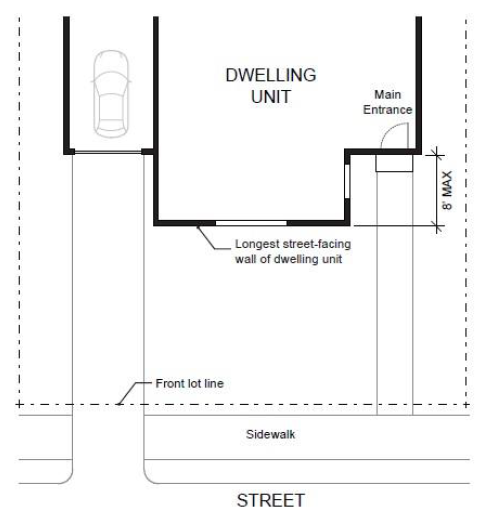
Figure for 8.120.C.2.b.i
Main Entrance Facing the Street
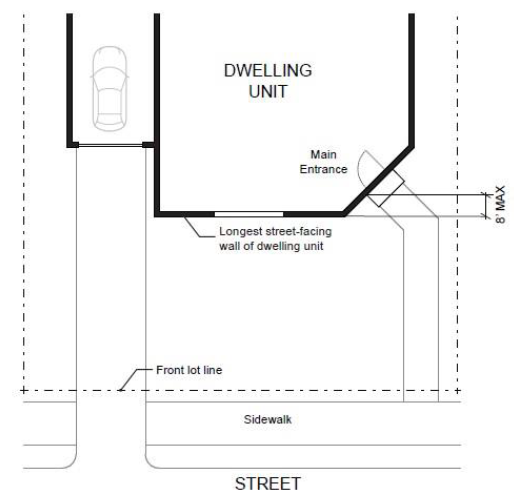
Figure for 8.120.C.4.b.iii
Main Entrance at 45 Degree Angle from the Street
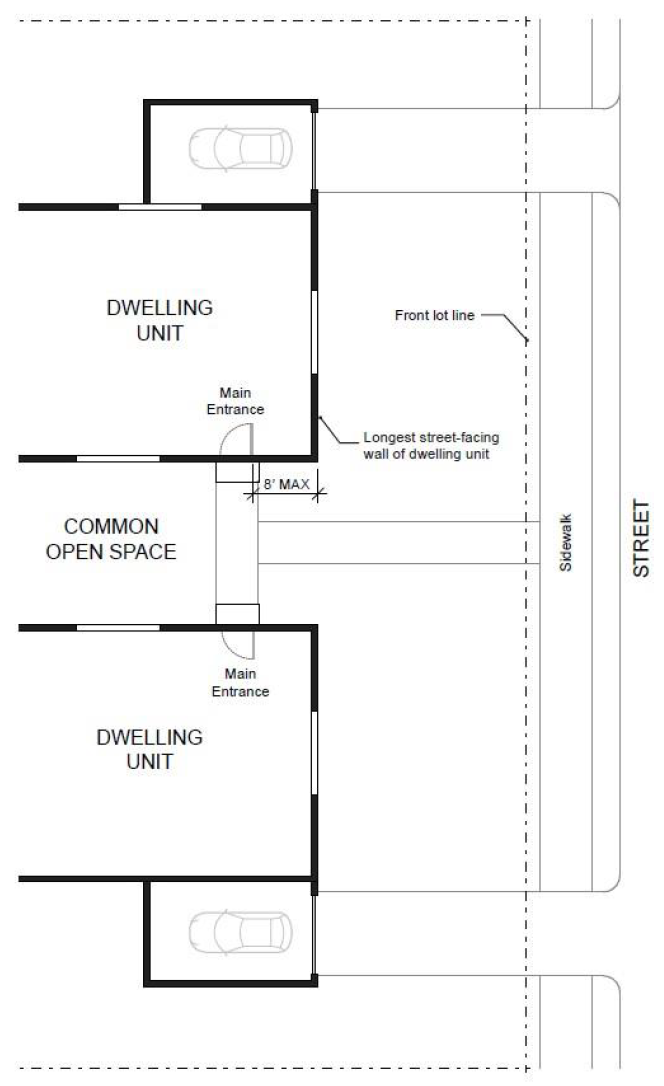
Figure for 8.120.C.2.b.iii
Main Entrance Facing the Common Open Space
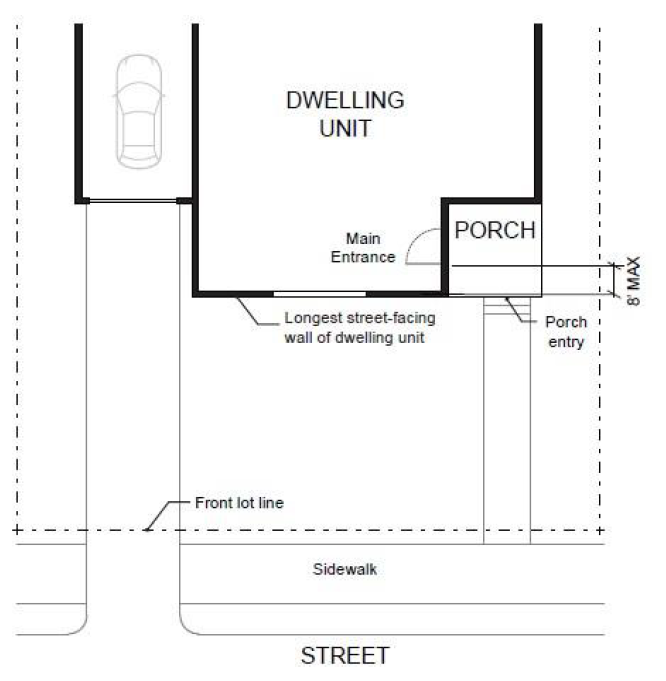
Figure for 8.120.C.4.b.iv
Main Entrance Opening onto a Porch
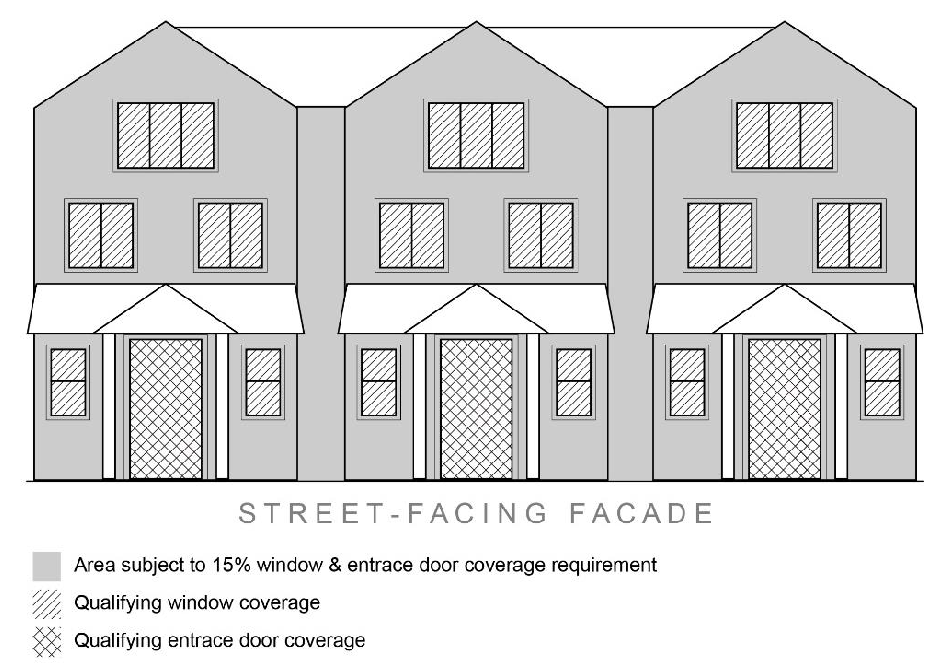
Figure for Figure 8.120.C.3
Window Coverage
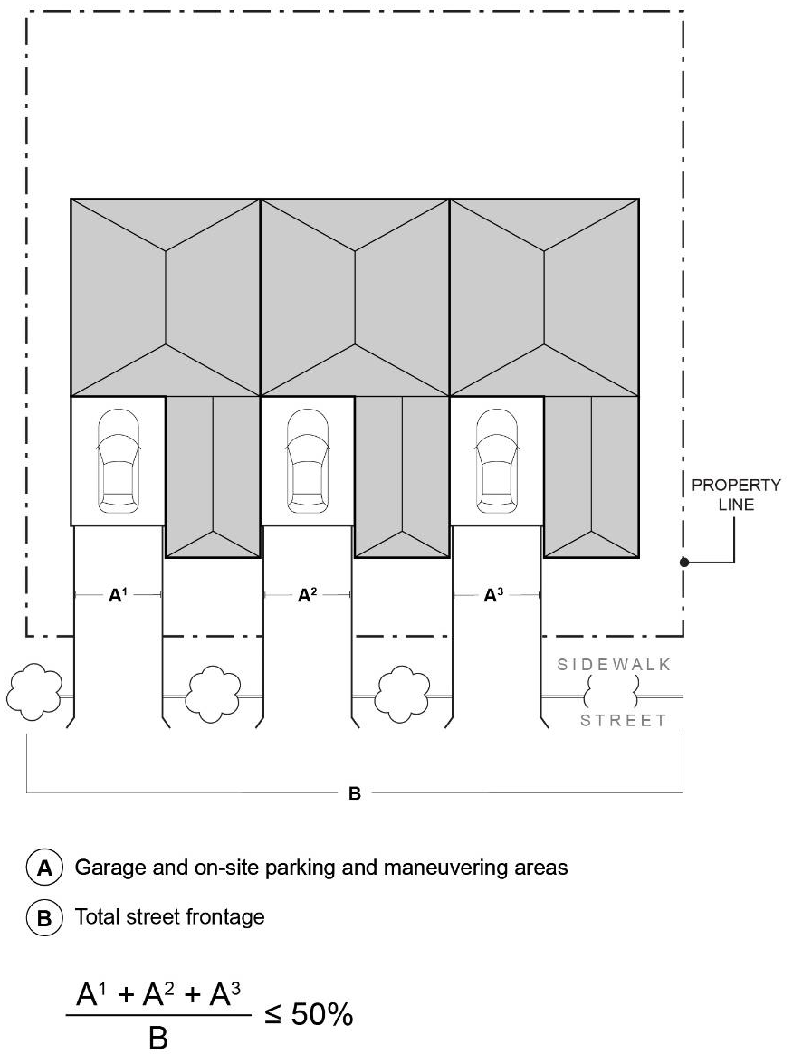
Figure for 8.120.C.4
Width of Garages and Parking Areas
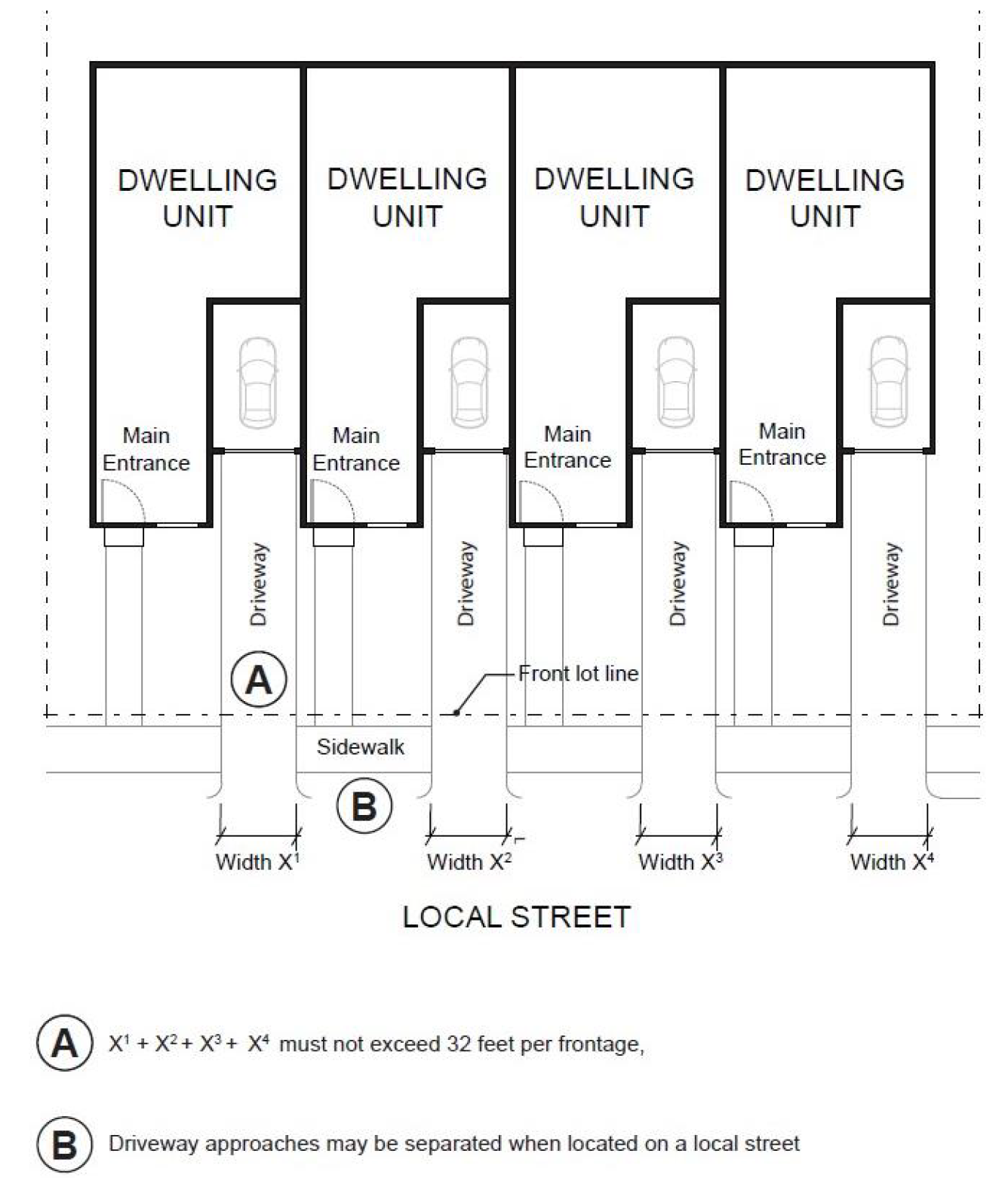
Figure for 8.120.C.5.b.
Driveway Approach Width and Separation on Local Street
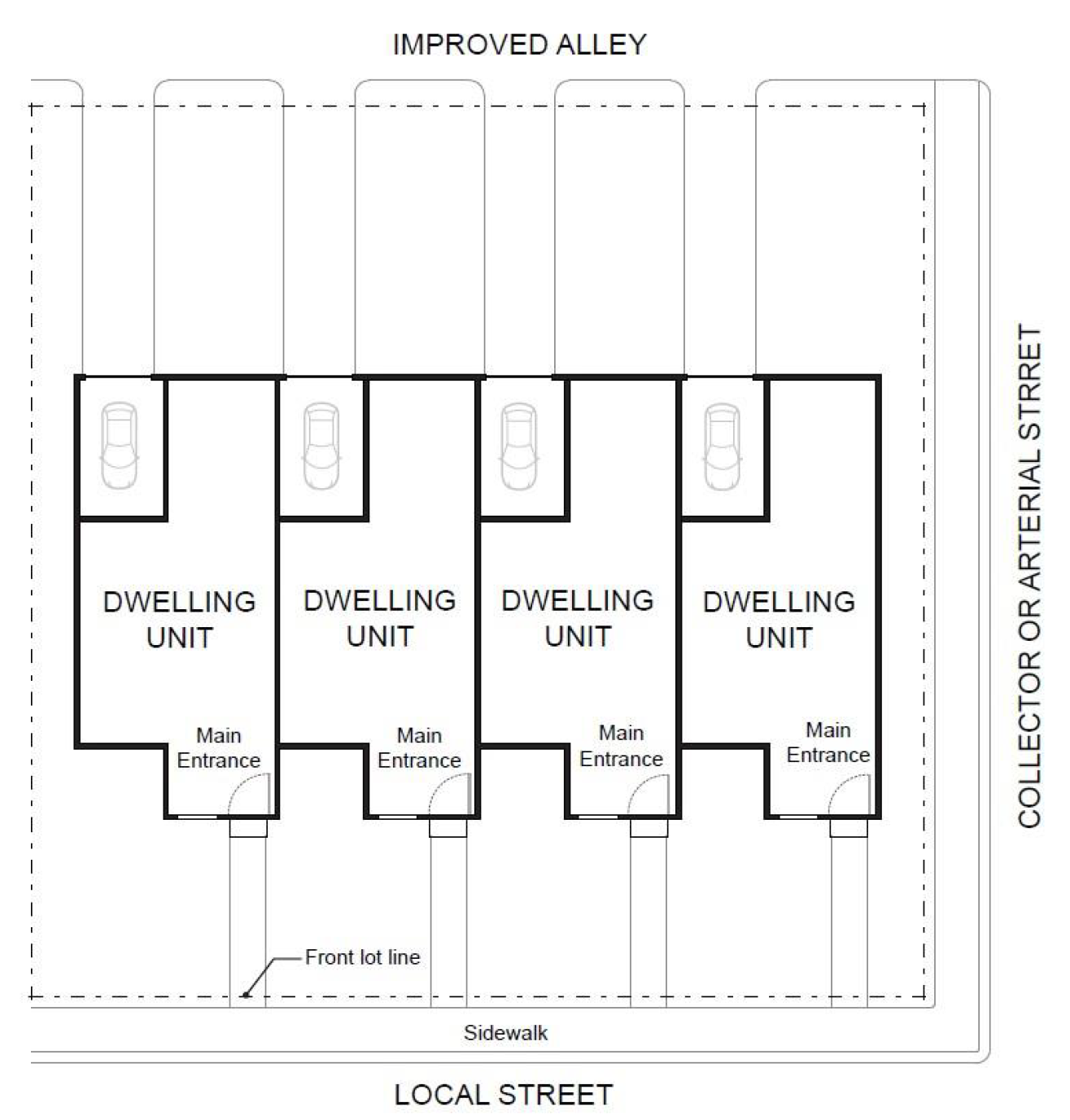
Figure for 8.120.C.5.c.i.
Alley Access
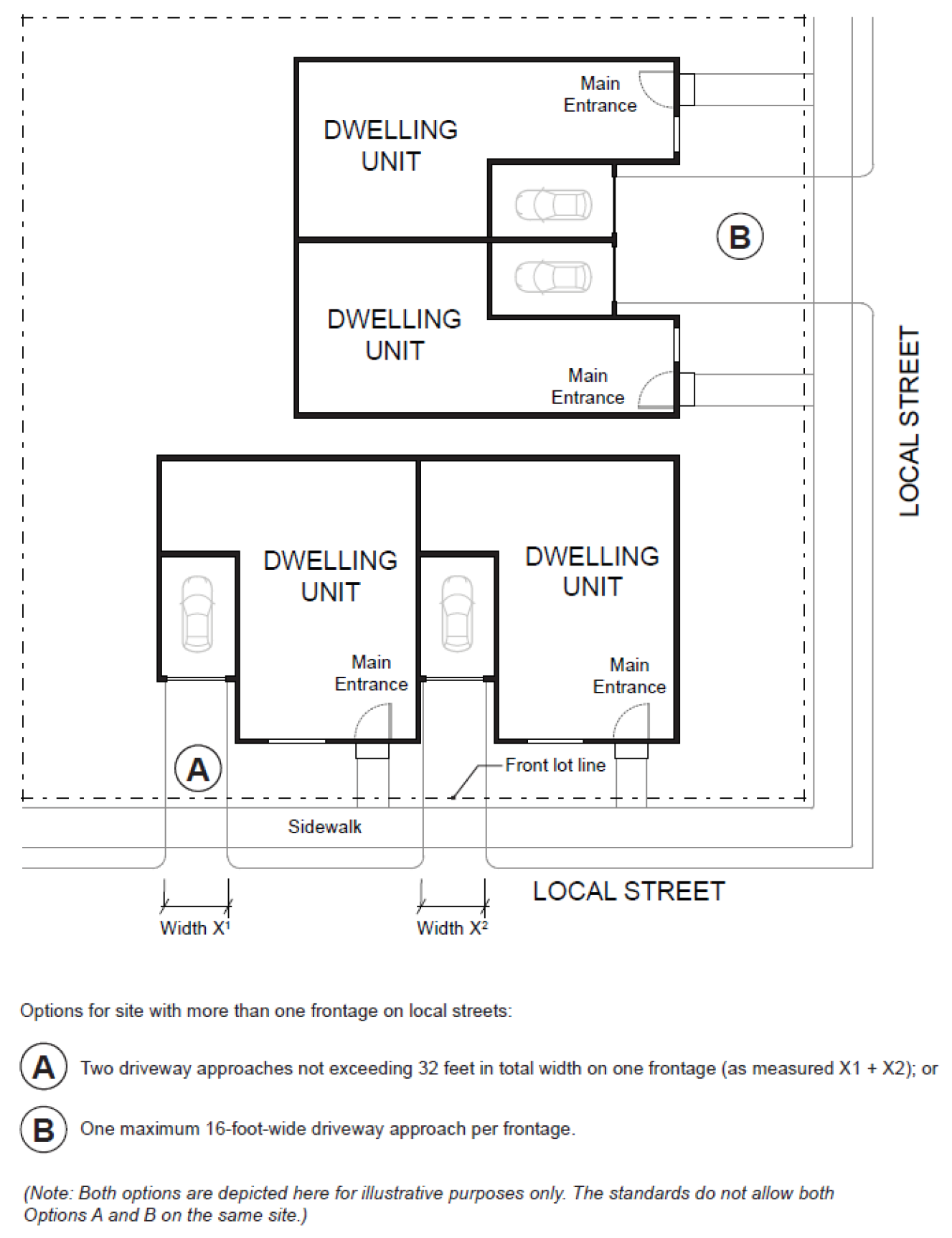
Figure for 8.120.C.5.c.i.
Driveway Approach Options for Multiple Local Street Frontages
(Ord. No. 894, § 5, 12-10-2024; Ord. No. 899, § 2(Att. A), 6-24-2025)
8.130 - Townhouse Projects and Dwellings.
A.
Approval Process.
1.
Townhouse dwellings are subject to the same approval process as that for detached single-family dwellings in the same zone.
2.
Townhouse projects.
a.
Townhouse projects are subject only to clear and objective standards, approval criteria, conditions, and procedures, unless discretionary standards and criteria have been adopted in accordance with ORS 197.307(5). Alternatively, an applicant may choose to submit an application for a townhouse project subject to discretionary standards and criteria adopted in accordance with ORS 197.307(6), if such a process is available.
b.
Creation of new lots or parcels as part of a townhouse project is subject to the applicable land division approval process in accordance with Chapter 7 of this Code.
c.
Applicants must demonstrate that sufficient infrastructure as defined in Section 1.020 of this Code is provided, or will be provided, upon submittal of a townhouse development application.
B.
Development Standards.
1.
Applicability.
a.
Townhouses shall meet the development standards contained within the dimensional standards table in Section 3.130.C of this Division.
b.
Townhouse projects shall meet:
i.
The development standards contained within the dimensional standards table in Section 3.130.C of this Code.
ii.
Any applicable general development standards contained within Division 8.000 of this Chapter.
iii.
Any applicable clear and objective platting standards contained within Chapter 7 of this Code or otherwise required by state law.
iv.
The additional development standards contained within this Section (8.130.B).
c.
The following standards are invalid and do not apply to townhouses or townhouse projects allowed by this Code, except as specified within this Section 8.130:
i.
Additional development standards of the applicable base zone related to the standards addressed under Subsections 2. and 3. of this Section B.
ii.
Development standards of the applicable base zone related to lot dimensions, lot coverage, landscape or open space area, or the siting or design of dwellings.
iii.
The jurisdiction's other development standards that apply only to townhouses and that conflict with provisions of this Code.
2.
Off-Street Parking.
a.
Garages and carports are not required for residential development
b.
Required Off-Street Parking. The minimum number of required off-street parking spaces for a townhouse project is one (1) space per unit. Spaces may be provided on individual lots or in a shared parking area on a common tract. A credit for on-street parking shall be granted for some or all of the required off-street parking as provided in Subsection b.
3.
On-Street Parking.
a.
On-Street Credit. If on-street parking spaces meet all the standards in Subsections i. through iv. below, they shall be counted toward the minimum off-street parking requirement.
i.
The space must be abutting the subject site;
ii.
The space must be in a location where on-street parking is allowed by the jurisdiction;
iii.
The space must be a minimum of twenty-two (22) feet long; and
iv.
The space must not obstruct a required sight distance area.
4.
Areas Owned in Common. Common areas must be maintained by a homeowners association or other legal entity. A homeowners association may also be responsible for exterior building maintenance. A copy of any applicable covenants, restrictions and conditions must be recorded and provided to the jurisdiction prior to issuance of a building permit.
C.
Design Standards. New townhouses shall meet the following design standards. Mandates for construction of a garage or carport and any other design standards are invalid.
1.
Entry Orientation. The main entrance of each townhouse must:
a.
Be within eight (8) feet of the longest street-facing wall of the dwelling unit, if the lot has public street frontage; and
b.
Either:
i.
Face the street (see Figure 8.120.C.2.b.i in the preceding Section);
ii.
Be at an angle of up to forty-five (45) degrees from the street (see Figure 8.120.C.4.b.iii in the preceding Section);
iii.
Face a common open space or private access or driveway that is abutted by dwellings on at least two (2) sides; or
iv.
Open onto a porch (see Figure 8.120.C.4.b.iv in the preceding Section). The porch must:
(a)
Be at least twenty-five (25) square feet in area; and
(b)
Have at least one (1) entrance facing the street or have a roof.
2.
Unit Definition. Each townhouse must include at least two (2) of the following on at least one (1) street-facing façade (see Figure 8.130.C.2 at the end of this Section):
a.
A roof dormer a minimum of four (4) feet in width.
b.
A balcony a minimum of two (2) feet in depth and four (4) feet in width and accessible from an interior room, which may encroach into a required setback area.
c.
A bay window that extends from the facade a minimum of two (2) feet, which may encroach into a required setback area.
d.
An offset of the facade of a minimum of two (2) feet in depth, either from the neighboring townhouse or within the façade of a single townhouse.
e.
An entryway that is recessed a minimum of three (3) feet.
f.
A covered entryway with a minimum depth of four (4) feet.
g.
A porch meeting the standards contained in Subsection 8.130.C.1.b.iv of this Code.
3.
Windows. A minimum of fifteen percent (15%) of the area of all street-facing facades on each individual unit must include windows or entrance doors. Half (½) of the window area in the door of an attached garage may count toward meeting this standard. (see Figure 8.120.C.3 in the preceding Section).
4.
Driveway Access and Parking. Townhouses with frontage on a public street shall meet the following standards:
a.
Garages on the front façade of a townhouse, off-street parking areas in the front yard, and driveways in front of a townhouse are allowed if they meet the following standards (see Figure 8.130.C.4.b at the end of this Section):
i.
Each townhouse lot has a street frontage of at least fifteen (15) feet on a local street.
ii.
A maximum of one (1) driveway approach is allowed for every townhouse. Driveway approaches and/or driveways may be shared.
iii.
Outdoor on-site parking and maneuvering areas do not exceed twelve (12) feet wide on any lot.
iv.
The garage width does not exceed twelve (12) feet, as measured from the inside of the garage door frame.
b.
The following standards apply to driveways and parking areas for townhouse projects that do not meet all of the standards in Subsection (a).
i.
Off-street parking areas shall be accessed on the back façade or located in the rear yard. No off-street parking shall be allowed in the front yard or side yard of a townhouse.
ii.
A townhouse project that includes a corner lot shall take access from a single driveway approach on the side of the corner lot (see Figure 8.130.C.4.b.ii at the end of this Section).
iii.
Townhouse projects that do not include a corner lot shall consolidate access for all lots into a single driveway. The driveway and approach are not allowed in the area directly between the front façade and front lot line of any of the townhouses (see Figure 8.130.C.4.b.iii at the end of this Section).
iv.
A townhouse project that includes consolidated access or shared driveways shall grant access easements to allow normal vehicular access and emergency access.
c.
Townhouse projects in which all units take exclusive access from a rear alley are exempt from compliance with Subsection b.
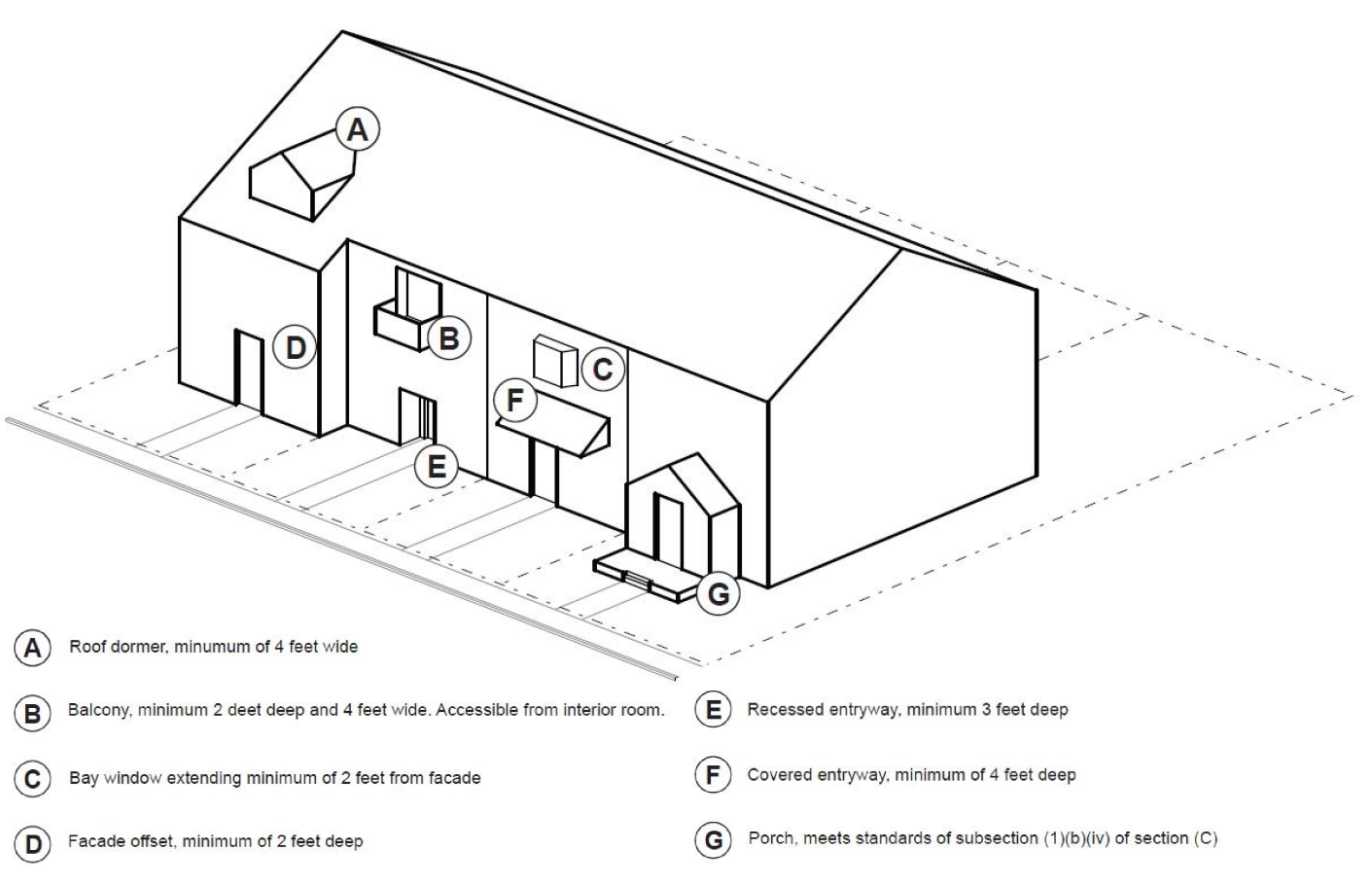
Figure for 8.130.C.2
Townhouse Unit Definition Features
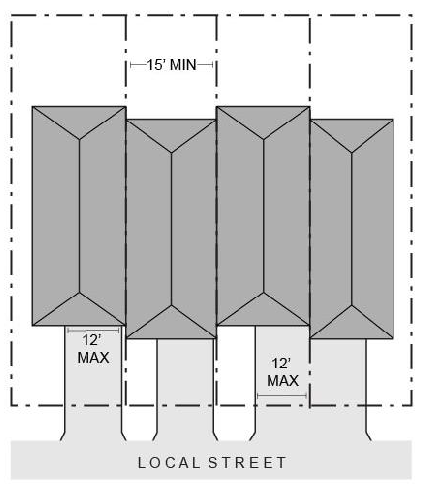
Figure for 8.130.C.4.a
Townhouses with Parking in Front Yard
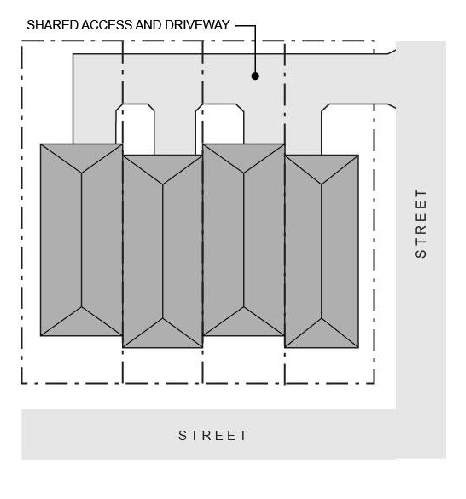
Figure for 8.130.C.4.b.ii
Townhouses on Corner Lot with Shared Access
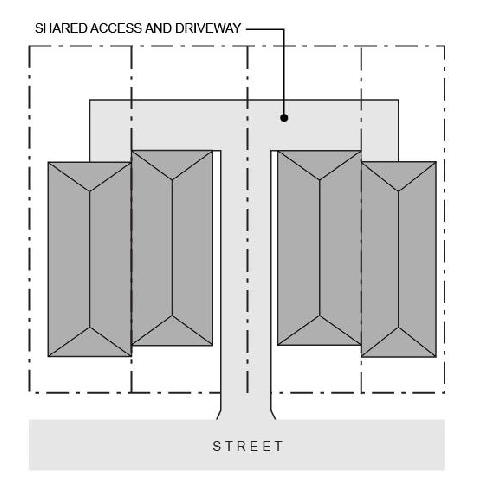
Figure for 8.130.C.4.b.iii
Townhouses with Consolidated Access
(Ord. No. 894, § 5, 12-10-2024; Ord. No. 899, § 2(Att. A), 6-24-2025)
8.140 - Cottage Cluster Projects and Dwellings.
A.
Approval Process.
1.
Cottage cluster projects are subject to the same approval process as that for detached single-family dwellings in the same zone and are subject only to clear and objective standards, approval criteria, conditions, and procedures, unless discretionary standards and criteria have been adopted in accordance with ORS 197.307(5). Alternatively, an applicant may choose to submit an application for a cottage cluster project subject to discretionary standards and criteria adopted in accordance with ORS 197.307(6), if such a process is available.
2.
Applicants must demonstrate that Sufficient Infrastructure as defined in Section 1.020 of this Code is provided, or will be provided, upon submittal of a cottage cluster development application.
B.
Development Standards.
1.
Applicability. Cottage clusters shall meet the development standards contained herein and within the dimensional standards table in Section 3.130.D of this Code.
2.
Average Unit Size. The maximum average floor area for a cottage cluster is one thousand four hundred (1,400) square feet per dwelling unit. Community buildings shall be included in the average floor area calculation for a cottage cluster.
3.
Off-Street Parking.
a.
Required Off-Street Parking. The minimum number of required off-street parking spaces for a cottage cluster project is zero (0) spaces per unit with a floor area of less than one thousand (1,000) square feet and one (1) space per unit with a floor area of one thousand (1,000) square feet or more. Spaces may be provided for individual cottages or in shared parking clusters. A credit for on-street parking shall be granted for some or all of the required off-street parking as provided in Subsection b.
b.
On-Street Credit. If on-street parking spaces meet all the standards in Subsections i. through iv. below, they shall be counted toward the minimum off-street parking requirement.
i.
The space must be abutting the subject site;
ii.
The space must be in a location where on-street parking is allowed by the jurisdiction;
iii.
The space must be a minimum of twenty-two (22) feet long; and
iv.
The space must not obstruct a required sight distance area.
C.
Design Standards. Cottage clusters shall meet the following design standards. No other design standards shall apply to cottage clusters unless noted in this Section. Mandates for construction of a garage or carport and any other design standards are invalid, except as specified in this Section.
1.
Cottage Orientation. Cottages must be clustered around a common courtyard, meaning they abut the associated common courtyard or are directly connected to it by a pedestrian path, and must meet the following standards (see Figure 8.140.C.1 at the end of this Section):
a.
Each cottage within a cluster must either abut the common courtyard or must be directly connected to it by a pedestrian path.
b.
A minimum of fifty percent (50%) of cottages within a cluster must be oriented to the common courtyard and must:
i.
Have a main entrance facing the common courtyard;
ii.
Be within ten (10) feet from the common courtyard, measured from the façade of the cottage to the nearest edge of the common courtyard; and
iii.
Be connected to the common courtyard by a pedestrian path.
c.
Cottages within twenty (20) feet of a street property line may have their entrances facing the street.
d.
Cottages not facing the common courtyard or the street must have their main entrances facing a pedestrian path that is directly connected to the common courtyard.
2.
Common Courtyard Design Standards. Each cottage cluster must share a common courtyard in order to provide a sense of openness and community of residents. Common courtyards must meet the following standards (see Figure 8.140.C.1 at the end of this Section):
a.
The common courtyard must be a single, contiguous piece.
b.
Cottages must abut the common courtyard on at least two (2) sides of the courtyard.
c.
The common courtyard must contain a minimum of one hundred fifty (150) square feet per cottage within the associated cluster (as defined in Subsection 1. of this Section C.).
d.
The common courtyard must be a minimum of fifteen (15) feet wide at its narrowest dimension.
e.
The common courtyard shall be developed with a mix of landscaping, lawn area, pedestrian paths, and/or paved courtyard area, and may also include recreational amenities. Impervious elements of the common courtyard shall not exceed seventy-five percent (75%) of the total common courtyard area.
f.
Pedestrian paths must be included in a common courtyard. Paths that are contiguous to a courtyard shall count toward the courtyard's minimum dimension and area. Parking areas, required setbacks, and driveways do not qualify as part of a common courtyard.
3.
Community Buildings. Cottage cluster projects may include community buildings for the shared use of residents that provide space for accessory uses such as community meeting rooms, guest housing, exercise rooms, day care, or community eating areas. Community buildings must meet the following standards:
a.
Each cottage cluster is permitted one (1) community building, which shall count towards the maximum average floor area, pursuant to Subsection B.5.
b.
A community building that meets the development code's definition of a dwelling unit must meet the maximum nine hundred (900) square foot footprint limitation that applies to cottages, unless a covenant is recorded against the property stating that the structure is not a legal dwelling unit and will not be used as a primary dwelling.
4.
Pedestrian Access.
a.
An accessible pedestrian path must be provided that connects the main entrance of each cottage to the following:
i.
The common courtyard;
ii.
Shared parking areas;
iii.
Community buildings; and
iv.
Sidewalks in public rights-of-way abutting the site or rights-of-way if there are no sidewalks.
b.
The pedestrian path must be hard-surfaced and a minimum of four (4) feet wide.
5.
Windows. Cottages within twenty (20) feet of a street property line must meet any window coverage requirement that applies to detached single-family dwellings in the same zone.
6.
Parking Design (see Figure 8.140.C.6 at the end of this Section).
a.
Clustered Parking. Off-street parking may be arranged in clusters, subject to the following standards:
i.
Cottage cluster projects with fewer than sixteen (16) cottages are permitted parking clusters of not more than five (5) contiguous spaces.
ii.
Cottage cluster projects with sixteen (16) cottages or more are permitted parking clusters of not more than eight (8) contiguous spaces.
iii.
Parking clusters must be separated from other spaces by at least four (4) feet of landscaping.
iv.
Clustered parking areas may be covered.
b.
Parking Location and Access.
i.
Off-street parking spaces and vehicle maneuvering areas shall not be located:
(a)
Within twenty (20) feet from any street property line, except alley property lines;
(b)
Between a street property line and the front façade of cottages located closest to the street property line. This standard does not apply to alleys.
ii.
Off-street parking spaces shall not be located within ten (10) feet of any other property line, except alley property lines. Driveways and drive aisles are permitted within ten (10) feet of other property lines.
c.
Screening. Landscaping, fencing, or walls at least three (3) feet tall shall separate clustered parking areas and parking structures from common courtyards and public streets.
d.
Garages and Carports.
i.
Garages and carports are not required for residential developments.
ii.
Garages and carports (whether shared or individual) must not abut common courtyards.
iii.
Individual attached garages up to two hundred (200) square feet shall be exempted from the calculation of maximum building footprint for cottages.
iv.
Individual detached garages must not exceed four hundred (400) square feet in floor area.
v.
Garage doors for attached and detached individual garages must not exceed twenty (20) feet in width.
7.
Accessory Structures. Accessory structures must not exceed four hundred (400) square feet in floor area.
8.
Existing Structures. On a lot or parcel to be used for a cottage cluster project, an existing detached single-family dwelling on the same lot at the time of proposed development of the cottage cluster may remain within the cottage cluster project area under the following conditions:
a.
The existing dwelling may be nonconforming with respect to the requirements of this Code.
b.
The existing dwelling may be expanded up to the maximum height in Subsection B.4. or the maximum building footprint in Chapter 1, Subsection B.1.; however, existing dwellings that exceed the maximum height and/or footprint of this Code may not be expanded.
c.
The floor area of the existing dwelling shall not count towards the maximum average floor area of a cottage cluster.
d.
The existing dwelling shall be excluded from the calculation of orientation toward the common courtyard, per Subsection 1.a. of this Subsection C.
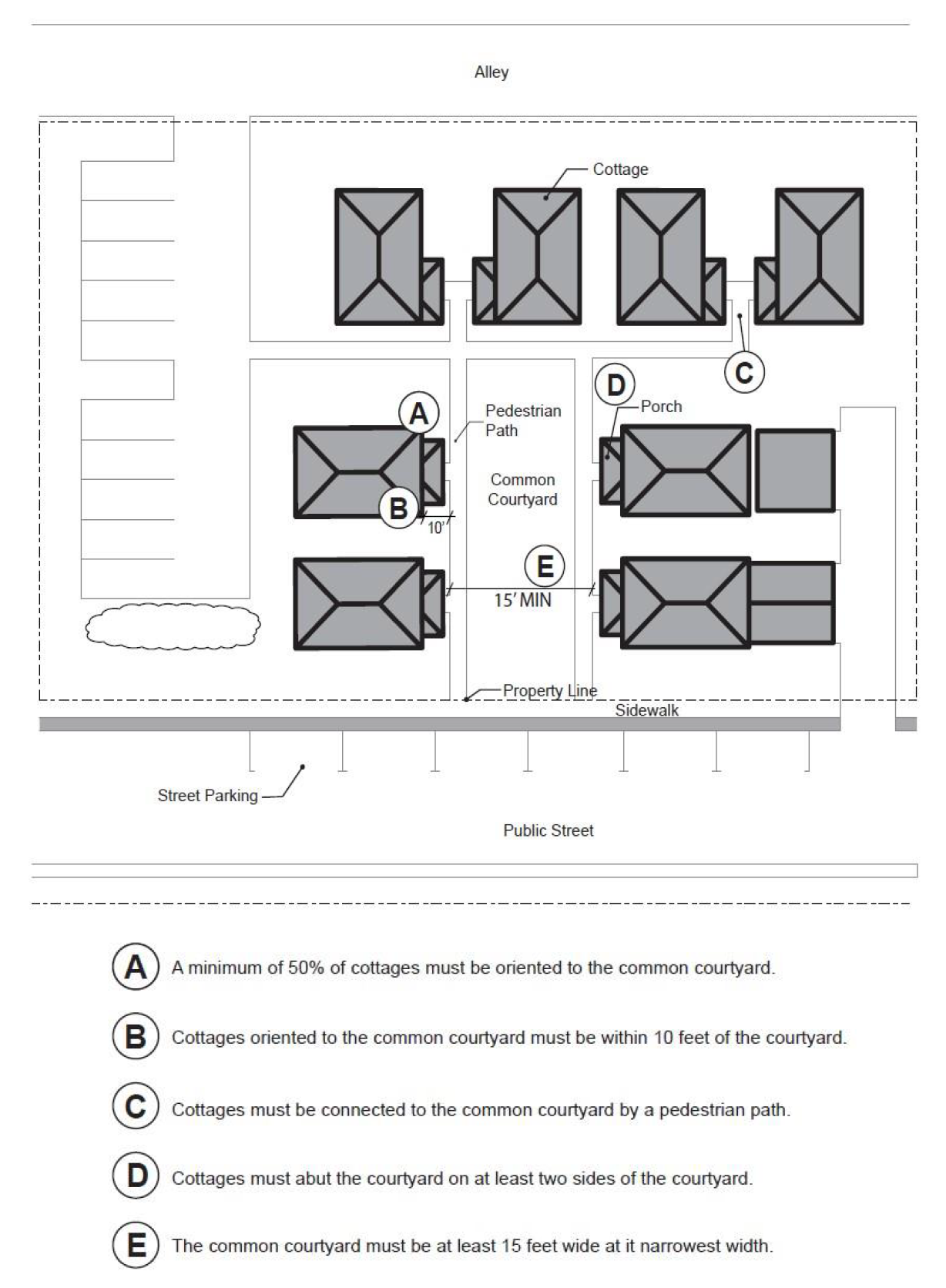
Figure 8.140.C.1
Cottage Cluster Orientation and Common Courtyard Standards
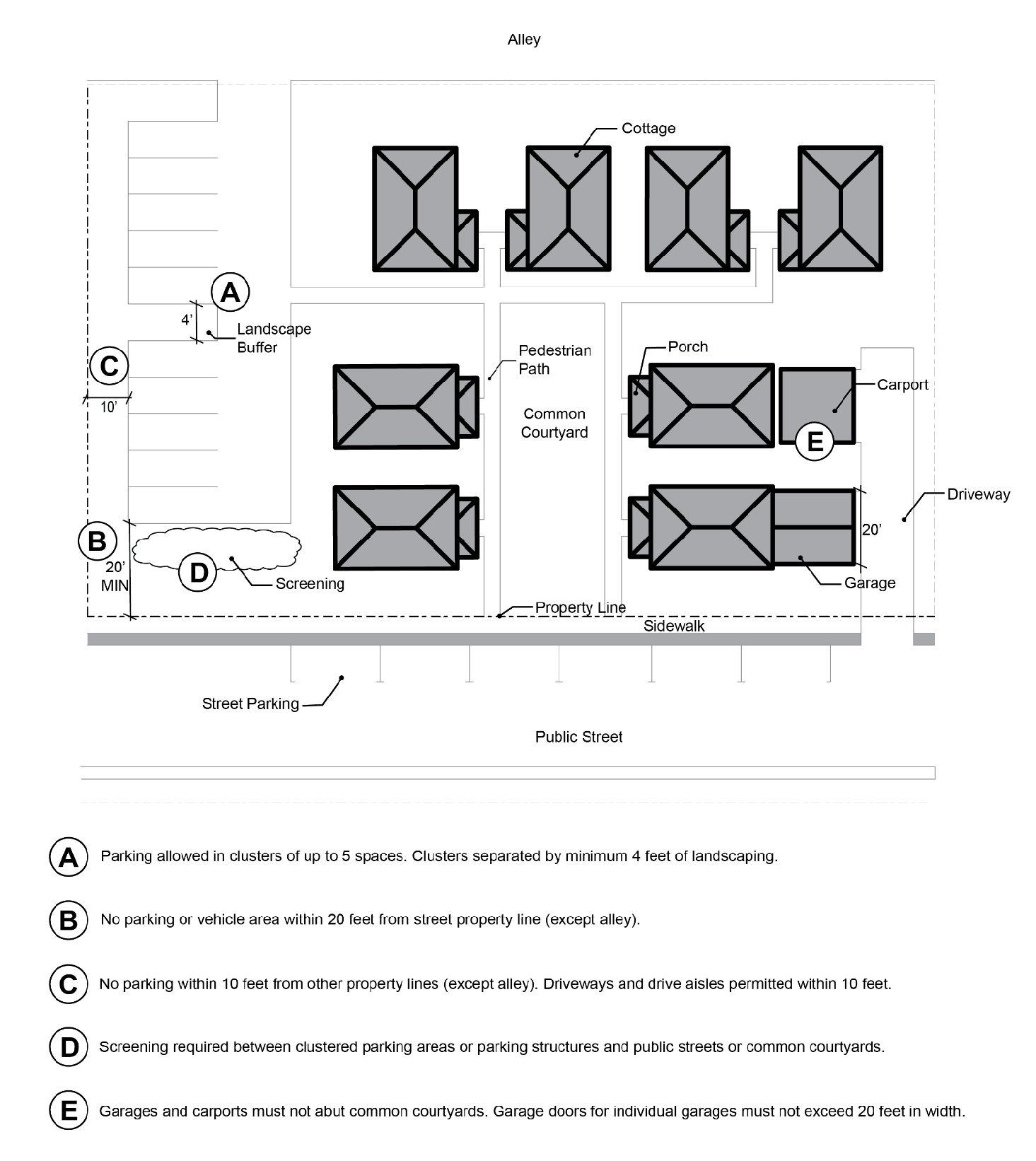
Figure 8.140.C.6.
Cottage Cluster Parking Design Standards
(Ord. No. 894, § 5, 12-10-2024; Ord. No. 899, § 2(Att. A), 6-24-2025)
8.150 - Multi-Family Residential Projects and Dwellings.
A.
Approval Process. Multi-family residential projects and dwellings are subject to a Site Development Review land use application in accordance with Section 6.900 of this Code.
B.
Design Standards.
1.
Building Entrances. The primary entrance to buildings that do not have residential units above or below other residential units shall face toward a public or private street, unless the lot configuration, site characteristics, onsite circulation, or other conditions make it impractical to face a building's primary entrance to the street. Exception: A primary entrance is not required to face a street designated as an arterial.
2.
Building Separation. Multiple residential buildings on a single lot shall be separated at least fifteen (15) feet from one another.
3.
Pedestrian Access and Circulation.
a.
Private streets or driveways greater than twenty (20) feet in length and that serve more than one (1) dwelling unit shall have sidewalks on at least one (1) side that connect to the nearest public street.
b.
Each primary entrance to a residential building shall be connected to a sidewalk onsite that connects to either a public street, private street, or driveway.
c.
Onsite pedestrian circulation shall be continuous and connect streets abutting the site, ground level entrances, common buildings such as laundry and recreation facilities, parking areas, shared open space and play areas, abutting transit stops, and any pedestrian amenities such as plazas, resting areas, and viewpoints. There shall be at least one (1) pedestrian connection to an abutting street frontage for each two hundred (200) linear feet of street frontage.
d.
Vehicle/pedestrian conflicts shall be minimized by providing pedestrian routes that are separated from parking lots, including onsite sidewalks that connect to garbage enclosures or recycling areas and mailboxes.
4.
Architectural Elements and Building Facades. Residential units shall be designed with vertical and horizontal offsets to break up rooflines, define private outdoor areas, allow greater views, and admit light and air to unit interiors. Large, blank walls shall be avoided. Windows and projecting walls shall be used to break up larger walls in order to establish visual interest.
a.
No wall of a residential building shall exceed a length of fifty (50) feet without a foundation offset of at least four (4) feet for a distance of at least sixteen (16) feet.
b.
The wall of a building that faces a public street shall incorporate architectural features including, but not limited to, at least three (3) of the following:
i.
Porches.
ii.
Balconies.
iii.
Dormer windows.
iv.
Recesses/alcoves.
v.
Unique entry areas, such as porticos or atriums.
c.
The same level of architectural design and quality of materials shall be applied to all sides of the building.
d.
The following window detail shall be incorporated into the building design:
i.
Windows shall account for at least fifteen percent (15%) of any rear or front building elevation no matter what the building's orientation on the lot is.
ii.
Windows shall account for at least ten percent (10%) of any side building elevation no matter what the building's orientation is.
iii.
All windows shall have outer casings or frames.
e.
Garages, carports, and accessory structures shall maintain the same level of design, aesthetic quality, and architectural compatibility as the residential structure(s).
f.
Roofline offsets shall be provided at intervals of forty (40) feet or less to create variety in the massing of structures and relieve the effect of a single, long roof. Roofline offsets shall be a minimum four (4) foot variation either vertically from the gutter line, or horizontally.
g.
The rooflines of attached dwellings shall be multi-gabled or have varied parapets over every unit's main entrance.
h.
Rooflines, porches, and doors shall have trim.
5.
Off-Street Parking, Garages, and Carports. In addition to the standards of Chapter 9, Off-Street Parking and Loading, off-street parking for attached dwellings on a single lot shall include these design standards:
a.
Garages and carports are not required for residential developments.
b.
Parking lots may not be located between a multiple-family structure and the right-of-way the structure fronts on.
c.
If there is no parking lot or alley access to attached dwellings, and motor vehicle access is from the street, parking must be either in an attached garage that is set back a minimum of five (5) feet behind the front door of the residential structure, in a detached accessory structure located at least fifty (50) feet from the front property line, or in a parking area at the side or rear of the site, or shall comply with the following standards:
i.
The garage door width of the dwelling is fifty percent (50%) or less of the width of the street facing elevation, and does not extend beyond the front door; or
ii.
The garage door is behind or even with the front door and the dwelling has a roofed front porch, which is at least one-third (1/3) as wide as the front elevation and at least five (5) feet deep. The porch may encroach within the required front yard setback a maximum of five (5) feet without a variance provided the foundation for the dwelling complies with the minimum front setback standard; and
iii.
The street facing wall of the dwelling contains at least one (1) window on the ground floor that allows visibility of the street.
d.
Side and rear yard setbacks for parking lots and/or garages shall be the same as the minimum building setbacks of the underlying zoning district or the same as the minimum building setback of any adjacent residential zoning district, whichever is more restrictive. Side and rear yard setbacks based on building height shall not be applied to parking lots or the access driveways.
6.
Outdoor Private Space. Outdoor private space is required for each residential dwelling unit.
a.
Each ground level dwelling unit shall have an attached accessible outdoor private space of not less than sixty (60) square feet in area. Individual outdoor areas for ground level units must be visually screened from each other by walls, fences, or vegetation screening that is at least six (6) feet high and totally sight-obscuring.
b.
Each upper level unit shall have an attached outdoor private space, such as a balcony, of not less than sixty (60) square feet in area. The area shall be enclosed, screened, or otherwise designed to provide privacy from adjacent units by walls, building offsets, or similar sight-obscuring screening.
7.
Recreation Areas.
a.
Recreational facilities or open space areas are required for attached dwelling developments that contain six (6) or more dwelling units on one (1) lot. Such recreational facilities and open space areas must be located on the development site or on a lot adjacent to the site. Common recreation areas, whether indoor, outdoor, or both, shall be provided at the rate of at least two hundred (200) square feet per dwelling unit. No more than fifty percent (50%) of the required recreation area may be in passive open space. Recreation facilities may include children's play structures and play equipment and shall be located outside of bioswales, detention ponds, steep slopes, or a vegetation corridor as defined in this Code. More than one (1) recreation area may be developed on the site. Any play structure exceeding ten (10) feet in height must comply with the underlying zoning district setbacks.
b.
Recreation facilities or open space areas are not required for development within the area between Historic Columbia River Highway and 2nd Street extended west to its intersection with 257th Drive from 257th Avenue to the SE Sandy Street right-of-way.
(Ord. No. 894, § 5, 12-10-2024; Ord. No. 899, § 2(Att. A), 6-24-2025)
8.160 - Manufactured Home Parks.
A.
Purpose. A single-family residential manufactured home park is intended for manufactured homes on separate spaces within a manufactured home park. The purpose of these provisions is to extend the opportunity for low and moderately priced single-family homes, to ensure a high-quality living environment within manufactured home parks, to ensure that manufactured homes in manufactured home parks are safe and durable, and to protect property values within and adjacent to manufactured home parks.
B.
Establishment of a Manufactured Home Park. A manufactured home park may be established as a permitted use in the MDR residential districts.
C.
Locational Criteria. Access to manufactured home parks shall be from abutting public streets. No manufactured home space shall have direct vehicular access to a street bordering the park.
D.
Density, Minimum Site Size, and Dimensions of Park. All manufactured home parks shall meet the following minimum requirements:
1.
The minimum size of a manufactured home park shall be one (1) acre.
2.
The number of permitted units allowed in a manufactured home park shall not exceed the density permitted in the underlying zone.
3.
Minimum park street frontage—One hundred (100) feet.
4.
Minimum park depth—One hundred fifty (150) feet.
E.
Standards and Criteria. Manufactured home parks must comply with the following standards and criteria:
1.
Perimeter Setback and Buffer Area.
a.
A perimeter setback and buffer area of at least twenty (20) feet shall be provided. This area shall remain unoccupied by any structure, street, parking, or driveway area, except that private street entrances may cross the perimeter buffer where necessary to provide access to the park.
b.
Within that portion of the perimeter setback and buffer area which abuts a public street right-of-way, screening shall be achieved through one (1) of the following:
i.
A three (3) foot high earthen berm with seventy-five percent (75%) of the area planted with evergreen and deciduous trees, shrubs, and groundcover arranged so as to achieve an effective sight and sound buffer of at least six (6) feet in height to screen the park at the time of completion.
ii.
A six (6) foot high decorative masonry wall, wooden fence, and a combination of evergreen and deciduous trees, shrubs, and groundcover arranged so as to achieve an effective sight and sound buffer to screen the park at time of completion.
c.
Within that portion of the perimeter setback and buffer area which abuts adjacent parcels, a sight-obscuring wooden fence or a decorative masonry wall at least six (6) feet in height shall be installed to screen the park from adjacent properties.
2.
Dimensional Standards—Per Space.
a.
Front yard—Ten (10) feet.
b.
Rear yard—Twenty (20) feet, if not abutting a perimeter strip.
c.
Side yard—Seven and one-half (7 ½) feet.
d.
Minimum distance between dwellings—Fifteen (15) feet.
e.
Lot coverage not to exceed seventy-five percent (75%).
3.
Minimum Dwelling Requirements.
a.
All manufactured homes shall have a gross floor area of at least six hundred (600) square feet.
b.
Any manufactured home established under this Code shall have been manufactured after June 15, 1976, and bear the Oregon Department of Commerce "Insignia of Compliance" indicating conformance with construction standards promulgated by the U.S. Department of Housing and Urban Development.
c.
Any manufactured home built before June 15, 1976, may be permitted if the owner obtains certification from the Oregon Department of Commerce that the home conforms with the U.S. Department of Housing and Urban Development construction standards.
4.
Landscaping/Open Space/Recreation Areas. All required landscaped areas shall comply with the general landscaping and vision clearance standards of this Code and the City's Development Standards.
a.
A minimum of twenty percent (20%) of the manufactured home park area shall be reserved for open space.
b.
Such open space may include the perimeter setback and buffer area, and improved outdoor recreation facilities.
c.
Ten percent (10%) of the manufactured home park area shall be reserved and developed for common recreation space or structure.
d.
Streets, access drives, parking lots, and unoccupied portions of manufactured home spaces shall not be considered open space.
5.
Public Facilities and Services.
a.
All developments are subject to the applicable requirements of the Development Standards and Public Facilities Standards.
b.
If a manufactured home space or permanent structure in the park is more than five hundred (500) feet from a public fire hydrant, the park shall have water supply mains designed to serve fire hydrants within five hundred (500) feet of such space or structure. Each fire hydrant shall be located along a vehicular way.
6.
Mail Delivery. Each manufactured home space shall be provided with a mailbox located on each manufactured home space or in a central mail station designed as an integral part of the manufactured home park, or in a stand containing clustered (four (4) or more) mailboxes located near the dwellings being served.
7.
Accessory Structures. Each manufactured home space shall be provided with an accessory storage building with one hundred (100) square feet of enclosed floor area. All such storage buildings within the park shall be of uniform design and constructed of the same materials. There shall be no outdoor storage of furniture, tools, equipment, building materials, or supplies belonging to the occupants or management of the park.
8.
Sidewalks/Pedestrian Pathways. A system of sidewalks or pathways shall be installed linking all manufactured home spaces, recreation areas, parking lots, and common buildings. This system may consist of conventional sidewalks paralleling the street, or an independent network of pathways. The system shall be linked with the sidewalks along perimeter streets bordering the manufactured home park. Pedestrian pathways and sidewalks shall be paved with a durable all-weather surface no less than four (4) feet in width.
9.
Internal Circulation System/Parking. Internal roads and driveways shall be designed to provide safe and convenient access to manufactured home spaces and other facilities in the manufactured home park for service and emergency vehicles, but shall not be designed to encourage outside traffic to traverse the development.
a.
All interior roadways shall be designed and constructed in accordance with the standards established by OAR 814-28-060(8) for manufactured home park roads and streets.
b.
Pavement Width. All interior streets shall have a minimum pavement width of twenty-four (24) feet, exclusive of any pedestrian circulation systems.
c.
Curbs shall be installed on both sides of interior streets if built with a raised crown. If streets are built with an inverted crown, curbs are not required.
d.
Dead-end (cul-de-sac) streets shall serve no more than eighteen (18) manufactured home sites and have a minimum turning radius of forty (40) feet.
e.
On-street parking shall be prohibited. Off-street parking and loading facilities shall be provided in accordance with the requirements of Chapter 9 of this Code.
f.
Required resident off-street parking spaces may be provided either on the manufactured home space or in an off-street parking bay within one hundred (100) feet from the dwelling served.
g.
Guest parking shall be provided in off-street parking bays in close proximity to the dwelling units served.
h.
Off-street parking shall be provided for all non-residential uses within the manufactured home park at the rate provided for in the City's off-street parking standards. These parking spaces shall be provided within one hundred (100) feet of the non-residential use.
i.
Recreational vehicles such as camping trailers, boats, campers, motor homes, and other such vehicles shall be parked or stored within an area specifically designated for such use and enclosed by a six (6) foot high sight-obscuring wooden fence or decorative masonry wall with a gate.
j.
Off-street loading bays and maneuvering areas shall be provided for all uses receiving delivery vehicles on a regular basis in conformance with City standards.
10.
Signs. Park identification signs shall comply with the City sign regulations. In addition, the following standards apply:
a.
Each manufactured home park shall provide one (1) sign immediately inside the main entrance identifying the location of all interior streets and drives, visitor parking areas, storage areas, all manufactured home sites by number, and all other buildings and structures within the park, provided that the face of the sign does not exceed City standards, and is either backlighted or indirectly lighted.
b.
Each manufactured home site shall have a sign not larger than one (1) square foot identifying the number of each manufactured home site.
c.
Traffic control signs shall be installed as required by the City or other governmental agency.
d.
Lighting, utility system, decks, play areas, park sanitation, and maintenance. Requirements not specified within this Section shall be those specified in OAR 814-23 and 814-28.
F.
Manufactured Home Installation Standards.
1.
Prior to the occupancy of any manufactured home space, the owner of the manufactured home park shall obtain a certificate of occupancy from the City.
2.
Wheels shall be removed from the manufactured home upon placement within a manufactured home park. Hubs and axles may remain.
3.
All manufactured homes shall be skirted and tied down in accordance with state standards.
G.
Manufactured Home Park Maintenance. The manufactured home park shall be maintained in a neat appearance at all times. Except for fully functioning vehicles, there shall be no outside storage of materials or equipment belonging to the park or to any guest of the park. All approved on-site improvements shall be the ongoing responsibility of the owner of the park. The owner shall be responsible for the maintenance of all landscaping which shall be maintained in good condition in order to present a healthy, neat, and orderly appearance that is free of refuse and debris.
(Ord. No. 899, § 2(Att. A), 6-24-2025)
8.165 - Manufactured Home Dwellings.
A.
Purpose. This Section establishes standards for manufactured homes, whether located on separate lots or within manufactured housing parks, to assure compatibility with other site built structures.
B.
Manufactured homes shall comply with the following standards:
1.
Be multi-sectional and enclose a space of not less than one thousand (1,000) square feet.
2.
Foundations for manufactured homes shall comply with current Oregon Administrative Rules regulations. Homes shall be placed on an excavated and back-filled foundation and enclosed at the perimeter such that the manufactured home is located not less than eight (8) inches nor more than twelve (12) inches above grade. If the manufactured home is placed on a basement, the twelve (12) inch limitation shall not apply.
3.
The manufactured home shall have a pitched roof. The minimum slope shall be not less than a nominal three (3) feet in height for each twelve (12) feet in width.
4.
The manufactured home shall have exterior siding and roofing which in color, material, and appearance is similar to the exterior siding and roofing material commonly used on residential dwellings within the community, or which is comparable to the predominant materials used on surrounding dwellings as determined by the Director.
5.
The manufactured home shall be certified by the manufacturer to have an exterior thermal envelope meeting performance standards which reduce levels equivalent to the performance standards required for single-family dwellings constructed under the State Code as defined in ORS 455.010.
6.
Garages and carports are not required for residential developments.
7.
The towing tongue, axles, wheels, and traveling lights shall be removed from the manufactured home when installed or within thirty (30) days of delivery to an individual lot that outright permits a manufactured home. Wheels shall be removed from the manufactured home upon placement within a manufactured home park, but hubs and axles may remain.
8.
The manufactured home shall not be sited adjacent to any structure listed on the Register of Historic Landmarks and Districts, or a structure designated Community Resource (CR), by the City.
9.
The manufactured home shall be connected to the City's public water supply and public sewer unless otherwise permitted by law.
10.
If the manufactured home is removed from its foundation, the owner shall either replace the manufactured home with another approved manufactured home, or remove the foundation, manufactured home accessory structures, and other structures on the property and disconnect sewer, water, and other utilities within thirty (30) days. If the owner fails to perform the work within thirty (30) days, the City may make the removal and disconnection and place a lien against the property for the cost of the work.
(Ord. No. 899, § 2(Att. A), 6-24-2025)
8.170 - Accessory Dwelling Units.
A.
Purpose. This Section provides standards for the establishment of an accessory dwelling unit as defined in Section 1.020 of this Code in relation to a primary single-family dwelling. This Section is intended to enable a unit to be a complete, independent living facility with provisions within the unit for a separate kitchen, bathroom, and sleeping area.
B.
Review Procedures.
1.
Accessory dwelling units shall be considered through a Type I review procedure in accordance with Section 6.900 of this Code.
C.
Number of Units. A maximum of two (2) accessory dwelling units are allowed per legal primary dwelling, provided that one (1) unit is either an interior conversion or attached to the primary dwelling and the other unit is detached from the primary dwelling.
D.
Development Standards.
1.
All accessory dwelling units shall comply with the primary dwelling's building setbacks and height standards of the underlying zoning district and overlay district, if applicable.
2.
Accessory dwelling units shall not exceed eight hundred (800) square feet in area or fifty percent (50%) of the primary dwelling's floor area, whichever is smaller. For interior conversions only, accessory dwelling units that result from conversion of a floor may occupy the entire floor area, even if that area exceeds eight hundred (800) square feet.
3.
Detached units shall be positioned within the side or rear yards of the primary dwelling.
4.
Detached units may not exceed the height of primary dwelling.
5.
Attached units shall utilize the same paint color as the primary dwelling. Attached units shall utilize the same exterior materials and roofing materials as the primary dwelling, except in instances where the primary dwelling has an exterior or roofing constructed with non-fire-resistant materials. In such situations, the applicant may elect to utilize fire-resistant materials to construct attached units.
6.
All accessory dwelling units shall meet all applicable health, fire, and building codes.
(Ord. No. 899, § 2(Att. A), 6-24-2025)
8.180 - Shared Dwellings.
Shared Dwelling units as defined in Section 1.020 of this Code are intended to be a flexible housing arrangement that typically have less impact on surrounding properties than typical housing arrangements that provide a similar number of units. As a result, consideration is given in the following standards to provide flexibility:
A.
The maximum number of units allowed in a shared housing facility shall be fifty percent (50%) above the standard density of the underlying zoning district.
B.
Social and recreational space shall be provided at a minimum of fifteen (15) square feet per occupant, based on one (1) person per bedroom.
C.
General storage area spaces at a minimum of ten (10) square feet within each unit, not including regular kitchen, bedroom, and linen storage.
D.
Laundry facilities shall be provided either in each unit or in an accessible space within the shared housing facility.
(Ord. No. 899, § 2(Att. A), 6-24-2025)
8.230 - Standards in the MU-3 (Urban Mixed-Use) Zoning District.
A.
Middle housing dwelling units shall have a minimum building height of twenty-five (25) feet.
B.
Accessory dwelling units shall either be attached to the primary dwelling or interior conversions of existing space.
C.
General retail uses above fifteen thousand (15,000) square feet of gross floor area shall be subject to a Type III site development review.
D.
Office uses.
1.
Office uses fifteen thousand (15,000) square feet or less of gross floor area shall be located within a multi-story structure unless the office space is temporary in nature or an accessory or incidental use to a primary land use.
2.
Office uses above fifteen thousand (15,000) square feet or greater shall be subject to a Type III site development review.
E.
Restaurants containing a drive-thru or similar set-up for food pick-up shall have adjacent dining facilities and be located within eight hundred (800) linear feet of the 257th Avenue right-of-way.
F.
Financial institutions with a drive-thru ATM or similar set-up for transactions shall have adjacent offices or public-facing services related to that use.
G.
Personal services uses above fifteen thousand (15,000) square feet of gross floor area shall be subject to a Type III site development review.
H.
Live-Work units are required to be multi-story structures.
(Ord. No. 894, § 5, 12-10-2024; Ord. No. 899, § 2(Att. A), 6-24-2025)
8.510 - 257th Avenue Corridor Standards.
A.
Purpose. The purpose of these development standards is to enhance the streetscape associated with 257th Avenue. Currently, 257th Avenue creates a tunnel-like effect as a result of sound walls and fences adjacent to the sidewalk. The location of the sidewalk immediately next to the street puts pedestrians in close proximity to high-volume, high-speed traffic without any landscape buffer. These development standards are intended to promote more pedestrian-friendly site designs by providing a more comfortable street environment for pedestrians.
B.
Applicability. These development standards apply to new development of properties abutting 257th Avenue between Stark Street and Sturges Drive/Cherry Park Road (North) which meet any of the following criteria:
1.
Any vacant property.
2.
Redevelopment of any commercial or apartment site that expands the building footprint of an existing structure.
3.
Any underdeveloped site that undergoes development to a more intensive use (i.e., single-family dwelling to duplex).
C.
Standards. In addition to any other standard of this Title applicable to the development, the following standards shall also apply:
1.
The sidewalk on 257th Avenue shall be a minimum of nine (9) feet wide.
2.
A minimum area of five (5) feet in width adjacent to the sidewalk must be landscaped.
3.
Fences along 257th Drive must be set back a minimum of five (5) feet from the back of the sidewalk.
4.
Within the required building setback area along 257th Avenue, the maximum height of a fence or berm, or the combined height of both when a fence is placed upon a berm, shall be forty-two (42) inches.
5.
Sight-obscuring hedges or landscaping shall not exceed a height of forty-two (42) inches from ground level. Trees separated by at least fifteen (15) feet are not subject to a height limitation.
6.
Street trees shall be planted in sidewalk tree wells meeting City specifications and spaced every forty (40) feet. The developer of the property shall be responsible for planting tree varieties approved by the City, or in lieu of the developer planting the street trees, the developer of the property may pay an assessment to the City to provide for street tree planting.
(Ord. No. 894, § 5, 12-10-2024; Ord. No. 899, § 2(Att. A), 6-24-2025)

