
Troutdale City Zoning Code
CHAPTER 1
INTRODUCTORY PROVISIONS
1.010 - Title.
This ordinance shall be known as the Troutdale Development Code of 2017, also referred to as "TDC" or the "Code".
1.015 - Purpose.
The purpose of this Code is to coordinate City regulations governing the development and use of land and to implement the Troutdale Comprehensive Land Use Plan. It is the policy of the City of Troutdale to accomplish this in a manner that allows Troutdale to develop as a community with its unique character, encourage development that conforms to that character and to assist all persons who propose such development.
1.016 - Applicability.
This Code applies to all property within the incorporated limits of the City of Troutdale as well as to property outside the incorporated City limits but within the City's urban planning area that is subject to that Intergovernmental Agreement transferring land use planning responsibility from Multnomah County to the City of Troutdale, except for those incorporated properties located east of the ordinary high water line of the west bank of the Sandy River, which are within the boundaries of the Columbia River Gorge National Scenic Area (NSA).
Property located within both the incorporated limits of the City and the National Scenic Area shall be subject only to the regulations of Sections 4.500 (Flood Management Area), 5.600 (Erosion Control and Water Quality Standards) and 5.700 (Stormwater Management) of this Code, but are also subject to land use review by the Multnomah County Department of Community Services.
1.017 - Scope and Compliance.
A parcel of land may be used, developed by land division, or otherwise, and a structure may be used or developed by construction, reconstruction, alteration, occupancy, or otherwise, only as permitted by this Code. The requirements of this Code apply to the person undertaking a development or the user of a development, and to the person's successors in interest.
1.018 - Consistency with Plan and Laws.
Actions initiated under this Code shall be consistent with the adopted Comprehensive Land Use Plan of the City of Troutdale and with applicable state and federal laws and regulations as these plans, laws, and regulations may now or hereafter provide.
1.020 - General Definitions.
As used in this Code, words used in the present tense include the future tense, while words in the plural include the singular, and all words used in the singular include the plural unless the context clearly indicates to the contrary. All words used in the masculine gender include the feminine gender. The word "shall" is mandatory and the word "may" is permissive. The word "structure" includes the word "building". The words "land", "property", "site", "lot", "parcel" and "premise" are used interchangeably unless the context clearly indicates to the contrary. The words "proposal", "application", and "request" are used interchangeably unless the context clearly indicates to the contrary. The word "lot" includes the word "parcel" unless the context clearly indicates to the contrary.
Where words are not defined in this Code, the following sources shall be consulted: State statute, and any dictionary of common usage, all of which shall be interpreted by context. Interpretations of the Code are the responsibility of the Director.
Abutting. Adjoining with any common boundary line(s).
Access. The place, means, or way by which pedestrians and vehicles shall have safe, adequate, and usable ingress and egress to a property of use.
Accessory Structure. A structure not utilized as a dwelling unit which is subordinate to the principal structure that is located on the same lot serving purposes clearly incidental to the principal structure. Accessory structures include detached garages, detached carports, storage sheds, gazebos, detached decks over twelve (12) inches in height, play structures, or other similar structures detached from the primary structure determined to be similar by the Director.
Accessory Use. A non-residential use of a structure serving purposes incidental to the principal use.
Accessway. Paved pathways which provide direct and continuous pedestrian and/or bicycle passage through blocks. Accessways are designed to provide continuous pedestrian/bicycle routes by connecting a public street to another street or residential area, neighborhood activity center, industrial or commercial center, transit facility, park, school, open space, or trail system.
Adjacent. Adjacent means next to, adjoining, or separated by right of way; for example, an industrial district across the street or highway from a commercial district shall be considered as adjacent.
Age Restricted Housing. A housing development that is intended for occupancy by at least one (1) person fifty-five (55) years of age or older per unit and is governed by a common set of rules, regulations or restrictions. These facilities are associated with independent living and are distinct from community-based care facilities.
Aggregate Resource. Any and all rock, sand, soil, or gravel product extracted for commercial, industrial, or construction use from natural deposits.
Agricultural or Animal-Based Uses. Land-based activities that are typically rural in nature and may include farming, greenhouse storage, plant or tree nurseries, livestock keeping, kenneling or animal boarding; or other similar uses. The keeping of animals for domestic purposes is not considered a land use. Veterinary clinics are considered an office use.
Alley. A service roadway providing a secondary means of access to abutting property and not intended for general traffic circulation.
Attached Dwelling. See Dwelling, Townhouse.
Automobile Wrecking Yard. See Junk Yard.
Bed & Breakfast. A structure designed for and occupied as a single-family dwelling, in which travelers are lodged for sleeping purposes and a meal provided, and for which compensation of any kind is paid. A Bed and Breakfast Facility is not a hotel, motel, boarding house, rooming house, or short-term vacation rentals upon residential property.
Bike Lane. A portion of a street or shoulder designated for use by bicycles through the application of a paint stripe.
Bike Path. A separate trail or path closed to motor vehicle use which is for the exclusive use of bicycles or the shared use of bicycles and pedestrians.
Bikeway. Any street or path which in some manner is specifically designated for the use of bicycles, or for shared use by bicycles, and other transportation modes compatible with bicycle use. The term "bikeway" includes bike lane and bike path.
Boarding, Lodging, or Rooming House. Any building, or portion thereof, containing not more than five (5) guestrooms for which rent is paid.
Building Footprint. The horizontal area as seen in plan, measured from outside of all exterior walls and supporting columns. It includes dwellings and any area of attached garage that exceeds two hundred (200) square feet. It does not include detached garages or carports; accessory structures; trellises; patios; areas of porch, deck, and balcony less than thirty (30) inches from finished grade; cantilevered covers, porches or projections; or ramps and stairways required for access.
Building, Height of. The height of a building is the vertical distance from grade plane to the average height of the highest roof surface. A grade plane is a reference plane representing the average of finished ground level adjoining the building at exterior walls. Where the finished ground level slopes away from the exterior walls, the reference plane shall be established by the lowest points within the area between the building and the lot line or, where the lot line is more than six (6) feet from the building, between the building and a point six (6) feet from the building.
Bus Stop. A location on a bus route, typically marked by a sign, where buses stop for passengers.
Caretaker Unit. A dwelling unit associated with a non-residential land use that is used to house no more than two (2) workers at a time who are primarily tasked with providing security and/or off-hour service to a facility.
Carpool/Vanpool. A group of two (2) or more commuters who share the ride to and from work, school, or other destinations.
Change of Use. Change in the primary type of use on a site.
Child Care Facility. See Day Care Facility.
City. The City of Troutdale, Oregon.
City Manager. The appointed chief administrative officer of the City who is responsible for the administration of all City ordinances, and who may make final determinations on all administrative decisions made by the Director or designated official.
Clear Vision Area. The area near intersections of roadways and ingress/egress points where a clear field of vision is necessary for public safety.
Clinic. A building, or portion of a building, containing one (1) or more offices for providing medical, dental, or psychiatric services, or similar uses not involving overnight housing of patients.
Clustering. A development design technique that concentrates buildings in specific areas on the site to allow the remaining land to be used for recreation, common open space, stormwater retention, and preservation of environmentally sensitive features.
Code. The Troutdale Development Code.
Commercial Amusement. Uses that include commercial recreational uses such as pool halls, bowling alleys, theaters, arenas, and auditoriums.
Common Courtyard. A common area for use by residents of a cottage cluster. A common courtyard may function as a community yard. Hard and soft landscape features may be included in a common courtyard, such as pedestrian paths, lawn, groundcover, trees, shrubs, patios, benches, or gazebos.
Common Wall. A wall or set of walls in a single structure shared by two (2) or more dwelling units. The common wall must be shared for at least twenty-five percent (25%) of the length of the side of the building of the dwelling units.
Community-Based Care Facility. A building, complex, or distinct part thereof that provide individualized services in a homelike setting to older adults, people with disabilities, and people requiring memory care. These include assisted living facilities, residential care facilities, and memory care facilities as defined and licensed by the State of Oregon. These facilities are distinct from age-restricted housing.
Community Service Use. A noncommercial use established primarily for the benefit and service of the population of the community or region in which it is located. Community service uses include, but are not limited to, schools, churches, community centers, fire stations, libraries, hospitals, fraternal lodges, cemeteries, and government-owned or government-operated structures or land used for public purposes.
Corporate Headquarters. A building where a company's executive management and key managerial and support staff are located to be the administrative center of a business enterprise. Corporate headquarters may include ancillary services for office workers.
Cottage. See Dwelling, Cottage.
Cottage Cluster. A grouping of no fewer than four (4) detached dwelling units per acre, each with a footprint of less than nine hundred (900) square feet, located on a single lot or parcel that includes a common courtyard. Cottage cluster may also be known as "cluster housing," "cottage housing," "bungalow court," "cottage court," or "pocket neighborhood."
Cottage Cluster Project. A development site with one (1) or more cottage clusters. Each cottage cluster as part of a cottage cluster project must have its own common courtyard.
Day Care Center or Day Care Facility. Any facility providing full-time care to more than twelve (12) children in a structure other than a single-family residential dwelling.
Day Care, Certified, or Group Day Care Home. A day care facility licensed or certified by the State of Oregon Department of Human Resources located in a building constructed as a single-family dwelling that is certified to care for no more than twelve (12) children or adults with disabilities.
Day Care, Family Provider. A day care facility, licensed or certified by the State of Oregon or Multnomah County, providing care in the provider's home in the family living quarters.
De Novo. Considering the matter anew, the same as if it had not been heard before and as if no decision previously had been rendered.
Detached Dwelling. See Dwelling, Single-family Detached.
Development. Any man-made change to improved or unimproved real estate including, but not limited to, construction, installation or change of a building or structure; land division; storage on the land; tree cutting; drilling; and site alteration such as that due to land surface mining, dredging, grading, paving, excavating, or clearing.
Development Permit. A permit issued for decks, accessory structures, and similar structures which requires zoning approval, but does not require a building permit.
Diameter at Breast Height (DBH). The diameter of the trunk of a tree measured at fifty-four (54) inches above natural grade.
Director. The appointed City official who is responsible for the administration of community development and related ordinances.
Distribution Center. An establishment engaged in the receipt, storage, and distribution of goods, products, cargo, and materials, including shipment by boat, rail, air, or motor vehicle.
Door Area. The area of the portion of a door other than a garage door that moves and does not include the frame.
Driveway Approach. The edge of a driveway where it abuts a public right-of-way.
Dwelling, Accessory. An interior, attached, or detached residential structure that is used in connection with, or that is accessory to, a single-family dwelling.
Dwelling, Apartment Building. See Dwelling, Multiple-Family.
Dwelling, Apartment Unit. An individual dwelling unit intended for rent or lease within a multiple-family dwelling, or constructed above, below, behind, or beside another use, including mixed-use dwellings.
Dwelling, Condominium. A type of residential development offering individual ownership of dwellings—units and common ownership of open spaces, structures and other facilities.
Dwelling, Cottage. An individual dwelling unit that is part of a cottage cluster. See also Cottage Cluster and Cottage Cluster Project.
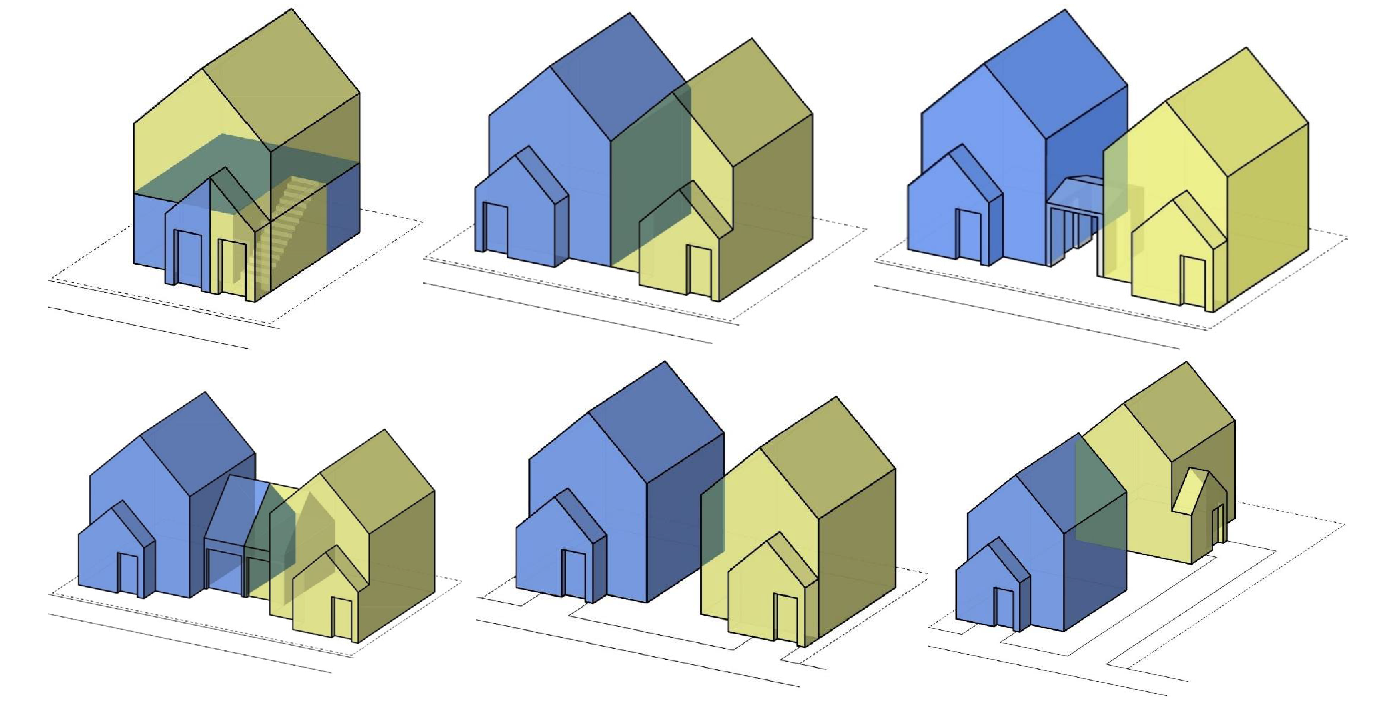
Dwelling, Duplex. A building with two (2) dwelling units on a lot or parcel in any configuration. In instances where a development can meet the definition of a duplex and also meets the definition of a primary dwelling unit with an accessory dwelling unit (ADU), the applicant shall specify at the time of application review whether the development is considered a duplex or a primary dwelling unit with an ADU. Example configurations as shown in the figure below (top row, from left to right) include:
A.
Top row, left to right: Stacked, attached side-by-side, attached by a breezeway.
B.
Bottom row, left to right: Attached by a garage wall, detached side-by-side, detached front and back.
Dwelling, Multi-Family. A building with five (5) or more dwelling units.
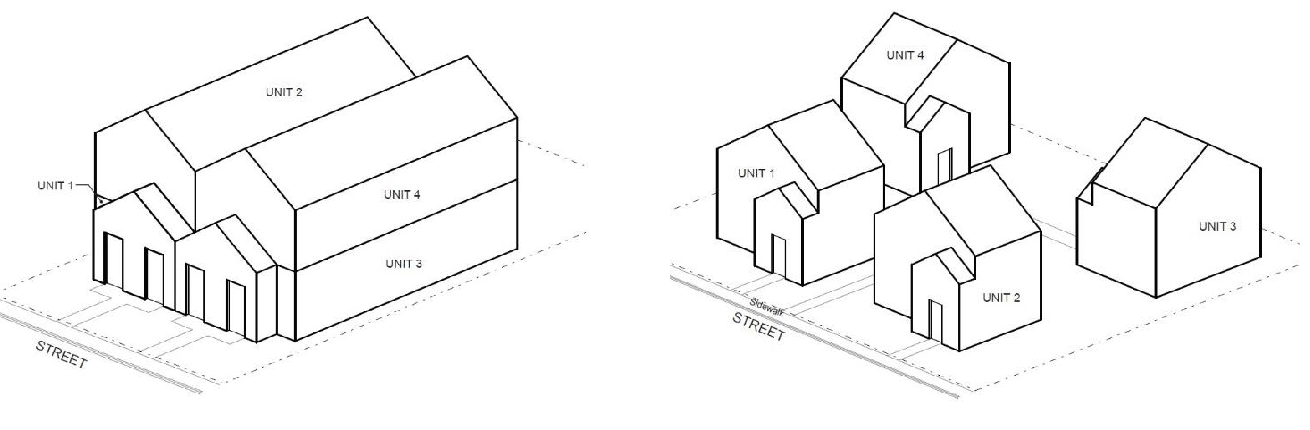
Dwelling, Quadplex. A building with four (4) dwelling units on a lot or parcel in any configuration. Example configurations as shown in the figure below include stacked (left) and detached (right).
Dwelling, Shared. A dwelling unit in which five (5) or more bedrooms are rented or leased. Shared dwelling units include boarding houses, rooming houses, and the like. Shared dwellings are multi-family residential units.
Dwelling, Single-Family Attached. See Townhouse.
Dwelling, Single-Family Detached. A detached structure on a lot or parcel that is comprised of a single dwelling unit. Detached single-family dwellings may be constructed off-site, e.g., manufactured dwellings or modular homes.
Dwelling, Townhouse. A dwelling unit constructed in a row of two (2) or more attached units, where each dwelling unit is located on an individual lot or parcel and shares at least one (1) common wall with an adjacent unit. A townhouse is also commonly called a "rowhouse," "attached house," or "common-wall house." See also Townhouse Project.
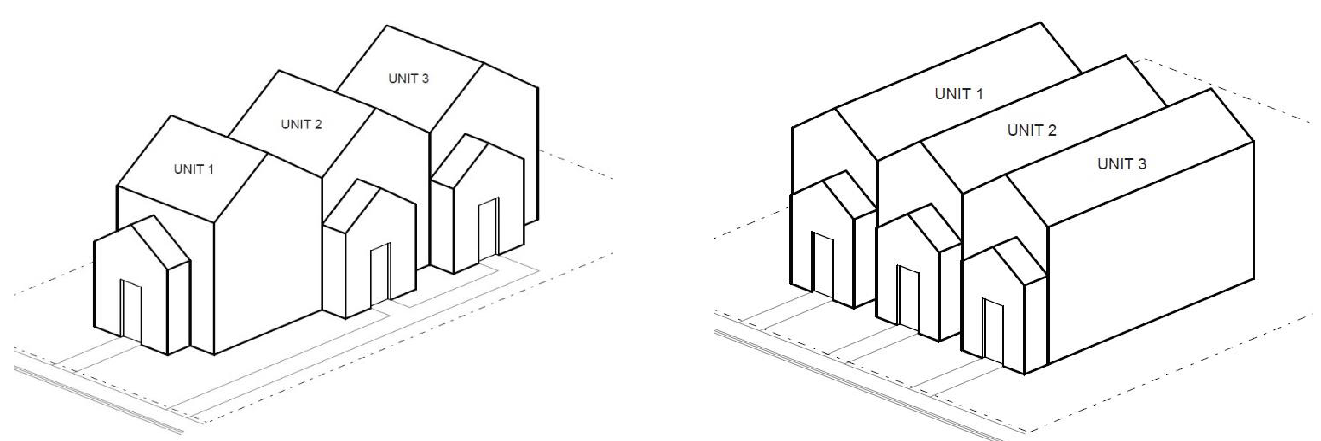
Dwelling, Triplex. A building with three (3) dwelling units on a lot or parcel in any configuration. Example configurations as shown in the figure below include front and back (left) and attached (right).
Dwelling, Zero Lot Line. A single-family detached dwelling that is located on a lot in such a manner that one (1) or more of the building's sides rest directly on a lot line and is not considered a townhouse.
Eating and Drinking Establishment. An establishment where meals or drinks (either alcoholic or nonalcoholic) are prepared and served to the public for consumption. This use includes restaurants, brew pubs, cafes, delicatessens, sandwich shops, taverns, bars, or other similar establishments.
Entertainment Facility, Major. A commercial or nonprofit enterprise including but not limited to amusement parks, multiple-screen theaters, museums, nightclubs, stadiums, zoos, or other similar uses, but not casinos. Major entertainment facilities often have a fee or age restriction for admission and generate a significant traffic impact in comparison to a minor entertainment facility.
Entertainment Facility, Minor. A commercial or nonprofit enterprise including but not limited to arcades, gaming rooms, museums, small-scale theaters, or other similar uses. Minor entertainment facilities are typically located within smaller spaces in a downtown or shopping center setting and have limited traffic impact in comparison to a major entertainment facility.
EV Charging Station. An electric vehicle charging station which is a piece of infrastructure that supplies electric energy for the recharging of plug-in vehicles, including electric cars, neighborhood electric vehicles, and plug-in hybrids.
Family. See Household.
Fence. An accessory structure that serves as an enclosure, barrier or screen that is not part of a building.
Fence, Electric. A type of security fence that carries an electric current that can produce a shock if touched.
Fence, Security. A fence that is designed to deliberately discourage entry into a secure area of a site. This includes but is not limited to barbed wire fencing (twisted or pointed wire ends) and razor wire fencing (metal blades) in a linear or curled pattern.
Fence, Sight-Obscuring. A fence that substantially screens an area or object by eighty percent (80%) of the view at a ninety (90) degree angle, excluding screens that are living plants.
Financial Institution. A bank, credit union, or similar entity that is licensed to deposit or manage money or other financial products for customers. Financial institutions may have a presence within a building or as a stand-alone automated teller machine (ATM).
Flex Space. A building or portion thereof that can accommodate either commercial or industrial uses or a combination of those uses when permissible through relevant building codes.
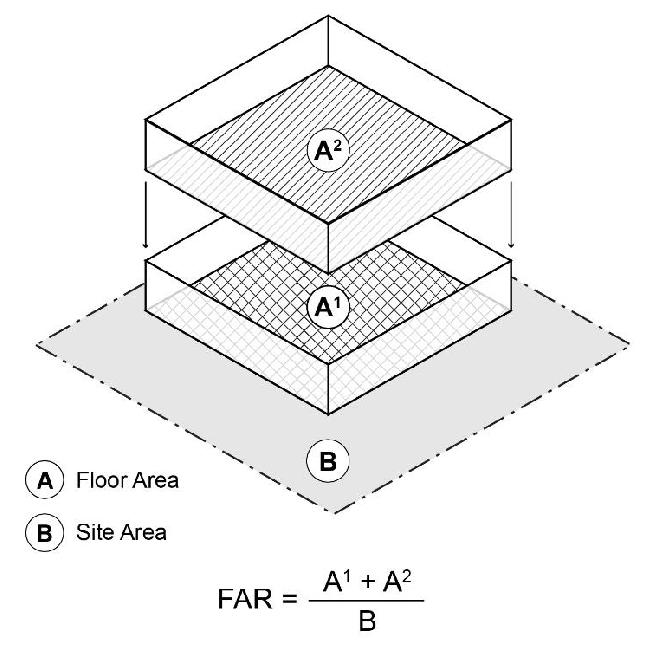
Floor Area. The total area of all floors of a building. Floor area is measured for each floor from the exterior faces of a building or structure. Floor area includes stairwells, ramps, shafts, chases, and the area devoted to garages and structured parking. Floor area does not include the following:
A.
Areas where the elevation of the floor is four (4) feet or more below the adjacent right-of-way;
B.
Roof area, including roof top parking;
C.
Roof top mechanical equipment; and
D.
Roofed porches, exterior balconies, or other similar areas, unless they are enclosed by walls that are more than forty-two (42) inches in height for seventy-five percent (75%) or more of their perimeter.
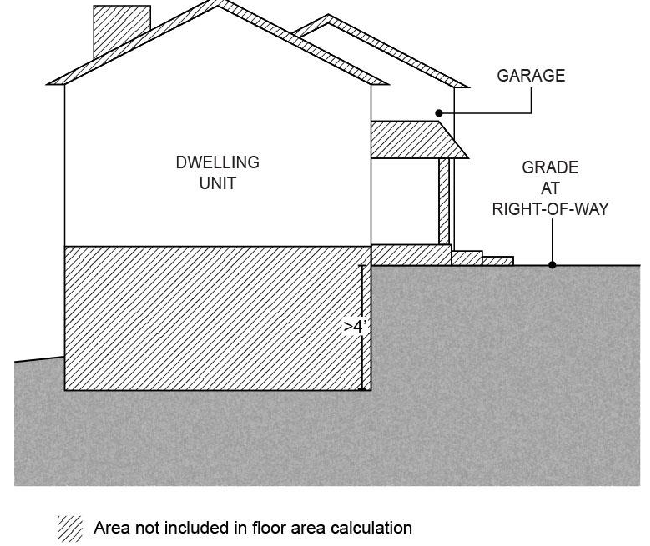
Floor Area Ratio ("FAR"). The amount of floor area of a building or structure in relation to the amount of site area, expressed in square feet. For example, a floor area ratio of seven-tenths (0.7) to one (1) means seven-tenths (0.7) square feet of floor area for every one (1) square foot of site area. FAR is calculated by dividing the total floor area of all buildings on a site by the total site area.
Food Vendor (Mobile). Any trailer, vehicle, wagon, cart, stand, or other similar mobile or temporary device or structure which is used for the purpose of preparing, processing, or converting food for immediate consumption as a drive-in, drive-through, curb, or walk-up service. A valid City business license is required. Food vendors (mobile) also means the site occupied by a mobile food vendor if a mobile food vendor occupies the site daily for more than three (3) consecutive days even if the mobile device or structure does not occupy the site twenty four (24) hours per day. Specific types of mobile food vendors are defined as follows:
Food Carts - in a location and operating for a limited duration. Includes both mobile cars, and also temporary stands with a maximum size of one hundred (100) square feet. Examples include a food stand erected for an event, such as a food stand put up and operated for the duration of an authorized community event. Customer access is walk up only.
Food Kiosks - located on a site in a long-term or permanent manner such as a drive-up coffee stand. These may be structures on trailers. There is no kitchen or indoor seating. Customer access can be walk-up or drive-up window.
Food Stands - in a location and operating for a limited duration. Examples include a hot dog stand that operates on a street corner during the lunch hour or a lemonade stand in a neighborhood. Maximum size is forty eight (48) square feet. Customer access is walk up only.
Food Trucks/Trailers - in which food is prepared and from which food is served. Food trucks and trailers park generally in parking lots and may move from the business site daily, or may locate in the same site for several weeks at a time. Maximum size is two hundred (200) square feet. There is no indoor seating. Customer access can be walk-up or drive-up window.
Freight & Trucking Firm. A logistics entity that provides shelter, transfer, or dispatching of trucks, truck fleets, or other vehicles carrying freight, cargo, or other goods and materials. The entity may provide limited access for vehicular services or fueling stations on site.
Frontage. The portion of a parcel of property abutting a public or private street, whether or not access to the property is accorded thereby and whether or not a building or structure faces the street.
Fueling Station. A facility that provides a location for vehicles to obtain fuel and may also contain a convenience store, car wash, or traveler services. This includes gas stations, commercial truck stops, or similar facilities. Electric charging stations placed within a right-of-way or upon a lot with a different primary land use from a fueling station are not included in this definition. This definition is distinct from freight & trucking firms or other types of vehicular services.
Gallery. A retail business selling or displaying works of art as its primary business.
Goal Protected Lands. Lands protected or designated pursuant to any one (1) of the following statewide planning goals:
A.
Goal 5 Natural Resources, Scenic and Historic Areas, and Open Spaces.
B.
Goal 6 Air, Water, and Land Resource Quality.
C.
Goal 7 Areas Subject to Natural Hazards.
D.
Goal 9 Economic Development.
Grade. The grade shall be as defined in the Uniform Building Code, as adopted by the City.
Group Home. See Residential Facility and Residential Home.
Gym. A building or room containing space and equipment for various indoor sports or exercise activities and may include locker and shower rooms, offices, classrooms, and swimming pool.
Heliport. A landing site for helicopters accessory to a use not located at the Portland-Troutdale Airport.
Home-Based Child Care. A service that provides child care upon residential property that is licensed with the State of Oregon as either a Registered Family Child Care service or a Certified Family Child Care service.
Home Occupation. A lawful occupation carried on in a dwelling by a resident of the dwelling, where the occupation is secondary to the main use of the property as a residence.
Hotel. See Lodging Facility.
Household. One (1) or more people living together in a dwelling unit. The following are also considered households: residents of residential homes and residents of residential facilities.
Human Services. An entity that provides services to assist or watch over children, older adults, people with disabilities, and people requiring memory care. This includes community-based care facilities, nursing facilities, certified child care or adult care centers, or other similar services that are not situated within a dwelling unit or upon residential property. Residential facilities, home-based child care, or other similar services that are situated upon residential property are distinct from human services.
Junk Yard. A lot for the dismantling or "wrecking" of motor vehicles, or for the storage or keeping, of junk, including scrap metals or other scrap materials.
Kennel or Other Animal Boarding Place. Any premises where five (5) or more dogs over one (1) year of age are kept, for any purpose whatsoever, or any premises where dogs are bred, boarded, or offered for sale as a commercial business. "Other animal boarding place", as used in this Code, means and includes any premises where six (6) or more cats or other animals are bred, boarded, or offered for sale as a commercial business.
Legislative Action. Any action which amends City policy including, but not limited to, changes to the Comprehensive Land Use Plan text, Development Code text, and other implementing ordinances, and map changes or amendments to the Comprehensive Land Use Plan Map, the Zoning District Map, or other City adopted maps which represent a change in City land use policy.
Live-Make Unit. A building or portion thereof where a dwelling unit and a manufacturing space or similar industrial use of limited impact are co-located within a unit and considered to be equal primary uses.
Live-Work Unit. A building or portion thereof where a dwelling unit and a commercial use are co-located within a unit and considered to be equal primary uses.
Loading Space. An off-street space or berth used for the temporary parking of a vehicle while loading or unloading persons, merchandise, or materials.
Local Food Production Use. Includes utilization of land to raise, harvest, or sell crops; feed, breed, manage, and sell livestock, poultry, honeybees, or their produce; raise dairy animals and sell dairy products; or engage in any other similar agricultural or horticultural use, animal husbandry, or combination thereof; for producing food to be consumed by people. Local food production uses include preparation or processing and storage of products raised on such land, but do not include construction or use of dwellings. Food does not include any substances regulated by the Controlled Substances Act enacted by the United States Congress.
Lodging Facility. A licensed commercial facility in which rooms or suites of rooms generally are rented as transient lodgings and not as principal residences. These include hotels, motels, inns, and hostels. This definition excludes bed and breakfast inns, dormitories, shared dwellings, and short-term vacation rentals upon residential property.
Lot. Any legally created unit of land. In this Code the term "lot" may include "parcel" if the context warrants.
Lot Area or Lot Size. The total square footage enclosed within the lot lines of a lot.
Lot, Corner. A lot at least two (2) adjacent sides of which abut streets other than alleys provided the angle of intersection of the adjacent streets does not exceed one hundred thirty-five (135) degrees.
Lot Coverage. The percentage of the total lot area covered by structures, including all projections except eaves, balconies, bay windows, or uncovered decks twelve (12) inches or less above grade.
Lot Depth. The horizontal distance measured midway between the front and rear lot lines. In the case of a corner lot, the depth shall be the length of its longest side lot line.
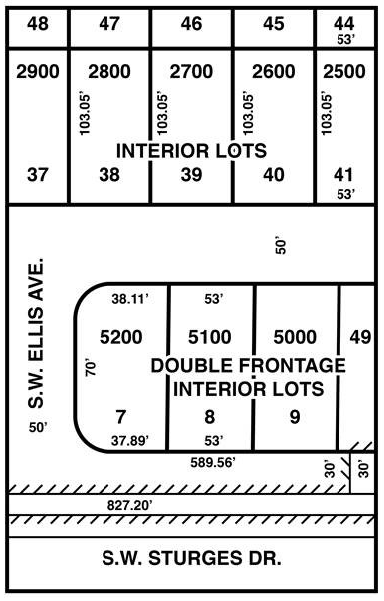
Lot, Double Frontage. A lot having frontage on two (2) nonintersecting streets, as distinguished from a corner lot; but a corner lot may also have double frontage. Frontage on a street and an alley does not constitute a double frontage lot.
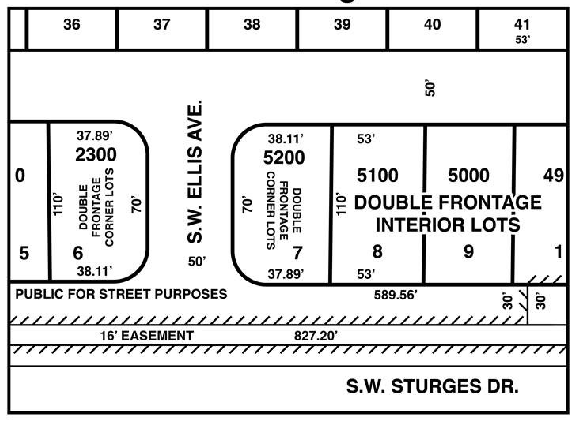
Double Frontage Lots
Lot, Interior. A lot other than a corner lot. An interior lot can be a double frontage lot.
Lot Line Adjustment. The relocation of a recorded lot line which does not result in the creation of an additional lot, or reduce any lot below minimum sizes required by this Code.
Lot Line, Front. For an interior lot, a line separating the lot from the street. Front lot lines on corner lots may face either street, except for corner lots that have continuously curved property lines along the streets. A continuously curved property line adjacent to two (2) or more streets of a corner lot shall be considered the front lot line. In this instance, such a corner lot has no rear property line, only front and side property lines.
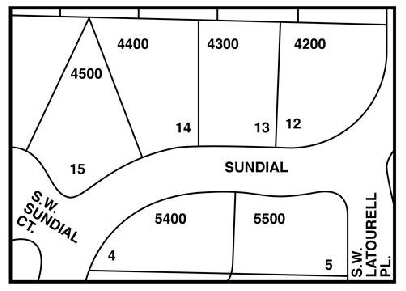
Corner Lots with Continuously Curved Front Lot Lines
Lot Line, Rear. A lot line not abutting a street which is opposite and most distant from the front lot line.
Lot Line, Side (Corner Lot). A line other than the front lot line separating the lot from the street, or a line separating the lot from the abutting lot along the same frontage.
Lot Line, Side (Interior Lot). Any lot line which is not a front or rear lot line.
Lot Width. The horizontal distance between the side lot lines, measured at right angles to the lot depth at a point midway between the front and rear lot lines.
Major Transit Stop. Transit centers, high capacity transit stations, major bus stops, inter-city bus passenger terminals, inter-city rail passenger terminals, and bike-transit facilities, as depicted in the Transit Master Plan of the Troutdale Transportation System Plan.
Manufactured Home or Manufactured Dwelling. A structure, transportable in one (1) or more sections, which is built on a permanent chassis and is designed for use as a dwelling with or without a permanent foundation when connected to the required utilities. To qualify as a manufactured home, the structure shall have been manufactured after June 15, 1976, and must bear an insignia issued by a state or federal agency indicating that the structure complied with all applicable construction standards of the U.S. Department of Housing and Urban Development in effect at the time of construction. For floodplain management purposes, the term "manufactured home" also includes park trailers, travel trailers, and other similar vehicles placed on a site for greater than one hundred eighty (180) consecutive days.
Manufacturing, Primary. An establishment engaged in the initial processing or treatment of raw material or manufacturing of products that require additional processing, fabrication, or assembly for ultimate use by the consumer. These activities or processes may necessitate the storage of large volumes of highly flammable, toxic matter or explosive materials needed for the manufacturing process. These activities may involve outdoor operations as part of their manufacturing process.
Manufacturing, Secondary. An establishment engaged in the manufacture of products predominantly from previously prepared materials; of finished products or parts, including processing, fabrication, assembly, treatment and packaging of such products; and incidental storage, sales, and distribution of such products, but excluding primary industrial processing. These products are for final use or consumption. This usually involves the processing, fabrication, or assembly of semi-finished products from a primary manufacturing industry.
Marijuana Facilities. A marijuana producer, marijuana retailer, marijuana wholesaler, medical marijuana dispensary, or marijuana grow site as those terms are defined under ORS 475B.015 and ORS 475B.410, but not including a Marijuana Processor, as defined by this Code.
Marijuana Processor. An establishment which processes, compounds, or converts marijuana into cannabinoid products, cannabinoid concentrates, or cannabinoid extracts.
Marina. A small harbor, boat basin, or moorage facility providing boat berthing, docking and mooring, and incidental services for recreational, commercial and/or charter fishing, or tour boats. Incidental services include, but are not limited to, restrooms; showers; minor boat and motor repair; mooring buoys; refueling facilities; boat hoists/lifts; boat launch ramp; small office for marina management; club house and/or meeting room; vending machines; small retail area for marine, fishing and other outdoor supplies and equipment; ice, packaged beverages, and foods; limited service restaurants; and temporary restaurants.
Marine Industrial/Marine Service Facility. A structure or use which is commercial or industrial in nature and which needs to be located in or adjacent to water areas because the use requires water access. Such uses include, but are not limited to, ship, tug barge, and workboat moorage and storage; vessel repair facilities; aquaculture facilities; and fish processing facilities.
Market Value. The value of a structure or property as determined by the Multnomah County Assessor, not including the assessed value. Market value may also be determined by a current appraisal as accepted by the Director.
Middle Housing. Dwelling types that include duplexes, triplexes, quadplexes, cottage clusters, and townhouses.
Mixed-Use Development. The development of a tract of land, building, or structure with a variety of uses, such as, but not limited to, residential, office, manufacturing, retail, public, or entertainment, in a compact urban form.
Mobile Food Vendor. See Food Vendor (Mobile).
Mobile Home. See Manufactured Home.
Multi-Family Dwelling. See Dwelling, Multi-Family.
Net Area. The total area of a parcel of land less the following: proposed public streets; area constrained for development under the provisions of this Code; area within a community resource protection overlay district; or, where approved by the City Council, land area dedicated or conveyed to the City.
Nonconforming Development. A development that was legally established prior to the adoption of this Code or in conformance with this Code in effect at the time of development, but which does not comply with the current regulations in this Code due to subsequent enactments or amendments to this Code.
Nonconforming Lot. A lot or parcel that was legally established prior to the adoption of this Code or in conformance with this Code in effect at the time, but which does not comply with the current regulations in this Code due to subsequent enactments or amendments to this Code.
Nonconforming Structure. A structure that was legally established prior to the adoption of this code or in conformance with this Code in effect at the time, but which does not comply with the current regulations in this Code due to subsequent enactments or amendments to this Code.
Nonconforming Use. A use that was legally established prior to the adoption of this Code or in conformance with this Code in effect at the time, but does not comply with or is not permitted to exist due to subsequent enactments or amendments to this Code.
Nursing Home. Housing with long-term physical or medical care for the physically handicapped, emotionally handicapped, or elderly population. Other terms used today include residential health care facility, extended care, intermediate care, and long-term care. However, independent living, assisted living, and congregate housing are considered unique from this use within this Code.
Office. A place of business or non-profit enterprise that is primarily conducted in an indoor setting with limited to no retail presence. This includes but is not limited to activities offered by a lawyers, architects, engineers, accountants, artists, teachers, real estate agents, insurance sales, financial advisors, or certain administrative and professional services, medical services and clinics, and veterinary clinics.
Outdoor Business. A business, all or most of which is conducted, or items displayed, in an open space area including sidewalk sales, pushcart vendors, Saturday markets, and Christmas tree sales.
Owner. The owner of record of real property as shown on the tax rolls of Multnomah County, or a person purchasing a piece of property under contract. For the purposes of this title, in terms of violations and binding agreements between the City and the owner, "owner" may also mean a leaseholder, tenant, or other person in possession or control of the premises or property at the time of agreement, violation of agreement, or the provisions of this title.
Parcel. A single unit of land that is created by a partition or by deed if recognized as a parcel under state law. In this Code, the term "parcel" may include "lot" if the context warrants.
Park. A forest, reservation, playground, beach, recreation center or any other area in the City, owned, operated, or maintained by the City and devoted to active or passive recreation.
Partition. Dividing land to create not more than three (3) parcels of land within a calendar year, but does not include any action statutorily excluded from the definition of partition. See ORS Chapter 92.
Pedestrian Walkway. An exterior hard-surfaced pathway intended for pedestrian use. Also referred to simply as a walkway.
Permitted Land Use. A use allowed in a zone and subject to the restrictions applicable to that zone as provided in this Code.
Personal Services Use. A business providing services involving touching the human body including but not limited to a barber shop or hair salon, masseuse, or nail-care salon.
Principal Use. The primary purpose for which a lot, structure, or building is used.
Processing. To subject to some special process or treatment, as in the course of manufacture; change in the physical state or chemical composition of matter; the second step in use of a natural resource. Examples include petroleum refining, oil shale crushing, retorting and refining, ore smelting, coal crushing and cleaning, saw mill, alfalfa pellet mills, food canning or packing, creation of glass, ceramic or plastic materials, gravel crushing, cement manufacture, and concrete batch plants. Processing occurs in both primary and secondary manufacturing.
Property Line Adjustment. The relocation or elimination of a common boundary line between two (2) or more lots or parcels.
Quadplex. See Dwelling, Quadplex.
Quasi-Judicial Action. An action or decision which involves the application of adopted policy to a specific development application or amendment.
Reclamation Plan. Shall have the meaning contained in ORS 517.750 and OAR 632-30-025 (Department of Geology and Mineral Industries).
Recreation, Active. A place or use that contains facilities or features that include recreational components beyond those of a typical passive park. These amenities include but are not limited to sports fields, sports courts, skateboard facilities, indoor recreation facilities, larger-scaled playgrounds, water-play features, dog parks, or other similar amenities where their utilization may lead to traffic, lighting, or noise impacts to surrounding areas.
Recreation, Passive. A place or use that contains facilities or features that are typically limited to trails, benches, picnic and seating areas, smaller-scaled playgrounds, or other types of low-impact parks.
Repair Shops (Vehicular and Equipment Services). A facility where services and repairs are made to vehicles or equipment apart from fueling stations.
Residential Facility. A residential care, residential training or residential treatment facility, as those terms are defined in ORS 443.400.
Residential Home. A residential treatment or training home as defined in ORS 443, a residential training facility registered under ORS 443 or an adult foster home licensed under ORS 443.705 — 443.845.
Retail Use. A place of sale of goods to the end user for direct consumption. Not wholesale.
Rowhouse. See Dwelling, Townhouse.
Sales or Rentals (Vehicular and Equipment Services). A facility where vehicles and similar equipment are displayed, purchased, leased, or rented.
School. A public, parochial, or private institution that provides educational instruction to students, including accredited colleges or universities. This definition does not include trade or business schools.
Service Use. Uses that provide commercial or nonprofit services to the general public. These include but are not limited to financial institutions, personal services, human services, vehicular and equipment services, and certain animal-based uses such as veterinary clinics. Any marine service uses shall comply with requirements of the underlying zoning district and obtain state and federal approvals as required.
Sign. Refer to Section 10.015 for all definitions for signs.
Single-Family Dwelling or Single-Family Residence. See Dwelling, Single-Family (Detached).
Site Area. The total area of a development site calculated after subtracting any required or planned dedication of public rights-of-way and/or designation of private rights-of-way.
Site and Design Review Committee. A committee chaired by the Director to review applicable development proposals for compliance to the provisions of this Code.
Storage, Accessory. The safekeeping of materials and goods at a location of which the principal use is not a storage facility and its presence at a location is considered incidental to the principal use.
Storage Facility. An establishment of which the principal use is providing leasable space where materials and goods may be stored by lessees in an outdoor or indoor setting, but not including tents. Storage facilities include self-storage establishments that cater to residential and non-residential clientele but shall not include commercial or industrial warehouses (See Warehouse).
Story. A portion of a building between the surface of any floor and the surface of the floor next above it, or, if there is no floor above it, the space between such floor and the ceiling next above it, provided that the following shall not be deemed a story:
A.
A basement or cellar if the height from finished grade at the exterior perimeter of the building to the finish floor elevation above is six (6) feet or less for at least fifty percent (50%) of the perimeter and does not exceed twelve (12) feet above grade at any point;
B.
An attic or similar space under a gable, hip, or gambrel roof, the wall plates of which on at least two (2) opposite exterior walls are not more than two (2) feet above the floor of such space.
Street Lighting. The total system of wiring, poles, arms, fixtures, and lamps, including all parts thereof that are necessary to light a street or pedestrian way.
Street, Private. A thoroughfare or street providing a means of access to a property or properties which is not owned by the City or other public entity.
Street, Public. A publicly owned thoroughfare or right-of-way acquired for use by the public which affords a principal means of access to abutting property.
Studio. A location where an ancillary form is created or practiced, such as an artist, a musician, dramatic arts or dance studio. Also includes light fabrication or manufacturing of individual pieces of art including welding, riveting, and use of a kiln, glass furnace, or foundry when such heat producing facilities comply with all Building Code requirements and crucibles do not exceed one (1) gallon in size.
Subdivision. To divide land to create four (4) or more lots within a calendar year, when such area or tract of land exists as a unit or contiguous units of land at the beginning of such year.
Sufficient Infrastructure. The following level of public services to serve new triplexes, quadplexes, townhouses, or cottage cluster development:
A.
Connection to a public sewer system capable of maintaining established service levels.
B.
Connection to a public water system capable of maintaining established service levels.
C.
Access via public or private streets maintaining adopted emergency vehicle access standards to a city's public street system.
D.
Storm drainage facilities capable of maintaining established service levels for storm drainage.
Townhouse or Townhome. See Dwelling, Townhouse.
Townhouse Project. One (1) or more townhouse structures constructed, or proposed to be constructed, together with the development site where the land has been divided, or is proposing to be divided, to reflect the townhouse property lines and any commonly owned property.
Transit Facility. A facility intended to accommodate and assist transit users. Transit facilities include light rail transit stations, park and ride lots for transit riders, transit centers, transit shelters, bus turnout lanes, and transit stops.
Transit Street. Any street identified as an existing or planned bus or light rail transit route.
Triplex. See Dwelling, Triplex.
Two-Family Dwelling. See Dwelling, Duplex.
Utility Facility, Major. Administrative offices and operation centers, wet system pump stations, sewage treatment plants and lagoons, electric generation facilities (other than small scale accessory wind turbines or solar panels intended to generate electricity for onsite uses), sanitary landfills, pump stations, substations (transmission and distribution), water towers and reservoirs, public wells (above ground), telephone switching equipment, communication receiver, transmission facilities, and ancillary equipment, telecommunication towers and poles, and drinking water treatment facilities.
Utility Facility, Minor. Street lights; underground lines and pipes; underground wells; transformers and regulator stations; closed system sanitary pump stations; and private, on-site facilities such as septic tanks, wells, and catch basins.
Warehouse. A building used primarily for the storage of materials or goods for use on the site or later distribution that is controlled by a single operator with public access restrictions. Warehouses shall not include storage facilities (See Storage Facility).
Water Dependent Development. Any use that is dependent on navigable waterway access and or use.
Window Area. The aggregate area of the glass within each window, including any interior grids, mullions, or transoms.
Windscreens. A fence-like structure, not to exceed six (6) feet in height, on the north or east side of a residential building only, and used to reduce the wind velocity at exterior doors.
Yard. A required open space on a lot that is unoccupied and unobstructed except for permitted projecting building features and accessory buildings.
Yard, Front. An open space extending the full width of the lot between a building and the front lot line, unoccupied and unobstructed from the ground upward, except as authorized by this Code.
Yard, Rear. An open space extending across the full width of the lot between the main building and the rear lot line, unoccupied and unobstructed from the ground upward, except as authorized by this Code. Where there is no rear lot line, the depth of the rear yard shall be the distance from a 10-foot line parallel to the front lot line, measured from one side line to the other.
Yard, Side. An open space between any building and the side lot line, unoccupied and unobstructed from the ground upward, except as authorized by this Code.
Yard, Street Side. An open space adjacent to a street that is not a front yard, unoccupied and unobstructed from the ground upward, except as authorized by this Code.
Zoned for Residential Use. A zoning district in which residential dwellings are the primary use and which implements a residential Comprehensive Plan map designation.
(Ord. No. 894, § 1, 12-10-2024)
1.030 - Airport Overlay Definitions.
Airport. An area of land or water that is used or intended to be used for the landing and takeoff of aircraft and includes any buildings and facilities.
Airport Approach Safety Zone. A surface longitudinally centered on the extended runway centerline and extending outward and upward from each end of the primary surface. The inner edge of the approach surface is the same width as the primary surface and extends to a width of one thousand two hundred fifty (1,250) feet for a utility runway having only visual approaches, one thousand five hundred (1,500) feet for a runway other than a utility runway having only visual approaches, two thousand (2,000) feet for a utility runway having a non-precision instrument approach, and three thousand five hundred (3,500) feet for a non-precision instrument runway other than utility having visibility minimums greater than three-fourths (¾) of a statute mile. The airport approach safety zone extends for a horizontal distance of five thousand (5,000) feet at a slope of twenty (20) feet for each foot upward (20:1) for all utility and visual runways, and ten thousand (10,000) feet at a slope of thirty-four (34) feet for each one (1) foot upward (34:1) for all non-precision instrument runways other than utility.
Airport Hazard. Any structure, tree, or use of land which exceeds height limitations established by local, state, and federal regulations.
Airport Imaginary Surfaces. Those imaginary areas in space which are defined by the airport approach safety zone, transitional zone, horizontal surface, clear zone, and conical surface, and in which any object extending above these imaginary surfaces is an obstruction.
Clear Zone. Extends from the primary surface to a point where the approach surface is fifty (50) feet above the runway end elevation.
Conical Surface. Extends one (1) foot upward for each twenty (20) feet outward (20:1) for four thousand (4,000) feet beginning at the edge of the horizontal surface five thousand (5,000) feet from the center of each end of the primary surface of each visual and utility runway or ten thousand (10,000) feet for all non-precision instrument runways other than utility at one hundred fifty (150) feet above the airport elevation), and upward extending to a height of three hundred fifty (350) feet above the airport elevation.
Horizontal Surface. A horizontal plane one hundred fifty (150) feet above the established airport elevation, the perimeter of which is constructed by swinging arcs of five thousand (5,000) feet from the center of each end of the primary surface of each visual or utility runway and ten thousand (10,000) feet from the center of each end of the primary surface of all other runways, and connecting the adjacent arcs by lines tangent to those arcs.
Noise Impact. Noise levels exceeding fifty-five (55) LDN (Day/Night Sound Level)
Place of Public Assembly. A structure or place which the public may enter for such purposes as deliberation, education, worship, shopping, entertainment, amusement, awaiting transportation, or similar activity.
Primary Surface. A surface longitudinally centered on a runway. When the runway has a specially prepared hard surface, the primary surface extends two hundred (200) feet beyond each end of that runway. When the runway has no specially prepared hard surface or planned hard surface, the primary surface ends at each end of that runway. The width of the primary surface is two hundred fifty (250) feet for utility runways having only visual approaches, five hundred (500) feet for utility runways having non-precision instrument approaches, and five hundred (500) feet for other than utility runways.
Transitional Zones. Extend one (1) foot upward for each seven (7) feet outward (7:1) beginning on each side of the primary surface, which point is the same elevation as the runway surface, and from the sides of the approach surfaces thence extending upward to a height of one hundred fifty (150) feet above the airport elevation (horizontal surface).
Utility Runway. A runway that is constructed and intended to be used by propeller driven aircraft of twelve thousand five hundred (12,500) pounds maximum gross weight or less.
(Ord. No. 894, § 1, 12-10-2024)
1.035 - Historic Landmark Definitions.
Alteration. To remove or add architectural features or otherwise change the physical appearance of any part or portion of the exterior of a historic landmark. A major alteration affects the visual qualities that convey the historical or architectural significance of a historic landmark. A minor alteration does not affect the visual qualities that convey the historical or architectural significance.
Architectural Integrity. The authenticity of a property's historic identity, evidenced by the survival of physical characteristics that existed during the property's historic or prehistoric period.
Certified Local Government. The Certified Local Government program is designed to promote historic preservation at the local level. The federal program (National Park Service) is administered by the Oregon State Historic Preservation Office (SHPO). Communities are certified after the local government has established its own historic preservation commission and program meeting federal and state standards. The Certified Local Government program offers communities financial and technical assistance in preserving historic resources.
Demolish. To raze, destroy, dismantle, deface or, in any manner, cause partial or total ruin of a designated historic landmark, individually or within a historic district.
Exterior. All outside features of a historic landmark, individually or within a historic district.
Historic Landmark. A historic resource officially designated in accordance with the procedures of this Chapter. Historic landmarks are identified in the Troutdale Historic Resources Inventory Table A of Section 4.230 of this Code.
Historic Landmarks Commission. The City of Troutdale Historic Landmarks Commission also referred to as the Landmarks Commission.
A.
Building. A construction made for purposes of shelter or habitation, e.g., house, barn, store, theater, train station, garage, school, etc.
B.
District. A geographically defined area possessing a significant concentration of buildings, structures, objects, and/or sites which are unified historically by plan or physical development, e.g., downtown, residential neighborhood, military reservation, ranch complex, etc.
C.
Historic Resource. Buildings, structures, sites, objects, or districts, which are of historical, architectural, or cultural significance to the community or are of statewide significance.
D.
Object. A construction which is primarily artistic or commemorative in nature and not normally movable or part of a building or structure, e.g., statue, fountain, milepost, monument, sign, etc.
E.
Site. The location of a significant event, use, or occupation which may include associated standing, ruined, or underground features, e.g., battlefield, shipwreck, campsite, cemetery, landscape, natural feature, garden, food-gathering area, etc.
F.
Structure. A construction made for functions other than shelter or habitation, e.g., a bridge, windmill, dam, highway, boat, kiln, etc.
Historic Resource Inventory. The City of Troutdale historic resource inventory is a list of historic resources that have historic, architectural or cultural significance, locally, regionally, or nationally. The historic resource inventory includes designated historic landmarks in Table A of Section 4.230 of this Chapter. The list of historic resources identified during Periodic Review in compliance with Comprehensive Land Use Plan Goal 5 policies for planning and archival purposes is kept in a City database compatible with the State Historic Preservation Office system and is available from the Planning Division.
Historic Resources of Statewide Significance. Buildings, structures, sites, objects, and districts which are listed in the National Register of Historic Places.
In-Kind Replacement. A process of rehabilitation utilized only where materials are extensively deteriorated or damaged, and cannot be repaired. Deteriorated materials or features are repaired with the same materials, style, and design. This process is based on physical evidence of essential form and detailing of historic materials or features.
National Register of Historic Places. An official list of the Nation's historic places worthy of preservation. The National Park Service's National Register of Historic Places (NRHP) is part of a national program to coordinate and support public and private efforts to identify, evaluate, and protect America's historic and archeological resources. All historic resources within Oregon on the National Register of Historic Places are, by definition, Historic Resources of Statewide Significance. The program is administered through the State Historic Preservation Office (SHPO).
New Construction. Any type of development or addition on a tax lot that has a designated historic landmark within the lot (e.g., garages, outbuilding, etc.).
Preservation. The act or process of applying measures necessary to sustain the existing form, integrity, and materials of a historic property. Work, including preliminary measures to protect and stabilize the property, generally focuses upon the ongoing maintenance and repair of historic materials and features, rather than extensive replacement and new construction. New exterior additions are not within the scope of this treatment; however, the limited and sensitive upgrading of mechanical, electrical, and plumbing systems and other code-required work to make properties functional is appropriate within a preservation project.
Rehabilitation. The act or process of making possible a compatible use for a property through repair, alterations, and additions while preserving those portions or features which convey its historical, cultural, or architectural values.
Restoration. The process of accurately recovering the form and details of a property and its setting as they appeared at a particular historic period by means of the removal of later work or the replacement of missing earlier work.
Secretary of the Interior's Standards. The Secretary of the Interior's Standards for the Treatment of Historic Properties, developed by the National Park Service, are intended to promote responsible preservation practices that help protect historic resources. The four (4) treatments are: Preservation, Rehabilitation, Restoration and Reconstruction. For the purpose of this Code, the treatment of Rehabilitation is used as the guidelines for the alterations to historic landmarks Section of this Code.
State Historic Preservation Office (SHPO). The Oregon State Historic Preservation Office is within the Oregon Parks & Recreation Department: Heritage Programs. Under federal and state mandates, the SHPO manages programs that create opportunities for individuals, organizations, and local governments to become directly involved in the protection of significant historic and cultural resources.
State Historic Preservation Office Statewide Inventory. A statewide inventory of Oregon's historic and archaeological properties maintained by the Oregon SHPO as mandated by the National Historic Preservation Act of 1966 and Amendments. The historic resource surveys that contribute to this inventory provide technical support to citizens, local governments, and federal and state agencies for identifying and protecting Oregon's cultural heritage resources.
1.040 - Vegetation Corridor and Slope District, Water Quality, and Flood Management Definitions.
100-Year Flood. The flood that is equaled or exceeded once in one hundred (100) years on the average; equivalent to the one percent (1%) annual chance flood. Also called the Special Flood Hazard Area, Base Flood, and 100-year Floodplain.
Area of Shallow Flooding. Means a designated AO, AH, AR/AO, AR/AH, or VO zone on a community's Flood Insurance Rate Map (FIRM) with a one percent (1%) or greater annual chance of flooding to an average depth of 1 - 3 feet where a clearly defined channel does not exist, where the path of flooding is unpredictable, and where velocity flow may be evident. Such flooding is characterized by ponding or sheet flow.
Area of Special Flood Hazard. Means the land in the floodplain within a community subject to a one percent (1%) or greater chance of flooding in any given year. The area may be designated as Zone A on the Flood Hazard Boundary Map (FHBM). After detailed ratemaking has been completed in preparation for publication of the flood insurance rate map, Zone A usually is refined into Zones A, AO, AH, A1-30, AE, A99, AR, AR/A1-30, AR/AE, AR/AO, AR/AH, AR/A, VO, or V1-30, VE, or V. For purposes of these regulations, the term ''special flood hazard area'' is synonymous in meaning with the phrase ''area of special flood hazard''.
Bankfull Stage. As defined in the Oregon Administrative Rules pertaining to removal/fill permits, the stage or elevation at which water overflows the natural banks of a stream or other waters of the state and begins to inundate upland areas. In the absence of physical evidence, the two-year recurrent flood elevation (storm level) may be used to approximate the bankfull stage. The bankfull stage is the starting point for measuring the width of a vegetation corridor from a protected water feature. In the absence of any data to establish the bankfull stage or two-year storm event, the starting point for measuring the vegetation corridor is determined by the following indicators:
A.
Water marks on fixed objects (vegetation, rocks, buildings, etc.);
B.
Drift lines (deposited waterborne twigs, litter, etc.); or
C.
Waterborne sediment deposits on the soil surface or fixed objects (vegetation, rocks, buildings, etc.).
Base Flood. A flood having a one percent (1%) chance of being equaled or exceeded in any given year.
Base Flood Elevation. The water surface elevation during the Base Flood in relation to a specified datum. The Base Flood Elevation (BFE) is depicted on the Flood Insurance Rate Map to the nearest foot and in the Flood Insurance Study to the nearest one-tenth (0.1) foot. Not every potential Special Flood Hazard Area within the Urban Growth Boundary has been mapped by the Federal Emergency Management Agency through the Flood Insurance Study, Flood Insurance Rate Maps, and Digital Flood Insurance Rate Maps. The Floodplain Manager or designee is authorized through Section 14.020 to obtain the information necessary to determine the presence and extent of unmapped Special Flood Hazard Areas and the associated Base Flood Elevation as part of reviewing development proposals that affect the 100-year Floodplain. Such information shall be used by the City of Troutdale to supplement the Flood Insurance Study, Flood Insurance Rate Maps, and Digital Flood Insurance Rate Maps.
Basement. Any area of the building having its floor subgrade (below ground level) on all sides.
Below-Grade Crawl Space. Means an enclosed area below the base flood elevation in which the interior grade is not more than two (2) feet below the lowest adjacent exterior grade and the height, measured from the interior grade of the crawlspace to the top of the crawlspace foundation, does not exceed four (4) feet at any point.
Breakaway Wall. Means a wall that is not part of the structural support of the building and is intended through its design and construction to collapse under specific lateral loading forces, without causing damage to the elevated portion of the building or supporting foundation system.
Conservation Easement. An easement applied to environmentally sensitive lands including, but not limited to, lands identified as hillsides, wetlands, floodplains, and floodways. The field verification shall be done by a licensed surveyor, engineer, hydrologist, or any other licensed specialist in the fields of engineering, hydrology, or botany. A conservation easement prohibits most forms of development and assures that native vegetation will be maintained or enhanced. Conservation easements usually affect privately owned land and are enforceable by the City. Trails and limited public facilities may be permitted under carefully controlled conditions within conservation easements.
Construction, Start of. (For other than new construction or substantial improvements under the Coastal Barrier Resources Act (Pub. L. 97-348)), includes substantial improvement, and means the date the building permit was issued, provided the actual start of construction, repair, reconstruction, rehabilitation, addition placement, or other improvement was within one hundred eighty (180) days of the permit date. The actual start means either the first placement of permanent construction of a structure on a site, such as the pouring of slab or footings, the installation of piles, the construction of columns, or any work beyond the stage of excavation; or the placement of a manufactured home on a foundation. Permanent construction does not include land preparation, such as clearing, grading and filling; nor does it include the installation of streets and/or walkways; nor does it include excavation for a basement, footings, piers, or foundations or the erection of temporary forms; nor does it include the installation on the property of accessory buildings, such as garages or sheds not occupied as dwelling units or not part of the main structure. For a substantial improvement, the actual start of construction means the first alteration of any wall, ceiling, floor, or other structural part of a building, whether or not that alteration affects the external dimensions of the building.
Critical Facility. A facility that is critical for the health and welfare of the population and is especially important to be located above the Base Flood Elevation following hazard events. The following is the list of Critical Facilities for the purposes of Chapter 14:
A.
Hospitals and other medical facilities having surgery and emergency treatment areas;
B.
Fire and police stations;
C.
Tanks or other structures containing, housing or supporting water or fire-suppression materials or equipment required for the protection of essential or hazardous facilities or special occupancy structures. These tanks or other structures do not include City water distribution facilities;
D.
Emergency vehicle shelters and garages;
E.
Structures and equipment in emergency-preparedness centers;
F.
Standby power generating equipment for essential facilities;
G.
Structures and equipment in government communication centers and other facilities required for emergency response; and
H.
Other facilities as determined by the Floodplain Manager or designee.
Some types of facilities may be critical to a community, but require location within or partially within Special Flood Hazard Areas because of the nature of the facilities.
Debris. Debris includes discarded man-made objects and may include tires, vehicles, litter, scrap metal, construction waste, lumber, plastic, or styrofoam. Debris does not include objects necessary to a use allowed by this Code, or ornamental and recreational structures. Debris does not include existing natural plant materials or natural plant materials which are left after flooding, downed or standing dead trees, or trees which have fallen into protected water features.
Department of Environmental Quality (DEQ) Water Quality Standards. State of Oregon DEQ water quality standards are the numerical criteria or narrative condition needed in order to protect an identified beneficial use.
Design Flood Elevation. The elevation of the 100-year storm as defined in the Federal Emergency Management Agency Flood Insurance Studies or, in areas without Federal Emergency Management Agency floodplains, the elevation of the 25-year storm or the edge of mapped flood-prone soils or similar methodologies.
Developer. The owners of property, their agents or contractors, or their successors and assigns, who have undertaken or are proposing development which is regulated by Sections 4.300, 5.600, 5.700, and Chapter 14 of this Code.
Development. Any man-made change to improved or unimproved real estate, including but not limited to buildings or other structures, mining, dredging, filling, grading, paving, excavation or drilling operations or storage of equipment or materials.
Digital Flood Insurance Rate Map. Depicts flood risk and federal flood zones and flood risk information. The Digital Flood Insurance Rate Map (DFIRM) presents the flood risk information in a format suitable for electronic mapping applications.
Disturb. Any man-made changes to the existing physical status of the land which are made in connection with development.
Elevated Building. Means, for insurance purposes, a non-basement building which has its lowest elevated floor raised above ground level by foundation walls, shear walls, posts, piers, pilings, or columns.
Elevation Certificate. A form supplied by the Federal Emergency Management Agency (FEMA) and used to document the lowest floor elevation of a building.
Emergency. Any man-made or natural event or circumstance causing or threatening loss of life, injury to person or property, and includes, but is not limited to, fire, explosion, flood, severe weather, drought, earthquake, volcanic activity, spills or releases of oil or hazardous material, contamination, utility or transportation disruptions, and disease.
Engineer. A registered professional engineer licensed by the State of Oregon.
Enhancement. The process of improving upon the natural functions and/or values of an area or feature which has been degraded by human activity. Enhancement activities may or may not return the site to a pre-disturbance condition, but create/recreate processes and features that occur naturally.
Erosion. Erosion is the detachment and movement of soil particles, rock fragments, or other material, organic or inorganic, resulting from actions of water, wind, human, or animal activity.
Erosion Hazard Zone. The area adjacent to a stream or river that is at risk of bank erosion from stream flow or mass wasting, as designated on the communities FIRM.
Erosion Prevention and Sediment Control Plans. Plan requirements are specified in the City of Troutdale's Construction Standards for Public Works Facilities.
Erosion, Visible or Measurable. Visible or measurable erosion includes, but is not limited to:
A.
Deposits of mud, dirt sediment, or similar material exceeding one-half (½) cubic foot in volume on public or private streets, adjacent property, or onto the storm and surface water system, either by direct deposit, dropping discharge, or as a result of the action of erosion.
B.
Evidence of concentrated flows of water over bare soils, turbid or sediment laden flows, or evidence of onsite erosion such as rivulets on bare soil slopes where the flow of water is not filtered or captured on the site.
C.
Earth slides, mudflows, earth sloughing, or other earth movement that leaves the property.
Excavation. Any act by which soil or rock is cut into, dug, quarried, uncovered, removed, displaced, or relocated.
Existing Building or Structure. A structure for which the Start of Construction commenced before February 1, 2019.
Federal Emergency Management Agency (FEMA). The agency with the overall responsibility for administering the National Flood Insurance Program.
Fill. Any material such as, but not limited to, sand, soil, rock, gravel, clay, or mud that is placed on a site for the purposes of development or redevelopment.
FIRM. See Flood Insurance Rate Map.
Flood or Flooding. Means:
A.
A general and temporary condition of partial or complete inundation of normally dry land areas from:
1.
The overflow of inland or tidal waters.
2.
The unusual and rapid accumulation or runoff of surface waters from any source.
3.
Mudslides (i.e., mudflows) which are proximately caused by flooding as defined in Subsection (A.2) of this definition and are akin to a river of liquid and flowing mud on the surfaces of normally dry land areas, as when earth is carried by a current of water and deposited along the path of the current.
4.
The collapse or subsidence of land along the shore of a lake or other body of water as a result of erosion or undermining caused by waves or currents of water exceeding anticipated cyclical levels or suddenly caused by an unusually high water level in a natural body of water, accompanied by a severe storm, or by an unanticipated force of nature, such as flash flood or an abnormal tidal surge, or by some similarly unusual and unforeseeable event which results in flooding as defined in Subsection (A.1) of this definition.
Flood Insurance Rate Map (FIRM). An official map of a community, on which the Federal Insurance Administrator has delineated both the special hazard areas and the risk premium zones applicable to the community.
Flood Insurance Study (FIS). Also known as the flood elevation study, means an examination, evaluation and determination of flood hazards and, if appropriate, corresponding water surface elevations, or an examination, evaluation and determination of mudslide (i.e., mudflow) and/or flood-related erosion hazards.
Flood Management Area (FLMA). All lands contained within the 100-year floodplain and floodway as shown on the Flood Insurance Rate Map, and the area of inundation for the February 1996 flood. In addition, all lands which have documented evidence of flooding.
Floodplain. As shown below in Figure 1 - Floodplain Cross Section, the area adjacent to a stream or river channel that is covered by water when the river or stream overflows its banks.
Floodplain Development Permit. Federally required permit required prior to construction and other development in any Special Flood Hazard Area (100-year Floodplain). See Section 14.035 of this Code.
Floodplain Functions. Hydrological and ecological functions including conveyance and temporary storage of floodwater, depositions of sediments outside of the channel, ground water recharge, filtering of pollutants, and reduction of floodwater velocity and erosive forces. Also included, but to a lesser extent in previously urbanized areas, are such functions as nutrient exchange, refuges, and feeding areas for fish.
Floodplain, 100-Year. As shown below in Figure 1 - Floodplain Cross Section, land area adjacent to a river, stream, or other water body that is subject to a one percent (1%) or greater chance of flooding in any given year. It consists of land ranging from that which is subject to annual flooding to that which has a one percent (1%) or greater chance of flooding in any given year. The 100-year Floodplain consists of the Floodway and the Floodway Fringe. The 100-year Floodplain is mapped by the Federal Emergency Management Agency (FEMA) on Flood Insurance Rate Maps (FIRMs) and is the area subject to Base Flood regulations. Not every potential Special Flood Hazard Area within the Urban Growth Boundary has been mapped by the Federal Emergency Management Agency through the Flood Insurance Study, Flood Insurance Rate Maps, and Digital Flood Insurance Rate Maps. The Floodplain Manager or designee is authorized through Section 14.020 to obtain the information necessary to determine the presence and extent of unmapped Special Flood Hazard Areas as part of reviewing development proposals that affect the 100-year Floodplain. Such information shall be used by the City of Troutdale to supplement the Flood Insurance Study, Flood Insurance Rate Maps, and Digital Flood Insurance Rate Maps and these areas are also subject to Base Flood regulations. See Base Flood.
Floodway (Regulatory Floodway). Means the channel of a river or other watercourse and the adjacent land areas that must be reserved in order to discharge the base flood without cumulatively increasing the water surface elevation more than a designated height.
Flow-Through Design. Typically a structure that does not displace surface floodwater or hinder or obstruct the movement of surface floodwater.
Highest Adjacent Grade (HAG). The highest natural elevation of the ground surface prior to construction, adjacent to the proposed walls of a structure. Refer to the Elevation Certificate, FEMA Form 81-31, for more information.
High Hazard Zone. Lands within the furthest landward extent of the floodway and erosion hazard zone, as designated on the communities FIRM.
Hydrodynamic Load. Force of water in motion.
Hydrostatic Load. Force of water at rest.
Invasive Non-native or Noxious Vegetation. Plant species that are listed as nuisance plants or prohibited plants on the most recent Portland Plant List as adopted by the City of Portland by ordinance because they are plant species that have been introduced and, due to aggressive growth patterns and lack of natural enemies in the area where introduced, spread rapidly into native plant communities.
Joint Fill Permit/404 Removal/Fill Permit. A permit issued jointly by the Oregon Department of State Lands and U.S. Army Corps of Engineers to allow, with conditions and mitigation, the removal or fill of wetlands determined to be of either local or state significance by the Oregon Department of State Lands.
Letter of Map Change (LOMC). An official FEMA determination, by letter, to amend or revise effective Flood Insurance Rate Maps and Flood Insurance Studies. LOMCs are issued in the following categories:
A.
Letter of Map Amendment (LOMA) - A revision based on technical data showing that a property was incorrectly included in a designated Special Flood Hazard Area. A LOMA amends the current effective Flood Insurance Rate Map and establishes that a specific property is not located in a Special Flood Hazard Area.
B.
Letter of Map Revision (LOMR) - A revision based on technical data showing, usually due to man-made changes, alterations to Federal Flood Zones, flood elevations floodplain and floodway delineations, and planimetric features. One (1) common type of LOMR, a LOMR-F, is a determination that a structure has been elevated through the placement of fill above the Base Flood Elevation and is excluded from the Special Flood Hazard Area.
C.
Conditional Letter of Map Revision (CLOMR) - A formal review and comment by FEMA as to whether a proposed project complies with the minimum National Flood Insurance Program floodplain management criteria. A CLOMR does NOT amend or revise effective Flood Insurance Rate Maps, Flood Boundary and Floodway Maps, or Flood Insurance Studies.
Lowest Floor. Means the lowest floor of the lowest enclosed area (including basement). An unfinished or flood resistant enclosure, usable solely for parking of vehicles, building access or storage in an area other than a basement area is not considered a building's lowest floor. Provided that such enclosure is not built so as to render the structure in violation of the applicable non-elevation design requirements of CFR Sec. 60.3.
Manufactured Dwelling. Means a structure, transportable in one (1) or more sections, which is built on a permanent chassis and is designed for use with or without a permanent foundation when attached to the required utilities. The term "manufactured dwelling" does not include a "recreational vehicle."
Manufactured Dwelling Park or Subdivision. Means a parcel (or contiguous parcels) of land divided into two (2) or more manufactured home lots for rent or sale.
Mean Sea Level. For purposes of the National Flood Insurance Program, the North American Vertical Datum of 1988 or other Datum, to which Base Flood Elevations shown on a community's FIRM are referenced.
Mitigation. The reduction of adverse effects of a proposed project by considering, in this order:
A.
Avoiding the impact altogether by not taking a certain action or parts of an action;
B.
Minimizing impacts by limiting the degree or magnitude of the action and its implementation;
C.
Rectifying the impact by repairing, rehabilitating, or restoring the effected environment;
D.
Reducing or eliminating the impact over time by preservation and maintenance operations during the life of the action by monitoring and taking appropriate measures; and
E.
Compensating for the impact by replacing or providing comparable substitute water quality resource areas.
Mulch. Application of plant residue, netting, or other suitable materials to the land surface to conserve moisture, hold soil in place, and aid in establishing plant cover.
National Flood Insurance Program (NFIP). A federal program enabling property owners in participating communities to purchase insurance as a protection against flood losses in exchange for state and community floodplain management regulations that reduce future flood damages.
National Wetland Inventory (NWI) Map. The City is mapped on the Camas and Washougal, Washington-Oregon wetland maps prepared by the U.S. Department of the Interior, Fish and Wildlife Service.
Native Vegetation or Native Plant. Vegetation listed as a native plant on the most recent Portland Plant List as adopted by the City of Portland by ordinance and any other vegetation native to the Portland metropolitan area provided that it is not listed as a nuisance plant or a prohibited plant on the Portland Plant List.
NAVD 88. The North American Vertical Datum of 1988 (NAVD 88) is the vertical control datum established in 1991 by the minimum-constraint adjustment of the Canadian-Mexican-U.S. leveling observations. This is the data used on FIRMs and in flood insurance studies adopted in 2009.
New Construction. A structure for which the Start of Construction commenced after February 1, 2019, and includes subsequent Substantial Improvements to the structure.
NGVD 29. "The National Geodetic Vertical Datum of 1929: The name, after May 10, 1973, of (the) Sea Level Datum of 1929." (Vertical control datum established for vertical control in the United States by the general adjustment of 1929). This is the datum used on FIRMs and in flood insurance studies prior to 2009.
NPDES Permit. The National Pollutant Discharge Elimination System 1200-C Permit is a State of Oregon Department of Environmental Quality permit that covers federal stormwater regulations as they pertain to construction activities in Oregon. The permit is administered by the City.
ODFW Construction Standards. The Oregon Department of Fish and Wildlife construction guidelines for building roads, bridges, and culverts, or any transportation structure within a waterway.
One Percent Annual Chance Flood. The flood that has a one percent (1%) chance of being equaled or exceeded on the average in any given year; equivalent to the 100-year flood.
Open Space. Land that is undeveloped and that is planned to remain so indefinitely. The term encompasses parks, forests, and farmland. It may also refer only to land zoned as being available to the public, including playgrounds, watershed preserves, and parks.
Perennial Streams. All primary and secondary perennial waterways mapped by the U.S. Geological Survey, having year-round flow.
Practicable. Available and capable of being done after taking into consideration cost, existing technology, and logistics in light of overall project purpose.
Pre-FIRM Structures. Buildings that were built before the flood risk was known and identified on the community's FIRM.
Protected Water Features, Primary. Includes:
A.
Title 3 wetlands.
B.
Rivers, streams (creeks or brooks) and drainages downstream from the point at which 100 acres or more are drained to that water feature (regardless of whether it carries year-round flow).
C.
Streams carrying year-round flow.
D.
Springs which feed streams and wetlands and have perennial (year-round) flow.
E.
Natural lakes.
Protected Water Features, Secondary. Includes intermittent streams and seeps downstream of the point at which fifty (50) acres are drained and upstream of the point at which one hundred (100) acres are drained to that water feature.
Recreational Vehicle (RV). A vehicle which is:
A.
Built on a single chassis;
B.
Four hundred (400) square feet or less when measured at the largest horizontal projection;
C.
Designed to be self-propelled or permanently towable; and
D.
Designed primarily not for use as a permanent dwelling but as temporary living quarters for recreational, camping, travel, or seasonal use.
Resource. A functioning natural system such as a wetland or stream.
Restoration. The process of returning a disturbed or altered area or feature to a previously existing natural condition. Restoration activities reestablish the structure, function, and/or diversity to that which occurred prior to impacts caused by human activity.
Riparian. Those areas associated with streams, lakes, and wetlands where vegetation communities are predominately influenced by their association with water.
Routine Repair and Maintenance. Activities directed at preserving an existing allowed use or facility, or nonconforming use, without expanding the development footprint or site use.
Sediment. Any material that is in suspension, is being transported, or has been moved from its site of origin by water, wind, or gravity as a result of erosion.
Site. The lot, or contiguous lots, under the same ownership that are subject to a development permit or erosion control plan.
Slope District. Slopes of twenty-five percent (25%) or greater throughout the City that have a minimum horizontal distance of fifty (50) feet. Engineered slopes associated with public streets or roads are not included.
Special Flood Hazard Area (SFHA). The land in the floodplain within a community subject to a one percent (1%) or greater chance of flooding in any given year. The area may be designated as Zone A on the FHBM (Flood Hazard Boundary Map). After detailed ratemaking has been completed in preparation for publication of the flood insurance rate map, Zone A usually is refined into Zones A, AO, AH, A1-30, AE, A99, AR, AR/A1-30, AR/AE, AR/AO, AR/AH, AR/A, VO, or V1-30, VE, or V. For purposes of these regulations, the term "special flood hazard area'' is synonymous in meaning with the phrase "area of special flood hazard''.
Statewide Planning Goal 5. Oregon's statewide planning goal that addresses open space, scenic and historic areas, and natural resources. The purpose of the goal is to conserve open space and protect natural and scenic resources.
Statewide Planning Goal 6. Oregon's statewide planning goal that addresses air, water, and land resources quality to "maintain and improve the quality of the air, water, and land resources of the state" as implemented by the Land Conservation and Development Commission (LCDC).
Statewide Planning Goal 7. Oregon's statewide planning goal that addresses areas subject to natural disasters and hazards to "protect life and property from natural disasters and hazards" as implemented by the Land Conservation and Development Commission.
Stockpile. Onsite storage of any soil, sand, gravel, clay, mud, debris, vegetation, refuse, or any other material, organic or inorganic, in a concentrated state.
Stream. A body of running water moving over the earth's surface in a channel or bed, such as a creek, rivulet, or river, that flows at least part of the year, including perennial and intermittent streams. Streams are dynamic in nature and their structure is maintained through build-up and loss of sediment.
Stream Bank, Top of. See Bankfull Stage.
Structure. Means, for floodplain management purposes, a walled and roofed building, including a gas or liquid storage tank that is principally above ground, as well as a manufactured home. Structure, for insurance purposes, means:
A.
A building with two (2) or more outside rigid walls and a fully secured roof that is affixed to a permanent site;
B.
A manufactured dwelling; or
C.
A travel trailer without wheels, built on a chassis and affixed to a permanent foundation, that is regulated under the community's floodplain management and building ordinances or laws.
For the latter purpose, structure does not mean a recreational vehicle or a park trailer or other similar vehicle, except as described in Section 1.040(C), or a gas or liquid storage tank.
Substantial Damage. Damage of any origin sustained by a structure located within the 100-year Floodplain, whereby the cost of restoring the structure to its prior condition would equal or exceed fifty percent (50%) of the structure's market value before the damage occurred.
Substantial Improvement. Means any reconstruction, rehabilitation, addition, or other improvement of a structure, the cost of which equals or exceeds forty-nine percent (49%) of the market value of the structure before the start of construction of the improvement. This term includes structures which have incurred substantial damage, regardless of the actual repair work performed. The term does not, however, include either:
A.
Any project for improvement of a structure to correct existing violations of state or local health, sanitary, or safety code specifications which have been identified by the local code enforcement official and which are the minimum necessary to assure safe living conditions; or,
B.
Any alteration of a historic structure, provided that the alteration will not preclude the structure's continued designation as a historic structure.
Surface Water Management System. All natural and constructed facilities used to regulate the quantity and quality of surface water, including drainage easements, culverts, storm drains, catch basins, drainage ditches, natural drainageways, stream corridors, rivers, ponds, wetlands, and impoundments.
Title 3. Title 3 is part of the Metro Urban Growth Management Functional Plan pertaining to water quality, flood management, and fish and wildlife conservation, and directly pertains to Statewide Planning Goals 5, Open Spaces, Scenic and Historic Areas, and Natural Resources; 6, Air, Water, and Land Resources Quality; and 7, Areas Subject to Natural Disasters and Hazards.
Variance. Means a grant of relief by a community from the terms of a floodplain management regulation.
Vegetation, Approved. Vegetation which typically does not require irrigation or fertilization because it is adapted to natural soil, water, and climatic conditions. The list of approved vegetation species is based on the most recent Portland Plant List as adopted by the City of Portland by ordinance, and is on file in the Community Development Department.
Vegetation Corridor. The undisturbed area between a development and a protected water feature as designated in Sections 4.316, Width of Vegetation Corridor, and 4.317, Method for Determining Vegetation Corridors Next to Primary Protected Water Features, of this Code, or slopes of twenty-five percent (25%) or greater throughout the City, except engineered slopes associated with public streets or roads.
Vegetation, Invasive, Non-Native, or Noxious. Plant species that have been introduced and due to aggressive growth patterns and lack of natural enemies in the area where introduced, spread rapidly into native plant communities, or which are not listed on the most recent Portland Plant List as adopted by the City of Portland by ordinance.
Vegetation, Native. Any vegetation native to the Portland Metropolitan Area or listed on the Portland Plant List as adopted by the City of Portland by ordinance.
Water-Dependent. A structure for commerce or industry which cannot exist in any other location and is dependent on the water by reason of the intrinsic nature of its operations.
Water Features. See Protected Water Features, primary and secondary.
Water Quality Facility. A created or constructed structure or drainageway that is designed, constructed, and maintained to collect, filter, retain, or detain surface water runoff during and after a storm event for the purpose of stormwater management and water quality improvement. The facility may take on characteristics of a wetland, but it does not become a resource.
Watershed. A geographic unit defined by the flows of rainwater or snowmelt. All land in a watershed drains to a common outlet, such as a stream, lake, or wetland.
Water Surface Elevation. The height, in relation to a specific datum, of floods of various magnitudes and frequencies in the floodplains of coastal or riverine areas.
Wetlands. Areas inundated or saturated by surface or ground water at a frequency and duration sufficient to support, and under normal circumstances do support, a prevalence of vegetation typically adapted for life in saturated soil conditions. Wetlands generally include swamps, marshes, bogs, and similar areas. Wetlands are those areas identified and delineated by qualified wetland specialists as set forth in the 1987 Corps of Engineers Wetland Delineation Manual.
A.
Wetlands, Constructed. Wetlands developed as a water quality or quantity facility, subject to change and maintenance as such. These areas must be clearly defined and/or separated from naturally occurring or created wetlands.
B.
Wetlands, Created. Those wetlands developed in an area previously identified as a non-wetland to replace or mitigate wetland destruction or displacement. A created wetland shall be regulated and managed the same as an existing wetland.
C.
Wetland Determinations. The identification of an area as either wetland or non-wetland.
D.
Wetlands, Title 3. Wetlands of metropolitan concern as shown on the Metro Water Quality and Flood Management Overlay District Map and other wetlands not mapped but determined significant by the Oregon Department of State Lands, consistent with the criteria in Title 3, Section 7.C. of the Metro Urban Growth Management Functional Plan. Title 3 wetlands include created wetlands approved and monitored by the Oregon Department of State Lands and U.S. Army Corps of Engineers. Title 3 wetlands do not include artificially constructed and managed stormwater and water quality treatment facilities.
(Ord. No. 894, § 1, 12-10-2024)

