Troutdale City Zoning Code
CHAPTER 9
OFF-STREET PARKING AND LOADING1
Editor's note— Ord. No. 899, § 2(Att. A), adopted June 24, 2025, amended Ch. 9 in its entirety to read as herein set out. Former Ch. 9, §§ 9.005—9.125, pertained to similar subject matter, and derived from Ord. No. 894, § 5, adopted Dec. 10, 2024.
9.005 - Off-Street Parking Required.
Where square feet are specified, the area measured shall be the gross leasable building floor area that is primary to the function of the proposed use. Where employees are specified, persons counted shall be those working on the premises, including proprietors, during the largest shift at peak season.
For purposes of this Chapter, in computing the total number of required off-street parking spaces, if the total contains a fraction, then the number shall be rounded up to the next higher whole number.
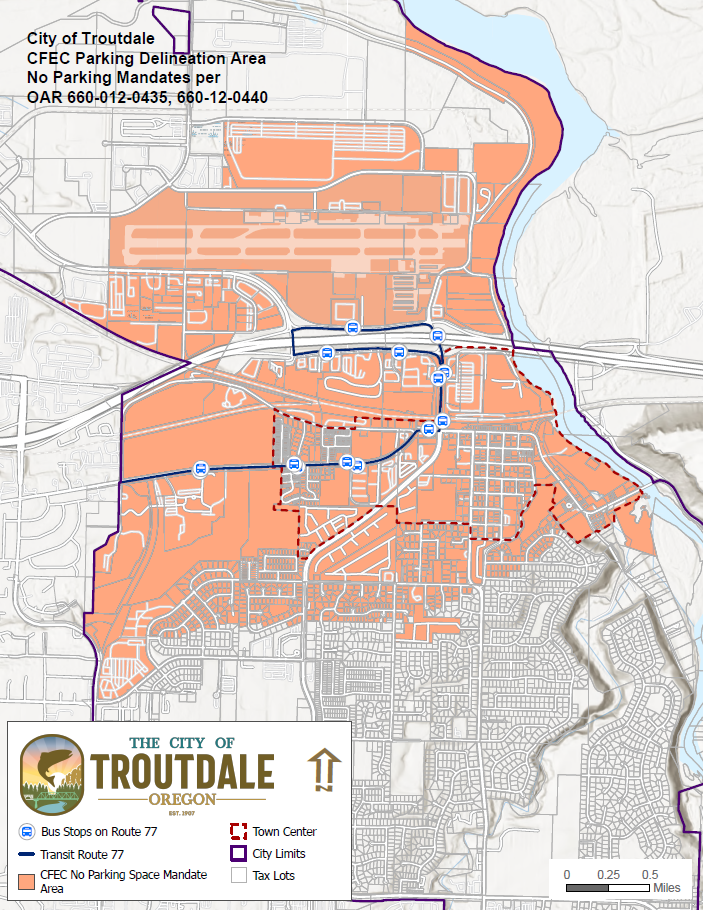
Off-street parking and loading space shall be provided for all developments on lots or parcels, not within the CFEC Parking Delineated Area. Per OAR 660-012-0440 Parking Reform Near Transit Corridors, no off-street parking is required for developments on a lot or parcel that includes lands within one-half (½) mile of a frequent transit corridor. Climate Friendly Areas, no off-street parking is required for developments on a lot or parcel within the Town Center Overlay District, including lands within one-quarter (¼) mile from the district boundary line (See City of Troutdale CFEC Parking Delineated Area Map).
The provision for, and maintenance of, off-street parking and loading facilities shall be a continuing obligation of the property owner. No building permit, or any other required permit for a structure or use under this or any other applicable rule, ordinance, or regulation, shall be issued with respect to off-street parking and loading, or land served by such facilities, until satisfactory evidence is presented that the property is, and will remain, available for the designated use as a parking or loading facility.
(Ord. No. 899, § 2(Att. A), 6-24-2025)
9.010 - Off-Street Parking Space Requirements.
The City of Troutdale has been required to reduce parking regulations for certain areas of the city to comply with the State of Oregon's Climate Friendly and Equitable Communities (CFEC) regulations. For areas of the city with reduced parking regulations due to CFEC, the Planning Department can provide off-street parking standards that are recommended but not required per this Subsection.
A.
Required parking spaces may be provided off-site, within two thousand (2,000) feet of pedestrian travel of a site. If any non-loading parking is provided on site, all required parking for people with disabilities shall be on site. If all parking is off-site, parking for people with disabilities must be located within the shortest possible distance of an accessible entrance via an accessible path and no greater than two hundred (200) feet from that entrance.
Table 1: Parking standards for lots or parcels not within the CFEC Delineated Area (see CFEC Parking Delineated Area Map). Parking spaces are based on one (1) per one thousand (1,000) sq. ft. of gross leasable area primary to the functional use, per Metro Title 3; ADU standards are per OAR Division 46.
(Ord. No. 899, § 2(Att. A), 6-24-2025)
9.030 - Other Developments Not Listed.
Requirements for a building or development use not specified herein shall be determined based upon the requirements of comparable uses listed. The Director may refer any question of interpretation to the Planning Commission for determination.
(Ord. No. 899, § 2(Att. A), 6-24-2025)
9.035 - Off-Street Parking Near Frequent Transit Corridor and Town Center Overlay District.
Per OAR 660-012-0440 Parking Reform Near Transit Corridors, no off-street parking is required for developments on a lot or parcel, including land within one-half (½) mile of a frequent transit corridor. Per OAR 660-012-0435 Climate Friendly Areas, no off-street parking is required for developments on a lot or parcel within the Town Center Overlay District, including lands within one-quarter (¼) mile from the district boundary line (See City of Troutdale CFEC Parking Delineated Area Map).
(Ord. No. 899, § 2(Att. A), 6-24-2025)
9.040 - Reduction of Required Parking Spaces.
A.
Any existing or proposed use subject to minimum off-street parking requirements and located within four hundred (400) feet of an existing transit route may reduce the number of required parking spaces by up to ten percent (10%) by providing a transit stop and related amenities, including a public plaza, pedestrian sitting areas, or additional landscaping, provided such landscaping does not exceed twenty-five percent (25%) of the total area dedicated for transit-oriented uses.
B.
Required parking spaces may be reduced at a ratio of one (1) parking space for each one hundred (100) square feet of transit amenity space provided above and beyond the minimum required by this Code.
C.
Required off-street parking spaces may be reduced by one (1) parking space for every on-street parallel parking space located adjacent to the subject site. For purposes of calculating the amount of adjacent onstreet parking spaces, the following applies:
1.
Adjacent shall mean on the same side and within the same block as the use.
2.
The minimum length of each on-street, parallel parking space shall be twenty-two (22) feet.
3.
If a continuous section being measured contains a fractional portion of twenty-two (22) feet, then the number of on-street spaces for that continuous section shall be rounded down to the next lower whole number.
4.
Breaks in the on-street parking for driveways or similar parking restrictions, such as fire hydrants, shall not be counted.
D.
Solar Panels or Wind Power. Development utilizing solar panels or wind power may reduce the number of required parking spaces by one (1) parking space when three (3) kilowatts of capacity in solar panels or wind power is proposed to be provided in a development.
E.
Car Sharing. Development utilizing car-sharing parking may reduce the number of required parking spaces by one (1) off-street parking space for each dedicated car-sharing space. Dedicated car-sharing parking spaces shall count toward the minimum number of off-street parking spaces required by the development.
F.
Electric Vehicle Charging Station. A development that provides an electric vehicle charging station may reduce the amount of required parking spaces by two (2) off-street parking spaces for every electric vehicle charging station provided in a development. Parking spaces that include electric vehicle charging while an automobile is parked shall count towards the minimum number of off-street parking spaces required by the development.
G.
Fully Accessible Parking. The amount of parking required shall be reduced by one (1) off-street parking space for every two (2) units in a development that are fully accessible to people with mobility disabilities.
H.
Any reduction under Section 9.040.A—G above shall be cumulative and not capped.
(Ord. No. 899, § 2(Att. A), 6-24-2025)
9.045 - Parking Regulations for Carpool/Vanpool.
A.
Designated employee parking areas in new developments with more than fifty (50) parking spaces shall provide preferential parking for carpools and vanpools;
1.
Number/Marking. The greater of one (1) space or five percent (5%) of required employee parking spaces shall be marked and signed for use as a carpool/vanpool space. The carpool/vanpool spaces shall be clearly marked "Reserved—Carpool/Vanpool Only".
2.
Location. Designated carpool/vanpool spaces shall be the closest employee parking spaces to the building entrance, normally used by employees, except for any accessible spaces provided.
B.
In applying Subsections A.1—2 above, access for emergency vehicles must be retained and adequate parking for truck loading should be considered.
(Ord. No. 899, § 2(Att. A), 6-24-2025)
9.050 - Electrical Vehicle Conduit.
A.
Electrical vehicle conduits for proposed multi-family residential or mixed use developments—Proposed multi-family residential buildings with five (5) or more residential units and proposed mixed use buildings consisting of privately owned commercial space and five (5) or more residential dwelling units, shall provide sufficient electrical service capacity, as defined in ORS 455.417, to accommodate no less than forty percent (40%) of all vehicle parking spaces. Dwelling units in townhouses are not included for purposes of determining the applicability of this regulation.
B.
For proposed Non-Residential Development under private ownership—Each building for a proposed non-residential development, under private ownership, shall provide electrical service capacity at no less than twenty percent (20%) of the vehicle parking spaces in the garage or parking area for the building. Fractional numbers derived from a calculation of the vehicle parking spaces must be rounded up to the nearest whole number.
(Ord. No. 899, § 2(Att. A), 6-24-2025)
9.055 - Landscaping and Screening.
A.
Except for a residential development which has landscaped yards, parking areas containing more than twenty (20) vehicle spaces shall include landscaping to cover not less than ten percent (10%) of the area devoted to parking facilities. The landscaping shall be uniformly distributed throughout the parking area and may consist of trees, shrubs, or groundcover.
B.
Parking areas shall be divided into bays of not more than twenty (20) parking spaces in parking areas with twenty (20) or more spaces. Between, and at the end of each parking bay, there shall be planters which have a minimum width of five (5) feet and be at least seventeen (17) feet in length. Each planter shall contain one (1) major structural tree and groundcover which has been deemed appropriate by the Director. Truck parking and loading areas are exempt from this requirement.
C.
Parking area setbacks shall be landscaped with major trees, shrubs, and groundcover as specified in Chapter 11, Landscaping and Screening, of this Code.
D.
Wheel stops, bumper guards, or other methods to protect landscaped areas shall be utilized. No vehicles may project over a property line. No vehicle shall overhang a public right-of-way, sidewalk, or landscaped area unless adequate area is provided for safe pedestrian circulation.
E.
Fences, walls, or hedges shall not be placed within front or street side setback areas except at the street side edge of parking lots when allowed within setbacks.
F.
Where parking adjoins a residential zoning district, there shall be a sight-obscuring screen which is at least eighty percent (80%) opaque when viewed horizontally from between two (2) and eight (8) feet above average ground level. The screening shall be composed of materials which are an adequate size so as to achieve the required degree of screening within three (3) years after installation.
(Ord. No. 899, § 2(Att. A), 6-24-2025)
9.060 - Vehicle Parking Access.
A.
Parking areas, driveways, aisles, and turnarounds shall be paved with concrete, asphalt, or comparable impervious surfacing. Porous concrete, grasscrete, or comparable porous paving surfacing may be used in place of impervious surfacing to reduce stormwater runoff, when approved by the Director. Gravel and similar erodible surfaces are not acceptable. Specific locations and types of vehicle parking spaces (carpool, compact, etc.) shall be indicated on submitted plans and located to the side or rear of buildings where feasible.
B.
Existing development may redevelop portions of designated parking areas for multi-modal facilities (transit shelters, park and ride, bicycle parking, etc.), subject to meeting all other applicable standards. Access for emergency vehicles must be retained and adequate parking for truck loading shall be considered.
C.
Any new development that includes more than one-half (½) acre of new off-street surface parking on a lot or parcel shall provide one of the provisions below. The new surface parking area shall be measured based on the perimeter of all new off-street spaces, maneuvering lanes, and maneuvering areas, including driveways and drive aisles.
1.
Installation of solar panels with a generation capacity of at least one-half (½) kilowatt per parking space. Panels may be located anywhere on the development site. In lieu of installing solar panels on the property, the developer may pay $1,500 per new parking space (per OAR 660-12-0405(1).(B)) located on the site into a city fund dedicated to equitable solar or wind energy development or a fund at the Oregon Department of Energy designated for such purpose; or
2.
Take action to comply with Green Energy Technology per OAR 330-135-0010; or
3.
Provide tree canopy covering at least forty percent (40%) of the new parking lot area at maturity, but no more than fifteen (15) years after planting.
D.
New development that includes more than one-half (½) acre of new surface parking shall provide either trees along driveways or a minimum of forty percent (40%) tree canopy coverage over parking areas. Developments are not required to provide trees along drive aisles. The tree spacing and species planted must be designed to maintain continuous canopy, except when interrupted by driveways, drive aisles, and other site design considerations; and
E.
In applying Subsections C. and D. above, the following shall apply:
1.
A tree canopy plan shall be developed in coordination with the local electric utility, including pre-design, design, building, and future maintenance phases.
2.
Trees must be planted and maintained to maximize their root health and chances for survival. This includes having ample high-quality soil, space for root growth, and reliable irrigation according to the needs of the species. Trees should be planted in continuous trenches where possible. The minimum standards for planting and tree care should be no lower than the current American National Standards Institute A300 standards.
F.
Conversion and redevelopment of underutilized parking areas for other uses is allowed. The City may allow the development of underutilized parking areas for permitted uses in the applicable zone and the conversion of on-street parking for green infrastructure or bike corrals. Underutilized shall mean any portion of the parking area that remains mostly vacant throughout most of the year (excluding special events or peak periods). A study shall accompany any request for parking conversion and parking area redevelopment that demonstrates, to the satisfaction of the City, that the elimination of the existing parking will have no detrimental effects that cannot be mitigated by the applicant on the property or surrounding properties. This includes, but is not limited to, the possibility that the elimination of parking areas may shift the need for parking onto neighboring properties or cause any other negative impacts to surrounding properties.
G.
Parking lots more than three (3) acres in size intended for use by the general public shall provide street-like features along driveways, including curbs, pedestrian and bicycle facilities, street trees or planting strips.
H.
Temporary overflow parking in conjunction with community events, special events, events of citywide interest, or sporting events, is allowed on an unpaved parking area on a parcel of at least one-half (½) acre in size, provided such parking does not occur within the Vegetation Corridor and Slope District. If a fee is charged for parking, it shall not be considered a commercial parking lot for purposes of zoning compliance.
(Ord. No. 899, § 2(Att. A), 6-24-2025)
9.065 - Drainage.
Parking areas, aisles, and turnarounds shall have provisions made for the on-site collection of drainage waters to eliminate sheet flow of such waters onto sidewalks, public rights-of-way, and abutting private property.
(Ord. No. 899, § 2(Att. A), 6-24-2025)
9.070 - Lighting.
Artificial lighting shall be provided in all required off-street parking areas. Lighting shall be deflected so as not to shine directly into adjoining dwellings or other types of living units and so as not to create a hazard to the public use of a street. Lighting shall be provided in a bicycle parking area so that all facilities are thoroughly illuminated and visible from adjacent sidewalks or motor vehicle parking lots during all hours of use. Lighting fixtures shall also comply with the requirements of Troutdale Municipal Code, Chapter 8.26.
(Ord. No. 899, § 2(Att. A), 6-24-2025)
9.075 - Shared Use of Parking Facilities.
A.
Shared parking shall meet the minimum parking requirements per Table 1 in Section 9.010. Two (2) or more uses or, structures on multiple parcels of land may utilize jointly the same parking and loading spaces when the peak hours of operation do not substantially overlap, provided that satisfactory evidence is presented to the City, in the form of deeds, leases, or contracts, clearly establishing the joint use.
B.
Shared parking is allowed if the application can show that the combined peak use is available by a parking study that demonstrates:
1.
There is a sufficient number of parking spaces to accommodate the requirements of the individual businesses; or
2.
That the peak hours of operation of such establishments do not overlap, and
3.
The applicants shall record a shared parking use agreement establishing the shared parking use. The applicant shall provide the city with a copy of the recorded shared parking use agreement. The shared parking use agreement can be terminated if all parties demonstrate to the city that the parking is no longer needed to meet minimum parking requirements.
(Ord. No. 899, § 2(Att. A), 6-24-2025)
9.080 - Driveways.
A.
A driveway to an off-street parking area shall be improved from the public roadway to the parking area a minimum width of twenty (20) feet for a two-way drive or twelve (12) feet for a one-way drive, but in either case not less than the full width of the approach for the first twenty (20) feet of the driveway. The improvement shall be constructed to the standards for private drives.
B.
A driveway for a single-family or two-family dwelling shall have a minimum width of ten (10) feet.
C.
Driveways, aisles, turnaround areas, and ramps shall have a minimum vertical clearance of twelve (12) feet for their entire length and width, but such clearance may be reduced in parking structures.
D.
Driveway approaches shall be paved with concrete surfacing constructed to City standards. If a street is not paved, the approach may be maintained to the same standard as the street until the street is paved.
(Ord. No. 899, § 2(Att. A), 6-24-2025)
9.085 - On-Site Circulation.
A.
Groups of more than three (3) parking spaces shall be permanently marked.
B.
Except for a single-family or two-family dwelling, groups of more than three (3) parking spaces shall be provided with adequate aisles or turnaround areas so that all vehicles may enter the street in a forward manner. No backing movements or other maneuvering shall be permitted within a street right-of-way other than an alley.
C.
Pedestrian walkways, separation, and differentiation of materials in parking lots three (3) acres or larger intended for public use shall be provided pursuant to Section 8.030 of this Code.
(Ord. No. 899, § 2(Att. A), 6-24-2025)
9.090 - Bicycle Parking Facilities.
Multi-family developments; industrial, commercial and community service uses; transit transfer stations; and park and ride lots, shall meet the following standards for bicycle parking facilities:
A.
Number/Type.
1.
The required minimum number of short-term bicycle parking spaces (stays of less than four (4) hours) shall be five percent (5%) of the total number of automobile parking spaces provided for the use. In no case shall less than one (1) bicycle parking space be provided even when no automobile parking spaces are being provided.
2.
The required number of long-term bicycle parking spaces (stays of more than four (4) hours and all-day/monthly) shall be three percent (3%) of the total number of vehicle parking spaces provided for the use and fractions rounded down.
3.
For transit centers, high capacity transit stations, inter-city bus and rail stations, and park-and-ride lots, at least eight (8) long-term and at least two (2) short-term bicycle parking spaces are required. For other major transit stops (frequent-service bus stops) at least two (2) short-term spaces are required.
B.
Location.
1.
Bicycle parking shall be located on-site, convenient to building entrances, and have direct access to both the public right-of-way and to the main entrance of the principal use.
2.
For facilities with multiple buildings or parking lots, bicycle parking shall be located in areas of greatest use and convenience to bicyclists.
3.
Bicycle parking may be provided within the public right-of-way in areas without building setbacks, subject to approval of the appropriate governing official and provided it meets the other bicycle parking requirements.
C.
Parking Space Dimensions. Each required bicycle parking space shall be at least two and one-half (2 ½) feet by six (6) feet, and when covered, provide vertical clearance of at least seven (7) feet. An access aisle of at least five (5) feet wide shall be provided and maintained beside or between each row of bicycle parking. Vertical or upright bicycle storage structures are exempted from the parking space length standard.
D.
Parking Facilities. Bicycle parking facilities shall offer security. Long-term bicycle parking shall be in the form of a lockable enclosure, a designated bicycle storage area inside a building on-site, a covered rack, or another form of secure parking where the bicycle can be stored, as approved by the Director. Short-term bicycle parking shall be in the form of a stationary object (i.e., a "rack") or other approved structure, covered or uncovered, to which the bicycle can be locked. Bicycle racks shall be securely anchored to the ground or to a structure and shall be designed to hold bicycles securely by means of the frame. Bicycle parking facilities shall be constructed so as to not obstruct walkways.
E.
Signing. Where bicycle parking facilities are not directly visible and obvious from the public right-of-way, entry and directional signs shall be provided to direct bicyclists from the public right-of-way to the bicycle parking facility.
F.
Exemptions. Temporary street-side sales and temporary uses, such as fireworks stands and Christmas tree sales, and single-family and two-family residences, are exempt from these standards.
(Ord. No. 899, § 2(Att. A), 6-24-2025)
9.095 - Setbacks.
A.
Parking areas which abut a residential zoning district shall meet the building setback of the most restrictive adjoining residential zoning district.
B.
Required parking shall not be located in a required front or side yard setback area abutting a public street except in industrial districts.
C.
In industrial districts, when greater setbacks are required for structures, parking lots may be within twenty (20) feet of any front, side street, or rear property line and within five (5) feet of any side property line. There shall be a sight-obscuring screen which is at least eighty percent (80%) opaque when viewed horizontally from between two (2) and eight (8) feet above eighty percent (80%) average ground level. The screening shall be composed of materials which are an adequate size so as to achieve the required degree of screening within three (3) years after installation.
D.
Parking areas shall be set back from a lot line adjoining a street the same distance as required building setbacks. Regardless of other provisions, a minimum setback of ten (10) feet shall be provided along the property fronting on a public street in an industrial district. The setback area shall be landscaped as provided in this Code.
(Ord. No. 899, § 2(Att. A), 6-24-2025)
9.100 - Truck Parking.
In residential zoning districts, no overnight parking of trucks or other equipment on wheels or tracks exceeding one (1) ton capacity used in the conduct of a business activity shall be permitted, except vehicles and equipment necessary for farming and truck gardening on the premises where such use is permitted.
(Ord. No. 899, § 2(Att. A), 6-24-2025)
9.105 - Accessible Parking Facilities.
The required number of accessible parking spaces shall be in conformance with the applicable provisions of the State of Oregon Structural Specialty Code. If all proposed parking is off-site, the off-site parking for people with disabilities must be located within the shortest possible distance to an entrance via an accessible path.
(Ord. No. 899, § 2(Att. A), 6-24-2025)
9.110 - Off-Street Parking Restrictions.
A.
Parking spaces in a public street, including an alley, shall not be considered required parking.
B.
Required parking shall be available for parking of operable passenger vehicles of residents, customers, and employees only, and shall not be used for the storage or display of vehicles or materials.
(Ord. No. 899, § 2(Att. A), 6-24-2025)
9.115 - Design Requirements for Off-Street Parking.
The following off-street parking development and maintenance shall apply in all cases:
A.
Size.
1.
The standard size of a parking space shall be nine (9) feet by eighteen (18) feet (one hundred sixty-two (162) square feet).
2.
The compact size of a parking space shall be eight (8) feet by sixteen (16) feet (one hundred twenty-eight (128) square feet). Up to thirty-five percent (35%) of required parking spaces may be compact spaces.
3.
Accessible parking spaces shall be in conformance with the State of Oregon Structural Specialty Code, Chapter 11 Accessibility.
4.
For parallel parking, the length of the parking space shall be increased to twenty-two (22) feet.
B.
Aisles shall not be less than:
1.
Twenty-five (25) feet in width for ninety degree (90°) parking.
2.
Twenty (20) feet in width for sixty degree (60°) parking.
3.
Twenty (20) feet in width for forty-five degree (45°) parking.
4.
Twelve (12) feet in width for parallel parking on one (1) side.
5.
Sixteen (16) feet in width for parallel parking on both sides.
(Ord. No. 899, § 2(Att. A), 6-24-2025)
9.120 - Loading Facilities.
A.
The minimum area required for commercial and industrial loading spaces is as follows:
1.
Two hundred fifty (250) square feet for buildings of five thousand (5,000) to nineteen thousand nine hundred ninety-nine (19,999) square feet of gross floor area.
2.
Five hundred (500) square feet for buildings of twenty thousand (20,000) to forty-nine thousand nine hundred ninety-nine (49,999) square feet of gross floor area.
3.
Seven hundred fifty (750) square feet for buildings in excess of fifty thousand (50,000) square feet of gross floor area.
B.
The required loading area shall not be less than ten (10) feet in width by twenty-five (25) feet in length and shall have an unobstructed height of fourteen (14) feet.
C.
Loading areas shall be screened from public view, public streets, and adjacent properties in compliance with applicable provisions of Chapter 11 of this Code.
D.
Required loading facilities shall be installed prior to final building inspection and shall be permanently maintained as a condition of use.
E.
A driveway designed for continuous forward flow of passenger vehicles for the purpose of loading and unloading children shall be located on the site of a school having a capacity greater than twenty-five (25) students.
F.
Exceptions and Adjustments. Loading areas within a street right-of-way in the Central Business District may be approved when all of the following conditions are met:
1.
Short in duration (i.e., less than one (1) hour).
2.
Infrequent (less than three (3) operations occur daily between 5:00 a.m. and 12:00 a.m. or all operations occur between 12:00 a.m. and 5:00 a.m. at a location that is not adjacent to a residential zone).
3.
Does not unreasonably obstruct traffic.
4.
Does not obstruct a primary emergency response route.
5.
Is acceptable to the applicable roadway authority.
(Ord. No. 899, § 2(Att. A), 6-24-2025)
9.125 - Off-Street Parking Plan.
A plan drawn to scale, indicating how the off-street parking and loading requirement is to be provided, shall accompany the application for a development permit. The plan shall show all those elements necessary to indicate that these requirements are being fulfilled, and shall include, but not be limited to:
A.
Delineation of individual parking spaces.
B.
Circulation area necessary to serve spaces.
C.
Access to streets, alleys, and properties to be served.
D.
Curb cuts.
E.
Dimensions, continuity, and substance of screening.
F.
Grading, drainage, surfacing, and subgrading details.
G.
Delineations of all structures or other obstacles to parking and circulation on the site.
H.
Specifications as to signs and bumper guards.
(Ord. No. 899, § 2(Att. A), 6-24-2025)
9.130 - Off-Street Parking Construction.
Required parking spaces shall be improved and available for use at the time of final building inspection.
(Ord. No. 899, § 2(Att. A), 6-24-2025)