
Twentynine Palms City Zoning Code
ARTICLE 4
- Site Development Regulations
Chapter 19.72 - Affordable Housing Density Bonus[1]
Editor's note—Ord. No. 308, § 4(Exh. A), adopted Sept. 26, 2023, repealed the former Ch. 19.72., §§ 19.72.010—19.72.200, and enacted a new Ch. 19.72 as set out herein. The former Ch. 19.72 pertained to similar subject matter and derived from original codification.
Chapter 19.82 - Off-Street Parking and Loading[2]
Editor's note—Ord. No. 309, § 4(Exh. A), adopted Sept. 26, 2023, repealed the former Ch. 19.82, §§ 19.82.010—19.82.100, and enacted a new Ch. 19.82, §§ 19.82.010—19.82.080 as set out herein. The former Ch. 19.82 pertained to similar subject matter and derived from original codification.
Chapter 19.92 - Trash Enclosure Standards[3]
___________
Editor's note— Ord. No. 294, § 4(Exh. A), adopted Aug. 25, 2020, amended the title of Ch. 19.92 to read as set out herein. Formerly, Ch. 19.92 pertained to trash storage facilities.
19.68.010 - Purpose
This Chapter establishes general development standards for height measurements and exceptions, as well as setback measurements and exceptions (e.g., projections, encroachments). Subsequent Chapters in this Article establish site development standards applicable to all uses or specific use types. Basic development standards applicable to each zone (e.g., density, lot area, building setback requirements, and height limitations) are provided in Article 2 (Land Use/Zoning Districts).
(Ord. No. 319, § 4(Exh. A), 8-13-2024)
19.68.020 - Height Measurements and Exceptions
The following rules apply to the calculation and determination of height of structures in the City. The intent of these regulations is to provide for compatibility in the measurement of building height under a variety of circumstances (e.g., sloped site).
A.
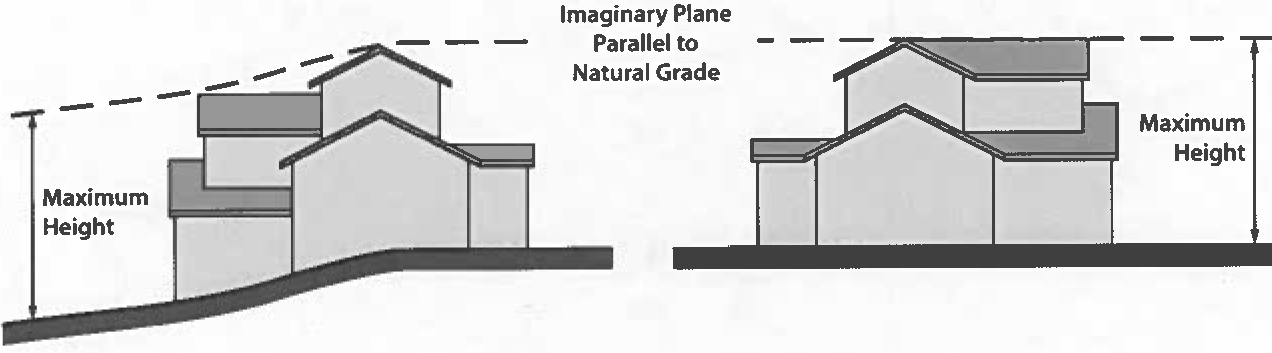
Height Measurement. The height of a structure shall be measured as the vertical distance from the finish grade to the highest point of the roof of the structure. Height is measured as the vertical distance from the finish grade of the site to an imaginary plane located the allowed number of feet above and parallel to the finish grade. See Figure 19.68.020-1 (Height Measurement).
Figure 19.68.020-1\Height Measurement
B.
Height Limits. Height limits are established throughout this Title. Primarily, height limits are listed in the Chapters of Article 2 (Land Use/Zoning Districts). Additional height limits are established for accessory structures, fences and walls, outdoor lighting, and signs and are contained in subsequent Chapters of this Article.
C.
Height Exceptions. Height limits typically exclude architectural features and appurtenances such as, but not limited to, chimneys, antennas, elevators, windmills and similar mechanical equipment.
1.
Architectural Features. Chimneys, cupolas, flagpoles, monuments, radio and other towers, gas storage holders, water tanks, and similar structures and mechanical appurtenances may be permitted in excess of building height limits by no more than 50 percent of the applicable height limitation; provided, however, that the same may be safely erected and maintained at such height in view of the specific conditions and circumstances affecting the structure and adjacent properties.
2.
Structures in Residential Districts.
a.
Antenna, Noncommercial. One noncommercial antenna may be permitted up to 52.5 feet in height for each parcel. Antennae shall be set back from all property lines at least 1.25 times the height of the antenna. Height does not include the additional height of whip antennae. Additional antennae shall require a Conditional Use Permit.
b.
Windmills, Noncommercial. One noncommercial windmill or solar energy collector may be permitted up to 35 feet in height for each parcel. Structures shall be set back from all property lines at least 1.25 times the height of the structure, measured to the top of the highest element of the structure. Additional windmills or solar collectors shall require a Conditional Use Permit. Up to a 50 percent increase in height, to 52.5 feet, may be approved subject to a Conditional Use Permit.
(Ord. No. 319, § 4(Exh. A), 8-13-2024)
19.68.030 - Setback Requirements and Exceptions
A.
General Yard and Setback Requirements.
1.
Required Yard Area. Except as otherwise specified in this Title, required yard areas shall be kept free of buildings and structures.
a.
Exceptions:
i.
Water Elements. Water elements such as fountains, ponds, and other water treatments, up to a maximum height of six feet, may be placed in setback areas, provided they do not create a traffic safety hazard. The installation of water elements may be subject to approval of building permits.
ii.
Art installations. Installation of art, such as sculptures, statues, and other installations of an adequately durable and weatherproof design, up to a maximum height of six feet, may be placed in street setback areas, provided they do not create a traffic safety hazard. The installation of art may be subject to approval of building permits.
2.
Exclusivity of Required Yard Area. No yard or other open space provided around any building for the purpose of complying with this Title shall be considered as providing a yard or open space for any other building or structure.
B.
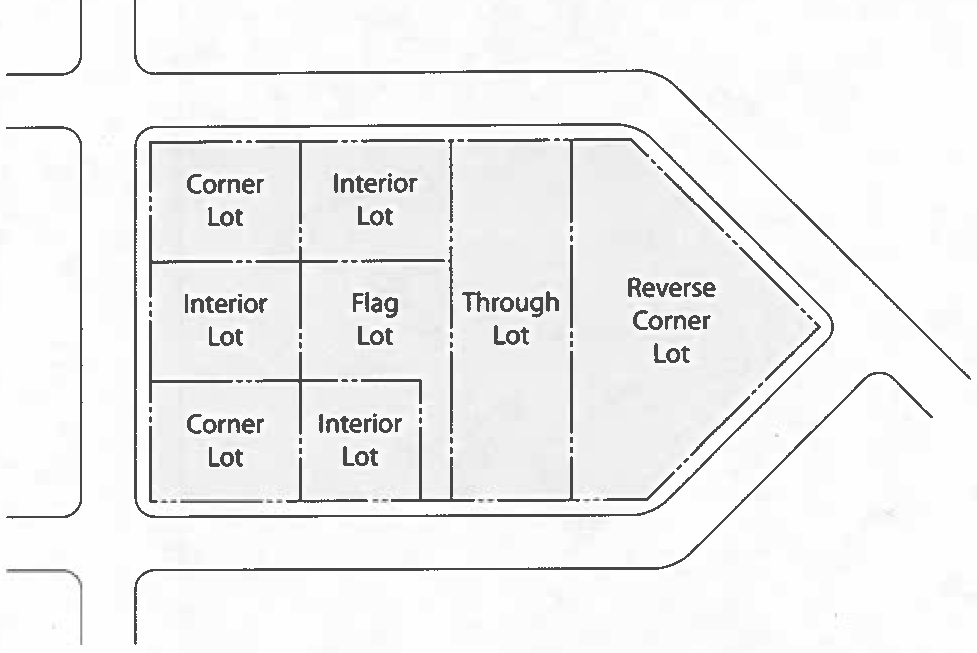
Through Lots. On through lots, either line separating such lot from a public thoroughfare may be designated by the owner as the front lot line. In such cases, the minimum rear yard shall be the average of the yards on lots next adjoining. If such lots next adjoining are undeveloped, the minimum rear yard shall conform to the front yard setback for the zone in which the property is located. See Figure 19.68.030-1 (Lot Type Diagram) for an illustration of a through lot.
Figure 19.68.030-1\Lot Type Diagram
C.
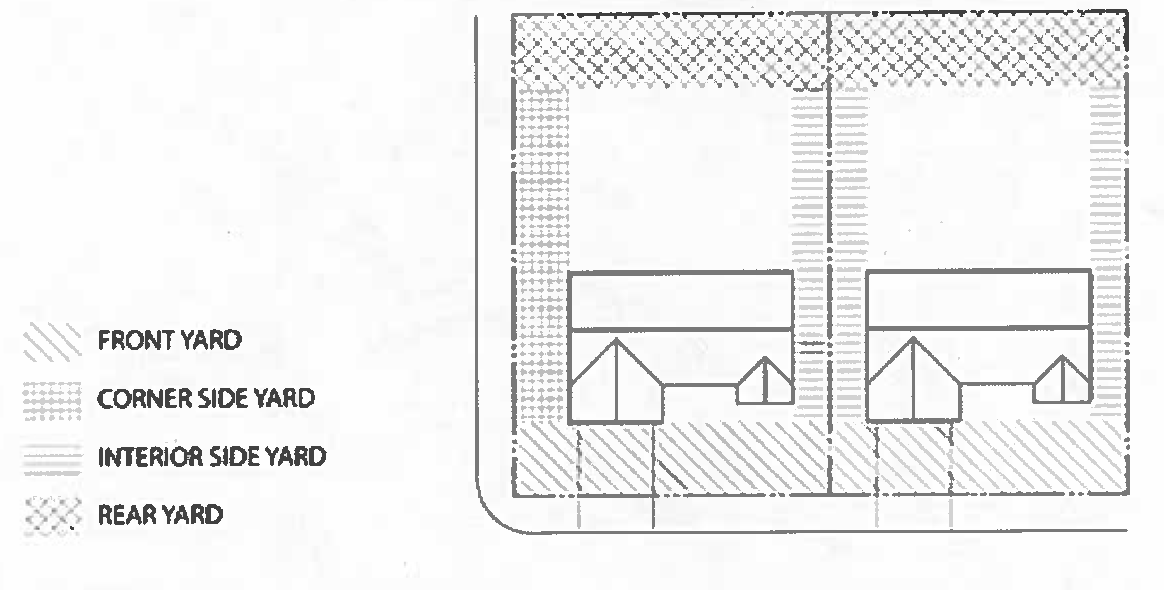
Front Yards. Generally, the front yard setback is determined by the front lot line, which is the lot line paralleling the street. In the case of a lot abutting two or more streets (comer lot), the front yard shall be the shortest length of the lot abutting a street. See Figure 19.68.030-2 (Yard Setback Measurement Diagram) for an illustration of all yards.
D.
Street Side Yards. Except as otherwise permitted, a street side yard shall be used only for landscaping, pedestrian walkways, driveways or off-street parking.
E.
Rear and Interior Side Yards. Except as otherwise permitted, these yards shall be used only for landscaping, pedestrian walkways, driveways, off-street parking or loading, recreational activities, or similar accessory activities.
F.
Vertical Clearance. Except as otherwise provided in this Title, every part of a required yard shall be open from its lowest point to the sky unobstructed. Building overhangs, bay windows, and other such elements may intrude as permitted, pursuant to Subsection 19.68.030.H (Allowed Encroachments or Projections into Required Yards).
G.
Setback Measurement. The setback of all buildings and structures shall be measured at a right angle from the property line. Except as permitted in Subsection 19.68.030.H (Allowed Encroachments or Projections into Required Yards), or as otherwise specified in this Title for specific types of structures (e.g., accessory structures, signs), structures shall not extend beyond required setback lines.
Figure 19.68.030-2\Yard Setback Measurement Diagram
H.
Allowed Encroachments or Projections into Required Yards. In addition to the structures listed in Section 19.70 (Accessory Uses and Structures) and Section 19.74 (Fences, Walls, and Screens), the following structures and architectural features attached to the main building may project into the required yards as set forth below.
I.
Residential and Public District Projections and Encroachments.
1.
No projection may be permitted to obstruct the view of a required clear site triangle.
2.
Attached architectural features such as awnings, canopies, eaves, chimneys, cornices, planter boxes, bay windows and cantilevered portions of the structure (not exceeding 50 percent of the length of the wall to which they are attached) and similar architectural features or mechanical equipment normally incidental to the use are permitted to encroach up to four feet into front or rear yards and up to two feet into side or street side yards.
3.
For properties in the R-HD district, attached unenclosed patio roofs, decks, porches and similar structures (having open, unenclosed sides around at least 50 percent of their perimeters) are permitted to encroach five feet into a rear yard, with a minimum five-foot setback to the rear yard property line. In no case shall such encroachments exceed 50 percent of the length of a building.
4.
For properties in all residential districts except R-HD, attached unenclosed patio roofs, decks, porches and similar structures (having open, unenclosed sides around at least 50 percent of their perimeters) are permitted to encroach up to 50 percent of the required rear yard, with a minimum 5-foot setback to the rear yard property line. In no case shall such encroachments exceed 50 percent of the length of a building.
5.
Pools, spas, and related equipment no greater than 6 feet in height may be located in a required rear or interior side yard setback, with a minimum five-foot setback to the property lines.
6.
Open storage of boats, recreational vehicles and trailers are not allowed in front and street side yard areas of multi-family residential and public districts. (RM, R-HD, P).
7.
Storage of construction vehicles and equipment is not permitted in residential and public districts.
J.
Nonresidential Projections and Encroachments.
1.
No projection may be permitted to obstruct the view of a required clear site triangle.
2.
Attached architectural features such as awnings, canopies, eaves, chimneys, cornices, planter boxes, bay windows, and cantilevered portions of the structure (not exceeding 50 percent of the length of the wall on any one story) are permitted to encroach up to four feet into front or rear yards and up to two feet into side or street side yards.
3.
Stairways, landings, corridors and fire escapes are permitted to encroach up to five feet in front and street side yards, up to four feet in interior side yards, and up to five feet in rear yards.
4.
Storage of boats, recreational vehicles, trailers, and construction vehicles and equipment are not permitted in commercial districts (CO, CN, CG, CT).
(Ord. No. 319, § 4(Exh. A), 8-13-2024)
19.69.010 - Purpose
This Chapter establishes standards for conventionally built, mobile and manufactured homes to ensure consistency with state law requirements and for multi-family residential development to ensure consistency with surrounding land uses and the policies of the General Plan.
(Ord. No. 319, § 4(Exh. A), 8-13-2024)
19.69.020 - Applicability
The standards contained in this Chapter shall apply to the following, unless specifically stated otherwise:
A.
New Uses and Structures. For all buildings erected and all uses of land established after the effective date of this Title, the development standards in this Chapter shall be complied with.
B.
Modification to Existing Structures and Uses. Whenever an existing building is modified or a use is expanded such that it creates an increase of 1,000 square feet or more or four or more in the number of existing dwelling units for multiple-family residential projects, the development standards in this Chapter shall be complied with.
(Ord. No. 319, § 4(Exh. A), 8-13-2024)
19.69.030 - Review Required
Consistency with the regulations contained in this Chapter shall be reviewed concurrent with any required Building Permit or Land Use Permit for applicable projects.
(Ord. No. 319, § 4(Exh. A), 8-13-2024)
19.69.040 - Development Standards—Manufactured or Mobile Homes
The following standards shall apply to all manufactured or mobile homes on lots permitting single-family residences.
A.
Manufactured and mobile homes shall be constructed to meet the standards of the National Mobile Home Construction and Safety Standards Act pursuant to Section 18551 of the California Health and Safety Code.
B.
Manufactured and mobile homes must be less than ten years old.
C.
Manufactured and mobile homes shall be attached to an engineered, permanent perimeter foundation approved by the Building and Safety Division.
D.
The home shall have a minimum width and depth of 20 feet excluding garages, porches, patios, eaves, cabanas and popouts.
E.
The siding material shall consist of stucco, wood, brick, stone or decorative concrete block. Synthetic siding material and textures may be used when determined by the Planning Division to be compatible with the neighborhood.
F.
The exterior covering material shall extend to surrounding grade.
G.
The roofing material shall be tile, rock, shingles or materials customarily used on residential structures in the neighborhood.
(Ord. No. 319, § 4(Exh. A), 8-13-2024)
19.69.050 - Development Standards—Multi-Family Residential
A.
On-site recreational areas for both adults and children for any proposed multi-family project exceeding ten dwelling units shall be provided.
B.
Bus benches and shelters shall be designed into large-scale projects when bus service is available or planned.
C.
Trash storage facilities shall be provided in accordance with Chapter 19.92 (Trash Storage Facilities).
D.
New construction and development shall be generally consistent in scale, mass and character with other structures in the immediately surrounding neighborhood.
E.
New multi-family development shall be designed to preserve natural and scenic resources, where feasible.
F.
New multi-family development shall provide separation between buildings, as determined by adopted Building Code and Fire Dept, requirements.
G.
New multi-family development shall provide pedestrian connections to adjacent residential and commercial developments. Such access shall be physically separated from vehicular traffic, except where the access utilizes public sidewalks within a public-right-of-way.
H.
New multi-family development shall provide pedestrian and bicycle access to open space, parks and adjacent neighborhoods. Such access shall not be mixed with vehicular and through traffic, except where the access utilizes public sidewalks or bikeways within a public-right-of-way.
I.
Homeowner associations or other legally enforceable mechanisms shall be established to maintain all common areas within multi-family developments.
(Ord. No. 319, § 4(Exh. A), 8-13-2024)
19.70.010 - Purpose
This Chapter establishes the regulations and criteria that allow compatible accessory uses to be located within the various land use districts in conjunction with a primary use or incidental to the primary use on the same property. Unless otherwise provided, all accessory uses are subject to the same regulations as the primary use.
(Ord. No. 319, § 4(Exh. A), 8-13-2024)
19.70.020 - Applicability
The regulations and standards contained in this Chapter shall apply only to those structures and uses expressly identified in this Section and shall be in addition to any other development standards and regulations contained elsewhere in this Development Code. For the purposes of this Title, accessory dwelling units are not considered accessory structures; accessory dwelling units are governed by the requirements of Chapter 19.134 (Accessory Dwelling Units) and are exempt from the requirements of this Chapter.
(Ord. No. 319, § 4(Exh. A), 8-13-2024)
19.70.030 - Permit Requirements
A.
All accessory structures, including those accessory structures identified in Section 19.70.040 (Exempt Accessory Structures), are subject to review through the same permit process required for the primary use. Where no permit is required, the accessory structure shall be reviewed through the Zoning Clearance process to ensure consistency with all applicable development standards.
B.
Accessory outdoor display is exempt from the requirement to obtain a permit where such display meets all standards of Section 19.70.080 (Accessory Outdoor Display).
(Ord. No. 319, § 4(Exh. A), 8-13-2024)
19.70.040 - Exempt Accessory Structures
The following accessory structures are exempt from the development standards of this Chapter.
A.
Play equipment that is no greater than eight feet in height.
B.
Decks or uncovered patios.
C.
Tennis courts.
D.
Pool accessories no greater than eight feet in height, excluding mechanical equipment.
E.
Water wells.
F.
Similar at-grade or below-grade structures.
(Ord. No. 319, § 4(Exh. A), 8-13-2024)
19.70.050 - Allowed Uses and Development Standards—General
A.
In addition to the accessory uses specifically provided for by this Section or elsewhere in the Development Code, each land use shall be deemed to include such other accessory uses which are necessarily and customarily associated with and are clearly incidental and subordinate to the land use. Whenever such accessory uses are questioned, it shall be the responsibility of the Community Development Director to determine if a proposed accessory use meets the criteria set forth in this Chapter.
B.
The combination of accessory structures and primary use structures shall not exceed the maximum lot coverage or floor area ratio (FAR) specified by the land use district.
C.
Permitted accessory structures shall be located on the same parcel as the primary use within the building envelope, except where expressly allowed.
D.
Seagoing cargo containers or similar storage facilities may be used for the purpose of temporary storage or containment of construction cleanup materials, subject to the following:
1.
Seagoing cargo containers or similar storage facilities may be located anywhere on the property, except in the clear sight triangles, during the duration of an active Building Permit.
2.
Such temporary storage devices must be removed within 30 days of Building Permit final or expiration.
3.
No permit is necessary for this type of use; however, the contractor is to inform the City of the intended use of these cargo containers and have the fact noted on other issued permit(s).
(Ord. No. 319, § 4(Exh. A), 8-13-2024)
19.70.060 - Allowed Uses and Development Standards—Residential
A.
Accessory Uses. The following uses shall be permitted as accessory uses to each single dwelling unit which is allowed:
1.
Guest Housing. Residential occupancy of a living unit, with no kitchen plumbing, located on the same parcel as the primary dwelling unit, but separated from it by at least ten feet. This housing is for use by the occupants or temporary guests of the occupants of the premises and is not to be rented or otherwise used as a separate dwelling, except as provided in Section 19.70.090 (Accessory Residential Dwellings). A maximum of one guest house shall be allowed per parcel.
2.
Accessory animal boarding, breeding, housing, lodging, sheltering or raising as specified by Chapter 19.102 (Animal Keeping).
B.
Accessory Structures. The following regulations shall apply to all accessory structures as specified:
1.
Architectural Compatibility. All accessory structures that enclose or shelter 120 square feet or more of floor area shall be required to be architecturally compatible with the main building(s) on site. Architectural compatibility shall be determined by similar architectural style and color.
2.
In the Single-Family Residential (RS) Districts, the cumulative total area of all accessory structures upon a recorded lot may not exceed 50 percent of the area of the main structure or 1,000 square feet, whichever is larger. Within the Rural Living (RL) Districts, the cumulative total area of all accessory buildings upon a recorded lot may not exceed 100 percent of the area of the main structure or 2,500 square feet, whichever is larger. An accessory dwelling unit as permitted under Chapter 19.134 (Accessory Dwelling Units) shall not be included within the cumulative total of allowed square footage for accessory structure(s).
3.
In the RS Districts, an accessory structure may not be higher than the height of the established primary use structure or 16 feet whichever is greater.
4.
In the RL Districts, accessory structures may be constructed up to the maximum height allowed within the land use district in which it is located, regardless of the height of the primary use structure..
5.
In the Multi-Family Residential (RM) District, the cumulative total area of all accessory structures upon a recorded lot may not exceed 50 percent of the cumulative total habitable area of all primary structures on-site containing a residential unit and shall be subject to the height, setback and lot coverage limitations of the RM Land Use District.
C.
Seagoing cargo containers and similar storage facilities may be permitted as permanent storage facilities on a lot containing a residence subject to the following conditions. A maximum of two cargo containers are permitted on any residentially zoned property.
1.
Approval of a Cargo Container Review Permit where it is demonstrated that the requested container(s) is to be located within the rear one-half of the lot and shall be screened from view of any public rights-of-ways or adjacent residential properties by residential structures, landforms or physical features of the lot, landscaping or opaque fencing of up to eight feet in height, with any visible remaining exterior portion of the container(s) painted in a manner compatible with the principal residence on-site.
2.
Screening shall be waived if the container(s) is/are completely encased within an on-site, stick-built skin and eaves, which are architecturally consistent with the primary residence on-site and are in compliance with the required setbacks for the zoning district.
3.
Containers shall be maintained in reasonable aesthetic condition at all times, as determined by the Community Development Director; shall not exceed 50 percent of the floor area of the primary residence on-site, inclusive of all accessory structures; shall not be stacked one atop another; and shall not be used for habitation of persons or animals.
(Ord. No. 319, § 4(Exh. A), 8-13-2024)
19.70.070 - Allowed Uses and Development Standards—Commercial, Industrial, and Public
A.
Accessory Uses. The following uses shall be permitted as accessory uses to primary commercial, industrial, or public uses which are allowed by a land use district:
1.
Accessory residential dwellings as specified in Section 19.70.090 (Accessory Residential Dwellings).
2.
Accessory outdoor sales or display areas subject to the standards set forth in Section 19.70.080 (Accessory Outdoor Display).
B.
Accessory Structures. The following regulations shall apply to all accessory structures as specified:
1.
Permanent use of seagoing cargo containers and similar storage facilities may be used as accessory structures on lots designated for commercial or industrial uses and containing an existing use subject to the following conditions:
a.
Approval of a Site Plan Review where it is demonstrated that the requested containers) shall not be located within any required setback area, shall not be located closer than 50 feet to any public rights-of-way when located between the right-of-way and any structure on-site, and shall be screened from view of any property used for residential purposes and/or the public rights- of-way by on-site structures, landforms or physical features of the lot, landscaping or opaque fencing of up to 8 feet in height, wherein any visible remaining exterior portion of the containers) shall be painted in a color compatible with the primary use structure on-site.
b.
Screening shall be waived if the container(s) is/are completely encased within an on-site, stick- built skin and eaves, which are architecturally consistent with the primary structure on-site and are in compliance with the setbacks for the zoning district.
c.
Containers shall be maintained in a reasonable aesthetic conditional at all times, as determined by the Community Development Director; shall not exceed 500 square feet of container per acre of land; shall be not stacked one atop another; and shall not be used for habitation of persons or animals.
d.
No seagoing cargo container(s) shall be utilized for any purpose other than that directly associated with the primary activity on-site, nor shall the containers) be allowed to be rented, leased or hired for compensation of any means.
(Ord. No. 319, § 4(Exh. A), 8-13-2024)
19.70.080 - Accessory Outdoor Display
The intent of this Section is to provide for the appropriate location and design of outdoor sales and display areas and to mitigate any adverse impacts that such uses may have on adjacent properties and rights-of- way.
A.
Accessory Outdoor Sales and Display Permitted. Outdoor sales and display shall be permitted as an accessory use only in commercial and industrial land use districts, subject to the following requirements:
1.
Outdoor sales and display shall only be permitted in an area not greater than 500 square feet or ten percent of the gross floor area of the ground floor of the building, whichever is less, and shall be located at least 50 feet from any residentially zoned property.
2.
Outdoor sales and display shall not be permitted within any required setback area, except as allowed under Subsection 19.70.080. A.4.
3.
Stacked items shall not exceed six feet in height. No material or display items shall be located within three feet of any building entry.
4.
Vending machines and accessory outdoor sales and display may be permitted outside of the building and within a required setback when located against and parallel to the building facade, extending up to 4 feet in depth from the building. These items shall count toward the total outdoor sales and display area permitted by this Section. Public telephones and mailboxes are excluded from these regulations.
5.
Outdoor sales and display of items shall be located on a permanent durable surface.
6.
No outdoor sales and display shall be allowed in areas set aside, required or designated for pedestrian walkways, drive aisles, driveways, maneuvering areas, emergency access ways, off- street parking or unloading/loading.
7.
Outdoor sales and display items may be located on sidewalks in the public right-of-way only if permitted in accordance with Chapter 19.55 (Sidewalk Vending). Outdoor sales and display items shall be permitted on privately owned walks or other areas intended for pedestrian movement provided an unobstructed, continuous path with a minimum four-foot width is maintained. Materials located at the edge of a pedestrian way adjacent to a driving aisle shall not extend more than ten feet without providing a break of not less than four feet in width to allow for unobstructed access onto the pedestrian way.
8.
Items for outdoor sale and display shall be completely screened from view from any abutting residentially zoned property.
9.
No outdoor sales, storage or display areas shall be located in the clear sight triangle as defined by this Code, or located in any manner that would restrict or limit adequate sight distances for interior or exterior vehicular movements.
10.
Any outdoor display or sale item located in a manner constituting a sign must conform to the appropriate sign ordinance or regulations.
11.
Outdoor sales and display shall only be accessory to a principal nonresidential use where such use conducts its activities within a completely enclosed building or group of buildings on the same property, shall be conducted by employees of the principal use, and shall be owned by the owner of the principal use and not a consignment operation or arrangement.
(Ord. No. 319, § 4(Exh. A), 8-13-2024)
19.70.090 - Accessory Residential Dwellings
The following dwelling is allowed as an accessory use to a primary agricultural, commercial, industrial or institutional use where such use demonstrates the need for on-site residency of one or more people to maintain, operate and/or secure the primary nonresidential land use on the property.
A.
Caretaker's Residence. Residential occupancy of a dwelling unit by the owners, operators or caretaker employed to maintain, operate or guard part or all of the property on which the caretaker dwelling is located as an accessory use. The caretaker dwelling unit may be located either above the first floor or behind a primary use structure. Caretaker housing shall be processed in accordance with the permit requirements identified in the applicable land use district chapters contained in Article 2 of this Development Code.
(Ord. No. 319, § 4(Exh. A), 8-13-2024)
19.72.010 - Purpose
This Chapter implements the statutory requirements set forth in Government Code Sections 65915-65918 (known as state density bonus law). To the extent practicable, the citation to the governing statutory provision is included next to the implementing Ordinance Section. If any provision of this Chapter conflicts with state law, the latter shall control. Applicable statutes should be consulted for amendments prior to applying the Ordinance provision.
(Ord. No. 308, § 4(Exh. A), 9-26-2023)
19.72.020 - Applicability
The density bonuses and incentives contained in this Chapter shall apply to housing developments eligible for a density bonus under state density bonus law. When an applicant seeks a density bonus for a housing development within, or for the donation of land for housing within, the City's jurisdiction that meets the requirements set out in California Government Code Section 65915, the actions and procedures set out in this Chapter shall apply. The burden is on the applicant to show that the housing development meets such requirements. The density bonus provisions of California Government Code Sections 65915 et seq., as may be amended from time to time, are incorporated by reference into this chapter. The City reserves the right to review applications for a density bonus in accordance with state density bonus law.
(Ord. No. 308, § 4(Exh. A), 9-26-2023)
19.72.030 - Definitions
In addition to the definitions in Chapter 19.06, the following definitions in this Section apply to this Chapter and shall control where there is a conflict with the definitions in Chapter 19.06. State law definitions, as they may be amended from time to time, control over the definitions in this Section. Where the definitions are provided by state law, the citation to the statute follows.
A.
Affordable Housing. Dwelling units with a sales price or rent within the means of a low- or moderate-income household as defined by state or federal legislation. As used in this Development Code:
1.
Very low income refers to family units/household whose annual income is 50 percent or less of the area's median income as defined in Health and Safety Code Section 50105 (Government Code Section 65915(b)(1)(B)).
2.
Low income refers to family units/households whose annual income is between 50 percent and 80 percent of the area's median income as defined in Health and Safety Code Section 50079.5 (Government Code Section 65915(b)(1)(A)).
3.
Moderate income refers to family units/households whose annual income is between 80 percent and 120 percent of the area's median income as defined in Health and Safety Code Section 50093 (Government Code Section 65915(b)(1)(D)).
B.
Affordable Housing Benefits. Means one or more of the following:
1.
A density bonus pursuant to Section 19.72.070.
2.
An incentive pursuant to Section 19.72.110.
3.
A development standard waiver or modification pursuant to Section 19.72.140.
4.
A parking standard modification pursuant to Section 19.72.150.
C.
Affordable Housing Cost. The definition set forth in Health and Safety Code Section 50052.5 (Government Code Section 65915(c)(1)).
D.
Affordable Housing Developer. The applicant or permittee of a qualified housing development and its assignees or successors in interest.
E.
Affordable Rent. The definition set forth in Health and Safety Code Section 50053 (Government Code Section 65915(c)(1)).
F.
Child Care Facility. A child day care facility other than a family day care home, including but not limited to infant centers, preschools, extended day care facilities, and school-age child care centers (Government Code Section 65915(h)(4)).
G.
Common Interest Development. Any of the following: a community apartment project, a condominium project, a planned development, and a stock cooperative pursuant to Civil Code Section 1351(c) and pursuant to Civil Code Section 4100. All common interest development units must be offered to the public for purchase (Government Code Section 65915(b)(1)(D)).
H.
Condominium Conversion Project. A residential project in which the applicant proposes to convert apartment units to condominiums pursuant to Government Code Section 65915.5(a).
I.
Density Bonus. A process by which a city can increase the density within a development project by a percentage established by law or through which the city offers incentives that support economic viability in return for guarantees with respect to the preservation of the rights of use or sale for affordable housing purposes.
J.
Density Bonus Units. Dwelling units granted pursuant to Section 19.72.040 which exceed the otherwise maximum allowable residential density.
K.
Development Standard. A site or construction condition, including but not limited to a height limitation, a setback requirement, a floor area ratio, an on-site open-space requirement, or a parking ratio, that applies to a residential development pursuant to the Development Code, the General Plan or other City condition, law, policy, resolution, or regulation (Government Code Section 65915(o)(1)).
L.
Housing Development. A development project of five or more residential units and includes a subdivision or common interest development that is approved by the City and consists of residential units or unimproved residential lots, and either a project to substantially rehabilitate and convert an existing commercial building to residential use or the substantial rehabilitation of an existing multifamily dwelling where the result of the rehabilitation would be a net increase in available residential units (Government Code Section 65915(i)).
M.
Incentive. Means "incentives and concessions" as that phrase is used in Government Code Section 65915.
N.
Market-rate Unit. A dwelling unit that is not an affordable unit.
O.
Maximum Allowable Residential Density. The density allowed under the Development Code and the Land Use Element of the General Plan, or if a range of density is permitted, means the maximum allowable density for the specific district density range applicable to the project. If the density allowed under the Development Code is inconsistent with the density allowed under the Land Use Element of the General Plan, the General Plan density shall prevail (Government Code Section 65915(o)(2)).
P.
Minimum Affordable Housing Component. A housing development project that includes a minimum of any of the following:
1.
Very Low Income Minimum Affordable Housing Component - Provides at least 5 percent of the total units for very low-income household residents (Government Code Section 65915(b)(1)(B)); or
2.
Low Income Minimum Affordable Housing Component - Provides at least 10 percent of the total units for low-income households (Government Code Section 65915(b)(1)(A)); or
3.
Moderate Income Minimum Affordable Housing Component - Provides at least 10 percent of the total dwelling units in a common interest development for moderate-income households (Government Code Section 65915(b)(1)(D)).
Q.
Other Incentives of Equivalent Financial Value. The reduction or waiver of requirements which the City might otherwise apply as conditions of condominium conversion approval, but shall not be construed to require the City to provide cash transfer payments or other monetary compensation (Government Code Section 65915.5(c)).
R.
Qualified Housing Development. A housing development that meets the requirements of Section 19.72.040 for density bonus.
S.
Qualified Land. Land offered for donation in accordance with Section 19.72.100 that meets the criteria set forth in SubSection 19.72.100.A.
T.
Senior Citizen Housing Development. A residential development that is developed, substantially rehabilitated, or substantially renovated for senior citizens and that has at least 35 senior citizen housing development units (Government Code Section 65915(b)(1)(C)).
U.
Senior Citizen Housing Development Unit. A residential dwelling unit in a senior citizen housing development that is available to, and occupied by, a senior citizen as defined in Civil Code Section 51.3.
V.
Specific, Adverse Impact. A significant, quantifiable, direct and unavoidable impact, based on objective, identified written public health or safety standards, policies or conditions as they existed on the date the application for the housing development was deemed complete. Inconsistency with the Development Code or General Plan land use designation shall not constitute a specific, adverse impact upon the public health or safety (Government Code Section 65589.5(d)(2)).
W.
Total Units and Total Dwelling Units. Dwelling units other than density bonus units (Government Code Section 65915(b)(3)).
(Ord. No. 308, § 4(Exh. A), 9-26-2023)
19.72.040 - Eligibility for Density Bonuses and Incentives
A.
Density bonuses are available to affordable housing developers in accordance with this Chapter for the following:
1.
The city shall grant one (1) density bonus as specified in this Section, and incentives or concessions as described in this Section, when an applicant seeks and agrees to construct a housing development, excluding any units permitted by the density bonus awarded pursuant to this Section, that will contain at least any one (1) of the following:
a.
Ten percent of the total units of a housing development for rental or sale to lower income households, as defined in Section 50079.5 of the Health and Safety Code.
b.
Five percent of the total units of a housing development for rental or sale to very low income households, as defined in Section 50105 of the Health and Safety Code.
c.
A senior citizen housing development, as defined in Sections 51.3 and 51.12 of the Civil Code, or a mobile home park that limits residency based on age requirements for housing for older persons pursuant to Section 798.76 or 799.5 of the Civil Code.
d.
Ten percent of the total dwelling units of a housing development are for rental or sale to persons and families of moderate income, as defined in Section 50093 of the Health and Safety Code.
e.
Ten percent of the total units of a housing development for transitional foster youth, as defined in Section 66025.9 of the Education Code, disabled veterans, as defined in Section 18541, or homeless persons, as defined in the federal McKinney-Vento Homeless Assistance Act (42 U.S.C. Sec. 11301 et seq.). The units described in this subparagraph shall be subject to a recorded affordability restriction of 55 years and shall be provided at the same affordability level as very low income units.
f.
Twenty percent of the total units for lower income students in a student housing development that meets the following requirements:
i.
All units in the student housing development will be used exclusively for undergraduate, graduate, or professional students enrolled full time at an institution of higher education accredited by the Western Association of Schools and Colleges or the Accrediting Commission for Community and Junior Colleges. In order to be eligible under this subclause, the developer shall, as a condition of receiving a certificate of occupancy, provide evidence to the city, county, or city and county that the developer has entered into an operating agreement or master lease with one or more institutions of higher education for the institution or institutions to occupy all units of the student housing development with students from that institution or institutions. An operating agreement or master lease entered into pursuant to this subclause is not violated or breached if, in any subsequent year, there are not sufficient students enrolled in an institution of higher education to fill all units in the student housing development.
ii.
The applicable 20-percent units will be used for lower income students.
iii.
The rent provided in the applicable units of the development for lower income students shall be calculated at 30 percent of 65 percent of the area median income for a single-room occupancy unit type.
iv.
The development will provide priority for the applicable affordable units for lower income students experiencing homelessness. A homeless service provider, as defined in paragraph (3) of subdivision (e) of Section 103577 of the Health and Safety Code, or institution of higher education that has knowledge of a person's homeless status may verify a person's status as homeless for purposes of this subclause.
v.
For purposes of calculating a density bonus granted pursuant to this subparagraph, the term "unit" as used in this Section means one rental bed and its pro rata share of associated common area facilities. The units described in this subparagraph shall be subject to a recorded affordability restriction of 55 years.
g.
100 percent of all units in the development, including total units and density bonus units, but exclusive of a manager's unit or units, are for lower income households, as defined by Section 50079.5 of the Health and Safety Code, except that up to 20 percent of the units in the development, including total units and density bonus units, may be for moderate-income households, as defined in Section 50053 of the Health and Safety Code.
B.
For the purpose of calculating a density bonus, the residential units must be on contiguous sites that are the subject of one development application, but do not have to be based upon individual subdivision maps or parcels (Government Code Section 65915(i)).
(Ord. No. 308, § 4(Exh. A), 9-26-2023)
19.72.050 - Application and Required Fees
A.
Application Filing and Processing. When an applicant seeks a density bonus for a housing development that meets the criteria in Section 19.72.070, the affordable housing developer must comply with all the following requirements:
1.
File an application for a density bonus in accordance with this Section that includes a minimum affordable housing component, whether or not the project also requires or has been granted a Conditional Use Permit or other permits or approvals (Government Code Section 65915(d)(1)).
2.
State in the application the specific minimum affordable housing component proposed for the housing development (Government Code Section 65915(b)(2)).
3.
Enter into an agreement with the City or its designee pursuant to Section 19.72.180 (Affordable Housing Agreement and Equity Sharing Agreement) to maintain and enforce the affordable housing component of the housing development (Government Code Section 65915(c)).
B.
Application Fees. Application fees shall be collected in accordance with Section 19.28.050 (Applications and Fees).
1.
If an application for a density bonus requires an unusual amount or specialized type of study or evaluation by City staff, consultant or legal counsel, City staff shall estimate the cost thereof and require the applicant to pay an additional fee or make one or more deposits to pay such cost before the study or evaluation is begun. On completion of the study or evaluation, and before the City Council decides the application, City staff shall determine the actual cost of the work and the difference between the actual cost and the amount paid by the applicant, and shall require the applicant to pay any deficiency or shall refund to the applicant any excess.
(Ord. No. 308, § 4(Exh. A), 9-26-2023)
19.72.060 - Effect of Proposal for Waiver or Reduction of Development Standards
A.
In no case may the city apply any development standard that will have the effect of physically precluding the construction of a development meeting the criteria of Section 19.72.040 at the densities or with the concessions or incentives permitted by this Section. An applicant may submit to the city a proposal for the waiver or reduction of development standards that will have the effect of physically precluding the construction of a development meeting the criteria of subSection C at the densities or with the concessions or incentives permitted under this Section, and may request a meeting with the city. If a court finds that the refusal to grant a waiver or reduction of development standards is in violation of this Section, the court shall award the plaintiff reasonable attorney's fees and costs of suit. Nothing in this subdivision shall be interpreted to require the city to waive or reduce development standards if the waiver or reduction would have a specific, adverse impact, as defined in paragraph (2) of subSection (d) of Section 65589.5, upon health, safety, or the physical environment, and for which there is no feasible method to satisfactorily mitigate or avoid the specific adverse impact. Nothing in this subdivision shall be interpreted to require the city to waive or reduce development standards that would have an adverse impact on any real property that is listed in the California Register of Historical Resources or to grant any waiver or reduction that would be contrary to state or federal law.
B.
A proposal for the waiver or reduction of development standards pursuant to this subdivision shall neither reduce nor increase the number of incentives or concessions to which the applicant is entitled pursuant to 19.72.040.
(Ord. No. 308, § 4(Exh. A), 9-26-2023)
19.72.070 - Density Bonus Allowance for Housing Development with Affordable Housing Component
A.
The amount of density bonus to which the applicant is entitled shall vary according to the amount by which the percentage of affordable housing units exceeds the percentage established in 19.72.040.
1.
For housing developments meeting the criteria of subSection 19.72.040(A)(1)(a), the density bonus shall be calculated as follows:
2.
For housing developments meeting the criteria of subSection 19.72.040(A)(1)(b), the density bonus shall be calculated as follows:
3.
For housing developments meeting the criteria of subSection 19.72.040(A)(1)(c) and (e), the density bonus shall be twenty percent (20%).
4.
For housing developments meeting the criteria of subSection 19.72.040(A)(1)(f), the density bonus shall be thirty-five percent (35%).
5.
For housing development meeting the criteria of subSection 19.72.040(A)(1)(g), the following shall apply:
i.
The density bonus shall be 80 percent of the number of units for lower income households.
ii.
If the housing development is located within one-half mile of a major transit stop, the city shall not impose any maximum controls on density.
6.
For housing developments meeting the criteria of subSection 19.72.040(A)(1)(d), the density bonus shall be calculated as follows:
C.
All density calculations resulting in fractional units shall be rounded up to the next whole number (Government Code Section 65915(f)(5)).
(Ord. No. 308, § 4(Exh. A), 9-26-2023)
19.72.080 - Density Bonus for Housing Development with Affordable Housing Component and Child Care Facility
A.
When an applicant proposes to construct a housing development that includes affordable units as specified in subSection C and includes a child daycare facility that will be located on the premises of, as part of, or adjacent to such housing development, the city shall grant either of the following if requested by the developer.
a.
An additional density bonus that is an amount of square feet of residential space that is equal to or greater than the amount of square feet in the child daycare facility.
b.
An additional concession or incentive that contributes significantly to the economic feasibility of the construction of the child daycare facility.
B.
A housing development shall be eligible for the density bonus or concession described in this subSection if the city, as a condition of approving the housing development, requires all of the following to occur:
a.
The child daycare facility will remain in operation for a period of time that is as long as or longer than the period of time during which the affordable housing units are required to remain affordable pursuant to Section 19.72.040.
b.
Of the children who attend the child daycare facility, the percentage of children of very low income households, lower income households, or moderate income households shall be equal to or greater than the percentage of affordable housing units that are proposed to be affordable to very low income households, lower income households, or moderate income households.
c.
Notwithstanding any requirement of this subSection, the city shall not be required to provide a density bonus or concession for a child daycare facility if it finds, based upon substantial evidence, that the community already has adequate child daycare facilities.
C.
The application and review process for the provision of child daycare facilities and related density bonus or concessions or incentives is set forth in Section 19.72.160.
(Ord. No. 308, § 4(Exh. A), 9-26-2023)
19.72.090 - Density Bonus for Condominium Conversions
Developer converting condominiums of a housing development of five (5) units or more who seeks a density bonus, shall make such application in conjunction with its tract map application pursuant to the Subdivision Map Act, and consistent with Government Code Section 65915.5. Any appeal of any concession or incentive or review by the planning commission or city council shall automatically require an appeal of the underlying map to that body. An applicant shall be ineligible for a density bonus or other incentives under this Section if the apartments proposed for conversion constitute a housing development for which a density bonus or other incentives were provided under Government Code Section 65915.
(Ord. No. 308, § 4(Exh. A), 9-26-2023)
19.72.100 - Density Bonus for Land Donations
A.
When a developer of a housing development donates land to the city as provided for in this subSection, the applicant shall be entitled to a fifteen percent (15%) increase above the otherwise maximum allowable residential density under the applicable zoning ordinance and land use element of the general plan for the entire housing development, as follows:
This increase shall be in addition to any increase in density mandated by subSection C, up to a maximum combined mandated density increase of thirty-five percent (35%), if an applicant seeks both the increase required pursuant to this subSection and subSection C. All density calculations resulting in fractional units shall be rounded up to the next whole number. Nothing in this subSection shall be construed to enlarge or diminish the city's authority to require an applicant to donate land as a condition of development.
1.
An applicant shall be eligible for the increased density bonus described in this Section if the city is able to make all the following findings:
a.
The applicant donates and transfers the land no later than the date of approval of the final subdivision map, parcel map, or residential development application.
b.
The developable acreage and zoning classification of the land being transferred are sufficient to permit construction of units affordable to very low income households in an amount not less than ten percent (10%) of the number of residential units of the proposed development.
c.
The transferred land is at least one (1) acre in size or of sufficient size to permit development of at least forty (40) units, has the appropriate general plan designation, is appropriately zoned for development as affordable housing, and is or will be served by adequate public facilities and infrastructure. The land shall have appropriate zoning and development standards to make the development of the affordable units feasible. No later than the date of approval of the final subdivision map, parcel map, or development application for the housing development, the transferred land shall have all of the permits and approvals, other than building permits, necessary for the development of very low income housing units on the transferred land, except that the city may subject the proposed development to subsequent design review to the extent authorized by subdivision (i) of Government Code Section 65583.2 if the design is not reviewed by the local government prior to the time of transfer.
d.
The transferred land and the very low income units constructed on the land will be subject to a deed restriction ensuring continued affordability of the units consistent with this Section, which restriction will be recorded on the property at the time of dedication.
e.
The land is transferred to the city or to a housing developer approved by the city. The city may require the applicant to identify and transfer the land to such city-approved developer.
f.
The transferred land shall be within the boundary of the proposed development or, if the city agrees in writing, within one-quarter (¼) mile of the boundary of the proposed development.
g.
A proposed source of funding for the very low income units shall be identified not later than the date of approval of the final subdivision map, parcel map, or residential development application.
B.
All density calculations resulting in fractional units shall be rounded up to the next whole number (Government Code Section 65915(g)(2)).
(Ord. No. 308, § 4(Exh. A), 9-26-2023)
19.72.110 - Affordable Housing Incentives
A.
Government Code SubSections 65915(d), (j), (k) and (1) govern the following provisions regarding affordable housing incentives.
B.
Qualifications for Incentives. Subject to Section 19.72.130 (Criteria for Denial of Application for Incentives), all of the following applicable requirements must be satisfied to be granted an incentive(s) pursuant to SubSection 19.72.110.B and Section 19.72.120 (Number of Incentives Granted):
1.
The applicant for an incentive must also be an applicant for a density bonus and qualify for a density bonus pursuant to Section 19.72.040 (Government Code Section 65915(d)(1)).
2.
A specific written proposal for an incentive(s) must be submitted with the application for density bonus (Government Code Section 65915(b)(1) and (d)(1)).
3.
If an incentive(s) pursuant to Sections 19.72.110 and 19.72.120 is sought, the applicant must establish that each requested incentive would result in identifiable, financially sufficient, and actual cost reductions for the qualified housing development (Government Code Section 65915(k)(1) & (3)).
4.
If an incentive(s) pursuant to SubSection 19.72.110.B(2) is sought, the applicant must establish that requirements of that Section are met (Government Code Section 65915(k)(2)).
5.
If an additional incentive for a child care facility is sought pursuant to SubSection 19.72.120.B, the applicant must establish that requirements of that Section are met (Government Code Section 65915(h)(1)(B)).
6.
The granting of an incentive shall not be interpreted, in and of itself, to require a General Plan Amendment, Zoning Change, or other discretionary approval (Government Code Section 65915(j)). An incentive is applicable only to the project for which it is granted. An applicant for an incentive may request a meeting with the Community Development Director (Director) and, if requested, the Director will meet with the applicant to discuss the proposal (Government Code Section 65915(d)(1)).
C.
Types of Incentives. For the purposes of this Chapter, incentive or consession means any of the following:
1.
A reduction in site development standards or a modification of Development Code requirements or design guidelines that exceed the minimum building standards approved by the California Building Standards Commission as provided in Part 2.5 (commencing with Section 18901) of Division 13 of the Health and Safety Code, including, but not limited to, a reduction in setback and square footage requirements and in the ratio of vehicular parking spaces that would otherwise be required that results in identifiable, financially sufficient, and actual cost reductions (Government Code Section 65915(k)(1)).
2.
Approval of mixed-use zoning in conjunction with the qualified housing development if commercial, office, industrial or other land uses will reduce the cost of the qualified housing development and if the commercial, office, industrial or other land uses are compatible with the qualified housing development and the existing or planned development in the area where the proposed qualified housing development will be located (Government Code Section 65915(k)(2)).
3.
Other regulatory incentives proposed by the affordable housing developer or the City that result in identifiable, financially sufficient, and actual cost reductions (Government Code Section 65915(k)(3)).
4.
For purposes of this Section, the parking ratios set forth in Government Code Section 65915 for qualified affordable housing projects shall be deemed a concession or incentive available to the applicant.
5.
Nothing in this Section limits or requires the provision of direct financial incentives by the City for the qualified housing development, including the provision of publicly owned land, or the waiver of fees or dedication requirements (Government Code Section 65915(1)).
(Ord. No. 308, § 4(Exh. A), 9-26-2023)
19.72.120 - Number of Incentives Granted
A.
Subject to Section 19.72.130 (Criteria for Denial of Application for Incentives), the applicant who meets the requirements of SubSection 19.72.110.A shall receive the following number of incentives described below and as shown in Table 19.72.120-1.
1.
One incentive for qualified housing development projects that include at least 5 percent for very low-income households, at least 10 percent of the total units for low-income households, or at least 10 percent for persons and families of moderate-income households in a development in which the units are for rental or sale.
2.
Two incentives for housing developments that include: At least seventeen percent (17%) of the total units affordable to lower income households; or at least ten percent (10%) of the total units affordable to very low income households; or at least twenty percent (20%) of the total units affordable to persons and families of moderate income in a development in which the units are for rental or sale..
3.
Three incentives for housing developments that include: At least twenty-four percent (24%) of the total units for lower income households; or at least fifteen percent (15%) for very low income households; or at least thirty percent (30%) for persons and families of moderate income in a development in which the units are for rental or sale.
4.
Four (4) incentives of concessions if the project includes 100% affordable housing units, excluding the manager's unit. If the project is within one-half mile of a major transit stop, the applicant shall also receive a height increase of up to three additional stories, or 33 feet.
5.
One incentive or concession for projects that include at least twenty (20) percent of the total units for lower income students in a student housing development.
(Ord. No. 308, § 4(Exh. A), 9-26-2023)
19.72.130 - Criteria for Denial of Application for Incentives
A.
Except as otherwise provided in this Chapter or by state law, if the requirements of SubSection 19.72.110.A are met, the City shall grant the incentive(s) that are authorized by SubSection 19.72.110.B and Section 19.72.120 unless a written finding, based upon substantial evidence, is made with respect to any of the following, in which case the City may refuse to grant the incentive(s):
1.
The incentive is not required in order to provide affordable housing costs or affordable rents for the affordable units subject to the qualified housing development application (Government Code Section 65915(d)(1)(A)).
2.
The incentive would have a specific, adverse impact, as defined in Government Code Section 65589.5(d)(2), upon the public health and safety or the physical environment or on any real property that is listed in the California Register of Historical Resources and for which there is no feasible method to satisfactorily mitigate or avoid the specific, adverse impact without rendering the development unaffordable to low- and moderate-income households (Government Code Section 65915(d)(1)(B); Government Code Section 65915 (d)(3)).
3.
The incentive would be contrary to state or federal law (Government Code Section 65915(d)(1)(C)).
4.
The community has adequate child care facilities, in which case the additional incentive for a child care facility pursuant to SubSection 19.72.120.B may be denied (Government Code Section 65915(h)(3)).
(Ord. No. 308, § 4(Exh. A), 9-26-2023)
19.72.140 - Waiver or Modification of Development Standards
A.
Requirements for Waiver or Modification of Development Standards.
1.
Application. To qualify for a waiver or reduction of one or more development standards, the applicant must submit a written application (together with an application for a qualified housing development) that states the specific development standard(s) sought to be modified or waived and the basis of the request (Government Code Section 65915(e)(1)). An applicant for a waiver or modification of development standard(s) pursuant to this Section may request a meeting with the Director to review the proposal. If requested, the Director shall meet with the applicant (Government Code Section 65915(e)(1)). An application for the waiver or reduction of development standard(s) pursuant to this Section shall neither reduce nor increase the number of incentives to which the applicant is entitled pursuant to Section 19.72.110 (Government Code Section 65915(e)(2)).
2.
Findings. All of the following findings must be made for each waiver or reduction requested:
a.
The development standard for which a waiver or reduction is requested will have the effect of physically precluding the construction of the proposed qualified housing development at the densities or with the incentives permitted under this Chapter (Government Code Section 65915(e)(1)).
b.
The requested waiver or reduction of a development standard will not have a specific, adverse impact, as defined in Government Code Section 65589.5(d)(2), upon the health, safety and/or physical environment or, if such a specific, adverse impact exists, there is a feasible method to satisfactorily mitigate or avoid the specific, adverse impact (Government Code Section 65915(e)(1)).
c.
The requested waiver or reduction of a development standard will not have an adverse impact on any real property that is listed in the California Register of Historical Resources (Government Code Section 65915(e)(1)).
d.
The requested waiver or reduction of a development standard is not contrary to state or federal law (Government Code Section 65915(e)(1)).
3.
Granting Application for Waiver or Modification of Development Standards. If the requirements of SubSection 19.72.140.A are satisfied, the application for waiver or modification of development standard(s) shall be granted, and the City shall not apply a development standard that will have the effect of physically precluding the construction of a qualified housing development at the densities or with the incentives permitted by this Chapter (Government Code Section 65915(e)(1)).
(Ord. No. 308, § 4(Exh. A), 9-26-2023)
19.72.150 - Parking Standard Modifications for Qualified Housing Developments
A.
Requirements for Parking Standard Modifications. Parking standard modifications pursuant to SubSection 19.72.150.B are available only for qualified housing developments. An application for parking standard modifications stating the specific modification requested pursuant to SubSection 19.72.150.B must be submitted with the qualified housing development application (Government Code Section 65915(p)(3)).
B.
Parking Standard Modifications. If the requirements of SubSection 19.72.150.A are met, the vehicular parking ratio, inclusive of handicapped and guest parking, shall not exceed the following ratios (Government Code Section 65915(p)(1)), except where noted under SubSection 19.72.150.C (Exceptions):
1.
Zero to one bedroom: one on-site parking space.
2.
Two to three bedrooms: one and one-half (1 ½) on-site parking spaces.
3.
Four and more bedrooms: two and one-half on-site parking spaces.
If the total number of spaces required results in a fractional number, it shall be rounded up to the next whole number.
C.
Exceptions. Upon request of the applicant, the following maximum parking standards shall apply, inclusive of handicap and guest parking, to the entire housing development subject to this Chapter, as required by Government Code Section 65915(p)(2):
1.
A maximum of 0.5 parking spaces per bedroom shall apply when all the following conditions apply:
a.
The development includes at least 20 percent low-income units or at least 11 percent very low income units.
b.
The development is located within .5 mile of a major transit stop, as defined in subdivision (b) of Section 21155 of the Public Resources Code.
c.
There is unobstructed access to the major transit stop from the development. A development shall have unobstructed access to a major transit stop if a resident is able to access the major transit stop without encountering natural or constructed impediments.
2.
A maximum of 0.5 parking spaces per unit shall apply when all the following conditions apply:
a.
The development consists solely of rental units, exclusive of a manager's unit or units, with an affordable housing cost to lower-income families, as provided in Section 50052.5 of the Health and Safety Code.
b.
The development is located within .5 mile of a major transit stop, as defined in subdivision (b) of Section 21155 of the Public Resources Code.
c.
There is unobstructed access to the major transit stop from the development. A development shall have unobstructed access to a major transit stop if a resident is able to access the major transit stop without encountering natural or constructed impediments.
3.
A maximum of 0.5 parking spaces per unit shall apply when all the following conditions apply:
a.
The development includes at least 40 percent moderate income units, exclusive of a manager's unit or units.
b.
The development is located within .5 mile of a major transit stop, as defined in subdivision (b) of Section 21155 of the Public Resources Code.
c.
There is unobstructed access to the major transit stop from the development. A development shall have unobstructed access to a major transit stop if a resident is able to access the major transit stop without encountering natural or constructed impediments.
4.
If a development consists solely of rental units, exclusive of a manager's unit or units, with an affordable housing cost to lower income families, then, upon the request of the developer, the city shall not impose vehicular parking standards if the development meets either of the following criteria:
a.
The development is located within one-half mile of a major transit stop and there is unobstructed access to the major transit stop from the development.
b.
The development is a for-rent housing development for individuals who are 62 years of age or older that complies with Sections 51.2 and 51.3 of the Civil Code and the development has either paratransit service or unobstructed access, within one-half mile, to fixed bus route service that operates at least eight times per day.
5.
If a development consists solely of rental units, exclusive of a manager's unit or units, with an affordable housing cost to lower income families, and the development is either a special needs housing development, as defined in Section 51312 of the Health and Safety Code, or a supportive housing development, as defined in Section 50675.14 of the Health and Safety Code, then, upon the request of the developer, the city shall not impose any minimum vehicular parking requirement. A development that is a special needs housing development shall have either paratransit service or unobstructed access, within one-half mile, to fixed bus route service that operates at least eight times per day.
D.
If the total number of parking spaces required for the qualified housing development is other than a whole number, the number shall be rounded up to the next whole number. For purposes of this Section, "on-site parking" may be provided through tandem parking or uncovered parking, but not through on-street parking (Government Code Section 65915(p)(2)).
E.
Except as otherwise provided in this Section, all other provisions of Chapter 19.82 (Off-Street Parking and Loading) applicable to residential development apply.
F.
An applicant may request additional parking incentives beyond those provided in this Section if applied for pursuant to Section 19.72.110 (Government Code Section 65915(p)(3)).
G.
Notwithstanding allowances in SubSection 19.72.150.C above, if the City or an independent consultant has conducted an area-wide or jurisdiction-wide parking study in the last seven years, then the City may impose a higher vehicular parking ratio not to exceed the ratio described in SubSection 19.72.150.B above, based on substantial evidence found in the parking study that includes, but is not limited to, an analysis of parking availability, differing levels of transit access, walkability access to transit services, the potential for shared parking, the effect of parking requirements on the cost of market-rate and subsidized developments, and the lower rates of car ownership for low- and very low-income individuals, including seniors and special needs individuals. The City shall pay the costs of any new study. The City shall make findings, based on a parking study completed in conformity with this paragraph, supporting the need for the higher parking ratio.
(Ord. No. 308, § 4(Exh. A), 9-26-2023)
19.72.160 - Density Bonus and Affordable Housing Incentive Program
A.
Project Design and Phasing. Projects seeking an affordable housing benefit pursuant to this Chapter must comply with the following requirements, unless otherwise specified in writing by the Director:
1.
Location/Dispersal of Units. Affordable units shall be reasonably dispersed throughout the development where feasible and shall contain on average the same (or greater) number of bedrooms as the market-rate units.
2.
Phasing. If a project is to be developed in phases, each phase must contain the same or substantially similar proportion of affordable units and market-rate units.
3.
Exterior Appearance. The exterior appearance and quality of the affordable units must be similar to the market-rate units. The exterior materials and improvements of the affordable units must be similar to, and architecturally compatible with, the market-rate units.
B.
Application Requirements. An application for one or more affordable housing benefits must be submitted as follows:
1.
Each affordable housing benefit requested must be specifically stated in writing on the application form provided by the City.
2.
The application must include the information and documents necessary to establish that the requirements of this Chapter are satisfied for each affordable housing benefit requested, including:
a.
For density bonus requests, that the requirements of Section 19.72.040 are met;
b.
For incentive requests, that the requirements of Section 19.72.110 are met;
c.
For development standard waiver or modification requests, that the requirements of Section 19.72.140 are met; and/or
d.
For parking standard modification requests, that the requirements of Section 19.72.150 are met.
3.
The application must be submitted concurrently with a complete application for a qualified housing development.
4.
The application must include a site plan that complies with and includes the following:
a.
For senior citizen housing development projects, the number and location of proposed total units and density bonus units.
b.
For all qualified housing development projects other than senior citizen housing development projects, the number and location of proposed total units, affordable units, and density bonus units. The density bonus units shall be permitted in geographic areas of the qualified housing development other than the areas where the affordable units are located (Government Code Section 65915(i)).
c.
The location, design, and phasing criteria required by SubSection 19.72.160.A, including any proposed development standard(s) modifications or waivers pursuant to Section 19.72.140.
5.
The application for a qualified housing development must state the level of affordability of the affordable units and include a proposal for compliance with Section 19.72.180 for ensuring affordability.
6.
If a density bonus is requested for a qualified land donation pursuant to Section 19.72.100, the application must show the location of the qualified land in addition to including sufficient information to establish that each requirement in Section 19.72.100 has been met.
7.
If an additional density bonus or incentive is requested for a child care facility pursuant to Section 19.72.080, the application shall show the location and square footage of the child care facility in addition to including sufficient information to establish that each requirement in Section 19.72.080 has been met.
C.
An application for an affordable housing benefit under this Chapter will not be processed until all of the provisions of this Section are complied with as determined by the Director and shall be processed concurrently with the application for the qualified housing development project for which the affordable housing benefit is sought. Prior to the submittal of an application for a qualified housing development, an applicant may submit to the Director a preliminary proposal for affordable housing benefits. The Director shall, within 90 days of receipt of a written proposal, notify the applicant of the Director's preliminary response and schedule a meeting with the applicant to discuss the proposal and the Director's preliminary response.
(Ord. No. 308, § 4(Exh. A), 9-26-2023)
19.72.170 - Determination on Density Bonus and Affordable Housing Incentive Program Requirements
A.
The decision-making body for the underlying qualified housing development application is authorized to approve or deny an application for an affordable housing benefit in accordance with this Chapter.
1.
Affordable Housing Benefit Determinations. An application for an affordable housing benefit shall be granted if the requirements of this Chapter are satisfied unless:
a.
The application is for an incentive for which a finding is made in accordance with Section 19.72.130; or
b.
The underlying application for the qualified housing development is not approved independent of and without consideration of the application for the affordable housing benefit.
2.
Affordable Housing Benefit Compliance Provisions. To ensure compliance with this Chapter and state law, approval of an application for an affordable housing benefit may be subject to, without limitation:
a.
The imposition of conditions of approval to the qualified housing development, including imposition of fees necessary to monitor and enforce the provisions of this Chapter;
b.
An affordable housing agreement and, if applicable, an equity sharing agreement pursuant to Section 19.72.180; and
c.
Recorded deed restriction implementing conditions of approval and/or contractual or legally mandated provisions.
3.
A decision regarding an affordable housing benefit application is subject to the appeal provisions of Section 19.28.120 (Appeals).
(Ord. No. 308, § 4(Exh. A), 9-26-2023)
19.72.180 - Affordable Housing Agreement and Equity Sharing Agreement
A.
General Requirements. No density bonus pursuant to Section 19.72.040 (Eligibility for Density Bonuses and Incentives) shall be granted unless and until the affordable housing developer, or its designee approved in writing by the Director, enters into an affordable housing agreement and, if applicable, an equity sharing agreement, with the City or its designee pursuant to and in compliance with this Section (Government Code Section 65915(c)). The agreements shall be in the form provided by the City, which shall contain terms and conditions mandated by, or necessary to implement, state law and this Article. The Director may designate a qualified administrator or entity to administer the provisions of this Section on behalf of the City. The affordable housing agreement shall be recorded prior to, or concurrently with, final map recordation or, where the qualified housing development does not include a map, prior to issuance of a Building Permit for any structure on the site. The Director is hereby authorized to enter into the agreements authorized by this Section on behalf of the City upon approval of the agreements by City Attorney for legal form and sufficiency.
B.
Low- or Very Low-Income Minimum Affordable Housing Component or Senior Citizen Housing Development.
1.
The affordable housing developer of a qualified housing development based upon the inclusion of low-income and/or very low-income affordable units must enter into an agreement with the City to maintain the continued affordability of the affordable units for 55 years (for rental units) or 30 years (for for-sale units), or a longer period if required by the construction or mortgage financing assistance program, mortgage insurance program, or rental subsidy program, as follows (Government Code Section 65915(c)(1)). The agreement shall establish specific compliance standards and specific remedies available to the City if such compliance standards are not met. The agreement shall, among other things, specify the number of lower-income affordable units by number of bedrooms; standards for qualifying household incomes or other qualifying criteria, such as age; standards for maximum rents or sales prices; the person responsible for certifying tenant or owner incomes; procedures by which vacancies will be filled and units sold; required annual report and monitoring fees; restrictions imposed on lower-income affordable units on sale or transfer; and methods of enforcing such restrictions.
2.
Rental Units. Rents for the low-income and very low-income affordable units that qualified the housing development for the density bonus pursuant to Section 19.72.040 shall be set and maintained at an affordable rent (Government Code Section 65915(c)(1)). The agreement shall set rents for the lower-income density bonus units at an affordable rent as defined in California Health and Safety Code Section 50053. The agreement shall require that owner-occupied units be made available at an affordable housing cost as defined in the Health and Safety Code Section 50052.5.
3.
For-Sale Units. Owner-occupied low-income and very low-income affordable units that qualified the housing development for the density bonus pursuant to Section 19.72.040 shall be available at an affordable housing cost (Government Code Section 65915(c)(1)). The affordable housing developer of a qualified housing development based upon a very low- or low-income minimum affordable component shall enter into an equity sharing agreement with the City or developer. The agreement shall be between the City and the buyer or the developer and the buyer if the developer is the seller of the unit. The City shall enforce the equity sharing unless it is in conflict with the requirements of another public funding source or law (Government Code Section 65915(c)(2)). The equity sharing agreement shall include at a minimum the following provisions:
a.
Upon resale, the seller of the unit shall retain the value of any improvements, the down payment, and the seller's proportionate share of appreciation. The City shall recapture any initial subsidy, as defined in subparagraph (b), and its proportionate share of appreciation, as defined in subparagraph (c), which amount shall be used within five years for any of the purposes described in subdivision (e) of Section 33334.2 of the Health and Safety Code that promote homeownership.
b.
For purposes of this Section, the City's initial subsidy shall be equal to the fair market value of the home at the time of initial sale minus the initial sale price to the very low-income household, plus the amount of any down payment assistance or mortgage assistance. If upon resale the market value is lower than the initial market value, then the value at the time of the resale shall be used as the initial market value.
c.
For purposes of this subdivision, the City's proportionate share of appreciation shall be equal to the ratio of the City's initial subsidy to the fair market value of the home at the time of initial sale.
4.
Senior Units. At least 35 senior citizen housing development units are maintained and available for rent or sale to senior citizens as defined in Civil Code Section 51.3.
C.
Moderate Income Minimum Affordable Housing Component.
1.
The affordable housing developer of a qualified housing development based upon the inclusion of moderate-income affordable units in a common interest development must enter into an agreement with the City ensuring that:
a.
The initial occupants of the moderate-income affordable units that are directly related to the receipt of the density bonus are persons and families of a moderate-income household.
b.
The units are offered at an affordable housing cost (Government Code Section 65915(c)(2)).
2.
The affordable housing developer of a qualified housing development based upon a moderate-income minimum affordable component shall enter into an equity sharing agreement with the City or developer (Government Code Section 65915(c)(2)). The agreement shall be between the City and the buyer or the developer and the buyer if the developer is the seller of the unit. The City shall enforce the equity sharing agreement unless it is in conflict with the requirements of another public funding source or law (Government Code Section 65915(c)(2)). The equity sharing agreement shall include at a minimum the following provisions:
a.
Upon resale, the seller of the unit shall retain the value of improvements, the down payment, and the seller's proportionate share of appreciation. The City shall recapture any initial subsidy, as defined in subparagraph (b), and its proportionate share of appreciation, as defined in subparagraph (c), which amount shall be used within five years for any of the purposes described in Health and Safety Code Section 33334.2(e) that promote homeownership (Government Code Section 65915(c)(2)(A)).
b.
The City's initial subsidy shall be equal to the fair market value of the unit at the time of initial sale minus the initial sale price to the moderate-income household, plus the amount of any down payment assistance or mortgage assistance. If upon resale the market value is lower than the initial market value, then the value at the time of the resale shall be used as the initial market value (Government Code Section 65915(c)(2)(B)).
c.
The City's proportionate share of appreciation shall be equal to the ratio of the City's initial subsidy to the fair market value of the unit at the time of initial sale (Government Code Section 65915(c)(2)(C)).
D.
Minimum Affordable Housing Component and Child Care Facility. If an additional density bonus or incentive is granted because a child care facility is included in the qualified housing development, the affordable housing agreement shall also include the affordable housing developer's obligations pursuant to Section 19.72.080 for maintaining a child care facility, if not otherwise addressed through conditions of approval.
(Ord. No. 308, § 4(Exh. A), 9-26-2023)
19.72.200 - Enforcement Provisions
A.
Occupancy. Prior to occupancy of an affordable unit, the household's eligibility for occupancy of the affordable unit must be demonstrated to the City. This provision applies throughout the restricted time periods pursuant to Section 19.72.180 (Affordable Housing Agreement and Equity Sharing Agreement) and applies to any change in ownership or tenancy, including subletting, of the affordable unit.
B.
Ongoing Compliance. Upon request, the affordable housing developer must show that the affordable units are continually in compliance with this Chapter and the terms of the affordable housing agreement. Upon 30-day notice, the City may perform an audit to determine compliance with this Chapter and the terms of any agreement or restriction.
C.
Enforcement. The City has the authority to enforce the provisions of this Chapter, the terms of affordable housing agreements and equity sharing agreements, deed restrictions, covenants, resale restrictions, promissory notes, deed of trust, conditions of approval, permit conditions, and any other requirements placed on the affordable units or the approval of the qualified housing development. In addition to the enforcement powers granted in this Chapter, the City may, at its discretion, take any other enforcement action permitted by law, including those authorized by City ordinances. Such enforcement actions may include, but are not limited to, a civil action for specific performance of the restrictions and agreement(s), damages for breach of contract, restitution, and injunctive relief. The remedies provided for herein shall be cumulative and not exclusive and shall not preclude the City from seeking any other remedy or relief to which it otherwise would be entitled under law or equity.
(Ord. No. 308, § 4(Exh. A), 9-26-2023)
19.73.010 - Purpose
This Chapter establishes mandatory development standards for commercial and industrial development to ensure consistency with surrounding land uses, and to implement the policies of the General Plan. This Chapter also enables the development of design criteria to allow flexibility in design solutions, and to reflect the policies of the General Plan.
(Ord. No. 319, § 4(Exh. A), 8-13-2024)
19.73.020 - Applicability
The standards contained in this Chapter shall apply to the following:
A.
New Uses and Structures. For all buildings erected and all uses of land established after the effective date of this Title, the development standards in this Chapter shall be complied with.
B.
Modification to Existing Structures and Uses. Whenever an existing building is modified or a use is expanded such that it creates an increase of 25 percent or more in the existing square footage of a use, the development standards in this Chapter shall be complied with.
(Ord. No. 319, § 4(Exh. A), 8-13-2024)
19.73.030 - Review Required
Consistency with the regulations contained in this Chapter shall be reviewed concurrent with any required Building Permit or Land Use Permit for applicable projects.
(Ord. No. 319, § 4(Exh. A), 8-13-2024)
19.73.040 - Minimum Development Standards—Commercial and Industrial Uses
A.
All mechanical equipment shall be screened from public rights-of-way and parking lots as an integral part of the building design through the use of parapets, screen walls, equipment wells or similar design features, a minimum of six inches above the tallest piece of mechanical equipment.
B.
Those portions of the front setback area not improved with drive aisles, walls, and signage or similar features shall be landscaped. Said landscaping shall reflect a desert theme, including use of drought resistant plants. All landscaping installation, design and landscaping plans are also subject to the requirements of the state of California.
C.
Vibrations generated on-site shall not be detectable off-site. For uses that may generate vibrations detectable off-site, a detailed vibration assessment and plan addressing and mitigating these impacts shall be submitted for review and approval.
D.
Electrical disturbances or interference. For uses that may produce electrical disturbances or interference to surrounding land uses, a detailed electrical interference assessment and plan addressing and mitigating these impacts shall be submitted for review and approval.
E.
Odors, dust and airborne pollution shall be controlled so as to not impact surrounding land uses or the public rights-of-way. For uses that may generate odors, dust or airborne pollution, a detailed assessment and plan addressing and mitigating these impacts shall be submitted for review and approval.
(Ord. No. 319, § 4(Exh. A), 8-13-2024)
19.74.010 - Purpose
The purpose of this Chapter is to regulate the height and location of fences, walls and screening to provide light, air and privacy without obstructing views, establish buffers between different land uses, and safeguard against visual obstructions at the intersections of streets and/or driveways.
(Ord. No. 319, § 4(Exh. A), 8-13-2024)
19.74.020 - Applicability
The standards contained in this Chapter shall apply to the following:
A.
New Uses and Buildings. Fences, walls and screens shall be provided as required by this Chapter for all buildings erected and all uses of land established after the effective date of this Title.
B.
Modification to Existing Structures and Uses. Fences, walls and screens shall be provided as required by this Chapter whenever an existing building is modified or a use is expanded such that it creates an increase of more than 25 percent in the number of existing dwelling units for residential projects or more than 25 percent in the existing square footage of commercial or industrial projects. In all cases where the change in use will involve outside storage as defined by this Code, such fences, walls or screening as set forth in Chapter 19.130 (Outdoor Storage) shall be required.
(Ord. No. 319, § 4(Exh. A), 8-13-2024)
19.74.030 - Permit Requirements and Exemptions
A.
Permit Required. Unless otherwise exempt, Zoning Clearance is required for new fences and walls.
B.
Exemptions. Fences and walls listed below are exempt from land use and development permits but may still require building permits.
1.
Retaining Walls. Retaining walls less than 36 inches in height are exempt from the requirements of this Chapter.
2.
Residential Fences and Walls. Fences and walls located on residential property constructed in compliance with the requirements of this Chapter.
3.
Required Fences and Walls. The requirements of this Chapter shall not apply to a fence or wall required by any law or regulation of the City (including temporary construction site fencing), county, state, or federal government, or any agency thereof.
(Ord. No. 319, § 4(Exh. A), 8-13-2024)
19.74.040 - Location and Height Measurements
A.
Height Measurement. Fence and wall height shall be measured from the highest finish grade at the base of the fence or wall to the uppermost part of the fence or wall; except when there is a difference in the ground level between two adjoining parcels, the fence or wall shall be measured at the mid-point of the retaining wall height as measured on the side with the lowest finish grade. See Figure 19.74.040-1 (Measurement of Fence and Wall Height on Parcels with Different Elevations).
Figure 19.74.040-1\Measurement of Fence and Wall Height on Parcels with Different Elevations
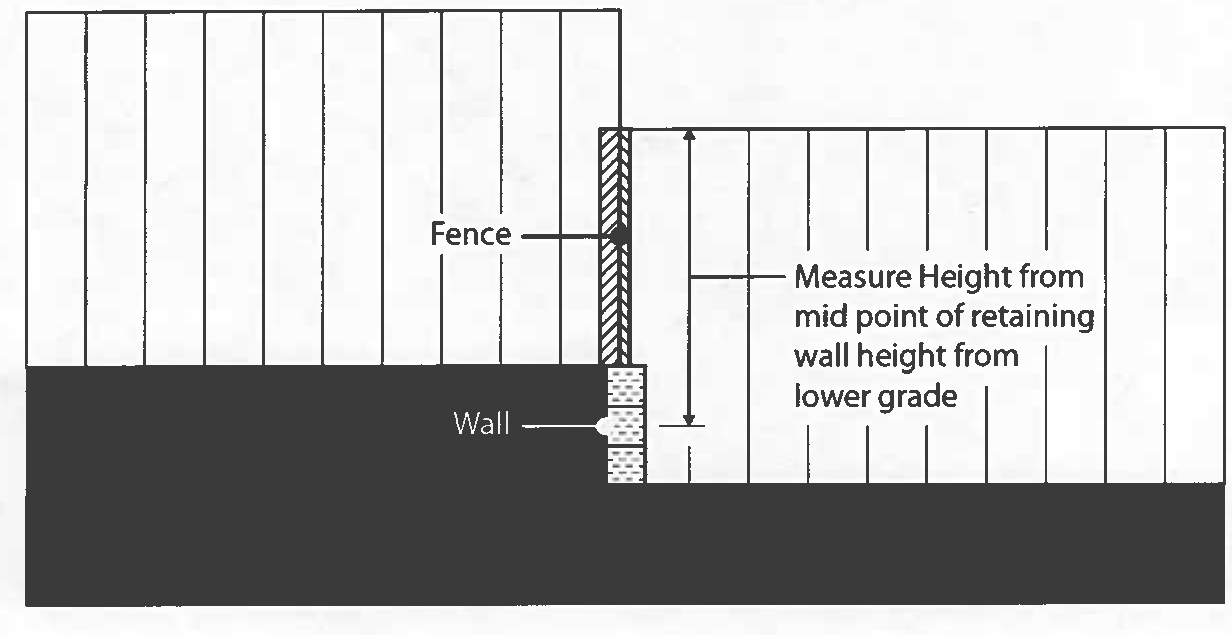
(Ord. No. 319, § 4(Exh. A), 8-13-2024)
19.74.050 - Materials and Maintenance
A.
Fence, Wall and Screen Materials. Fences, walls and screens shall be constructed of attractive, long-lasting materials and architecturally integrated with the building design and with existing fences/walls on the site. The following limitations apply:
1.
Fences and gates approved for screening purposes in residential zones shall be chain link, solid wood, solid vinyl, tubular steel or wrought iron. Where tubular steel or wrought iron is used, it shall be backed by solid or perforated metal sheeting painted to match the fence or gate. When chain link is used for screening, it must be backed with wood or plastic slats, solid plastic sheet, or knitted fabric privacy/wind screening. Decorative block walls may also be used for screening purposes.
2.
Fences and gates approved for screening purposes in commercial, office, mixed-use, industrial, or public and open space zones shall be a solid wall or material, chain link, metal, tubular steel or wrought iron. Open fencing shall be backed by solid or perforated metal sheeting painted to match the fence or gate. When chain link is used for screening, it must be backed with wood or plastic slats, except that chain link fence is not permitted for screening purposes along any property line abutting the right-of-way along Adobe Road or SR-62 in the CO, CN, CT, CG, and CS land use districts.
3.
If not required for screening purposes, chain link fencing is permitted in all land use districts, except along any property line abutting the right-of-way along Adobe Road or SR-62 in the CO, CN, CT, CG, and CS land use districts.
4.
Alternative materials for screening purposes may be approved by the Community Development Director or the Planning Commission as part of a discretionary permit approval.
5.
Barbed wire shall not be permitted or maintained in or about the construction of a fence, wall or screen located within any setback area.
6.
No sharp wire or points shall project at the top of the fence or wall six feet or less in height.
B.
Maintenance. Fences, walls and screens shall be continuously maintained in an orderly and good condition.
(Ord. No. 319, § 4(Exh. A), 8-13-2024)
19.74.060 - Requirements by Land Use Type
A.
Applicable to All Land Use Types.
1.
Fencing and Walls for Pools, Spas and Similar Features. Swimming pools, spas and other similar water features shall be enclosed in compliance with Building Code requirements.
2.
Temporary Fences. Nothing in this Chapter shall be deemed to prohibit the erection of a temporary fence around construction projects in compliance with the Building Code and other applicable requirements of the Development Code.
B.
Residential and Public Districts.
1.
Maximum Height. The height of fences, walls or screening (including landscape) in residential and public districts is limited according to Table 19.74.060-1 (Maximum Height of Fences, Walls and Screens in Residential and Public Land Use Districts).
Table 19.74.060-1\Maximum Height of Fences, Walls and Screens in Residential and Public Land Use Districts
1.For through lots where the rear yard is adjacent to the front yard of adjoining property,
the height of fences, walls or screening shall not exceed four feet within a setback
area equal to the front yard setback of the adjoining property
2.The maximum height of a fence, wall or screen shall be four feet within the street
side yard of a reverse corner lot.
3.See definition of clear site triangle in Chapter 19.06 (Definitions).
2.
Required Walls. A solid masonry wall shall be provided between uses as follows;
a.
An eight-foot solid masonry wall shall be required between any parking areas developed on a parcel zoned for multiple-family residential uses (RM or R-HD zones) and an abutting parcel zoned for single-family residential (RL or RS zone), except that the masonry wall shall not exceed four feet in height within the required front yard setback.
b.
An eight-foot solid masonry wall shall be required between any parking areas developed on a parcel zoned high density residential (R-HD) and an abutting parcel zoned multi-family residential (RM), except that the masonry wall shall not exceed four feet in height within the required front yard setback.
C.
Commercial Districts.
1.
Maximum Height. The height of fences, walls or screening in commercial land use districts is limited according to Table 19.74.060-2 (Maximum Height of Fences, Walls and Screens in Commercial Land Use Districts).
Table 19.74.060-2
Maximum Height of Fences, Walls and Screens in Commercial Land Use Districts
1For through lots where the rear yard is adjacent to the front yard of adjoining property,
the height offences, walls or screening shall not exceed four feet within a setback
area equal to the front yard setback of the adjoining property.
2See definition of clear site triangle in Chapter 19.06 (Definitions).
2.
Required Walls. A solid masonry wall shall be provided as follows:
a.
An eight-foot solid masonry wall shall be required between any parcel zoned for commercial land use uses and an abutting parcel zoned for residential or public uses, except that the masonry wall shall not exceed four feet in height within the required front yard setback.
3.
Screening.
a.
Screening of Mechanical Equipment. Mechanical equipment, including rooftop equipment, shall be screened by a permanent parapet wall and shall not be visible from grade level or adjacent street elevations. Such screening shall extend a minimum of six inches above the highest portion of the equipment and shall be readily accessible for maintenance.
b.
Screening of Commercial Loading Docks and Trash Storage Areas. Loading docks and trash storage areas shall be screened from public view, adjoining public streets and rights-of-way, and residentially zoned areas. The method of screening shall be architecturally compatible with other on-site development in terms of colors and materials.
D.
Industrial Districts.
1.
Maximum Height. The height of fences, walls or screening in industrial land use districts is limited according to Table 19.74.060-3 (Maximum Height of Fences, Walls and Screens in Industrial Land Use Districts).
Table 19.74.060-3
Maximum Height of Fences, Walls and Screens in Industrial Land Use Districts
1.For through lots where the rear yard is adjacent to the front yard of adjoining property,
the height of fences, walls or screening shall not exceed four feet within a setback
area equal to the front yard setback of the adjoining property.
2.See definition of clear site triangle in Chapter 19.06 (Definitions).
2.
Required Walls. A solid masonry wall shall be provided as follows:
a.
A 10-foot solid masonry wall shall be required between any parcel zoned for industrial land uses and an abutting parcel zoned for residential uses, except that the masonry wall shall not exceed six feet in height within the required front yard setback.
b.
At the discretion of the approving authority, a solid masonry wall up to ten feet in height may be required between any parcel zoned for industrial land use uses and an abutting parcel zoned for commercial uses, where such wall is necessary to address land use or activity incompatibilities. The masonry wall shall not exceed six feet in height within the required front yard setback.
3.
Screening.
a.
Screening of Mechanical Equipment. Mechanical equipment, including rooftop equipment, shall be screened by a permanent parapet wall and shall not be visible from grade level or adjacent street elevations. Such screening shall extend six inches above the highest portion of the equipment and shall be readily accessible for maintenance.
b.
Screening of Commercial Loading Docks and Trash Storage Areas. Loading docks and trash storage areas shall be screened from public view, adjoining public streets and rights-of-way, and residential ly zoned areas. The method of screening shall be architecturally compatible with other on-site development in terms of colors and materials.
(Ord. No. 319, § 4(Exh. A), 8-13-2024)
19.78.010 - Purpose
This Chapter establishes lighting standards to encourage effective, nondetrimental lighting; maintain nighttime safety, utility, security and productivity; and encourage lighting practices and systems which will minimize light pollution, glare, and light trespass, conserve energy and resources and curtail the degradation of the nighttime visual environment of the areas outlined below.
19.78.020 - Applicability
The regulations contained in this Chapter shall apply to all projects as follows:
A.
New Uses and Buildings. For all buildings erected and all uses of land established after the effective date of this Title, outdoor lighting shall be provided in accordance with the requirements of this Chapter.
B.
Modification to Existing Structures and Uses. Whenever an existing building is modified or a use is expanded such that it creates an increase of more than 20 percent or 2,500 square feet in the gross floor area of the building or use, whichever is more, outdoor lighting shall be provided in accordance with the requirements of this Chapter.
C.
Outdoor lighting fixtures established prior to the adoption date of this Chapter shall come into compliance within one year of the adoption date except as provided below:
1.
In the event the property owner or occupant demonstrates that compliance will cause a financial or other hardship, the Community Development Director may approve time extensions for such lighting fixtures for periods of up to one year. A maximum of three one-year extensions may be granted by the Director.
2.
If an extreme hardship exists, the Planning Commission may approve additional extensions of time if a finding is made that such extension does not create a public nuisance.
3.
All requests for extension shall be in writing and shall be signed by the owner or occupant of the property.
19.78.030 - Definitions
The following definitions shall apply to this Chapter:
A.
Architectural Lighting. Lighting which is either directed toward a residence with the intent of highlighting an architectural feature or a light fixture which is architecturally ornamental in nature or purpose.
B.
Cut-off Fixture. Outdoor lighting fixtures shielded or constructed so that light rays are only emitted by the installed fixtures in such a manner that does not direct light upward or onto neighboring uses and limits glare from the light rays in the area above 80 degrees from the vertical pole.
C.
Fixture. The assembly that holds a lamp and may include an assembly housing, a mounting bracket or polo socket, lamp holder, ballast, reflector or mirror and a refractor or lens.
D.
Foot-candle. A measure of illuminance in lumens per square foot.
E.
Freestanding Lighting. A light fixture which is not attached to a building.
F.
Fully Shielded. Outdoor lighting fixtures shielded or constructed so that light rays are only emitted by the installed fixtures in such a manner that does not direct light upward or onto neighboring uses.
G.
Night Sky. A clear sky, between dusk and dawn, with visible stars, despite necessary or desired illumination of private and public property.
H.
Pedestrian Lighting. Freestanding lighting fixtures not exceeding a height of 36 inches from surrounding ground grade level.
19.78.040 - Permit Requirements and Exemptions
A.
Permit Required. Consistency with the regulations contained in this Chapter shall be reviewed concurrent with any required building permit or land use permit for applicable projects.
B.
Prohibited Lighting. Searchlights for advertising purposes are prohibited.
C.
Exemptions. The following outdoor lighting fixtures are exempt from the requirements of this Chapter.
1.
Fixtures producing light directly by the combustion of fossil fuels, such as kerosene lanterns or gas lamps.
2.
Existing nonconforming neon outdoor lighting fixtures.
3.
Emergency lighting operated by a public utility or agency during the course of repairing or replacing damaged facilities.
4.
Emergency lighting and fixtures necessary to conduct rescue operations, provide emergency medical treatment or address any other emergency situation.
5.
Provided there is no light trespass or the lighting fixtures are regulated by motion detector, lighting fixtures within 5 feet of an entrance or exit door and/or alcove of a dwelling unit, not exceeding a height of 8 feet and no greater than 5.0 foot-candles as measured at a 5-foot radius from the door and no greater than 0.05 foot-candle measured at the property line abutting residential uses.
6.
Holiday lighting and fixtures, providing such lighting and fixtures do not remain for longer than 60 days in duration.
7.
Architectural lighting, whether it is freestanding or attached to a building which does not exceed an intensity of 2.0 foot-candles.
8.
Pedestrian lighting which does not have an intensity greater than 2.0 foot-candles.
9.
Vertical lighting for a properly displayed US flag.
19.78.050 - Development Standards - General
A.
Shielding Requirements. All outdoor lighting, except as specified in SubSection 19.70.040.C (Exemptions) shall be fully shielded. Examples of appropriate fixtures are shown in Figure 19.78.050-1 (Examples of Acceptable/Unacceptable Lighting Fixtures).
B.
Level of Illumination. Outdoor lighting shall be designed to illuminate at the minimum level necessary for safety and security and to avoid the harsh contrasts in lighting levels between the project site and adjacent properties. Illumination requirements are provided in Table 19.78.050-2 (Illumination Requirements) and are measured at ground level, unless otherwise noted.
Figure 19.78.050-1
Examples of Acceptable/Unacceptable Lighting Fixtures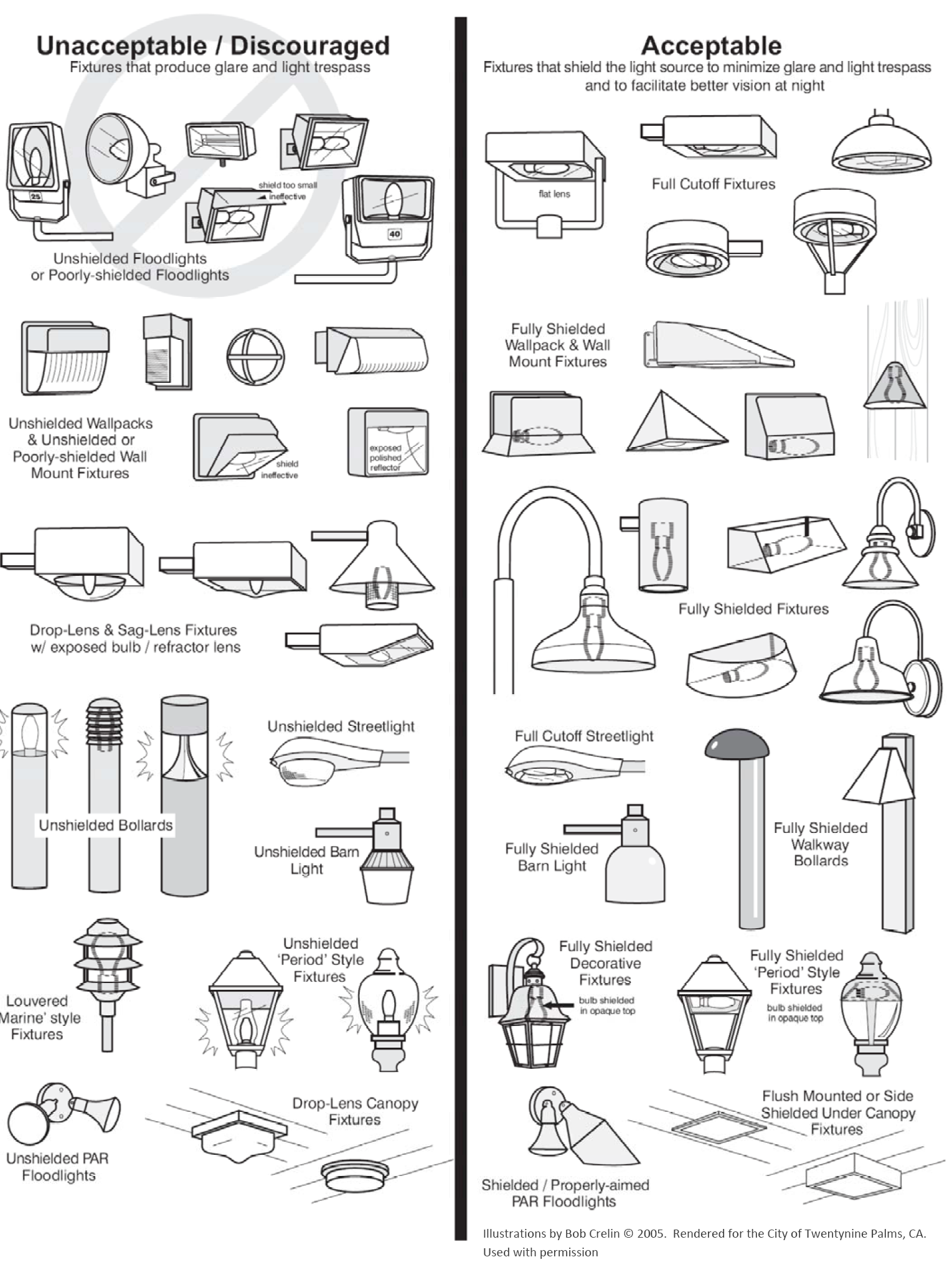
Table 19.78.050-2
Illumination Requirements
19.78.060 - Development Standards by Land Use
A.
Residential Land Use. Pole lighting shall not exceed 12 feet in height.
B.
Parking Lot Lighting.
1.
Parking lot lighting shall be oriented downward with cut-off fixtures to protect the desert sky.
2.
At least 50 percent of all lighting fixtures within parking lots or within open lot sale areas shall be turned off within one hour after closing or between 10:00 p.m. and sunrise, whichever occurs first.
C.
Recreational Facilities. There shall be no illumination of private or public recreational facilities unless the facilities are being utilized. The illumination must be turned off between the hours of 10:00 p.m. and sunrise or one hour after the termination of the event and/or use, whichever occurs last.
D.
Billboards and Externally Illuminated Signs. Lighting fixtures used to illuminate any new sign shall be mounted on the top of the sign structure and shall comply with the shielding requirements of this Chapter and the City's Sign Code.
19.78.070 - Penalty for Violation
Violation of this Chapter shall constitute an infraction on the first and second offense and a misdemeanor on the third offense. Each day of violation may be cited as a separate offense.
19.80.010 - Purpose
This Chapter establishes standards to reduce unnecessary, excessive and annoying noise and vibration in the City, maintain quiet in those areas which exhibit low noise levels, and implement programs aimed at reducing noise in those areas in the City where noise levels are above acceptable values.
19.80.020 - Applicability
A.
The standards and requirements contained in this Chapter shall apply to all areas within the City limits of Twentynine Palms.
B.
Exemptions. The following sources of noise are exempt:
1.
Temporary construction, repair or demolition activities between 7:00 a.m. and 7:00 p.m. except Sundays and federal holidays.
2.
During the months of May through September of each year, temporary construction, repair or demolition activities shall be permitted during the hours of 6:00 a.m. to 7:00 p.m.
19.80.030 - Definitions
All terminology used in this Chapter, not defined below, shall be in conformance with applicable publications of the American National Standards Institute (ANSI) or its successor body. The following words, phrases and terms as used in this Chapter shall have the meaning as indicated below:
A.
A Weighted Sound Level. The sound level in decibels as measured on a sound level meter using the A-weighting network. The level so read is designated dBA.
B.
Ambient Noise Level. The composite of noise from all sources near and far. In this context, the ambient noise level constitutes the normal or existing level of environmental noise at a given location.
C.
Community Noise Equivalent Level (CNEL). CNEL is a noise rating scale. CNEL is similar to the LDN scale (see Day Night Noise Level, below) except that it includes an additional 5 dBA penalty for events that occur during the evening (7 p.m. to 10 p.m.) time period.
D.
Construction. Any site preparation, assembly, erection, substantial repair, alteration, or similar action, for or of public or private rights-of-way, structures, utilities or similar property.
E.
Cumulative Period. An additive period of time.
F.
Day Night Noise Level (LDN). A 24-hour, time-weighted annual average noise level. Time-weighted refers to the fact that noise which occurs during certain sensitive time periods is penalized for occurring at these times. In the LDN scale, those events that take place during the night (10 p.m. to 7 a.m.) are penalized by 10 dB. This penalty was selected to attempt to account for increased human sensitivity to noise during the quieter period of a day, where sleep is the most probable activity. LDN is composed of individual time segments which may be continuous or interrupted.
G.
Decibel (dBA). A unit for measuring the amplitude of a sound, equal to 20 times the logarithm to the ratio of the sound measured to the reference pressure, which is 20 micropascals.
H.
Demolition. Any dismantling, intentional destruction or removal of structures, utilities, public or private rights-of-way surfaces, or similar existing development.
I.
Equivalent Noise Level (LEQ). The "energy" average noise level during the time period of the sample. It is a number that represents a decibel sound level. This constant sound level would contain an equal amount of energy as a fluctuating sound level over a given period of time. LEQ can be measured for any time period, but is typically measured for 15 minutes, 1 hour or 24 hours.
J.
Motor Vehicle. Any and all self-propelled vehicles as defined in the California Motor Vehicle Code, including all on-highway type motor vehicles subject to registration under said Code, and all off-highway type motor vehicles subject to identification under said Code.
K.
Sound Level Meter. An instrument, including a microphone, an amplifier, an output meter, or frequency weighting networks, for the measurement of sound levels. Such instrument shall meet or exceed the pertinent requirements for type S2A meters contained in the ANSI specifications for sound level meter, S1.4-1971, or the most recent revision thereof.
19.80.040 - Administration
A.
Lead Agency. The Community Development Director shall designate a control program established by this Chapter. Such program may designate a specific staff person or persons to administer the noise monitoring and review on behalf of the City.
B.
Powers. In order to implement and enforce this Chapter and for the general purpose of noise abatement and control, the City shall have, in addition to any other vested authority, the power to:
1.
Conduct or cause to be conducted studies, research, and monitoring related to noise including joint cooperative investigation with public or private agencies, and the application for, and acceptance of, grants.
2.
Review all public and private projects which are likely to cause noise in violation of this Chapter and which are subject to mandatory review or approval by other departments. Such review may include, but shall not be limited to:
a.
Review for compliance with the intent and provisions of this Chapter.
b.
Require sound analyses which identify existing and projected noise sources and associated noise levels.
c.
Require the usage of adequate mitigation measures to avoid violation of any provision of this Chapter.
3.
Upon presentation of proper credentials, enter and/or inspect any private property, place, report or records at any time when granted permission by the owner or by some other person with authority to act for the owner. When permission is refused or cannot be obtained, a search warrant may be obtained from a court of competent jurisdiction upon a showing of probable cause to believe that a violation of this Chapter may exist. Such inspection may include the administration of any necessary tests.
19.80.050 - General Noise Regulations
Notwithstanding any other provision of this Chapter, and in addition thereto, it shall be unlawful for any person to willfully or negligently make or continue, or cause to be made or continued, any loud, unnecessary or unusual noise which disturbs the peace and quiet enjoyment of any neighborhood or which causes any discomfort or annoyance to any reasonable person of normal sensitivity residing in the area. The factors which shall be considered in determining whether a violation of the provisions of this Section exists shall include, but not limited to, the following:
A.
The sound level of the objectionable noise.
B.
The sound level of the ambient noise.
C.
The proximity of the noise to residential sleeping facilities.
D.
The nature and zoning of the area within which the noise emanates.
E.
The number of persons affected by the noise source.
F.
The duration of the noise and its tonal, informational or musical content.
G.
Whether the noise is continuous, recurrent or intermittent.
H.
Whether the noise is produced by a commercial or noncommercial activity.
19.80.060 - Noise Measurement Procedure
A.
Upon receipt of a signed complaint from a citizen or upon direction from the City Council, the City shall investigate the complaint. The investigation shall consist of a measurement of the offending noise and the gathering of data to adequately define the noise problem and shall include the following:
1.
Type of noise source.
2.
Location of noise source relative to complainant's property.
3.
Time period during which noise source is considered by complainant to be intrusive.
4.
Total duration of noise produced by noise source.
5.
Date and time of noise measurement survey.
B.
The following procedures shall be followed when taking noise measurements:
1.
Utilizing the A weighting scale of the sound level meter and the "slow-meter response" (use "fast" response for impulsive type sounds), the noise level shall be measured at a position(s) at any point on the receiver's property.
2.
In general, the microphone shall be located 4 or 5 feet above the ground, and 10 feet or more from the nearest reflective surface where possible. However, in those cases where another elevation is deemed appropriate, the latter shall be utilized. If the noise complaint is related to interior noise levels, interior noise measurements shall be made within the affected residential unit. The measurements shall be made at a point at least 4 feet from the wall, ceiling or floor nearest the noise source, with windows in the normal seasonal configuration. Calibration of the measurement equipment utilizing an acoustic calibration shall be performed immediately prior to recording any noise data.
19.80.070 - Noise Standards
A.
Table 19.80.070-1 describes the noise standard for emanations from any source, as it affects adjacent properties:
Table 19.80.070-1
Noise Standards
1.Applies to indoor environment excluding bathrooms, toilets, closets and corridors.
2.Applies to single-family residential. Outdoor environment limited to private yard
of single-family; normally this is a rear yard.
3.Applies to multi-family residential. Applies to first-floor patio area where there
is an expectation of privacy (i.e., not a patio area which also serves as the primary
entrance to the unit).
4.Standard recognizes that residential in mixed-use areas may be exposed to noise environments
which may have late night noise and may change substantially from time to time.
5.Only applies to neighborhood parks where peace and quiet are determined to be of primary
importance. Not applicable to urban parks or active parks.
B.
No person shall operate or cause to be operated any source of sound at any location or allow the creation of any noise on property owned, leased, occupied or otherwise controlled by such person, which causes the noise level, when measured on any other property, either incorporated or unincorporated, to exceed:
1.
The noise standard for that receiving land use, as specified in Table 19.80.070-1, for a cumulative period of more than 30 minutes in any hour; or
2.
The noise standard plus 5 dBA for a cumulative period of more than 15 minutes in any hour; or
3.
The noise standard plus 10 dBA for a cumulative period of more than five minutes in any hour; or
4.
The noise standard plus 15 dBA for a cumulative period of more than one minute in any hour; or
5.
The noise standard plus 20 dBA for any period of time.
C.
If it is determined that the existing noise level exceeds any of the standards contained in SubSection 19.74.070.B (1-5) above, the allowable noise exposure standard for a new project may be increased by 5 dBA in each category.
D.
If the alleged offense consists entirely of impact noise or simple tone noise, each of the noise levels in Table 19.80.070-1 shall be reduced by 5 dBA.
19.80.080 - Interior Noise Limits
The maximum permissible interior noise level for residential uses, generated from another property, as measured in a residential living area on the receiving property, shall be as specified in Table 19.80.080-1.
Table 19.80.080-1
Residential Interior Noise Limits
19.80.090 - Prohibited Noise and Vibration
A.
No person shall unnecessarily make, continue or permit to continue prohibited noise and/or vibration as described herein. Any person(s) so doing shall be in violation of this ordinance.
B.
Operating, playing or permitting the operation or playing of any radio, television, sound system, drum, musical instrument or similar device which produces or reproduces sound:
1.
Between the hours of 10 p.m. and 7 a.m. in such a manner as to create a noise disturbance across a residential or commercial real property line, except for cases in which an exception has been issued by the City.
2.
In such a manner as to exceed the levels set forth for public space in Table 19.80.070-1, measured at a distance of at least 50 feet from such device operating on a public right-of-way or public space.
C.
Using or operating for any purpose any loudspeaker system or similar device between the hours of 10 p.m. and 7 a.m. such that the sound therefrom creates a noise disturbance across a residential real property line, except for any noncommercial public speaking, public assembly or other activity for which an exception has been issued by the City.
D.
Offering for sale, selling anything, or advertising by shouting or outcry within any residential or commercial area of the City except by variance issued by the City. The provisions of this Section shall not be construed to prohibit the selling by outcry of merchandise, food, and beverages at licensed sporting events, parades, fairs, circuses or other similar licensed public entertainment events.
E.
Owning, possessing or harboring any animal or bird which frequently or for long duration, howls, barks, meows, squawks or makes other sounds which create a noise disturbance across a residential or commercial real property line. This provision shall not apply to public zoos.
F.
Loading, unloading, opening, closing or other handling of boxes, crates, containers, building materials, garbage cans or similar objects between the hours of 10 p.m. and 7 a.m. in such a manner as to cause a noise disturbance across a residential real property line.
19.80.100 - Vibration
A.
Vibration Standard. No ground vibration shall be allowed which can be felt without the aid of instruments at or beyond the lot line; nor will any vibration be permitted which produces a particle velocity greater than or equal to 0.2 inches per second measured at or beyond the lot line.
B.
Vibration Measurement. Vibration velocity shall be measured with a seismograph or other instrument capable of measuring and recording displacement and frequency, particle velocity or acceleration. Readings are to be made at points of maximum vibration along any lot line.
C.
Exempt Vibrations. The following sources of vibration are not regulated by this Code:
1.
Motor vehicles not under the control of an industrial use.
2.
Temporary construction, maintenance or demolition activities between 7:00 a.m. and 7:00 p.m. except Sundays and federal holidays.
19.82.010 - Purpose
The intent and purpose of this Chapter is to ensure that all uses shall have the minimum required off-street motor vehicle parking spaces installed and maintained in a manner which will ensure adequate and safe parking (temporary storage), ingress and egress, and parking facility design which will provide for safe and convenient use of such facilities.
(Ord. No. 309, § 4(Exh. A), 9-26-2023)
19.82.020 - Applicability
A.
Unless specifically exempted within this Chapter, parking spaces, loading spaces or areas, and other facilities required by the provision of this Chapter shall be provided for each of the following:
1.
The construction or reconstruction of any building or structure hereinafter specified.
2.
A change in use of a lot or building site which requires a greater number of parking or loading spaces than was provided for the previous use or activity.
B.
All improvements required by this Chapter, or any previously effective regulations governing same, shall henceforth be made available and maintained for the use for which they were designed. Every lot or building site, or portion thereof, used as a public or private parking area shall be improved and maintained in accordance with the standards set forth in this Chapter.
(Ord. No. 309, § 4(Exh. A), 9-26-2023)
19.82.030 - Exemptions
Any existing building, structure, or change in use of property is exempt from the provisions of this Chapter, unless it is altered in any of the following ways:
A.
Increases the floor area by more than 25 percent or 1,000 square feet, whichever is more restrictive.
B.
Changes the use to one requiring a number of parking spaces 25 percent greater than the existing use or requiring more than 10 additional parking spaces, whichever is more restrictive pursuant to this Chapter.
C.
Increases the number of dwelling units or guest rooms, requiring an increase in the number of parking spaces pursuant to this Chapter, of two spaces for residential uses or 10 spaces for transient occupancy uses within a commercial land use district.
Those buildings or structures existing as of November 23, 1987, on lots fronting Adobe Road from Cactus Drive to Two Mile Road with a General Commercial zoning designation shall continue to be exempt from the provisions of this Chapter under any change in use.
(Ord. No. 309, § 4(Exh. A), 9-26-2023)
19.82.040 - Number of Parking Spaces Required
A.
Except as exempted in Section 19.82.040, and/or as specified in SubSection 19.82.050.B, the number of parking spaces required for a use shall be as set forth in Table 19.82.050-1 (Off-street Parking Requirements). Any resulting fraction shall be rounded up to the next successive whole number. Where mixed-use or multiple-tenant commercial or office developments are proposed, the baseline parking requirement shall be calculated as the sum of the requirements for each use, subject to the requirements of Section 19.82.060 (Shared or Unspecified Uses).
Table 19.82.040-1
Off-street Parking Requirements
GFA = Gross floor area
Notes:1Additional parking shall not be required for restaurants, theaters, physical fitness
centers (health clubs) and establishments for the sale and on-site consumption of
food and beverages, or group assembly, if they are established within a commercial
complex which meets the parking requirements established in Table 19.82.050-1, and
they occupy no more than 33 percent of the gross floor area of said complex. Where
such facilities exceed 33 percent of the commercial complex floor area, or where the
required number of parking is not otherwise provided, additional on-site parking shall
be provided per the requirements of Table 19.82.050-1.
2Where drive-through service is provided, the number of required parking spaces may
be reduced by one parking space for each four stacking spaces provided in the drive-through
lanes. A stacking space is defined as an unobstructed space measuring 10 feet by 20
feet in a drive-through lane intended as a motor vehicle waiting space that does not
block other driveway access.
3Where such uses include facilities for public assembly, such as gymnasiums, sports
arenas or stadiums, additional parking spaces shall be required in the amount of one
space for each five fixed seats or 40 square feet of assembly area, whichever results
in the greater number of parking spaces. Such additional parking may be temporary,
e.g., athletic fields or other on-site open areas suitable for parking. Also see Section
19.82.080 (Reciprocal Parking Facilities).
4One recreational vehicle (RV) storage space must be provided for each 20 dwelling
units, or fraction thereof or for each 20 guest rooms, or fraction thereof, located
on a lot or building site. Projects of 10 or fewer dwelling units or 10 or fewer guest
rooms are exempt from this requirement. Such spaces shall be not less than 12 x 36
feet in size.
(Ord. No. 309, § 4(Exh. A), 9-26-2023)
19.82.050 - Shared or Unspecified Uses
A.
When any use or the number of parking spaces required therefore is not specified herein, the number of parking spaces required for any such use shall be determined in accordance with the conditions imposed as a result of project review. To implement this Section, the applicant shall provide analyses as part of a Site Plan Review to demonstrate that the proposed uses are noncompeting uses, competing uses, and/or unspecified uses as set forth below.
1.
Noncompeting Uses. In mixed-use or multiple-tenant commercial and office developments, applicants may request a reduction in parking requirements based on an analysis of peak demands for noncompeting uses. Up to 75 percent of the requirements for the primary use (based on floor area and/parking demand), may be waived by the Planning Commission if the applicant can demonstrate that the peak demands for two uses do not overlap. An applicant may use the latest peak demand analyses published by the Institute of Traffic Engineers (ITE) or other source acceptable to the Planning Commission.
2.
Competing Uses. In mixed-use or multiple-tenant developments, applicants may propose a reduction in parking requirements where peak demands for the proposed and/or existing uses overlap. In these cases, the approving authority may reduce the combined parking requirements by no more than 30 percent.
3.
Unspecified Uses. Calculations for required off-street parking as set forth in this SubSection shall involve the following calculations. First, a baseline number of parking spaces shall be calculated in accordance with the parking schedule in Table 19.82.050-1 for specified uses, or as determined acceptable by the approving authority based on a parking study prepared by the applicant. The approving authority shall then establish a final number of spaces required for the project or use based on the information provided and the approving authority's review of the specific use(s) and the ability of the site to adequately accommodate the required number of spaces. Proposed reductions in the baseline number of spaces to be provided may be approved by the approving authority subject to the review and approval of a Site Plan Review Permit. Alternately, the number of spaces required may be approved through any individual requirement or combination of requirements found in 19.82.050 (Number of Parking Spaces Required).
B.
Approving modifications, as set forth in SubSection 19.82.060.A, shall require the approving authority to make at least one of the following findings:
1.
A surplus of spaces on a particular site will benefit the land use district in which the subject property is located as a whole by providing off-site sharing opportunities for other sites in the land use district.
2.
The techniques for reduction of the number of off-street or on-site parking spaces available to the applicant are infeasible or would impose an undue hardship on the applicant.
3.
Approval of the requested reduction will facilitate the implementation of the policies of the General Plan, or any affected Specific Plan or Planned Development.
(Ord. No. 309, § 4(Exh. A), 9-26-2023)
19.82.060 - Design and Construction of Facilities
The design and construction of all parking facilities shall be in conformance with the criteria set forth herein unless specifically exempted from the provisions of this Chapter.
A.
Parking Stall Dimensions. Parking stall dimensions shall be as set forth in Table 19.82.060-1 (Parking Stall Dimensions).
Table 19.82.060-1
Parking Stall Dimensions
B.
Dimensions for Various Parking Configurations. Dimensions for parking lots shall be as set forth in Table 19.82.060-2 (Dimensions for Parking Configurations) and Exhibit A (Dimensions for Parking Configurations).
Table 19.82.060-2
Dimensions for Parking Configurations
Exhibit A
Dimensions for Parking Configurations
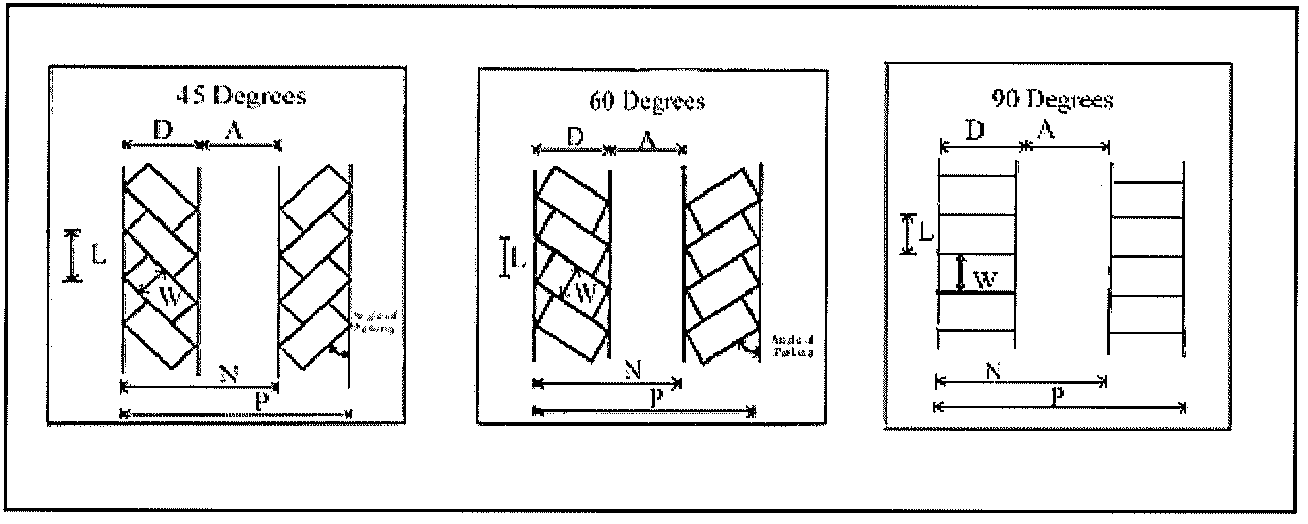
C.
Required Access Drive Widths. Access drive widths shall be as set forth in Table 19.82.060-3 (Required Access Drive Widths).
Table 19.82.060-3
Required Access Drive Widths
1Driveway access to residences which are over 150 feet in length shall provide a minimum
20-foot-wide drive aisle to accommodate emergency vehicles for the length of the driveway.
>2Where a garage entrance is located more than 100 feet from a paved roadway, an alternate
driveway surface may be allowed between the garage and/or parking area and a point
100 feet from the edge of the paved right-of-way. Where no driveway surface or a driveway
using an alternate surface is allowed, a permanent concrete/asphaltic surface at least
20 feet by 20 feet shall be installed adjacent to the entrance to the garage. When
a property fronts an unpaved right-of-way, no permanent driveway surface is required.
3A wider driveway standard may be required by the City Engineer during project review
where determined necessary for the protection of the public health and safety.
D.
Marking.
1.
All paved parking stalls shall be clearly marked by painted (or other easily distinguished and durable material) pavement striping or other easily distinguished and durable material.
2.
Entrances, exits, and aisles shall be clearly marked with arrows painted on the parking lot surface and/or with appropriate signage.
E.
Wheel Stops. For all parking spaces/stalls located at the outside border of a parking area and not separated by a fence, wall, or concrete curb from any abutting property line, drive aisle, street, alley or undeveloped area by a landscape planter, a minimum of 4 feet in width shall be protected by either a raised concrete curb or permanent wheel stops.
F.
Driveway Slopes. No driveway, or portion thereof, shall have a slope exceeding 20 percent. No driveway, or portion thereof, shall have a dip, hump or other surface irregularity that has an angle of approach or departure exceeding 10 percent.
G.
Location.
1.
All off-street parking required by this Chapter shall be located on the same lot as the use it is designed to serve, unless otherwise approved as follows:
a.
Off-site parking shall be subject to Site Plan Review.
b.
Each off-site parking space shall be no more than 300 feet from an entrance to the use it serves, except where otherwise approved by the Planning Commission based on the nature of the specific use and its location.
c.
The applicant shall provide a recordable instrument guaranteeing use of such parking facility for the benefit of the property and its use(s) for the duration of the use(s) for which the parking is provided. Said instrument shall be approved by the City Attorney and, upon approval, shall be recorded in the County Recorder's Office as a deed restriction on all subject properties.
2.
Each parking space must be accessible from a street or alley, provided that no parking space shall be designed to require that vehicles back into a street, except for parking spaces that serve a one-or two-family dwelling unit in the RL, RS, RM or OSR land use districts.
3.
Each parking space required for a residential use is to be located within 150 feet of the entrance to the dwelling unit, excluding the vertical distance required to reach the entrances of dwelling units on upper floors.
4.
Any garage accessory to the following uses which is required to provide the number of mandatory spaces for the use must be located in a manner as to provide a clear space of at least 20 feet between the garage entrance and the front or street-side property line:
a.
One- or two-family dwellings.
b.
Multiple dwellings where the garage faces a street.
H.
Parking for the Physically Handicapped. Parking spaces specifically designated and conveniently located for the use of the handicapped shall be provided in accordance with current regulations administered by the Building Department.
I.
Screening. Parking areas shall be located and screened as follows:
1.
Adjacent to a residential land use district. Wherever a parking lot for a commercial, industrial or institutional development abuts or is adjacent to the side or rear property line of a residential zone, the parking lot shall be screened by a solid masonry wall not less than 6 feet in height. If the parking lot abuts or adjoins the front property line in a residential zone, the wall shall be reduced in height to 4 feet.
2.
Wall design. All required screen walls shall incorporate pilasters set at a maximum separation of 30 feet, caps, and a painted or plastered finish. The colors and style of the wall shall be compatible with related on-site buildings and shall be designed and constructed to require minimal maintenance.
3.
Exemptions.
a.
No such wall or berm need be provided wherever the elevation of that portion of the parking area abutting property located in a residential district is 6 feet or more below the elevation of the abutting property at the common property line.
b.
No such wall or berm need be provided along a side property line when the side yard is used for access to a parking area in the same zoning district as the primary use. A landscaped area not less than 4 feet in width shall be provided abutting the property line in lieu thereof. Such a landscaped area shall be planted with trees and shrubs of a size and in such a manner that they will provide a screening effect in compliance with the provisions of this Section.
J.
Landscaping. For newly created parking lots or parking areas adjacent to a public right-of-way in the commercial districts (CG, CO, CT and CN), a minimum 6-foot-wide landscaped area shall separate parking areas from the street or public sidewalk.
K.
Sight Distance.
1.
To prevent the hood of a vehicle from obscuring the driver's view of pedestrians and vehicles as illustrated in Exhibit B, a driveway on a slope rising up to a public right-of-way shall have a transition Section not less than 16 feet in length with a slope not exceeding 5 percent ending at the property line (or ultimate right-of-way line if established by the General Plan or a Specific Plan).
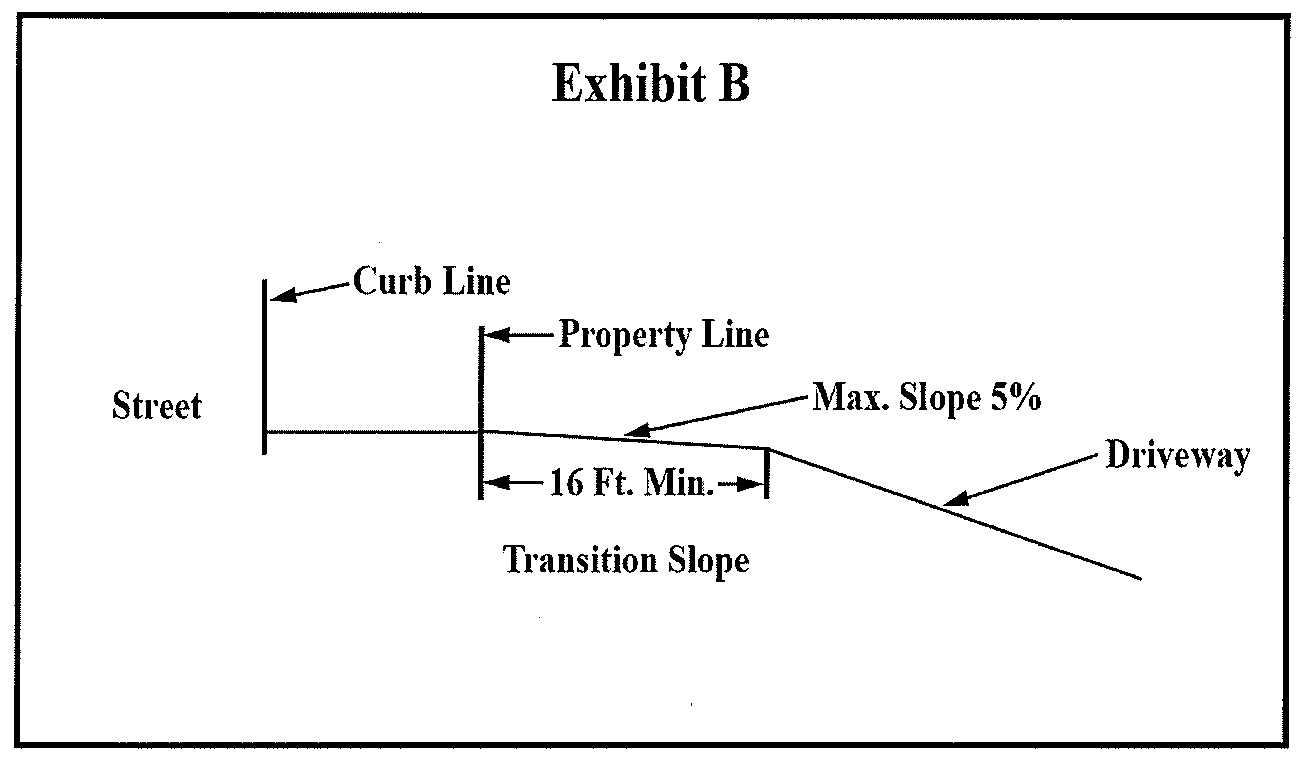
2.
Landscaping, cut banks, fences, walls, and other man-made improvements which exceed a height of 30 inches shall not be permitted or maintained within the clear sight triangle.
L.
Lighting Requirements.
1.
Lighting shall be provided in accordance with Chapter 19.78 (Lighting Standards).
2.
Light standards shall have a design compatible with the architectural style of related building.
M.
Paving Standards.
1.
All parking areas, including access ways thereto, for the following, shall be paved:
a.
All development in the General Commercial (CG), Office Commercial (CO), Neighborhood Commercial (CN), Tourist Commercial (CT), Service Commercial (CS) and Community Industrial (IC) land use districts.
b.
Single-family residential development in the RS-4, RS-3 and RS-2 land use districts.
c.
All development in the Multi-family (RM) and High Density (RH) Residential land use districts.
d.
All institutional and public uses, regardless of zoning designation, except as otherwise determined appropriate pursuant to a Site Plan Review approved by the Planning Commission.
2.
Paving shall not be required for projects in the following land use districts if it can be demonstrated that the area will be appropriately treated to contain wind and soil erosion with a durable and easily distinguishable material, and if appropriate facilities are provided to accommodate handicap access, traffic and circulation safely and adequately:
a.
Residential development in the Rural Living (RL), Open Space Residential (OSR), RS-1 and RS-E land use districts. Paving shall not be required for RV parking spaces, where required.
b.
In any land use district, subject to approval by the Planning Commission, an alternative surface is allowed, provided that it is an equivalent durable surface material. In all instances the parking area shall be separated from adjacent landscaped or natural areas by a vehicle barrier, concrete curb or wheel stop. All such parking areas shall meet the minimum standards for parking space and drive aisle dimensions as set forth in this Chapter. Where such parking area access is directly upon a paved public street, the parking lot shall provide a minimum of 10-foot-deep concrete or asphalt apron at all entrances to the lot from the street.
(Ord. No. 309, § 4(Exh. A), 9-26-2023)
19.82.070 - Reciprocal Parking Facilities
Joint use of parking facilities for two or more uses may only be allowed with approval of an Site Plan Review application, pursuant to Chapter 19.36 (Site Plan Review) or other discretionary approval where required when the parties sharing the parking facility provide a recordable document which demonstrates that:
A.
The hours of parking demand for the uses do not overlap pursuant to Section 19.82.050 (Shared or Unspecified Uses).
B.
The parking facility provides a total number of spaces sufficient to meeting the peak parking demand of any combination of simultaneous uses.
C.
Upon approval, the document shall be recorded in the County Recorder's Office as a Deed Restriction on all properties subject to the agreement.
(Ord. No. 309, § 4(Exh. A), 9-26-2023)
19.82.080 - Loading Space Requirements
A.
All office, commercial and industrial uses (activities) shall provide a loading space as specified in Table 19.82.080-1 (Required Number of Loading Spaces) and 19.82.080-2 (Minimum Loading Space Dimensions). If, during project review, it can be determined that a loading area can reasonably be shared by more than one use, a shared loading area shall be approved in lieu of one per use.
Table 19.82.080-1
Required Number of Loading Spaces
B.
Loading zone bays shall be located as close as possible to loading doors.
C.
Supermarkets, hardware stores, building supplies, and similar uses may have specific requirements.
D.
If individual uses on the same site or lot have a floor area less than that for which loading spaces would be required, then the total gross floor area of all uses on the site or lot shall be used to determine the required number of loading spaces.
E.
Variations in the size, number and/or location of required loading spaces may be reviewed and approved by the approval authority on a case-by-case basis following the submission of supporting traffic, parking or loading information, study or analysis. On-site parking drive aisles, parking bays, and/or driveways may be utilized for the required loading area when determined by the approving authority that the hours of business operations and the availability of the required loading space will not conflict, and the loading/unloading activity can be conducted in a safe manner. In no case shall such loading area be utilized for a period exceeding two hours. Such space(s) shall be signed identifying the dual use purpose of the space.
Table 19.82.080-2
Minimum Loading Space Dimensions
(Ord. No. 309, § 4(Exh. A), 9-26-2023)
19.88.010 - Purpose and Intent
Aesthetically pleasing signage improves the visual appearance of a community for visitors, residents, and persons engaged in commercial activities. The purpose of this Chapter is to assist in the maintenance and improvement of the City of Twentynine Palms, enhance business opportunities and preserve the City's aesthetic quality and character.
In addition to improving the appearance of the City's land use districts, the City seeks, with this Chapter, to promote public safety and reduce hazards to motorists and pedestrians.
With this Chapter it is also the City's goal to foster and encourage business in the City and encourage sound and aesthetic sign use and construction practices with the establishment of these nonarbitrary and nondiscriminatory standards and procedures for the regulation of signs.
This Chapter will allow for signage that will properly and effectively identify businesses, organizations, institutional establishments and enterprises in the City and result in an increase in property values in the City.
It is intended that this Chapter will also provide a means for the elimination of signs that are abandoned or no longer in use. The Chapter provides for a reasonable, timely and economically feasible transition without an undue financial burden on the City or its citizens.
The City does not intend to regulate noncommercial speech, nor is it the intent of this Chapter to regulate works of art, such as murals or statues, which do not or are not intended to advertise a commercial product, business or service. Accordingly, this Chapter shall not apply to noncommercial speech except to the degree its application to such speech is specifically set forth herein.
19.88.020 - Definitions
For purposes of this Chapter, the following definitions shall apply:
A.
Accessory Signs. A sign which is not intended to identify or advertise a specific business or institution, but instead is intended to advertise or identify a commodity or service or the location of a service on the site, that is offered by a business located on the same property as the sign.
B.
A-Frame Sign, Portable Sign, and Sandwich Board Sign. Portable signs capable of standing without support or attachment. Portable signs (e.g., H-frame) shall be considered accessory signs. A-frame sign means a one- or two-sided sign, hinged or attached at the top or side of the sign panels, identifying, advertising, or directing attention to a business, product, operation, or service sold or offered in the building on the property where the sign is located. A-Frame signs shall be securely anchored to the ground at all times when displayed.
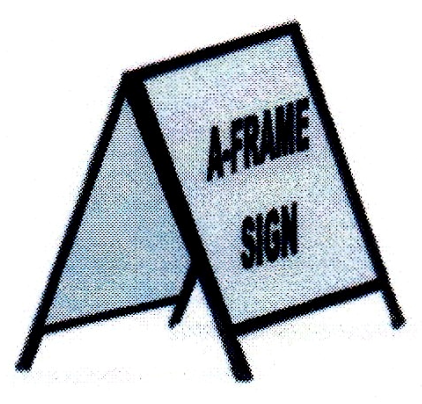
A-FRAME SIGN
C.
Animated Signs. Signs with moving parts or messages, or so operating as to give a viewer the illusion of moving parts, images, or messages including revolving or whirling signs, commercial signs held and animated by a person, and wind signs are prohibited except as expressly authorized by this Chapter.
D.
Banner. Any cloth, bunting, plastic, paper, vinyl or similar material attached to any structure, pole, framing, or vehicle for the purpose of advertising or drawing attention to a business, product, institution, or service.
E.
Building Frontage. The lineal measurement of the actual building foundation (exclusive of patios or accessory structures as defined by the Uniform Building Code) on the side or sides of a building adjacent to a street right-of-way or along the main entrance when the building is not adjacent to a street right-of-way.
F.
Business Complex. Three or more business entities, located on one parcel or on contiguous adjoining parcels, of at least 1.5 acres, which have been deemed by the Planning Commission to be a business complex for purposes of signage.
G.
Business Complex Occupant Sign. Signs for individual occupants of a business complex.
H.
Business Complex Sign. An on-site freestanding or monument sign utilized in conjunction with a business complex.
I.
Digital or Electronic Sign. An electronic device or screen that represents information in visual form for the purpose of identifying, advertising, or directing attention to a business, product, operation, or service sold or offered in a building or on a property where the sign is located.
J.
Double-faced Sign. A sign which is a single structure designed with the intent that each side be viewed from opposite directions.
K.
Foot-candle. Unit of light density incident on a plane (assumed to be horizontal unless otherwise specified), and measurable with a luminance meter, aka light meter.
L.
Freestanding Sign. A sign, other than a monument sign, not attached to any building, and supported by nothing other than its own construction.
M.
Legal Non-conforming Sign. A sign that conformed to all applicable regulations when established but does not conform to the regulations of this Chapter.
N.
Monument Sign. A single or double-faced sign that is designed and constructed as part of, and placed onto, a monument base.
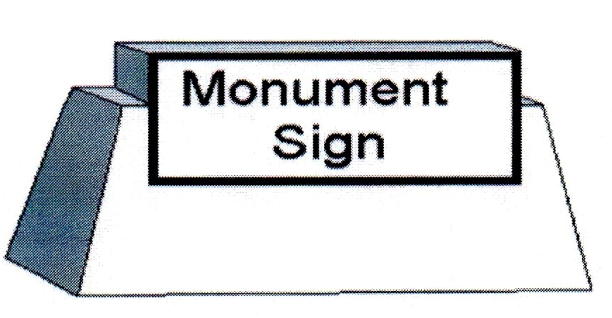
MONUMENT SIGN
O.
Multi-faced Sign. A sign which is a single structure designed with the intent that each side be viewed from different directions.
P.
Mural. A hand-produced work of visual art that is tiled, painted, or permanently adhered by hand directly upon, or affixed directly to, an exterior wall of a building and which does not contain a commercial message of any type.
Q.
Nit 2 . A term used to describe a metric unit of luminance. It is defined as candela per square meter (cd/m 2 ). The unit is based on the candela, the modern metric unit of luminous intensity, and the square meter.
R.
Off-site Directional Sign. An off-site sign for the purpose of providing directions to the location of a business, institution, service, event or activity located on a parcel other than the parcel upon which the sign is located.
S.
Off-site Sign. A commercial sign that is used to identify or advertise a commercial business, institution, service, event or activity located on a parcel other than that upon which the sign is located.
T.
Outdoor Advertising Sign. An off-site sign that is erected in the conduct of the outdoor advertising business (e.g., billboards).

U.
Painted Wall Sign. A sign that is painted onto a building surface. An artistic mural that is not intended to advertise, identify or promote a business, product or service is not a painted wall sign. Painted wall signs are not a permitted sign type.
V.
Pedestrian Walkway Sign. A sign hung from or on a canopy or like structure in such a manner as to hang over or adjacent to a pedestrian walkway, and oriented so as to direct a message to pedestrian traffic.
W.
Pennant/Streamer. Any cloth, bunting, plastic, paper, vinyl or similar material attached to a line or rope and displayed for the purpose of advertising or drawing attention to a business, product, institution, or service. Any similar advertising device that does not fit this definition shall be interpreted as a banner.
X.
Political Sign. See Temporary Political Sign.
Y.
Portable or Movable Sign. Any sign which is intended to be movable or capable of being moved, whether or not on wheels or other special supports, including but not limited to A-frame type signs. Portable or movable signs also include placards, signs, banners or similar devices attached to vehicles for advertising purposes, unless such devices are an integral part of such vehicle used in the normal course of business. This definition does not include real estate advertising signs or political signs.
Z.
Primary Sign. A sign intended to identify or advertise a specific business or institution located on the same property as the sign.
AA.
Primary Wall Sign. A wall sign intended to identify or advertise a specific business or institution located on the same property as the wall sign.
BB.
Projecting Sign. Single- or double-faced signs attached to a building which extends in a perpendicular plane from the wall to which they are attached.

CC.
Public (Civic) Information Sign. A sign owned, operated, or leased by a government agency, where such agency is responsible for the oversight and/or administration of activities or services for the benefit of the general public. This definition excludes signs owned or controlled by publicly traded or for profit utilities. Public information signs must display information of general public interest or benefit, and may include commercial content.
DD.
Real Estate Directional Sign. A sign containing directional information about the location of property for sale, lease or rent.
EE.
Real Estate Sign. Sign advertising a property's availability for sale, lease or rent.
FF.
Roof Line. The highest point of a roof of any building. In cases where the roof of a building or structure has varying roof Sections of different height, each Section has a different roof line.
GG.
Roof Sign. A sign affixed to the roof of a building or structure.
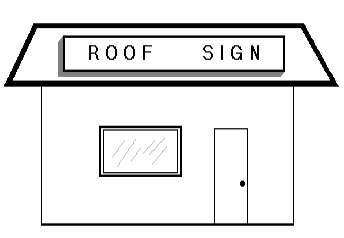
HH.
Sign. Any device, display, fixture, structure, or object used to identify, advertise, display, direct or attract attention to an object, person, institution, organization, business, product, idea, service, event, or location by means of pictures, words, figures, designs, symbols, fixtures, colors, illumination, or projected images. Artistic murals that are not intended to advertise a product, business, service or event, are not considered signs.
II.
Sign Area. The area of the smallest rectangle enclosing all elements and ornamentation of a sign. The sign base or supports are not included in calculating sign area unless they form an integral part of the design of the sign. The base of a monument sign is not considered in calculating the sign area. In computing the area of a sign, the area of the largest surface viewable from any one direction at one time shall be calculated. In calculating the sign area for those signs having text that is painted, embedded, etched, or otherwise permissibly affixed to an architectural feature of a building (such as a wall, canopy, or parapet), such architectural feature shall not be considered.
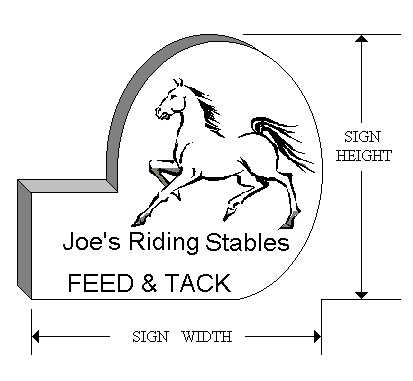
JJ.
Sign Height. In the case of a freestanding or monument sign, sign height shall be the distance from the base of the sign at normal grade to the top of the highest component of the sign. Normal grade is the established grade after construction, exclusive of any filling, berming, mounding or excavating solely for the purpose of locating the sign. For all other signs, sign height shall be the distance from the lowest point of the sign to the highest point of the sign, or any component thereof.
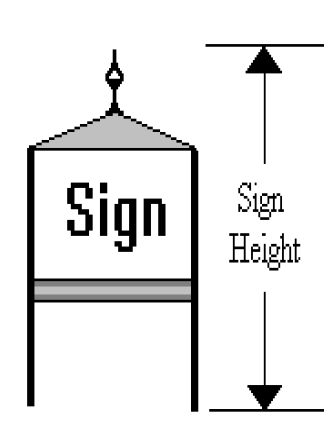
KK.
Special Event Signs. A sign of any type including banner, pennant, commercial flag, streamer, inflatable sign, tethered balloon or other similar object advertising a commercial or noncommercial event.
LL.
Temporary Political Sign. A sign used to promote a political view, candidate or issue in a specific election.
MM.
Temporary Sign. A sign displayed for a fixed, terminable length of time. Temporary signs are intended to be removed after the temporary purpose has been served. Included are for sale, lease or rent signs, political signs, service signs, special-event signs, construction signs, directional signs to special or temporary events and signs of a similar nature.
NN.
Wall Sign. A sign affixed to an exterior wall of a building or perimeter fence.
OO.
Window Sign. A sign painted onto, affixed to, or placed in or in front of a window so as to convey a message to persons outside the building.

19.88.030 - Permits
A.
Permit Purpose. The purpose of a Sign Permit is to ensure compliance with the provisions of this Chapter.
B.
Permit Required. Unless specifically excluded by this Chapter, a Sign Permit is required to erect, construct or otherwise place any sign conveying a message for a commercial, industrial, private or institutional use, service or product. A Sign Permit shall not be issued for any sign or sign structure that is not in compliance with this Chapter. A Sign Permit application shall include the following information, except where a modification of these requirements is determined by the Community Development Director as unnecessary to ensure compliance with the provisions of this Chapter:
1.
The name, address and telephone number of the applicant and property owner.
2.
The address and accurate, detailed description of the precise location of the proposed sign.
3.
A scale diagram of the sign with the accurately calculated copy area.
4.
A visual sample of the colors to be used.
C.
Sign Permit Method of Review. Following submittal of a completed Sign Permit application, the approving authority shall render a decision to approve, conditionally approve or deny the permit based upon conformance to this Chapter.
D.
Building Permit Requirement. Approval of a Sign Permit does not preclude the necessity for obtaining building, electrical or other permits for signs where such other permits are required by the City or other regulatory agencies. A copy of the current valid Sign Permit shall be submitted to the City with application for any required Building Permit.
E.
Permit Fees. Sign Permit applications shall be accompanied by a permit fee, as established by City Council Resolution.
F.
Penalty. To obtain a permit for any Sign established without proper permits, the business owner or the person responsible for such permit shall pay a penalty equal to the permit fee for the sign in question, in addition to the appropriate Sign Permit fee.
G.
Exempt Signs. A Sign Permit is not required for the following signs:
1.
Noncommercial flags or emblems.
2.
Traffic or highway signs, or similar warning devices.
3.
Legal notices required per law or ordinance.
4.
Utility company signs identifying conduits, cables, danger or other similar notices.
5.
Seasonal holiday displays and decorations.
6.
Memorial tablets or signs and historic markers.
7.
Signs identifying security companies legally authorized to conduct business in the City that provide security service for the property on which the sign is located, except that no such sign shall exceed a maximum area of 2 square feet per sign.
19.88.040 - General Provisions
A.
Maintenance. All signs and their components shall be maintained and kept in good repair and shall contain current content. If a sign is not properly maintained or does not contain current content, it shall be subject to the enforcement procedures set forth in Section 19.88.280 (Enforcement).
B.
Lighting. Except for time and temperature components and permitted digital or electronic signs, signs may only be lit by stationary, shielded light, by light inside the sign, or by direct neon lighting. The glare from such luminous sources shall not impair the vision or otherwise interfere with any driver of a motor vehicle. All lighting must comply with the Chapter 19.78 (Lighting Standards).
C.
Maximum Sign Area. The sign area of any single sign shall not exceed 100 square feet, except as otherwise provided by this Chapter.
D.
Maximum Sign Area for Accessory Signs. The maximum sign area for an accessory sign shall not exceed 12 square feet.
E.
Maximum Sign Area of Signs with Time and Temperature Displays. Notwithstanding anything contained in this Chapter to the contrary, the maximum sign area allowed for any sign that includes an automatic time and/or temperature display may be increased by 30 percent for the sole purpose of the time and/or temperature display.
F.
Setback from Property Lines. No part of any sign, including the footing, shall be located closer than 1 foot from any property line or public right-of-way.
G.
Interference with Vehicle and Pedestrian Traffic. No sign shall interfere with a driver's or pedestrian's view of public rights-of-way, walkways and crosswalks or in any other manner impair public safety, interfere with the safe operation of a motor vehicle on public streets, or otherwise interfere with the use of the public right-of-way.
H.
Allowable Sign Quantity and Sign Area for Individual Businesses. An individual business (business not in a business complex) may have a maximum of three on-site primary signs and a maximum of three on-site accessory signs. The combined allowable sign area for all such primary signs and accessory signs shall be 2 square feet for each lineal foot of building frontage. In addition to the maximum number and area of primary signs set forth above, an individual business with rear parking and a rear entrance shall be permitted to have one additional primary sign to be mounted to the rear wall of the business, with a sign area not to exceed 1½ square feet for each lineal foot of the building foundation of the wall to which the sign is mounted.
I.
Conflicting Regulations. In the event of any conflict between the requirements of this Chapter and/or the requirements of other regulations or ordinances, the more restrictive shall apply.
J.
Maximum Sign Height. The maximum sign height of a monument sign, real estate sign, or off-site directional sign, shall be 8 feet, unless a more restrictive height standard is specified by this Chapter or the provisions of the applicable land use district, or overlay district.
K.
Quantity. A maximum of one freestanding sign may be placed on a parcel when permitted by this Chapter.
L.
Monument Signs, Quantity. A maximum of one monument sign may be permitted per parcel except in the event that two monument signs can be placed on a parcel with a minimum separation of 300 lineal feet. In such cases, the measurement shall be the lineal distance as measured along the public right-of-way of the parcel.
M.
Professional Appearance. Signs shall have the appearance of being professionally prepared.
N.
Multi-faced Signs. The sign area and quantity of a multi-faced sign shall be calculated as a single sign provided the sign faces are placed at angles which do not exceed 60 degrees. Four-sided signs are not allowed.
O.
Non-commercial Messages.
1.
Whenever these sign regulations permit a commercial sign, a noncommercial message may be substituted in lieu of the commercial message. For purposes of this subSection, a "commercial sign" means any sign wording, logo, or other representation that, directly or indirectly, names, advertises or calls attention to a business, product, service or other commercial activity.
2.
Where commercial messages are allowed, permitted or referenced in this Chapter, the reference or allowance does not prohibit any noncommercial message in the same location.
3.
The right to substitute a noncommercial message does not waive any other requirement imposed by this Chapter as to number, size, construction, location, lighting, safety or any other regulated attribute.
19.88.050 - Sign Limitations in Clear Sight Triangles
Freestanding signs, where permitted, may be allowed within a clear sight triangle, provided the Community Development Director determines the proposed sign will not interfere with pedestrian or vehicular use of the right-of-way or pose any public safety hazard. Any sign in a clear sight triangle that creates a public safety hazard, as determined by the Community Development Director or City Engineer, is subject to the enforcement procedures set forth in Section 19.88.280 (Enforcement). Any freestanding sign that may be permitted in a clear sight triangle shall have no more than two supporting posts or columns, each with a width no greater than 12 inches. Monument signs are not permitted in clear sight triangles.
19.88.060 - Business Complex Signs
A.
General. A business complex may have a maximum of one freestanding sign or a maximum of two monument signs; construction and placement of more than one monument sign in a business complex is permissible only in the event that the monument signs can be located with a minimum separation of 300 lineal feet. In such cases, the measurement shall be the lineal distance as measured along the public right-of-way of the parcel. Each business in the business complex, up to a maximum of 10 businesses, may place a sign on the freestanding sign and/or monument sign for a business complex.
B.
Complex Occupant Primary Signs. In addition to the above signage allowed in the business complex, each occupant of a business complex may have one primary wall sign. If, at the discretion of the Community Development Director, a primary wall sign cannot be reasonably placed for business complex occupant identification, a projecting sign or roof sign may be substituted, subject to the regulations herein.
C.
Complex Occupant Accessory Signs. Each occupant of a business complex may have up to three accessory signs with a maximum sign area of up to 12 square feet each.
D.
Business Complex Designation. To be deemed a business complex, the applicant must submit a Sign Permit application to the Community Development Director for such designation. The Community Development Director shall refer all such applications to the Planning Commission which shall grant the business complex designation, for purposes of signage, to any applicant meeting all of the following criteria:
1.
The application is from three or more business entities.
2.
Each business is a separate business with a separate entrance.
3.
The businesses are located on either one parcel of at least 1.5 acres or on contiguous adjoining parcels with a combined area of at least 1.5 acres.
E.
Allowable Sign Area. The allowable sign area for a business in a business complex is 2 square feet of sign area for each lineal foot of building frontage.
19.88.070 - Accessory Signs
A.
Placement. Except as otherwise allowed pursuant to this Chapter, all accessory signs shall only be mounted to either a freestanding sign or to the wall of a building.
B.
Quantity. A maximum of three accessory signs, including A-frame signs, are allowed per business as specified in Sections 19.88.040 (General Provisions) and 19.88.070 (Accessory Signs) of this Chapter.
C.
Sign Area. The maximum sign area for all accessory signs mounted to a freestanding sign is 25 percent of the sign area of the sign to which it is attached. No accessory sign, whether mounted to a wall or freestanding sign, shall have a sign area exceeding 12 square feet per sign face.
19.
88.080 Freestanding Signs
A.
Quantity. A freestanding sign may only be permitted in a business complex. A maximum of one freestanding sign may be permitted per parcel or per business complex.
B.
Maximum Height, Freestanding Signs. The maximum sign height of a freestanding sign shall be 15 feet, unless a more restrictive height standard is specified by this Chapter or the provisions of the applicable land use district or overlay district.
C.
Sign Area. In cases where a freestanding sign may be utilized for a business in a business complex, the maximum allowable sign area for a freestanding sign is 100 square feet.
19.88.090 - Monument Signs
A.
Quantity. A maximum of one monument sign may be permitted per parcel or per business complex, except as provided in SubSections 19.88.060.A and 19.88.090.B.
B.
Multiple Monument Signs. A maximum of two monument signs may be placed on any parcel when separated by a minimum distance of 300 lineal feet. In such cases, the measurement shall be the lineal distance as measured along the public right-of-way(s) of the parcel.
C.
Height. The sign height of a monument sign shall not exceed 8 feet.
D.
Visual Obstruction. No monument sign may be located so as to visually obstruct any neighboring sign when viewed from the street traffic lane nearest the curb at any location within 150 feet of either side of said sign. Monument signs are not permitted in clear sight triangles.
E.
Sign Area. The maximum allowable sign area for a monument sign for an individual business is 75 square feet. The maximum allowable sign area for a monument sign in a business complex is 100 square feet. The maximum cumulative sign area for all monument signs in a business complex is 200 square feet.
19.88.100 - Projecting Signs
A.
Encroachment into Right-of-way. Projecting signs shall maintain a 1-foot setback from any property line or public right-of-way.
B.
Minimum Clearance. The lowest edge of any projecting sign shall have a minimum clearance of 8 feet from grade.
C.
Maximum Height. The height of a projecting sign shall not project above the height of the structure to which it is attached. Architectural features of a building which project above the roof lines shall not be used in calculating the maximum allowable height of projecting signs.
D.
Sign Area. The maximum allowable sign area for a projecting sign is 50 square feet.
19.88.110 - Roof Signs
A.
Location. Roof signs shall be placed parallel to the roof line. A roof sign shall not project beyond the end of the building wall or edge of the roof. Architectural features of a building which project above the roof line shall not be used in determining allowable placement of roof signs. A roof sign may project above the roof line of the roof Section upon which such sign is placed, provided that it does not project a distance above such roof line exceeding 25 percent of the sign's sign height.
B.
Sign Area. The maximum allowable sign area for a roof sign is 100 square feet.
C.
Prohibited Roof Signs. Roof signs may not be mounted atop a flat roof.
19.88.120 - Wall Signs
A.
Location. A wall sign is only permissible if its exposed face is in a plane parallel to the plane of the wall to which it is attached.
B.
Sign Area. The maximum allowable sign area for a primary wall sign is 75 square feet if the business, industrial use, or institutional use has a street frontage of less than 200 lineal feet as measured along any street frontage. In the event the business, industrial use, or institutional use has a street frontage of more than 200 lineal feet, as measured along any street frontage, the maximum allowable sign area for a primary wall sign facing such street shall be 125 square feet.
C.
Projections:
1.
A wall sign may not project more than 18 inches from the wall to which it is attached.
2.
A wall sign may project above the height of the wall to which it is attached, provided that it does not project a distance above said wall exceeding 25 percent of the sign's sign height.
19.88.130 - Temporary Special Event Signs
A.
Permit Requirement/Exemption. A Sign Permit shall not be required for banners, pennants, or streamers, or other signage used as public or commercial special event signs, except that a Sign Permit shall be required for the use or placement of inflatable signs or tethered balloons used as special event signs.
B.
Quantity. No more than two special event signs may be displayed by a business at any time.
C.
Placement. Except for tethered balloons and inflatable signs, special event signs shall not be placed in any location at which a primary or accessory sign could not be placed. Temporary special event signs may not be placed within the public right-of-way unless approved by the City Council, and are subject to issuance of an encroachment permit.
D.
Size. A special event sign shall not exceed 75 square feet in sign area.
E.
Time of Display. Temporary special event signs may be displayed for no more than 30 consecutive days, and shall be removed following completion of the display period or any partial period of display. Special event signs shall not be replaced for a minimum of 30 days following their removal.
F.
Appearance. Special event signs displayed for a commercial purpose that are determined by the Community Development Director or designee to be unsightly due to becoming tattered, faded, torn, or otherwise falling into disrepair are subject to the enforcement procedures set forth in Section 19.88.280 of this Chapter.
19.88.140 - Moving, Alternating, Animated and Flashing Signs
A.
Permit Requirements. A Sign Permit, approved by the Planning Commission, is required for the following signs:
1.
A permanent sign(s) with moving, animated, or rotating parts.
2.
A permanent sign where the messages alternate or otherwise change more than once in any 24-hour period.
3.
Signs with electronically flashing, moving or changing elements.
4.
On- or off-site signs containing a commercial message which are held or animated by a person whether on private or public property.
B.
Required Findings. In making a determination to approve moving, alternating, animated and flashing signs, the Planning Commission must make all of the following findings:
1.
Approval of the permit will not result in a substantial negative visual impact, detrimental to the health, safety, or welfare of the City or its residents.
2.
The proposed sign will not interfere with, or encroach onto or over, any property other than the property on which the sign is located.
3.
There are no traffic hazards created by the construction or operation of the proposed sign.
4.
That construction, placement, and operation of the sign will not conflict with the purpose and intent of this Chapter.
19.88.150 - Prohibited Signs
The following signs are prohibited. Prohibited signs may be deemed a public nuisance and are subject to the enforcement procedures set forth in Section 19.88.280 of this Chapter:
A.
Portable Signs. Moveable or portable signs, including signs attached to or painted onto trailers or vehicles or parts thereof for the purpose of advertising a product, institution, or business when parked, stored or displayed within or visible from the public right-of-way in a manner intended to attract attention for advertising purposes. Parking, storing or displaying of such advertising on- or off-site in a fixed location in a prohibited manner for a period exceeding 72 hours shall be conclusively considered a violation of this ordinance. Permanent identification and/or magnetic or painted signs on vehicles used for delivery or sales of merchandise or rendering services of the advertised business or product when parked continuously in a designated parking space or loading zone on the property where the business is located is not a violation of this Section.
B.
Signs That Make Sounds. Signs that make sounds (excluding signs with speakers for communication with customers at businesses offering drive-through services).
C.
Signs That Interfere with Traffic. Signs, whether of commercial or noncommercial nature, that obscure, imitate or otherwise limit the effectiveness of traffic control signs or devices or that block motorists' line of sight.
D.
Signs with Obscene Content. Signs that show any statement or symbol of an obscene or unlawful nature or depict specified sexual activities or specified anatomical parts as defined by City Ordinance.
E.
Signs with Neon Lighting on Support Structures. Signs, whether commercial or noncommercial in nature, that have neon lighting on their support structures.
F.
Placed on Prohibited Locations. Commercial or noncommercial signs placed, mounted or erected in the public right-of-way, or on trees, utility poles, traffic signs or other public property, except where approved by the City Council.
G.
Signs Placed without Permission. Signs, whether commercial or noncommercial in nature, placed without permission of the property owner or tenant.
H.
Off-site Signs. Signs not located on the parcel upon which the advertised business or enterprise is located, other than those off-site directional signs, public information signs, real estate directional signs and/or outdoor advertising signs specifically authorized by the terms of this Chapter.
I.
Unsafe Signs. Any sign, regardless of whether commercial or noncommercial, constructed, erected, maintained or placed in a manner determined to be unsafe by the City Building Official.
J.
Painted Signs. Signs painted directly onto a parapet, roof, roof structure or wall.
K.
Noncurrent Signs. Signs that display commercial messages for a business that has ceased operations for 90 days or more. Notwithstanding the above, the structure of a noncurrent sign shall not be considered a sign for purposes of this Section so long as the sign area is covered, to the satisfaction of the Community Development Director, in a manner such that the sign's text (i.e., its commercial content) is not visible.
L.
Abandoned Nonconforming Signs. Signs which do not conform to the provisions of this Code which have not been used for 180 days or more and which were placed for a business, institution, or service which has been discontinued 180 days or more.
19.88.160 - Exempt Signs
The following signs are exempt from the Sign Permit requirements contained in this Chapter and shall not be included in calculating allowable sign area and quantity:
A.
Drive-through Restaurant Menu Boards. Drive-through restaurant menu boards, not exceeding 30 square feet. Such exemption shall only apply to two such signs for any single business location and only for menu boards placed adjacent to a drive-through lane and oriented toward customers utilizing the drive-through.
B.
Drive-through Directional Signs. A maximum of three directional signs per business location, up to 4 square feet each in sign area, specifically for the purpose of directing motorists through a drive-through lane.
C.
Parking/Circulation Directional Signs. Signs with a sign area up to 4 square feet each, specifically for the purpose of directing motorists to parking/circulation areas.
D.
Pedestrian Walkway Sign. Pedestrian walkway signs with a sign area not exceeding 5 square feet, and having a minimum vertical clearance of 7 feet. Such exemption shall only apply to one such sign for any single business location.
E.
Sports/Recreation Fields. Signs located on publicly owned sports or recreation fields for the purpose of identifying sponsoring businesses.
F.
Business Logo Flag. One flag per business, attached to a flagpole, displaying a company/agency name and/or logo and not exceeding 32 square feet in size.
G.
Interior Courtyard Signs. Signs on private property located inside a building, courtyard, mall, and apartment complex or other similar structures, such that they are neither conspicuously visible nor readable to the unassisted eye from a public street or right-of-way, or from adjacent properties not under the same ownership.
H.
Street Address. Numbers and/or letters on a structure for the purposes of identifying a street address, up to a maximum of 4 square feet.
I.
Window Display Signs. Sign(s) affixed or placed on, in, or in front of a window.
J.
Signs Placed during Construction. One sign, up to 32 square feet in sign area, not exceeding an overall structure height of 8 feet, on a parcel for which construction of a commercial, industrial, or institutional project is imminent. Such sign shall be limited to announcement of the project to be constructed and other related information and shall be allowed for up to 180 days, or during such time a Building Permit remains active, whichever is longer and shall be removed prior to occupancy of the project.
K.
Flags of a state or nation. A flag may be displayed on a pole not exceeding 50 feet in height, or the maximum height as allowed by the applicable land use district, whichever is least restrictive. This exemption shall not apply to flags of a state or nation which exceed 50 square feet in size and which are determined by the Planning Commission to be placed or displayed in a manner to attract attention to a commercial business. Placement of such flags shall require approval of a Sign Permit by the Planning Commission.
L.
Murals. Murals are an important part of the community character. As such, the City declares that murals are not signs but rather public art and are therefore excluded from the regulations of this chapter. Murals are of a noncommercial nature and shall not be used for commercial purposes. A mural does not include any of the following:
1.
Mechanically produced or computer-generated prints or images, including but not limited to digitally printed vinyl.
2.
Changing image murals.
M.
Signs placed in the public-right-of-way by a public agency on a temporary or permanent basis, and displaying information for the protection or benefit of the general public.
19.88.170 - Signs in Residential Land Use Districts
A.
Signs for Permitted Institutional Uses. Signs to identify a permitted institutional use may be permitted in a residential land use district. Specific sign standards such as sign type, height, area and placement will be regulated as part of the overall site review for the permitted institutional use, pursuant to the regulations for each use.
B.
Commercial Signs. Signs of a commercial nature are not permitted in a residential land use district except for real estate signs as permitted herein and signs that identify a permitted institutional use within the land use district.
C.
Residential Identification. Signs identifying a residential area or neighborhood, up to a maximum sign area of 32 square feet, and maximum height of 8 feet, are allowed. A maximum of one such sign per residential area or neighborhood is allowed.
19.88.180 - Industrial Signage
One monument sign and one wall sign will be permitted per parcel for any approved industrial use in an industrial land use district.
19.88.190 - Real Estate Signs
A.
Placement. Real estate signs may be placed on any real property or structure that is for sale, rent or lease.
B.
Off-site Placement. Real estate directional signs may be placed off-site in any land use district subject to the standards for off-site directional signs contained in this Chapter.
C.
Projection into Public Right-of-way. No real estate sign or real estate directional sign shall project into any public right-of-way, or private street easement.
D.
Placement on Roof. No real estate sign or real estate directional sign may be placed on the roof of any building.
E.
Sign Area.
1.
The sign area of an on-site real estate sign shall not exceed 32 square feet.
2.
An on-site real estate sign may have a sign area of up to 6 square feet for each acre of unimproved land being advertised in excess of 1 acre, or 6 square feet for each 1,000 square feet of available improved commercial, industrial, office, or multiple family residential floor area, not to exceed 32 square feet in size.
F.
Sign Height. The sign height of a real estate sign shall not exceed 8 feet.
G.
Real estate signs and real estate directional signs having a sign area less of 32 square feet or less in size do not require a Sign Permit. All signs shall comply with the location and height standards of this Chapter. A building permit shall be obtained prior to installation if such permit is required pursuant to the Building Code.
H.
Removal. Real estate signs and real estate directional signs shall be removed within 15 days after the sale, rental or lease of the advertised property.
19.88.200 - Temporary Political Signs
A.
Consent. Temporary political signs may be placed on private property with the consent of the property owner(s), lessee or their authorized representative(s).
B.
Placement/Removal. Temporary political signs shall be removed within 10 days following the election for which the sign was placed. Any sign not removed within the 10-day period shall be considered abandoned and may be removed by the City at the candidate's expense.
C.
Responsibility. All political advertising material used in conjunction with temporary political signs shall indicate who is responsible for its production and/or placement.
19.88.210 - Off-site Directional Signs
A.
Location. Off-site directional signs for commercial advertising may only be permitted in nonresidential land use districts, on undeveloped property, along streets that are not designated scenic highways. No off-site directional sign may be located in such a manner as to obscure a mural. No such sign may be located within 50 feet of another off-site directional sign.
B.
Content. Seventy-five (75) percent of the sign area on any off-site directional sign shall be limited to the business or institution name and directional information useful to the traveling public to locate such business, product, service, or institution. As an auxiliary function, not more than 25 percent of the sign area of any off-site directional sign may contain nondirectional commercial content.
C.
Sign Dimensions. The width of the sign area of an off-site directional sign shall not exceed 8 feet.
D.
Sign Height. The sign height of an off-site directional signs may not exceed 8 feet.
E.
Sign Area. The sign area of an off-site directional signs may not exceed 32 square feet.
F.
Property Owner Permission. The applicant shall provide written verification from the property owner or his/her designee that placement of the sign is authorized at the proposed location. The applicant shall include the owner or tenant name, address and telephone number with the Sign Permit application.
G.
Quantity of Signs Allowed. No business shall have more than two off-site directional signs located within the City limits.
H.
Sign Applicant. The applicant for an off-site directional sign must be the owner or operator of the location to which the directions on the sign relate.
19.88.220 - Public Information Signs
Off-site and on-site public information signs shall be permitted subject to the following standards:
A.
Approval. Each public information sign is subject to approval of a Sign Permit by the City Council, following Planning Commission consideration and recommendation at a noticed public hearing.
B.
Time. The sign display structure may be permanent or temporary, and the sign may be configured so that the messages displayed may be temporary or permanent.
C.
Length of Display. Except as otherwise allowed pursuant to this Section, placement of nonemergency information shall be limited to placement upon the sign display or structure for no more than 30 days preceding the event or activity, and must be removed within seven days following the event.
D.
Parties Eligible to Display. Governmental, historic, nonprofit organizations, and commercial entities may place information of a permanent or temporary nature upon an approved public information sign with the approval of the Sign Permit holder.
E.
Location. Each public information sign shall be located consistent with the sign standards for the district where the sign is located, or as otherwise approved by the City Council. A single public information sign shall be allowed on each right-of-way of an adjacent site or property owned by a public agency, or upon private property where there is a legally recorded agreement or contract between a property owner and public agency responsible for the sign.
F.
Sign Area and Height. A public information sign shall not exceed 100 square feet in sign area, nor a maximum height of 15 feet.
G.
Content. A public information sign may display information notifying the public of events or information of civic or community-wide historic, civic or cultural interest. On a public information sign a minimum of 50 percent of the display time shall consist of noncommercial information.
H.
Fee. A Sign Permit fee, as established by the City Council, shall be required for approval of public information signs.
I.
Conflicting Requirements. When the provisions of this Section conflict with any provisions of this Code, the approving authority shall apply the standard which appropriately addresses the specific requirements of the site, location, or purpose of the sign.
J.
Sign Applicant. The applicant or co-applicant for a permit for a public information sign must be a governmental agency, who shall also be the party responsible for compliance with the requirements of the Sign Permit.
19.88.230 - Outdoor Advertising Signs
A.
Approval. Outdoor advertising signs require approval of a Sign Permit at a noticed public hearing conducted by the Planning Commission.
B.
Location. Outdoor advertising signs may be permitted only along Twentynine Palms Highway in CC or CT land use districts, but not between Mesquite Springs Road and Desert Knoll Avenue. No outdoor advertising sign shall be located in a manner that it obscures a mural. Outdoor advertising signs may not be located within 3,500 feet of any other such outdoor advertising sign. Outdoor advertising signs may not be affixed on or over the roof of any building.
C.
Outdoor Advertising Act. Outdoor advertising signs shall comply in all aspects with the State Outdoor Advertising Act [Chapter 2 of Division 3 of the Business and Professions Code (Section 5200 et seq.) and the California Administrative Code, Title 4, Division 6].
D.
Sign Area. The sign area of an outdoor advertising sign may not exceed 240 square feet.
E.
Sign Height. The sign height of an outdoor advertising sign may not exceed 25 feet.
F.
Design. The design of an outdoor advertising sign shall be such that it is supported by only one steel post.
G.
Permit Requirements. A Building Permit is required for construction of an outdoor advertising sign. A copy of the current State Outdoor Advertising Permit must be submitted with the Building Permit application.
19.88.240 - Digital and Electronic Sign Standards
A.
Purpose and Intent. Businesses and public agencies desire to utilize advancements in technology which permit signs to change copy electronically. These technologies can impact adjacent areas and adversely dominate the environment in which they operate unless regulated in a reasonable and effective manner. The intent of this Section is to establish operating standards and regulations for signs which utilize digital or electronic display technologies in order to minimize the secondary negative effects that may accompany the unregulated use of digital signs, and to preserve the character and repose of adjacent properties, protect property values, and reduce traffic hazards caused by undue distractions of drivers and pedestrians.
B.
Definitions. For purposes of this Section, the words "wall sign," "digital sign," "freestanding sign" and "sign" shall have the same definitions as contained in this Chapter.
C.
Permits Required. The placement or installation of a digital or electronic message display sign shall require approval of a Conditional Use Permit by the Planning Commission, except that a public information sign shall require the approval of the City Council.
D.
Operational Standards for Digital Signs.
1.
A digital sign display or electronic message board may not change the display message more frequently than once every 15 seconds, with a transition period of 1 second or less.
2.
A digital sign display must have installed an ambient light monitor, which shall continuously monitor and automatically adjust the brightness level of the display based on ambient light conditions consistent with the terms of this Section and the requirements of Chapter 19.78 (Lighting Standards).
3.
The maximum brightness levels for digital signs shall not exceed 100 nits 2 or 0.2 foot-candles over ambient light levels measured within 150 feet of the source at any time. Certification must be provided to the City demonstrating that the sign has been preset to automatically adjust the brightness to these levels or lower. Reinspection and recalibration may be periodically required by the City in its reasonable discretion, at the permittee's expense, to ensure that the specified brightness levels are maintained at all times.
4.
Brightness of digital sign displays shall be measured as follows:
a.
At least 30 minutes following sunset, an appropriately calibrated meter shall be used to obtain an ambient light reading for the location. This is done while the sign is off or displaying black copy. The reading shall be made with the meter aimed directly at the sign area at the preset location. The sign shall then be turned on to full white copy to take another reading with the meter at the same location.
b.
If the difference between the readings is 100 nits 2 or 0.2 foot-candles or less, the brightness is properly adjusted.
E.
Other Requirements. The use, size and location of digital signs, shall comply with all applicable regulations and ordinances of the City. Where located adjacent to a state highway, a sign shall also comply with the requirements of state law.
19.88.250 - Historic Signs
A.
Applicability. On-site signs that identify a historic landmark or a historic structure of merit, as designated by the City of Twentynine Palms or the California or National Registers, are exempt from the regulations of this Chapter provided they do not exceed one such sign per parcel, a sign area of 20 square feet or a sign height of 8 feet.
B.
Permit Requirement for Larger Signs. Planning Commission approval of an Administrative Use Permit shall be required for signs in excess of the above limits and may only be approved if the Planning Commission finds that the sign is in keeping with the historical character of the site.
19.88.260 - Legal Nonconforming Signs
A.
Expansion. Legal nonconforming signs may not be expanded, moved or structurally altered to extend their useful life.
B.
Reestablishment. Legal nonconforming signs may not be reestablished after removal or damage of more than 50 percent of the replacement value. Replacement value shall be based on the cost of replacing the sign with a sign of a similar type as determined by the Building Official. A legal nonconforming sign that has been damaged or destroyed may be reestablished in the same type, manner, location and dimension when such sign has been damaged by an "act of God" or natural disaster, and where the subject sign was in legal and continuing use at the time it was damaged or destroyed.
C.
Removal Requirement. Legal nonconforming signs must be removed within 30 days of notice by the City that the sign or signs have suffered damaged, destroyed or abandoned, and may not be reestablished.
D.
Any sign not removed following appropriate notice as required by this Code shall be deemed a public nuisance and shall be subject to the enforcement procedures set forth in Section 19.88.280 of this Chapter.
19.88.270 - Appeals
Appeal of an action made pursuant to this Chapter shall be filed in accordance with Section 19.28.120 (Appeals).
19.88.280 - Enforcement
A.
General Provision. Any person, firm, corporation, or entity found to be in violation of any provision of this Chapter, or found to have caused, assisted in, or permitted any such violation, shall be guilty of an infraction. A separate offense or violation of this Chapter shall be deemed to have occurred for each day, or portion thereof, during which any violation of any provision of this Chapter is committed, continued or permitted by such person, firm, corporation or entity.
B.
Public Nuisance and Abatement. Any sign installed or maintained contrary to the provisions of this Chapter is deemed to be a public nuisance. Any sign deemed to be a public nuisance may be abated in accordance with the abatement procedures established in California Business & Professions Code Section 5499.1 et seq. or as otherwise provided by law.
C.
Multiple Violations. The third violation of this Chapter and any violation thereafter, by the same person, firm, corporation or entity constitutes a misdemeanor.
D.
Misdemeanor, First or Second Offense. Notwithstanding the foregoing, whenever the health, safety, or welfare of the community is at risk, any person, firm, corporation or entity may be charged with a misdemeanor for the first or second violation hereof at the discretion of the City Council or District Attorney.
E.
Misdemeanor with Concurrent Violation. Any person, firm, corporation or entity may be charged with a misdemeanor for any violation of this Chapter, at the discretion of the City Council or District Attorney, if cited concurrently for any other Municipal Code violation.
19.90.010 - Purpose
This Chapter establishes standards for street dedications and improvements required in accordance with the adopted General Plan Circulation Element. In addition, this Chapter identifies procedures for delaying or deferring the required street dedications and improvements and establishes a Development Impact Fee.
(Ord. No. 318, § 4(Exh. A), 5-28-2024)
19.90.020 - Applicability
The standards contained in this Chapter shall apply to the following:
A.
New Uses and Buildings. For all buildings erected and all uses of land established after the effective date of this Title, street dedications and improvements shall be provided as required by this Chapter.
B.
Existing or Modified Uses and Buildings. Upon construction of a structure or improvement which would result in an increase or change in vehicular and/or pedestrian traffic, street dedications and improvements shall be provided as required by the Chapter.
C.
Exceptions. The requirements of this Chapter for street dedications and/or improvements may be deferred or delayed in accordance with the procedures set forth in Section 19.90.070 (Street Dedications and Improvements—Delay or Deferral).
(Ord. No. 318, § 4(Exh. A), 5-28-2024)
19.90.030 - Review and Permit Requirements
A.
Requirements for street dedications and improvements shall be imposed during review of any permit for a ministerial or discretionary approval for development projects.
B.
Additional approvals may be required prior to commencement of work on street improvements, such as an encroachment permit.
(Ord. No. 318, § 4(Exh. A), 5-28-2024)
19.90.040 - Required Dedications and Improvements—General
A.
Before occupancy is granted for any building or improvement subject to the requirements of this Chapter, the Director shall determine the following:
1.
That all of the required dedications have been provided.
2.
That physical and legal access has been established.
a.
Physical access is a route which is traversable in a standard (2-wheel drive) sedan. Proof of physical access shall be determined by the Director.
b.
Legal access is:
i.
A dedicated right of way.
ii.
A dedication to the City of Twentynine Palms and to the public in general, an easement for public road, highway and public utility purposes of a width as established by the Circulation Element of the General Plan.
iii.
An existing traveled way that is substantially in compliance with City road standards, where a prescriptive right by the user has been established for the public use by court decree.
iv.
Private road easement.
c.
When all feasible efforts to establish legal access in accordance with subsection Alb of this section have been exhausted, the lot is an existing legally created parcel, and the property owner has physical access, the Director may waive the requirement for legal access on the condition that the property owner enters into an agreement in the form required by the City, which includes the property owners:
i.
Representation that the owner has the right to physical access.
ii.
Acknowledgement that proof of legal access has not been provided to the City's satisfaction.
iii.
Agreement to disclose to any subsequent owners that legal access has not been established to the satisfaction of the City. Notation of said agreement and conditions of waiver shall also be notated on the building permit.
3.
That all of the required street improvements have either been installed or that a cash deposit, surety bond or other form of surety acceptable to the City Council, in an amount equal to the estimated cost of the street improvements, has been posted with the City to ensure the installation of said street improvements.
B.
The following street improvements shall apply to expressways, arterials, secondarys and collector streets:
1.
Paving.
2.
Concrete curbs and gutters shall be installed.
3.
Sidewalks, per City standards, shall be installed.
(Ord. No. 318, § 4(Exh. A), 5-28-2024)
19.90.050 - Required Dedications and Improvements—Residential
A.
Property owners constructing a new single-family residence or any other attached or detached addition on the property shall be responsible for the dedication of additional right of way along all street frontages of the property.
B.
The following street improvement standards shall apply to local streets (see Article 2 for definitions of the land use districts), upon subdivision of the property or approval of a land use entitlement application:
1.
In the RL, RS- I, RS-E, and OSR land use districts:
a.
Paving.
b.
Asphalt berms may be installed in lieu of curb and gutter.
c.
Sidewalks shall not be required.
2.
In the RS-2 and RS-3 land use districts:
a.
Paving.
b.
Concrete curbs and gutters shall be installed.
c.
Sidewalks shall not be required.
3.
In the RS-4 and RM land use districts:
a.
Paving.
b.
Concrete curbs and gutters shall be installed.
c.
Sidewalks, per City standards, shall be installed.
4.
In the R-HD land use district:
a.
Streets shall be paved.
b.
Concrete curbs and gutters shall be installed.
c.
Sidewalks, per City standards, shall be installed.
(Ord. No. 318, § 4(Exh. A), 5-28-2024)
19.90.060 - Required Dedications and Improvements—Commercial and Industrial
A.
Property owners constructing a new commercial or industrial building or establishing a new use shall be responsible for the construction of required improvements along the entire street frontage of their lot.
B.
In the CG, CO, CT, CN and CS land use districts (see Article 2 for definitions of the land use districts), the following street improvement standards shall apply to local streets:
1.
Paving.
2.
Concrete curbs and gutters shall be installed.
3.
Sidewalks, per City standards, shall be installed.
C.
In the IC land use district, the following street improvement standards shall apply to local streets:
1.
Paving.
2.
Concrete curbs and gutters shall be installed.
3.
Sidewalks shall not be required.
(Ord. No. 318, § 4(Exh. A), 5-28-2024)
19.90.070 - Street Dedications and Improvements—Delay or Deferral
A.
Request for Deferral. Request for a deferral of any requirement for street dedication and/or street improvement may be made to the City Manager, who shall have the authority to defer any of the requirements subject to an executed deferral agreement between the City and the responsible party.
1.
Exception. For any project for which Planning Commission or City Council approval is required, the approving authority shall have the discretion to either require the construction of street improvements, require a deposit in the amount equal to the estimated cost of the street improvements, or defer such improvement subject to an executed deferral agreement between the City and the responsible party.
B.
Conditions of Approval. In approving a request for deferring or delaying public improvements, the approving authority shall impose reasonable and appropriate conditions in order to achieve the purpose of this Development Code, ensure consistency with the goals and policies of the General Plan, and justify making the necessary findings. Conditions shall include but are not limited to the following:
1.
Delayed Improvements—Bonding. Where it is impractical to dedicate right-of-way and/or complete installation of street improvements prior to occupancy or commencement of a use, subject to these requirements, an agreement in writing shall be entered into with the City to make such improvements. Additionally, a cash deposit, a surety bond, an irrevocable letter of credit or such other form of surety as may be acceptable to the City Attorney, in an amount equal to the estimated cost of the improvements, shall be posted with the Community Development Department in lieu thereof, to guarantee the installation of such improvement. In that event, the actual installation of street improvements may be delayed until a time certain as identified in the agreement or upon written demand by the City. If surety bonds are submitted, they shall be furnished by a surety company authorized to write such bonds in the state of California.
2.
Written Agreement Required. Prior to deferring any improvement requirement, a written agreement from the applicant shall be required, agreeing to participate in any street improvement program for the area in which the property is located, whether privately or publicly initiated. If approved by the City Council on appeal, any such deferral agreement shall be executed by the City Manager on behalf of the City. This agreement shall be recorded with the County Recorder.
C.
Findings for Approval. Prior to deferring or delaying any dedication or improvement requirement as prescribed by this Chapter, the approving authority shall make all the following findings:
1.
That the modification of the improvement would not adversely affect public health and safety.
2.
That the improvements being deferred or delayed do not postpone improvements which are a necessary prerequisite to the use and orderly development of the surrounding area.
D.
Appeals. Any action by the City Manager or Planning Commission pertaining to a request to defer public improvements may be appealed to the City Council in accordance with Section 19.28.120 (Appeals).
(Ord. No. 318, § 4(Exh. A), 5-28-2024)
19.90.080 - Development Impact Fee
A.
Establishment. Development Impact Fees will be assessed in connection with the issuance of a development permit for new construction.
B.
Calculation of Fee. The amount of the fee shall be as adopted by Resolution of the City Council and shall be calculated according to the square footage of the proposed construction. Fees are based upon land use type as identified in Article 2.
C.
Collection. The amount of fees due hereunder shall be determined at the time of approval of a development permit for new construction. The fee shall be paid prior to the issuance of a building permit for such development and no building permit shall be issued authorizing the construction or establishment of any units without payment of the fee.
D.
Creation of Separate Funds. Purpose and Use of Development Impact Fees. The City Finance Director shall create a separate account into which all Development Impact Fees collected shall be placed. Because development subject to this fee will have traffic impacts on a citywide basis, the fees collected are to be allocated for improvements on Adobe Road, Lear Avenue, Encelia Avenue, Mesquite Springs Road, Amboy Road, Two Mile Road, Hatch Road, Sullivan Road and Twentynine Palms Hwy.
E.
The City's Finance Director shall file a report with the City Council annually which shall contain both of the following:
a.
The amount of funds collected and expended under this Chapter.
b.
The status of any project required or authorized to be funded to cany out the purposes set forth herein.
(Ord. No. 318, § 4(Exh. A), 5-28-2024)
19.92.010 - Purpose
This Chapter establishes standards for the provision and construction of trash storage areas for the purpose of screening the trash container(s) from public view, maintaining any loose debris within the enclosure, providing access to persons with disabilities, and providing a permanent location for the container(s) that will not encroach on driveways, parking, pedestrian and emergency access areas. The intent of these regulations is to comply with state law (California Solid Waste Reuse and Recycling Access Act, Public Resources Code Sections 42900 through 42911) as well as with the City's General Plan. The term "trash" shall be used in this Section to represent refuse, recyclable materials, and organic waste.
(Ord. No. 294, § 4(Exh. A), 8-25-2020)
19.92.020 - Applicability
The standards contained in this Chapter shall apply to the following:
A.
New Uses and Buildings. For all buildings erected and all new uses of land established after the effective date of this Title, trash facilities shall be provided as required by this Chapter.
B.
Modification to Existing Structures and Uses. Whenever an existing building is modified or a use is expanded such that it creates an increase of more than 25 percent in the number of existing dwelling units for residential projects or more than 25 percent in the existing square footage of commercial or industrial projects, trash facilities shall be provided as required by this Chapter.
C.
Conversion of Existing Structures to Restaurants, Food Service Establishments, or Grocery Stores. Whenever an existing building is converted to a restaurant, food service, grocery or other business creating organic waste, without increasing the square footage, trash enclosures shall be provided containing bins for organic waste as required by this Chapter.
(Ord. No. 294, § 4(Exh. A), 8-25-2020)
19.92.030 - Permit Requirements and Exemptions
A.
Permit Required. Consistency with the regulations contained in this Chapter shall be reviewed concurrent with any required Building Permit or land use permit for applicable projects.
B.
Exemptions. The following projects are exempt from the requirements of this Chapter:
1.
Residential Projects of Four Units or Less. Residential projects containing four units or less are not subject to the requirements in this Chapter. Individual trash storage containers are still required. However, if such a residential complex of four units or less utilizes trash bins of four cubic yards or greater, they must be in an enclosure as required by this Chapter.
2.
Temporary Uses. Temporary uses shall not be required to provide an enclosure in accordance with this Chapter. Trash storage containers are still required.
(Ord. No. 294, § 4(Exh. A), 8-25-2020)
19.92.040 - Development Standards
A.
Number of Trash Enclosures. Trash enclosures for multi-family residential, commercial and industrial uses shall be of sufficient size to accommodate the trash container, recycling container and organics recycling container (if applicable), consistent with the following standards. Businesses claiming an exemption from providing an organics container will be required to submit documentation supporting the exemption. All trash enclosures shall be in compliance with the ADA accessibility standards of the CA Building Code.
1.
Single Tenant Building: One trash enclosure per commercial establishment.
2.
Multi-Tenant Complex: One trash enclosure per three commercial establishments or units where each unit is 15,000 square feet or less.
3.
Multi-Tenant Complex: One trash enclosure per commercial establishment or unit where the unit is 15,001 square feet or larger.
4.
Multi-Family Residential Complex: One trash enclosure per complex of five or more units and at a rate of one trash enclosure per ten dwelling units (or fraction thereof).
B.
Screening of Trash Storage Areas. All outdoor storage of trash, garbage, refuse, and other items or material intended for discarding or collection shall be screened from public view on three sides by a permanent trash enclosure, in accordance with Figure 19.92.040-1 (Trash Enclosure Standards).
1.
Materials and Construction. Trash enclosures shall be sized to accommodate the required trash container, recycling container and organics recycling bin and shall be constructed of a 6-foot-high solid wall of 8-inch block construction, or similar permanent construction on three sides using materials used in the primary structure, including masonry material, stucco, brick, stone, or decorative concrete block. The fourth side shall be a gate 6 feet in height made of wood or metal painted to match the surrounding wall.
2.
Stockade Fence Option. For a multi-family residential complex of five to nineteen units a stockade wood fence with a solid wood gate is a permitted option in accordance with Figure 19.92.040-2. For a multi-family residential complex of twenty or more units, the trash enclosure shall be of 8-inch solid wall block construction in accordance with Figure 19.92.040-1.
3.
Visibility.
a.
Gates of trash enclosures shall remain closed at all times, except when the enclosure is being accessed for refuse disposal or pick-up.
b.
Trash bins shall not be visible above the wall.
C.
Maintenance. The property owner shall keep all trash enclosures, including gates, maintained in a clean condition, free of graffiti, in good repair, and in functional order at all times.
D.
Architectural Treatment. All trash enclosures visible from streets or public parking areas shall be constructed and finished to be compatible with the architectural details and decor of the primary structure.
E.
Location.
1.
Trash enclosures shall not be located within the required front or street side setbacks and shall be located near a driveway that allows access by the trash pick-up vehicles.
2.
Garbage containers or trash bins shall not be kept, placed, or maintained so as to be visible from any public street or alley.
F.
Modifications. Variations from these standards may be made to accommodate unique site conditions or constraints. Any variation from these standards shall be submitted to the Community Development Director for approval. The Director may approve or deny the proposed modification to achieve consistency between the design of the trash enclosure and the primary structure on-site, to accommodate site constraints, or when such modification is determined necessary to comply with the requirements of the waste hauler or state law.
Figure 19.92.040-1
Trash Enclosure Standards — Solid Block Wall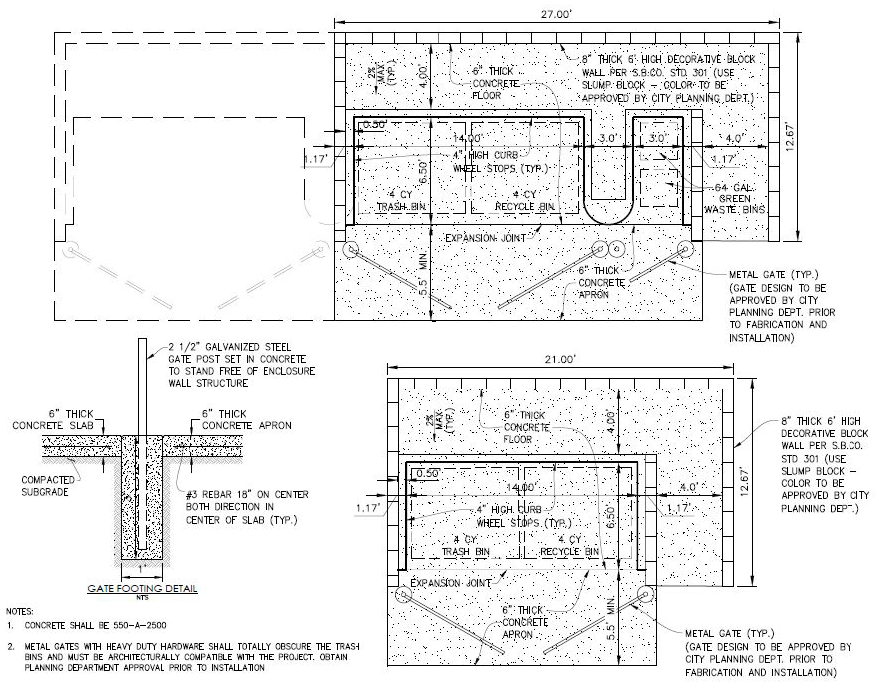
Figure 19.92.040-2
Trash Enclosure Standards — Stockade Fence
(Optional for Residential)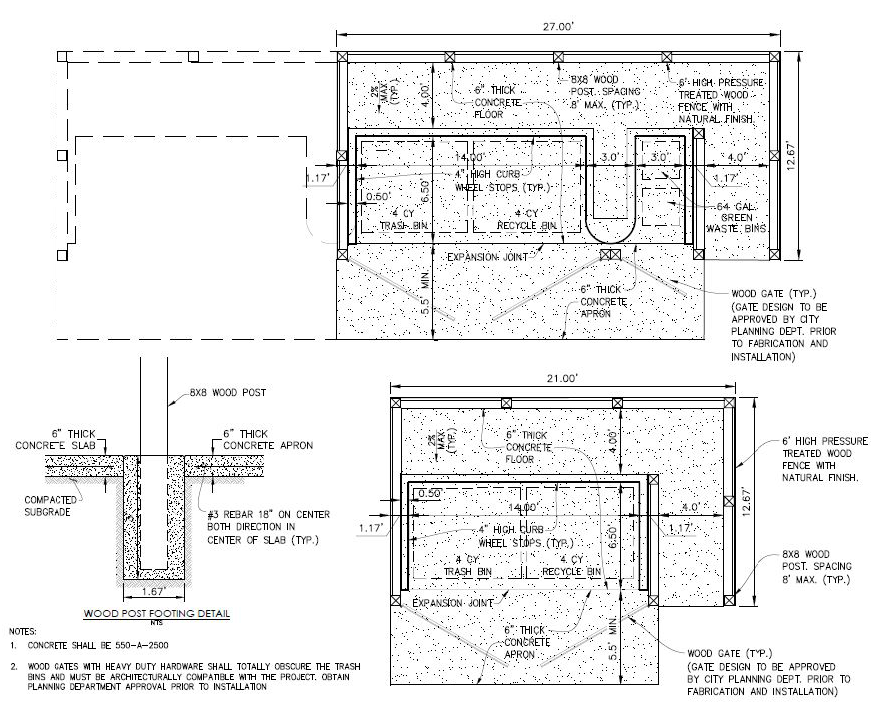
(Ord. No. 294, § 4(Exh. A), 8-25-2020)
19.94.010 - Purpose
This Chapter establishes requirements for the undergrounding of utilities both on-site and off-site.
19.94.020 - Applicability
The regulations contained in this Chapter shall apply to the construction, change or expansion of a use or structure and shall require that utilities are undergrounded in accordance with the requirements contained in this Chapter. The requirements of this Chapter shall apply to the following:
A.
New Uses and Buildings. For all buildings erected and all uses of land established after the effective date of this Title, utilities shall be undergrounded as required by this Chapter.
B.
Modification to Existing Structures and Uses. Whenever an existing building is modified or a use is expanded such that it creates an increase of more than 25 percent in the number of existing dwelling units for residential projects of more than 10 units, or more than 25 percent in the existing square footage of commercial or industrial projects where such expansion exceeds 10,000 square feet in size, utilities shall be undergrounded as required by this Chapter.
19.94.030 - Development Standards - Residential
Utilities shall be installed in accordance with the following standards for residential projects:
A.
Projects of More Than 10 Units. All utilities serving residential projects of more than 10 dwelling units shall install underground utilities both on-site and in the public right-of-way, including existing utilities.
B.
Projects of 10 Units or Less. All utilities serving residential projects of 10 dwelling units or less shall install underground utilities as follows:
1.
On-Site. All on-site utilities shall be installed underground.
2.
Public Rights-of-Way. All utilities in the public right-of-way, including existing utilities, shall be installed in a manner consistent with the existing surrounding improvements directly abutting the subject property.
19.94.040 - Development Standards - Commercial and Industrial
Utilities shall be installed in accordance with the following standards for all commercial and industrial projects:
A.
Projects of More Than 4 Acres. All utilities serving new commercial or industrial projects of more than 4 acres shall install underground utilities both on-site and in the public right-of-way, including existing utilities.
B.
Projects of 4 Acres or Less. All utilities serving new commercial or industrial projects of 4 acres or less shall install underground utilities as follows:
1.
On-Site. All on-site utilities shall be installed underground.
2.
Public Rights-of-Way. All utilities in the public right-of-way, including existing utilities, shall be installed in a manner consistent with the existing surrounding improvements directly abutting the subject property.
19.94.050 - Deferral of Undergrounding
A.
Applicability. A request for deferral shall apply only to the undergrounding of existing off-site overhead utilities.
B.
Request for Deferral. Request for a deferral of undergrounding utilities shall be made in writing to the City Manager.
C.
Approval Authority.
1.
For any project for which the Community Development Director is the designated approval authority, the City Manager shall have the discretion to either require the undergrounding of off-site utilities or defer such undergrounding, subject to the requirements of SubSection 19.94.050.D.
2.
For any project for which the Planning Commission or City Council is the designated approval authority, the applicable approval authority shall have the discretion to either require the undergrounding of off-site utilities or defer such undergrounding, subject to the requirements of SubSection 19.94.050.D.
D.
Findings for Approval and Requirements. Any approval for the deferral of utilities is subject to the following:
1.
The request shall be supported by cost estimates prepared by a licensed professional and approved by the City Engineer. All cost estimates shall be provided by the applicant at the time of request.
2.
The cost of such undergrounding or the impact of such undergrounding on adjacent properties exceeds a reasonable cost based on the scale of the proposed project.
3.
The property owner shall be required to enter into a deferred improvement agreement committing the participation of the property in its fair share cost of such undergrounding at a future date.
4.
Undergrounding of utilities shall be in a manner consistent with the surrounding improvements directly abutting the subject property at the time that such undergrounding of utilities occurs.
19.96.010 - Purpose
This Chapter establishes water-efficient landscape standards for the following purposes and for compliance with the state Water Efficient Landscape Ordinance (WELO):
A.
To assure beneficial, efficient and responsible use of water resources.
B.
To retain the land's natural hydrological role and promote the infiltration of surface water into the groundwater.
C.
To recognize that landscapes enhance the aesthetic appearance of developments and communities.
D.
To encourage the appropriate design, installation, maintenance and management of landscapes so that water demand can be decreased, runoff can be retained and flooding can be reduced without a decline in the quality or quantity of landscapes.
E.
To reduce or eliminate water waste.
19.96.020 - Applicability
A.
All planting, irrigation and landscape related improvements required by this Chapter shall apply to the following landscape projects:
1.
New construction projects except single-family homes, with an aggregate landscape area equal to or greater than 500 square feet requiring a building or landscape permit, plan check or design review.
2.
Rehabilitated landscaping for landscape areas equal to or greater than 2,500 square feet for industrial, commercial, office and institutional developments; parks and other public recreational areas; and multi-family residential.
3.
Special landscaped areas, such as areas dedicated to edible plants, irrigated with recycled water, or dedicated to active play, greater than 500 square feet requiring a building or landscape permit, plan check or design review, shall prepare a water-efficient landscape worksheet and landscape documentation package according to specifications.
4.
Recognizing the special landscape management needs of cemeteries, new and rehabilitated cemeteries are limited to SubSections 19.96.050.A and 19.96.060.B(4); existing cemeteries are limited to SubSection 19.96.060.B(4).
5.
Irrigation of landscaped areas of any size shall be conducted in a manner conforming to the rules and requirements of this ordinance, and shall be subject to penalties and incentives for water conservation and water waste prevention as determined and implemented by the local water purveyor or as mutually agreed upon by the local water purveyor and the City.
6.
Existing landscape areas that are 2,500 square feet or greater shall not exceed their maximum applied water allowance.
B.
Any project with an aggregate landscape area of 2,500 square feet or less may comply with the performance requirements of the state Model Water Efficient Landscape ordinance or conform to the prescriptive measures contained in Appendix D of that ordinance.
C.
For projects using rainwater captured on-site or treated/untreated greywater, any lot or parcel within the project that has less than 2500 square feet of landscape and meets the lot or parcel's landscape water requirement (Estimated Total Water Use) entirely with treated or untreated greywater or through stored rainwater captured on-site is subject only to Appendix D Section (5) of the state Model Water Efficient Landscape ordinance.
D.
Exemptions. The standards in this Chapter do not apply to:
1.
Registered local, state or federal historical sites.
2.
Ecological restoration projects that do not require a permanent irrigation system.
3.
Mined-land reclamation projects that do not require a permanent irrigation system.
4.
Existing plant collections, as part of botanical gardens and arboretums open to the public.
19.96.030 - Definitions
For the purposes of this Chapter, the following definitions shall apply. Additional applicable definitions are contained in the WELO.
A.
Applied Water. The portion of water supplied by the irrigation system to the landscape.
B.
Artificial Turf. A man-made material which simulates the appearance of live turf, organic turf, grass, sod or lawn.
C.
Ecological Restoration Project. A project where the site is intentionally altered to establish a defined, indigenous, historic ecosystem.
D.
Estimated Applied Water Use. The average annual total amount of water estimated to be necessary to keep plants in a healthy state, calculated as provided in the WELO. It is based on the reference evapotranspiration rate, the size of the landscape area, plant water use factors and the relative irrigation efficiency of the irrigation system.
E.
ET Adjustment Factor (ETAF). Equal to the plant factor divided by the irrigation efficiency factor for a landscape project, as described in the WELO. The ETAF is calculated in the context of local reference evapotranspiration, using site-specific plant factors and irrigation efficiency factors that influence the amount of water that needs to be applied to the specific landscaped area.
F.
Hardscapes. Any durable materials or feature (pervious or nonpervious) installed in or around a landscaped area, such as pavements or walls. Swimming pools and other water features are considered part of the landscaped area and not considered hardscapes for purposes of this Chapter.
G.
Irrigation Efficiency. The measurement of the amount of water beneficially used divided by the amount of water applied. Irrigation efficiency is derived from measurements and estimates of irrigation system characteristics and management practices. The irrigation efficiency for purposes of this Chapter is 0.75 for overhead spray devices and 0.81 for drip systems.
H.
Landscape Area. All the planting areas, turf areas and water features in a landscape design plan subject to the maximum applied water allowance calculation. The landscaped area does not include footprints of buildings or structures, sidewalks, driveways, parking lots, decks, patios, gravel or stone walks, other pervious or nonpervious hardscapes, and other nonirrigated areas designated for nondevelopment (e.g., open spaces and existing native vegetation).
I.
Landscape Documentation Package. The documents required to be provided to the City for review and approval of landscape design projects, as described in the WELO.
J.
Landscape Project. Total area of landscape in a project, as provided in the definition of "landscaped area."
K.
Maximum Applied Water Allowance (MAWA). The upper limit of annual applied water for the established landscaped area as specified in the WELO. It is based upon the area's reference evapotranspiration, the ETAF, and the size of the landscaped area. The estimated applied water use shall not exceed the maximum applied water allowance. Special landscape areas are subject to the MAWA with an ETAF not to exceed 1.0. MAWA = (ETo)(0.62)[(ETAF x LA) + ((1-ETAF) x SLA)].
L.
Mined-land Reclamation Projects. Any surface mining operation with a reclamation plan approved in accordance with the Surface Mining and Reclamation Act of 1975.
M.
Permit. An authorizing document issued by the City for new construction or rehabilitated landscape.
N.
Rehabilitated Landscape. Any relandscaping project that requires a permit, plan check, or design review, that is greater than 2,500 square feet and that meets the requirements of the WELO.
O.
Special Landscape Area (SLA). An area of the landscape dedicated solely to edible plants, recreational areas, areas irrigated with recycled water, or water features using recycled water.
P.
Turf. A ground cover surface of mowed grass. Annual bluegrass, Kentucky bluegrass, perennial ryegrass, red fescue, and tall fescue are cool-season grasses. Bermudagrass, Kikuyugrass, Seashore Paspalum, St. Augustinegrass, Zoysiagrass, and Buffalo grass are warm-season grasses.
Q.
Water Feature. A design element where open water performs an aesthetic or recreational function. Water features include ponds, lakes, waterfalls, fountains, artificial streams, spas and swimming pools (where water is artificially supplied). The surface area of water features is included in the high water use hydrozone of the landscape area. Constructed wetlands used for on-site wastewater treatment, habitat protection or stormwater best management practices that are not irrigated and used solely for water treatment or stormwater retention are not water features and, therefore, are not subject to the water budget calculation.
19.96.040 - Permit Requirements
Consistency with the regulations contained in this Chapter shall be reviewed concurrent with any required building permit or land use permit for applicable projects.
19.96.050 - Implementation Procedures
A.
Prior to installation, a landscape documentation package and water-efficient landscape worksheet shall be submitted to the Community Development Department for review and approval of all landscape projects subject to the provisions of this Chapter. Any landscape documentation package submitted shall comply with the WELO.
B.
Other regulations affecting landscape design and maintenance practices are potentially applicable and should be consulted for additional requirements. These regulations include but may not be limited to:
1.
State of California Section 65595.
2.
Water conservation and drought response regulations of the local water purveyor.
3.
This Development Code.
4.
The City's Building Code.
5.
Specific Plans, General Plan or similar land use and planning documents.
6.
Conditions of approval for a specific project.
C.
The landscape documentation package submitted to the Community Development Department shall include appropriate water use calculations, as outlined in the WELO.
D.
The landscape documentation package shall bear the signature of a licensed landscape architect, licensed landscape contractor or any other person authorized to design a landscape. This Chapter shall not be deemed to prohibit any person from preparing any plans, drawings or specifications for any property owned by that person.
E.
Verification of compliance of the landscape installation with the approved plans shall be obtained through a certificate of completion in conjunction with the final permit process.
19.96.060 - Development Standards
A.
For applicable landscape installation or rehabilitation projects subject to this Chapter, the estimated applied water use allowed for the landscaped areas shall not exceed the maximum applied water allowance calculated using an ET adjustment factor of 0.7, except for special landscaped areas where the maximum applied water allowance is calculated using an ETAF of 1.0; or the design of the landscaped area shall otherwise be shown to be equivalently water efficient in a manner acceptable to the City as provided in the WELO.
B.
Existing Landscapes.
1.
Irrigation of landscaped areas of any size shall be conducted in a manner conforming to the rules and requirements of the State and local water purveyor and shall be subject to penalties and incentives for water conservation and waste prevention, as determined and implemented by the local water purveyor and as may be mutually agreed to by the City.
2.
The City and/or local water purveyor may administer programs such as irrigation water use analyses; irrigation surveys and/or irrigation audits; tiered meter rate structures; water budgeting by parcel; or other approaches to achieve community-wide landscape water use efficiency to a level equivalent to or less than would be achieved by applying a MAWA calculated with an ETAF of 0.8 to all landscaped areas in the City over 2,500 square feet in size.
3.
Neither the architectural guidelines nor the Covenants, Conditions and Restrictions (CC&Rs) of a common interest development, including apartments, condominiums, planned developments and stock cooperatives, shall prohibit or include conditions that have the effect of prohibiting the use of low-water use plants as a group.
4.
Water Waste Prevention.
a.
Water waste resulting from inefficient landscape irrigation leading to excessive runoff, low head drainage, overspray and other similar conditions where water flows onto adjacent property, nonirrigated areas, walks, roadways or structures is prohibited.
b.
All landscape areas, whether installed pursuant to this Chapter or not, shall be maintained in a healthful and sound condition. Irrigation systems and their components shall be maintained in a fully functional manner consistent with the originally approved design and the provisions of this Chapter.
c.
Landscapes shall be maintained to ensure water efficiency. A regular maintenance schedule should include, but not be limited to, checking, adjusting and repairing irrigation equipment; resetting the automatic controller; aerating and dethatching turf areas; replenishing mulch; fertilizing; pruning; and weeding in all landscaped areas.
C.
Artificial Turf. Artificial or synthetic turf is an appropriate substitute for natural turf in some cases for the purposes of water conservation.
19.96.070 - Enforcement and Penalties
A.
Any firm, corporation or person, whether as principal, agent, employee or otherwise, violating or causing the violation of any of the provisions of this Chapter shall be guilty of a misdemeanor, and any conviction thereof shall be punishable as set forth in Section 1.04.020 of the City's Municipal Code.
B.
Nothing herein shall prevent or restrict the City from taking such other lawful action in any court of competent jurisdiction as is necessary to prevent or remedy any violation or noncompliance. Such other lawful actions shall include, but shall not be limited to, an equitable action for injunctive relief or an action at law for damages.
C.
Further, nothing herein shall be construed to prohibit the City from prosecuting any violation of this Chapter by means of code enforcement established pursuant to the authority as provided by the laws of the state of California and the City.
D.
Any violation of the provisions of this Chapter shall constitute a separate offense for each and every day during which such violation is committed or continued.
19.98.010 - Purpose
The purpose of this Chapter is to establish regulations for the removal, relocation or trimming of any Western Joshua Tree, or any part thereof.
(Ord. No. 314, § 4(Exh. A), 12-12-2023)
19.98.020 - Definitions
A.
"Western Joshua Tree" means Yucca Brevifolia, an evergreen tree-like plant that has been treated as a member of the asparagus family (Asparagaceae).
B.
"Take" means any activity that results in the removal of a Joshua Tree, or any part thereof.
(Ord. No. 314, § 4(Exh. A), 12-12-2023)
19.98.030 - Regulations
A.
The California Fish and Game Commission has listed the Western Joshua Tree as a threatened species under the California Endangered Species Act (CESA).
B.
Prior to the removal, relocation or trimming of any Western Joshua Tree, or any part thereof, a take permit must be obtained from CA Dept of Fish and Wildlife.
(Ord. No. 314, § 4(Exh. A), 12-12-2023)

