
Twentynine Palms City Zoning Code
ARTICLE 5
- Special Use Regulations
Chapter 19.134 - Accessory Dwelling Units[1]
___________
Editor's note—Ord. No. 311, § 4(Exh. A), adopted Sept. 26, 2023, repealed the former Ch. 19.134, §§ 19.134.010—19.134.070, and enacted a new Ch. 19.134, §§ 19.134.010—19.134.050 as set out herein. The former Ch. 19.134 pertained to similar subject matter and derived from Ord. No. 295, § 4(Exh. A), adopted Dec. 12, 2020.
19.100.010 - Purpose
The purpose of this Chapter is to establish requirements and criteria for establishment or expansion of an adult-oriented business. The intent of this Chapter is to regulate adult-oriented businesses which, because of their very nature, are believed to have the potential for recognized significant secondary effects on the community which include, but are not limited to: depreciated property values and increased vacancies in residential and commercial areas in the vicinity of the adult-oriented businesses; higher crime rates, noise, debris or vandalism in the vicinity of adult-oriented businesses; and blighting conditions such as low level maintenance of commercial premises and parking lots which thereby have a deleterious effect upon adjacent areas. Special regulation of these uses is necessary to ensure that these adverse effects will not contribute to the blighting or downgrading of the neighborhoods in the vicinity of the adult-oriented businesses while at the same time protecting the First Amendment rights of those individuals who desire to own, operate or patronize adult-oriented businesses. Nothing in this Chapter is intended to authorize, legalize or permit the establishment, operation or maintenance of any business, building or use which violates any City ordinance or any statute of the state of California regarding public nuisances, unlawful exposure, sexual conduct, lewdness or obscene or harmful matter or the exhibition or public display thereof.
19.100.020 - Applicability
The regulations contained in this Chapter apply to all adult-oriented businesses, as described herein.
19.100.030 - Definitions
A.
Adult Bookstore. Any establishment, which, as a regular and substantial course of conduct, displays and/or distributes adult merchandise, books, periodicals, magazines, photographs, drawings, sculptures, motion pictures, videos, slides, films or other written, oral or visual representations which are distinguished or characterized by an emphasis on a matter depicting, describing or relating to specified sexual activities or specified anatomical parts. (See "Adult-Oriented Business" for definition of regular and substantial portion of its business.)
B.
Adult Cabaret. A nightclub, bar, lounge, restaurant or similar establishment or concern which features, as a regular and substantial course of conduct, any type of live entertainment, films, motion pictures, videos, slides, other photographic reproductions, or other oral, written, or visual representations which are characterized by an emphasis on matter depicting, describing or relating to specified sexual activities or specified anatomical parts.
C.
Adult Hotel/Motel. A motel, hotel or similar commercial establishment which (1) offers public accommodations, for any form of consideration, which provides patrons with closed-circuit television transmissions, films, motion pictures, video cassettes, slides or other photographic reproductions which are characterized by the depiction or description of specified sexual activities or specified anatomical areas and which advertises the availability of this sexually oriented type of material by means of a sign visible from the public right-of-way, or by means of any off-premises advertising including, but not limited to, newspapers, magazines, pamphlets or leaflets, radio or television; or (2) offers a sleeping room for rent for a period of time less than 10 hours; or (3) allows a tenant or occupant to sub-rent the sleeping room for a time period of less than 10 hours.
D.
Adult Model Studio. Any premises where there is furnished, provided or procured a figure model or models who pose in any manner which is characterized by its emphasis on matter depicting, describing, or relating to specified sexual activities or specified anatomical parts where such model(s) is being observed or viewed by any person for the purpose of being sketched, painted, drawn, sculptured, photographed, filmed, or videotaped for a fee, or any other thing of value, as a consideration, compensation or gratuity for the right or opportunity to so observe the model or remain on the premises. An adult model studio shall not include any live art class or any studio or classroom which is operated by any public agency, or any private educational institution authorized to issue and confer a diploma or degree.
E.
Adult Motion Picture Arcade. Any business establishment or concern which, as a regular and substantial course of conduct, provides coin- or slug-operated or manually or electronically controlled still, motion picture or video machines, projectors, or other image-producing devices that are maintained to display images to an individual in individual viewing areas when those images are distinguished or characterized by an emphasis on matter depicting, describing or relating to specified sexual activities or specified anatomical parts.
F.
Adult-Oriented Business. Any business establishment or concern which as a regular and substantial course of conduct performs as an adult bookstore, adult theater, adult motion picture arcade, adult cabaret, performer, adult model studio or adult hotel/motel (but not clothing-optional hotel/motel); any business establishment or concern which as a regular and substantial course of conduct sells or distributes sexually oriented merchandise or sexually oriented material; or any other business establishment or concern which as a regular and substantial course of conduct offers to its patrons products, merchandise, services or entertainment characterized by an emphasis on matters depicting, describing or relating to specified sexual activities or specified anatomical parts. Adult-oriented business does not include those uses or activities, the regulation of which is preempted by state law. Adult-oriented business shall also include any business establishment or concern which, as a regular and substantial course of conduct, provides or allows performers, models, actors, actresses or employees to appear in any place in attire which does not opaquely cover specified anatomical parts. For the purposes of this Chapter, a business establishment or concern has established the provision of products, merchandise, services or entertainment characterized by an emphasis on matters depicting, describing or relating to specified sexual activities or specified anatomical parts as a regular and substantial course of conduct when one or more of the following conditions exist:
1.
The area devoted to adult merchandise and/or sexually oriented material exceeds more than 30 percent of the total display or floor space area open to the public.
2.
The business establishment or concern presents any type of live entertainment which is characterized by an emphasis on specified sexual activity or specified anatomical parts at least four times in any month in any given year.
3.
The regular and substantial course of conduct of the business consists of or involves the sale, trade, display or presentation of services, products, or entertainment which are characterized by an emphasis on matter depicting, describing, or relating to specified sexual activities or specified anatomical parts.
G.
Adult Theater. A business establishment or concern which, as a regular and substantial course of conduct, presents live entertainment, motion pictures, videos, slide photographs or other pictures or visual reproductions which are distinguished or characterized by their emphasis on matter depicting, describing or relating to specified sexual activities or specified anatomical parts.
H.
Live Art Class. Any premises on which all of the following occur: there is conducted a program of instruction involving the drawing, photographing or sculpting of live models exposing specified anatomical parts; instruction is offered in a series of at least two classes; the instruction is offered indoors; an instructor is present in the classroom while any participants are present; and preregistration is required at least 24 hours in advance of participation in the class.
I.
Sex Club. Any establishment not primarily dedicated to providing overnight lodging accommodations, including a private club, which as a regular and substantial course of conduct permits persons to engage in specified sexual activities in any public or semi-public portion of the establishment or which provides any private room to persons more than once in a 20-hour period in which persons are permitted to engage in specified sexual activities. For the purpose of this Chapter, a public or semi-public portion of an establishment shall mean any portion of the establishment in which invitees of the establishment are permitted access and which is not let, leased or rented more than once in a 20-hour period to persons who are entitled to exclusive use of the room. The above notwithstanding, a sex club is also any place which represents itself to any person or group of persons as a place for persons to engage in specified sexual activities.
J.
Sexually Oriented Material. Any element of sexually oriented merchandise, or any book, periodical, magazine, photograph, drawing, sculpture, motion picture film, video, or other written, oral or visual representation which, for purposes of sexual arousal, provides depictions which are characterized by an emphasis on matter depicting, describing or relating to specific sexual activities or specified anatomical parts.
K.
Sexually Oriented Merchandise. Sexually oriented implements and paraphernalia such as, but not limited to, dildos, auto sucks, sexually oriented vibrators, edible underwear, benwa balls, inflatable orifices, anatomical balloons with orifices, simulated and battery operated vaginas, and similar sexually oriented devices which are designed or marketed primarily for the stimulation of human genital organs or sadomasochistic activity.
L.
Specified Anatomical Parts. 1) Less than completely and opaquely covered human genitals; pubic region; buttocks; or female breast below a point immediately above the top of the areola; or 2) human male genitals in a discernibly turgid state, even if completely and opaquely covered.
M.
Specified Sexual Activities. 1) Actual or simulated sexual intercourse, oral copulation, anal intercourse, oral anal copulation, bestiality, direct physical stimulation of unclothed genitals, flagellation or torture in the context of a sexual relationship, the use of excretory function in the context of a sexual relationship, or any of the following depicted sexually oriented acts or conduct: anilingus, buggery, coprophagy, coprophilia, cunnilingus, fellatio, necrophilia, pederasty, pedophilia, sapphism, and zooerastia; or 2) clearly depicted human genitals in a state of sexual stimulation, arousal or tumescence; or 3) use of human or animal ejaculation, sodomy, oral copulation, coitus or masturbation; or 4) fondling or touching of nude human genitals, pubic region, buttocks or female breast; or 5) masochism, erotic or sexually oriented torture, beating or the infliction of pain; or 6) erotic or lewd touching, fondling or other sexually oriented contact with an animal by a human being; or 7) human excretion, urination, menstruation, vaginal or anal irrigation; or 8) striptease or the removal of clothing to the point where specified anatomical parts are not opaquely covered.
19.100.040 - Permit Required
A.
No adult-oriented business shall be permitted to operate, engage in, conduct or carry on business in the City unless the owner of the business first obtains both an Adult-oriented Business Permit and a Business License from the City, as well as any other license or permit otherwise required by law.
B.
Sex clubs, as defined in Section 19.100.030, are prohibited.
19.100.050 - Application and Required Fees
A.
The property owner, or authorized agent of the property owner, is eligible to request an Adult-oriented Business Permit. A single Adult-oriented Business Permit shall suffice for the operation of any adult-oriented business in the City.
B.
Submission of Application. All applications for an Adult-oriented Business Permit will be filed with the City Clerk and forwarded to the Community Development Department for processing. The following information is required at the time an Adult-oriented Business Permit is submitted:
1.
A completed City preprinted Adult-oriented Business Permit application signed by the property owner or authorized representative.
2.
A nonrefundable deposit or fee as set forth by Ordinance or Resolution of the City Council.
3.
A Letter of Justification describing the proposed project and explaining how it will comply with the standards contained in Section 19.100.070 and all other information as required by the preprinted City Adult-oriented Business Permit application.
19.100.060 - Application Process
A.
Determination of Completeness. Within 10 business days following the receipt of an application pursuant to this Chapter, the Community Development Director (Director) will determine whether the application contains all the information required by the provisions of this Chapter. If it is determined that the application is not complete, the applicant will be notified in writing within five business days of the date such determination is made that the application is not complete and the reasons therefore, including the additional information required to complete the application form. The applicant will have 30 calendar days to submit additional information to render the application complete. Failure to do so within the 30-day period will render the application void. Within five business days following the receipt of an amended application or supplemental information, the Director will again determine whether the application is complete in accordance with the procedures set forth in this Subsection. Evaluation and notification will occur as provided above until such time as the application is found to be complete. The applicant will be notified within five days of the date the application is found to be complete. All notices required by this Chapter will be deemed given upon the date they are either deposited in the United States mail or on the date upon which personal service of such notice is provided.
B.
Investigation of Application. Upon determining that an application for an adult-oriented business is complete, the sheriff's department will, within 30 calendar days of receipt of the application, conduct an investigation of the information contained in the application to determine if the proposed adult-oriented business is in compliance with the provisions of this Chapter. Such investigation may include providing copies of the application to the Director of Public Works, City Engineer, Community Development Director or other officials for their investigation and report thereon.
C.
Issuance of Permit. The Director will issue an Adult-oriented Business Permit within 30 days of receipt of a complete application if the standards contained in Section 19.100.070 are met. If any of the standards cannot be met, the application will be denied.
D.
Appeal of Decision. Any applicant will be permitted to appeal the decision of the Director in the manner provided in Section 19.28.120 (Appeals) of this Development Code.
E.
Permits Nontransferable. No Adult-oriented Business Permit may be sold, transferred or assigned by any permittee or by operation of law, to any other person, group, partnership, corporation or any other entity. Any such sale, transfer, or assignment or attempted sale, transfer or assignment shall be deemed to constitute a voluntary surrender of the permit and the permit shall be thereafter null and void. An Adult-oriented Business Permit held by a corporation or partnership is subject to the same rules of transferability as contained above. For the purposes of this Section, a corporation is sold, transferred, or assigned when in excess of 30 percent of its stock is sold, transferred or assigned.
F.
Use Specific. Any change in the nature or composition of the adult-oriented business from one element of an adult-oriented business to another element of an adult-oriented business shall also render the permit null and void.
G.
Off-site Activity Uses Prohibited. An Adult-oriented Business Permit shall only be valid for the exact location specified on the permit. Off-site adult-oriented business activity is prohibited.
19.100.070 - Development and Operational Standards
A.
Locational Limitations.
1.
The adult-oriented business shall not be located within 300 feet of any existing residence. The adult-oriented business shall not be located within 500 feet of any lot upon which there is properly located a public park, school or mortuary or within 500 feet of any lot approved to be used by a religious institution for religious activities at least three times per week. 1 The adult-oriented business shall not be located on property adjacent to another adult-oriented business. For the purpose of this Section, "adjacent property" shall mean property with a common boundary, excluding intervening easements and rights-of-way, whether such rights-of-way are held by the City in fee or otherwise. By way of example, an adult-oriented business shall not be permitted to operate at a location across the street from another adult-oriented business if, but for the existence of the street, the property lines of the businesses would be contiguous.
2.
The adult-oriented business shall not be located completely or partially within any mobile structure or pushcart.
3.
The adult-oriented business complies with the development and design requirements of the land use district in which it is to be located.
B.
Parking Requirements. The parking requirements for adult-oriented businesses shall be as follows:
1.
Bookstores/retail establishments. One parking space per 300 square feet of gross floor area.
2.
Theaters. One parking space for each three fixed seats, or one parking space for each 24 square feet of gross floor area.
3.
Cabarets. One parking space for each three fixed seats, or one parking space per 35 square feet of gross floor area.
4.
Motion picture arcade. One parking space for each individual viewing area plus one parking space per employee.
5.
Motel/hotel. One parking space per guest room.
C.
The adult-oriented business shall comply with the City's sign regulations in Chapter 19.88 (Signs).
D.
Misdemeanor or Felony. Neither the applicant, if an individual, nor any of the officers, shareholders owning in excess of 30 percent of the corporation's shares, or general partners, if a corporation or partnership, of the adult-oriented business have been found guilty within the past two years of a misdemeanor or felony classified by the state as a sex-related offense and have not violated any of the provisions of an Adult-oriented Business Permit or similar permit or license in any city, county, territory or state.
E.
Regulation of Public Restroom Facilities. The adult-oriented business shall provide separate restroom facilities for male and female patrons. The restrooms shall be free from sexually oriented materials and sexually oriented merchandise. Only one person shall be allowed in the restroom at any time, unless otherwise required by law, in which case the adult-oriented business shall employ a restroom attendant of the same sex as the restroom users who shall be present in the restroom during operating hours. The attendant shall prevent any person(s) from engaging in any specified sexual activities (except such regular uses for which a public restroom is intended) within the public portion of a restroom; shall ensure that no person of the opposite sex is permitted in the restroom; and shall ensure that not more than one person enters a stall at any one time by watching the public portion of the restroom. This Section shall not require the attendant to look into the private stalls.
F.
Lighting Requirements. All areas of the adult-oriented business shall be illuminated at a minimum of the following foot-candles, minimally maintained and evenly distributed at ground level:
Bookstores .....20 foot-candles
Retail Establishments .....foot-candles
Theater or Cabaret (except during performances, at which times the lighting shall be at least 1.25 foot candles) .....5 foot-candles
Motion Picture Arcade .....10 foot-candles in public areas
Individual Viewing Booths .....1.25 foot-candles
Motion Picture Theater (except during performances, at which times the lighting shall be at least 1.25 foot candles) .....10 foot-candles
Motel/Hotel .....20 foot-candles in public areas
G.
Individual Viewing Area Standards.
1.
The individual viewing areas of the adult-oriented business shall be operated and maintained with no holes, openings or other means of direct visual or physical access between the interior space of two or more individual viewing areas.
2.
No individual viewing area may be occupied by more than one person at any one time.
3.
The interior of the adult-oriented business shall be configured such that there is an unobstructed view of every public area of the premises, including but not limited to the interior of all individual viewing areas, from a permanent security station physically demarked in the establishment which is no larger than 32 square feet of floor area with no single dimension being greater than 8 feet in a public portion of the establishment. No public area, including but not limited to the interior of any individual viewing area, shall be obscured by any door, curtain, wall, two-way mirror or other device which would prohibit a person from seeing into the interior of the individual viewing area from the manager's station. A security officer shall be stationed in the security station at all times the business is in operation or open to the public in order to enforce all rules and regulations. No individual viewing area shall be designed or operated to permit occupancy of more than one person at a time. "Individual viewing area" shall mean any area designed for occupancy of 10 or fewer persons for the purpose of viewing live performances, pictures, movies, videos or other presentations.
4.
The adult-oriented business shall not stage any special events, promotions, festivals, concerts or similar events which would increase the demand for parking beyond the approved number of spaces for the particular use.
H.
A traffic study has been prepared for the adult-oriented business in conformance with industry standards. The applicant shall demonstrate that the project will not result in a reduction in any roadway level of service below that level of service designated in the General Plan for that roadway.
I.
The adult-oriented business shall comply with the Noise Element of the General Plan, Interior and Exterior Noise Standards and any mitigation measures necessary to reduce the project's noise impacts to the City's articulated noise standard.
J.
The adult-oriented business shall comply with all building and construction standards of the Uniform Building Code, Chapter 24 hereof, Title 24 of the California Code of Regulations, and all other federal, state and City-adopted standards for the specific use.
K.
Operational Standards.
1.
The adult-oriented business shall not allow admittance to any person under the age of 18 if no liquor is served, or under the age of 21 if liquor is served.
2.
The adult-oriented business shall not conduct any massage, tattooing or acupressure on the premises or operate escort services from the premises.
3.
Material or Merchandise. The adult-oriented business shall not display any sexually oriented material or sexually oriented merchandise which would be visible from any location other than from within the adult-oriented business.
4.
Hours of Operation. With the exclusion of adult-oriented hotels, the adult-oriented business shall not operate between the hours of 1:00 a.m. and 9:00 a.m.
5.
Whenever live entertainment is provided, patrons shall be physically separated from performers by a buffer zone of at least 6 feet. Such physical separation shall consist of an actual physical rail, 32 inches high running no less than 6 feet around the outside perimeter of the area in which the entertainment is provided. Live entertainment, for the purposes of this requirement, shall mean any existent display by a human being which is characterized by an emphasis on specified anatomical parts or specified sexual activities. This provision shall not apply to an individual viewing area where the stage is completely separated from the individual viewing area by a floor to ceiling permanent, solid barrier.
6.
No patron will directly pay or give any gratuity to any performer, and no performer will solicit or accept any directly paid gratuity from any patron. For purposes of this Section, the phrase "directly pay" shall mean the person-to-person transfer of the gratuity. This Section shall not prohibit the establishment of a non-human gratuity receptacle placed at least 6 feet from the stage or area in which the performer is occupying.
7.
Prohibition against Physical Contact. No performer will intentionally have any physical contact with any patron and no patron will intentionally have any physical contact with any performer while on the premises of an adult-oriented business.
8.
Security Measures.
a.
The adult-oriented business shall provide a security system that visually records and monitors all parking lot areas.
b.
At least one security guard will be on duty outside the premises, patrolling the grounds and parking lot at all times live entertainment is offered. The security guard shall be charged with preventing violations of law and enforcing the provisions of this Chapter. All security guards will be uniformed so as to be readily identifiable as a security guard by the public. No person acting as a security guard shall act as a doorman, ticket taker or seller, or similar functionary while acting as a security guard. For all adult-oriented businesses providing live entertainment, an additional security guard will be provided with each increase in maximum occupancy of 200 persons.
19.100.080 - Enforcement and Revocation
A.
Inspections. The permittee shall permit officers of the City, the County of San Bernardino, and each of their authorized representatives to conduct unscheduled inspections of the premises of the adult-oriented business for the purpose of ensuring compliance with the law at any time the adult-oriented business is open for business or occupied.
B.
Revocation Grounds. The Director may suspend or revoke an Adult-oriented Business Permit when he/she discovers that any of the following has occurred:
1.
Any of the requirements contained in Section 19.100.070 above ceases to be satisfied.
2.
The application contains incorrect, false or misleading information.
3.
The applicant, within the last two years, has been convicted of any felony or misdemeanor which is classified as a sex or sex-related offense, any violation of this Development Code, any violation of the City's massage ordinance, or any violation of any other adult business ordinance of any other city, county or state.
4.
Any person has been convicted of a sex-related offense as a result of his/her activity on the premises of the adult-oriented business.
5.
Any person(s) has engaged in any specified sexual activities on the premises.
C.
Revocation Hearing Notice. Upon determining that the grounds for permit revocation exist, the Director will provide the permittee with written notice of the proposed revocation by certified mail addressed to the street address of the business as shown on the Adult-oriented Business Permit application. The notice of the proposed revocation will specify grounds for the proposed revocation as well as the date, time and location at which the hearing will be held. The City Manager or his/her designee will hold the revocation hearing as provided below:
1.
Revocation Hearing. The City Manager or his/her designee will hold a hearing on a proposed permit revocation not later than 30 days after issuance of the notice of revocation unless an extension of time is agreed to by both the City and the permittee. At the hearing, the Director or his/her designee will present evidence and witnesses, as necessary, to establish the cause of the revocation of the permit. The permittee, at the hearing, may be represented by legal counsel, may present evidence and witnesses, and may cross-examine City witnesses. The Director will be afforded the same rights.
2.
After the hearing held pursuant to Subsection (1) above, the City Manager or designee will render a decision on the proposed revocation within 20 business days from the hearing date. The City Manager or designee may suspend or revoke the Adult-oriented Business Permit if he/she determines that any of the grounds of revocation contained herein have been proven. A copy of the written decision will be mailed by certified mail to the permittee at the address listed in the Adult-oriented Business Permit application. The decision of the City Manager or his/her designee will be final and conclusive.
D.
Maintenance of Status Quo Pending Decision; Judicial Review. The status quo pending the issuance of a decision on any revocation or appeal hearing provided under this Chapter will be maintained until such time as the hearing has been concluded and a written decision made. Any decision denying an application or suspending or revoking a permit will be judicially reviewable pursuant to a writ of administrative mandate under California Code of Civil Procedure Section 1094.5. The status quo will also be maintained pending Superior Court's issuance of the judicial decision on the writ petition.
E.
Except as otherwise provided, any person aggrieved by a decision of the Director under this Chapter may file an appeal in the manner provided in the Section 19.128.120 (Appeals), and the appeal shall be noticed, heard and decided as provided therein.
F.
No person, corporation, partnership or member thereof or any other entity whose Adult-oriented Business Permit has been revoked may obtain an Adult-oriented Business Permit for a business within two years of the date it stops operating.
19.100.090 - Violation and Penalty
A.
Every person, whether acting as an individual owner, employee of the owner, permittee, or operator or employee of the permittee, or whether acting as a mere helper for the owner, permittee employer or operator, or whether acting as a participant or worker in any way, who operates or conducts or who participates in the operation of an unpermitted adult-oriented business, or who violates any provisions of this Chapter, shall be guilty of a misdemeanor and shall be fined not more than $1,000.00 for each offense or imprisoned for not more than six months in the county jail for each offense, or both. Each day the violation continues shall be regarded as a separate offense for which the full penalty may be imposed.
B.
Any establishment operated, conducted or maintained contrary to the provisions of this Chapter is unlawful and a public nuisance, and the City Attorney may, in addition to or in lieu of prosecuting a criminal action hereunder, commence an action or actions, proceeding or proceedings for the abatement, removal and enjoinment thereof in the manner provided by law, and shall take such other steps and shall apply to such court or courts as may have jurisdiction to grant such relief as will abate or remove such adult-oriented business and restrain and enjoin any person from operating, conducting or maintaining such an establishment contrary to the provisions of this Chapter.
19.100.100 - Severability
Should any Section, Subsection, clause or provision of this Chapter for any reason be held to be invalid or unconstitutional, such invalidity or unconstitutionality shall not affect the validity or constitutionality of the remaining portions of this Chapter; it being hereby expressly declared that this Ordinance and each Section, Subsection, sentence, clause and phrase hereof would have been prepared, proposed, approved and ratified irrespective of the fact that any one or more Sections, Subsections, sentences, clauses or phrases be declared invalid or unconstitutional. 1 The distance of separation required by Subsection 19.100.070.A(1) shall be made using a straight line, without regard to intervening structures or objects, from the property line of the lot on which the adult-oriented business is located to the nearest property line of the lot upon which is located a residential use, religious institution, park or school from which the measurement is being taken is located. On the same lot as the adult-oriented business, the distance between the two shall be measured in a straight line between the front doors of each use without regard to intervening structures or objects. Furthermore, no sensitive use whose permit to operate is approved after the date the adult-oriented business application has been submitted shall be considered for purposes of determining whether the Adult-oriented Business Permit shall be issued.
19.101.010 - Purpose.
It is recognized by the City of Twentynine Palms that commercial and industrial establishments are developing shared workspaces, and offering services beyond the primary purpose of their business. The purpose of this Chapter is to establish regulations for the development and operation of ancillary uses, commercial activities, and live entertainment. The intent of the standards is to regulate these uses for compatibility with surrounding uses.
(Ord. No. 327, § 3, 1-27-2026)
19.101.020 - Applicability.
The requirements contained in this Chapter shall apply to ancillary uses, commercial activities, and live entertainment, as specified below, located in existing commercial or industrial uses.
(Ord. No. 327, § 3, 1-27-2026)
19.101.30 - Ancillary Uses—Review.
Ancillary Uses are owned and operated by the primary business. Provided that the primary business offers additional or ancillary services offered or products sold that are allowed in the same permit level or lower than the primary business, then no permit is required. However, any upgrade in intensity of use will require the requisite perm it. (i.e. a dining counter inside of a grocery market that is owned and operated by the market will not require any additional land use approval, but a retail establishment that adds alcohol sales may require a conditional use permit). There are no limits to ancillary services or products for sale, provided that they do not require expansion of the facilities in which the activities are located.
(Ord. No. 327, § 3, 1-27-2026)
19.101.031 - Ancillary Commercial Business—Review.
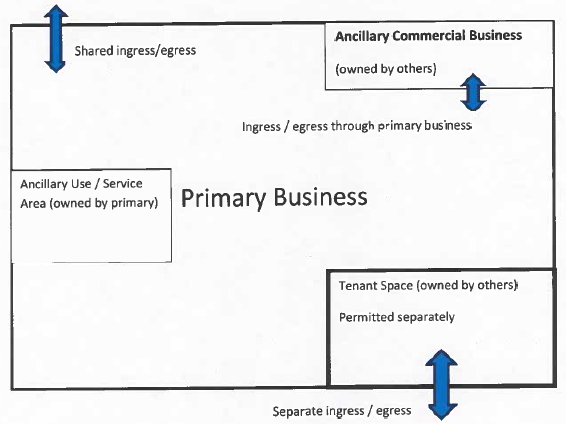
Provided that any new proposed ancillary business is located entirely within the physical constraints of another business, then the second business may be permitted with a lower-level of land use approval than would otherwise be approved at the next lower level of land use permit. The following criteria applies to ancillary commercial uses:
A.
The ancillary commercial business are not owned or operated by the primary business.
B.
Entrances and exits of the secondary business must be located entirely within the primary business, with no unique means of egress.
C.
The secondary business must have the same hours and days of operation or less as the primary business.
D.
Ancillary commercial businesses may not take up more than 25% of the gross square footage of the primary business.
Figure 19.101.030-A
(Ord. No. 327, § 3, 1-27-2026)
19.101.032 - Ancillary Live Entertainment—License Required.
A.
Definitions:
"Live entertainment" means a musical act (including karaoke), theatrical act (including standup comedy), play, revue, scene, dance act, or combination, performed by 1 or more persons, whether or not they are compensated for the performance, in a privately owned premises that is open to the public, whether or not admission is charged. Live Entertainment does not include Adult Entertainment.
"Ancillary Live Entertainment" means "Live Entertainment" that occurs in an establishment where a primary use (restaurant, bar, retail, etc.) is already a permitted use.
"Live Entertainment Venue" is an establishment whereas "Live Entertainment" is the primary use (i.e. theaters, concert halls, etc.).
"Live Entertainment Special Event" is a one-time or seasonal event that may include road closures, parking lot enclosures, temporary facilities, etc. See Section 19.34 of the Development Code.
B.
Applicability:
Any
commercial or industrial establishment may offer Ancillary Live Entertainment provided a License has been issued by the City of Twentynine Palms.
C.
Exemptions:
The following types of establishments are exempt from this section, and may have Live Entertainment as part of their regular operations, provided that the Restrictions prescribed in Section 19.101.032.D are adhered to:
1.
Fraternal Organizations.
2.
Non-profit institutions such as schools, museums, observatories, art galleries.
3.
Houses of worship.
D.
Restrictions:
1.
Licenses for Ancillary Live Entertainment are renewable annually upon payment of the appropriate application fee. No Ancillary Live Entertainment may occur in any establishment without a License and fees fully paid.
2.
The maximum occupancy of the establishment where ancillary live entertainment is to occur shall not be exceeded at any time.
3.
Parking for the establishment where ancillary live entertainment shall not be exceeded during such events. Section 19.82 of the Development Code may not be violated.
4.
The City's noise ordinance (Section 19.82 of the Development Code) shall not be violated.
5.
The City's lighting ordinance (Section 19.80 of the Development Code) shall not be violated.
6.
No activities that would fall into the description of "Adult Oriented Business" as defined in Section 19.100 of the Development Code are permitted.
7.
An increase in service calls for Law Enforcement that would be considered a danger to public health and safety, per the recommendation of Law Enforcement.
8.
The first violation of may be subject to an administrative citation, the second violation may be subject to an administrative citation and suspension of the license, and the third violation may be subject to revocation of the license. Operating live entertainment without a license may result in the maximum administrative citation allowable.
(Ord. No. 327, § 3, 1-27-2026)
19.102.010 - Purpose.
The purpose of this Chapter is to provide reasonable standards for the control of domestic animals which improves the quality of life for residents and visitors, improves residential areas, reduces hazards and public nuisances which can result from domestic animals, ensure a safe environment in which to live and preserves the City's quality and character.
This Chapter will allow for keeping of animals in limited amounts with reasonable controls and safeguards that will protect property rights while properly and effectively protecting property values in the City.
(Ord. No. 303, § 3(Exh. A), 2-15-2023)
19.102.020 - Definitions.
A.
Abandon. To leave or release any animal, confined or unconfined, without care and attention.
B.
AEP. Animal Entitlement Permit.
C.
Animal. Except for humans, any living, breathing creature, including mammals, birds, rodents, dogs, livestock, pets, reptiles, insects, fish, horses, or other non-human creature, whether wild or domestic.
D.
Animal Control Officer. Any person duly appointed by the City Manager, and authorized to act in his behalf in the enforcement of the Animal Codes and Ordinances, and shall include any peace officer, deputy sheriff, Code Enforcement Officer, citizen patrol officer, or other person employed by City Animal Control.
E.
Cat. A domestic cat of the species Felis catus, including its young or kittens.
F.
Cattle. All species of bovine.
G.
CFAC. California Food and Agriculture Code.
H.
CPC. California Penal Code.
I.
Custodian. Any person owning, or having control, care, charge, custody, or possession of any animal.
J.
Dog. An animal, domestic dog of the species canine of either sex, altered or unaltered, that has reached the age of four (4) months.
K.
Enclosure. A fence, pen or structure suitable to securely and humanely prevent the animal from escaping or the entry of unauthorized persons.
L.
Exotic Animal. Any animal that is not normally considered a pet. Exotic animals would include, but are not limited to, domestically bred raccoons, wolves, and wolf hybrids. (Requires additional AEP.)
M.
Home Kennel or Cattery. Home-based breeding of dogs or cats owned by the resident. Includes home dog or cat breeding.
N.
Horse. Animal of the Equus genus, including mule, ass, donkey, and miniatures.
O.
Impoundment. The seizing or picking up of an animal by a duly authorized person and bringing same into the animal shelter for confinement, custody, and disposition.
P.
Kennel/Cattery, Commercial. Commercial keeping, breeding, caring, boarding, training, or marketing of dogs and/or cats. Requires a facility specified in Section 19.102.210 (Kennels and Catteries). Kennel requirements shall not apply to animal shelters operated by governmental agencies, or to pet stores.
Q.
Livestock, Large. All large ranch animals including horses, domesticated bovine (cow or ox), livestock and pigs of any type, except miniature pigs.
R.
Livestock, Small. All domesticated caprine (goat), ovine (sheep), pygmy goats, miniature animals including miniature pigs, llamas, alpacas, ostriches, or other similar animals. Livestock (small) shall not include , horses, miniature horses, miniature cows, donkeys, or burrows.
S.
Owner. Any person or custodian who owns an animal, keeps an animal or has charge, care, custody or control of an animal.
T.
Person. Any person, animal owner, custodian, firm, partnership, corporation, trust and any association of persons.
U.
Pet. Any animal that is kept and cared for, for companionship, protection or adornment of a home. Pets shall include but not be limited to: dogs, rabbits, cats, caged homing pigeons, nonpoisonous insects, ornamental or songbirds, fish, nonpoisonous snakes under six (6) feet long, domesticated hedgehogs, or small animals kept in a cage such as hamsters, lizards, white mice, domestic rodents, or reptiles. Pets shall not include horses, pigs of any type, large or small livestock, or exotic animals.
V.
Pig. All species and sizes of pigs and hogs, genus Sus, excluding pot-bellied pigs. All pigs are prohibited in the City unless in conformance with 19.102.100 (Keeping of Animals) of this Chapter.
W.
Pig, Miniature. Any domesticated miniature Vietnamese, Chinese, or Asian pot-bellied or pot belly pig not exceeding one hundred twenty-five pounds (125 lbs.) in weight and eighteen inches (18") in height measured at the shoulder.
X.
Potentially Dangerous Dog (CFAC 31602).
1.
Any dog which, when unprovoked, on two (2) separate occasions within the prior thirty six (36) month period, engages in any behavior that requires a defensive action by any person to prevent bodily injury when the custodian and the dog are off of the property of the custodian of the dog.
2.
Any dog which, when unprovoked, bites a person causing punctures or wounds that do not result in muscle tears or disfiguring lacerations, and does not require multiple sutures or corrective or cosmetic surgery.
3.
Any dog which, when unprovoked, on two (2) separate occasions within the prior 36-month period, has killed, seriously bitten, inflicted injury, or otherwise caused injury attacking a domestic dog off of the property of the custodian of the dog.
Y.
Poultry. Winged and feathered animals including, but not limited to, chickens, hens, roosters, ducks, geese, and turkeys.
Z.
Premises. Any dwelling, parcel of land, structure, residence, building, pen, corral, enclosure, fenced yard, or dog run.
AA.
Prohibited Animals. Animals not allowed by the state of California or the City of Twentynine Palms.
BB.
Property. A piece or parcel of land or real estate, including buildings and easements.
CC.
Residence. A place or structure constructed for the expressed purpose of people living in it, including houses, apartments, and multi-family buildings. This includes the surrounding yard or grounds that belong to that structure.
DD.
Stable, Horse. Riding academy, or any place where horses are rented or held for rent to the public, or where such horses are stabled, kept, or maintained for a fee, or where horses are boarded or cared for by a person or persons other than their owner.
EE.
Stray. Any animal that is loose, unconfined or beyond the control of its custodian.
FF.
Unlicensed Dog. Any dog for which the license for the current year has not been paid, or to which the tag for the current year provided for in this Code is not attached.
GG.
Vicious Animal.
1.
CFAC 31603 (a). Any dog seized under CPC 599aa upon the conviction of the owner under CPC Section 597.5 (a).
2.
CFAC 31603 (b). Any dog which, when unprovoked and in an aggressive manner, inflicts a severe injury or kills a human being. (Severe injury is physical injury to a human being resulting in muscle tears or disfiguring lacerations, or requires multiple sutures, or corrective or cosmetic surgery).
3.
CFAC 31603 (c). Any animal previously determined to be and currently listed as a potentially dangerous animal which, after its owner or custodian has been notified of this determination, continues the behavior described in Section 31602 of the CFAC or is maintained in violation of Sections 31641, 31642, or 31643 of the CFAC.
HH.
Wild Animal. Any animals, whether captive born or caught in the wild, that have not been domesticated, (i.e., have not been genetically controlled over a very long period of time), and specifically adapted to live in close proximity to humans. This includes but is not limited to lions and tigers as well as other dangerous or venomous mammals, fowl, fish or reptiles.
(Ord. No. 303, § 3(Exh. A), 2-15-2023)
19.102.030 - Control of Animals.
A.
Stray Animals.
1.
No custodian of any animal shall permit such animal to stray or run at large upon any public property or street, public right-of-way, parking lot, sidewalk, school ground, public park, playground, place of public assembly or any other public place, or any unenclosed private lot or other unenclosed private place, or upon any private place or property without the consent of the property owner or person in control thereof.
2.
Limited Exemption.
a.
Cats may stray or roam free unless they become a nuisance, and are caught or contained by a complaining party.
b.
Cats caught or contained by a complaining party may be impounded by Animal Control, with all applicable fees to be paid prior to its release to its owner or claimant.
B.
Personal Control of Dog. No person may lawfully bring his dog out of his premises or property, unless:
1.
Said dog is restrained by a substantial leash not to exceed six (6) feet in length and is in the charge of a person competent and physically capable of restraining such dog, and is in an area where dogs are permitted; or
2.
Said dog is contained or enclosed in a portable cage or animal carrier; or
3.
Said dog is on unenclosed private property, with permission of property owner; said dog is under immediate and obedient command control of its owner or some other person competent to control such dog in that manner; and said dog does not stray from that private property.
C.
Animal Attack. It is unlawful for the owner of any animal to fail to control, restrict or confine any animal so that it attacks, harasses or bites any person or animal. This does not apply to police dogs in the performance of their duty, or trained guard dogs functioning in their designated capacity, on the property they were protecting.
D.
Animals Prohibited in Parks. Notwithstanding any other section to the contrary, no person owning or having control, care, charge, custody or possession of any animal shall bring such animal (except any licensed service animal assisting its assigned person, or an animal legally in training for such duty) into or upon a public park, or public recreation area; nor shall any such person otherwise allow or permit, knowingly or unknowingly, such animal to enter or remain in a public park or public recreation area, including associated sidewalks and parking lots. However, this section shall not apply to any person participating in a dog training class, dog show, or other animal activity in such public park or public recreation area necessarily involving the attendance of the animals, being conducted under the sponsorship of or pursuant to written permission of the City Department of Community Services.
(Ord. No. 303, § 3(Exh. A), 2-15-2023)
19.102.040 - Care of Animals.
A.
It is unlawful for any person to keep an animal confined in an area that is inadequate for its size so that it cannot stand, turn around, lie down and stretch out.
B.
It shall be unlawful for any person to permit the animal to be kept or placed in any building, vehicle, structure or place, without proper care and attention.
C.
It shall be unlawful for any person to keep any animal without providing water and shelter at all times, or fail to feed the animal at least once a day.
D.
It shall be unlawful for any animal to be left in a vehicle, structure, or in any other place, when, in the determination of an Animal Control Officer, such placement would present a danger to the health of the animal due to excessive heat, lack of adequate ventilation, lack of water, or other dangerous situation. When such conditions are observed, forcible entry may be made and the animal impounded.
E.
It shall be unlawful for any custodian to fail to care for an animal that is under that person's control.
F.
It is unlawful to abandon any animal.
G.
It is unlawful for any person to tether, fasten, chain, tie, or restrain a dog, or cause a dog to be tethered, fastened, chained, tied, or restrained, to a dog house, tree, fence, or any other stationary object for a period of time not to exceed three (3) hours in a twenty four (24) hour period unless the custodian is with the dog at all times.
1.
A person may attach a dog to a running line, pulley, or trolley system for a time not to exceed three (3) hours in a twenty four(24) hour period.
a.
The dog shall not be attached to a running line, pulley, or trolley system by means of a choke collar or pinch collar.
b.
The line attached to the dog shall not be capable of wrapping around, catching, or being captured by any pole or inanimate object or other dog.
2.
Dogs must have access to shade, shelter, and clean water at all times.
(Ord. No. 303, § 3(Exh. A), 2-15-2023)
19.102.050 - Impounding Animals.
A.
Animals may be impounded by an Animal Control Officer for any of the following reasons:
1.
Any animal found straying, running at large, running loose, or unrestrained upon any public street, public right-of-way, school ground, public park, playground, public assembly, or any other public place, or any private property or place without the consent of the property owner or person in control of such property or place.
2.
Any animal found to be without access to water and shelter.
3.
Any animal in need of veterinary assistance or euthanasia due to illness or injury, and an owner cannot be located or fails to take the animal to a veterinarian when directed by the Animal Control Officer.
4.
Any animal found to be abused, injured, physically distressed, or failing to thrive due to neglect, and an owner cannot be located or fails to provide proper care for the animal when directed by the Animal Control Officer.
5.
Any animal that reasonably appears to have been abandoned.
6.
Any animal in physical danger or distress. This includes any animal left inside any vehicle, structure or any other place, when, in the determination of an Animal Control Officer, such placement presents a danger to the health of the animal due to excessive heat, lack of adequate ventilation, lack of water or other dangerous condition. This includes animals left outside without access to shade or shelter.
7.
Any animal restrained in any manner that restricts its ability to move or reach shelter, safety, or water, including but not limited to being wrapped up in a cable or chain, or having such chain or cable wrapped around any object, and an owner cannot be located, or the situation reoccurs after the owner was warned or the property posted with a warning.
8.
Dogs which are not wearing a current City rabies tag, or are unvaccinated.
9.
Prohibited animals.
10.
Any animal involved in an attack or aggressive behavior toward people or other animals.
11.
Any animal which, upon complaint, is a noise nuisance due to barking or whining, or any other noise between the hours of 8:00 p.m. and 8:00 a.m., and where no owner or custodian is present, or such owner or custodian is unable or is unwilling to stop the offending noise.
B.
Prohibited Impoundment.
1.
A dog shall not be seized or impounded, or its owner cited for dog running loose, when the dog has not strayed from and is upon private property with permission of property owner or resident.
2.
A dog shall not be impounded when it strays from, and then returns to, the private property of the custodian, and the custodian is present. The custodian, however, may be cited. If no one is home, the dog may be impounded, providing the house is posted with a Notice of Violation.
C.
Citizen Impounding Animal.
1.
Any person who finds any animal which has strayed or is loose upon public property or his own property, and the owner of the animal is not present, may take possession of and hold same; provided that he shall notify Animal Control of the fact that he has such animal in his possession, within four (4) hours after securing possession of such animal.
2.
If such person takes possession of the animal during days or times Animal Control Officers are off duty, a message left on the answer phone at the Animal Control office, giving the description and location of the impounded dog, will allow the person to possess the dog until Animal Control Officers are able to respond on the next work day, even if this time exceeds four (4) hours.
3.
Any person that captures a stray animal when Animal Control is closed may bring the animal to Animal Control and place it in any available outside pens, leaving information concerning when and where the animal was found.
(Ord. No. 303, § 3(Exh. A), 2-15-2023)
19.102.060 Animal - Control Officer/Code Enforcement Officer Authority.
A.
Animal Control Officers and Code Enforcement Officers shall have the authority to enter upon any area, property, vehicle, structure, or premises to enforce the provisions of this Code, and are authorized to do and perform any and all acts necessary to carry out the provisions of this Code and the laws of the state of California and the City of Twentynine Palms pertaining to animals.
B.
It is unlawful for any person to willfully resist, delay, interfere with, or obstruct any Animal Control or Code Enforcement Officer, in the discharge or attempted discharge of any duty of his or her office or employment.
(Ord. No. 303, § 3(Exh. A), 2-15-2023)
19.102.070 - Animal Traps.
A.
Live traps may be used to capture stray animals.
B.
It shall be unlawful for any person, not so assigned or directed by an Animal Control Officer, to move, remove, or take any trap owned by the City.
C.
It shall be unlawful for any person, other than an Animal Control Officer, to release any animal that has been caught in a trap owned by the City unless directed by an Animal Control Officer.
D.
It shall be unlawful for any person to damage, interfere with, tamper with, spring, or make nonfunctioning any trap owned by the City.
(Ord. No. 303, § 3(Exh. A), 2-15-2023)
19.102.080 - Wild Animals.
A.
Feeding.
1.
It shall be unlawful to feed or, knowingly or unknowingly, provide breeding habitat for wild pigeons.
2.
It shall be unlawful to feed any wild, carnivorous mammal.
B.
Possession. Wild animals may be possessed by a custodian if all of the required state permits are obtained, and if a City Conditional Use Permit and Animal Permit are issued.
(Ord. No. 303, § 3(Exh. A), 2-15-2023)
19.102.090 - Prohibited Animals.
A.
The state of California prohibits a number of animals, including but not limited to primates—apes and monkeys, including rhesus, cynomolgus, and macaque—and ferrets.
B.
The following animals are prohibited by the City of Twentynine Palms.
1.
Pigs, genus Sus, including hogs or swine, unless in conformance with 19.102.100 (Keeping of Animals) of this Chapter. This prohibition does not apply to miniature pigs kept in compliance with this Chapter.
2.
Snakes over 6 feet long.
3.
Wild animals, unless in conformance with Subsection 19.102.080.B of this Chapter.
4.
Poisonous or venomous animals.
5.
Piranha fish.
6.
Beekeeping, hobby or commercial.
7.
Any animal prohibited by the state of California.
(Ord. No. 303, § 3(Exh. A), 2-15-2023)
19.102.100 - Keeping of Animals.
A.
It shall be unlawful to keep a number of animals exceeding the numbers set out in this Ordinance, except as may be otherwise approved by kennel or cattery license or land use permit.
B.
Nuisance. Pets may be kept on any residentially zoned property in the maximum numbers identified in Subsection 19.102.100.F, provided the keeping of said pets does not constitute a nuisance.
C.
Animals, including horses, may not be kept on a property as a primary use, but only as an accessory use except where specifically allowed by the applicable land use district.
D.
Keeping of livestock requires payment of fee determined by the City Council.
E.
See City Development Code for applicable land use district requirements.
F.
Limitation on number of animals.
1.
In land use districts that allow large or small livestock, all of these animals are prohibited on parcels less than one (1) acre in size. The density for large livestock shall be one (1) large livestock animal per quarter acre, with a maximum combined total of six (6) large livestock animals, regardless of the acreage in excess of one (1) acre unless otherwise allowed by this Chapter or the City's land use codes.
2.
Only the following animals may be kept in the following land use zones up to the maximum numbers listed except where they create a public nuisance regardless of their numbers.
a.
OSR (Open Space Residential).
i.
Four (4) dogs and four (4) cats.
ii.
Total of twenty five (25) birds including, but not limited to, ornamental birds, parrots, songbirds, poultry or caged pet pigeons.
iii.
One (1) miniature pig meeting the requirements contained in Section 19.102.240.
b.
RL-1 (Residential, Rural Living).
i.
Three (3) dogs and three (3) cats.
ii.
Total of twenty five (25) birds including, but not limited to, ornamental birds, parrots, songbirds, poultry or caged pet pigeons.
iii.
One (1) miniature pig meeting the requirements contained in Section 19.102.240.
iv.
On parcels of at least one (1) acre, one (1) large or small livestock animal is allowed per quarter acre. The maximum combined total of all large and small livestock is six (6), regardless of the acreage in excess of one (1) acre.
c.
RL - 2.5 (Residential, Rural Living).
i.
Three (3) dogs and three (3) cats.
ii.
Total of twenty five (25) birds, including, but not limited to, ornamental birds, parrots, songbirds, poultry or caged pet pigeons.
iii.
Two (2) miniature pigs meeting the requirements contained in Section 19.102.240.
iv.
On parcels of one (1) acre or larger, one (1) large livestock animal is allowed per quarter acre, up to a maximum of six (6) large livestock animals.
v.
On parcels of one (1) acre or larger, one (1) small livestock animal is allowed per quarter acre, up to a maximum of twelve (12) small livestock animals.
vi.
On parcels of two point five (2.5) acres or larger, the maximum combined total of all large and small livestock is twelve (12), regardless of the acreage in excess of two and a half (2.5) acres.
d.
RL-5 (Residential, Rural Living).
i.
Four (4) dogs and four (4) cats.
ii.
Poultry, one hundred (100) per acre.
iii.
Total of twenty five (25) birds (except poultry), including, but not limited to, ornamental birds, parrots, songbirds, or caged pet pigeons.
iv.
Two (2) pot-bellied pigs meeting the requirements contained in Section 19.102.240.
v.
On parcels of one (1) acre or larger, one (1) large livestock animal is allowed per quarter acre, up to a maximum of twelve (12) large livestock animals.
vi.
On parcels of one (1) acre or larger, one (1) small livestock animal is allowed per quarter acre, up to a maximum of twelve (12) small livestock animals.
vii.
On parcels of five (5) acres or larger, the maximum combined total of all large and small livestock is twelve (12), regardless of the acreage in excess of five (5) acres.
e.
RS-1 (Residential).
i.
Three (3) dogs and three (3) cats.
ii.
One (1) miniature pig meeting the requirements contained in Section 19.102.240.
f.
RS-2 (Residential).
i.
A combined total of three (3) dogs and cats, not to exceed two (2) dogs.
ii.
One (1) pot-bellied pig meeting the requirements contained in Section 19.102.240.
g.
RS-3 (Residential).
i.
A combined total of three (3) dogs and cats, not to exceed two (2) dogs.
ii.
One (1) miniature pig meeting the requirements contained in Section 19.102.240.
h.
RS-4 (Residential).
i.
Two (2) dogs and two (2) cats.
ii.
One (1) miniature pig meeting the requirements contained in Section 19.102.240.
i.
RS-E (Residential, Estate).
i.
Three (3) dogs and three (3) cats.
ii.
Total of twenty five (25) birds including, but not limited to, ornamental birds, parrots, songbirds, poultry or caged pet pigeons.
iii.
Two (2) miniature pigs meeting the requirements contained in Section 19.102.240.
iv.
On parcels of one (1) acre or larger, one (1) large livestock animal is allowed per quarter acre, up to a maximum of six (6) large livestock animals.
v.
On parcels of one (1) acre or larger, one (1) small livestock animal is allowed per quarter acre, up to a maximum of twelve (12) small livestock animals.
vi.
On parcels of two point five (2.5) acres or larger, the maximum combined total of all large and small livestock is twelve (12), regardless of the acreage in excess of two point five (2.5) acres.
j.
RM (Residential, Multi-Family). One (1) dog and one (1) cat.
k.
CG (General Commercial). One (1) guard dog.
l.
CO (Office Commercial). One (1) guard dog.
m.
CT (Tourist Commercial). One (1) guard dog.
n.
CN (Neighborhood Commercial). One (1) guard dog.
o.
CS (Service Commercial). One (1) guard dog.
p.
IC (Community Industrial). One (1) guard dog.
G.
Exceptions.
1.
Equestrian Area.
a.
City Council Resolution 09-26 adopted an equestrian area bordered by Adobe Road to the east, Mesquite Springs Road to the west, Amboy Road to the south and Valle Vista to the north.
b.
The equestrian area allows a greater number of horses to be kept on the property under the following circumstances.
i.
No more than four (4) horses per acre, or fraction thereof (i.e., one (1) horse per quarter acre), with no upper limit, may be kept on any lot or parcel designated an equestrian area.
ii.
If an excess of ten (10) horses is requested or kept, a Site Plan Review shall also be required prior to the establishment of the additional horses.
2.
No horses may be kept in any area designated as a "non-equestrian area" and any property containing legally existing horses in said area shall have a legal nonconforming status when the property in question has been designated a non-equestrian area by City Council resolution.
H.
Exotic Animals.
1.
Exotic animals require an Animal Entitlement Permit.
2.
Dangerous exotic animals, such as wolves or wolf hybrids, must be kept in an enclosure inspected and approved by Animal Control.
a.
The enclosures for dangerous exotic animals shall be chain link, brick, or concrete, with roof, floor, and door that is kept locked so that entry cannot be made by unauthorized persons. Enclosure shall provide shade and shelter at all times of the day, and water must be provided at all times.
b.
Wolves or wolf hybrids shall not be permitted to be outside of their enclosure or its owner's residential structure at any time, except when on a substantial leash, not over six (6) feet in length, held by a person physically capable of controlling the animal.
(Ord. No. 303, § 3(Exh. A), 2-15-2023)
19.102.110 - Disposition of Animals.
A.
Sick or Injured Animal. Any Animal Control officer impounding an animal shall make a reasonable attempt to notify the custodian of the animal as soon as possible. If such animal is not claimed and the applicable fees are not paid within the time limit specified by state law or San Bernardino County Code, the animal shall be adopted out or destroyed in accordance with the provisions of this Code.
B.
City Animal Control Officers having custody of any impounded animal may, by humane methods, summarily destroy the same in accordance with California state laws if:
1.
The animal is seriously injured, or suffering from any incurable or contagious disease and the custodian is unknown, or cannot be immediately contacted. Should the custodian of a euthanized animal be identified, the custodian of said animal shall be notified of its destruction as soon as practicable.
2.
An impounded animal, which has been kept for the period of time required by law, which has not been redeemed or adopted.
C.
Potentially Dangerous or Vicious Animal. If there is probable cause to believe that a dog is potentially dangerous or vicious, and the custodian is known, the Animal Control Officer shall schedule a vicious animal or potentially dangerous animal hearing pursuant to Section 19.102.160 (Administrative Hearing Procedure) of this Chapter prior to disposing of the dog.
D.
Redeeming Impounded Animals.
1.
An impounded dog may be redeemed by payment of a fee in addition to any impound charges, any medical fees and any other charges for each day the dog has been held.
2.
Any impounded dog or cat that is over four (4) months old shall not be released from the pound unless it is licensed in accordance with the provisions of this Code.
E.
Fees pertaining to animals shall be as set forth in the City Council adopted fee schedule.
(Ord. No. 303, § 3(Exh. A), 2-15-2023)
19.102.120 - Animal Permits.
A.
Animal Entitlement Permit (AEP).
1.
Except in the case of an approved kennel or cattery, the issuance of an AEP allows the custodian to possess exotic animals, and animal(s) in excess of the number allowed by this Chapter, up to a maximum of four (4) additional dogs and/or four (4) additional cats and/or up to two (2) additional miniature pigs.
2.
An AEP may be issued by the Animal Control upon receipt of a completed application on forms provided by the City and receipt of a cost recovery fee as established by City Council fee schedule.
3.
A granted AEP is valid only for the specific animals, property and owner identified in the application. Such an AEP is neither transferrable to another property or another owner of the same property, nor applicable to any other animal or other type of animal or animal owner other than the ones identified in the permit.
4.
The AEP is subject to revocation if any of the provisions or conditions are not adhered to.
5.
It is unlawful to keep or possess any animal subject to a revoked AEP.
6.
In granting or denying an AEP, the Animal Control Officer shall apply the following criteria:
a.
There are unusual or extenuating circumstances that warrant the consideration of the permit.
b.
The property in question is suitably sized and equipped to accommodate the requested additional animals without creating noise or odor problems.
7.
The residences abutting or within three hundred (300) feet are given written notice of the consideration of the request and are given at least ten (10) business days to respond in writing expressing any concerns.
8.
In no case shall an AEP for additional animals be granted on property that is registered as a location for a dangerous or vicious animal, is currently in violation of any City Codes or Ordinances, or for any party that has a history of animal complaints or violations.
a.
In granting an AEP, the Animal Control Officer may set a time limit provided that the permit shall be valid for at least six (6) months.
b.
If at any time after the issuance of an AEP, the Animal Control Officer determines through the receipt of sufficient evidence, that the additional animals have become a nuisance or a problem to the area, the Animal Control Officer may suspend or revoke the AEP, subject to the applicant's right of appeal.
9.
The Animal Control Officer shall render a decision on the granting or denial of an AEP within fifteen (15) business days after finding the application complete. Written notice of the decision shall be given to the applicant and any person who has responded to the proposal in writing.
10.
If the AEP application is denied, revoked, or suspended, the applicant may appeal such action or decision to the Planning Commission. If the AEP is approved, any neighbor of the applicant that is affected by the approval may appeal that approval. All appeals shall be processed in accordance with Section 19.28.120 (Appeals).
B.
Exotic Animals.
1.
Prior to bringing an exotic animal into the City, the applicant must have an approved AEP, and must have installed a cage or enclosure on his property that meets the requirements of Animal Control Department.
a.
When submitting an Animal Permit application for an exotic animal, the applicant must submit a Site Plan and plans for any exterior enclosure or cage.
b.
Fees shall be specified in the City's fee schedule adopted by the City Council.
(Ord. No. 303, § 3(Exh. A), 2-15-2023)
19.102.130 - Location of Domestic Animals.
A.
Except as otherwise approved by kennel license, pens, stables, barns, kennels, corrals or similar structures used for the keeping of permitted animals may be erected, placed or maintained only as follows:
1.
No pen, corral, stable, coop or other animal enclosure shall be constructed or maintained within twenty (20) feet of any dwelling on the same lot or parcel of land; and
2.
No pen, corral, stable or other animal enclosure shall be constructed or maintained within seventy five (75) feet of any front lot line; and
3.
No pen, corral, stable or other animal enclosure shall be constructed or maintained within seventy five (75) feet of any side street or closer to any side street line than a distance equal to one-half (1/2) of the width of the lot or building site abutting such side street, whichever distance is lesser; and
4.
No pen, corral, stable or other animal enclosure shall be constructed or maintained within fifteen (15) feet of any interior side lot line or rear lot line.
(Ord. No. 303, § 3(Exh. A), 2-15-2023)
19.102.140 - Public Nuisance, Animals or Property.
A.
It shall be unlawful, and a public nuisance, for any person to keep, feed, or maintain any animal or group of animals or any condition, regardless of the number of animals permitted, in any manner so as to constitute a danger, nuisance, disturbance, hazard or menace to a person or the property of another, or a detriment to the public health, safety or general welfare of the community.
1.
This shall include, but is not limited to, any condition resulting in insects, wild pigeons, rodents, or other pests. It shall also include, but is not limited to, the failure to remove animal waste; allowing excessively disturbing or offensive odor, behavior, or noise, such as barking, whining, growling, or bleating; or allowing any animal, except for pet felines, to run loose off of the custodian's property.
2.
Notification of Nuisance. When an animal or property is determined to be a nuisance, the owner of such animal or property shall be notified of the violation and may be cited with the appropriate code violation or the Animal Control Officer may schedule a nuisance abatement hearing in accordance with the abatement procedure in Section 19.102.160 (Administrative Hearing Procedure).
B.
Impounding Nuisance Animal. Any animal that is being kept or maintained in a manner that constitutes a nuisance, or whose actions constitute a nuisance, may be impounded pending a Nuisance Abatement Hearing.
C.
Animal Waste.
1.
The custodian of any animal shall not permit, either willfully or through failure to exercise due care or control, any such animal to defecate or urinate upon public property, park, sidewalk, or building used by the public, or upon any private property not owned or occupied by the custodian of the animal.
2.
Where any animal defecates on property not owned by the custodian, the custodian of the animal shall immediately clean up, remove, and dispose of the waste in an appropriate manner.
3.
Animal custodians may not allow animal waste to accumulate on their property.
(Ord. No. 303, § 3(Exh. A), 2-15-2023)
19.102.150 - Filing Animal Nuisance Complaints.
A.
Citizens may initiate an animal complaint by contacting the City's Animal Control Department.
1.
Animal nuisance complaints.
a.
If the Animal Control Officer observes an animal violation, the officer may warn the custodian or issue the custodian a citation, including impounding the animal if the situation warrants it.
b.
If the Animal Control Officer does not observe the violation, the officer cannot issue a citation as the complainant. The complainant does have the right to sign a ticket that will be issued to the custodian of the animal. This will require the complainant to identify the animal that was in violation and the person he/she wants to cite. The complainant must then sign a citation, complete a sworn statement, and agree to appear and testify at any scheduled hearing or trial.
c.
The Animal Control Officer may schedule an administrative hearing to resolve the animal nuisance problem.
B.
Corrective Measures Prior to Administrative Hearing. If the custodian of the animal takes necessary corrective measures in advance of the hearing and so notifies the Director of Animal Control or his/her designee, or develops a plan to correct the problem(s) which is acceptable to the Animal Control Department, the hearing may be canceled or postponed.
C.
Animal Remains a Danger Prior to Administrative Hearing.
1.
If an animal exhibits behavior that constitutes a threat or danger to public health or safety, or it harasses or attacks other animals, and the owner is unwilling or unable to correct the situation immediately, the animal may be impounded prior to a hearing.
a.
The animal shall be kept at the City's Animal Control facility or with a veterinarian designated by the owner, at the owner's expense.
b.
Considering the potential danger or menace to public safety, the animal impounded pending a potentially dangerous or vicious animal hearing may remain impounded during the entire hearing and appeal process. Should the hearing or appeal result in the animal being returned to the owner, the owner shall be responsible for payment of all fees and charges prior to the release of the animal. Failure of the owner to redeem the animal within ten (10) days of its ordered release will result in the animal being euthanized.
D.
Prohibited Destruction of Dog Believed to be Potentially Dangerous or Vicious, Prior to Hearing. California Food and Agriculture Code (CFAC) Section 31645 provides that destruction of a dog believed to be potentially dangerous or vicious may only occur after notice to the dog owner and an administrative hearing pursuant to CFAC Section 31621, unless the dog owner signs the dog over for destruction. If the owner of the dog fails to pick up the dog within ten (10) days of the dog being available for release, the dog may be adopted out or destroyed.
(Ord. No. 303, § 3(Exh. A), 2-15-2023)
19.102.160 - Administrative Hearing Procedure.
A.
A hearing officer shall be a Code Enforcement Officer, Community Development Director, City Official, City Manager, or Animal Control Officer, from this City or another City. The hearing officer shall not have any personal involvement in the case to be heard.
B.
When an administrative hearing is scheduled, all property owners within three hundred (300) feet of the subject property shall be notified by mail of the date, time and location of the hearing. Said notice shall be given not less than ten (10) calendar days before the hearing is scheduled to be held.
C.
The City's administrative hearings are limited civil cases, and shall be open to the public. The hearings shall be held to hear and dispose of complaints concerning animal nuisances, or potentially dangerous or vicious animals. A jury shall not be available. The hearing officer may find, upon a preponderance of the evidence, that the dog is potentially dangerous or vicious and make other orders authorized by this Chapter.
D.
When an administrative hearing has been scheduled to determine whether an animal is a nuisance, or potentially dangerous, or vicious, the custodian of the animal shall be served personally with Notice of the Hearing, or it shall be sent to him/her by certified mail (return receipt requested). At the hearing he/she may present evidence as to why the animal should not be declared a nuisance, or potentially dangerous, or vicious.
E.
The hearing shall be held within no less than five (5) business days nor more than ten (10) business days after service of the notice upon the custodian (CFAC 31621).
F.
Whenever possible, any complaint received from the public, which serves as evidentiary basis for the Animal Control Officer to find probable cause, shall be verified and sworn to by the complainant and shall be attached to the complaint. The hearing officer shall admit into evidence all relevant evidence including incident reports, photos, medical reports and receipts, and the affidavits of witnesses. The officer may limit the scope of discovery, and may shorten the time to produce records or witnesses (CFAC 31621).
G.
The hearing officer may find, upon a preponderance of the evidence, that the animal is a nuisance, and/or is potentially dangerous or vicious and shall make other orders authorized by CFAC 31621 that will remedy the nuisances.
H.
The custodian of the animal shall be notified in writing of the determination and orders issued, either personally or by certified mail (return receipt requested).
I.
Custodians of animals that are found to be potentially dangerous or vicious at the administrative hearing shall comply with the requirements specific to each type of designation in this Chapter, and with any other requirements that the hearing officer orders.
J.
Upon completion of the hearing, the hearing officer shall determine by a preponderance of the evidence:
1.
Whether the evidence placed on the record is sufficient to support the allegation; and
2.
If findings are supported, determine the manner in which said nuisance shall be abated and the date by which said nuisance shall be abated.
K.
Within ten (10) business days of the completion of the hearing, the hearing officer shall issue a written order to Animal Control Department and the custodian of the animal, informing them of the hearing officer's decision.
L.
If the hearing officer rules that the animal is potentially dangerous or vicious, the hearing officer may establish a time schedule to ensure compliance with this Chapter, but in no case more than thirty (30) days subsequent to the date of the hearing officer's decision, or thirty five (35) days if the service of the decision is by certified mail (return receipt requested) (CFAC 31622 (b)).
M.
The animal shall not be released until all of the conditions at the animal's residence are in compliance with the hearing officer's orders, and compliance is verified by Animal Control.
N.
If the owner or custodian fails to appear at the hearing, the hearing shall nevertheless proceed and an appropriate order shall be issued. Failure of the animal owner or custodian to appear, or receive notice of the hearing, shall not affect the validity of any proceedings under this Chapter.
O.
The animal owner may stipulate in writing that the animal is potentially dangerous or vicious, as alleged in the complaint or petition, agree to all of the conditions for such animal, and the hearing shall not be held.
(Ord. No. 303, § 3(Exh. A), 2-15-2023)
19.102.170 - Appeals.
A.
Review of Hearing Officer's Decision.
1.
The decision and determination of the hearing officer shall be reviewed by the Community Development Director or his/her designee on appeal within five (5) business days following the conclusion of the hearing.
a.
If the Director finds that the actions of the hearing officer are in compliance with the provisions of this Code, the Director shall affirm the hearing officer's decision and determination, notifying the defendant of such affirmation within ten (10) business days.
i.
The custodian of the animal has ten (10) business days to claim the animal, paying all of the impounding, boarding and medical bills and fees.
ii.
Should the custodian fail to pay all of the impounding, boarding and medical bills and fees the animal shall not be released, but shall be processed as a normal unclaimed animal after the ten (10) day period.
b.
If the Director finds that the decision of the hearing officer was not in conformance with the provisions of this Code, the Director shall overturn the decision and determination of the hearing officer, notifying the defendant of such action.
i.
In the event that the hearing officer's decision is overturned, the animal will be released to the custodian without charges, penalties or fees, except for annual City licensing fees, if needed.
B.
Appeal of Hearing Officer's Order.
1.
Any person who is affected by the hearing officer's order may appeal the decision pursuant to Section 19.28.120 (Appeals). In cases where an appeal is filed, abatement by the City shall be stayed until such time as a decision is rendered by the appeal authority.
2.
At the time and place for such appeal hearing, the Planning Commission shall hear from staff and shall receive all relevant oral and written evidence on the alleged violation.
3.
If the animal is in custody at the time of an appeal, the animal shall remain in custody until all appeals are exhausted.
C.
Notice of Planning Commission Decision.
1.
If the Planning Commission finds from the evidence presented at its hearing that the action taken was in conformity with the provisions of this Chapter, it shall require compliance with the original hearing officer's order within thirty (30) calendar days after the mailing of the Planning Commission's order to the owner or custodian of the animal, unless a period of time in excess of thirty (30) calendar days is specifically authorized.
2.
A copy of the Commission's order shall be mailed to the complainants, the owner or custodian of the animal, and to any other person requesting the same, within five (5) business days after conclusion of the Planning Commission's hearing and decision. The Commission's decision shall be final and conclusive unless appealed to the City Council pursuant to Section 19.28.120 (Appeals).
3.
If the nuisance is not brought into compliance within the thirty (30) day period or within such longer period as the Commission may provide, the Animal Control Officer or Code Enforcement Officer is expressly authorized and directed to enter upon the premises for the purpose of abating the nuisance.
(Ord. No. 303, § 3(Exh. A), 2-15-2023)
19.102.180 - Potentially Dangerous and Vicious Animals.
A.
Complaint of Potentially Dangerous or Vicious Animal.
1.
It is unlawful for an animal to attack or be aggressive toward any person or other animal.
2.
In addition to a citation, the Animal Control Officer may schedule an administrative hearing pursuant to Section 19.102.160 (Administrative Hearing Procedure) to determine whether the animal should be declared potentially dangerous or vicious.
B.
Exemptions. Exemptions for dog attacks pursuant to CFAC 31626 are:
1.
No dog may be declared potentially dangerous or vicious if it injures any person who, at the time the injury was sustained, was committing a willful trespass or other tort upon premises occupied by the custodian of the dog, or was teasing, tormenting, abusing, or assaulting the dog, or was committing or attempting to commit a crime.
2.
No dog may be declared potentially dangerous or vicious if the dog was protecting or defending a person within the immediate vicinity of the dog from an unjustified attack or assault.
3.
No dog may be declared potentially dangerous or vicious for injuring or damaging a domestic animal when probable cause exists that the dog was defending itself from harassment or an attack initiated by that domestic animal.
C.
Potentially Dangerous Animals.
1.
When probable cause exists that an animal is potentially dangerous, a potentially dangerous animal hearing shall be scheduled pursuant to Section 19.102.160 (Administrative Hearing Procedure) of this Code.
2.
Requirements for a dog to be declared potentially dangerous.
a.
If there are no additional instances of potentially dangerous animal behavior within thirty six (36) months of being designated a potentially dangerous dog, the dog will be removed from the list of potentially dangerous dogs (CFAC 31644).
b.
All potentially dangerous dogs shall be properly licensed and vaccinated. The licensing authority shall include the potentially dangerous designation in the registration records of the dog. The owner shall pay an annual potentially dangerous dog registration fee in addition to the regular licensing fee in an amount to be determined by resolution of the City Council (CFAC 31641).
c.
A potentially dangerous dog, while on the owner's property, shall at all times be kept indoors, or in a securely fenced, locked yard from which the animal cannot escape, and into which children cannot enter. A potentially dangerous dog may be off the owner's premises only if it is restrained by a substantial chain or leash, and under the control of a responsible adult, who is capable of controlling such animal (CFAC 31642).
d.
The owner of a potentially dangerous dog shall notify City Animal Control, in writing, within two (2) calendar days, if the animal dies or is sold, transferred, or permanently removed from the City of Twentynine Palms (CFAC 31643).
e.
It is unlawful to possess any dog in violation of any of the restrictions placed upon it at a potentially dangerous dog hearing. Any dog in violation of these requirements may be impounded and held pending a vicious dog hearing.
3.
Exemptions.
a.
This Chapter does not apply to licensed kennels, humane society shelters, animal control facilities or veterinary clinics.
b.
This Section shall not apply to any dog utilized by any police department or any law enforcement officer in the performance of police or law enforcement work.
D.
Vicious Animals.
1.
When probable cause exists that an animal is vicious, a vicious animal hearing shall be scheduled pursuant to Section 19.102.160 (Administrative Hearing Procedure) of this Code.
2.
An animal may also be considered to be vicious when it has previously been determined to be potentially dangerous by hearing or stipulation, and the owner has failed to meet any part of the requirements of the hearing officer as set forth in the potentially dangerous animal hearing.
3.
Requirements for Vicious Animals.
a.
All vicious animals shall be properly licensed and vaccinated. In addition, the licensing authority shall include a designation of vicious in the registration records of such animal. The owner shall pay an annual vicious animal registration fee, in addition to the regular license fee as determined by resolution of the City Council.
b.
The owner shall, at his or her own expense, have the vicious animal registration number assigned to the animal permanently tattooed upon the animal's left ear or, if the left ear is not available, in the left inner thigh, by a licensed veterinarian or person trained and licensed to do business as a tattoo artist. In addition, a conspicuously colored tag, provided by the City of Twentynine Palms Animal Control Services, shall be securely affixed to the animal, and must remain on the animal at all times.
c.
The owner of a vicious animal shall, within ten (10) calendar days of such determination, present said animal at Twentynine Palms Animal Control and allow photographs and measurements of the animal to be taken for purposes of identification.
d.
Any required enclosure for the animal shall prevent the entry of young children, and shall be suitable to confine a vicious animal in conjunction with other measures. The enclosure shall have an exercise area and shall be designed so that the animal cannot escape. The owner shall conspicuously display signs with words or symbol warning of the presence of a vicious animal as approved by the Animal Control Officer.
e.
While off of the owner's premises, a vicious animal shall at all times be restrained by a substantial metal or leather chain or leash not exceeding six (6) feet in length, held by and under the control of a responsible adult, and the animal shall wear a muzzle approved by the City of Twentynine Palms Animal Control Services.
f.
The vicious animal also shall be spayed or neutered, at the owner's expense, within thirty (30) days of the determination of vicious animal.
g.
Inspection. The Animal Control Officer is authorized to make inspections he/she deems reasonably necessary to ensure compliance with these provisions.
h.
Notification of change of status. The owner of a vicious animal shall notify the City of Twentynine Palms immediately if said animal is loose, unconfined, has attacked another animal or human being, or has died. A vicious animal shall not be sold, bartered, or given away, or placed in a new home without prior notification of and approval by the City of Twentynine Palms Animal Control Services. Any new owner must be advised of the animal's status as a vicious animal and must comply with all of the stipulations set forth at the previous administrative vicious animal hearing.
4.
Time Limit to Meet Requirements Regarding Euthanasia.
a.
All requirements for owners of vicious animals must be satisfied within the time limit specified by the hearing officer after the animal was deemed to be vicious at a vicious animal hearing, or within thirty (30) days of the final appeal, when the appeal decision was an affirmation of the hearing officer's decision.
b.
If all requirements for vicious animals are not satisfied within thirty (30) days of the finding or final appeal, or within an extension of such time granted by the Animal Control Officer in writing, or the owner is unwilling to implement them, the animal shall be humanely euthanized pursuant to San Bernardino County Code.
5.
Impounding Vicious Animal.
a.
Any registered vicious animal shall be immediately impounded by the City of Twentynine Palms Animal Control if:
i.
The animal's registration is not properly maintained.
ii.
Inspection by the Animal Control Officer reveals that the animal is not maintained in the required enclosure.
iii.
The animal is outside of the dwelling of the owner or the defined enclosure and not under the physical restraint control of a responsible adult.
iv.
The animal is being kept in violation of any of the requirements set forth in Subsection 19.102.180.D(3).
6.
Even if the owner is in compliance with the regulations for keeping such a vicious animal, if the animal again attacks, bites, causes injury, or otherwise threatens the safety of a human being or domestic animal, then:
a.
Thereafter, the animal may be impounded and shall be kept at an appropriate facility designated by the City at the owner's expense pending the outcome of a hearing and any appeal that may be filed, to determine whether the animal is a threat to the public health and safety and whether the animal must be humanely euthanized or whether the animal can be returned to the owner under certain conditions.
b.
The owner of an animal determined to be vicious may be prohibited by the City from owning, possessing, controlling, or having custody of any dog for a period of up to three (3) years, when it is found at a hearing that ownership or possession of a dog by that person would create a significant threat to the public health, safety, and welfare (CFAC 31646).
7.
Destruction of Vicious Animal.
a.
An animal determined to be vicious may be ordered destroyed by Animal Control when it is found, at a hearing, that the release of the animal would create a significant threat to the public health, safety, and welfare (CFAC 31645).
b.
If it is determined that an animal found to be vicious shall not be destroyed, the hearing officer shall impose conditions upon the ownership of the animal that protects the public health, safety, and welfare.
8.
Vicious Animal Brought to Twentynine Palms from Another Jurisdiction. It is unlawful for any animal owner or custodian to bring an animal into the City of Twentynine Palms that has been declared vicious by another jurisdiction.
(Ord. No. 303, § 3(Exh. A), 2-15-2023)
19.102.190 - Animal Bites and Rabies.
A.
Duty to Report Animal Bites. It shall be the duty of any person having knowledge that any animal subject to rabies (all warm-blooded mammals), whether or not the animal is suspected of having rabies, has bitten any human being within the City of Twentynine Palms to immediately report the fact to City Animal Control or the sheriff with full information in regard to the incident.
B.
Duty to Report Rabid Animals.
1.
It is the duty of any person having knowledge of the whereabouts of an animal known to have or suspected of having rabies to report the fact immediately to City Animal Control. If such person is the owner or possessor or has custody of such animal, he shall immediately confine it and keep said animal strictly confined until it is established to the satisfaction of said official that such animal has or does not have rabies.
2.
Where such owner or possessor does not have the proper facility for such confinement, or where the owner of such rabid or suspected rabid animal is not known, such animal shall be isolated in strict confinement under proper care and under the observation of a licensed veterinarian in a pound, veterinary hospital, or other adequate facility in a manner approved by City Animal Control, and shall not be killed or released for at least ten (10) calendar days after the onset of symptoms suggestive of rabies.
3.
If such animal creates a menace to the public health and safety, the Animal Control Officer or his representative may kill or destroy the animal forthwith and examine it for rabies in the laboratory using the fluorescent rabies antibody (FRA) test in the County Health Department Laboratory.
4.
Whenever any such owned biting animal is quarantined in a place other than the premises of its owner, all expenses incurred in its confinement shall be the liability of the owner or custodian of such biting animal.
C.
Confinement of Biting Animal.
1.
Upon receipt of a report that a person has been bitten by an animal subject to rabies, any person authorized to enforce the provisions of this Chapter is hereby empowered to enter upon any private property, including the home or residence where the biting animal is kept or has strayed, to inspect and strictly isolate, and seize and impound if necessary, any such animal for a period of ten (10) calendar days (for dogs and cats) and fourteen (14) calendar days (for other animals).
2.
Notwithstanding the foregoing provisions, the Animal Control Officer may authorize, with permission of the owner, the euthanasia of a biting animal for the purpose of laboratory examination for rabies using the fluorescent rabies antibody (FRA) test in the County Health Department Laboratory.
3.
It shall be unlawful for any person to remove from any place of isolation or quarantine any animal which has been isolated or quarantined under the provisions of this Chapter, without the consent of City Animal Control.
D.
Disposition of Animals Bitten by Rabid Animals.
1.
Any animal that is subject to rabies, that is bitten by, or bites, an animal believed to have rabies, shall, upon notification by or of its owner or custodian, be:
a.
Immediately given a rabies vaccination (regardless whether the animal has had a recent rabies vaccination) and quarantined at a location approved by Animal Control for a period of six (6) months; or
b.
Immediately destroyed unless the animal suspected of having rabies is determined by laboratory examination to be negative from rabies.
2.
If the custodian of an animal bitten by a suspected rabid animal fails to euthanize or quarantine their animal, or the custodian of the animal is unknown or cannot be contacted, Animal Control may, at its discretion, immediately euthanize or quarantine the animal.
3.
The carcass of any dead animal exposed to rabies will, upon demand, be surrendered to Animal Control.
4.
At the discretion of the Animal Control Officer, the County Health Laboratory shall examine high-risk or medium-risk animals for rabies when they are involved in a biting incident. Specimens of low-risk animals may be examined upon payment of reasonable laboratory fees.
5.
Posting of Quarantine Sign. It shall be the duty of any person authorized to enforce the provisions of this Chapter to post an appropriate sign in a conspicuous place at a location where a dog or cat or any biting, vicious or rabid animal is being quarantined or confined to warn the public of this fact. It shall be unlawful for anyone to obstruct the posting of such a sign or to remove or destroy such a posted sign without permission of Animal Control.
(Ord. No. 303, § 3(Exh. A), 2-15-2023)
19.102.200 - Animal Licensing and Vaccination.
A.
Dog License. Every resident in the City of Twentynine Palms who owns, has an interest in, harbors and feeds, or has the care, charge, custody, or possession of a dog four (4) months of age or over, and whether such dog is confined or not, shall obtain a City dog license for such dog.
B.
Possession of Unvaccinated Dog. It shall be unlawful for any person in the City of Twentynine Palms to own, have an interest in, harbor and feed, or have the care, charge, custody, or possession of a dog over the age of four (4) months, whether such dog is confined or not, unless such dog has a current vaccination with a rabies vaccine approved by the California Department of Public Health and is officially tagged as provided for in this Chapter. Said vaccines shall be used exclusively to vaccinate all dogs in the City of Twentynine Palms. Vaccinations with said vaccines shall be valid for a period not to exceed three (3) years.
C.
Vaccination.
1.
Said rabies vaccination shall be administered only by a veterinarian who is duly licensed to practice in the state of California. Vaccination for rabies may be done in any veterinary clinic or hospital or in a low-cost rabies vaccination clinic sponsored by the County or any incorporated city.
2.
Each dog shall have a current rabies vaccination as evidenced by a valid rabies certificate issued by the veterinarian who performed the vaccination as a requisite to licensing. Provided further that rabies vaccination certificate shall not be required if the license is obtained at the time the dog is vaccinated at a County or City low-cost clinic.
3.
While a dog is being used as a guard dog in the City, it must have a City dog license and the license tag must be securely fixed to the dog's collar regardless of where the owner resides and whether a license has been obtained for that jurisdiction.
D.
Exceptions to Vaccination.
1.
Notwithstanding the provisions of this Chapter, a dog may be licensed without a rabies vaccination if the custodian of such dog provides Animal Control with a letter from a licensed veterinarian attesting to the fact that the dog cannot receive a rabies vaccination due to an infirmity or disability.
2.
The owner or custodian of such dog shall, within ten (10) days after the termination of such infirmity or disability, have the dog vaccinated and licensed.
3.
Any such dog with infirmity or disability shall be securely confined within its custodian's premises so that it does not come in contact with any other animal or person.
E.
Licensing of Animal Establishments Other Than Dog Kennels and Catteries. No person shall, in the City, conduct or operate any pet shop, pet grooming parlor, or any other type of commercial business involving animals, without first conforming to the requirements of the City's Animal Control, obtaining a City business license, obtaining any other permits required by the City, and receiving approval of the appropriate planning permit from the City's Community Development Department (if required). Any such establishment shall also conform to the appropriate development codes.
(Ord. No. 303, § 3(Exh. A), 2-15-2023)
19.102.210 - Kennels and Catteries.
A.
Commercial kennels and catteries shall only be located in Service Commercial (CS) or Community Industrial (IC) land use districts.
B.
License Requirement. Every person, firm, or corporation engaged in the operation, control, or management of a kennel or cattery as herein defined shall obtain a City Business license, meet requirements of the City Animal Control, and pay annual license fees as determined by resolution of the City Council.
C.
Kennel License Requirement.
1.
The license must be renewed annually.
2.
All dogs or cats owned by, under the control of, or in possession of a kennel or cattery operator shall be subject to the provisions of this Chapter. The City Animal Control shall have the power, upon the giving of ten (10) days' notice by United States mail or by personal delivery to any licensee under this Section, and an opportunity to be heard, to revoke any license granted to a kennel or cattery operator for violations of this Chapter.
3.
Any person convicted of any crimes against animals within the past ten (10) years will not be permitted to operate, control or manage a kennel or cattery in the City of Twentynine Palms.
D.
Kennel and Cattery Facility Standards.
1.
The facilities shall be structurally sound and maintained in good repair to prevent injury to animals, contain the animals, and restrict the entrance of other animals.
2.
Reliable and adequate potable water shall be available.
3.
Facilities for isolating animals under quarantine or treatment for disease shall be in a room that is separated from healthy animals.
4.
Facilities shall be provided for the storage of food and bedding in covered containers, protected against infestation or contamination by vermin.
5.
Refrigeration shall be provided for perishable items of the diet normally requiring refrigeration.
6.
Provisions shall be made for the removal and disposal of excretion, bedding, dead animals, and debris. Disposal facilities shall be so constructed and operated as to minimize vermin infestation, offensive odors, and disease hazards.
7.
Washrooms, sinks and basins shall be provided to maintain cleanliness of personnel.
8.
Facilities shall be heated or cooled when necessary to protect the animals and to provide for their health and comfort.
9.
Facilities shall be adequately ventilated to provide for the health and comfort of the animals at all times. All rooms shall be provided with fresh air by air conditioning or evaporative cooling. They shall be ventilated so as to minimize drafts, offensive odors, and moisture condensation.
10.
Facilities shall have ample light by natural or artificial means. Animal enclosures shall be placed as to prevent discomfort to animals.
11.
The interior building surfaces shall be constructed and maintained so that they are impervious to moisture and may be readily sanitized.
12.
A suitable method shall be provided to rapidly eliminate excess water. Rooms shall be provided with drains and sloped for adequate flushing. If closed drainage systems are used, they shall be equipped with traps.
13.
The animal waste in kennels, cages or pins shall be removed at least once a day and the kennel, cage or pin sanitized.
E.
Commercial Kennels.
1.
Runs shall be constructed of concrete or other suitable nonporous material. The floors shall slope one-quarter (1/4) inch per foot to a drain or to a drain way. All such drains shall be properly plumbed, trapped and vented and shall be connected to an approved underground disposal system which shall consist of a septic tank and seepage pit or leaching line as required by the County Health Department.
2.
Kennels shall not be constructed closer than three hundred (300) feet away from any structure on adjacent property used for human habitation nor closer than forty (40) feet to any dwelling on the premises, except that of the owner/operator's home.
3.
Provisions shall be made in boarding and breeding kennels for the separation of kennel owned dogs from those owned by other persons.
4.
A perimeter fence made of chain link or other suitable sturdy fencing and six (6) feet high is required around the kennel.
5.
Runs made of chain link or block walls are required.
6.
Access to clean food and water is required.
7.
Floors shall be constructed to prevent injuries to animals; wire and mesh which allow animals' feet to pass through shall not be used.
8.
If dogs are housed in rooms, pens, or runs, a minimum of eight (8) square feet of floor space shall be provided for each dog measuring two (2) feet or less in length, and a minimum of twelve (12) square feet of floor space for each dog measuring more than two (2) feet in length. No more than five (5) dogs may be housed in one (1) pen or run.
9.
A dog shall not be housed in a cage unless the interior height of such cage is six (6) inches or more in excess of the height of the dog as measured from the floor to the apex of its shoulders while in a standing position, and the width and depth are six (6) inches or more in excess of the length of the dog as measured from the end of its nose to the base of its tail. No more than one (1) dog or five (5) puppies shall be housed in any one (1) cage.
10.
All dogs eight (8) weeks of age must receive a series of puppy vaccinations as directed by the local veterinarian. All adult dogs must receive all annual boosters required for prevention of contagious disease.
11.
All dogs four (4) months of age or older shall be currently vaccinated against rabies with chick embryo modified live virus rabies vaccine. The state of California requires that a licensed veterinarian administer all rabies vaccinations.
12.
All dogs shall be individually vaccinated and have a current City dog license attached to their collar.
13.
Records of all dogs and their vaccinations must be kept and made available to the Animal Control upon request.
14.
All kennels, runs, buildings and other equipment and facilities used for the care of dogs shall be cleaned daily and shall be disinfected as necessary to prevent the spread of disease. Boarding kennels shall disinfect all facilities used in the care of dogs between each separate usage.
15.
All droppings shall be removed from the kennel daily. Soiled papers and bedding materials shall be removed from the kennel as frequently as necessary to maintain the kennel in a clean, sanitary manner. All such waste material shall be disposed of in a manner satisfactory to Animal Control.
16.
When any dog is sold, the purchaser shall be provided with a copy of the "Certificate of Vaccination" issued by a veterinarian and shall be advised to obtain a dog license in their name within thirty (30) calendar days from the date of purchase.
17.
The kennel shall be constructed with sound-deadening materials so that barking cannot be heard one hundred (100) feet from the structure.
F.
Commercial Catteries.
1.
Individual animal cages shall be constructed of concrete, plastic, stainless steel, or other suitable, washable, nonporous material, and shall be maintained so as to provide sufficient space for the animal to make normal postural adjustments with adequate freedom of movements and to remain dry and clean.
2.
Interior height of cages shall be at least two (2) feet and a minimum of three (3) square feet of floor space shall be provided for each adult cat. No more than two (2) adult cats without kittens shall be housed in one (1) cage. No more than one (1) cat with nursing kittens shall be housed in one (1) cage.
3.
If cats are housed in pens or runs, a minimum of three (3) square feet shall be provided for each cat. The maximum number of cats without nursing kittens housed in a pen shall not exceed five (5).
4.
Operation, Construction, and Maintenance.
a.
All cats shall be confined and not allowed to run at large.
b.
Adequate housing shall be provided for the protection of cats from the elements.
c.
The building within which cats are to be housed shall be provided with adequate ventilation and lights, and shall be constructed so as to be easily kept clean and sanitary at all times. Adequate ventilation shall be that which minimizes drafts, avoids offensive odors, and prevents moisture condensation. Cat odors shall not be allowed to persist inside the building.
d.
Adequate heating and cooling shall be provided.
e.
Cat cages shall be within an enclosed building and shall be a nonporous material, such as plastic, fiberglass or stainless steel or other material that will prevent the escape of the animal through decomposition of the material of which the cage is made, and at the same time permits easy cleaning. The minimum floor space of each cage shall be three (3) square feet for each adult cat. Each cage shall be at least two (2) feet in height. No more than two (2) adult cats without nursing kittens or one (1) cat with nursing kittens shall be placed inside each cage.
f.
Inside runs shall be so constructed that a minimum space of three (3) square feet is provided per cat, and that the maximum number of cats without nursing kittens to be housed in each pen shall not exceed five (5). Wire netting used between pens shall be such that the cats cannot put their feet through the wire netting spaces. If dividers are of solid construction, this shall be of uniform material and make. Enclosures shall be constructed so as to enable the animals to remain dry and clean.
g.
Each pen shall be provided with a cat scratching post.
h.
Cat resting or sleeping shelves shall be provided and shall be uniform and of approved construction.
i.
All cats shall be provided with sufficient clean litter to contain excreta and these shall be disposed of daily in a manner approved by Animal Control.
j.
Adequate provision shall be made for the disposal of dead animals which shall be satisfactory to Animal Control.
k.
Boarded cats shall be caged or penned individually and separated by a floor to ceiling solid partition, unless they belong to the same owner, in which case they may stay together provided there is adequate space.
l.
The operator of every cattery shall be responsible to take the appropriate preventive measures to preclude outbreaks of infectious and contagious diseases, as well as external parasites, among the cats.
m.
Adequate disinfection shall be provided. Beddings shall be cleaned and laundered at the end of each boarding period prior to use by another cat.
n.
Provisions shall be made for convenient access to clean food and water. Food and water containers shall be kept clean and sanitary. Animal feed shall be properly stored and protected from contamination and vermin infestation.
o.
All cats are required to have annual vaccinations against all infectious diseases, including rabies. Kittens must have a series of vaccinations. Proof of vaccinations must be made available upon request of the Animal Control Officer.
G.
Home Kennel or Cattery.
1.
A home kennel or cattery is for the private breeding of dogs or cats, not for the commercial kenneling of dogs or cats owned by other persons. The number of adult breeder dogs and/or cats cannot exceed the number allowed in the land use zone where the animals are kept. Puppies or kittens under four (4) months old are not considered in the number of dogs and cats allowed on the property.
2.
A City Business License is required.
3.
Breeding facilities must be approved by Animal Control before a Business License can be issued.
(Ord. No. 303, § 3(Exh. A), 2-15-2023)
19.102.220 - Horses.
A.
Keeping of Horses.
1.
Horses may be kept on residential land use district property that is at least one (1) acre or greater and is not designated a non-equestrian area.
2.
Horses are prohibited on parcels less than one (1) acre in size. Horse density shall be one (1) horse per quarter acre, with a maximum of six (6) horses when not combined with other large livestock animals, regardless of the acreage in excess of one (1) acre.
3.
Horses are an accessory use in all land use zones.
4.
The permitted number of horses shall not include horses less than twelve (12) months old.
5.
All stables, corrals, and horse boarding facilities shall at all times furnish a shelter for all the horses kept on the property, providing them with shade from the sun and shelter from the elements. The horses shall be provided with fresh water at all times, and shall be fed daily. Such facilities shall meet all requirements of Twentynine Palms and California Codes. Construction of animal shelters over one hundred and twenty (120) square feet requires a Building Permit.
6.
It is unlawful for any person to neglect or fail to care for any animal in their care, or to allow any horse, or any other animal, to suffer or be treated cruelly, or to fail to provide veterinary care.
7.
Any property that boards or houses a horse or horses in numbers that exceed the allowable limits shall comply with the provisions of this Chapter within one hundred and eighty (180) days of the date of adoption of this Chapter.
8.
Waste from horses or any other large animal may be disposed of by a person or company licensed to dispose of such waste, or it may be tilled into the ground. Such waste shall not be allowed to accumulate, and shall not create an insect, malodorous, or visual nuisance.
9.
Ridden or Driven Horses or Livestock. It shall be unlawful for any person to willfully or negligently permit any livestock or horses to be ridden, led, driven across, or left on any private lands, public lands, streets, sidewalks, or public right-of-way in the City of Twentynine Palms without obtaining prior consent of the private owner or public agency holding or governing such lands.
10.
Equestrian Area. Any residential property of at least one (1) acre in size, in an area declared to be an equestrian area by the City Council, may have one (1) horse per quarter acre with no upward limit on the total number of horses.
a.
See Equestrian Overlay District.
b.
Notwithstanding the foregoing, if an excess of the ten (10) horses is requested or kept, a Site Plan Review shall be required prior to the establishment of the additional horses.
11.
Non-Equestrian Area.
a.
No horses may be kept in any area designated as a non-equestrian area by City Council resolution. Any property containing legally existing horses in said area shall have a legal nonconforming status when the property in question has been designated a non-equestrian area by City Council resolution. In considering adoption of such a resolution, the Planning Commission and City Council shall hold a public hearing, notice of which is given pursuant to Section 65090 of the California Government Code. The City may impose a fee for the processing of requests to have property designated a non-equestrian area; in the event that a petition for a non-equestrian area is submitted, and is signed by at least five (5) contiguous property owners, no application fee will be required.
(Ord. No. 303, § 3(Exh. A), 2-15-2023)
19.102.230 - Stables or Horse Boarding.
A.
Public stables or horse boarding will only be permitted, and a permit issued, on property zoned for such use.
B.
Stables or horse boarding may only be permitted upon the granting of, and in conformance with, a Conditional Use Permit issued by the Planning Commission.
C.
It shall be unlawful to operate, or permit to be operated, any stables or horse boarding business without a valid permit to do so.
D.
Compliance with Rules and Regulations.
1.
No such permit shall be issued unless the applicant agrees in writing to comply with such rules and regulations as may be promulgated by the City's Animal Control for the location, operation, maintenance and care of the horses. The applicant shall also agree to handle and properly remove the waste from such horses so that it does not create an offensive odor or a danger to human or animal health or become a public nuisance.
2.
Such permit may be revoked by the Planning Commission for failure to comply with such rules and regulations, or if at any time such place becomes a menace to human or animal health, or a public nuisance.
(Ord. No. 303, § 3(Exh. A), 2-15-2023)
19.102.240 - Miniature Pigs.
A.
License, compliance with regulations. Notwithstanding the provisions of this Title, it is unlawful for any person to own or have custody, control or possession of any pot-bellied pig within the City unless such pot-bellied pig is licensed pursuant to the provisions of this Chapter within ten (10) calendar days upon said pot-bellied pig's entry to the City and unless said pot-bellied pig complies with the regulations as set forth in this chapter.
B.
Licensing procedures. Any person owning or having custody or control of a pot-bellied pig within the City may obtain a license for such pot-bellied pig from the Animal Control Department in accordance with the following procedures:
1.
Application. File with the Animal Control Department an application on a form provided by the City.
2.
License fee. The application shall be accompanied by a nonrefundable license fee in an amount as may be established by resolution of the City Council.
3.
Veterinary certification. The application shall be accompanied by a statement signed by a licensed veterinarian certifying that the pot-bellied pig has been spayed/neutered, that the pig is in good health and has received all necessary vaccinations, and the height and weight of the pig. Such certification shall be no older than thirty (30) calendar days when submitted to the Animal Control Department.
C.
Issuance, term, renewals.
1.
Issuance of license. The Animal Control Department shall issue a license for the keeping of a pot-bellied pig on a lot within the City zoned for such use upon the filing of a completed application and a finding that the animal meets the requirements set forth in Paragraphs 1 through 4 of Subsection D of this Section.
2.
Term of license. Any license issued pursuant to this Section shall be valid for a period of one (1) year from the date of issuance; provided, however, any license expiring on a Saturday, Sunday or holiday, shall be valid until the next work day.
3.
Renewals. Any license issued pursuant to this Section may be renewed for periods of one (1) year each upon the filing of an application for such renewal with the Animal Control Department accompanied by a nonrefundable renewal fee in an amount as may be established by resolution of the City Council. The renewal application shall be on such form as provided by City. The Animal Control Department shall issue such renewed license unless it is found that the pot-bellied pig is not in compliance with the regulations as set forth in Subsection D of this Section.
D.
Regulations. The owner or person having custody, control or possession of a pot-bellied pig within the City shall comply with the following regulations:
1.
Spayed/neutered. The pot-bellied pig shall be spayed or neutered.
2.
Weight. The pot-bellied pig shall not weigh more than one hundred and twenty five (125) pounds.
3.
Height. The pot-bellied pig shall not exceed eighteen (18) inches in height as measured from the shoulder of said animal.
4.
De-tusked. Any male pot-bellied pig two (2) years of age or older must have his tusks removed.
5.
Confinement on premises. Each pot-bellied pig shall be provided with a fenced yard designed to assure that the animal is confined and managed in a safe, clean and odor-free manner when out-of-doors. Notwithstanding any other provision of this Code, the pot-bellied pig may be kept as a pet in the residence on the lot upon which said pot-bellied pig resides.
6.
Harness requirements. Each pot-bellied pig while on a street, sidewalk or other public place shall be restrained by a harness and leash or similar restraint not longer than six (6) feet in length held by a competent person.
E.
Revocation of license. The license for a pot-bellied pig issued pursuant to this Section may be revoked by the Animal Control Department upon the finding that the provisions of Paragraphs 1 through 4 of Subsection D of this Section have been violated and not corrected within ten (10) calendar days of issuance by the Animal Control Director or a deputy of the Animal Control Director of a notice of such alleged violation or within such longer period as may be specified in the notice of violation. Upon failing to correct the violation within the required time, the Animal Control Director shall issue a written notice of the revocation of the license and the pot-bellied pig must be removed from the City within ten (10) calendar days thereafter or such longer period as may be set forth in the notice of revocation.
(Ord. No. 303, § 3(Exh. A), 2-15-2023)
19.102.250 - Penalty Provisions.
Any person violating any of the provisions of this Chapter shall be guilty of an infraction.
(Ord. No. 303, § 3(Exh. A), 2-15-2023)
19.102.260 - Severability.
If any Section, Subsection, sentence, clause, phrase, or portion of this Ordinance shall be found for any reason to be invalid or unenforceable by the decision of any court of competent jurisdiction, such decision shall not affect the validity of the remaining portions of this Ordinance. The City Council hereby declares that it would have adopted this Ordinance and each Section, Subsection, sentence, clause, phrase, or portions thereof, irrespective of the fact that any one (1) or more Sections, Subsections, phrases, or portions be declared invalid or unconstitutional.
(Ord. No. 303, § 3(Exh. A), 2-15-2023)
19.104.010 - Purpose
The purpose of this Chapter is to establish regulations for the development and operation of certain auto-related uses, including vehicle rental and sales, vehicle repair, body shops and gas stations. The intent of the standards is to regulate these uses for compatibility with surrounding uses.
19.104.020 - Applicability
The requirements contained in this Chapter shall apply to auto-related uses, as specified below, located in the Commercial and Industrial Land Use Districts.
19.104.030 - Permit Required
All auto-related uses shall be subject to approval of the specified permit as designated in Table 19.16.030-1 (Allowed Land Uses and Permit Requirements) and Table 19.18.030-1 (Allowed Uses and Permit Requirements).
19.104.040 - Automobile and Vehicle Related Uses - General
The following regulations shall apply to all automobile and vehicle-related uses.
A.
Hours of operation shall be limited to no earlier than 6:00 a.m. and no later than 10:00 p.m., unless specifically approved otherwise.
B.
Exterior amplified sound systems are prohibited.
C.
The property owner and/or individual responsible for said property shall take all steps necessary to ensure that individuals shall not loiter upon the property before and after regularly established business hours.
D.
Persons engaged in the delivery of automobiles and vehicles for storage, sales, rental or display shall not stop or park within any public rights-of-way to off-load such automobiles and vehicles without approval of an encroachment permit.
E.
Off-site circulation shall be reviewed and approved by the City Engineer to ensure that traffic flow from the public right-of-way onto the site, or traffic flow from the site, shall not create a hazardous situation.
F.
Appropriate best management practices shall be constructed and/or practiced to ensure that any vehicle fluids shall not leave the site and shall not contaminate soil.
G.
Dismantling of stored and/or parked vehicles shall be expressly prohibited within the public view, unless specifically approved otherwise.
19.104.050 - Automobile and Vehicle Rentals
The following regulations shall apply to all automobile and vehicle rental uses, including trailer and mobile home rental, truck and trailer rental, and motorcycle rental.
A.
Repairs, except incidental replacement/repair including such items as the installation of windshield wiper blades, batteries, or comparable activity, shall be prohibited.
B.
Vehicles shall not be displayed for sale in the parking area, drive aisles, or other portions of the property.
C.
Vehicles stored outside shall be screened from view in compliance with Section 19.104.090 (Automobile and Vehicle Storage).
19.104.060 - Automobile and Vehicle Sales
The following regulations shall apply to all automobile and vehicle sales uses, including trailer and mobile home sales, truck and trailer sales, motorcycle sales, and boat sales.
A.
Vehicles shall only be displayed for sale in approved display areas.
B.
On-site circulation shall be reviewed and approved by the City Engineer to ensure that vehicle circulation through the site shall be safe and that the placement of the vehicle display areas does not interfere with the flow of vehicles to designated parking stalls.
C.
Vehicles in inventory shall not be parked on the public right-of-way.
D.
Repairs shall be conducted within an entirely closed building.
E.
On-site vehicle painting is prohibited.
F.
Outdoor storage of new or used tires is prohibited.
G.
Vehicle storage may be permitted as incidental to the primary use and shall be screened from view in compliance with Section 19.104.090 (Automobile and Vehicle Storage). Vehicles displayed for sale in approved display areas are not subject to screening requirements.
H.
When located adjacent to a property with a residential land use designation, a block wall of not less than 6 feet shall be required along the entire length of the property line. The block wall shall be reduced to the maximum height allowed within the required front yard setback and as necessary to meet clear site triangle requirements. Any gate(s) shall be constructed of materials to prevent view of the stored materials within the walled and gated area.
19.104.070 - Automobile and Vehicle Parts and Accessories Stores
The following regulations shall apply to all automobile and vehicle parts and accessories stores, including parts and accessories for trucks and trailers, motorcycles, and boats.
A.
Replacement parts and repairs shall not be installed and/or completed by customers or employees of the on-site business in the parking area, drive aisles or unimproved areas of the site.
B.
No vehicle repairs are permitted on-site unless specifically approved and in compliance with all applicable requirements and conditions of approval.
19.104.080 - Automobile and Vehicle Repairs and Service
The following regulations shall apply to all automobile and vehicle repairs and service uses, including minor auto repair, major auto repair, stereo and sound system installation, body, paint and upholstery shops, boat service and repair, motorcycle service and repair, and heavy equipment service and repair.
A.
On-site circulation shall be reviewed and approved by the City Engineer to ensure that on-site circulation upon and through the site shall be safe and convenient for the patrons and that the placement of the vehicle display areas do not interfere with the flow of vehicles to designated parking stalls.
B.
Repairs shall be conducted within an entirely closed building, except when located in the IC Land Use District.
C.
Service bay doors shall be oriented away from adjacent properties with a residential land use designation.
D.
Outdoor storage of new or used tires is prohibited.
E.
Vehicle storage may be permitted as incidental to the primary use and shall be screened from view in compliance with Section 19.104.090 (Automobile and Vehicle Storage).
F.
Vehicles waiting for service or repair shall not be parked on the public right-of-way.
G.
When located adjacent to a property with a residential land use designation, a block wall of not less than 6 feet in height shall be required along the entire length of the property line. The block wall shall be reduced as necessary to the maximum height allowed within the required front yard setback and to meet clear site triangle requirements. Any gate(s) shall be constructed of materials to prevent view of the stored materials within the walled and gated area.
H.
Automobiles and vehicles shall not be stored outside of a building on-site for more than 24 consecutive hours, unless stored in an approved storage area in compliance with the requirements of Section 19.104.090 (Automobile and Vehicle Storage).
19.104.090 - Automobile and Vehicle Storage
The following regulations shall apply to all automobile and vehicle storage yards, including designated storage areas incidental to a primary use.
A.
A solid wall not less than 6 feet high made of block, masonry or other similar material shall be constructed and maintained around the perimeter of the use to substantially block the view of the storage yard. The wall shall not encroach into any required setback along a front or street side yard or encroach into any required clear site triangle area. This requirement shall apply to storage yards with a capacity of 50 or more vehicles. Any vehicles not screened shall be operable and in good repair.
B.
A minimum of 4 feet of landscaping shall be provided along any street frontage to provide aesthetic relief along the wall.
C.
Storage areas shall be paved with concrete or asphalt paving. An alternative material may be approved by the Planning Commission.
19.104.100 - Drive-Through Facilities
The following regulations shall apply to all drive-through facilities.
A.
Drive-through facilities shall be designed and constructed so as not to impose adverse impacts on adjacent uses or the surrounding neighborhood because of customer or employee parking demand, traffic generation, noise, light, litter, or other potentially objectionable impacts.
B.
Development Standards.
1.
Drive-through Stacking Length. Stacking lanes for drive-through customers shall be of sufficient length to accommodate at least six vehicles, measuring a minimum of 9 feet by 18 feet per vehicle, unless additional stacking length is required by the approving authority. Stacking length shall be in addition to the number of parking spaces required for the use.
2.
Access and Circulation. A drive-through facility shall comply with the following site design elements:
a.
Drive-through facilities shall have two points of ingress/egress either to a public street or to an interior parking lot circulation system which serves a group of businesses.
b.
Vehicle entrances to drive-through businesses shall be located a minimum of 150 feet from the nearest intersection with 200 feet being the preferred distance, except where the City Engineer determines that an alternate standard can be safely accepted.
c.
Separate queuing and circulation shall be provided for drive-through traffic to ensure access for other traffic to parking spaces or exits without waiting in drive-through service lanes, unless it is determined by the approving authority that access to parking spaces is not unreasonably obstructed.
d.
Site design shall minimize pedestrian/vehicle conflicts and avoid locating driveways and service areas in a manner that would interfere with the flow of on-site circulation.
3.
Design Characteristics. Drive-through facilities shall be provided with screening and protection from wind and sun through the use of special landscape and architectural treatments such as berming, screen walls and bays around the drive aisle, and roof overhang, porte-cochere or other roofing protection integrated into the design of the building.
4.
Landscaping. Drive-through facilities shall provide a minimum of 10 feet of landscaping between the drive-through lane and adjacent streets. Such landscaping will count toward landscaping required by the Development Code.
5.
Hours of Operation. The operation of the drive-through of any facility located adjacent to a residential district or residential use allowed in the district may only be operational between the hours of 6:00 a.m. and 10:00 p.m. The approval of the required permit may further restrict the hours of operation for such restaurants when adjacent to other uses or districts and where modified hours are necessary to mitigate potential adverse impacts related to noise, traffic or lighting.
19.104.110 - Towing Services
The following regulations shall apply to all towing service yards.
A.
Outdoor storage of new or used tires is prohibited.
B.
Vehicle storage may be permitted as incidental to the primary use and shall be screened from view in compliance with Section 19.104.090 (Automobile and Vehicle Storage).
C.
No service or repairs shall be made to the automobiles or vehicles, unless specifically approved otherwise and in compliance with the requirements of Section 19.104.080 (Automobile and Vehicle Repairs and Service).
D.
Automobiles and vehicles shall not be stored outside of a building on-site for more than 24 consecutive hours, unless stored in an approved storage area in compliance with the requirements of Section 19.104.090 (Automobile and Vehicle Storage).
19.106.010 - Purpose
The purpose of this Chapter is to establish regulations for bed and breakfast uses in the Rural Living (RL) and Multi-Family Residential (RM) land use districts.
19.106.020 - Applicability
The requirements contained in this Chapter shall apply to all bed and breakfast uses located in the RL and RM land use districts. For bed and breakfast uses in commercial districts, see Chapter 19.16 (Commercial Districts) and Chapter 19.18 (Service Commercial and Community Industrial Districts) of the Development Code.
19.106.030 - Definitions
Bed and breakfast uses shall include the following types of uses:
A.
Host Home. A host home contains one or two guest rooms.
B.
Bed and Breakfast Home. A bed and breakfast home contains three to five guest rooms.
C.
Bed and Breakfast Inns/Lodges. A bed and breakfast inn/lodge contains six to ten guest rooms.
19.106.040 - Permit Required
The following permit requirements shall be applicable to all bed and breakfast uses in the RL and RM land use districts:
A.
All bed and breakfast uses shall be subject to approval of the specified permit as designated in Table 19.08.030-1 (Allowed Land Uses and Permit Requirements, RL District) and Table 19.12.030-1 (Allowed Land Uses and Permit Requirements, RM District).
B.
All bed and breakfast uses shall register with the City Finance Department for transient occupancy tax reporting and payment.
19.106.050 - Development Standards—General
The following performance and development criteria shall apply to all bed and breakfast uses.
A.
Occupancy Requirement. The residence shall be occupied by the owner or a resident employee responsible to the owner.
B.
Structural Feature Requirements.
1.
All dwelling units proposed for bed and breakfast uses must comply with standards and specifications of the Uniform Building Code, and shall also be subject to the room occupancy standard outlined in the state housing law (as amended).
2.
Each guest room shall be equipped with a fire extinguisher and a smoke detector conforming to the Uniform Building Code Standards (UBC No. 43-6), and exit/egress and an emergency evacuation map must be displayed in a prominent location in each guest room.
C.
Access and Driveway Requirements. The owner shall ensure that all required accesses, driveways and parking spaces remain clear and unobstructed, and are available and ready for the occupants' use at all times.
D.
Parking Requirements.
1.
All required parking spaces shall comply with the location and design standards established by the applicable land use district and the provisions of Chapter 19.82 (Off-Street Parking and Loading).
2.
Additional parking spaces may be required when deemed necessary by the approving authority.
E.
Lighting. Lighting shall comply with Chapter 19.78 (Lighting Standards).
F.
Signs. All signs shall comply with Chapter 19.88 (Signs).
G.
Design Standards.
1.
Where no minimum lot area requirement is specified in this Chapter, a bed and breakfast use shall not be permitted on a site that has less than the required minimum lot area specified by the underlying land use district.
2.
Alterations and modifications made to the structure(s) and the site shall be compatible with the character of the neighborhood. Such alterations and modifications shall also comply with all applicable provisions, requirements and standards of the Code.
3.
Additional landscaping may be required to screen parked vehicles from view where such parking is located within the front yard setback.
4.
No bed and breakfast use shall be permitted where more than two such uses currently exist within 1,000 feet of the perimeter of the proposed site.
H.
Kitchen Facilities.
5.
There shall be no cooking facilities permitted in guest rooms.
6.
The sale of food or other materials is limited to current guests of the premises where the use is located and not to the general public.
I.
Records of Patrons. Records of all guests who patronize the bed and breakfast establishment shall be preserved for a minimum period of three years before such records are discarded.
J.
Miscellaneous Conditions.
1.
The use shall not involve the use of commercial vehicles for the delivery of materials to or from the premises beyond those commercial vehicles normally associated with residential uses.
2.
There shall be no outdoor storage of materials or equipment related to the bed and breakfast use, nor shall merchandise be visible from outside the home.
3.
The appearance of the structure shall not be altered nor the occupation within the residence be conducted in a manner which would cause the premises to substantially differ from its residential character either by the use of colors, materials, construction, lighting, signs, or the emission of sounds, noises and vibrations.
19.106.060 - Development Standards - Host Homes
A.
Minimum Lot Size Required. The following minimum lot sizes shall be required:
1.
RM Land Use District. A host home shall comply with the following minimum lot sizes:
a.
One Guest Room: No minimum.
b.
Two Guest Rooms: 7,200 square feet.
2.
RL Land Use District. A minimum lot area of 1 acre is required.
B.
Minimum Number of Bathrooms Required. A minimum of two bathrooms shall be provided.
19.106.070 - Development Standards - Bed and Breakfast Homes
A.
Minimum Lot Size Required. The following minimum lot sizes shall be required:
1.
RM Land Use District. A bed and breakfast home shall comply with the following minimum lot sizes:
a.
Three Guest Rooms: 8,200 square feet.
b.
Four Guest Rooms: 9,200 square feet.
c.
Five Guest Rooms: 10,200 square feet.
2.
RL Land Use District. A minimum lot area of 1 acre is required.
B.
Minimum Number of Bathrooms Required. A minimum of three bathrooms shall be provided.
C.
Access. A bed and breakfast home in the RL land use district must be located on a parcel with public street access which connects to the City's paved and maintained roadway system.
19.106.080 - Development Standards - Bed and Breakfast Inns/Lodges
A.
Minimum Lot Size Required. The following minimum lot sizes shall be required.
1.
RM Land Use District. A minimum lot area of 20,000 square feet is required for six guest rooms plus an additional 1,000 square feet of lot area for each additional guest room.
2.
RL Land Use District. A minimum lot area of 5 acres is required for a bed and breakfast inn/lodge in the RL land use district.
B.
Minimum Number of Bathrooms Required. A minimum of four bathrooms shall be provided.
C.
Accessibility. Access for the physically handicapped shall be provided per requirements of the Americans with Disabilities Act (ADA) and Title 24 of the California Code of Regulations.
19.106.090 - Additional Findings for Approval
Prior to approving an application for a bed and breakfast use, the approving authority shall find that all the following are true. These findings are in addition to those required for permit approval.
A.
That the proposed bed and breakfast use complies with all requirements of the Development Code and is consistent with the adopted goals and policies or the adopted General Plan.
B.
That the residential character of the neighborhood in which the proposed bed and breakfast use is located shall be maintained and preserved and that the issuance of the permit shall not be detrimental to the public health, safety and welfare or injurious to the vicinity and district in which the use is located.
19.108.010 - Purpose
The purpose of this Chapter is to establish regulations and processing requirements for bingo games.
19.108.020 - Applicability
The requirements contained in this Chapter shall apply to all bingo games.
19.108.030 - Definitions
A.
Bingo. A game of chance in which prizes are awarded by designated numbers or symbols on a card which conform with numbers or symbols selected at random.
B.
Minors. All persons defined as minors under Civil Code Section 25.1.
C.
Nonprofit Organizations. An organization exempted from bank and corporation tax by Section 23701 of the California Revenue and Taxation Code.
D.
Prizes. Cash, kind, or both for each separate game which is held.
19.108.040 - License Required
No person other than a nonprofit organization, mobile home park association, or senior citizen organization may conduct bingo games. Such organizations or association shall not conduct bingo games without first having secured a bingo license to conduct such games from the City Council.
19.108.050 - Application and Required Fees
A.
Application Submittal.
1.
Applicants for a bingo license shall file a written, signed and acknowledged application with the City Clerk, showing:
a.
The name and address of the applicant.
b.
The dates, hours and location where the bingo games will be operated.
c.
The name(s) of the person(s) having the management or supervision of said games.
d.
Whether food and beverages will be available.
e.
Such other reasonable information as may be required as to the identity or character of the applicant, manager, or members of an applicant operating said games.
2.
If the applicant is a nonprofit organization, the application shall be accompanied by a copy of the tax-exempt status determination issued by the State Franchise Tax Board to the applicant organization showing that the applicant organization is exempt under the provisions of Section 23701 of California Revenue and Taxation Code.
3.
The applicant shall submit with the application a declaration, under penalty of perjury of a duly authorized official or representative of the organization, which states that the applicant organization owns or leases the property on which the bingo games are to be held and that such property is used by such organization for an office or for purposes for which the organization is organized. Said declaration shall also indicate that the proceeds of such games will only be used for charitable purposes, except as provided in Subsection 19.108.080.B of this Chapter.
B.
License Fee. A license fee as specified in the Council adopted fee schedule shall be paid upon filing of each license application for the purpose of defraying the expense incidental to the processing of said application. If a license application is denied, one-half of said license fee shall be refunded to the organization.
19.108.060 - Application Process
A.
Granting of License. After the making and filing of the application, the City Clerk shall refer the application to the Sheriff for investigation. The Sheriff shall make reports of his/her findings, together with a recommendation as to whether or not the applicant shall be granted a license, to the City Clerk within 10 working days after the application was referred to the Sheriff. The license shall be issued for a specified location. The license shall be valid for a period of one year from date of issuance.
B.
Hearing Procedure. An applicant or licensee may, within 10 days after service of a written notice of denial of a license or suspension or revocation of his/her license, file a request for a hearing with the City Council. The request for hearing shall be in writing and signed by or on behalf of the applicant or licensee. It need not be verified or follow any particular form. Failure to file such a request for a hearing shall constitute a waiver of the licensee's right to a hearing.
19.108.070 - Operating Standards
A.
A bingo game shall be conducted only on property owned or leased by the nonprofit organization or other licensed game organizer, and used by it for an office or for performance of the purposes for which the organization is organized. Use solely for the purposes of conducting bingo games is not an acceptable use. The property owned or leased by the organization need not be used or leased exclusively by such organization.
B.
The bingo game shall be operated and staffed only by members of the licensed organization which organized said game. Such members shall not receive a profit, wage or salary from any bingo game. Only the organization licensed to conduct a bingo game shall operate such game or participate in the promotion, supervision or any other phase of such game. No individual, corporation, partnership or other legal entity except the organization authorized to conduct a bingo game shall hold a financial interest in the conduct of such bingo game.
C.
Bingo games shall not be held on more than 10 days in each calendar month nor for more than 5 hours in any 24-hour period.
D.
No bingo shall be permitted between the hours of 2:00 a.m. and 6:00 a.m.
E.
Participation Limited to Those Present. No person shall be allowed to participate in a bingo game, unless the person is physically present at the time and place in which the bingo game is being conducted.
F.
Bingo Game Open to Public. All bingo games shall be open to the public, not just to the members of the licensed organization.
G.
Value of Prizes. The total value of prizes awarded during the conduct of any bingo game shall not exceed $250 in cash or kind, or both, for each separate game which is held.
H.
Minors Prohibited From Participation. No minor shall be allowed to participate in any bingo game pursuant to Section 326.5(e) of the Penal Code.
19.108.080 - Profits
A.
Licensed Nonprofit Organizations under the California Revenue and Taxation Code Section 23701. All profits derived from a bingo game by organizations exempted from payment of the bank and corporate tax by Section 23701D of the California Revenue and Taxation Code shall be kept in a special fund or account and shall not be commingled with any other fund or account. Such profits shall be used only for charitable purposes.
B.
Other Licensed Organizations. With respect to other licensed organizations authorized to conduct bingo games, all proceeds derived from a bingo game shall be kept in a special fund or account and shall not be commingled with any other fund or account. Such proceeds shall be used only for charitable purposes, except as follows:
1.
Such proceeds may be used for prizes.
2.
A portion of such proceeds not to exceed 10 percent of the proceeds after the deduction for prizes, or $500 per month, whichever is less, may be used for rental of property, overhead, and administrative expenses.
C.
Records. Records required by this Section shall be retained for a period of three years. The licensee's books and records shall be available for inspection by the Finance Department upon reasonable notice.
19.108.090 - License Requirements
A.
Display of License. Every licensee shall display the license issued by the City in a conspicuous place on the premises where the bingo games are conducted.
B.
License Not Transferable. Each license issued hereunder shall be issued to a specific nonprofit organization and for a specific location and shall in no event be transferable from one organization or location to another.
19.108.100 - License Renewal
A.
A licensee may file an application for renewal of a license pursuant to this Section. A renewal fee shall be required. A renewal application shall be filed at least 30 days prior to expiration of the license period.
B.
In the event a renewal application is filed during the pendency of a proceeding to suspend or revoke the license, such filing shall continue such license in full force and effect until the entry of the final order by the City Council terminating proceedings. Failure of the City Council to revoke, suspend, limit or condition the license shall have the effect of granting said license. The application for renewal shall become a part of the pending proceeding and be subject to all evidence which has been or is thereafter presented. No further notice to the applicant is required and the City Council or hearing officer is authorized to consider and make findings upon such application in accordance with this chapter.
19.108.110 - Violations and Enforcement
A.
Grounds for Disciplinary Action. It shall be a ground for denial, revocation or other disciplinary action of any applicant, licensee, the agent, employee or any person connected or associated with the applicant or licensee as partner, director, officer, stockholder, general manager or person exercising managerial authority of or on behalf of the licensee if such organization or person has:
1.
Knowingly made any false, misleading or fraudulent statement of a material fact in an application for a license, or in any report or record required to be filed with the City; or
2.
Violated any provision of this Chapter or of any statute relating to the permitted activity; or
3.
Been convicted of a felony or any crime involving moral turpitude; or
4.
Committed any unlawful, fault, fraudulent, deceptive or dangerous act while conducting permitted bingo games; or
5.
Violated any rule or regulation adopted by the City relating to the licensed bingo games; or
6.
Conducted the permitted bingo game in a manner contrary to the peace, health, safety and/or general welfare of the public; or
7.
Failed to comply with the Zoning, Building & Safety, and Environmental Health Services regulations of the County of San Bernardino, and applicable local and state fire regulations; or
8.
Signed a fictitious name or provided a fictitious address in connection with applications submitted pursuant to this chapter.
B.
Penalty for Violation. Any person violating any provision of this Chapter shall be guilty of a misdemeanor and subject to a fine of not more than $500 or imprisonment in the County jail for not more than six months, or both such fine and imprisonment; provided, however, pursuant to subsections (b) and (c) of Section 326.5 of the Penal Code, any persons paying or receiving a profit, wage or salary from any bingo game authorized by Section 19 of Article IV of the State Constitution and this Chapter shall be guilty of a misdemeanor and shall be punishable by a fine not to exceed $10,000. In accordance with subsection (d) of Section 326.5 of the Penal Code, the City may bring an action to enjoin a violation of any provision of this Chapter.
C.
Suspension or Revocation of License. The City Council may, upon its own motion or upon the verified complaint in writing of any person, investigate the actions of any licensee and may temporarily suspend, for a period not exceeding one year, or revoke the permit of any licensee who commits any one or more of the acts or omissions constituting grounds for disciplinary action under this Chapter.
D.
Suspension or Revocation without Hearing. If any applicant, licensee, the agent or employee or any person connected or associated with the applicant or licensee as partner, director, officer, stockholder, general manager, or person who is exercising manager authority on behalf of the licensee is convicted in any court of the violation of any law regulating any activity at the licensee's business premises, the City Council may revoke said license forthwith without any further action thereon other than giving notice of revocation to the licensee.
E.
Pending Revocation or Suspension Proceedings, Effect on Licensee. Pending the final determination of a proceeding for revocation or suspension of a license, a licensee may continue to operate bingo games until the City Council makes such final determination.
19.110.010 - Purpose
The purpose of this Chapter is to permit and establish the regulations for farmers market uses, defined herein, which may, by their nature, require an increased level of regulation to ensure that such uses do not become a detriment to the health, safety and public welfare of the community of Twentynine Palms.
19.110.020 - Applicability
The requirements of this Chapter shall apply to all farmers market uses.
19.110.030 - Permit Required
A.
Permit Required. No farmers market use shall be permitted, engaged in or commenced unless first obtaining a permit as follows:
1.
Temporary Use Permit. Farmers market uses of four events or less, not exceeding 28 days total (for any location, regardless of operator), and not exceeding seven consecutive calendar days of consecutive operation in any calendar year, shall require approval of a Temporary Use Permit in accordance with Chapter 19.34 (Temporary Use Permit and Standards).
2.
Conditional Use Permit. Farmers market uses of more than four events, not exceeding 120 days total (for any location, regardless of operator), in any calendar year shall require approval of a Conditional Use Permit in accordance with Chapter 19.42 (Conditional Use Permit).
B.
Business License Required. A valid Business License shall be required for the principal operator of any approved farmers market use and for each vendor within/at a farmers market use.
19.110.040 - Development and Operational Standards
Failure to comply and/or conform with the following standards shall constitute a violation of the City's Municipal Code and shall be grounds to revoke an approved permit for a farmers market use.
A.
Locational Standard. A property used as a farmers market use shall be separated from any other property used for the same purpose by a minimum of 1 mile. A lesser separation distance may be allowed through the Conditional Use Permit process if sufficient evidence has been provided that illustrates that, due to the unique character of the property or properties requesting approval or due to the unique hours/days of operation of activities being considered under the permit, a lesser distance is appropriate.
B.
Noticing. All property owners within 300 feet of the exterior perimeter of the property whereupon the farmers market use will be located shall be notified.
C.
Structural and Design Features.
1.
Each structure used in association with a farmers market shall conform to all Fire Department standards and criteria.
2.
Access for the physically handicapped shall be provided per the requirements of the Americans with Disabilities Act (ADA) and Title 24 of the California Code of Regulations.
3.
Alterations and modifications made to any structure(s) and to the site used for a farmers market use shall be consistent and compatible with, and complementary to, the character of the surrounding neighborhood as determined by the Planning Commission. Alterations and modifications made to any on-site structure shall comply with all applicable provisions, requirements and standards of the City's Municipal Code and all applicable Uniform Codes and Fire Codes/Regulations.
4.
The appearance of any structure(s) on-site shall not be altered nor occupied in a manner which would cause the premises to differ from its original character either by the use of colors, materials, construction, lighting or signs, or the emission of sounds, noises and vibrations.
5.
Any lights used to illuminate a site used for a farmers market purpose shall be designed so as to reflect away from adjoining properties and all public rights-of-ways, and shall comply with Chapter 19.78 (Lighting Standards).
6.
All merchandise displayed or made available shall not be placed in a manner so as to become a visual distraction to motorists or pedestrians using the adjoining public right-of-way, or interfere with traffic signals or controls.
D.
Operational Standards.
1.
Hours of Operation. The specific days and hours of operation of any farmers market use shall be identified and specifically considered/approved by the approving authority in its review of the required permit.
2.
A farmers market use may include, with Planning Commission approval, live or recorded music, street performers and/or other forms of live entertainment. Traditional "kiddie rides," such as inflatable or mechanical rides/devices (merry-go-rounds and the like) or animal rides, are expressly prohibited.
3.
Farmers market uses may be conducted either indoor or outdoor, or both.
4.
All merchandise (including arts and crafts, flowers, and prepared and raw food items) displayed or made available shall consist of new items, collectables and/or antiques (as defined herein) and new handmade crafts. No second-hand or previously used items (except antiques and collectables) shall be displayed or allowed for sale. No items shall be displayed upon the ground, except those items which, by their nature, are too large or too heavy to be placed upon a display table. An antique is defined as any handmade or manufactured product, such as an automobile, a work of art, piece of furniture, jewelry, clothing or decorative object, of at least 50 years of age or which is indicative of a specific period of craftsmanship and design. Further, a collectible is any mass-produced product, no longer manufactured and of limited availability, such as coins, books, stamps, clothing, bric-a-brac, curios or similar objects, regardless of its age, which represents an earlier period, style or fad, and which, when originally produced, carried an inexpensive retail price but has taken on an intrinsic value greater than that original value and which continues to appreciate with time.
5.
The sale, display or complementary exchange (free giveaway) of domestic animals (including dogs, cats, birds, fish, rabbits, chickens, and ducks) or livestock of any type is expressly prohibited. Further, domestic animals (except service animals) or livestock shall not accompany their human hosts, or be allowed to freely roam, at any site approved for a farmers market during such events.
6.
Public address systems shall not be used after 9:00 p.m. Sunday through Thursday and 10:00 p.m. on Friday and Saturday. Noise levels from the public address system shall not exceed 65 dBA at the property lines.
E.
Records and Performance Deposit.
1.
Records of all vendors who participate in any approved farmers market shall be preserved for a minimum period of three years before such records are discarded. Such records shall be made available to the City within five working days upon written request from the City. Failure to preserve vendor records or failure to present vendor records when requested by the City shall be grounds to revoke the approved permit.
2.
A deposit of $1,000 shall be maintained and remain with the City Finance Department during the life of the approved farmers market use. The City shall have the right to withdraw sufficient funds from this deposit to reimburse the City for direct costs and/or expenses incurred by the City for activities that can be identified as being under the control of the event organizer regarding the approved farmers market. Additionally, sufficient funds may be withdrawn from this deposit to reimburse the City for expenditures incurred to abate the cleanup of trash, debris or associated materials removed from the premises where a farmers market takes place that can be demonstrated to have occurred due to the approved event pursuant to the proceeding described in Chapter 19.146 (Nuisance Abatement). Use of this deposit shall be at the discretion of the Finance Director in consultation with the City Manager. Any such decision may be appealed to the City Council for final determination.
F.
Parking, Access and Driveways.
1.
The property owner and/or operator of each farmers market shall ensure that all required accesses, driveways and parking spaces for such activity remain clear and unobstructed, and are available and ready for their intended use at all times.
2.
At a minimum, the parking requirements established in Chapter 19.82 (Off-Street Parking and Loading) shall apply, with parking provided at a ratio of one parking stall per vendor plus one parking stall per 1,000 square feet of area encompassing all vendor booths and display areas. With the exception of handicap parking stalls and access to such stalls, which shall be paved, parking areas may be paved or unpaved as approved by the approving authority. For nonpaved areas, private property or otherwise, provided and/or used for any farmers market use, dust control measures shall be submitted to and approved by the approving authority.
3.
Parking of commercial vehicle(s) anywhere on a site approved for a farmers market use, except temporarily for durations of less than four hours when actively being loaded or unloaded, shall be prohibited, except that longer-term use of a limited number of commercial vehicles may be approved under a Conditional Use Permit.
4.
Additional parking spaces may be required when deemed necessary by the approval authority.
5.
The operator of any approved farmers market use shall ensure that a sufficient number of adequately trained staff are available at each event to properly maintain traffic circulation and control at all times.
G.
Miscellaneous Conditions.
1.
All pedestrian and vehicular traffic shall be arranged and directed in a manner that ensures the safety of all individuals visiting or participating in the farmers market use.
2.
The farmers market use shall not involve the use of commercial vehicles for the display or delivery of materials to or from the premises beyond those commercial vehicles needed by the vendors for the delivery of their approved merchandise for sale.
3.
The use of utilities and community facilities shall be limited to that normally associated with the property's use, except as specifically approved by the approving authority under the applicable permit.
4.
No signage of any type or nature shall be placed upon the site, or within the surrounding area, to identify the property as a farmers market use except as specifically approved by the approving authority under the applicable permit and shall comply with the provisions of Chapter 19.88 (Signs).
19.110.050 - Maintenance and Cleaning of Premises
1.
The property owner and/or farmers market use organizer shall keep or cause to be kept the property utilized for the farmers market use in a neat, clean and orderly manner at all times. The property owner and/or farmers market use organizer shall provide the Community Development Department with written permission that specifies that following the expiration of a written notice from the City to return the farmers market use property to its required neat, clean and orderly manner under the provisions and requirements of this Development Code and the Conditions of Approval of the approved permit, that the City shall have the right to enter and clean, or cause to be cleaned, said property and the cost of such cleaning shall be the responsibility of the property owner and/or farmers market use organizer.
2.
All landscaping on-site shall be maintained in a neat, clean, weed- and disease-free manner at all times. Where a property is not maintained as specified herein, the property owner shall be required to restore the property and/or landscaping to its required neat, clean, weed- and disease-free manner under the provisions and requirements of this Chapter and Development Code Chapter 19.146 (Nuisance Abatement).
3.
In accepting the right to operate a farmers market use as approved, if the property owner and/or farmers market use organizer fails to restore the property and/or landscaping to its required neat, clean and orderly manner, the property owner and/or farmers market use organizer with acceptance of the approved permit declares and provides an express permission and consent to the City, or agents acting on its behalf, to enter the property to restore the property and/or landscaping to its required neat, clean and orderly manner as prescribed in Development Code Chapter 19.146 (Nuisance Abatement). All costs of said restoration shall first be withdrawn from the deposit required in Subsection 19.110.040.E(2) and where the funds in this deposit are insufficient to cover the actual costs of the restoration, a lien shall be placed against the property for the remaining balance.
19.110.060 - Annual Inspection
Each year on or before the anniversary date of the approval of the permit for the farmers market use, the owner(s) shall provide proof to the Community Development Department of an annual safety inspection from the Fire Department. Further, each year on or before the anniversary date of the approval of the permit for the farmers market, the owner(s) shall request, and pay any applicable fee, for an inspection from the City's Building & Safety Division.
19.110.070 - Outstanding Citations
A farmers market shall not be approved for any applicant (whether individual, company or corporation), or at a location where the property owner, a tenant or lessee, has either of the following:
A.
Any combination of two or more outstanding citations of the City's Municipal Code, or adjudicated citations found in favor of the City by a court of competent jurisdiction, issued within the 24 months preceding the submission date listed upon the permit application and directly or indirectly related to, or similar to, any property, event, activity or use for which the farmers market use application is proposed; or
B.
A Municipal Code violation(s) being processed by the City or pending before a Court of competent jurisdiction and directly or indirectly related to, or similar to, any property, event, activity or use for which the farmers market application is proposed.
19.110.080 - Penalty for Noncompliance
The approval authority may revoke or void any permit for a farmers market use for noncompliance with the conditions set forth in this Chapter and/or under the approved permit in conformance to the procedures established in Section 19.28.160 (Revocation or Modification), and shall give notice of such action to the permittee. In lieu of revocation, the approval authority, at its sole discretion, may suspend the right to use a property as a farmers market use for 3, 6 or 12 months, based upon the severity of the violations proven at an advertised revocation hearing in conformance with Section 19.28.160 (Revocation or Modification).
19.112.010 - Purpose
The purpose of this Chapter is to prohibit the parking or idling of commercial vehicles having an unladen vehicle weight of 15,000 pounds or more in RS, RM or R-HD classified residential districts or on any adjacent City street or right-of-way, except for existing vehicles which must obtain a permit in accordance with this Chapter.
19.112.020 - Applicability
A.
This Chapter is applicable only to commercial vehicles with an unladen weight of 15,000 pounds or more.
B.
Exceptions.
1.
Deliveries and Pickups. Such restrictions shall not apply to the parking or standing of any commercial vehicle making pickups or deliveries of goods, wares and merchandise from or to any building or structure located in a residential district, or for the purpose of delivering materials to be used in the actual and bona fide repair, alteration, remodeling or construction of any building or structure upon the restricted streets or highways of which a building permit has previously been obtained.
2.
Emergency On-call Vehicles. This Chapter shall not apply to emergency on-call vehicles (tow trucks) of 25,999 gross vehicle weight or less, subject to the following:
a.
The tow truck must be registered to a permanent tow truck business, with a valid City Business License, located within a commercial or industrial land use district.
b.
Tow trucks may only be parked in residential districts during such time that the vehicle driver residing at the residence is on call.
c.
No more than two such tow trucks may be parked at any residence at any given time. The tow truck(s) may only be parked in a manner that does not create a public hazard.
d.
The tow truck shall be unladened at all times when parked in a residential area pursuant to this Section, and shall not be parked in the residential area with a towed, wrecked or inoperable vehicle upon it.
19.112.030 - Definitions
In addition to the definitions in Chapter 19.06, the following definitions in this section apply to this Chapter and shall control where there is a conflict with the definitions in Chapter 19.06.
A.
Residential District. All private property within the RS, RM or R-HD land use districts and adjacent City streets, City rights-of-way, or portions thereof.
B.
Commercial Vehicle. Pursuant to Vehicle Code Section 260, includes all trucks, truck tractors, trailers and semi-trailers, whether attached or not.
19.112.040 - Truck Prohibition
It shall be unlawful for any commercial vehicle having an unladen vehicle weight of 15,000 pounds or more to be parked or left standing in a residential district, except as provided herein.
19.112.050 - Permit Requirements for Existing Vehicles
A.
Existing Vehicles. Existing commercial vehicles greater than 15,000 pounds unladen weight, not exempt pursuant to Subsection 19.112.020.B (1-2) above, that were regularly parked and legally established in the regulated land use districts prior to the effective date of this Chapter may continue to be parked in such districts subject to the following requirements:
1.
Annual Permit. Each vehicle must obtain an annual permit from the City by making a written application through the Home Occupation Permit process, as supplemented herein, to the Community Development Director (Director) for permission to park said vehicle in a residential zone. Fees charged for parking permits will be the same as for a Home Occupation Permit. Such permits must be applied for within 90 days of the effective date of this Chapter and are nontransferable as to location, permit holder or vehicle.
2.
In addition, such application must clearly identify the vehicle, the approximate date that the vehicle began parking at the location, the exact area where this vehicle is proposed to be parked and the reasons that this vehicle needs to be parked in a residential zone and not at some other location. The Director or designee will investigate the proposed parking location and make recommendations as to the safety, legality and other concerns of the proposed parking site.
3.
After notice is sent to adjoining property owners, such application may be referred to the Planning Commission to render a decision at a regularly scheduled meeting if protests have been received. The Planning Commission may adopt specific requirements or conditions as to the location of the approved parking site and restrict the site for parking a truck, a tractor with or without a trailer or semi-trailer, or any other type of commercial vehicle over 15,000 pounds. Such a decision may be appealed to City Council though the City's appeal process. If approved by the City, an annual commercial vehicle parking permit will be issued by the Director. The permit must be displayed at all times in or on the vehicle.
4.
If written complaints have not been received by the City within the preceding year, such a permit may be annually renewed on the anniversary date of issuance upon payment of the Home Occupation Permit renewal fee. If complaints are received, the Director will utilize the same process as set out herein to obtain a license.
5.
Such a permit may be suspended or revoked or the renewal of such a permit denied only after a public hearing before the Planning Commission for failure to meet or a violation of the standard conditions listed below, specific site requirements established by the Planning Commission, or any requirements of the Home Occupation Permit.
19.112.060 - Standard Conditions
A.
Standard conditions for parking such vehicles in residential neighborhoods include, but are not limited to, the following:
1.
The vehicle may only be parked in the driveway of the owner or operator's single-family residential lot, completely clear of all public streets, sidewalks, easements and front yard setback or a specific location approved by the Planning Commission. The vehicle must utilize a driveway approach to enter and exit the property.
2.
The operator of the vehicle shall not idle the vehicle's engine for longer than 15 minutes, nor race the vehicle's engine, nor use jake brakes, nor blow air horns at any time.
3.
Light mechanical work or maintenance (such as but not limited to changing oil) shall only be performed between the hours of 8:00 a.m. and 8:00 p.m. No major mechanical work nor any maintenance or repair work which causes an undue amount of noise (such as but not limited to rebuilding the engine or body work) may be performed.
19.112.070 - Penalty for Violation
Any person violating any of the provisions of this Chapter shall be deemed guilty of an infraction.
19.114.010 - Purpose
The purpose of this Chapter is to implement the applicable state regulations in a manner that allows for the establishment of community care facilities while preserving the character of the land use district in which the uses are located.
(Ord. No. 308, § 4(Exh. A), 9-26-2023)
19.114.020 - Applicability
This Chapter provides application requirements and development criteria for the following types of community care facilities:
A.
Child day care center.
B.
Residential care facility serving seven or more persons.
C.
Congregate care facilities serving seven or more persons.
(Ord. No. 308, § 4(Exh. A), 9-26-2023)
19.114.030 - Application Requirements
The following application requirements shall apply to residential care facilities serving seven or more persons, congregate care facilities serving seven or more persons, and child day care centers:
A.
Preinspection. Prior to an application to use a single-family dwelling as a residential care facility, congregate care facility, or child day care center, the applicant shall request an inspection of the property by the City's Building and Safety Division to determine the property's compliance with the City's current building and zoning standards. The inspector shall file a written report indicating compliance or, if the property and structures are not in compliance, the nature of any violations. The approving authority, in approving the required permit, shall include conditions as are necessary to ensure that all corrections are completed prior to beginning operation of the requested use.
B.
Additional Application Materials Required. Following the required preinspection, the applicant shall submit an application for the required permit which shall include (in addition to the materials typically required), but not be limited to, the following:
1.
Floor plans and a site plan, fully dimensioned, indicating the type, use and location of all rooms, buildings, structures, parking and landscape areas.
2.
Proof of compliance with standards of the State Fire Marshal as adopted in Title 24 of the California Code of Regulations.
(Ord. No. 308, § 4(Exh. A), 9-26-2023)
19.114.040 - Development Standards
All residential care facilities serving seven or more persons, congregate care facilities serving seven or more persons, and child day care centers shall comply with the development standards for the land use district in which they are located. In addition, the following standards shall apply:
A.
An outdoor play area for day care centers, or a recreation or amenity area for residential care facilities or congregate care facilities, not less than 75 square feet per child or person receiving services, but in no case less than 450 square feet in area, shall be provided. The play or amenity area shall be provided in the rear yard area. Stationary play equipment shall not be located in required street side or front setback areas.
B.
A 6-foot-high solid fence or wall shall be provided surrounding the play or recreation/amenity area. In the front setback, an open fence not exceeding 4 feet in height shall be provided. Materials, textures, colors, and design of the fence or wall shall be compatible with on-site structures and development of adjacent properties. All fences or walls shall provide for safety with controlled points of entry.
C.
On-site landscaping shall comply with the requirements in Chapter 19.96 (Water Efficient Landscape).
D.
All on-site parking shall comply with the provisions of Chapter 19.82 (Off-Street Parking and Loading). Separate entrance and exit points shall be provided to allow vehicles to enter the street in a forward motion. Adequate off-street parking for residents and employees and passenger loading spaces shall be provided where necessary to avoid on-street passenger drop-off and pickup, and parking.
E.
All on-site lighting shall comply with the provisions of Chapter 19.78 (Lighting Standards).
F.
All on-site signage shall comply with the provisions of Chapter 19.88 (Signs).
G.
Day care centers, residential care facilities, and congregate care facilities shall be state-licensed and shall be operated according to all applicable state and local health and safety regulations.
H.
The residential characteristic of the neighborhood in which the use is located shall be maintained. This shall be done by incorporating single-story and human scale/single-family residential architectural elements (doors, windows, offsets or reveals) and hardscape treatments typical of adjacent residential areas.
I.
Residential care facilities serving more than six persons shall comply with all of the following locational criteria:
1.
The facilities shall have frontage and access from a public street.
J.
Child day care centers shall comply with all of the following locational criteria:
1.
Facilities located in residential zones shall not be located within 1,000 feet of one another.
2.
Facilities located in single-family residential neighborhoods shall have frontage and access from an expressway or an arterial, collector, or local street, as designated on the Circulation Plan of the General Plan.
3.
Facilities in single-family residential neighborhoods shall be located at transition areas between the single-family residential zone and nonresidential land use districts. Properties located adjacent to nonresidential districts shall be deemed to be in such transition areas for purposes of this Section, except that small family day care homes may be located in non-transition areas.
(Ord. No. 308, § 4(Exh. A), 9-26-2023)
19.114.050 - Conditions of Approval
The following conditions of approval shall apply to residential care facilities serving seven or more persons, congregate care facilities serving seven or more persons, and child day care centers located in residential districts:
A.
Outdoor activities may only be conducted between the hours of 8:00 a.m. and 8:00 p.m.
B.
Facilities that do not provide 24-hour-a-day care may operate up to 14 hours per day.
C.
The applicant shall provide proof of state license to the Planning Division within 60 days of the approval.
(Ord. No. 308, § 4(Exh. A), 9-26-2023)
19.116.010 - Purpose.
The purpose of this Chapter is to regulate the development, establishment and operation of emergency shelters in order to provide opportunities for the development of permanent year-round emergency shelter for homeless individuals and others in need of emergency shelter in the Multi-Family Residential (RM) and High Density Residential (R-HD) land use districts, and to establish standards for emergency shelters that will help ensure that the location and operation of such facilities provide for the health, safety and general welfare of all City residents.
(Ord. No. 308, § 4(Exh. A), 9-26-2023)
19.116.020 - Applicability
The requirements contained in this Chapter shall apply to all emergency shelter uses located in the RM and R-HD land use districts.
(Ord. No. 308, § 4(Exh. A), 9-26-2023)
19.116.030 - Definitions
A.
Emergency Shelter. Housing with minimal supportive services for homeless persons that is limited to occupancy of six months or less. No individual or households may be denied access to such emergency shelter because of an inability to pay (California Health and Safety Code Section 50801).
(Ord. No. 308, § 4(Exh. A), 9-26-2023)
19.116.040 - Permit Required
The following permit requirements shall be applicable to all emergency shelter uses:
A.
All emergency shelters shall be subject to approval of the specified permit as designated in Table 19.12.030-1 (Allowed Land Uses and Permit Requirements) and 19.14.030-1 (Allowed Land Uses and Permit Requirements).
(Ord. No. 308, § 4(Exh. A), 9-26-2023)
19.116.050 - Operating Standards
The following requirements apply to the operation of emergency shelters, as authorized by Government Code Section 65583(a)(4):
A.
The maximum number of beds or persons to be served nightly by an emergency shelter shall be 25.
B.
Off-street parking shall be limited to one space per employee.
C.
Appropriately sized and located exterior and interior on-site waiting and intake areas shall be provided.
D.
Appropriate exterior lighting shall be provided.
E.
On-site management shall be provided.
F.
Security shall be provided during the hours that the emergency shelter is in operation.
G.
The maximum length of stay by a homeless person in an emergency shelter shall be six months.
H.
An emergency shelter shall not be located within 300 feet of another emergency shelter.
I.
No individual or household shall be denied emergency shelter because of an inability to pay.
(Ord. No. 308, § 4(Exh. A), 9-26-2023)
19.124.010 - Purpose
A.
The purpose of this Chapter is to establish regulations for the location, design and improvement of mobile home parks and special occupancy parks to ensure they are compatible with and complementary to existing and future development in the immediate vicinity, and comply with the goals and policies of the General Plan.
B.
It is also the purpose of this Chapter to provide for flexibility in the design of residential development and to encourage:
1.
A creative approach to land development.
2.
An efficient use of the land.
3.
Community open space and amenities for recreational and visual enjoyment.
19.124.020 - Applicability
The requirements contained in this Chapter shall apply to all mobile home parks and special occupancy parks located in any land use district. It is hereby declared that in any instance where the provisions of this Chapter conflict with any applicable state law or regulation, that such state law or regulation shall govern.
19.124.030 - Definitions
Except as otherwise provided in Chapter 19.06 (Definitions), all terms used in this Chapter which are defined in the Mobile Home Parks Act or Special Occupancy Parks Act (California Health and Safety Code, Division 13, Parts 2.1 and 2.3, respectively), and the applicable regulations adopted pursuant thereto by the California Department of Housing and Community Development, are used in this Chapter as so defined unless, from the context thereof, it clearly appears that a different meaning is intended.
19.124.040 - Permit Required
Mobile home parks and special occupancy parks shall be subject to review pursuant to the permit requirements specified in the land use district tables in Article 2 (Chapters 19.08 through Chapter 19.22).
19.124.050 - Performance and Development Standards - General
The following standards shall apply to all mobile home parks and special occupancy parks:
A.
Landscaped Street Frontage. A minimum 15-foot-wide landscaped area shall be provided along all public rights-of-way.
B.
The park shall be visually screened from all public rights-of-way and interior property boundaries with a solid wall or fence composed of block, wood, metal, vinyl, or similar opaque material 6-foot in height, and/or a drought tolerant, irrigated, opaque, landscaped screen that will grow to 6 feet in height or greater. In no case shall the screening material encroach into front or street side setback.
C.
Access and Access Drives. All park access shall be from a public street; however, access drives within a park shall be privately owned.
D.
Clear Site Triangle. Landscaping and other visual obstructions shall not interfere with the required clear site triangle at all vehicular access points.
E.
Recycling. A recycling program shall be established for the park.
F.
Common Recreational Facilities and Open Space Requirements. Common recreational open space shall be provided in the park for use by all tenants and their invited guests. The area shall be provided in one common location with a minimum aggregate area of 400 square feet of recreational space for each mobile home space. Requirements for this open space and additional amenities required are detailed in Table 19.124.050-1 (Amenities) and Subsection 19.124.050.G, below.
Table 19.124.050-1
Amenities
* In addition to required common recreational open space area.
G.
Additional amenities required per the number of unit spaces in Table 19.124.050-1 may include, but shall not be limited to:
1.
Game room and/or indoor recreation room, minimum 400 square feet.
2.
Meeting room.
3.
Swimming pool and spa.
4.
Putting green.
5.
Pitch and putt golf course.
6.
Children's play area with play equipment.
7.
Plaza with water feature.
8.
Other amenities as approved by the approving authority, which provide equal or greater recreational benefit to residents.
(Ord. No. 290, § 4(Exh. A), 12-17-2019)
19.124.060 - Development Standards - Mobile Home Parks
This Section shall apply to all mobile home parks, as that term is defined by Health and Safety Code Section 18214(a) of the Mobile Home Parks Act.
A.
Mobile home parks are permitted for mobile homes, manufactured homes, and recreational vehicle use only. Recreational vehicles are only permitted for use on mobile home spaces to the extent that the recreational vehicle is otherwise permitted by state law and accompanying regulations.
B.
Space Standards. Individual mobile home spaces shall comply with standards specified in Table 19.124.060-1 (Mobile Home Park Space Standards):
Table 19.124.060-1
Mobile Home Park Space Standards
C.
Skirting and Pad Requirements. Each mobile home shall be equipped with skirting or provided with a support pad to give the appearance of the mobile home being located on grade.
D.
Parking Requirements. Each unit shall be provided with two 10-foot by 20-foot off-street parking spaces. There shall also be at least one guest parking space per four units. Guest parking shall be provided at parking bays located at designated areas along the interiors of the mobile home park. This provision shall apply both to mobile home units and recreational vehicle units in the mobile home park, as permitted by Subsection 19.124.060.A and as designated by the California Department of Housing and Community Development.
E.
Laundry Facilities. Common laundry facilities of sufficient number and accessibility consistent with the California Uniform Building Code shall be provided.
F.
Recreational Vehicle Storage in a Mobile Home Park. When used as a frequent means of transportation, a self-propelled recreational vehicle or truck-mounted camper may be parked beside a mobile home space. That vehicle shall not be occupied or connected to the lot's utility facilities or interconnected with the occupied mobile home unit.
G.
Performance Surety. Lots or mobile home spaces shall not be sold unless a corporation, homeowners association, assessment district or other approved appropriate entity has been legally formed with the right to operate and maintain all of the mutually available features of the development including, but not limited to, open spaces, amenities, landscaping, or slope maintenance. Covenants, Conditions & Restrictions (CC&Rs) may be developed and recorded for the development subject to review and approval of the City Attorney. The recorded CC&Rs shall permit enforcement by the City, if required. No lot or mobile home space shall be sold unless all approved and required open space, amenities, landscaping or other improvements, or approved phase thereof, have been completed unless the City Engineer determines that the health, safety and welfare of the occupants and the intent of this Code will be adequately safeguarded.
H.
Subdivisions. All mobile home park subdivisions shall be conditioned to require reservation and maintenance of all common areas for common use and enjoyment of the residents of the mobile home subdivision, and may not exceed the maximum density as prescribed by the land use district and the overlay district in which the park is located. All mobile home park subdivisions shall comply with all appropriate design standards established by this Chapter and all applicable state and City subdivision requirements, and the zoning and land use requirements of the land use district and overlay district in which they are located.
19.124.070 - Development Standards - Special Occupancy Parks
This Section shall apply to all special occupancy parks, as that term is defined in Health and Safety Code Section 18862.43 of the Special Occupancy Parks Act.
A.
Special occupancy parks are permitted for recreational vehicle and camping use only.
B.
Design Standards. The exterior boundaries of special occupancy parks shall complement the surrounding development or future developments.
C.
Space Standards. Individual spaces for recreational vehicles or for camping shall comply with the following standards, as set forth in Table 19.124.070-1 (Special Occupancy Park Space Standards).
Table 19.124.070-1
Special Occupancy Park Space Standards
D.
Parking Requirements. Each unit shall be provided with one 10-foot by 20-foot off-street parking space. There shall also be at least one guest parking space per 10 units. Guest parking shall be provided at parking bays located at designated areas along the interiors of the special occupancy park.
E.
Laundry Facilities. Common laundry facilities of sufficient number and accessibility consistent with the Uniform Building Code shall be provided.
(Ord. No. 290, § 4(Exh. A), 12-17-2019)
19.124.080 - Existing Uses
Mobile home parks and special occupancy parks existing at the time of the adoption of this Development Code which do not comply with its provisions may continue to operate subject to the provisions contained in Chapter 19.142 of this Code (Nonconforming Buildings and Uses).
19.128.010 - Purpose
The purpose of this Chapter is to establish regulations for outdoor dining areas in commercial districts.
19.128.020 - Applicability
The requirements contained in this Chapter shall apply to all outdoor dining areas.
19.128.030 - Definitions
A.
Outdoor Dining Area. Any outdoor area established in conjunction with a restaurant, bar, nightclub or other similar facility, for the sale and/or consumption of food or drink.
19.128.040 - Permit Required
The following permit requirements shall be applicable to all outdoor dining areas:
A.
An outdoor dining area of less than 200 square feet may be added to an existing permitted facility if it meets all applicable standards, as verified through the Zoning Clearance process.
B.
An outdoor dining area of 200 square feet or greater shall require an amendment to the previously approved permit issued for the primary use and shall be processed in accordance with Section 19.28.140 (Amendments to Previously Approved Permits). In the absence of a previously approved permit for the primary use, a Site Plan Review shall be required in accordance with Chapter 19.36 (Site Plan Review).
19.128.050 - Development Standards
A.
Placement in Required Setback. Attached, unenclosed patio roofs, decks, porches, awnings, canopies and other similar shading devices associated with an outdoor dining area may encroach into a required setback area, to a setback of 1 foot from the property line. Any setback of 3 feet or less shall require approval of the Fire Department in compliance with the Uniform Fire Code.
B.
Parking Requirements. Parking shall be in compliance with the standards of Chapter 19.82 (Off-street Parking and Loading), for the primary use and the proposed outdoor dining area. Exception: The addition of an outdoor dining area of less than 200 square feet may be added with no additional parking required.
19.128.060 - Conditions of Approval
In approving an outdoor dining area, the approving authority may impose appropriate conditions to achieve the purposes of this Development Code and the goals and policies of the adopted General Plan.
19.128.070 - Additional Findings for Approval
In addition to the findings for the required permit, the approving authority shall make all the following findings prior to approving an outdoor dining area:
A.
Sufficient control measures are in place or are proposed to mitigate negative effects caused by increased noise or trash and refuse.
B.
The proposed outdoor dining area complies with all applicable local, county, state and federal requirements.
19.130.010 - Purpose
The purpose of this Chapter is to regulate outdoor storage uses. The intent of these regulations is to encourage outdoor storage uses that are compatible with associated and surrounding uses and do not obstruct pedestrian or vehicular circulation or create an unsightly appearance of unrestricted clutter.
19.130.020 - Applicability
The requirements contained in this Chapter shall apply to all outdoor storage uses located in the Commercial and Industrial land use districts.
19.130.030 - Permit Required
All outdoor storage uses shall require an amendment to the previously approved permit issued for the primary use and shall be processed in accordance with Section 19.28.140 (Amendments to Previously Approved Permits). In the absence of a previously approved permit for the primary use, a Site Plan Review shall be required in accordance with Chapter 19.36 (Site Plan Review).
19.130.040 - Development and Performance Standards - General
The following standards apply to properties in all Commercial and Industrial land use districts.
A.
Screening of outdoor storage shall be provided and maintained by the use of solid walls, wood fencing or chain link fencing with slats or drought-tolerant vegetation. If drought-tolerant vegetation is used to accomplish screening, the vegetation shall:
1.
Provide adequate screening within one year of planting.
2.
Be maintained to provide continual screening of any outdoor storage.
3.
Be watered with an automatic watering system equipped with a timer.
B.
If slats are used to accomplish screening, such materials shall be of uniform design and color and shall be maintained in good repair at all times.
C.
All materials, supplies, equipment, and operating trucks shall be stored in an enclosed building or area screened from public view.
D.
All storage area screening shall be architecturally integrated with surrounding buildings by the use of concrete, masonry, or other similar materials not to exceed a height of 8 feet from the highest finished grade in nonindustrial land uses and a height of 10 feet from the highest finished grade in industrial land uses.
E.
Storage of materials or equipment shall not exceed screen height within 50 feet of street-fronting screens in all zoning districts except the CS and IC Districts.
F.
The Director of Community Development may waive screening requirements subject to approval of an Administrative Use Permit.
19.130.050 - Development and Performance Standards - Commercial Districts
The following standards apply to properties in the CG, CT, CO and CN land use districts.
A.
Outdoor storage shall be screened so that it is not visible from the public right-of-way.
19.130.060 - Development and Performance Standards - Industrial Districts
The following standards apply to properties in the CS and IC land use districts.
A.
Outdoor storage shall be screened so that it is not visible from the following streets:
1.
Twentynine Palms Highway throughout the City
2.
Adobe Road north of Twentynine Palms Highway
3.
National Park Drive
4.
Amboy Road east of Adobe Road to the City limit
5.
Utah Trail between Amboy Road and the National Park entrance
B.
Operations. Outdoor manufacturing uses or activities shall provide for both the physical screening and operational controls of outdoor manufacturing use and activities to ensure adequate and appropriate buffering to surrounding land uses and the public right-of-way.
19.132.010 - Purpose
The purpose of this Chapter is to establish standards and requirements for recycling facilities.
19.132.020 - Applicability
The requirements contained in this Chapter shall apply to all recycling facility uses.
19.132.030 - Permit Required
A.
Permit Required. All recycling facility uses shall be subject to approval of the specified permit as designated in Table 19.16.030-1 (Allowed Land Uses and Permit Requirements) and Table 19.18.030-1 (Allowed Land Uses and Permit Requirements).
B.
Exceptions. Reverse vending machines covering up to 50 square feet do not require review and permits under this Chapter, provided they comply with all applicable development standards.
19.132.040 - Development and Performance Standards - General
The following development and performance standards shall apply to all recycling facilities.
A.
Site Cleanup Required. The operator and host business of any recycling collection or processing facility shall, on a daily basis, remove any and all recyclable materials or solid wastes which have accumulated or are deposited outside the containers, bins or enclosures intended as receptacles for such materials. Upon the failure to remove said materials, the City may deem them to be abandoned and may enter the site to remove the materials. The property owner(s) of the premises and the operator of the facility shall be liable for the full cost of any such cleanup work done by the City.
B.
Parking Requirements.
1.
All required parking spaces shall comply with the location and design standards established by the applicable land use district and the provisions of Chapter 19.82 (Off-Street Parking and Loading). Exceptions: Parking requirements for employees may be reduced when it is determined by the Community Development Director that parking spaces are not necessary for operation of the facility or when employees are transported in a company vehicle to a work facility.
2.
One parking space shall be provided for each commercial vehicle operated by the recycling/processing facility.
3.
Space shall be provided on-site for a minimum of six vehicles, except where the Community Development Director reasonably determines that allowing overflow traffic above six vehicles is compatible with surrounding businesses and public safety; or on-site drive-through stacking capacity for 10 vehicles shall be provided to circulate and deposit recyclable materials.
4.
Occupation of parking spaces by the facility and by the attendant may not reduce available parking spaces below the minimum number required for the primary host use unless all the following conditions exist:
a.
The facility is located in a convenience zone or a potential convenience zone as designated by the California Department of Conservation.
b.
A parking study shows that existing parking capacity is not already fully utilized during the time the recycling facility will be on the site.
c.
The permit will be reconsidered at the end of 12 months. Parking credits in an established parking facility may then be granted as follows:
i.
Commercial host use
ii.
Community facility host use. A maximum five spaces' reduction will be allowed when not in conflict with parking needs of the host use.
C.
Signage. In addition to the signs and certificates issued by the Department of Conservation, and Division of Recycling, which must be displayed by the operator/processor and the informational signs required by this Chapter:
1.
Unattended containers not over 50 cubic feet in bulk and not over 9 feet in height may have a maximum sign area of 4 square feet.
2.
Other containers or units may have one flat-mounted sign per side of container or wall of enclosure of 20 percent of the surface of the side where the sign is affixed, not to exceed a maximum of 16 square feet.
19.132.050 - Development and Performance Standards - Recycling Facilities
A.
Small Collection Facilities. A small collection facility is an accessory use to a host use, and typically is not a permanent building (for recycling facilities as a primary use, see Subsection 19.132.050.B, Large Collection Facilities). A small collection facility may be approved as designated in the applicable allowed land use tables, provided the facility meets the following standards.
1.
The facility shall be established as an accessory use to a primary commercial or industrial use which is in compliance with the Development Code and Building and Fire Codes of the City and shall not occupy more than 500 square feet in area.
2.
Containers shall be constructed and maintained with durable, waterproof and rustproof material and shall be covered.
3.
Containers shall be clearly marked to identify the type(s) of recyclable(s) which may be deposited.
4.
Facility shall be clearly marked to identify the name and telephone number of the facility operator.
5.
Site shall be swept and maintained in a dust-free, litter-free condition on a daily basis.
6.
Facility shall be set back at least 10 feet or greater if established by the land use district from any street right-of-way and shall not obstruct pedestrian or vehicular circulation.
7.
The facility shall not impair the landscaping required for any concurrent use.
8.
Noise level shall not at any time exceed 65 dBA as measured at the property line of residentially zoned property, and shall not exceed 70 dBA at any location.
9.
Small collection facilities shall not include power-driven sorting and/or consolidation equipment, such as crushers or bailers, except reverse vending machines.
10.
Use of the facility for collection of solid wastes or hazardous wastes is prohibited.
11.
If the permit expires without renewal or is revoked, the collection facility shall be removed from the site on the day following permit expiration or revocation.
12.
Attended facilities located within 100 feet of a property zoned or occupied for residential use may only be in operation during the hours between 9:00 a.m. and 7:00 p.m., and otherwise during the hours of operation of the host business. Containers for the 24-hour donation of materials shall be at least 30 feet from any property zoned or occupied for residential use unless there is a recognized service corridor and acoustical shielding between the containers and the residential use.
13.
The facility shall conform to all development regulations for the land use district in which it is located.
14.
Mobile recycling units shall have an area clearly marked to prohibit other vehicular parking during the hours when the mobile unit is scheduled to be present.
B.
Large Collection Facilities. A large collection facility is on a separate property not appurtenant to a host use. A large collection facility may be approved as designated in the commercial and industrial land use districts provided the facility meets the following standards:
1.
Facility is located at least 150 feet from the property line of any residential use or land use district which allows residential land uses.
2.
Facility shall be screened from the public right-of-way by operating in an enclosed building or within an area enclosed by an opaque fence at least 6 feet in height which is buffered by exterior landscaping and shall meet all applicable noise standards specified in this Chapter.
3.
Setbacks and landscape requirements shall be those provided for the land use district in which the facility is located.
4.
All exterior storage of material shall be in sturdy containers which are covered, secured and maintained in good condition, or may be baled or placed on pallets. Storage containers for flammable material shall be constructed of nonflammable material. Oil storage must be in containers approved by the Fire Department. No storage, excluding truck trailers and seagoing cargo containers, shall be visible above the height of the fencing, screening or landscaping.
5.
The site shall be maintained free of litter, dust, flies, and any other undesirable materials, and shall be cleaned of loose debris on a daily basis.
6.
Noise levels shall not exceed 65 dBA as measured at the property line of residentially zoned property, and shall not exceed 70 dBA at any location.
7.
If the facility is located within 500 feet of property zoned, planned or occupied for residential use, it shall not be in operation between 7:00 p.m. and 7:00 a.m.
8.
Any containers or enclosures provided for after-hours donation of recyclable materials shall be at least 50 feet from any property zoned, planned or occupied for residential use; be of sturdy, rustproof construction; have sufficient capacity to accommodate materials collected; and be secured from unauthorized entry or removal of materials.
9.
Donation areas shall be kept free of litter and any other undesirable material and the containers shall be clearly marked to identify the type of material that may be deposited. Facility shall display a notice stating that no material shall be left outside the recycling containers.
10.
Facility shall be clearly marked with the name and phone number of the facility operator and the hours of operation; identification and informational signs shall meet the standards of the zone; and directional signs may be installed with the approval of the Community Development Department if necessary, to facilitate traffic circulation or if the facility is not visible from the public right-of-way.
11.
Power-driven processing, including aluminum foil and can compacting, baling, plastic shredding, or other light processing activities necessary for efficient temporary storage and shipment of material, may be approved at the discretion of the approval authority if noise restrictions and other conditions are met.
C.
Recycling Processing Facilities and Recyclable Materials Salvage Yards.
1.
The facility shall be located at least 150 feet from property zoned or occupied for residential use and operations shall take place within a fully enclosed building or within an area enclosed by a solid wood or masonry fence at least 6 feet in height.
2.
Setbacks from property lines shall be those provided for the land use district in which the facility is located. If the setback is less than 25 feet, the facility shall be buffered by a landscape strip at least 10 feet wide along each property line.
3.
If the facility is located within 500 feet of property zoned or occupied for residential use, it shall not be in operation between 7:00 p.m. and 7:00 a.m. The facility shall be administered by on-site personnel during the hours the facility is open.
4.
Noise level shall not exceed 65 dBA as measured at the property line of an existing residence or land use district allowing residential land uses, and shall not exceed 70 dBA at any point.
5.
Sign criteria shall be those provided for the land use district in which the facility is located. In addition, the facility shall be clearly marked with the name and phone number of the facility operator and the hours of operation.
6.
Any containers or enclosures provided for after-hours donation of recyclable materials shall be at least 50 feet from any property zoned or occupied for residential use; be of sturdy, rustproof construction; have sufficient capacity to accommodate materials collected; and be secured from unauthorized entry or removal of materials.
7.
Donation areas shall be kept free of litter and any other undesirable material. The containers shall be clearly marked to identify the type of material that may be deposited. Facility shall display a notice stating that no material shall be left outside the recycling containers.
8.
The facility shall not create any dust, fumes, smoke, vibration or odor above an ambient level that is detectable on neighboring properties.
9.
Power-driven processing may be permitted, provided all noise level requirements are met.
10.
A processing facility may accept used motor oil for recycling from the generator in accordance with Section 25250.11 of the California Health and Safety Code.
11.
All exterior storage of material shall be in sturdy containers or enclosures which are covered, secured and maintained in good condition or may be baled or placed on pallets. Storage containers for flammable material shall be constructed of nonflammable material. Oil storage must be in containers approved by the Fire Department. No storage, excluding truck trailers and seagoing cargo containers, shall be visible above the height of the fencing, screening or landscaping.
12.
Site shall be maintained free of litter and any other undesirable materials; be cleaned of loose debris on a daily basis; and be secured from unauthorized entry and removal of materials when attendants are not present.
19.134.010 - Purpose
The purpose of this Chapter is to provide regulations and criteria for the establishment and location of accessory dwelling units and junior accessory dwelling units in compliance with Government Code Sections 65852.2 and 65852.22. It is the intent of the City to protect and preserve existing neighborhoods while providing affordable housing.
(Ord. No. 311, § 4(Exh. A), 9-26-2023)
19.134.020 - Applicability
A.
New Accessory Dwelling Units. The development standards of this Chapter shall apply to all new accessory dwelling units and junior accessory dwelling units.
B.
Modification and Expansion of Existing Accessory Dwelling Units. Whenever an existing permitted accessory dwelling unit is modified or expanded such that it creates an increase of more than 10 percent in the floor space, the development standards of this Chapter shall apply.
(Ord. No. 311, § 4(Exh. A), 9-26-2023)
19.134.030 - Definitions
A.
Accessory dwelling unit or ADU. An attached or a detached residential dwelling unit that provides complete independent living facilities for one or more persons and is located on a lot with a proposed or existing primary residence. An accessory dwelling unit also includes the following:
1.
An efficiency unit, as defined by Section 17958.1 of the California Health and Safety Code; and
2.
A manufactured home, as defined by Section 18007 of the California Health and Safety Code.
B.
Accessory Dwelling Unit, Attached. A residential dwelling attached to a primary residence by at least one wall.
C.
Accessory Dwelling Unit, Detached. A residential dwelling unit which does not share any portion of a wall with the primary residence but may be attached by a breezeway or roof structure that is open on at least two sides.
D.
Complete independent living facilities. A dwelling unit that contains permanent provisions for living, sleeping, eating, cooking, and sanitation on the same parcel as the proposed or existing single-family or multifamily dwelling.
E.
Efficiency Unit. A residential dwelling which provides occupancy for not more than two persons, having a minimum floor area of 220 square feet.
F.
Junior accessory dwelling unit or JADU. A residential dwelling unit that:
1.
Is not less than 150 square feet and not more than 500 square feet in size.
2.
Is contained entirely within an existing or proposed single-family structure.
3.
Includes its own separate sanitation facilities or shares sanitation facilities with the existing or proposed single-family structure.
4.
Includes provisions for cooking.
5.
Has exterior access that is independent from that of the primary residence.
(Ord. No. 311, § 4(Exh. A), 9-26-2023)
19.134.040 - Permit Required
A.
Any application for an accessory dwelling unit or junior accessory dwelling units that meets the location and development standards contained in this Chapter shall be approved ministerially without discretionary review or public hearing.
1.
If there is an existing dwelling on the property, the City must act on the application for the ADU or JADU within sixty (60) days of receiving the completed application.
2.
If the application for an ADU or JADU is submitted with the application for a new single-family dwelling, the City may delay acting on the permit for the ADU or JADU until the permit for the single-family dwelling is approved. If the applicant requests a delay, the sixty (60)-day time period shall be tolled for the period of the delay.
3.
If the director denies an application for an accessory dwelling unit or junior accessory dwelling unit, the director shall, within the time period described above, return in writing a full set of comments to the applicant with a list of items that are defective or deficient and a description of how the application can be remedied by the applicant.
4.
The director shall not deny an application for a permit to create an accessory dwelling unit due to the correction of nonconforming zoning conditions, building code violations, or unpermitted structures that do not present a threat to public health and safety and are not affected by the construction of the accessory dwelling unit.
B.
Accessory dwelling units shall be reviewed as part of the established Building Permit process, and compliance with the standards of this Chapter will be verified through the Planning Division.
(Ord. No. 311, § 4(Exh. A), 9-26-2023)
19.134.050 - Development Standards
A.
Density. For the purposes of this Chapter, accessory dwelling units are not considered for the purposes of evaluating the density requirements established in the General Plan.
B.
Accessory Dwelling Unit standards shall not be considered in the application of any local ordinance, policy or program to limit residential growth.
C.
The correction of non-conforming zoning conditions shall not be a requirement for the approval of permit for the creation of an ADU or JADU.
D.
The installation of fire sprinklers shall not be required in an ADU or JADU if sprinklers are not required for the primary residence. The construction of an accessory dwelling unit shall not trigger a requirement for fire sprinklers to be installed in the existing primary dwelling.
E.
Accessory dwelling units may be rented separate from the primary dwelling unit but shall not be sold or otherwise conveyed separate from the primary residence.
F.
Location.
1.
One ADU or JADU may be located on any residential lot zoned for single-family dwellings upon which an existing single-family dwelling exists or is proposed.
2.
One ADU may be permitted on any lot zoned as Mixed Use on which an existing or proposed single-family dwelling exists.
3.
Not more than two detached ADU's may be located on any residential lot that allows for multi-family dwelling units upon where an existing multi-family dwelling unit exists.
4.
One attached accessory dwelling unit shall be allowed within the portions of a multi-family structure that are not used for living space, including but not limited to storage rooms, boiler rooms, passageways, attics, basements and garages. In addition, no more than two detached accessory dwelling units shall be allowed for every lot upon which a multi-family structure sits.
G.
Size Requirements.
1.
Accessory Dwelling Units shall be a minimum of 220 square feet.
2.
Junior Accessory Dwelling Units shall be a minimum of 150 square feet.
3.
The maximum size of a detached or attached ADU is 850 square feet for a studio or one-bedroom unit.
4.
The total floor area for a new detached accessory dwelling unit with more than one bedroom shall not exceed one thousand two hundred (1,200) square feet.
5.
Junior Accessory dwelling units shall not exceed 500 square feet. Junior Accessory Dwelling Units shall only be located in a primary dwelling and shall not be located within an accessory structure.
6.
All Accessory Dwelling Units and Junior Accessory Dwelling Units shall comply with the California Building Code. The construction of an accessory dwelling unit shall not constitute a Group R occupancy change under the building code, as described in Section 310 of the California Building Code (Title 24 of the California Code of Regulations), unless the building official or Code Compliance officer makes a written finding based on substantial evidence in the record that the construction of the accessory dwelling unit could have a specific, adverse impact on public health and safety. Nothing in this clause shall be interpreted to prevent the Building Official from changing the occupancy code of a space that was unhabitable space or was only permitted for nonresidential use and was subsequently converted for residential use pursuant to this section.
7.
A demolition permit for a detached garage that is to be replaced with an accessory dwelling unit be reviewed with the application for the accessory dwelling unit and issued at the same time. The applicant shall not be required to provide written notice or post a placard for the demolition of a detached garage that is to be replaced with an accessory dwelling unit, unless the property is located within an architecturally and historically significant historic district.
H.
Setbacks. Accessory dwelling units shall conform to the setbacks of the applicable land use district, except that side and rear yard setbacks may be four feet, but shall not encroach into any required non-buildable easements. The front yard setback of the underlying zone shall apply, unless either the attached or detached unit does not permit at least an 800 square foot accessory dwelling unit with four-foot side and rear yard setbacks to be constructed in compliance with all other development standards.
I.
Height.
1.
A height limitation of sixteen (16) feet on a lot with an existing or proposed single family or multifamily dwelling unit.
2.
A height of 18 feet for a detached accessory dwelling unit on a lot with an existing or proposed single family or multifamily dwelling unit that is within one-half of one mile walking distance of a major transit stop or a high-quality transit corridor, as those terms are defined in Section 21155 of the Public Resources Code.
3.
An additional two feet in height to accommodate a roof pitch on the accessory dwelling unit that is aligned with the roof pitch of the primary dwelling unit.
4.
A height of 18 feet for a detached accessory dwelling unit on a lot with an existing or proposed multifamily, multistory dwelling.
5.
A height of 25 feet or the height limitation that applies to the primary dwelling, whichever is lower, for an accessory dwelling unit that is attached to a primary dwelling.
J.
Parking Requirements.
1.
One off-street parking space shall be provided for each ADU. These spaces may be provided as tandem parking on a driveway.
2.
Exception. No off-street parking is required in the following instances:
a.
The ADU is located within one-half mile walking distance of public transit.
b.
The ADU is located within an architecturally or historically significant housing district.
c.
The ADU is part of the proposed or existing primary residence or accessory structure.
d.
When on-street parking permits are required but not offered to the occupant of the accessory dwelling unit.
e.
When there is a car share vehicle located within one block of the accessory dwelling unit.
f.
When a permit application for an accessory dwelling unit is submitted with a permit application to create a new single-family dwelling or a new multifamily dwelling on the same lot, provided that the accessory dwelling unit or the parcel satisfies any other criteria listed in this subsection.
3.
When a garage, carport or covered parking structure is demolished in conjunction with the construction of an accessory dwelling unit or converted to an accessory dwelling unit, those off-street parking spaces are not required to be replaced.
4.
A junior accessory dwelling unit shall not require parking in addition to that required for the proposed or existing single-family residence.
K.
Utilities.
1.
Accessory dwelling units shall have a septic system per standards established by the Building Code, unless the property is served by a public sewer. All septic systems on properties with an accessory dwelling unit shall have adequate additional reserve leach area, as required by the Building Official or the San Bernardino County Department of Environmental Health, unless the property is served by a public sewer.
2.
Separate utility service may be established for an accessory dwelling unit located on a portion of the lot that could legally be separated by lot division. Separate utility service may not be established for an accessory dwelling unit located on a portion of the lot that could not legally be separated by lot division.
3.
All applicable county, state and federal laws will be adhered to in regard to allowing accessory dwelling units.
(Ord. No. 311, § 4(Exh. A), 9-26-2023)
19.136.010 - Purpose
The provisions of this Chapter are intended to regulate the development, establishment and operation of single-room occupancy facilities in order to provide opportunities for the development of permanent, affordable housing opportunities for lower-income individuals, persons with disabilities, seniors and formerly homeless individuals, and to establish standards for these small units that will help ensure the location and operation of such facilities provide for the health, safety and general welfare of all City residents.
19.136.020 - Applicability
The requirements contained in this Chapter shall apply to all single-room occupancy facilities.
19.136.030 - Definitions
A.
Single-Room Occupancy (SRO) Facilities. A residential building providing two or more single-room occupancy units.
B.
Single-Room Occupancy (SRO) Unit. A living space with a minimum floor area of 150 square feet and a maximum of 400 square feet restricted to occupancy by no more than two persons. Kitchen and bathroom facilities may be wholly or partially included in each living space, or may be fully shared.
19.136.040 - Permit Required
All SRO facilities shall be subject to approval of the specified permit as designated in Table 19.12.030-1 (Allowed Land Uses and Permit Requirements, RM District), Table 19.14.030-1 (Allowed Land Uses and Permit Requirements, R-HD District), and Table 19.16.030-1 (Allowed Land Uses and Permit Requirements, Commercial Districts).
19.136.050 - Location Standards
SRO facilities shall not be located within 500 feet of another SRO facility.
19.136.060 - Development Standards
A.
Single-Room Occupancy Facility.
1.
Density. An SRO facility is not required to meet density standards of the adopted General Plan. The maximum number of units in a facility shall not exceed 100.
2.
Common Area. Four (4) square feet per living unit shall be provided, with at least 200 square feet in area of interior common space, excluding janitorial storage, laundry facilities, manager's office and common hallways.
3.
Laundry Facilities. Laundry facilities must be provided in a separate room at the ratio of one washer and one dryer for every 20 units or fractional number thereof, with at least one washer and dryer per floor.
4.
Cleaning Supply Room. A cleaning supply room or utility closet with a wash tub with hot and cold running water shall be provided on each floor of the SRO facility.
5.
Parking. Off-street parking shall be provided consistent with the regulations of Chapter 19.82 (Off-street Parking and Loading).
B.
Single-Room Occupancy Unit.
1.
Unit Size. An SRO unit shall have a minimum size of 150 square feet and a maximum size of 400 square feet.
2.
Occupancy. An SRO unit shall accommodate a maximum of two persons.
3.
Bathroom. An SRO unit is not required to but may contain partial or full bathroom facilities. A partial bathroom facility shall have at least a toilet and sink; a full facility shall have a toilet, sink and bathtub or shower, or bathtub/shower combination. If a full bathroom facility is not provided, common bathroom facilities shall be provided in accordance with the California Building Code for congregate residences with at least one full bathroom per every three units on a floor.
4.
Kitchen. An SRO unit is not required to but may contain partial or full kitchen facilities. A full kitchen includes a sink, a refrigerator and a stove, range top or oven. A partial kitchen is missing one or more of these appliances. If a full kitchen is not provided, common kitchen facilities shall be provided with at least one full kitchen per floor or 10 units, whichever is more restrictive.
5.
Closet. Each SRO unit shall have a separate closet which measures a minimum of 3 feet wide by 6 feet tall by 24 inches deep.
6.
Building Code Compliance. SRO units shall comply with all requirements of the California Building Code.
7.
Accessibility. All SRO units shall comply with all applicable accessibility and adaptability requirements. All common areas shall be fully accessible as required by state and federal law.
8.
Tenancy. Tenancy of SRO units shall be limited to no less than 30 days.
19.136.070 - Management Standards
A.
Facility Management. An SRO facility with 10 or more units shall provide on-site management, and an on-site manager shall be present at all times. An SRO facility with less than 10 units shall provide at a minimum an on-site management office, and a manager or other responsible party shall be available for contact at all times.
B.
Management Plan. A management plan shall be submitted with the development application for an SRO facility and is subject to approval by the City. The management plan must address management and operation of the facility, rental procedures, safety and security of residents, and building and property maintenance procedures.
C.
Security lighting for all entrances, parking lots, pathways and public areas shall be provided. All lighting shall be consistent with the requirements of Chapter 19.78 (Lighting Standards).
19.138.010 - Purpose
The purpose of this Chapter is to establish regulations for the development and operation of certain special regulated uses. The intent of the standards is to regulate these uses for compatibility with surrounding existing uses.
19.138.020 - Applicability
The requirements contained in this Chapter shall apply to all special regulated uses, as defined herein.
19.138.030 - Definitions
For purposes of this Chapter, the following uses shall be considered special regulated uses:
A.
Alcohol-Related Uses. Uses that require the establishment or transfer of a license issued through the Department of Alcoholic Beverage Control (ABC), including on-sale and off-sale licenses.
19.138.040 - Permit Required
All special regulated uses shall be subject to approval of the specified permit as designated in the land use tables in Article 2 (Chapters 19.08 through Chapters 19.22).
19.138.050 - Alcohol-Related Uses
A.
The following regulations shall apply to all alcohol-related uses.
1.
Prohibited Activities. The property owner and/or individual responsible for said property shall take all steps necessary to ensure that individuals shall not loiter upon the property before and after regularly established business hours.
2.
Development Standards. When located adjacent to a property with a residential district designation or an established residential use, the alcohol-related use shall be separated from said residential use or district by a solid block wall of not less than 6 feet in height along the entire length of the property line (utilizing a step down in wall height within required setback areas).
B.
The following regulations shall apply to alcohol-related uses with off-site consumption.
1.
Hours of operation for the identified use shall be no earlier than 6:00 a.m. and no later than midnight the same day.
C.
The following regulations shall apply to alcohol-related uses with on-site consumption.
1.
For uses with 50 percent or more of floor area designated as bar space, excluding kitchens, storage spaces, and restrooms, hours of operation for the identified use shall be no earlier than 11:00 a.m. and no later than 2:00 a.m. the following day.
2.
For uses with less than 50 percent of floor area designated as bar space, excluding kitchens, storage spaces, and restrooms, hours of operation for the identified use shall be no earlier than 6:00 a.m. and not later than 2:00 a.m. the following day. This limitation shall not apply where the primary use of the business is a full service restaurant as defined in this Development Code.
19.140.010 - Purpose
The purpose of this Chapter is to establish regulations and procedures for wireless telecommunications facilities. It is the City's intent in establishing these regulations to allow for the development of wireless telecommunications facilities where needed in accordance with the Federal Telecommunications Act of 1996, as amended (Telecommunications Act), while maintaining development standards and permitting requirements consistent with state law. The goals of this Chapter are to:
A.
Provide for the design and location of telecommunications facilities so as to minimize their adverse visual impacts.
B.
Encourage the location of telecommunications facilities in nonresidential areas and minimize the total number of towers throughout the City.
19.140.020 - Applicability
All new commercial antennae, including alterations and intensifications of use to existing facilities, shall be subject to the provisions of this Chapter.
19.140.030 - Permit Required
A.
Conditional Use Permit Required. The placement of wireless telecommunications facilities in the City shall require the approval of a Conditional Use Permit in accordance with Chapter 19.42, except where specifically noted otherwise.
B.
Administrative Use Permit Required. The following projects shall be subject to approval by Administrative Use Permit in accordance with Chapter 19.38, provided they do not require a variance and are not located in a residential area.
1.
Any building or roof-mounted wireless telecommunications facility that does not extend above the top of the parapet wall by more than 12 feet and that is screened from public view or painted to match the structure, including any facility proposed to be located on pitched roof surfaces.
2.
Wireless telecommunications facilities mounted on or contained within other existing structures, such as steeples, signs, water tanks, pump stations, utility poles, or ball field lighting, in such a manner as to not be identifiable as a wireless telecommunications facility. This may include the replacement of an existing structure to accommodate a wireless telecommunications facility.
3.
The co-location of a new wireless telecommunications facility to an existing approved support structure, or the replacement of an existing approved support structure in order to co-locate a new facility, which includes an increase in height or a substantial change in the external dimensions of the facility. Any such facility shall be subject to camouflaging requirements if visible from any residential area or publicly maintained road.
4.
Addition of antennas or microwave dishes to any existing telecommunications facility.
5.
Any telecommunications facility within an existing multi-user wireless telecommunications facility (antenna farm) not included in Subsection 19.140.030.B(4), above. Any such facility shall be subject to camouflaging requirements if visible from any residential area or publicly maintained road.
6.
Any telecommunications facility not located within 1 mile of any publicly maintained road.
C.
Exemptions. The following projects are exempt from the permit requirements of this Chapter. Additional permits may be required, including Zoning Clearance.
1.
Removal of wireless telecommunications facilities.
2.
Notwithstanding any other provision of this Chapter, the co-location of a new wireless telecommunications facility on an existing wireless telecommunications facility that (a) was approved after January 1, 2007, by discretionary permit; (b) was approved subject to an environmental impact report, negative declaration, or mitigated negative declaration; and (c) otherwise complies with the requirements of Government Code Section 65850.6(b) for wireless telecommunications co-location facilities shall not be required to obtain another discretionary permit approval, but shall be required to obtain all other applicable nondiscretionary permit(s), as specified by this Development Code and the City-adopted Building Code, provided such co-location does not increase the height or change the location of the existing wireless telecommunications facility or otherwise change the bulk, size or other physical attributes of the existing permitted wireless telecommunications facility.
3.
Change of antennas on any existing telecommunications facility which does not result in increased visibility of the structure.
19.140.040 - Application Submittal Requirements
Applications for wireless telecommunications facilities shall include the following information:
A.
Detailed documentation identifying other sites considered for the project, explaining the rationale for selection of the proposed site in view of the relative merits of any of the feasible alternatives, and enumerating the specific reasons for the rejection of the alternative sites.
B.
A discussion of the potential for co-location at an existing or new site.
C.
Visual impact analyses or demonstrations (including mock-ups and/or photomontages) demonstrating views for public areas as well as from private residences. The analysis shall be "worst case" and shall assess the cumulative impacts of the proposed facility, including the provision of electrical service to the site, and other existing and foreseeable telecommunications facilities in the area, and shall identify and incorporate all feasible mitigation measures consistent with the technological requirements of the proposed telecommunication service.
D.
Where multiple sites are a part of a new communications network, the applicant shall submit documentation detailing, to the greatest extent possible, the scope of the network to include, but not be limited to, proposed locations, tower heights, co-location potential, and camouflaging potential of the network sites, so that the network can be reviewed and evaluated as a whole.
E.
A map(s) depicting:
1.
The geographic location and boundaries of all coverage areas (search rings) planned by the applicant in all of the City's jurisdictions.
2.
The location of the applicant's facilities sites within each coverage.
3.
A map depicting the coverage area of proposed facility (USGS topographic base maps).
F.
In addition to the information listed above, the City will require the applicant to enter into a performance agreement(s) as a condition of permit approval for the removal of the approved facility should it be abandoned.
19.140.050 - Development and Performance Standards
A.
Structure Height. Any proposed wireless telecommunications facility shall not exceed the height specification established for the land use district in which it is being located.
B.
Separation from Residential Use. Telecommunications facilities shall not be located closer than a distance equal to 200 percent of the height of the facility from the property line of any adjoining parcel within a residential land use district or closer than 300 feet from any residence.
C.
Minimizing Impacts. All telecommunications facilities shall be located and designed so as to minimize negative visual impact. To this end, all the following measures shall be implemented for all telecommunications facilities:
1.
Co-location/Stealth/Camouflaging. No new telecommunications facilities that are visible from normal viewing points shall be installed on a site that is not already developed with telecommunications facilities or other public or quasi-public uses unless it blends with the surrounding existing natural and man-made environment in such a manner so as to be effectively unnoticeable, unless all the following are provided:
a.
Technical evidence acceptable to the approving authority showing a clear and convincing need for this facility in this location.
b.
Evidence of the infeasibility of co-location on another facility or joint location (in an existing multi-user site), or that co-location on an existing facility would result in a substantial adverse impact.
c.
Evidence showing the inability to camouflage the facility.
2.
Separation from Existing Facility. No telecommunications facility that is visible from off-site locations shall be installed closer than 2 miles from another visible telecommunications facility unless it is a co-location facility, is situated on a multiple-user site, or the conditions identified in Section 19.140.030C (1) (a-c) are met. This provision does not apply to architecturally integrated building-mounted facilities or other stealth facilities, or to facilities mounted on existing utility towers, utility streetlights or utility poles.
D.
Height Measurement.
1.
For ground-mounted wireless telecommunications facilities, the height shall be measured from the lowest natural undisturbed ground surface at the base of the tower to the top of the tower or to the top of the highest piece of equipment attached thereto, whichever is greater.
2.
For building-mounted telecommunications facilities, the height of the antenna structure shall be measured from the top of the building on which the antenna is mounted to the top of the antenna or screening structure, whichever is higher. The height of antenna structures that are attached to a building shall be measured from the top of the building roof. The combined height of the building and the antenna shall not exceed the height regulations outlined in each land use district of this Development Code, unless a variance is approved in accordance with the procedures of Chapter 19.34 (Temporary Use Permit), and California Government Code Section 65906.
E.
Ridgeline Sites. Telecommunications facilities in view of features or vistas that provide scenic value, as identified in the General Plan, shall be sited below the ridgeline and designed to minimize their profile (e.g., screened, depressed, or located behind berms.)
F.
Nonreflective Colors. All buildings, poles, towers, antenna supports, antennas and other components of each telecommunication site shall be treated with nonreflective colors to provide concealment.
G.
Support Facilities. Freestanding, aboveground telecommunications support facilities (equipment shelters) shall be constructed to look like a structure or facility typically found in the area.
H.
Parking. Parking for service vehicles may be permitted on-site and may be required to be screened.
I.
Lighting. Outside lighting is prohibited unless required by the FAA or the Uniform Building Code.
J.
Dish Design. Other than existing multi-user sites, open mesh design shall be utilized for microwave dishes, wherever possible.
K.
Screening. All utility or accessory equipment must be screened from view from any residence or publicly maintained road. The screening material shall be architecturally integrated with the building, structure or landscaping so as not to be recognizable as an accessory equipment structure.
L.
Area Disturbance. The applicant shall avoid or minimize disturbance to the natural landscape. The applicant shall repair disturbed areas used for storage of construction materials and shall flag boundaries of the construction area. Workers shall be notified of the limits of construction and the need to minimize site damage.
M.
Power and Communication Lines. No aboveground power or communication lines shall be extended to the site, unless clear and convincing evidence demonstrates that undergrounding such lines would result in substantial environmental impacts. All underground utilities shall be installed in a manner to minimize the disturbance of existing vegetation and wildlife habitats.
N.
Compliance with Regulations. All wireless telecommunications facilities are to be installed and maintained in compliance with the applicable sections of the City's Building Code, Electrical Code, and Noise Ordinance.
O.
Designated Contact. The operator shall provide a "single point of contact" person in its engineering and maintenance departments to ensure continuity on all interference issues. The name, telephone number, fax number and e-mail address of that person shall be provided to the police chief upon activation of the facility.
19.140.060 - Review Factors
The approving authority shall consider the following factors in determining whether to approve an application for a wireless telecommunications facility:
A.
Height of the proposed wireless telecommunications facility.
B.
Proximity of the wireless telecommunications facility to residential structures and residential district boundaries.
C.
Nature of the uses on adjacent and nearby properties.
D.
Surrounding tree coverage and foliage or other existing structures.
E.
Design of the wireless telecommunications facility, with particular reference to design characteristics that have the effect of reducing or eliminating visual obtrusiveness.
F.
Proposed ingress and egress.
G.
Availability of suitable existing towers and other structures.
19.140.070 - Monitoring and Evaluation of Compliance
A.
The applicant shall follow and adhere to all state and federal requirements when it comes to monitoring and compliance of all wireless telecommunications equipment and facilities.
B.
All structural and nonstructural elements of the site including towers, accessory structures, landscaping and stealth/camouflaging design features shall be maintained in the condition on which the original permit approval was based.
19.140.080 - Abandoned Sites
Any telecommunications facility that is not operated for a continuous period of 12 months shall be considered abandoned, and the owners of such facility shall remove same within 90 days of receipt of notice from the City notifying the owner of such abandonment. The owner shall return the site to its approximate natural condition. If such telecommunications facility is not removed within said 90 days, the City may remove it at the owner's expense. If there are two or more users of a single facility, then this provision shall not become effective until all users cease using the facility for a period of 12 months.
19.140.090 - Interjurisdictional Review
When any proposed wireless telecommunications facility is located adjacent to properties that are within the jurisdiction of the County of San Bernardino, the City may refer the matter to the County for review and comments.

