
Venice City Zoning Code
SECTION 3
- DEVELOPMENT STANDARDS
3.1. - General Development Standards
A.
Purpose and Intent. This section contains general regulations and specific development standards that apply across this Land Development Code ("Code") and which may vary by zoning district. The following subsections define specific development standards to carry out the purposes, intent and provisions of this Code. Except as explicitly permitted in this Code, all structures and sites shall be developed in accordance with this section.
3.1.1. Building Height
A.
Applicability. Building height shall be defined as the vertical distance measured from the greater of the following: FEMA first habitable floor requirement, 18 inches above the Florida Department of Environmental Protection requirement for the first habitable floor structural support, 18 inches above the elevation of the average crown of the adjacent roads, or the average natural grade unaltered by human intervention, and shall be measured to the highest point of the roof.
B.
Habitable Space. Allowable building height includes the habitable space of a building and the portion of the building up to the measured limit. Non-habitable rooftop elements, such as architectural features and building appurtenances, are limited to twenty (20) percent of the building height.
1.
An active rooftop use in a commercial, multifamily, or mixed-use district, including rooftop dining, shall be included as habitable space and shall count toward a building's permitted height. Such rooftop use shall be assumed to be ten (10) feet in height; for example, when a building with rooftop uses is proposed in a district with a height of limit of thirty-five (35) feet, the primary enclosed space of such building may be twenty-five (25) feet tall to allow for a rooftop use.
2.
Chimneys, steeples, cupolas, and associated features, including spires and belfries, are exempt from these requirements.
3.
Mechanical equipment, including equipment for elevators, stairwells, air conditioning systems, and similar items shall be exempt from these requirements.
Figure 3.1.1. Limit to appurtenances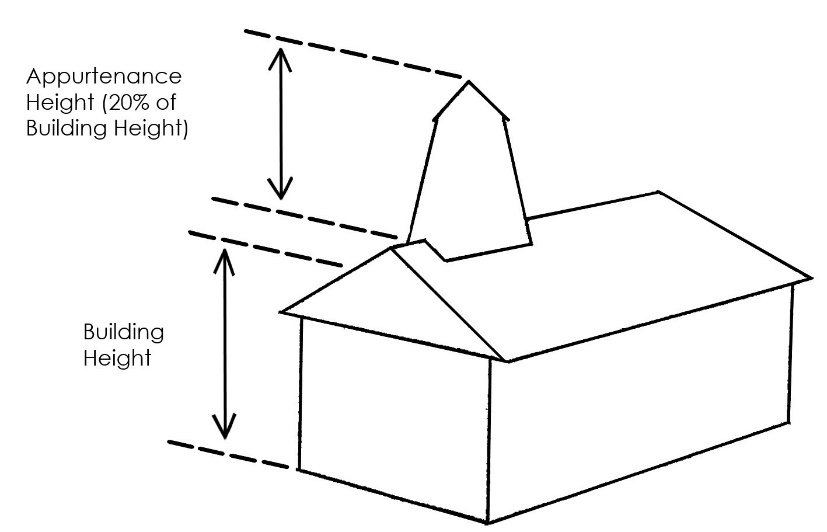
Figure 3.1.2. Example of Active Rooftop Use included in Height Calculation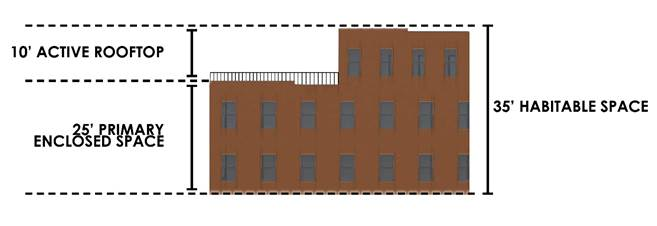
C.
Nonconforming Heights. Buildings that pre-date the adoption of this Code and exceed the height development standards in this Code are recognized as nonconforming. Buildings rendered nonconforming shall comply with the standards of Section 8: Nonconformities.
D.
Height Exceptions. If indicated on a zoning district development standard table, a height exception may be requested per the requirements of Section 1.12: Height Exceptions and the standards in Section 4: Compatibility.
3.1.2. Block Configuration Requirements
A.
Residential Districts. Blocks, except waterfront blocks, shall not exceed 1,200 feet in length in residential districts.
B.
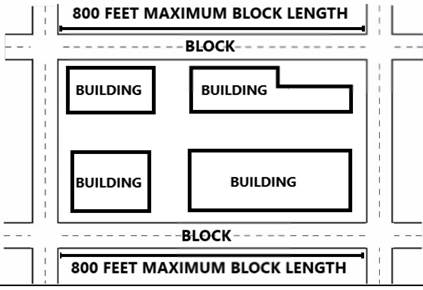
Nonresidential Districts. Blocks shall not exceed 800 feet in length in nonresidential districts.
1.
A design alternative may be requested for this requirement.
C.
Mixed Use Districts. Blocks shall be a minimum 650 feet and maximum 1,200 feet in length in mixed use districts.
D.
Culs-De-Sac. Where a tract of land is of such size or location as to prevent a typical lot arrangement, there may be established one or more courts, dead-end streets or other arrangements; provided, however, that direct access shall be given to all lots from a dedicated street or court. A dead-end street (cul-de-sac) shall terminate in a circular roadway having a minimum diameter of 100 feet. A dead-end street (cul-de-sac) shall not exceed 600 feet in length. Street stubs to adjoining areas shall be provided to the property line when required to give access to such areas or to provide for future traffic circulation. Street stubs in excess of 250 feet shall be provided with a temporary cul-de-sac turnaround within the platted right-of-way complying with the cul-de-sac standards contained in this section. A design alternative for cul-de-sac lengths may be approved subject to fire code standards.
Figure 3.1.2.1. Nonresidential Block Configuration
(Illustrative Example Only)
3.1.3. Lot Configuration Requirements
A.
General Requirements.
1.
The size, length, width and minimum setback lines of lots shall be in compliance with the zoning district standards as defined in Section 2: Zoning.
2.
No lot shall have an area or width less than that required by this LDR except as where permitted by this Code.
3.
All side lines of lots shall be at right angles to straight street lines and radial to curved street lines, except where the Director determines that a variation to this rule will provide a better street and lot layout.
4.
All lots created after the effective date of this Code shall be of conforming size, length, width and have legal access to allow a principal building to be erected upon it in compliance with the requirements of this Code.
B.
Lot Calculations. Lots are parcels of land, either vacant or occupied, intended as a unit for the purpose, whether immediate or for the future, of transfer of ownership or for development. Lot calculations shall include the following defined terms:
1.
Lot Width. Lot width shall be considered to be the average distance between straight lines connecting front and rear lot lines at each side of the lot, measured as straight lines between the points of the side lot lines in front (at intersection of the street line) and the rear-most points of the side lot lines in the rear.
2.
Lot Length. Lot length is the distance between the front and rear property lines measured from the midpoint of each front and rear line along a line parallel to the side property lines.
3.
Lot Area. Lot area is comprised of the interior area of the lot/parcel, calculated by multiplying lot width and lot length. Lot areas shall be exclusive of public rights-of-way and all lands seaward of the mean high-water line.
4.
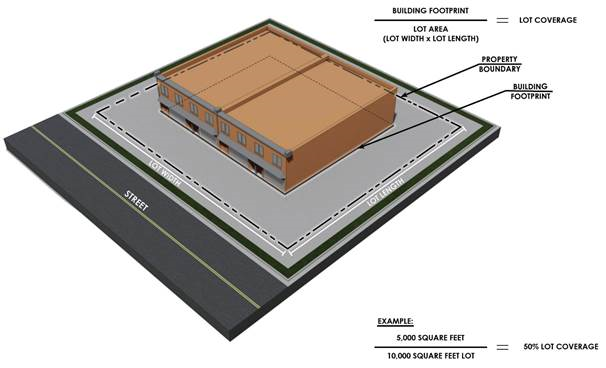
Lot Coverage. Lot coverage is the maximum area of a lot that is permitted to be covered by roofed structures that are or may be impervious to the weather (measured as a percentage of the lot). Lot coverage does not include paved areas such as parking lots, pools, driveways or pedestrian walkways. Lot coverage shall be calculated by dividing building footprint by the area of the lot, as displayed in Figure 3.1.3. For example, a building with a building footprint of 5,000 square feet on a lot of 10,000 square feet would produce a total lot coverage of 50%.
Figure 3.1.3. Lot Width, Length, Area and Coverage
3.1.4. Building Placement Requirements
A.
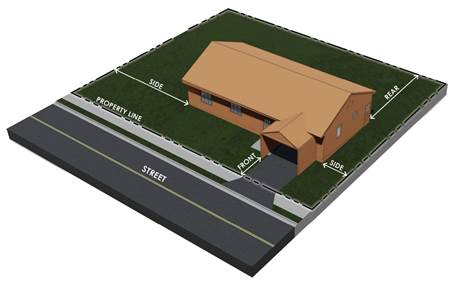
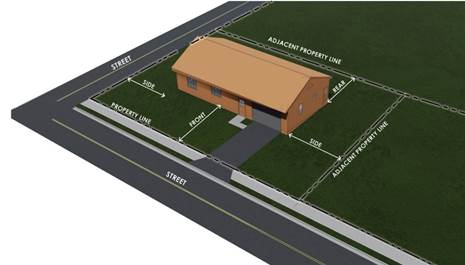
Setbacks. Building setbacks determine the distance between the buildings on a lot and the property lines (front, side, and rear). Building setbacks shall be measured from the closest point of the base of the wall of the structure to the lot line. Where property lines extend into the paved or improved portion of the right-of-way, and on RMH, RMHP, and RMHS zoned property, setbacks are measured from the edge of pavement or improved surface. Setbacks are designated by a front setback requirement, side setback requirements, and a rear setback requirement. Easements shall not be considered a public right-of-way or private street for the purpose of designating a front yard and front setback. It is understood, for the purpose of calculating setback requirements and yards, three configurations of lots exist: interior lots, corner lots, and through lots (see graphic examples in this section).
1.
Interior Lot. A lot bounded by a street on only one side. For the purpose of setbacks and yards, the street yard shall be recognized as the front. An interior lot shall have one front yard, two side yards, and one rear yard. For single-family residential uses, the primary structure shall be oriented so the driveway and entrances are in the front yard.
Figure 3.1.4.1. Setback—Interior Lot
2.
Corner Lot. A lot which abuts two or more streets, other than an alley or easement. Each corner lot shall be required, either on its plat or building permit, to designate the street that will define its front yard, which shall dictate its front setback requirement. For single-family residential uses, the primary structure shall be oriented so the entrance is in the designated front yard. If the abutting streets are different street types, the front yard shall be on the lesser street type (e.g., local road instead of collector arterial).
Figure 3.1.4.2. Setback—Corner Lot
3.
Through Lot. A lot which has frontage on two parallel streets. Each through lot shall be required, either on its plat or building permit, to designate the street for its front yard, which shall dictate its front setback requirement. For single-family residential uses, the primary structure shall be oriented so the driveway and entrance are in the designated front yard. If the abutting streets are different street types, the front yard shall be on the lesser street type (i.e., local road instead of collector arterial).
Figure 3.1.4.3. Setback—Through Lot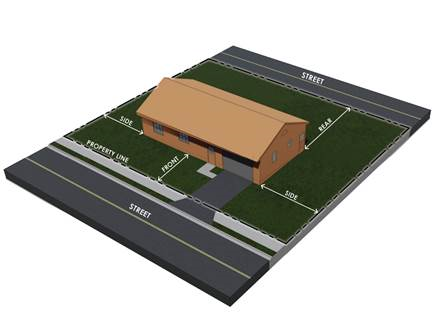
4.
Permitted Exceptions to Setbacks.
a.
Roof overhangs, up to a maximum of three (3) feet, are permitted into a setback.
b.
Stairwells and balconies shall not intrude into a setback. A design alternative may be approved by the Planning Commission as part of a preliminary plat, so long as stairwells and balconies do not overhang more than a maximum of three (3) feet into a setback.
c.
Fences, walls, and landscaping are permitted to be located up to the property line.
d.
Side setback exceptions. Where lots of record existed prior to the effective date of the ordinance from which this chapter is derived, which lots do not meet the minimum width requirements set out in this chapter, then for such lots, and only for such lots, the following minimum side setbacks are set out:
B.
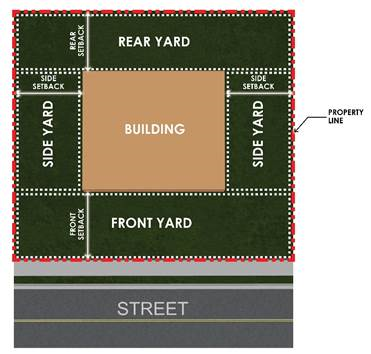
Yards. Yards are different from building setbacks as they define the types of uses and activities that are permitted within lots as defined by the front, side, and rear yards. A yard shall be defined as an unoccupied area that is open and unobstructed from the ground except where otherwise permitted by this Code, on the same lot as a principal building.
1.
Yard (Front). The area of the lot that extends between the side lot lines, from the front lot line to the building. Vehicle parking is allowed in the front yard only when permitted in Section 3.4: Parking. Each lot shall identify its front yard. Easements shall not be considered a public right-of-way or private street for the purpose of designating a front yard and front setback. Swimming pools may only be permitted in the front yard through a variance as defined in Section 1.13: Variances.
2.
Yard (Side). The area of the lot that extends from the front yard line to the rear yard line and from the building to the side property line.
3.
Yard (Rear). The area of the lot that extends between the side lot lines, from the rear lot line to the building.
4.
Yard (Waterfront). The area of a waterfront lot that extends from the mean high-water line of the adjacent water body to the building. For the purpose of this definition, any yard abutting a waterfront (the Gulf of Mexico, Roberts Bay, the Intracoastal Waterway, and any channels that access these bodies of water) shall be considered a waterfront. Stormwater facilities and retention ponds shall not be considered in this definition.
Figure 3.1.4.4. Yards
5.
Permitted Exceptions to Yards. Attached unroofed decks, poles, posts, children's play equipment and other customary yard accessories, ornaments, statuary and furniture are permitted in a yard subject to height limitations and requirements limiting obstructions to visibility, and shall not be any closer than three (3) feet from the property line.
3.1.5. Preservation of Natural Features
A.
Development shall be in accordance with Chapter 89: Environmental and OS 1.4.2: Protection of Native Habitats and Natural Resources, of the City's Comprehensive Plan.
3.1.6. Soil and Flood Hazards
A.
Development shall be in accordance with Chapter 89: Environmental. All building sites shall be able to be used safely for building purposes, without interruption of access or other undue hazard from flood, adverse soil or foundation conditions.
3.1.7. Easement Requirements
A.
Easements shall comply with the standards of Chapter 74: Utilities and the latest version of the City Standard Details.
B.
Construction easements shall be provided where necessary.
C.
Easements of greater width may be required along or across lots where necessary for the extension of certain utilities, or where more than one (1) utility service is located within the same easement.
D.
Wastewater collection systems and water mains shall be located within street rights-of-way unless such location would prevent orderly development of a particular parcel of land.
3.1.8. Access Management Requirements
A.
Access Design for Residential Property. In order to provide for safe and convenient ingress and egress, and to maintain traffic flow on public streets, the number and location of driveways shall be regulated by the dedication of access rights to the City.
1.
Lots Less Than Eighty (80) Feet of Frontage. Lots with less than 80 feet of frontage shall have no more than one driveway opening on that street, provided that a second opening shall be permitted if one driveway is marked "entrance only" and the other is marked "exit only."
2.
Lots between Eighty (80) Feet and Two Hundred (200) Feet of Frontage. Lots which have between eighty (80) feet and two hundred (200) feet of frontage on any street shall have no more than two driveways opening on that street.
3.
Lots with More than Two Hundred (200) Feet of Frontage. For each one hundred (100) feet or fraction thereof by which a lot exceeds two hundred (200) feet, one driveway opening may be created in addition to the first two.
B.
Driveway Location.
1.
Non-Residential and Mixed Use Districts. No driveway shall be constructed with its center closer than:
a.
Twenty (20) feet to a property line, except when the drive is jointly used by an adjoining property;
b.
Fifty (50) feet to the intersection of the edge of the pavement of two streets; or
c.
Forty (40) feet to the center of the next nearest entrance driveway; provided that no portion of any driveway shall be constructed closer than five (5) feet to a property line, except when the drive is jointly used by an adjoining property.
2.
Residential Districts.
a.
No portion of any driveway shall be constructed closer than five (5) feet to a property line, except when the drive is jointly used by an adjoining property, or forty (40) feet to the intersection of the edge of the pavement of two streets, or ten feet to the edge of the next nearest driveway.
b.
For lots of record where lot width is 50 feet or less, driveways may be setback a minimum of one (1) foot from the property line.
3.
Design alternatives for location may be permitted.
C.
Driveway Width.
1.
Non-Residential and Mixed Use Districts.
a.
Driveways shall not exceed fifty (50) feet in width at their junction with the street or highway pavement, except where otherwise required by FDOT, and may not exceed thirty (30) feet in width at the property line.
b.
Planning Commission may, via a design alternative, authorize driveways up to forty (40) feet in width at the property line in nonresidential or mixed use zoning districts after finding that the specific use proposed requires large vehicles to use the driveways and that the increased width is necessary to accommodate such vehicles.
2.
Residential Districts.
a.
Driveways shall not exceed twenty-four (24) feet in width at the property line.
b.
Design alternatives for width may be permitted.
3.
For driveways divided by a median, each accessway will be measured individually.
D.
Vehicle Maneuvering or Parking; Joint Use of Driveways. Except for the driveways, the area between the edge of the pavement or curb of a street, road or highway and the property line shall not be used for vehicle maneuvering or parking. In order to minimize the number of drives necessary for proper access to uses, there should be joint use of drives by adjoining properties wherever possible.
1.
Easements. Whenever a cross-access easement is designated, the property owner shall grant the easement running with the land to allow general cross-access to and from other properties in the area. Whenever a cross-access easement is proposed (which may involve coordinated parking design), each applicant for subdivision or site plan approval shall provide the necessary easements to ensure adjoining properties can be easily tied in to create a unified system. Stub-outs shall be used as necessary to make it visually obvious that nearby properties may be tied in to the cross-access.
2.
Parking Design. Wherever cross-access easements have been established, the design of parking shall also be coordinated (including shared parking) and shall not prohibit access to the easements and circulation.
E.
Intersections.
1.
Intersections on streets or roads designated as arterials shall not be less than 1,320 feet apart, centerline measurement.
2.
Intersections on streets or roads designated as collectors should not be less than 500 feet apart, centerline measurement. A design alternative may be granted for intersections not meeting this requirement.
F.
Visibility Triangle.
1.
Where an accessway (including alleys) intersects a public right-of-way, all landscaping, fences, signs or walls shall provide unobstructed cross-visibility at a level between two and one-half (2.5) feet and ten (10) feet within the areas of property on both sides of an accessway formed by the intersection of each side of the accessway and public right-of-way lines, with two sides of each triangle being ten feet in length from the point of intersection and the third side being a line connecting the ends of the two other sides; provided that trees having limbs and foliage are trimmed in such a manner that no limbs or foliage extend into the cross-visibility area shall be allowed and provided that they are located so as not to create a traffic hazard. No buffer, structure or landscaping, except required grass or ground cover, shall be located closer than three (3) feet to the edge of any accessway pavement.
2.
On a corner lot, in any zoning district except the VA, DE, and SBI mixed use districts and IND zoning district, no fence, wall, hedge or other planting or structure that will materially obstruct vision between a height of two and one-half (2.5) feet and ten (10) feet above the centerline grades of the intersecting streets shall be erected, placed or maintained within the triangular area formed by the right-of-way lines at such corner lots and a straight line joining the right-of-way lines at points which are twenty (20) feet distant from the intersection of the right-of-way lines and measured along the right-of-way lines. Clear tree trunks, signposts, lampposts, fence posts and the like are exempt from this requirement. Where intersections of rights-of-way are less than ninety (90) degrees at the property lines, the legs of the visibility triangle shall be twenty-five (25) feet long.
3.1.9. Accessory Uses and Structures
A.
Purpose and Intent. Accessory uses and structures are defined as uses and structures which are typically incidental and subordinate to the principal use or structure and unless otherwise provided, on the same premises. "On the same premises" shall be construed as meaning on the same lot or on a contiguous lot in the same ownership. Typical examples of accessory structures include, but are not limited to, swimming pools, spas, sheds, gazebos, shade structures, and similar structures. Where a building is structurally attached to the principal building, it shall be considered a part of the principal building, and not an accessory building.
B.
General Standards.
1.
Permitted accessory uses and structures are those customarily associated with the permitted uses within the zoning district and are not intended to allow for accessory uses and structures that are not consistent with the district's purpose and intent. Accessory uses and structures must be located on the same property/parcel as the principle use for which they are intended.
2.
Except as otherwise provided in this Code, no accessory use or structure shall be approved, established, or constructed, before the principal use or structure is approved, established or constructed.
3.
No accessory structure shall be occupied or utilized unless the principal structure, to which it is accessory, is occupied or utilized.
4.
All accessory uses shall be designed to serve primarily the residents, customers, guests, or employees of the principal use with which they are associated.
5.
If an accessory building shares a structural wall with a principal building, it shall be deemed to be a part of the principal building and shall comply in all respects with the requirements of this Code applicable to the principal building.
6.
No accessory structure or use may be located in a utility easement, right-of-way, drainage easement, or visibility triangle.
7.
No accessory structure or use shall be located in any front yard, except statues, arbors, trellises, flagpoles thirty-five (35) feet or less in height, planters, porches, U.S. Postal Service authorized mailboxes, outdoor lighting, or similar structures. Parking and fences are also allowed in the required front yard, unless otherwise stated in other sections of this Code.
C.
Specific Accessory Structures Standards. In no case shall an accessory use be permitted that is not a permitted use under the zoning district. Except as otherwise noted or precluded through easements, accessory structures shall be located no less than five (5) feet from a side or rear property line. Standards for specific accessory structures are as follows:
1.
Pools and Pool Decks. Pools and pool decks shall not be permitted in any front yard, except through an approved variance in compliance with Section 1.14: Variances; may be permitted no closer than five (5) feet from the side or rear property line; and may not be located within any easements. Pools and pool decks that encroach into a waterfront yard must be no higher than thirty-six (36) inches from grade and can be no closer than five (5) feet from the property line adjacent to the waterfront, or to the mean high-water line, whichever is more landward.
2.
Cages or Screened Enclosures. Pool cages and screened enclosures are permitted no closer than five (5) feet from the side or rear property line. In no instance may a cage or enclosure be permitted in an easement. Cages or enclosures in waterfront yards shall be no closer than fifteen (15) feet from the property line adjacent to the waterfront, or to the mean high-water line, whichever is more landward.
3.
Sheds. Sheds shall not be permitted in any front yard and may be permitted no closer than five (5) feet from the side or rear property line. In no instance may a shed be permitted in a front yard or an easement. Sheds in waterfront yards shall be no closer than twenty (20) feet from the property line adjacent to the waterfront, or to the mean high-water line, whichever is more landward.
4.
Garages. Attached garages shall be permitted in any front yard and must meet standard setback requirements for their respective district. Detached garages are not permitted in a front yard and may be permitted in a side or rear yard no closer than five (5) feet to the property line. Garages in waterfront yards shall be no closer than twenty (20) feet from the property line adjacent to the waterfront, or to the mean high-water line, whichever is more landward.
5.
Accessory Dwelling Units. One accessory dwelling unit (ADU) shall be permitted on any lot with a single-family detached dwelling, except where prohibited by a Binding Master Plan.
a.
Lot size. The lot must meet the minimum lot size required by the zoning district for a single- family dwelling, or be a lot of record.
b.
Structure Size. The total living square footage of the ADU shall not exceed 1,000 square feet.
c.
Lot Coverage. ADUs are exempt from lot coverage calculations.
d.
Setbacks. Detached ADUs may be permitted no closer than five (5) feet from the side and rear property line. Detached ADUs are only allowed in front yards when side and rear placement is not possible and a minimum front setback of at least twenty (20) feet can be maintained.
e.
Parking. No additional parking shall be required for construction of an ADU.
f.
Density. ADUs are exempt from density calculations.
g.
Architecture. ADUs shall be designed to be architecturally consistent with the principal structure.
D.
Height of Accessory Structures. The height of accessory structures may not exceed the height of the highest point of the principal structure on the lot.
E.
Prohibited Accessory Structures. Storage pods and cargo containers shall not be permitted as accessory structures in residential districts.
F.
Miscellaneous Accessory Uses/Structures.
1.
Bus Stops and Shelters. Bus stops, shelters, and benches may be located in any district. No advertising sign shall be permitted on such structures. District setbacks are waived. Locations and setbacks may be approved by the Planning Commission after recommendation from staff.
2.
Bicycle Racks. Bicycle racks may be located in any district. District setbacks are waived.
3.
Electric Vehicle Charging Stations.
a.
Electric vehicle charging stations shall meet all applicable state and federal laws, including the Florida Building Code.
b.
Electric vehicle charging stations may be permitted in any district. Locations and setbacks may be approved as part of any required site plan or zoning permit.
c.
Each electric vehicle charging station shall include signs that indicate the space is for electric vehicle parking only. Each station shall also post information about voltage and amperage levels, safety information, and contact information for any problems with equipment.
4.
Mail, Delivery Lockers, Newspaper Boxes. Mail, delivery lockers, and newspaper delivery boxes may be placed in accord with U.S. Postal Service regulations and are exempt from district setbacks.
5.
Security Residences. A residence for security personnel for permitted industrial uses may be permitted as an accessory use. The residence shall be utilized only by the owner or security personnel with proof of employment.
6.
Home Occupations. Home occupations may have up to two employees or independent contractors, not including remote employees, who reside outside the home in which the business is located. Parking, exterior modifications, conducting of retail transactions, and mitigation of potential nuisances must be conducted in accordance with F.S. § 559.955. A home occupation shall be subject to all applicable City occupational license and other business taxes.
(Ord. No. 2022-15, § 3(Exh. B), 7-12-22; Ord. No. 2022-31, § 2(Exh. A), 12-13-22; Ord. No. 2023-05, § 2(Exh. A), 2-28-23; Ord. No. 2023-09, § 2(Exh. A), 5-9-23; Ord. No. 2023-12, § 2(Exh. A), 5-23-23; Ord. No. 2023-19, § 2(Exh. A), 6-27-23; Ord. No. 2023-41, § 2, 10-24-23; Ord. No. 2023-51, § 2(Exh. A), 1-9-24; Ord. No. 2024-16, § 2(Exh. A), 9-10-24)
3.2. - Mixed Use Districts Frontage Requirements
A.
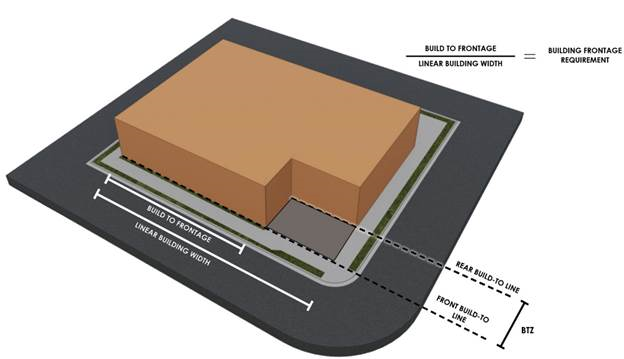
Build-To-Zone (BTZ). Building placement in Mixed Use Districts is defined by Build-to Zones (BTZ). BTZs accommodate flexibility in specific site design while maintaining an established street edge. The BTZ shall be expressed as the range between the minimum and maximum setbacks on a given property, running parallel to each property line. Each development standards table shall express building placement requirements for front/street, side, and rear placement, from which the area of the BTZ may be determined.
B.
Building Frontage Requirement. The building frontage requirement indicates the percentage of the linear building width that must be located at the front build-to line (minimum setback). This requirement may be achieved through the inclusion of an active use area. The required building frontage shall be calculated by dividing the frontage located at the build-to line by the total linear building width.
Figure 3.2.1. Building Frontage Requirement
C.
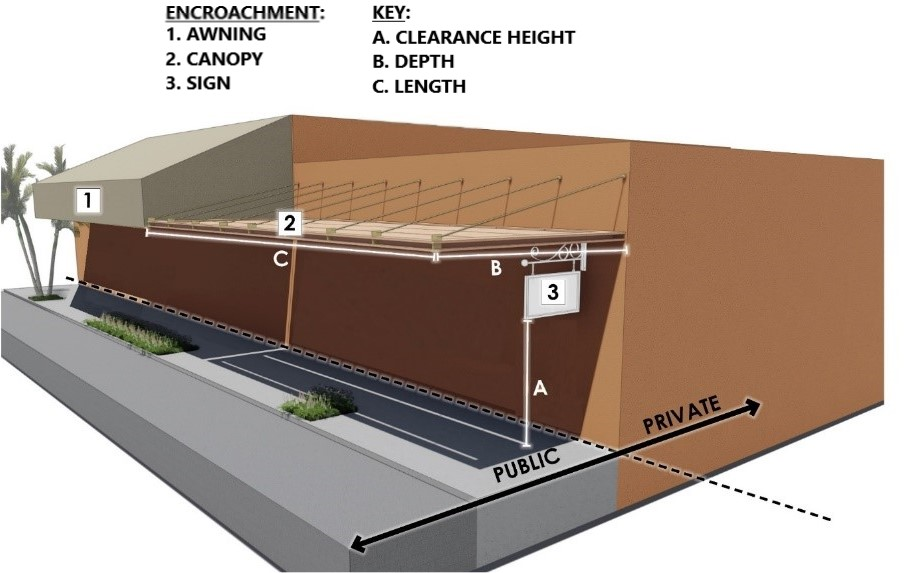
Encroachments. Encroachments are building elements that are attached to a building and are permitted to exist within a setback (i.e., in the private realm, see Figure 3.2.2) or the public realm (Figure 3.2.3). Encroachments may include architectural elements that are intended to bring the public realm closer to the building.
1.
Awnings, canopies, and projecting signs are the only allowable encroachments into the public realm, provided there are no supporting structures located in the public realm. Awnings may have additional design standards as required by this Code.
2.
Encroachments are required to comply with a minimum required clearance height (A), maximum encroachment depth (B), and maximum allowed length (C) as displayed in Figures 3.2.2 and 3.2.3.
3.
For reasons of public safety and accessibility, steps may also be permitted as encroachments but do not need to meet the requirements of this section.
Figure 3.2.2. Encroachments into Setback
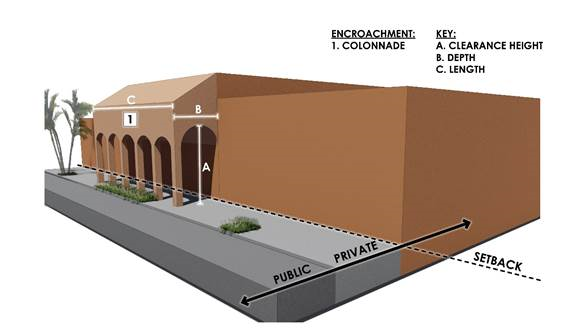
Figure 3.2.3. Encroachments: Public Property and Right-of-Way
D.
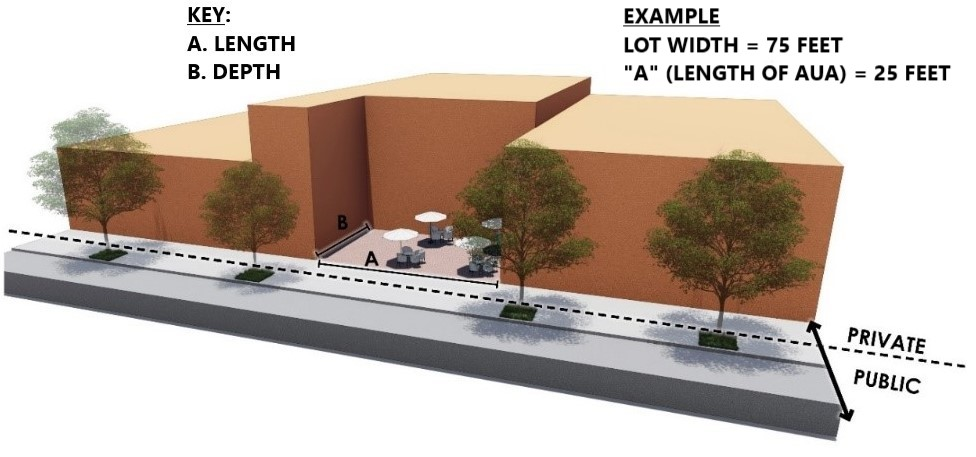
Active Use Areas. Active Use Areas refer to those areas along a frontage that encroach into the private realm and that may provide for a court, colonnade, arcade, courtyard, outdoor dining, merchandise display, shared garden, or similar area. Active use areas shall only be allowed along primary streets.
1.
Active use areas are an optional feature within Mixed Use Districts that may be permitted by a design alternative. The design alternative shall define an allowed length (A) and allowed depth (B), as illustrated in Figure 3.2.4.
2.
The maximum length of an active use area is measured parallel to the frontage, while the maximum depth is measured perpendicular to the frontage.
3.
Active use areas may be utilized to achieve building frontage requirements in Section 2 of this Code.
4.
If setback requirements allow a side setback that would make it impossible to achieve frontage requirement standards, active use areas must be used to achieve the frontage requirement standard.
Figure 3.2.4. Active Use Areas
E.
Entrances. Entrances are required on a Primary Street; secondary entrances are permitted and encouraged. If a property has frontage on multiple Primary Streets, the street hierarchy shall govern the placement of entrances. Corner lots with frontage on one or more Primary Streets shall provide at least one entrance per Primary Street with a maximum of two entrances per street. For corner lots, an entrance may be placed at an angle facing the intersection of the two streets to achieve compliance with this standard.
(Ord. No. 2022-15, § 3(Exh. B), 7-12-22; Ord. No. 2024-16, § 2(Exh. A), 9-10-24)
3.3. - Stormwater and Utilities
A.
No subdivision or site and development plan shall be approved unless the Planning Commission finds, after full consideration of all pertinent data, that the subdivision or development can be served adequately with necessary public facilities and services as determined by the Director, City Engineer, and utilities department.
B.
Generally.
1.
Each developer, owner, or builder shall be responsible for the design, installation, inspection, and testing of the complete utility systems within their development and those necessary to connect the same to the City or JPA designated system. "Complete utility system" shall include all component parts of a water distribution and wastewater collection system, including valves, fittings, laterals, hydrants, manholes, lift stations, and all appurtenances as shown upon the approved design of such utility system. "Complete utility system" shall include reclaimed water distribution system components if included in the approved design.
2.
All plans and specifications of such proposed installation shall conform to the City Standard Details and shall be submitted to the City for approval prior to submission to the appropriate local and state agencies.
C.
Stormwater Facilities. It shall be the developer's responsibility to provide all necessary stormwater facilities such as stormwater culverts, pipes, junction boxes, outfalls, swales, canals, structures, ponds, drainage wells, and all other associated improvements to serve the proposed development. The developer shall obtain an approved SWFWMD permit, permit modification, or exemption prior to commencement of construction activities. A complete stormwater management system shall be provided in all areas of development.
1.
All stormwater facilities shall be designed and installed under the direction and supervision of a state-licensed professional engineer and in accordance with the City Standard Details.
2.
Stormwater facilities must provide adequate disposal of surface water, maintain any natural watercourses, and provide that historic drainage patterns from adjacent parcels shall be maintained.
3.
Stormwater facilities adjacent to regions with historical flooding or ponding shall minimize impacts and be designed to not further increase discharge volume in the region. Stormwater facility designs are to be submitted for approval by the City Engineer through the site and development plan process or as part of construction plan review.
4.
In areas where high groundwater exists and it is deemed necessary by the City Engineer for the protection of paved streets, underdrains shall be installed.
5.
The engineer is to provide the following statement on all plans requiring a SWFWMD permit: "The post-development runoff will not exceed the pre-development runoff for a 25-year, 24-hour storm event."
6.
Drainage calculations must be provided to verify that the peak flow rate and total volume do not exceed the pre-developed runoff. Proposed development runoff may not additionally impact areas of existing flooding or ponding nor negatively impact adjacent property.
a.
The stormwater collection system shall be designed in order to completely capture and convey the runoff for the 25-year, 24-hour storm event, unless otherwise determined by the City.
b.
The City's EPA/NPDES permit guidelines are to be followed in stormwater system design.
c.
Best management practices (BMPs) are to be followed in all permanent constructed systems and in all construction procedures in accordance with the City Standard Details, and all other applicable local, state and federal requirements.
7.
Upon completion of the site work, the project engineer shall furnish the City with a copy of the SWFWMD certificate of compliance, certification that the improvements were installed in accordance with the approved SWFWMD permit and City approved construction permit and record drawings signed and sealed by a state-licensed professional engineer. The project engineer will be required to further provide the certifying engineer name for the annual re-inspection and certification of system function. Certificates of compliance signed and sealed by a state-licensed professional engineer must be filed with the City Engineer annually upon completion.
D.
Potable Water Distribution System; Fire Hydrants and Fire Lines.
1.
The potable water distribution system shall be designed by a state-licensed professional engineer in accordance with state law, and shall be installed with approval and inspection by all appropriate regulatory authorities. All water distribution systems must be installed to meet the minimum design requirements of the City Standard Details, subdivision design standards, and other applicable regulations.
2.
Each lot shall be provided with a connection to the City water distribution system. Backflow prevention shall be installed at each potable service as required by the cross connection control program established in Chapter 74. Further, all backflow devices shall be certified to the City upon installation and annually certified that the device is operating by the manufacturer's recommendations prior to the installation of water meters. Pressure and leakage tests in accordance with the City Standard Details, subdivision design standards, and state requirements will be performed at the developer's expense and witnessed by the City Engineering division. Adequate fire protection shall be designed into the system and fire hydrants installed consistent with the requirements of Chapter 38, at the expense of the developer, in single-family development. In high density, nonresidential, and mixed-use districts, fire hydrants are to be spaced as required consistent with the requirements of Chapter 38. Where fire lines extend into private developments from the main distribution system, the developer must have installed an approved detector check valve, and grant to the City an easement over such lines.
3.
Connections to City Water Supply. It shall be the developer's responsibility to provide that each lot shall be provided with a connection to the City's water supply, or a water supply designated by the Joint Planning and Interlocal Service Boundary Agreement (JPA) with Sarasota County.
a.
Water services shall be installed in accordance with the City Standard Details, and other applicable state and local requirements, and under the direction and supervision of a state-licensed professional engineer.
b.
All water service connections are subject to inspection and approval by the City.
c.
Backflow prevention shall be installed at each potable service as required by the cross connection control program established in Chapter 74: Utilities, Code of Ordinances.
d.
All backflow devices shall be certified as required in Chapter 74: Utilities, Code of Ordinances.
e.
A complete turnover package as outlined in the City Standard Details must be submitted for approval by City Council.
f.
Developments will not be eligible for water service or water meter placement until turnover is accepted by City Council.
E.
Wastewater Collection System. Wastewater collection systems shall be designed by a state-licensed professional engineer in accordance with state law and the regulations of the Florida Department of Environmental Protection or other appropriate agency, and shall be installed with approval and inspection by the City. The wastewater collection system shall be designed, constructed and maintained in such a manner as not to adversely affect the water quality of any stream, lake, river, underground aquifer or other waterbody.
1.
Connections to City or County Wastewater Collection System. It shall be the developer's responsibility to connect each lot to the City or County (where applicable) wastewater collection system. Where connecting to the City's system, all connections shall be installed in accordance with the City Standard Details and must comply with the regulations of the state or other regulatory authorities. Wastewater collection systems and connections shall be installed under the direction and supervision of a state-licensed professional engineer and subject to inspection and acceptance by the City. A complete turnover package as outlined in the City Standard Details must be submitted and approved by City Council prior to acceptance of utilities.
2.
Wastewater Collection Line Inspections and Cleaning. Wastewater collection lines will be inspected by City personnel using City TV inspection equipment prior to acceptance and prior to expiration of the one-year developer's maintenance obligation. The developer shall be invoiced per the schedule of fees and charges. Payment of inspection fees must be received prior to utility acceptance by City Council. The developer may perform their own TV inspection that would supplement the City TV inspection. Such a developer TV inspection shall meet all of the same requirements of the City TV inspection procedures, and any deviations will result in rejection of the developer's TV inspection submittal.
F.
Utility Lines. Utility lines of all kinds, including, but not limited to, those of franchised utilities, electric power and light, telephone, cable television, water, wastewater and gas, shall be constructed and installed beneath the surface of the ground within residential subdivisions, unless it is determined by the City Engineer and utilities manager that soil, topographical or any other compelling conditions make the installation of such utility lines unreasonable or impracticable. It shall be the developer's responsibility to make the necessary arrangements with each utility in accordance with the utility's established policies. The underground installation of incidental appurtenances such as transformer boxes, pedestal-mounted terminal boxes for electricity, or similar service hardware necessary for the provision of electric and communication utilities shall not be required.
G.
Developer Installed Lines.
1.
The developer of a tract of land, after approval of plans by the City and other appropriate agencies, shall at their expense, install the required transmission mains and collection system to connect the development to the City or JPA designated system.
2.
The developer shall, also at their own expense, after approval by the City and all appropriate agencies, install all distribution, collection, and service lines and meter boxes within said development.
3.
The minimum size pipe allowed for distribution of water shall be six (6) inches in diameter except for dead end lines that shall be a minimum of eight (8) inches in diameter. The minimum size pipe allowed for collection of wastewater shall be eight (8) inches.
4.
Upon acceptance of such installation by the City, all transmission, collection, distribution, and service lines and meter boxes shall be deeded to and become the property of the City through the turnover procedure outlined in the City Standard Details.
5.
Should the City require oversizing of the lines beyond the developer's needs, the City shall reimburse the developer only for the difference in the cost of the pipe. Should the City require fittings and hydrants beyond the developer's needs, the City shall reimburse the developer for the cost of such fittings and hydrants.
H.
Turnover of Lines and/or Systems. When construction has been completed, the turnover of lines and/or systems to the City shall be in accordance with the procedure established in the City Standard Details. The City will not render service or process building permits for such service until the documentation set forth in the City Standard Details has been received and accepted by City Council.
I.
Reclaimed Water System. In certain areas of the City, reclaimed water, or highly treated wastewater, may be available for irrigation. For long-term planning, the City encourages all developments to include an irrigation system during construction, even if reclaimed water is not available at the time of development. Connection to the reclaimed water system may become available at a future date. Developers shall closely coordinate with the utilities department during construction and operation of reclaimed water systems. Reclaimed water systems shall comply with Chapter 74: Utilities.
(Ord. No. 2022-15, § 3(Exh. B), 7-12-22)
3.4. - Streets and Sidewalks
A.
Purpose and Intent. The standards regarding streets and sidewalks defined in this section shall be applied to all development applications. For the purpose of this section, development applications shall include site and development plans, preliminary plats, final plats, and construction plans. The City shall recognize two street design types, complete streets and traditional streets.
1.
Complete Streets. Complete Street Types in this Code are intended to provide a suite of options for redevelopment of roadways in the City. Complete streets are designed and operated to enable safe use and support a mixture of multimodal options which accommodate all users, whether vehicular, bicyclist or pedestrian. Complete street requirements are defined in Section 3.4.1.I: Complete Street Design Standards and 3.4.1.J: Complete Street Types.
2.
Traditional Streets. Traditional streets are designed for motor vehicle use and shall comply with the standards defined in Section 3.4.1.E.: Traditional Roadway Width Specifications.
3.4.1. Streets
A.
Minimum Street Improvements. All streets shall conform to the requirements of this section, the latest version of the City Standard Details, and the Manual of Uniform Minimum Standards for Design, and Construction and Maintenance for Streets and Highways, State of Florida, including sidewalks and parkways to the established and approved grade.
B.
Street Signs and Street Names.
1.
Street signs, showing the names of all intersecting streets, shall be erected at each intersection.
2.
All signs on City streets shall have blue background and design as required by the City.
3.
All signs shall require approval by the City and/or the County as applicable before being installed. Street signs for any County-maintained street within the City limits shall meet County specifications.
4.
All development applications shall include a proposed addressing plan that includes proposed street names that shall be reviewed and approved by the City or County as applicable.
5.
New streets that are an extension of, or in alignment with, existing streets shall bear the same name as that of the existing streets.
C.
Addressing.
1.
New development shall be addressed in compliance with the standards below:
a.
Development on vacant property that does not require site and development plan approval must seek address assignment from the Planning and Zoning Department.
b.
All applicants seeking development application approval shall provide an addressing plan.
c.
Applicants shall provide a street map of the area to ensure a logical address assignment in their addressing plan submittal.
d.
Single-family structures shall have a unique address number.
e.
Commercial structures shall have a unique address number.
f.
Multi-unit structures shall have either a unique address number for each unit or a main address number with separate suite/apartment numbers for each unit.
i.
When unit numbers are used in a multistory building, each unit number shall reflect its physical location by the applicable floor level.
ii.
Units adjacent to the frontage right-of-way shall have addresses on the right-of-way. Units beyond the first row and/or beyond the first entrance point should be addressed on the applicable adjacent accessway or street.
g.
Structures shall be assigned addresses based on street frontage. Lots with two or more street frontages should be assigned an address based on the location of the building entrance.
h.
Address numbers shall be odd numbers on one side of a street and even numbers on the opposite side of the street. This will follow National Emergency Numbers Association (NENA) procedures and the City's address numbering process. Streets running in a north-south direction shall be addressed as follows: Addresses on the east side of the street shall be even-numbered and addresses on the west side of the street shall be odd-numbered. Streets running in a west to east direction shall be addressed as follows: Addresses on the north side of the street shall be even-numbered and addresses on the south side of the street shall be odd-numbered.
i.
In determining if a curved street should be addressed with a north-south or an east-west orientation, the Planning and Zoning Department shall focus on the predominant direction of the street. If such orientation of the street creates confusion or conflict, then the Planning and Zoning Department shall assign an address which best preserves the welfare and safety of the citizens of the city. The Planning and Zoning Department may break established addressing procedure in order to make adjustments at barriers. In the event adjustments are necessary, a "warped" pattern may be used to provide a transition from an established pattern to the area subject to change or correction.
j.
In cases of nonconforming street patterns, the Planning and Zoning Department shall place emphasis on address number continuity.
k.
Address numbers that run past a 90-degree turn shall continue to be in sequence with the rest of the parcels or buildings on such street, the primary direction of the street numbering sequence shall be maintained in numbering and all addresses on the same street should fall within the same address range.
l.
Culs-de-sac shall require that an odd number be used at a point so determined by the Planning and Zoning Department along the turning circle.
m.
Circular or loop shaped roads shall be addressed to keep even numbers on one side and odd numbers on another side.
n.
Numbering shall occur in a counterclockwise pattern unless a clockwise pattern provides greater protection of the public health, safety and welfare of the citizens.
o.
At any fork in a road, the address range sequence follows the customary counterclockwise standard.
p.
Accessory structures shall have an address number.
q.
Historic structures, as defined in this code, shall maintain their original historic address.
r.
Unimproved parcels abutting a right-of-way or easement shall have an address when determined necessary by the Director or their designee.
s.
Where permitted by this Code, if a property owner proposes an additional unit on a lot, they shall provide a separate and unique address for each unit. The use of any fraction or decimal is prohibited. The number must fit within the existing numbering sequence.
t.
If an address was not assigned through plat approval by the City, applicants shall provide copies of plats and development applications so that an address may be assigned.
u.
The Planning and Zoning Department shall have the discretion to reassign addresses along contiguous stretches of road for the purpose of protecting the health, safety and welfare of the general public.
2.
Existing development shall implement the following address changes when necessary:
a.
Renovations on a corner lot that involve changing the primary street based on the standards for a corner lot in Section 3.1.4.A.2. shall require a change of address to the new primary street.
b.
Lot splitting shall require readjustment of numbering on all affected lots to ensure compliance with guidelines in Section 3.4.1.C and to create a logical sequence of numbers.
3.
Property owners may seek reassignment of any existing address number(s) from the City.
D.
Traffic Calming Measures.
1.
The City allows the use of traffic calming measures including, but not limited to, street modifications and traffic control devices, complete streets components, or facilities for alternate modes of transportation such as bike lanes and sidewalks.
2.
The use of streetscaping as a method of traffic calming is also encouraged and may include the placement of distinctive lighting, furniture, art, trees, and other landscaping along streets and at intersections, in keeping with Section 3.1.8.F.
3.
The City Engineer must approve traffic calming measures whenever proposed.
4.
Traffic calming measures shall not impede emergency response, as determined by the Fire Marshal.
E.
Traditional Minimum Street Improvement Requirements. Traditional streets shall comply with the standards defined in the latest version of the City Standard Details.
F.
Alleys. Consistent with Strategy LU 1.4.1 from the City's Comprehensive Plan, the City shall maintain the historic grid street patterns established by the Nolen Plan. Alleys may be required in the rear of lots, when in the opinion of the City Engineer, they are required to continue or complete the original town plan by John Nolen, dated 1926. Alleys shall be at least twenty (20) feet wide and a five-foot cutoff shall be made at all acute angle alley intersections.
G.
Private Streets. Construction details for private streets may be approved by the City Engineer provided they meet the latest version of City Standard Details. In addition, private streets shall provide continuation of existing street patterns. The proposed street layout shall be coordinated with the street system of the surrounding area. All collector and arterial streets shall be public.
1.
Access to Adjoining Property. Street stubs to the property line shall be provided when required to give access to adjoining areas or to provide for future traffic circulation. Street stubs in excess of two hundred fifty (250) feet shall be provided with a temporary cul-de-sac turnaround within the platted right-of-way complying with the cul-de-sac standards contained in this section.
H.
Bridges. Bridges shall be designed in accordance with the Florida Department of Transportation Standard Specifications for Road and Bridge Construction, the latest version of the City Standard Details, and other applicable regulations. Bridges shall be designed by a state-licensed professional engineer and are subject to approval by the City Engineer. Bridges shall be constructed with curbs, the required paving width, and, in addition, sidewalks consistent with the width of the approaching sidewalk on both sides, except on dual bridges where sidewalks shall only be required on the outside of each bridge. Approach guardrails or fences shall be provided as required.
I.
Complete Street Design Standards. Street design shall implement Strategy LU 1.3.3 Walkable Streets and Strategy LU 1.3.4 Interconnected Circulation, of the City's Comprehensive Plan and meet the requirements below:
1.
Complete Street Classifications. Complete streets shall be classified based on the projected average traffic volume criteria contained in the latest edition of the Institute of Transportation Engineers (ITE) Trip Generation Manual. The classification of streets is defined in the City's Comprehensive Plan, Strategy TR 1.1.1. Roadway Classifications. Streets for nonresidential developments shall be classified on a case-by-case basis in consultation with the Director and City Engineer based on standard engineering practice and the projected average traffic volume for anticipated uses. The relationship of the development's street pattern to the overall roadway network and other trip generators must also be considered in developing street classifications to provide safe and efficient vehicular and pedestrian access.
2.
City Standard Details. Any standards not defined in this subsection shall meet or exceed the design standards required within the latest version of the City Standard Details.
J.
Complete Street Types. Complete Street Types in this Code are intended to provide a suite of options for redevelopment of roadways in the City. Using the August 2017 Florida Department of Transportation Context Classification as a basis, the following Street Types present a framework to correspond with said context classifications. It is the intent that these street types will allow for a context-sensitive system of complete streets in the City which emphasize the user, whether driver, bicyclist or pedestrian. The following street types and their unique specifications apply to streets designated in Mixed Use Districts and this subsection, but may also be used in other areas in the City after review by the TRC.
1.
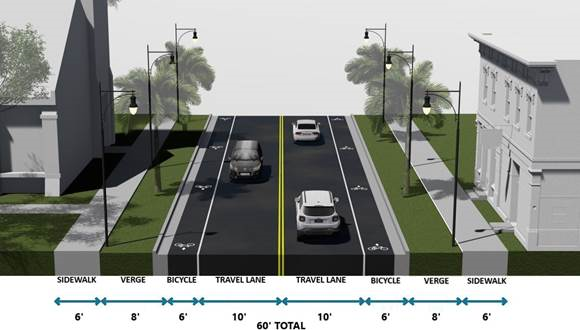
Complete Street Type 1. This roadway type has a mix of uses within small blocks and allows for two lanes of vehicular traffic, and bicycle lanes on each side.
Figure 3.4.1.1. Complete Street Type 1 (Illustrative Purposes Only)
2.
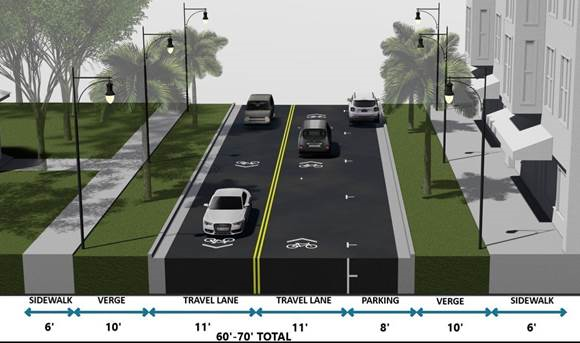
Complete Street Type 2. This roadway type has a mix of uses within small blocks with a well-connected roadway network. Street Type 2 allows for two lanes of vehicular traffic featuring sharrows with dedicated parking on one side.
Figure 3.4.1.2. Complete Street Type 2 (Illustrative Purposes Only)
3.
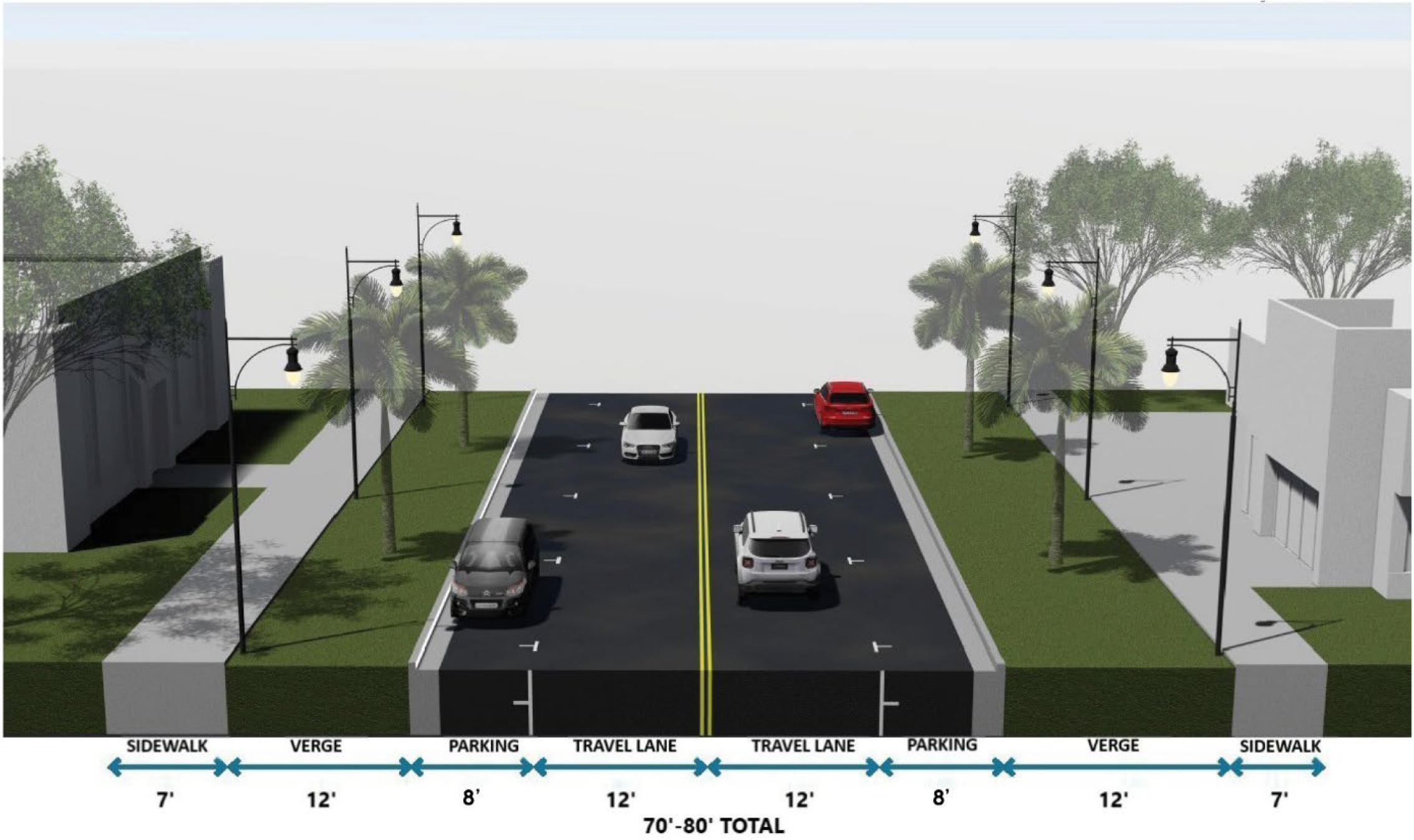
Complete Street Type 3. This roadway type features single-family and multi-family residential with neighborhood scale retail and office. Buildings have minimal to shallow setbacks. Street Type 3 allows for two lanes of vehicular traffic with dedicated parking on each side.
Figure 3.4.1.3. Complete Street Type 3 (Illustrative Purposes Only)
4.
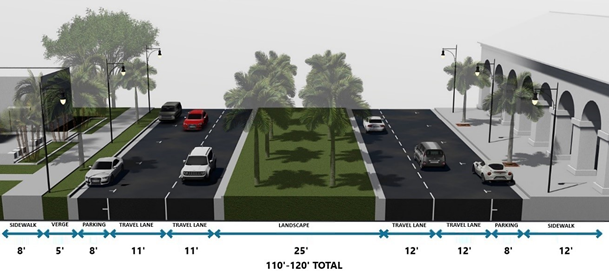
Complete Street Type 4. This roadway type has buildings with no setbacks or minimal setbacks, and features retail, office, and institutional uses. Street Type 4 allows for two lanes of vehicular traffic on each side, with a lane of dedicated parking on each side.
Figure 3.4.1.4. Complete Street Type 4 (Illustrative Purposes Only)
5.
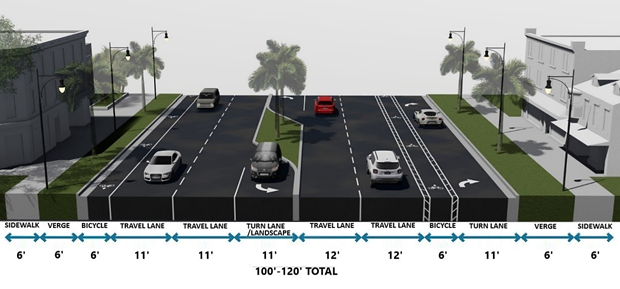
Complete Street Type 5. This street type allows for most retail and commercial uses, featuring detached buildings with setbacks on all sides. Street type 5 allows for multi-lane traffic with turn lanes and dedicated bicycle lanes.
Figure 3.4.1.5. Complete Street Type 5 (Illustrative Purposes Only)
6.
Complete Street Type Design Standards. Street Types shall comply with the following design standards in Table 3.4.1.1. Design standards may be modified to resemble current FDOT classification context more closely, if necessary, via a design alternative approved by the Planning Commission.
Table 3.4.1.1. Complete Street Type Design Standards
7.
City of Venice Streets and Street Type Classification. The City has identified two types of complete streets: those identified in the City's Comprehensive Plan in Figure TR -7 - Possible Complete Streets and those identified for each mixed use area (See Table 3.4.1.2).
Table 3.4.1.2. Complete Streets Classifications
3.4.2. Sidewalks
A.
Applicability of Required Sidewalks.
1.
Sidewalks shall be required improvements within adjoining rights-of-way for public or private streets in connection with all new development and redevelopment of property within the City.
2.
Sidewalks shall be part of a preliminary plat and/or site and development plan.
3.
In place of required sidewalks and/or bicycle lanes, a multi-use recreational trail (MURT) may be approved by design alternative. It is preferred to have both on-street bicycle lanes and multi-use trails to accommodate both commuter and recreational bicyclists.
B.
Standards.
1.
Sidewalks shall be constructed in accordance with the specifications contained in this section and the latest version of the City Standard Details.
2.
Required sidewalks shall be at least six (6) feet in width. Other pedestrian walkways or paths internal to a development project shall be at least five (5) feet in width. Paths provided as an amenity for recreational use shall be consistent with the standards in Sec. 3.4.2.C for MURTs.
3.
Sidewalks shall be constructed in accordance with the Americans with Disabilities Act of 1990 (ADA) standards and requirements at a minimum.
4.
Required sidewalks for any development along a designated complete street roadway shall meet the minimum sidewalk or MURT requirements of Sections 3.4.1.I and 3.4.1.J.
5.
If required sidewalks are proposed to be located outside a right-of-way, a sidewalk easement dedicated to the City shall be required.
6.
Sidewalks shall be installed prior to the issuance of a certificate of occupancy for any adjoining building, except when the developer provides a satisfactory cash or surety bond to ensure completion of all remaining sidewalks within two years or at any other time completion is required by the City.
7.
A design alternative may be requested for required sidewalks in accordance with the requirements of Section 1.11: Design Alternatives. The design alternative, at minimum, shall reflect a sidewalk system along streets and lot line easements which links the property to activities such as school sites, shopping and other pedestrian systems.
C.
Multi-Use Recreational Trails (MURTs). MURTs provide pedestrian mobility options for the residents of the City. MURTs are intended to provide a safe, comfortable environment for bicyclists, walkers, and other forms of alternative mobility options. MURTs shall comply with the following standards:
1.
Width. MURTs shall be at least ten (10) feet in width.
2.
Material. MURTs shall be a paved, concrete, or similar hard surface material.
D.
Connectivity of Parks. The connectivity of parks and public spaces shall be achieved via pedestrian/bike access ways including linear parks, sidewalks, bicycle lanes, trails, blueways (such as kayak trails), and/or greenways.
E.
Cash Deposit in Lieu of Construction.
1.
Where determined that circumstances exist (including planned future reconstruction of a street or the existence of a major surface drainage system), which make the immediate construction of a sidewalk impractical, the owner or developer may propose a cash deposit in lieu of equivalent sidewalk construction for the roadway frontage. Such proposals shall be based upon design, permitting, and construction estimates and shall be reviewed by City staff and provided with a recommendation of the Planning Commission to City Council for a final decision.
2.
All such sidewalk deposits shall be held in a special sidewalk fund which may be used by the City for construction of new sidewalks (but not maintenance of existing sidewalks) at any needed location in the City.
(Ord. No. 2022-15, § 3(Exh. B), 7-12-22; Ord. No. 2023-51, § 2(Exh. A), 1-9-24; Ord. No. 2024-16, § 2(Exh. A), 9-10-24)
3.5. - Signs
A.
Purpose and Intent. The purpose of this section is to establish standards for the fabrication, erection, and use of signs, and to regulate the location, type, size, and height of signage for all properties within the City. The adoption of this section reflects the formal findings of fact by the City Council that regulation of signage advances the following compelling governmental interests:
1.
Reduce signage that the City has determined to be a cause of unsafe traffic and visibility conditions for pedestrians, bicyclists, drivers, and passengers.
2.
Protect pedestrians, bicyclists, drivers, and passengers from injury caused by the faulty and uncontrolled construction and use of signs within the City.
3.
Protect pedestrians, bicyclists, drivers, and passengers from injury caused by distractions, obstructions, and hazards created by certain signs or by cluttered, distracting, or illegible signage.
4.
Promote the public welfare, health, and safety of all persons using public thoroughfares and rights-of-way within the City in relation to the signage displayed thereon, or overhanging, or projecting into such public spaces.
5.
Preserve the value of private property by assuring the compatibility of signs with surrounding land uses.
6.
Assure that public benefits derived from expenditures of public funds for the improvement and beautification of public streets and other public structures and spaces are protected by exercising reasonable controls over character and design of signage.
7.
Advance the aesthetic goals of the City throughout the community and ensure the effectiveness and flexibility in the design, creativity, or use of signage without creating a detriment to the general public.
Furthermore, this section leaves ample and adequate alternative channels of commercial speech communication for the messages portrayed on advertising signs, namely, distributed print media, broadcast media, and point-of-purchase display, and is narrowly defined so as to limit said prohibition to commercial speech on exterior signage and signage intended to be viewed from beyond the boundaries of a site.
B.
Applicability. The provisions of this section shall govern all signs within the City. No sign shall be altered, replaced, converted, changed, or modified except in accordance with the requirements of this Code. The provisions of this section provide diverse sign types with specific provisions based on the district(s) in which they are located. No portion of this section is intended to violate free speech or other applicable legal standards specific to signage. Any type of sign not expressly exempted or permitted in this Code is prohibited.
C.
Determining Number of Signs. For the purpose of determining number of signs, a sign shall be considered to be a single display surface or display device containing elements organized, related and composed to form a unit. In the case of double-faced signs, where both faces advertise the same facilities, products or services, the total sign shall constitute a single sign. Where both faces do not advertise the same facilities, products or services, each sign face shall constitute a single sign. Where matter is displayed in a random manner without organized relationship of elements, or where there is reasonable doubt about the relationship of elements, each element shall be considered to be a single sign.
D.
Design Alternatives. The Planning Commission may grant design alternatives to a sign design standard set forth in this Code if:
1.
The request is included as part of a signage plan for a development. A signage plan shall be submitted concurrently with a site and development plan and shall, at minimum, include the number of signs, types of signs, sizes of signs, heights of signs, setbacks for signs, location of signs, sign designs, and illumination of signs;
2.
The design alternative is consistent with the stated intent of the design standard at issue;
3.
The design alternative achieves or implements the stated intent to the same degree or better than strict compliance with the standard would achieve; and
4.
The design alternative will not result in adverse impacts on properties abutting the site.
3.5.1. Prohibited Signs
A.
Generally. Signs are prohibited in all districts unless:
1.
Constructed pursuant to a valid building permit when required under this Code; and
2.
Authorized under this Code.
B.
Specifically Prohibited. Notwithstanding subsection A. above, the following signs are specifically prohibited:
1.
Any sign which constitutes a traffic hazard or a detriment to traffic or pedestrian safety by reason of its size, location, movement, character, coloring or method of illumination;
2.
Any sign obstructing the vision of drivers;
3.
Any sign obstructing or detracting from the visibility of any official traffic control device by unreasonably diverting or tending to divert the attention of operators of moving vehicles from traffic movement on streets, roads, intersections or access facilities;
4.
Any sign erected in such a manner as to obstruct the vision of or constitute a hazard to pedestrians;
5.
The use of flashing or revolving lights is prohibited in any sign as constituting a hazard to traffic;
6.
Any sign which by glare or method of illumination constitutes a hazard to traffic is prohibited. No sign may use the word "Stop," "Look," "Drive-In" or "Danger" or any other word, phrase, symbol or character in such a manner as to interfere with, mislead or confuse traffic;
7.
Signs displaying an obscene or pornographic message;
8.
Signs (other than those erected or required to be erected by the municipal, county, state, or federal government) erected on the right-of-way of any street, road or public way, or signs overhanging or infringing upon the right-of-way of any street, road, or public way, except as specifically provided by this section;
9.
Signs erected on public property other than signs erected by the municipal, county, state, or federal government for public purposes, unless otherwise authorized by this section;
10.
Signs so located as to prevent free ingress or egress into or from any door, passable window or fire escape. No sign shall be attached to a standpipe or fire escape;
11.
Off-site signs, except for off-site identification/directional signs approved by the Planning Commission pursuant to this Code;
12.
Portable signs, except where specifically permitted by the terms of this section;
13.
Any sign containing or consisting of banners, balloons, posters, pennants, ribbons, streamers, spinners, or other similarly moving devices or signs which may move or swing as a result of wind or man-made wind;
14.
Signs on or attached to utility poles or trees, shrubs or plants;
15.
Outline or strip lighting on corners, eaves, ridges, fascia or other portions of buildings or structures, except when temporarily provided as part of holiday decorations;
16.
Roof signs that are constructed upon a roof or roof-mounted structure, except where specifically permitted by terms of this section. Those signs that are placed or mounted on a mansard roof are not considered prohibited roof signs but may be permitted as a building sign;
17.
Pole or pylon signs;
18.
Illuminated portable signs;
19.
Vehicle identification or trailer-mounted signs attached to or painted on a vehicle or trailer that is inoperable, does not have a current State of Florida vehicle registration, or is not regularly used as part of the activity located on the premises, excluding personal use by the business and/or property owner. Any sign bearing a commercial message that is attached to or painted on a vehicle or trailer that is routinely parked or otherwise located on a site other than the site where the business is located, or a sign whereby its size or placement on the vehicle or trailer makes it impractical or dangerous to operate the vehicle or trailer, is also prohibited; and
20.
Any sign that emits audible sound, odor, or visible matter such as smoke or steam.
3.5.2. Exempt Signs
A.
Types of Exempt Signs. The following signs may be erected in any zoning district without securing a permit, subject to meeting all requirements of this Code:
1.
Any sign integrated into or on an ATM, coin-operated machine, gasoline pump, telephone booth, vending machine, or similar equipment or machine.
2.
A sign carried by a person.
3.
Professional nameplates or occupational buildings signs not exceeding two square feet in area.
4.
Memorial signs or names of buildings that do not exceed four square feet in area.
5.
Government signs located in public right-of-way or on public property.
6.
Vehicle signs, provided the vehicle is operable, has a current State of Florida registration, is regularly used by the business, and does not meet any definition of a prohibited vehicle sign in Section 3.5.1.B.19.
7.
One flagpole per property is allowed. The flagpole must be no higher than the maximum height for the zoning district, as measured at ground level. Flagpoles shall be no closer than ten feet from the property line.
8.
Murals on buildings or structures are exempt, provided the mural does not advertise or promote any product, business logo, or business. Murals that provide a depiction or rendering of scenery, recreation, habitat, or leisure activities are exempt. Murals which advertise or promote a product, business logo, or business shall be categorized as a wall sign.
9.
Historic designation or registry signs (e.g., John Nolen Historic District, Golden Beach) or similar.
10.
Portable signs (may also be referred to as "sandwich board" or "sidewalk" signs). Portable signs shall be:
a.
Non-illuminated;
b.
Sufficient to meet adopted accessibility standards with respect to sidewalks and travel widths, obstructions, etc.;
c.
Removed at close of business daily;
d.
Limited to one per business;
e.
Located within 10 feet of the business entrance; and
f.
No greater than 6 square feet in area.
11.
Directional signs (entrance, exit, drive-thru, etc.) on nonresidential use lots are exempt, subject to the following standards:
a.
The name and/or logo of the business or organization may be included on the face of the sign, provided that at least one-half of the area of the sign face provides directional information.
b.
A nonresidential lot or parcel shall have only one directional sign at any entrance to the lot located within the front setback. The directional sign shall provide directional information for no more than one business or organization. The maximum area of such signs shall be four square feet.
c.
The number of directional signs outside the front yard shall not be limited and the maximum area of such signs shall be two square feet.
12.
Window signs, subject to the following:
a.
May only be placed on windows with primary street frontage;
b.
Shall not exceed a maximum of two signs per tenant of any building;
c.
Shall have a total maximum area of 25% of the window, except an upper story total maximum area may increase by 10 percent; and
d.
Shall have a maximum height per sign of 2 feet and a maximum width per sign of 10 feet, except the height and width of an upper story sign may increase by 10 percent.
B.
Types of Temporary Signs.
1.
Properties Used for Residential Purposes. Up to two (2) temporary yard signs are allowed in residential yards, with neither to exceed three (3) square feet in area per sign.
2.
Properties Used for Non-Residential Purposes. Limited to one (1) temporary sign per business of one (1) square foot per linear foot of building or twenty (20) square feet, whichever is less.
3.
Real Estate Signs.
a.
In residential districts, limited to one sign per lot or parcel except for corner lots which may have one sign per street frontage. Lots with navigable waterway may have one additional real estate sign in the waterfront yard or on a structure over water. Lots that abut a golf course may have one additional real estate sign in a yard that abuts the golf course. The size of a real estate sign for any lot shall not exceed four (4) square feet.
b.
Real estate signs shall be removed within forty-eight (48) hours of sale closing or lease start.
c.
Real estate signs advertising a developer's sale of vacant lots shall be limited to entrances to the subdivision from a public street and limited to sixteen (16) square feet in area and eight (8) feet in height.
d.
All signs in a development for an approved subdivision shall be removed when five percent of the total lots in the last phase of the subdivision remain.
e.
Real estate signs in nonresidential districts shall be non-illuminated and are limited to one sign per parcel. Corner lots may have one sign per street frontage. Each sign shall be a maximum thirty-two (32) square feet in area and shall be removed within forty-eight (48) hours of the sale closing or lease start.
4.
Construction Signs. The sign shall not be erected before a building permit for trade work has been issued by the City, and must be removed immediately following final inspection of the trade work. If construction is not begun in sixty (60) days or if construction is not continuously and actively pursued to completion, such sign shall be removed. Construction signs shall not be illuminated. Construction signs must include 24-hour contact information.
a.
Up to three (3) signs are permitted per lot or parcel where trades are working on the site, except that corner lots may be permitted three signs per frontage provided that there is a minimum separation of signs from each frontage of not less than fifty (50) feet. Each sign shall not exceed eight square feet in area.
C.
General Standards for Temporary Signs. All temporary signs shall meet the following criteria:
1.
Does not interfere with visibility or impede the safety of pedestrians or motorists.
2.
Shall be set back a minimum of two (2) feet from the edge of pavement of a street.
3.
Not illuminated.
4.
Displayed a maximum of thirty (30) consecutive days, after which the sign shall be removed.
3.5.3. Permitted Signs
A.
General Applicability.
1.
Design. Permitted signs are defined in this section with standards provided. All signs shall be constructed in a professional manner and shall be architecturally consistent with the buildings they identify. Signs shall be or appear to be constructed of stone, masonry, metal, ceramic, glass, plastic, or wood. Fluorescent, metal flake or iridescent colors are prohibited. Ground signs shall include base, cap and column in their design.
2.
Landscaping. Ground signs shall be placed in a landscaped setting appropriate to the size and scale of the sign, and character of the site. Landscaping shall comply with Section 3.7: Landscaping.
3.
Intersection Visibility Triangle. No sign structure may obstruct the visibility triangle as described in Section 3.1.8.F. No sign shall impede pedestrians or motorists on or off the premises.
4.
Illumination. Outline or strip lighting, neon tube, animated, or flashing or changeable illumination shall not be permitted. Illumination in signs may not impair the vision of motor vehicle drivers. All permanent signs may be non-illuminated or illuminated by internal or external illumination.
a.
External Illumination. Only stationery and shielded light sources directed solely onto the sign are permitted.
b.
Internal Illumination. Only illumination of letters and logos shall be permitted, and illumination shall have a designation of "white" or "daylight."
5.
Changeable Copy. Up to 50% of the maximum area for monument or wall signs may be used for changeable copy. No video, animated, scrolling or moving changeable electronic variable message shall be permitted.
6.
Drive-Through Menu Signs. For each establishment with a lawful, permitted use that utilizes a drive-through lane, a maximum two (2) drive-through menu signs shall be allowed for each drive-through lane.
a.
Each allowed drive-through sign may be either a freestanding sign or an attached sign and shall not exceed forty (40) square feet in sign area and ten (10) feet in height.
b.
Drive-through signs shall be in addition to the freestanding and attached signage otherwise allowed pursuant to the other provisions of this section.
c.
Drive-through signs shall require a permit.
7.
Sign Construction Standards. All signs must be erected in compliance with building, electrical, and fire codes, and with the following requirements as applicable:
a.
Supports and braces shall be designed as an integral part of the sign structure and be hidden from public view to the extent technically feasible.
b.
Audio components are prohibited as part of any sign with the exception of drive-through menu signs.
8.
Maintenance. All signs must be maintained to be safe and present a neat, clean appearance. Signs shall be maintained in their approved, permitted state.
9.
Calculating Sign Area. The sign face area shall be computed including the entire display area within the periphery of a simple geometric shape such as a square or rectangle, or combinations of simple geometric shapes, comprising all of the display area of the sign and including all of the elements of the matter displayed, but not including blank masking, frames or structural elements of the sign bearing no advertising matter. In the case of multi-faced signs, only one face shall count toward the total allowed sign area. If the faces of a multi-faced sign are unequal in size, then the calculation of the sign area shall be based on the size of the largest face.
a.
Calculation of sign structure area for monument signs. The entire area of the sign includes the display area of the sign and the surrounding sign structure within the periphery of a regular geometric form, or combination of geometric forms. The area shall be measured from the outside edges of the sign structure.
b.
Calculation of sign height. The vertical height of a sign shall be the vertical distance measured from the highest adjacent unaltered grade to the highest point of the sign structure.
Figure 3.5.4.1. Calculation of Sign Dimensions
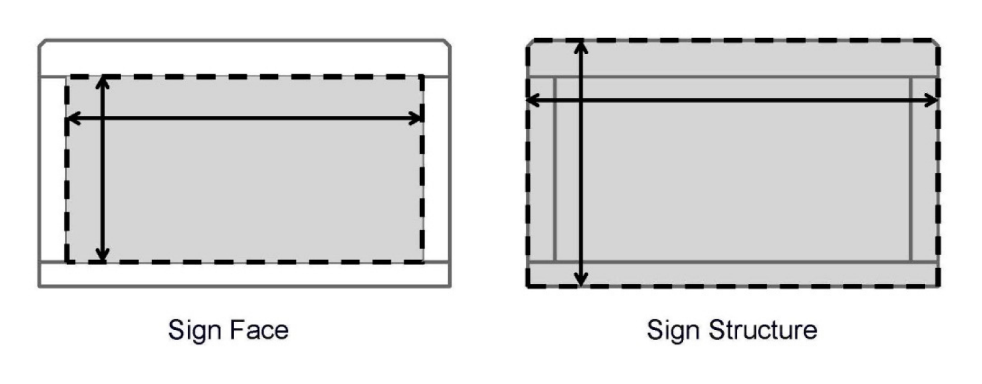
Figure 3.5.4.2. Calculation of Sign Dimensions Using Simple Dimensions
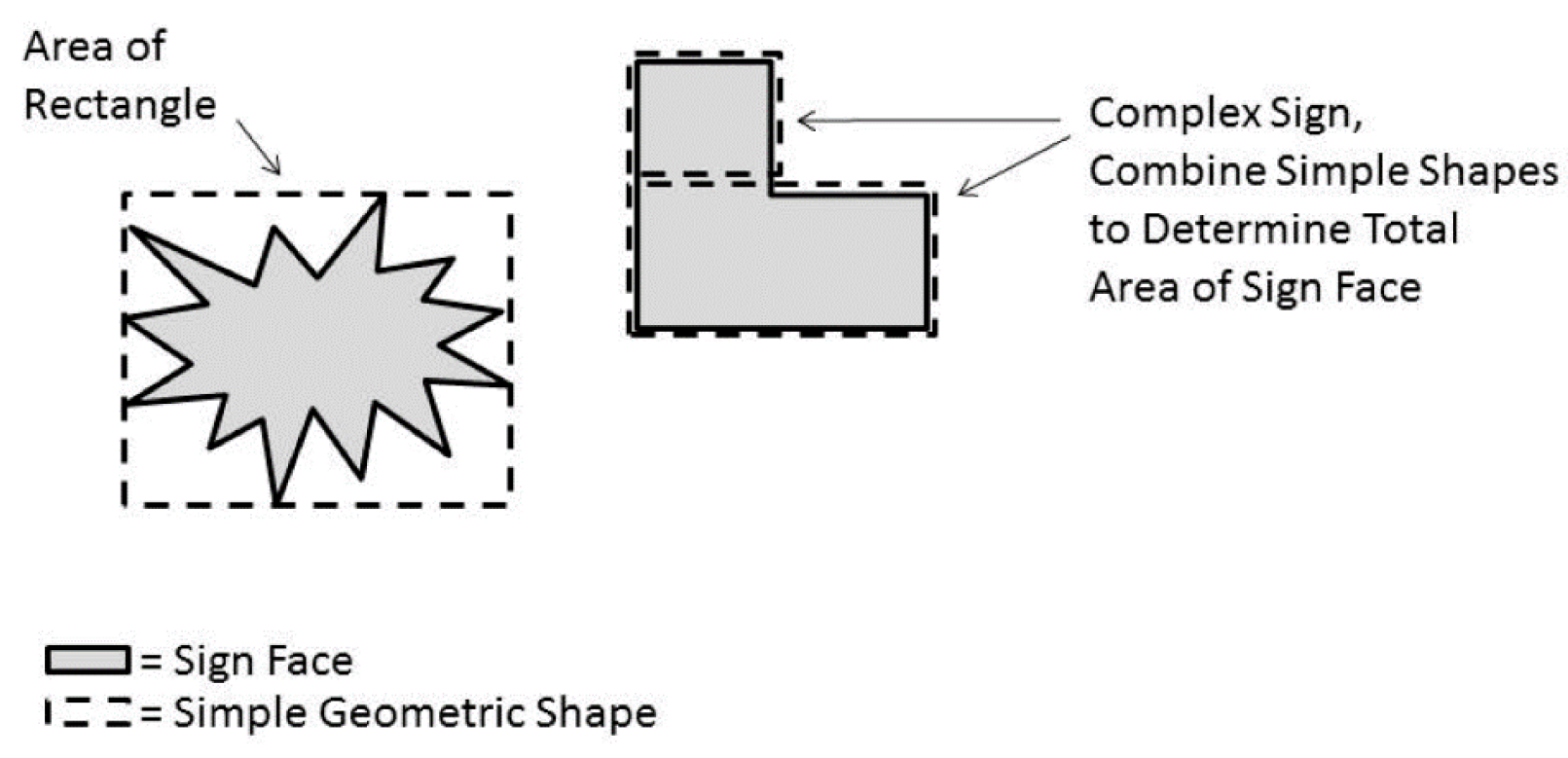
Figure 3.5.4.3. Calculation of Sign Height
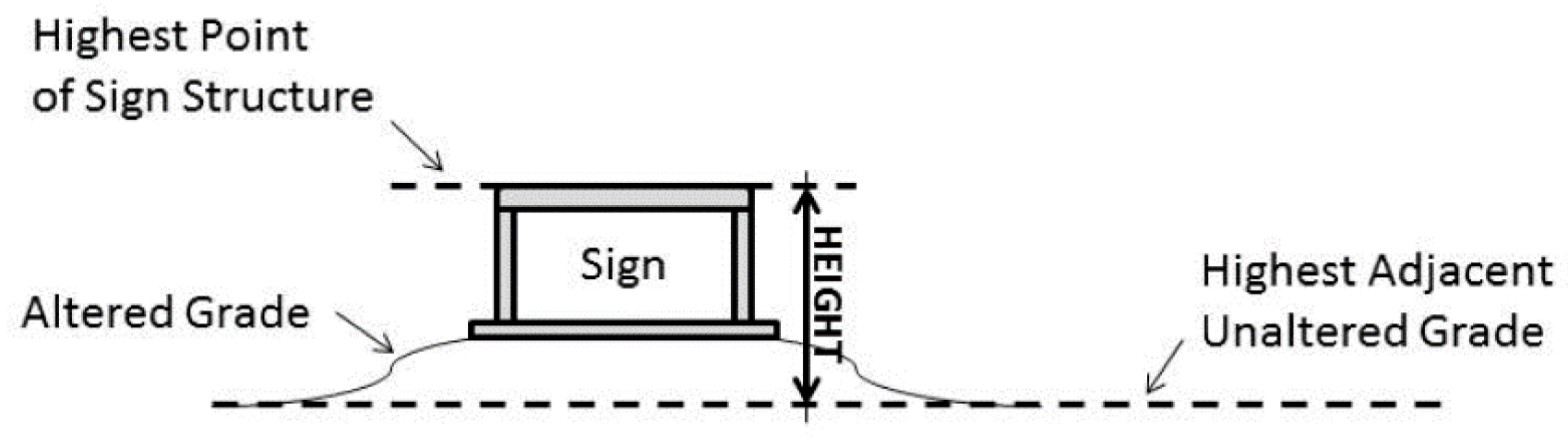
B.
Permitted Sign Types. This subsection provides description, locational standards, size standards, and any other required information for each sign type. Graphic illustrations for permitted signs are provided below for reference and context; illustrations are for example purposes only. Text shall take precedence over any conflict with illustrations. All permitted sign types require a permit.
1.
Awning Signs.
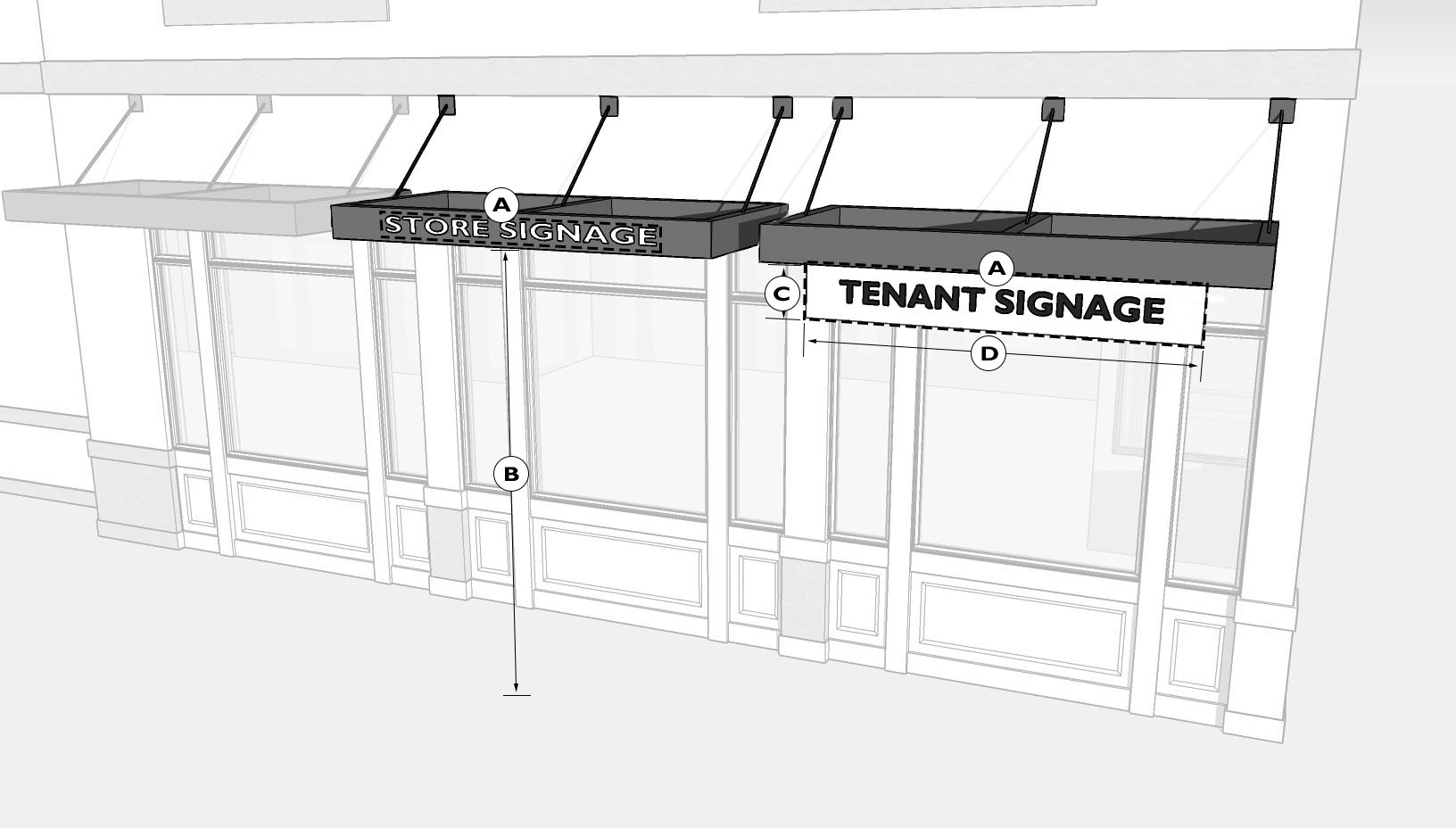 | |
| 1. Description | An on-premises attached awning extending from the building with attached signage. |
| 2. Size |
A. Sign Area: Maximum 20% of awning.
B. Clearance: Minimum 8'. C. Height: Maximum 4' above clearance. D. Length: Maximum 12'. Subject to Section 7 and encroachment standards in Section 3.1.11. |
| 3. Miscellaneous | Signs shall not extend outside the overall length or width of an awning, or extend above the height of the building wall that the awning is attached. Signs shall not be illuminated or back-lit. |
2.
Monument Signs.
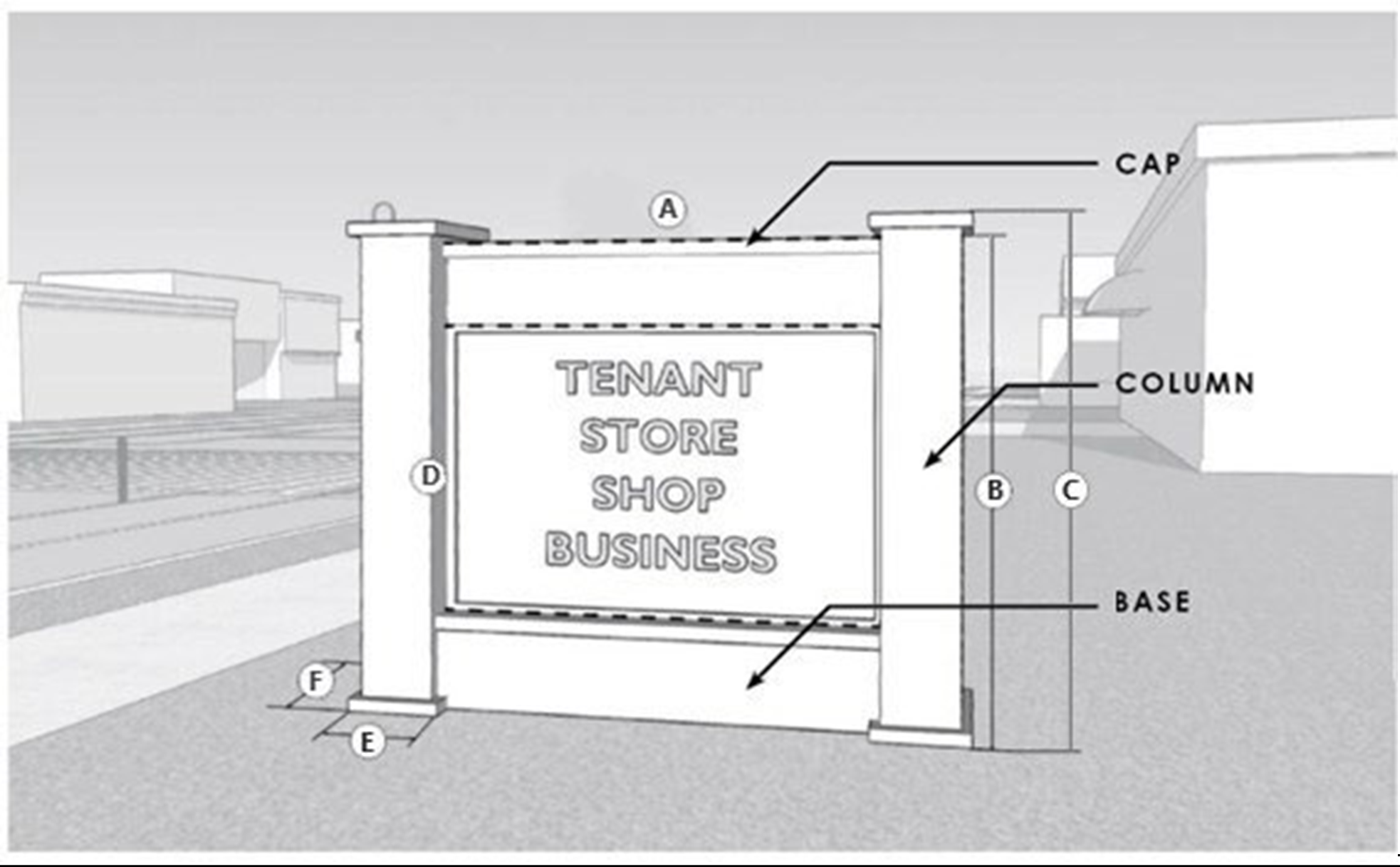 | |
| 1. Description | A freestanding ground sign with a supporting structure with two columns on the end of the sign. A monument sign is not attached, supported or suspended to or from any building or structure. All monument signs shall include three separate and distinct features: base, cap, and columns. Each of these features must be distinguishable by form, finish, or other means besides color. All ground signs shall be in the form of monument signs, except directory signs, and shall include the physical address on the sign. |
| 2. Location and Number | 1 sign per frontage maximum. |
| 3. Size |
Sign Area and Height:
A. Sign Width: Maximum 10'. B. Sign Height: Maximum 9' if adjacent to a roadway with a posted speed limit of 30 mph or less AND less than four lanes; otherwise, maximum 15', measured from ground to top of cap. C. Column Height: No greater than 1' above the sign cap. D. Sign Face Area: Maximum 75 square feet. E. Column Width: Minimum 6"/Maximum 16". F. Column Length: Maximum 18". |
3.
Neighborhood or Subdivision Entry Signs.
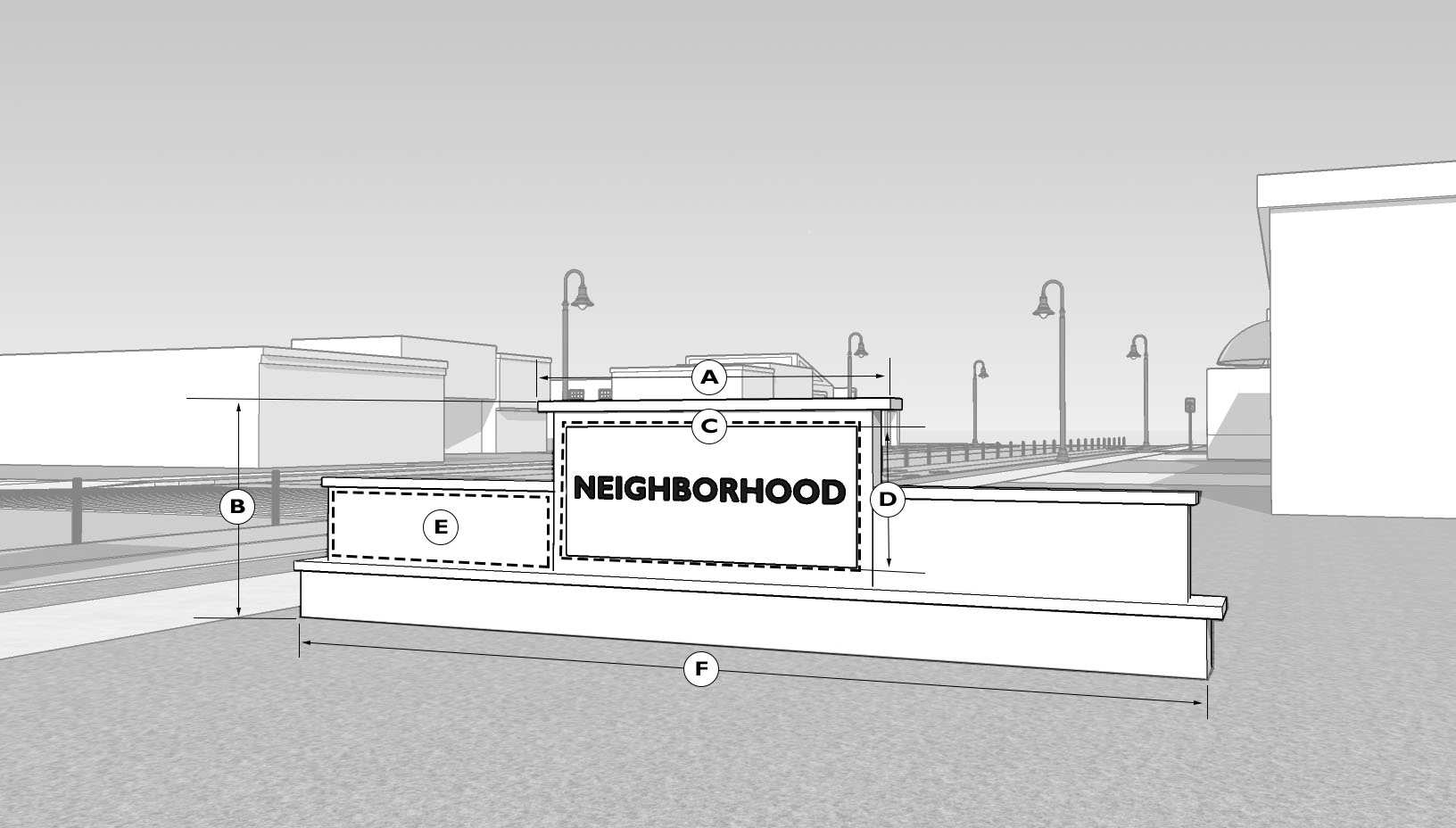 | |
| 1. Description | Signs attached to walls or entry features. |
| 2. Location and Number |
1 sign per entrance (e.g., median sign) or 2 wall signs either side of entrance. Additional
signs may be permitted as a design alternative.
ROW encroachment may be allowed with Director approval. |
| 3. Size |
Wall Sign:
A. Sign Area: Maximum 40 square feet. Entry Feature Sign: A. Sign Area Width: Maximum 8'. B. Total Sign Height: Maximum 7'. C. Sign Area: Maximum 40 square feet. D. Sign Height: Maximum 5'. E. Sign Exposed Material: Maximum 80 square feet per sign face side. F. Sign Structure Overall Width: Maximum 25'. |
4.
Projecting Signs.
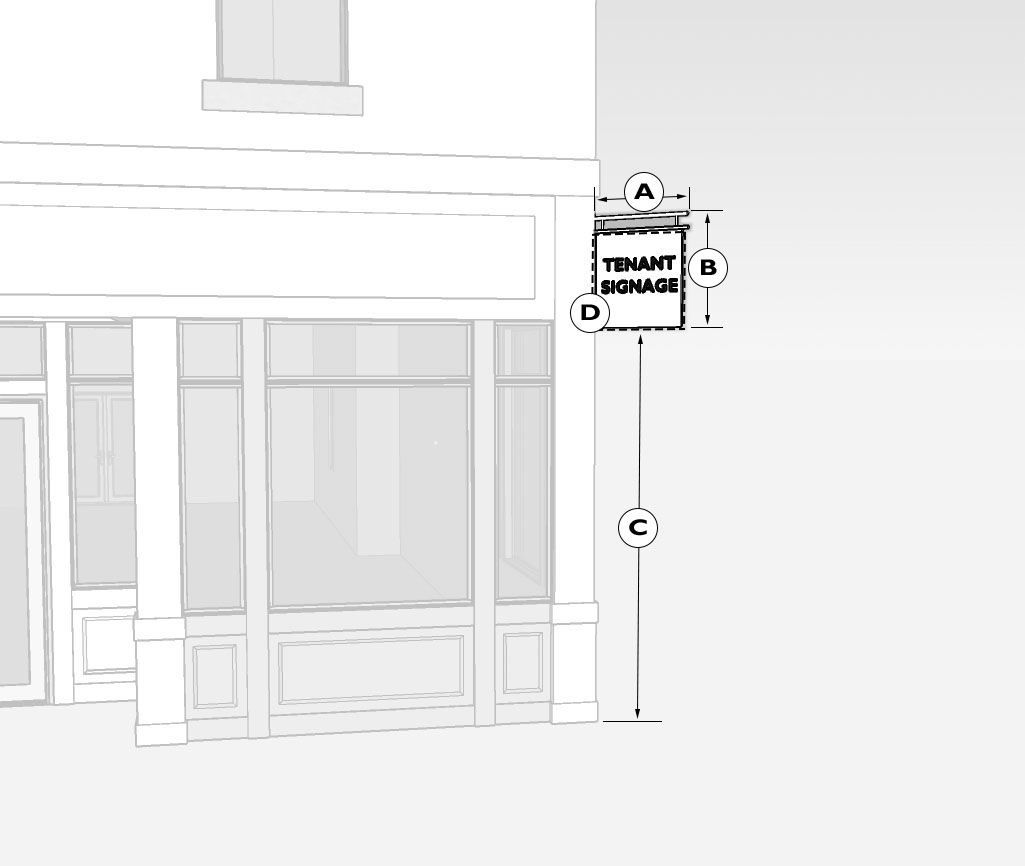 | |
| 1. Description | A sign attached directly to a supporting building wall and intersecting the building wall at a right angle. A projecting sign may be 2 or 3-dimensional. |
| 2. Location and Number | 1 projecting sign per street frontage. |
| 3. Size |
A. Sign Length: Maximum 4'.
B. Sign Height: Maximum 2'. C. Clearance: Minimum 8'. D. Sign Area: Maximum 4 square feet. |
| 4. Miscellanenous | Projecting signs erected at building corners may intersect at a 45 degree angle to the corner of the building, in which case only 1 projecting sign is allowed. No projecting sign is allowed to extend above the roof line or the parapet wall. Buildings with 2 or more stories may not have a projecting sign located higher than the second story or 27', whichever is less. |
5.
Wall Signs.
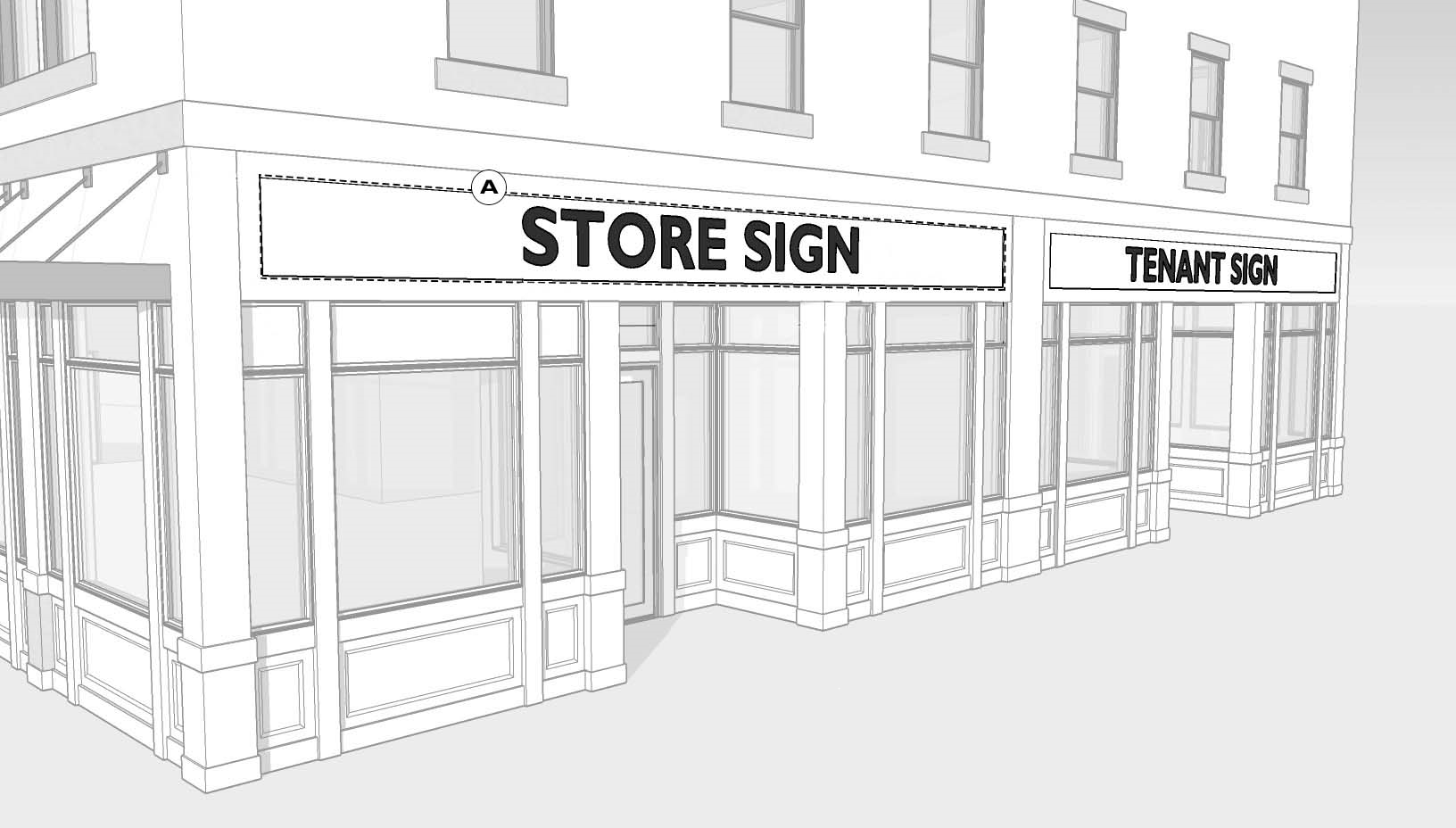 | |
| 1. Description | An on-premises sign attached directly to a building wall above the given store front place. A wall sign shall include murals conveying the name of a business or a commercial message. A wall sign shall not extend more than 18 inches from the building. |
| 2. Location and Number | Wall signs shall be located on the supporting building wall directly above a business. Wall signs are not allowed to extend above the roof line or the parapet wall. For multitenant buildings one sign is allowed per tenant, unless a tenant is on the corner, in which case one sign per street frontage may be permitted. |
| 3. Size | Multi-Tenant Buildings: A. 1.5 square feet for each linear foot of building or tenant frontage, maximum 150 square feet. Single Tenant Buildings greater than 60,000 square feet: A. One square foot per linear foot of building or tenant frontage, maximum 400 square feet. Single Tenant Buildings less than 60,000 square feet: A. 1.5 sq. ft. per linear foot of building frontage or 150 sq. ft. total, whichever is less. |
6.
Directory Sign.
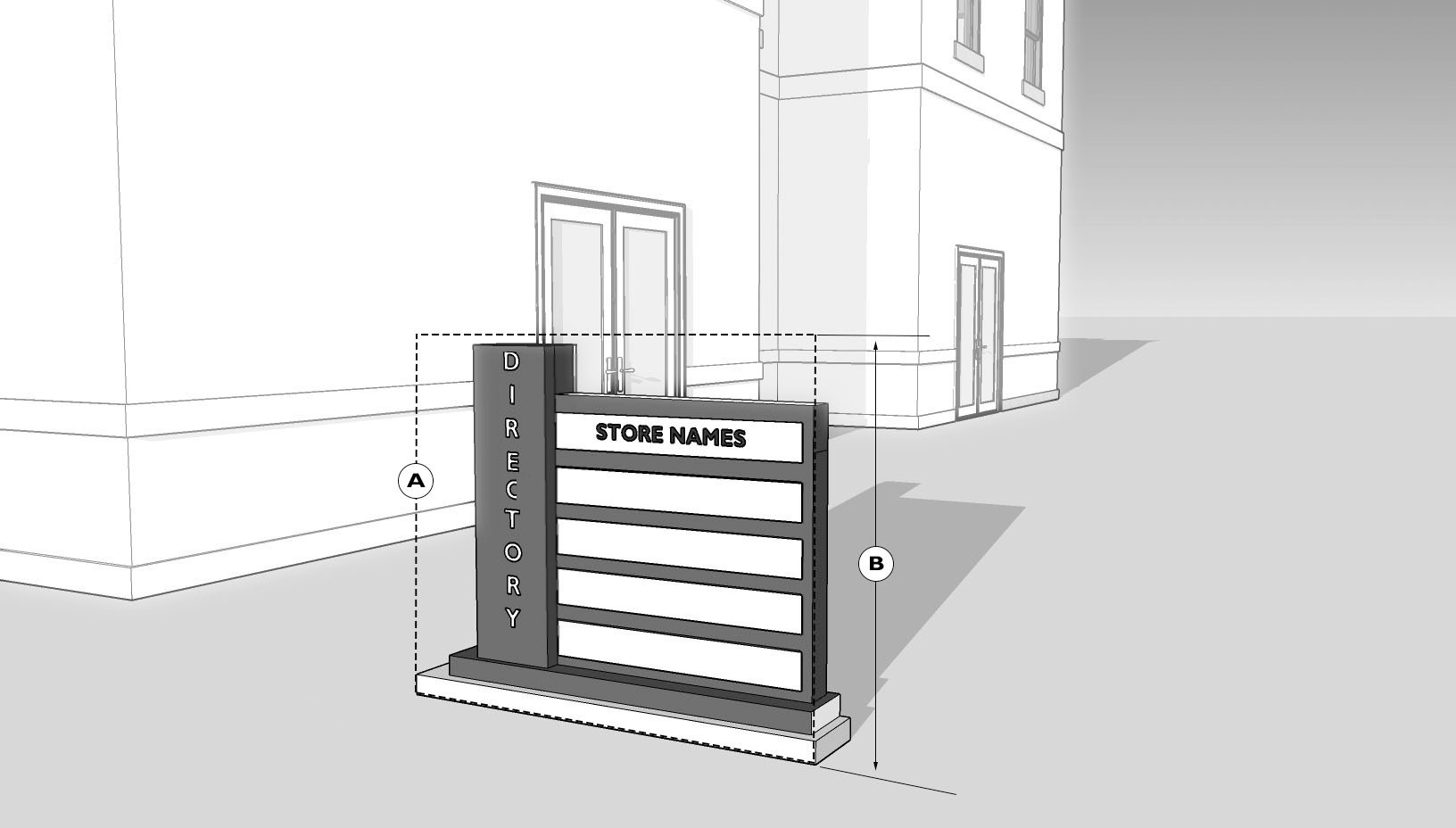 | |
| 1. Description | A directory sign is a freestanding ground sign, located along internal drives to orient people to the stores or offices in the area. A directory sign is not attached, supported or suspended to or from any building or structure. |
| 2. Size |
A. Area: Maximum 20 square feet for directory signs.
B. Height: Maximum 4'. |
7.
Sculpture Signs.
a.
Sculpture signs are permitted in any nonresidential district and shall be included in the calculation for total maximum area of signage (i.e., maximum area of ground signage plus maximum area of building signage) as permitted by that district.
b.
No single sculpture sign shall exceed eight (8) feet in height or 32 square feet when measured across its largest two-dimensional (2-D) plane.
c.
No more than one sculpture sign shall be permitted per business or establishment.
d.
Sculpture signs may be portable or permanent but must comply with the following standards to ensure public safety:
i.
Sculpture signs shall be located within ten (10) feet of the public entrance to the tenant space.
ii.
When a sculpture sign is placed on a private pedestrian sidewalk or walkway, an unobstructed portion of the sidewalk or walkway a minimum of 44 inches wide or the minimum width of an accessible route per the Florida Americans with Disability Accessibility Implementation Act, whichever is greater, shall be maintained to provide safe and convenient pedestrian circulation.
iii.
The placement of sculpture signs shall not impede safe and convenient on-site pedestrian and vehicular circulation or impact required parking spaces.
iv.
If anchored in place, sculpture signs shall be constructed and maintained in strict conformity with City building codes and all other applicable City regulations.
Figure 3.5.4.4. Calculating area of sculpture signs
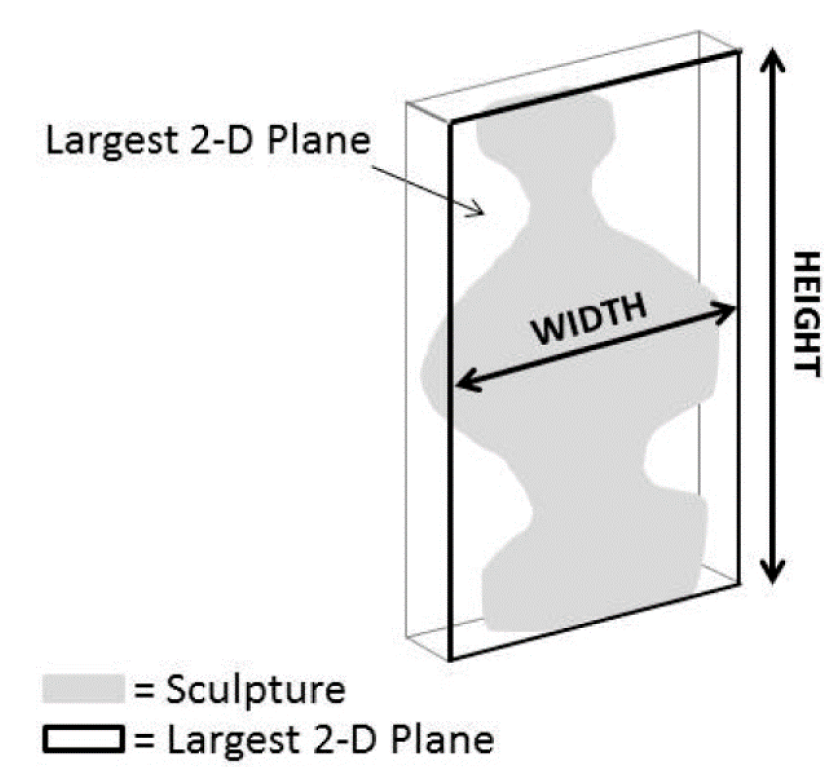
C.
Permitted Sign Types Within Mixed-Use Districts. Each Mixed-Use District shall permit a specific selection of sign types. Sign types, the number of signs, and permitted square footage for signs are identified in Section 3.5.4.B above. Sign types for each Mixed-Use District are permitted by sign type in the Table 3.5.4.B. Permitted sign types within a Mixed-Use District may be modified through a design alternative.
Table 3.5.4.B. Permitted Sign Types within Mixed-Use Districts
3.5.4. Nonconforming Signs
A.
Standards for Nonconforming Signs. Nonconforming signs in any district shall not be altered or moved except as otherwise permitted by this section. Normal maintenance of signs, including repainting or repair of the existing sign face and/or sign structure, shall not be considered an alteration. Any other changes to the sign face or sign structure shall constitute an alteration of the sign. Any nonconforming sign structure which is moved, removed, or altered voluntarily or involuntarily, must be brought up to the standards of permitted sign types in this section.
3.5.5. Substitution
A.
Substitution of Signs. Non-commercial copy may be substituted for commercial copy on any sign that is otherwise permitted in this section.
3.5.6. Abandoned and Unsafe Signs
A.
Abandoned and Unsafe Signs. Any sign that no longer advertises a bona fide business conducted, or a product sold, and/or is deteriorated/broken/damaged as to cause harm to the general public, shall be taken down within thirty (30) days after written notification from the City.
(Ord. No. 2022-15, § 3(Exh. B), 7-12-22; Ord. No. 2022-31, § 2(Exh. A), 12-13-22; Ord. No. 2023-05, § 2(Exh. A), 2-28-23; Ord. No. 2023-51, § 2(Exh. A), 1-9-24)
3.6. - Parking
3.6.1. Off-Street Parking Standards
A.
Purpose, Intent and Applicability.
1.
Purpose and Intent. The purpose of this section is to ensure adequate off-street parking and loading facilities in proportion to the generalized demand of the different uses permitted in this Code.
2.
General Applicability. Parking must be provided in accordance with this Code. Only new development or redevelopment are subject to the standards of this section. Current or nonconforming parking arrangements shall not be subject to the provisions of this section until an increase in floor area or change in use occurs.
a.
Off-street parking shall be maintained and no permit for construction or addition may be permitted until the parking requirements of this Code have been met.
b.
Off-street parking shall be located on the same plot or parcel of land that it is intended to serve unless otherwise permitted in this section.
c.
No off-street parking shall be placed within a visibility triangle per Section 3.1.8.F.
3.
Additions. A building or site may be renovated or repaired without providing additional parking. If there is an increase in floor area, the increase in floor area must meet the parking requirements in this Code.
4.
Change in Uses. A change in use of a building shall meet the parking requirements of that new use. For the purpose of this section, a change in use shall be defined as a change in occupancy classification per the Florida Building Code. If the parking requirements of this Code cannot be met for the new use, the Director may request additional information about the new use and shall determine whether the current parking can sustain the new use. If it cannot, an alternative parking plan may be provided. For the requirements of an alternative parking plan, please see Section 3.4.3: Alternative Vehicle Parking Provisions.
5.
Unlisted Uses. In those situations where a proposed use is not identified in Table 3.4.2., the Director may apply an off-street parking standard based on the use determined to be the most similar to the proposed use. The applicant may provide a parking study or similar analysis prepared by a Professional Engineer or Certified Land Use Planner with experience in parking studies; the Director may use this study in applying an alternative parking standard.
3.6.2. Electric Vehicles and Charging Standards
A.
Purpose, Intent, and Applicability.
1.
Purpose and Intent. Electric vehicles are an important emerging technology, as recognized by the Legislature of the State of Florida, and the intent of this Code is to adequately accommodate them.
2.
Applicability. Provision for electric vehicle charging must be provided in accordance with this Code. Government facilities allowing public access and multifamily housing with fifty (50) or more parking spaces are required to provide electric vehicle parking at the point of new development or redevelopment subject to the standards of this section (see Tables 3.6.1 to 3.6.6). Voluntary installations of electric vehicle parking spaces by non-residential uses shall follow the standards set out in this section.
B.
Parking and Charging Standards.
1.
Parking.
a.
Electric vehicle parking spaces shall, at a minimum, be equipped with an electric vehicle charging station rated at electric vehicle charging Level 2 or higher.
b.
Electric vehicle parking spaces shall be painted green, or shall be marked by green painted lines or curbs.
c.
Each electric vehicle parking space shall be marked by a sign designating the parking space as an electric vehicle parking space, in accordance with the Manual on Uniform Traffic Control Devices (MUTCD) of the Federal Highway Administration.
2.
Fees. Nothing herein shall prohibit the charging of a fee for the use of an electric vehicle charging station by a resident, guest, invitee, or employee.
3.
ADA Accessible Spaces. A minimum of one (1) electric vehicle parking space must be located adjacent to a required accessible parking space such that the electric vehicle charging station can be shared between an accessible parking space and an electric vehicle parking space. An accessway between the two spaces shall be provided at a minimum width of five (5) feet. The accessible parking space shall be designated as an EV reserved space. Electric Vehicle Supply Equipment (EVSE) accessible spaces should have all relevant parts located within accessible reach, and in a barrier-free access aisle for the user to move freely between the EVSE and the electric vehicle. A design alternative may be proposed where an alternative configuration of spaces would still achieve the intent of this subsection.
4.
Lighting. Site lighting, shielded and projected downward in accordance with Section 3.9, Lighting, shall be provided where an electric vehicle charging station is installed. Design alternatives may be proposed where facilities are not open for use during hours of darkness.
5.
Equipment Standards and Protection.
a.
Battery charging station outlets and connector devices shall be between 36 inches and 48 inches from the surface where mounted. Equipment mounted on pedestals, lighting posts, bollards, or other devices shall be designed and located so as to not impede pedestrian travel or create trip hazards on sidewalks. Adequate battery charging station protection, such as concrete-filled steel bollards, shall be used. Curbing may be used in lieu of bollards if the battery charging station is set back a minimum of 24 inches from the face of the curb.
b.
Electric vehicle charging stations shall contain a retraction device, coiled cord, or a fixture to hang cords and connectors above the ground surface.
6.
Required signage.
a.
Information shall be posted identifying voltage and amperage levels and any type of use, fees, or safety information related to the electric vehicle charging station.
b.
Each electric vehicle charging station space shall be posted with signage indicating the space is only for electric vehicle charging purposes. For purposes of this subsection, "charging" means that an electric vehicle is parked at an electric vehicle charging station and is connected to the battery charging station equipment and is actively charging.
c.
The signage shall include any restrictions that may result in removal of the electric vehicle by the property owner pursuant to state statutes.
7.
Maintenance. Electric vehicle charging stations shall be maintained by the property owner in good condition in all respects, including the functioning of the equipment. Removal of any required electric vehicle charging stations is prohibited. A phone number or other contact information shall be provided on the equipment for reporting malfunctions or other problems.
3.6.3. Parking Requirements by Use
A.
Required Parking. Parking shall be provided in accordance with Tables 3.6.1-3.6.6. All uses listed in Tables 3.6.1-3.6.6 are consistent with the uses in the Use Table(s) found in Section 2.2.7 and Section 2.3.13. Where a use is not specifically listed, the Director is responsible for applying the requirement for the most similar use consistent with the Alternative Parking Plan process. Notes regarding parking calculations are provided in Tables 3.6.1-3.6.6.
B.
Minimum and Maximum Parking. Off-street parking requirements provide the minimum and maximum standards to meet the parking needs generated by the various uses permitted by the City's Comprehensive Plan and Code. While it is recognized that the automobile is the predominant mode of transportation within the City at this time, the parking requirements outlined in this section are intended to encourage the use of alternative modes of travel and multimodal development strategies (bicycling, walking, transit, Transportation Demand Management (TDM), shared use of parking, etc.) throughout the City, specifically within the Mixed Use Districts. This shall be done by providing a range of acceptable parking that is responsive to market conditions and individual project needs. Specific to Section 3.6.4.: Alternative Vehicle Parking Provisions, an Alternative Parking Plan (APP) may be provided where applications for development projects may not meet a specific, identified use and/or where design alternatives are proposed.
C.
Parking Requirement by Use Table. Requirements for parking are illustrated in Tables 3.6.1—3.6.6. Minimum parking required, and maximum parking allowed are defined using a ratio requirement.
D.
Standard. Parking standards shall be set on 1,000 SF (square feet) of floor area unless otherwise noted in the table. Where the parking standards are based on floor area, it shall be gross floor area, except the following areas of a structure which may be excluded:
1.
Common restrooms;
2.
Elevator structures;
3.
Parking structures;
4.
Public corridors; and
5.
Mechanical rooms.
Table 3.6.1. Parking Requirements by Use
Table 3.6.2. Parking Requirements by Use
Table 3.6.3. Parking Requirements by Use
Table 3.6.4. Parking Requirements by Use
Table 3.6.5. Parking Requirements by Use
Table 3.6.6. Parking Requirements by Use
3.6.4. Alternative Vehicle Parking Provisions
A.
Alternative Parking Plan (APP). The parking requirements set forth in Tables 3.6.1—3.6.6 may be modified through an Alternative Parking Plan (APP). The below requirements shall be met:
1.
A parking study must be prepared by a registered professional engineer in the State of Florida or certified land use planner.
2.
The study must include the size, type, and use(s) of the development; anticipated peak parking; anticipated normal parking amounts; and narrative and data as to why the parking requirements of the Code do not accurately reflect the needs of the proposed development.
3.
The study shall provide analysis using information and studies from the Urban Land Institute (ULI), Institute of Transportation Engineers (ITE), American Planning Association (APA), or another alternative professional standard approved by the Director.
4.
The Director may approve an APP if parking requirements are modified by twenty-five (25) percent or less. If greater than twenty-five (25) percent, the Planning Commission shall consider the APP as part of the site and development process.
B.
Remote Parking.
1.
Requirements for Remote Parking. Required parking spaces may be permitted on a separate parcel from the site on which the principal use is located if the remote parking complies with the following:
a.
Any remote parking area shall be under the same ownership as the principal use or otherwise secured by a lease of no less than the term of any lease for the principal use.
b.
All necessary legal instruments shall be executed and recorded in the public records of Sarasota County and copies of the recorded documents provided to the Director and City Engineer, or their designees, prior to the issuance of certificates of occupancy.
c.
All renewal agreements pertaining to remote parking area leases shall be provided to the Director, or their designee, prior to the expiration of the lease term.
d.
The remote parking shall comply with the distance requirements in Table 3.6.7.
e.
Remote parking lots shall abide by all parking design standards set forth in the Code.
f.
Remote parking plans shall be submitted to the Director for review on forms per the Director's discretion.
Table. 3.6.7. Remote Parking
Figure 3.6.1. Maximum Allowed Distance for Remote Parking for Traditional Districts
(Illustrative Purposes Only)
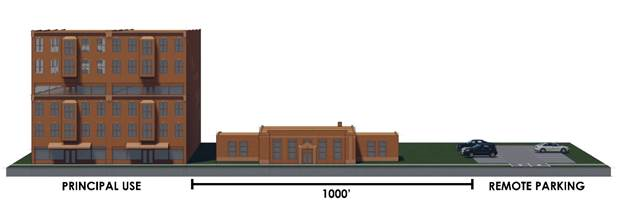
3.6.5. Design Standards
A.
General Design Standards.
1.
Parking Plans. To ensure compliance with the following standards, a Parking Plan shall be required for all development and redevelopment with the exception of single-family residential uses.
a.
Parking Plans shall, at minimum, provide proposed uses; provide amount of parking spaces; and illustrate access points, internal circulation, landscaping, pedestrian connections, materials, parking type (angle of parking), dimensions, and drive aisles.
b.
Single-family residential shall ensure all parking is located on the individual home site except where otherwise modified through an Alternative Parking Plan described in Section 3.6.4.A.
c.
Parking plans shall be reviewed by the applicable TRC members and the Director.
d.
Parking lighting shall comply with lighting standards as required in Section 3.9: Lighting.
2.
Arrangement. Parking areas shall be arranged so that any vehicle may enter or exit a parking space without moving another vehicle, except for parking structures which may be designed to allow tandem parking and/or valet services. Townhouses and multiple-family developments which have ground floor dwelling units with attached carports or garages may allow one parking space in a driveway of at least twenty (20) feet in length between the carport or garage and the adjacent roadway or sidewalk if the sidewalk is located outside of the right-of-way.
3.
Encroachment into Right-of-Way. No parking space may be designed in such a way to encroach, hinder or otherwise block a public or private roadway, alley, or sidewalk.
4.
Required Buffers. No parking shall be located in required landscape buffer areas. Parking spaces may be located within a setback and/or BTZ as permitted in the specific regulations for each district.
5.
Accessibility. Parking facilities accessible for persons with disabilities shall be in compliance with or exceed the standards detailed in the state Accessibility Code, including quantity, size, location, and accessibility.
6.
Crime Prevention Through Environmental Design. The parking area shall be properly lighted for security utilizing Crime Prevention Through Environmental Design (CPTED) principles. Adherence to these principles shall be addressed in the narrative submitted as part of the Site and Development Plan application. Parking areas shall be lighted to ensure the safety of pedestrians and vehicles. The lighting shall not cause undue glare or hazardous interference to public roadways or adjacent residential property. Lighting shall meet the requirements in Section 3.9: Lighting.
7.
Driveways. Driveways, aisles, and joint access easements shall not be used for parking vehicles except for those serving single-family and two-family residential properties.
8.
Tandem Parking. Tandem parking is only permitted through a design alternative.
9.
Curbing and Wheel Stops. Facilities shall have curbs or wheel stops or similar devices so as to prevent vehicles from overhanging on or into adjacent property, or from blocking required landscaped areas or walkways. Wheel stops shall be prefabricated concrete or recycled plastic product manufactured specifically for this use; the use of railroad ties, or other non-traditional wheel stops shall not be permitted. Bollards may be used along the front of a building to prevent vehicle impact; bollards shall be limited to four (4) feet in height.
10.
Landscaped Islands. Parking lots shall be visually and functionally segmented using landscaped islands and canopy trees as described in the landscape standards provided in Section 3.7: Landscaping.
11.
Identification. Facilities shall be identified as to purpose and location.
12.
Surfacing. Facilities shall be hard surfaced with asphalt bituminous concrete and Portland cement concrete. Any deviation from the surfaces to be utilized for these surfacing requirements must be requested as a variance and follow the variance process as stated in Section 1.13: Variances. Up to fifty (50) percent of required parking spaces for houses of worship and public and private schools offering academic courses may be surfaced with grass for permanent reserve parking; however, if parking demand is such that the grass is damaged or destroyed to the extent that the grass ceases to grow, then paving of such area in accordance with this section may be required. Grass parking shall be required to feature conforming parking space sizes, wheel stops, and perimeter landscaping per provisions of this Code. Drive aisles providing access within grass parking areas shall be paved.
13.
Drainage. Facilities shall be drained so as not to cause any nuisance on adjoining or nearby properties, consistent with Section 3.3: Stormwater and Utilities.
14.
Access and Maneuvering. Facilities shall be arranged for convenient access and safety of pedestrians and vehicles. Facilities shall be so arranged that no vehicle shall be required to back up from such facilities directly onto designated arterial or collector streets. Facilities shall be so designed, maintained and regulated that no parking or maneuvering incidental to parking shall be on any public street, sidewalk, or alley; provided that, in the Venice Avenue mixed use district, alleys may be used as maneuvering space for parking.
15.
Marking of Spaces. All off-street parking spaces shall be marked, consistent with the City's standards.
16.
Landscaping between Parking Tiers. Where abutting tiers of interior parking spaces are proposed, the facilities shall be designed so as to have an area of no less than five (5) feet in clear width maintained between such tiers, which shall be landscaped in accordance with Section 3.7: Landscaping and Chapter 89, Section 3.5.2.L. Where vehicle encroachment of up to two (2) feet is proposed, the landscaped area must be ten (10) feet wide, measured from the back of the curb. A design alternative may be requested for the width of a divider median.
17.
Landscaping of Other Areas. Facilities shall be constructed so that interior portions of off-street vehicular facilities not utilized specifically as a parking space or maneuvering or other vehicular use area shall be landscaped instead of paved in accordance with Section 3.7: Landscaping.
18.
Blockage Prohibited. No parking space may encroach, hinder or otherwise block a public or private way including an alley, sidewalk, path or designated bicycle lane. Where parking spaces are located such that the parked vehicle will overhang a sidewalk or walkway, a minimum clear width shall be provided equal to the minimum width required within this Code.
19.
Lighting. Lighting within parking lots shall comply with Section 3.9: Lighting.
20.
Use. Required off-street parking shall not be used for sales, storage, repair, dismantling or servicing of any type or kind, nor shall areas devoted to such activities be counted towards off-street parking requirements.
B.
Dimensional Standards.
1.
Parking Spaces. Each parking space shall be a minimum of ten (10) feet in width by eighteen (18) feet in length. Parallel spaces shall be a minimum of eight (8) feet in width by twenty (20) feet in length, maximum twenty-two (22) feet in length. Handicapped parking spaces shall comply with state statutes. For uses that require commercial or industrial vehicles that cannot fit in a standard space, parking spaces shall be the size of a typical vehicle for that use. A design alternative may be requested for parking space dimensions.
2.
Parking Drive-Aisle Areas. Minimum aisle width shall be as follows:
Table 3.6.8. Parking Area Dimensional Standards Table
Figure 3.6.2. Parking Dimensional Standards
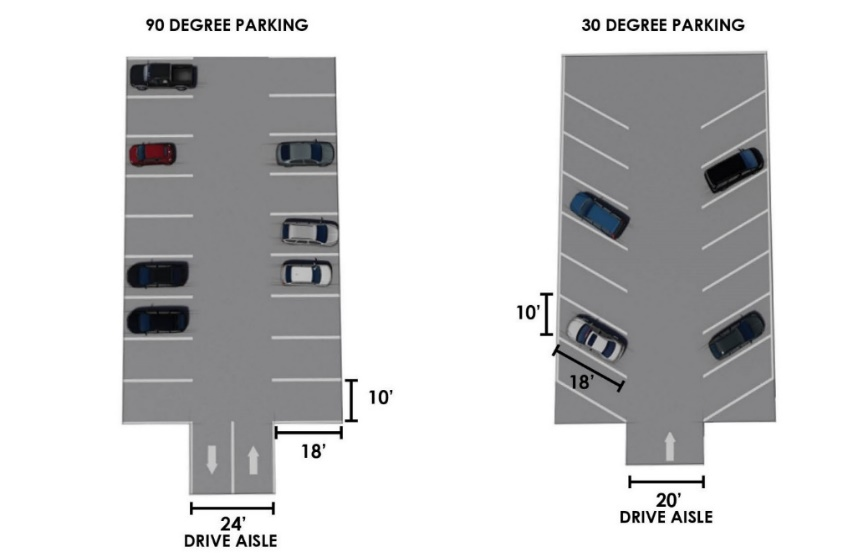
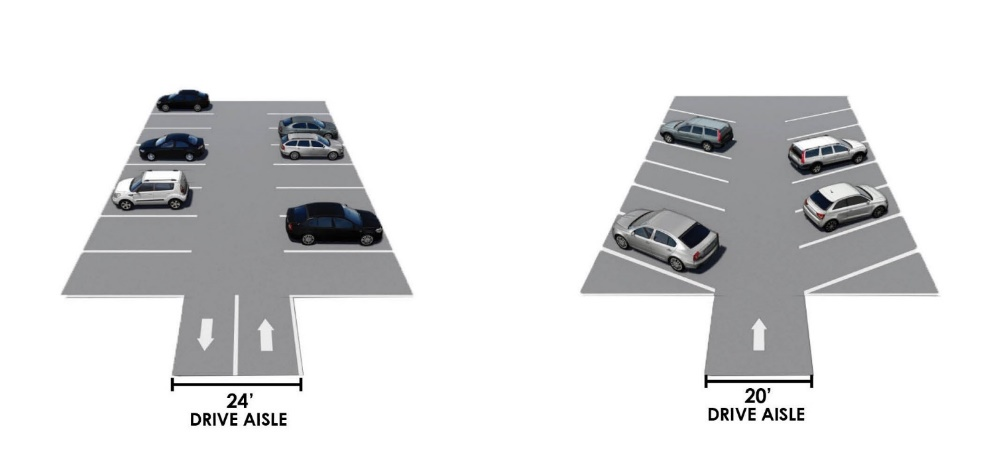
C.
Stacking Requirements.
1.
Stacking. Whenever a structure or use provides for the off-loading of passengers or allows for use without exiting the vehicle, stacking or off-loading lanes and spaces shall be designated and marked and will be required on-site as follows:
a.
Drive-Through Uses: Three (3) stacking spaces before the order station and three (3) stacking spaces before the pickup window, exclusive of those associated with the order station. For uses with dual ordering stations, stacking spaces may be reduced to two (2) per station.
b.
Day Care: One (1) stacking space per eight persons, minimum of five (5) spaces. An APP per Section 3.6.4. may be applied for if fewer stacking spaces are required.
c.
Schools: One (1) stacking space per classroom, up to a maximum of ten (10) spaces. An APP per Section 3.6.4. may be applied for if more stacking spaces are required.
d.
Hotel or Motel Office: Minimum two (2) stacking spaces.
e.
Automatic or Mechanical Carwash: Two (2) stacking spaces per individual unit.
f.
Hand Carwash or Auto Detailing: Two (2) stacking spaces per individual unit or work station.
g.
One (1) stacking space per refuse collection area is required and shall be oriented to allow loading without requiring access or maneuvering through parking spaces.
2.
Size. A stacking space shall be a minimum of ten (10) feet by eighteen (18) feet and shall be located so as not to obstruct, endanger, or interfere with on-site or off-site access, maneuvering or traffic patterns. Stacking lanes shall be marked or separated to prevent use as access and to protect users while off-loading or waiting.
Figure 3.6.3. Stacking Requirements (Illustrative Purposes Only)
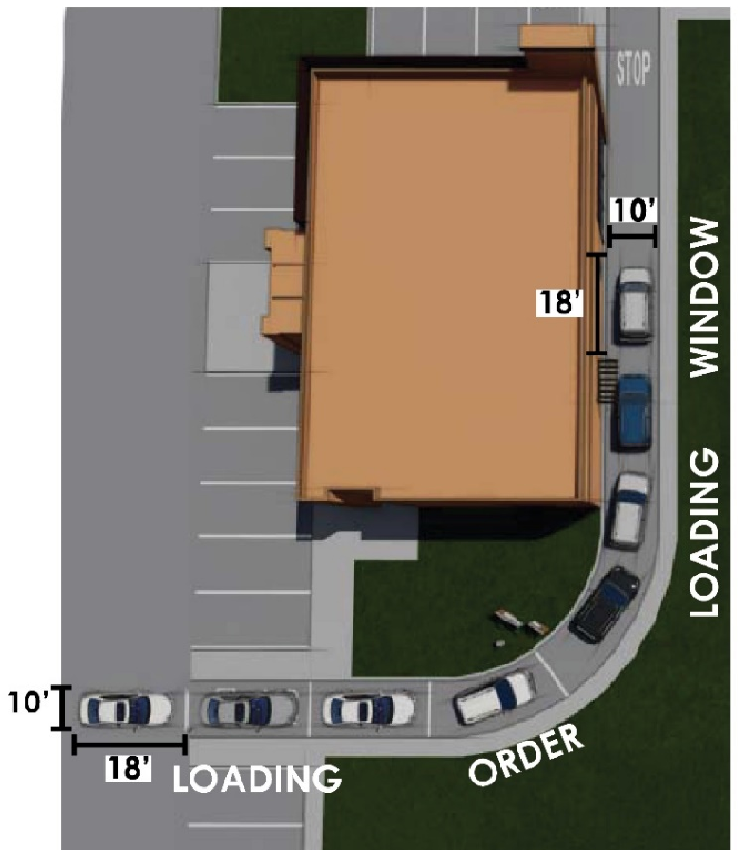
D.
Off-site Location of Parking Facilities. The required off-street parking facilities shall be located on the same lot or parcel of land they are intended to serve unless they meet provisions set forth in Section 3.6.4.: Alternative Vehicle Parking Provisions.
E.
Combined Off-street Parking Facilities.
1.
Two or more owners or operators of buildings or uses requiring off-street parking facilities may make a collective provision for such facilities, provided that the total of such parking spaces when combined or used together shall not be less than the sum of the requirements computed separately except in accordance with this section. Any arrangement for combined off-street parking shall be subject to the recording of a legal instrument satisfactory to the City Attorney ensuring that such off-street parking will be maintained in the future so long as a use requiring such off-street parking continues.
2.
No part of an off-street parking area required for any building or use shall be included as a part of an off-street parking area similarly required for another building or use unless the Planning Commission determines that the type of use indicates that the period of usage will not overlap or be concurrent with each other. In situations where parking will be shared, an alternative parking plan may be proposed in accordance with Section 3.6.4.
F.
Nonconforming Parking. See Section 8: Nonconformities.
G.
Off-Street Loading/Unloading Facilities.
1.
General Requirements.
a.
General. Off-street loading facilities are required by this section so that vehicles engaged in unloading will not encroach on or interfere with the public use of streets or pedestrian areas. Adequate space shall be available for the unloading and loading of goods, materials, or other things for delivery and shipping.
b.
Off-Street. Off-street parking facilities may not be used or counted as meeting off-street loading requirements.
c.
Uninterrupted Flow. If loading/unloading is proposed within the road or driveway, at least one vehicular travel lane shall be preserved to ensure the uninterrupted flow of traffic.
d.
Change of Use. When the use of a structure or land or any part thereof is changed to a use requiring off-street loading facilities, the full amount of off-street loading space required shall be supplied and maintained.
e.
Change in Size of Structure. When any structure is enlarged or any use extended so that the size of the resulting occupancy requires off-street loading space, the full amount of such space shall be supplied and maintained for the structure or use in its enlarged or extended size.
f.
Accessibility and Location. Loading/unloading areas shall be convenient to the building it services. Each off-street loading space shall be directly accessible from a street or alley without crossing or entering any other required off-street loading space. Such loading space shall be accessible from the interior of the building it serves and shall be arranged for convenient and safe ingress and egress by motor truck and/or trailer combination. Loading/unloading areas for semi-trailers and similar vehicles shall not be located in the front of a building façade and not in any drive aisle or in any public right-of-way.
g.
Required Loading/Unloading Information. As part of any required parking, loading and unloading locations and sizes shall be included on any parking plan.
2.
Loading/Unloading Spaces.
a.
Right-of-way. Service areas shall be located outside of a public right-of-way when practicable and be indicated through signage.
b.
Size. The size of loading/unloading spaces may be adjustable based upon the needs of the use in a building. Loading and unloading space for vehicles which can fit in the minimum parking space size per the Code (10 feet width, 18 feet length) shall be the same size as the minimum parking space. For uses that require commercial delivery trucks or semi-trailers and similar vehicles which cannot fit into the minimum parking space size per the Code, loading/unloading spaces shall be made to accommodate the typical commercial delivery vehicle. The expected typical size of vehicles shall be included with any loading/unloading plan. Provisions shall be made to accommodate the range of anticipated vehicles.
3.
Combined Off-street Loading. Collective, joint, or combined provisions for off-street loading facilities for two or more buildings or uses may be made, provided that such off-street loading facilities are equal in size and capacity to the combined requirements of the several buildings or uses and are designed, located, and arranged to be usable thereby.
a.
Number of Spaces. For each multifamily and nonresidential use the following number of spaces are required:
(Ord. No. 2022-15, § 3(Exh. B), 7-12-22; Ord. No. 2022-31, § 2(Exh. A), 12-13-22; Ord. No. 2023-05, § 2(Exh. A), 2-28-23; Ord. No. 2024-16, § 2(Exh. A), 9-10-24)
3.7. - Landscaping
3.7.1. Purpose, Intent and Applicability
A.
Purpose and Intent. The purpose of this section is to enhance the appearance, protect the environment, preserve character, and improve property values within the City through landscaping standards. The intent of properly landscaped and maintained areas is to reduce the potential incompatibility of adjacent land uses, conserve natural resources, maintain open space, protect established residential neighborhoods, and promote and enhance community image and roadway beautification. Landscaping shall be coordinated with all site design elements including building layout, parking, access and signs.
B.
Applicability. All development listed below (except for single-family structures and duplexes) shall comply with the requirements of this section:
1.
Development subject to Section 1.9: Site and Development Plan.
2.
Development subject to Section 1.10: Preliminary Plat.
3.
Development subject to Section 1.15.1: Construction Plan.
4.
Any development that involves the construction of a new principal building shall comply with the standards of this section. The expansion or modification of any existing building shall comply with the standards of this section.
5.
The foundation plantings required due to expansion or modification of any existing building shall comply with the standards of this section, and any modification to existing foundation plantings shall require compliance with the standards of this section. Any other existing foundation plantings may remain, provided they are not altered.
6.
For any nonconforming foundation planting, see Section 8: Nonconformities.
C.
Landscape Plan Required. All developments subject to a site and development plan per Section 1.9: Site and Development Plan, a preliminary plat per Section 1.10.1: Preliminary Plat, or as determined to be necessary by the Director to complete the review of a project, shall submit a landscape plan. The landscape plan must include narrative and calculations to ensure that the proposed landscaping will be in compliance with the requirements of this Code. The landscape plan must be signed and sealed by a State of Florida licensed Landscape Architect or Engineer. The landscape plan, drawn on 24 inch by 36 inch plan sheets, must at a minimum include the following items where applicable:
1.
Project name, street address, and legal description;
2.
Date, scale, north arrow, and the names, addresses, and telephone numbers of both the property owner and those preparing the plan;
3.
Location of subject property lines and dimensions of the site, the zoning classification of the site, and the zoning classification of adjacent properties; a vicinity map should also be attached to or made a part of the plan;
4.
Location of the twenty-five (25) year and one hundred (100) year floodplain, if applicable; any applicable Coastal Regulatory lines; the approximate location of significant drainage features; and the location and size of existing and proposed buildings, streets, utility easements, driveways, parking, sidewalks, and similar features;
5.
Location, height, and material of proposed screening, walls, and fencing (including berms to be delineated by one (1) foot contours and top of berm spot grades);
6.
Location(s) and dimension(s) of proposed landscape buffer areas and cross section (see Section 4: Compatibility);
7.
Complete plant schedule including common and scientific name, symbols with a legend, quantities, container size or tree caliper, container size at installation, heights, spread, spacing and method of irrigation at installation. The location, size, and type of all protected, Venetian, Heritage, and Canopy trees as per Chapter 89, Section 3 Tree Preservation, Protection and Replacement shall also be provided;
8.
Calculations as to the amount (in square feet) of all vehicle use and parking areas and the amount of square footage for all landscaped areas required and provided;
9.
Location(s), size, species, and protective barriers of existing vegetation to be preserved;
10.
A narrative on how existing healthy trees proposed to be retained will be protected from damage during construction per the requirements of Chapter 89, Section 3 Tree Preservation, Protection and Replacement;
11.
The size, height, location and material of proposed planters, sculptures, and water features;
12.
A plan drawn to site scale no smaller than 1:10 and no greater than 1:60 scale showing in addition to the above items the location of roads, sidewalks, buildings, buffers, planters, drainage facilities, easements, property lines, fences, and environmental features such as conservation or wetland areas and historical resources;
13.
Location of visibility triangles on the site, including visibility triangles within parking areas and intersections of rights-of-way; and
14.
Other information as may be required by the Director to determine whether the landscape plan meets the requirements of this Code.
D.
Landscape Installation. Before issuance of a certificate of occupancy, approval of a final plat, or any other certificate of completion for site work is issued, all landscape required by this section must be installed or the City shall have other documents providing for the installation of landscaping including, but not limited to, performance bonds issued to the City (see Sec- tion 1.10.1: Preliminary Plat). If a situation arises where installation of landscape is impossible or conflicts with the timing of other construction, a temporary certificate of occupancy may be issued as determined by the Director. Installation of landscape materials shall be in accordance with the approved landscape plan and shall be installed in accordance with Chapter 89.
E.
Landscape Maintenance. All landscape vegetation shall be maintained in a healthy condition by the property owner or successors in perpetuity and all landscape plans must include a statement acknowledging this requirement. Any landscape vegetation that is damaged, disease-ridden, dead, or considered a hazard, must be replaced by the property owner no later than six months after notification by the City. Trees should have a warranty of two years from the installer; all other landscape material should have a warranty of at least one year from the installer.
F.
Tree Preservation and Mitigation. All proposed development must conserve on-site existing or established trees as defined in Chapter 89, Section 3 Tree Preservation, Protection and Replacement.
G.
Terms. All terms regarding tree species and plant materials shall be consistent with Chapter 89, Section 3 Tree Preservation, Protection and Replacement. Where conflicts arise, terms defined in Chapter 89 shall be the standard for the requirements in this section.
H.
Conflict. Where conflicts for landscaping and buffering occur in this Code, the more stringent provision shall be required.
I.
Other Standards.
1.
Plant material required in buffers are included in Section 4.3: Perimeter Buffer Types.
2.
Parking lot landscaping design requirements are defined in Section 3.7.5: Parking Lot Landscaping Requirements.
3.7.2. Plant Materials
A.
Selection of Materials. Plant materials used to meet the requirements of this section must meet the standards for Florida No. 1 or better, as set out in Grades and Standards for Nursery Plants, Parts I and II, Department of Agriculture, State of Florida (as amended). Root ball and container sizes on all plant materials must also meet state standards.
1.
Tree Requirements. All trees installed as part of a landscape plan shall meet the requirements of Chapter 89, Section 3 Tree Preservation, Protection and Replacement. Palms do not count as trees for the purposes of this section.
2.
Mulch Requirements. Mulch material shall be consistent with Florida Friendly Landscaping™ recommendations. Non-porous materials shall not be used as mulch. Mulch shall not be placed within six (6) inches of the trunks of trees. Mulch shall be placed to a minimum depth of two (2) inches and a maximum depth of four (4) inches. Individual trees shall be mulched consistent with requirements of Chapter 89, Section 3. The intention of these regulations is to allow mulch within a landscape design while not allowing an entire yard to only be covered with mulch.
a.
Installation Standards. The top level of the mulch shall not exceed the height of the immediately adjacent ground surface. Mulch shall not be placed directly against a plant stem or tree trunk. "Non-organic mulch," defined for the purpose of this subsection, shall include (but is not limited to) rubber, decorative gravel or crushed stone and shall be allowed only in planting bed areas (e.g., in gardens or hedge areas) or directly adjacent to a building. Plant material installation and establishment shall follow the guidelines provided in the current edition of the ANSI A300 Planting Standards (American Standards Institute). Container stock shall require root ball remediation and shearing at the time of installation.
3.
Native and Florida Friendly Plant Material. All required material must be Native Florida and/or Florida Friendly (as identified in the Florida-Friendly Plant Database administered by the IFAS Extension). Existing Florida-native plant material shall be given priority for preservation in development.
4.
Vines. Vines shall be a minimum of 30 inches in height immediately after planting and may be used in conjunction with fences, screens or walls to meet physical barrier requirements as specified.
5.
Hedge Plants.
a.
Hedge plants shall be a minimum of 24 inches in height when measured immediately after planting.
b.
Hedge plants shall be a minimum 3-gallon nursery specification.
c.
Hedge plants, where required in this Code, shall be planted not more than 30 inches on center, and maintained so as to form a continuous, unbroken, solid visual screen.
6.
Accent Plants. All required accent plants shall be a minimum of one-gallon nursery specification, unless otherwise noted in this section, at the time of planting.
7.
Groundcover and Lawn Grass. Groundcover and lawn grass shall be installed in such a manner as to present a finished, neat appearance. Grass areas shall be consolidated to areas of a site which are frequented by pedestrian traffic, provide recreational uses, provide cover for drain basins, or provide soil erosion control.
8.
Invasive Exotics. Category 1 invasive exotic plants, as identified by IFAS Extension, must be removed from the development area. Methods to remove and control invasive exotic plants must be included on the development plans. Sites shall be maintained to ensure no invasive exotic plants occur on the site. For purposes of this subsection, invasive exotic plants include any additional species referenced by the most recent list of such plants provided by the Florida Invasive Species Council (FISC). A design alternative may be proposed to maintain invasive exotics.
3.7.3. Irrigation
A.
Irrigation Design and Maintenance Standards. Irrigation systems are required for all required landscaped areas. Irrigation systems are required to be operational before building occupancy or the issuance of a certificate of completion. All required landscaping areas shall be irrigated by a permanent irrigation system that meets the following requirements, consistent with Strategy IN 1.4.6 of the City's Comprehensive Plan:
1.
Irrigation systems shall be water efficient with WaterSense (as administered by the United States Environmental Protection Agency) labeled irrigation controllers, to meet watering needs of a landscape without overwatering.
2.
Irrigation systems shall not be connected to both potable and non-potable sources to avoid contaminating potable water supplies.
3.
Irrigation system piping shall be underground.
4.
All required irrigation systems must be designed to minimize the application of water to impervious areas.
5.
Irrigation systems shall be operated by an automatic irrigation controller and/or timer, and with a rain or soil moisture sensor, or other device designed to prevent system operation when adequate soil moisture is available.
6.
The design of the irrigation system shall include sprinkler heads and devices appropriate for the landscape material to be irrigated.
7.
The developer/owner is responsible for maintenance of the required irrigation system consistent with the development order, the provisions of this section, and F.S. § 373.62, as may be amended.
8.
Reclaimed water shall be used for irrigation where available.
B.
Irrigation Plan Required. Irrigation plans are not required as part of the landscape plan but must be submitted as part of construction plans or building, or other subsequent development permits prior to the issuance of such permits. The irrigation plan must, at a minimum:
1.
Indicate the type of irrigation system proposed;
2.
Indicate irrigation application rates and controller duration times for each zone; and
3.
Be signed by a certified irrigation technician or Landscape Architect.
3.7.4. Foundation Plantings
A.
Foundation Plantings. Foundation plantings shall be defined as a grouping of plants used in a landscape design to blend a building with its setting and help obscure potential undesirable elements of the foundation. Foundation plantings may be comprised of shrubs, accent plants, and ornamental grasses in any combination. For the purpose of this section, artificial turf shall not be permitted to meet landscaping requirements. Foundation landscaping shall abut the building (while allowing the necessary space for growth) and shall be used or installed in such a manner so as to screen mechanical equipment attached to or adjacent to the building, provide direction to and enhance entrances and walkways, and provide visual breaks along monotonous building facades.
3.7.5. Parking Lot Landscaping Requirements
A.
Parking Area Perimeter Standards. Parking lot perimeter boundaries shall meet the following requirements:
1.
Location. Where any parking area is located along or within fifty (50) feet of a public right-of-way (other than an alley), the parking lot must be screened by the parking area perimeter standards below.
a.
Where perimeter buffers are required per Section 4.3, the parking area perimeter buffer shall be credited toward the perimeter buffer requirement along the portion of the lot line parallel to the to the parking lot perimeter buffer. If the perimeter buffer is more intense than the parking area buffer, the required components of the parking area buffer are not required.
2.
Required Materials. Perimeter standards for parking areas shall meet the following requirements:
a.
A minimum of one canopy tree per thirty-five (35) linear feet (or portion thereof), on center, shall be planted around the perimeter of parking lot areas. See also Chapter 89 for canopy tree requirements.
b.
A continuous hedge comprised of shrubs planted not more than thirty-six (36) inches, on center, shall be planted around the perimeter of the vehicular use area. Species must be of sufficient type to achieve a mature height of five (5) feet from grade.
c.
Parking lots or portions of parking lots located within fifty (50) feet of/adjacent to residentially zoned properties must have a wall, fence, or landscaped hedge at least four (4) feet in height at the perimeter of the property.
B.
Interior Parking Area Standards. Interior parking area landscaping shall be provided as follows:
1.
Required Square Footage of Landscape Area. A minimum of ten (10) percent of the parking lot shall be devoted to interior landscaping. In calculating this percentage, the area shall include impervious portions of the parking lot including all access and circulation areas. Terminal and interior islands and divider medians shall be used to comply with required interior parking lot landscaping. Store cart return areas and similar uses shall not count toward the minimum required interior landscaping requirements. Any required internal landscape area shall be a minimum of ten (10) square feet.
a.
Developments with a future land use designation of Mixed Use Seaboard (MUS) have a minimum requirement of zero (0) percent.
2.
Planting. At least one (1) canopy tree shall be planted and established within the interior parking area for every twenty (20) parking spaces, in addition to trees required in terminal and interior islands.
3.
Terminal Islands. Terminal islands shall meet the following requirements:
a.
Each row of parking spaces shall end with terminal islands to separate parking from adjacent drive lanes.
b.
Each terminal island shall measure at least ten (10) feet in width by eighteen (18) feet in length per aisle of parking, measured from the inside of the curb. A design alternative may be requested for the size of terminal islands so long as at least six (6) feet in width and sixteen (16) feet in length is provided.
c.
No more than twenty (20) parking spaces may be located between terminal islands.
d.
All parking lot planting areas receiving trees shall have uncompacted coarse loam that is a minimum of thirty-six (36) inches deep.
e.
Within terminal islands, one (1) canopy tree shall be required for every 150 square feet (or fraction above one half thereof), with a minimum of one canopy tree required per terminal island.
f.
Terminal islands shall be landscaped with shrubs, accent plants and ornamental grasses.
g.
Landscaping in islands adjacent to parking spaces shall be set back a minimum of two (2) feet behind the back of the curb to provide for pedestrian access to parked vehicles.
Figure 3.7.5.1 Terminal Islands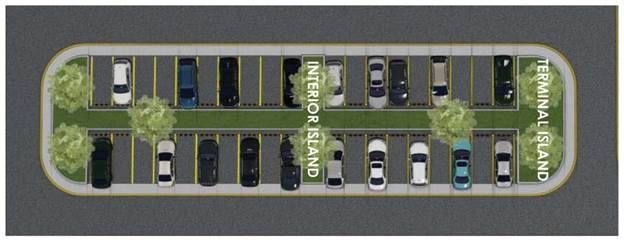
4.
Interior Islands. Interior islands shall be used to ensure there are no more than ten (10) contiguous spaces, however a design alternative may be requested to allow for greater than ten (10) contiguous spaces, so long as the total number of contiguous spaces is no more than twenty (20). Interior islands shall meet the following requirements
a.
Each interior island shall measure at least ten (10) feet in width by eighteen (18) feet in length, measured from the inside of the curb. A design alternative may be requested for smaller interior islands, so long as at least six (6) feet in width and sixteen (16) feet in length is provided.
b.
Within interior islands, one canopy tree shall be required for every 150 square feet (or fraction above one half thereof), with a minimum of one (1) canopy tree required per interior island.
c.
The landscaping materials in landscaped islands adjacent to parking spaces shall be set back a minimum of two feet behind the back of the curb to provide for pedestrian access to parked vehicles.
Figure 3.7.5.2. Interior Islands
C.
Landscaped Divider Medians. Landscaped divider medians shall form a continuous landscaped strip between abutting rows of parking areas or access drives. Landscaped divider medians shall meet the following requirements:
1.
Any hardscape (e.g., sidewalk) proposed is in addition to the minimum width required by Section 3.6.5.A.17.
2.
Landscaped divider medians shall be required for all abutting rows of parking. A design alternative may be requested for the minimum number of required landscaped divider medians.
3.
One canopy tree shall be required for each thirty-five (35) linear feet of divider median (or fraction above one-half thereof).
4.
Shrubs shall be planted in divider medians which separate parking areas from access drives to form a continuous hedge the full length of the divider median.
5.
Vehicles shall not encroach more than two (2) feet per row upon divider medians.
Figure 3.7.5.3 Divider Medians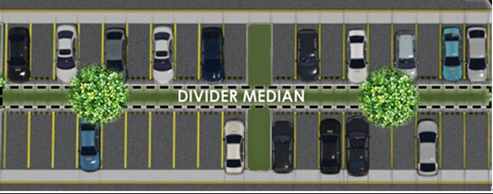
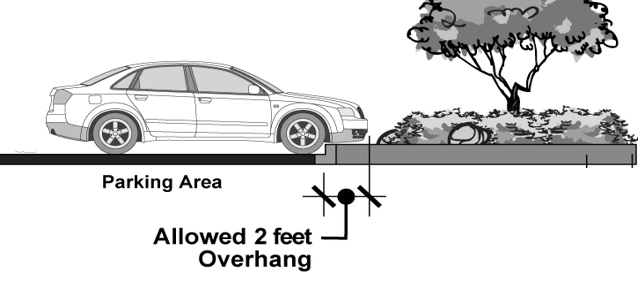
D.
Curbing and Wheel Stops. Concrete curbing shall be provided within all parking areas to prevent vehicles from encroaching onto and overhanging required plantings, sidewalks, rights-of-way or adjacent property. Wheel stops shall be consistent with Section 3.6.5: Design Standards.
E.
Protection of Existing Native Plant Communities. Consistent with the standards for preservation of existing trees and plant communities in Chapter 89, Section 3: Tree Preservation, Protection and Replacement, credit for applicable plant material may be approved by the Director in determining allowance to modify parking and access aisles. In the case of a tree that may be counted towards a tree preservation credit, said tree must be graded by a licensed arborist and approved by City staff to be in good health.
F.
Lighting. Parking lot lighting shall not be located such that it prevents the installation of required trees, or that required trees will block lighting. Parking lot lighting layout and heights shall meet the standards as set forth in Section 3.9: Lighting.
Figure 3.7.5.5 Interior Parking Area Standards Combined (For Illustrative Example
Purposes Only)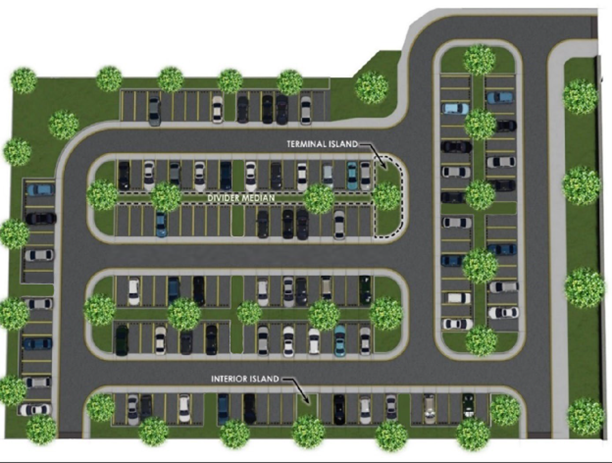
3.7.6. Miscellaneous Landscaping
A.
Landscaping Adjacent to Right-of-Way without Off-Street Parking. Perimeter standards for development without off-street parking areas adjacent to a right-of-way shall meet the following requirements:
1.
A minimum of one canopy tree per thirty-five (35) linear feet (or portion thereof), on center, shall be planted along the right-of-way. See also Chapter 89 for canopy tree requirements.
2.
A continuous hedge comprised of shrubs planted not more than thirty-six (36) inches, on center, shall be planted along the right-of-way. Species must be of sufficient type to achieve a mature height of five (5) feet from grade.
3.
Where perimeter buffers are required per Section 4.3, the right-of-way buffer shall be credited toward the perimeter buffer requirement along the portion of the lot line parallel to the right-of-way buffer. If the perimeter buffer is more intense than the right-of-way buffer, the required components of the right-of-way buffer are not required.
4.
In districts that allow for a zero foot setback adjacent to a right-of-way, where a setback of less than one (1) foot is proposed, no plantings are required adjacent to the right-of-way. A proposed setback of one (1) foot to less than five (5) feet requires foundation plantings only. A setback of five (5) feet or greater will require plantings consistent with this section.
B.
Landscaping Adjacent to Mechanical Equipment, Lift Stations, Services Areas and Dumpster Enclosures. The exterior of any service area, lift station, or dumpster enclosure shall be landscaped with:
1.
A minimum of one (1) shrub for every three linear feet, on center, and one (1) small understory tree for every 35 linear feet. Maximum growth height shall not exceed eight (8) feet or conflict with existing trees or utilities.
2.
An opaque solid fence or wall consistent with the requirements of Section 3.8: Fences, Walls, Berms and Retaining Walls, may be used to satisfy the planting requirements for these facilities provided such fence or wall is at least six (6) feet in height from grade and completely encloses the area.
3.
Landscaping and or walls/fences shall be installed no less than three (3) feet from the equipment, service area, or dumpster enclosure to allow for access, maintenance and required air flow.
(Ord. No. 2022-15, § 3(Exh. B), 7-12-22; Ord. No. 2022-31, § 2(Exh. A), 12-13-22; Ord. No. 2023-05, § 2(Exh. A), 2-28-23; Ord. No. 2023-12, § 2(Exh. A), 5-23-23; Ord. No. 2023-51, § 2(Exh. A), 1-9-24; Ord. No. 2024-11, §§ 2, 3, 6-25-24; Ord. No. 2024-16, § 2(Exh. A), 9-10-24)
3.8. - Fences, Walls, Berms, and Retaining Walls
3.8.1. Purpose and Applicability
A.
Purpose and Intent. The purpose of this section is to ensure the safe, appropriate, and aesthetically pleasing construction of fences, walls, berms, and retaining walls within the City. For the purpose of this section, fences, walls, berms, and retaining walls are all considered to be freestanding elements that are not structural elements of a building.
B.
Applicability. Unless otherwise specified in this section, fences and walls, whether required by this Code or optional, shall require a zoning permit unless otherwise permitted through building permits, or unless otherwise stated below.
1.
Exceptions. The following do not require a permit:
a.
Internal garden area fences in residential districts. For the purpose of this section, an internal garden fence is one that is five (5) feet or more from property lines and is less than four (4) feet in height and serves the purpose of protecting garden areas from animals.
C.
Design Alternatives. Consistent with Section 1.11: Design Alternatives, design alternatives may be considered for the following design elements within this section: building materials, breaks and openings in fences and walls, side and rear fence and wall heights for residential districts, all fence and wall heights for nonresidential and planned districts, and berm design standards. The purpose of the design alternative may be any of the following:
1.
To allow an establishment with uses that require high fences to protect public safety.
2.
To allow a use needing additional height to meet or exceed the compatibility standards.
3.
To allow recreation uses in which pedestrian or spectator safety cannot be guaranteed with a maximum fifteen (15) foot fence, and which may require heights greater than fifteen (15) feet.
4.
To allow for fencing materials similar in appearance to the materials used in the building(s) on the property.
5.
To allow for fencing materials that provide equal or greater protection and general appearance than the permitted materials.
6.
To allow for fencing materials more appropriate for uses near environmentally sensitive areas.
7.
To allow design options for, but not the removal of, required openings per Section 3.8.3.C.5: Breaks and Openings in Fences and Walls.
3.8.2. General Standards
A.
Setbacks. Fences, walls, berms, and retaining walls may encroach into setbacks unless otherwise indicated in this section. However, a berm may not be constructed in a manner that any portion of the berm's slopes extend over the property line.
B.
Right-of-Way. No fence, wall or berm may encroach into a public right-of-way. Fences and walls shall not block any required ingress or egress point.
C.
Visibility Triangles (Sight Distance). No fence, wall, berm, or retaining wall may encroach into a designated visibility triangle for driveways or for the intersections of rights-of-way subject to Sections 3.1.8.F: Visibility Triangle.
D.
Maintenance. All fences, walls, berms, and retaining walls must be properly maintained consistent with the permit for which they were approved and meet property maintenance standards set forth in Chapter 88. Any damage or deterioration due to age, damage, neglect, or weather must be repaired.
E.
Measurement of Height.
1.
Height shall be measured from the existing natural grade upon which the structure to be measured sits. Where a grade change would result in a height greater than six (6) feet, fences may be installed to maintain a continuous straight edge along the top of the fence; however, such fence may be no taller than eight (8) feet above grade at any point.
2.
An additional maximum one (1) foot of height may be permitted for decorative details including posts, columns, and light fixtures.
F.
Vacant Properties. Fences and walls may be installed on vacant properties and properties with no active uses. Only open fences, as defined in Section 3.8.3.B., shall be permitted along a street frontage.
3.8.3 Fences and Walls Material and Design Standards
A.
Finished Sides. All fences and walls shall be installed with the finished side facing towards the exterior or adjoining properties and rights-of-way.
B.
Design. Fences and walls shall comply with the design requirements established for the zoning district (if applicable).
1.
Fencing Materials. Fences and walls must be constructed of concrete, concrete block, brick, wood, decorative metal (aluminum, iron or steel), or vinyl materials. Where there is a conflict, the standards of Section 7: Historic Architectural Preservation Controls and Standards, shall prevail. Unless required by law, no fence or wall may be constructed of non-traditional or dangerous fence or wall materials including, but not limited to, barbed wire, razor wire, scrap metal, railroad ties, or any other material determined by the Director to be detrimental to the public health, safety and welfare. Nets, sheets, or slats made of fabrics plastic, metal, or vinyl may not be used as part of the fence nor may such materials be attached to a fence for the purpose of effecting privacy or required screening.
2.
Columns. Solid support columns shall not be larger than sixteen (16) inches in width and length and shall be spaced eight (8) feet on center. Support columns are limited to six (6) feet in height, and may be topped with decorative elements for a total height of up to seven (7) feet.
3.
Chain Link and Similar. Chain link, chicken wire, hardwire cloth and other woven or mesh products are not permitted in front yards in any district.
4.
Open Fences. Open fences shall be defined as wood or metal picket, wrought iron, vinyl, or similar designs, with a solid to open ratio of not more than 1:4.
Figure 3.8.3. Open Fence Ratio 1:4 (Illustrative Example Only)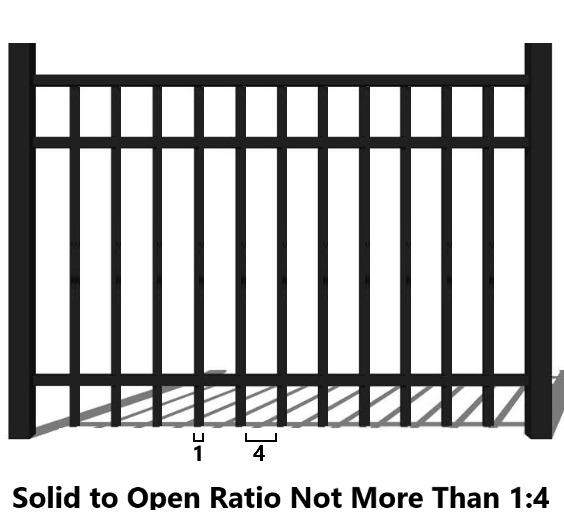
5.
Breaks and Openings in Fences and Walls. Consistent with Intent OS 1.6 of the City's Comprehensive Plan and Chapter 89 of the LDC, no fence or wall shall exceed five hundred (500) continuous linear feet in length without providing for a break in the fencing or wall to allow for the movement of wildlife and connectivity of wildlife corridors, as applicable, subject to the following:
a.
Wildlife breaks and openings shall be a minimum width of twenty-five (25) feet to allow for wildlife movement.
b.
Wildlife breaks and openings may include plantings of trees, shrubs, and other ground coverings provided the plantings will not grow into a complete blockage of the opening.
3.8.4. Height of Fences and Walls
A.
Fence Height Requirements for Residentially-Zoned Properties. Fences and walls for residentially zoned properties, including residential properties within a PUD (unless otherwise regulated within the PUD zoning standards), that are not required walls or fences for perimeter compatibility requirements shall meet the following requirements:
1.
Front Setback Height. Fences and walls in a front setback may be a maximum three (3) feet in height; open fences, as defined in Section 3.8.3.C.4, may be a maximum six (6) feet in height.
2.
Side and Rear Setback Height. Fences and walls in a rear or side setback may be a maximum six (6) feet in height.
3.
Waterfront Setback Height. Fences and walls in a waterfront setback may be a maximum four (4) feet in height, and must be open at a ratio of 1:4. Fences and walls in waterfront setbacks may connect to a seawall. Fences or walls in a waterfront setback that are not connected to a seawall shall not be higher than the top of the bank.
Figure 3.8.4. Fence Heights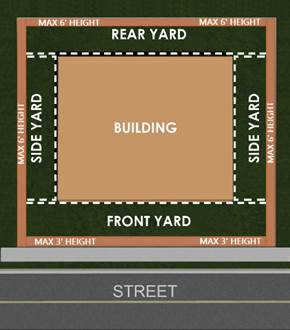
B.
Fence Height Requirements for Nonresidential-Zoned Properties and Mixed Use Districts.
1.
Height. Height requirements shall be as provided below:
a.
Height. Fences and walls may be a maximum six (6) feet in height.
b.
IND and PID Zoning Districts. Fences and walls may be a maximum eight (8) feet in height.
c.
State or Federal Agencies. Fences and walls may exceed the height in Subsections a. and b. above, if required by state or federal agency requirements. Material and locational requirements of this section may not apply, but the fences and walls shall be landscaped.
d.
Recreation Uses. Fences surrounding recreation uses such as tennis, pickleball, or other outdoor courts may be a maximum fifteen (15) feet in height. These fences may be of chain link or similar open materials to allow for visibility into the recreational area.
e.
Refuse Collection Areas. Fences and walls surrounding refuse collection areas shall be between six (6) feet and eight (8) feet in height.
C.
Mobile Home and Recreational Vehicle Parks. Fences installed on the perimeter of mobile home and recreational vehicle parks shall comply with Section 2.2.2.C.
3.8.5. Berms, Retaining Walls and Slopes
A.
City Standard Details. The latest version of the City of Venice Standard Details, General Notes and Testing Requirements, as amended, hereafter referred to as the "City Standard Details," shall be utilized for the permitting and construction of all berms, walls, and slopes as may be applicable. Where conflicts between this Code and the latest version of the City Standard Details exist, the City Standard Details shall apply.
B.
Design Standards. Berms, retaining walls and slopes shall conform to the following standards:
1.
Berms. Berms may be located in setbacks subject to the following:
a.
Shall not exceed a grade of one (1) foot of rise in three (3) feet of length.
b.
May also feature walls as permitted in Section 4: Compatibility of this LDC.
c.
Shall be landscaped and shall meet all landscape requirements as required in Section 3.7: Landscaping.
d.
Shall not exceed a total of ten (10) feet above the toe of the berm. The toe of the berm shall be defined as the base or bottom of a berm slope at the point where the ground surface abruptly changes to a significantly flatter grade.
Figure 3.8.5. Berms and Walls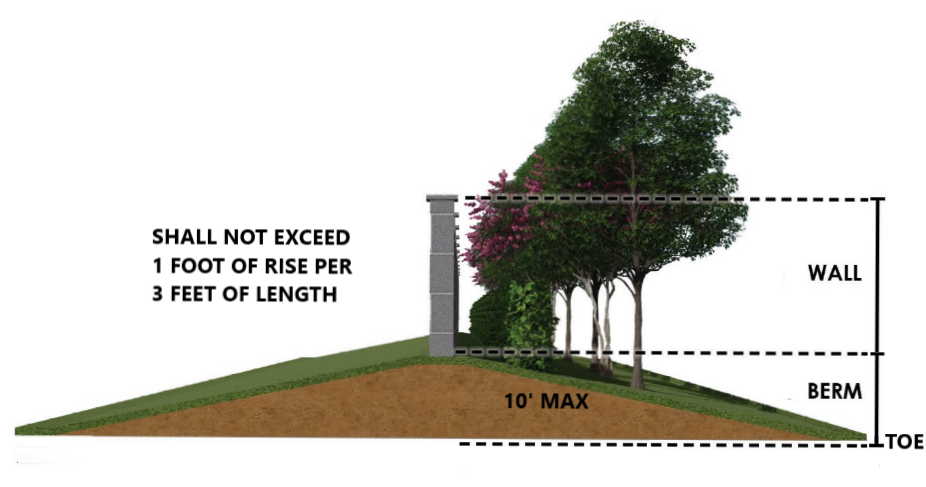
2.
Retaining Walls. In a residential zoning district, if a fence is installed on a retaining wall, the external height of the retaining wall shall count towards the height of the fence.
3.
Slopes. Within all residential zoning districts, the grade of slope in any setback shall not exceed one foot of rise in four (4) feet of length.
(Ord. No. 2023-49, § 2, 12-12-23)
3.9. - Lighting
3.9.1. Purpose and Applicability
A.
Purpose and Intent. The purpose of this section is to ensure all exterior lighting shall be designed, installed, and maintained to provide safe, convenient, and efficient lighting for customers, pedestrians, and vehicles, while minimizing adverse impacts on adjacent properties and conserving energy. Additional and specific lighting standards in Chapter 89 Environmental for Marine Turtle Lighting and the Venice Municipal Airport Master Plan shall also apply.
B.
Applicability. The provisions of this section shall govern outdoor lighting (or "exterior lighting") for all development and redevelopment with the exception of the following:
1.
Single-family detached and attached units;
2.
Lighting for bridges, flags, and public buildings;
3.
Temporary holiday/event lighting;
4.
Lighting required by federal, state or local laws and regulations;
5.
Work in the public right-of-way;
6.
Street lights or other lighting within public rights-of-way; and
7.
Lighting subject to Section 7: Historic Architectural Preservation Control and Standards.
C.
Design Standards. All exterior lighting shall be designed to incorporate shielding to minimize impact to surrounding properties except as otherwise provided in this section. Lighting shall be provided for the following:
1.
Essential walkways, pedestrian routes, and common areas such as building entrances and stairwells;
2.
Car areas, including parking lots, driveways, and drive aisles; and
3.
Space around buildings.
D.
Design Alternatives. Consistent with Section 1.11: Design Alternatives, design alternatives may be considered for requirements within Section 3.9.3: Outdoor Lighting Standards. Design alternatives may not be proposed for any standards listed as prohibited or for any beachfront standards or other lighting regulations related to Marine Turtle Lighting Standards as defined in Chapter 89.
E.
Height Calculation. Where this section mentions height of lighting fixtures, the height of outdoor lighting fixtures shall be measured from the finished grade to the top of the fixture.
3.9.2. Lighting and Photometric Plans
A.
Lighting and Photometric Plans. Lighting and photometric plans shall be required during review of any site and development plan to determine consistency with these regulations. Unless otherwise exempt, it is a violation of this section to install or operate outdoor lighting without first obtaining lighting plan approval and subsequent necessary permits.
B.
Application Requirements. At a minimum, the lighting and photometric plans must meet the following requirements:
1.
The plan must be prepared by a licensed engineer, who shall sign and seal the plans and certify that the plan complies with this section.
2.
The plan must be of an engineered scale that is easily legible.
3.
The plan must show all proposed and existing buildings on the site, pedestrian and vehicular areas, other above ground improvements, the horizontal location of all proposed and existing outdoor lighting fixtures including pole and wall-mounted fixtures, mounting heights of each fixture, overall height of each pole above grade, location of externally illuminated signs and associated fixtures, and the location of all architectural and landscape lighting fixtures.
4.
The plan shall include the hours of operation for the facility.
5.
The plan must show initial horizontal illuminance values in footcandles for the area to be illuminated; other types of illuminance measurement are not acceptable. These values must be calculated at grade and include contributions from all onsite fixtures. The plan must plot footcandles of illumination at ground level to the nearest tenth of a footcandle, and at horizontal grid intervals of no more than ten (10) feet.
6.
The manufacturer's cut sheets (specifications) for each proposed fixture must be submitted.
7.
The plan must include a lighting fixture schedule that presents the following information:
a.
Lighting fixture plan identification symbol or abbreviation.
b.
Fixture type, including the manufacturer's product identification catalog number.
c.
Lamp type and wattage or LED luminaire wattage.
d.
Fixture mounting height.
3.9.3. Outdoor Lighting Standards
A.
General Outdoor Lighting Standards. All lighting and photometric plans must conform to the following regulations:
1.
Footcandles. Illumination levels shall be measured in footcandles, defined as one lumen per square foot. Footcandles shall not exceed 0.5 footcandles at the property line where the neighboring property is a residential use or a residential zoning district. For all other uses, illumination levels may not exceed 1.0 footcandles at the property line, not including entrances to nonresidential and multifamily uses which may not exceed 5.0 footcandles. To avoid glare and light trespass onto neighboring properties, fixtures must be installed with shields and reflectors. Fixtures shall not be oriented towards adjacent properties.
2.
Cutoff Fixtures. All fixtures, except for street lighting fixtures, including security lighting, must be cutoff fixtures. Cutoff fixtures shall project all light in a downward direction.
Figure 3.9.3.1. Cutoff Fixtures (Illustrative Example)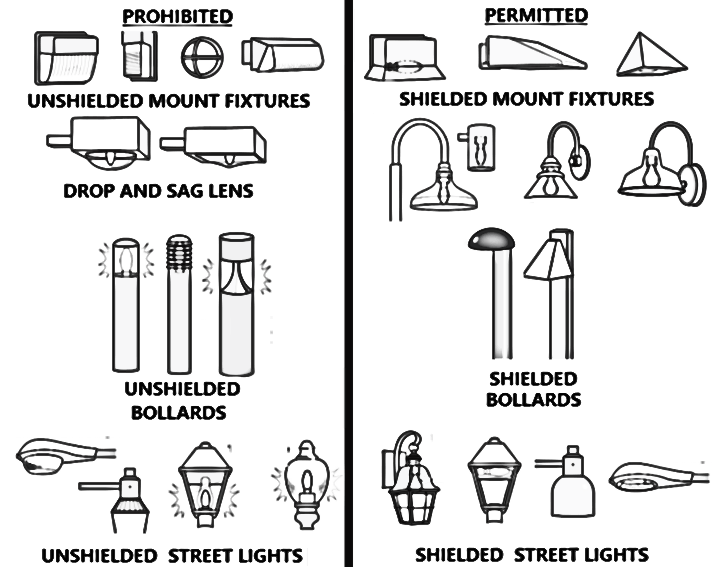
3.
Design. All fixtures must be incorporated into the building or site as an integrated design element through the use of common or complementary style, material, and color.
4.
Prohibited. The following are prohibited:
a.
Sag lenses, convex lenses, and drop lenses.
b.
Floodlighting.
5.
Flag Lighting. Lights used to illuminate flags are exempt, provided flag lighting illuminates the flag in a narrow beam only. Preference is for downward-directed light.
6.
External Building Lighting. Fixtures that decoratively light a building or wall may not light above the parapet of the building or the top of the wall. Design alternatives may be permitted for this section. Alternatives must not project light off-site, including into the sky.
7.
Pedestrian Level Lighting. Pedestrian level lighting is required within parking lots, along sidewalks, along multimodal paths, and within civic spaces and public gathering spaces. street lighting is not considered pedestrian level lighting. In no cases shall this type of lighting exceed twelve (12) feet in height. Bollard or path lighting shall not exceed a three (3) foot mounting height. All such lighting shall be shielded and downward directed.
8.
Parking Area Lighting. To avoid conflict in layout, parking lot lighting must be coordinated with the parking lot's landscaping. Lighting design shall be coordinated with the landscape plan to ensure that vegetation growth will not substantially impair the intended illumination by proper placement of landscaping and light sources. The height of light fixtures within a parking area shall be staggered so that the tallest fixtures are in the center of the parking lot and the lowest heights are at the perimeter of the parking lot. Light fixture height shall not exceed thirty (30) feet within the center of a parking area and shall decrease in height to a range of twelve (12) to fifteen (15) feet at the perimeter of the parking area.
Figure 3.9.3.2. Parking Area Heights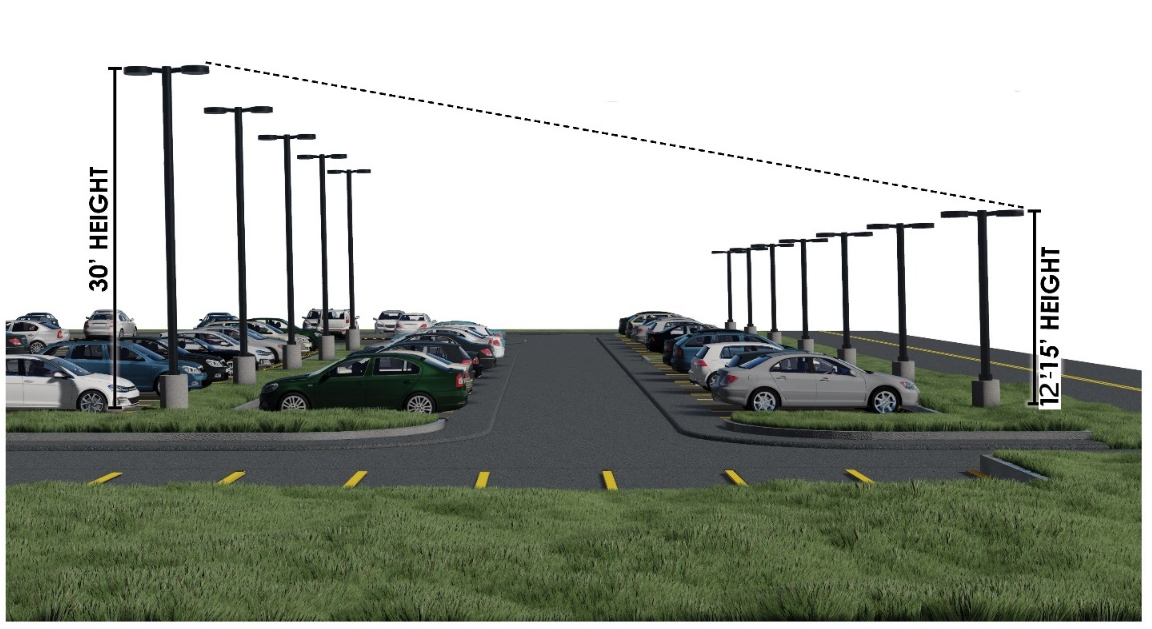
B.
Special Regulations for Outdoor Lighting. Outdoor lighting plans must conform to the following regulations, where applicable:
1.
Walkways, Bikeways, and Trails. Walkway, bikeway, parks and trail lighting, and pedestrian facilities such as building connections or walkways to parking (excluding sidewalks) must conform to the following regulations:
a.
Intrusion. All lighting shall be designed and installed to illuminate with a smooth, even pattern, without glare or light flow intrusion in excess of 0.5 footcandles onto adjacent properties as provided for by the horizontal grid intervals on the lighting plan.
b.
Footcandles. Illumination levels along the walkway, bikeway or trail, must range between 0.2 and 0.5 footcandles. Nature trails, walkways, and bikeways may be exempted from this minimum illumination level by the Director if the natural environmental objectives and purposes of the trail, walkway, or bikeway would be unreasonably compromised by this minimum lighting requirement and the location and environmental design of the trail, walkway, or bikeway reasonably provides natural surveillance and otherwise protects public safety. A design alternative may be requested for footcandles.
2.
Parking Garages. Interior fixtures must be shielded to prevent light spilling from the garage. Light fixtures on the top deck of a parking garage may not exceed fifteen (15) feet in height and must be shielded to prevent light trespass on to the adjacent properties. Rooftop lighting of parking garages must be set back a minimum twenty-five (25) feet from the perimeter of the rooftop.
3.
Canopied Areas for Vehicles. Lights and light fixtures for canopied areas commonly used for vehicular use such as drive-through facilities or gas stations must be recessed or cutoff fixtures and must conform to the following standards:
a.
Fixtures in canopies may not rely on surrounding structures, including canopy edge, for required shielding.
b.
Canopy fascia may not be internally lit.
c.
LED lighting strips or neon tubing shall not be permitted.
4.
Outdoor Sports Fields and Performance Areas. Lighting of outdoor sports fields and performance areas shall comply with the following regulations:
a.
Glare Control Package. All lighting fixtures shall be equipped with a glare control package (e.g., louvers, shields, or similar devices) and aimed so that their beams are directed and fall within the primary playing or performance area.
b.
Hours of Operation. The hours of operation for the lighting system for any game or event shall not continue more than one and half hours after the end of the game or event.
c.
Height of Fixtures. Light fixtures shall not exceed a height of eighty (80) feet.
d.
Buffers Adjacent to Residential Properties. A landscaped buffer yard sufficient to prevent light trespass and glare spillover to adjacent residential properties may be required by the Director.
5.
Properties Subject to Marine Turtle Protection. See Chapter 89 for lighting standards.
6.
Rooftop Uses. Lighting for rooftop uses (such as a restaurant or lounge) shall not exceed twelve (12) feet in height. Lighting fixtures shall be located no less than ten (10) feet from the perimeter of the building and not face outward. All lighting shall be designed to effectively eliminate glare, be shielded to prevent light spilling over the side of the building, and shall be turned off when the rooftop area is not in use.
7.
Sign Lighting. Lighting fixtures illuminating signs shall comply with the standards of Section 3.5: Signs, and such fixtures shall be aimed and shielded so that direct illumination is focused exclusively on the sign face.
8.
FAA Lighting. Lighting at the Venice Municipal Airport shall comply with all FAA rules and regulations and the Venice Municipal Airport Master Plan.
(Ord. No. 2022-15, § 3(Exh. B), 7-12-22)

