
Venice City Zoning Code
SECTION 7
- HISTORIC AND ARCHITECTURAL PRESERVATION CONTROLS AND STANDARDS
7.1. - Introduction and History
A significant portion of the City of Venice was initially developed in accordance with a master plan prepared in 1925 by John Nolen, a nationally renowned city planner. The City has benefitted greatly from the Nolen city plan as a guide and vehicle for orderly development, including the layout of a master street system with broad avenues and boulevards, the designation of residential, commercial, public, and industrial areas, and particularly the provision for adequate parks and open spaces.
The initial development of the City under the Nolen city plan was subject to architectural review and control that established a thematic design concept of the Italian Renaissance style. A significant number of structures built prior to 1930 were of the Italian Renaissance style (hereinafter referred to as the "Nolen Era") and approximately 140 such structures remain in existence today. These structures provide a distinctive theme and charm to portions of the City, which the City desires to maintain and preserve. The John Nolen Plan of Venice Historic District is currently listed in the National Register of Historic Places and is included in the City's Comprehensive Plan as Map LU-10.
The City continues to believe that the preservation of the historical planning and architectural integrity of the community, and the regulation of general aesthetics in certain areas of the City, furthers a proper public purpose by preserving and enhancing the beauty and charm of the City, enhancing the attractiveness of the area for tourists, residents and commerce, improving the local economy, improving property values and generally improving the overall quality of life of City residents and visitors.
(Ord. No. 2022-15, § 3(Exh. B), 7-12-22)
7.2. - Purpose and Intent
A.
The Historic and Architectural Preservation Board (HAPB) shall conduct studies and make recommendations on matters of historical and architectural interest and preservation; process requests for inclusion of properties, structures, and landmarks to the local historic register; establish local historic architectural control districts; administer historic preservation, architectural, and aesthetic standards to apply in appropriate areas or districts of the City; and further public awareness of the City's past and of preservation in general and to develop programs to stimulate public interest and involvement in historic, architectural, and cultural preservation.
B.
In carrying out these duties, the HAPB will comply with the requirements for attaining and maintaining a Certified Local Government (CLG) designation as required by 16 U.S.C. 470 et seq., as amended. Specifically, the Board shall:
1.
Identify and nominate eligible properties to the National Register of Historic Places, and notify appropriate local officials, and owners of record of eligibility to the National Register of Historic Places. The Board shall also act as a complement to the Florida National Register Review Board and shall review and comment on nominations forwarded by the State Historic Preservation Office.
2.
Identify and nominate properties for the local register of historic places.
3.
Develop and maintain a system for survey and inventory of historic properties. Such inventory shall be compatible with the Florida Master Site File.
4.
Assist the Planning Commission in the preparation, implementation, and administration of historic preservation in the City's Comprehensive Plan.
5.
Provide educational opportunities and further public participation in local historic preservation and architectural programs.
6.
Gather information necessary for drafting, establishing, and maintaining guidelines for best practices for historical preservation and architectural review.
7.
Ensure that new buildings are compatible with the historic area standard wherein the structure will reside.
8.
Submit an annual report and other documents as necessary to the State Historic Preservation Officer to retain the CLG designation.
9.
Perform any other functions which may be designated by City Council.
(Ord. No. 2022-15, § 3(Exh. B), 7-12-22)
7.3. - Manager of Historic Resources
A.
General Duties and Responsibilities. The City Manager shall appoint a Historical Resources Manager (HRM) who shall serve as the City's Historic Preservation Officer and provide needed expertise and advice to the HAPB on historic preservation matters. The HRM will be responsible for processing all National and Local Register applications, developing and maintaining the inventory of historic architectural properties, providing educational opportunities regarding historic preservation, and furthering public participation in local historic preservation and architectural programs. The HRM will also perform such other duties, activities, and reporting as necessary to help the City maintain a CLG designation.
B.
Specific Review Authority. The HRM shall also be responsible for reviewing and approving all requests for alterations, additions, and renovations for non-Nolen Era properties that are included on the Local Register using the appropriate guidelines promulgated by the Secretary of the Interior. Any appeals of the HRM's decisions shall be heard by the HAPB. The HRM may also defer decisions on proposed changes to non-Nolen Era properties to the HAPB.
(Ord. No. 2022-15, § 3(Exh. B), 7-12-22; Ord. No. 2022-31, § 2(Exh. A), 12-13-22; Ord. No. 2023-05, § 2(Exh. A), 2-28-23)
7.4. - National Register
A.
Nominating properties or districts to the National Register of Historic Places shall follow the procedures laid out in 54 USC § 302504, Participation of certified local governments in National Register nominations.
B.
Properties or districts currently listed in the National Register of Historic Places are eligible for nomination to the Local Register of Historical Resources based upon the regulations set forth in Section 7.7: Local Register and Landmarks.
(Ord. No. 2022-15, § 3(Exh. B), 7-12-22)
7.5. - Applicability
A.
This section applies to historic and architectural resources which include sites, buildings, structures, objects, landscape elements and settings, and areas public or private that are historically, architecturally, culturally, and/or archaeologically significant, including:
1.
Areas of the City that have been designated as local architectural control districts.
2.
Designated local historic landmarks.
(Ord. No. 2022-15, § 3(Exh. B), 7-12-22)
7.6. - Historic Architectural Control Districts
A.
There are hereby established districts in the City to which architectural standards for the design of structures shall be applied.
7.6.1. Historic Venice (HV) District
A.
This district shall include those areas of the City having a preponderance of structures constructed during the years 1925 through 1929 located within the original core of the City. (See Figure 7.6.3. below.) The intent of this district shall be the preservation and furtherance of the architectural heritage of the City by mandating that all new construction, and alterations to existing structures, be made in the Venice Historic Precedent (VHP) Style.
7.6.2. Venetian Theme (VT) District
A.
This district shall include areas at the periphery of the HV district within the original planned area of the City, and also includes the South Trail Mixed Use District. (See Figure 7.6.3. below.) The intent of this VT district is that all new construction and alterations, except for new and existing detached single-family homes, shall incorporate the architectural design elements of the Venice Historic Precedent Style so as to allow a seamless transition from the Historic District to the remainder of the City.
7.6.3. Mixed-Use Districts
A.
Three (3) Mixed-Use Districts are included within the areas defined by Sections 7.6.1 and 7.6.2: the Venice Avenue, Downtown Edge, and South Trail Mixed-Use Districts. For the remaining Mixed-Use Districts (Airport, Seaboard, North Trail, Laurel West, Laurel East, Knights Trail, Knights Trail Transition) architectural standards and controls are defined within each district's regulations in Section 2 of this Code and may include elements of the Venice Historic Precedent Style.
B.
PUDs implementing the Mixed-Use Residential (MUR) Future Land Use may have architectural standards and controls established within their binding master plans. These standards and controls shall continue to be recognized as required even if they are different than the present Code requirements. New PUDs that are subject to architectural controls shall include an architectural component to the binding master plan defining the architectural elements and styles for the proposed PUD.
Figure 7.6.3. Architectural Control Districts Overlay Map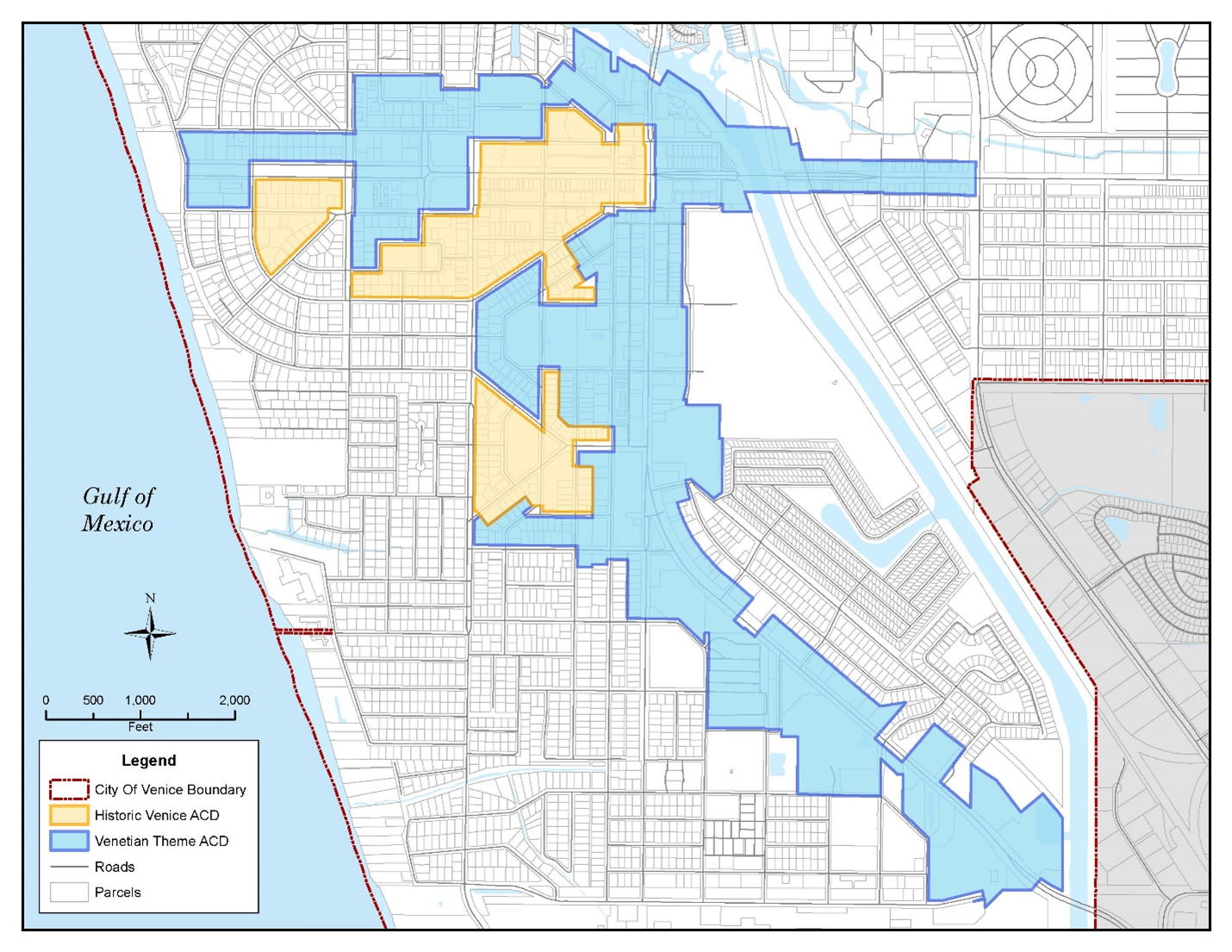
(Ord. No. 2022-15, § 3(Exh. B), 7-12-22; Ord. No. 2022-31, § 2(Exh. A), 12-13-22)
7.7 - Local Register and Landmarks
A.
The City has a Local Register of Historical Resources ("Local Register") which consists primarily of properties built during the John Nolen Era (1925-1929) and architecturally designed consistent with the Venice Historical Precedent style that the property owner has requested be included on the Local Register. The benefits to the property owners include:
1.
Qualified improvements are entitled to a 10-year Ad Valorem Tax Exemption equal to the amount that the taxes would have increased due to the improvements made.
2.
Properties in a flood plain can be restored even if the cost exceeds 50% of the assessed value.
3.
Properties are entitled to modified enforcement of the Florida Building Code ("FBC") as provided by the FBC.
4.
Properties are designated as conforming for zoning considerations.
5.
Properties are given special consideration for home occupations and other special exceptions by the Planning Commission upon application.
6.
They are exempt from fees normally required for development review permits.
B.
Other places, buildings, structures, landscape features, or sites that have unique historical, architectural, cultural, and/or archaeological significance that were constructed outside the Nolen Era may be considered for inclusion on the Local Register.
C.
The HAPB shall review and make recommendations to City Council for Local Register designations that meet one or more of the following:
1.
Are significant in the City's history and culture and possess an integrity of location, design, setting, materials, workmanship, or association;
2.
Are associated with distinctive elements of cultural, social, political, economic, scientific, religious, prehistoric, paleontological, and architectural history that have contributed to the pattern of history in the community, the city, the county, the state, the region, or the nation;
3.
Are associated with the lives of persons significant in past history;
4.
Embody the distinctive characteristics of a type, period, style or method of construction or work of a master; or possess high artistic value; or represent a distinguishable entity whose components may lack individual distinction;
5.
Are a traditional cultural property associated with the cultural practices, traditions, beliefs, ways of life, arts, crafts, or social institutions of a living community;
6.
Have yielded or are likely to yield information in history, ancient history, or prehistory;
7.
Are listed individually in the National Register of Historic Places;
8.
Are a contributing structure to a National Historic District; or
9.
Are characterized as a geographically definable area possessing a significant concentration, linkage, or continuity of historically, architecturally, or culturally significant sites, buildings, objects, or structures united by past events or aesthetically by plan or physical development.
D.
Non-Nolen Era properties on the Local Register are exempt from the Venice Historic Precedent.
E.
No nomination for placement of a historic property, landmark, or historic resource on the Local Register shall be accepted by the City without the written consent of the owner of the property, landmark, or resource.
F.
No City permits for any demolition, alteration, construction, relocation, land disturbing or development activities shall be issued once a completed nomination has been accepted until the City Council acts to approve or deny the nomination or for a period of twelve months, whichever shall occur first.
G.
Upon receipt of a nomination form, including necessary documentation, the following review process shall occur:
1.
The HRM shall review the nomination for completeness and accuracy. If the HRM determines the nomination is incomplete or inaccurate, the applicant shall be so notified and provided an opportunity to revise the nomination.
2.
Once a nomination is accepted as complete and accurate, City staff shall schedule a public hearing for consideration of the nomination within ninety (90) days at a regular meeting of the HAPB. Notice shall be provided consistent with Sections 1.2.E.2. and 3. The ninety (90) days may be extended by written consent of the property owner.
3.
The HAPB shall consider the criteria set forth in Section 7.7.C. and render a recommendation to City Council including a determination of suitability for inclusion on the Local Register. The recommendation to City Council shall include specific findings and conclusions as to why the nomination does or does not meet the appropriate criteria.
4.
The City Council shall be the final decision authority on nominations to the Local Register. The City Council shall consider HAPB's recommendation at its next available regular meeting.
5.
Whenever City Council denies a nomination, no further nomination shall be filed for the same historical resource for a period of one year from the date of such denial. The time limit stated herein may be waived by the Council when this action is deemed necessary in the best interests of the City.
H.
Local Register designations may be amended or rescinded through the same procedures for establishing the designation in subsection G. above.
(Ord. No. 2022-15, § 3(Exh. B), 7-12-22; Ord. No. 2022-31, § 2(Exh. A), 12-13-22; Ord. No. 2023-05, § 2(Exh. A), 2-28-23)
7.8. - Changes to Historic and Architectural Resources
A.
There are four types of changes to historic and architectural resources for which the City requires prior approval. These include:
1.
Alterations, additions, and new construction in Historic Architectural Control Districts, as applicable;
2.
Alteration, additions, restoration, or repair of historic resources on the Local Register;
3.
Demolition of any structure on the Local Register or any structure from 1929 or older within the Historic Architectural Control Districts; and
4.
Relocation of any structure on the Local Register, or any structure from 1929 or older within the Historic Architectural Control Districts.
B.
These changes are governed by specific processes and criteria for evaluation that are described in the following sections for Certificates of: Architectural Compliance, Appropriateness, Demolition, or Relocation.
7.8.1. Certificate of Architectural Compliance (CAC)
A.
Applicability.
1.
A CAC is required for the following within the HV and VT districts:
a.
All new structures, including accessory structures.
b.
New carports and canopies.
c.
Any exterior alteration to a street or alley facing elevation that requires a building permit, unless exempted by this section.
d.
When there is an alteration to a facade or elevation that requires a CAC (excluding a minor alteration where a minor alteration is a change to fewer than three items from Sections 7.10.3-7.10.8), then the entire elevation or facade shall be brought into compliance with the regulations. Other elevations or facades are not required to be brought into compliance at that time.
e.
Any color change to a nonresidential or multifamily residential structure. For properties within the HV District, color changes for single family and single family attached structures must comply with the colors of the VHP but are not required to obtain a CAC. For properties within the VT District, color regulations do not apply to single family and attached single family structures.
2.
A CAC will also be required for all Nolen-Era properties included on the Local Register.
3.
All Nolen-Era properties that are on the Local Register and/or within the HV or VT districts are subject to review of the Secretary of the Interior's Standards as referenced in Sec. 7.8.3.C. The HRM shall provide analysis of the standards for the HAPB to consider in its decision to approve or deny a CAC.
B.
Exceptions.
1.
Ordinary Maintenance. Nothing in this section shall be construed to prevent the ordinary maintenance or repair of any resource, which does not involve a change in the design, material, or outer appearance thereof. For Nolen-Era properties, replacement of materials must be compliant with the VHP.
2.
No CAC shall be required for the following:
a.
Detached single-family and attached single-family residential properties in the VT District not on the Local Register, except for Nolen-Era properties, which require a CAC for changes other than ordinary maintenance and repair.
b.
Minor maintenance and repair work where such work does not require a building permit in either the HV or VT District.
c.
Accessory structures that are screened to adjoining properties and rights-of-way with a wall, fence, or intervening principal structure.
d.
Screened enclosures where such enclosures are screened by a fence or wall from adjacent rights-of-way.
e.
Signs in either the HV or VT District.
f.
Actions required to repair damage to a structure caused by natural forces, fire, or other events beyond the control of the owner unless the total cost of the repairs (which include material and labor) exceeds 50 percent of the market value of the structure as it existed prior to the damage as determined by the Sarasota County Property Appraiser or as determined by a more recent appraisal.
g.
Replacement of only windows and doors provided there is no change in the size of the openings and provided the replacement doors and windows comply with the VHP.
h.
Structures in either the HV or VT District that are not constructed in the VHP style but are on the Local Register are subject to review by the Historical Resources Manager.
i.
Structures in either the HV or VT District that are not constructed in the VHP style but are historically significant or substantially constructed in a different style (such as, but not limited to, the Sarasota School of Architecture).
j.
The Director or designee shall determine whether an exception applies and may defer such a decision to the HAPB.
C.
Criteria. New structures and changes to structures in the HV and VT Districts that require a CAC shall incorporate the design characteristics of the VHP Style.
D.
Application and Review.
1.
An optional pre-application meeting may be held with the HAPB to review the proposed project prior to filing the application. The purpose of this meeting is to provide assistance to the applicant in developing plans in accordance with the guidelines.
2.
Application Requirements.
a.
To scale drawings sufficient to show the architectural definition of the structure.
b.
Full elevation views of each façade.
c.
Door and Window details.
d.
Roof design and materials of roof.
e.
Wall texture or finish and color.
f.
Location and screening of mechanical equipment.
g.
Any such other details determined to be necessary by the Director to determine compliance with the VHP Style.
h.
Applicable fee as established by City Council through resolution which may be amended from time to time.
i.
Any applicable Variance or Design Alternative necessary to facilitate approval of the CAC.
3.
Upon receipt of a complete application for a CAC, as determined by the Director, City staff shall schedule a public hearing during the next available regular meeting of the HAPB. Notice of a public hearing shall be consistent with Section 1.2.E.
4.
The HAPB shall consider the application and input received at the public hearing and, based upon these regulations shall:
a.
Grant the Certificate of Architectural Compliance; or
b.
Continue the application to a date certain for the applicant to consider comments by the HAPB and study alternative means whereby the application may be brought into conformity with applicable criteria; or
c.
Grant the Certificate of Architectural Compliance with conditions; or
d.
Deny the Certificate of Architectural Compliance and issue a development order stating the reasons for denial of the application.
5.
Appeals of HAPB decisions shall be processed in accordance with Section 1.16.
E.
Expiration of Certificate of Architectural Compliance. A Certificate of Architectural Compliance shall be valid for one year from the approval. The HAPB may grant additional time upon request, not to exceed an additional one year.
F.
Amendments. Any change in the scope of work pursuant to the approved Certificate of Architectural Compliance, after the issuance of the Certificate, shall require an amendment to the Certificate to be processed under the procedures set forth in this section.
G.
Violations. It shall be a violation of this section if work is not performed in accordance with an approved Certificate of Architectural Compliance.
7.8.2. Authority of Director
A.
The Director (or designee) shall determine when a CAC is required by these regulations. The Director may request an advisory opinion from the HAPB as to whether a CAC is required for a specific project. The Director or designee shall have the authority to authorize the issuance of building permits for construction when it has been determined that no CAC is required and all other building code requirements have been met.
B.
The Director or designee shall have the authority to issue a CAC for minor alterations in the HV or VT Districts when the plans comply with these regulations.
C.
In situations where no CAC is required but improvements are required to comply with the regulations, including, but not limited to, minor alterations, certain window and door changes, and color changes, the Director or designee shall have the authority to determine compliance with the regulations. The Director may seek guidance from the HAPB at a public meeting.
7.8.3. Certificate of Appropriateness (COA)
A.
Applicability. A Certificate of Appropriateness is required for alterations, restorations, additions, and repairs to non-Nolen Era historic resources included on the Local Register.
B.
Exceptions:
1.
Ordinary Maintenance. Nothing in this section shall be construed to prevent the ordinary maintenance or repair of any resource, which does not involve a change in the design, material, or outer appearance thereof.
2.
Emergency Conditions and Unsafe Buildings. For the purpose of remedying emergency conditions determined to be imminently dangerous to life, health or property, or resources determined to be unsafe by the Building Official, nothing contained in this section shall prevent the making of any temporary construction, reconstruction, demolition or other repairs to a resource pursuant to an order of a government agency or a court of competent jurisdiction, provided that only such work as is reasonably necessary to correct the hazardous or unsafe condition may be carried out. The owner of a resource damaged by fire or natural calamity shall be permitted to stabilize the resource immediately and to rehabilitate it under the normal review procedures of this section and Chapter 88 as applicable.
3.
Economic Hardship. Where, by reason of particular site conditions and restraints, or because of unusual circumstances applicable solely to the particular applicant, strict enforcement of the provisions of this section would result in economic hardship to the applicant, the HRM may grant a Certificate of Appropriateness exempting the applicant from some or all of the requirements. In any instance where there is a claim of economic hardship, the owner shall submit, by affidavit, to the HRM the following information:
a.
For All Properties:
i.
Two estimates from an architect, developer, real estate consultant, appraiser, or other real estate professional experienced in rehabilitation as to the economic feasibility of rehabilitation or reuse of the existing structure on the property;
ii.
A statement of the credentials of each professional providing an estimate;
iii.
The assessed value of the land and improvements thereon according to the two most recent assessments;
iv.
Real estate taxes for the previous two years;
v.
Annual debt service, if any, for the previous two years;
vi.
All appraisals obtained within the previous two years by the owner or applicant in connection with his purchase, financing, or ownership of the property; and
vii.
Any listing of the property for sale or rent, price asked and offers received, if any.
b.
For Income-Producing Properties:
i.
Annual gross income for the previous two years, including cash flow before and after debt service;
ii.
Itemized operating and maintenance expenses for the previous two years; and
iii.
Annual cash flow, if any, for the previous two years.
c.
The HRM may require an applicant to furnish additional information by affidavit relevant to a determination of undue economic hardship. In the event that any of the required information cannot be obtained by the applicant, the applicant shall file with his affidavit a statement of the information which cannot be obtained and shall describe the reasons why such information cannot be obtained.
C.
Criteria. The HRM shall use the most recent Secretary of the Interior's Standards for the Treatment of Historic Properties with Guidelines for Preserving, Rehabilitating, Restoring, and Reconstructing Historic Buildings as guidelines by which applications for Certificate of Appropriateness are to be evaluated. In reviewing applications for a certificate of appropriateness for alterations, restorations, additions, and repairs, the following criteria shall be used:
1.
The change to the historic resource is of a nature which will not adversely affect or destroy any architectural feature of the structure; and
2.
The change to the historic resource adheres to the Secretary of the Interior's Guidelines; and
3.
Any distinctive feature, finish, construction technique or examples of craftsmanship that characterize the property will be maintained; and
4.
Any new addition, exterior alteration, or related new construction will not destroy the historic materials that characterize the property; and
5.
Any addition and any related construction will be undertaken in such a manner that if removed in the future, the essential form and integrity of the historic property and its environment will be preserved;
6.
Any new work is differentiated from the old and is compatible with the massing, size, scale, and architectural features to protect the historic integrity of the property and its environment; and
7.
The character of the historic resource of the property will be retained and preserved and the removal of historic materials or features that characterize the property will be avoided.
D.
Application and Review.
1.
An optional pre-application meeting may be held with the HRM to review the proposed project prior to filing of the application. The purpose of this meeting is to provide assistance to the applicant in developing plans in accordance with the guidelines.
2.
Requests for Certificates of Appropriateness shall be made on application forms approved by the City.
3.
Application fees and other applicable charges may be established by resolution adopted by the City.
4.
Appropriate documentation for inclusion in the application includes:
a.
A narrative description of the type of work proposed and its effect or impact upon the structure, site, or district; and
b.
Designs showing in detail any proposed alteration to a designated structure or contributing structure within a Historic Architectural Control District including, but not limited to, façade elevations and proposed materials to be used; and
c.
A site plan showing the location of existing structures and any proposed additions to structures on the site; and
d.
Any other drawings, photographs, material brochures or samples, or information that may be necessary to determine and provide for compliance with this Code as determined by City staff.
5.
The HRM shall perform a completeness and sufficiency review of the application and associated materials. The applicant shall be notified in writing as to the completeness and sufficiency of the application. Any applications having deficiencies shall be identified in writing to the applicant.
6.
Requests for a Certificate of Appropriateness shall be reviewed and determined by the HRM within 60 days of submittal of the request.
7.
One of the following actions shall be taken by the HRM:
a.
Grant the Certificate of Appropriateness; or
b.
Grant the Certificate of Appropriateness with conditions; or
c.
Deny the Certificate of Appropriateness and issue a development order stating the reasons for denial of the application.
E.
Appeals. Applicants may appeal decisions of the HRM to the HAPB.
F.
Expiration of Certificate of Appropriateness. A Certificate of Appropriateness shall be valid for one year from the approval. The HRM may grant additional time upon request, but such extension of a Certificate of Appropriateness shall not exceed an additional one year.
G.
Amendments. Any change in the scope of work pursuant to the approved Certificate of Appropriateness, after the issuance of the Certificate, shall require an amendment to the Certificate to be processed under the procedures set forth in this section.
H.
Violations. It shall be a violation of this section if work is not performed in accordance with an approved Certificate of Appropriateness.
7.8.4. Certificate of Demolition (COD)
A.
Applicability. An application for a Certificate of Demolition (COD) shall be required for the demolition of the following:
1.
Any structure 1929 or older within a Historic Architectural Control District.
2.
Any structure on the Local Register.
B.
Criteria. The purpose and intent of this section is to determine that no other feasible alternative to the demolition can be found.
1.
No Certificate of Demolition shall be issued by the HAPB unless the applicant has demonstrated that there is no reasonable beneficial use of the property or the applicant cannot receive a reasonable return on a commercial or income-producing property.
2.
The HAPB shall be guided by the following criteria when evaluating applications for a Certificate of Demolition:
a.
The historic or architectural significance of the building, structure, or object.
b.
The difficulty or the impossibility of reproducing such a building, structure or object because of its design, texture, material, detail, or unique location.
c.
Whether the building, structure or object is one of the last remaining examples of its kind in the neighborhood, the county, or the region.
d.
Whether reasonable measures can be taken to save the building, structure, or object from collapse.
e.
Whether the building, structure or object is capable of earning reasonable economic return on its value.
f.
The general justification in written form for why demolition is being proposed.
C.
Application and Review.
1.
The following information shall be required for all applications for a Certificate of Demolition:
a.
A report from a licensed architect or engineer who shall have demonstrated experience in structural rehabilitation concerning the structural soundness of the building and its suitability for rehabilitation including an estimated cost to rehabilitate the property.
b.
A report from a qualified architect, real estate professional, or developer, with demonstrated experience in rehabilitation, or the owner as to the economic feasibility of rehabilitation or reuse of the property. The report should explore various alternative uses for the property and include, but not be limited to, the following information:
i.
The amount paid for the property, date of purchase, remaining mortgage amount (including other existing liens) and the party from whom purchased, including a description of the relationship, if any, between the owner of record or applicant and the person from whom the property was purchased, and any terms of financing between the seller and buyer.
ii.
The most recent County Property Appraiser's assessed value of the property.
iii.
Photographs of the property and written description of its condition.
iv.
Annual debt service or mortgage payment.
v.
Real estate property taxes for the current year and the previous two years.
vi.
An appraisal of the property conducted within the last two years. Appraisals shall include the professional credentials of the appraiser.
vii.
Estimated market value of the property in its current condition; estimated market value after completion of the proposed demolition; and estimated market value after rehabilitation.
viii.
Evidence of attempts to sell or rent the property, including the price asked within the last two years and any offers received.
ix.
Cost of rehabilitation for various use alternatives. Provide specific examples of the infeasibility of rehabilitation or alternative uses which could earn a reasonable return for the property.
x.
If the property is income-producing, the annual gross income from the property for the previous two years as well as annual cash flow before and after debt service and expenses, itemized operating, and maintenance expenses for the previous two years, and depreciation deduction and projected five-year cash flow after rehabilitation.
xi.
If the property is not income-producing, projections of the annual gross income which could be obtained from the property in its current condition.
xii.
Evidence that the building can or cannot be relocated.
2.
The HAPB may request that the applicant provide any additional information to be used in making the determinations of reasonable beneficial use and reasonable return.
3.
If the applicant does not provide the requested information, the applicant shall submit a statement to the HAPB detailing the reasons why the requested information was not provided.
4.
Upon receipt of a complete application for a COD, City staff shall schedule a public hearing during the next available regular meeting of the HAPB. Notice of a public hearing shall be consistent with Section 1.2.E.
5.
The HAPB may condition any demolition approval upon the receipt of plans and building permits for any new structure and submission of evidence of financing in order to ensure that the site does not remain vacant after demolition. Applications for demolition shall include a written commitment that unless otherwise conditioned by the HAPB the property will be at a minimum: graded, drained, grassed and maintained within seven days after the structure is removed.
6.
The HAPB may grant a COD even though the structure has a reasonable beneficial use or receives a reasonable return if:
a.
The HAPB determines that the property no longer contributes to the City's historic character; or
b.
The HAPB determines that the demolition of the property is necessary to achieve the purposes of the Comprehensive Plan.
7.
The HAPB may, at the owner's expense, require the recording of the property for archival purposes prior to demolition. The recording may include, but shall not be limited to, video recording, photographic documentation with negatives and measured architectural drawings.
8.
The HAPB shall consider the application and input received at the public hearing and, based upon these regulations shall:
a.
Grant the COD; or
b.
Continue the application to a date certain to allow the applicant to consider comments from the HAPB and/or to provide additional information to substantiate the request for demolition. The HAPB may not delay the demolition of a structure for a time period beyond six months unless additional time is requested by the applicant; or
c.
Grant the COD with conditions; or
d.
Deny the COD and issue a development order stating the reasons for denial of the application.
9.
The HAPB may grant a COD that provides for a delayed effective date. The effective date of the Certificate shall be determined by the HAPB based on the relative significance of the structure and the probable time required to arrange a possible alternative to demolition. The HAPB may delay demolition for up to three months from the date of the HAPB's action. During the demolition delay period, the HAPB may take such steps as it deems necessary to preserve the structure concerned. Such steps may include, but are not limited to, consultation with community groups, public agencies, and interested citizens, recommendations for acquisition of property by public or private bodies or agencies, and exploration of the possibility of moving one or more structures or other features.
10.
Appeals of HAPB decisions shall be processed in accordance with Section 1.16.
11.
Expiration of COD.
a.
A COD shall be valid for one year from the approval.
12.
Amendments.
a.
Amendments to applications for a COD shall require the application process to be restarted.
13.
Violations.
a.
It shall be a violation of this section if work is not performed in accordance with an approved COD.
7.8.5. Certificate of Relocation (COR)
A.
Applicability. An application for a Certificate of Relocation (COR) shall be required for the relocation of the following:
1.
Any structure 1929 or older within a Historic Architectural Control District.
2.
Any structure on the Local Register.
B.
Criteria. For proposed relocations, the following criteria shall be used:
1.
The historic character and aesthetic interest the building, structure or object contributes to at its present setting.
2.
Whether the building, structure or object can be moved without significant damage to its physical integrity.
3.
Whether the proposed relocation area is compatible with the historical and architectural character of the building, structure, or object.
C.
Application and Review.
1.
The following information shall be required for all applications for a Certificate of Relocation:
a.
A general justification in written form why the relocation is being proposed.
b.
A report from a licensed architect or engineer who shall have demonstrated experience in structural rehabilitation concerning the structural soundness of the building and its suitability for relocation.
c.
A description of the proposed new location for the structure, including the nature of and compatibility with the proposed new location.
2.
The HAPB may request that the applicant provide any additional information needed to make its determination.
3.
If the applicant does not provide the requested information, the applicant shall submit a statement to the HAPB detailing the reasons why the requested information was not provided.
4.
Upon receipt of a complete application for a COR City staff shall schedule a public hearing during the next available regular meeting of the HAPB. Notice of a public hearing shall be consistent with Section 1.2.E.
5.
The HAPB shall review the evidence provided and shall determine whether the property can reasonably be relocated to the proposed new location, and whether it is appropriate to do so.
6.
The HAPB may condition any relocation approval upon the receipt of plans and building permits for any new replacement structure and submission of evidence of financing in order to ensure that the site does not remain vacant after relocation. Applications for relocation shall include a written commitment that unless otherwise conditioned by the HAPB the property will be at a minimum: graded, drained, grassed and maintained within seven days after the structure is removed.
7.
The HAPB shall consider the application and input received at the public hearing and, based upon these regulations, shall:
a.
Grant the COR; or
b.
Continue the application to a date certain to allow the applicant to consider comments from the HAPB and/or to provide additional information to substantiate the request for relocation;
c.
Grant the COR with conditions; or
d.
Deny the COR and issue a development order stating the reasons for denial of the application.
8.
Appeals of HAPB decisions shall be processed in accordance with Section 1.16.
9.
Expiration of COR. A COR shall be valid for one year from the approval.
10.
Amendments. Amendments to applications for COR shall require the application process to be restarted.
11.
Violations. It shall be a violation of this section if work is not performed in accordance with an approved COR.
(Ord. No. 2022-15, § 3(Exh. B), 7-12-22; Ord. No. 2022-31, § 2(Exh. A), 12-13-22; Ord. No. 2023-12, § 2(Exh. A), 5-23-23; Ord. No. 2023-15, § 2, 6-13-23; Ord. No. 2024-16, § 2(Exh. A), 9-10-24)
7.9. - Maintenance of Historic Resources
A.
Every owner of a historic resource subject to a CAC or COA shall protect the resource against any fault, defect, or condition which renders it structurally unsafe or not watertight (i.e., demolition by neglect) and shall keep it in good repair including:
1.
All of the exterior portions of such buildings or structures including, but not limited to, all roofing materials and roof components, window glass, window frames and sashes, exterior doors, and door frames; and
2.
All interior portions thereof which, if not so maintained, may cause such buildings or structures to deteriorate or to become damaged or otherwise to fall into a state of disrepair.
B.
Enforcement.
1.
Violations of this section shall be enforced through the City's Code enforcement process as identified in Chapter 2 of the City's Code of Ordinances.
2.
City staff and the HAPB may work with a property owner to encourage maintenance and stabilization of a historic resource.
(Ord. No. 2022-15, § 3(Exh. B), 7-12-22)
7.10. - Architectural Design Standards: The Venice Historical Precedent
7.10.1. Background
A.
The Venice Historical Precedent (VHP) style is an interpretation of the Italian Renaissance, Mediterranean Revival, and Northern Italian architectural styles, popularized during the last century of development in Florida and incorporated into the John Nolen Plan for the City of Venice. Due to the variations in the application of these styles, and to allow for a continuation of those elements currently found within the City's core, the City hereby outlines the materials, features, colors, and finishes characterizing the Venice Historical Precedent. This style fosters compatible design of features and design/building elements that complement the City's historical structures. The standards below are understood to be the minimum architectural components and elements. Design Alternatives are prohibited unless explicitly permitted under each design element.
B.
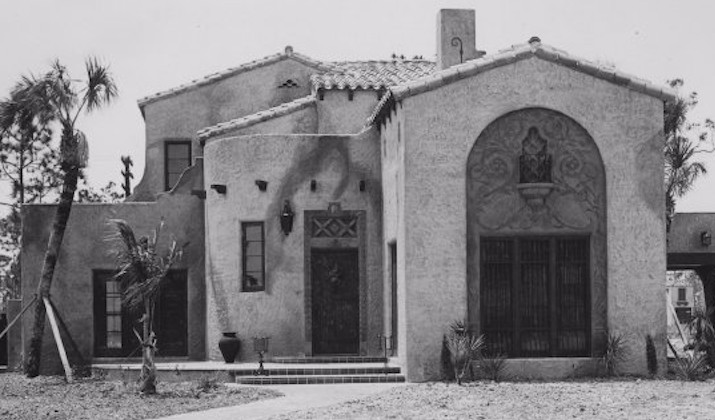
The following historic photos provide examples of residential and nonresidential properties built in 1925 and 1926 and a current photo of those structures as they exist today to provide further illustration and clarification of the Venice Historic Precedent style.
1.
VHP Residential Building Examples:
Current Photo (historic photo not available)
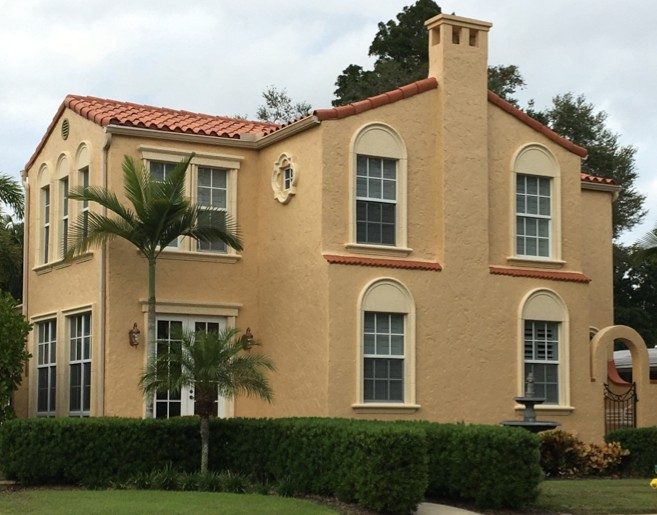 An exemplary two-story home built in 1926, 332 Ponce de Leon Ave. This is a simple
design, with few elements: mullioned windows, all rectangular with about half having
arches over them. It has a symmetric design, with the entry on the right.
An exemplary two-story home built in 1926, 332 Ponce de Leon Ave. This is a simple
design, with few elements: mullioned windows, all rectangular with about half having
arches over them. It has a symmetric design, with the entry on the right.
|
Historic Photo
 |
Current Photo
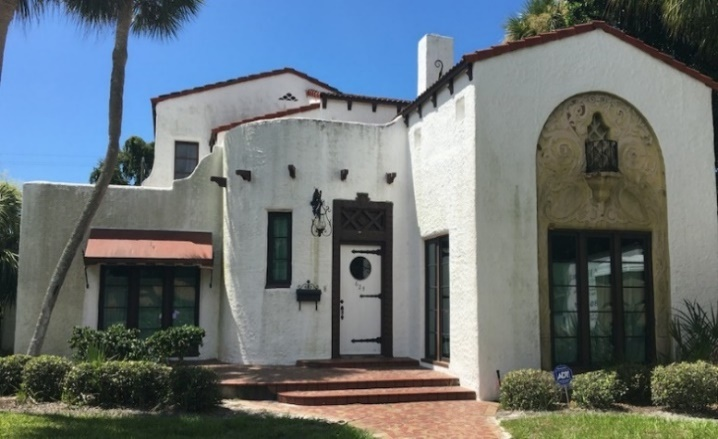 |
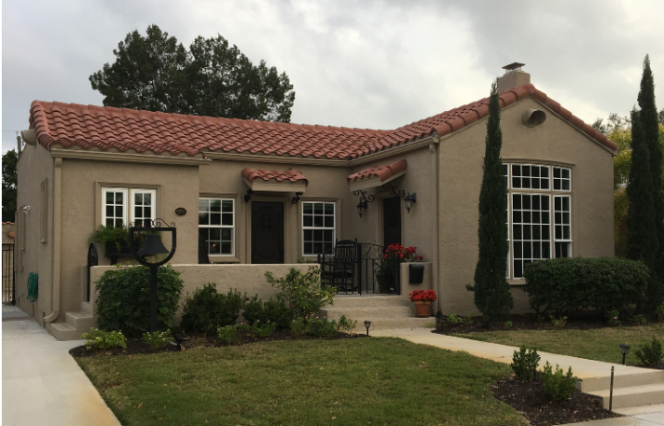
| An original and a recent photo of 625 W. Venice Ave. Built in 1926, this home shows very little change since construction. This has a Spanish influence and an interesting stepping up as the house recedes. Again, there are few design elements: a prominent arch over rectangular front windows, with all other openings also being rectangular. | |
Historic Photo
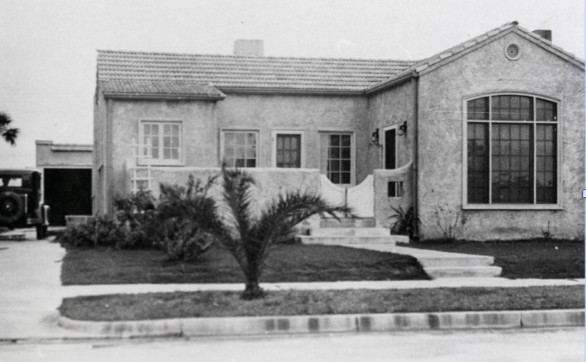 |
Current Photo
 |
| The home at 243 Pensacola Rd., also built in 1926. The original version is on the left and the current is on the right. Note just a hint of an arch over the prominent front window; the rest of the openings are rectangular. Very little has changed over time, with the exception of overhangs over the two entry doors. | |
Current Photo
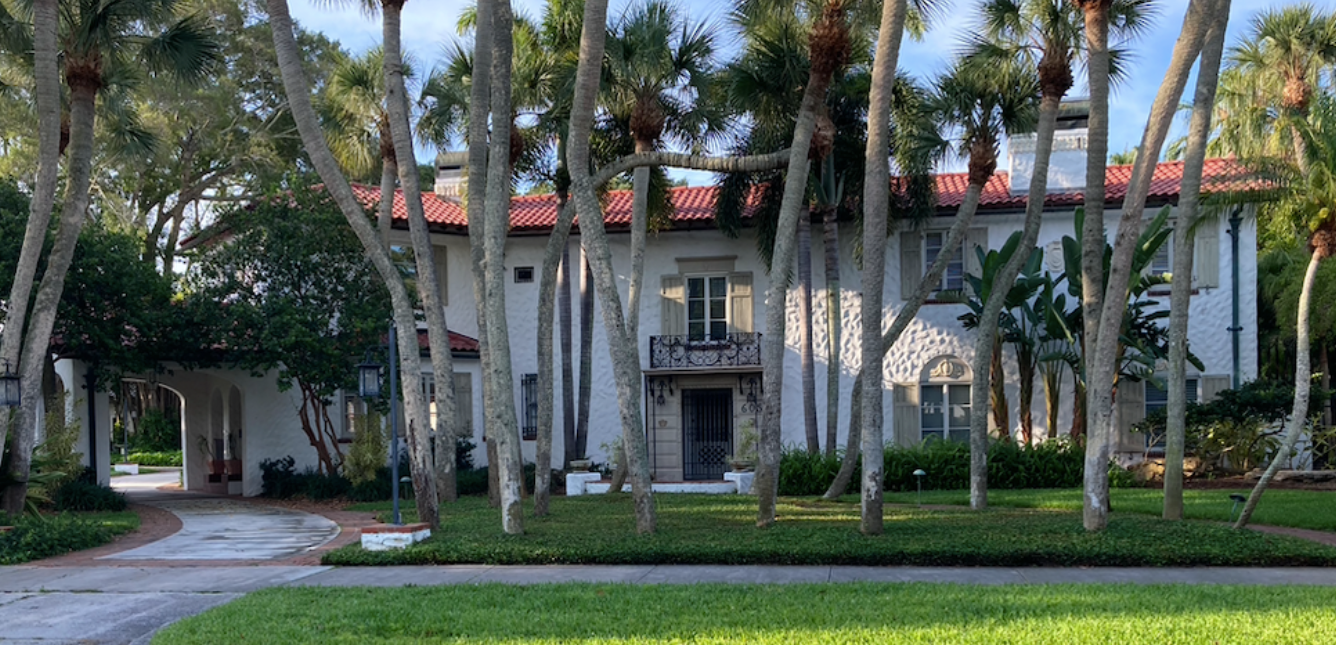
An example of a large house done very much in the VHP style is on W. Venice Ave. The massing is broken up with both a detail to the left of the entry and a porte cochère, both at an angle to the main structure. Note that there are few arches visible. The garage is to the rear, not easily visible from the street. Current construction codes in some cases make items found in the 1920's buildings seem unfeasible, such as the curved window, but there are several examples of items such as arched windows that do meet code.
Current Photos
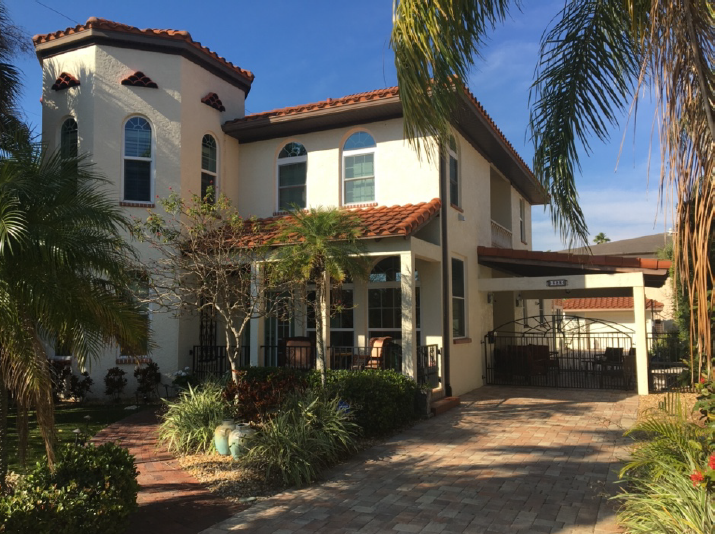 | 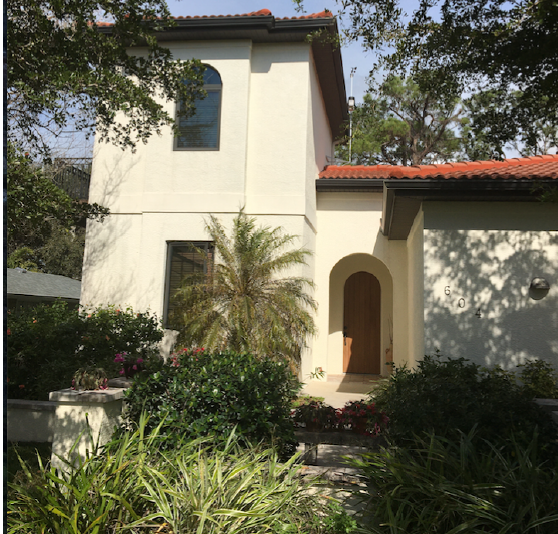 |
| Examples of recent homes constructed with current materials are shown here. The first was built in 1994 on Pedro St. It has the tower seen in a few original homes, as well as the simplicity of the VHP (e.g., no corbels around the tower). The house sits on a 55' x 150' lot and has the garage at the rear. Like several other homes of varying size, there is a covering over the driveway to shelter car occupants from the rain. This home is easily mistaken for a 1920's home. | |
2.
VHP Nonresidential Building Examples:
a.
Commercial buildings differ from residential buildings in their larger size, which presents issues with visual mass. One example here breaks up the large mass and another uses it as part of the design. As with residential examples both shown here and others not shown, each structure is unique while expressing a simplicity of elements that represents the VHP.
Historic Photo
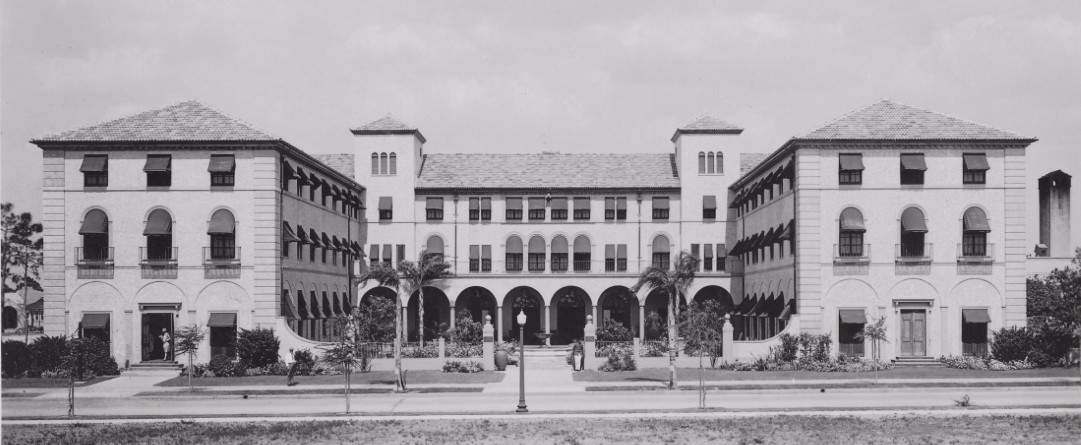
Hotel Venice, 200 Nassau St, built in 1926. Strict symmetry has been maintained while
breaking the
mass into three sections. The light color reflected infrared from sunlight and the
awnings provided shade.
The north-facing windows (not impacted by the sun) sported awnings for design consistency.
Current Photo
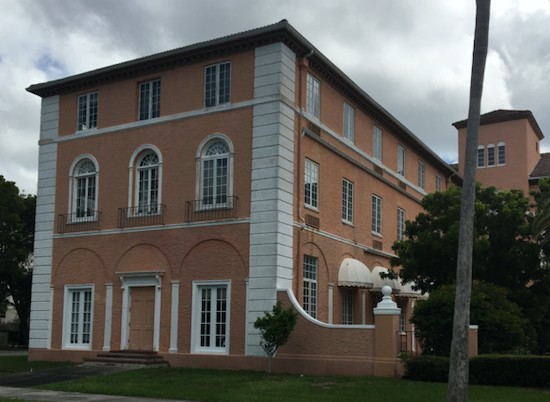 | Later incarnations of the Hotel Venice, as in the left, darken the wall color, thus providing a greater contrast with the accents. In this image, the eye is drawn towards the edges, rather than the façade as a whole. It is important to recall that the VHP stressed an integral building design rather than an assembly of parts. |
Historic Photo
 |
Current Photo
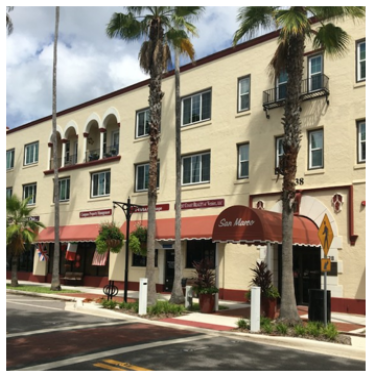 |
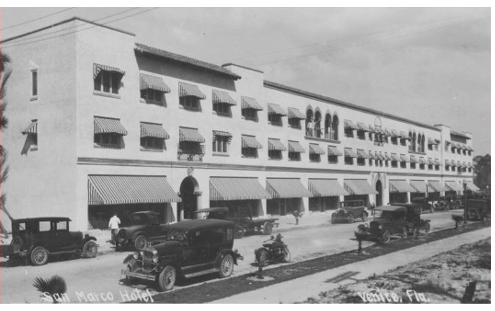
| The San Marco Hotel, more recently known as the KMI (Kentucky Military Institute) Building, is an example of the opposite treatment of a large mass. Left, in a late 1920's photo, the two long lines of upper windows themselves provide a focal point, broken near the 1/3 and 2/3 points by quadruplet arches. In the color photo on the right, simple delineation of one set of arches can be seen as a dark band underneath them. The arches are a pale hue, similar to the walls. Note the simplicity of the decorative third-floor railing over the primary entrance. The many windowsills are simple and the same color as the walls. These characteristics point to a frequent element of the VHP: simplicity with a minimum of modest decoration. As with most Venice commercial buildings of the Nolen era, this structure maintains strict mirror symmetry on its façade. | |
Historic Photo
 |
Current Photo
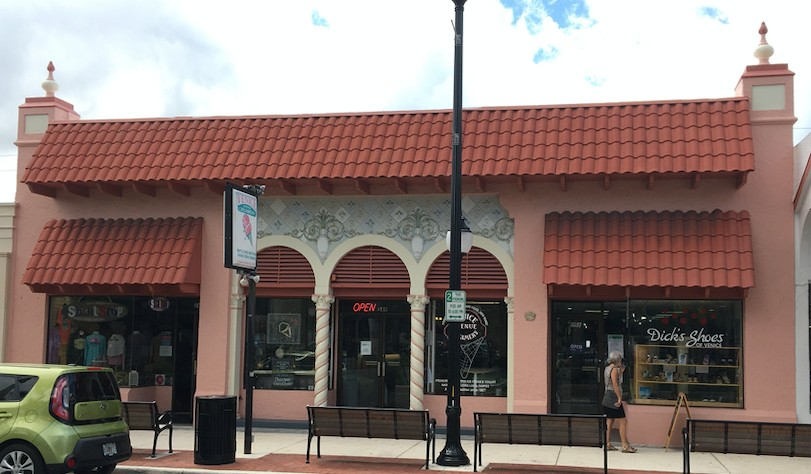 |
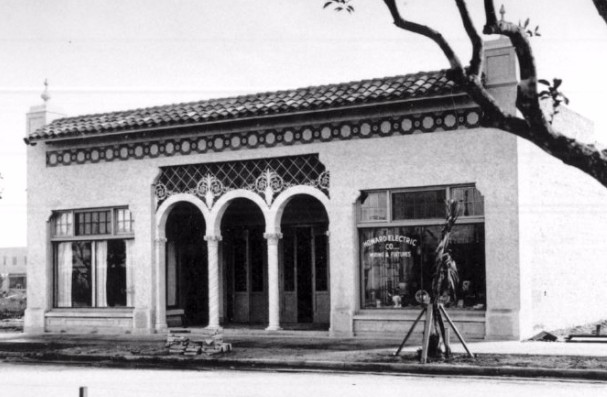
| The Sanders Building at 247 - 251 W. Venice Ave., built in 1926, is an example of the most decorative of the VHP commercial buildings. The original form, seen below left, shows both an arched entry and rectangular windows. The tile decoration over the entry contrasts with the wall color, and unusual feature in VHP, but that contrast is carried over into the under-eave decoration across the building. Small corner decorative features in the windows and above-entry tile work are a recurring theme in VHP. The roof clay tile line is terminated at the two small towers with their own unique decoration. The current version of the building has lost some of the feeling of the original but does retain the original sense in the entry and in the roofline-terminating towers. The openness of the façade, a VHP characteristic, is somewhat diminished by the enlarged roof tile band and the added window covers on each side. Perhaps most unfortunate is the obliteration of the decorative band just under the eave. | |
Historic Photo
 |
Current Photo
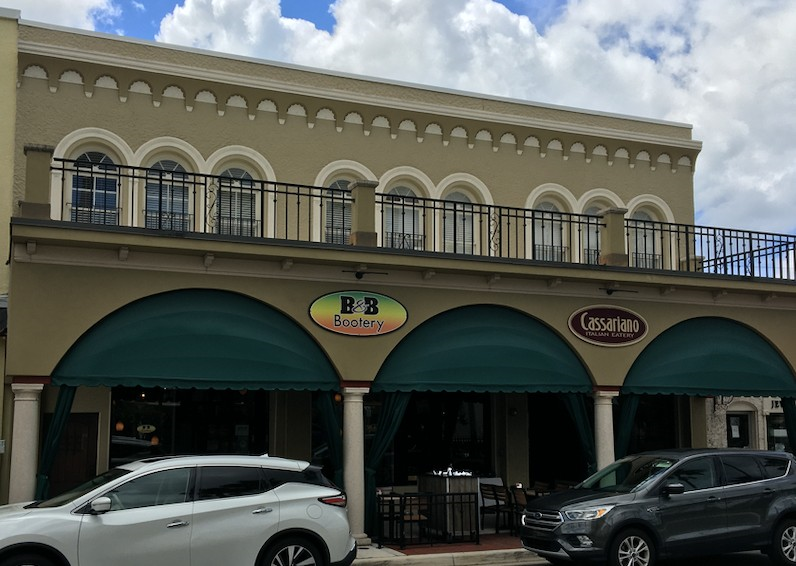 |
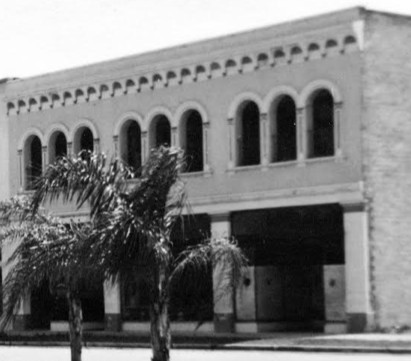
| A final example of a VHP commercial building is the Mohler Building, 311 W. Venice Ave., built in the late 1920's. The original building is shown on the left. Note the symmetry and non-contrasting colors. The nine upper windows have been grouped into triplets to add interest. The top-façade decoration is again unique; this particular pattern reflects the arched windows below. The three store-fronts are again rectangular with little if any decoration. The current building maintains the feeling of the upper story, with delicate delineation of the windows and upper decoration. The added balcony is in keeping with the VHP with a simple railing and simple arches as a frontispiece. | |
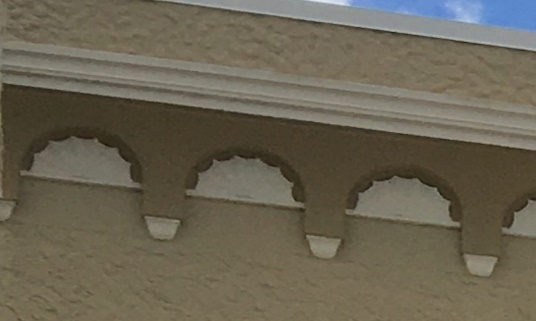 A detail of the upper decoration on the Mohler building shows the delicate nature
of this design. Note that the white semicircles have a bas-relief design.
A detail of the upper decoration on the Mohler building shows the delicate nature
of this design. Note that the white semicircles have a bas-relief design.
| |
Current Photos
 |  |
|
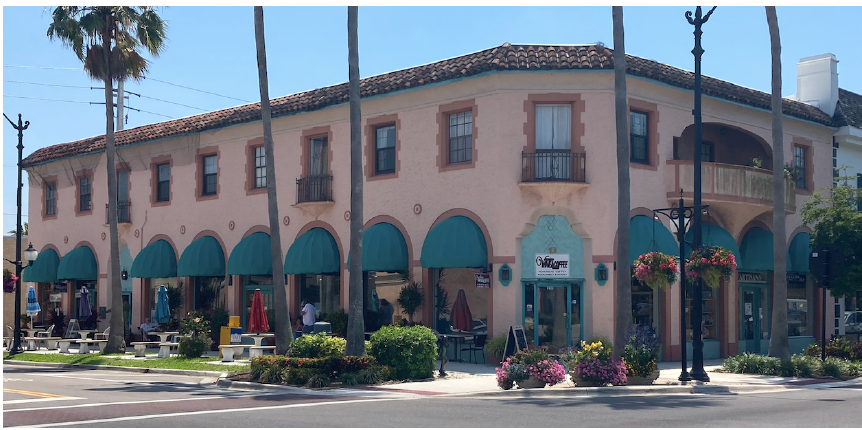
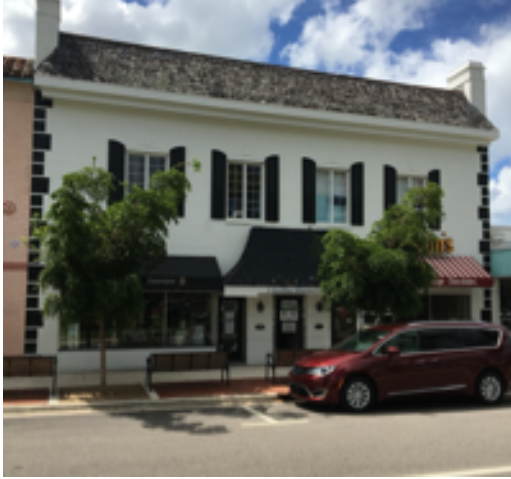
Other historic commercial buildings include the Schoolcraft and Bossovain buildings
adjoining each other at 201 and 205 W. Venice Ave. As with residential buildings,
each of the commercial buildings of the Nolen era was unique. One feature of the VHP,
trim that is similar in tone to the façade body, has unfortunately been lost on both
of these buildings. Original photos show these buildings with much less contrast with
trim. In fact, neither the black quoins nor shutters on the Bossovain building were
present originally. These elements tend to draw the eye to those details, rather than
the building as a whole.
| |
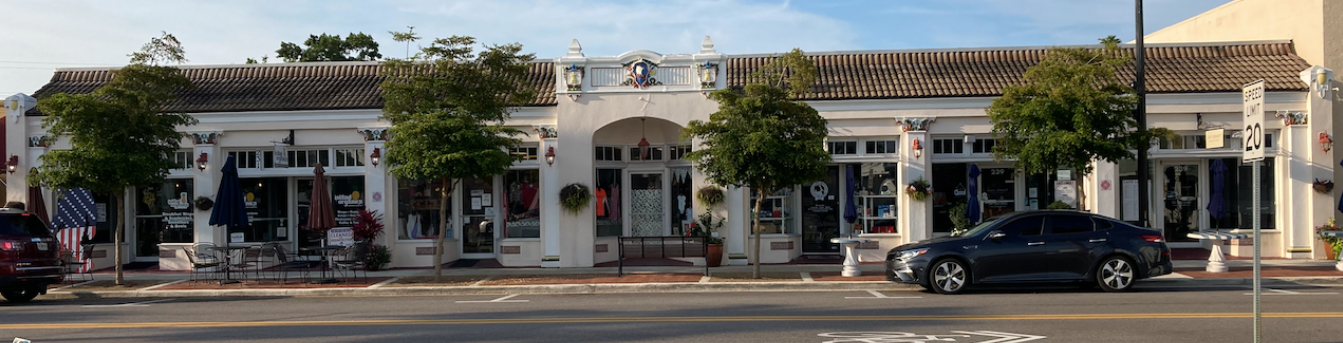 | |
| Finally, a one-story commercial building, the Lawton Building, is at 229-237 W. Miami Ave. This one is very close to the original version and reflects the VHP in several aspects: symmetry, decorative entry with a hint of arch, and three storefront entries on either side. The colors remain uniformly muted so the design as a whole is recognized. | |
Current Photos
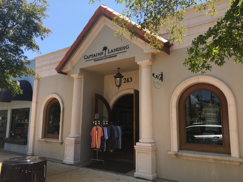 This building at 243 W. Venice Ave. is consistent with VHP principles: muted colors,
trim slightly different from the fascia, simple arched windows, gracious entry. The
single story is compatible with the narrow width so the vision is modest in scale.
This building at 243 W. Venice Ave. is consistent with VHP principles: muted colors,
trim slightly different from the fascia, simple arched windows, gracious entry. The
single story is compatible with the narrow width so the vision is modest in scale.
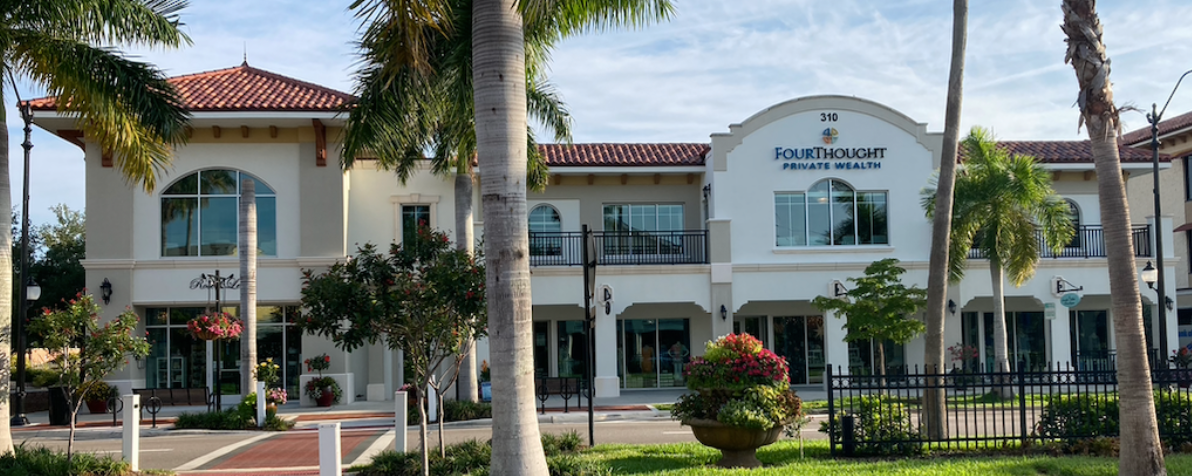 This photo is also of a new building at 310 W. Venice Ave. The massing of the structure
is broken up by presenting two distinct façades, the larger, rightmost being symmetric
and itself broken into three parts. The six first-floor openings are exact VHP.
This photo is also of a new building at 310 W. Venice Ave. The massing of the structure
is broken up by presenting two distinct façades, the larger, rightmost being symmetric
and itself broken into three parts. The six first-floor openings are exact VHP.
|
7.10.2. Building Massing
A.
General Requirements. One- or two-story asymmetrical massing is customary. Massing type generally includes side-gabled type, which is rectangular in form and sometimes includes lower side-wing portions; cross-gabled roof, which typically has one front-facing gable and one side facing gable; the hipped-and-gabled roofs; the hipped roof, which tends to be a simple rectangular box-shape; shed roof; or flat-roof with parapet walls often covered with roof tile coping.
1.
Residential Development:
a.
Structures located on lots of 50' in width or less shall have at least 2 different massing forms with at least one offsetting wall plane of at least 5% the length of the façade having a minimal depth of at least 16".
b.
Structures located on lots greater than 50' lot width, shall have at least 2 different massing forms and two offsetting wall planes of at least 10" the length of the façade having a minimal depth of at least 16".
2.
Nonresidential Development:
a.
Structures located on lots of 50' in width or less, shall have at least one massing form.
b.
Structures located on lots greater than 100' lot width, shall have at least 2 different massing forms.
3.
One story buildings with over 10,000 square feet of gross floor area and multi-story buildings with over 20,000 square feet of gross floor area shall be designed with wall plane projections or setbacks on each publicly visible façade having a depth of at least 5% of the length of the facade and extending at least 25% of the length of the facade.
4.
One-story buildings with less than or equal to 10,000 square feet of gross floor area and multistory buildings with less than or equal to 20,000 square feet of gross floor area shall be designed with the primary facade having either:
a.
Offsetting wall planes or upper story setbacks of at least two horizontal feet, or
b.
A recessed entry space, projecting canopy or portal.
7.10.3. Facades and Exterior Walls
A.
Permitted Façade Materials. Façade and exterior wall elements are to be arranged in an orderly, balanced manner; the use of asymmetry may be utilized strategically to impart interest in the design of the façade.
1.
Primary materials: A minimum 90% of wall area not including openings will be stucco without an applied pattern.
2.
Secondary materials: A maximum 10% of wall area of the front elevation can be either patterned tiles, clay/concrete roof tiles, natural cut stone (coral, oolite, coralina, or similar), and/or cast or engineered stone equivalent to natural cut stone.
3.
A transition between façade building materials should be provided. The transition should include, but not be limited to, wall offsets, wall inserts, trim, pilasters, and columns.
Figure 7.10.3. Examples of Permitted Façade Materials
Stucco without applied pattern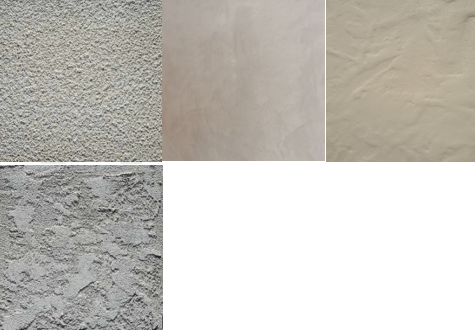
Patterned Tile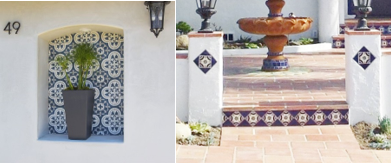
Clay/Concrete Tile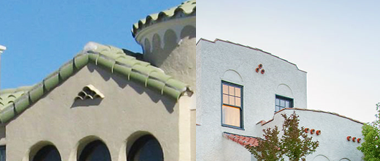
Natural Cut Stone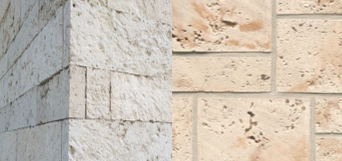
Cast Stone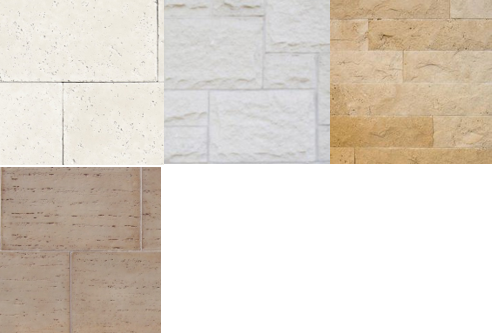
7.10.4 Façade Colors
A.
Color is an important aspect in defining the architectural style. The placement and combination of colors on the building may highlight architectural features, including building offsets, columns, doors, and decorative elements. The VHP color scheme does not have complex color schemes and often uses only two paint colors.
1.
Façade Colors: Colors may include pastels and light earth tones with allowance for darker or vibrant colors to be used as decorative trim or accents. All building colors shall be in accordance with the approved color palette and used as the basis for petition approval and project completion review by staff. Negligible color variation is expected in the finished product due to differences of print colors and actual implementation during construction.
2.
Color Coverage: Up to 75% of wall surfaces must be one approved color, 20% must be a secondary corresponding approved color, and 5% must be in a corresponding approved accent color. A design alternative may be considered for the percentage of approved color coverage.
3.
Design Alternative: Alternative colors or color hues are encouraged and may be approved through the design alternative process. Colors that are prohibited for design alternatives include any colors that are high intensity, fluorescent, gilt, or high gloss metallic.
7.10.5. Roofs
A.
Generally: Roof forms and roof lines are one of the most important and distinctive design elements which define a building's character. A variety of roof forms, and roof lines, within a single building, add visual interest and are used to reduce the overall massing to produce unique building forms.
B.
Required Roof Forms: Acceptable roof forms include hip, gable, mansard, or parapet roof forms, or a combinations of these, except that residential structures shall require at least two different roof forms. Pitched roof slopes shall range from a minimum of 4:12 to a maximum of 6:12 pitch. Mansard roof slopes shall be a maximum of 10:12 pitch for commercial uses.
C.
Flat Roofs: Flat roofs must include architectural features including, but not limited to, parapets, barrel tile bands, or other features with the goal of blocking the view of the flat roof from the public right-of-way.
D.
Required Materials: Permitted visible roofing materials include:
1.
Clay, terracotta, concrete roof tiles.
2.
Composite and alternate roofing materials that are substantially similar to clay, terracotta, and concrete roof tiles in appearance and profile.
E.
Prohibited Materials:
1.
Standing seam or ribbed metal, ceramic glazed, or high gloss materials are prohibited.
F.
Required Roofing Colors:
1.
Reds, browns, whites, and natural earth tone colors, including greens, and shall contrast the façade colors of the building.
2.
Design Alternatives may be proposed for roofing color blends.
G.
Prohibited Colors:
1.
Bright or high gloss, colors are prohibited and may not be proposed as a design alternative.
H.
Required Roof Material Profiles:
1.
Barrel pan tiles; and/or
2.
Spanish S tiles are required.
Figure 7.10.5. Permitted Roof Materials and Roof Photos
 |  |
Examples of Permitted Roof Materials in Use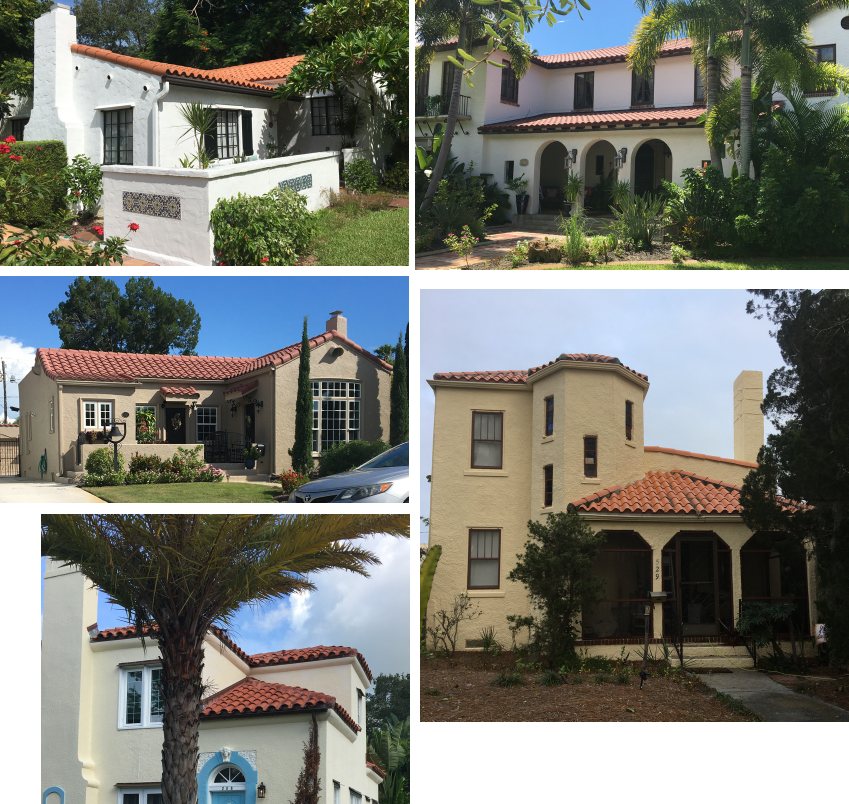
7.10.6. Openings: Windows, Doors, and Garages
A.
General Requirements:
1.
Residential Development:
a.
Not more than 50% of a residential wall surface shall consist of door, window, and other openings, excluding porches.
b.
All doors, windows and glazed surfaces shall be located at least two feet from outside building corners.
2.
Nonresidential Development:
a.
Wall surface may have greater than 50% door, window, or other openings, but not more than 90%.
b.
Existing structures having wall openings greater than 90% shall be exempt from this section.
3.
Glazing: All glazing shall be clear or lightly tinted neutral gray consistent with VHP.
B.
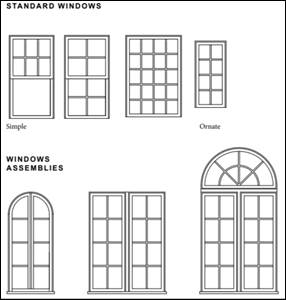
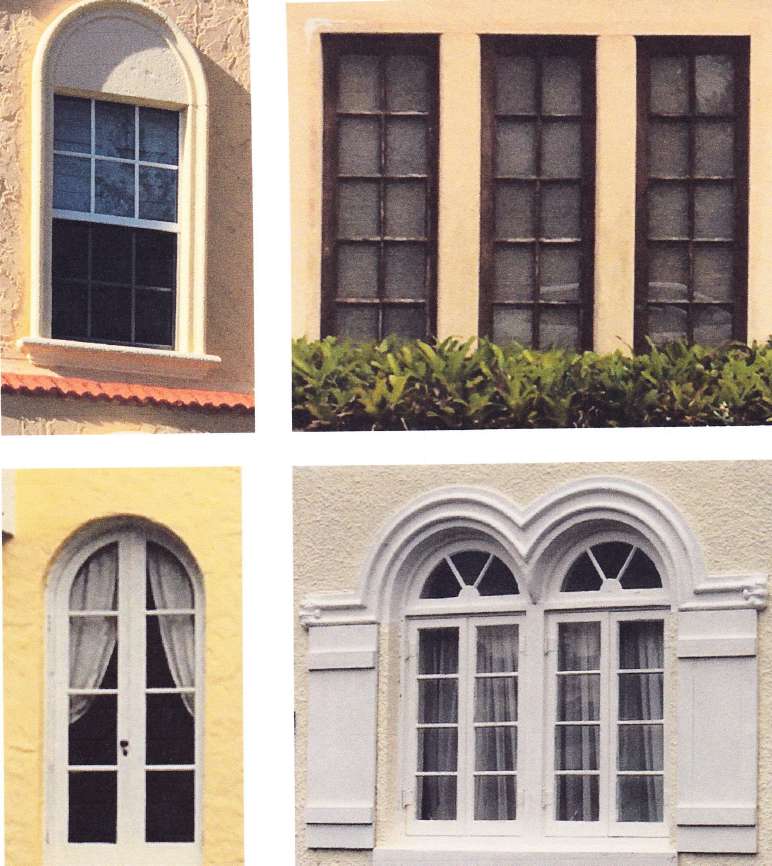
Windows: Arrangement, size, and proportions shall be symmetrical within any façade. A large focal window is common featuring double-arch shaped transom. Windows shall comply with the specific standards below.
1.
Residential Development: Standard type casement, double-hung, or picture having vertical portion at least 2 to 1 (height to width).
a.
Windows shall have divided lites with muntin pattern 4 over 1, 6 over 1, 3 over 1, or 4 over 4.
b.
Mulled windows shall be separated by four (4) to six (6) inch trim and not exceed 3 units.
2.
Non-residential Development: Glazing areas shall be composed of multiple panels.
Figure 7.10.6.1. Windows
C.
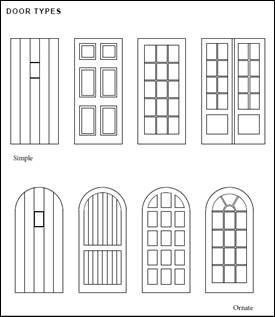
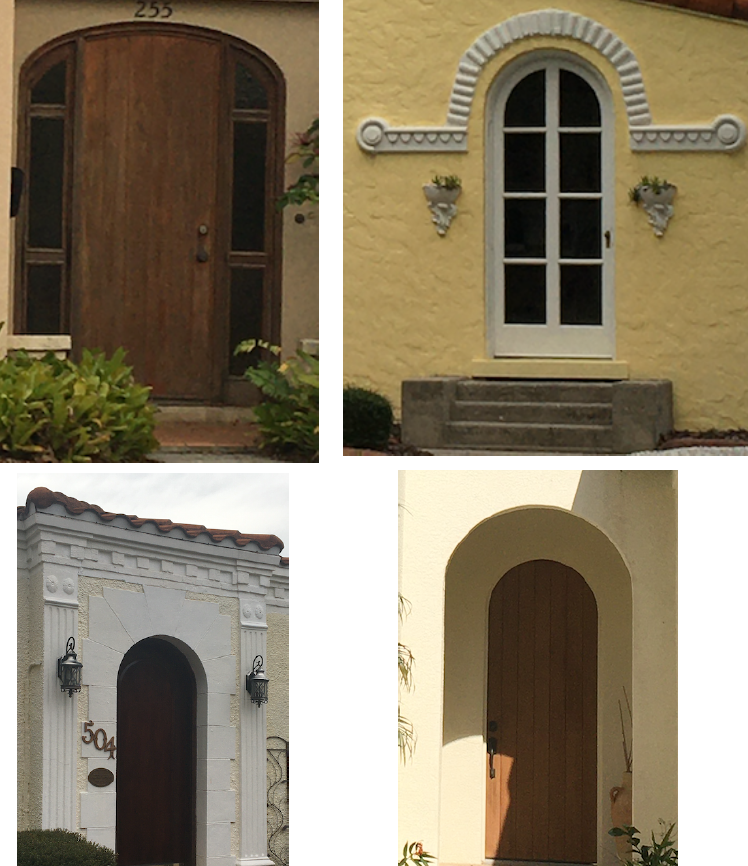
Doors: Main entrance doors are a principal feature of most primary façades. Historically, entry doors for residences were single-leaf doors typically heavy board and batten, often with small, centered lights. Decorative iron work and hardware were common. Secondary doors, in the rear, often consisted of pared fully glazed French style doors. Entry doors for non-residential structures often consisted of single or double doors with partial or full glazing.
1.
Residential Door Types: Entry doors shall correlate with historical precedent; however, they shall be selected to coordinate with the architectural style and complement the details of the building.
a.
Sliding glass doors are prohibited excluding the rear elevation.
b.
Folding glass accordion-style doors are prohibited in side and front elevations.
Figure 7.10.6.2. Residential Door Types
2.
Non-residential Door Types: Doors shall correlate with the VHP, but shall be selected to coordinate with the architectural style and complement the details of the building.
D.
Garages:
1.
General Requirements: Garages shall minimize their visual impact on the streetscape and the public realm subject to the following:
a.
Garages located on lots of fifty (50) feet in width or less are to be located in the rear/back of the structure, subject to driveway spacing requirements of this Code. A Design Alternative may be considered for this requirement.
b.
Garages located on lots greater than fifty (50) feet in width may be side-loading if the garage door faces away from the pedestrian entry door, but rear garages are encouraged.
c.
Side-loading garages must incorporate windows on the front wall surface.
d.
Front-loading garages are prohibited on lots greater than fifty (50) feet in width.
e.
Garage door openings are not to exceed sixteen (16) feet in width per opening and eight (8) feet in height.
f.
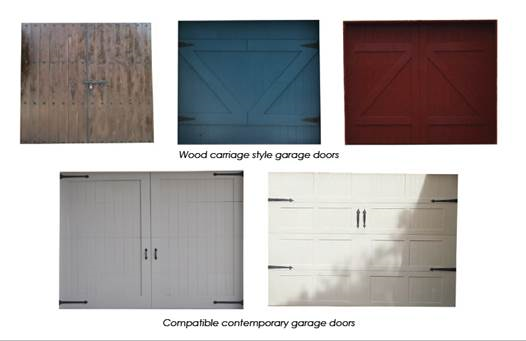
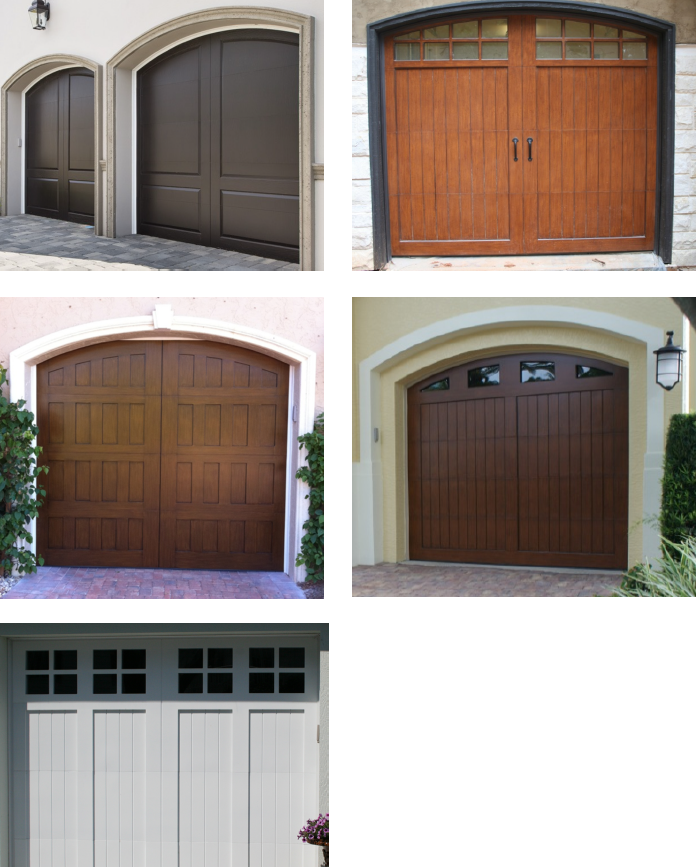
Examples of residential garage door types:
Figure 7.10.6.3. Residential Garage Door Types
2.
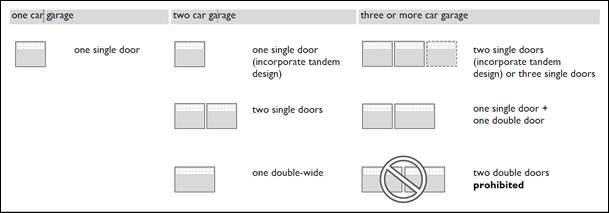
Residential Garage Door Configurations: Residential garage door configurations are illustrated in Figure 7.10.6.4 below.
Figure 7.10.6.4. Residential Garage Door Configurations
7.10.7. Building Features
A.
Features and Entryways. Each building on a site shall promote and enhance a pedestrian scale and orientation on any façade facing a street, through-building articulation, transparency, or other design treatments.
1.
Entryway features for residential structures shall be:
a.
Flush with primary elevation with decorative or ornate trim;
b.
Recessed in a small alcove within the primary elevation;
c.
Sheltered by a projecting roof; and
d.
Covered by a porch, arcade, portico, or tower element.
B.
Railings. When railings are incorporated into the design of these features (e.g., balconies, wall elements, second-story balconettes, etc.), they shall be decorative in nature and designed to be complementary to the architectural style of the building. Railings shall be of welded wrought iron, flat carved, or turned material. Railings shall be of sufficient detail to complement the building and be consistent with surrounding VHP railing profiles. Wrought iron railings are typically powder coated finish and black.
7.10.7.B. Railings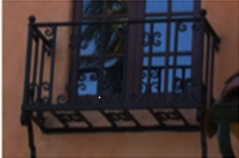 Wrought Iron
| 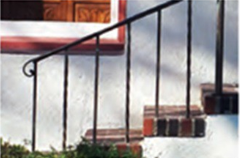 Wrought Iron
|
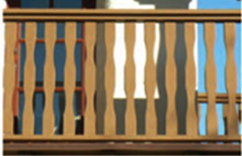 Flat Carved
| |
C.
Awnings, Shutters, Canopies, and Curtains.
1.
Awnings are permitted to shade openings and shall be of a size, shape, and number in proportion to the size, style and shape of the building openings and shall not obscure the building details.
a.
Awnings shall not be internally illuminated or lighted from behind.
b.
Awnings shall be opaque and made of heavyweight vinyl, acrylic or canvas fabrics.
2.
Shutters are permitted. The total width of the shutters shall not be less than the width of the opening they adjoin.
a.
Roll-up type hurricane and security shutters shall be concealed from public view.
b.
Bahama-type shutters are prohibited in the Historic Venice District and are permitted in the Venetian Theme District.
3.
A canopy is defined as an awning with vertical and horizontal support members having similar architectural character to, or in keeping with, that of the main structure to which the canopy is attached.
a.
Canopies shall not be internally illuminated or lighted from behind.
b.
Canopies shall be opaque and shall be covered with heavyweight vinyl, acrylic or canvas fabrics.
c.
Canopies are primarily used at building openings to provide shade, protection, and recognition of entry points and shall not be used as a substitute for a permanent roof structure.
4.
Exterior curtains or wind/rain screens shall be used as weather-related devices only, and shall not be permanent in nature.
a.
Curtains/rain screens shall not be held in permanent tracks or framework and shall be removable.
b.
Curtains may be attached to the structure using completely concealed or retractable methods which do not detract from the architectural character of the building when not in use.
Figure 7.10.7.C. Canopies, Awnings, Shutters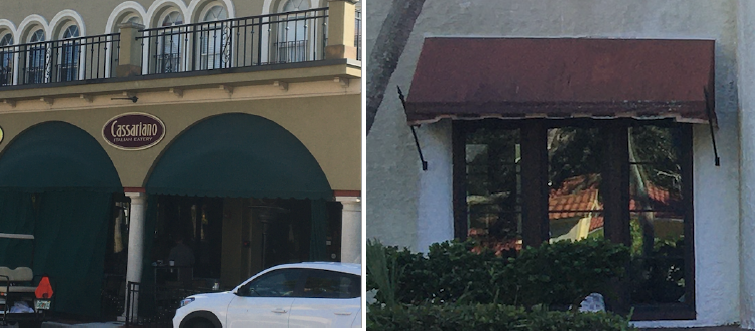 | |
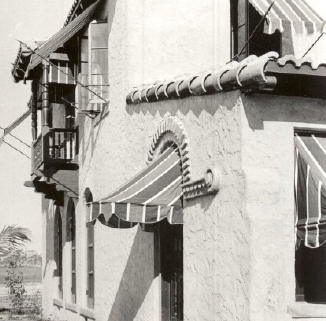 |
5.
Proposed colors for awnings, shutters, canopies, and curtains should be consistent with the HAPB pre-approved palette of colors.
D.
Recesses and/or Projections. All buildings must contain two or more of the following features. Design alternatives may be considered for this requirement.
1.
Colonnades.
Figure 7.10.7.1. Colonnades
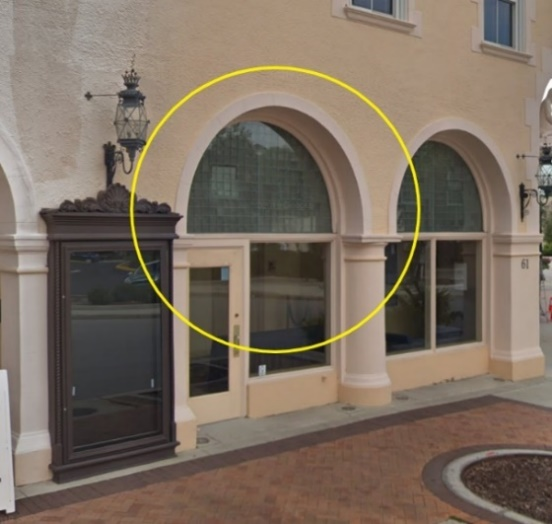
2.
Corbels and Brackets.
Figure 7.10.7.2. Corbels and Brackets
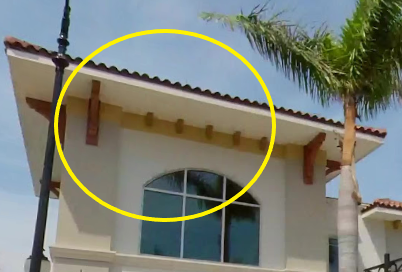
3.
Balconies.
Figure 7.10.7.3. Balconies
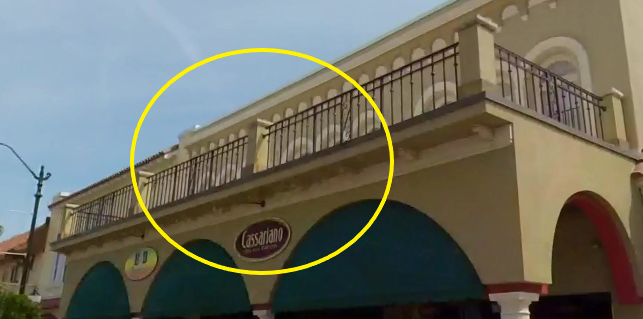
4.
Arches.
Figure 7.10.7.4. Arches
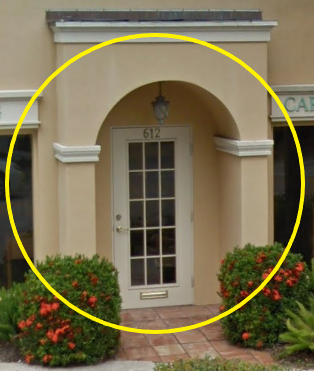
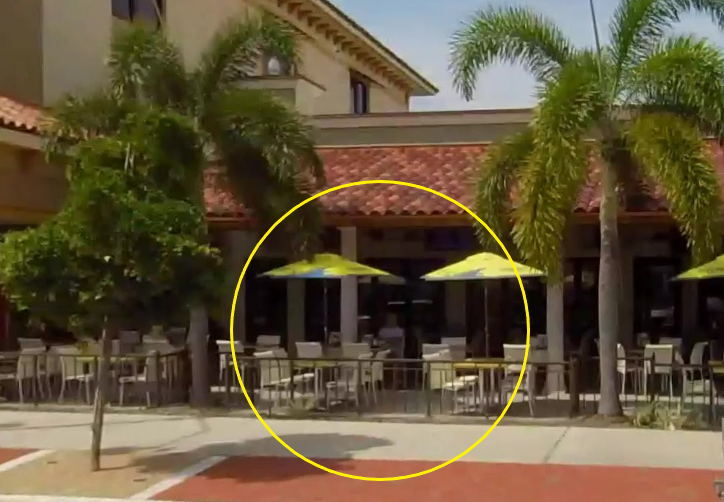
5.
Outdoor patios. A knee wall or ornamental (low height) fence delineating the public and private realm (i.e., active use areas) shall be provided as part of this feature.
Figure 7.10.7.5. Patios
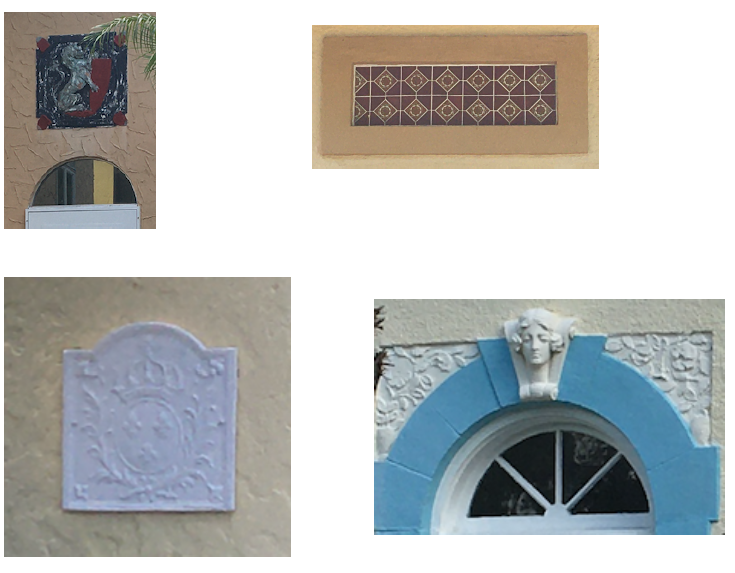
6.
Ornamental relief designs.
Figure 7.10.7.6. Reliefs
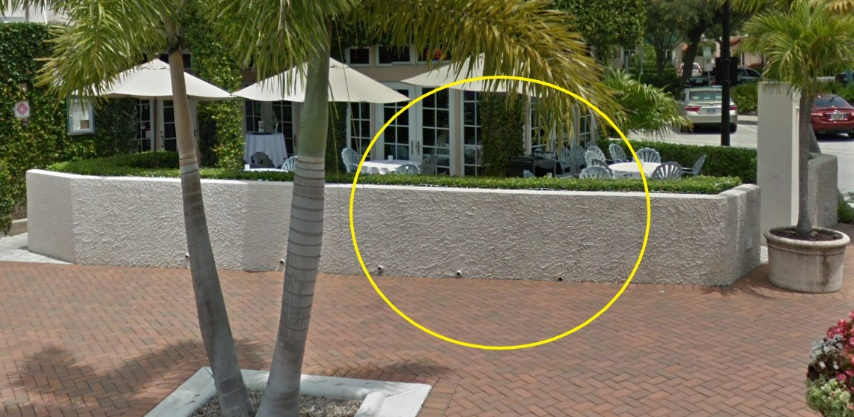
7.
Integrated planters or knee walls that incorporate landscape areas.
Figure 7.10.7.7. Knee Walls
8.
Exterior Stairways: Design must be consistent with the VHP.
E.
Decorative Architectural Features.
1.
All buildings must contain one or more of the following:
a.
Clay toile attic vent;
b.
Recessed niches;
c.
Wall cutouts;
d.
Carved bas relief ornamentation;
e.
Decorative iron window grilles;
f.
Ornamental relief designs.
F.
Design Alternative. Unless prohibited in this section, a design alternative may be submitted for other building features.
G.
Prohibited Items. Exposed roof drains, gutters, and downspouts shall not be visible, except where integrated into the building through the application of colors, materials, design, and other details of the building architecture consistent with the VHP.
7.10.8. Residential Light Types and Fixtures
A.
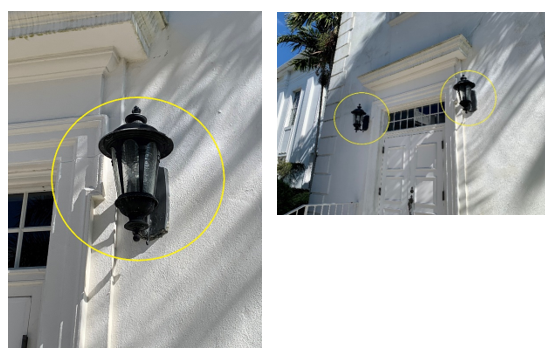
General Requirements. Decorative lighting should enhance the architectural character and ambience of the project and shall follow the VHP and must include unique elements and style variation.
1.
Decorative historic light fixtures are required.
2.
Exterior lighting shall be designed to coordinate with the building and landscape architecture. Building-mounted fixtures shall be compatible with the building façade.
3.
VHP light fixtures visible from the street shall be dark metal or wrought iron fixtures. Fixtures can be fairly elaborate with curving brackets, chains, or filigree.
Figure 7.10.8. Light Fixtures
4.
Lights used to illuminate a building façade or landscaping shall be screened or recessed.
B.
Design Alternative. Alternative materials may be proposed as a design alternative.
C.
Prohibited Items.
1.
Flood lights are prohibited unless required by state or federal law and should be limited to not extend beyond the property line.
2.
Internally lit canopy and awning lighting is not permitted.
7.10.9. Fences and Walls
A.
Height. Fences and walls shall be between three (3) and six (6) feet in height or as specified by the zoning district and provide a continuous straight edge along the top of the fence or wall.
B.
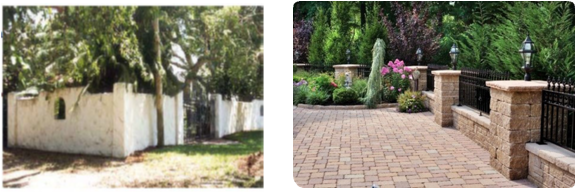
Materials. Walls shall be of a masonry (with stucco), natural stone or combination of multiple materials similar to the material and style of the façade of the primary building. Fence materials are limited to painted decorative aluminum, solid wooden (shadow box or similar style) or non-white vinyl fences.
1.
Wooden and vinyl fences are permitted in side and rear yards only and shall be set back a minimum of four feet from the intersection of the front wall facing the street and the finished side of the fence shall face the abutting property.
C.
Variation. Fences and walls shall provide variation in wall plane and include unique character by incorporation of openings, pilasters, or trim.
Figure 7.10.9. Fences and Walls
D.
Design Alternative. A design alternative may be submitted for the following:
1.
Height above six (6) feet, but not to exceed eight (8) feet.
2.
Vinyl fence color, but must be similar to the required façade color collection.
E.
Prohibited Items.
1.
Chain-link/cyclone fences or chain link with vinyl slats, fabric or similar.
7.10.10. Service Areas and Equipment Screening
A.
Requirements. Service areas for equipment, including, but not limited to, trash receptacles, pool equipment, generators, and ground level or roof-mounted mechanical equipment shall be screened by walls, fences, or other screening structures.
1.
These spaces should be minimized from public view through their placement, screening, and overall building design.
2.
Service area screening shall be the height of the equipment or facility plus 6 inches, up to a maximum height of 8 feet.
3.
Screening shall be provided to minimize and or reduce the visual appearances from service areas, utilities (such as pumps, transformers, etc.) and loading/unloading service areas (i.e., deliveries).
4.
Screening shall be compatible with the architecture of the buildings on-site, incorporating a similar palette of materials.
B.
Design Alternative.
1.
Design alternatives may be considered for this section.
C.
Prohibited Materials.
1.
Chain link/cyclone or chain link with vinyl slats, fabric or similar.
7.10.11. Swimming Pools and Pool Enclosures and Screening.
A.
Installations of decks, pools, patios, and hot tubs shall be considered on a case-by-case basis. The appropriateness shall vary according to siting, size, and design.
1.
Wood decks or brick patios are allowed inside of rear yards only. Wood decks shall not be built in the front yard.
2.
Wood decks in side yards not adjacent to a public right-of-way shall be set back a minimum of ten (10) feet. Appropriate and compliant walls, fencing, and/or landscaping shall be used around the wood deck for screening purposes.
3.
Decks, pools, hot tubs, and patios shall not be visible from the right-of-way by use of compliant stucco masonry screen wall or decorative fencing and landscaping.
4.
Swimming pools shall not be constructed in the front yard.
5.
Swimming pools may be built in side or rear yards only provided the pool is located directly behind the principal structure or it is set to the rear half of the side yard.
6.
Pool enclosures shall be constructed in a manner such that they are subordinate to the primary structure and do not impact or obscure significant features of the building.
7.
Screened porches visible from the right-of-way shall have a frame color compatible with the principal structure.
7.10.12. Design Alternatives to Venice Historic Precedent
A.
Purpose and Intent. It is recognized that because of the individual unique characteristics or circumstances of any given project, flexibility in the application of architectural requirements may be warranted in certain situations. To facilitate flexible design options, a design alternative to the standards provided within the VHP may be requested where the standards specify that a design alternative is permissible. If not specified, a design alternative may not be requested. If an applicant requests multiple design alternatives, each design alternative shall be evaluated independently.
B.
Specific Application Requirements. As part of the application for a VHP design alternative, floor plans and elevations for the proposed design alternative shall be required. A detailed narrative is required that:
1.
Cites the specific VHP section from which a design alternative is being requested.
2.
Addresses each proposed design alternative separately and provides justification for each.
3.
The Director or HAPB may require any additional information needed to facilitate a review of the design alternative(s) being sought.
C.
Considerations. Proposed design alternatives may be approved or denied separately or have unique stipulations deemed appropriate for the request. The HAPB shall consider the following criteria in consideration of requested VHP design alternatives:
1.
Whether the design alternative is consistent with the stated purpose and intent of this VHP and with the Comprehensive Plan;
2.
Whether the request is permitted as a design alternative for the specific standard for which a design alternative is being sought;
3.
Whether the design alternative will have a material negative impact on adjacent uses, or the applicant proposes to mitigate the negative impact to be created by the proposed design alternative;
4.
Similar situations in the general area and in past decisions by the HAPB under this section;
5.
Whether the design alternatives will permit improved design, efficiency, and performance; and
6.
If applicable, whether the design alternative is necessary to preserve or enhance historic and architectural resources.
7.10.13. Variances to Venice Historic Precedent
A.
The HAPB shall have the authority to grant a variance from the VHP. The burden of proof shall be on the applicant to show that, due to special conditions, a literal enforcement of the regulations will cause an unnecessary and undue hardship on the applicant.
B.
The board shall consider the following factors:
1.
Whether special conditions and circumstances exist that are peculiar to the structure or building involved;
2.
The degree to which the structure in question is constructed in the VHP Style;
3.
The degree to which structures in the immediate area are constructed in the VHP Style;
4.
The visibility of the proposed improvement from the street and adjoining properties; and
5.
The cost of compliance with the regulations compared to the cost of the improvement with the variance and the value of the existing structure.
C.
In granting any variance, the board may prescribe appropriate conditions and safeguards, including, but not limited to, time limits for the work to commence or be completed. Violation of such conditions and safeguards, when made a part of the terms under which the variance is granted, shall be deemed a violation of this section.
D.
A variance granted for one structure shall not be a precedent or grounds for a variance for another structure.
(Ord. No. 2022-31, § 2(Exh. A), 12-13-22; Ord. No. 2024-16, § 2(Exh. A), 9-10-24)
7.11. - Cultural and Archaeological Resources
A.
If evidence of the existence of cultural resources is discovered or observed at permitted development activities, all work shall cease in the area of potential effect. The developer, owner, contractor, or agent thereof shall notify the City of the potential cultural resources within two (2) calendar days. Examples of such evidence in whole or in part include paleontological remains, whole or fragmentary stone tools, shell tools, aboriginal or historic pottery, historic glass, historic bottles, bone tools, historic building foundations, shell mounds, shell middens, or sand mounds.
1.
The developer, owner, contractor, or agent thereof shall provide a site assessment survey for cultural resources discovered at permitted development projects. The survey's purpose is to locate and assess the significance of cultural resources and to provide a basis for determining if the project has no effect or adverse effect on the cultural resources.
2.
All site assessment surveys shall be conducted by professionals meeting the qualifications established by the National Park Service as codified in 36 CFR Part 61 and shall be conducted consistent with rules promulgated by the Florida Bureau of Archaeological Research.
3.
The research design for a site assessment survey shall be reviewed and approved by the HRM or designee before the survey commences. The survey shall be designed to locate all cultural resources and assess their significance. At a minimum, site assessment surveys must contain the following sections:
a.
Project scope;
b.
Archival research;
c.
Research design;
d.
Fieldwork;
e.
Analysis;
f.
Conclusions; and
g.
Florida Master Site File forms for all resources identified.
4.
Upon completion of the site assessment survey, the City and the developer, owner, contractor, or agent thereof shall evaluate the findings.
a.
If the finding is that there is no effect then the project may proceed without modification. The no effect finding will be reconsidered if substantive changes in project design or the location of project ground-disturbing activities are made, or if new information becomes available.
b.
If the finding is that the proposed development would have an adverse effect, the City and the developer, owner, contractor, or agent thereof shall determine measures to avoid, minimize, or mitigate any adverse effects to such resources by the project.
B.
If any human skeletal remains or associated burial artifacts are discovered during permitted development activity, all work in the area must cease, and the developer, owner, contractor, or agent thereof must immediately notify the City Police Department and notify the City Manager, if appropriate, within two (2) calendar days. According to F.S. Ch. 872, it is unlawful to disturb, vandalize, or damage a human burial.
(Ord. No. 2022-15, § 3(Exh. B), 7-12-22)

