
Ventura County Unincorporated
City Zoning Code
City Zoning Code
ARTICLE 2
- Definitions
8102-0 - Application of definitions.
a.
Unless the provision or context otherwise requires as determined by the Planning Director, the definitions of words and terms as follows shall govern the construction of this Chapter.
b.
Words and terms defined in Section 8102-0 below are endeavored to be italicized for convenience whenever they appear in this Chapter. If a word or term defined below is not italicized where appearing in this Chapter, it shall nonetheless have the defined meaning unless from the context a different meaning is defined or otherwise clearly intended.
c.
Whenever any words or terms used in this Chapter are not defined herein but are defined in another Chapter of this Division, and the word or term is used in the same context in this Chapter or the General Plan, the word or term shall have the same meaning as defined in such other Chapter or the General Plan. If a conflict exists between a definition, the definition for a word or term in this Chapter and a definition for the same word or term in another Chapter of this Division or the General Plan, the definition herein shall control.
d.
Whenever a definition or other provision in this Chapter references a statute, regulation or provision of federal, state, or local law or regulation, the reference shall be to the current or successor version of the law unless expressly stated otherwise herein.
Abut—To touch physically, to border upon, or to share a common property line with. Lots that touch at corners only shall not be deemed abutting. Adjoining and contiguous shall mean the same as abutting.
(Add Ord. 3810—5/5/87)
Access—The place or way by which pedestrians and/or vehicles shall have safe, adequate, usable ingress and egress to a property or use.
Accessory Structure—A detached structure located upon the same lot as the building or use to which it is accessory, and the use of which is customarily incidental, appropriate and subordinate to the use of the principal building or to the principal use of the lot.
Accessory Structures, Habitable—Structures intended for human occupancy or which are primarily used for human occupancy. Such structures include, but are not limited to, recreation rooms, artist studios, hobby rooms, and pool houses/cabanas. Non-habitable accessory structures include garages, workshops and storage sheds.
(Add Ord. 4216—10/24/00)
Accessory Use—A use customarily incidental, appropriate and subordinate to the principal use of land or buildings located upon the same lot.
Affordable Housing Agreement—A legally binding agreement between a property owner, a permittee (if not the owner), an eligible organization (if applicable), and the County, in a form approved by the Planning Division, that sets forth provisions necessary to ensure that the requirements for providing affordable dwelling units are satisfied and maintained.
Affordable Housing Price—The listing price for lease or sale of an affordable dwelling unit. The affordable housing price shall be made available at either an "Affordable Rent" or "Affordable Housing Cost" as defined in Health and Safety Code sections 50053 and 50052.5, respectively.
Agriculture—Farming, including animal husbandry and the production and management of crops (including aquatic crops) for food, fiber, fuel and ornament.
(Am. Ord. 3730—5/7/85)
Agriculture, Commercial—A farming enterprise consisting of tree and crop production, for feed, food, fiber, fuel, shelter, and ornament, and including floriculture, horticulture, aquaculture, or animal husbandry established and conducted in a manner consistent with proper and accepted customs and standards as established and followed by similar agricultural operations in the County. (See Section 8107-25.)
Agricultural Contractor Service and Storage Yard—An open area, which may legally establish buildings and structures, for the storage of vehicles, equipment and materials which are associated with an agricultural contracting business or operation, where sales, manufacturing and processing activities are specifically excluded. Agricultural contractor service and storage yards do not include landscape maintenance or groundskeeping businesses.
Agricultural Operations, Necessary—Those activities which are performed solely for the benefit of commercial agriculture. Excluded from this definition are activities such as clearing land for development of nonagricultural uses, and harvesting of native trees or their limbs for various commercial purposes. (See Section 8107-25.)
Agricultural Promotional Uses—Uses and attendant structures that promote the Ventura County agricultural industry in general and the specific farming operations associated with the promotional use through educational and/or entertainment activities that do not significantly compromise the agricultural use of the property or the area. (See Section 8107-19.)
Agricultural Sales Facility—Structures or areas accessory to permitted agricultural operations for the selling, or selling and display, of agricultural products. (See Section 8107-20.)
Agricultural Shade/Mist Structures—Fabric or membrane clad structures for the propagation of plant materials. Hoop-houses do not fall under this definition. (See Section 8107-20.)
Agricultural Water Impoundment—A human-made surface water source used for livestock watering or other agricultural purposes (e.g., agricultural reservoir), also referred to as farm pond or livestock pond, in which water supply is primarily fed by sources other than natural processes such as groundwater seep or precipitation.
Agricultural Wind Generation Machine—A machine that is fixed-in-place with engine-driven fans that pull warm air down during strong temperature inversions, blowing it down and out, pushing away and replacing cold air near target agricultural crops to help mitigate frost conditions. Agricultural wind generation machines are not the same as small wind energy systems, which are designed to create electricity from wind energy. (See Section 8106-6.4.)
Agricultural Worker Housing—Housing occupied by farmworkers and animal caretakers in the form of farmworker or animal caretaker dwelling units, farmworker housing complexes, group quarters or temporary trailers pursuant to Section 8107-41 of this Chapter.
Air Quality Management Plan (AQMP)—The Air Quality Management Plan for Ventura County, including all appendices thereto, as may be amended. See Article 12 of this Chapter.
Airfields, Landing Pads and Strips—Aircraft landing strips or heliports for agricultural crop dusting or personal use of the property owner or tenants, not available for public use, and with no commercial operations. "Aircraft" includes helicopters, all fixed wing airplanes, gliders, hang-gliders and ultra-light aircraft.
Albedo—A measure of a material's ability to reflect sunlight on a scale of 0 to 1, with a value of 0.0 indicating that the surface absorbs all solar radiation (e.g., charcoal) and a value of 1.0 representing total reflectivity (e.g., snow).
Alley—A thoroughfare not more than thirty (30) feet wide, other than a public road or street, permanently reserved as a secondary means of access to abutting property.
Alter—To prune, cut, trim, poison, over-water, or otherwise damage or invade the tree protected zone or to cause such alterations. Invasion of the tree protected zone shall include such activities as trenching, digging, placement of heavy equipment, vehicles, or materials within the tree protected zone. (See Section 8107-25.)
Alternative Compliance—Refers to the range of methods available to a permittee to comply with a requirement that a multifamily dwelling provide a certain percentage of dwelling units at an affordable housing price, consistent with Government Code section 65850(g).
Amortize (or Amortization)—To require the termination of (a nonconforming use or structure) at the end of a specified period of time. (Add. Ord. 3810 - 5/5/87)
Amusement and Recreational Facilities—Facilities such as billiard and pool establishments, bowling alleys, dance halls and studios, golf driving ranges, indoor motion picture theaters, miniature golf, parks, playgrounds and yoga and martial arts instruction.
(Am. Ord. 3730—5/7/85)
Animal—Any organism, other than Homo sapiens, belonging to the taxonomic classification of Animalia and of the phylum Mollusca or higher forms up to, and including, Chordata.
(Add Ord. 4092—6/27/95; Am. Ord. 4123—9/17/96)
Animal Caretaker—A person employed full time on the same property for activities associated with animal husbandry or animal keeping, non-husbandry (see Section 8104-4 of this chapter).
(Add Ord. 4281—5/6/03)
Animal Domestic—An animal that is customarily kept as farm livestock, for animal husbandry purposes, or as a household pet, or is otherwise ordinarily under human control. Legally-owned exotic animals customarily kept as pets are also considered domestic animals.
(Add Ord. 4092—6/27/95; Am. Ord. 4123—9/17/96)
Animal Husbandry—A branch of agriculture for the raising, nurturing, and management of any animal(s), through breeding, pasturing, or ranching, for such purposes as sales of animals, food production, fiber production, ornament, pleasure, or beneficial use (e.g., insectaries).
(Am. Ord. 3810—5/5/87; Am. Ord. 4092—6/27/95)
Animal, Inherently Dangerous—A wild animal which poses an inherent danger to its keepers, the public, property, or the environment. Such animals include, but are not limited to, crocodiles, alligators and the like; all venomous reptiles; all constrictor snakes over eight (8) feet in length; large cats (mountain lions, cheetahs and all larger cats); wolves, foxes, and coyotes; venomous arachnids such as black widow spiders and scorpions; and insects (e.g., Africanized honeybees) meeting this definition.
(Add Ord. 4092—6/27/95; Am. Ord. 4123—9/17/96)
Animal Keeping, Non-husbandry—The keeping of animals other than for husbandry or pet purposes, with or without compensation; including such activities as boarding, stabling, pasturing, rehabilitating, training of animals and lessons for their owners, and recreational riding by the owners of the animals; but excluding such activities as the rental use of the animals by people other than the owners, and excluding events such as organized competitions, judgings and the like.
(Add Ord. 4092—6/27/95; Am. Ord. 4123—9/17/96)
Animal, Pet—An animal which is not inherently dangerous, but is kept for pleasure, companionship or security purposes rather than for husbandry.
(Am. Ord. 4092—6/27/95; Am. Ord. 4123—9/17/96)
Animal, Security—An animal, such as a dog used for guard purposes. (See Section 8107-2.4.4(a).)
Animal, Service—Shall have the same definition as set forth in the Code of Federal Regulations, 28 CFR § 35.104, which states: "Service animal means any dog that is individually trained to do work or perform tasks for the benefit of an individual with a disability, including a physical, sensory, psychiatric, intellectual, or other mental disability. Other species of animals, whether wild or domestic, trained or untrained, are not service animals for the purposes of this definition. The work or tasks performed by a service animal must be directly related to the individual's disability. Examples of work or tasks include, but are not limited to, assisting individuals who are blind or have low vision with navigation and other tasks, alerting individuals who are deaf or hard of hearing to the presence of people or sounds, providing non-violent protection or rescue work, pulling a wheelchair, assisting an individual during a seizure, alerting individuals to the presence of allergens, retrieving items such as medicine or the telephone, providing physical support and assistance with balance and stability to individuals with mobility disabilities, and helping persons with psychiatric and neurological disabilities by preventing or interrupting impulsive or destructive behaviors. The crime deterrent effects of an animal's presence and the provision of emotional support, well-being, comfort, or companionship do not constitute work or tasks for the purposes of this definition." (See Section 8107-2.4.4(b).)
Animal Shade Structure, Portable—A portable structure, not anchored to the ground or a foundation, constructed generally of wood or steel pipe supporting a roof that provides shade for animals. (See Section 8107-2.2.1(b).)
Animal, Wild—An animal which is normally found living in a natural state and not customarily domesticated.
(Am. Ord. 3810—5/5/87; Am. Ord. 4092—6/27/95; Am. Ord. 4123—9/17/96)
Antenna—A whip (omni-directional antenna), panel (directional antenna), disc (parabolic antenna), or similar device used for transmission or reception of radio waves or microwaves.
Antenna, Non-Commercial—A device for transmitting or receiving radio signals, as defined by the Federal Communications Commission (FCC), 47 C.F.R. Part 97, of the Commission's Rules, or its successor regulation. Non-commercial antennas are used to operate amateur radios, such as HAM radios and citizen band antennas, for purposes of the non-commercial exchange of messages, including emergency response training and operations.
(Am. Ord. 3810—5/5/87; Am. Ord. 4092—6/27/95)
Apiary—Shall have the same definition as set forth in the State Food and Agricultural Code, Division 13, Chapter 1, section 29002, as may be amended, which states: "[An] "apiary" includes bees, comb, hives, appliances, or colonies, wherever they are kept, located, or found."
(Am. Ord. 3730—5/7/85)
Apiculture—Apiculture means the keeping or maintenance of one (1) or more beehives, but does not include honey houses, extraction houses, or warehouses. Also see definition of Beekeeping, Backyard and Section 8107-2.6.
Applicant—The individual, party or entity that files for and signs an "application request." There may be multiple applicants.
(Add Ord. 4123—9/17/96)
Application Requests—Include, but are not limited to, filings for zoning clearances, permits, variances, appeals, suspensions, modifications and revocations, interpretations, amendments and zone changes.
Aquaculture/Aquiculture—A branch of agriculture that is devoted to the growing and harvesting of fish, shellfish, and plants in marine, brackish, and fresh water.
(Add Ord. 3810—5/5/87; Am. Ord. 4092—6/27/95)
Arcade—A commercial amusement establishment containing four or more game machines, electronic or otherwise, or similar amusement devices.
Assembly Use—A building or structure where groups or individuals voluntarily meet to pursue their common social, educational, religious, or other interests. For the purposes of this definition, assembly uses do not include outdoor events, conference centers/convention centers, amusement and recreational facilities, equestrian centers, or sport and athletic recreational facilities.
Athletic Field—A level, open expanse of land intended to be used for organized team sports such as baseball, football and soccer.
(Add Ord. 3810—5/5/87)
Automobile Impound Yard—A building or premises for the storage of motor vehicles, such as impounded or repossessed vehicles, where such vehicles are intended to be stored for more than a 24-hour period. This definition shall not include automobile wrecking or salvage in any form.
(Add Ord. 3730—5/7/85)
Automobile Service Station—A commercial activity, both retail and service in character, engaged in dispensing automotive fuels and motor oil; the sale and service of tires, batteries and other automobile accessories and replacement items; and washing and lubrication services. Activities associated with service stations do not include body and fender repair, painting or major motor repairs.
Base Zone—Any of the zones listed in Article 4 of this Chapter that are not identified as an overlay zone in Article 4.
(Add Ord. 3993—2/25/92)
Bathroom, Full—A room or location with a sink, a toilet, and a bathtub and/or shower.
(Add Ord. 3730—5/7/85; Am. Ord. 4092—6/27/95)
Bathroom, Half—A room or location with a toilet with or without a sink, and without a bathtub and/or shower.
(Add Ord. 4092—6/27/95)
Bed-and-Breakfast Inn—A single-family dwelling occupied by at least one (1) permanent resident with one (1) or more rooms in the same dwelling unit rented for overnight transient occupancy accommodation and at least one (1) meal per day offered for the overnight guests. (See Section 8107-43.)
Bedroom Equivalent—All rooms in a dwelling, with the exception of core rooms, are considered bedroom equivalents. Bedroom equivalents include, but are not limited to the following rooms: sleeping rooms, dens, studios, sewing rooms, libraries, studies, offices, lounges, lofts, recreation rooms, and workshops.
Bee—For purposes of Section 8107-2.6 of this Chapter, any stage of life of the common domestic honey bee (Apis mellifera).
Bee, Aggressive Behavior—For purposes of Section 8107-2.6 of this Chapter, aggressive bee behavior means a situation where two (2) or more bees repeatedly strike, but not necessarily sting, any person or domestic animal at a distance of fifteen (15) feet or more from the front of the beehive entrance or a distance of five (5) feet or more from the side or rear of the beehive. Bee foraging on flowering vegetation is not considered aggressive bee behavior.
Bee Colony—An aggregate of worker bees, drones, and a queen(s) (or "laying worker" in the absence of a queen) living together in a beehive as a social unit, including the comb, and appliances.
Beehive—A structure that houses a bee colony.
Beekeeper—A person who owns, operates, maintains, possesses, or otherwise controls one (1) or more hives of bees.
Beekeeping, Backyard—A hobbyist beekeeping operation that consists of the keeping or maintenance of four (4) or fewer hives, as verified by the Agricultural Commissioner's Office, and is accessory to a single-family dwelling for personal consumption of bee products or enjoyment. (See Section 8107-2.6.2.)
Beekeeping Flyaway Barrier—For purposes of Section 8107-2.6.2 of this Chapter, a solid wall, fence, or dense vegetation or combination thereof that provides an obstruction through which bees cannot readily fly.
Beekeeping Sensitive Sites—For purposes of Section 8107-2.6.2 of this Chapter, a land use that requires a greater safety buffer from an apiary. Beekeeping sensitive sites are public and private schools, medical facilities, and hospitals.
Belt Course—A projection of masonry or similar material around a building or part of a building, which is attached to the building.
Bicycle Parking, Long-Term (LT)—A locker or locked enclosure providing bicycle storage and protection from theft, vandalism, and weather when the bicycle and accessories are not in use for extended periods during the day, overnight, or for a longer duration.
Bicycle Parking, Short-Term (ST)—A rack or racks used to park bicycles for up to several hours.
Biosolids—Shall have the same definition as set forth in the California Code of Regulations, title 14, section 17852(a)(9), as may be amended, which states: "Solid, semi-solid, or liquid residue generated during the treatment of domestic sewage in a treatment works. Biosolids includes, but is not limited to, treated domestic septage and scum or solids removed in primary, secondary, or advanced wastewater treatment processes. Biosolids includes the residue solids resulting from the co-digestion of anaerobically digestible material with sewage sludge. Biosolids does not include ash generated during the firing of sewage sludge in a sewage sludge incinerator or grit and screenings generated during the preliminary treatment of domestic sewage in a treatment works."
(Add Ord. 4214—10/24/00)
Biosolids Composting Facility or Operation—A facility or operation that processes biosolids (treated sewage sludge), along with necessary additives and amendments, into compost and results in controlled biological decomposition. (See Section 8107-36.)
Boardinghouse—A dwelling with one household in permanent residence, where two (2) or more rooms are used by other individuals for compensation, with or without daily meals. Single room occupancy units are included in this definition.
Borrow Area—An area where soil, sand, gravel or rock is extracted and removed for use as fills, grades or embankments on property of a different ownership or noncontiguous property of the same ownership. (See Section 8107-9.)
(Add Ord. 3723—3/12/85)
Botanic Gardens and Arboreta—Scientific and educational institutions whose purpose is the advancement and diffusion of a knowledge and love of plants. (See Section 8107-35.)
Building—Any structure having a roof supported by columns or walls and intended for the shelter, housing or enclosure of persons, animals, chattel or property of any kind.
Building Lot Coverage—The ratio of the area of land covered by buildings (i.e., the total "building area") to gross lot area, expressed as a percentage of lot area. For purposes of this definition, "building" is any structure having a roof supported by columns or walls, and "building area" is the area included within the surrounding exterior walls or columns of a building, exclusive of courts.
Business Services—Uses such as advertising agencies, blueprinting and photocopying, computer and data processing services, coupon and trading stamp redemption services, drafting services, employment agencies, laminating of photographs, packaging services and telephone answering services.
California Environmental Quality Act (CEQA)—Refers to the California Environmental Quality Act, which is set forth at Public Resources Code section 21000 et seq., and the CEQA Guidelines, which are set forth at California Code of Regulations, title 14, sections 15000 et seq.
Camp—A rural facility with permanent structures for overnight accommodation and accessory structures and buildings, which is used for temporary leisure, recreational or study purposes, and provides opportunities for the enjoyment or appreciation of the natural environment. A camp provides a structured program of outdoor and/or nature-oriented activities including but not limited to outdoor/camping skills, horseback riding, animal husbandry, hiking, mountain biking, wildlife and wildflower viewing, fishing, or hunting. For these reasons, camps are in an undeveloped, open space environment. A camp requires a substantial land area for these activities, and much or all its permit area is used for these purposes. (See Section 8107-17.)
Campground—A rural facility without permanent structures for overnight accommodation, but with limited accessory structures and buildings, which is used for temporary leisure or recreational purposes and provides opportunities for the enjoyment or appreciation of the natural environment. (See Section 8107-16.)
Caretaker—An employee who must be on the property in conjunction with a principal use for a substantial portion of each day for security purposes or for the vital care of people, equipment or other conditions of the site.
Caretaker, Animal—A person employed full-time on the same property for activities associated with Animal Husbandry or Animal Keeping, Non-Husbandry. (See Section 8105-4.)
Certificate of Appropriateness—Shall have the same definition as set forth in the Ventura County Cultural Heritage Ordinance, as may be amended, which states: "An authorization issued by the Cultural Heritage Board or its designee which generally indicates that the proposed subdivision, rezoning, maintenance, acquisition, stabilization, preservation, reconstruction, protection, alteration, restoration, rehabilitation, remodeling, addition, change of use, demolition, relocation, change, remodeling or other project affecting a potential or designated Cultural Heritage Site will not reduce its cultural heritage values, or prevent the eligibility of a Potential Cultural Heritage Site to become a designated Cultural Heritage Site."
Certificate of Review—Shall have the same definition as set forth in the Ventura County Cultural Heritage Ordinance, as may be amended, which states: "An action by the Cultural Heritage Board or its designee documenting its consideration of, and recommendations, regarding the effects, including environmental effects to historic resources, of permit actions on a potential or designated cultural heritage site, where a Certificate of Appropriateness is not required."
CESQG — See Conditionally Exempt Small-Quantity Generator.
Change of Use—Where a new use of land or structures is initiated in place of, or in addition to, a previous use.
Chemicals—Includes such compounds as adhesives, explosives, fertilizers, industrial gases, ink, lacquer, paints, pesticides, pigments and dyes, sealants, shellac, synthetic fibers, synthetic resins, synthetic rubber, thinners and varnishes.
Chipping/Grinding Operation or Facility—Shall have the same definition as set forth in the California Code of Regulations (CCR), Title 14, Section 17852(a)(10), as may be amended, which states: "[A]n operation or facility, that does not produce compost, that mechanically reduces the size or otherwise engages in the handling, of compostable material and:
(A)
The site does the following:
1.
The site handles only material, excluding manure, allowed at a green material composting operation or facility as set forth in section 17852(a)(22); and
2.
Each load of green material is removed from the site within forty-eight (48) hours of receipt. The EA [enforcement agency] may allow a site to keep green material on-site for up to seven (7) days if the EA determines that the additional time does not increase the potential for violations of this Chapter.
(B)
If the site fails to meet the definition of green material because it exceeds the contamination limits in section 17852(a)(21), the site shall be regulated as set forth in the Transfer/Processing Regulatory requirements (commencing at section 17400).
(C)
If the site fails to meet the definition of this section because the green material remains on-site for a longer period of time that is allowed, then the site shall be regulated as a compostable material handling operation or facility, as set forth in this Chapter."
Chipping and grinding operations or facilities do not include the on-farm chipping or grinding of agricultural prunings or other agricultural organic discards. (See Section 8107-36.4.)
Clear Sight Triangle—The area of unobstructed visibility at street intersections or driveways that allows a driver to see approaching vehicles to the right or left. (See Section 8106-8.4.)
Coastal Zone—That portion of the land and water area of Ventura County as shown on the "Coastal Zone" maps adopted by the California Coastal Commission.
Commercial Organics Processing Operation—An organics processing operation that includes the sale or off-site distribution of the product produced. Does not include the processing of mixed solid waste or Biosolids or On-Site Composting Operations. Those operations which have up to two hundred (200) cubic yards of any combination of separated feedstock, actively decomposing compost, or stabilized compost on-site at any one (1) time are Small-Scale, and those with up to one thousand (1,000) cubic yards are Medium-Scale, and those with over one thousand (1,000) cubic yards are Large-Scale. (See Section 8107-36.)
Commercial Vehicle—A vehicle, and any equipment accessory thereto, used to transport products or raw materials, or to provide services of a commercial nature. The vehicle may or may not have markings indicating its association with commercial activities.
Commission—The Ventura County Planning Commission.
Communications Facilities—Unstaffed facilities that transmit or receive electromagnetic signals for the purpose of operating telephone, radio, television, or data communication services. Such facilities include transmitting and receiving antennas/dishes, radar stations microwave towers, and other associated equipment and structures primarily designed to support the transmission of electromagnetic signals. Non-commercial antennas and wireless communication facilities are included in this definition. (See Section 8107-45.)
Community Wastewater Treatment Facility—A wastewater treatment plant that treats liquid waste which is received from off of the plant site. Such facilities include public agency-owned plants and privately-owned plants, and may include accessory biosolids composting operations. (See also On-site Wastewater Treatment Facility).
Compatible Use (T-P Zone)—Any use which does not significantly detract from the use of the property for, or inhibit, the growing and harvesting of timber. "Compatible use" includes the accessory retail sale of Christmas trees.
Composting Operation—A type of organics processing operation that processes organic materials to a stabilized state through controlled biological decomposition or vermicomposting. This may include the chipping, shredding, or screening of material on-site prior to its being composted. (See Section 8107-36.)
Conditionally Exempt Small-Quantity Generator (CESQG) — A business concern that generates less than one hundred (100) kilograms (two hundred twenty (220) pounds or approximately twenty-seven (27) gallons) of hazardous waste per calendar month, or a maximum of one kilogram (2.2 pounds) of acutely or extremely hazardous waste per calendar month, and stores no more than one thousand (1,000) kilograms of hazardous waste on-site at any one time. The definition of CESQG shall reflect the definition in Section 261.5 of Title 40 of the Code of Federal Regulations, as it may be amended from time to time.
Conference Center/Convention Center—An urban facility for the assembly of persons for study and discussion, which includes permanent structures for dining, assembly and overnight accommodation.
Conservation Organization—A public conservation organization is a federal, state or local agency responsible for protecting and managing natural resources and includes but is not limited to the California Department of Fish and Wildlife, U.S. Fish and Wildlife Service, U.S. Army Corps of Engineers, Regional Water Quality Control Board, California Department of Parks and Recreation, National Park Service and Ventura County Watershed Protection District. A private conservation organization is one (1) operating under section 501(c)(3) of the U.S. Internal Revenue Code with the primary purpose of preserving and protecting land in its natural, scenic, historical, recreational or open space condition.
Contractor Service and Storage Yard—An open area, which may include garages and sheds, for the storage of vehicles, equipment and materials which are associated with a contracting business or operation, where sales, manufacturing and processing activities are specifically excluded. (Am. Ord. 3730 - 5/7/85)
Core Room—A room typically found in a single-family dwelling utilized for basic living functionality, generally recognized as being a kitchen, living room, bathroom, utility room, dining room, or family room.
Correctional Institution—An institutional care facility operated by, or at the direction of, a legally constituted federal, state, or local government authority for the detention and treatment of public offenders, including ancillary uses and structures such as court facilities, classrooms, offices, kitchens, dining areas, laundry facilities, communications facilities, outdoor recreational yards, gymnasiums, utilities, and other necessary infrastructure. (See Section 8107-32.)
Correlated Color Temperature (CCT)—A measure in degrees kelvin (K) of the warmth or coolness of light. Lamps with a CCT of less than three thousand (3,000) K are yellowish and considered warm. Lamps with a CCT greater than four thousand (4,000) K are bluish-white and considered cool.
County—Means the County of Ventura, a political subdivision of the state.
Covered Parking/Space—Parking spaces for motor vehicles or bicycles that have roofs that are permanently attached to the ground and imperforate.
Cross Access—An element of vehicular, bicycle and pedestrian circulation which allows persons and cars to gain access from one land use, usually (but not limited to) commercial, to another without having to use the public road fronting those land uses.
Cultural Heritage Site—An improvement, natural feature, site or district that has completed the legally required procedures stipulated in the Ventura County Cultural Heritage Ordinance to have it designated by the Ventura County Cultural Heritage Board or the Ventura County Board of Supervisors as a district, landmark, site of merit, or point of interest and has received that designation.
Day Care Center—Any care facility licensed by the State of California, other than a "Family Day Care Home," such as, but not limited to, infant centers, preschools, care of the developmentally disabled, and adult and child extended day care facilities.
Dead Wooding—The removal of broken, diseased, dying, and dead plant material. (See Section 8107-25.)
Decision, Administrative—Any decision made by the Planning Director or his or her designee.
Decision, Discretionary—Discretionary decisions require the exercise of judgment, deliberations, or decision on the part of the decision-making authority in the process of approving or disapproving a particular activity, as distinguished from situations where the decision-making authority merely has to determine whether there has been conformity with applicable statutes, ordinances, or regulations.
Decision, Ministerial—Ministerial decisions are approved by a decision-making authority based upon a given set of facts in a prescribed manner in obedience to the mandate of legal authority. In these cases, the authority must act upon the given facts without regard to its own judgment or opinion concerning the propriety or wisdom of the act although the statute, ordinance or regulation may require, in some degree, a construction of its language by the decision-making authority.
Decision-Making Authority—An individual or body vested with the authority to make recommendations or act on application requests pursuant to this Chapter. The final decision-making authority is the one that has the authority to act on an application request by approving or denying it.
Denial With Prejudice—Denial of an application request based on the desire or intent of the decision-making authority to limit the filing of requests to use a specific property or structure for a specific use. When an application is denied with prejudice, it is usually because two or more similar applications on the same property have recently been denied by the same decision-making authority.
Disability—Shall have the same definition as set forth in Section 12926 of the California Fair Employment and Housing Act, and Section 12012 of the Federal Americans with Disabilities Act. (42 U.S.C. sec. 12012)
Disposal Facility, Hazardous Waste—A facility used for the final disposal of hazardous wastes. (See Section 8107-36.3.11.)
Disposal Facility, Oilfield Waste—A facility used for the final disposal of liquid and solid oilfield wastes. Such facility may be a Class II or Class III disposal facility but not a Class I Hazardous Waste Disposal Facility.
Disposal Facility, Solid Waste—A facility, for example a landfill, used for the final disposal of solid wastes (as defined in Sec. 40191 of the California Public Resources Code). A Disposal Facility includes uses customarily incidental, appropriate, and subordinate to solid waste disposal, including but not limited to transfer stations and recycling centers.
(Add Ord. 4214—10/24/00)
District—Shall have the same definition as set forth in the Ventura County Cultural Heritage Ordinance, as may be amended, which states: "A geographically definable area, urban or rural, possessing a significant concentration, linkage, or continuity of sites, landscapes, structures, or objects, united by past events or aesthetically by plan or physical developments. A district may also be composed of individual elements separated geographically but linked by association or history."
(Add Ord. 4220—12/12/00)
Domestic Birds—Finches, myna birds, parrots and similar birds of the Psittacine family, pigeons, doves, ravens and toucans.
(Am. Ord. 3730—5/7/85)
Drilling, Temporary Geologic—Bona fide temporary search and sampling activities which, in the case of oil-related testing, use drilling apparatus smaller than that used in oil production. Excluded from this definition is soil testing for wells, foundations, septic systems and similar construction.
Dripline—The area created by extending a vertical line from the outermost portion of the limb canopy to the ground. (See Section 8107-25.)
Drive Aisle—A driving area within a parking area or parking structure used by motor vehicles to maneuver, turn around, and/or access parking spaces.
Driveway—An area that provides vehicular access to a site, such as from a roadway or another site, and which may include areas in the right-of-way as well as areas that extend into the site from the property line. In a parking area, the driveway becomes a drive aisle once its function changes from that of providing site access to that of allowing maneuvering within the parking area or access to parking spaces.
Driveway, Ribbon—Driveways made of two (2) parallel strips or "ribbons" of pavement with a permeable surface in between the strips.
Dwelling—A building or portion thereof designed or occupied exclusively for residential purposes.
Dwelling, Multifamily—A building or portion of a building, designed for and occupied exclusively by three or more families, and containing three (3) or more dwelling units. Single room occupancy units, townhouses, and triplexes are included in this definition.
Dwelling, Single-Family—A building, mobilehome, or manufactured home designed or used exclusively for occupancy by one (1) family and containing one (1) principal dwelling unit.
Dwelling, Two-Family—A building containing two principal dwelling units.
(Am. Ord. 4092—6/27/95)
Dwelling, Superintendent—An accessory dwelling for a person employed and working on the site containing the business, who is paid to manage the business.
(Add Ord. 4216—10/24/00)
Dwelling Unit—One (1) or more rooms with internal access between all rooms, which provide complete independent living facilities for one (1) family, including permanent provisions for living, sleeping, eating, cooking, bathing, and sanitary facilities. (Also see definition of Internal Access.)
(Am. Ord. 4092—6/27/95)
Dwelling Unit, Accessory (ADU)—An attached or a detached residential dwelling unit, or a unit within the existing space of a primary dwelling unit, which provides complete independent living facilities for one (1) or more persons and is located on a lot with a proposed or existing primary dwelling. It shall include permanent provisions for living, sleeping, eating, cooking, and sanitation on the same lot as the proposed or existing single-family or multifamily dwelling. An accessory dwelling unit also includes the following:
(a)
An efficiency unit, as defined in section 17958.1 of the Health and Safety Code; and
(b)
A manufactured home, as defined in section 18007 of the Health and Safety Code. (See Section 8107-1.7.)
Dwelling Unit, Affordable—A dwelling unit that is designated to meet the specific income affordability requirements of a residential development project, and that must be made available at an affordable housing price as specified for the project. Affordable dwelling units may include for-sale and/or rental units.
Dwelling Unit, Animal Caretaker—A dwelling unit occupied by one (1) or more animal caretakers, employed full-time and working on-site where the dwelling unit is located, or employed on other land in Ventura County that is under the same ownership or lease as the subject lot. Members of the animal caretaker's household may also occupy said dwelling unit. (See Section 8107-41.)
Dwelling Unit, Caretaker—A dwelling unit occupied by a caretaker, and his or her family, employed full time and working on the same lot on which the dwelling unit is located or on other land which is under the same ownership or lease as the subject lot.
(Am. Ord. 4092—6/27/95; Am. Ord. 4281—5/6/03)
Dwelling Unit, Farmworker—A dwelling unit occupied by one (1) or more farmworkers, employed full-time and working on-site where the dwelling unit is located, or employed on other land that is under the same ownership or lease as the subject lot. Farmworkers who are principally employed offsite in activities associated with agricultural packing and storage facilities, and transportation of agricultural products to the market may not occupy a farmworker dwelling unit. Members of the farmworker's household may also occupy said dwelling unit. (See Section 8107-41.)
Dwelling Unit, Junior Accessory (JADU)—A dwelling unit that is no more than five hundred (500) square feet in size and contained entirely within an existing or proposed single-family dwelling. A JADU may include separate sanitation facilities, or may share sanitation facilities with the existing structure. (See Section 8107-1.7.)
Dwelling Unit, Market Rate—Means a dwelling unit that is not an affordable dwelling unit.
Eating Establishment—A commercial establishment where the selling of food prepared on the premises is the principal business. Such uses include cafes, cafeterias, coffee shops, delicatessens, dinnerhouses, fast food take-out establishments, ice cream parlors, sandwich shops, and similar uses. Such uses may include the licensed "on-site" provision of alcoholic beverages for consumption on the premises, when accessory to such food service, and nightclubs and lounges, where food service is accessory to the primary function of the establishment. The following uses are not included under this definition: a) Uses where the preparation of food is merely incidental to the sale of food products, such as grocery stores and food markets; b) Food serving uses connected with the operations of hospitals, nursing homes, boarding houses, schools, and government offices and private industry for employees and their guests. Eating establishments shall be classified in the following manner, and parking requirements shall be correlated with that classification:
Class I—An establishment where the product is intended to be consumed on the premises and table service by employees is customarily provided.
Class II—An establishment where the product is taken out or consumed on the premises. This facility provides seating and/or car service.
Class III—An establishment where the product is usually taken out because limited or no space is provided for eating.
Class IV—An establishment where the product is always taken out. This facility provides no seating or counter space for purposes of product consumption on premises.
(Add Ord. 4092—6/27/95)
Education and Training, Art, Craft, and Self-Improvement—Institutions and centers offering education, training, conferences, lectures, seminars, workshops, panel discussions, or the like devoted to the skill or professional improvement or personal enrichment of attendees. Education provided at such sites is not part of an onsite program or a structured curriculum that directly qualifies its attendees for degrees, licenses, certifications, etc, in specialized fields offering paid employment. Any units or credits provided may or may not be transferable to accredited institutions or recognized by professional, vocational, or trade associations or organizations. Examples include sites offering dance classes, art classes, driver education, music instruction, a continuing education seminar, swim classes, etc.
Education and Training, Professional and Vocational—A specialized institution, school, center, or site offering a program or curriculum of training, coursework, skill development, or the like that leads to a degree, license, certification, or trade that is recognized by specific fields offering paid employment. Institutions, schools, centers, or sites that offer continuing education courses for the maintenance of degrees, licenses, certifications, or trades may be included in this definition. Examples include but are not limited to professional law schools, trade schools, vocational medical training schools, professional photography/film schools, etc.
Emergency—A sudden, unexpected occurrence involving a clear and imminent danger, demanding immediate action to prevent or mitigate loss of or damage to life, health, property, or essential public services. This may include such occurrences as fire, flood, earthquake, or other soil or geologic movements, as well as such occurrences as riot, accident, or sabotage.
(Add Ord. 4214—10/24/00)
Emergency Shelter—Shall have the same definition as set forth in Government Code section 65582(g) and Health and Safety Code section 50801: "'Emergency shelter' means housing with minimal supportive services for homeless persons that is limited to occupancy of six months or less within any 12-month period by a homeless person. No individual or household may be denied emergency shelter because of an inability to pay." (See Section 8107-44.)
Employed Full-Time—"Employed full-time" means that the person is working a minimum of thirty-two (32) hours per week at a job for which they are employed.
(Add Ord. 4281—5/6/03)
Employee Housing—Shall have the same meaning as "employee housing" as defined in Section 17008 of the Health and Safety Code, as may be amended, and that is regulated by the California Department of Housing and Community Development. (See Section 8107-26.)
Employee Housing, Agricultural—Housing occupied by agricultural employees, which may include permanent employee housing, seasonal employee housing or temporary employee housing, and that is regulated by the California Department of Housing and Community Development. (See Section 8107-26.)
Employee Housing, Permanent—Employee housing which is not temporary or seasonal as defined in Health and Safety Code Section 17010(c), as may be amended, and that is regulated by the California Department of Housing and Community Development. (See Section 8107-26.)
Employee Housing, Seasonal—Employee housing which is operated annually on the same site and which is occupied for not more than one hundred eighty (180) days in any calendar year, as defined in Health and Safety Code Section 17010(b), as may be amended, and that is regulated by the California Department of Housing and Community Development. (See Section 8107-26.)
Employee Housing, Temporary—Employee housing which is not operated on the same site annually and which is established for one (1) operation and then removed, as defined in Health and Safety Code Section 17010(a), as may be amended, and that is regulated by the California Department of Housing and Community Development. (See Section 8107-26.)
Energy Production from Renewable Sources and Energy Storage—Any facility, structure, or installation as a principal use that produces energy from naturally replenished sources such as, but not limited to, wind, water, sunlight, geothermal heat, or biomass, and/or facilities that store energy primarily for off-site uses. (See Section 8107-49.)
(Add Ord. 3730—5/7/85)
Energy Storage—A specific type of land use under the definition "energy production from renewable sources and energy storage" that is limited to the storage of energy primarily for off-site use. (See Section 8107-49.)
Entitlement—A ministerial or discretionary Zoning Clearance, permit, variance or other County approval, including but not limited to those set forth in Sections 8111-1.1 and 8111-1.2 of this Chapter, authorizing a right to some type of use, development or project under this Chapter.
(Add Ord. 4092—6/27/95)
Equine—Any member of the taxonomic family Equidae, including horses, asses, mules, ponies, and zebras.
(Add Ord. 4092—6/27/95)
Equestrian Center—A site, facility or commercial venture where horses and/or other animals are kept and made available to people other than the animals' owner(s) for such activities as riding lessons, exercise, and recreation; and where organized events such as competitions, judgings, and the like may be held.
(Add Ord. 4092—6/27/95)
Expansion—Increasing the area or volume occupied by or devoted to a use, increasing the living space or occupant capacity of a structure, or adding uses or structures accessory to a nonresidential use or structure. The following are not considered to be expansion: the addition of unenclosed porches, patio covers and the like; one enclosed addition of not more than 30 square feet to a dwelling; and the addition of detached accessory structures not for human habitation as accessory to a dwelling.
(Add Ord. 3810—5/5/87)
Exploration Drilling (Testing Only)—Bona fide temporary search and sampling activities which, in case of oil-related testing, use drilling apparatus smaller than that used in oil production. Excluded from this definition is soil testing for wells, foundations, septic systems and similar construction.
Family—An individual, or two (2) or more persons living together as a single housekeeping unit in a dwelling unit, unless otherwise specified by state law.
Family Day Care Home—A home licensed by the State of California to provide care, protection, and supervision for periods of less than 24 hours per day for fourteen (14) or fewer children, including children under the age of ten (10) years who reside at the provider's home.
(Add Ord. 4216—10/24/00)
Family Day Care Home, Large—(Delete Ord. 4216—10/24/00)
Family Day Care Home, Small—(Delete Ord. 4216—10/24/00)
Family Room—A room with an unobstructed opening into a living room, dining room, or kitchen, or a room where at least one-half (½) of the area of the common wall is open and unobstructed.
Farm Plan—A plan for new commercial agriculture in text and map form which outlines, among other things, proposed compliance with grading regulations such as the Ventura County Hillside Erosion Control Ordinance (County Ordinance Nos. 3539 and 3683), irrigation, crop types and locations, and phasing of implementation. The plan should also include any bids for contract services such as surveying, engineering, land preparation, and planting. (See Section 8107-25.)
Farmworker—A person principally employed in agriculture.
Farmworker Housing Complex—A residential development, distinct from a farmworker dwelling unit, where the units are rented to persons who are principally employed within Ventura County for activities associated with agriculture. Farmworker housing complexes may include studios, one-, two- or three-bedroom units within the complex. Members of the farmworker's household may also occupy said unit within the complex. (See Section 8107-41.3.3.)
Farmworker, Principally Employed—A farmworker whose income from activities associated with agriculture is at least fifty (50) percent of their gross personal income, as reflected in documents cited in Section 8107-41.2.2(f). For temporary or seasonal farmworkers, gross personal income may be calculated on a quarterly basis to meet the employment criteria. (See Section 8107-41.)
Fell—To cut, push, or pull down, or otherwise topple a tree. (See Section 8107-25.)
Fence—An unroofed vertical structure that serves as a visual screen or as a physical enclosure around a property, building, or yard area for security, containment or privacy, or to indicate a boundary. This definition includes hedges, thick growths of shrubs, and walls used as screens, but does not include windbreaks for the protection of orchards or crops, or County-approved enclosures for the containment of animals.
Fence, See-through—A chain link fence or any other type of fence that permits at least 50 percent open visibility throughout the fence.
(Am. Ord. 4216—10/24/00)
Festivals, Animal Shows, Receptions, and Similar Events, Temporary Outdoor—See Outdoor Events.
Filming Activities—All uses, structures and activities related to the production of motion pictures, television programming music and corporate videos, advertisements, and commercial still photography. Said activities include, but are not limited to, preparation, filming, and strike time, and the ancillary functions accessory thereto. (See Section 8107-11.)
(Am. Ord. 4092—6/27/95)
Filming Activities, Occasional—Filming activities which do not cumulatively exceed ninety (90) days in any 180-day period, on a given lot. Such activities may involve facilities and structures that are to be removed upon the completion of a given scene, movie, video, or television series. (See Section 8107-11.)
(Add Ord. 4092—6/27/95)
Filming Activities, Permanent—On-going filming activities that occur at a fixed location intended primarily for such purposes and usually using facilities and structures that are permanent or intended to remain in place for an indefinite period of time. These facilities and structures may include, but are not limited to, components of film production such as studios, sound stages, production laboratories, equipment storage areas, fabrication shops, offices, accompanying food services, or permanent working sets. (See Section 8107-11.)
Filming Activities, Temporary—Filming activities on an individual lot which exceed ninety (90) days in any one-hundred-eighty-day period on that lot and which may involve the use of nonpermanent facilities and structures such as exterior sets or flats (pieces of scenery on portable wooden frames) that are not intended for human habitation and which do not require permanent foundations. (See Section 8107-11.)
Financial Assurance—A monetary assurance that reclamation will be completed on mined lands pursuant to the approved reclamation plan. In the event that a mining site is abandoned or the owner and/or operator is financially incapable of reclaiming the site, the funds will be used by the County or the State Department of Conservation toward reclamation of the mined site.
Financial Assurance Mechanism—An instrument acceptable to the State Department of Conservation and the County, that serves as the financial assurance, such as a surety bond, trust fund, certificate of deposit or an irrevocable letter of credit.
Firewood Operation—Any commercial operation involving the cutting, sawing or chopping of wood in any form for use as firewood on property other than that on which the operation is located, irrespective of where such wood is grown.
Foot-Candle—The unit of measure expressing the quantity of light received on a surface. One (1) foot-candle is the illuminance cast on a surface by a candle source one-foot in height, from a distance of one (1) foot.
Forest Resource Management (FRM) Plan—A FRM Plan is a long-term forest and land management plan and guidelines in text and map form which outlines among other things, compliance with the tree protection regulations, improvement project plans, tree harvesting on a sustaining yield basis, and phasing of implementation. The FRM Plan shall also include plans for the conservation of soil, vegetation, water, and fish and wildlife habitat and other factors as necessary. (See Section 8107-25.)
Fuel Modification—A method of modifying fuel load by reducing the amount of non-fire resistive vegetation or altering the type of vegetation to reduce the fuel load. Fire resistive vegetation is that which does not readily ignite from a flame or other ignition source.
Functional Connectivity—The degree to which a physical setting (i.e., natural landscape and built environment) facilitates or impedes the movement of organisms. Functional connectivity is a product of both the features of the physical setting (e.g., vegetation, physical development) and the behavioral response of plants and animals to these physical features.
Garage and Yard Sales—Occasional sales of miscellaneous household goods or personal articles, open to the public, and conducted from or on a property with a legally established residential use. (See Section 8107-1.11.)
General Plan—Refers collectively to the Ventura County General Plan including all County Area Plans, and any County Specific Plans.
General Plan Consistency—Compatibility and agreement with the General Plan of the County of Ventura. Consistency exists when the standards and criteria of the Ventura County General Plan are met or exceeded.
Geographic Information System (GIS)—The digital data system which is the basis for zoning and other land use information.
Geothermal Spa—A recreational or health facility without sleeping accommodations, open to the public, where pools or tubs designed for the immersion of the human body make use of locally available geothermally heated water, and which may include accessory massage services and accessory commercial eating facilities designed primarily for the users of the pools or tubs.
Girth—The circumference in inches of a tree's trunk, limb, or root. The girth of a trunk is measured at a mid-point four and one-half (4½) feet between the uphill and downhill side of the root crown. Where an elevated root crown is encountered which enlarges the trunk at four and one-half (4½) feet above grade, the trunk shall be measured above the crown swell where the normal trunk resumes. Girth of limbs shall be measured just beyond the swell of the branch where the limb attaches to the main trunk or their supporting limbs. (See Section 8107-25.)
Glare—The sensation produced by a bright source within the visual field that is sufficiently brighter than the level to which the eyes are adapted causing annoyance, discomfort, or loss in visual performance and visibility.
Government Building—A building, structure or other facility operated by a legally constituted federal, state or local government authority, unless covered by a more specific land use category in Sections 8105-4 and 8105-5 of this Chapter.
Grade—Adjacent ground level. For purposes of building height measurement, grade is the average of the finished ground level at the center of all walls of a building, or other datum point established by the Public Works Agency. In the case where the walls are parallel to and within five (5) feet of a sidewalk, the finished ground level is measured at the sidewalk.
Grading—The contouring of land through mechanical means. The movement, removal or deposit of earth materials (i.e., any rock, natural soil or unconsolidated material above bedrock or mixture thereof) by artificial means.
Green Roof—A green space created by adding plants and other growing media on the roof of a structure or building.
Gross Floor Area (GFA)—Shall have the same definition as set forth in the California Residential Building Code, as may be amended, which states: "The area within the inside perimeter of the exterior walls of the building, exclusive of vent shafts and courts, without deduction for corridors, stairways, ramps, closets, the thickness of interior walls, columns or other features. The area of a building, a portion thereof, not provided with surrounding exterior walls shall be the usable area under the horizontal projection of the roof or floor above. The gross floor area shall not include shafts with no openings or interior courts."
Gun Club—Any building or premises where there are facilities of any sort for the firing of handguns, rifles or other firearms.
Gymnasium—An indoor recreational or athletic facility for such uses as aerobics, gymnastics, racquetball, swimming, skating rinks, tennis and table tennis, trampoline operations and weight training; but not including amusement and recreational facilities as defined in this Article.
Hardscape—The inorganic elements of landscaping, including, but not limited to, masonry, woodwork, stone walls, concrete, and brick design features.
Hazardous Fire Area—See definition in the Ventura County Fire Code which is incorporated herein by this reference.
Hazardous Material—Shall have the same definition as set forth in Division 20, Chapter 6.95, Section 25501(n) of the California Health and Safety Code, as may be amended, which states in part that a "hazardous material" is a material, because of its quantity, concentration, physical or chemical characteristics, poses a significant present or potential hazard to human health and safety or to the environment if released into the workplace or the environment. Hazardous materials include, but are not limited to, hazardous substances, hazardous waste, and any material that the administering agency (CUPA) determines to be potentially injurious to the health and safety of persons or harmful to the environment if released into the workplace or the environment.
Hazardous Waste—Shall have the same definition as set forth in Division 20, Chapter 6.5, Section 25141 of the California Health and Safety Code, as may be amended, which states in part that a "hazardous waste" is a waste, or combination of wastes, which because of its quantity, concentration, physical, chemical, or infectious characteristics, may cause, or significantly contribute to an increase in mortality or an increase in serious irreversible, or incapacitating reversible illness; or may pose a substantial present or potential hazard to human health or environment due to factors including, but not limited to, carcinogenicity, acute toxicity, chronic toxicity, bioaccumulative properties, or persistence in the environment, when improperly treated, stored, transported, or disposed of, or otherwise managed.
Hazardous Waste Collection Facility, Household/CESQG—A facility where household hazardous wastes or hazardous wastes generated by conditionally exempt small-quantity generators (CESQGs) are received, identified, sorted, packaged, labeled, and temporarily (up to one (1) year) stored prior to transport for recycling, treatment, storage, or disposal. (See Section 8107-36.)
Hazardous Waste Collection Facility, Recyclable Household/CESQG—A facility where latex paints, used motor oil, automotive batteries, antifreeze, household batteries, other recyclable household hazardous wastes, or recyclable hazardous wastes generated by conditionally exempt small-quantity generators (CESQGs) are received, identified, sorted, packaged, labeled, and temporarily (up to one (1) year) stored prior to transport for recycling. (See Section 8107-36.)
Hazardous Waste Collection, Treatment and Storage Facility—A facility used for the treatment, transfer, storage, resource recovery, or recycling of hazardous wastes of all types, excluding biological, and radioactive waste. A hazardous waste collection, treatment and storage facility may consist of one (1) or more treatment, transfer, storage, resource recovery, or recycling hazardous waste management units, or combinations of those units. (See Section 8107-36.)
Heat Island Effect—Developed areas where surfaces absorb light and radiation that heat the air to a higher temperature than the surrounding areas.
Height—The vertical distance from the adjacent grade to the highest point of a structure or other object, other than a building with a pitched roof. The height of a building with a pitched roof is the distance from grade or averaged grade to the averaged midpoint, as measured pursuant to Article 6.
Heritage Tree—Any species of tree with a single trunk of ninety (90) or more inches in girth or with multiple trunks, two (2) of which collectively measure seventy-two (72) inches in girth or more. In addition, species with naturally thin trunks when full grown (such as Washington Palms), species with naturally large trunks at an early age (such as some date palms), or trees with unnaturally enlarged trunks due to injury or disease (e.g., burls and galls) must be at least sixty (60) feet tall or seventy-five (75) years old to be a heritage tree. (See Section 8107-25.)
High Fire Hazard Areas—An area in the unincorporated territory of the County designated by the County Fire Protection District as an area of uncultivated brush, grass, or forest-covered land, and land within five hundred (500) feet of such area, wherein authorized representatives of said District deem a potential fire hazard to exist due to the presence of such flammable material.
Historic Repository—A location where structures, facilities, equipment and the like, which are associated with the historic or cultural development of Ventura County, may be collected and displayed. (See Section 8107-39.)
Historical Tree—Any tree or group of trees identified by the County or a city as a landmark, or identified on the Federal or California Historic Resources Inventory to be of historical or cultural significance, or identified as contributing to a site or structure of historical or cultural significance. (See Section 8107-25.)
Home Exchange—A practice in which the owner of a dwelling allows the use of that dwelling in exchange for the use of another person's dwelling for a limited time with no rent exchanged. (See Section 8109-4.6.)
Home Occupation—Any commercial activity conducted on or from a residential lot where such activity is clearly incidental and secondary to the use of the residential lot for dwelling purposes and the activity does not change the character of the residential use. (See Section 8107-1.2.)
Homeshare—A dwelling which is the primary residence of an owner who possesses at least a twenty (20) percent ownership interest in the subject parcel, with any portion of the dwelling rented for a period less than thirty (30) consecutive days when said owner is physically present in the same dwelling, with no meals or food provided to the renter or renters. A homeshare is not considered a home occupation under this Chapter. Use of a dwelling for occasional home exchange is not considered a homeshare. (See Section 8109-4.6.)
Hoop House—A removable agricultural structure that is used to protect crops during the growing season that is made of flexible permeable or impermeable membrane material. (See Section 8107-20.4.)
Hospital—A licensed institution providing in-patient care or overnight accommodations for persons with illnesses, injuries, or other conditions, physical or mental, calling for medical treatment or observation, including one or more of the following basic services: anesthesia, laboratory, nursing, pharmacy, radiology, rehabilitation or surgery.
Hospital for Large Animals—A facility providing acute veterinary care to horses or to cattle or other farm animals.
Hotel—A building with one main entrance, or a group of buildings, containing guest rooms where lodging with or without meals is provided for compensation.
Household Hazardous Waste—Shall have the same definition as set forth in the California Code of Regulations, Title 22, Section 66260.10, which states: "Any hazardous waste generated incidental to owning and/or maintaining a place of residence. Household hazardous waste does not include any waste generated in the course of operating a business at a residence." (See Section 8107-36.)
Household, Lower Income—The following definitions delineate the range of lower income household categories, as defined in the Health and Safety Code:
Acutely Low Income Household—Persons or families whose income does not exceed fifteen (15) percent of the area median income, adjusted for family size, as defined in Health and Safety Code section 50063.5.
Extremely Low Income Household—Persons or families whose income does not exceed thirty (30) percent of the area median income, adjusted for family size, as defined in Health and Safety Code section 50106.
Very Low Income Household—Persons or families whose income does not exceed fifty (50) percent of the area median income, adjusted for family size, as defined in Health and Safety Code section 50105.
Low Income Household—Persons or families whose income does not exceed eighty (80) percent of the area median income, adjusted for family size, as defined in Health and Safety Code section 50079.5.
Household, Moderate Income—Persons or families whose incomes exceed the limits for lower income households but do not exceed one hundred twenty (120) percent of the area median income, adjusted for family size, as defined in Health and Safety Code section 50093.
Human Habitation—The use of a structure or portion thereof for any one or portions of the following purposes: living, sleeping, eating, cooking, and bathing.
Hydrozone—A portion of the landscaped area that contains plants with similar water needs and rooting depth.
Idle Mine—Surface mining operations curtailed for a period of one year or more, by more than ninety (90) percent of the operation's previous maximum annual mineral production, with the intent to resume those surface mining operations at a future date.
Inauguration—The lawful commencement of uses, activities, or construction of structures and facilities permitted by this Chapter or by a specific entitlement issued pursuant to this Chapter. Use inauguration occurs after the Planning Director or designee issues a Zoning Clearance, and other required local, state, and federal permits, such as finalized building permits and Certificates of Occupancy, have been obtained.
Individual Sewage Disposal Systems (ISDS)—Liquid waste systems which dispose of sewage generated by an individual residence or business in unsewered areas, typically including a septic tank and a soil absorption system such as a leach field, seepage pit, mound, or sand filtration bed, or other approved system.
Inoperative Motor Vehicle—A vehicle that is abandoned, dismantled, wrecked, nonfunctional, unlicensed, unregistered, or any vehicle incapable of operating safely and legally on any highway, roadway, public road or street, or navigable waterway; or nonfunctional motorized equipment such as tractors and similar farm vehicles not intended for use on a public road or street. Vehicles with Certificates of Nonoperation issued by the Department of Motor Vehicles are not considered registered pursuant to this Chapter and are therefore inoperative motor vehicles.
Intermediate Care Facility—A health facility which provides inpatient care to ambulatory or nonambulatory patients who have a recurring need for skilled nursing supervision and need supportive care, but who do not require continuous skilled nursing care. The term "intermediate care facility" shall include intermediate care facilities/developmentally disabled-habilitative for seven or more persons, nursing homes for seven or more persons, rest homes and convalescent homes.
Internal Access—Unobstructed, enclosed passageways with conditioned air systems connecting habitable rooms, which are not blocked by doors, fixed closed, or capable of being fixed closed with a one-way dead-bolt lock or similar devices. Access through garages or sleeping rooms is not considered internal access.
Interpretive Center—A site, with or without structures, for the display of architecture, art or other artifacts associated with the site and which may also depict the cultural and social history and prehistory of Ventura County. (See Section 8107-38.)
Introduced Protected Trees—Trees which appear on Table 1 "Protected Trees" of the Tree Protection Ordinance, Section 8107-25 of this Chapter, but which have been intentionally planted for purposes of affecting the environment, architecture, climate or aesthetics of a given place and are, therefore, considered landscape features.
Invasive Plant—Any species of plant included on the California Invasive Plant Council Invasive Plant Checklist for California Landscaping, as may be amended.
Invasive Species Management Plan—A maintenance plan designed to effectively control the spread of invasive or watch list species within native vegetation preservation areas that were retained for landscaping purposes.
ISA Standards—Pruning standards promulgated by the International Society of Arboriculture (ISA).
Kelvin—A unit of measure used to describe the hue (or correlated color temperature) of a light source.
Kennel/Cattery—Any lot or premises, with or without structures, where pet animals such as dogs or cats are kept for limited periods of time, whether for compensation or not, for purposes of boarding, training, animal rescue and the like, and may include accessory veterinary services that are not available to the public.
Kitchen—Shall have the same definition as set forth in Chapter 2, Section 202 of the California Green Building Code, which states: "That portion in a dwelling unit that is a room or area used for cooking, food storage and preparation and washing dishes, including associated counter tops and cabinets, refrigerator, stove, ovens, and floor area." (See Section 8107-1.10.)
Kitchen, Outdoor—A kitchen located outside a dwelling unit, but within a structure fully open on at least fifty (50) percent of its perimeter.
Landmark—A designation applied to sites and structures pursuant to the Ventura County Cultural Heritage Ordinance.
Landscape Area—Includes all planting areas, turf areas, and man-made water features. The landscape area does not include the footprint of buildings or structures, sidewalks, driveways, parking lots, decks, patios, gravel or stone walks, other pervious or non-pervious hardscapes, or undeveloped non-irrigated areas that are not used for landscaping credit within Section 8106-8.2.4.
Landscape Documentation Package—The set of documents that must be submitted to the County Building and Safety Division prior to issuance of a building permit when a project is subject to the Model Water Efficiency Landscape Ordinance (MWELO), as defined below. The elements of the Landscape Documentation Package are defined in Sections 492.3 through 492.8 of the MWELO, as may be amended, and include the following: project information, a water efficient landscape worksheet, a soil management report, a landscape design plan, an irrigation design plan and a grading design plan.
Landscape Plan—A visual representation of the types and size of plants, water features, paths, walkways, walls, stormwater retention areas, etc., proposed for installation on a site. These plans may also include details associated with irrigation, fencing, and lighting, when required. A landscape plan is distinct from the landscape design plan required to be included with a MWELO Landscape Documentation Package.
Landscape, Water Feature—A design element where open water performs an aesthetic or recreational function. Water features include ponds, lakes, waterfalls, fountains, artificial streams, spas, and swimming pools where water is artificially supplied.
Landscaping, Insect Nesting Habitat—Habitat that is suitable for ground and tunnel nesting insects. Ground nesting habitat consists of sunny areas of bare earth (mulch-free) with loose, well drained soils. Tunnel nesting insect habitat consists of shrubs with pithy or hollow stems (e.g., elderberry, sumac, raspberry blackberry, wild roses) or artificial tunnel nests.
Lattice Tower—A structure, guyed or freestanding, erected on the ground, which generally consists of metal crossed strips or bars to support antennas and equipment.
Legitimate Poultry Hobbyist—Shall have the same definition as set forth in Ventura County Ordinance Code, Division 4, Chapter 4, Article 9, Section 4494.2(b), as may be amended, which states: "A person who owns and breeds poultry for exhibition or for sale of offspring in accordance with accepted poultry raising practices."
Light Fixture—See definition of luminaire.
Light Pollution—Adverse effects of artificial light including, but not limited to, glare, light trespass, sky glow, and impacts on the nocturnal environment, including light sources that are left on when they no longer serve a useful function.
Light Trespass or Light Spillover—Light emitted by a luminaire that shines beyond the boundaries of the property on which it is sited.
Lighting, Directional—Adjustments made to a luminaire to focus light where it is needed.
Lighting, Outdoor—Any luminaire that is installed outside the interior of a structure. The luminaire could be mounted to the exterior of a structure, mounted to poles, fences or other freestanding structures, or placed so as to provide direct illumination on any exterior area, object or activity. Outdoor lighting includes but is not limited to luminaires used for porches, hardscapes, landscapes, security lighting, driveways and walkways, parking areas, and outdoor recreation areas.
Lighting, Seasonal or Festive—Temporary lighting installed and operated in connection with holidays, traditions or festivities.
Lighting, Security—A luminaire that is primarily intended to deter or detect intrusions or other unwanted activity. It can also be used to allow safe passage. Security lighting is a form of essential luminaires.
Lot—An area of real property with fixed boundaries depicted on or described by a final map, parcel map, or instrument of conveyance for the purpose of defining land to be held, actually or potentially, in fee title as a discrete unit; provided that streets, alleys, and similar rights-of-way, whether held in fee or otherwise, are not lots. Easements and licenses are not lots either. Alternatively, the Planning Director may determine that a permit area is a "lot" for purposes of this definition. Except as otherwise specified in this Chapter, references to lots are intended to include remainder parcels and parcels offered for dedication. "Lot" has the same meaning as "parcel" and the terms are synonymous.
Lot Area, Gross—The total area, measured in a horizontal plane, within the lot lines of a lot. For purposes of this Chapter, the terms "gross lot area" and "gross area" have the same meaning and are synonymous.
Lot Area, Minimum—The minimum required gross or net area of a lot for subdivisions, uses of land and/or structures, and for other activities specified in this Chapter.
Lot Area, Net—The lot area less the area within any existing or proposed public or private street, road, or easement for ingress or egress, and less the area within any existing or proposed easement wherein the owner of the lot is prohibited from using the surface of the land. Included in the "net area" is the area lying within public utility easements (except as otherwise provided in the Ventura County Subdivision Ordinance), sanitary sewer easements, landscaping easements, public service and tree maintenance easements, and open space easements, flowage easements, subsurface drainage easements, subsurface flood control easements, and other such easements wherein the owner of the lot is not prohibited from using the surface of the land. For purposes of this Chapter, the terms "net lot area" and "net area" have the same meaning and are synonymous.
Lot, Corner—A lot situated at the intersection of two (2) or more streets or highways, which streets or highways have an angle of intersection of not more than one hundred thirty-five (135) degrees.
Lot Depth—The mean horizontal distance between the front and rear lot lines, measured in the mean direction of the side lot lines.
Lot, Flag—A lot generally configured in the shape of an "L" or "T," and that takes access from the street by means of a strip of land which is part of the lot.
Lot, Interior—A lot other than a corner lot.
Lot, Legal—A lot that complies with the Subdivision Map Act and the Ventura County Subdivision Ordinance, and is either entitled to, or has been issued, a Certificate of Compliance. A lot that has been issued a recorded Conditional Certificate of Compliance is a legal lot for purposes of sale, lease, and financing only, but is an illegal lot for all other purposes and is not eligible for the granting or issuance of land use permits or entitlements approving development thereon under the Zoning Ordinances or other County ordinances.
Lot Line:
Front—A line separating an interior lot from a street, or a line separating the narrower street frontage of a corner lot from the street, except for flag lots.
Side—Any lot boundary line that is not a front lot line or a rear lot line.
Rear:
a.
Rectangular lots: A lot line that is opposite and most distant from the front lot line.
b.
Triangular and irregularly-shaped lots: A line ten (10) feet long within the lot, opposite and most distant from the front lot line that is parallel to the front lot line or parallel to the chord of a curved front lot line, where such chord is drawn perpendicular to the mean direction of lot depth.
Types of Lot Lines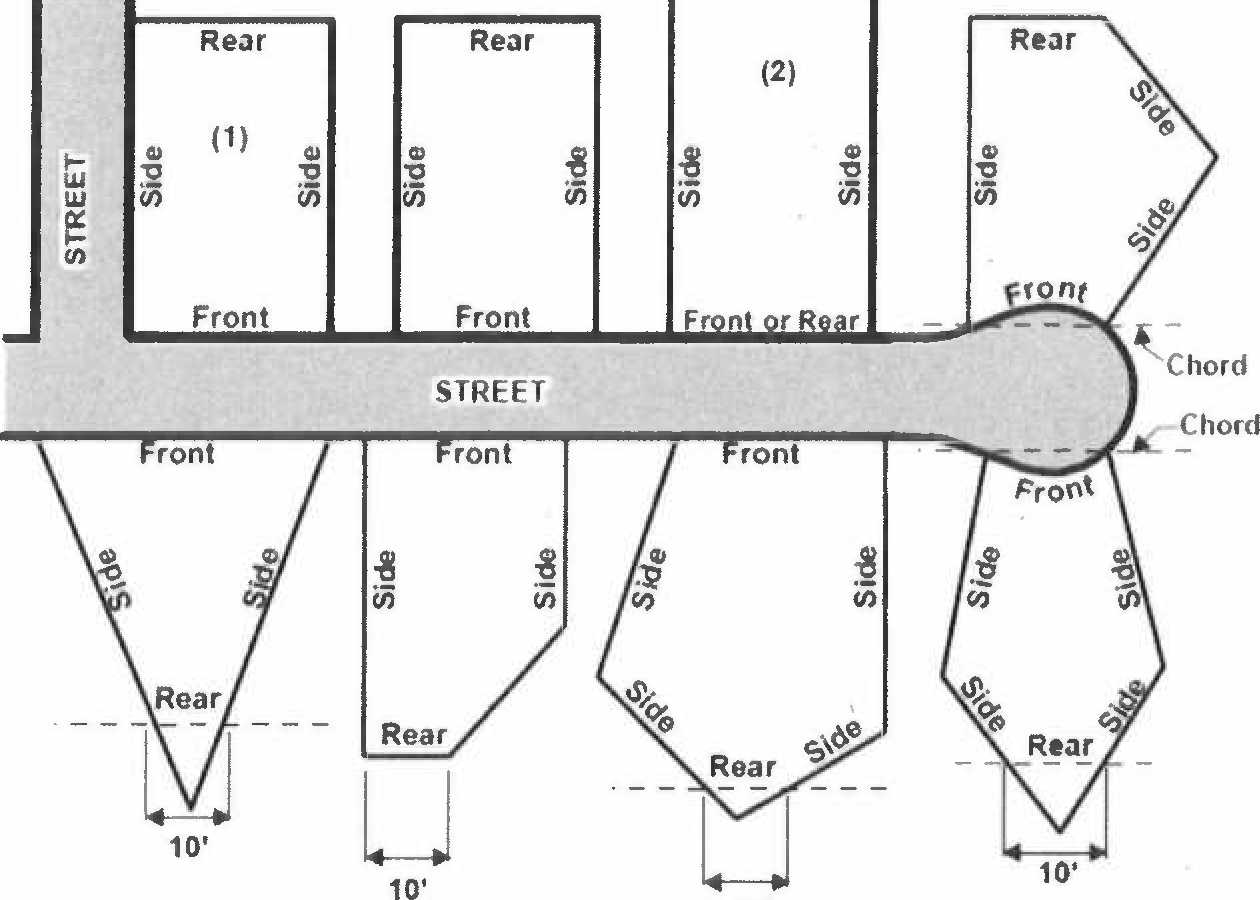
(1) For corner lots, the narrower street frontage is the front yard.
(2) For through lots, see Section 8106-4.4.
(3) For flag lots, see Section 8106-4.3.
Lot, Reverse Corner—A corner lot, the rear of which abuts the side of another lot. Interior lots adjacent to flag lots are not considered reverse corner lots.
Lot, Through—A lot, other than a corner lot, having frontage on two (2) parallel or approximately parallel streets.
Lot Width—The horizontal distance between the side lot lines measured at the front setback.
Low Barrier Navigation Center (LBNC)—Shall have the same definition as set forth in Government Code section 65660(a), which states: "'Low Barrier Navigation Center' means a Housing First, low-barrier, service-enriched shelter focused on moving people into permanent housing that provides temporary living facilities while case managers connect individuals experiencing homelessness to income, public benefits, health services, shelter, and housing. A Low Barrier Navigation Center may be non-congregate and relocatable. 'Low Barrier' means best practices to reduce barriers to entry, and may include, but is not limited to, the following:
(1)
The presence of partners if it is not a population-specific site, such as for survivors of domestic violence or sexual assault, women, or youth.
(2)
Pets.
(3)
The storage of possessions.
(4)
Privacy, such as partitions around beds in a dormitory setting or in larger rooms containing more than two beds, or private rooms." (See Section 8107-51.)
Lumen—Unit of measure used to quantify the amount of light produced by a lamp or emitted from a luminaire (as distinct from a "watt," which is a measure of power consumption).
Luminaire—A complete lighting unit—i.e., the lamp and all components directly associated with the distribution, positioning and protection of the lighting unit. This is also referred to as a light fixture.
Luminaires, Essential—A luminaire that is used for safety purposes, for security lighting, to illuminate a circulation area such as a walkway or driveway, or to illuminate a building entrance.
Luminaire, Fully-Shielded—A luminaire constructed and installed in such a manner that all light emitted by the fixture is projected below the horizontal plane through the fixture's lowest light-emitting part. Examples of fully-shielded luminaires are included in Figure 1.
Figure 1. Examples of Fully-Shielded Luminaires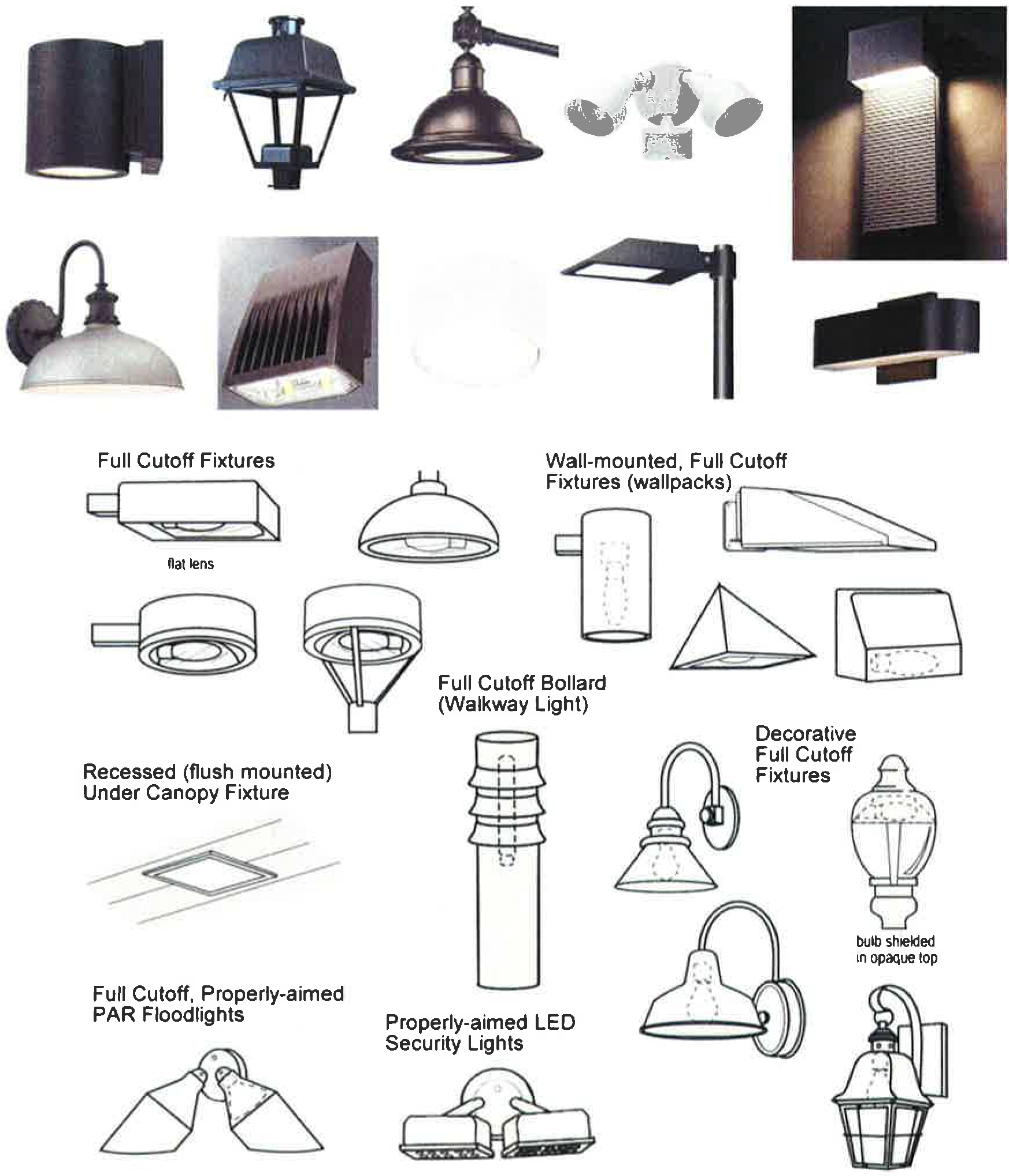
Luminaire, Outdoor—See definition of Lighting, Outdoor.
Luminaire, Partially-Shielded—A luminaire constructed and installed such that most light emitted by the fixture is projected below the horizontal plane through the fixture's lowest light-emitting part. Light emitted above the horizontal plane arises only from decorative elements or diffusing materials such as frosted/colored glass or plastic. Examples of partially-shielded luminaires are included in Figure 2.
Figure 2. Examples of Partially-Shielded
Luminaires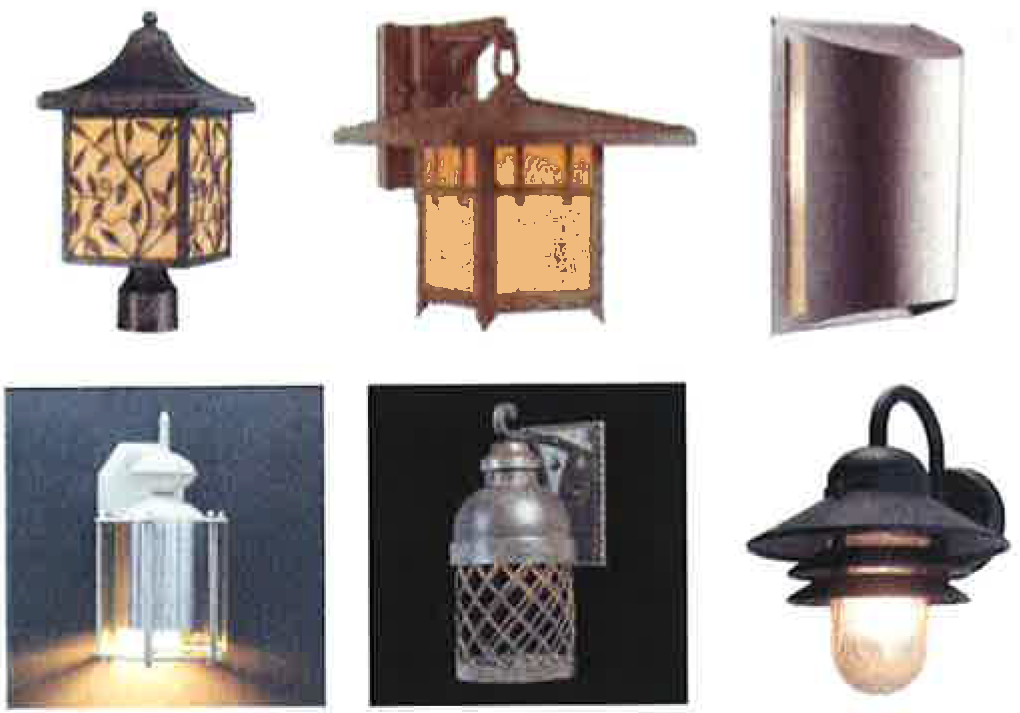
Mechanical Parking Lifts—Automated or manual, indoor or outdoor, lift systems designed to stack one or more motor vehicles vertically.
Mineral Resource Development—The exploration for or extraction of surface or subterranean compounds and materials; this includes oil and gas exploration and production, and the mining of metallic and nonmetallic minerals, sand, gravel and rock.
Mining—A form of mineral resource development involving the extraction and removal of more than one thousand (1,000) cubic yards of material from the same site, or from separate lots within one (1) mile of each other that are owned or mined by the same person, through such activities and uses as borrow areas, sand, gravel and rock quarries, etc. Mining does not include extraction and removal of material from construction sites or following floods, landslides or natural disasters where the land is being restored to its prior condition. (See Section 8107-9.)
Mining, Accessory Uses—Uses customarily incidental, appropriate and subordinate to mining located on the same site, such as stockpiling; sorting; screening; washing; crushing; and maintenance facilities. Other accessory uses include the following: ready mix concrete batching; asphalt concrete batching; recycling of concrete, asphalt and related construction materials; trucking operations associated with products from the site; and contractors' service and storage yards and concrete and asphalt concrete products manufacturing which make use of the products produced from the subject mining site. These uses may require separate permits as principal uses if not addressed under the primary mining permit. (See Section 8107-9.)
Mining, Agricultural Site—An area, or areas within a site where the Planning Director has determined that the excavation and/or removal of more than one thousand (1,000) cubic yards of earthen material is integral and beneficial to the development or enhancement of a bona fide farming operation on that site. (See Section 8107-9.)
Mining, Public Works Maintenance—Mining, and its accessory uses, for periods of less than one year, on a site where such mining is necessary for the preservation of public facilities or structures, or to alleviate imminent threats to public health and safety, and where such mining has been declared in writing by the Public Works Agency to be under its administrative control through an approved permit. Said uses include such operations as the maintenance of flood control facilities [pursuant to Title 14 CCR Section 3502(a)(2)], removing material to avert potential landslides, and accessory processes such as stockpiling, sorting, and screening of on-site material.
Mixed Solid Waste—Shall have the same definition as "Mixed Material" as set forth in the California Code of Regulations, Title 14, Section 17852(a)(26), as may be amended, which states: "Any compostable material that is part of the municipal solid waste stream, and is mixed with or contains non-organics, processed industrial materials, mixed demolition or mixed construction debris, or plastics. A feedstock that is not source separated or contains 1.0 percent or more of physical contaminants by dry weight is mixed material." Mixed solid waste is "non-hazardous" solid waste discarded from homes, businesses, institutions, and manufacturing plants that has not been separated or sorted by type and usually contains unrecyclable residuals that shall be disposed of in a waste disposal facility.
Mixed-Use Development—A development project with planned integration of residential and nonresidential development within a building with the upper floors used for residential and the ground floor used for nonresidential land uses.
Mobile Food Facility—A wheeled vehicle or a stand, allowed by the California Health and Safety Code, from which food or beverages are sold.
Mobilehome—Shall have the same definition as set forth in Health and Safety Code, section 18008, as may be amended. For the purposes of Article 17 of this Chapter, a recreational vehicle located in a mobilehome park or trailer park shall be treated as a mobilehome, provided it has been used as a principal dwelling unit for nine (9) consecutive months.
Mobilehome Park—Shall have the same definition as set forth in Health and Safety Code, section 18214. (See Sections 8107-7.1 and 8109-4.10.)
Model Water Efficient Landscape Ordinance (MWELO)—New development and retrofitted landscape water efficiency standards governed by California Code of Regulations, Title 23, Division 2, Chapter 2.7, as may be amended.
Module—A drive aisle with vehicles parked on one or two sides of the aisle.
Monopole—A structure composed of a single spire, pole, or tower used to support antennas and connecting appurtenances for a non-commercial antenna or wireless communication facility.
Motel—Building(s) that provide lodging in guest rooms primarily for those traveling through the area or that otherwise require short term accommodations. Motel buildings typically have direct access from the rooms to the outdoors. Motels include auto courts, motor lodges, and tourist courts.
Motocross/OHV (Off-Highway Vehicle) Park—An activity involving two-wheeled motorized vehicles (limited to two-engine cylinders or less), conducted on a closed course, laid out over natural terrain, that may include left and right turns, hills, jumps and irregular terrain, and which does not include high-speed sections. (See Section 8107-22.)
Mulch—Any organic material such as leaves, bark, straw, compost, or inorganic mineral materials such as rocks, gravel, or decomposed granite left loose and applied to the soil surface for environmental beneficial purposes such as reducing evaporation, suppressing weeds, moderating soil temperature, and preventing soil erosion.
Multiple Trunk Tree—A tree that has two (2) or more trunks forking below four and one-half (4½) feet above the uphill side of the root crown. (See Section 8107-25.)
Museum—A place or structure where objects of interest are displayed and viewed by the public.
Native Trees—Any trees indigenous to Ventura County not planted for commercial agriculture. (See Section 8107-25.)
Native Vegetation—Naturally occurring vegetation in Ventura County. Native vegetation includes, but is not limited to, oak woodland, coastal sage scrub, chaparral, perennial grassland, California annual grassland, riparian woodland and riparian scrub. Native vegetation does not include ruderal vegetation and plant species listed by the California Invasive Plant Council. In addition, native vegetation does not included ornamental, landscape or crop vegetation, including sod and lawn grasses and actively managed fallow farmland.
Native Vegetation Community—Natural occurring vegetation community in Ventura County as classified and recognized by the California Native Plant Society (CNPS) in collaboration with the California Department of Fish and Wildlife (CDFW). Also referred to as a "Natural Community" or listed in "A Manual of California Vegetation" (CNPS, Online Edition), as may be amended.
[Non-Commercial Antenna—See Antenna, Non-Commercial.]
Nonconforming Structure—A structure, or portion thereof, that was lawfully erected or altered and maintained, but that no longer conforms with development standards of this Chapter, including standards for building lot coverage, parking, lot area per structure, height, and setbacks, solely because of amendments to this Chapter or changes to other applicable law.
Nonconforming Use—A use that was lawfully established and maintained but that, because of amendments to this Chapter or other applicable law, is: (1) no longer permitted in the zone in which it is located or, (2) no longer in conformance with the parking requirements of the use in the zone in which it is located.
Nonmotorized Wheeled Conveyances—Those conveyances of a wheeled nature that do not require motorized propulsion, such as, but not limited to, skateboards, bicycles, unicycles, and rollerskates.
Nonprofit Humane Organization Animal Facility—Shall have the same definition as set forth in Ventura County Ordinance Code, Division 4, Chapter 4, Article 9, Section 4494.2(c), as may be amended, which states: "An animal facility operated by a bona fide charity in good standing under the provisions of Section 501(c)(3) of the Internal Revenue Code, where roosters are kept for adoption, recovery or sanctuary."
Official Zoning Data—The approved zoning classifications for all parcels in unincorporated Ventura County, maintained technologically in GIS format.
Offsets—Methods of mitigation and/or replacement for the alteration, felling, or removal of a protected tree. (See Section 8107-25.)
Off-Site Parking—Parking provided at a site other than the site on which the use served by such parking is located.
Oil and Gas Exploration and Production—The drilling, extraction and transportation of subterranean fossil gas and petroleum, and necessary attendant uses and structures, but excluding refining, processing or manufacturing thereof. (See Section 8107-5.)
On-Site Composting Activities, Accessory—Composting activities at residences, parks, community gardens, homeowners associations, residential planned developments, universities, schools, hospitals, golf courses, industrial parks, or other similar land uses where the purpose is to compost material generated on-site, in conjunction with any necessary bulking agents, additives, and amendments. Those operations which have less than ten (10) cubic yards of any combination of separated feedstock, actively decomposing compost, and stabilized compost or ground uncomposted material on site at any one (1) time are small-scale, those with between ten (10) and two hundred (200) cubic yards are medium-scale, and those with more than two hundred (200) cubic yards are large-scale. This category does not include activities related to normal farming activities.
On-site Wastewater Treatment Facility—A wastewater treatment plant that treats liquid waste which is generated on the same project site where the plant is located, with both the plant and the project site under common ownership. The plants are sized, and explicitly restricted to serve only the project site and cannot serve uses off-site or under different ownership (see Community Wastewater Treatment Facility).
Open storage—The placement or keeping, in an area not fully enclosed by the walls of a building, of miscellaneous objects and materials accessory to the principal use of the property, including inoperative motor vehicles, boats and trailers; building materials; reusable parts and equipment, and the like; but excluding trash, garbage and debris. (See Section 8107-1.6 for open storage accessory to dwellings, and Article 9 for other uses by zone.)
Organics Processing Operations—A category of operations that actively processes organic materials (materials originally derived from living organisms) for the purpose of producing compost, mulch, wood chips, or other similar products. This category includes but is not limited to on-site composting operations, small, medium and large; commercial organics processing operations, small, medium and large (includes vermicomposting and chipping/grinding operations); and biosolids composting operations. This category does not include activities related to normal farming activities.
Outdoor Events—An outdoor event held in a stationary location on a privately owned parcel in the Open Space, Agricultural Exclusive, Rural Agricultural, or Commercial Planned Development zone at which the primary event activities occur outside of structures, such as harvest festivals; carnivals; historic re-enactments; animal events; art shows; athletic events; concerts; craft fairs; farmer's markets; receptions; ceremonies; fundraisers; social, political, spiritual or organizational gatherings; and similar events except for those that are either separately regulated under this Chapter, addressed by a permit or entitlement issued under this Chapter or that occur at a permitted school or college. (See Section 8107-46.)
Outdoor Recreational Facility—An outdoor area designed for active recreation, whether publicly or privately-owned, including, but not limited to, baseball and softball diamonds, soccer and football fields, golf courses, equestrian arenas, and sport courts.
Outdoor Sales and Services, Temporary—Such temporary outdoor uses as sidewalk sales (except swap meets), seasonal sales and auctions, but excluding mobile food facilities. (See Section 8107-12.)
Overlay Zone—Any zone listed in Section 8104-7, Article 4 of this Chapter. An overlay zone creates a special zoning district, placed over an existing base zone(s), which identifies special provisions in addition to those in the underlying base zone. The overlay zone can share common boundaries with the base zone or cut across base zone boundaries. (See Article 9 for specific overlay zone standards.)
Parcel—For the purposes of this Chapter, the word "parcel" shall have the same meaning as the word "lot" and the two (2) terms are synonymous.
Park, Natural—An area of land available for public use, at least seventy-five (75) percent of which is landscaped or otherwise left in a natural state, and which does not involve off-road motor vehicle uses of any kind.
Park, Urban—An area of land available for public use predominantly located within the built environment. Typical amenities and uses may include, but are not limited to, landscaped areas, athletic fields and courts, areas for skateboarding and other nonmotorized conveyances, plazas, squares, picnic and/or sitting areas, natural areas, trails and walkways, and concessions. (See Section 8107-48.)
Parking Area—An area outside the public right-of-way containing five (5) or more parking spaces and designed and used primarily for the parking of operable motor vehicles and bicycles. Parking areas may be located at grade, above ground, or below ground. Parking areas include parking facilities, lots, structures and underground parking. Elements of parking areas include parking spaces, drive aisles, loading areas and required landscaping and screening. Parking areas do not include: individual residential garages, parking spaces/areas for single-family (including caretaker and farmworker dwelling units), or two-family dwelling units, or motor vehicle storage or inventory display areas.
Parking Facility—A type of parking area and/or structure that is a principal use.
Periodic Outdoor Sporting Events—Recreational events or activities, other than spectator-type animal events, which require a natural environment, are carried on by one or more organized groups of people, and do not involve structures, motorized vehicles, aircraft or firearms.
Permittee—A person or entity that holds a permit or operates a use allowed by a permit. The owner of the property for which an entitlement has been approved is the permittee, unless an alternative person or entity is designated as the permittee in the subject use permit, in which case that other person or entity is the permittee.
Person—Any individual, organization, partnership, or other business association or corporation, including any utility, and any federal, state, local government, or special district or an agency thereof.
Personal Goods—Items such as bristle goods, umbrellas, grooming items and tobacco paraphernalia.
Personal Services—Enterprises serving individual necessities, such as barber shops, beauty salons and spas, clothing rental, coin-operated laundromats, funeral homes, marriage bureaus, massage services by masseurs/masseuses, personal laundry and dry cleaning establishments, photographic studios, tattoo parlors, upholstery shops, and travel agencies.
Petroleum Refining—Oil-related industrial activities involving the processing and/or manufacture of substances such as: asphalt and tar paving mixtures; asphalt and other saturated felts (including shingles); fuels; lubricating oils and greases; paving blocks made of asphalt, creosoted wood and other compositions of asphalt and tar with other materials; and roofing cements and coatings.
Pigeons/Squab—Any pigeon not designated as a Homing, Racing, or Roller pigeon, including but not limited to, show pigeons, pigeons raised for food, or pigeons matching the basic description of a homing, racing or roller pigeon, but lacking the required seamless band.
Pigeons, Homing/Racing—Member of the family Columbae, identified as such by presence of a seamless metal or metal/plastic band permanently affixed to the leg, indicating year of birth and unique identification number, issued by the "American Racing Pigeon Union," A.U.; "International Federation of Pigeon Fanciers," I.F.; or other internationally recognized federation.
Pigeons, Rollers—Member of the family of pigeons known as "Birmingham Rollers," identified as such by the presence of a seamless metal or metal/plastic band permanently affixed to the leg, issued by the "National Birmingham Roller Club," N.B.R.C.; "Ventura County Roller Club," V.C.R.C or other nationally recognized federation or club.
Planning Commission—The Ventura County Planning Commission.
Planning Director—The Director of the Resource Management Agency, Planning Division, of the County, or designee.
Point of Interest—A designation applied to the site of a former improvement or event location pursuant to the Ventura County Cultural Heritage Ordinance.
Preliminary Processing—Basic activities and operations instrumental to the preparation of agricultural goods for shipment to market, excluding canning or bottling.
Principal Use—The primary or main use on a lot to which other uses and structures are accessory.
Principally Employed—The source of personal income that exceeds fifty percent (50%) of the gross personal income as reflected in a person's previous annual income tax return.
Processed Commodities—Agricultural products which have been bottled, canned, supplemented with preservatives or coloring agents, or chemically altered. Processed commodities do not include those agricultural products which have been only washed, sorted, mixed, packaged, squeezed, juiced or pressed.
Protected Trees—Any trees from among the species or any heritage tree or historical tree listed in Table 1 "Protected Trees" of the Tree Protection Ordinance, Section 8107-25 of this Chapter, with one (1) or more differentiated trunks which meets the dimensional standards therein and which is situated on land with the applicable zoning shown on Table 1.
Pruning—The removal of all, or portions, of a tree's shoots, branches, limbs or roots. (See Section 8107-25.)
Public Road or Street—Any road or street or thoroughfare of whatever nature, publicly maintained and open to the use of the public for the purpose of vehicular travel.
Public Works Maintenance—Public Works maintenance means work performed to restore public facilities or structures to their original design capacity and any activities necessary for the preservation of public facilities or structures or to alleviate imminent threats to public health and safety. Said work and activities include, but are not limited to, removing material to avert potential landslides, the repair and/or maintenance of flood control facilities as defined by title 14, section 3505(a)(2) of the California Code of Regulations, and accessory processes such as stockpiling, sorting, and screening of material.
Qualified Tree Consultant—An individual who, through a combination of education, training, licenses and certificates for professional proficiency, and work experience can demonstrate to the satisfaction of the Planning Director, possesses the necessary skills and abilities to provide competent advice as called for by various provisions of the tree protection regulations of Section 8107-25.
Qualified Tree Trimmer—An individual who, to the satisfaction of the Planning Director, has certified that he or she has read and understands the tree protection regulations of Section 8107-25, the Tree Protection Guidelines, the I.S.A. Pruning Standards, is licensed to conduct business in Ventura County and has other applicable land use permits to conduct said business.
R-Zone—A residential zoning designation under this Chapter.
Radio Studios—A staffed commercial facility used for the creation and production of AM/FM radio and other electronic media programming, which includes studios, stages, editing facilities, post-production facilities, associated antennas and accessory antenna equipment used for the transmission of radio and microwave signals. (See Section 8107-45.2.3.)
Reclamation—The combined process of land treatment that minimizes water degradation, air pollution, damage to aquatic or wildlife habitat, flooding, erosion, and other adverse effects from surface mining operations, including adverse surface effects incidental to underground mines, so that mined lands are reclaimed to a usable condition which is readily adaptable for alternate land uses and create no danger to public health or safety. The process may require the removal of mining related structures, equipment and improvements, backfilling, grading, resoiling, revegetation, soil compaction, slope stabilization, erosion control or other measures which may also extend into adjacent lands surrounding mined lands.
Recreational Vehicle—Shall have the same definition as set forth in Division 13, Part 2, section 18010 of the California Health and Safety Code, as may be amended, which states: "'Recreational Vehicle' means both of the following: (a) A motor home, travel trailer, truck camper, or camping trailer, with or without motive power, designed for human habitation for recreational, emergency, or other occupancy, that meets all of the following criteria: (1) It contains less than three hundred twenty square feet of internal living room area, excluding built-in equipment, including, but not limited to, wardrobe, closets, cabinets, kitchen units or fixtures, and bath or toilet rooms. (2) It contains 400 square feet or less of gross area measured at maximum horizontal projections. (3) It is built on a single chassis. (4) It is either self-propelled, truck-mounted, or permanently towable on the highways without a permit. (b) A park trailer, as defined in Section 18009.3." Recreational vehicles do not fall within the definition of mobilehomes.
Recreational Vehicle Park—Shall have the same definition as set forth in Division 13, Part 2.3, Chapter 2, section 8862.39, of the California Health and Safety Code, which states: "(a) Any area or tract of land, or a separate designated section within a mobilehome park where two or more lots are rented, leased, or held out for rent or lease, or were formerly held out for rent or lease and later converted to a subdivision, cooperative, condominium, or other form of resident ownership, to accommodate owners or users of recreational vehicles, camping cabins, or tents. (b) Notwithstanding subdivision (a), employee housing that has obtained a permit to operate pursuant to the Employee Housing Act (Part 1 (commencing with Section 17000)) and that both meets the criteria of Section 17021.6 and is comprised of two or more lots or units held out for lease or rent or provided as a term or condition of employment shall not be deemed a recreational vehicle park for the purposes of the requirement to obtain an initial or annual permit to operate or pay any fees related thereto required by this part." A "recreational vehicle park" is primarily for temporary use by recreational vehicles for which utility connections (sewer, water, electricity) are provided at the park. (See Section 8107-7.2.)
Recyclable Materials—Materials which have been retrieved or diverted from disposal, that can be collected, sorted, cleaned, reconstituted and returned to the economic mainstream in the form of raw material for new, reused, or reconstituted products which meet the quality standards necessary to be used in the marketplace.
(Add Ord. 4214—10/24/00)
Recyclables Collection Center—An indoor or outdoor facility such as a buy-back center, a drop-off center, or a mobile unit, that occupies less than five hundred (500) square feet, and has a capacity of no more than eighty (80) cubic yards, and that receives separated, nonhazardous, nonputrescible, recyclable or reusable materials—containing less than ten (10) percent unrecyclable residuals that shall be disposed in a waste disposal facility—generated off site and which may aggregate or sort these materials for the purpose of shipment off site. This definition does not apply to reverse vending machines that occupy less than fifty (50) square feet per principal use. (See Section 8107-36.)
Recyclables Collection and Processing Facility—A facility that receives separated, nonhazardous, nonputrescible, recyclable or reusable materials, or receives unseparated loads, for the purpose of preparation for shipment off site. Loads received contain less than ten (10) percent unrecyclable residuals that shall be disposed in a waste disposal facility. Processing may include separation, baling, crushing, cleaning, sorting, shredding, or chopping. This definition includes facilities that recycle construction and demolition debris and facilities that use recycled construction and demolition material to batch concrete and asphalt. This definition does not include automobile wrecking and salvage yards. (See Section 8107-36.)
Remove—To transplant a protected tree or carry away a fallen protected tree or its limbs. (See Section 8107-25.)
Rent—The terms rent, rented and rental mean allowing use of a dwelling or property, or any portion thereof, in exchange for consideration in any form.
Residential Care Facility—A residential facility providing nonmedical or incidental medical services on a 24-hour basis or on a less-than-24-hour basis to people who are mentally ill, mentally handicapped, physically disabled, or elderly, or are dependent or neglected children, wards of the Juvenile Court, or other persons in need of personal services, supervision, or assistance essential for sustaining the activities of everyday living or for protection of the individual. Including within this definition are "intermediate care facilities/ developmentally disabled-nursing" and "intermediate care facilities/developmentally disabled-habilitative" with six (6) or fewer beds, and congregate living health facilities, pursuant to the Health and Safety Code. (See Section 8107-53.)
Resource Recovery—Shall have the same definition as set forth in the California Code of Regulations, Title 14, section 17225.58, as may be amended, which states: "The reclamation or salvage of wastes for reuse, conversion to energy or recycling."
Rest Home—A licensed facility where lodging, meals, nursing, dietary and other personal services are rendered for nonpsychiatric convalescents, invalids, and aged persons for compensation. Excludes cases of contagious or communicable diseases, and surgery or primary treatments such as are customarily provided in sanitariums and hospitals.
Restoration Project—A project that involves the manipulation of the physical, chemical, or biological characteristics of a site to re-establish the site's natural or historic habitat, species, or ecological functions. It may include the re-establishment of habitat at sites where ecological function was wholly or partially lost or degraded.
Retail Trade—Businesses engaged in the sale of merchandise, generally without transformation, and rendering services that include the incidental sale of merchandise. Examples of retail trade businesses are auto supply stores, book and stationery stores, camera shops, clothing and fabric stores, department and variety stores, drug stores, florists, food stores, furniture stores, gift and novelty shops, hardware and paint stores, home furnishings stores, household appliance stores, jewelry stores, liquor stores, music stores, newsstands, pet stores, shoe stores, sporting goods stores, toy and hobby shops and used merchandise stores.
(Am. Ord. 3730—5/7/85)
Retreat—A facility which (a) provides opportunities for small groups of people to congregate temporarily on a site for such purposes as education, enlightenment, contemplation, renewal or solitude; and (b) by its nature, needs to be located in a quiet, sparsely-populated, natural environment. (See Section 8107-18.)
(Add Ord. 3810—5/5/87; Am. Ord. 4317—3/15/05)
Reuse Salvage Facility—A facility or yard that accepts, salvages, and sells or distributes a variety of separated, nonhazardous discards including building materials, household fixtures, and furniture, and which requires some outdoor storage and which may conduct minor repair or upgrading of the materials. This definition does not apply to automobile salvage operations. (See Section 8107-36.3.5.)
(Add Ord. 4214—10/24/00)
Riparian/Riparian Area/Riparian Habitat Area—The bank of a stream, creek or river. Riparian habitat is the aquatic and terrestrial habitats that occur along streams, creeks and rivers.
Roof Structures—Structures located on the roof of a building for the housing of elevators, stairways, tanks, ventilating fans and similar equipment required to operate and maintain the building; fire or parapet walls, safety rails, skylights, towers, flagpoles, chimneys, smokestacks, solar collectors, residential satellite and digital T.V. dishes less than one (1) meter in diameter and similar structures. (See Section 8106-7.2.)
(Am. Ord. 3730—5/7/85)
Rooster—Shall have the same definition as set forth in Ventura County Ordinance Code, Division 4, Chapter 4, Article 9, Section 4494.2(g), which states: "Any male chicken that: (1) is six (6) months old or older; or (2) has full adult plumage; or (3) is capable of crowing." (See Section 8107-2.3.)
Root Crown—The area of a tree where the trunk(s) meet the roots, sometimes called the collar of the tree. (See Section 8107-25.)
Root System—Unless otherwise demonstrated to the satisfaction of the Planning Director with a field investigation conducted by a certified arborist, the root system is the underground portion of a tree, as defined by inscribing a circle around the trunk of the tree using a radius equal to the farthest reach of the dripline plus five (5) feet. The minimal radius to be used is fifteen (15) feet. (See Section 8107-25.)
Sales and Display Areas—Indoor or outdoor areas that are accessible to customers and used for the sale, rental, lease, or display of inventory, but does not include indoor or outdoor storage areas that customers cannot access.
Schools, Boarding or Nonboarding—Educational facilities for pre-college levels of instruction; specifically limited to elementary, middle school and high schools offering full curricula as required by State law. Boarding schools are those which provide lodging and meals for the pupils.
Senior Mobilehome Park—A mobilehome park with a minimum of ten (10) spaces in which at least eighty (80) percent of the occupied mobilehomes or manufactured homes are inhabited by, or intended for habitation by, at least one (1) person who is fifty-five (55) years of age or older. (See Section 8109-4.11.)
Setback—The minimum distance by which structures are to be separated from the boundary lines of the lot on which they are located, in order to provide an open yard area which is unoccupied and unobstructed from the ground upward. In the case of "flag lots," the setbacks shall be measured from the applicable front (F), rear (R) and sides (S) of the lot as set forth in Section 8106-4.3 of this Chapter.
Setback, Front—An open yard area that extends between side lot lines across the front of a lot, the depth of which is the required minimum horizontal distance between the front lot line and a line parallel thereto on the lot.
Setback, Rear—An open yard area that extends across the rear of the lot between the inner site lot lines which is the required minimum horizontal distance between the rear lot line and a line parallel thereto on the lot.
Setback, Side—An open yard area that extends from the front yard, or the front lot line where no front yard is required, to the rear yard; the width of the required side yard shall be measured horizontally from the nearest part of the side lot line.
Shall and May—"Shall" is mandatory; "May" is permissive.
Shared Parking—Shared parking is a tool through which adjacent property owners share their parking areas and thereby reduce the number of parking spaces that each would provide on their individual properties. Shared parking is commonly applied when land uses have different parking demand patterns and are able to use the same parking spaces/areas throughout the day.
Short-Term Rental—A dwelling, any portion of which is rented for a period less than thirty (30) consecutive days when the owner is not physically present, with no meals or food provided to the renter or renters. A short-term rental is not considered a home occupation under this Chapter. Use of a dwelling for occasional home exchange is not considered a short-term rental. (See Section 8109-4.6.)
Sight Triangle—A triangular area on a corner lot, two of the sides of such triangle being formed by extending two imaginary lines from the corner of the lot adjacent to the street intersection at least 40 feet back to two points along the sides of the lot parallel to the two intersecting streets, the third side then being formed by the connection of such points.
(Add Ord. 3810—5/5/87)
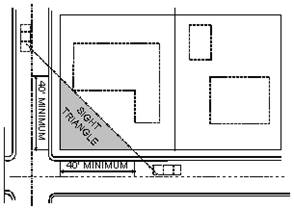
Signs—For sign definitions, see Article 10.
Single Room Occupancy (SRO)—Housing units that are restricted to occupancy by no more than two (2) persons and may include a kitchen and/or a bathroom, in addition to a bed. These units are typically comprised of one or two (2) rooms.
Site—One or more lots planned and developed as a unit under one permit.
Site of Merit—A designation applied to sites and structures pursuant to the Ventura County Cultural Heritage Ordinance.
(Add Ord. 4220—12/12/00)
Sky Glow—brightening of the nighttime sky resulting from the scattering and reflection of artificial light in the atmosphere that reduce one's ability to view the night sky.
Small Utility Structures—Electrical boxes, traffic signal controllers, ventilation columns, transformers, valve apparatus, and telephone and cable TV vaults and boxes that have no covered floor area for human occupancy. Small utility structures do not include towers, antennas, satellite dishes and other communication equipment that fall under the definition of Communications Facilities.
(Add Ord. 4092—6/27/95; Am. Ord. 4123—9/17/96)
SMARA—The Surface Mining and Reclamation Act (Public Resources Code § 2710 et seq.). (See Section 8107-9.)
(Add Ord. 4187—5/25/99)
Soil Amendment Operation—An operation engaged in the resale and/or blending of various soil amendment and mulch products. Soil amendments are soil additives (such as gypsum, sand, rice hulls, peat moss, or compost) that stabilize the soil, improve resistance to erosion, increase permeability to air and water, ease cultivation, improve texture and resistance of the surface to crusting, or otherwise improve soil quality. This definition does not include organics processing operations.
(Add Ord. 4214—10/24/00)
Stabilized Compost—The finished product of the composting process. Stabilized compost is no longer undergoing significant biological decomposition.
(Add Ord. 4214—10/24/00)
Stand-Alone Batch Plant—A facility where, following the cessation of mining operations at, or immediately adjacent to, the site due to the exhaustion of mineral resources, pre-processed mineral materials such as cement, aggregate, recycled construction materials, and petroleum products are imported from off site and are mixed together to create concrete or asphalt for use at construction sites. The following uses may be accessory to the batch plant operation: processing/recycling used concrete and asphalt construction materials, processing mined materials into product for a batch plant, trucking associated exclusively with the subject plant, stockpiling of materials used in the batching operation, offices and maintenance buildings and facilities for the operation. (See Section 8107-42.)
Stockpiling of Construction Related Debris and/or Fill Material for Non-Agricultural Operations—The depositing of inert materials from offsite onto land for temporary storage in non-agricultural operations until such time as it can be removed to another site. Such materials include soil, sand, rock, and broken concrete removed from construction sites, debris basins, landslides and the like. (See Section 8107-28.)
Store—An enclosed building housing an establishment offering a specified line of goods or services for retail sale direct to walk-in customers.
Stormwater Management Landscaping—Landscape features that make use of vegetation, land forms, soil or filtering media to provide retention, treatment, evapotranspiration, or infiltration of stormwater. Examples include bioretention areas, rain gardens, vegetated drainage swales, vegetated buffer strips, tree box filters, infiltration trenches, and dry swales.
Structural Alteration—Any change in roof lines or exterior walls, or in the supporting members of a building such as foundations, bearing walls, columns, beams, girders, floor joists, roof joists, or rafters. This includes any physical change that could affect the integrity of a wall, including partial or total removal, moving a wall to another location or expanding the wall in terms of height or length. Minor actions such as adding a doorway, walkway, passage or window, or attaching architectural features or adornments, are not considered to be structural alterations.
Structure—Anything constructed or erected on the ground, or that requires location on the ground, or is attached to something having a location on or in the ground. "Structure" does not include fences, or walls used as fences, seven (7) feet or less in height, or plant materials.
(Am. Ord. 3810—5/5/87)
Supportive Housing—Shall have the same definition as set forth in Government Code section 65582(n), which states: "'Supportive Housing' means housing with no limit on length of stay, that is occupied by the target population, and that is linked to an onsite or offsite service that assists the supportive housing resident in retaining the housing, improving their health status, and maximizing their ability to live and, when possible, work in the community." (See Section 8107-52.)
Surface Water Feature—An area containing a stream (including intermittent and ephemeral), creek, river, wetland, seep, or pond, the riparian habitat area associated with the feature, as well as a development buffer area that is two hundred (200) feet as measured from the farthest extent of the surface water feature and its associated riparian area. The data used to designate the areas are obtained from the U.S. Fish and Wildlife Service National Wetlands Inventory Dataset. Areas designated as surface water features are shown on the "Surface Water Feature Buffer" map within the Planning GIS Wildlife Corridor layer of the County of Ventura - County View Geographic Information System (GIS), as may be amended by the Planning Director. The term surface water feature does not include ponds, lakes, marshes, wetlands or agricultural water impoundments or associated riparian habitat areas that are legally established and human-made.
Swap Meet—A market operating on weekends and holidays for the sale or exchange of merchandise at retail by a number of sellers.
(Am. Ord. 3810—5/5/87)
Tandem Parking—The placement of parking spaces one behind the other, such that one parking space must be driven across in order to access the other space.
Temporary—A period of thirty (30) days or less, unless otherwise specifically defined in this Chapter or in the conditions of a permit issued pursuant to this Chapter.
Temporary Collection Activity—An activity of short duration (not exceeding seven (7) consecutive days and not occurring more frequently than twice in any thirty-day period, and seven (7) times per year at the same location) where mixed solid wastes, hazardous wastes, or recyclable materials are collected from the public at a central point and transported for recycling, processing, transformation, or disposal. This definition does not include individual refuse bins sited for the temporary collection of seasonal recyclables, such as Christmas trees and telephone books. (See Section 8107-36.3.4.)
Temporary Rental Unit—A dwelling which is used as a short-term rental or homeshare. (See Section 8109-4.6.)
Through Lot—See Lot, Through.
Timber—Trees of any species maintained for eventual harvest for forest product purposes, whether planted or of a natural growth, standing or down, on privately or publicly owned land, including Christmas trees but excluding nursery stock.
Timber Growing and Harvesting—Trees of any species maintained for eventual harvest for forest product or firewood purposes, which may or may not be part of an agricultural operation. Such trees can be planted or of a natural growth, standing or down, on privately or publicly owned land, including Christmas trees but excluding nursery stock. (See Section 8107-25.)
Townhouse Development—A subdivision consisting of attached dwelling units in conjunction with a separate lot or lots of common ownership, wherein each dwelling unit has at least one vertical wall extending from ground to roof dividing it from adjoining units, and each unit is separately owned, with the owner of such unit having title to the land on which it sits.
Traffic Safety Sight Area—The area that provides an unobstructed view for motorists to avoid or anticipate potential collisions along a roadway, intersection, parking lot, etc.
Transitional Housing—Shall have the same definition as set forth in Government Code section 65582(q), which states: "'Transitional Housing' means buildings configured as rental housing developments, but operated under program requirements that require the termination of assistance and recirculating of the assisted unit to another eligible program recipient at a predetermined future point in time that shall be no less than six months from the beginning of the assistance." (See Section 8107-52.)
Transportation Services—Establishments primarily engaged in undertaking the transportation of goods and people for compensation, and which may in turn make use of other transportation establishments in effecting delivery. This definition includes parking areas for overnight truck storage, commercial truck fueling, and such establishments as commercial distribution services, freight forwarding services and freight agencies.
Tree Certification—Written documentation signed by a qualified tree consultant, as determined by the Planning Director, which states in a manner consistent with Section 8107-25 that there is no reasonable and appropriate alternative to altering or removing a given tree.
Tree Emergency—A situation in which a tree or its limbs are determined to pose an imminent threat to public safety, property or to the health of a protected tree. (See Section 8107-25.)
Tree Protected Zone—The surface and subsurface area within the dripline and extending a minimum of five (5) feet outside the dripline, or fifteen (15) feet from the trunk of a tree, whichever is greater. (See Section 8107-25.)
Tree Row—A row of trees planted and presently used for the purpose of providing a shelter from wind for commercial agriculture; also known as a windbreak, or windrow. (See Section 8107-25.)
Use—The purpose for which land or a building or structure is arranged, designed or intended to be used, or for which it is or may be used, occupied or maintained.
Vector—Any insect, rodent, or other animal capable of transmitting pathogens (disease-causing agents, especially microorganisms) from one host to another.
Vegetation—Native and nonnative trees and plant communities such as grassland, coastal scrub, riparian vegetation, and chaparral, including invasive plants. The term vegetation does not include human-planted landscaping associated with legally established development or commercial agricultural products.
Vegetation Modification—Human-caused alteration of vegetation through direct actions including, but not limited to, complete removal, mowing, thinning, or chaining.
Vehicle, Commercial—A vehicle, and any equipment accessory thereto, used to transport products or raw materials, or to provide services of a commercial nature. The vehicle may or may not have markings indicating its association with commercial activities.
Vehicle, Inoperative—A vehicle which is not licensed, not currently registered, or is not capable of meeting vehicle codes for operating legally on a public right-of-way or navigable waterway; or nonfunctional motorized equipment such as tractors and similar farm vehicles not intended for use on a public right-of-way. Vehicles with Certificates of Nonoperation issued by the Department of Motor Vehicles are not considered registered pursuant to this Chapter and are therefore inoperative vehicles.
Vending Machine—A commercial mechanical or electric machine for the dispensing of objects usually in exchange for the deposit of money or tokens, or which dispenses money or tokens in exchange for objects.
Vermicomposting Operation—An organics processing operation that uses live worms, with or without thermophilic composting, to transform organic materials into a biologically degraded and stabilized material.
Vermiculture—A form of animal husbandry involving the raising of worms of the taxonomic phylum Annelida (segmented worms). Vermiculture is not included in organic processing operations. (See Section 8107-2.7.)
Violation—The lack of compliance with a provision of Division 8, Chapter 1 of the Ventura County Ordinance Code or any term or condition of any permit, entitlement, or variance issued pursuant to this Chapter or any term or condition imposed and adopted as mitigation measures pursuant to CEQA. A violation may be considered to exist on a lot if an unpermitted structure, improvement, or condition associated with the lot obstructs or encroaches upon a separate lot.
Violator—Any person or entity that is the permittee, property owner, lessee, or occupant of the property on which a violation exists and/or that is responsible for creating, causing, or maintaining a violation on any property in whole or in part.
Waste Collection and Processing Activities to Mitigate an Emergency—Any waste collection, sorting, storage, handling, or processing activity that must be established promptly in response to an emergency—as determined by the Planning Director—to prevent or mitigate loss of, or damage to, life, health, property, or essential public services, and to maximize recovery of recyclable and reusable materials. Such activities are often established in zones where they are not typically allowed. (See Section 8107-36.2.12.)
Waste Handling, Waste Disposal and Recycling Facilities—A category of facilities that receives, processes, salvages, transforms (e.g., burns), landfills, or transfers mixed solid wastes, recyclables, reusables, hazardous wastes, or household hazardous wastes. This category includes but is not limited to recyclables collection centers; recyclables collection and processing facilities; temporary collection activities; recyclable household/CESQG hazardous waste collection facilities; household/CESQG hazardous waste collection facilities; hazardous waste collection, treatment and storage facilities; reuse salvage facilities; waste processing facilities; waste transfer stations; solid waste disposal facilities; oilfield waste disposal facilities; hazardous waste disposal facilities; and waste collection and processing activities to mitigate an emergency. (See Section 8107-36.)
Waste Hauling Yard—A transportation services operation that specializes in transporting mixed solid waste, and may also transport recyclables, reusables, and other discards. (See Section 8107-36.5.)
Waste Processing Facility—A facility that receives, stores, transfers, and processes mixed solid waste, or recyclable, reusable or discarded materials, other than hazardous waste, for the purpose of preparation for shipment off site, and which generates more than ten (10) percent unrecyclable residuals that shall be disposed in a waste disposal facility. Processing may include separation, baling, crushing, cleaning, sorting, shredding, or chopping. Included in this category are mixed solid waste composting operations, which are facilities that specialize in the composting of mixed solid waste. This category does not include organics processing operations. (See Section 8107-36.)
Waste Transfer Station—A facility used to transfer mixed solid wastes directly from one (1) vehicle to another, often smaller to larger vehicles, such as transfer vehicles, truck trailers, railroad cars, or barges, for transport elsewhere. (See Section 8107-36.)
Watch List Invasive Species—Any species of plant that has been classified by the California Invasive Plant Council to be at a high risk to become invasive in California in the future.
Wet Bar—An area within a dwelling or habitable accessory structure thereto, distinct from a kitchen as defined in Article 2 of this Chapter, designed for the purpose of preparing beverages containing a counter top and sink with running water. (See Section 8107-1.10.)
Wholesale Nurseries for Propagation—Wholesale operations where plants, seeds, seedlings, trees and other horticultural materials, including mulch, bark, soil amendments, and inorganic mineral materials such as rocks, gravel, and decomposed granite, are sold to a wholesale distributor or to a retail outlet for resale to the public. This definition does not include landscape contracting operations, which are classified as contractor service and storage yards. (See Section 8107-20.5.3.)
Wildlife Crossing Structure—A structure (such as a culvert, bridge or underpass) containing features that enhance its suitability for use by wildlife (terrestrial or aquatic) to safely cross human-made barriers (such as flood plain facilities, roadways and highways). Examples of such features include the presence of vegetation providing cover or habitat near the entrances and/or natural light visible at the opposite entrance. The locations of the wildlife crossing structures are shown on the "Wildlife Crossing Structures" map layer within the County of Ventura, Resource Management Agency, County View Geographic Information System (GIS), as may be amended by the Planning Director. The definition of wildlife crossing structure does not include cattle guards.
Wildlife Impermeable Fencing—A fence or wall, other than a retaining wall, that prevents various species of wildlife including amphibians, reptiles, mammals, and birds, from freely passing through with little or no interference. Except for gates and associated gate support components, a fence that includes one (1) or more of the following design features is considered wildlife impermeable fencing:
(1)
Any fence that is higher than sixty (60) inches above grade, inclusive of any wire strands placed above a top rail of a fence.
(2)
Any electric fence comprised of any material or number of electrified strands.
(3)
Any fence that is constructed of wrought iron, plastic mesh, woven wire, razor wire, or chain link or that consists entirely of a solid surface, such as cinderblock.
Wireless Communication Facility (or Facilities)—A facility that transmits or receives signals for AM/FM radio, television, satellites, wireless phones and data, personal communication services, pagers, wireless internet, specialized mobile radio services, or other similar services. The facility may include, but is not limited to, antennas, radio transmitters, equipment shelters or cabinets, air vents, towers, masts, air conditioning units, fire suppression systems, emergency back-up generators with fuel storage, and structures primarily designed to support antennas. (See Section 8107-45.)
Wireless Communication Facility, Building-Concealed—A wireless communication facility designed and constructed as an architectural feature of an existing building in a manner where the wireless communication facility is not discernible from the remainder of the building. Standard building architectural features used to conceal a wireless communication facility include, but are not limited to, parapet walls, windows, cupolas, clock towers, and steeples. (See Section 8107-45.)
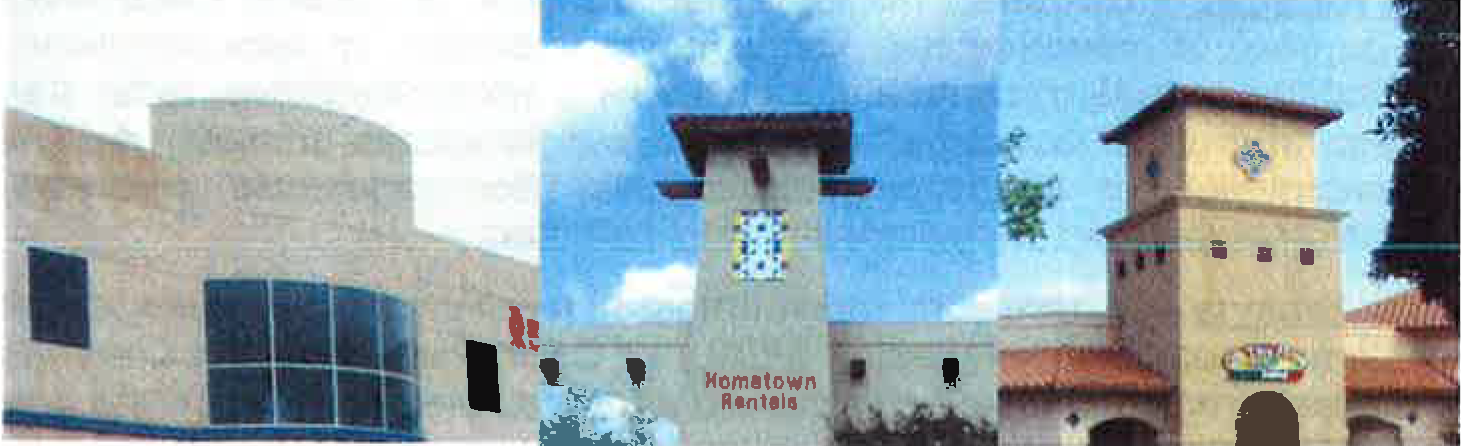
Examples of Building-Concealed Wireless Communication Facilities
Wireless Communication Facility, Collocation—The placement or installation of one (1) or more wireless communication facilities on a single tower, mast/pole, structure, or building with one (1) or more existing wireless communication facilities. Collocated wireless communication facilities may be separately owned and used by more than one (1) public or private entity. (See Section 8107-45.)
Wireless Communication Facility, Faux Trees—A stealth, ground-mounted wireless communication facility camouflaged to resemble a tree, including mono-broadleaf, mono-pine, mono-palm, mono-elm, and mono-eucalyptus. (See Section 8107-45.)
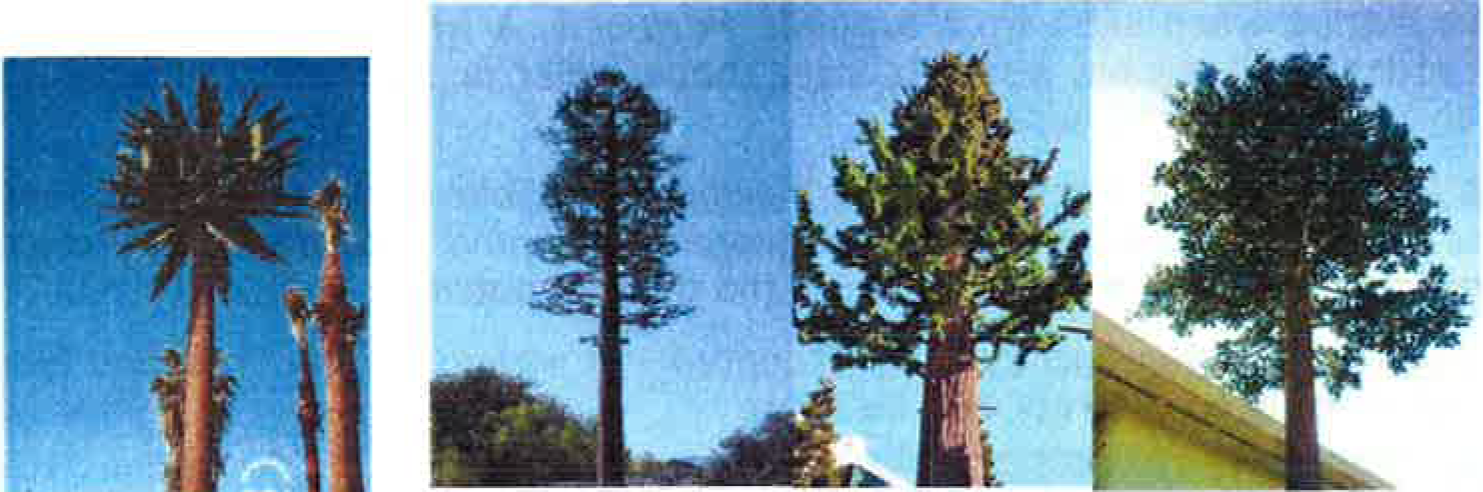
Examples of Faux Tree-Wireless Communication Facilities
Wireless Communication Facility, Flush-Mounted—A wireless communication facility with an antenna attached directly to the exterior of a structure or building and that remains close and is generally parallel to the exterior surface of the structure or building. Associated equipment for the antenna is not flush-mounted and is located inside an existing building, on a rooftop, at the ground level, or underground. (See Section 8107-45.)

Examples of Flush-Mounted Wireless Communication Facilities
Wireless Communication Facility, Ground-Mounted—A wireless communication facility that is placed on the ground, which consists of a monopole, lattice tower, or any other freestanding structure that supports an antenna. (See Section 8107-45.)
Wireless Communication Facility, Modification—Any physical change to a wireless communication facility or a change to operational characteristics for that facility that are subject to existing permit conditions. Modifications do not include routine maintenance. (See Section 8107-45.)
Wireless Communication Facility, Non-Stealth—A wireless communication facility that is not disguised or concealed and does not meet the definition of a stealth facility or building-concealed facility. (See Section 8107-45.)
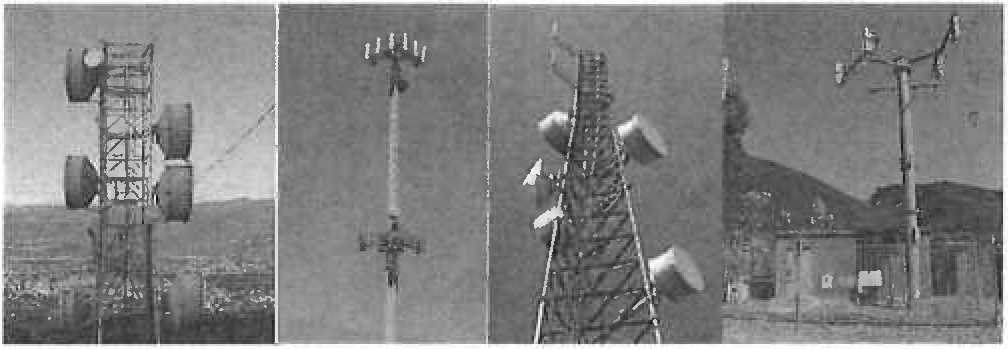
Examples of Non-Stealth Wireless Communication Facilities
Wireless Communication Facility, Prominently Visible—A wireless communication facility is considered to be prominently visible without the aid of any magnifying equipment such as cameras, binoculars, etc. if it stands out as an obvious or noticeable feature within its setting when seen from a public viewpoint. A wireless communication facility may be prominently visible when its size, shape, color or material contrasts with other objects in the surrounding setting. (See Section 8107-45.)
Wireless Communication Facility, Public Viewpoint—Public roads and public recreational areas such as parks, beaches, state designated trails, and Ventura County regional and local trails/corridors that are accessible to the general public. (See Section 8107-45.)
Wireless Communication Facility, Roof-Mounted—A wireless communication facility that is mounted directly on the roof of a building. (See Section 8107-45.)
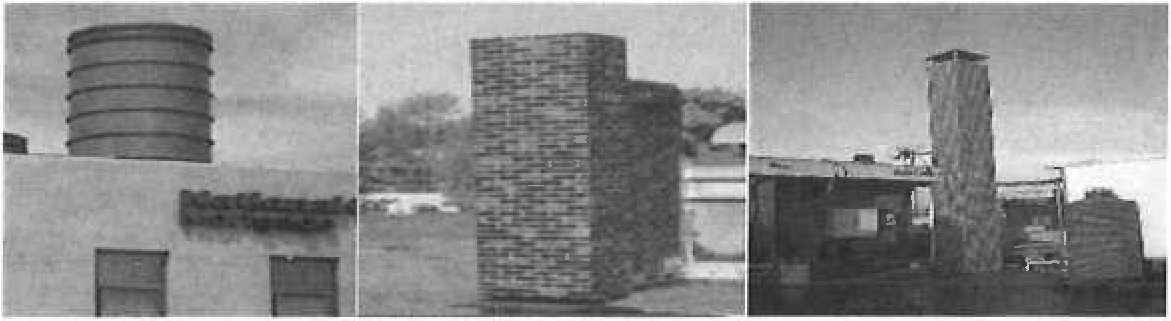
Examples of Roof-Mounted Wireless Communication Facilities
Wireless Communication Facility, Routine Maintenance—Work performed by the operator to restore a facility to its permitted condition, including the restoration or replacement of existing faux design elements, antennas, and equipment in equipment cabinets. In all cases, the replacement of antennas or faux design elements shall be limited to reproductions of the originally permitted equipment. Routine maintenance also includes testing and repair of operational features which do not alter the physical dimensions of the permitted wireless communication facility - such as backup generators, fire suppression systems, air ventilation systems, and cable modifications in cable conduits. (See Section 8107-45.)
Wireless Communication Facility, Section 6409(a) Modification—A modification of an existing wireless tower or base station that involves the collocation, removal or replacement of transmission equipment that does not substantially change the physical dimensions of such wireless tower or base station and that otherwise qualifies for approval pursuant to Section 6409(a) of the Federal 2012 Middle Class Tax Relief and Job Creation Act (codified at 47 U.S.C. §1455(a)), as may be amended. (See Section 8107-45.)
Wireless Communication Facility, Stealth—A wireless communication facility that blends into the surrounding visual setting. A stealth facility utilizes concealment elements such as design (size, height, color material, and antenna type) or siting techniques to camouflage, partially conceal, or integrate the wireless communication facility into the design of an existing facility, structure or its surrounding visual setting. Examples of stealth facilities include but are not limited to the following:
1.
Facilities disguised as other objects typically found within a setting, such as faux trees, monorocks, and water tanks (photos 1 and 2);
2.
Panel antennas flush-mounted on existing utility facilities, water tanks, and integrated with building facades (photos under flush-mounted);
3.
Facilities that are camouflaged or partially concealed by objects within an existing setting, such as a cluster of trees or utility poles (photo 3); or,
4.
Whip antennas and slim line poles that use simple camouflage techniques, such as size and color, and are located sufficient distance from public viewpoints to render them virtually unnoticeable (photo 4). (See Section 8107-45.)
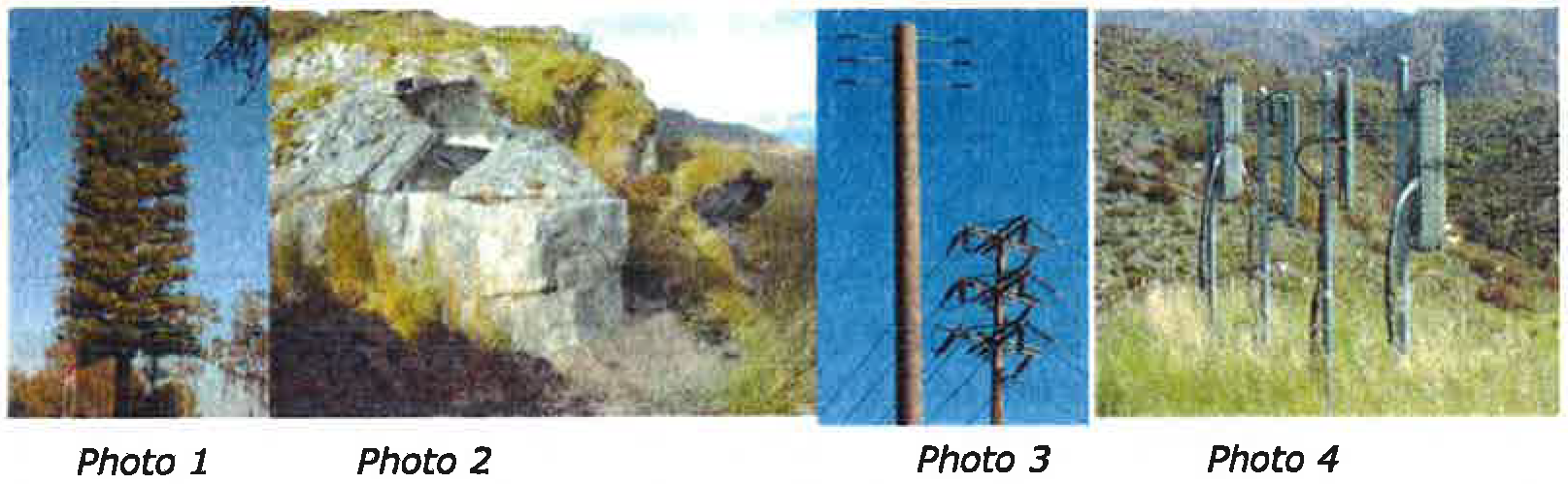
Examples of Stealth Wireless Communication Facilities
(Ord. 3720—5/7/85; Am. Ord. 3723—3/12/85; Am. Ord. 3730—5/7/85; Am. Ord. 3759—1/14/86; Am. Ord. 3810—5/5/87; Am. Ord. 3881—12/20/88; Am. Ord. 3895—4/25/89; Am. Ord. 3945—7/10/90; Am. Ord. 3993—2/25/92; Am. Ord. 4092—6/27/95; Am. Ord. 4118—7/2/96; Am. Ord. 4123—9/17/96; Am. Ord. 4187—5/25/99; Am. Ord. 4214—10/24/00; Am. Ord. 4216—10/24/00; Am. Ord. 4220—12/12/00; Am. Ord. 4227—1/9/01; Am. Ord. 4281—5/6/03; Am. Ord. 4282—5/20/03; Am. Ord. 4317—3/15/05; Am. Ord. 4377—1/29/08; Am. Ord. 4389—9/9/08; Am. Ord. 4393—12/16/08; Ord. No. 4407, § 2, 10-20-2009; Ord. No. 4411, § 1, 3-2-2010; Ord. No. 4413, § 1, 4-6-2010; Ord. No. 4417, § 1, 10-5-2010; Ord. No. 4436, § 1, 6-28-2011; Ord. No. 4455, § 1, 10-22-2013; Ord. No. 4470, § 1, 3-24-2015; Ord. No. 4507, § 2, 3-14-2017; Ord. No. 4509, § 2, 4-18-2017; Ord. No. 4518, § 1, 2-6-2018; Ord. No. 4519, § 1, 2-27-2018; Ord. No. 4520, § 1, 2-27-2018; Ord. No. 4523, § 1, 6-19-2018; Ord. No. 4526, § 1, 7-17-2018; Ord. No. 4528, § 1, 9-25-2018; Ord. No. 4537, § 1, 3-12-2019; Ord. No. 4554, § 2, 12-10-2019; Ord. No. 4555, § 2, 12-10-2019; Ord. No. 4577 § 1, 3-9-2021; Ord. No. 4580 § 1, 4-13-2021; Ord. No. 4596, § 1, 3-1-2022; Ord. No. 4606, § 1, 11-1-2022; Ord. No. 4615, § 1, 2-7-2023; Ord. No. 4618, § 2, 7-25-2023; Ord. No. 4619, § 1, 9-12-2023; Ord. No. 4624, § 1, 1-9-2024; Ord. No. 4630, § 1, 5-21-2024; Ord. No. 4639, § 2, 12-17-24; Ord. No. 4641, § 2, 12-17-2024; Ord. No. 4650, § 2, 9-16-2025; Ord. No. 4651, § 1, 9-16-2025)

