Standards for Specific Uses
The purpose of this Article is to set forth standards and regulations which apply to proposed uses as listed.
These regulations only apply to non-commercial antennas that are an accessory structure to a dwelling. All other types of non-commercial antennas are regulated as a wireless communication facility (see Section 8107-45).
No non-commercial antenna or mast shall exceed seventy-five (75) feet in height measured from the grade to the highest point of the antenna or mast. The crank-up variety of ham radio antennas should be used. All units should be color-coordinated to harmonize with predominant structural background material, so as to reduce visual impacts. Where feasible, both the antennas and support structures shall be screened from public view. The most unobtrusive locations for the antennas are generally in the rear yard, behind trees and adjacent to main or accessory buildings in order to provide background screening for the support structure. The height, nature, texture and color of all materials to be used for the installation, including landscape materials, shall be submitted with the permit application.
Non-commercial antennas shall not be constructed, placed, or installed on a structure, site or district designated by a federal, state, or County agency as an historical landmark or site of merit unless that facility is designed to meet the Secretary of the Interior (SOI) Standards. If the facility does not meet the SOI standards, then the Cultural Heritage Board must determine that the proposed facility will have no significant, adverse effect on the historical resource.
(Am. Ord. 3810—5/5/87; Ord. No. 4470, § 4, 3-24-2015)
On property containing a residential use, no commercial activity shall be construed as a valid accessory use to the residential use unless the activity falls within the definition and regulations of a home occupation, or the activity is authorized by a discretionary permit allowing commercial operations. Home occupations are permitted in accordance with the following standards:
(Am. Ord. 4092—6/27/95)
(Am. Ord. 3730—5/7/85; Am. Ord. 4092—6/27/95)
(Add Ord. 3730—5/7/85)
(Am. Ord. 4092—6/27/95)
(Ord. No. 4407, § 5, 10-20-2009)
(Add Ord. 3730—5/7/85)
(Add Ord. 3810—5/5/87; Am. Ord. 3810—5/5/87; Am. Ord. 4216—10/24/00)
(Add Ord. 4216—10/24/00)
a.
It is not in violation of any other ordinance; and
b.
It does not displace required on-site parking.
(Add Ord. 4216—10/24/00)
a.
The number of clients allowed per day may be increased to a maximum of ten (10).
b.
More than one client may be allowed on-site at one time.
c.
Clients may be allowed on the premises until 9:00 pm.
d.
Clients may be allowed on the premises on Saturdays.
(Add Ord. 4216—10/24/00)
Mobilehomes and manufactured housing may be used as single-family dwellings if the unit was constructed on or after June 15, 1976, or certified by the California Department of Housing and Community Development (HCD) as meeting September 15, 1971, or later, California construction standards. Units used as accessory dwelling units are subject to this date limitation, but mobilehomes used as caretaker or farmworker dwellings are not.
(Am. Ord. 3730—5/7/85; Am. Ord. 4123—9/17/96; Am. Ord. 4281—5/6/03; Ord. No. 4519, § 3, 2-27-2018)
Units which are used as single-family residences or as caretaker or farm worker dwellings shall be installed on a foundation system in compliance with Chapter 2, Article 7, Section 1333 of Title 25 of the California Administrative Code. Nonconforming units renewed continuing under a Continuation Conditional Use Permit shall be in compliance with the applicable provisions of Chapter 2, Article 7, of Title 25 of the California Code of Regulations.
(Am. Ord. 4123—9/17/96; Am. Ord. 4216—10/24/00)
Exterior siding of a single-family dwelling shall extend to the ground level, or to the top of the deck or structural platform where the dwelling is supported on an exposed pile foundation complying with the requirements of Sections 2908 and 2909 of the Uniform Building Code, or to the top of a perimeter foundation. For mobilehomes used as caretaker or farmworker dwellings, manufactured mobilehome skirting shall completely enclose the mobilehome, including the tongue, with a color or material that will be compatible with the mobilehome. For any mobilehomes located more than one hundred and fifty (150) feet from all property lines, and more than two hundred (200) feet from a public road, no skirting is required.
(Am. Ord. 4216—10/24/00; Am. Ord. 4281—5/6/03)
(See Sec. 8107-14.2)
(Am. Ord. 4092—6/27/95)
Model homes, or a temporary office, for the limited purpose of conducting sale only of lots or dwellings in the subdivision, or dwellings of similar design in another subdivision in the vicinity may be permitted, subject to the following provisions:
a.
Materials or equipment kept on any lot for use in construction of any building or room addition on said lot for which a Zoning Clearance and necessary building permits are obtained and in force, provided that such storage is neat and orderly, and does not exceed an area equal to the gross floor area of the building or addition under construction. Stored materials shall be installed within 180 days of their placement on the lot; however, the Planning Director may grant a time extension for good cause, based on a written request from the applicant.
b.
Items used periodically or continuously on the property by the resident(s) thereof, such as outdoor furniture, trash or recycling cans or barrels, equipment for maintenance of the property and the uses thereon, outdoor cooking equipment, and recreational equipment, accessory to the principal use.
c.
Operative vehicles and the items placed on them, provided that such vehicles are accessory to the principal use and are owned by the resident(s) of the property on which they are parked.
d.
One cord (128 cubic feet) of firewood, if stored in a neat and orderly manner in one location on the lot. Two cords of wood may be kept on properties within the National Forest boundaries.
(Am. Ord. 3810—5/5/87; Am. Ord. 4092—6/27/95; Am. Ord. 4123—9/17/96)
Editor's note— Ord. No. 4615, § 3, adopted Feb. 7, 2023, repealed the former Sec. 8107-1.7 and enacted a new Sec. 8107-1.7 as set out herein. The former Sec. 8107-1.7 pertained to accessory dwelling units and derived from Am. Ord. 3810, adopted May 5, 1987; Am. Ord. 3920, adopted Dec. 19, 1989; Am. Ord. 4092, adopted June 27, 1995; Am. Ord. 4123, adopted Sept. 17, 1996; Am. Ord. 4281, adopted May 6, 2003; Am. Ord. 4282, adopted May 20, 2003; Am. Ord. 4377, adopted Jan. 29, 2008; Ord. No. 4407, § 5, adopted Oct. 20, 2009; Ord. No. 4436, § 6, adopted June 28, 2011; Ord. No. 4507, § 3, adopted Mar. 14, 2017; Ord. No. 4509, § 2, adopted April 18, 2017; and Ord. No. 4519, § 3, adopted Feb. 27, 2018.
The purpose of this Section 8107-1.7 is to allow and regulate accessory dwelling units (ADUs) and junior accessory dwelling units (JADUs) in compliance with Government Code section 66310 et seq., as may be amended. Pursuant to Government Code section 66314(c), an ADU permitted through this Section 8107-1.7 does not exceed the allowable density for the lot upon which the ADU is located; and an ADU is a residential use that shall be deemed consistent with the existing general plan and zoning designation for the lot. If any provision of this Section 8107-1.7 or the underlying zoning district standards conflicts with state law, the latter shall govern.
(Ord. No. 4615, § 3, 2-7-2023; Ord. No. 4633, § 1, 6-4-2024)
As used in this Section 8107-1.7, the following definitions shall apply:
Accessory Structure—A structure that is accessory and incidental to a dwelling located on the same lot as defined in Government Code section 66313(b), as may be amended.
Existing—Space, units, or structures that are legally permitted or legal non-conforming.
Nonconforming Zoning Condition—A physical improvement on a property that does not conform to current zoning standards as defined in Government Code section 66313(9), as may be amended.
Passageway—A pathway that is unobstructed clear to the sky and extends from a street to one (1) entrance of the accessory dwelling unit as defined in Government Code section 66313(i), as may be amended.
Proposed Dwelling—A dwelling that is the subject of a permit application and that meets the requirements for permitting as defined in Government Code section 66313(k), as may be amended.
Public Transit—A location, including, but not limited to, a bus stop or train station, where the public may access buses, trains, subways, and other forms of transportation that charge set fares, run on fixed routes, and are available to the public as defined in Government Code section 66313(1), as may be amended.
Tandem Parking—A parking configuration where two (2) or more automobiles are parked on a driveway or in any other location on a lot, lined up behind one another as defined in Government Code section 66313(m), as may be amended.
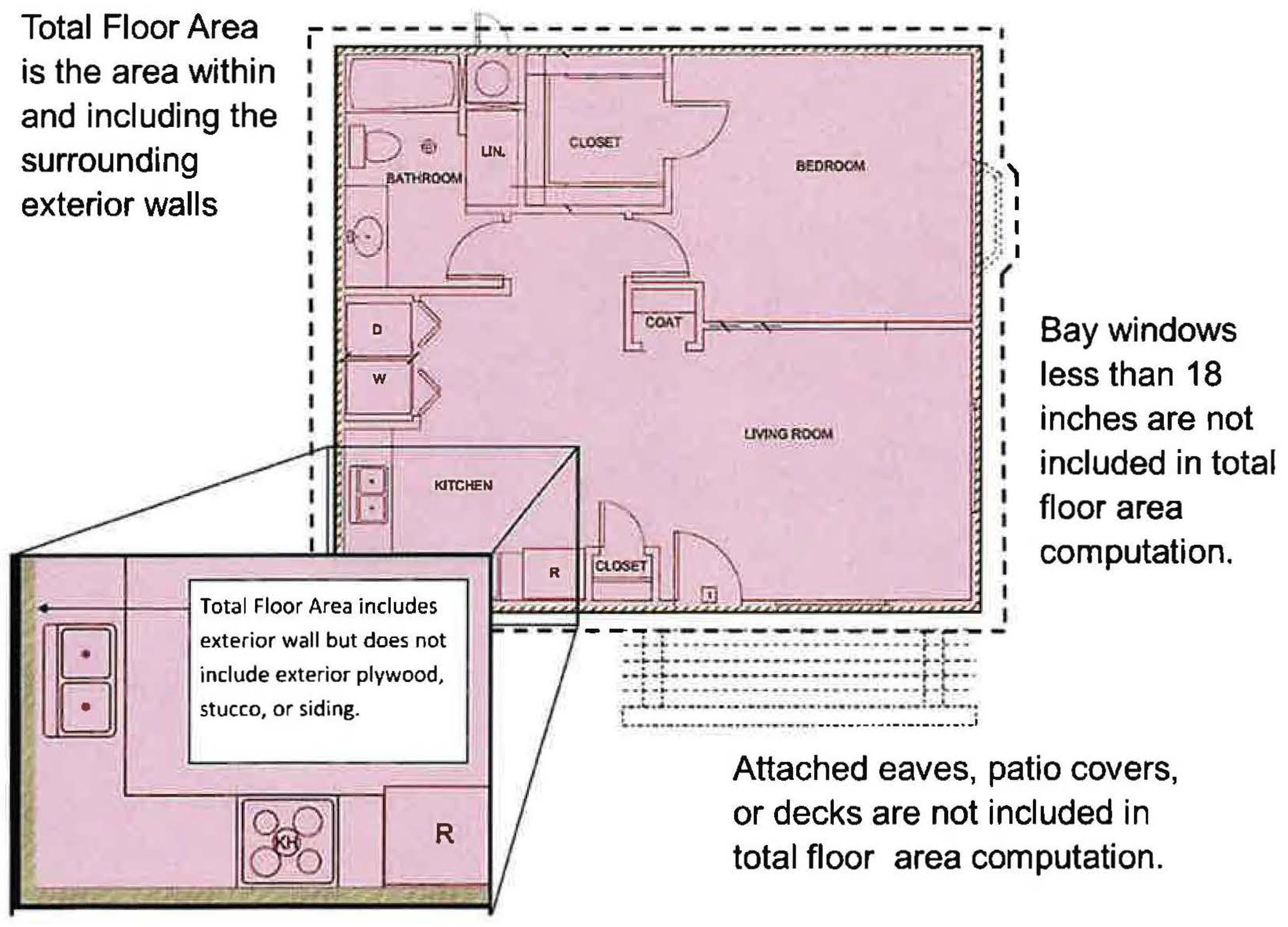
Total Floor Area—Shall have the same definition as "building area" as set forth in Title 24, Part 2, Chapter 2 of the California Building Code, as may be amended, which states: "The area included within surrounding exterior walls, or exterior walls and fire walls, exclusive of vent shafts and courts. Areas of the building not provided with surrounding walls shall be included in the building area if such areas are included within the horizontal projection of the roof or floor above." However, the computation of total floor area for ADUs shall not include: a garage that is attached to, or below the ADU when there is no internal access from the garage to the ADU; or an unenclosed area or feature such as any eave or architectural feature, attached covered patio or deck, an open deck constructed at or below the level of the first floor, a balcony or the space below a cantilevered balcony, the space below an open and unenclosed stairway, a covered car port, a bay window that does not extend to the floor or protrude more than eighteen (18) inches from the adjoining exterior wall, or similar, as illustrated in Figure 1.
(Ord. No. 4615, § 3, 2-7-2023; Ord. No. 4633, § 1, 6-4-2024)
An ADU may be created in the following forms:
a.
Detached: The ADU is separated from the primary residential structure.
b.
Attached: The ADU is attached to the primary residential structure. An attached ADU may include the conversion of existing partially enclosed spaces (such as a covered patio) to an ADU that is attached to the primary residential structure.
c.
Space within Primary Residential Structure: The ADU is created within the space (e.g., primary bedroom, attached garage, storage area, or similar use) of an existing or proposed primary residential structure.
d.
Space within an Existing Accessory Structure: The ADU is created within the space of an existing accessory structure that is located on the lot of the primary residence.
(Ord. No. 4615, § 3, 2-7-2023; Ord. No. 4633, § 1, 6-4-2024)
A complete application for a building permit shall be ministerially approved to allow ADU(s) and/or a JADU that meets applicable Building Code and Fire Code requirements and the standards set forth in Sections 8107-1.7.4(a), (b), (c) or (d).
a.
Within Space of Single-Family Dwellings and Accessory Structures: One (1) ADU within the space of a single-family dwelling or accessory structure pursuant to this Section 8107-1.7.4(a) is allowed per lot if all the following standards are met:
(1)
The subject lot is zoned R1, R2, RES, RPO, R/MU, RA, RE, RO, or CPD/CBD.
(2)
Location of ADU and/or JADU:
(a)
The ADU or JADU is created within a portion of the existing or proposed space of a single-family dwelling and has exterior access from the proposed or existing single-family dwelling; or
(b)
The ADU is created within the existing space of an accessory structure, such as the conversion of garages and other accessory structures, either attached or detached from the primary dwelling. An existing accessory structure may include an expansion of not more than one hundred fifty (150) square feet beyond its same physical dimensions, but such expansion shall be limited to accommodating ingress and egress to the ADU.
(3)
The side and rear setbacks comply with applicable Building and Fire Code requirements, even if the existing side and rear setbacks are legal non-conforming.
(4)
The ADU pursuant to this Section 8107-1.7.4(a) may be combined with:
(a)
One (1) ADU that meets the standards of either Section 8107-1.7.4(b) or Section 8107-1.7.5; and
(b)
One (1) JADU complying with the requirements of Government Code section 66333 et seq. and Section 8107-1.7.6.
b.
New Detached ADU with an Existing or Proposed Single-Family Dwelling: One (1) detached new construction ADU pursuant to this Section 8107-1.7.4(b) is allowed on a lot with a proposed or existing single-family dwelling if all the following standards are met:
(1)
The subject/of is zoned R1, R2, RES, RPD, R/MU, RA, RE, RO, or CPD/CBD.
(2)
The ADU's side and rear yard setbacks are at least four (4) feet.
(3)
The ADU does not exceed eight hundred fifty (850) square feet.
(4)
The ADU's maximum building height above grade complies with the height limitations identified in Section 8107-1.7.5(d)(1).
(5)
The ADU pursuant to this Section 8107-1.7.4(b) may be combined with:
(a)
One (1) ADU that meets the standards of either Section 8107-1.7.4(a) or the standards for an attached ADU pursuant to Section 8107-1.7.5; and
(b)
One (1) JADU complying with the requirements of Government Code section 66333 et seq. and Section 8107-1.7.6.
c.
ADUs in Existing Multifamily Dwelling Structures: ADUs within portions of existing multifamily dwelling structures are allowed pursuant to this Section 8107-1.7.4(c), and may be combined with detached ADUs pursuant to Section 8107-1.7.4(d), if all the following standards are met, even if the multifamily dwelling is legal nonconforming:
(1)
The subject lot is zoned R1, R2, RES, RPD, R/MU, RHD, RA, RE, RO, or CPD/CBD.
(2)
Location of ADU:
(a)
The ADUs are created within portions of the existing multifamily dwelling structures that are not used as livable space, including, but not limited to, storage rooms, boiler rooms, passageways, attics, basements, or garages. If there is no existing non-livable space within a multifamily dwelling structure, an ADU cannot be created pursuant to this Section 8107-1.7.4(c).
(b)
The non-livable space used to create an ADU pursuant to this Section 8107-1.7.4(c) on a lot with mixed-uses shall be limited to the residential areas, and shall not include the areas used for commercial or other non-residential activities. Parking and storage areas for non-residential uses shall also be excluded from potential ADU development pursuant to this Section 8107-1.7.4(c).
(3)
The maximum number of ADUs that may be created pursuant to this Section 8107-1.7.4(c) shall be at least one (1) or the number of ADUs equal to up to twenty-five (25) percent of the existing multifamily dwelling units, whichever is greater.
d.
Detached ADUs with Existing or Proposed Multifamily Dwelling: Up to two (2) detached ADUs are allowed on lots with an existing or proposed multifamily dwelling pursuant to this Section 8107-1.7.4(d), and may be combined with ADUs created within multifamily dwellings pursuant to Section 8107-1.7.4(c), if all the following standards are met, even if the multifamily dwelling is legal nonconforming:
(1)
The subject lot is zoned R1, R2, RES, RPO, R/MU, RHO, RA, RE, RO, or CPD/CBD.
(2)
The ADUs maximum height above grade complies with the height limitations identified in Section 8107-1.7.5(d)(1).
(3)
New construction ADUs shall not exceed one thousand two hundred (1,200) square feet.
(4)
The ADU's side- and rear-yard setbacks are at least four (4) feet.
(5)
Detached ADUs may be attached to each other, but must be detached from the existing or proposed multifamily dwelling.
e.
No Zoning Clearance Required: No Zoning Clearance or other land use entitlement is required pursuant to this Chapter for an ADU or JADU authorized under this Section 8107-1.7.4.
f.
Not Subject to Development Standards in Section 8107-1.7.5: ADUs that meet the requirements of Section 8107-1.7.4(a), (b), (c), or (d) and are entitled to a building permit are not subject to the development standards of Section 8107-1.7.5, including size, setback, parking and lot coverage requirements.
(Ord. No. 4615, § 3, 2-7-2023; Ord. No. 4618, § 4, 7-25-2023; Ord. No. 4633, § 1, 6-4-2024)
ADUs that do not meet the standards under Section 8107-1.7.4 for approval by building permit shall be approved with a ministerial Zoning Clearance if the ADU meets Building Code and Fire Code requirements, the standards in this Section 8107-1.7.5 and other applicable zoning standards.
a.
Property Requirements:
(1)
The subject lot is zoned R1, R2, RES, RPO, R/MU, RHO, RA, RE, RO, CPD/CBD, OS, AE, or TP.
(2)
The lot has a proposed or existing single-family or multifamily dwelling.
b.
Maximum Number of ADUs and JADUs per Lot:
(1)
Each lot may have one (1) ADU pursuant to this Section 8107-1.7.5, which may be combined with:
(a)
One (1) ADU that meets the standards of either Section 8107-1.7.4(a) or Section 8107-1.7.4(b); and
(b)
One (1) JADU that meets the standards of Section 8107-1.7.6.
(2)
Lots zoned OS, AE, or TP are only allowed a maximum of one (1) ADU pursuant to this Section 8107-1.7.5.
c.
Parking Standards:
(1)
No Parking Requirements: No parking standards apply for an ADU in any of the following instances:
(a)
Where the ADU is located within one-half (½) mile walking distance of public transit.
(b)
Where the ADU is located within an architecturally and historically significant historic district.
(c)
Where the ADU is part of the proposed or existing primary residence or an accessory structure.
(d)
When on-street parking permits are required but not offered to the occupant of the ADU.
(e)
When there is a car share vehicle, as defined by section 22507.1(d) of the Vehicle Code, located within one (1) block of the ADU.
(f)
When a permit application for an ADU is submitted with a permit application to create a new single-family dwelling or a new multifamily dwelling on the same lot, provided that the ADU or the parcel satisfies any of the criteria listed above in this Section 8107-1.7.5(c)(1).
(2)
Required Off-street Parking: Except as provided in Section 8107-1.7.5(c)(1), the following off-street parking standards shall apply:
(a)
Number of Spaces. One (1) covered or uncovered off-street parking space is required per ADU or per bedroom, whichever is less.
(b)
Location of Spaces. Off-street parking may be provided as tandem parking on a driveway. Additionally, the parking space for an ADU may encroach into a required front and/or interior side setback, provided that:
i.
The long dimension of the space is parallel to the centerline of the nearest driveway on the lot; and
ii.
On interior lots, a minimum distance of three (3) feet from the side lot line remains unobstructed by vehicles.
(3)
No Off-Street Replacement Parking Required for Primary Residential Structure: When a garage, carport, or covered parking structure is demolished in conjunction with the construction of an ADU or converted to an ADU, those off-street parking spaces do not need to be replaced for the primary dwelling. Additionally, no parking is required for a newly created ADU pursuant to Section 8107-1.7.5(c)(1)(c) above.
d.
Height:
(1)
The maximum allowed height for detached ADUs is as follows:
(a)
Maximum of sixteen (16) feet above grade on a lot with an existing or proposed single-family or multifamily dwelling; or
(b)
Maximum of eighteen (18) feet above grade on a lot with an existing or proposed multifamily dwelling with multiple stories; or
(c)
Maximum of eighteen (18) feet above grade if the lot has an existing or proposed single-family or multifamily dwelling, and is within one half-mile walking distance of a major transit stop or a high-quality transit corridor, as defined in section 21155 of the Public Resources Code. An additional two (2) feet in overall height is allowed to accommodate a roof pitch that is aligned with the roof pitch of the primary dwelling unit.
(d)
Detached ADUs may exceed the allowable height limits set forth in subsections (a) through (c) above if the ADU is set back at least twenty (20) feet from all property lines, but the ADU shall not exceed the maximum allowed building height of the primary dwelling unit on the lot, pursuant to Article 6 of this Chapter.
(e)
Detached ADUs are limited to no more than two (2) stories.
(2)
The maximum allowed height for an attached ADU is twenty-five (25) feet above grade or the maximum allowed building height of the primary dwelling pursuant to Article 6 of this Chapter, whichever is lower.
e.
Setbacks:
(1)
No additional setbacks are required if any of the following are converted to an ADU or portion of an ADU: (a) an existing living area; (b) an existing accessory structure; or (c) a new structure constructed in the same building footprint and to the same dimensions as an existing structure. The provisions of Article 13 of this Chapter shall not apply in these situations. For purposes of this Section, living area, as defined by Government Code section 66313(e), means the interior habitable area of a dwelling unit, including basements and attics, but does not include a garage or any accessory structure.
(2)
All other new attached and detached ADUs shall have four-foot setbacks from the rear and side lot lines.
f.
Minimum Lot Size: There is no minimum lot size requirement for an ADU or JADU.
g.
ADU Size for Attached and Detached ADUs:
(1)
For lots that are nine thousand (9,000) square feet or less, the maximum total floor area of an attached or detached ADU shall be eight hundred fifty (850) square feet if there is one (1) bedroom or an efficiency unit; or one thousand (1,000) square feet if there is more than one (1) bedroom; or
(2)
For lots that are larger than nine thousand (9,000) square feet, but less than ten (10) acres, the maximum total floor area of an attached or detached ADU shall be one thousand two hundred (1,200) square feet; or
(3)
For lots that are ten (10) acres in size or larger, the maximum total floor area of an attached or detached ADU shall be one thousand eight hundred (1,800) square feet.
(4)
Covered patios, decks, and garages below the ADU are not included in the total floor area computation but are counted toward the maximum allowable square footage allowed for "accessory structures to dwellings" in Section 8105-4.
h.
ADUs Within Space of Single-Family Dwellings in the OS, AE or TP Zones: One (1) ADU per lot is allowed within a proposed or existing single-family dwelling in the OS, AE or TP zones if the applicable standards of this Section 8107-1.7.5 and the following standards are met:
(1)
The ADU is created within a portion of the existing or proposed space of a single-family dwelling and has independent exterior access;
(2)
The ADU does not have internal access to the primary dwelling;
(3)
The ADU does not exceed the size maximums for attached or detached ADUs set forth in Section 8107-1.7.5(g), as applicable; and
(4)
The side and rear setbacks comply with applicable Building and Fire Code requirements.
i.
Accessory Structures:
(1)
No accessory structure shall be attached to a detached ADU unless the combined total floor area of the accessory structure and ADU does not exceed the allowable size of the ADU per Section 8107-1.7.5(g). This provision does not apply to ADUs built attached to, or above a garage.
(2)
An ADU attached to an accessory structure shall not have internal access to the accessory structure.
j.
Limited Exception to Development Standards: Notwithstanding any other minimum or maximum size for an ADU, size that may be limited based upon a percentage of the proposed or existing primary dwelling, or limits on lot coverage, floor area ratio, open space, front setback, and minimum lot size, for either attached or detached ADUs, an ADU that is up to eight hundred fifty (850) square feet with four-foot side and rear setbacks may be constructed in compliance with all other applicable development standards.
(Ord. No. 4615, § 3, 2-7-2023; Ord. No. 4633, § 1, 6-4-2024)
A JADU must comply with the following requirements:
a.
Number and Location:
(1)
The subject lot is within one (1) of the following single-family residential zones: R1; R2; RES; RA; RE; or RO.
(2)
One (1) JADU is allowed per lot, including on lots with multiple detached single-family dwellings.
(3)
The JADU must be created within the walls of a proposed or existing single-family dwelling, including attached garages, which are considered within the walls of the existing single-family dwelling.
(4)
A JADU is not allowed in a multifamily dwelling.
(5)
A JADU is not allowed in an accessory structure.
b.
Size: The JADU shall not be larger than five hundred (500) square feet in total floor area.
c.
Kitchen: The JADU must contain an efficiency kitchen that includes:
(1)
Cooking facility with appliances, and
(2)
A food preparation counter and storage cabinets.
d.
Entrance: The JADU shall have a separate entrance from the main entrance to the proposed or existing single-family dwelling. An interior entry into the single-family dwelling is not required unless the JADU shares sanitation facilities with the single-family dwelling.
e.
Parking:
(1)
When a JADU is created by the conversion of an attached garage, replacement parking for the primary residential structure is not required to be provided.
(2)
No parking is required for a JADU.
f.
Sanitation: A JADU must either include separate sanitation facilities or share sanitation facilities with the single-family dwelling.
(Ord. No. 4615, § 3, 2-7-2023; Ord. No. 4633, § 1, 6-4-2024)
a.
Ministerial Permit Approval:
(1)
Permit applications for an ADU or JADU that meet the requirements of this Section 8107-1.7 shall be considered and approved ministerially without discretionary review or a hearing.
(2)
Except for deviations processed and granted in accordance with Section 8107-37.3 (Deviations for Cultural Heritage Sites) and Section 8111-9 (Reasonable Housing Accommodations), or as required by state law, no variance to the standards or requirements of this Chapter is available for an ADU or JADU.
b.
Type of Permit:
(1)
Applications pursuant to Sections 8107-1.7.4 and 8107-1.7.6 shall be reviewed and approved with a building permit, if the applicable standards are met.
(2)
Applications pursuant to Section 8107-1.7.5 shall be reviewed and approved with a Zoning Clearance, if the applicable standards are met.
c.
When Demolition Permit Required: A demolition permit for a detached garage that is to be replaced with an ADU shall be reviewed with the application for the ADU and issued at the same time.
d.
Nonconforming Zoning Violations: Correction of nonconforming zoning conditions, building code violations, or unpermitted structures that do not present a threat to public health and safety and are not affected by the construction of an ADU shall not be a condition to ministerial approval of an ADU or JADU application.
e.
Rentals, Owner Occupancy and Transfers:
(1)
Rentals: An ADU and JADU may each be rented separately from the primary residence.
(2)
Rental Term: All ADUs and JADUs, and any portion thereof, that are rented shall be rented for terms that are longer than thirty (30) consecutive days.
(3)
Owner Occupancy:
(a)
Lot with ADU: For a lot with an ADU, the owner of the lot does not have to occupy the primary residence or ADU. However, if a single-family dwelling has an ADU and a JADU, then the owner must occupy either the JADU or the remaining portion of the single-family dwelling in accordance with Section 8107-1.7.7(e)(3)(b).
(b)
Lot with JADU: At the time of application for a JADU, the owner of the lot must reside in the single-family dwelling. Upon completion of construction of the JADU, the owner must occupy either the remaining portion of the single-family dwelling or the JADU. For purposes of this Section 8107-1.7. 7(e)(3)(b), owner includes a beneficial owner when the property is owned by a trust or legal entity. Owner-occupancy, however, is not required if the owner is a governmental agency, land trust, or housing organization.
(4)
Sales and Transfers: Except as provided in Government Code section 66340 et seq., an ADU shall not be sold or otherwise conveyed separately from the primary residence. JADUs shall not be sold or transferred separately from the single-family dwelling.
f.
Deed Restriction:
(1)
For ADUs: Upon approval of an ADU, a deed restriction running with the land in a form provided by the County must be recorded with the County Recorder at the property owner's expense. The deed restriction must include the following:
(a)
Rentals of the ADU must be for a term that is longer than thirty (30) consecutive days; and
(b)
Except as provided in Government Code section 66340 et seq., the ADU shall not be sold or otherwise conveyed separately from the primary residence.
(2)
For JADUs: Upon approval of a JADU, a deed restriction running with the land in a form provided by the County must be recorded with the County Recorder at the property owner's expense. The deed restriction must include the following:
(a)
Rentals of the JADU must be for a term that is longer than thirty (30) consecutive days;
(b)
A prohibition on the sale of the JADU separate from the sale of the single-family dwelling, including a statement that the deed restriction may be enforced against future purchasers;
(c)
A restriction on the size and attributes of the JADU that conforms with Section 8107-1.7.6 and Government Code section 66333 et seq.; and
(d)
Owner occupancy requirements for the JADU in accordance with Section 8107-1.7.7(e)(3)(b).
(Ord. No. 4615, § 3, 2-7-2023; Ord. No. 4633, § 1, 6-4-2024)
Buildings or structures may not be used for human habitation unless specifically permitted as a dwelling or as allowed by an approved discretionary entitlement.
(Add Ord. 3730—5/7/95; Am. Ord. 4092—6/27/95; Am. Ord. 4123—9/17/96—grammar; Ord. No. 4639, § 6, 12-17-2024)
Accessory bathrooms are allowed pursuant to Section 8105-4 of this Chapter if the following standards are met:
(a)
An accessory bathroom may be a freestanding structure, attached to, or within a building or structure.
(b)
Full bathrooms may be allowed within a maximum 200-square-foot freestanding building. This building may include two (2) full or half bathrooms. Each individual bathroom may be combined with a changing room, not to exceed a combined total of one hundred (100) square feet.
(c)
Full bathrooms shall not be attached to, or located within, an enclosed accessory structure or building, except when the bathroom:
(1)
has internal access to a dwelling unit.
(2)
is permitted by a discretionary entitlement pursuant to Sections 8105-4 and 8105-5.
(d)
Full bathrooms may be attached to, or located within, an unenclosed accessory structure or building only if accessible by way of a door leading directly outside of the accessory structure or building.
(e)
Detached accessory structures or buildings may contain a half bathroom provided that the bathroom does not exceed sixty-four (64) square feet in area and is not plumbed to allow for future bathing facilities (i.e., shower or tub).
(Add Ord. 4123—9/17/96; Am. Ord. 4216—10/24/00; Am. Ord. 4282—5/20/03; Ord. No. 4639, § 6, 12-17-2024)
(Rep./Reen. Ord. 4092—6/27/95; Ord. No. 4639, § 6, 12-17-2024)
The keeping of animals as a principal use (e.g., animal husbandry/keeping) or accessory use (e.g., pet animals) shall be permitted in accordance with this Section and the requirements of other pertinent Sections of this Chapter, particularly Articles 5 and 6. The purpose of this Section is to establish animal density standards to regulate the keeping of animals for such purposes as "animal husbandry," "animal keeping" and as "pet animals" in a manner that will not endanger the health, peace, and safety of citizens and environment of Ventura County, and that will assure that animals are kept in safe and sanitary conditions.
(Ord. No. 4639, § 6, 12-17-2024)
The following health and safety standards shall apply to all animal keeping activities:
All animals shall be fenced, corralled, caged, cooped, penned, or otherwise prevented from exiting the property upon which they are located as indicated in Tables 1 and 2, except during exercise and the movement of animals onto and off of the property.
(Rep./Reen. Ord. 4092—6/27/95)
Except for movement onto and off of the property, animals shall not be kept, maintained, or used in any other way, inside or outside of any structure within the distance set forth in Table 2 of Section 8107-2.5.1 and Section 8107-2.3.7(f) of this Chapter.
(Ord. No. 4580 § 4, 4-13-2021)
The following additional standards apply:
Where a species of animal is not listed explicitly for animal keeping, the Planning Director, in consultation with appropriate experts, shall make a species equivalency determination. Similarly, the Planning Director shall have the power to assign the appropriate "animal unit factor" and "the maximum number allowed" to the species in question, based upon such criteria as height, weight, noise, odor, waste production, potential for escape, and impacts upon other animals and humans, etc.
The offspring of animals are allowed and shall not be counted as animal units until they are of weanable or self-sufficient age. For dogs and cats, this age shall be four (4) months. For equines, this age shall be one (1) year. For roosters, this age shall be six (6) months, or when the rooster has full adult plumage, or is capable of crowing. For all other animals, the weanable ages for offspring shall be those ages determined by the Planning Director in consultation with appropriate experts.
(Ord. No. 4580 § 4, 4-13-2021)
Different species of animals may be combined on a given lot not to exceed the total number of animal units allowed on that lot.
Contiguous lots under unified control, either through ownership or by means of a lease, may be combined to meet minimum area requirements for animal keeping, but only for the duration of the common ownership or lease, and only in zones that allow the keeping of animals as a principal use. The keeper of the animals shall provide written proof to the satisfaction of the Planning Director, that he or she has unified control of the affected parcels and that the animals utilize all of the lots in question.
(Ord. No. 4639, § 6, 12-17-2024)
In addition to the requirements of this Chapter, the keeping of wild animals as pets, for animal husbandry/keeping purposes, or for rehabilitation/recovery projects, shall be subject to approvals by any, and all, other county, state, and federal regulatory agencies as applicable to the species in question.
(Am. Ord. 4123—9/17/96—grammar; Ord. No. 4639, § 6, 12-17-2024)
Any animal that is the offspring of wild and domestic parents shall be regarded as a wild animal, unless otherwise determined by the Planning Director in consultation with appropriate experts.
(Rep./Reen. Ord. 4092—6/27/95)
The purpose of this Section 8107-2.3.7 is to limit the number of roosters that may be kept on a lot to eliminate the potential for a public nuisance, illegal cockfighting and the raising of birds to be used for cockfighting, to prevent the inhumane treatment of birds by those who engage in illegal cockfighting activities and for the protection of health and safety of the residents of Ventura County.
Definitions for all italicized terms in this Section are set forth in Article 2 of this Chapter.
In accordance with Division 4, Chapter 4, Article 9, Sections 4494.1 through 4494.5 of the Ventura County Ordinance Code, the following limits and standards shall apply to the keeping of roosters:
a.
No person shall keep, maintain, control or harbor more than four (4) roosters on any lot at any given time notwithstanding the maximum allowable animal keeping units allowed for a lot as set forth in Table 3 — Allowed Number of Animal Husbandry/Keeping Units of Section 8107-2.5.2. The four-rooster limit shall not apply to the following:
(1)
Commercial poultry ranches whose primary commodity is the production of eggs or meat for sale as permitted by the County;
(2)
Public or private schools as registered with the California Department of Education;
(3)
The County of Ventura;
(4)
Nonprofit humane organization animal facilities; and
(5)
Youth-oriented poultry projects sanctioned by such organizations as Future Farmers of America (FFA), 4-H, or equivalent youth organizations, and legitimate poultry hobbyists who own and breed poultry for exhibition or for sale of offspring in accordance with accepted poultry raising practices, may have up to five (5) roosters of the same breed for a maximum of twenty-five (25) roosters in zone designations allowing roosters in accordance with Table 3 of Section 8107-2.5.2 and the waiver provisions set forth in Section 8107-2.5.5 of this Chapter, and provided that such projects or hobbyist activities are approved in writing by the Ventura County Animal Services Director or any person authorized to act on behalf of Ventura County Animal Services.
b.
No roosters are permitted in the R1 and R2 Zones, the RPD Zone on lots less than one (1) acre, and in all other zone designations with a gross lot area of less than twenty thousand (20,000) square feet.
c.
Section 8105-4's "Animal Husbandry, More Animals Than Are Permitted; Animal Keeping Non-Husbandry, More Animals Than Are Permitted; and, Keeping of Animals Accessory to Dwellings, More Animals Than Are Permitted" land use does not apply to the keeping of roosters. The maximum number of roosters allowed on a lot is set forth in Section 8107-2.3.7(a) above.
d.
No person shall maintain or control any rooster by means of a tether attached to an object.
e.
At all times roosters shall be provided: (1) access to water and shelter from the elements (i.e., rain, wind, direct sun, etc.); (2) sufficient room to spread both wings fully and to be able to turn in a complete circle without any impediment and without touching the side of an enclosure; and, (3) clean and sanitary premises that are kept in good repair.
f.
Setback requirements for roosters (forty (40) feet minimum from any dwelling unit, other than the dwelling unit of the property owner or keeper of the roosters) are set forth in Section 8107-2.2.2 of this Chapter.
g.
By March 11, 2019, a property owner or person occupying or leasing the property or the premises of another who maintains, keeps, controls or harbors roosters shall have brought the number of roosters into conformance with the provisions of this Section. Sections 8113-4 and 8113-5.4 of this Chapter do not apply to the keeping of roosters.
(Ord. No. 4580 § 4, 4-13-2021)
Pet animals shall be kept in accordance with the following standards and other applicable standards of this chapter.
The keeping of pet animals is permitted in all base zones, and is allowed in addition to other forms of animal keeping, such as animal husbandry pursuant to Section 8107-2.3.1 of this Chapter.
(Ord. No. 4639, § 6, 12-17-2024)
The range of pet animal species that may be kept is listed below in Table 1, "Pet Animals" of this Section 8107-2, but may be expanded by the Planning Director through the equivalency determination process in accordance with Section 8107-2.3.1 of this Chapter.
Pet Animals
1. Inherently dangerous animals may not be kept as pet animals.
2. See Sec. 8107-2.4.6 for the number of additional pet animals allowed as a part of Animal Husbandry/Keeping.
3. The keeping of bees shall be in accordance with Section 8107-2.6.
(Ord. No. 4639, § 6, 12-17-2024)
Except as provided in Article 5, no more than a total of 3.00 pet animal units are allowed per principal dwelling unit including all its accessory uses. Occupied spaces in mobilehome parks and multifamily dwellings are allowed no more than 1.00 pet animal unit per mobilehome or dwelling unit.
(Ord. No. 4639, § 6, 12-17-2024)
For security, no more than 1.0 animal unit is allowed per commercial/industrial zoned lot. The animals that are allowed are listed on Table 1 'Pet Animals'. Calculating the number allowed should be done in accordance with 8107-2.4.5. Utility animals such as seeing-eye dogs and similar animals may be kept in addition to the maximum allowed number of animal units.
The sum of the individual animal units for a given dwelling unit shall not exceed the total number of animal units allowed pursuant to Sec. 8107-2.4.3. This is demonstrated by the following example:
EXAMPLE
If 3.00 pet animal units are allowed per dwelling unit, the three pet animal units could be composed of four dogs (1.00 unit), four cats (1.00 unit), four rabbits (0.20 unit), 2 chickens (0.20 unit), 2 ducks (0.20 unit), 1 large bird (0.10 unit) and 20 small birds (0.30 unit). This combination would equate to 3.00 pet animal units, while allowing 37 actual animals. If an additional cat (0.25 pet animal unit) were desired, the total number of pet animal units would rise to 3.25. This would exceed the allowable number of 3.00 pet animal units per dwelling unit.
Additional pet animals beyond those permitted pursuant to Sec. 8107-2.4.3 may be kept in accordance with the following standards:
a.
Pet animals in addition to those permitted as pets pursuant to Sec. 8107-2.4.3 may only be kept on lots meeting the 'Minimum Lot Area Required' standard set forth on Table 3 (Sec. 8107-2.5.2).
b.
The total number of additional pet animals that may be kept shall be no more than two times the 'Maximum No. Allowed' identified in Table 1 for a given animal. For example, 4 dogs are allowed as pets. Up to 8 additional dogs would be allowed pursuant to this section.
(Am. Ord. 4123—9/17/96)
(Rep./Reen. Ord. 4092—6/27/95)
c.
The first increment of additional pet animals may only be allowed when the lot in question meets the 'Minimum Lot Area Required' standard for the zone in question as noted on Table 3. The second increment of pet animals may only be allowed when the size of the lot in question is three times its 'Minimum Lot Area Required'. For example, the 'Minimum Lot Area Required' in the R-E zone is 10,000 sq. ft.. An individual would be allowed 4 dogs as pets and an additional 4 dogs on a lot of 10,000 sq. ft. or more. An additional 4 dogs would be allowed on a lot of 30,000 sq. ft. or more.
d.
All animals required to be licensed by other agencies shall be licensed. All dogs and cats authorized by this section shall be licensed and spayed or neutered pursuant to Ventura County Animal Regulation Department.
e.
A Zoning Clearance shall be obtained by the owner of the animals prior to their being allowed on the property.
f.
The 'Animal Unit Factor' for a given animal shall be counted against the total number of allowed animal units permitted for the lot in question pursuant to Table 3. For example, a lot of 20,000 sq. ft. to 24,999 sq. ft. zoned R-O is allowed 3 animals units for Animal Husbandry/Animal Keeping pursuant to Table 3. If a person wished to keep 4 dogs as pets they do not count against this allotment. Pursuant to Sec. 8107-2.4.6, 4 additional pet dogs (each with a .25 animal unit factor) could be allowed but they would count as 1 animal unit against the total allotment of 3 Animal Husbandry/Keeping units.
(Am. Ord. 4123—9/17/96)
(Rep./Reen. Ord. 4092—6/27/95)
Animals, other than those being kept as pets, such as for animal husbandry and animal keeping projects, shall be kept in accordance with the following standards and other applicable standards of this Chapter.
The range of animals allowed for keeping or for husbandry purposes is listed in Table 2 below, entitled "Animal Husbandry/Keeping," with additional specialty animal husbandry listed in Article 5 (e.g., apiculture). This range of allowed animals and their attendant animal unit factors may be expanded through the equivalency determination process pursuant to Section 8107-2.3.1.
Table 2
(See Section 8107-2.5.1)
Animal Husbandry/Keeping
(Ord. No. 4580 § 4, 4-13-2021; Ord. No. 4639, § 6, 12-17-2024)
The maximum number of animal units allowed on a given lot(s) is set forth in Table 3, "Allowed Number of Animal Husbandry/Keeping Units." Up to two (2) units of equines may be kept on R-O, R-E, and R-A zoned lots of ten thousand (10,000) to twenty thousand (20,000) square feet if a waiver is obtained pursuant to Section 8111-1.1.2.
TABLE 3
(Section 8107-2.5.2)
ALLOWED NUMBER OF ANIMAL HUSBANDRY/KEEPING UNITS
REGULATORY NOTES:
1. Only animals of less than 1.00 animal unit may be allowed on lots less than 20,000 square feet in the RA, RO and RE Zones unless a waiver is obtained pursuant to Section 8111-1.1.2 of this Chapter.
2. No roosters, peafowl, guinea fowl or the like are permitted in the R1 Zone, or on lots less than 20,000 square feet in other zones.
3. No more than two peafowl are permitted on lots less than 1 acre; however, up to four peafowl may be permitted with a waiver pursuant to Section 8111-1.1.2.
4. On lots 20,000 square feet or more in size (except for in the R1 and R2 Zones) or on lots one acre or more in the RPD Zone, no more than four roosters are allowed notwithstanding the maximum allowable animal husbandry/keeping units per lot set forth in Table 3 above.
(Am. Ord. 4123—9/17/96)
(Ord. No. 4580 § 4, 4-13-2021)
The first animal unit is only allowed if the lot in question meets the minimum lot area set forth in Table 3. Additional units may be added based on the size of the lot and the formulas set forth in Table 3. Animal unit and lot size calculations shall be rounded to the nearest one-hundredth. For example, if the one-thousandth value is 5 (.125) or greater, round up the one-hundredth value by 1 (.125 becomes .13). Fractions of animal units may be applied towards the total number of allowed animals on a lot, but they may not be rounded up to whole numbers. This is illustrated in the following two (2) examples.
Example 1
A 3.2 acre lot, zoned R-A, contains 139,392 sq. ft. (3.2 ac. × 43,560 sq. ft./ac.). The allowed number of animal units is calculated by dividing the sq. ft. of the lot by the animal accrual rate (139,392 sq. ft. ÷ 1 unit/10,000 sq. ft. = 13.9392 units) and rounding to the nearest one-hundredth. Therefore, 13.94 animal units are allowed on the lot. These units could allow for example 7 horses and 6 cows (13 units), 1 pig (0.5 unit), and 2 sheep (0.40 unit). Since there are no animal units in Table 2 equaling .04 unit, pursuant to Sec. 8107-2.4.5, pet animals from Table 1 could be added since the subject lot exceeds the minimum lot size. Therefore, 1 medium bird (0.03 unit) and 1 mouse (0.01 unit) could be added, totaling 13.94 units.
Example 2
A 1.29 acre lot, zoned R-E, contains 56,192 sq. ft. (1.29 ac × 43,560 sq. ft./ac.). The allowed number of animal units is calculated by subtracting 25,000 sq. ft. from the lot area, (31,192 sq. ft.), then dividing by the animal unit accrual rate (31,192 sq. ft. ÷ 1/25,000 sq. ft. = 1.23768 units) and then adding 3 units for a total of 4.24768 units. Rounding to the nearest one-hundredth, there would be 4.25 animal units allowed on the lot. These units could allow for example, 2 horses (2.0 units), 2 ostriches (1.0 unit), 1 cow (1.0 unit), and 1 sheep (0.20 unit) totaling 4.20 units. The remaining 0.05 unit is less than any animal listed in Table 2, so pet animals from Table 1 could be added since the lot exceeds the minimum required lot size. Therefore, the remaining 0.05 animal unit could be allowed for 1 medium bird (0.03 unit) and 1 rat (0.02 unit).
(Rep./Reen. Ord. 4092—6/27/95)
Livestock and fowl identified in Table 2 of Section 8107-2.5.1 above, other than roosters (see Section 8107-2.5.5 below), may be kept in accordance with a waiver pursuant to Section 8111-1.1.2 of this Chapter for a limited period of time on lots where they would not otherwise be allowed because the lot does not meet minimum size requirements or the project would lead to animals in excess of the numbers otherwise allowed; or where a discretionary permit would otherwise be required; provided such animals are kept for youth oriented projects sanctioned by such organizations as 4-H or Future Farmers of America (FFA) and provided all of the following criteria are met:
a.
The animals shall be kept for no more than one (1) year from the date of approval for keeping unless otherwise specifically set forth in the waiver.
b.
Written concurrence is provided by all abutting residents and abutting landowners surrounding the lot where the animal is to be kept. Said concurrence shall be in a form acceptable to the Planning Director.
c.
The setbacks for the keeping of animals may be waived with the written concurrence of the neighbors possibly impacted by the setback intrusion.
d.
Animals shall be kept in a manner consistent with Section 8107-2.2 et seq. (General standards).
(Ord. No. 4580 § 4, 4-13-2021)
Roosters may be kept for youth-oriented poultry projects, provided such roosters are kept for youth-oriented poultry projects sanctioned by such organizations as 4-H or Future Farmers of America (FFA) or equivalent youth organizations as determined by the Ventura County Animal Services Director and the Planning Director. Roosters may also be kept by legitimate poultry hobbyists, as defined in Article 2 of this Chapter. Roosters may be kept for youth poultry projects and by legitimate poultry hobbyists in the numbers and types as set forth in Section 8107-2.3.7 of this Chapter and in accordance with the setback and containment standards and with the written approval by the Ventura County Animal Services Director as set forth in Sections 8107-2.2.2, 8107-2.3.7(f), and 8107-2.3.7(a)(5) of this Chapter, provided any necessary waiver of the number of roosters up to twenty-five (25) roosters is obtained pursuant to Section 8111-1.1.2 of this Chapter.
(Ord. No. 4580 § 4, 4-13-2021)
The following standards apply to the keeping of bees.
(a)
Definitions. Definitions for all italicized terms in this Section 8107-2.6 et seq. are set forth in Article 2 of this Chapter. If a term used in this section is not defined in Article 2 it shall have the meaning established for such word or phrase in Chapter 1 (commencing with Section 29000) of Division 13 of the Food and Agricultural Code as may be amended.
(b)
Agricultural Commissioner Registration Requirement. Every person that is the owner or is in possession of an apiary that is located within the unincorporated area of the county shall register with the Agricultural Commissioner's Office the number of bee colonies in each apiary that is owned by the person, and provide the location of each apiary. Every person required to register under this section shall do so on the first day of January of each year in which they maintain or possess an apiary or within thirty (30) days thereafter, as required in the California Food and Agricultural Code sections 29010—29056, as may be amended.
(c)
Exempt Beekeeping Activities. The following beekeeping activities are exempt from the regulations of this Section 8107-2.6. et seq. Notwithstanding the following, persons conducting exempt beekeeping activities shall still comply with state and federal laws pertaining to apiculture, and shall register annually each beehive with the Agricultural Commissioner's Office pursuant to Section 8107-2.6(b), above.
(1)
Keeping of bees within an educational institution for study or observation, or within a physician's office or laboratory for medical research, treatment, or other scientific purposes.
(2)
In addition to the maximum number of beehives allowed pursuant to Section 8107-2.6.2(d), below, one (1) additional beehive may be brought onto a property for a maximum of thirty (30) consecutive calendar days for the purposes of swarm prevention.
(d)
Prohibited Beekeeping Activities.
(1)
Beekeeping is prohibited in mobile home and recreational vehicle parks, all commercial and industrial zones, and the R2, RHD, and R/MU Zones. Beekeeping is also prohibited in the RES Zone when there are two-family or multifamily dwellings on the property.
(2)
No person shall own or operate an apiary that has Africanized honeybees and/or bees that exhibit aggressive bee behavior, contains apiary pests, or is an abandoned apiary, as determined by the Agricultural Commissioner. Africanized honeybees are considered inherently dangerous animals (insects).
(3)
Beehives and beekeeping appurtenances shall not be located on a roof of a structure unless the roof is a permitted roof-top deck and/or is an area that is designed and permitted to be walked upon.
(e)
Nuisance Abatement. Failure to comply with the following nuisance abatement procedures will result in formal enforcement procedures as set forth in Section 8107-2.6(f).
(1)
If a bee colony exhibits aggressive bee behavior in a beehive on a property or in/on a structure and has been determined by the Agricultural Commissioner to be a public nuisance, the property owner and/or the beekeeper of the bee colony shall abate and remove the bee colony in order to protect the health, safety, and welfare of the public.
(2)
Bee colonies determined by the Agricultural Commissioner to be neglected or abandoned, and/or are not maintained in accordance with the regulations of this Section 8107-2.6 et seq. are a public nuisance. The property owner and/or the beekeeper of the bee colony shall immediately remove the bee colony or abate the nuisance by immediately complying with the regulations of this section in order to protect the health, safety, and welfare of the public.
(f)
Violation, Enforcement Procedures and Penalties. Failure to comply with the provisions of this Section 8107-2.6 et seq. may result in the issuance of a Notice of Violation and/or commencement of Civil Administrative Penalties in accordance with Article 14 of this Chapter, and/or criminal prosecution of a misdemeanor/infraction pursuant to Section 13-1 (Enforcement) of the Ventura County Ordinance Code.
(Ord. No. 4606, § 4, 11-1-2022)
In addition to the beekeeping standards in Section 8107-2.6 above, beekeeping that is not backyard beekeeping pursuant to Section 8107-2.6.2 and as defined in Article 2 of this Chapter shall be operated in accordance with the following standards:
(a)
This type of beekeeping is only allowed in the OS, AE, RA, and TP Zones.
(b)
Occupied apiaries shall be located or maintained a safe distance from an urbanized area. For the purpose of this section, an urbanized area is defined as an area containing three (3) or more dwelling units per acre. A "safe distance" shall be determined after investigation by the Agricultural Commissioner and shall be consistent with Section 8107-2.6.1(c) below. Decisions of the Agricultural Commissioner may be appealed pursuant to Section 8111-7.2(c) of this Chapter.
(c)
Unless otherwise authorized in writing by the Agricultural Commissioner, no occupied apiary shall be located or maintained within:
(1)
Four hundred (400) feet of any off-site dwelling,
(2)
Fifty (50) feet of any property line common to other property except that it may be adjoining the property line when such other property contains an apiary, or upon mutual agreement for such location with the adjoining property owner, and
(3)
One hundred fifty (150) feet of any public road, street, or highway.
(d)
Adequate available and suitable water supplies shall be maintained on the property near the apiary at all times.
(Ord. No. 4606, § 4, 11-1-2022)
In addition to the beekeeping standards in Section 8107-2.6 above, backyard beekeeping shall be operated in accordance with the following standards:
(a)
Purpose. The purpose of this section is to establish regulations for hobbyist beekeeping activities that are accessory to a single-family dwelling. Naturally occurring and uncontrolled beehives that have colonized on a residential property for less than thirty (30) calendar days are not subject to the provisions of this Section 8107-2.6.2.
(b)
Prohibited Activities. In addition to the prohibited beekeeping activities listed in Section 8107-2.6(d) above, no person shall keep, maintain, possess, or control any apiary in or upon any premises on lots less than ten thousand (10,000) square feet in total gross lot area, except as exempted pursuant to Section 8107-2.6(c) above. Backyard beekeeping is limited to a maximum of four (4) beehives pursuant to the standards set forth in Section 8107-2.6.2(d) below.
(c)
Development Standards. Unless an activity is exempt pursuant to Section 8107-2.6(c) above, all backyard beekeeping shall be operated in accordance with the following standards:
(1)
Beehive entrances shall face away from, or parallel to, the nearest lot line adjacent to another and shall face away from doors and/or windows.
(2)
A beehive shall be sited so the general flight pattern of bees is in a direction that will deter bee contact with humans and animals. A solid wall, fence, or dense vegetation, known as a "beekeeping flyaway barrier," shall be located along the side of the beehive that contains the entrance to the hive, such that the bees are forced to fly to an elevation of at least six (6) feet above ground level to exit and enter the beehive. A backyard flyaway barrier that consists of a wall or fence shall be no less than six (6) feet in height and no taller than seven (7) feet. The backyard flyaway barrier shall be located a maximum of five (5) feet from the beehive and shall extend at least two (2) feet on either side of the hive. For the purposes of this Section 8107-2.6.2(c)(2), dense vegetation means trees or shrubs that are vigorous, compact, thick, and are at least six (6) feet in height (e.g., tall hedge) prior to or at the time the beehive(s) are on the property. Property line fences do not constitute beekeeping flyaway barriers.
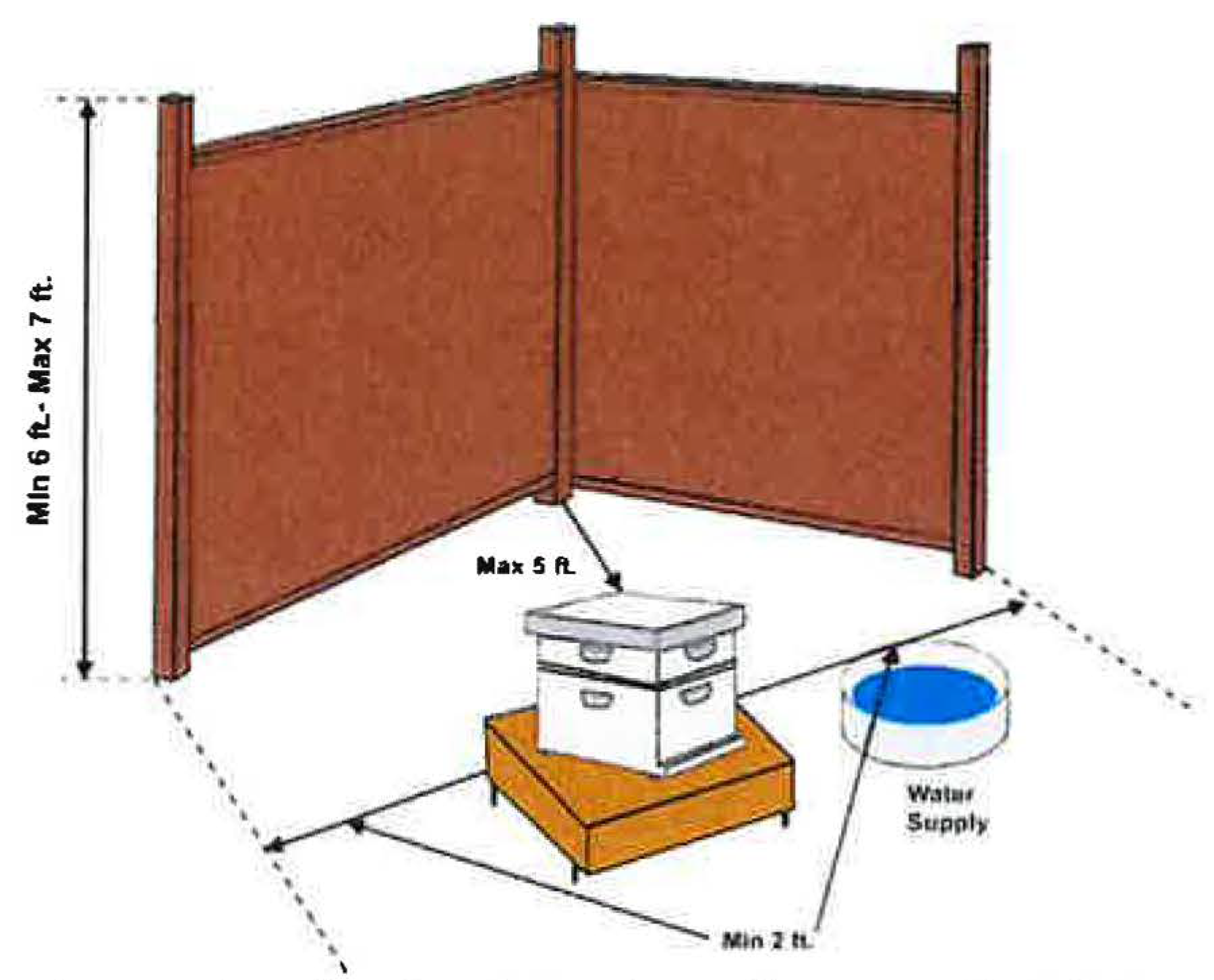
Example of a Beekeeping Flyaway Barrier
In lieu of a minimum six-foot-tall beekeeping flyaway barrier, beehives shall be located:
i.
At least one hundred (100) feet from any off-site dwelling at all times, unless a more restrictive setback standard is required by Section 8107-2.6.2(d), below; or
ii.
On a structure that is a minimum of eight (8) feet above ground level, provided that the beehive(s) are not located on a roof as set forth in Section 8107-2.6(d)(3) above, measured from the lowest adjacent ground level parallel to and within five (5) feet of the structure. Such structure shall comply with the most restrictive setback requirements as set forth in Sections 8106-1.1, or 8107-2.6.2(d) below. A Zoning Clearance is required for the construction of any structure over seven (7) feet tall to house beehive(s).
(d)
Schedule of Specific Development Standards. The development standards set forth in the table below apply to all backyard beekeeping activities.
(e)
Beekeeping Education Course. Beekeepers shall complete an education course on beekeeping approved by the Agricultural Commissioner's Office prior to establishing an apiary on the property. A copy of the current registration and evidence of completion of the education course shall be provided to the County upon request.
(f)
Backyard Beekeeping Best Management Practices.
(1)
Beekeepers shall maintain compliance with all of the standards set forth in this section.
(2)
A beehive shall be maintained through the provision of adequate space, and pest and disease control.
(3)
Adequate and accessible forage habitat to feed and nourish bees shall be readily available. If necessary, the beekeeper shall provide supplemental nourishment to the beehive(s) to prevent starvation during times of reduced nectar production.
(4)
Beehives shall be re-queened following any swarming or aggressive bee behavior.
(5)
Each beehive, and all bees therein, shall at all times be under the control of the property owner on which the beehive is located or the beekeeper thereof, and shall not be a public nuisance.
(6)
An adequate and accessible supply of fresh water shall be available at all times, including prior to introduction of a beehive to a new location. If the property on which the apiary is located does not contain sufficient natural water, the beekeeper shall provide one (1) or more water containers or water sources within two (2) feet of the beehive. The water supply shall provide landing sites for the bees to drink without drowning, undue competition, or overcrowding.
(7)
Beekeepers shall inspect each beehive at least once a month to detect aggressive bee behavior and/or apiary pests in order to take corrective action(s) in a timely manner. Beekeepers shall practice swarm prevention techniques and provide additional space for beehive growth to minimize bee swarming.
(8)
Beekeepers shall post identification and contact information in a prominently visible location on each beehive, including the name and phone number of the beekeeper.
(9)
Beekeepers shall always have a shovel and an operable water hose or fire extinguisher available on the property for suppression of any accidental fire.
(10)
Bee smokers shall contain a noncombustible container with a secure lid and be equipped with a fire-resistant smoker plug to prevent embers from escaping.
(Ord. No. 4606, § 4, 11-1-2022)
The following standards apply to vermiculture operations:
a.
Vermiculture operations shall only be allowed on lots of twenty thousand (20,000) square feet or larger.
b.
No worm beds, feedstock, bedding material, worm castings or similar related materials associated with the operation shall be located within one hundred (100) feet of a dwelling on a neighboring property.
c.
The area used for worm beds, feedstock, bedding material, castings, and related materials shall not, in the aggregate, exceed six (6) feet in height. If a discretionary permit is issued pursuant to Section 8105-4 of this Chapter, these standards may be exceeded. The standards set forth in Section 8107-36.4.1 of this Chapter shall apply to all such vermiculture operations in excess of five thousand (5,000) square feet of open beds.
d.
The volume of raw or composted feedstock and the bedding materials shall not exceed that which is reasonably necessary to the production of the worms raised on the site.
e.
Prior to the issuance of a Zoning Clearance for any vermiculture operation, a "stockpile management plan" shall be approved by the Environmental Health Division. The vermiculture operation shall only be conducted in conformance with the approved plan and the limitations set forth in this Section.
(Rep./Reen. Ord. 4092—6/27/95; Am. Ord. 4214—10/24/00; Ord. No. 4639, § 6, 12-17-2024)
New and used automobile, motorhome, trailer and boat sales yards are subject to the following conditions:
(Ord. No. 4407, § 5, 10-20-2009)
Editor's note— Ord. No. 4568, § 1, adopted Nov. 10, 2020, repealed the former § 8107-5, §§ 8107-5.1—8107-5.6.27, and enacted a new § 8107-5 as set out herein. The former § 8107-5 pertained to similar subject matter and derived from Ord. 3730, adopted May 7, 1985; Ord. 3810, adopted May 5, 1987; and Ord. 3900, adopted June 20, 1989.
The purpose of this section is to establish reasonable and uniform limitations, safeguards and controls for oil and gas exploration and production operations within the non-coastal portions of the unincorporated area that will allow for the reasonable use of important resources. The regulations in this section shall also ensure that development activities will be conducted in harmony with other land uses and that the rights of surface and mineral owners are balanced.
(Ord. No. 4568, § 1, 11-10-2020)
Section 8107-5 shall apply to all oil and gas exploration and production operations, as provided herein:
a.
All existing oil and gas exploration and production operations are subject to the oil development operational standards set forth in Section 8107-5.6 to the extent: (i) such standards impose greater restrictions than those set forth in existing permit conditions, laws, or regulations applicable to the operation, and (ii) application of such standards does not impair any vested right of an operator under California law.
b.
The oil development design guidelines set forth in Section 8107-5.5 and oil development operational standards set forth in Section 8107-5.6 shall be utilized to evaluate consistency of proposed development with this Chapter and to develop conditions of approval for all new, adjusted and modified discretionary permits authorizing oil and gas exploration and production operations.
c.
Notwithstanding any provision set forth in Article 13 of this Chapter, a new Conditional Use Permit, or a discretionary permit adjustment or modification, as applicable, is required under this Chapter to authorize any new oil and gas exploration and production operation, or component thereof, including but not limited to: (1) the drilling of any new well unless specifically identified by location and number in an active discretionary permit issued under this Chapter; (2) the re-drilling or deepening of any existing well unless specifically authorized by an active discretionary permit issued under this Chapter; or (3) the installation of any permanent structure unless the structure is specifically identified by an active discretionary permit issued under this Chapter or unless the structure replaces an existing structure with the same dimensions at the same location. This subsection (c) does not apply to maintenance and repair activities.
d.
The provisions of Section 8107-5 shall apply to oil and gas operations upon federally owned lands. Pursuant to the provisions of the Mineral Leasing Act of 1920 (30 U.S.C. Section 181 et seq.), operations conducted on federally owned lands do not require issuance of a land use development permit from the County; however, the review and permitting of such projects by federal agencies should take into account the provisions of Section 8107-5.
(Ord. No. 4568, § 1, 11-10-2020)
Unless otherwise defined herein, or unless the context clearly indicates otherwise, the definition of petroleum-related terms shall be that used by the California Geologic and Energy Management Division (CalGEM).
(Ord. No. 4568, § 1, 11-10-2020)
a.
No oil or gas exploration or production related use may commence without or be inconsistent with a Conditional Use Permit approved pursuant to this Chapter. Furthermore, a Zoning Clearance must be obtained by the permittee to confirm consistency with this Chapter and Conditional Use Permit prior to drilling every well, commencing site preparation for such well(s), or installing related appurtenances, as defined by the Planning Director.
b.
A single Zoning Clearance may be issued for more than one (1) well, drill site, structure or appurtenance; however, the construction or installation of each separate improvement must commence within one hundred eighty (180) days of issuance. All well drilling conducted under a single Zoning Clearance must be completed within one (1) year of permit issuance.
c.
Possession of an approved Conditional Use Permit and Zoning Clearance shall not relieve the operator of the responsibility of securing and complying with any other permit which may be required by other County ordinances, or state or federal laws. No condition of a Conditional Use Permit for uses allowed by this Chapter shall be interpreted as permitting or requiring any violation of law, or any lawful rules or regulations or orders of an authorized governmental agency. When more than one (1) set of rules apply, the stricter one (1) shall take precedence.
(Ord. No. 4568, § 1, 11-10-2020)
The general oil development design guidelines that follow shall be used in the evaluation of projects and development of conditions which will help ensure that oil development projects generate minimal negative impacts on the environment. The guidelines shall be applied whenever physically and economically feasible and practicable, unless the strict application of a particular guideline would otherwise defeat the intent of other guidelines. An applicant should use the guidelines in the design of the project and anticipate their use as potential permit conditions, unless the applicant can demonstrate that they are not feasible or practicable. More restrictive requirements may be imposed on a project through the conditions of the permit.
a.
Pipelines should be used to transport petroleum products off-site to promote traffic safety and air quality.
b.
The use of a pipeline for transporting crude oil may be a condition of approval for expansion of existing processing facilities or construction of new processing facilities.
c.
New pipeline corridors should be consolidated with existing pipeline or electrical transmission corridors where feasible, unless there are overriding technical constraints or significant social, aesthetic, environmental or economic reasons not to do so.
d.
When feasible, pipelines shall be routed to avoid important resource areas, such as recreation, sensitive habitat, geological hazard and archaeological areas. Unavoidable routing through such areas shall be done in a manner that minimizes the impacts of potential spills by considering spill volumes, durations, and projected paths. New pipeline segments shall be equipped with automatic shutoff valves, or suitable alternatives approved by the Planning Director, so that each segment will be isolated in the event of a break.
e.
Upon completion of pipeline construction, the site shall be restored to the approximate previous grade and condition. All sites previously covered with native vegetation shall be reseeded with the same or recovered with the previously removed vegetative materials, and shall include other measures as deemed necessary to prevent erosion until the vegetation can become established, and to promote visual and environmental quality.
(Ord. No. 4568, § 1, 11-10-2020)
The following are minimum operational standards and requirements which shall be applied pursuant to Section 8107-5.2. More restrictive requirements may be imposed on a project through the conditions of the permit. Measurements are taken from the outside perimeter of the noise receptors noted below:
(Ord. No. 4568, § 1, 11-10-2020)
No well shall be drilled and no equipment or facilities shall be permanently located within:
a.
One hundred (100) feet of any dedicated public street, highway or nearest rail of a railway being used as such, unless the new well is located on an existing drill site and the new well would not present a safety or right-of-way problem. If aesthetics is a problem, then the permit must be conditioned to mitigate the problem.
b.
Five hundred (500) feet of any building or dwelling not necessary to the operation of the well, unless a waiver is signed pursuant to Section 8107-5.6.25, allowing the setback to be reduced. In no case shall the well be located less than one hundred (100) feet from said structures.
c.
Five hundred (500) feet of any institution, school or other building used as a place of public assemblage, unless a waiver is signed pursuant to Section 8107-5.6.25, allowing the setback to be reduced. In no case shall any well be located less than three hundred (300) feet from said structures.
d.
Three hundred (300) feet from the edge of the existing banks of "Red Line" channels as established by the Ventura County Watershed Protection District (VCWPD), and one hundred (100) feet from the existing banks of all other channels appearing on the most current United States Geologic Services (USGS) 2,000-foot scale topographic map as a blue line. These setbacks shall prevail unless the permittee can demonstrate to the satisfaction of the Public Works Agency that the subject use can be safely located nearer the stream or channel in question without posing an undue risk of water pollution, and impairment of flood control interests. In no case shall setbacks from streams or channels be less than fifty (50) feet. All drill sites located within the 100-year flood plain shall be protected from flooding in accordance with VCWPD requirements.
e.
The applicable setbacks for accessory structures for the zone in which the use is located.
f.
One hundred (100) feet from any marsh, small wash, intermittent lake, intermittent stream, spring or perennial stream appearing on the most current USGS 2,000-foot scale topographic map, unless a qualified biologist, approved by the County, determines that there are no significant biological resources present or that this standard setback should be adjusted.
(Ord. No. 4568, § 1, 11-10-2020)
Drill sites and access roads shall not obstruct natural drainage courses. Diverting or channeling such drainage courses may be permitted only with the authorization of the Public Works Agency.
(Ord. No. 4568, § 1, 11-10-2020)
All equipment used for drilling, re-drilling, and maintenance work on approved wells shall be removed from the site within thirty (30) days of the completion of such work unless a time extension is approved by the Planning Director.
(Ord. No. 4568, § 1, 11-10-2020)
Oil, produced water, drilling fluids, cuttings and other contaminants associated with the drilling, production, storage and transport of oil shall be contained on the site unless properly transported off-site, injected into a well, treated or re-used in an approved manner on-site or if allowed, off-site. Appropriate permits, permit modifications or approvals must be secured when necessary, prior to treatment or re-use of oil field waste materials. The permittee shall furnish the Planning Director with a plan for controlling oil spillage and preventing saline or other polluting or contaminating substances from reaching surface or subsurface waters. The plan shall be consistent with requirements of County, state and federal laws.
(Ord. No. 4568, § 1, 11-10-2020)
Prior to the commencement or continuance of drilling or other uses on an existing permit, the permittee shall file, in a form acceptable to the County Counsel and certified by the County Clerk, a bond or other security in the penal amount of not less than ten thousand dollars ($10,000.00) for each well that is drilled or to be drilled. Any operator may, in lieu of filing such a security for each well drilled, re-drilled, produced or maintained, file a security in the penal amount of not less than ten thousand dollars ($10,000.00) to cover all operations conducted in the County of Ventura, a political subdivision of the State of California, conditioned upon the permittee well and truly obeying, fulfilling and performing each and every term and provision in the permit. In case of any failure by the permittee to perform or comply with any term or provision thereof, the Planning Commission may, after notice to the permittee and a public hearing, by resolution, determine the amount of the penalty and declare all or part of the security forfeited in accordance with its provisions. The sureties and principal will be jointly and severally obligated to pay forthwith the full amount of the forfeiture to the County of Ventura. The forfeiture of any security shall not insulate the permittee from liability in excess of the sum of the security for damages or injury, or expense or liability suffered by the County of Ventura from any breach by permittee of any term or condition of said permit or of any applicable ordinance or of this security. No security shall be exonerated until after all the applicable conditions of the permit have been met.
(Ord. No. 4568, § 1, 11-10-2020)
The drill site and all roads or hauling routes located between the public right-of-way and the subject site shall be improved or otherwise treated as required by the County and maintained as necessary to prevent the emanation of dust. Access roads shall be designed and maintained so as to minimize erosion, prevent the deterioration of vegetation and crops, and ensure adequate levels of safety.
(Ord. No. 4568, § 1, 11-10-2020)
Light emanation shall be controlled so as not to produce excessive levels of glare or abnormal light levels directed at any neighboring uses. Lighting shall be kept to a minimum to maintain the normal night-time light levels in the area, but not inhibit adequate and safe working light levels. The location of all flood lights and an outline of the illuminated area shall be shown on the landscape plan, if required, or on the requisite plot plan.
(Ord. No. 4568, § 1, 11-10-2020)
The permittee shall immediately notify the Planning Director and Fire Department and all other applicable agencies in the event of fires, spills, or hazardous conditions not incidental to the normal operations at the permit site. Upon request of any County Agency, the permittee shall provide a written report of any incident within seven (7) calendar days which shall include, but not be limited to, a description of the facts of the incident, the corrective measures used and the steps taken to prevent recurrence of the incident.
(Ord. No. 4568, § 1, 11-10-2020)
All permanent facilities, structures, and aboveground pipelines on the site shall be colored so as to mask the facilities from the surrounding environment and uses in the area. Said colors shall also take into account such additional factors as heat buildup and designation of danger areas. Said colors shall be approved by the Planning Director prior to painting of facilities.
(Ord. No. 4568, § 1, 11-10-2020)
The permit area shall be maintained in a neat and orderly manner so as not to create any hazardous or unsightly conditions such as debris; pools of oil, water, or other liquids; weeds; brush; and trash. Equipment and materials may be stored on the site which are appurtenant to the operation and maintenance of the oil well located thereon. If the well has been suspended, idled or shut-in for thirty (30) days, as determined by CalGEM, all such equipment and materials shall be removed within ninety (90) days.
(Ord. No. 4568, § 1, 11-10-2020)
Within ninety (90) days of revocation, expiration or surrender of any permit, or abandonment of the use, the permittee shall restore and revegetate the premises to as nearly its original condition as is practicable, unless otherwise requested by the landowner.
(Ord. No. 4568, § 1, 11-10-2020)
The permittee shall maintain, for the life of the permit, liability insurance of not less than five hundred thousand dollars ($500,000.00) for one (1) person and one million dollars ($1,000,000.00) for all persons and two million dollars ($2,000,000.00) for property damage. This requirement does not preclude the permittee from being self-insured.
(Ord. No. 4568, § 1, 11-10-2020)
Unless herein exempted, drilling, production, and maintenance operations associated with an approved oil permit shall not produce noise, measured at a point outside of occupied sensitive uses such as residences, schools, health care facilities, or places of public assembly, that exceeds the following standard or any other more restrictive standard that may be established as a condition of a specific permit. Noise from the subject property shall be considered in excess of the standard when the average sound level, measured over one (1) hour, is greater than the standard that follows. The determination of whether a violation has occurred shall be made in accordance with the provisions of the permit in question.
Nomenclature and noise level descriptor definitions are in accordance with the Ventura County General Plan Goals, Policies and Programs and the Ventura County General Plan Hazards Appendix. Measurement procedures shall be in accordance with the Ventura County General Plan Hazards Appendix.
The maximum allowable average sound level is as follows:
For purposes of this section, a well is in the "producing phase" when hydro-carbons are being extracted or when the well is idled and not undergoing maintenance. It is presumed that a well is in the "drilling and maintenance phase" when not in the "producing phase."
(Ord. No. 4568, § 1, 11-10-2020)
The noise standard established pursuant to Section 8107-5.6.13 shall not be exceeded unless covered under any of the following provisions:
a.
Where the ambient noise levels (excluding the subject facility) exceed the applicable noise standards. In such cases, the maximum allowable noise levels shall not exceed the ambient noise levels plus 3 dB(A).
b.
Where the owners/occupants of sensitive uses have signed a waiver pursuant to Section 8107-5.6.25 indicating that they are aware that drilling and production operations could exceed the allowable noise standard and that they are willing to experience such noise levels. The applicable noise levels shall apply at all locations where the owners/occupants did not sign such a waiver.
(Ord. No. 4568, § 1, 11-10-2020)
When a permittee has been notified by the Planning Division that his operation is in violation of the applicable noise standard, the permittee shall correct the problem as soon as possible in coordination with the Planning Division. In the interim, operations may continue; however, the operator shall attempt to minimize the total noise generated at the site by limiting, whenever possible, such activities as the following:
a.
Hammering on pipe;
b.
Racking or making-up of pipe;
c.
Acceleration and deceleration of engines or motors;
d.
Drilling assembly rotational speeds that cause more noise than necessary and could reasonably be reduced by use of a slower rotational speed;
e.
Picking up or laying down drill pipe, casing, tubing or rods into or out of the drill hole.
If the noise problem has not been corrected by 7:00 p.m. of the following day, the offending operations, except for those deemed necessary for safety reasons by the Planning Director upon the advice of the Division of Oil and Gas, shall be suspended until the problem is corrected.
(Ord. No. 4568, § 1, 11-10-2020)
If drilling, re-drilling, or maintenance operations, such as pulling pipe or pumps, are located within one thousand six hundred (1,600) feet of an occupied sensitive use, the work platform, engine base and draw works, crown block, power sources, pipe rack and other probable noise sources associated with a drilling or maintenance operation shall be enclosed with soundproofing sufficient to ensure that expected noise levels do not exceed the noise limits applicable to the permit. Such soundproofing shall be installed prior to the commencement of drilling or maintenance activities and shall include any or all of the following: acoustical blanket coverings, soundwalls, or other soundproofing materials or methods which ensure that operations meet the applicable noise standard.
(Ord. No. 4568, § 1, 11-10-2020)
The applicant may have a noise study prepared by a qualified acoustical consultant, approved by the County. If the findings of the study conclude that the proposed project will meet the County Noise standards contained in Section 8107-5.6.13 and do not constitute a nuisance, then the soundproofing requirement may be waived. If the findings show that a noise level will be generated above and beyond the County standards, then soundproofing must be installed sufficient to meet the applicable noise standard. Where a waiver pursuant to Section 8107-5.6.25 is signed, no preventive noise insulation will be required.
(Ord. No. 4568, § 1, 11-10-2020)
All acoustical blankets or panels used for required soundproofing shall be of fireproof materials and shall comply with California Industrial Safety Standards and shall be approved by the Ventura County Fire Protection District prior to installation.
(Ord. No. 4568, § 1, 11-10-2020)
All nonemergency maintenance of a well, such as the pulling of pipe and replacement of pumps shall be limited to the hours of 7:00 a.m. to 7:00 p.m. of the same day if the well site is located within three thousand (3,000) feet of an occupied residence. This requirement may be waived by the Planning Director if the permittee can demonstrate that the applicable noise standard can be met or that all applicable parties within the prescribed distance have signed a waiver pursuant to Section 8107-5.6.25.
(Ord. No. 4568, § 1, 11-10-2020)
All drilling activities shall be limited to the hours of 7:00 a.m. through 7:00 p.m. of the same day when they occur less than eight hundred (800) feet from an occupied sensitive use. Nighttime drilling shall be permitted if it can be demonstrated to the satisfaction of the Planning Director that the applicable noise standard can be met or that all applicable parties within the prescribed distance have signed a waiver pursuant to Section 8107-5.6.25.
(Ord. No. 4568, § 1, 11-10-2020)
In addition to the signage otherwise allowed by Section 8110, only signs required for directions, instructions, and warnings, identification of wells and facilities, or signs required by other County ordinances or state and federal laws may be placed in areas subject to an oil and gas Conditional Use Permit. Identification signs shall be a maximum four (4) square feet in size and shall contain, at minimum, the following information:
1.
Division of Oil and Gas well name and number.
2.
Name of owner/operator.
3.
Name of lease and name and/or number of the well.
4.
Name and telephone number of person(s) on 24-hour emergency call.
The well identification sign(s) shall be maintained at the well site from the time drilling operations commence until the well is abandoned.
(Ord. No. 4568, § 1, 11-10-2020)
All active well sites (except submersible pumps), sumps and/or drainage basins or any machinery in use or intended to be used at the well site or other associated facilities shall be securely fenced, if required, based on the Planning Director's determination that fencing is necessary due to the proximity of nearby businesses, residences, or other occupied sensitive uses. A single, adequate fence which is compatible with surrounding area, may be used to enclose more than one (1) oil well or well site and appurtenances. Location of fences shall be shown on a submitted plot plan and/or landscape plan, if required. Fences must meet all CalGEM regulations.
(Ord. No. 4568, § 1, 11-10-2020)
Projects shall be located, designed, and operated so as to minimize their adverse impact on the physical and social environment. To this end, dust, noise, vibration, noxious odors, intrusive light, aesthetic impacts and other factors of nuisance and annoyance shall be reduced to a minimum or eliminated through the best accepted practices incident to the exploration and production of oil and gas.
(Ord. No. 4568, § 1, 11-10-2020)
All oil and gas production areas shall be landscaped to screen production equipment, structures and parking areas to the maximum extent feasible as determined by the Planning Director or designee. The landscaping shall screen the development in a manner that maximizes natural or natural-appearing landscapes to the maximum extent feasible, when such infrastructure will impact the viewshed from within an existing community, or from a public road or trail. Required landscaping shall be implemented in accordance with a landscape plan pursuant to all applicable landscaping standards in Section 8106-8.2 and Section 8108-5.14. When the project is not subject to MWELO, low water usage landscaping and use of native vegetation shall be strongly encouraged.
(Ord. No. 4568, § 1, 11-10-2020; Ord. No. 4577 § 3, 3-9-2021)
Where provisions exist for the waiver of an ordinance requirement, the waiver must be signed by the owner and all adult occupants of a dwelling, or in the case of other sensitive uses, by the owner of the use in question. Once a waiver is granted, the permittee is exempt from affected ordinance requirements for the life of the waiver. Unless otherwise stated by the signatory, a waiver signed pursuant to Section 8107-5.6.14(b) shall also be considered a waiver applicable to Sections 8107-5.6.16, 8107-5.6.17, 8107-5.6.19 and 8107-5.6.20.
(Ord. No. 4568, § 1, 11-10-2020)
The imposition of regulations on petroleum operations, which are based on distances from occupied sensitive uses, shall only apply to those occupied sensitive uses which were in existence at the time the permit for the subject oil operations was approved.
(Ord. No. 4568, § 1, 11-10-2020)
To ensure that adequate funds are available for the legitimate and anticipated costs incurred for monitoring and enforcement activities associated with oil and gas-related Conditional Use Permits, the permittee shall deposit with the County funds, determined on a case-by-case basis, prior to the issuance of a Zoning Clearance for Use Inauguration, and within ten (10) days of any transfer to a new permittee. The funds shall also cover the costs for any other necessary inspections or the resolution of confirmed violations that may occur. One (1) deposit may be made to cover all of the permittee's various permits. In addition, all new or modified Conditional Use Permits for oil and gas related uses shall, at the discretion of the Planning Director, be conditioned to require a compatibility review on a periodic basis. The purpose of the review is to determine whether the permit, as conditioned, has remained consistent with its findings for approval and if there are grounds for proceeding with public hearings concerning modification, suspension, or revocation of the permit.
(Ord. No. 4568, § 1, 11-10-2020)
(Am. Ord. 4214—10/24/00)
a.
Have been grown on the same site as the facility or are customarily grown within the County of Ventura as determined by the Agricultural Commissioner's Office and;
b.
Be raw and unprocessed, except that items that have been washed, dried, bagged, trimmed, cut, boxed, cooled or transplanted (e.g. nursery stock and flowers) may be allowed as determined by the Environmental Health Division. Honey in jars is expressly allowed.
(Am. Ord. 4215—10/24/00)
a.
Processed commodities, the ingredients of which are customarily grown in Ventura County, as determined by the Agricultural Commissioner's Office, such as dried fruit and beef jerky, or;
b.
Non-agricultural items, which are customarily accessory to the agricultural commodities sold and serve to advance the sale of agricultural products, educate the public about the agricultural industry in general, or the sales of products from the facility in particular, or;
c.
Agricultural commodities not customarily grown in the county.
(Am. Ord. 4215—10/24/00)
(Am. Ord. 4092—6/27/95)
(Am. Ord. 4215—10/24/00; Ord. No. 4639, § 6, 12-17-2024)
Each application for the development of a recreational vehicle park, as defined in Title 25 of the California Administrative Code under "recreational trailer park," shall be subject to the following regulations.
(Add Ord. 3810—5/5/87; Am. Ord. 3810—5/5/87)
(Am. Ord. 3810—5/5/87)
A maximum of two pool or billiard tables may be accessory to a Class I or Class II eating establishment, or to a bar or tavern.
(Am. Ord. 4123—9/17/96)
(Am./Subsections Added—Ord. 3723—3/12/85; Rep./Reen. Ord. 4187—5/25/99)
The purpose of this section is to establish reasonable and uniform limitations, safeguards and controls for mining and accessory uses which will allow for the reasonable use of an important County resource. These regulations shall also ensure that mining activities will be conducted in harmony with the environment and other uses of land within the County and that mineral sites will be appropriately reclaimed.
Unless otherwise indicated herein, the purpose, intent and provisions of Section 8107-9 et seq. shall be and are hereby automatically imposed and made a part of any permit for mining development issued by Ventura or any mining development operation initiated upon Federally owned lands for which it has been determined that no land use permit is required by Ventura County.
Unless otherwise defined herein, or unless the text clearly indicates otherwise, the definition of mining shall be that defined in this Chapter.
No mining-related use may commence without the approval of the appropriate land use permit, reclamation plan, and the approval and depositing of the applicable financial assurances for reclamation required pursuant to this Chapter. Furthermore, a Zoning Clearance must be obtained by the permittee prior to commencing activities authorized by the land use permit, and as it may be modified. The issuance of a land use permit shall not relieve the operator of the responsibility of securing and complying with any other permit which may be required by other County Ordinances, or State or Federal laws. No condition of a land use permit for uses allowed by this Chapter shall be interpreted as permitting or requiring any violation of law, or any lawful rules or regulations or orders of an authorized governmental agency. In instances where more than one set of rules applies, the stricter one shall take precedence.
The general guidelines that follow shall be used in the development of conditions which will help ensure that mining projects generate minimal negative impacts on the environment. The guidelines shall be applied whenever physically and economically feasible or practicable, unless the strict application of a particular guideline(s) would otherwise defeat the intent of other guidelines. An applicant should use the guidelines in the design of the project and anticipate their use as permit conditions, unless the applicant can demonstrate that they are not physically or economically feasible or practicable.
(Am. Ord. 3900—6/20/89)
The following are minimum standards and requirements which shall be applied pursuant to Sec. 8107-9.2.
Projects shall be located, designed, operated and reclaimed so as to minimize their adverse impact on the physical and social environment, and on natural resources. To this end, dust, noise, vibration, noxious odors, intrusive light, aesthetic impacts, traffic impacts and other factors of nuisance and annoyance, erosion and flooding shall be minimized or eliminated through the best accepted mining and reclamation practices which are applicable to local conditions and incident to the exploration for and extraction of aggregate resources. In addition, mitigation measures should be consistent with contemporary principles and knowledge of resource management, stormwater quality, groundwater quality and quantity, flood control engineering and flood plain management. Further, posting of signs and notification to neighboring property owners of the project's activities shall be required where necessary.
No processing equipment or facilities shall be permanently located, and no mining or accessory uses shall occur, within the horizontal setbacks specified below:
(Am. Ord. 4092—6/27/95)
a.
100 feet of any dedicated public street or highway unless the Public Works Agency determines a lesser distance would be acceptable.
b.
100 feet of any dwelling not accessory to the project, unless a waiver is signed pursuant to Sec. 8107-9.6.13 allowing the setback to be reduced. In no case shall permanent processing facilities, equipment, or mining be located less than 50 feet from said structures.
c.
200 feet of any institution, school or other building used as a place of public assemblage, unless a waiver is signed pursuant to Sec. 8107-9.6.13 allowing the setback to be reduced. In no case shall permanent processing facilities or equipment or mining be located less than 100 feet from said structures.
Other facilities and structures shall be set back distances which are applicable for accessory structures for the zone in which the use is located.
Mining operations and their accessory uses, access roads, facilities, stockpiling of mineral resources and related mining activities shall be consistent with current engineering and public works standards and in no case shall obstruct, divert, or otherwise affect the flow of natural drainage and flood waters so as to cause significant adverse impacts, except as authorized by the Public Works Agency.
(Am. Ord. 4092—6/27/95)
Contaminants, water runoff and siltation shall be controlled and generally contained on the project site so as to minimize adverse off-site impacts.
The project site and all roads or hauling routes located between the public right-of-way and the subject site shall be improved or otherwise treated as required by the County and maintained as necessary to prevent the emanation of dust.
Light emanation shall be controlled so as not to produce excessive levels of glare or abnormal light levels directed at any neighboring uses.
(Am. Ord. 4123—9/17/96—grammar)
All permanent facilities and structures on the site shall be colored so as to mask facilities visible from surrounding uses and roadways in the area. Said colors shall also take into account such additional factors as heat buildup and designation of danger areas. Said colors shall be approved by the Planning Director prior to painting of facilities.
The permit area shall be maintained in a neat and orderly manner so as not to create unsightly conditions visible from outside the permitted area or any hazardous conditions. Equipment and materials may be stored on the site which are appurtenant to the operation and maintenance of mining operations.
No mining permit shall be approved without an approved reclamation plan, unless it is exempted from said reclamation plan by the State Department of Conservation. Where reclamation plans are not processed concurrently with a discretionary land use entitlement, at least one noticed public hearing on the reclamation plan must be held prior to its approval. Such reclamation plans are subject to all rights of appeal associated with permit approval. All reclamation plans must be found to be consistent with and approved in accordance with: the Ventura County Zoning Ordinance, as amended; the provisions of SMARA (Public Resource Code (PRC) § 2710 et seq.), PRC Section 2207, and State regulation Title 14 California Code of Regulations (CCR) § 3500 et seq., as amended; the regulations, guidelines and other measures adopted by the State Mining and Geology Board; Ventura County Public Works Agency standards; any and all locally adopted resource management goals and policies; and compatible with the existing geological and topographical features of the area. Additional considerations, such as the following, shall also be addressed in the reclamation plan and permit:
(Am. Ord. 4092—6/27/95)
a.
The creation of safe, stable slopes and the prevention of subsidence;
b.
Control of water runoff and erosion;
c.
Views of the site from surrounding areas;
d.
Availability of backfill material;
e.
Proposed subsequent use of the land which will be consistent with the General Plan and existing and proposed uses in the general area;
f.
Removal or reuse of all structures and equipment;
g.
The time frame for completing the reclamation;
h.
The costs of reclamation if the County will need to contract to have it performed;
i.
Revegetation of the site;
j.
Phased reclamation of the project area;
k.
Provisions of an appropriate financial assurance mechanism to ensure complete implementation of the approved reclamation plan.
(Add Ord. 4092—6/27/95)
Upon receipt of a complete reclamation plan, the Planning Director shall forward the plan to the State Department of Conservation for review. Following review by the State, the reclamation plan may be approved by the County in accordance with the requirements of SMARA, as amended. Termination of the use or revocation of the use permit does not absolve the responsible parties for the reclamation of the site pursuant to the adopted reclamation plan and/or SMARA requirements. Failure to reclaim mined lands constitutes a violation of this Chapter and the property owner is ultimately responsible for such reclamation.
(Add Ord. 4092—6/27/95)
All equipment, except that which is required to complete the reclamation plan, and all facilities and structures on the project site, except those approved for retention in support of the authorized "end use", shall be removed from the site in accordance with the reclamation plan, within 180 days after the termination of the use, unless a time extension is approved by the Planning Director.
(Am. Ord. 4092—6/27/95)
The imposition of regulations on mining operations, which are based on distances from occupied sensitive uses (i.e., residences, schools, health care facilities, or places of public assembly), shall only apply to those occupied sensitive uses which were in existence at the time the permit for the subject mining operations was approved. The provisions of this section shall continue for the life of the permitted mining operations at the subject site.
Upon the written request of the permittee, the Planning Director may grant temporary exceptions to the noise standards, hours of operation and the conditions of a given permit provided it is deemed necessary because of a declared public emergency or the off-hours scheduling of a public works project where a formal contract to conduct the work in question has been issued.
Where provisions exist for the waiver of ordinance requirements, the waiver must be signed by the owner and all adult occupants of a dwelling, or in the case of other sensitive uses, by the owner of the use in question. Once a waiver is granted, the permittee is exempt from affected ordinance requirements relative to the sensitive use in question for the life of the permitted operations.
The permittee shall immediately notify the Planning Director of any incidents such as fires, explosions, spills, land or slope failures or other conditions at the permit site which could pose a hazard to life or property outside the permit area. Upon request of any County agency, the permittee shall provide a written report of any incident within seven calendar days which shall include, but not be limited to, a description of the facts of the incident, the corrective measures used and the steps taken to prevent recurrence of the incident.
The permittee shall provide the Planning Director with the current name(s) and/or position title, address and phone number of the person who shall receive all orders, notices and communications regarding matters of condition and code compliance. The person(s) in question shall be available by phone during the hours that activities occur on the permit site, even if this means 24 hours a day.
For mining projects located in sensitive areas which operate under regularly changing environmental conditions (e.g., in-river mining), a mining plan shall be prepared by the permittee on a regular basis in accordance with the applicable conditions of a project's permit. Said plan shall describe how mining over the next interval will be conducted in accordance with the intent and provisions of the project's use permit. The plan shall be reviewed and approved by the County at the permittee's expense. The review and approval of current mining plans shall not be used in lieu of the formal modification process to change the text and drawings of the permit conditions.
Monitoring of the permit or aspects of it may be required as often as necessary to ensure compliance with the permit conditions. In any case, the permit and site shall be reviewed and inspected by the Planning Division or its contractors at least once a year. The purpose of said review is to ascertain whether the permittee is in compliance with all conditions of the permit and current SMARA requirements and whether there have been significant changes in environmental conditions, land use or mining technology, or if there is other good cause which would warrant the Planning Director's filing of an application for modification of the conditions of the permit. If such an application is filed, it shall be at the County's expense and modification of conditions would not occur without a duly noticed public hearing. More frequent inspections may be mandated at the discretion of the Planning Director after violations have been discovered on the site. The permittee shall pay the County the annual inspection fee established by resolution of the Board of Supervisors.
(Am. Ord. 4092—6/27/95)
Permit conditions shall be imposed which will enable the County to recover the reasonable and appropriate costs necessary for the reviewing and monitoring of permit operations and the enforcing of the applicable requirements of the Zoning Ordinance and the conditions of this permit.
In case of any failure by the permittee to perform or comply with any term or provision of this conditional use permit, the final decision-making authority that would act on the permit may, after notice to the permittee and a public hearing, determine by resolution the amount of the civil penalty to be levied against the permittee. Said penalty shall be paid within 30 days unless the penalty is under appeal. Failure to pay the penalty within the allotted time period shall be considered grounds for suspension of the subject use, pursuant to Sec. 8111-7.2, until such time as the penalty is paid. The payment of a civil penalty shall not insulate the permittee from liability in excess of the sum of the penalty for damages or injury or expense or liability suffered by the County of Ventura from any breach by the permittee of any term or condition of said permit or of any applicable ordinance or of this security. Said penalty is separate from the "administrative penalty" that the County may impose pursuant to SMARA.
The maximum penalty that can be levied against a permittee at any given time shall be in accordance with the amounts set forth below. The amounts for a given permit may be increased to adjust for inflation pursuant to the conditions of the subject permit.
(Am. Ord. 4092—6/27/95)
Performance bonds or other securities may be imposed on any permit to ensure compliance with certain specific tasks or aspects of the permit. The amount of the security shall be based upon the actual anticipated costs for completing the subject task if the County were forced to complete it rather than the permittee. The performance security may be posted in phases as tasks are undertaken or required to be completed.
The permittee shall maintain, for the life of the permit, liability insurance of not less than $500,000 for one person and $1,000,000 for all persons, and $2,000,000 for property damage, unless the Ventura County Risk Management Agency deems higher limits are necessary. This requirement does not preclude the permittee from being self-insured.
(Am. Ord. 3723—3/12/85)
Unless herein exempted, operations associated with an approved mining permit shall not produce noise, measured at a point outside of occupied sensitive uses such as residences, schools, health care facilities, or places of public assembly, that exceeds the following standard or any other more restrictive standard that may be established as a condition of a specific permit. Noise from the subject property shall be considered in excess of the standard when the average sound level, measured over one hour at the sensitive use, is greater than the standard that follows. The determination of whether a violation has occurred shall be made by the Planning Director in accordance with the provisions of the permit in question, where such provisions exist. If the permit has no such violation determination provisions, then best common practice shall be used.
Nomenclature and noise level descriptor definitions are described in the Ventura County General Plan Goals, Policies and Programs and the Ventura County General Plan Hazards Appendix. Measurement procedures shall be guided by the Ventura County General Plan Hazards Appendix and other contemporary procedures in effect. The maximum allowable average sound level is as follows:
The noise standard established pursuant to Sec. 8107-9.6.22 shall not be exceeded except for the following conditions:
a.
Where the ambient noise levels (excluding the permitted mining operation) exceed the applicable noise standards. In such cases, the maximum allowable noise levels shall not exceed the ambient noise levels plus 3 dB(A).
b.
Where a waiver has been signed pursuant to Sec. 8107-9.6.13, wherein those granting the waiver acknowledge that noise from mining related operations and traffic could exceed the allowable noise standard and that they are willing to experience such noise levels. The noise standards described under Sec. 8107-9.6.22 shall continue to apply at all locations where a waiver has not been signed pursuant to Sec. 8107-9.6.13.
The following are minimum standards and requirements which shall be applied pursuant to Sec. 8107-9.2.
Within 90 days of a surface mining operation becoming idle, the operator shall submit to the Planning Director a proposed IMP. The proposed IMP shall fully comply with the requirements of SMARA, all land use permit conditions, and shall provide measures the operator will implement to maintain the site in a stable condition, taking into consideration public health and safety. The proposed IMP shall be submitted on forms provided by the Planning Department, and shall be processed as an amendment to the reclamation plan. IMPs shall not be considered a project for the purposes of environmental review.

Financial assurances for idle operations shall be maintained as though the operation were active.
Upon receipt of a complete proposed IMP, the Planning Director shall forward the IMP to the State Department of Conservation for review. Following review by the State, the IMP may then be approved by the County in accordance with the requirements of SMARA, as amended.
The IMP may remain in effect for a period not to exceed five years, at which time the Planning Director may renew the IMP for one additional period not to exceed five years, or require the surface mining operator and/or property owner to commence reclamation in accordance with its approved reclamation plan.
No permit for an Agricultural Mining Site shall be approved unless all of the following applicable standards have been met.
a.
Excavated material shall be relocated to a lawful site;
b.
The haul routes do not conflict with school bus routes/schedules;
c.
Traffic controls exist to promote the safe ingress and egress of vehicles to and from the site through such means as signs, flagmen, notices to property owners, etc.;
d.
Dust shall be controlled to a degree comparable with agricultural operations in the area through such means as watering the work site;
e.
Erosion of the site shall not occur;
f.
Siltation of streams and adjacent property shall not occur.
a.
An agronomic report by a qualified soil expert certifies that the proposed removal of material will enhance the agricultural productivity of the site and may be required if determined necessary by the Planning Director.
b.
The topsoil at the site is being preserved.
c.
The depth of material excavated does not exceed the minimum depth required to create a suitable soil zone for the intended crops/trees.
d.
A farm plan that includes such details as: the crops/trees to be grown at the site, irrigation plans, long term water availability for the intended crops/trees, and an implementation schedule.
Veterinary clinics shall be housed in a completely enclosed, soundproof building, except as provided in Section 8107-21 of this Chapter.
(Am. Ord. 3749—10/29/85; Am. Ord. 4092—6/27/95; Ord. No. 4639, § 6, 12-17-2024)
All filming activities shall be conducted in keeping with the California Film Commission's "Filmmaker's Code of Professional Responsibility" and shall not result in damage to the filming location or to surrounding properties. Except for permanent facilities, all affected properties shall be restored to their original condition when such filming is completed.
Filming activities shall be granted a Zoning Clearance, which will serve as a ministerial "Film Permit," provided that the activities, or any portions thereof, do not:
a.
Exceed a total of 60 days on any lot in any 180-day period.
b.
Occur between ten o'clock p.m. and seven o'clock a.m. unless they are on a designated "back lot," studio or sound stage.
c.
Cause traffic delays of more than three minutes on public or private roads.
d.
Result in noise levels exceeding that which is normal for the area and surrounding properties, or result in types of noise emanating from such sources as gunfire, explosions, aircraft, etc., which are not normal for the area in question, unless the nearest residence is located more than 2,000 feet from the noise source.
e.
Result in levels of light and glare exceeding that which is normal for the area.
f.
Result in levels of dust being generated that are likely to impact upon surrounding properties.
g.
Result in alterations of land via: grading more than 50 cubic yards; more than a half-acre of brush/vegetation removal; streambed alterations; off-road motor vehicle activity; and the like.
h.
Result in disturbances to significant flora, fauna, cultural, historical, or paleontological resources, other than those allowed by this Code.
i.
Exceed criteria established by zone or for a specific geographical region recognized and approved by the Ventura County Board of Supervisors.
(Add Ord. 3730—5/7/85; Am. Ord. 3810—5/5/87; Am. Ord. 4092—6/27/95; Am. Ord. 4123—9/17/96)
a.
In areas designated Open Space, Rural, or Agriculture in the General Plan, residents in dwelling units on lots within 1,000 feet of the boundary of the permit area where the filming activities are taking place;
b.
In areas designated Open Space, Rural, or Agriculture in the General Plan, the caretakers or owners/keepers of animals which are housed within structures on lots within 1,000 feet of the boundary of the permit area where the filming activities are taking place;
c.
In areas designated Urban and Rural Community in the General Plan, dwelling units on lots within 300 feet of the boundary of the permit area where the filming activities are taking place;
d.
In all areas of the County, residents of lots to which access must be taken from private easements that also provide access to the lots upon which the filming activities are taking place.
a.
Only one per potentially affected dwelling unit shall be counted, regardless of the number of occupants of a dwelling unit, for instances a and c of Sec. 8107-11.2.1 above, and
b.
Only one per potentially affected lot shall be counted for instance b of Sec. 8107-11.2.1 above.
c.
In instances where more than one potentially affected lot is owned by the same individual, and that individual is the signatory of the waiver, only one waiver from that individual shall be counted.
d.
The names and addresses of the above listed parties within the required contact area, and the language of the waiver statement, shall be reviewed and approved by the Planning Division prior to the applicant's initiation of the waiver process. Verification that one hundred percent (100%) of the above listed parties have been contacted must be submitted to the Planning Division.
(Add Ord. 3730—5/7/85; Am. Ord. 3810—5/5/87; Am. Ord. 4092—6/27/95; Am. Ord. 4123—9/17/96)
Any occasional filming activity requests which exceed the thresholds set forth in Sec. 8107-11.1 and for which waivers cannot be obtained shall be subject to the permit requirements established under Article 5, unless the Planning Director determines that, based upon the characteristics of the filming activities, it can be seen with certainty that there is no possibility that the activities could have any impacts on surrounding land uses.
The Planning Director, in reviewing a filming request, may require the applicant to demonstrate that factors beyond those listed in Sec. 8107-11.1, and under the purview of the Planning Division or another regulatory agency, have been adequately addressed. The Planning Director retains the right of site inspection at all times.
(Add Ord. 3730—5/7/85; Am. Ord. 3810—5/5/87; Am. Ord. 4092—6/27/95; Am. Ord. 4123—9/17/96)
Such uses are permitted for one calendar day in any 90-day period, provided that they do not disrupt normal traffic flows and do not result in the blocking of public rights-of-way, parking area aisles or required parking spaces, except as allowed by permit. All related facilities and materials shall be removed on the departure of the use.
(Add Ord. 3730—5/7/85)
(Ord. No. 4407, § 5, 10-20-2009)
The outdoor sale of trees and wreaths for festive or ornamental purposes is permitted during the 45-day period immediately preceding December 25th. Such sales activities shall not disrupt normal traffic flows, nor result in the blocking of public rights-of-way, parking area aisles or required parking spaces, except as allowed by permit. All related structures, facilities and materials shall be removed by December 31st of the same year. Christmas tree sales are allowed one temporary, unlighted identification sign not exceeding twenty (20) square feet in area.
(Add Ord. 3730—5/7/85)
(Ord. No. 4407, § 5, 10-20-2009)
Temporary structures acceptable to the Building and Safety Division may be used as temporary offices on a construction site, or on an adjoining lot if owned by the same developer or same property owner, in accordance with Article 5, provided that a building permit for such construction is in full force and effect on the same site, or if a land use permit or subdivision has been approved on the site and a Zoning Clearance for grading, construction, or use inauguration has been issued. The temporary office(s) shall be connected to a water supply and sewage disposal system approved by the Environmental Health Division. The temporary office(s) shall be removed from the site within forty-five (45) days after a Certificate of Occupancy for the permitted use is issued by the Building and Safety Division or, in the case of a phased residential or commercial project, upon completion of the approved development.
(Add Ord. 3730—5/7/85; Am. Ord. 4092—6/27/95; Am. Ord. 4123—9/17/96; Ord. No. 4639, § 6, 12-17-2024)
A Zoning Clearance authorizing the use of a habitable recreational vehicle (RV), or an existing dwelling, as temporary housing during construction or major remodeling of a principal dwelling may be issued, subject to the following criteria and requirements:
a.
One habitable RV may be used for temporary housing by the owner of the subject legal lot, or by a caretaker/watchperson, for up to twelve (12) months during construction of a principal dwelling, or during major remodeling of a principal dwelling which precludes its use as a dwelling, provided that a building permit is in full force and effect authorizing said construction or major remodeling of the principal dwelling on the same lot or on an adjacent lot under common ownership. The continued use of the RV for up to two (2) additional 12-month periods is authorized provided that substantial progress toward completion of the construction or major remodeling of the principal dwelling is being made.
b.
The term "RV" as used in this Section 8107-14.2 means a motor home, travel trailer, truck camper, or camping trailer that is self-contained and habitable, and that is either self-propelled, truck-mounted, or permanently towable on California roadways without a permit under the Vehicle Code.
c.
To be deemed "habitable" as the term is used in this Section 8107-14.2, an RV shall meet all of the following criteria:
(1)
The RV shall contain sleeping, cooking, bathing and sanitary facilities;
(2)
The RV shall be connected to a permanent source of potable water;
(3)
Wastewater from the RV shall be disposed of by either an Environmental Health Division-approved on-site wastewater disposal system or a sewer line connection approved by the Building and Safety Division; and
(4)
The RV shall be connected to an approved electrical source. Acceptable electrical connections include the use of an existing permitted electrical source on the lot or a temporary power pole. Generators are not considered an approved electrical source.
d.
Prior to occupancy of the RV, all electrical and plumbing connections to the RV must be approved and inspected by the Building and Safety Division.
e.
Prior to the issuance of a Certificate of Occupancy by the Building and Safety Division for the principal dwelling under construction or major remodeling or when the Zoning Clearance authorizing use of the RV for temporary housing has expired, whichever occurs first, any such RV shall: (1) cease being used for temporary housing; (2) be disconnected from the utilities (e.g., water supply, electrical, and sewage disposal system); and (3) either be removed from the lot or properly stored on the lot in conformance with this Chapter.
f.
Where a property owner has obtained a building permit issued by the Building and Safety Division to construct a replacement principal dwelling, an existing permitted dwelling on the same lot may be used for temporary housing during the construction of the replacement dwelling, provided that prior to the issuance of a Certificate of Occupancy by the Building and Safety Division for the replacement dwelling either: (1) the existing dwelling will be removed or (2) a Zoning Clearance is obtained by the owner of the lot to authorize the conversion of the existing dwelling to another use in conformance with the requirements of this Chapter (e.g., farmworker dwelling unit, accessory dwelling unit, non-habitable structure). Building permits for the demolition of existing dwellings and improvements necessary to convert an existing dwelling to another use must be finalized by the Building and Safety Division prior to occupancy of the replacement dwelling.
(Add Ord. 4092—6/27/95; Am. Ord. 4216—10/24/00; Ord. No. 4532, § 4, 10-30-2018; Ord. No. 4639, § 6, 12-17-2024)
A Zoning Clearance authorizing the use of a habitable recreational vehicle (RV) for temporary housing by the former resident(s) of each permitted dwelling involuntarily damaged or destroyed by natural disaster, as determined by the Planning Director, may be issued subject to all of the following criteria and requirements:
a.
The RV(s) shall be located on a legal lot. One (1) RV per dwelling lost on the lot may be allowed for temporary housing, except as set forth in subsection (b) below. In the event more than one (1) RV is authorized on a lot, including other RVs authorized under this Chapter, no more than one (1) RV shall be rented, leased, or held out for lease on the lot as set forth in Section 18862.39 of the Health and Safety Code.
b.
The RV(s) shall be located on the same lot of the dwelling(s) that was involuntarily damaged or destroyed by natural disaster. Notwithstanding the foregoing, an RV occupied by a resident(s) who lost a dwelling(s) in a local, state, or federal-declared disaster may be located on a different lot in the unincorporated Ventura County if authorized in writing by the owner of the lot where the RV is located and provided all other applicable requirements of this Chapter are met. In this situation, only one (1) RV is allowed per lot;
c.
The dwelling(s) to be reconstructed were legally established and inhabited at the time they were damaged or destroyed;
d.
The RV(s) shall be a motor home, travel trailer, truck camper, or camping trailer, that is self-contained and habitable, and that is either self-propelled, truck-mounted, or permanently towable on roadways without a permit under the Vehicle Code;
e.
The RV(s) shall be "habitable" as the term is used in this Section 8107-14.3 by meeting all of the following criteria:
(1)
The RV(s) shall contain sleeping, cooking, bathing and sanitary facilities;
(2)
The RV(s) shall either contain an adequate source of potable water for sanitation purposes through an internal tank, or be connected to a permanent source of potable water;
(3)
Composting toilets are not allowed. The wastewater of the RV(s) shall be disposed of by one (1) of the following means:
i.
Through a connection to an existing septic system;
ii.
Through a connection to an existing sewer connection; or
iii.
With a wastewater tank that is located within or outside the RV, provided that such tank is regularly serviced, for the duration of the RV's use as temporary housing, by a wastewater disposal provider permitted by the Environmental Health Division. The resident of the RV shall provide proof of such regular wastewater disposal service, in the form of a contract or receipts, to the Planning Division or Environmental Health Division upon request; and
(4)
The RV(s) shall be connected to an approved electrical source. Acceptable electrical connections include the use of an existing electrical source on the lot or a temporary power pole. Generators are not considered an approved electrical source;
f.
After the issuance of a Zoning Clearance authorizing use of the RV(s) as temporary housing under this Section 8107-14.3, all electrical and plumbing connections to the RV(s) must be approved and inspected by the Building and Safety Division prior to occupancy of the RV(s);
g.
Length of Time Allowed to Occupy an RV for Temporary Housing:
(1)
A Zoning Clearance to authorize the use of an RV(s) as temporary housing under this Section 8107-14.3 must be obtained within twelve (12) months of the lot being cleared of disaster debris upon approval by the Environmental Health Division. The resident(s) who lost a dwelling(s) may reside in an RV(s) as temporary housing for up to twelve (12) months on the lot.
(2)
Notwithstanding Section 8107-14.3(g)(1) above, an RV(s) occupied by the resident(s) who lost a dwelling(s) in a local, state, or federal-declared disaster as of December 5, 2017, may be used for temporary housing under this Section 8107-14.3 for an initial term of up to eighteen (18) months. Upon written request of the property owner, the original resident(s) who lost a dwelling(s) may thereafter use the RV(s) for a subsequent term of up to forty-two (42) months for good cause shown, as determined by the Planning Director, provided that: (1) the RV(s) is connected to a permanent supply of potable water (e.g., well, public water purveyor); and (2) the RV(s) continues to comply with the wastewater disposal requirements of Section 8107-14.3(e)(3) above. Upon written request of the property owner, the original resident(s) who lost a dwelling(s) may continue to use the RV(s) for a second term of up to five (5) years provided that the same criteria for the first five-year term is met. Upon written request of the property owner, the original resident(s) who lost a dwelling(s) may continue to use the RV(s) for a third term of up to five (5) years (not to exceed a total of fifteen (15) years from the date of the property being cleared of disaster debris as approved by the Environmental Health Division) provided that the criteria above, for the first and second five-year terms are met and a complete building permit application has been submitted to the Building and Safety Division for the reconstruction of the replacement dwelling.
h.
The use of the RV(s) for temporary housing under this Section 8107-14.3 shall cease after issuance of the building permit for the replacement dwelling(s), at which time the property owner may obtain a Zoning Clearance authorizing the continued use of the same RV(s) for temporary housing pursuant to Section 8107-14.2 above. If the property owner does not obtain a Zoning Clearance authorizing continued use of the same RV as temporary housing pursuant to Section 8107-14.2 above within forty-five (45) days of issuance of a building permit for the replacement dwelling(s), or does not obtain a building permit for the replacement dwelling(s) before the applicable deadline set forth in subsection (g) above, the RV(s) shall: (1) cease being used for temporary housing; (2) be disconnected from the utilities (e.g., water supply, electrical, and sewage disposal system); and (3) either be removed from the lot or properly stored on the lot in conformance with this Chapter.
(Add Int. Urg. Ord. 4044—11/2/93; Extended Int. Urg. Ord. 4050—12/4/93; Am. Ord. 4092—6/27/95; Ord. No. 4532, § 5, 10-30-2018; Ord. No. 4639, § 6, 12-17-2024)
The temporary storage of building and construction materials is permitted on a lot adjacent to one on which an effective and operative Zoning Clearance and building permit have been issued to allow such construction, or on a project site within a recorded subdivision. Such storage is permitted during construction and for forty-five (45) days thereafter.
(Add Ord. 3730—5/7/85; Ord. No. 4639, § 6, 12-17-2024)
Campgrounds shall be developed in accordance with the following standards:
(Am. Ord. 3881—12/20/88)
(Add Ord. 3810—5/5/87)
(Add Ord. 3810—5/5/87; Am. Ord. 3881—12/20/88)
(Add Ord. 3730—5/7/85; Am. Ord. 3810—5/5/87; Am. Ord. 3881—12/20/88)
(Add Ord. 3881—12/20/88)
See Article 8.
(Add Ord. 3881—12/20/88)
(Ord. No. 4407, § 5, 10-20-2009)
Camps shall be developed and operated in accordance with the following standards:
Camps shall be allowed on property zoned Open Space (O-S) only if the property is in agricultural production.
(Add Ord. 4317—3/15/05)
(Am. Ord. 4317—3/15/05)
(Add Ord. 4317—3/15/05)
(Am. Ord. 4317—3/15/05)
(Add Ord. 4317—3/15/05)
(Am. Ord. 4317—3/15/05)
Structures or portions of structures intended for sleeping and restrooms/showers (excepting those for permanent staff as defined in Section 8107-17.4.3 of this chapter) shall be limited to a collective average of 200 square feet per overnight guest and staff allowed per Section 8107-17.2 of this chapter (Overnight Population).
(Am. Ord. 4317—3/15/05)
The total allowed square footage of all roofed structures or buildings other than sleeping and restroom/shower facilities shall be limited to one hundred (100) square feet per person allowed per Section 8107-17.3 of this chapter (Daily On-Site Population).
(Am. Ord. 4317—3/15/05)
(Add Ord. 4317—3/15/05)
(Am. Ord. 4317—3/15/05)
(Am. Ord. 4123—9/17/96—grammar; Am. Ord. 4317—3/15/05)
(Am. Ord. 4317—3/15/05)
See Article 8.
(Add Ord. 3881—12/20/88; Am. Ord. 4317—3/15/05)
(Ord. No. 4407, § 5, 10-20-2009)
(Add Ord. 4317—3/15/05)
(Add Ord. 4092—6/27/95)
a.
Maximum 200 square feet for each overnight guest, for sleeping and restroom facilities.
b.
Maximum 2,000 square feet for all other buildings (other than structures for animals), such as kitchen and dining areas, conference rooms, storage, and the like.
(Am. Ord. 4216—10/24/00)
(Add Ord. 3810—5/5/87; Rep. as 8107-21 and Reen. as 8107-18—Ord. 3881—12/20/88; Am. Ord. 4092—6/27/95)
A golf course may include accessory structures as needed for maintenance and for players on a day of golfing, including a maintenance building, a pro shop, restrooms, and limited eating facilities.
(Add Ord. 3810—5/5/87)
The gross floor area (GFA) for agricultural buildings (principal and accessory) shall be calculated separately for each category of uses identified in the Zoning Matrix. For example, the allowed GFA for green houses is independent of the GFA allowed for agricultural sales facilities.
(Add Ord. 4092—6/27/95)
Said structures shall meet the requirements of the Fire Code, Building Code, and the regulations administered by the Public Works Agency, some of which may be more restrictive than those listed below. Prior to the issuance of a Zoning Clearance, the following standards and requirements shall be met:
a.
There shall be no permanent floor materials.
b.
Permanent walkways within a structure shall not exceed 10% of the structure's GFA.
c.
All cover materials shall be of flexible fabric or membrane and not solid rigid materials such as glass, fiberglass, plastic or metal.
d.
The structure's foundations and supporting members shall be designed and constructed so as to be easily removed.
e.
There shall be no heating, cooling, or lighting systems in the structures or utilities to the structures except water or electricity for irrigation timers.
f.
No structure shall exceed 15 feet above grade at its highest point.
g.
The structures shall be set back at least 20 feet from all property lines as determined by the Planning Director.
h.
Each structure shall be separated from an adjoining structure by at least 6 feet.
i.
Documentation, satisfactory to the Planning Director, shall be submitted from the Fire and Building and Safety Departments, and from the Public Works Agency, indicating 1) that the project, as proposed, is capable of meeting the requirements of the respective departments; and 2) whether a specific permit(s) will be required by said department.
(Add Ord. 3810—5/5/89; Am. Ord. 4092—6/27/95; Am. Ord. 4123—9/17/96)
Such offices are allowed in the O-S, A-E and R-A zones, as uses accessory to an agricultural operation, without provisions for human habitation, provided the following requirements are met:
a.
The property is covered by a Land Conservation Act contract;
b.
The lot size is 100 acres or greater;
c.
The County Agricultural Commissioner has certified in writing that the applicant is conducting a bona fide commercial agricultural operation on or from the lot on which the agricultural office is requested.
(Add Ord. 4123—9/17/96)
Temporary pet vaccination clinics, as provided for in Sec. 8105-5, are subject to the following regulations:
(Ord. No. 4407, § 5, 10-20-2009)
(Add Ord. 3749—10/29/85; Rep. as 8107-17 and Reen. as 8107-21—Ord. 3881—12/20/88)
The purpose of this section is to establish reasonable and uniform limitations, safeguards and controls for the depositing and stockpiling of construction related debris and/or fill material onto land for temporary storage.
The purpose, intent and provisions of Section 8107-22 et seq. shall be and are hereby automatically imposed and made part of any land use permit issued by the County of Ventura for the stockpiling of construction related debris and/or fill material. This section does not apply to on-site earth moving activities that are an integral and necessary part of an on-site construction project where all required permits have been approved by a public agency in accordance with applicable state law and local adopted plans and ordinances, where such permits have authorized stockpiling.
No operation for stockpiling of construction related debris and/or fill material may commence without the approval of the appropriate land use permit as required by this Chapter. The issuance of a land use permit shall not relieve the permittee of the responsibility of securing and complying with any other permit which may be required by other County Ordinances, or State or Federal laws. No condition of a land use permit for uses allowed by this Chapter shall be interpreted as permitting or requiring any violation of law, or any lawful rules or regulations or orders of an authorized governmental agency. In instances where more than one set of rules applies, the stricter one shall take precedence.
No permit for stockpiling of construction related debris and/or fill material shall be approved unless the following applicable standards have been complied with.
The permittee shall provide to the Planning Division signed waivers, on forms provided by the County, from the applicable property owners/residents, as determined by the Planning Director, pursuant to Sec. 8111-1.1.2.
The permittee shall provide the Planning Director with the current name(s) and/or position title, address and phone number of the person who shall receive all orders, notices and communications regarding matters of code compliance. Such person(s) shall be available by phone during the hours the activities occur on the permit site.
The permitted area shall be maintained in a neat and orderly manner so as not to create any hazardous condition or unsightly conditions which are visible from outside the permitted stockpile area.
Only equipment and vehicles necessary for the immediate operation of the permitted stockpile operation may be stored on-site.
The permittee shall take all necessary measures to prevent the depositing of construction related debris and/or fill material on thoroughfares in accordance with the following requirements:
a.
The permittee shall keep all public roadways utilized by this stockpiling operations and access roads to the site clear of dirt, sand, gravel, rocks and other debris associated with his/her operation.
b.
All trucks leaving the site must be constructed, covered, or loaded to prevent any of its contents from dropping, sifting, leaking, blowing, spilling, or otherwise escaping from the vehicle onto a private or public roadway.
All stockpiles of construction materials shall be managed as necessary to prevent water and wind erosion. Sedimentation due to water erosion occurring outside the permitted stockpile area shall not occur.
There shall be no fugitive dust leaving the stockpile site. Fugitive dust shall be controlled in accordance with the following:
a.
All dust generating activities shall cease when wind speeds exceed 25 mph average over one hour or during high wind events. High wind events are defined as wind of such velocity as to cause fugitive dust from the permit area to blow off-site.
b.
Fugitive dust throughout the site shall be controlled by the use of a watering truck. Water shall be applied to all stockpiles, onsite roads and access roads, which have not been otherwise treated to prevent fugitive dust.
c.
If it is observed at any point in time that fugitive dust is blowing off-site or off access roads, and additional watering activities are insufficient to prevent fugitive dust, dust generating activities shall be immediately curtailed until the conditions abate.
Stockpiles shall be placed and managed so as to prevent any material from shifting or sliding onto adjoining property.
Stockpile shall be limited to a height of thirty (30) feet.
Hauling to and from the site shall be limited to six days per week, excluding Sundays, and shall occur only between the hours of 9:00 a.m. to 3:00 p.m.
Operations are subject to all noise standards as specified by Section 8107-9.6.22.
Material shall not be stockpiled on or hauled through or within 100 feet of areas such as wetlands, riparian habitat or other environmentally sensitive areas as determined by the Planning Director.
Within 90-days of revocation, expiration or surrender of any permit, or abandonment of the use, the permittee shall restore the premises to its original condition as determined by the Planning Director.
(Rep. & Reen. Ord. 4216—10/24/00)
The purpose of this Section is to establish reasonable and uniform limitations, safeguards, and controls for the design, placement, and use of facilities and structures (hereinafter referred to as "facilities") for the nonmotorized wheeled conveyances such as, but not limited to: skateboards, bicycles, unicycles, tricycles and rollerskates. Such regulations are established to minimize the impact on neighboring uses such as, but not limited to: unsightly structures, noise, loss of privacy, traffic congestion, trespassing, and risk of damage or injury from flying projectiles and debris.
No point on a facility shall extend more than 8 feet above adjacent finished grade level and no facility or collection of facilities on a given lot shall cover more than 400 square feet of aggregate ground area.
(Add Ord. 3895—4/25/89)
All facilities shall be set back the following distances from all other structures and property lines:
All facilities shall be constructed so as to minimize visual and auditory impacts.
The number of persons using a facility or collection of facilities at a given site shall not include more than six individuals who are not residents at the site where the facility is located.
The use of facilities shall be limited to daylight hours between 9:00 a.m. and 7:00 p.m., Monday through Saturday.
Facilities shall be maintained in a neat, safe, and orderly manner.
Facilities shall be removed within 90 days when no longer used, or capable of being safely used, for their intended purpose.
The permittee shall provide the County with a hold harmless agreement, acceptable to the County, prior to the issuance of a Zoning Clearance, which provides, in substance, that: The permittee agrees to hold the County harmless, indemnify, and defend the County for any loss or damage to property, or injury or loss of life arising out of the use authorized by this Zoning Clearance.
The use of the facility shall be without monetary compensation to any of the parties involved, nor operated in any way as a commercial enterprise.
(Add Ord. 3895—4/25/89)
In a park or recreation area owned or operated by the County of Ventura, the owner(s) of a recreational vehicle which is licensed and equipped for highway travel may reside in the recreational vehicle for up to six months in any twelve-month period, in accordance with an approved Park Host program. Sewage disposal shall be provided by means of a system approved by the Environmental Health Division.
(Add Ord. 3810—5/5/87; Rep. as 8107-18 and Reen. as 8107-24—Ord. 3881—12/20/88)
(All Sec. 8107-25 and Subsections added by Ord. 3993—2/25/92)
Ventura County recognizes that trees contribute significantly to the County's unique aesthetic, biological, cultural, and historical environment as well as its air quality. It is the County's specific intent through the regulations that follow, to encourage the responsible management of these resources by employing public education and recognized conservation techniques to achieve an optimal cover of healthy trees of diverse ages and species while practically reconciling conflicting demands for alternative uses.
For purposes of Sec. 8107-25 et seq., the following definitions shall apply:
Alter—To prune, cut, trim, poison, over-water, or otherwise damage or invade the protected zone of a tree or to cause such alterations. Invasion of the protected zone shall include such activities as trenching, digging, placement of heavy equipment, vehicles, or materials within the protected zone.
(Am. Ord. 4092—6/27/95)
Certification—Written documentation signed by an appropriate expert (as determined by the Planning Director), which states in a manner consistent with this ordinance, his/her opinion that there is no reasonable and appropriate alternative to altering or removing a given tree.
(Am. Ord. 4092—6/27/95)
Commercial Agriculture—A for-profit farming enterprise consisting of tree and crop production for feed, food, fiber, fuel, shelter, and ornament, and including floriculture, horticulture, aquaculture, or animal husbandry established and conducted in a manner consistent with proper and accepted customs and standards as established and followed by similar agricultural operations in the County.
Deadwooding—Removal of broken, diseased, dying, and dead plant material.
(Add Ord. 4092—6/27/95)
Dripline—The area created by extending a vertical line from the outermost portion of the limb canopy to the ground.
Emergency—A situation in which a tree or its limbs are determined to pose an imminent threat to public safety, property or to the health of a protected tree.
(Am. Ord. 4092—6/27/95)
Farm Plan—A plan for new commercial agriculture in text and map form which outlines, among other things, proposed compliance with grading regulations such as the Hillside Erosion Control Ordinance, irrigation, crop types and locations, and phasing of implementation. The plan should also include any bids for contract services such as surveying, engineering, land preparation, and planting.
Fell—To cut, push, or pull down, or otherwise topple a tree.
(Add Ord. 4092—6/27/95)
Forest Resource Management Plan—A long-term forest and land management plan and guidelines in text and map form which outlines among other things, compliance with the Tree Protection Regulations, improvement project plans, tree harvesting on a sustaining yield basis, and phasing of implementation. The plan shall also include plans for the conservation of soil, vegetation, water, and fish and wildlife habitat and other factors as necessary.
(Am. Ord. 4092—6/27/95)
Girth—The circumference in inches of a tree's trunk, limb, or root. The girth of a trunk is measured at a mid-point four and one-half feet between the uphill and downhill side of the root crown. Where an elevated root crown is encountered which enlarges the trunk at four and one-half feet above grade, the trunk shall be measured above the crown swell where the normal trunk resumes. Girth of limbs shall be measured just beyond the swell of the branch where the limb attaches to the main trunk or their supporting limbs.
(Am. Ord. 4092—6/27/95)
Heritage Tree—Any species of tree with a single trunk of ninety (90) or more inches in girth or with multiple trunks, two of which collectively measure seventy-two (72) inches in girth or more. In addition, species with naturally thin trunks when full grown (such as Washington Palms), species with naturally large trunks at an early age (such as some date palms), or trees with unnaturally enlarged trunks due to injury or disease (e.g., burls and galls) must be at least sixty (60) feet tall or seventy-five (75) years old to be considered as a heritage tree.
Historical Tree—Any tree or group of trees identified by the County or a city as a landmark, or identified on the Federal or California Historic Resources Inventory to be of historical or cultural significance, or identified as contributing to a site or structure of historical or cultural significance.
Introduced Protected Trees—Trees which appear on Table 1 "PROTECTED TREES" but which have been planted by man for purposes of affecting the environment, architecture, climate or aesthetics of a given place and are, therefore, considered landscape features.
ISA Standards—Pruning standards promulgated by the International Society of Arboriculture.
Multiple Trunk Tree—A tree which has two or more trunks forking below four and one-half feet above the uphill side of the root crown.
Native Trees—Any trees indigenous to Ventura County not planted for commercial agriculture.
Necessary Agricultural Operations—Those activities which are performed solely for the benefit of commercial agriculture. Excluded from this definition are activities such as clearing land for future subdivision, development of nonagricultural uses, and harvesting of native trees or their limbs for various commercial purposes.
Offsets—Methods of mitigation and/or replacement for the alteration, felling, or removal of a protected tree.
Protected Trees—Any trees from among the species or any heritage or historical tree listed in Table 1 (following definitions) with one or more differentiated trunks which meets the dimensional standards therein and which is situated on land with the applicable zoning shown on Table 1.
Protected Zone—The surface and subsurface area within the dripline and extending a minimum of five feet outside the dripline, or fifteen (15) feet from the trunk of a tree, whichever is greater.
Pruning—Removal of all, or portions, of a tree's shoots, branches, limbs or roots.
Qualified Tree Consultant—An individual who, through a combination of education, training, licenses and certificates for professional proficiency, and work experience can demonstrate to the satisfaction of the Planning Director he or she possesses the necessary skills and abilities to provide competent advice as called for by various provisions of the Tree Protection Regulations.
Qualified Tree Trimmer—An individual who has, to the satisfaction of the Planning Director, certified that he has read and understands the Tree Protection Ordinance, Tree Protection Guidelines, ISA Pruning Standards, is licensed to conduct business in Ventura County and has other applicable land use permits to conduct said business.
Remove—To transplant a protected tree or carry away a fallen protected tree or its limbs.
Root Crown—The area of a tree where the trunk(s) meet the roots, sometimes called the collar of the tree.
Root System—Unless otherwise demonstrated to the satisfaction of the Planning Director with a field investigation conducted by a certified arborist, the root system is the underground portion of a tree, as defined by inscribing a circle around the trunk of the tree using a radius equal to the farthest reach of the dripline plus five feet. The minimal radius to be used is fifteen (15) feet.
Timber Growing and Harvesting—An activity which may or may not be part of an agricultural operation which involves the cutting of trees for forest product or firewood purposes. Such trees can be planted or of a natural growth, standing or down, on privately or publicly owned land, including Christmas trees but excluding nursery stock.
Tree Row—A row of trees planted and presently used for the purpose of providing a shelter from wind for commercial agriculture; also known as a windbreak, or windrow.
TABLE 1
PROTECTED TREES
X Indicates the zones in which the subject trees are considered protected trees.
1
SRP—Scenic Resource Protection Overlay Zone.
2
See Definition above.
(Am. Ord. 4092—6/27/95; Am. Ord. 4390—9/9/08)
No person shall alter, fell, or remove a Protected Tree except in accordance with the provisions of Section 8107-25 et seq. If tree alteration, felling, or removal is part of a project requiring a discretionary permit, then the tree permit application and approval process should accompany the parent project discretionary permit.
If a person applies to alter, fell, or remove a Protected Tree located in an area subject to an area plan or project related conditions (e.g., subdivisions and conditional use permits) which include requirements more stringent than the subject ordinance requirements, the stricter requirements shall prevail in establishing the conditions of approval for a tree permit.
No provision of these Tree Protection Regulations shall be interpreted as permitting or requiring any violation of law, or any lawful rules or regulations or orders of an authorized governmental agency. Regulations of other agencies and jurisdictions that should be considered in the administration of the Tree Protection Regulations are referred to in the Tree Protection Guidelines, as adopted and as may be amended by the Ventura County Board of Supervisors.
(Am. Ord. 4092—6/27/95; Am. Ord. 4328—9/13/05)
The alteration, felling, or removal of a Protected Tree by a person is exempt from the provisions of Sec. 8107-25 et seq. when such tree is:
(Am. Ord. 4092—6/27/95)
a.
Planted, grown, or held for sale by lawfully established nurseries and tree farms or removed from, or transplanted from, such a nursery as part of its operation.
b.
Located and planted in a tree row presently serving commercial agriculture.
c.
Planted, grown, and presently harvested for commercial agricultural purposes, or removed from, or transplanted from, a ranch or farm as part of its operation. This does not include the managed production of protected trees or the transplanting or harvesting of naturally growing protected trees or their limbs.
Except as provided in Sec. 8107-25.4, the alteration, felling or removal of Protected Trees may occur without a Tree Permit under the following circumstances, and in accordance with the following standards. Said alterations shall be performed by the property owner or resident with the owner's consent, or by a qualified tree trimmer. For all the following trimming and pruning, ISA standards shall be used and in all such cases climbing spurs shall not be used:
(Am. Ord. 4092—6/27/95)
a.
Cases of emergency where the Planning Director or his designee, or any employee of a government authority or special district, in the performance of his or her duties determines that a tree or its limbs pose an imminent threat to the public safety or general welfare or the health of the tree. If conditions and circumstances allow, the public official shall consult with the Planning Director or designee prior to ordering the trimming, felling, or removal of any Protected Tree for the above reasons. Subsequent to the emergency action, copies of the work orders or reports will be provided to the Planning Director within 30 days, describing the action taken and the nature of the emergency.
(Am. Ord. 4092—6/27/95)
b.
Pruning and trimming of any size dead limb or root tissue.
c.
Pruning and trimming of living limbs and roots, each of which is less than 20% of the tree trunk's girth, provided such trimming does not endanger the life of the tree, result in an imbalance in structure, or remove more than 20% of its canopy or the root system.
(Am. Ord. 4092—6/27/95)
d.
Pruning and trimming living limbs which exceed the size set forth in "c" above provided such alteration is justified in writing by a qualified tree consultant, and is intended to promote the health of the tree.
(Add Ord. 4092—6/27/95)
e.
Pruning and trimming living limbs and roots each of which exceeds the size set forth in "c" above by a Public Utility Company or its contractors for the purpose of protecting the public and maintaining adequate clearance from public utility conduits and facilities.
(Am. Ord. 4092—6/27/95)
f.
Pruning and trimming living limbs and roots each of which exceeds the size set forth in "c" above by the Ventura County Public Works Agency or its contractors for the purpose of:
(Am. Ord. 4092—6/27/95)
(1)
maintaining safety,
(2)
providing for the flow of vehicular and pedestrian traffic,
(3)
providing for the flow of flood waters in Flood Control rights-of-way, or
(4)
constructing and maintaining improvements within the public right-of-way.
g.
Pruning and trimming living limbs and roots each of which exceeds the size set forth in "c" above by any park or school district, or the Ventura County General Services Agency or its contractors, for the purpose of maintaining safety or improving structural integrity or balance of trees on County, school, or park district properties.
(Am. Ord. 4092—6/27/95)
h.
Pruning and trimming living limbs and roots each of which exceeds the size set forth in "c" above by the Ventura County Fire Protection District and its contractors for the purpose of providing fire protection when said District determines there is no reasonable alternative.
(Am. Ord. 4092—6/27/95)
i.
Pruning and trimming of living limbs and roots for non-commercial purposes or for any commercial agricultural operation on lots less than ten (10) acres zoned R-A or R-E for any reason not specified in "a" through "g" above, shall be conducted or supervised by a qualified tree consultant.
(Am. Ord. 4092—6/27/95)
j.
Pruning and trimming living limbs and roots for necessary agricultural operations, which exceed the size set forth in "c" above of protected trees located on land zoned A-E, O-S or T-P. Such pruning for necessary agricultural operations in the R-A or R-E zones is allowed only if a minimum of ten acres is used for commercial agricultural purposes.
k.
The felling or removal of five (5) or fewer Protected Trees in any 12 consecutive month period beginning with the date of the first tree removal for necessary agricultural operations, or the expansion of existing or establishment of new commercial agriculture on land under the same contiguous ownership provided that:
(Am. Ord. 4092—6/27/95)
(1)
The land is zoned A-E, O-S or T-P, and
(2)
The trees to be removed are not classified as heritage or historical,
(3)
There is a farm plan for any expansion or establishment of new commercial agriculture, and
(4)
Records are kept of the dates that any protected trees are removed and such records or summaries thereof are submitted to the Planning Director.
l.
The removal of any naturally fallen trees and/or the felling and subsequent removal of standing, certifiably dead, trees. Certification by a qualified tree consultant or objective data confirming that a standing tree is dead shall be submitted to the Planning Director upon his request.
(Am. Ord. 4092—6/27/95)
The Planning Director shall approve a Ministerial Tree Permit if the application is complete, the applicable fee has been paid, and all applicable certifications have been provided. Such certification must be based on at least one of the situations outlined in the following subsections, must indicate which of those subsections is being referred to, and must state that the recommended alteration is the only reasonable and appropriate alternative action. In lieu of a certified statement by a qualified tree consultant, an applicant may submit objective data such as photographs which allows the Planning Director to make the required determination.
Tree alteration shall be performed by the property owner or resident with consent of owner, or, by a qualified tree trimmer. The Planning Director shall impose standard conditions to ensure only the approved trees are altered, felled, or removed such as tree tagging and protective fencing for remaining trees. Alteration shall only occur in accordance with ISA standards.
Except as provided in Sections 8107-25.4, 8107-25.5, or 8107-25.7, no person shall alter, fell, or remove a Protected Tree without obtaining a ministerial tree permit for the following circumstances:
a.
The tree poses a significant threat to people, lawfully established structures or other trees because of such factors as: its continued growth; its probable collapse in the near future; or its potential to spread disease or pests; as determined and certified by a qualified tree consultant.
b.
The tree interferes with public utility facilities as certified by the tree maintenance supervisor for the utility, in consultation and concurrence with a qualified tree consultant.
c.
The tree interferes with the public safety or traffic line of sight or emergency vehicle movement as certified by a traffic engineer of the Ventura County Public Works Agency in consultation with a qualified tree consultant.
d.
The tree interferes with private sewer lines as certified by a plumbing contractor or other person doing the plumbing work and there is no alternative to removing the tree or altering roots or other elements of the tree as certified by a qualified tree consultant.
e.
Alteration, felling, or removal is necessary to construct improvements within the public right-of-way or within a flood control or other public utility right-of-way, as certified by a Registered Civil Engineer of the State of California in consultation and concurrence with a qualified tree consultant.
f.
The tree constitutes a public safety hazard as certified by a supervisor from any park or school district, County General Services Agency, or Fire Protection District in consultation with a qualified tree consultant.
g.
The trees to be felled and/or removed number six to ten (10) Protected Trees in any twelve (12) consecutive month period beginning with the date of the first tree removal, and their removal is required for necessary agricultural operations, or the expansion of existing or establishment of a new commercial agriculture on land under the same contiguous ownership provided that:
(1)
The land is zoned A-E, O-S or T-P, and
(2)
The trees to be removed are not classified as historical, and
(3)
A farm plan has been prepared for any proposed expansion of existing or establishment of new commercial agriculture, and
(4)
Records are kept of the dates that any protected trees are removed and such records or summaries thereof are submitted to the Planning Director.
h.
The trees to be felled and/or removed number eleven (11) to twenty-five (25) Protected Trees in any twelve (12) consecutive month period beginning with the date of the first tree removal, and their removal is required for necessary agricultural operations, or the expansion of existing or establishment of new commercial agriculture from land under the same contiguous ownership provided that:
(1)
The land is zoned A-E, O-S or T-P, and
(2)
The trees to be felled and/or removed are not classified as historical, and
(3)
A farm plan has been prepared for any proposed expansion of existing or establishment of new commercial agriculture, and
(4)
Records are kept of the dates that any protected trees are felled and/or removed and such records are submitted to the Planning Director, and
(5)
A field inspection by the Planning Director or designee has occurred.
i.
The tree(s) in its present form and/or location denies reasonable access to the subject property and/or the construction, maintenance, or use of the property in a manner permitted by zoning on the said property. No more than five protected trees may be cumulatively felled or removed from the subject property for this purpose, and no more than three of the five trees may be oak or sycamore trees and none of them may be "historical" or "heritage" trees. Trees may also be altered as necessary for this same purpose.
j.
The tree to be felled and/or removed is an "Introduced Protected Tree" located in the public easement or on public property, and permission to remove it has been granted pursuant to County Ordinance Code No. 2041 relating to Encroachments on County Highways and as it may be amended.
k.
The tree to be felled and/or removed is an "Introduced Protected Tree," as certified by a qualified tree consultant, and is located on private property.
(Am. Ord. 4092—6/27/95; Am. Ord. 4328—9/13/05)
Except as provided in Sections 8107-25.4, 8107-25.5 or 8107-25.6, no person shall alter, fell, or remove a Protected Tree without obtaining a Planning Director approved discretionary Tree Permit. The Planning Director may approve a discretionary Tree Permit application with necessary conditions to promote the purpose of these tree ordinance regulations if:
b.
The cumulative number of trees to be felled or removed from the site number four or more oak or sycamore trees and their continued existence in their present form and/or location denies reasonable access to the subject property and/or the approved construction, maintenance, or use in a manner permitted by the zoning on said property.
c.
The cumulative number of trees to be felled or removed from the site number six or more protected trees (not listed in subsections a or b of this Section), and their continued existence in their present form and/or location denies reasonable access to the subject property and/or the approved construction, maintenance, or use in a manner permitted by the zoning on said property.
(Am. Ord. 4328—9/13/05)
a.
There is a farm plan for any proposed expansion of existing or establishment of new commercial agriculture.
b.
The proposed agricultural activities are consistent with proper and accepted customs and standards as established and followed by similar agricultural operations in the County and as set forth in the adopted "Tree Protection Guidelines."
c.
The Planning Director determines that, on balance, the proposed agricultural activities, which include Protected Tree alteration, would result in benefits to the public which outweigh the residual negative effects of tree alteration after mitigating permit conditions are imposed.
(Am. Ord. 4092—6/27/95; Am. Ord. 4328—9/13/05)
a.
There is a Forest Resource Management Plan prepared by a registered professional forester (RPF) which is intended to improve or enhance forest resources.
b.
The above Plan establishes a "sustainable yield" for the property and a program to maintain it.
c.
The proposed timber harvesting activities are consistent with proper and accepted customs and standards as established and followed by similar sustaining yield operations and as may be set forth in the adopted Tree Protection Guidelines.
d.
The Planning Director determines that, on balance, the proposed activities, which include Protected Tree alteration, felling and/or removal would result in benefits to the public which outweigh the residual negative effects on the tree(s) after mitigating permit conditions are imposed.
(Am. Ord. 4092—6/27/95; Am. Ord. 4328—9/13/05)
a.
Established public policy including General Plan policies would be advanced, or
b.
Resources of local, regional, or Statewide significance could be productively utilized, or
c.
The public benefits outweigh the unavoidable negative impacts associated with the removal of protected trees required by the project.
(Am. Ord. 4092—6/27/95; Am. Ord. 4328—9/13/05)
The application form and supporting information necessary to evaluate a request to alter, fell, or remove a Protected Tree shall be determined by the Planning Director and be in accordance with the Tree Protection Guidelines.
(Am. Ord. 4092—6/27/95)
In granting a Tree Permit, the Planning Director shall utilize the adopted "Tree Protection Guidelines," as amended from time to time, in making a decision consistent with the purpose of the tree protection regulations and said Guidelines.
(Am. Ord. 4092—6/27/95)
Unless exempted herein, offsets shall be provided on a one-for-one basis for the following circumstances:
(Am. Ord. 4092—6/27/95)
a.
All discretionary tree permits pursuant to Sec. 8107-25.7.
b.
Where the alteration, felling, or removal of a tree(s) has taken place but cannot be retroactively legalized pursuant to provisions of the Tree Protection regulations.
(Add Ord. 4092—6/27/95)
Trees removed and transplanted to a location acceptable to the Planning Director shall be exempted from "offset" requirements provided:
a.
The transplanted tree is properly cared for per industry standards; and
b.
The tree survives for a period of at least five years; and
c.
A compliance agreement has been entered into with the Planning Division to monitor (a) and (b) above.
(Am. Ord. 4092—6/27/95)
Offsets shall be based on the "cross-sectional" area of the affected portions of the subject tree. The required offset is achieved when the Planning Director deems the selected offsets from among the alternatives referenced in the Tree Protection Guidelines equals the cross-sectional area of the affected portions of the tree(s) in question. In determining the offset obligation, the ISA valuation of a subject tree shall be calculated in accordance with the most current edition of the ISA "Guide for Plant Appraisal" as it applies to central Southern California.
(Am. Ord. 4092—6/27/95)
Within ten calendar days of the notice of decision, appeals may be made to the Ventura County Planning Commission upon filing of the proper form and payment of the appropriate fee. The decision of the Planning Commission shall be final and conclusive. There is no appeal to the Board of Supervisors for a tree permit decision under the provisions of Article 11.
A violation of any provision of these Tree Protection Regulations or of any condition of a Tree Permit granted under authority of this ordinance, is a misdemeanor/infraction, as specified in Section 13-1 of the Ventura County Ordinance Code, and upon conviction thereof, shall be punishable as provided by Section 13-2 of the Ventura County Ordinance Code. In such cases, each tree altered, felled or removed in violation of this ordinance shall constitute a separate violation.
(Am. Ord. 4092—6/27/95)
A violation of the prohibitions of these Tree Protection Regulations, or of any condition of the Tree Permit granted under authority of this ordinance, is hereby declared to be a public nuisance as such violations constitute a destruction of a County natural resource. This ordinance shall be enforced by the Ventura County Planning Director applying those procedures set forth in Ventura County Ordinance Code Sections 8114-3 and 8114-4.
As an alternative to pursuing legal action, the Planning Director, at his/her sole discretion, may approve a compliance agreement between the confirmed violator and Ventura County. This agreement may include, but is not limited to, requirements to obtain the necessary tree permit(s), provide offsets for unauthorized and unpermitable losses due to alterations, fellings, or removals, and other mitigation measures to abate a specific violation of the tree protection regulations.
(Am. Ord. 4092—6/27/95)
Editor's note— Ord. No. 4596, § 3, adopted March 1, 2022, repealed the former §§ 8107-26, 8107-26.1—8107-26.5, and enacted a new § 8107-26 as set out herein. The former § 8107-26 pertained to farmworker and animal caretaker dwelling units and derived from Ord. 4092, adopted June 27, 1995; Ord. 4123, adopted Sept. 17, 1996; Ord. 4215, adopted Oct. 24, 2000; and Ord. 4281, adopted May 6, 2003.
Health and Safety Code section 17000, et seq., known as the Employee Housing Act, includes regulations that require local jurisdictions to allow the development and use of employee housing. The purpose of this Section is to promote the development of, and to establish development standards for, employee housing consistent with state law. If any provision in this Chapter conflicts with the mandates of the Employee Housing Act as it relates to employee housing, the provisions of the Employee Housing Act shall govern.
(Ord. No. 4596, § 3, 3-1-2022)
Employee housing that accommodates six (6) or fewer employees, pursuant to Health and Safety Code section 17021.5, shall be considered a single-family structure and residential use of property under this Chapter and is subject to the following:
a.
A lot with an existing single-family dwelling is not eligible for development of new employee housing with a zoning clearance for six (6) or fewer employees if applicable zoning does not allow two (2) single-family dwelling units on the subject lot.
b.
Employee housing for six (6) or fewer employees shall comply with the setback, lot coverage, height, and other development standards applicable to a single-family dwelling on the subject lot.
c.
No additional development standards other than those applicable to a single-family dwelling apply to an employee housing unit for six (6) or fewer employees.
d.
Use of a single-family dwelling for purposes of employee housing serving six (6) or fewer persons shall not constitute a change of occupancy for purposes of Health and Safety Code section 17910 et seq. (the State Housing Law) or local building codes.
e.
Within thirty (30) days after obtaining the appropriate permit from the California Department of Housing and Community Development (HCD) to operate the employee housing, and thereafter on an annual basis, the applicant shall submit evidence that the HCD permit for the employee housing is current and valid.
(Ord. No. 4596, § 3, 3-1-2022)
All agricultural employee housing shall comply with the setback, building lot coverage, height, and other development standards applicable to the underlying zone in which it is located, and the following development standards, unless otherwise indicated in this Section 8107-26.3.
a.
For the purposes of this Section, "agricultural employees" shall have the same meaning as defined in section 1140.4(b) of the Labor Code, as may be amended, which includes those engaged in "agriculture" as such term is defined in section 1140.4(a) of the Labor Code. Pursuant to Labor Code section 1140.4(a), "agriculture" means farming in all its branches, including the cultivation and tillage of the soil, dairying, the production, cultivation, growing, and harvesting of any agricultural or horticultural commodities (including commodities defined as agricultural commodities in Section 1141j(g) of Title 12 of the United States Code), the raising of livestock, bees, furbearing animals, or poultry, and any practices (including any forestry or lumbering operations) performed by a farmer or on a farm as an incident to or in conjunction with such farming operations, including preparation for market and delivery to storage or to market or to carriers for transportation to market.
b.
Agricultural employee housing may be developed and maintained for the purpose of providing permanent, seasonal or temporary employee housing.
c.
Agricultural employee housing consisting of no more than thirty-six (36) beds in a group quarters or twelve (12) units or spaces designed for use by a single family or household, or that is approved pursuant to section 17021.8 of the Health and Safety Code, shall not be deemed a land use under this Chapter that implies that such housing is an activity that differs in any other way from an agricultural land use.
d.
Agricultural employee housing that consists of four (4) or fewer dwelling units is permitted with a zoning clearance provided that each dwelling unit does not exceed one thousand eight hundred (1,800) square feet in gross floor area.
e.
All other agricultural employee housing may be allowed with a Planning Director-approved Planned Development Permit except that agricultural employee housing that meets the criteria specified in Health and Safety Code section 17021.8, as may be amended, shall be allowed with a zoning clearance.
f.
Agricultural employee housing shall comply with the same general requirements set forth in Section 8107-41.3.1(a) through (d) of this Chapter that apply to agricultural worker housing.
g.
Agricultural employee housing designed as housing complexes shall meet the development standards set forth in Section 8107-41.3.3, and those designed as group quarters shall meet the development standards set forth in Section 8107-41.3.4.
h.
Agricultural employee housing may, but is not required to, be developed or provided by the employer, or located on the same lot where the qualifying agricultural work is being performed.
i.
Within thirty (30) days after obtaining the appropriate permit from the California Department of Housing and Community Development (HCD) to operate the agricultural employee housing, and thereafter on an annual basis, the applicant shall submit evidence that the HCD permit for the agricultural employee housing is current and valid.
j.
Deed Restriction. Within thirty (30) days after receiving approval for permanent or seasonal employee housing from the Planning Division, and before issuance of the final zoning clearance, the applicant shall record with the County Recorder, a deed restriction in a form approved by the County that runs with the land on which the agricultural employee housing is located declaring that:
1.
The agricultural employee housing will continuously be maintained in compliance with this Section 8107-26 and all other applicable sections of this Article; and
2.
The applicant will obtain and maintain, for as long as the agricultural employee housing is operated, the appropriate permit(s) from HCD pursuant to the Employee Housing Act and the regulations promulgated thereunder.
3.
The deed restriction shall not be amended, released, terminated, or removed from the property without the prior written consent of the County. In the event the agricultural employee housing use is terminated and/or structures are removed in accordance with this Chapter and other applicable law as confirmed in writing by the Planning Director, the deed restriction that accompanies the development shall be released and removed from the property.
k.
Signed Affidavit for Temporary Employee Housing. Within thirty (30) days after receiving approval for temporary employee housing from the Planning Division, the applicant shall submit a signed affidavit, in a form approved by the County, affirming that:
1.
The agricultural employee housing will only be used as temporary employee housing; and
2.
The applicant will obtain and maintain, for as long as the temporary employee housing is operated, the appropriate permit(s) from HCD pursuant to the Employee Housing Act and the regulations promulgated thereunder.
(Ord. No. 4596, § 3, 3-1-2022; Ord. No. 4618, § 4, 7-25-2023)
HCD is the enforcement agency for purposes of the Employee Housing Act and is responsible for, among other things, issuing permits to operate, conducting inspections of employee housing prior to and during occupancy, and investigating complaints of violations of the Employee Housing Act and its implementing regulations.
While the County does not enforce the requirements of the Employee Housing Act, the County retains its enforcement authority over its land use permits and related conditions of approval, including as follows:
a.
Violations of Sections 8107-26.2 and 8107-26.3 may be enforced pursuant to Article 14 of this Chapter or through any other available legal means.
b.
Any civil administrative penalties collected pursuant to Section 8114-3.7 of this Chapter for violations of Section 8107-26 et seq. of this Chapter, shall be deposited in a farmworker housing fund account for exclusive use by the County to fund rehabilitation and/or construction of farmworker housing.
c.
In addition to all other available enforcement and legal remedies, the County may require the removal of a housing unit and restoration of the site (including any affected agricultural soils) based on the unpermitted or unverified use of the employee housing or based on other violations of Section 8107-26 et seq.
(Ord. No. 4596, § 3, 3-1-2022)
Cemeteries existing prior to January 1, 1994, in "A-E" zones may be allowed to expand subject to permit modification or to a Planning Commission approval of a Conditional Use Permit, and subject to the findings of the A-E zone.
(Add Ord. 4092—6/27/95; Am. Ord. 4123—9/17/96)
Radio stations with studio facilities, existing prior to January 1, 1994, in O-S and A-E zones, may be allowed to expand, subject to obtaining the necessary County entitlements.
(Add Ord. 4092—6/27/95)
The purpose of this Section is to establish reasonable and uniform development standards for the siting, design, placement and use of tracks, parks or trails (hereinafter referred to as "tracks"), for the organized use of motocross motorcycle vehicles such as, and limited to, small and medium sized motorcycles, dirt bikes, OHVs (off-highway vehicles), motocross and mini-motocross bikes the engines of which do not exceed two cylinders; and appurtenant structures and improvements such as restrooms, clubhouses, storage structures, parking areas, equipment yards, pit areas and concession/vending stands (hereinafter referred to as "facilities"). The following development standards are established to minimize the impact on resources and neighboring uses from such effects as, but not limited to: noise, loss of privacy, traffic congestion, trespassing, fugitive dust, and risk of damage or injury from flying projectiles and debris.
(Add Ord. 4118—7/2/96; Am. Ord. 4123—9/17/96)
(Ord. No. 4407, § 5, 10-20-2009)
The following are minimum siting criteria for any motocross tracks and facilities:
a.
Any area within the following overlay zones: Mineral Resource Protection (MRP) or Scenic Resource Protection (SRP).
b.
Within the Sphere of Influence, Area of Interest or Planning Area of any incorporated city, whichever is the largest area applicable.
c.
Within a County-adopted greenbelt area, unless the facility was initially permitted prior to adoption of the greenbelt area.
d.
Within a 100-year flood plain (Zone A) as designated on a FIRM (Flood Insurance Rate Map).
e.
Within an airport approach or departure zone as depicted in the County's General Plan Hazards Appendix Maps.
f.
Within the boundaries of the Los Padres National Forest.
g.
Within a designated High or Very High Fire Hazard Severity Zone, or equivalent designation, unless the facility was operating in such an area in accordance with the Non-Coastal Zoning Ordinance as of August 5, 2014.
h.
On any land subject to a Land Conservation Act (LCA) contract, notwithstanding its Open Space zoning designation.
(Add. Ord. 4118—7/2/96; Am. Ord. 4123—9/17/96; Am. Ord. 4390—9/9/08; Ord. No. 4472, 6-2-2015)
a.
Within two minutes driving time or 500 feet (whichever is greater) of an all-weather street, road or highway with a minimum right-of-way of 100 feet, and in a location which would provide a secondary route of ingress/egress via a street, road or highway with a minimum all-weather right-of-way of 60 feet.
b.
On sites which naturally lend themselves to meeting the purpose of these regulations (Section 8107-29.2) in that the sites naturally promote minimum grading or disturbance of the existing topography, and auditory buffering such as that provided by canyons, hills, or other natural sound buffers.
c.
Motocross tracks and facilities shall not be allowed on any legal lot of less than forty (40) acres. No track on a given lot shall cover more than 30 acres of total ground area. On lots larger than forty acres, such tracks and facilities (excluding parking areas, sound baffles and noise attenuation structures) shall not occupy more than 30 acres total area.
(Add Ord. 4118—7/2/96; Am. Ord. 4123—9/17/96)
All tracks and facilities shall be set back the following distances from dwellings, other public uses and property lines:
a.
100 feet from any occupied dwelling not necessary to the operation of the track, unless a waiver is signed pursuant to Sec. 8107-5.6.25, allowing the setback to be reduced. In no case shall a track be located less than 50 feet from said structure.
b.
A minimum of 60 feet from all property lines.
c.
500 feet from any institution, school or other building used as a place of public assemblage, unless a waiver is signed pursuant to Sec. 8107-5.6.25, allowing the setback to be reduced. In no case shall any track be located less than 300 feet from said structures.
d.
The applicable setbacks for accessory structures in the Open Space zone.
(Add Ord. 4118—7/2/96; Am. Ord. 4123—9/17/96)
All facilities and structures shall be constructed and operated as follows:
a.
All such facilities shall be operated in compliance with the most current standards established by the American Motorcyclist Association (AMA) or its affiliates, successor organization or an alternative sanctioning body approved by the Planning Director.
b.
All facilities shall be sited and operated so as to be in conformance with minimum noise standards, as set forth in the Ventura County General Plan, and as monitored from all property lines.
c.
All mechanical or repair activity of motocross/off-highway vehicles shall be limited to vehicles engaged in same-day events or activities. No other such mechanical and/or repair activity shall be allowed on the site.
d.
On-site lighting shall be for security purposes only. Such lighting shall be shielded to eliminate or minimize glare to off-site areas.
e.
The maximum number of active participants (i.e. riders, crew members, employees) using a permitted facility shall not exceed 30 persons per acre of the total up to 30 acres. Non-participants (i.e. spectators) shall be limited to a maximum of 50 persons per acre of total net site area up to 30 acres, and such persons shall be allowed on-site during organized events only.
f.
The use of permitted facilities for practice or other non-organized, non-competitive activities shall be limited to daylight hours between 9:00 a.m. and 7:00 p.m. seven (7) days a week. Use of such facilities for organized events shall be limited to daylight hours between 9:00 a.m. and 7:00 p.m., or fifteen minutes after official sunset for that day's event, whichever is later, on Saturdays and Sundays only. Deviation from this standard pertaining to days and hours of operation shall be subject to prior approval by the Planning Director. With a Permit Adjustment, organized events may also be held on Friday evenings and holidays that fall on Fridays and Mondays. Such deviations from the normal schedule are allowed once per three-month quarter.
For purposes of this subsection "official sunset" shall be defined as that which is published in a local newspaper of general circulation.
g.
Facilities shall be maintained in a neat, safe, and orderly manner and in compliance with all applicable Federal, State and local regulations and standards.
h.
All facilities located in or on non-paved areas shall be watered or otherwise treated as often as necessary to prevent fugitive dust impacts on- and off-site. At a minimum, such watering shall be done prior to each day's events or operations. Watering shall be done more frequently during Santa Ana and high wind periods.
(Add Ord. 4118—7/2/95; Am. Ord. 4123—9/17/96)
a.
A Zoning Clearance must be obtained.
b.
The facility may not occupy a site for more than three hours in a given day, nor visit the same site more than three times in a given day for periods of less than 30 minutes.
c.
No freestanding signs are permitted for advertising or any other purpose associated with the facility.
d.
The facility is limited to sites where a principal use is already legally established.
e.
The facility must not block access to or from other principal uses on the site.
f.
The facility must not be placed in a public right-of-way.
g.
The facility, and access to it, cannot occupy more than two parking spaces during the operating hours of the principal use.
h.
The facility must be located at least 30 feet off the access road servicing the site.
i.
Only one such facility (remaining in place more than 30 minutes) is allowed on a lot at one time.
j.
The mobile food facility must not park within 300 feet of a restaurant or other permanent eating establishment that is open during the same hours that the mobile food facility is present, unless the facility is accessory to the eating establishment.
k.
All permits required by the Environmental Health Division must be obtained prior to issuance of a Zoning Clearance for a mobile food facility.
(Add Ord. 4123—9/17/96)
A minimum of two acres is required for such facilities.
In all zones except M-3, street facing facades of buildings adjacent to street-side property lines shall be designed or treated to appear as general commercial uses through the use of such features as mock windows, undulating facades, columns, pilasters, or other methods which demonstrate, to the satisfaction of the Planning Director, that they will achieve the same purpose.
(Am. Ord. 4216—10/24/00)
Building separation shall be pursuant to Article 6 of this Chapter. Driving lanes within mini-storage facilities shall be at least 25 feet wide.
Where a mini-storage facility abuts an O-S, A-E or R zone, building height shall not exceed 12 feet for the first 20 feet from the common property line or lines. Thereafter, the height standard for the zone shall apply.
Where a setback is required by this Chapter, access to the setback area shall be provided and shall be maintained so that it does not become a repository for trash, debris and other nuisances. Required setbacks may be increased, taking into account adjoining uses, the density of adjoining development, visual impacts, and building length and bulk. There shall be a setback of at least 30 feet from the main entrance gate to the property line from which it takes access.
There must be a seven-foot high peripheral wall adjacent to any property line that abuts an R-zone. Where other zones abut the site, such a wall may also be required by the Planning Director based on the character of existing development in the area and best planning practice.
Notwithstanding Sec. 8106-1.2 all mini-storage facilities constructed after the adoption of this Section shall have a minimum 10-foot landscape strip along all property lines adjacent to public streets.
Parking shall be provided as specified in Section 8108-4.7. Any such facility that offers trucks, trailers, and the like for rental shall have sufficient on-site storage for the rental vehicles, and such storage shall not block access to rental units nor impede on-site traffic circulation/traffic flow, nor be visible from any public right-of-way, nor otherwise utilize required on-site parking.
(Ord. No. 4407, § 5, 10-20-2009)
There shall be an office to service the facility, and said office shall be accessible from outside the main entrance gate.
Noise and lighting shall not create a nuisance upon nor otherwise negatively impact neighboring uses. Any lighting shall be directed into the project and not toward neighboring properties.
Accessory retail sales of items directly related to storage and/or shipping, such as locks, adhesive tape, and cardboard boxes, shall be permitted. Other accessory uses are limited to a caretaker dwelling, an office as set forth in Sec. 8107-31.9, and vehicle storage as set forth in Sec. 8107-31.16.
There shall be no businesses or "garage sales" conducted in or from any rental space within such facilities, and each person or entity renting a space within a facility must agree to this in writing.
Any roof-mounted equipment shall be screened from view from any public right-of-way.
The permittee shall submit a standard format for agreements regarding the leasing of spaces and lockers to the Planning Director to ensure that there are no conflicts with these standards or with permit conditions. Also, any deviation from the standard agreements shall be subject to approval by the Planning Director.
The permittee shall submit a graffiti control plan for approval by the Planning Director and thereafter implement the plan in accordance with the schedule approved by the Planning Director. Said plan shall address the prevention of graffiti by such means as landscaping materials, special surface finishes, misting/irrigation strategies and/or alarms, or other means deemed feasible by the Planning Director. The plan shall also include strategies which detail how graffiti will be removed within 48 hours of its discovery.
Currently licensed vehicles may be stored on the site, provided that no more than 30 percent of the gross area of the subject lot is devoted to such vehicle storage. Areas devoted to vehicle storage shall not be visible from off-site.
There shall be no bulk storage of materials or waste products, no painting or mechanical work (except for maintenance of the facility), and no automobile bodywork or painting, on mini-storage sites.
(Add Ord. 4166—4/14/98)
Correctional institutions shall be developed on property with a minimum lot area of thirty (30) acres.
(Add Ord. 4227—1/9/01; Ord. No. 4639, § 6, 12-17-2024)
These uses and attendant structures are intended to advance agricultural operations in Ventura County through promotional, educational, and entertainment activities that directly relate to agricultural activities in the county and/or on the subject site by exposing the public to the industry's economic and cultural contributions, farming practices, and conflicts with urban uses among other issues.
In pursuit of the above purpose, such activities as the following may be allowed: tours of the facility, interactive exhibits that educate, recreational/entertainment activities with an agricultural theme, and/or other activities that are dependent on the agricultural setting. Accessory uses to the promotional use, such as food and beverage facilities and sales of souvenirs related to the promotional use, may also be allowed.
Agricultural Promotional Uses shall meet all the following standards:
a.
No more than 15% of the site is devoted to the promotional use and its related accessory uses and required parking, and
b.
At least 80% of the land not devoted to the promotional use shall be devoted to production agriculture and related accessory structures and improvements.
(Add Ord. 4215—10/24/00; Ord. No. 4639, § 6, 12-17-2024)
Said structures shall not be anchored in the ground nor attached to any structure which is anchored in the ground. For example, shade structures may be attached to such portable structures as corrals which are not anchored in the ground. Shade structures which cannot meet this standard may still be constructed under other applicable provisions of Sec. 8105-4.
(Add Ord. 4215—10/24/00)
Botanic gardens and arboreta shall be developed in accordance with the following standards:
The minimum permit area shall be fifty (50) acres on property zoned Open Space (O-S). There shall be no minimum lot size in the Commercial Planned Development (C-P-D) zone. A minimum of eighty percent (80%) of the lot area must be planted, either for public display or for replenishment of displayed plants.
(Add Ord. 4317—3/15/05)
One gift shop per site is permitted. Gift shops shall not exceed one thousand (1,000) square feet in size. Commodities sold in the gift shop shall be limited to seeds and plants that are grown and displayed on the site, together with items which are customarily accessory to plant sales, such as garden implements, plant pots, and books on plants, plant history, and/or gardening. The gift shop area may also sell prepared refreshments such as soft drinks and snack items. No more than twenty percent (20%) of the total sales inventory, based on square feet of shelf space, sold at the gift shop shall be prepared refreshments.
(Add Ord. 4317—3/15/05)
Siting and design of all facilities should avoid or mitigate direct or indirect significant impacts to native plant communities and natural habitat. Measures should include but not be limited to:
(Add Ord. 4317—3/15/05; Ord. No. 4577 § 3, 3-9-2021)
The County of Ventura encourages land uses which enable citizens to efficiently reuse and recycle the solid waste they generate, to minimize the amount of solid waste sent to waste disposal facilities, and to assist in meeting the recycling goals mandated by the state. This section sets forth minimum standards and regulations for the siting, design, and operation of these types of operations and activities.
For purposes of Sec. 4107-37 et seq., the following definitions shall apply:
Contamination—Unwanted materials in a waste stream or feedstock. These may be residuals that must be disposed of in a waste disposal facility or any item that is not within the desired category of separated discards. Contamination is calculated as a percentage by weight.
Feedstock—Input material to a manufacturing or processing operation. With regard to organic processing operations, feedstock means decomposable organic material used for the manufacture of compost, mulch, worm castings, and other soil amendments.
Separated—Separated refers to discarded materials that have been segregated by material type (including commingled recyclables) prior to receipt by a resource recovery (recycling, reuse, etc.) facility or operation.
Windrow—A long, relatively narrow pile, such as of composting material.
(Add Ord. 4215—10/24/00)
The following standards shall apply to all waste handling, waste disposal and recycling facilities (except temporary collection activities, accessory operations and waste collection and processing activities to mitigate an emergency):
a.
Prior to issuing a Conditional Use Permit or other discretionary entitlement, the applicable decision-making authority (the Planning Director, Planning Commission, and/or Board of Supervisors) shall make a finding that the proposed project will not have a significant effect on soils designated "Prime," "Statewide Importance," "Unique" or "Local Importance" on the California Department of Conservation's Farmland Mapping and Monitoring Program, Important Farmlands Maps, or on land subject to a Land Conservation Act (LCA) contract, as defined in the appropriate section of the Ventura County Initial Study Assessment Guidelines, unless the Planning Director, in consultation with the Agricultural Commissioner, determines that the land is developed or otherwise unsuitable for agricultural activities.
b.
The project shall be designed, and all activities shall be conducted so as to minimize their adverse impact on the physical environment. To this end, dust, noise, vibration, noxious odors, intrusive light, vectors, traffic impacts and other factors of nuisance and annoyance shall be reduced to a minimum or eliminated through appropriate setbacks and other best accepted practices that are applicable to local conditions.
c.
The site shall be maintained free of litter and the facility operator shall be responsible for daily collection of all litter that leaves the site.
d.
All residual wastes derived from receiving and processing activities shall be removed from the site within the time frame required by state law.
e.
Materials shall not be accepted at any time when the storage capacity of the site would be exceeded by such delivery.
f.
Drainage—Drainage must be controlled so as to prevent any leachate runoff from the site; divert surface water drainage away from all piles of material; and prevent the creation of puddles and standing water in any area where waste materials are stored.
g.
Facilities in commercial, M-1, or M-2 zones which require outdoor operations or storage shall incorporate appropriate landscaping, walls, fences, or other methods to provide visual screening from any adjacent properties and public rights-of-way.
h.
The standards outlined in the following Sections (8107-36.3.2 through 8107-36.3.12) that apply to the specific activity shall also be met.
(Add Ord. 4214—10/24/00)
Recyclables collection centers shall comply with the standards outlined in Sec. 8107-36.3.1, as well as the following standards:
a.
In residentially zoned areas, such centers shall only be allowed as accessory uses when they are accessory to government or similar private facilities frequented by the general public, such as schools, parks, and assembly uses.
b.
No Zoning Clearance or modification of any original entitlement permit shall be required when such centers are established in conjunction with an approved principal use and are on lots larger than one acre.
c.
Each collection container shall be clearly marked to identify the type of materials that may be deposited and shall be of sufficient capacity to accommodate both deposited material quantity and collection frequency.
d.
Collection containers shall be constructed of sturdy materials and maintained in good condition.
e.
Containers for the 24-hour donation of materials shall be at least 40 feet from any property occupied for residential use unless there is a recognized service road and acoustical shielding between the containers and the residential use.
f.
The collection center shall not obstruct pedestrian or vehicular circulation.
g.
For operations located within 500 feet of property occupied for residential use, power-driven equipment (excluding reverse vending machines) shall not be operated between the hours of 7:00 p.m. and 7:00 a.m.
h.
Use of parking spaces by accessory recyclables collection centers (established in conjunction with an approved principal use) and attendant(s) may not reduce available parking spaces below the minimum required in the land use permit for the principal use, unless it is demonstrated to the satisfaction of the Planning Director that the existing parking capacity is not fully utilized, pursuant to Section 8108-4.8.1.
i.
Individual refuse bins sited for the temporary collection of seasonal recyclables, such as Christmas trees and telephone books, shall be allowed without a permit when the above standards [Sec. 8107-36.3.2(a—h)] are met.
(Add Ord. 4214—10/24/00)
(Ord. No. 4407, § 5, 10-20-2009; Ord. No. 4411, § 4, 3-2-2010)
Recyclables collection and processing facilities shall comply with the standards outlined in Sec. 8107-36.3.1 as well as the following standards:
a.
Prior to issuing a Conditional Use Permit or other discretionary entitlement, the applicable decision-making authority (the Planning Director, Planning Commission, and/or Board of Supervisors) shall make a finding that the proposed project, as conditioned, is compatible with adjacent agriculture, including but not limited to such factors as water runoff, siltation, erosion, dust, introduction of pests and diseases, and the potential for trespassing, pilferage, or vandalism, as well as conflicts between agricultural and non-agricultural uses including but not limited to vehicular traffic and the application of agricultural chemicals to agricultural property.
b.
Such facilities shall be set back a minimum of 300 feet from any agricultural production. If the applicant can demonstrate that potential impacts to the agricultural production have been adequately mitigated by design or terrain, the Planning Director, in consultation with the Agricultural Commissioner, may reduce or waive the setback.
(Add Ord. 4214—10/24/00)
All temporary collection activities shall comply with the standards outlined in Sec. 8107-36.3.1 as well as the following standards:
a.
They shall not occur earlier than 6:00 a.m. or after 10:00 p.m. if they are out-of-doors.
b.
They shall not cause traffic delays of more than three minutes at a time on public roads.
c.
Where hazardous waste or household hazardous wastes are being collected, the following additional conditions shall apply:
(1)
The contained area used for unloading, identifying, consolidating and packaging the hazardous wastes/materials shall be set back at least 50 feet from the nearest residence, business, hospital, or dedicated public street or highway.
(2)
The following local authorities shall be notified of the proposed activity prior to use inauguration: Environmental Health Division, Fire Protection District, Sheriff's Department, and Air Pollution Control District.
d.
In the A-E zone, such activities shall only be for the collection of materials generated from commercial agriculture and from ancillary structures related to agricultural activities.
(Add Ord. 4214—10/24/00)
Reuse salvage facilities shall comply with the standards outlined in Sec. 8107-36.3.1.
(Add Ord. 4214—10/24/00)
Recyclable household/CESQG hazardous waste collection facilities shall comply with the standards outlined in Sec. 8107-36.3.1.
(Add Ord. 4214—10/24/00)
When established in conjunction with an approved principal use, recyclable household/CESQG hazardous waste collection facilities are exempt from obtaining a separate Zoning Clearance if the standards outlined in Sec. 8107-36.3.1, as well as the following standards, are met:
a.
Use of parking spaces by the facility and attendant(s) may not reduce available parking spaces below the minimum required by the land use permit for the principal use, unless it is demonstrated to the satisfaction of the Planning Director that the existing parking capacity is not fully utilized, pursuant to Section 8108-4.8.1.
b.
Such facilities shall be of sufficient capacity to accommodate both incoming material quantity and collection frequency.
c.
Facilities shall only accept materials that are the same or equivalent to those normally sold, dispensed, used, generated, or accepted at the site.
d.
The acceptance of materials shall occur during normal business hours and be a routine part of the business as opposed to a special event.
e.
All exterior storage of material shall be in sturdy containers or enclosures that are maintained in good condition, and placed upon impervious surfaces.
f.
Space will be provided on-site for the anticipated peak customer load to circulate vehicles and to deposit recyclable materials.
g.
Any structures added to a site to accommodate acceptance of materials are subject to Planning Division regulations such as setback and height standards, and permit modification requirements.
h.
For facilities located within 500 feet of property occupied for residential use, power-driven equipment shall not be operated between the hours of 7:00 p.m. and 7:00 a.m.
(Add Ord. 4214—10/24/00; Ord. No. 4407, § 5, 10-20-2009)
Household/CESQG hazardous waste collection facilities and hazardous waste collection, treatment, and storage facilities shall comply with the standards outlined in Sec. 8107-36.3.1 as well as the following standards:
a.
Such facilities shall be allowed in the O-S zone only when accessory to a solid waste disposal facility or government facilities.
b.
No such facilities shall be sited within a 100-year flood plain.
(Add Ord. 4214—10/24/00)
Waste processing facilities and waste transfer stations shall comply with the standards outlined in Sec. 8107-36.3.1 as well as the following standards:
a.
Prior to issuing a Conditional Use Permit or other discretionary entitlement, the applicable decision-making authority (the Planning Director, Planning Commission, and/or Board of Supervisors) shall make a finding that the proposed project, as conditioned, is compatible with adjacent agriculture, including but not limited to such factors as water runoff, siltation, erosion, dust, introduction of pests and diseases, and the potential for trespassing, pilferage, or vandalism, as well as conflicts between agricultural and non-agricultural uses including but not limited to vehicular traffic and the application of agricultural chemicals to agricultural property.
b.
Such facilities shall be set back a minimum of 300 feet from any agricultural production. If the applicant can demonstrate that potential impacts to the agricultural production have been adequately mitigated by design or terrain, the Planning Director, in consultation with the Agricultural Commissioner, may reduce or waive the setback.
c.
No such facilities will be sited within a 100-year flood plain.
d.
All on-site recyclable materials and refuse shall be stored in containers, within a building, or in an area screened from view from surrounding properties and public streets.
(Add Ord. 4214—10/24/00)
Solid waste disposal facilities shall comply with the standards outlined in Sec. 8107-36.3.1, as well as the following standards:
a.
Such facilities shall be consistent with the Siting Criteria outlined in the Countywide Siting Plan of the Ventura County Integrated Waste Management Plan.
b.
Such facilities shall be set back a minimum of 300 feet from any agricultural production. If the applicant can demonstrate that potential impacts to the agricultural production have been adequately mitigated by design or terrain, the Planning Director, in consultation with the Agricultural Commissioner, may reduce or waive the setback.
(Add Ord. 4214—10/24/00)
Hazardous waste disposal facilities shall comply with the standards outlined in Sec. 8107-36.3.1, as well as the following standards:
a.
No facilities will be sited within a 100-year flood plain.
b.
Such facilities shall be set back a minimum of 300 feet from any agricultural production. If the applicant can demonstrate that potential impacts to the agricultural production have been adequately mitigated by design or terrain, the Planning Director, in consultation with the Agricultural Commissioner, may reduce or waive the setback.
(Add Ord. 4214—10/24/00)
Where the Planning Director has determined that an emergency exists, the Planning Director has discretion to allow limited-term (not to exceed 12 months) waste collection and processing activities necessary to prevent or mitigate loss of or damage to life, health, property, or essential public services, and to maximize recovery of recyclable and reusable materials. Such activities may be established in zones where they are not typically allowed.
(Add Ord. 4214—10/24/00)
The following standards shall apply to all organics processing operations, and vermiculture operations with over five thousand (5,000) square feet of open beds:
a.
No organics processing operation, other than those accessory to agricultural activities and on-site composting operations, shall be located in the AE (Agricultural Exclusive) zone on land designated as "Prime", "Statewide Importance", "Unique" or "Local Importance", on the California Department of Conservation's Farmland Mapping and Monitoring program, Important Farmlands Maps unless it meets one (1) of the following criteria:
1.
The Planning Director, in consultation with the Agricultural Commissioner, determines that the land upon which the organics processing operation would be located is developed or otherwise unsuitable for agricultural use;
2.
The organics processing operation is a commercial organics processing operation that meets all of the following criteria:
i.
Development of the commercial organics processing operation will not result, when combined with all other commercial organics processing operations in the unincorporated area of Ventura County, in the cumulative loss in the unincorporated area of more than two hundred (200) acres of AE zoned land designated as "Prime", "Statewide Importance", "Unique" or "Local Importance" on the California Department of Conservation's Farmland Mapping and Monitoring Program, Important Farmland Maps.
ii.
At least sixty (60) percent of the finished products generated by the commercial organics processing operation are used for an agricultural use or an agricultural accessory use in Ventura County, the City of Carpinteria or outside the State of California, with preference given to Ventura County to the extent feasible;
iii.
All feedstock used to generate the finished products are generated and collected from Ventura County and the City of Carpinteria;
iv.
The maximum size of a commercial organics processing operation is not larger than one hundred (100) acres per lot;
v.
The applicant demonstrates that all terms and conditions of an applicable Land Conservation Act (LCA) contract will be maintained if a commercial organics processing operation is located on land subject to an LCA contract. The applicant must also demonstrate compliance with the California Land Conservation Act of 1965, Sections 51200 et seq. of the California Government Code; and
vi.
Upon completion of the commercial organics processing operation, the site is returned to its condition as existing prior to development of the operation.
b.
Prior to issuing a conditional use permit or other discretionary entitlement for an organics processing operation, other than those accessory to agricultural activities and on-site composting operations, in the Open Space (OS) zone, the applicable decision-making authority (the Planning Director, Planning Commission, and/or Board of Supervisors) shall make a finding that the proposed project will not have a significant effect on agricultural soils as defined in the appropriate section of the Ventura County Initial Study Assessment Guidelines.
c.
Prior to issuing a conditional use permit or other discretionary entitlement for an organics processing operation, other than those accessory to agricultural activities and on-site composting operations, the applicable decision-making authority (the Planning Director, Planning Commission, and/or Board of Supervisors) shall make a finding that the proposed project, as conditioned, is compatible with adjacent agriculture, including but not limited to such factors as water runoff, siltation, erosion, dust, introduction of pests and diseases, and the potential for trespassing, pilferage, or vandalism, as well as conflicts between agricultural and non-agricultural uses including but not limited to vehicular traffic and the application of agricultural chemicals to agricultural property.
d.
All organics operations must provide written proof from the Ventura County Water Resources Division that the project is either not sited over the Oxnard Forebay or the North Las Posas Outcrop or that the project has been adequately designed to prevent infiltration into these sensitive areas of groundwater recharge.
e.
Such facilities shall be set back a minimum of three hundred (300) feet from any agricultural production. If the applicant can demonstrate that potential impacts to the agricultural production have been adequately mitigated by design or terrain, the Planning Director, in consultation with the Agricultural Commissioner, may reduce or waive the setback.
f.
Drainage—Drainage must be controlled so as to prevent any leachate run-off from the site; divert surface water drainage away from all piles of material; and prevent the creation of puddles and standing water in any area where organic materials are stored.
g.
Dust—Dust must be controlled through watering, use of enclosures and screens, etc.
h.
Feedstock Inspection—All incoming materials shall be inspected for contaminants, such as plastic, and all contaminants shall be removed to the greatest extent feasible before processing.
i.
Fire Prevention/Suppression—
1.
The maximum pile height of all feedstock and actively decomposing compost is twelve (12) feet, except as allowed by a discretionary permit.
2.
There shall be a method or system to daily monitor the temperature of all piles or windrows over six (6) feet tall, and all temperatures must be kept below 160°F, except as allowed by discretionary permit
3.
All operations must isolate potential heat sources or flammables from piles and windrows.
j.
General Safety—All reasonable effort shall be made to ensure that all end products, excluding discarded wastes, are innocuous and free of particles that could be harmful to human health and safety, or to agricultural production where applicable.
k.
Litter and Waste—All reasonable effort shall be made to prevent litter, compost, and chipped uncomposted material from migrating off-site. The operator is responsible for keeping the site reasonably free of litter and for the daily collection of all litter that leaves the site.
l.
Materials Accepted—Only separated organic (originally derived from living organisms) materials shall be accepted at organics processing operations. Asbestos-containing waste material, infectious wastes, or hazardous wastes shall not knowingly be accepted.
m.
Noise—Grinders and other power-driven equipment shall not be operated between the hours of 7:00 p.m. and 7:00 a.m. within five hundred (500) feet of property occupied for residential use or other place of overnight habitation, such as hotels or campgrounds. Noise levels near such uses shall not exceed Leq1H of 55 dB (A) or ambient noise levels plus 3 dB (A), whichever is greater, during any hour from 6:00 a.m. to 7:00 p.m.
n.
Odors—All operations must implement management practices—such as controlling temperature, moisture, and oxygen levels in piles and windrows—to prevent offensive and noxious odors from leaving the site.
o.
Pests—All operations must implement management practices to prevent and control vectors, such as flies, rodents and scavenging birds.
p.
Throughput—All products (e.g., compost or mulch) must be sold, given away, or beneficially used within twenty-four (24) months of the facility's acceptance of the raw material. Feedstock materials shall not be accepted at any time when the storage capacity of the site would be exceeded by such delivery.
q.
Additional Standards—The standards outlined in the following Section 8107-36.4 et seq. that apply to specific uses, shall also be met.
(Add Ord. 4214—10/24/00; Ord. No. 4595, § 1, 2-8-2022)
Medium- and large-scale on-site composting operations shall comply with the standards outlined in Section 8107-36.4.1 as well as the following standard:
a.
The minimum parcel size for all outdoor, medium- and large-scale, on-site composting operations is one acre.
Medium- and small-scale commercial organics processing operations shall comply with the standards outlined in Section 8107-36.4.1, as well as the following standards:
a.
The minimum parcel size for outdoor operations is three acres in residential zones, and 1.5 acres in other zones.
b.
Dust producing activities shall cease during high wind events. High wind events are defined as wind of such velocity as to cause fugitive dust from within the site to blow off-site. At any point in time, if it is observed that fugitive dust is blowing off-site, additional dust prevention measures shall be initiated. If these measures are insufficient to prevent fugitive dust (i. e. during periods of extreme heat or winds), dust generating activities shall be immediately curtailed until the conditions abate.
c.
The surface slope under outdoor processing operations shall be at least one percent and no more than 15 percent.
d.
The following standards apply to outdoor piles and windrows over 100 cubic yards to facilitate fire control:
The operator shall at all times maintain an effective firebreak by removing and clearing away flammable vegetation and combustible growth from areas within 100 feet of all windrows and piles (excludes single specimens of trees, ornamental shrubbery or similar plants used as ground covers, provided they do not form a means of rapidly transmitting fire from the native growth to the piles or windrows).
A fire lane of 20 feet shall be provided along the perimeter of the area where piles and windrows are located. Windrows shall not exceed 150 feet in length unless separated by a 20-foot fire access road. Twenty feet must be maintained between all piles and windrows, or 12 feet must be maintained between all piles and windrows alternating with a 20-foot fire access road positioned every 150 feet.
e.
Prior to issuance of a Zoning Clearance for the operation, proof from the County Fire Protection District of an approved Fire Hazard Management Plan shall have been provided to the Planning Division.
f.
Space shall be provided on-site to accommodate the anticipated peak deliveries, for the circulation of vehicles and the depositing of organic materials.
g.
Landscaping, walls, fences, or other screening shall be incorporated to visually screen outdoor operations from adjacent properties and public rights-of-way.
h.
All operations must deposit with the Planning Division a compliance review fee, and shall maintain such deposit with the Planning Division during the term of the land use, and shall make the site available for inspection twice a year. The inspection frequency may be increased or decreased at the discretion of the Planning Director, based on such factors as performance, scale of operation or neighboring uses.
i.
Upon completion of operations, the facility grounds, sedimentation ponds, and drainage areas shall be cleaned of all compost materials, construction scraps, and other materials related to the operations. If in the O-S zone, the site shall be restored as nearly as possible to its natural or original state prior to the organics processing activity.
j.
Any structures added to a site are subject to Planning Division regulations such as setback and height standards, and permit modification requirements.
k.
Prior to issuance of a Zoning Clearance for those operations which will use gasoline-powered engines of 50 horsepower or greater, proof of an operation's compliance with pertinent APCD requirements shall have been provided to the Planning Division.
l.
All outdoor processing areas shall meet the setback standards listed below. However, if the applicant can demonstrate, supported by substantial evidence in the record, that potential impacts to water resources and surrounding properties, uses or roads have been adequately mitigated by design or terrain, the Planning Director may waive all or appropriate portions of this requirement.
300 feet from any off-site residence or public facility;
100 feet from an adjoining property line;
100 feet from any dedicated public street or highway;
100 feet from any surface water, including springs, seeps, wetlands, and intermittent streams; and/or
200 feet from wells or other water supplies.
(Add Ord. 4214—10/24/00)
Large-scale organics processing operations and bio-solids composting operations shall comply with the standards outlined in Section 8107-36.4.1, as well as the following standards:
a.
The following standards apply to outdoor piles and windrows over 100 cubic yards to facilitate fire control:
The operator shall at all times maintain an effective firebreak by removing and clearing away flammable vegetation and combustible growth from areas within 100 feet of all windrows and piles (excludes single specimens of trees, ornamental shrubbery or similar plants used as ground covers, provided they do not form a means of rapidly transmitting fire from the native growth to the piles or windrows).
A fire lane of 20 feet shall be provided along the perimeter of the area where piles and windrows are located. Windrows shall not exceed 150 feet in length unless separated by a 20-foot fire access road. Twenty feet must be maintained between all piles and windrows, or 12 feet must be maintained between all piles and windrows alternating with a 20-foot fire access road positioned every 150 feet.
b.
The minimum parcel size is 5 acres in residential zones, and 4 acres in other zones.
c.
Dust producing activities shall cease during high wind events. High wind events are defined as wind of such velocity as to cause fugitive dust from within the site to blow off-site. At any point in time, if it is observed that fugitive dust is blowing off-site, additional dust prevention measures shall be initiated. If these measures are insufficient to prevent fugitive dust (i. e. during periods of extreme heat or winds), dust generating activities shall be immediately curtailed until the conditions abate.
d.
Space shall be provided on-site to accommodate the anticipated peak deliveries, for the circulation of vehicles and the depositing of organic materials.
e.
All operations must deposit with the Planning Division a compliance review fee, and shall maintain such deposit with the Planning Division during the term of the land use, and shall make the site available for inspection twice a year. The inspection frequency may be increased or decreased at the discretion of the Planning Director, based on such factors as performance, scale of operation or neighboring uses.
f.
All outdoor processing areas shall meet the setback standards listed below. However, if the applicant can demonstrate, supported by substantial evidence in the record, that potential impacts to water resources and surrounding properties, uses or roads have been adequately mitigated by design or terrain, the Planning Director may waive all or portions of this requirement.
300 feet from any off-site residence or public facility;
100 feet from an adjoining property line;
100 feet from any dedicated public street or highway;
100 feet from any surface water, including springs, seeps, wetlands, and intermittent streams; and/or
200 feet from wells or other water supplies.
(Add Ord. 4214—10/24/00)
The following standards shall apply to all waste hauling yards:
a.
Any mixed solid waste or recyclables that are received, stored, or transferred shall only be incidental to the conduct of a refuse collection and disposal business.
b.
The mixed solid waste or recyclables shall remain within the original containers while onsite at all times, except for unforeseen circumstances, such as truck breakdown, which require transfer of materials to another container.
c.
The containers shall not be stored onsite for more than any 72-hour period.
(Add Ord. 4214—10/24/00; Ord. No. 4639, § 6, 12-17-2024)
The purpose of this designation is to promote the enhancement, preservation, rehabilitation, restoration, reconstruction and maintenance of sites and structures of historical or cultural heritage value through the imposition of design standards. Fulfillment of this purpose can be impeded by strict adherence to various standards in this Chapter, therefore, this Section promotes the stated purpose by creating a mechanism whereby appropriate deviations from the regulations of this Chapter can be granted.
(Ord. No. 4639, § 6, 12-17-2024)
The deviations described in Section 8107-37.3 below may be applied to the following cultural heritage sites in accordance with the following limitations:
a.
Landmarks and designated districts: all allowed deviations;
b.
Sites of merit: all allowed deviations except "a"; and,
c.
Points of interest: all allowed deviations except "a", "g" and "j".
Sites that are eligible for designation as a cultural heritage site pursuant to the Cultural Heritage Ordinance may also receive deviations, conditioned on the eventual formal designation of the site.
(Ord. No. 4639, § 6, 12-17-2024)
To advance the purpose outlined in Section 8107-37.1 above, deviations from various standards and regulations of this Chapter may be granted as part of a Planned Development Permit. Deviations "a" and "k" below may only be granted by the Planning Commission. All other deviations may be granted by the Planning Director or designee.
a.
Minimum Lot Area: Section 8103-0 (Purpose and Establishment of Zones and Minimum Lot Areas), Section 8103-1 et seq. (Establishment of Alternative Minimum Lot Area by Suffix), Section 8106-1.1 and Section 8106-1.2;
b.
Permit Approval Level: Section 8105-4 (Permitted Uses in Open Space, Agricultural, Residential and Special Purpose Zones). Where the square footage or gross floor area of structures on a lot requires a given permit to be issued, the square footage of significant historic structures on a cultural heritage site shall not be counted towards the total square footage of structures;
c.
Permit Approval Level: Section 8105-5 (Permitted Uses in Commercial and Industrial Zones). Where the square footage or gross floor area of structures on a lot requires a given permit to be issued, the square footage of structures on a cultural heritage site shall not be counted towards the total square footage of structures;
d.
General Development Standards: Section 8106-1.1 (Development Standards for Uses and Structures in OS, AE, and R-Zones);
e.
General Development Standards: Section 8106-1.2 (Development Standards for Uses and Structures in Commercial, Industrial, and Special Purpose Zones);
f.
Fences, Gates, and Retaining Walls: Section 8106-8.1 et seq.
g.
Accessory Dwelling Unit Standards: Section 8107-1.7 et seq. (Accessory Dwelling Units and Junior Accessory Dwelling Units);
h.
Parking Standards: Section 8108 et seq. (Parking and Loading Requirements);
i.
Landscaping Standards: Section 8106-8.2, Section 8108-5.14 and in Article 9;
j.
Signage: Section 8110-4a (Prohibited portable freestanding signs), Section 8110-4i (Prohibited Projecting Signs), Section 8110-5-2 et seq. (Location); and
k.
Non-conforming Uses and Structures: Section 8113-5.2 (Uses Within Structures Subject to Amortization), Section 8113-5.2.1 (Expansion and Change of Use Prohibited), Section 8113-5.3 et seq. (Uses Not Amortized), Section 8113-6.1 (Destruction, Uses Not Amortized), Section 8113-6.2 (Destruction, Uses Amortized), Section 8113-7 (Additional Use), Section 8113-8 (Use of Non-conforming Lots).
Add Ord. 4220—12/12/00; AM. ORD. 4282, 5/20/03; AM. ORD. 4377, 1/29/08; AM. ORD. 4407, 10/20/09; AM. ORD. 4519, 2/27/18; AM. ORD. 4577, 3/9/21; Ord. No. 4615, § 3, 2-7-2023; Ord. No. 4639, § 6, 12-17-2024)
Deviations pursuant to this Chapter as listed in Section 8107-37.3 above may be granted by the issuance of a Planned Development Permit only if the standards in Sections 8111-1.2.1 through 8111-1.2.1.8 and the following standards are met:
a.
The site is a designated cultural heritage site, or will be eligible for such designation through the imposition of, and compliance with, applicable conditions as part of the Planned Development Permit process;
b.
The deviation from standards is necessary for the enhancement, preservation, rehabilitation, restoration, reconstruction and maintenance of the site/structure and is consistent with subsection "c" that follows;
c.
Design and development standards for the site and related structures are adopted which ensure that the historic or cultural significance and character of the subject site and/or structure is perpetuated and adherence to said standards have been made a condition of the Planned Development Permit;
d.
The deviation(s) granted will not create a significant unmitigated adverse impact;
e.
The project associated with the subject cultural heritage site or designated district has received a Certificate of Appropriateness or Certificate of Review, where applicable, pursuant to the Ventura County Cultural Heritage Ordinance.
(Add Ord. 4220 - 12/12/00; Ord. No. 4639, § 6, 12-17-2024)
While the precise conditions of the required Planned Development Permit will vary with each case, the following topical areas shall be addressed in the conditions of approval:
a.
Time frames within which to implement improvements to the site and/or structures;
b.
On-going maintenance of the site and/or structures in accordance with the approved Design and Development Standards as set forth in Section 8107-37.6 below;
c.
Prohibitions against the destruction, removal, delinquent treatment of the site and/or structures;
d.
Recordation of documents, satisfactory to the County, that provide notice to the subsequent property owners of possible conflict with adjoining land uses such as agricultural operations and/or deed restrictions found in the applicable Planned Development Permit to enforce provisions of the permit and the applicable provisions of the Ventura County Cultural Heritage Ordinance;
e.
Provisions that preclude the removal, destruction, alteration or deterioration through neglect of the site/structure unless a Certificate of Appropriateness or Certificate of Review, where applicable, has been issued by the Ventura County Cultural Heritage Board and modification to the Planned Development Permit has been granted.
(Ord. No. 4639, § 6, 12-17-2024)
The design and development standards required pursuant to Section 8107-37.4(c) are intended to guide the property owner and the County in the long-term enhancement, preservation, rehabilitation, restoration, reconstruction and maintenance of the site and applicable structures. The standards shall be in adequate detail for the site and should address the following factors among others, as well as the Secretary of the Interior's Standards for Historic Properties:
a.
Range and description of architectural styles;
b.
Construction materials and techniques;
c.
Exterior finish/colors;
d.
Landscaping styles and materials;
e.
Range of historic uses of the site; and
f.
Density, scale and patterns of development.
(Add Ord. 4220—12/12/00; Ord. No. 4639, § 6, 12-17-2024)
Interpretive Centers are intended to give the public an opportunity to experience and understand the County's past by exploring sites and the structures and improvements thereon that have played an important role in the cultural and social history and prehistory of the County. The purpose of this section is to allow the display of materials on site that have a direct connection to the site and to provide further standards by which interpretive centers can be developed and regulated.
(Ord. No. 4639, § 6, 12-17-2024)
The site must be a designated cultural heritage site. The display of materials shall be limited to ones with a direct connection to the site.
(Ord. No. 4639, § 6, 12-17-2024)
The following uses and structures are allowed as accessory to an interpretive center so long as they are found to be consistent with the definition of the use and applicable requirements of the Ventura County Cultural Heritage Ordinance, as may be amended:
a.
Those existing lawful structures and improvements on the site;
b.
Preserved, restored, relocated, or re-created structures, improvements, equipment or implements;
c.
Public tours and displays;
d.
Periodic festivals, fundraisers, charity events, receptions, ceremonies, and the like;
e.
Refreshment and gift sales of historically related items;
f.
Educational activities and meetings;
g.
Accessory structures and improvements to facilitate the purposes of the interpretive center such as storage buildings, rest rooms, caretaker dwelling units, parking areas, lighting, security measures and the like; and
h.
Improvements required by law such as handicapped access facilities.
(Add Ord. 4220—12/12/00; Ord. No. 4407, § 5, 10-20-2009; Ord. No. 4639, § 6, 12-17-2024)
The purpose of historic repositories is to allow for the collection and display of structures, facilities, equipment and the like that are associated with the historic or cultural development of the County.
(Ord. No. 4639, § 6, 12-17-2024)
Historic Repositories may only be established in accordance with the following standards:
a.
Historic Repositories shall be designed so as to portray historic and cultural resources in a manner that best approximates their original setting and context while allowing for public access and viewing.
b.
The minimum lot size for an historic repository shall be the minimum required lot area for the applicable zone (Section 8103-0 of this Chapter).
c.
A plan for the ultimate development of the site shall be reviewed and granted a Certificate of Appropriateness by the Cultural Heritage Board.
(Ord. No. 4639, § 6, 12-17-2024)
The following uses and structures may be allowed as part of, or accessory to, an historic repository and, if allowed, shall be specifically addressed in the required discretionary entitlement:
a.
Preserved, restored, relocated, or re-created structures, improvements, facilities, equipment, implements and the like;
b.
Public tours and displays;
c.
Periodic festivals, fundraisers, charity events, receptions, ceremonies, and the like;
d.
Refreshment and gift sales of historically related items;
e.
Filming activities;
f.
Educational activities and meetings;
g.
Accessory structures and improvements to facilitate the purposes of the historic repository such as storage buildings, rest rooms, caretaker dwelling unit, parking areas, lighting, security measures and the like; and
h.
Improvements required by law such as handicapped access facilities.
(Ord. No. 4407, § 5, 10-20-2009; Ord. No. 4639, § 6, 12-17-2024)
Such uses may be allowed in the Open Space and Agricultural Exclusive zones if the proposed use will occur in an existing structure designated a Cultural Heritage Site pursuant to the Ventura County Cultural Heritage Ordinance, and all other required findings can be met.
(Add Ord. 4220 - 12/12/00)
In addition to all other applicable requirements of this Chapter, Agricultural Worker Housing shall be developed and operated in accordance with the following requirements:
(Ord. No. 4596, § 3, 3-1-2022)
Editor's note— Ord. No. 4596, § 3, adopted March 1, 2022, repealed the former §§ 8107-41, 8107-41.1—8107-41.4, and enacted a new § 8107-41 as set out herein. The former § 8107-41 pertained to farm worker housing complexes and derived from Ord. 4281, adopted May 6, 2003; and Ord. No. 4411, § 4, adopted March 2, 2010.
Under section 65580(a) of the Government Code, the Legislature has declared that the availability of housing, including farmworker housing, is of vital statewide importance. The purpose of this section is to promote the development of, and to establish development standards for, agricultural worker housing, which is available to: farmworkers and animal caretakers who are employed on a full-time, full-time seasonal, temporary or part-time basis; and their families. Agricultural worker housing includes:
a.
Farmworker and animal caretaker dwelling units;
b.
Farmworker housing complexes;
c.
Farmworker group quarters pursuant to Section 8107-41.3.4; and
d.
Temporary trailers for seasonal and temporary farmworkers and animal caretakers pursuant to Section 8107-41.3.5.
(Ord. No. 4596, § 3, 3-1-2022)
a.
Agricultural worker housing shall only be occupied by farmworkers and animal caretakers, and members of their household.
b.
The applicant shall demonstrate that the agricultural worker housing shall only be used for farmworkers and animal caretakers (on a permanent or seasonal basis) who meet the employment criteria in Section 8107-41.2.2. This requirement shall not apply to housing occupied by agricultural workers who subsequently retire or become disabled and continue to reside in the unit pursuant to Section 8107-41.2.2(c).
c.
A deed restriction in a form approved by the County that runs with the land shall be recorded with the County Recorder, prior to the issuance of a zoning clearance for construction for all agricultural worker housing except for temporary trailers, limiting the use of such housing to agricultural worker housing and setting forth the conditions and requirements applicable to such use. The property owner shall also be required to provide written disclosure of all such conditions and requirements before any sale, lease or financing of the subject lot(s) and dwelling units. This use restriction shall not be amended, released, terminated, or removed from the property without the prior written consent of the County. In the event the agricultural worker housing use is terminated and/or structures are removed in accordance with this Chapter and other applicable law as confirmed in writing by the Planning Director, the deed restriction that accompanies the development shall be released and removed from the property.
(Ord. No. 4596, § 3, 3-1-2022)
a.
Farmworker and animal caretaker dwelling units shall only be rented or provided under the terms of employment to farmworkers or animal caretakers who are employed on a full-time (minimum of thirty-two (32) hours per week), full-time seasonal, or temporary basis by the property owner or lessee of the lot upon which the dwelling unit is located to work onsite or on other land in Ventura County that is under the same ownership or lease. Farmworkers may retain their employment status during periods of non-agricultural employment, as long as they meet the full-time requirement for at least nine (9) months of the calendar year.
b.
Units in a farmworker housing complex and farmworker group quarters shall only be rented or provided to persons who are principally employed within Ventura County for activities directly associated with agriculture. This includes farmworkers who work on a full-time, full-time seasonal, temporary or part-time basis.
c.
A qualified farmworker or animal caretaker who has been renting or occupying a farmworker or animal caretaker dwelling unit, or a unit in a farmworker housing complex, and who subsequently retires or becomes disabled, may continue to reside in the unit, along with members of their household.
d.
After the death of a qualified farmworker or animal caretaker who has been renting or occupying a farmworker or animal caretaker dwelling unit, or a unit in a farmworker housing complex, their surviving spouse or domestic partner may continue to reside in the unit.
e.
Temporary trailers shall only be rented or provided to farmworkers and animal caretakers who are employed on a full-time, full-time seasonal, or temporary basis by the property owner or lessee of the lot to work on the land upon which the temporary trailer is located.
f.
Proof of qualifying employment for occupants of agricultural worker housing shall be provided at the time of permit approval, which can be satisfied by providing a combination of at least two (2) of the following documents, as applicable:
1.
Employee's income tax return;
2.
Employee's pay receipts;
3.
Employer's DE-34 form;
4.
Employer's ETA 790 form;
5.
Employee's W-2 form;
6.
Employer's DLSE-NTE form;
7.
A document signed by both the employer and the employee, which states that the occupant of the agricultural worker housing is employed in agriculture, and includes a description of the employee's job duties; or,
8.
Other proof approved in writing by the Planning Director or his/her designee.
(Ord. No. 4596, § 3, 3-1-2022)
The owner or lessee of the property, property management company, and/or designated agent of the owner or lessee, shall submit any applicable County-required verification fees as established by resolution of the Board of Supervisors, and an annual employment verification declaration, no later than May 15th of each year to the Planning Director or designee, in a form acceptable to the Planning Director, to verify that all the dwelling units or sleeping quarters in the agricultural worker housing are occupied by persons who meet the employment criteria established in Section 8107-41.2.2 above. For purposes of this Section 8107-41.2.3, permanent agricultural worker housing includes all agricultural worker housing except for temporary trailers. The completed verification declaration and supporting documentation shall require the property owner to meet all the following requirements:
a.
Verify and provide evidence that any permanent agricultural worker housing was occupied by farmworkers or animal caretakers during the preceding calendar year;
b.
Declare that any permanent agricultural worker housing will be occupied by farmworkers or animal caretakers during the current calendar year; and,
c.
Provide proof of qualifying employment for occupants of agricultural worker housing, upon request by the County, by using a combination of at least two (2) of the documents as listed in Section 8107-41.2.2(f).
(Ord. No. 4596, § 3, 3-1-2022)
a.
The provisions of Sections 8107-41.2.2 and 8107-41.2.3 of this Chapter shall be referenced or set forth in deed restrictions and/or conditions of approval that shall be recorded in the subject property's chain of title. Violations of Sections 8107-41.2.2 and 8107-41.2.3 may be enforced pursuant to Article 14 of this Chapter or through any other available legal means.
b.
Any civil administrative penalties collected pursuant to Section 8114-3.7 of this Chapter for violations of Section 8107-41 et seq. of this Chapter, shall be deposited in a farmworker housing fund account for exclusive use by the County to fund rehabilitation and/or construction of farmworker housing.
c.
In addition to all other available enforcement and legal remedies, the County may require the removal of a housing unit and restoration of the site (including any affected agricultural soils) based on the unpermitted or unverified use of the agricultural worker housing units, or based on other violations of Section 8107-41 et seq.
(Ord. No. 4596, § 3, 3-1-2022)
All agricultural worker housing shall comply with the setback, building lot coverage, height, and other development standards applicable to the zone in which it is located and the following development standards, unless otherwise indicated in this Section 8107-41.3.
(Ord. No. 4596, § 3, 3-1-2022; Ord. No. 4618, § 4, 7-25-2023)
a.
New agricultural worker housing shall not be located on land classified as "Prime" or "Statewide" Importance by the California Department of Conservation Important Farmland Inventory, unless no other feasible alternative location exists on-site.
b.
Agricultural worker housing shall not be located on areas utilized for active crop production on the parcel, unless approved with a Planned Development Permit.
c.
New agricultural worker housing shall be clustered together, if feasible, and sited near existing road and other structures to reduce grading, landform alteration, the need for construction of new roads, and potential impacts to agricultural soils and operations.
d.
New exterior lighting for agricultural worker housing shall be of a low profile and limited to security needs only (see definition of "luminaires, essential"); all exterior lights shall be directed downward and fully shielded from streets and any off-site residences.
(Ord. No. 4596, § 3, 3-1-2022)
Farmworker dwelling units and animal caretaker dwelling units are subject to the following development standards:
a.
Farmworker and animal caretaker dwelling units may be permitted with a zoning clearance if the maximum number of allowable units does not exceed the limits listed below in Table 8107-41.1 for that lot.
b.
No more than four (4) farmworker or animal caretaker dwelling units shall be located on any single lot.
c.
New farmworker and animal caretaker dwelling units shall not exceed one thousand eight hundred (1,800) square feet in gross floor area. An attached accessory structure, either habitable or non-habitable, with internal access to the farmworker or animal caretaker dwelling unit shall count toward the total square footage of the dwelling unit.
d.
Farmworker or animal caretaker dwelling units not meeting the above criteria (a, b or c) may only be approved with a Planning Director-approved Planned Development Permit.
(Ord. No. 4596, § 3, 3-1-2022)
Farmworker housing complexes shall be subject to the following development standards:
a.
Minimum Parcel Size. A farmworker housing complex is allowed on a parcel with a minimum parcel size as noted below:
1 Farmworker housing complexes may be allowed on parcels of less than the prescribed minimum parcel size on land zoned AE pursuant to Sec. 8103-2.7.
b.
Units in a farmworker housing complex may include studios, one-, two- or three-bedrooms.
c.
A farmworker housing complex shall be prohibited in any location designated as a Very High Fire Hazard Severity Zone.
d.
Open Space Requirements. When the development includes more than twelve (12) units, recreational facilities and open space shall be provided for the benefit and recreational use of the residents in accordance with the following standards:
1.
The development shall be landscaped pursuant to Sections 8106-8.2.2, 8106-8.2.3, and 8106-8.2.8 of this Chapter. Section 8106-8.2.7 shall apply to any parking areas containing manufactured slopes.
2.
All recreational areas and landscaping shall be installed prior to occupancy of the final unit within the complex. Landscaped areas shall be maintained.
3.
Outdoor Common Area.
(a)
At least twenty (20) percent of the area set aside for housing shall be outdoor common area.
(b)
At least fifty (50) percent of the area designated as outdoor common area shall be comprised of land with slopes of ten (10) percent or less.
(c)
Agricultural worker housing shall include recreational areas developed for use with activities such as for baseball, basketball, soccer or horseshoes. Farmworker housing complexes intended for families shall also include children's play equipment.
(d)
Permittee shall be responsible for the maintenance of all outdoor common areas.
4.
Outdoor Private Area. Outdoor private area shall be provided for each unit in the development in the form of outdoor patios, decks and/or balconies and shall be directly and exclusively accessed by the unit it is intended to serve.
(a)
Ground Floor Units. Private outdoor areas must be at least eighty (80) square feet per unit and all dimensions must be at least eight (8) feet.
(b)
Upper-Level Units. Private outdoor areas shall be provided as balconies or loggias, and must be at least forty (40) square feet per unit, with a minimum five-foot depth dimension.
e.
Amenities. Farmworker housing complexes may include community centers for the primary benefit of the residents.
(Ord. No. 4596, § 3, 3-1-2022)
Farmworker group quarter facilities are a group of structures, or a single structure in the form of single room occupancy, dormitories, boarding houses, barracks or bunkhouses, consisting of either individual or shared facilities for the purpose of providing housing or services for farmworkers. These facilities are generally designed as a combination of sleeping rooms or bunk beds and may include a shared kitchen, mess hall and bathroom facility. This type of agricultural worker housing is designed for, and may only be occupied by, individual farmworkers and not their families; and may, but is not required to, be owned or managed by an entity or organization. Farmworker group quarters are subject to the following additional standards:
a.
Minimum lot size. Farmworker group quarters shall be located on lots with a minimum area of five (5) acres.
b.
Minimum unit size. For dormitory-style housing, a minimum of fifty (50) gross square feet of personal living space shall be required for each occupant.
c.
Setbacks. Farmworker group quarters shall adhere to the following setbacks:
d.
Open Space Requirements. When farmworker group quarter facilities house more than thirty-six (36) persons, recreational facilities and open space shall be provided for the benefit and recreational use of the residents in accordance with the standards listed in Section 8107-41.3.3(d)(1), (2) and (3) above.
e.
Accessory Uses and Structures. The following accessory uses and structures are allowed for farmworker group quarter facilities if specifically authorized by the Planning Director-approved Planned Development Permit. Such accessory uses and structures must be located either in a single community building or in a permitted location outdoors, and such uses and structures may not be used by the general public:
1.
Food service for residents of the group quarters, which may include kitchen facilities and a dining hall;
2.
Laundry facilities for residents of the group quarters;
3.
Enclosed storage facilities for each resident or dwelling unit;
4.
Facilities primarily used to provide residents of the group quarters with information regarding and referral to employment, social and community, education, health and other services.
(Ord. No. 4596, § 3, 3-1-2022)
A maximum of one (1) temporary trailer may be used to provide housing for seasonal or temporary farmworkers or animal caretakers, and their families, on a limited term basis. The trailer must be located on the same lot where the farmworkers or animal caretakers are employed.
a.
Permit Type and Requirements. A qualifying temporary trailer shall be permitted with a zoning clearance, which will serve as a ministerial limited term trailer permit, permitted for a maximum of one hundred eighty (180) consecutive calendar days or fewer in any 12-month period pursuant to the following:
1.
The permit application shall include a description of the number of seasonal or temporary farmworkers or animal caretakers to occupy the temporary trailer, the area of cultivation and crops requiring these workers, and the time period for which seasonal or temporary farmworkers or animal caretakers are required.
2.
The permit application shall clearly identify the location of sewer connections, dump stations, or otherwise demonstrate adequate sewage disposal by, for example, including a plan or contract for regular service through registered or permitted septage pumping vehicles, or a combination thereof, which will serve the trailer.
3.
In addition to meeting all ministerial zoning clearance permit application requirements, the applicant shall submit an affidavit in a separate signed statement affirming that the temporary trailer will only be used to house seasonal or temporary farmworkers or animal caretakers solely employed on the site for agricultural production or animal keeping.
4.
The limited term trailer permit application shall include applicable County fees in accordance with the Board-adopted fee schedule, for a permitting and monitoring program to be conducted by the Resource Management Agency.
5.
After the issuance of a zoning clearance authorizing use of the temporary trailer as housing for seasonal or temporary farmworkers or animal caretakers under this Section 8107-41.3.5, all electrical and plumbing connections to the trailer(s) must be approved and inspected by the Building and Safety Division prior to occupancy of the trailer.
6.
The Planning Director or designee may extend a limited term trailer permit by an additional ninety (90) days, on a one-time basis, provided that the applicant submits documentation to justify the additional seasonal employment necessary for the agricultural activity.
b.
General Requirements.
1.
A maximum of one (1) temporary trailer will be allowed on any lot.
2.
The temporary trailer must be a motor home, travel trailer, truck camper, recreational vehicle, or camping trailer, that is self-contained and habitable (as defined in subsection (5) below), and that is either self-propelled, truck-mounted, or permanently towable on roadways without a permit under the California Vehicle Code.
3.
A temporary trailer used to house seasonal or temporary farmworkers or animal caretakers shall be occupied for no more than one hundred eighty (180) consecutive calendar days in any 12-month period, unless the permit is extended pursuant to Section 8107-41.3.5(a)(6) above.
4.
The maximum size of a temporary trailer occupying a space on the lot shall be three hundred twenty (320) square feet of living area. Living area does not include built-in equipment such as wardrobes, closets, cabinets, kitchen units or fixtures, or bath and toilet rooms.
5.
The temporary trailer must be "habitable" as the term is used in this Section 8107-41.3.5 by meeting all of the following criteria:
(a)
The temporary trailer must contain sleeping, cooking, bathing and sanitary facilities;
(b)
The temporary trailer must either contain an adequate source of potable water for sanitation purposes through an internal tank or be connected to a permanent source of potable water;
(c)
Composting toilets are not allowed. The temporary trailer's wastewater must be disposed of by one (1) of the following means:
i.
Through a connection to an existing sewer utility connection; or
ii.
Through the use of an incorporated wastewater tank that is located within or outside the vehicle, provided that such tank is regularly serviced, for the duration of the vehicle's use as temporary housing, by a wastewater disposal provider, or a septage pumping vehicle permitted by the Environmental Health Division. The permittee shall provide proof of such regular wastewater disposal service, in the form of a contract or receipts, to the Planning Division or Environmental Health Division upon request;
(d)
The temporary trailer must be connected to an approved electrical source. Acceptable electrical connections include the use of an existing electrical source on the lot or a temporary power pole. Generators are not considered an approved electrical source; and
(e)
Heating facilities shall be in accordance with those associated with trailers, or equipment initially installed or designed for trailers. No temporary heating facilities will be allowed.
6.
Utility conduits shall be installed underground in conformance with applicable state and local regulations.
7.
When the temporary trailer is not in use, utilities shall be disconnected, and such housing shall be removed from the site or stored consistent with Section 8107-1.6.4 during the remainder of the year. The temporary trailer shall be removed from the site within five (5) days of the expiration of the permitted period. It may be stored on site for the remaining days of the calendar year if screened from public view and stored in compliance with the open storage regulations in Section 8107-1.6.4. A temporary trailer stored on site shall be covered when not in use.
c.
Site Design Criteria:
1.
Building height and setbacks shall be as prescribed in the applicable zone, except where Title 25 of the California Administrative Code is more restrictive.
2.
The temporary trailer shall be located a minimum of six (6) feet from any other structure on the lot.
3.
Roadways and vehicle pads shall not be permitted in areas of natural slope inclinations greater than fifteen (15) percent or where grading would result in slope heights greater than ten (10) feet and steeper than 2:1.
4.
One (1) picnic table, and a grill or campfire ring may be provided on a level, landscaped front yard area.
(Ord. No. 4596, § 3, 3-1-2022)
The purpose of this section is to allow the continuation of existing batch plants near urban areas as a principal, conditionally permitted use when all mining adjacent to or at the plant site has ceased due to exhaustion of mineral resources. These batch plants serve established urban centers from sites that are configured for such uses. Allowing for their continued use through this section provides a practical public benefit by providing aggregate resources without any new, adverse environmental impacts at different locations. Further, this section establishes reasonable and uniform development standards for the configuration and operation of batch plants continuing after mining operations have terminated that are intended to minimize the plants' impact on resources and neighboring uses and allows for the batch plant facilities to be repaired, remodeled, replaced or modernized, in whole or in part, to improve efficiency, reliability, and safety in the operation of the facility.
(Add Ord. 4289—6/24/03)
A "stand alone batch plant" is a facility where, following the cessation of mining operations at, or immediately adjacent to, the site due to the exhaustion of mineral resources, pre-processed mineral materials such as cement, aggregate, recycled construction materials, and petroleum products are imported from off-site and are mixed together to create concrete or asphalt for use at construction sites. The following uses may be accessory to the batch plant operation: processing/recycling used concrete and asphalt construction materials, processing mined materials into product for a batch plant, trucking associated exclusively with the subject plant, stockpiling of materials used in the batching operation, offices and maintenance buildings and facilities for the operation.
(Add Ord. 4289—6/24/03)
To qualify as a "stand alone batch plant" under this section, a batch plant (concrete and/or asphalt):
(a)
Must be in operation as of January 1, 1999 and on that date be a legal nonconforming use, a legally permitted principal use, or a legally permitted accessory use to an approved mining operation, in the open space zone within one mile of areas designated "urban" on the general plan;
(b)
Must have received unprocessed material in the past from: (1) a mining operation that was included in the permit which authorized the plant; or (2) a legally permitted mining operation immediately adjacent to the plant and such materials are now exhausted;
(c)
Must be adjacent to or within two thousand (2,000) feet of a four-lane road that trucks have lawful access to and which have a separate left turn lane for access to the site; and
(d)
Must be within a four mile radius of four highways which are a combination of U.S. highways or state routes.
Where a conditional use permit (CUP) exists that specifically regulates the subject batch plant as a principal use, the CUP may remain in effect until the CUP expires, at which time it may be renewed pursuant to this section with a Planning Commission approved CUP. Where the batch plant is not subject to its own specific CUP, but is accessory to a permitted mining operation exhausted of mineral resources, a new CUP for the subject plant, or a modification of the mining permit to include the batch plant as a principal use, shall be applied for within one year of the adoption of Section 8107-42 et seq. Said new CUP or modification shall be subject to approval by the Planning Commission and shall specifically regulate the batch plant operations.
(Add Ord. 4289—6/24/03)
Any permit approved pursuant to this section shall incorporate all applicable standards associated with mining operations found in Section 8107-9 et seq., including, but not limited to, those relating to setbacks, noise, dust, light, and truck traffic.
(Add Ord. 4289—6/24/03)
In addition to all other applicable requirements of the Non-Coastal Zoning Ordinance, boarding houses and bed and breakfast inns must be developed and operated in accordance with the following requirements:
Boarding houses and bed and breakfast inns are allowed in areas zoned Open Space (O-S) only if the property is in agricultural production.
(Add Ord. 4317—3/15/05)
In areas zoned Open Space (O-S) or Agricultural Exclusive (A-E), boarding houses and bed and breakfast inns must be operated by the same person or family who owns the property on which the boarding house or bed and breakfast inn, or both, are located.
(Add Ord. 4317—3/15/05)
In areas zoned Rural Agriculture (R-A) or Rural Exclusive (R-E), for lots over one acre, the number of allowed bedrooms is determined by the permit required, with a maximum of ten (10) bedrooms in total.
(Add Ord. 4317—3/15/05)
The purpose of this Section 8107-44 is to regulate and establish development standards for emergency shelters in compliance with Government Code section 65583(a)(4). If this Section 8107-44 conflicts with any other provision of this Chapter, this Section 8107-44 shall prevail. If this Section 8107-44 conflicts with state law, the latter shall govern.
(Ord. No. 4641, § 4, 12-17-2024)
a.
An application for an emergency shelter shall be reviewed and approved with a Zoning Clearance prior to establishment or construction of any emergency shelter.
b.
An application for an emergency shelter shall include the total number of occupants, details of employee shifts, along with total number of employees, including those in the largest shift, and security personnel.
c.
The Planning Director or designee, in reviewing an application for an emergency shelter, may require the applicant to demonstrate that the requirements provided in this Section 8107-44 have been met.
(Ord. No. 4641, § 4, 12-17-2024)
An emergency shelter must comply with all of the following standards:
a.
Sited within the CPD Zone;
b.
May not be established, constructed or operated in a location that is within three hundred (300) feet of the same use.
c.
Maximum Capacity:
(1)
No more than sixty (60) persons may be served nightly at the facility; and
(2)
The maximum number of beds may not exceed one (1) bed for every fifty (50) square feet of gross floor area used for sleeping purposes.
d.
On-Site Personnel Requirements: Must provide both of the following:
(1)
At least one (1) on-site property manager at all times for each twenty (20) occupants; and
(2)
At least one (1) attendant at all times for each twenty (20) occupants.
e.
Parking Requirements: Subject to Government Code section 65583(a)(4)(B)(ii), on-site parking shall be a minimum of one (1) space per employee in the largest shift.
f.
Intake and Waiting Areas:
(1)
Shall have an interior client intake area of a minimum of two hundred fifty (250) square feet.
(2)
An exterior waiting area, if provided, shall be located onsite and outside of the following: designated pedestrian areas, designated parking areas and the public right-of-way.
g.
Outdoor Lighting:
(1)
Outdoor lighting may be provided in active pedestrian areas, including sidewalks, pathways, and driveways.
(2)
All outdoor lighting shall be fully-shielded, directed downward, and not directly illuminate onto adjacent properties. This requirement for shielding applies to all light fixtures, except security lighting, which may be on motion sensor with timers.
(3)
Lighting provided for parking areas shall be consistent with Section 8108-5.12 of this Chapter.
h.
Security Personnel Required: At least one (1) security guard shall be provided during all hours of operation.
i.
Maximum Length of Stay: Occupancy for an individual may not exceed six (6) months within any 12-month period.
j.
Contact Information:
(1)
Prior to the issuance of the Zoning Clearance, the applicant shall provide the contact information for the on-site property manager(s) to the Planning Division.
(2)
If any contact information for the on-site property manager(s) should change, or the responsibility is assigned to another person, the property owner shall provide the Planning Division with the new information in writing within ten (10) calendar days of the change.
(Ord. No. 4641, § 4, 12-17-2024)
Prior to the issuance of an emergency shelter zoning clearance, the County Executive Officer or designee must determine that the written Management Plan submitted by the emergency shelter operator meets the requirements of this Section.
The Management Plan must include, but is not limited to, provisions for: security; lighting; staff training; a resident identification process; screening for qualification of potential residents for occupancy and compatibility with services provided at the facility; neighborhood outreach; care of pets; timing and location of outdoor activities; and temporary storage of residents' personal belongings. The Emergency Shelter Management Plan must be consistent with Section 8107-44.3 and Section 8107-44.5.
Prior to determining whether the Management Plan includes all of the necessary elements and meets the requirements of this section, the County Executive Officer or designee shall consult with the Ventura County Sheriff's Department, the police department(s) of the adjacent cities, the Ventura County Human Services Agency, the Ventura County Health Care Agency, the Ventura County Planning Division, and the local school district(s).
The construction and operation of the emergency shelter must comply with the following standards.
a.
In the event that paleontological, archaeological, or cultural resources are found during grading or construction, such activities shall halt in the area of the find and the project developer shall notify the Planning Division. The project developer shall hire a qualified consultant approved by the Planning Division who shall prepare a work plan to address the disposition of the paleontological, archaeological, and/or cultural resource encountered. The work plan must comply with the following minimum standards for resource disposition as determined by the Planning Director or designee:
(1)
The work plan shall include a detailed description of the nature, extent, condition and significance of the sensitive resource.
(2)
The work plan shall specify the available options for resource disposition such as avoidance, recovery and curation, photo-documentation, incorporation of the resource into project design, and other methods.
(3)
The work plan shall include a recommendation of a course of action that is most protective of the resource while allowing the project objectives to be fulfilled.
Construction can only proceed in conformity with the approved work plan.
b.
Development shall comply with the requirements of the Ventura County Construction Noise Threshold Criteria and Control Plan.
c.
Development shall comply with the Ventura County "Paveout Policy", current County Road Standards and the Traffic Impact Mitigation Fee Ordinance.
d.
Outdoor activities, which include recreation and eating, are allowed but must be screened by a six-foot-high landscape screen or solid wall if the outdoor areas are visible from a public street. For emergency shelters that are adjacent to residential zones, outdoor activities that generate noise that could be disruptive to neighbors shall only be conducted between the hours of 8:00 a.m. and 9:00 p.m.
e.
Emergency shelter resident intake and release times must not coincide with start and release times of any school within one-half mile of the shelter with the exception of residents who are students or parents/guardians accompanying students to school.
f.
For emergency shelters that include kitchen facilities, such facilities must be designed and operated in compliance with the California Retail Food Code.
g.
Emergency shelters must provide a storage area for refuse and recyclables that complies with the County's "Space Allocation Guidelines for Refuse and Recyclables Collection and Loading Areas."
h.
In no case shall more than sixty (60) residents occupy the shelter at any one time.
i.
The emergency shelter operator must comply with the provisions of the management plan at all times.
Requests for development of an emergency shelter shall only be reviewed or considered once a fully completed Emergency Shelter Zoning Clearance Application, including a Management Plan prepared in compliance with [Section] 8107.44.4, is submitted. If additional information is needed to determine whether the standards of Section 8107-44 are satisfied, the Emergency Shelter Zoning Clearance Application will not be deemed complete until all of the requested information is submitted.
(Ord. No. 4436, § 6, 6-28-2011)
The purpose of this section is to provide uniform standards for the siting, design, monitoring, and permitting of wireless communication facilities in the unincorporated, non-public right-of-way, non-coastal area of the County consistent with applicable federal and state laws and regulations. These standards are intended to protect and promote the public health, safety, and welfare, including the aesthetic quality of the unincorporated areas of the County. More specifically, the purpose of this Section 8107-45 is to provide a consistent set of regulations to process permits for wireless communication facilities, and a comprehensive set of development standards that will protect visual resources and public views, in conformity with goals and policies of the General Plan and area plans, while providing for the communication needs of the community.
(Ord. No. 4470, § 4, 3-24-2015; Ord. No. 4639, § 6, 12-17-2024)
The following facilities and devices are not covered by the provisions of this Section:
(1)
Non-commercial antennas such as citizen band radios and amateur radio facilities that are an accessory structure to a dwelling. (See standards for non-commercial antennas in Sections 8106-7.1 and 8107-1.1.)
(2)
Wireless communication facilities located within the public road rights-of-way. (See Ventura County Ordinance Code at Div. 12, Chapter 8, for applicable regulations.)
(3)
Residential satellite and digital TV dishes less than one meter in diameter.
(4)
Temporary wireless communication facilities that are needed during public emergencies or are used in conjunction with a temporary event or activity that does not otherwise require a permit under this Chapter. (See Section 8107-45.9 for permitting of temporary wireless communication facilities used for events and activities that require a permit under this Chapter.)
(Ord. No. 4470, § 4, 3-24-2015)
Any wireless communication facility, including a non-commercial antenna, located on a government building, such as a police or fire station, shall be permitted as an accessory use if the wireless communication facility is used exclusively for the government operation located within that facility or if it substantially contributes to public safety (i.e. police, fire and emergency management operations). Such a wireless communication facility shall be processed as part of the underlying land use permit for the government building and shall be subject to the development standards in Section 8107-45.4, except as provided in Section 8107-45.2.4.
(Ord. No. 4470, § 4, 3-24-2015; Ord. No. 4639, § 6, 12-17-2024)
Any wireless communication facility located on a radio studio or a facility for a permanent filming activity shall be permitted as an accessory use if the wireless communication facility is necessary to, and is used exclusively for, the radio studio or permanent filming activity operation. A wireless communication facility defined as an accessory use shall be processed as part of the underlying land use permit for the building or facility but shall be subject to the development standards in Section 8107-45.4.
(Ord. No. 4470, § 4, 3-24-2015; Ord. No. 4639, § 6, 12-17-2024)
The applicable County decision-making authority may waive or modify one (1) or more of the development standards in Section 8107-45.4 for a wireless communication facility that is exclusively used for public safety when the application of such standards would effectively prohibit the installation of that facility. In order to waive or modify a development standard, the applicant shall demonstrate in writing that a waiver or modification of the standard is necessary for the provision of public safety services, and that such waivers or modifications do not exceed what is necessary to remove the effective prohibition.
(Ord. No. 4470, § 4, 3-24-2015; Ord. No. 4639, § 6, 12-17-2024)
In addition to meeting standard application submittal requirements of Section 8111-2, the project applicant for a wireless communication facility may be required to submit some or all of the following information, depending on the scope of the proposed project and as determined by the Planning Division.
a.
Project Description: A written project description for the proposed wireless communication facility that includes, but is not limited to, a general description of the existing land use setting, the type of facility, visibility from public viewpoints, stealth design features, propagation diagrams, on and off-site access, landscaping, and facility components (support structure, antennas, equipment shelters or cabinets, emergency back-up generators with fuel storage etc.).
b.
Propagation Diagram: One (1) or more propagation diagrams or other evidence may be required to demonstrate that the proposed wireless communication facility is the minimum height necessary to provide adequate service (i.e., radio frequency coverage or call-handling capacity) in an area served by the carrier proposing the facility. The propagation diagram shall include a map showing the provider's existing facilities, existing coverage or capacity area, and the proposed coverage or capacity area at varied antenna heights. The propagation diagram shall also include a narrative description summarizing the findings in layman's terms. Existing obstacles such as buildings, topography, or vegetation that cannot adequately be represented in the propagation diagrams, yet may cause significant signal loss and therefore require additional facility height, should be clearly described and/or illustrated through additional visual analyses, such as line-of-sight or Fresnel zone modeling diagrams. A propagation diagram shall be required if the proposed wireless communication facility would exceed forty (40) feet in height, and may be required at lower heights if the facility is located on a ridgeline, within the SRP overlay zone, or in an Urban Residential zone.
c.
Visual Impact Analysis: A visual impact analysis includes photo simulations and other visual information, as necessary, to determine visual impact of the proposed wireless communication facility on the existing setting or to determine compliance with design standards established by this Section. The photo simulations shall include "before" and "after" renderings of the site, its surroundings, the proposed facility and antennas at maximum height, and any structures, vegetation, or topography that will screen the proposed facility from multiple public viewpoints. Public viewpoints selected for visual impact analysis should be located approximately a half-mile (½), one (1) mile, and two (2) miles from the proposed facility. All photo simulations and other graphic illustrations shall include accurate scale and coloration of the proposed facility.
d.
Authorization and License Information: A letter of authorization from the property owner and the communications carrier that demonstrates knowledge and acceptance of the applicant's proposed project's structures and uses on the subject property. This information shall also include a copy of the FCC radio spectrum lease agreement or the FCC registration number (FRN).
e.
FCC Compliance: Documentation prepared by a qualified radio frequency engineer that demonstrates the proposed wireless communication facility will operate in compliance with Section 1.1301, et seq., of Title 47 of the Code of Federal Regulations or any successor regulations. Documentation of FCC compliance shall be required for all wireless communication facility permits, including permit modifications.
f.
Alternative Site Analysis: Documentation that demonstrates: (1) the applicant has satisfied the wireless communication facility preferred and non-preferred location standards stated in Section 8107-45.4(d) and (e); and (2) infeasibility of alternative sites that would result in fewer environmental impacts to ridgelines (see Section 8107-45.4(i)) and other environmental resources; and if requested (3) all efforts to collocate the proposed facility on an existing facility, including copies of letters or other correspondence sent to other carriers or wireless communication facility owners requesting collocation on their facilities. If collocation is not feasible, the applicant shall demonstrate to the satisfaction of the Planning Division that technical, physical, or legal obstacles render collocation infeasible.
g.
Site Plan and Design Specifications: This documentation shall fully describe the project proposed, including all on- and off-site improvements. The site plan shall be drawn to scale, and the site plan and design specifications shall include the following:
(1)
Written explanation and site plan that describes the facility's components and design (including dimensions, colors, and materials), equipment cabinets, and the number, direction, and type (panel, whip, or dish) of antennas;
(2)
The location and dimensions of the entire site area, exact location of the facility and its associated equipment with proposed setbacks, access road improvements, and any proposed landscaping or other development features. The site plan shall also identify site grading, paving and other features that may increase runoff from the site;
(3)
Front, side, and rear elevation plans showing all of the proposed equipment and structures;
(4)
Building plans and elevations for building-concealed, flush- and roof-mounted wireless communication facilities showing all equipment and structures;
(5)
Manufacturer specifications and samples of the proposed color and material for the facility and its associated equipment; and
(6)
Site plan components required to address fire prevention, water conservation, and other regulatory requirements.
h.
Landscape Plan: This documentation shall describe the location and type of newly proposed landscaping, proposed irrigation systems (as needed), and the location of existing landscape materials that are necessary to properly screen or blend the wireless communication facility with the surrounding area. This information shall be provided on a landscape plan, which conforms to the requirements of Section 8106-8.2.2.
i.
Maintenance and Monitoring Plan: A maintenance and monitoring plan shall describe the type and frequency of required maintenance activities to ensure continuous upkeep of the facility, its associated equipment, and any proposed landscaping during the life of the permit. Landscaping shall be maintained in conformance with Section 8106-8.2.8.
j.
Noise/Acoustical Information: This documentation shall include manufacturer's specifications for all noise-generating equipment, such as air conditioning units and back-up generators, as well as a scaled diagram or site plan that depicts the equipment location in relation to adjoining properties.
k.
Hazardous Materials: This documentation shall include the quantity, type, and storage location for containment of hazardous materials, such as the fuel and battery back-up equipment, proposed for the wireless communication facility.
l.
Geotechnical Requirements: A geotechnical report shall include the following:
(1)
Soils and geologic characteristics of the site;
(2)
Foundation design criteria for the proposed facility;
(3)
Slope stability analysis;
(4)
Grading criteria for ground preparation, cuts and fills and soil compaction; and
(5)
Other pertinent information that evaluates potential geologic, fault, and liquefaction hazards and proposed mitigation.
m.
Consent to Future Collocation: A written statement shall be provided that states whether or not the applicant consents to the future collocation of other wireless communication facility carriers on the proposed facility (see Section 8107-45.6).
n.
Additional Information: Additional information determined by the Planning Division as necessary for processing the requested wireless communication facility entitlement. If a non-stealth facility is proposed, include a description (with illustrations) of all modifications that would be allowed pursuant to a Section 6409(a), Modification so that a determination can be made whether the facility could become prominently visible from a public viewpoint (see Section 8107-45.4(b)(1)).
(Ord. No. 4470, § 4, 3-24-2015; Ord. No. 4577 § 3, 3-9-2021)
a.
Partial and Full-Concealment Requirements: To minimize visual impacts, a wireless communication facility shall be designed as a stealth facility or building-concealed facility. A wireless communication facility may be designed as a non-stealth facility only if it meets standards provided in Section 8107-45.4(b) below.
b.
Exceptions to Stealth and Building-Concealed Facilities: A non-stealth facility may be permitted when the applicant demonstrates that the project location and design meet one (1) or more of the following criteria:
(1)
The facility is not prominently visible from a public viewpoint and could not be prominently visible from a public viewpoint following a Section 6409(a) Modification. This standard may be achieved by blending the facility into its surroundings as defined in Section 8107-45.4(c); or
(2)
The non-stealth facility is prominently visible from a public viewpoint but meets one (1) or more of the following criteria:
(a)
It is located on a ridgeline and meets the requirements in Section 8107-45.4(i); or
(b)
The minimum height required for adequate service, coverage, or capacity area cannot be achieved with one (1) or more stealth facilities (see Section 8107-45.4(f)(4)); or
(c)
It is used solely for the provision of public safety and the decision-making authority waives this development standard pursuant to Section 8107-45.2.4.
c.
Making Wireless Communication Facilities Compatible with the Existing Setting: To the extent feasible, all wireless communication facilities shall be located and designed to be compatible with the existing setting as follows:
(1)
Location: Facilities shall be located in areas where existing topography, vegetation, buildings, or structures effectively screen and/or camouflage the proposed facility; and
(2)
Facility Design: The facility shall be designed (i.e., size, shape, color, and materials) to blend in with the existing topography, vegetation, buildings, and structures on the project site as well as its existing setting.
d.
Preferred Wireless Communication Facility Locations: To the extent feasible, and in the following order of priority, new wireless communication facilities shall be sited in the following locations:
(1)
On an existing wireless communication facility with adequate height and structure to accommodate additional wireless communication facilities (see Section 8107-45.6).
(2)
Flush-mounted on an existing structure, pole, or building in the AE and OS zones.
(3)
Where the wireless communication facility is not prominently visible from a public viewpoint.
(4)
Within an area zoned Industrial.
(5)
Near existing public or private access roads.
(6)
On or near the same site as an existing wireless communication facility when visual or other environmental impacts can be mitigated to a level of less than significant under CEQA and when such "clustering" of facilities is consistent with the applicable Area Plan.
e.
Non-Preferred Wireless Communication Facility Locations: To the extent feasible, wireless communication facilities should not be sited in the following locations:
(1)
Within an area zoned Urban Residential.
(2)
Silhouetted on the top of ridgelines on land designated as Open Space under the General Plan when prominently visible from public viewpoints.
(3)
On a structure, site or in a district designated as a local, state, or federal historical landmark (see Section 8107-45.4(j)).
(4)
Within an area zoned Scenic Resource Protection Overlay (see Section 8107-45.4(m)).
(5)
Within environmentally sensitive areas (see Section 8107-45.4(k)).
f.
Height:
(1)
How to Measure: Unless otherwise indicated in this Section 8107-45.4, the height of a wireless communication facility shall be measured as follows:
• A ground-mounted facility shall be measured from the grade to the highest point of the antenna or any equipment, whichever is highest.
• A structure-mounted facility shall be measured from the averaged grade to the highest point of the antenna or any equipment, whichever is highest. (See Section 8106-1.3.2 for the "averaged grade" calculation.)
(2)
Minimizing Visual Impacts: The height of a wireless communication facility shall be limited to what is necessary to provide adequate service or coverage.
(3)
Building-Concealed Facilities:
(a)
For building-concealed wireless communication facilities, height is measured as the vertical distance from the flat grade or averaged grade, as applicable, to the highest point of the existing or newly created architectural facade or feature where the antenna is concealed.
(b)
Building-concealed wireless communication facilities shall not exceed the maximum height limits of the zone in which the building is located (see Section 8106-7 for exceptions). An existing building that exceeds the maximum height limit may be used to conceal a wireless communication facility if an increase in allowable height of the building was granted by a previously approved discretionary permit, and the building dimensions would not increase by adding the wireless communication facility.
(4)
Stealth Facilities:
Stealth facilities shall meet the definition in Section 8102-0 and the applicable height limits prescribed in Section 8107-45.4.
(a)
The maximum allowable height of a faux structure shall be the height limits in Table 1 below, or the average height of representative structures commonly found in the local setting, whichever is less.
Table 1
(Sec. 8107-45.4(f)(4))
Maximum Height of Faux Structures
* Not applicable in the public right-of-way, see VCOC Sec. 12800.
(b)
Faux trees shall maintain a natural appearance and may not exceed the height of nearby natural trees (see i, ii, and iii below). A faux tree located among existing natural trees should not be obviously taller than the other trees. Smaller, natural trees may also be planted around the faux tree to mask its height from public viewpoints. The maximum allowable height of a faux tree shall be as follows:
i.
No Nearby Trees: Maximum heights in Table 2 apply if there are no trees within a 150-foot radius of the faux tree. (Also see the tree planting height requirement in Section 8107-45(i)(4).)
Table 2
(Sec. 8107-45.4(f)(4))
Maximum Height of Faux Trees1[5]
ii.
Tree Canopy: The maximum height of a faux tree located within, or adjacent to, a tree canopy may extend up to fifteen (15) feet above the maximum height of the existing tree canopy when both of the following criteria are met:
• The applicant demonstrates to the satisfaction of the Planning Division that a lower faux tree height would result in obstructed coverage of the proposed facility due to the existing tree canopy; and
• The median tree height of the canopy is at least thirty (30) feet high, and the nearest tree in the canopy is located within one hundred (150) feet of the faux tree; and the faux tree is sited behind the canopy relative to public viewpoints.
iii.
Surrounding Trees (Non-canopy): A faux tree may extend up to five (5) feet above the maximum height of trees within a 150-foot radius. The maximum height of surrounding trees should be measured using existing tree heights, unless a certified arborist estimates average growth after five (5) years, which may be added to existing height measurements.
(c)
A stealth facility that exceeds eighty (80) feet in height shall be considered a non-stealth facility for entitlement processing under Section 8107-45. However, stealth design features may be included in the wireless communication facility to blend the facility with the surrounding environment.
(d)
Roof-mounted wireless communication facilities shall not exceed the maximum height limits of the zone in which the building is located by more than six (6) feet.
(e)
Flush-mounted wireless communication facilities shall not extend above the building height. If mounted on a structure other than a building, such as a light pole or utility pole, the antenna shall not extend more than five (5) feet above the structure.
(f)
No stealth facility shall exceed the maximum height stated in an applicable Area Plan.
(5)
Non-Stealth Facilities:
(a)
Notwithstanding subparts (b) and (c) below, in no event shall a non-stealth facility exceed the maximum height stated in the applicable Area Plan.
(b)
Unless a greater height limit is approved in accordance with subsection (c) below, non-stealth facilities shall not exceed fifty (50) feet in height.
(c)
When the Planning Commission (or the Board of Supervisors, upon appeal) is the assigned decision-making authority for a proposed wireless communication facility entitlement pursuant to Section 8105-4 or Section 8105-5, a non-stealth facility may be approved if one (1) or more of the following findings are made:
i.
The greater height results in the same or reduced visual and environmental impacts when compared to the standard applicable height limits: or
ii.
The applicant demonstrates that the minimum height required for adequate service, coverage, or capacity area cannot be achieved with one (1) or more shorter facilities; or
iii.
The greater height is necessary for the provision of public safety (see Section 8107-45.2.4).
g.
Setbacks:
(1)
All wireless communication facilities shall comply with the required minimum front, side, and rear yard setbacks for the zone in which the site is located. No portion of an antenna array shall extend beyond the property lines.
(2)
Ground-mounted wireless communication facilities shall be set back a distance equal to the total facility height or fifty (50) feet, whichever is greater, from any offsite dwelling unit.
(3)
Whenever feasible, a new ground-mounted wireless communication facility shall be set back from the property line to avoid creating the need for fuel clearance on adjacent properties.
h.
Retention of Concealment Elements: No modification to an existing wireless communication facility shall defeat concealment elements of the permitted facility. Concealment elements are defeated if any of the following occur:
(1)
A stealth facility is modified to such a degree that it results in a non-stealth facility; or
(2)
The stealth facility no longer meets the applicable development standards for stealth facilities in Section 8107-45.4; or
(3)
Equipment and antennas are no longer concealed by the permitted stealth design features; or
(4)
Proposed modifications to a stealth facility, designed to represent a commonly found element in the environment or community (such as a tree, rock, or building), result in a facility that no longer resembles the commonly found element due to its modified height, size, or design.
i.
Standards for Specific Types of Stealth Facilities:
(1)
Building-Concealed Facilities:
(a)
Height shall not exceed the maximum height limits established in Section 8107-45.4(f)(3).
(b)
Width shall not increase building width, or create building features that protrude beyond the exterior walls of the building.
(c)
Building additions shall be limited to the area/volume required for the wireless technology and shall not increase habitable floor area, include general storage area, or provide any use other than wireless technology concealment.
(2)
Roof-Mounted Facilities:
(a)
Shall be hidden by an existing or newly created building or architectural feature, or shall be concealed from public viewpoints using architectural features, screening devices, or by siting the facility so that it is concealed from offsite viewpoints.
(b)
Shall not exceed the maximum height limits for roof-mounted facilities stated in Section 8107-45.4(f)(4)(d).
(c)
Shall be compatible with the architectural style, color, texture, façade design, and materials and shall be proportional to the scale and size of the building. Newly created architectural features or wireless equipment shall not protrude beyond the exterior walls of the building.
(3)
Flush-Mounted Facilities:
A wireless communication facility may be flush-mounted on a building or other structure pursuant to the following standards, and provided that associated equipment is located in manner consistent with the definition for flush-mounted antenna in Section 8102-0:
(a)
Flush-mounted wireless communication facilities shall be designed as a stealth facility and shall be compatible with the architectural style, color, texture, façade, and materials of the structure. Panel antennas shall not interrupt architectural lines of building façades, including the length and width of the portion of the façade on which it is mounted. Mounting brackets, pipes, and coaxial cable shall be screened from view.
(b)
Shall not exceed the maximum height limits for flush-mounted wireless communication facilities stated in Section 8107-45.4(f)(4)(e).
(c)
Any flush-mounted wireless communication facility attached to a light pole or a utility pole must exhibit the same or improved appearance than existing local light poles or utility poles.
(d)
Flush-mounted wireless communication facilities should be attached to a vertical surface except they may be mounted atop a light pole or a utility pole when flush-mounting is infeasible. Panel antennas shall be mounted no more than eighteen (18) inches from building surfaces or poles and shall appear as an integral part of the structure. They may be mounted a further distance than eighteen (18) inches on lattice towers and other industrial structures.
(4)
Faux Trees:
(a)
Shall incorporate a sufficient amount of "architectural branches" (including density and vertical height) and design material so that the structure is as natural in appearance as technically feasible.
(b)
Shall be the same type of tree or a tree type that is compatible (i.e., similar in color, height, shape, etc.) with existing trees in the surrounding area (i.e., within approximately a one hundred fifty (150) foot radius of the proposed facility location). If there are no existing trees within the surrounding area, the vicinity of the facility shall be landscaped with newly planted trees. The trees should be compatible with the faux tree design, and be of a type and size that would be expected to reach seventy-five (75) percent of the faux tree's height within five (5) years. (Also see Section 8107-45.4(q) for additional information on landscaping.)
(c)
Shall not exceed the maximum height limits established for faux trees stated in Section 8107-45.4(f)(4)(b).
(d)
Shall include antennas and antenna support structures colored to match the components (i.e., branches and leaves) of the proposed artificial tree.
(e)
New trees required as part of a landscape plan for a faux tree shall be a minimum size of 36-inch box to help ensure survival of the tree. Palm trees shall have a minimum brown trunk height of sixteen (16) feet.
(5)
Monorocks:
(a)
Shall only be located in areas with existing, natural rock outcroppings.
(b)
Shall match the color, texture, and scale of rock outcroppings adjacent to the proposed project site.
(6)
Other Faux Stealth Facilities:
(a)
Faux structure types, including but not limited to water tanks, flag poles, windmills, and light poles, may be used as a stealth facility when that type of structure is commonly found within the local setting of the wireless communication facility.
(b)
Faux structures shall not exceed the maximum height limits established in Section 8107-45.4(f)(4)(a).
(c)
Faux light poles shall be designed to function as a light pole, and match the design and height of existing light poles on the proposed site, provided that they do not exceed the height listed in Table 1 (Section 8107-45.4(f)(4)(a)). This standard is not applicable to light poles within the public right-of-way.
j.
Historical Landmarks/Sites of Merit: A wireless communication facility shall not be constructed, placed, or installed on a structure, site or district designated by a federal, state, or County agency as an historical landmark or site of merit unless that facility is designed to meet the Secretary of the Interior (SOI) Standards. If the facility does not meet the SOI standards, then the Cultural Heritage Board must determine that the proposed facility will have no significant, adverse effect on the historical resource.
k.
Environmentally Sensitive Areas:
(1)
All wireless communication facilities and their accessory equipment shall be sited and designed to avoid or minimize impacts to habitat for special status species, sensitive plant communities, migratory birds, waters and wetlands, riparian habitat, and other environmentally sensitive areas as determined by the County's Initial Study Assessment Guidelines.
(2)
Wireless communication facilities that are higher than two hundred (200) feet and are required by the Federal Aviation Administration (FAA) to include lighting for aviation safety, should use the minimum amount of pilot warning and obstruction avoidance lighting to minimize impacts to migratory birds.
(3)
Wireless communication facilities that are located in known raptor, California Condor, or waterbird concentration areas or daily movement routes, or in major diurnal migratory bird movement routes or stopover sites, should have daytime visual markers on guy wires to prevent collisions by birds.
l.
Ridgelines:
(1)
A wireless communication facility shall not be sited on a ridgeline or hilltop that is prominently visible from a public viewpoint when alternative sites are available. Applicants shall demonstrate that no feasible, alternative locations are available when proposing a wireless communication facility on a ridgeline or shall demonstrate that alternative locations result in significant environmental impacts when compared to the proposed ridgeline location.
(2)
Facilities sited on a ridgeline or hillside shall blend with the surrounding natural and man-made environment to the maximum extent possible. Blending techniques that should be utilized include the use of non-reflective materials, paint, or enamel to blend exterior surfaces with background color(s); the placement of facilities behind earth berms or existing vegetation; siting of associated equipment below ridgelines, and the use of small stealth facilities (such as slim line poles or whip antennas) that blend in with the surrounding vegetation.
m.
Scenic Resource Protection Overlay Zone: With the exception of public safety described in Section 8107-45.2.4, a wireless communication facility shall not be prominently visible from a public viewpoint, and shall be designed as a stealth facility, when located within a Scenic Resource Protection Overlay Zone.
n.
Accessory Equipment: All accessory equipment associated with the operation of a wireless communication facility shall be located and screened to prevent the facility from being prominently visible from a public viewpoint to the maximum extent feasible.
o.
Colors and Materials: All wireless communication facilities shall use materials and colors that blend in with the natural or man-made surroundings. Highly reflective materials are prohibited.
p.
Noise: All wireless communication facilities shall be operated and maintained to comply at all times with the noise standards outlined in Section 2.16 of the Ventura County General Plan Goals, Policies, and Programs.
q.
Landscaping and Screening: The permittee shall plant, irrigate and maintain additional landscaping, during the life of the permit when landscaping is deemed necessary to screen the wireless communication facility from being prominently visible from a public viewpoint. New landscaping shall not incorporate any invasive or watch species, as defined by the California Invasive Plant Council and shall be in conformance with Section 8106-8.2.5.
r.
Security:
(1)
Each facility shall be designed to prevent unauthorized access, climbing, vandalism, graffiti and other conditions that would result in hazardous situations or visual blight. The approving authority may require the provision of warning signs, fencing, anti-climbing devices, or other techniques to prevent unauthorized access and vandalism.
(2)
All fences shall be constructed of materials and colors that blend in with the existing setting. The use of a chain link fence is prohibited within areas designated as Urban and Existing Community in the General Plan, and areas that are prominently visible from a public viewpoint, unless the chain link fence is fully screened.
s.
Lighting:
(1)
No facility may be illuminated unless specifically required by the FAA or other government agency.
(2)
Any necessary security lighting shall be down-shielded and controlled to minimize glare or light levels directed at adjacent properties and to minimize impacts to wildlife.
t.
Signage: A permanent, weather-proof identification sign, subject to Planning Director approval, shall be displayed in a prominent location such as on the gate or fence surrounding the wireless communication facility or directly on the facility. The sign must identify the facility operator(s) and type of use, provide the operator's address, FCC-adopted standards, and specify a 24-hour telephone number at which the operator can be reached during an emergency.
u.
Access Roads:
(1)
Where feasible, wireless communication facility sites shall be accessed by existing public or private access roads and easements.
(2)
Wireless communication facility sites shall minimize the construction of new access roads, particularly when such roads are located in areas with steep slopes, agricultural resources, or biological resources as determined by the County's Initial Study Assessment Guidelines. When required, new access roads shall be designed to meet standards established by the Ventura County Public Works Agency and Ventura County Fire Protection District.
(Ord. No. 4470, § 4, 3-24-2015; Ord. No. 4577 § 3, 3-9-2021)
The maximum height limits for faux trees are based on the height of a mature tree for each tree type, as established by the U. S. Department of Agriculture, Natural Resources Conservation Service's plants database. The following tree species were used to identify the maximum height limits for each faux tree: Acer negundo (Box elder), Ulmus parvifolia (Chinese Elm), Eucalyptus globulus (Tasmanian Bluegum), Washingtonia filifera (California fan palm), and Pinus sabiniana (Foothill Pine).
Wireless communication facilities shall comply with all current applicable federal, state and local law, all standards and regulations of the FCC, and all standards and regulations of any other local, state and federal government agency with the authority to regulate such facilities.
(Ord. No. 4470, § 4, 3-24-2015; Ord. No. 4639, § 6, 12-17-2024)
Any proposed collocation may be processed pursuant to a permit modification in Section 8107-45.10.1. Collocations which do not qualify for modification in Section 8107-45.10.1 may alternatively be processed pursuant to Section 8107-45.10.2 or Section 8107-45.10.3.
(Ord. No. 4470, § 4, 3-24-2015; Ord. No. 4639, § 6, 12-17-2024)
a.
Periodic Inspection: The County reserves the right to undertake periodic inspection of a permitted wireless communication facility in accordance with Section 8111-8 of this Chapter.
b.
Maintenance of Facility: The permittee shall routinely inspect each wireless communication facility, as outlined in the approved maintenance and monitoring plan, to ensure compliance with the standards set forth in Section 8107-45.4 and the permit conditions of approval. The permittee shall maintain the facility in a manner comparable to its condition at the time of installation. If routine maintenance or repair is not sufficient to return the facility to its physical condition at the time of installation, the permittee shall obtain all required permits and replace the facility to continue the permitted operation.
c.
Graffiti: The permittee shall remove graffiti from a facility within ten (10) working days from the time of notification by the Planning Division.
d.
Landscape and Screening: All trees, foliage, or other landscaping elements approved as part of a wireless communication facility shall be maintained in good condition during the life of the permit, and the permittee shall be responsible for replacing any damaged, dead, or decayed landscape vegetation. The permittee shall maintain the landscaping in conformance with the approved landscape plan.
e.
Hours of Maintenance: Except for emergency repairs, backup generator testing and maintenance activities that are audible to an off-site, noise-sensitive receptor shall only occur on weekdays between the hours of 8:00 a.m. and 10:00 p.m.
f.
Transfer of Ownership:
(1)
In the event that the permittee sells or transfers its interest in a wireless communication facility, the succeeding operator shall become the new permittee responsible for ensuring compliance with the permit for the wireless communication facility, including all conditions of approval, and all other relevant federal, state and local laws and regulations.
(2)
The permittee (or succeeding permittee) shall file, as an initial notice with the Planning Director, the new permittee's contact information.
(3)
The permittee shall provide the Planning Director with a final notice within thirty (30) days after the transfer of ownership and/or operational control has occurred. The final notice of transfer shall include the effective date and time of the transfer and a letter signed by the new permittee agreeing to comply with all conditions of the County permit.
(Ord. No. 4470, § 4, 3-24-2015; Ord. No. 4639, § 6, 12-17-2024)
The County may contract for the services of a qualified technical expert to supplement Planning Division staff in the review of proposed wireless communication facilities or in the review of the permittee's compliance with Section 8107-45.4, which may include the review of technical documents related to radio frequency emissions, alternative site analyses, propagation diagrams, and other relevant technical issues.
The use of a qualified technical expert shall be at the permittee's expense, and the cost of these services shall be levied in addition to all other applicable fees associated with the project. The technical expert shall work under a contract with and administered by the County. If proprietary information is disclosed to the County or the hired technical expert, such information shall remain confidential in accordance with applicable California laws.
(Ord. No. 4470, § 4, 3-24-2015; Ord. No. 4639, § 6, 12-17-2024)
A temporary wireless communication facility, such as a "cell-on-wheels" (COW), may be used for the following purposes: to replace wireless communication facility services during the relocation or rebuilding process of an existing facility, during festivals or other temporary events and activities that otherwise require a permit under this Chapter, and during public emergencies. Once the relocation or rebuilding process, temporary event, or emergency is complete, the temporary facility shall be removed from the site as soon as practicable.
A temporary wireless communication facility shall be processed as an accessory use under a proposed or existing County permit when used during the relocation or rebuilding process of an existing wireless communication facility, or when used for a festival or other temporary event or activity that otherwise requires a permit under this Chapter.
(Ord. No. 4470, § 4, 3-24-2015)
Proposed modifications to an existing wireless communication facility shall be processed in accordance with Article 11 of this Chapter except that the type of permit modification required shall be a Zoning Clearance, Permit Adjustment, or Minor or Major Modification as provided below.
(Ord. No. 4470, § 4, 3-24-2015; Ord. No. 4639, § 6, 12-17-2024)
One or more of the following modifications to an existing wireless communication facility may be processed with a Zoning Clearance:
a.
Replacement of wireless communication facility equipment when the design of equipment remains the same but the size of equipment decreases or remains the same.
b.
Collocations on an existing wireless communication facility that are included in and authorized by the existing permit.
c.
Collocation on an existing building-concealed facility that is subject to an existing County permit, or an increase to the size of existing antennas within a building-concealed facility that is subject to an existing County permit, when the proposed modifications do not result in changes to the external features of the building-concealed facility (such as a building's architectural features) and when the proposed wireless communication facility equipment remains hidden within the building-concealed facility.
d.
Additional equipment mounted onto an existing wireless communication facility, excluding collocation, that is attached behind and concealed by existing directional panel or dish antenna, or that is concealed by an existing stealth design feature. Photographic or other visual evidence shall be supplied that demonstrates the additional equipment will not be visible from any public viewpoint.
e.
Modifications to equipment located within, and visually hidden by, an existing equipment shelter or cabinet, such as replacing parts and other equipment accessories, increasing the size of the fuel tank and modifying or replacing an existing back-up generator in compliance with permitted noise levels.
f.
New or replacement equipment cabinets or shelters that are physically located within the existing, permitted site area, and when the new or replacement equipment is screened by existing vegetation or fencing if visible from a public viewpoint, and when the new or replacement equipment does not generate noise that exceeds permitted levels.
g.
Non-commercial antenna mounted on an existing commercial or public safety wireless communication facility when the antenna is not visible from a public viewpoint and would not increase the height of the wireless communication facility.
h.
Modifications that constitute a Section 6409(a) Modification, provided that each modification is in conformance with subsection 8107-45.4(h). Decisions of the Planning Director (or designee) on requested Section 6409(a) Modifications are final when rendered and are not subject to appeal pursuant to Section 8111-7.
(Ord. No. 4470, § 4, 3-24-2015; Ord. No. 4639, § 6, 12-17-2024)
Modifications to a wireless communication facility that cannot be processed with a Zoning Clearance, pursuant to Section 8107-45.10.1 above, may be processed with a Permit Adjustment, provided that the modifications would not alter the findings made for the existing permit (see Sections 8111-1.2.1.1 through 1.2.1.8 of this Chapter), nor any findings contained in the environmental document, and further provided that the proposed modifications satisfy each of the following criteria as applicable:
a.
New or replacement equipment cabinets or shelters would not generate noise that would exceed originally permitted levels and are not prominently visible from a public viewpoint;
b.
Alterations to the approved landscaping plan are in compliance with the standards in Section 8107-45.4(q) and may result in replacement vegetation or additional vegetation for screening purposes;
c.
Modifications to the facility design and operation would be consistent with the facility's original design and permitted conditions of approval. Proposed changes to a stealth facility shall retain the necessary features to ensure the facility remains stealth, as stated in Section 8107-45.4(i);
d.
Modifications would only involve grading of a previously disturbed site; and
e.
Modifications would not result in a replacement, modification, or a series of replacements or modifications to a wireless communication facility that cumulatively constitute an increase in physical dimensions of ten (10) percent or more in any one (1) or more of the following:
•
Height or width of the antenna or associated equipment;
•
Circumference of the antenna, mast, or pole;
•
Distance of the antenna array from the support structure;
•
Volume of equipment, including but not limited to boxes, equipment sheds, guy wires, pedestals and cables; or
•
Equipment area that is enclosed by structural elements or screening devices such as fences and walls.
(Ord. No. 4470, § 4, 3-24-2015; Ord. No. 4639, § 6, 12-17-2024)
Modifications to an existing wireless communication facility shall be processed as either a Minor or Major Modification if the proposed modification cannot be processed as a Zoning Clearance (see Section 8107-45.10.1) or Permit Adjustment (see Section 8107-45.10.2).
(Ord. No. 4470, § 4, 3-24-2015; Ord. No. 4639, § 6, 12-17-2024)
No Conditional Use Permit for a wireless communication facility shall be issued for a period that exceeds ten (10) years. At the end of the permit period for all wireless communication facilities, the permit shall expire unless the permittee submits, in accordance with all applicable requirements of this Chapter, an application for a permit modification to the Planning Division. An application that includes a request for a permit time extension shall be submitted prior to the permit expiration date, in which case the permit shall remain in full force and effect to the extent authorized by Section 8111-2.10 of this Chapter.
(Ord. No. 4470, § 4, 3-24-2015; Ord. No. 4639, § 6, 12-17-2024)
a.
Time Extensions for Conditional Use Permits (CUP): All permit time extension requests shall be processed as a Minor Modification or Major Modification pursuant to Section 8111-6.1 of this Chapter. No permit time extension for a wireless communication facility shall be issued for a period that exceeds ten (10) years.
b.
Wireless Communication Facility Technology Upgrades: Whenever a permit time extension is requested for a wireless communication facility, the permittee shall replace or upgrade existing equipment when feasible to reduce the facility's visual impacts and improve the land use compatibility of the facility.
(Ord. No. 4470, § 4, 3-24-2015; Ord. No. 4639, § 6, 12-17-2024)
Any wireless communication facility rendered nonconforming solely by the enactment or subsequent amendment of the development standards stated in Section 8107-45.4 shall be considered a legal nonconforming wireless communication facility subject to the following provisions.
(Ord. No. 4470, § 4, 3-24-2015; Ord. No. 4639, § 6, 12-17-2024)
If a modification, other than a permit time extension, is proposed to a legal nonconforming wireless communication facility, the modification may be authorized through a permit modification processed pursuant to Section 8107-45.10 provided that both of the following apply:
a.
The modification itself conforms to current development standards in Section 8107-45.4; and
b.
The modification can be processed with a Zoning Clearance (see Section 8107-45.10.1), Permit Adjustment (see Section 8107-45.10.2) or Minor Modification (see Section 8111-6.1.2).
(Ord. No. 4470, § 4, 3-24-2015; Ord. No. 4639, § 6, 12-17-2024)
An existing permit for a legal, nonconforming wireless communication facility may be granted a one-time time extension not to exceed ten (10) years. The request must qualify for and shall be processed as a Minor Modification pursuant to Section 8111-6.1.2 and all of the following must apply:
a.
The facility was operated and maintained in compliance with applicable County regulations;
b.
The facility height (Section 8107-45.4(f)) and setbacks (Section 8107-45.4(g)) are within a ten-percent deviation from current standards; and
c.
The facility is stealth when required by Section 8107-45.4.
Permit modifications granted pursuant to this Section may include, but are not limited to, conditions requiring the permittee to upgrade the legal nonconforming wireless communication facility in order to reduce the level of nonconformance with current development standards.
(Ord. No. 4470, § 4, 3-24-2015; Ord. No. 4639, § 6, 12-17-2024)
A wireless communication facility that is not operated for a period of twelve (12) consecutive months or more from the final date of operation shall be considered an abandoned facility. The abandonment of a wireless communication facility constitutes grounds for revocation of the land use entitlement for that facility pursuant to Section 8111-6.2.
(Ord. No. 4470, § 4, 3-24-2015; Ord. No. 4639, § 6, 12-17-2024)
When the use of a wireless communication facility is terminated, the permittee shall provide a written notification to the Planning Director within thirty (30) days after the final day of use. The permittee shall specify in the written notice the date of termination, the date the facility will be removed, and the method of removal.
(Ord. No. 4470, § 4, 3-24-2015; Ord. No. 4639, § 6, 12-17-2024)
Within one-hundred eighty (180) days of permit revocation, permit expiration or voluntary termination, the permittee shall be responsible for removal of the wireless communication facility and all associated improvements, and for restoring the site to its pre-construction condition. If the permittee does not comply with these requirements, the property owner shall be responsible for the cost of removal, repair, site restoration, and storage of any remaining equipment.
(Ord. No. 4470, § 4, 3-24-2015)
The purpose of this Section 8107-46 is to regulate outdoor events to ensure they are compatible with surrounding land uses and are not detrimental to public health and safety or the environment. This Section 8107-46 does not apply to any event that is either (a) attended by seventy-five (75) or fewer total "attendees" (a term which, as used in this Section 8107-46, includes guests, staff, vendors, and any other persons in attendance) over the course of an event on a lot smaller than two hundred fifty (250) acres, or (b) attended by one hundred (100) or fewer attendees over the course of an event on a lot that is either greater than two hundred fifty (250) acres or, when combined with other contiguous lots under common ownership, totals two hundred fifty (250) or more acres. This Section 8107-46 also does not apply to any event at which the primary event activities occur within dwellings or other structures. Whether or not an outdoor event is regulated by this Section 8107-46, the use of fireworks, large tents, bonfires or other structures or activities presenting a fire hazard may require approval by the Ventura County Fire Protection District.
(Ord. No. 4526, § 3, 7-17-2018)
The construction or installation of permanent structures, equipment or impervious surfaces shall not be authorized under this Section 8107-46 in conjunction with an outdoor event use.
(Ord. No. 4526, § 3, 7-17-2018)
No Zoning Clearance or other land use approval or entitlement is required under this Chapter for an outdoor event that meets all of the following criteria. An outdoor event authorized under this Section 8107-46.3 shall comply with all requirements set forth below:
a.
Criteria. The event does not exceed the applicable attendee limit set forth below:
(1)
For a parcel of less than five (5) acres, the total number of attendees over the course of an event is greater than seventy-five (75) but does not exceed 150, or such larger number if (i) both the event and the number of attendees are such that the use is customarily incidental, appropriate and subordinate to a principal use of the parcel and (ii) no consideration in any form is provided for allowing use of the parcel for the event; or
(2)
For a parcel of five (5) acres or greater, the total number of attendees over the course of an event is greater than seventy-five (75) but does not exceed two hundred fifty (250), or such larger number if (i) both the event and the number of attendees are such that the use is customarily incidental, appropriate and subordinate to a principal use of the parcel and (ii) no consideration in any form is provided for allowing use of the parcel for the event; or
(3)
For a parcel that is either greater than two hundred fifty (250) acres or, when combined with other contiguous parcels under common ownership, totals two hundred fifty (250) or more acres, the total number of attendees over the course of an event is greater than one hundred (100) but does not exceed three hundred fifty (350), or such larger number if (i) both the event and the number of attendees are such that the use is customarily incidental, appropriate and subordinate to a principal use of the parcel and (ii) no consideration in any form is provided for allowing use of the parcel for the event; and
(4)
The event occurs on a legal lot.
b.
Requirements. The event shall comply with all of the following requirements:
(1)
No vehicle shall be parked within a 15-foot diameter of the trunk of any protected tree as defined in Section 8107-25.2.
(2)
Offsite vehicle parking may occur on public roads and rights-of-way only as legally permitted.
(3)
Each event may only occur between the hours of 8:00 a.m. and 10:00 p.m. in one (1) calendar day. If set up and/or breakdown cannot be completed on the day of the event between 8:00 a.m. and 10:00 p.m., set up may occur the day prior to the event between the hours of 8:00 a.m. and 5:00 p.m., and breakdown may occur the day after the event between the hours of 8:00 a.m. and 5:00 p.m.
(4)
No amplified noise or music shall occur before 10:00 a.m. or after 10:00 p.m.
(5)
No event shall occur in a hazardous fire area unless and until the event host contacts the Ventura County Fire Protection District and agrees to comply with its fire hazard-related ordinances and policies for the event.
(6)
At least one (1) portable restroom and hand washing station shall be provided for each fifty (50) attendees.
(7)
All temporary lighting for the event, except for market/string lighting, shall be hooded and/or directed downward to prevent spillover.
c.
Limitation on Number of Permit-Exempt Events. The number of permit-exempt outdoor events that may occur pursuant to this Section 8107-46.3 is as follows:
(1)
For a parcel less than two hundred fifty (250) acres, no more than five (5) outdoor events meeting the applicable attendee limit of this Section 8107-46.3 are held at the parcel each calendar year; or
(2)
For a parcel that is either greater than two hundred fifty (250) acres or, when combined with other contiguous parcels under common ownership, totals two hundred fifty (250) or more acres, no more than ten (10) outdoor events meeting the applicable attendee limit of this Section 8107-46.3 are held at the parcel each calendar year.
(Ord. No. 4526, § 3, 7-17-2018)
A Conditional Use Permit is required to authorize (1) an outdoor event that is not exempt from permitting pursuant to, or does not meet all requirements set forth in, Section 8107-46.1 or 8107-46.3; and (2) the advertising of a venue to host any such event requiring a Conditional Use Permit. A Conditional Use Permit may authorize up to sixty (60) outdoor events per calendar year on a lot during an initial term. If the initial term is completed, a Conditional Use Permit may be renewed through a permit modification to allow up to ninety (90) events per calendar year on the lot during each subsequent term. A Conditional Use Permit shall have a five-year initial term, or such shorter term as requested by the applicant. If the initial term is completed, a Conditional Use Permit may be renewed through permit modifications with subsequent terms of ten (10) years each, or such shorter terms as requested by the applicant.
(Ord. No. 4526, § 3, 7-17-2018; Ord. No. 4639, § 6, 12-17-2024)
a.
No application for a Conditional Use Permit pursuant to Section 8107-46.4 shall be accepted for processing if final violations (i.e., violations that were not timely appealed or were confirmed after timely appeal) have been issued for holding two (2) or more outdoor events on the parcel within the previous twenty-four (24) months without a Conditional Use Permit if required pursuant to Section 8107-46.4.
b.
Applications for all Conditional Use Permits under Section 8107-46.4, and applications for all discretionary modifications thereto, not involving legislative actions shall be processed in accordance with the time limits set forth in the Permit Streamlining Act (Gov. Code, § 65920 et seq.), regardless of whether or not the proposed outdoor event use constitutes "development" as defined by Government Code section 65927. Failure to comply with any time limit set forth in the Permit Streamlining Act shall not constitute a basis for the denial of any such permit application.
c.
The permit approval standards set forth in Section 8111-1.2.1.2 (Permit Approval Standards for Outdoor Events and Assembly Uses) and, if applicable to the proposed project, additional standards set forth in Section 8111-1.2.1.3 (Additional Standards for AE Zone), Section 8111-1.2.1.4 (Compliance with Other Documents), Section 8111-1.2.1.5 (Additional Standards for Overlay Zones), and Section 8111-1.2.1.8 (Additional Standards for Cultural Heritage Sites) shall be applied to all applications seeking a Conditional Use Permit pursuant to Section 8107-46.4 and applications for all discretionary modifications thereto.
(Ord. No. 4526, § 3, 7-17-2018; Ord. No. 4639, § 6, 12-17-2024)
The purpose of this Section 8107-47 is to regulate commercial cannabis activity to ensure that such activity is compatible with surrounding land uses and is not detrimental to public health and safety or the environment.
(Ord. No. 4592 (Voter Initiative Measure "O"), § 4, 11-3-2020)
The provisions of this Section 8107-47 shall be applicable to all commercial cannabis activity.
(Ord. No. 4592 (Voter Initiative Measure "O"), § 4, 11-3-2020)
a.
All commercial cannabis activity, as defined by Section 2701, shall comply with the development standards set forth in Section 2703.
b.
All commercial cannabis activity, as defined by Section 2701, shall occur within an existing (1) permanent greenhouse, glasshouse, conservatory, hothouse, or other similar structure using light deprivation and/or one (1) of the artificial lighting models, excluding hoop structures, or (2) other fully-enclosed structures. No commercial cannabis cultivation or nursery cultivation shall occur outdoors.
c.
Notwithstanding any other provision of this Chapter, the Planning Director or designee may deny a zoning clearance, for commercial cannabis cultivation that exceeds five hundred (500) cumulative net acres of commercial cannabis cultivation within the County.
d.
Notwithstanding any other provision of this Chapter, the Planning Director or designee may deny a zoning clearance for commercial cannabis nursery cultivation, as defined by Section 2701, which exceeds one hundred (100) cumulative net acres of commercial cannabis nursery within the County.
e.
All commercial cannabis activity is subject to the cannabis business licensing requirements set forth in Chapter 5 of Division 2 of the Ventura County Code of Ordinances.
(Ord. No. 4592 (Voter Initiative Measure "O"), § 4, 11-3-2020)
a.
Zoning clearance applications for commercial cannabis activity are granted based upon determinations, arrived at objectively and involving little or no personal judgment, that the request complies with Sections 8105-4 and 8105-5 as well as the established standards set forth in this Section 8107-47. Such determinations and applications are, to the fullest extent permitted, ministerial for the purpose of, and therefore exempt from, the California Environmental Quality Act (Pub. Resources Code, § 21000 et seq.).
b.
Notwithstanding any other provision of this Chapter, no public hearing shall be conducted regarding zoning clearance applications for commercial cannabis activity.
c.
Decisions of the Planning Director or designee granting a zoning clearance application for commercial cannabis activity are final when rendered and are not subject to appeal pursuant to Section 8111-7 or otherwise.
d.
After an applicant, as defined by Section 2701, obtains a zoning clearance pursuant to this Section, the County Executive Officer shall provide authorization to State licensing authorities that the applicant may proceed with the State licensing process. However, the applicant shall not begin commercial cannabis activities until a County business license is obtained pursuant to Chapter 5 of Division 2 of this Code.
e.
The Planning Director or designee shall begin accepting and reviewing applications for zoning clearances pursuant to this Section on January 1, 2021.
(Ord. No. 4592 (Voter Initiative Measure "O"), § 4, 11-3-2020)
The purpose of this Section 8107-48 is to regulate the design of urban parks to ensure compatibility with surrounding land uses and safely provide publicly accessible park and recreational opportunities.
(Ord. No. 4624, § 4, 1-9-2024)
This section applies to urban parks projects, as defined in Article 2.
(Ord. No. 4624, § 4, 1-9-2024)
Urban parks subject to this Section 8107-48 shall comply with the following standards and requirements:
(Ord. No. 4624, § 4, 1-9-2024)
Urban parks shall be sited and designed to be compatible with surrounding uses, including the built environment, natural, cultural, and historic resources through the following standards and requirements. Specifically, urban parks shall:
a.
Utilize materials and designs that are durable, easily maintained, and can withstand detrimental effects of weather, time and active use.
b.
Comply with applicable landscaping and water conservation requirements in Section 8106-8.2. For instance, tree and shrub types shall be native and non-invasive regionally adaptive drought tolerant species (see Ventura County Landscape Design Criteria).
c.
Incorporate energy conservation and efficiency into building design to reduce lifetime energy usage with renewable energy resources, facilitation of passive ventilation, and effective use of passive thermal reduction.
d.
Site improvements that avoid sensitive biological resources, as defined in the General Plan, while including uses such as trails and nature viewing areas.
e.
Include only buildings that complement and support the park setting, such as concessions, gymnasiums, restroom facilities, and/or maintenance equipment storage facilities.
(Ord. No. 4624, § 4, 1-9-2024)
Urban parks shall comply with all applicable design standards set forth in this Section 8107-48.2.2.
a.
Setbacks: For the purposes of this Section, urban park uses shall include, but are not limited to, sports or athletic fields or courts, non-motorized vehicle tracks or courses, playgrounds, etc.
1.
With the exception of the prescribed setbacks included in this Section 8107-48.2.2.a, urban park uses shall be located near urban park boundaries and be visible from the public right of way, internal driveway, and/or parking area to maximize visibility for security and accessibility for the public.
2.
Urban park uses, other than playgrounds, on lots greater than 1.5 acres shall be:
i.
Setback at least fifteen (15) feet from the public right of way; and
ii.
Setback at least twenty-five (25) feet from noise sensitive uses, as defined in the General Plan.
3.
Playgrounds shall be setback at least:
i.
Twenty-five (25) feet from the public right of way; however, the required setback may be reduced to ten (10) feet if more than fifty (50) percent of the playground is surrounded by a three-foot-high wall or see-through fence; and
ii.
Fifteen (15) feet from adjacent urban parks uses and outdoor recreational facilities.
4.
A low berm, landscape buffer, wall and/or transparent fence can be included within the setback area, where appropriate, provided it does not exceed three (3) feet in height.
5.
For purposes of Section 8107-48.2.2.a.2, setbacks for urban park uses and outdoor recreational facilities other than playgrounds shall be measured to the edge of the nearest sideline, field perimeter, or athletic field seating.
6.
For purposes of Section 8107-48.2.2.a.3, setback distances for playgrounds shall be measured from the edge of the playground (inclusive of the playground area surface).
7.
Any structure or use not described in this Section 8107-48.2.2.a shall adhere to the underlying zone's setback requirements.
b.
Safety.
1.
Urban parks shall be designed for safety and to help reduce the incidence and fear of crime through well-defined user areas and by features that physically separate urban park users from potential conflicting uses, such as separating a playground from a roadway, through one (1) or more of the following methods:
i.
Natural surveillance (e.g., placement of physical features, activities, lights and gathering areas to maximize visibility).
ii.
Access control (e.g., placement of walkways, fences, landscaping, gates, walls and lighting to guide visitors to the entrance or exit and discourage access to dark or unmonitored areas).
iii.
Maintenance (e.g., clean and well-kept conditions, and removal, repair, replacement of damaged, broken, or vandalized facilities).
2.
Urban parks shall be designed to reduce risks to users from extreme temperatures and solar exposure by incorporating active and passive thermal reduction design including, but not limited to, orientation of facilities to be cooled by prevailing breezes, low heat retention materials and surfaces, and shaded seating areas and benches. Trees are encouraged on the perimeter, particularly around playgrounds and athletic fields, to provide natural shade and attenuate noise.
[3.
Reserved.]
4.
When feasible principal use building entrances should be accessed directly from, and face, the public street. The building entrances shall be no more than two hundred fifty (250) feet away from the edge of a parking lot, inclusive of surrounding sidewalks.
(Ord. No. 4624, § 4, 1-9-2024)
a.
Parking shall be provided in accordance with Article 8.
b.
Connections to existing and planned multimodal transportation networks that include roadways, pathways, trails, bicycle paths, sidewalks, and mass transit routes shall be provided to ensure easy and equitable access to urban parks, including primary and secondary entrances.
c.
Vehicle and pedestrian entrances shall be separated, with access designed for each user type.
d.
Adequate access for fire and emergency response, as well as for maintenance activities, shall be provided.
(Ord. No. 4624, § 4, 1-9-2024)
a.
New noise generators proposed to be located near any noise sensitive use shall be consistent with the noise standards in the Hazards and Safety Element of the General Plan.
b.
Outdoor recreational facilities shall be sited to avoid conflicts with existing noise sensitive uses, and potential noise impacts on adjacent residential land uses must be minimized.
(Ord. No. 4624, § 4, 1-9-2024)
All trash and recycling enclosures shall be consistent with the standards set forth in the Ventura County Integrated Waste Management Division's Space Allocation Guidelines for Refuse and Recyclables Collection and Loading Areas, as may be amended.
(Ord. No. 4624, § 4, 1-9-2024)
a.
Lighting Design. The lighting design shall be consistent with the purpose of this Section 8107-48.2.6 and minimize the effects of light trespass on the surrounding environment.
b.
Outdoor Lighting. All light poles and outdoor lighting/luminaires shall be consistent with the following standards:
1.
All outdoor luminaires shall be fully shielded, directed downward, and installed and maintained in such a manner to avoid light trespass beyond the lot line in excess of those amounts set forth in Section 8107-48.2.6(e) below. Lights at building entrances and under-eave lights, may be partially shielded.
2.
All outdoor luminaires, other than essential luminaires, shall be turned off or allowed to automatically dim from 10:00 p.m., or when people are no longer present in exterior areas being illuminated, or the close of business hours, whichever is latest, until sunrise, unless otherwise allowed by the decision-making authority.
3.
All light pole standards within or near a playing area that are not protected by a fence should have pole pads that are at least three (3) to six (6) inches thick by at least six (6) feet high as measured from the grade.
c.
Security Lighting.
1.
Outdoor luminaires used for security lighting shall not exceed a maximum output of two thousand six hundred (2,600) lumens per luminaire.
2.
Where the light output exceeds eight hundred fifty (850) lumens, motion sensors with timers programmed to turn off the light(s) no more than ten (10) minutes after activation must be used between 10:00 p.m. and sunrise. Restroom and building entrance lighting are exempt from timer or motion activation limits.
3.
Where security cameras are used in conjunction with security lighting, the lighting color may exceed three thousand (3,000) Kelvin but shall be the minimum necessary for effective operation of the security camera.
4.
Lights shall be present outside restrooms, at building entrances, and along primary circulation routes and pathways.
d.
Parking Area Lighting. Lighting provided for parking areas shall be consistent with Section 8108-5.12.
e.
Outdoor Recreational Facility Lighting.
1.
Outdoor recreational facility lighting may exceed eight hundred fifty (850) lumens and three thousand (3,000) Kelvin per luminaire. Lighting levels for these facilities shall not exceed those recommended in the lighting handbook entitled "Recommended Practice: Lighting Sports and Recreational Areas" available online, and as may be amended, by the Illuminating Engineering Society of North America (IESNA) for the class of play (Sports Class I, II, III or IV).
2.
In cases where fully-shielded luminaires would cause impairment to the visibility required for the intended recreational activity, partially-shielded luminaires and directional lighting methods may be utilized to reduce light pollution, glare and light trespass.
3.
The lighting design (including lumens, Kelvin, etc.) shall be prepared by a qualifying engineer, architect or landscape architect in conformance with this Section 8107-48.2.6.
4.
With the exception of security lighting as specified in Section 8107-48.2.6(c), and parking area lighting as specified in Section 8108-5.12, organized league events at outdoor recreational facilities shall not be illuminated between 10:00 p.m. and sunrise, except to complete a recreational event or activity that is in progress as of 10:00 p.m.
5.
With the exception of security lighting as specified in Section 8107-48.2.6(c), and parking area lighting as specified in Section 8108-5.12, casual use of outdoor recreational facilities between dusk and 10:00 p.m., if allowed, shall be activated by a timer switch. For example, basketball or tennis courts would be lightened independently through a timer switch activated by an "on" button. Lights shall not be allowed to be turned on between 10:00 p.m. and dawn.
f.
Allowable Light Trespass. Outdoor lighting shall not exceed the Quantitative Light Trespass Limits shown in Table 1 below, measured from the property line illuminated by the light source, whenever the project site abuts one (1) or more of the specified zones in Table 1. If the project site abuts more than one (1) of the specified zones in Table 1, the more restrictive standard shall apply. For example, if a project site abuts both a single-family residential zone and a multifamily residential zone, the light trespass limit shall be 0.1 foot-candles at the property line.
Table 1
(Section 8107-48.2.6(f))
Quantitative Light Trespass Limits, by Zone
g.
Height Standards for Luminaires.
1.
Luminaires affixed to structures for the purpose of lighting outdoor recreational facilities (such as for equestrian arenas, batting cages, tennis courts, basketball courts, etc.) shall not be mounted higher than fifteen (15) feet above the finished grade. In cases where luminaires are affixed to fences, the top of the fixture shall not be higher than the height of the fence.
2.
Freestanding light fixtures used to light walkways, driveways, or hardscaping shall utilize luminaires that are no higher than two (2) feet above finished grade.
3.
All other freestanding light fixtures shall not be higher than twenty (20) feet above finished grade, unless specifically authorized by a discretionary permit granted under this Chapter.
h.
In the case of conflicting height standards for luminaries, the more restrictive standard shall apply.
(Ord. No. 4624, § 4, 1-9-2024; Ord. No. 4639, § 6, 12-17-2024)
a.
A sign program shall describe and pictorially represent the location (on a site plan and on the elevations of any building), dimensions, color, letter style, letter height, and sign type of all signs to be installed. All new, altered, or changed signs shall conform to an approved sign program unless an amendment to that approved sign program is approved by the decision-making authority pursuant to Section 8111-6.1 of this Chapter.
b.
For urban parks in Designated Disadvantaged Communities, as defined in the General Plan, all onsite signs shall be in English and the next most prevalent language in the surrounding community for equitable facility use.
(Ord. No. 4624, § 4, 1-9-2024)
All application submittals shall include the following plans, as applicable:
(Ord. No. 4624, § 4, 1-9-2024)
All discretionary applications that include lighting shall depict on the site plan the location and manufacturer specifications that demonstrate consistency with Sections 8107-48.2.6 and 8108-5.12 of this Chapter. The permittee shall install and maintain all exterior lighting in accordance with the approved lighting plan.
(Ord. No. 4624, § 4, 1-9-2024)
All discretionary applications that include landscaping shall include a landscape plan if required by Section 8106-8.2 that indicates all locations and species of plantings, trees, trails, and landscape features, and complies with the landscape plan standards pursuant to Section 8106-8.2.2.
(Ord. No. 4624, § 4, 1-9-2024)
Any urban park that is to be dedicated to the County of Ventura or any other public entity for park and recreational purposes shall comply with the following requirements:
(Ord. No. 4624, § 4, 1-9-2024)
Prior to a determination of application completeness, the County of Ventura or public entity, as applicable, shall confirm in writing its intent to accept the dedication of the proposed urban park after issuance of the required permits.
(Ord. No. 4624, § 4, 1-9-2024)
The applicant shall provide an Acquisition and Improvement Agreement approved by the County or other public entity, as applicable. The Acquisition and Improvement Agreement shall include a project description, establish a timeline for completion of urban park, outdoor recreation facilities, and/or gymnasium construction and identify the dates for transfer of title to the public entity. The amount of annual operation and maintenance costs shall be included in the Acquisition and Improvement Agreement.
(Ord. No. 4624, § 4, 1-9-2024)
An urban park that is both privately-owned and maintained shall comply with the following requirements:
(Ord. No. 4624, § 4, 1-9-2024)
The applicant shall provide a Maintenance Plan to ensure that that the urban park is maintained in a neat and orderly manner so as not to create any blight, hazardous, or nuisance conditions. The plan shall be consistent with the project description, standards in this Section 8107-48.5 and all other applicable zoning standards.
(Ord. No. 4624, § 4, 1-9-2024)
The applicant shall demonstrate sufficient funding, inclusive of inflation, for physical maintenance of the urban park for a period of no fewer than fifteen (15) years.
(Ord. No. 4624, § 4, 1-9-2024)
The permittee shall maintain, for the life of the urban park, liability insurance of not less than five hundred thousand dollars ($500,000.00) for one (1) person and one million dollars ($1,000,000.00) for all persons and two million dollars ($2,000,000.00) for property damage. This requirement does not preclude the permittee from being self-insured.
(Ord. No. 4624, § 4, 1-9-2024)
In addition to the requirements set forth in Section 8107-48.5, a privately-owned urban park that will be maintained by a public entity shall demonstrate proof of an approved and executed agreement with the public entity and shall be incorporated into the land use entitlement.
(Ord. No. 4624, § 4, 1-9-2024)
If any of the standards and requirements set forth in Sections 8107-48.2 through 8107-48.6 cannot be met due to factors such as parcel size, unusual site conditions, or factors that would unduly serve as a prohibition on the establishment of an urban park, the decision-making authority may waive or modify such standards and requirements. A written explanation by the applicant or designee shall be required to describe how the proposed project meets the standards and intent of the sections referenced above to the maximum extent feasible.
(Ord. No. 4624, § 4, 1-9-2024)
The purpose of this Section 8107-49 is to regulate energy production from renewable sources and energy storage to ensure public safety and compatibility with surrounding land uses, and limit impacts to agricultural and open space lands, while providing reliable renewable energy for the community.
(Ord. No. 4630, § 3, 5-21-2024)
The total cumulative acreage for energy storage facilities, including accessory equipment and structures but excluding the area for ingress and egress to the facility, shall not exceed one hundred (100) acres within the combined areas of the OS (Open Space), AE (Agricultural Exclusive), and RA (Rural Agriculture) zoning districts in the unincorporated area of Ventura County. The County shall not approve any project or combination of projects that will exceed this acreage limitation.
(Ord. No. 4630, § 3, 5-21-2024)
The purpose of this Section 8107-50 is to allow and regulate the processing of locally grown food (agricultural processed commodities) on OS, AE, and RA zoned lands in compliance with the County's Save Open-Space and Agricultural Resources (SOAR) Ordinance (§ 2(1)(I)(m)).
(Ord. No. 4632, § 2, 6-4-2024)
This Section 8107-50 does not authorize or apply to the following uses and structures which are separately regulated as set forth in this Chapter:
a.
Preliminary processing and packing of agricultural products.
b.
Those related to alcoholic beverages such as wineries and distilleries.
c.
Cannabis or hemp processing and manufacturing facilities.
d.
Principal or accessory drinking or eating establishments.
e.
The hosting of outdoor events pursuant to Section 8107-46 of this Chapter as part of the locally grown processing facility use.
f.
Promotional, educational, and entertainment activities that directly relate to agricultural activities pursuant to Section 8107-33 of this Chapter.
(Ord. No. 4632, § 2, 6-4-2024)
The following standards apply to all locally grown food processing facilities that are subject to this Section 8107-50:
a.
Locally grown food processing facilities are allowed in the OS, AE, and RA Zones with an approved land use entitlement as identified in Section 8105-4 of this Chapter.
b.
Locally grown food processing facilities shall consist of the processing of agricultural products that are grown or produced on the subject lot, or locally grown as verified by the Agricultural Commissioner's Office.
c.
All existing and proposed buildings, structures, and equipment dedicated to processing of food, including but not limited to packaging, labeling, storing, required parking and loading of processed commodities, and related buildings, structures, and parking areas for employees, shall be counted toward the total acreage of the locally grown food processing facility, which determines the permit type for such facility as set forth in Section 8105-4 of this Chapter. The following shall not be calculated as part of the total acreage of the facility: private and public roads and streets, below ground infrastructure, flatwork not used for required parking and loading, areas of active crop production, containment areas for the keeping of animals, areas designated for preliminary processing of agricultural products, and areas dedicated to a use or uses other than food processing.
d.
Only one (1) locally grown food processing facility is allowed per legal lot. Each facility shall not exceed a total of three (3) acres in area per legal lot, based on the criteria set forth in subsection (c) above. There is no limit on the number of processed commodities that may be prepared at a single facility.
e.
No new land use entitlement authorizing a locally grown food processing facility shall be approved, and no existing locally grown food processing facility shall be authorized to expand its net acreage (as calculated per subsection (c) above), after January 1, 2030. Such facilities approved prior to January 1, 2030, may continue to operate in accordance with the terms and conditions of the facility's approved permit. An application to extend the expiration date of the permit, in accordance with Sections 8111-2 and 8111-2.10 of this Chapter, may be submitted to the Planning Division after January 1, 2030.
f.
Only twelve (12) cumulative net acres (as calculated per subsection (c) above) of locally grown food processing subject to this Section 8107-50 is allowed within Ventura County; no locally grown food processing facilities may be approved or expanded that would exceed this cumulative net acreage total. The Planning Division shall track and record the total net acres of locally grown food processing facilities that are subject to this Section 8107-50.
g.
No proposed above or below ground improvements related to the locally grown processing facility, including wastewater treatment systems and related infrastructure, shall result in the direct or indirect loss of soils on land classified as "Prime," "Statewide Importance," and/or "Unique" by the California Department of Conservation Important Farmland Inventory, unless the Planning Director, in consultation with the Agricultural Commissioner, determines that the land is developed or otherwise unsuitable for agricultural production.
h.
No public tours, events, or food tasting shall occur at the locally grown food processing facility, unless approved by separate permit pursuant to Section 8105-4 of this Chapter.
i.
The property where the locally grown food processing facility is located does not require the expansion or extension of new sewer lines to the facility.
j.
Existing and proposed buildings and structures that are utilized as part of the locally grown food processing facility shall meet all applicable building code and food safety requirements and laws.
k.
The applicant shall demonstrate that all terms and conditions of an applicable Land Conservation Act (LCA) contract will be maintained if a locally grown food processing facility is located on land subject to an LCA contract. The applicant must also demonstrate compliance with the California LCA of 1965, sections 51200 et seq. of the California Government Code, as may be amended.
l.
All proposed signage for the locally grown food processing facility shall comply with the regulations of Article 10 of this Chapter.
m.
All exterior lighting for the locally grown food processing facility shall comply with Section 8106-8.6 of this Chapter and applicable lighting regulations in overlay zones outlined in Section 8109-4 of this Chapter.
n.
The buildings and structures utilized for locally grown food processing shall comply with the setback, building lot coverage, height, permit type, and other development standards applicable to the zone and overlay zone, if applicable, in which it is located.
o.
All off-street parking for the locally grown food processing facility shall comply with the parking regulations of Article 8 of this Chapter. The required number of parking spaces shall be the same as for buildings for the packing or processing of agricultural products as listed under Agricultural Land Uses in the table of Section 8108-4.7 of this Chapter.
p.
Development of the locally grown food processing facility that involves the removal, alteration or encroachment into the protected zone of a protected tree will require a Tree Permit in accordance with Section 8107-25 of this Chapter.
q.
Within ten (10) days of the termination of the use of the locally grown food processing facility, the permittee shall notify the Planning Division of such termination of use for the purpose of tracking available acreage that has been allocated for locally grown food processing as set forth in subsection (f) above. All equipment, buildings and structures, and improvements on the lot associated with the locally grown food processing facility shall be removed from the lot or converted to a use permitted by the Planning Division and other applicable regulatory agencies within one hundred eighty (180) days after the notification of termination of the use, unless a time extension is approved in writing by the Planning Director.
(Ord. No. 4632, § 2, 6-4-2024)
Locally grown food processing facilities that meet all of the general standards set forth in Section 8107-50.2 above and meet all of the following procedures and standards of Section 8107-50.3 et seq., shall be approved with a ministerial Zoning Clearance. Locally grown food processing facilities in the RA Zone, and those that do not meet the standards below may only be approved with a Conditional Use Permit pursuant to Section 8105-4 of this Chapter and the standards set forth in Section 8107-50.4 below.
(Ord. No. 4632, § 2, 6-4-2024)
a.
Applications for a ministerial Zoning Clearance for a locally grown food processing facility shall be filed with the Planning Division. No application shall be accepted for filing and processing if not provided in accordance with Section 8107-50.3.1 and Section 8111-2 et seq. of this Chapter.
b.
Applicants shall provide all requested information that is required by the Planning Division to process and act upon the application based upon the applicable standards. This includes, but is not limited to, a written description of the proposed type, scale, net acreage (as calculated per Section 8107-50.2(c) above), and intensity of the locally grown food processing facility, and other above- and below-ground improvements that would be utilized for the facility.
c.
A ministerial Zoning Clearance for a locally grown food processing facility shall be issued if the proposed use of land, structures, or construction complies with Section 8111-1.1.l(b) of this Chapter, the general standards of Section 8107-50.2, and the Zoning Clearance standards of 8107-50.3.2 below.
d.
In instances where the locally grown food processing facility requires a ministerial Zoning Clearance in conjunction with a separate project involving an application for a Conditional Use Permit, Planned Development Permit, or other discretionary County land use approval involving some or all of the property subject to the locally grown food processing facility, the application for the locally grown food processing facility shall be processed concurrently with the application for the discretionary land use approval, including for purposes of evaluating the project's potential environmental effects.
(Ord. No. 4632, § 2, 6-4-2024)
a.
The locally grown food processing facility shall not exceed twenty thousand (20,000) square feet in area, based on the criteria set forth in Section 8107-50.2(c) above.
b.
No proposed above or below ground improvements related to the locally grown processing facility, including wastewater treatment systems and related infrastructure, shall result in direct or indirect impacts on native vegetation. Removal of native vegetation to accommodate a locally grown food processing facility is prohibited. An assessment prepared by a qualified biological consultant may be required by the Planning Director to determine an application's compliance with this subsection (b).
(Ord. No. 4632, § 2, 6-4-2024)
A Conditional Use Permit is required to authorize a locally grown food processing facility if it does not meet the provisions of Section 8107-50.3.2(b) above, if required by Section 8105-4 of this Chapter, or if it is in the RA Zone.
a.
In addition to complying with the requirements of Section 8111-2 et seq. of this Chapter, applicants shall provide all requested information that is required by the Planning Division to process and act upon the application based upon the applicable standards. This includes, but is not limited to, a written description of the proposed type, scale, net acreage (as calculated per Section 8107-50.2(c) above), and intensity of the locally grown food processing facility, including all existing and proposed structures, buildings, equipment, and other above- and below-ground improvements that would be utilized for the facility.
b.
A Conditional Use Permit authorizing a locally grown food processing facility, and any discretionary permit modification thereto, shall meet all of the general standards set forth in Section 8107-50.2 above, in addition to the applicable permit approval standards of this Chapter as set forth in Section 8111-1.2.1.1 (General Permit Approval Standards), Section 8111-1.2.1.3 (Additional Standards for AE Zone), Section 8111-1.2.1.4 (Compliance with Other Documents), Section 8111-1.2.1.5 (Additional Standards for Overlay Zones), and Section 8111-1.2.1.8 (Additional Standards for Cultural Heritage Sites).
(Ord. No. 4632, § 2, 6-4-2024; Ord. No. 4639, § 6, 12-17-2024)
The purpose of this Section is to comply with Government Code section 65660 et seq. regarding low barrier navigation centers (hereafter referred to as "LBNCs," and each singularly an "LBNC"). If this Section 8107-51 conflicts with any other provision of this Chapter, this Section 8107-51 prevails. If this Section 8107-51 conflicts with state law, the latter shall govern.
(Ord. No. 4641, § 4, 12-17-2024)
As required by Government Code section 65662, LBNCs that comply with this Section 8107-51 are permitted by right in areas zoned for mixed-use and nonresidential zones permitting multifamily uses. This includes lots zoned R/MU, CO, and CPD.
(Ord. No. 4641, § 4, 12-17-2024)
a.
An application for an LBNC shall be reviewed and approved with a Zoning Clearance prior to establishment or construction of any LBNC.
b.
An application for an LBNC shall include the total number of occupants, details of employee shifts, along with total number of employees, including those in the largest shift, and security personnel.
c.
The Planning Director or designee, in reviewing an application for a LBNC, may require the applicant to demonstrate that the requirements provided in Section 8107-51.4 have been met.
(Ord. No. 4641, § 4, 12-17-2024)
a.
Each LBNC shall comply with all of the development and operational standards provided in Section 8107-44.3 (b) through (j) of this Chapter that apply to emergency shelters.
b.
Operational Services: As required by Government Code section 65662, each LBNC must satisfy all of the following:
(1)
The LBNC offers services to connect people to permanent housing through a services plan that identifies services staffing.
(2)
The LBNC is linked to a coordinated entry system, so that staff in the interim facility or staff who co-locate in the facility may conduct assessments and provide services to connect people to permanent housing. For the purposes of this Section, a "coordinated entry system" means a centralized or coordinated assessment system developed pursuant to section 576.400(d) or section 578.7(a)(8), as applicable, of Title 24 of the Code of Federal Regulations, as those sections read on January 1, 2020, and any related requirements, designed to coordinate program participant intake, assessment, and referrals.
(3)
The LBNC complies with Chapter 6.5 (commencing with section 8255) of Division 8 of the Welfare and Institutions Code.
(4)
The LBNC has a system for entering information regarding client stays, client demographics, client income, and exit destination through the local homeless management information system as defined by section 578.3 of Title 24 of the Code of Federal Regulations.
(Ord. No. 4641, § 4, 12-17-2024)
The purpose of this Section 8107-52 is to comply with Government Code sections 65583(c)(3) and 65650 et seq. regarding transitional housing and supportive housing, as such terms may be amended. If this Section 8107-52 conflicts with any other provision of this Chapter, this Section 8107-52 shall prevail. If this Section 8107-52 conflicts with state law, the latter shall govern.
(Ord. No. 4641, § 4, 12-17-2024)
Transitional housing and supportive housing are allowed in all zones that allow residential dwellings. This includes lots zoned R1, R2, RES, RPD, R/MU, RHD, RA, RE, RO, CO, CPD, OS, AE, and TP.
(Ord. No. 4641, § 4, 12-17-2024)
a.
In accordance with Government Code section 65583(c)(3), transitional housing and supportive housing are considered a residential use of property and are subject only to those standards that apply to other residential dwellings of the same type (e.g., other single-family, two-family, or multifamily dwellings) in the same zone.
For example, supportive housing proposed in a new multifamily dwelling in the RPD Zone would require the same type of permit and meet the same development standards as other multifamily dwellings in the RPD Zone, unless such housing qualifies for approval as a use by right pursuant to Section 8107-52.3.1 below.
b.
Supportive housing that complies with the requirements of Section 8107-52.3.1 below shall qualify for approval as a use by right in accordance with Government Code section 65651(a), and shall meet the standards of that section.
(Ord. No. 4641, § 4, 12-17-2024)
a.
Standards and Requirements:
(1)
Supportive housing that complies with the requirements of this Section 8107-52.3.1 is considered a use by right in all zones where multifamily and mixed uses are permitted, including nonresidential zones permitting multifamily uses. This includes lots zoned R2, RPD, RHD, R/MU, RES, CO, and CPD.
As required by Government Code section 65650, for purposes of this Section 8107-52.3.1, supportive housing includes nonresidential uses and administrative office space as provided in Section 8107-52.3.1(a)(2)(vi) below, as well as transitional housing for youth and young adults.
(2)
To qualify for approval as a use by right pursuant to this Section 8107-52.3.1, all of the following must be satisfied:
i.
The development consists of fifty (50) units or fewer.
ii.
Units within the development are subject to a recorded affordability restriction for fifty-five (55) years. A deed restriction ensuring the continued affordability of the units consistent with this Section 8107-52.3.1 shall be recorded with the County Recorder in a form approved by the County at the property owner's expense prior to the issuance of a Zoning Clearance for construction of the development.
iii.
One hundred (100) percent of the units, excluding managers' units, within the development are restricted to lower income households and are, or will be, receiving public funding to ensure affordability of the units to lower income households. The rents in the development shall be set at an amount consistent with the rent limits stipulated by the public program providing financing for the development. For purposes of this subsection, "lower income households" has the same meaning as defined in section 50079.5 of the Health and Safety Code, as may be amended.
iv.
At least twenty-five (25) percent of the units in the development or twelve (12) units, whichever is greater, are restricted to residents in supportive housing who meet criteria of the target population. If the development consists of fewer than twelve (12) units, then one hundred (100) percent of the units, excluding managers' units, in the development shall be restricted to residents in supportive housing. For purposes of this subsection, "target population" has the same meaning set forth in Government Code section 65650(d) and Health and Safety Code section 50675.14, as may be amended, which include persons, including persons with disabilities, and families who are "homeless," as that term is defined by section 11302 of Title 42 of the United States Code, or who are "homeless youth," as that term is defined by Government Code section 12957(e)(2).
v.
The applicant provides the County with the information required by Government Code section 65652, outlined in Section 8107-52.3.1(b)(2) below.
vi.
Nonresidential floor area shall be used for on-site supportive services and administrative office space in the amounts specified below.
For purposes of this subsection, "supportive services" has the same meaning set forth in Government Code sections 65650 and 65582, as may be amended, and includes, but is not limited to, a combination of subsidized, permanent housing, intensive case management, medical and mental health care, substance abuse treatment, employment services, and benefits advocacy.
"Administrative office space" has the meaning set forth in Government Code section 65650(a), as may be amended, and means an organizational headquarters or auxiliary office space utilized by a nonprofit organization for the purpose of providing on-site supportive services at a supportive housing development authorized by this Section 8107-52.3.1 and includes other nonprofit operations beyond the scope of the corresponding supportive housing development. "Administrative office space" includes parking necessary to serve the office space.
A.
For a development with twenty (20) or fewer total units, at least ninety (90) square feet shall be provided for on-site supportive services.
B.
For a development with more than twenty (20) units, at least three (3) percent of the total floor area shall be provided for on-site supportive services that are limited to tenant use, including, but not limited to, community rooms, case management offices, computer rooms, and community kitchens.
C.
Administrative office space shall not exceed twenty-five (25) percent of the total floor area.
vii.
The developer replaces any dwelling units on the site of the supportive housing development in the manner provided in Government Code section 65915(c)(3).
viii.
Units within the development, excluding managers' units, include at least one (1) bathroom and a kitchen or other cooking facilities, including, at minimum, a stovetop, a sink, and a refrigerator.
(3)
In accordance with Government Code section 65651(b)(1), a supportive housing development subject to this Section 8107-52.3.1 must comply with all objective development standards and policies that apply to other multifamily development within the same zone.
(4)
If the supportive housing development is located within one-half-mile of a public transit stop, no parking is required for the units occupied by supportive housing residents as set forth in Government Code section 65654.
b.
Application Requirements for Supportive Housing as a Use By Right:
(1)
An application for supportive housing shall be reviewed and approved with a Zoning Clearance prior to establishment or construction of any supportive housing pursuant to this Section 8107-52.3.1.
(2)
In accordance with Government Code section 65652, the application shall include a plan for providing supportive services, with documentation demonstrating that supportive services will be provided onsite to residents in the project, as required by this Section 8107-52.3.1 and Government Code section 65651, and describing those services, which shall include all of the following:
i.
The name of the proposed entity or entities that will provide supportive services;
ii.
The proposed funding source or sources for the provided on-site services; and
iii.
Proposed staff resources and staffing requirements to manage the on-site supportive services.
(Ord. No. 4641, § 4, 12-17-2024)
The purpose of this Section 8107-53 is to regulate residential care facilities serving six (6) or fewer persons in accordance with state law (See Health and Safety Code, §§ 1267.8, 1566.3, 1568.0831, and 11834.23.).
(Ord. No. 4641, § 4, 12-17-2024)
Residential care facilities serving six (6) or fewer persons are allowed in all zones that allow residential dwellings. This includes lots zoned R1, R2, RES, RPD, R/MU, RHD, RA, RE, RO, CO, CPD, OS, AE, and TP.
(Ord. No. 4641, § 4, 12-17-2024)
a.
When required by state or federal law, a residential care facility serving six (6) or fewer persons is considered a residential use of property by a family under this Chapter, and is subject to the following:
(1)
A residential care facility serving six (6) or fewer persons shall comply with the setback, building lot coverage, height limit, sign-placement and other development standards applicable to a family dwelling of the same type and in the same zone.
(2)
No additional development standards other than those identified in subsection (a)(1) above shall apply to a residential care facility serving six (6) or fewer persons.
(3)
Use of a family dwelling for purposes of a residential care facility serving six (6) or fewer persons shall not constitute a change of occupancy for purposes of local building codes or Part 1.5 (commencing with section 17910) of Division 13 of the Health and Safety Code, as may be amended. However, nothing in this Section 8107-53.3 is intended to supersede Health and Safety Code sections 13143 or 13143.6, to the extent such sections are applicable to residential care facilities serving six (6) or fewer persons.
b.
Subject to subsection (c) below, for purposes of this Section, "family dwelling" has the same meaning as provided in Health and Safety Code section 1566.3(g), as it may be amended, which states: "'family dwelling' includes, but is not limited to, single-family dwellings, units in multifamily dwellings, including units in duplexes and units in apartment dwellings, mobilehomes, including mobilehomes located in mobilehome parks, units in cooperatives, units in condominiums, units in townhouses, and units in planned unit developments."
c.
Notwithstanding subsection (b) above, the term "family dwelling" as used in this Section shall mean a single-family dwelling if the residential care facility is any of the following: an alcoholism or drug abuse recovery or treatment facility subject to Health and Safety Code section 11834.23, or an intermediate care facility/developmentally disabled habilitative, intermediate care facility/developmentally disabled—nursing, or a congregate living health facility subject to Health and Safety Code section 1267.8.
(Ord. No. 4641, § 4, 12-17-2024)
Standards for Specific Uses
The purpose of this Article is to set forth standards and regulations which apply to proposed uses as listed.
These regulations only apply to non-commercial antennas that are an accessory structure to a dwelling. All other types of non-commercial antennas are regulated as a wireless communication facility (see Section 8107-45).
No non-commercial antenna or mast shall exceed seventy-five (75) feet in height measured from the grade to the highest point of the antenna or mast. The crank-up variety of ham radio antennas should be used. All units should be color-coordinated to harmonize with predominant structural background material, so as to reduce visual impacts. Where feasible, both the antennas and support structures shall be screened from public view. The most unobtrusive locations for the antennas are generally in the rear yard, behind trees and adjacent to main or accessory buildings in order to provide background screening for the support structure. The height, nature, texture and color of all materials to be used for the installation, including landscape materials, shall be submitted with the permit application.
Non-commercial antennas shall not be constructed, placed, or installed on a structure, site or district designated by a federal, state, or County agency as an historical landmark or site of merit unless that facility is designed to meet the Secretary of the Interior (SOI) Standards. If the facility does not meet the SOI standards, then the Cultural Heritage Board must determine that the proposed facility will have no significant, adverse effect on the historical resource.
(Am. Ord. 3810—5/5/87; Ord. No. 4470, § 4, 3-24-2015)
On property containing a residential use, no commercial activity shall be construed as a valid accessory use to the residential use unless the activity falls within the definition and regulations of a home occupation, or the activity is authorized by a discretionary permit allowing commercial operations. Home occupations are permitted in accordance with the following standards:
(Am. Ord. 4092—6/27/95)
(Am. Ord. 3730—5/7/85; Am. Ord. 4092—6/27/95)
(Add Ord. 3730—5/7/85)
(Am. Ord. 4092—6/27/95)
(Ord. No. 4407, § 5, 10-20-2009)
(Add Ord. 3730—5/7/85)
(Add Ord. 3810—5/5/87; Am. Ord. 3810—5/5/87; Am. Ord. 4216—10/24/00)
(Add Ord. 4216—10/24/00)
a.
It is not in violation of any other ordinance; and
b.
It does not displace required on-site parking.
(Add Ord. 4216—10/24/00)
a.
The number of clients allowed per day may be increased to a maximum of ten (10).
b.
More than one client may be allowed on-site at one time.
c.
Clients may be allowed on the premises until 9:00 pm.
d.
Clients may be allowed on the premises on Saturdays.
(Add Ord. 4216—10/24/00)
Mobilehomes and manufactured housing may be used as single-family dwellings if the unit was constructed on or after June 15, 1976, or certified by the California Department of Housing and Community Development (HCD) as meeting September 15, 1971, or later, California construction standards. Units used as accessory dwelling units are subject to this date limitation, but mobilehomes used as caretaker or farmworker dwellings are not.
(Am. Ord. 3730—5/7/85; Am. Ord. 4123—9/17/96; Am. Ord. 4281—5/6/03; Ord. No. 4519, § 3, 2-27-2018)
Units which are used as single-family residences or as caretaker or farm worker dwellings shall be installed on a foundation system in compliance with Chapter 2, Article 7, Section 1333 of Title 25 of the California Administrative Code. Nonconforming units renewed continuing under a Continuation Conditional Use Permit shall be in compliance with the applicable provisions of Chapter 2, Article 7, of Title 25 of the California Code of Regulations.
(Am. Ord. 4123—9/17/96; Am. Ord. 4216—10/24/00)
Exterior siding of a single-family dwelling shall extend to the ground level, or to the top of the deck or structural platform where the dwelling is supported on an exposed pile foundation complying with the requirements of Sections 2908 and 2909 of the Uniform Building Code, or to the top of a perimeter foundation. For mobilehomes used as caretaker or farmworker dwellings, manufactured mobilehome skirting shall completely enclose the mobilehome, including the tongue, with a color or material that will be compatible with the mobilehome. For any mobilehomes located more than one hundred and fifty (150) feet from all property lines, and more than two hundred (200) feet from a public road, no skirting is required.
(Am. Ord. 4216—10/24/00; Am. Ord. 4281—5/6/03)
(See Sec. 8107-14.2)
(Am. Ord. 4092—6/27/95)
Model homes, or a temporary office, for the limited purpose of conducting sale only of lots or dwellings in the subdivision, or dwellings of similar design in another subdivision in the vicinity may be permitted, subject to the following provisions:
a.
Materials or equipment kept on any lot for use in construction of any building or room addition on said lot for which a Zoning Clearance and necessary building permits are obtained and in force, provided that such storage is neat and orderly, and does not exceed an area equal to the gross floor area of the building or addition under construction. Stored materials shall be installed within 180 days of their placement on the lot; however, the Planning Director may grant a time extension for good cause, based on a written request from the applicant.
b.
Items used periodically or continuously on the property by the resident(s) thereof, such as outdoor furniture, trash or recycling cans or barrels, equipment for maintenance of the property and the uses thereon, outdoor cooking equipment, and recreational equipment, accessory to the principal use.
c.
Operative vehicles and the items placed on them, provided that such vehicles are accessory to the principal use and are owned by the resident(s) of the property on which they are parked.
d.
One cord (128 cubic feet) of firewood, if stored in a neat and orderly manner in one location on the lot. Two cords of wood may be kept on properties within the National Forest boundaries.
(Am. Ord. 3810—5/5/87; Am. Ord. 4092—6/27/95; Am. Ord. 4123—9/17/96)
Editor's note— Ord. No. 4615, § 3, adopted Feb. 7, 2023, repealed the former Sec. 8107-1.7 and enacted a new Sec. 8107-1.7 as set out herein. The former Sec. 8107-1.7 pertained to accessory dwelling units and derived from Am. Ord. 3810, adopted May 5, 1987; Am. Ord. 3920, adopted Dec. 19, 1989; Am. Ord. 4092, adopted June 27, 1995; Am. Ord. 4123, adopted Sept. 17, 1996; Am. Ord. 4281, adopted May 6, 2003; Am. Ord. 4282, adopted May 20, 2003; Am. Ord. 4377, adopted Jan. 29, 2008; Ord. No. 4407, § 5, adopted Oct. 20, 2009; Ord. No. 4436, § 6, adopted June 28, 2011; Ord. No. 4507, § 3, adopted Mar. 14, 2017; Ord. No. 4509, § 2, adopted April 18, 2017; and Ord. No. 4519, § 3, adopted Feb. 27, 2018.
The purpose of this Section 8107-1.7 is to allow and regulate accessory dwelling units (ADUs) and junior accessory dwelling units (JADUs) in compliance with Government Code section 66310 et seq., as may be amended. Pursuant to Government Code section 66314(c), an ADU permitted through this Section 8107-1.7 does not exceed the allowable density for the lot upon which the ADU is located; and an ADU is a residential use that shall be deemed consistent with the existing general plan and zoning designation for the lot. If any provision of this Section 8107-1.7 or the underlying zoning district standards conflicts with state law, the latter shall govern.
(Ord. No. 4615, § 3, 2-7-2023; Ord. No. 4633, § 1, 6-4-2024)
As used in this Section 8107-1.7, the following definitions shall apply:
Accessory Structure—A structure that is accessory and incidental to a dwelling located on the same lot as defined in Government Code section 66313(b), as may be amended.
Existing—Space, units, or structures that are legally permitted or legal non-conforming.
Nonconforming Zoning Condition—A physical improvement on a property that does not conform to current zoning standards as defined in Government Code section 66313(9), as may be amended.
Passageway—A pathway that is unobstructed clear to the sky and extends from a street to one (1) entrance of the accessory dwelling unit as defined in Government Code section 66313(i), as may be amended.
Proposed Dwelling—A dwelling that is the subject of a permit application and that meets the requirements for permitting as defined in Government Code section 66313(k), as may be amended.
Public Transit—A location, including, but not limited to, a bus stop or train station, where the public may access buses, trains, subways, and other forms of transportation that charge set fares, run on fixed routes, and are available to the public as defined in Government Code section 66313(1), as may be amended.
Tandem Parking—A parking configuration where two (2) or more automobiles are parked on a driveway or in any other location on a lot, lined up behind one another as defined in Government Code section 66313(m), as may be amended.
Total Floor Area—Shall have the same definition as "building area" as set forth in Title 24, Part 2, Chapter 2 of the California Building Code, as may be amended, which states: "The area included within surrounding exterior walls, or exterior walls and fire walls, exclusive of vent shafts and courts. Areas of the building not provided with surrounding walls shall be included in the building area if such areas are included within the horizontal projection of the roof or floor above." However, the computation of total floor area for ADUs shall not include: a garage that is attached to, or below the ADU when there is no internal access from the garage to the ADU; or an unenclosed area or feature such as any eave or architectural feature, attached covered patio or deck, an open deck constructed at or below the level of the first floor, a balcony or the space below a cantilevered balcony, the space below an open and unenclosed stairway, a covered car port, a bay window that does not extend to the floor or protrude more than eighteen (18) inches from the adjoining exterior wall, or similar, as illustrated in Figure 1.
(Ord. No. 4615, § 3, 2-7-2023; Ord. No. 4633, § 1, 6-4-2024)
An ADU may be created in the following forms:
a.
Detached: The ADU is separated from the primary residential structure.
b.
Attached: The ADU is attached to the primary residential structure. An attached ADU may include the conversion of existing partially enclosed spaces (such as a covered patio) to an ADU that is attached to the primary residential structure.
c.
Space within Primary Residential Structure: The ADU is created within the space (e.g., primary bedroom, attached garage, storage area, or similar use) of an existing or proposed primary residential structure.
d.
Space within an Existing Accessory Structure: The ADU is created within the space of an existing accessory structure that is located on the lot of the primary residence.
(Ord. No. 4615, § 3, 2-7-2023; Ord. No. 4633, § 1, 6-4-2024)
A complete application for a building permit shall be ministerially approved to allow ADU(s) and/or a JADU that meets applicable Building Code and Fire Code requirements and the standards set forth in Sections 8107-1.7.4(a), (b), (c) or (d).
a.
Within Space of Single-Family Dwellings and Accessory Structures: One (1) ADU within the space of a single-family dwelling or accessory structure pursuant to this Section 8107-1.7.4(a) is allowed per lot if all the following standards are met:
(1)
The subject lot is zoned R1, R2, RES, RPO, R/MU, RA, RE, RO, or CPD/CBD.
(2)
Location of ADU and/or JADU:
(a)
The ADU or JADU is created within a portion of the existing or proposed space of a single-family dwelling and has exterior access from the proposed or existing single-family dwelling; or
(b)
The ADU is created within the existing space of an accessory structure, such as the conversion of garages and other accessory structures, either attached or detached from the primary dwelling. An existing accessory structure may include an expansion of not more than one hundred fifty (150) square feet beyond its same physical dimensions, but such expansion shall be limited to accommodating ingress and egress to the ADU.
(3)
The side and rear setbacks comply with applicable Building and Fire Code requirements, even if the existing side and rear setbacks are legal non-conforming.
(4)
The ADU pursuant to this Section 8107-1.7.4(a) may be combined with:
(a)
One (1) ADU that meets the standards of either Section 8107-1.7.4(b) or Section 8107-1.7.5; and
(b)
One (1) JADU complying with the requirements of Government Code section 66333 et seq. and Section 8107-1.7.6.
b.
New Detached ADU with an Existing or Proposed Single-Family Dwelling: One (1) detached new construction ADU pursuant to this Section 8107-1.7.4(b) is allowed on a lot with a proposed or existing single-family dwelling if all the following standards are met:
(1)
The subject/of is zoned R1, R2, RES, RPD, R/MU, RA, RE, RO, or CPD/CBD.
(2)
The ADU's side and rear yard setbacks are at least four (4) feet.
(3)
The ADU does not exceed eight hundred fifty (850) square feet.
(4)
The ADU's maximum building height above grade complies with the height limitations identified in Section 8107-1.7.5(d)(1).
(5)
The ADU pursuant to this Section 8107-1.7.4(b) may be combined with:
(a)
One (1) ADU that meets the standards of either Section 8107-1.7.4(a) or the standards for an attached ADU pursuant to Section 8107-1.7.5; and
(b)
One (1) JADU complying with the requirements of Government Code section 66333 et seq. and Section 8107-1.7.6.
c.
ADUs in Existing Multifamily Dwelling Structures: ADUs within portions of existing multifamily dwelling structures are allowed pursuant to this Section 8107-1.7.4(c), and may be combined with detached ADUs pursuant to Section 8107-1.7.4(d), if all the following standards are met, even if the multifamily dwelling is legal nonconforming:
(1)
The subject lot is zoned R1, R2, RES, RPD, R/MU, RHD, RA, RE, RO, or CPD/CBD.
(2)
Location of ADU:
(a)
The ADUs are created within portions of the existing multifamily dwelling structures that are not used as livable space, including, but not limited to, storage rooms, boiler rooms, passageways, attics, basements, or garages. If there is no existing non-livable space within a multifamily dwelling structure, an ADU cannot be created pursuant to this Section 8107-1.7.4(c).
(b)
The non-livable space used to create an ADU pursuant to this Section 8107-1.7.4(c) on a lot with mixed-uses shall be limited to the residential areas, and shall not include the areas used for commercial or other non-residential activities. Parking and storage areas for non-residential uses shall also be excluded from potential ADU development pursuant to this Section 8107-1.7.4(c).
(3)
The maximum number of ADUs that may be created pursuant to this Section 8107-1.7.4(c) shall be at least one (1) or the number of ADUs equal to up to twenty-five (25) percent of the existing multifamily dwelling units, whichever is greater.
d.
Detached ADUs with Existing or Proposed Multifamily Dwelling: Up to two (2) detached ADUs are allowed on lots with an existing or proposed multifamily dwelling pursuant to this Section 8107-1.7.4(d), and may be combined with ADUs created within multifamily dwellings pursuant to Section 8107-1.7.4(c), if all the following standards are met, even if the multifamily dwelling is legal nonconforming:
(1)
The subject lot is zoned R1, R2, RES, RPO, R/MU, RHO, RA, RE, RO, or CPD/CBD.
(2)
The ADUs maximum height above grade complies with the height limitations identified in Section 8107-1.7.5(d)(1).
(3)
New construction ADUs shall not exceed one thousand two hundred (1,200) square feet.
(4)
The ADU's side- and rear-yard setbacks are at least four (4) feet.
(5)
Detached ADUs may be attached to each other, but must be detached from the existing or proposed multifamily dwelling.
e.
No Zoning Clearance Required: No Zoning Clearance or other land use entitlement is required pursuant to this Chapter for an ADU or JADU authorized under this Section 8107-1.7.4.
f.
Not Subject to Development Standards in Section 8107-1.7.5: ADUs that meet the requirements of Section 8107-1.7.4(a), (b), (c), or (d) and are entitled to a building permit are not subject to the development standards of Section 8107-1.7.5, including size, setback, parking and lot coverage requirements.
(Ord. No. 4615, § 3, 2-7-2023; Ord. No. 4618, § 4, 7-25-2023; Ord. No. 4633, § 1, 6-4-2024)
ADUs that do not meet the standards under Section 8107-1.7.4 for approval by building permit shall be approved with a ministerial Zoning Clearance if the ADU meets Building Code and Fire Code requirements, the standards in this Section 8107-1.7.5 and other applicable zoning standards.
a.
Property Requirements:
(1)
The subject lot is zoned R1, R2, RES, RPO, R/MU, RHO, RA, RE, RO, CPD/CBD, OS, AE, or TP.
(2)
The lot has a proposed or existing single-family or multifamily dwelling.
b.
Maximum Number of ADUs and JADUs per Lot:
(1)
Each lot may have one (1) ADU pursuant to this Section 8107-1.7.5, which may be combined with:
(a)
One (1) ADU that meets the standards of either Section 8107-1.7.4(a) or Section 8107-1.7.4(b); and
(b)
One (1) JADU that meets the standards of Section 8107-1.7.6.
(2)
Lots zoned OS, AE, or TP are only allowed a maximum of one (1) ADU pursuant to this Section 8107-1.7.5.
c.
Parking Standards:
(1)
No Parking Requirements: No parking standards apply for an ADU in any of the following instances:
(a)
Where the ADU is located within one-half (½) mile walking distance of public transit.
(b)
Where the ADU is located within an architecturally and historically significant historic district.
(c)
Where the ADU is part of the proposed or existing primary residence or an accessory structure.
(d)
When on-street parking permits are required but not offered to the occupant of the ADU.
(e)
When there is a car share vehicle, as defined by section 22507.1(d) of the Vehicle Code, located within one (1) block of the ADU.
(f)
When a permit application for an ADU is submitted with a permit application to create a new single-family dwelling or a new multifamily dwelling on the same lot, provided that the ADU or the parcel satisfies any of the criteria listed above in this Section 8107-1.7.5(c)(1).
(2)
Required Off-street Parking: Except as provided in Section 8107-1.7.5(c)(1), the following off-street parking standards shall apply:
(a)
Number of Spaces. One (1) covered or uncovered off-street parking space is required per ADU or per bedroom, whichever is less.
(b)
Location of Spaces. Off-street parking may be provided as tandem parking on a driveway. Additionally, the parking space for an ADU may encroach into a required front and/or interior side setback, provided that:
i.
The long dimension of the space is parallel to the centerline of the nearest driveway on the lot; and
ii.
On interior lots, a minimum distance of three (3) feet from the side lot line remains unobstructed by vehicles.
(3)
No Off-Street Replacement Parking Required for Primary Residential Structure: When a garage, carport, or covered parking structure is demolished in conjunction with the construction of an ADU or converted to an ADU, those off-street parking spaces do not need to be replaced for the primary dwelling. Additionally, no parking is required for a newly created ADU pursuant to Section 8107-1.7.5(c)(1)(c) above.
d.
Height:
(1)
The maximum allowed height for detached ADUs is as follows:
(a)
Maximum of sixteen (16) feet above grade on a lot with an existing or proposed single-family or multifamily dwelling; or
(b)
Maximum of eighteen (18) feet above grade on a lot with an existing or proposed multifamily dwelling with multiple stories; or
(c)
Maximum of eighteen (18) feet above grade if the lot has an existing or proposed single-family or multifamily dwelling, and is within one half-mile walking distance of a major transit stop or a high-quality transit corridor, as defined in section 21155 of the Public Resources Code. An additional two (2) feet in overall height is allowed to accommodate a roof pitch that is aligned with the roof pitch of the primary dwelling unit.
(d)
Detached ADUs may exceed the allowable height limits set forth in subsections (a) through (c) above if the ADU is set back at least twenty (20) feet from all property lines, but the ADU shall not exceed the maximum allowed building height of the primary dwelling unit on the lot, pursuant to Article 6 of this Chapter.
(e)
Detached ADUs are limited to no more than two (2) stories.
(2)
The maximum allowed height for an attached ADU is twenty-five (25) feet above grade or the maximum allowed building height of the primary dwelling pursuant to Article 6 of this Chapter, whichever is lower.
e.
Setbacks:
(1)
No additional setbacks are required if any of the following are converted to an ADU or portion of an ADU: (a) an existing living area; (b) an existing accessory structure; or (c) a new structure constructed in the same building footprint and to the same dimensions as an existing structure. The provisions of Article 13 of this Chapter shall not apply in these situations. For purposes of this Section, living area, as defined by Government Code section 66313(e), means the interior habitable area of a dwelling unit, including basements and attics, but does not include a garage or any accessory structure.
(2)
All other new attached and detached ADUs shall have four-foot setbacks from the rear and side lot lines.
f.
Minimum Lot Size: There is no minimum lot size requirement for an ADU or JADU.
g.
ADU Size for Attached and Detached ADUs:
(1)
For lots that are nine thousand (9,000) square feet or less, the maximum total floor area of an attached or detached ADU shall be eight hundred fifty (850) square feet if there is one (1) bedroom or an efficiency unit; or one thousand (1,000) square feet if there is more than one (1) bedroom; or
(2)
For lots that are larger than nine thousand (9,000) square feet, but less than ten (10) acres, the maximum total floor area of an attached or detached ADU shall be one thousand two hundred (1,200) square feet; or
(3)
For lots that are ten (10) acres in size or larger, the maximum total floor area of an attached or detached ADU shall be one thousand eight hundred (1,800) square feet.
(4)
Covered patios, decks, and garages below the ADU are not included in the total floor area computation but are counted toward the maximum allowable square footage allowed for "accessory structures to dwellings" in Section 8105-4.
h.
ADUs Within Space of Single-Family Dwellings in the OS, AE or TP Zones: One (1) ADU per lot is allowed within a proposed or existing single-family dwelling in the OS, AE or TP zones if the applicable standards of this Section 8107-1.7.5 and the following standards are met:
(1)
The ADU is created within a portion of the existing or proposed space of a single-family dwelling and has independent exterior access;
(2)
The ADU does not have internal access to the primary dwelling;
(3)
The ADU does not exceed the size maximums for attached or detached ADUs set forth in Section 8107-1.7.5(g), as applicable; and
(4)
The side and rear setbacks comply with applicable Building and Fire Code requirements.
i.
Accessory Structures:
(1)
No accessory structure shall be attached to a detached ADU unless the combined total floor area of the accessory structure and ADU does not exceed the allowable size of the ADU per Section 8107-1.7.5(g). This provision does not apply to ADUs built attached to, or above a garage.
(2)
An ADU attached to an accessory structure shall not have internal access to the accessory structure.
j.
Limited Exception to Development Standards: Notwithstanding any other minimum or maximum size for an ADU, size that may be limited based upon a percentage of the proposed or existing primary dwelling, or limits on lot coverage, floor area ratio, open space, front setback, and minimum lot size, for either attached or detached ADUs, an ADU that is up to eight hundred fifty (850) square feet with four-foot side and rear setbacks may be constructed in compliance with all other applicable development standards.
(Ord. No. 4615, § 3, 2-7-2023; Ord. No. 4633, § 1, 6-4-2024)
A JADU must comply with the following requirements:
a.
Number and Location:
(1)
The subject lot is within one (1) of the following single-family residential zones: R1; R2; RES; RA; RE; or RO.
(2)
One (1) JADU is allowed per lot, including on lots with multiple detached single-family dwellings.
(3)
The JADU must be created within the walls of a proposed or existing single-family dwelling, including attached garages, which are considered within the walls of the existing single-family dwelling.
(4)
A JADU is not allowed in a multifamily dwelling.
(5)
A JADU is not allowed in an accessory structure.
b.
Size: The JADU shall not be larger than five hundred (500) square feet in total floor area.
c.
Kitchen: The JADU must contain an efficiency kitchen that includes:
(1)
Cooking facility with appliances, and
(2)
A food preparation counter and storage cabinets.
d.
Entrance: The JADU shall have a separate entrance from the main entrance to the proposed or existing single-family dwelling. An interior entry into the single-family dwelling is not required unless the JADU shares sanitation facilities with the single-family dwelling.
e.
Parking:
(1)
When a JADU is created by the conversion of an attached garage, replacement parking for the primary residential structure is not required to be provided.
(2)
No parking is required for a JADU.
f.
Sanitation: A JADU must either include separate sanitation facilities or share sanitation facilities with the single-family dwelling.
(Ord. No. 4615, § 3, 2-7-2023; Ord. No. 4633, § 1, 6-4-2024)
a.
Ministerial Permit Approval:
(1)
Permit applications for an ADU or JADU that meet the requirements of this Section 8107-1.7 shall be considered and approved ministerially without discretionary review or a hearing.
(2)
Except for deviations processed and granted in accordance with Section 8107-37.3 (Deviations for Cultural Heritage Sites) and Section 8111-9 (Reasonable Housing Accommodations), or as required by state law, no variance to the standards or requirements of this Chapter is available for an ADU or JADU.
b.
Type of Permit:
(1)
Applications pursuant to Sections 8107-1.7.4 and 8107-1.7.6 shall be reviewed and approved with a building permit, if the applicable standards are met.
(2)
Applications pursuant to Section 8107-1.7.5 shall be reviewed and approved with a Zoning Clearance, if the applicable standards are met.
c.
When Demolition Permit Required: A demolition permit for a detached garage that is to be replaced with an ADU shall be reviewed with the application for the ADU and issued at the same time.
d.
Nonconforming Zoning Violations: Correction of nonconforming zoning conditions, building code violations, or unpermitted structures that do not present a threat to public health and safety and are not affected by the construction of an ADU shall not be a condition to ministerial approval of an ADU or JADU application.
e.
Rentals, Owner Occupancy and Transfers:
(1)
Rentals: An ADU and JADU may each be rented separately from the primary residence.
(2)
Rental Term: All ADUs and JADUs, and any portion thereof, that are rented shall be rented for terms that are longer than thirty (30) consecutive days.
(3)
Owner Occupancy:
(a)
Lot with ADU: For a lot with an ADU, the owner of the lot does not have to occupy the primary residence or ADU. However, if a single-family dwelling has an ADU and a JADU, then the owner must occupy either the JADU or the remaining portion of the single-family dwelling in accordance with Section 8107-1.7.7(e)(3)(b).
(b)
Lot with JADU: At the time of application for a JADU, the owner of the lot must reside in the single-family dwelling. Upon completion of construction of the JADU, the owner must occupy either the remaining portion of the single-family dwelling or the JADU. For purposes of this Section 8107-1.7. 7(e)(3)(b), owner includes a beneficial owner when the property is owned by a trust or legal entity. Owner-occupancy, however, is not required if the owner is a governmental agency, land trust, or housing organization.
(4)
Sales and Transfers: Except as provided in Government Code section 66340 et seq., an ADU shall not be sold or otherwise conveyed separately from the primary residence. JADUs shall not be sold or transferred separately from the single-family dwelling.
f.
Deed Restriction:
(1)
For ADUs: Upon approval of an ADU, a deed restriction running with the land in a form provided by the County must be recorded with the County Recorder at the property owner's expense. The deed restriction must include the following:
(a)
Rentals of the ADU must be for a term that is longer than thirty (30) consecutive days; and
(b)
Except as provided in Government Code section 66340 et seq., the ADU shall not be sold or otherwise conveyed separately from the primary residence.
(2)
For JADUs: Upon approval of a JADU, a deed restriction running with the land in a form provided by the County must be recorded with the County Recorder at the property owner's expense. The deed restriction must include the following:
(a)
Rentals of the JADU must be for a term that is longer than thirty (30) consecutive days;
(b)
A prohibition on the sale of the JADU separate from the sale of the single-family dwelling, including a statement that the deed restriction may be enforced against future purchasers;
(c)
A restriction on the size and attributes of the JADU that conforms with Section 8107-1.7.6 and Government Code section 66333 et seq.; and
(d)
Owner occupancy requirements for the JADU in accordance with Section 8107-1.7.7(e)(3)(b).
(Ord. No. 4615, § 3, 2-7-2023; Ord. No. 4633, § 1, 6-4-2024)
Buildings or structures may not be used for human habitation unless specifically permitted as a dwelling or as allowed by an approved discretionary entitlement.
(Add Ord. 3730—5/7/95; Am. Ord. 4092—6/27/95; Am. Ord. 4123—9/17/96—grammar; Ord. No. 4639, § 6, 12-17-2024)
Accessory bathrooms are allowed pursuant to Section 8105-4 of this Chapter if the following standards are met:
(a)
An accessory bathroom may be a freestanding structure, attached to, or within a building or structure.
(b)
Full bathrooms may be allowed within a maximum 200-square-foot freestanding building. This building may include two (2) full or half bathrooms. Each individual bathroom may be combined with a changing room, not to exceed a combined total of one hundred (100) square feet.
(c)
Full bathrooms shall not be attached to, or located within, an enclosed accessory structure or building, except when the bathroom:
(1)
has internal access to a dwelling unit.
(2)
is permitted by a discretionary entitlement pursuant to Sections 8105-4 and 8105-5.
(d)
Full bathrooms may be attached to, or located within, an unenclosed accessory structure or building only if accessible by way of a door leading directly outside of the accessory structure or building.
(e)
Detached accessory structures or buildings may contain a half bathroom provided that the bathroom does not exceed sixty-four (64) square feet in area and is not plumbed to allow for future bathing facilities (i.e., shower or tub).
(Add Ord. 4123—9/17/96; Am. Ord. 4216—10/24/00; Am. Ord. 4282—5/20/03; Ord. No. 4639, § 6, 12-17-2024)
(Rep./Reen. Ord. 4092—6/27/95; Ord. No. 4639, § 6, 12-17-2024)
The keeping of animals as a principal use (e.g., animal husbandry/keeping) or accessory use (e.g., pet animals) shall be permitted in accordance with this Section and the requirements of other pertinent Sections of this Chapter, particularly Articles 5 and 6. The purpose of this Section is to establish animal density standards to regulate the keeping of animals for such purposes as "animal husbandry," "animal keeping" and as "pet animals" in a manner that will not endanger the health, peace, and safety of citizens and environment of Ventura County, and that will assure that animals are kept in safe and sanitary conditions.
(Ord. No. 4639, § 6, 12-17-2024)
The following health and safety standards shall apply to all animal keeping activities:
All animals shall be fenced, corralled, caged, cooped, penned, or otherwise prevented from exiting the property upon which they are located as indicated in Tables 1 and 2, except during exercise and the movement of animals onto and off of the property.
(Rep./Reen. Ord. 4092—6/27/95)
Except for movement onto and off of the property, animals shall not be kept, maintained, or used in any other way, inside or outside of any structure within the distance set forth in Table 2 of Section 8107-2.5.1 and Section 8107-2.3.7(f) of this Chapter.
(Ord. No. 4580 § 4, 4-13-2021)
The following additional standards apply:
Where a species of animal is not listed explicitly for animal keeping, the Planning Director, in consultation with appropriate experts, shall make a species equivalency determination. Similarly, the Planning Director shall have the power to assign the appropriate "animal unit factor" and "the maximum number allowed" to the species in question, based upon such criteria as height, weight, noise, odor, waste production, potential for escape, and impacts upon other animals and humans, etc.
The offspring of animals are allowed and shall not be counted as animal units until they are of weanable or self-sufficient age. For dogs and cats, this age shall be four (4) months. For equines, this age shall be one (1) year. For roosters, this age shall be six (6) months, or when the rooster has full adult plumage, or is capable of crowing. For all other animals, the weanable ages for offspring shall be those ages determined by the Planning Director in consultation with appropriate experts.
(Ord. No. 4580 § 4, 4-13-2021)
Different species of animals may be combined on a given lot not to exceed the total number of animal units allowed on that lot.
Contiguous lots under unified control, either through ownership or by means of a lease, may be combined to meet minimum area requirements for animal keeping, but only for the duration of the common ownership or lease, and only in zones that allow the keeping of animals as a principal use. The keeper of the animals shall provide written proof to the satisfaction of the Planning Director, that he or she has unified control of the affected parcels and that the animals utilize all of the lots in question.
(Ord. No. 4639, § 6, 12-17-2024)
In addition to the requirements of this Chapter, the keeping of wild animals as pets, for animal husbandry/keeping purposes, or for rehabilitation/recovery projects, shall be subject to approvals by any, and all, other county, state, and federal regulatory agencies as applicable to the species in question.
(Am. Ord. 4123—9/17/96—grammar; Ord. No. 4639, § 6, 12-17-2024)
Any animal that is the offspring of wild and domestic parents shall be regarded as a wild animal, unless otherwise determined by the Planning Director in consultation with appropriate experts.
(Rep./Reen. Ord. 4092—6/27/95)
The purpose of this Section 8107-2.3.7 is to limit the number of roosters that may be kept on a lot to eliminate the potential for a public nuisance, illegal cockfighting and the raising of birds to be used for cockfighting, to prevent the inhumane treatment of birds by those who engage in illegal cockfighting activities and for the protection of health and safety of the residents of Ventura County.
Definitions for all italicized terms in this Section are set forth in Article 2 of this Chapter.
In accordance with Division 4, Chapter 4, Article 9, Sections 4494.1 through 4494.5 of the Ventura County Ordinance Code, the following limits and standards shall apply to the keeping of roosters:
a.
No person shall keep, maintain, control or harbor more than four (4) roosters on any lot at any given time notwithstanding the maximum allowable animal keeping units allowed for a lot as set forth in Table 3 — Allowed Number of Animal Husbandry/Keeping Units of Section 8107-2.5.2. The four-rooster limit shall not apply to the following:
(1)
Commercial poultry ranches whose primary commodity is the production of eggs or meat for sale as permitted by the County;
(2)
Public or private schools as registered with the California Department of Education;
(3)
The County of Ventura;
(4)
Nonprofit humane organization animal facilities; and
(5)
Youth-oriented poultry projects sanctioned by such organizations as Future Farmers of America (FFA), 4-H, or equivalent youth organizations, and legitimate poultry hobbyists who own and breed poultry for exhibition or for sale of offspring in accordance with accepted poultry raising practices, may have up to five (5) roosters of the same breed for a maximum of twenty-five (25) roosters in zone designations allowing roosters in accordance with Table 3 of Section 8107-2.5.2 and the waiver provisions set forth in Section 8107-2.5.5 of this Chapter, and provided that such projects or hobbyist activities are approved in writing by the Ventura County Animal Services Director or any person authorized to act on behalf of Ventura County Animal Services.
b.
No roosters are permitted in the R1 and R2 Zones, the RPD Zone on lots less than one (1) acre, and in all other zone designations with a gross lot area of less than twenty thousand (20,000) square feet.
c.
Section 8105-4's "Animal Husbandry, More Animals Than Are Permitted; Animal Keeping Non-Husbandry, More Animals Than Are Permitted; and, Keeping of Animals Accessory to Dwellings, More Animals Than Are Permitted" land use does not apply to the keeping of roosters. The maximum number of roosters allowed on a lot is set forth in Section 8107-2.3.7(a) above.
d.
No person shall maintain or control any rooster by means of a tether attached to an object.
e.
At all times roosters shall be provided: (1) access to water and shelter from the elements (i.e., rain, wind, direct sun, etc.); (2) sufficient room to spread both wings fully and to be able to turn in a complete circle without any impediment and without touching the side of an enclosure; and, (3) clean and sanitary premises that are kept in good repair.
f.
Setback requirements for roosters (forty (40) feet minimum from any dwelling unit, other than the dwelling unit of the property owner or keeper of the roosters) are set forth in Section 8107-2.2.2 of this Chapter.
g.
By March 11, 2019, a property owner or person occupying or leasing the property or the premises of another who maintains, keeps, controls or harbors roosters shall have brought the number of roosters into conformance with the provisions of this Section. Sections 8113-4 and 8113-5.4 of this Chapter do not apply to the keeping of roosters.
(Ord. No. 4580 § 4, 4-13-2021)
Pet animals shall be kept in accordance with the following standards and other applicable standards of this chapter.
The keeping of pet animals is permitted in all base zones, and is allowed in addition to other forms of animal keeping, such as animal husbandry pursuant to Section 8107-2.3.1 of this Chapter.
(Ord. No. 4639, § 6, 12-17-2024)
The range of pet animal species that may be kept is listed below in Table 1, "Pet Animals" of this Section 8107-2, but may be expanded by the Planning Director through the equivalency determination process in accordance with Section 8107-2.3.1 of this Chapter.
Pet Animals
1. Inherently dangerous animals may not be kept as pet animals.
2. See Sec. 8107-2.4.6 for the number of additional pet animals allowed as a part of Animal Husbandry/Keeping.
3. The keeping of bees shall be in accordance with Section 8107-2.6.
(Ord. No. 4639, § 6, 12-17-2024)
Except as provided in Article 5, no more than a total of 3.00 pet animal units are allowed per principal dwelling unit including all its accessory uses. Occupied spaces in mobilehome parks and multifamily dwellings are allowed no more than 1.00 pet animal unit per mobilehome or dwelling unit.
(Ord. No. 4639, § 6, 12-17-2024)
For security, no more than 1.0 animal unit is allowed per commercial/industrial zoned lot. The animals that are allowed are listed on Table 1 'Pet Animals'. Calculating the number allowed should be done in accordance with 8107-2.4.5. Utility animals such as seeing-eye dogs and similar animals may be kept in addition to the maximum allowed number of animal units.
The sum of the individual animal units for a given dwelling unit shall not exceed the total number of animal units allowed pursuant to Sec. 8107-2.4.3. This is demonstrated by the following example:
EXAMPLE
If 3.00 pet animal units are allowed per dwelling unit, the three pet animal units could be composed of four dogs (1.00 unit), four cats (1.00 unit), four rabbits (0.20 unit), 2 chickens (0.20 unit), 2 ducks (0.20 unit), 1 large bird (0.10 unit) and 20 small birds (0.30 unit). This combination would equate to 3.00 pet animal units, while allowing 37 actual animals. If an additional cat (0.25 pet animal unit) were desired, the total number of pet animal units would rise to 3.25. This would exceed the allowable number of 3.00 pet animal units per dwelling unit.
Additional pet animals beyond those permitted pursuant to Sec. 8107-2.4.3 may be kept in accordance with the following standards:
a.
Pet animals in addition to those permitted as pets pursuant to Sec. 8107-2.4.3 may only be kept on lots meeting the 'Minimum Lot Area Required' standard set forth on Table 3 (Sec. 8107-2.5.2).
b.
The total number of additional pet animals that may be kept shall be no more than two times the 'Maximum No. Allowed' identified in Table 1 for a given animal. For example, 4 dogs are allowed as pets. Up to 8 additional dogs would be allowed pursuant to this section.
(Am. Ord. 4123—9/17/96)
(Rep./Reen. Ord. 4092—6/27/95)
c.
The first increment of additional pet animals may only be allowed when the lot in question meets the 'Minimum Lot Area Required' standard for the zone in question as noted on Table 3. The second increment of pet animals may only be allowed when the size of the lot in question is three times its 'Minimum Lot Area Required'. For example, the 'Minimum Lot Area Required' in the R-E zone is 10,000 sq. ft.. An individual would be allowed 4 dogs as pets and an additional 4 dogs on a lot of 10,000 sq. ft. or more. An additional 4 dogs would be allowed on a lot of 30,000 sq. ft. or more.
d.
All animals required to be licensed by other agencies shall be licensed. All dogs and cats authorized by this section shall be licensed and spayed or neutered pursuant to Ventura County Animal Regulation Department.
e.
A Zoning Clearance shall be obtained by the owner of the animals prior to their being allowed on the property.
f.
The 'Animal Unit Factor' for a given animal shall be counted against the total number of allowed animal units permitted for the lot in question pursuant to Table 3. For example, a lot of 20,000 sq. ft. to 24,999 sq. ft. zoned R-O is allowed 3 animals units for Animal Husbandry/Animal Keeping pursuant to Table 3. If a person wished to keep 4 dogs as pets they do not count against this allotment. Pursuant to Sec. 8107-2.4.6, 4 additional pet dogs (each with a .25 animal unit factor) could be allowed but they would count as 1 animal unit against the total allotment of 3 Animal Husbandry/Keeping units.
(Am. Ord. 4123—9/17/96)
(Rep./Reen. Ord. 4092—6/27/95)
Animals, other than those being kept as pets, such as for animal husbandry and animal keeping projects, shall be kept in accordance with the following standards and other applicable standards of this Chapter.
The range of animals allowed for keeping or for husbandry purposes is listed in Table 2 below, entitled "Animal Husbandry/Keeping," with additional specialty animal husbandry listed in Article 5 (e.g., apiculture). This range of allowed animals and their attendant animal unit factors may be expanded through the equivalency determination process pursuant to Section 8107-2.3.1.
Table 2
(See Section 8107-2.5.1)
Animal Husbandry/Keeping
(Ord. No. 4580 § 4, 4-13-2021; Ord. No. 4639, § 6, 12-17-2024)
The maximum number of animal units allowed on a given lot(s) is set forth in Table 3, "Allowed Number of Animal Husbandry/Keeping Units." Up to two (2) units of equines may be kept on R-O, R-E, and R-A zoned lots of ten thousand (10,000) to twenty thousand (20,000) square feet if a waiver is obtained pursuant to Section 8111-1.1.2.
TABLE 3
(Section 8107-2.5.2)
ALLOWED NUMBER OF ANIMAL HUSBANDRY/KEEPING UNITS
REGULATORY NOTES:
1. Only animals of less than 1.00 animal unit may be allowed on lots less than 20,000 square feet in the RA, RO and RE Zones unless a waiver is obtained pursuant to Section 8111-1.1.2 of this Chapter.
2. No roosters, peafowl, guinea fowl or the like are permitted in the R1 Zone, or on lots less than 20,000 square feet in other zones.
3. No more than two peafowl are permitted on lots less than 1 acre; however, up to four peafowl may be permitted with a waiver pursuant to Section 8111-1.1.2.
4. On lots 20,000 square feet or more in size (except for in the R1 and R2 Zones) or on lots one acre or more in the RPD Zone, no more than four roosters are allowed notwithstanding the maximum allowable animal husbandry/keeping units per lot set forth in Table 3 above.
(Am. Ord. 4123—9/17/96)
(Ord. No. 4580 § 4, 4-13-2021)
The first animal unit is only allowed if the lot in question meets the minimum lot area set forth in Table 3. Additional units may be added based on the size of the lot and the formulas set forth in Table 3. Animal unit and lot size calculations shall be rounded to the nearest one-hundredth. For example, if the one-thousandth value is 5 (.125) or greater, round up the one-hundredth value by 1 (.125 becomes .13). Fractions of animal units may be applied towards the total number of allowed animals on a lot, but they may not be rounded up to whole numbers. This is illustrated in the following two (2) examples.
Example 1
A 3.2 acre lot, zoned R-A, contains 139,392 sq. ft. (3.2 ac. × 43,560 sq. ft./ac.). The allowed number of animal units is calculated by dividing the sq. ft. of the lot by the animal accrual rate (139,392 sq. ft. ÷ 1 unit/10,000 sq. ft. = 13.9392 units) and rounding to the nearest one-hundredth. Therefore, 13.94 animal units are allowed on the lot. These units could allow for example 7 horses and 6 cows (13 units), 1 pig (0.5 unit), and 2 sheep (0.40 unit). Since there are no animal units in Table 2 equaling .04 unit, pursuant to Sec. 8107-2.4.5, pet animals from Table 1 could be added since the subject lot exceeds the minimum lot size. Therefore, 1 medium bird (0.03 unit) and 1 mouse (0.01 unit) could be added, totaling 13.94 units.
Example 2
A 1.29 acre lot, zoned R-E, contains 56,192 sq. ft. (1.29 ac × 43,560 sq. ft./ac.). The allowed number of animal units is calculated by subtracting 25,000 sq. ft. from the lot area, (31,192 sq. ft.), then dividing by the animal unit accrual rate (31,192 sq. ft. ÷ 1/25,000 sq. ft. = 1.23768 units) and then adding 3 units for a total of 4.24768 units. Rounding to the nearest one-hundredth, there would be 4.25 animal units allowed on the lot. These units could allow for example, 2 horses (2.0 units), 2 ostriches (1.0 unit), 1 cow (1.0 unit), and 1 sheep (0.20 unit) totaling 4.20 units. The remaining 0.05 unit is less than any animal listed in Table 2, so pet animals from Table 1 could be added since the lot exceeds the minimum required lot size. Therefore, the remaining 0.05 animal unit could be allowed for 1 medium bird (0.03 unit) and 1 rat (0.02 unit).
(Rep./Reen. Ord. 4092—6/27/95)
Livestock and fowl identified in Table 2 of Section 8107-2.5.1 above, other than roosters (see Section 8107-2.5.5 below), may be kept in accordance with a waiver pursuant to Section 8111-1.1.2 of this Chapter for a limited period of time on lots where they would not otherwise be allowed because the lot does not meet minimum size requirements or the project would lead to animals in excess of the numbers otherwise allowed; or where a discretionary permit would otherwise be required; provided such animals are kept for youth oriented projects sanctioned by such organizations as 4-H or Future Farmers of America (FFA) and provided all of the following criteria are met:
a.
The animals shall be kept for no more than one (1) year from the date of approval for keeping unless otherwise specifically set forth in the waiver.
b.
Written concurrence is provided by all abutting residents and abutting landowners surrounding the lot where the animal is to be kept. Said concurrence shall be in a form acceptable to the Planning Director.
c.
The setbacks for the keeping of animals may be waived with the written concurrence of the neighbors possibly impacted by the setback intrusion.
d.
Animals shall be kept in a manner consistent with Section 8107-2.2 et seq. (General standards).
(Ord. No. 4580 § 4, 4-13-2021)
Roosters may be kept for youth-oriented poultry projects, provided such roosters are kept for youth-oriented poultry projects sanctioned by such organizations as 4-H or Future Farmers of America (FFA) or equivalent youth organizations as determined by the Ventura County Animal Services Director and the Planning Director. Roosters may also be kept by legitimate poultry hobbyists, as defined in Article 2 of this Chapter. Roosters may be kept for youth poultry projects and by legitimate poultry hobbyists in the numbers and types as set forth in Section 8107-2.3.7 of this Chapter and in accordance with the setback and containment standards and with the written approval by the Ventura County Animal Services Director as set forth in Sections 8107-2.2.2, 8107-2.3.7(f), and 8107-2.3.7(a)(5) of this Chapter, provided any necessary waiver of the number of roosters up to twenty-five (25) roosters is obtained pursuant to Section 8111-1.1.2 of this Chapter.
(Ord. No. 4580 § 4, 4-13-2021)
The following standards apply to the keeping of bees.
(a)
Definitions. Definitions for all italicized terms in this Section 8107-2.6 et seq. are set forth in Article 2 of this Chapter. If a term used in this section is not defined in Article 2 it shall have the meaning established for such word or phrase in Chapter 1 (commencing with Section 29000) of Division 13 of the Food and Agricultural Code as may be amended.
(b)
Agricultural Commissioner Registration Requirement. Every person that is the owner or is in possession of an apiary that is located within the unincorporated area of the county shall register with the Agricultural Commissioner's Office the number of bee colonies in each apiary that is owned by the person, and provide the location of each apiary. Every person required to register under this section shall do so on the first day of January of each year in which they maintain or possess an apiary or within thirty (30) days thereafter, as required in the California Food and Agricultural Code sections 29010—29056, as may be amended.
(c)
Exempt Beekeeping Activities. The following beekeeping activities are exempt from the regulations of this Section 8107-2.6. et seq. Notwithstanding the following, persons conducting exempt beekeeping activities shall still comply with state and federal laws pertaining to apiculture, and shall register annually each beehive with the Agricultural Commissioner's Office pursuant to Section 8107-2.6(b), above.
(1)
Keeping of bees within an educational institution for study or observation, or within a physician's office or laboratory for medical research, treatment, or other scientific purposes.
(2)
In addition to the maximum number of beehives allowed pursuant to Section 8107-2.6.2(d), below, one (1) additional beehive may be brought onto a property for a maximum of thirty (30) consecutive calendar days for the purposes of swarm prevention.
(d)
Prohibited Beekeeping Activities.
(1)
Beekeeping is prohibited in mobile home and recreational vehicle parks, all commercial and industrial zones, and the R2, RHD, and R/MU Zones. Beekeeping is also prohibited in the RES Zone when there are two-family or multifamily dwellings on the property.
(2)
No person shall own or operate an apiary that has Africanized honeybees and/or bees that exhibit aggressive bee behavior, contains apiary pests, or is an abandoned apiary, as determined by the Agricultural Commissioner. Africanized honeybees are considered inherently dangerous animals (insects).
(3)
Beehives and beekeeping appurtenances shall not be located on a roof of a structure unless the roof is a permitted roof-top deck and/or is an area that is designed and permitted to be walked upon.
(e)
Nuisance Abatement. Failure to comply with the following nuisance abatement procedures will result in formal enforcement procedures as set forth in Section 8107-2.6(f).
(1)
If a bee colony exhibits aggressive bee behavior in a beehive on a property or in/on a structure and has been determined by the Agricultural Commissioner to be a public nuisance, the property owner and/or the beekeeper of the bee colony shall abate and remove the bee colony in order to protect the health, safety, and welfare of the public.
(2)
Bee colonies determined by the Agricultural Commissioner to be neglected or abandoned, and/or are not maintained in accordance with the regulations of this Section 8107-2.6 et seq. are a public nuisance. The property owner and/or the beekeeper of the bee colony shall immediately remove the bee colony or abate the nuisance by immediately complying with the regulations of this section in order to protect the health, safety, and welfare of the public.
(f)
Violation, Enforcement Procedures and Penalties. Failure to comply with the provisions of this Section 8107-2.6 et seq. may result in the issuance of a Notice of Violation and/or commencement of Civil Administrative Penalties in accordance with Article 14 of this Chapter, and/or criminal prosecution of a misdemeanor/infraction pursuant to Section 13-1 (Enforcement) of the Ventura County Ordinance Code.
(Ord. No. 4606, § 4, 11-1-2022)
In addition to the beekeeping standards in Section 8107-2.6 above, beekeeping that is not backyard beekeeping pursuant to Section 8107-2.6.2 and as defined in Article 2 of this Chapter shall be operated in accordance with the following standards:
(a)
This type of beekeeping is only allowed in the OS, AE, RA, and TP Zones.
(b)
Occupied apiaries shall be located or maintained a safe distance from an urbanized area. For the purpose of this section, an urbanized area is defined as an area containing three (3) or more dwelling units per acre. A "safe distance" shall be determined after investigation by the Agricultural Commissioner and shall be consistent with Section 8107-2.6.1(c) below. Decisions of the Agricultural Commissioner may be appealed pursuant to Section 8111-7.2(c) of this Chapter.
(c)
Unless otherwise authorized in writing by the Agricultural Commissioner, no occupied apiary shall be located or maintained within:
(1)
Four hundred (400) feet of any off-site dwelling,
(2)
Fifty (50) feet of any property line common to other property except that it may be adjoining the property line when such other property contains an apiary, or upon mutual agreement for such location with the adjoining property owner, and
(3)
One hundred fifty (150) feet of any public road, street, or highway.
(d)
Adequate available and suitable water supplies shall be maintained on the property near the apiary at all times.
(Ord. No. 4606, § 4, 11-1-2022)
In addition to the beekeeping standards in Section 8107-2.6 above, backyard beekeeping shall be operated in accordance with the following standards:
(a)
Purpose. The purpose of this section is to establish regulations for hobbyist beekeeping activities that are accessory to a single-family dwelling. Naturally occurring and uncontrolled beehives that have colonized on a residential property for less than thirty (30) calendar days are not subject to the provisions of this Section 8107-2.6.2.
(b)
Prohibited Activities. In addition to the prohibited beekeeping activities listed in Section 8107-2.6(d) above, no person shall keep, maintain, possess, or control any apiary in or upon any premises on lots less than ten thousand (10,000) square feet in total gross lot area, except as exempted pursuant to Section 8107-2.6(c) above. Backyard beekeeping is limited to a maximum of four (4) beehives pursuant to the standards set forth in Section 8107-2.6.2(d) below.
(c)
Development Standards. Unless an activity is exempt pursuant to Section 8107-2.6(c) above, all backyard beekeeping shall be operated in accordance with the following standards:
(1)
Beehive entrances shall face away from, or parallel to, the nearest lot line adjacent to another and shall face away from doors and/or windows.
(2)
A beehive shall be sited so the general flight pattern of bees is in a direction that will deter bee contact with humans and animals. A solid wall, fence, or dense vegetation, known as a "beekeeping flyaway barrier," shall be located along the side of the beehive that contains the entrance to the hive, such that the bees are forced to fly to an elevation of at least six (6) feet above ground level to exit and enter the beehive. A backyard flyaway barrier that consists of a wall or fence shall be no less than six (6) feet in height and no taller than seven (7) feet. The backyard flyaway barrier shall be located a maximum of five (5) feet from the beehive and shall extend at least two (2) feet on either side of the hive. For the purposes of this Section 8107-2.6.2(c)(2), dense vegetation means trees or shrubs that are vigorous, compact, thick, and are at least six (6) feet in height (e.g., tall hedge) prior to or at the time the beehive(s) are on the property. Property line fences do not constitute beekeeping flyaway barriers.
Example of a Beekeeping Flyaway Barrier
In lieu of a minimum six-foot-tall beekeeping flyaway barrier, beehives shall be located:
i.
At least one hundred (100) feet from any off-site dwelling at all times, unless a more restrictive setback standard is required by Section 8107-2.6.2(d), below; or
ii.
On a structure that is a minimum of eight (8) feet above ground level, provided that the beehive(s) are not located on a roof as set forth in Section 8107-2.6(d)(3) above, measured from the lowest adjacent ground level parallel to and within five (5) feet of the structure. Such structure shall comply with the most restrictive setback requirements as set forth in Sections 8106-1.1, or 8107-2.6.2(d) below. A Zoning Clearance is required for the construction of any structure over seven (7) feet tall to house beehive(s).
(d)
Schedule of Specific Development Standards. The development standards set forth in the table below apply to all backyard beekeeping activities.
(e)
Beekeeping Education Course. Beekeepers shall complete an education course on beekeeping approved by the Agricultural Commissioner's Office prior to establishing an apiary on the property. A copy of the current registration and evidence of completion of the education course shall be provided to the County upon request.
(f)
Backyard Beekeeping Best Management Practices.
(1)
Beekeepers shall maintain compliance with all of the standards set forth in this section.
(2)
A beehive shall be maintained through the provision of adequate space, and pest and disease control.
(3)
Adequate and accessible forage habitat to feed and nourish bees shall be readily available. If necessary, the beekeeper shall provide supplemental nourishment to the beehive(s) to prevent starvation during times of reduced nectar production.
(4)
Beehives shall be re-queened following any swarming or aggressive bee behavior.
(5)
Each beehive, and all bees therein, shall at all times be under the control of the property owner on which the beehive is located or the beekeeper thereof, and shall not be a public nuisance.
(6)
An adequate and accessible supply of fresh water shall be available at all times, including prior to introduction of a beehive to a new location. If the property on which the apiary is located does not contain sufficient natural water, the beekeeper shall provide one (1) or more water containers or water sources within two (2) feet of the beehive. The water supply shall provide landing sites for the bees to drink without drowning, undue competition, or overcrowding.
(7)
Beekeepers shall inspect each beehive at least once a month to detect aggressive bee behavior and/or apiary pests in order to take corrective action(s) in a timely manner. Beekeepers shall practice swarm prevention techniques and provide additional space for beehive growth to minimize bee swarming.
(8)
Beekeepers shall post identification and contact information in a prominently visible location on each beehive, including the name and phone number of the beekeeper.
(9)
Beekeepers shall always have a shovel and an operable water hose or fire extinguisher available on the property for suppression of any accidental fire.
(10)
Bee smokers shall contain a noncombustible container with a secure lid and be equipped with a fire-resistant smoker plug to prevent embers from escaping.
(Ord. No. 4606, § 4, 11-1-2022)
The following standards apply to vermiculture operations:
a.
Vermiculture operations shall only be allowed on lots of twenty thousand (20,000) square feet or larger.
b.
No worm beds, feedstock, bedding material, worm castings or similar related materials associated with the operation shall be located within one hundred (100) feet of a dwelling on a neighboring property.
c.
The area used for worm beds, feedstock, bedding material, castings, and related materials shall not, in the aggregate, exceed six (6) feet in height. If a discretionary permit is issued pursuant to Section 8105-4 of this Chapter, these standards may be exceeded. The standards set forth in Section 8107-36.4.1 of this Chapter shall apply to all such vermiculture operations in excess of five thousand (5,000) square feet of open beds.
d.
The volume of raw or composted feedstock and the bedding materials shall not exceed that which is reasonably necessary to the production of the worms raised on the site.
e.
Prior to the issuance of a Zoning Clearance for any vermiculture operation, a "stockpile management plan" shall be approved by the Environmental Health Division. The vermiculture operation shall only be conducted in conformance with the approved plan and the limitations set forth in this Section.
(Rep./Reen. Ord. 4092—6/27/95; Am. Ord. 4214—10/24/00; Ord. No. 4639, § 6, 12-17-2024)
New and used automobile, motorhome, trailer and boat sales yards are subject to the following conditions:
(Ord. No. 4407, § 5, 10-20-2009)
Editor's note— Ord. No. 4568, § 1, adopted Nov. 10, 2020, repealed the former § 8107-5, §§ 8107-5.1—8107-5.6.27, and enacted a new § 8107-5 as set out herein. The former § 8107-5 pertained to similar subject matter and derived from Ord. 3730, adopted May 7, 1985; Ord. 3810, adopted May 5, 1987; and Ord. 3900, adopted June 20, 1989.
The purpose of this section is to establish reasonable and uniform limitations, safeguards and controls for oil and gas exploration and production operations within the non-coastal portions of the unincorporated area that will allow for the reasonable use of important resources. The regulations in this section shall also ensure that development activities will be conducted in harmony with other land uses and that the rights of surface and mineral owners are balanced.
(Ord. No. 4568, § 1, 11-10-2020)
Section 8107-5 shall apply to all oil and gas exploration and production operations, as provided herein:
a.
All existing oil and gas exploration and production operations are subject to the oil development operational standards set forth in Section 8107-5.6 to the extent: (i) such standards impose greater restrictions than those set forth in existing permit conditions, laws, or regulations applicable to the operation, and (ii) application of such standards does not impair any vested right of an operator under California law.
b.
The oil development design guidelines set forth in Section 8107-5.5 and oil development operational standards set forth in Section 8107-5.6 shall be utilized to evaluate consistency of proposed development with this Chapter and to develop conditions of approval for all new, adjusted and modified discretionary permits authorizing oil and gas exploration and production operations.
c.
Notwithstanding any provision set forth in Article 13 of this Chapter, a new Conditional Use Permit, or a discretionary permit adjustment or modification, as applicable, is required under this Chapter to authorize any new oil and gas exploration and production operation, or component thereof, including but not limited to: (1) the drilling of any new well unless specifically identified by location and number in an active discretionary permit issued under this Chapter; (2) the re-drilling or deepening of any existing well unless specifically authorized by an active discretionary permit issued under this Chapter; or (3) the installation of any permanent structure unless the structure is specifically identified by an active discretionary permit issued under this Chapter or unless the structure replaces an existing structure with the same dimensions at the same location. This subsection (c) does not apply to maintenance and repair activities.
d.
The provisions of Section 8107-5 shall apply to oil and gas operations upon federally owned lands. Pursuant to the provisions of the Mineral Leasing Act of 1920 (30 U.S.C. Section 181 et seq.), operations conducted on federally owned lands do not require issuance of a land use development permit from the County; however, the review and permitting of such projects by federal agencies should take into account the provisions of Section 8107-5.
(Ord. No. 4568, § 1, 11-10-2020)
Unless otherwise defined herein, or unless the context clearly indicates otherwise, the definition of petroleum-related terms shall be that used by the California Geologic and Energy Management Division (CalGEM).
(Ord. No. 4568, § 1, 11-10-2020)
a.
No oil or gas exploration or production related use may commence without or be inconsistent with a Conditional Use Permit approved pursuant to this Chapter. Furthermore, a Zoning Clearance must be obtained by the permittee to confirm consistency with this Chapter and Conditional Use Permit prior to drilling every well, commencing site preparation for such well(s), or installing related appurtenances, as defined by the Planning Director.
b.
A single Zoning Clearance may be issued for more than one (1) well, drill site, structure or appurtenance; however, the construction or installation of each separate improvement must commence within one hundred eighty (180) days of issuance. All well drilling conducted under a single Zoning Clearance must be completed within one (1) year of permit issuance.
c.
Possession of an approved Conditional Use Permit and Zoning Clearance shall not relieve the operator of the responsibility of securing and complying with any other permit which may be required by other County ordinances, or state or federal laws. No condition of a Conditional Use Permit for uses allowed by this Chapter shall be interpreted as permitting or requiring any violation of law, or any lawful rules or regulations or orders of an authorized governmental agency. When more than one (1) set of rules apply, the stricter one (1) shall take precedence.
(Ord. No. 4568, § 1, 11-10-2020)
The general oil development design guidelines that follow shall be used in the evaluation of projects and development of conditions which will help ensure that oil development projects generate minimal negative impacts on the environment. The guidelines shall be applied whenever physically and economically feasible and practicable, unless the strict application of a particular guideline would otherwise defeat the intent of other guidelines. An applicant should use the guidelines in the design of the project and anticipate their use as potential permit conditions, unless the applicant can demonstrate that they are not feasible or practicable. More restrictive requirements may be imposed on a project through the conditions of the permit.
a.
Pipelines should be used to transport petroleum products off-site to promote traffic safety and air quality.
b.
The use of a pipeline for transporting crude oil may be a condition of approval for expansion of existing processing facilities or construction of new processing facilities.
c.
New pipeline corridors should be consolidated with existing pipeline or electrical transmission corridors where feasible, unless there are overriding technical constraints or significant social, aesthetic, environmental or economic reasons not to do so.
d.
When feasible, pipelines shall be routed to avoid important resource areas, such as recreation, sensitive habitat, geological hazard and archaeological areas. Unavoidable routing through such areas shall be done in a manner that minimizes the impacts of potential spills by considering spill volumes, durations, and projected paths. New pipeline segments shall be equipped with automatic shutoff valves, or suitable alternatives approved by the Planning Director, so that each segment will be isolated in the event of a break.
e.
Upon completion of pipeline construction, the site shall be restored to the approximate previous grade and condition. All sites previously covered with native vegetation shall be reseeded with the same or recovered with the previously removed vegetative materials, and shall include other measures as deemed necessary to prevent erosion until the vegetation can become established, and to promote visual and environmental quality.
(Ord. No. 4568, § 1, 11-10-2020)
The following are minimum operational standards and requirements which shall be applied pursuant to Section 8107-5.2. More restrictive requirements may be imposed on a project through the conditions of the permit. Measurements are taken from the outside perimeter of the noise receptors noted below:
(Ord. No. 4568, § 1, 11-10-2020)
No well shall be drilled and no equipment or facilities shall be permanently located within:
a.
One hundred (100) feet of any dedicated public street, highway or nearest rail of a railway being used as such, unless the new well is located on an existing drill site and the new well would not present a safety or right-of-way problem. If aesthetics is a problem, then the permit must be conditioned to mitigate the problem.
b.
Five hundred (500) feet of any building or dwelling not necessary to the operation of the well, unless a waiver is signed pursuant to Section 8107-5.6.25, allowing the setback to be reduced. In no case shall the well be located less than one hundred (100) feet from said structures.
c.
Five hundred (500) feet of any institution, school or other building used as a place of public assemblage, unless a waiver is signed pursuant to Section 8107-5.6.25, allowing the setback to be reduced. In no case shall any well be located less than three hundred (300) feet from said structures.
d.
Three hundred (300) feet from the edge of the existing banks of "Red Line" channels as established by the Ventura County Watershed Protection District (VCWPD), and one hundred (100) feet from the existing banks of all other channels appearing on the most current United States Geologic Services (USGS) 2,000-foot scale topographic map as a blue line. These setbacks shall prevail unless the permittee can demonstrate to the satisfaction of the Public Works Agency that the subject use can be safely located nearer the stream or channel in question without posing an undue risk of water pollution, and impairment of flood control interests. In no case shall setbacks from streams or channels be less than fifty (50) feet. All drill sites located within the 100-year flood plain shall be protected from flooding in accordance with VCWPD requirements.
e.
The applicable setbacks for accessory structures for the zone in which the use is located.
f.
One hundred (100) feet from any marsh, small wash, intermittent lake, intermittent stream, spring or perennial stream appearing on the most current USGS 2,000-foot scale topographic map, unless a qualified biologist, approved by the County, determines that there are no significant biological resources present or that this standard setback should be adjusted.
(Ord. No. 4568, § 1, 11-10-2020)
Drill sites and access roads shall not obstruct natural drainage courses. Diverting or channeling such drainage courses may be permitted only with the authorization of the Public Works Agency.
(Ord. No. 4568, § 1, 11-10-2020)
All equipment used for drilling, re-drilling, and maintenance work on approved wells shall be removed from the site within thirty (30) days of the completion of such work unless a time extension is approved by the Planning Director.
(Ord. No. 4568, § 1, 11-10-2020)
Oil, produced water, drilling fluids, cuttings and other contaminants associated with the drilling, production, storage and transport of oil shall be contained on the site unless properly transported off-site, injected into a well, treated or re-used in an approved manner on-site or if allowed, off-site. Appropriate permits, permit modifications or approvals must be secured when necessary, prior to treatment or re-use of oil field waste materials. The permittee shall furnish the Planning Director with a plan for controlling oil spillage and preventing saline or other polluting or contaminating substances from reaching surface or subsurface waters. The plan shall be consistent with requirements of County, state and federal laws.
(Ord. No. 4568, § 1, 11-10-2020)
Prior to the commencement or continuance of drilling or other uses on an existing permit, the permittee shall file, in a form acceptable to the County Counsel and certified by the County Clerk, a bond or other security in the penal amount of not less than ten thousand dollars ($10,000.00) for each well that is drilled or to be drilled. Any operator may, in lieu of filing such a security for each well drilled, re-drilled, produced or maintained, file a security in the penal amount of not less than ten thousand dollars ($10,000.00) to cover all operations conducted in the County of Ventura, a political subdivision of the State of California, conditioned upon the permittee well and truly obeying, fulfilling and performing each and every term and provision in the permit. In case of any failure by the permittee to perform or comply with any term or provision thereof, the Planning Commission may, after notice to the permittee and a public hearing, by resolution, determine the amount of the penalty and declare all or part of the security forfeited in accordance with its provisions. The sureties and principal will be jointly and severally obligated to pay forthwith the full amount of the forfeiture to the County of Ventura. The forfeiture of any security shall not insulate the permittee from liability in excess of the sum of the security for damages or injury, or expense or liability suffered by the County of Ventura from any breach by permittee of any term or condition of said permit or of any applicable ordinance or of this security. No security shall be exonerated until after all the applicable conditions of the permit have been met.
(Ord. No. 4568, § 1, 11-10-2020)
The drill site and all roads or hauling routes located between the public right-of-way and the subject site shall be improved or otherwise treated as required by the County and maintained as necessary to prevent the emanation of dust. Access roads shall be designed and maintained so as to minimize erosion, prevent the deterioration of vegetation and crops, and ensure adequate levels of safety.
(Ord. No. 4568, § 1, 11-10-2020)
Light emanation shall be controlled so as not to produce excessive levels of glare or abnormal light levels directed at any neighboring uses. Lighting shall be kept to a minimum to maintain the normal night-time light levels in the area, but not inhibit adequate and safe working light levels. The location of all flood lights and an outline of the illuminated area shall be shown on the landscape plan, if required, or on the requisite plot plan.
(Ord. No. 4568, § 1, 11-10-2020)
The permittee shall immediately notify the Planning Director and Fire Department and all other applicable agencies in the event of fires, spills, or hazardous conditions not incidental to the normal operations at the permit site. Upon request of any County Agency, the permittee shall provide a written report of any incident within seven (7) calendar days which shall include, but not be limited to, a description of the facts of the incident, the corrective measures used and the steps taken to prevent recurrence of the incident.
(Ord. No. 4568, § 1, 11-10-2020)
All permanent facilities, structures, and aboveground pipelines on the site shall be colored so as to mask the facilities from the surrounding environment and uses in the area. Said colors shall also take into account such additional factors as heat buildup and designation of danger areas. Said colors shall be approved by the Planning Director prior to painting of facilities.
(Ord. No. 4568, § 1, 11-10-2020)
The permit area shall be maintained in a neat and orderly manner so as not to create any hazardous or unsightly conditions such as debris; pools of oil, water, or other liquids; weeds; brush; and trash. Equipment and materials may be stored on the site which are appurtenant to the operation and maintenance of the oil well located thereon. If the well has been suspended, idled or shut-in for thirty (30) days, as determined by CalGEM, all such equipment and materials shall be removed within ninety (90) days.
(Ord. No. 4568, § 1, 11-10-2020)
Within ninety (90) days of revocation, expiration or surrender of any permit, or abandonment of the use, the permittee shall restore and revegetate the premises to as nearly its original condition as is practicable, unless otherwise requested by the landowner.
(Ord. No. 4568, § 1, 11-10-2020)
The permittee shall maintain, for the life of the permit, liability insurance of not less than five hundred thousand dollars ($500,000.00) for one (1) person and one million dollars ($1,000,000.00) for all persons and two million dollars ($2,000,000.00) for property damage. This requirement does not preclude the permittee from being self-insured.
(Ord. No. 4568, § 1, 11-10-2020)
Unless herein exempted, drilling, production, and maintenance operations associated with an approved oil permit shall not produce noise, measured at a point outside of occupied sensitive uses such as residences, schools, health care facilities, or places of public assembly, that exceeds the following standard or any other more restrictive standard that may be established as a condition of a specific permit. Noise from the subject property shall be considered in excess of the standard when the average sound level, measured over one (1) hour, is greater than the standard that follows. The determination of whether a violation has occurred shall be made in accordance with the provisions of the permit in question.
Nomenclature and noise level descriptor definitions are in accordance with the Ventura County General Plan Goals, Policies and Programs and the Ventura County General Plan Hazards Appendix. Measurement procedures shall be in accordance with the Ventura County General Plan Hazards Appendix.
The maximum allowable average sound level is as follows:
For purposes of this section, a well is in the "producing phase" when hydro-carbons are being extracted or when the well is idled and not undergoing maintenance. It is presumed that a well is in the "drilling and maintenance phase" when not in the "producing phase."
(Ord. No. 4568, § 1, 11-10-2020)
The noise standard established pursuant to Section 8107-5.6.13 shall not be exceeded unless covered under any of the following provisions:
a.
Where the ambient noise levels (excluding the subject facility) exceed the applicable noise standards. In such cases, the maximum allowable noise levels shall not exceed the ambient noise levels plus 3 dB(A).
b.
Where the owners/occupants of sensitive uses have signed a waiver pursuant to Section 8107-5.6.25 indicating that they are aware that drilling and production operations could exceed the allowable noise standard and that they are willing to experience such noise levels. The applicable noise levels shall apply at all locations where the owners/occupants did not sign such a waiver.
(Ord. No. 4568, § 1, 11-10-2020)
When a permittee has been notified by the Planning Division that his operation is in violation of the applicable noise standard, the permittee shall correct the problem as soon as possible in coordination with the Planning Division. In the interim, operations may continue; however, the operator shall attempt to minimize the total noise generated at the site by limiting, whenever possible, such activities as the following:
a.
Hammering on pipe;
b.
Racking or making-up of pipe;
c.
Acceleration and deceleration of engines or motors;
d.
Drilling assembly rotational speeds that cause more noise than necessary and could reasonably be reduced by use of a slower rotational speed;
e.
Picking up or laying down drill pipe, casing, tubing or rods into or out of the drill hole.
If the noise problem has not been corrected by 7:00 p.m. of the following day, the offending operations, except for those deemed necessary for safety reasons by the Planning Director upon the advice of the Division of Oil and Gas, shall be suspended until the problem is corrected.
(Ord. No. 4568, § 1, 11-10-2020)
If drilling, re-drilling, or maintenance operations, such as pulling pipe or pumps, are located within one thousand six hundred (1,600) feet of an occupied sensitive use, the work platform, engine base and draw works, crown block, power sources, pipe rack and other probable noise sources associated with a drilling or maintenance operation shall be enclosed with soundproofing sufficient to ensure that expected noise levels do not exceed the noise limits applicable to the permit. Such soundproofing shall be installed prior to the commencement of drilling or maintenance activities and shall include any or all of the following: acoustical blanket coverings, soundwalls, or other soundproofing materials or methods which ensure that operations meet the applicable noise standard.
(Ord. No. 4568, § 1, 11-10-2020)
The applicant may have a noise study prepared by a qualified acoustical consultant, approved by the County. If the findings of the study conclude that the proposed project will meet the County Noise standards contained in Section 8107-5.6.13 and do not constitute a nuisance, then the soundproofing requirement may be waived. If the findings show that a noise level will be generated above and beyond the County standards, then soundproofing must be installed sufficient to meet the applicable noise standard. Where a waiver pursuant to Section 8107-5.6.25 is signed, no preventive noise insulation will be required.
(Ord. No. 4568, § 1, 11-10-2020)
All acoustical blankets or panels used for required soundproofing shall be of fireproof materials and shall comply with California Industrial Safety Standards and shall be approved by the Ventura County Fire Protection District prior to installation.
(Ord. No. 4568, § 1, 11-10-2020)
All nonemergency maintenance of a well, such as the pulling of pipe and replacement of pumps shall be limited to the hours of 7:00 a.m. to 7:00 p.m. of the same day if the well site is located within three thousand (3,000) feet of an occupied residence. This requirement may be waived by the Planning Director if the permittee can demonstrate that the applicable noise standard can be met or that all applicable parties within the prescribed distance have signed a waiver pursuant to Section 8107-5.6.25.
(Ord. No. 4568, § 1, 11-10-2020)
All drilling activities shall be limited to the hours of 7:00 a.m. through 7:00 p.m. of the same day when they occur less than eight hundred (800) feet from an occupied sensitive use. Nighttime drilling shall be permitted if it can be demonstrated to the satisfaction of the Planning Director that the applicable noise standard can be met or that all applicable parties within the prescribed distance have signed a waiver pursuant to Section 8107-5.6.25.
(Ord. No. 4568, § 1, 11-10-2020)
In addition to the signage otherwise allowed by Section 8110, only signs required for directions, instructions, and warnings, identification of wells and facilities, or signs required by other County ordinances or state and federal laws may be placed in areas subject to an oil and gas Conditional Use Permit. Identification signs shall be a maximum four (4) square feet in size and shall contain, at minimum, the following information:
1.
Division of Oil and Gas well name and number.
2.
Name of owner/operator.
3.
Name of lease and name and/or number of the well.
4.
Name and telephone number of person(s) on 24-hour emergency call.
The well identification sign(s) shall be maintained at the well site from the time drilling operations commence until the well is abandoned.
(Ord. No. 4568, § 1, 11-10-2020)
All active well sites (except submersible pumps), sumps and/or drainage basins or any machinery in use or intended to be used at the well site or other associated facilities shall be securely fenced, if required, based on the Planning Director's determination that fencing is necessary due to the proximity of nearby businesses, residences, or other occupied sensitive uses. A single, adequate fence which is compatible with surrounding area, may be used to enclose more than one (1) oil well or well site and appurtenances. Location of fences shall be shown on a submitted plot plan and/or landscape plan, if required. Fences must meet all CalGEM regulations.
(Ord. No. 4568, § 1, 11-10-2020)
Projects shall be located, designed, and operated so as to minimize their adverse impact on the physical and social environment. To this end, dust, noise, vibration, noxious odors, intrusive light, aesthetic impacts and other factors of nuisance and annoyance shall be reduced to a minimum or eliminated through the best accepted practices incident to the exploration and production of oil and gas.
(Ord. No. 4568, § 1, 11-10-2020)
All oil and gas production areas shall be landscaped to screen production equipment, structures and parking areas to the maximum extent feasible as determined by the Planning Director or designee. The landscaping shall screen the development in a manner that maximizes natural or natural-appearing landscapes to the maximum extent feasible, when such infrastructure will impact the viewshed from within an existing community, or from a public road or trail. Required landscaping shall be implemented in accordance with a landscape plan pursuant to all applicable landscaping standards in Section 8106-8.2 and Section 8108-5.14. When the project is not subject to MWELO, low water usage landscaping and use of native vegetation shall be strongly encouraged.
(Ord. No. 4568, § 1, 11-10-2020; Ord. No. 4577 § 3, 3-9-2021)
Where provisions exist for the waiver of an ordinance requirement, the waiver must be signed by the owner and all adult occupants of a dwelling, or in the case of other sensitive uses, by the owner of the use in question. Once a waiver is granted, the permittee is exempt from affected ordinance requirements for the life of the waiver. Unless otherwise stated by the signatory, a waiver signed pursuant to Section 8107-5.6.14(b) shall also be considered a waiver applicable to Sections 8107-5.6.16, 8107-5.6.17, 8107-5.6.19 and 8107-5.6.20.
(Ord. No. 4568, § 1, 11-10-2020)
The imposition of regulations on petroleum operations, which are based on distances from occupied sensitive uses, shall only apply to those occupied sensitive uses which were in existence at the time the permit for the subject oil operations was approved.
(Ord. No. 4568, § 1, 11-10-2020)
To ensure that adequate funds are available for the legitimate and anticipated costs incurred for monitoring and enforcement activities associated with oil and gas-related Conditional Use Permits, the permittee shall deposit with the County funds, determined on a case-by-case basis, prior to the issuance of a Zoning Clearance for Use Inauguration, and within ten (10) days of any transfer to a new permittee. The funds shall also cover the costs for any other necessary inspections or the resolution of confirmed violations that may occur. One (1) deposit may be made to cover all of the permittee's various permits. In addition, all new or modified Conditional Use Permits for oil and gas related uses shall, at the discretion of the Planning Director, be conditioned to require a compatibility review on a periodic basis. The purpose of the review is to determine whether the permit, as conditioned, has remained consistent with its findings for approval and if there are grounds for proceeding with public hearings concerning modification, suspension, or revocation of the permit.
(Ord. No. 4568, § 1, 11-10-2020)
(Am. Ord. 4214—10/24/00)
a.
Have been grown on the same site as the facility or are customarily grown within the County of Ventura as determined by the Agricultural Commissioner's Office and;
b.
Be raw and unprocessed, except that items that have been washed, dried, bagged, trimmed, cut, boxed, cooled or transplanted (e.g. nursery stock and flowers) may be allowed as determined by the Environmental Health Division. Honey in jars is expressly allowed.
(Am. Ord. 4215—10/24/00)
a.
Processed commodities, the ingredients of which are customarily grown in Ventura County, as determined by the Agricultural Commissioner's Office, such as dried fruit and beef jerky, or;
b.
Non-agricultural items, which are customarily accessory to the agricultural commodities sold and serve to advance the sale of agricultural products, educate the public about the agricultural industry in general, or the sales of products from the facility in particular, or;
c.
Agricultural commodities not customarily grown in the county.
(Am. Ord. 4215—10/24/00)
(Am. Ord. 4092—6/27/95)
(Am. Ord. 4215—10/24/00; Ord. No. 4639, § 6, 12-17-2024)
Each application for the development of a recreational vehicle park, as defined in Title 25 of the California Administrative Code under "recreational trailer park," shall be subject to the following regulations.
(Add Ord. 3810—5/5/87; Am. Ord. 3810—5/5/87)
(Am. Ord. 3810—5/5/87)
A maximum of two pool or billiard tables may be accessory to a Class I or Class II eating establishment, or to a bar or tavern.
(Am. Ord. 4123—9/17/96)
(Am./Subsections Added—Ord. 3723—3/12/85; Rep./Reen. Ord. 4187—5/25/99)
The purpose of this section is to establish reasonable and uniform limitations, safeguards and controls for mining and accessory uses which will allow for the reasonable use of an important County resource. These regulations shall also ensure that mining activities will be conducted in harmony with the environment and other uses of land within the County and that mineral sites will be appropriately reclaimed.
Unless otherwise indicated herein, the purpose, intent and provisions of Section 8107-9 et seq. shall be and are hereby automatically imposed and made a part of any permit for mining development issued by Ventura or any mining development operation initiated upon Federally owned lands for which it has been determined that no land use permit is required by Ventura County.
Unless otherwise defined herein, or unless the text clearly indicates otherwise, the definition of mining shall be that defined in this Chapter.
No mining-related use may commence without the approval of the appropriate land use permit, reclamation plan, and the approval and depositing of the applicable financial assurances for reclamation required pursuant to this Chapter. Furthermore, a Zoning Clearance must be obtained by the permittee prior to commencing activities authorized by the land use permit, and as it may be modified. The issuance of a land use permit shall not relieve the operator of the responsibility of securing and complying with any other permit which may be required by other County Ordinances, or State or Federal laws. No condition of a land use permit for uses allowed by this Chapter shall be interpreted as permitting or requiring any violation of law, or any lawful rules or regulations or orders of an authorized governmental agency. In instances where more than one set of rules applies, the stricter one shall take precedence.
The general guidelines that follow shall be used in the development of conditions which will help ensure that mining projects generate minimal negative impacts on the environment. The guidelines shall be applied whenever physically and economically feasible or practicable, unless the strict application of a particular guideline(s) would otherwise defeat the intent of other guidelines. An applicant should use the guidelines in the design of the project and anticipate their use as permit conditions, unless the applicant can demonstrate that they are not physically or economically feasible or practicable.
(Am. Ord. 3900—6/20/89)
The following are minimum standards and requirements which shall be applied pursuant to Sec. 8107-9.2.
Projects shall be located, designed, operated and reclaimed so as to minimize their adverse impact on the physical and social environment, and on natural resources. To this end, dust, noise, vibration, noxious odors, intrusive light, aesthetic impacts, traffic impacts and other factors of nuisance and annoyance, erosion and flooding shall be minimized or eliminated through the best accepted mining and reclamation practices which are applicable to local conditions and incident to the exploration for and extraction of aggregate resources. In addition, mitigation measures should be consistent with contemporary principles and knowledge of resource management, stormwater quality, groundwater quality and quantity, flood control engineering and flood plain management. Further, posting of signs and notification to neighboring property owners of the project's activities shall be required where necessary.
No processing equipment or facilities shall be permanently located, and no mining or accessory uses shall occur, within the horizontal setbacks specified below:
(Am. Ord. 4092—6/27/95)
a.
100 feet of any dedicated public street or highway unless the Public Works Agency determines a lesser distance would be acceptable.
b.
100 feet of any dwelling not accessory to the project, unless a waiver is signed pursuant to Sec. 8107-9.6.13 allowing the setback to be reduced. In no case shall permanent processing facilities, equipment, or mining be located less than 50 feet from said structures.
c.
200 feet of any institution, school or other building used as a place of public assemblage, unless a waiver is signed pursuant to Sec. 8107-9.6.13 allowing the setback to be reduced. In no case shall permanent processing facilities or equipment or mining be located less than 100 feet from said structures.
Other facilities and structures shall be set back distances which are applicable for accessory structures for the zone in which the use is located.
Mining operations and their accessory uses, access roads, facilities, stockpiling of mineral resources and related mining activities shall be consistent with current engineering and public works standards and in no case shall obstruct, divert, or otherwise affect the flow of natural drainage and flood waters so as to cause significant adverse impacts, except as authorized by the Public Works Agency.
(Am. Ord. 4092—6/27/95)
Contaminants, water runoff and siltation shall be controlled and generally contained on the project site so as to minimize adverse off-site impacts.
The project site and all roads or hauling routes located between the public right-of-way and the subject site shall be improved or otherwise treated as required by the County and maintained as necessary to prevent the emanation of dust.
Light emanation shall be controlled so as not to produce excessive levels of glare or abnormal light levels directed at any neighboring uses.
(Am. Ord. 4123—9/17/96—grammar)
All permanent facilities and structures on the site shall be colored so as to mask facilities visible from surrounding uses and roadways in the area. Said colors shall also take into account such additional factors as heat buildup and designation of danger areas. Said colors shall be approved by the Planning Director prior to painting of facilities.
The permit area shall be maintained in a neat and orderly manner so as not to create unsightly conditions visible from outside the permitted area or any hazardous conditions. Equipment and materials may be stored on the site which are appurtenant to the operation and maintenance of mining operations.
No mining permit shall be approved without an approved reclamation plan, unless it is exempted from said reclamation plan by the State Department of Conservation. Where reclamation plans are not processed concurrently with a discretionary land use entitlement, at least one noticed public hearing on the reclamation plan must be held prior to its approval. Such reclamation plans are subject to all rights of appeal associated with permit approval. All reclamation plans must be found to be consistent with and approved in accordance with: the Ventura County Zoning Ordinance, as amended; the provisions of SMARA (Public Resource Code (PRC) § 2710 et seq.), PRC Section 2207, and State regulation Title 14 California Code of Regulations (CCR) § 3500 et seq., as amended; the regulations, guidelines and other measures adopted by the State Mining and Geology Board; Ventura County Public Works Agency standards; any and all locally adopted resource management goals and policies; and compatible with the existing geological and topographical features of the area. Additional considerations, such as the following, shall also be addressed in the reclamation plan and permit:
(Am. Ord. 4092—6/27/95)
a.
The creation of safe, stable slopes and the prevention of subsidence;
b.
Control of water runoff and erosion;
c.
Views of the site from surrounding areas;
d.
Availability of backfill material;
e.
Proposed subsequent use of the land which will be consistent with the General Plan and existing and proposed uses in the general area;
f.
Removal or reuse of all structures and equipment;
g.
The time frame for completing the reclamation;
h.
The costs of reclamation if the County will need to contract to have it performed;
i.
Revegetation of the site;
j.
Phased reclamation of the project area;
k.
Provisions of an appropriate financial assurance mechanism to ensure complete implementation of the approved reclamation plan.
(Add Ord. 4092—6/27/95)
Upon receipt of a complete reclamation plan, the Planning Director shall forward the plan to the State Department of Conservation for review. Following review by the State, the reclamation plan may be approved by the County in accordance with the requirements of SMARA, as amended. Termination of the use or revocation of the use permit does not absolve the responsible parties for the reclamation of the site pursuant to the adopted reclamation plan and/or SMARA requirements. Failure to reclaim mined lands constitutes a violation of this Chapter and the property owner is ultimately responsible for such reclamation.
(Add Ord. 4092—6/27/95)
All equipment, except that which is required to complete the reclamation plan, and all facilities and structures on the project site, except those approved for retention in support of the authorized "end use", shall be removed from the site in accordance with the reclamation plan, within 180 days after the termination of the use, unless a time extension is approved by the Planning Director.
(Am. Ord. 4092—6/27/95)
The imposition of regulations on mining operations, which are based on distances from occupied sensitive uses (i.e., residences, schools, health care facilities, or places of public assembly), shall only apply to those occupied sensitive uses which were in existence at the time the permit for the subject mining operations was approved. The provisions of this section shall continue for the life of the permitted mining operations at the subject site.
Upon the written request of the permittee, the Planning Director may grant temporary exceptions to the noise standards, hours of operation and the conditions of a given permit provided it is deemed necessary because of a declared public emergency or the off-hours scheduling of a public works project where a formal contract to conduct the work in question has been issued.
Where provisions exist for the waiver of ordinance requirements, the waiver must be signed by the owner and all adult occupants of a dwelling, or in the case of other sensitive uses, by the owner of the use in question. Once a waiver is granted, the permittee is exempt from affected ordinance requirements relative to the sensitive use in question for the life of the permitted operations.
The permittee shall immediately notify the Planning Director of any incidents such as fires, explosions, spills, land or slope failures or other conditions at the permit site which could pose a hazard to life or property outside the permit area. Upon request of any County agency, the permittee shall provide a written report of any incident within seven calendar days which shall include, but not be limited to, a description of the facts of the incident, the corrective measures used and the steps taken to prevent recurrence of the incident.
The permittee shall provide the Planning Director with the current name(s) and/or position title, address and phone number of the person who shall receive all orders, notices and communications regarding matters of condition and code compliance. The person(s) in question shall be available by phone during the hours that activities occur on the permit site, even if this means 24 hours a day.
For mining projects located in sensitive areas which operate under regularly changing environmental conditions (e.g., in-river mining), a mining plan shall be prepared by the permittee on a regular basis in accordance with the applicable conditions of a project's permit. Said plan shall describe how mining over the next interval will be conducted in accordance with the intent and provisions of the project's use permit. The plan shall be reviewed and approved by the County at the permittee's expense. The review and approval of current mining plans shall not be used in lieu of the formal modification process to change the text and drawings of the permit conditions.
Monitoring of the permit or aspects of it may be required as often as necessary to ensure compliance with the permit conditions. In any case, the permit and site shall be reviewed and inspected by the Planning Division or its contractors at least once a year. The purpose of said review is to ascertain whether the permittee is in compliance with all conditions of the permit and current SMARA requirements and whether there have been significant changes in environmental conditions, land use or mining technology, or if there is other good cause which would warrant the Planning Director's filing of an application for modification of the conditions of the permit. If such an application is filed, it shall be at the County's expense and modification of conditions would not occur without a duly noticed public hearing. More frequent inspections may be mandated at the discretion of the Planning Director after violations have been discovered on the site. The permittee shall pay the County the annual inspection fee established by resolution of the Board of Supervisors.
(Am. Ord. 4092—6/27/95)
Permit conditions shall be imposed which will enable the County to recover the reasonable and appropriate costs necessary for the reviewing and monitoring of permit operations and the enforcing of the applicable requirements of the Zoning Ordinance and the conditions of this permit.
In case of any failure by the permittee to perform or comply with any term or provision of this conditional use permit, the final decision-making authority that would act on the permit may, after notice to the permittee and a public hearing, determine by resolution the amount of the civil penalty to be levied against the permittee. Said penalty shall be paid within 30 days unless the penalty is under appeal. Failure to pay the penalty within the allotted time period shall be considered grounds for suspension of the subject use, pursuant to Sec. 8111-7.2, until such time as the penalty is paid. The payment of a civil penalty shall not insulate the permittee from liability in excess of the sum of the penalty for damages or injury or expense or liability suffered by the County of Ventura from any breach by the permittee of any term or condition of said permit or of any applicable ordinance or of this security. Said penalty is separate from the "administrative penalty" that the County may impose pursuant to SMARA.
The maximum penalty that can be levied against a permittee at any given time shall be in accordance with the amounts set forth below. The amounts for a given permit may be increased to adjust for inflation pursuant to the conditions of the subject permit.
(Am. Ord. 4092—6/27/95)
Performance bonds or other securities may be imposed on any permit to ensure compliance with certain specific tasks or aspects of the permit. The amount of the security shall be based upon the actual anticipated costs for completing the subject task if the County were forced to complete it rather than the permittee. The performance security may be posted in phases as tasks are undertaken or required to be completed.
The permittee shall maintain, for the life of the permit, liability insurance of not less than $500,000 for one person and $1,000,000 for all persons, and $2,000,000 for property damage, unless the Ventura County Risk Management Agency deems higher limits are necessary. This requirement does not preclude the permittee from being self-insured.
(Am. Ord. 3723—3/12/85)
Unless herein exempted, operations associated with an approved mining permit shall not produce noise, measured at a point outside of occupied sensitive uses such as residences, schools, health care facilities, or places of public assembly, that exceeds the following standard or any other more restrictive standard that may be established as a condition of a specific permit. Noise from the subject property shall be considered in excess of the standard when the average sound level, measured over one hour at the sensitive use, is greater than the standard that follows. The determination of whether a violation has occurred shall be made by the Planning Director in accordance with the provisions of the permit in question, where such provisions exist. If the permit has no such violation determination provisions, then best common practice shall be used.
Nomenclature and noise level descriptor definitions are described in the Ventura County General Plan Goals, Policies and Programs and the Ventura County General Plan Hazards Appendix. Measurement procedures shall be guided by the Ventura County General Plan Hazards Appendix and other contemporary procedures in effect. The maximum allowable average sound level is as follows:
The noise standard established pursuant to Sec. 8107-9.6.22 shall not be exceeded except for the following conditions:
a.
Where the ambient noise levels (excluding the permitted mining operation) exceed the applicable noise standards. In such cases, the maximum allowable noise levels shall not exceed the ambient noise levels plus 3 dB(A).
b.
Where a waiver has been signed pursuant to Sec. 8107-9.6.13, wherein those granting the waiver acknowledge that noise from mining related operations and traffic could exceed the allowable noise standard and that they are willing to experience such noise levels. The noise standards described under Sec. 8107-9.6.22 shall continue to apply at all locations where a waiver has not been signed pursuant to Sec. 8107-9.6.13.
The following are minimum standards and requirements which shall be applied pursuant to Sec. 8107-9.2.
Within 90 days of a surface mining operation becoming idle, the operator shall submit to the Planning Director a proposed IMP. The proposed IMP shall fully comply with the requirements of SMARA, all land use permit conditions, and shall provide measures the operator will implement to maintain the site in a stable condition, taking into consideration public health and safety. The proposed IMP shall be submitted on forms provided by the Planning Department, and shall be processed as an amendment to the reclamation plan. IMPs shall not be considered a project for the purposes of environmental review.

Financial assurances for idle operations shall be maintained as though the operation were active.
Upon receipt of a complete proposed IMP, the Planning Director shall forward the IMP to the State Department of Conservation for review. Following review by the State, the IMP may then be approved by the County in accordance with the requirements of SMARA, as amended.
The IMP may remain in effect for a period not to exceed five years, at which time the Planning Director may renew the IMP for one additional period not to exceed five years, or require the surface mining operator and/or property owner to commence reclamation in accordance with its approved reclamation plan.
No permit for an Agricultural Mining Site shall be approved unless all of the following applicable standards have been met.
a.
Excavated material shall be relocated to a lawful site;
b.
The haul routes do not conflict with school bus routes/schedules;
c.
Traffic controls exist to promote the safe ingress and egress of vehicles to and from the site through such means as signs, flagmen, notices to property owners, etc.;
d.
Dust shall be controlled to a degree comparable with agricultural operations in the area through such means as watering the work site;
e.
Erosion of the site shall not occur;
f.
Siltation of streams and adjacent property shall not occur.
a.
An agronomic report by a qualified soil expert certifies that the proposed removal of material will enhance the agricultural productivity of the site and may be required if determined necessary by the Planning Director.
b.
The topsoil at the site is being preserved.
c.
The depth of material excavated does not exceed the minimum depth required to create a suitable soil zone for the intended crops/trees.
d.
A farm plan that includes such details as: the crops/trees to be grown at the site, irrigation plans, long term water availability for the intended crops/trees, and an implementation schedule.
Veterinary clinics shall be housed in a completely enclosed, soundproof building, except as provided in Section 8107-21 of this Chapter.
(Am. Ord. 3749—10/29/85; Am. Ord. 4092—6/27/95; Ord. No. 4639, § 6, 12-17-2024)
All filming activities shall be conducted in keeping with the California Film Commission's "Filmmaker's Code of Professional Responsibility" and shall not result in damage to the filming location or to surrounding properties. Except for permanent facilities, all affected properties shall be restored to their original condition when such filming is completed.
Filming activities shall be granted a Zoning Clearance, which will serve as a ministerial "Film Permit," provided that the activities, or any portions thereof, do not:
a.
Exceed a total of 60 days on any lot in any 180-day period.
b.
Occur between ten o'clock p.m. and seven o'clock a.m. unless they are on a designated "back lot," studio or sound stage.
c.
Cause traffic delays of more than three minutes on public or private roads.
d.
Result in noise levels exceeding that which is normal for the area and surrounding properties, or result in types of noise emanating from such sources as gunfire, explosions, aircraft, etc., which are not normal for the area in question, unless the nearest residence is located more than 2,000 feet from the noise source.
e.
Result in levels of light and glare exceeding that which is normal for the area.
f.
Result in levels of dust being generated that are likely to impact upon surrounding properties.
g.
Result in alterations of land via: grading more than 50 cubic yards; more than a half-acre of brush/vegetation removal; streambed alterations; off-road motor vehicle activity; and the like.
h.
Result in disturbances to significant flora, fauna, cultural, historical, or paleontological resources, other than those allowed by this Code.
i.
Exceed criteria established by zone or for a specific geographical region recognized and approved by the Ventura County Board of Supervisors.
(Add Ord. 3730—5/7/85; Am. Ord. 3810—5/5/87; Am. Ord. 4092—6/27/95; Am. Ord. 4123—9/17/96)
a.
In areas designated Open Space, Rural, or Agriculture in the General Plan, residents in dwelling units on lots within 1,000 feet of the boundary of the permit area where the filming activities are taking place;
b.
In areas designated Open Space, Rural, or Agriculture in the General Plan, the caretakers or owners/keepers of animals which are housed within structures on lots within 1,000 feet of the boundary of the permit area where the filming activities are taking place;
c.
In areas designated Urban and Rural Community in the General Plan, dwelling units on lots within 300 feet of the boundary of the permit area where the filming activities are taking place;
d.
In all areas of the County, residents of lots to which access must be taken from private easements that also provide access to the lots upon which the filming activities are taking place.
a.
Only one per potentially affected dwelling unit shall be counted, regardless of the number of occupants of a dwelling unit, for instances a and c of Sec. 8107-11.2.1 above, and
b.
Only one per potentially affected lot shall be counted for instance b of Sec. 8107-11.2.1 above.
c.
In instances where more than one potentially affected lot is owned by the same individual, and that individual is the signatory of the waiver, only one waiver from that individual shall be counted.
d.
The names and addresses of the above listed parties within the required contact area, and the language of the waiver statement, shall be reviewed and approved by the Planning Division prior to the applicant's initiation of the waiver process. Verification that one hundred percent (100%) of the above listed parties have been contacted must be submitted to the Planning Division.
(Add Ord. 3730—5/7/85; Am. Ord. 3810—5/5/87; Am. Ord. 4092—6/27/95; Am. Ord. 4123—9/17/96)
Any occasional filming activity requests which exceed the thresholds set forth in Sec. 8107-11.1 and for which waivers cannot be obtained shall be subject to the permit requirements established under Article 5, unless the Planning Director determines that, based upon the characteristics of the filming activities, it can be seen with certainty that there is no possibility that the activities could have any impacts on surrounding land uses.
The Planning Director, in reviewing a filming request, may require the applicant to demonstrate that factors beyond those listed in Sec. 8107-11.1, and under the purview of the Planning Division or another regulatory agency, have been adequately addressed. The Planning Director retains the right of site inspection at all times.
(Add Ord. 3730—5/7/85; Am. Ord. 3810—5/5/87; Am. Ord. 4092—6/27/95; Am. Ord. 4123—9/17/96)
Such uses are permitted for one calendar day in any 90-day period, provided that they do not disrupt normal traffic flows and do not result in the blocking of public rights-of-way, parking area aisles or required parking spaces, except as allowed by permit. All related facilities and materials shall be removed on the departure of the use.
(Add Ord. 3730—5/7/85)
(Ord. No. 4407, § 5, 10-20-2009)
The outdoor sale of trees and wreaths for festive or ornamental purposes is permitted during the 45-day period immediately preceding December 25th. Such sales activities shall not disrupt normal traffic flows, nor result in the blocking of public rights-of-way, parking area aisles or required parking spaces, except as allowed by permit. All related structures, facilities and materials shall be removed by December 31st of the same year. Christmas tree sales are allowed one temporary, unlighted identification sign not exceeding twenty (20) square feet in area.
(Add Ord. 3730—5/7/85)
(Ord. No. 4407, § 5, 10-20-2009)
Temporary structures acceptable to the Building and Safety Division may be used as temporary offices on a construction site, or on an adjoining lot if owned by the same developer or same property owner, in accordance with Article 5, provided that a building permit for such construction is in full force and effect on the same site, or if a land use permit or subdivision has been approved on the site and a Zoning Clearance for grading, construction, or use inauguration has been issued. The temporary office(s) shall be connected to a water supply and sewage disposal system approved by the Environmental Health Division. The temporary office(s) shall be removed from the site within forty-five (45) days after a Certificate of Occupancy for the permitted use is issued by the Building and Safety Division or, in the case of a phased residential or commercial project, upon completion of the approved development.
(Add Ord. 3730—5/7/85; Am. Ord. 4092—6/27/95; Am. Ord. 4123—9/17/96; Ord. No. 4639, § 6, 12-17-2024)
A Zoning Clearance authorizing the use of a habitable recreational vehicle (RV), or an existing dwelling, as temporary housing during construction or major remodeling of a principal dwelling may be issued, subject to the following criteria and requirements:
a.
One habitable RV may be used for temporary housing by the owner of the subject legal lot, or by a caretaker/watchperson, for up to twelve (12) months during construction of a principal dwelling, or during major remodeling of a principal dwelling which precludes its use as a dwelling, provided that a building permit is in full force and effect authorizing said construction or major remodeling of the principal dwelling on the same lot or on an adjacent lot under common ownership. The continued use of the RV for up to two (2) additional 12-month periods is authorized provided that substantial progress toward completion of the construction or major remodeling of the principal dwelling is being made.
b.
The term "RV" as used in this Section 8107-14.2 means a motor home, travel trailer, truck camper, or camping trailer that is self-contained and habitable, and that is either self-propelled, truck-mounted, or permanently towable on California roadways without a permit under the Vehicle Code.
c.
To be deemed "habitable" as the term is used in this Section 8107-14.2, an RV shall meet all of the following criteria:
(1)
The RV shall contain sleeping, cooking, bathing and sanitary facilities;
(2)
The RV shall be connected to a permanent source of potable water;
(3)
Wastewater from the RV shall be disposed of by either an Environmental Health Division-approved on-site wastewater disposal system or a sewer line connection approved by the Building and Safety Division; and
(4)
The RV shall be connected to an approved electrical source. Acceptable electrical connections include the use of an existing permitted electrical source on the lot or a temporary power pole. Generators are not considered an approved electrical source.
d.
Prior to occupancy of the RV, all electrical and plumbing connections to the RV must be approved and inspected by the Building and Safety Division.
e.
Prior to the issuance of a Certificate of Occupancy by the Building and Safety Division for the principal dwelling under construction or major remodeling or when the Zoning Clearance authorizing use of the RV for temporary housing has expired, whichever occurs first, any such RV shall: (1) cease being used for temporary housing; (2) be disconnected from the utilities (e.g., water supply, electrical, and sewage disposal system); and (3) either be removed from the lot or properly stored on the lot in conformance with this Chapter.
f.
Where a property owner has obtained a building permit issued by the Building and Safety Division to construct a replacement principal dwelling, an existing permitted dwelling on the same lot may be used for temporary housing during the construction of the replacement dwelling, provided that prior to the issuance of a Certificate of Occupancy by the Building and Safety Division for the replacement dwelling either: (1) the existing dwelling will be removed or (2) a Zoning Clearance is obtained by the owner of the lot to authorize the conversion of the existing dwelling to another use in conformance with the requirements of this Chapter (e.g., farmworker dwelling unit, accessory dwelling unit, non-habitable structure). Building permits for the demolition of existing dwellings and improvements necessary to convert an existing dwelling to another use must be finalized by the Building and Safety Division prior to occupancy of the replacement dwelling.
(Add Ord. 4092—6/27/95; Am. Ord. 4216—10/24/00; Ord. No. 4532, § 4, 10-30-2018; Ord. No. 4639, § 6, 12-17-2024)
A Zoning Clearance authorizing the use of a habitable recreational vehicle (RV) for temporary housing by the former resident(s) of each permitted dwelling involuntarily damaged or destroyed by natural disaster, as determined by the Planning Director, may be issued subject to all of the following criteria and requirements:
a.
The RV(s) shall be located on a legal lot. One (1) RV per dwelling lost on the lot may be allowed for temporary housing, except as set forth in subsection (b) below. In the event more than one (1) RV is authorized on a lot, including other RVs authorized under this Chapter, no more than one (1) RV shall be rented, leased, or held out for lease on the lot as set forth in Section 18862.39 of the Health and Safety Code.
b.
The RV(s) shall be located on the same lot of the dwelling(s) that was involuntarily damaged or destroyed by natural disaster. Notwithstanding the foregoing, an RV occupied by a resident(s) who lost a dwelling(s) in a local, state, or federal-declared disaster may be located on a different lot in the unincorporated Ventura County if authorized in writing by the owner of the lot where the RV is located and provided all other applicable requirements of this Chapter are met. In this situation, only one (1) RV is allowed per lot;
c.
The dwelling(s) to be reconstructed were legally established and inhabited at the time they were damaged or destroyed;
d.
The RV(s) shall be a motor home, travel trailer, truck camper, or camping trailer, that is self-contained and habitable, and that is either self-propelled, truck-mounted, or permanently towable on roadways without a permit under the Vehicle Code;
e.
The RV(s) shall be "habitable" as the term is used in this Section 8107-14.3 by meeting all of the following criteria:
(1)
The RV(s) shall contain sleeping, cooking, bathing and sanitary facilities;
(2)
The RV(s) shall either contain an adequate source of potable water for sanitation purposes through an internal tank, or be connected to a permanent source of potable water;
(3)
Composting toilets are not allowed. The wastewater of the RV(s) shall be disposed of by one (1) of the following means:
i.
Through a connection to an existing septic system;
ii.
Through a connection to an existing sewer connection; or
iii.
With a wastewater tank that is located within or outside the RV, provided that such tank is regularly serviced, for the duration of the RV's use as temporary housing, by a wastewater disposal provider permitted by the Environmental Health Division. The resident of the RV shall provide proof of such regular wastewater disposal service, in the form of a contract or receipts, to the Planning Division or Environmental Health Division upon request; and
(4)
The RV(s) shall be connected to an approved electrical source. Acceptable electrical connections include the use of an existing electrical source on the lot or a temporary power pole. Generators are not considered an approved electrical source;
f.
After the issuance of a Zoning Clearance authorizing use of the RV(s) as temporary housing under this Section 8107-14.3, all electrical and plumbing connections to the RV(s) must be approved and inspected by the Building and Safety Division prior to occupancy of the RV(s);
g.
Length of Time Allowed to Occupy an RV for Temporary Housing:
(1)
A Zoning Clearance to authorize the use of an RV(s) as temporary housing under this Section 8107-14.3 must be obtained within twelve (12) months of the lot being cleared of disaster debris upon approval by the Environmental Health Division. The resident(s) who lost a dwelling(s) may reside in an RV(s) as temporary housing for up to twelve (12) months on the lot.
(2)
Notwithstanding Section 8107-14.3(g)(1) above, an RV(s) occupied by the resident(s) who lost a dwelling(s) in a local, state, or federal-declared disaster as of December 5, 2017, may be used for temporary housing under this Section 8107-14.3 for an initial term of up to eighteen (18) months. Upon written request of the property owner, the original resident(s) who lost a dwelling(s) may thereafter use the RV(s) for a subsequent term of up to forty-two (42) months for good cause shown, as determined by the Planning Director, provided that: (1) the RV(s) is connected to a permanent supply of potable water (e.g., well, public water purveyor); and (2) the RV(s) continues to comply with the wastewater disposal requirements of Section 8107-14.3(e)(3) above. Upon written request of the property owner, the original resident(s) who lost a dwelling(s) may continue to use the RV(s) for a second term of up to five (5) years provided that the same criteria for the first five-year term is met. Upon written request of the property owner, the original resident(s) who lost a dwelling(s) may continue to use the RV(s) for a third term of up to five (5) years (not to exceed a total of fifteen (15) years from the date of the property being cleared of disaster debris as approved by the Environmental Health Division) provided that the criteria above, for the first and second five-year terms are met and a complete building permit application has been submitted to the Building and Safety Division for the reconstruction of the replacement dwelling.
h.
The use of the RV(s) for temporary housing under this Section 8107-14.3 shall cease after issuance of the building permit for the replacement dwelling(s), at which time the property owner may obtain a Zoning Clearance authorizing the continued use of the same RV(s) for temporary housing pursuant to Section 8107-14.2 above. If the property owner does not obtain a Zoning Clearance authorizing continued use of the same RV as temporary housing pursuant to Section 8107-14.2 above within forty-five (45) days of issuance of a building permit for the replacement dwelling(s), or does not obtain a building permit for the replacement dwelling(s) before the applicable deadline set forth in subsection (g) above, the RV(s) shall: (1) cease being used for temporary housing; (2) be disconnected from the utilities (e.g., water supply, electrical, and sewage disposal system); and (3) either be removed from the lot or properly stored on the lot in conformance with this Chapter.
(Add Int. Urg. Ord. 4044—11/2/93; Extended Int. Urg. Ord. 4050—12/4/93; Am. Ord. 4092—6/27/95; Ord. No. 4532, § 5, 10-30-2018; Ord. No. 4639, § 6, 12-17-2024)
The temporary storage of building and construction materials is permitted on a lot adjacent to one on which an effective and operative Zoning Clearance and building permit have been issued to allow such construction, or on a project site within a recorded subdivision. Such storage is permitted during construction and for forty-five (45) days thereafter.
(Add Ord. 3730—5/7/85; Ord. No. 4639, § 6, 12-17-2024)
Campgrounds shall be developed in accordance with the following standards:
(Am. Ord. 3881—12/20/88)
(Add Ord. 3810—5/5/87)
(Add Ord. 3810—5/5/87; Am. Ord. 3881—12/20/88)
(Add Ord. 3730—5/7/85; Am. Ord. 3810—5/5/87; Am. Ord. 3881—12/20/88)
(Add Ord. 3881—12/20/88)
See Article 8.
(Add Ord. 3881—12/20/88)
(Ord. No. 4407, § 5, 10-20-2009)
Camps shall be developed and operated in accordance with the following standards:
Camps shall be allowed on property zoned Open Space (O-S) only if the property is in agricultural production.
(Add Ord. 4317—3/15/05)
(Am. Ord. 4317—3/15/05)
(Add Ord. 4317—3/15/05)
(Am. Ord. 4317—3/15/05)
(Add Ord. 4317—3/15/05)
(Am. Ord. 4317—3/15/05)
Structures or portions of structures intended for sleeping and restrooms/showers (excepting those for permanent staff as defined in Section 8107-17.4.3 of this chapter) shall be limited to a collective average of 200 square feet per overnight guest and staff allowed per Section 8107-17.2 of this chapter (Overnight Population).
(Am. Ord. 4317—3/15/05)
The total allowed square footage of all roofed structures or buildings other than sleeping and restroom/shower facilities shall be limited to one hundred (100) square feet per person allowed per Section 8107-17.3 of this chapter (Daily On-Site Population).
(Am. Ord. 4317—3/15/05)
(Add Ord. 4317—3/15/05)
(Am. Ord. 4317—3/15/05)
(Am. Ord. 4123—9/17/96—grammar; Am. Ord. 4317—3/15/05)
(Am. Ord. 4317—3/15/05)
See Article 8.
(Add Ord. 3881—12/20/88; Am. Ord. 4317—3/15/05)
(Ord. No. 4407, § 5, 10-20-2009)
(Add Ord. 4317—3/15/05)
(Add Ord. 4092—6/27/95)
a.
Maximum 200 square feet for each overnight guest, for sleeping and restroom facilities.
b.
Maximum 2,000 square feet for all other buildings (other than structures for animals), such as kitchen and dining areas, conference rooms, storage, and the like.
(Am. Ord. 4216—10/24/00)
(Add Ord. 3810—5/5/87; Rep. as 8107-21 and Reen. as 8107-18—Ord. 3881—12/20/88; Am. Ord. 4092—6/27/95)
A golf course may include accessory structures as needed for maintenance and for players on a day of golfing, including a maintenance building, a pro shop, restrooms, and limited eating facilities.
(Add Ord. 3810—5/5/87)
The gross floor area (GFA) for agricultural buildings (principal and accessory) shall be calculated separately for each category of uses identified in the Zoning Matrix. For example, the allowed GFA for green houses is independent of the GFA allowed for agricultural sales facilities.
(Add Ord. 4092—6/27/95)
Said structures shall meet the requirements of the Fire Code, Building Code, and the regulations administered by the Public Works Agency, some of which may be more restrictive than those listed below. Prior to the issuance of a Zoning Clearance, the following standards and requirements shall be met:
a.
There shall be no permanent floor materials.
b.
Permanent walkways within a structure shall not exceed 10% of the structure's GFA.
c.
All cover materials shall be of flexible fabric or membrane and not solid rigid materials such as glass, fiberglass, plastic or metal.
d.
The structure's foundations and supporting members shall be designed and constructed so as to be easily removed.
e.
There shall be no heating, cooling, or lighting systems in the structures or utilities to the structures except water or electricity for irrigation timers.
f.
No structure shall exceed 15 feet above grade at its highest point.
g.
The structures shall be set back at least 20 feet from all property lines as determined by the Planning Director.
h.
Each structure shall be separated from an adjoining structure by at least 6 feet.
i.
Documentation, satisfactory to the Planning Director, shall be submitted from the Fire and Building and Safety Departments, and from the Public Works Agency, indicating 1) that the project, as proposed, is capable of meeting the requirements of the respective departments; and 2) whether a specific permit(s) will be required by said department.
(Add Ord. 3810—5/5/89; Am. Ord. 4092—6/27/95; Am. Ord. 4123—9/17/96)
Such offices are allowed in the O-S, A-E and R-A zones, as uses accessory to an agricultural operation, without provisions for human habitation, provided the following requirements are met:
a.
The property is covered by a Land Conservation Act contract;
b.
The lot size is 100 acres or greater;
c.
The County Agricultural Commissioner has certified in writing that the applicant is conducting a bona fide commercial agricultural operation on or from the lot on which the agricultural office is requested.
(Add Ord. 4123—9/17/96)
Temporary pet vaccination clinics, as provided for in Sec. 8105-5, are subject to the following regulations:
(Ord. No. 4407, § 5, 10-20-2009)
(Add Ord. 3749—10/29/85; Rep. as 8107-17 and Reen. as 8107-21—Ord. 3881—12/20/88)
The purpose of this section is to establish reasonable and uniform limitations, safeguards and controls for the depositing and stockpiling of construction related debris and/or fill material onto land for temporary storage.
The purpose, intent and provisions of Section 8107-22 et seq. shall be and are hereby automatically imposed and made part of any land use permit issued by the County of Ventura for the stockpiling of construction related debris and/or fill material. This section does not apply to on-site earth moving activities that are an integral and necessary part of an on-site construction project where all required permits have been approved by a public agency in accordance with applicable state law and local adopted plans and ordinances, where such permits have authorized stockpiling.
No operation for stockpiling of construction related debris and/or fill material may commence without the approval of the appropriate land use permit as required by this Chapter. The issuance of a land use permit shall not relieve the permittee of the responsibility of securing and complying with any other permit which may be required by other County Ordinances, or State or Federal laws. No condition of a land use permit for uses allowed by this Chapter shall be interpreted as permitting or requiring any violation of law, or any lawful rules or regulations or orders of an authorized governmental agency. In instances where more than one set of rules applies, the stricter one shall take precedence.
No permit for stockpiling of construction related debris and/or fill material shall be approved unless the following applicable standards have been complied with.
The permittee shall provide to the Planning Division signed waivers, on forms provided by the County, from the applicable property owners/residents, as determined by the Planning Director, pursuant to Sec. 8111-1.1.2.
The permittee shall provide the Planning Director with the current name(s) and/or position title, address and phone number of the person who shall receive all orders, notices and communications regarding matters of code compliance. Such person(s) shall be available by phone during the hours the activities occur on the permit site.
The permitted area shall be maintained in a neat and orderly manner so as not to create any hazardous condition or unsightly conditions which are visible from outside the permitted stockpile area.
Only equipment and vehicles necessary for the immediate operation of the permitted stockpile operation may be stored on-site.
The permittee shall take all necessary measures to prevent the depositing of construction related debris and/or fill material on thoroughfares in accordance with the following requirements:
a.
The permittee shall keep all public roadways utilized by this stockpiling operations and access roads to the site clear of dirt, sand, gravel, rocks and other debris associated with his/her operation.
b.
All trucks leaving the site must be constructed, covered, or loaded to prevent any of its contents from dropping, sifting, leaking, blowing, spilling, or otherwise escaping from the vehicle onto a private or public roadway.
All stockpiles of construction materials shall be managed as necessary to prevent water and wind erosion. Sedimentation due to water erosion occurring outside the permitted stockpile area shall not occur.
There shall be no fugitive dust leaving the stockpile site. Fugitive dust shall be controlled in accordance with the following:
a.
All dust generating activities shall cease when wind speeds exceed 25 mph average over one hour or during high wind events. High wind events are defined as wind of such velocity as to cause fugitive dust from the permit area to blow off-site.
b.
Fugitive dust throughout the site shall be controlled by the use of a watering truck. Water shall be applied to all stockpiles, onsite roads and access roads, which have not been otherwise treated to prevent fugitive dust.
c.
If it is observed at any point in time that fugitive dust is blowing off-site or off access roads, and additional watering activities are insufficient to prevent fugitive dust, dust generating activities shall be immediately curtailed until the conditions abate.
Stockpiles shall be placed and managed so as to prevent any material from shifting or sliding onto adjoining property.
Stockpile shall be limited to a height of thirty (30) feet.
Hauling to and from the site shall be limited to six days per week, excluding Sundays, and shall occur only between the hours of 9:00 a.m. to 3:00 p.m.
Operations are subject to all noise standards as specified by Section 8107-9.6.22.
Material shall not be stockpiled on or hauled through or within 100 feet of areas such as wetlands, riparian habitat or other environmentally sensitive areas as determined by the Planning Director.
Within 90-days of revocation, expiration or surrender of any permit, or abandonment of the use, the permittee shall restore the premises to its original condition as determined by the Planning Director.
(Rep. & Reen. Ord. 4216—10/24/00)
The purpose of this Section is to establish reasonable and uniform limitations, safeguards, and controls for the design, placement, and use of facilities and structures (hereinafter referred to as "facilities") for the nonmotorized wheeled conveyances such as, but not limited to: skateboards, bicycles, unicycles, tricycles and rollerskates. Such regulations are established to minimize the impact on neighboring uses such as, but not limited to: unsightly structures, noise, loss of privacy, traffic congestion, trespassing, and risk of damage or injury from flying projectiles and debris.
No point on a facility shall extend more than 8 feet above adjacent finished grade level and no facility or collection of facilities on a given lot shall cover more than 400 square feet of aggregate ground area.
(Add Ord. 3895—4/25/89)
All facilities shall be set back the following distances from all other structures and property lines:
All facilities shall be constructed so as to minimize visual and auditory impacts.
The number of persons using a facility or collection of facilities at a given site shall not include more than six individuals who are not residents at the site where the facility is located.
The use of facilities shall be limited to daylight hours between 9:00 a.m. and 7:00 p.m., Monday through Saturday.
Facilities shall be maintained in a neat, safe, and orderly manner.
Facilities shall be removed within 90 days when no longer used, or capable of being safely used, for their intended purpose.
The permittee shall provide the County with a hold harmless agreement, acceptable to the County, prior to the issuance of a Zoning Clearance, which provides, in substance, that: The permittee agrees to hold the County harmless, indemnify, and defend the County for any loss or damage to property, or injury or loss of life arising out of the use authorized by this Zoning Clearance.
The use of the facility shall be without monetary compensation to any of the parties involved, nor operated in any way as a commercial enterprise.
(Add Ord. 3895—4/25/89)
In a park or recreation area owned or operated by the County of Ventura, the owner(s) of a recreational vehicle which is licensed and equipped for highway travel may reside in the recreational vehicle for up to six months in any twelve-month period, in accordance with an approved Park Host program. Sewage disposal shall be provided by means of a system approved by the Environmental Health Division.
(Add Ord. 3810—5/5/87; Rep. as 8107-18 and Reen. as 8107-24—Ord. 3881—12/20/88)
(All Sec. 8107-25 and Subsections added by Ord. 3993—2/25/92)
Ventura County recognizes that trees contribute significantly to the County's unique aesthetic, biological, cultural, and historical environment as well as its air quality. It is the County's specific intent through the regulations that follow, to encourage the responsible management of these resources by employing public education and recognized conservation techniques to achieve an optimal cover of healthy trees of diverse ages and species while practically reconciling conflicting demands for alternative uses.
For purposes of Sec. 8107-25 et seq., the following definitions shall apply:
Alter—To prune, cut, trim, poison, over-water, or otherwise damage or invade the protected zone of a tree or to cause such alterations. Invasion of the protected zone shall include such activities as trenching, digging, placement of heavy equipment, vehicles, or materials within the protected zone.
(Am. Ord. 4092—6/27/95)
Certification—Written documentation signed by an appropriate expert (as determined by the Planning Director), which states in a manner consistent with this ordinance, his/her opinion that there is no reasonable and appropriate alternative to altering or removing a given tree.
(Am. Ord. 4092—6/27/95)
Commercial Agriculture—A for-profit farming enterprise consisting of tree and crop production for feed, food, fiber, fuel, shelter, and ornament, and including floriculture, horticulture, aquaculture, or animal husbandry established and conducted in a manner consistent with proper and accepted customs and standards as established and followed by similar agricultural operations in the County.
Deadwooding—Removal of broken, diseased, dying, and dead plant material.
(Add Ord. 4092—6/27/95)
Dripline—The area created by extending a vertical line from the outermost portion of the limb canopy to the ground.
Emergency—A situation in which a tree or its limbs are determined to pose an imminent threat to public safety, property or to the health of a protected tree.
(Am. Ord. 4092—6/27/95)
Farm Plan—A plan for new commercial agriculture in text and map form which outlines, among other things, proposed compliance with grading regulations such as the Hillside Erosion Control Ordinance, irrigation, crop types and locations, and phasing of implementation. The plan should also include any bids for contract services such as surveying, engineering, land preparation, and planting.
Fell—To cut, push, or pull down, or otherwise topple a tree.
(Add Ord. 4092—6/27/95)
Forest Resource Management Plan—A long-term forest and land management plan and guidelines in text and map form which outlines among other things, compliance with the Tree Protection Regulations, improvement project plans, tree harvesting on a sustaining yield basis, and phasing of implementation. The plan shall also include plans for the conservation of soil, vegetation, water, and fish and wildlife habitat and other factors as necessary.
(Am. Ord. 4092—6/27/95)
Girth—The circumference in inches of a tree's trunk, limb, or root. The girth of a trunk is measured at a mid-point four and one-half feet between the uphill and downhill side of the root crown. Where an elevated root crown is encountered which enlarges the trunk at four and one-half feet above grade, the trunk shall be measured above the crown swell where the normal trunk resumes. Girth of limbs shall be measured just beyond the swell of the branch where the limb attaches to the main trunk or their supporting limbs.
(Am. Ord. 4092—6/27/95)
Heritage Tree—Any species of tree with a single trunk of ninety (90) or more inches in girth or with multiple trunks, two of which collectively measure seventy-two (72) inches in girth or more. In addition, species with naturally thin trunks when full grown (such as Washington Palms), species with naturally large trunks at an early age (such as some date palms), or trees with unnaturally enlarged trunks due to injury or disease (e.g., burls and galls) must be at least sixty (60) feet tall or seventy-five (75) years old to be considered as a heritage tree.
Historical Tree—Any tree or group of trees identified by the County or a city as a landmark, or identified on the Federal or California Historic Resources Inventory to be of historical or cultural significance, or identified as contributing to a site or structure of historical or cultural significance.
Introduced Protected Trees—Trees which appear on Table 1 "PROTECTED TREES" but which have been planted by man for purposes of affecting the environment, architecture, climate or aesthetics of a given place and are, therefore, considered landscape features.
ISA Standards—Pruning standards promulgated by the International Society of Arboriculture.
Multiple Trunk Tree—A tree which has two or more trunks forking below four and one-half feet above the uphill side of the root crown.
Native Trees—Any trees indigenous to Ventura County not planted for commercial agriculture.
Necessary Agricultural Operations—Those activities which are performed solely for the benefit of commercial agriculture. Excluded from this definition are activities such as clearing land for future subdivision, development of nonagricultural uses, and harvesting of native trees or their limbs for various commercial purposes.
Offsets—Methods of mitigation and/or replacement for the alteration, felling, or removal of a protected tree.
Protected Trees—Any trees from among the species or any heritage or historical tree listed in Table 1 (following definitions) with one or more differentiated trunks which meets the dimensional standards therein and which is situated on land with the applicable zoning shown on Table 1.
Protected Zone—The surface and subsurface area within the dripline and extending a minimum of five feet outside the dripline, or fifteen (15) feet from the trunk of a tree, whichever is greater.
Pruning—Removal of all, or portions, of a tree's shoots, branches, limbs or roots.
Qualified Tree Consultant—An individual who, through a combination of education, training, licenses and certificates for professional proficiency, and work experience can demonstrate to the satisfaction of the Planning Director he or she possesses the necessary skills and abilities to provide competent advice as called for by various provisions of the Tree Protection Regulations.
Qualified Tree Trimmer—An individual who has, to the satisfaction of the Planning Director, certified that he has read and understands the Tree Protection Ordinance, Tree Protection Guidelines, ISA Pruning Standards, is licensed to conduct business in Ventura County and has other applicable land use permits to conduct said business.
Remove—To transplant a protected tree or carry away a fallen protected tree or its limbs.
Root Crown—The area of a tree where the trunk(s) meet the roots, sometimes called the collar of the tree.
Root System—Unless otherwise demonstrated to the satisfaction of the Planning Director with a field investigation conducted by a certified arborist, the root system is the underground portion of a tree, as defined by inscribing a circle around the trunk of the tree using a radius equal to the farthest reach of the dripline plus five feet. The minimal radius to be used is fifteen (15) feet.
Timber Growing and Harvesting—An activity which may or may not be part of an agricultural operation which involves the cutting of trees for forest product or firewood purposes. Such trees can be planted or of a natural growth, standing or down, on privately or publicly owned land, including Christmas trees but excluding nursery stock.
Tree Row—A row of trees planted and presently used for the purpose of providing a shelter from wind for commercial agriculture; also known as a windbreak, or windrow.
TABLE 1
PROTECTED TREES
X Indicates the zones in which the subject trees are considered protected trees.
1
SRP—Scenic Resource Protection Overlay Zone.
2
See Definition above.
(Am. Ord. 4092—6/27/95; Am. Ord. 4390—9/9/08)
No person shall alter, fell, or remove a Protected Tree except in accordance with the provisions of Section 8107-25 et seq. If tree alteration, felling, or removal is part of a project requiring a discretionary permit, then the tree permit application and approval process should accompany the parent project discretionary permit.
If a person applies to alter, fell, or remove a Protected Tree located in an area subject to an area plan or project related conditions (e.g., subdivisions and conditional use permits) which include requirements more stringent than the subject ordinance requirements, the stricter requirements shall prevail in establishing the conditions of approval for a tree permit.
No provision of these Tree Protection Regulations shall be interpreted as permitting or requiring any violation of law, or any lawful rules or regulations or orders of an authorized governmental agency. Regulations of other agencies and jurisdictions that should be considered in the administration of the Tree Protection Regulations are referred to in the Tree Protection Guidelines, as adopted and as may be amended by the Ventura County Board of Supervisors.
(Am. Ord. 4092—6/27/95; Am. Ord. 4328—9/13/05)
The alteration, felling, or removal of a Protected Tree by a person is exempt from the provisions of Sec. 8107-25 et seq. when such tree is:
(Am. Ord. 4092—6/27/95)
a.
Planted, grown, or held for sale by lawfully established nurseries and tree farms or removed from, or transplanted from, such a nursery as part of its operation.
b.
Located and planted in a tree row presently serving commercial agriculture.
c.
Planted, grown, and presently harvested for commercial agricultural purposes, or removed from, or transplanted from, a ranch or farm as part of its operation. This does not include the managed production of protected trees or the transplanting or harvesting of naturally growing protected trees or their limbs.
Except as provided in Sec. 8107-25.4, the alteration, felling or removal of Protected Trees may occur without a Tree Permit under the following circumstances, and in accordance with the following standards. Said alterations shall be performed by the property owner or resident with the owner's consent, or by a qualified tree trimmer. For all the following trimming and pruning, ISA standards shall be used and in all such cases climbing spurs shall not be used:
(Am. Ord. 4092—6/27/95)
a.
Cases of emergency where the Planning Director or his designee, or any employee of a government authority or special district, in the performance of his or her duties determines that a tree or its limbs pose an imminent threat to the public safety or general welfare or the health of the tree. If conditions and circumstances allow, the public official shall consult with the Planning Director or designee prior to ordering the trimming, felling, or removal of any Protected Tree for the above reasons. Subsequent to the emergency action, copies of the work orders or reports will be provided to the Planning Director within 30 days, describing the action taken and the nature of the emergency.
(Am. Ord. 4092—6/27/95)
b.
Pruning and trimming of any size dead limb or root tissue.
c.
Pruning and trimming of living limbs and roots, each of which is less than 20% of the tree trunk's girth, provided such trimming does not endanger the life of the tree, result in an imbalance in structure, or remove more than 20% of its canopy or the root system.
(Am. Ord. 4092—6/27/95)
d.
Pruning and trimming living limbs which exceed the size set forth in "c" above provided such alteration is justified in writing by a qualified tree consultant, and is intended to promote the health of the tree.
(Add Ord. 4092—6/27/95)
e.
Pruning and trimming living limbs and roots each of which exceeds the size set forth in "c" above by a Public Utility Company or its contractors for the purpose of protecting the public and maintaining adequate clearance from public utility conduits and facilities.
(Am. Ord. 4092—6/27/95)
f.
Pruning and trimming living limbs and roots each of which exceeds the size set forth in "c" above by the Ventura County Public Works Agency or its contractors for the purpose of:
(Am. Ord. 4092—6/27/95)
(1)
maintaining safety,
(2)
providing for the flow of vehicular and pedestrian traffic,
(3)
providing for the flow of flood waters in Flood Control rights-of-way, or
(4)
constructing and maintaining improvements within the public right-of-way.
g.
Pruning and trimming living limbs and roots each of which exceeds the size set forth in "c" above by any park or school district, or the Ventura County General Services Agency or its contractors, for the purpose of maintaining safety or improving structural integrity or balance of trees on County, school, or park district properties.
(Am. Ord. 4092—6/27/95)
h.
Pruning and trimming living limbs and roots each of which exceeds the size set forth in "c" above by the Ventura County Fire Protection District and its contractors for the purpose of providing fire protection when said District determines there is no reasonable alternative.
(Am. Ord. 4092—6/27/95)
i.
Pruning and trimming of living limbs and roots for non-commercial purposes or for any commercial agricultural operation on lots less than ten (10) acres zoned R-A or R-E for any reason not specified in "a" through "g" above, shall be conducted or supervised by a qualified tree consultant.
(Am. Ord. 4092—6/27/95)
j.
Pruning and trimming living limbs and roots for necessary agricultural operations, which exceed the size set forth in "c" above of protected trees located on land zoned A-E, O-S or T-P. Such pruning for necessary agricultural operations in the R-A or R-E zones is allowed only if a minimum of ten acres is used for commercial agricultural purposes.
k.
The felling or removal of five (5) or fewer Protected Trees in any 12 consecutive month period beginning with the date of the first tree removal for necessary agricultural operations, or the expansion of existing or establishment of new commercial agriculture on land under the same contiguous ownership provided that:
(Am. Ord. 4092—6/27/95)
(1)
The land is zoned A-E, O-S or T-P, and
(2)
The trees to be removed are not classified as heritage or historical,
(3)
There is a farm plan for any expansion or establishment of new commercial agriculture, and
(4)
Records are kept of the dates that any protected trees are removed and such records or summaries thereof are submitted to the Planning Director.
l.
The removal of any naturally fallen trees and/or the felling and subsequent removal of standing, certifiably dead, trees. Certification by a qualified tree consultant or objective data confirming that a standing tree is dead shall be submitted to the Planning Director upon his request.
(Am. Ord. 4092—6/27/95)
The Planning Director shall approve a Ministerial Tree Permit if the application is complete, the applicable fee has been paid, and all applicable certifications have been provided. Such certification must be based on at least one of the situations outlined in the following subsections, must indicate which of those subsections is being referred to, and must state that the recommended alteration is the only reasonable and appropriate alternative action. In lieu of a certified statement by a qualified tree consultant, an applicant may submit objective data such as photographs which allows the Planning Director to make the required determination.
Tree alteration shall be performed by the property owner or resident with consent of owner, or, by a qualified tree trimmer. The Planning Director shall impose standard conditions to ensure only the approved trees are altered, felled, or removed such as tree tagging and protective fencing for remaining trees. Alteration shall only occur in accordance with ISA standards.
Except as provided in Sections 8107-25.4, 8107-25.5, or 8107-25.7, no person shall alter, fell, or remove a Protected Tree without obtaining a ministerial tree permit for the following circumstances:
a.
The tree poses a significant threat to people, lawfully established structures or other trees because of such factors as: its continued growth; its probable collapse in the near future; or its potential to spread disease or pests; as determined and certified by a qualified tree consultant.
b.
The tree interferes with public utility facilities as certified by the tree maintenance supervisor for the utility, in consultation and concurrence with a qualified tree consultant.
c.
The tree interferes with the public safety or traffic line of sight or emergency vehicle movement as certified by a traffic engineer of the Ventura County Public Works Agency in consultation with a qualified tree consultant.
d.
The tree interferes with private sewer lines as certified by a plumbing contractor or other person doing the plumbing work and there is no alternative to removing the tree or altering roots or other elements of the tree as certified by a qualified tree consultant.
e.
Alteration, felling, or removal is necessary to construct improvements within the public right-of-way or within a flood control or other public utility right-of-way, as certified by a Registered Civil Engineer of the State of California in consultation and concurrence with a qualified tree consultant.
f.
The tree constitutes a public safety hazard as certified by a supervisor from any park or school district, County General Services Agency, or Fire Protection District in consultation with a qualified tree consultant.
g.
The trees to be felled and/or removed number six to ten (10) Protected Trees in any twelve (12) consecutive month period beginning with the date of the first tree removal, and their removal is required for necessary agricultural operations, or the expansion of existing or establishment of a new commercial agriculture on land under the same contiguous ownership provided that:
(1)
The land is zoned A-E, O-S or T-P, and
(2)
The trees to be removed are not classified as historical, and
(3)
A farm plan has been prepared for any proposed expansion of existing or establishment of new commercial agriculture, and
(4)
Records are kept of the dates that any protected trees are removed and such records or summaries thereof are submitted to the Planning Director.
h.
The trees to be felled and/or removed number eleven (11) to twenty-five (25) Protected Trees in any twelve (12) consecutive month period beginning with the date of the first tree removal, and their removal is required for necessary agricultural operations, or the expansion of existing or establishment of new commercial agriculture from land under the same contiguous ownership provided that:
(1)
The land is zoned A-E, O-S or T-P, and
(2)
The trees to be felled and/or removed are not classified as historical, and
(3)
A farm plan has been prepared for any proposed expansion of existing or establishment of new commercial agriculture, and
(4)
Records are kept of the dates that any protected trees are felled and/or removed and such records are submitted to the Planning Director, and
(5)
A field inspection by the Planning Director or designee has occurred.
i.
The tree(s) in its present form and/or location denies reasonable access to the subject property and/or the construction, maintenance, or use of the property in a manner permitted by zoning on the said property. No more than five protected trees may be cumulatively felled or removed from the subject property for this purpose, and no more than three of the five trees may be oak or sycamore trees and none of them may be "historical" or "heritage" trees. Trees may also be altered as necessary for this same purpose.
j.
The tree to be felled and/or removed is an "Introduced Protected Tree" located in the public easement or on public property, and permission to remove it has been granted pursuant to County Ordinance Code No. 2041 relating to Encroachments on County Highways and as it may be amended.
k.
The tree to be felled and/or removed is an "Introduced Protected Tree," as certified by a qualified tree consultant, and is located on private property.
(Am. Ord. 4092—6/27/95; Am. Ord. 4328—9/13/05)
Except as provided in Sections 8107-25.4, 8107-25.5 or 8107-25.6, no person shall alter, fell, or remove a Protected Tree without obtaining a Planning Director approved discretionary Tree Permit. The Planning Director may approve a discretionary Tree Permit application with necessary conditions to promote the purpose of these tree ordinance regulations if:
b.
The cumulative number of trees to be felled or removed from the site number four or more oak or sycamore trees and their continued existence in their present form and/or location denies reasonable access to the subject property and/or the approved construction, maintenance, or use in a manner permitted by the zoning on said property.
c.
The cumulative number of trees to be felled or removed from the site number six or more protected trees (not listed in subsections a or b of this Section), and their continued existence in their present form and/or location denies reasonable access to the subject property and/or the approved construction, maintenance, or use in a manner permitted by the zoning on said property.
(Am. Ord. 4328—9/13/05)
a.
There is a farm plan for any proposed expansion of existing or establishment of new commercial agriculture.
b.
The proposed agricultural activities are consistent with proper and accepted customs and standards as established and followed by similar agricultural operations in the County and as set forth in the adopted "Tree Protection Guidelines."
c.
The Planning Director determines that, on balance, the proposed agricultural activities, which include Protected Tree alteration, would result in benefits to the public which outweigh the residual negative effects of tree alteration after mitigating permit conditions are imposed.
(Am. Ord. 4092—6/27/95; Am. Ord. 4328—9/13/05)
a.
There is a Forest Resource Management Plan prepared by a registered professional forester (RPF) which is intended to improve or enhance forest resources.
b.
The above Plan establishes a "sustainable yield" for the property and a program to maintain it.
c.
The proposed timber harvesting activities are consistent with proper and accepted customs and standards as established and followed by similar sustaining yield operations and as may be set forth in the adopted Tree Protection Guidelines.
d.
The Planning Director determines that, on balance, the proposed activities, which include Protected Tree alteration, felling and/or removal would result in benefits to the public which outweigh the residual negative effects on the tree(s) after mitigating permit conditions are imposed.
(Am. Ord. 4092—6/27/95; Am. Ord. 4328—9/13/05)
a.
Established public policy including General Plan policies would be advanced, or
b.
Resources of local, regional, or Statewide significance could be productively utilized, or
c.
The public benefits outweigh the unavoidable negative impacts associated with the removal of protected trees required by the project.
(Am. Ord. 4092—6/27/95; Am. Ord. 4328—9/13/05)
The application form and supporting information necessary to evaluate a request to alter, fell, or remove a Protected Tree shall be determined by the Planning Director and be in accordance with the Tree Protection Guidelines.
(Am. Ord. 4092—6/27/95)
In granting a Tree Permit, the Planning Director shall utilize the adopted "Tree Protection Guidelines," as amended from time to time, in making a decision consistent with the purpose of the tree protection regulations and said Guidelines.
(Am. Ord. 4092—6/27/95)
Unless exempted herein, offsets shall be provided on a one-for-one basis for the following circumstances:
(Am. Ord. 4092—6/27/95)
a.
All discretionary tree permits pursuant to Sec. 8107-25.7.
b.
Where the alteration, felling, or removal of a tree(s) has taken place but cannot be retroactively legalized pursuant to provisions of the Tree Protection regulations.
(Add Ord. 4092—6/27/95)
Trees removed and transplanted to a location acceptable to the Planning Director shall be exempted from "offset" requirements provided:
a.
The transplanted tree is properly cared for per industry standards; and
b.
The tree survives for a period of at least five years; and
c.
A compliance agreement has been entered into with the Planning Division to monitor (a) and (b) above.
(Am. Ord. 4092—6/27/95)
Offsets shall be based on the "cross-sectional" area of the affected portions of the subject tree. The required offset is achieved when the Planning Director deems the selected offsets from among the alternatives referenced in the Tree Protection Guidelines equals the cross-sectional area of the affected portions of the tree(s) in question. In determining the offset obligation, the ISA valuation of a subject tree shall be calculated in accordance with the most current edition of the ISA "Guide for Plant Appraisal" as it applies to central Southern California.
(Am. Ord. 4092—6/27/95)
Within ten calendar days of the notice of decision, appeals may be made to the Ventura County Planning Commission upon filing of the proper form and payment of the appropriate fee. The decision of the Planning Commission shall be final and conclusive. There is no appeal to the Board of Supervisors for a tree permit decision under the provisions of Article 11.
A violation of any provision of these Tree Protection Regulations or of any condition of a Tree Permit granted under authority of this ordinance, is a misdemeanor/infraction, as specified in Section 13-1 of the Ventura County Ordinance Code, and upon conviction thereof, shall be punishable as provided by Section 13-2 of the Ventura County Ordinance Code. In such cases, each tree altered, felled or removed in violation of this ordinance shall constitute a separate violation.
(Am. Ord. 4092—6/27/95)
A violation of the prohibitions of these Tree Protection Regulations, or of any condition of the Tree Permit granted under authority of this ordinance, is hereby declared to be a public nuisance as such violations constitute a destruction of a County natural resource. This ordinance shall be enforced by the Ventura County Planning Director applying those procedures set forth in Ventura County Ordinance Code Sections 8114-3 and 8114-4.
As an alternative to pursuing legal action, the Planning Director, at his/her sole discretion, may approve a compliance agreement between the confirmed violator and Ventura County. This agreement may include, but is not limited to, requirements to obtain the necessary tree permit(s), provide offsets for unauthorized and unpermitable losses due to alterations, fellings, or removals, and other mitigation measures to abate a specific violation of the tree protection regulations.
(Am. Ord. 4092—6/27/95)
Editor's note— Ord. No. 4596, § 3, adopted March 1, 2022, repealed the former §§ 8107-26, 8107-26.1—8107-26.5, and enacted a new § 8107-26 as set out herein. The former § 8107-26 pertained to farmworker and animal caretaker dwelling units and derived from Ord. 4092, adopted June 27, 1995; Ord. 4123, adopted Sept. 17, 1996; Ord. 4215, adopted Oct. 24, 2000; and Ord. 4281, adopted May 6, 2003.
Health and Safety Code section 17000, et seq., known as the Employee Housing Act, includes regulations that require local jurisdictions to allow the development and use of employee housing. The purpose of this Section is to promote the development of, and to establish development standards for, employee housing consistent with state law. If any provision in this Chapter conflicts with the mandates of the Employee Housing Act as it relates to employee housing, the provisions of the Employee Housing Act shall govern.
(Ord. No. 4596, § 3, 3-1-2022)
Employee housing that accommodates six (6) or fewer employees, pursuant to Health and Safety Code section 17021.5, shall be considered a single-family structure and residential use of property under this Chapter and is subject to the following:
a.
A lot with an existing single-family dwelling is not eligible for development of new employee housing with a zoning clearance for six (6) or fewer employees if applicable zoning does not allow two (2) single-family dwelling units on the subject lot.
b.
Employee housing for six (6) or fewer employees shall comply with the setback, lot coverage, height, and other development standards applicable to a single-family dwelling on the subject lot.
c.
No additional development standards other than those applicable to a single-family dwelling apply to an employee housing unit for six (6) or fewer employees.
d.
Use of a single-family dwelling for purposes of employee housing serving six (6) or fewer persons shall not constitute a change of occupancy for purposes of Health and Safety Code section 17910 et seq. (the State Housing Law) or local building codes.
e.
Within thirty (30) days after obtaining the appropriate permit from the California Department of Housing and Community Development (HCD) to operate the employee housing, and thereafter on an annual basis, the applicant shall submit evidence that the HCD permit for the employee housing is current and valid.
(Ord. No. 4596, § 3, 3-1-2022)
All agricultural employee housing shall comply with the setback, building lot coverage, height, and other development standards applicable to the underlying zone in which it is located, and the following development standards, unless otherwise indicated in this Section 8107-26.3.
a.
For the purposes of this Section, "agricultural employees" shall have the same meaning as defined in section 1140.4(b) of the Labor Code, as may be amended, which includes those engaged in "agriculture" as such term is defined in section 1140.4(a) of the Labor Code. Pursuant to Labor Code section 1140.4(a), "agriculture" means farming in all its branches, including the cultivation and tillage of the soil, dairying, the production, cultivation, growing, and harvesting of any agricultural or horticultural commodities (including commodities defined as agricultural commodities in Section 1141j(g) of Title 12 of the United States Code), the raising of livestock, bees, furbearing animals, or poultry, and any practices (including any forestry or lumbering operations) performed by a farmer or on a farm as an incident to or in conjunction with such farming operations, including preparation for market and delivery to storage or to market or to carriers for transportation to market.
b.
Agricultural employee housing may be developed and maintained for the purpose of providing permanent, seasonal or temporary employee housing.
c.
Agricultural employee housing consisting of no more than thirty-six (36) beds in a group quarters or twelve (12) units or spaces designed for use by a single family or household, or that is approved pursuant to section 17021.8 of the Health and Safety Code, shall not be deemed a land use under this Chapter that implies that such housing is an activity that differs in any other way from an agricultural land use.
d.
Agricultural employee housing that consists of four (4) or fewer dwelling units is permitted with a zoning clearance provided that each dwelling unit does not exceed one thousand eight hundred (1,800) square feet in gross floor area.
e.
All other agricultural employee housing may be allowed with a Planning Director-approved Planned Development Permit except that agricultural employee housing that meets the criteria specified in Health and Safety Code section 17021.8, as may be amended, shall be allowed with a zoning clearance.
f.
Agricultural employee housing shall comply with the same general requirements set forth in Section 8107-41.3.1(a) through (d) of this Chapter that apply to agricultural worker housing.
g.
Agricultural employee housing designed as housing complexes shall meet the development standards set forth in Section 8107-41.3.3, and those designed as group quarters shall meet the development standards set forth in Section 8107-41.3.4.
h.
Agricultural employee housing may, but is not required to, be developed or provided by the employer, or located on the same lot where the qualifying agricultural work is being performed.
i.
Within thirty (30) days after obtaining the appropriate permit from the California Department of Housing and Community Development (HCD) to operate the agricultural employee housing, and thereafter on an annual basis, the applicant shall submit evidence that the HCD permit for the agricultural employee housing is current and valid.
j.
Deed Restriction. Within thirty (30) days after receiving approval for permanent or seasonal employee housing from the Planning Division, and before issuance of the final zoning clearance, the applicant shall record with the County Recorder, a deed restriction in a form approved by the County that runs with the land on which the agricultural employee housing is located declaring that:
1.
The agricultural employee housing will continuously be maintained in compliance with this Section 8107-26 and all other applicable sections of this Article; and
2.
The applicant will obtain and maintain, for as long as the agricultural employee housing is operated, the appropriate permit(s) from HCD pursuant to the Employee Housing Act and the regulations promulgated thereunder.
3.
The deed restriction shall not be amended, released, terminated, or removed from the property without the prior written consent of the County. In the event the agricultural employee housing use is terminated and/or structures are removed in accordance with this Chapter and other applicable law as confirmed in writing by the Planning Director, the deed restriction that accompanies the development shall be released and removed from the property.
k.
Signed Affidavit for Temporary Employee Housing. Within thirty (30) days after receiving approval for temporary employee housing from the Planning Division, the applicant shall submit a signed affidavit, in a form approved by the County, affirming that:
1.
The agricultural employee housing will only be used as temporary employee housing; and
2.
The applicant will obtain and maintain, for as long as the temporary employee housing is operated, the appropriate permit(s) from HCD pursuant to the Employee Housing Act and the regulations promulgated thereunder.
(Ord. No. 4596, § 3, 3-1-2022; Ord. No. 4618, § 4, 7-25-2023)
HCD is the enforcement agency for purposes of the Employee Housing Act and is responsible for, among other things, issuing permits to operate, conducting inspections of employee housing prior to and during occupancy, and investigating complaints of violations of the Employee Housing Act and its implementing regulations.
While the County does not enforce the requirements of the Employee Housing Act, the County retains its enforcement authority over its land use permits and related conditions of approval, including as follows:
a.
Violations of Sections 8107-26.2 and 8107-26.3 may be enforced pursuant to Article 14 of this Chapter or through any other available legal means.
b.
Any civil administrative penalties collected pursuant to Section 8114-3.7 of this Chapter for violations of Section 8107-26 et seq. of this Chapter, shall be deposited in a farmworker housing fund account for exclusive use by the County to fund rehabilitation and/or construction of farmworker housing.
c.
In addition to all other available enforcement and legal remedies, the County may require the removal of a housing unit and restoration of the site (including any affected agricultural soils) based on the unpermitted or unverified use of the employee housing or based on other violations of Section 8107-26 et seq.
(Ord. No. 4596, § 3, 3-1-2022)
Cemeteries existing prior to January 1, 1994, in "A-E" zones may be allowed to expand subject to permit modification or to a Planning Commission approval of a Conditional Use Permit, and subject to the findings of the A-E zone.
(Add Ord. 4092—6/27/95; Am. Ord. 4123—9/17/96)
Radio stations with studio facilities, existing prior to January 1, 1994, in O-S and A-E zones, may be allowed to expand, subject to obtaining the necessary County entitlements.
(Add Ord. 4092—6/27/95)
The purpose of this Section is to establish reasonable and uniform development standards for the siting, design, placement and use of tracks, parks or trails (hereinafter referred to as "tracks"), for the organized use of motocross motorcycle vehicles such as, and limited to, small and medium sized motorcycles, dirt bikes, OHVs (off-highway vehicles), motocross and mini-motocross bikes the engines of which do not exceed two cylinders; and appurtenant structures and improvements such as restrooms, clubhouses, storage structures, parking areas, equipment yards, pit areas and concession/vending stands (hereinafter referred to as "facilities"). The following development standards are established to minimize the impact on resources and neighboring uses from such effects as, but not limited to: noise, loss of privacy, traffic congestion, trespassing, fugitive dust, and risk of damage or injury from flying projectiles and debris.
(Add Ord. 4118—7/2/96; Am. Ord. 4123—9/17/96)
(Ord. No. 4407, § 5, 10-20-2009)
The following are minimum siting criteria for any motocross tracks and facilities:
a.
Any area within the following overlay zones: Mineral Resource Protection (MRP) or Scenic Resource Protection (SRP).
b.
Within the Sphere of Influence, Area of Interest or Planning Area of any incorporated city, whichever is the largest area applicable.
c.
Within a County-adopted greenbelt area, unless the facility was initially permitted prior to adoption of the greenbelt area.
d.
Within a 100-year flood plain (Zone A) as designated on a FIRM (Flood Insurance Rate Map).
e.
Within an airport approach or departure zone as depicted in the County's General Plan Hazards Appendix Maps.
f.
Within the boundaries of the Los Padres National Forest.
g.
Within a designated High or Very High Fire Hazard Severity Zone, or equivalent designation, unless the facility was operating in such an area in accordance with the Non-Coastal Zoning Ordinance as of August 5, 2014.
h.
On any land subject to a Land Conservation Act (LCA) contract, notwithstanding its Open Space zoning designation.
(Add. Ord. 4118—7/2/96; Am. Ord. 4123—9/17/96; Am. Ord. 4390—9/9/08; Ord. No. 4472, 6-2-2015)
a.
Within two minutes driving time or 500 feet (whichever is greater) of an all-weather street, road or highway with a minimum right-of-way of 100 feet, and in a location which would provide a secondary route of ingress/egress via a street, road or highway with a minimum all-weather right-of-way of 60 feet.
b.
On sites which naturally lend themselves to meeting the purpose of these regulations (Section 8107-29.2) in that the sites naturally promote minimum grading or disturbance of the existing topography, and auditory buffering such as that provided by canyons, hills, or other natural sound buffers.
c.
Motocross tracks and facilities shall not be allowed on any legal lot of less than forty (40) acres. No track on a given lot shall cover more than 30 acres of total ground area. On lots larger than forty acres, such tracks and facilities (excluding parking areas, sound baffles and noise attenuation structures) shall not occupy more than 30 acres total area.
(Add Ord. 4118—7/2/96; Am. Ord. 4123—9/17/96)
All tracks and facilities shall be set back the following distances from dwellings, other public uses and property lines:
a.
100 feet from any occupied dwelling not necessary to the operation of the track, unless a waiver is signed pursuant to Sec. 8107-5.6.25, allowing the setback to be reduced. In no case shall a track be located less than 50 feet from said structure.
b.
A minimum of 60 feet from all property lines.
c.
500 feet from any institution, school or other building used as a place of public assemblage, unless a waiver is signed pursuant to Sec. 8107-5.6.25, allowing the setback to be reduced. In no case shall any track be located less than 300 feet from said structures.
d.
The applicable setbacks for accessory structures in the Open Space zone.
(Add Ord. 4118—7/2/96; Am. Ord. 4123—9/17/96)
All facilities and structures shall be constructed and operated as follows:
a.
All such facilities shall be operated in compliance with the most current standards established by the American Motorcyclist Association (AMA) or its affiliates, successor organization or an alternative sanctioning body approved by the Planning Director.
b.
All facilities shall be sited and operated so as to be in conformance with minimum noise standards, as set forth in the Ventura County General Plan, and as monitored from all property lines.
c.
All mechanical or repair activity of motocross/off-highway vehicles shall be limited to vehicles engaged in same-day events or activities. No other such mechanical and/or repair activity shall be allowed on the site.
d.
On-site lighting shall be for security purposes only. Such lighting shall be shielded to eliminate or minimize glare to off-site areas.
e.
The maximum number of active participants (i.e. riders, crew members, employees) using a permitted facility shall not exceed 30 persons per acre of the total up to 30 acres. Non-participants (i.e. spectators) shall be limited to a maximum of 50 persons per acre of total net site area up to 30 acres, and such persons shall be allowed on-site during organized events only.
f.
The use of permitted facilities for practice or other non-organized, non-competitive activities shall be limited to daylight hours between 9:00 a.m. and 7:00 p.m. seven (7) days a week. Use of such facilities for organized events shall be limited to daylight hours between 9:00 a.m. and 7:00 p.m., or fifteen minutes after official sunset for that day's event, whichever is later, on Saturdays and Sundays only. Deviation from this standard pertaining to days and hours of operation shall be subject to prior approval by the Planning Director. With a Permit Adjustment, organized events may also be held on Friday evenings and holidays that fall on Fridays and Mondays. Such deviations from the normal schedule are allowed once per three-month quarter.
For purposes of this subsection "official sunset" shall be defined as that which is published in a local newspaper of general circulation.
g.
Facilities shall be maintained in a neat, safe, and orderly manner and in compliance with all applicable Federal, State and local regulations and standards.
h.
All facilities located in or on non-paved areas shall be watered or otherwise treated as often as necessary to prevent fugitive dust impacts on- and off-site. At a minimum, such watering shall be done prior to each day's events or operations. Watering shall be done more frequently during Santa Ana and high wind periods.
(Add Ord. 4118—7/2/95; Am. Ord. 4123—9/17/96)
a.
A Zoning Clearance must be obtained.
b.
The facility may not occupy a site for more than three hours in a given day, nor visit the same site more than three times in a given day for periods of less than 30 minutes.
c.
No freestanding signs are permitted for advertising or any other purpose associated with the facility.
d.
The facility is limited to sites where a principal use is already legally established.
e.
The facility must not block access to or from other principal uses on the site.
f.
The facility must not be placed in a public right-of-way.
g.
The facility, and access to it, cannot occupy more than two parking spaces during the operating hours of the principal use.
h.
The facility must be located at least 30 feet off the access road servicing the site.
i.
Only one such facility (remaining in place more than 30 minutes) is allowed on a lot at one time.
j.
The mobile food facility must not park within 300 feet of a restaurant or other permanent eating establishment that is open during the same hours that the mobile food facility is present, unless the facility is accessory to the eating establishment.
k.
All permits required by the Environmental Health Division must be obtained prior to issuance of a Zoning Clearance for a mobile food facility.
(Add Ord. 4123—9/17/96)
A minimum of two acres is required for such facilities.
In all zones except M-3, street facing facades of buildings adjacent to street-side property lines shall be designed or treated to appear as general commercial uses through the use of such features as mock windows, undulating facades, columns, pilasters, or other methods which demonstrate, to the satisfaction of the Planning Director, that they will achieve the same purpose.
(Am. Ord. 4216—10/24/00)
Building separation shall be pursuant to Article 6 of this Chapter. Driving lanes within mini-storage facilities shall be at least 25 feet wide.
Where a mini-storage facility abuts an O-S, A-E or R zone, building height shall not exceed 12 feet for the first 20 feet from the common property line or lines. Thereafter, the height standard for the zone shall apply.
Where a setback is required by this Chapter, access to the setback area shall be provided and shall be maintained so that it does not become a repository for trash, debris and other nuisances. Required setbacks may be increased, taking into account adjoining uses, the density of adjoining development, visual impacts, and building length and bulk. There shall be a setback of at least 30 feet from the main entrance gate to the property line from which it takes access.
There must be a seven-foot high peripheral wall adjacent to any property line that abuts an R-zone. Where other zones abut the site, such a wall may also be required by the Planning Director based on the character of existing development in the area and best planning practice.
Notwithstanding Sec. 8106-1.2 all mini-storage facilities constructed after the adoption of this Section shall have a minimum 10-foot landscape strip along all property lines adjacent to public streets.
Parking shall be provided as specified in Section 8108-4.7. Any such facility that offers trucks, trailers, and the like for rental shall have sufficient on-site storage for the rental vehicles, and such storage shall not block access to rental units nor impede on-site traffic circulation/traffic flow, nor be visible from any public right-of-way, nor otherwise utilize required on-site parking.
(Ord. No. 4407, § 5, 10-20-2009)
There shall be an office to service the facility, and said office shall be accessible from outside the main entrance gate.
Noise and lighting shall not create a nuisance upon nor otherwise negatively impact neighboring uses. Any lighting shall be directed into the project and not toward neighboring properties.
Accessory retail sales of items directly related to storage and/or shipping, such as locks, adhesive tape, and cardboard boxes, shall be permitted. Other accessory uses are limited to a caretaker dwelling, an office as set forth in Sec. 8107-31.9, and vehicle storage as set forth in Sec. 8107-31.16.
There shall be no businesses or "garage sales" conducted in or from any rental space within such facilities, and each person or entity renting a space within a facility must agree to this in writing.
Any roof-mounted equipment shall be screened from view from any public right-of-way.
The permittee shall submit a standard format for agreements regarding the leasing of spaces and lockers to the Planning Director to ensure that there are no conflicts with these standards or with permit conditions. Also, any deviation from the standard agreements shall be subject to approval by the Planning Director.
The permittee shall submit a graffiti control plan for approval by the Planning Director and thereafter implement the plan in accordance with the schedule approved by the Planning Director. Said plan shall address the prevention of graffiti by such means as landscaping materials, special surface finishes, misting/irrigation strategies and/or alarms, or other means deemed feasible by the Planning Director. The plan shall also include strategies which detail how graffiti will be removed within 48 hours of its discovery.
Currently licensed vehicles may be stored on the site, provided that no more than 30 percent of the gross area of the subject lot is devoted to such vehicle storage. Areas devoted to vehicle storage shall not be visible from off-site.
There shall be no bulk storage of materials or waste products, no painting or mechanical work (except for maintenance of the facility), and no automobile bodywork or painting, on mini-storage sites.
(Add Ord. 4166—4/14/98)
Correctional institutions shall be developed on property with a minimum lot area of thirty (30) acres.
(Add Ord. 4227—1/9/01; Ord. No. 4639, § 6, 12-17-2024)
These uses and attendant structures are intended to advance agricultural operations in Ventura County through promotional, educational, and entertainment activities that directly relate to agricultural activities in the county and/or on the subject site by exposing the public to the industry's economic and cultural contributions, farming practices, and conflicts with urban uses among other issues.
In pursuit of the above purpose, such activities as the following may be allowed: tours of the facility, interactive exhibits that educate, recreational/entertainment activities with an agricultural theme, and/or other activities that are dependent on the agricultural setting. Accessory uses to the promotional use, such as food and beverage facilities and sales of souvenirs related to the promotional use, may also be allowed.
Agricultural Promotional Uses shall meet all the following standards:
a.
No more than 15% of the site is devoted to the promotional use and its related accessory uses and required parking, and
b.
At least 80% of the land not devoted to the promotional use shall be devoted to production agriculture and related accessory structures and improvements.
(Add Ord. 4215—10/24/00; Ord. No. 4639, § 6, 12-17-2024)
Said structures shall not be anchored in the ground nor attached to any structure which is anchored in the ground. For example, shade structures may be attached to such portable structures as corrals which are not anchored in the ground. Shade structures which cannot meet this standard may still be constructed under other applicable provisions of Sec. 8105-4.
(Add Ord. 4215—10/24/00)
Botanic gardens and arboreta shall be developed in accordance with the following standards:
The minimum permit area shall be fifty (50) acres on property zoned Open Space (O-S). There shall be no minimum lot size in the Commercial Planned Development (C-P-D) zone. A minimum of eighty percent (80%) of the lot area must be planted, either for public display or for replenishment of displayed plants.
(Add Ord. 4317—3/15/05)
One gift shop per site is permitted. Gift shops shall not exceed one thousand (1,000) square feet in size. Commodities sold in the gift shop shall be limited to seeds and plants that are grown and displayed on the site, together with items which are customarily accessory to plant sales, such as garden implements, plant pots, and books on plants, plant history, and/or gardening. The gift shop area may also sell prepared refreshments such as soft drinks and snack items. No more than twenty percent (20%) of the total sales inventory, based on square feet of shelf space, sold at the gift shop shall be prepared refreshments.
(Add Ord. 4317—3/15/05)
Siting and design of all facilities should avoid or mitigate direct or indirect significant impacts to native plant communities and natural habitat. Measures should include but not be limited to:
(Add Ord. 4317—3/15/05; Ord. No. 4577 § 3, 3-9-2021)
The County of Ventura encourages land uses which enable citizens to efficiently reuse and recycle the solid waste they generate, to minimize the amount of solid waste sent to waste disposal facilities, and to assist in meeting the recycling goals mandated by the state. This section sets forth minimum standards and regulations for the siting, design, and operation of these types of operations and activities.
For purposes of Sec. 4107-37 et seq., the following definitions shall apply:
Contamination—Unwanted materials in a waste stream or feedstock. These may be residuals that must be disposed of in a waste disposal facility or any item that is not within the desired category of separated discards. Contamination is calculated as a percentage by weight.
Feedstock—Input material to a manufacturing or processing operation. With regard to organic processing operations, feedstock means decomposable organic material used for the manufacture of compost, mulch, worm castings, and other soil amendments.
Separated—Separated refers to discarded materials that have been segregated by material type (including commingled recyclables) prior to receipt by a resource recovery (recycling, reuse, etc.) facility or operation.
Windrow—A long, relatively narrow pile, such as of composting material.
(Add Ord. 4215—10/24/00)
The following standards shall apply to all waste handling, waste disposal and recycling facilities (except temporary collection activities, accessory operations and waste collection and processing activities to mitigate an emergency):
a.
Prior to issuing a Conditional Use Permit or other discretionary entitlement, the applicable decision-making authority (the Planning Director, Planning Commission, and/or Board of Supervisors) shall make a finding that the proposed project will not have a significant effect on soils designated "Prime," "Statewide Importance," "Unique" or "Local Importance" on the California Department of Conservation's Farmland Mapping and Monitoring Program, Important Farmlands Maps, or on land subject to a Land Conservation Act (LCA) contract, as defined in the appropriate section of the Ventura County Initial Study Assessment Guidelines, unless the Planning Director, in consultation with the Agricultural Commissioner, determines that the land is developed or otherwise unsuitable for agricultural activities.
b.
The project shall be designed, and all activities shall be conducted so as to minimize their adverse impact on the physical environment. To this end, dust, noise, vibration, noxious odors, intrusive light, vectors, traffic impacts and other factors of nuisance and annoyance shall be reduced to a minimum or eliminated through appropriate setbacks and other best accepted practices that are applicable to local conditions.
c.
The site shall be maintained free of litter and the facility operator shall be responsible for daily collection of all litter that leaves the site.
d.
All residual wastes derived from receiving and processing activities shall be removed from the site within the time frame required by state law.
e.
Materials shall not be accepted at any time when the storage capacity of the site would be exceeded by such delivery.
f.
Drainage—Drainage must be controlled so as to prevent any leachate runoff from the site; divert surface water drainage away from all piles of material; and prevent the creation of puddles and standing water in any area where waste materials are stored.
g.
Facilities in commercial, M-1, or M-2 zones which require outdoor operations or storage shall incorporate appropriate landscaping, walls, fences, or other methods to provide visual screening from any adjacent properties and public rights-of-way.
h.
The standards outlined in the following Sections (8107-36.3.2 through 8107-36.3.12) that apply to the specific activity shall also be met.
(Add Ord. 4214—10/24/00)
Recyclables collection centers shall comply with the standards outlined in Sec. 8107-36.3.1, as well as the following standards:
a.
In residentially zoned areas, such centers shall only be allowed as accessory uses when they are accessory to government or similar private facilities frequented by the general public, such as schools, parks, and assembly uses.
b.
No Zoning Clearance or modification of any original entitlement permit shall be required when such centers are established in conjunction with an approved principal use and are on lots larger than one acre.
c.
Each collection container shall be clearly marked to identify the type of materials that may be deposited and shall be of sufficient capacity to accommodate both deposited material quantity and collection frequency.
d.
Collection containers shall be constructed of sturdy materials and maintained in good condition.
e.
Containers for the 24-hour donation of materials shall be at least 40 feet from any property occupied for residential use unless there is a recognized service road and acoustical shielding between the containers and the residential use.
f.
The collection center shall not obstruct pedestrian or vehicular circulation.
g.
For operations located within 500 feet of property occupied for residential use, power-driven equipment (excluding reverse vending machines) shall not be operated between the hours of 7:00 p.m. and 7:00 a.m.
h.
Use of parking spaces by accessory recyclables collection centers (established in conjunction with an approved principal use) and attendant(s) may not reduce available parking spaces below the minimum required in the land use permit for the principal use, unless it is demonstrated to the satisfaction of the Planning Director that the existing parking capacity is not fully utilized, pursuant to Section 8108-4.8.1.
i.
Individual refuse bins sited for the temporary collection of seasonal recyclables, such as Christmas trees and telephone books, shall be allowed without a permit when the above standards [Sec. 8107-36.3.2(a—h)] are met.
(Add Ord. 4214—10/24/00)
(Ord. No. 4407, § 5, 10-20-2009; Ord. No. 4411, § 4, 3-2-2010)
Recyclables collection and processing facilities shall comply with the standards outlined in Sec. 8107-36.3.1 as well as the following standards:
a.
Prior to issuing a Conditional Use Permit or other discretionary entitlement, the applicable decision-making authority (the Planning Director, Planning Commission, and/or Board of Supervisors) shall make a finding that the proposed project, as conditioned, is compatible with adjacent agriculture, including but not limited to such factors as water runoff, siltation, erosion, dust, introduction of pests and diseases, and the potential for trespassing, pilferage, or vandalism, as well as conflicts between agricultural and non-agricultural uses including but not limited to vehicular traffic and the application of agricultural chemicals to agricultural property.
b.
Such facilities shall be set back a minimum of 300 feet from any agricultural production. If the applicant can demonstrate that potential impacts to the agricultural production have been adequately mitigated by design or terrain, the Planning Director, in consultation with the Agricultural Commissioner, may reduce or waive the setback.
(Add Ord. 4214—10/24/00)
All temporary collection activities shall comply with the standards outlined in Sec. 8107-36.3.1 as well as the following standards:
a.
They shall not occur earlier than 6:00 a.m. or after 10:00 p.m. if they are out-of-doors.
b.
They shall not cause traffic delays of more than three minutes at a time on public roads.
c.
Where hazardous waste or household hazardous wastes are being collected, the following additional conditions shall apply:
(1)
The contained area used for unloading, identifying, consolidating and packaging the hazardous wastes/materials shall be set back at least 50 feet from the nearest residence, business, hospital, or dedicated public street or highway.
(2)
The following local authorities shall be notified of the proposed activity prior to use inauguration: Environmental Health Division, Fire Protection District, Sheriff's Department, and Air Pollution Control District.
d.
In the A-E zone, such activities shall only be for the collection of materials generated from commercial agriculture and from ancillary structures related to agricultural activities.
(Add Ord. 4214—10/24/00)
Reuse salvage facilities shall comply with the standards outlined in Sec. 8107-36.3.1.
(Add Ord. 4214—10/24/00)
Recyclable household/CESQG hazardous waste collection facilities shall comply with the standards outlined in Sec. 8107-36.3.1.
(Add Ord. 4214—10/24/00)
When established in conjunction with an approved principal use, recyclable household/CESQG hazardous waste collection facilities are exempt from obtaining a separate Zoning Clearance if the standards outlined in Sec. 8107-36.3.1, as well as the following standards, are met:
a.
Use of parking spaces by the facility and attendant(s) may not reduce available parking spaces below the minimum required by the land use permit for the principal use, unless it is demonstrated to the satisfaction of the Planning Director that the existing parking capacity is not fully utilized, pursuant to Section 8108-4.8.1.
b.
Such facilities shall be of sufficient capacity to accommodate both incoming material quantity and collection frequency.
c.
Facilities shall only accept materials that are the same or equivalent to those normally sold, dispensed, used, generated, or accepted at the site.
d.
The acceptance of materials shall occur during normal business hours and be a routine part of the business as opposed to a special event.
e.
All exterior storage of material shall be in sturdy containers or enclosures that are maintained in good condition, and placed upon impervious surfaces.
f.
Space will be provided on-site for the anticipated peak customer load to circulate vehicles and to deposit recyclable materials.
g.
Any structures added to a site to accommodate acceptance of materials are subject to Planning Division regulations such as setback and height standards, and permit modification requirements.
h.
For facilities located within 500 feet of property occupied for residential use, power-driven equipment shall not be operated between the hours of 7:00 p.m. and 7:00 a.m.
(Add Ord. 4214—10/24/00; Ord. No. 4407, § 5, 10-20-2009)
Household/CESQG hazardous waste collection facilities and hazardous waste collection, treatment, and storage facilities shall comply with the standards outlined in Sec. 8107-36.3.1 as well as the following standards:
a.
Such facilities shall be allowed in the O-S zone only when accessory to a solid waste disposal facility or government facilities.
b.
No such facilities shall be sited within a 100-year flood plain.
(Add Ord. 4214—10/24/00)
Waste processing facilities and waste transfer stations shall comply with the standards outlined in Sec. 8107-36.3.1 as well as the following standards:
a.
Prior to issuing a Conditional Use Permit or other discretionary entitlement, the applicable decision-making authority (the Planning Director, Planning Commission, and/or Board of Supervisors) shall make a finding that the proposed project, as conditioned, is compatible with adjacent agriculture, including but not limited to such factors as water runoff, siltation, erosion, dust, introduction of pests and diseases, and the potential for trespassing, pilferage, or vandalism, as well as conflicts between agricultural and non-agricultural uses including but not limited to vehicular traffic and the application of agricultural chemicals to agricultural property.
b.
Such facilities shall be set back a minimum of 300 feet from any agricultural production. If the applicant can demonstrate that potential impacts to the agricultural production have been adequately mitigated by design or terrain, the Planning Director, in consultation with the Agricultural Commissioner, may reduce or waive the setback.
c.
No such facilities will be sited within a 100-year flood plain.
d.
All on-site recyclable materials and refuse shall be stored in containers, within a building, or in an area screened from view from surrounding properties and public streets.
(Add Ord. 4214—10/24/00)
Solid waste disposal facilities shall comply with the standards outlined in Sec. 8107-36.3.1, as well as the following standards:
a.
Such facilities shall be consistent with the Siting Criteria outlined in the Countywide Siting Plan of the Ventura County Integrated Waste Management Plan.
b.
Such facilities shall be set back a minimum of 300 feet from any agricultural production. If the applicant can demonstrate that potential impacts to the agricultural production have been adequately mitigated by design or terrain, the Planning Director, in consultation with the Agricultural Commissioner, may reduce or waive the setback.
(Add Ord. 4214—10/24/00)
Hazardous waste disposal facilities shall comply with the standards outlined in Sec. 8107-36.3.1, as well as the following standards:
a.
No facilities will be sited within a 100-year flood plain.
b.
Such facilities shall be set back a minimum of 300 feet from any agricultural production. If the applicant can demonstrate that potential impacts to the agricultural production have been adequately mitigated by design or terrain, the Planning Director, in consultation with the Agricultural Commissioner, may reduce or waive the setback.
(Add Ord. 4214—10/24/00)
Where the Planning Director has determined that an emergency exists, the Planning Director has discretion to allow limited-term (not to exceed 12 months) waste collection and processing activities necessary to prevent or mitigate loss of or damage to life, health, property, or essential public services, and to maximize recovery of recyclable and reusable materials. Such activities may be established in zones where they are not typically allowed.
(Add Ord. 4214—10/24/00)
The following standards shall apply to all organics processing operations, and vermiculture operations with over five thousand (5,000) square feet of open beds:
a.
No organics processing operation, other than those accessory to agricultural activities and on-site composting operations, shall be located in the AE (Agricultural Exclusive) zone on land designated as "Prime", "Statewide Importance", "Unique" or "Local Importance", on the California Department of Conservation's Farmland Mapping and Monitoring program, Important Farmlands Maps unless it meets one (1) of the following criteria:
1.
The Planning Director, in consultation with the Agricultural Commissioner, determines that the land upon which the organics processing operation would be located is developed or otherwise unsuitable for agricultural use;
2.
The organics processing operation is a commercial organics processing operation that meets all of the following criteria:
i.
Development of the commercial organics processing operation will not result, when combined with all other commercial organics processing operations in the unincorporated area of Ventura County, in the cumulative loss in the unincorporated area of more than two hundred (200) acres of AE zoned land designated as "Prime", "Statewide Importance", "Unique" or "Local Importance" on the California Department of Conservation's Farmland Mapping and Monitoring Program, Important Farmland Maps.
ii.
At least sixty (60) percent of the finished products generated by the commercial organics processing operation are used for an agricultural use or an agricultural accessory use in Ventura County, the City of Carpinteria or outside the State of California, with preference given to Ventura County to the extent feasible;
iii.
All feedstock used to generate the finished products are generated and collected from Ventura County and the City of Carpinteria;
iv.
The maximum size of a commercial organics processing operation is not larger than one hundred (100) acres per lot;
v.
The applicant demonstrates that all terms and conditions of an applicable Land Conservation Act (LCA) contract will be maintained if a commercial organics processing operation is located on land subject to an LCA contract. The applicant must also demonstrate compliance with the California Land Conservation Act of 1965, Sections 51200 et seq. of the California Government Code; and
vi.
Upon completion of the commercial organics processing operation, the site is returned to its condition as existing prior to development of the operation.
b.
Prior to issuing a conditional use permit or other discretionary entitlement for an organics processing operation, other than those accessory to agricultural activities and on-site composting operations, in the Open Space (OS) zone, the applicable decision-making authority (the Planning Director, Planning Commission, and/or Board of Supervisors) shall make a finding that the proposed project will not have a significant effect on agricultural soils as defined in the appropriate section of the Ventura County Initial Study Assessment Guidelines.
c.
Prior to issuing a conditional use permit or other discretionary entitlement for an organics processing operation, other than those accessory to agricultural activities and on-site composting operations, the applicable decision-making authority (the Planning Director, Planning Commission, and/or Board of Supervisors) shall make a finding that the proposed project, as conditioned, is compatible with adjacent agriculture, including but not limited to such factors as water runoff, siltation, erosion, dust, introduction of pests and diseases, and the potential for trespassing, pilferage, or vandalism, as well as conflicts between agricultural and non-agricultural uses including but not limited to vehicular traffic and the application of agricultural chemicals to agricultural property.
d.
All organics operations must provide written proof from the Ventura County Water Resources Division that the project is either not sited over the Oxnard Forebay or the North Las Posas Outcrop or that the project has been adequately designed to prevent infiltration into these sensitive areas of groundwater recharge.
e.
Such facilities shall be set back a minimum of three hundred (300) feet from any agricultural production. If the applicant can demonstrate that potential impacts to the agricultural production have been adequately mitigated by design or terrain, the Planning Director, in consultation with the Agricultural Commissioner, may reduce or waive the setback.
f.
Drainage—Drainage must be controlled so as to prevent any leachate run-off from the site; divert surface water drainage away from all piles of material; and prevent the creation of puddles and standing water in any area where organic materials are stored.
g.
Dust—Dust must be controlled through watering, use of enclosures and screens, etc.
h.
Feedstock Inspection—All incoming materials shall be inspected for contaminants, such as plastic, and all contaminants shall be removed to the greatest extent feasible before processing.
i.
Fire Prevention/Suppression—
1.
The maximum pile height of all feedstock and actively decomposing compost is twelve (12) feet, except as allowed by a discretionary permit.
2.
There shall be a method or system to daily monitor the temperature of all piles or windrows over six (6) feet tall, and all temperatures must be kept below 160°F, except as allowed by discretionary permit
3.
All operations must isolate potential heat sources or flammables from piles and windrows.
j.
General Safety—All reasonable effort shall be made to ensure that all end products, excluding discarded wastes, are innocuous and free of particles that could be harmful to human health and safety, or to agricultural production where applicable.
k.
Litter and Waste—All reasonable effort shall be made to prevent litter, compost, and chipped uncomposted material from migrating off-site. The operator is responsible for keeping the site reasonably free of litter and for the daily collection of all litter that leaves the site.
l.
Materials Accepted—Only separated organic (originally derived from living organisms) materials shall be accepted at organics processing operations. Asbestos-containing waste material, infectious wastes, or hazardous wastes shall not knowingly be accepted.
m.
Noise—Grinders and other power-driven equipment shall not be operated between the hours of 7:00 p.m. and 7:00 a.m. within five hundred (500) feet of property occupied for residential use or other place of overnight habitation, such as hotels or campgrounds. Noise levels near such uses shall not exceed Leq1H of 55 dB (A) or ambient noise levels plus 3 dB (A), whichever is greater, during any hour from 6:00 a.m. to 7:00 p.m.
n.
Odors—All operations must implement management practices—such as controlling temperature, moisture, and oxygen levels in piles and windrows—to prevent offensive and noxious odors from leaving the site.
o.
Pests—All operations must implement management practices to prevent and control vectors, such as flies, rodents and scavenging birds.
p.
Throughput—All products (e.g., compost or mulch) must be sold, given away, or beneficially used within twenty-four (24) months of the facility's acceptance of the raw material. Feedstock materials shall not be accepted at any time when the storage capacity of the site would be exceeded by such delivery.
q.
Additional Standards—The standards outlined in the following Section 8107-36.4 et seq. that apply to specific uses, shall also be met.
(Add Ord. 4214—10/24/00; Ord. No. 4595, § 1, 2-8-2022)
Medium- and large-scale on-site composting operations shall comply with the standards outlined in Section 8107-36.4.1 as well as the following standard:
a.
The minimum parcel size for all outdoor, medium- and large-scale, on-site composting operations is one acre.
Medium- and small-scale commercial organics processing operations shall comply with the standards outlined in Section 8107-36.4.1, as well as the following standards:
a.
The minimum parcel size for outdoor operations is three acres in residential zones, and 1.5 acres in other zones.
b.
Dust producing activities shall cease during high wind events. High wind events are defined as wind of such velocity as to cause fugitive dust from within the site to blow off-site. At any point in time, if it is observed that fugitive dust is blowing off-site, additional dust prevention measures shall be initiated. If these measures are insufficient to prevent fugitive dust (i. e. during periods of extreme heat or winds), dust generating activities shall be immediately curtailed until the conditions abate.
c.
The surface slope under outdoor processing operations shall be at least one percent and no more than 15 percent.
d.
The following standards apply to outdoor piles and windrows over 100 cubic yards to facilitate fire control:
The operator shall at all times maintain an effective firebreak by removing and clearing away flammable vegetation and combustible growth from areas within 100 feet of all windrows and piles (excludes single specimens of trees, ornamental shrubbery or similar plants used as ground covers, provided they do not form a means of rapidly transmitting fire from the native growth to the piles or windrows).
A fire lane of 20 feet shall be provided along the perimeter of the area where piles and windrows are located. Windrows shall not exceed 150 feet in length unless separated by a 20-foot fire access road. Twenty feet must be maintained between all piles and windrows, or 12 feet must be maintained between all piles and windrows alternating with a 20-foot fire access road positioned every 150 feet.
e.
Prior to issuance of a Zoning Clearance for the operation, proof from the County Fire Protection District of an approved Fire Hazard Management Plan shall have been provided to the Planning Division.
f.
Space shall be provided on-site to accommodate the anticipated peak deliveries, for the circulation of vehicles and the depositing of organic materials.
g.
Landscaping, walls, fences, or other screening shall be incorporated to visually screen outdoor operations from adjacent properties and public rights-of-way.
h.
All operations must deposit with the Planning Division a compliance review fee, and shall maintain such deposit with the Planning Division during the term of the land use, and shall make the site available for inspection twice a year. The inspection frequency may be increased or decreased at the discretion of the Planning Director, based on such factors as performance, scale of operation or neighboring uses.
i.
Upon completion of operations, the facility grounds, sedimentation ponds, and drainage areas shall be cleaned of all compost materials, construction scraps, and other materials related to the operations. If in the O-S zone, the site shall be restored as nearly as possible to its natural or original state prior to the organics processing activity.
j.
Any structures added to a site are subject to Planning Division regulations such as setback and height standards, and permit modification requirements.
k.
Prior to issuance of a Zoning Clearance for those operations which will use gasoline-powered engines of 50 horsepower or greater, proof of an operation's compliance with pertinent APCD requirements shall have been provided to the Planning Division.
l.
All outdoor processing areas shall meet the setback standards listed below. However, if the applicant can demonstrate, supported by substantial evidence in the record, that potential impacts to water resources and surrounding properties, uses or roads have been adequately mitigated by design or terrain, the Planning Director may waive all or appropriate portions of this requirement.
300 feet from any off-site residence or public facility;
100 feet from an adjoining property line;
100 feet from any dedicated public street or highway;
100 feet from any surface water, including springs, seeps, wetlands, and intermittent streams; and/or
200 feet from wells or other water supplies.
(Add Ord. 4214—10/24/00)
Large-scale organics processing operations and bio-solids composting operations shall comply with the standards outlined in Section 8107-36.4.1, as well as the following standards:
a.
The following standards apply to outdoor piles and windrows over 100 cubic yards to facilitate fire control:
The operator shall at all times maintain an effective firebreak by removing and clearing away flammable vegetation and combustible growth from areas within 100 feet of all windrows and piles (excludes single specimens of trees, ornamental shrubbery or similar plants used as ground covers, provided they do not form a means of rapidly transmitting fire from the native growth to the piles or windrows).
A fire lane of 20 feet shall be provided along the perimeter of the area where piles and windrows are located. Windrows shall not exceed 150 feet in length unless separated by a 20-foot fire access road. Twenty feet must be maintained between all piles and windrows, or 12 feet must be maintained between all piles and windrows alternating with a 20-foot fire access road positioned every 150 feet.
b.
The minimum parcel size is 5 acres in residential zones, and 4 acres in other zones.
c.
Dust producing activities shall cease during high wind events. High wind events are defined as wind of such velocity as to cause fugitive dust from within the site to blow off-site. At any point in time, if it is observed that fugitive dust is blowing off-site, additional dust prevention measures shall be initiated. If these measures are insufficient to prevent fugitive dust (i. e. during periods of extreme heat or winds), dust generating activities shall be immediately curtailed until the conditions abate.
d.
Space shall be provided on-site to accommodate the anticipated peak deliveries, for the circulation of vehicles and the depositing of organic materials.
e.
All operations must deposit with the Planning Division a compliance review fee, and shall maintain such deposit with the Planning Division during the term of the land use, and shall make the site available for inspection twice a year. The inspection frequency may be increased or decreased at the discretion of the Planning Director, based on such factors as performance, scale of operation or neighboring uses.
f.
All outdoor processing areas shall meet the setback standards listed below. However, if the applicant can demonstrate, supported by substantial evidence in the record, that potential impacts to water resources and surrounding properties, uses or roads have been adequately mitigated by design or terrain, the Planning Director may waive all or portions of this requirement.
300 feet from any off-site residence or public facility;
100 feet from an adjoining property line;
100 feet from any dedicated public street or highway;
100 feet from any surface water, including springs, seeps, wetlands, and intermittent streams; and/or
200 feet from wells or other water supplies.
(Add Ord. 4214—10/24/00)
The following standards shall apply to all waste hauling yards:
a.
Any mixed solid waste or recyclables that are received, stored, or transferred shall only be incidental to the conduct of a refuse collection and disposal business.
b.
The mixed solid waste or recyclables shall remain within the original containers while onsite at all times, except for unforeseen circumstances, such as truck breakdown, which require transfer of materials to another container.
c.
The containers shall not be stored onsite for more than any 72-hour period.
(Add Ord. 4214—10/24/00; Ord. No. 4639, § 6, 12-17-2024)
The purpose of this designation is to promote the enhancement, preservation, rehabilitation, restoration, reconstruction and maintenance of sites and structures of historical or cultural heritage value through the imposition of design standards. Fulfillment of this purpose can be impeded by strict adherence to various standards in this Chapter, therefore, this Section promotes the stated purpose by creating a mechanism whereby appropriate deviations from the regulations of this Chapter can be granted.
(Ord. No. 4639, § 6, 12-17-2024)
The deviations described in Section 8107-37.3 below may be applied to the following cultural heritage sites in accordance with the following limitations:
a.
Landmarks and designated districts: all allowed deviations;
b.
Sites of merit: all allowed deviations except "a"; and,
c.
Points of interest: all allowed deviations except "a", "g" and "j".
Sites that are eligible for designation as a cultural heritage site pursuant to the Cultural Heritage Ordinance may also receive deviations, conditioned on the eventual formal designation of the site.
(Ord. No. 4639, § 6, 12-17-2024)
To advance the purpose outlined in Section 8107-37.1 above, deviations from various standards and regulations of this Chapter may be granted as part of a Planned Development Permit. Deviations "a" and "k" below may only be granted by the Planning Commission. All other deviations may be granted by the Planning Director or designee.
a.
Minimum Lot Area: Section 8103-0 (Purpose and Establishment of Zones and Minimum Lot Areas), Section 8103-1 et seq. (Establishment of Alternative Minimum Lot Area by Suffix), Section 8106-1.1 and Section 8106-1.2;
b.
Permit Approval Level: Section 8105-4 (Permitted Uses in Open Space, Agricultural, Residential and Special Purpose Zones). Where the square footage or gross floor area of structures on a lot requires a given permit to be issued, the square footage of significant historic structures on a cultural heritage site shall not be counted towards the total square footage of structures;
c.
Permit Approval Level: Section 8105-5 (Permitted Uses in Commercial and Industrial Zones). Where the square footage or gross floor area of structures on a lot requires a given permit to be issued, the square footage of structures on a cultural heritage site shall not be counted towards the total square footage of structures;
d.
General Development Standards: Section 8106-1.1 (Development Standards for Uses and Structures in OS, AE, and R-Zones);
e.
General Development Standards: Section 8106-1.2 (Development Standards for Uses and Structures in Commercial, Industrial, and Special Purpose Zones);
f.
Fences, Gates, and Retaining Walls: Section 8106-8.1 et seq.
g.
Accessory Dwelling Unit Standards: Section 8107-1.7 et seq. (Accessory Dwelling Units and Junior Accessory Dwelling Units);
h.
Parking Standards: Section 8108 et seq. (Parking and Loading Requirements);
i.
Landscaping Standards: Section 8106-8.2, Section 8108-5.14 and in Article 9;
j.
Signage: Section 8110-4a (Prohibited portable freestanding signs), Section 8110-4i (Prohibited Projecting Signs), Section 8110-5-2 et seq. (Location); and
k.
Non-conforming Uses and Structures: Section 8113-5.2 (Uses Within Structures Subject to Amortization), Section 8113-5.2.1 (Expansion and Change of Use Prohibited), Section 8113-5.3 et seq. (Uses Not Amortized), Section 8113-6.1 (Destruction, Uses Not Amortized), Section 8113-6.2 (Destruction, Uses Amortized), Section 8113-7 (Additional Use), Section 8113-8 (Use of Non-conforming Lots).
Add Ord. 4220—12/12/00; AM. ORD. 4282, 5/20/03; AM. ORD. 4377, 1/29/08; AM. ORD. 4407, 10/20/09; AM. ORD. 4519, 2/27/18; AM. ORD. 4577, 3/9/21; Ord. No. 4615, § 3, 2-7-2023; Ord. No. 4639, § 6, 12-17-2024)
Deviations pursuant to this Chapter as listed in Section 8107-37.3 above may be granted by the issuance of a Planned Development Permit only if the standards in Sections 8111-1.2.1 through 8111-1.2.1.8 and the following standards are met:
a.
The site is a designated cultural heritage site, or will be eligible for such designation through the imposition of, and compliance with, applicable conditions as part of the Planned Development Permit process;
b.
The deviation from standards is necessary for the enhancement, preservation, rehabilitation, restoration, reconstruction and maintenance of the site/structure and is consistent with subsection "c" that follows;
c.
Design and development standards for the site and related structures are adopted which ensure that the historic or cultural significance and character of the subject site and/or structure is perpetuated and adherence to said standards have been made a condition of the Planned Development Permit;
d.
The deviation(s) granted will not create a significant unmitigated adverse impact;
e.
The project associated with the subject cultural heritage site or designated district has received a Certificate of Appropriateness or Certificate of Review, where applicable, pursuant to the Ventura County Cultural Heritage Ordinance.
(Add Ord. 4220 - 12/12/00; Ord. No. 4639, § 6, 12-17-2024)
While the precise conditions of the required Planned Development Permit will vary with each case, the following topical areas shall be addressed in the conditions of approval:
a.
Time frames within which to implement improvements to the site and/or structures;
b.
On-going maintenance of the site and/or structures in accordance with the approved Design and Development Standards as set forth in Section 8107-37.6 below;
c.
Prohibitions against the destruction, removal, delinquent treatment of the site and/or structures;
d.
Recordation of documents, satisfactory to the County, that provide notice to the subsequent property owners of possible conflict with adjoining land uses such as agricultural operations and/or deed restrictions found in the applicable Planned Development Permit to enforce provisions of the permit and the applicable provisions of the Ventura County Cultural Heritage Ordinance;
e.
Provisions that preclude the removal, destruction, alteration or deterioration through neglect of the site/structure unless a Certificate of Appropriateness or Certificate of Review, where applicable, has been issued by the Ventura County Cultural Heritage Board and modification to the Planned Development Permit has been granted.
(Ord. No. 4639, § 6, 12-17-2024)
The design and development standards required pursuant to Section 8107-37.4(c) are intended to guide the property owner and the County in the long-term enhancement, preservation, rehabilitation, restoration, reconstruction and maintenance of the site and applicable structures. The standards shall be in adequate detail for the site and should address the following factors among others, as well as the Secretary of the Interior's Standards for Historic Properties:
a.
Range and description of architectural styles;
b.
Construction materials and techniques;
c.
Exterior finish/colors;
d.
Landscaping styles and materials;
e.
Range of historic uses of the site; and
f.
Density, scale and patterns of development.
(Add Ord. 4220—12/12/00; Ord. No. 4639, § 6, 12-17-2024)
Interpretive Centers are intended to give the public an opportunity to experience and understand the County's past by exploring sites and the structures and improvements thereon that have played an important role in the cultural and social history and prehistory of the County. The purpose of this section is to allow the display of materials on site that have a direct connection to the site and to provide further standards by which interpretive centers can be developed and regulated.
(Ord. No. 4639, § 6, 12-17-2024)
The site must be a designated cultural heritage site. The display of materials shall be limited to ones with a direct connection to the site.
(Ord. No. 4639, § 6, 12-17-2024)
The following uses and structures are allowed as accessory to an interpretive center so long as they are found to be consistent with the definition of the use and applicable requirements of the Ventura County Cultural Heritage Ordinance, as may be amended:
a.
Those existing lawful structures and improvements on the site;
b.
Preserved, restored, relocated, or re-created structures, improvements, equipment or implements;
c.
Public tours and displays;
d.
Periodic festivals, fundraisers, charity events, receptions, ceremonies, and the like;
e.
Refreshment and gift sales of historically related items;
f.
Educational activities and meetings;
g.
Accessory structures and improvements to facilitate the purposes of the interpretive center such as storage buildings, rest rooms, caretaker dwelling units, parking areas, lighting, security measures and the like; and
h.
Improvements required by law such as handicapped access facilities.
(Add Ord. 4220—12/12/00; Ord. No. 4407, § 5, 10-20-2009; Ord. No. 4639, § 6, 12-17-2024)
The purpose of historic repositories is to allow for the collection and display of structures, facilities, equipment and the like that are associated with the historic or cultural development of the County.
(Ord. No. 4639, § 6, 12-17-2024)
Historic Repositories may only be established in accordance with the following standards:
a.
Historic Repositories shall be designed so as to portray historic and cultural resources in a manner that best approximates their original setting and context while allowing for public access and viewing.
b.
The minimum lot size for an historic repository shall be the minimum required lot area for the applicable zone (Section 8103-0 of this Chapter).
c.
A plan for the ultimate development of the site shall be reviewed and granted a Certificate of Appropriateness by the Cultural Heritage Board.
(Ord. No. 4639, § 6, 12-17-2024)
The following uses and structures may be allowed as part of, or accessory to, an historic repository and, if allowed, shall be specifically addressed in the required discretionary entitlement:
a.
Preserved, restored, relocated, or re-created structures, improvements, facilities, equipment, implements and the like;
b.
Public tours and displays;
c.
Periodic festivals, fundraisers, charity events, receptions, ceremonies, and the like;
d.
Refreshment and gift sales of historically related items;
e.
Filming activities;
f.
Educational activities and meetings;
g.
Accessory structures and improvements to facilitate the purposes of the historic repository such as storage buildings, rest rooms, caretaker dwelling unit, parking areas, lighting, security measures and the like; and
h.
Improvements required by law such as handicapped access facilities.
(Ord. No. 4407, § 5, 10-20-2009; Ord. No. 4639, § 6, 12-17-2024)
Such uses may be allowed in the Open Space and Agricultural Exclusive zones if the proposed use will occur in an existing structure designated a Cultural Heritage Site pursuant to the Ventura County Cultural Heritage Ordinance, and all other required findings can be met.
(Add Ord. 4220 - 12/12/00)
In addition to all other applicable requirements of this Chapter, Agricultural Worker Housing shall be developed and operated in accordance with the following requirements:
(Ord. No. 4596, § 3, 3-1-2022)
Editor's note— Ord. No. 4596, § 3, adopted March 1, 2022, repealed the former §§ 8107-41, 8107-41.1—8107-41.4, and enacted a new § 8107-41 as set out herein. The former § 8107-41 pertained to farm worker housing complexes and derived from Ord. 4281, adopted May 6, 2003; and Ord. No. 4411, § 4, adopted March 2, 2010.
Under section 65580(a) of the Government Code, the Legislature has declared that the availability of housing, including farmworker housing, is of vital statewide importance. The purpose of this section is to promote the development of, and to establish development standards for, agricultural worker housing, which is available to: farmworkers and animal caretakers who are employed on a full-time, full-time seasonal, temporary or part-time basis; and their families. Agricultural worker housing includes:
a.
Farmworker and animal caretaker dwelling units;
b.
Farmworker housing complexes;
c.
Farmworker group quarters pursuant to Section 8107-41.3.4; and
d.
Temporary trailers for seasonal and temporary farmworkers and animal caretakers pursuant to Section 8107-41.3.5.
(Ord. No. 4596, § 3, 3-1-2022)
a.
Agricultural worker housing shall only be occupied by farmworkers and animal caretakers, and members of their household.
b.
The applicant shall demonstrate that the agricultural worker housing shall only be used for farmworkers and animal caretakers (on a permanent or seasonal basis) who meet the employment criteria in Section 8107-41.2.2. This requirement shall not apply to housing occupied by agricultural workers who subsequently retire or become disabled and continue to reside in the unit pursuant to Section 8107-41.2.2(c).
c.
A deed restriction in a form approved by the County that runs with the land shall be recorded with the County Recorder, prior to the issuance of a zoning clearance for construction for all agricultural worker housing except for temporary trailers, limiting the use of such housing to agricultural worker housing and setting forth the conditions and requirements applicable to such use. The property owner shall also be required to provide written disclosure of all such conditions and requirements before any sale, lease or financing of the subject lot(s) and dwelling units. This use restriction shall not be amended, released, terminated, or removed from the property without the prior written consent of the County. In the event the agricultural worker housing use is terminated and/or structures are removed in accordance with this Chapter and other applicable law as confirmed in writing by the Planning Director, the deed restriction that accompanies the development shall be released and removed from the property.
(Ord. No. 4596, § 3, 3-1-2022)
a.
Farmworker and animal caretaker dwelling units shall only be rented or provided under the terms of employment to farmworkers or animal caretakers who are employed on a full-time (minimum of thirty-two (32) hours per week), full-time seasonal, or temporary basis by the property owner or lessee of the lot upon which the dwelling unit is located to work onsite or on other land in Ventura County that is under the same ownership or lease. Farmworkers may retain their employment status during periods of non-agricultural employment, as long as they meet the full-time requirement for at least nine (9) months of the calendar year.
b.
Units in a farmworker housing complex and farmworker group quarters shall only be rented or provided to persons who are principally employed within Ventura County for activities directly associated with agriculture. This includes farmworkers who work on a full-time, full-time seasonal, temporary or part-time basis.
c.
A qualified farmworker or animal caretaker who has been renting or occupying a farmworker or animal caretaker dwelling unit, or a unit in a farmworker housing complex, and who subsequently retires or becomes disabled, may continue to reside in the unit, along with members of their household.
d.
After the death of a qualified farmworker or animal caretaker who has been renting or occupying a farmworker or animal caretaker dwelling unit, or a unit in a farmworker housing complex, their surviving spouse or domestic partner may continue to reside in the unit.
e.
Temporary trailers shall only be rented or provided to farmworkers and animal caretakers who are employed on a full-time, full-time seasonal, or temporary basis by the property owner or lessee of the lot to work on the land upon which the temporary trailer is located.
f.
Proof of qualifying employment for occupants of agricultural worker housing shall be provided at the time of permit approval, which can be satisfied by providing a combination of at least two (2) of the following documents, as applicable:
1.
Employee's income tax return;
2.
Employee's pay receipts;
3.
Employer's DE-34 form;
4.
Employer's ETA 790 form;
5.
Employee's W-2 form;
6.
Employer's DLSE-NTE form;
7.
A document signed by both the employer and the employee, which states that the occupant of the agricultural worker housing is employed in agriculture, and includes a description of the employee's job duties; or,
8.
Other proof approved in writing by the Planning Director or his/her designee.
(Ord. No. 4596, § 3, 3-1-2022)
The owner or lessee of the property, property management company, and/or designated agent of the owner or lessee, shall submit any applicable County-required verification fees as established by resolution of the Board of Supervisors, and an annual employment verification declaration, no later than May 15th of each year to the Planning Director or designee, in a form acceptable to the Planning Director, to verify that all the dwelling units or sleeping quarters in the agricultural worker housing are occupied by persons who meet the employment criteria established in Section 8107-41.2.2 above. For purposes of this Section 8107-41.2.3, permanent agricultural worker housing includes all agricultural worker housing except for temporary trailers. The completed verification declaration and supporting documentation shall require the property owner to meet all the following requirements:
a.
Verify and provide evidence that any permanent agricultural worker housing was occupied by farmworkers or animal caretakers during the preceding calendar year;
b.
Declare that any permanent agricultural worker housing will be occupied by farmworkers or animal caretakers during the current calendar year; and,
c.
Provide proof of qualifying employment for occupants of agricultural worker housing, upon request by the County, by using a combination of at least two (2) of the documents as listed in Section 8107-41.2.2(f).
(Ord. No. 4596, § 3, 3-1-2022)
a.
The provisions of Sections 8107-41.2.2 and 8107-41.2.3 of this Chapter shall be referenced or set forth in deed restrictions and/or conditions of approval that shall be recorded in the subject property's chain of title. Violations of Sections 8107-41.2.2 and 8107-41.2.3 may be enforced pursuant to Article 14 of this Chapter or through any other available legal means.
b.
Any civil administrative penalties collected pursuant to Section 8114-3.7 of this Chapter for violations of Section 8107-41 et seq. of this Chapter, shall be deposited in a farmworker housing fund account for exclusive use by the County to fund rehabilitation and/or construction of farmworker housing.
c.
In addition to all other available enforcement and legal remedies, the County may require the removal of a housing unit and restoration of the site (including any affected agricultural soils) based on the unpermitted or unverified use of the agricultural worker housing units, or based on other violations of Section 8107-41 et seq.
(Ord. No. 4596, § 3, 3-1-2022)
All agricultural worker housing shall comply with the setback, building lot coverage, height, and other development standards applicable to the zone in which it is located and the following development standards, unless otherwise indicated in this Section 8107-41.3.
(Ord. No. 4596, § 3, 3-1-2022; Ord. No. 4618, § 4, 7-25-2023)
a.
New agricultural worker housing shall not be located on land classified as "Prime" or "Statewide" Importance by the California Department of Conservation Important Farmland Inventory, unless no other feasible alternative location exists on-site.
b.
Agricultural worker housing shall not be located on areas utilized for active crop production on the parcel, unless approved with a Planned Development Permit.
c.
New agricultural worker housing shall be clustered together, if feasible, and sited near existing road and other structures to reduce grading, landform alteration, the need for construction of new roads, and potential impacts to agricultural soils and operations.
d.
New exterior lighting for agricultural worker housing shall be of a low profile and limited to security needs only (see definition of "luminaires, essential"); all exterior lights shall be directed downward and fully shielded from streets and any off-site residences.
(Ord. No. 4596, § 3, 3-1-2022)
Farmworker dwelling units and animal caretaker dwelling units are subject to the following development standards:
a.
Farmworker and animal caretaker dwelling units may be permitted with a zoning clearance if the maximum number of allowable units does not exceed the limits listed below in Table 8107-41.1 for that lot.
b.
No more than four (4) farmworker or animal caretaker dwelling units shall be located on any single lot.
c.
New farmworker and animal caretaker dwelling units shall not exceed one thousand eight hundred (1,800) square feet in gross floor area. An attached accessory structure, either habitable or non-habitable, with internal access to the farmworker or animal caretaker dwelling unit shall count toward the total square footage of the dwelling unit.
d.
Farmworker or animal caretaker dwelling units not meeting the above criteria (a, b or c) may only be approved with a Planning Director-approved Planned Development Permit.
(Ord. No. 4596, § 3, 3-1-2022)
Farmworker housing complexes shall be subject to the following development standards:
a.
Minimum Parcel Size. A farmworker housing complex is allowed on a parcel with a minimum parcel size as noted below:
1 Farmworker housing complexes may be allowed on parcels of less than the prescribed minimum parcel size on land zoned AE pursuant to Sec. 8103-2.7.
b.
Units in a farmworker housing complex may include studios, one-, two- or three-bedrooms.
c.
A farmworker housing complex shall be prohibited in any location designated as a Very High Fire Hazard Severity Zone.
d.
Open Space Requirements. When the development includes more than twelve (12) units, recreational facilities and open space shall be provided for the benefit and recreational use of the residents in accordance with the following standards:
1.
The development shall be landscaped pursuant to Sections 8106-8.2.2, 8106-8.2.3, and 8106-8.2.8 of this Chapter. Section 8106-8.2.7 shall apply to any parking areas containing manufactured slopes.
2.
All recreational areas and landscaping shall be installed prior to occupancy of the final unit within the complex. Landscaped areas shall be maintained.
3.
Outdoor Common Area.
(a)
At least twenty (20) percent of the area set aside for housing shall be outdoor common area.
(b)
At least fifty (50) percent of the area designated as outdoor common area shall be comprised of land with slopes of ten (10) percent or less.
(c)
Agricultural worker housing shall include recreational areas developed for use with activities such as for baseball, basketball, soccer or horseshoes. Farmworker housing complexes intended for families shall also include children's play equipment.
(d)
Permittee shall be responsible for the maintenance of all outdoor common areas.
4.
Outdoor Private Area. Outdoor private area shall be provided for each unit in the development in the form of outdoor patios, decks and/or balconies and shall be directly and exclusively accessed by the unit it is intended to serve.
(a)
Ground Floor Units. Private outdoor areas must be at least eighty (80) square feet per unit and all dimensions must be at least eight (8) feet.
(b)
Upper-Level Units. Private outdoor areas shall be provided as balconies or loggias, and must be at least forty (40) square feet per unit, with a minimum five-foot depth dimension.
e.
Amenities. Farmworker housing complexes may include community centers for the primary benefit of the residents.
(Ord. No. 4596, § 3, 3-1-2022)
Farmworker group quarter facilities are a group of structures, or a single structure in the form of single room occupancy, dormitories, boarding houses, barracks or bunkhouses, consisting of either individual or shared facilities for the purpose of providing housing or services for farmworkers. These facilities are generally designed as a combination of sleeping rooms or bunk beds and may include a shared kitchen, mess hall and bathroom facility. This type of agricultural worker housing is designed for, and may only be occupied by, individual farmworkers and not their families; and may, but is not required to, be owned or managed by an entity or organization. Farmworker group quarters are subject to the following additional standards:
a.
Minimum lot size. Farmworker group quarters shall be located on lots with a minimum area of five (5) acres.
b.
Minimum unit size. For dormitory-style housing, a minimum of fifty (50) gross square feet of personal living space shall be required for each occupant.
c.
Setbacks. Farmworker group quarters shall adhere to the following setbacks:
d.
Open Space Requirements. When farmworker group quarter facilities house more than thirty-six (36) persons, recreational facilities and open space shall be provided for the benefit and recreational use of the residents in accordance with the standards listed in Section 8107-41.3.3(d)(1), (2) and (3) above.
e.
Accessory Uses and Structures. The following accessory uses and structures are allowed for farmworker group quarter facilities if specifically authorized by the Planning Director-approved Planned Development Permit. Such accessory uses and structures must be located either in a single community building or in a permitted location outdoors, and such uses and structures may not be used by the general public:
1.
Food service for residents of the group quarters, which may include kitchen facilities and a dining hall;
2.
Laundry facilities for residents of the group quarters;
3.
Enclosed storage facilities for each resident or dwelling unit;
4.
Facilities primarily used to provide residents of the group quarters with information regarding and referral to employment, social and community, education, health and other services.
(Ord. No. 4596, § 3, 3-1-2022)
A maximum of one (1) temporary trailer may be used to provide housing for seasonal or temporary farmworkers or animal caretakers, and their families, on a limited term basis. The trailer must be located on the same lot where the farmworkers or animal caretakers are employed.
a.
Permit Type and Requirements. A qualifying temporary trailer shall be permitted with a zoning clearance, which will serve as a ministerial limited term trailer permit, permitted for a maximum of one hundred eighty (180) consecutive calendar days or fewer in any 12-month period pursuant to the following:
1.
The permit application shall include a description of the number of seasonal or temporary farmworkers or animal caretakers to occupy the temporary trailer, the area of cultivation and crops requiring these workers, and the time period for which seasonal or temporary farmworkers or animal caretakers are required.
2.
The permit application shall clearly identify the location of sewer connections, dump stations, or otherwise demonstrate adequate sewage disposal by, for example, including a plan or contract for regular service through registered or permitted septage pumping vehicles, or a combination thereof, which will serve the trailer.
3.
In addition to meeting all ministerial zoning clearance permit application requirements, the applicant shall submit an affidavit in a separate signed statement affirming that the temporary trailer will only be used to house seasonal or temporary farmworkers or animal caretakers solely employed on the site for agricultural production or animal keeping.
4.
The limited term trailer permit application shall include applicable County fees in accordance with the Board-adopted fee schedule, for a permitting and monitoring program to be conducted by the Resource Management Agency.
5.
After the issuance of a zoning clearance authorizing use of the temporary trailer as housing for seasonal or temporary farmworkers or animal caretakers under this Section 8107-41.3.5, all electrical and plumbing connections to the trailer(s) must be approved and inspected by the Building and Safety Division prior to occupancy of the trailer.
6.
The Planning Director or designee may extend a limited term trailer permit by an additional ninety (90) days, on a one-time basis, provided that the applicant submits documentation to justify the additional seasonal employment necessary for the agricultural activity.
b.
General Requirements.
1.
A maximum of one (1) temporary trailer will be allowed on any lot.
2.
The temporary trailer must be a motor home, travel trailer, truck camper, recreational vehicle, or camping trailer, that is self-contained and habitable (as defined in subsection (5) below), and that is either self-propelled, truck-mounted, or permanently towable on roadways without a permit under the California Vehicle Code.
3.
A temporary trailer used to house seasonal or temporary farmworkers or animal caretakers shall be occupied for no more than one hundred eighty (180) consecutive calendar days in any 12-month period, unless the permit is extended pursuant to Section 8107-41.3.5(a)(6) above.
4.
The maximum size of a temporary trailer occupying a space on the lot shall be three hundred twenty (320) square feet of living area. Living area does not include built-in equipment such as wardrobes, closets, cabinets, kitchen units or fixtures, or bath and toilet rooms.
5.
The temporary trailer must be "habitable" as the term is used in this Section 8107-41.3.5 by meeting all of the following criteria:
(a)
The temporary trailer must contain sleeping, cooking, bathing and sanitary facilities;
(b)
The temporary trailer must either contain an adequate source of potable water for sanitation purposes through an internal tank or be connected to a permanent source of potable water;
(c)
Composting toilets are not allowed. The temporary trailer's wastewater must be disposed of by one (1) of the following means:
i.
Through a connection to an existing sewer utility connection; or
ii.
Through the use of an incorporated wastewater tank that is located within or outside the vehicle, provided that such tank is regularly serviced, for the duration of the vehicle's use as temporary housing, by a wastewater disposal provider, or a septage pumping vehicle permitted by the Environmental Health Division. The permittee shall provide proof of such regular wastewater disposal service, in the form of a contract or receipts, to the Planning Division or Environmental Health Division upon request;
(d)
The temporary trailer must be connected to an approved electrical source. Acceptable electrical connections include the use of an existing electrical source on the lot or a temporary power pole. Generators are not considered an approved electrical source; and
(e)
Heating facilities shall be in accordance with those associated with trailers, or equipment initially installed or designed for trailers. No temporary heating facilities will be allowed.
6.
Utility conduits shall be installed underground in conformance with applicable state and local regulations.
7.
When the temporary trailer is not in use, utilities shall be disconnected, and such housing shall be removed from the site or stored consistent with Section 8107-1.6.4 during the remainder of the year. The temporary trailer shall be removed from the site within five (5) days of the expiration of the permitted period. It may be stored on site for the remaining days of the calendar year if screened from public view and stored in compliance with the open storage regulations in Section 8107-1.6.4. A temporary trailer stored on site shall be covered when not in use.
c.
Site Design Criteria:
1.
Building height and setbacks shall be as prescribed in the applicable zone, except where Title 25 of the California Administrative Code is more restrictive.
2.
The temporary trailer shall be located a minimum of six (6) feet from any other structure on the lot.
3.
Roadways and vehicle pads shall not be permitted in areas of natural slope inclinations greater than fifteen (15) percent or where grading would result in slope heights greater than ten (10) feet and steeper than 2:1.
4.
One (1) picnic table, and a grill or campfire ring may be provided on a level, landscaped front yard area.
(Ord. No. 4596, § 3, 3-1-2022)
The purpose of this section is to allow the continuation of existing batch plants near urban areas as a principal, conditionally permitted use when all mining adjacent to or at the plant site has ceased due to exhaustion of mineral resources. These batch plants serve established urban centers from sites that are configured for such uses. Allowing for their continued use through this section provides a practical public benefit by providing aggregate resources without any new, adverse environmental impacts at different locations. Further, this section establishes reasonable and uniform development standards for the configuration and operation of batch plants continuing after mining operations have terminated that are intended to minimize the plants' impact on resources and neighboring uses and allows for the batch plant facilities to be repaired, remodeled, replaced or modernized, in whole or in part, to improve efficiency, reliability, and safety in the operation of the facility.
(Add Ord. 4289—6/24/03)
A "stand alone batch plant" is a facility where, following the cessation of mining operations at, or immediately adjacent to, the site due to the exhaustion of mineral resources, pre-processed mineral materials such as cement, aggregate, recycled construction materials, and petroleum products are imported from off-site and are mixed together to create concrete or asphalt for use at construction sites. The following uses may be accessory to the batch plant operation: processing/recycling used concrete and asphalt construction materials, processing mined materials into product for a batch plant, trucking associated exclusively with the subject plant, stockpiling of materials used in the batching operation, offices and maintenance buildings and facilities for the operation.
(Add Ord. 4289—6/24/03)
To qualify as a "stand alone batch plant" under this section, a batch plant (concrete and/or asphalt):
(a)
Must be in operation as of January 1, 1999 and on that date be a legal nonconforming use, a legally permitted principal use, or a legally permitted accessory use to an approved mining operation, in the open space zone within one mile of areas designated "urban" on the general plan;
(b)
Must have received unprocessed material in the past from: (1) a mining operation that was included in the permit which authorized the plant; or (2) a legally permitted mining operation immediately adjacent to the plant and such materials are now exhausted;
(c)
Must be adjacent to or within two thousand (2,000) feet of a four-lane road that trucks have lawful access to and which have a separate left turn lane for access to the site; and
(d)
Must be within a four mile radius of four highways which are a combination of U.S. highways or state routes.
Where a conditional use permit (CUP) exists that specifically regulates the subject batch plant as a principal use, the CUP may remain in effect until the CUP expires, at which time it may be renewed pursuant to this section with a Planning Commission approved CUP. Where the batch plant is not subject to its own specific CUP, but is accessory to a permitted mining operation exhausted of mineral resources, a new CUP for the subject plant, or a modification of the mining permit to include the batch plant as a principal use, shall be applied for within one year of the adoption of Section 8107-42 et seq. Said new CUP or modification shall be subject to approval by the Planning Commission and shall specifically regulate the batch plant operations.
(Add Ord. 4289—6/24/03)
Any permit approved pursuant to this section shall incorporate all applicable standards associated with mining operations found in Section 8107-9 et seq., including, but not limited to, those relating to setbacks, noise, dust, light, and truck traffic.
(Add Ord. 4289—6/24/03)
In addition to all other applicable requirements of the Non-Coastal Zoning Ordinance, boarding houses and bed and breakfast inns must be developed and operated in accordance with the following requirements:
Boarding houses and bed and breakfast inns are allowed in areas zoned Open Space (O-S) only if the property is in agricultural production.
(Add Ord. 4317—3/15/05)
In areas zoned Open Space (O-S) or Agricultural Exclusive (A-E), boarding houses and bed and breakfast inns must be operated by the same person or family who owns the property on which the boarding house or bed and breakfast inn, or both, are located.
(Add Ord. 4317—3/15/05)
In areas zoned Rural Agriculture (R-A) or Rural Exclusive (R-E), for lots over one acre, the number of allowed bedrooms is determined by the permit required, with a maximum of ten (10) bedrooms in total.
(Add Ord. 4317—3/15/05)
The purpose of this Section 8107-44 is to regulate and establish development standards for emergency shelters in compliance with Government Code section 65583(a)(4). If this Section 8107-44 conflicts with any other provision of this Chapter, this Section 8107-44 shall prevail. If this Section 8107-44 conflicts with state law, the latter shall govern.
(Ord. No. 4641, § 4, 12-17-2024)
a.
An application for an emergency shelter shall be reviewed and approved with a Zoning Clearance prior to establishment or construction of any emergency shelter.
b.
An application for an emergency shelter shall include the total number of occupants, details of employee shifts, along with total number of employees, including those in the largest shift, and security personnel.
c.
The Planning Director or designee, in reviewing an application for an emergency shelter, may require the applicant to demonstrate that the requirements provided in this Section 8107-44 have been met.
(Ord. No. 4641, § 4, 12-17-2024)
An emergency shelter must comply with all of the following standards:
a.
Sited within the CPD Zone;
b.
May not be established, constructed or operated in a location that is within three hundred (300) feet of the same use.
c.
Maximum Capacity:
(1)
No more than sixty (60) persons may be served nightly at the facility; and
(2)
The maximum number of beds may not exceed one (1) bed for every fifty (50) square feet of gross floor area used for sleeping purposes.
d.
On-Site Personnel Requirements: Must provide both of the following:
(1)
At least one (1) on-site property manager at all times for each twenty (20) occupants; and
(2)
At least one (1) attendant at all times for each twenty (20) occupants.
e.
Parking Requirements: Subject to Government Code section 65583(a)(4)(B)(ii), on-site parking shall be a minimum of one (1) space per employee in the largest shift.
f.
Intake and Waiting Areas:
(1)
Shall have an interior client intake area of a minimum of two hundred fifty (250) square feet.
(2)
An exterior waiting area, if provided, shall be located onsite and outside of the following: designated pedestrian areas, designated parking areas and the public right-of-way.
g.
Outdoor Lighting:
(1)
Outdoor lighting may be provided in active pedestrian areas, including sidewalks, pathways, and driveways.
(2)
All outdoor lighting shall be fully-shielded, directed downward, and not directly illuminate onto adjacent properties. This requirement for shielding applies to all light fixtures, except security lighting, which may be on motion sensor with timers.
(3)
Lighting provided for parking areas shall be consistent with Section 8108-5.12 of this Chapter.
h.
Security Personnel Required: At least one (1) security guard shall be provided during all hours of operation.
i.
Maximum Length of Stay: Occupancy for an individual may not exceed six (6) months within any 12-month period.
j.
Contact Information:
(1)
Prior to the issuance of the Zoning Clearance, the applicant shall provide the contact information for the on-site property manager(s) to the Planning Division.
(2)
If any contact information for the on-site property manager(s) should change, or the responsibility is assigned to another person, the property owner shall provide the Planning Division with the new information in writing within ten (10) calendar days of the change.
(Ord. No. 4641, § 4, 12-17-2024)
Prior to the issuance of an emergency shelter zoning clearance, the County Executive Officer or designee must determine that the written Management Plan submitted by the emergency shelter operator meets the requirements of this Section.
The Management Plan must include, but is not limited to, provisions for: security; lighting; staff training; a resident identification process; screening for qualification of potential residents for occupancy and compatibility with services provided at the facility; neighborhood outreach; care of pets; timing and location of outdoor activities; and temporary storage of residents' personal belongings. The Emergency Shelter Management Plan must be consistent with Section 8107-44.3 and Section 8107-44.5.
Prior to determining whether the Management Plan includes all of the necessary elements and meets the requirements of this section, the County Executive Officer or designee shall consult with the Ventura County Sheriff's Department, the police department(s) of the adjacent cities, the Ventura County Human Services Agency, the Ventura County Health Care Agency, the Ventura County Planning Division, and the local school district(s).
The construction and operation of the emergency shelter must comply with the following standards.
a.
In the event that paleontological, archaeological, or cultural resources are found during grading or construction, such activities shall halt in the area of the find and the project developer shall notify the Planning Division. The project developer shall hire a qualified consultant approved by the Planning Division who shall prepare a work plan to address the disposition of the paleontological, archaeological, and/or cultural resource encountered. The work plan must comply with the following minimum standards for resource disposition as determined by the Planning Director or designee:
(1)
The work plan shall include a detailed description of the nature, extent, condition and significance of the sensitive resource.
(2)
The work plan shall specify the available options for resource disposition such as avoidance, recovery and curation, photo-documentation, incorporation of the resource into project design, and other methods.
(3)
The work plan shall include a recommendation of a course of action that is most protective of the resource while allowing the project objectives to be fulfilled.
Construction can only proceed in conformity with the approved work plan.
b.
Development shall comply with the requirements of the Ventura County Construction Noise Threshold Criteria and Control Plan.
c.
Development shall comply with the Ventura County "Paveout Policy", current County Road Standards and the Traffic Impact Mitigation Fee Ordinance.
d.
Outdoor activities, which include recreation and eating, are allowed but must be screened by a six-foot-high landscape screen or solid wall if the outdoor areas are visible from a public street. For emergency shelters that are adjacent to residential zones, outdoor activities that generate noise that could be disruptive to neighbors shall only be conducted between the hours of 8:00 a.m. and 9:00 p.m.
e.
Emergency shelter resident intake and release times must not coincide with start and release times of any school within one-half mile of the shelter with the exception of residents who are students or parents/guardians accompanying students to school.
f.
For emergency shelters that include kitchen facilities, such facilities must be designed and operated in compliance with the California Retail Food Code.
g.
Emergency shelters must provide a storage area for refuse and recyclables that complies with the County's "Space Allocation Guidelines for Refuse and Recyclables Collection and Loading Areas."
h.
In no case shall more than sixty (60) residents occupy the shelter at any one time.
i.
The emergency shelter operator must comply with the provisions of the management plan at all times.
Requests for development of an emergency shelter shall only be reviewed or considered once a fully completed Emergency Shelter Zoning Clearance Application, including a Management Plan prepared in compliance with [Section] 8107.44.4, is submitted. If additional information is needed to determine whether the standards of Section 8107-44 are satisfied, the Emergency Shelter Zoning Clearance Application will not be deemed complete until all of the requested information is submitted.
(Ord. No. 4436, § 6, 6-28-2011)
The purpose of this section is to provide uniform standards for the siting, design, monitoring, and permitting of wireless communication facilities in the unincorporated, non-public right-of-way, non-coastal area of the County consistent with applicable federal and state laws and regulations. These standards are intended to protect and promote the public health, safety, and welfare, including the aesthetic quality of the unincorporated areas of the County. More specifically, the purpose of this Section 8107-45 is to provide a consistent set of regulations to process permits for wireless communication facilities, and a comprehensive set of development standards that will protect visual resources and public views, in conformity with goals and policies of the General Plan and area plans, while providing for the communication needs of the community.
(Ord. No. 4470, § 4, 3-24-2015; Ord. No. 4639, § 6, 12-17-2024)
The following facilities and devices are not covered by the provisions of this Section:
(1)
Non-commercial antennas such as citizen band radios and amateur radio facilities that are an accessory structure to a dwelling. (See standards for non-commercial antennas in Sections 8106-7.1 and 8107-1.1.)
(2)
Wireless communication facilities located within the public road rights-of-way. (See Ventura County Ordinance Code at Div. 12, Chapter 8, for applicable regulations.)
(3)
Residential satellite and digital TV dishes less than one meter in diameter.
(4)
Temporary wireless communication facilities that are needed during public emergencies or are used in conjunction with a temporary event or activity that does not otherwise require a permit under this Chapter. (See Section 8107-45.9 for permitting of temporary wireless communication facilities used for events and activities that require a permit under this Chapter.)
(Ord. No. 4470, § 4, 3-24-2015)
Any wireless communication facility, including a non-commercial antenna, located on a government building, such as a police or fire station, shall be permitted as an accessory use if the wireless communication facility is used exclusively for the government operation located within that facility or if it substantially contributes to public safety (i.e. police, fire and emergency management operations). Such a wireless communication facility shall be processed as part of the underlying land use permit for the government building and shall be subject to the development standards in Section 8107-45.4, except as provided in Section 8107-45.2.4.
(Ord. No. 4470, § 4, 3-24-2015; Ord. No. 4639, § 6, 12-17-2024)
Any wireless communication facility located on a radio studio or a facility for a permanent filming activity shall be permitted as an accessory use if the wireless communication facility is necessary to, and is used exclusively for, the radio studio or permanent filming activity operation. A wireless communication facility defined as an accessory use shall be processed as part of the underlying land use permit for the building or facility but shall be subject to the development standards in Section 8107-45.4.
(Ord. No. 4470, § 4, 3-24-2015; Ord. No. 4639, § 6, 12-17-2024)
The applicable County decision-making authority may waive or modify one (1) or more of the development standards in Section 8107-45.4 for a wireless communication facility that is exclusively used for public safety when the application of such standards would effectively prohibit the installation of that facility. In order to waive or modify a development standard, the applicant shall demonstrate in writing that a waiver or modification of the standard is necessary for the provision of public safety services, and that such waivers or modifications do not exceed what is necessary to remove the effective prohibition.
(Ord. No. 4470, § 4, 3-24-2015; Ord. No. 4639, § 6, 12-17-2024)
In addition to meeting standard application submittal requirements of Section 8111-2, the project applicant for a wireless communication facility may be required to submit some or all of the following information, depending on the scope of the proposed project and as determined by the Planning Division.
a.
Project Description: A written project description for the proposed wireless communication facility that includes, but is not limited to, a general description of the existing land use setting, the type of facility, visibility from public viewpoints, stealth design features, propagation diagrams, on and off-site access, landscaping, and facility components (support structure, antennas, equipment shelters or cabinets, emergency back-up generators with fuel storage etc.).
b.
Propagation Diagram: One (1) or more propagation diagrams or other evidence may be required to demonstrate that the proposed wireless communication facility is the minimum height necessary to provide adequate service (i.e., radio frequency coverage or call-handling capacity) in an area served by the carrier proposing the facility. The propagation diagram shall include a map showing the provider's existing facilities, existing coverage or capacity area, and the proposed coverage or capacity area at varied antenna heights. The propagation diagram shall also include a narrative description summarizing the findings in layman's terms. Existing obstacles such as buildings, topography, or vegetation that cannot adequately be represented in the propagation diagrams, yet may cause significant signal loss and therefore require additional facility height, should be clearly described and/or illustrated through additional visual analyses, such as line-of-sight or Fresnel zone modeling diagrams. A propagation diagram shall be required if the proposed wireless communication facility would exceed forty (40) feet in height, and may be required at lower heights if the facility is located on a ridgeline, within the SRP overlay zone, or in an Urban Residential zone.
c.
Visual Impact Analysis: A visual impact analysis includes photo simulations and other visual information, as necessary, to determine visual impact of the proposed wireless communication facility on the existing setting or to determine compliance with design standards established by this Section. The photo simulations shall include "before" and "after" renderings of the site, its surroundings, the proposed facility and antennas at maximum height, and any structures, vegetation, or topography that will screen the proposed facility from multiple public viewpoints. Public viewpoints selected for visual impact analysis should be located approximately a half-mile (½), one (1) mile, and two (2) miles from the proposed facility. All photo simulations and other graphic illustrations shall include accurate scale and coloration of the proposed facility.
d.
Authorization and License Information: A letter of authorization from the property owner and the communications carrier that demonstrates knowledge and acceptance of the applicant's proposed project's structures and uses on the subject property. This information shall also include a copy of the FCC radio spectrum lease agreement or the FCC registration number (FRN).
e.
FCC Compliance: Documentation prepared by a qualified radio frequency engineer that demonstrates the proposed wireless communication facility will operate in compliance with Section 1.1301, et seq., of Title 47 of the Code of Federal Regulations or any successor regulations. Documentation of FCC compliance shall be required for all wireless communication facility permits, including permit modifications.
f.
Alternative Site Analysis: Documentation that demonstrates: (1) the applicant has satisfied the wireless communication facility preferred and non-preferred location standards stated in Section 8107-45.4(d) and (e); and (2) infeasibility of alternative sites that would result in fewer environmental impacts to ridgelines (see Section 8107-45.4(i)) and other environmental resources; and if requested (3) all efforts to collocate the proposed facility on an existing facility, including copies of letters or other correspondence sent to other carriers or wireless communication facility owners requesting collocation on their facilities. If collocation is not feasible, the applicant shall demonstrate to the satisfaction of the Planning Division that technical, physical, or legal obstacles render collocation infeasible.
g.
Site Plan and Design Specifications: This documentation shall fully describe the project proposed, including all on- and off-site improvements. The site plan shall be drawn to scale, and the site plan and design specifications shall include the following:
(1)
Written explanation and site plan that describes the facility's components and design (including dimensions, colors, and materials), equipment cabinets, and the number, direction, and type (panel, whip, or dish) of antennas;
(2)
The location and dimensions of the entire site area, exact location of the facility and its associated equipment with proposed setbacks, access road improvements, and any proposed landscaping or other development features. The site plan shall also identify site grading, paving and other features that may increase runoff from the site;
(3)
Front, side, and rear elevation plans showing all of the proposed equipment and structures;
(4)
Building plans and elevations for building-concealed, flush- and roof-mounted wireless communication facilities showing all equipment and structures;
(5)
Manufacturer specifications and samples of the proposed color and material for the facility and its associated equipment; and
(6)
Site plan components required to address fire prevention, water conservation, and other regulatory requirements.
h.
Landscape Plan: This documentation shall describe the location and type of newly proposed landscaping, proposed irrigation systems (as needed), and the location of existing landscape materials that are necessary to properly screen or blend the wireless communication facility with the surrounding area. This information shall be provided on a landscape plan, which conforms to the requirements of Section 8106-8.2.2.
i.
Maintenance and Monitoring Plan: A maintenance and monitoring plan shall describe the type and frequency of required maintenance activities to ensure continuous upkeep of the facility, its associated equipment, and any proposed landscaping during the life of the permit. Landscaping shall be maintained in conformance with Section 8106-8.2.8.
j.
Noise/Acoustical Information: This documentation shall include manufacturer's specifications for all noise-generating equipment, such as air conditioning units and back-up generators, as well as a scaled diagram or site plan that depicts the equipment location in relation to adjoining properties.
k.
Hazardous Materials: This documentation shall include the quantity, type, and storage location for containment of hazardous materials, such as the fuel and battery back-up equipment, proposed for the wireless communication facility.
l.
Geotechnical Requirements: A geotechnical report shall include the following:
(1)
Soils and geologic characteristics of the site;
(2)
Foundation design criteria for the proposed facility;
(3)
Slope stability analysis;
(4)
Grading criteria for ground preparation, cuts and fills and soil compaction; and
(5)
Other pertinent information that evaluates potential geologic, fault, and liquefaction hazards and proposed mitigation.
m.
Consent to Future Collocation: A written statement shall be provided that states whether or not the applicant consents to the future collocation of other wireless communication facility carriers on the proposed facility (see Section 8107-45.6).
n.
Additional Information: Additional information determined by the Planning Division as necessary for processing the requested wireless communication facility entitlement. If a non-stealth facility is proposed, include a description (with illustrations) of all modifications that would be allowed pursuant to a Section 6409(a), Modification so that a determination can be made whether the facility could become prominently visible from a public viewpoint (see Section 8107-45.4(b)(1)).
(Ord. No. 4470, § 4, 3-24-2015; Ord. No. 4577 § 3, 3-9-2021)
a.
Partial and Full-Concealment Requirements: To minimize visual impacts, a wireless communication facility shall be designed as a stealth facility or building-concealed facility. A wireless communication facility may be designed as a non-stealth facility only if it meets standards provided in Section 8107-45.4(b) below.
b.
Exceptions to Stealth and Building-Concealed Facilities: A non-stealth facility may be permitted when the applicant demonstrates that the project location and design meet one (1) or more of the following criteria:
(1)
The facility is not prominently visible from a public viewpoint and could not be prominently visible from a public viewpoint following a Section 6409(a) Modification. This standard may be achieved by blending the facility into its surroundings as defined in Section 8107-45.4(c); or
(2)
The non-stealth facility is prominently visible from a public viewpoint but meets one (1) or more of the following criteria:
(a)
It is located on a ridgeline and meets the requirements in Section 8107-45.4(i); or
(b)
The minimum height required for adequate service, coverage, or capacity area cannot be achieved with one (1) or more stealth facilities (see Section 8107-45.4(f)(4)); or
(c)
It is used solely for the provision of public safety and the decision-making authority waives this development standard pursuant to Section 8107-45.2.4.
c.
Making Wireless Communication Facilities Compatible with the Existing Setting: To the extent feasible, all wireless communication facilities shall be located and designed to be compatible with the existing setting as follows:
(1)
Location: Facilities shall be located in areas where existing topography, vegetation, buildings, or structures effectively screen and/or camouflage the proposed facility; and
(2)
Facility Design: The facility shall be designed (i.e., size, shape, color, and materials) to blend in with the existing topography, vegetation, buildings, and structures on the project site as well as its existing setting.
d.
Preferred Wireless Communication Facility Locations: To the extent feasible, and in the following order of priority, new wireless communication facilities shall be sited in the following locations:
(1)
On an existing wireless communication facility with adequate height and structure to accommodate additional wireless communication facilities (see Section 8107-45.6).
(2)
Flush-mounted on an existing structure, pole, or building in the AE and OS zones.
(3)
Where the wireless communication facility is not prominently visible from a public viewpoint.
(4)
Within an area zoned Industrial.
(5)
Near existing public or private access roads.
(6)
On or near the same site as an existing wireless communication facility when visual or other environmental impacts can be mitigated to a level of less than significant under CEQA and when such "clustering" of facilities is consistent with the applicable Area Plan.
e.
Non-Preferred Wireless Communication Facility Locations: To the extent feasible, wireless communication facilities should not be sited in the following locations:
(1)
Within an area zoned Urban Residential.
(2)
Silhouetted on the top of ridgelines on land designated as Open Space under the General Plan when prominently visible from public viewpoints.
(3)
On a structure, site or in a district designated as a local, state, or federal historical landmark (see Section 8107-45.4(j)).
(4)
Within an area zoned Scenic Resource Protection Overlay (see Section 8107-45.4(m)).
(5)
Within environmentally sensitive areas (see Section 8107-45.4(k)).
f.
Height:
(1)
How to Measure: Unless otherwise indicated in this Section 8107-45.4, the height of a wireless communication facility shall be measured as follows:
• A ground-mounted facility shall be measured from the grade to the highest point of the antenna or any equipment, whichever is highest.
• A structure-mounted facility shall be measured from the averaged grade to the highest point of the antenna or any equipment, whichever is highest. (See Section 8106-1.3.2 for the "averaged grade" calculation.)
(2)
Minimizing Visual Impacts: The height of a wireless communication facility shall be limited to what is necessary to provide adequate service or coverage.
(3)
Building-Concealed Facilities:
(a)
For building-concealed wireless communication facilities, height is measured as the vertical distance from the flat grade or averaged grade, as applicable, to the highest point of the existing or newly created architectural facade or feature where the antenna is concealed.
(b)
Building-concealed wireless communication facilities shall not exceed the maximum height limits of the zone in which the building is located (see Section 8106-7 for exceptions). An existing building that exceeds the maximum height limit may be used to conceal a wireless communication facility if an increase in allowable height of the building was granted by a previously approved discretionary permit, and the building dimensions would not increase by adding the wireless communication facility.
(4)
Stealth Facilities:
Stealth facilities shall meet the definition in Section 8102-0 and the applicable height limits prescribed in Section 8107-45.4.
(a)
The maximum allowable height of a faux structure shall be the height limits in Table 1 below, or the average height of representative structures commonly found in the local setting, whichever is less.
Table 1
(Sec. 8107-45.4(f)(4))
Maximum Height of Faux Structures
* Not applicable in the public right-of-way, see VCOC Sec. 12800.
(b)
Faux trees shall maintain a natural appearance and may not exceed the height of nearby natural trees (see i, ii, and iii below). A faux tree located among existing natural trees should not be obviously taller than the other trees. Smaller, natural trees may also be planted around the faux tree to mask its height from public viewpoints. The maximum allowable height of a faux tree shall be as follows:
i.
No Nearby Trees: Maximum heights in Table 2 apply if there are no trees within a 150-foot radius of the faux tree. (Also see the tree planting height requirement in Section 8107-45(i)(4).)
Table 2
(Sec. 8107-45.4(f)(4))
Maximum Height of Faux Trees1[5]
ii.
Tree Canopy: The maximum height of a faux tree located within, or adjacent to, a tree canopy may extend up to fifteen (15) feet above the maximum height of the existing tree canopy when both of the following criteria are met:
• The applicant demonstrates to the satisfaction of the Planning Division that a lower faux tree height would result in obstructed coverage of the proposed facility due to the existing tree canopy; and
• The median tree height of the canopy is at least thirty (30) feet high, and the nearest tree in the canopy is located within one hundred (150) feet of the faux tree; and the faux tree is sited behind the canopy relative to public viewpoints.
iii.
Surrounding Trees (Non-canopy): A faux tree may extend up to five (5) feet above the maximum height of trees within a 150-foot radius. The maximum height of surrounding trees should be measured using existing tree heights, unless a certified arborist estimates average growth after five (5) years, which may be added to existing height measurements.
(c)
A stealth facility that exceeds eighty (80) feet in height shall be considered a non-stealth facility for entitlement processing under Section 8107-45. However, stealth design features may be included in the wireless communication facility to blend the facility with the surrounding environment.
(d)
Roof-mounted wireless communication facilities shall not exceed the maximum height limits of the zone in which the building is located by more than six (6) feet.
(e)
Flush-mounted wireless communication facilities shall not extend above the building height. If mounted on a structure other than a building, such as a light pole or utility pole, the antenna shall not extend more than five (5) feet above the structure.
(f)
No stealth facility shall exceed the maximum height stated in an applicable Area Plan.
(5)
Non-Stealth Facilities:
(a)
Notwithstanding subparts (b) and (c) below, in no event shall a non-stealth facility exceed the maximum height stated in the applicable Area Plan.
(b)
Unless a greater height limit is approved in accordance with subsection (c) below, non-stealth facilities shall not exceed fifty (50) feet in height.
(c)
When the Planning Commission (or the Board of Supervisors, upon appeal) is the assigned decision-making authority for a proposed wireless communication facility entitlement pursuant to Section 8105-4 or Section 8105-5, a non-stealth facility may be approved if one (1) or more of the following findings are made:
i.
The greater height results in the same or reduced visual and environmental impacts when compared to the standard applicable height limits: or
ii.
The applicant demonstrates that the minimum height required for adequate service, coverage, or capacity area cannot be achieved with one (1) or more shorter facilities; or
iii.
The greater height is necessary for the provision of public safety (see Section 8107-45.2.4).
g.
Setbacks:
(1)
All wireless communication facilities shall comply with the required minimum front, side, and rear yard setbacks for the zone in which the site is located. No portion of an antenna array shall extend beyond the property lines.
(2)
Ground-mounted wireless communication facilities shall be set back a distance equal to the total facility height or fifty (50) feet, whichever is greater, from any offsite dwelling unit.
(3)
Whenever feasible, a new ground-mounted wireless communication facility shall be set back from the property line to avoid creating the need for fuel clearance on adjacent properties.
h.
Retention of Concealment Elements: No modification to an existing wireless communication facility shall defeat concealment elements of the permitted facility. Concealment elements are defeated if any of the following occur:
(1)
A stealth facility is modified to such a degree that it results in a non-stealth facility; or
(2)
The stealth facility no longer meets the applicable development standards for stealth facilities in Section 8107-45.4; or
(3)
Equipment and antennas are no longer concealed by the permitted stealth design features; or
(4)
Proposed modifications to a stealth facility, designed to represent a commonly found element in the environment or community (such as a tree, rock, or building), result in a facility that no longer resembles the commonly found element due to its modified height, size, or design.
i.
Standards for Specific Types of Stealth Facilities:
(1)
Building-Concealed Facilities:
(a)
Height shall not exceed the maximum height limits established in Section 8107-45.4(f)(3).
(b)
Width shall not increase building width, or create building features that protrude beyond the exterior walls of the building.
(c)
Building additions shall be limited to the area/volume required for the wireless technology and shall not increase habitable floor area, include general storage area, or provide any use other than wireless technology concealment.
(2)
Roof-Mounted Facilities:
(a)
Shall be hidden by an existing or newly created building or architectural feature, or shall be concealed from public viewpoints using architectural features, screening devices, or by siting the facility so that it is concealed from offsite viewpoints.
(b)
Shall not exceed the maximum height limits for roof-mounted facilities stated in Section 8107-45.4(f)(4)(d).
(c)
Shall be compatible with the architectural style, color, texture, façade design, and materials and shall be proportional to the scale and size of the building. Newly created architectural features or wireless equipment shall not protrude beyond the exterior walls of the building.
(3)
Flush-Mounted Facilities:
A wireless communication facility may be flush-mounted on a building or other structure pursuant to the following standards, and provided that associated equipment is located in manner consistent with the definition for flush-mounted antenna in Section 8102-0:
(a)
Flush-mounted wireless communication facilities shall be designed as a stealth facility and shall be compatible with the architectural style, color, texture, façade, and materials of the structure. Panel antennas shall not interrupt architectural lines of building façades, including the length and width of the portion of the façade on which it is mounted. Mounting brackets, pipes, and coaxial cable shall be screened from view.
(b)
Shall not exceed the maximum height limits for flush-mounted wireless communication facilities stated in Section 8107-45.4(f)(4)(e).
(c)
Any flush-mounted wireless communication facility attached to a light pole or a utility pole must exhibit the same or improved appearance than existing local light poles or utility poles.
(d)
Flush-mounted wireless communication facilities should be attached to a vertical surface except they may be mounted atop a light pole or a utility pole when flush-mounting is infeasible. Panel antennas shall be mounted no more than eighteen (18) inches from building surfaces or poles and shall appear as an integral part of the structure. They may be mounted a further distance than eighteen (18) inches on lattice towers and other industrial structures.
(4)
Faux Trees:
(a)
Shall incorporate a sufficient amount of "architectural branches" (including density and vertical height) and design material so that the structure is as natural in appearance as technically feasible.
(b)
Shall be the same type of tree or a tree type that is compatible (i.e., similar in color, height, shape, etc.) with existing trees in the surrounding area (i.e., within approximately a one hundred fifty (150) foot radius of the proposed facility location). If there are no existing trees within the surrounding area, the vicinity of the facility shall be landscaped with newly planted trees. The trees should be compatible with the faux tree design, and be of a type and size that would be expected to reach seventy-five (75) percent of the faux tree's height within five (5) years. (Also see Section 8107-45.4(q) for additional information on landscaping.)
(c)
Shall not exceed the maximum height limits established for faux trees stated in Section 8107-45.4(f)(4)(b).
(d)
Shall include antennas and antenna support structures colored to match the components (i.e., branches and leaves) of the proposed artificial tree.
(e)
New trees required as part of a landscape plan for a faux tree shall be a minimum size of 36-inch box to help ensure survival of the tree. Palm trees shall have a minimum brown trunk height of sixteen (16) feet.
(5)
Monorocks:
(a)
Shall only be located in areas with existing, natural rock outcroppings.
(b)
Shall match the color, texture, and scale of rock outcroppings adjacent to the proposed project site.
(6)
Other Faux Stealth Facilities:
(a)
Faux structure types, including but not limited to water tanks, flag poles, windmills, and light poles, may be used as a stealth facility when that type of structure is commonly found within the local setting of the wireless communication facility.
(b)
Faux structures shall not exceed the maximum height limits established in Section 8107-45.4(f)(4)(a).
(c)
Faux light poles shall be designed to function as a light pole, and match the design and height of existing light poles on the proposed site, provided that they do not exceed the height listed in Table 1 (Section 8107-45.4(f)(4)(a)). This standard is not applicable to light poles within the public right-of-way.
j.
Historical Landmarks/Sites of Merit: A wireless communication facility shall not be constructed, placed, or installed on a structure, site or district designated by a federal, state, or County agency as an historical landmark or site of merit unless that facility is designed to meet the Secretary of the Interior (SOI) Standards. If the facility does not meet the SOI standards, then the Cultural Heritage Board must determine that the proposed facility will have no significant, adverse effect on the historical resource.
k.
Environmentally Sensitive Areas:
(1)
All wireless communication facilities and their accessory equipment shall be sited and designed to avoid or minimize impacts to habitat for special status species, sensitive plant communities, migratory birds, waters and wetlands, riparian habitat, and other environmentally sensitive areas as determined by the County's Initial Study Assessment Guidelines.
(2)
Wireless communication facilities that are higher than two hundred (200) feet and are required by the Federal Aviation Administration (FAA) to include lighting for aviation safety, should use the minimum amount of pilot warning and obstruction avoidance lighting to minimize impacts to migratory birds.
(3)
Wireless communication facilities that are located in known raptor, California Condor, or waterbird concentration areas or daily movement routes, or in major diurnal migratory bird movement routes or stopover sites, should have daytime visual markers on guy wires to prevent collisions by birds.
l.
Ridgelines:
(1)
A wireless communication facility shall not be sited on a ridgeline or hilltop that is prominently visible from a public viewpoint when alternative sites are available. Applicants shall demonstrate that no feasible, alternative locations are available when proposing a wireless communication facility on a ridgeline or shall demonstrate that alternative locations result in significant environmental impacts when compared to the proposed ridgeline location.
(2)
Facilities sited on a ridgeline or hillside shall blend with the surrounding natural and man-made environment to the maximum extent possible. Blending techniques that should be utilized include the use of non-reflective materials, paint, or enamel to blend exterior surfaces with background color(s); the placement of facilities behind earth berms or existing vegetation; siting of associated equipment below ridgelines, and the use of small stealth facilities (such as slim line poles or whip antennas) that blend in with the surrounding vegetation.
m.
Scenic Resource Protection Overlay Zone: With the exception of public safety described in Section 8107-45.2.4, a wireless communication facility shall not be prominently visible from a public viewpoint, and shall be designed as a stealth facility, when located within a Scenic Resource Protection Overlay Zone.
n.
Accessory Equipment: All accessory equipment associated with the operation of a wireless communication facility shall be located and screened to prevent the facility from being prominently visible from a public viewpoint to the maximum extent feasible.
o.
Colors and Materials: All wireless communication facilities shall use materials and colors that blend in with the natural or man-made surroundings. Highly reflective materials are prohibited.
p.
Noise: All wireless communication facilities shall be operated and maintained to comply at all times with the noise standards outlined in Section 2.16 of the Ventura County General Plan Goals, Policies, and Programs.
q.
Landscaping and Screening: The permittee shall plant, irrigate and maintain additional landscaping, during the life of the permit when landscaping is deemed necessary to screen the wireless communication facility from being prominently visible from a public viewpoint. New landscaping shall not incorporate any invasive or watch species, as defined by the California Invasive Plant Council and shall be in conformance with Section 8106-8.2.5.
r.
Security:
(1)
Each facility shall be designed to prevent unauthorized access, climbing, vandalism, graffiti and other conditions that would result in hazardous situations or visual blight. The approving authority may require the provision of warning signs, fencing, anti-climbing devices, or other techniques to prevent unauthorized access and vandalism.
(2)
All fences shall be constructed of materials and colors that blend in with the existing setting. The use of a chain link fence is prohibited within areas designated as Urban and Existing Community in the General Plan, and areas that are prominently visible from a public viewpoint, unless the chain link fence is fully screened.
s.
Lighting:
(1)
No facility may be illuminated unless specifically required by the FAA or other government agency.
(2)
Any necessary security lighting shall be down-shielded and controlled to minimize glare or light levels directed at adjacent properties and to minimize impacts to wildlife.
t.
Signage: A permanent, weather-proof identification sign, subject to Planning Director approval, shall be displayed in a prominent location such as on the gate or fence surrounding the wireless communication facility or directly on the facility. The sign must identify the facility operator(s) and type of use, provide the operator's address, FCC-adopted standards, and specify a 24-hour telephone number at which the operator can be reached during an emergency.
u.
Access Roads:
(1)
Where feasible, wireless communication facility sites shall be accessed by existing public or private access roads and easements.
(2)
Wireless communication facility sites shall minimize the construction of new access roads, particularly when such roads are located in areas with steep slopes, agricultural resources, or biological resources as determined by the County's Initial Study Assessment Guidelines. When required, new access roads shall be designed to meet standards established by the Ventura County Public Works Agency and Ventura County Fire Protection District.
(Ord. No. 4470, § 4, 3-24-2015; Ord. No. 4577 § 3, 3-9-2021)
The maximum height limits for faux trees are based on the height of a mature tree for each tree type, as established by the U. S. Department of Agriculture, Natural Resources Conservation Service's plants database. The following tree species were used to identify the maximum height limits for each faux tree: Acer negundo (Box elder), Ulmus parvifolia (Chinese Elm), Eucalyptus globulus (Tasmanian Bluegum), Washingtonia filifera (California fan palm), and Pinus sabiniana (Foothill Pine).
Wireless communication facilities shall comply with all current applicable federal, state and local law, all standards and regulations of the FCC, and all standards and regulations of any other local, state and federal government agency with the authority to regulate such facilities.
(Ord. No. 4470, § 4, 3-24-2015; Ord. No. 4639, § 6, 12-17-2024)
Any proposed collocation may be processed pursuant to a permit modification in Section 8107-45.10.1. Collocations which do not qualify for modification in Section 8107-45.10.1 may alternatively be processed pursuant to Section 8107-45.10.2 or Section 8107-45.10.3.
(Ord. No. 4470, § 4, 3-24-2015; Ord. No. 4639, § 6, 12-17-2024)
a.
Periodic Inspection: The County reserves the right to undertake periodic inspection of a permitted wireless communication facility in accordance with Section 8111-8 of this Chapter.
b.
Maintenance of Facility: The permittee shall routinely inspect each wireless communication facility, as outlined in the approved maintenance and monitoring plan, to ensure compliance with the standards set forth in Section 8107-45.4 and the permit conditions of approval. The permittee shall maintain the facility in a manner comparable to its condition at the time of installation. If routine maintenance or repair is not sufficient to return the facility to its physical condition at the time of installation, the permittee shall obtain all required permits and replace the facility to continue the permitted operation.
c.
Graffiti: The permittee shall remove graffiti from a facility within ten (10) working days from the time of notification by the Planning Division.
d.
Landscape and Screening: All trees, foliage, or other landscaping elements approved as part of a wireless communication facility shall be maintained in good condition during the life of the permit, and the permittee shall be responsible for replacing any damaged, dead, or decayed landscape vegetation. The permittee shall maintain the landscaping in conformance with the approved landscape plan.
e.
Hours of Maintenance: Except for emergency repairs, backup generator testing and maintenance activities that are audible to an off-site, noise-sensitive receptor shall only occur on weekdays between the hours of 8:00 a.m. and 10:00 p.m.
f.
Transfer of Ownership:
(1)
In the event that the permittee sells or transfers its interest in a wireless communication facility, the succeeding operator shall become the new permittee responsible for ensuring compliance with the permit for the wireless communication facility, including all conditions of approval, and all other relevant federal, state and local laws and regulations.
(2)
The permittee (or succeeding permittee) shall file, as an initial notice with the Planning Director, the new permittee's contact information.
(3)
The permittee shall provide the Planning Director with a final notice within thirty (30) days after the transfer of ownership and/or operational control has occurred. The final notice of transfer shall include the effective date and time of the transfer and a letter signed by the new permittee agreeing to comply with all conditions of the County permit.
(Ord. No. 4470, § 4, 3-24-2015; Ord. No. 4639, § 6, 12-17-2024)
The County may contract for the services of a qualified technical expert to supplement Planning Division staff in the review of proposed wireless communication facilities or in the review of the permittee's compliance with Section 8107-45.4, which may include the review of technical documents related to radio frequency emissions, alternative site analyses, propagation diagrams, and other relevant technical issues.
The use of a qualified technical expert shall be at the permittee's expense, and the cost of these services shall be levied in addition to all other applicable fees associated with the project. The technical expert shall work under a contract with and administered by the County. If proprietary information is disclosed to the County or the hired technical expert, such information shall remain confidential in accordance with applicable California laws.
(Ord. No. 4470, § 4, 3-24-2015; Ord. No. 4639, § 6, 12-17-2024)
A temporary wireless communication facility, such as a "cell-on-wheels" (COW), may be used for the following purposes: to replace wireless communication facility services during the relocation or rebuilding process of an existing facility, during festivals or other temporary events and activities that otherwise require a permit under this Chapter, and during public emergencies. Once the relocation or rebuilding process, temporary event, or emergency is complete, the temporary facility shall be removed from the site as soon as practicable.
A temporary wireless communication facility shall be processed as an accessory use under a proposed or existing County permit when used during the relocation or rebuilding process of an existing wireless communication facility, or when used for a festival or other temporary event or activity that otherwise requires a permit under this Chapter.
(Ord. No. 4470, § 4, 3-24-2015)
Proposed modifications to an existing wireless communication facility shall be processed in accordance with Article 11 of this Chapter except that the type of permit modification required shall be a Zoning Clearance, Permit Adjustment, or Minor or Major Modification as provided below.
(Ord. No. 4470, § 4, 3-24-2015; Ord. No. 4639, § 6, 12-17-2024)
One or more of the following modifications to an existing wireless communication facility may be processed with a Zoning Clearance:
a.
Replacement of wireless communication facility equipment when the design of equipment remains the same but the size of equipment decreases or remains the same.
b.
Collocations on an existing wireless communication facility that are included in and authorized by the existing permit.
c.
Collocation on an existing building-concealed facility that is subject to an existing County permit, or an increase to the size of existing antennas within a building-concealed facility that is subject to an existing County permit, when the proposed modifications do not result in changes to the external features of the building-concealed facility (such as a building's architectural features) and when the proposed wireless communication facility equipment remains hidden within the building-concealed facility.
d.
Additional equipment mounted onto an existing wireless communication facility, excluding collocation, that is attached behind and concealed by existing directional panel or dish antenna, or that is concealed by an existing stealth design feature. Photographic or other visual evidence shall be supplied that demonstrates the additional equipment will not be visible from any public viewpoint.
e.
Modifications to equipment located within, and visually hidden by, an existing equipment shelter or cabinet, such as replacing parts and other equipment accessories, increasing the size of the fuel tank and modifying or replacing an existing back-up generator in compliance with permitted noise levels.
f.
New or replacement equipment cabinets or shelters that are physically located within the existing, permitted site area, and when the new or replacement equipment is screened by existing vegetation or fencing if visible from a public viewpoint, and when the new or replacement equipment does not generate noise that exceeds permitted levels.
g.
Non-commercial antenna mounted on an existing commercial or public safety wireless communication facility when the antenna is not visible from a public viewpoint and would not increase the height of the wireless communication facility.
h.
Modifications that constitute a Section 6409(a) Modification, provided that each modification is in conformance with subsection 8107-45.4(h). Decisions of the Planning Director (or designee) on requested Section 6409(a) Modifications are final when rendered and are not subject to appeal pursuant to Section 8111-7.
(Ord. No. 4470, § 4, 3-24-2015; Ord. No. 4639, § 6, 12-17-2024)
Modifications to a wireless communication facility that cannot be processed with a Zoning Clearance, pursuant to Section 8107-45.10.1 above, may be processed with a Permit Adjustment, provided that the modifications would not alter the findings made for the existing permit (see Sections 8111-1.2.1.1 through 1.2.1.8 of this Chapter), nor any findings contained in the environmental document, and further provided that the proposed modifications satisfy each of the following criteria as applicable:
a.
New or replacement equipment cabinets or shelters would not generate noise that would exceed originally permitted levels and are not prominently visible from a public viewpoint;
b.
Alterations to the approved landscaping plan are in compliance with the standards in Section 8107-45.4(q) and may result in replacement vegetation or additional vegetation for screening purposes;
c.
Modifications to the facility design and operation would be consistent with the facility's original design and permitted conditions of approval. Proposed changes to a stealth facility shall retain the necessary features to ensure the facility remains stealth, as stated in Section 8107-45.4(i);
d.
Modifications would only involve grading of a previously disturbed site; and
e.
Modifications would not result in a replacement, modification, or a series of replacements or modifications to a wireless communication facility that cumulatively constitute an increase in physical dimensions of ten (10) percent or more in any one (1) or more of the following:
•
Height or width of the antenna or associated equipment;
•
Circumference of the antenna, mast, or pole;
•
Distance of the antenna array from the support structure;
•
Volume of equipment, including but not limited to boxes, equipment sheds, guy wires, pedestals and cables; or
•
Equipment area that is enclosed by structural elements or screening devices such as fences and walls.
(Ord. No. 4470, § 4, 3-24-2015; Ord. No. 4639, § 6, 12-17-2024)
Modifications to an existing wireless communication facility shall be processed as either a Minor or Major Modification if the proposed modification cannot be processed as a Zoning Clearance (see Section 8107-45.10.1) or Permit Adjustment (see Section 8107-45.10.2).
(Ord. No. 4470, § 4, 3-24-2015; Ord. No. 4639, § 6, 12-17-2024)
No Conditional Use Permit for a wireless communication facility shall be issued for a period that exceeds ten (10) years. At the end of the permit period for all wireless communication facilities, the permit shall expire unless the permittee submits, in accordance with all applicable requirements of this Chapter, an application for a permit modification to the Planning Division. An application that includes a request for a permit time extension shall be submitted prior to the permit expiration date, in which case the permit shall remain in full force and effect to the extent authorized by Section 8111-2.10 of this Chapter.
(Ord. No. 4470, § 4, 3-24-2015; Ord. No. 4639, § 6, 12-17-2024)
a.
Time Extensions for Conditional Use Permits (CUP): All permit time extension requests shall be processed as a Minor Modification or Major Modification pursuant to Section 8111-6.1 of this Chapter. No permit time extension for a wireless communication facility shall be issued for a period that exceeds ten (10) years.
b.
Wireless Communication Facility Technology Upgrades: Whenever a permit time extension is requested for a wireless communication facility, the permittee shall replace or upgrade existing equipment when feasible to reduce the facility's visual impacts and improve the land use compatibility of the facility.
(Ord. No. 4470, § 4, 3-24-2015; Ord. No. 4639, § 6, 12-17-2024)
Any wireless communication facility rendered nonconforming solely by the enactment or subsequent amendment of the development standards stated in Section 8107-45.4 shall be considered a legal nonconforming wireless communication facility subject to the following provisions.
(Ord. No. 4470, § 4, 3-24-2015; Ord. No. 4639, § 6, 12-17-2024)
If a modification, other than a permit time extension, is proposed to a legal nonconforming wireless communication facility, the modification may be authorized through a permit modification processed pursuant to Section 8107-45.10 provided that both of the following apply:
a.
The modification itself conforms to current development standards in Section 8107-45.4; and
b.
The modification can be processed with a Zoning Clearance (see Section 8107-45.10.1), Permit Adjustment (see Section 8107-45.10.2) or Minor Modification (see Section 8111-6.1.2).
(Ord. No. 4470, § 4, 3-24-2015; Ord. No. 4639, § 6, 12-17-2024)
An existing permit for a legal, nonconforming wireless communication facility may be granted a one-time time extension not to exceed ten (10) years. The request must qualify for and shall be processed as a Minor Modification pursuant to Section 8111-6.1.2 and all of the following must apply:
a.
The facility was operated and maintained in compliance with applicable County regulations;
b.
The facility height (Section 8107-45.4(f)) and setbacks (Section 8107-45.4(g)) are within a ten-percent deviation from current standards; and
c.
The facility is stealth when required by Section 8107-45.4.
Permit modifications granted pursuant to this Section may include, but are not limited to, conditions requiring the permittee to upgrade the legal nonconforming wireless communication facility in order to reduce the level of nonconformance with current development standards.
(Ord. No. 4470, § 4, 3-24-2015; Ord. No. 4639, § 6, 12-17-2024)
A wireless communication facility that is not operated for a period of twelve (12) consecutive months or more from the final date of operation shall be considered an abandoned facility. The abandonment of a wireless communication facility constitutes grounds for revocation of the land use entitlement for that facility pursuant to Section 8111-6.2.
(Ord. No. 4470, § 4, 3-24-2015; Ord. No. 4639, § 6, 12-17-2024)
When the use of a wireless communication facility is terminated, the permittee shall provide a written notification to the Planning Director within thirty (30) days after the final day of use. The permittee shall specify in the written notice the date of termination, the date the facility will be removed, and the method of removal.
(Ord. No. 4470, § 4, 3-24-2015; Ord. No. 4639, § 6, 12-17-2024)
Within one-hundred eighty (180) days of permit revocation, permit expiration or voluntary termination, the permittee shall be responsible for removal of the wireless communication facility and all associated improvements, and for restoring the site to its pre-construction condition. If the permittee does not comply with these requirements, the property owner shall be responsible for the cost of removal, repair, site restoration, and storage of any remaining equipment.
(Ord. No. 4470, § 4, 3-24-2015)
The purpose of this Section 8107-46 is to regulate outdoor events to ensure they are compatible with surrounding land uses and are not detrimental to public health and safety or the environment. This Section 8107-46 does not apply to any event that is either (a) attended by seventy-five (75) or fewer total "attendees" (a term which, as used in this Section 8107-46, includes guests, staff, vendors, and any other persons in attendance) over the course of an event on a lot smaller than two hundred fifty (250) acres, or (b) attended by one hundred (100) or fewer attendees over the course of an event on a lot that is either greater than two hundred fifty (250) acres or, when combined with other contiguous lots under common ownership, totals two hundred fifty (250) or more acres. This Section 8107-46 also does not apply to any event at which the primary event activities occur within dwellings or other structures. Whether or not an outdoor event is regulated by this Section 8107-46, the use of fireworks, large tents, bonfires or other structures or activities presenting a fire hazard may require approval by the Ventura County Fire Protection District.
(Ord. No. 4526, § 3, 7-17-2018)
The construction or installation of permanent structures, equipment or impervious surfaces shall not be authorized under this Section 8107-46 in conjunction with an outdoor event use.
(Ord. No. 4526, § 3, 7-17-2018)
No Zoning Clearance or other land use approval or entitlement is required under this Chapter for an outdoor event that meets all of the following criteria. An outdoor event authorized under this Section 8107-46.3 shall comply with all requirements set forth below:
a.
Criteria. The event does not exceed the applicable attendee limit set forth below:
(1)
For a parcel of less than five (5) acres, the total number of attendees over the course of an event is greater than seventy-five (75) but does not exceed 150, or such larger number if (i) both the event and the number of attendees are such that the use is customarily incidental, appropriate and subordinate to a principal use of the parcel and (ii) no consideration in any form is provided for allowing use of the parcel for the event; or
(2)
For a parcel of five (5) acres or greater, the total number of attendees over the course of an event is greater than seventy-five (75) but does not exceed two hundred fifty (250), or such larger number if (i) both the event and the number of attendees are such that the use is customarily incidental, appropriate and subordinate to a principal use of the parcel and (ii) no consideration in any form is provided for allowing use of the parcel for the event; or
(3)
For a parcel that is either greater than two hundred fifty (250) acres or, when combined with other contiguous parcels under common ownership, totals two hundred fifty (250) or more acres, the total number of attendees over the course of an event is greater than one hundred (100) but does not exceed three hundred fifty (350), or such larger number if (i) both the event and the number of attendees are such that the use is customarily incidental, appropriate and subordinate to a principal use of the parcel and (ii) no consideration in any form is provided for allowing use of the parcel for the event; and
(4)
The event occurs on a legal lot.
b.
Requirements. The event shall comply with all of the following requirements:
(1)
No vehicle shall be parked within a 15-foot diameter of the trunk of any protected tree as defined in Section 8107-25.2.
(2)
Offsite vehicle parking may occur on public roads and rights-of-way only as legally permitted.
(3)
Each event may only occur between the hours of 8:00 a.m. and 10:00 p.m. in one (1) calendar day. If set up and/or breakdown cannot be completed on the day of the event between 8:00 a.m. and 10:00 p.m., set up may occur the day prior to the event between the hours of 8:00 a.m. and 5:00 p.m., and breakdown may occur the day after the event between the hours of 8:00 a.m. and 5:00 p.m.
(4)
No amplified noise or music shall occur before 10:00 a.m. or after 10:00 p.m.
(5)
No event shall occur in a hazardous fire area unless and until the event host contacts the Ventura County Fire Protection District and agrees to comply with its fire hazard-related ordinances and policies for the event.
(6)
At least one (1) portable restroom and hand washing station shall be provided for each fifty (50) attendees.
(7)
All temporary lighting for the event, except for market/string lighting, shall be hooded and/or directed downward to prevent spillover.
c.
Limitation on Number of Permit-Exempt Events. The number of permit-exempt outdoor events that may occur pursuant to this Section 8107-46.3 is as follows:
(1)
For a parcel less than two hundred fifty (250) acres, no more than five (5) outdoor events meeting the applicable attendee limit of this Section 8107-46.3 are held at the parcel each calendar year; or
(2)
For a parcel that is either greater than two hundred fifty (250) acres or, when combined with other contiguous parcels under common ownership, totals two hundred fifty (250) or more acres, no more than ten (10) outdoor events meeting the applicable attendee limit of this Section 8107-46.3 are held at the parcel each calendar year.
(Ord. No. 4526, § 3, 7-17-2018)
A Conditional Use Permit is required to authorize (1) an outdoor event that is not exempt from permitting pursuant to, or does not meet all requirements set forth in, Section 8107-46.1 or 8107-46.3; and (2) the advertising of a venue to host any such event requiring a Conditional Use Permit. A Conditional Use Permit may authorize up to sixty (60) outdoor events per calendar year on a lot during an initial term. If the initial term is completed, a Conditional Use Permit may be renewed through a permit modification to allow up to ninety (90) events per calendar year on the lot during each subsequent term. A Conditional Use Permit shall have a five-year initial term, or such shorter term as requested by the applicant. If the initial term is completed, a Conditional Use Permit may be renewed through permit modifications with subsequent terms of ten (10) years each, or such shorter terms as requested by the applicant.
(Ord. No. 4526, § 3, 7-17-2018; Ord. No. 4639, § 6, 12-17-2024)
a.
No application for a Conditional Use Permit pursuant to Section 8107-46.4 shall be accepted for processing if final violations (i.e., violations that were not timely appealed or were confirmed after timely appeal) have been issued for holding two (2) or more outdoor events on the parcel within the previous twenty-four (24) months without a Conditional Use Permit if required pursuant to Section 8107-46.4.
b.
Applications for all Conditional Use Permits under Section 8107-46.4, and applications for all discretionary modifications thereto, not involving legislative actions shall be processed in accordance with the time limits set forth in the Permit Streamlining Act (Gov. Code, § 65920 et seq.), regardless of whether or not the proposed outdoor event use constitutes "development" as defined by Government Code section 65927. Failure to comply with any time limit set forth in the Permit Streamlining Act shall not constitute a basis for the denial of any such permit application.
c.
The permit approval standards set forth in Section 8111-1.2.1.2 (Permit Approval Standards for Outdoor Events and Assembly Uses) and, if applicable to the proposed project, additional standards set forth in Section 8111-1.2.1.3 (Additional Standards for AE Zone), Section 8111-1.2.1.4 (Compliance with Other Documents), Section 8111-1.2.1.5 (Additional Standards for Overlay Zones), and Section 8111-1.2.1.8 (Additional Standards for Cultural Heritage Sites) shall be applied to all applications seeking a Conditional Use Permit pursuant to Section 8107-46.4 and applications for all discretionary modifications thereto.
(Ord. No. 4526, § 3, 7-17-2018; Ord. No. 4639, § 6, 12-17-2024)
The purpose of this Section 8107-47 is to regulate commercial cannabis activity to ensure that such activity is compatible with surrounding land uses and is not detrimental to public health and safety or the environment.
(Ord. No. 4592 (Voter Initiative Measure "O"), § 4, 11-3-2020)
The provisions of this Section 8107-47 shall be applicable to all commercial cannabis activity.
(Ord. No. 4592 (Voter Initiative Measure "O"), § 4, 11-3-2020)
a.
All commercial cannabis activity, as defined by Section 2701, shall comply with the development standards set forth in Section 2703.
b.
All commercial cannabis activity, as defined by Section 2701, shall occur within an existing (1) permanent greenhouse, glasshouse, conservatory, hothouse, or other similar structure using light deprivation and/or one (1) of the artificial lighting models, excluding hoop structures, or (2) other fully-enclosed structures. No commercial cannabis cultivation or nursery cultivation shall occur outdoors.
c.
Notwithstanding any other provision of this Chapter, the Planning Director or designee may deny a zoning clearance, for commercial cannabis cultivation that exceeds five hundred (500) cumulative net acres of commercial cannabis cultivation within the County.
d.
Notwithstanding any other provision of this Chapter, the Planning Director or designee may deny a zoning clearance for commercial cannabis nursery cultivation, as defined by Section 2701, which exceeds one hundred (100) cumulative net acres of commercial cannabis nursery within the County.
e.
All commercial cannabis activity is subject to the cannabis business licensing requirements set forth in Chapter 5 of Division 2 of the Ventura County Code of Ordinances.
(Ord. No. 4592 (Voter Initiative Measure "O"), § 4, 11-3-2020)
a.
Zoning clearance applications for commercial cannabis activity are granted based upon determinations, arrived at objectively and involving little or no personal judgment, that the request complies with Sections 8105-4 and 8105-5 as well as the established standards set forth in this Section 8107-47. Such determinations and applications are, to the fullest extent permitted, ministerial for the purpose of, and therefore exempt from, the California Environmental Quality Act (Pub. Resources Code, § 21000 et seq.).
b.
Notwithstanding any other provision of this Chapter, no public hearing shall be conducted regarding zoning clearance applications for commercial cannabis activity.
c.
Decisions of the Planning Director or designee granting a zoning clearance application for commercial cannabis activity are final when rendered and are not subject to appeal pursuant to Section 8111-7 or otherwise.
d.
After an applicant, as defined by Section 2701, obtains a zoning clearance pursuant to this Section, the County Executive Officer shall provide authorization to State licensing authorities that the applicant may proceed with the State licensing process. However, the applicant shall not begin commercial cannabis activities until a County business license is obtained pursuant to Chapter 5 of Division 2 of this Code.
e.
The Planning Director or designee shall begin accepting and reviewing applications for zoning clearances pursuant to this Section on January 1, 2021.
(Ord. No. 4592 (Voter Initiative Measure "O"), § 4, 11-3-2020)
The purpose of this Section 8107-48 is to regulate the design of urban parks to ensure compatibility with surrounding land uses and safely provide publicly accessible park and recreational opportunities.
(Ord. No. 4624, § 4, 1-9-2024)
This section applies to urban parks projects, as defined in Article 2.
(Ord. No. 4624, § 4, 1-9-2024)
Urban parks subject to this Section 8107-48 shall comply with the following standards and requirements:
(Ord. No. 4624, § 4, 1-9-2024)
Urban parks shall be sited and designed to be compatible with surrounding uses, including the built environment, natural, cultural, and historic resources through the following standards and requirements. Specifically, urban parks shall:
a.
Utilize materials and designs that are durable, easily maintained, and can withstand detrimental effects of weather, time and active use.
b.
Comply with applicable landscaping and water conservation requirements in Section 8106-8.2. For instance, tree and shrub types shall be native and non-invasive regionally adaptive drought tolerant species (see Ventura County Landscape Design Criteria).
c.
Incorporate energy conservation and efficiency into building design to reduce lifetime energy usage with renewable energy resources, facilitation of passive ventilation, and effective use of passive thermal reduction.
d.
Site improvements that avoid sensitive biological resources, as defined in the General Plan, while including uses such as trails and nature viewing areas.
e.
Include only buildings that complement and support the park setting, such as concessions, gymnasiums, restroom facilities, and/or maintenance equipment storage facilities.
(Ord. No. 4624, § 4, 1-9-2024)
Urban parks shall comply with all applicable design standards set forth in this Section 8107-48.2.2.
a.
Setbacks: For the purposes of this Section, urban park uses shall include, but are not limited to, sports or athletic fields or courts, non-motorized vehicle tracks or courses, playgrounds, etc.
1.
With the exception of the prescribed setbacks included in this Section 8107-48.2.2.a, urban park uses shall be located near urban park boundaries and be visible from the public right of way, internal driveway, and/or parking area to maximize visibility for security and accessibility for the public.
2.
Urban park uses, other than playgrounds, on lots greater than 1.5 acres shall be:
i.
Setback at least fifteen (15) feet from the public right of way; and
ii.
Setback at least twenty-five (25) feet from noise sensitive uses, as defined in the General Plan.
3.
Playgrounds shall be setback at least:
i.
Twenty-five (25) feet from the public right of way; however, the required setback may be reduced to ten (10) feet if more than fifty (50) percent of the playground is surrounded by a three-foot-high wall or see-through fence; and
ii.
Fifteen (15) feet from adjacent urban parks uses and outdoor recreational facilities.
4.
A low berm, landscape buffer, wall and/or transparent fence can be included within the setback area, where appropriate, provided it does not exceed three (3) feet in height.
5.
For purposes of Section 8107-48.2.2.a.2, setbacks for urban park uses and outdoor recreational facilities other than playgrounds shall be measured to the edge of the nearest sideline, field perimeter, or athletic field seating.
6.
For purposes of Section 8107-48.2.2.a.3, setback distances for playgrounds shall be measured from the edge of the playground (inclusive of the playground area surface).
7.
Any structure or use not described in this Section 8107-48.2.2.a shall adhere to the underlying zone's setback requirements.
b.
Safety.
1.
Urban parks shall be designed for safety and to help reduce the incidence and fear of crime through well-defined user areas and by features that physically separate urban park users from potential conflicting uses, such as separating a playground from a roadway, through one (1) or more of the following methods:
i.
Natural surveillance (e.g., placement of physical features, activities, lights and gathering areas to maximize visibility).
ii.
Access control (e.g., placement of walkways, fences, landscaping, gates, walls and lighting to guide visitors to the entrance or exit and discourage access to dark or unmonitored areas).
iii.
Maintenance (e.g., clean and well-kept conditions, and removal, repair, replacement of damaged, broken, or vandalized facilities).
2.
Urban parks shall be designed to reduce risks to users from extreme temperatures and solar exposure by incorporating active and passive thermal reduction design including, but not limited to, orientation of facilities to be cooled by prevailing breezes, low heat retention materials and surfaces, and shaded seating areas and benches. Trees are encouraged on the perimeter, particularly around playgrounds and athletic fields, to provide natural shade and attenuate noise.
[3.
Reserved.]
4.
When feasible principal use building entrances should be accessed directly from, and face, the public street. The building entrances shall be no more than two hundred fifty (250) feet away from the edge of a parking lot, inclusive of surrounding sidewalks.
(Ord. No. 4624, § 4, 1-9-2024)
a.
Parking shall be provided in accordance with Article 8.
b.
Connections to existing and planned multimodal transportation networks that include roadways, pathways, trails, bicycle paths, sidewalks, and mass transit routes shall be provided to ensure easy and equitable access to urban parks, including primary and secondary entrances.
c.
Vehicle and pedestrian entrances shall be separated, with access designed for each user type.
d.
Adequate access for fire and emergency response, as well as for maintenance activities, shall be provided.
(Ord. No. 4624, § 4, 1-9-2024)
a.
New noise generators proposed to be located near any noise sensitive use shall be consistent with the noise standards in the Hazards and Safety Element of the General Plan.
b.
Outdoor recreational facilities shall be sited to avoid conflicts with existing noise sensitive uses, and potential noise impacts on adjacent residential land uses must be minimized.
(Ord. No. 4624, § 4, 1-9-2024)
All trash and recycling enclosures shall be consistent with the standards set forth in the Ventura County Integrated Waste Management Division's Space Allocation Guidelines for Refuse and Recyclables Collection and Loading Areas, as may be amended.
(Ord. No. 4624, § 4, 1-9-2024)
a.
Lighting Design. The lighting design shall be consistent with the purpose of this Section 8107-48.2.6 and minimize the effects of light trespass on the surrounding environment.
b.
Outdoor Lighting. All light poles and outdoor lighting/luminaires shall be consistent with the following standards:
1.
All outdoor luminaires shall be fully shielded, directed downward, and installed and maintained in such a manner to avoid light trespass beyond the lot line in excess of those amounts set forth in Section 8107-48.2.6(e) below. Lights at building entrances and under-eave lights, may be partially shielded.
2.
All outdoor luminaires, other than essential luminaires, shall be turned off or allowed to automatically dim from 10:00 p.m., or when people are no longer present in exterior areas being illuminated, or the close of business hours, whichever is latest, until sunrise, unless otherwise allowed by the decision-making authority.
3.
All light pole standards within or near a playing area that are not protected by a fence should have pole pads that are at least three (3) to six (6) inches thick by at least six (6) feet high as measured from the grade.
c.
Security Lighting.
1.
Outdoor luminaires used for security lighting shall not exceed a maximum output of two thousand six hundred (2,600) lumens per luminaire.
2.
Where the light output exceeds eight hundred fifty (850) lumens, motion sensors with timers programmed to turn off the light(s) no more than ten (10) minutes after activation must be used between 10:00 p.m. and sunrise. Restroom and building entrance lighting are exempt from timer or motion activation limits.
3.
Where security cameras are used in conjunction with security lighting, the lighting color may exceed three thousand (3,000) Kelvin but shall be the minimum necessary for effective operation of the security camera.
4.
Lights shall be present outside restrooms, at building entrances, and along primary circulation routes and pathways.
d.
Parking Area Lighting. Lighting provided for parking areas shall be consistent with Section 8108-5.12.
e.
Outdoor Recreational Facility Lighting.
1.
Outdoor recreational facility lighting may exceed eight hundred fifty (850) lumens and three thousand (3,000) Kelvin per luminaire. Lighting levels for these facilities shall not exceed those recommended in the lighting handbook entitled "Recommended Practice: Lighting Sports and Recreational Areas" available online, and as may be amended, by the Illuminating Engineering Society of North America (IESNA) for the class of play (Sports Class I, II, III or IV).
2.
In cases where fully-shielded luminaires would cause impairment to the visibility required for the intended recreational activity, partially-shielded luminaires and directional lighting methods may be utilized to reduce light pollution, glare and light trespass.
3.
The lighting design (including lumens, Kelvin, etc.) shall be prepared by a qualifying engineer, architect or landscape architect in conformance with this Section 8107-48.2.6.
4.
With the exception of security lighting as specified in Section 8107-48.2.6(c), and parking area lighting as specified in Section 8108-5.12, organized league events at outdoor recreational facilities shall not be illuminated between 10:00 p.m. and sunrise, except to complete a recreational event or activity that is in progress as of 10:00 p.m.
5.
With the exception of security lighting as specified in Section 8107-48.2.6(c), and parking area lighting as specified in Section 8108-5.12, casual use of outdoor recreational facilities between dusk and 10:00 p.m., if allowed, shall be activated by a timer switch. For example, basketball or tennis courts would be lightened independently through a timer switch activated by an "on" button. Lights shall not be allowed to be turned on between 10:00 p.m. and dawn.
f.
Allowable Light Trespass. Outdoor lighting shall not exceed the Quantitative Light Trespass Limits shown in Table 1 below, measured from the property line illuminated by the light source, whenever the project site abuts one (1) or more of the specified zones in Table 1. If the project site abuts more than one (1) of the specified zones in Table 1, the more restrictive standard shall apply. For example, if a project site abuts both a single-family residential zone and a multifamily residential zone, the light trespass limit shall be 0.1 foot-candles at the property line.
Table 1
(Section 8107-48.2.6(f))
Quantitative Light Trespass Limits, by Zone
g.
Height Standards for Luminaires.
1.
Luminaires affixed to structures for the purpose of lighting outdoor recreational facilities (such as for equestrian arenas, batting cages, tennis courts, basketball courts, etc.) shall not be mounted higher than fifteen (15) feet above the finished grade. In cases where luminaires are affixed to fences, the top of the fixture shall not be higher than the height of the fence.
2.
Freestanding light fixtures used to light walkways, driveways, or hardscaping shall utilize luminaires that are no higher than two (2) feet above finished grade.
3.
All other freestanding light fixtures shall not be higher than twenty (20) feet above finished grade, unless specifically authorized by a discretionary permit granted under this Chapter.
h.
In the case of conflicting height standards for luminaries, the more restrictive standard shall apply.
(Ord. No. 4624, § 4, 1-9-2024; Ord. No. 4639, § 6, 12-17-2024)
a.
A sign program shall describe and pictorially represent the location (on a site plan and on the elevations of any building), dimensions, color, letter style, letter height, and sign type of all signs to be installed. All new, altered, or changed signs shall conform to an approved sign program unless an amendment to that approved sign program is approved by the decision-making authority pursuant to Section 8111-6.1 of this Chapter.
b.
For urban parks in Designated Disadvantaged Communities, as defined in the General Plan, all onsite signs shall be in English and the next most prevalent language in the surrounding community for equitable facility use.
(Ord. No. 4624, § 4, 1-9-2024)
All application submittals shall include the following plans, as applicable:
(Ord. No. 4624, § 4, 1-9-2024)
All discretionary applications that include lighting shall depict on the site plan the location and manufacturer specifications that demonstrate consistency with Sections 8107-48.2.6 and 8108-5.12 of this Chapter. The permittee shall install and maintain all exterior lighting in accordance with the approved lighting plan.
(Ord. No. 4624, § 4, 1-9-2024)
All discretionary applications that include landscaping shall include a landscape plan if required by Section 8106-8.2 that indicates all locations and species of plantings, trees, trails, and landscape features, and complies with the landscape plan standards pursuant to Section 8106-8.2.2.
(Ord. No. 4624, § 4, 1-9-2024)
Any urban park that is to be dedicated to the County of Ventura or any other public entity for park and recreational purposes shall comply with the following requirements:
(Ord. No. 4624, § 4, 1-9-2024)
Prior to a determination of application completeness, the County of Ventura or public entity, as applicable, shall confirm in writing its intent to accept the dedication of the proposed urban park after issuance of the required permits.
(Ord. No. 4624, § 4, 1-9-2024)
The applicant shall provide an Acquisition and Improvement Agreement approved by the County or other public entity, as applicable. The Acquisition and Improvement Agreement shall include a project description, establish a timeline for completion of urban park, outdoor recreation facilities, and/or gymnasium construction and identify the dates for transfer of title to the public entity. The amount of annual operation and maintenance costs shall be included in the Acquisition and Improvement Agreement.
(Ord. No. 4624, § 4, 1-9-2024)
An urban park that is both privately-owned and maintained shall comply with the following requirements:
(Ord. No. 4624, § 4, 1-9-2024)
The applicant shall provide a Maintenance Plan to ensure that that the urban park is maintained in a neat and orderly manner so as not to create any blight, hazardous, or nuisance conditions. The plan shall be consistent with the project description, standards in this Section 8107-48.5 and all other applicable zoning standards.
(Ord. No. 4624, § 4, 1-9-2024)
The applicant shall demonstrate sufficient funding, inclusive of inflation, for physical maintenance of the urban park for a period of no fewer than fifteen (15) years.
(Ord. No. 4624, § 4, 1-9-2024)
The permittee shall maintain, for the life of the urban park, liability insurance of not less than five hundred thousand dollars ($500,000.00) for one (1) person and one million dollars ($1,000,000.00) for all persons and two million dollars ($2,000,000.00) for property damage. This requirement does not preclude the permittee from being self-insured.
(Ord. No. 4624, § 4, 1-9-2024)
In addition to the requirements set forth in Section 8107-48.5, a privately-owned urban park that will be maintained by a public entity shall demonstrate proof of an approved and executed agreement with the public entity and shall be incorporated into the land use entitlement.
(Ord. No. 4624, § 4, 1-9-2024)
If any of the standards and requirements set forth in Sections 8107-48.2 through 8107-48.6 cannot be met due to factors such as parcel size, unusual site conditions, or factors that would unduly serve as a prohibition on the establishment of an urban park, the decision-making authority may waive or modify such standards and requirements. A written explanation by the applicant or designee shall be required to describe how the proposed project meets the standards and intent of the sections referenced above to the maximum extent feasible.
(Ord. No. 4624, § 4, 1-9-2024)
The purpose of this Section 8107-49 is to regulate energy production from renewable sources and energy storage to ensure public safety and compatibility with surrounding land uses, and limit impacts to agricultural and open space lands, while providing reliable renewable energy for the community.
(Ord. No. 4630, § 3, 5-21-2024)
The total cumulative acreage for energy storage facilities, including accessory equipment and structures but excluding the area for ingress and egress to the facility, shall not exceed one hundred (100) acres within the combined areas of the OS (Open Space), AE (Agricultural Exclusive), and RA (Rural Agriculture) zoning districts in the unincorporated area of Ventura County. The County shall not approve any project or combination of projects that will exceed this acreage limitation.
(Ord. No. 4630, § 3, 5-21-2024)
The purpose of this Section 8107-50 is to allow and regulate the processing of locally grown food (agricultural processed commodities) on OS, AE, and RA zoned lands in compliance with the County's Save Open-Space and Agricultural Resources (SOAR) Ordinance (§ 2(1)(I)(m)).
(Ord. No. 4632, § 2, 6-4-2024)
This Section 8107-50 does not authorize or apply to the following uses and structures which are separately regulated as set forth in this Chapter:
a.
Preliminary processing and packing of agricultural products.
b.
Those related to alcoholic beverages such as wineries and distilleries.
c.
Cannabis or hemp processing and manufacturing facilities.
d.
Principal or accessory drinking or eating establishments.
e.
The hosting of outdoor events pursuant to Section 8107-46 of this Chapter as part of the locally grown processing facility use.
f.
Promotional, educational, and entertainment activities that directly relate to agricultural activities pursuant to Section 8107-33 of this Chapter.
(Ord. No. 4632, § 2, 6-4-2024)
The following standards apply to all locally grown food processing facilities that are subject to this Section 8107-50:
a.
Locally grown food processing facilities are allowed in the OS, AE, and RA Zones with an approved land use entitlement as identified in Section 8105-4 of this Chapter.
b.
Locally grown food processing facilities shall consist of the processing of agricultural products that are grown or produced on the subject lot, or locally grown as verified by the Agricultural Commissioner's Office.
c.
All existing and proposed buildings, structures, and equipment dedicated to processing of food, including but not limited to packaging, labeling, storing, required parking and loading of processed commodities, and related buildings, structures, and parking areas for employees, shall be counted toward the total acreage of the locally grown food processing facility, which determines the permit type for such facility as set forth in Section 8105-4 of this Chapter. The following shall not be calculated as part of the total acreage of the facility: private and public roads and streets, below ground infrastructure, flatwork not used for required parking and loading, areas of active crop production, containment areas for the keeping of animals, areas designated for preliminary processing of agricultural products, and areas dedicated to a use or uses other than food processing.
d.
Only one (1) locally grown food processing facility is allowed per legal lot. Each facility shall not exceed a total of three (3) acres in area per legal lot, based on the criteria set forth in subsection (c) above. There is no limit on the number of processed commodities that may be prepared at a single facility.
e.
No new land use entitlement authorizing a locally grown food processing facility shall be approved, and no existing locally grown food processing facility shall be authorized to expand its net acreage (as calculated per subsection (c) above), after January 1, 2030. Such facilities approved prior to January 1, 2030, may continue to operate in accordance with the terms and conditions of the facility's approved permit. An application to extend the expiration date of the permit, in accordance with Sections 8111-2 and 8111-2.10 of this Chapter, may be submitted to the Planning Division after January 1, 2030.
f.
Only twelve (12) cumulative net acres (as calculated per subsection (c) above) of locally grown food processing subject to this Section 8107-50 is allowed within Ventura County; no locally grown food processing facilities may be approved or expanded that would exceed this cumulative net acreage total. The Planning Division shall track and record the total net acres of locally grown food processing facilities that are subject to this Section 8107-50.
g.
No proposed above or below ground improvements related to the locally grown processing facility, including wastewater treatment systems and related infrastructure, shall result in the direct or indirect loss of soils on land classified as "Prime," "Statewide Importance," and/or "Unique" by the California Department of Conservation Important Farmland Inventory, unless the Planning Director, in consultation with the Agricultural Commissioner, determines that the land is developed or otherwise unsuitable for agricultural production.
h.
No public tours, events, or food tasting shall occur at the locally grown food processing facility, unless approved by separate permit pursuant to Section 8105-4 of this Chapter.
i.
The property where the locally grown food processing facility is located does not require the expansion or extension of new sewer lines to the facility.
j.
Existing and proposed buildings and structures that are utilized as part of the locally grown food processing facility shall meet all applicable building code and food safety requirements and laws.
k.
The applicant shall demonstrate that all terms and conditions of an applicable Land Conservation Act (LCA) contract will be maintained if a locally grown food processing facility is located on land subject to an LCA contract. The applicant must also demonstrate compliance with the California LCA of 1965, sections 51200 et seq. of the California Government Code, as may be amended.
l.
All proposed signage for the locally grown food processing facility shall comply with the regulations of Article 10 of this Chapter.
m.
All exterior lighting for the locally grown food processing facility shall comply with Section 8106-8.6 of this Chapter and applicable lighting regulations in overlay zones outlined in Section 8109-4 of this Chapter.
n.
The buildings and structures utilized for locally grown food processing shall comply with the setback, building lot coverage, height, permit type, and other development standards applicable to the zone and overlay zone, if applicable, in which it is located.
o.
All off-street parking for the locally grown food processing facility shall comply with the parking regulations of Article 8 of this Chapter. The required number of parking spaces shall be the same as for buildings for the packing or processing of agricultural products as listed under Agricultural Land Uses in the table of Section 8108-4.7 of this Chapter.
p.
Development of the locally grown food processing facility that involves the removal, alteration or encroachment into the protected zone of a protected tree will require a Tree Permit in accordance with Section 8107-25 of this Chapter.
q.
Within ten (10) days of the termination of the use of the locally grown food processing facility, the permittee shall notify the Planning Division of such termination of use for the purpose of tracking available acreage that has been allocated for locally grown food processing as set forth in subsection (f) above. All equipment, buildings and structures, and improvements on the lot associated with the locally grown food processing facility shall be removed from the lot or converted to a use permitted by the Planning Division and other applicable regulatory agencies within one hundred eighty (180) days after the notification of termination of the use, unless a time extension is approved in writing by the Planning Director.
(Ord. No. 4632, § 2, 6-4-2024)
Locally grown food processing facilities that meet all of the general standards set forth in Section 8107-50.2 above and meet all of the following procedures and standards of Section 8107-50.3 et seq., shall be approved with a ministerial Zoning Clearance. Locally grown food processing facilities in the RA Zone, and those that do not meet the standards below may only be approved with a Conditional Use Permit pursuant to Section 8105-4 of this Chapter and the standards set forth in Section 8107-50.4 below.
(Ord. No. 4632, § 2, 6-4-2024)
a.
Applications for a ministerial Zoning Clearance for a locally grown food processing facility shall be filed with the Planning Division. No application shall be accepted for filing and processing if not provided in accordance with Section 8107-50.3.1 and Section 8111-2 et seq. of this Chapter.
b.
Applicants shall provide all requested information that is required by the Planning Division to process and act upon the application based upon the applicable standards. This includes, but is not limited to, a written description of the proposed type, scale, net acreage (as calculated per Section 8107-50.2(c) above), and intensity of the locally grown food processing facility, and other above- and below-ground improvements that would be utilized for the facility.
c.
A ministerial Zoning Clearance for a locally grown food processing facility shall be issued if the proposed use of land, structures, or construction complies with Section 8111-1.1.l(b) of this Chapter, the general standards of Section 8107-50.2, and the Zoning Clearance standards of 8107-50.3.2 below.
d.
In instances where the locally grown food processing facility requires a ministerial Zoning Clearance in conjunction with a separate project involving an application for a Conditional Use Permit, Planned Development Permit, or other discretionary County land use approval involving some or all of the property subject to the locally grown food processing facility, the application for the locally grown food processing facility shall be processed concurrently with the application for the discretionary land use approval, including for purposes of evaluating the project's potential environmental effects.
(Ord. No. 4632, § 2, 6-4-2024)
a.
The locally grown food processing facility shall not exceed twenty thousand (20,000) square feet in area, based on the criteria set forth in Section 8107-50.2(c) above.
b.
No proposed above or below ground improvements related to the locally grown processing facility, including wastewater treatment systems and related infrastructure, shall result in direct or indirect impacts on native vegetation. Removal of native vegetation to accommodate a locally grown food processing facility is prohibited. An assessment prepared by a qualified biological consultant may be required by the Planning Director to determine an application's compliance with this subsection (b).
(Ord. No. 4632, § 2, 6-4-2024)
A Conditional Use Permit is required to authorize a locally grown food processing facility if it does not meet the provisions of Section 8107-50.3.2(b) above, if required by Section 8105-4 of this Chapter, or if it is in the RA Zone.
a.
In addition to complying with the requirements of Section 8111-2 et seq. of this Chapter, applicants shall provide all requested information that is required by the Planning Division to process and act upon the application based upon the applicable standards. This includes, but is not limited to, a written description of the proposed type, scale, net acreage (as calculated per Section 8107-50.2(c) above), and intensity of the locally grown food processing facility, including all existing and proposed structures, buildings, equipment, and other above- and below-ground improvements that would be utilized for the facility.
b.
A Conditional Use Permit authorizing a locally grown food processing facility, and any discretionary permit modification thereto, shall meet all of the general standards set forth in Section 8107-50.2 above, in addition to the applicable permit approval standards of this Chapter as set forth in Section 8111-1.2.1.1 (General Permit Approval Standards), Section 8111-1.2.1.3 (Additional Standards for AE Zone), Section 8111-1.2.1.4 (Compliance with Other Documents), Section 8111-1.2.1.5 (Additional Standards for Overlay Zones), and Section 8111-1.2.1.8 (Additional Standards for Cultural Heritage Sites).
(Ord. No. 4632, § 2, 6-4-2024; Ord. No. 4639, § 6, 12-17-2024)
The purpose of this Section is to comply with Government Code section 65660 et seq. regarding low barrier navigation centers (hereafter referred to as "LBNCs," and each singularly an "LBNC"). If this Section 8107-51 conflicts with any other provision of this Chapter, this Section 8107-51 prevails. If this Section 8107-51 conflicts with state law, the latter shall govern.
(Ord. No. 4641, § 4, 12-17-2024)
As required by Government Code section 65662, LBNCs that comply with this Section 8107-51 are permitted by right in areas zoned for mixed-use and nonresidential zones permitting multifamily uses. This includes lots zoned R/MU, CO, and CPD.
(Ord. No. 4641, § 4, 12-17-2024)
a.
An application for an LBNC shall be reviewed and approved with a Zoning Clearance prior to establishment or construction of any LBNC.
b.
An application for an LBNC shall include the total number of occupants, details of employee shifts, along with total number of employees, including those in the largest shift, and security personnel.
c.
The Planning Director or designee, in reviewing an application for a LBNC, may require the applicant to demonstrate that the requirements provided in Section 8107-51.4 have been met.
(Ord. No. 4641, § 4, 12-17-2024)
a.
Each LBNC shall comply with all of the development and operational standards provided in Section 8107-44.3 (b) through (j) of this Chapter that apply to emergency shelters.
b.
Operational Services: As required by Government Code section 65662, each LBNC must satisfy all of the following:
(1)
The LBNC offers services to connect people to permanent housing through a services plan that identifies services staffing.
(2)
The LBNC is linked to a coordinated entry system, so that staff in the interim facility or staff who co-locate in the facility may conduct assessments and provide services to connect people to permanent housing. For the purposes of this Section, a "coordinated entry system" means a centralized or coordinated assessment system developed pursuant to section 576.400(d) or section 578.7(a)(8), as applicable, of Title 24 of the Code of Federal Regulations, as those sections read on January 1, 2020, and any related requirements, designed to coordinate program participant intake, assessment, and referrals.
(3)
The LBNC complies with Chapter 6.5 (commencing with section 8255) of Division 8 of the Welfare and Institutions Code.
(4)
The LBNC has a system for entering information regarding client stays, client demographics, client income, and exit destination through the local homeless management information system as defined by section 578.3 of Title 24 of the Code of Federal Regulations.
(Ord. No. 4641, § 4, 12-17-2024)
The purpose of this Section 8107-52 is to comply with Government Code sections 65583(c)(3) and 65650 et seq. regarding transitional housing and supportive housing, as such terms may be amended. If this Section 8107-52 conflicts with any other provision of this Chapter, this Section 8107-52 shall prevail. If this Section 8107-52 conflicts with state law, the latter shall govern.
(Ord. No. 4641, § 4, 12-17-2024)
Transitional housing and supportive housing are allowed in all zones that allow residential dwellings. This includes lots zoned R1, R2, RES, RPD, R/MU, RHD, RA, RE, RO, CO, CPD, OS, AE, and TP.
(Ord. No. 4641, § 4, 12-17-2024)
a.
In accordance with Government Code section 65583(c)(3), transitional housing and supportive housing are considered a residential use of property and are subject only to those standards that apply to other residential dwellings of the same type (e.g., other single-family, two-family, or multifamily dwellings) in the same zone.
For example, supportive housing proposed in a new multifamily dwelling in the RPD Zone would require the same type of permit and meet the same development standards as other multifamily dwellings in the RPD Zone, unless such housing qualifies for approval as a use by right pursuant to Section 8107-52.3.1 below.
b.
Supportive housing that complies with the requirements of Section 8107-52.3.1 below shall qualify for approval as a use by right in accordance with Government Code section 65651(a), and shall meet the standards of that section.
(Ord. No. 4641, § 4, 12-17-2024)
a.
Standards and Requirements:
(1)
Supportive housing that complies with the requirements of this Section 8107-52.3.1 is considered a use by right in all zones where multifamily and mixed uses are permitted, including nonresidential zones permitting multifamily uses. This includes lots zoned R2, RPD, RHD, R/MU, RES, CO, and CPD.
As required by Government Code section 65650, for purposes of this Section 8107-52.3.1, supportive housing includes nonresidential uses and administrative office space as provided in Section 8107-52.3.1(a)(2)(vi) below, as well as transitional housing for youth and young adults.
(2)
To qualify for approval as a use by right pursuant to this Section 8107-52.3.1, all of the following must be satisfied:
i.
The development consists of fifty (50) units or fewer.
ii.
Units within the development are subject to a recorded affordability restriction for fifty-five (55) years. A deed restriction ensuring the continued affordability of the units consistent with this Section 8107-52.3.1 shall be recorded with the County Recorder in a form approved by the County at the property owner's expense prior to the issuance of a Zoning Clearance for construction of the development.
iii.
One hundred (100) percent of the units, excluding managers' units, within the development are restricted to lower income households and are, or will be, receiving public funding to ensure affordability of the units to lower income households. The rents in the development shall be set at an amount consistent with the rent limits stipulated by the public program providing financing for the development. For purposes of this subsection, "lower income households" has the same meaning as defined in section 50079.5 of the Health and Safety Code, as may be amended.
iv.
At least twenty-five (25) percent of the units in the development or twelve (12) units, whichever is greater, are restricted to residents in supportive housing who meet criteria of the target population. If the development consists of fewer than twelve (12) units, then one hundred (100) percent of the units, excluding managers' units, in the development shall be restricted to residents in supportive housing. For purposes of this subsection, "target population" has the same meaning set forth in Government Code section 65650(d) and Health and Safety Code section 50675.14, as may be amended, which include persons, including persons with disabilities, and families who are "homeless," as that term is defined by section 11302 of Title 42 of the United States Code, or who are "homeless youth," as that term is defined by Government Code section 12957(e)(2).
v.
The applicant provides the County with the information required by Government Code section 65652, outlined in Section 8107-52.3.1(b)(2) below.
vi.
Nonresidential floor area shall be used for on-site supportive services and administrative office space in the amounts specified below.
For purposes of this subsection, "supportive services" has the same meaning set forth in Government Code sections 65650 and 65582, as may be amended, and includes, but is not limited to, a combination of subsidized, permanent housing, intensive case management, medical and mental health care, substance abuse treatment, employment services, and benefits advocacy.
"Administrative office space" has the meaning set forth in Government Code section 65650(a), as may be amended, and means an organizational headquarters or auxiliary office space utilized by a nonprofit organization for the purpose of providing on-site supportive services at a supportive housing development authorized by this Section 8107-52.3.1 and includes other nonprofit operations beyond the scope of the corresponding supportive housing development. "Administrative office space" includes parking necessary to serve the office space.
A.
For a development with twenty (20) or fewer total units, at least ninety (90) square feet shall be provided for on-site supportive services.
B.
For a development with more than twenty (20) units, at least three (3) percent of the total floor area shall be provided for on-site supportive services that are limited to tenant use, including, but not limited to, community rooms, case management offices, computer rooms, and community kitchens.
C.
Administrative office space shall not exceed twenty-five (25) percent of the total floor area.
vii.
The developer replaces any dwelling units on the site of the supportive housing development in the manner provided in Government Code section 65915(c)(3).
viii.
Units within the development, excluding managers' units, include at least one (1) bathroom and a kitchen or other cooking facilities, including, at minimum, a stovetop, a sink, and a refrigerator.
(3)
In accordance with Government Code section 65651(b)(1), a supportive housing development subject to this Section 8107-52.3.1 must comply with all objective development standards and policies that apply to other multifamily development within the same zone.
(4)
If the supportive housing development is located within one-half-mile of a public transit stop, no parking is required for the units occupied by supportive housing residents as set forth in Government Code section 65654.
b.
Application Requirements for Supportive Housing as a Use By Right:
(1)
An application for supportive housing shall be reviewed and approved with a Zoning Clearance prior to establishment or construction of any supportive housing pursuant to this Section 8107-52.3.1.
(2)
In accordance with Government Code section 65652, the application shall include a plan for providing supportive services, with documentation demonstrating that supportive services will be provided onsite to residents in the project, as required by this Section 8107-52.3.1 and Government Code section 65651, and describing those services, which shall include all of the following:
i.
The name of the proposed entity or entities that will provide supportive services;
ii.
The proposed funding source or sources for the provided on-site services; and
iii.
Proposed staff resources and staffing requirements to manage the on-site supportive services.
(Ord. No. 4641, § 4, 12-17-2024)
The purpose of this Section 8107-53 is to regulate residential care facilities serving six (6) or fewer persons in accordance with state law (See Health and Safety Code, §§ 1267.8, 1566.3, 1568.0831, and 11834.23.).
(Ord. No. 4641, § 4, 12-17-2024)
Residential care facilities serving six (6) or fewer persons are allowed in all zones that allow residential dwellings. This includes lots zoned R1, R2, RES, RPD, R/MU, RHD, RA, RE, RO, CO, CPD, OS, AE, and TP.
(Ord. No. 4641, § 4, 12-17-2024)
a.
When required by state or federal law, a residential care facility serving six (6) or fewer persons is considered a residential use of property by a family under this Chapter, and is subject to the following:
(1)
A residential care facility serving six (6) or fewer persons shall comply with the setback, building lot coverage, height limit, sign-placement and other development standards applicable to a family dwelling of the same type and in the same zone.
(2)
No additional development standards other than those identified in subsection (a)(1) above shall apply to a residential care facility serving six (6) or fewer persons.
(3)
Use of a family dwelling for purposes of a residential care facility serving six (6) or fewer persons shall not constitute a change of occupancy for purposes of local building codes or Part 1.5 (commencing with section 17910) of Division 13 of the Health and Safety Code, as may be amended. However, nothing in this Section 8107-53.3 is intended to supersede Health and Safety Code sections 13143 or 13143.6, to the extent such sections are applicable to residential care facilities serving six (6) or fewer persons.
b.
Subject to subsection (c) below, for purposes of this Section, "family dwelling" has the same meaning as provided in Health and Safety Code section 1566.3(g), as it may be amended, which states: "'family dwelling' includes, but is not limited to, single-family dwellings, units in multifamily dwellings, including units in duplexes and units in apartment dwellings, mobilehomes, including mobilehomes located in mobilehome parks, units in cooperatives, units in condominiums, units in townhouses, and units in planned unit developments."
c.
Notwithstanding subsection (b) above, the term "family dwelling" as used in this Section shall mean a single-family dwelling if the residential care facility is any of the following: an alcoholism or drug abuse recovery or treatment facility subject to Health and Safety Code section 11834.23, or an intermediate care facility/developmentally disabled habilitative, intermediate care facility/developmentally disabled—nursing, or a congregate living health facility subject to Health and Safety Code section 1267.8.
(Ord. No. 4641, § 4, 12-17-2024)