
Walla Walla County Unincorporated
City Zoning Code
City Zoning Code
CHAPTER 17
08 - DEFINITIONS
17.08.005 - General.
For the purpose of this title, certain terms or words used in this title are defined as set out in this chapter. The word "person" shall include a firm, association, organization, partnership, trust, company, or corporation as well as an individual; the present tense shall include the future tense, the singular number includes the plural, and the plural number includes the singular; the word "shall" is mandatory; the word "may" is permissive; the words "used" or "occupied" include the words "intended," "designed," or "arranged to be used or occupied"; and the word "lot" includes the words "plot or parcel." (Ord. 269 (part), 2002)
17.08.010 - Accessory use.
"Accessory use" means a use, a building or structure, part of a building or other structure, which is subordinate to, and the use of which, is incidental to that of the main building, structure or use on the same lot, including a private garage. If an accessory building is attached to the main building by a common wall or roof, such accessory building shall be considered a part of the main building. (Ord. 269 (part), 2002)
17.08.015 - Accessory dwelling unit.
"Accessory dwelling unit" means a dwelling unit within a primary residence or an accessory building for occupancy by a person or family for living and sleeping purposes, or for the temporary use of guests of the occupants of the premises. "Accessory dwelling unit" includes "guesthouse." Any accessory dwelling unit used as a bed and breakfast guesthouse shall comply with all applicable bed and breakfast regulations. Accessory dwelling units are subject to the following conditions:
A.
No accessory building to be used for a dwelling unit shall be constructed upon a lot until the construction of the main building has commenced;
B.
Accessory dwelling units must meet all applicable building codes;
C.
The size of the primary residence must be at least eight hundred square feet to allow an accessory dwelling unit;
D.
The accessory dwelling unit, excluding any garage area and other nonliving areas, shall not exceed one thousand one hundred square feet, or fifty percent of the total square footage of the primary residence (excluding any garage area and other nonliving space), whichever is less;
E.
There shall be only one accessory dwelling unit per lot;
F.
The accessory dwelling unit and the primary residence must meet all lot coverage and setback requirements of the applicable zone as defined herein the Walla Walla County zoning code;
G.
Accessory dwelling units shall meet all Walla Walla County health department requirements for water and septic/sewer requirements;
H.
Mobile homes and recreational vehicles shall not be permitted as accessory dwelling units;
I.
Accessory dwelling units must be dependent upon the primary residence and must share at least four of the following criteria with the primary residence:
i.
Road access;
ii.
Septic system;
iii.
Water system;
iv.
Utility meters;
v.
Yard; and
vi.
Parking area.
J.
Either the primary residence or the accessory dwelling unit must be occupied by an owner of the property for at least six (6) months out of a year, and at no time can the owner receive rent for the owner-occupied dwelling;
K.
An accessory dwelling unit may be rented.
L.
One parking space must be provided for the accessory dwelling unit in addition to the parking required for a one family dwelling unit;
M.
Accessory dwelling units are allowed only on a lot with a one family dwelling unit;
N.
Accessory dwelling units are allowed within or accessory to a one family dwelling unit; and
O.
An accessory dwelling unit in an urban growth area is not allowed on the same lot that is utilized for a family day care and/or a home occupation. (Ord. 269 (part), 2002)
(Ord. No. 371, § III(Exh. A, Pt. B), 8-3-2009; Ord. No. 439, § III(Exh. A),12-14-2015)
17.08.016 - Accessory dwelling unit, industrial and business park.
"Accessory dwelling unit, industrial and business park" means a dwelling unit with a primary industrial or business park building for occupancy by a person or family for living or sleeping purposes.
(Ord. No. 440, § III(Exh. A, § I), 12-14-2015)
17.08.017 - Adult family home.
"Adult family home" means a regular family abode in which a person or persons provides personal care, special care, room, and board to more than one but not more than six adults who are not related by blood or marriage to the person or persons providing the services. (Ord. 269 (part), 2002)
17.08.019 - Agricultural activity.
See the definition in RCW 90.58.065.
(Ord. No. 446, § III(Exh. A), 6-27-2016)
17.08.020 - Agritourism enterprise.
"Agritourism enterprise" refers to agriculturally related experiences provided on a working farm or ranch for the enjoyment, entertainment, or education of the public or invited groups. The agritourism enterprise shall support, promote, or sustain agricultural operations and production. The following activities marketed to the general public or invited groups constitute agritourism enterprises: farm or ranch tours, hayrides, u-pick operations, classes, on-site retail sales, or picnic facilities. An agritourism enterprise does not include produce stands or produce markets as defined in Chapter 17.08. The enterprise shall meet the following conditions:
A.
An agritourism enterprise shall not provide any lodging for guests or employees, or include a restaurant or event facilities, unless otherwise allowed in the code.
B.
The agritourism enterprise may conduct on-site retail sales of products grown by the farm or ranch in a market area that is not larger than 400 square feet.
C.
Ancillary retail sales of products not grown or produced by the farm or ranch must be confined to 15 percent of the total gross floor space of the retail market area (maximum of 60 square feet), and must be clearly accessory to retail sales and marketing of the farm or ranch.
D.
A permit is required for all agritourism enterprises except as listed under (E). Permit review shall be limited to determining that the proposed enterprise meets the conditions listed above, provides adequate parking, and is compliant with other applicable development regulations. A permit may be revisited by the Walla Walla County Community Development Department if any of the activities are determined to be outside of the scope, purpose, and/or use of the agritourism enterprise.
E.
The following activities are exempt from the agritourism enterprise permit because they are considered to be part of the regular operation of a farm or ranch, provided that adequate off-street parking is available and specific ingresses and egresses are designated and permitted.
1.
Farm or ranch tours offered no more than four times per year.
2.
Stand-alone u-pick operations not conducted on the same farm or ranch that offers other agritourism experiences.
(Ord. No. 463, § III(Exh. A), 5-1-2017)
17.08.022 - Airport.
"Airport" means a place where aircraft can land and take off, usually equipped with hangars, facilities for refueling and repair, and various accommodations for passengers. (Ord. 269 (part), 2002)
(Ord. No. 463, § III, 5-1-2017)
Note— Formerly numbered as § 17.08.020.
17.08.023 - Airport and aircraft landing field—Agricultural.
"Airport, and aircraft landing field" means any runway, landing area or other facility which is designed, used or intended to be used in relation to agricultural uses for landing and taking off of aircraft, including all necessary taxiways, aircraft storage and tiedown areas, hangars and other necessary buildings and open space. (Ord. 269 (part), 2002)
(Ord. No. 371, § III(Exh. A, Pt. B), 8-3-2009)
17.08.024 - Aircraft landing field—Private.
"Aircraft landing field, private" means any runway, landing area or other facility which is designed, used or intended to be used in relation to private use for landing and taking off of aircraft, including all necessary taxiways, aircraft storage and tiedown areas, hangars and other necessary buildings and open space. (Ord. 342 § 1, 2007)
17.08.025 - Alley.
"Alley" means a passage or way, other than a public street open to public travel and established for public use, affording generally a secondary means of vehicular access to abutting lots and not intended for general traffic circulation. (Ord. 269 (part), 2002)
(Ord. No. 371, § III(Exh. A, Pt. B), 8-3-2009)
17.08.030 - All-terrain vehicle areas or parks.
"All-terrain vehicle areas or parks" means an area or park where a minimum level of permanent improvements are required, designed for use by all-terrain vehicles, including motorcycles, minibikes, dunebuggies, snowmobiles, four-wheel drive vehicles and mountain bicycles. (Ord. 269 (part), 2002; Ord. 307 (part), 2004)
17.08.035 - Alterations.
"Alterations" means a change or rearrangement of the structural parts of existing facilities, or an enlargement by extending the sides or increasing the height or depth, or the moving from one location to another on the same site. (Ord. 269 (part), 2002)
17.08.051 - Apiary.
"Apiary" includes bees, hives and appliances wherever they are kept, located or found. (Ord. 269 (part), 2002)
17.08.051A - Apparel and accessory stores.
"Apparel and accessory stores" means retail stores primarily engaged in selling clothing of all kinds and related articles for personal wear and adornment. (Ord. 269 (part), 2002)
17.08.051B - Apparel and other textile products manufacture.
"Apparel and other textile products manufacture" means establishments producing clothing and fabricating products by cutting and sewing purchased woven or knit textile fabrics and related materials, such as leather, rubberized fabrics, plastics, and furs. Also included are establishments that manufacture clothing by cutting and joining (for example, by adhesives) materials such as paper and nonwoven textiles. (Ord. 269 (part), 2002)
17.08.052 - Appliances.
"Appliances" means any implements or devices used in the manipulating of bees, or their brood, or hives, which may be used in any apiary or any extracting or packing equipment. (Ord. 269 (part), 2002)
17.08.053 - Art production facility.
An "art production facility" is defined as the workshop of an artist or sculptor primarily used for onsite production of unique custom goods by hand manufacturing involving the use of hand tools and small-scale equipment.
(Ord. No. 426, § III(Exh. A), 12-15-2014)
17.08.054 - Assembly hall.
"Assembly hall" means a meeting hall such as, but not limited to, grange halls and lodges. (Ord. 269 (part), 2002)
17.08.056 - Automobile parking.
"Automobile parking" means establishments primarily engaged in the temporary parking of automobiles, usually on an hourly, daily, or monthly contract or fee basis as the principal use on the property. (Ord. 269 (part), 2002)
17.08.070 - Automobile wrecking yard.
"Automobile wrecking yard" means any premises devoted to the dismantling or wrecking of motor vehicles or trailers; or the storage, sale, or dumping of dismantled or partially dismantled, obsolete, or wrecked vehicles or their parts.
(Ord. No. 371, § III(Exh. A, Pt. B), 8-3-2009)
17.08.072 - Automotive dealers.
"Automotive dealers" means establishments primarily engaged in selling new and used automobiles, boats, recreational vehicles and utility trailers, and motorcycles and mopeds; dealers selling new automobile parts and accessories. Automobile repair shops maintained by establishments engaged in the sale of new automobiles also are included. (Ord. 269 (part), 2002)
17.08.073 - Automotive repair and services.
"Automotive repair and services" means establishments primarily engaged in furnishing automotive repair and other services. Automotive repair shops operated by establishments engaged in the sale of new automobiles are classified in retail trade, as are those operated by gasoline service stations. (Ord. 269 (part), 2002)
17.08.074 - Bed and breakfast guesthouse.
"Bed and breakfast guesthouse" means an establishment located in a primary dwelling unit or accessory building providing overnight accommodations and food services to transients for compensation or utilized by the owner or operator as short-term lodging for travelers and transient guests. A bed and breakfast guesthouse establishment is subject to the following conditions:
A.
Number of Guest Rooms. A bed and breakfast guesthouse establishment shall not have more than ten guest rooms; travelers or transient guests may not stay longer than thirty consecutive days;
B.
Occupancy. Property owner or operator occupied;
C.
Parking. One off-street parking space must be provided for each guest room in addition to any other parking requirements;
D.
Food Service. Except in the case of Type III bed and breakfasts, only limited food service as permitted under Washington Administrative Code (WAC) Chapter 246-215, Food Service, may be provided. Food service is limited to overnight guests, or, in the case of Type III bed and breakfast guesthouses, 50 guests at a time;
E.
Signs. Signs associated with this use shall be limited to four square feet in size, except bed and breakfast establishments in a zone which allows signs larger than four square feet may have a larger sign, provided it is in compliance with the size standards for that district. Signs shall meet all setback requirements for the zone in which the bed and breakfast establishment is located.
(Ord. No. 371, § III(Exh. A, Pt. B), 8-3-2009; Ord. No. 397, Exh. A, § I, 6-20-2011; Ord. No. 445, § III(Exh.A), 6-27-2016)
17.08.074A - Bed and breakfast guesthouse type I.
"Bed and Breakfast guesthouse type I" means a bed and breakfast guesthouse located in a primary dwelling unit. (Ord. 269 (part), 2002; Ord. 312 (part), 2005)
(Ord. No. 371, § III(Exh. A, Pt. B), 8-3-2009)
17.08.074B - Bed and breakfast guesthouse type II.
"Bed and breakfast guesthouse type II" means a bed and breakfast guesthouse located in or utilizing one or more accessory building(s). (Ord. 269 (part), 2002; Ord. 312 (part), 2005)
(Ord. No. 371, § III(Exh. A, Pt. B), 8-3-2009; Ord. No. 445, § III(Exh. A), 6-27-2016)
17.08.074C - Bed and breakfast guesthouse type III.
Bed and breakfast guesthouse type III means a bed and breakfast guesthouse located in a primary dwelling unit. This type III designation includes, as an approved nonagricultural accessory use, the option of dining service for up to fifty guests at a time and the hosting of wedding, corporate, or other events that do not exceed fifty persons. Bed and Breakfast type III guesthouses must: (1) meet all the applicable health and safety requirements of any required food service permit; (2) have no adverse effect upon the continued and compatible use of agricultural land either within or adjacent to the proposed property; and (3) meet the various requirements of WAC 365-196-815(3)(c)(iii)(B).
(Ord. No. 397, Exh. A, § II, 6-20-2011; Ord. No. 438, § III(Exh. A), 12-14-2015)
17.08.075 - Billboard.
"Billboard" means an outdoor advertising display directing attention to a product service or commodity not sold on the premises, except as otherwise would be permitted for identification directing signs (see Sections 17.08.365 and 17.08.470). (Ord. 269 (part), 2002)
17.08.085 - Board.
"Board" means the board of county commissioners of the county of Walla Walla, Washington. (Ord. 269 (part), 2002)
17.08.095 - Brewery, type I.
See the definition in Section 17.22.030.
(Ord. No. 459, § III(Exh. A), 12-12-2016)
17.08.096 - Brewery, type II.
See the definition in Section 17.22.030.
(Ord. No. 459, § III(Exh. A), 12-12-2016)
17.08.105 - Building.
"Building" means any structure having a roof but excluding all forms of vehicles even though immobilized. When a use is required to be within a building, or where special authority granted pursuant to this title requires that a use shall be within an entirely enclosed building, then "building" means one so designed and constructed that all exterior walls of the structure shall be solid from the ground to the roofline, and shall contain no openings except for windows and doors which are designed so that they may be closed. (Ord. 269 (part), 2002)
17.08.110 - Building height.
"Building height" means the vertical distance measured from the average elevation of the finished grade around the building to the highest point of the coping of a flat roof, or to the deck line of a mansard roof, or to the average height of the highest gable of a pitch or hip roof. (Ord. 269 (part), 2002)
17.08.115 - Building, main.
"Main building" means the principal building or other structure on a lot or building site designed or used to accommodate the primary use to which the premises are devoted. (Ord. 269 (part), 2002)
17.08.117 - Building materials, hardware and garden supply stores.
"Building materials, hardware and garden supply stores" means retail establishments primarily engaged in selling lumber and other building materials; paint, glass, and wallpaper; hardware; nursery stock; and lawn and garden supplies. (Ord. 269 (part), 2002)
17.08.120 - Business or commerce.
"Business or commerce" means the purchase, sale, offering for sale, or other transaction involving the handling or disposition of any article, service, substance, or commodity for livelihood or profit; or the management or occupancy of the office buildings, offices, recreational and amusement enterprises; or the maintenance and the use of buildings, or persons rendering services. (Ord. 269 (part), 2002)
17.08.122 - Business services.
"Business services" means establishments primarily engaged in providing services, to business establishments on a contract or fee basis. (Ord. 269 (part), 2002)
17.08.125 - Campground.
"Campground" means a parcel of land in which two or more spaces are occupied on a temporary basis or intended for temporary occupancy by recreational vehicles or tents for travel, recreational or vacation uses and which is designated as being open to the general public. For the purpose of this regulation, "campground" includes camping clubs as defined in RCW Chapter 19.105, and Sections 17.08.185, 17.08.190, 17.08.255, 17.08.285 and 17.08.370. (Ord. 269 (part), 2002)
17.08.137 - Caretakers quarters.
"Caretakers quarters" means a residential use accessory to a nonresidential use consisting of a dwelling unit and occupied by a caretaker or watchperson. (Ord. 269 (part), 2002)
17.08.140 - Carport.
"Carport" means a structure to house or protect motor vehicles owned or operated by the occupants of the main building which is open to the weather for at least forty percent of the total area of its sides. (Ord. 269 (part), 2002)
17.08.142 - Chemicals and allied products manufacture.
"Chemicals and allied products manufacture" means establishments producing basic chemicals, and establishments manufacturing products by predominantly chemical processes consisting of three general classes of products: (1) basic chemicals, such as acids, alkalines, salts, and organic chemicals; (2) chemical products to be used in further manufacture, such as synthetic fibers, plastics materials, dry colors, and pigments; and (3) finished chemical products to be used for ultimate consumption, such as drugs, cosmetics, and soaps; or to be used as materials or supplies in other industries, such as paints, fertilizers, and explosives. (Ord. 269 (part), 2002)
17.08.145 - Clinic.
"Clinic" means a building designed and used for the medical, dental, and surgical diagnosis and treatment of patients under the care of doctors and nurses where patients are not usually lodged overnight. (Ord. 269 (part), 2002)
17.08.151 - Colony or colonies.
"Colony" or "colonies" of bees refers to any natural group of bees having a queen. (Ord. 269 (part), 2002)
17.08.153 - Computer and office equipment manufacture.
"Computer and office equipment manufacture" means establishments primarily engaged in manufacturing electronic computers; computer storage devices; computer terminals; computer peripheral equipment; computer components, calculating and accounting machines. (Ord. 269 (part), 2002)
17.08.155 - Conditional use.
"Conditional use" means a use permitted in one or more districts as defined by this title, but which, because of characteristics peculiar to it, or because of size, technological processes or equipment, or because of the exact location with reference to surroundings, streets, and existing improvements or demands upon public facilities, requires a special degree of control to make such uses consistent with and compatible to other existing or permissible uses in the same district, and to assure that such use shall not be in conflict with the public interest. (Ord. 269 (part), 2002)
17.08.160 - Conditional use permit.
"Conditional use permit" means the documented evidence of authority granted by the planning commission to locate a conditional use at a particular location. (Ord. 269 (part), 2002)
17.08.168 - Crop maze.
"Corn maze" means a recreational accessory use to an existing farm open to the public, such as in a cornfield. (Ord. 307 (part), 2004)
17.08.177 - Dairy products processing.
"Dairy products processing" means establishments primarily engaged in: (1) manufacturing creamery butter; natural, processed, and imitation cheese; dry, condensed, and evaporated milk; ice cream and frozen dairy desserts; and special dairy products, such as yogurt and malted milk; and (2) processing (pasteurizing, homogenizing, vitaminizing, bottling) fluid milk and cream for wholesale or retail distribution. (Ord. 269 (part), 2002)
17.08.179 - Day care, family.
"Day care, family" means a child day care facility that provides child day care and early learning services in the family living quarters of the provider's home for not more than twelve children in a 24-hour period; provided, any such family day care is licensed by the state or county and conducted in accordance with state and county requirements. Services can be provided in all types of family dwelling units. Family day care facilities are subject to the following conditions:
A.
The use must be located in the principal residential dwelling unit.
B.
Outdoor play areas must be completely enclosed by a wall or fence.
C.
Outdoor play equipment must be located at least fifteen feet from side property lines adjoining residential zoning districts.
D.
A family day care facility in an urban growth area is not allowed on the same lot as an accessory dwelling unit and/or a home occupation.
(Ord. No. 371, § III(Exh. A, Pt. B), 8-3-2009)
17.08.180 - Day care center.
"Day care center" means an establishment providing for the care, supervision and protection of children; provided, any such "day care center" is licensed by the state or county and conducted in accordance with state and county requirements. (Ord. 269 (part), 2002)
17.08.185 - Day-use area.
"Day-use area" means an area established or maintained for use by the public as a place for picnicking and other day-use activities and at which overnight use is prohibited. (Ord. 269 (part), 2002)
17.08.190 - Dependent space, campground.
"Campground dependent space" means a campground space at which there is no sanitary sewage connection provided. (Ord. 269 (part), 2002)
17.08.192 - Director.
"Director" means the director of the department of community development of the county of Walla Walla, Washington or his or her designee.
(Ord. No. 386, § III(Exh. A, § 4), 8-30-2010)
17.08.194 - Distillery, production facility.
A distillery is a facility which produces by distillation spirits for consumption; the sales and distribution of which are subject to regulation by the Washington State Liquor Control Board. Uses that are clearly incidental to the production of spirits are allowed accessory uses to a distillery. On-site retail sales and samples shall not be permitted.
(Ord. No. 366, § 2, 10-20-2008; Ord. No. 371, § III(Exh. A, Pt. B), 8-3-2009)
17.08.195 - District.
"District" means an area accurately defined as to boundaries and location on an official zoning map and within which area only certain types of land uses are permitted and within which other types of land uses are excluded, as set forth in this title. (Ord. 269 (part), 2002)
17.08.197 - Durable goods, wholesale.
"Wholesale durable goods" means establishments primarily engaged in the wholesale distribution of motor vehicles and motor vehicle parts and supplies, furniture and home furnishings; lumber and other construction materials; professional and commercial equipment and supplies; metals and minerals, except petroleum; electrical goods; hardware, and plumbing and heating equipment and supplies; machinery, equipment, and supplies; and miscellaneous durable goods. (Ord. 269 (part), 2002)
17.08.205 - Dwellings, types of.
"Types of dwellings" means:
A.
Dwelling, one-family. "One-family dwelling" means a detached building designed exclusively for occupancy by one family and containing one dwelling unit.
B.
Dwelling, two-family (duplex). "Two-family dwelling or duplex" means a building designed exclusively for occupancy by two families living independently of each other, and containing two dwelling units.
C.
Dwelling, multiple. "Multiple dwelling" means a building designed exclusively for occupancy by three or more families living independently of each other, and containing three or more dwelling units. (Ord. 269 (part), 2002)
17.08.210 - Dwelling unit.
"Dwelling unit" means one or more rooms designed for or occupied by one family for living or sleeping purposes and containing kitchen facilities for use solely by one family. All rooms comprising a dwelling unit shall have access through an interior door to other parts of the dwelling unit. A studio apartment constitutes a dwelling unit within the meaning of this title. (Ord. 269 (part), 2002)
17.08.212 - Eating and drinking establishments.
"Eating and drinking establishments" mean establishments engaged in selling prepared food and drinks for consumption on the premises. Also included are caterers which serve prepared food other than at the place of business and lunch counters and refreshment stands selling prepared foods and drinks for immediate consumption. In-plant food contractors are included here as well as leased eating and drinking concessions in hotels, motels, sports arenas, and other amusement places. (Ord. 269 (part), 2002)
(Ord. No. 476, § III(Exh. A), 8-5-2019)
17.08.212A - Electric vehicle battery charging station.
"Electric vehicle battery charging station" means an electrical component assembly or cluster of component assemblies designed specifically to charge batteries within electric vehicles, which meet or exceed any standards, codes, and regulations set forth by chapter 19.28 RCW and consistent with rules adopted under RCW 19.27.540.
(Ord. No. 476, § III(Exh. A), 8-5-2019)
17.08.213 - Electronic and other electric equipment manufacture.
"Electronic and other electric equipment manufacture" means establishments engaged in manufacturing machinery, apparatus, and supplies for the generation, storage, transmission, transformation, and utilization of electrical energy. Included are the manufacturing of electricity distribution equipment; electrical industrial apparatus; household appliances; electrical lighting and wiring equipment; radio and television receiving equipment; communications equipment; electronic components and accessories; and other electrical equipment and supplies. The manufacture of household appliances is included. (Ord. 269 (part), 2002)
17.08.213A - Electronic message center sign.
"Electronic message center sign" means an electrically activated changeable copy sign having variable message and/or graphic presentation capability that can be electronically programmed by computer or handheld device from a remote location. Electronic message center signs typically use light emitting diodes (LEDs) or liquid crystal display (LCD) as a lighting source.
(Ord. No. 487, § III(Exh. A, § 1), 2-1-2021)
17.08.213B - Equestrian park.
"Equestrian park" means a recreational facility, open to the public, for training, education and competition in equestrian sports such as dressage, show jumping, driving, reining, vaulting, cross country, endurance and eventing. Such facility may consist of an indoor and/or outdoor riding ring, bleachers, lighting, horse stalls or stables, and watering stations. (Ord. 307 (part), 2004)
(Ord. No. 487, § III(Exh. A, § 1), 2-1-2021)
17.08.214 - Fabricated metal products industries.
"Fabricated metal products industries" means establishments engaged in fabricating ferrous and nonferrous metal products, such as metal cans, tinware, hand tools, cutlery, general hardware, nonelectric heating apparatus, fabricated structural metal products, metal forgings, metal stampings, ordnance (except vehicles and guided missiles), and a variety of metal and wire products. (Ord. 269 (part), 2002)
17.08.215 - Family.
"Family" means a group of individuals, not necessarily related by blood, marriage, adoption, or guardianship living together in a dwelling unit as a single housekeeping unit. (Ord. 269 (part), 2002)
17.08.217 - Farmworker dwellings.
"Farmworker dwellings" means housing for accommodating agricultural employees and their families employed by the owner of the premises. (Ord. 269 (part), 2002)
17.08.220 - Fence.
"Fence" means a masonry wall or a barrier composed of posts connected by boards, rails, panels, or wire for the purpose of enclosing space or separating parcels of land. "Fence" does not include retaining walls. (Ord. 269 (part), 2002)
17.08.230 - Finance, insurance and real estate services.
"Finance, insurance and real estate services" means establishments operating primarily in the fields of finance, insurance, and real estate. Finance includes depository institutions, nondepository credit institutions, holding companies, other investment companies, brokers and dealers in securities and commodity contracts, and security and commodity exchanges. Insurance covers carriers of all types of insurance, and insurance agents and brokers. Real estate includes owners, lessors, lessees, buyers, sellers, agents, and developers of real estate. (Ord. 269 (part), 2002)
17.08.232 - Food and kindred products manufacture.
"Food and kindred products manufacture" means establishments manufacturing or processing foods and beverages for human consumption, and certain related products, such as manufactured ice, chewing gum, vegetable oils, and prepared feeds for animals and fowls. (Ord. 269 (part), 2002)
17.08.235 - Food stores.
"Food stores" means retail establishments primarily engaged in selling food for home preparation and consumption. (Ord. 269 (part), 2002)
17.08.237 - Funeral service and crematories.
"Funeral service and crematories" means establishments primarily engaged in preparing the dead for burial, conducting funerals and cremating the dead. (Ord. 269 (part), 2002)
17.08.240 - Furniture and fixtures manufacture.
"Furniture and fixtures manufacture" means establishments engaged in manufacturing household, office, public building, and restaurant furniture; and office and store fixtures. (Ord. 269 (part), 2002)
17.08.245 - Garage, private.
"Private garage" means an accessory building or an accessory portion of the main building, enclosed on not less than three sides and designed or used only for the shelter or storage of vehicles owned or operated only by the occupants of the main building or buildings. (Ord. 269 (part), 2002)
17.08.251 - General merchandise stores.
"General merchandise stores" means retail stores which sell a variety of merchandise, such as dry goods, apparel and accessories, furniture and home furnishings, small wares, hardware, and food. The stores included in this group are known as department stores, variety stores, general merchandise stores, catalog showrooms, warehouse clubs, and general stores. (Ord. 269 (part), 2002)
17.08.252 - Golf facility.
"Golf facility" means a recreational facility consisting of a large landscaped area of land out with a series of nine or eighteen holes each including tees, fairways, putting greens and often one or more natural or artificial hazards, and may include a driving practice range and putting practice greens. Such a facility usually includes a clubhouse or main building that usually contains a pro shop where golfers check in to pay for their golf, and where golf clubs, clothing, and other golf-related equipment are for sale, and usually includes food and drink service consisting of a restaurant, snack bar, or drinks in a refrigerator. The clubhouse or main building may also contain a meeting room and/or a bar. (Ord. 269 (part), 2002; Ord. 307 (part), 2004)
17.08.253 - Growing of crops.
"Growing of Crops" means establishments primarily engaged in the production of crops, plants, vines, and trees (excluding forestry operations, retail nurseries, and commercial greenhouses); in the operation of sod farms; in the production of mushrooms, bulbs, flower seeds, vegetable seeds and seeds of field crops; and in the growing of hydroponic crops.
(Ord. No. 371, § III(Exh. A, Pt. B), 8-3-2009)
17.08.255 - Health officer.
"Health officer" means the legally designated health officer as defined in RCW 70.25.010(2) or the authorized representative of Walla Walla County/city health department. (Ord. 269 (part), 2002)
17.08.255A - Heliport.
"Heliport" means a transportation facility in which an area on a roof or on the ground is used for the takeoff and landing of helicopters or other steep-gradient aircraft, and one (1) or more of the following services are provided; cargo facilities, maintenance and overhaul, fueling service, tie-down areas, hangars and other accessory buildings and open spaces.
(Ord. No. 371, § III(Exh. A, Pt. B), 8-3-2009)
17.08.255B - Helistop.
"Helistop" means a transportation facility intended for private use in which an area on a roof or on the ground is used for the takeoff and landing of helicopters or other steep-gradient aircraft, but not including cargo facilities, fueling service, hangars, maintenance, overhaul, tie-down space, or accessory buildings for more than one (1) aircraft.
(Ord. No. 371, § III(Exh. A, Pt. B), 8-3-2009)
17.08.256 - Hive.
"Hive" means any receptacle or container made or prepared for the use of bees, or box, or similar container taken possession of by bees. (Ord. 269 (part), 2002)
17.08.258 - Home furniture, furnishings and equipment stores.
"Home furniture, furnishings and equipments stores" means retail stores selling goods used for furnishing the home such as furniture, floor coverings, draperies, glass and chinaware, domestic stoves, refrigerators, and other household electric and gas appliances. Establishments selling electric and gas appliances are included in this if the major part of their sales consists of articles for home use. These stores also may perform repair work on household appliances, radios, televisions, and stereo equipment as an accessory use. (Ord. 269 (part), 2002)
17.08.260 - Home occupation, type I.
"Home occupation" means an occupation customarily conducted entirely within a dwelling or out building and carried on by the inhabitants thereof, which use is clearly incidental and secondary to the dwelling for dwelling purposes and does not change the character thereof. Home occupations are subject to the following conditions:
A.
That not more than one non-resident shall be employed on-site in the home occupation.
B.
There shall be no exterior display, no exterior sign, no exterior storage of materials or equipment (excluding one occupation related vehicle) and no variation from the residential character of the principal building. No special equipment different from the normal residential equipment shall be installed to the exterior, and no offensive noise, vibration, smoke, dust, odors, heat or glare shall be produced as a result thereof. Proposed occupations shall be subject to the applicable requirements of Walla Walla County Code Chapter 8.24—Debris and Excessive Vegetation.
C.
Legal lots of record are only allowed one home occupation, multiple home occupations are not allowed on-site.
D.
A home occupation shall not occupy more than four hundred square feet of any residence or accessory structure. No home occupation shall occupy more than four hundred square feet total.
E.
A home occupation in an urban growth area is not allowed on the same lot as an accessory dwelling unit and/or a family day care facility.
F.
No more than one customer per hour is allowed on-site. Monday—Friday. 8 a.m.—5 p.m., subject to applicable requirements of the International Building Code and International Fire Code adopted by Walla Walla County and the State of Washington. No customers are allowed outside of those hours.
G.
On-site retail sales of goods shall be limited to goods that are produced on-site, or to goods connected with a service provided by the home occupation.
H.
The home occupation permit shall be revoked should either of the following occur:
1.
The applicant/operator relocates his or her residence off-site.
2.
The county finds that the home occupation has failed to comply with the provisions and standards of this section or with the performance standards required by the code.
I.
Home occupation, type I proposals shall be subject to type I administrative review described in Walla Walla County Code Section 14.09.045.
J.
Home occupations shall not include the following:
1.
Clinics, hospitals or other medically related offices;
2.
Mortuaries or funeral homes;
3.
Commercial print shops;
4.
Rental of trailers;
5.
Restaurants or cafes;
6.
Animal hospitals, public stables or commercial kennels;
7.
Vehicle repair, painting or auto detailing shops;
8.
Outdoor storage of building or construction materials not intended for immediate use in or on the premises;
9.
Family child day care homes providing services for over twelve children; and
10.
Metal plating, heavy manufacturing and industrial uses. (Ord. 269 (part), 2002)
(Ord. No. 371, § III(Exh. A, Pt. B), 8-3-2009; Ord. No. 382, § III (Exh. A), 5-17-2010; Ord. No. 405, § III(Exh. B), 11-15-2011)
17.08.261 - Home occupation, type II.
"Home occupation" means an occupation customarily conducted entirely within a dwelling, out building, or designated activity area and carried on by the inhabitants thereof, which use is clearly incidental and secondary to the dwelling for dwelling purposes and does not change the character thereof. Home occupations are subject to the following conditions:
A.
Not more than three non-residents shall be employed on-site in the home occupation. For home occupations employing more than one non-resident on-site, one parking space on-site for each additional non-resident employee shall be provided.
B.
No offensive noise, vibration, smoke, dust, odors, heat or glare shall be produced as a result thereof. Proposed occupations shall be subject to the applicable requirements of Walla Walla County Code Chapter 8.24—Debris and Excessive Vegetation
C.
The maximum amount of square footage that may be used in a residence or accessory building by the home occupation is eight hundred square feet. No home occupations shall occupy more than eight hundred square feet combined total within a residence and accessory buildings.
D.
Outdoor activity/storage may only take place in a defined activity area that is visually screened from adjacent residence either by existing vegetation, terrain or site obscuring landscape/screening methods. Landscaping and screening will be the responsibility of the resident business owner. Size of the activity area shall be no larger than twenty-one thousand seven hundred eighty square feet (one-half acre). The proposed activity area shall be established on the site plan to be submitted with the home occupation application.
E.
A maximum of two customers per hour are permitted on-site Monday—Friday, 8 a.m.—5 p.m., subject to applicable requirements of the International Building Code and International Fire Code adopted by Walla Walla County and the State of Washington. No customers are allowed outside of those hours.
F.
A home occupation in an urban growth area is not allowed on the same lot as an accessory dwelling unit and/or a family day care facility.
G.
On-site retail sales of goods shall be limited to goods that are produced on-site, or to goods connected with a service provided by the home occupation.
H.
The home occupation permit shall be revoked should either of the following occur:
1.
The applicant/operator relocates his or her residence off-site.
2.
The county finds that the home occupation has failed to comply with the provisions and standards of this section or with the performance standards required by the permit.
I.
Home occupation, type II proposals shall be subject to type II administrative review described in Walla Walla County Code Section 14.09.045.
J.
Home occupations shall not include the following:
1.
Clinics, hospitals or other medically related offices;
2.
Mortuaries or funeral homes;
3.
Rental of trailers;
4.
Restaurants or cafes;
5.
Animal hospitals, public stables or commercial kennels;
6.
Vehicle repair, painting or auto detailing shops;
7.
Hotels or motels;
8.
Junkyards and auto wrecking yards;
9.
Family child day care homes providing services for over twelve children; and
10.
Metal plating, heavy manufacturing and industrial uses.
K.
Approval of the type II home occupation permit shall be valid for a period of one year, requiring annual review and renewal. Approval is valid only for the original applicant of the proposed home occupation. A change in use or in ownership shall require the submission of a new home occupation permit application. Application for renewal shall consist of a letter from the applicant stating the existing home occupation is still in compliance with the original permit issued by the county. The applicant shall submit the renewal letter to the community development department no earlier than thirty calendar days before the permit expiration date and no later than 30 calendar days after the permit expiration date. No fee shall be required for a timely filed renewal of the approved home occupation. Application for renewal shall be reviewed pursuant to the type I administrative review described in Walla Walla County Code Section 14.09.030. A renewal application that is not timely filed shall require the submission of a new home occupation permit application.
L.
All required site improvements shall be completed and confirmed as such in writing by the applicant, prior to the home occupation becoming operational.
(Ord. No. 382, § III(Exh. A), 5-17-2010; Ord. No. 405, § III(Exh. B), 11-15-2011)
17.08.262 - Honey bees.
"Honey bees" means honey producing insects of the species apias mellifera, and includes the adults, eggs, larvae, pupae or other immature stages thereof, together with such materials as are deposited into hives by their adults, except honey and beeswax in rendered form. (Ord. 269 (part), 2002)
Editor's note— Formerly numbered as 17.08.261.
17.08.265 - Hospital.
"Hospital" means an institution providing primary health services and medical or surgical care to persons, primarily inpatients, suffering from illness, disease, injury, deformity, and other abnormal physical or mental conditions and including, as an integral part of the institution, related facilities, such as laboratories, outpatient facilities, training facilities, medical offices, and staff residences. (Ord. 269 (part), 2002)
17.08.270 - Hospital, animal.
"Animal hospital" means a place where animals are given medical care and the boarding of animals is limited to short-term care incidental to the hospital use. (Ord. 269 (part), 2002)
17.08.280 - Hotel.
A facility offering transient lodging accommodations to the general public and may provide additional services, such as restaurants and meeting rooms. (Ord. 269 (part), 2002)
17.08.282 - Hunting/fishing lodge.
"Hunting/fishing lodge" means an accessory recreational use to an existing farm or a hunting club, open to the public, consisting of temporary transient quarters and may include a separate food service, or the ancillary sale of vehicle fuel, fishing tackle, hunting and fishing equipment, or ammunition, or the rental of any wheeled motor vehicle or boat. (Ord. 307 (part), 2004)
17.08.287 - Industrial machinery and equipment manufacture.
"Industrial machinery and equipment manufacture" means establishments engaged in manufacturing industrial and commercial machinery and equipment. Included are the manufacture of engines and turbines; farm and garden machinery; construction, mining, and oil field machinery; elevators and conveying equipment; hoists, cranes, monorails, and industrial trucks and tractors; metalworking machinery; special industry machinery; general industrial machinery; computer and peripheral equipment and office machinery; and refrigeration and service industry machinery. Machines powered by built-in or detachable motors ordinarily are included, with the exception of electrical household appliances. Power-driven hand tools are included, whether electric or otherwise driven. (Ord. 269 (part), 2002)
17.08.290 - Instruments and related products manufacture.
"Instruments and related products manufacture" means establishments engaged in manufacturing instruments (including professional and scientific) for measuring, testing, analyzing, and controlling, and their associated sensors and accessories; optical instruments and lenses; surveying and drafting instruments; hydrological, hydrographic, meteorological, and geophysical equipment; search, detection, navigation, and guidance systems and equipment; surgical, medical, and dental instruments, equipment, and supplies; ophthalmic goods; photographic equipment and supplies; and watches and clocks. (Ord. 269 (part), 2002)
17.08.300 - Junk yard.
"Junk yard" means any premises devoted wholly or in part to the storage, buying, or selling or otherwise handling or dealing in old rags, sacks, bottles, cans, papers, metal, rubber or other articles commonly known as junk. (Ord. 269 (part), 2002)
17.08.305 - Kennel, commercial.
"Commercial kennel" means any structure or premises in which animals are boarded, groomed, bred, or trained for commercial gain. (Ord. 269 (part), 2002)
17.08.307 - Leather and leather goods manufacture.
"Leather and leather goods manufacture" means establishments engaged in tanning, currying, and finishing hides and skins, leather converters, and establishments manufacturing finished leather and artificial leather products and some similar products made of other materials. (Ord. 269 (part), 2002)
17.08.310 - Livestock.
"Livestock" means animals kept in open fields or structures for training, boarding, home use, sales, or breeding and production, including but not limited to: cattle, horses, hogs, sheep, goats, llama, and ostriches. (Ord. 269 (part), 2002)
17.08.312 - Livestock trailer sales and service.
"Livestock trailer sales and service" means any establishments primarily engaged in selling new and used trailers for hauling livestock (see 17.08.310 for livestock definition); dealers selling new livestock trailer parts and accessories; and offering service and repair for trailers.
(Ord. No. 441, § III(Exh. A, § I), 12-14-2015)
17.08.317 - Long-term care facility.
"Long term care facility" means an institution or a distinct part of an institution that is licensed or approved to provide health care under medical supervision for twenty-four or more consecutive hours to two or more patients who are not related to the facility owner(s) by marriage, blood, or adoption. (Ord. 269 (part), 2002)
17.08.320 - Lot.
"Lot" means divided lands having fixed boundaries, being of sufficient area and dimension to meet minimum zoning requirements for width and area. The term includes tracts or parcels. (Ord. 269 (part), 2002)
17.08.323 - Lot coverage.
"Lot coverage" means the total amount of the gross site area covered by the footprint of all structures.
(Ord. No. 371, § III(Exh. A, Pt. B), 8-3-2009)
17.08.330 - Lot types.
The following diagrams illustrates terminology used in this title with reference to "corner lots," "interior lots," "through lots," and flag lots:
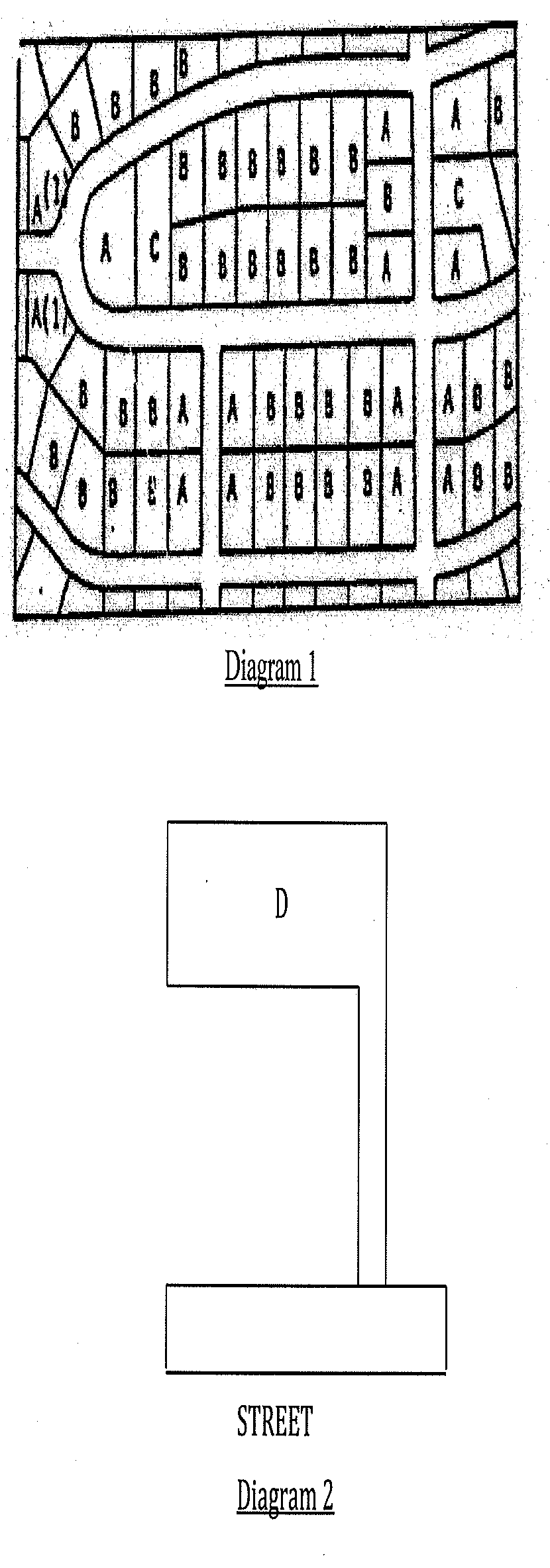
A.
"Corner lot" means a lot located at the intersection of two or more streets (see A in diagram). A lot abutting on a curved street or streets shall be considered a corner lot if straight lines drawn from the foremost points of the side lot lines to the foremost point of the lot meet an interior angle of less than one hundred thirty-five degrees (see lots marked A (1) in the diagram).
B.
"Interior lot" means a lot other than a corner lot with only one frontage on a street other than an alley (see B in diagram).
C.
"Through lot" means a lot other than a corner lot with only one street other than an alley. Through lots with frontage on two streets, may be referred to as "double frontage lots" (see C in diagram). (Ord. 269 (part), 2002)
D.
"Flag Lot" means a lot that has access to a road, street, or public highway, by means of a narrow strip of the lot, as illustrated (see D in Diagram 2). New flag lots shall not be created.
(Ord. No. 371, § III(Exh. A, Pt. B), 8-3-2009; Ord. No. 427, § III(Exh. A), 12-15-2014)
17.08.331 - Lumber and wood products manufacture.
"Lumber and wood products manufacture" means establishments engaged in cutting timber and pulpwood; merchant sawmills, lath mills, shingle mills, cooperage stock mills, planing mills, and plywood mills and veneer mills engaged in producing lumber and wood basic materials; and establishments engaged in manufacturing finished articles made entirely or mainly of wood or related materials. (Ord. 269 (part), 2002)
17.08.332 - Manufactured home.
"Manufactured home" means a single-family dwelling built according to the Department of Housing and Urban Development (HUD) Manufactured Home Construction and Safety Standards, Code 3280. A manufactured home includes plumbing, heating, air conditioning and electrical systems. It is constructed on a permanent chassis and can be transported in one or more sections. Manufactured homes must comprise a minimum of three hundred twenty square feet in size after installation. (Ord. 269 (part), 2002)
(Ord. No. 476, § III(Exh. A), 8-5-2019)
17.08.332A - Marijuana.
See the definition in RCW 69.50.101 as it exists or is hereafter amended.
(Ord. No. 461, § II, 12-23-2016)
17.08.332B - Marijuana cooperative.
Those entities authorized pursuant to RCW 69.51A.250 as it exists or is hereafter amended.
See the definition of "cooperative" in WAC 314-55-010 as it exists or is hereafter amended.
(Ord. No. 461, § II, 12-23-2016)
17.08.332C - Marijuana processor.
See the definition in RCW 69.50.101 as it exists or is hereafter amended.
(Ord. No. 461, § II, 12-23-2016)
17.08.332D - Marijuana producer.
See the definition in RCW 69.50.101 as it exists or is hereafter amended.
(Ord. No. 461, § II, 12-23-2016)
17.08.332E - Marijuana products.
See the definition in RCW 69.50.101 as it exists or is hereafter amended.
(Ord. No. 461, § II, 12-23-2016)
17.08.332F - Marijuana retailer.
See the definition in RCW 69.50.101 as it exists or is hereafter amended.
(Ord. No. 461, § II, 12-23-2016)
17.08.332G - Marina.
See the definition in Section V of the Walla Walla County Shoreline Management Plan.
(Ord. No. 371, § III(Exh. A, Pt. B), 8-3-2009; Ord. No. 461, § II, 12-23-2016)
Note— Formerly numbered as 17.08.332A.
17.08.333 - Meat processing and packing.
"Meat processing and packing" means establishments primarily engaged in the operation of meat packing plants; manufacturing sausages and other prepared meat products; and poultry slaughtering and processing. (Ord. 269 (part), 2002)
17.08.335 - Reserved.
Editor's note— Ord. No. 476, § III(Exh. A), adopted Aug. 5, 2019, repealed former § 17.08.335 in its entirety which pertained to the definition of double-wide mobile homes and derived from Ord. No. 269 (part), adopted in 2002.
17.08.340 - Mobile/manufactured home lot.
"Mobile/manufactured home lot" means a plot of ground within a mobile/manufactured home park designated to accommodate one mobile or manufactured home. (Ord. 269 (part), 2002)
(Ord. No. 476, § III(Exh. A), 8-5-2019)
17.08.345 - Mobile/manufactured home park.
"Mobile/manufactured home park" means a tract of land under single ownership or control upon which two or more mobile homes or manufactured homes occupied as dwellings may be located. (Ord. 269 (part), 2002)
(Ord. No. 476, § III(Exh. A), 8-5-2019)
17.08.348 - Mobile home.
"Mobile home" means a factory-built dwelling built prior to June 15, 1976, to other than the HUD construction and safety standards. (Ord. 269 (part), 2002)
(Ord. No. 476, § III(Exh. A), 8-5-2019)
17.08.349 - Reserved.
Editor's note— Ord. No. 476, § III(Exh. A, adopted Aug. 5, 2019, repealed former § 17.08.349 in its entirety which pertained to the definition of mobile home subdivision and derived from Ord. No. 269(part), adopted in 2002.
17.08.355 - Motel.
See Hotel. (Ord. 269 (part), 2002)
17.08.360 - Nonconforming use.
"Nonconforming use" means a use which lawfully occupied a building or land at the time this title becomes effective and which does not conform with the use regulations of the district in which it is located. (Ord. 269 (part), 2002)
17.08.362 - Nondurable goods, wholesale.
"Wholesale nondurable goods" means establishments primarily engaged in the wholesale distribution of paper and paper products; drugs, drug proprietaries, and druggists' sundries; apparel, piece goods, and notions; groceries and related products; farm-product raw materials; chemicals and allied products; petroleum and petroleum products; beer, wine, and distilled alcoholic beverages; and miscellaneous nondurable goods. (Ord. 269 (part), 2002)
17.08.363 - Office.
"Office" means a room or group of rooms used for conducting the affairs of a business, profession, service, industry, or government and generally furnished with desks, tables, files, and communication equipment. (Ord. 269 (part), 2002)
17.08.364 - Organic waste processing facility.
"Organic waste processing facility" means a facility that is operated for the purpose of producing marketable compost, other soil amendments, and/or energy recovery from the on-site and/or off-site organic material fraction of the waste stream, provides a direct benefit/link to the agricultural operation on the premises and other agricultural lands in the vicinity, and is permitted, designed in compliance with the applicable regulations contained in the Washington Administrative Code Chapter 173-350. Feedstock may include, but is not limited to agricultural waste, industrial food processing waste, commercial and residential yard waste, biosolids, or food waste from local or regional sources. (Ord. 339 § 1, 2007)
17.08.365 - Outdoor advertising display.
"Outdoor advertising display" means any card, cloth, paper, metal painted signs, wooden, plaster, stone or other sign of any kind or character whatsoever placed for outdoor advertising purposes on the ground or on any tree, wall, bush, rock, post, fence, building, structure or thing whatsoever. "Placed," as used in the definition of "outdoor advertising display" and "outdoor advertising structure" includes erecting, construction, posting, painting, tacking, nailing, gluing, sticking, carving or otherwise fastening, affixing or making visible in any manner whatsoever. (Ord. 269 (part), 2002)
17.08.367 - Paper and allied products manufacture.
"Paper and allied products manufacture" means establishments primarily engaged in the manufacture of pulps from wood and other cellulose fibers, and from rags; the manufacture of paper and paperboard; and the manufacture of paper and paperboard into converted products, such as paper coated off the paper machine, paper bags, paper boxes, and envelopes. (Ord. 269 (part), 2002)
17.08.370 - Park.
"Park" means an area established or maintained for use by the public as a place for outdoor recreational activities including, but not limited to, picnic areas, marine parks, fishing access areas and campgrounds. (Ord. 269 (part), 2002)
17.08.380 - Person.
"Person" means any individual, firm, corporation, partnership, association, or agency of the state, county or municipal government. (Ord. 269 (part), 2002)
17.08.382 - Personal services.
"Personal services" means establishments primarily engaged in providing services generally to individuals, such as barber and beauty shops, drycleaners, laundries, and photographic studios. (Ord. 269 (part), 2002)
17.08.383 - Petroleum and coal products manufacture.
"Petroleum and coal products manufacture" means establishments primarily engaged in petroleum refining, paving and roofing materials, and compounding lubricating oils and greases from purchased materials. (Ord. 269 (part), 2002)
17.08.385 - Planning commission.
"Planning commission" means the planning commission of the county of Walla Walla. (Ord. 269 (part), 2002)
17.08.386 - Planning director.
"Planning director" means the director of the department of community development of the county of Walla Walla, Washington or his or her designee.
(Ord. No. 386, § III(Exh. A, § 4), 8-30-2010)
17.08.387 - Primary metal industries.
"Primary metal industries" means establishments engaged in smelting and refining ferrous and nonferrous metals from ore, pig, or scrap; in rolling, drawing, and alloying metals; in manufacturing castings and other basic metal products; and in manufacturing nails, spikes, and insulated wire and cable, including the production of coke. (Ord. 269 (part), 2002)
17.08.390 - Principal use.
"Principal use" means the primary or predominant use to which the property is or may be devoted, and to which all other uses on the premises are accessory. (Ord. 269 (part), 2002)
17.08.392 - Printing, publishing and allied industries.
"Printing, publishing and allied industries" means establishments engaged in printing by one or more common processes, such as letterpress; lithography (including offset), gravure, or screen; and those establishments which perform services for the printing trade, such as bookbinding and platemaking, including establishments engaged in publishing newspapers, books, and periodicals, regardless of whether or not they do their own printing. (Ord. 269 (part), 2002)
17.08.393 - Produce market.
See the definition in Section 17.25.020. (Ord. 269 (part), 2002)
(Ord. No. 476, § III(Exh. A), 8-5-2019)
17.08.395 - Produce stand.
"Produce stand" means a roadside stand of less than one hundred twenty sq. ft. specifically for the display and sale of fresh fruits and vegetables where at least fifty percent of the produce for sale is produced on-site. (Ord. 269 (part), 2002)
17.08.398 - Railroad terminal.
"Railroad terminal" means an establishment primarily engaged in the furnishing of terminal facilities for rail passenger or freight traffic for line-haul service and in the movement of railroad cars between terminal yards, industrial sidings and other local sites.
(Ord. No. 371, § III(Exh. A, Pt. B), 8-3-2009)
17.08.407 - Recreational facility.
"Recreational facility" means facilities and equipment for recreation purposes such as swimming pools, tennis courts and community centers. (Ord. 269 (part), 2002)
17.08.410 - Recreational vehicle.
"Recreational vehicle" means a vehicular type unit, as defined by the Department of Labor and Industries, designed for temporary living quarters for recreational, camping or travel use, which either has its own motor power or is mounted on or drawn by another vehicle. (Ord. 269 (part), 2002)
17.08.412 - Repair shops and related services (non-automotive).
"Repair shops and related services (non-automotive)" means establishments primarily engaged in non-automotive specialized repair services, not elsewhere classified, such as bicycle repair; leather goods repair; lock and gun repair; musical instrument repair; septic tank cleaning; furnace cleaning; and typewriter repair. (Ord. 269 (part), 2002)
17.08.414 - Retail, miscellaneous.
"Retail, miscellaneous" means retail establishments not elsewhere classified, including, but not limited to, liquor stores, used merchandise stores, florists, news dealers and newsstands. (Ord. 269 (part), 2002)
17.08.420 - Riding academy.
"Riding academy" means a recreational facility open to the public for instruction and lessons in horsemanship and/or stock riding, including the conducting of day camps. Such facility may include an indoor and/or outdoor arena, trails, horse stalls or stables for the boarding of horses, horse grooming, medication, and rental, tack sales, and the holding of public events related to the instruction and lessons in horsemanship and/or stock riding. (Ord. 307 (part), 2004)
17.08.427 - Rubber and miscellaneous plastics products manufacture.
"Rubber and miscellaneous plastics products manufacture" means establishments manufacturing products from plastics, resins and from natural, synthetic, or reclaimed rubber, gutta percha, balata, or gutta siak, including establishments primarily manufacturing tires. (Ord. 269 (part), 2002)
17.08.440 - School, elementary, junior or senior high (including public, private and parochial).
"Elementary school," "junior high school" or "senior high school" (including public, private and parochial) means an institution of learning which offers instruction in the several branches of learning and study required by the Education Code of the state of Washington to be taught in the public and parochial schools. (Ord. 269 (part), 2002)
17.08.445 - Senior citizen assisted housing.
"Senior citizen assisted housing" means a place of residence for several families or individuals which may feature services to retired persons such as limited nursing facilities, minimum maintenance living accommodations, and recreation programs and facilities. (Ord. 269 (part), 2002)
(Ord. No. 371, § III(Exh. A, Pt. B), 8-3-2009)
17.08.450 - Service building.
"Service building" means a building within a park which contains toilet, lavatory and/or bathing facilities and/or laundry facilities. (Ord. 269 (part), 2002)
17.08.455 - Service station and convenience market, automobile.
"Automobile service station and convenience market" means an occupancy which provides for:
A.
The servicing of motor vehicles and operations incidental thereto limited to the retail sale of petroleum products and automotive accessories; automobile washing by hand; waxing and polishing of automobiles; tire changing and repairing (excluding recapping); battery service, charging and replacement, excluding repair and rebuilding; radiator cleaning and flushing, excluding steam cleaning and repair; and installation of accessories;
B.
The following operations if conducted within a building: lubrication of motor vehicles; brake servicing limited to servicing and replacement of brake cylinders, lines and brake shoes; wheel balancing; the testing, adjustment, and replacement or servicing of carburetors, coils, condensers, distributor caps, fan belts, filters, generators, points, rotors, spark plugs, voltage regulators, water and fuel pumps, water hoses and wiring; convenience markets and fast food services. (Ord. 269 (part), 2002)
17.08.460 - Sewage dumping station.
"Sewage dumping station" means a facility used for removing and disposing of sewage from recreational vehicle holding tanks. (Ord. 269 (part), 2002)
17.08.470 - Sign.
"Sign" means any device for visual communications that is used for the purpose of bringing the subject thereof to the attention of the public. (Ord. 269 (part), 2002)
17.08.475 - Small scale value-added agriculture processing.
"Small scale value-added agriculture processing" means the production, storage, marketing, and distribution of regional agricultural products from one or more producers, including support services that facilitate these activities. Value-added agricultural products may be defined as any agricultural commodity that meets at least one of the following categories:
A.
Has undergone a change in physical state;
B.
Was produced in a manner that enhances the value of the agricultural commodity; or
C.
Is aggregated and marketed as a locally-produced agricultural food product.
The processing facility shall meet the following conditions:
A.
The facility is not a slaughterhouse or mushroom substrate production facility.
B.
The facility is not a source of farm- or ranch-based renewable energy, including E-85 fuel (except for own use).
C.
The facility is supplemental and related to the primary permitted use;
D.
The facility processes at least 50 percent agricultural goods produced in Walla Walla County.
E.
The facility may conduct on-site retail sales of value-added products produced by the processing facility, or farm or ranch, in a market area that is not larger than 400 square feet.
F.
Ancillary retail sales of products not grown or produced by the processing facility, or farm or ranch, must be confined to fifteen percent of the total gross floor space of the retail area (maximum of 60 square feet), and must be clearly accessory to retail sales and marketing of the processing facility.
G.
The total gross floor area of the facility shall not exceed 12,000 square feet.
H.
A permit is required for all small scale value-added agriculture processing facilities. Permit review shall be limited to determining that the proposed facility meets the conditions listed above, provides adequate parking, and is compliant with other applicable development regulations. A permit may be revisited by the Walla Walla County Community Development Department if any of the activities are determined to be outside of the scope, purpose, and/or use of the processing facility.
(Ord. No. 463, § III(exh. A), 5-1-2017)
17.08.481 - Stable, public.
"Stable, public" means an accessory building in which horses or beasts of burden owned by persons other than the occupants of the premises are kept, and in which such animals are kept for hire, remuneration or sale. (Ord. 307 (part), 2004)
17.08.482 - Stone, clay, glass and concrete products manufacture.
"Stone, clay and concrete products manufacture" means establishments manufacturing flat glass and other glass products, cement, structural clay products, pottery, concrete and gypsum products, cut stone, abrasive and asbestos products, and other products from materials taken principally from the earth in the form of stone, clay, and sand. (Ord. 269 (part), 2002)
17.08.483 - Storage, self service.
"Self service storage" means a structure containing separate, individual, and private storage spaces of varying sizes leased or rented on individual leases for varying periods of time. (Ord. 269 (part), 2002)
17.08.485 - Street.
"Street" means a public or private thoroughfare which affords the primary means of access to abutting property and intended for general traffic circulations. "Street" does not include an alley. (Ord. 269 (part), 2002)
(Ord. No. 371, § III(Exh. A, Pt. B), 8-3-2009)
17.08.490 - Structure.
"Structure" means a combination of materials to form a construction for use, occupancy, or ornamentation whether installed on, above, or below the surface of land or water. (Ord. 269 (part), 2002)
17.08.492 - Textile mill products manufacture.
"Textile mill products manufacture" means establishments engaged in performing any of the following operations: (1) preparation of fiber and subsequent manufacturing of yarn, thread, braids, twine, and cordage; (2)manufacturing broad woven fabrics, narrow woven fabrics, knit fabrics, and carpets and rugs from yarn; (3) dyeing and finishing fiber, yarn, fabrics, and knit apparel; (4) coating, waterproofing, or otherwise treating fabrics; (5) the integrated manufacture of knit apparel and other finished articles from yarn; and (6) the manufacture of felt goods, lace goods, nonwoven fabrics, and miscellaneous textiles. (Ord. 269 (part), 2002)
17.08.493 - Townhouse.
"Townhouse" means a building containing one dwelling unit that occupies space from the ground to the roof, and is attached to one or more other townhouse dwellings by common walls. (Ord. 269 (part), 2002)
17.08.501 - Transient labor camp.
"Transient labor camp" means a place, area, or piece of land where sleeping places or housing sites are provided by an agricultural employer for his or her agricultural employees or by another person, including a temporary worker housing operator, who is providing such accommodations for employees for temporary, seasonal occupancy. (Ord. 269 (part), 2002)
17.08.502 - Transportation equipment manufacture.
"Transportation equipment manufacture" means establishments engaged in manufacturing equipment for transportation of passengers and cargo by land, air, and water. Products produced by these establishments include motor vehicles, aircraft, ships, boats, railroad equipment, and miscellaneous transportation equipment, such as motorcycles, bicycles, and snowmobiles. (Ord. 269 (part), 2002)
17.08.503 - Truck stop.
"Truck stop" means any building, premises, or land in which or upon which a business, service, or industry involving the maintenance, servicing, storage, or repair of commercial vehicles is conducted or rendered, including the dispensing of motor fuel or other petroleum products directly into motor vehicles and the sale of accessories or equipment for trucks and similar commercial vehicles. A truck stop also may include overnight accommodations and restaurant facilities primarily for the use of truck crews. (Ord. 269 (part), 2002)
17.08.504 - Utility facilities.
"Utility facilities" means facilities for the distribution or transmission of services to an area; including, but not limited to: telephone exchanges, water or sewage pumping or treatment stations, electrical substations, and water storage reservoirs or tanks. (Ord. 269 (part), 2002)
17.08.505 - Variance.
"Variance" means a departure from the provisions of a zoning ordinance relating to lot width or setbacks that, if applied to a specific lot, would significantly interfere with the use of the property. (Ord. 269 (part), 2002)
(Ord. No. 476, § III(Exh. A), 8-5-2019)
17.08.507 - Warehousing and storage.
"Warehousing and storage" means establishments primarily engaged in farm products warehousing and storage, refrigerated warehousing and storage, and general warehousing and storage. (Ord. 269 (part), 2002)
17.08.508 - Wedding and event center, Type I.
See the definition in Chapter 17.21.
(Ord. 347 § 1, 2007; Ord. No. 446, § III(Exh. A), 6-27-2016)
17.08.509 - Wedding and event center, Type II.
See the definition in Chapter 17.21.
(Ord. No. 446, § III(Exh. A), 6-27-2016)
17.08.515 - Winery, Type I.
See the definition in Section 17.22.030. (Ord. 269 (part), 2002)
(Ord. No. 371, § III(Exh. A, Pt. B), 8-3-2009)
17.08.516 - Winery, Type II.
See the definition in ch.17.22.030.
(Ord. No. 371, § III(Exh. A, Pt. B), 8-3-2009)
17.08.517 - Winery, Type III.
See the definition in ch. 17.22.030.
(Ord. No. 473, § III(Exh. A, § 2), 10-15-2018)
17.08.518 - Wireless communication facility.
"Wireless communication facility" means an unstaffed facility for the transmission and/or reception of radio frequency (RF) signals usually consisting of an equipment shelter or cabinet, a support structure and/or other transmission and reception devices. This definition does not include ancillary antennas such as are usual to individual businesses and residences and which conform to height limits and other development standards in the zone in which such antennas would be located. (Ord. 269 (part), 2002)
17.08.518A - Wireless communication facility, attached.
"Attached wireless communication facility" means a wireless facility that is affixed to an existing structure, for example, an existing building, tower, water tank, utility pole, etc., which does not include an additional wireless communication support structure. (Ord. 269 (part), 2002)
17.08.519 - Wireless communication support structure.
"Wireless communication support structure" means the structure erected to support wireless communication antennas and connecting appurtenances. Support structure types include, but are not limited to, monopoles, lattice towers, wood poles, and guyed towers. (Ord. 269 (part), 2002)
17.08.520 - Yard.
"Yard" means an open space unoccupied and unobstructed from the ground upward unless specifically otherwise permitted in this title. (Ord. 269 (part), 2002)

