
Wauchula City Zoning Code
ARTICLE 2
- REGULATIONS FOR SPECIFIC DISTRICTS
2.01.00 - General provisions.
The purpose of this Section is to set forth the general provisions concerning land use. The provisions established herein shall regulate land use, density, and intensity, establish building lot and yard requirements, establish land use districts that identify the location of land uses in the City of Wauchula, establish standards for land use in the City, and provide for a map locating the permitted land uses in the City. All land in Wauchula shall be subject to the provisions of this Section, and shall be shown on the Official Zoning Map as provided in Section 8.05.00. More than one permitted use may be located on a single parcel of land in any zoning district within the City.
2.01.01 Development approval.
(A)
No development approval shall be issued unless the proposed development conforms to the design regulations prescribed within the applicable zoning district. The design regulations, including lot layout, height, and density/intensity standards, are included in Table 2.02.02(B).
(B)
No use is permitted unless it is listed as a permitted, permitted with conditions, or special exception in the Table of Land Uses. However, uses that are required to be permitted in any zoning district by state statute may be permitted in accordance with state law whether or not the use is included in the Table of Land Uses.
(C)
A use not specifically mentioned or described by category in the Table of Land Uses is prohibited. Evaluation of these uses shall be as set forth in Section 2.01.02 below.
2.01.02 Interpretation—Materially similar uses.
(A)
The Development Director shall determine if a use not mentioned can reasonably be interpreted to fit into a use category where similar uses are described. Interpretations may be reviewed, upheld, or overturned by the City of Wauchula City Commission following review and recommendation by the Planning and Zoning Board at regularly scheduled meetings. It is the intent of this Code to group similar or compatible land uses into specific zoning districts, either as permitted uses (P), uses permitted with conditions (PC), or uses authorized as special exceptions (S). Uses required to be approved through Planned Unit Development (PUD) are listed in Table 2.02.01(B). Uses not listed in the Table of Uses (Table 2.02.01(A)) as P, PC, or S are presumed to be prohibited from the applicable zoning district. In the event that a particular use is not listed in the Table of Uses, and such use is not listed as a prohibited use under the specific zoning district and is not otherwise prohibited by law, the Development Director shall determine whether a materially similar use exists in this section.
(1)
Should the Development Director determine that a materially similar use does exist, the regulations governing that use shall apply to the particular use not listed, and the Development Director's decision shall be recorded in writing.
(2)
Should the Development Director determine that a materially similar use does not exist; the matter may be referred to the Planning and Zoning Board for consideration for amendment to the LDC to establish a specific listing for the use in question. Unless an appeal is timely filed pursuant to Article 8, the Development Director's decision is valid.
(3)
Periodically, the Development Director shall forward the materially similar use decisions to the Planning and Zoning Board for review of interpretations and to be considered as potential text amendments to the LDC. If, when seeking periodic review of interpretations, the Development Director's interpretation is reversed, then decisions made in reliance on the Development Director's interpretation become non-conforming uses.
(B)
Rules of interpretation.
(1)
The Development Director may determine that a use is materially similar if the use is of the same general type as the uses permitted there by this Code based on characteristics, use patterns, and land use and traffic impacts.
(2)
The Development Director may utilize the following resources in making a determination of materially similar use.
a.
The use is listed as within the same structure or function classification as the use specifically enumerated in the Table of Land Uses, as determined by the Land-Based Classification Standards (LBCS) of the American Planning Association (APA). The Development Director shall refer to the following documents in making this determination, which documents are incorporated by reference and are maintained on file in the office of the planning department:
1.
LBCS Activity Dimension with Detail Descriptions (April 1, 2001);
2.
LBCS Function Dimension with Detail Descriptions (April 1, 2001);
3.
LBCS Structure Dimension with Detail Descriptions (April 1, 2001); and
4.
LBCS Tables (April 1, 2001).
The use shall be considered materially similar if it falls within the same LBCS classification.
b.
If the use cannot be located within one of the APA's LBCS classifications pursuant to subsection (A), above, the Development Director may refer to the most recent North American Industry Classification System (NAICS) Manual. The use shall be considered materially similar if it falls within the same industry classification of the most recent NAICS Manual.
(Ord. No. 2013-16, § 2(2.01.00), 1-13-13)
2.02.00 - Establishment of districts.
In order to classify, regulate, and restrict the uses of land, water, buildings, and structures; to regulate and restrict the height and bulk of buildings; to regulate the area of yards, courts, and other open spaces between buildings; and to regulate the intensity of land use, all the area of the City of Wauchula is classified into one of the following districts:
2.02.01 Zoning District Summary Tables. The tables on the following pages present, in a quick-reference form, information regarding permitted and special exception land uses, and development standards for all zoning districts. These tables must be read in conjunction with the regulations for specific zoning districts in Section 2.02.02 and the regulations for building design and appearance standards in Section 2.06.00. The Development Director may permit in a particular zone a use not listed in this Code, provided the use is of the same general type as the uses permitted there by this Code (See Section 2.01.02). The key to the table is as follows:
P = Permitted Use - Use is permitted by right subject to all other applicable standards
PC = Permitted with Conditions - Use is permitted if it meets the listed conditions in Section 3.08.00, and subject to all other applicable standards. At the Development Director's discretion, any development larger than five acres or development that may have compatibility concerns may be sent to the Planning and Zoning Board for approval.
S = Special Exception Use - Use is permitted if it meets the listed conditions in Section 3.09.00, subject to all other applicable standards, and only after review and approval of a special exception permit by the Planning and Zoning Board.
* See Table 2.02.01(B) for uses that require approval of a Planned Unit Development including conditions as outlined in Section 3.10.00.
Table 2.02.01(A)
Table of Land Uses
Table 2.02.01(B)
Uses that Require Approval of a Planned Unit Development
*Requires approval with Conditions as Outlined in Section 3.10.00
Table 2.02.01(C)
Table of Development Standards
* Addition to existing code.
** In R3, the setback requirements apply to the zoning lot, not to the individual buildings within the project.
(1) Maximum Height does not apply to church spires, cupolas, belfries, chimneys, flag or radio poles, gas holders, grain elevators or elevator enclosures.
(2) For two stories.
(3) The front, rear and side setbacks shall be the minimum required from the most restrictively zoned adjoining parcel.
(4) Lots of record less than 51 feet wide and more than 25 feet wide: side setback must be a minimum of five feet.
(5) No building shall exceed three stories or 45 feet in height unless one foot shall be added to the required front and side yard setbacks for each foot of building height in excess of 45 feet.
(6) Minimum side street setback for a C-2 corner lot is 20 feet.
Table 2.02.01(D) Zoning Consistency Matrix
* New Districts
2.02.02 Establishment of zoning districts. The following zoning designations are hereby established within the City of Wauchula.
2.02.02.01 AG Agriculture.
(A)
FLUM Designation: Agriculture.
(B)
Purpose: To provide for agricultural activities within the City of Wauchula; and to provide for the continuation of agricultural tax exempt status as governed by State Statute, on property that is around the perimeter of the City and the subject of annexation. In general, agricultural pursuits and single-family detached dwelling units are allowed.
(C)
Permitted principal uses and structures: Uses permitted in this district are detailed in the Table of Land Uses in Section 2.02.01(A). Permitted uses are designated by the letter "P" and are permitted by right subject to all other applicable standards.
(1)
Agricultural uses as defined herein: The use of land for producing or harvesting crops or plants; for raising, livestock or fish; for forestry, fisheries, animal specialty farms or hunting, trapping and game propagation. Intense agricultural activities such as feed lots, dairying, and egg production are not allowed within the City Limits, unless they are pre-existing uses of the land prior to annexation.
(2)
Limited agricultural uses as defined herein: Land uses in residential areas that are characterized as agricultural in nature and are limited to orchards; vineyards; nurseries; ornamental horticulture areas; groves; noncommercial greenhouses, and raising of exotic species with the exception of venomous reptiles.
(3)
Permitted in this district are newly annexed parcels with agricultural uses that have been previously qualified for the Agricultural Tax Exemption as defined by F.S. 193.461, "which includes, but is not limited to, horticulture; floriculture; viticulture; forestry; dairy; livestock; poultry; bee, pisciculture, when the land is used principally for the production of tropical fish; aquaculture; sod farming; and all forms of farm products and farm production."
(4)
Any use or structure deemed objectionable to the surrounding area, or that would be noxious, injurious, or adversely affect the public health, safety, comfort, and general welfare or the environment is prohibited.
(5)
Manufactured structures regulated by the Florida Department of Highway Safety and Motor Vehicles are permitted.
(D)
Principal uses and structures permitted with conditions: Uses permitted with conditions in this district are detailed in the Table of Land Uses in Subsection 2.02.01(A). Permitted with conditions uses are designated by the letters "PC." Uses Permitted with Conditions are permitted if they meet the listed conditions in Section 3.08.00, and subject to all other applicable standards. At the Development Director's discretion, any development larger than five acres or development that may have compatibility concerns may be sent to the Planning and Zoning Board for approval.
(E)
Accessory uses: Accessory uses and structures customarily incidental and subordinate to permitted principal uses and structures; provided, however, that no accessory structures shall be located on property other than that on which the principal structure is located. Section 2.04.00 contains detailed guidance and regulations for permitted accessory uses.
(1)
In-law units. In-law units are permitted as an accessory use pursuant to the requirements of Subsection 2.04.01.
(F)
Special exception uses: Uses permitted as special exceptions in this district are detailed in the Table of Land Uses in Section 2.02.01(A). Such uses are designated by the letter "S." Special Exception uses require the submission of an application and approval by the Planning and Zoning Board prior to application for a development permit. Special exception uses must meet the listed conditions in Section 3.09.00, and subject to all other applicable standards. Article 7 governs review of an application for approval of a special exception.
(G)
Development standards: Development standards for uses in this district are detailed in the Table of Development Standards in Section 2.02.01(C). Specifically, standards are established, as applicable, for maximum density; minimum lot size; minimum lot width; minimum lot depth; minimum floor area; floor area ratio; setbacks; maximum lot coverage; and maximum building height.
(H)
Other requirements:
(1)
Aquaculture, composting, and recycling activities conducted on non-mandatory reclamation lands shall be subject to, and require evidence of, all relevant state and federal permits, and shall be appropriately buffered from existing or future adjacent residential development; and may be permitted as listed in the "Table of Land Uses", Table 2.02.01(A).
(2)
Roadside stands: Excess produce and other products that are agricultural in nature and harvested from orchards, vineyards, nurseries, ornamental horticultural areas, groves, noncommercial greenhouses, etc., as well as excess produce harvested from any commercial farm, may be sold on the premises to the general public by the means of a roadside stand or similar structure, by the residents of the property. All setbacks must be observed from right-of-ways and property lines as required for any accessory structure.
(3)
Lands that are surrounded by the city limits, and are known as "enclaves", may not be annexed in and zoned for agricultural purposes, unless such lands are currently the site of agricultural activities, such as groves, and unless the health, safety, and welfare of the citizens of Wauchula can be protected. For the health, safety, and welfare of the citizens of Wauchula, agricultural uses will only be permitted at the perimeter of the City, in areas that already support agricultural uses and have qualifying agricultural tax exemptions. At the time of development, or subdivision of the land for development, or when the agricultural tax exemption is removed, all rights to agricultural uses (including the keeping of farm animals) shall cease.
2.02.02.02 FR Farm Residential.
(A)
FLUM designation: Agriculture or single-family residential.
(B)
Purpose: To provide for limited agricultural uses and the keeping of farm animals within the City of Wauchula. In general, limited agricultural pursuits and single-family detached dwelling units are allowed.
(C)
Permitted principal uses and structures: Uses permitted in this district are detailed in the Table of Land Uses in Section 2.02.01(A). Permitted uses are designated by the letter "P" and are permitted by right subject to all other applicable standards.
(1)
Limited agricultural uses as defined in this code are permitted.
(2)
Farm animals as defined in this code are permitted.
(3)
Any use or structure deemed objectionable to the surrounding area, or that would be noxious, injurious, or adversely affect the public health, safety, comfort, and general welfare or the environment is prohibited.
(4)
Manufactured structures regulated by the Florida Department of Highway Safety and Motor Vehicles are permitted.
(D)
Principal uses and structures permitted with conditions: Uses permitted with conditions in this district are detailed in the Table of Land Uses in Section 2.02.01(A). Permitted with conditions uses are designated by the letters "PC." Uses permitted with conditions are permitted if they meet the listed conditions in Section 3.08.00, and subject to all other applicable standards. At the Development Director's discretion, any development larger than five acres or development that may have compatibility concerns may be sent to the Planning and Zoning Board for approval.
(E)
Accessory uses: Accessory uses and structures customarily incidental and subordinate to permitted principal uses and structures; provided, however, that no accessory structures shall be located on property other than that on which the principal structure is located. Section 2.04.00 contains detailed guidance and regulations for permitted accessory uses.
(1)
The storing, repairing, or restoration of vehicles may be permitted in keeping with Sections 2.03.02 and 2.03.03.
(2)
In-law units. In-law units are permitted as an accessory use pursuant to the requirements of Section 2.04.01.
(F)
Special exception uses: Uses permitted as special exceptions in this district are detailed in the Table of Land Uses in Section 2.02.01(A). Such uses are designated by the letter "S." Special exception uses require the submission of an application and approval by the Planning and Zoning Board prior to application for a development permit. Special Exception uses must meet the listed conditions in Section 3.09.00, and subject to all other applicable standards. Article 7 governs review of an application for approval of a special exception.
(G)
Development standards: Development standards for uses in this district are detailed in the Table of Development Standards in Subsection 2.02.01(C). Specifically, standards are established, as applicable, for maximum density; minimum lot size; minimum lot width; minimum lot depth; minimum floor area; floor area ratio; setbacks; maximum lot coverage; and maximum building height.
(H)
Other requirements:
(1)
Aquaculture, composting, and recycling activities conducted on non-mandatory reclamation lands shall be subject to, and require evidence of, all relevant state and federal permits, and shall be appropriately buffered from existing or future adjacent residential development; and may be permitted as listed in the "Table of Land Uses", Table 2.02.01(A).
(2)
Roadside stands: Excess produce and other products that are agricultural in nature and harvested from orchards, vineyards, nurseries, ornamental horticultural areas, groves, noncommercial greenhouses, etc., as well as excess produce harvested from any commercial farm, may be sold on the premises to the general public by the means of a roadside stand or similar structure, by the residents of the property. All setbacks must be observed from right-of-ways and property lines as required for any accessory structure.
(3)
Lands that are surrounded by the City limits, and are known as "enclaves", may not be annexed in and zoned for agricultural purposes, unless such lands are currently the site of agricultural activities, such as groves, and unless the health, safety, and welfare of the citizens of Wauchula can be protected. For the health, safety and welfare of the citizens of Wauchula, agricultural uses will only be permitted at the perimeter of the City, in areas that already support agricultural uses and have qualifying agricultural tax exemptions. At the time of development, or subdivision of the land for development, or when the agricultural tax exemption is removed, all rights to agricultural uses (including the keeping of farm animals) shall cease.
2.02.02.03 R-1A Single-Family Residential.
(A)
FLUM designation: Single-family residential.
(B)
Purpose: To provide the opportunity for conventional single-family development in appropriate areas of the City, compatible with existing development and in conformance with the provisions of the Comprehensive Plan, including density limitations.
(C)
Permitted principal uses and structures: Uses permitted in this district are detailed in the Table of Land Uses in Section 2.02.01(A). Permitted uses are designated by the letter "P" and are permitted by right subject to all other applicable standards.
(1)
Any use or structure deemed objectionable to the surrounding area, or that would be noxious, injurious, or adversely affect the public health, safety, comfort, and general welfare or the environment is prohibited.
(D)
Principal uses and structures permitted with conditions: Uses permitted with conditions in this district are detailed in the Table of Land Uses in Section 2.02.01(A). Permitted with conditions uses are designated by the letters "PC." Uses permitted with Conditions are permitted if they meet the listed conditions in Section 3.08.00, and subject to all other applicable standards. At the Development Director's discretion, any development larger than five acres or development that may have compatibility concerns may be sent to the Planning and Zoning Board for approval.
(E)
Accessory uses: Accessory uses and structures customarily incidental and subordinate to permitted principal uses and structures; provided, however, that no accessory structures shall be located on property other than that on which the principal structure is located. Section 2.04.00 contains detailed guidance and regulations for permitted accessory uses.
(1)
The storing, repairing, or restoration of vehicles may be permitted in keeping with Sections 2.03.02 and 2.03.03.
(2)
In-law units. In-law units are permitted as an accessory use pursuant to the requirements of Section 2.04.01.
(F)
Special exception uses: Uses permitted as special exceptions in this district are detailed in the Table of Land Uses in Section 2.02.01(A). Such uses are designated by the letter "S." Special Exception uses require the submission of an application and approval by the Planning and Zoning Board prior to application for a Development Permit. Special Exception uses must meet the listed conditions in Section 3.09.00, and subject to all other applicable standards. Article 7 governs review of an application for approval of a special exception.
(G)
Development standards: Development standards for uses in this district are detailed in the Table of Development Standards in Section 2.02.01(C). Specifically, standards are established, as applicable, for maximum density; minimum lot size; minimum lot width; minimum lot depth; minimum floor area; floor area ratio; setbacks; maximum lot coverage; and maximum building height.
(H)
Other requirements:
(1)
Clubhouses and similar facilities are permitted within platted subdivisions on parcels retained by the developer or dedicated to and maintained by a homeowners association. Appropriate development standards will be determined by the Development Director.
(2)
Private golf courses are permitted in conjunction with platted subdivisions of 25 lots or more.
2.02.02.04 R-1 Single-Family Residential.
(A)
FLUM designation: Single-family residential.
(B)
Purpose: To provide the opportunity for conventional single-family development in appropriate areas of the City, compatible with existing development and in conformance with the provisions of the Comprehensive Plan, including density limitations.
(C)
Permitted principal uses and structures: Uses permitted in this district are detailed in the Table of Land Uses in Section 2.02.01(A). Permitted uses are designated by the letter "P" and are permitted by right subject to all other applicable standards.
(1)
Any use or structure deemed objectionable to the surrounding area, or that would be noxious, injurious, or adversely affect the public health, safety, comfort, and general welfare or the environment is prohibited.
(D)
Principal uses and structures permitted with conditions: Uses permitted with conditions in this district are detailed in the Table of Land Uses in Section 2.02.01(A). Permitted with conditions uses are designated by the letters "PC." Uses permitted with conditions are permitted if they meet the listed conditions in Section 3.08.00, and subject to all other applicable standards. At the Development Director's discretion, any development larger than five acres or development that may have compatibility concerns may be sent to the Planning and Zoning Board for approval.
(E)
Accessory uses: Accessory uses and structures customarily incidental and subordinate to permitted principal uses and structures; provided, however, that no accessory structures shall be located on property other than that on which the principal structure is located. Section 2.04.00 contains detailed guidance and regulations for permitted accessory uses.
(1)
The storing, repairing, or restoration of vehicles may be permitted in keeping with Sections 2.03.02 and 2.03.03.
(2)
In-law units. In-law units are permitted as an accessory use pursuant to the requirements of Section 2.04.01.
(F)
Special exception uses: Uses permitted as special exceptions in this district are detailed in the Table of Land Uses in Section 2.02.01(A). Such uses are designated by the letter "S." Special exception uses require the submission of an application and approval by the Planning and Zoning Board prior to application for a development permit. Special Exception uses must meet the listed conditions in Section 3.09.00, and subject to all other applicable standards. Article 7 governs review of an application for approval of a special exception.
(G)
Development standards: Development standards for uses in this district are detailed in the Table of Development Standards in Section 2.02.01(C). Specifically, standards are established, as applicable, for maximum density; minimum lot size; minimum lot width; minimum lot depth; minimum floor area; floor area ratio; setbacks; maximum lot coverage; and maximum building height.
(H)
Other requirements:
(1)
Clubhouses and similar facilities are permitted within platted subdivisions on parcels retained by the developer or dedicated to and maintained by a homeowners association. Appropriate development standards will be determined by the development director.
(2)
Private golf courses are permitted in conjunction with platted subdivisions of 25 lots or more.
(3)
Modular homes placed within a traditional, site-built, "sticks and bricks" neighborhood must meet the requirements of Section 2.03.04.
2.02.02.05 R-2 Single-Family Residential/Duplexes.
(A)
FLUM designation: Low Density Residential
(B)
Purpose: To provide the opportunity for conventional single-family development and duplexes in appropriate areas of the City, compatible with existing development and in conformance with the provisions of the Comprehensive Plan, including density limitations.
(C)
Permitted principal uses and structures: Uses permitted in this district are detailed in the Table of Land Uses in Section 2.02.01(A). Permitted uses are designated by the letter "P" and are permitted by right subject to all other applicable standards.
(1)
Any use or structure deemed objectionable to the surrounding area, or that would be noxious, injurious, or adversely affect the public health, safety, comfort, and general welfare or the environment is prohibited.
(D)
Principal uses and structures permitted with conditions: Uses permitted with conditions in this district are detailed in the Table of Land Uses in Section 2.02.01(A). Permitted with conditions uses are designated by the letters "PC." Uses permitted with conditions are permitted if they meet the listed conditions in Section 3.08.00, and subject to all other applicable standards. At the Development Director's discretion, any development larger than five acres or development that may have compatibility concerns may be sent to the Planning and Zoning Board for approval.
(E)
Accessory uses: Accessory uses and structures customarily incidental and subordinate to permitted principal uses and structures; provided, however, that no accessory structures shall be located on property other than that on which the principal structure is located. Section 2.04.00 contains detailed guidance and regulations for permitted accessory uses.
(1)
The storing, repairing, or restoration of vehicles may be permitted in keeping with Sections 2.03.02 and 2.03.03.
(2)
In-law units. In-law units are permitted as an accessory use pursuant to the requirements of Section 2.04.01.
(F)
Special exception uses: Uses permitted as special exceptions in this district are detailed in the Table of Land Uses in Section 2.02.01(A). Such uses are designated by the letter "S." Special exception uses require the submission of an application and approval by the Planning and Zoning Board prior to application for a development permit. Special exception uses must meet the listed conditions in Section 3.09.00, and subject to all other applicable standards. Article 7 governs review of an application for approval of a special exception.
(G)
Development standards: Development standards for uses in this district are detailed in the Table of Development Standards in Section 2.02.01(C). Specifically, standards are established, as applicable, for maximum density; minimum lot size; minimum lot width; minimum lot depth; minimum floor area; floor area ratio; setbacks; maximum lot coverage; and maximum building height.
(H)
Other requirements:
(1)
Modular homes placed within a traditional, site-built, "sticks and bricks" neighborhood must meet the requirements of Section 2.03.04.
2.02.02.06 R-3 Multifamily Residential.
(A)
FLUM designation: Medium density residential.
(B)
Purpose: Provide the opportunity for areas of conventional multiple-family dwelling units such as duplex, patio homes, cluster housing, triplex, quadraplex, apartments, condominiums, and townhouse types of structures in appropriate areas of the City, compatible with existing development and in conformance with the provisions of the Comprehensive Plan. The density for such uses shall not exceed the permitted densities of the Comprehensive Plan. Group care facilities area also permitted in the R-3 zoning district.
(C)
Permitted principal uses and structures: Uses permitted in this district are detailed in the Table of Land Uses in Section 2.02.01(A). Permitted uses are designated by the letter "P" and are permitted by right subject to all other applicable standards.
(1)
Any use or structure deemed objectionable to the surrounding area, or that would be noxious, injurious, or adversely affect the public health, safety, comfort, and general welfare or the environment is prohibited.
(D)
Principal uses and structures permitted with conditions: Uses permitted with conditions in this district are detailed in the Table of Land Uses in Section 2.02.01(A). Permitted with conditions uses are designated by the letters "PC." Uses permitted with conditions are permitted if they meet the listed conditions in Section 3.08.00, and subject to all other applicable standards. At the Development Director's discretion, any development larger than five acres or development that may have compatibility concerns may be sent to the Planning and Zoning Board for approval.
(E)
Accessory uses: Accessory uses and structures customarily incidental and subordinate to permitted principal uses and structures; provided, however, that no accessory structures shall be located on property other than that on which the principal structure is located. Section 2.04.00 contains detailed guidance and regulations for permitted accessory uses.
(1)
The storing, repairing, or restoration of vehicles may be permitted in keeping with Sections 2.03.02 and 2.03.03.
(2)
In-law units. In-law units are permitted as an accessory use pursuant to the requirements of Section 2.04.01.
(F)
Special exception uses: Uses permitted as special exceptions in this district are detailed in the Table of Land Uses in Section 2.02.01(A). Such uses are designated by the letter "S." Special exception uses require the submission of an application and approval by the Planning and Zoning Board prior to application for a development permit. Special exception uses must meet the listed conditions in Section 3.09.00, and subject to all other applicable standards. Article 7 governs review of an application for approval of a special exception.
(G)
Development standards: Development standards for uses in this district are detailed in the Table of Development Standards in Section 2.02.01(C). Specifically, standards are established, as applicable, for maximum density; minimum lot size; minimum lot width; minimum lot depth; minimum floor area; floor area ratio; setbacks; maximum lot coverage; and maximum building height.
(H)
Other requirements:
(1)
Modular homes placed within a traditional, site-built, "sticks and bricks" neighborhood must meet the requirements of Section 2.03.04.
2.02.02.07 R-4 Manufactured (Mobile) Home Park/RV Park.
(A)
FLUM designation: Medium density residential.
(B)
Purpose: Encourage and facilitate manufactured home (mobile home) subdivisions, RV parks, and RV campgrounds on undivided property, along with open space and other amenities for the common use of residents; to designate those uses and activities which are appropriate for and compatible with such areas; and to establish standards and provisions necessary to ensure proper development and public safety in a manufactured home subdivision setting.
(C)
Permitted principal uses and structures: Uses permitted in this district are detailed in the Table of Land Uses in Section 2.02.01(A). Permitted uses are designated by the letter "P" and are permitted by right subject to all other applicable standards.
(1)
No manufactured home (mobile home) with an age of more than five years as shown on the registration certificate and/or having a roof pitch of less than 3:12 may be placed in an R-4 zone. All manufactured homes must be skirted within 30 days of placement. All manufactured homes must be tied down in accordance with State law.
(2)
Any use or structure deemed objectionable to the surrounding area, or that would be noxious, injurious, or adversely affect the public health, safety, comfort, and general welfare or the environment is prohibited.
(3)
Manufactured homes as regulated by the State will be permitted.
(D)
Principal uses and structures permitted with conditions: Uses permitted with conditions in this district are detailed in the Table of Land Uses in Section 2.02.01(A). Permitted with conditions uses are designated by the letters "PC." Uses permitted with conditions are permitted if they meet the listed conditions in Section 3.08.00, and subject to all other applicable standards. At the Development Director's discretion, any development larger than five acres or development that may have compatibility concerns may be sent to the Planning and Zoning Board for approval.
(E)
Accessory uses: Accessory uses and structures customarily incidental and subordinate to permitted principal uses and structures; provided, however, that no accessory structures shall be located on property other than that on which the principal structure is located. Section 2.04.00 contains detailed guidance and regulations for permitted accessory uses.
(1)
The storing, repairing, or restoration of vehicles may be permitted in keeping with Sections 2.03.02 and 2.03.03.
(2)
Clubhouse, laundry, swimming pool, and other shared facilities for the common use of the residents of a development are permitted within a mobile home or RV park.
(3)
No more than one conventional single-family home, at least 600 s.f. in size, for the use of a resident manager, is permitted within a mobile home or RV park.
(4)
Porches and awnings that are physically attached to manufactured homes are permitted.
(5)
In an RV park or manufactured home subdivision, storage area for boats, recreational vehicles, and other types of vehicles which exceed 30 feet in length are allowed. Storage area is for the use of park residents only, and shall be fenced and landscaped. Storage of these units shall be prohibited on individual manufactured home sites or on park roads when storage area is provided.
(F)
Special exception uses: Uses permitted as Special Exceptions in this district are detailed in the Table of Land Uses in Section 2.02.01(A). Such uses are designated by the letter "S." Special exception uses require the submission of an application and approval by the Planning and Zoning Board prior to application for a development permit. Special exception uses must meet the listed conditions in Section 3.09.00, and subject to all other applicable standards. Article 7 governs review of an application for approval of a special exception.
(G)
Development standards: Development standards for uses in this district are detailed in the Table of Development Standards in Section 2.02.01(C). Specifically, standards are established, as applicable, for maximum density; minimum lot size; minimum lot width; minimum lot depth; minimum floor area; floor area ratio; setbacks; maximum lot coverage; and maximum building height.
(H)
Other requirements:
(1)
Site development plan. In an RV park or manufactured home subdivision, no manufactured homes, structures, or facilities shall be installed or constructed until a site development plan meeting the requirements of Section 7.05.00 of this code has been submitted to and approved by the City of Wauchula. All improvements, regardless of timing or project phasing, shall be substantially consistent with the approved site development plan. Where an existing manufactured home subdivision in an R-4 district has no site development plan, such a plan shall be prepared and submitted to the City prior to the addition, improvement, rearrangement or replacement of park facilities or manufactured homes.
2.02.02.08 P-1 Professional/Neighborhood Commercial and Residential.
(A)
FLUM designation: Single-family residential, low density, medium density, and commercial.
(B)
Purpose: The P-1 professional/neighborhood commercial and residential district is intended primarily to meet the limited shopping and service needs of residents in the neighborhood and in surrounding neighborhoods; and to provide a buffer zone between neighboring primarily residential and primarily commercial districts. The non-residential uses are generally for convenience and are generally retail commercial and neighborhood services, such as dry cleaning drop off, laundromat, general store, flower shop, restaurants, professional offices, and sometimes include gas stations. Considerations for allowing businesses in the neighborhoods should be: distance from other services, amount of foot traffic in the area, and the general compatibility of the use with the neighborhood.
(C)
Permitted principal uses and structures: Uses permitted in this district are detailed in the Table of Land Uses in Section 2.02.01(A). Permitted uses are designated by the letter "P" and are permitted by right subject to all other applicable standards.
(1)
Any use or structure deemed objectionable to the surrounding area, or that would be noxious, injurious, or adversely affect the public health, safety, comfort, and general welfare or the environment is prohibited.
(D)
Principal uses and structures permitted with conditions: Uses permitted with conditions in this district are detailed in the Table of Land Uses in Section 2.02.01(A). Permitted with conditions uses are designated by the letters "PC." Uses permitted with conditions are permitted if they meet the listed conditions in Section 3.08.00, and subject to all other applicable standards. At the Development Director's discretion, any development larger than five acres or development that may have compatibility concerns may be sent to the Planning and Zoning Board for approval.
(E)
Accessory uses: Accessory uses and structures customarily incidental and subordinate to permitted principal uses and structures; provided, however, that no accessory structures shall be located on property other than that on which the principal structure is located. Section 2.04.00 contains detailed guidance and regulations for permitted accessory uses.
(1)
Where commercial and residential uses share a development site, no residential accessory uses shall be permitted.
(2)
All outdoor storage areas will be enclosed by suitable vegetation, fences or walls in commercial zoning districts.
(3)
In-law units. In-law units are permitted as an accessory use pursuant to the requirements of Section 2.04.01.
(F)
Special exception uses: Uses permitted as special exceptions in this district are detailed in the Table of Land Uses in Section 2.02.01(A). Such uses are designated by the letter "S." Special Exception uses require the submission of an application and approval by the Planning and Zoning Board prior to application for a development permit. Special Exception uses must meet the listed conditions in Section 3.09.00, and subject to all other applicable standards. Article 7 governs review of an application for approval of a special exception.
(G)
Development standards: Development standards for uses in this district are detailed in the Table of Development Standards in Section 2.02.01(C). Specifically, standards are established, as applicable, for maximum density; minimum lot size; minimum lot width; minimum lot depth; minimum floor area; floor area ratio; setbacks; maximum lot coverage; and maximum building height.
(H)
Other requirements. None.
2.02.02.09 Historic Downtown Commercial HC-1.
(A)
FLUM designation: Commercial classification.
(B)
Purpose: To provide a commercial district that recognizes the City's historic structures; that is more pedestrian oriented than Highway Commercial; that uses parking lots and street parking rather than on-site parking for each use. Low density single and multi-family residential uses interspersed with the commercial uses are allowed
(C)
Permitted principal uses and structures: Uses permitted in this district are detailed in the Table of Land Uses in Section 2.02.01(A). Permitted uses are designated by the letter "P" and are permitted by right subject to all other applicable standards.
(1)
Permitted are residential units located on the second or third floors of commercial buildings.
(2)
In general, the uses permitted in this district are not intended to be large volume traffic uses, as there is a lack of off-street parking in the district due to the nature of the historic buildings. The Development Director may disallow any use that is traditionally a large volume traffic generator, at his/her discretion.
(3)
Multifamily Residential development is permitted and is encouraged.
(D)
Principal uses and structures permitted with conditions: Uses permitted with conditions in this district are detailed in the Table of Land Uses in Section 2.02.01(A). Permitted with conditions uses are designated by the letters "PC." Uses permitted with conditions are permitted if they meet the listed conditions in Section 3.08.00, and subject to all other applicable standards. At the Development Director's discretion, any development larger than five acres or development that may have compatibility concerns may be sent to the Planning and Zoning Board for approval.
(E)
Accessory uses: Accessory uses and structures customarily incidental and subordinate to permitted principal uses and structures; provided, however, that no accessory structures shall be located on property other than that on which the principal structure is located. Section 2.04.00 contains detailed guidance and regulations for permitted accessory uses.
(1)
Where commercial and residential uses share a development site, no residential accessory uses shall be permitted.
(F)
Special exception uses: Uses permitted as Special Exceptions in this district are detailed in the Table of Land Uses in Section 2.02.01(A). Such uses are designated by the letter "S." Special exception uses require the submission of an application and approval by the Planning and Zoning Board prior to application for a development permit. Special exception uses must meet the listed conditions in Section 3.09.00, and subject to all other applicable standards. Article 7 governs review of an application for approval of a special exception.
(G)
Development standards: Development standards for uses in this district are detailed in the Table of Development Standards in Section 2.02.01(C). Specifically, standards are established for maximum density; minimum lot size; minimum lot width; minimum lot depth; minimum floor area; floor area ratio (as applicable); setbacks; maximum lot coverage; and maximum building height.
(1)
Vacant lots are to be developed with the same setbacks as adjacent structures. Building designs must be architecturally integrated with the historic buildings within this zoning district.
(H)
Other requirements:
(1)
Signs for home-based occupations: Home-based Occupations in historic districts, such as inns or tearooms or antique stores, may have a pole-mounted, swinging sign, in the tradition of signs of the historic period. If the sign is lighted, the sign may not be lit after 11:00 p.m. in residential zoning districts.
(2)
Exceptions to off-street parking spaces required for uses in historic structures. Upon approval of a site plan by the Development Director, off-street parking may be waived or reduced, provided the following determinations are made:
(a)
Construction of the required spaces on-site would prevent the continuous development of a compact and coordinated row of commercial buildings fronting on an already established commercial block or shopping area;
(b)
The required spaces cannot be reasonably provided. In residential zoning districts and in conjunction with historic structures, parking may be allowed on the street, if the character of the neighborhood is not altered.
(c)
The principal building and use proposed is not designed or oriented to providing sales or services to persons remaining in vehicles;
(d)
Construction of the required space would detract from the overall shopping desirability of the adjoining buildings and premises and would result in the incompatible mixing of vehicles, buildings, and pedestrian shoppers.
(3)
Criteria for designation of historic sites, criteria for modification of historic structures and new construction on historic sites: For regulations regarding these topics see Article 2, Section 2.05.00, "Historic Preservation."
2.02.02.10 C-1 General Commercial.
(A)
FLUM designation: Commercial classification.
(B)
Purpose: To locate and establish areas within the City of Wauchula which are deemed suited for the development and maintenance of general retail, business, and personal service uses intended to serve the daily shopping and business needs of community residents; to designate those uses and services deemed appropriate for location and development within said zoning district; and to establish such development standards and provisions as are necessary to ensure proper development and functioning of uses within the district. Low density single and multi-family residential uses interspersed with the commercial uses are allowed.
(C)
Permitted principal uses and structures: Uses permitted in this district are detailed in the Table of Land Uses in Section 2.02.01(A). Permitted uses are designated by the letter "P."
(1)
Permitted are residential units located on the second or third floors of commercial buildings.
(2)
Multifamily residential development is permitted and is encouraged.
(D)
Principal uses and structures permitted with conditions: Uses permitted with conditions in this district are detailed in the Table of Land Uses in Section 2.02.01(A). Permitted with conditions uses are designated by the letters "PC." Uses permitted with conditions are permitted if they meet the listed conditions in Section 3.08.00, and subject to all other applicable standards. At the Development Director's discretion, any development larger than five acres or development that may have compatibility concerns may be sent to the Planning and Zoning Board for approval.
(E)
Accessory uses: Accessory uses and structures customarily incidental and subordinate to permitted principal uses and structures; provided, however, that no accessory structures shall be located on property other than that on which the principal structure is located. Section 2.04.00 contains detailed guidance and regulations for permitted accessory uses.
(1)
Where commercial and residential uses share a development site, no residential accessory uses shall be permitted.
(F)
Special exception uses: Uses permitted as special exceptions in this district are detailed in the Table of Land Uses in Section 2.02.01(A). Such uses are designated by the letter "S." Special exception uses require the submission of an application and approval by the Planning and Zoning Board prior to application for a development permit. Special exception uses must meet the listed conditions in Section 3.09.00, and subject to all other applicable standards. Article 7 governs review of an application for approval of a special exception.
(G)
Development standards: Development standards for uses in this district are detailed in the Table of Development Standards in Section 2.02.01(C). Specifically, standards are established, as applicable, for maximum density; minimum lot size; minimum lot width; minimum lot depth; minimum floor area; floor area ratio; setbacks; maximum lot coverage; and maximum building height.
(1)
Vacant lots are to be developed with the same setbacks as adjacent structures.
(H)
Other requirements: None.
2.02.02.11 C-2 Highway Commercial/Light Manufacturing.
(A)
FLUM designation: Commercial.
(B)
Purpose: The purpose of this district is to provide areas for a variety of commercial and light industrial uses that generate a high volume of traffic, have large parking needs or must be located on a highway, including retail commercial uses, light industrial uses, highway business uses, and other business establishments that are clean, quiet, and free of hazardous or objectionable elements, such as noise, odor, dust, smoke, or glare, as well as low density single and multi-family residential uses interspersed with the commercial and light industrial uses.
(C)
Permitted principal uses and structures: Uses permitted in this district are detailed in the Table of Land Uses in Section 2.02.01(A). Permitted uses are designated by the letter "P" and are permitted by right subject to all other applicable standards.
(1)
All structures for a principal use shall be of conventional construction in conformance with the Florida Building Code and any subsequent revisions unless otherwise provided herein.
(2)
Modular structures with a proven age of five years or less and bearing the Florida Department of Economic Opportunity insignia will be allowed to be placed on a property.
(3)
Mobile units, sheds, display stands, and similar structures will be allowed under a temporary permit issued by the development director for a maximum of 60 days each calendar year.
(4)
Multifamily residential development is permitted and is encouraged.
(D)
Principal uses and structures permitted with conditions: Uses permitted with conditions in this district are detailed in the Table of Land Uses in Section 2.02.01(A). Permitted with conditions uses are designated by the letters "PC." Uses permitted with conditions are permitted if they meet the listed conditions in Section 3.08.00, and subject to all other applicable standards. At the Development Director's discretion, any development larger than five acres or development that may have compatibility concerns may be sent to the Planning and Zoning Board for approval.
(E)
Accessory uses: Accessory uses and structures customarily incidental and subordinate to permitted principal uses and structures; provided, however, that no accessory structures shall be located on property other than that on which the principal structure is located. Section 2.04.00 contains detailed guidance and regulations for permitted accessory uses.
(1)
All outdoor storage areas will be enclosed by suitable vegetation, fences, or walls in commercial zoning districts.
(F)
Special exception uses: Uses permitted as special exceptions in this district are detailed in the Table of Land Uses in Section 2.02.01(A). Such uses are designated by the letter "S." Special exception uses require the submission of an application and approval by the Planning and Zoning Board prior to application for a development permit. Special exception uses must meet the listed conditions in Section 3.09.00, and subject to all other applicable standards. Article 7 governs review of an application for approval of a special exception.
(G)
Development standards: Development standards for uses in this district are detailed in the Table of Development Standards in Section 2.02.01(C). Specifically, standards are established, as applicable, for maximum density; minimum lot size; minimum lot width; minimum lot depth; minimum floor area; floor area ratio; setbacks; maximum lot coverage; and maximum building height.
(1)
Minimum lot requirements: Development site shall be large enough to accommodate all required setbacks, parking, stormwater management and other standards and facilities.
(2)
Parking: In general, parking is not allowed within the front setback if the setback is less than 25 feet. In this case, parking shall be accommodated by site design on the side or in the rear of the building.
(3)
Minimum yard requirements: Corner lot. The side street setback requirement on a corner lot shall be 20 feet.
(H)
Other requirements. None.
2.02.02.12 I Industrial District.
(A)
FLUM designation: Industrial classification.
(B)
Purpose: To promote a variety of employment opportunities, facilitate a diversified economic base, and promote efficient use of infrastructure. It is the intent to permit all uses allowed in Commercial districts plus uses that involve outdoor storage and outdoor activity including, but not limited to lumber and building supplies, heating and air conditioning, sheet metal, welding, plumbing, electrical, laundry and dry cleaning, bakeries, bottling plants, printing, light manufacturing and processing, wholesaling, and similar uses.
(C)
Permitted principal uses and structures: Uses permitted in this district are detailed in the Table of Land Uses in Section 2.02.01(A). Permitted uses are designated by the letter "P" and are permitted by right subject to all other applicable standards.
(D)
Principal uses and structures permitted with conditions: Uses permitted with conditions in this district are detailed in the Table of Land Uses in Section 2.02.01(A). Permitted with conditions uses are designated by the letters "PC." Uses permitted with conditions are permitted if they meet the listed conditions in Section 3.08.00, and subject to all other applicable standards. At the Development Director's discretion, any development larger than five acres or development that may have compatibility concerns may be sent to the Planning and Zoning Board for approval.
(E)
Accessory uses: Accessory uses and structures customarily incidental and subordinate to permitted principal uses and structures; provided, however, that no accessory structures shall be located on property other than that on which the principal structure is located. Section 2.04.00 contains detailed guidance and regulations for permitted accessory uses.
(F)
Special exception uses: Uses permitted as special exceptions in this district are detailed in the Table of Land Uses in Section 2.02.01(A). Such uses are designated by the letter "S." Special Exception uses require the submission of an application and approval by the Planning and Zoning Board prior to application for a development permit. Special exception uses must meet the listed conditions in Section 3.09.00, and subject to all other applicable standards. Article 7 governs review of an application for approval of a special exception.
(1)
As an approved special exception use, residential development may be permitted as accessory to the principal use, to accommodate caretakers and essential personnel to maintain business operations and provide security.
(G)
Development standards: Development standards for uses in this district are detailed in the Table of Development Standards in Section 2.02.01(C). Specifically, standards are established, as applicable, for maximum density; minimum lot size; minimum lot width; minimum lot depth; minimum floor area; floor area ratio; setbacks; maximum lot coverage; and maximum building height.
(H)
Other requirements. Traffic generated by establishments in this district should not overburden roadways.
2.02.02.13 P/SP Public/Semi Public Buildings and Grounds.
(A)
FLUM designation: Public/semi-public and recreation.
(B)
Purpose: To identify local government buildings, educational facilities, hospitals, and other public and semi-public buildings and grounds, which are accessible to all citizens, compatible with adjacent land uses and the environment, and promote the efficient use of infrastructure. Properties which are publicly owned and open to recreational use by the public are included in this category. It encompasses sports facilities, and city, county, and state owned parks.
(C)
Permitted principal uses and structures: Uses permitted in this district are detailed in the Table of Land Uses in Section 2.02.01(A). Permitted uses are designated by the letter "P" and are permitted by right subject to all other applicable standards.
(D)
Principal uses and structures permitted with conditions: Uses permitted with conditions in this district are detailed in the Table of Land Uses in Section 2.02.01(A). Permitted with conditions uses are designated by the letters "PC." Uses permitted with conditions are permitted if they meet the listed conditions in Section 3.08.00, and subject to all other applicable standards. At the Development Director's discretion, any development larger than five acres or development that may have compatibility concerns may be sent to the Planning and Zoning Board for approval.
(E)
Accessory uses: Accessory uses and structures customarily incidental and subordinate to permitted principal uses and structures; provided, however, that no accessory structures shall be located on property other than that on which the principal structure is located. Customary uses that are secondary and incidental to principal uses, including bathhouses, caretakers' residences, pavilions, and boat docks. Minimum building spacing shall be 15 feet. Section 2.04.00 contains detailed guidance and regulations for permitted accessory uses.
(F)
Special exception uses: Uses permitted as special exceptions in this district are detailed in the Table of Land Uses in Section 2.02.01(A). Such uses are designated by the letter "S." Special Exception uses require the submission of an application and approval by the Planning and Zoning Board prior to application for a development permit. Special Exception uses must meet the listed conditions in Section 3.09.00, and subject to all other applicable standards. Article 7 governs review of an application for approval of a special exception.
(1)
This category also permits recreational vehicles (RVs) at a density up to ten units per acre (10 du/ac). However, RVs are prohibited in wetlands, but are allowed in the 100-year floodplain on a temporary campsite basis. As a result, tie downs and impervious surfaces of any kind are prohibited when associated with RV uses.
(G)
Development standards: Development standards for uses in this district are detailed in the Table of Development Standards in Section 2.02.01(C). Specifically, standards are established, as applicable, for maximum density; minimum lot size; minimum lot width; minimum lot depth; minimum floor area; floor area ratio; setbacks; maximum lot coverage; and maximum building height.
(1)
The front, rear, and side setbacks shall be the minimum required from the most restrictively zoned adjoining parcel.
(H)
Other requirements: None.
2.02.02.14 CON Conservation.
(A)
FLUM designation: Conservation classification.
(B)
Purpose: To preserve the proper functioning of natural resources, such as wetlands, floodplains, and groundwater recharge areas and to preserve open space. These marked areas match the designated areas on the Future Land Use Map of the Comprehensive Plan.
(C)
Permitted principal uses and structures: Uses permitted in this district are detailed in the Table of Land Uses in Section 2.02.01(A). Permitted uses are designated by the letter "P" and are permitted by right subject to all other applicable standards.
(D)
Principal uses and structures permitted with conditions: Uses permitted with conditions in this district are detailed in the Table of Land Uses in Section 2.02.01(A). Permitted with conditions uses are designated by the letters "PC." Uses permitted with conditions are permitted if they meet the listed conditions in Section 3.08.00, and subject to all other applicable standards. At the Development Director's discretion, any development larger than five acres or development that may have compatibility concerns may be sent to the Planning and Zoning Board for approval.
(E)
Accessory uses: Accessory uses and structures customarily incidental and subordinate to permitted principal uses and structures; provided, however, that no accessory structures shall be located on property other than that on which the principal structure is located. Customary uses that are secondary and incidental to principal uses, including restrooms, caretakers' residences, pavilions, boardwalks, and pedestrian/bicycle paths. Section 2.04.00 contains detailed guidance and regulations for permitted accessory uses.
(F)
Special exception uses: Uses permitted as Special Exceptions in this district are detailed in the Table of Land Uses in Section 2.02.01(A). Such uses are designated by the letter "S." Special exception uses require the submission of an application and approval by the Planning and Zoning Board prior to application for a development permit. Special exception uses must meet the listed conditions in Section 3.09.00, and subject to all other applicable standards. Article 7 governs review of an application for approval of a special exception.
(G)
Development standards: Development standards for uses in this district are detailed in the Table of Development Standards in Section 2.02.01(C). Specifically, standards are established, as applicable, for maximum density; minimum lot size; minimum lot width; minimum lot depth; minimum floor area; floor area ratio; setbacks; maximum lot coverage; and maximum building height.
(H)
Other requirements: None.
2.02.02.15 PUD Planned Unit Development.
(A)
FLUM designation: Single-family residential, low density residential, medium density residential, commercial, and industrial classifications.
(1)
Relationship of PUD regulations to the Comprehensive Plan, Land Development Code, or other regulations. The development of land uses within a PUD shall be consistent with the pattern of land use designations established on the Future Land Use Map of the Comprehensive Plan. Residential densities in a PUD shall not exceed the permitted densities established in the Comprehensive Plan. Non-residential intensities shall not exceed permitted Floor Area Ratios established in the Comprehensive Plan. Where there are conflicts between these special PUD provisions and other regulations in this code, these special regulations shall apply. Where no standard is designated in this Section for a particular element of a PUD, appropriate regulations set forth in other sections of this code shall apply. In a unique situation where no standard is specified, the City Commission shall determine the appropriate standard.
(B)
Purpose: Planned Unit Development (PUD) districts are intended for specialized purposes, where a proposed project warrants greater flexibility than a standard district provides; when the Comprehensive Plan requires a Planned Unit Development review process; or when the ability to attach conditions to a site plan is warranted.
Planned unit development (PUD) may be used as a vehicle to permit developments when the innovative use of buffering and modern design techniques mitigate the external impacts of development and create a helpful physical environment. Through the utilization of a PUD, the Commission may allow mixed dwelling types and/or housing densities; provide for the safe, efficient, convenient, harmonious groupings of structures, uses, facilities, and support uses; for appropriate relationships of space, inside and outside buildings, for intended uses; for preservation of desirable natural features; and minimum disturbance of natural topography.
Within planned unit development districts, regulations adapted to such unified planning and development are intended to accomplish the purposes of zoning and other applicable regulations to an equivalent or higher degree than where such regulations are intended to control unscheduled development on individual lots; to promote economical and efficient land use; improve levels of amenities for harmonious, creative design, and a better environment.
In view of the substantial public advantage of planned unit development, it is the intent of these regulations to promote and encourage development in this form, where appropriate, in location and character.
The planned unit development (PUD) district is established to provide for well-planned and/or orderly mixed-use development in any area of the City. Further, PUDs are intended to:
(1)
Promote flexibility in development design;
(2)
Promote the efficient use of land;
(3)
Preserve, as much as possible, existing landscape features and amenities;
(4)
Provide for more usable and suitably located recreation facilities and other public and common facilities than would otherwise be provided;
(5)
Combine and coordinate architectural styles, building forms and building relationships within the planned development;
(6)
Lessen the burden of traffic conflict on streets and highways;
(7)
Provide for a balanced land use mixture.
(C)
Permitted principal uses and structures: All development within a PUD district shall comply strictly with its approved Master Development Plan, the Land Development Code, and the Comprehensive Plan. Platting of property for residential or non-residential uses shall be carried out according to the requirements of Section 7.06.00. Development on individual sites, other than single-family development, shall be reviewed and approved according to the requirements of Section 7.05.00, Site Development Plans. Development may occur in stages consistent with Section 7.04.05.
(D)
Planned Unit Development Districts: Five Planned Unit Development Districts are provided within the City and include:
Planned Unit Development — Residential (PUD-R)
Planned Unit Development — Office (PUD-O)
Planned Unit Development — Commercial (PUD-C)
Planned Unit Development — Industrial (PUD-I)
Planned Unit Development — Mixed Use (PUD-MU)
Details for each district are provided in the subsections below.
(E)
Density and intensity: The total number of permitted dwelling units within a PUD shall be based on the gross acreage of the overall development site, including all open space, recreation areas, drainage facilities, road rights-of-way, and areas proposed for commercial use. These units may be clustered or otherwise arranged according to sound planning principles throughout the PUD site, providing a mixture of housing types, densities, and price ranges in a creative development design that is appealing to residents and beneficial to the City as a whole.
Where a PUD site lies within two or more land use designations, as shown on the Future Land Use Map (such as low density residential and medium density residential), separate dwelling unit calculations shall be made, using the appropriate permitted density value for each. Where a PUD site lies partially within the commercial land use designation, densities within these areas shall not exceed 12 units per acre.
Dwelling units permitted under each category shall be located on portions of the site lying within the respective land use designation. This requirement may be waived by the City Commission upon recommendation of the Planning and Zoning Board. In this situation, both bodies shall find that the distribution of residential units without regard to land use designation boundaries is in harmony with the intent of the Comprehensive Plan, will not create adverse impacts on surrounding properties, and is justified in order to fulfill a beneficial development concept. In no case, however, shall the total number of units exceed the number allowable under the provisions of the Comprehensive Plan.
(F)
Common properties. Projects less than five acres must meet park and recreational facility requirement of Article 6. For projects greater than five acres:
(1)
Designated open space. The developer shall establish a property owner's association or similar legal entity for the perpetual ownership and maintenance of open space, drainage facilities, and other community facilities designated on the Master Development Plan and subdivision or site development plans for individual tracts. Designated open space shall be defined as the total area within the PUD that has been set aside for recreational use, stormwater management, or for preservation in its natural condition, for the benefit of the residents of the development. Open space shall be shown on the Master Development Plan.
(2)
The minimum open space required in a PUD shall be 30% of the gross site area, and may include, but shall not be limited to, the following:
a.
Common recreation areas, as defined below in subparagraph (4) below, Common recreation area.
b.
Areas equivalent to no more than 50% of the total acreage of wetlands, lakes, drainage retention/detention areas, and other permanent or semi-permanent water bodies.
c.
Scrub or other natural areas to be set aside for the preservation of endangered plant or animal species.
d.
Golf courses.
e.
Stormwater retention/detention areas, but not ditches and swales.
(3)
Designated open space shall not include the following:
a.
Lands designated for residential or commercial use (regardless of density or intensity of these uses).
b.
Parking areas, except those that are accessory to recreational uses.
c.
Utility easements and road rights-of-way.
d.
Perimeter setback areas, unless developed with bicycle or pedestrian trails.
e.
Sewer and/or water treatment plant sites.
f.
Land that has been or is to be conveyed to a public agency for public use via a purchase agreement or dedication for schools, parks, community buildings, or other public facilities (excluding drainage facilities).
(4)
Common recreation area. Common recreation area shall be designated as such on the Master Development Plan, shall be distributed throughout the PUD, and shall be integrated into its overall design. Common recreation area shall constitute not less than one-half of the total area qualifying as designated open space as defined above in [subsection] (1), Designated open space above.
Recreation areas shall be usable and accessible, and shall be improved with facilities to allow a specific use or range of uses. Types of recreation facilities and the acreage assigned to each shall be shown in tabular form on the plan.
a.
Common recreation area may include the following uses and associated facilities:
i.
Swimming pools, tennis courts, and playing fields.
ii.
Playgrounds.
iii.
Picnic areas and pavilions (up to 20% of total required common recreation area acreage).
iv.
Golf courses (up to 50% of total required Common Recreation Area acreage).
v.
Rights-of-way for nature trails, jogging/bicycle paths, or other pedestrian facilities, up to 15 feet in width (excluding sidewalks in residential or commercial areas).
b.
The following shall not be included in common recreation areas:
i.
Streets, road right-of-way, and parking areas.
ii.
All easements.
iii.
Water bodies and wetlands, except within designated right-of-way for nature trails.
iv.
Ditches, swales, retention areas and other stormwater management facilities.
v.
Areas of less than 50 feet in width and 5,000 square feet in size, unless incorporated into a pedestrian or bicycle circulation system.
(G)
Public easements. The City of Wauchula shall be granted easements allowing access to and use of tracts designated for open space, recreation, drainage facilities, sewer and water facilities and private roads, should public maintenance and/or repair become necessary.
(H)
Access. All residential and commercial properties shall have direct frontage on a public right-of-way or private right-of-way dedicated to common use by all residents of the development.
(I)
Landscaping.
(1)
Landscaping requirements shall be as set forth in Section 3.07.00.
(2)
Unless otherwise conditioned in the PUD ordinance, along public or private rights-of-way, including those bordering the perimeter of the PUD, one canopy tree shall be planted for every 50 feet of right-of-way. Such trees shall be no less than ten feet in height at the time of planting, and shall be placed within five feet of the right-of-way. Along internal roads, the trees shall be planted alternately on either side of the street.
(3)
The City Commission shall be permitted to impose any additional landscaping requirements that it determines are necessary, either within the PUD or along its perimeter, to prevent or minimize adverse impacts between potentially incompatible land uses.
(J)
Other requirements:
(1)
Unified control. All land included for the purpose of development within a Planned Unit Development shall be owned or under the control of the applicant, whether that applicant is an individual, partnership or corporation, or a group of individuals, partnerships, or corporations.
(2)
Subdivision of property. Property in a Planned Unit Development shall be platted in accordance with Section 7.06.00 prior to the issuance of building permits. In the case of lands that have been platted prior to the adoption of this code, the landowner shall be required to vacate the previous plat or pre-platted lands before any rezoning and Master Development Plan approval will be considered. In addition, all payments, easements, and dedications required by this code and other City ordinances will be applicable to any development within a Planned Unit Development, whether vacating an existing plat or replatting, or unplatted lands, so that all new development within the City will bear its fair share of provision of public services.
(3)
Private roads. Internal roads serving the PUD may remain in the private ownership of the developer or may be conveyed to a property owner's association or similar entity created under the provisions of [Section] 7.04.06, "Ownership and maintenance of common property." However, such roads must be designed and constructed to meet all standards applicable to a public road serving the same function, including right-of-way widths. No private road that constitutes the primary access to residential or commercial properties within a PUD shall be built on an easement.
2.02.02.15.01 Planned Unit Development District — Residential (PUD-R).
(A)
Purpose: It is the intent of these regulations to provide for development of residential areas in areas adequately served or in areas which can be served by necessary utilities and services, in locations that are compatible with adjacent and surrounding land uses in accord with the goals, objectives, and policies of the Comprehensive Plan and in compliance with the standards set forth herein. It is further the intent to permit the establishment of such districts only where planned development with carefully located buildings, parking, and service areas, and landscaped open space will provide for internal convenience and ease of use as well as external compatibility. It is further intended that PUD-R districts may provide a broad range of housing types appropriate to the general need of the area served.
(B)
Permitted uses: Uses in PUD-R districts shall be consistent with Comprehensive Plan requirements regarding use, type, locational criteria, and other applicable Comprehensive Plan criteria. Uses and structures which are customarily and clearly incidental to permitted principal uses and structures shall be also permitted.
(C)
Density: PUD-R districts shall be consistent with the Comprehensive Plan density requirements and Section 2.02.02.15(F).
2.02.02.15.02 Planned Unit Development District — Office (PUD-O).
(A)
Purpose: It is the intent of these regulations to provide for office development at appropriate locations, in conformance with the goals, objectives, and policies of the Comprehensive Plan and in compliance with standards set forth herein. It is further the intent to permit the establishment of such districts only where planned development with carefully located buildings, parking, and service areas, and landscaped open space will provide for internal convenience and ease of use which is compatible with adjacent and surrounding land uses. It is further intended that PUD-O districts shall provide a broad range of office facilities and services appropriate to the general need of the area served. Uses in PUD-O districts shall be consistent with the Comprehensive Plan requirements regarding permissible uses, intensity, locational criteria, and other applicable standards.
(B)
Location: PUD-O districts shall be located to facilitate ease and convenience of use; and where negative impacts on the surrounding transportation systems, public services, and surrounding land uses will be minimized; where the use is compatible with surrounding land uses; where the development will not encourage the expansion of office or commercial strip development along adjacent streets; and where the intensity of the project is consistent with the use that is provides.
(C)
Permitted uses: Uses in PUD-O districts shall be consistent with Comprehensive Plan requirements regarding use, type, locational criteria, and other applicable Comprehensive Plan criteria. Uses and structures which are customarily and clearly incidental to permitted principal uses and structures shall be also permitted.
(D)
Intensity: PUD-O districts shall be permitted a range of floor area ratios, heights, and square footages consistent with the Comprehensive Plan intensity requirements. In evaluating proposals, the criteria contained in Articles 2 and 7 shall provide a basis for intensity determinations (floor area ratio, height, square footage, and setbacks).
2.02.02.15.03 Planned Unit Development District — Commercial (PUD-C).
(A)
Purpose: It is the intent of these regulations to provide for commercial development in scale with surrounding market areas, at appropriate locations, in conformance with the goals, objectives, policies, and locational criteria of the Comprehensive Plan and in compliance with standards set forth herein. It is further the intent to permit the establishment of such districts only where planned development with carefully located buildings, parking and service areas, and landscaped open space will provide for internal convenience and ease of use which is compatible with adjacent and surrounding land uses. It is further intended that PUD-C districts shall provide a broad range of commercial facilities and services appropriate to the general need of the area served.
PUD-C districts shall be consistent with Comprehensive Plan requirements regarding permissible uses, maximum floor area ratio, maximum project size, intensity, locational requirements, and other applicable standards.
(B)
Location: PUD-C districts shall be located to facilitate ease and convenience of use; and where negative impacts on the surrounding transportation systems, public services, and surrounding land uses will be minimized; where the use is compatible with surrounding land uses; where the use is compatible with surrounding land uses; where the development will not encourage the expansion of office or commercial strip development along adjacent streets; and where the intensity of the project is consistent with the use that it provides.
(C)
Permitted uses: Uses in PUD-C districts shall be consistent with Comprehensive Plan requirements regarding use, type, locational criteria, and other applicable Comprehensive Plan criteria. Uses and structures which are customarily and clearly incidental to permitted principal uses and structures shall be also permitted.
(D)
Intensity: PUD-C districts shall be permitted a range of floor area ratios, heights, and square footages consistent with the Comprehensive Plan intensity requirements. In evaluating proposals, the criteria contained in Articles 2 and 7 shall provide a basis for intensity determinations (floor area ratio, height, square footage, and setbacks).
2.02.02.15.04 Planned Unit Development District — Industrial (PUD-I).
(A)
Purpose: It is intended that PUD-I districts shall encourage concentration of complimentary uses grouped adjacent to major streets or streets serving industrial areas, providing well planned development on sites with adequate frontage and depth to permit controlled access to streets and reduce marginal traffic friction; serve as an alternative to further extensions of industrial zoning allowing disorderly strip development; protect stability and property values in surrounding neighborhoods; and to establish complimentary groupings of related manufacturing, processing, assembly, research activities, distribution activities, offices and associated uses.
Uses must be consistent with the Comprehensive Plan permitted uses, locational criteria, project size, intensity, and other criteria.
(B)
Location: PUD-I districts shall be located where they will facilitate ease and convenience of use; where negative impacts on the surrounding transportation systems, public services, and surrounding land uses will be minimized; where the use is compatible with surrounding land uses; and where the intensity of the project is consistent with the use that it provides.
(C)
Permitted uses: Uses in PUD-I districts shall be consistent with Comprehensive Plan requirements regarding use, type, locational criteria, and other applicable Comprehensive Plan criteria. Uses and structures which are customarily and clearly incidental to permitted principal uses and structures shall be also permitted.
(D)
Intensity: PUD-I districts shall be permitted a range of floor area ratios, heights, and square footages consistent with the Comprehensive Plan intensity requirements. In evaluating proposals, the criteria contained in Articles 2 and 7 shall provide a basis for intensity determinations (floor area ratio, height, square footage, and setbacks).
2.02.02.15.05 Planned Unit Development District — Mixed Use (PUD-MU).
(A)
Intent: The Planned Unit Development Mixed Use district (PUD-MU) is enacted to provide for and encourage a compatible mix of uses, rather than a separation of uses, in accordance with the Wauchula Comprehensive Plan. Planned Unit Development Mixed Use districts are defined for purposes of these regulations as planned development districts for the establishment of complimentary groupings of residential, commercial, office, industrial, or other uses.
It is the intent of these regulations to provide for development of such districts at appropriate locations, in accord with the goals, objectives, and policies, of the Comprehensive Plan, and the standards set forth herein. It is further intended that PUD-MU development shall consist of interdependent uses/tracts and/or complexes, where planned site design, including the siting of buildings, parking, service areas, and landscaped open spaces will allow for scale and balance, compatibility with adjacent and surrounding land uses, and a reduction in general traffic congestion.
(B)
Location: PUD-MU districts shall be located where they will facilitate ease and convenience of use; where negative impacts on the surrounding transportation systems, public services, and surrounding land uses will be minimized; where the use is compatible with surrounding land uses; and where the intensity of the project is consistent with the use that it provides.
(C)
Permitted uses: All uses must be consistent with the Comprehensive Plan permitted uses, project size, intensity, density, locational criteria, and other factors. In the determination of what constitutes a primary use in a PUD-MU district, percentage of land area, percentage of building square footage, and percentage of impacts such as traffic shall be considered. Exceeding 51 percent shall be considered to be a primary use.
PUD-MU districts shall not be used when other single use proposed districts can accommodate the proposed uses. However, if a proposed development cannot be applied to other single use Planned Districts, then a PUD-MU may be used if a General Development Plan, which meets the criteria of Articles 2 and 7 is also approved.
PUD-MU districts shall:
(1)
Provide appropriate areas for and facilitate quality mixed use development in activity centers that are consistent with the Comprehensive Plan's land use and transportation goals, objectives, policies and strategies;
(2)
Accommodate intensities and patterns of development that can support multiple modes of transportation, including public transit and walking;
(3)
Group and link places used for living, working, shopping, schooling, and recreating, thereby reducing vehicle trips and relieving traffic congestion in the City;
(4)
Provide a variety of residential housing types and densities to assure activity in the district to support a mix of uses and enhance the housing choices of City residents; and
(5)
Integrate new mixed use development with its surroundings by encouraging connections for pedestrians and vehicles and by assuring sensitive, compatible use, scale, and operational transitions to neighboring uses.
(D)
Intensity: Application of appropriate review criteria shall be based upon the specific facts of the proposal. The ranges of intensity controls shall generally be approved according to the guidelines set forth in the other single use PUD districts corresponding to the uses in the PUD-MU district. In no event shall uses permitted in a PUD-MU district exceed the maximum intensity controls in the other single use PUD districts.
(Ord. No. 2014-16, § 2(Exh. A), 12-8-14; Ord. No. 2014-19, § 2(Exh. A), 12-8-14; Ord. No. 2016-02, § 2(Exh. A), 4-11-16; Ord. No. 2016-13, § 2(Exh. A), 9-12-16; Ord. No. 2019-12, § 2(Exh. A), 11-12-19; Ord. No. 2020-02, § 2(Exh. A), 5-11-20; Ord. No. 2020-07, § 2(Exh. A), 9-28-20; Ord. No. 2023-06, § 2(Exh. A), 9-11-23)
2.03.00 - General regulations for all zoning districts.
2.03.01 Moving of buildings. No structure shall be moved from one development site to another unless such structure, at the new location, shall comply with all applicable provisions of these Codes and all other applicable codes.
2.03.02 Storage of junked and inoperable property.
(A)
No motor vehicle, part thereof, or trailer that is inoperable and/or is unlicensed, may be stored on any zoning lot unless either completely inside an enclosed structure or pursuant to a licensed junkyard and/or recycling business/salvage yard on the zoning lot.
(B)
No discarded objects, including but not limited to appliances, building parts, vehicle parts, or equipment parts, may be stored on any zoning lot unless either completely inside an enclosed structure or pursuant to a licensed junkyard and/or recycling business/salvage yard on the zoning lot.
2.03.03 Restoration or repairing of inoperable motor vehicles.
(A)
Storage of more than three inoperable vehicles constitutes a junkyard. However, an individual who is actively restoring, not for profit, a classic or antique vehicle, may have a maximum of two additional inoperable vehicles (for a total of three including the restoration vehicle) on a zoning lot as long as they are of the same make and model of the restoration vehicle. Vehicles may not be stored in front of the principal structure and must be setback ten feet from side and rear property lines. Stored vehicles must be completely inside an enclosed structure or shielded or screened from public view.
(B)
Notwithstanding any other provisions of this article, if the owner of an inoperable motor vehicle can demonstrate that the owner is actively restoring or repairing the vehicle, and if it is shielded or screened from view, the vehicle and one additional inoperable motor vehicle which is also shielded or screened from view and which is being used for the restoration or repair may remain on the property. Vehicles may not be stored in front of the principal structure and must be setback ten feet from side and rear property lines. Stored vehicles must be completely inside an enclosed structure or shielded or screened from public view.
2.03.04 Modular homes. The following is a list of criteria that must be met if a modular home is placed within a traditional, site-built, "sticks and bricks" neighborhood.
(A)
No modular structure with an age of more than five years and/or having a roof pitch of less than 3:12 shall be allowed in any zone for purposes other than accessory buildings.
(B)
The area between the ground and the floor level of a modular building shall be enclosed with masonry or decorative skirting within 90 days of placement on the lot.
(C)
The exterior finish and roofing material of all modular buildings shall be of a material compatible with conventionally-built structures in the neighborhood.
(D)
Roofs of all modular buildings shall have eaves and gable overhangs of not less than one foot measured from the vertical side of the structure unless a lesser overhang is characteristic of the neighborhood. Facia boards shall be used on all edges of the roof to screen exposed rafters, vents, etc., and to give the roof a finished appearance.
(E)
All additions to and repair or replacement of material to or for an existing modular building shall conform to the requirements of this section after the adoption of this code.
(F)
Each modular building shall be placed on a concrete foundation and anchored in accordance with the Florida Building Code.
2.03.05 Affordable Housing.
2.03.05.01 Density bonuses for affordable housing. The City of Wauchula provides for an affordable housing land donation density bonus incentive consistent with the requirements as outlined in F.S. ch. 420.615.
(A)
The City of Wauchula may provide density bonus incentives pursuant to the provisions of this section to any landowner who voluntarily donates fee simple interest in real property to the City for the purpose of assisting the City in providing affordable housing. The City must determine that the donated real property is appropriate for use as affordable housing and must be subject to deed restrictions to ensure that the property will be used for affordable housing.
(B)
For purposes of this section, the terms "affordable," "extremely-low-income persons," "low-income persons," "moderate-income persons," and "very-low-income persons" have the same meaning as in F.S. ch. 420.0004.
(C)
The density bonus may be applied to any land where residential use is an allowable use on the receiving land.
(D)
The density bonus, identification of receiving land for the bonus, and any other conditions associated with the donation of the land for affordable housing are the subject of review and approval by the City Commission. The award of density bonus pursuant to this section, the legal description of the land receiving the bonus, and any other conditions associated with the bonus shall be memorialized in a binding agreement and recorded with the Hardee County Clerk of Court.
(E)
As part of the approval process, the City of Wauchula shall adopt a comprehensive plan amendment, pursuant to F.S. ch. 163, pt. II, for the receiving land that incorporates the density bonus. The amendment shall be adopted in the manner as required for small-scale amendments pursuant to F.S. § 163.3187.
(F)
The deed restrictions required pursuant to subsection (A) for an affordable housing unit must also prohibit the unit from being sold at a price that exceeds the threshold for housing that is affordable for low-income or moderate-income persons or to a buyer who is not eligible due to his or her income under this chapter. The deed restriction may allow affordable housing units created under subsection (A) to be rented to extremely-low-income, very-low-income, low-income, or moderate-income persons.
(G)
The City of Wauchula may transfer all or a portion of the donated land to a nonprofit housing organization, such as a community land trust, housing authority, or community redevelopment agency, to be used for the production and preservation of permanently affordable housing.
2.03.05.02 Affordable housing permitted in nonresidential (F.S. § 166.04151(7)).
(A)
The City of Wauchula shall authorize multifamily and mixed-use residential as allowable uses in any area zoned for commercial, industrial, or mixed use if at least 40 percent of the residential units in a proposed multifamily development are rental units that, for a period of at least 30 years, affordable as defined in F.S. § 420.0004. Notwithstanding any other law, local ordinance, or regulation to the contrary, the City of Wauchula may not require a proposed multifamily development to obtain a zoning or land use change, special exception, conditional use approval, variance, or Comprehensive Plan amendment for the building height, zoning, and densities authorized under this subsection. For mixed-use residential projects, at least 65 percent of the total square footage must be used for residential purposes.
(B)
The City of Wauchula may not restrict the density of a proposed development authorized under this subsection below the highest currently allowed density on any land in the City where residential development is allowed under the City of Wauchula's Land Development Code. For purposes of this paragraph, the term "highest currently allowed density" does not include the density of any building that met the requirements of this subsection or the density of any building that has received any bonus, variance, or other special exception for density provided in the City's Land Development Code as an incentive for development.
(C)
The City of Wauchula may not restrict the floor area ratio of a proposed development authorized under this subsection below 150 percent of the highest currently allowed floor area ratio on any land in the City where development is allowed under the City of Wauchula's Land Development Code. For purposes of this paragraph, the term "highest currently allowed floor area ratio" does not include the floor area ratio of any building that met the requirements of this subsection or the floor area ratio of any building that has received any bonus, variance, or other special exception for floor area ratio provided in the municipality's land development regulations as an incentive for development. For purposes of this subsection, the term "floor area ratio" includes floor lot ratio.
(D)
Height.
(1)
The City of Wauchula may not restrict the height of a proposed development authorized under this subsection below the highest currently allowed height for a commercial or residential building located in its jurisdiction within one mile of the proposed development or three stories, whichever is higher. For purposes of this paragraph, the term "highest currently allowed height" does not include the height of any building that met the requirements of this subsection or the height of any building that has received any bonus, variance, or other special exception for height provided in the City's Land Development Code as an incentive for development.
(2)
If the proposed development is adjacent to, on two or more sides, a parcel zoned for single-family residential use that is within a single-family residential development with at least 25 contiguous single-family homes, the municipality may restrict the height of the proposed development to 150 percent of the tallest building on any property adjacent to the proposed development, the highest currently allowed height for the property provided in the City's Land Development Code, or three stories, whichever is higher. For the purposes of this paragraph, the term "adjacent to" means those properties sharing more than one point of a property line but does not include properties separated by a public road.
(E)
A proposed development authorized under this subsection must be administratively approved and no further action by the City Commission is required if the development satisfies the land development regulations for multifamily developments in areas zoned for such use and is otherwise consistent with the Comprehensive Plan, with the exception of provisions establishing allowable densities, floor area ratios, height, and land use. Such land development regulations include, but are not limited to, regulations relating to setbacks and parking requirements. A proposed development located within one-quarter mile of a military installation identified in [F.S.] § 163.3175(2) may not be administratively approved. Each municipality shall maintain on its website a policy containing procedures and expectations for administrative approval pursuant to this subsection.
(F)
The City of Wauchula shall consider reducing parking requirements for a proposed development authorized under this subsection if the development is located within one-quarter mile of a transit stop, as defined in the City's Unified Land Development Code, and the transit stop is accessible from the development. F.S. § 166.04151(7)(f) includes the specific requirements related to the reduction of parking for transit stops.
(G)
If the City of Wauchula designates less than 20 percent of the land area within its jurisdiction for commercial or industrial use, the City must authorize a proposed multifamily development as provided in this subsection in areas zoned for commercial or industrial use only if the proposed multifamily development is mixed-use residential.
(H)
A proposed development authorized under this subsection which is located within a transit-oriented development or area, as recognized by the City of Wauchula, must be mixed-use residential and otherwise comply with requirements of the municipality's regulations applicable to the transit-oriented development or area except for use, height, density, floor area ratio, and parking as provided in this subsection or as otherwise agreed to by the City and the applicant for the development.
(I)
Except as otherwise provided in this subsection, a development authorized under this subsection must comply with all applicable State and local laws and regulations.
(J)
Nothing in this subsection precludes the City of Wauchula from granting a bonus, variance, conditional use, or other special exception to height, density, or floor area ratio in addition to the height, density, and floor area ratio requirements in this subsection.
Nothing in this subsection precludes a proposed development authorized under this subsection from receiving a bonus for density, height, or floor area ratio pursuant to an ordinance or regulation of the City of Wauchula where the proposed development is located if the proposed development satisfies the conditions to receive the bonus except for any condition which conflicts with this subsection. If a proposed development qualifies for such bonus, the bonus must be administratively approved by the City of Wauchula and no further action by the governing body of the municipality is required.
(K)
This subsection does not apply to:
(1)
Airport-impacted areas as provided in F.S. § 333.03.
(2)
Property defined as recreational and commercial working waterfront in [F.S.] § 342.201(2)(b) in any area zoned as industrial.
(L)
Any development authorized this section must be treated as a conforming use even after the expiration date provided in Subsection (M) and the development's affordability period as provided in Subsection (A) notwithstanding the Comprehensive Plan, future land use designation, or zoning. If at any point during the development's affordability period the development violates the affordability period requirement provided in Subsection (A), the development must be allowed a reasonable time to cure such violation. If the violation is not cured within a reasonable time, the development must be treated as a nonconforming use.
(M)
This subsection expires October 1, 2033.
2.03.06 Special needs housing facilities.
(A)
Special needs housing facilities provide 24-hour care. These care facilities are subject to local zoning laws and may be located in residential areas but are generally confined to commercial areas.
(B)
They are licensed or registered by the State of Florida according to separate and specific provisions of the Florida Statutes. Article 9 of this code defines each special needs housing facility. They are listed as a group in the Table of Land Uses, [Subsection] 2.02.01(A).
(C)
Any violation of applicable State regulations shall be deemed a violation of this Code, and shall constitute grounds for termination of the use.
2.03.07 Family foster and day care homes.
(A)
Family foster homes, family day care homes, and adult family-care homes are permitted in residential areas, in occupied homes only and are not subject to local zoning laws when so located. Licensing, registration, occupancy and other matters are regulated under specific provisions of the Florida Statutes. Article 9 of this Code defines each family care or foster home. They are included as a group in the Table of Land Uses, [Section] 2.02.01(A), and permitted in all residential zoning districts.
(B)
Any violation of applicable State regulations shall be deemed a violation of this Code, and shall constitute grounds for termination of the use.
2.03.08 Temporary uses: tents, circus, carnival, mobile food trucks. A permit is required from the Development Director before erecting any temporary use, except for mobile food trucks, which are addressed below in Subsection (E). Such uses may be erected temporarily on property in a commercial district where a commercial structure is already established; or on property occupied by a religious institution, regardless of its zoning district; or on a vacant lot subject to the approval of the Development Director; and subject to the following requirements:
(A)
Temporary uses, with exception of mobile food trucks, may not be erected more than two times per year, for periods not to exceed 21 days;
(B)
The temporary use shall not block any point of ingress or egress to the site;
(C)
All electrical connections must be inspected and approved by the Building Department and the Fire Department.
(D)
Adequate restroom facilities are required at the discretion of the Development Director.
(E)
Mobile food trucks:
(1)
Application. A person desiring to operate a mobile food truck or trailer shall make written application to the City. The application shall include the following:
a.
Name, address, telephone number, and email address of the applicant and vehicle owner (if the applicant is not the vehicle owner);
b.
Business name of the mobile food truck;
c.
Proposed hours of operation;
d.
Preferred location of the mobile food truck and property owner information, including the legal property/site address, name, address, telephone number, email address, and existing principal business name, if applicable;
e.
Completed and notarized property owner affidavit indicating the applicant has permission to operate the mobile food truck on the owner's real property;
f.
A site plan including dimensions and the placement on the lot in relation to lot line and other structures;
g.
Copies of all permits and business licenses required by the State of Florida. Mobile food truck vendors must provide proof of all current State licenses and permits to the City on a yearly basis following their initial application and must display proof of current State licenses and permits on the vehicle where they are readily visible.
(2)
Locations. Food trucks may operate on private property, including parking lots, in C-2 and industrial zoned districts with the written consent from the property owner. Evidence of such written consent, in the form set forth in Subsection (1)e. above, shall be provided to the City prior to the on-site location of the food truck. Food trucks shall be limited to one per parcel or no more than one per quarter acre. Location of a food truck within any public right-of-way or on any public property, other than a site approved by the Development Director, is prohibited. Location of a food truck within the clear visibility triangle at intersections of public streets, alleys, or driveways, as set forth in [Section] 3.02.04, is also prohibited. Food trucks shall be located no closer than ten feet from any public sidewalk, fire hydrant, utility box, handicapped ramp or parking spot, or other entrance way or exit.
(3)
Hours of operation. All business activity related to mobile food trucks shall be of a temporary nature. Hours of operation shall be limited to the hours between 5:00 a.m. and 11:00 p.m. No approved food truck shall be left unattended on a public way, nor remain on a public way outside of these allowed hours of operation.
(4)
Food truck standards. Any auxiliary power required for the food vehicle shall be self-contained. No use of public or private power sources are allowed without providing written consent from the owner. No power cable or equipment shall be extended at grade across any City street, alley, or sidewalk. The use of compressors or loudspeakers is prohibited. All electrical connections shall comply with all electrical code standards per the Florida Building Code. Any exterior lighting used by the food truck shall be designed and placed in such a manner that it does not result in light spillage onto other properties or interfere with vehicular traffic. All identifying information, logos, advertising, or other displays on the exterior of a food vehicle shall conform to the purposes set forth in Section 4.01.00 regulating commercial signage. No freestanding signage shall be permitted. All food trucks are limited to four outdoor tables.
(5)
Design and operation. The food truck shall not exceed 20 feet in length or nine feet in width and shall be kept in good repair. Vendor shall comply with all Hardee County public health requirements, and fire department requirements if propane or a combustible fuel is used. The food truck vendor shall only sell food and beverages that are capable of immediate consumption. Garbage receptacles must be supplied by the applicant for the public use. Such receptacles shall be capable of accommodating all refuse generated by the vending activity. The containers must be removed and emptied daily by the vendor. City trash receptacles will not be used for this purpose.
2.03.09 Recreational vehicles, tents, and other temporary shelters. Recreational vehicles, tents, and other temporary shelters located outside a recreational vehicle park or outside approved areas for camping shall not be used for human habitation, except as provided in Article 8, Section 8.02.08 "Temporary manufactured home or recreational vehicle for use during construction of a residence or as disaster relief."
2.03.10 Alcoholic beverages.
(A)
Definitions and restrictions. The City adopts by reference the definitions set out in F.S. § 561.01, as they may, from time to time, be amended. Please see Chapter 3, Alcoholic Beverages, located in the Code of Ordinances, for operational restrictions related to alcohol.
(B)
Zoning restrictions for licensed places. Except as provided in F.S. § 563.02(I), no vendor's license for the sale, consumption, or dispensation of alcoholic or intoxicating beverages shall be issued for any building, location, or establishment, unless such building, location or establishment is located in either a commercial, industrial, or agricultural zone, as defined and established by the official zoning map and ordinances of the City. No manufacturer's, distributor's, caterer's, or vendor's license, as defined by state law, shall be issued where such manufacturing, distributing, or catering establishment is prohibited under the official zoning map and ordinances of the City.
(C)
Sale near schools. As required by F.S. § 562.45(2)(a), a location for on-premises consumption of alcoholic beverages may not be located within 500 feet of the real property that comprises a public or private elementary school, middle school, or secondary school. However, the distance requirement does not apply to premises licensed on or before July 1, 1999, and locations that are licensed as restaurants, which derive at least 51 percent of their gross revenues from the sale of food and nonalcoholic beverages, pursuant to Chapter 509 of the Florida Statutes. This distance shall be measured by following the shortest route of ordinary pedestrian travel along the public thoroughfare from the nearest point of the licensee's place of business or proposed place of business to the nearest point of the school grounds in use as part of the school facilities. This restriction shall not, however, be construed to prohibit the issuance of temporary permits to certain nonprofit organizations as provided for in F.S. § 561.422.
(D)
Businesses not conforming with distance to school requirements. Premises licensed on or before July 1, 1999, that are located within 500 feet of a school and premises that were licensed prior to the establishment of a school located within 500 feet may continue indefinitely and may be transferred from one owner to another. However, once the use has been vacated for six months or more, they are subject to the distance restrictions imposed by [Subsection] (C).
2.03.11 Temporary, off-premises sales of motor vehicles and vessels.
(A)
It shall be a violation of this section for any person engaged in the business of buying, selling, or dealing in motor vehicles required to be registered and titled under Florida Statutes Chapters 319 and 320, to conduct tent sales, parking lot sales or other outdoor sales of such motor vehicles in the City of Wauchula without first obtaining a permit in accordance with this section unless the real property on which the sales are conducted is owned by the person conducting the sales or is leased to that person exclusively for an initial term of at least six months.
For the purposes of this section, the term "sale" shall include lease as well as lease-purchase transactions.
(B)
A minimum of 20 business days before occupying the property on which the motor vehicles are to be offered for sale, the person applying to conduct the sale shall file a complete application with the City Manager or his designee accompanied by:
(1)
A copy of a surety bond required by the Florida Department of Motor Vehicles.
(2)
A surety bond in the amount of $100,000.00 issued by a surety company authorized to do business in the State of Florida as a surety, in the form approved by resolution of the Wauchula City Commission. This surety bond shall not be required if, at the time the application is filed. the person applying to conduct the sale is a motor vehicle dealer selling motor vehicles in the city at a location owned by or exclusively leased to that motor vehicle dealer for an initial term of at least six months.
(3)
Evidence of current public liability insurance coverage issued by a company authorized to do business in the State of Florida, in the minimum amount of $300,000.00 for any one person and $6001000.00 for any one incident.
(4)
A non-refundable application fee of $500.00 to cover the expenses of City of Wauchula incident to processing the application for permit.
(5)
A copy of all deeds of record conveying which sales are to be conducted to the current owners of record.
(6)
A notarized authorization of all property owners of record for use of the real property for the sale.
(7)
A copy of the lease if any, to the applicant of the real property on which the sales are to be conducted.
(8)
A signed contract with a solid waste collection company for removal of debris, including temporary structures, left on the property more than 48 hours after conclusion of the sale.
(9)
A copy of the permit issued by the Florida Division of Motor Vehicles for the proposed sales.
(10)
A letter from the Community Development Director confirming that the proposed sales are allowed by the zoning regulations of the zoning district of the real property on which the sales are to be conducted.
(C)
The application shall contain the following information:
(1)
The name. physical headquarters address, mailing address, telephone number, and federal tax identification number of the applicant.
(2)
The address and legal description of the real property where the motor vehicles will be sold and the name, address, and telephone number of every owner of that real property.
(3)
The date or dates of the proposed sale
(4)
The proposed hours of operation.
(5)
A site plan drawn to scale at one inch equals 100 feet or less showing the following:
a.
Vehicular access onto the property from a public street which provides the minimum required street frontage required by the City of Wauchula Land Development Code. No vehicular traffic shall be allowed ingress to or egress from the property on any residential street.
b.
Location and use of any permanent buildings and a statement of uses existing on the property.
c.
Location and amount of existing off-street parking areas, proposed temporary additional off-street parking areas and aisles, including dimensions, location of traffic markings, and signs. All parking spaces may be on an unpaved surface and shall equal or exceed 20 parking spaces or one parking space for every five motor vehicles which are to be for sale on the property, whichever is greater. Temporary barriers, guides, signs, and other temporary markings shall be erected and placed around and within the parking area to facilitate safe and efficient vehicular traffic flow on-site. Parking spaces required by this subparagraph are in addition to the space required for motor vehicles which are for sale.
d.
Location and amount of sanitary facilities, lighting, and public water.
(6)
Evidence that adequate sanitary facilities approved by the Hardee County Health Department will be provided by permanent facilities on the property or by temporary or portable facilities.
(D)
Upon approval of the application, the City Manager, or his designee, shall issue a permit to conduct a temporary motor vehicle sale subject to the following permit conditions.
(1)
That the information provided in the application and with the application is accurate and complete.
(2)
That the temporary permit is for a period of not more than five consecutive business days, the location and dates of which are contained in the permits.
(3)
That the hours of operation are limited to the hours of operation contained in the permit, which shall be the hours of operation proposed in the application, falling between the hours of 8:00 a.m. to 10:00 p.m. Sunday through Thursday and 8:00 a.m. to midnight on Friday and Saturday.
(4)
That no motor vehicles shall be placed on the real property prior to the dates of sale contained in the permit.
(5)
That prior to putting motor vehicles on the property for sale, all sanitary facilities, lighting, public water, parking spaces, barriers, guides, signs, and other temporary markings must be installed as shown in the permit application.
(6)
That no vehicular traffic shall be allowed ingress to or egress from the property on any residential street, that no vehicular traffic shall be allowed ingress to or egress from the property at any other location other than that shown on the plan submitted with the application, and that traffic control shall be provided by or provided as approved by the Wauchula Police Department according to arrangements made by and paid for by the applicant.
(7)
That any sounds or noises caused by the temporary use of the property for sale of motor vehicles shall not adversely affect any surrounding property.
(8)
That a copy of the permit must be filed in advance of the sale with the law enforcement and fire departments which may be involved in traffic enforcement or provision of emergency services.
(9)
That existing required parking for any existing business on the property plus the required parking for the temporary use does not exceed available parking spaces.
(10)
That no activity, temporary tent, mechanical device, or temporary sanitary facility shall be located closer than 100 feet from any residentially zoned property, nor closer than 25 feet from a public or private street right-of-way line.
(11)
That no permanent or temporary lighting may be installed without an electrical permit and inspection.
(12)
That permanent or temporary lighting used to illuminate the property after dusk shall be designed and arranged to only illuminate into the property and away from adjacent property, including road right-of-way.
(13)
That any temporary structure shall satisfy all permit and inspection requirements of all applicable city, county and state agencies, shall not be used for living quarters, and shall be removed from the property within 48 hours after the conclusion of the sale.
(14)
That only two double-sided signs with text advertising the sale may be erected on the property where the event will be held, which shall be a temporary sign or signs not more than 200 square feet collectively in sign area, not higher than ten feet off the ground measured from the tom to be erected not more than seven business days prior to the event at a location set back at least ten feet from the front property line, and which does not interfere with the visibility of the intersection of any public or private streets, and which shall be removed by the permit holder at the conclusion of the sale.
(15)
That the site of the sale must be cleared of all debris and all temporary structures removed within 48 hours after the conclusion of the sale.
(16)
That all motor vehicles must be removed from the property within 24 hours after the last sale date allowed in the permit and the property shall be restored to its pre-sale condition within 48 hours after the conclusion of the sale.
(17)
That the length of any warranty on each motor vehicle and the location at which that warranty work shall be performed or, if no warranty, a statement of that fact, shall be conspicuously posted on the property on which the sales are to be conducted and on each motor vehicle.
(18)
That the permit holder shall comply and shall require all officers, employees, and agents to comply fully with all applicable city, county, state, and federal laws and ordinances regarding the sale of motor vehicles.
(19)
That the permit holder shall deliver to the City Manager, within three business days after the conclusion of the sale, a list of the motor vehicles sold, leased, and lease-purchased during the sale, together with the vehicle identification number of each motor vehicle on the list.
(E)
Within ten business days after the filing of a complete application with all required attachments, the City Manager, or his designee, shall review the application, inspect the property, and either issue or deny the permit. Reasons for denial of the permit shall be stated in writing and mailed to the applicant at the mailing address stated in the application.
(F)
In any three-month period, not more than one permit shall be issued pursuant to this section for a specific location. No more than two permits shall be issued on an annual basis for a specific location.
(G)
Failure to comply with any of the permit conditions listed in subsection (D) of this section shall constitute grounds for revocation of the permit by the City Manager or his designee if not promptly corrected by the person issued the permit.
(H)
No permit shall be issued pursuant to this article to any person who has failed to comply with any of the permit conditions listed in subsection (D) of this section for a period of 24 months after the violation unless all deficiencies which are violations of permit conditions are promptly corrected by the person issued the permit.
2.03.12 Medical marijuana dispensing facilities. As authorized by F.S. § 381.986(11)(a), medical marijuana dispensing facilities must meet the following requirements:
(A)
Location. A medical marijuana dispensing facility may not be located within 500 feet of the real property that comprises a public or private elementary school, middle school, or secondary school unless approved by the City Commission at a public hearing at which the City determines that the location promotes the public health, safety, and general welfare of the community. This distance shall be measured by following the shortest route of ordinary pedestrian travel along the public thoroughfare from the nearest point of the licensee's place of business or proposed place of business to the nearest point of the school grounds in use as part of the school facilities.
(B)
Other criteria. Medical marijuana dispensing facilities shall meet all applicable State rules, regulations, and/or restrictions including but not limited to those relating to: Advertising, consumption on site, exterior lighting, hours of operation, sale of other products, and security as set forth in F.S. § 381.986 and other applicable Florida law.
(C)
If anything in this section is expressly pre-empted by the State Constitution or State general law, then such provision shall be of no force and effect and the relevant State Constitutional provision and/or State general law, if any, shall govern.
2.03.13 Urban agriculture (hydroponic garden facility). A site plan must be submitted for review. The screening of outdoor activities from adjacent properties must be provided in all districts except AG and FR. Accessory uses include greenhouses, lighting and climate control systems, irrigation equipment, and storage facilities for water and the nutrient mediums. This use is also allowed in the PUD zoning district.
(Ord. No. 2014-18, § 2(Exh. A), 12-8-14; Ord. No. 2015-17, § 3(Exh. A), 1-11-16; Ord. No. 2016-11, § 2(Exh. A), 6-13-16; Ord. No. 2019-12, § 2(Exh. A), 11-12-19; Ord. No. 2020-07, § 2(Exh. A), 9-28-20; Ord. No. 2020-13, § 3(Exh. A), 11-9-20; Ord. No. 2021-12, § 2(Exh. A), 9-13-21; Ord. No. 2021-15, § 2(Exh. A), 1-10-22; Ord. No. 2021-17, § 2, 1-10-22; Ord. No. 2023-10, § 2(Exh. A), 11-13-23; Ord. No. 2024-09, § 2(Exh. A), 9-9-24)
Editor's note— Ord. No. 2014-18, § 2(Exh. A), adopted Dec. 8, 2014, supplied provisions to be added to this Code as § 2.03.10. In order to prevent the duplication of section numbers, at the discretion of the editor, these provisions have been redesignated as § 2.03.11 to read as set out herein.
2.04.00 - General regulations for accessory uses.
Accessory uses, as defined in Article 9 "Definitions," are those that are incidental and secondary to a principal use that is permitted within a given zoning district. Accessory structures, as defined in Article 9 "Definitions," are those that are incidental and secondary to a principal structure that is permitted within a given zoning district. It is the purpose of this Section to regulate the construction, placement, and use of accessory structures, in order to ensure that they do not adversely affect nearby residents and/or surrounding properties. In addition to the standards provided below, accessory structures shall meet all requirements set forth in individual zoning districts and other applicable provisions of this code. Accessory structures must comply with all the following regulations, except where the regulations are noted for specific zoning districts.
(A)
All accessory structures shall comply with the local building code.
(B)
All accessory structures shall be shown on a site development plan when required under Section 7.05.00 "Site development plans," of this code.
(C)
Accessory structures shall not be constructed prior to the principal structure, unless approval is granted by the Planning and Zoning Board.
(D)
Accessory structures shall not be located in a required landscape buffer; or within a public utility easement.
(E)
Accessory structures shall be included in all calculations of impervious surface and stormwater runoff.
(F)
No manufactured home, trailer, or vehicle of any kind shall be permitted as an accessory structure on any development site except as allowed in Article 8, Section 8.02.07 "Temporary office or construction trailer" or Article 8, Section 8.02.08 "Temporary manufactured home or recreational vehicle for use during construction of a residence or as disaster relief." Cargo and shipping containers shall not be used as accessory structure(s).
(G)
Except where otherwise provided, accessory structures shall be separated from each other and from the principal structure by no less than five feet in all residential zoning districts and 15 feet in all commercial, professional, and industrial zoning districts.
(H)
Except in R1A and R4, accessory structures shall be set back no less than ten feet from the rear lot line and five feet from the side lot line. In R1A, accessory structures must be set back ten feet from both rear and side lot lines. In R4, accessory structures must be set back five feet from both rear and side lot lines.
(I)
In all residential districts, accessory structures shall not be located forward of the front building line or, on a corner lot, within either front yard setback area.
(J)
Residential zoning districts: No more than two accessory structures may be located on any residential lot of record; and, are permitted only in the rear or side yards. Detached garages or carports will be subject to accessory structure setbacks for the applicable zoning district but are not included when counting the total number or square footage of accessory structures on a lot in residential districts. Accessory structures, including swimming pools, shall be prohibited on residential lots of less than 5,000 square feet.
(K)
Accessory structures in residential districts shall be limited to a cumulative total of 500 square feet, except where other standards apply, such as in manufactured home subdivisions. Swimming pools, screen enclosures, carports, and garages are not included in this size limitation.
(L)
In all residential districts, guest houses, garage apartments, and the like, and accessory buildings of any kind, shall not be used for housing a business, except as noted in Section 2.04.03 "Home-based businesses" of this Article 2.
(M)
More than two accessory structures may be permitted on commercial or industrial development sites, provided each is setback 10 feet from the rear and five feet from the side lot lines.
(N)
All outdoor storage areas will be enclosed by suitable vegetation, fences, or walls in commercial zoning districts.
2.04.01 In-law units. In-law units are attached or within the principal structure and are, therefore, not considered accessory structures, but they are accessory uses.
(A)
A unit is considered an "in-law unit" if it is within a principal structure or attached to a principal structure. If it does not meet either of these criteria, then it is considered to be a "garage apartment" and the regulations are located under Accessory uses, Section 2.04.02, of this Article.
(B)
In all residential districts, attached in-law units and the like are intended to be occupied by family members and/or care givers and shall not be rented if the character of the single-family neighborhood is compromised in any manner.
(C)
In-law units may not take up more than 33 percent or one-third of the principal dwelling unit. Unless required by the Building Official, it may not be served by a separate meter.
2.04.02 Garage apartments.
(A)
A garage apartment is a detached, accessory structure and may also be known as a guest house or cottage or the like.
(B)
A garage apartment may be served by an electrical meter billed separate from the principal building.
(C)
Garage apartments, may be rented out if the principal building is owner-occupied.
(D)
Garage apartments constructed after May 10, 1999, shall meet these standards:
(1)
The secondary dwelling unit shall be located near the rear of the principal dwelling unit. Side yard regulations shall apply to the rear and sides of the building. The garage apartment must be set back a minimum of 7.5 feet from the property line and five feet from any other building.
(2)
Minimum lot requirement: 2,000 square feet in addition to lot requirements for principal building;
(3)
Minimum floor area: 480 square feet. The garage apartment must have a minimum of 600 square feet floor area;
(4)
Maximum size: Maximum shall be not more than 75 percent of the principal dwelling unit; and
(5)
Parking: A minimum of one additional parking space shall be required for each secondary dwelling unit.
2.04.03 Home-based businesses.
(A)
For purposes of this section, a business is considered a home-based business if it operates, in whole or in part, from a residential property and meets the following criteria:
(1)
The employees of the business who work at the residential dwelling must also reside in the residential dwelling, except that up to a total of two employees or independent contractors who do not reside at the residential dwelling may work at the home-based business. The business may have additional remote employees that do not work at the residential dwelling.
(2)
Parking related to the home-based business activities of the home-based business complies with the zoning requirements applicable to other residential properties within the same zoning classification and the need for parking generated by the home-based business may not be greater in volume than would normally be expected at a similar residence where no business is conducted. The use of vehicles or trailers operated or parked at the home-based business or on a street right-of-way, must comply with the regulations applicable to a residence where the home-based business is conducted. Vehicles and trailers used in connection with the home-based business must be parked in legal parking spaces that are not located within the right-of-way, on or over a sidewalk, or on any unimproved surfaces at the residence.
(3)
No "heavy equipment," defined for purposes of this section as commercial, industrial, or agricultural vehicles, equipment, or machinery, may be parked or stored such that it is visible from the street or neighboring property.
(4)
As viewed from the street, the use of the residential property must be consistent with the uses of the residential areas that surround the property. External modifications made to a residential dwelling to accommodate a home-based business must conform to the residential character and architectural aesthetics of the neighborhood.
(5)
The home-based business may not conduct retail transactions at a structure other than the residential dwelling; however, incidental business uses and activities may be conducted at the residential property.
(6)
The activities of the home-based business must be secondary to the property's use as a residential dwelling.
(7)
The business activities at the home-based business must comply with any relevant local or State regulations with respect to signage and equipment or processes that create noise, vibration, heat, smoke, dust, glare, fumes, or noxious odors as such as such regulations apply to a residence in the City where no home-based business is conducted.
(8)
The business activities at the home-based business must comply any relevant local, State, and Federal regulations with respect to the use, storage, or disposal of any corrosive, combustible, or other hazardous or flammable materials or liquids as such regulations apply to a residence in the City where no home-based business is conducted.
(B)
A person or entity operating a home-based business in a manner inconsistent with this section is in violation of the City's Code, and the City may enforce these provisions by any legal means available or as otherwise directed by general law, including, but not limited to, code enforcement proceedings, civil citations, or a legal action to enjoin a violation of this section.
(C)
The home-based business is subject to applicable business taxes. Nothing herein is deemed to excuse or exempt the owner or operator of a home-based business from complying with any Federal or State occupational or licensure requirements.
(D)
It is the intent that this section be interpreted in harmony with general law pertaining to home-based businesses, and in the event of a conflict, general law will govern and control the interpretation and application of this section.
2.04.04 Swimming pools.
(A)
Swimming pools, single-family/duplex. Swimming Pools are permitted for all single-family homes and duplexes as an accessory, and must comply with all applicable regulations. Single-family swimming pools shall meet the following requirements:
(1)
Single-family swimming pools shall be permitted accessory to a single-family home or duplex use only, and shall be at least 12 feet from any lot line, as measured from the edge of the water.
(2)
Swimming pools, including all decking and screen enclosures, shall be located to the rear of the front building line.
(3)
Screen enclosures over and around swimming pools shall be erected so as to conform to setback requirements for accessory buildings; however, such enclosures may be attached to the principal building. Lighting for pools shall be located and installed such that no direct light nor reflected light is visible on adjoining property.
(4)
Swimming pools shall not be located within public utility, drainage easements, or landscape buffers along side and rear lot lines. For purposes of setback measurement, the term "swimming pool" shall include all surrounding decking and vertical supports for screen enclosures.
(5)
The total ground coverage of the house and swimming pool shall not exceed 65 percent coverage of the lot.
(6)
The swimming pool must meet the safety requirements as outlined in Section 2.04.03(C).
(B)
Public swimming pools.
(1)
Public swimming pools in residential districts shall meet the applicable district accessory structure setback requirements and public swimming pools in non-residential districts shall meet the requirement of [Subsection] 2.04.00(M). For purposes of setback measurement, the term "swimming pool" shall include all surrounding decking and vertical supports for screen enclosures.
(2)
Swimming pools shall not be located within public utility, drainage easements, or landscape buffers along side and rear lot lines.
(3)
The swimming pool must meet the safety requirements as outlined in Section 2.04.03(C).
(C)
Swimming pool and spa safety.
(1)
Construction. During all swimming pool construction, the contractor shall install and maintain a temporary or permanent enclosure in accordance with Section 2.04.03(C)(4). No temporary enclosure may be removed until a permanent enclosure has been properly installed.
(2)
Permanent enclosures shall be properly installed prior to final swimming pool inspection;
(3)
Public swimming pools.
a.
Telephone. For safety reasons, a telephone for pool users shall be readily accessible adjacent to the pool, and within the enclosed area at all pool locations.
b.
The immediate perimeter of all public swimming pools, spas, and other non-single-family/duplex swimming pools shall be fenced or enclosed in accordance with Subsection 2.04.03(3)(C)(4) unless the Planning Director finds that:
i.
The pool is separated from adjoining on-site and off-site buildings and located in; a yard or area which is accessible only by passing through a self-closing, self-latching gate; or located within an enclosed building, or
ii.
A comparable measure of protection from unauthorized access to the pool is provided by:
(a)
The existence of practically impassible natural or manmade permanent barriers separating the pool from adjoining on-site and/or off-site structures and properties, or
(b)
A readily visible warning sign shall be installed.
(c)
A combination of these or plainly similar circumstances.
(4)
Enclosures: All fences or other barriers which enclose or protect the pool or yard area from unauthorized access shall be at least four feet in height with the vertical protective barrier material such that a four-inch diameter sphere cannot pass through any opening. All entryways or gates to fenced or enclosed pools shall open outwards away from the pool and have self-closing, self-latching safety latches, the release mechanism of which must be located on the pool side of the gate or entryway. The mechanism shall be mounted at a minimum height of three feet six inches above grade and otherwise be designed and placed so that it cannot be reached by a child under six years of age by reaching over the top or through any opening or gap.
2.04.05 Antennas and satellite dishes. The requirements for communication towers and Communication Antennas are located in Section 3.09.16.
(A)
Antennas and satellite dish antennas shall be considered accessory structures and shall be installed in accordance with all applicable provisions of this code and any other relevant regulations. No dish shall exceed 12 feet in diameter. No antenna shall exceed 30 feet in height, as measured from the ground to the highest projection of the antenna or supporting structure.
(B)
No antenna or dish shall be placed forward of the front building line. Antennas shall be set back from all property lines a distance at least equal to their height. Setbacks shall be measured from the outermost projection of the antenna or supporting structure.
(C)
Where mounted on a building, the combined height of the building and the antenna shall not exceed the maximum permitted building height in the applicable zoning district.
(D)
An Antenna/Dish Installation Permit shall be required for all antennas/dishes exceeding 25 feet in height and four feet in diameter. Applications for this permit shall include a site plan, sketch plan or other scaled drawing showing all structures on the property, and the location, height and size of the proposed antenna.
(E)
The following regulations apply to antennas and satellite dish antennas in specific districts:
(1)
Residential districts, except R3 and R4.
a.
An antenna shall be permitted only as an accessory use to a single-family detached dwelling unit.
b.
Roof-mounted dish antennas shall be prohibited.
c.
No more than one antenna and one dish shall be placed on any one lot or development site.
(2)
R3 and R4 districts.
a.
An antenna shall be permitted as an accessory use to a single-family detached dwelling unit, or for the common use of the residents of a multifamily structure or a manufactured home subdivision, RV park or campground.
b.
Roof-mounted antennas shall be permitted for multifamily developments, manufactured home subdivisions, RV parks and RV campgrounds only, but only where they can be affixed to buildings of conventional construction.
c.
No more than one antenna and one dish antenna shall be placed on any one lot or development site.
(3)
Commercial and industrial districts. No more than two dish antennas shall be placed on any one lot or development site, except at sports bars/restaurants, schools, colleges and broadcast studios. Roof mounted satellite dishes are permitted in these districts.
2.04.06 Temporary portable storage units (TPSU).
(A)
Purpose and Intent. Temporary portable storage units (TPSU) are permitted in a manner that is safe and compatible with adjacent surrounding uses in compliance with this section.
(B)
Prohibitions. Any TPSU exceeding eight feet in width 16 feet in length, and nine feet in height shall be prohibited in residential zoning districts.
(C)
Criteria for Temporary Portable Storage Containers. A TPSU may be permitted in any zoning district and is not subject to zoning permit or building permit requirements, provided it meets the following criteria:
(1)
Number of Units. For parcels or lots one acre or less in size, a maximum of one TPSU shall be permitted. For parcels or lots greater than one acre in size, a maximum of three TPSU shall be permitted.
(2)
Placement/Location. The following criteria shall apply to the location and placement of a TPSU:
(a)
A TPSU shall be prohibited on a vacant parcel or lot.
(b)
TPSUs shall not be stacked.
(c)
A TPSU shall be located a minimum of five feet from any property line and/or structure.
(d)
A TPSU shall not be permitted within a required landscape area, buffer area, areas that are considered environmentally sensitive or within easements.
(e)
A TPSU shall not be permitted in a manner that impairs a motor vehicles operator's view of other vehicles, bicycle, or pedestrian ways, entering or exiting a sidewalk or right-of-way, or in a manner that obstructs the flow of pedestrian or vehicular traffic.
(3)
Duration. Temporary portable on demand storage (PODS) units, shipping containers or similar portable storage units and dumpsters shall not be stored for longer than the timelines below unless an active building permit is on file with the City.
(a)
Temporary storage containers shall be removed from the property within 30 calendar days from the date of initial installation, delivery and/or construction. Upon request, one extension, not to exceed 30 days, may be approved by the City Building Official. The temporary placement of Temporary or Portable Storage Containers on residentially-zoned properties, or on properties the primary use of which is residential, for the limited purpose of loading and unloading household contents shall be permitted for a period of time not exceeding 30 total days in any one calendar year.
(b)
In no event shall the continuous or intermittent use of a temporary storage container exceed 60 cumulative days during any 12-month period.
(4)
All TPSUs shall have the name and current phone number and address of the company providing the TPSU, and the date the TPSU was placed at the site clearly posted on the exterior. No other signage shall be allowed on a TPSU. Allowed signage shall not exceed 33 percent of the area of the side of the TPSU containing the signage and no more than two sides of any TPSU shall contain signage.
(5)
TPSUs shall be locked and secured by the owner or tenant of the unit or property at all times when loading or unloading is not taking place. Storage of hazardous material is prohibited.
(6)
If the National Weather Advisory Service or other qualified weather advisory service identifies weather conditions which are predicted to include winds of 75 mph or greater, all TPSUs shall be removed from all properties and placed in approved storage locations at least 24 hours prior to the predicted onset of such winds or as soon as reasonably practical if less notice is provided. This requirement may be modified by the POD upon receipt of adequate documentation from an architect or engineer or other professional qualified to give such opinion that a greater wind loading pertain to a particular TPSU model or manufacturer so that the TPSU is unlikely to be moved by winds greater than the predicted winds. As an alternative to removal, the TPSU vendor may submit a tie-down proposal for approval by the POD and each TPSU not removed shall be tied down in the approved manner. Removal of a TPSU under the provisions of this subsection shall not be considered an "event."
(D)
Exemptions. The following shall be exempt from the provisions of this section:
(1)
Structures such as storage sheds that are assembled on site or pre-manufactured, roll off trash bins, trucks, or trailers.
(2)
Properly permitted businesses that sell, rent or lease TPSUs.
(Ord. No. 2019-13, § 2(Exh. A), 1-13-20; Ord. No. 2021-17, §§ 3, 4, 1-10-22)
2.05.00 - Historic preservation.
2.05.01 Purpose. The purpose of this section is to implement the goals, objectives, and policies of the Comprehensive Plan of the City by identifying and encouraging the protection of resources which reflect elements of the City's cultural, social, economic, political, and architectural history.
2.05.02 Intent.
(A)
This section and regulations relating to this section are intended to:
(1)
Effect and accomplish the preservation, enhancement, protection, perpetuation and use of landmarks, landmark sites and historic districts having a special historic, architectural, archaeological, aesthetic or cultural interest and value to this City, State and Nation, including encouraging the protection of historic districts against destruction, or encroachment of structures, uses, or features likely to have adverse effects on their historic, architectural, or cultural character;
(2)
Safeguard the City's historic, aesthetic and cultural heritage as embodied and reflected in such landmarks, landmark sites, and districts and encourage property owners against destruction of, or addition of features to significant structures likely to have adverse effects on the historic, architectural, or cultural character of the significant structure;
(3)
Promote the use of historic districts, landmarks, and landmark sites for the education, pleasure and welfare of the people of the City;
(4)
Foster civic pride in the value of notable accomplishments of the past;
(5)
Strengthen the economy of the City;
(6)
Protect and enhance the City's resources to residents, tourists and visitors and serve as a support and stimulus to business and industry; and
(7)
Preserve and enhance the visual, environmental, and aesthetic quality, character, diversity and interest of the City, including the residential character and desirable aesthetic features of the City.
(B)
It is hereby declared, as a matter of public policy, that the identification and designation and the encouragement of the preservation and protection of historic, architecturally, and culturally significant resources within the City is necessary and proper to promote the aesthetic, economic, environmental, and educational welfare of the public.
2.05.03 Designation, effect, amendment or rescission of designation of historic districts and properties.
(A)
Procedures governing the designation of landmarks, landmark sites, and historic districts shall be those set forth in Chapter 2, Article VI, Sections 2-109 and 2-110 of this Code.
(B)
Effect of designation.
(1)
This section and historic designation is intended to encourage the preservation of significant historic resources in these ways:
a.
By providing official recognition of the historic significance of the property and encouraging consideration of its historic value in future development planning;
b.
By imposing limited protection from activities involving funding, licensing or assistance by federal agencies that could result in damage or loss of the property's historic values;
c.
By making the property eligible for federal financial incentives for historic preservation; and
d.
By ensuring that development (including reconstruction), relocation, or redevelopment (including rehabilitation or restoration) of the resource meets standards and guidelines for preservation as adopted by the City Commission.
(2)
Designated significant structures and historic districts, at the option of the City Commission and consistent with State law, may be eligible for forms of relief from variance fees, building codes, and other relief.
(C)
Amendment or rescission. Designation may be amended or rescinded upon petition to the City Commission on the basis of changed circumstances and according to the same criteria set forth herein for designation.
(D)
Comprehensive Plan. Following designation, the City Manager shall initiate action at the earliest possible date to amend the City's Comprehensive Plan to identify designated significant structures and historic districts in the Future Land Use Map series.
(E)
Moratorium. Upon the filing of an application for designation, until such time as a final decision has been made by the City Commission, no individual or private or public entity shall:
(1)
Erect any structure on the subject property; or
(2)
Alter, restore, renovate, move, or demolish any structure on the subject property.
(F)
Property Owner Consent. Designation by the City Commission of a structure that is less than 100 years old or that is not listed on the National Register of Historic Places shall require the consent of the owner of the subject property.
(G)
Property owner objection. Objections by property owners must be notarized to prevent nomination to the National Register of Historic Places.
2.05.04 Certificate of appropriateness required.
(A)
Certificate of appropriateness. Activities that include renovation, alteration, new construction, demolition, or relocation affecting a landmark, a landmark site, or a property in a historic district zone shall require the issuance of a certificate of appropriateness before such activity commences. The applicant shall complete an application form provided by the Development Director accompanied by the plans, elevations, and specifications thereof so far as they relate to the proposed appearance, color, texture of materials, and architectural design of the exterior (including the front, sides, rear, and roof of the building) alterations or addition or of any out building, party wall, courtyard, fence, or other accessory structure thereof. The Development Director shall determine when an application is complete and may request additional information when such application is determined to be incomplete. The Development Director shall review the application and forward his recommendation and findings to the Board prior to the public hearing. Nothing in this subsection shall preclude a pre-application conference between the Board and the applicant at the applicant's request.
(B)
Notice of violation. Whenever any alteration, new construction, demolition, except demolition of a noncontributing structure in a historic district, or relocation is undertaken on a landmark, landmark site, or property in a historic district without a certificate of appropriateness, whether or not a building permit is required, the Development Director is authorized to issue a notice of violation to stop all work.
(C)
Demolition of non-contributing structures. Nothing in this section shall be construed to require a certificate of appropriateness for the demolition of a non-contributing structure in a historic district or for routine maintenance by governmental and/or utility entities.
(D)
Exceptions. A certificate of appropriateness shall be required in addition to any other building permits required by law, provided that a certificate of appropriateness shall not be required for issuance of a permit to a contractor who is in possession of an order from the City to proceed with demolition, emergency action, or board up of an unsafe structure. Any conditions contained in the certificate of appropriateness shall be included as a requirement to any building permit for which the certificate of appropriateness was issued. There shall be no application fee required for a certificate of appropriateness. Ordinary repairs and maintenance which do not substantially change the design or character of the building will not require a certificate of appropriateness, as more specifically set forth in Section 2.05.07.
(E)
Review authority. The Board shall be responsible for considering and passing upon applications for a certificate of appropriateness, and all certificates shall be issued by the Board and signed by the Chairman thereof. The Board is authorized to prescribe procedural and administrative rules it deems necessary or appropriate to administer this function. The Board shall promulgate appropriate rules providing for the establishment and maintenance of a record of applications for a certificate of appropriateness considered by the Board.
(F)
Delegation of review authority.
(1)
The Board may establish specific guidelines within which designated staff may issue certificates of appropriateness without review by the Board. Should an application be denied by staff, the same may be referred to the Board for further consideration as if it were a new application.
(2)
In the event that the Historic Preservation Board becomes inactive for any reason, the City Commission may appoint another Board or Committee to act as the review Board for the purposes of this section.
(G)
Public hearing. The Board shall hold a public hearing on each application for a certificate of appropriateness at its next regular meeting, following the filing of a completed application with the Development Director at least 14 days before the meeting. The Board shall make a decision on each application within 30 days after the hearing provided that the Board may extend the time for decision an additional 30 days when the application is for relocation, new construction, or demolition. Upon mutual consent between the Board and the applicant, any decision on a certificate of appropriateness may be deferred for an additional 30 days.
(H)
Notice of the time and place of the public hearing shall be posted on the City's website, posted on the designated property, and mailed by United States mail to the applicant and the owner of the designated property at least seven days in advance of the hearing.
(I)
Signage. The applicant for a certificate of appropriateness shall post signs at intervals of not more than 200 feet along all street sides of land upon which the request for a certificate of appropriateness is made within five days after the filing of a completed application. The signs shall be eight and one-half inches wide, 11 inches in height and light blue and shall be posted in full view of the public. Where the land does not have frontage on a public street, the signs shall be erected on the nearest street right-of-way with an attached notation indicating generally the direction and distance to the land upon which the application for a certificate of appropriateness has been filed, or at such other locations and at such intervals, as determined by the Development Director, as will ensure that the signs will be seen by as many persons as possible. The signs shall be maintained by the applicant until a final determination has been made by the Board on the application for a certificate of appropriateness. If the signs are not posted within the time requirements, the public hearing notice will be deemed inadequate and no action shall be taken until proper posting is accomplished. The signs shall be removed by the applicant within ten days after final action by the Board.
(J)
Board action. The Board shall approve, approve with conditions, approve the withdrawal of, or deny each application, based on the criteria contained in this section. Notice of the decision of the Board shall be sent by regular mail to the applicant and the owner of the property within 14 days of the meeting when the decision was made by the Board. In the case of a denial of an application, the Board shall state the reasons for such a denial in writing and transmit the written statement to the applicant and the owner of the designated property. The written statement shall also contain recommendations to the applicant concerning changes, if any, in the proposed action that would cause the Board to reconsider its denial. If the Board fails to act on an application within the specified time period, the application shall be deemed approved.
(K)
General standards. In considering an application for a certificate of appropriateness for alteration, new construction, demolition, or relocation, the Board shall be guided by the following general standards:
(1)
The effect of the proposed work on the landmark, landmark site, or property within a historic zone;
(2)
The relationship between such work and other structures on the landmark site or other property in the historic zone;
(3)
The extent to which the historic, architectural, or archaeological significance, architectural style, design, arrangement, texture, colors, and materials of the landmark or the property will be affected;
(4)
Whether the plans may be carried out by the applicant within a reasonable period of time.
(L)
Additional guidelines. Applications for certificates of appropriateness for alterations, shall be considered by the Board in accordance with the following additional guidelines, which are based on the United States Secretary of the Interior's Standards for Rehabilitation and Guidelines for Rehabilitating Historic Buildings:
(1)
The removal or alteration of any historic material or distinctive architectural features shall be avoided when reasonably possible so as to preserve the distinguishing original qualities or character of a building, structure, or site. Every reasonable effort shall be made to protect and preserve archaeological resources affected by, or adjacent to, any acquisition, protection, stabilization, preservation, rehabilitation, restoration, or reconstruction project.
(2)
Distinctive stylistic features or examples of skilled craftsmanship which characterize a building, structure, or site, shall be maintained where reasonably possible.
(3)
Changes which may have taken place in the course of time are evidence of the history and development of a building structure, or site. These changes may have acquired significance in their own right, and this significance shall be recognized and respected. Deteriorated architectural features shall be repaired rather than replaced, wherever reasonably possible. In the event replacement is necessary, the new material shall match the material being replaced in composition, design, color, texture, and other visual qualities. However, technologically advanced materials shall be considered and used as replacement alternatives. Repair or replacement of missing architectural features shall be based on accurate duplications of features, substantiated by historical, physical, or pictorial evidence rather than on conjectural designs or the availability of different architectural elements from other buildings or structures.
(M)
Additional guidelines for new construction. In considering an application for certificate of appropriateness for new construction, the Board shall consider the following additional guidelines:
(1)
Height. The height of any proposed alteration or construction shall be compatible with the style and character of the landmark and with surrounding structures in a historic zone.
(2)
Proportions of windows and doors. The proportions and relationships between doors and windows shall be compatible with the architectural style and character of the landmark and with surrounding structures in a historic zone.
(3)
Relationship of building masses, setbacks, and spaces. The relationship of a structure within a historic zone to the open space between it and adjoining structures shall be compatible.
(4)
Roof shape. The design of the roof shall be compatible with the architectural style and character of the landmark and surrounding structures in a historic zone.
(5)
Landscaping. Landscaping shall be compatible with the architectural character and appearance of the landmark and of surrounding structures and landscapes in a historic zone.
(6)
Scale. The scale of the structure after alteration, construction, or partial demolition shall be compatible with its architectural style and character and with surrounding structures in a historic zone.
(7)
Directional expression. Facades in historic zones shall blend with other structures with regard to directional expression. Structures in a historic zone shall be compatible with the dominant horizontal or vertical expression of surrounding structures. The directional expression of a landmark after alteration, construction, or partial demolition shall be compatible with its original architectural style and character.
(8)
Architectural details. Architectural details including materials, colors and textures shall be treated so as to make new construction compatible with the architectural style or character of a landmark or historic zone. The Board will give recommendations as to appropriate colors for any landmark or historic zone.
(N)
Undue economic hardship.
(1)
No decision of the Board shall result in undue economic hardship for the property owner. The Board may require that the property owner furnish any or all of the following information before the Board makes a determination of any alleged undue economic burden and its decision on the application for certificate of appropriateness:
a.
An estimate of the cost of the proposed construction, alteration, demolition, or removal;
b.
A report from a licensed engineer, contractor or architect with experience in rehabilitation as to the structural soundness of any structures on the property and their suitability for rehabilitation;
c.
The estimated market value of the property in its current condition; after completion of the proposed construction, alteration, demolition, or removal; and in the case of a proposed demolition, after renovation of the existing property for continued use;
d.
In the case of a proposed demolition, an estimate from an architect, developer, licensed contractor, real estate consultant, appraiser, or other real estate professional experienced in rehabilitation as to the economic feasibility of rehabilitation or reuse of the existing structure on the property;
e.
The amount paid for the property, the date of purchase, and the party from whom purchased, including a description of the relationship, if any, between the owner of record or applicant and the person from whom the property was purchased, and any terms of financing between the seller and buyer;
f.
The annual gross income from the property for the previous two years, itemized operating and maintenance expenses for the previous two years, and depreciation deduction and annual cash flow before and after debt service, if any, during the same period;
g.
The remaining balance on any mortgage or other financing secured by the property and annual debt service, if any, for the previous two years;
h.
All appraisals obtained within the previous two years by the owner or applicant in connection with the purchase, financing, or ownership of the property;
i.
Any listing of the property for sale or rent, price asked, and offers received, if any within the previous two years;
j.
The assessed value of the property according to the two most recent assessments;
k.
The real estate taxes for the previous two years;
l.
The form of ownership or operation of the property, whether sole proprietorship, for profit or not for-profit corporation, limited partnership, joint venture, or other;
m.
Any other information considered necessary by the Board to a determination as to whether the property does yield or may yield a reasonable return to the property owner. The Board may require that the property owner furnish such additional information as the Board believes is relevant to the Board's determination of any alleged undue economic hardship.
(2)
In any case where undue economic hardship is claimed, the Board shall make two specific findings. First, the Board shall determine if the owner would be entitled to a certificate of appropriateness without consideration of undue economic hardship. Second, the Board shall determine whether the owner demonstrated an undue economic hardship. The Board shall hold a hearing on both matters at the same time; except that, any property owner, may request a separate hearing on each.
(O)
When a certificate of appropriateness has been applied for in connection with the replacement of roof covering, windows, or doors, the Board shall allow the property owner's original design plans when the Board's design guidelines will result in a cost in excess of 20 percent of the property owner's original plans. The owner shall be required to show to the Board's satisfaction that the work to be performed will be in accordance with the original roof lines and conform to the original door and window openings of the structure and the replacement of windows, doors, or roof materials with the less expensive alternative will achieve a savings in excess of 20 percent over historically compatible materials otherwise required under this article.
(P)
When a landmark, building or structure on a landmark site, or building or structure within a historic district, or any portion of said building or structure, has been destroyed or damaged by an act of God, the building or structure may be reconstructed to its pre-existing condition. This provision shall not be construed so as to waive any portion of the zoning code or the building, fire, health or safety codes of the City.
(Q)
Compliance with certificate of appropriateness. All work performed pursuant to the issuance of a certificate of appropriateness shall conform to the requirements of such certificate. It shall be the duty of the City Building Official to inspect from time to time any work being performed pursuant to such certificate to assure such compliance. In the event work is not performed in accordance with such certificate, the City Building Official shall issue a notice of violation to stop all work and all work shall cease. No additional work shall be undertaken as long as such notice shall continue in effect.
(R)
Expiration of certificate of appropriateness. Any certificate of appropriateness which has been approved pursuant to the provision of this section shall expire 12 months from the date of issuance if the work authorized is not commenced within this period. Further, such certificate shall expire if the work authorized is not completed within three years of the date of issuance, unless otherwise extended by the Board.
(S)
Emergency conditions. In any case where the City Building Official or the Code Enforcement Officer determines that there are emergency conditions dangerous to life, health or property affecting a landmark, a landmark site, or a property in a historic zone, either official may order the remedying of these conditions in accordance with other applicable laws or regulations without the approval of the Board or issuance of a required certificate of appropriateness. This section specifically includes those structures that have been defined to be unsafe pursuant to applicable City housing and building codes. The City Building Official or the Code Enforcement Officer shall promptly notify the Chairman of the Board of the action being taken.
2.05.05 Changes in Approved Work. Any change in work proposed subsequent to the issuance of a certificate of appropriateness shall be received by the Board's staff, and, if the staff finds that the proposed change is minimal and does not materially affect the aesthetic character, or is otherwise in accordance with guidelines established by the Board, it may approve the change; otherwise a new application for a certificate of appropriateness will be required.
2.05.06 Maintenance and Interior Alteration. Nothing in this article shall be construed to prevent the ordinary maintenance of any exterior element of any building or structure which does not involve a change of design, appearance or material, and which does not require a building permit. If the Board determines that any historic property or any structure within a historic district is endangered by lack of ordinary maintenance and repair or that any improvement in visual proximity to a historic property or historic district is endangered by lack of ordinary maintenance and repair to such extent that it detracts from the desirable character of the historic property or historic district, the Board may request the Development Director, or his designee, the Code Enforcement Officer, or any other appropriate official or agency of the City to require correction of such deficiency under the authority and procedures of applicable ordinances, laws and regulations.
2.05.07 Exceptions to certificate of appropriateness.
(A)
A certificate of appropriateness will not be required for general, occasional maintenance of any historic building, structures or sites or any structure within a historic district. General occasional maintenance will include, but not be limited to, lawn and landscaping care and minor repair that restores or maintains the historic site or current character of the building or structure.
(B)
A certificate of appropriateness will not be required for any interior alteration, construction, reconstruction, restoration, renovation, or demolition, except when involving an architecturally significant feature that was a significant element in the designation as a historic building, contributing structure, or landmark.
(C)
Board approval is not required for the alteration, repair, or maintenance of any exterior building features when such work is compatible with the existing design and colors. The Development Director may approve, without a public hearing, routine alterations, repairs, or maintenance when an applicant complies with the design guidelines of the Board. These routine alterations, repairs, and maintenance include the following:
(1)
Repair of cornices using existing materials and duplicating the original design.
(2)
Decks at the ground level and not visible from any street and which do not require alterations to any structure.
(3)
Installation of new doors which are compatible in size and style with the original.
(4)
Installation of fencing located behind any street facade.
(5)
The painting of any material or surfaces other than unpainted masonry, stone, brick, terra-cotta and concrete in a color appropriate to the architectural style or period of original construction.
(6)
The replacement of front porch columns with ones matching the original in style, size and material.
(7)
The replacement of a roof with one of the same material and color.
(8)
The repair of wooden siding with wood which duplicates the original appearance.
(9)
Installation of skylights not visible from any street front.
(10)
The replacement of windows with ones compatible in size, and style with the original.
Any staff decision may be appealed by the applicant to the Board.
(D)
Any exterior alteration or new construction which is not visible from any street or roadway may receive immediate approval from the Development Director without a public hearing when an applicant complies with the design guidelines of the Board. Any staff decision may be appealed by the applicant to the Board.
(E)
The ordinance designating a landmark or landmark site or historic district may designate additional exceptions to a certificate of appropriateness.
(F)
City capital projects approved by the City Commission and noticed to the Board do not require a certificate of appropriateness.
(G)
In any instance where a certificate of appropriateness for demolition has been denied, the applicant may reapply upon the expiration of 12 months from the date of the initial decision of the Board denying the certificate of appropriateness whether or not the applicant appeals the initial decision.
2.05.08 Emergency conditions. For the purpose of remedying emergency conditions determined to be imminently dangerous to life, health, or property, nothing contained herein will prevent the making of any temporary construction, reconstruction, demolition or other repairs to a historic property or a structure within a historic district. Such temporary construction, reconstruction, or demolition will take place pursuant to permission granted by the Development Director, or his designee, and then only for such work as the Development Director or designee may determine to be reasonably necessary to correct such condition. The owner of a historic property or an improvement in a historic district which is damaged by fire or natural calamity will be permitted to immediately stabilize the improvement and to rehabilitate it later under the procedures required by the ordinances of the City so long as the property is secured to the satisfaction of the Development Director, or his designee, and a permit is obtained to commence restoration within such time period as deemed reasonable by the Development Director, or his designee. The owner may request a special meeting of the Board to consider an application for a certificate of appropriateness which would provide for repairs of a more permanent nature.
2.05.09 Demolition.
(A)
No permit for voluntary demolition of a designated building, structure, improvement or site shall be issued to the owner thereof until an application for a special certificate of appropriateness has been submitted and approved pursuant to the procedures in this paragraph, and all other applicable requirements of the City Code have been met. Denial by the Board of a special certificate of appropriateness to demolish shall be evidenced by written order detailing the public interest which is sought to be preserved. The Board shall be guided by the criteria contained in subsection (D) below.
(B)
The Board may grant approval for a special certificate of appropriateness to demolish with a deferred effective date of up to 365 days from the date of the Board's decision. The effective date shall be determined by the Board based upon the relative significance of the structure and the probable time required to arrange a possible alternative to demolition. During the demolition deferral period, the commission may take such steps as it deems necessary to preserve the structure concerned, in accordance with the purposes of this section. Such steps may include, but shall not be limited to, consultation with civic groups, public agencies, and interested citizens, recommendations for acquisition of property by public or private bodies or agencies, and exploration of the possibility of moving one or more structures or other features. After the specified expiration date of the deferred special certificate of appropriateness, a demolition permit may be approved by the Board at a public hearing.
(C)
In connection with any certificate of appropriateness, standard or special, for demolition of buildings or improvements designated as historic structures or located in a historic district, the Board may require at the owner's expense, salvage and preservation of specified classes of building materials, architectural details and ornaments, fixtures, and the like for reuse in restoration of other historic properties. The Board may also require, at the owner's expense, the recording of the improvement for archival purposes prior to demolition. The recording may include, but shall not be limited to, photographs and scaled architectural drawings.
(D)
In addition to all other provisions of this article, the Board shall consider the following criteria in evaluating applications for a special certificate of appropriateness for demolition of designated properties:
(1)
Is the structure of such interest or quality that it would reasonably meet national, state, or local criteria for designation as a historic structure or is so designated?
(2)
Is the structure of such design, craftsmanship, or material that it could be reproduced only with great difficulty and/or expense?
(3)
Is the structure one of the last remaining examples of its kind in the neighborhood, the county, or the region?
(4)
Does the structure contribute significantly to the historic character of a designated district?
(5)
Would retention of the structure promote the general welfare of the City by providing an opportunity for study of local history, architecture, and design or by developing an understanding of the importance and value of a particular culture and heritage?
(6)
Are there definite plans for reuse of the property if the proposed demolition is carried out, and what will be the effect of those plans on the character of the surrounding area?
(E)
The decision of the Board under Section 2.05.09 may be appealed by the applicant seeking demolition to the City Commission.
2.05.10 Economic hardship. Where, by reason of particular site conditions and restraints, or because of unusual circumstances applicable solely to the particular applicant property, strict enforcement of the provisions of this section would result in serious undue economic hardship that would amount to a taking of property without just compensation or, for properties producing income at the time of the application for a certificate of appropriateness, failure to achieve a reasonable economic return to the applicant, the Board shall have the power to vary or modify adherence to this section; provided, always, that its requirements ensure harmony with the general purposes hereof and will not adversely affect the City.
(A)
In any instance where there is a claim of undue economic hardship, the owner shall submit, by affidavit, to the Board at least 30 days prior to the public hearing, the following information:
(1)
For all property:
a.
The amount paid for the property, the date of purchase and the party from whom purchased; and
b.
The assessed value of the land and improvements thereon according to the two most recent assessments; and
c.
Real estate taxes for the previous two years; and
d.
Annual debt service, if any, for the previous two years; and
e.
All appraisals obtained within the previous two years by the owner or applicant in connection with his purchase, financing or ownership of the property; and
f.
Any listing of the property for sale or rent, price asked and offers received, if any; and
g.
Any consideration by the owner as to profitable adaptive uses for the property; and
h.
All cost estimates or reports relating to the demolition of the property obtained within the previous two years; and
i.
All cost estimates or reports relating to the rehabilitation or restoration of the property obtained within the previous two years; and
j.
All reports relating to the engineering, architectural, or construction feasibility of rehabilitating or restoring the property obtained within the previous two years; and
k.
All reports relating to the economic feasibility of restoring or rehabilitating the property obtained within the previous two years, including market studies.
(2)
For income-producing property, the commission may consider the following in determining whether to grant an economic hardship variance:
a.
Annual gross income from the property for the previous five years; and
b.
Itemized operating and maintenance expenses for the previous five years; and
c.
Annual cash flow, if any, for the previous five years.
(B)
The Board may require that an applicant furnish such additional information as the commission believes is relevant to its determination of undue economic hardship. The owner shall permit access to the subject property for the purpose of inspections and/or appraisals required by the commission. In the event that any of the required information is not reasonably available to the applicant and cannot be obtained by the applicant, the applicant shall file with his affidavit a statement of the information which cannot be obtained and shall describe the reasons why such information cannot be obtained. It shall be the applicant's evidentiary burden, however, to support its claim that the denial of a demolition permit will cause undue economic hardship.
2.05.11 Maintenance of designated properties. Nothing in this chapter shall be construed to prevent the ordinary maintenance or repair of any exterior elements of any building or structure which does not involve a change of design, appearance, or material, and which does not require a building permit.
2.05.12 Demolition by neglect. In the event the Board reasonably believes that a historic property or a structure or building in a historic district is being demolished by neglect, as defined in Article 9, the Board shall notify the owner of record by certified mail of its preliminary findings and its intent to hold a public hearing within 30 days to determine evidence of neglect. The owner shall have until the time of the public hearing to make necessary repairs to rectify the evidence of neglect as identified in the notice. If the owner fails to rectify the evidence of neglect identified in the initial notice within such 30 days, the Board shall hold a public hearing to consider recommending to the Code Enforcement Officer that the owner be issued a citation for Code violation. The owner shall have the right to any rebuttal at that public hearing. If the Board finds that the structure is being demolished by neglect pursuant to this article, the Board shall recommend to the Code Enforcement Officer that the owner be issued a citation for Code violation and that penalties be instituted pursuant to the Code Enforcement Ordinance and/or this article.
2.05.13 Appeal process. The determination by the Board approving or denying an application for a certificate of appropriateness shall, on the date it is issued, be appealable to the City Commission. Notice of appeal shall be filed with the City Clerk within 30 days of the date of the Board's decision. Any decision by the City Commission regarding a certificate of appropriateness may be reviewed by writ of certiorari to the Circuit Court of Hardee County, Florida.
2.05.14 Previously approved and designated properties. Properties designated as historic structures by the City as of the effective date of this section shall remain so designated and alterations or changes to said structures shall be subject to this section.
2.05.15 Vested rights. Nothing in this section shall be construed or applied to abrogate the vested right of a property owner to complete development where the property owner demonstrates each of the following:
(A)
A governmental act of development approval was obtained prior to the effective date of this section; and
(B)
The approval is one upon which the property owner has detrimentally relied, in good faith, by making such a substantial change in position or incurring such extensive obligations and expenses; and
(C)
That it would be highly inequitable to deny the property owner the right to complete the development.
Any property owner claiming to have vested rights under this subsection must file an application with the City Commission for a vested rights determination within 30 days after the effective date of this section. The application shall be accompanied by a fee of $500.00 and contain a sworn statement as to the basis upon which the vested rights are asserted, together with documentation required by the City Manager and other documentary evidence supporting the claim. The City Commission shall hold a public hearing on the application, and based upon the evidence submitted shall make a determination as to whether the property owner has established vested rights for the development of the property. To the extent that a property owner demonstrates vested rights, the provisions of this section shall not be applied.
2.05.16 Enforcement, violations, and penalties. Violations of this ordinance will be subject to the code enforcement procedures outlined in Section 8.03.02 of the City's Unified Land Development Code.
(Ord. No. 2024-01, §§ 8, 13, 17—19, 3-11-24)
2.06.00 - Building design and appearance standards.
2.06.01 Purpose. The building design and appearance standards are hereby established to provide regulation in the design and quality of the built environment as they are important elements in reinforcing a comfortable, human-scale environment, maintaining the City's attractiveness and economic vitality, and providing a unique sense of place in the City. These requirements are not intended to control the detailed design of buildings or supersede or supplant established building and fire code regulations, nor to regulate the quality, durability, maintenance, performance, load capacity, or fire resistance characteristics or workmanship of buildings and materials. Accordingly, it is the purpose of this Article to:
A.
Maintain the visual environment of the City, protect the general welfare, and ensure that the City's property values, appearance, character, and economic well-being are preserved through design and appearance standards.
B.
Preserve the unique heritage, history, and architectural character of existing buildings as these buildings are proposed, renovated, re-used, and as changes and improvements are made.
C.
Standards for the use of exterior building facade materials are established in this Article for the purposes of promoting harmony in the context of physical relationships and scale between buildings, yet encourage originality and uniqueness in design.
2.06.02 Applicability.
A.
Location. The building design and appearance standards are applicable to the property located in the area generally described below:
• Northern Boundary
º City limit line
• Eastern boundary (from north to south)
º Heard Bridge Road to Townsend Street East,
º Townsend Street East to 4 th Avenue North,
º 4 th Avenue North to the northern parcel lines of the parcels adjacent to the north side of East Oak Street
º East Oak Street to Diana Avenue/1 st Avenue North
º Diana Avenue/1 st Avenue North to 1 st Avenue South to the intersection with 1 st Avenue South and East Summit Street
º Continue south along eastern parcel lines abutting US 17 to the southern City limits
• Southern boundary
º City limit line
• Western boundary (from north to south)
º 7 th Avenue North to Louisiana Street
º Louisiana Street to 8 th Avenue North
º 8 th Avenue North to the northern parcel lines of the parcels adjacent to the north side of West Oak Street
º West Oak Street to Florida Avenue
º Florida Avenue to the southern parcel lines of the parcels adjacent to the south side of West Bay Street
º West Bay Street to 7 th Avenue South
º 7 th Avenue South to Carlton Street
º Carlton Street to Markowski Road to intersection with Stenstrom Road
º Markowski Road intersection with Stenstrom Road south following the western boundary of parcels abutting US 17 (excluding the City cemetery) to the southern City Limits
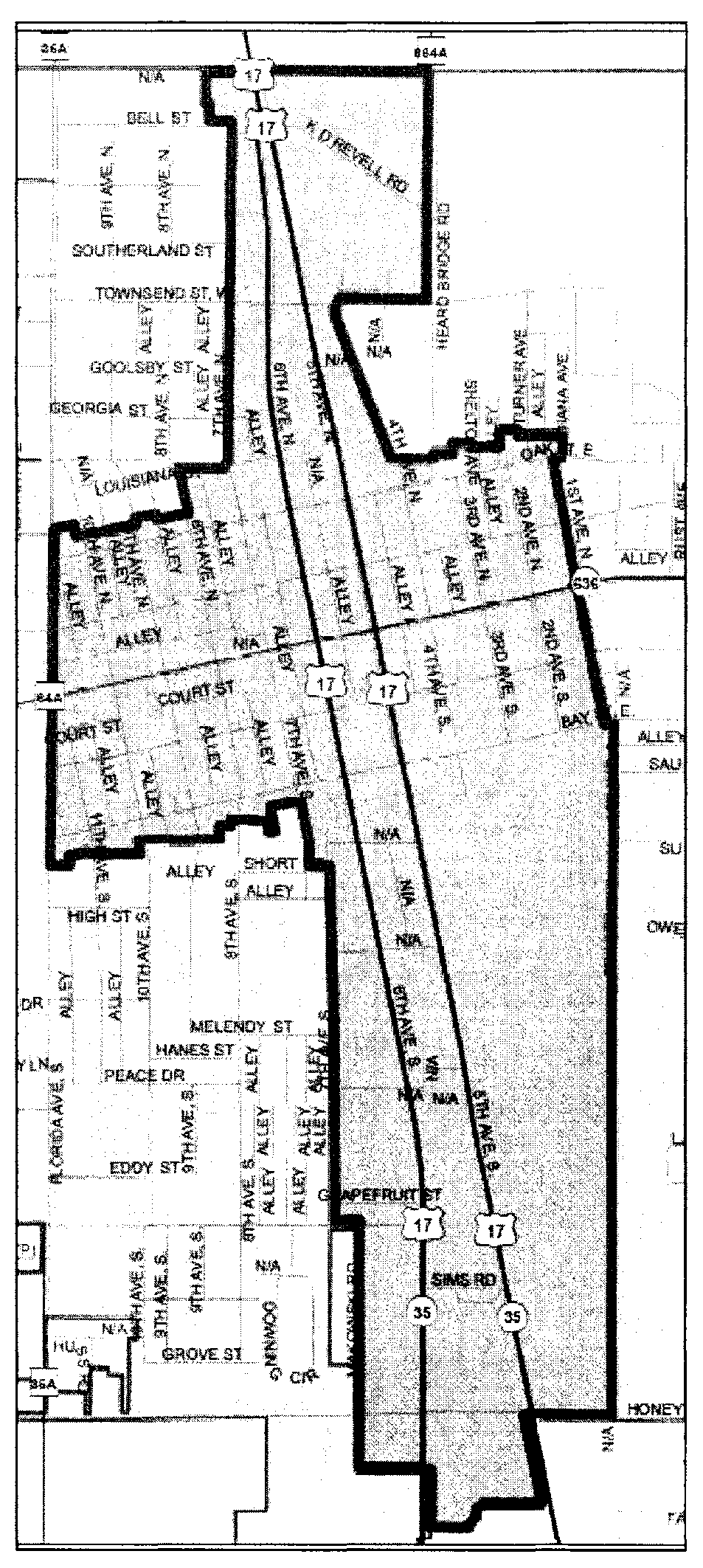
B.
Compliance with standards.
1.
All new construction of buildings and structures. New construction refers to site preparation for and construction of entirely new structures whether or not the site was previously occupied and/or the construction/placement of additional buildings on the site.
2.
All substantial exterior building improvements. Substantial exterior improvements include the exterior improvement, expansion, and/or replacement of structures where the value of such work is 50 percent or more of the assessed value of all buildings on the parcel at the time or exceeds 50 percent of the existing structure's floor area. The value shall include the value of other such work performed within the previous 24 months, but not before the effective date of these requirements.
C.
Exemptions from the provisions of this section.
1.
All uses included as "single family" on the Table of Land Uses.
2.
Accessory structures.
3.
Routine maintenance or repair of any structure or site feature. For the purposes of this section, routine shall mean that the repairs shall in no case exceed 50 percent of the value of the structure. If there is no alteration in the exterior appearance, maintenance items such as roof repair or replacement, HVAC repair and replacement, electrical and plumbing repair, foundation stabilization, masonry repair, replacement of rotten wood, and repair of existing windows and doors that do not significantly change the architectural character of a building shall not, in and of themselves, be considered substantial renovation
4.
The construction, reconstruction, alteration, restoration, moving, or demolition of any structure or site feature to correct existing violations of state or local health, sanitary, or safety code specifications which have been identified by the local code enforcement official and which are the minimum necessary to ensure safe living and/or working conditions
5.
Temporary uses as defined in the City of Wauchula Zoning Ordinance. temporary uses and structures being used during the construction of a permanent structure. The zoning permit shall specify a limited duration for the temporary structure.
6.
Building material requirements established through an adopted Planned Unit Development Master Development Plan shall supersede these requirements.
2.06.03 Standards for exterior façade materials. All building construction, alteration, renovation, and other development activity subject to the provisions of Section 2.06.02 shall conform to the following standards for exterior building façade materials. Each building façade shall conform to these standards independently of other façades.
A.
Building materials.
1.
Approved exterior finish materials.
• Stucco or synthetic stucco.
• Brick or glazed brick
• Tinted and textured concrete masonry
• Textured concrete (pre-cast or cast-in-place)
• Split face concrete block
• Fiber cement/cement board siding (Hardiplank®)
• Stone, cast stone, marble, or similar material
• Glass and glass storefront
• Painted surfaces (excluding corrugated metal buildings)
• Architectural treated metal
• Architectural finished exterior finish insulation systems (EFIS)
2.
Prohibited exterior finish materials.
• Buildings with exposed corrugated metal siding are not permitted. Pre-fabricated metal buildings may be used if finished with an approved exterior finish material other than paint (see approved exterior finish materials).
• Exposed concrete block.
• Exposed plywood or particle board.
B.
Requirements for coverage.
Figure 1 illustrates the coverage requirements for exterior façades for residential (excluding single-family), commercial, and industrial uses.
1.
All façades that are parallel to a right-of-way or pedestrian oriented space shall maintain an exterior finish that conforms to this Section. For lots at the corner of an intersection, the secondary street side façade shall also maintain an exterior finish that conforms to this Section (see Figure 1).
2.
Side yard façades that are perpendicular from the adjoining right-of-way (or secondary street for corner lots) and not adjacent to a pedestrian oriented space shall have the exterior façade conform to this Section for a minimum distance as measured from the corner of the façade closest to the adjoining street. The remaining portion of the façade is exempt from the requirements (see Figure 1).
3.
Façades constructed at an angle to a right-of-way or pedestrian oriented space that are visible from the adjoining right-of-way or pedestrian oriented space shall maintain an exterior finish that conforms to this Section.
4.
Any façade that is located such that it cannot be viewed from an adjoining right-of-way or pedestrian oriented space shall be exempt from the requirements of this section.
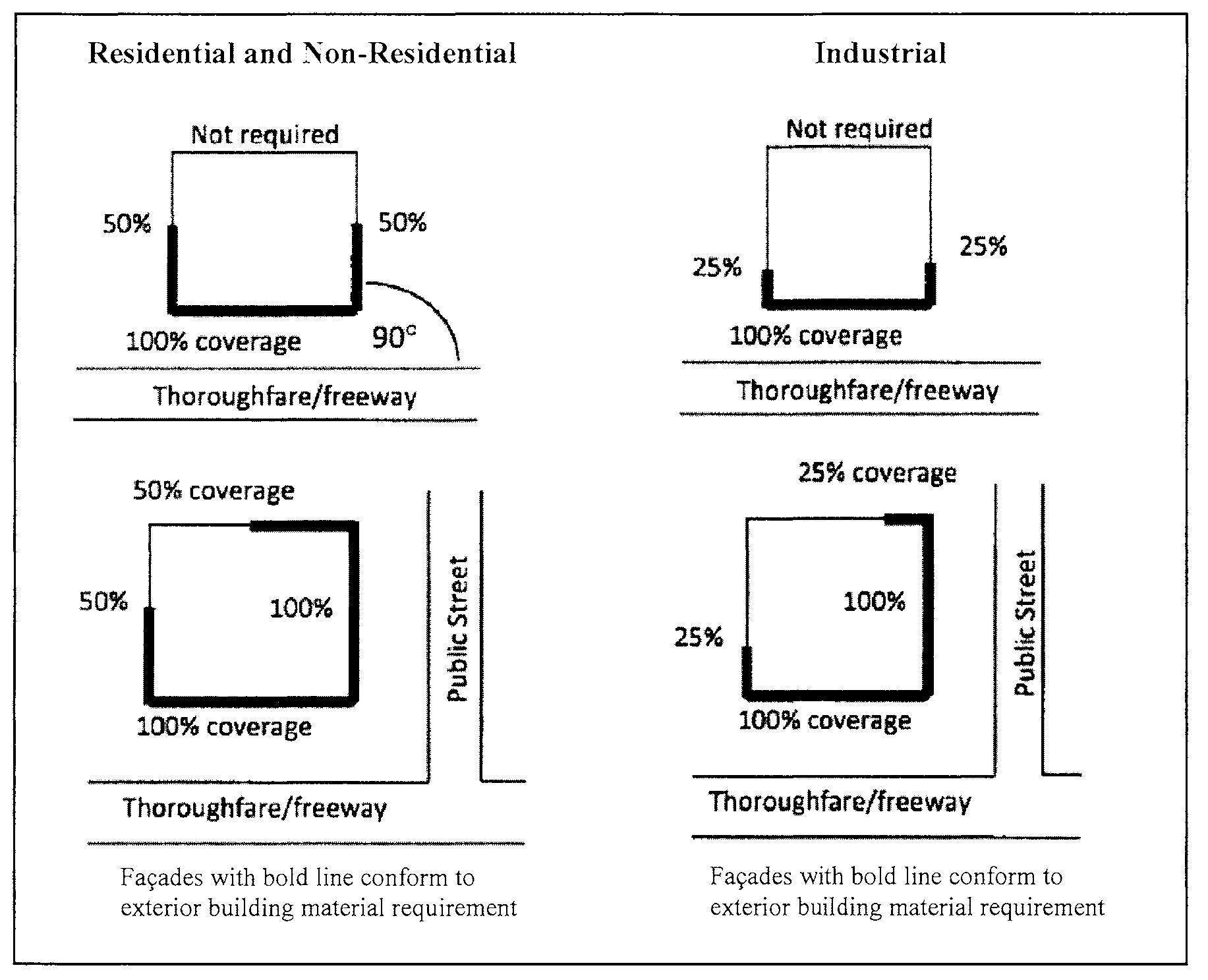
Figure 1: Façade Orientation and Applicability Requirements
2.06.04 Alternative designs or materials. To encourage creativity, imagination, innovation, and variety in architectural design, the Development Director may waive or modify the requirements of this Article upon determining that the proposed architectural design or exterior façade material meets all of the criteria below. The Development Director, at his discretion, may forward any request for alternate design consideration to the Planning and Zoning Board for consideration.
1.
The proposed design or material is consistent with the purposes of this Article.
2.
The proposed design or material would enhance the character of the building, development or neighborhood, and would be equal or superior to designs or materials permitted by this Article.
3.
The proposed design or material would be in harmony with the character of adjacent buildings, neighborhoods, and the surrounding district.
2.06.05 Review and approval. The applicant must submit a drawing showing the exterior building elevations for approval as part of the site development plan application. If the project does not require site development plan approval, the exterior building elevations drawing must be submitted as part of the building permit application. The requirements for exterior building elevation drawings are located in Section 7.05.03(D)(5). The Development Director, at his discretion, may forward any request for site conformance with building design and approval standards to the Planning and Zoning Board for consideration.
(Ord. No. 2016-13, § 2(Exh. A), 9-12-16)

