
Wauchula City Zoning Code
ARTICLE 4
- SIGN REGULATIONS
4.01.00 - Purpose, Findings, and General Principles.
The regulation of signs as provided herein is based upon their function, and is not based upon the content of the message contained on any such sign. The Florida Constitution provides that it is the policy of the state to conserve and protect its scenic beauty, and the regulation of signage for purposes of aesthetics directly serves that policy. In order to preserve the city as a desirable community in which to live, play, and do business, a pleasing, visually attractive urban environment is of foremost importance. The regulation of signs within the city is a highly contributive means by which to achieve this desired end. These sign regulations are prepared with the intent of enhancing the urban environment and promoting the continued well-being of the City. The enhancement of the visual environment is critical to a community's image, and the sign control principles set forth herein create a sense of character and ambiance that distinguishes the City as one with a commitment to maintaining and improving an attractive environment.
These sign regulations are intended to complement the requirements of the adopted building and electrical codes. In case of an inconsistency between these regulations and the building or electrical code, the more stringent requirement shall apply. It is the intent of this Article to encourage the use of signs which are compatible with their surroundings and appropriate to the type of activity to which they pertain.
It is the purpose of this division to promote the public health, safety, and general welfare through a comprehensive system of reasonable, consistent, and nondiscriminatory sign standards and requirements. These sign regulations are intended to:
(A)
Enable the identification of places of residence and business.
(B)
Allow for the communication of information necessary for the conduct of commerce.
(C)
Lessen hazardous situations, confusion, and visual clutter caused by proliferation, improper placement, illumination, animation, and excessive height, area, and bulk of signs which compete for the attention of pedestrian and vehicular traffic.
(D)
Enhance the attractiveness and economic well-being of the city as a place to live, play, and conduct business.
(E)
Protect the public from the dangers of unsafe signs.
(F)
Permit signs that are compatible with their surroundings and aid orientation, and preclude placement of signs in a manner that conceals or obstructs adjacent land uses or signs.
(G)
Encourage signs that are appropriate to the zoning district in which they are located and consistent with the category of use to which they pertain.
(H)
Curtail the size and number of signs and sign messages to the minimum reasonably necessary to identify a residential or business location and the nature of any such business.
(I)
Establish sign size in relationship to the scale of the lot and building on which the sign is to be placed or to which it pertains.
(J)
Preclude signs from conflicting with the principal permitted use of the site or adjoining sites.
(K)
Regulate signs in a manner so as to not interfere with, obstruct vision of, or distract motorists, bicyclists, or pedestrians.
(L)
Require signs to be constructed, installed, and maintained in a safe and satisfactory manner.
(M)
Implement the City's Comprehensive Plan and comply with the minimum requirements established by state law that requires the regulation of signage.
4.01.01 Content Neutrality; Substitution; Prohibition
(A)
Substitution of Non-Commercial Speech for Commercial Speech. Except as otherwise provided in this Code, any sign erected pursuant to the provisions of this Article or Code may, at the option of the owner, contain a non-commercial message in lieu of a commercial message and the non-commercial copy may be substituted at any time in place of the commercial copy. The non-commercial message (copy) may occupy the entire sign face or any portion thereof. The sign face may be changed from commercial to non-commercial messages, or from one non-commercial message to another non-commercial message, as frequently as desired by the owner of the sign, provided that the size, height, setback, and other dimensional criteria contained in this Article and Code have been satisfied. No sign shall obstruct the area of clear visibility, consistent with Section 3.02.04 of this Code.
(B)
Content Neutrality as to Sign Message (Viewpoint). No sign or sign structure shall be subject to any limitation based upon the content (viewpoint) of the message contained on such sign or displayed on such sign structure, except as stated under Section 4.01.00.
(C)
It is unlawful for any person to display untrue, false, or misleading statements upon signs, billboards, or other public places, calculated to mislead the public as to anything sold, any services to be performed, or information disseminated. The fact that any such sign or display shall contain words or language, sufficient to mislead an ordinary person in reading the same, shall be prima facie evidence of a violation of this section by the persons displaying such sign, or permitting same to be displayed at their residence, establishment, or place of business.
4.02.00 - Exempted Signs.
The following signs are exempt from the operation of these sign regulations, and from the requirement that a permit be obtained for the erection of permanent signs, provided they are not placed or constructed so as to create a hazard of any kind:
(A)
Signs that are not designed or located so as to be visible from any street or adjoining property.
(B)
Signs of two square feet or less, provided that such sign, or combination of such signs, does not constitute a sign prohibited by Section 4.03.00 of this Code.
(C)
Signs necessary to promote health, safety, and welfare, and other regulatory, statutory, traffic control, or directional signs erected on public property.
(D)
Legal notices and official instruments.
(E)
Temporary holiday lights and decorations provided such items are removed no later than 30 days after the holiday being celebrated.
(F)
Memorial signs or historic markers containing names of buildings, dates of erection, and other information when inscribed in a masonry surface or metal plaque and permanently affixed to the side of a building.
(G)
Public warning signs to indicate the dangers of trespassing, swimming, animals, or similar hazards.
(H)
Signs carried by a person.
(I)
Temporary religious displays erected on religious institution grounds.
(J)
Temporary construction signs not exceeding 12 square feet in size.
(K)
Temporary real estate yard signs or signs naming the future site occupant not exceeding 12 square feet in size.
(L)
Temporary signs indicating yard sales or garage sales, provided that such signs are removed within 48 hours.
(M)
For each dwelling unit, one sign no larger than four square feet in area which contains the name of the occupant, name of the dwelling, and/or house number.
4.03.00 - Prohibited Signs.
The following types of signs are prohibited in all zoning districts:
(A)
Portable signs, for periods of more than ten days, except sidewalk signs as permitted in Section 4.04.07.
(B)
Abandoned signs.
(C)
Signs that are in violation of the adopted building or electrical codes.
(D)
Any sign that, in the opinion of the Development Director, constitutes a safety hazard.
(E)
Blank temporary signs.
(F)
Signs imitating or resembling official traffic or government signs or signals.
(G)
Signs attached to trees, telephone poles, public benches, streetlights, or signs placed on any public property or public right-of-way (snipe signs), except sidewalk signs as permitted in Section 4.04.07.
(H)
Signs placed on vehicles or trailers that are parked or located for the primary purpose of displaying said sign (this does not apply to permitted portable signs or to signs or lettering on buses, taxis, or vehicles operating during the normal course of business).
(I)
Signs with the optical illusion of movement by means of a design that presents a pattern capable of giving the illusion of motion or changing of copy.
(J)
Any sign obstructing traffic visibility.
(K)
Signs with moving, revolving, or rotating parts, except trademark signs at least 12 feet in height and rotating at no more than two revolutions per minute.
(L)
Signs with lights or illuminations that flash, move, rotate, blink, flicker, or vary in intensity or color, except on theater marquees, time-temperature-date signs, and electronic message boards.
(M)
Illuminated signs of such intensity or brilliance as to cause glare or impair the vision of motorists, cyclists, or pedestrians using or entering a public right-of-way, or that are a hazard or nuisance to occupants of any property because of glare or other characteristics.
(N)
Signs emitting sound, odor, smoke, or steam.
(O)
Signs that display any words, characters, or illustrations that are obscene, lewd, indecent, lascivious, or immoral nature.
(P)
No person shall paint, paste, print, or nail any banner, sign, paper sign, or any advertisement or notice of any kind whatsoever, or cause same to be done, on any curbstone, flagstone, pavement, or any other portion or part of any sidewalk or street, or upon any trees, lamppost, telephone or telegraph pole, hydrant, bridge, workshop, or tool shed.
(Q)
Murals that are Used as Advertising. Murals are considered artwork and may not be used as an advertising sign.
(Ord. No. 2014-21, § 2(Exh. A), 2-9-15)
4.04.00 - Permitted Signs.
The following signs are permitted within the City of Wauchula, subject to the standards provided in this Section and require a permit from the Development Director, unless otherwise stated. Each application for a sign permit must include a drawing of the sign, with dimensions, the placement on the lot in relation to lot lines and other structures indicated.
(A)
Height. No sign shall exceed 15 feet in height. Signs located in C-1, HC-1, and P-1 zones are limited to five feet in height.
(B)
Illumination. No illuminated sign shall be located so to face directly, shine, or reflect glare into a dwelling home situated in the vicinity of such sign. (See also Section 4.03.00(L) and Section 4.03.00(M)).
(C)
Billboards.
(1)
Attached Billboards, as defined in Article 9, must be designed by a professional engineer for safety reasons. The sealed engineering plans must accompany the request for a permit. All attached billboards must have approval of the City Commission.
(2)
Freestanding billboards as defined in Article 9 shall not be permitted in a P-1 Professional/Neighborhood Commercial or HC-1 Historic Downtown Commercial district; and shall not be permitted on any lot that is surrounded by residential dwelling units. Freestanding billboards shall only be permitted within other non-residential districts at such locations and in such a manner as will not constitute a traffic hazard or eyesore. Freestanding billboards must be designed by a professional engineer for safety reasons. The sealed engineering plans must accompany the request for a permit. All billboards must have approval of the City Commission;
(D)
Electronic Message Boards. All or part of a sign for a permitted non-residential use located in a non-residential zoning district may include an electronic message board. An electronic message board sign may only be used as part of a permitted free standing or ground-mounted sign. The electronic message board may display a static, fixed image, with changes of copy not more frequently than once every five seconds. An electronic message board shall not flash or animate static information. Electronic message center signs in residential zoning districts are limited to places of public assembly and K—12 schools.
(E)
Where the rear of a sign would be visible from any street or from an adjoining district of residential classification, the exposed structural members of such sign shall be concealed by painted lattice work or by planting, and such back screening shall be properly maintained.
(F)
The following signs are permitted in non-residential zoning districts unless not allowed due to other provisions of this Code:
(1)
The total surface area of sign, other than billboards, shall not exceed 200 square feet per zoning lot, except for signage in multi-use complexes and shopping centers (Section 4.04.04).
(2)
Signs serving or incidental to a Special Exception subject to approval by the City or Wauchula City Commission; and
(3)
Small incidental signs such as those necessary to control or direct traffic, parking, or access shall be permitted in addition to those allowed above, provided no such sign shall exceed two square feet on one side.
(G)
Portable signs other than sidewalk signs as permitted in Section 4.04.07 are permitted for a maximum of ten days upon approval of the Development Director.
4.04.01 Signs for Permitted Non-Residential Uses Located in Non-Residential Zoning Districts. Signs are permitted as an accessory use to structures on property located in non-residential zoning districts.
(A)
Number of Free Standing/Ground-mounted Signs Permitted. For each frontage of 75 feet to 250 feet on a publicly maintained road, one free standing/ground-mounted sign is permitted near the right-of-way. For parcels having 250 feet or more of frontage on a single road, an additional free standing/ground-mounted sign per entrance shall be allowed and signs shall be located near the entrance.
(B)
Corner Lots. For lots or parcels situated at intersections, an additional sign may be placed on the additional street frontage, one for up to 250 feet of frontage and one additional sign if there is more than 250 feet of street frontage, placed on the second street.
(C)
Small Lots. For businesses with less than 75 feet of street frontage, only one sign, mounted on the building, is allowed.
(D)
Through Lots. For through lots, an additional sign may be mounted on the back of the building.
(E)
Sign Types. The maximum 200 square feet of signage as required by Section 4.04.00(F)(1) may be distributed through the following sign types:
(1)
Design Standards for Affixed Signs. Signs that are affixed to a building are limited to one square foot of sign area for each two lineal feet of street frontage, or 36 square feet of sign area, whichever is larger, and limited to a total of six signs.
(2)
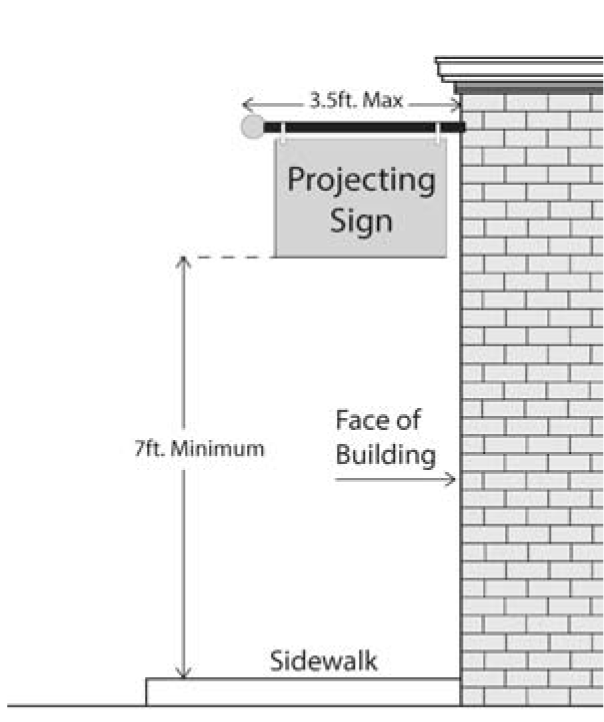
Design Standards for Projecting Signs: Projecting signs shall be permitted as building signs within the C-2 and HC-1 zoning districts subject to the following conditions:
a.
Projecting signs shall be included in calculating the maximum allowable building sign area in accordance with Section 4.04.01 and shall have no more than two sides.
b.
One projecting sign may be permitted per principal ground-floor business.
c.
Projecting signs shall not exceed eight square feet in sign area if mounted at a height of 15 feet or lower measured from the finished sidewalk to the bottom of the sign.
d.
Projecting signs shall not exceed 25 square feet in sign area if mounted higher than 15 feet measured from the finished sidewalk to the bottom of the sign.
e.
Projecting signs shall be located within five feet (horizontally) of the principal business entrance. In no case, however, shall a projecting sign be mounted within ten feet of any other projecting sign.
f.
Projecting signs may project no more than 42 inches from the building wall.
g.
Projecting signs shall maintain a seven-foot clearance, between the bottom of the sign and the finished surface of all public and private pedestrian pathways.
h.
Within the HC-1 zoning district, exceptions to conditions b. through f. above may be approved by the Historic Preservation Board based upon a determination that sufficient historical documentation exists to justify the exception(s).
Example of Projecting Sign
(3)
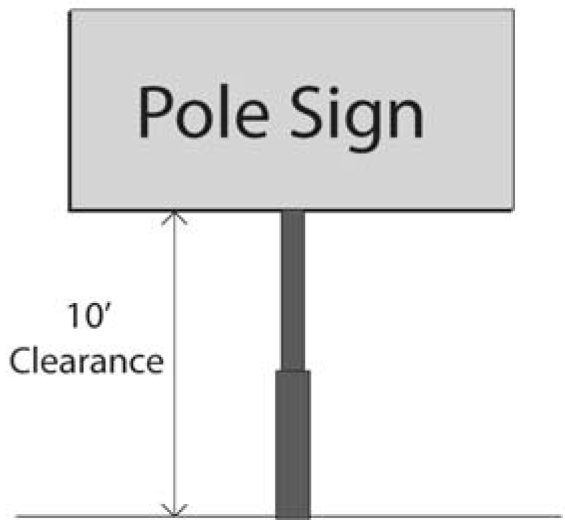
Design Standards for Freestanding Signs. Total sign area may be up two square feet for each lineal foot of building street frontage or one square foot for each lineal foot of lot street frontage whichever results in a larger sign area, but not to exceed 64 square feet in C-2 and I zones. Sign height shall not exceed 15 feet in C-2 and I zones. All freestanding signs shall be set back ten feet from any property line.
Example of free standing (pole) Sign
(4)
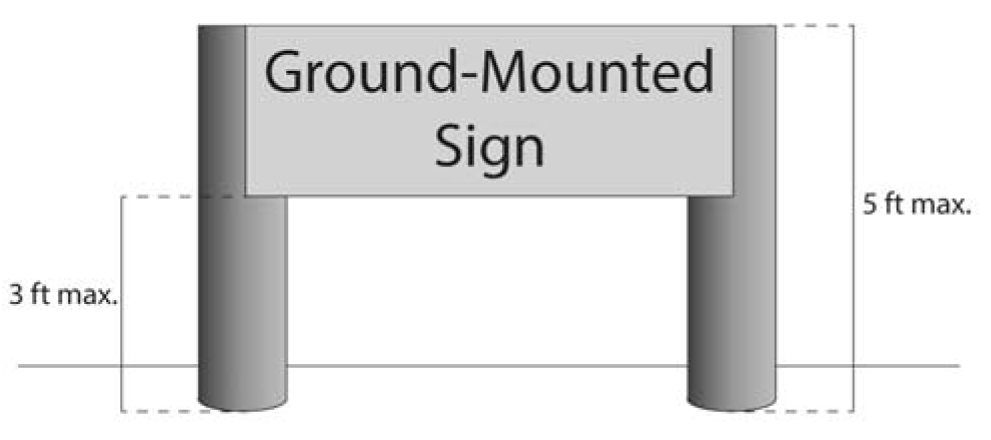
Design Standards for Ground-mounted Signs. Ground-mounted signs shall not exceed five feet in height and the bottom of a ground-mounted sign shall be a maximum of three feet above the ground. The total sign area may be up two square feet for each lineal foot of building street frontage or one square foot for each lineal foot of lot street frontage whichever results in a larger sign area, but not to exceed 48 square feet in surface area and may contain an area designated as a reader sign board which does not exceed 50% of the sign surface per side. All ground-mounted signs shall be set back ten feet from any property line and must meet requirements as provided in Section 3.02.04 of this code relating to Clear Visibility Triangle.
Example of Ground-Mounted Sign
(5)
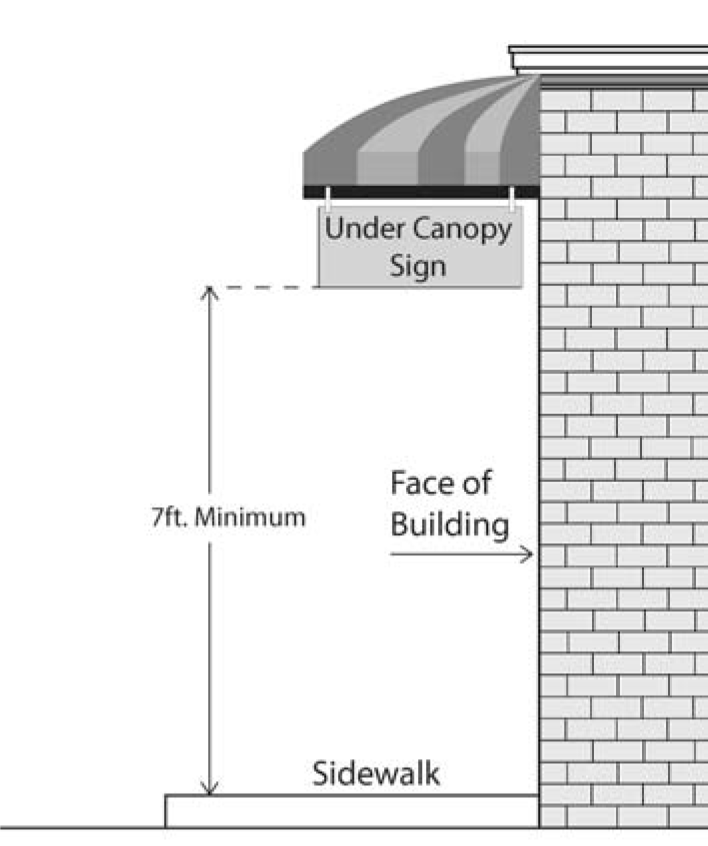
Design Standards for Under Canopy Signs. Signs mounted under a canopy, awning, or awning-like structure shall be a maximum of four square feet in size, shall maintain a clearance of seven feet from the bottom of the sign to the top of the walkway beneath, and shall swing freely. Under canopy or under awning signs that are not visible from the property frontage shall not count against the total signage.
Example of Under Canopy Sign
(F)
Engineering Plans Required for Large Signs. Signs exceeding 72 square feet must be designed by a professional engineer for safety reasons. The sealed engineering plans must accompany the request for a permit.
(G)
Window advertising. Window advertising of the kind described in this paragraph shall not count against the total signage for a business, industry, or profession, but not more than 25 percent of all of the glass surfaces of the windows facing a public street or right-of-way may be used for signage or any other opaque items that block the glass, including, but not limited to, posters, fliers, advertisements, display racks, other interior furnishings, or similar materials or objects.
4.04.02 Signs for permitted non-residential uses located in residential zoning districts. Signs are permitted accessory to permitted non-residential uses on residentially zoned property. No sign shall exceed five feet in height.
(A)
Number of signs permitted. Except as provided in this paragraph, no more than one ground-mounted or free standing sign shall be permitted for each development site. For parcels having 250 feet or more of frontage on a single road, an additional sign per entrance shall be allowed and signs shall be located near the entrance. No part of any ground-mounted or free standing sign shall be located within ten feet of any property line or right-of-way. This shall be construed to mean that no portion of any sign shall extend beyond any property line.
(B)
Corner lots. For lots or parcels situated at intersections, an additional freestanding/ground-mounted sign may be placed on the secondary street frontage of 75 feet or more on a publicly maintained road. No more than three ground-mounted or pole signs may be permitted on any development site.
(C)
Small lots. For lots with less than 75 feet of street frontage, only one sign, mounted on the building and meeting the requirements of Section 4.04.02(D)(1), is allowed.
(D)
Sign types. The total sign area for each development site shall not exceed 200 square feet. The sign area can be distributed through the following sign types:
(1)
Design standards for affixed signs. Maximum affixed sign area shall be one and one-half square feet for each foot of building frontage, up to the maximum 36 square feet per sign, and limited to a total of six signs.
(2)
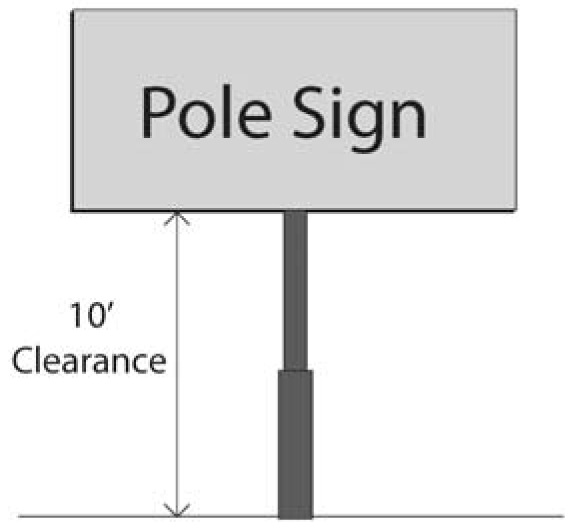
Design standards for freestanding signs. Freestanding signs shall only be permitted on frontage facing arterial roadways as defined on the Existing Functional Classification Map as adopted in the 2030 Comprehensive Plan. Freestanding signs shall not exceed 15 feet in height, and must have a minimum ground clearance of ten feet. A freestanding sign shall not exceed 48 square feet in surface area and may contain an area designed as a reader sign board which does not exceed 24 square feet per side or more than 50 percent per side, whichever is less.
Example of Freestanding (Pole) Sign
(3)
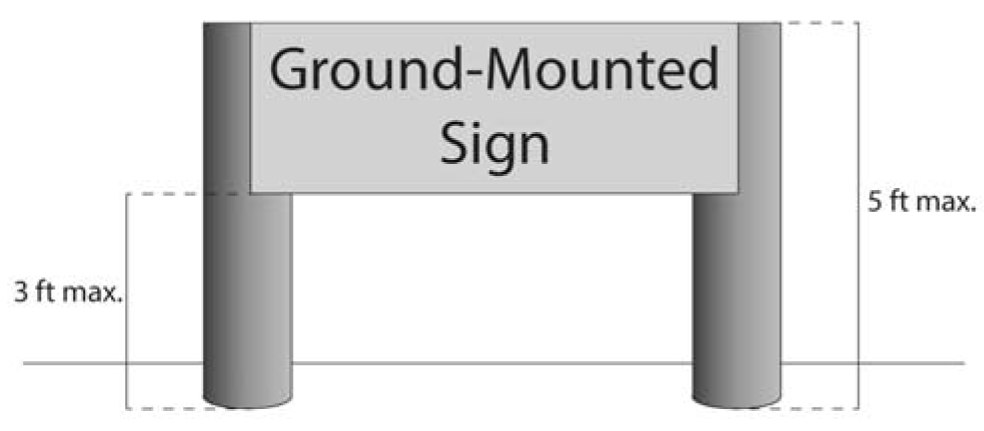
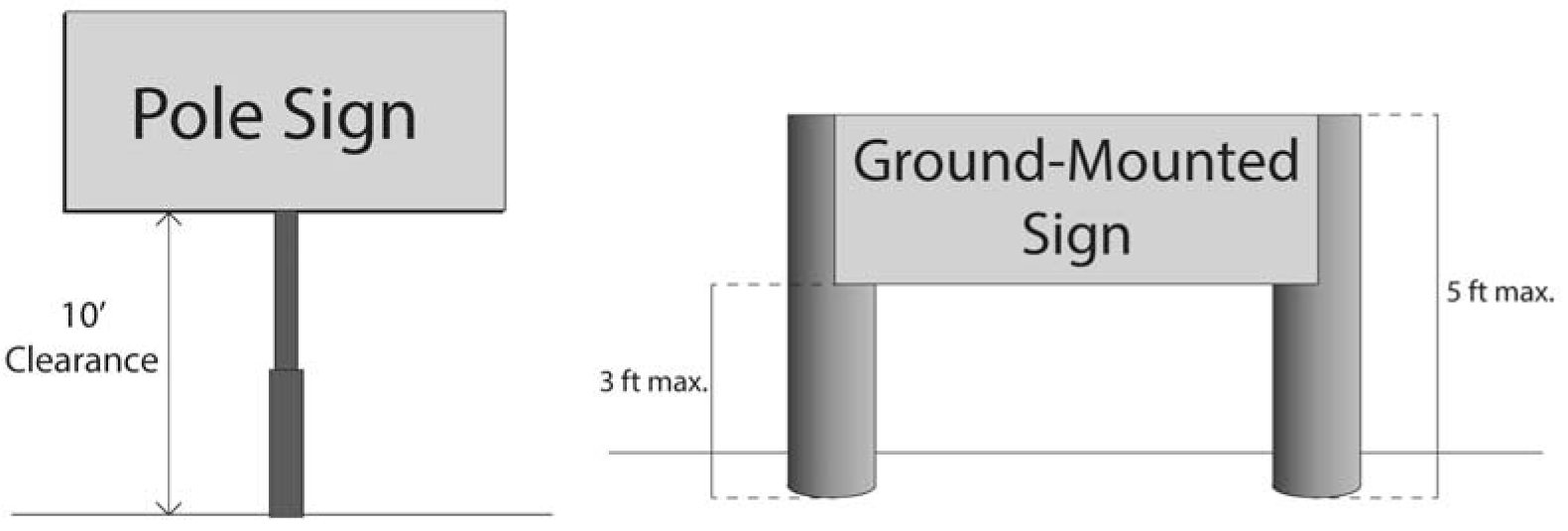
Design standards for ground-mounted signs. Ground-mounted signs shall not exceed five feet in height. The bottom of a ground-mounted sign shall be a maximum of three feet above the ground and shall not exceed 32 square feet in surface area per side and may contain an area designated as a reader sign board which does not exceed 50 percent of the sign surface per side. All ground-mounted signs must meet requirements as provided in Section 3.02.04 of this Code relating to Clear Visibility Triangle.
Example of Ground-Mounted Sign
(E)
Window advertising. Window advertising of the kind described in this paragraph shall not count against the total signage, but not more than 25 percent of all of the glass surfaces of the windows facing a public street or right-of-way may be used for signage or any other opaque items that block the glass, including, but not limited to, posters, fliers, advertisements, display racks, other interior furnishings, or similar materials or objects.
(F)
Landscaping. All ground-mounted and pole signs shall be landscaped. When shrubs or small trees are used, only those shrubs or small trees listed in this Code are permissible. For a list of permissible shrubs and trees, see Article 3, Section 3.07.10.
(G)
Illumination. Illumination of permitted signs may be from external sources. Lighting on signs which are not internally illuminated shall be shielded with an opaque shade and directed so as to produce no glare on roadways or surrounding properties. The use of neon is prohibited. The sign may not be lit after 11:00 p.m.
4.04.03 Signs for permitted residential uses. Notwithstanding any other provision of this Article 4, the following signs are permitted in residential or PUD zoning districts.
(A)
Subdivision identification signs. Non-illuminated or indirectly lit ground or wall signs identifying a neighborhood for residential areas that include at least five acres of land area are permitted. These signs shall only be allowed at major entrance-ways; and not more than one sign shall be located at each entrance-way.
(B)
Multifamily housing developments. Multifamily housing developments may have one identification sign per street frontage. These signs may be ground or wall signs. The only form of artificial illumination allowed is indirect illumination. Identification signs shall be limited to one square foot of area per dwelling unit up to a maximum of 30 square feet.
4.04.04 Multi-use complex and shopping centers. This section shall apply to all shopping centers and multi-use complexes located within commercial and industrial zoning districts.
(A)
Number of freestanding/ground-mounted signs permitted. For each frontage of 75 feet to 250 feet on a publicly maintained road, one freestanding/ground-mounted sign is permitted for the development near the right-of-way. For parcels having 250 feet or more of frontage on a single road, an additional sign per entrance shall be allowed and signs shall be located near the entrance.
(B)
Corner Lots. For lots or parcels situated at intersections, an additional freestanding/ground-mounted sign may be placed on the secondary street frontage of 75 feet or more on a publicly maintained road. No more than three ground-mounted or pole signs may be permitted on any development site.
(C)
Sign Types. The following sign types are permitted:
(1)
Freestanding or Ground Mounted Signs. Total sign area may be up two square feet for each lineal foot of building street frontage or one square foot for each lineal foot of lot street frontage whichever results in a larger sign area, but not to exceed 64 square feet. Sign height shall not exceed 15 feet. All freestanding or ground mounted signs shall be set back ten feet from any property line. Business directories are allowed as a part of the sign face square footage, but not in addition to it. Individual business directory signs shall be a minimum of 12) inches in height.
(2)
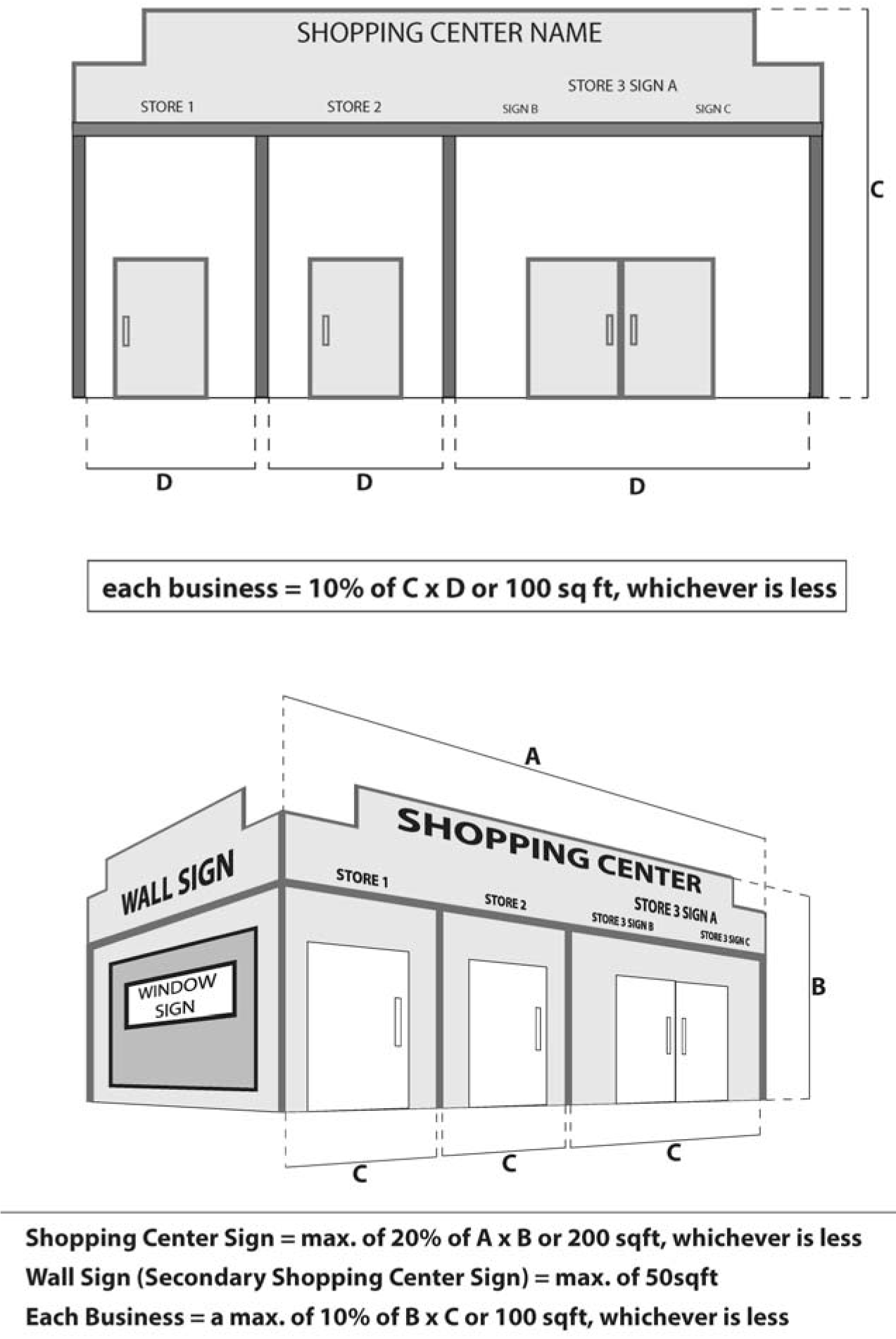
Affixed/Projecting Signs. Affixed/Projecting signage is allotted to the development as a whole as well as the occupants of the multi-occupancy development.
a.
Signage for the Multi-Occupancy Development Property:
1.
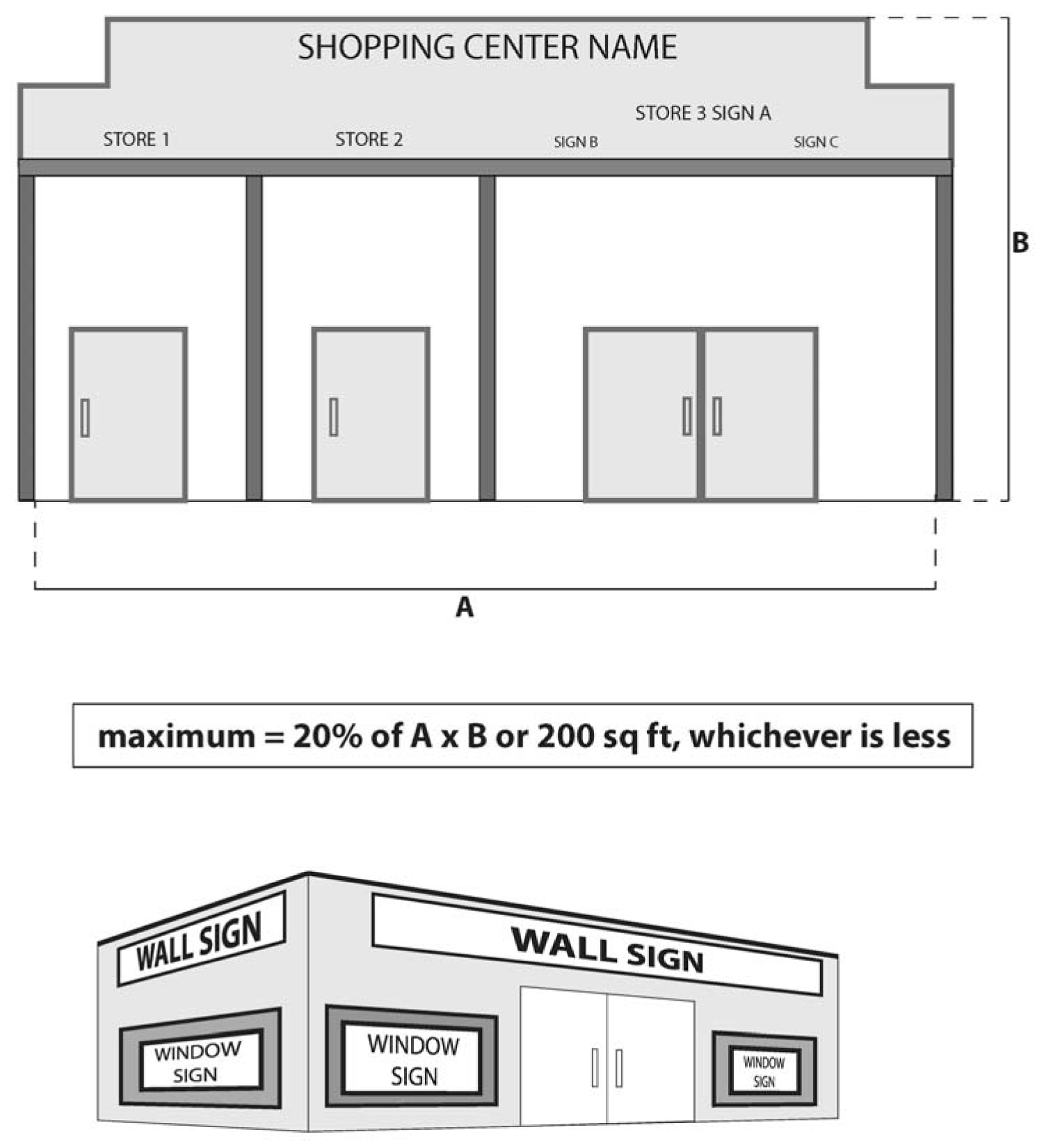
Each multiple-occupancy development property may display one affixed sign on any one side of the principal building in which such occupancy is located.
2.
The sign shall be no greater than 20% of the surface area of such building side or 200 square feet, whichever is the smaller.
3.
Where a multiple-occupancy development consists of only one principal building, one additional sign (a secondary sign) may be allowed if a second public street abuts the multiple-occupancy development.
4.
The size of the secondary sign may not exceed an area of 50 square feet.
5.
The secondary sign for a multiple-occupancy complex shall only include identification of the multiple-occupancy complex.
6.
Wall-mounted signs for a multiple-occupancy complex shall only include identification of the complex itself.
7.
No secondary sign shall be allowed to be located on any face of a building or any roof which would be directly opposing any property having a single-family land use designation on the future land use map or zoned for single-family use. This provision shall not apply to single-family land uses designated on arterial roadways (shown in the City of Wauchula 2030 Comprehensive Plan).
b.
Signs for occupants of a multiple-occupancy development. Each occupant of a multiple-occupancy complex may display such signs on the principal building in which such occupant is located, with the following limitations.
1.
The sign may be placed only on the exterior surface of the principal building, or portion thereof, which is included as part of the occupant's individually leased or owned premises in accordance with the following:
(a)
On the side which is the primary entrance/exit to the occupancy, the occupant may display in the leased or owned area as many as three signs.
(b)
Only one building side will be considered as being any occupant's primary entrance/exit.
(c)
The three signs may have a combined maximum size of ten percent of the surface area of the exterior wall included in such occupant's individually leased or owned premises or 100 square feet, whichever is the less.
(d)
If the occupant has an entrance/exit on a corner or on more than one side, the occupant may choose which building side shall count as having the primary entrance/exit.
(e)
One additional sign may be placed on the non-entrance/exit side of the occupant's leased or owned area.
(f)
The maximum size of a sign on a non-entrance/exit side of an occupancy shall be 24 square feet. Such sign shall be allowed if the property adjacent or opposite to the non-entrance/exit side is zoned non-residential.
2.
Each occupant, the individually owned or leased premises of which do not include part of an exterior wall of a principal building, may nevertheless display one such sign of up to six square feet of sign area on one side of the principal building in which such occupant is located.
3.
A common or jointly owned area shall not be included as part of the exterior surface of any one occupancy. The allowable sign area of two or more occupants may be placed on a common or jointly owned area providing:
(a)
The common area is an integral part of all occupants which will be included in the sign.
(b)
Only one sign, common to all occupants of the common area, may be displayed.
(3)
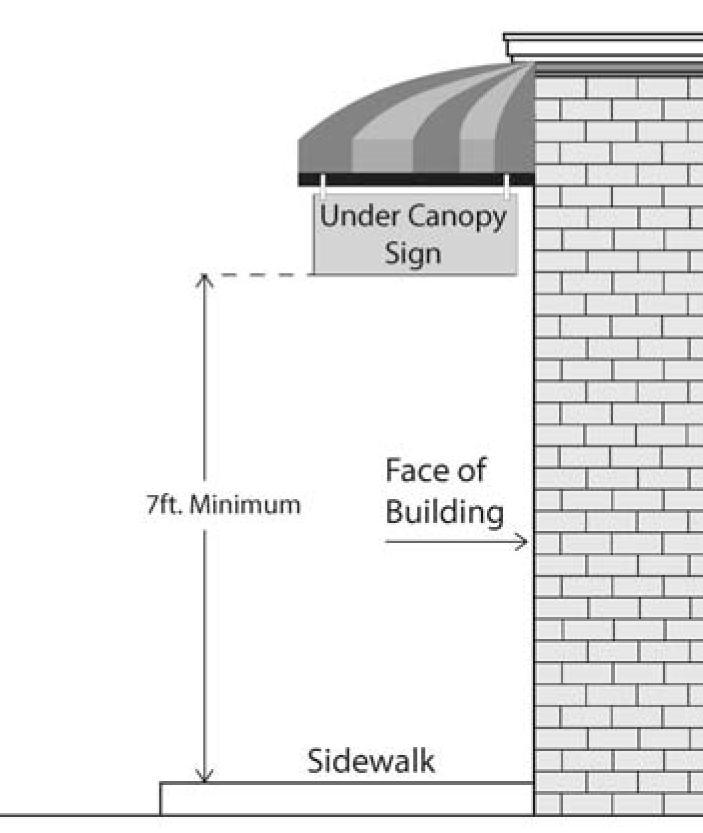
Under Canopy or Under Awning Signs. Under canopy or under awning signs that are not visible from the property frontage shall not count against the total signage. One under canopy or under awning sign per tenant shall be permitted as follows:
Signs mounted under a canopy, awning, or awning-like structure shall be a maximum of four square feet in size, shall maintain a clearance of seven feet from the bottom of the sign to the top of the walkway beneath, and shall swing freely.
(4)
Window Advertising. Window advertising of the kind described in this paragraph shall not count against the total signage, but not more than 25% of all of the glass surfaces of the windows facing a public street or right-of-way may be used for signage or any other opaque items that block the glass, including, but not limited to, posters, fliers, advertisements, display racks, other interior furnishings, or similar materials or objects.
(D)
Landscaping. All ground-mounted and free standing signs shall be landscaped. When shrubs or small trees are used, only those shrubs or small trees listed in this Code are permissible. For a list of permissible shrubs and trees, see Article 3, Section 3.07.10.
(E)
Illumination. Illumination of permitted signs may be from external sources. Lighting on signs which are not internally illuminated shall be shielded with an opaque shade and directed so as to produce no glare on roadways or surrounding properties. The use of neon is prohibited.
4.04.05 Special Event Signs. Notwithstanding any other provision of this Article 4, the Development Director may permit a special event signing program for a period of not more than 30 days in a year for any use or combination of uses of any type, except for political signs as explained in (D). Special event signs may include, but are not limited to:
(A)
Signs consisting of one or more banners, flags, pennants, ribbons, spinners, streamers or captive balloons, or other objects or material fastened in such a manner as to move in the wind.
(B)
Searchlights used to advertise or promote a business or to attract customers to a property.
(C)
For each lot with a semi-public use - religious, charitable, educational, or cultural - signs not exceeding six square feet in area that are used for not more than 30 days.
(D)
Political signs: For each lot, one sign no more than six square feet in area which is put in place no earlier than 60 days prior to the election or referendum to which they pertain. These political signs must be removed within ten working days after the election or referendum to which the sign relates is over. The person or persons responsible for the placement of a political sign must be responsible for its removal.
4.04.06 Entrance/Exit Signs. All entrance and exit signs, such as those found at banks and fast-food restaurants, must be placed low enough so as not to obstruct visibility of the roadway. Additionally, one signs may be internally lit; two signs shall be no larger than two square feet; three signs shall not be placed in the road right-of-way; and four signs must conform to all the regulations of this Article.
4.04.07 Free-standing Sidewalk Signs. Sidewalk signs may be placed on sidewalks in the rights-of-way located in the area bounded by Palmetto Street, Florida Avenue, Orange Street, and 3rd Avenue under the following conditions:
(A)
Safety: The placement of the sidewalk sign on public property shall be allowed if the sign will not constitute a traffic hazard or nuisance.
(B)
Use: Sidewalk signs can only be used during the hours when the business is open to the public and must be brought in at the close of business or in the event of high winds, severe weather watches or warnings, and/or upon issuance of a hurricane evacuation notice for Hardee County.
(C)
Number: One sidewalk sign meeting the requirements of this Code is permitted per establishment for each primary public entrance from the sidewalk. Buildings with multiple tenants are allowed one sign per primary public entrance from the sidewalk if placed no closer than ten feet from another such sign.
(D)
Size:
1.
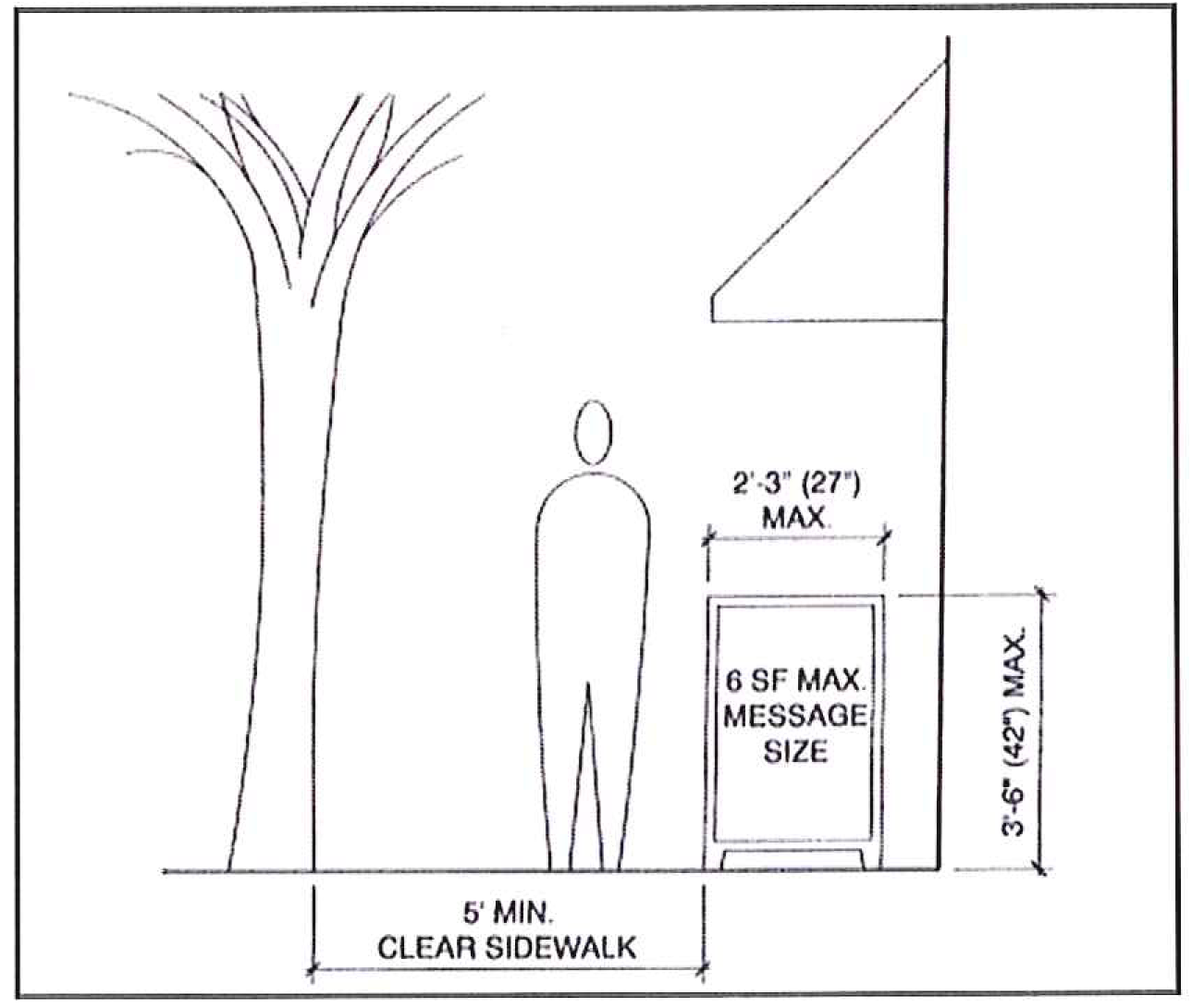
The total sidewalk signs shall be no larger than 27 inches in width and 42 inches in height and no materials such as papers, balloons, windsocks, etc., may be added. The height of such signs may not be artificially increased above the allowed maximum by placing material underneath the base of such sign.
2.
Sidewalk signs shall have no more than two display sides. A-frame signs shall have a maximum internal spacing between faces of 45 degrees.
3.
Sidewalk signs are considered accessory signage and do not count against the permitted sign area for permanent signs.
(E)
Location.
1.
Sidewalk signs shall be located directly in front of the sponsoring establishment within 15 feet of the primary public entrance.
2.
Sidewalk signs shall only be placed where there is eight feet of clear passageway width, with no obstructions, on a sidewalk or pedestrian walkway.
3.
Sidewalk signs shall not block or restrict pedestrian movement and when the sign is in place, there shall be a minimum of five feet clear sidewalk or walkway width for pedestrian travel and otherwise shall comply with the Americans with Disabilities Act (ADA) requirements.
4.
Sidewalk signs may not be placed in the driving lanes of a public street, or any portion of the street pavement, or in parking stalls on the public right-of-way.
5.
Sidewalk signs shall not be placed so as to obstruct vehicular traffic sight.
6.
Sidewalk signs shall not be placed within two feet of the face of any curb when abutting parallel parking spaces.
7.
Sidewalk signs shall not be placed where they interfere with any exit, fire hydrant, parking meter, bus stop, loading zone, bicycle rack, sidewalk ramp, wheelchair ramp, any required ADA routes, or similar public facility.
(F)
Construction and design.
1.
Sidewalk signs shall be constructed of durable, weather-resistant materials such as wood, steel, aluminum and PVC. The use of cardboard, paper, fabric, and non-rigid materials is prohibited.
2.
Sidewalk signs must be readily portable but stable, able to withstand modest wind speeds and accidental contact.
3.
Signs shall be free of sharp or jagged edges and corners and may not contain anything including foil, mirrors, bare metal, or other reflective materials, which could create hazardous conditions to motorist, bicyclist, or pedestrians. The feet and/or base structure of the sign shall be clearly visible.
4.
Signs shall not contain any electrical components (battery or otherwise), lighting, parasite signs, nor any moving parts, including balloons, flags, and streamers. Sidewalk signs shall not swing, rotate, or twirl.
5.
The maximum number of sides for a sidewalk sign shall be two with a maximum internal spacing between faces of 45 degrees.
6.
Sidewalk signs may consist of changeable copy signs, chalkboard surfaces, and dry erase marker board surfaces (e.g., white boards). All signs shall be legible.
(G)
Permitting.
1.
Sidewalk signs do not require a permit from the Development Director.
2.
Signage ownership identification. Each sidewalk sign shall have placed on it, within easy viewing of a city inspector, the sign-owner's name, sponsoring location address, and contact information (mailing address and telephone number or email address).
3.
Sidewalk signs located along U.S. 17 shall be subject to FDOT procedures.
(H)
Maintenance. Signs shall be maintained in a good condition and kept clean so as not to be unsightly or offensive in appearance. Faded or peeling signage shall be refinished, replaced, or removed.
(I)
Exceptions. The following signs shall be exempt from the provisions of this chapter:
1.
Signs installed or displayed by the City, another governmental agency, a public utility, or common carrier.
2.
Signs required to be posted or maintained by law or governmental rule, order, or regulation.
(J)
Indemnification and removal.
1.
Any person who wishes to place a "sidewalk" sign on a public sidewalk shall do so at his, her or its own risk and shall defend, indemnify and hold harmless the City of Wauchula, Hardee County, and/or the Florida Department of Transportation from and against any and all liability, losses, damages, claims, demands, expenses, fees, fines, penalties, suits, proceedings, actions and costs of actions (including attorney's fees), of whatsoever kind or nature arising out of or in any way related to the design, construction, installation or maintenance of the "sidewalk" sign or any act or omission of the sign owner or his, her or its agents, servants, employees, independent contractors, customers, patrons or invitees, whether on the public sidewalk or elsewhere.
2.
Neither the city, the County, nor FDOT shall be liable to any person under any circumstances for the design, construction, installation, or maintenance of any "sidewalk" sign placed on a public sidewalk and the city expressly disclaims any duty to inspect "sidewalk" signs for any purpose whatsoever.
3.
All sidewalk signs shall be subject to the public's use of the said public right-of-way. The city manager or his/her designee may require the immediate removal, on a temporary or permanent basis and without compensation, of any sandwich board sign from the public right-of-way when such removal is determined to be reasonably necessary to protect the public health, safety or welfare or to permit other lawful and proper uses of such right-of-way.
4.
The city and/or FDOT shall have the right to remove and impound any signs which obstruct safe pedestrian or vehicular passage or which encroach upon the FDOT-maintained right-of-way or which violate any other provision of this Code. Sidewalk signs placed in violation of this section will result in immediate removal of the sign.
5.
Sidewalk signs in use as of the effective date of this Section that do not conform to the above standards and conditions shall be removed and their use discontinued within 30 days of the effective date of this section.
(Ord. No. 2014-21, § 2(Exh. A), 2-9-15; Ord. No. 2021-17, § 5, 1-10-22)
4.05.00 - Maintenance.
All signs and billboards, including their supports, braces, guys and anchors, electrical parts and lighting fixtures, and all painted and display areas, shall be maintained in accordance with the building and electrical codes adopted by the City of Wauchula, and shall present a neat and clean appearance. The vegetation around, in front of, behind, and underneath the base of ground signs for a distance of 50 feet shall be neatly trimmed and free of unsightly weeds, and no rubbish or debris that would constitute a fire or health hazard shall be permitted under or near the sign.
4.06.00 - Murals.
(A)
Purpose.
(1)
It is the purpose of this section to enhance the aesthetic image of the City in order to promote tourism, enhance property values, and to showcase the historical and cultural assets of the City.
(2)
It is the purpose of this Section to protect the health, safety and welfare of the citizens of the City by establishing reasonable design criteria, permitting procedures, and maintenance requirements.
(B)
Location of Murals. Murals may be permitted in the commercial and industrial districts only.
(C)
Permitting:
(1)
No person, persons, entity, or entities may install, construct, paint, or modify any mural without an approved mural permit.
(2)
Permit Application:
a.
The Community Development Department shall develop and maintain application forms and time schedules for the application process.
b.
The application form shall include, but not be limited to the following requirements:
1.
Name and address of applicant.
2.
Name and address of property owner, if other than the applicant.
3.
Street address and parcel ID number of the property upon which the mural is to be painted.
4.
An affidavit by the property owner authorizing the painting of a mural upon the subject property and accepting responsibility for maintenance of the mural pursuant to the standards set forth in this Section of the ULDC.
5.
Scaled architectural elevation of the building façade clearly indicating the location of the proposed mural.
6.
Scaled full color rendering of the proposed mural.
7.
Color photo of the building of sufficient size and clarity to indicate the size and placement of the proposed mural.
8.
Maintenance schedule identifying how the mural will be maintained including, without limitation, the following:
(a)
Name and address of person or entity responsible for continuing maintenance of the proposed mural;
(b)
Description and specifics of the ultra violet light resistant coating to be applied to the proposed mural;
(c)
Description and specifics of the sacrificial coating to be applied to the proposed mural for graffiti protection.
(3)
Review of Permit Application:
a.
There shall be a two-step review process for property located within the City Historical District:
1.
The Main Street Board and the Historic Preservation Board shall simultaneously review the application for compliance with the criteria set forth in Paragraph (F) of this Section and forward their respective responses and recommendations to the City Planning and Zoning Board within 30 days of receipt of said application by them.
2.
The Planning and Zoning Board shall review the application for compliance with Paragraph (C).2.b. and Paragraph (D) of this Section and it shall consider the respective recommendations of the Main Street Board and the Historic Preservation Board, and either approve, approve with conditions, or deny the application.
b.
Those applications for proposed murals on buildings located outside the Historical District shall be reviewed by the Planning and Zoning Board only.
c.
Should the Planning and Zoning Board deny the application, it shall set forth with specificity the reasons therefore and the applicant may appeal the denial to the City Commission within ten days of the date of said denial.
d.
The Commission shall review a timely filed appeal of a denied applicant within 30 days of the date the appeal is filed and affirm the denial, reverse the denial and approve the application, or reverse the denial and approve the application with conditions.
(4)
Administrative Action. The decision of the Commission shall be final administrative action, reviewable by certiorari in circuit court as provided by law.
(D)
Mural Requirements and Review Criteria. The Main Street Board, the Historic Preservation Board, and the Planning and Zoning Board shall apply the following criteria in the review of all mural permit applications:
(1)
City designated theme-based murals shall be encouraged to the greatest extent possible.
(2)
Murals shall be designed for decorative, non-commercial purposes only and shall contain no written messages, logos, corporate representations, or banners, and may not be used in any way to advertise the structure or property upon which they appear. Murals that are found to be in violation of this Section shall be regulated as a sign in accordance with the applicable provisions of this Code.
(3)
Mural colors shall be exempt from building code color regulations or other applicable regulations.
(4)
The maximum square footage upon which a mural may be applied to the side of a multi-story structure is 40 %. Single-story structures are exempt from a maximum square footage cover requirement.
(5)
The façades of building or structures upon which murals are applied shall be in good condition. Murals shall be applied to a prepared wall surface free of cracks, peeling paint, or stucco, and shall be covered with a protective coat to minimize deterioration.
(6)
A proposed mural shall not create a public safety hazard, including, without limitation, a distraction to vehicular traffic, as determined by the Development Director.
(7)
All murals shall be weatherproofed to maintain their aesthetic quality.
(8)
Murals may be artificially illuminated as long as the lighting upon or within the mural shall be controlled and directed in such a manner as not to annoy adjacent property owners, nor impair the vision of passing motorists. All lighting for murals shall conform to the city electrical code, and installation shall be done only after obtaining an electrical permit.
(9)
Murals shall exemplify high artistic standards of quality and shall be applied by professional artists or licensed painters, or under the direct supervision of such persons.
(10)
Murals shall be applied in strict accordance with an approved mural permit application. Any deviation(s) from the approved permit application with respect to the rendering, materials, or style of the mural may result in the revocation of the mural permit.
(11)
Murals shall not extend beyond or project above the vertical or horizontal line of any wall or structure upon which the mural is applied or installed. Projections greater than six inches from the surface upon which the mural is applied or installed are prohibited.
(12)
Murals that contain obscene subject matter as defined in Chapter 847, Florida Statutes, are prohibited.
(E)
Restoration or Removal of Murals.
(1)
Notice of Determination That a Mural Must be Restored or Removed:
a.
Upon identification of a mural that has become deteriorated or no longer satisfies the terms and conditions upon which the mural permit was granted, a notice shall be sent by the code enforcement officer to the owner(s) of the building as listed on the most recent available records of the Hardee County Property Appraiser, and to the permittee, if not the same person or entity as the owner(s). The notice shall be delivered by registered or certified mail, return receipt requested, or by hand delivery by the code enforcement officer directing that the mural be restored or removed. Also, the notices shall be posted on or adjacent to the mural. Failure of any person to receive notice shall not invalidate any proceeding under this Section. Evidence of an attempt to serve notice and proof of posting shall be sufficient to show that these notice requirements have been met. Proof of posting shall be by affidavit of the person posting said notice. Attached to the affidavit shall be a copy of the notice posted.
b.
As applicable, the notice should contain generally the following information:
1.
The name of the person upon whom the notice is served.
2.
The street address of the building upon which the mural is painted.
3.
That the mural has been determined to be deteriorated or no longer satisfies the terms and conditions upon which it was permitted.
4.
If restoration will remedy the situation, a summary of the nature and extent of restoration required.
5.
If the conditions are of such character that restoration is not feasible or reasonably expected to remedy the condition of the mural, notice that the mural must be removed.
6.
That within 45 days from the date of the notice, a proposal for restoration by a professional artist or licensed painter must be submitted to the code enforcement officer, or the mural must be removed.
(2)
Referral to the Code Enforcement Board or Special Magistrate. If the conditions are not remedied within 45 days of the notice of determination, or a proposal for restoration not received, and restoration not completed within a reasonable time thereafter, the determination shall be referred by the code enforcement officer to the Code Enforcement Board or Special Magistrate (hereinafter the "Board/Magistrate") for a public hearing concerning the subject mural. The owner(s) of the building and the permittee, if not the same person or entity as the owner(s), shall be notified by the code enforcement officer of the time, place, and purpose of the public hearing. Also, said notice shall be posted on or adjacent to the mural. Failure of any person to receive notice shall not invalidate any proceedings under this Section. Evidence of an attempt to serve notice and proof of posting shall be sufficient to show that these notice requirements have been met. Proof of posting with date and place of posting shall be by affidavit of the person posting the notice. Attached to the affidavit shall be a copy of the notice posted.
(3)
Action by the Code Enforcement Board/Magistrate:
a.
If the owner(s) of any building with a mural painted thereon has failed to restore or submit a proposal for restoration as provided in Section (E)(2), after the expiration of the 45-day period, the Board/Magistrate shall consider removing the mural.
b.
Ease case before the Board/Magistrate shall be presented by the code enforcement officer. At the hearing, the Board/Magistrate shall proceed to receive evidence and take testimony on the cases before the Board/Magistrate. All testimony shall be under oath and shall be recorded. Formal rules of evidence shall not apply, but fundamental due process shall be observed and shall govern the proceedings.
c.
After receiving evidence and or testimony on the case at said public hearing conducted by said Board/Magistrate that any mural is deteriorated or no longer satisfies the terms and conditions upon which it was permitted in accordance with Section (D), the Board/Magistrate may order the owner(s) to remedy the conditions by restoration or removal by a date set by the Board/Magistrate, and providing the failure of the owner(s) to do so will result in the Board/Magistrate authorizing the code enforcement officer to take action to remedy the conditions and charge all expenses thereof against the real property. The Board/Magistrate may take any other appropriate action to carry out the purpose and intent of its order. The Board/Magistrate, the code enforcement officer, or the owner(s) may request a postponement or continuance of a scheduled public hearing.
d.
If the conditions are not remedied within the time established by the Board/Magistrate, the code enforcement officer shall take whatever action deemed necessary and appropriate to remedy the conditions, including fencing, screening, and removing the deteriorated mural. In the event removal of the mural is required by the code enforcement officer, the code enforcement officer shall notify the Commission prior to said removal.
(4)
Notice of Removal:
a.
A certified copy of the order of the Board/Magistrate's determination that the mural should be removed, together with a copy of the notice of determination by the code enforcement officer as provided in Section 3 shall be sent by the code enforcement officer to each owner listed on the most recent available records of the Hardee County Property Appraiser by registered or certified mail, return receipt requested, or by hand delivery by the code enforcement officer or City police officer.
b.
In addition, a certified copy of the order of the Board/Magistrate's determination that the mural should be removed, together with a copy of the code enforcement officer's notice of determination, shall be posted on the building following the adoption of said order of the Board/Magistrate.
c.
Failure of a person to receive notice shall not invalidate any proceeding under this section. Evidence of an attempt to serve notice and proof of posting shall be sufficient to show that these notice requirements have been met. Proof of posting with the date and place of posting shall be by affidavit of the person posting the notice. Attached to the affidavit shall be a copy of the notice posted.
(5)
Appeals to the City Commission.
a.
The Commission has the sole authority to hear and decide appeals from the decision or determination of the Board/Magistrate pursuant to the Board/Magistrate's authority under this Article. Appeals may be taken by any person aggrieved or by any officer, board, department, or agency of the City government adversely affected by the decision or determination of the Board/Magistrate. An appeal shall be taken within ten working days after rendition of said decision or determination, by filing with the code enforcement officer, a written notice of appeal specifying its grounds. The appeal shall be on a form prescribed by the Board/Magistrate.
b.
Upon receipt of the notice of appeal, the code enforcement officer shall transmit to the Commission all documents, plans, papers, minutes, applications, recommendations, or other materials relating to the appealed decision. The appeal of any decision of the Board/Magistrate shall be on evidence made on the record made before it.
c.
"Public Hearing." The Commission shall hold a hearing on said appeal after publication of notice stating the time, place, and purpose of the hearing in a newspaper of general circulation in the City at least ten calendar days before said hearing. The applicant or his duly authorized agent shall also post, at least ten calendar days prior to the date of such hearing, a notice provided by the code enforcement officer in a conspicuous place or places on the building or structure involved in the hearing. In all cases, affidavit proof with the date and place of the required publication and posting of the notices shall be present at the hearing. The Commission shall decide the appeal within a reasonable time. The Commission may, upon appeal, reverse, affirm, or modify any order, decision, or determination of the Board/Magistrate. If the Commission finds that the City should pay the costs of an appeal, it may so authorize. No appeal shall be granted in whole or in part unless four members of the City Commission concur.
(6)
Administrative Action. The decision of the Commission shall be final administrative action, reviewable by certiorari in circuit court as provided by law.
(7)
Assessment of Cost of Abatement; Imposition of Lien. As soon after such abatement as provided for in Paragraph H. is feasible, the cost, plus a minimum of $100.00 to defray administrative and operating expenses for abating the nuisance on such premises, shall be calculated and invoiced by the code enforcement officer to the owner of the premises. The cost plus said expenses are due and payable upon the date of the mailing of said invoice. Such additional charges are hereby declared to be necessary for the purpose of inspection and administration and enforcement of this article. Thereupon, the code enforcement officer, shall levy a special assessment lien in the amount of such cost plus administrative expense against such premises. Such lien shall describe the premises and show the total costs assessed are due and payable. Until payment is complete, such assessments shall be legal, valid and binding obligation upon the property. Thirty days after the filing of the lien, interest shall begin to accrue at the rate of 12% per annum on any unpaid portion thereof. The amount to be charged to defray administrative and operating costs and the interest rate to accrue on liens filed hereunder shall be amended by resolution of the City Commission.
a.
Recording of Lien. As soon as possible after the assessment has been made, as provided in this Article, by the code enforcement officer, a certified copy of the special assessment lien shall be recorded in the official records of the county in the office of the clerk of the circuit court in and for the county, and the lien shall become effective as of the date of filing such copy with said clerk of the circuit court. The code enforcement officer after recording of said lien, shall forward to the owner or owners a copy of the recorded lien by registered or certified mail, return receipt requested, or by hand delivery, by the code enforcement officer or City police officer.
b.
Effect of Lien. The property lien created under the provisions of this article shall become effective as of the date of recording a certified copy in the official records of the County by the Clerk of the Circuit Court. Such assessments, together with interest thereon, may be enforced by civil action in the appropriate court of the County. The liens created under this article shall be a first lien equal to a lien for nonpayment of property taxes, on any property against which an assessment for costs to abate the nuisance has been filed, and shall continue in full force from the date of recording until discharged by satisfaction.
c.
Satisfaction of Lien. Upon satisfaction of the lien created under this article, the code enforcement officer shall file an order of satisfaction, release, and dismissal of lien with the clerk of the circuit court.
(8)
Removal by Owner. A mural may be removed by the property owner at any time.
(F)
Minimum Exterior Property Maintenance Code. Any violation of this order may be enforced through the Minimum Exterior Property Maintenance Code or pursuant to any other applicable law.
(G)
Penalty. If the code enforcement officer shall find that any of the provisions of this article are being violated, he shall notify the property owner of such violations, in writing, indicating the nature of the violation and ordering any action necessary to correct it. Any person found guilty of a violation of any provision of this article, or any lawful order of the Board/Magistrate or code enforcement officer, shall be punished in accordance with section 1-13 of the Code of Ordinances.
(H)
Civil Remedies. The City may institute in any court, or before any administrative board of competent jurisdiction, action to prevent, restrain, correct, or abate any violation of this article or of any order or regulations made in connection with its administration or enforcement; and the court or administrative board shall adjudge to the plaintiff such relief by way of injunction or any other remedy allowed by law or otherwise, to include mandatory injunction, as may be proper under all the facts and circumstances of the case, in order to fully effectuate the regulations adopted and orders and rulings made pursuant thereto.

