
Wauchula City Zoning Code
ARTICLE 9
- DEFINITIONS AND ACRONYMS
For the purposes of this Code, the following terms shall have the meanings set forth below. Included are pertinent definitions adopted in the Comprehensive Plan, in addition to others applicable to this Code but not covered in the Plan. It is the intent of this Article to incorporate Comprehensive Plan definitions in substantially the same form in which they were adopted, although some terms may be defined here in a more detailed or restrictive manner. In the event a Comprehensive Plan amendment conflicts with a definition contained herein, the definition in the Comprehensive Plan shall take precedence, and shall be incorporated into this Code by reference.
All words in the Code shall have the customary dictionary meaning. The present tense includes the future tense, and the future tense includes the present tense. The singular includes the plural and the plural includes the singular. The word "person" includes a firm, corporation, association, organization, trust or partnership. The word "shall" is always mandatory. The word "used" or "occupied" as applied to any land or building shall be construed to include the words "intended, arranged, or designed to be used or occupied."
A
Accessory Building or Use: A building, structure, or use of a building, or a use of land or water that is clearly secondary and incidental to the principal use of a building, water, or land, which building, structure, or use is located on the same parcel of land with the principal building or use, is consistent with use in conjunction with the principal building, and does not unreasonably degrade the aesthetics of the land, parcel, or community. An accessory structure or building must be built or purchased to City building code standards and in conformance with Article 2, including without limitation, Section 2.04.00 of this Code. By way of example, some structures and materials that shall not be used as an accessory building in the City of Wauchula include, but are not limited to: Old refrigerators, containers from ships, Quonset huts, trailers of any kind, manufactured (mobile) homes, tractor trailer containers, the back of pick-up trucks, an RV or motor home, a large cardboard box, or the like.
Adjacent Municipalities: Those municipalities that could have an immediate effect on land use decisions.
Adjusted for Family Size: Adjusted in a manner which results in an income eligibility level which is lower for households with fewer than four people, or higher for households with more than four people, than the base income eligibility otherwise determined, based upon a formula as established by the US Dept. of HUD.
Adjusted Gross Income: All wages, regular cash or noncash contributions from persons outside the household, and such other resources and benefits as may be determined to be income by the US Dept. of HUD, adjusted for family size, less deductions allowable under s.62 of the Internal Revenue Code.
Adult Day Care Center: Any building, buildings, or part of a building, whether operated for profit or not, in which is provided through its ownership or management, therapeutic programs of social and health services as well as activities for adults in a non-institutional setting. Participants may utilize a variety of services offered during any part of a day, but less than a 24-hour period. These services are provided to three or more persons who are 18 years of age or older, who are not related to the owner or operator by blood or marriage, and who require such services. (Section 429.901, F.S.)
Adult Entertainment Establishment: Any business that excludes minors by virtue of age due to the presence or display of films, photographs, published materials, or activities of a sexual nature or nudity. This definition shall include adult bookstores and theaters, and establishments offering massage, body rubs and similar activities to the exclusion of minors. Establishments that offer medical and therapeutic services provided by state licensed practitioners are excluded from this definition. Any business qualifying as an incidental adult materials vendor shall also be excluded from this definition.
Adult Family-Care Home: (Pursuant to Section 429.65, F.S.); A full-time, family-type living arrangement, in a private home, under which a person who owns or rents the home provides, room, board, and personal care, on a 24-hour basis, for no more than five disabled adults or frail elders who are not relatives. The following family-type living arrangements are not required to be licensed as an adult family-care home:
(a)
An arrangement whereby the person who owns or rents the home provides room, board, and personal services for not more than two adults who do not receive optional state supplementation under s. 409.212. The person who provides the housing, meals, and personal care must own or rent the home and reside therein.
(b)
An arrangement whereby the person who owns or rents the home provides room, board, and personal services only to his or her relatives.
(c)
An establishment that is licensed as an assisted living facility under Florida Statutes Chapter 429.65. (c. 429.65, F.S.)
Affordable Housing: Housing for which monthly rents or monthly mortgage payments, including taxes, insurance, and utilities, do not exceed 30 percent of that amount which represents the percentage of the median adjusted gross annual income for households or persons indicated in s. 420.004, F.S. (1991).
Agricultural Uses: Activities within land areas which are predominantly used for the cultivation of crops and livestock including: crop land; pasture land; orchards; vineyards; nurseries; ornamental horticulture areas; groves; confined feeding operations; specialty farms; and silviculture areas.
Agricultural Uses, Limited: Land uses in residential areas that are characterized as agricultural in nature and are limited to orchards; vineyards; nurseries; ornamental horticulture areas; groves; noncommercial greenhouses; bee keeping; and, raising exotic species with the exception of venomous reptiles.
Aircraft Establishments: An establishment engaged in the retail selling of new and/or used aircraft and related new parts accessories. Aircraft establishments may include repair departments provided such repair departments are incidental and accessory to the principal retail selling of aircraft and related aircraft accessories.
Airport Clear Zone: A designated area of land which is subject to peak aircraft noise and on which there is the highest potential of danger from airport operations.
Airport Facility: Any area of land or water improved, maintained or operated by a governmental agency for the landing and takeoff of aircraft, or privately owned paved runways of 4,000 or more feet in length, and any appurtenant area which is used for airport buildings, or other airport facilities or rights-of-way.
Alley: A permanent service way providing secondary means of access to abutting properties. For the purposes of this Code, it includes any public right-of-way less than 25 feet.
Alteration: Any change in, addition to, deletion from, or rearrangement of structures, walls, roofs, floors, wiring, pipes, or other structural parts of a building, except customary maintenance or repair.
Amendment: Any action of a local government which has the effect of amending, adding to, deleting from, or changing an adopted comprehensive plan element or map or map series, or changing an adopted Land Development Code Section, map, or map series, or a change or addition to a legal document which, when properly signed, has the same legal power as the original document.
Amusement Enterprise, Indoor: See Recreation, Commercial, Indoor.
Amusement Enterprise, Outdoor: See Recreation, Commercial Outdoor.
Annexation: The adding of real property to the boundaries of an incorporated municipality, such addition making such real property in every way a part of the municipality. (171-031 F.S.)
Antenna: An external device for sending or receiving electromagnetic signals for radios, televisions, or similar devices and which is accessory to the principal use or structure on or about which it is located. This shall include parabolic or dish-shaped antennas but shall not include antennas, which are part of Personal Wireless Service Facilities, or antennas mounted on communication towers.
Antique Car/Vehicle: Any vehicle 25 years or older.
Antique Vehicles: Vehicles that are more than 25 years old.
Antique Stores: An establishment engaged in the selling of antique furniture, home furnishings, and objects of art and related antique accessories.
Apartment: A dwelling unit in a duplex or multiple family dwelling
Apartment Building: A building or portion thereof designed for occupancy by three or more families living independently of each other in three or more dwelling units, and the units are separated by party walls with varying arrangements of entrances.
Aquifer: A water bearing stratum of permeable rock, sand, or gravel.
Area of Shallow Flooding: Areas located within the areas of special flood hazard having hazards associated with base flood depths of one to three feet, where a clearly defined channel does not exist and where the path of flooding is unpredictable and indeterminate.
Area of Special Flood Hazard: The Area of Special Flood Hazard shall include:
1.
All areas designated as an area of special flood hazard pursuant to Section 5.01.00. The relevant Flood Hazard Boundary Map and Flood Insurance Rate Maps, and any revisions thereto, are adopted by reference and declared to be a part of this Code.
2.
Other areas of the community designated on a map by the Development Director as having a one percent or greater chance of flooding in any given year. This may include isolated topographic depressions with a history of flooding or a high potential for flooding.
Arterial Road: A roadway providing service that is relatively continuous and of relatively high traffic volume, long trip length, and high operating speed. In addition, every United States numbered highway is an arterial road.
Assisted Living Facility (aka Adult Congregate Living Facility): Any building or buildings, section or distinct part of a building, private home, boarding home, home for the aged, or other residential facility, whether operated for profit or not, which undertakes through its ownership or management to provide housing, meals, and one or more personal services for a period exceeding 24 hours to one or more adults who are not relatives of the owner or administrator. (§ 429.02, F.S.)
Auto Parts Sales: Stores that sell new automobile parts, tires, and accessories and may also include minor parts installation (e.g., mufflers and radiators, quick-lube, etc.). This does not include tire recapping or businesses dealing exclusively in used parts.
Auto Salvage Yard: A commercial business which disassembles inoperable vehicles for the purpose of resale of automobile parts. Storage of three or less inoperable vehicles at one time constitutes an auto salvage yard. See "Junkyard" for a business which stores more than three inoperable vehicles at one time.
Automobile, Boat, Farm Equipment, Motorcycle, and Truck Repair Establishments: See Vehicle Repair Establishments.
Automobile, Truck, and Boat Sales and/or Rental/Leasing Establishments: An establishment engaged in the sale, renting or leasing of new or used passenger automobiles, trucks and boats and related new parts and accessories. Such establishments may include repair departments provided they are clearly incidental and accessory to the principal use of selling and/or leasing automobiles, trucks and boats.
Automobile, Truck, and Boat Repair: An establishment engaged in the fixing and repair of automobiles, trucks and boats including the repair of automobile and truck tops, bodies, battery and ignition systems and radiators; automobile and truck painting and refinishing and repair and replacement of glass; and, general and specialized automobile and truck repairs including motorcycle, farm tractors and farm equipment repairs.
Automotive Equipment Rental Establishments: An establishment engaged in renting or leasing large equipment and machinery.
Automotive Repair and Maintenance: The repair, alteration, restoration, towing, painting, or finishing of automobiles, trucks, recreational vehicles, boats and other vehicles, as a primary use, and includes the incidental wholesale and retail sale of vehicle parts as an accessory use. This use includes the following categories:
1.
Major Repair/Body Work: Repair facilities dealing with entire vehicles. Includes activities listed under Service Station, as well as removal and major overhaul of engines, transmissions and drive systems, and all types of paint and body work, including welding. These establishments provide towing, collision repair, other body work, and tire recapping.
2.
Minor Maintenance/Repair: Minor facilities specialize in limited aspects of repair and maintenance (e.g., muffler and radiator shops, quick-lube, etc.). See Service Station.
Availability or Available: With regard to the provision of facilities and services concurrent with the impacts of development, means that at a minimum the facilities and services will be provided in accordance with the standards set forth in Rule 9J-S.0055(2), FAC.
B
Backlogged Facility: A state roadway, at least 0.2 miles in length, operating below the Florida Department of Transportation's statewide adopted minimum operating level of service standards for its functional classification, and that is not in the FDOT's Five-Year Work Program and has not been determined by FDOT to be a constrained facility. Unlike a constrained roadway, there are no prohibitive costs or environmental constraints.
Bakery, Retail: A place where products such as bread, cake, and pastries are baked, sold and may be consumed on the premises. Also called "bakeshop."
Banks and Financial Institutions: Includes banks and trust companies; credit agencies; credit unions; lending and thrift institutions; investment companies; securities/commodity contract brokers and dealers; security and commodity exchanges; vehicle finance (equity) leasing agencies.
Bars, Lounges, and Taverns: An establishment designed for the serving of alcoholic beverages for consumption on the premises. Any food service is subordinate to the sale of alcoholic beverages.
Bed and Breakfast: A residential structure containing guest rooms where lodging with breakfast included is provided for compensation, and generally for a stay of a week or less. Bed and Breakfast structures are normally found in established neighborhoods and may be the primary residence of the owner and innkeeper. Residential structures rented out for a season or for longer than a week or two are considered boarding houses.
Best Management Practice (BMP): A practice or combination of practices that are determined to be the most effective, practical means of preventing or reducing the amount of pollution generated by nonpoint sources to a level compatible with water quality goals.
Bicycle and Pedestrian Ways: Any road, path, or way that is open to bicycle travel and traffic afoot and from which motor vehicles are excluded.
Big Box Retail: Retail sales establishments in free-standing buildings, typically with floor areas of approximately 80,000 to 200,000 square feet.
Billboard, Attached: An attached sign composed of a flat, continuous, and uninterrupted surface (including cut-outs) that measures 200 square feet in aggregate sign area or more and is an accessory use to structures on property.
Billboard, Freestanding: A freestanding sign composed of a flat, continuous, and uninterrupted surface (including cut-outs) that measures 200 square feet in aggregate sign area or more, exceeds 25 feet in height, and can be a primary use of a property.
Blighted Areas: Developed areas that have deteriorated through neglect or abandonment and which could benefit the community if redeveloped.
Boarding House: A building or portion of a building, in which two or more sleeping rooms are provided for occupancy by nontransient persons with or without meals for compensation on a prearranged weekly or monthly basis. A boarding or rooming house may include living quarters containing independent cooking facilities designed for the resident manager only.
Body Art: Physical body adornment using, but not limited to, the following techniques: body piercing, tattooing, and body painting. Body Art does not include permanent cosmetics or ear piercing.
Body Art Shop: Any room, place, establishment, or part thereof, other than a medical office, hospital, or clinic, where body painting, body piercing, and/or tattooing (including inkless tattooing) performed by a person licensed as a tattoo artist under F.S. §§ 381.00771—381-00791, is conducted.
Body Painting: The act of applying paint or similar matter to an unclothed or partially unclothed person.
Body Piercing: As set forth in Section 381.0075(2)(a), Florida Statutes, as it may be from time to time amended: for commercial purposes the act of penetrating the skin to make, generally permanent in nature, a hole, mark, or scar. "Body piercing" does not include the use of a mechanized, pre-sterilized ear-piercing system that penetrates the outer perimeter or lobe of the ear or both.
Buffer Yard: An area or strip of land established to separate and protect one type of land use from another with which it is incompatible. A buffer area typically is landscaped and contains vegetative plantings, berms, and/or walls or fences to create a visual and/or sound barrier between the two incompatible uses.
Building: A structure that is permanently affixed to the ground, has a roof, and is used for the shelter of humans, animals, property, or goods.
Building Area: The gross land area covered by a building or buildings, including the total land coverage by roofs, steps, balconies, and unroofed porches, stoops, porticos, and patios, including accessory buildings.
Building Height: The vertical distance from the average finish grade elevation at the building line to the highest point of the structure.
Building Line: The vertical projection of the outer limits of the roof and portions of the structure onto the ground.
Building Permit: A permit that may be required by appropriate authority as described herein, relating to the location, construction, alteration, demolition, or relocation of structures within the area of jurisdiction.
Building Site: The lot, lots, or parcel of land upon which a building or use of land has been located or is proposed to be located.
Building Supply Sales: Establishments that sell primarily lumber, electrical supplies, heating and plumbing equipment, or a general line of building materials, to the general public; includes home improvement stores.
Bulk Storage of Explosive Gases: The maintenance on a commercial or industrial development site, for sale or on-site use, of a quantity of fuel-related gases exceeding 500 gallons.
Business Office: Offices of individuals, associations or groups that provide business services to individuals, clients, businesses and corporations. Such offices include those in the business of real estate and insurance services; banking, financial, tax, investment and brokerage services; title and abstract companies; advertising, employment, travel, protective and collection agencies; business machine sales; pest control companies, telemarketing offices; customer service centers for corporations such as phone service, utility service, cable television service, credit card customer services; business and management consulting services; and other business, political, labor and union, administrative and business office operations.
Business Training Schools: An establishment engaged in furnishing nonacademic instruction and trade courses. Business training schools include the following: correspondence schools; business and stenographic schools; barber and beauty schools; art and music schools; and dancing schools.
C
Camouflaged Construction: Methods of design and construction of communication towers which permit such towers to unobtrusively blend into the existing surroundings and be disguised so as to not have the appearance of a communication tower. Notwithstanding the camouflaged construction, the structure shall continue to be considered a communication tower for purposes of this Code.
Canopy: Canopy refers to the area shaded by the crown of mature tree.
Capital Budget: The portion of each local government's budget that reflects capital improvements scheduled for a fiscal year.
Capital Improvement: Physical assets constructed or purchased to provide, improve, or replace a public facility and that are large scale and high in cost. The cost of a capital improvement is generally nonrecurring and may require multi year financing. For the purposes of this rule, physical assets that have been identified as existing or projected needs in the individual comprehensive plan elements shall be considered capital improvements.
Capital Improvement Program (CIP): A five-year listing of proposed capital improvement projects.
Carport: A carport is an accessory structure of a principal structure, consisting of a roof and support members such as columns or beams unenclosed from the ground to the roof on at least two sides, and designed or used for the storage of motor driven vehicles or boats owned and used by the occupants of a building to which it is accessory.
Cemetery: Land used or intended to be used for the burial of the human dead and dedicated for cemetery purposes, including columbariums and mausoleums, when operated in conjunction with and within the boundaries of such cemetery.
Central Business District: A compact urban core area of a municipality or unincorporated urbanized area which serves as the primary center for economic activity in the jurisdiction.
Certificate of Occupancy: A certificate, required by appropriate authority under the provisions of this Code, which authorizes the occupancy of a structure or premises and is required prior to occupancy.
Certified Survey: A survey, sketch, plan, map, or other exhibit containing a written statement regarding its accuracy or conformity to specified standards, which is certified and signed by the registered surveyor under whose supervision the survey was prepared.
Child Care: The care, protection, and supervision of a child, for a period of less than 24 hours a day on a regular basis, which supplements parental care, enrichment, and health supervision for the child, in accordance with his or her individual needs, and for which a payment, fee, or grant is made for care. (402.302, F.S.)
Child Care, Drop-in: Child care provided occasionally in a child care facility in a shopping mall or business establishment where a child is in care for no more than a four-hour period and the parent remains on the premises of the shopping mall or business establishment at all times. Drop-in child care arrangements shall meet all requirements for a child care facility unless specifically exempted. (402.302, F.S.)
Child Care, Evening: Child care provided during the evening hours and may encompass the hours of 6:00 p.m. to 7:00 a.m. to accommodate parents who work evenings and late-night shifts. (402.302, F.S.)
Child Care, Weekend: Child care provided between the hours of 6:00 p.m. on Friday and 6:00 a.m. on Monday. (402.302, F.S.)
Child Care Facility: (Pursuant to Section 402.302, F.S.); Any child care center or child care arrangement which provides child care for more than five children unrelated to the operator and which receives a payment, fee, or grant for any of the children receiving care, wherever operated, and whether or not operated for profit. The following are not included:
(a)
Public schools and nonpublic schools and their integral programs, except as provided in s. 402.3025, F.S.;
(b)
Summer camps having children in full-time residence;
(c)
Summer day camps;
(d)
Bible schools normally conducted during vacation periods; and
(e)
Operators of transient establishments, as defined in Chapter 509, F.S., which provide child care services solely for the guests of their establishment or resort, provided that all child care personnel of the establishment are screened according to the level 2 screening requirements of Chapter 435, F.S. (402.302, F.S.)
City: The City of Wauchula, Florida.
Classic Car/Vehicle: A vehicle 20 years or older.
Classic Vehicles: Vehicles that are more than 20 years old.
Clearing: The alteration of the shoreline vegetation by complete removal, chemical treatment, and mechanical or nonmechanical uprooting.
Clerk of the Circuit Court: The Clerk of the Circuit Court in and for Hardee County, Florida.
Clinic: An establishment operated by one or more persons for the purpose of rendering human health care or services by any lawful practitioner of medical arts under Florida statutes.
Club, Community/Fraternal: Buildings, facilities, and property owned and operated by a corporation or association of persons for social or recreational purposes, including those organized chiefly to promote friendship and welfare among its members, to include facilities and service for providing entertainment, in addition to food and drink for consumption by individual members and their invited guests; but not operated primarily for profit or to render a service that is customarily carried on as a business. The term when used herein shall also mean lodge, fraternal order, or society.
Cluster: A development design technique that concentrates structures and infrastructure in specific areas on the site to allow the remaining land to be used for recreation, common open space, and preservation of environmentally sensitive features.
Cluster Development: Generally refers to a development pattern for residential, commercial, industrial, institutional, or combinations of such uses in which the uses are grouped or "clustered", rather than spread evenly throughout a parcel as a conventional lot by lot development. A zoning ordinance may authorize such development by permitting smaller lot sizes if a specified portion of the land is kept in permanent open space either through public dedication or through creation of a homeowners association.
Cluster Home: A building designed and used exclusively for occupancy by one family (single family dwelling), grouped with other dwellings on a site and separated from other dwelling units by open space.
Cluster Subdivision, Single Family: A form of development for single-family residential subdivisions that permits a reduction in lot area and bulk requirements, provided there is no increase in the number of lots permitted under a conventional subdivision and the resultant land area is devoted to open space.
Collector Road: A roadway providing service that is of relatively moderate traffic volume, moderate trip length, and moderate operating speed. Collector roads collect and distribute traffic between local roads or arterial roads.
Commercial Uses: Activities within land areas which are predominantly connected with the sale, rental and distribution of products, or performance of services.
Commission: The City Commission for Wauchula, Florida.
Communications Antenna: Any exterior transmitting or receiving device mounted on a tower, building, or structure and used in communications that radiate or capture electromagnetic waves, digital signals, analog signals, radio frequencies (excluding radar signals), wireless telecommunications signals, or other communications signals.
Communications Tower: Any structure that is designed and constructed primarily for the purpose of supporting one or more communication antenna for telephone, radio, and similar communication purposes, including self-supporting guyed towers (anchored with guy wires or cables) or monopole towers (free standing), microwave towers, common carrier towers, cellular telephone towers, camouflaged towers, and any support structures thereto.
Community Centers: Structures or buildings used by residents of a community for social, cultural, or recreational purposes (the term also includes senior centers). Community centers are typically utilized by civic or non-profit groups, clubs, homeowners associations or other such community group. This provision excludes dining facilities, clubhouses and recreation facilities in residential developments.
Community Planning Act: Chapter 163, Part II, Florida Statutes, known and cited as the "Community Planning Act."
Community Residential Home: A dwelling unit licensed to serve frail elders as defined in Section 429.65, F.S.; physically disabled or handicapped persons as defined in Section 760.22(7)(a), F.S.; developmentally disabled persons as defined in Section 393.063, F.S.; non-dangerous mentally ill persons as defined in Section 394.455(18), F.S.; or a child who is found to be dependent as defined in Sections 39.01 or 984.03, F.S.; or a child in need of services as defined in Sections 984.03 or 985.03, F.S. These residents are clients of the Department of Elderly Affairs, the Agency for Persons with Disabilities, the Department of Juvenile Justice, or the Department of Children and Family Services or a dwelling unit licensed by the Agency for Health Care Administration which provides a living environment for 7 to 14 unrelated residents who operate as the functional equivalent of a family, including such supervision and care by supportive staff as may be necessary to meet the physical, emotional, and social needs of the residents (Section 419.001, F.S.).
Homes of six or fewer residents, which otherwise meet the definition of a community residential home, shall be deemed a single-family unit and a noncommercial, residential use for the purpose of local laws and ordinances. Homes of six or fewer residents, which otherwise meet the definition of a community residential home, shall be allowed in single-family or multifamily zoning without approval by the local government, provided that such homes shall not be located within a radius of 1,000 feet of another existing such home with six or fewer residents. (Section 419.001, F.S.).
Comparison Goods Stores: An establishment engaged in the selling of merchandise in less than bulk quantities. Comparison goods stores as distinct convenience goods stores are further defined by the following characteristics: retail sale or merchandise purchase by the consumer on an infrequent basis, before making a final decision the consumer will probably visit several stores in which he will compare prices, styles and brands; comparison goods stores offer a large variety and selection of merchandise which enables the consumer to fulfill his particular desire; and, the type of merchandise in comparison goods stores includes clothing, shoes, apparel accessories, furniture, appliances and home furnishings. Trade stamp redemption stores are included in the comparison goods store category.
Compatibility: A condition in which land uses or conditions can coexist in relative proximity to each other in a stable fashion over time such that no use or condition is unduly negatively impacted directly or indirectly by another use or condition.
Comprehensive Plan: The Comprehensive Plan of the City of Wauchula, adopted pursuant to the Local Government Comprehensive Planning Act, Section 163.3161 et seq., F.S.
Concurrency: The necessary public facilities and services to maintain the adopted level of service standards are available when the impacts of development occur.
Concurrency Management System: The procedures and/or process that the local government will utilize to assure that development orders and permits are not issued unless the necessary facilities and services are available concurrent with the impacts of development.
Concurrent with the Impacts of Development: Concurrent with the impacts of development shall be satisfied when: the necessary facilities and services are in place at the time a development permit is issued; or a development permit is issued subject to the condition that the necessary facilities and services will be in place when the impacts of the development occur; or that the necessary facilities are under construction at the time a permit is issued; or that the necessary facilities and services are guaranteed in an enforceable development agreement that includes the provisions of concurrency as defined.
Cone of Influence: An area around one or more major water wells the boundary of which is determined by the government agency having specific statutory authority to make such a determination based on groundwater travel or drawdown depth.
Conservation: The preservation of native plants and trees to provide canopy, buffer yards, and reduce water demanded to maintain landscaping.
Conservation Easement: A right or interest in real property intended to maintain land or water areas predominantly in their natural, scenic, open, or wooded condition. Such areas may preserve habitat for fish, plants, or wildlife; the structural integrity or physical appearance of sites of historical, architectural, archaeological, or cultural significance; or existing land uses compatible with conservation of natural resources.
Conservation Uses: Activities or conditions within land areas designated for the purpose of conserving or protecting natural resources or environmental quality, including areas designated for such purposes as flood control, protection of quality or quantity of groundwater or surface water, floodplain management, commercially or recreationally valuable fish and shellfish, or protection of vegetative communities or wildlife habitats.
Constrained Facility: A segment of roadway on the state highway system operating below the adopted level of service standard and unable to reach the standard because of prohibitive costs and environmental constraints. Existing level of service must be maintained on these roadways.
Construction and Demolition Debris: Materials generally considered to be not water soluble and nonhazardous in nature, including, but not limited to, steel, iron, aluminum, brass, copper, cast iron, metal, tin, glass, plexiglass, plastic, vinyl, rubber (excluding whole tires), leather, concrete, asphalt, tar paper, shingles, non-contaminated gravel, non-contaminated rocks, non-contaminated soils, street sweepings, plants, grass, lumber, dry paint-dyes, drywall, dry spackling-plaster-stucco-grout, paper, cardboard, dry ink-adhesives and wood. Household garbage, medical waste, liquid waste, biohazardous waste or toxic waste shall be prohibited. Mixing of construction and demolition debris with other types of solid waste, including material from a construction or demolition structure, will cause it to be classified as other than construction and demolition debris.
Construction Service Establishments: An establishment in which a person practices a vocation or occupation that performs a type of labor, act or work off the premises that directly results in the fabrication, construction, addition, alteration, repair of development of land, buildings or other structures on a given premises. Construction services include the following: operative and investment builders; subdividers and developers; general building, heavy construction and special trade contractors; plumbing, painting, electrical work and carpentry contractors; and highway, bridges, dams, sewer and water system contractors.
Consumptive Use Permit: A permit issued by the Water Management District that allows the production (or pumping) of groundwater up to a specified amount, usually expressed in gallons per day.
Contiguous: Sharing a common boundary line.
Contractor's Shops and Storage Yards: Facilities and areas which are customarily used by contractors for storage of supplies, materials or equipment, fabrication, assembly or repair of materials or equipment, or places for vehicular and equipment storage.
Convenience Store without Gas: A small retail store, 10,000 feet for less that sells convenience items as its primary sales and is intended for the convenience of surrounding residents.
Convenience Store With Gas: A convenience goods store in conjunction with the sale and dispensing of motor fuels, oils, or automotive accessories; but where no major automotive repair, body rebuilding, welding, tire capping, or painting is or is intended to be performed.
Correctional Facilities: A facility for the housing of persons convicted of, or being held for, a crime. Typical uses include prisons (a facility regulated by the State of Florida Department of Corrections which is designed for maximum security to house persons convicted of a crime), community correctional centers, probation and restitution centers, vocational training centers, and forestry camps (all as defined by the State of Florida Department of Corrections), or local government jails or detention centers.
Craft/Artisan Production: Any production, including assembly and transformation of raw materials, to make unique custom goods through the use of hand tools or small scale equipment to include, but not limited to: Microbreweries, micro-distilleries, micro-wineries, artist studios and/or classes, coffee roasting/shops, confectionary production/shops, furniture making/upholstery, clothing and accessory production/repair/sales, custom cabinetry or woodwork, jewelry crafting, custom paper-making and printers, and specialty/cottage food production/preparation. All uses in this category shall be open to the public, have on-site retail and/or consumption components, and may have retail sales/distribution to a non-local destination.
Critical Facility: A facility for which even a slight chance of flooding might be too great. Critical facilities include, but are not limited to schools, nursing homes, hospitals, police, fire and emergency response installations, water treatment plants, pump stations and wells, wastewater treatment plants and pump stations, installations which produce, use or store hazardous materials or hazardous waste. Community emergency plans should address the continuation of services of critical facilities during a flood.
Cultural Facilities: A building or complex of buildings that houses public or private not-for-profit facilities to provide educational and informational services to the general public including, but not limited to, auditoriums, civic centers or theaters predominantly used for live performances, libraries, historical landmarks, museums, art galleries, arboretum, planetariums, and botanical and zoological gardens.
D
Day: The word "day" shall mean a business day, unless a specific calendar day is indicated.
Demolition: The complete or constructive removal of any or part or whole of a building or structure upon any site when same will not be relocated intact to a new site.
Density, Gross: A ratio expressed as the number of dwelling units per gross acre. The ratio is derived by dividing the total number of dwelling units by the total land area (in acres) used or proposed to be used for purposes such as buildings, roads, public facilities, and open space, but exclusive of bodies of water.
Density, Net: A ratio expressed as the number of dwelling units per net acre. The ratio is derived by dividing the total number of dwelling units by the net land area used or proposed to be used for residential purposes exclusive of road right-of-ways, roads, sidewalks, parks, playgrounds, open space, and bodies of water.
Density Bonus: An additional number of dwelling units above what would otherwise be permissible within a particular zoning classification or future land use classification.
Developer: Any person, including a governmental agency, undertaking any development as defined in this Code.
Development: The carrying out of any building activity or mining operation, the making of any material change in the use or appearance of any structure or land, or the dividing of land into three or more parcels.
The following activities or uses shall be taken to involve "development:"
A reconstruction, alteration of the size, or material change in the external appearance of a structure on land; a change in the intensity of use of land, such as an increase in the number of dwelling units in a structure or on land or a material increase in the number of businesses, manufacturing establishments, offices, or dwelling units in a structure or on land; alteration of a shore or bank of a seacoast, river, stream, lake, pond, or canal, including any "coastal construction"; commencement of drilling, except to obtain soil samples, mining, or excavation on a parcel of land; demolition of a structure; clearing of land as an adjunct of construction; deposit of refuse, solid or liquid waste, or fill on a parcel of land.
The following operations or uses shall not be taken to involve "development":
Work by a highway or road agency or railroad company for the maintenance or improvement of a road or railroad track, if the work is carried out on land within the boundaries of the right-of-way; work by any utility and other persons engaged in the distribution or transmission of gas or water, for the purpose of inspecting, repairing, renewing, or constructing on established rights of way any sewers, mains, pipes, cables, utility tunnels, power lines, towers, poles, tracks, or the like; work for the maintenance, renewal, improvement, or alteration of any structure, if the work affects only the interior or the color of the structure or the decoration of the exterior of the structure; the use of any structure or land devoted to dwelling uses for any purpose customarily incidental to enjoyment of the dwelling; the use of any land for the purpose of growing plants, crops, trees, and other agricultural or forestry products, raising livestock, or for other agricultural purposes; a change in use of land or structure from a use within a class specified in an ordinance or rule to another use in the same class; a change in the ownership or form of ownership of any parcel or structure; the creation or termination of rights of access, riparian rights, easements, covenants concerning development of land, or other rights in land.
"Development" as designated in an ordinance, rule, or development permit includes all other development customarily associated with it unless otherwise specified. When appropriate to the context, "development" refers to the act of developing or to the result of development. Reference to any specific operation is not intended to mean that the operation or activity, when part of other operations or activities, is not development. (380.04 F.S.)
Development Capacity: An element of the concurrency management system, addressing the ability of public facilities to absorb development that has not been built, or that has not been completely built out, and that therefore has not impacted, or fully impacted, existing public facilities. The availability of public facilities to accommodate future development, in order to maintain an established level of service, will take into account this vested but currently unused or under utilized capacity.
Development Controls: Standards in the comprehensive plan which control the development or use of land and which are in addition to the densities, intensities, and uses assigned to land by the future conditions maps.
Development of Regional Impact (DRI): Any development that, because of its character, magnitude, or location, would have a substantial effect upon the health, safety, or welfare of citizens of more than one county.
Development Order: Any order granting, denying, or granting with conditions an application for a development permit. (380.031 F.S.)
Development Permit: Includes any building permit, zoning permit, plat approval, or rezoning, certification, variance, or other action having the effect of permitting development. (380.031 F.S.)
Dimensional Variances: A departure from the terms of this ordinance pertaining to height, width, depth and area of structures and size of yards and open spaces, where such departure will not be contrary to the public interest, and where, owing to conditions peculiar to the property because of its size, shape or topography, and not as a result of the actions of the applicant, the literal enforcement of this ordinance would result in unnecessary and undue hardship.
Dispensing Organization: An organization approved by the Department of Health to cultivate, process, transport, and dispense low-THC cannabis or medical cannabis pursuant to F.S. § 381.986.
Domestic and Business Repair Establishments: An establishment in which a person, or persons, performs a type of labor, act or work that results in the fixing and repair of an article of merchandise or piece of equipment intended for and directly incidental to the customer's business or domestic use. The type of fixing and repair provided by a domestic and business repair establishment includes the following: small electrical appliances, radios and television repairs; reupholster and furniture repairs; bicycle, leather goods, locks, guns, and musical instruments repairs; and business machine and typewriter repairs.
Domestic and Business Service Establishments: An establishment in which a person performs a type of labor, act or work that results in a specialized aid or assistance intended and directly incidental to the customer's domestic or business operations. The type of specialized aid or assistance provided by a domestic and business service establishment includes the following: duplicating, mailing, and stenographic services; blueprinting and photocopying services; window cleaning, floor waxing, office cleaning and janitorial services; disinfecting and exterminating services; ambulance services; and catering services.
Domestic Rental Establishment: An establishment engaged in renting or leasing small miscellaneous merchandise, products or goods.
Dormitory, Fraternity House, or Sorority House: A building in which rooms are provided for occupancy by, and maintained as a place of residence exclusively for students affiliated with an academic or professional college or university, with or without meals, and when approved and regulated by such institution.
Duplex: See Dwelling, two family.
Dwelling: A building used or intended for use primarily for human habitation. The word shall not include hotels, motels, tourist courts, fraternity or sorority houses, rooming or boarding houses, nor other structures primarily for transient uses.
Dwelling, Single Family: A building used or designed to be used as a dwelling unit.
Dwelling, Single Family Attached: Attached dwelling units, each unit owned separately. Examples of attached units are patio homes, town homes, row homes, and homes built with zero lot line development plans. See Dwelling Unit, Single Family Attached
Dwelling, Triplex: A building divided into three dwelling units, designed or intended for occupancy by three families.
Dwelling, Two Family: A building designed and used exclusively by two families living independently of each other in two separate housekeeping units. The dwelling units may be attached side by side or one above the other. This is also referred to as a duplex.
Dwelling, Multiple Family: A building used or designed to be used for three or more dwelling units.
Dwelling Unit (DU): A room or rooms comprising the essential elements of a single housekeeping unit. Facilities for preparation, storage, and keeping of food for consumption within the premises shall identify the unit as a dwelling unit.
Dwelling, Zero Lot Line Home: A building located on a lot in such a manner that one or more of the building's sides rest directly on a lot line.
E
EAR: An Evaluation and Appraisal Report as required by 163.3191, F.S. In general, a report that evaluates the comprehensive plan to determine if plan amendments are necessary to reflect changes in state requirements since the last update of the comprehensive plan.
Easement: A right given by the owner of land to another party for specific limited use of that land. For example, a property owner may give or sell an easement on his property to allow utility facilities like power lines or pipelines, or to allow access to another property. A property owner may also sell or dedicate to the government the development rights for all or part of a parcel, thereby keeping the land open for conservation, recreation, scenic or open space purposes.
Educational Uses: Activities and facilities of public or private primary or secondary schools, vocational and technical schools, and colleges and universities licensed by the Florida Department of Education, including the areas of buildings, campus open space, dormitories, recreational facilities or parking.
Efficiency Apartment: A minimum dwelling unit.
Electrical Power Plant: A power plant that converts a form of raw energy into electricity; for example, a hydro, steam, diesel, or nuclear generating station for stationary or transportation service.
Electric Power Substation: An assembly of equipment in an electric power system through which electric energy is passed for transmission, transformation, distribution, or switching. Also known as substation.
Emergency Services: Buildings, garages, parking and/or dispatch centers for ambulances, fire, police and rescue.
Environmentally Sensitive Land: Areas of land or water which are determined necessary by the local government, based on locally determined criteria, to conserve or protect natural habitats and ecological systems. Nothing in this definition shall be construed to prohibit silvicultural operations which employ the Florida Department of Agriculture and Consumer Affairs Best Management Practices as revised in 1993.
Equipment and Material Storage Yards: All uses related to outdoor storage of large construction equipment or machinery, company vehicles, or large quantities of other materials. Excludes storage associated with vehicle service and equipment.
Equipment, Light Duty: Motorized equipment weighing six tons or less.
Equipment, Heavy Duty: Motorized equipment having a gross weight of more than six tons.
Equipment Sales and Rental: Service establishments with outdoor storage/rental yards, which may offer a wide variety of materials and equipment for rental, including construction equipment and lawn and garden equipment, etc.
Equestrian Facility, Commercial: Commercial horse, donkey, and mule facilities including horse ranches, boarding stables, riding schools and academies, horse exhibition facilities (for shows or other competitive events), pack stations, and barns, stables, corrals and paddocks accessory and incidental to these uses.
Equestrian Facility, Private Stable: Stables, corrals, paddocks used by the individual homeowners of corresponding property and their animals.
Evacuation Routes: Routes designated by county civil defense authorities or the regional evacuation plan, for the movement of persons to safety, in the event of a hurricane.
Exterior Building Elevations: Scaled drawings of all exterior facades of the building, including identification of all proposed major building materials, colors and textures, and all proposed wall signs.
F
Façade (building façade): Any exterior side of a building facing a public right-of-way or pedestrian-oriented space and finished accordingly.
Facility Availability: Whether or not a facility is available in a manner to satisfy the concurrency management system.
Factory-built Housing: Shall mean any residential building, or building component or building system therefor, which is of closed construction and that is made or assembled in manufacturing facilities for installation, or assembly and installation, on the building site. Factory-built housing may also mean any residential building, or building component or building system therefor of open construction made or assembled in manufacturing facilities for installation or assembly and installation on the building site.
Family: (a) An individual, or two or more persons related by blood, marriage, or adoption; which include only spouse, children, stepchildren, foster children, parents, stepparents, foster-parents, brothers, sisters, grandparents, and step-grandparents; living together as a single household unit; or,
(b) A group of not more than four persons, who need not be related by blood, marriage, or adoption, living together as a single household unit.
Family Day Care Home: (Pursuant to Section 402.302, F.S.); The operation of a residence as a family day care home, as defined by law, registered or licensed with the Department of Children and Family Services shall constitute a valid residential use for purposes of any local zoning regulations, and no such regulation shall require the owner or operator of such family day care home to obtain any special exemption or use permit or waiver, or to pay any special fee in excess of $50.00, to operate in an area zoned for residential use (Section 166.0445, F.S.).
An occupied residence in which child care is regularly provided for children from at least two unrelated families and which receives a payment, fee, or grant for any of the children receiving care, whether or not operated for profit. A family day care home shall be allowed to provide care for one of the following groups of children, which shall include those children under 13 years of age who are related to the caregiver:
(a)
A maximum of four children from birth to 12 months of age.
(b)
A maximum of three children from birth to 12 months of age, and other children, for a maximum total of six children.
(c)
A maximum of six preschool children if all are older than 12 months of age.
(d)
A maximum of ten children if no more than five are preschool age and, of those five, no more than two are under 12 months of age. (Section 402.302, F.S.)
Family Child Care Home, Large: An occupied residence in which child care is regularly provided for children from at least two unrelated families, which receives a payment, fee, or grant for any of the children receiving care, whether or not operated for profit, and which has at least two full-time child care personnel on the premises during the hours of operation. One of the two full-time child care personnel must be the owner or occupant of the residence. A large family child care home must first have operated as a licensed family day care home for two years, with an operator who has had a child development associate credential or its equivalent for one year, before seeking licensure as a large family child care home. Household children under 13 years of age, when on the premises of the large family child care home or on a field trip with children enrolled in child care, shall be included in the overall capacity of the licensed home. A large family child care home shall be allowed to provide care for one of the following groups of children, which shall include household children under 13 years of age:
(a)
A maximum of eight children from birth to 24 months of age.
(b)
A maximum of 12 children, with no more than four children under 24 months of age. (c 402.302, F.S.)
Family Foster Home: A private residence in which children who are unattended by a parent or legal guardian are provided 24-hour care. Such homes include emergency shelter family homes and specialized foster homes for children with special needs. A person who cares for a child of a friend for a period not to exceed 90 days, a relative who cares for a child and does not receive reimbursement for such care from the state or federal government, or an adoptive home which has been approved by the state or by a licensed child-placing agency for children placed for adoption is not considered a family foster home. (c. 409.175, F.S.)
Farm Animals: Farm animals allowed within the City Limits are horses, llamas, cattle, sheep and goats, poultry, fowl, and swine (ostriches are considered poultry).
Farm Equipment and Supply Establishments: An establishment engaged in the selling of farm equipment, machinery, hardware, production supplies and other miscellaneous farm and garden supplies. Farm equipment and supply establishments may include farm equipment repair departments provided such repair departments are incidental and accessory to the principal selling of farm equipment and supplies.
Farming: An establishment having as the principal purpose of business the production for sale of field crops, fruit, tree nuts, vegetables, livestock, livestock products, poultry hatcheries, and animal husbandry activities.
Farm Labor Camp: Shall be developed under the same regulations as a Manufactured Home Subdivision. See the regulations in Article 3 for Manufactured Home Subdivision.
Farmers' Market: The sale of organic, non-organic, or otherwise locally grown fruits, vegetables, and other agricultural products directly to the consumer by the farmer, typically in an outdoor setting or an association of local farmers who assemble at a defined location for the purpose of selling their produce directly to consumers.
Farming Service Establishments: An establishment in which a person performs a type of labor, act or work off the premises that results in a variety of farming services such as crop dusting, vegetable and fruit picking, grain cleaning, harvesting, plowing and similar operations.
FDEO (DEO): Florida Department of Economic Opportunity; the arm of the state government that manages growth by protecting the functions of important state resources and facilities.
Feedlot, Commercial: Any premises used principally for the raising or keeping of animals in a confined area at a concentration of one animal per 600 square feet or less.
Fence: Artificial barrier installed or constructed for the purpose of screening or enclosing property. All fences shall be appropriate for use in an urban area. Fences in Residential Districts shall be fabricated from materials which are compatible with surrounding properties, including, but not limited to, chain link, wood stockade panels, or masonry. In all Residential Districts, electrified fences shall be prohibited, and fences shall not be constructed of the following materials: barbed wire, chicken wire, hog wire, or razor wire. The Development Director shall approve all fences erected in the City of Wauchula.
Filling Station (Convenience Store with Gas): A building and land used or intended for use to dispense, sell, or offer for sale any motor fuels, oils, or automotive accessories, but where no major automotive repair, body rebuilding, welding, tire capping, or painting is or is intended to be performed.
Flea Market: An assembly of vendors, whether professional or nonprofessional, that offers for sale, trade or barter any goods, regardless whether they are new, used, antique or handmade; and where offered for sale in open air areas, buildings or temporary structures.
Flood or Flooding: A temporary partial or complete inundation of normally dry land from the overflow of lakes, rivers, or other water bodies, or from the unusual and rapid accumulation of runoff or surface waters from any source.
Flood Hazard Boundary Map (FHBM): An official map of a community, issued by the Federal Emergency Management Agency, where the boundaries of the areas of special flood hazard have been defined as Zone A.
Flood Insurance Rate Map (FIRM): An official map of a community on which the Federal Emergency Management Agency has delineated both the areas of special flood hazard and the risk premium zones applicable to the community.
Floodplain: Land that will be inundated by floods known to have occurred or reasonably characteristic of what can be expected to occur from the overflow of inland or tidal waters and the accumulation of runoff of surface waters from rainfall.
Floodprone Areas: Areas inundated during a 100-year flood event or areas identified by the National Flood Insurance Program as an A Zone on Flood Insurance Rate Maps or Flood Hazard Boundary Maps, produced by FEMA.
Flood Protection Elevation: The elevation of the base flood plus one foot.
Floodway: The channel of a stream plus any adjacent flood plain areas that must be kept free of encroachment in order that the 100-year flood may be carried without substantial increases in flood heights.
Floor Area Ratio, Maximum, Gross: The ratio of floor area that can be built for each square foot of land area. Maximum Gross Floor Ratio × Land Area = Floor Area.
Floor Area: The total floor area of all stories, including halls, stairways and elevator shafts, measured to outside faces of exterior walls.
Floor Space: That portion of the total area of a building which is suitable for year-round use, including fully enclosed porches and breezeways, but excluding enclosed garages, carports, and screened porches.
Florida Master Site File: The state's clearinghouse for information on archaeological sites, historical structures, and field surveys for such sites. A combination of both paper and computer files, it is administered by the Bureau of Archaeological Research, Division of Historical Resources, Florida Department of State.
Food and Beverage Manufacturing, Processing and Packaging, Heavy Industrial: Meets the definition of "Food and Beverage Manufacturing, Processing and Packaging, Light Industrial" and allows the uses listed within that definition. In addition, the following uses are also allowed: citrus processing; fats and oil product manufacturing; grain mill products and by-products; meat and poultry canning, curing, and byproduct processing; animal food production.
Food and Beverage Manufacturing, Processing and Packaging, Light Industrial: Manufacturing establishments producing or processing foods and beverages for human consumption, and certain related products. Includes bakeries; bottling plants; breweries; candy, sugar and confectionery products manufacturing; catering services separate from stores or restaurants; coffee roasting; dairy products manufacturing; fruit and vegetable canning, preserving, related processing; seafood processing and canning; soft drink production; miscellaneous food item preparation from raw products. This definition does not include bakeries (retail) which sell all products on-site.
Foster Care Facility: A residential facility, which provides a family living environment including supervision and care necessary to meet the physical, emotional, and social needs of its residents. The capacity of such a facility shall not be more than three residents. (c. 393.063, F.S.)
Fowl: Chickens, pigeons, peacocks, ostriches, and the like.
Funeral Homes, Mortuaries, and Crematories: An establishment engaged in preparing the dead for burial, conducting funerals and cremating the dead and includes funeral chapels.
G
Garage Apartment (Guest House, Cottage, etc.): An accessory dwelling unit on a parcel, which may be offered for rent. Garage apartments are accessory to a principal building.
Garage, Residential: A garage is an accessory structure designed or used for inside parking of private passenger vehicles, recreational vehicles, or boats, owned by the occupants of the main building. A residential garage attached to or part of the main structure is to be considered part of the principal building. An unattached garage is to be considered as an accessory structure.
Garage, Private: A building, attached or detached to or from the principal structure, intended for the storage of automobiles or other wheeled property belonging primarily to occupants of the premises.
Garage, Public: Any land or building used for the storage of automobiles or other wheeled property primarily for non-occupants of the premises, whether or not remuneration is paid or received for such storage.
Government Uses and Structures: Any land, building, structure, uses or activity that is owned and operated by the city, county, state or federal government or legally empowered special governmental district and is necessary to the conduct of government, the furnishing of public services or of an institutional character and over which such governments exercise direct and complete control.
Group Home Facility: A residential facility which provides a family living environment including supervision and care necessary to meet the physical, emotional, and social needs of its residents. The capacity of such a facility shall be at least four residents but not more than 15 residents. (c. 393.063, F.S.)
H
Hazardous Material: A hazardous chemical, toxic chemical, or extremely hazardous substance, as defined in s. 329 of Title III, Superfund Amendments and Reauthorization Act of 1986 (42 USC s. 11001, et seq.). (s. 252.82 FS)
Hazardous Waste: Solid waste, or a combination of solid wastes, which, because of its quantity, concentration, or physical, chemical, or infectious characteristics, may cause, or significantly contribute to, an increase in mortality or an increase in serious irreversible or incapacitating reversible illness or may pose a substantial present or potential hazard to human health or the environment when improperly transported, disposed of, stored, treated or otherwise managed.
Heating Fuel and Ice Establishments: An establishment engaged in the selling of coal, wood, heating fuel oil, bottled gas, and/or ice.
Heavy Uses: Refers to those uses which are hazardous although the maximum public and private safety precautions have been taken and the most stringent performance standards have been met and/or those uses whose premises do contain outdoor or open storage or above-ground tank storage of merchandise, products or materials or any outdoor or open storage of equipment, materials or other items utilized by such establishments in practicing their vocation or occupation except for automobiles and delivery trucks.
Height: When referring to a communications tower or other structure, the distance measured from the finished grade of the parcel to the highest point on the tower or other structure, including the base pad and any antenna.
High Recharge Area or Prime Recharge Area: An area so designated by the appropriate water management district governing board. High recharge and prime recharge areas shall receive a level of protection commensurate with their significance to natural systems or their status as current or future sources of potable water.
Historic Preservation Definitions Relating to Article 2 and 8:
Alteration. Any act or process that changes one or more of the exterior architectural features of a building or structure, including, but not limited to, the erection, construction or reconstruction of any building or structure.
Board. The Wauchula Historic Preservation Board, sometimes referred to as the Historic Preservation Board.
Building. Any structure, either temporary or permanent, having a roof intended to be impervious to weather, and used or built for the shelter or enclosure of persons, animals or property of any kind.
Certificate of Appropriateness. A document issued by the Board, or its staff under certain circumstances, approving a proposal to make specified alterations to or to demolish a designated historic property or a building, structure, or monument located within a designated historic district or the HC-1 zoning district, or to construct a building or structure on property located within a designated historic district or the HC-1 zoning district, which must be obtained before such alteration, demolition, or construction may be begun.
(1)
Standard Certificate of Appropriateness. A standard certificate of appropriateness shall be issued by the City manager or designee, based on the guidelines and standards for preservation approved by the Board.
(2)
Special Certificate of Appropriateness. For all applications for a special certificate of appropriateness involving the demolition, removal, reconstruction or new construction at an individual site or in a district, a special certificate of appropriateness is required that is issued by the Historic Preservation Board.
City Commission or Commission. The City Commission of the City of Wauchula.
Construction. The act of adding or addition to an existing building or structure or the erection of a new principal or accessory building or structure on a lot or property.
Demolition. The act or process of that destroys a building or structure in part or in whole.
Demolition by Neglect. A situation in which a property owner intentionally or inadvertently allows a historic property to suffer severe deterioration, potentially beyond the point of repair.
Designation. A decision by the City Commission to designate a property as a "historic property" or a district as a "historic district" and to thereafter prohibit all alteration, demolition, or construction on such property or within such district prior to the issuance of a certificate of appropriateness by the Board.
Designation Report. A document prepared by the City Manager or his designee for all properties or districts which are proposed for historic designation, including the boundaries of the proposed historic property or district and a summary of its historical significance, and containing location maps and a review guide which describes the physical characteristics of the property or district, and including those findings and recommendations by the Historic Preservation Board pursuant to subsection 2.05.04.E.
Design Guidelines. The United States Secretary of the Interior's "Standards of Rehabilitation," as adopted by the Board, along with any other criteria adopted by the Board.
Exterior Architectural Features. The architectural style, general design, and general arrangement of the exterior of a building or other structure, including but not limited to the type or texture of the building material, the type and style of all windows, doors and signs, and other appurtenant architectural fixtures, features, details or elements relative to the foregoing.
Historic District. An area designated as a historic district by an ordinance of the City, and which may contain within definable geographic boundaries one or more significant structures and which may have within its boundaries other buildings or structures that, while not of such historic or architectural significance to be designated as significant structures, nevertheless contribute to the overall visual characteristics of the significant structure located within the historic district.
Historic Preservation Jurisdiction. The area within the corporate limits of the City.
Historic Property. A structure, site, landmark, or monument, including the adjacent area necessary for the proper appreciation or use thereof, deemed worthy of preservation by reason of its value to the City for one or more of the following reasons:
(1)
It is an outstanding example of a structure representing its era;
(2)
It is one of the few remaining examples of a past architectural style;
(3)
It is a place or structure associated with an event or person of historic or cultural significance to the City; or
(4)
It is a site of natural or aesthetic interest that is continuing to contribute to the cultural or historical development and heritage of the City.
National Register of Historic Places. A national listing maintained by the U.S. Department of the Interior of buildings, sites, structures and districts that have attained a quality of significance as determined by the Historic Preservation Act of 1966, as amended.
Ordinary Repairs or Maintenance. Work done to prevent deterioration of a building or structure or decay of or damage to a building or structure or any part thereof by restoring the building or structure as nearly as practicable to its condition prior to such deterioration, decay, or damage.
Person. Includes any natural person, corporation, or unincorporated association.
Reconstruction. The process of reproducing by new construction the exact form and detail of a demolished building, improvement, or structure as it appeared at a certain point in time.
Rehabilitation. The process or returning a property to a state of utility, through repair or alteration, which makes possible an efficient contemporary use while preserving those portions of the property that are significant to its historic, architectural, and cultural features.
Relocation. The act of preserving a historic structure that cannot remain on its existing site by physically moving it to a new location.
Restoration. The act of accurately recovering the form and details of a property as it appeared at a particular period of time, which may involve the removal of later additions or alterations, or the replacement of missing features.
Secretary of the Interior's Standards for Rehabilitation (as revised March 1990). A national publication that provides guidance on the sensitive rehabilitation of a historic property. The ten standards generally address design issues, which include character defining elements, changes which have occurred over the course of the property's history, desirable approaches to the repair of damaged features, appropriate cleaning methods, archaeological or paleontological resources, and new construction in connection with a historic property.
Significant Structure. A building or structure designated as a significant structure by ordinance of the City, pursuant to procedures described in this section, that is worthy of rehabilitation, restoration and preservation because of its historic or architectural significance to the City.
Structure. Anything constructed or erected, the use of which requires permanent or temporary location on or in the ground, including, but without limiting the generality of the foregoing, buildings, fences, bridges, gazebos, monuments, street markers, signs, and light poles.
Undue Economic Hardship. A finding that failure to issue a certificate would place an onerous and excessive financial burden upon the owner that would amount to the taking of the owner's property without just compensation.
Historic Preservation Board: The duly appointed members of the City Historic Preservation Board.
Historic Resources: Historically significant structures or archeological sites.
Historic Site: A single lot or portion of a lot containing an improvement, landscape feature, or archaeological site, or a historically related complex of improvements, landscape features, or archaeological sites that may yield information on history or prehistory.
Home-based Occupation: An accessory use in a residence consisting of an occupation carried on entirely within a dwelling with no more than two non-family, non-resident employees, where no evidence of the home occupation is noticeable from off of the premises; where no pedestrian or vehicular traffic in excess of that which is customary in residential areas is generated; and where no commercial vehicles are kept on the premises or parked overnight on the premises, unless otherwise permitted by these regulations. Home-based occupations are intended to allow an individual to generate income "at home" without the expense of renting office space.
Usual home occupations include, but are not limited to, personal services such as are furnished by a musician, artist, beauty operator, seamstress, notary public; home party product and catalogue sales such as Avon, Mary Kay, Tupperware and Amway; insurance work; computer work; woodworking; and cabinetry shops.
Also allowed are home-based occupation for professional services such as an architect, accountant, lawyer, engineer or member of the medical or similar profession, so long as the residential character of the neighborhood is not compromised and no additional traffic in the neighborhood is generated.
In historic homes: Bed and Breakfast inns, tearooms, antique stores and other similar uses are encouraged and allowed if the regulations in Article 2, Section 2.03.11 "Home-based Occupations" can be met.
Horticultural Specialty Farms: An establishment having as the principal purpose of business the production for sale of greenhouse, frame, cloth house, lath house, or outdoor grown horticultural products such as bulbs, florists' greens, herbs, mushrooms, flower seeds, and sod crops. Horticultural specialty farms may include landscaping service establishments.
Hospice: A centrally administered corporation or a limited liability company that provides a continuum of palliative and supportive care for the terminally ill patient and his or her family. (400.601, F.S.)
Hospice Residential Unit: A homelike living facility, or other facility licensed under other parts of Chapter 400, F.S. (Nursing Homes and Related Health Care Facilities), or Chapter 395, F.S. (Hospitals), or under Chapter 429, F.S. (Assisted Care Communities), that is operated by a hospice for the benefit of its patients and is considered by a patient who lives there to be his or her primary residence. (Section 400.601, F.S.)
Hospital: An establishment engaged in providing health in-patient facilities, in which medical or surgical services are a main function.
Hotels and Motels: A building or group of buildings under common ownership, interest and single management, as licensed by the State, containing lodging units intended primarily for rental or lease to short-term visitors by the day or week, and which may provide additional services such as restaurants, meeting rooms and recreation facilities.
Hurricane Shelter: A structure designated by local officials as a place of safe refuge during a storm or hurricane.
Hydroponic Garden Facility: An establishment primarily engaged in the commercial cultivation of plants in a root medium other than soil, generally nutrient-rich water with or without the mechanical support of an inert medium such as sand, gravel, peat, rock wool, or vermiculite. Accessory uses include greenhouses, lighting and climate control systems, irrigation equipment, and storage facilities for water and the nutrient medium.
Hydroponic System: Propagation of plants using a mechanical system designed to circulate a solution of minerals in water with limited use of growth media.
I
Impermeable Surface: Any surface that does not allow, or only minimally allows, the penetration of water.
Incompatible Land Uses: Land uses that, if occurring adjacent to one another have a detrimental effect on one or both of the uses.
Indoor: Refers to that which is within a building.
Industrial Uses: The activities within land areas predominantly connected with manufacturing, assembly, processing, or storage of products.
Infrastructure: Those manmade structures that serve the common needs of the population, such as: sewage disposal systems; potable water systems; potable water wells serving a system; solid waste disposal sites or retention areas; stormwater systems; utilities; piers; docks; wharves; breakwaters; bulkheads; seawalls; bulwarks; revetments; causeways; marinas; navigation channels; bridges; and roadways.
In-law Units: An accessory dwelling unit located within or attached to the principal structure provided for family members and caretakers.
Inoperable Vehicle: A motor vehicle which does not have a current state license plate; or a vehicle which is licensed but is disassembled or wrecked in part or in whole and is unable to move under its own power.
Institutional Use: A use by a public or nonprofit, quasi-public or private institution of educational, religious, charitable, medical, scientific research or civic purposes.
Intensity: An objective measurement of the extent to which land may be developed or used, including the consumption or use of the space above, on or below ground; the measurement of the use of or demand on natural resources; and the measurement of the use of or demand on facilities and services.
J
Junkyard: A place where junk, waste, discarded, or salvaged materials are bought, sold, exchanged, stored, baled, packed, disassembled, or handled, including automobile wrecking yards, house wrecking and structural steel materials and equipment, but not including the purchase or closed storage of used furniture and household equipment, used cars in operable condition, used or salvaged materials as part of manufacturing operations. Storage of more than three inoperable vehicles at one time constitutes a junkyard.
K
Kennel, Commercial: A building or premises where animals are boarded for compensation, or are bred or raised on a commercial scale; does not include a veterinary facility, pet shop, humane society shelter, or animal shelter.
L
Land Area: The total land area within the property lines.
Land Development Regulations: Includes local zoning, subdivision, building, and other regulations controlling the development of land. (380.031 F.S.)
Land Use: The development that has occurred on land. (380.031 F.S.)
Land Use intensity: The overall structural mass and open space relationship in a developed property. It correlates the amount of floor area, livability space, recreation space and car storage space of a property with the size of its site or land area.
Landscaping Service Establishments: An establishment in which a person performs a type of labor, act, or work off the premises that results in horticultural services such as cemetery upkeep, landscape gardening, tree planting and similar operations. Landscaping service establishments do not include horticultural specialty farms.
Laundromats, Self-service or Coin-operated: An establishment designed to provide limited laundry and dry cleaning facilities which are used and operated by ultimate consumers on the premises on a self-service basis and not by employees of the establishment itself.
Laundry and Dry Cleaning Pick-up Establishments: An establishment designed for the convenient and efficient pick up of and drop off of laundry or dry cleaning on the premises by persons not employed by the establishment. No actual laundry or dry cleaning service or work is performed on the premises except for the collecting and distributing activities stated above.
Laundry and Dry Cleaning Plants: An establishment engaged in the commercial operation of mechanical laundries with steam or other power and including rug cleaning, dry cleaning or dyeing apparel and household fabrics or establishments supply laundered linens, work clothing, diapers, baby linens or uniforms.
Level of Service (LOS): An indicator of the extent or degree of service provided by, or proposed to be provided by a facility based on, and related to, the operational characteristics of the facility. Level of service shall indicate the capacity per unit of demand for each public facility. Levels of Service are adopted in the Comprehensive Plan for potable water, sanitary sewer, drainage, traffic on roads and recreation space needed per person in the City.
Light Industrial/Manufacturing: Includes steam laundry, creamery, printing shop and any other light manufacturing or industrial enterprises of similar character and extent, employing electricity or other non-objectionable motor power, utilizing hand labor or unobjectionable machinery or processes; business establishments that are clean, quiet and free of hazardous or objectionable elements, such as noise, odor, dust, smoke or glare
Living Area: In calculating the square feet of living area, calculate the floor area of the dwelling unit exclusive of carports, breezeways or open porches.
Local Comprehensive Plan: Any or all local comprehensive plans or elements or portions thereof prepared, adopted, or amended pursuant to the Community Planning Act, as amended. (380.031 F.S.)
Local Planning Agency: The agency designated to prepare the comprehensive plan or plan amendments required by the Community Planning Act. (163.3164 F.S.)
Local Road: A roadway providing service that is of relatively low traffic volume, short average trip length or minimal through traffic movements, and high volume land access for abutting property.
Lot: Includes the word "plot" or "parcel" and is: A parcel of land under one principal building and its accessory buildings and including the open spaces and yards required under this ordinance.
a.
Lot Line: The boundary dividing a lot from a right-of-way adjoining lot, or other adjoining tract of land.
1)
Front Lot Line: The lot line abutting a street right-of-way line.
2)
Rear Lot Line: The lot line opposite the front lot line.
3)
Side Lot Line: Lot lines other than the front or rear lot lines.
b.
Corner Lot: A lot which abuts on two or more intersecting streets at their intersection.
c.
Double Frontage Lot: Any lot other than a corner lot which abuts on two streets.
d.
Lot of Record: A lot which is duly recorded in the office of the clerk of the circuit court.
e.
Corner Lot: A corner lot has two front yards and must meet the front yard setbacks on both streets. The side and rear yard shall be designated by the homeowner or by the Development Director if a variance to setbacks is required.
Low Income Persons: One or more natural persons or a family, the total annual adjusted gross household income of which does not exceed 80 percent of the median annual adjusted gross income for households within the state, or 80 percent of the median annual adjusted gross income for households within the metropolitan statistical area (MSA) or, if not within an MSA, within the county in which the person or family resides, whichever is greater. For the City of Wauchula, the median income of Hardee County is used. (420.004, F.S. 1991.)
Low-THC Cannabis: A plant of the genus Cannabis, the dried flowers of which contain 0.8 percent or less of tetrahydrocannabinol and more than ten percent of cannabidiol weight for weight; the seeds thereof; the resin extracted from any part of such plant; or any compound, manufacture, salt, derivative, mixture, or preparation of such plant or its seeds or resin that is dispensed only by a medical marijuana treatment center from a dispensing organization as authorized by State law.
M
Main Street Board: The Board of Directors of Main Street of Wauchula, Inc., a Florida not-for-profit corporation.
Maintenance and Repair, Small Equipment: Establishments providing on-site repair and accessory sales of supplies for appliances, office machines, home electronic/mechanical equipment, bicycles, tools, or garden equipment, conducted entirely within an enclosed building. This classification does not include maintenance and repair of vehicles.
Major Vehicle Repair: See Automotive Repair and Maintenance.
Manufactured Home or Mobile Home: See Manufactured Housing, Mobile Home (HUD Home).
Manufactured Home Park: Development site under a single ownership on which manufactured homes are installed and organized around a common set of amenities, including private internal roads, clubhouse or recreation facility, and common open space. A manufactured home park may not be platted or otherwise divided by fee simple ownership; however, the sale of interests or memberships on a condominium basis is permitted. All facilities, including roads, are privately owned or owned in common by residents of the park.
Manufactured Home Subdivision (MHP): A platted subdivision which includes individual manufactured home lots organized around a common set of amenities, including clubhouse or recreation facilities and common open space. All facilities, including private roads, are privately owned or owned in common by residents of the park.
Manufactured Housing: Describes both modular and mobile homes since both are manufactured in a plant and trucked to the site. The differences are as follows:
Mobile Home (HUD Home): A residential structure that is transportable in one or more sections, and which is eight feet (2.4 meters) or more in width, over 35 feet in length with the hitch, built on an integral chassis, and designed to be used as a dwelling when connected to the required utilities, including the plumbing, heating, air-conditioning, and electrical systems contained in the structure (Section 513.01, F.S.). Pursuant to Section 553.36, F.S., a mobile home shall be constructed to standards promulgated by the U.S. Department of Housing and Urban Development (HUD) and must bear the HUD label. This industry is regulated in Florida by the Department of Highway Safety and Motor Vehicles (DHSMV). Upon installation, a mobile home's wheels and axles may be removed, but the integral chassis must stay in place. To be acceptable in Florida, a mobile home must be installed by a manufactured/mobile home installer licensed by DHSMV.
Modular Home (DCA Home): A home that is built in sections (modules) at a factory and assembled on site and is designed, built, permitted and inspected to the Florida Building Code (FBC), and any other design standards the City may adopt which apply to conventional construction, and must be installed on permanent foundations (e.g., poured footers, stem walls & poured piers or engineered slabs, just like site built homes) that are designed and built specifically for that home by a contractor licensed by the Department of Business & Professional Regulation (DBPR) (it is a violation of Florida Statutes for a mobile home installer to install a modular home). To be acceptable in Florida, a modular home must bear the insignia of the Florida Department of Community Affairs (DCA) on the inside of the cover of the home's electrical panel. They are considered real property when installed on a permanent foundation, and insured as such. Modular buildings may include residential, commercial, institutional, storage, and industrial structures. (See Also Manufactured Building).
(NOTE): A few modular manufacturers continue to produce their homes on a mobile home type chassis (called "on-frame" construction, which is allowed in the FBC) and transport them on wheels and axles just like mobile homes, as opposed to most who construct [without the chassis] on typical floor joist type construction and transport the modules on a flat bed trailer, lifting them into place onsite with a crane. No matter the method of construction, the modular home must be installed by a licensed contractor on a permanent foundation, as specified in Chapter 428.4, Florida Building Code (FBC).
Manufacturing: Assembly or fabrication of parts that are free of hazardous or objectionable elements, such as noise, odor, dust, smoke or glare, that may be detectable to the normal senses from outside the building. Such uses shall operate entirely within enclosed structures, and the premises shall not contain any outdoor or open storage or aboveground tank storage of merchandise, products, or materials or any outdoor or open storage of equipment, materials, or other items utilized by such establishments except for automobiles and delivery or service trucks. Such uses shall not involve electrical interference to television, radio, or communication systems off the premises.
Manufacturing of Finished Products: Includes small-scale production of finished goods and products, such as, carpentry shops, cabinet making, upholsterers, furniture lamination, decorative and ornamental fencing or ironworks, canvas awnings and boat accessories, and similar activities.
Manufacturing of Raw Materials: General, large-scale production of goods and products from raw materials, to either a finished product or intermediate product such as, but not limited to, lumber and wood products and building materials for uses such as pallets, skids, milling operations, and trusses and beams; and machinery and equipment production for the manufacturing and assembling of other products such as construction equipment, conveyors, cranes, die casting, dies, dredging, engines and turbines, farming and gardening, food products manufacturing, gear cutting, heating, ventilation, air conditioning, industrial trucks and tractors, industrial furnaces and ovens, industrial molds, laundry and dry cleaning, materials handling, mining, oil field equipment, paper manufacturing, passenger and freight elevators, pistons, printing, pumps, refrigeration equipment, textile manufacturing.
Marijuana: All parts of any plant of the genus Cannabis, whether growing or not; the seeds thereof; the resin extracted from any part of the plant; and every compound, manufacture, salt, derivative, mixture, or preparation of the plant or its seeds or resin, including low-THC cannabis, which are dispensed from a medical marijuana treatment center for medical use by a qualified patient as defined by F.S. § 381.986.
Marine Establishments: An establishment engaged in the retail selling of new and/or used boats and motor boats and related new parts and accessories. Marine establishments may include repair departments provided such repair departments are incidental and accessory to the principal retail selling of boats and related marine accessories.
Medical Cannabis: All parts of any plant of the genus Cannabis, whether growing or not; the seeds thereof; the resin extracted from any part of the plant; and every compound, manufacture, salt, derivative, mixture, or preparation of the plant or its seeds or resin that is dispensed only from a dispensing organization for medical use as authorized by State law.
Medical/Dental/Health Care Office/Laboratory: A use providing consultation, diagnosis, therapeutic, preventive, or corrective personal treatment services by doctors, dentists, medical and dental laboratories and similar practitioners of medical and healing arts for humans licensed for such practice by the State of Florida.
Medical Marijuana Delivery Device: An object used, intended for use, or designed for use in preparing, storing, ingesting, inhaling, or otherwise introducing marijuana into the human body, and which is dispensed from a medical marijuana treatment center for medical use by a qualified patient.
Medical Marijuana Dispensing Facility: Any property where medical cannabis or low-THC cannabis or marijuana delivery devices are sold, purchased, delivered, or dispensed for medical use by a medical marijuana treatment center as defined by Section 29, Article X of the State Constitution and as authorized by State law.
Medical Marijuana Treatment Center (MMTC): An entity that acquires, cultivates, possesses, processes (including development of related products such as food, tinctures, aerosols, oils, or ointments), transfers, transports, sells, distributes, dispenses, or administers marijuana, products containing marijuana, related supplies, or educational materials to qualifying patients or their caregivers and is registered by the State of Florida Department of Health. (Term as defined by Section 29, Article X of the State Constitution.)
Minerals: All solid minerals, including clay, gravel, phosphate rock, lime, shells (excluding live shellfish), stone, sand, heavy minerals, and any rare earths, that are contained in the soils or waters of the state.
Mining: The act of taking mineral substances from a pit or excavation in the earth. Mining is not a permitted use in the City of Wauchula.
Minor Arterial: A route that is relatively continuous, of high traffic volume, of shorter trip lengths, of moderate operating speed. Minor arterials allow greater access to adjacent properties. Such roads are designated on the Future Traffic Circulation Map of the City of Wauchula Comprehensive Plan.
Minor Replat: The subdivision of a single lot or parcel of land into two lots or parcels; or the subdivision of a parcel into two or more lots solely for the purpose of increasing the area of two or more adjacent lots or parcels of land; where there are no roadway, drainage or other required improvements, and where the resultant lots comply with the standards of this Code.
Minor Vehicle Repair (Service Station): See Automotive Repair and Maintenance.
Mitigation: Any action, including but not limited to, restoration, enhancement, or creation of wetlands, required to be taken in order to offset environmental impacts on permitted activities.
Mobile Food Truck. A licensed and operable motor vehicle or trailer used to serve, vend, or provide ready to eat food or nonalcoholic beverages for human consumption from an approved and assigned fixed location.
Mobile Food Vendor. Any business operator or vendor who conducts business from a motor vehicle upon public streets or private property.
Moderate Income Persons: One or more natural persons or a family, the total annual adjusted gross household income of which does is less than 120 percent of the median annual adjusted gross income for households within the state, or 120 percent of the median annual adjusted gross income for households within the metropolitan statistical area (MSA) or, if not within an MSA, within the county in which the person or family resides, whichever is greater. For the City of Wauchula, the median income of Hardee County is used. (420.004, F.S. 1991)
Modular Home or Building: See Manufactured Housing, Modular Home (DCA Home).
Motel: See Hotels and Motels.
Motion Picture Theaters: An establishment engaged in the commercial exhibition of motion pictures, with or without stage presentations.
Motor Freight Transportation Establishments: An establishment engaged in furnishing local or long distance trucking, transfer and draying services with or without the storage of merchandise, products or materials and including maintenance facilities provided such maintenance facilities are incidental to the principal trucking and freight handling services.
a.
Light Motor Freight Transportation Establishments: Those motor freight transportation establishments which are nonhazardous and whose premises do not contain any outdoor or open storage or aboveground tank storage of merchandise, products or materials.
b.
Heavy Motor Freight Transportation Establishments: Those motor freight transportation establishments which are hazardous, although the maximum public and private safety precautions have been taken and the most stringent performance standards have been met and/or those motor freight transportation establishments whose premises do contain outdoor or open storage or aboveground tank storage of merchandise, products or materials.
Motor Home: Shall include the terms motor coach, sport coach, and describe any self-propelled vehicle fitted and equipped for living purposes, including facilities for sleeping or preparation of goods for consumption.
Multi-Use Complex: Any development of two or more business or industrial uses that are under common land ownership or that share common property frontage.
Mural: A picture of graphic design painted upon the exterior of a building, structure, or window for embellishment or decorative purposes without a commercial purpose. Any language, logo, commercial message, or pictorial representation relating to the advertisement of any products or services or the ideal of any business is not a mural.
N
National Register of Historic Places: Established by Congress in 1935, the National Register of Historic Places is a listing of culturally significant buildings, structures, objects, sites, and districts in the United States. The listing is maintained by the U.S. Department of Interior.
Natural Drainage Features: The naturally occurring features of an area which accommodate the flow of significant amounts of stormwater, such as streams, rivers, lakes, sloughs, floodplains, and wetlands.
Natural Drainage Flow: The pattern of surface and stormwater drainage through or from a particular site before the construction or installation of improvements or prior to regrading.
Natural Reservations: Areas designated for conservation purposes, and operated by contractual agreement with or managed by a federal, state, regional or local government or non profit agency such as: national parks, state parks, lands purchased under the Save Our Coast, Conservation and Recreation Lands or Save Our Rivers programs, sanctuaries, preserves, monuments, archaeological sites, historic sites, wildlife management areas, national seashores, and Outstanding Florida Waters. This definition does not include privately owned land managed by a state agency on either a voluntary or a short-term contractual basis.
Natural Resources: Land, air, water, groundwater, drinking water supplies, fish and their habitats, wildlife and their habitats, biota, and other such resources belonging to, managed by, held in trust by, appertaining to, or otherwise controlled by the State of Florida and situated in an area of critical state concern or offshore from an area of critical state concern.
Natural Vegetation: Vegetative communities that are native to, and therefore tolerant of, a particular geographic location.
Night Clubs and Dance Halls: Any establishment dispensing alcoholic beverages for on-site consumption and where a room, place, or space is designated for music, dancing, or live entertainment. Alcohol consumption and entertainment are the primary use.
Nonconforming Structure: A structure or portion thereof, existing at the effective date of this chapter, or any amendment thereto, which was occupied, designed, erected, intended, or structurally altered for a use not permitted at its location by the provisions of this chapter for a new use, and/or which does not conform to all of the regulations applicable to the district in which it is located. A nonconforming structure cannot be rebuilt, replaced or enlarged, except as provided in this Code. The presence of a nonconforming structure on a parcel of land does not allow the reestablishment of a nonconforming use which has been abandoned or eliminated. (See Article 7, Section 7.12.00 of this Code)
Nonconforming Use: Land use or activity that is prohibited under the current provisions of the Comprehensive Plan or this Code, but complied with those requirements in effect at the time it was established. Such uses may continue indefinitely, except where this Code requires their elimination. Once a nonconforming use is eliminated, removed, or suspended permanently, associated land or structures shall be used only in accordance with the adopted Comprehensive Plan and this Code (see Article 7, Section 7.12.00 of this Code).
Nonhazardous: Those structures, uses, materials or premises that do not constitute a fire, explosion or safety hazard and/or not emit any atmospheric or environmental pollutant, light flashes, noxious gases, electromagnetic interference, radioactive emissions, smoke or heat, glare, dust, dirt, odor, noise or vibrations which may be heard or felt off the premises.
Nurseries and Garden Centers, Commercial Retail: Land and/or structures used to display flowers, shrubs, trees, plants, and garden accessories, such as tools, pots, garden ornaments, fertilizers, mulch, and similar accessories, primarily for retail sale to the public. May also sell by mail.
Nurseries and Greenhouses, Non-Commercial: Land or greenhouse engaged in the production and non-retail sale/lease of ornamental plants and nursery products, such as bulbs, flowers, shrubbery, trees, fruits and vegetables which are grown on the premises.
Nurseries, Wholesale: Nurseries which sell nursery goods in large quantities for resale by a retailer or by mail.
Nursing Home Facility: Any facility which provides nursing services as defined in Chapter 464, F.S., and which is licensed according to Chapter 400, F.S. Facility means any institution, building, residence, private home, or other place, whether operated for profit or not, including a place operated by a county or municipality, which undertakes through its ownership or management to provide, for a period exceeding 24-hours, nursing care, personal care, or custodial care for three or more persons not related to the owner or manager by blood or marriage, who by reason of illness, physical infirmity, or advanced age require such services; but does not include any place providing care and treatment primarily for the acutely ill. A facility offering services for fewer than three persons is within the meaning of this definition if it holds itself out to the public to be an establishment which regularly provides such services. (c. 400, F.S.)
O
Office Supply Store: Establishments primarily engaged in one or more of the following:
(1)
retailing new stationery, school supplies, and office supplies;
(2)
selling a combination of new office equipment, furniture, and supplies; and
(3)
selling new office equipment, furniture, and supplies in combination with selling new computers.
Open Space: Undeveloped lands suitable for passive recreation or conservation uses.
Outdoor: Refers to that which is not within a building.
Outdoor Advertising Service Establishment: An establishment engaged in the maintenance, distribution, and erection of display boards, posters, and painted and electric spectacular displays on panels, bulletins and frames principally outdoors and off the premises.
Outpatient Clinic: An establishment where patients are not lodged overnight, but are admitted for examination and treatment by, but not limited to, physicians, dentists, optometrists, and clinical laboratory personnel.
P
Parcel of Land: Includes the words "lot" and "plot" and is: Any quantity of land capable of being described with such definiteness that its location and boundaries may be established, which is designated by its owner or developer as land to be used or developed as a unit or which has been used or developed as a unit. (380.031 F.S.)
If, however, the property lines are such as to defeat the purposes of this Code or lead to absurd results, a "parcel" may be as designated for a particular site by the Development Director.
Park Model Recreational Vehicle (Park Trailer): See Recreation Vehicle Unit.
Parking Lot: An open area used exclusively for the storage of motor vehicles, whether or not a fee is charged.
Parking Lot, Commercial: An open area used exclusively for the storage of motor vehicles, where a fee is charged.
Parking Space, Off-street: An area specifically and permanently designated for the off-street parking or storage of vehicles. Such parking spaces shall meet the minimum dimensional requirements of this Code and no part of such parking space or spaces shall exist upon any public right-of-way.
Patio Home: A single family detached or semi-detached unit built on a small lot enclosed by walls which provide privacy. If the walls are ignored, its layout may be similar to either the zero lot line or duplex (twin house); thus, it may be built either as a detached or semi-detached dwelling. The patio home appeals to those who want privacy without the maintenance of a larger yard.
Pawn Shops: The term "pawn shops" shall mean any place where money is lent on objects retained by said pawn shop and where anything of value shall remain on the premises based on a personal loan wherein a pledge or a retention of these objects of value is made by the "pawn shop" business.
Pedestrian-oriented space: An area designed with an emphasis placed on the visual and functional needs of the pedestrian.
Percolation Pond: A pond (usually man-made) designed to allow treated wastewater effluent to percolate slowly into the ground. The pond acts as a holding facility while gravity allows the water to percolate or seep through the soil or other unconsolidated medium into the local water table (usually the surficial aquifer).
Permanent Cosmetics: The application of pigments to or under the skin of a human being for the purpose of permanently changing the color or other appearance of the skin. This includes, but is not limited to, permanent eyeliner, eye shadow, or lip color.
Personal Services: Those business activities usually conducted in a commercial zoning district customarily providing services rather than goods to individuals. Such uses include beauty salons (including tanning and nails), barbershops, seamstress/tailor, shoe repair, daytime spas, dry cleaning drop off point, fitness and weight loss centers, learning centers, and other similar, compatible, or ancillary uses.
Personal Service Establishments: An establishment in which a person performs a type of labor, act or work that results in a specialized aid or assistance directly to the personal needs of ultimate consumers. The type of specialized aid or assistance provided by a personal service establishment includes the following: beauty and barber services; garment mending, alteration and related minor pressing services; laundry and dry cleaning pick-up services; self-service or coin-operated laundromat services; fur repair and storage services; shoe shining, shoe repair and hat cleaning services; watch, clock and jewelry repair services; and commercial photographic services. Personal service establishments do not include laundry and dry cleaning plants.
Pharmacy: A place where drugs and medicines are prepared and dispensed as defined in F.S. § 465.003.
Places of Public Assembly: Any area, building, or structure where people assemble for a common purpose, such as a social, cultural, recreational, and/or religious purposes, whether owned and/or maintained by a for-profit or not-for-profit entity, and includes, but is not limited to, public assembly buildings such as auditoriums, theaters, halls, private clubs and fraternal lodges, assembly halls, exhibition halls, convention centers, and places of worship, or other areas, buildings, or structures that are used for religious purposes or assembly by persons.
Places of Worship: Any area, building, or structure where people assemble for religious purposes.
Planned Unit Development (PUD): A form of development characterized by a unified site design for a number of housing units, clustering buildings, and providing common open space, density increases, and a mix of building types and land uses. It permits the planning of a project and the calculation of densities over the entire development, rather than on an individual lot-by-lot basis. Also, a process in which public officials have considerable involvement in determining the nature of development through site plan review. It includes aspects of both subdivision and zoning regulation and usually is administered either through a special permit or a rezoning process.
Planning and Zoning Board: The Zoning Board for the City of Wauchula, Florida.
Plat: A map, plan or chart of a tract of land or property which is drawn to scale and shows the existing or proposed location of boundary lines, buildings, structures, uses or any other required data or information.
Potable Water: Water suitable for human consumption and that meets water quality standards determined by the Department of Health and Rehabilitative Services, provided through a public system or by private well.
Potable Water Facilities: A system of structures designed to collect, treat, or distribute potable water, and includes water wells, treatment plants, reservoirs, and distribution mains.
Potable Water Wellfield: The site of one or more water wells which supply potable water for human consumption to a water system which serves at least 15 service connections used by year-round residents or regularly serves at least 25 year-round residents.
Premises: A lot or other tract of land under one ownership and all the structures on it.
Principal Arterial: A route that is relatively continuous, of high traffic volume, of long average trip length, of high operating speed, of limited access to adjacent property and of high mobility importance. Such roads are designated on the Future Traffic Circulation Map of the City of Wauchula Comprehensive Plan.
Principal Building: The building in which is conducted the principal use of the lot on which it is situated. Construction trailers or mobile homes, used as offices, are not considered principal buildings
Printing and Publishing: Establishments engaged in printing by letterpress, lithography, gravure, screen, offset, or electrostatic (xerographic) copying; and other establishments serving the printing trade such as bookbinding, typesetting, engraving, photoengraving and electrotyping. This use also includes establishments that publish newspapers, books and periodicals; and establishments manufacturing business forms and binding devices.
Professional Office and Services: A use providing professional or consulting services in the fields of law, architecture, design, engineering and surveying, planning, accounting and similar professions.
Property Line: The recorded boundary of a lot or other tract of land under one ownership.
Public Buildings and Grounds: Structures or lands that are owned, leased, or operated by a government entity, such as civic and community centers, hospitals, libraries, police stations, fire stations, and government administration buildings.
Public Facilities: Transportation systems or facilities, sewer systems or facilities, solid waste systems or facilities, drainage systems or facilities, potable water systems or facilities, educational systems or facilities, parks and recreation systems or facilities and public health systems or facilities.
Public Hurricane Shelter: A structure designated by local emergency management officials and the American Red Cross as a shelter during a hurricane. (308.032 F.S.)
Public Offices: A building occupied on a rental, lease or similarly obtained basis by the city, county, state or federal government or legally empowered special governmental district, but not owned by such governments, in which public officials and employees direct the administrative and executive functions and affairs of government.
Public (Supply) Sanitary Sewer Facilities: Sanitary sewer facilities which serve at least 15 service connections, or regularly serves at least 25 residents. Generally, a multi-user septic tank is not a public sanitary sewer facility.
Public Service Structures: Any structure, excluding buildings for general administrative, executive, studio, warehousing or storage functions or general maintenance operations, that is necessary for the operation and maintenance of a utility that is regulated or controlled by the city, county, state or federal government or legally empowered special governmental district, but not owned and operated by such government. Public service structures include the following: railroad tracks and related appurtenances; telephone and telegraph transmission lines, towers and related appurtenances; radio broadcasting, television transmission towers and related appurtenances; water and sanitary sewer distribution and collection mains, lines and related appurtenances; and electric, gas, petroleum and steam transmission lines, pies, towers, transformers, meters, substations and related appurtenances.
Public Supply Potable Water Wellfield: A potable water wellfield that serves a public supply water system.
Public Supply Water System: A potable water facility which serves at least 15 service connections, or regularly serves at least 25 residents.
Public Transportation Terminals: An establishment engaged in passenger transportation by railway, highway, water, or air, or furnishing services related to transportation, including maintenance facilities and/or freight transportation provided such maintenance facilities and/or freight transportation is incidental and accessory to the principal passenger transportation services.
Purchase of Development Rights: The acquisition of a governmentally recognized right to develop land which is severed from the realty and held or further conveyed by the purchaser.
R
Recharge Areas: Geographic areas where the aquifer system is replenished through rainfall. Areas of high aquifer recharge are important for the continuation of potable ground water supplies.
Reclamation: The alteration and/or restoration of land, after a mining activity, establishing land suitable for agriculture, development, recreation, lakes, wetlands, or other natural environments.
Reclamation Plan: Plan for the rehabilitation, per Chapter 378, F.S., of land from which a mineral resource has been extracted.
Recreation: The pursuit of leisure time activities occurring in an indoor or outdoor setting.
Recreation Facility: A component of a recreation site used such as a trail, tennis court, basketball court, athletic field, golf course or swimming pool.
Recreation Uses, Indoor Commercial: This category consists of uses that share land use characteristics such as traffic-generation rates and bulk (buildings) requirements. A recreational facility conducted entirely indoors for commercial purposes, with or without seating for spectators, and providing accommodations for a variety or individual, organized or franchised sports, including wrestling, soccer, tennis, volleyball, racquetball, handball, bowling, skating, and ice skating. Such facility may also provide other regular organized or franchised events, such as children's amusements, dance studios and instruction, music schools and instruction, martial arts studios and instruction, skateboard facilities, trampoline or gymnastics facilities, large health and fitness club facilities, swimming pools, snack bar, restaurant, retail sales or related sports, health, or fitness items, and other support facilities.
Recreation Uses, Indoor Public: Indoor recreation uses include areas for recreation activities including, but not limited to, aquariums, day or youth camps, gymnasiums, libraries or museums, indoor skating rinks, indoor swimming pools, indoor tennis, racquetball, handball courts, and all other institutional, indoor recreation.
Recreation Uses, Outdoor Commercial: Predominantly participant uses conducted in open or partially enclosed or screened facilities. This group includes recreation uses that are greater nuisances than conventional outdoor recreation activities because of their size and scale, traffic volumes, noise, lights, or physical hazards such as flying objects or use of weapons. These uses include, but are not limited to, amusement parks, drive-in theaters, fairgrounds, golf driving ranges (including miniature golf), marinas, outdoor theaters (or amphitheaters), race tracks (e.g., auto, dog, go-cart, harness, horse, motorcycle), ranges (skeet, rifle, or archery), sport arenas, and all other outdoor commercial recreation uses.
Recreation Uses, Outdoor Public: Outdoor recreation uses include areas for recreation activities including, but not limited to, arboretums, basketball courts, boat launching ramps, areas for cycling, hiking, and jogging, golf courses (regulation or par 3), outdoor nature areas, parks (public or private), picnic areas, playfields, playgrounds, commercial stables, outdoor swimming pools and springs, tennis courts, tot-lots, wildlife sanctuaries, and all other outdoor recreation uses. Specifically excluded are outdoor movie theaters, firing ranges, miniature golf courses, golf driving ranges, and marinas.
Recreation Vehicle (RV): See Recreational Vehicle Unit.
Recreation Vehicle (RV) Campgrounds: A development designed specifically to accommodate recreation vehicles for overnight or limited vacation-season stays.
Recreation Vehicle (RV) Parks: A place set aside and offered by a person, for either direct or indirect remuneration of the owner, lessor, or operator of such place, for the parking, accommodation, or rental of five or more recreational vehicles or tents; the term also includes buildings and sites set aside for group camping and similar recreational facilities. The terms "campground," "camping resort," "RV resort," "travel resort," and "travel park," or any variations of these terms, are synonymous with the term "recreational vehicle park" (Section 513.01, F.S.).
Recreation Vehicle Unit: Those units primarily designed as temporary living quarters for recreation, camping or travel use that either have their own mode of power or are mounted on or drawn by another vehicle. When traveling on the public roadways of Florida, recreational vehicle units shall comply with the length and width provisions of Section 316.515, F.S., and as that Section may hereafter be amended. Unless stated otherwise, the following definitions are provided in Section 320.01, F.S.:
1.
"Travel Trailer": A vehicular Portable unit mounted on wheels, of such a size or weight as not to require special highway movement permits when drawn by a motorized vehicle. It is primarily designed and constructed to provide temporary living quarters for recreation, camping, or travel use. It is of a body width, not more than eight feet and a body length of no more than 40 feet when factory equipped for the road.
2.
"Fifth-Wheel Trailer": A vehicular unit mounted on wheels, designed to provide temporary living quarters for recreational, camping, or travel use, of such size or weight as not to require a special highway movement permit, of gross trailer area not to exceed 400 square feet in the setup mode, and designed to be towed by a motorized vehicle that contains a towing mechanism that is mounted above or forward of the tow vehicle's rear axle.
3.
"Camping Trailer": A vehicular portable unit mounted on wheels and constructed with collapsible partial sidewalls that fold for towing by another vehicle and unfold at the campsite to provide temporary living quarters for recreation, camping or travel use.
4.
"Truck Camper": A truck equipped with a portable unit, designed to be loaded onto, or affixed to, the bed or chassis of a truck, constructed to provide temporary living quarters, for recreation, camping, or travel use.
5.
"Motor Home": A vehicular unit which does not exceed the length, height, and width limitations provided in F.S. 316.515 that is built on a self-propelled motor vehicle chassis, primarily designed to provide temporary living quarters for recreation, camping or travel use. Motor homes shall comply with the length and width provisions of Section 316.515, F.S., and as that Section may hereafter be amended. For the purposes of this Code, motor home shall NOT refer to "mobile home" or "manufactured home."
6.
"Park Trailer": A transportable unit which has a body width not exceeding 14 feet and which is built on a single chassis and is designed to provide seasonal or temporary living quarters when connected to utilities necessary for operation of installed fixtures and appliances. The total area of the unit in a setup mode, when measured from the exterior surface of the exterior stud walls at the level of maximum dimensions, not including any bay window, does not exceed 400 square feet when constructed to ANSI A 119.5 standards, and 500 square feet when constructed to U.S. Department of Housing and Urban Development Standards. The length of a park trailer means the distance from the exterior of the front of the body (nearest to the drawbar and coupling mechanism) to the exterior of the rear of the body (at the opposite end of the body), including any protrusions. (Section 320.01, FS).
7.
"Private Motor Coach": A vehicular unit which does not exceed the length, width, and height limitations provided in Section 316.519(9), F.S., is built on a self-propelled bus type chassis having no fewer than three load-bearing axles, and is primarily designed to provide temporary living quarters for recreational, camping, or travel use.
8.
"Van Conversion": A vehicular unit which does not exceed the length and width limitations provided in Section 316.515, F.S., is built on a self-propelled motor vehicle chassis, and is designed for recreation, camping, and travel use.
Recycling Center, Indoor: A building in which used material is separated and processed prior to shipment to others who will use those materials to manufacture new products.
Recycling Center, Outdoor: A collection point for small recyclable items and materials, such as cans, bottles, newspapers, secondhand goods and used motor oil. Activities of a recycling collection center are limited to sorting, compacting and transferring.
Recycling Collection Station: An accessory use that serves as a neighborhood drop-off point for the collection and temporary storage of small recoverable resources, such as glassware, plastic jugs and metal cans, but which does not involve any processing.
Recycled Materials Processing Facility: A structure or enclosed space used for the collection and processing of recyclable materials for shipment, or to an end-user's specifications, by such means as baling, briquetting, cleaning, compacting, crushing, flattening, grinding, mechanical sorting, re-manufacturing and shredding.
Repeat Violation: A violation of a provision of a code or ordinance by a person who has been previously found through a code enforcement board or any other quasi-judicial or judicial process, to have violated or who has admitted violating the same provision within five years prior to the violation, notwithstanding the violations occur at different locations.
Research, Development, and Testing Laboratories: An establishment engaged in research, development and testing.
Residential Uses: Activities within land areas used predominantly for housing.
Resource Recovery: The process of recovering materials or energy from solid waste, excluding those materials or solid waste under control of the Nuclear Regulatory Commission. (171.031 F.S.)
Restaurant: An eating and drinking establishment designed to serve customers foods and beverages which are consumed within the confines of the principal building itself.
Restaurant, Drive-in/Drive thru/Walk-up: Any restaurant serving food and/or nonalcoholic beverages to persons in vehicles for consumption in the vehicle or on the premises, including outdoor eating areas, and/or at walk-up windows. Services by carhops to persons in vehicles on the premises shall cause a restaurant to be classified and regulated as this type restaurant. For purposes of this definition, fast food chains or operations shall also be considered as drive-in restaurants.
Restaurant, Sit Down/Table-Service: A retail service establishment wherein the entire business activity, or substantially most of the business activity, consists of the sale of food to patrons seated at tables, booths and/or counter stools for consumption within the building; includes cafeterias, delicatessens, sports bars, cafés and bistros. Within the PUD and TND zoning districts, sidewalk cafes may be approved on sidewalks located within a public right-of-way as an accessory use to an existing or proposed restaurant whose primary purpose is food service to persons seated at a table.
Restaurant, Take Out & Short Order: A retail service establishment with full kitchen facilities whose principal business is the sale of foods, frozen desserts, or beverages in ready-to-consume individual servings, for consumption either within the restaurant building or for carry-out, and where customers are not served their food, frozen desserts, or beverages by a restaurant employee at the same table or counter where the items are consumed. This may be a total counter stool operation, or with any combination of counter stool and/or tables and booths; service may be provided to persons in vehicles, or at walk-up windows in combination with indoor seating for at least 20 persons.
Retail Sales: Stores and shops selling multiple lines of merchandise including: art galleries, artists' supplies, antique shop, bicycles, clothing and accessories, collectibles (cards, coins, comics, stamps, etc.), department stores, drug and discount stores, dry goods, fabrics and sewing supplies, houseplant stores (indoor sales, only; outdoor sales are "Plant Nurseries"), furniture, home furnishings and equipment, general stores, gift and souvenir shops, hardware, hobby materials, luggage and leather goods, office supply store, musical instruments, parts and accessories, newsstands, home electronics/appliance store, jewelry, orthopedic supplies, pet supplies, religious goods, sporting goods and equipment, toys and games, video/DVD store, and variety stores.
Right-of-Way: Land in which the state, a county, or a municipality owns the fee simple title or has an easement dedicated or required for a transportation or utility use; and, any land dedicated, deeded, used, or to be used, for a street, alley, walkway boulevard, drainage facility, access for ingress and egress, or other purpose by the public, or certain designated individuals, or governing bodies.
Roadside Stand: A permanent structure accessory to either a residential or farm use intended for retail of primarily locally made products as identified in Sections 2.02.02.01(H) and 2.02.02.02(H).
Roadway: A road, that includes streets, sidewalks, alleys, highways, and other ways open to travel by the public, including the roadbed, right-of-way, and all culverts, drains, sluices, ditches, water storage areas, waterways, embankments, slopes, retaining walls, bridges, tunnels, and viaducts necessary for the maintenance of travel and all ferries used in connection therewith. (334.03(18) FS)
Roadway Functional Classification: The assignment of roads into categories according to the character of service they provide in relation to the total road network. Basic functional categories include limited access facilities, arterial roads, and collector roads, that may be subcategorized into principal, major or minor levels. Those levels may be further grouped into urban and rural categories.
Rural Areas: Low density areas characterized by social, economic and institutional activities which may be largely based on agricultural uses or the extraction of natural resources in unprocessed form, or areas containing large proportions of undeveloped, unimproved, or low density property.
S
Sanitary Landfill: includes the following types of facilities:
a)
Class I Sanitary Landfill: a disposal facility which receives an average of 20 tons or more per day, if scales are available, or 50 cubic yards or more per day of solid waste, as measured in place after covering, and which receives an initial cover daily. Such sites shall receive an initial cover at the end of each working day in accordance with FAC Rule 17-701.050(6)(m). (171.031 F.S. and Rule 17.050, FAC)
b)
Class II Sanitary Landfill: a disposal facility which receives an average of less than 50 cubic yards per day of solid waste, as measured in place after covering, and which receives an initial cover at least once every four days. Such sites shall receive an initial cover at least once every four days. If Class II sites receive sewage or industrial sludge, dead animals, rendering wastes, or other nuisance wastes, Class I covering frequency shall be required. (171.031 F.S. and Rule 17.050, FAC)
c)
Class III Sanitary Landfill: a disposal facility which receives only trash or yard trash. Class III sites which are operated as trash facilities, based on site specific information, may be exempt from the liner and leachate and gas controls required in FAC Rule 17-701.050(5)(a), (b), (c), (d), (e), (f), (i), (j), and 6(i), and are required to apply initial cover once every week. In determining whether a Class III landfill qualifies for the exemptions from certain requirements of Rule 17-701.050, the FDEP shall consider the hydrogeology, types of waste, and methods used to control types of waste received for disposal. Class III sites which are operated as yard trash composting facilities are not required to apply initial cover and, additionally, are exempt from FAC Rules 17-701.050(3)(a) and (b), (4), (5), and (6)(a), (c)4., (d), (f), (h), (i), (j), (k), (l), (m), (n), and (o). If trash or yard trash is mixed with other types of solid waste, the disposal site shall be classified as a Class I or II landfill. (Rule 17.050, FAC).
Sanitary Sewer Facilities: See Wastewater Facilities
School, Leisure/Special Interest: A facility engaged in the instruction of a particular leisure or special interest activity including but not limited to dance, karate, and crafts and arts schools. This provision excludes water ski schools.
School, Vocational, Technical, Trade: An establishment which offers, for compensation, instruction in a vocation such as but not limited to barbering, cosmetology, hair styling, bartending and interior decorating; or in a trade or craft, including but not limited to, carpentry, masonry, metal working, machinery repair and operation, welding, fabrication and the like; or in the training in various skills and may include but not be limited to business schools and vocational schools.
Screen Cage: Screen Cage or Enclosure (only for the purpose of allowing setbacks per 2.04.04) shall mean a type of screen enclosure consisting of a structural network of metal, wood, or concrete columns with open mesh panels for both walls and roofs.
Seasonal Population: Part time inhabitants who utilize, or may be expected to utilize, public facilities or services, but are not residents. Seasonal population shall include tourists, migrant farmworkers, and other short term and long term visitors.
Secondhand Stores: An establishment engaged in the retail selling of used merchandise and goods including clothing, furniture, books and similar miscellaneous used merchandise and goods. Secondhand stores may include repair departments.
Self Storage Facility: See Warehouse, Mini.
Semi-Public Use: Includes for-profit and nonprofit churches, organizations and governmental entities operating for a public purpose; or a public service; or public utility that is essential. It includes such organizations as recreational and neighborhood associations and cultural activities. A cemetery is considered a semi-public use.
Septic Tank: A watertight receptacle constructed to promote separation of solid and liquid components of wastewater, to provide limited digestion of organic matter, to store solids, and to allow clarified liquid to discharge for further treatment and disposal in a soil absorption system. (10D-6 FAC)
Service Station, Minor Automotive Repairs: Activities conducted at a service garage involving retail sale of automotive fuels or oils and maintenance or small-scale mechanical work on motor vehicles including inspection, maintenance, repair or replacement of brake systems, ignition and electrical systems, carburetors and fuel systems, batteries, oil, antifreeze and other fluids, and tires. Also included are auto washing and detailing, and the tuning and adjustment, but not disassembly or removal, of engines and transmissions.
Services: The programs and employees determined necessary by local government to provide adequate operation and maintenance of public facilities and infrastructure as well as those educational, health care, social, and other programs necessary to support the programs, public facilities, and infrastructure set out in the local plan or required by local, state, or federal law.
Shielded or Screened from View (Inoperable Vehicles): To shield or screen from view means the vehicle is not visible by someone standing at ground level from outside of the property on which a subject vehicle is located. Placing an inoperable vehicle within an area completely enclosed by either a solid, rigid, opaque fence composed of standard fencing materials or a landscaped arrangement of non-deciduous trees, sufficient in height, spacing, density, and circumference to ensure precluding visibility of the subject vehicle by someone standing at ground level from outside of the property on which the subject vehicle is located shall constitute shielding or screening from view. The placing, draping, or securing of a tarpaulin or other nonrigid cover over or around an inoperable vehicle shall not be sufficient to constitute shielding or screening from view.
Shopping Center: A group of commercial establishments built primarily for retailing purposes on common property planned, developed, owned or managed as a unit with common off-street parking provided on the same site.
Shopping Center, Mini: A complex of commercial establishments customarily under single ownership not containing any accommodations or residential units, and on less than five acres of land. The principal use of such establishments is the retail sales of goods; but may include other non-residential uses permitted in the zoning district in which it is located.
Signable Area of a Building: A rectangular area on the facade of a building that is free of windows and doors or major architectural detail. Any portion of a roof less than 20 feet from the ground is included. Illustrations of signable areas are on file with the City and should be consulted before applying for the required sign permit.
Sign Area: The entire area within a continuous perimeter, and a single plane, composed of a square, circle, or rectangle that encloses the extreme limit of the advertising message or announcement or wording together with any frame, background, trim, or other integral part of the display excluding the necessary supports or uprights on which such sign is placed. The owner may not increase the allowed total area, but may use more than one square, circle, or rectangle in order to calculate the area. Sign area of a ground-mounted sign is the entire area of one side of such sign so that two sides that are back to back are counted only once.
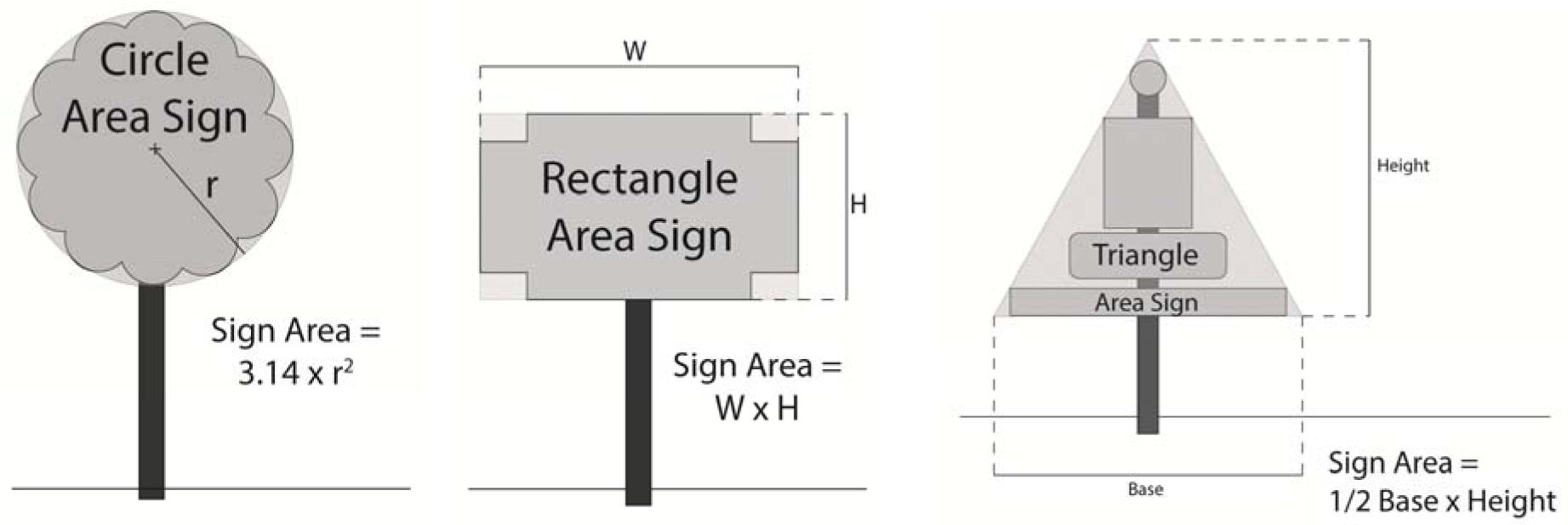
Sign: Any structure, part thereof, or device, whether or not attached thereto or painted or represented thereon, or any material or thing, illuminated or otherwise, which displays or includes any numeral, letter, work, model, banner, emblem, insignia, device, trademark, or other representation used as, or in the nature of, an announcement, advertisement, direction, or designation, enterprise, or industry, which is located upon any land, on any building, in or upon a window, or indoors in such manner as to attract attention from outside the building.
Sign, Abandoned: A sign that no longer serves to advertise a bona fide business conducted, service performed, or product sold.
Sign, Affixed (Wall-mounted): Signs mounted parallel to (flush with) the face of the building and projecting not more than 12 inches from the building wall. The area of individual letters, figures, or signs shall be the area of the simple geometric form (rectangle, square, etc.), necessary to enclose the letters, figures, or signs.
Sign, Canopy: A building sign upon or attached to a canopy or covered structure projecting from and supported by a building when such canopy or covered structure extends beyond the building line or property line.
Sign, Changeable Copy: Any sign with copy that can be changed, rearranged, or altered manually whereby the sign face is not changed.
Sign, Electronic Message Board: A sign or portion of a sign, that has light emitting diodes (LED), or other similar computer controlled multiple lights, on which the copy changes automatically.
Sign, Freestanding: A ground sign that is mounted on free standing poles or other supports such that the bottom edge of the sign face is ten feet or more above grade.
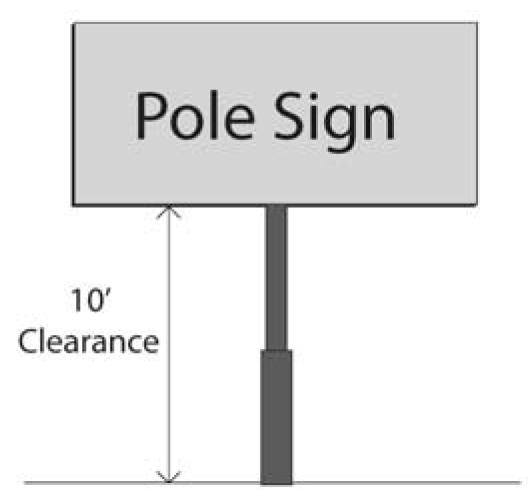
Sign, Ground-mounted: Any sign that is supported by an upright, uprights, or braces in or upon the ground and independent of support from any building.
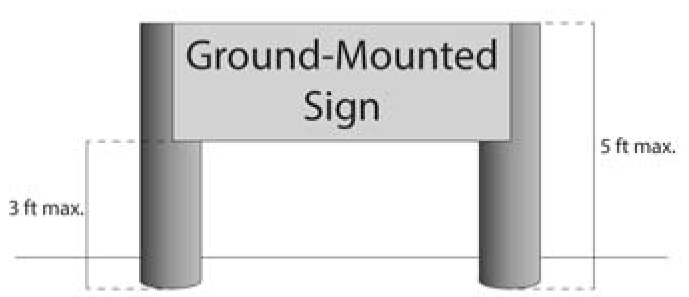
Sign, Home Occupation: A building sign displayed where there is a licensed home occupation.
Sign, Illuminated: Any sign illuminated by any light source including by not limited to electric bulbs, luminous tubes, fiber optics and LED (light emitting diodes), whether or not the light source is part of the sign proper.
Sign, Illuminated Internally: Any sign illuminated by one or more light sources constituting an integral part of the sign proper.
Sign, Illuminated Externally: A sign illuminated by an external light source, including flood or spotlights, directed primarily toward such sign.
Sign, Nonconforming: A sign not in compliance with these regulations and that has not received a special permit pursuant to Article 4 or extension of time pursuant to Article 4.
Sign, Portable: A sign that has no permanent attachment to a building or to the ground by means of a footing, including but not limited to, an A-frame sign, a sign with its own wheels designed to be pulled, a sign towed on a trailer or similar device, hot air or gas filled balloons, trash receptacles, and similar sidewalk appliances which display advertising copy and sidewalk signs.
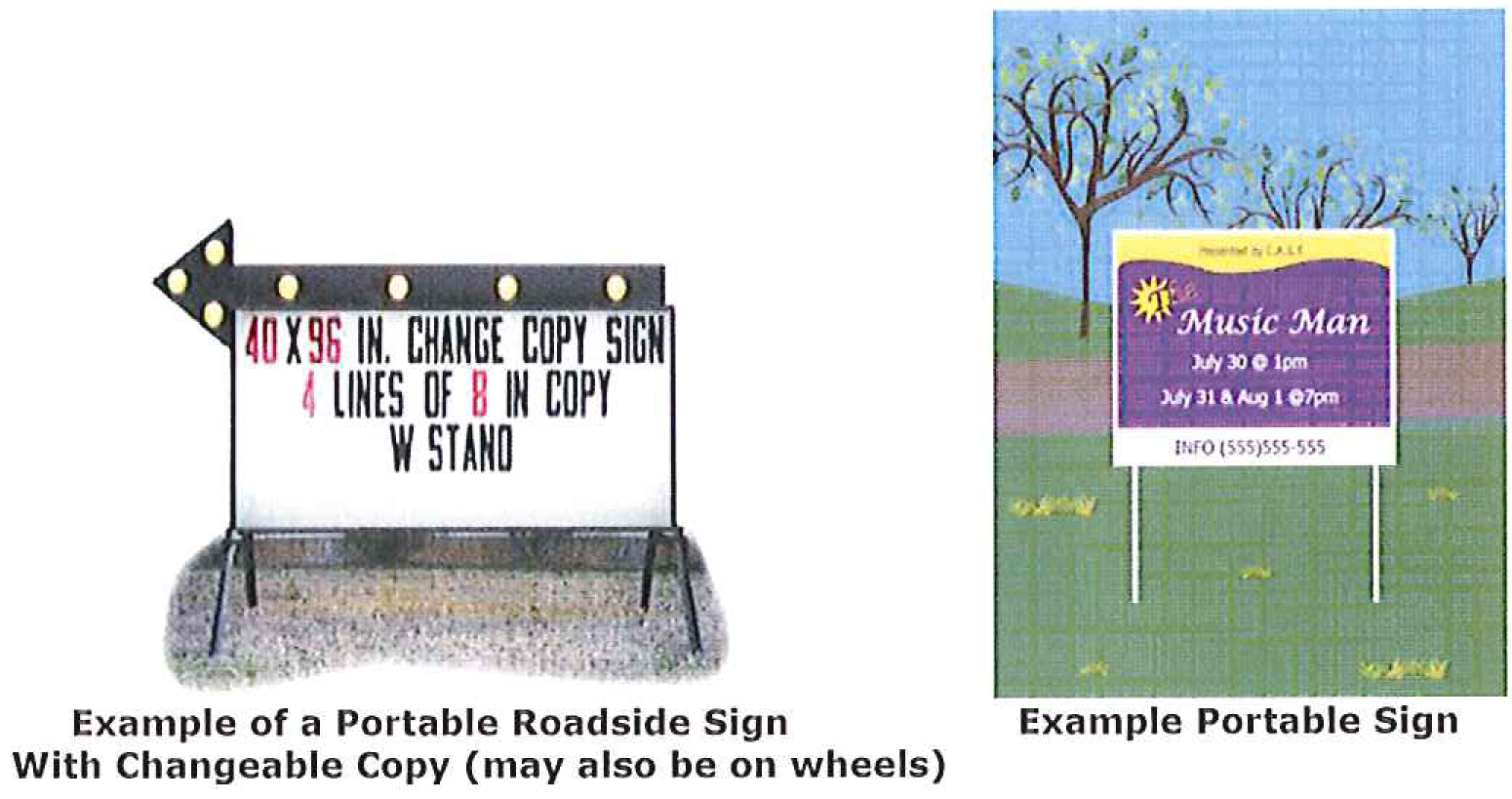
Sign, Projecting: A sign that is affixed to any building wall or structure and projects perpendicularly more than 12 inches from the building wall.
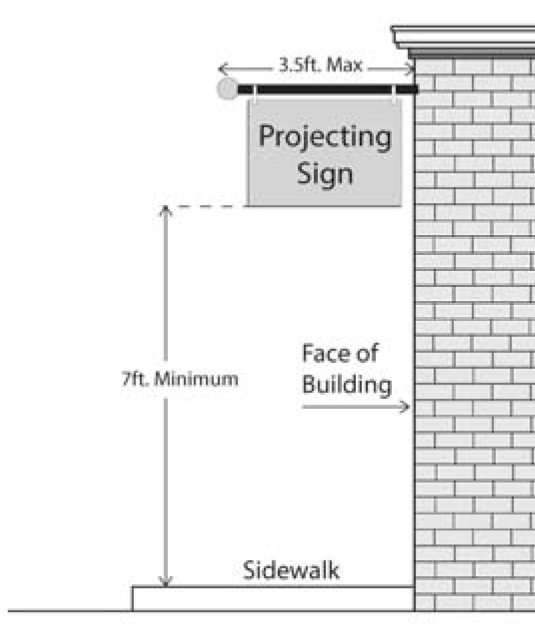
Sign, Reader Board (Changeable Copy): Any sign with copy that can be changed, rearranged, or altered manually whereby the sign face is not changed.
Sign, Sandwich Board: See Sidewalk Sign.
Sign, Sidewalk (sometimes referred to as a sandwich board sign): Any freestanding, self-supporting, single or double faced sign which is designed to be placed upon, but not affixed to, the ground, or sidewalks or pavement, and that is portable and readily moved from place to place.
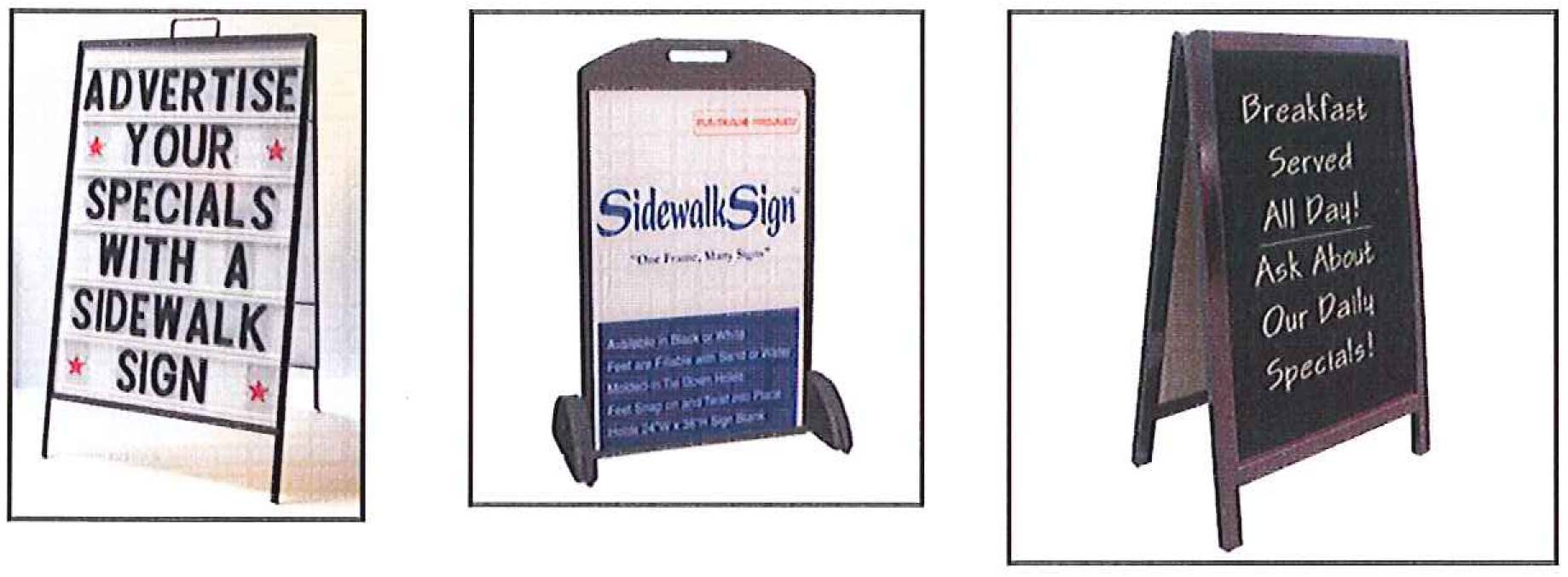
Sign, Snipe: A temporary sign not otherwise defined in this article that is tacked, nailed, posted, glazed, or otherwise affixed to a light fixture, utility pole, public building, fence, railing, public telephone pole, traffic control device, public bench, tree, or to the ground.
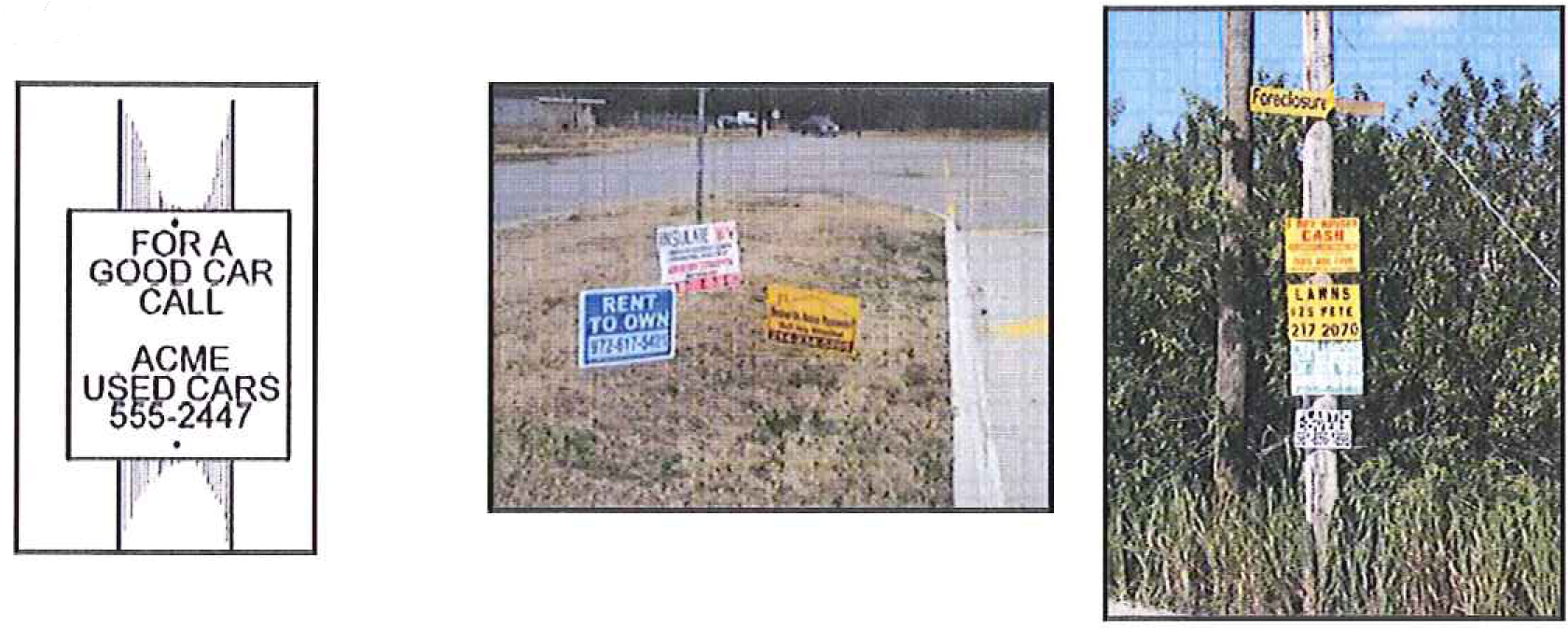
Sign, Window: A sign applied to or mounted on the window panes or glass of any window or door.
Single Family Attached Dwelling Unit: See Dwelling Unit, Single Family Attached
Site: The location of a significant event, activity, building, structure, or archaeological resource.
Site Development Plan: A plan, to scale, showing uses and structures proposed for a parcel of land. It includes lot lines, streets, building sites, reserved open spaces, buildings, major landscape features; both natural and man-made; the locations of proposed utility lines; and, other pertinent information, per Article 7, Section 7.05.00 of this Code.
Site Plan Review: The process whereby local officials review the site plans and maps of a developer to assure that they meet the stated purposes and standards of land development regulations, provide for the necessary public facilities, and protect and preserve topographical features and adjacent properties through appropriate siting of structures and landscaping.
Shall: When the word "shall" is used, the action is mandatory; "may" is permissive.
Solid Waste: Sludge from a waste treatment works, water supply treatment plant, or air pollution control facility or garbage, rubbish, refuse, or other discarded material, including solid, liquid, semisolid, or contained gaseous material resulting from domestic, industrial, commercial, mining, agricultural, or governmental operations.
Solid Waste Facilities: Structures or systems designed for the collection, processing, or disposal of solid wastes, including hazardous wastes, and includes transfer stations, processing plants, recycling plants, and disposal systems.
Solid Waste Processing Plant: A facility for incineration, resource recovery, or recycling of solid waste prior to its final disposal.
Solid Waste Transfer Station: A facility for temporary collection of solid waste prior to transport to a processing plant or to final disposal.
Special Exception Use: A use which is essential to or would promote the public health, safety, or welfare in one or more districts, but which would impair the integrity and character of the district in which it is located, or in adjoining districts unless restrictions or conditions on location, size, extent and character of performance are imposed in addition to those imposed in this ordinance. No use shall be approved under this definition unless specifically listed as a special exception for a particular district in table in Article 2, Table 2.02.01(A), Table of Land Uses.
Special Needs Housing: Facilities that provide 24-hour care, services and housing in an institutional or residential setting for adults and/or children with conditions, disabilities or circumstances that qualify them for short or long-term housing and care. Such facilities include, but are not limited to: Adult Family-Care Home, Assisted Living Facility, Family Foster Home, Foster Care Facility, Group Home Facility, Hospice Residential Unit, Nursing Home Facility, and other similar facilities and homes; all of which are defined elsewhere in this Article.
Special Transportation Services: A means of transportation provided on a subsidized basis to transportation disadvantaged individuals by a public, private or non-profit organization, such as a bus company, a taxicab company, or a social service organization.
Stormwater: The flow of water that results from a rainfall event.
Stormwater Basin (formerly Drainage Basin): The area defined by topographic boundaries which contributes stormwater to a watershed, drainage system, estuarine waters, or oceanic water, including all areas artificially added to the basin.
Stormwater Detention Structure (formerly Drainage Detention Structure): A structure which collects and temporarily stores stormwater for the purpose of treatment through physical, chemical or biological processes with subsequent gradual release of the stormwater.
Stormwater Management Facilities: Manmade structures that are part of a stormwater management system designed to collect, convey, hold, divert, or discharge stormwater, and may include stormwater sewers, canals, detention facilities and retention facilities.
Stormwater Management Retention Structure (formerly Drainage Retention Structure): A structure designed to collect and prevent the release of a given volume of stormwater by complete on-site storage.
Street: A public access way 20 feet or more in width dedicated or otherwise having legal sanction for unlimited public use, includes the terms road, avenue, lane, boulevard, thoroughfare, highway, place, way, drive, and terrace.
Street, Primary Abutting: If more than one street abuts a subject property the "primary abutting street" shall be the street having the larger traffic count, as determined by the City.
Structure: Anything constructed, installed, or portable, the use of which requires a location on a parcel of land. It includes a movable structure while it is located on land that can be used for housing, business, commercial, agricultural, or office purposes either temporarily or permanently. Structure also includes fences, billboards, swimming pools, poles, pipelines, transmission lines, tracks, and advertising signs. (380.031 F.S.)
Subdivision: The platting of real property into two or more lots, parcels, tracts, tiers, blocks, sites, units, or any other division of land; and includes establishment of new streets and alleys, additions, and resubdivisions; and, when appropriate to the context, relates to the process of subdividing or to the lands or area subdivided.
Sufficiency Review: Department of Economic Opportunity (DEO) review of an adopted evaluation and appraisal report to determine whether it has been submitted in a timely fashion and whether it contains components in accordance with the prescribed criteria in Section 163.3191, F.S.
Surfaced in a Stable Manner: The term "surfaced in a stable manner" shall mean hard penetration type asphalt or concrete with proper drainage and precluding excessive glare in a manner approved by the administrative official; except that areas of parking facilities utilized for parking spaces, excluding moving aisles, access roads and off-street parking appurtenances may be surfaced with materials such as wood chips, gravel, wood bark, synthetic materials, open web concrete blocks and other means; provided, however, the grade preparation and subgrade has not more than four-tenths percent grade and base soil will provide percolation.
Swimming Pool, Single-Family/Duplex: Any swimming pool, spa, or spa-like structure, that are accessory to, and situated on the premises of a single-family or duplex dwelling that is intended for swimming or recreational bathing that contains water over 24 inches deep. This includes, but is not limited to, in-ground, above-ground, and on-ground swimming pools, hot tubs, and spas.
Swimming Pool, Public: A watertight structure of concrete, masonry, or other approved materials which is located either indoors or outdoors, used for bathing or swimming by humans, and filled with a filtered and disinfected water supply, together with buildings, appurtenances, and equipment used in connection therewith. A public swimming pool shall mean a conventional pool, spa, spa-type pool, wading pool, special purpose pool, or water recreation attraction, to which admission may be gained with or without payment of a fee and includes, but is not limited to, pools operated by or serving camps, churches, cities, counties, day care centers, group homes facilities for eight or more clients, health spas, institutions, parks, state agencies, schools, subdivisions, or the cooperative living-type projects, such as apartment, hotels, mobile home parks, motels, recreational vehicle parks, and townhouses. However, the term does not include a swimming pool located on the premises of a single-family or duplex dwelling. Any swimming pool not accessory to and not situated on the premises of a single-family or duplex dwelling for the purposes of this code shall be considered a public swimming pool.
T
Tattooing: Inserting pigment under the surface of the skin of a human being, by pricking with a needle or otherwise, to produce an indelible mark or figure visible through the skin.
Temporary Portable Storage Unit (TPSU): Portable structures intended to be used for the off-site storage of personal property which are placed on a property temporarily for loading and unloading. Portable structures used for depositing personal goods to be donated to a non-profit charitable organization are not included in the definition of a TPSU.
Tire and Automotive Accessory Establishments: An establishment engaged in the selling of automobile tires, batteries and other new automobile parts and accessories, including installation of the automotive accessories sold on the premises provided such activities are incidental and accessory to the principal selling of tires and automotive accessories.
Town House: A building or structure designed for and/or containing one dwelling unit and or intended for occupancy by not more than one family or household and attached to other similar buildings or structures by not more than two party walls extending from the foundation to the roof and providing two direct means of access from the outside. For the purpose of this Code, a townhouse may include a building or structure in fee simple, condominium, cooperative or leasehold ownership or any combination thereof.
Transfer of Development Rights: A governmentally recognized right to use or develop land at a certain density, or intensity, or for a particular purpose, which is severed from the realty and placed on some other property.
Tree: For the purpose of obtaining a tree removal permit within the City Limits of Wauchula, a tree is defined as a woody, self-supporting plant having a diameter of six inches when measured 4.5 feet above ground level, and having a height of ten feet or more.
25-Year Frequency, 24-Hour Duration Storm Event: A storm event and associated rainfall during a continuous 24-hour period that may be expected to occur once every 25 years. Its associated floodplain is that land which may be expected to be flooded during the storm event.
Triplex: See Dwelling, Triplex
Truck and Motor Freight Terminals: An area and building where trucks load and unload cargo and freight and where the cargo and freight may be broken down or aggregated into smaller or larger loads for transfer to other vehicles or modes of transportation; furnishes services incidental to air, motor freight, and rail transportation.
Truck Stop: Any facility offering fuel for sale for commercial vehicles, trucks and automobiles and constructed and designed for the maneuverability and fueling of tractor trailer vehicles; has the capacity to fuel three or more tractor trailer vehicles at the same time and parking facilities for three or more vehicles. The facility may include provisions for one or more of the following: (a) sleeping accommodations for commercial vehicle or truck crews; (b) sale of parts and accessories for commercial vehicles or trucks; (c) a restaurant; or (d) truck parking or storage area.
U
Urban Sprawl: Urban development or uses which are located in predominantly rural areas, or rural areas interspersed with generally low-intensity or low-density urban uses, and which are characterized by one or more of the following conditions: (a) The premature or poorly planned conversion of rural land to other uses; (b) The creation of areas of urban development or uses which are not functionally related to land uses which predominate the adjacent area; or (c) The creation of areas of urban development or uses which fail to maximize the use of existing public facilities or the use of areas within which public services are currently provided. Urban sprawl is typically manifested in one or more of the following land use or development patterns: leapfrog or scattered development; ribbon or strip commercial or other development; or large expanses of predominantly low-intensity, low-density, or single-use development.
Use: Use refers to the activities which take place on any land or premises and also refers to the structures located thereon and designed for those activities.
V
Variance: A variance is an approved modification to the development standards established by this Code. A variance may only be granted for height, area, size of structure or size of yards and open spaces, or other dimensional requirements, and once granted runs with the land. See Article 7, Section 7.11.00.
Vegetative Communities: Ecological communities, such as coastal strands, oak hammocks, and cypress swamps, that are classified based on the presence of certain soils, vegetation and animals.
Vehicle Dealer Establishments: An establishment engaged in the selling of new and/or used vehicles and related new parts and accessories. Vehicle dealer establishments may include repair departments provide such repair departments are clearly incidental and accessory to the principal selling of vehicles.
Vehicle Equipment Rental Establishments: An establishment engaged in renting or leasing large equipment and machinery. See also Equipment, Sales and Rental.
Vehicle Parking Establishments: An establishment engaged in providing commercial parking facilities on open air lots surfaced in a stable manner and/or structures for a fee or charge. See Parking Lot, Commercial.
Vehicle Rental Establishments: An establishment engaged in renting or leasing of vehicles without drivers.
Vehicle Repair Establishments: An establishment in which a person practices a vocation or occupation that performs a type of labor, act or work, that results in the fixing and repair of any kind of vehicle, including automobiles, boats, farm equipment, motorcycles and trucks. Included are: activities listed under Major and Minor Vehicle Repair, as well as removal and major overhaul of engines; transmissions and drive systems; all types of paint and body work; battery and ignition systems; radiators; repair and replacement of glass; and, general and specialized repairs.
Vehicle Restoration/Antique or Classic (Private and "Not for Profit"): Restoring of classic vehicles (more than 20 years old) or antique vehicles (more than 25 years old) by a private individual and "not for profit." All activities must take place under cover. Stored vehicles must be screened. Vehicles may not be stored in front of the principal structure and must be setback ten feet from side and rear property lines. An individual who is restoring a classic or antique vehicle, may have three inoperable vehicles as long as they are of the same make and model of the vehicle he is restoring.
Vehicle Service Establishments or Car Wash: An establishment engaged in furnishing vehicle washing, waxing, polishing, and/or similar services except repairs.
Vehicular Use Area: All areas used for circulation, parking, and/or display or any and all types of vehicles, boats, or construction equipment, whether self-propelled or not, and all land upon which vehicles traverse as a function of the principal use.
Very-low Income Family, Very-low Income Household: One or more natural persons or a family, not including students, the total annual adjusted gross household income of which does not exceed 50 percent of the median annual adjusted gross income for households within the metropolitan statistical areas (MSA) or, if not within an MSA, within the county in which the person or family resides, whichever is greater. For the City of Wauchula, the median income of Hardee County is used. (420.004, F.S.)
Vested Right: A right is vested when it has become absolute and fixed and cannot be defeated or denied by subsequent conditions or change in regulations, unless it is taken and paid for. There is no vested right to an existing zoning classification or to have zoning remain the same forever. However, once development has been started or has been completed, there is a right to maintain that particular use regardless of the classification given the property. In order for a nonconforming use to earn the right to continue when the zoning is changed, the right must have vested before the change. If the right to complete the development was not vested, it may not be built, no nonconforming use will be established, and the new regulations will have to be complied with.
Veterinary Animal Hospital: Any building or portion thereof designed or used for the veterinary care, surgical procedures, or treatment of animals, but not boarding of well animals.
Veterinary Clinic: A facility which provides for outpatient care of animals wholly within a soundproof, air-conditioned structure, with minimal overnight stays and hours of operation limited to traditional office/clinic hours. Such use shall not include outside kennels.
Visible from Right-of-Way: The subject property as viewed from any point of the adjacent public or private right-of-way or pedestrian oriented space.
W
Warehouse: A building used solely for the purpose of storage or distribution of goods, wares, merchandise, or other articles.
Warehouse, Mini: A building or group of buildings that contain individual compartmentalized and controlled separate storage spaces leased or rented on an individual basis and accessible to the lessees through individual doors (also known as self storage facilities).
Wastewater Facilities (aka "Sanitary Sewer Facilities"): Structures or systems designed for the collection, transmission, treatment, or disposal of sewage and includes trunk mains, interceptors, treatment plants, and disposal systems.
Wastewater Lift Station (aka "Sewer Lift Stations" or "Pump Stations"): Used to help transport liquid wastewater from homes and businesses across the City to a treatment plant for processing and cleaning. Sewer pipes are generally gravity driven and wastewater flows slowly downhill until it reaches a certain low point. The "lift" stations then push the wastewater back uphill to a high point where gravity can once again take over the process thereby transporting the liquid to a treatment plant.
Water Detention Structure, Water Management Structure: A facility which provides for storage of stormwater runoff and the controlled release of such runoff during and after a storm.
Water Recharge Areas: Land or water areas through which groundwater is replenished.
Water Retention Structure: A facility which provides for storage of stormwater runoff.
Water Wells: Wells excavated, drilled, dug, or driven for the supply of industrial, agricultural, or potable water for general public consumption.
Wellhead Protection Area: An area designated by local government to provide land use protection for the groundwater source for a potable water wellfield, as defined in this code, including the surface and subsurface area surrounding the wellfield. Differing levels of protection may be established within the wellhead protection area commensurate with the capacity of the well and an evaluation of the risk to human health and the environment. Wellhead protection areas shall be delineated using professionally accepted methodologies based on the best available data and taking into account any zones or contribution described in existing data.
Wetlands: Those areas that are inundated or saturated by surface water or ground water at a frequency and a duration sufficient to support, and under normal circumstances do support, a prevalence of vegetation typically adapted for life in saturated soils. Soils present in wetlands generally are classified as hydric or alluvial, or possess characteristics that are associated with reducing soil conditions. The prevalent vegetation in wetlands generally consists of facultative or obligate hydrophytic macrophytes that are typically adapted to areas having soil conditions described above. These species, due to morphological, physiological, or reproductive adaptations, have the ability to grow, reproduce, or persist in aquatic environments or anaerobic soil conditions. Florida wetlands generally include swamps, marshes, bayheads, bogs, cypress domes and strands, sloughs, wet prairies, riverine swamps and marshes, hydric seepage slopes, tidal marshes, mangrove swamps, and other similar areas.
Florida wetlands generally do not include longleaf or slash pine flatwoods with an understory dominated by saw palmetto. The delineation of actual wetland boundaries may be made by any professionally accepted methodology consistent with the type of wetlands being delineated but shall be consistent with any unified statewide methodology for the delineation of the extent of wetlands ratified by the Legislature.
Wholesaling and Distribution: Establishments engaged in selling merchandise to retailers, and to industrial, commercial, institutional, farm, or professional business users; or to other wholesalers; or acting as agents or brokers in buying merchandise for or selling merchandise to such persons or companies. Includes such establishments as: agents, merchandise or commodity brokers, and commission merchants, assemblers, buyers and associations engaged in the cooperative marketing of farm products, and merchant wholesalers.
Written or In Writing: The term "written" or "in writing" shall be construed to include any representation of words, letters, or figures, whether by printing or otherwise.
Y
Yard: The open space surrounding the principal building on any lot, unoccupied and unobstructed by any portion of that building except where specifically permitted by this ordinance. Yards are further defined as follows:
a.
Front yard: That portion of the yard extending the full width of the lot and measured between the front lot line and a parallel line tangent to the nearest part of the principal building, which line shall be designated as the front yard line.
b.
Rear yard: That portion of the yard extending the full width of the lot and measured between the rear lot line and parallel line tangent to the nearest part of the principal building.
c.
Side yards: Those portions of the yard extending from the front yard to the rear yard and measured between the side lot lines and parallel lines tangent to the principal building; provided, however, that overhanging eaves may extend two feet into the required side yard.
Year: The word "year" shall mean a calendar year, unless otherwise indicated.
Z
Zero Lot Line Development: A development approach in which a building is sited on one lot line with no yard while retaining the other required yards. The intent is to allow more flexibility in site design and to increase the amount of usable open space on the lot.
Zoning District: An area identified on the Zoning Map of the City of Wauchula, Florida, assigned a zoning classification as indicated on such map, consisting of one of several zoning classifications as set forth and established in Article 2 of this Code. Reference to the word "district" or "zone" shall mean Zoning District.
Zoning Map: The official map, described within Section 8.05.00, upon which the delineations of the several zoning districts are shown for locations within the City of Wauchula.
Zoning Permit: A permit, required by appropriate authority under the provisions of this Code, which authorizes the excavation, construction or alteration of a structure and is required prior to such construction or alteration, except for recurring maintenance work regardless of cost or the installation of required improvements according to an approved preliminary subdivision plat or an approved preliminary development plat including planned-development projects and special exception uses.
ACRONYMS:
(Ord. No. 2014-19, § 2(Exh. A), 12-8-14; Ord. No. 2014-21, § 2(Exh. A), 2-9-15; Ord. No. 2016-02, § 2(Exh. A), 4-11-16; Ord. No. 2016-13, § 2(Exh. A), 9-12-16; Ord. No. 2017-05, § 2, 4-10-17; Ord. No. 2019-12, § 2(Exh. A), 11-12-19; Ord. No. 2019-13, § 2(Exh. A), 1-13-20; Ord. No. 2020-02, § 2(Exh. A), 5-11-20; Ord. No. 2020-07, § 2(Exh. A), 9-28-20)

