
Wauchula City Zoning Code
ARTICLE 6
- PUBLIC FACILITY MONITORING AND PERMITTING
6.01.00 - Concurrency.
The purpose of this Section is to ensure that facilities and services needed to support development are available concurrent with the impacts of development. The following public facilities and services are subject to concurrency evaluation: roads, potable water, sanitary sewer, drainage, solid waste, and recreation.
Except as otherwise provided, no development proposal submitted after the effective date of this Code shall be approved unless public facilities are or will be available to serve a proposed development, such that the Levels of Service adopted in the Comprehensive Plan are maintained. Prior to concurrency approval for a proposed development, the following conditions shall be met, as applicable.
6.01.01 General Provisions.
(A)
Potable Water, Sewer, Solid Waste, and Drainage. The concurrency requirement may be met through one of the following conditions or actions:
(1)
The necessary facilities and services are in place at the time a development permit is issued; or
(2)
A development permit is issued subject to the condition that the necessary facilities and services will be in place when the impacts of the development occur; or
(3)
The necessary facilities are under construction at the time a permit is issued; or
(4)
The necessary facilities and services are guaranteed in an enforceable development agreement that includes provisions 1-3 above. An enforceable development agreement shall include, but is not limited to, the provisions of Section 163.3227, F.S., or shall be a development order issued pursuant to Sections 163.3220—3243, F.S., or an agreement or development order issued pursuant to Chapter 380, F.S. The agreement shall guarantee that the necessary facilities and services will be in place when the impacts of the development occur.
(B)
Roads. The concurrency requirement may be met by satisfying the conditions listed in paragraphs (A)(1-4) above, and by complying with the following standards:
(1)
The Capital Improvements Element and 5-Year Schedule of Capital Improvements must be financially feasible, and may recognize and include transportation projects listed in the first three years of the applicable FDOT 5-Year Work Program.
(2)
The 5-Year Schedule of Capital Improvements must include facilities necessary to maintain the adopted level of service standards to serve the proposed new development, and the facilities necessary to eliminate those portions of existing deficiencies that are a priority to be eliminated during the five-year period in which the Capital Improvements Plan is to be implemented.
(3)
The Capital Improvements Element and 5-Year Schedule of Capital Improvements must be based on currently available revenue sources that must be adequate to fund the public facilities required to serve the development authorized by the development order and development permit.
(4)
The 5-Year Schedule of Capital Improvements must include the estimated date of commencement of actual construction and the estimated date of project completion.
(5)
The 5-Year Schedule of Capital Improvements must demonstrate that the actual construction of the road must be scheduled to commence in or before the third year of the five-year schedule.
(6)
A plan amendment would be required to eliminate, defer, or delay construction of any road that is needed to maintain the adopted level of service standard and that is listed in the 5-Year Schedule of Capital Improvements.
(7)
The City will adopt land development regulations that, in conjunction with the Capital Improvements Element, ensure that development orders and permits are issued in a manner that will assure that the necessary public facilities will be available to accommodate the impact of that development.
(8)
A monitoring system shall be adopted that enables the City to determine whether it is adhering to the adopted level of service standards and its capital improvements schedule.
(9)
The Comprehensive Plan shall clearly designate those areas within that facilities will be provided by the City with public funds in accordance with the 5-Year Schedule of Capital Improvements.
(C)
Parks and Recreation. The concurrency requirement may be met by satisfying the conditions listed in paragraphs (A)(1-4) above, or by complying with the following standards:
(1)
At the time the development permit is issued, the necessary public facilities and services are the subject of a binding executed contract that provides for the commencement of the actual construction of the required public facilities or the provision of services within one year of the issuance of the development permit; or
(2)
The necessary public facilities and services are guaranteed in an enforceable development agreement that requires the commencement of the actual construction of the public facilities or the provision of services within one year of the issuance of the applicable development permit. An enforceable development agreement may include, but is not limited to the provisions of Section 163.3227, F.S., or an agreement or development order issued pursuant to Chapter 380, F.S.
6.01.02 Concurrency Management System. The Concurrency Management System (CMS) shall identify and inventory existing service capacities available for development. It shall include facility and service improvements approved in the first year of the City's 5-Year Schedule of Capital Improvements. No development order or permit may be issued by the City that results in a reduction in LOS below the adopted standard.
6.01.02.01 Concurrency Test Statement. Concurrency Test Statements shall be filed with and reviewed by the City, and a determination of concurrency shall be made prior to formal submittal of a development plan of any kind. This shall include issuance of building permits for residential development on existing lots where no plat or Site Development Plan is required.
6.01.02.02 Procedure. The following procedure shall be carried out in order to obtain a determination of concurrency:
(A)
Prepare Concurrency Test Statements on forms available at the Development Director's office.
(B)
Completed Concurrency Test Statements shall include the following information:
(1)
A legal description of the site proposed to be developed along with a map identifying the site in relationship to the City's boundaries.
(2)
A narrative description of the proposed development identifying the type of development and all land uses proposed within the site.
(3)
Identification of all roadways adjacent to the site by name, pavement width, functional classification, jurisdiction (i.e., state, county, or City jurisdiction), current capacity, and existing LOS.
(4)
Projected Average Daily Traffic (ADT) and peak-hour traffic generated by the proposed development and the traffic distribution on the existing roadway(s).
(5)
Projected potable water demand generated by the proposed development and identification of the service provider.
(6)
Projected wastewater demand generated by the proposed development and identification of the service provider.
(7)
Projected solid waste generation and identification of the service provider.
(8)
Description of the stormwater management system for the proposed development. This description shall include the drainage basin in which the proposed project is located, method of treatment, system design parameters, and location of outfall.
(9)
Identification of required park and recreation facilities, if any, and method of providing said facilities.
(10)
A development schedule identifying the proposed date for the start of construction and the date of project completion.
Where required information is readily available, the Development Director may, at his discretion, obtain or calculate one or more of the above data requirements. However, it shall be the applicant's full responsibility to ensure that the Concurrency Test Statement is complete and accurate.
The Development Director shall distribute the completed Concurrency Test Statement to appropriate City departments charged with providing the identified services. Each department shall certify on the Concurrency Test Statement whether or not there is sufficient capacity to service the development.
For any public service not provided by the City of Wauchula, the Development Director may waive capacity certification on a case-by-case basis if there is satisfactory evidence that capacity is available to support the proposed development. Drainage certification for single-family development on existing lots may be waived under the same conditions.
The applicant shall be notified within seven working days as to whether the proposed development meets the concurrency requirement. If the proposal is determined to meet concurrency, the applicant may proceed with the development process as set forth in other sections of this Code. Proposals not meeting concurrency shall not be processed for review until and unless an agreement has been reached by the City and the developer to mitigate the identified deficiency.
6.01.03 Fees. Fees for staff review of Concurrency Test Statements shall be established, and may be changed from time to time, by resolution of the City Commission.
6.01.04 Developments to be Consistent with Concurrency Test Statements. All development proposals submitted to the City for review shall be consistent with the data established in the Concurrency Test Statement. Those exceeding the service demand levels established in the Concurrency Test Statement shall not be processed. The applicant shall be provided with a written notice that a new Concurrency Test Statement shall be required.
Where deficiencies have been identified, development plans based on an agreement to provide needed facilities and/or services shall be processed with the agreement as a condition of development approval. However, the City shall not be required to approve a development plan that meets the concurrency requirement, but does not satisfy other provisions of this Code.
6.01.05 Allocation of Municipal Services. Allocations of public facility and service capacities shall be on a first come, first served basis. Services shall be allocated at the following stages:
(A)
Subdivisions. On final approval of a subdivision plat, service capacities shall be allocated based on the approved plat. Allocation of service capacity shall be valid for five years from the date of final plat approval.
(B)
Conditional Use Permit. On final approval of a subdivision plat, service capacities shall be allocated based on the approved plat. Allocation of service capacity shall be valid for five years from the date of final plat approval.
(C)
Site Development Plan. Those developments that are processed under the site development plan review procedures shall be allocated service capacities upon approval of the site development plan. Allocation of service capacity shall be valid for six months from the date of site development plan approval.
(D)
Single Family Residential on Existing Lots. Prior to receiving a building permit for single family structures on platted lots existing before the adoption of this Code, or on non-subdivision lots established by metes and bounds legal description, the builder or property owner shall secure a Certificate of Concurrency from the Development Director. Allocation of service capacity shall be valid until the expiration date of the building permit or the issuance of a certificate of occupancy.
6.01.06 Levels of Service. Through the Concurrency Management System, Wauchula shall maintain the following levels of service for public facilities:
Table 6.1 Levels of Service
All development that was not approved through a subdivision plat, conditional use permit, site development plan, or the issuance of a building permit prior to the date of adoption of this Code shall be subject to an Adequacy Determination through the Concurrency Management System. An Adequacy Determination shall also be required for existing development where any improvement, expansion, or other change is proposed that may result in a greater demand for those public facilities addressed in this Section. The Development Director shall determine whether a proposed change in existing development requires an Adequacy Determination.
6.01.07 Required Determinations. As part of the Adequacy Determination, findings shall be made as to the amount of available capacity in those public facilities that are addressed in this Section.
6.01.07.01 Adequacy of the Road System. The adequacy of the road network shall be evaluated according to conditions at the time the development plan or building permit is approved. Initial measurement of roadway capacities shall be carried out using data and methodology accepted by FDOT or other traffic analysis techniques that are technically justifiable as determined by the Development Director. Capacity ratings on the state highway network shall be approved by FDOT.
Any proposed development shall be required to address the adequacy of the City's road network as it relates to the projected traffic volumes generated by the development. If any affected road segment lacks capacity to accommodate the additional traffic generated at the adopted LOS, it shall be determined whether such capacity will be available if all of the transportation improvements contained in the City's Comprehensive Plan and/or that of Hardee County are completed.
For the purpose of this Section, improvements to state roads resulting in an improvement in the level of service, and that are scheduled to occur by the third year of the FDOT's Five Year Work Program, shall be considered concurrent. If it is determined that such capacity will not be available, then the specific improvements necessary to enable the road network to reach such capacity shall be identified, through the completion of a detailed transportation study conducted by a professional in the field of transportation planning, and the application may be granted with an express condition regarding the adequacy of the City's transportation network. At the sole discretion of the City Commission, such condition shall require one of the following:
(A)
That the applicant shall construct the necessary improvements proportional to the share of the additional capacity that is needed to accommodate traffic generated by the applicant's development; or
(B)
That the applicant deposit money into a "road fund" equal to the share of the cost of the improvements that would otherwise be required.
A determination of facility deficiency shall be based on methodology presented in the 1985 or most recent edition of the Highway Capacity Manual of the Transportation Research Board of the American Association of State Highway and Transportation Officials (AASHTO) Research Council, Washington, D.C. It shall be the applicant's responsibility to provide the transportation data and analysis necessary for an Adequacy Determination.
At the Development Director's option, and where adequate capacity appears to be available, an alternate methodology may be used to establish non-deficiency. Table 6.2, "Maximum Peak Hour Volume for Each Level of Service by Facility Type," may be used as a general indicator of current level of service and future level of service based on approval of the proposed development. This methodology may be used as a basis for development approval only if the calculated new level of service is higher than the adopted level of service standard. Where a capacity analysis using Table 6.2 indicates the proposed development would create a new level of service equal to or below the adopted standard, a more detailed analysis shall be performed using the 1985 Highway Capacity Manual methodology. The final Adequacy Determination shall be based on the latter analysis.
Table 6.2 Maximum Peak Hour Volume
For Each Level of Service, By Facility Type
Properties served by local roads or other roads for which traffic count information is unavailable shall be evaluated for impact on the nearest road(s) for which levels of service can be measured. The impact on the transportation system shall be determined by utilizing the trip generation standards set forth in the ITE Trip Generation Manual, 4th Edition, or most recent. The estimated number of trips generated by the proposed development shall be subtracted cumulatively from the available capacity on the roadway to determine whether the roadway's capacity is adequate to support the development based on the impacted roadway's level of service.
The calculation of total traffic generated by a proposed non-residential or mixed use project will assume 100% buildout and occupancy of the project. Credit against the trip generation of non-residential land uses may be taken utilizing the percentages shown in Table 6.3. Any capture of trips from passing traffic in excess of these percentages must be justified by the applicant.
Table 6.3 Trip Capture Ratios
For mixed use development, the applicant shall justify any trips that will be absorbed internally by the project.
The procedures outlined in Chapter 5 of the ITE Trip Generation Manual, 4th Edition, pages 10-16, can be used to quantify pass-by trips. Wauchula may consider these procedures in conjunction with locally derived data and Table 6.3.
6.01.07.02 Adequacy of Drainage. The proposed development shall be designed to provide adequate areas and easements for the construction and maintenance of a water management system to serve the proposed development and adjacent public rights of way in a manner that conforms to sound engineering standards. The development order shall require that the applicant meet the following LOS standards, where applicable, prior to any plan approval.
(A)
Road Protection. Residential streets having not more than 50 feet of pavement width shall have crown elevations equal to the 100 year flood elevation. Rights of way having greater than 50 feet of pavement width shall have a final edge of pavement elevation no lower than the 100 year flood elevation.
(B)
Buildings. The lower floor elevation for buildings shall be no lower than one foot above the 100 year elevation.
(C)
Off-Site Discharge. Off-site discharge is not to exceed the standards allowed by the SWFWMD and this Code.
(D)
Storm Sewers. The design frequency applicable to storm sewers is the 25-year, 24-hour storm event.
6.01.07.03 Adequacy of Potable Water Service. Potable water service must be available for the needs of the proposed development at the adopted LOS. The proposed development shall be designed so as to reserve rights-of-way, easements, and any other areas that may be needed for the installation and maintenance of a potable water distribution system that will meet all applicable building, health, and environmental regulations, including Chapter 17-22, F.A.C.
Where adequate potable water capacity is available in the City of Wauchula's municipal water system, the Concurrency Test Statement shall include a certification from the appropriate City official, stating that sufficient capacity exists as of the date of application. Such certification shall be based on the existing level of demand in addition to permitted development that has not been constructed, and any other development for which capacity has been reserved.
Where adequate potable water service will be made available at a future date concurrent with the impacts of the proposed development, an Adequacy Determination must be based on a financially feasible plan to construct or expand a water treatment facility that will have sufficient capacity to provide for the needs of the development. For purposes of the Concurrency Test Statement, the Development Director shall certify that such a plan exists.
An agreement will be required between the City and the developer prior to approval in order to provide for the expansion of water treatment facilities necessary to serve the proposed development. City approval of an application for plat approval shall not create a reservation of potable water plant or network capacity, or a commitment to provide service.
6.01.07.04 Adequacy of Wastewater Treatment and Disposal Services. Sanitary sewer service must be available for the needs of the proposed development at the adopted LOS. The proposed development shall be designed so as to reserve rights-of-way, easements, and any other areas that may be needed for the installation and maintenance of a wastewater treatment and disposal system that will meet all applicable building, health, and environmental regulations.
Where adequate sanitary sewer capacity is available in the City of Wauchula's municipal wastewater treatment system, the Concurrency Test Statement shall include a certification from the appropriate City official, stating that sufficient capacity exists as of the date of application. Such certification shall be based on the existing level of demand in addition to permitted development that has not been constructed, and any other development for which capacity has been reserved.
Where adequate sanitary sewer service will be made available at a future date concurrent with the impacts of the proposed development, an Adequacy Determination must be based on a financially feasible plan to construct or expand a wastewater treatment facility that will have sufficient capacity to provide for the needs of the development. For purposes of the Concurrency Test Statement, the Development Director shall certify that such a plan exists.
An agreement will be required between the City and the developer prior to approval in order to provide for the expansion of wastewater treatment facilities necessary to serve the proposed development. City approval of an application for plat approval shall not create a reservation of wastewater plant or network capacity, or a commitment to provide service.
6.01.07.05 Adequacy of Solid Waste Disposal Sites or Facilities. Solid waste disposal sites or facilities shall be available prior to development approval to provide for the needs of the proposed development at the LOS shown in Section 6.01.06. Certification shall be made by Hardee County, in a form acceptable to the Development Director, that adequate landfill capacity is available to meet the needs of the proposed development. Certification may be made on a project-by-project basis, or through a written statement, renewed at regular intervals, that sufficient capacity exists to meet the City of Wauchula's needs during a specific time period. In the latter instance, the Development Director shall provide Solid Waste Disposal certification on the Concurrency Test Statement.
A finding that solid waste disposal sites or facilities are available must be based on a demonstration that existing facilities have sufficient capacity to provide for the needs of the development proposed and for other developments in the service area that are occupied, or available for occupancy, for which building permits have been issued, or for which solid waste disposal capacity has been reserved. If existing capacity is unavailable, conditional approval may be granted if it is shown that there is a financially feasible plan to expand solid waste disposal capacity so that sufficient capacity will be available to accommodate the solid waste of the proposed development and for other developments within the service area that are occupied or available for occupancy, for which building permits are in effect, or for which solid waste disposal capacity has been reserved.
6.01.07.06 Adequacy of Parks and Recreational Facilities. Park and recreational facilities shall be available prior to development approval for any residential development to meet the needs of that development at adopted LOS. Calculations shall be based on average household size figures provided in the Housing Element of the Comprehensive Plan.
A finding that park and recreational facilities are available to serve a proposed residential development must be based upon a level of service calculation that includes other such developments, existing and permitted, for which capacity has been reserved. If existing capacity is not available, conditional approval may be granted if it is shown that there is a financially feasible plan to expand park and recreational facilities so that sufficient capacity will be available for the proposed development at the time that certificates of occupancy are anticipated to be requested. If sufficient capacity does not exist for park and recreational facilities at the time that he seeks development approval, the developer may elect to donate land of suitable size, topography and general character to serve as a recreation facility that will meet the adopted LOS standard for park and recreational facilities, or make payment in lieu of land dedication.
6.01.08 Monitoring. The Concurrency Management System shall be monitored and updated annually. Monitoring and updating shall consist of summing all approved services during each year and subtracting those sums from the capacities available at the beginning of the concurrency period. Any capital improvement scheduled during the concurrency period and constructed or placed into service shall then be added to the capacity totals. In addition, any developer-sponsored facility or service placed into service as a result of mitigation shall be accounted for in the specific facility/service provided. Upon calculation of available capacities under this method, all capital improvements projects budgeted and approved by the City Commission in the first year of its 5-Year Schedule of Capital Improvements shall be added to the relevant capacities. The sums of all aforementioned calculations shall then be the available capacities for the next year. The following calculation shall be the basis of the annual concurrency monitoring system:
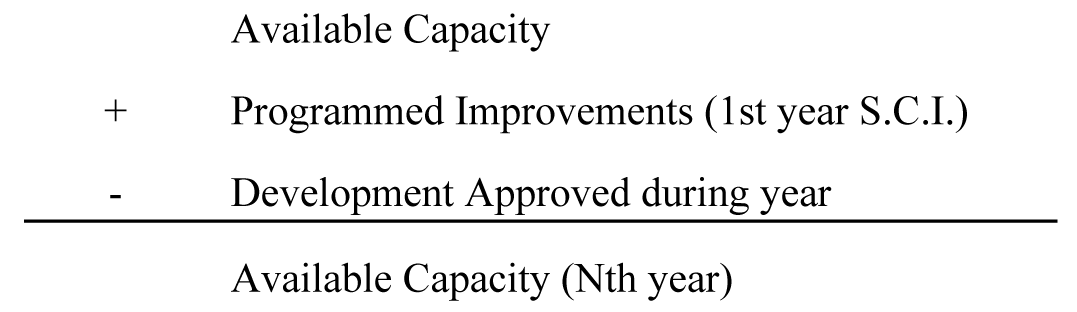
If capital projects identified in the first year of the City's 5-Year Schedule of Capital Improvements were not constructed or placed into service during the identified concurrency period, those projects shall be subtracted from available capacities and, if not provided for in the Capital Budget, removed from capacity available for concurrency purposes. Development projects approved based on service capacities presumed to be available shall not be permitted to proceed until a method to mitigate any deficiency has been approved. Such mitigation shall include, but not be limited to, phasing of a development project, payment of money to construct necessary facilities, or the construction of necessary facilities.
Any subdivision plat or site development plan for which construction has not begun within the time frame specified in this Code shall be considered lapsed and shall forfeit any allocation of service capacity. Upon forfeiture, all capacities so allocated shall be returned to the service/facility provider. The Concurrency Management System shall be approved by Resolution of the City Commission on the first regularly scheduled City Commission meeting in September of each year.
6.01.09 Appealing City's Adequacy Determination. A developer may challenge any concurrency determination made by the City by appealing the decision to the City Commission. The appeal shall be accompanied by substantial, competent evidence that sufficient capacity does exist by virtue of the following:
(A)
The impacts of the proposed development will differ from the impacts estimated by the City as a result of special circumstances of that development;
(B)
Based on the City's own information, the analysis being used has an error in its base data;
(C)
In the case of roads, the applicant presents evidence through travel speed, distance and time studies that impacted roadway links actually operate at higher levels of service than indicated by the City's analysis. Methodology for such travel speed/distance/time studies shall be certified by a licensed professional traffic engineer. In the event the travel speed/distance/time studies are warranted, the City or its agent shall conduct or commission such a study after receiving a fee from the applicant to cover the costs of conducting and analyzing the study. The applicant shall have the opportunity to review the methodology prior to the commencement of the study.
6.01.10 Options for Achieving Compliance. Where it appears, or it has been determined, that there is a lack of capacity to service a proposed development, the developer should consider a variety of methods for achieving compliance. Some possibilities are as follows.
(A)
Plan Amendment. The developer may propose a plan amendment that lowers the adopted level of service standard for the affected facilities and/or services.
(B)
Reduce Impact of Development. The developer may propose a reduction in the scale or impact of the proposed development.
(C)
Phasing of Development. The developer may propose a phasing of the proposed development to match the availability of capacity with the timing of each phase of the development. Specific conditions for permitting each phase to proceed shall be included in an enforceable development agreement or development order to ensure that necessary public facilities and services will be in place when the impacts of the development occur.
(D)
Development Agreement. The developer may propose a development agreement assuring that the required facility capacity will be provided. Any development agreement must provide one or more of the following assurances, acceptable to the City in form and amount, to guarantee the applicant's pro rata share of the cost of completing or providing any public facilities and services that may be necessary to maintain the adopted level of service standards for the subject property:
(1)
Cash escrow;
(2)
Irrevocable letter of credit;
(3)
Prepayment of capacity/connection charges.
Whenever an applicant's pro rata share of a public facility is less than the full cost of the facility, the City shall do one of the following:
(1)
Contract with the applicant for the full cost of the facility, including terms regarding reimbursement of the applicant for costs in excess of the applicant's pro rata share; or
(2)
Obtain assurances from other sources similar to those described above in this Section; or
(3)
Amend the Comprehensive Plan to modify the adopted level of service standard so as to reduce the required facility to equal the applicant's needs.
(E)
Alternative Transportation Study. Where a developer disagrees with the results obtained by the City in its concurrency review regarding transportation, a transportation study may be performed at the option and expense of the developer. The results of the study shall be considered by the City in subsequent determinations regarding the development's compliance with concurrency requirements.
(F)
Other Transportation Studies. For those roadway facilities that indicate a lower LOS than the adopted standard of the City's Comprehensive Plan, the City shall allow applicants to perform an operating LOS assessment based upon procedures outlined in the 1985 Highway Capacity Manual. A discussion of any proposed transportation system management and/or mitigation strategies shall be included in the study. The transportation study shall be signed and sealed by a registered professional engineer. The cost of this assessment shall be borne by the applicant.
6.02.00 - Development Agreements.
6.02.01 General Provisions. The lack of certainty in the approval of development can result in a waste of economic and land resources, discourage sound capital improvement planning and financing, escalate the cost of housing and development, and discourage commitment to comprehensive planning. Assurance to a developer that upon receipt of his development permit he may proceed in accordance with existing laws and policies, subject to the conditions of a development agreement, strengthens the public planning process, encourages sound capital improvement planning and financing, assists in assuring there are adequate capital facilities for the development, encourages private participation in comprehensive planning, and reduces the economic costs of development.
It is the intent of this Section to encourage a stronger commitment to comprehensive and capital facilities planning, ensure the provision of adequate public facilities for development, encourage the efficient use of resources, and reduce the economic cost of development, all in conformity with and to carry out the purposes of the Wauchula Comprehensive Plan and the Local Government Comprehensive Planning and Land Development Regulation Act.
6.02.02 Authority. This intent is effected by exercising the authority granted the City to enter into development agreements with developers under F.S. Sections 163.3220 through 163.3243. This Section shall be regarded as supplemental and additional to the powers conferred upon the City by other laws and shall not be regarded as in derogation of any powers now existing.
6.02.03 Procedures.
6.02.03.01 Application for Development Agreement. The developer shall make application for a development agreement through the Development Director and pay an application fee set by resolution.
6.02.03.02 Public Hearing. Before entering into, amending or revoking a development agreement, the City shall conduct at least two public hearings, one of which shall be held by the Planning and Zoning Board.
6.02.03.03 Notice of Hearing. Notice of intent to consider a development agreement shall be advertised approximately seven days before each public hearing in a newspaper of general circulation and readership in Hardee County. Notice of intent to consider a development agreement shall also be mailed to all affected property owners before the first public hearing. The day, time, and place at which the second public hearing will be held shall be announced at the first public hearing.
6.02.03.04 Contents of Notice. The notice shall specify the location of the land subject to the development agreement, the development uses proposed on the property, the proposed population densities, and the proposed building intensities and height and shall specify a place where a copy of the proposed agreement can be obtained.
6.02.04 Contents and Duration of Development Agreement.
(A)
Contents. A development agreement shall include the following:
(1)
A legal description of the land subject to the agreement and the names of its legal and equitable owners.
(2)
The duration of the agreement.
(3)
The development uses permitted on the land, including population densities, and building intensities and height.
(4)
A description of public facilities that will service the development, including who shall provide such facilities; the date any new facilities, if needed, will be constructed; and a schedule to assure public facilities are available concurrent with the impacts of the development.
(5)
A description of any reservation or dedication of land for public purposes.
(6)
A description of all local development permits approved or needed to be approved for the development of the land.
(7)
A finding that the development permitted or proposed is consistent with the City's Comprehensive Plan and land development regulations.
(8)
A description of any conditions, terms, restrictions, or other requirements determined to be necessary by the City for the public health, safety, or welfare of its citizens.
(9)
A statement indicating that the failure of the agreement to address a particular permit, condition, term, or restriction shall not relieve the developer of the necessity of complying with the law governing said permitting requirements, conditions, term, or restriction.
(10)
A development agreement may provide that the entire development or any phase thereof be commenced or completed within a specific period of time.
(B)
Duration of Agreement. The duration of a development agreement shall not exceed five years. It may be extended by mutual consent of the City and the developer, subject to a public hearing in accordance with [Sections] 6.02.03.02—6.02.03.04 above.
6.02.04.01 Applicability of Laws.
(A)
Consistency with Plan And Regulations. A development agreement and authorized development shall be consistent with the City's Comprehensive Plan and land development regulations.
(B)
Development Governed By Laws in Effect At Execution. The City's laws and policies governing the development of land at the time of the execution of the development agreement shall govern the development of the land for the duration of the development agreement.
(C)
Applicability of Subsequent Laws. The City may apply subsequently adopted laws and policies to a development that is subject to a development agreement only if the City has held a public hearing and determined:
(1)
They are not in conflict with the laws and policies governing the development agreement and do not prevent development of the land uses, intensities, or densities in the development agreement;
(2)
They are essential to the public health, safety, or welfare, and expressly state that they shall apply to a development that is subject to a development agreement;
(3)
They are specifically anticipated and provided for in the development agreement;
(4)
The City demonstrates that substantial changes have occurred in pertinent conditions existing at the time of approval of the development agreement; or
(5)
The development agreement is based on substantially inaccurate information supplied by the developer.
(D)
Rights Vested Pursuant to Common Law. This Section does not abrogate any rights that may vest pursuant to common law.
6.02.05 Review, Amendment, Termination.
(A)
Periodic Review of Agreements. The City shall inspect land subject to development agreement at least once every 12 months to determine if there has been demonstrated good faith compliance with the terms of the development agreement. If the City finds, on the basis of substantial competent evidence, that there has been a failure to comply with the terms of the development agreement, the agreement may be revoked or modified by the City.
(B)
Amendment or Cancellation of Agreement. A development agreement may be amended or canceled by mutual consent of the parties to the agreement or by their successors in interest.
(C)
Modification or Revocation to Comply with Subsequent State and Federal Law. If state or federal laws are enacted after the execution of a development agreement that are applicable to and preclude the parties' compliance with the terms of a development agreement, such agreement shall be modified or revoked as is necessary to comply with the relevant state or federal laws.
6.02.06 Recording and Enforcement.
(A)
Recording of Agreement. Within 14 days after the City enters into a development agreement, the City shall record the agreement with the clerk of the circuit court. A copy of the recorded development agreement shall be submitted to the DEO within 14 days after the agreement is recorded. The burdens of the development agreement shall be binding upon, and the benefits of the agreement shall inure to, all successors in interest to the parties to the agreement.
(B)
Enforcement of Agreement. Any party, any aggrieved or adversely affect person as defined in F.S. 163.3215(2), or the DEO, may file an action for injunctive relief in circuit court to enforce the terms of a development agreement or to challenge the validity of the agreement.
6.03.00 - Development Exactions and Dedications.
6.03.01 Dedication of Sites for Public Uses or Fee In Lieu.
(A)
Parks.
(1)
Where an evaluation under the Concurrency Management System indicates that additional usable recreation land and facilities are needed to maintain the adopted level of service standard, the developer shall dedicate land of suitable size, topography and general character to the City or pay a fee that is equal to the fair market value of the land otherwise required to be dedicated. The required acreage or fee shall be determined by the Development Director based on information supplied in the Concurrency Test Statement submitted in connection with the proposed development.
Conditions for the City's acceptance of dedicated recreation land shall be established in a Development Agreement under the provisions of Section 6.02.00.
(2)
Where dedication of recreation land is not required to maintain the adopted level of service, the City may refuse to accept such land, or establish reasonable conditions for acceptance. Proposed recreational uses must be consistent with the Future Land Use Map of the Wauchula Comprehensive Plan. Other conditions may include, but are not limited to, the following:
a.
Land must be readily accessible and usable for recreational purposes.
b.
Land must be fully or partially developed for recreational use at time of acceptance.
c.
The facility would meet a specific recreational need of the City (i.e., picnic areas, boat launch facilities).
(B)
Right-of-Way. Right-of-way required to serve all development shall be dedicated in accordance with the requirements of Article 3 of this Code. Where subdivisions are bordered by public right-of-way, additional right-of-way shall be dedicated so as to meet minimum widths specified in the comprehensive plan. Where dedicated right-of-way is extended to an adjoining property or street, there shall be no reserved strips affording private control of future access. The City may require public reserved strips where such reservations promote the public health and safety and implement the comprehensive plan.
Where right-of-way has been dedicated independent of any requirement of this Code or the Comprehensive Plan, the City may refuse to accept such right-of-way, or establish such conditions for acceptance as the City Commission determines to be reasonable.
6.03.02 Dedication of Utility Easements. Except where alleys are provided for the purpose of access and utility placement, easements of no less than 15 feet in width, or wider as the City Engineer deems necessary, shall be dedicated for the installation of underground utilities by the City or franchised utility providers. Easements for watercourses or drainageways traversing a subdivision shall be of a width sufficient to convey the volume of stormwater projected to be generated by the 25-year storm event. Such easements shall be approved by the City Engineer.

