
Wauchula City Zoning Code
ARTICLE 8
- ADMINISTRATION AND ENFORCEMENT
8.01.00 - Development Officials.
At the option of the City Commission, both of the positions established in this Section, that of the Development Director and the Building Official, may be assigned to one person.
8.01.01 Development Director. The Development Director shall supervise and administer all staff activities regarding comprehensive planning, zoning, development review, issuance of permits, certificates of occupancy, and code enforcement. He/she shall perform duties prescribed by this Code, as well as any others assigned by the City Manager. The Development Director shall be duly qualified for these responsibilities through appropriate education and work experience. The Development Director shall have a thorough knowledge of the provisions of the Comprehensive Plan and this Code, and shall have the authority to interpret the intent and meaning of this Code in situations where its applicability is not clear. Appeals of administrative decisions of the Development Director may be made to the City Commission.
Other specific duties of the Development Director are as follows:
(A)
Advise and cooperate with the City Manager in the implementation, amendment, and enforcement of this Code and the Comprehensive Plan.
(B)
Attend all public hearings at which zoning and comprehensive planning matters are discussed, including meetings of the Planning and Zoning Board and City Commission. He will attend meetings of the Code Enforcement Board or Special Magistrate when necessary.
(C)
Accept and process all applications for amendments to the Comprehensive Plan, zoning actions, and variances.
(D)
Certify the accuracy of the Official Zoning Map and amendments thereto.
(E)
Collect and account for all required application fees.
(F)
Grant such administrative approvals as are allowed under the provisions of this Code for Minor Subdivisions, Temporary Use Permit, Antenna/Dish Permit, Sign Permit, and others as identified in this Code.
(G)
Receive applications and application fees for Comprehensive Plan Amendment, Rezoning, Planned Unit Development, Landscaping Plan, Site Development Plan, Subdivision Plat, Conditional Use Permit, Special Exception Use Permit, Request for a Variance, and others as identified in this Code.
(H)
Evaluate each proposed Comprehensive Plan Amendment, Rezoning, Planned Unit Development, Landscaping Plan, Site Development Plan, Subdivision Plat, Conditional Use, Special Exception Use, and Request for a Variance, for consistency with this Code and the Comprehensive Plan, and others as identified in this Code.
(I)
Evaluate each application for a Development Order, including Building Permits, to determine whether it meets applicable Concurrency requirements.
(J)
Ensure that all time limits prescribed by this Code are met.
(K)
Monitor the progress of all development applications through the review process and be available to respond to inquiries from interested persons.
(L)
Any other duties assigned by the City Manager.
8.01.02 Building Official. The Building Official shall be responsible for review of building construction plans, the issuance of Building Permits and certificates of occupancy, and the inspection of construction sites and buildings under construction. He/she shall have a working knowledge of the Florida Building Code and be familiar with electrical, fire, zoning, and other codes having a bearing on building construction in Wauchula. The Building Official shall be duly qualified for these responsibilities through appropriate certification, education, and work experience. Alternatively, the City may retain a licensed professional contractor/builder on a part-time basis to perform technical review of building activities.
8.02.00 - Administrative Approvals by the Development Director and/or Building Official.
The Development Director and/or Building Official shall have the authority to approve the following, subject to conditions set forth below and in applicable provisions of this Code:
8.02.01 Building Permit. A Building Permit is required prior to construction or alteration.
(A)
It shall be unlawful to commence any excavation or construction or any alteration of any structure until the Development Director or Building Official has issued a building permit authorizing such work.
(B)
If no building permit has been issued and a builder begins or continues to build, a stop work order may be issued by the administrative official or a restraining order may be obtained upon application to the proper court of record, and evidence of the lack of a building permit shall establish a prima facia case for the issuance of the restraining order.
(C)
Application for a Building Permit. In applying to the Development Director and/or Building Official for a Building Permit, the applicant shall submit a plat along with the application, drawn to scale, and showing:
(1)
The dimensions of the lot to be built upon;
(2)
The outside dimensions of all structures;
(3)
Setbacks;
(4)
Off-street parking, if required;
(5)
Landscaping placement and stormwater retention ponds, if required;
(6)
Easements; and
(7)
Any other information necessary for determining conformance with this Code.
(D)
The Development Director or the Building Official shall act upon applications for Building Permits within two weeks from the date of their submission.
(E)
Duration of Permit.
(1)
Construction shall commence within six months from date of issuance.
(2)
The permit expires after one calendar year. If the work is not completed, work must cease until a new building permit is obtained.
(3)
One or more extensions may be granted by the Development Director or the Building Official, not to exceed 90 days each.
8.02.02 Certificate of Occupancy.
(A)
The Development Director is the enforcement officer for all regulations contained in this Code. The Development Director shall implement a procedure for periodic inspection of development work in progress to ensure compliance with the development permit and final development order that authorized the activity.
(B)
Upon completion of work authorized by a development permit or development order, and before the development is occupied, the developer shall apply to the Building Official for a Certificate of Occupancy. The Building Official shall inspect the work and issue the certificate, if all work is found to be in conformity with the permit or order.
8.02.03 Administrative Approval of Minor Field Adjustments. The Development Director has the authority to approve minor field adjustments. A minor field adjustment is a deviation from a final development order that falls within the following limits and that is necessary in light of technical or engineering considerations first discovered during actual development and not reasonably anticipated during the initial approval process:
(A)
Alteration of the location of any road, walkway, landscaping, or structure by not more than five feet.
(B)
Reduction of the total amount of open space by not more than five percent, or reduction of the yard area or open space associated with any single structure by not more than five percent; provided that such reduction does not permit the required yard area or open space to be less than that required by this Code.
(C)
If the work is found to have one or more minor field adjustments, the Development Director shall request a revised site plan from the applicant showing the deviations and amend the development order to conform to actual development. The Development Director may, however, refer any minor field adjustment that significantly affects the development's compliance with the purposes of this Code to the Planning and Zoning Board for treatment as a major deviation.
(D)
Major deviation defined. A major deviation is a deviation other than a minor field adjustment, from a final development order or permit.
8.02.04 Major deviation from development permits and development orders.
(A)
If the work is found to have one or more major deviations, as defined in Section 8.02.03(D), the Development Director shall:
(1)
Place the matter on the next agenda of the Planning and Zoning Board, allowing for adequate notice.
(2)
Issue a stop work order and/or refuse to allow occupancy of all or part of the development if deemed necessary to protect the public interest. The order shall remain in effect until the Development Director determines that work or occupancy may proceed pursuant to the decision of the Planning and Zoning Board.
(3)
Refer the matter to the code inspector if it appears that the developer has committed violations within the jurisdiction of the Code Enforcement Board or Special Magistrate.
(B)
If the matter falls within the jurisdiction of the Code Enforcement Board or Special Magistrate, the Code Enforcement Board or Special Magistrate shall hold a public hearing on the matter and shall take one of the following actions:
(1)
Order the developer to bring the development into substantial compliance (i.e. having no or only minor deviations) within a reasonable period of time. The development order or permit may be revoked if this order is not complied with.
(2)
Amend the development order or permit to accommodate adjustments to the development made necessary by technical or engineering considerations first discovered during actual development and not reasonably anticipated during the initial approval process. Amendments shall be the minimum necessary to overcome the difficulty, and shall be consistent with the intent and purpose of the development approval given and the requirements of this Code.
(3)
Revoke the relevant development order or permit based on a determination that the development cannot be brought into substantial compliance and that the development order or permit should not be amended to accommodate the deviations.
8.02.05 Revocation of development order. Should a development order or permit be revoked, development activity shall not proceed on the site until a new development order or permit is granted in accordance with procedures for original approval.
8.02.06 Setback adjustments.
(A)
In single family zoning districts, the Development Director or Building Official may approve reduction of side and rear setbacks for principal and accessory structures (excluding swimming pools) by no more than ten percent subject to the following conditions:
(1)
The setback requirement is established by the zoning district and no other section of this Code;
(2)
The total structural coverage of the lot or building site shall not exceed 65%;
(3)
The approval would not result in the encroachment of a structure into an existing utility or drainage easement held by the City;
(4)
A certified survey shall be submitted by the applicant verifying building locations and structural coverage;
(B)
Lots of record less than 51 feet in width and more than 25 feet in width shall have a minimum side yard setback of five feet. For a single family home on these small lots, the Development Director may vary the front and rear setbacks so as not to render the lot "unbuildable." The front and rear setbacks should complement the setbacks of the surrounding properties. See Section 7.11.02 for further requirements for nonconforming lots of record.
(C)
At his discretion, the Development Director or Building Official may deny the approval and refer the application to the City Commission as a variance or for approval of a Site Development Plan.
8.02.07 Temporary office or construction trailer. The Development Director or Building Official may authorize the use of a manufactured home or other temporary structure not meeting the requirements of the Florida Building Code at the construction site of an approved Site Development Plan. The temporary structure may be used only as an office, tool shed, or other facility in support of construction work, and shall not be used for living accommodations, for sales/rental of lots or offices, or for any other purpose.
The applicant shall designate the exact location of the temporary structure on the Site Development Plan, and shall place it only in the approved location. The temporary structure shall not be installed prior to issuance of the building permit for the development site, and shall be removed upon expiration of the building permit or issuance of the Certificate of Occupancy, whichever comes first. If a manufactured home is to be used, the wheels and axles shall not be removed.
8.02.08 Temporary manufactured home or recreational vehicle for use during construction of a residence or as disaster relief not related to a declaration of emergency. The Development Director or Building Official may authorize the use of a manufactured home or recreational vehicle as a temporary residence during construction of a permanent residence or in the case of a disaster situation such as fire, flood, or hurricane, with the following conditions:
(A)
The lot or building site is at least one-quarter acre in size;
(B)
The applicant has received approval of a building permit for construction of a single family residence on the property;
(C)
The temporary unit shall be placed at least 20 feet from all lot lines, and ten feet from any other existing or planned structure and shall be located in the side or rear yard;
(D)
The manufactured home or recreational vehicle unit must be connected to a public sewer system or, upon approval of the Development Director, have received a septic tank permit from the Hardee County Health Department;
(E)
Wheels and axles shall not be removed;
(F)
The manufactured home or recreational vehicle shall be removed from the building site within 30 days of the Certificate of Occupancy for the permanent residence, or at the end of a one-year period commencing at the date of its installation, whichever comes first; and
(G)
This administrative approval may not be renewed or granted a second time for the same building site.
8.02.09 Use of temporary shelter after declaration of emergency. The City enforces temporary shelter requirements after a declaration of emergency consistent with the requirements from F.S. § 166.0335.
(A)
For the purposes of this section, the term "temporary shelter" includes, but is not limited to, a recreational vehicle, trailer, or similar structure placed on a residential property.
(B)
Notwithstanding any other law, ordinance, or regulation to the contrary, following the declaration of a state of emergency issued by the Florida Governor for a natural emergency as defined in [F.S.] § 252.34(8) during which a permanent residential structure was damaged and rendered uninhabitable, a municipality may not prohibit the placement of one temporary shelter on the residential property for up to 36 months after the date of the declaration or until a certificate of occupancy is issued on the permanent residential structure on the property, whichever occurs first, if all of the following circumstances apply:
(1)
The resident makes a good faith effort to rebuild or renovate the damaged permanent residential structure, including, but not limited to, applying for a building permit, submitting a plan or design to the municipality, or obtaining a construction loan.
(2)
The temporary shelter is connected to water and electric utilities and does not present a threat to health and human safety.
(3)
The resident lives in the temporary structure.
8.02.10 Continued Use of Existing Single-Family Home During Construction of a Replacement Single-Family Home. The Development Director or Building Official may authorize the continued use of an existing single-family home during the construction of a new replacement single-family home with the following conditions:
8.02.10 Continued use of existing single-family home during construction of a replacement single-family home. The Development Director or Building Official may authorize the continued use of an existing single-family home during the construction of a new replacement single-family home with the following conditions:
(A)
The lot or building site is large enough to accommodate the existing single-family home and the construction of the replacement home while meeting all development standards for the district as listed in Table 2.02.01(C);
(B)
The property owner must provide a notarized letter explaining the reason why the existing home should remain during construction and the owner's intent to move into the new construction and have the existing house demolished within 30 days after the final certificate of occupancy on the new construction is issued;
(C)
Demolition of the existing single-family structure must occur within 30 days after issuance of the certificate of occupancy.
(Ord. No. 2014-17, § 2(Exh. A), 12-8-14; Ord. No. 2023-08, § 2(Exh. A), 4-8-24)
8.03.00 - Development boards.
8.03.01 Planning and Zoning Board.
(A)
At its own option, the City Commission may appoint itself as the Planning and Zoning Board (Local Planning Agency) and serve all associated functions of said board. The functions, powers, and duties of the Planning and Zoning Board shall be as follows:
(1)
Act as Local Planning Agency pursuant to the Local Government Comprehensive Planning and Land Development Regulation Act, 163, Part II, F.S., and perform the functions and duties prescribed herein.
(2)
Review and make recommendations to the governing body on any matter relating to the planning of the City, including the evaluation and appraisal of the Comprehensive Plan, Comprehensive Plan Amendments, the development and amendment of the Unified Land Development Code, also known as the Land Development Regulations, and other matters the City Commission may defer or refer to the said Board.
(3)
Consider the need for revision or addition of regulations in this Code, and recommend changes to the City Commission.
(4)
Consider the need for revision of the Comprehensive Plan, and recommend changes to the City Commission.
(5)
Advise and make recommendations to the City Commission regarding applications for amendments to the Official Zoning Map, requests for variances, or other special designations on property within the City.
(6)
Review and decide special exception applications.
(7)
At the request of the Development Director, interpret and determine the intent of provisions of this Code which are unclear or in conflict with other regulations.
(8)
Submit annually to the City Manager a list of recommended capital improvement items, no later than March 1st, prior to the beginning of the budget year. The list shall be arranged in order of preference, with recommendations as to which projects shall be completed in which year.
(B)
Appointment of members.
(1)
The Planning and Zoning Board shall have five voting members, all of whom shall be appointed by the City Commission. Every member shall be a voting member of the Board when in attendance.
(2)
The Planning and Zoning Board shall include a representative of the school district appointed by the school board as a nonvoting member of the Planning and Zoning Board to attend those meetings at which the Board considers comprehensive plan amendments and rezonings that would, if approved, increase residential density on the property that is the subject of the application.
(3)
Each member of the Planning and Zoning Board that is appointed by the City Commission shall reside or own a business in the City, and at least two members of the Board shall reside in the City.
(4)
Each member shall be appointed to a three year term. In the event that all members are appointed at the same time, three members shall be appointed for an initial term of one year, one member shall be appointed for an initial term of two years, and one member shall be appointed for an initial term of three years.
(5)
Reappointment to fill vacancies shall be made so as to continue the staggered pattern and shall be for terms of three years for all members.
(6)
Any member may be removed from office by the City Commission upon written charges and after public hearing.
(7)
At the first meeting held after January 1 of each year, the Board shall elect a Chairman and a Vice-Chairman. The Chairman, or in his absence the Vice-Chairman, shall preside over all meetings of the Board. Officers shall serve terms of one year.
(8)
The Chairman may establish subcommittees and appoint members as needed to carry out the purposes of the Board.
(9)
If any member fails to attend three consecutive meetings, the Board may declare the member's office vacant and notify the City Commission.
(10)
All vacancies, whether by resignation, dismissal, or expiration of the term of office, shall be filled promptly by the City Commission.
(11)
Members may serve with compensation, including reimbursement for such travel, mileage, and per diem expenses as may be incurred.
(C)
Procedure for meetings of the Board.
(1)
The Board shall adopt procedures or by-laws to carry out its purposes. All rules must conform to this Code, other City ordinances, and State law.
(2)
The Board shall meet once each month when business is placed on the agenda or by decision of the Chairman. The Chairman may cancel a regular monthly meeting of the Board for lack of an agenda.
(3)
A sound recording of the meetings shall be made and kept on file with the City Clerk's office, as well as summary minutes of the decisions and recommendations by the Board. The City Clerk shall keep the minutes of the proceedings of the Planning and Zoning Board, indicating the attendance of each member, and the decision on every question.
(4)
Three voting members shall constitute a quorum.
(5)
Each decision of the Board must be approved by a majority vote of the members present.
(D)
Notice of Public Hearings.
(1)
Section 8.06.00 addresses notice requirements.
8.03.02 Code Enforcement Board or Special Magistrate. A Code Enforcement Board and an Alternate Special Magistrate Code Enforcement System is created in Sections 2-93 to 2-96 and 3-1 to 3-13 of the Code of Ordinances to enforce the provisions of this Code pursuant to Chapter 162 and 166 F.S.
8.03.03 Wauchula Historic Preservation Board. The City of Wauchula previously established and hereby ratifies and confirms the Wauchula Historic Preservation Board to promote the educational, cultural, and economic welfare of the public.
(A)
Appointment of members.
(1)
The Wauchula Historic Preservation Board shall consist of five members appointed by the City Commission. Appointments shall be made on the basis of civic pride, integrity, experience, and interest in the field of historic preservation.
(2)
The membership shall consist of three professional and two lay members. All of the members but one shall be residents of the great Wauchula area (areas served by Wauchula utilities). The remaining member shall be a business representative from a business located within the historic district.
(3)
Upon the expiration of each term, a successor shall be appointed by the City Commission, to fill such vacancy, for a term of four years. Other vacancies in office shall be promptly filled by appointment of the City Commission for the remainder of the unexpired term.
(4)
Professional members shall may be appointed from the disciplines of architecture, landscape architecture, accounting, building design, history, architectural history, planning, archaeology, real estate development, law, building construction, or other historic preservation related disciplines such as urban planning, American studies, American civilization, cultural geography or cultural anthropology. In the absence of the availability or willingness of such professionals, lay persons shall be appointed to the professional positions if they have demonstrated special interest, experience, or knowledge in history, architecture, or related disciplines.
(B)
Meetings of Historic Preservation Board.
(1)
Meetings of the Historic Preservation Board shall occur at regular intervals, but no less than four times each year.
(2)
The Board shall provide public notice of all hearings and meetings as required by the Land Development Code, the Code of Ordinances, and F.S. ch. 286, which meetings and hearings shall be open to the public. The Board shall prepare and maintain for public inspection minutes of all Board meetings and hearings, including the factual basis for any and all determinations, recommendations, and decisions reached by the Board. Minutes shall be kept on file and available for public inspection as required by F.S. chs. 119 and 286, and other applicable law.
(3)
All applicants shall be given written notification of decisions of the Board.
(4)
Three members shall constitute a quorum for meetings, and an affirmative vote of a majority of members present at any meeting shall be necessary for any action to be taken by the Board. Appropriate local officials, owners of record, and applicants shall be notified of proposed Board actions as required by the Land Development Code, the Code of Ordinances, and other applicable law.
(5)
The Board shall prepare and maintain for public inspection a written annual report of its historic preservation activities, cases, decisions, and qualifications of its members.
(C)
The duties and responsibilities of the Historic Preservation Board shall be those set forth in Chapter 2, Article VI of the Code of Ordinances.
(Ord. No. 2024-01, § 3, 3-11-24)
8.04.00 - Duties of City Commission.
(A)
Powers and duties in the areas of development and land use regulation.
(1)
Adopt and amend the Comprehensive Plan.
(2)
Adopt and amend the Land Development Code.
(3)
Appoint members of the Planning and Zoning Board, Wauchula Historic Preservation Board, and Code Enforcement Board or Special Magistrate.
(4)
Determine the need for and appoint members of additional boards, committees, and subcommittees to investigate and make decisions on various land use and development issues.
(5)
Establish fees for application for a comprehensive plan amendment, zoning actions, site development plan review, landscape plan review, application for a conditional use, application for a variance, application for a special exception, and other activities carried out under the provisions of this Code.
(6)
Make final decisions on requested changes to the Comprehensive Plan, Zoning Ordinance and Map, Planned Unit Developments, and Conditional Uses.
(7)
Make final decisions on requests for variances where, by reason of the exception of narrowness, shallowness, or unusual shape of a site on the effective date of this Code, or by reason of exceptional topographic conditions, or some other extraordinary situation or condition of that site, the literal enforcement of the dimensional requirements (height or width of building or size of yards, but not dwelling unit or population density) of this Code would deprive the applicant of reasonable use of the land in a manner enjoyed by other landowners in the same zoning district. The Commission may impose any reasonable conditions or restrictions in granting said variance.
(8)
Hear and decide on appeals where it is alleged there is error in any order, requirement, decision, or determination made by the administrative official in the enforcement of this Code. This power shall include the hearing of any appeal of an administrative official's decision concerning the amortization of any nonconforming use or any calculation of amortization thereunder.
(9)
Accept the Final Plat for a new subdivision.
8.05.00 - Official Zoning Map.
(A)
The zoning districts listed in Article 2 and the boundaries thereof are shown upon the Official Zoning Map or series of maps of the City enacted as law immediately upon enactment of this Code and made a part thereof, such maps being designated as the "Official Zoning Map of the City of Wauchula." This map or maps and all notations, references, and other information properly inscribed thereon are hereby incorporated as a part of this Article.
(B)
The boundaries of such districts as are shown on the Official Zoning Map, together with all regulations in this Code that are applicable in such districts, are hereby established and declared to be in effect upon all land included within the boundaries of each and every district shown upon said map(s).
(C)
Within 20 working days of action by the City Commission or Planning and Zoning Board, the Official Zoning Map will be amended to reflect all approved changes in zoning classifications, land uses, variances, and any other relevant information pertaining to permitted uses or development standards in the City of Wauchula.
(D)
The legal description advertised for public hearing purposes on a zoning action or variance on any parcel of property shall override any and all of the rules o Section 8.05.01(A) through (F) for interpretation of district boundaries.
8.05.01 Rules of Interpretation of District Boundaries. Where uncertainty exists as to the boundaries of districts as shown on the Official Zoning Map, the following rules shall apply:
(A)
Boundaries indicated as approximately following the center lines of streets, highways, or alleys shall be construed to follow such center lines;
(B)
Boundaries indicated as approximately following platted lot lines shall be construed as following such lot lines;
(C)
Boundaries indicated as following railroad lines shall be construed to be midway between the main tracks;
(D)
Boundaries indicated as following shore lines shall be construed to follow the high water line, and in the event of a lowering of the water level shall be construed as moving downward to the current water level;
(E)
Boundaries indicated as following the center lines of streams, rivers, canals, lakes, or other bodies of water shall be construed to follow such center lines; and
(F)
Boundaries indicated as parallel to or extensions of features indicated in subsections (A) through (E) above shall be so construed.
8.06.00 - Public Hearings/Public Notice.
Due Public Notice. No change in land use classification or designation, zoning classification or designation, variance, special exception, plan amendment, or amendment to this Code, may be considered by the Planning and Zoning Board or the City Commission until due public notice has been given of a public hearing; and, all changes, except special exceptions and variances, are made by ordinance. Public Hearings for Comprehensive Plan amendments are regulated under Section 8.07.00. An emergency ordinance or a resolution may not be used to make Comprehensive Plan amendment changes. Specific regulations pursuant to Chapter 166.041, F.S., are listed below.
(A)
All ordinances acted on by the City must be read on two separate days and shall, at least ten calendar days before adoption, be noticed once in a newspaper of general circulation in the municipality. The notice of proposed enactment shall state the date, time, and place of the meeting; the title or titles of proposed ordinances; and the place or places within the municipality where such proposed ordinances may be inspected by the public. The notice shall also advise that interested parties may appear at the meeting and be heard with respect to the proposed ordinance. All requests shall be submitted in writing to the Development Director, together with applicable fees, which will have been established by the City Commission.
(B)
Notice of Planning and Zoning Board public hearings shall be given at least ten calendar days in advance of the meeting and public hearing. Additionally, notice of the public hearings shall be posted at City Hall and on the City's website least ten calendar days prior to the public hearing.
(C)
For each zoning or variance application to be considered at a public hearing, a notice shall be mailed to all property owners of record within a radius of 500 feet of the affected property, provided, however, that failure to receive such notice shall not invalidate any action or proceedings taken at the public hearing. A sign stating the date and location of the hearing, the type of request for zoning or variance being considered, and the name of the owner requesting the hearing shall be posted on the affected property seven calendar days prior to the hearing in a conspicuous location.
(D)
Other Local Government Notification. When a proposed zoning action, variance, or special exception lies within 200 feet of the jurisdiction of another local government, the Planning and Zoning Board or local governing body of that local government shall be notified, so that it may have an opportunity to send a representative to the public hearing to speak on its behalf.
8.06.01 Advertisement of Public Hearings for Zoning Changes that are Petitioner Initiated - (F.S. 166.041). In cases in which the proposed ordinance changes the actual zoning map designation for a parcel(s) of land public notice shall be enacted pursuant to Section 8.06.00(A).
8.06.02 Advertisement of Public Hearings for Zoning Changes Involving Less than 10 Acres that are City Initiated - (F.S. 166.041).
(A)
Notice By Mail: In cases in which the City initiated proposed ordinance changes the actual zoning map designation for a parcel(s) of land involving less than ten contiguous acres of the total land area of the municipality, the governing body shall direct the clerk of the governing body to notify by mail each real property owner whose land will be redesignated by enactment of the ordinance and whose address is known by reference to the latest ad valorem tax records. Notice shall be mailed to all property owners whose land will be affected at least 30 calendar days prior to the date of the public hearing.
(B)
Contents of the Notice. The notice shall state the substance of the proposed ordinance as it affects that property owner and shall set a time and place for one or more public hearings on such ordinance. A copy of the notice shall be kept available for public inspection during the regular business hours of the office of the clerk.
(C)
Public Notice. The public notice shall be enacted pursuant to Section 8.06.00(A).
8.06.03 Advertisement of Public Hearings for Zoning Changes Involving ten Acres or More that are City Initiated - (F.S. 166.041).
(A)
In cases in which the City initiated proposed ordinance changes the actual zoning map designation for a parcel(s) of land involving ten contiguous acres or more of the total land area of the municipality: the governing body shall hold two advertised public hearings on the proposed ordinance.
(B)
At least one hearing shall be held after 5:00 p.m. on a weekday, unless the local governing body, by a majority plus one vote, elects to conduct that hearing at another time of day, and the first hearing shall be held at least seven calendar days after the day that the first advertisement is published. The second hearing shall be held at least ten calendar days after the first hearing and shall be advertised at least five calendar days prior to the public hearing. The day, time, and place at which the second public hearing will be held shall be announced at the first public hearing.
(C)
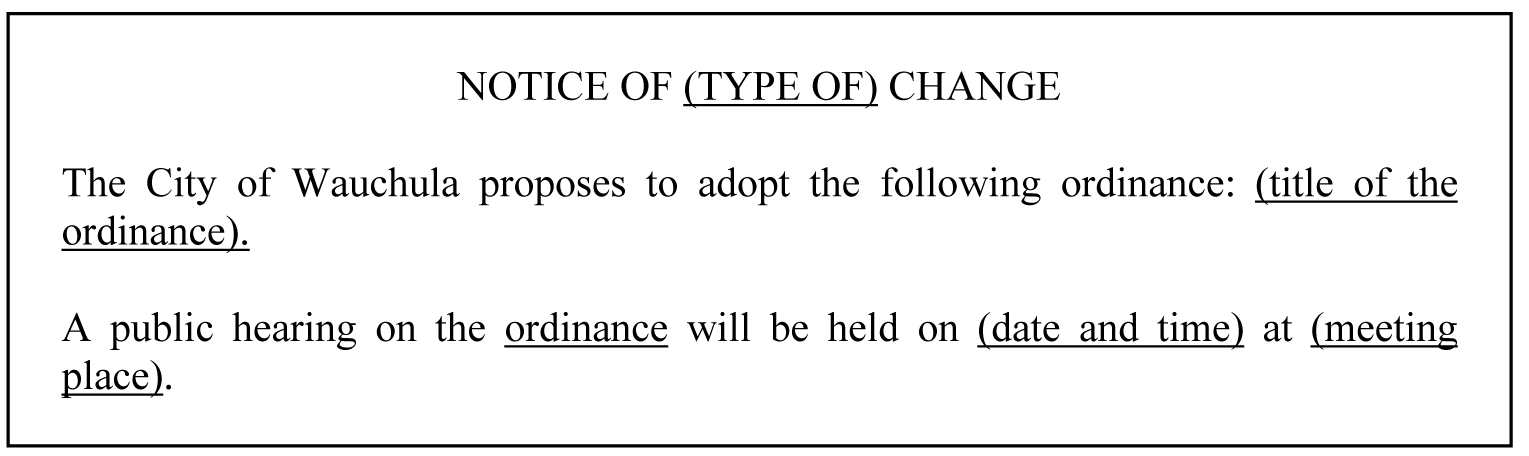
The required advertisements shall be no less than two columns wide by ten inches long in a standard size or a tabloid size newspaper, and the headline in the advertisement shall be in a type no smaller than 18 point. The advertisement shall not be placed in that portion of the newspaper where legal notices and classified advertisements appear. The advertisement shall be placed in a newspaper of general circulation in the City and of general interest and readership in the municipality.
(D)
Advertisement Form.
(E)
The advertisement shall contain a geographic location map that clearly indicates the area covered by the proposed ordinance. The map shall include major street names as a means of identification of the general area.
(F)
Mail-out May Be Done. In lieu of publishing the advertisement as outlined above, the City may mail a notice to each person owning real property within the area covered by the ordinance. Such notice shall clearly explain the proposed ordinance and shall notify the person of the time, place, and location of both public hearings on the proposed ordinance. If mail-outs are completed, the Ordinance must be advertised per the requirements of Section 8.06.00(A).
8.06.04 Advertisement of Public Hearings for Changes to the Actual List of Permitted, Conditional, or Prohibited Uses within a Zoning Category. In cases in which the proposed ordinance changes the actual list of permitted, conditional, or prohibited uses within a zoning category, public notice shall be enacted pursuant to Section 8.06.02, except a geographic location map is not required.
8.07.00 - Statutory Requirements for Comprehensive Plan Amendments.
There are three general types of Comprehensive Plan Amendments: Expedited State Review, State Coordinated Review, and Small Scale. The Expedited State Review Process is utilized for the majority of Comprehensive Plan amendments adopted by local governments. The State Coordinated Review Process is utilized for amendments that are in an area of critical state concern, amendments that propose a rural land stewardship area, amendments that propose a sector plan, or amendments that update a comprehensive plan based on an Evaluation and Appraisal Report. The Small Scale process is utilized for amendments that qualify as small-scale development amendments.
All requests for Comprehensive Plan Amendments shall be submitted in writing to the Development Director, together with applicable fees, which will have been established by the City Commission. Specific regulations for Comprehensive Plan Amendment applications are detailed in Article 7, Section 7.02.00. Comprehensive Plan Amendments may be submitted by the City to DEO for review according to the procedures established in Chapter 163 F.S. The following sections outline the requirements for each type of Comprehensive Plan Amendment.
8.07.01 Expedited State Review Process (consistent with F.S. 163.3184). The Expedited State Review Process is utilized for all Comprehensive Plan amendments except amendments that are in an area of critical state concern, amendments that propose a rural land stewardship area, amendments that propose a sector plan, amendments that update a comprehensive plan based on an Evaluation and Appraisal Report, or amendments that qualify as small-scale development amendments.
(A)
Public Notice Requirements: All procedures for advertisement of a public hearing to adopt an ordinance must be followed as adopted by the City and set forth in Section 8.06.00 above and in keeping with Florida Statutes Chapter 166. According to State Law, the following section (1) must be adhered to:
(1)
The local governing body shall hold at least two advertised public hearings, advertised per the requirements of Section 8.06.03, on the proposed comprehensive plan or plan amendment as follows:
a.
The first public hearing shall be held at the transmittal stage. It shall be held on a weekday at least seven calendar days after the day that the first advertisement is published pursuant to the requirements of Florida Statutes Chapter 166.
b.
The second public hearing shall be held at the adoption stage. It shall be held on a weekday at least five calendar days after the day that the second advertisement is published pursuant to the requirements of Florida Statutes Chapter 166.
(B)
First Public Hearing: After the initial public hearing, the local government shall transmit the amendment and all supporting data and analysis within ten days to the review agencies and any local governments that have filed a written request.
(C)
Comments: Comments from agencies and local governments reviewing the proposed amendment must be received by Wauchula no later than 30 days from the date on which the agency or government received the amendment from Wauchula.
(D)
Second Public Hearing: The local government shall hold its second public hearing, which shall be a hearing on whether to adopt one or more comprehensive plan amendments. If the local government fails, within 180 days after receipt of agency comments, to hold the second public hearing, the amendments shall be deemed withdrawn unless extended by agreement with notice to the DEO and any affected person that provided comments on the amendment. The 180-day limitation does not apply to DRI amendments.
(E)
Adoption Transmittal: All adopted Comprehensive Plan amendments, along with the supporting data and analysis, shall be transmitted within ten working days after the second public hearing to DEO and any other agency or local government that provided timely comments. DEO shall notify the local government of any deficiencies within five working days after receipt of an amendment package. For purposes of completeness, an amendment shall be deemed complete if it contains a full, executed copy of the adoption ordinance or ordinances; in the case of a text amendment, a full copy of the amended language in legislative format with strike-thru/underline changes; in the case of a Future Land Use Map amendment, a color copy of the Future Land Use Map clearly depicting the parcel, its existing future land use designation, and its adopted designation; and a copy of any data and analyses the local government deems appropriate.
(F)
Effective Date: An amendment adopted under the Expedited State Review Process does not become effective until 31 days after DEO notifies the local government that the plan amendment package is complete. If timely challenged, an amendment does not become effective until DEO or the Administration Commission enters a final order determining the adopted amendment to be in compliance.
8.07.02 State Coordinated Review Process (consistent with F.S. 163.3184). The State Coordinated Review Process is utilized for Comprehensive Plan amendments that are in an area of critical state concern, amendments that propose a rural land stewardship area, amendments that propose a sector plan, or amendments that update a comprehensive plan based on an evaluation and appraisal report.
(A)
Public Notice Requirements: All procedures for advertisement of a public hearing to adopt an ordinance must be followed as adopted by the City and set forth in Section 8.06.00 above and in keeping with Florida Statutes Chapter 166. According to State Law, the following section (A) must be adhered to:
(1)
The local governing body shall hold at least two advertised public hearings, advertised per the requirements of Section 8.06.03, on the proposed comprehensive plan or plan amendment as follows:
a.
The first public hearing shall be held at the transmittal stage. It shall be held on a weekday at least seven calendar days after the day that the first advertisement is published pursuant to the requirements of Florida Statutes Chapter 166.
b.
The second public hearing shall be held at the adoption stage. It shall be held on a weekday at least five calendar days after the day that the second advertisement is published pursuant to the requirements of Florida Statutes Chapter 166.
(B)
First Public Hearing: After the initial public hearing, the local government shall transmit the amendment and all supporting data and analysis within ten days to the review agencies and any local governments that has filed a written request. The transmitted document shall clearly indicate on the cover sheet that this plan amendment is subject to the state coordinated review process.
(C)
Comments: Comments from agencies and local governments reviewing the proposed amendment must be received by DEO not later than 30 days from the date on which the DEO received the amendment.
(D)
DEO Review: If DEO elects to review an amendment, DEO shall issue a report giving its objections, recommendations, and comments regarding the proposed plan or plan amendment within 60 days after receipt of the amendment. DEO may make objections, recommendations, and comments in its report regarding whether the amendment is in compliance and whether the amendment will adversely impact important state resources and facilities.
(E)
Second Public Hearing: The local government shall hold its second public hearing, which shall be a hearing on whether to adopt one or more comprehensive plan amendments. If the local government fails, within 180 days after receipt of agency comments, to hold the second public hearing, the amendments shall be deemed withdrawn unless extended by agreement with notice to DEO and any affected person that provided comments on the amendment. The 180-day limitation does not apply to DRI amendments.
(F)
Adoption Transmittal: All adopted Comprehensive Plan amendments, along with the supporting data and analysis, shall be transmitted within ten days after the second public hearing to the DEO and any other agency or local government that provided timely comments. DEO shall notify the local government of any deficiencies within five working days after receipt of an amendment package. For purposes of completeness, an amendment shall be deemed complete if it contains a full, executed copy of the adoption ordinance or ordinances; in the case of a text amendment, a full copy of the amended language in legislative format with strike-thru/underline changes; in the case of a Future Land Use Map amendment, a color copy of the Future Land Use Map clearly depicting the parcel, its existing future land use designation, and its adopted designation; and a copy of any data and analyses the local government deems appropriate.
(G)
Notice of Intent: After DEO makes a determination of completeness regarding the adopted plan or plan amendment, DEO shall have 45 days to determine if the plan or plan amendment is in compliance. Unless the amendment is substantially changed from the one commented on, DEO's compliance determination shall be limited to objections raised in the objections, recommendations, and comments report. During the 45 days, DEO shall issue, through a senior administrator or the secretary, a notice of intent to find that the amendment is in compliance or not in compliance. DEO shall post a copy of the notice of intent on the agency's Internet website. Publication by DEO of the notice of intent on DEO's Internet site shall be prima facie evidence of compliance with the publication requirements of Florida Statutes.
(H)
Effective Date: An amendment adopted under the State Coordinated Review Process shall go into effect pursuant to DEO's notice of intent. If timely challenged, an amendment does not become effective until DEO or the Administration Commission enters a final order determining the adopted amendment to be in compliance.
8.07.03 Small Scale Plan Amendments Exempt from DEO Review (consistent with F.S. 163.3184 and 163.3187). Plan amendments that are defined as Small Scale Amendments do not have to be submitted to DEO for review. The amendment is adopted by ordinance and sent to DEO and the Central Florida Regional Planning Council. DEO will not issue a Notice of Intent for the small scale amendment.
(A)
Definition. Small Scale Plan Amendments are defined by Florida Statute as:
(1)
Encompassing the use of ten or fewer acres of any land use category; and
(2)
Does not include any text change to the Comprehensive Plan's goals, objectives, and policies;
(3)
Is not located within an area of critical state concern; and
(4)
The local government can approve the amendment without exceeding its yearly maximum of 120 acres of small scale amendments.
(B)
Reviewing Board. Proposed Small Scale Plan Amendments are heard by the Planning and Zoning Board and are recommended to the City Commission by the Board. Then the amendments are heard at one Public Hearing before the City Commission and adopted by Ordinance. The amendments become law after the waiting period for the ordinance has expired, which is 31 days after adoption.
(C)
Public Notice Requirements. The public notice required for the amendment is:
(1)
A newspaper notice as outlined in Sections 8.06.01 or 8.06.02; and
(2)
The City must mail the owners of the property notice; and
(3)
There is no size requirements for the newspaper advertisement; and
(4)
Notice must be given of: the date, place, and time of the meeting; the title of the proposed ordinance; the location where the proposed ordinance can be inspected by the public; and that interested parties can appear and be heard.
(D)
Challenges. Challenges will be heard by the Division of Administrative Hearings. Any affected person may file a petition with the Division of Administrative Hearings to challenge the small scale development amendment within 30 days following the local government's adoption of the amendment per Florida Statute Section 163.3184(5). An administrative law judge shall hold a hearing in the affected jurisdiction not less than 30 days nor more than 60 days following the filing of a petition and the assignment of an administrative law judge. The parties to a hearing held pursuant to this subsection shall be the petitioner, the local government, and any intervener. In the proceeding, the plan amendment shall be determined to be in compliance if the local government's determination that the small scale development amendment is in compliance is fairly debatable. DEO may not intervene in any proceeding initiated pursuant to this section.
If the administrative law judge recommends that the small scale development amendment be found not in compliance, the administrative law judge shall submit the recommended order to the Administration Commission for final agency action. If the administrative law judge recommends that the small scale development amendment be found in compliance, the administrative law judge shall submit the recommended order to DEO.
8.08.00 - Public Records.
All resolutions, ordinances, and records involving permitted land uses, development regulations, and development approval are hereby declared to be public information and shall be maintained in an orderly fashion by the City Clerk or his designee(s). Such materials shall be available for public inspection between the hours of 8:00 a.m. and 5:00 p.m. on weekdays at City Hall. Copies shall be made available at a price reflecting the City's reproduction costs.
8.09.00 - Fees.
The City Commission shall, by separate resolution, establish and revise as necessary a schedule of fees for zoning changes, review/approval of plans, administrative approvals, and other actions undertaken under the provisions of this Code. All fees shall be set, at a minimum, at levels that cover the City's costs of administration, inspection, and enforcement.

