
West Milwaukee City Zoning Code
ARTICLE XIV
DEFINITIONS
Sec. 98-361.- General definitions.
For the purpose of this chapter, certain words or phrases shall have meanings that either vary somewhat from their customary dictionary meanings or are intended to be interpreted to have a specific meaning. Words used in the present tense in this chapter include the future. The word "person" includes a firm, association, partnership, trust, company, or corporation as well as an individual. The word "he" includes the word "she". The word "shall" is mandatory, the word "should" is advisory, and the word "may" is permissive. Any words not defined in this section shall be presumed to have their customary dictionary definitions.
Brewery. An establishment that has a permit issued under Wis Stat. § 125.29 and brews its own specialty beer in limited quantities that is for distribution and consumption on and off the premises.
Brewpub. An establishment that has a permit under Wis Stat. § 125.295 and brews its own specialty beer in limited quantities for distribution and consumption on and off the premises and is usually combined with a restaurant.
Tasting room. A room for the consumption of on-site produced beer, wine, or distilled products.
(Ord. No. 03-O-16, § 1, 5-16-2016)
Sec. 98-362. - Specific words and phrases.
Accessory use or structure. A use or detached structure subordinate to the principal use of a structure, land, or water and located on the same lot or parcel, and serving a purpose customarily incidental to the principal use or the principal structure. (See also "minor structure")
Alley. A special public right-of-way affording only secondary access to abutting properties.
Amended soil area. A landscaped portion of a site where decomposed organic material has been incorporated into the soil to improve its performance for infiltration and vegetation growth, enabling the area to function as a vegetated stormwater management measure.
Antique store. Retail stores where old objects such as furniture, glass, coins, or other objects prized for their rarity, style, or historic period are sold. For the purpose of this chapter, antiques are generally objects that are at least 20 years old.
Art studio. An establishment engaged in the sale or exhibit of art works such as paintings, sculpture, macrame, knitted goods, stitchery, or pottery. Art studios are also engaged in the creations of such art works and often offer instruction in their creation. Within the context of this chapter, art studio does not include nude modeling or pornographic exhibits.
Arterial highway. A public street or highway used or intended to be used primarily for fast or heavy through traffic. Arterial streets and highways include freeways and expressways, state trunk and county trunk highways, and other heavily traveled streets and parkways.
Assembly. When used in describing an industrial operation, the fitting or joining of parts of a mechanism by means of fasteners, nuts and bolts, screws, glue, welding or other similar technique. Assembly shall not include the construction, stamping or reshaping of any of the component parts.
Auto body shop. An establishment where repairs and replacements are made to motor vehicle bodies. Such work typically involves welding and requires state approved paint booths. All such work shall be conducted entirely within an enclosed structure.
Auto repair. General repair and servicing of the mechanical parts of a motor vehicle. Services include, but are not limited to, oil changes, tune-ups, engine overhaul, brake work, and exhaust system work. All such work shall be conducted entirely within an enclosed structure.
Baby sitting. The act of providing care and supervision for fewer than four (4) children. This definition does not apply when the baby sitter is related to the child, or when more than four (4) children in one (1) household are related.
Bar. See "tavern."
Basement. That portion of any structure which is below grade, or which is partly below and partly above grade but so located that the vertical distance from the grade to the floor is greater than the vertical distance from the grade to the ceiling.
Bioretention area or rain garden. An excavated area backfilled with a prepared or amended soil mixture, covered with a mulch layer and planted with a diversity of woody or herbaceous vegetation, to which stormwater is directed to promote infiltration and evapotranspiration.
Boardinghouse. A building other than a hotel or restaurant where meals or lodging are regularly furnished by prearrangement for compensation for not more than 12 persons not members of the family who are the principal occupants of the family. Boarding houses are not open to transient customers such as those who would seek lodging at a motel or hotel.
Bond. See "surety".
Buffer yard. An area of land which may contain sufficient area and width, landscape plantings, earth berms, fencing, walls, or other visual and/or sound barriers intended to eliminate or minimize land use conflicts between adjacent land uses.
Building. Any structure having a roof supported by columns or walls used or intended to be used for the shelter or enclosure of persons, animals, equipment, machinery, or materials.
Building height. The vertical distance measured from the mean elevation of the finished lot grade along the street yard face of the structure to the highest point of the roof.
Car wash. Any facility used for the washing of vehicles requiring the installation of special equipment, or machinery and plumbing affixed to or separate from the structure.
Cistern. A system for collecting rooftop runoff that detains water in above-ground or underground storage tanks, ranging in capacity from one hundred to 10,000 gallons.
Clothing stores. Retail stores where clothing is sold, such as department stores, dry goods and shoe stores, and dress, hosiery, and millinery shops.
Cocktail lounge. An establishment serving liquor by the drink which is operated as a use accessory to a restaurant; or a cabaret or nightclub offering live entertainment. Cocktail lounge customers are typically seated at booths or tables which are served by waiters or waitresses.
Commercial recreation facility. Indoor and outdoor recreation facilities operated for profit. Such facilities include, but are not limited to arcades, billiard parlors, bowling alleys, baseball and football fields, go kart tracks, golf courses, gymnasiums, handball courts, miniature golf courses, race tracks, racquetball courts, rifle and pistol ranges, roller skating rinks, and volley ball courts. Bars, taverns, dance halls, and theaters are not considered commercial recreation facilities.
Community living arrangement. The following facilities licensed and operated, or permitted under the authority of the Wisconsin Statutes: child welfare agencies under § 48.60, group foster homes for children under § 48.02(7m), and community-based residential facilities under § 50.01; but does not include day care centers, nursing homes, general hospitals, special hospitals, prisons, or jails. The establishment of community living arrangements is governed by Wis. Stats. §§ 46.03(22), 59.97(15), 60.63, and 62.23(7)(i) of the Wisconsin Statutes.
Conditional uses. Uses which may, under the correct circumstances, be allowed in a particular district but which, due to their special nature, cannot be predetermined to be a permitted use and thus require approval by the Plan Commission as provided in Section 98-256 of this chapter.
Condominium. A building, or group of buildings, in which units are owned individually, and the structure, common areas, and facilities are owned by all owners on a proportional, undivided basis. It is a legal form of ownership of real estate and not a specific building type or style.
Construction site control measure. A control measure used to meet the requirements of Section 98-203 of this chapter.
Control measure. A practice or combination of practices to control erosion and attendant pollution.
Control plan. A written description of the number, locations, sizes, and other pertinent information of control measures designed to meet the requirements of the site construction erosion control provisions of this chapter submitted by the applicant for review and approval by the Village.
Convention center. A building or portion thereof designed to accommodate 300 or more people in assembly. Convention centers may provide live entertainment, may serve alcoholic beverages, and may provide full service or limited service restaurants when the owner or operator holds the appropriate licenses and permits.
Court. An open space area, unobstructed from the ground to the sky, which is bounded on three (3) or more sides by the exterior walls of one (1) or more buildings.
Dance hall. A place of assembly, open to the public and operated for profit, where dances, parties, receptions and other gatherings are held. Dance halls may provide live entertainment, may serve alcoholic beverages, and may serve catered meals when the owner or operator holds the appropriate licenses and permits.
Day care center. An establishment providing care and supervision for four (4) or more persons under the age of seven (7) and licensed by the State of Wisconsin pursuant to Wis. Stats. § 48.65.
Development. Any man-made change to improved or unimproved real estate, including but not limited to construction of or addition or substantial improvements to buildings, other structures, or accessory uses, mining, dredging, filling, grading, paving, excavation or drilling operations, or disposition of materials.
District, basic. A part or parts of the Village for which the regulations of this chapter governing the use and location of land and buildings are uniform (such as the residential, commercial, and industrial district classifications).
District, overlay. Overlay districts provide for the possibility of superimposing certain additional requirements upon a basic zoning district without disturbing the requirements of the basic district. In the instance of conflicting requirements, the more strict of the conflicting requirements shall apply.
Drive-in restaurant. A free-standing establishment used for the sale, dispensing or serving of food, refreshments, or beverages in or on disposable plates and cups; including those establishments where customers may serve themselves and may eat and drink the food, refreshments, and beverages on or off the premises. Contemporary drive-in restaurants often offer drive-through service. For the purpose of this chapter, an eating establishment located in a shopping center with three (3) or more attached business/retail establishments; which does not provide drive- through service; and which may serve food, refreshments, or beverages in or on disposable plates and cups is not considered to be a drive-in restaurant.
Dwelling. A detached building designed or used exclusively as a residence or sleeping place, but does not include boarding or lodging houses, motels, hotels, tents, cabins, or mobile homes.
Dwelling, single-family. A detached building designed for or occupied exclusively by one (1) family.
Dwelling, two-family. A detached building containing two (2) separate dwelling (or living) units, designed for occupancy by not more than two (2) families. A two-family dwelling may also be known as a "duplex."
Dwelling, multiple-family. A residential building designed for or occupied by three (3) or more families, with the number of families in residence not to exceed the number of dwelling units provided.
Dwelling, bi-level. A two-level dwelling with one (1) level above grade, and the other level half above grade and half below grade. The lowest level may or may not have exterior access. For the purpose of measuring living area, the building inspector will determine functional areas as set forth in the definition of "living area" and the first floor area will be considered to be the first level that is entirely above grade.
Dwelling, tri-level. A three-level dwelling with two (2) levels above grade, and a third level half above grade and half below grade. The lowest level may or may not have exterior access.
Election campaign period. In the case of an election for office, the period beginning on the first day for circulation of nomination papers by candidates, or the first day that candidates would circulate papers were papers to be required, and ending the day of the election.
In the case of a referendum, the period beginning on the day on which the question to be voted upon is submitted to the electorate and ending on the day on which the referendum is held.
Erosion. The detachment and movement of soil, sediment, or rock fragments by water, wind, ice, or gravity.
Essential services. Services provided by public and private utilities necessary for the exercise of the principal use or service of the principal structure. These services include underground, surface, or overhead gas, electrical, steam, water, sanitary sewerage, storm water drainage, and communication systems and accessories thereto, such as poles, towers, wires, mains, drains, vaults, culverts, laterals, sewers, pipes, catch basins, water storage tanks, conduits, cables, fire alarm boxes, police call boxes, traffic signals, pumps, lift stations, and hydrants, but not including buildings.
Family. A group of persons related by blood, marriage or adoption, or not more than four (4) unrelated persons who live together in one (1) dwelling unit as a single housekeeping entity.
Family day care home. A dwelling licensed as a day care center by the State of Wisconsin pursuant to Wis. Stats. § 48.65, where care is provided for not more than eight (8) children.
Fence, open. A structure of rails, planks, stakes, strung wire, or similar material erected as an enclosure, barrier, or boundary. Open fences are those with more than 40 percent of their surface area open for free passage of light and air. Examples of such fences include chain link, picket, and rail fences.
Fence, ornamental. A fence intended to decorate, accent, or frame a feature of the landscape. Ornamental fences are often used to identify a lot corner or lot line; or frame a driveway, walkway, or planting bed. Ornamental fences are those with more than 75 percent of their surface area open for free passage of light and air. Ornamental fences are often of the rail, or wrought iron type.
Fence, solid. A structure of rails, planks, stakes, strung wire, or similar material erected as an enclosure, barrier, or boundary. Solid fences are those with 40 percent or less of their surface area open for free passage of light and air and designed to conceal from view the activities conducted behind them. Examples of such fences are stockade, board-on-board, board and batten, basket weave, louvered fences, and chain link with screening inserts.
Flea market. Any premises where the principal use is the sale of new or used household goods, personal effects, tools, art work, small household appliances, and similar merchandise, equipment or objects, in small quantities, in broken lots or parcels, not in bulk, for use or consumption by the immediate purchaser. Flea markets may be conducted within a structure or in the open air. Rummage sales and garage sales are not considered to be flea markets.
Flood. A temporary rise in streamflow or stage in lake level that results in water overtopping the banks and inundating areas adjacent to the stream channel or lake bed.
Foster family home. The primary domicile of a foster parent which is for four (4) or fewer foster children and which is licensed pursuant to Wis. Stats. § 48.62.
Frontage. The smallest dimension of a lot abutting a public street measured along the street right-of-way line. For lots abutting a lake or stream, the smallest dimension measured along the shoreline.
Garage, private. A structure primarily intended for and used for the enclosed storage or shelter of the private motor vehicles of the families resident upon the premises. Carports are considered garages.
Garage, public or commercial. Any garage other than a private garage.
Garage sale. See "rummage sale."
Gift stores. Retail stores where items such as art, antiques, jewelry books, and notions are sold.
Green roof. An engineered roofing system that includes vegetation planted in a growing medium above an underlying waterproof membrane material, designed to reduce the volume of stormwater runoff from building roofs.
Ground-mounted solar energy collector system. A free-standing solar energy system that is placed or mounted to the ground.
Group assembly. A company of persons gathered together for any purpose for a period of two (2) or more hours.
Group foster home. Any facility operated by a person required to be licensed by the State of Wisconsin pursuant to Wis. Stats. § 48.62 for the care and maintenance of five (5) to eight (8) foster children.
Hardware stores. Retail stores where items such as plumbing, heating, and electrical supplies, sporting goods, and paints are sold.
Home occupation. Any occupation for gain or support conducted entirely within buildings by resident occupants which is incidental to the principal use of the premises. Home occupations include uses such as baby sitting, millinery, dressmaking, canning, laundering, and crafts, but does not include the display of any goods nor such occupations or uses as barbering, beauty shops, dance schools, real estate brokerages, or photographic studios.
Hotel. A facility offering transient lodging accommodations to the general public and providing additional services such as restaurants, meeting rooms, and recreation facilities.
Housing for the elderly. A dwelling unit or units designed and constructed to be occupied by elderly persons. An elderly person is a person who is 62 years of age or older on the date such person intends to occupy the premises, or a family, the head of which, or his spouse, is an elderly person as defined herein.
Impervious surface. Any pavement or structural element that prevents rain, surface water runoff, or melting snow from infiltrating into the ground below, including but not limited to roofs and paved roads, driveways and parking lots.
Junk or salvage yard. An area consisting of buildings, structures, or premises where junk waste and discarded or salvage materials are bought, sold, exchanged, stored, baled, packed, disassembled, or handled, including automobile wrecking yards and house wrecking and structural steel materials and equipment yards, but not including the purchase or storage of used furniture and household equipment or used cars in operable condition.
Land developing activity. The construction of buildings, roads, parking lots, paved storage areas and similar facilities.
Land disturbing activity. Any man-made change of the land surface including removing vegetation cover, excavating, filling and grading, but not including agricultural activities such as planting, growing, cultivating and harvesting of crops; growing and tending of gardens; harvesting of trees; and landscape modifications.
Landowner. Any person holding title to land.
Land user. Any person operating, leasing, renting, or having made other arrangements with the landowner by which the landowner authorizes use of his or her land.
Live entertainment. Personal appearances of singers, dancers, comedians, actors, performing animals, or speakers in a public place for the purpose of making a profit or promoting an activity intended to make a profit. Activities sponsored by federally authorized not-for-profit organizations such as church programs or school plays or school sporting events are not considered to be live entertainment.
Living area. The total area bounded by the exterior walls of a building at the floor levels, but not including basement, utility rooms, garages, porches, breezeways, and unfinished attics.
Loading area. A completely offstreet space or berth on the same lot as the principal use it serves for the loading or unloading of freight carriers, having adequate ingress and egress to a public street or alley.
Lot. For the purpose of this chapter a lot shall be defined as a parcel of land on which a principal building and its accessory building are placed, together with the required open spaces, provided that no such parcel shall be bisected by a public street and should not include any portion of a public right-of-way. No lands dedicated to the public or reserved for roadway purposes should be included in the computation of lot size.
Lot, corner. A lot abutting two (2) or more streets at their intersection provided that the corner of such intersection shall have an angle of 135 degrees or less, measured on the lot side. (See Illustration No. 3.)
Lot, double frontage. A parcel of land, other than a corner lot, with frontage on more than one (1) street or with frontage on a street and a navigable body of water. (See Illustration No. 3.)
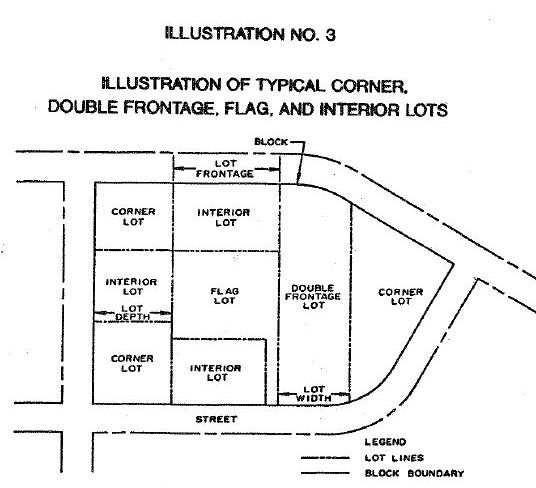
Lot width. The width of a parcel of land measured at the setback line.
Machine shops. Shops where lathes, presses, grinders, shapers, and other wood and metal working machines are used such as blacksmith, tinsmith, welding, and sheet metal shops; plumbing, heating, and electrical repair shops; and overhaul shops.
Manufacturing. When used in describing an industrial operation, the making or processing of a product with machinery.
Minor structures. Any small, movable accessory erection or construction such as birdhouses, tool houses, pethouses, play equipment, arbors, and walls and fences.
Motel. An establishment providing transient accommodations containing six (6) or more rooms with at least 25 percent of all rooms having direct access to the outside without the necessity of passing through the main lobby of the building.
Nonconforming lot. A lot, the area, dimensions, or location of which was lawful prior to the adoption or amendment of the zoning ordinance, but which fails by reason of such adoption or amendment to conform to the present requirements of the zoning ordinance. Vacant nonconforming lots are also referred to as substandard lots.
Nonconforming structure. A building or structure lawfully existing at the time of adoption of the zoning ordinance which houses a use which is permitted in the district, but does not comply with all the applicable area, height, yard, and/or parking requirements of the district in which it is located.
Nonconforming use. Any use of land, or land and buildings in combination, lawfully existing at the time of adoption of the zoning ordinance, which does not comply with the use regulations for the district in which it is located.
Parking lot. A structure or premises containing ten (10) or more parking spaces open to the public. Such spaces may be for rent or a fee.
Parties in interest. Includes all abutting property owners, all property owners within 100 feet, and all property owners of opposite frontages.
Permeable surfacing. A material or materials and accompanying subsurface treatments designed and installed specifically to allow stormwater to penetrate into the material, thereby reducing the volume of stormwater runoff from the surfaced area. Permeable surfacing may include without limitation paver blocks, 'grasscrete' or similar structural support materials, and permeable concrete or asphalt.
Pocket wetlands. A small (typically under 1,000 SF in area) constructed wetland designed to reduce peak stormwater flows and runoff volumes and to remove pollutants via settling and bio-uptake.
Premises. A lot, parcel, tract or plot of land together with the buildings and structures thereon.
Private swimming pool. A receptacle for water, or an artificial pool of water, which has at any point a depth of more than two (2) feet, whether above or below the ground, used or intended to be used by the owner thereof, or invitees, for bathing or swimming, and includes all structures, appurtenances, equipment, appliances, and other facilities appurtenant thereto.
Processing. When used in describing an industrial operation, the series of continuous actions that changes one (1) or more raw materials into a finished product. The process may be chemical as in the processing of photographic materials; it may be a special method such as processing butter or cheese; it may be a mechanical process such as packaging a base product.
Professional home offices. Residences of clergymen, architects, landscape architects, professional engineers, registered land surveyors, lawyers, real estate agents, artists, teachers, authors, musicians, or persons in other recognized professions used to conduct their professions.
Rain barrel. A structure for the collection of roof runoff in containers typically ranging from 50 to 100 gallons in size, designed for the subsequent release of water to landscaped areas.
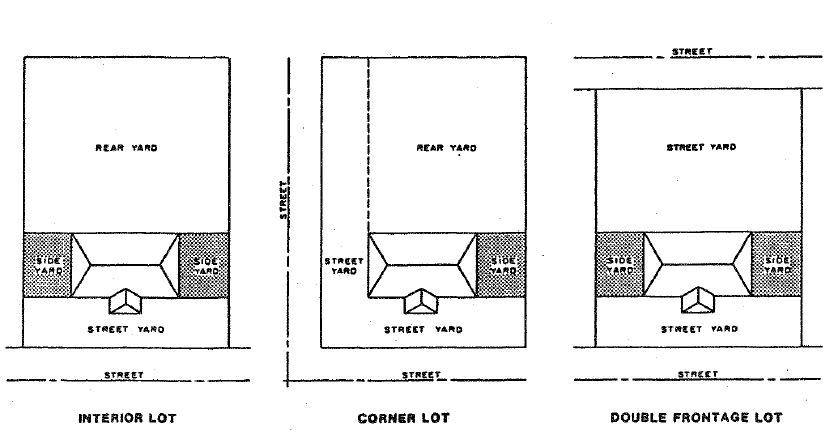
Rear yard. A yard extending across the full width of the lot, the depth of which shall be the minimum horizontal distance between the rear lot line and a line parallel thereto through the nearest point of the principal structure. This yard is opposite the street yard or one (1) of the street yards on a corner lot. (See Illustration No. 4)
Restaurant. An establishment where food and drink is prepared, served and consumed primarily within the principal structure. For the purpose of this chapter, establishments serving food in individually wrapped, hermetically sealed single servings supplied by a licensed processor, and serving food from a vending machine are not considered restaurants. In addition, taverns that serve free lunches consisting of popcorn, cheese, crackers, pretzels, cold sausage, cured fish, or bread and butter are not restaurants. (See also "Drive-in Restaurant")
Roof-mounted solar energy collector system. A solar energy system that is professionally mounted on the roof of a principal building or accessory structure. A building mounted solar energy system includes building integrated, flush-mounted and non-flush mounted systems.
Rummage sale. The occasional sale of personal property at a residence conducted by one (1) or more families in a neighborhood. Rummage sales do not exceed four (4) consecutive days in length and are not conducted more often than three (3) times per year. Rummage sales do not involve the resale of merchandise acquired for that purpose. Rummage sales are also known as "garage sales." Flea markets, defined elsewhere in this section, are not rummage sales.
Runoff. The rainfall, snowmelt, or irrigation water flowing over the ground surface.
Seat. Furniture upon which to sit having a linear measurement not less than 24 inches across the surface used for sitting.
Second hand store. Retail stores where merchandise that has been previously owned or used is sold. Unlike antiques, second hand merchandise has usually been manufactured within the last few years and is rarely over 20 years old.
Setback or street yard. A yard extending across the full width of the lot, the depth of which shall be the minimum horizontal distance between the existing or proposed street or highway line and a line parallel thereto through the nearest point of the principal structure. Corner lots and double frontage lots have two (2) such yards. (See Illustration No. 4)
Set of one-year design storms. The rain intensities and rain volumes or corresponding values specific to the community for the storm durations of 0.5, 1, 2, 3, 6, 12, and 24 hours that occur approximately once per year. The following are typical characteristics of these one-year storms in most of Wisconsin:
Side yard. A yard extending from the street yard to the rear yard of the lot, the width of which shall be the minimum horizontal distance between the side lot line and a line parallel thereto through the nearest point of the principal structure. (See Illustration No. 4)
ILLUSTRATION NO. 4
LOCATION OF YARDS ON A TYPICAL INTERIOR LOT AND A TYPICAL CORNER LOT
Sign. Any medium, including its structure, words, letters, figures, numerals, phrases, sentences, emblems, devices, designs, trade names, or trade marks by which anything is made known and which are used to advertise or promote an individual, firm, association, corporation, profession, business, commodity, or product and which is visible from any public street or highway.
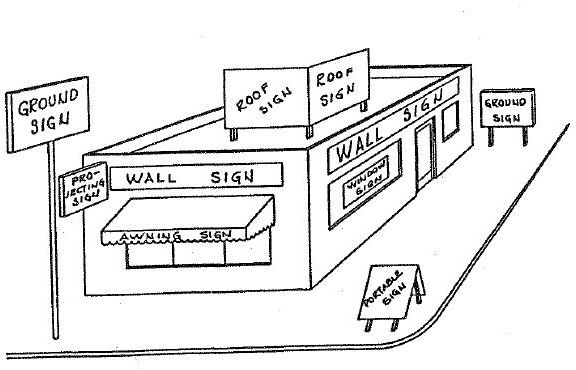
Sign, awning. A sign that is mounted or painted on, or attached to an awning, canopy, or marquee. (See Illustration No. 5)
Sign, ground. Any sign placed upon or supported by the ground independent of any other structure. (See Illustration No. 5)
ILLUSTRATION NO. 5
SIGN TYPES
Sign, off-premise. A sign which directs attention to a business, commodity, service, or entertainment conducted, sold, or offered at a location other than the premises on which the sign is located.
Sign, portable. A sign that is not permanent, affixed to a building, structure, or to the ground. Such sign is sometimes mounted on wheels to make it transportable. (See Illustration No. 5)
Sign, projecting. A sign that is wholly or partly dependent upon a building for support and which projects more than 12 inches from such building. (See Illustration No. 5)
Sign, roof. A sign that is mounted on the roof of a building or which is wholly dependent upon a building for support and which projects above the point of a building with a flat roof, the eave line of a building with a gambrel, gable, or hip roof, or the deck line of a building with a mansard roof. (See Illustration No. 5)
Sign, wall. A sign fastened to or painted on the wall of a building or structure in such a manner that the wall becomes the supporting structure for, or forms the background surface of the sign and which does not project more than 12 inches from such building or structure. (See Illustration No. 5)
Sign, window. A sign that is applied or attached to the exterior or interior of a window or located in such manner within the building that it can readily be seen from the exterior of the building through a window. (See Illustration No. 5)
Sign copy. The message or advertisement, and any other symbols on the face of a sign.
Sign face. The area or display surface used for the message.
Site. The entire area included in the legal description of the land upon which a land disturbing or land development activity is proposed in a land disturbing permit application.
Stormwater tree. A tree selected and installed (either with or without an engineered box or structure) as an integral component of a stormwater management plan, sited at a point or location where the tree(s) will have the effect of increasing the coverage of tree canopies to provide stormwater interception and evapotranspiration, stormwater uptake, and increased infiltration.
Street. A public right-of-way not less than 50 feet wide providing primary access to abutting properties.
Structural alterations. Any change in the supporting members of a structure, such as foundations, bearing walls, columns, beams, or girders.
Structure. Any erection or construction, such as buildings, prefabricated or prebuilt buildings, towers, masts, poles, booms, signs, decorations, carports, machinery, and equipment.
Substantial improvement. Any repair, reconstruction or improvement of a structure, the cost of which equals or exceeds 50 percent of the present equalized assessed value of the structure either before the improvement or repair is started, or if the structure has been damaged, and is being restored, before the damage occurred. The term does not however, include either: (a) any project for improvement of a structure to comply with existing state or local health, sanitary of safety code specifications which are solely necessary to assure safe living conditions, or (b) any alteration of a structure or site documented as deserving preservation by the Wisconsin State Historical Society or listed on the National Register of Historic Places. Ordinary maintenance repairs are not considered structural repairs, modifications or additions; such ordinary maintenance repairs include internal and external painting, decorating, paneling, and the replacement of doors, windows, and other nonstructural components.
Surety. Whenever the terms "surety", "surety bond," or "bond" are used in this chapter, said term shall describe only an irrevocable letter of credit or a cash bond as approved by the Village Attorney.
Swimming pool. See "private swimming pool"
Tavern. An establishment used primarily for the serving of liquor by the drink to the general public and where food or packaged liquors may be served or sold, but only as an accessory use. A tavern may also be called a "bar."
Theater. A building or part of a building devoted to showing motion pictures, or for dramatic, musical or live performances.
Townhouses. A group of single-family dwellings, also called row houses, having an unpierced common wall between each adjacent section and the end units having side yards.
Turning lane. An existing or proposed connecting roadway between two (2) arterial streets or between an arterial street and any other street. Turning lanes include grade separated interchange ramps.
Utilities. Public and private facilities such as water wells, water and sewage pumping stations, water storage tanks, power and communication transmission lines, electrical power substations, static transformer stations, telephone and telegraph exchanges, microwave radio relays, and gas regulation stations, but not including sewage disposal plants, municipal incinerators, warehouses, shops, and storage yards.
Vegetated stormwater management measures. Vegetated swales, bioretention areas, rain gardens, pocket wetlands, stormwater trees, or similar practices that are designed and intended to provide stormwater treatment and control by promoting evapotranspiration and infiltration of stormwater.
Vegetated swales. Stormwater conveyance systems routing stormwater flows through vegetated areas, natural elongated depressions, or constructed channels. A vegetated infiltration swale differs from a conventional drainage channel or ditch in that it is constructed specifically to promote infiltration.
Yard. An open space on the same lot with a structure, unoccupied and unobstructed from the ground upward except for vegetation. The street and rear yards extend the full width of the lot. (See Illustration No. 4)
(Ord. No. 1-O-13, § 1, 4-2-2013; Ord. No. 02-O-22, 6-20-2022; Ord. No. 07-O-22, § IV, 2-21-2023)

