
West Milwaukee City Zoning Code
ARTICLE II
GENERAL PROVISIONS
Sec. 98-26.- Jurisdiction.
The jurisdiction of this chapter shall include all lands and waters within the corporate limits of the Village of West Milwaukee.
Sec. 98-27. - Compliance.
No structure, land, or water shall hereafter be used or developed (as "development" is defined in Section 98-362 of this chapter), and no structure or part thereof shall hereafter be located, erected, moved, reconstructed, extended, enlarged, converted, or structurally altered except in conformity with the regulations herein specified for the district in which it is located.
Sec. 98-28. - Municipalities and state agencies regulated.
Unless specifically exempted by law all cities, villages, towns, and counties are required to comply with this chapter and obtain all required permits. State agencies are required to comply if Wis. Stats. § 13.48(13) applies. The construction, reconstruction, maintenance, and repair of state highways and bridges by the Wisconsin Department of Transportation are exempt from compliance when Wis. Stats. § 30.12(4)(a) applies.
Sec. 98-29. - Use restrictions.
The following use restrictions and regulations shall apply:
(1)
Principal uses: Only those principal uses specified for a district, their essential services, and the following uses shall be permitted in that district.
(2)
Accessory uses and structures are permitted in any district but not until their principal structure is present or under construction. Residential accessory uses shall not involve the conduct of any business, trade, or industry except home occupations and professional home offices as defined in this chapter.
(3)
Conditional uses and their accessory uses are considered as special uses requiring review, public hearing, and approval by the Village Plan Commission in accordance with Section 98-256 of this chapter. Any development within 500 feet of the existing or proposed rights-of-way of freeways, expressways, and interstate and controlled access trafficways and within 1,500 feet of their existing or proposed interchange or turning lane rights-of-way shall be deemed to be conditional uses. Such development shall be specifically reviewed and approved by the Village Plan Commission as provided in Section 98-257 of this chapter.
(4)
Unclassified or unspecified uses may be permitted by the Village Plan Commission provided that such uses are similar in character to the principal uses permitted in the district.
(5)
Temporary uses, such as real estate sales or rental field offices or shelters for materials and equipment being used in the construction of a permanent structure, may be permitted for a period of up to one (1) year by the Village Plan Commission. Temporary use permits may be renewed if the Plan Commission deems such renewal appropriate. Additional temporary uses are set forth in Section 98-257 of this chapter and may be permitted as conditional uses as set forth in Sections 98-256 and 98-257 of this chapter.
Sec. 98-30. - Site restrictions.
No land shall be used or structure erected where the land is unsuitable for such use or structure by reason of flooding, concentrated runoff, inadequate drainage, adverse soil or rock formation, unfavorable topography, low percolation rate or bearing strength, erosion susceptibility, or any other feature likely to be harmful to the health, safety, prosperity, aesthetics, and general welfare of this community. The Village Administrator or his/her designee, in applying the provisions of this section, shall in writing recite the particular facts upon which he bases his conclusion that the land is not suitable for certain uses. The applicant shall have an opportunity to present evidence contesting such unsuitability if he so desires. Thereafter the Village Plan Commission may affirm, modify, or withdraw the determination of unsuitability. In addition:
(1)
All lots shall abut upon a public street, and each lot shall have a minimum frontage at the road right-of-way of 50 feet.
(2)
All principal structures shall be located on a lot; and only one (1) principal structure shall be located, erected, or moved onto a lot in single-family and two-family residential districts. The Plan Commission may permit more than one (1) structure per lot in other districts where more than one (1) structure is needed for the orderly development of the parcel. Where additional structures are permitted, the Plan Commission may impose additional yard requirements, landscaping requirements, or parking requirements, or require a minimum separation distance between principal structures.
(3)
No zoning permit shall be issued for a lot which abuts a public street dedicated to only a portion of its proposed width and located on that side thereof from which the required dedication has not been secured.
(4)
Lots abutting more restrictive district boundaries shall provide side and rear yards not less than those required in the more restrictive abutting district. The street yards on the less restrictive district shall be modified for a distance of not more than 40 feet from the district boundary line so as to equal the average of the street yards required in both districts.
(5)
Preservation of topography. In order to preserve the natural topography as much as possible and in order to protect against dangers and damage caused by man-made changes to the existing topography, and to avoid unsightly and hazardous exposed earth sections, no lots or portions of lots nor any parcels of land shall be excavated or filled unless the following conditions are met:
a.
If the difference in grade between two (2) adjacent lots along a lot line is to be not greater at any point than two (2) feet, this difference in levels may be sloped toward or away from the lot line at a gradient of one (1) foot vertical to two (2) feet horizontal, and as soon as practical must be covered adequately with top soil and sodded to prevent erosion; or a retaining wall of stone or other suitable masonry material shall be constructed to retain the higher ground. Within a single lot, any excavation or fill not exceeding two (2) feet, and not involving an area in excess of 4,000 square feet shall be subject to the aforesaid requirements.
b.
If a difference in grade between two (2) adjacent lots along a lot line is to be greater at any point than two (2) feet, the following procedure shall be followed:
1.
No slope to be covered with sod, grass seed, or other natural plan material may exceed a gradient of one (1) foot vertical to two (2) feet horizontal.
2.
A slope protected by rip-rap construction may not exceed a gradient of one (1) foot vertical to one (1) foot horizontal.
3.
A difference in adjacent grades may be protected by a retaining wall providing that the wall is engineered in such a manner as not to collapse. No retaining wall shall exceed four (4) feet in height. A retaining wall may be stepped to achieve greater height. Each step of the wall shall be no more than four (4) feet in height and shall be set back a minimum of two (2) feet from the previous step.
4.
Approval of any of the aforesaid methods shall be obtained in the following manner:
i.
The applicant shall furnish a topographic survey with a maximum contour interval of one (1) foot prepared by a registered professional engineer or registered land surveyor showing existing elevations on the subject lot and on adjacent lands within 25 feet of the area to be filled or excavated.
ii.
The applicant shall furnish a map showing existing drainage patterns and existing soil types on the subject lot and on adjacent land within 25 feet of the area to be filled or excavated.
iii.
The applicant shall furnish a plan showing a typical cross-section of the proposed slope, rip-rap, or retaining wall; the proposed drainage pattern, including any stormwater management measures proposed; a planting or sodding schedule; and the proposed means of preventing erosion during construction. If a retaining wall is to be constructed, a registered professional engineer shall certify that the wall will not collapse.
iv.
The Village Administrator or his/her designee shall transmit the applicant's plans to the Village Engineer for review and comment, and the permit shall be issued only after receipt of the engineer's written report.
v.
The applicant shall complete the proposed work in strict accordance with the approved plan and the time schedule specified in the permit.
c.
In every instance, no person, occupant, owner of land, or corporation shall remove or cause to be accumulated topsoil or subsoil on any industrial, commercial, institutional, recreational, or residential district without the proper review and approval of an application for such removal or accumulation by the Plan Commission. Such removal or accumulation includes, but is not limited to piles of earth, dirt, topsoil, or subsoil, which has been formed, accumulated or pushed into mounds or piles and which obstruct view or pose a threat to the general safety or welfare of the community with the existence of trenches, holes, or pits caused by such removal or accumulation.
(6)
A buffer yard shall be created and maintained around all business and manufacturing districts which abut upon residential districts. The Plan Commission may also require a buffer yard around business and industrial districts abutting park and institutional districts. Buffer yards shall be a minimum of 20 feet in width and shall screen business or manufacturing uses from adjoining lands in such a manner that:
a.
Buffer yards are encouraged to incorporate vegetated stormwater management measures such as bioretention areas and stormwater trees.
b.
Where architectural walls or fences are used, sufficient landscaping shall be used in conjunction with such wall or fence to create an attractive view from the residential side, and all walls and fences shall be maintained in a structurally sound and attractive condition. Any wall or fence shall be not less than four (4) feet nor more than six (6) feet in height.
c.
All landscaping shall be maintained by the owner or operator to the satisfaction of the Plan Commission.
d.
Where the land adjacent to the buffer yard is a parking lot, the buffer yard shall be sufficiently opaque to prevent the penetration of headlight glare. Overhead lighting installed in or adjacent to a buffer yard shall not throw any rays onto adjacent residential properties.
e.
Where the land adjacent to the buffer yard is a parking lot, the buffer yard area adjacent to the parking lot is encouraged to be designed to function as a vegetated stormwater management measure. A combination of fencing, walls and plant material utilized in the buffer yard shall be sufficiently opaque to prevent the penetration of headlight glare at the property line. Overhead lighting installed in or adjacent to a buffer yard shall not throw any rays onto adjacent residential properties.
(Ord. No. 02-O-22, 6-20-2022)
Sec. 98-31. - Reduction or joint use.
No lot, yard, parking area, building area, or other space shall be reduced in area or dimension so as not to meet the provisions of this section. No part of any lot, yard, parking area, or other space required by this section for a particular structure or use shall be used jointly or in conjunction with any other structure or use. This provision shall not apply to any Planned Unit Development Overlay District.
(Ord. No. 5-O-2000, § 1, 3-27-2000)
Sec. 98-32. - First Amendment protected adult-oriented establishments.
(a)
Findings of fact.
(1)
The board finds that adult-oriented establishments, as defined and otherwise regulated by the Village in its adult-oriented licensing and regulation ordinance, require special zoning in order to protect and preserve the health, safety, and welfare of the Village.
(2)
Based its review of studies conducted in Phoenix AZ, Garden Grove CA, Los Angeles CA, Whittier CA, Indianapolis IN, Minneapolis MN, St. Paul MN, Cleveland OH, Oklahoma City OK, Amarillo TX, Austin TX, Beaumont TX, Houston TX, Seattle WA, and the findings incorporated in City of Renton v. Playtime Theaters, Inc., 475 U.S. 41 (1986), Coleman A. Young v. American Mini-Theaters, Inc., 427 U.S. 50 (1976), the board finds that there is convincing evidence that the secondary effects of adult-oriented establishments include an increased risk of prostitution, high-risk sexual behavior, crime, and other deleterious effects upon existing businesses and surrounding residential areas, and decreased property values.
(3)
The board intends to control the impact of these secondary effects in order to protect the health, safety, and welfare of the citizenry; protect the citizens from increased crime; preserve the quality of life; preserve the property values and character of surrounding neighborhoods and areas.
(4)
It is not the intent of the board to suppress any speech activities protected by the First Amendment, but to enact a content-neutral ordinance which addresses the secondary effects of adult-oriented establishments while providing an outlet for First Amendment protected activities.
(5)
In order to minimize and control the secondary effects of adult-oriented establishments upon the Village, it is the intent of the board to prevent the concentration of adult-oriented establishments within a certain distance of each other and within a certain distance of other specified locations which are incompatible with and would suffer from the secondary effects of adult-oriented establishments.
(6)
Based upon its review of materials linking alcohol consumption and high-risk sexual behavior and materials linking alcohol consumption and crimes such as sexual assault, the board finds that a geographic separation of adult-oriented establishments from alcohol beverage licensed premises is warranted.
(b)
Location of first amendment protected adult-oriented establishments.
(1)
The First Amendment and other provisions of the United States Constitution, as interpreted by the United States Supreme Court and other courts, require that adult-oriented establishments, as defined and otherwise regulated by the Village, are entitled to certain protections, including the opportunity to locate in the Village. Therefore, if an adult-oriented establishment license has been granted by the Village, and if all the requirements of this section of the zoning code are met, an adult-oriented establishment shall be an allowed use in the M-1 zoning district and shall be a prohibited use in any other zoning district. No other requirements of the zoning code need be satisfied, but for those required in order to obtain an adult-oriented entertainment license from the Village.
(2)
Adult-oriented establishments shall be located at least 500 feet from:
a.
Any residential district line, playground lot line, or public park lot line;
b.
Any structure used as a residence, place of religious worship, public or private school, or youth facility as defined in the Village's adult-oriented establishment licensing and regulation ordinance;
c.
Any other structure housing an adult-oriented establishment;
d.
Any structure housing an establishment which holds an alcohol beverage license.
(3)
Distance requirements are to be measured in a straight line in any direction regardless of intervening structures, from the structure housing the adult-oriented establishment to the above residential district boundary lines, to the lot line of any lot used for a park, playground, or the lot line of any structure listed in subsection (b)(2)b., c. and d., above.
(4)
The measurements from a structure shall be taken from the farthest point a structure extends in the direction of the measurement, including overhanging roofs or similar projections.
(5)
For adult-oriented establishments located in conjunction with other buildings and clearly separate from other establishments such as in a shopping center, measurements shall be taken from the boundaries of the space occupied by the adult-oriented establishment.
(6)
For any adult-oriented establishment located above ground level in a multi-story structure and clearly separate from other establishments within the structure, the distance measurements shall be taken from the ground floor public entrance/exit nearest the adult-oriented establishment (excluding emergency exits).
(5)
A licensed adult-oriented establishment is not disqualified from holding an adult-oriented establishment license by the location subsequent to the grant or renewal of its license of any of the establishments described in subsection (b)(2), above, within 500 feet of the licensed premises. This provision applies only to the renewal of an existing license and does not apply when an application for a license is submitted after a license for that location has not been renewed or has been revoked.
(Ord. No. 3-O-2000, § 1, 3-20-2000)
Sec. 98-33. - Location of tattoo or body piercing establishments.
(a)
If a tattoo or body piercing establishment, as defined in Wis. Stats. § 252.23(1) and 252.24(1), has obtained a license pursuant to Wisconsin Statutes; and has fully complied with all rules and regulations established by the department of health and human services and the local health department for the safe and adequate care and treatment of individuals receiving tattoos or piercing; and if it has further complied with all the requirements of this section of the zoning code, a tattoo or body piercing establishment shall be an allowed conditional use in the M-1 zoning district and shall be a prohibited use in any other zoning district.
(b)
Tattoo or body piercing establishments shall be located at least 500 feet from:
(1)
Any residential district line, playground lot line, or public park lot line;
(2)
Any structure used as a residence, place of religious worship, public or private school, or youth facility as otherwise defined in this zoning code;
(3)
Any structure housing a tattoo or body piercing establishment;
(4)
Any structure housing an establishment which holds an alcohol beverage license.
(c)
Distance requirements are to be measured in a straight line in any direction regardless of intervening structures, from the structure housing the tattoo or body piercing establishment to the above residential district boundary lines, to the lot line of any lot used for a park, playground, or the lot line of any structure listed in subsection (b)(2), (3) and (4) above.
(d)
The measurements from a structure shall be taken from the farthest point a structure extends in the direction of the measurement, including overhanging roofs or similar projections.
(e)
For tattoo or body piercing establishments located in conjunction with other buildings and clearly separate from other establishments such as in a shopping center, measurements shall be taken from the boundaries of the space occupied by the tattoo or body piercing establishment.
(f)
For any tattoo or body piercing establishment located above ground level in a multi-story structure and clearly separate from other establishments within the structure, the distance measurements shall be taken from the ground floor public entrance/exit nearest the tattoo or body piercing establishment (excluding emergency exits).
(g)
Subsequent to the granting or renewal of its license, a licensed tattoo or body piercing establishment is not considered in violation of the zoning code by the location of any of the establishments described in subsection (b), above, within 500 feet of the licensed premises. This provision applies only to the renewal of an existing license and does not apply when an application for a license is submitted after a license for that location has not been renewed or has been revoked.
(Ord. No. 1-O-2004, § 1, 1-5-2004; Ord. No. 08-O-16, § 3, 10-17-2016)
Sec. 98-34. - Solar energy collector systems.
(a)
General.
(1)
Applicant must complete an accessory solar energy collector systems application.
(2)
Accessory solar energy collector systems are allowed in all zoning districts. See also Wis. Stats. § 66.0401.
(3)
Accessory solar energy collector systems must comply with all applicable building ordinances, electrical code requirements, plan review and plan review fee are required.
(4)
Owners of accessory solar energy collector systems are solely responsible for negotiating with other property owners for any desired solar easements to protect access to sunlight. Any such easements must be recorded with the register of deeds.
(5)
A complete set of plans, including a site plan and any structure details drawn to scale. This plan set will be reviewed to ensure that a solar energy collector system does not negatively impact the public health, safety, and welfare.
(6)
Solar energy collector systems shall meet all setback and yard requirements for the district in which they are located. Solar energy collector systems shall conform to all height requirements of this chapter.
(7)
All solar energy collectors should be kept in good working order and will need to be properly removed or replaced within six months if they are damaged/destroyed, stop working or at end of useful life.
(8)
Installation of the solar energy collectors should conform with the approved plans.
(b)
Roof-mounted solar energy collector systems.
(1)
Roof-mounted solar energy collector systems shall be mounted on principal and/or accessory structures. Only building-integrated and/or flush-mounted solar energy collector system may be installed.
(2)
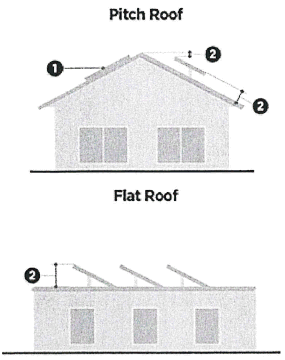
Systems on residential structures shall not extend beyond 12 inches parallel to the roof surface of a pitched roof or flat roof. Systems on nonresidential structures shall not extend beyond 36 inches parallel to the roof surface of a pitched roof or flat roof. Systems on all structures shall not extend above the highest peak of a pitched roof. Height is measured from the roof surface on which the system is mounted to the highest edge of the system.
(3)
All materials used for racking, mounts, mounting clamps, and flashings shall be of a color consistent with the color of the roof surface to minimize visibility.
(c)
Ground-mounted solar energy collector systems. Accessory ground-mounted solar energy collector systems are a conditional use in all zoning and may not be located in a (front or corner side) street yard.
(Ord. No. 07-O-22, § III, 2-21-2023)

