
West Milwaukee City Zoning Code
ARTICLE IV
TRAFFIC, LOADING, PARKING AND ACCESS
Sec. 98-91.- Traffic visibility.
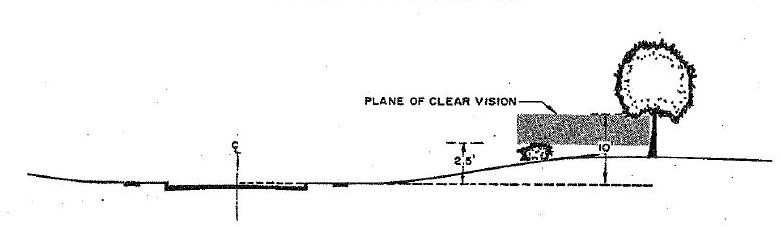
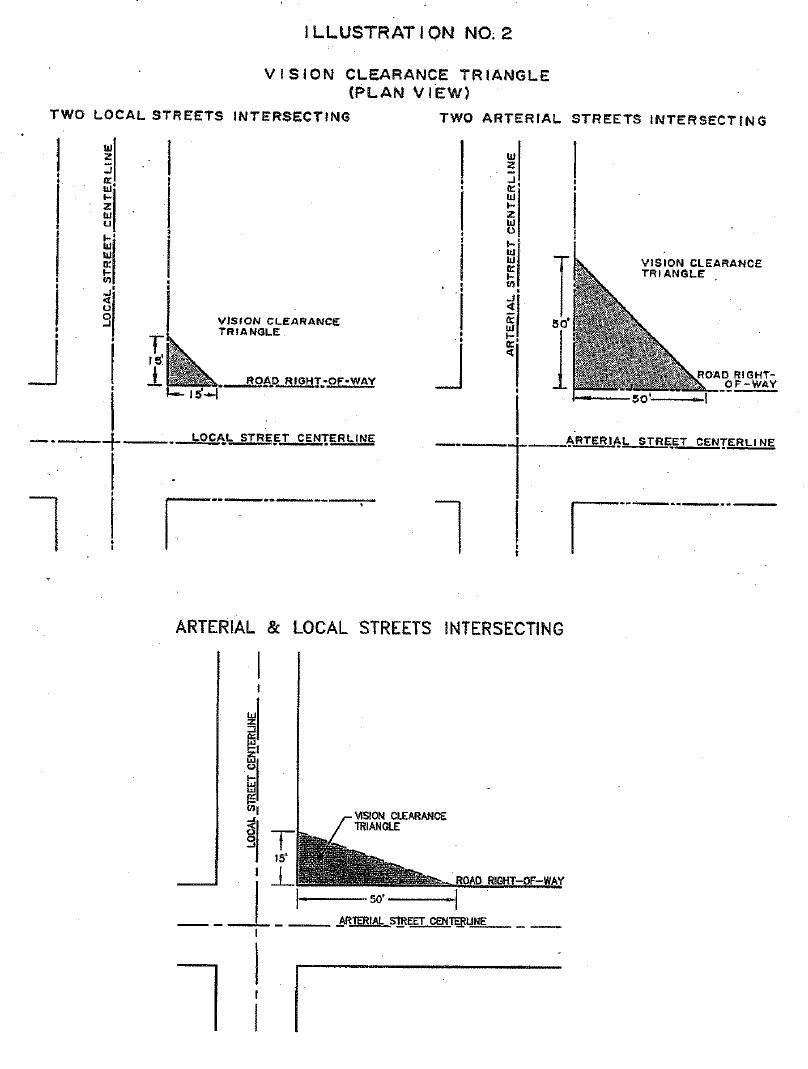
No obstructions, such as structures, parking, or vegetation, shall be permitted in any district between the heights of two and one-half (2½) feet and ten (10) feet above the plane through the mean curb grades (See Illustration No. 1) within the triangular space formed by any two (2) existing or proposed intersecting street or alley right-of-way lines and a line joining points on such lines located a minimum of 15 feet from their intersection. (See Illustration No. 2)
In the case of arterial streets intersecting with other intersecting streets or railways, the corner cutoff distances establishing the vision triangle clearance space shall be increased to 50 feet. (See Illustration No. 2)
ILLUSTRATION NO. 1
VISION CLEARANCE TRIANGLE (CROSS-SECTIONAL VIEW)
Sec. 98-92. - Loading requirements.
On every lot on which a business, trade, or industrial use is hereafter established, space with access to a public street or alley shall be provided as specified below for the loading and unloading of vehicles off the public right-of-way.
(1)
Number of loading and unloading spaces required.
Gross Floor Area of Building
For each additional 75,000 square feet (or fraction thereof) of gross floor area, one (1) additional loading and unloading space shall be provided.
(2)
Each loading and unloading space shall have access to a public dedicated street or alley.
(3)
The minimum area for each loading and unloading space, excluding the area needed to maneuver, shall be 250 square feet.
(4)
At no time shall any part of a truck or van be allowed to extend into the right-of-way of a public thoroughfare while the truck or van is being loaded or unloaded.
Sec. 98-93. - Vehicular parking.
In all districts, motor vehicles shall be parked within an enclosed building, or on an approved driveway or parking lot.
Sec. 98-94. - Parking requirements.
In all districts and in connection with every use, there shall be provided at the time any use is initiated, changed, or increased; or when any building is erected, enlarged, extended, or increased, off-street parking stalls for all vehicles in accordance with the following:
(1)
Adequate access to a public street shall be provided for each parking space, and driveways shall be at least ten (10) feet wide for one- and two-family dwellings, and a minimum of 20 feet wide at the property line for all other uses.
(2)
The minimum dimensions of each parking space shall be nine (9) feet by 18 feet, except for spaces provided for use by physically disabled persons.
(3)
Parking spaces for use by physically disabled persons. All open off-street parking areas provided for more than 25 parking spaces, except for parking areas restricted to use by employees only, shall provide parking spaces for use by motor vehicles which transport physically disabled persons in accordance with the following minimum standards:
a.
One physically disabled parking space shall be provided in parking areas containing 26 to 49 spaces.
b.
Two (2) percent of the total number of spaces shall be physically disabled parking spaces in parking areas containing 50 to 1,000 spaces.
c.
In addition to the number of spaces required in subsection b. above, one (1) percent of each 1,000 spaces over the first 1,000 spaces shall be provided for physically disabled parking spaces in parking areas containing more than 1,000 spaces.
d.
The minimum dimensions for all parking spaces provided for use by physically disabled persons shall be 12 feet by 18 feet.
e.
Parking spaces provided for use by physically disabled persons shall be located as close as possible to an entrance which allows persons to enter and leave the parking area without assistance.
f.
All parking spaces provided for use by physically disabled persons shall be marked by a sign which includes the international symbol for barrier-free environments and a statement informing the public that the parking space is reserved for use by physically disabled persons. Such sign shall comply with the requirements of Wis. Stats. §§ 346.50, 346.503, and 346.505.
(4)
Location of parking spaces is to be on the same lot as the principal use or not more than 150 feet from the principal use. No parking space or driveway, except in residential districts, shall be closer than 25 feet to a residential lot line or a street right-of-way opposite a residential district.
(5)
Surfacing. All off-street parking areas shall be surfaced with an asphaltic or portland cement pavement in accordance with Village standards and specifications so as to provide a durable and dust free surface and shall be so graded and drained as to dispose of all surface water. Permeable surfacing may also be used upon review and approval by the Village Engineer. Any parking area for more than five (5) vehicles shall have the aisles and spaces clearly marked.
(6)
Lighting. Adequate lighting shall be provided for parking lots. Lighting fixtures shall be placed so that light overlaps at a height of about seven (7) feet and provides a minimum illumination of one (1) footcandle. Lighting in parking lots shall be shielded in such a way as not to affect adjacent properties in a negative way.
(7)
Landscaping. All public off-street parking areas which serve five (5) or more vehicles and are created or redesigned and rebuilt subsequent to the adoption of this chapter shall be provided with accessory landscaped areas totaling not less than five (5) percent of the surfaces area. The minimum size of each landscaped area shall be 100 square feet. Vegetated stormwater management measures designed and sited to receive runoff from parking areas shall be counted towards the minimum landscaped area requirement. Locations of landscaped areas, plant materials, and protection afforded the plantings (which shall include curbing or wheel stops as appropriate to allow stormwater to flow into vegetated management measures), including curbing and provision for maintenance shall be subject to approval by the Plan Commission and, in the case of vegetated stormwater management measures, the Village Engineer. All plans for proposed parking areas shall include a topographic survey and grading plan which shows existing and proposed grades, drainage pathways, and location of improvements. The preservation of existing trees, shrubs, and other natural vegetation in the parking area may be included in the calculation of required minimum landscaped area. Parking areas for five (5) or more vehicles which adjoin residential districts shall be visually screened with a combination of a solid wall, fence, or evergreen planting of equivalent visual density, or other effective means, built and maintained to a minimum height of six (6) feet.
(8)
Curbs or barriers shall be installed at least four (4) feet from a property line so as to prevent parked vehicles from extending over any lot line.
(9)
The following guide specifies the minimum number of parking spaces required. In the case of structures or uses not specified herein, the number of spaces specified as the general standard for the use class or the number of spaces specified for similar use shall apply. In developments involving the establishment or addition of two (2) or more uses on one (1) lot or parcel, the cumulative number of spaces required for each use shall determine the total number of spaces required.
a.
Residential uses:
1.
Single-family, two-family, and multiple-family dwellings—Two (2) spaces per dwelling unit.
2.
Housing for the elderly—One space per dwelling unit.
b.
Retail sales and customer service uses, and places of entertainment:
1.
General standard for the above uses—One space per 150 square feet of gross floor area of customer sales and service, plus one (1) space per employee.
2.
Financial institutions—One space for each 150 square feet of gross floor area of customer service, plus one (1) space per employee for the work shift with the largest number of employees. Financial institutions with drive-in facilities shall provide sufficient space for four (4) waiting vehicles at each drive-in service lane.
3.
Funeral homes—One space for each four (4) patrons at maximum capacity, or 25 spaces per chapel unit, whichever is greater.
4.
Grocery stores or supermarkets—One space per 150 square feet of gross floor area of customer sales and service area, plus one (1) space per employee for the work shift with the largest number of employees.
5.
Convenience grocery stores—One space per 100 square feet of gross floor area.
6.
Motels and hotels—One space per room or suite, plus one (1) space per employee for the work shift with the largest number of employees, plus one (1) space per three (3) persons, based on maximum capacity, for each public meeting room and/or banquet room.
7.
Lodges and clubs—One space per three (3) persons based on the maximum capacity of the facility.
8.
Restaurants—One space per 150 square feet of gross dining area, plus one (1) space per employee for the work shift with the largest number of employees.
9.
Restaurants, drive-in or fast-food—One space per 50 square feet of gross dining area, plus one (1) space per employee for the work shift with the largest number of employees. Drive-in restaurants with drive-through facilities shall provide sufficient space for four (4) waiting vehicles at each drive-through service lane.
10.
Appliance and general merchandise repair services—One space per 300 square feet of gross floor area, plus one (1) space per employee for the work shift with the largest number of employees.
11.
Theaters, auditoriums and other places of public assembly—One space per three (3) patrons based on the maximum capacity of the facility.
12.
Personal services—One space per 200 square feet of gross floor area, plus one (1) space per employee for the work shift with the largest number of employees.
13.
Taverns, dance halls, night clubs and lounges—One space per 50 square feet of gross floor area, plus one (1) space per employee for the work shift with the largest number of employees.
14.
Motor vehicle sales establishments—Two (2) customer parking spaces per salesperson, plus one (1) space per employee for the work shift with the largest number of employees.
15.
Motor vehicle repair, maintenance, and service stations—Three (3) spaces per indoor service bay plus one (1) space per employee for the work shift with the largest number of employees.
16.
Car washes—One space per employee for the work shift with the largest number of employees. Car washes shall provide sufficient space for eight (8) waiting vehicles at each washing stall and sufficient space for drying two (2) vehicles after each washing stall.
17.
Animal hospitals—Three (3) patron parking spaces per doctor, plus one (1) space per employee for the work shift with the largest number of employees.
18.
Plant nurseries, and lawn and garden supply stores—One space per 200 square feet of gross indoor sales and display area, plus one (1) space per 500 square feet of gross outdoor sales and display area. plus one (1) space per employee for the work shift with the largest number of employees.
19.
Shopping centers (gross leaseable area of at least 50,000 square feet)—Five and one-half (5½) spaces per 1,000 square feet of gross leaseable area.
c.
Offices:
1.
Medical, dental and similar professional health service offices—Five (5) patron spaces per doctor, plus one (1) space per employee for the work shift with the largest number of employees.
2.
Government, professional and business offices—One space per 250 square feet of gross floor area, plus one (1) space per employee for the work shift with the largest number of employees.
d.
Commercial/recreational uses:
1.
General standard—One space per four (4) patrons based on the maximum capacity of the facility, plus one (1) space per employee for the work shift with the largest number or employees.
2.
Bowling alleys—Five (5) spaces for each lane, plus one (1) space per employee for the work shift with the largest number of employees.
3.
Indoor tennis, racquetball and handball courts—Three (3) spaces per court, plus one (1) space per employee for the work shift with the largest number of employees.
4.
Skating rinks, ice or roller—One space per 200 square feet of gross floor area.
e.
Industrial and related uses:
1.
Manufacturing, processing, and fabrication operations—One space per employee for the work shift with the largest number of employees.
2.
Wholesale business—One space per employee for the work shift with the largest number of employees, plus one (1) space per 2,500 square feet of gross floor area.
3.
Warehousing—One space per employee for the work shift with the largest number of employees, plus one (1) space per 5,000 square feet of gross floor area.
4.
Extractive and related operations—One space per employee for the work shift with the largest number of employees.
f.
Institutional and related uses:
1.
Churches—One space per three (3) seats based on the maximum capacity of the facility.
2.
Libraries—One space per 250 square feet of gross floor area or one (1) space per four (4) seats based on maximum capacity, whichever is greater, plus one (1) space per employee for the work shift with the greatest number of employees.
3.
Museums—One space per 250 square feet of gross floor area, plus one (1) space per employee for the work shift with the greatest number of employees.
4.
Rooming and boarding houses, fraternity and sorority houses, dormitories and rectories—One space per bed.
5.
Convents and monastaries—One space per three (3) residents, plus one (1) space per employee for the work shift with the largest number of employees, plus one (1) space per five (5) chapel seats if the public may attend.
6.
Nursing homes—One space per three (3) patient beds, plus one (1) space per employee for the work shift with the largest number of employees.
7.
Hospitals—Two (2) spaces per three (3) patient beds, plus one (1) space per staff doctor, plus one (1) space per employee, excluding doctors, for the work shift with the largest number of employees.
8.
Schools:
i.
Elementary schools, middle schools, and high schools—One space for each teacher and staff member, plus one (1) space for each ten (10) students 16 years of age or older.
ii.
Colleges, universities and trade schools—One space for each teacher and staff member, plus one (1) space for each two (2) students during the highest attendance period.
iii.
Children's nursery schools and day-care centers—One space per employee for the work shift with the greatest number of employees, plus one (1) space per six (6) students at the highest class attendance period.
g.
Adjustments. In the B-1 District (Local Business District), the minimum number of required parking spaces may be adjusted to allow for the parking of up to five vehicles off site, including employees, so long as, the requisite number of off-site parking spaces are located within 250 feet of the front door. The petitioner shall show to the satisfaction of the village administrator or his/her designee that adequate parking will be provided for customers, clients, visitors, and employees. The following provisions and factors shall be used as a basis to adjust parking requirements:
1.
Evidence that actual parking demands associated with business operations will meet the Zoning Code requirements. The petitioner shall submit written documentation and data that the operation will require less parking than the Zoning Code requires.
2.
Availability of shared parking. When a reduction of parking spaces is requested based upon off-site availability of shared parking, the petitioner shall submit written verification that such shared parking is available and shall include copies of any contracts, joint lease agreements, purchase agreements, and other such documentation to show that such shared parking can be accomplished. The village attorney or village engineer may provide an opinion designating the method by which the required shared parking shall be provided. The off-site shared parking spaces shall be clearly posted for the joint use of employees and/or tenants or customers of each respective use those spaces serve.
3.
Use of on-street parking for visitors. Available nearby on-street parking may be counted toward visitor and employee parking needs. This may only be allowed when on-street parking is permitted in a specific location, and then only when such on-street parking spaces are within 250 feet of the entrance they are intended to serve.
4.
Use of alternative transportation. Upon demonstration to the village administrator or his/her designee that effective alternative transportation to the automobile will occur, the staff may reduce parking requirements. Alternative transportation may include, but is not limited to, bus transit, van pool operations, car pool/ride sharing and bicycles. Parking management plans/operations may also be used as a basis to reduce required parking. Parking management plans may include, but are not limited to, flexible working hours or shifts, preferential parking for car pools/van pools, transit/van pool fare subsidy, imposition of a charge for parking, and establishment of a transportation coordinator to implement car pool, van pool, and transit programs. Proposals for adjustments of parking requirements under this subsection shall show how the alternative transportation modes will be implemented, the permanency of such modes, extent of the program, the number of vehicles the mode will replace, and other pertinent information.
(Ord. No. 8-O-2000, § 1, 4-17-2000; Ord. No. 11-O-20, 6-15-2020; Ord. No. 02-O-22, 6-20-2022)
Sec. 98-95. - Driveways.
All driveways installed, altered, changed, replaced, or extended after the effective date of this chapter shall meet the following requirements:
(1)
Islands between driveway openings shall be provided with a minimum of six (6) feet between all driveways and three (3) feet at all lot lines. The Plan Commission may modify this requirement where lots are so narrow as to require a shared driveway between adjacent properties.
(2)
Openings for vehicular ingress and egress shall not exceed 24 feet at the street right-of-way and 30 feet at the curbline (or roadway).
(3)
Surfacing. All driveways shall be surfaced with an asphaltic or portland cement pavement in accordance with Village standards and specifications so as to provide a durable and dust free surface and shall be so graded and drained as to dispose of all surface water. Permeable surfacing may also be used upon review and approval by the Village Engineer.
(4)
Vehicular entrances and exits to drive-in theaters, banks, restaurants, motels, funeral homes, vehicular sales, service stations, or washing and repair stations or garages shall be located not less than 200 feet from any pedestrian entrance or exit to a school, college, university, church, hospital, park, playground, library, public emergency shelter, or other place of public assembly.
(Ord. No. 02-O-22, 6-20-2022)
Sec. 98-96. - Parking of trucks and recreational vehicles in residential districts.
No truck, commercial trailer, mobile home, travel trailer, recreational vehicle, or snowmobile shall be parked regularly on any residentially zoned lot except as provided herein:
(1)
One commercial pick-up truck with a gross weight of less than 10,000 pounds or a commercial cargo van type truck with a gross weight of less than 10,000 pounds may be parked upon an approved driveway. A commercial pick-up truck is defined as any open or closed bed truck commonly referred to as a mini, one-half-ton, three-fourths-ton, or one-ton pick-up truck with no more than four (4) rubber road tires, which is licensed as a truck and used to transport property or equipment for business purposes. A commercial cargo van is defined as any motor vehicle commonly referred to as a mini-van, cargo van, commercial van, or panel truck with no more than four (4) rubber road tires, which is licensed as a truck and used to transport property or equipment for business purposes.
(2)
One non-commercial pick-up truck with a gross weight of less than 10,000 pounds may be parked upon an approved driveway. A non-commercial pick-up truck is defined as an open bed cargo bed truck commonly referred to as a mini, one-half-ton, or three-fourths-ton pick-up truck with no more than four (4) rubber road tires, which is licensed as a truck and used for private transportation, transporting personal items, or for recreational use. The bed of a non-commercial pick-up truck may be covered by a tarpaulin, a truck cap, or a piggy-back camper. Permitted non-commercial pick-up trucks and their appurtenances shall not exceed 21 feet in length, six (6) feet in width, and seven (7) feet in height. Where no commercial pick-up truck or commercial cargo van is parked in the driveway as provided in subsection (1), above, two (2) non-commercial pick-up trucks may be parked upon an approved driveway.
(3)
One boat and its trailer may be stored in the rear yard.
(4)
Additional trucks and/or recreational vehicles may be stored within the lot within a fully enclosed structure.
Sec. 98-97. - Outside storage of junked equipment prohibited.
In all districts, no abandoned, dismantled, inoperative, wrecked, or junked vehicle, or a vehicle under repair or awaiting parts, shall be parked or stored for a period to exceed 15 days unless the vehicle is within a fully enclosed structure. For the purpose of this section, "vehicle" includes, but is not limited to, automobile, motor cycle, trail bike, all terrain vehicle, boat, trailer, travel trailer, mobile home, motor home, recreational vehicle, or snowmobile.
Sec. 98-98. - Highway access.
No direct private access shall be permitted to the existing or proposed rights-of-way of expressways, nor to any controlled access arterial street without permission from the highway agency that has access control jurisdiction. No direct public or private access shall be permitted to the existing or proposed rights-of-way of the following:
(1)
Arterial streets intersecting other arterial streets within 100 feet of the intersection of the right-of-way lines.
(2)
Collector and minor land access streets intersecting an arterial street or another minor land access street within 50 feet of the intersection of the right-of-way lines.
(3)
Access barriers, such as curbing, fencing, ditching, landscaping, or other topographic barriers, shall be erected to prevent unauthorized vehicular ingress or egress to the above specified streets or highways.
(4)
Temporary access to the above rights-of-way may be granted by the Village Board after review and recommendation by the highway agencies having jurisdiction. Such access permit shall be temporary, revocable, and subject to any conditions required and shall be issued for a period not to exceed 12 months.

