
Westlake Village City Zoning Code
CHAPTER 9
14.- DEVELOPMENT STANDARDS
9.14.010.- Purpose.
The purpose of these development standards is to provide for open areas around structures where needed for access to and around buildings, to protect access to natural light, ventilation and direct sunlight, to separate incompatible land uses, to provide space for privacy, landscaping and recreation, to regulate the height of structures, to support public safety, and to preserve neighborhood character.
9.14.020. - Development Standards.
The chart below sets forth development standards for the various zones. Requirements for each item specified in the column on the left are set forth in the column on the right. Yard requirements shall be considered minimum standards.
In addition, the front, side, and rear yards required by this Section shall be established on the main portion of a flag lot exclusive of the access strip; provided, however, on residential lots that in lieu of such yards, a uniform distance of ten (10) feet from all lot lines may be substituted. In addition, the access strip shall be maintained clear except for driveways, landscaping, fences, or walls, which shall be subject to the same requirements specified for yards on adjoining properties fronting on the same parkway, highway, or street.
On flag lots and irregularly shaped lots where the provisions of this Chapter 9.14 do not clearly establish location of yards and lot lines, the director shall make such decision.
A. R-1 ZONE. Development standards for the R-1 Zone shall be as follows:
Maximum building height
2 stories, 35 feet main structure
1 story, 18 feet for accessory structures and guest houses
Front yard
20 feet
Rear yard, Residences
25 feet
Rear Yard Accessory structures
5 feet
Side yard, Residences
10% of average lot width for each interior side yard, to a maximum of 10 feet
10% of average lot width for street side of a corner lot, to a maximum of 10 feet
10 feet for street side of a reversed corner lot
Side yard, Accessory structures
10% of average lot width to a maximum of 10 feet
10 feet for street side of a reversed corner lot
A garage or carport with the automobile entrance facing a street shall be set back 20 feet from the street side property line
Minimum lot width
65 feet
Minimum lot area
8,000 square feet
Maximum lot coverage
Accessory buildings may not occupy more than 50% of the required rear yard area
Minimum distance between buildings
6 feet if only one or neither building is used for residential purposes; 10 feet if both buildings are used for residential purposes
B. RPD ZONE. Development standards for the RPD Zone shall be as follows:
Maximum building height
2 stories, 35 feet main structure
1 story, 18 feet for accessory structures and guest houses
Yards, minimum lot width, maximum lot coverage for single-family dwellings
Same as R-1 except as modified in any conditions of approval
Yards, multifamily dwellings
20 feet from any public right-of-way
Minimum distance between buildings
6 feet if only one or neither building is used for residential purposes; 10 feet if both buildings are used for residential purposes
C. CPD ZONE. Development standards for the CPD Zone shall be as follows:
Maximum building height
2 stories, 35 feet
Maximum lot coverage
35%
Minimum setback from an abutting public right-of-way
20 feet
Minimum setback from an abutting side yard
10 feet (landscaped)
Maximum floor area ratio
0.50
D. CR ZONE. Development standards for the CR Zone shall be as follows:
Maximum building height
2 stories, 35 feet
Maximum lot coverage
35%
Minimum setback from an abutting public right-of-way
20 feet
Minimum setback from an abutting side yard
10 feet (landscaped)
E. BP ZONE. Development standards for the BP Zone shall be as follows:
Maximum building height
2 stories, 35 feet
Maximum lot coverage
35%
Minimum setback from an abutting public right-of-way
20 feet
Minimum setback from an abutting side yard
10 feet (landscaped)
Maximum floor area ratio
0.50
F. PI ZONE. Development Standards for the PI Zone shall be as follows:
Maximum building height
2 stories, 35 feet
Minimum lot coverage
35%
Minimum setback from an abutting public right-of-way
20 feet
Minimum setback from an abutting side yard
10 feet (landscaped)
Maximum floor area ratio
0.50
G. OS ZONE. Development standards for the OS Zone shall be as follows:
Maximum building height
single story, 20 feet
Minimum setback from an abutting public right-of-way
20 feet
Minimum setback from an abutting side yard
10 feet (landscaped)
(Ord. No. 133, Amended, 11/10/93; Ord. No. 185-03, Amended, 07/23/03)
9.14.030. - Projections Permitted into Required Yards.
A.
The chart below summarizes the requirements for various projections permitted into the required yards set forth in this Article. The various types of projections are set forth in the column on the left and the limitations for such projections into required yards are set forth in the columns to the right. Such projections are subject to the limitations set forth in Subsection B.
B.
Projections into required yards shall be subject to the following limitations:
1.
No portion of eaves or cantilevered roofs shall be less than eight (8) feet above grade, and no related vertical supports or members shall be located within the required yard.
2.
Raised structures, including porches, landings, decks, balconies and stairs thereto shall be open and unenclosed, provided, however, that an open—work railing not to exceed three and one-half may be installed.
3.
Awnings and canopies shall have no vertical support.
4.
Covered patios attached to a dwelling unit shall remain permanently unenclosed on at least two sides. This provision, however, shall not preclude the placement of detachable screens.
9.14.040. - Accessory Structures and Equipment.
The following structures and equipment may be used in required yards subject to the requirements specified herein:
1.
Planter boxes and masonry planters are permitted in all required yards not to exceed a height of three and one-half feet.
2.
A swimming pool is permitted in a required rear yard, no closer than five (5) feet to any lot line.
3.
Ground-mounted air conditioners, swimming pool pumps, heaters, filters and fans may be used in a required rear yard provided that such structures or equipment are not closer than two and one-half (2½) feet to any lot line, and that such structures or equipment do not exceed a height of six (6) feet measured from the base of the unit. Such equipment shall be screened by solid fence or wall.
4.
Trash enclosures, movable dog houses and children's play equipment may be used in a required rear yard.
9.14.050. - Fences, Walls and Screening.
A.
Permit Required. No person shall erect or construct a fence or wall exceeding forty-two (42) inches in height within the City without first obtaining approval of a fence permit from the Planning Director and City Manager, unless said fence or wall has been previously authorized by the City Council as part of an approved development permit.
Application for a fence permit shall be made upon forms provided by the City and shall be accompanied by a diagram indicating property lines, the location and height of proposed fence or wall, and the building materials to be used.
B.
Standards
1.
No fence, wall (other than retaining walls), or hedge shall be higher than six (6) feet when viewed from either side. When a portion of a wall is deigned to retain earth, the maximum height of said wall shall not exceed six (6) feet when measured from the adjacent property.
2.
Fences or walls constructed of grape stake, plywood, sheet metal, corrugated aluminum, corrugated fiberglass, barbed wire, chain link, razor ribbon, chain or similar material are prohibited except where allowed by a Temporary Use Permit.
3.
In Residential Zones, fences, walls, hedges, or obstructions to view shall not exceed forty-two (42) inches in height in any front yard or side yard setback area abutting a street. Except as provided in subparagraph B-5 below, fences, hedges or obstructions to view in nonresidential zones shall not exceed forty-two (42) inches in height in any minimum setback abutting a public street.
4.
All fences and walls shall be finished on both sides.
5.
Wherever property zoned for commercial or industrial purposes abuts a residential zone, there shall be erected along the property line abutting the residential zone a landscaped, solid, decorative wall six (6) feet in height (as viewed from adjacent properties) as part of the development of such commercial or industrial property.
6.
In Residential Zones, decks, fences and walls (including retaining walls) which exceed eight (8) feet in height (where permitted), or combinations of decks, fences and walls which create the appearance of a fence or wall in excess of eight (8) feet in height when viewed from a location other than the property on which it is built, shall be screened using berming, paint, texturing, landscaping, or a combination of these methods, to the satisfaction of the Planning Director.
(Ord. No. 53, Amended, 06/13/84; Ord. No. 58, Amended, 08/14/85; Ord. No. 65, Amended, 11/08/86)
(Ord. No. 221-12, § 1, 12-12-2012)
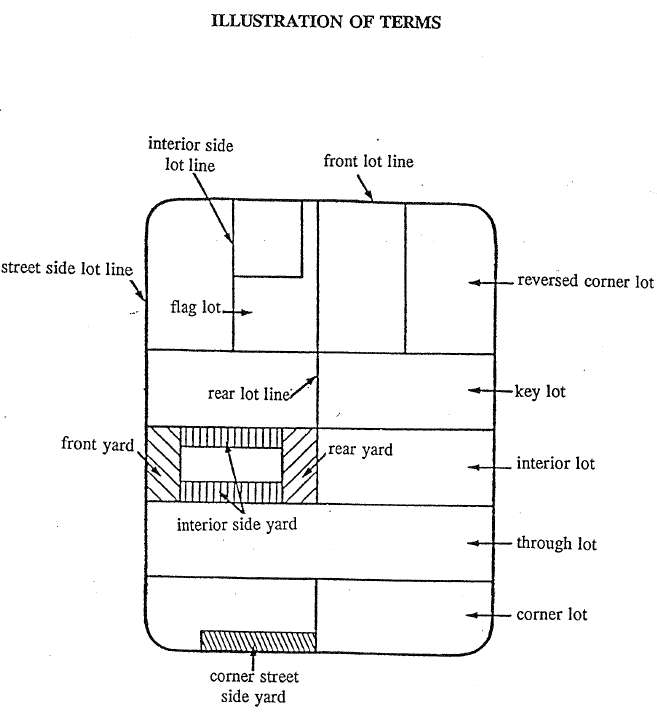
9.14.060. - Illustration of Terms.
The following diagram illustrates the terms shown thereon as the same are used in this Article:
9.14.070. - Accessory Dwelling Unit Development Standards.
A.
Permitted ADU Locations. ADUs are permitted only in the R-1 (Single-Family Residential) and RPD (Residential Planned Development) zones, and in the Mixed Use Lindero and Mixed Use Corsa zoning districts of the North Business Park Specific Plan. An ADU shall be located on the same lot as an existing or proposed detached primary residence.
B.
General ADU Development Standards.
1.
Lot Size. All new ADUs are exempt from compliance with minimum lot size requirements.
2.
Lot Coverage. All new ADUs shall conform to the lot coverage requirements for the zoning district in which the ADU is located, except where the application of the lot coverage requirements would not permit construction of an eight hundred (800) square foot ADU that is sixteen (16) feet in height with four-foot side and rear yard setbacks.
3.
Size. The maximum total floor area of any new ADU shall not exceed the following:
a.
New detached ADU. Eight hundred fifty (850) square feet (ADU with no more than one (1) bedroom) or one thousand (1,000) square feet (ADU with at least two (2) bedrooms).
b.
New attached ADU. Eight hundred fifty (850) square feet (ADU with no more than one (1) bedroom) or one thousand (1,000) square feet (ADU with at least two (2) bedrooms) or fifty (50) percent of the primary residence's living area, whichever is less.
c.
A covered balcony, porch or patio provided with an ADU shall count towards the total ADU square footage allowance.
4.
Height. The maximum height of any new ADU shall not exceed the following:
a.
Sixteen (16) feet for a detached ADU, except as provided in subparagraphs b. and c. below.
b.
Eighteen (18) feet for a detached ADU on a lot that is within one-half mile walking distance of a major transit stop or a high-quality transit corridor, as those terms are defined in Public Resources Code Section 21155; or twenty (20) feet if necessary to accommodate a roof pitch on the ADU that is aligned with the roof pitch of the primary dwelling unit.
c.
Eighteen (18) feet for a detached ADU on a lot with an existing or proposed multi-story multi-family dwelling.
d.
Twenty-five (25) feet or the height limit applicable to the primary dwelling, whichever is less, for an attached ADU.
5.
Setbacks.
a.
An ADU shall comply with all front yard setback requirements applicable to the primary residence, except where the application of the front yard setback requirement would not permit construction of an eight hundred (800) square foot ADU that is sixteen (16) feet in height with four-foot side and rear yard setbacks. Unless otherwise provided in this Section, any new ADU shall have a minimum setback of four (4) feet to the rear property line and four (4) feet to the side-yard property line.
b.
Notwithstanding subparagraph a. above, no setback shall be required for an ADU that is within an existing structure or constructed in the same location and with the same dimensions as an existing legally permitted structure.
c.
A detached ADU must maintain a ten-foot separation from any other building on the same property and an eight-foot separation from eave of the detached ADU to eave of any adjacent structure on the same property, except where the application of this requirement would not permit construction of an eight hundred (800) square foot ADU that is sixteen (16) feet in height with four-foot side and rear yard setbacks.
6.
Design and Features.
a.
The ADU's color, materials, and architectural details, including windows and roof pitch, shall match the primary residence.
b.
If an automatic sprinkler system is required for the primary residence, the ADU shall also have an automatic sprinkler system.
c.
The ADU portion of the lot shall be landscaped consistent with the landscaping on the remainder of the lot to maintain the appearance of a single-family residential lot.
7.
Parking Requirements. One off-street parking space shall be provided for an ADU with at least one bedroom, in addition to the parking required for the primary residence. The required parking space may be provided as tandem parking on an existing driveway.
8.
Parking Exemption. Notwithstanding subparagraph 7. above, no parking space is required for an ADU that satisfies any of the following, including when an application for an ADU is submitted with an application to create a new single-family dwelling or multifamily dwelling on the same lot:
a.
The ADU is located within one-half-mile walking distance of "public transit" as defined in Government Code Section 65852.2.
b.
The ADU is located within an architecturally and historically significant district.
c.
The ADU is part of the existing or proposed primary residence or an existing accessory structure.
d.
The ADU is located in an area where on-street parking permits are required but not offered to an ADU occupant.
e.
The ADU is located within one block of a City-approved and dedicated parking space for a car share vehicle.
9.
Replacement Parking. When an existing garage, carport, or covered parking structure is demolished in conjunction with the construction of an ADU or is converted into an ADU, replacement parking for the primary residence is not required.
10.
Fees and Utility Connections.
a.
The property owner shall pay all sewer, water, school district, and other applicable fees, including development impact fees as permitted under Government Code Section 65852.2(f)(3).
b.
The property owner shall install a new or separate utility connection between the ADU and the utility, and pay all applicable connection fees or capacity charges unless the ADU is exempt under Government Code Section 65852.2(f).
c.
An ADU is not considered a new residential use for the purposes of calculating local agency connection fees or capacity charges for utilities, including water and sewer service.
d.
If an ADU will use a private sewage disposal system, the property owner shall obtain approval by the local health officer.
(Ord. No. 260-17, § 7, 1-10-2017; Ord. No. 285-21, § 8, 1-27-2021; Ord. No. 297-22, § 2, 12-14-2022)
9.14.080. - Accessory Dwelling Unit and Junior Accessory Dwelling Unit Review Process.
A.
An application for a new ADU or JADU shall be subject to review and approval under the Zoning Clearance/Building Permit Process specified in paragraph B. below or under the Building Permit Only Process specified in paragraph C. below. If a demolition permit is required for a detached garage that is to be replaced with an ADU, the demolition permit shall be reviewed and issued at the same time as the building permit for the ADU. A Zoning Clearance or Building Permit application for an ADU or JADU shall not be denied due to the correction of nonconforming zoning conditions, building code violations, or unpermitted structures that do not present a threat to public health and safety and are not affected by the construction of the ADU.
B.
Zoning Clearance/Building Permit Process. Before constructing or establishing an ADU under the development standards provided in Section 9.14.070, an applicant shall obtain a zoning clearance from the Planning Director and obtain a building permit from the Building Official. Any ADU that satisfies the requirements of Section 9.14.070 shall be ministerially approved by the Planning Director in accordance with the procedures specified in Government Code Section 65852.2. If a zoning clearance application for an ADU is denied, the Planning Director shall return in writing a full set of comments to the applicant with a list of items that are defective or deficient and a description of how the application can be remedied.
C.
Building Permit Only Process. An ADU, JADU, or both if required by state law, shall be allowed with only a building permit if the proposed unit(s) meet the requirements of both: (i) the California Building Standards Code as adopted and/or amended by the City; and (ii) Government Code Section 65852.2(e)(1). As of the enactment of this Section, Government Code Section 65852.2(e)(1) requires the City to ministerially approve a building permit within a residential or mixed-use zone to create any of the following:
1.
One ADU and one JADU per lot with a proposed or existing single-family dwelling if all of the following apply:
a.
The ADU or JADU is within the proposed space of a single-family dwelling or existing space of either an existing single-family dwelling or existing accessory structure, and may include an expansion of not more than one hundred fifty (150) square feet beyond the same physical dimensions as the existing accessory structure.
b.
The space has exterior access from the proposed or existing single-family dwelling.
c.
The side and rear setbacks are sufficient for fire and safety.
2.
One detached, new construction ADU that does not exceed eight hundred (800) square feet in size, complies with the height limits specified in Section 9.14.070(B)(4), and has at least four-foot side and rear yard setbacks on a lot with a proposed or existing single-family dwelling. A new detached ADU described in this subparagraph may be combined with a JADU described in subparagraph 1. above.
3.
One ADU within the portions of existing multifamily dwelling structures that are not used as livable space, including storage rooms, boiler rooms, passageways, attics, basements, or garages, if each unit complies with state building standards for dwellings. If requested, multiple ADUs shall be allowed, up to the number of ADUs that equals twenty-five (25) percent of the existing multifamily dwelling units in the structure.
4.
Not more than two (2) detached ADUs located on a lot that has an existing multifamily dwelling, subject to a height limit of sixteen (16) feet and four-foot rear yard and side setbacks.
D.
Very High Fire Hazard Severity Zone. Notwithstanding paragraphs C. and D. above, no ADU or JADU shall be permitted on properties located within the Very High Fire Hazard Severity Zone designated in the General Plan unless all of the following requirements are met:
1.
No more than one ADU or one JADU is allowed on properties located in the Very High Fire Hazard Severity Zone.
2.
All new ADUs or JADUs proposed within the Very High Fire Hazard Severity Zone shall comply with applicable brush clearance requirements. Unless otherwise required by applicable City building and fire codes, in any residential zone where new ADUs or JADUs are allowed, if fire sprinklers are required for the primary dwelling unit then fire sprinklers are also required for new ADUs or JADUs.
E.
JADUs Approved Under the Building Permit Only Process. In accordance with the standards set forth in Government Code Section 65852.22, JADUs approved under the building permit only process shall comply with the following requirements, unless state law is amended to set forth different standards in which case state law standards will govern:
1.
A JADU shall be a maximum of five hundred (500) square feet of gross floor area. The gross floor area of a shared sanitation facility shall not be included in the maximum gross floor area of a JADU.
2.
A JADU must be contained entirely within the walls of the existing or proposed single-family dwelling. For the purposes of this Section, enclosed uses within the dwelling, such as attached garages, are considered a part of the proposed or existing single-family dwelling.
3.
A separate exterior entry from the main entrance to the single-family dwelling shall be provided to serve a JADU.
4.
A JADU may include separate sanitation facilities, or may share sanitation facilities with the single-family dwelling in which case the JADU shall have an interior door to the main living area to allow access to the facilities in the single-family dwelling.
5.
A JADU shall include an efficiency kitchen, which shall include all of the following:
a.
A cooking facility with appliances.
b.
A food preparation counter and storage cabinets that are of reasonable size in relation to the size of the JADU.
6.
One of the residential dwellings on the lot shall be occupied as the primary residence of the owner of the lot and shall not be rented or leased as long as the JADU exists.
7.
No additional parking is required for a JADU.
F.
Restrictive Covenant. Within thirty (30) days following the issuance of a building permit for the ADU or JADU, the property owner shall record with the Los Angeles County Registrar-Recorder a restrictive covenant in a form satisfactory to the City Attorney. The restrictive covenant shall include the following requirements and any other provisions required by state law, except as otherwise provided in Government Code Section 65852.26:
1.
The ADU or JADU may not be sold, transferred, or assigned separately from the primary residence.
2.
The ADU or JADU may not be rented for a period of less than thirty (30) days.
3.
If the property contains a JADU, the JADU shall be a legal unit and may be used as habitable space, only so long as either the main dwelling unit, or the JADU, is occupied by the owner of record of the property.
4.
If the property contains an ADU permitted after January 1, 2025, the ADU shall be a legal unit and may be used as habitable space, only so long as either the main dwelling unit, or the ADU, is occupied by the owner of record of the property.
5.
Such restrictions shall run with the land and be binding upon all future owners, and lack of compliance may result in legal action against the property owner to compel compliance with this Code.
(Ord. No. 285-21, § 9, 1-27-2021; Ord. No. 297-22, § 3, 12-14-2022)
9.14.090 - Two Units in Single-Family Residential Zones.
A.
Purpose. This Section provides objective zoning and design standards for the development of two (2) residential units on single-family residential zone lots pursuant to Government Code Sections 65852.21 and 66411.7. Development pursuant to this Section does not require discretionary review or a hearing and is processed ministerially through a zoning clearance application.
B.
Applicability. This Section applies to single-family residential zone lots. For the purposes of this Section, the following zones are considered single-family residential zones: R-1, RPD-4, RPD-56, RPD-126, RPD-153, RPD-169, RPD-284, and RPD-481.
C.
General Standards. All development pursuant to this Section is subject to the following standards.
1.
Eligibility requirements of Government Code Section 65852.21(a) shall be satisfied.
2.
Except where superseded by this Section, development shall comply with the development standards of the zone in which the lot is located.
3.
Development standards applicable to individual subdivisions originally approved by the County are not applicable to development under this Section.
4.
No residential unit shall be placed such that it is necessary to pass through a flood control easement or storm drain easement to access the unit.
5.
No residential unit shall be located within a restricted use area or restricted development area identified on a subdivision map or assessor's map.
6.
More than twenty-five (25) percent of the exterior structural walls of an existing dwelling shall not be demolished if the dwelling has been occupied by a tenant in the three (3) years prior to the zoning clearance application.
7.
The lot shall contain no more than one pedestrian path connecting to the public right-of-way or private street.
8.
The lot shall contain no exterior stairways except those leading from grade to the first floor.
9.
Off-street parking shall be provided in accordance with the following standards.
a.
A minimum of one off-street parking space in an enclosed garage shall be provided for each residential unit.
b.
No off-street parking is required if either of the following apply:
i.
The lot is located within one-half mile walking distance of either: (i) a high-quality transit corridor as defined in Public Resources Code Section 21155(b); or (ii) a major transit stop as defined in Public Resources Code Section 21064.3.
ii.
There is a car share vehicle located within one block of the lot.
D.
Additional Standards for New Construction. In addition to the standards of subsection C., the standards of this subsection apply if one or both residential units are new construction.
1.
The combined total gross floor area of the units, exclusive of any ADU or JADU, shall not exceed the greater of one thousand eight hundred (1,800) square feet or the gross floor area of the existing primary dwelling unit on the lot.
2.
No residential unit shall exceed a building height of one story.
3.
No residential unit shall exceed a building height of eighteen (18) feet.
4.
Each residential unit shall have a minimum setback of four (4) feet from side and rear property lines except as allowed by Government Code Section 65852.21.
5.
If the residential units are built as separate buildings, the following standards shall apply.
a.
The buildings shall be located one in front of the other in relation to the street.
b.
The front building shall be at least as wide and as tall as the rear building.
c.
The front building shall be positioned such that the rear building is not visible from the street when viewed from directly in front of the property.
6.
If the residential units are built as a single building, the following standards shall apply.
a.
One residential unit shall have a door facing the street and one residential unit shall have a door facing a side or rear property line.
b.
The building shall not be symmetrical such that one side is a mirror image of the other.
E.
Additional Standards for Conversion of an Existing Dwelling. In addition to the standards of subsection C., the standards of this subsection apply if an existing dwelling will be fully or partially retained.
1.
The combined total gross floor area of the units, exclusive of any ADU or JADU, shall not exceed the greater of one thousand eight hundred (1,800) square feet or the gross floor area of the existing primary dwelling unit on the lot.
2.
Additions to the existing dwelling shall have a minimum setback of four (4) feet from side and rear property lines.
3.
Additions to the existing dwelling shall not increase the building height of the structure.
4.
If the existing dwelling has a second story, then the footprint of the second story shall not be expanded.
5.
If the existing dwelling does not have a second story, then a second story shall not be constructed.
6.
If two (2) residential units are located in the same building, one residential unit shall have a door facing the street and one residential unit shall have a door facing a side or rear property line.
F.
Additional Standards for Urban Lot Split Projects. In addition to the standards of subsections C., D., and E. as applicable, the standards of this subsection apply if the residential units will be located on lots created by an urban lot split pursuant to Section 10.1.050.
1.
Each lot created by the parcel map shall be used solely for residential uses.
2.
No lot created by the parcel map shall have more than two (2) residential units inclusive of any ADU or JADU.
3.
For each lot created by the parcel map the combined total gross floor area of the units, inclusive of any ADU or JADU, shall not exceed one thousand eight hundred (1,800) square feet.
4.
If the boundary line between the lots created by the parcel map is perpendicular to the front lot line and neither lot is a flag lot, then the units shall be subject to the following standards.
a.
The buildings nearest the street on each lot created by the parcel map shall be attached with zero setback along the lot line between the lots.
b.
The buildings nearest the street on each lot created by the parcel map shall have identical architectural style, materials, and colors, as shall all fences, walls, and hardscaping visible from the street.
c.
The buildings nearest the street on each lot created by the parcel map shall have no more than one residential unit with a door facing the street.
G.
Exceptions. The Planning Director shall approve an exception to any of the standards specified in this Section upon determining that complying with the standard would physically preclude the construction of up to two (2) residential units or would physically preclude either of the two (2) residential units from being eight hundred (800) square feet in floor area.
H.
Denial. The Planning Director may deny a zoning clearance upon making both of the following findings in writing based upon a preponderance of evidence.
1.
The proposed housing development project would have a specific, adverse impact upon the public health and safety or the physical environment as defined and determined in Government Code Section 65589.5(d)(2).
2.
There is no feasible method to satisfactorily mitigate or avoid the specific, adverse impact.
I.
Short-Term Rental Restrictive Covenant. The Planning Director's approval of a zoning clearance shall not be effective until the property owner submits an executed restrictive covenant prohibiting short term rental of a residential unit created pursuant to this Section. The restrictive covenant shall prohibit rental for a period less than thirty-one (31) days, shall be in a form approved by the City Attorney, and shall be recorded with the Los Angeles County Registrar-Recorder.
J.
Finality of Decisions. Decisions of the Planning Director administering this Section shall be final and shall not be subject to appeal pursuant to Chapter 9.32.
(Ord. No. 289-21, § 2, 1-12-2022)

