Westlake Village City Zoning Code
CHAPTER 9
19.- OFF-STREET PARKING AND LOADING STANDARDS
9.19.010.- Purpose.
These regulations are intended to achieve the following purposes:
1.
To provide accessible, attractive and well-maintained off-street parking and loading facilities.
2.
To reduce traffic congestion and hazards.
3.
To protect neighborhoods from the effects of vehicular noise and traffic generated by adjacent nonresidential districts.
4.
To assure the maneuverability of emergency vehicles.
5.
To provide parking in proportion to the needs generated by varying types of land uses.
(Ord. No. 51, Amended, 04/10/84; Ord. No. 56, Amended, 04/10/85; Ord. No. 65, Amended, 11/08/86; Ord. No. 74, Amended, 10/14/87; Ord. No. 82, Amended, 05/11/88; Ord. No. 108, Amended, 07/24/90)
9.19.020. - Applicability.
Every use hereafter inaugurated, and every building or structure hereafter erected or altered, shall have permanently maintained off-street parking and loading areas.
(Ord. No. 51, Amended, 04/10/84; Ord. No. 56, Amended, 04/10/85; Ord. No. 65, Amended, 11/08/86; Ord. No. 74, Amended, 10/14/87; Ord. No. 82, Amended, 05/11/88; Ord. No. 108, Amended, 07/24/90)
9.19.030. - General Regulations.
1.
When a structure, other than a single-family residence, is enlarged or increased in capacity, or when a change in use creates an increase in the amount of off-street parking or loading area required, additional spaces shall be provided for only the enlargement or increased capacity as required by this Section. However, when such enlargement exceeds ten (10) percent of existing floor area over any five (5)-year period, additional spaces shall be provided so that the entire project (existing and proposed enlargement) complies with the parking requirements of this Section.
2.
Requirements for uses not specifically listed herein shall be determined by the Planning Director, based upon the requirements for comparable uses and upon the particular characteristics of the use.
3.
In any residential zone, a parking structure with the automobile entrance viewable from a public street shall be a garage. Such a garage shall be enclosed with an opaque garage door.
4.
Required guest parking and loading areas shall be designated as such and restricted to such use.
5.
Walls, fences and dense landscaping within parking areas shall be designed to allow for maximum visibility.
6.
In the case of mixed uses, within a single lot or development, the total requirements for off-street parking and loading spaces shall be the sum of the requirements for each of the various uses. Parking and loading facilities for one use shall not be considered as providing such facilities for any other use.
7.
Fractional space requirements shall be counted as the next largest whole space.
8.
No area may be utilized and counted both as a required parking space and a required loading space.
9.
The design and configuration of all new parking facilities shall adhere to all applicable provisions of Chapter 9.37 (Transportation Demand and Trip Reduction Measures).
(Ord. No. 51, Amended, 04/10/84; Ord. No. 56, Amended, 04/10/85; Ord. No. 65, Amended, 11/08/86; Ord. No. 74, Amended, 10/14/87; Ord. No. 82, Amended, 05/11/88; Ord. No. 108, Amended, 07/24/90; Ord. No. 131, Amended, 04/14/93; Ord. No. 192-05, Amended, 3/9/05)
9.19.040. - Number of Parking Spaces Required.
The following minimum number of parking spaces shall be provided for each use (where "sf." refers to square foot and "gfa." refers to gross floor area):
A.
Residential Uses
Single-family including mobilehomes in a mobile home park and multi-family dwellings:
Spaces Required - Two (2) covered spaces for each dwelling unit with one or more bedrooms; one additional space for each accessory dwelling unit with at least one bedroom, in accordance with Section 9.14.070; plus guest parking (where required)
Apartment units:
Spaces Required - One covered and one uncovered space for each dwelling unit with two (2) or more bedrooms; one-half (½) covered spaces for each studio or one bedroom dwelling unit; plus guest parking
Guest parking for mobilehome parks:
Spaces Required - One-half (.5) spaces for each mobilehome dwelling unit
Covered space definition:
For purposes of this provision, "covered space" means an enclosed garage for single-family residences and means an enclosed garage or carport for mobilehomes or apartment units.
B.
Commercial Uses
Restaurants, cafes, bars other eating and drinking establishments, and public assembly uses:
Spaces Required - 1 for each 45 sf. of floor area accessible to customers (excluding restrooms), plus 1 for each 250 sf. of all other floor area
Medical and physical therapy offices:
Spaces Required - 1 for each 200 sf. of gfa.
Hotels and motels:
Spaces Required - 1 for each guest unit, plus requirements for related commercial uses
Mortuaries or funeral homes:
Spaces Required - 1 for each 5 fixed seats or 1 homes for each 45 sf. of non-fixed seating area in the main assembly or service chapel
Spectator entertainment:
Spaces Required - 1 for each 5 fixed seats, or 1 for every 35 sf. of non-fixed seating area, plus 1 space for each 250 square feet of general commercial area
Participant entertainment:
Spaces Required - 1 for each 21 sf. of gfa.
Bowling alleys:
Spaces Required - 3 for each lane, plus requirements for related commercial uses
Health clubs and spas:
Spaces Required - 1 for each 150 sf. of gfa., including any pool area
Game Courts:
Spaces Required - 1 for each player authorized to participate at one time on a court under the rules of the Amateur Athletic Union, plus required parking for spectator seating and associated commercial uses
Motor vehicle sales and service shops:
Spaces Required - 1 for each 1000 sf. of display or sales area of the first 10,000 sf., then 1 for each 5000 sf. thereafter; plus 1 for each 500 sf. of floor area within a building on the premises
Furniture stores:
Spaces Required - 1 for each 500 sf. of gfa.
Service stations:
Spaces Required - 1 for each pump island, plus 1 for each service bay
Golf courses:
Spaces Required - 8 for each hole, plus 1 for each 35 sf. of gfa. in the assembly building and 1 for each 250 sf. of gfa. within other commercial uses
Take-out only food:
Spaces Required - 1 space for each 250 sf. of gfa., plus 5 additional spaces
All other commercial uses not listed above 1 for each 250 sf. of gfa.
C.
Business Park Uses
General industrial, wholesaling, warehousing, manufacturing, and research and development:
Spaces Required - 1 for each 330 sf. of gfa.
Self-storage facilities:
Spaces Required - 1 for each employee, plus 1 for each 20,000 sf. of gfa. and 1 for each vehicle or boat storage space. A minimum of three spaces shall be provided for a project
D.
Institutional Uses
Hospitals:
Spaces Required - 1.5 for each bed
Schools:
Spaces Required
Elementary - 1 for each classroom, plus 1 for each 5 fixed seats or 35 sf. in an auditorium
High School - 5 for each classroom, plus 1 for each 5 fixed seats or 35 sf. in an auditorium
Nursery School - 1 for each 10 children (maximum enrollment)
Churches, Temples, and similar religious facilities:
Spaces Required - 1 for each 4 fixed seats or 80 linear inches of bench seating, or 1 for each 28 square feet of nonfixed seating area within the principal sanctuary. Additional parking shall be required for related uses such as schools and day care centers unless alternating use of parking facilities is approved pursuant to Section 9.19.070
(Ord. No. 192-05, Amended, 3/9/05)
(Ord. No. 260-17, § 6, 1-10-2017; Ord. No. 285-21, § 10, 1-27-2021)
9.19.050. - Number of Handicapped Parking Spaces Required.
All nonresidential parking lots accessible to the public, with the exception of parking lots providing one hundred (100) percent valet parking with an approved variance, shall provide parking spaces designated for use by handicapped persons, in the number indicated by the following table:
When fewer than five (5) parking spaces are provided, one shall be fourteen (14) feet wide and lined to provide a nine (9) foot parking area and a five (5) foot loading and unloading area. However, there is no requirement that the space be reserved exclusively or identified for use by the handicapped only.
(Ord. No. 51, Amended, 04/10/84; Ord. No. 56, Amended, 04/10/85; Ord. No. 65, Amended, 11/08/86; Ord. No. 74, Amended, 10/14/87; Ord. No. 82, Amended, 05/11/88; Ord. No. 108, Amended, 07/24/90)
9.19.060. - Number of Loading Spaces Required.
The following minimum number of loading spaces shall be provided for each use:
1.
Commercial and institutional uses, other than office uses:
2.
Office uses:
3.
Manufacturing, wholesale, warehousing and industrial uses:
(Ord. No. 51, Amended, 04/10/84; Ord. No. 56, Amended, 04/10/85; Ord. No. 65, Amended, 11/08/86; Ord. No. 74, Amended, 10/14/87; Ord. No. 82, Amended, 05/11/88; Ord. No. 108, Amended, 07/24/90)
9.19.070. - Reduction of Requirements.
A.
The alternating use of parking facilities may be approved as part of a planned development or conditional use permit in cases where parties wish to cooperatively establish and operate parking facilities and where these uses generate parking demands primarily during hours when the remaining uses are not in operation (for example, if one use operates during the daytime or on weekends and the other use operates during evenings or weekdays only). The burden of proof for a reduction in the total number of required parking spaces, however, shall remain with the applicant, and documentation shall be submitted substantiating the reasons for the requested parking reduction. An alternating use agreement shall be approved only under the following circumstances:
1.
That a sufficient number of spaces shall be provided to meet the greater parking demand of the alternating uses;
2.
That satisfactory statements have been submitted by the parties operating such facilities, describing the nature of the uses and times when such uses operate so as to indicate the lack of conflict between them; and
3.
That additional documents or agreements as may be deemed necessary in each particular case to assure provision for and the maintenance of the required parking spaces have been provided.
B.
Parking requirements for a secondary use within the same building as the primary use (for example, a restaurant in a hotel or a shop within a sport facility) may be reduced by up to one-half, upon the determination by the Commission that such a reduction is justified.
C.
Subject to approval of a Zoning Clearance, existing compact parking areas for nonresidential uses within the Commercial Planned Development (CPD), Commercial Recreation (CR) and Business Park (BP) Zones may be restriped to achieve standard, nine (9) foot parking stall width dimensions, provided that such parking areas shall maintain at least ninety-five (95) percent of the total number of parking stalls previously approved for the specific site. An approved reduction of up to five (5) percent of available on-site parking shall not effect the calculation of required parking for uses otherwise permitted within the specific zone.
(Ord. No. 51, Amended, 04/10/84; Ord. No. 56, Amended, 04/10/85; Ord. No. 65, Amended, 11/08/86; Ord. No. 74, Amended, 10/14/87; Ord. No. 82, Amended, 05/11/88; Ord. No. 108, Amended, 07/24/90; Ord. No. 148-97, Amended, 6/11/97)
9.19.080. - Design Standards.
A.
Dimensional Requirements.
1.
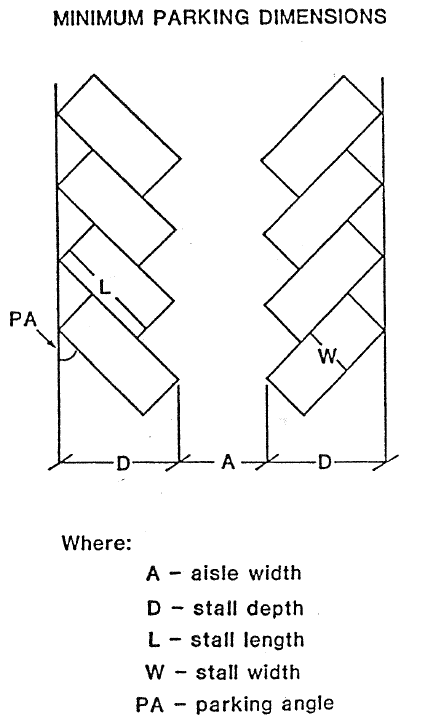
Minimum parking dimensions shall be as indicated in the following table and as depicted on the accompanying diagram.
2.
Any parking space located parallel to a wall or other solid barrier shall be widened an additional two (2) feet.
3.
An inside dimension of twenty (20) feet by twenty (20) feet shall be maintained, unobstructed, for a private two (2) car garage.
4.
Each loading space shall have an unobstructed minimum dimension of twelve (12) feet in width, forty (40) feet in length and fifteen (15) feet in height.
5.
Multi-storied parking structures, subterranean parking, parking decks and single row tuck-under parking is prohibited unless specifically authorized by the Commission as a variance from standards.
B.
Landscaping. Landscaping of parking areas shall be provided and maintained according to the following regulations, as well as those contained in Chapter 9.16 of this Article.
1.
A minimum of five (5) percent of any open parking and driveway areas containing parking spaces for at least ten (10) vehicles, and not more than twenty-one (21) vehicles, shall be landscaped. A minimum of ten (10) percent of any open parking and driveway areas containing more than twenty-one (21) parking spaces shall be landscaped. Such landscaped areas shall be distributed through the entire parking area as evenly as possible and as required by the Director. All such required landscaped areas shall be computed on the basis of the total amount of parking and driveway areas provided (except spaces provided for display purposes or for enclosed vehicle storage areas); however, the Director and Commission may allow any landscaped area which would be within an open service or work area, and not viewable from any perimeter street, to be relocated to a more functional location within the other open parking areas on such property provided such relocation does not decrease the total percentage of required interior landscaping.
2.
Landscaped areas shall be distributed throughout the entire parking area. One tree of at least fifteen (15) gallons in size shall be provided for every ten (10) parking spaces and located so as to visually disrupt long rows of parked vehicles (trees may be clustered).
3.
A minimum ten (10) foot wide landscape planter shall be provided adjacent to any public or private street wherever parking or circulation is generally located adjacent to such rights-of-way.
4.
Where vehicles are to be parked immediately adjacent to a public or private street, a decorative masonry wall of thirty (30) inches in height, measured from the finished surface of the parking area, bermed landscaping having the same height, or a combination thereof shall be provided.
5.
Landscaping shall be provided between a building and a contiguous parking area to the satisfaction of the Director.
C.
Access.
1.
Any parking area shall be provided with suitable maneuvering room so that all vehicles therein may enter an abutting street in a forward direction, except for detached single-family dwelling units.
2.
Use of a required parking space shall not require more than two (2) vehicle maneuvers, except for parallel parking spaces.
3.
No parking space shall be located so that a vehicle is required to maneuver within ten (10) feet of a vehicular entrance to the property.
4.
No required parking space shall be located so as to require the moving of another vehicle in order to access the space.
5.
Exits from parking lots shall be clearly posted with "stop" indicators (i.e., restraining lines).
6.
Parking for the handicapped shall be so located that a handicapped person is not compelled to wheel or walk behind parked cars other than their own. Pedestrian ways which are accessible to the physically handicapped shall be provided from each such parking space to related facilities, including curb cuts or ramps as needed. Ramps shall not encroach into any parking space. However, ramps located at the front of parking spaces for the physically handicapped may encroach into the length of such spaces when such encroachment does not limit a handicapped person's capability to leave or enter their vehicle.
7.
Entrances to and vertical clearances within parking structures shall have a minimum vertical clearance of eight (8) feet two (2) inches where required for accessibility to parking spaces for the handicapped.
D.
Driveways.
1.
Access to one or more automobile storage spaces required by this Chapter shall be not less than ten (10) feet wide at any place.
2.
Driveway aprons located in front of enclosed garages shall have a depth no greater than ten (10) feet, unless constructed to a depth of twenty (20) feet or more.
E.
Surfacing. Parking and loading areas, as well as the maneuvering areas and driveways used for access thereto, shall be paved with:
1.
Concrete surfacing to a minimum thickness of three and one-half (3.5) inches, with expansion joints as necessary; or
2.
Asphalt surfacing, rolled to a smooth, hard surface having a minimum thickness of one and one-half (1.5) inches after compaction, and laid over a base of crushed rock, gravel or other similar material compacted to a minimum thickness of four (4) inches. The requirement for said base may be modified if:
a.
A qualified engineer, retained to furnish a job site soil analysis, finds that said base is unnecessary to ensure a firm and unyielding subgrade, equal, from the standpoint of the service, life and appearance of the asphaltic surfacing, to that provided if said base were required, and so states in writing, together with a copy of his findings and certification to such effect; or
b.
Other available information provides similar evidence;
3.
Other alternative material that will provide at least the equivalent in service, life and appearance of the materials and standards which would be employed for development pursuant to subsection 1 or 2 of this Section.
The City Engineer, at the request of the Planning Director, shall review and report on the adequacy of paving where modification of base is proposed under subsection 2 or where alternative materials are proposed under subsection 3. The City Engineer may approve such modification or such alternative materials if, in his opinion, the evidence indicates compliance with subsections 2 or 3, as the case may be.
F.
Marking.
1.
All parking spaces, except in a garage or carport containing two (2) or fewer parking spaces shall be striped in a manner clearly showing the layout of the intended parking stalls. Such striping shall be maintained in a clear and visible manner.
2.
The surface of each parking space for the handicapped shall have a surface identification sign duplicating the symbol of accessibility in blue paint, at least three (3) square feet in size.
G.
Wheel Stops. Wheel stops or continuous concrete curbing at least six (6) inches in height shall be provided for all parking spaces, except those established in a garage or carport. Required wheel stops adjacent to landscaped strips may be waived, provided that the width of the landscaped planters adjacent to the affected parking stalls be expanded by a minimum of two (2) feet.
H.
Lighting. Parking areas for other than single-family residences and vehicle sales areas designed to accommodate three (3) or more vehicles shall have lighting facilities capable of providing a minimum of 0.2 and an average of 0.8 foot candle maintained illumination with a uniformity ratio of 4:1 (average/minimum) at every point of the parking lot. Any illumination, including security lighting, shall be so arranged as to reflect away from adjoining properties and rights-of-way.
I.
Slope.
1.
Parking areas used exclusively for parking and vehicle maneuvering shall be designed and improved with grades not to exceed a five (5) percent slope.
2.
Driveways used exclusively for ingress and egress or interior parking lot circulation shall be designed and improved with grades not to exceed twenty (20) percent slope.
3.
Surface slopes of parking spaces for the physically handicapped shall be the minimum possible and shall not exceed one-quarter inch per foot (2.083 percent slope) in any direction.
J.
Drainage. All required off-street facilities for three (3) or more required parking spaces and all loading facilities shall be so designed that surface water will not drain over any sidewalk.
K.
Screening.
1.
Parking areas for three (3) or more cars abutting residentially-zoned property shall be separated from such property by a landscaped strip with a minimum width of ten (10) feet, and a six (6) foot high solid fence or wall, located on the residential side of the landscaped strip. If said wall is not at least five (5) feet above the ground elevation of the parking lot, another wall shall be required immediately adjacent to the parking spaces which is five (5) feet high.
2.
A loading area adjoining a street or a required front yard shall be screened with a solid wall of a design subject to the approval of the Planning Director.
L.
Speed Bumps. Speed bumps are prohibited.
M.
Parking Lot Maintenance. Parking facilities including paved and landscaped areas for other than single-family residences, designed to accommodate three (3) or more vehicles, shall be maintained at all times in accordance with provisions of the Zoning Ordinance and conditions of an approved permit. Any alteration or modification to the parking facilities including established landscaping shall require prior review and issuance of a Zoning Clearance.
N.
Bicycle Parking. Parking areas for other than single-family residences, designed to accommodate three (3) or more vehicles, shall provide a stationary bicycle rack or facility to secure the frame and both wheels of bicycles to the satisfaction of the City Planning Director.
(Ord. No. 51, Amended, 04/10/84; Ord. No. 56, Amended, 04/10/85; Ord. No. 65, Amended, 11/08/86; Ord. No. 74, Amended, 10/14/87; Ord. No. 82, Amended, 05/11/88; Ord. No. 108, Amended, 07/24/90; Ord. No. 148-97, Amended, 6/11/97; Ord. No. 192-05, Amended, 3/9/05)
9.19.090. - Location of Required Parking and Loading Spaces.
A.
Required parking spaces within commercial and industrial zones shall be on the same lot or parcel of land and shall be located within four hundred (400) feet of the main structure they serve. Such distance shall be computed from the nearest point of the structure's public access to the nearest point of the parking area.
B.
Required parking for single-family dwellings shall be located on the same lot as the dwelling served, and shall not be located within a required front or side yard.
C.
Required parking for multifamily dwellings, apartments, and mobile homes in a mobile home park shall be located on the same lot as the dwelling served, or in the case of parking being located in a common area, not more than one hundred (100) feet from the dwelling served, and shall not be located within a required front or side yard.
D.
Required loading spaces shall be located immediately adjacent to the exterior wall of the building, but shall not be within the building. Such spaces shall not be located in any required front or side yard.
E.
Loading spaces shall be set back a minimum of twenty-five (25) feet from any residentially-zoned property.
F.
Loading spaces shall be so located and designed so that trucks shall not be required to back into a public street for ingress or egress. Truck maneuvering areas shall be provided where appropriate.
G.
Parking for commercial and industrial uses adjacent to residential uses shall be set back a distance equal to the building setback required by the adjoining residential property.
H.
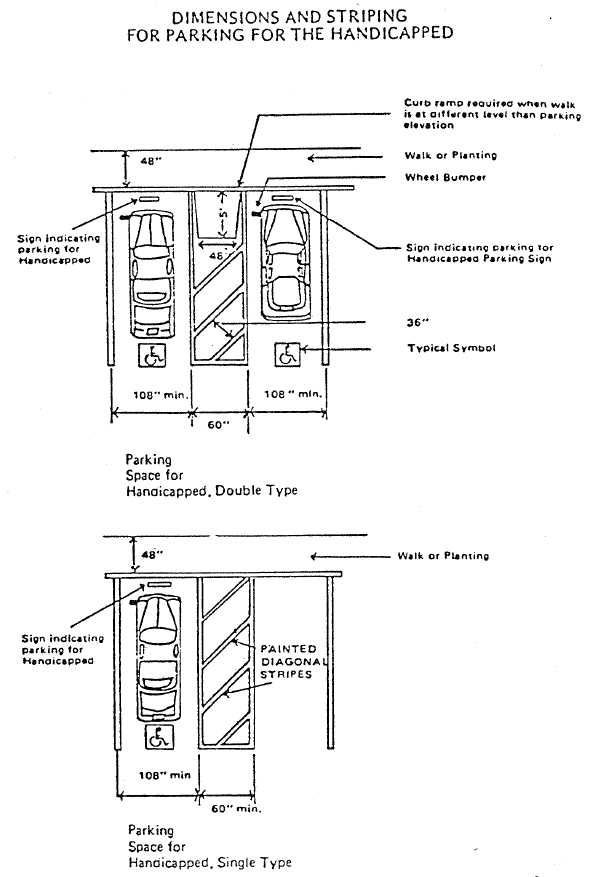
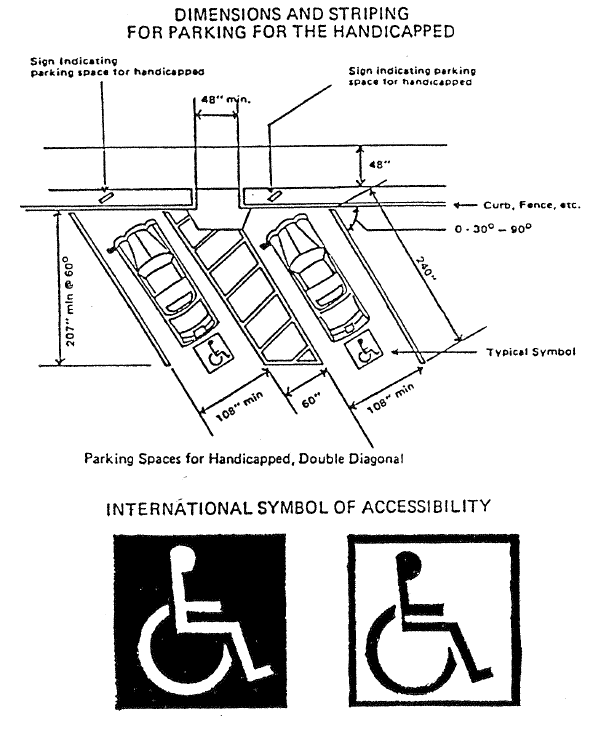
Parking spaces for the physically handicapped shall be located as near as practical to a primary entrance. If only one space is provided, it shall be fourteen (14) feet wide and striped to provide a nine (9) foot parking area and a five (5) foot loading and unloading area. When more than one space is provided, in lieu of providing a fourteen (14) foot wide space for each parking space, two (2) spaces can be provided within a twenty-three (23) foot wide area striped to provide a nine (9) foot parking area on each side of a five (5) foot loading and unloading area in the center. The minimum length of each parking space shall be eighteen (18) feet. These parking spaces shall be designed substantially in conformance with the diagrams contained in this Section.
(Ord. No. 51, Amended, 04/10/84; Ord. No. 56, Amended, 04/10/85; Ord. No. 65, Amended, 11/08/86; Ord. No. 74, Amended, 10/14/87; Ord. No. 82, Amended, 05/11/88; Ord. No. 108, Amended, 07/24/90)