
White City City Zoning Code
CHAPTER 19
42 SPECIFIC USE STANDARDS
19.42.010 Purpose
The purpose of this Chapter is to further the purposes of the General Plan, this Ordinance, and all other municipal land use ordinances, as well as to ensure compatibility of selected specific uses with surrounding uses and properties to avoid any negative impacts associated with such uses.
Repealed & Replaced by Ord. Title 19 White City Zoning Ordinance on 6/2/2023
19.42.020 Applicability
- This Chapter contains the specific and additional regulations for permitted and conditional uses identified in the Schedule of Uses for each of the zones contained in this Title. Any use not listed as permitted or conditional in the applicable zone shall be prohibited.
- Compliance with specific use standards, as applicable, as well as all other requirements of this Ordinance, and all other land use ordinances, and all other Federal, State, and Local requirements are required for any land use application approval required by this Ordinance, or any other approval, Permit, or license required by other land use.
Repealed & Replaced by Ord. Title 19 White City Zoning Ordinance on 6/2/2023
19.42.030 Accessory Dwelling Units, Internal (IADU)
- Purpose. White City recognizes that internal accessory dwelling units in single-family residential zones can be an important tool in the overall housing plan for White City. The purposes of the Internal Accessory Dwelling Unit standards of this code are to:
- Comply with State of Utah legislation which allows for Internal Accessory Dwelling Units generally and requires municipalities to adopt an ordinance if they wish to regulate certain requirements of the dwellings;
- Allow opportunities for property owners to provide social or personal support for family members where independent living is desirable;
- Provide for affordable housing opportunities;
- Make housing units available to moderate in co me people who might otherwise have difficulty finding housing in the Metro Township;
- Provide opportunities for additional income to offset rising housing costs;
- Develop housing units in single-family neighborhoods that are appropriate for people at a variety of stages in the life cycle;
- Preserve the character of single-family neighborhoods by providing: standards governing development of Internal ADUs; and
- Ensure that internal accessory dwelling units (IADUs) are properly regulated by requiring property owners to obtain a business license and a building permit for an IADU prior to renting the IADU.
- Definitions.
- "Internal Dwelling Unit" means an accessory dwelling units attached unit created:
- within a primary dwelling;
- within the footprint of the primary dwelling at the time the internal accessory dwelling unit is created; and for the purpose of offering a long-term rental of 30 consecutive days or longer.
- "Owner Occupancy" means a property where the property owner, as reflected in title records, makes his or her legal primary residence at the site, as evidenced by voter registration, vehicle registration, driver's license, county assessor records or similar means.
- "Primary dwelling units " means a single-family dwelling that is detached and is occupied as the primary residence of the owner of record.
- "Internal Dwelling Unit" means an accessory dwelling units attached unit created:
- Allowed Areas and Zones.
- IADUs incorporated within the single- family residence shall be a permitted use on single¬ family home lots in primarily residential zones that require 6,000 square foot minimum lot sizes or greater excepting those lots in the A-1, A-2 and R-1-21 zones. These zones comprise less than 25% of the total residential zoned area of White City and may be exempted by Utah State Code I0-9a-530(4)(e)(i) .
- In no case may an IADU be permitted in a townhome, a multi-family PUD or other attached unit type, or on any lot that cannot satisfy parking or other conditions of the code.
- Number of Residents Allowed in Accessory Units. IADUs shall not be occupied by more than four (4) persons.
- Parking Requirements. In addition to the required parking for the existing home. the property owner must demonstrate that one (1) on-site parking space is available for an IADU. A property owner bears the burden of showing by a preponderance of evidence that sufficient parking is available. In cases where attached garage conversions are done to create IADU. replacement on-site parking spaces are required for the primary dwelling in a number equal to the parking spaces eliminated by such IADU.
- Owner Occupancy. The primary dwelling or the IADU must have owner occupancy. An application for an IADU shall include evidence of owner occupancy.
- Number of IADUs per Lot. Only one (1) IADU is allowed per lot.
- IADU Design Standards.
- An approved building permit is required for all IADUs before an IADU is constructed. and all other applicable provisions of this Chapter and the Municipal White City Code must be met before an IADU can be rented. Existing non-compliant IADUs may come into compliance by receiving a permit and verifying existing work was done according to code.
- The design and size of an IADU shall conform to all applicable building, fire. and health codes, including applicable water service requirements.
- Conversions of an existing space to an IAD will require compliance with safety requirements per building code including. but not limited to, egress windows with window wells in case of emergency. close off door(s) if needed between the IADU and main unit. and sufficient HVAC and climate control for the IADU.
- IADUs will not require a separate HVAC or firewall.
- The owner shall provide a separate address marking for emergency services and mailing services.
- Single-family residences with an IADU shall retain the same appearance as a single- family residence.
- Affidavit and Notice of Accessory Dwelling Unit. Applicants for IADUs shall provide an affidavit stating that the owner of the property will live in either the primary dwelling or IADU as their primary residence. Upon approval of the IADU by the building official, and upon the issuance of a business license pursuant to section 19.42.030 J. A Notice of Internal Accessory Dwelling Unit including the affidavit hall be recorded against the property to provide notice to a future owner of the owner occupancy requirement for the IADU.
- Upon sale of the property, if the new owner wishes to continue use of-a previously approved IADU, the new owner shall sign and record a new affidavit, update their information with the planning and business license departments, and comply with current administrative IADU requirements. A copy of the recorded notice will be provided to the applicant when completed.
- Business Licensing. Prior to renting out any IADU, a business license must be obtained. That license must be maintained and renewed annually as long as the unit is rented.
- Retention of Single-Family Residence Status. IADUs are part of a single-family residence and shall not be treated as a multi-family residence.
- IADUs may not be separately metered apart from the single-family residence.
- IADUs may not be sold or subdivided separately from the single-family residence.
- Short-Term Rental Use Prohibited. Units approved as IADUs shall not be used as short-term rentals. Any rentals shall be made for 30 consecutive days or more.
- Remedies for Violations. In addition to any other legal or equitable remedies available to a municipality, White City Metro Township may hold a lien against a property that contains an internal accessory dwelling unit in accordance with the provisions and procedures of Utah Code Annotated Section 10-9a-530. if the owner of the property violates any of the provisions of that Section or any of the provisions of this ordinance.
- Variances. The Land Use Hearing Officer may grant variances to the standards of this chapter in accordance with section 19.20. The land use hearing officer may not grant a variance from Building Code requirements, owner occupancy provisions. lot square footage requirements. or the number of units allowed per lot.
Repealed & Replaced by Ord. Title 19 White City Zoning Ordinance on 6/2/2023
19.42.040 Accessory Outside Storage
- Storage of goods, wares, merchandise, commodities, and any other items located outside of a completely enclosed building for more than twenty-four (24) hours is prohibited except as accessory outside storage for public or quasi-public uses, subject to the applicable zoning district and subject to the following standards:
- The area used for accessory outside storage may not constitute more than fifteen percent (15%) of the lot area and may not reduce the access to or usability of areas required for parking for the lot.
- With the exception of retail sales displays in an approved commercial area, outside storage shall be screened from public view by a minimum six-foot (6') high opaque fence. The required screening shall be established prior to the use of any area for outside storage.
- When outdoor storage occurs in a front yard, side yard, or any other location within the public view, a fence or screening of a height and material determined by the Planning Commission shall be installed.
- Outside storage areas shall be paved with asphalt or concrete.
- Outside storage areas shall be maintained in a clean, neat, and orderly condition. The required screening shall be kept in good repair.
- The presence of hazardous materials, junk, junk cars, or debris not usually appurtenant to permitted on-site uses is prohibited.
- "Accessory Outside Storage" as defined herein does not include construction yards, storage yards, or other storage uses where the storage of items outside of an enclosed building is a primary characteristic of the use.
Repealed & Replaced by Ord. Title 19 White City Zoning Ordinance on 6/2/2023
19.42.050 Amateur Communications Or Ham Radios
- This section shall apply to amateur radio antennas and support structures. The equipment and facilities mentioned herein shall be allowed in all within the municipality, and it is the municipality’s intent to provide reasonable accommodation for such communications.
- This section separates regulations governing amateur communications from commercial wireless communications facilities and related equipment, and establishes provisions relating to visual mitigation, r-f noise, engineering, residential impact, health, safety, and facility siting. All facilities shall comply with the following regulations and all other ordinances of the municipality and any pertinent regulations of the federal communications commission (FCC) and the federal aviation administration (FAA).
- Amateur radio antennas are regulated by the federal communications commission (FCC).
- A building permit is required for all amateur radio facilities. A copy of the users amateur radio license shall be submitted with the building permit application. For antennas and support structures that do not exceed the maximum height requirement of the applicable zone, no additional review is required.
- All antennas and support structures shall comply with the required setbacks of the applicable zone in which the property is located.
- No more than one amateur radio antenna and support structure per lot may be installed and shall be located in the rear or side yard, of a home or main structure.
Repealed & Replaced by Ord. Title 19 White City Zoning Ordinance on 6/2/2023
19.42.060 Animal Hospitals Or Clinics
- Animal Hospitals and Clinics, where allowed as a permitted or conditional use in the applicable zone, are also subject to the following standards:
- The use of the building space shall be restricted to medical treatment and incidental care such as bathing, the trimming of common household pets on an outpatient basis only, except that temporary boarding in connection with medical treatment shall be permitted, and except that short-term boarding, defined to be not more than two weeks, may be permitted.
- Outdoor animal runs or holding facilities may be approved as an accessory use with a conditional use permit. Such runs or holding facilities may not be established within three hundred feet (300’) of a property line of a residential zone, an educational institution, or a place of worship.
- The building space shall be adequately soundproofed to assure that no noise will be carried beyond the confines of the building or space that the use would occupy.
- When outdoor holding facilities are permitted by the underlying zone, the location of barns, stables, coops, pens corrals and other holding areas are subject to the requirements for animal rights in this Chapter.
- The applicant shall demonstrate that noise, odors, traffic, light pollution, and refuse produced by the use can be reasonably mitigated.
Repealed & Replaced by Ord. Title 19 White City Zoning Ordinance on 6/2/2023
19.42.070 Animal Rights
- Animal rights, where allowed as a permitted or conditional use in the applicable zone, are also subject to the following standards:
- When a parcel with animal rights contains less than five and a quarter (5.25) acres, that parcel may hold no more than one (1) animal unit and their seasonal offspring for each ten thousand square feet (10,000 sq. ft.).
- When a parcel or group of contiguous parcels with shared ownership contains more than five and a quarter (5.25) acres, that parcel or group of parcels may hold no more than one (1) animal unit and their seasonal offspring for each five thousand square feet (5,000 sq. ft.).
- No animals or fowl may be kept or maintained closer than forty feet (40’) to any dwelling on an adjacent parcel of land. No barn, stable, coop, pen or corral shall be kept closer than forty feet (40’) to any street.
- All yards, barns, shelters, cages, areas, places, and premises where domestic livestock, animals, or fowl are kept shall be maintained in a clean and sanitary condition so that flies, dust, or odors do not disturb the health of any person or animal or create a nuisance to any adjoining property.
- All pens, yards, shelters, cages, areas, and premises where animals are held or kept shall be maintained so that no flies, insects, or vermin, rodent harborage, odors, ponded water, the accumulation of manure, garbage or other noxious materials do not disturb health and safety of any person or animal.
Repealed & Replaced by Ord. Title 19 White City Zoning Ordinance on 6/2/2023
19.42.080 Apiary
- The purpose of the apiary standards is to establish certain requirements for sound beekeeping practices. These standards are intended to avoid problems that may otherwise be associated with the keeping of bees in populated areas.
- Apiaries, where allowed as a permitted or conditional use in the applicable zone, are also subject to the following standards:
- No more than the following number of colonies may be kept on any lot or parcel within the municipality, based upon the size of the lot or parcel upon which the apiary is situated:
- Less than or equal to nine thousand nine hundred ninety-nine square feet(9,999 sq. ft.) in size: one(1) colony;
- More than nine thousand nine hundred ninety-nine square feet (9,999 sq. ft.) but less than or equal to nineteen thousand nine hundred ninety-nine square feet (19,999 sq. ft.) in size: two (2) colonies;
- More than nineteen thousand nine hundred ninety-nine square feet (19,999 sq. ft.) in size: one (1) colony plus one (1) additional colony for each ten thousand square feet (10,000 sq. ft.) of land area.
- A site plan shall be submitted for review by Planning and Development Services addressing the following:
- Any colony situated within twenty-five feet (25’) of a public or private property line shall require the establishment of a flyway barrier at least six feet (6’) in height consisting of a solid wall, fence, dense vegetation, or combination thereof as approved by the Director or designee. Said barrier shall be along or parallel to the property line extending ten feet beyond the colony in each direction, forcing a flight pattern elevation of at least six feet (6’) above grade.
- A water source shall be provided on the property and no nearer than twenty feet(20’) to the hive to avoid bees congregating on nearby properties in a search for water.
- A sign conspicuously posted setting forth the name and phone number or other identifying marks, such as a registration number, of the responsible beekeeper.
- In addition to the aforementioned conditions, the applicant shall ensure compliance at all times with the following conditions:
- All honeybee colonies shall be kept in Langstroth-type hives with removable frames, which shall be kept in sound and usable condition.
- All honeybee colonies shall be registered with the Utah Department of Agriculture and Consumer Services in accordance with the Utah Bee Inspection Act.
- Maintenance shall be such that no bee comb or other materials are left upon the grounds of the apiary site. Upon removal from the hive, all such materials shall promptly be disposed of in a sealed container or placed within a building or other bee-proof enclosure.
- All colonies shall be maintained with marked queens. The colony shall be promptly requeened if it exhibits unusual aggressive characteristics by stinging or attempting to sting without due provocation or swarming. Regardless of colony behavior, each colony shall be requeened on a yearly basis.
- Each Utah apiary shall meet all requirements and inspection schedules deemed necessary by the Utah Department of Agriculture and Consumer Services.
- Notwithstanding compliance with the various requirements of this subsection, it shall be unlawful for any beekeepers to keep any colony or colonies in such a manner or of such disposition as to cause any unhealthy condition, interfere with the normal use and enjoyment of human or animal life of others or interfere with the normal use and enjoyment of any public property or property of others.
- No more than the following number of colonies may be kept on any lot or parcel within the municipality, based upon the size of the lot or parcel upon which the apiary is situated:
- Upon receipt of information that any colony situated within the municipality is not being kept in compliance with the requirements of this section, an investigation and subsequent hearing before the municipality’s Land Use Hearing Officer may result and may result in the revocation of the apiary permit.
Repealed & Replaced by Ord. Title 19 White City Zoning Ordinance on 6/2/2023
19.42.090 Bars And Clubs
Bars and clubs are not permitted in White City, but if ever allowed as a permitted or conditional use in a zone, bars and clubs are subject to the following standards in additional to standards in the applicable zone:
- A security and operations plan shall be prepared by the applicant and approved by the Unified Police Department of Greater Salt Lake and the Director. The security and operations plan shall be filed with Planning and Development Services as part of the business license. The security and operations plan shall include:
- A complaint-response community relations program;
- A provision for resolving neighborhood complaints regarding the operations on the business premises;
- Design and construction requirements to ensure that any sound level originating within the premises, measured within fifteen feet (15') from an exterior wall or door thereof, does not exceed the maximum permissible sound level set forth in Title 9;
- A provision stating that live entertainment shall only be located within an enclosed building subject to the foregoing sound limit;
- Prohibiting electronically amplified sound in any exterior portion of the premises;
- Designation of a location for smoking tobacco outdoors in conformance with Utah law;
- A provision stating that any trash strewn on the premises be collected and deposited in a trash receptacle by six o'clock (6:00) A.M. the following day, including any smoking and trash or debris in parking lot areas;
- A provision stating that portable trash receptacles on the premises be emptied daily, and automated receptacles be emptied at least weekly. Automated receptacles shall be located only within a municipality approved trash storage area; and
- A parking management plan which shall include consideration of the impact of parking on surrounding neighborhoods.
- Site and floor plans proposed for the premises shall be reviewed and approved by the Unified Police Department of Greater Salt Lake. Such review may require design features for the purpose of reducing alcohol related problems such as consumption by minors, driving under the influence, and public drunkenness.
- In addition to the required setbacks, where a bar or club abuts a residentially zoned parcel, an additional buffer consisting of vegetative landscaping or walls are required along any property line or within any required yard area on the lot where the premises are located.
- The location of an outdoor smoking area shall be selected to mitigate the effect on neighboring residences, businesses, and buildings. Where complaints are made about the outdoor smoking area, the Planning Commission may require the outdoor smoking area to be moved to an alternate location where it can be shown that the smoking area is adversely affecting neighboring residences, businesses, and buildings.
- Not more than one alcohol related establishment as noted in the table of permitted and conditional uses shall be located within five hundred feet (500') of another alcohol related establishment as measured linearly without regard to intervening structures from the nearest point on the property line of one establishment to the nearest point on the property line of the second establishment.
Repealed & Replaced by Ord. Title 19 White City Zoning Ordinance on 6/2/2023
19.42.100 Bed And Breakfast Inn
A bed and breakfast inn, where allowed as a permitted or conditional use in the applicable zone, is also subject to the following standards:
- The structure shall have a residential appearance;
- The structure shall be limited to a maximum of two (2)stories in height;
- The structure must contain a minimum of five (5) guestrooms, but not more than fifteen (15) guestrooms;
- Guests using the accommodations or lodging must pay compensation;
- A bed and breakfast inn may not provide cooking facilities in any individual guestroom;
- The access to the site and the on-site parking shall be available for use and maintained, including snow removal, throughout the entire year; and
- A bed and breakfast inn located in the C-2 Zone may include a restaurant and conference rooms.
Repealed & Replaced by Ord. Title 19 White City Zoning Ordinance on 6/2/2023
19.42.110 Car And Light Truck Wash
- Car and light truck washes are not permitted in White City, but if ever allowed as a permitted or conditional use in a zone, Car and light truck washes are subject to the following standards in additional to standards in the applicable zone:
- In addition to the applicable landscaping requirements of Chapter 19.50 , landscaping for all car washes shall double the number of plantings required in areas between stacking and drive-through areas and the street and residentially zoned property.
- The facility shall be designed and operated, including the bay openings and vacuum areas, to minimize traffic, noise, and aesthetic impacts to surrounding properties and public view.
- Vacuum stations and related equipment are prohibited along any side of a building facing a residential use or residential zoning district unless a masonry wall is located along the entire property line adjacent to that residential use or zone.
- Recycling of water used for vehicle washing is required to be installed and used in perpetuity. The use of recycling water systems and the disposal of water fluids and solids shall comply with applicable state and federal laws, guidelines and/or standards.
- Any water flow resulting from the use of the washing facilities shall be confined to the car wash site and disposed of through an on-site drainage system in accordance with applicable laws.
- The internal traffic circulation pattern shall be designed so as to preclude traffic congestion on public streets in the vicinity and to provide safe ingress, egress, and movement of traffic on the site.
- The site shall provide space sufficient to allow a minimum of five vehicles to stack while waiting to access the car wash prior to reaching the payment area. All stacking shall be maintained on site and may not back onto any public right-of-way.
- Provisions shall be made for regular on-site maintenance and clean-up of the property.
- Landscaping for New Construction of Car Washes.
- Plantings and related landscape improvements shall be provided in conjunction with drive-through service facilities, including automatic car washes, in order to:
- Introduce a more aesthetically pleasing approach to these types of vehicular activities on newly developed or redeveloped sites;
- Better integrate these types of land uses into the established character of surrounding area improvements; and
- Screen queued vehicles from the view of passing motorists on adjacent roadways.
- Trees Required.
- One (1) tree shall be planted for each one hundred and twenty-five square feet (125 sq. ft.) or more of landscape area. Landscape areas of less than one hundred and twenty-five square feet (125 sq. ft.) do not require a tree to be planted.
- Groundcover Plantings.
- A minimum of fifty percent (50%) of the surface area of each landscape area shall be planted in low-growing shrubs, groundcover, perennials, ornamental grasses, or other herbaceous plants.
- To avoid visibility obstructions, these plantings shall not reach a mature height of more than thirty inches (30”).
- Mulch.
- The entire landscape area shall be mulched to promote plant health and retain water. No turf shall be planted in these landscape areas.
- The entire landscape area shall be mulched to promote plant health and retain water. No turf shall be planted in these landscape areas.
- Plantings and related landscape improvements shall be provided in conjunction with drive-through service facilities, including automatic car washes, in order to:
Repealed & Replaced by Ord. Title 19 White City Zoning Ordinance on 6/2/2023
19.42.120 Caretaker Living Quarters
- Caretaker living quarters are not permitted in White City but if ever allowed in a zone caretaker living quarters are subject to the following standards in additional to standards in the applicable zone:
- The caretaker living quarters shall be located within the principal building on the site.
- The caretaker living quarters shall be occupied by the owner or an employee of the business or use.
- A minimum of one(1) designated parking space shall be provided for the caretaker living quarters, in addition to any parking spaces required for the principal use.
- The caretaker living quarters may have no more than two (2) bedrooms.
- The caretaker living quarters shall be limited to a maximum of six hundred fifty square feet ( 650 sq. ft.).
- The caretaker unit must meet all applicable requirements of the International Residential Building Code as adopted by the municipality. Each unit shall have a kitchen suitable for cooking and preparing meals, a bathroom with shower and/or bathing facilities, a living room, and a bedroom. Studio units are permitted so long as they provide space for the amenities as described in this Section.
- The property owners shall execute and record a covenant and agreement with the jurisdiction to revert the property to an industrial use without a caretaker living quarters, including the removal of the kitchen facilities of any permanent addition that does not meet the requirements of the zone in which the use is located, after the expiration of any associated permit granted or the termination of the business.
Repealed & Replaced by Ord. Title 19 White City Zoning Ordinance on 6/2/2023
19.42.130 Check Cashing
- Check cashing and other non-depository financial institutions are not permitted in White City, but if ever allowed as a permitted or conditional use in a zone, check cashing and other non-depository financial institutions, are subject to the following standards in additional to standards in the applicable zone:
- Establishments shall be located no closer than one mile from other similar establishments;
- Use activities shall be limited to short term Title loan and short-term consumer installment loan business;
- The following services are specifically prohibited: "cash for gold", "cash for precious metals", and the processing or storage of repossessed vehicles or other repossessed property; and
- All business activity, including customer queuing, shall be accommodated inside the building.
Repealed & Replaced by Ord. Title 19 White City Zoning Ordinance on 6/2/2023
19.42.140 Chickens Or Ducks, Residential Keeping Of Or Domestic Fowl
- Domestic Fowl or Chickens. Subject to the requirements of this Section and any other applicable provision of this code, hen chickens and ducks (and no roosters or other types of fowl) regardless of age, in the amount set forth below, may be kept on a lot or parcel of land for the sole purpose of producing eggs.
- The number of hen chickens or ducks which may be kept shall be limited based on the size of the lot or parcel as follows:
- Lots with at least twenty thousand square feet (20,000 sq. ft.): Up to sixteen (16) chickens or ducks for the first twenty thousand square feet (20,000 sq. ft.) and up to eight (8) additional chickens or ducks for each ten thousand square feet (10,000 sq. ft.) of lot area.
- Lots with between fifteen thousand (15,000) and nineteen thousand nine hundred ninety-nine square feet (19,999 sq. ft.): Up to twelve (12).
- Lots with between ten thousand (10,000) and fourteen thousand nine hundred ninety-nine square feet (14,999 sq. ft.): Up to eight (8).
- Lots with between six thousand (6,000) and nine thousand nine hundred ninety-nine square feet (9,999 sq. ft.): Up to four (4).
- Lots with less than five thousand nine hundred ninety-nine square feet (5,999 sq. ft.): None.
- The principal use on the lot or parcel shall be a single- or two-family dwelling.
- Chickens and ducks shall be confined within a secure enclosure that includes a coop.
- The coop shall be covered, weatherproof, and well ventilated.
- The enclosure, including the coop, shall be predator resistant.
- The coop shall have a minimum floor area of at least two and one-half square feet (21/2 sq. ft.) per animal.
- If the chickens or ducks are not allowed to roam within an enclosure or a properly fenced rear yard outside the coop, the coop shall have a minimum floor area of six square feet (6 sq. ft.) per chicken.
- The coop shall be structurally sound and located in a rear yard at least forty feet (40') from any neighboring residential structure. The coop shall also meet the minimum setback for accessory structures within the applicable zoning district and may not be located nearer any street than the primary residential structure. Coops may not be located in any front yard or side yard, corner lot.
- The coop and enclosure shall be maintained in a neat and sanitary condition and shall be cleaned as necessary to prevent any odor detectable at a property line.
- No chicken or duck shall be permitted to roam outside the coop or enclosure except that a rear yard enclosed with a six-foot (6') fence with links or slats spaced at intervals small enough to keep chickens enclosed and predators out.
- Feed shall be stored in rodent and predator proof containers.
- Water shall be available to the animals at all times.
- Animals may not be slaughtered on site unless it can be done humanely and not within the public view.
- A Salt Lake County Animal Services permit is required.
Repealed & Replaced by Ord. Title 19 White City Zoning Ordinance on 6/2/2023
19.42.150 Child Care
- Childcare, where allowed as a permitted or conditional use in the applicable zone, is also subject to the following standards:
- A person exempted from licensing as a childcare center under the Utah Department of Health and Human Services Rule R381-60-3 is not subject to land use approval or business licensing. Building Code regulations may still apply.
- “Child Care, Residential” must be licensed by the Utah Department of Health and Human Services under Rule R430-50 et seq. A copy of the Health and Human Services License must be submitted prior to the issuance or renewal of a Business License.
- “Child Care, Licensed Family” must be licensed by the Utah Department of Health and Human Services under Rule R430-90 et seq. A copy of the Health and Human Services License must be submitted prior to the issuance or reissuance of a Business License.
- When Child Care is provided from a residence or a home day care:
- The applicant must reside in the home in which the business will be conducted.
- The lot shall contain one(1) available on-site parking space not required for use of the dwelling, and an additional available on-site parking space not required for use of the dwelling for any employee not residing in the dwelling. The location of the parking shall be approved by the Director to ensure that the parking is functional and does not change the residential character of the lot.
- No signs shall be allowed on the dwelling or lot except a nameplate sign.
- At no time may the applicant provide daycare or preschool services for a group of children exceeding the maximum number specified for such facility.
- The use shall comply with the health department noise regulations.
- The play yard may not be located in the front yard and shall only be used between eight (8:00)a.m. and nine(9:00) p.m.
- The use shall comply with all local, state, and federal laws and regulations. The Life Safety Code includes additional requirements if there are more than six children.
- Upon complaint that any of the requirements of this section or any other municipal ordinance are being violated by a home day care/preschool caregiver, White City shall review the complaint and if substantiated may institute a license revocation proceeding under Title 5.
- Planning and Development Services shall notify in writing all property owners within a three-hundred-foot radius of the caregiver's property concerning the licensing of a home day care/preschool at such property.
- A “Child Care Center” must be licensed by the Utah Department of Health and Human Services under Rule R381-100 et seq. A copy of the Health and Human Services License must be submitted prior to the issuance or reissuance of a business license. A child care center is subject to the following requirements:
- Minimum Lot Size: Twenty thousand (20,000) square feet (20,000 sq. ft.).
- Location Requirements. The child daycare use shall be addressed on and oriented to an arterial street as shown on the municipality’s street plan.
- Rear Yard Playground Equipment. All outside playground equipment shall be located only in the rear yard.
- Landscape Buffering. Any outside area where children are allowed must be fenced with a solid fence at least six feet (6') high. At least ten feet (10') from the fence to the interior portion of the property shall be landscaped in such a way that the area cannot be used by the patrons.
Repealed & Replaced by Ord. Title 19 White City Zoning Ordinance on 6/2/2023
19.42.160 Commercial Plant Nursery
- When a commercial plant nursery is allowed as a permitted or conditional use, the growing of nursery plants with associated retail sales are subject to the following requirements:
- Licensing Requirements. In addition to a business license, a commercial plant nursery must be licensed under the Utah Nursery Act, administered by the Utah Department of Agriculture and Food.
- Site Location Standards. A commercial plant nursery must be located on a site with no less than one (1) acre that has primary access to a street designated as a principal or minor arterial on the UDOT Functional Classification Map.
- Operation and Development Standards.
- All buildings, structures or improvements shall be located at least twenty feet (20’) from any property line.
- All buildings and structures may not exceed twenty feet (20’)in height.
- All storage of non-plant material shall be in a completely enclosed building or within a masonry wall enclosure at least six feet (6’)in height.
- No outdoor telephone bell or paging system may be used.
Repealed & Replaced by Ord. Title 19 White City Zoning Ordinance on 6/2/2023
19.42.170 Critical Infrastructure Materials
- Vested Critical Infrastructure Materials Operations - Conclusive Presumption.
- Critical infrastructure materials operations operating in accordance with a legal nonconforming use, as determined by Chapter 19.06 of this Title, or a permit issued by the municipality are conclusively presumed to be vested critical infrastructure materials operations if the critical infrastructure materials operation existed, was conducted, or was otherwise engaged in before January 1, 2019 and before when the municipality prohibited, restricted, or otherwise limited the critical infrastructure materials operations.
- A person claiming that a vested critical infrastructure materials operation has been established has the burden of proof to show by the preponderance of the evidence that the vested critical infrastructure materials operation has been established.
- A vested critical infrastructure materials operation:
- Runs with the land; and
- May be changed to another critical infrastructure materials operation conducted within the scope of a legal nonconforming use, as determined by Chapter 19.06, or the permit for the vested critical infrastructure materials operation without losing its status as a vested critical infrastructure materials operation.
- Rights of A Critical Infrastructure Materials Operator with A Vested Critical Infrastructure Materials Operation.
- Notwithstanding the municipality’s prohibition, restriction, or other limitation on a critical infrastructure materials operation adopted after the establishment of the critical infrastructure materials operation, the rights of a critical infrastructure materials operator with vested critical infrastructure materials operations include the right to:
- Use, operate, construct, reconstruct, restore, maintain, repair, alter, substitute, modernize, upgrade, and replace equipment, processes, facilities, and buildings; and
- Discontinue, suspend, terminate, deactivate, or continue and reactivate, temporarily or permanently, all or any part of the critical infrastructure materials operation.
- Notwithstanding the municipality’s prohibition, restriction, or other limitation on a critical infrastructure materials operation adopted after the establishment of the critical infrastructure materials operation, the rights of a critical infrastructure materials operator with vested critical infrastructure materials operations include the right to:
- Notice for Subdivisions in Proximity to Vested Critical Infrastructure Materials Operation.
- For any new subdivision development located in whole or in part within one-thousand feet (1,000’.) of the boundary of any parcel or lot containing a vested critical infrastructure materials operation, the owner of the development shall provide notice on any plat filed with the Salt Lake County Recorder the following notice:
- "Vested Critical Infrastructure Materials Operations. This property is located in the vicinity of an established Vested Critical Infrastructure Materials Operation in which Critical Infrastructure Materials Operations have been afforded the highest priority use status. It can be anticipated that such operations may now or in the future be conducted on property included in the Critical Infrastructure Materials Protection Area. The use and enjoyment of this property is expressly conditioned on acceptance of any annoyance or inconvenience that may result from such normal Critical Infrastructure Materials Operations."
- For any new subdivision development located in whole or in part within one-thousand feet (1,000’.) of the boundary of any parcel or lot containing a vested critical infrastructure materials operation, the owner of the development shall provide notice on any plat filed with the Salt Lake County Recorder the following notice:
- Abandonment of A Vested Critical Infrastructure Materials Operations.
- A critical infrastructure materials operator may abandon some or all of a vested critical infrastructure materials operation use only as provided in this Section.
- To abandon some or all of a vested critical infrastructure materials operation, a critical infrastructure materials operator shall record a written declaration of abandonment with the Salt Lake County Recorder.
- The written declaration of abandonment shall specify the vested critical infrastructure materials operations or the portion of the vested critical infrastructure materials operations being abandoned.
- Non-Vested Critical Infrastructure Materials Operations.
- Conducting a critical infrastructure materials operation without a permit or determination of a non-conforming use shall be determined a violation of this Ordinance. Such operation may not be considered a vested’ critical infrastructure materials operation and shall be subject to remedies and penalties established in the White City Municipal Code.
- Conducting a critical infrastructure materials operation without a permit or determination of a non-conforming use shall be determined a violation of this Ordinance. Such operation may not be considered a vested’ critical infrastructure materials operation and shall be subject to remedies and penalties established in the White City Municipal Code.
Repealed & Replaced by Ord. Title 19 White City Zoning Ordinance on 6/2/2023
19.42.180 Drive-Thru Windows
- Purpose: Drive-thrus are not permitted in White City, but if ever allowed as a permitted or conditional use in a zone the following standards shall apply in addition to standards in the applicable zone. The regulations of this section are intended to allow thru protect the community by reducing the negative impacts drive-thrus may create. These impacts include noise from idling cars and voice amplification equipment, lighting, and queued traffic interfering with on-site and off-site traffic and pedestrian flow. The specific purposes of this section are to:
- Reduce noise, lighting, and visual impacts on abutting uses, particularly residential uses;
- Promote safer and more efficient on site vehicular and pedestrian circulation; and
- Reduce conflicts between queued vehicles and traffic on adjacent streets.
- Applicability and Permit Requirements. These regulations shall apply to all new drive-through facilities, any rebuild or replacement of an existing structure containing a drive-thru facility or modification to an existing building that includes altering the location of an existing drive-through window, expands the floor area by twenty five percent (25%) or more of the gross floor area or one thousand square feet (1,000 sq. ft.), whichever is less, and/or the parking requirement increases as required by this Title.
- Additional Application Materials Required. In addition to the site plan and standard application requirements, an applicant for a business with drive-thru facilities shall submit a site plan that includes: a parking and circulation plan, driveway locations, and the placement of audio equipment (if this type of equipment will be used).
- Capacity and design standards for drive-thru and drive-up facilities are found in Chapter 19.08.
Repealed & Replaced by Ord. Title 19 White City Zoning Ordinance on 6/2/2023
19.42.190 Home Occupations
- Home occupations are subject to the following standards:
- Restrictions. The following business activities are prohibited from taking place at a residential dwelling unit:
- Commercial uses of a primarily retail nature or that rely on walk up traffic;
- Vehicle, trailer, or boat repair or maintenance, including body and fender work;
- Vehicle sales or rentals;
- Towing or impound operations, junkyards, accessory outdoor storage, or storage yards;
- Lawn mower or small engine repair;
- Major appliance repair (washers, dryers, refrigerators, etc.);
- Any use involving the storage or sale of flammable, explosive or hazardous materials;
- Mortuaries or crematoriums;
- Sexually oriented businesses; and
- Welding, iron works, foundries, manufacturing, or assembly uses.
- Exemptions. The following activities are exempted from or not subject to regulation under this Chapter:
- Uses other than a home business that are listed as permitted or conditional uses in residential zones;
- Garage or yard sales, provided:
- The sale is held for not more than three (3) consecutive days;
- No more than two (2) sales are held per year at the same location; and
- No consignment goods are offered for sale.
- Standards. The following standards apply to home businesses:
- The primary use of the dwelling shall be residential.
- The person operating the business shall reside in the dwelling at least nine (9) months per year.
- For lots that front on a right of way less than eighty feet(80’) wide, only the business operator and his/her immediate family members who reside in the home may be employed to do any work in the home, whether compensated or not, in conjunction with the business. For lots that front on a right of way of eighty feet (80’) or greater, one(1) non-resident employee is allowed to be employed to do work in the home.
- Customers shall be allowed at the residence on an appointment only basis between the hours of 7:00 a.m. and 10:00 p.m. Group lessons or sessions may not exceed six (6) people at a time.
- Exterior remodeling that would change the residential appearance of the home is prohibited. Interior structural alterations made to the home are allowed only if they are consistent with its primary use as a dwelling.
- Any sale of goods not produced as part of the home occupation shall constitute a clearly incidental part of the operation of the home occupation. There may be no display of goods produced by the home occupation observable from outside the dwelling.
- All business activities shall take place entirely within the dwelling and/or attached garage and may not occupy more than twenty-five percent (25%) five-hundred square feet (500 sq. ft.), whichever is less, of the floor area of the home.
- Storage or display of supplies, inventory, equipment, or materials in any portion of the yard or within an open detached accessory structure is prohibited. Explosive or combustible materials may not be stored or used in association with a home occupation.
- The home business may use only those tools, equipment, or electric apparatus that are commonly used as accessories to or in conjunction with residential uses.
- The home business may not emit or create excessive odors, smoke, dust, heat, fumes, light, glare, sounds, noises, vibrations, or interference with radio and/or television reception.
- In addition to the parking spaces required for the residents of the dwelling, off-street parking for customers and for an employee, if allowed under Subsection 19.42.180.C.,3 above, shall be provided in the driveway or garage.
- Any nameplate sign may not exceed three square feet, may not be illuminated, and shall be attached to a wall or window of the dwelling.
- Vehicles. No vehicle larger than a passenger car, van, or one-ton pickup truck may be brought to, parked on, or stored on the property in conjunction with a home business except that:
- Occasional deliveries and pick-ups by commercial small package delivery organizations such as the USPS, FedEx, UPS of DHL are exempt from this requirement.
- Tow trucks, tanker trucks, box vans, delivery vans, and similar vehicles may not be stored on site. Such vehicles may be located off site in an approved and licensed off-site storage location.
- One trailer may be used in association with a Home Occupation in accordance with the following standards:
- The maximum body length of an enclosed trailer is twenty feet (20’). The maximum body length of an open trailer is sixteen feet (16’).
- Trailers shall be garaged or stored on private property and may not be located within the front yard setback or, for corner lots, in either the front or side yard setback.
- Trailers may have one sign covering the lesser of twenty-four square feet (24 sq. ft.) or thirty percent (30%) of the side panel of the trailer.
- The home occupation applicant must either be the bona fide owner of the home (as shown on the current Salt Lake County tax assessment rolls) or if the applicant is renting or leasing the home, the homeowner must provide written permission allowing the applicant to conduct a business in the home. Said letter of permission must be signed and notarized by the homeowner.
- The property address (house number) shall be clearly posted on the home using letters at least four inches (4”) in height in a color that contrasts with the color of the building.
- The condition of the dwelling and landscaped areas shall be well maintained.
- The activities of the home occupation may not involve the use of hazardous materials or chemicals in amounts that will increase the hazard of fire, explosion, or safety to the structure the use is conducted in, adjacent structures, or the occupants thereof.
- Regulations and Enforcement.
- All home businesses shall obtain a White City business license.
- An application for a home business, accompanied by the application fee, shall be submitted to Planning and Development Services. The application shall be approved upon the applicant agreeing to comply with the standards set forth in this section.
- A change of business ownership or relocation to a new address is considered a new business and requires separate approval.
- The home business license shall be renewed each year that the home occupation is in operation.
- All home businesses shall be reviewed for compliance with the provisions of this Chapter. Noncompliance may result in revocation of the home business license.
- The business owner is responsible for complying with all applicable health, fire, building and safety codes.
- Violations of the standards set forth in this section shall be subject to the civil penalties outlined in section 19.08.070. In addition, a business license revocation hearing may be scheduled at the discretion of the Director for any business found to be in violation of the home business standards or any other municipal ordinance.
- Restrictions. The following business activities are prohibited from taking place at a residential dwelling unit:
Repealed & Replaced by Ord. Title 19 White City Zoning Ordinance on 6/2/2023
19.42.200 Hotel
- Hotels are not permitted in White City, if ever allowed as permitted or conditional use in a zone, the following standards shall apply in addition to the standards in the applicable zone.
- The minimum number of floors within the building is three (3). Any basement space may not count toward meeting the minimum floor requirement.
- Where stucco or fiber cement siding are used as exterior materials, at least twenty-five percent (25%) of the exterior shall be brick, stone or another comparable material approved by the Director or designee.
- At least five of the following amenities shall be included:
- Swimming pool;
- Hot tub;
- Fitness Room;
- Business Center;
- Meetings Rooms;
- Common Breakfast Space;
- Restaurant and/or Bar; and/or
- Substantial Gardens or a Reading Room.
- The minimum area per guest room shall be two hundred eighty square feet (280 sq. ft.).
- Each guest room shall include a restroom.
- Hotels, motels, or other lodging facilities are encouraged to co-locate with complementary uses such as dining, shopping and entertainment are within close proximity.
- In addition to meeting these standards, existing buildings or structures being converted to be or include a hotel, motel, or other lodging facilities shall be brought into conformance with all applicable building codes.
- All guest rooms shall be accessed from interior corridors.
Repealed & Replaced by Ord. Title 19 White City Zoning Ordinance on 6/2/2023
19.42.210 Household Pets
Household pets are prohibited in watershed areas, primary water supply recharge areas, or drinking water source protection areas, as determined by the Salt Lake Valley Health Department or Department of Environmental Quality.
Repealed & Replaced by Ord. Title 19 White City Zoning Ordinance on 6/2/2023
19.42.220 Kennel, Commercial
- Commercial Kennels are not permitted in White City, if ever allowed as a permitted or conditional use in a zone, the following standards shall apply in addition to the standards in the applicable zone:
- The site shall be adequate in size and shape to accommodate the type of boarding cats or dogs/kennels proposed and all yards, walls, parking, landscaping, and other required improvements.
- The use may not substantially lessen the usability or suitability of adjacent or nearby properties for planned or zoned uses.
- Noise produced by the proposed use shall be in compliance with Title 9 of this code. When the animals are proposed for indoor accommodations, soundproofing shall be provided sufficient to prevent noise and vibrations from penetrating into surrounding properties or buildings.
- All commercial kennels and catteries shall be designed and maintained in compliance with Title 8.
- The property shall be maintained in such a way so as not to create conditions that attract flies or create other nuisances in accordance with Title 9.
- The number of dogs or cats permitted for boarding or kenneling shall be as determined through the discretionary permit process, based upon site size, design and compatibility with surrounding uses.
- The area where the dogs or cats are penned shall be screened with a block wall and a secure gate.
- An isolated area shall be provided for animals that are sick or diseased.
Repealed & Replaced by Ord. Title 19 White City Zoning Ordinance on 6/2/2023
19.42.230 Outdoor Dining Appurtenant To A Permitted Restaurant Use
- Outdoor dining is not permitted in White City if ever allowed as a permitted or conditional use in a zone and appurtenant to a permitted restaurant use the following standards shall apply in addition to the standards in the applicable zone:
- A useable pedestrian sidewalk that provides continuous passage through the outdoor dining area of at least five feet (5’) wide must be maintained as unobstructed by fire hydrants, trees, poles, meters, fountains, etc., and any proposed seating.
- Restaurants serving liquor must be able to contain distribution to the site.
- Public facilities, such as drinking fountains, fire hydrants, trash cans, etc., may not be obstructed. Public facilities may not be defaced or damaged. Damaged facilities will be restored at the property owner's expense.
- Crosswalks may not be obstructed.
- Dining may not interfere with adjacent business access, the growth or maintenance of street trees and maintenance of public facilities. Site distance for vehicles and pedestrians may not be obstructed.
- Minimum Conditions of Approval.
- There may be no addition in the number or arrangement of tables on public property without prior approval.
- Tables and chairs may not be located, other than approved in the initial application, so as to further encroach onto the designated public way.
- The management of the restaurant is responsible for the removal of litter, debris, snow, and sidewalk cleaning.
- There may be no additional signage, other than normal menus and logos on umbrella canopies.
- Restore any damage to public facilities and clean public facilities each day from food and drink spills and debris.
- Sidewalk dining is subject to inspection by the Planning and Development Services for compliance.
- Other dining facilities, such as cooking implements, coolers, serving tables, bars, etc., may not be allowed.
Repealed & Replaced by Ord. Title 19 White City Zoning Ordinance on 6/2/2023
19.42.240 Pawn Shop
- Pawn shops are not permitted in White City, if ever allowed as a permitted or conditional use in a zone the following standards shall apply in addition to the standards in the applicable zone:
- Site Location Standards.
- The business may not be located within six hundred feet (600’) of a public or private school (kindergarten through twelfth grade), church or other religious building, or public park, as measured from any point upon the outside walls of the building or building lease space containing the business to the nearest property line of the school, church or other religious building, or park site.
- The business may not be located within one hundred feet (100’) of any existing residential dwelling or property zoned for residential uses as measured from any point upon the outside walls of the building or building lease space containing the business to the nearest property line of the residential zoned property.
- The business shall be in a location that is fully visible from a public street with an unobstructed view from the public street for public safety.
- Operation and Development Standards.
- The business shall have lighting to provide illumination for security and safety of parking and access areas in accordance with this Title.
- The business window may not be tinted or obscured in any way, including by temporary or painted window signs, and the interior lighting of the business shall remain at adequate levels to clearly see into the business from the exterior of the business.
- A sign shall be posted in the front of the business indicating that no loitering is permitted per White City Municipal Code.
- Site Location Standards.
Repealed & Replaced by Ord. Title 19 White City Zoning Ordinance on 6/2/2023
19.42.250 Reiki
- Reiki is not permitted in White City, if ever allowed as a permitted or conditional use in a zone, the following standards shall apply in addition to the standards in the applicable zone:
- Hours of operation shall be between 7:00 a.m. and 10:00 p.m.
- Each practitioner that is not an employee listed on the business licensee shall have a municipal business license.
- Neither clients nor practitioners shall appear on the premises in a state of nudity or semi-nudity, as defined in the Sexually Oriented Business Chapter of Title 5 of this Code.
- The premises may not be used for any conduct that violates Utah Code § 58-47h-501 of the Utah Massage Therapy Practice Act (2013) or sexual conduct that violates Title 76 of the Utah Criminal Code.
- If a reiki practitioner, while performing the “spiritual healing art”, involves the use of any of the methods outlined in the scope of practice of Massage Therapy defined by Utah Code, then the reiki practitioner must be licensed as a Massage Therapist.
Repealed & Replaced by Ord. Title 19 White City Zoning Ordinance on 6/2/2023
19.42.260 Residential Facilities For Persons With A Disability
Residential Facilities for persons with a disability are subject to the following standards:
- Licensing. The licensing requirements for "residential treatment programs" and "residential support programs" are defined and administered pursuant to state law and the Utah Administrative Code.
- Exceptions to Permitting Requirements. Four (4) or fewer unrelated individuals who share housekeeping responsibilities in a single dwelling do not require a land use permit but function as a family, as defined in Section 19.04.020 of this Title.
- Reasonable Accommodation. The Director or designee shall consider requests for a permitted use/reasonable accommodation for a residential facility for persons with a disability”. Residential facilities may be permitted in any zone where single-family residential uses are permitted, provided that:
- The residential facility meets or will meet all program, physical facility, and licensure requirements of the State Department of Human Services or Health Department;
- The residential facility meets all applicable municipal standards, licensing and zoning requirements;
- The residential facility may not house persons who are involuntarily residing therein or who are residing therein as a part of or in lieu of confinement, rehabilitation, or treatment in a correctional facility;
- The applicant provides sufficient evidence that the requested accommodation is necessary to allow disabled individuals reasonable, non-discriminatory, federally mandated housing opportunities in the relevant zone. Evidence may include information relating to the history, management, financial feasibility, and therapeutic benefits of the Residential Facility, and applicable law; and
- The Director or designee may not deny the application based upon reasonably anticipated detrimental effects to the community so long as reasonable conditions are proposed to mitigate such anticipated detrimental effects.
- Termination. A residential facility use permitted by this Title is nontransferable and shall be subject to revocation by the appropriate land use authority if:
- The facility is devoted to a use other than a residential facility for persons with a disability;
- The residential facility exceeds the maximum number of residents specified and approved in the original application, changes the disability classification under Utah Code, or remodels or expands without first receiving the applicable permits; or
- The residential facility is not licensed by the State Department of Health or Department of Human Services.
- Day Treatment. To avoid excessive traffic, overburdened on street parking, and related impacts altering the residential character of a neighborhood, no day treatment for non-residents may be permitted in residential facilities for persons with a disability in the R-1 or R-2 Zones.
Repealed & Replaced by Ord. Title 19 White City Zoning Ordinance on 6/2/2023
19.42.270 Retail Shops Or Galleries Where Primary Product Is Produced On Site
- Retail shops or galleries where primary product is produced on site, where allowed as a permitted or conditional use in the applicable zone, are also subject to the following standards:
- The applicant shall demonstrate that noise, odors, traffic, light pollution, and refuse produced by the use shall be reasonably mitigated.
- Storage of products may not block front windows nor spill outdoors onto the property.
Repealed & Replaced by Ord. Title 19 White City Zoning Ordinance on 6/2/2023
19.42.280 Retail Tobacco Specialty Business
- For the purposes of this Section:
- “Community location” means:
- Public or private kindergarten, elementary, middle, junior high, or high School;
- Licensed child-care facility or preschool;
- Trade or technical school;
- Church, mosque, temple, or other religious building;
- Public library;
- Public playground;
- Public park;
- Youth center or other space used primarily for youth-oriented activities;
- Public recreational facility; or
- Public arcade.
- “Retail tobacco specialty business” means a commercial establishment in which:
- The sale of tobacco products accounts for more than thirty five percent (35%) of the total annual gross receipts for the establishment;
- Food and beverage products, excluding gasoline sales, is less than forty five percent (45%) of the total annual gross receipts for the establishment; and
- The establishment is not licensed as a pharmacy under Title 58, Chapter 17b, Pharmacy Practice Act.
- “Tobacco product” means:
- Any cigar, cigarette, or electronic cigarette as defined in Utah Code § 76-10-101;
- A tobacco product as defined in Utah Code § 59-14-102, including:
- Chewing tobacco; or
- Any substitute for a tobacco product, including flavoring or additives to tobacco; and
- Tobacco paraphernalia as defined in Utah Code § 76-10-104.1.
- “Community location” means:
- A Retail tobacco specialty business may not be located within:
- One thousand feet (1,000’)of a community location;
- Six hundred feet (600’) of another retail tobacco specialty business; or
- Six hundred feet (600’) of a residential or agricultural zone or use.
- For the purposes of Subsection 19.42.060.2.B above, the proximity requirements shall be measured in a straight line from the nearest entrance of the retail tobacco specialty business to the nearest property boundary of the community location, retail tobacco specialty business, or agricultural or residential zone or use, without regard for intervening structures or zones districts.
- A retail tobacco specialty business that has a business license and was operating lawfully on or before May 8, 2012, is exempt from the requirements of Subsection 19.42.060.2 if said business meets all of the following criteria:
- The business license has been renewed continuously without relapse or permanent revocation;
- The retail tobacco specialty business has not closed for business or otherwise suspended the sale of tobacco products for more than sixty (60) consecutive days;
- The retail tobacco specialty business does not substantially change the business premises or its business operation; and
- The retail tobacco specialty business maintains the right to operate under the terms of other applicable laws, including but not limited to zoning ordinances, building codes, and the business license that was issued prior to May 8, 2012.
Repealed & Replaced by Ord. Title 19 White City Zoning Ordinance on 6/2/2023
19.42.290 Self Service Fuel Station
- Purpose. Self-service fuel stations are not permitted in White City. If ever allowed as a permitted or conditional use in a zone the following standards shall apply in addition to standards in the applicable zone to ensure compatibility of such uses with surrounding uses and properties and to avoid any impacts associated with such uses:
- Site Organization.
- Building Locations. Service station buildings, e.g., convenience store structures should be located on the corner of the property with the pump islands located to the interior of the site to give the facility a good architectural presence from the street(s).
- Driveways.
- Driveway cuts shall be limited and located as far from the intersection as possible and are required to be shared with adjacent uses and/or properties, where possible, to eliminate traffic conflicts at intersections.
- Driveways shall be designed and located to ensure safe and efficient movement of traffic and pedestrians on and off the site.
- No more than one two-way driveway may be permitted per one hundred (100) linear feet of street frontage.
- On Site Vehicle Storage. Storage of vehicles is prohibited.
- Special Requirements.
- Patron Vehicle Servicing. Areas should be provided on self- service station sites to allow patrons to service their vehicles with air and water. These facilities should be located where they do not obstruct circulation patterns of the site.
- Car Washes (Accessory to An Automotive Service Station).
- A car wash structure, where provided, shall meet the minimum setback standards for the zoning district in which it is located.
- Automatic car wash facilities may provide areas for vacuuming and drying of vehicles upon exiting the car wash structure. Such areas shall be located where they do not obstruct circulation patterns of the site.
- A minimum of eight feet (8') of space shall be provided between the exit of the car wash structure and any cross driveway to allow for sight distance of vehicles in the crossing driveway.
- Pump Island Canopy Design.
- Setbacks. Fuel pump island canopies located at service stations shall be set back a minimum of twenty feet (20') from all front property lines.
- Vehicle Stacking. Each pump island should generally include stacking space for a minimum of two (2) vehicles (total of forty feet (40’)) on site so that driveways within the site or adjacent street areas are not utilized for waiting customers. Pump island stacking may not encroach upon required parking space back out areas (twenty-four (24) feet minimum) or two-way driveways for general site circulation (twenty-four (24) feet minimum).
- Lighting. All canopy illumination and lighting directed toward the ground shall be recessed into the canopy.
- Vertical Clearance. There shall be a minimum clearance of thirteen and a half feet (13.5’) to the bottom of the canopy above grade.
- Height. Vertical canopy fascia utilized for signage may not exceed four feet (4') in height, and the height to the top of the vertical fascia may not exceed twenty feet (20') from grade unless otherwise approved by the Director.
- Pumps associated with a self-service fuel station are subject to the parking requirements of Chapter 19.48 and all other applicable ordinances.
- Architectural Design.
- All building elevations shall comply with applicable standards.
- The length of pump canopies shall be minimized as much as possible. If the site allows, pump canopies shall be broken up into two (2) separate locations. This reduces the effect of pump canopies dominating other buildings on the site.
- Pump island structural columns and canopy fascia shall use the same architectural materials as the main building, e.g., stone, brick, etc., and shall run from ground level to the bottom of the canopy.
- Speaker Boxes. Speaker boxes designed to communicate from pump islands may not be audible on any residential property adjacent to the business and shall comply with the applicable noise ordinances.
- Drive-thru businesses and activities conducted on site, where permitted, shall be subject to the drive-thru standards in this Chapter.
- Site Organization.
Repealed & Replaced by Ord. Title 19 White City Zoning Ordinance on 6/2/2023
19.42.300 Self Service Storage Facilities, Outdoor
- Outdoor self-service storage facilities are not permitted in White City. If ever allowed as a permitted or conditional use in a zone, outdoor self-service storage facilities are subject to the following standards:
- Self-storage unit facilities may not be visually prominent from the street. Facilities shall be located behind another building or buildings containing another permitted use. An applicant may propose a portion of the facility not be located behind another building or buildings if a forty-foot (40') landscape buffer is provided between the facility and the street.
- Each self-storage unit facility shall include a masonry wall along the entirety of each street frontage.
- No garage door or door accessing a unit may face a public street.
- Storage units may not exceed one (1) story or twenty-four feet (24') in height.
- In no case may any storage unit be used for human habitation or the housing of animals.
- No business activity of any kind may be transacted from within a storage unit.
- No outdoor storage or storage containers are permitted within the self-storage facility.
- The masonry wall of the storage units may be constructed on the side and/or rear property lines when not abutting property in any residential zone.
- A self-storage facility under sixty thousand square feet (60,000 sq. ft.) may have one (1) caretaker’s dwelling. A self-storage facility with at least sixty thousand square feet (60,000 sq. ft.) and less than ninety-thousand square feet (90,000 sq. ft.) may have two (2) caretaker’s dwellings. A self-storage facility with ninety-thousand square feet (90,000 sq. ft.) or more may have three (3) caretaker’s dwellings.
Repealed & Replaced by Ord. Title 19 White City Zoning Ordinance on 6/2/2023
19.42.310 Sexually Oriented Business Or Activity
- Purpose. The purpose of this Section is to establish reasonable and uniform regulations for sexually oriented businesses, their location, and signage, and to mitigate adverse impacts to the community consistent with state and federal law.
- For the purposes of this Section:
- “Community Location” means:
- Public or private kindergarten, elementary, middle, junior high, or high School;
- Licensed child-care facility or preschool;
- Trade or technical School;
- Church, Mosque, Temple, or other Religious Building;
- Public library;
- Public playground;
- Public Park;
- Youth center or other space used primarily for youth-oriented activities;
- Public recreational facility; or
- Public arcade.
- “Community Location” means:
- Business Permitted—Restrictions. Other than outcall services and nude and seminude dancing agencies, sexually oriented businesses may be permitted only in areas zoned C-2, subject to the following additional restrictions:
- Sexually oriented businesses shall be subject to conditional use requirements.
- No sexually oriented business may be located:
- Within 1,000 feet from a community location or any school, public park, religious institution, or other sexually oriented business;
- Within 600 feet from an agricultural or residential boundary;
- Distance requirements for this Section shall be measured in a straight line, without regard to intervening structures, from the nearest property line of the school, public park, religious institution, agricultural or residential zoning district, or other sexually oriented business, and to the nearest property line of the sexually oriented business.
- Outcall services and nude and seminude dancing agencies shall be permitted only in zones where offices are allowed. Customers are not allowed to visit such an office.
- Sign Restrictions. Notwithstanding anything to the contrary contained in Chapter 19.52 of this Title, signs for sexually oriented businesses shall be limited as follows:
- No more than one exterior sign may be allowed.
- No sign may be allowed to exceed eighteen square feet (18 sq. ft.).
- Signs shall contain alphanumeric copy only.
- No animation shall be permitted on or around any sign, or on the exterior walls or roof of such premises.
- No descriptive art or designs depicting any activity related to, or inferring, the nature of the business shall be allowed on any sign.
- Only flat signs may be permitted.
- Painted wall advertising is prohibited.
- Other than the signs specifically allowed by this section, sexually oriented businesses may not construct any temporary sign, banner, light or other device designed to draw attention to the business location.
- Severability. If any provision of this Section, or the application thereof to any person or circumstances, is held to be unconstitutional or otherwise invalid by any court of competent jurisdiction, such invalidity may not affect other provisions hereof which can be implemented without the invalid provision. To this end the provisions of this Section are declared to be severable.
Repealed & Replaced by Ord. Title 19 White City Zoning Ordinance on 6/2/2023
19.42.320 Short Term Rental
- Short term are allowed, provided that:
- Short term rentals are listed as a permitted or conditional use in the applicable zone;
- The on-site parking and the access to the site are available for use and maintained, including snow removal, throughout the entire year; and
- The dwelling unit is served by an approved drinking water supply and public sewer system that are capable of supporting the use throughout the entire year and are approved by the Health Department prior to issuance of a license.
Repealed & Replaced by Ord. Title 19 White City Zoning Ordinance on 6/2/2023
19.42.330 Stable, Public, Or Private
- Stable, either public or private, where allowed as a permitted or conditional use in the applicable zone shall be subject to the following standards:
- Minimum Area. The minimum area required for a public or private sable shall be 6,000 square feet for one horse plus one thousand square feet (1,000) square feet for each additional horse on the property.
- Exercise Area Required. For any stable, public or private, a fenced open space area, either roofed or unroofed, with a minimum area of one-thousand square feet or more shall be provided somewhere on the property.
- Maximum Number of Horses. The maximum number of horses allowed on the property shall be one (1) horse for every one thousand (1,000) square feet or land designated for the use.
- Stall Setbacks. All stalls on the property shall follow the accessory structure setbacks, area, height, and lot coverage requirements in the applicable zone.
- Sanitation and Maintenance. All stables and horse facilities are required to comply with health department regulations. Each property is responsible for maintenance of sanitary conditions, including, but not limited to the cleaning of stables, barns, corrals, and any other areas that animals have access to. Animal waste shall not be allowed to accumulate, run off, leach, so as to create a nuisance or be offensive to other persons in the vicinity or harm nearby water sources or storm drains.
Repealed & Replaced by Ord. Title 19 White City Zoning Ordinance on 6/2/2023
19.42.340 Storage And Salvage Yards
- Storage yards and Yards are not permitted in White City. If ever allowed as a permitted or conditional use in a zone, storage or salvage yards are subject to the following standards in addition to the standards in the applicable zone:
- No portion of the storage area shall be located within three hundred feet (300') of any residential zone or use lot line.
- Any outdoor storage area shall be completely enclosed by a fence or wall no less than six feet (6') in height, constructed of a sturdy, durable material and sufficiently opaque to ensure that the stored material is not visible from outside the storage area. The fence or wall shall have a minimum of two (2) non-transparent gates not exceeding forty-eight feet (48') in width providing access to the storage area for vehicles but may not allow direct view of the storage area from adjacent properties or streets. Said fence or wall shall be continuously maintained in good condition and may contain only approved signs.
- Each salvage or storage yard must include a masonry wall along the entirety of each street frontage. This wall shall be constructed at the front setback line required for buildings in the underlying zone. The storage or salvage area may not be closer to street than the front facade of the building. The Director may accept a landscaped berm in lieu of the masonry wall if the height, width, and berm landscaping fully screen the storage or salvage areas. A berm allowed in lieu of a masonry wall shall include live plant material that covers no less than fifty percent (50%) of the berm with grasses, bushes, ground cover or tree canopies. Trees and bushes must be at least twenty five percent (25%) evergreen.
- Stored materials may not be stacked higher than six feet (6') and shall be stored in a manner so as not to be visible from adjoining properties or rights-of-way. In no case may salvage or junk be stored at a height exceeding the height of the storage area fence or wall. Operational vehicles and motorized equipment are not subject to the height requirement for storage. No inoperable vehicle or equipment may be stored within the outdoor storage areas. Permitted salvage yards are the only allowable storage areas for inoperable vehicles or equipment.
- Outdoor storage shall be kept and maintained in a neat and orderly manner. Outdoor storage may not include dirt, manure, gravel, rocks, sand, bark, or similar materials, unless the items are stored in bags, on pallets, or on other individually sealed containers.
- A management office shall be provided on site. A caretaker unit may be permitted for security personnel or on-site operator.
- Conditions within the storage area shall be controlled to minimize the hazards of fire and other threats to health and safety. Conditions within the storage area shall be controlled to minimize the hazards of fire and other threats to health and safety. Product, salvage, or other storage shall be stored in rows with a continuously looping drive aisles with a minimum width of twenty feet (20').
- Requests for a permit for a salvage yard shall also require submission of a detailed proposal identifying the predominant type of salvage to be received, the methods of separation and/or recycling, and ultimate destination of all salvaged, recycled, and waste materials. The applicant shall submit written materials outlining measures taken to comply with all necessary state, county, and municipal laws.
- All batteries shall be removed from any vehicle, and all radiators and fuel tanks shall be drained prior to the vehicle being placed in the storage yard. Salvaged batteries, oil and other such substances shall be removed by a licensed disposal company and be stored in a manner which prevents leakage of battery fluid. No fluids removed from vehicles may be applied as a dust control method, or otherwise allowed to be discharged upon the ground.
- Vehicle parts may not be stored, loaded, unloaded, or dismantled outside the fence enclosing the salvage yard.
- In order to protect surrounding areas, business operations, including loading and unloading operations shall be limited to daylight hours.
Repealed & Replaced by Ord. Title 19 White City Zoning Ordinance on 6/2/2023
19.42.350 Towing Services And Impound Lots
- Towing services and impound lots are not permitted in White City if ever allowed as a permitted or conditional use in a zone, towing services or impound lots are subject to the following standards in addition to the standards in the applicable zone:
- No impound or tow yard shall be closer than three hundred (300’) to any property in a residential or mixed-use zone, as measured from property line to property line.
- The impound or tow storage yard shall be entirely enclosed by a six foot (6’) decorative masonry wall.
- A minimum 20-foot landscaped setback shall be provided along all street frontages.
- All wheels of vehicles within the impound yard shall have ground contact. No stacking of vehicles is permitted.
- The surface of the storage yard shall be covered with an all-weather surface. Any stormwater or other runoff from the site shall be contained on the site and disposed of through an on-site drainage system, in conformance with applicable regulations to enforce the requirements of the National Pollutant Discharge Elimination Systems (NPDES) permit.
- The business shall be operated in compliance with the provisions of Chapter 9.48, Noise Control.
- The impound lot or tow yard and the associated landscaping, walls and surfaced areas shall be maintained in good repair, in a clean, neat, and orderly condition.
- All such areas shall be provided with internal circulation, safe entrances and exits in compliance with Title 14.
- No dismantling or demolition of automobiles or other vehicles may be conducted on the premises.
Repealed & Replaced by Ord. Title 19 White City Zoning Ordinance on 6/2/2023
19.42.360 Vehicle And Equipment Repair
- Purpose. Vehicle repair facilities are not permitted in White City, if ever allowed as a permitted or conditional use in a zone, vehicle repair services will be subject to the following standards in addition to the standards in the applicable zone to ensure compatibility of such uses with surrounding uses and properties and to avoid any impacts associated with such uses:
- All minor, major, and commercial and industrial vehicle and equipment repair uses are subject to the following minimum requirements:
- A minimum site area of twenty thousand square feet (20,000 sq. ft.) is required.
- On- and off-site improvements shall be in conformance with the development standards of this Title.
- No part of the use may be located within one-hundred feet (100’) of a residential zone.
- All vehicle and equipment repair activities shall be conducted within an enclosed building.
- The site shall be developed with permanent, related buildings. No trailers or temporary modular units are permitted.
- Except as provided in herein below, inoperable vehicles, tires, parts, and service equipment may not be stored outside.
- Inoperable vehicles and equipment awaiting service may be temporarily parked on site in accordance with the following standards:
- Inoperable vehicles and equipment may not be located within any minimum required parking stalls and drive aisles and may not block any traffic flow;
- Inoperable vehicles and equipment shall be screened from any adjacent streets by a building or solid masonry wall not less than six feet (6’) in height;
- Inoperable vehicles and equipment must be located on asphalt or concrete; and
- Inoperable vehicles may not be stored on the property longer than thirty (30) days.
- Commercial and industrial vehicle and equipment repair establishments must be located along and have primary access from an arterial or major collector street on the UDOT Functional Classification Map. Where a principal arterial has a frontage road, primary access from the frontage road is sufficient to meet this standard.
- All minor, major, and commercial and industrial vehicle and equipment repair uses are subject to the following minimum requirements:
Repealed & Replaced by Ord. Title 19 White City Zoning Ordinance on 6/2/2023
19.42.370 Wireless Telecommunications Facilities
- Purpose. The purpose of this Section is to establish general requirements for the siting of wireless telecommunications facilities and to:
- Encourage the location of facilities in nonresidential areas;
- Minimize the total number of monopole facilities throughout the community;
- Encourage the joint use of new and existing communication sites;
- Encourage location of facilities where adverse impact on the community is minimal;
- Encourage innovative design of facilities to minimize adverse visual impact; and
- Enhance the ability of the providers of telecommunication services to do so quickly, effectively, and efficiently.
- Applicability.
- The requirements of this Section apply to both commercial and private wireless telecommunications services, such as “cellular” or “PCS” (personal communications services) communications and paging systems.
- All facilities shall comply with the regulations in this Section, all other ordinances of the municipality, and any pertinent regulations of the Federal Communications Commission and the Federal Aviation Administration.
- Site Location Plan Required.
- A site location plan shall be submitted by each company desiring placement of wireless telecommunication facilities.
- The plan shall be submitted to Planning and Development Services prior to processing any permits for permitted or conditional use locations.
- The plan shall include an inventory of existing and anticipated sites for the municipality and within one-half mile of the municipal boundary.
- For each site, the plan shall indicate:
- Area coverage, if known;
- Antenna location;
- Antenna height above existing grade; and
- Antenna type.
- The plan shall be updated upon request from the Director or designee.
- Every plan shall be considered proprietary information and may not be part of the public record.
- Allowable Uses. The wireless communications facilities specified in Table 19.42.360-1 are allowed, provided that they comply with all requirements of this Ordinance.TABLE 19.42-1: FOOTNOTES
TABLE 19.42.360-1: SPECIFIC USE STANDARDS
ALLOWABLE WIRELESS COMMUNICATIONS FACILITIESP- Permitted Use C- Conditional Use N-Not allowed Zones Wall Mount Roof Mount Monopole Lattice Tower All R-1 Zones P3, C5 P3, C5 C3, C5 N All R-2 Zones P3, C5 P3, C5 C3, C5 N All A Zones P1, C2 P1, C2 C N All NMU, CMU Zones P1, C2 P1, C2 C N All C Zones P P C N
1 Permitted use only on nonresidential buildings.
2 Conditional use on residential buildings.
3 Allowed only in conjunction with public or quasi-public uses (see definitions in Chapter 19.04).
4 Permitted use if not within three hundred feet (300’) of a residential zone boundary.
5 Stealth facilities are conditional uses and not required to be located with public or quasi-public uses. - Facility Types and Standards. There are four (4) general types of antenna structures. The standards for the installation of each type of antenna structure are as follows:
- Wall Mounted Antenna.
- Wall mounted antennas may not extend above the wall line of the building or structure or extend more than four feet horizontally from the face of the building or structure.
- Antennas, equipment, and the supporting structure shall be painted to match the color of the building, structure, or background against which they are most commonly seen.
- Antennas and the supporting structures on buildings should be architecturally compatible with the building.
- Antennas shall be considered wall mounted if they are mounted directly on existing parapet walls, penthouses, or mechanical equipment rooms, with no portion of the antenna extending above the roofline of such structures.
- Stealth wall mounted antennas are encouraged, and variations from the provisions of this Section may be allowed, as determined by the Director for permitted uses and the Planning Commission for conditional uses. Stealth wall mounted antennas need not be located with public or quasi-public uses in all R-l and R-2 zones(see Table 19.42.360).
- Roof Mounted Antenna.
- Roof mounted antennas shall be allowed on top of existing penthouses or mechanical equipment rooms. Antennas and antenna mounting structures may not extend more than eight feet (8’)above the existing roofline of the penthouse or mechanical equipment room.
- For antennas not mounted on a penthouse or mechanical equipment room but on a flat roof:
- Setback. The antennas shall be mounted at least five feet from the exterior wall or parapet wall of the building or structure.
- Height. For antennas mounted between five and fourteen feet (5’ - 14’) from the exterior wall or parapet wall, the maximum height of the antenna is equal to the distance the antenna is set back from the exterior wall or parapet wall. For antennas setback more than 14 feet, the maximum height shall be 14 feet. Antennas extending more than 19 feet above the roofline require conditional use approval.
- Fourteen (14’) to nineteen (19’) roof-mounted antennas extending above the roofline of any penthouse or mechanical equipment room require conditional use approval.
- Roof mounted antennas on a pitched roof are allowed, provided the antennas and antenna support structures do not extend higher than the peak of the roof, measured by a horizontal line from the peak extending over the roof (see Figure 19.42.360.3).
- Roof mounted antennas shall be constructed and colored to match the surroundings in which they are located.
- Stealth roof mounted antennas are encouraged and variations from the provisions of this Section may be allowed, as determined by the Director for permitted uses and the Planning Commission for conditional uses. Stealth roof mounted antennas need not be located with public or quasi-public uses in all R-1 and R-2 zones (see Table 19.42.360).
- Monopole.
- The height limit for monopoles is sixty feet (60’), except that the Planning Commission may allow a monopole up to 80 feet in the C-2 zones if it finds:
- The monopole will blend in with surrounding structures, poles, or trees and is compatible with surrounding uses;
- The monopole will be available for co-location with other companies; and
- The monopole will be setback at least three hundred feet (300’) from any residential zone boundary.
- The height shall be measured from the top of the structure including antennas, to the original grade directly adjacent to the monopole.
- In all R-1 and R-2 zones, monopoles will only be allowed in conjunction with an existing public or quasi-public use as defined in Chapter 19.04, which include, but are not limited to, churches, schools, utilities, and parks.
- No monopoles may be allowed in the front yard setback of any lot.
- Monopoles shall be setback from any residential structure a distance equal to the monopole’s height.
- Stealth monopole facilities are encouraged and variations from the provisions of this Section may be allowed, as determined by the Director for permitted uses and the Planning Commission for conditional uses. Stealth monopoles need not be located with public or quasi-public uses in all R-1 and R-2 zones (see Table 19.42.360).
- The height limit for monopoles is sixty feet (60’), except that the Planning Commission may allow a monopole up to 80 feet in the C-2 zones if it finds:
- Lattice Tower. Lattice towers are not permitted.
- Wall Mounted Antenna.
- Color. The color of monopoles, antennas, and any associated buildings or equipment shall blend with the surroundings in which they are located.
- Additional Requirements.
- The following shall be considered by the Planning Commission for conditional uses:
- Compatibility of the proposed structure with the height and mass of existing buildings and utility structures;
- The possibility of locating the antenna on other existing structures in the same vicinity, such as other monopoles, buildings, water towers, utility poles, athletic field lights, parking lot lights, etc., without significantly impacting antenna transmission or reception;
- Location of the antenna in relation to existing vegetation, topography (including ridge lines), and buildings to obtain the best visual screening;
- Spacing between monopoles that creates detrimental impacts to adjoining properties; and
- Installation of improvements, including, but not limited to landscaping and fencing.
- The following shall be considered by the Planning Commission for conditional uses:
- Accessory Structures. Accessory structures to antenna structures shall comply with the required setback, height, and landscaping requirements of the zone in which they are located. All utility lines on the lot leading to the accessory structure and antenna structure shall be underground.
- Non-maintained or Abandoned Facilities.
- The municipality shall provide notice to the owner or agent of a non-maintained or abandoned telecommunications facility that the facility must be repaired or put into use within ninety (90) calendar days.
- If the owner or agent fails to repair the facility or put the facility into use within ninety (90) days of notice, the municipality may require the facility to be removed from the building or premises.
- Building Permit Required.
- A building permit from Planning and Development Services is required for all wireless telecommunication facilities, including, but not limited to, monopoles and roof and wall mounted antennas.
- Subsection Federal Communications Commission Illustrations.
- The illustrations, Figures 19.42.360.1, 19.42.360.2, and 19.42.360.3, are intended to demonstrate graphically the intent of this Chapter.
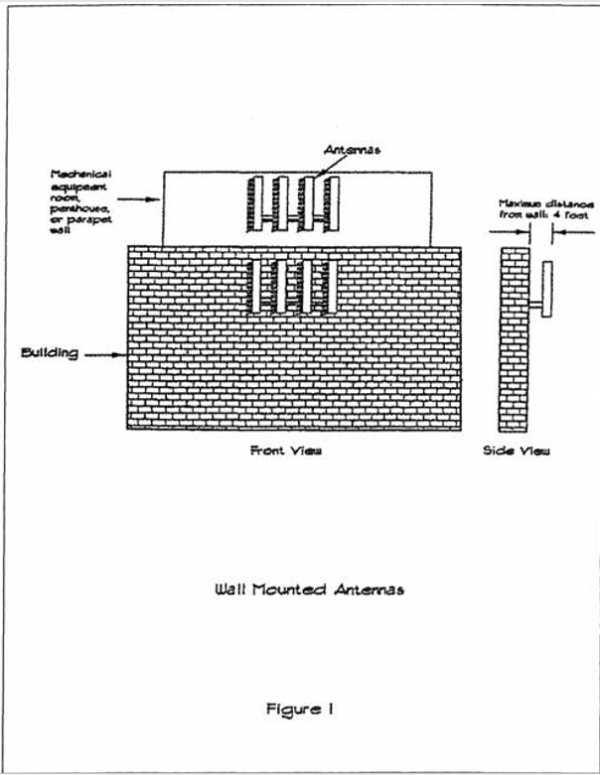
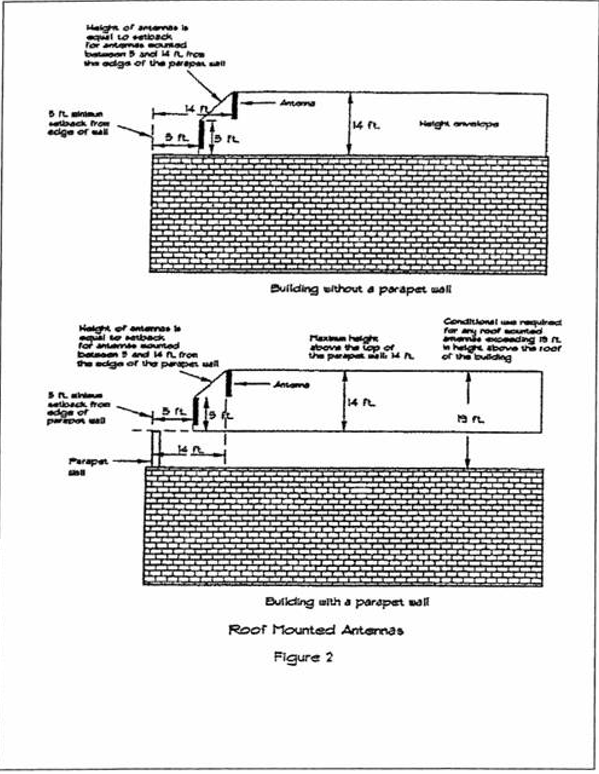
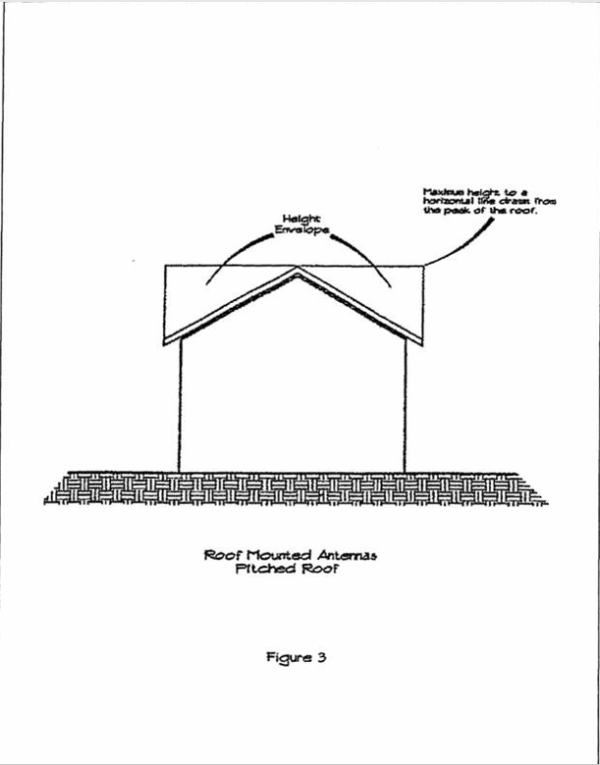
Repealed & Replaced by Ord. Title 19 White City Zoning Ordinance on 6/2/2023

