
White Settlement City Zoning Code
ARTICLE IX
SUPPLEMENTAL REGULATIONS
Sec. 111-235.- Site plan requirements.
(a)
Generally.
(1)
Site plans are required for all new structures to secure a building permit from the building official. When a site plan is required by this chapter, such site plan must conform to the requirements of this section and must be approved by action of the planning and zoning commission and the city council.
(2)
When a site plan requires approval before a building permit is issued, and there is no request for a zoning change, the planning and zoning commission and city council may approve the site plan. The approved site plan and a copy of the minutes of the city council action must accompany the request for the issuance of the building permit.
(3)
Changes in any site plan required by this chapter and approved by the planning and zoning commission and the city council shall be processed the same as the original approval of the site plan, except that changes of detail which do not alter the basic relationship of the proposed development to adjacent property, and which do not alter the uses permitted or increase the density, floor-area ratio, height ratio, or reduce the yards provided at the boundary of the site as indicated on the approved site plan may be authorized by the city manager. An aggrieved party may appeal the decision of the city manager to the board of adjustments and appeals in accordance with the provisions of this chapter.
(b)
Site plan required. When required by the administrative official, applicable advisory board, commission, or the city council, any applicant for a zoning change shall submit a proposed site plan for approval. It is the established policy of the planning and zoning commission and the city council under this section that a site plan will be required for any application for a zoning change to C-O, C-N, or C-C commercial, and to I-L and I-H industrial, on any tract of land which meets one or more of the following conditions:
(1)
Adjacent to any of the following single-family residential zoning districts: R-7, R-6, R-5, R-C, R-D, MF-16, MF-24, MF-24-A and MH.
(2)
Unique topographical conditions are present on the tract.
(3)
Greater than three acres in area.
(c)
Notice and hearing. Notice and hearing requests for site plan approval shall be conducted as follows:
(1)
Owners of record of property within 200 feet of the property under consideration will be notified of site plan consideration by the planning and zoning commission.
(2)
The city manager or designee shall have at least one sign erected on the property for which site plan consideration of the planning and zoning commission has been requested. The sign shall have total area of at least four square feet and shall be located adjacent to streets, if possible. Such sign shall be erected on or before the first date of the first notice to property owners and shall be removed immediately after final action by the city council, or when the applicant withdraws the request, whichever comes first. The sign shall contain a notice of hearing on a site plan and the telephone number of the public official from whom dates of public hearing may be obtained. The erection or continued maintenance of signs shall not be deemed a condition precedent to the granting of any site plan recommendation or approval or the holding of any public hearing.
(3)
Council approval of a site plan that accompanies a zoning change request shall become part of the amending ordinance and shall be referenced on the zoning district map. Hearings held by the council for consideration of approval of such zoning changes and accompanying site plans shall be conducted in accordance with the provisions of article XIV of this chapter and state law.
(4)
Council approval of a site plan required for the issuance of a building permit, in which no zoning change has been requested, shall not constitute an official public hearing as required by article XIV of this chapter. Notice of the consideration of the site plan by the city council in the posted agenda of the council shall be sufficient notice for the purposes of approving a site plan by city council action for the issuance of a building permit.
(d)
Form and content. The site plan shall contain the information listed in this subsection. Any or all of the required features may be incorporated on a single drawing if such drawing is clear and capable of evaluation by the planning and zoning commission, the city council, and the officers required to enforce and interpret this chapter.
(1)
The boundary lines and dimensions of the property, existing subdivision lots, available utilities, easements, roadways, sidewalks, fire lanes, and public rights-of-way.
(2)
Topography of the property proposed for development in contours of not less than two feet, together with any proposed grade elevations, if different from existing elevations. (Note: If the natural contour of the land is to be altered or changed in any location on the property more than four feet, the site plan must provide detailed information on the proposed grading plan. This information shall include the correlation of the proposed grading plan to the surrounding properties and the use of those surrounding properties and shall include information indicating the drainage and line of sight effect the proposed grading plan will have on the surrounding properties).
(3)
Floodplains, watercourses, marshes, drainage areas, and other significant environmental features, including, but not limited to, rock outcroppings and major tree groupings.
(4)
The location and use of all existing and proposed buildings or structures, including all refuse storage areas, and the minimum distance between buildings. When building complexes are proposed, a site plan showing the location of each building and the minimum distance between buildings, and between buildings and the property line, street line, and/or alley shall be submitted. For buildings more than one story in height, except R-7, residential, through R-D, duplex residences, elevations and/or perspective drawings shall be required in order that the relationship of the buildings to adjacent property, open spaces, and to other features of the development plan may be determined. Such drawings need only indicate the height, number of floors and exposures for access, light, and air. A designation of the maximum building coverage of the site shall be indicated upon the site plan.
(5)
The total number and location of off-street parking and loading spaces. A plan indicating the arrangement and provision of off-street parking and off-street loading when required. Such a plan may be presented as a ratio of off-street parking and off-street loading area to the building area when accompanied by a typical example indicating the feasibility of the arrangement proposed and when the areas when the example would be applied are dimensioned on the drawing of the entire site.
(6)
All points of vehicular ingress and egress and circulation within the property, including any special traffic regulations facilities proposed or required ensuring the safe function of the circulation plan.
(7)
Setbacks, lot coverage, and when relevant, the relationships of the setbacks provided and the height of any existing or proposed building or structure.
(8)
The location, size, and arrangement of all outdoor signs, exterior auditory speakers, and lighting.
(9)
The type, location, and quantity of all plant material used for landscaping, and the type, location, and height of fences or screening and the plantings around them. When necessary to protect the public health, safety, or welfare, the city council or the planning and zoning commission may require landscaping and screening requirements to be in place prior to the start of construction pursuant to an approved site plan.
(10)
A land use plan that delineates when multiple types of land use are proposed, the specific areas to be devoted to various uses.
(11)
Vicinity map, north point, scale, name of development, name of owner, name of planner, total acreage of project, street address, or common description of the property.
(12)
Current land uses and zoning district of the property and current land uses and zoning districts of contiguous properties and buildings on the exterior of the site and within 25 feet of all property lines.
(13)
The location and size of existing and proposed surface and subsurface drainage facilities, including culverts, drains, and detention ponds, showing size and dimensions of flow.
(14)
Land uses and zoning district contiguous to the property.
(15)
Existing buildings on the exterior of the site and within 25 feet of all property lines.
(16)
The number of square feet of the property after construction which will constitute impervious area or impervious surface and vegetated areas
(17)
Roadway speeds and distances of adjacent driveways from all proposed driveways.
(18)
For requests for alcoholic beverages uses, the distances from schools, churches, and day care facilities.
(e)
Consideration. In considering, granting, or denying an application for a site plan as provided for in this chapter, the planning and zoning commission and the city council shall take into consideration the following factors:
(1)
Compliance with this chapter, chapter 109, pertaining to subdivisions, and all other ordinances of the city.
(2)
Such other measures as will secure and protect public health, safety, morals, and general welfare.
(Code 2004, ch. 14, § 26; Code 2008, § 54-207; Code 2019, § 111-207; Ord. No. 2020-02-002, § 4, 2-4-2020)
Sec. 111-236. - Zoning of vacated streets and alleys.
When a street or alley that formed a district boundary is vacated by the city council, adjacent districts shall extend to the centerline of the street or alley vacated.
(Code 2004, ch. 14, § 29; Code 2008, § 54-208; Code 2019, § 111-208)
Sec. 111-237. - Reverse corner lots.
On a reverse corner lot in any nonresidential district, the rear line of which abuts a lot zoned or used for residential purpose, no structure or portion thereof shall be located within five feet of any part of the rear lot line. Further, any portion of a structure on a reverse corner lot in a nonresidential district, which structure is located within 15 feet of such rear lot line, shall observe the same yard requirements on its street side as are specified by this chapter for the lot which it abuts to its rear.
(Code 2004, ch. 14, § 30; Code 2008, § 54-209; Code 2019, § 111-209)
Sec. 111-238. - Special rules for double frontage lots.
(a)
Double frontage lots in residential districts. When a double frontage lot is located in any residential district, the major thoroughfare shall be the rear lot line, and such lot shall front on the minor street.
(b)
Double frontage lots backing to major thoroughfares.
(1)
A minimum front yard shall be required on both streets; provided, however, that when a principal structure on a double frontage lot will back upon a major thoroughfare, the minimum rear yard, in any residential district, may be reduced to five feet, when:
a.
The front and rear yards and building lines therefor are designated on a plat approved by the commission and recorded in the plat records of the county; and
b.
A screening device approved by the city as to location and height is erected along the property line abutting the major thoroughfare.
(2)
When a double frontage lot is developed with the major thoroughfare frontage as the rear lot line and a screening device is installed along the line, the device shall be of a type defined in this chapter and shall be maintained wholly by the owner.
(c)
Screening on double frontage lot.
(1)
In screening a major thoroughfare, as described in subsection (b)(2) of this section, the screening device may have a maximum height of eight feet, notwithstanding the height limitations elsewhere herein provided.
(2)
When a double frontage lot is developed with the major thoroughfare frontage as the rear lot line and a screening device is installed as provided in subsections (b)(2) and (c)(1) of this section, the screening device may be located on the property line and accessory buildings may be located in the rear yard when in compliance with the yard requirements for accessory buildings herein contained, so long as the same shall not constitute a sight obstruction, as herein regulated.
(Code 2004, ch. 14, § 31; Code 2008, § 54-210; Code 2019, § 111-210)
Sec. 111-239. - Principal and accessory buildings and uses.
(a)
Principal buildings and uses. All residential and commercial buildings, as herein defined, are principal uses.
(b)
Accessory buildings and uses.
(1)
No accessory building, other than guesthouses and garage apartments located in districts where the same are permitted, shall be used for dwelling purposes.
(2)
In addition to those uses listed as accessory uses in the various district regulations, the following are also accessory uses to appropriate principal uses:
a.
Storage of goods used or produced by manufacturing activities upon the building lot occupied by such activities, where such storage is permitted by the district regulations.
b.
The production, processing, cleaning, servicing, altering, testing, repairing or storing of merchandise normally incidental to a retail service or business, when conducted by the person engaged in the principal use, where such activity is permitted by the district regulations.
c.
Off-street motor vehicle parking areas and loading facilities for the exclusive use of the owners, customers, clients and employees of the principal use.
d.
Bomb and fallout shelters.
e.
Swimming pools as a part of single-family residences when used by residents and their guests only.
f.
In multifamily residential developments: club rooms, clothes washing and drying facilities, swimming pools, sauna baths and other indoor and outdoor recreation facilities common to such developments, when such uses exist for the use and benefit of residents and their guests but not the general public.
g.
Cargo containers, shipping containers, cube containers or any other similarly designed commercial containers not originally intended for permanent on-site residential use, shall not be used as a residential or commercial accessory building except under the following conditions:
1.
The owner/occupant of a residential property who is remodeling or doing construction work at a residential building may apply for a permit for the use of such a container. The permit for and the use of such a container shall expire 30 days from the date the permit is issued, not the date the container is placed on the property.
2.
The owner or tenant of a commercial property may apply for a permit for the use of such a container for additional seasonal storage for a period. The permit for and use of such a container shall expire 60 days from the date the permit is issued, not the date the container is placed on the property. An additional period of 30 days may be granted by the building official upon application by the owner/occupant of the commercial property and payment of an additional fee, as in the case of an original application for a permit.
3.
In no event shall such a container exceed 40 feet in length. When used at a commercial property, the container must be screened from public view.
(c)
Residential accessory building regulations. Accessory buildings that are placed in residential districts, except MF, MH and RV districts, shall meet the following requirements:
(1)
The total square footage of accessory buildings placed on a property shall not exceed 75 percent of the total square footage, including garage, of the primary residential structure.
(2)
No accessory building may exceed the height of the primary residential structure.
(3)
The combined total square footage of all accessory buildings may not exceed 50 percent of the rear yard located at the primary residence.
(4)
All accessory buildings must be placed behind the rear building line of the primary structure.
(5)
No accessory building may be located closer than five feet to the side and rear property line of the property.
(6)
No more than two accessory buildings may be located on the property.
(7)
There must be a minimum of ten feet between accessory buildings.
(8)
Any accessory building that exceeds 400 square feet must have a concrete foundation. A building permit will be required to erect this size structure.
(Code 2004, ch. 14, § 32; Code 2008, § 54-211; Code 2019, § 111-211; Ord. No. 2171-01, 7-24-2001; Ord. No. 2268-05, 7-12-2005; Ord. No. 2306-07, § I, 3-13-2007)
Sec. 111-240. - Permitted obstructions in required yards and open spaces.
The following shall not be considered to be obstructions when located in the required yards and open spaces specified:
(1)
In all required yards.
a.
Open terraces not over four feet above the average level of the adjoining ground, but not including a permanently roofed-over terrace or porch, awnings and canopies.
b.
Steps four feet or less above the grade which are necessary to provide access to a permitted building, or for access to a building lot from a street or alley.
c.
Chimneys projecting 24 inches or less into the yard but not occupying more than two percent of the required yard area.
(2)
In front yards.
a.
One-story bay windows, balconies and overhanging eaves or gutters, none of which shall project more than four feet into a required yard.
b.
Open covered porches shall be permitted to extend into the front yard but shall not exceed eight feet in front of the building line.
c.
Hedges or other natural growth shall be permitted such that the height does not exceed a height of three feet; unless they are within four feet of the building. Trees are permitted in excess of such height when the lower branches are pruned to a height of seven feet to prevent obstruction to traffic.
d.
Trees shall not extend above the paved public street surface unless they are maintained at a minimum height of 12 feet above curb grade.
e.
Fences shall be permitted in the front yard when all the following conditions are met:
1.
The city manager or designated representative shall determine that the proposed front yard fence is compatible with the existing home and other homes in the neighborhood.
2.
The city manager or designated representative shall determine that the proposed encroachments are the minimum allowed in order to construct the proposed fence.
3.
The city manager or designated representative will determine whether there are substantial objections to the construction of the fence by property owners in the notification area. The staff will mail notice of the proposed fence to every property owner within the notification area.
4.
In the event a property owner within the notification area of the proposed special exception objects to the request, the person opposing must submit a petition with signatures of 35 percent of the property owners within the notification area showing their disapproval. The petition must be returned within 14 days from the date of a notification letter, and the notification must inform each property owner of the procedure and time limits for protest. Upon verification of signatures, and that a minimum of 35 percent of the property owners do object to the proposed fence, a public hearing will be scheduled. The staff will mail notice of the public hearing and meeting of the board to every property owner within the notification area at least ten days prior to the meeting date. Notice of the hearing will also be published in the newspaper of record at least ten days prior to the meeting. The concurring vote of 75 percent of the members of the board will be required to grant the special exception.
5.
The staff shall mail notice of the public hearing and meeting of the board to every property owner within the notification area at least ten days prior to the meeting date. Notice of the meeting shall also be published in the newspaper of record at least ten days prior to the meeting.
6.
The notification area shall include those properties within 200 feet of the property for which a special exception is requested on the same side of the street and across the street therefrom.
7.
If less than 35 percent of the property owners within the notification area object to the application for a special exception for erection of the enclosed front yard fence, then the request shall be deemed to be granted without need of a public hearing by the board. The city manager or designated representative shall issue to the applicant appropriate documentation showing the grant of the special exception. Such documentation and grant shall contain the restrictions listed in this chapter, use limitations, building requirements and other matters determined to be appropriate and/or necessary to meet the terms of this section.
f.
Enclosed front yard fence restrictions.
1.
The fence posts shall not exceed 42 inches in height and the top horizontal fence rail shall not exceed 36 inches in height.
2.
The fence must be a decorative type material. The following shall be considered decorative type material: wooden picket, split rail, ornamental iron, stone, brick, decorative masonry, and polyvinyl chloride (PVC).
3.
The fence shall have 50 percent visibility throughout.
4.
The fence shall be maintained in an aesthetically pleasing manner.
(3)
In side yards. Bay windows, overhanging eaves or gutters projecting two feet or less into a required yard, but in no case shall such eaves or gutters be closer than three feet from the side lot line.
(4)
In rear yards. Detached off-street parking structures; open off-street parking spaces; servants' quarters; accessory sheds; tool rooms; and, similar buildings or structures for domestic or agricultural storage, balconies, breezeways and open unroofed porches, one-story bay windows and overhanging eaves or gutters.
(5)
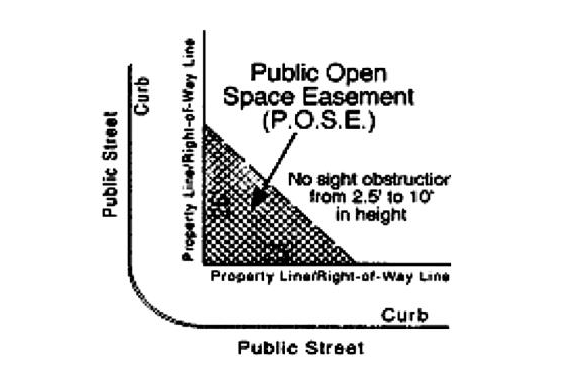
Public open space easement (POSE) and sight obstructions. Nothing shall be erected, placed, planted, or allowed to grow in such a manner as to materially impede vision between a height of 2.5 feet and ten feet (above the centerline grades of the intersecting streets) in the triangular area bounded by the street right-of-way lines and the diagonal line joining points 25 feet from the point of intersection. Visibility triangle areas measuring seven feet by 60 feet on both sides of all non-single-family driveways shall also be maintained. It is unlawful for any person to erect or place or cause to be erected or replaced on any property under such person's control any hedge, tree, shrub, or other growth or any fence or other structure in such manner or at such location as to constitute an obstruction to view creating a traffic hazard. On corners or on street curves of more than 60 degrees, when doubt may exist regarding sight obstructions, the approval of the city manager or authorized representative shall be required.
Public Open Space Easement
(Code 2004, ch. 14, § 33; Code 2008, § 54-212; Code 2019, § 111-212; Ord. No. 2398-11, § 1, 7-26-2011)
Sec. 111-241. - Screening devices.
(a)
Abutting residential property. On any non-residentially zoned property (C-O, C-N, C-C, I-L and I-H), adjacent to a residentially zoned property, before any use (other than a use permitted in the residential districts) is made of the nonresidential property, an eight-foot-tall opaque screening device constructed of wood or masonry shall be erected along the common property line between the nonresidential use and the adjoining residentially zoned property. Insofar as it is practical, the screening device shall be erected along the entire length of the common line between the nonresidential property and the abutting residentially zoned property.
(b)
Multifamily. A screening device, as defined within this chapter, shall be erected and thereafter maintained in good appearance, quality, and standing between multifamily uses and single-family uses before and during the continuation of any multifamily use permitted to initiate and thereafter continue adjacent to any property that is zoned for single-family use. Insofar as it is practicable, such screening device shall be erected the entire length of the common line between the property zoned for multifamily use and the property zoned for single-family use.
(Code 2004, ch. 14, § 34; Code 2008, § 54-213; Code 2019, § 111-213)
Sec. 111-242. - Erection and maintenance of screening devices.
(a)
Responsibility. When a screening device is required under the terms of section 111-241, it shall be the responsibility of the user of the multifamily, commercial or industrial property to erect the required screening device, and the same shall be a condition precedent to the issuance of a certificate of occupancy for the premises on which the device is located.
(b)
Perpetually maintained. All screening devices required by this chapter or action of the board of adjustments and appeals shall be perpetually maintained by the user of the property on which the device is located.
(1)
All fences required by a city ordinance, regulation or approval for screening, buffering or other requirement shall be perpetually maintained, repaired or replaced by the owner. All portions of fences, required or not, in a dilapidated state shall be repaired or replaced by the owner of the property upon which the fence is located. Fences not required by city ordinance or approval may be removed. For the purpose of this section, the term "dilapidated fence" means:
a.
Any masonry wall and/or masonry fence with loose, cracked or broken brick, stone, rock, mortar or similar materials;
b.
Any masonry wall and/or masonry fence with brick, stone, rock, mortar or similar materials that is discolored from the predominant original fence color in an amount that comprises ten percent or more of the total fence area of a property;
c.
Any eight-foot section of any fence that is more than 15 degrees out of vertical alignment; or
d.
Any eight-foot section of a wood fence that has ten percent of its pickets or structural elements damaged, missing, or rotted.
(2)
Repairs and partial replacements of any nature shall be made with materials of comparable composition, color, size, shape, quality and otherwise similar appearance of the original fence to which the repairs or replacements are being made. Products manufactured for other uses such as plywood, corrugated steel or fiberglass panels are prohibited as fence materials.
(3)
Fences may not be braced by guy wires, braces, or any other material that may be viewable from any public street, right-of-way, alleyway, or property and easements controlled by the city.
(4)
If an owner of land fails to correct a violation of this section, a city official may give notice to the owner of the land to abate a violation within 30 days of the date of the notice.
a.
The notice must be hand delivered to the owner in writing, or by letter addressed to the owner at the owner's post office address as shown on the latest tax roll.
b.
If personal service cannot be obtained or the owner's post office address is unknown, notice may be given:
1.
By publication in the city's official newspaper at least twice within ten days; or
2.
By posting the notice on or near the front door of the main building on the property to which the violation relates; or
3.
If the property contains no building, by posting the notice on a placard attached to a stake driven into the ground on the property to which the violation relates.
(c)
Height. No fence or other screening device, whether required or not, shall exceed eight feet in height, without proper board approval.
(Code 2004, ch. 14, § 35; Code 2008, § 54-214; Code 2019, § 111-214; Ord. No. 2017-2557, § I, 9-12-2017)
Sec. 111-243. - Fences.
(a)
Permit required. It is unlawful for any person to construct a fence on any lot without having first obtained a building permit therefor from the office of the building inspector.
(b)
Permit fees. Permit fees shall be as prescribed in the city fee schedule.
(c)
On public property. No fence, guy wires, braces or any part of such fence shall be constructed upon or protrude over property owned by the city.
(d)
In rear yard. No fence shall be constructed at a height exceeding eight feet along the rear yard or alley line.
(e)
In side yard. No fence shall be constructed at a height exceeding eight feet on any side yard line up to the building line of the house proper. All such fences constructed on side yard lines must be vertical.
(f)
In front yard. No fence over three feet in height shall be permitted from the front building line to the front property line, except that fences along the side lot lines may taper from six or eight feet to three feet within the last eight feet of the required front yard building line setback. All fences must be constructed parallel with lot or property lines as hereinafter specifically referred to. On lots or property used or zoned for other than one- or two-family purposes, the placement of fences, hedges or walls shall be subject to the approval of the building official and the issuance of a building permit based on requirements set forth in this chapter and other applicable ordinances. All fences adjacent to public street rights-of-way must be maintained in good repair.
(g)
Corner lot exceptions. On all corner lots which have adjacent rear lot lines, fences may be constructed not to exceed eight feet in height along the side and rear yard lines except that such fences shall be restricted to a height of three feet for a distance equal to the front yard building line setback from the front property line parallel and adjacent to any side street. On all corner lots when the rear lot line is adjacent to a side lot line of an adjoining lot or across an alley from such side lot line, no fence exceeding three feet in height shall be constructed along the side yard line which is next to the street for a distance equal to the side yard building line setback from the side property line parallel and adjacent to any side street.
(h)
Enclosure of swimming pool.
(1)
Every outdoor swimming pool shall be completely surrounded by a fence or wall not less than six feet in height, which shall be so constructed as not to have openings, holes or gaps larger than four inches in any dimension except for doors and gates. A dwelling house, or accessory building may be used as part of such enclosure.
(2)
All personnel gates or doors opening through such enclosure shall be equipped with a self-closing and self-latching device for keeping the gate or door securely closed at all times when not in actual use, except that the door of any dwelling which forms a part of the enclosure need not be so equipped.
(3)
This requirement shall be applicable to all new swimming pools hereafter constructed, other than indoor pools, and shall apply to all existing pools which have a depth of 24 inches or more of water at any point. No person in possession of land within the city, either as owner, purchaser, lessee, tenant, or a licensee, upon which is situated a swimming pool having a depth of 24 inches or more of water at any point shall fail to provide and maintain such fence or wall as herein provided.
(4)
The board of adjustments and appeals may make modifications in individual cases, upon a showing of good cause with respect to the height, nature or location of the fence, wall gates or latches, or the necessity therefor, provided the protection as sought hereunder is not reduced thereby. The board of adjustments and appeals may permit other protective devices or structures to be used so long as the degree of protection afforded by the substitute devices or structures is not less than the protection afforded by the substitute fence, gates and latch described herein. The building official shall allow a reasonable period within which to comply with the requirements of this subsection.
(5)
The term "swimming pool," as used herein, means a body of water in an artificial or semi-artificial receptacle or other container located outdoors, used or intended to be used for public, semipublic, or private swimming by adults or children, or both adults and children, operated and maintained by any person, whether such person is an owner, lessee, operator, licensee, or concessionaire, and shall include swimming pools used or intended to be used solely by the owner or friends invited to use it without payment of any fee; however, the requirements of this section shall not apply to a swimming pool constructed, operated, and maintained in conjunction with a motel, hotel, or private dormitory, or like business which operates on a 24-hour-per-day basis and which provides such pool for the use of its tenants and their guests.
(i)
Barbed wire fence. It is unlawful for any person, or agent or employee thereof, to build or permit or allow to be built any barbed wire fence on or around any property or premises owned or controlled by such person within the limits of the city; provided, however, that any fence including top grade construction barbed wire, the lowest strand of which is not less than 6½ feet above ground level, shall be permitted only on commercial use fences with arms. Fence arms may be permitted on fences six feet or more in height. Barbed wire may be constructed on such arms above six feet in height and may not extend beyond any property line or fence setback line provided in this or other sections. The building official may issue a permit for the maintenance and reconstruction of barbed wire fences at the time of the passage of the ordinance from which this section is derived, provided that such fence or portion of such fence cannot economically be replaced with nonhazardous materials and that such fence is located more than 200 feet from any area that is zoned residential. The building official shall have the authority to refuse to issue a permit for the maintenance or reconstruction of a barbed wire fence based on the safety and welfare of adjacent residents and the degree of attractive nuisance inherent in such fence.
(j)
Fence materials.
(1)
Any and all materials used in the construction of a fence built within the legal limits of the city shall meet or exceed standards set by the International Building Code.
(2)
Metal posts shall be used for the vertical fence supports. The posts shall be set in concrete and placed into the ground to a minimum depth of two feet.
(k)
Prohibited materials.
(1)
Electrical fences or electrical attachments of any type, dimension or compositions shall not be constructed within the legal limits of the city.
(2)
Products manufactured for other uses such as plywood, corrugated steel or fiberglass panels are prohibited as fence materials.
(3)
Permanent fences with razor wire of any type or dimensions shall not be constructed within the legal limits of the city, except when required by other state and federal regulatory agencies.
(l)
Fence orientation. When any stockade fence or other screening device, whether required or not, is located on a lot adjacent to a public street, right-of-way, public park, or other city-owned property, the fence shall have its back side oriented away from view from the adjacent public area. For the purpose of this section, the back side of a stockade fence shall be the side with exposed posts or rails.
(m)
Temporary fences. Temporary fencing for the purpose of protecting or securing construction sites may be allowed. A time schedule for the use of temporary fencing must be specified in the permit for fencing. Barbed wire fences may be allowed for temporary use but must be approved by height, location and number of strands by the building official.
(n)
Inspection. When a fence that requires a building permit is completed, it must be inspected. The office of the building inspector shall be notified upon completion of the fence. The building inspector will issue an electronic letter of final approval, if the fence complies with the provisions of this section or it will be rejected. All fences constructed under the provisions of this section shall be maintained so as to comply with the requirements of this section at all times.
(Code 2004, ch. 14, § 36; Code 2008, § 54-215; Code 2019, § 111-215; Ord. No. 2017-2557, § II, 9-12-2017; Ord. No. 2021-06-010, § 1, 6-1-2021)
Sec. 111-244. - Antenna facilities.
(a)
Purpose. Certain radio equipment used in transmitting and receiving signal energy is essential and deemed to promote the health, safety and general welfare of the citizens of the city. The placement of such equipment shall be located such that the health, safety, welfare, and aesthetic quality of the community shall not be compromised. Therefore, the regulations governing the location of such equipment shall consider the aesthetic quality of the community equal to the health, safety, and general welfare of the community. The antennas, masts and towers hereinafter enumerated shall not be deemed violations of this chapter when made under the conditions herein provided.
(b)
Definitions. The following words, terms and phrases, when used in this section, shall have the meanings ascribed to them in this subsection, except where the context clearly indicates a different meaning:
Antenna means a device used in communications that transmits or receives radio signals.
Antenna, building-attached, means an antenna attached to existing structures in two general forms:
(1)
Roof-mounted, in which antennas are placed on the roofs of buildings; or
(2)
Building-mounted, in which antennas are mounted to the sides of buildings.
These antennas can also be mounted on structures such as water tanks, billboards, church steeples, electrical transmission towers, etc.
Antenna facility means any structure, monopole, tower, or lattice tower used to support antennas that are more than 35 feet tall.
Antenna, microwave, or dish antenna means a dish-shaped antenna used to link communications sites together by wireless transmission of voice or data, utilizing electromagnetic radiation frequencies from three GHz to 300 Hz; and using relatively low transmitter power levels when compared to other forms of transmission.
Antenna, panel, means an antenna or array of antennas designed to concentrate a radio signal in a particular area. Panel antennas are typically flat, rectangular devices approximately six square feet in size. A panel antenna is also known as a directional antenna.
Antenna, whip, means a cylindrically shaped antenna that has a diameter between two and six inches, and measures between one foot and 18 feet in height. A whip antenna is used to emit signals in a 360-degree horizontal plane and a compressed vertical plane. A whip antenna is also known as an omni-directional antenna.
Collocation means the act of locating wireless communications equipment from more than one provider on a single antenna facility.
Equipment storage means a small, unmanned, single-story equipment building less than 500 square feet in size used to house radio transmitters and related equipment.
Lattice towers means a tower having three or four support legs and holding a variety of antennas. These towers range from 60 to 200 feet in height and can accommodate a variety of users.
Monopole means an antenna facility composed of a single spire more than 35 feet tall used to support communications equipment or other visible items. No guy wires are used or permitted.
Satellite receive-only antenna means an antenna that enables the receipt of television signals transmitted directly from satellites to be viewed on a television monitor. Such antennas are commonly known as a satellite dish, television receive-only antenna, dish antenna, parabolic antenna or satellite earth station antenna.
Tower means any columnar, guyed structure more than 35 feet tall used to support antennas or other visible items.
(c)
Residentially zoned districts amateur radio equipment and TV antennas. Amateur radio equipment, (including ham radio and CB equipment) and personal use TV antennas shall be allowed in the R-7, R-6, R-5, R-C, R-D, MF-16, MF-24, MF-24-A, MH or RV zoning districts if it complies with the following regulations:
(1)
An antenna facility may be building-attached, monopoles, towers, or lattice towers.
(2)
Only one antenna facility, exceeding 35 feet, per premises.
(3)
An antenna facility, exclusive of the height of any antenna or mast, shall not exceed 65 feet in height. Provided, however, that an antenna facility shall be permitted additional height at the ratio of one added foot in height for each additional foot of setback beyond the minimum setback required of an accessory building in the zoning district regulations. Regardless of the above, the maximum height for a tower permitted without a special exception in any residential district shall be 80 feet.
(4)
The height of an antenna, including the height of any antenna facility to which it may be fastened or attached, shall not exceed 80 feet in height without a special exception.
(5)
An antenna not fastened to an antenna facility shall not exceed 50 feet in overall height without a special exception, except for an antenna which does not extend more than eight feet above a building on which it is mounted.
(6)
An antenna facility shall be limited to having the number and size of antennas attached to it that are allowed by the antenna facility manufacturer's designs and specifications for maximum wind load requirements.
(7)
Setbacks.
a.
Antennas and antenna facilities shall not be permitted in front or side yards. Guy wires are not permitted in front yards.
b.
Guy wires are permitted in required side and rear yards.
c.
Setback for antenna facilities shall be the same as is required for accessory buildings in residential districts.
(8)
Separation. There shall be no minimum or maximum separation requirements for antenna facilities from other structures on the same lot of record.
(9)
Antenna facilities shall not be permitted in any easement.
(10)
Lights. No auxiliary or outdoor lighting above 20 feet shall be allowed on antenna facilities located on residentially zoned property, and no lights so located shall be directed off one's property, except such lights or lighting as may be required by the Federal Aviation Administration or the Federal Communications Commission.
(11)
Construction standards. A building permit must be obtained prior to the construction and/or installation of an antenna facility. Antenna facilities must be installed as per the manufacturer's recommendations or under the seal of a registered professional engineer of the state.
(12)
Maintenance. Antennas and/or antenna facilities obviously not in use or obviously in need of maintenance as determined by the building official shall be removed or brought into compliance within 30 days following notice given by the building official. This shall not preclude immediate action by the building official to safeguard life, limb, health, property, and public welfare.
(13)
No part of an antenna, antenna facility, or any attachment thereto may extend beyond the property lines of the owner of such antenna or antenna facility without written permission from affected property owners.
(14)
No permit shall be issued for the installation of an antenna or antenna facility on a multifamily structure or property unless a notarized statement of permission from the owner is presented to the building department.
(15)
All antennas and antenna facilities shall be subject to an inspection every five years by a qualified expert. Such inspection to be conducted and charged for by the city in accordance with provisions in the building code.
(16)
A special exception, in accordance with section 111-314, must be obtained from the board of adjustments and appeals for any antenna facility which does not comply with the regulations specified hereinabove.
(17)
The zoning board of adjustments and appeals will approve a requested application for a special exception upon documentation that such exception is necessary and critical to the communications operation of the facility.
(d)
Residentially zoned districts commercial antennas. Only building-attached antennas shall be allowed in residentially zoned districts under the following conditions:
(1)
A special exception must be obtained from the board of adjustments and appeals, in accordance with section 111-314.
(2)
The proposed antenna must be attached to or enclosed in an existing structure currently or last occupied by a nonresidential use as listed in this chapter, or attached to a power or telephone pole, water storage tower, or other utility structure.
(3)
The antenna must not exceed eight feet above the structure to which it is attached.
(4)
A maximum of three antennas shall be allowed to be attached to a single antenna facility.
(5)
A minimum of 1,500 feet of separation shall be required between antenna facilities.
(6)
If attached to the exterior of a structure or a power or telephone pole, water storage tower or other utility structure, the antenna must be at least 75 feet above grade and painted to match the structure to which it is attached.
(7)
The antenna may be placed lower than 75 feet above grade if completely enclosed within existing architectural elements of a building so as not to be visible.
(8)
Any associated equipment storage building shall be screened from public view by a decorative masonry wall, with landscaping for aesthetic purposes.
(9)
All driveways accessing any antenna facility site or equipment storage site shall be constructed of an all-weather hard surface as approved by the building official.
(10)
Lights. No auxiliary or outdoor lighting shall be allowed on antennas located on residentially zoned property except such lights or lighting as may be required by the Federal Aviation Administration or the Federal Communications Commission.
(11)
Construction standards. A building permit must be obtained prior to the construction and/or installation of a tower, antenna or mast. Towers must be installed as per the manufacturer recommendations or under the seal of a registered professional engineer of the state.
(12)
Maintenance. Antennas, obviously not in use or obviously in need of maintenance, as determined by the building official, shall be removed or brought into compliance within 30 days following notice given by the building official. This shall not preclude immediate action by the building official to safeguard life, limb, health, property, and public welfare.
(13)
No part of an antenna, antenna facility, or any attachment thereto may extend beyond the property lines of the owner of such antenna.
(14)
No permit shall be issued for the installation of an antenna facility, on a structure or property, unless a notarized statement of permission from the owner is presented to the building department.
(15)
All antennas or antenna facilities shall be subject to an inspection every five years by a qualified expert. Such inspection may be conducted and charged for by the city in accordance with provisions in the building code.
(e)
Commercial or industrial zoned districts. Radio, television, microwave broadcast relay, receiving towers and transmission and retransmission facilities, satellite receiving only earth stations (home dish antenna) and any electronic emission equipment of a commercial nature shall be allowed in the C-O, C-N, C-C, I-L, and I-H zoning districts if it complies with the following regulations:
(1)
Only one antenna facility per premises.
(2)
Antenna facilities shall be limited to building-attached and monopoles only.
(3)
An antenna facility, exclusive of the height of any attached antenna, shall not exceed 35 feet in height. Provided, however, that an antenna facility shall be permitted additional height at the ratio of one added foot in height for each additional foot of setback beyond the minimum setback required of an accessory building in this chapter. Regardless of the above, the maximum height for an antenna facility permitted without a special exception in any C-O, C-N, C-C, I-L or I-H district shall be 65 feet.
(4)
The height of an antenna, including the height of any antenna facility to which it may be fastened or attached, shall not exceed 65 feet in height without a special exception.
(5)
An antenna not fastened to an antenna facility shall not exceed 50 feet, except for an antenna which does not extend more than eight feet above a building on which it is attached.
(6)
An antenna facility shall be limited to having the number and size of antennas attached to it that are allowed by the antenna facility manufacturer's designs and specifications for maximum wind load requirements.
(7)
Setbacks.
a.
Antennas and antenna facilities shall not be permitted in front or side yards.
b.
Antennas and antenna facilities shall be set back from residential districts a minimum distance equal to two times the height of the tower, but in no instance shall the setback be less than 200 feet from any residentially zoned district.
(8)
Separation. There shall be no minimum or maximum separation requirements for antenna facilities from other structures on the same lot of record. With the exception of structure-mounted antennas, there shall be a separation of 1,500 feet from antenna facilities.
(9)
Antenna facilities shall not be permitted in any easement.
(10)
Lights. No auxiliary or outdoor lighting shall be allowed on antennas located on residentially zoned property except such lights or lighting as may be required by the Federal Aviation Administration or the Federal Communications Commission.
(11)
Construction standards. A building permit must be obtained prior to the construction and/or installation of a tower, antenna or mast. An antenna facility must be installed as per the manufacturer recommendations or under the seal of a registered professional engineer of the state.
(12)
Maintenance. An antenna facility and antennas obviously not in use or obviously in need of maintenance, as determined by the building official, shall be removed or brought into compliance within 30 days following notice given by the building official. This shall not preclude immediate action by the building official to safeguard life, limb, health, property, and public welfare.
(13)
No part of an antenna facility and antennas or any attachment thereto may extend beyond the property lines of the owner of such antenna or antenna facility.
(14)
No permit shall be issued for the installation of an antenna or antenna facility on a multifamily structure or property unless a notarized statement of permission from the owner is presented to the building department.
(15)
All antennas or antenna facilities shall be subject to an inspection every five years by a qualified expert. Such inspection may be conducted and charged for by the city in accordance with provisions in the building code.
(16)
A special exception, in accordance with section 111-314, must be obtained from the board of adjustments and appeals for any antenna or tower, which does not comply with the regulations specified herein.
(f)
Written report upon denial of request. The city shall document any denial of a request to place, construct, or modify personal wireless service facilities in writing. Such documentation shall be supported by substantial evidence within the written record.
(g)
Satellite receive-only antennas—Generally. Satellite receive-only antennas assist individuals in the reception of satellite transmitted television signals. Satellite receive-only antennas shall not be deemed violations of this chapter when made under the conditions herein provided. Such conditions are found to be reasonable and clearly defined health, safety and aesthetic objectives. A satellite receive only antenna shall be allowed if it complies with the following:
(1)
The satellite receive-only antenna is two meters (6.56 feet) or less in diameter and is located or proposed to be located in any area when commercial or industrial uses are generally permitted by nonfederal land use regulations; or
(2)
The satellite receive-only antenna is less than one meter (3.28 feet) in diameter in any zoning district.
(h)
Satellite receive-only antennas—Size conditions. Satellite receive-only antennas greater than one meter (3.28 feet) in diameter in residential districts and two meters (6.56 feet) in diameter in commercial or industrial districts shall be allowed in any zoning district if they comply with the following regulations:
(1)
Only one satellite receive-only antenna per lot of record.
(2)
A satellite receive-only antenna shall not exceed ten feet in height.
(3)
Setbacks.
a.
Front and side. Satellite receive-only antennas shall not be permitted in front or side yards.
b.
Rear. Satellite receive-only antennas shall be permitted in rear yards, provided they meet the minimum setback as is required for accessory buildings in residential districts and as for all buildings in nonresidential districts.
(4)
Separation. There shall be no minimum or maximum separation requirements for satellite receive-only antennas from other structures on the same lot of record.
(5)
Satellite receive-only antennas shall not be permitted in easements.
(6)
Lights. No auxiliary or outdoor lighting shall be allowed on satellite receive-only antennas except such lights or lighting as may be required by the Federal Aviation Administration or the Federal Communications Commission.
(7)
Construction standards. A building permit must be obtained prior to the construction and/or installation of a satellite receive-only antenna. Satellite receive-only antennas must be installed as per the manufacturer's recommendations or under the seal of a registered professional engineer of the state.
(8)
Maintenance. Satellite receive-only antennas obviously not in use or obviously in need of maintenance, as determined by the building official, shall be removed or brought into compliance within 30 days following notice given by the building official. This shall not preclude immediate action by the building official to safeguard life, limb, health, property, and public welfare.
(9)
No part of a satellite receive-only antenna or any attachment thereto may extend beyond the property lines of the owner of such satellite receive-only antenna.
(10)
No permit shall be issued for the installation of a satellite receive-only antenna on a multifamily structure or property unless a notarized statement of permission from the owner is presented to the building department.
(11)
All ground-mounted satellite receive-only antennas shall be screened from view from adjoining properties by solid fencing or evergreen plants. A satellite receive-only antenna located within a fence surrounding the yard in which the satellite receive-only antenna is located shall be considered to be screened.
(i)
Special exception.
(1)
A special exception, in accordance with section 111-314, must be obtained from the board of adjustments and appeals for any satellite receive-only antenna or antenna facility which does not comply with the regulations specified hereinabove.
(2)
The board of adjustments and appeals will approve a requested application subject to the finding that collocation of this facility with a nearby existing tower facility is technically not feasible and subject to the following conditions:
a.
The applicant will permit collocation of others at the site;
b.
The applicant will configure its antenna and other equipment to accommodate other providers;
c.
The applicant will identify its backhaul provider connecting antenna sites;
d.
The applicant will give notice to the city identifying any provider who collocates to the site and identify the applicant's backhaul provider;
e.
The applicant shall satisfactorily complete and provide all descriptive material required in this section; and
f.
The applicant shall demonstrate that the project does not adversely impact the public health, safety, and general welfare, as provided for in this chapter.
(Code 2004, ch. 14, § 37; Code 2008, § 54-216; Code 2019, § 111-216; Ord. No. 2020-02-002, § 5, 2-4-2020)

