
Windermere City Zoning Code
ARTICLE II
LAND USE: TYPE, DENSITY, INTENSITY
Sec. 2.00.00.- Generally.
2.00.01
Purpose. The purpose of this article is to describe the specific uses and restrictions that apply to land use districts in the land use element of the comprehensive plan. These regulations are intended to allow development and use of property only in compliance with the goals, objectives and policies of the town, as expressed in the town comprehensive plan.
2.00.02
Definitions. The following words, terms and phrases, when used in this article, shall have the meanings ascribed to them in this section, except where the context clearly indicates a different meaning:
Abut means to physically touch or border upon, or to share a common property line.
Accessory buildings or structures mean a separate subordinate building or structure located on the same lot or parcel as the principal building, the use of which is incidental to that of the dominant use of the principal building.
Adult congregate living facility (ACLF) means a type of residential care facility, defined in F.S. ch. 400, part 2.
Agricultural activity means any farming and forestry operation affecting land or waters such as site preparation, clearing, fencing, contouring, soil preparation, plowing, planting, harvesting, construction of access roads, extraction of stumps and submerged logs, and placement of bridges and culverts.
Density or gross density means the total number of dwelling units divided by the total site area, less public right-of-way.
Dwelling unit means a single housing unit providing complete, independent living facilities for one housekeeping unit, including permanent provisions for living, sleeping, eating, cooking and sanitation.
Family means a single individual, doing his own cooking, and living upon the premises as a separate housekeeping unit, or a collective body of persons doing their own cooking and living together upon the premises as a separate housekeeping unit in a domestic relationship based upon birth, marriage or other domestic bond, as distinguished from a group occupying a boardinghouse, lodging-house, club, fraternity or hotel.
Junkyard means premises, or portions thereof used for the storage or sale of used and discarded materials, including, but not limited to, paper, rags, metal, building materials, appliances, household furnishings, machinery, vehicles, equipment, or parts thereof. The storage for a period of two or more months of one or more wrecked or partly dismantled motor vehicles, parts of dismantled motor vehicles, or the sale of parts thereof, not capable of or not intended to be restored to highway operating condition shall also constitute a junkyard. For the purposes of this Land Development Code, such uses as automobile reclaiming businesses, automotive wrecking businesses, automotive salvage businesses and recycling centers shall be considered junkyards and are prohibited.
Lot means a designated parcel, tract or area of land established by plat, subdivision or as otherwise allowed by law.
Manufactured housing.
(1)
The term "manufactured housing" has the following features or characteristics and is further defined in F.S. § 320.01(2):
a.
Mass produced in a factory;
b.
Designed and constructed for transportation to a site for installation and use when connected to required utilities;
c.
Either an independent, individual building or a module for combination with other elements to form a building on the site.
(2)
The term "manufactured housing" does not apply to the use of the prefabricated panels, trusses, plumbing subsystems or other prefabricated subelements incorporated in the course of construction of buildings on the site, but only to major elements requiring minor and incidental on-site combination or installation.
Multifamily dwelling means any residential structure containing two or more separate dwelling units.
Parcel means a unit of land within legally established property lines.
Recreation vehicle means a vehicular-type portable structure without permanent foundation, which can be towed, hauled or driven and primarily designed as temporary living accommodation for recreation, camping and travel use and including, but not limited to, travel trailers, truck campers, camping trailers and self-propelled motor homes.
Single-family dwelling means a structure containing one dwelling unit, and not attached to any other dwelling unit by any means. A single-family unit may contain an accessory apartment pursuant to this Land Development Code. The term "single-family dwelling" also includes licensed family care homes housing six persons or less.
(Ord. No. 91-6, § 3(2.00.00), 2-11-1992; Ord. No. 2016-01, § 2, 7-12-2016)
Sec. 2.01.00. - Land use districts.
2.01.01
Generally. Land use districts for the town are established in the comprehensive plan, future land use element, including a map series. The land use districts and classifications defined in the future land use element of the town comprehensive plan and delineated on the future lane use map shall be the determinants of permissible activities on any parcel in the jurisdiction and as follows:
(1)
Allowable uses are shown in section 2.02.03 to correlate individual land use activities with land use districts.
(2)
The land use map shall be reviewed by the town yearly as a part of its monitoring and evaluation of the comprehensive plan.
(3)
Spot or strip zoning techniques shall not be used in determination of land use district formation.
(4)
Residential districts shall not be redesignated or reduced for commercial use if 51 percent of the residential district is developed.
2.01.02
Residential.
2.01.03
Public.
2.01.04
Commercial.
2.01.05
Conservation.
2.01.06
Planned unit development.
2.01.07
Agriculture.
2.01.08
Recreation.
(Ord. No. 91-6, § 3(2.01.00), 2-11-1992)
Sec. 2.02.00. - Uses allowed in land use districts.
2.02.01
Generally. This section defines and prescribes the specific uses allowed within each land use district prescribed in the comprehensive plan and this Land Development Code.
2.02.01(A)
Restrictive rezoning.
(1)
Notwithstanding the provision of any section of this Land Development Code, in amending the land use district at the request or concurrence of the applicant, the development review board may recommend that the town council approve such amendment with restrictions applicable only to the property involved in the change, provided that such restrictions confer upon the applicant or subject property no privileges otherwise denied by these articles to other lands, structures or buildings in the same district. The applicant's request shall include a development plan. Such restrictions may include one or more of the following:
a.
Use restrictions greater than those otherwise specified for the particular district.
b.
Density restrictions greater than those otherwise specified for the particular district.
c.
Setbacks greater than those otherwise specified for the particular district, including setbacks from lakes and major arterials.
d.
Height limits more restrictive than otherwise permitted in the particular district.
e.
Minimum lot areas or minimum widths greater than otherwise specified for the particular district.
f.
Minimum floor area greater than otherwise specified for structures in the particular district.
g.
Open space requirements greater than otherwise required for property in the particular district.
h.
Parking, loading, driveway or traffic requirements more restrictive than otherwise required for the particular district.
i.
Fencing or screening requirements greater than otherwise required for the particular district.
j.
Restrictions on any other matters which the town council may regulate under this Land Development Code.
(2)
Upon approval of such restrictive rezoning, the town planner shall enter the applicable restrictions, or reference thereto, on the official zoning maps of the town in a manner sufficient to constitute notice to all interested persons. Restrictions shall run with the land, without regard to transfer of ownership or other interests, and may be removed only upon amendment to the district.
2.02.02
Types of uses.
(1)
Residential.
a.
The category of residential uses includes single-family dwellings, accessory apartments and guesthouses, rectories and mobile modular and manufactured housing, but specifically excludes recreational vehicles, travel trailers or similar vehicles.
b.
Group homes and foster care facilities licensed by the state shall be permitted as required by state law.
(2)
Commercial. A wide variety of commercial uses are included in this category to include those listed and other substantially similar types of uses:
a.
Shopping centers.
b.
Personal service establishments, such as; barbershops, beauty parlors, medical and dental clinics, restaurants, financial institutions, professional and other offices, travel agencies, service stations, laundry and dry cleaning pickup stations, self-service coin-operated laundry and dry cleaning establishments, shoe repair, and locksmiths.
c.
Retail business, such as; drug, liquor, hardware stores, book, stationery, china and luggage shops, newsstands, photographic supplies and studios, ladies', men's and children's apparel.
d.
Automobile repair shops for ignition, fuel, brake and suspension systems.
e.
Theatres, except drive-in theatres.
f.
Florist shops, the products of which are displayed and sold wholly within an enclosed building.
g.
Grocery, fruit, vegetable and meat market stores.
h.
Health baths.
i.
Interior decorating, home furnishings and furniture stores.
j.
Music conservatory, dancing schools and art studios.
k.
Music, radio and television shops.
l.
Retail paint and wallpaper stores.
m.
Dry cleaning establishments using equipment which emits no smoke or escaping steam, and which use nonflammable synthetic cleaning agents (perchloroethylene, trichloroethylene, etc.).
n.
Bakeries, the product of which are sold only at retail on the premises.
o.
Other uses which are similar or compatible to the uses permitted herein, which would promote the intent and purposes of this district. Determination shall be made by the town council which shall be without public notice or public hearing.
(3)
Recreational. These uses include areas for outdoor recreational activities such as picnicking, jogging, cycling, arboretums, hiking, playgrounds, ball fields, outdoor ball courts, outdoor swimming pools and water-related or water dependent uses such as boat ramps, fishing docks and piers, and all similar outdoor recreation uses, whether public or private. Specifically excluded from this group of uses are firing ranges, marinas, miniature golf courses, racetracks and similar recreational or quasi-recreational activities inconsistent with the allowable outdoor recreational uses described.
(4)
Conservation. Such uses and activities as are outlined in section 5.02.04(b) are permitted.
(5)
Public service. This group of activities includes uses such as emergency service activities (buildings, garages, parking, dispatch) for fire, police, ambulance and rescue, as well as water plants, electric sub-stations and telephone exchanges. Where these uses are within a residential land use district or abut a residence, the development review board shall ensure that the adjacent and owners are properly protected from objectionable odors, noises or views.
(6)
Government offices and facilities. This type of use includes government owned buildings, facilities and land. It includes buildings owned by a government entity and rented or leased to others.
(7)
Institutional. This type of use includes educational facilities (public or private), preschool and day care facilities (public or private), churches, residential care facilities and other similar institutional uses.
(8)
Agricultural. Agricultural uses include residences, croplands, groves, pastures, forestry, aquaculture, and buildings which are an accessory to these agricultural uses. This category of uses does not include processing or distribution plants for agricultural products and supplies.
(9)
Restricted commercial. This group of uses includes business and professional offices, medical offices or clinics, government offices, financial institutions without drive up facilities, day care facilities, convenience stores and personal service businesses where the service is performed on an individual-to-individual basis as opposed to services which are performed on objects or personal property. Examples of personal service businesses are barbershops, beauty shops, photography studios and travel agencies.
2.02.03
Allowable uses within each land use district.
(1)
Residential. The following uses are allowed in the residential land use district. All others are prohibited.
a.
Single-family residential and accessory dwelling units.
b.
Public service.
c.
Public elementary school.
(2)
Public. The following uses are allowed in the public land use district. All others are prohibited.
a.
Outdoor recreational.
b.
Conservation.
c.
Public service.
d.
Government offices and facilities.
e.
Institutional.
f.
Such offices: music, drama, art or dance schools; and similar or compatible businesses appropriate to a government or institutional building, as are determined to be permissible by the town council without need for a public notice or public hearing.
g.
Public elementary school.
(3)
Commercial. The following uses are allowed in the commercial land use district. All others are prohibited.
a.
Commercial.
b.
Restricted commercial.
c.
Public service.
d.
Government offices and facilities.
e.
Single-family residential, as an additional alternative, but not concurrent use in a restricted commercial area (Ord. No. 98-1).
f.
Public elementary school.
(4)
Conservation. The following uses are allowed in the conservation land use district. All others are prohibited.
a.
Conservation.
b.
Outdoor recreation.
c.
Agricultural (citrus, silviculture and nature range land only).
(5)
Planned unit development (mixed use). The following uses are allowed in the planned unit development land use district. All others are prohibited.
a.
Residential.
b.
Restricted commercial.
c.
Outdoor recreation.
d.
Public service.
e.
Conservation.
f.
Institutional.
g.
Government offices and facilities.
h.
Public middle and high school.
(6)
Agriculture. The following uses are allowed in the planned unit development land use district:
a.
Agriculture.
b.
Public service.
c.
Public elementary school.
(7)
Recreation. See subsection 2.02.02(3) of this section, also public elementary school.
2.02.04
Table of density and dwelling unit types of residential use.
2.02.05
Floor area ratio.
(1)
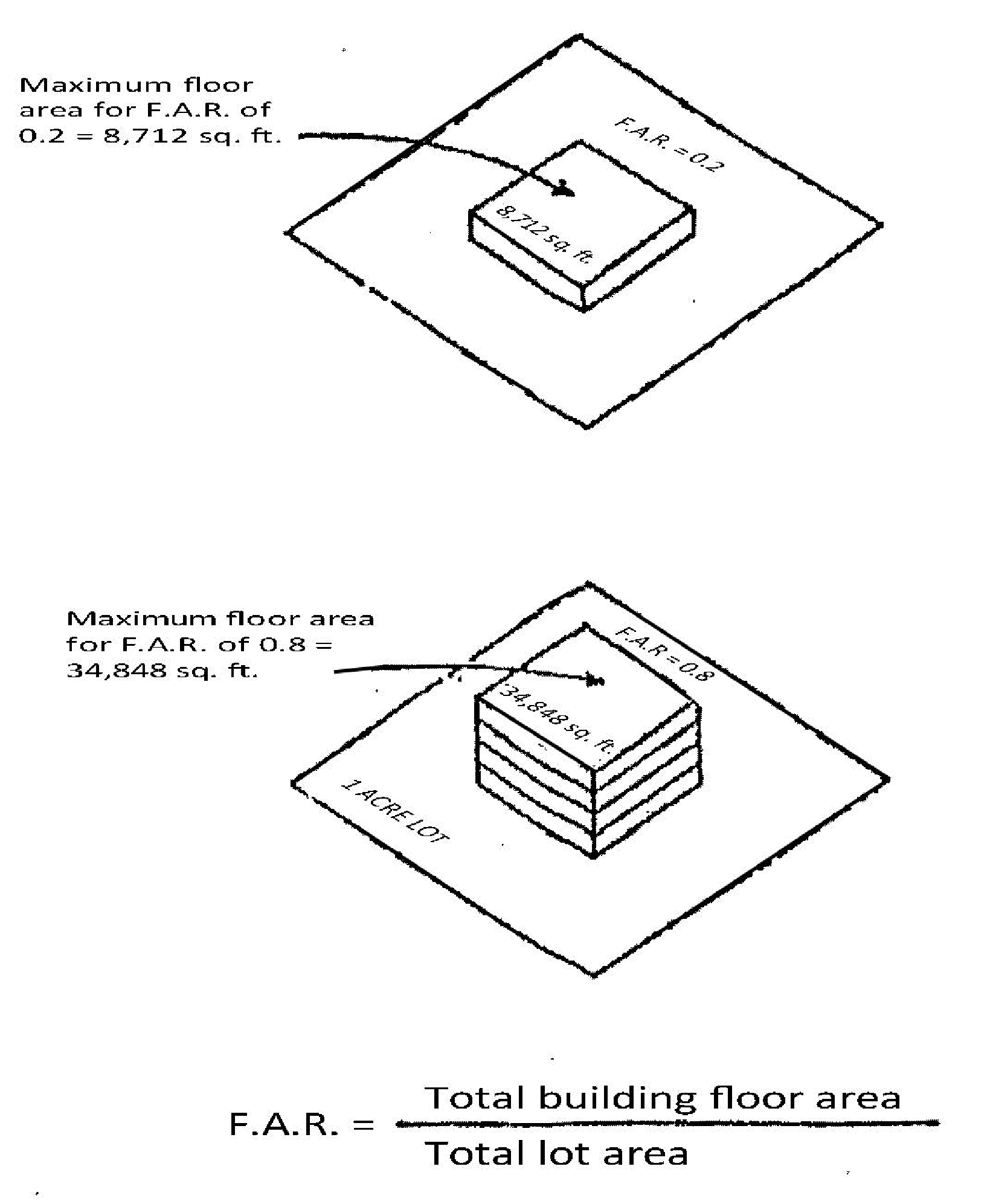
Generally. A floor area ratio is a measurement of the intensity of development on a site. For purposes of this Land Development Code, floor area ratios (FAR) are provided only for nonresidential development (see section 6.01.02(e) for impervious surface ratio).
(2)
Calculating floor area ratio. The floor area ratio is the relationship between the total floor area on a site and the gross site area. The FAR is calculated by adding together the floor areas of all floors and dividing this total by the gross site area. See figure 2.02.04-A for a graphic illustration of this concept.
(3)
Table of floor area ratios.
(Ord. No. 91-6, § 3(2.02.00), 2-11-1992; Ord. No. 94-2, § 1(h), 2-8-1994; Ord. No. 97-5, 9-9-1997; Ord. No. 2009-03, § 3, 6-9-2009; Ord. No. 2016-01, §§ 8, 9, 7-12-2016)
Sec. 2.03.00. - Density and intensity bonuses.
2.03.01
Purpose. It is the purpose of this section to encourage new development and redevelopment that is designed and constructed at a level of quality in excess of the minimum. Where a proposed development is designed to exceed minimum requirements, additional development rights may be allowed in locations where added density or intensity can be accommodated while still providing appropriate protection to neighboring properties and the general public.
2.03.02
Compliance procedures.
(1)
Submittals. All proposed development requesting additional intensity or density shall provide the following information on the application for development approval:
a.
The application for approval of a proposed development shall indicate that the development approval is requested through compliance with the bonus standards.
b.
The application shall clearly show the design features and calculations showing the basis for the requested density or intensity bonus.
(2)
Points required. Each of the bonus standards provided in subsection 2.03.03 of this section is assigned a point value. Compliance with the standards "earns" points. A proposed development may provide additional features chosen from the types of standards described in subsection 2.03.03 of this section. Credit, in the form of points, will be given based upon the compliance of the proposed project with the standards. The number of points needed to satisfy the requirement for bonus standards and subsequently allow development of a site subject to the bonus standards is as follows:
a.
Residential development: six points for each two percent increase in density beyond the maximum shown in table 2.02.04.
b.
Nonresidential development: five points for each additional 0.10 FAR beyond the maximum shown the section 2.02.05.
2.03.03
Available density/intensity bonuses.
(1)
Where bonuses may be used. Density and intensity bonuses may be used in the mixed use land use district.
(2)
Environmentally sensitive lands and habitat.
a.
Environmentally sensitive lands, as defined in article V of this Land Development Code, or land containing qualifying habitat (wetlands or uplands) known to be significant to one or more endangered or threatened plant and animal species or species of special concern, as designated by the United States Fish and Wildlife Service or by the state game and fresh water fish commission, or the state department of agriculture and consumer services, shall be donated to the town or town-approved agency, or at the town's option, the property owner shall provide a perpetual conservation easement. The deed for the donated property shall contain a conservation easement to guarantee the preservation of the property in perpetuity.
b.
If by donation, the donation shall be of a fee simple interest, or by binding agreement at the time of application for development approval.
c.
If by conservation easement, a copy of a recordable document shall be provided with the application.
d.
A minimum of five acres shall be required to qualify for credit, unless the proposed environmentally sensitive area is located immediately adjacent to, and contiguous with, an existing environmentally sensitive area. However, in such cases, donation or dedication of an easement for less than five acres shall include the entire environmentally sensitive area on the property to be developed. Donation of the minimum shall qualify for one point.
e.
For each one acre in excess of the minimum one, two-tenths additional points shall be earned, up to a maximum of 12 points.
f.
If the proposed development includes no dredge and fill activity affecting environmentally sensitive lands it shall qualify for one point.
g.
If the proposed development includes no discharge of stormwater into waters designated as aquatic preserves, or Outstanding Florida Water, the project shall qualify for one point.
(3)
Public access to water bodies.
a.
Public access ways to natural reservations or public water bodies shall be donated to the town or a town approved agency. The development review board shall find that there exists a demonstrated need for public access in the proposed location and that the proposal is consistent with public shoreline access plans. Donation shall qualify for up to five points, based upon the size, demonstrated need, relationship to the comprehensive plan and condition of the donated property.
b.
As an alternative to donation of public access ways, irrevocable easements may be established to provide public access the natural reservations and public water bodies. Establishment of easements, where ownership and maintenance responsibility remain with the property owners, shall qualify for up to two points, based upon the size, demonstrated need, improvements proposed and condition of the property.
(4)
Water conservation.
a.
The appropriate use of only xeric landscaping or low-water demanding plants in all required buffers or landscaped areas shall qualify for up to five points, based upon the size of the buffering relation to the property. (Note: Use of xeric landscaping in any required landscaped area also allows the development review board to waive the requirement for an irrigation system, regardless of whether the proposed development is qualifying for bonus credit. However, there shall be provisions for watering during establishment of the plant materials.)
b.
The use of drip irrigation, fertigation or other low-water use methods shall qualify for one point.
c.
The appropriate reuse of treated effluent and/or grey water within a development project shall qualify for one point per acre if used for irrigation and other appropriate purposes, up to a maximum of 14 points.
(5)
Proximity to services and facilities. Proximity of the proposed development to the following community services and facilities shall be eligible for points as indicated in the following table:
(6)
Special housing needs.
a.
Provision of low- and moderate-income housing shall qualify for credit based upon the following schedule:
b.
Provision of housing to serve the special needs of the elderly shall qualify for one point per ten units, to a maximum of six points.
c.
Provision of housing to serve physically or mentally handicapped persons shall qualify for one point per ten units, to maximum of six points.
d.
No more than 20 percent of a conventional housing development shall be devoted to special housing needs.
(7)
Access to transportation facilities.
a.
Provision of separate pedestrian or bicycle access ways from a residential development to designated activity centers containing commercial, office, service and/or recreation activities, and located within one-half mile of the development shall qualify for one point.
b.
Where two adjacent nonresidential developments share a common access driveway, thereby reducing the number of access points to an arterial or collector facility, the project under development review may be granted up to four points.
c.
Provision of parallel frontage and/or service roads on major collector roads shall be eligible for up to ten points, based upon one point per 100 linear feet of frontage.
d.
Provision of a bus shelter or other sheltered transit collection point in a nonresidential development shall be eligible for up to three points.
(8)
Maximum points available.
(Ord. No. 91-6, § 3(2.03.00), 2-11-1992)

