
Windermere City Zoning Code
ARTICLE VIII
SIGNS1
State Law reference— Sign ordinances, F.S. § 166.0425.
Sec. 8.00.01. - Relationship to building codes.
These sign regulations are intended to complement the requirements of the building codes adopted by the town. Wherever there is inconsistency between these regulations and the building code, the more stringent requirement shall apply.
(Ord. No. 2011-06, § 2(8.00.01), 11-8-2011)
Sec. 8.00.02. - No defense to nuisance action.
Compliance with the requirements of these regulations shall not constitute a defense to an action brought to abate a nuisance under the common law.
(Ord. No. 2011-06, § 2(8.00.02), 11-8-2011)
Sec. 8.00.03. - Maintenance.
All signs, including their supports, braces, guys and anchors, electrical parts and lighting fixtures, and all painted and display areas, shall be maintained in accordance with the building codes adopted by the town, and shall present a neat and clean appearance. The vegetation around, in front of, behind, and underneath the base of ground signs for a distance of ten feet shall be neatly trimmed and free of unsightly weeds, and no rubbish or debris that would constitute a fire or health hazard shall be permitted under or near the sign.
(Ord. No. 2011-06, § 2(8.00.03), 11-8-2011)
Sec. 8.00.04. - Definitions.
The following words, terms and phrases, when used in this article, shall have the meanings ascribed to them in this section, except where the context clearly indicates a different meaning:
A-frame sign means a double-faced sign that opens up into an inverted V and could stand on its own or be carried by a person.
Advertising means copy intended to directly or indirectly promote the sale or use of a product, service, entertainment or real or personal property.
Aggregate sign area means the total square foot area of signage.
Animated sign means any sign, or part of a sign, which changes physical position by movement or rotation.
Awning means a sheltering screen, usually of canvas fabric, supported and stiffened by a rigid frame, extending over or before any place which has windows, doors, outside walks or the like, and providing shelter or protection against the weather.
Awning sign means any information painted on, or imprinted on, awnings.
Banner sign means any sign intended to be hung either with or without frames and with or without characters, letters, illustrations or ornamentations applied to paper, plastic or fabric of any kind. National flags and flags of political subdivisions, or information painted or imprinted on awnings as defined in this article, shall not be considered banners for the purpose of this article.
Billboards means a flat surface or board, usually outdoors, on which advertisements or notices are posted.
Blade sign means a sign mounted perpendicular at 90 degrees to the facade of a building.
Building frontage means length of facade at grade of the building along the street on which it borders.
Building sign means a sign displayed upon or attached to any part of the exterior of a building, including walls, windows, doors, parapets, marquees and/or roofs.
Changeable surface sign means a sign which has copy that can be changed or rearranged electronically, mechanically or manually without altering the sign structure.
Community wide garage sale means a designated community within the town limits where residents of the entire defined community are allowed to hold a garage sale.
Construction sign means a temporary sign used to identify a site undergoing land disturbance activities, building construction or remodeling. A sign used primarily for purposes of allowing inspectors, workers and trades to identify the intended property.
Copy means the linguistic or graphic content of a sign.
Cornice means a horizontal molded projection that crowns a building.
Development means, for the purposes of this article only, an approved residential or commercial project.
Development sign means a permanent sign located at the entrance of an approved residential or commercial project.
Directional sign means a sign located on premises denoting exits, entrances, driveways or off-street parking.
Display box means a sign used to display changeable text, examples include: church sermons, announcements, restaurant menus and messages.
District means the various zoning areas established and described by the land development regulations and/or zoning maps.
Double-faced sign means a sign with two sides.
Electric sign means any sign containing electric wiring.
Erect means to construct, reconstruct, build, relocate, raise, assemble, place, affix, attach, create, paint, draw, or in any other way bring into being or establish.
Expression line means an architectural detail on the facade of a building, which delineates the transition between the ground floor and the upper floor levels. The expression line shall be no higher than 16 feet above finish grade level.
Facade means any side of a building facing public way or space.
Finished grade level means the completed or settled level of the ground, asphalt or pavement on which a sign is erected; except that if the sign is erected on an artificial mound or similar artificial rise. The term "finished grade level" means the completed or settled level of the ground, asphalt or pavement which surrounds all or the majority of the building on the parcel or site on which the sign is erected.
Flag means cloth flown as an emblem, often flown from a pole.
Ground sign means a sign not attached to a building.
Illuminated sign means a sign which contains a source of light or which are designed or arranged to reflect light from an artificial source, including indirect lighting, neon, incandescent lights, backlighting, and shall also include signs with reflectors that depend upon automobile headlights for an image.
Marquee means a structure projecting from and supported by a building which extends beyond the building line or property line and fully or partially covers a sidewalk, public entrance or other pedestrian way.
Monument sign means a freestanding sign with multiple tenants' signs incorporated into a design used for commercial properties with more than one tenant at a single address or property.
Occupancy means use or intended use of a building or part thereof for the shelter of persons, animals or property.
Occupant means persons, partnerships, trusts, organizations or corporations that are occupying or leasing property.
Off-site sign means an off-site sign, or a sign which is not related to the activity on the same premises.
Parcel means a unit of land within legally established property lines.
Parapet means a vertical wall projecting above a building roofline.
Permanent means designed, constructed and intended to exist more than 14 days.
Placement means the location which a sign occupies on a lot or building.
Portable sign means any sign that is not permanently affixed to a building, structure or the ground.
Roofline means a horizontal line intersecting the highest point or points of a roof, including parapet.
Roof sign means a sign placed above the roofline of a building or on or against a roof slope.
Sandwich sign means a double-faced sign that opens up into an inverted V and could stand on its own or be carried by a person.
Sidewalk sign means a sign that stands on a moveable base. a sidewalk sign may be single- or double-faced.
Sign means any device or display designed to advertise, inform, identify or to attract the attention of persons which is visible from outside the premises on which the device or display is located.
Sign area means the area within a line, including the outer extremities of all letters, figures, characters, and delineations, or the outer extremities of the framework or background of the sign, which ever line includes the larger area. The support for the sign whether it be columns, a pylon or building or part thereof, shall not be included in the sign area.
Sign height means the vertical distance from the finished grade level at the base of the supporting structure to the highest point of a sign.
Sign setback distance means the shortest horizontal distance from the property line to the nearest point of the sign or its supporting members, whichever is nearest to the property line.
Sign structure means any device designed to support a sign.
Snipe sign means signs erected on public property, or on private property (such as private utility poles) located on public property, other than signs erected by the public authority for public purposes.
Storefront means the glazed portion of the first floor facade.
Temporary means designed, constructed and intended to be erected for less than 15 days.
Town-based organizations means any civic, cultural, educational, fraternal, charitable, athletic, youth, senior, religious and other nonprofit organizations that are based in the town or whose operations and functions occur in a large part within the town and who play a substantial role in the civic or social life in the town.
Vehicle sign means any sign affixed to a vehicle.
Vision triangle means a triangular area of clear visibility formed by two intersecting streets or intersection of a driveway and street.
Wall sign means a sign painted on the outside of a building or a sign attached flat to or pinned away from the wall with a face horizontally parallel to the building.
Wind sign means devices such as pennants, spinners and streamers fastened in such a manner as to move upon being subjected to pressure by wind or breeze.
Window sign means a sign which is applied to, or located within six inches of the interior of a window, and is visible from outside.
(Ord. No. 2011-06, § 2(8.00.04), 11-8-2011; Ord. No. 2012-01, § 2(8.00.04), 4-10-2012; Ord. No. 2013-02, § 1(8.00.04), 6-11-2013)
Sec. 8.01.00. - Exempt signs.
The following signs are exempt from the requirement in this article that a permit be obtained for the erection of permanent signs, provided they are not placed or constructed so as to create a hazard of any kind:
(1)
Not visible from street or adjoining property. Signs that are not designed or located so as to be visible from any street or adjoining property.
(2)
Legal notices. Legal notices and official instruments.
(3)
Temporary decorative flags and bunting. Temporary decorative flags and bunting for a celebration, convention or commemoration of significance to the entire community when authorized by the town manager or designee for a prescribed period of time.
(4)
Merchandise displays. Merchandise displays behind storefront windows so long as no part of the display moves or contains flashing lights.
(5)
Memorial or historical signs or tablets, names of buildings and dates of erection. Memorial or historical signs or tablets, names of buildings and dates of erection when cut into any masonry surface or when constructed of bronze or other incombustible materials and attached to the surface of a building.
(6)
Residential nameplate. A sign permitted for the sole purpose of identifying the inhabitant residing therein, the house name, or identifying the address of the house. The sign shall not contain advertising of any kind and shall not exceed one square foot in area.
(7)
Credit card signs. Credit card advertisements or trade associations' emblems, which do not exceed one-half square foot, may be displayed. Such signs shall be displayed flat on window or door surfaces. The purpose of these signs is to offer a service and not to advertise the business.
(8)
Works of art. Works of art that do not constitute advertising.
(9)
Sidewalk sign or informational sign. One sidewalk sign or one informational sign per business is allowed.
a.
Sidewalk sign. The maximum size of the sidewalk sign shall not exceed 36 inches in height by 24 inches wide. The maximum outside dimensions of the sign structure shall not exceed 48 inches in height by 26 inches wide. The maximum depth of the sign shall not exceed two and one-half inches. Signs shall be placed on sidewalks or private property only, with no portion of such sign extending more than 2½ feet from the wall of the business storefront. Handwritten signs are prohibited. The signs must be decorative and have professionally printed lettering. The sign may be displayed during open business hours only and must be located in front of business being advertised.
b.
Informational sign. The maximum size of the informational sign shall not exceed 36 inches in height by 24 inches wide. The sign shall be framed in black, gray, or blue, and shall be placed inside of a business at least six inches away from the interior storefront window.
(10)
Open signs. One sign per business may be displayed inside a window. The maximum size of the sign shall not exceed two square feet. The maximum letter height shall not exceed five inches. The sign may be LED stationary/steady lit with a maximum of two colors. Neon lighting is prohibited. Acceptable background colors are white or black. The maximum brightness shall not exceed 3,000 millicandelas (mcd). The sign may be lit during open business hours only.
(11)
Outdoor auxiliary displays. Outdoor auxiliary displays such as mannequins and display racks related to the business are permitted but only during the days of town sanctioned events. No portion of such display may extend more than two and one-half feet from the wall of the business storefront. For purposes of this section, outdoor auxiliary displays do not include plants, trees, and benches that are not for sale.
(Ord. No. 2011-06, § 2(8.01.00), 11-8-2011; Ord. No. 2014-01, § 1(1), 6-10-2014)
Sec. 8.02.01. - Generally.
(a)
It shall be unlawful to erect, cause to be erected, maintain or cause to be maintained any sign not expressly authorized by, or exempted from, this article.
(Ord. No. 2011-06, § 2(8.02.01), 11-8-2011; Ord. No. 2014-01, § 1(2), 6-10-2014)
Sec. 8.02.02. - Specifically.
The following signs are expressly prohibited unless exempted by division 8.01.00 of this article, or expressly authorized by divisions 8.03.00 or 8.04.00 of this article:
(1)
Signs that are in violation of the building codes adopted by the town.
(2)
Any sign that constitutes a safety hazard or that obstructs the vision of pedestrians, cyclists or motorists traveling on or entering public streets.
(3)
Signs internally lit or with visible luminary.
(4)
Animated signs with visible moving, revolving or rotating parts or visible mechanical movement of any description or other apparent visible movement achieved by electrical, electronic or mechanical means, except for traditional barber poles.
(5)
Signs with the optical illusion of movement by means of design that presents a pattern capable giving the illusion of motion or a changeable surface sign.
(6)
Signs with lights or illuminations that flash, move, rotate, scintillate, blink, flicker, twinkle, sparkle, zoom or vary, in intensity or color except for time-temperature-date signs.
(7)
Wind signs including balloons, pennants, ribbons, spinners, or any other device fastened in a manner to allow it to move when subjected to pressure by wind. See exhibit 8.02.02.G in section 8.07.00.
(8)
Signs that incorporate projected images.
(9)
Signs that emit audible sound, odor or visible matter such as smoke or steam.
(10)
Searchlights.
(11)
Snipe signs.
(12)
Signs on vehicles or trailers that are parked or located for the primary purpose of displaying the sign.
(13)
Portable signs, as defined in this article.
(14)
Sandwich and A-frame signs, as defined in this article.
(15)
Signs carried by a person advertising goods or services.
(16)
Neon, light emitting diode and fiber optic signs, with the exception of open signs.
(17)
Off-site signs.
(18)
Billboards.
(19)
Roof signs
(Ord. No. 2011-06, § 2(8.02.02), 11-8-2011)
Sec. 8.03.01. - Where allowed.
Temporary signs are allowed throughout the town, subject to the restrictions imposed by this division and other relevant parts of this article.
(Ord. No. 2011-06, § 2(8.03.01), 11-8-2011)
Sec. 8.03.02. - Sign types allowed.
Temporary sign may be a ground or building sign, but may not be an electric sign.
(Ord. No. 2011-06, § 2(8.03.02), 11-8-2011)
Sec. 8.03.03. - Reserved.
Editor's note— Ord. No. 2014-01, § 1(3), adopted June 10, 2014, repealed § 8.03.03, which pertained to removal of illegal temporary signs and derived from Ord. No. 2011-06, adopted November 8, 2011.
Sec. 8.03.04. - Restrictions on temporary signs.
A temporary sign may display any message as follows:
(1)
To indicate a business sale, special event or other activity. Such sign shall not exceed 20 square feet. One banner per business may be displayed on the property of the business for no more than 14 consecutive days, for a maximum of two times a calendar year.
(2)
To indicate construction activity. Construction signs shall be permitted for up to 12 months and shall not exceed 20 square feet. All such construction signs must be removed upon completion of construction.
(3)
To indicate the existence of a new business, or a business in a new location, if such business has no permanent signs. Such sign may be displayed for a period of not more than 60 days or until installation of permanent signs, whichever shall occur first, and shall not exceed 20 square feet.
(4)
To announce or advertise town events and functions on town property and rights-of-way. The town council shall approve a list of town-based organizations whose events and functions will be classified as a town event or function. Such sign shall not exceed 20 square feet. Such signs may be displayed no more than 14 days prior and must be removed within 48 hours after the event or function.
(Ord. No. 2011-06, § 2(8.03.04), 11-8-2011)
Sec. 8.03.05. - Permissible size and number of temporary signs.
(a)
Sale, lease or rental. No individual sign shall exceed four square feet in area. Said signs shall be removed within five days of close of sale, rental or lease. In the event a sale, lease, or rental sign is used on property located within a commercial zoning district and such sign is reasonably expected to be displayed for more than six months out of a calendar year, such sign shall be subject to the same requirements and restrictions applicable to a permanent sign as regulated by this article VIII. In such an event, the allowable sign area shall be increased by four square feet in area for each sign in order to accommodate the additional sign or signs.
(b)
Open house. Open houses may display no more than two directional signs each in street rights-of-way with prior approval of the town manager or designee. No individual sign shall exceed four square feet in area. Applicable permit fees are listed in the town fee directory.
(c)
Garage or estate sale signs (in residential district only).
(1)
Estate and garage sale signs will be issued by the town. Only one sale per residence not exceeding three consecutive days may occur in any eight-month period. Only six sales are permitted on the same day. The applicable permit fee is listed in the town fee directory.
(2)
Community-wide garage sales are allowed for the following described communities for a one-day community garage sale limited to one sale in any eight-month period. The applicable permit fee is listed in the town fee directory. The holding of a community-wide garage sale does not limit the individual resident of their right to hold an individual sale during the limits provided in this subsection. Defined communities are as follows:
a.
Butler Bay, unit 1.
b.
Manors at Butler Bay.
c.
Marina Bay Estates.
d.
Sunset Bay.
e.
Willows at Lake Rhea.
f.
Windermere Reserve.
g.
Windermere Oaks.
h.
Windsong at Windermere.
i.
Rosser Reserve.
(Ord. No. 2011-06, § 2(8.03.05), 11-8-2011; Ord. No. 2012-01, § 2(8.03.05), 4-10-2012; Ord. No. 2013-02, § 1(8.03.05), 6-11-2013; Ord. No. No. 2015-08, § 1, 6-9-2015)
Sec. 8.03.06. - Political and election campaign signs.
Political and election campaign signs not exceeding four square feet in area may be displayed by an owner or tenant on their property without a permit.
(Ord. No. 2011-06, § 2(8.03.06), 11-8-2011; Ord. No. 2013-01, § 1(8.03.06), 3-12-2013)
Sec. 8.04.01. - Sign types allowed.
A permanent sign may be a ground or building sign.
(Ord. No. 2011-06, § 2(8.04.01), 11-8-2011)
Sec. 8.04.02. - Permissible area of permanent building signs.
(a)
The formula for determining the allowable surface area of signs shall be that for each linear foot of the building frontage one square foot of signage will be allowed. The area of any one sign shall not exceed 20 square feet.
(b)
Sign plan for multiple businesses.
(1)
All buildings containing more than one business shall submit a sign plan indicating size, color and location of the signs that each business will be allowed to display. A sign application for any single sign in a multiuse building requires the submittal of the overall approved building sign plan for permit approval.
(2)
Allocation of total aggregate sign area to individual businesses or tenants is not a function of the town but is the responsibility of the owner or landlord.
(c)
Display boxes will be included in the total aggregate sign area. One display box is permitted per business. The location, design and lighting are subject to approval by the town manager or designee.
(d)
An awning sign may be placed on the vertical portion of an awning with letters, not exceeding six inches in height. The area of the sign will be included in the total aggregate sign area. The awning may not project over a public right-of-way and must provide a minimum of seven feet, six inches clearance over any pedestrian way.
(Ord. No. 2011-06, § 2(8.04.02), 11-8-2011)
Sec. 8.04.03. - Directional signs.
Directional signs limited in area to four square feet, giving directions to motorists regarding the location of parking areas and access drives shall be permitted on all parcels and shall not be counted as part of an occupancy's allowable sign area.
(Ord. No. 2011-06, § 2(8.04.03), 11-8-2011)
Sec. 8.04.04. - Signs at entrances to residential developments.
(a)
Generally. A permanent development sign may be displayed at the entrance to residential developments.
(b)
Restrictions. One double-faced sign or two individual signs are permitted at the entrance into a development. The sign faces must be identical. If two signs are used, they must be located at each side of the entrance. No face of the sign shall exceed 32 square feet in size. If illuminated, only an external steady light may be used.
(Ord. No. 2011-06, § 2(8.04.04), 11-8-2011)
Sec. 8.04.05. - Flags.
(a)
Exemption. Noncommercial flags are not considered signs for purposes of the standards in section 8.05.04.
(b)
Size. The maximum distance from top to bottom of any flag shall be 20 percent of the total height of the flagpole, or in the absence of flagpole, 20 percent of the distance from the top of the flag or insignia to the ground.
(c)
Height. No flagpole shall exceed 30 feet.
(Ord. No. 2011-06, § 2(8.04.05), 11-8-2011; Ord. No. 2013-02, § 1(8.04.05), 6-11-2013)
Sec. 8.04.06. - Utility signs.
Public utility signs that identify the location of underground utility lines and facilities, high voltage lines and facilities, and other utility facilities and appurtenances are permitted so long as the sign face does not exceed one-half square foot.
(Ord. No. 2011-06, § 2(8.04.06), 11-8-2011; Ord. No. 2013-01, § 1(8.04.05), 3-12-2013)
Sec. 8.05.01. - Sign area.
(a)
Generally. The area of a sign shall be the area within the smallest square or rectangle, the sides of which touch the extreme points or edges of the sign face.
(b)
Special situations.
(1)
Where a sign is composed of letters or pictures attached directly to a facade, window, door or marquee, and the letters or pictures are not enclosed by a border or trimming, the sign area shall be the area within the smallest square or rectangle, the sides of which touch the extreme points of the letters or pictures. See exhibits in section 8.07.00.
(2)
Where two sign faces are placed back to back on a single sign structure, and the faces are at no point more than four inches apart, the area of the sign shall be taken at 66 percent of the sum of the areas of the two faces.
(3)
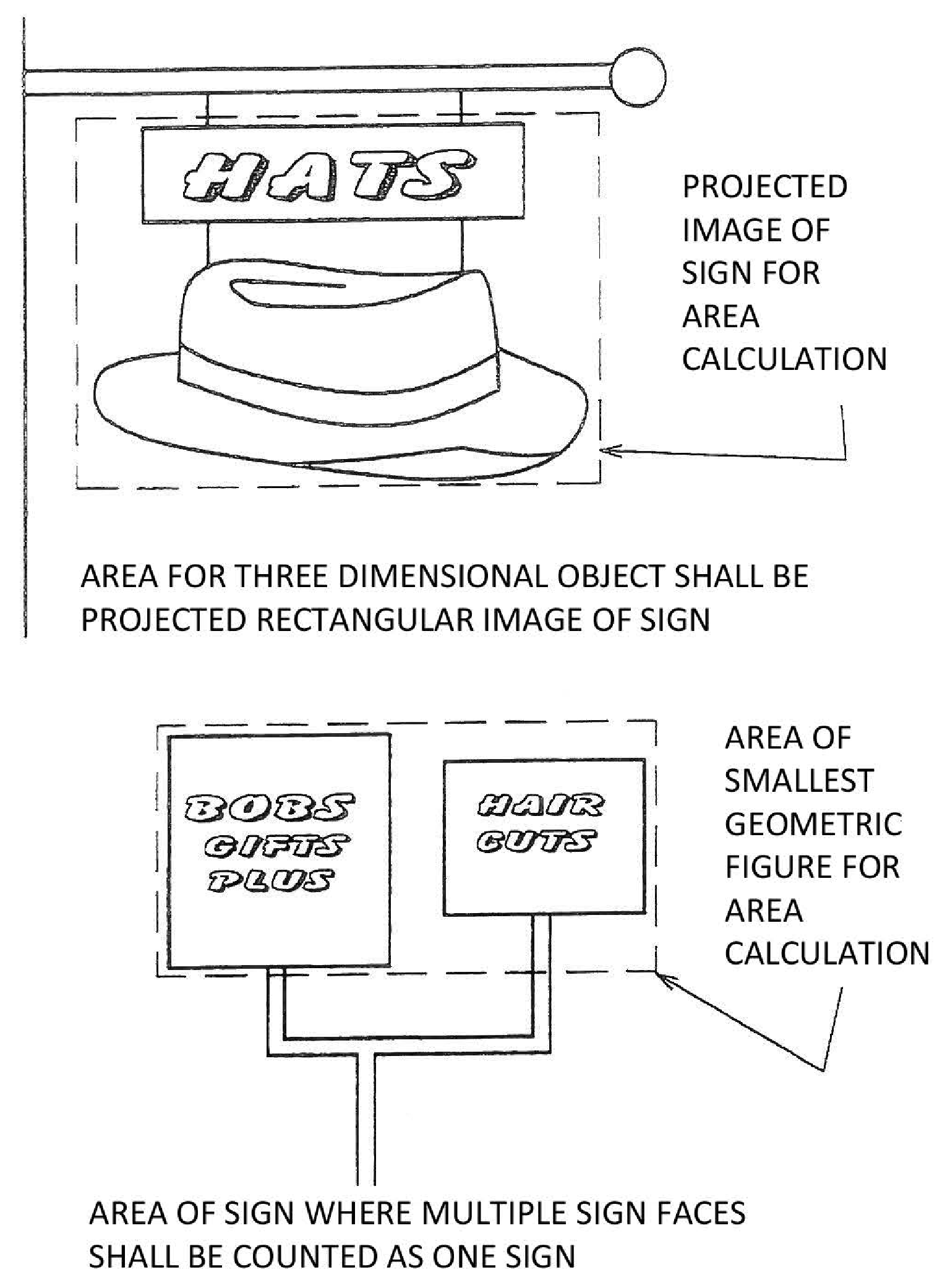
Where a sign is in the form of a three-dimensional object, the area shall be determined by drawing a square or rectangle, the sides of which touch the extreme points or edges of the projected image of the sign and multiplying that area by two. The projected image is that image created by tracing the largest possible two-dimensional outline of the sign. See exhibits in section 8.07.00.
(Ord. No. 2011-06, § 2(8.05.01), 11-8-2011)
Sec. 8.05.02. - Number of signs.
In general, the number of signs shall be the number of noncontiguous sign faces. Multiple noncontiguous sign faces may be counted as a single sign if all the sign faces are on one structure and are included in the geometric figure used for determining the sign area. See exhibits in section 8.07.00.
(Ord. No. 2011-06, § 2(8.05.02), 11-8-2011)
Sec. 8.05.03. - Ground sign height and permissible area.
(a)
The height of a ground sign shall be measured as the vertical distance from the finished grade level at the base of the supporting structure to the top of the sign, or its frame supporting structure, whichever is higher. The maximum height of a ground sign shall not exceed eight feet.
(b)
The area of a ground sign shall not exceed 20 square feet.
(Ord. No. 2011-06, § 2(8.05.03), 11-8-2011)
Sec. 8.05.04. - Standards in residential zones.
All single-family residential properties that are located in residential zoning districts are permitted signs not to exceed eight square feet in total sign area per road frontage. Lakefront lots, comer lots, and lots with frontage on more than one street are entitled to eight square feet per frontage. This sign area allowance covers but is not limited to: sale, lease, rental, open house, construction signs, and political and election campaign signs.
(Ord. No. 2013-02, § 1(8.05.04), 6-11-2013)
Sec. 8.06.01. - Generally.
All permanent signs must comply with the following design, construction and location standards:
(1)
Compliance with building codes required. All permanent signs, and the illumination thereof, shall be designed, constructed and maintained in conformity with applicable provisions of the building codes adopted by the town.
(2)
Illumination standards.
a.
Sign lighting may not be designed or located to cause confusion with traffic lights.
b.
Illumination by floodlights or spotlights is permissible so long as none of the light emitted shines directly onto an adjoining property or into the eyes of motorists or pedestrians using or entering public streets.
c.
Illuminated signs shall not have lighting mechanisms that project more than 18 inches perpendicularly from any surface of the sign over public space.
d.
Light sources shall be shielded and high intensity floor lights or other lights shall not be directed at pedestrians or vehicles.
e.
The spillover from lighting in proximity to residential areas shall be avoided so it is not a nuisance. Unnecessary light spill is defined as a light contribution in excess of 0.1 footcandles measured at a point five feet beyond the property line. Lamps for parking area lighting shall be energy efficient. High-intensity discharge (HID) mercury vapor lights are prohibited.
(3)
Placement standards.
a.
Near street and driveway intersections. Signs located within a clear visibility triangle shall conform to the requirements of section 6.02.04(8).
b.
In right-of-way. Supports for signs or sign structures shall not be placed in or upon a public right-of-way or public easement, except for sidewalk signs.
c.
Blocking exits, fire escapes, etc. No sign or sign structure shall be erected that impedes use of any fire escape, emergency exit or standpipe.
(Ord. No. 2011-06, § 2(8.06.01), 11-8-2011)
Sec. 8.06.02. - Clearance standards.
(a)
Over pedestrian ways. All signs over pedestrian ways shall provide a minimum of seven feet, six inches of clearance.
(b)
Over vehicular ways. All signs over vehicular ways shall provide a minimum of 14 feet of clearance.
(c)
Maximum height. Fences or walls not in the front yard setback shall have a maximum height of 72 inches.
(Ord. No. 2011-06, § 2(8.06.02), 11-8-2011)
Sec. 8.06.03. - Relationship to building features.
(a)
A sign running parallel to a building shall not extend beyond the roof or sides of the surface to which it is attached, nor disrupt a major architectural feature of the building. See exhibits in section 8.07.00.
(b)
A building sign shall not be displayed above the expression line, except for:
(1)
Wall-mounted hanging signs that are highly decorative and compliment the building facade.
(2)
Small window signs.
(3)
Signs that identify a building, and are incorporated in the cornice detail.
(Ord. No. 2011-06, § 2(8.06.03), 11-8-2011)
Sec. 8.06.04. - Maximum projection.
A blade sign may project no more than four feet perpendicularly from the surface to which it is attached.
(Ord. No. 2011-06, § 2(8.06.04), 11-8-2011)
Sec. 8.06.05. - Window coverage.
(a)
Window signs. These are signs which are applied or painted to or located within six inches of the inside surface of any exterior window and shall occupy no more than 25 percent of the total area of the window in which they are displayed and are counted as part of the aggregated sign area. Further, no sign or signs shall cover more than ten square feet of any window space.
(b)
Window space. A window space is considered to be the total area of any single window pane or series of window panes separated by mullion of 12 inches or less.
(Ord. No. 2011-06, § 2(8.06.05), 11-8-2011)
Sec. 8.06.06. - Permit procedures and penalties.
(a)
Application requirements for permanent signs. Any permanent sign must be reviewed by the town planner and approved by the town manager. It shall be unlawful to erect a sign as defined in this article without first obtaining an approved sign permit. A sign permit shall not be required to repaint a sign exactly as it was previously. An application shall be submitted to the town manager or designee, with the applicable fee as established by resolution of the town council and is on file in the town clerk's office, and the following information:
(1)
One drawing showing details of construction and foundation.
(2)
Scaled drawing with size, shape, design, colors, materials and lighting.
(3)
Plot plan of site and sign location, if a ground sign.
(4)
Elevation of sign on building, if wall or window sign.
(5)
A summary of both allowable and used total square footage.
(b)
Permit expiration. Sign permits are valid only for 60 days after issuance. Failure of permittee to erect his sign within this period shall require the permittee to file a new sign permit application.
(c)
Sign removal. Two days after a sign no longer advertises a bona fide business conducted, product sold, or activity or campaign is completed, said sign shall be removed by the owner, agent, or person having the beneficial use of the building, structure or lot upon which the sign is found. Upon failure to comply, the town manager or designee is hereby authorized, after due notice, to cause removal of the sign and any expense incident thereto shall be paid by the owner of the building, structure or lot to which such sign is attached.
(d)
Temporary banners over streets.
(1)
Schools, churches, civic associations, fraternal organizations, charitable and other nonprofit organizations, including professional business and community associations may be allowed, by obtaining proper prior approval from the town manager or designee, to temporarily erect a banner over a town street.
(2)
Requests for the erection of overhead street banners shall be made at least three weeks prior to the requested date of installation in order that affected departments of the town may be notified.
(3)
All overhead street banners shall be erected by a firm or organization which is covered by a public liability, personal injury and property damage insurance policy, a copy of which is to be provided to the town manager or designee.
(4)
Banners shall have a minimum clearance of seven feet, six inches over pedestrian ways and 14 feet over vehicular ways.
(5)
Banners may be erected two weeks prior to the opening of the event advertised and shall be removed within 48 hours after its termination.
(e)
Violations.
(1)
Any sign installed or placed on public property, except in conformance with the requirements of this article, shall be deemed illegal and shall be removed by the town manager or his designee. The town shall have the right to recover from the owner or person placing such sign the cost of removal and disposal of such sign.
(2)
Signs installed or placed on private property in violation of the provisions of this article shall be subject to code enforcement action. The town code inspector shall notify the property owner and provide the property owner with seven days to correct the violation. The town code inspector shall also provide a courtesy notice of such violation to the business owner. If the violation is not corrected within seven days, the code inspector shall initiate the code enforcement procedure set forth in section 11.06.00 of the town's code of ordinances.
(3)
The town may obtain an injunction or other legal or equitable relief in the circuit court against any person violating this article.
(4)
Violators may be fined up to $300.00 a day for each violation or such other amount set from time-to-time by resolution of the town council.
(f)
Non-conforming signs. Signs which have been legally erected prior to the effective date of this section shall be allowed to remain in existence as set forth in subsections (1)—(3) below. Thereafter, unless such signs conform to the provisions of article VIII, the property owners shall be subject to the penalties set forth in subsection 8.06.06(e).
(1)
Sidewalk signs must be brought into conformance with the requirements of article VIII on or before the effective date of this section.
(2)
All other signs may continue to be maintained, but only until June 1, 2015.
(3)
A non-conforming sign shall not be changed, expanded or altered in any manner to increase the degree of its nonconformity, or be structurally altered to prolong its useful life. Nonconforming signs are required to be maintained in good condition. Normal repair and maintenance of a sign shall not be considered a structural alteration.
(Ord. No. 2011-06, § 2(8.06.06), 11-8-2011; Ord. No. 2014-01, §§ 1(4)—1(6), 6-10-2014; Ord. No. 2014-07, § 1, 9-9-2014)
Sec. 8.06.07 - Appeals and variances.
(a)
Appeals. A decision rendered by the town planner and/or the town manager under subsection 8.06.06(a) may be appealed to the town council. Such appeal shall be filed in writing within 60 days of the decision. The appeal shall be filed with the town clerk by submitting the necessary and pertinent documentation specifying the grounds on which the appeal is based and the payment of applicable fees. The town council shall hear the appeal at the next regular council meeting.
(b)
Variances. Variances to restrictions set forth in this article VIII shall be governed by the process set forth in article X of the land development code.
(Ord. No. 2014-01, § 1(7), 6-10-2014)
Sec. 8.07.00. - Exhibits.
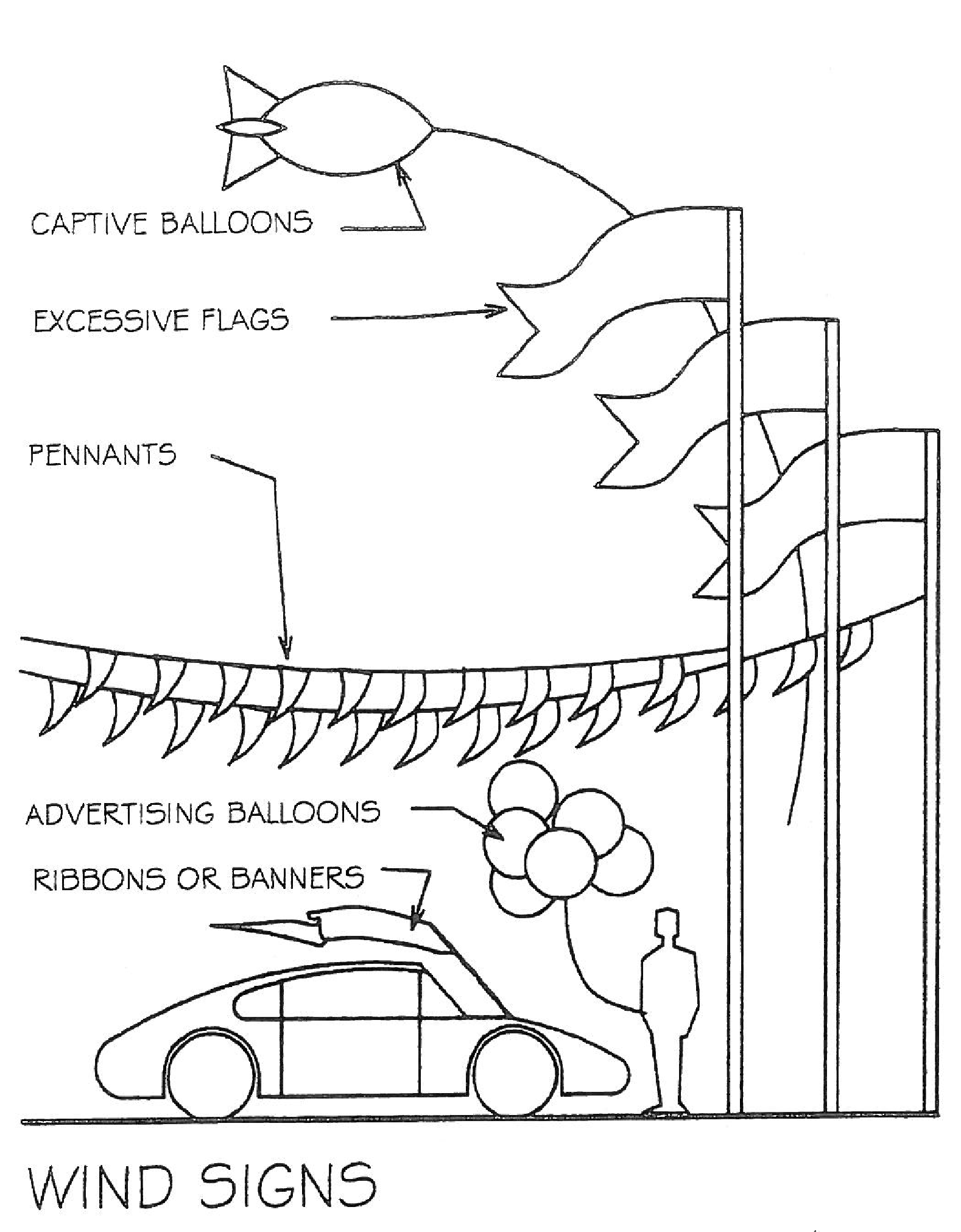
Exh 8.02.02G Wind Signs
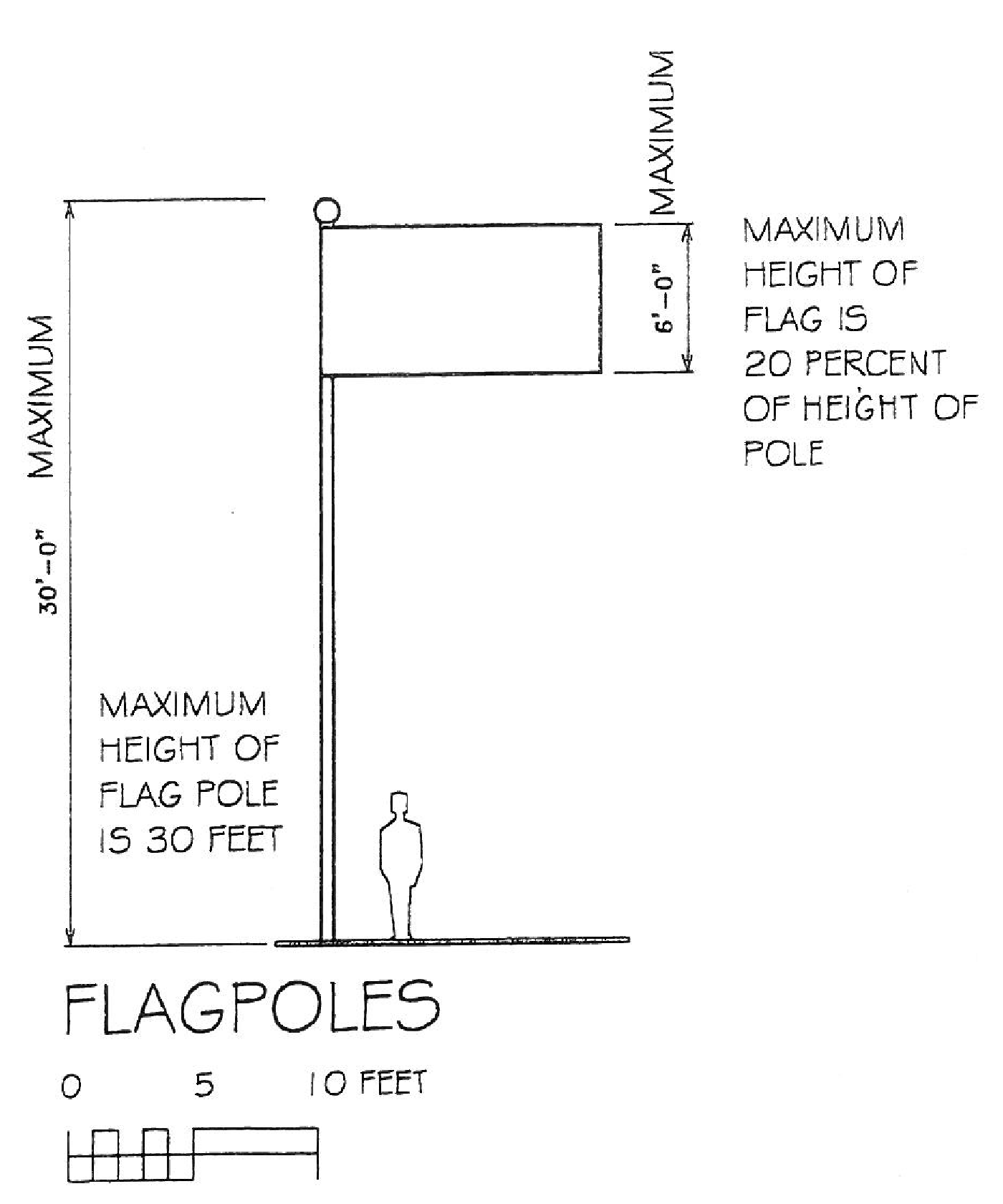
Exh 8.04.05B Flagpoles
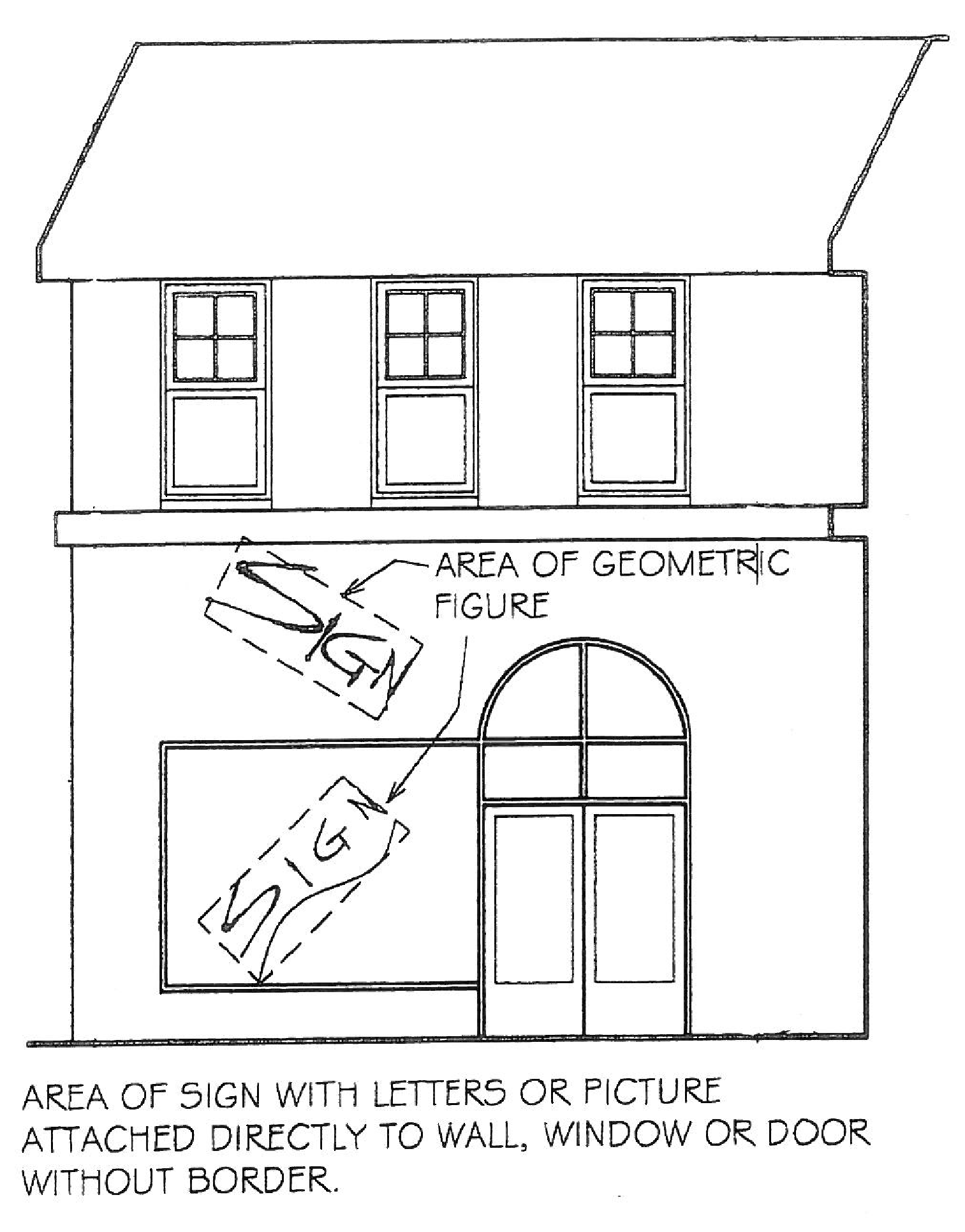
Exh 8.05.01B(1) Area of Sign with Letters or Picture
Exh 8.05.01B(3) Top: Area for Three Dimensional Object
Exh 8.05.02A Bottom: Area of Sign Where Multiple Sign Faces
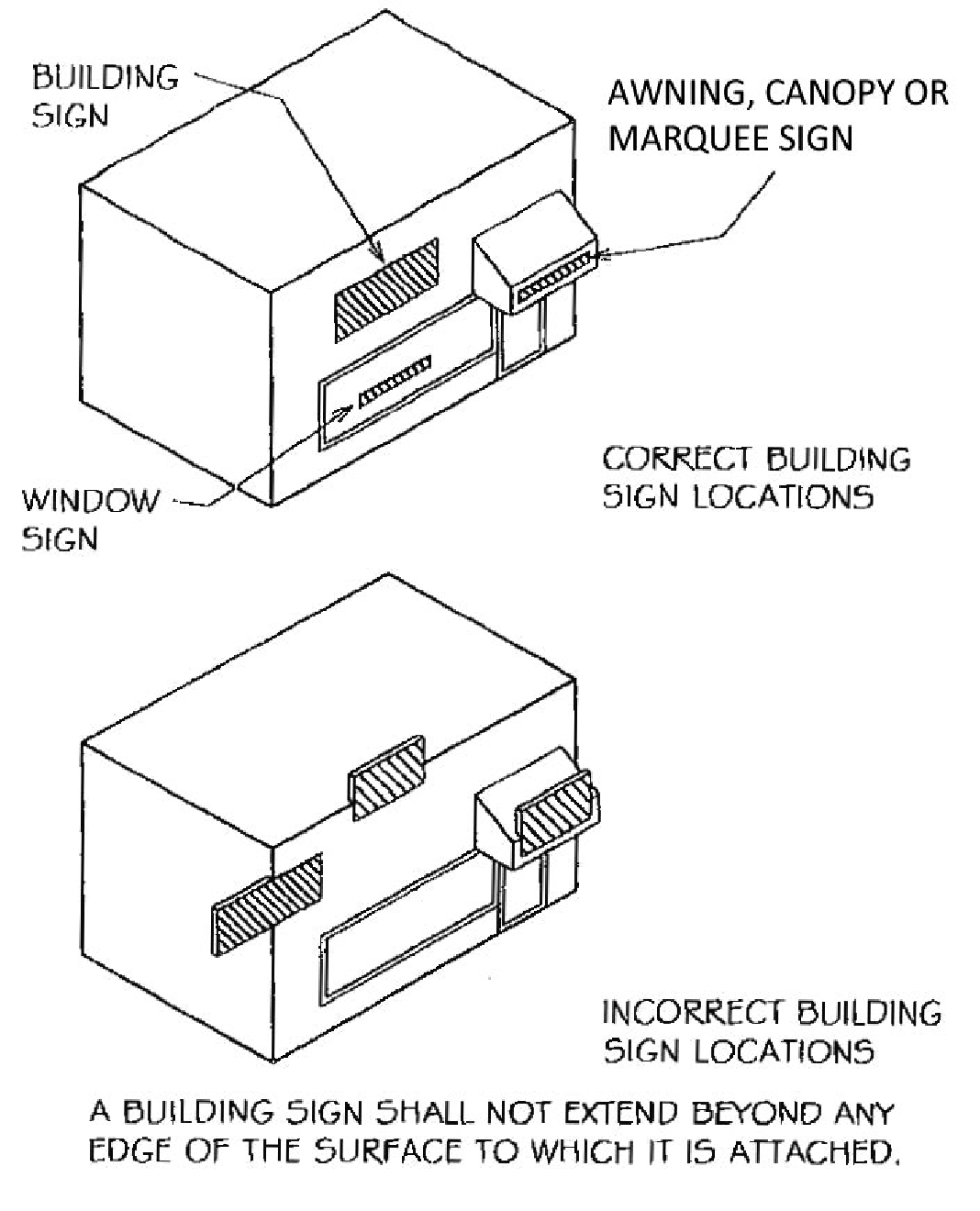
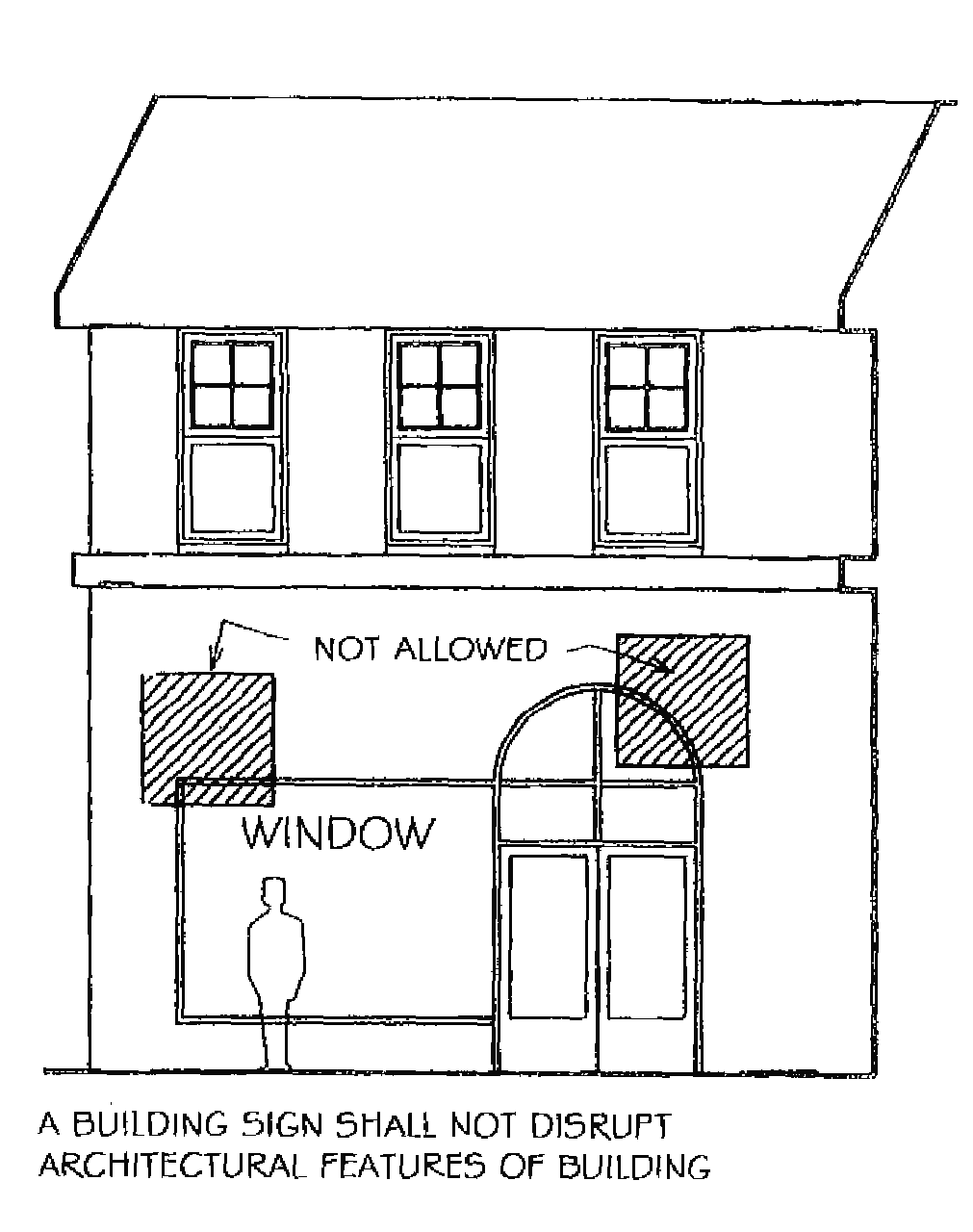
Exh 8.06.03A, Building sign (two-part illustration)
(Ord. No. 2011-06, § 2(8.07.00), 11-8-2011)

