
Winter Park City Zoning Code
Sec. 58-71
General provisions for residential zoning districts.
(a)
Suitability of buildings. Any proposed building shall be considered as to its suitability of design and type of construction in relation to the district and to the immediate neighborhood site, and if such design, lot grading or construction is markedly incongruous with the character of such neighborhood as to be detrimental to the value of adjacent or nearby properties, then the zoning official shall deny the application for a building permit.
(b)
Grading of building site.
(1)
Every lot which is used for a building site shall be so graded that it will be dry and free from standing water and the grade around the walls of every new building at the point where the sill meets these walls shall not be less than 12 inches above the crown line established or to be established for the street on which such a building faces, unless the lot has drainage away from the street to the lake or canal or has other adequate means of drainage as may be checked and approved by the building director or the public works director at the request of the city building director. If the street on which the lot faces has a slope between lot lines, an elevation half-way between the high and low points is to be used for determining the height of crown line.
(2)
No lot owner shall grade a lot in such a way as to interfere with the natural drainage of adjoining lots, divert the drainage of a lot onto adjoining lots, or interfere with the natural drainage of any lot so that the drainage of such lot is diverted in a manner that is inconsistent with permitted stormwater management systems or upon any public street or thoroughfare in a manner or in such amounts as to flood a public street or thoroughfare.
(3)
In addition, no lot shall be filled with elevated lot grades adjacent to or near other surrounding properties so as to require the use of retaining walls or other barriers to create an unnatural lot grade transition unless approved by the building director or the public works director based on one or more of the following criteria:
a.
Verified topographic conditions on the property exist which include grading that requires the use of a retaining wall to prevent drainage onto adjacent properties.
b.
Terraced retaining walls are required to retain water on site to prevent storm water runoff into a water body or other properties. On the waterfront side of lakefront properties terraced retaining walls must not exceed three feet in height above the existing grade.
c.
The proposed retaining wall is located a large distance from the nearest residential property, such as, but not limited to 30 feet, or a distance determined proportionately based on the lot width in a manner that is designed to provide no adverse or increased storm water drainage onto an adjacent property.
d.
Terraced retaining walls are used for aesthetic landscaping only and are designed in a manner that does not create storm water drainage onto neighboring residential properties.
(c)
Architectural towers, spires, chimneys, or other architectural appendages, etc.
(1)
Any architectural tower, spire, faux chimney, flag pole or other architectural appendage to a building shall conform to the maximum building height. However, when necessary to meet the building code requirements, functional chimneys may exceed the height by that minimum required distance. One flag pole may be placed on a residential lot or parcel subject to a height limit of five feet less than the permitted building height and located in front of the home encroaching up to ten feet into the front setback and not within the required side and rear yard setbacks established for the subject property.
(d)
Parking of commercial vehicles in residential districts.
(1)
The regular or constant parking of commercial vehicles or vehicles used primarily for commercial purposes, or vehicles having outside lettering larger than three square feet in area per side displaying information identifying a business, product or service, including trucks (with a rated capacity over one ton), semi-trailers, truck tractors or any combination thereof or any other truck or special mobile equipment or heavy equipment, building materials and other similar materials is not permitted within the residential zoning districts. (R-1AAA, R-1AA, R-1A, R-2, R-3, R-4 or PURD).
(2)
Exceptions. The provision of this section shall not apply to:
a.
Property where construction is underway for which a current and valid building permit has been issued by the city, as to those vehicles and equipment actively engaged in such construction. Those vehicles and equipment, not including construction machinery, must be removed each evening and at any time the vehicles and equipment are not actively engaged in such construction;
b.
Those vehicles and equipment being used to perform lawful work upon the premises where the vehicle is parked, including immediate pick-up or delivery service;
c.
Any vehicle, with a capacity rating under 10,000 pounds that is parked entirely inside a garage and not visible from the street or from surrounding properties;
d.
Political signage on vehicles as otherwise permitted by the sign regulations.
(e)
Buses. In residential districts, buses shall be parked only in designated bus parking areas approved pursuant to the notification and procedures outlined for conditional uses.
(f)
Boats, trailers, vehicles over 25 feet, and recreational vehicles.
(1)
Boats, trailers of any type, vehicles over 25 feet, recreational vehicles, as defined in state statutes (including campers, travel trailers and motor homes) and similar vehicles shall not be parked or stored within any residential district including public rights-of-way, except as hereinafter specifically permitted. Under no circumstances shall any boat, trailer, or recreational vehicle be slept in or otherwise used for lodging or habitation while parked or stored within a residential district.
(2)
Boats and boat trailers may be parked if stored entirely within a carport, garage or enclosed structure. Recreational vehicles (including campers, travel trailers, and motor homes), vehicles over 25 feet, and trailers (other than boat trailers) may be parked if stored entirely within a garage or other enclosed structure. As used herein, a garage or other enclosed structure shall mean a structure having at least 75 percent opaqueness.
(3)
Boats, trailers and recreational vehicles having an overall length of 32 feet or less, or vehicles over 25 feet, may be parked in a private driveway within a residential district for an aggregate of not more than 24 hours during any one calendar week.
(4)
The parking of boats, trailers, vehicles over 25 feet, and recreational vehicles in side and rear lot areas is permitted only if fences, walls and landscape screening, including hedges, trees, etc., having at least 65 percent opaqueness of the view of the boat, trailer or recreational vehicle shall be constructed and planted so as to buffer adjacent residential properties.
(5)
Residents may allow their guests to park a boat, trailer or recreational vehicle having a length of 32 feet or less for up to 48 hours in the driveway or behind the main structure of the lot on which it is parked. If additional time is needed, the code compliance manager shall be notified no later than 24 hours after such vehicle is so parked.
(g)
Projections into setbacks. Eaves, roof overhangs, canopies, chimneys and flues, and awnings may project into the minimum yard or setback areas up to three and one-half feet. Fabric canopies, awnings, balconies, etc., with ground supports, second floor open porches, two-story high columns or similar features are considered a structure, and to be part of the main structure, and thus shall observe the setback requirements of the districts in which they are located. Cantilevered bay windows which project from the wall at a minimum height of 24 inches above finished grade may project two feet into required setbacks and are limited to a maximum width of eight feet.
(h)
Accessory buildings, structures, air-conditioning equipment and other accessory uses in residential zones.
(1)
No detached accessory use or structure shall be permitted in the required front yard. On double frontage lots or corner lots, no detached accessory use or structure shall be permitted in the required yards fronting on the streets. In addition, no storage sheds shall be permitted in the area between the building line of the main structure and street or streets, unless screened by an opaque fence or wall.
(2)
An accessory building may be attached to a principal structure by a one-story open-sided roofed breezeway with a maximum width of eight feet connected perpendicular to the principal structure without meeting the setback requirements of the principal building and complying with the setbacks of the accessory building; however, all other zoning requirements must be met, such as impervious coverage, building coverage or floor area ratio, where applicable.
(3)
Mechanical equipment, which includes air-conditioning equipment, swimming pool equipment, generators, and similar type equipment, shall not be located in any front yard or required side yard with street frontage unless totally shielded from view from the street by walls or vinyl fences otherwise complying with the zoning code. Mechanical equipment may be located up to ten feet from a rear lot line as long as they are adjacent to the accessory structure or principal structure. Mechanical equipment shall not be located in any required side yard or within ten feet from the rear lot line except that they may be permitted up to five feet from a side or rear property line if screened by a solid fence or wall that is at a minimum equal in height of the equipment. Propane tanks shall not be located within five feet of any side or rear lot line. Any mechanical equipment placed on a roof must be screened from view from surrounding properties and from public streets.
(4)
Accessory structures or buildings, up to 150 square feet in size, may be located five feet from a side or rear interior property line. Accessory buildings over 150 square feet in size up to 400 square feet shall not be located closer than ten feet to any side or rear property line, and any two-story accessory building or any accessory building over 400 square feet shall meet the same rear and side setback as required for the principal structure. No accessory structure shall exceed a height of 16 feet unless located so as to comply with the setbacks of the principal structure. Total square footage of accessory structures shall be inclusive of all enclosed, and covered open air areas such as patios, summer kitchens, or porches.
(5)
The following table summarizes the side and rear setback requirements for accessory structures based on size and type as indicated throughout this section.
(6)
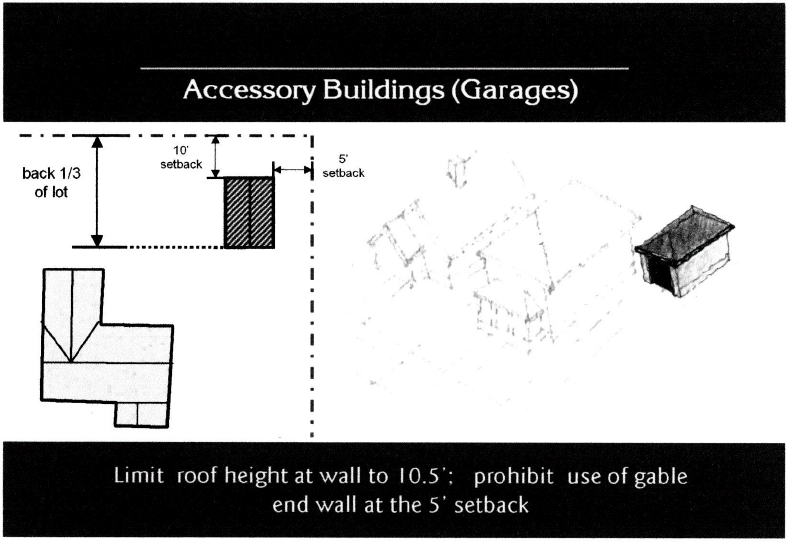
Accessory buildings in rear yards. The exterior walls of accessory buildings shall not exceed ten and one-half feet in height. Additionally, accessory buildings located less than ten feet from an interior side lot line must have a sloped or flat roof, e.g., the side wall adjacent to the lot line cannot be a gable end wall. A garage not exceeding 620 square feet may be located five feet from the interior side lot line and ten feet from the rear lot line. Additionally, private garages (attached or detached) shall be limited in size to no greater than 50 percent of the living area of the dwelling. A rear garage utilizing the setbacks in this section must be partially located in the rear third of the lot depth, except on waterfront properties.
(7)
Garages and carports for single-family dwellings on any lot and two-family dwellings on lots over 70 feet wide:
a.
Streetfront-facing garages must meet one of the following design standards:
1.
The front wall of the garage must be offset at least three feet from the main wall of the home with a maximum of two doors no greater than nine feet wide, with the garage door face recessed at least six inches from the plane of garage wall. Alternatively, one garage door may be permitted up to 18 feet wide with architectural design features such as glazing, hardware and raised panels integrated into the door or other finishes matching the primary structure. The main wall of the home is considered to be a solid wall which separates air-conditioned living space from the outdoors.
2.
The garage must have a side entry or be located at the rear of the property behind the main dwelling.
3.
A third front facing garage bay with a maximum door width of nine feet, shall be recessed back at least four feet from the adjacent front wall of the other garage doors or main wall of the home.
In addition, no street-facing garage shall have a garage opening exceeding ten feet in height.
b.
Open carports must be located at least three feet behind or at least three feet in front of the main house wall. In cases where the front setback is permitted to be less than 20 feet, the minimum front setback to the garage or carport opening shall be at least 20 feet after complying with one of the design standards in this section. Alternate methods to accomplish the step back shall be reviewed on a case-by-case basis. In addition, no front-facing garages on the front half of the lot shall have doors exceeding ten feet in height.
c.
Detached garages located in front of or within 25 feet behind the front wall of a home must adhere to the same required side yard setback as the main residence.
d.
Requirements when two courtyard garages are located in front of a home:
1.
An additional five feet of front setback shall be required to the garage wall.
2.
The entry drive width is limited to 16 feet from the front lot line to the front wall of the garages.
3.
Windows or similar architectural features shall be provided in the garage wall facing the street.
4.
Landscaping shall be provided to buffer at least 20 percent of side wall of the garages including one or more understory or shade trees in front of each garage wall facing the street. Specific details of proposed landscaping shall be shown on building plans.
e.
Porte cochere. A porte cochere attached to the front of the home may encroach up to ten feet into the required front setback or porte corcheres attached to the side of a home may utilize a side-yard setback of five feet from an interior side lot line or 15 feet from a street-side lot line subject to the following: three sides of the structure must be at least 75 percent open; a maximum height of 13 feet from existing grade to roof top and a maximum roof overhang of 12 inches. If a porte cochere has an area greater than 250 square feet, then the principal building setbacks shall be applied. Porte cocheres less than 250 square feet shall not be counted towards floor area ratio.
(8)
An accessory building or structure shall not be located within five feet of any other building. The building height of any accessory building shall not exceed the building height of the main building or principal residence on the property.
(9)
A guesthouse or garage apartment shall not be constructed on a lot for occupancy before completion of the main buildings. This shall not prohibit the erection of other accessory buildings prior to the construction of the principal building, when such accessory buildings are neither constructed nor used for dwelling purposes.
(10)
Guesthouses or garage apartments are permitted accessory uses when they provide accommodations for guests, domestic service employees or members of a family occupying the main building on the same property. Guesthouses or garage apartments shall not exceed 1,000 square feet of floor area. Guesthouses or garage apartments as permitted accessory uses may not have a kitchen area or cooking facilities. They also may not have separate utility meters or be rented, let or hired out for occupancy whether compensations be paid directly or indirectly.
(11)
Vertical arbors and trellis structures may be located no closer than five feet to side and rear lot lines. The structure shall not exceed a maximum length of 15 feet along a side or rear yard wall or fence. The maximum overall height of such structures shall not exceed ten feet, except within the buildable area of the lot, where the structure may extend to a height not exceeding that of the principal building on the property. In front-yard and street-yard setback areas, decorative arbors or trellises may be permitted no closer than 15 feet from any front lot line and ten feet from any street side yard lot line, subject to approval by the zoning official.
(12)
Play structures. Play structures, tree forts and similar play structures used by children that incorporate an elevated-floor-level-type of raised or elevated platform for walking or playing upon which has a maximum height of 16 feet above existing grade and a total footprint of 400 square feet or less shall maintain a side and rear setback of at least ten feet. If attached accessories are incorporated, such as swings, slides and similar play items used by children, that are not six feet in height, those accessory items may be permitted a side and rear setback of five feet. Play structures include playground-type equipment, swings, slides, forts and similar structures used by children. All other provisions of accessory building regulations shall also apply.
(13)
Backyard chicken coop accessory structures.
a.
Chicken coops, pens or chicken tractors must be located in the side or rear yard and be set back a minimum of ten feet from the rear and a minimum of ten feet from the side lot lines. Coops must be screened at grade from adjacent properties with a solid six-foot fence or wall. No coop will be allowed in any front or side-yard.
b.
The coop, pen, or chicken tractor must be a minimum of 20 feet from any pre-existing neighboring residential principal structure, at least five feet from the principal structure on the subject property, and at least five feet from any property line. No setback is required between a coop and another accessory structure on the subject property.
c.
Chicken coops must be less than 50 square feet and may have an attached run. The coop must also be tied down for wind resistance.
d.
The maximum height of a coop shall be eight feet, as measured from the existing grade to the highest part of the coop.
e.
An applicant for a permit must demonstrate compliance with the criteria in the Code in order to obtain a permit. The application for a permit must be submitted to the building official. Applicants must submit photos of the proposed site of the coop/run areas, a to scale survey/site plan of the subject property showing the location, and proof of successful completion of a University of Florida Agricultural Extension Service class or an equivalent class approved by the building official, completed within the last year.
f.
A building official determination is required for a permit. The building official is authorized to implement reasonable rules and regulations regarding backyard chickens. The building official must not approve locations with outstanding Code violations.
g.
No more than 25 permits will be issued citywide. Permits will be issued on a first-come, first-served basis. Participants choosing to leave the program must provide notice to the city. The city is then authorized to re-issue the permit to another qualified applicant. If a participant is removed from the program due to violations of the terms of this ordinance. The permit may also be re-issued to another qualified applicant.
(i)
Additional cooking facilities. For properties which contain a single-family residence that is 5,000 square feet in gross floor area of larger, a second kitchen may be included in a dwelling or cabana subject to not having a separate utility meter.
(j)
Swimming pools and screen enclosures. Swimming pools for private residential use are accessory uses and shall be constructed in accordance with the Florida Building Code. The location of pools, pool decks and screen enclosures shall be as follows:
(1)
Swimming pools and spas are permitted to have a rear setback of seven and one-half feet and a side setback of seven and one-half feet for lots which are 70 feet wide or less and are permitted to have a side and rear setback of ten feet for lots which are over 70 feet in width. The setback to a lake, canal or stream shall not be construed as a side or rear setback. Swimming pools and spas shall not be permitted in any required front or street-side yard.
(2)
Pool decks shall be located no closer to the side and rear lot line than 50 percent of the required setback for swimming pools. Pool decks may be permitted in the remaining area of the required side and rear setbacks only if screened from the adjacent property by a six-foot masonry wall. Pool and spa decks shall not be constructed more than three feet in height above the existing grade elevation at the tallest edge of the deck, patio or terrace. The setback to a lake, canal or stream shall not be construed as a side or rear setback. Instead, on lakefront lots, pool decks must be set back a minimum of 50 feet from the ordinary high-water elevations established in this article. On streamfront or canalfront lots, pool decks may be setback a minimum of 20 feet from the canal bulkhead if approved by the planning and zoning board.
(3)
Screen pool enclosures on lakefront, canalfront or streamfront lots shall be regulated as structures and located only within the required setbacks and as approved by the planning and zoning board. Screen pool enclosures on nonwaterfront lots shall be regulated as structures and located only within required setbacks for the respective zoning district except as provided for in the following paragraphs:
a.
The rear and side setback may be seven and one-half feet, subject to limiting the height of the screen enclosure to ten feet at the sides of the enclosure and 14 feet at the apex of the enclosure.
b.
The rear and side setback may be five feet subject to limiting the height of the screen enclosure to seven and one-half feet in height at the rear and side setback and compliance to the apex height limitations cited above provided that there is also a dense landscape or solid fence buffer along the rear lot line to a minimum height of six feet installed and maintained.
c.
No variance shall be granted regarding the height of screen pool enclosures.
(4)
Other screen enclosures (not enclosing a swimming pool or spa) with screen roofs shall also be regulated as described above.
(k)
Private outdoor recreational areas. Private outdoor recreational areas requiring site improvements, including tennis courts, basketball courts, etc., shall require side and rear setbacks of ten feet to the exterior boundary of the court. Their associated backstop and side fencing shall also conform to these setbacks and shall not exceed 12 feet in height. The composition of this fencing shall be vinyl-coated chain link or other decorative fencing that does not impede the flow of air and which received the approval of the zoning official. Private pickleball courts requiring site improvements shall provide a minimum setback of 150 feet from all side and rear property lines. A masonry wall, not less than six feet in height, shall be constructed between the property line and the perimeter of the court along no fewer than three sides of the court. Pickleball activity on pickleball courts is limited to the hours of 8:00 a.m. to 8:00 p.m.
(l)
Residential decks; patios. Decks or patios may not be located closer than five feet from a side or rear property line. These provisions shall apply to decks or patios only if they are less than three feet above existing grade, otherwise, such decks or patios must conform to the setbacks for the main structure.
(m)
Residential driveways; parking spaces; motor courts, sidewalks, etc. Any residential sidewalk, driveway, parking space or other vehicle circulation area, whether of a paved surface such as asphalt, concrete or brick, or of an unpaved surface such as gravel, mulch or dirt, shall be setback at least two feet from the side or rear property lines, except where a common drive is permitted between adjoining properties or a nonconforming drive exists and does not create any drainage problem for an adjacent property.
(1)
In all single-family residential districts, a driveway must be a minimum of nine feet wide, unless otherwise required by the city engineer.
(2)
On lots that are 60 feet wide or less, a one-foot setback may be utilized as the driveway setback along a side lot line. The drive and parking surfaces must be designed to prohibit the diversion of drainage from vehicle driveways, parking or circulation areas onto adjacent properties.
(n)
Walls and fences.
(1)
Permits. Requests for permits for walls and fences must be accompanied by a site plan and drawings clearly showing the locations, heights and materials for which approval is requested.
(2)
Height and setbacks in residential districts. The table provided below summarizes the maximum height of walls and fences in each required yard as well as the types of walls and fences permitted, as outlined in the following paragraphs. Decorative fences must be a minimum of 75 percent open.
a.
In front yards and in side yards with street frontages, walls and fences shall not exceed three feet in height above the existing grade. However, these decorative front yard or street frontage walls and fences may be permitted columns or posts to exceed this height limit by one foot provided they are spaced at least ten feet apart. Light fixtures may also be placed on columns at driveway entrances up to one foot in height.
b.
In side yards with street frontages, a decorative fence may be permitted up to four feet in height above the existing grade where necessary to meet swimming pool safety requirements. Additionally, in street-side yard areas of corner lots, a privacy fence or wall may be constructed six feet in height above the existing ground level when setback at least ten feet from the street-side property line, subject to vegetative planting on the street facing side of the fence.
c.
In all other side and rear yard areas, walls and fences may be a maximum of six feet in height above the existing grade.
d.
No wall or fence shall be permitted which would in any way obstruct or impair the visibility of automobiles at intersections and points of ingress and egress to the public right-of-way. For walls and solid fences located on any street, a setback of one foot from the lot line is required to prevent interference with pedestrian mobility on existing or future sidewalks.
e.
Gates located on any street are permitted up to a maximum four feet in height from existing grade and must match the material of the fencing or no less than 60 percent open in composition, whichever is greater.
f.
Walls and fences on the lakefront, canalfront, or streamfront side of properties shall meet the requirements established in this article for such waterfront properties.
g.
For purposes of locating walls and fences, front yards shall be the area from the front lot line to the front building wall or as determined by the zoning official.
(3)
Materials permitted in residential districts. In any residential district, all fences in the front yard and those within ten feet of a side yard lot line with street frontage shall be decorative. In all yards, chain link, chicken wire, attachable mesh/plastic screening, or similar-type permanent fences shall be prohibited. Barbed wire, electrically-charged fences and solid or mostly solid metal fences shall not be erected in any residential district. A wall, fence or similar structure erected in any residential district shall not contain material or substances such as broken glass, spikes, nails, barbs or similar materials designed to inflict pain or injury on any person or animal.
(4)
The column and post height of a wall or fence may exceed the allowable wall or fence height by a maximum of two feet in areas outside the front yard and street-side yards, provided they are spaced 20 feet apart in side and rear yards, except the additional two feet of post height may be permitted on columns located on either side of entry gates in areas outside the front yard and street-side yards.
(5)
Walls and fences shall be finished on both sides with similar architectural treatments and color on both surfaces so that, for example, a brick-veneered masonry wall shall have brick veneer on both sides or a stuccoed masonry wall shall have a stucco finish on both sides, a painted wood fence would be painted on both sides.
(6)
Existing nonconforming walls or fences on corner lots located within a required setback may be repaired or replaced subject to verification that the new wall or fence does not create a traffic visibility obstruction, is not closer than five feet to a street-side property line and is constructed of a material permitted by this section. In addition, where a hedge or landscaping material was required as a screening buffer due to a variance or a condition of a permit, the hedge or landscaping material shall be maintained and irrigated to ensure continued viability.
(o)
Building to have access on a public street. Every building hereafter erected or moved shall be on a lot with frontage on a public street or previously approved private street. The structures on these lots shall be so located so as to provide safe and convenient access for servicing, fire protection, other emergency vehicles, and required off-street parking. Furthermore, no building hereafter erected or moved shall be on a lot solely adjacent to an unpaved road.
(p)
Land and building uses seen generally. (See general provisions for nonresidential districts for applicable regulations).
(q)
Solid waste containers. Prior to the issuance of a building permit, plans for the location or use of any solid waste container must show the location of container(s) for solid waste disposal. The number of containers, their location and access to them for unloading purposes are subject to the approval of the city. Solid waste containers or dumpsters shall be screened from view of surrounding properties for all new development. Recycling containers may be exempted from this requirement by the city.
(r)
Relocation or moving a building.
(1)
No building shall be moved into or relocated to a new site within the city and no work shall be commenced in preparation therefore, unless a moving permit has first been issued pursuant to the Florida Building Code.
(s)
Curb cut permits. Any proposed construction in zoning districts other than R-1AAA, R-1AA, R-1A and R-2 shall have its access points or curb cuts for off-street parking facilities approved by the City Traffic Engineer. In all such cases where that use has an access point or curb cut onto one public street, no additional curb cuts may be made onto another public street without the approval of the City Traffic Engineer. Approval shall be based on a finding that no additional traffic will be directed onto local residential streets.
(t)
Underground utilities.
(1)
It is the intent of the city to improve the aesthetic appeal of the city and the reliability of utility service by requiring that utility lines, such as electric, telephone, cable TV, fiber optics and other utilities, be placed underground in conjunction with the construction of all new buildings. The implementation of underground utilities shall also be required as a component to the substantial renovation of any existing building. Substantial renovations shall be interpreted as when the building permit value of such renovations and/or additions exceeds 50 percent of the value of the existing improvements on the most current property tax roll. Property owners shall provide space on site within the private property or within the building for any necessary pad-mounted transformers and switch gear and shall screen such to the degree possible with landscaping or other approved screening when visible from the public right-of-way.
(2)
The city recognizes that certain physical elements such as existing buildings, swimming pools, large trees and such may impose unreasonable hardships on property owner's compliance with the placement of utilities underground and for the location of transformers. Upon confirmation of these hardships by the utility companies, the Building Director may waive this requirement for such projects or may allow the waiver of up to two required parking spaces to be used for the required pad-mounted transformer and switch gear.
(u)
Duplex-modified yard developments.
(1)
This development concept is to provide for more flexible and creative site planning which may assist in lowering development and housing costs, expand the choice and type of dwelling units while maintaining compatibility with, and the integrity of, adjacent residential neighborhoods.
(2)
"Duplex-modified yard development" defined. A duplex-modified yard development shall consist of a building designed for, or occupied exclusively by, two families and containing dwelling units erected as a single building on adjoining lots, each being separated from the adjoining unit by an approved party wall, thereby creating noncommunicating dwelling units. Such buildings shall be designated duplex-modified yard dwellings.
(3)
Duplex-modified yard developments shall be permitted only when a declaration of covenants and restriction containing or addressing the provisions set forth in subsection (5) below is executed by all holders of any interest in or lien upon the real property upon which the duplex-modified yard dwelling is constructed, is approved by the city attorney as to form and content and is recorded in the Public Records of Orange County, Florida. Those desiring to utilize these duplex-modified yard provisions shall reimburse the city for the costs of the review and approval by the city attorney.
(4)
The adjoining lots on which each duplex-modified yard dwelling is constructed shall together be considered to be one lot for the purpose of compliance with the development standards applicable to the particular zoning district in which the duplex-modified yard dwelling is located.
(5)
The declaration of covenants and restrictions shall contain or address the following:
a.
A legal description of the entire parcel of real property upon which the duplex-modified yard dwelling is constructed, hereinafter referred to as the "duplex-modified yard development property," and legal descriptions of each separate parcel therein to be subjected to fee simple ownership;
b.
A provision that restrictions shall run with the land, and shall not be amended or rescinded without the written consent of the city commission;
c.
A provision designating those portions of the duplex-modified yard development property that will be commonly used by both fee simple owners, if any; establishing mutual easements permitting such use and governing the insurance, maintenance and repair thereof;
d.
A provision governing the insurance, maintenance and repair of all party walls;
e.
A provision governing the insurance, maintenance and repair of all exterior portions of all improvements to the duplex-modified yard development property. This provision must require that any exterior maintenance or repair performed with respect to any portion of the duplex-modified yard development property be accomplished in such a duplex-modified yard development property as a whole, i.e., the entire duplex-modified yard dwelling must be repainted at the same time under a common color scheme.
f.
A provision governing the landscaping of the duplex-modified yard development property. This provision must require that the landscaping be performed and maintained at all times in such a manner so as to preserve the overall appearance and value of the duplex-modified yard development property as a whole.
g.
A provision governing the method by which the owners of the duplex-modified yard development property will be assessed for the expenses of insurance, maintenance and repair of those items set forth in the preceding paragraphs of this subsection. This provision must include a means by which one owner may perform any necessary maintenance or make any necessary repairs to the duplex-modified yard development property and receive contribution from the other owner should the other owner unreasonably refuse to bear his portion of the expense. This provision must also include a description of the remedies that the contributing owner shall have against the noncontributing owner, such remedies being generally consistent with the remedies afforded to co-tenants in common, and a method by which disputes concerning the necessity or reasonableness of a given item of maintenance or repair may be resolved.
h.
An optional provision establishing an incorporated owner's association to perform the duties of insurance, maintenance, repair and assessment described above. The owner's association may operate more than one duplex-modified yard development property in a common manner not inconsistent with this section.
(6)
The foregoing duplex-modified yard development standards shall also apply to principal and cottage-dwelling developments with the following provisions:
a.
The two dwelling units (principal and cottage dwellings) are not required to be joined by a common party wall.
b.
The dwelling units must be provided with at least ten feet of driveway access to each of the dwellings from the public street or alley.
(v)
Significant changes to buildings or approved plans. Various sections of this zoning article require approvals by the planning and zoning board and/or city commission. Within the section for conditional uses there are specific requirements defining significant changes for conditional uses. For all other types of approvals, the standards below will determine whether a significant change or substantial deviation shall be deemed to have occurred which then would require a subsequent review and approval for those changes by the planning and zoning board and/or the city commission as follows:
(1)
When there is an increase in the height of a building of more than one foot; or
(2)
When there is an increase in the square footage of a proposed building of more than 500 square feet above grade; or
(3)
When there is an increase in the impervious lot coverage of more than 1,000 square feet; or
(4)
When there is a change in the architectural style of the building; or
(5)
When there is a major shift or relocation of the site and floor plan(s) or distribution of uses within the building or major shift or relocation in the features of building location, [stormwater] retention, parking area and/or driveways; or
(6)
When additional variances are requested that were not part of the original public record in the review by the planning and zoning board and/or the city commission; or
(7)
When the planning director, building director, zoning official, or city commission finds that a material change has been made to a plan detail that was critical to the decision rendered by the board or the commission.
(w)
Tents. (See general provisions for nonresidential districts for applicable regulations.)
(x)
Special events. (See provisions for nonresidential districts for applicable regulations.)
(y)
Home occupations.
(1)
Generally. Any use customarily conducted entirely within a dwelling and carried on by members of the immediate family residing on the premises, which use is clearly incidental and secondary to the use of the dwelling for dwelling purposes and does not change the character thereof, is permitted as a home occupation provided that there is used no sign or display that will indicate from the exterior that the building is being utilized in part for any purpose other than that of a dwelling, there is no commodity sold upon the premises and no mechanical or electrical equipment is used except such as is permissible for purely domestic or household purposes, and no clients, customers or guests connected with the business may visit the property. Fabrication of articles, such as are commonly classified under the terms "arts and handicrafts" may be deemed a home occupation.
(2)
Requirements for receiving a home business certificate. All home occupations shall be required to obtain a business certificate prior to the start of such business and use of the property. The applicant must submit the following in order to obtain a business certificate. Business certificates issued for home occupations shall only be issued to the residential address and not to a post office box.
a.
Address number and tax ID number of the property;
b.
A survey or sketch with dimension showing the floor plan and the area to be utilized for the home occupation along with the total floor area of the residence;
c.
A detailed written description of the exact nature of the home occupation;
d.
If the residence is a rental unit, a notarized letter of approval for the home occupation from the property owner or property manager is necessary; and
e.
A signed copy of the home occupation regulation form.
(3)
Prohibited home occupations. The building director and/or zoning official shall make determination as to whether any business qualifies as a home occupation based upon its type and operational characteristics. The following list of uses indicates some the businesses which shall be prohibited as home occupations but is not intended to be a complete list:
a.
Adult entertainment;
b.
Antique shops;
c.
Auto service and repair;
d.
Barber shop and beauty salon;
e.
Bed and breakfast facilities;
f.
Body scrubs, body art or tattoo;
g.
Child care of more than five pre-school children and/or five after-school children (see family day care definition);
h.
Churches;
i.
Clothes modeling or sales;
j.
Clubs, private;
k.
Escort services;
l.
Food processing and handling (excluding Cottage Food businesses subject to F.S. § 500.80);
m.
Fortune-tellers;
n.
Group instruction of more than two persons;
o.
Health spas;
p.
Kennels or overnight boarding of animals;
q.
Massage therapy;
r.
Retail commercial operations;
s.
Taxi or limousine service;
t.
Vehicle sales/rental;
u.
Storage or warehousing.
(4)
Storage of merchandise. No merchandise shall be displayed or sold on the premises. No outside display of merchandise or outside storage of equipment or materials shall be permitted.
(5)
Employees. No person shall be engaged in any home occupation as an employee or volunteer worker other than members of the immediate family residing in the dwelling unit. No accessory building shall be used for such home occupation. Any home occupation that creates objectionable noise, fumes, odor, dust, electrical interference shall be prohibited.
(z)
Short-term rental of residential dwellings. The rental, use or occupancy of any residential dwellings for less than one month shall be prohibited.
(aa)
Construction tolerances. The city's zoning official may permit setback encroachments up to one-foot upon request in writing on a sworn affidavit from the property owner attesting to the cause or reason for the error relating to technical reasons that is subject to acceptance by the city.
(bb)
Limitation on first or second floor walls of buildings in residential zoning districts. First or second floor walls of buildings in residential zoning districts shall not extend above the top plate of the first floor for one-story buildings or above the second-floor top plate of two-story buildings so as to create additional wall height or the appearance of an additional story unless such area is part of the allowable floor area and meets the required setbacks. This limitation does not prevent the provision of a parapet wall for flat-roof buildings.
(cc)
Required two-story setback applies. The required two-story setback shall apply to walls which extend 12 feet in height or more above the existing pre-construction grade for buildings in residential zoning districts.
(dd)
Solar panels. Solar photovoltaic (PV) is a permitted accessory use, provided that is meets the provisions of the respective zoning district and limited to the setbacks, area and coverage limitations of accessory structures in the respective zoning district. Solar panels shall be placed in locations that, to the greatest extent possible, are not visible from the public right-of-way or, as an alternative, other technologies such as roofing materials designed as photo voltaic collectors shall be used if the optimum location is visible from the public right-of-way.
(ee)
Canton Park site development standards. The property described as and known as Canton Park Subdivision as referenced in the Canton Avenue Cottages 1, plat page 108 of book 86 shall have the following development standards for lots in the R-2 and R-1A zoning district:
Front setback to main dwelling: 23 feet.
Porch setback: 15 feet from front lot line.
Side setbacks: Eight feet on one side and 12 feet on opposite side.
Rear setback: 25 feet to main dwelling. Lots less than 90 feet deep may utilize a rear setback of ten feet.
Garages in rear: Ten feet to rear lot line and five feet to side lot line.
Chimneys and bay windows may encroach two feet into the setback.
Side setback to a porte cochere is two feet.
Rear screened porches may be connected to the garage.
Air-conditioning compressors shall observe a five-foot side setback.
Other zoning provisions shall apply where applicable or not covered under this subsection.
(ff)
Parking garage setbacks. Any above-grade parking garage or parking deck shall be setback at least 100 feet from any property used for single-family or low-density residential. The distance shall be measured from the closest point of the parking garage structure to the property line of the property used for single-family or low-density residential.
(gg)
Gateway plan conformance. Pursuant to the desire to provide attractive entrance features and architectural interest at the gateway entrances into the city, the city commission shall have the authority in the review of plans for the development or redevelopment of properties to negotiate for a portion of such property to be reserved for the construction of gateway design structures, and the city commission may negotiate on a case-by-case basis, depending on the size of the project, a financial arrangement between the property owner/developer and the city to facilitate the construction of gateway design structures.
(hh)
Parking garage design guidelines. Parking garages shall conform to the parking garage design guidelines and procedures outlined within section 58-84. This requirement, however, shall not apply to parking garages below grade within basements, defined as having at least half the height of the entire parking structure below existing grade or for parking garages that are totally enclosed by other liner building areas that are not visible from any public street other than the entrance/exit feature.
(ii)
Parking shelters. For multi-family residential projects, the city may permit open accessory detached shelter structures for shade and rain protection for vehicles provided that the parking shelter is at least 80 percent open, that the posts or columns meet a minimum five-foot setback from adjacent properties, that the structures meets all building code wind load requirements; are not more than one story in height and limited to no more than ten feet in height to the roof eve. Such parking shelters shall only cover a row of parking one space deep and may not span across a landscape island or the drive aisle. Such shelters may only located in the rear of the property or side of the property and not located in any area within 25 feet of a right-of-way. Furthermore, such parking shelters must be architecturally consistent with the principle building and as such, metal post and canvas type coverings are not permitted.
(jj)
Gated streets and gated communities. Consistent with the subdivision regulations provisions that prohibit private streets, and in order to promote vehicular and pedestrian ingress and egress access and for providing uninhibited emergency services access to any neighborhood, in subdivision or other housing community or housing projects, the use of gates or other access controls to restrict access to streets, neighborhoods, condominiums or other housing communities shall be prohibited. This shall not be interpreted to prohibit the access management controls and gates to private residential parking garages provided unrestricted access is provided to visitor parking, that may be required per this Code or by a condition of approval of a residential project by the city commission nor shall it be interpreted to prohibit gates on driveways to any individual single family home.
(kk)
Split residential zoning. In cases where a property has split and different zoning designations, the property may be used cumulatively for the density permitted by the combined zoning designations, subject to approval by the city commission.
(ll)
Air traffic hazards. To ensure no air traffic hazards will be created, no structure, antenna, tower or appendage to a building may exceed the heights detailed in the Orlando/Orange County Airport Zoning Regulations text and map.
(mm)
Design standards for the central business district/West New England Avenue, the Morse Boulevard designated area, and the Orange Avenue Overlay District.
(1)
The following provisions shall apply to any construction, renovation, or remodeling of any exterior façade for buildings within the indicated subareas below:
(a)
Central business district/West New England Avenue. The central business district/West New England Avenue area is defined in figure M: area boundaries map of the city of winter park design standards.
(b)
Morse Boulevard. The Morse Boulevard designated area is defined as those properties fronting Morse Boulevard between New York Avenue and Denning Drive and additionally the properties in the blocks bounded by Morse Boulevard, Denning Drive, Canton Avenue and Harper Street, further defined in figure M: area boundaries map of the City of Winter Park Design Standards.
(c)
Orange Avenue overlay district. The Orange Avenue overlay district is defined as represented on Future Land Use Map FLUM-1-25, further defined in figure M: area boundaries map of the City of Winter Park Design Standards.
(2)
The planning and zoning department shall review any proposed construction, renovation, or remodeling of any exterior façade for buildings within the indicated subareas specified in subsection (1) above for compliance with the specifications set forth in the City of Winter Park Design Standards document. This review shall take place prior to the issuance of a building permit. Building elevation drawings and other plans shall be submitted with sufficient detail to indicate the building materials, composition, color, and any other necessary details, so that the visual appearance of the resultant work is readily apparent.
(3)
For purposes of this subsection, replacements, renovations or changes to canopies or awnings and to signage on walls, canopies or awnings shall be considered remodeling of the building facade, regardless of whether the scope of work requires a building permit.
(4)
A determination by the Planning and Zoning Department shall either be approval, approval with conditions, or denial. Any applicant for building façade approval may elect to appeal a determination of the Planning and Zoning Department to the planning and zoning board for their consideration.
(Ord. No. 3258-22, § 4, 11-9-22; Ord. No. 3259-23, § 4, 1-25-23; Ord. No. 3280-23, § 1, 9-13-23; Ord. No. 3295-24, § 1, 4-24-24; Ord. No. 3317-24, § 1, 10-17-24; Ord. No. 3349-25, § 1, 7-9-25; Ord. No. 3351-25, § 1, 8-27-25)
Editor's note— Ord. No. 3258-22, § 4, adopted Nov. 9, 2022, repealed the former § 58-71, and added new §§ 58-70 and 58-71 as set out herein. The former § 58-71 pertained to general provisions for residential zoning districts and derived from Ord. No. 2796-10, § 1(Exh. A), adopted Feb. 22, 2010; Ord. No. 2795-10, § 4, adopted Feb. 22, 2010; Ord. No. 2849-11, § 15, adopted Sept. 12, 2011; Ord. No. 2875-12, § 4, adopted June 11, 2012; Ord. No. 3002-15, § 1, adopted July 13, 2015; Ord. No. 3006-15, § 1, adopted Aug. 10, 2015; Ord. No. 3030-16, § 5, adopted Feb. 8, 2016; Ord. No. 3096-17, § 6, adopted Dec. 11, 2017; Ord. No. 3098-17, § 5, adopted Dec. 11, 2017; Ord. No. 3182-20, § 5, adopted Sept. 9, 2020; and Ord. No. 3185-20, § 2, adopted Oct. 14, 2020.

