
Winter Park City Zoning Code
Sec. 58-65
R-1A, R-1AA and R-1AAA districts.
(a)
Purpose and intent. These districts are established within the city to provide areas for single-family dwellings and necessary accessory buildings. The regulations enumerated for this district are designed to encourage and promote the construction of and the continued use of the land for single-family dwellings, to promote and encourage a suitable environment for family life, to prohibit uses of the land which would substantially interfere with development or continuation of single-family dwellings in the districts, and to prevent use of the land for purposes which would overburden the public facilities. For lakefront properties, the regulations enumerated in this section are designed to encourage and promote the construction of residential uses in a manner which minimizes the impacts on the lakes, which are among the city's greatest assets; thus, diminishing their water quality and aesthetic appeal. Permitted as conditional uses within these districts will be certain structures and uses required to serve the residents such as public schools, churches and noncommercial recreational uses. Areas zoned for R-1A, R-1AA and R-1AAA districts shall be those existing low-density residential areas plus certain undeveloped areas which should develop in a similar manner according to the comprehensive plan.
(b)
Permitted uses. Detached single-family dwellings.
(c)
Accessory uses permitted. Accessory buildings including private garages to serve the residences, accessory living quarters which contain no cooking facilities, a recreation room, outdoor recreation areas, guest house, greenhouse, dock, boathouse, outdoor kitchens, swimming pools, and spas are permitted. Stormwater retention facilities servicing exclusively uses permitted in this district are permitted.
(d)
Conditional uses. The following uses may be permitted within this district only after review by the planning and zoning board and approval by the city commission in accordance with provisions of this article.
(1)
Churches or similar places of worship with necessary accessory structures, but not including mission or revival tents. Churches may not operate day nurseries, kindergartens or schools (grades 1—12) without first receiving conditional use approval for this use;
(2)
Public playgrounds, parks, playing fields and neighborhood municipal recreation buildings and uses in keeping with the character and requirements of the district;
(3)
Libraries, community centers and other public buildings;
(e)
Minimum building site.
(1)
The minimum lot area for the R-1A district shall be 8,500 square feet with a minimum width at the building line of 75 feet. Corners lots shall have an extra ten feet of lot width required.
(2)
The minimum lot area for the R-1AA district shall be 10,000 square feet with a minimum frontage at the building line of 100 feet. Corners lots shall have an extra ten feet of lot width required.
(3)
The minimum lot area for the R-1AAA district shall be 25,000 square feet with a minimum frontage at the building line, which is the front setback line of the main residence of 150 feet and a minimum frontage at the street and at the lake of 150 feet. Corner lots shall have an extra ten feet of lot width required.
(f)
Site and building improvement regulations. The following table summarizes the general development standards for single-family homes for all R-1 Districts as further addressed in the provisions throughout this section. For lots of unique shape or size, reference section 58-70.
(1)
Floor area ratio (FAR).
a.
Limitations on allowable floor area are established for the following purposes:
1.
To provide adequate living space for single-family dwellings;
2.
To assure that the overall bulk and mass of all buildings on each site will be harmoniously related to the size of the building sites on which they are constructed;
3.
To prevent out-of-scale developments that are inconsistent with the preservation of neighborhood character and open space.
b.
The maximum floor area ratio for single-family zoned property shall not exceed 40 percent.
1.
Properties with an area of 12,500 square feet or less shall use a maximum floor area ratio of 40 percent.
2.
Properties with an area larger than 12,500 square feet shall use a maximum floor area ratio of 35 percent.
c.
Gross floor area shall be defined as the sum of the gross horizontal areas of the floors of a building or buildings measured from the exterior surface of the walls or columns of open-roofed structures. Basement areas or other below-grade floor areas are excluded when more than one-half of that basement or floor height is below the established existing grade or curb level or edge of street when no curb is present. The area of stairways, elevators, atriums, or any room with a height greater than 17 feet, shall be counted on each floor level. The area within carports, screened or roofed porches and balconies shall be counted, except those areas permitted to be excluded in this article and except as provided in the definitions for "gross floor area."
d.
The area of screen pool enclosures shall not be counted in the floor area ratio. However, the area within screen pool enclosures shall not exceed eight percent of the lot area. Properties may exceed the eight percent limitation for screen pool enclosures provided the total area of all structures, including screen pool enclosures, does not exceed the combination of the permitted floor area ratio and the eight percent of lot area.
e.
The area within an open street-front porch and entry of the principal structure may be excluded from the "gross floor area," subject to the limitations in this paragraph. This exclusion shall be limited to a maximum area of 400 square feet. The area within an open or screened rear or open side porch, lanai, porte cochere or other covered area of the principal structure shall not be included within the "gross floor area." This exclusion shall be limited to a maximum area of 500 square feet total, regardless of which floor the exception is located on. An open front porch, entry area or porte cochere utilizing this exemption shall also comply with the provisions in subsection 58-65(f)(5)c.
f.
Floor area ratio on lakefront lots shall only be computed using the site area used for the building. Land area located across a street and separated from the building site as well as any submerged land areas shall not be included in the available land area calculation.
(2)
Impervious lot or site coverage.
a.
Limitations on allowable impervious lot or site coverage are established for the following purposes:
1.
To provide sufficient area on each building site for landscaping and open space;
2.
To protect existing vegetation including trees;
3.
To assure adequate percolation of rainfall into the soil thereby avoiding excessive erosion or runoff of water onto neighboring properties and promoting aquifer recharge.
b.
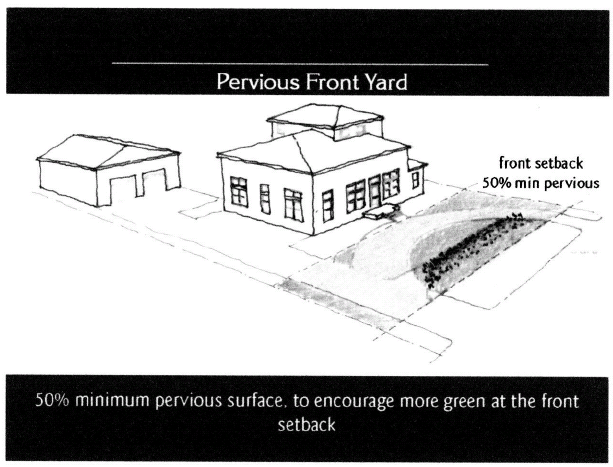
Buildings, accessory structures, patios, decks, drives and other impervious surfaces shall not cover more than 50 percent of the total land area of the lot and at least 50 percent of the front yard area must consist of pervious surfaces with landscaping material. In any area of the front yard hard surfaces such as concrete, asphalt, brick, pavers or similar materials, and driveways with stone or gravel may cover a maximum of 50 percent of the front yard area. Any areas outside of the defined driveway and walkways, shall contain landscaping materials. Mulch drives are prohibited. The front yard area includes that area between the front lot line and the front wall(s) or front porch of the home.
c.
Impervious lot or site coverage shall be defined as the percentage of the lot land area that is covered with impervious materials such as buildings, swimming pools, decks, patios, driveways, etc. Standard engineering coefficients of permeability may be utilized for mixed surfaces.
d.
On lakefront lots, land located across a street and separated from the building site as well as any submerged land areas shall not be included in the available land area calculation.
(3)
Building height.
a.
Limitations on the maximum allowable height of structures are established for the following purposes:
1.
To protect the value and enjoyment of neighboring properties by avoiding excessively massive buildings or buildings which dominate over neighborhood structures, preserving the character and charm of the community;
2.
To preserve reasonable access to light, air and privacy for all properties;
3.
To prevent the inequitable loss of private views or the unreasonable interference with significant public views resulting from excessively tall or poorly planned structures.
b.
Height limits. No building shall have more than two stories. Building height shall be defined as the vertical distance measured from the average elevation of the existing lot grade, as defined in section 58-95, to the highest point of the roof, including all appurtenances, and architectural features. The average elevation shall be measured along the front wall of the principal structure. The following limits shall apply to all height determinations in residential districts:
1.
For properties with a lot area of 12,500 square feet or less, no building or portion thereof shall exceed 32 feet in height.
2.
For properties with a lot area over 12,500 square feet, no building or portion thereof shall exceed 35 feet in height.
3.
Flat roofs, which are those roofs with a roof pitch of 2:12 or less, shall not exceed 28 feet in height.
4.
Properties or lots exceeding 50,000 square feet in size with at least 100 feet width at the building line may be permitted building heights of 40 feet if all side setbacks are increased to 35 feet.
(4)
Attics.
a.
Any living area directly within the roof slope(s) not accessed by a pulldown ladder, that is over five feet in height, is permitted up to an additional three percent of the maximum floor area ratio allowed for the lot. These areas include bonus rooms, air-conditioned storage areas, etc. In addition, dormers or windows above the second-story may only face the public right-of-way or waterbodies. Homes with a mansard, gambrel, or flat roof types may not utilize this exception. This area shall also comply with the Building code.
(5)
Setbacks.
a.
Minimum setback standards are established for the following purposes:
1.
To provide open space on each building site;
2.
To assure a harmonious relationship of buildings on each site to the public right-of-way;
3.
To protect access within building sites for emergency egress.
4.
To protect trees by providing greater area for them.
b.
Effect of setback standards. Setback standards define a yard area on the building site that is parallel and adjacent to the property line from which the setback is measured. Setbacks shall be maintained at not less than the minimum width specified by the setback standard. This minimum yard area shall be maintained as unoccupied space and shall be kept open and unobstructed from the ground upward along its full length and width. Required yard dimensions shall be measured between the property line of the building and that part of any structure or improvement nearest to the property line.
c.
Second-story setbacks. For the purposes of determining required setbacks, a building wall that exceeds 12 feet in height above the existing grade to the wall plate shall be located on a lot so as to be in compliance with the setback requirements for the two-story portion of the building. In the case of a gable end or similar walls, the height shall be measured from the existing grade to the top plate at the bottom of the gable.
d.
Setbacks to be rounded to the nearest whole number. Unless otherwise provided in this section, all required setbacks must be rounded to the nearest whole number. One-half foot or greater shall be rounded up unless otherwise stated in this section.
(6)
Front yard setbacks.
a.
Standardized calculation method. The front yard setback shall be calculated using 20 percent of the lot depth or the setback of the existing or most recently demolished home, whichever is greater. In the case of measuring the setback from the existing or mostly recently demolished home, the setback calculation shall be measured to a permitted and/or inhabited structure. The front setback shall not exceed a maximum ten-foot difference beyond the existing home. In instances where a lot has been vacant for at least seven years, the 20 percent of the lot depth measurement shall be utilized.
b.
Notwithstanding the required or established front setback for a residence, no garage or carport shall be located so as to provide a front setback or street-side yard setback of less than 20 feet to the garage or carport opening.
c.
Single-story front porch areas of the principal structure which are a minimum of 75 percent open-air, may encroach into the required front and/or street-side setback by a maximum of seven feet.
(7)
Side yard setbacks.
a.
The side setback for one-story homes or the first floor of two-story homes is equal to 30 percent of the lot width in feet equally divided on each side of the home, except the side setback is seven and one-half feet for lots which are 60 feet wide or less.
b.
The side setback for two-story homes measured to the second story wall shall be 40 percent of the lot width in feet equally divided on each side of the home, except the second-floor side setback is ten feet for lots which are 60 feet wide or less.
c.
General side setback rules. The lot width is measured at the Code required front setback, as defined in this chapter. Lots over 200 feet in width shall use the required setback for lots which are 200 feet in width.
d.
Special side setback option for narrow lots (70 feet wide or less) with rear parking areas or garages: Provide a side setback of 11 feet on one side to allow driveway access and provide a minimum setback of six feet on the other side. The driveway shall utilize a minimum side setback of one foot, subject to not diverting drainage onto the neighboring property.
(8)
Rear yard setbacks. The rear setback shall be 25 feet for a one-story structure and 35 feet for any second-story portion of any building. The rear setback may be reduced to ten feet when the rear yard of the residential property abuts non-residentially zoned property.
(9)
Side wall articulation. Each side wall shall provide architectural articulation by stepping the wall plane in or out by at least two feet every 36 feet. The articulation must be provided on one-story walls, and on both floors for two-story-high walls. Articulation is not required on the second story, when the second story setback is at least three feet greater than the first story setback. Each structure is permitted one two-foot by eight-foot projection into each of the required side setback to satisfy the articulation requirement. Projections designed to accomplish any additional required articulation must meet the required side setback.
(Ord. No. 3258-22, § 2, 11-9-22; Ord. No. 3295-24, § 1, 4-24-24)
Editor's note— Ord. No. 3258-22, § 2, adopted Nov. 9, 2022, repealed the former § 58-65, and enacted a new § 58-65 as set out herein. The former § 58-65 pertained to R-1AAA lakefront district regulations and derived from Ord. No. 2377, § 1, adopted Sept. 12, 2000; Ord. No. 2443-01, §§ 1, 8, adopted Oct. 9, 2001; Ord. No. 2510-03, § 1, adopted Apr. 8, 2003; Ord. No. 2512-03, § 1, adopted Apr. 8, 2003; Ord. No. 2590-04, § 1, adopted July 12, 2004; Ord. No. 2601-04, § 1, adopted Sept. 13, 2004; Ord. No. 2664-06, § 1, adopted Feb. 27, 2006; Ord. No. 2705-07, § 1, adopted Mar. 12, 2007; Ord. No. 2711-07, § 1, adopted May 29, 2007; Ord. No. 2795-10, § 1, adopted Feb. 22, 2010; Ord. No. 2875-12, § 1, adopted June 11, 2012; Ord. No. 2885-12, § 1, adopted Sept. 24, 2012; memo of April 22, 2013; and Ord. No. 3030-16, §§ 1, 3, adopted Feb. 8, 2016.

