
Winter Park City Zoning Code
Sec. 58-87
Lakefront lots other waterfront properties.
(a)
Purpose and intent. It is the intent of this section to ensure that buildings and structures on waterfront properties including canalfront lots, lakefront lots and streamfront lots are constructed or placed such that no boating hazards will be created, that construction shall be compatible with the natural grade of the property; minimizing large stem walls, large swimming pool/patio walls, terraces or retaining walls on the waterfront, facing the water that are more than three feet above existing grade; that water pollution from stormwater runoff and other sources will be minimized by providing adequate stormwater retention and conveyance per code; that views of water from adjoining waterfront properties will not be unduly impaired; that existing trees shall be preserved to the degree reasonably possible and that the appearance of the property and the shore when viewed from the water will be kept as natural as reasonably possible. The city's lakes, canals and streams are among the city's greatest assets, and it is in the public interest to require that their aesthetic appeal and water quality be maintained and enhanced when possible.
(b)
Building plans.
(1)
A building permit shall not be issued for any new structure or building, addition over 500 square feet to any existing structure or building, or significant change to an existing property on a lakefront, canalfront or streamfront lot until satisfactory building plans are reviewed and approved by the planning and zoning board that are deemed in compliance with the objectives established in the aforementioned purpose and intent and the specific requirements of this section. The planning department shall review all such plans and provide a recommendation to the planning and zoning board. A decision by the planning and zoning board shall be done at a public hearing after review of comments from city staff and notification of the adjacent waterfront property owners.
(2)
In cases involving the construction of swimming pools (without screen pool enclosures), or patios, or hardscape additions that meet the requirements of this section including all lakefront review criteria the planning department shall provide an administrative review which will result in approval, approval with conditions or denial of the permit. In such cases, the owner may appeal the planning department's determinations to the planning and zoning board.
(3)
In all other cases, the planning and zoning board shall review and approve construction upon lakefront lots, canalfront lots and streamfront lots when deemed in compliance with the objectives established in the aforementioned purpose and intent.
(4)
The requirements of this section are minimum requirements, and the planning and zoning board may impose more restrictive requirements and conditions on the height, bulk, location and any other aspect of the proposed development where necessary in order to accomplish the purpose and intent of this section.
(c)
Submission requirements.Applications shall require the following submissions:
(1)
Existing conditions survey including the existing contours or spot elevations at the side property lines and as otherwise occur regularly on the property. The survey shall also include the location of existing trees having a diameter of six inches or greater measured two feet from the ground and the approximate locations of the adjacent building corners and swimming pool deck corners closest to the lake.
(2)
Site plan showing the location of all existing or proposed buildings, structures, pool decks, retaining or terrace walls, hardscape and paved areas, drives and curb cuts. The site plan shall include indications of the trees proposed to be removed. The site plan shall also indicate the proposed first floor elevation and the elevation of all exterior patio/lanai/pool decks, retaining walls, etc. The site plan shall include the proposed front side, and waterfront setbacks measured from the ordinary high-water elevation to the principal structure and to the furthest edge of any patio/lanai/pool deck.
(3)
Statistical table to indicate the square footage of the property as measured to the ordinary high-water elevation, square footage of the building elements and square footage of the combined impervious surfaces.
(4)
Building elevations of the proposed principal and accessory structures including pool cabanas. The elevations shall include the existing ground level to indicate extent of retaining or stem walls proposed.
(5)
Drainage plan (which may also be included on the site plan) showing the method of conveyance of storm water drainage and the areas designed for storm water retention including any curbs or walls necessary to contain drainage on-site or swales, inlets and pipes necessary for conveyance.
(6)
Additionally, staff may request a copy of the existing conditions survey, which, in addition to the requirements of (c)(1) above, shall also include the building footprint of all proposed structures including swimming pools and pool decks, the building footprint for adjacent property structures, and the setback from each corner of any proposed structures and adjacent structures to the closest point to the ordinary high-water elevation and front lot lines.
(d)
Structures on lakefront, canalfront or streamfront lots. The following standards shall apply to all construction on lakefront, canalfront or streamfront lots:
(1)
Stormwater retention. Lakefront, canalfront and streamfront lots shall be developed to maximize the amount of natural rainfall which is percolated into the soil via retention systems and to prevent direct overland runoff into the water or onto adjoining properties. With the exception of boathouses, docks or other over-water construction, storm water runoff from structures and other impervious surfaces shall be directed into swales or terraces on the lot or restrained by berms so as to provide for the on-site retention and percolation of the first one inch of runoff. Properties being developed or redeveloped shall eliminate any direct piped discharges of storm water into the water, so that this runoff is directed to the on-site retention and percolation areas. The planning and zoning board may require, as conditions necessitate, the submission of soil and water table information, topographic detail, drainage calculations and professionally designed plans so as to insure these requirements are met. All storm water retention compliance shall prioritize the preservation of existing trees and the impacts of fill or excavation on tree root systems shall be minimized and the planning and zoning board shall have the authority to require berm or alternative retention methods and volumes including waiving the need for such storm water retention where deemed advisable to protect the root systems and survivability of all existing protected canopy tree specimens. Storm water retention/swales shall be setback from existing trees based on the same separation distances as required for tree barriers during demolition/construction. In addition, the city may require for proper conveyance of storm water, the implementation of inlet and pipe drainage systems incorporated into the property so that runoff is properly conveyed down the side setback areas.
(2)
No lakefront, canalfront or streamfront lot owner shall grade the lot in such a way as to interfere with the natural drainage of adjoining lots or in a way that diverts drainage from their lot onto adjoining lots. In order to prevent stormwater runoff onto adjacent properties, new construction on sloping sites shall require stemwall construction in order to maintain the existing grades within the side setback areas. The planning and zoning board may also require, as conditions necessitate, the construction of physical features, such as curbs, walls or inlets and piping of roof gutters to ensure runoff on a lot does not negatively impact adjoining lots.
(3)
Views of neighbors. Structures on lakefront, canalfront or streamfront lots shall, to the extent reasonably possible, be designed and located to minimize their obstruction or degradation of traditional views to and through the property to the water from adjoining waterfront properties. The planning and zoning board, may as conditions necessitate, reduce the height of structures, alter their location, size and design so as to accomplish these objectives. The planning and zoning board shall also have limited authority to grant exceptions to the front and side setback standards when deemed necessary to accomplish these objectives.
(4)
Tree preservation. Structures on lakefront, canalfront or streamfront lots shall be developed and landscaped so that when viewed from the water, those structures are as unobtrusive as is reasonably possible. Structures shall also be located so that existing trees shall be preserved to the degree reasonably possible. When a lot is being redeveloped, or a lot's structure is being extended or altered, the planning and zoning board may require the planting of new trees and other landscaping in order to achieve this objective. The planning and zoning board shall also require the preservation of trees protected by the city's tree ordinance whenever possible in order to keep the lakefront environment as natural as reasonably possible.
(5)
Views from the lake. To the extent practical, vehicles shall not be visible from the lake, canal or stream. To achieve this objective, the parking of vehicles in any area between the rear of the principal building and the water shall be prohibited. Driveways and other parking surfaces for vehicles shall not be located on the waterfront side of lots closer to the water than the first one third of the length of the home and driveways on the side of homes leading to basement parking garage areas shall not be permitted. This shall not apply to driveways and parking areas in the front of the lot that may be situated such that vehicles are visible from the water.
(6)
Structures on lakefront lots require the approval of the planning and zoning board prior to the issuance of a building permit. As conditions necessitate, the planning and zoning board or city commission (if part of a conditional use application) may impose increased setbacks in concert with their waterfront review or conditional use authority as necessary to accomplish the objectives in this section. Structures in this context shall also include parking lots, driveways, swimming pools, cabanas, gazebos, screen enclosures, tennis courts and any other outdoor recreational facilities, and other accessory buildings and structures.
a.
Setbacks—Single family/duplex. The setback from the water's ordinary high-water elevation for single family and duplex buildings and any other accessory structures on those properties (other than boathouses, docks, over the water gazebos or retaining walls) shall be the average water front setback to the principal structure established by the adjacent water front properties or 50 feet, whichever is greater. That average lakefront setback determination shall be the point at which building construction is permitted. Pools and associated pool decks without screen pool enclosures, that are no taller than three feet in height above the existing natural grade may have a setback of 50 feet. The planning and zoning board shall have the authority to approve water front setbacks less than the average determined above to a minimum of 50 feet in accordance with their water front review authority based upon the determination by the planning and zoning board that such construction does not unduly impair the views of water of adjoining waterfront properties. The planning and zoning board shall also have limited authority to grant exceptions to the water front setback standards when new construction replaces an existing structure(s) that are nonconforming to the current required lakefront setbacks but may not increase that nonconformity.
b.
Setbacks—Multi-family/non-residential/mixed use. The water front setback from the ordinary high-water elevation for multi-family (three or more units) or non-residential or mixed-use buildings and any other accessory structures on those properties (other than boathouses, docks, over the water gazebos or retaining walls) shall correspond to the height of the proposed structure. For buildings and structures 35 feet in height or less, the water front setback shall be a minimum of 75 feet. As the height of the building or structure increases, for each one-foot increase in height over 35 feet in height, the water front setback shall be increase by two and one-half feet. Parking lots, driveways, swimming pools or other accessory structures shall setback a minimum of 50 feet from the ordinary high-water elevations below.
c.
Ordinary high-water elevations. For convenience, the ordinary high-water elevations of the city's principal lakes are listed below. These elevations have been determined by the Florida Department of Environmental Protection (FDEP) Bureau of Survey and Mapping. All elevations reference NAVD (88 datum). For the canal and stream front locations, the ordinary high-water elevations are to be provided by the public works department.
1.
Lake Berry .....69.4 feet
2.
Lake Killarney .....82.0 feet
3.
Lake Maitland .....65.7 feet
4.
Lake Mizell .....65.7 feet
5.
Lake Osceola .....65.7 feet
6.
Lake Sue .....70.7 feet
7.
Lake Sylvan .....71.2 feet
8.
Lake Virginia .....65.7 feet
9.
Lake Bell .....88.6 feet
10.
Lake Spier .....89.7 feet
11.
Lake Forrest .....100.0 feet
12.
Lake Grace .....100.8 feet
13.
Lake Rose .....87.8 feet
14.
Lake Tuscany .....69.1 feet
15.
Lake Baldwin .....90.7 feet
16.
Lake Temple .....66.6 feet
(7)
Structures on canalfront or streamfront lots require the approval of the planning and zoning board prior to the issuance of a building permit. Other than boathouses, the waterfront setback shall be at least 50 feet from the canal bulkhead or stream. Structures in this context shall also include driveways, parking lots, swimming pools and pool decks, screen enclosures, tennis courts and other outdoor recreational facilities, cabanas and other accessory buildings and structures. A structure shall be interpreted as any object higher than three feet above grade whether permanently affixed to the ground or not and shall include poles, flags, play equipment, etc. which are not permitted in the 50-foot lakefront setback except as permitted below for canalfront or streamfront locations. Swimming pools and decks on canalfront or streamfront lots may be permitted a minimum of 25 feet from the canal bulkhead or stream ordinary high-water elevation, provided the swimming pool has an elevation of no more than two feet above the existing grade on the side closest to the canal or stream. The planning and zoning board may require, as conditions necessitate, the imposition of increased setbacks to accomplish the objectives in this section.
(8)
Fences or walls on lakefront, canalfront, or streamfront lots.
a.
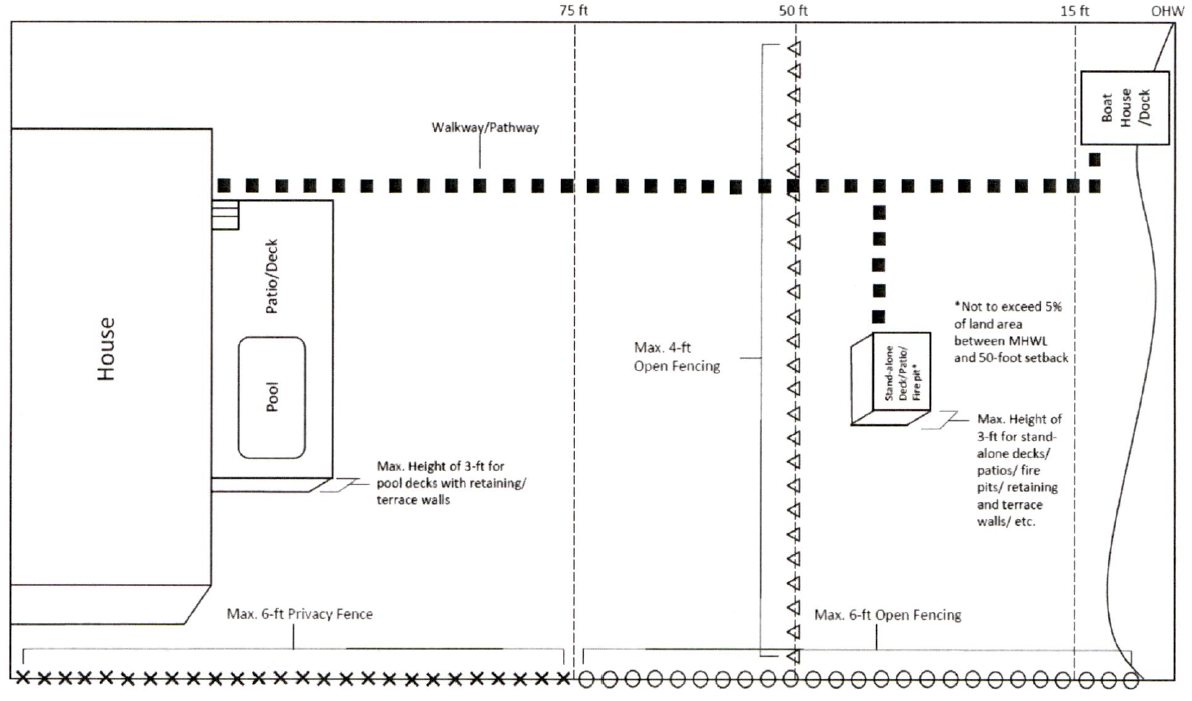
Fences or walls on lakefront, canalfront, or streamfront lots shall not be permitted to extend into the water beyond the ordinary high-water elevation or into a canal beyond the bulkhead. Fences and walls shall not be permitted which run parallel to or across the lakefront, canalfront or streamfront property anywhere within the 50-foot setback from the ordinary high-water elevation.
b.
Fences that are 75 percent open, such as aluminum picket, wrought iron, or green or black cladded vinyl chain link, but not walls or nonopaque fences, may be permitted which run parallel to or across the lakefront, canalfront or streamfront on only that portion of the land between the rear of the main structure and the 50-foot setback provided such fence does not exceed four feet in height above existing grade.
c.
Retaining walls, terrace walls, standalone decks and patios, railings or other structures higher than three feet above existing grade shall not be permitted within the 50-foot setback. Other accessory structures or improvements, that do not exceed three feet in height within the 50-foot setback such as walkways, railings, standalone patios and, decks, fire pits, etc., shall not cover more than five percent of the land area within that 50-foot setback. Standalone patios, decks and fire pits shall have a minimum setback of 15 feet from the ordinary high-water elevation.
d.
In order to maintain water views across properties, fences running down the sides of properties up to 75 feet setback from the ordinary high-water line, shall be permitted a height of up to 6 feet. Fences within the 75-foot setback, shall be 75 percent open, limited to materials such as aluminum picket, wrought iron, or green or black cladded vinyl chain link, which allow visibility across property lines and to the water. Wood shadow box fences shall not qualify as open fencing. The planning and zoning board may permit fences closer than 50 feet but only on canalfront or streamfront lots as necessary to enclose swimming pools. The following figure provides a summarized example of the overall requirements provided in the subsections above.
(e)
Conformance to grades. Many waterfront lots have existing grade slopes down to the water that are otherwise uncommon in the region. The typical home design with a finished first floor level and the swimming pool and patios decks at the same level cannot be accomplished on these sloping sites.
(1)
The design of the floor levels and swimming pool or patio decks must conform to the terrain and natural slope of the property.
(2)
Swimming pool and spa decks, patios and terraces shall not be constructed more than three feet in height above the average existing grade elevation on the lakeside edge of the deck, patio, or terrace. The height shall be measured from the existing natural grade and not the finished grade; and shall be measured from the average or midpoint of existing grade when a property slopes from side to side across the width of the pool deck, patio or terrace. The three feet height limit shall be measured to the level of the predominant swimming pool deck elevation, patio or terrace elevation and cannot be mitigated with the construction of retaining walls or negative/infinity edge water collection areas or landscape terrace walls in front of the predominant pool/patio elevation.
(3)
The facade of exposed walls taller than three feet above grade facing the lake shall be screened with landscape materials across the length of the retaining wall except for any sections involving steps down to the lakefront.
(4)
On lots with severe grade drops of over seven feet throughout the length of the house, as measured by the contours starting at the front of the main structure to the end of the proposed structure, the planning and zoning board may approve swimming pool and spa decks, patios and terraces higher than three feet above existing grade on the water side to a maximum of five feet above existing grade. This approval is subject to the project design including step-downs within the principal structure and/or from the first-floor elevation down to the swimming pool, patio, or terrace deck, that at a minimum shall be equal to the number of feet requested above the three-foot allowance. For example, a swimming pool deck, patio or terrace deck height requested at five feet above existing grade, shall have a minimum of two feet of step-downs within the principal structure and/or from the finished floor elevation down to the swimming pool deck, patio or terrace deck or a combination of both. This restriction or limitation on the maximum height above existing grade shall not be provided any exception or variance.
(5)
Walk-out basement levels on waterfront homes that create three floors of living area, or usable basement areas for garage/storage, etc. on the waterfront side of the home shall be permitted where grades permit. However, swimming pools and associated decks and patios, shall be located only on the lowest living area level, and shall be in accordance with the height requirements as set forth in this section.
(6)
The height of accessory structures on waterfront homes is measured to existing grade; this shall be inclusive of any elevation decks/patios, etc.
(f)
Any property that requests and is permitted a swimming pool, patio or terrace deck elevation in excess of three feet above existing grade on the waterfront side, shall not be permitted to construct an accessory structure on that elevated swimming pool, patio or terrace deck unless such accessory structure meets the required lakefront and side setbacks of the principal residence. This restriction shall not be provided any exception or variance.
(g)
Retaining walls or seawalls. Retaining walls shall not exceed a maximum width of 36 inches. The construction of retaining walls or seawalls shall be done in accordance with the Lakeshore Protection regulations within this Code of Ordinances.
(h)
Wetlands. Located adjacent to certain streams, lakes and canals are wetland areas, as defined by the Florida Department of Environmental Protection (FDEP) and St. Johns River Water Management District (SJRWMD) methodology, soil types, hydrological requirements and vegetation types in which no adding of soil or other fill materials shall be permitted. In addition, the use of these wetland areas for any structure shall be permitted only as a conditional use granted only upon the affirmative vote of four members of the city commission and said structures shall be limited to elevated boardwalks or gazebos. The criteria utilized to evaluate such conditional use requests shall include, but not be limited to: the effect on the wetland's function; environmental impacts on the wetlands from the construction process; the loss of environmentally sensitive areas and the precedent for similar construction in other such wetland areas including conformance to the comprehensive plan. For any other building or structure(s) there shall be a 50-foot minimum setback required from the edge of such designated wetlands.
(Ord. No. 2362, § 1, 7-11-00; Ord. No. 2398, § 1, 11-28-00; Ord. No. 2469-02, §§ 1, 2, 6-11-02; Ord. No. 2590-04, § 4, 7-12-04; Ord. No. 2764-09, § 1, 3-9-09; Ord. No. 2796-10, § 1(Exh. A), 2-22-10; Ord. No. 2832-10, § 1, 11-22-10; Ord. No. 2833-10, § 1, 12-13-10; Ord. No. 2850-11, § 1, 9-12-11; Ord. No. 3019-15, § 1, 11-9-15; Ord. No. 3098-17, § 4, 12-11-17; Ord. No. 3133-18, § 1, 12-10-18; Ord. No. 3261-23, § 1, 3-8-23)
Editor's note— Ord. No. 3261-23, adopted Mar. 8, 2023, changed the title of § 58-87 from "Lakefront lots, canalfront lots, streamfront lots, wetlands, boathouses and docks" to "Lakefront and other waterfront properties". This historical notation has been preserved for reference purposes.

