
Ypsilanti Charter Township
City Zoning Code
City Zoning Code
ARTICLE II
CONSTRUCTION OF LANGUAGE AND DEFINITIONS
Sec. 200.- Construction of language:
The following rules of construction apply to the text of this ordinance:
1.
The particular shall control the general.
2.
In the case of any difference of meaning or implication between the text of this ordinance and any caption or illustration, the text shall control.
3.
The word "shall" is always mandatory and not discretionary. The word "may" is permissive.
4.
Words used in the present tense shall include the future; and words used in the singular number shall include the plural, and the plural the singular, unless the context clearly indicates the contrary.
5.
A "building" or "structure" includes any part thereof.
6.
The phrase "used for" includes "arranged for," "designed for," "intended for," "maintained for" or "occupied for."
7.
The word "person" includes an individual, a corporation, a partnership, an incorporated association, or any other similar entity.
8.
Unless the context clearly indicates the contrary, where a regulation involves two or more items, conditions, provisions, or events connected by the conjunction "and," "or," "either...or," the conjunction shall be interpreted as follows:
A.
"And" indicates that all the connected items, conditions, provisions, or events shall apply.
B.
"Or" indicates that the connected items, conditions, provisions, or events may apply singly or in any combination.
C.
"Either...or" indicates that the connected items, conditions, provisions, or events shall apply singly but not in combination.
9.
Terms not herein defined shall have the meaning customarily assigned to them.
(Ord. No. 2022-498, 12-23-21)
Sec. 201. - Definitions:
Abut: To touch, to lie immediately next to, to share a common wall or lot line, or to be separated by only a street, alley, or right-of-way.
Access Property: A property, parcel, or lot abutting Ford Lake, either natural or man-made, and used or intended to be used for providing access to Ford Lake by pedestrian or vehicular traffic to and from offshore land regardless of whether said access to the water is gained by easement, common fee ownership, single fee ownership, lease, license, gift, business invitation or any other form or dedication or conveyance.
Accessory Use, or Accessory: A use, which is clearly incidental to, customarily found in connection with, and located on the same zoning lot, unless otherwise specified, as the principal use to which it is related.
When "accessory" is used in this text, it shall have the same meaning as accessory use.
An accessory use includes, but is not limited to, the following:
1.
Residential accommodations for servants and/or caretakers.
2.
Outdoor swimming pools, hot tubs, and saunas for the use of the occupants of a residence, or their guests.
3.
Domestic storage in a barn, shed, toolroom or similar accessory building or other structure.
4.
A newsstand primarily for the convenience of the occupants of a building, which is located wholly within such building and has no exterior signs or displays.
5.
Storage of merchandise normally carried in stock in connection with a business or industrial use. Such storage maybe excluded in the applicable district regulations.
6.
Storage of goods used in or produced by industrial uses or related activities. Such storage maybe excluded in the applicable district regulations.
7.
Accessory off-street parking spaces, open or enclosed. Accessory off-street parking spaces are subject to the accessory off-street parking regulations for the district in which the zoning lot is located.
8.
Uses clearly incidental to a main use such as but not limited to: offices of an industrial or commercial complex located on the site of the commercial or industrial complex.
9.
Accessory off-street loading. Accessory off-street parking is subject to the off-street loading regulations for the district in which the zoning lot is located.
10.
Accessory signs. Accessory signs are subject to the sign regulations for the district in which the zoning lot is located.
11.
Solar panels, wind generators, television reception antenna and air conditioning units.
12.
Common household gardening in a residential district. For purposes of this ordinance, common household gardening shall include the growing of fruits and vegetables for consumption solely by members of the family residing in the dwelling unit located on the same zoning lot.
Active Solar Energy Structure: A structure which utilizes mechanically operating solar collectors to collect, transfer, or store solar energy.
Adaptive Reuse: The development of a new use for an older building or for a building originally designed for a special or specific purpose.
Adjoining: Touching or contiguous, as distinguished from lying near or adjacent.
Adult Day Care Center: A center other than a private residence, in which more than six (6) adults are supervised and receive group care for periods of time not to exceed sixteen (16) hours in a twenty-four (24) hour period.
Adult Day Care Home: A private residence, in which six (6) adults or less are given care and supervision for periods of time not to exceed sixteen (16) hours in a twenty-four (24) hour period.
Adult care facility, state licensed: A governmental or non-governmental establishment that provides foster care to adults. It included facilities and foster care family homes for adults who are aged, mentally ill, developmentally disabled, or physically handicapped who require supervision or an ongoing basis but who do not require continuous nursing care. An adult foster care facility does not include nursing homes, homes for the aged, hospitals, alcohol or substance abuse rehabilitation centers, residential centers for persons released from or assigned to a correctional, facility, or any other facilities which have been exempted from the definition of adult foster care facility by the Adult Foster Care Facility Licensing Act, 218 of 1979, MCL 400.701, as amended. The types of licensed adult foster care facilities include the following:
1.
Adult foster care facility. A residential structure that is licensed to provide room, board, and supervised care, but not continuous nursing care, for unrelated adults over the age of seventeen (17), in accordance with Public Act 218 of 1979, as amended, and the Adult Foster Care Administrative Rules as administered by the Michigan Department of Social Services. The following four (4) types of adult foster care homes are provided for by these rules:
a.
Adult foster care family home. A residence for six (6) or fewer adults. Licensee must live in the home; and local zoning approval is not required prior to issuance of a license.
b.
Adult foster care small group home. Residence for twelve (12) or fewer adults. Licensee is not required to live in the home. Local zoning approval is required prior to issuance of a license only if seven (7) or more residents will live in the house.
c.
Adult foster care large group home. Residence for thirteen (13) to twenty (20) adults. Licensee is not required to live in the home. Local zoning approval is required prior to issuance of a license.
d.
Congregate facility. Residence for more than twenty (20) adults.
Agricultural Commercial and Tourism: A business venture on a working farm, ranch or agricultural enterprise that offers educational and recreational experiences for visitors while generating supplemental income for the owner. Examples include but are not limited to u-pick operations, corn mazes, farm stands, or cider mills.
Alley: Any dedicated public way affording a secondary means of access to abutting property, and not intended for general traffic circulation. A street shall not be considered an alley.
Alterations: Any change, addition or modification in construction or type of occupancy, or in the structural members of a building such as walls or partitions, columns, beams or girders, the consummated act of which may be referred to herein as "altered" or "reconstructed."
Ambient: Ambient is defined as the sound pressure level exceeded ninety percent (90%) of the time or L90.
Ambient Noise: Regularly occurring background noise not produced by the object or device in question.
ANSI: American National Standards Institute.
Antique Goods: Personal property purchased or made more than fifty (50) years ago.
Antenna: Any device or array that transmits and/or receives electromagnetic signals for voice, data or video communications purposes including, but not limited to, television, AM/FM radio, microwave, cellular telephone, and similar forms of communications.
Arcade: A building or structure, or any part thereof, which is devoted to the commercial use of amusement devices, pinball machines, electronic tables featuring pool, billiards, bowling, basketball, football, or the like, or electronic games of skill or dexterity utilizing videotapes or video screen or TV adaptations, etc., automatic sport devices or tables or similar activities for hire, or for amusement. An arcade as a primary use falls under the definition of indoor recreation.
Architectural features: Steps, windowsills, belt courses, brick and/or wrought iron wing walls, chimneys, architraves, pediments.
Artisan Food and Beverage Production: A facility typically operated by a single business entity for the production of small-scale, hand-crafted, specialty food and beverage products for on- and/or off-site sales and consumption. The facility may include wholesale and/or retail sales.
Awning: A roof-like mechanism, which projects from the wall of a building for the purpose of affording weather protection to doorways and windows. Often, awnings provide identity for a business and provide shade for display areas.
Basement: That portion of a building which is partly or wholly below grade but so located that the vertical distance from the average grade to the floor is greater than the vertical distance from the average grade to the ceiling. A basement shall not be counted as a story.
Bed and Breakfast Operations: A use which is subordinate to the principal use of a dwelling unit as a single-family dwelling unit and a use in which transient guests are provided room and board in return for payment.
Berm: An earthen mound of definite height and location to serve as an obscuring device in carrying out the requirements of this ordinance.
Best Management Practices: Structural and non-structural practices and techniques that mitigate the adverse impacts caused by land development on water quality and quantity.
Block: The property abutting one (1) side of a street and lying between the two (2) nearest intersecting streets (crossing or terminating), or between the nearest such street and railroad right-of-way, unsubdivided acreage, lake, river, or live stream; or between any of the foregoing and any other barrier to the continuity of development, or corporate boundary lines of the Township.
Boarding House: A private house that provides accommodations and meals for paying guests.
Body-piercing: The perforation of human tissue other than an ear for a non-medical purpose.
Branding: A permanent mark made on human tissue by burning with a hot iron or other instrument.
Buffer: Landscaping (other than solely grass on flat terrain), or the use of landscaping along with berms, walls, or decorative fences, that at least partially and periodically obstruct the view from the street, in a continuous manner, of vehicular use areas; parking lots and their parked cars; detention and retention ponds; different land uses; cellular tower facilities; and other similar uses.
Building: Any structure, either temporary or permanent, having a roof supported by columns or walls, and intended for the shelter, or enclosure of persons, animals, chattels, or property of any kind.
Building height: The vertical measured distance from the established grade to the highest point of the roof surface for flat roofs, to the deck line for mansard roofs, and the average height between eaves and the ridge for gable, hip, and gambrel roofs. Any extension of a mansard, gambrel, hip, or gable roof below a wall shall require building height measurement to take place at the average height between the top of the building wall and the ridge line and the established building grade. Where a building is located on sloping terrain, the height may be measured from the average ground level of the grade at the building wall.
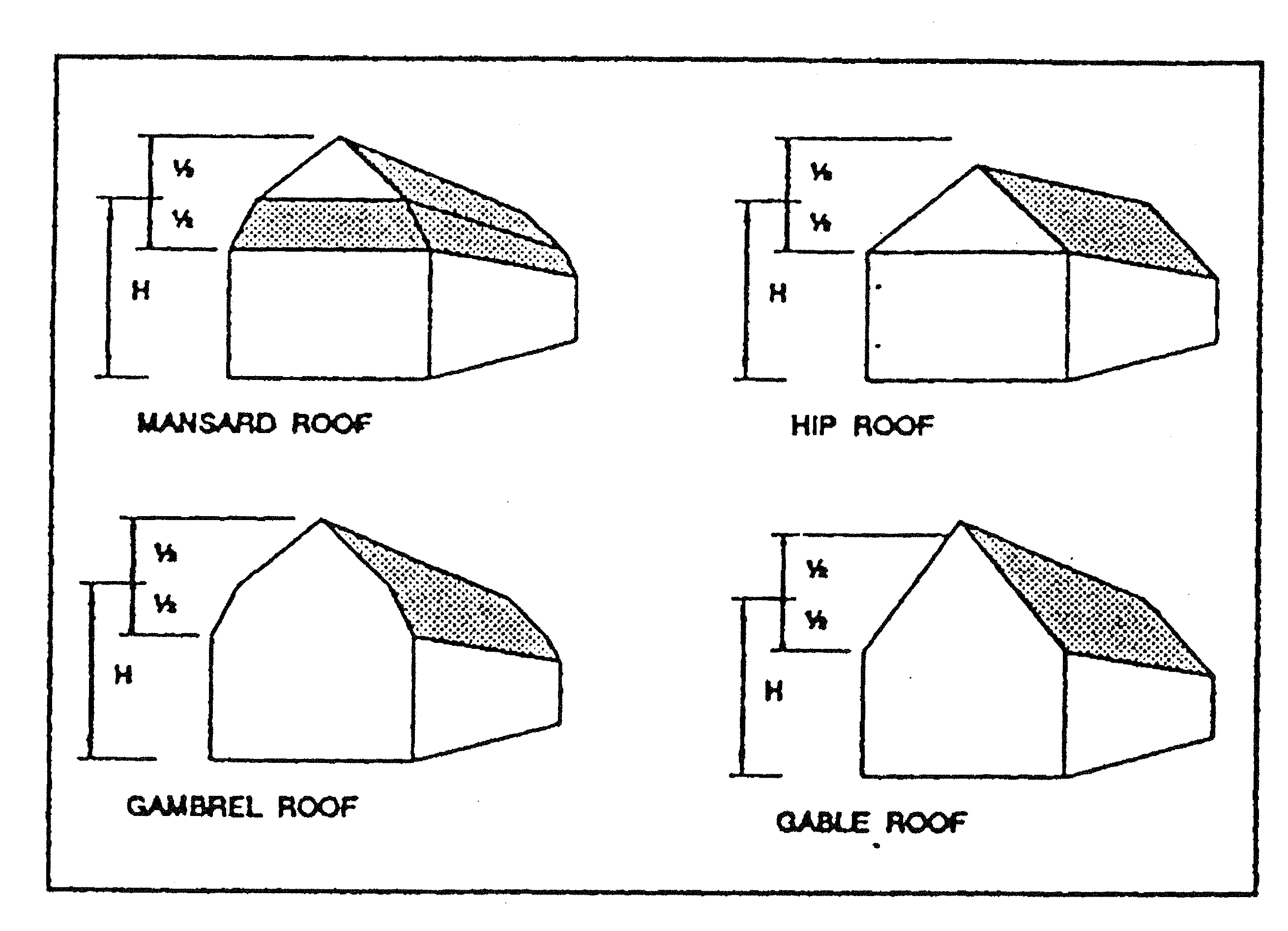
BUILDING HEIGHT
Building, Main or Principal: A building in which is conducted the principal use of the lot on which it is situated.
Building Line: The minimum distance which any building must be located from a street right-of-way or high-water line.
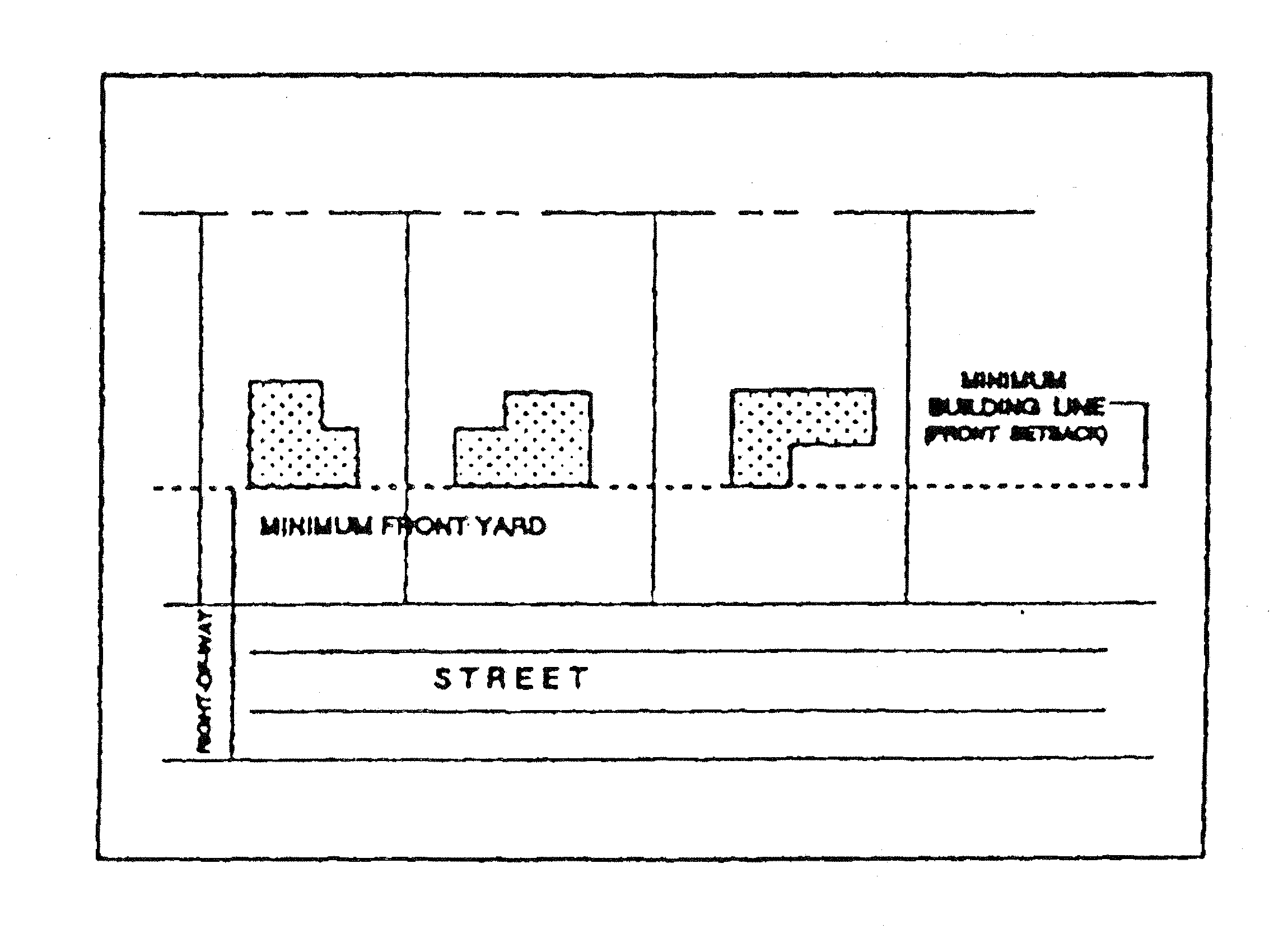
BUILDING LINE
Building, Temporary: Any building not designed to be permanently located at the place where it is, or where it is intended to be, temporarily placed, or affixed.
Building Footprint Area: The area enclosed by the perimeter of a structure as viewed from above, including any overhang or attached structure.
Caliper: The method by which nursery tree stock is measured. Caliper is the diameter of the trunk of a tree measured in inches at a point six (6) inches above ground line if caliper measurement is four (4) inches or less. If caliper measurement is larger, then the measurement is taken twelve (12) inches above the ground.
Cemetery: Grounds and facilities including any one (1) or a combination of more than one (1) of the following: a burial ground for earth interment, including green burials; a mausoleum for crypt entombment; a crematory for the cremation of human remains; and a columbarium for the deposit of cremated remains.
Cessation: To terminate, abandon or discontinue a use of land for a period of time that, under the provisions of this ordinance, would prevent the use from being resumed.
Child Care Organization, State Licensed: A facility for the care of children under eighteen (18) years of age, as licensed and regulated by the State under Act No. 116 of the Public Acts of 1973 and Act No. 218 of the Public Acts of 1979 and the associated rules promulgated by the Michigan Department of Licensing and Regulatory Affairs. Definitions for various care organizations are listed below:
1.
Child Care Center or Day Care Center. A facility other than a private residence, receiving more than six (6) children for group day care for periods of less than twenty-four (24) hours a day, and where the parents or guardians are not immediately available to the child. It includes a facility which provides care for not less than two (2) consecutive weeks, regardless of the number of hours of care per day.
The facility is generally described as a child care center, day care center, day nursery, nursery school, parent cooperative preschool, play group, or drop-in center. "Child care center" or "day care center" does not include a Sunday school conducted by a religious institution or a facility operated by a religious organization where children are cared for during short periods of time while persons responsible for such children are attending religious services.
2.
Child Caring Institution. A child care facility which is organized for the purpose of receiving children for care, maintenance, and supervision, usually on a twenty-four (24) hour basis, in a building maintained for that purpose, and operates throughout the year. It includes a maternity home for the care of unmarried mothers who are minors, an agency group home, and institutions for mentally retarded or emotionally disturbed children. It does not include hospitals, nursing homes, boarding schools, or an adult foster care facility in which a child has been placed.
3.
Foster Family Home. A private home in which at least one (1) but not more than four (4) children, who are not related to an adult member of the household by blood, marriage, or adoption, are given care and supervision for twenty-four (24) hours a day, for four (4) or more days a week, for two (2) or more consecutive weeks, unattended by a parent or legal guardian.
4.
Foster Family Group Home. A private home in which more than four (4) but less than seven (7) children, who are not related to an adult member of the household by blood, marriage, or adoption, are provided care for twenty-four (24) hours a day, for four (4) or more days a week, for two (2) or more consecutive weeks, unattended by a parent or legal guardian.
5.
Family Day Care Home. A private home in which at least one (1) but less than seven (7) children are received for care and supervision for periods of less than twenty-four (24) hours a day, unattended by a parent or legal guardian, except children related to an adult member of the family by blood, marriage, or adoption. It includes a home that gives care to an unrelated child for more than four (4) weeks during a calendar year.
6.
Group Day Care Home. A private home in which more than six (6) but not more than twelve (12) children are given care and supervision for periods of less than twenty-four (24) hours a day unattended by a parent or legal guardian except children related to an adult member of the family by blood, marriage, or adoption. It includes a home that gives care to an unrelated child for more than four (4) weeks during a calendar year.
Class A nonconforming designation: A nonconforming structure or use of land that has been designated by the Planning Commission to be allowed to be perpetuated and improved in accordance with the provisions of this article and an approved site plan.
Class B nonconforming status: Nonconforming structures or uses of land, other than those designated as Class A, are considered to be Class B and are allowed to continue within the restricted provisions of this ordinance.
Club: An organization of persons for special purposes or for sports, arts, sciences, literature, politics, or the like, with state and/or national not for profit tax status.
Commercial Vehicle. Any of the following shall be considered a commercial vehicle:
1.
All motor vehicles used for the transportation of passengers for hire, or constructed or used for transportation of goods, wares, or merchandise, and/or all motor vehicles designed and used for drawing other vehicles and not so constructed as to carry any load thereon either independently or any part of the weight of a vehicle or load so drawn;
2.
A bus, school bus, or motor vehicle, except a motor home, having a gross vehicle weight rating of 26,001 or more pounds, a motor vehicle towing a vehicle with a gross vehicle weight rating of more than 10,000 pounds, or a motor vehicle carrying hazardous material on which is required to be posted a placard as defined and required under Title 49 of the U.S. Code of Federal Regulations, parts 100 to 199. A commercial motor vehicle does not include a vehicle used exclusively to transport personal possessions or family members for nonbusiness purposes;
3.
Truck tractor;
4.
Semi-trailer, which shall include flat beds, stake beds, roll-off containers, tanker bodies, dump bodies and full or partial box-type enclosures.
5.
Vehicles of a type that are commonly used for the delivery of ice cream, milk, bread, fruit or similar vending supply or delivery trucks. This category shall include vehicles of a similar nature which are also of a type commonly used by electrical, plumbing, heating, and cooling, and other construction-oriented contractors;
6.
Tow trucks;
7.
Commercial hauling trucks;
8.
Vehicle repair service trucks;
9.
Snow plowing trucks (subject to listed exclusions below);
10.
Any vehicle exceeding twelve (12) feet in height or thirty-five (35) feet in length;
A.
Vehicles excluded from definition of commercial vehicle.
Pickup trucks and passenger vehicles, with or without snowplows, are specifically excluded from the above definition of commercial vehicle for the purposes of this Section.
Community Supported Agriculture (CSA): An area of land managed by an individual or group of individuals to grow and harvest food and/or farm products for shareholder consumption or for sale or donation.
Composting: The process of biologically decomposing organic matter.
Condominium: A place or project consisting of not less than two (2) condominium units established in conformance with the condominium act, Public Act 59 of 1978 (MCL 559.101 et seq.), as amended, and this ordinance. The following additional definitions shall apply in the application of the regulations of this ordinance:
1.
Condominium Documents: The master deed recorded pursuant to the condominium act, and any other instrument referred to in the master deed or bylaws that affects the rights and obligations of a co-owner in the condominium.
2.
Condominium Unit: The portion of a condominium project designed and intended for separate ownership and use, as described in the master deed.
3.
General Common Elements: The common elements other than the limited common elements.
4.
Limited Common Elements: A portion of the common elements reserved in the master deed for the exclusive use of less than all of the co-owners.
5.
Master Deed: The condominium document recording the condominium project to which are attached as exhibits and incorporated by reference the bylaws for the project and the condominium subdivision plan for the project and all other information required by Section 8 of the Condominium Act, Public Act 59 of 1978, as amended (MCL 559.108 et seq.). See "Site Condominium definitions" for definitions specific to site condominiums, also referred to as condominium subdivisions.
Conservation Easement: Conservation easement means an interest in land that provides limitation on the use of land or a body of water or requires or prohibits certain acts on or with respect to the land or body of water, whether or not the interest is stated in the form of a restriction, easement, covenant, or condition in a deed, will, or other instrument executed by or on behalf of the owner of the land or body of water or in an order of taking, which interest is appropriate to retaining or maintaining the land or body of water, including improvements on the land or body of water, predominantly in its natural, scenic, or open condition, or in an agricultural, farming, open space, or forest use, or similar use or condition.
Crematorium: An enclosed facility wherein human or animal remains are cremated in a cremation retort.
Data Center or Computing Center: A facility primarily used to house computer systems and associated components, including servers, telecommunications, storage systems, backup power supplies, redundant data communications connections, and environmental controls.
dB(A): The sound pressure level in decibels. Refers to the "a" weighted scale defined by ANSI. A method of weighting the frequency spectrum to mimic the human ear.
D.B.H. (Diameter At Breast Height): A measurement of the diameter of a tree trunk taken on the outside bark at breast height. Breast height is defined as four and one-half (4.5) feet from the uphill side of the tree.
Debilitating Medical Condition: One (1) or more of the following:
1.
Cancer, glaucoma, positive status for human immunodeficiency virus, acquired immune deficiency syndrome, hepatitis C, amyotrophic lateral sclerosis, Crohn's disease, agitation of Alzheimer's disease, nail-patella syndrome (NPS), or the treatment of these conditions.
2.
A chronic or debilitating disease or medical condition that produces one (1) or more of the following: Cachexia or wasting syndrome; severe and chronic pain; severe nausea; seizures, including but not limited to those characteristic of epilepsy; or severe and persistent muscle spasm, including but not limited to those characteristic of multiple sclerosis.
3.
Any other medical condition or its treatment approved by the department, as provided for in Section 5 of the Michigan Medical Marihuana Act (MCL 333.26425).
Decibel: The unit of measure used to express the magnitude of sound pressure and sound intensity.
Deck Line: The intersection of two (2) roof surfaces of a mansard or gambrel roof forming the highest horizontal line of the steeper roof slope.
Dedicated Open Space: Open land that is permanently set aside by the owner for retention in a generally undeveloped state which preserves natural features, scenic or wooded conditions, agricultural uses, open space, or similar conditions.
Development: The construction of a new building or other structure on a zoning lot, the relocation of an existing building on another zoning lot, or the use of open land for a new use.
Dirt Tract: An earth track on which motorized recreational vehicles such as motorcycles, mopeds, all-terrain vehicles, and similar vehicles are operated.
District: A portion of the incorporated area of the Township within which certain regulations and requirements or various combinations thereof apply under the provisions of this ordinance.
Dripline: The area directly located under the outer circumference of the tree branches.
Drive-Through: An establishment so developed that some portion of its retail or service character is dependent upon providing a driveway approach and staging area specifically designed for motor vehicles so as to serve patrons while in their motor vehicles, rather than within a building or structure, for carrying out and consumption or use after the vehicle is removed from the premises.
Drug Paraphernalia: All equipment, products and materials of any kind, which is used, intended for use, or designed for use in planting, propagating, cultivating, growing, harvesting, manufacturing, compounding, converting, producing, processing, preparing, testing, analyzing, packaging, repackaging, storing, containing, concealing, injecting, ingesting, inhaling, or otherwise introducing into the human body a controlled substance as defined in Section 7104 of the Michigan Public Health Code (Act No. 368 of the MI Public Acts of 1978 as amended) in violation of the laws of the State of Michigan.
Dry Cleaning and Laundry Establishment: A commercial establishment providing dry cleaning and laundry services on-site for businesses and residents.
Dry Cleaning Plant: A facility used or intended to be used for cleaning fabrics, textiles, clothing, laundry, or other similar Articles, by immersion and/or agitation in solvents or other processes.
Durable Medical Supplies: Sales of medical equipment used in the home to aid in a better quality of living.
Dwelling: Any building, or part thereof, containing sleeping, kitchen, and bathroom facilities designed for and occupied by one-family. In no case shall a travel trailer, motor home, automobile, tent, or other portable building not defined as a recreational vehicle be considered a dwelling. In the case of mixed occupancy where a building is occupied in part as a dwelling unit, the part so occupied shall be deemed a dwelling unit for the purposes of the Zoning Ordinance.
1.
Manufacture Dwelling Unit. A dwelling unit which is substantially built, constructed, assembled, and finished off the premises upon which it is intended to be located.
2.
Site Built Dwelling. A dwelling unit which is substantially built, constructed assembled, and finished on the premises upon which it is intended to serve as its final location. Site built dwelling units shall include dwelling units constructed of precut materials, and panelized wall roof and floor sections when such sections require substantial assembly and finishing on the premises upon which it is intended to serve as its final location.
3.
One-Family or Single-Family Detached Dwelling. An independent, detached residential dwelling designed for and used or held ready for use by one (1) family only.
4.
Two-Family or Duplex Dwelling. A detached building, designed exclusively for and occupied by two (2) families living independently of each other, with separate housekeeping, cooking, and bathroom facilities for each.
5.
Single-Family Attached Dwelling. A self-contained single-family dwelling unit attached to a similar single-family attached dwelling unit with party or common walls, designed as part of a series of three (3) or more dwelling units, each with:
A.
A separate entryway with direct access to the outdoors at ground level;
B.
Each dwelling shall comprise of a single unit from the lowest floor to the highest floor of the structure between the common walls (i.e., units shall not be stacked on top of each other);
C.
A separate basement, if applicable;
D.
A separate utility connection and;
E.
Defined front and rear yards.
Single-family attached dwelling units may also be known as townhouses, row houses, or clustered single-family dwellings. Any three (3) or more attached dwellings not meeting the above criteria shall be considered a multiple-family dwelling.
6.
Multiple-Family Dwelling. A building designed for and occupied by three (3) or more families living independently, with separate housekeeping, cooking, and bathroom facilities for each.
7.
Apartment Dwelling. An apartment is an attached dwelling unit with party or common walls, contained in a building with other dwelling units or sharing the occupancy of a building with other than a residential use. Apartments are commonly accessed by a common stair landing or walkway. Apartments are typically rented by the occupants. Apartment buildings often may have a central heating system and other central utility connections. Apartments typically do not have their own yard space. Apartments are also commonly known as garden apartments or flats.
Engineering Standards: The Engineering Standards of Ypsilanti Charter Township, as they may be amended from time to time, adopted by resolution of the Township Board, to serve as the minimum standard for evaluating development plans and developing property.
Erected: Built, constructed, altered, reconstructed, moved upon, or any physical operations on the premises which are required for construction, excavation, fill, drainage, and the like shall be considered a part of erection.
Essential Services: The erection, construction, alteration or maintenance by public utilities or municipal departments of underground, surface, or overhead gas, electrical, steam, fuel or water transmission or distribution systems, collection, communication, supply or disposal systems, including poles, wires, mains, drains, sewers, pipes, conduits, cables, fire alarm and police callboxes, traffic signals and hydrants in connection therewith that are necessary for the furnishing of adequate service by such utilities or municipal departments for the general health, safety and welfare. Wireless communication towers or antennas, utility buildings, and other associated structures shall not be considered essential services under this Article.
Excavation: Any breaking of ground, except common household gardening and ground care.
Excavation of Gravel, Sand, Topsoil, or Earth: Premises from which any rock, gravel, sand topsoil, or earth in excess of fifty (50) cubic yards in any calendar year is excavated or removed from the purpose of disposition away from the premises except excavation in connection with the construction of a building or within public highway rights-of-way.
Extraction: The process of removing stone, rock, aggregate, sand, gravel, earth, clay, or similar materials from an open excavation but not including extraction by underground methods.
Extractive Operations: Any pit, excavation, or mining operation for the purpose of searching for, or removing for commercial use, any earth, sand, gravel, clay, stone, slate, marble, or other nonmetallic mineral in excess of fifty (50) cubic yards in any calendar year but shall not include an oil well or excavation preparatory to the construction of a building or structure.
Family: Means either of the following:
1.
A domestic family, that is, one (1) or more persons living together and related by the bonds of consanguinity, marriage, or adoption, together with servants of the principal occupants and not more than one (1) additional unrelated person, with all of such individuals being domiciled together as a single, domestic, housekeeping unit in a dwelling.
2.
The functional equivalent of the domestic family, that is, persons living together in a dwelling unit whose relationship is of a permanent and distinct character and is the functional equivalent of a domestic family, with a demonstrable and recognizable bond which constitutes the functional equivalent of the bonds which render the domestic family a cohesive unit. This definition shall not include any society, club, fraternity, sorority, association, lodge, coterie organization, or group whose association is temporary or seasonal in character or nature. For the purposes of enforcement, it is presumed that a functional equivalent of a domestic family is limited to six (6) or fewer persons.
Farm: The land, plants, animals, buildings, structures including ponds used for agricultural or aquacultural activities, machinery, equipment, and other appurtenances used in the commercial production of farm products.
Farm Operation: Operation and management of a farm or a condition or activity that occurs at any time as necessary on a farm in connection with the commercial production, harvesting, and storage of farm products, and includes, but is not limited to:
1.
Marketing produce at roadside stands or farmers markets.
2.
The generation of noise, odors, dust, fumes, and other associated conditions.
3.
The operation of machinery and equipment necessary for a farm including, but not limited to, irrigation and drainage systems and pumps and on-farm grain dryers, and the movement of vehicles, machinery, equipment, and farm products and associated inputs necessary for farm operations on the roadway as authorized by the Michigan Vehicle Code.
4.
Field preparation and ground and aerial seeding and spraying.
5.
The application of chemical fertilizers or organic materials, conditioners, liming materials, or pesticides.
6.
Use of alternative pest management techniques.
7.
The fencing, feeding, watering, sheltering, transportation, treatment, use, handling, and care of farm animals.
8.
The management, storage, transport, utilization, and application of farm by-products, including manure or agricultural wastes.
9.
The conversion from a farm operation activity to other farm operation activities.
10.
The employment and use of labor.
Farm Product: Those plants and animals useful to human beings produced by agriculture and includes, but is not limited to, forages and sod crops, grains and feed crops, field crops, dairy and dairy products, poultry (ex. chicken) and poultry products, deer, livestock, including breeding and grazing, equine, fish, and other aquacultural products, bees and bee products, berries, herbs, fruits, vegetables, flowers, seeds, grasses, nursery stock, trees and tree products, mushrooms, and other similar products, or any other product which incorporates the use of food, feed, fiber, or fur, as determined by the Michigan Commission of Agriculture.
Farm Stand or Roadside Stand: See Farm Operation.
Farmers Market: A public market at which farmers, ranchers, artisans, or agricultural businesses sell local and regional foods, farm products, or similar added-value products they have grown, raised, produced, or created. Farmers markets may be seasonal or occur year-round.
Financial Institution: A bank, savings and loan, credit union, mortgage office, or similar institution, including branch offices and automated teller machines.
Finished Ground Floor: The finished surface of the floor level above the basement or cellar of a structure or building, or the upper surface of the floor of the ground story of a structure or building.
Finished Ground Floor Height: The vertical distance from the grade elevation at the top of the curb to the top of the finished ground floor.
Fence: The following definitions are related to fences:
1.
Chain-link fence - A fence constructed of galvanized steel or similar materials as approved by the Building Official for the purpose of enclosing or securing an area. Chain-link fences shall not include wire fences or fences of similar construction.
2.
Construction fence - A fence erected for the purpose of securing a construction site against unauthorized access. The Building Official may require such fences as part of an approved permit.
3.
Damaged fence or wall - A fence or wall that is not properly secured, in danger of collapse, or has otherwise been found by the Building Official to be in a damaged condition.
4.
Decorative wall - A masonry wall consisting of brick, stone, or similar materials as approved by the Building Official and constructed with a design that includes specific pattern elements or ornamentation.
5.
Illegal fence or wall - A fence that was illegally erected or installed, or a fence that is not in compliance with the provisions of this article and does not meet the definition of a legal nonconforming fence.
6.
Industrial fence - A chain-link or ornamental fence constructed of materials approved by the Building Official for the purpose of enclosing or securing an industrial use.
7.
Legal nonconforming fence or wall - A fence or wall which was legally erected or installed but is no longer in compliance with the provisions of this article. Such fences or walls must be located outside of any existing right-of-way and wholly upon the parcel to which they are associated.
8.
Living fence - A continuous hedgerow of living plant material planted and maintained for the purpose of enclosing an area.
9.
Obscuring wall - A masonry wall consisting of brick, stone, or similar materials as approved by the Building Official and constructed for the purpose of enclosing, obscuring, or screening an area from view.
10.
Ornamental fence - A fence consisting of wrought iron, galvanized steel, aluminum, vinyl, wood, or similar materials fabricated into a design with specific pattern elements or ornamentation. All spaces in the fence shall be open and unobstructed and the fence shall not block vision to an extent greater than forty percent (40%). Ornamental fences shall not include chain-link or wire fences or fences of similar construction.
11.
Privacy fence - A fence constructed of wood, vinyl, or similar materials that blocks vision to an extent greater than forty percent (40%) for the purpose of obscuring or screening an area from public view.
12.
Rail fence - A fence constructed of wood, vinyl or similar materials and consisting of one (1) to four (4) horizontal rails connecting to vertical posts spaced a minimum of six (6) feet apart. All spaces in such fences shall be open and unobstructed and such fences shall not block vision to an extent greater than forty percent (40%).
13.
Special events fence - A fence erected for the purposes of public safety at a special event. Such fences shall not be erected across public rights-of-way except as authorized by the Township or the Washtenaw County Road Commission for special community events only.
14.
Temporary fence - A fence constructed of canvas, plastic, chain-link, wood, or similar material as approved by the Building Official for the purpose of enclosing or securing an area for a limited period of time.
Firearm Retail Sales: An establishment, or part thereof, devoted to the sale, lease, or purchase of firearms or ammunition.
Flood or Flooding: A general and temporary condition of partial or complete inundation of normally dry land areas from:
1.
The overflow of inland or tidal waters.
2.
The unusual and rapid accumulation or runoff of surface waters from any source.
3.
The collapse or subsidence of land along the shore of a lake or other body of water as a result of undermining caused by waves or currents of water exceeding anticipated cyclical levels or suddenly caused by unusually high-water level in a natural body of water, accompanied by a severe storm or by an unanticipated force of nature, such as a flash flood or an abnormal tidal surge, or by some similarly unusual and unforeseeable event which results in flooding.
Flood, Base: The flood having a one percent (1%) chance of being equaled or exceeded in any given year.
Flood Hazard Area: Land which, on the basis of available floodplain information, is subject to a one percent (1%) or greater change of flooding in any given year.
Flood Insurance Rate Map (Firm): The official map of Ypsilanti Charter Township prepared by the Federal Emergency Management Agency, delineating both the areas of special flood hazard and the risk premium zones applicable to Ypsilanti Charter Township.
Flood Insurance Study: The official report provided by the Federal Emergency Management Agency. The report contains flood profiles, the water surface elevation of the base flood, and may include a Flood Boundary-Floodway Map.
Floodplain: Any land area susceptible to be inundated by water from any source (see definition of base flood).
Floodway: The channel of a river or other watercourse and the adjacent land areas which must be reserved in order to discharge the base flood.
Floor Area, Residential: For the purpose of computing the minimum allowable floor area in a residential dwelling unit, the sum of the horizontal areas of each story of the building shall be measured from the exterior faces of the exterior walls or from the centerline of walls separating two (2) dwellings. The floor area measurement is exclusive of areas of basements, unfinished attics, attached garages, breezeways, and enclosed and unenclosed porches.
Floor Area, Usable (for the purposes of computing parking): That area used for or intended to be used for the sale of merchandise or services, or for use to serve patrons, clients, or customers. Such floor area which is used or intended to be used principally for the storage or processing of merchandise, hallways, or for utilities or sanitary facilities, shall be excluded from this computation of "usable floor area." Measurement of usable floor area shall be the sum of the horizontal areas of the several floors of the building, measured from the interior faces of the exterior walls.
USABLE FLOOR AREA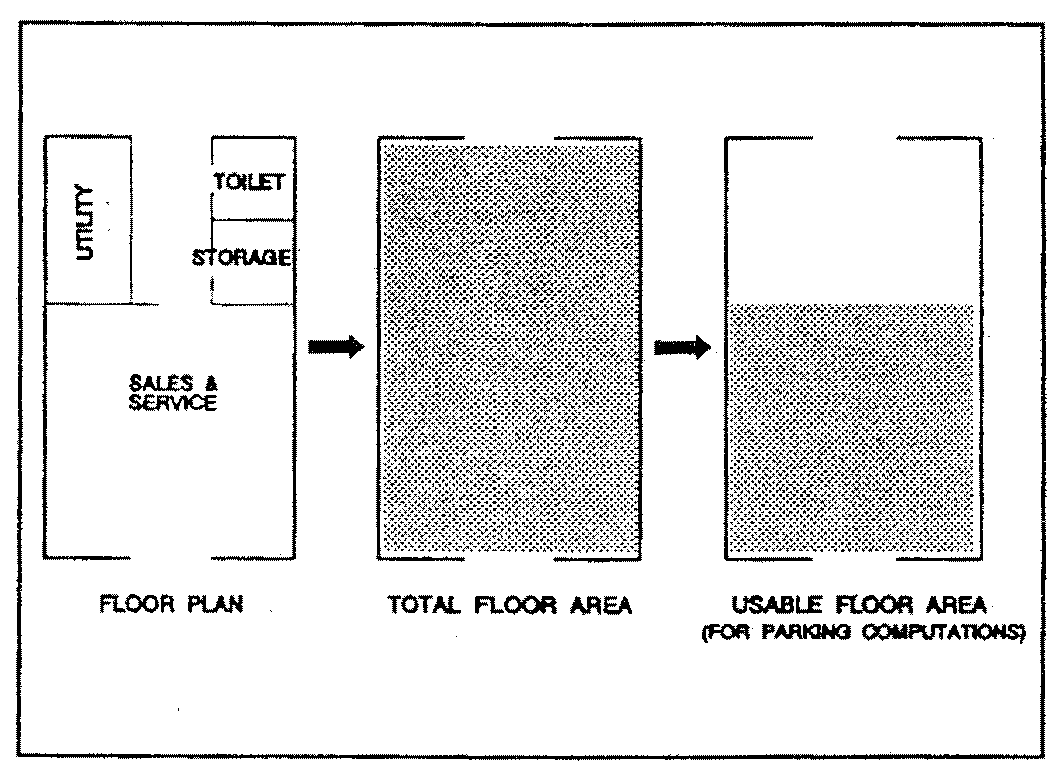
Food Processing: A commercial establishment operated under license or permit of an appropriate regulatory authority where food is manufactured or packaged for human consumption at another establishment or place.
Freeway: A divided highway of not less than two (2) lanes in each direction to which owners or occupants of abutting property or the public have no right of ingress or egress to, from, or across the highway, except at points determined by, or as otherwise provided, by the authorities responsible, therefore.
Garage, private: An accessory building or portion of a main building designed or used solely for the storage of motor-driven vehicles, boats, and similar vehicles and such other lawn and home care equipment owned and used by the occupant of the building to which it is accessory.
Garage Sale: Any sale of personal effects, jewelry, or household items, furnishings, and equipment belonging to the owner or occupant of the property held in any district by the owner, occupant, or his personal representative.
Garage, Service: Any premises used for the storage or care of motor-driven vehicles, or where any such vehicles are equipped for operation, repaired, or kept for remuneration, hire or sale.
Generally Accepted Agricultural and Management Practices: Those practices as defined by the Michigan Commission of Agriculture pursuant to the Michigan Right to Farm Act (MCL 286.471 et seq.).
Golf Course: A tract of land laid out for at least nine (9) holes for playing the game of golf and improved with tees, greens, fairways, and hazards and that may include a clubhouse, driving range, pro shop, shelter, and related accessory uses.
Grade: The ground elevation established for the purpose of regulating the number of stories and the height of buildings. The building grade shall be the level of the ground adjacent to the walls of the building if the finished grade is level. If the ground is not entirely level, the grade shall be determined by averaging the elevation of the ground for each face of the building.
Greenbelt: A planting of trees and shrubs to serve as a screening device between abutting land uses.
GREENBELT PLANTING SCREEN ILLUSTRATIONS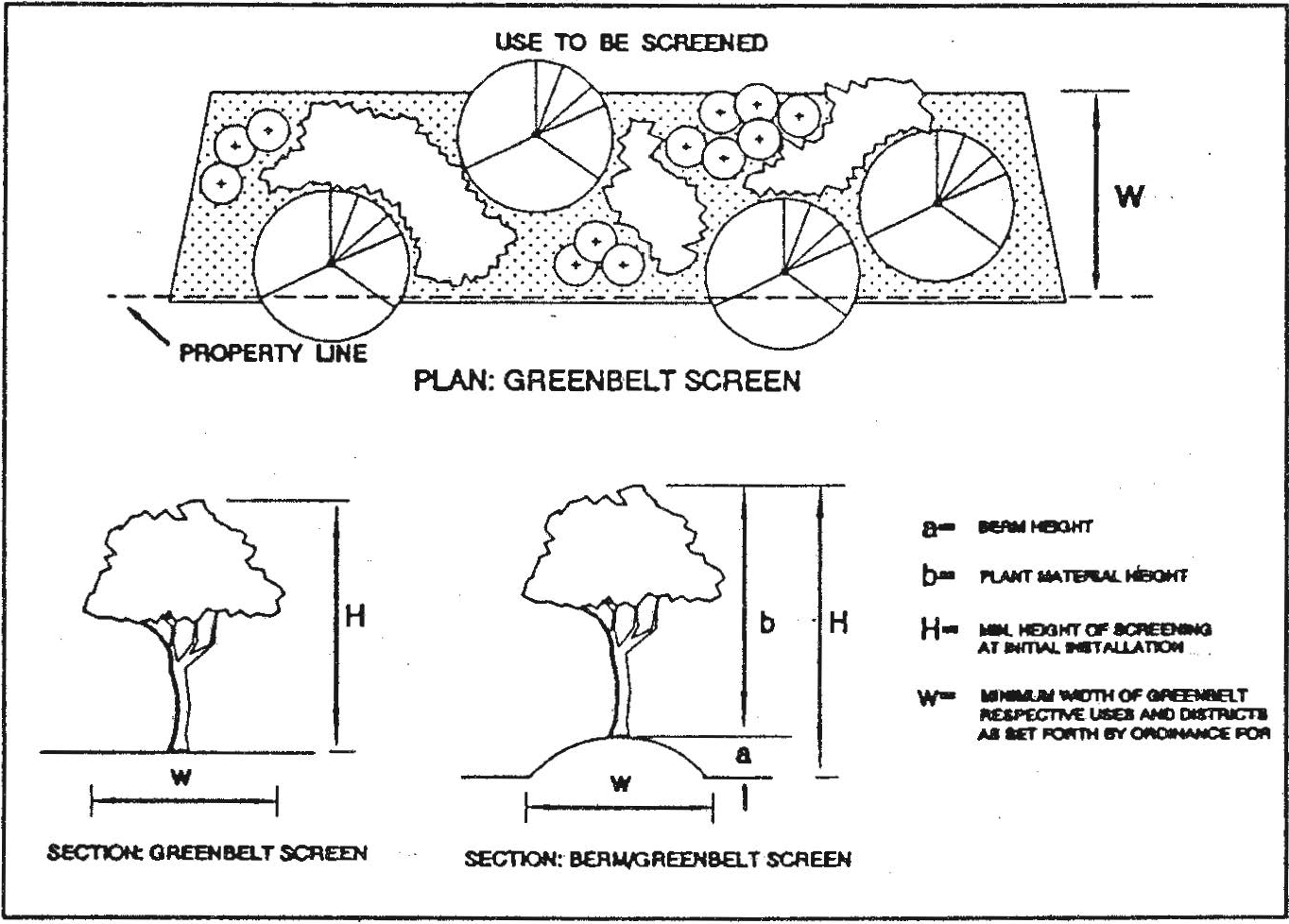
Greenhouse, Commercial: A building that is used for wholesale commercial purposes, constructed of permanent or temporary framing that is set directly on the ground and is covered with glass panels or plastic or other transparent material, and is used to grow plants.
Ground Story Activation: The incorporation of specific design characteristics intended to allow the ground story interior of a building to interact with the public realm immediately outdoors.
Guarantee: A cash deposit, certified check, irrevocable bank letter of credit, or such other instrument acceptable to the city.
Health Club/Athletic Clubs: A building or portion of a building designed and equipped for the conduct of sports, exercise, leisure time activities, or other customary or usual recreational activities, operated for profit or not-for-profit and which can be open only to members and guests of the organization or open to the public for a fee.
Home Occupation: An occupation carried on by an occupant of a dwelling unit as a secondary use which is clearly subservient to the use of the dwelling for residential purposes.
Hotel: A building or part of a building, with a common entrance or entrances, in which the dwelling units or rooming units are used primarily for transient occupancy, and in which one (1) or more of the following services are offered: maid service, furnishing of linen, telephone, secretarial or desk service, and bellboy service. A hotel may include a restaurant or cocktail lounge, public banquet halls, ballrooms, or meeting rooms. This definition does not include apartments.
Hydraulic Fracturing (Fracking): Fluid-driven fracturing of rock for the purpose of stimulating natural gas or oil production.
Illegal structure: A structure or portion thereof, which is not a conforming or a nonconforming structure, or is not in compliance with all applicable federal, state, county and township laws, ordinances, regulations, and codes.
Illegal use of land: A use that occupies one or more contiguous parcels of land, or structures and land in combination, which is not a conforming or a nonconforming use, or is not in compliance with all applicable federal, state, county and township laws, ordinances, regulations, and codes.
Impervious Material: Any material that substantially reduces or prevents the infiltration of water.
Impervious Surface: A surface which does not allow water to be absorbed so it may percolate into deeper ground. Such surfaces are those constructed of Portland cement, bituminous asphalt, paving brick, composed stone or gravel, or any other surface that allows no water penetration.
Impervious Surface Ratio: The percentage of lot area covered by all building, pavement, driveways, parking lots, and all other structures (area of all structures, pavement, and parking lots divided by the gross lot area).
Improvements: Those features, and actions associated with a project which are considered necessary by the Township to protect natural resources or the health, safety, and welfare of the residents of the Township, and future users or inhabitants of the proposed project or project area, including parking areas, landscaping, roadways, lighting, utilities, sidewalks, screening, and drainage. Improvements do not include the entire project which is the subject of zoning approval.
Indoor Commercial Recreation Facility: An enterprise conducted entirely within a building, which receives a fee in return for the provision of some recreational activity or facility. Such activities and facilities include, but are not limited to: arcades, racquetball, tennis courts, gymnasiums, swimming pools, skating rinks, performance studios, indoor skateboard parks, climbing facilities, indoor driving ranges, batting cages, firing ranges, basketball courts, indoor soccer fields, and similar activities or facilities. Such facilities may provide ancillary accessory uses such as pro shops or snack bars.
Industrial Park: A group of two (2) or more lots or parcels devoted to industrial, research, warehousing, or business park uses: developed according to an overall plan for the park, sharing a common public or private street system, and usually identified by a name for the park.
Interstate Highway: A highway officially designated as a part of the national system of interstate and defense highways by the Department of Transportation and approved by the appropriate authority of the Federal government.
Junkyard: An open area where waste, used or secondhand materials are bought and sold, exchanged, stored, baled, packed, disassembled, or handled including but not limited to: scrap iron and other metals, paper, rags, rubber tires and bottles. A junkyard includes automobile wrecking yards and includes any area of more than two hundred (200) square feet for storage, keeping or abandonment of junk, but does not include uses established entirely within enclosed buildings. A junkyard shall also include any premises upon which two (2) or more motor vehicles, which cannot be operated under their own power, are kept, or stored for a period of fifteen (15) days or more.
Kennel, Commercial: Any lot or premises on which three (3) or more dogs, cats, or other household pets are either permanently or temporarily boarded or bred and raised for remuneration.
Lighting: The following definitions are related to lighting:
1.
Candela. A unit of luminance or brightness for electronic message signs. A common candle emits light with a luminous intensity of roughly one (1) candela.
2.
Canopy Structure. Any overhead protective structure that is constructed in such a manner to allow pedestrians and/or vehicles to pass under.
3.
Flood or Spotlight. Any light fixture or lamp that incorporates a reflector or refractor to concentrate the light output into a directed beam in a particular direction.
4.
Footcandle. A unit of illuminance, which is the quantity of light, or luminous flux, arriving at a surface divided by the area of the illuminated surface, amounting to one lumen per square foot.
5.
Glare. Directed light emitted by a lamp, luminous tube lighting, or other light source.
6.
Light Fixture. The assembly that holds a lamp and may include an assembly housing, a mounting bracket or pole socket, a lamp holder, a ballast, a reflector or mirror, and a refractor or lens. A light fixture also includes the assembly for luminous tube and fluorescent lighting.
7.
Light Pollution. Artificial light which causes a detrimental effect on the environment, enjoyment of the night sky or causes undesirable glare or unnecessary illumination of adjacent properties.
8.
Light Trespass. The shining of light produced by a luminaire beyond the boundaries of property in which it is located.
9.
Lumen. Unit of luminous flux; the flux emitted within a unit solid angle by a point source with a uniform luminous intensity of one candela. One (1) foot-candle is one (1) lumen per square foot. One (1) lux is one (1) lumen per square meter. One (1) foot-candle equals 10.8 lumen per square meter.
10.
Luminaire. The complete lighting system including the lamp and light fixture.
11.
Luminaire Cut-Off Angle. The angle, measured up from the lowest level or nadir, between the vertical axis and the first line of sight at which the bare source is not visible.
12.
Luminaire, Fully Shielded. A luminaire constructed or shielded in such a manner that all light emitted by the luminaire, either directly from the lamp or indirectly from the luminaire, is projected below the horizontal plane through the luminaire's lowest light emitting part as determined by photometric test or certified by the manufacturer.
13.
Luminance. At a point and in a given direction, the luminous intensity in the given direction produced by an element of the surface surrounding the point divided by the area of the projection of the element on a plane perpendicular to the given direction. Units: candelas per unit area. The luminance is the perceived brightness that we see, the visual effect of the illuminance, reflected, emitted, or transmitted from a surface.
14.
Luminous Tube Lighting. Gas filled tubing which, when subjected to high voltage, becomes luminescent in a color characteristic of the particular gas used, e.g., neon, argon, etc.
15.
Photometric Plan. A plan which illustrates the intensity of light on a site measured in footcandles.
16.
Outdoor Light Fixtures. Outdoor artificial illuminating devices, outdoor fixtures, lamps, and other similar devices, permanently installed or portable, used for flood lighting, general illumination, or advertisement.
17.
Shielded Fixture. Outdoor light fixtures shielded or constructed so that light rays emitted by the fixture are projected below the horizontal plane passing through the lowest point on the fixture from which light is emitted, i.e., "shoe-box type" fixtures. A luminaire mounted in a recessed fashion under a canopy or other structure such that the surrounding structure effectively shields the light in the same manner is also considered fully shielded for the purposes of this ordinance.
Livestock: Means and includes horses, stallions, colts, geldings, mares, sheep, rams, lambs, bulls, bullocks, steers, heifers, cows, calves, mules, jacks, jennets, burros, goats, kids, swine, poultry, and fur-bearing animals being raised in captivity.
Loading Space: An off-street space on the same lot with a building, or group of buildings, for the temporary parking of a commercial vehicle while loading and unloading merchandise or materials.
INTERIOR, THROUGH AND CORNER LOTS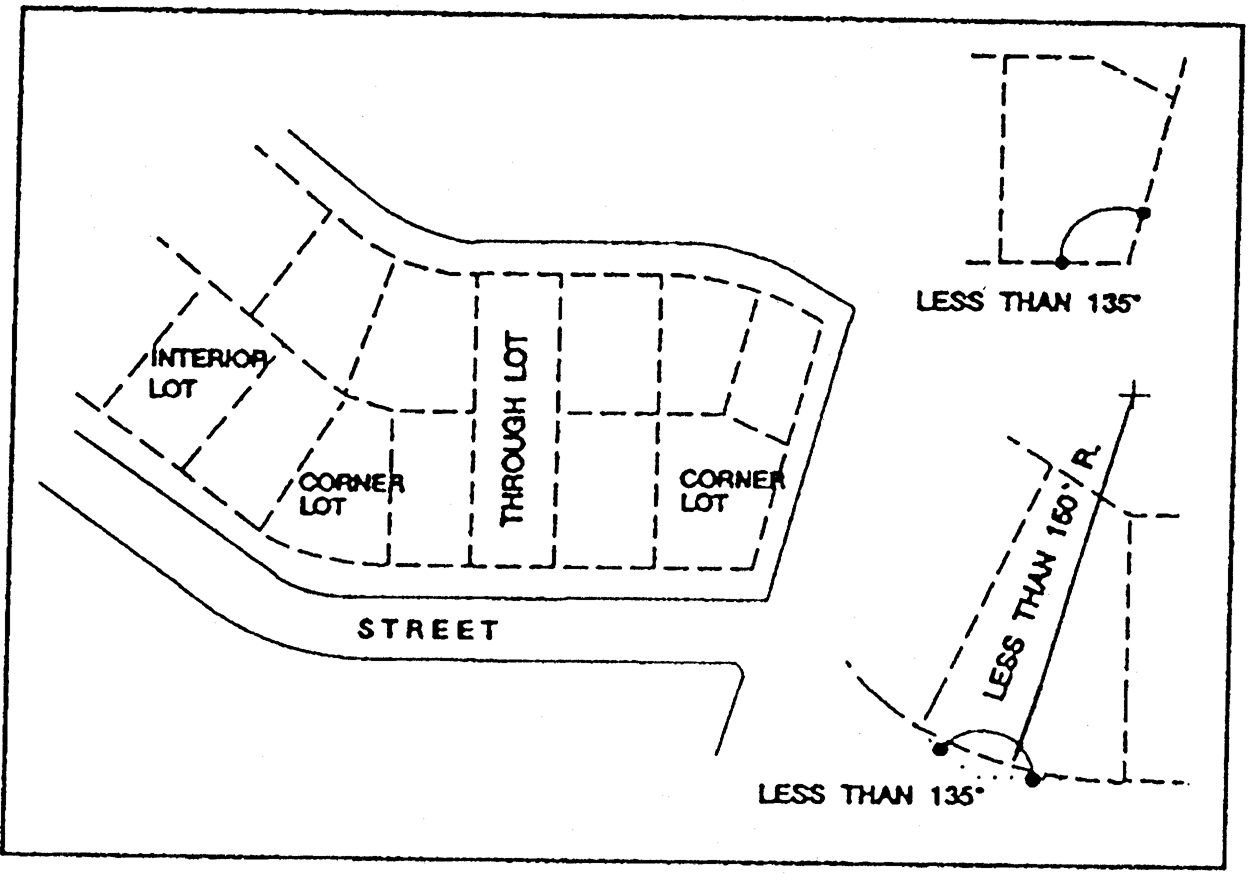
Lot: A parcel of land, excluding any portion in a street or other right-of-way, of at least sufficient size to meet minimum requirements for lot area, and to provide such yards and other open spaces as herein required. In no case of division or combination shall any lot or parcel created, including residuals, be less than that required by this ordinance. Such lot shall have frontage on a public street, or on an approved private street, and may consist of:
1.
A single lot of record.
2.
A portion of a lot of record.
3.
Any combination of complete and/or portions of lots of record.
4.
A parcel of land described by metes and bounds.
Lot Area (Gross): The area contained within the lot lines.
Lot Area (Net): The area contained within the lot lines, less the total area of that portion encumbered by road or street easements, rights-of-way, required access easements, and all portions covered by wetlands, bodies of water (including streams, ponds, and lakes), or pre-existing County Drain easements multiplied by 0.90.
Lot, Corner: A lot located at the intersection of two (2) or more streets.
Lot Coverage: The part or percent of the lot occupied by buildings including accessory buildings and including but not limited to: patios, decks, pools, and similar structures.
Lot Depth: The horizontal distance between the front and rear lot lines, measured along the median between the side lot lines.
Lot, Interior: Any lot other than a corner lot.
Lot Lines: The lines bounding a lot as defined herein:
1.
Front Lot Line. In the case of an interior lot, is that line separating said lot from the street. In the case of a through lot, is that line separating said lot from each street.
2.
Rear Lot Line. That lot line opposite the front lot line. In the case of a lot pointed at the rear, the rear lot line shall be an imaginary line parallel to the front lot line, not less than ten (10) feet long lying farthest from the front lot line and wholly within the lot. On a corner lot, the rear yard shall be that yard opposite the front facade of the main building.
3.
Side Lot Line. Any lot line other than the front lot line or rear lot line. A side lot line separating a lot from a street is a side street lot line. A side lot line separating a lot from another lot, or lots is an interior side lot line.
Lot of Record: A parcel of land, the dimensions of which are shown on a document or map on file with the County Register of Deeds or in common use by municipal or county officials, and which actually exists as so shown, or any part of such parcel held in a record ownership separate from that of the remainder thereof.
Lot, Through: Any interior lot having frontage on two (2) more or less parallel streets as distinguished from a corner lot. In the case of a row of double frontage lots, all yards of said lots adjacent to streets shall be considered frontage, and front yard setbacks shall be provided as required.
Lot width: The horizontal straight-line distance between the side lot lines, measured between the two (2) points where the required front setback line intersects the side lot lines.
LOT WIDTH AND SETBACK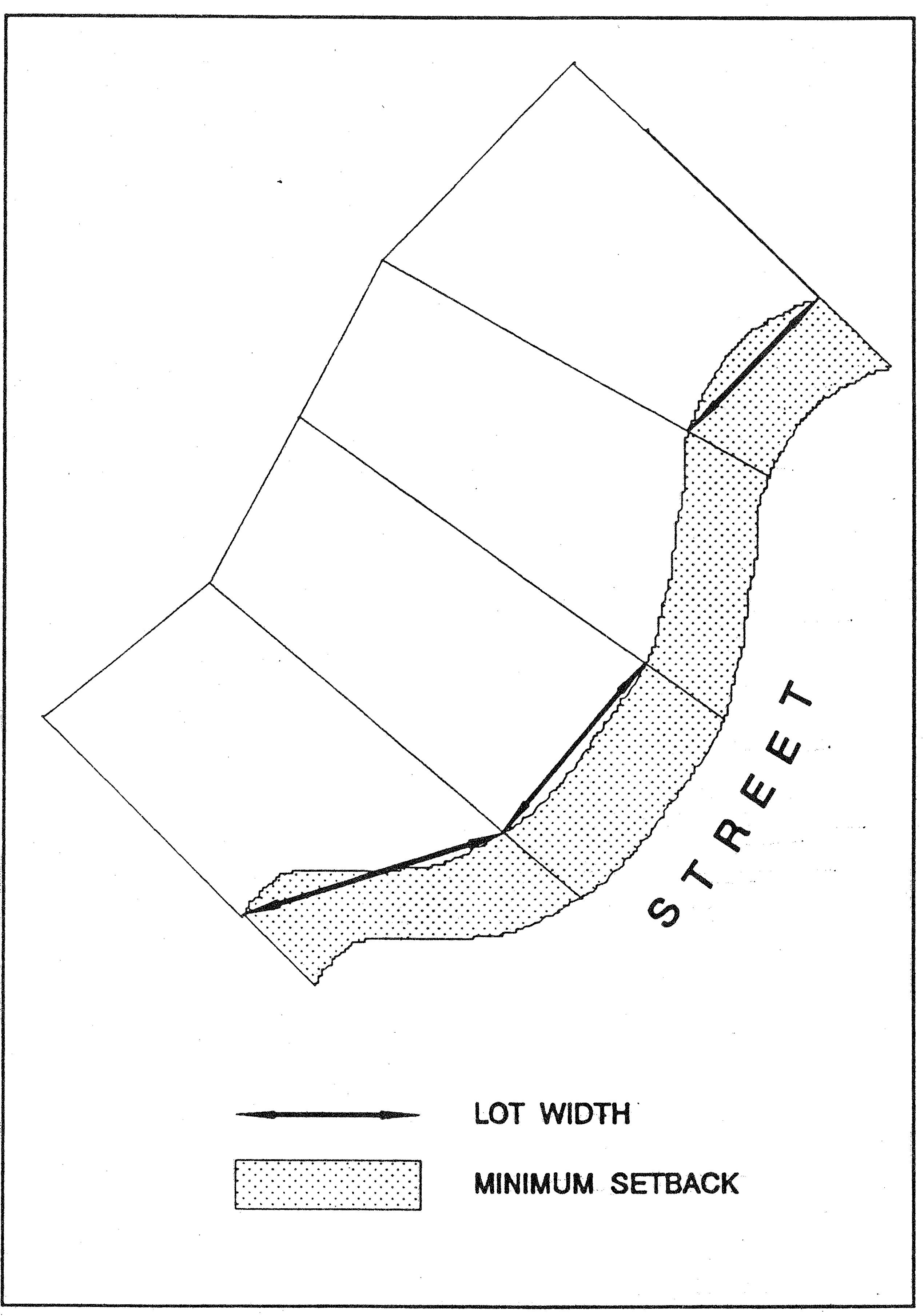
Lot, Zoning: A single tract of land, located within a single block which, at the time of filing for a building permit, is designated by its owner or developer as a tract to be used, developed, or built upon as a unit, under single ownership or control. A zoning lot shall satisfy this ordinance with respect to area, size, dimensions, and frontage as required in the district in which the zoning lot is located. A zoning lot, therefore, may not coincide with a lot of record as filed with the County Register of Deeds, but may include one or more lots of record.
EXAMPLES OF ZONING LOTS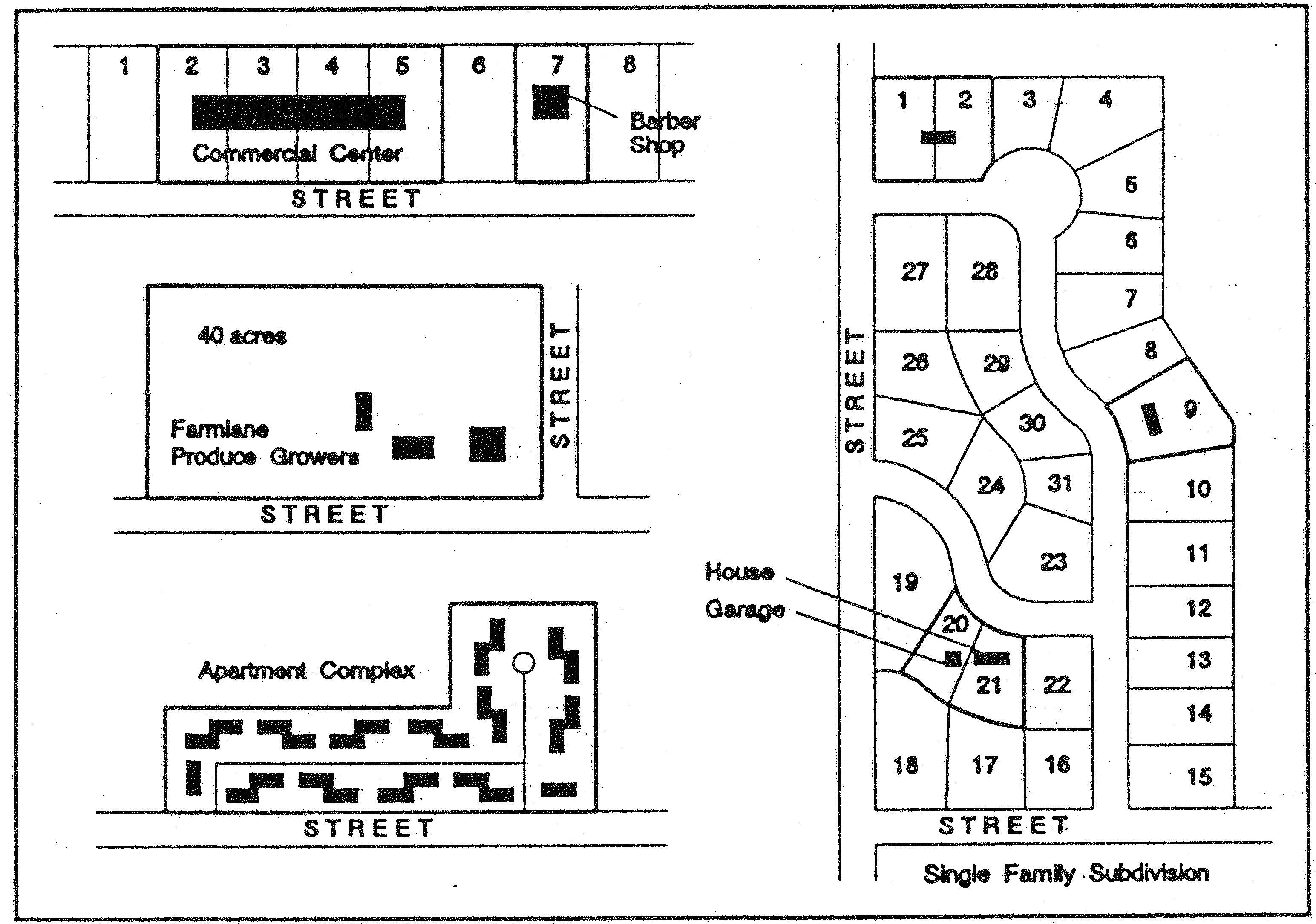
Lot of Record: A lot which is part of a subdivision and is shown on a map thereof which has been recorded in the Office of the Register of Deeds of Washtenaw County, or a lot described by metes and bounds, the deed to which has been recorded in said office.
Main Building: A building in which is conducted the principal use of the lot upon which it is situated.
Main Use: The principal use to which the premises are devoted and the principal purpose for which the premises exist.
Major thoroughfare: An arterial street which is intended to serve as a large volume trafficway for both the immediate municipal area and the region beyond, and is designated as an interstate, freeway, major, or minor arterial by the National Functional Classification Map published by the Michigan Department of Transportation.
Manufacturing: The process of making products by hand, by machinery, or by other agency, often with the provision of labor and the use of machinery.
Manufacturing, Compounding, or Processing: An enclosed establishment engaged in the mechanical or chemical transformation of materials or substances into new products, including the assembling of component parts, the creation of products, and the blending of materials, usually in a continuous and regular action or succession of actions.
Manufactured Home: A housing structure that is transportable in one (1) or more sections.
Marihuana: Means that term as defined in Section 7106 of the Public Health Code, (Public Act 368 of 1978, as amended, MCL 333.7106 and MCL 333.27102).
Marina: A privately owned commercial facility which extends into or over Ford Lake and offers service to the general public or members of the marina for launching, docking, loading, or other servicing of watercraft.
Massage Therapist: Any person who is engaged in the business or profession of massage therapy and who receives compensation for his or her services.
Massage Therapy: The act of massage offered or performed by a massage therapist in conjunction with a beauty salon, spa, health club, athletic club, medical office, or physical therapy clinic which is operating legally under this ordinance.
Massage Therapy Establishment: Any establishment or business wherein massage is practiced, including establishments commonly known as health clubs, physical culture studios, massage studios, massage parlors, or similar establishments by whatever name designated.
Master Deed: The condominium document recording the condominium project as approved by the Township to which is attached as exhibits and incorporated by reference the bylaws for the project and the condominium subdivision plan for the project and all other information required by Section 8 of the Condominium Act, (Public Act 59 of 1978 (MCL 559.101 et seq.), as amended.
Master Plan: The comprehensive community plan including graphic and written proposals indicating the general location for streets, parks, schools, public buildings, and all physical development of the Township, and includes any unit or part of such plan, and any amendment to such plan or parts thereof.
Materials Recovering Facility: A specialized plant that receives, separates, and prepares recyclable materials for marketing to end-user manufacturers.
Medical Clinic: Facilities for medical, dental, or psychiatric diagnosis and treatment, exclusive of major surgical procedures, for sick, ailing, and injured persons who are not kept overnight on the premises.
Medical Marihuana Dispensary: Any structure used for dispensing marihuana by a primary caregiver or caregivers to one (1) or more qualifying patient(s). A medical marihuana dispensary does not include a qualifying patient's residence if the marihuana transferred is exclusively for the qualifying patient's use.
Medical Marihuana Nursery: Any structure which is used, intended for use, or designed for use in planting, propagating, cultivating, growing, harvesting, manufacturing, producing, processing, preparing, packaging, repackaging, or storing medical marihuana for one or more qualifying patients. A medical marihuana nursery does not include a qualifying patient's residence if the marihuana is exclusively for the qualifying patient's use.
Medical Office: The place of work for physicians, dentists, or similar professionals where persons are examined or treated on an outpatient basis only. An office may not include facilities for outpatient surgery, laboratories, pharmacies, or facilities for in-patient care.
Mezzanine: An intermediate floor in any story occupying not less than one-third (⅓) of the floor area of such story.
BASIC STRUCTURAL TERMS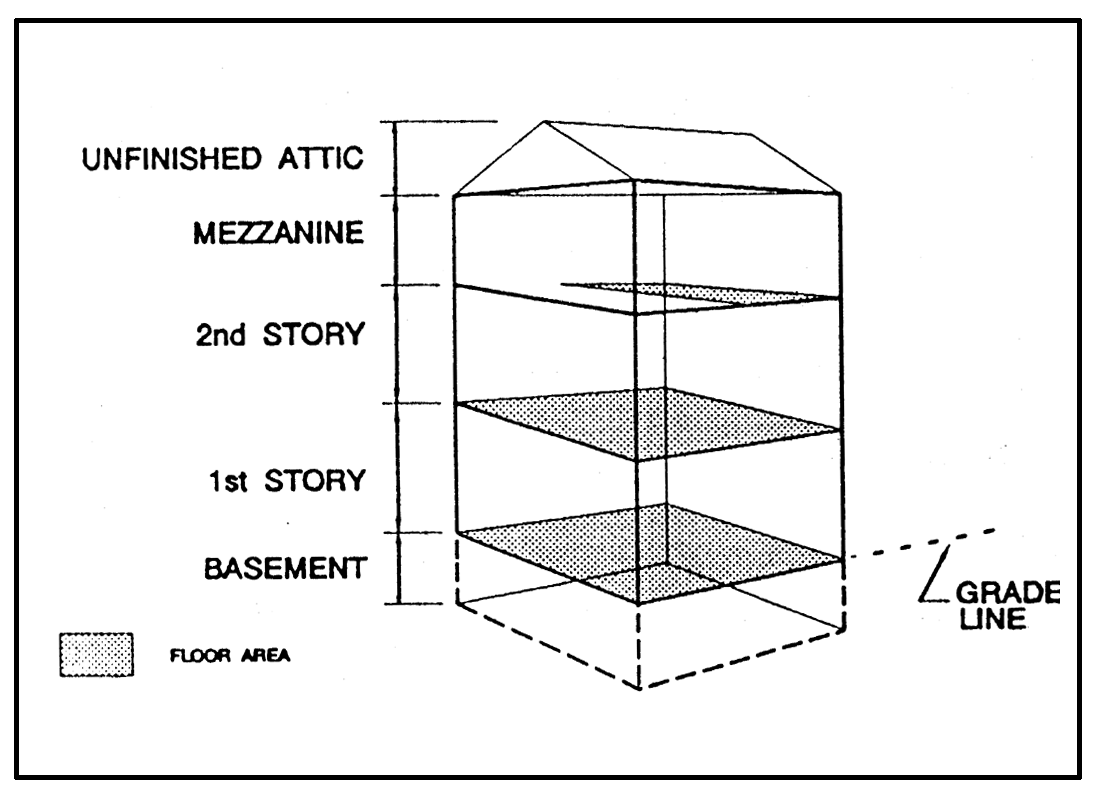
Mixed-Use Development: A development of a tract of land, building, or structure with a variety of complementary and integrated uses as permitted by the applicable zoning district, in a compact form that promotes multiple forms of transportation and supports public gathering spaces.
Mobile Home: Any building or structure, transportable in one (1) or more Sections, which is built on a chassis and designed to be sold as a dwelling with or without permanent foundation, when connected to the required utilities, and includes the plumbing, heating, air conditioning, and electrical systems contained in the structure. Mobile home does not include recreational equipment.
Mobile Home Park: A parcel or tract of land under the control of a person upon which three (3) or more mobile homes are located on a continual non-recreational basis and which is offered to the public for that purpose regardless of whether a charge is made therefore, together with any building, structure, enclosure, street, equipment, or facility used or intended for use incident to the occupancy of a mobile home and which is not intended for use as a temporary trailer park.
Mortuary/Funeral Home: An establishment in which the dead are prepared for burial or cremation, and in which wakes, and funerals may be held.
Motel: A series of attached, semidetached or detached rental units containing a bedroom, bathroom, and closet space. Units shall provide for overnight lodging, have separate entrances, and are offered to the public for compensation. This definition does not include apartments.
Multiple Dwelling, High-Rise: A multiple-family dwelling of over four (4) stories in height.
Multiple Dwelling, Mid-Rise: A multiple-family dwelling of two to four (2 to 4) stories in height.
Municipality: The Charter Township of Ypsilanti.
Native Plant Species: A native plant species is one (1) that has naturally evolved over thousands of years under certain soil, hydrologic, and other site conditions. Where "native plant species" is used in the text, this means a straight species, not a cultivar of a species.
New Construction: Structures for which start of construction commenced on or after the effective date of this ordinance.
Nonconforming Building or Structure: Any building or structure lawfully established which does not comply with all the regulations of this ordinance or of any amendment thereto governing bulk of the district in which such building or structure is located.
Nonconforming lot: A platted or unplatted parcel of land lawfully existing at the effective date of this ordinance or amendments thereto that does not conform to ordinance provisions for the district in which it is located.
Nonconforming site: A parcel of land that was developed or improved with structures and other site improvements prior to the date of adoption of current zoning ordinance provisions for site design, landscaping, pedestrian access, exterior lighting, paving, and other site elements.
Nonconforming Use: Any use thereof or the use of land that does not conform with the regulations of this comprehensive amendment or any amendments thereto governing use of the district in which it is located but conformed with all of the codes, Ordinances, and other legal requirements applicable at the time such building or structure was erected, enlarged, or altered, and the use thereof or the use of land was established.
Nuisance Factors: An offensive, annoying, unpleasant or obnoxious thing or practice, a cause or source of annoyance, especially a continuing or repeating invasion of any physical characteristics of activity or use across a property line which can be perceived by or affects a human being, or the generation of an excessive or concentrated movement of people or things, such as, but not limited to: (a) noise, (b) dust, (c) smoke, (d) odor, (e) glare, (f) fumes, (g) flashes, (h) vibration, (i) shock waves, (j) heat, (k) electronic or atomic radiation, (l) objectionable effluent, (m) noise of congregation of people, particularly at night, (n) passenger traffic, (o) invasion of nonabutting street frontage by traffic, (p) a burned structure, (q) and a condemned structure.
Nursery, Plant Materials: A space, building or structure, or combination thereof, for the storage of live trees, shrubs, or plants offered for retail sale on the premises including products used for gardening or landscaping. The definition of nursery within the meaning of this ordinance does not include any space, building, or structure used for the sale of fruits, vegetables, or Christmas trees.
Obscene Material: Any "material" as defined in Section 2 of the Obscene Material Act (Public Act 343 of 1984, as amended, MCL 752.362.2(4), et. seq.) and found to be "obscene" as also defined in that same Act (MCL 752.362.2(5) et seq.).
Office Park: A group of two (2) or more buildings, on individual lots, or one (1) undivided parcel, with a common street or driveway system, developed according to an overall plan for the park, and identified by a name for the park.
Off-Grid Energy System: An energy production facility or device that is not connected to the available public utility.
Off-Street Parking Lot: A facility providing off-street vehicular parking spaces and drives or aisles for the parking of more than three (3) vehicles.
On-Grid Energy System: A supplemental energy production facility or device that is connected to the available public utility.
On-Site Use Wind Energy Systems: An on-site use wind energy system is intended to primarily serve the needs of the property owner and/or occupant.
Open Air Businesses: Sales and/or display of retail merchandise or services outside of a permanent structure.
Open Front Store: A business establishment so developed that service to the patrons may be extended beyond the walls of the structure, not requiring the patron to enter the structure. The term "open front store" shall not include automobile repair or gasoline service stations.
Open Space: A parcel or area of land that is intended to provide light and air, and is designed for resource protection, aesthetic, or recreational purposes. Open space uses may include, but are not limited to lawns, decorative plantings, walkways, active and passive recreation areas, land use buffers, playgrounds, fountains, woodlands, wetlands, and bio-retention facilities. Open space shall not include streets, driveways, parking lots, or other surfaces designed or intended for vehicular traffic.
Open Space, Common: Open space within or related to a development, not in individually owned lots, which is designed for and dedicated to the common use or enjoyment of the residents of the development or general public.
Open Storage: The storage of any materials or objects outside the confines of a building.
Outdoor Commercial Recreation: An enterprise conducted primarily outdoors, which receives a fee in return for the provision of some recreational activity or facility. Such activities and facilities include, but are not limited to soccer, baseball, football, or other athletic fields, outdoor miniature golf courses and driving ranges, tennis, basketball or other athletic courts, and other similar facilities or activities.
Outdoor Storage: The keeping of personal or business property or motor vehicles in a required open parking space or any other area outside of a building for a period exceeding seventy-two (72) consecutive hours.
Parking Garage: A building or portion thereof designed or used exclusively for storage of motor vehicles, and in which motor fuels and oils are not sold, and motor vehicles are not equipped, repaired, hired, or sold. Electric vehicle charging stations may be located in a parking garage.
Parking Space: An area of definite length and width, said area shall be exclusive of drives, aisles or entrances giving access thereto, and shall be fully accessible for the parking of permitted vehicles.
Parole and/or Probation Offices: A facility for the offices of parole supervisory officials or probation supervisory officials, as further described below:
1.
Parole: A term of community supervision afforded by the parole board to a prisoner who has served the minimum portion of his or her sentence, less good time or disciplinary credits if applicable. While on parole, a parolee is supervised by an agent who is an employee of the Department of Corrections. At the successful completion of the parole period, the offender is "discharged" from his or her sentence. If a parolee violates the parole terms, he or she can be sent back to prison. The parole board retains jurisdiction until the maximum-sentence is served in prison or the offender discharges from parole.
2.
Probation: A term of supervision afforded either a convicted felon or a convicted misdemeanant by a court as an alternative to prison or jail, although some judges may sentence offenders to a combination of both probation and jail or boot camp. The Michigan Department of Corrections supervises convicted felons who are serving probation sentences under the jurisdiction of the sentencing court.
Passive Solar Energy Structure: A structure which uses natural and architectural components to collect and store solar energy without using external mechanical energy.
Pawnbroker: Any person, corporation, or member of a co-partnership or firm who loans money on deposit or pledge of personal property, or other valuable thing, other than securities or printed evidence of indebtedness, or who deals in the purchasing of personal property or other valuable thing on condition of selling the same back again at a stipulated price.
Performance Standard: A criterion established to control smoke and particulate matter, noise, odor, toxic or noxious matter, vibration, fire and explosion hazards, glare or heat, or radiation hazards generated by or inherent in uses of land or buildings.
Physician: An individual licensed as a physician under Part 170 of the Public Heath Code, Public Act 368 of 1978, as amended, (MCL 333.17001 to 333.17084 et seq.) or an osteopathic physician under Part 175 of the Public Health Code, Public Act 368 of 1978, as amended, (MCL 333.17501 to 333.17556 et seq.).
Places of Worship: A site used for or intended for the regular assembly of persons for the conducting of religious services and accessory uses therewith.
Planned Unit Development (PUD): A development consisting of a combination of land uses in which the specific development configuration and use allocation is based upon a comprehensive physical plan meeting the requirements of this ordinance.
Planning Commission: The Planning Commission of the Ypsilanti Township.
Primary Caregiver: A person who has agreed to assist with a patient's medical use of marihuana and has a valid registry identification card issued under the Michigan Marihuana Act.
Principal Building: A building or structure in which is conducted the principal use of the lot on which it is situated. May be referred to as the "main building".
Principal Use: The principal use to which the premises are devoted and the principal purpose for which the premises exist. Commonly referred to as "main use".
Public Access Launch Site: A publicly owned facility which extends into or over Ford Lake and offers to the general public a site for launching, docking, loading, or other servicing of recreational watercraft or parking of watercraft trailers.
Public Service Building and Facilities: Building or facility used for a public service or purpose.
Public Utilities: A person, firm, corporation, municipal department, board, or commission duly authorized to furnish and furnishing under federal, state, or municipal regulations or franchise agreements to the public: gas, steam, electricity, sewage disposal, communication, telegraph, transportation, or water. Wireless communications towers or antennas shall not be considered public or private utilities under this section.
Qualifying Patient: A person who has been diagnosed by a physician as having a debilitating medical condition and has a valid registry identification card issued under the Michigan Marihuana Act.
Recreational Equipment: Travel trailers, pickup campers or coaches, motorized dwellings, tent trailers, boats and boat trailers, snowmobiles, horse trailers, dune buggies, and other similar equipment and conveyances.
Registry Identification Card: A document issued by the Michigan Department of Community Health that identifies a person as a registered qualifying patient or registered primary caregiver.
Regulating Plan: A plan which dictates building forms and uses allowed on every property within an area regulated by a form-based code.
Resident Patient: A person under treatment for substance abuse but not including persons under the jurisdiction of the Department of Corrections.
Restaurant: Any establishment whose principal business is the sale of food and beverages to the customer in a ready-to-consume state, and whose method of operation is characteristic of a fast food, standard restaurant, bar/lounge, or combination thereof, as defined below:
1.
Restaurant, Drive-In: A restaurant whose method of operation involves delivery of prepared food so as to allow its consumption in a motor vehicle or elsewhere on the premises, but primarily outside of an enclosed building.
2.
Restaurant, Fast Food: A restaurant in which the method of operation involves minimum waiting for delivery of ready-to-consume food to the customer for consumption on the premises either inside or outside of the structure, or for consumption off the premises, but not intended to be consumed in a motor vehicle at the site.
3.
Restaurant, Standard: A restaurant in which the method of operation involves either: 1) The delivery of prepared food by waiters and waitresses to customers seated at tables within a completely enclosed building; or 2) The preparation of food to be delivered to customers at a cafeteria line and subsequently consumed by the customers at tables within a completely enclosed building.
4.
Bar/Lounge: A type of restaurant which is operated primarily for the dispensing of alcoholic beverages with the ancillary sale of prepared food or snacks. If a bar or lounge is part of a larger dining facility, it shall be defined as that part of the structure so designated or operated.
Retail Establishment: Establishments engaged in selling goods or merchandise to the general public for personal or household consumption and rendering services incidental to the sale of such goods. A retail establishment does not include establishments whose principal business is that of a pawnbroker, secondhand dealer, or junk dealer.
Retail Sales, Large Scale: A retail establishment, commonly referred to as a "big box" store, which exceeds fifty thousand (50,000) square feet in gross floor area.
Ridgeline: The intersection of two (2) roof surfaces forming the highest horizontal line of the roof.
Right-Of-Way: A strip of land occupied or intended to be occupied by a street or related facilities, public path or trail, railroad, electric line, oil or gas pipeline, water main, sanitary or storm sewer, communication line, or for other special uses.
Roof: The outside top covering of a building.
Room: For the purpose of determining lot area requirements and density in a multiple-family district, a room is a living room, dining room or bedroom, equal to at least eighty (80) square feet in area. A room shall not include the area in kitchen, sanitary facilities, utility provisions, corridors, hallways, and storage. Plans presented showing one-, two- or three-bedroom units and including a "den," "library" or other extra room shall count such extra room as a bedroom for the purpose of computing density.
Rooming House: A residential building where rooms or suites of rooms are rented, for compensation whether under a written lease or not, by arrangement for definite periods, where the renters use common facilities, such as hallways and bathrooms. A rooming house shall not include hotels, motels, apartment houses, tourist homes, one-family dwellings, two- and multi-family dwellings or fraternity and sorority houses.
Rotor: An element of a wind energy system that acts as a multi-bladed airfoil assembly, thereby extracting through rotation, kinetic energy directly from the wind.
Satellite Earth Station: A structure designed, intended, or used to receive communications or other signals from geostationary, communications satellites, or other extraterrestrial sources.
School: A building operated and maintained for educational purposes and such other community uses as deemed necessary and desirable. The term" school" shall include all educational functions, the building or structure required to house them, and all accessory uses normally incidental to a school, including but not restricted to, athletic fields, field houses, gymnasiums, parking lots, greenhouses, playgrounds, stadiums, and open space.
Secondhand Apparel: Personal property designed to be worn as clothing which has been previously worn by another person.
Secondhand Dealer or Junk Dealer: Any person, corporation, or member of a co-partnership or firm whose principal business is that of purchasing storing, selling, exchanging and/or receiving secondhand personal property of any kind or description. A secondhand dealer or junk dealer does not include any person, corporation, or member of a co-partnership or firm whose principal business is antique goods or secondhand apparel.
Self-Storage Facility: A building or group of buildings containing fully enclosed, compartmentalized stalls or lockers which are rented or leased as individual units for the storage of personal property customarily related to residential, office, and/or local commercial activities.
Senior Housing: An institution other than a hospital or hotel, which provides housing or room and board to non-transient persons primarily sixty (60) years of age or older. Housing for seniors may include:
1.
Independent Living: A multiple-family housing form with full facilities for self-sufficiency in each individual dwelling unit.
2.
Congregate Care: A dependent elderly housing facility with cooking facilities within the unit, but with a central dining service option. Limited medical care is available.
3.
Assisted Living: A dependent elderly housing facility without cooking facilities in individual rooms and with and only central dining service. Limited medical care, including memory care, may be provided.
4.
Convalescent Home: A state licensed medical establishment providing accommodation and care for aged or infirmed persons, or for those who are bedfast or needing considerable nursing care, but not including facilities for the treatment of sickness or injuries or facilities for surgical care. Commonly referred to as "nursing home".
Setback: The distance required to obtain minimum front, side, or rear yard open space provisions of this ordinance. Setbacks for a public street shall be measured from existing or proposed right-of-way lines, whichever is greater. Setbacks for buildings shall be measured from the foundation wall.
Sidewalk Sales Area: A paved sidewalk surface abutting a principal building on a zoning lot for display and sales of merchandise.
Single Housekeeping Unit: All of the associated rooms in a dwelling unit available to and occupied by all of the occupants with a single set of cooking facilities also available to and utilized by all of the occupants of the dwelling unit.
Site Condominium Definitions:
1.
Condominium Unit. Means that portion of a condominium project designed and intended for separate ownership and use, as described in the master deed and is a parcel of land occupied, or intended to be occupied, by a main building or a group of such buildings and accessory buildings or utilized for the principal use and uses accessory thereto, together with such yards and open spaces as are required under the provisions of this ordinance. A lot may or may not be specifically designated as such on public records. Lot shall mean the same as homesite and condominium unit in site condominium developments.
2.
Site Condominium (condominium subdivision). A method of subdivision where the sale and ownership of sites is regulated by the Condominium Act, Public Act 59 of 1978 as amended, (MCL 559.101 et seq.) as opposed to the Subdivision Control Act of 1967 (Act No. 288 of the Public Acts of Michigan of 1967 (MCL 560.101 et seq.), as amended. Condominium subdivision shall be equivalent to the term "subdivision" as used in this Zoning Ordinance and the Township subdivision regulations Ordinance.
3.
Site Condominium Subdivision Plan. Means the site, survey, and utility plans; floor plans; and Sections, as appropriate, showing the existing and proposed structures and improvements including the location thereof on the land.
Shopping Center: A group of commercial establishments, primarily retail uses, that are compatible with each other and are mutually supportive, in one (1) or more buildings, on a site that is planned, developed, and managed as one (1) operating unit, with common driveways, parking areas, identification signs, and other common facilities and services.
Smoking Lounge: An establishment that allows smoking of tobacco products or non-tobacco products or substances on the premises. The term "smoking lounge" includes but is not limited to facilities commonly described as cigar bars and lounges, hookah bars, cafes and lounges, tobacco bars and lounges, tobacco clubs, or zero percent nicotine establishments.
Solar Energy Collector: A panel or panels and/or other devices or equipment, or any combination thereof, that collect, store, distribute and/or transform solar, radiant energy into electrical, thermal or chemical energy for the purpose of generating electric power or other form of generated energy for use in or associated with a principal land use on the parcel of land on which the solar energy collector is located and, if permitted, for the sale and distribution of excess available electricity to an authorized public utility for distribution to other lands.
1.
Building-Mounted Solar Energy Collector: A solar energy collector attached to the roof or wall of a building, or which serves as the roof, wall, or window or other element, in whole or in part, of a building.
2.
Ground-Mounted Solar Energy Collector: A solar energy collector that is not attached to and is separate from any building on the parcel of land on which the solar energy collector is located.
3.
Commercial Solar Energy System: A utility-scale facility of solar energy collectors with the primary purpose of wholesale or retail sales of generated electricity. Commonly referred to as solar farms.
Sound Pressure: Average rate at which sound energy is transmitted through a unit area in a specified direction. The pressure of the sound measured at a receiver.
Sound Pressure Level: The sound pressure mapped to a logarithmic scale and reported in decibels (dB).
Specified Anatomical Areas:
1.
Less than completely and opaquely covered:
A.
Human genitals, pubic region,
B.
Buttock, and
C.
Female breast below a point immediately above the top of the areola; and
2.
Human male genitals in a discernible turgid state, even if completely and opaquely covered.
Specified Sexual Activities:
1.
Human genitals in a state of sexual stimulation or arousal
2.
Acts of human masturbation, sexual intercourse, or sodomy.
3.
Fondling or other erotic touching of human genitals, pubic region, buttocks, or female breast.
Story: That part of a building, except a mezzanine as defined herein, included between the surface of one (1) floor and the surface of the next floor, or if there is no floor above, then the ceiling next above. A story thus defined shall not be counted as a story when more than fifty percent (50%), by cubic content, is below the height level of the adjoining ground.
Story, Half: An uppermost story lying under a sloping roof having an area of at least two hundred (200) square feet in area with a clear height of seven (7) feet six (6) inches. For the purposes of this ordinance, the usable floor area is only that area having at least four (4) feet clear height between floor and ceiling.
BASEMENT AND STORY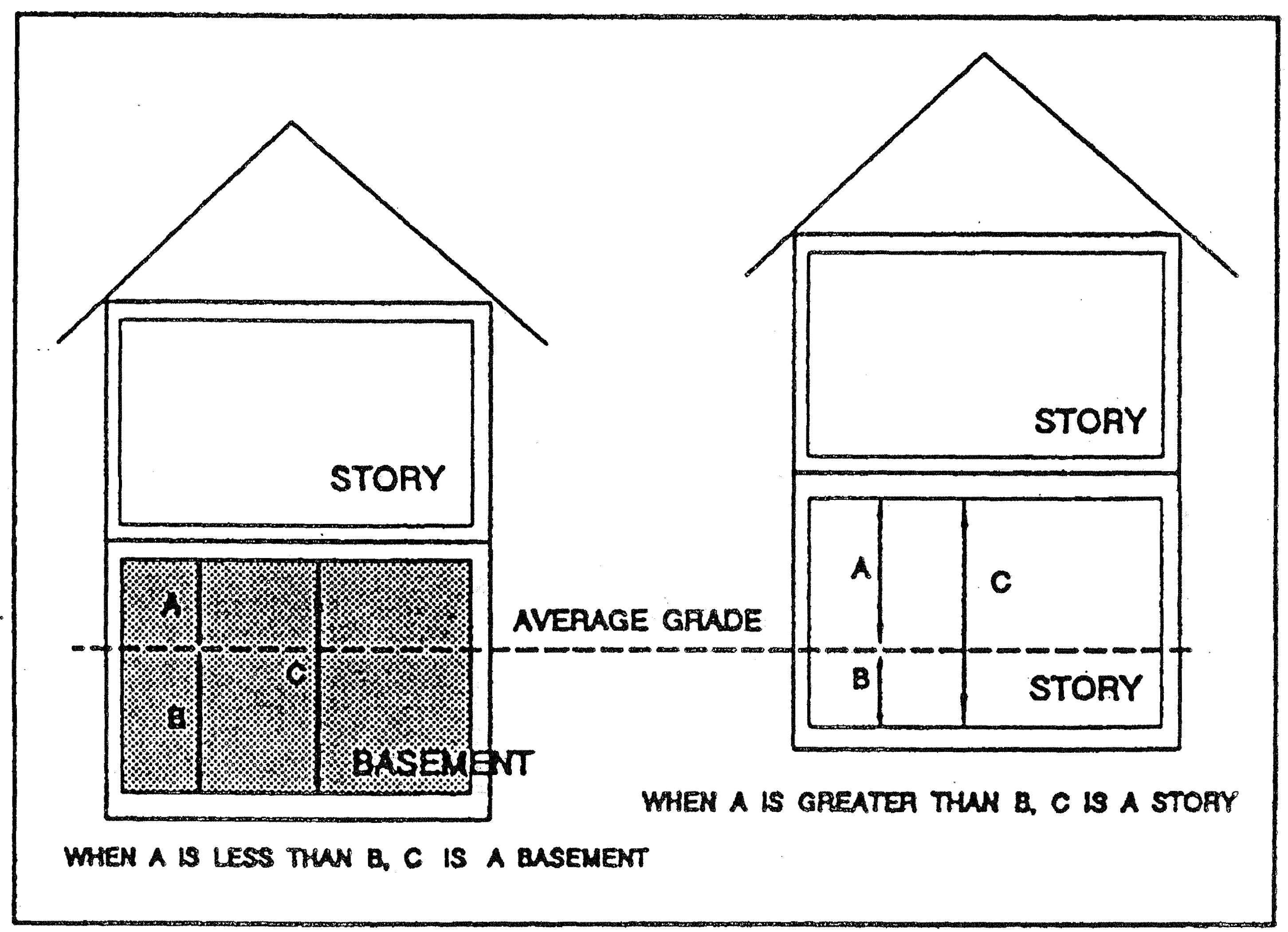
Street: That portion of a public or private right-of-way that affords a primary means of vehicular access to abutting properties, whether designated as a street, avenue, highway, road, boulevard, lane, or throughway or however otherwise designated, but not including driveways to buildings. An alley shall not be considered a street.
Street Frontage: All of the property fronting on one (1) side of a street, measured along such street between an intersecting or intercepting street and another intersecting or intercepting street, a right-of-way in excess of thirty (30) feet, an end of a dead-end street, or a municipal boundary.
Street Line: The dividing line between the street right-of-way and the lot. When such right-of-way is not definable, a line shall be defined as thirty-three (33) feet on either side of the center of the street.
Streetscape: The visual elements of a street, including the road, adjoining buildings, street furniture, trees, and open spaces, etc., that combine to form the street's character.
Structure: Anything constructed or erected, the use of which requires location on the ground or attachment to something having location on the ground.
Subdivision: The partitioning or dividing of a parcel or tract of land by the proprietor thereof or by his heirs, executors, administrators, legal representatives, successors or assigns for the purpose of sale, or lease of more than one (1) year, or of building development, where the act of division creates five (5) or more parcels of land, each of which is ten (10) acres or less in area; or five (5) or more parcels of land, each of which is ten (10) acres or less in area are created by successive divisions within a period of ten (10) years.
Substantial Construction: Work of a substantial character done by way of preparing the site for actual use, which includes obtaining all necessary approvals and building permits, and actual physical placement of building materials in their permanent position. Clearing trees, ground, and other preparatory work does not constitute substantial construction.
Substantial Improvement: Any repair, reconstruction, or improvement of a structure, the cost of which equals or exceed fifty percent (50%) of the market value of the structure either, 1) before the improvement or repair is started, or 2) if the structure has been damaged and is being restored, before the damage occurred. For the purposes of this definition, "Substantial improvement" is considered to occur when the first alteration of any wall, ceiling, floor, or other structural part of the building commences, whether or not that alteration affects the external dimensions of the structures. The term does not, however include any project for improvement of a structure to comply with existing state or local health, sanitary, or safety code specifications which are solely necessary to assure safe living conditions.
Tattoo: One (1) or more of the following:
1.
An indelible mark made upon the body of another individual by the insertion of a pigment under the skin;
2.
An indelible design made upon the body of another individual by production of scars other than by branding.
Tattoo Parlor: A structure or building at which one (1) or more of the following procedures is done for compensation:
1.
Tattooing;
2.
Branding;
3.
Body-Piercing.
Technology Centers/Office Research: Business(es) that provide an environment where high-tech uses and functions such as engineering, design, research and development, photonics/optics, computer assisted design, robotics research, numerical control equipment (CAD/CAM), prototype development and limited manufacturing, biotechnology lasers, medical research, food and materials testing, telecommunications, and limited assembly operations associated with principal permitted uses can be located. Data or computing centers do not qualify under this definition.
Temporary Use or Building: A use or building permitted to exist during a specified period of time.
Tent Sale: A temporary structure of demountable construction in which merchandise is displayed and sold.
Township Board: The Board of Trustees of the Charter Township of Ypsilanti, also referred to as the Board of Trustees.
Trade Contractor: A building or portion thereof where building and construction trade services are provided to the public. "Trade Contractor" shall include, but will not be limited to, contractor offices, including landscaper's showrooms, construction supplies and storage including plumbing, heating, air conditioning, and building equipment and materials, and other uses similar in nature and impact.
Transition: For the purposes of this ordinance, the word "transition" or "transitional" shall mean one (1) or more of the following:
1.
A zoning district which may serve as a district of transition (i.e., a buffer zone between various land use districts or land use types).
2.
A residential rear or side yard lot or land parcel arrangement abutting a land use of more intense development character.
3.
A device such as an earth berm, wall, screening fence, heavy shrub and tree planting, or a combination of such devices providing a buffer between land use types.
LAND USE TRANSITION THROUGH ZONING DISTRICT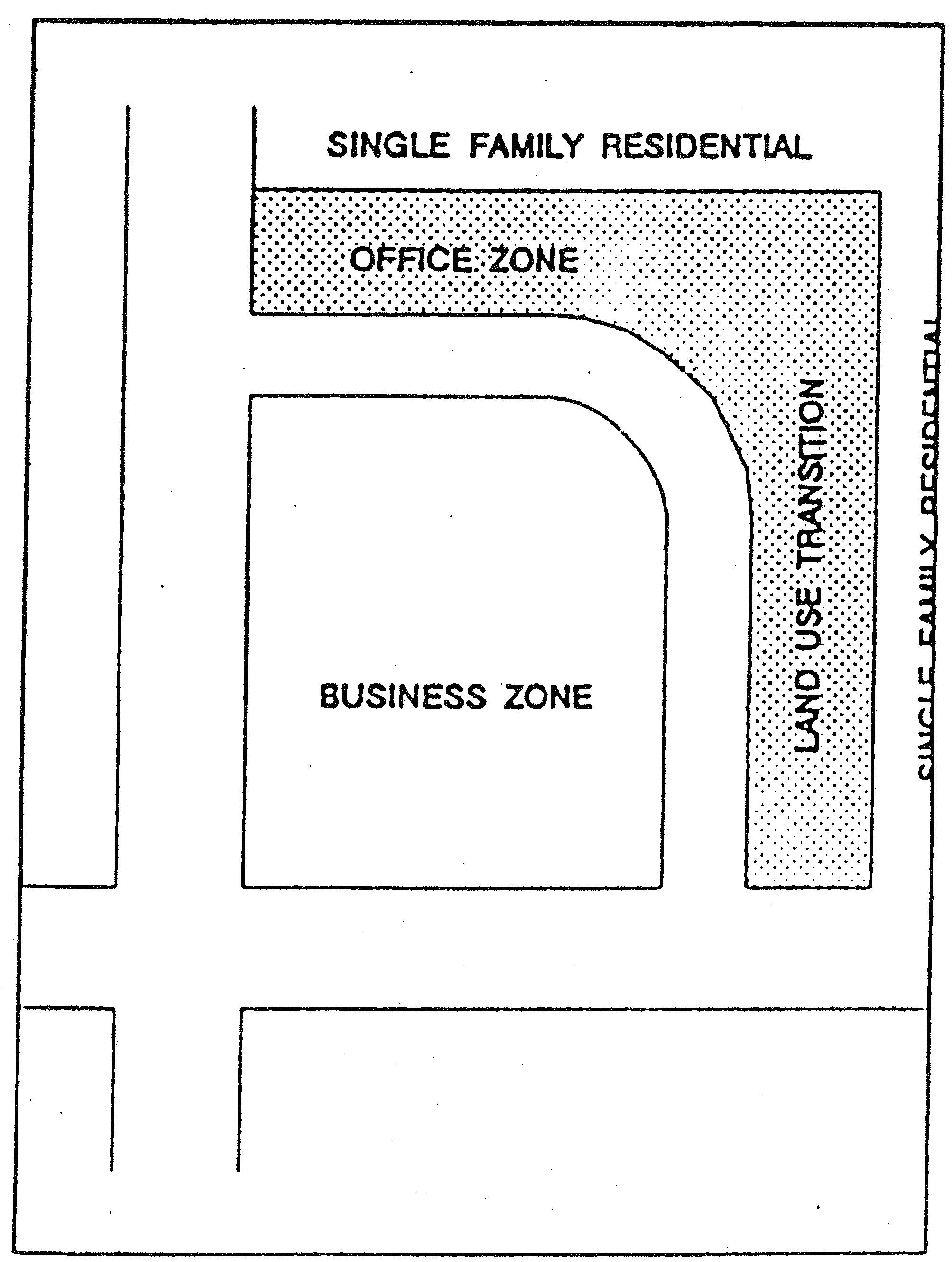
TRANSITION DETAILS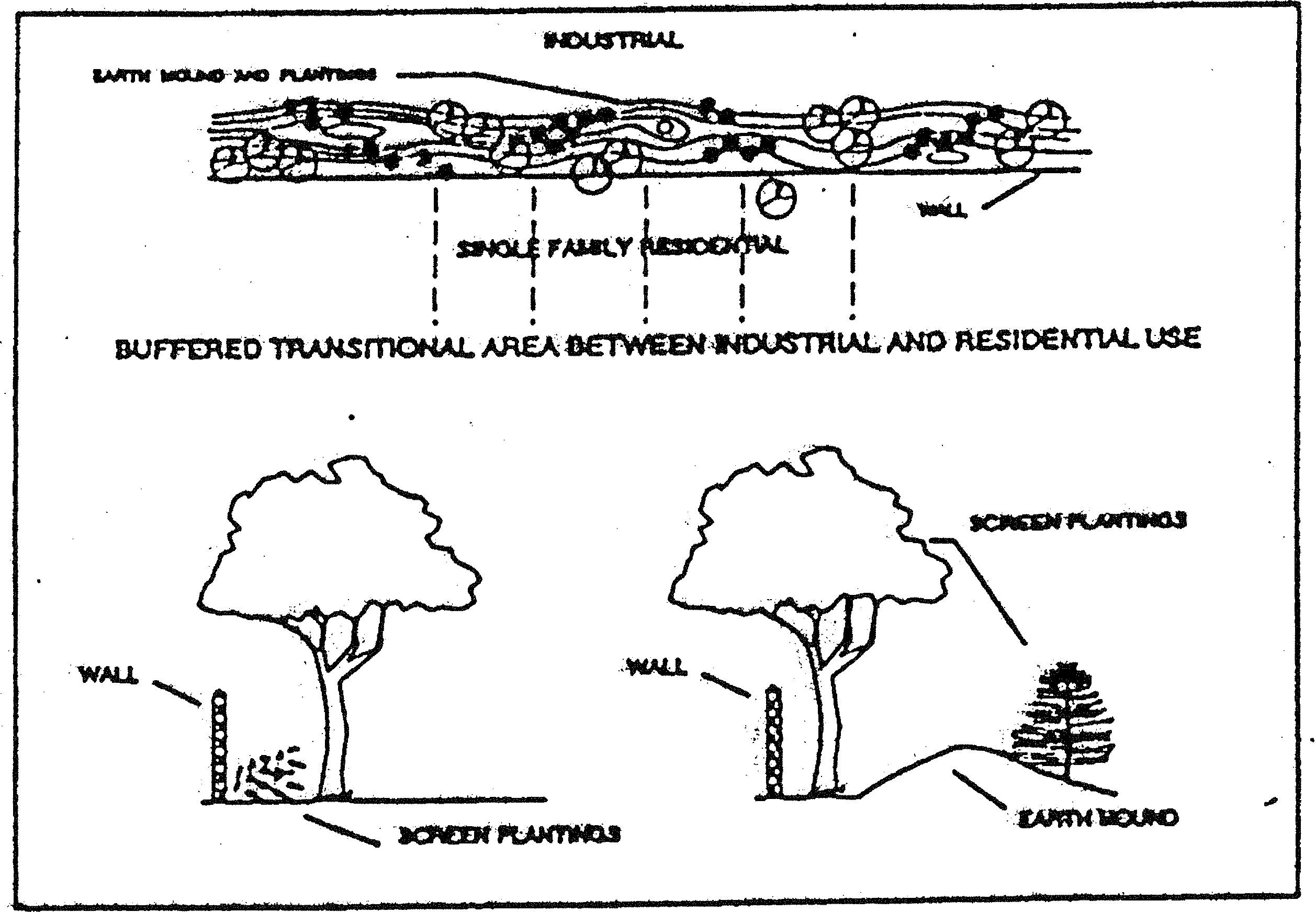
Trash Enclosure Or Recycling Enclosure: An area, screened in accordance with requirements of this ordinance, designed for the storage of garbage dumpsters and other trash receptacles.
Usable Marihuana: The dried leaves and flowers of the marihuana plant, and any mixture or preparation thereof, but does not include the seeds, stalks, and roots of the plant.
Use: The principal purpose for which land or a building is arranged, designed, or intended, or for which land or a building is or may be occupied.
USGS: United States Geological Survey.
Variance: The term 'variance' shall mean a modification of the literal physical provisions of the Zoning Ordinance, which may be granted by the Zoning Board of Appeals in accordance with the authority bestowed upon that Board by the provisions of this ordinance.
Vehicle Filling/Multi-Use Station: A building or premises used primarily for the dispensing, sale, or offering for sale of motor fuels directly to users of motor vehicles; together with the sale of minor accessories and services for motor vehicles such as filling tires with air, checking fluid levels, adding water to batteries or radiators, and similar activities but not including major vehicle repair; as well as selling convenience foods and other such items through a convenience store.
Vehicle Repair, Major: The general repair, engine rebuilding, rebuilding, or reconditioning of motor vehicles; collision service, such as body, frame or fender straightening and repair; and painting of automobiles and any repair of a major component part as defined by the administrative rules promulgated pursuant to the State of Michigan Motor Vehicle Service and Repair Act (MCL 257.1302).
Vehicle Repair, Minor: Repairs other than major repair including but not limited to lubrication; oil changes; installing, changing, or otherwise servicing the antifreeze or other coolant; and the replacement, adjustment, repair, or servicing of tires, batteries, fuel pumps, gaskets, brakes and other parts and assemblies listed as minor repair services by the administrative rules promulgated pursuant to in State of Michigan Motor Vehicle Service and Repair Act (MCL 257.1302).
Vehicle Wash: A building, or portion thereof, the primary purpose of which is that of washing vehicles either by automatic or self-service means.
Veterinary Hospital: A facility maintained by or for the use of a licensed veterinarian in the diagnosis, treatment, or prevention of animal diseases and injuries.
Visiting Qualifying Patient: A patient who is not a resident of this state or who has been a resident of this state for less than thirty (30) days.
Wall, Obscuring: A structure of definite height and location to serve as an obscuring screen in carrying out the requirements of this ordinance.
Watercraft: A contrivance used or designed for navigation on water, including a vessel, boat, motor vessel, steam vessel, vessel operated by machinery either permanently or temporarily affixed, scow, or any marine equipment or device capable of carrying passengers.
Warehouse: A building or structure used principally for the storage of goods and merchandise.
Wholesale, Establishment: Establishments or places of business primarily engaged in selling merchandise to retailers; to industrial, commercial, institutional, or professional business users, or to other wholesalers; or acting as agents or brokers and buying merchandise for, or selling merchandise to, such individuals or companies.
Wind Energy Conversion System (WECS): Any device such as a turbine, windmill, or charger that converts wind energy to a usable form of energy. WECS shall fall within two (2) classifications: on-site or commercial and shall typically be defined as horizontal axis or vertical axis.
1.
On-Site Wind Energy Conversion: A WECS, the energy from which is used only by the primary residence or residences in a cooperative effort, business or agricultural operation and not sold or transferred to the electrical grid for commercial profit. This does not exclude the sale of excess energy sold to a utility through net metering for on-site WECS when the WECS produces more energy than can be stored or used onsite.
2.
Commercial Wind Energy Conversion System: Any WECS that is exclusively designed and built to provide electricity to the electric utility's power grid as an ongoing commercial enterprise or for commercial profit.
3.
Horizontal-Axis Wind Energy Conversion Systems: Conventionally designed systems that have a main rotor shaft that is parallel to the ground and a series of "blades" that are perpendicular to the ground, as in a traditional agricultural windmill. Horizontal-axis wind energy conversion systems are traditionally mounted on a tower or pole and must be pointed into the wind.
4.
Vertical-Axis Wind Energy Conversion Systems: Systems that have a main rotor shaft that is perpendicular to the ground and the system does not need to be pointed into the wind. These systems are more common in areas where wind direction is variable. These systems often resemble a drum, cylinder, or helix.
Wireless Communications Facilities: All structures and accessory facilities relating to the use of the radio frequency spectrum for the purpose of transmitting or receiving radio signals. This may include, but shall not be limited to, radio towers, television towers, telephone devices and exchanges, micro-wave relay facilities, telephone transmission equipment building, and commercial mobile radio service facilities. Not included within this definition are: citizen band radio facilities; short wave receiving facilities; amateur (ham) radio facilities; satellite dishes; and, governmental facilities which are subject to state or federal law or regulations which preempt municipal regulatory authority. For purposes of this ordinance, the following additional terms are defined:
1.
Wireless Communications Antenna (WCA): Shall mean any antenna used for the transmission or reception of wireless communication signals excluding those used for dispatch communications by public emergency stations, ham radio antennas, and satellite antennas, those who receive video programming services via multi-point distribution services which are forty (40) inches or less in diameter and those which receive television broadcast signals. Antenna may be affixed to existing structures, such as existing buildings, towers, water tanks, utility poles, and the like. A wireless communication support structure proposed to be newly established shall not be included within this definition.
2.
Wireless Communication Support Structures: Shall mean structures erected or modified to support wireless communication antennas. Support structures within this definition include, but shall not be limited to, monopoles, lattice towers, light poles, wood poles and guyed towers, or other structures which appear to be something other than a mere support structure.
3.
Collocation: Shall mean the location by two (2) or more wireless communication providers of wireless communication facilities on a common structure, tower, or building, with the view toward reducing the overall number of structures required to support wireless communications antennas within the community.
Written Certification: A document signed by a physician, stating the patient's debilitating medical condition, and stating that, in the physician's professional opinion, the patient is likely to receive therapeutic or palliative benefit from the medical use of marihuana to treat or alleviate the patient's debilitating medical condition or associated symptoms with the debilitating medical condition.
Yard: The open spaces on the same lot with the main building, unoccupied and unobstructed from the ground upward except as otherwise provided in this ordinance, and as defined in this ordinance:
1.
Front Yard: An open space extending the full width of the lot, the depth of which is the minimum horizontal distance between the front lot line and the nearest line of the main building.
2.
Rear Yard: An open space extending the full width of the lot, the depth of which is the minimum horizontal distance between the rear lot line and the nearest line of the main building. In the case of a corner lot, one (1) of the non-front yards shall be considered a side yard; the other side shall be considered a rear yard. In the case of a corner lot, the rear yard shall not extend into the front yard.
3.
Side Yard: An open space between a main building and the side lot line, extending from the front yard to the rear yard, the width of which is the horizontal distance from the nearest point of the side lot line to the nearest point of the main building. In the case of a corner lot, one (1) of the non-front yards shall be considered a side yard; the other side shall be considered a rear yard.
YARDS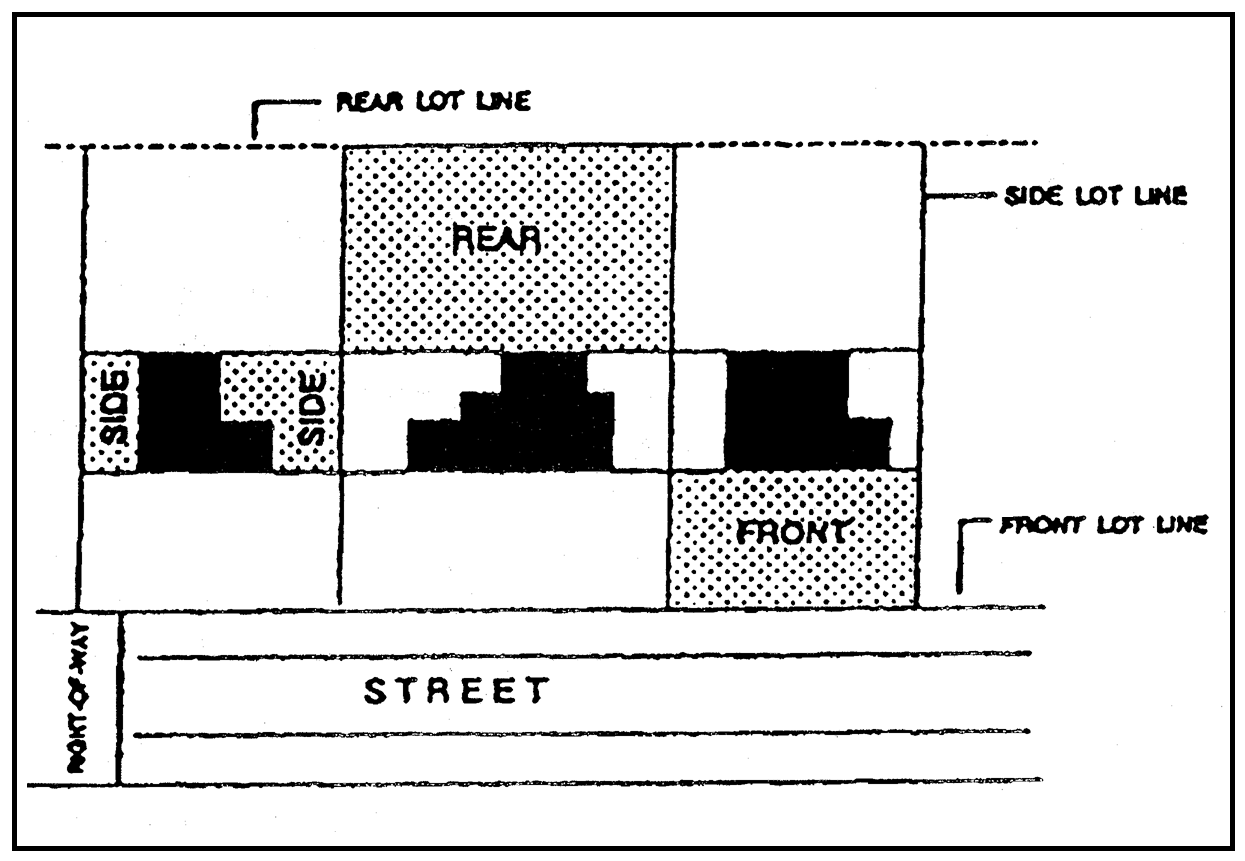
Zoning Administrator: The official of Ypsilanti Township charged with the administration of this ordinance.
Zoning Board of Appeals: The Zoning Board of Appeals of the Charter Township of Ypsilanti.
Zoning District: An area or areas within the incorporated area of the Ypsilanti Township within which regulations and requirements governing use, lot area, lot size, and other provisions are uniform.
Zoning Enabling Act: The Michigan Zoning Enabling Act, as amended, MCL 125.3101 et seq. as adopted by Public Act 110 of 2006.
(Ord. No. 2022-498, 12-23-21; Ord. No. 2023-506, 11-21-23; Ord. No. 2025-513, 12-16-25)

