
Anderson City Zoning Code
CHAPTER 17
15 - MIXED USE DISTRICT ALLOWED USES AND FORM BASED STANDARDS
17.15.010 - Purpose, intent, and applicability.
A.
Chapter Purpose and Intent. The purpose of this Chapter is to establish unique allowed use and development standards for subject property within the Mixed Use area as defined by the City of Anderson Zoning Code. It is the intent of these standards to help preserve and protect the existing, historic, and unique character of Downtown Anderson by requiring new construction and remodels and existing construction to enhance the existing built environment and provide additional development opportunities. Additionally, the application of these standards will enable the Downtown area to become a pedestrian-oriented shopping, doing, entertainment, and living center for the city and environs.
B.
Applicability of Standards and Entitlement Review. The standards of this chapter apply to all property zoned Mixed Use. Uses that require a use permit as listed in Section 17.050 (Allowed use regulations) shall obtain a use permit.
The Downtown is also governed by a regulating plan that addresses how development interacts with the street and how the street is developed. The application of both the zoning district and the regulating plan (see Section 17.030 (Mixed Use District Definitions) for definition) are described in more detail in Sections 17.020.A (Defining the Mixed Use District) and 17.040 (Regulating Plan and Street Typologies and Standards). Generally, the zoning district designation (Mixed Use) defines the character and allowed use provisions for the subject site while the Regulating Plan defines the development standards (setbacks, building typology, street standards).
C.
Applicability of Regulating Plan Standards. Generally, the development standards applicable to a property shall be those for the respective zone and street frontage as reflected in the regulating plan. However, for those properties that face onto multiple street frontages (e.g., a corner lot or a double frontage lot), the following shall apply:
1.
The development standards applicable to the site shall be reflective of the individual sides of the lot.
For instance, if a corner lot faces Street A and Street B, then that side of the lot facing Street A shall be developed consistent with the standards for Street A and the side facing Street B shall be developed consistent with the standards for Street B.
2.
At the corner, the design shall merge and unify the two standards together such that:
a.
The more restrictive setback requirement shall prevail on that side of the corner.
For instance, if Street A has a five-foot build-to line and Street B has a zero-foot build-to line, then that side facing Street A shall be located at the five-foot build-to line and the side facing Street B shall be located at the zero-foot build-to line. (Note: In this example, the building is not centered on the corner; this is consistent with the intent of this provision.)
b.
The more restrictive design standards shall prevail on that side of the corner, provided the two standards are architecturally integrated together.
For instance, if Street A allows for a Stoop frontage and Street B does not, a Stoop may be developed along the Street A frontage, but at the corner the design of the building must architecturally transition into a frontage type that is allowed along Street B. The same shall be true for allowed building types, storefront regulations, sign types, and landscaping. Only those features allowed on that frontage may be developed on said frontage.
2.
In the case of allowed uses, the least restrictive use provisions shall apply to the entire lot, provided that the primary entrance for the use either faces the street with the least restrictive use regulations or (preferred) faces the intersection/street corner.
For instance, if a corner lot faces Street A and Street B and Street A allows a particular use by right and Street B requires a conditional use permit for the same use, then the use shall be allowed by right on that lot provided the primary entrance to the use is located facing Street A or (preferred) facing the intersection/at the corner.
(Ord. 757, § 2(Exh. A), 2009)
17.15.020 - Introduction to the Mixed Use District.
A.
Defining the Mixed Use District. The Mixed Use District is the regulating document for development within Downtown Anderson. The basis for this Code is in two unique zoning districts: the Mixed Use—Commercial Emphasis (MU-C) and the Mixed Use—Residential Emphasis (MU-R). The Mixed Use District recognizes the historic character of the Downtown and identifies a special set of development standards, allowed use regulations, and other special use regulations that apply to new construction and qualifying remodels/expansions.
The standards in this Chapter are presented in a format that is unique to the Downtown—through a form based code. Form based zoning provides a method of regulating development to achieve a desired urban form. Form based provisions address the relationship between building facades and the public realm, the form and mass of buildings, and the size, character, and type of streets and blocks. The central focus of form based provisions is the regulating plan that designates the appropriate form (and character) of development rather than only distinctions in land-use types, which is the basis of conventional zoning.
This Mixed Use District also includes regulations for the street—the space between buildings. Part of the historical context of the Downtown includes how individual developments relate and interact with the street. This is because the street acts as a unifying thread across all development.
B.
Relationship to Other Zoning Provisions. Generally, the regulations of this chapter shall govern development within the Downtown. In cases where there is a conflict between the provisions of this chapter and the regulations elsewhere in the Zoning Code, this Chapter shall prevail. However, with regard to topics on which this Chapter is silent, provisions elsewhere in the Zoning Code shall prevail.
(Ord. 757, § 2(Exh. A), 2009)
17.15.030 - Mixed Use District definitions.
The following terms are used throughout the Mixed Use District and are defined as follows:
Alley. A narrow public drive serving commercial and residential development. (See Section 17.040.B.1.e. for further discussion.)
Alley parking. Residential or commercial parking that takes access from an alley. (See Section 17.060.I.1. for further discussion.)
Arcade frontage. An Arcade frontage is nearly identical in character to the Gallery frontage except that the upper stories of the building may project over the public sidewalk and encroach into the public right-of-way. The sidewalk must be fully absorbed within the colonnade so that a pedestrian may not bypass it. (See Section 17.060.D. for further discussion.)
Avenue. Connects districts or regions and capable of carrying a large amount of vehicular traffic while still maintaining a quality pedestrian environment and retail-supporting urban edge. This street typology may be used in place of an Arterial. (See Section 17.040.B.1.a. for further discussion.)
Awning. A temporary shelter that is supported from the exterior wall of a building. It is typically constructed of canvas or a similar fabric that is sturdy and flexible.
Building type. Defines the type of structure based on massing, layout, and use. (See Section 17.060.E for further discussion.)
Build-to line. An urban setback dimension that delineates the maximum distance from the property line a front or street side building facade can be placed. Typically, build-to lines range from zero to ten feet.
Bulkhead. The portion of a commercial facade located between the ground and the bottom of the street level display windows. It is typically constructed of stone, brick, or concrete.
Bulkhead height. The height of the bulkhead (see "Bulkhead"). (See Section 17.060.G. for further discussion.)
Courtyard housing building type. A group of dwelling units arranged to share one or more common courtyards on a qualifying lot in any zone. Dwellings take access from the street or the courtyard(s). Dwelling configuration occurs as townhouses, apartments, or apartments located over or under townhouses. The Courtyard is intended to be a semi-public space that is an extension of the public realm. (See Section 17.060.E. for further discussion.)
Door Yard/Terrace frontage. Characterized by a facade that is set back from the street property line and multiple levels of the building directly accessible from the street. Door Yard/Terrace is a variation on the Stoop frontage, but it provides opportunities for multiple levels of commercial/retail easily accessible from the street. (See Section 17.060.D. for further discussion.)
Dwelling unit. Any room or group of connected rooms that have sleeping, cooking, eating, and bathroom facilities and are intended for long-term occupation.
Expression line. An architectural embellishment that delineates the end of the ground floor and the start of the second floor of a building.
Facade. The architecturally finished side of a building, typically facing onto a public right-of-way or street.
Form based code (FBC). A development code emphasizing the regulation of building form, scale, and orientation, rather than zoning and land use.
Frontage line. A lot line fronting a street, public right-of-way, paseo, plaza, or park.
Frontage type. The architectural composition of the front facade of a building, particularly concerning how it relates and ties into the surrounding public realm. (See Section 17.060.D. for further discussion.)
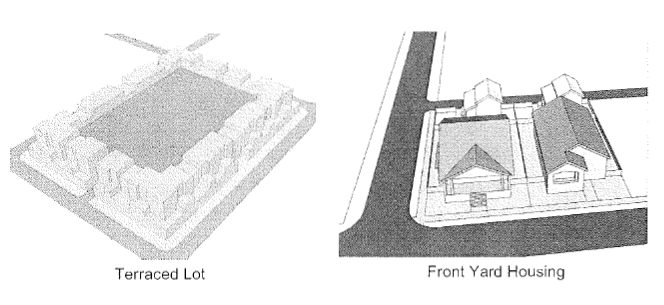
Front yard housing building type. A detached building designed as a single-family residence, duplex, triplex, or quadplex. Front yard housing is accessed from the sidewalk adjacent to the street build-to line. (See Section 17.060.E.4. for further discussion.)
Gallery frontage. Characterized by a facade which is aligned close to or directly on the right-of-way line with the building entrance at sidewalk grade and with an attached colonnade that projects over the public sidewalk and encroaches into the public right-of-way. The sidewalk must be fully absorbed within the colonnade so that a pedestrian may not bypass it. (See Section 17.060.D. for further discussion.)
Ground floor height. The height of the front facade's first story as measured from the sidewalk level up to the bottom of the "expression line" (see "Expression Line"). (See Section 17.060.G.2. for further discussion.)
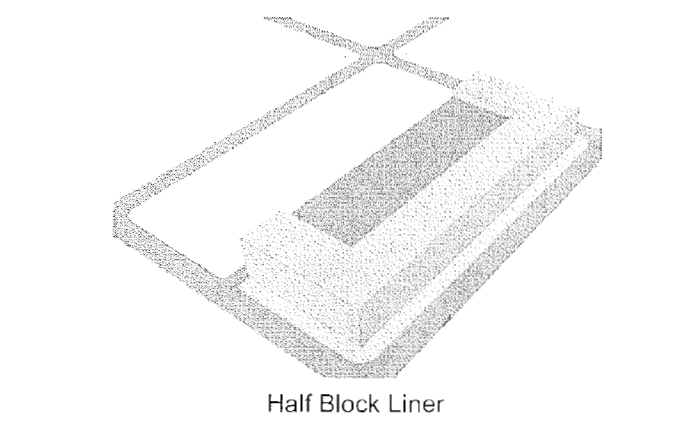
Half block liner building type. An attached building with a frontage of approximately one-third to one-half the length of a Downtown block and zero side yard setbacks. It is used for mixed-use, residential, and commercial development. (See Section 17.060.E. for further discussion.)
Height. The vertical distance of a building measured between the point where the final grade intersects a building or its foundation to the highest point of the building directly above that point.
Historic building or resource. Historic buildings and resources are usually forty-five years old or older and meet at least one of the following criteria:
1.
A resource listed in, or determined to be eligible by the State Historical Resources Commission, for listing in the California Register of Historical Resources (Public Resources Code, Section 5024.1).
2.
A resource included in a local register of historical resources, as defined in Public Resources Code, Section 5020.1(k) or identified as significant in a historical resource survey.
3.
Any object, building, structure, site, area, place, record, or manuscript which the City determines to be historically significant or significant in the architectural, engineering, scientific, economic, agricultural, educational, social, political, military, or cultural annals of California, and:
a.
Is associated with events that have made a significant contribution to the broad patterns of California's history and cultural heritage;
b.
Is associated with the lives of persons important in our past;
c.
Embodies the distinctive characteristics of a type, period, region, or method of construction, or represents the work of an important creative individual, or possesses high artistic values; or
d.
Has yielded, or may be likely to yield, information important in prehistory or history.
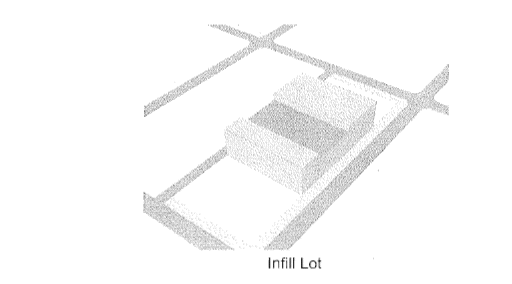
Infill building type. An attached building with a frontage that is less than one-third the length of a Downtown block. It is used for mixed-use, residential, and commercial development. (See Section 17.060.E. for further discussion.)
Inset of front door from "build-to line." The distance from the front door of the building to the "build-to line" (see "Build-to line"). (See Section 17.060.G. for further discussion.)
Maximum awning extension from building. The maximum distance allowed between the building and the end of a fully extended awning (see "Awning"). (See Section 17.060.G. for further discussion.)
Neighborhood yard frontage. Characterized by deep front yard setbacks where the building facade is set back substantially from the front property line. The resulting front yard is unfenced and is visually continuous with adjacent yards, supporting a common landscape. (See Section 17.060.D. for further discussion.)
Parking structure. A privately owned and operated multistory structure that provides public parking spaces for a fee. (See Section 17.060.I. for further discussion.)
Parking type. The type of parking allowed for motorized vehicles including automobiles, trucks, and motorcycles. (See Section 17.060.I. for further discussion.)
Paseo. Local and private pathways serving pedestrians and bicyclists only. Paseos may also provide limited service access during specified periods of the day. (See Section 17.040.B.1.f. for further discussion.)
Porch frontage. Characterized by a facade which is set back from the property line with a front yard and by a porch which is appended to the front facade (the porch may encroach into the front setback). (See Section 17.060.D. for further discussion.)
Regulating plan. Designates building form and streetscape standards based on location, street hierarchy, and character. More specifically, it addresses how development interacts with the street and how the street is developed, and it defines the development standards (setbacks, building typology, street standards).
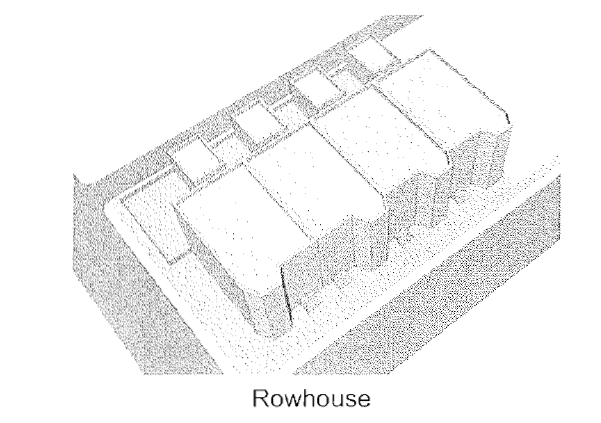
Rowhouse building type. Two or more detached two- or three-story dwellings with zero side yard setbacks. A Rowhouse may be used for nonresidential purposes. (See Section 17.060.E. for further discussion.)
Setback. The required distance between a property line and a building or ancillary structure.
Stoop frontage. Characterized by a facade which is aligned close to the frontage line with the ground story elevated from the sidewalk to provide privacy for the ground floor uses. The entrance is usually an exterior stair or landing which may be combined with a small porch or roof. (See Section 17.060.D. for further discussion.)
Storefront frontage. Characterized by a facade which is aligned close to or directly on the right-of-way line with the building entrance at sidewalk grade. Storefront frontage has substantial glazing on the ground floor and provides awnings or canopies cantilevered over the sidewalk. (See Section 17.060.D. for further discussion.)
Storefront width. The front facade width as measured from one corner of the front facade to the other. (See Section 17.060.G. for further discussion.)
Street typology. Classifies street, sidewalk, and related landscaping standards based on the primary use of the street. (See Section 17.040.B.1. for further discussion.)
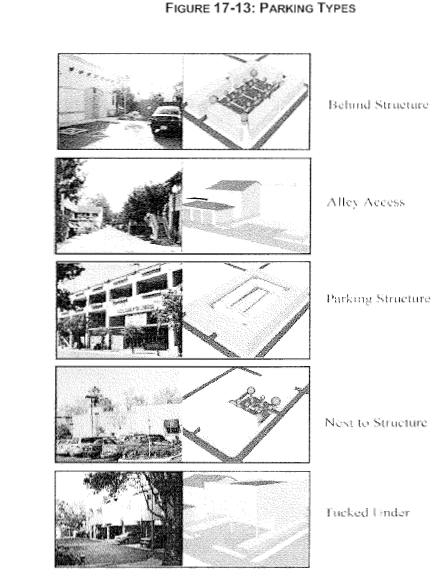
Surface parking—Behind building. Ground-level public or private parking lot located in the rear yard setback behind a building. If possible, access to the parking should be taken from an alley. (See Section 17.060.I. for further discussion.)
Surface parking—Next to building. Ground-level public or private parking lot located in the side yard setback next to a building. If possible, access to the parking should be taken from an alley. (See Section 17.060.I. for further discussion.)
Terrace frontage. Characterized by a facade that is set back from the street property line by an elevated terrace. This buffers residential uses from the sidewalk and removes the private yard from public encroachment. (See Section 17.060.D. for further discussion.)
Tucked under parking. Ground-level private covered parking lot located directly beneath the second floor of building. Tucked under parking shall not be visible from the public right-of-way unless the right-of-way is a City-designated alley. (See Section 17.060.I. for further discussion.)
(Ord. 757, § 2(Exh. A), 2009)
17.15.040 - Regulating plan and street typologies and standards.
A.
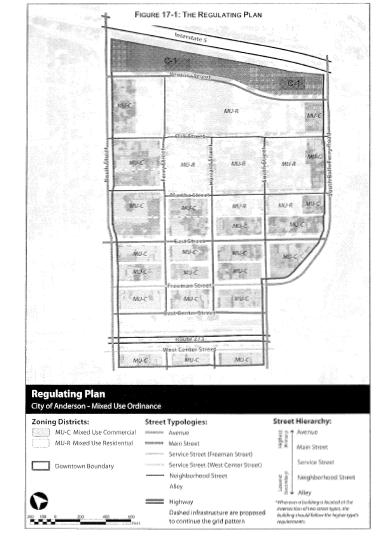
Establishment of the Regulating Plan and Street Hierarchy and Character. In addition to the application of the Mixed Use District, development within the Downtown is also governed by the regulating plan. The regulating plan "codes" development based upon the street it is located along. This plan is based on the following street hierarchy and character, and as illustrated on the regulating plan (see Figure 17-1, The Regulating Plan):
1.
Main street (East Center Street, East Street, and Ventura Street)—A main street is a primary street of Downtown Anderson and provides a social setting for the community. It is pedestrian-oriented and focused on rehabilitation of existing buildings, as well as the development of new infill structures that are compatible with the uniquely small town character of the district. This area benefits from the presence of specialty retail businesses, restaurants, nightlife, and tourism-oriented services. Residential uses that are designed to add activity to the street scene are encouraged.
2.
Service streets (Freeman Street and West Center Street)—The focus of service streets is to maximum [maximize] on-street parking and provide vehicular access to the backs of buildings and parking lots or to serve the automotive type uses found along West Center Street.
3.
Neighborhood streets (South Street, Howard Street, Ferry Street, Martha Street, and Oak Street)—The neighborhood streets of Downtown Anderson display a mix of local retail and residential development. They have a more intimate nature than the other areas, as reflected in the narrower sidewalks and streets, and the abundance of street trees and landscaping. Neighborhood streets also provide the primary pedestrian routes between the residential and commercial portions of Downtown.
4.
Avenues (North Street and Balls Ferry Road)—Avenues are more automobile-oriented than the other streets and replace arterial roadways as these significant roadways pass through Downtown. As such, avenues are an ideal location for regional commercial and family entertainment.
B.
Street Typologies and Standards. The purpose of this Section is to provide roadway standards that will facilitate the creation of streets that are inviting, multimodal public places for vehicular traffic, bicyclists, and pedestrians.
1.
Street Typologies.
a.
Avenue. Avenues connect districts or regions and are capable of carrying a large amount of vehicular traffic while still maintaining a higher quality pedestrian environment and retail-supporting urban edge. This street typology replaces an Arterial in Downtown.
The landscaping strip along the sides of the roadway should be designed to facilitate the safe passage of pedestrians. It is suggested that the strip include a continuous landscaped area between the edge of the curb and the sidewalk. This area should include street trees and lighting designed at a pedestrian scale. Landscape strips should be a minimum of five feet wide. Where a continuous landscape strip is not possible, street trees should be provided within tree wells or at intersections within curb "bulb-outs."
Wherever an avenue intersects with a main street or a neighborhood street, the intersection should be designed to enhance pedestrian safety and convenience. Features may include pedestrian bulb-outs, differentiated accent paving within the intersection, in-street crossing lights (if there is no crosswalk signal), and pedestrian refuge areas within the medians of avenues.
b.
Main Street[s]. Street trees should frequently interrupt the parking lanes to soften visual impact of the parked vehicles and to help cool the air heated by the pavement.
Diagonal parking and wide sidewalks should create a safe, inviting environment for both pedestrians and motorists.
Wherever a main street intersects with an avenue or a neighborhood street, the intersection should be designed to provide pedestrians with safe passage. Features may include pedestrian bulb-outs, differentiated accent paving within the intersection, and in-street crossing lights (if there is no crosswalk signal).
Turning movements typically occur from within the main travel lanes: however, short (one- to two-car length) turn pockets may be provided at some intersections in lieu of parking on one side of the street.
c.
Neighborhood Streets. Neighborhood streets are home to the majority of residential development in Downtown Anderson as well as a few small neighborhood-serving retail stores. These streets have a more intimate nature than the other areas, and because of this landscaping and larger street trees should frequently interrupt the parking lanes to soften visual impact of the parked vehicles and to help cool the air heated by the pavement. A continuous landscape strip is not required.
d.
Service Streets. The focus of service streets is to maximize on-street parking and provide vehicular access to the backs of buildings and parking lots or to serve the automotive type uses.
Customer entrances may be located off alleys, but the primary entrance should face a main street, neighborhood street, or avenue if a lot has two frontages.
e.
Alley. Alleys are narrow public drives serving commercial and residential development. In commercial developments, alleys provide the primary service access and loading areas for businesses.
Customer entrances may also be located off of alleys. In addition, if it does not obstruct the flow of vehicular and pedestrian traffic, portions of the alley may be used for outdoor retail space, patios, art gardens, and related uses. In residential development, parking should be accessed via alleys.
Alley street lighting and landscaping should be designed at a pedestrian scale with an emphasis on creating a safe and secure environment. Additionally, landscaping shall not impede automobile or pedestrian visibility within or immediately adjacent to an alley.
f.
Paseo. Paseos are local and private pathways serving pedestrians and bicyclists only, and they may also provide limited service access during specified periods of the day. In addition, if it does not obstruct the flow of pedestrian traffic, portions of the paseo may also be used for outdoor dining, retail space, patios, art gardens, and related uses.
These types of "streets" are not necessarily shown on the Regulating Plan but would be appropriate to include in the district as part of a unified development plan to connect uses and activities in a pedestrian orientation without additional public right-of-ways.
Paseo street lighting and landscaping should be designed at a pedestrian scale. Larger canopy trees should be used where possible for shade.
2.
Street Typology Standards. The following table (Table 17-1) displays associated standards for each street typology.
TABLE 17-1: STREET TYPOLOGY STANDARDS
Notes:
1.
Twenty-five feet is ideal but actual curb radius shall be determined in consultation with Caltrans and the City Engineer.
2.
Street trees shall be provided along neighborhood streets. Bulb-outs at street intersections and landscape planters placed between parallel parking spaces shall be provided of sufficient size to accommodate street trees planted at regular intervals as required by the Planning Director.
(Ord. 757, § 2(Exh. A), 2009)
17.15.050 - Allowed use regulations.
The purpose of this section is to list allowed uses according to districts and Downtown zones within the districts. This list is not meant to be exhaustive and does not regulate building character or design, but instead delineates the types of uses allowed within a building. These allowed use regulations are unique to Chapter 17 and are intended to implement the vision of the Anderson General Plan.
Areas within the Downtown area that are zoned C-1 are subject to the applicable regulations in the Zoning code related to that zoning district. Buildings constructed within Downtown are encouraged to comply with building placement and design standards set forth for the Mixed Use District.
A.
Permitted Uses. The following table (Table 17-2) identifies the permitted uses within the Downtown. These allowed use regulations are listed by street type, then by district, as applicable. The uses listed are defined in Section 17.050.B (Definitions of Permitted Uses).
TABLE 17-2: PERMITTED USES
Notes:
1. Alcohol sales permitted on premises.
2. Subject to home occupation standards.
3. Ground floors shall be constructed to accommodate commercial use. Ground floor residential uses may be permitted as interim uses only.
The symbols are defined as: P—Permitted; C—Conditionally Permitted; N—Not Permitted.
B.
Definitions of Permitted Uses.
1.
Attached Single-family Residential. A building designed exclusively for occupancy by one family on a single lot that has zero side yard setbacks and shares a party wall with the adjacent building(s) (e.g., townhouse).
2.
Commercial Recreation and Entertainment. Establishments providing indoor or outdoor recreation and entertainment services including bars, movie theaters, dance halls, electronic game arcades, bowling alleys, billiard parlors, ice/rolling skating rinks, health clubs.
3.
Detached Single-family Residential. A building designed exclusively for occupancy by one family on a single lot. This classification includes manufactured homes (defined in California Health and Safety Code Section 18007).
4.
Institutional/Governmental. This use includes churches and related facilities, government agency and service facilities (e.g., post office, civic center, police department, fire department), as well as public educational facilities and publicly owned parkland.
5.
Home Occupation. The conduct of a business within a dwelling unit or residential site, employing occupants of the dwelling, with the business activity being subordinate to the residential use of the property. Home occupations are typically home office use with a limited number of customers coming to the site. Examples include, but are not limited to, accountants and financial advisors, architects, artists, attorneys, and real estate sales.
6.
Live/Work Unit. An integrated housing unit and working space, occupied and utilized by a single household in a structure, either single-family or multi-family, that has been designed or structurally modified to accommodate joint residential occupancy and work activity, and which includes:
a.
Complete kitchen space and sanitary facilities in compliance with the City building code; and
b.
Working space reserved for and regularly used by one or more occupants of the unit.
c.
The difference between live/work and work/live units is that the "work" component of a live/work unit is secondary to its residential use and may include only commercial activities and pursuits that are compatible with the character of a quiet residential environment, while the work component of a work/live unit is the primary use to which the residential component is secondary.
7.
Mixed-use. Characterized by commercial retail use on the ground floor and office, hotel, or residential uses on the upper floors.
8.
Multi-family Residential. A building designed and intended for occupancy by two or more families living independent of each other, each in a separate dwelling unit, which may be owned individually or by a single landlord (e.g., duplex, triplex, quadplex, apartment, apartment house, condominium).
9.
Navigation Centers. "Low barrier navigation center" means a housing first, low-barrier, service-enriched shelter focused on moving people into permanent housing that provides temporary living facilities while case managers connect individuals experiencing homelessness to income, public benefits, health services, shelter, and housing. A low barrier navigation center may be non-congregate and relocatable as defined by Government Code Section 65660.
10.
Neighborhood Commercial. A pedestrian-oriented market store oriented to the daily shopping needs of the surrounding residential areas. Neighborhood markets are less than eight thousand square feet in size and operate less than eighteen hours a day. Neighborhood markets may include deli or beverage tasting facilities that are ancillary to the market/grocery portion of the use. Alcohol sales are allowed for off-site consumption or on-site consumption as part of the beverage tasting facility only.
11.
Offices. This use includes businesses providing direct services to consumers (e.g., insurance companies, utility companies), professional offices (e.g., accounting, attorneys, doctors, dentists, employment, public relations), personal services (e.g., barber and beauty shops, shoe repair, tailors), and offices engaged in the production of intellectual property (e.g., advertising, architectural, computer programming, photography studios).
12.
Retail Commercial. Stores and shops selling multiple lines of merchandise. These stores and lines of merchandise include, but are not limited to, art galleries, bakeries (all production in support of on-site sales), clothing and accessories, collectibles, department stores, drug stores, dry goods, fabrics and sewing supplies, florists and houseplant stores, furniture, home furnishings and equipment, general stores, gift shops, hardware, hobby materials, musical instruments, parts and accessories, newsstands, pet supplies, specialty shops, day spas, sporting goods and equipment, and stationery stores. Thrift stores are allowed with the issuance of a conditional use permit only.
13.
Sit-down Restaurants. A retail business selling food and beverages prepared and/or served on the site, for on-premise consumption where most customers are served food at tables, but may include providing food for takeout. Also includes coffee houses and accessory cafeterias as part of office and industrial uses. Alcohol sales are allowed for on-site consumption only.
14.
Supportive Housing. Housing with no limit on length of stay, that is occupied by the target population, and that is linked to an onsite or offsite service that assists the supportive housing resident in retaining the housing, improving their health status, and maximizing their ability to live and, when possible, work in the community as defined by California Government Code Section 65582.
15.
Transitional Housing. Buildings configured as rental housing developments, but operated under program requirements that require the termination of assistance and recirculating of the assisted unit to another eligible program recipient at a predetermined future point in time that shall be no less than six months from the beginning of the assistance as defined by California Government Code Section 65582.
C.
Prohibited Uses. Regardless of zoning designation, unless it is found that the use is compatible with a mixed-use development, the following uses shall be prohibited:
1.
Adult-oriented business;
2.
Agriculture and commercial nursery;
3.
Commercial cleaning plant;
4.
Boat, trailer, and vehicle (including parts) sales, service, storage and garages except along West Center and Douglas streets;
5.
Camp and trailer park;
6.
Car wash;
7.
Drive-in/drive-through restaurants;
8.
Equipment rental and sales yard;
9.
Fuel dealers;
10.
Laundry, commercial plant;
11.
Recycling center and recyclable material collection facility;
12.
Service station;
13.
Thrift store. Defined as a shop where more than fifty percent of the sales inventory is used articles except as provided in Section 17.15.050(B)11.
14.
Uses involving hazardous materials or generating high level of noise incompatible with residential uses;
15.
The planning director may deem additional uses to be prohibited based on a finding that the use is similar in nature, function, and operation to the prohibited uses listed in this subsection.
(Ord. 757, § 2(Exh. A), 2009; Ord. No. 767, 9-21-2010; Ord. No. 868, § 2, 2-17-2026; Ord. No. 870, § 2, 2-17-2026)
17.15.060 - Development standards.
Development standards for development activities are intended to encourage, protect, and preserve the historic urban image of Downtown Anderson. They are also intended to improve overall aesthetic appearance and to serve as an incentive for private investment.
An important initiative of the Anderson Mixed Use District is to clearly spell out development standards that shape the desired urban form. Building intensities are regulated through conformance to the prescribed development standards and design guidelines (e.g., height, setbacks, parking, form, massing).
A.
General Development Standards.
1.
Mandatory Conformance. Standards listed in this Section—General Development Standards—as well as architectural and design standards listed in Section 17.070, are mandatory requirements that must be satisfied for all new projects and modifications to existing development, as follows:
a.
Projects shall be reviewed for conformance with these provisions as part of design review.
b.
Modifications to existing development, except for minor modifications listed (as listed in [Subsection] c., below) and that only require issuance of a building permit, shall be reviewed for conformance to the standards within this chapter as part of plan check during building permit review.
c.
Standards within this Chapter are not applicable to minor modifications to a structure, such as repair, restoration, or reconstruction, where such work, as determined by the Planning Director, maintains the outer dimensions and surface relationships of the existing structure (e.g., repainting, replacement of windows or doors with matching size and style, repair of exterior materials such as stucco, brick, and wood)
2.
Adaptive Reuse Provisions. The following exemptions to the design standards are provided to allow the reuse of existing small scale buildings within the district:
a.
Within the MU-C portion of the district the following exemptions and provisions shall apply to nonconforming houses or stand-alone structures on lots seven thousand square feet or smaller:
i.
Structures are exempted from the "build-to" requirements.
ii.
Maintenance, repair and modifications are permitted without compliance to provisions within this Chapter provided such work does not exceed fifty percent of the appraised value thereof, according to the assessor's records or current appraisal of valuation of subject property. Any appraisal shall be furnished and paid for by the applicant.
iii.
The design review committee shall review remodels, and expansions, unless otherwise exempted. A determination shall be made by the committee that the improvements comply with the spirit of the design standards by incorporating one or more features.
b.
Within the MU-R, conversions from residential to an allowed commercial use (e.g. offices, restaurants and small shops) is subject to review and approval by the design review committee. The DRC shall review the conversion plans to ensure the character of the building is preserved while allowing for necessary commercial modifications including but not limited to Americans with Disabilities Act requirements.
c.
Nonconforming properties located in either the MU-C or MU-R that qualify as historic buildings or resources as defined by this code may also expand or remodel subject to review and approval by the design review committee that the historic character of the building is maintained or reestablished.
3.
Area-Wide Height Requirements and Exceptions. Refer to Section 17.060.B. and Table 17-3 for district height requirements.
The approval body may approve architectural features such as tower elements, elevator service shafts, and roof access stairwells that extend above the height limit. Telecommunications antennas and service structures located on rooftops may also exceed the maximum building height but shall be hidden to the maximum extent possible using appropriate screening and "stealth" technologies.
B.
Height Requirements. The maximum height is specified in Table 17-3 below and is intended to preserve the compact, walkable, historic Downtown core while simultaneously stimulating economic development in the commercial heart of the City.
TABLE 17-3: HEIGHT REQUIREMENTS
1.
The maximum height may be increased by twenty percent with a use permit.
C.
Building Placement. The setbacks and build-to lines for Downtown Anderson are intended to enhance social interactions in the historic Downtown retail core while simultaneously providing appropriate levels of privacy in residential areas.
Table 17-4 and Figure 17-10 display setback requirements for each Downtown Anderson district.
TABLE 17-4: SETBACK AND "BUILD-TO" REQUIREMENTS
* Build-to lines are defined as the edge where the public right-of-way ends and the private property boundary begins. The line may vary from the standards specified in this table if a conflict exists with the allowed frontage type. Additional setback may be permitted to allow for outdoor seating, an entry plaza and other similar areas. Buildings may not be setback to accommodate parking in front of building facades.
D.
Frontage Types. The architectural composition of the front facade of a building, particularly concerning how it relates and ties into the surrounding public realm. The Downtown Anderson frontage types are intended to enhance social interactions in the historic Downtown retail core while simultaneously providing appropriate levels of privacy in residential areas. Allowed frontage types in the different districts and along the four street types are listed in Table 17-5 and defined below. An "X" means that the frontage type is allowed; a blank cell means that the frontage type is not allowed.
TABLE 17-5: ALLOWED FRONTAGE TYPES
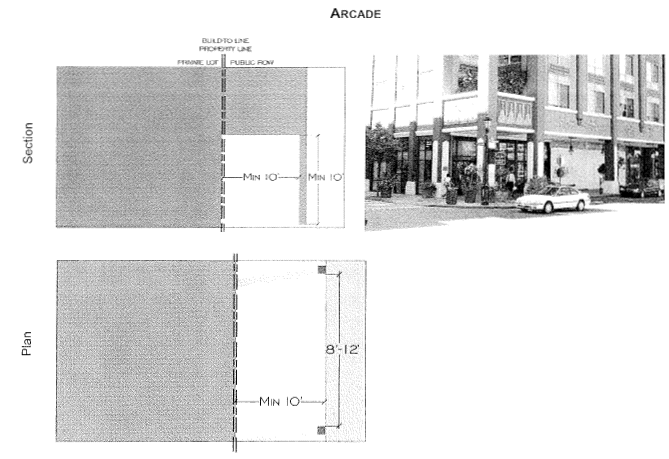
• Depth = Ten-foot minimum from the build-to line to the inside column face.
• Height = Ten-foot minimum clear.
• Seventy-five percent—one hundred percent of the building front.
— An arcade frontage is nearly identical in character to the Gallery frontage except that the upper stories of the building may project over the public sidewalk and encroach into the public right-of-way.
— The sidewalk must be fully absorbed within the colonnade so that a pedestrian may not bypass it.
— This frontage is typically for retail use.
— An encroachment permit is needed to construct this frontage type, but can be approved as part of Design Review.
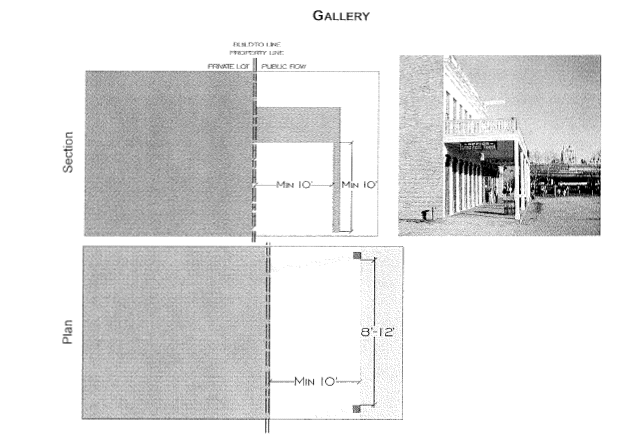
• Depth = Ten-foot minimum from the build-to line to the inside column face.
• Height = Ten-foot minimum clear.
• Seventy-five percent—one hundred percent of the building front.
— A gallery frontage is characterized by a facade which is aligned close to or directly on the right-of-way line with the building entrance at sidewalk grade and with an attached colonnade that projects over the public sidewalk and encroaches into the public right-of-way.
— The sidewalk must be fully absorbed within the colonnade so that a pedestrian may not bypass it.
— This frontage is typically for retail use.
— An encroachment permit is needed to construct this frontage type, but can be approved as part of Design Review.
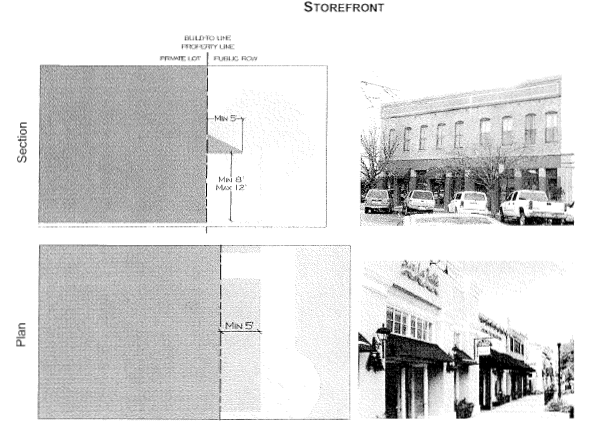
• Depth = Five-foot minimum over the sidewalk.
• Height = Eight-foot minimum clear, twelve-foot maximum.
• Minimum of fifty percent of the overall building frontage.
— A storefront frontage is characterized by a facade which is aligned close to or directly on the right-of-way line with the building entrance at sidewalk grade.
— Storefront frontage has substantial glazing on the ground floor.
— Storefront frontages provide awnings or canopies cantilevered over the sidewalk.
— Building entrances may either provide a canopy or awning, or alternatively, may be recessed behind the front building facade.
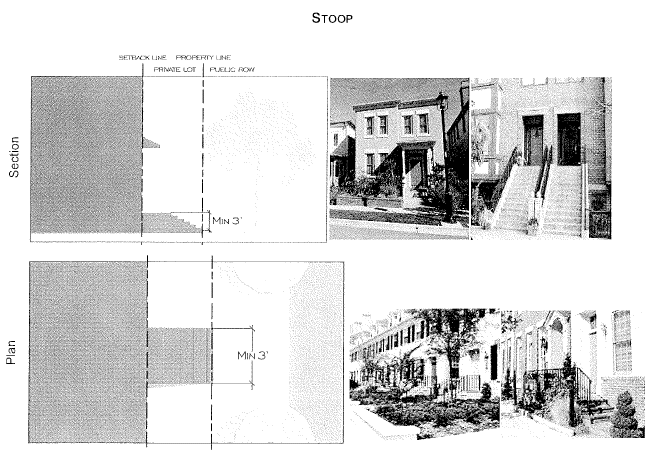
• Width = Three-foot minimum.
• Stoops must rise to a minimum of three feet above grade. Exceptions may be permitted to comply with ADA requirements where no other alternative exists.
— A stoop frontage is characterized by a facade which is aligned close to the frontage line with the ground story elevated from the sidewalk to provide privacy for the ground floor uses.
— The entrance is usually an exterior stair or landing which may be combined with a small porch or roof.
— The stoop frontage type is suitable for ground floor residential uses with short setbacks.
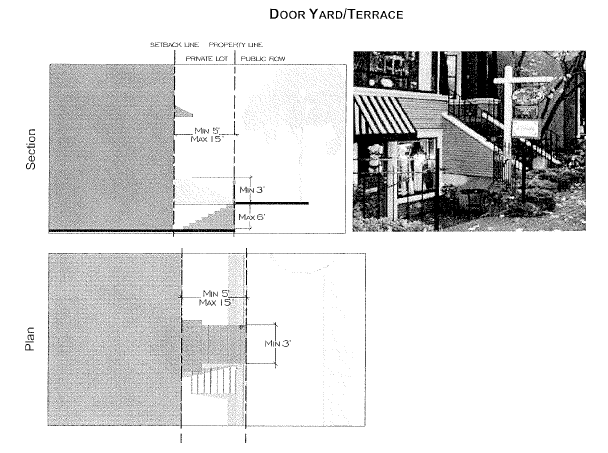
• Width = Three-foot minimum.
• Minimum of three feet above grade. Exceptions may be permitted to comply with ADA requirements where no other alternative exists.
— A door yard/terrace frontage is characterized by a facade that is set back from the street property line and multiple levels of the building directly accessible from the street.
— The door yard/terrace is a variation on the stoop frontage, but it provides opportunities for multiple levels of commercial/retail easily accessible from the street.
— Could also be used for a lower-level commercial use with office or residential on the second level.
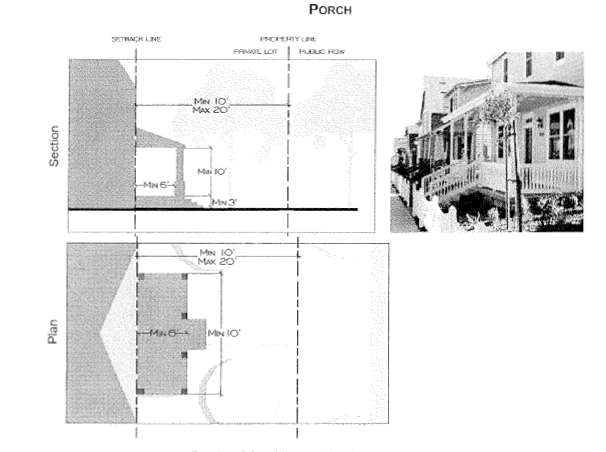
• Depth = Six-foot minimum (clear).
• Width = Ten-foot minimum.
• Height = Ten-foot minimum (clear).
• Porch height must be a minimum of three feet above grade. Exceptions may be permitted to comply with ADA requirements where no other alternative exists.
— This frontage type is characterized by a facade which is set back from the property line with a front yard and by a porch which is appended to the front facade.
— The porch may encroach into the front setback.
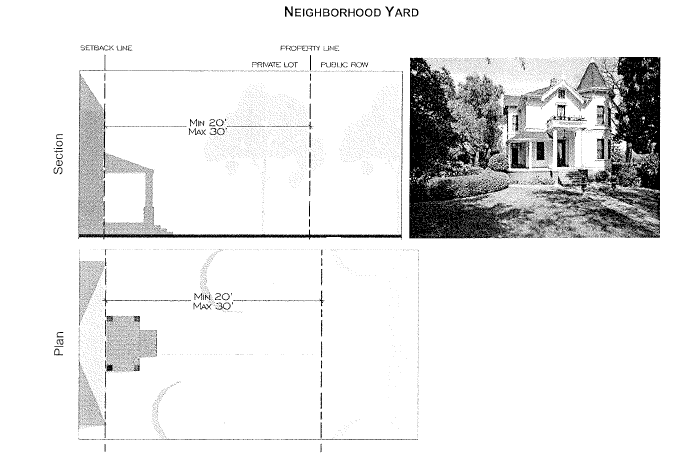
• Minimum twenty-foot setback
• Maximum thirty-foot setback
— A neighborhood yard frontage is characterized by deep front yard setbacks. The building facade is set back substantially from the front property line. The resulting front yard is unfenced and is visually continuous with adjacent yards, supporting a common landscape. Porches and/or stoops are not required, though they are recommended.
E.
Building Types. The following building types are intended to provide a variety of flexible building styles appropriate for the small town character of Anderson that can be used to guide future development. Allowed building types in the different districts and along the four street types are listed in Table 17-6 and defined below. An "X" means that the building type is allowed; a blank cell means that the building type is not allowed.
TABLE 17-6: ALLOWED BUILDING TYPES
1.
Half Block Liner. An attached building with a frontage of approximately one-third to one-half the length of a downtown block and zero side yard setbacks. It is used for mixed-use, residential, and commercial development.
2.
Infill. An attached building with frontage that is less than one-third the length of a downtown block and zero side yard setbacks. It is used for mixed-use, residential, and commercial development.
3.
Terraced. A mixed-use, residential, or commercial building characterized by individual units that are assessed via multileveled outdoor terraces. The terraces are intended to be semi-public spaces that are extensions of the public realm.
4.
Front Yard Housing. A detached building designed as a single-family residence, duplex, triplex, or quadplex. Front Yard Housing is accessed from the sidewalk adjacent to the street build-to line.
5.
Rowhouse. Two or more detached two- or three-story dwellings with zero side yard setbacks. A rowhouse may be used for nonresidential purposes.
6.
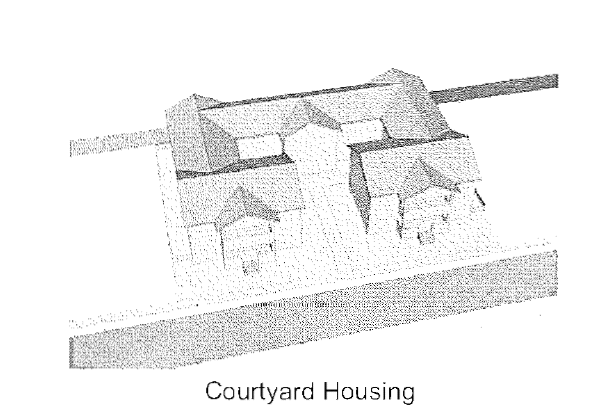
Courtyard Housing. A group of dwelling units arranged to share one or more common courtyards on a qualifying lot in any zone. Dwellings take access from the street or the courtyard(s). Dwelling configuration occurs as town houses, apartments, or apartments located over or under town houses. The courtyard is intended to be a semi-public space that is an extension of the public realm.
F.
Residential Standards When Part of Mixed-Use Development. The residential component of a mixed-use development may be located wholly within an existing commercial building or in an entirely new structure. The following requirements apply:
1.
To provide adequate privacy and security, residential entrances may be grade-separated or placed in the quieter areas away from the main commercial portions.
2.
Access to residential use shall be clearly delineated.
3.
Access to open space areas, either public or private, shall be provided when available.
4.
When in a mixed configuration, residential uses should be located on the upper stories or on ground floors when they do not use storefront space. Residential uses may occupy, on a temporary basis, the ground floor of a building located on commercial street frontage, but the ground floor shall be designed to accommodate future commercial use.
5.
Units of various sizes (e.g., studios, one- and two-bedroom units) are encouraged.
6.
Open space shall be required regardless if the residential use is located in an existing, expanded, or new structure:
a.
The amount of open space shall be governed by the standards of the residential zoning most similar in nature and function to the proposed residential portion of the mixed-use development. However, the amount may be reduced based on the anticipated needs of the future tenants and the quality, usefulness, and/or amenities within the spaces provided.
b.
On-site open space may include, but is not limited to, pedestrian walkways, plaza areas, landscape areas, roof gardens, terraces, and other creative spaces which may be used either visually, actively, or passively by the residents within the development.
c.
Public open space such as parks, plazas, public recreational facilities, and other similar facilities located within one-quarter mile may be counted toward the open space requirement for the mixed-use development.
G.
Storefront Regulations. The following storefront standards are intended to provide continuity of building form at street level in Downtown Anderson. Additionally, standards are meant to enhance the relationship between buildings and the sidewalk, subsequently encouraging more pedestrian activity.
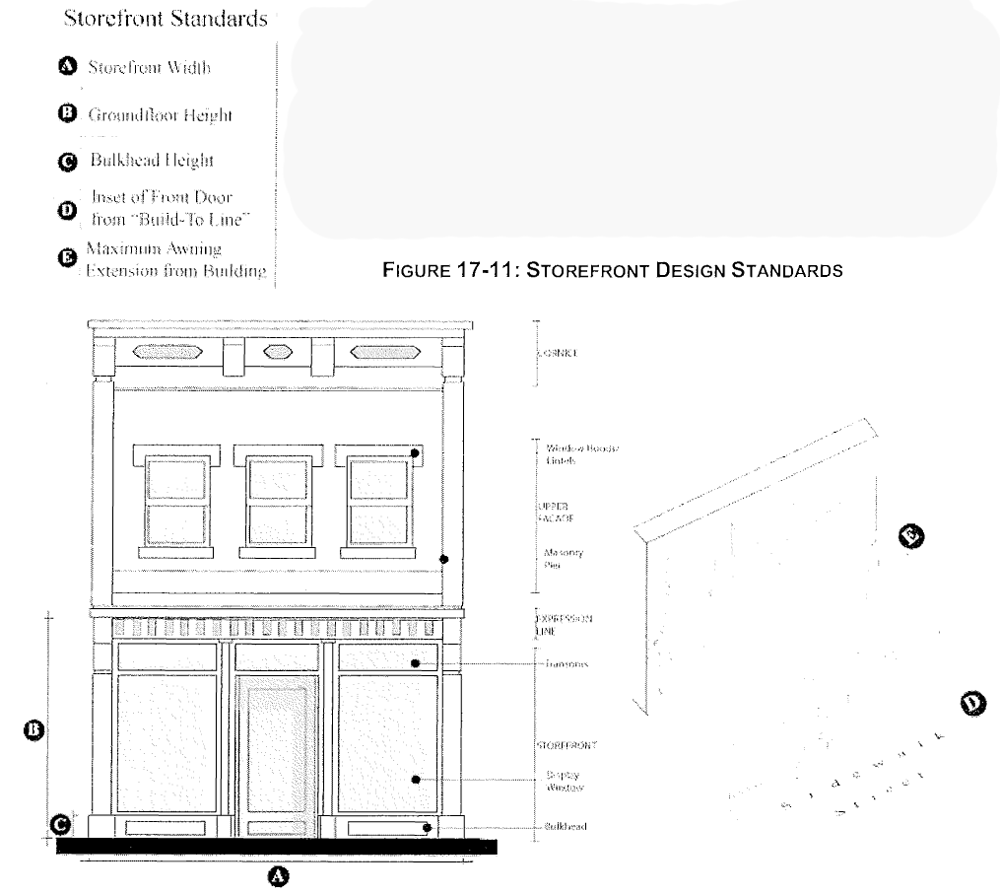
Table 17-7 lists the storefront design standards. "Tags" refer to those elements labeled in Figure 17-11 and described below (Storefront Design Standard Definitions).
TABLE 17-7: STOREFRONT DESIGN STANDARDS
H.
Storefront Design Standard Definitions.
1.
Storefront Width. The front facade width as measured from one corner of the front facade to the other.
2.
Ground Floor Height. The height of the front facade's first story as measured from the sidewalk level to the top of the expression line. An expression line is an architectural embellishment that delineates the end of the ground floor and the start of the second floor of a building.
3.
Bulkhead Height. The height of the bulkhead which is the portion of a commercial facade located between the ground and the bottom of the street level display windows. It is typically constructed of stone, brick, or concrete.
4.
Inset of Front Door from Build-To Line. The distance from the front door of the building to the build-to line. A build-to line is an urban setback dimension that delineates the maximum distance from the property line a front building facade can be placed. Typically, build-to lines range from zero to ten feet. See Table 17-7 for build-to line regulations in Downtown Anderson.
5.
Maximum Awning Extension from Building. The maximum distance allowed between the building and the end of a fully extended awning. An awning is a temporary shelter that is supported from the exterior wall of a building. It is typically constructed of canvas or a similar fabric that is sturdy and flexible.
6.
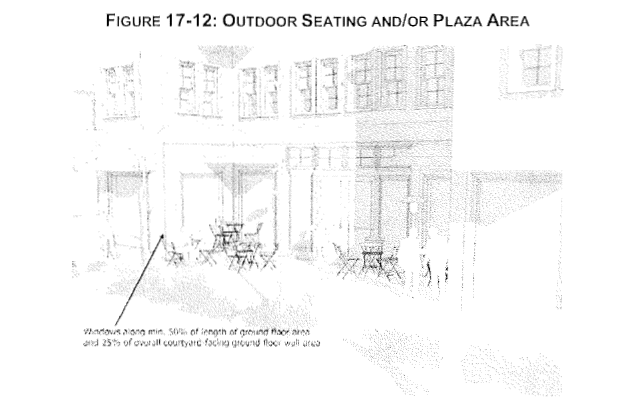
Entry Plazas and Seating Areas. Downtown stores are encouraged to integrate outdoor seating and entry plazas into the design of buildings. The building facades may be setback from the build-to line to accommodate outdoor seating and/or plazas. Storefront windows and doors shall be used to ensure that a visual connection is maintained between the outdoor and indoor areas of the use.
I.
Parking. Parking requirements have been reduced to encourage pedestrian activity and economic growth in Downtown Anderson. In the design of parking facilities, consideration should be given to locating parking in the back or at the sides of buildings in order to maintain a continuous retail facade for pedestrians along downtown streets.
1.
Allowable Parking Types. Allowable parking types listed in Table 17-8 and defined below. An "A" means that the parking type is allowed; a "P" means that the parking type is preferred and highly encouraged. An "N" means that the parking type is not allowed.
TABLE 17-8: PARKING
N—Not permitted
A—Allowed
P—Preferred and highly encouraged.
2.
Parking Standards.
a.
Downtown Anderson encourages "one-stop" parking where shoppers park once and visit multiple stores on foot. On-street parking is encouraged and along certain streets may serve as the only parking for a use. Shared parking lots are encouraged.
b.
Locating parking lots between the front property line and the building store front is prohibited. Instead, off-street parking should be located to the rear of buildings. Street parking should be available whenever possible in front of retail stores.
c.
When off-street parking in the rear is not possible, the visual impact of headlight bleed and the asphalt parking surface shall be minimized by landscaped berms and/or walls with a maximum height of 3 feet.
d.
Rear parking lots should be designed and located contiguously, or adjacent to alleys, so that vehicles can travel from one private parking lot to the other either directly or via an alley without having to enter a street. This may be achieved with reciprocal shared access agreements.
e.
Locate rear parking lots or structure entries on side streets or alleys in order to minimize pedestrian/vehicular conflicts.
f.
Create wide, well-lit, landscaped pedestrian walkways connecting on-site pedestrian circulation systems in parking lots to off-site public sidewalks and building entries.
g.
In order to minimize conflicting vehicle turning movement along major roadways, the City encourages shared access drives within and between integrated nonresidential development. This reduces the number of driveway curb cuts. The City also encourages reciprocal access between non-residential developments to provide for convenience, safety, and efficient circulation. If incorporated, a reciprocal access agreement shall be recorded with the land by the owners of abutting properties to ensure shared access will be preserved over time.
h.
The layout of parking areas should be designed so that pedestrians walk parallel to moving cars.
i.
Parking areas that accommodate a significant number of vehicles should be divided into a series of connected smaller lots. Landscaping and offsetting portions of the lot are effective in reducing the visual impact of larger parking areas.
j.
Demarcation of parking spaces should be legible, and the spaces should be adequate but not overly generous.
k.
Parking structures (privately owned and operated) are encouraged to incorporate retail and/or office space on the street level of the structure. This prevents the structure from becoming a pedestrian "dead zone" in Downtown Anderson.
J.
Signs. The following sign standards are intended to encourage creative sign design as an integral part of a building's architecture, rather than treating signs as an add-on or afterthought. Additionally, stimulating retail and wayfinding signage in Downtown Anderson will increase economic activity and city legibility. While this Section addresses permanent signage within the Downtown, additional provisions for temporary signs, prohibited signs, and other general provisions may be found in Chapter 17.44 (Comprehensive Sign Ordinance).
1.
Relation to Other City Sign Regulations. Where conflicts exist between this Section and Chapter 17.44 (Comprehensive Sign Ordinance), provisions within this Section shall prevail.
2.
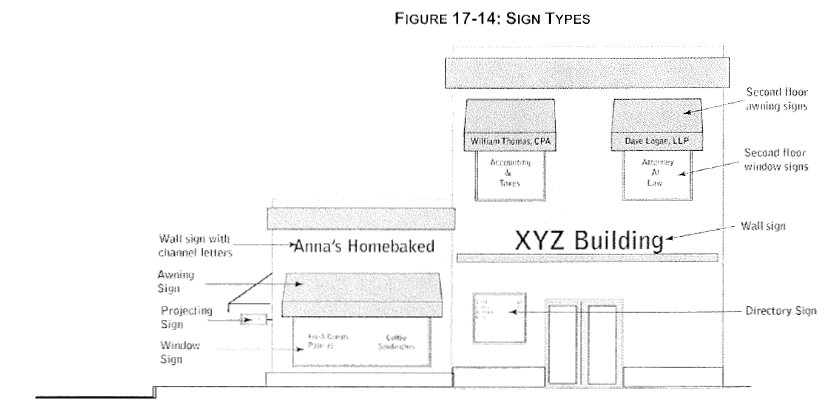
Allowed Sign Types. Allowed types of signs are listed in Table 17-9 by street type and zone. An "A" means that the sign type is allowed; a "P" means that the sign type is preferred and highly encouraged. An "N" means that the sign type is not allowed.
TABLE 17-9: ALLOWABLE SIGN TYPES
Notes:
1.
Monument signs allowed only if landscaped and shared by two or more businesses.
2.
A-frame signs permitted only if they do not interfere with the pedestrian right-of-way.
N—Not permitted
A—Allowed
P—Preferred and highly encouraged.
3.
Sign Size and Number. Consistent with the standards of Chapter 17.44 (Comprehensive Sign Ordinance), the maximum allowed number and size for signs in downtown shall be as follows:
a.
Freestanding Sign. One freestanding identification sign per site allowing one-quarter foot of sign area per foot of lot frontage on which the sign is to be located, not to exceed twenty square feet in area nor six feet in height on a site where all buildings are set back at least ten feet from the street curb or street pavement edge on which the use fronts. Where the subject property exceeds one acre in size, the maximum sign area may be increased to forty square feet and height to ten feet.
b.
Wall Sign. One wall sign per building frontage. Maximum wall sign area is determined as follows, not to exceed one hundred square feet:
i.
For buildings with only one building frontage: One-half square foot of sign area for each ground-level linear foot of building frontage.
ii.
For buildings with multiple building frontages: One-half square foot of sign area for each ground-level linear foot of one building frontage and one-quarter square foot of sign area for each linear foot of additional frontage. The basic sign area in a multitenant center may be reallocated between businesses by the center manager based on an overall sign plan for the center.
c.
Marquee Sign. One marquee sign per building occupant which does not exceed five square feet in area or is located lower than seven and one-half [feet] above the grade level below it. No sign may be placed upon the roof of a marquee.
d.
Projecting Signs. One projecting sign per building, not to exceed four-tenths square feet for every linear foot of main entrance facade frontage, not to exceed a maximum of twenty square feet. A projecting sign shall be at least eight feet above grade directly below the sign.
e.
Multistory Building Directory Sign. One directory wall sign for each primary building entry to identify occupants in a multistory building. The sign may not exceed five square feet in area.
f.
A-Frame Signs. One freestanding A-frame sign not exceeding an area of four square feet and three feet in height per establishment.
3.
Sign Design. Design, color, materials, size, and placement are all important in creating signs that are architecturally attractive and integrated into the overall site design. Signs that are compatible with the surroundings and effectively communicate a message will promote a quality visual environment. The standards that follow address these issues and others; the standards are intended to help business owners provide quality signs that add to and support the character of Downtown Anderson.
a.
General Design Standards.
i.
Design signs in harmony with the style and character of the development and as an integral design component of the building architecture, building materials, landscaping, and overall site development.
ii.
Sign letters and materials should be professionally designed and fabricated.
iii.
Exposed conduit and tubing (raceway) is prohibited. All transformers and other equipment shall be concealed.
iv.
All signs shall be maintained in good repair, including the display surface, which shall be kept neatly painted or posted.
v.
The exposed back of all signs visible to the public shall be suitably finished and maintained.
vi.
The use of retractable awnings as a signage tool is acceptable.
b.
Placement.
i.
Signs should be generally free of obstructions when viewed from different angles. However, trees or other landscaping that grow to a point that it obstructs the view of a sign or makes it illegible shall not be grounds for removal or trimming of the plant(s).
ii.
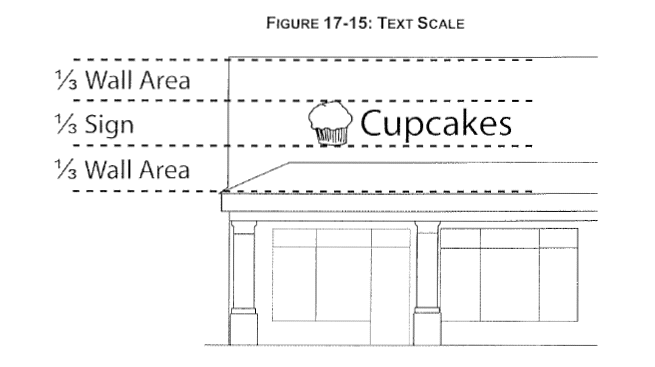
Utilize a consistent proportion of signage to building scale, such as one-third text to two-thirds wall area or one-fourth text to three-fourths wall area. See Figure 17-15 (Text Scale).
c.
Materials.
i.
Paper and cloth signs are appropriate for interior temporary use only and are not permitted on the exterior of a building.
ii.
The use of neon is permitted if it fits with the style of the architecture (e.g., art deco) and is not a nuisance (e.g., produces glare) to the surrounding properties.
Sign Tips: Colors and Materials
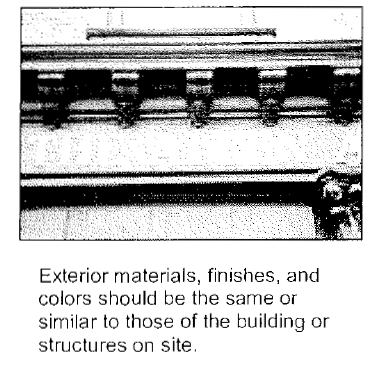
—Use exterior materials, finishes, and colors in harmony with, or an upgrade to, those of the buildings or structures on site.
—The selected materials need to contribute to the legibility of the sign. For example, glossy finishes are often difficult to read because of glare and reflections.
—Contrast is an important influence on the legibility of signs. Light letters on a dark background or dark letters on a light background are most legible.
—Limit the total number of colors used in any one sign. Small accents of several colors may make a sign unique and attractive, but the competition between large areas of many different colors decreases readability.
d.
Sign Legibility.
i.
Avoid spacing letters and words too close together. Crowding of letters, words, or lines will make any sign more difficult to read. Conversely, over-spacing these elements causes the viewer to read each item individually, again obscuring the message. As a general rule, letters should not occupy more than 75 percent of the sign panel area.
Sign Tips: Legibility
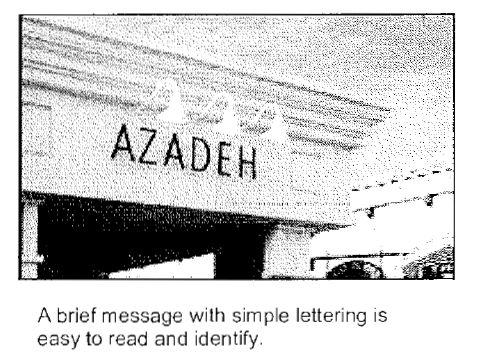
—Use a brief message whenever possible. Fewer words help produce a more effective sign. A sign with a brief, succinct message is easier to read and looks more attractive.
—Limit the number of lettering styles in order to increase legibility. A general rule to follow is to limit the number of different letter types to no more than two for small signs and three for large signs.
—Use symbols and logos in the place of words whenever appropriate. Pictographic images will usually register more quickly in the viewer's mind than a written message.
—Avoid hard-to-read, overly intricate typefaces and symbols. Typefaces and symbols that are hard to read reduce the sign's ability to communicate.
e.
Sign Illumination.
i.
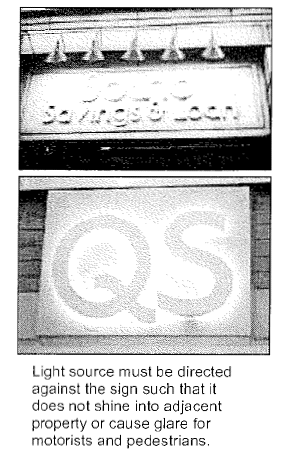
The light from an illuminated sign shall not be of an intensity or brightness that will create glare or other negative impact on residential properties in direct line of sight to the sign.
ii.
Whenever indirect lighting fixtures are used (fluorescent or incandescent), care shall be taken to properly shield the light source to prevent glare from spilling over into residential areas and any public right-of-way.
iii.
Reserved.
iv.
Reserved.
v.
Internally illuminated plastic box "canned" signs are prohibited. Individually illuminated channel letters are acceptable.
vi.
Signs shall not have blinking, flashing, or fluttering lights, or other illumination devices that have a changing light intensity, brightness, or color.
vii.
Light sources shall utilize energy-efficient fixtures to the greatest extent possible and shall comply with Title 24 of the California Code of Regulations (California Building Standards Code).
Sign Tips: Illumination
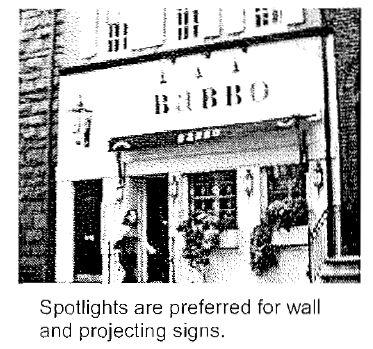
—If the sign can be illuminated by an indirect source of light, this is usually the best arrangement because the sign will appear to be better integrated with the building's architecture. Light fixtures attached to the front of the structure cast light on the sign and the face of the structure as well.
—Individually illuminated letters should be backfill. Signs composed of individual letters mounted directly on a structure can often use a distinctive element of the structure's facade as a backdrop, thereby providing a better integration of the sign with the structure.
K.
Landscaping. Landscaping in Downtown Anderson should be pedestrian-oriented and reflect and enhance the area's small town charm. These provisions emphasize the use of potted plants, trees, and landscaping along urban streetscapes and within urban parking lots. Landscaping shall be provided on-site consistent with the standards set forth below.
1.
Landscaping Standards.
a.
Street Trees. Street trees shall be provided every thirty feet on center within the required landscape area. Tree selection shall be from the city's adopted street tree list and to the satisfaction of the planning director.
b.
Standard Design Concepts.
i.
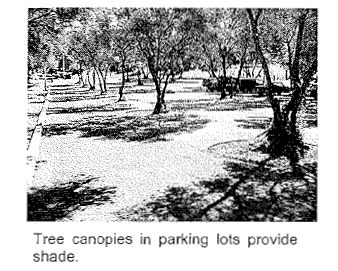
Use landscaping to complement the architecture, to minimize the impact of incompatible land uses, and to establish a transition between adjacent developments. Plant materials can absorb sound, filter air, curtail erosion, provide shade, and maintain privacy.
ii.
Provide landscaping to break up blank walls, shade pedestrians, accent entries, and soften the connection of paving for vehicles to buildings.
iii.
Landscaping strips (or bulb-outs) on public streets should be wide enough for canopy shade that is consistent with the street width. See standards for landscape area width in Section 17.040.
iv.
The use of alternative types of landscaping strip ground cover is strongly encouraged. Standard grass strip is discouraged.
v.
Parking facilities shall attain a minimum of fifty percent tree canopy coverage within ten years of completion of construction to provide shade and minimize visual and environmental impacts.
vi.
In surface parking lots, trees should be installed at a ratio of one tree per three parking stalls for the perimeter of the parking lot and one tree per six spaces for the interior of the parking lot.
vii.
Consider placement of trees and shrubs to avoid conflict with vehicular overhangs, traffic and visibility patterns, and on-site structures.
viii.
Owners of vacant lots without any structures shall seed the lot(s) on a regular basis and mow a minimum of once a season to eliminate fire danger or as necessary to present a clean and tidy appearance.
ix.
Owners of vacant lots that contain structures shall maintain the existing landscaping on a regular basis so that the lot(s) should not give an overgrown appearance.
x.
Landscape should be oriented in accord with the demands of the species for sunlight and its susceptibility to the prevailing wind.
c.
Irrigation. Irrigation of landscaping shall only be directed onto the landscaping. Spillover onto hardscape shall be minimized to the maximum extent feasible.
d.
Tree Grates/Guards.
i.
Tree grates should be utilized at passages to provide a continuous walking surface while providing adequate space for the tree to grow.
ii.
Install structural soil systems to direct new root growth downward below hardscape areas, which helps to postpone root damage caused to the surrounding hardscape and structures. By providing deep watering and air to root systems as appropriate when trees are planted within five feet of any permanent structure/paving/curb, additional service life may be achieved. Structural soil systems are preferred over root barriers as they are often more effective.
iii.
A minimum of six feet of structural soil shall be provided for trees. The area of enhanced root zone environment shall be enlarged beyond this minimum according to the species size planted. The structural soil can be provided under tree grates and pavement.
iv.
Trees and landscaping installed in parking lots should be protected from vehicle damage by a minimum six-inch-tall concrete curb surrounding the planter area. Planter barriers to protect landscaping should also be designed with intermittent curb cuts to allow parking lot runoff to drain into landscape areas.

e.
Pots and Planters.
i.
Boxed and container plants in decorative planters of ceramic, terra cotta, wood, metal, or stucco should be used to enhance public areas.
ii.
Large planters may also be incorporated into seating areas. Such planters should be open to the earth below and be provided with a permanent irrigation system.
iii.
Hanging flower baskets enhance the beauty of the Downtown. Lamp posts should include supports and irrigation systems for hanging flower baskets. Flower baskets may also hang from buildings, such as on arcades, galleries, porches, and other frontage types, provided that supports are architecturally consistent with the building and irrigation systems are included.
f.
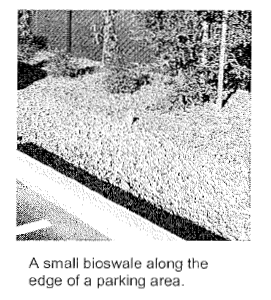
Water Quality and Urban Runoff. Because of the proximity of the downtown to natural riparian areas and the potential impact of urban activities on the natural environment, water quality and urban runoff in the downtown is of particular concern. The use of bioswales and landscaped water quality basins represents the preferred approach to urban runoff and stormwater quality control throughout downtown, particularly in the MU-R zone. Such features add aesthetic character, utilize natural materials, and serve as a functional element that allows for stormwater management.
i.
Bioswales and similar natural landscaped runoff control facilities shall be used to enhance appearance of stormwater management methods and allow for groundwater recharge.
ii.
Bioswales shall be used to collect surface runoff before it crosses pavement areas and to reduce ponding and damage to walkways. Bioswales shall be graded to direct water away from paved areas into detention basins.
iii.
Bioswales shall utilize a slope that is steep enough to prevent ponding and shallow enough to slow water velocity. Soils must not readily drain water; the goal is to get cleaner water to flow downstream. Recommended slopes of one to four percent should be used. Flow should be sufficiently low enough to provide adequate residence time within the channel. Flow depth should not be taller than the vegetation (a maximum depth of four inches is recommended). Final design of bioswales shall be subject to approval of the City Engineer.
(Ord. 757, § 2(Exh. A), 2009)
17.15.070 - Special use regulations and other standards.
The purpose of the following special use regulations is to address concerns and provide standards for the following types of development and issues specific to Downtown Anderson. These standards should ensure consistency with the vision and goals defined in this Zoning Code and the General Plan by providing guidance to planners, developers, and residents on these unique topics.
A.
Live/Work. Live/work units are built spaces that function predominantly as work spaces and secondarily as residences.
Live/work units are permitted in buildings through a conditional use permit which demonstrates compliance with the following standards:
1.
The unit must contain a cooking space and bathroom in conformance with applicable building standards.
2.
Adequate and clearly defined working space must constitute no less than fifty percent of the gross floor area of the live/work unit. Said working space shall be reserved for and regularly used by one or more persons residing there.
3.
At least one residence in each live/work unit shall maintain at all times a valid city business license for a business on the premises.
4.
Persons who do not reside in the live/work unit may be employed in a live/work unit when the required parking is provided.
5.
Customer and client visits are allowed when the required parking is provided.
6.
No portion of a live/work unit may be separately rented or sold as a commercial space for a person or persons not living on the premises, or as a residential space for a person or persons not working on the premises.
B.
Newspaper Racks. For the purpose of this section, "newspaper rack" is defined as any type of unattended device placed upon or abutting any public right-of-way for the vending, display, or free distribution of newspapers, news periodicals, or other written materials.
1.
Permission to install a newspaper rack requires an encroachment permit from the City of Anderson.
2.
No person shall place, erect, install, service, stock, or maintain any newspaper rack or courtesy bench which obstructs or intrudes upon, in whole or in part, any public right-of-way. A minimum of four feet of clear walkway must be maintained.
3.
Newspaper racks shall not be located directly in front of a building entrance.
4.
Newspaper racks may not be anchored to a light pole, street sign, or other similar street element.
5.
Any vendor choosing to distribute free publications in Downtown Anderson shall obtain prior approval from the City prior to installation.
C.
Public Art. For the purpose of this section, "public art" in Downtown Anderson is defined as permanent or temporary works of art in the public realm, whether part of a building or freestanding. Public art shall not include any form of commercial advertising.
1.
Public art shall be incorporated into public plazas, parks, and municipal buildings. Additionally, the incorporation of public art into private development projects is strongly encouraged.
2.
Possible types of public art include but are not limited to the following options:
a.
Building features and enhancements such as bike racks, gates, benches, water features, or shade screens, which are unique and/or produced in limited editions by a professional artist.
b.
Landscape art enhancements such as walkways, bridges, or art features within a garden.
c.
Murals or mosaics covering walls, floors, and walkways. Murals may be painted or constructed with a variety of materials, including the use of imbedded and nontraditional materials.
d.
Sculptures, which can be freestanding, wall-supported or suspended, kinetic, electronic, and made of endurable materials suitable for the site.
e.
Fiberwork, neon, or glass artworks, photographs, prints, and any combination of media including sound, film, and video systems, or other interdisciplinary artwork applicable to the site.
f.
Community arts projects resulting in tangible artwork, such as community murals, sculptures, or kiosks.
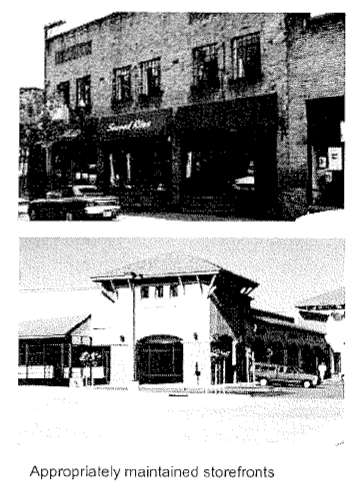
D.
Storefront Vacancy. For the purpose of this Section, a "storefront vacancy" in Downtown Anderson is defined as a vacant commercial ground floor (street-level) space in any otherwise occupied or unoccupied building.
1.
Vacant storefronts shall be properly locked and secured to prevent unauthorized trespassing during the period of vacancy.
2.
The exterior facade of vacant storefronts shall be maintained by the property owner at the same level of quality as surrounding occupied storefronts and buildings.
3.
Property owners of vacant storefronts shall use creative temporary alternative uses of storefront window areas such as using them as a display area for community information, public art by local artists, and merchandise from other stores.
4.
Property owners of vacant storefronts shall consult with the city's economic development staff regarding possible available tenants.
5.
Vacant storefronts shall not be boarded up or otherwise appear derelict or abandoned.
6.
An adequate level of exterior security lighting shall be regularly maintained regardless of storefront occupancy status.
(Ord. 757, § 2(Exh. A), 2009)
17.15.080 - Low barrier navigation center.
A.
Purpose and Intent. The purpose of this section is to allow operation of low barrier navigation centers to help people in need of housing that are temporarily homeless and to implement the provisions of Government Code Section 65660 relating to low barrier navigation centers.
B.
Definitions. For purposes of this section, the following definitions shall apply, as defined by Government Code Section 65660.
1.
Coordinated Entry System. A centralized or coordinated assessment system developed pursuant to the applicable provisions of the Code of Federal Regulations as specified in Government Code Section 65662, and any related requirements, designed to coordinate program participant intake, assessment, and referrals.
2.
Low Barrier. Best practices to reduce barriers to entry, and may include, but is not limited to, the following:
a.
The presence of partners if it is not a population-specific site, such as for survivors of domestic violence or sexual assault, women, or youth.
b.
Pets.
c.
The storage of possessions.
d.
Privacy, such as partitions around beds in a dormitory setting or in larger rooms containing more than two beds, or private rooms.
C.
Requirements. A low barrier navigation center shall meet the following requirements:
1.
It offers services to connect people to permanent housing through a services plan that identifies services staffing.
2.
It is linked to a coordinated entry system, so that staff in the interim facility or staff who colocate in the facility may conduct assessments and provide services to connect people to permanent housing.
3.
It complies with Chapter 6.5 (commencing with Section 8255) of Division 8 of the Welfare and Institutions Code.
4.
It has a system for entering information regarding client stays, client demographics, client income, and exit destination through the local Homeless Management Information System as defined by Section 578.3 of Title 24 of the Code of Federal Regulations.
D.
Application Procedure and Review.
1.
Within thirty days of receipt of an application for a low barrier navigation center development, the local jurisdiction shall notify a developer whether the developer's application is complete pursuant to Section 65943 [of the California Government Code].
2.
The city shall act within sixty days of receipt of a completed application.
(Ord. No. 870, § 1, 2-17-2026)

