
Batesburg Leesville
City Zoning Code
City Zoning Code
ARTICLE 10
- LANDSCAPING
10-1.- LANDSCAPE REQUIREMENTS.
These requirements apply to all developments or redevelopments with a change in use of greater intensity, or where an expansion or redevelopment of a property results in an increase in the value of the property by 50% or more of the pre-development value, or an increase of 50% or more of the building or parking areas within the Town of Batesburg-Leesville jurisdiction, with the exception of the construction, enlargement or repair of any single-family detached dwelling.
(Ord. of 11-14-2005)
10-2. - LANDSCAPING PLAN REQUIREMENTS.
In addition to the site plan requirements from the appropriate land development regulation sections, the following standards shall apply:
(a)
North arrow and scale.
(b)
Topographic information and final grading adequate to identify and properly specify planting for areas needing slope protection.
(c)
The location and contours, at one (1) foot intervals, of all proposed berms.
(d
The location and dimensions of all existing (to remain) and proposed structures, setback line and required buffer yards, parking lots, driveways, landscaped islands and strips, sidewalks, service areas, screening, fences, walls, berms, above or underground utilities and storm drainage systems, freestanding electrical equipment, recreational facilities, and other freestanding structural features as determined necessary by the Town.
(e)
Location of plant material, including name of plants (botanical and common), installation size, spread at time of planting and at maturity, quantities of plants, and other remarks as appropriate to describe plant selection (lawns and beds of annual or perennial plants may be designated by common names only).
(f)
Onsite and abutting land use features [within 50 feet], and use(s) of adjacent parcel(s).
(g)
Protection plan for existing trees that are to be saved.
(h)
Location of irrigation system, if any, to landscaped areas.
(i)
Such other information as may be deemed necessary because of the landscaping requirements or physical characteristics peculiar to the particular development.
(Ord. of 11-14-2005)
10-3. - STANDARDS.
10-3.1.
Planting - Vegetation used in landscaping or screening should be planted during the dormant season to ensure the best chance of survival. A surety bond may be required to insure the installation of landscaping, especially during the growing season.
10-3.2.
Driver Visibility - Landscaping, including existing or planted material, shall not obstruct the view of motorists using any street, private driveway, parking aisles or the approach to any street intersection.
10-3.3.
Maintenance - The owner is responsible for maintaining all required plant material in good health. Any dead, unhealthy or missing plants must be replaced with vegetation that conforms to the initial planting standards of this section. All landscape planting areas shall be stabilized from soil erosion immediately upon planting and shall be maintained for the duration of the premises. In the event that plant material is severely damaged due to an unusual weather occurrence or other act of nature, the owner shall have until the end of the dormant season to replant.
10-3.4.
Existing Landscaping Features - Use of existing trees or shrubs to satisfy off-street landscaping is strongly encouraged. If such existing landscaping is used and consists of mature and semi-mature trees, the Zoning Administrator shall have the authority to reduce the amount of required landscaping by up to fifty (50%) percent based on the following schedule. In no instance shall any paved area within a parking area extend closer to any existing tree used for landscaping than its drip line.
10-3.5.
General Provisions - In order to receive credit, preserved vegetation must be in good health and condition. Protective barriers around trees designated to be preserved must be indicated on the landscaping and grading plans. If a preserved tree dies, it must be replaced with the total number of trees, which were credited to the existing tree.
Existing vegetation in the buffer may be counted toward the required plantings. The specific numbers and types of required plantings for each buffer type may be varied through Alternative Compliance, if the Zoning Administrator determines that the existing vegetation forms an effective buffer.
A.
Plant Installation Standards - The following standards shall apply to all new plant material installed as a requirement of this section:
1.
A variety of different species (including both deciduous and evergreen species) shall be incorporated into the site design to provide visual interest, as well as disease and pest resistance.
2.
Indigenous and drought resistant plant material should be used wherever possible. If such plant materials are not used, then an irrigation system shall be installed.
3.
All plant material installed shall be free from disease.
4.
All plant material shall be installed in a fashion that ensures that availability of sufficient soil and water to sustain healthy growth.
5.
All plant material shall be planted in a manner that is not intrusive to utilities or pavement.
6.
Plant materials should be placed intermittently against long expanses of building walls, fences and other barriers to create a softening effect.
7.
Ground cover plants shall be planted in a number as appropriate by species to provide fifty (50) percent surface coverage.
8.
Seeding or sodding shall be provided for full coverage within the first growing season.
9.
Sod shall be used where necessary to provide coverage and soil stabilization.
10.
Detention/retention basins and ponds should be landscaped. Landscaping should include canopy and understory trees, evergreens, shrubbery, hedges, and/or other live planting materials.
Detention/Retention Ponds:
a.
Detention and retention ponds, or other holding areas that are part of a storm/surface water system, should be enhanced as an amenity of the development.
b.
Unless designed as an integral part of a landscape plan or featured as an amenity (i.e., water features in a wet bottom basin or recreation/open space in a dry bottom basin), all detention ponds, retention ponds, or other similar holding areas shall be screened from view from any existing or future private or public street and from adjoining property.
c.
The development of any system shall be in accordance with the provisions of the Lexington County Stormwater Management and Sediment Erosion Control Ordinance, to include the requirement of fencing for safety purposes.
Screening:
a.
The use of vegetation for screening is strongly encouraged, however, if fencing or a wall is used for screening of service areas, utilities, or ponds, at least 50% of the structure shall be softened with shrubbery or other vegetation. The vegetation must be placed on the outside property line of the structure. Access and room for maintenance must be incorporated into the design and placement of the structure and subsequent vegetation.
11.
Earthen berms and existing topography should, whenever practical, be incorporated into the landscape treatment of a site.
12.
Automated irrigation systems, when required, shall be equipped with electronic rain gauges to prevent inadvertent watering during periods of precipitation.
B.
All new plant material shall be the following minimum sizes:
1.
Small maturing (understory/ornamental) trees shall be a minimum one and one-half (1½) inch caliper at installation and multi-stem varieties shall be a minimum of five (5) feet in height, as measured by ANSI Z60.1-1996 American Standard For Nursery Stock.
2.
Large and medium maturing (canopy) trees shall be a minimum two (2) inches caliper at installation and multi-stem varieties shall be a minimum of ten (10) feet in height, as measured by ANSI Z60.1-1996 American Standard For Nursery Stock.
3.
Evergreen trees shall be a minimum six (6) foot height at installation, as measured by ANSI Z60.1-1996 American Standard For Nursery Stock.
4.
Shrubs shall be a minimum of 18 inches in height at installation, as measured by ANSI Z60.1-1996 American Standard For Nursery Stock.
C.
All plant material used must meet the standards set forth in ANSI Z60.1-1996 American Standard for Nursery Stock. The Town Zoning Administrator shall review questions about acceptable plant materials. A list of recommended plantings is located at the end of this Article.
D.
All landscape islands must be covered with living material including grass, groundcover, and shrubs, except for marked areas directly around the trees, so that no soil is exposed. No stone or synthetic mulch is permitted. All other planting areas not covered by trees or shrubs shall be covered by grass, mulch and ground covers.
(Ord. of 11-14-2005; Ord. of 3-8-2010)
10-4. - LANDSCAPED YARDS.
10-4.1.
Street Yards - The minimum average width of all required street yards shall be ten (10) feet. Widths shall be measured perpendicular to the appropriate street right-of-way. Trees for use in street yards shall be of large maturing canopy type. Ornamental and coniferous types shall not be used to meet the requirements of this section unless conflicts with overhead utilities exist. In such case, the building official may authorize the substitution of understory trees. The Zoning Administrator may waive the street yard requirement if the building is built to a zero front setback as permissible by the zoning district, in conjunction with the Town Center plan, and if the development is commercial or mixed-use. Residential developments other than multi-family shall provide street yards as part of the street plan and public right-of-way. Landscaping requirements are shown in Table 1.
10-4.2.
Perimeter Yards - The minimum width of side yards for lots 200 feet or greater in width shall be ten (10) feet. For lots less than 200 feet in width, the combined width of the side yards shall be a minimum of 10% of the total width of the lot. All rear yards shall be at least 10 feet in width Perimeter yards are only required of commercial, manufacturing and multi-family developments. Landscaping requirements are shown in Table 1.
10-4.3.
Zoning Setbacks - The required landscaped perimeter yards shall not prohibit the location of buildings, structures or shared drives otherwise specifically allowed by the underlying zoning setbacks, and may be reduced accordingly by the Zoning Administrator.
10-4.4.
Maximum Requirement - The landscaped yard should not result in requiring more than 35% of the available lot and may be reduced accordingly by the Zoning Administrator. Additionally, the intent of this ordinance shall not be construed as to mean that trees are to be planted in a density that would be unhealthy or damaging.
Table 1 - Street and Perimeter Yards
;adv=6;(Ord. of 11-14-2005)
10-5. - PARKING LOTS.
The impervious surface of the parking area and access area shall be separated from the street right-of-way and property lines by a landscaped strip at least ten feet in width. Ingress and egress shall be provided through driveway openings only. In the event a parking lot is adjacent to a parking lot or driveway on another parcel, the required landscaped strip along the common property line between the two areas may be waived by the Zoning Administrator, or the Planning Commission, if it will result in less traffic congestion on adjoining streets because of improved traffic circulation between the two parking lots or a reduction in the number of curb cuts.
10-5.1.
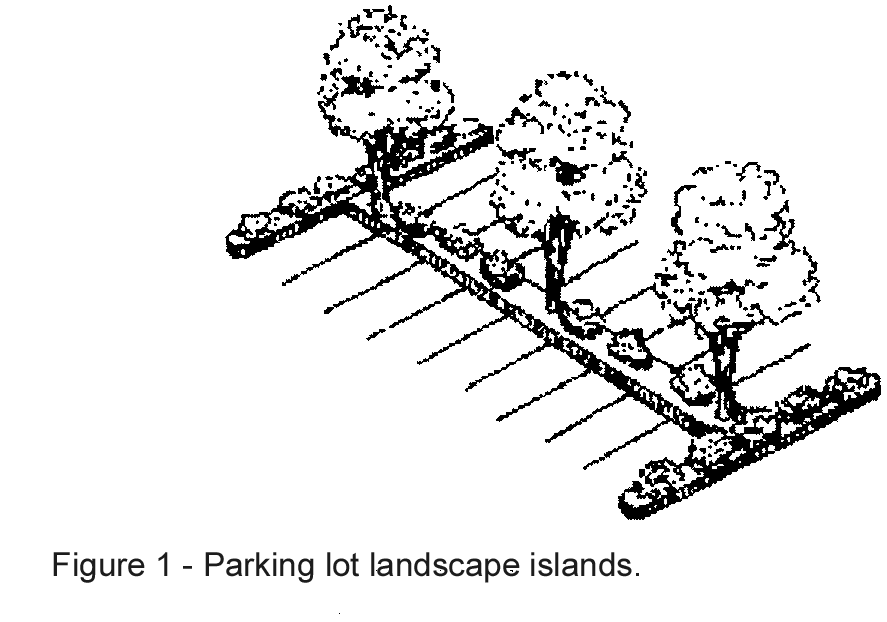
The parking lot shall be constructed so that spaces are grouped into bays. At the end of each bay for 8 or more cars, a landscaped island of at least nine feet in width and 15 feet in length shall be built to separate the bays from each other or from traffic lanes. When the parking bays contain double rows of parking spaces, the landscaped island shall be increased to nine feet in width and 30 feet in length. (Figure 1) A parking bay may not be constructed to a length of more than 180 feet without constructing a landscaped island. The Zoning Administrator may approve islands, which vary from 9' x 15' or 9' x 30' rectangles in order to provide desirable geometric design features such as rounded corners and angles to facilitate maneuvering of automobile traffic.
10-5.2.
The landscaped areas within the parking lot shall not be less than 4% of the impervious surface area of the parking lot. The perimeter landscaped strip and street yards required shall be excluded from the calculations of the minimum landscaped percentage.
10-5.3.
A minimum of one tree shall be provided within the landscaped areas in the parking lot for each 10 parking spaces in the lot. No trees identified as large maturing shall be planted within 20 feet of an electrical transmission or distribution line. Existing trees and natural vegetation shall be retained wherever possible, particularly where they border adjacent property. All parking facing street frontage shall plant shrubs to screen the area (not to exceed three feet at mature height at entrances and sight distance triangles) or create berms. No gaps greater than five (5) feet are allowed in a screen. All applications for development review or zoning permits shall be accompanied by a landscaping plan.
(Ord. of 11-14-2005)
10-6. - LANDSCAPE MAINTENANCE.
The owner, or his agent, shall be responsible for the maintenance, repair and replacement of all landscaping materials and barriers.
10-6.1.
No plant material over 18 inches in height at maturity or structures of any kind shall be placed within the sight distance triangle or sight visibility triangle.
10-6.2.
Fences and walls shall be maintained in good repair.
(Ord. of 11-14-2005)
10-7. - SERVICE/UTILITY AREAS.
This section shall apply to all service areas which either present safety hazards or detract from the aesthetics of the community, or both; including but not limited to, loading docks, garbage collection sites, exposed utility fixtures, HVAC equipment, tanks, etc.
All service areas affected by this article shall be provided with a visual screen consisting of fences or landscaping, or both, designed and installed to screen the area from view from any public street or adjoining property and shall meet or exceed the minimum standards required below:
A.
The screening must be at least six (6) feet in height or the height of the object to be screened.
B.
The screening must extend along the entire perimeter of the service area, except for necessary access.
C.
Fencing shall be designed to relate well to the principal building as to materials and colors. Fences must be constructed of brick, masonry, or wood and shall require appropriate plantings.
Garbage collection sites (dumpsters, compactors) shall be shielded from sight by screening as outlined above and shall be eighty percent (80%) opaque. This screening shall also be provided to deter unauthorized access.
(Ord. of 11-14-2005)
10-8. - BUFFER YARDS.
When land is developed and the adjacent property contains an unlike land use, buffer yards shall be provided along all side and rear property lines to insulate adjacent properties from adverse impacts. No structure or parking lot shall be permitted within a required buffer yard; however, driveways and other passive activities may utilize these spaces. All shrubs used for buffer yards shall be evergreen unless otherwise approved by the Zoning Administrator. Shrubs must be 18 inches in height at installation. See Table 2 for specific planting requirements.
10-8.1.
Buffer yard Types.
Type A - Shall apply when any use is similar to an adjacent use or has only a slight impact on the adjacent use. This is similar to the standard street yard requirement. See Table 3 for specific zoning uses to which this type of buffer shall apply.
Type B - Shall apply when any use is somewhat different from an adjacent use or has a moderate impact on adjacent uses. See Table 3 for specific zoning uses to which this type of buffer shall apply.
Type C - Shall apply when any use is clearly different from an adjacent use or has a definite impact on adjacent uses. See Table 3 for specific zoning uses to which this type of buffer shall apply.
Type D - Shall apply when any use is incompatible with an adjacent use or has a large impact on adjacent uses. See Table 3 for specific zoning uses to which this type of buffer shall apply.
Type E - Shall apply when any use is incompatible with or has a severe impact on adjacent uses. See Table 3 for specific zoning uses to which this type of buffer shall apply.
Table 2 - Bufferyard Types
(Ord. of 11-14-2005)

