
Batesburg Leesville
City Zoning Code
City Zoning Code
ARTICLE 8
- SPECIAL PROVISIONS
8-1.- GROUP HOUSING PROJECTS.
8-1.1.
General: Group housing projects consist of more than one residential structure (single-family, duplex or multi-family) on a single lot in permitted residential districts. All group housing projects shall conform to the following minimum standards:
a.
Lot Size: A group housing project shall not be permitted on a lot having an area of less than twenty thousand (20,000) square feet;
b.
Street Access: Any building established in connection with such group housing project which cannot properly be served by emergency or service vehicles from an abutting street shall be made accessible to such vehicles by a paved driveway having a roadbed width of not less than twenty (20) feet, exclusive of parking spaces;
c.
Off-Street Parking Facilities: Off-street parking facilities established in connection with such developments shall be of such design, location and arrangement that will not interfere with the efficient flow of traffic through the area and that will not interfere with the access of emergency or service vehicles;
d.
Separation of Buildings: All buildings and structures established in connection with such projects shall not be less than twenty (20) feet apart, nor less than forty (40) feet apart of front-to-front;
e.
Setback Requirements: Unless otherwise provided by this ordinance, all buildings and structures established in connection with such development shall comply with the front-yard setbacks established for the districts in which located and shall be set back not less than fifteen (15) feet from any side or rear property line. Parking facilities or driveways shall not be permitted in the side and rear-yard setbacks for a distance of ten (10) feet from the property line;
f.
Uses Prohibited: In no case shall a use be permitted in connection with such developments that is not permitted by this Ordinance in the district in which such project is to be located;
g.
lot Area Per Dwelling Unit: A group housing project shall conform to the minimum lot area per dwelling unit for the district in which it is located;
h.
Position of Dwelling Structure: No dwelling structure established in connection with a group housing project shall be situated on a lot as to face the rear of another building or structure within the development or on adjoining properties for a distance of one hundred (100) feet;
i.
Screening: Group housing projects shall be effectively screened along the side and rear property line by a planting of trees or shrubs designed at least five (5) feet high and four (4) feet deep, or a solid wall or fence at least five (5) feet high, or an equivalent screen approved by the Zoning Administrator.
8-2. - MOBILE HOME PARKS.
The purposes of this ordinance are to better accommodate mobile homes in the corporate limits of Batesburg-Leesville; to minimize any adverse affects of mobiles — both physical and psychological — on low-density residential development; to provide for sound, orderly and healthy environments sufficient to meet the unique needs of mobile home inhabitants; to protect mobile home developments and mobile homes from encroachment by incompatible uses; and to encourage the consolidation of mobile homes into mobile home parks.
8-2.1.
APPLICATION.
No mobile home shall be established, erected, placed or located on any lot, site, parcel, or in any park in the corporate areas of the Town of Batesburg-Leesville without first meeting the minimum requirements of this ordinance. The application of this ordinance shall be limited to the regulation of mobile homes for residential purposes. Mobile home sales, mobile home offices and other non-residential uses are not subject to regulation under the terms of this ordinance.
8-2.2.
DEFINITIONS.
In addition to the definitions set forth in Article 2 of this Ordinance, the following definitions relate to mobile home parks:
a.
ACCESSORY BUILDING OR USE: An accessory building or use is:
1.
Subordinate to and serves the mobile home users;
2.
Designed for the comfort, convenience or necessity of occupants of the mobile home(s) being served; and
3.
Located on the same site or lot as the mobile home(s) it serves.
b.
HEALTH AUTHORITY: An authorized representative of the County, District or South Carolina Department of Health and Environmental Control.
c.
MOBILE HOME: A movable or portable unit fifty (50) feet or less in length and less than twelve (12) feet in width, constructed to be towed on its own chassis, designed without a permanent foundation, capable of supporting year-round occupancy, which may include one (1) or more components that can be retracted for towing purposes and subsequently expanded, or which may consists of two (2) or more unites separately towable but designed to be joined into one (1) integral unit. A mobile home may or may not be permanently attached to the ground and its transport features may or may not be removed.
The term mobile home used in these regulations shall not include pre-fabricated, modular or unitized dwellings placed on permanent foundations, nor shall it refer to travel trailers, campers or similar units designed or recreation or other short term uses.
d.
MOBILE HOME PARK: A lot used, designed, or intended to be used for the purpose of supplying parking space for one (1) or more occupied mobile homes and which includes buildings, structures, vehicles, or enclosures used or intended to be used as a part of such mobile home park. Sales or storage lots for unoccupied mobile homes are not considered to be mobile home parks.
e.
STREET: A public thoroughfare designed to provide the principal means of access to abutting property, or designed to serve as a roadway for vehicular travel, or both, but excluding alleys. For the purposes of this ordinance, "streets" are divided into the following categories:
1.
Collector street A public way designed primarily to connect arterial or to provide access from residential areas to major destination points such as shopping employment centers and which may be expected to carry a significant volume of traffic having neither origin nor destination on the street, and which is designated as a collector street by the Town of Batesburg-Leesville.
2.
Major arterial thoroughfare: A street or highway which is used to move fast or heavy traffic between population centers, around population centers, or from one section of the town to another.
3.
Cul-de-sac: A minor street of short length having one end open to traffic and one end terminating in a vehicular turn-around.
4.
Minor street: A street that serves traffic to and from residences and a small amount of low intensity commercial development. Minor streets are treated separately from other types of streets because, in some residential areas, they carry significant volumes of foot and bicycle traffic and are used by children. In rural areas, minor streets carry slow moving farm vehicles and frequently have short sight distances. A minor street typically serves up to 140 dwelling units and has average daily traffic (ADT) of 1,400 vehicles or fewer.
f.
PARCEL: A quantity of land with specific dimensions and location which has been recorded as the property of an owner(s) and which has been assigned a parcel identification number (PIDN) by the Lexington County Assessor's Office.
g.
TRAVEL OR CAMPING VEHICLE: A vehicular portable structure designed as a temporary dwelling for travel or recreational use, not exceeding thirty-five (35) feet in length.
8-2.3.
TYPES OF MOBILE HOME DEVELOPMENT.
The mobile home is recognized as a special form of housing, and is therefore subject to specific and special standards provided herein.
(Ord. of 9-9-2002)
8-2.4.
LICENSING AND PERMITS.
a.
Operating License Required: After enactment of this ordinance, it shall be unlawful for any existing or proposed mobile home park to operate within the corporate areas of the Town of Batesburg-Leesville without first obtaining a license from the Building Code, Inspections Department and Business License (see Business License Ordinances). Existing mobile homes may have up to two years after the enactment of this ordinance to conform with the ordinance and obtain a license. Proposed mobile home parks will receive a license upon approval of their Mobile Home Park Plan by the Planning Commission.
b.
Application of Original License: Four copies of an application for an original license are required on forms provided by the Building Codes and Inspections Department, signed by the applicant, and shall contain the following:
1.
The name and address of the applicant;
2.
The interest of the applicant in, and the location and legal description of the mobile home park;
3.
The size (number of acres) and number of mobile homes which it is designed to accommodate;
4.
An approved building permit number;
5.
Assessor's Officer Parcel Identification Number(s).
c.
Building Permit Required: It shall be unlawful to build, construct or develop a mobile home park in the corporate parts of the Town of Batesburg-Leesville without securing a building permit thereof, as provide for the Town of Batesburg-Leesville Ordinances.
d.
Application for Building Permit: The applicant developer or his representative shall prepare and present eight (8) copies of a Park Plan to the Town of Batesburg-Leesville Planning Department not less than thirty (30) days prior to the meeting at which it is to be considered by the Planning Commission. Within this thirty (30) day period, the Planning Department will retain one (1) copy of the plan, which it shall review for conformance with the provisions of this ordinance, and distribute the remain copies to the following agencies for review and comment:
1.
Public Works Department (1 copy).
2.
South Carolina Department of Health and Environmental Control (3 copies).
The Planning Commission shall review and act upon the Park Plan within forty-five (45) days of the date of its submission by the applicant. If no action is taken by the Commission within this time, the plan shall be deemed to have been approved; provided however, that the application may waive this requirement and the Planning Commission shall not act to overrule the requirements of the other agencies. It may, however, seek to bring agreement in cases of conflicts between the various reviewing agencies or a reviewing agency and the applicant developer.
e.
Issuance of Building Permit: In order to obtain a building permit, the developer shall submit one copy of the approved development plan including all necessary endorsements to the Director of the Building Code and Inspection Department. Issuance of a building permit will allow the developer to start construction.
f.
Issuance of Original Operating License: Prior to the issuance of an operating license, as required by the ordinance, final inspection of the mobile home park shall be conducted by the Building Codes and Inspection Department to determine compliance with the approved plan, and by the above listed review agencies to determine compliance with all other regulations.
g.
Renewal of License: Operating licenses shall be renewed annually. Application for renewal of a license shall be in writing by the holder of the license to be renewed and shall contain the following:
1.
Name and address of the applicant;
2.
Name and address of the mobile home park;
3.
Assessor's Office Parcel Identification Number(s); and
4.
Any change in the information submitted since the original license was issued or the last renewal granted.
h.
Denial of License: Any person whose application for a license under these regulations has been denied may request, and shall be granted, a hearing on the matter before the Appeals Board under the procedure provided by these regulations.
i.
Revocation of License: Whenever, upon inspection of any mobile home park, the inspecting officer finds that conditions or practices exist which are in violation of any provision of these regulations, the officer shall give notice in writing to the owner or agent that unless such conditions or practices are corrected within a reasonable period of time specified in the notice, the license will be suspended. At the end of such period, the officers shall reinspect such mobile home park, and if such conditions or practices have not been corrected, he shall suspend the license and give notice in writing of such suspension to the owner or agent. When a license to operate a mobile home park has been suspended, all occupants of the park shall be notified of the suspension and be given notice that they must vacate the park within forty-five (45) days.
Any person whose license has been suspended, or who has received notice that his license will be suspended unless certain conditions or practices at the mobile home park are corrected, may request and shall be granted a hearing on the matter before Town Council under the procedure provided by these regulations, provided that when no petition for hearing shall be filed within ten (10) days following the day on which notice of suspension was served, such license shall be deemed to have been automatically revoked at the expiration of such ten (10) day period.
8-2.5.
EXISTING MOBILE HOME PARKS.
Existing mobile home parks are required to meet the following selected requirement of this ordinance:
a.
Registration with the Planning Department within 180 days. The following information must be provided:
1.
Name of the mobile home park;
2.
Name of the record owner(s);
3.
A copy of the Assessor's Office block map sheet showing the location of the park and the number of available spaces.
b.
Existing mobile home parks must comply with the following selected requirements within a period of two (2) years from the date of enactment:
1.
Setback requirements from the rights-of-way, front and rear property lines. (See Section 8-2.7c.)
2.
Spacing requirement between mobile homes. (See Section 8-2.7k.)
3.
Buffer yard requirement (See Section 8-2.6d.)
4.
All mobile homes in the park shall be securely anchored against high winds to the ground. ([See Section] 8-2.71)
8-2.6.
REQUIREMENTS FOR PROPOSED MOBILE HOME PARKS.
A required development or park plan shall contain the following information:
a.
General Information.
1.
Proposed name of mobile home park;
2.
North arrow, graphic scale and written scale;
3.
Name of record owner(s), developer(s), and surveyor(s) or engineer(s);
4.
Existing zoning classifications of the tract, if any;
5.
A vicinity map, for the purposes of locating the proposed park;
6.
Assessor's Office Parcel Identification Number(s).
b.
Existing Site Data.
1.
Total tract boundaries of the park, and a statement of total acreage of the property;
2.
Topographical map if available;
3.
All existing rights-of-way, easements sewer lines, fire hydrants, utility transmission lines, storm drainage ditches, water courses, building flood plain areas based on a one hundred (100) year, if available, wood areas, and all other significant man-made or natural features within the propose park and within fifty (50) feet from the boundaries of the park;
4.
All existing streets on or abutting the park, including names, right-of-way widths, pavement widths and approximate grades.
c.
Proposed Site Data.
1.
Street rights-of-way, pavement widths, grades and street names;
2.
Preliminary plans for sanitary sewerage disposal systems, storm sewers, water, electricity and gas lines, showing connections to existing system or proposals for developing new systems, storm and sanitary sewer profiles, cross-sections and size shall be provided when required by the Planning Commission;
3.
Other easements and rights-of way, including location, dimensions and purposes;
4.
Contour changes to be made by grading, if any;
5.
Location, size and number of proposed and existing mobile home sites or stands and all existing and proposed automobile parking areas;
6.
Location, width and plantings of buffer yard areas;
7.
Such other information as may be required by the Planning Commission.
8-2.7.
PARK DESIGN STANDARDS.
a.
Density: The maximum number of mobile homes per acre shall not exceed six (6).
b.
Minimum Square Foot Standards: No mobile home will be allowed in any mobile home park with less than 700 square foot of heated space.
c.
Setbacks: All mobile homes and all buildings or structures within a mobile home park shall observe the following minimum setback requirements:
1.
Minimum front setback depth measured from the nearest street right-of-way line:
2.
All building structures and mobile homes shall be setback from the side property line a distance of 15 feet and 20 feet from the rear property line. The requirements of this section may be superseded by the requirements of Section 8-2.7d Buffer yard Requirements since the selected buffer yard may be wider than the side or rear setback.
d.
Buffer yard Requirements: An improved buffer yard is a portion of a yard which contains fences, walls, berms and plantings located along the outside perimeter of a parcel of land to lessen the impact of noise, land use intensity and light on or from adjoining property.
The area used in buffer yard must be a portion of the property under development and may be a portion of the rear or side yard setback requirements of this ordinance. Buffer yards are inclusive of the applicable setbacks. No development, including accessory buildings, parking lots or drives, may be located in the improved buffer yard.
To determine the appropriate improved buffer yard required under this section, refer to Table 1. Match the abutting use with the proposed use to find the appropriate buffer yard type. Should a question arise as to the land use classification of an existing use, the Planning Commission staff shall determine the classification. Next refer to Table 2 to determine the amount of space required. Several options of landscaping are available under each buffer yard. The requirements are given in 100 foot units measured along the property line.
TABLE 1. BUFFER YARD REQUIREMENTS
TABLE 2. BUFFER YARD CODES
The plant size and caliper of materials used in buffer yards are as follows:
1.
The minimum tree shall be 6 to 7 feet in height and 1.5 inches in diameter at a height of 18 inches above the ground.
2.
The minimum shrub shall be 2 to 3 feet in height.
3.
Both trees and shrubs shall be nursery stock with well developed root systems unless plants found in place can be used. If the property being developed is wooded and provides a screen equal or greater than that which would be planted, no other requirements of plant material is required. In case of open woods, an additional planting of eye level shrubs such as hemlock or pines may be needed to improve screening. Fencing requirements are not changed by a wooded site. At least one half of all trees or shrubs shall be evergreens.
e.
Sign Location: Mobile home park signs may not be located within the clear sight triangle areas.
f.
Parking: A minimum of two parking spaces adjacent to the mobile home park shall be provided. Parking spaces shall be paved and properly marked. Concrete curbs or other appropriate car stops shall be installed at the end of all parking bays which are not the "drive through" type.
g.
Interior Roadways - Construction and Drainage.
1.
Construction: All interior roadways shall provide a fifty (50) foot right-of-way and be constructed on a prepared soil base that has had all tree stumps and other vegetative matter removed to a depth of two (2) feet below subgrade and is properly compacted. No permanent parking or structures shall be permitted in the right-of-way. The paved portion of the roadway shall be at least 16 feet wide and consist of 1.5 inches of compacted tar and gravel on a 4-inch compacted stone base or 1.5 inches of compacted asphalt surface on two (2) inches of compacted asphalt base. Construction of all roadways shall be in compliance with Lexington County Standard Specifications for Construction of Roads.
A centerline profile of each street shall be submitted. The Public Works Department shall review and approve all roadway plans and shall inspect all roadway installations. Roadway intersections shall be at least one hundred and fifty (150) feet apart. A paved or piped ditch is required along an section of roadway that is in excess of a 5% grade. All dead-end roadways shall terminate in a "cul-de-sac." Other methods to achieve vehicular turn around may be approved by the Planning Commission. All road names are subject to approval by the Planning Commission.
2.
Drainage: A drainage plan with specifications shall be prepared by a Registered Professional Engineer authorized and licensed by the State of South Carolina. The plan should address all surface runoff relating to internal streets in such a manner that present and future development property, as well as adjoining properties, will be protected from damage of excessive annual drainage maintenance costs. The drainage plan shall include all calculations, graphs, charts and other information necessary to check the design. Calculations shall list the methodology used for the design and include information on spacing of catch basins, channel velocities, pipe and culvert design. The plan shall define all necessary open ditches, pipes, culverts, catch basins and cross drains. The plan shall indicate that flared end sections or head walls shall be constructed at the end of all pipes and culverts and that riprap shall be placed at the end of all pipes and culverts. The plan shall indicate that drainage channels have been established at all outlets and that the channels are lined with appropriate material depending on the channel velocity. If applicable, the drainage shall be in conformance with the Lexington County Ordinance on Sediment Reduction and Stormwater Management Ordinance.
h.
Exterior Roadways: It is in the interest of public safety and good traffic management that exterior roadways/streets serving mobile home parks be of sufficient width to accommodate mobile homes that are being transported to the mobile home park. Therefore, any exterior roadway/street serving a mobile home park development, regardless of classification (e.g., arterial, collector, minor street), must be a minimum of 20 feet pavement width.
i.
Traffic Generation Standards for Minor Streets: If development is permitted to "overload" and exceed the design capacity of streets, they cannot properly function as designed and built. Overloaded streets detract from accessibility to any existing commercial or residential development and increase the risk of accidents. Therefore, developments which are expected to generate traffic volumes in excess of 500 passenger cars per day and taking primary access form a minor street will be evaluated by the Town Planning Staff. The staff will use techniques described in the current Highway Capacity Manual, The National Cooperative Highway Research Program Report No. 187, Institute of Traffic Engineers Handbooks and readily available traffic counts to estimate the design capacity and traffic volume for the subject road section. If staff finds that, in combination with existing and planned developments on road, the proposed development will generate traffic volumes that exceed the capacity of the road, they shall recommend actions to be considered by the Planning Commission. The action may include that consideration be given to the following options:
1.
The size, density, or number of units in the development may be adjusted to lessen the amount of traffic produced to comply with the regulation.
2.
The roadway, to the nearest arterial/collector, may be upgraded to accommodate the increased traffic. The improvements may consist of repaving, widening, signs, signalization of intersections or other appropriate improvements. The improvements must be approved by the Planning Commission and by the proper road authority (County Department of Public Works or State Highway Department). In addition to traffic considerations, Planning Commission will also consider any major negative impact on existing residential neighborhoods.
It is also the intent of this Section to encourage partnership between private development and the public sector in upgrading roadway facilities for development purposes. Appropriate cost sharing arrangements are possible and should be fully explored. It is not the intent of this section to burden private development with the full cost of upgrading a public roadway facility. Such cost sharing arrangements as purchase of materials by the developer and installation by the public sector are to be encouraged.
j.
Ingress/Egress: No access road to a mobile home park shall be located closer than the following distances to any other intersecting street:
The number of entrances/exits shall not exceed a ratio of one per one hundred fifty (150) feet of park frontage. Parks with less than one hundred fifty (150) feet frontage are only allowed one (1) combined ingress/egress road.
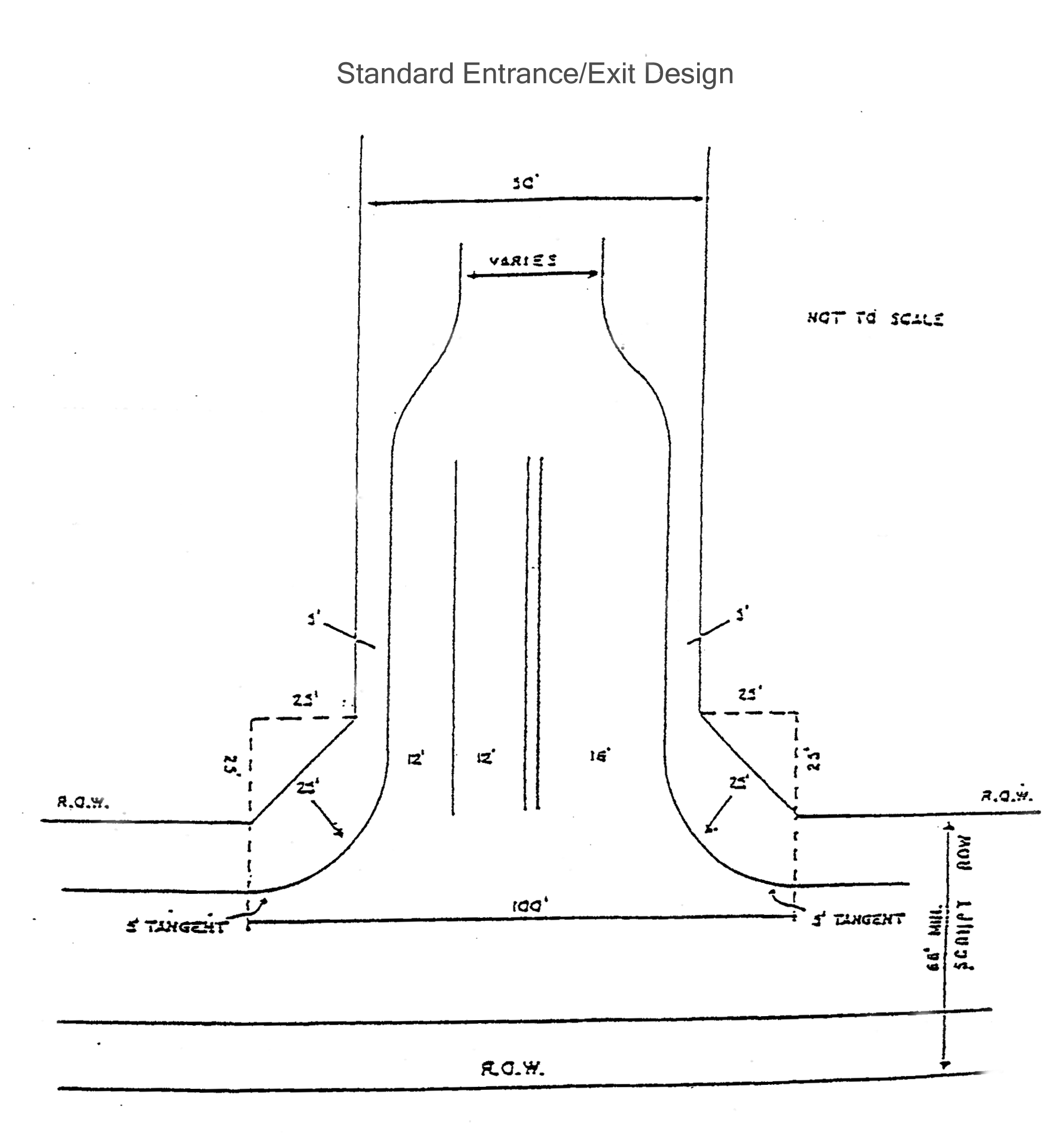
Mobile home parks with 100 or more mobile home spaces must provide an entrance/exit as defined in Illustration 1. As a result of the higher traffic volumes produced by such developments, these entrances/exits require a higher design standard than other ingress/egress points. This requirement may be waived if the developer can demonstrate that there will be a sufficient number of entrances/exits to handle the estimated additional traffic volumes safely without imposing undue problems on traffic safety or management.
k.
Spacing Requirements: Mobile homes shall be placed at least twenty (20) feet apart and twenty (20) feet from any common building or structure in the park.
l.
Foundations: On a single wide home, double blocking must occur at all corners and in front and back of axles for a total of eight (8) double blocked piers. Multi-wide homes must have all piers double blocked. Piers may be not further than ten (10) feet apart.
Piers or load-bearing supports or devices shall be designed and constructed to evenly distribute the loads. Piers shall extend at least six (6) inches from the centerline of the frame member. Manufactured load-bearing supports or devices shall be listed or approved for the use intended, or piers shall be constructed as follows:
1.
Except for corner piers, piers less than 40 inches high shall be constructed of masonry units, placed with cores or cells vertically. Piers shall be installed with their long dimensions perpendicular to the main (I-beam) frame member that supports and shall have a minimum cross-sectional area of 119 square inches. Piers shall be capped with a minimum 2-inch sold masonry unit or concrete cap or equivalent.
2.
Piers between 40 and 80 inches high and all corner piers over 24 inches shall be at least 16 x 16 inches consisting of interlocking masonry units and shall be fully capped with a minimum of 4-inch solid masonry unit or equivalent.
3.
Piers over 80 inches high shall be constructed in accordance with the provisions of paragraph 2 above, provided the piers shall be filled solid with grout and reinforced with four continuous No. 5 bars. One bar shall be placed in each corner cell of hollow masonry unit piers, or in each corner of the grouted space of piers constructed of solid masonry units.
4.
Cast-in-place concrete piers meeting the same size and height limitation of paragraphs 1, 2 and 3 above may be substituted for piers constructed of masonry units.
5.
All piers shall be constructed on footings of solid concrete, poured in place or pre-cast concrete not less than 16 x 16 x 4 inches.
m.
Tie-downs and Skirting: All mobile homes shall be anchored to resist flotation, collapse or lateral movements by providing over-the-top and/or frame ties to ground anchors. Specific requirements shall be that:
1.
There must be at least three (3) tie-downs per side if the home is under 50 feet in length. If the home is fifty (50) feet or greater in length, then there must be four (4) tie-downs per side. Tie-downs must be placed in all corners and at intermediate points.
2.
Skirting is required within sixty (60) days of set up. The skirting is to be of solid skirting material (wood, vinyl, metal, masonry). All materials must be painted or stained except brick and stone. Material are to be erected in a fashion as not to create a fire hazard or harbor trash or rodents. Skirting must have an access door and properly vented. Skirting shall be maintained in a good state of repair.
8-2.8.
NOTICE, HEARINGS AND ORDERS.
a.
Whenever the health authority determines that there are reasonable grounds to believe that there has been a violation of any provision of these regulations, it shall give a notice of such alleged violation to the owner or agent of the park, as hereinafter provided:
1.
Be in writing;
2.
Include a statement of the reasons for its issuance;
3.
Allow reasonable time for the performance of any act it requires;
4.
Be served upon the owner or his agent as the case may require, provided that such notice or order shall be deemed to have been properly served upon such owner or agent when a copy of the inspection report form or other notice has been delivered personally to the permit holder or person in charge or such notice has been sent by registered mail to his last know address; or when he has been served with such notice by any other method authorized or required by the laws of this State; and
5.
Contain an outline of remedial action, which if taken, will affect compliance with the provisions of these regulations.
b.
Any person affected by any notice which has been issued in connection with the enforcement of any provision of these regulations may request and shall be granted a hearing on the matter before the health authority, provided that such person shall file in the office of health authority a written petition requesting such hearing and setting forth a brief statement of the grounds thereof: Upon receipt of such petition, the health authority shall set a time and place for such hearing, and shall give the petitioner written notice thereof. At such hearing the petitioner shall be given the opportunity to be heard and to show why such notice should be modified or withdrawn. The hearing shall be commenced no later than ten (10) days after the day on which the petition was filled, provided that upon application the petitioner, the health authority may postpone the date of the hearing for a reasonable time beyond such ten (10) day period when in its judgment the petitioner has submitted good and sufficient reasons for such postponement.
c.
After such hearing, the health authority shall make findings as to compliance with the provisions of these regulations and shall issue an order in writing sustaining, modifying or withdrawing the notice which shall be served as provided in Section 8-2.8a4. Upon failure to comply with any order sustaining or modifying a notice, the permit of the mobile home park affected by the order may be revoked. Revoked permits may not be reissued by a new permit may be issued, if all requirements of there regulations are met.
d.
Whenever the health authority finds that an emergency exists which requires immediate action to protect the public health, it may, without notice or hearing, issue an order citing the existence of such an emergency and requiring that such action be taken as may deem necessary to meet the emergency including the suspension of the permit. Notwithstanding any other provisions of these regulations, such order shall be effective immediately Any person to whom such an order is directed shall comply therewith immediately, but upon petition to the health authority, shall be afforded a hearing as provided in Section 8-2.8b. The provisions of 8-2.8c and 8-2.8d shall be applicable to such hearing and the order issued thereafter.
8-2.9.
WATER SUPPLY.
a.
General requirements: Mobile home parks shall be connected to the Town's public water supply system. The developer of the park shall be responsible for the installation of the lines to connect to the system. All lines shall meet the requirements of the S.C. Department of Health and Environmental Control and the coordination guidelines of the Town of Batesburg-Leesville.
b.
Taps:
1.
Water systems for mobile home parks in which the mobile homes are intended primarily for rental shall be connected to a master meter at or near the entrance of the park. Parks in which mobile home are primarily intended for individual ownership shall be provided with individual meters at the front of each lot on the common property. Mobile home parks which change from primarily individual owner to rental shall be required to install a master meter and to pay a new tap fee at the then prevailing rate based upon the size of the master meter required. The individual meters shall be removed at the owner expense and shall be returned to the Town of Batesburg-Leesville.
2.
Each mobile home shall be considered as a separate water tap requiring the payment of separate tap fee.
c.
Water Distribution System:
1.
All water piping, fixtures, and other equipment shall be constructed and maintained in accordance with state and local regulations.
2.
The water piping system shall not be connected with non-potable or questionable water supplies and shall be protected against the hazards of backflow or back-siphonage. All plastic pipe must bear the NSF seal of approval.
3.
The mobile home park water system shall be adequate to provide a minimum of twenty (20) pounds per square inch of pressure at all service buildings and mobile home connections.
4.
Where drinking fountains are provided for public use, they shall be of a type and in locations approved by the health authority.
d.
Individual Water-riser Pipes and Connections:
1.
Individual water-riser pipes shall be located within the confined area of the mobile home stand at a point where the water connection will approximate a vertical position, thereby insuring the shortest water connection possible and decreasing susceptibility to water pipe freezing.
2.
The water riser pipe shall have a minimum inside diameter of three fourths (¾) inches, terminating at least four (4) inches above the ground surface, with two (2) three-fourths (¾) inch valve outlets. The outlets shall be threaded so that a connection can be made from one outlet to the mobile home water piping system and the other connection can serve as an outside connection.
3.
Adequate provisions shall be made to prevent freezing of service lines, valves and riser pipe and to protect risers from heaving and thawing actions of grounds during freezing weather. Surface drainage shall be diverted from the location of the riser pipe individual service connections shall be constructed as to protect the line from infiltration by the ground water.
4.
A shut-off valve below the frost line shall be provided near the water-riser pipe of each mobile home lot. Underground stop-and-waste-cocks shall be installed on any connection.
5.
Disinfection of Water Systems: All water systems shall be disinfected and analyzed in accordance with South Carolina State Department of Health and Environmental Control requirements before use for domestic purposes.
8-2.10.
SEWAGE DISPOSAL.
a.
General Requirements: Mobile home parks shall be connected to the public sewer system. The construction of lines and appurtenances to make a connection to the existing lines of the Town of Batesburg-Leesville shall be at the expense of the park developer. All sewer lines must be constructed in accordance with the S.C. Department of Health and Environmental Control requirements and the provision of the Town's construction guidelines.
b.
Individual Connections:
1.
Each mobile home shall be considered a separate tap for the purpose of calculating tap fees. Parks with a master water meter shall be charged sewer charges at the commercial rate. Parks with individual meters shall be charged at residential rate. Each mobile home lot shall be provided with at least a four (4) inch nominal diameter sewer riser pipe. The sewer riser pipe shall be so located on each stand that the provisions of section 8-2.10b2 can be met.
2.
The sewer connection shall have a nominal size of four (4) inches, and the slope of any portion thereof shall be at least one forth (¼) inch per foot. The sewer connection shall be provided with suitable fittings, so the water tight and gas tight connection can be made between the mobile home drain, the sewer connection and the sewer riser. Taped connections are not acceptable.
3.
All materials used for sewer connections shall be semi-ridged corrosive resistant, non-absorbent and durable. The inner surface shall be smooth.
4.
Provisions shall be made for capping the sewer riser pipe in a gas-tight manner when a mobile home does not occupy the lot. Surface drainage shall be diverted away form the riser. The rim of the riser pipe shall extend at least four (4) inches above the ground.
8-2.11.
REFUSE DISPOSAL.
a.
The storage, collection and disposal of refuse in the mobile home park shall be managed so as to create no health hazards, rodent harborage, insect-breeding areas, accident or fire hazards or air pollution.
b.
All refuse shall be stored in flytight, watertight, rodent proof containers which shall be located not more than one hundred fifty (150) feet from any mobile home space. If pick-up by the Town's sanitation department is desired, the park owner must provide dumpsters meeting town specifications and located in such a manner as to allow the Town's sanitation vehicle easy access. Dumpsters must be placed on a concrete pad.
c.
Racks or holders shall be provided for all individual refuse containers. Such container racks or holders shall be so designed as to prevent containers from being tipped, to minimize spillage and container deterioration and to facilitate cleaning around them. No wooden racks will be allowed in newly constructed mobile homes.
d.
If a private sanitation service is used refuse must be collected and removed at least twice per week.
8-2.12.
INSECT AND RODENT CONTROL.
a.
Insect and rodent control measures to safeguard the public health as required by the health authority shall be applied to the mobile home park.
b.
The health authority may require the mobile home park operator to take suitable measures to control other insects, obnoxious weeds and rank vegetation.
c.
Accumulations of debris which may provide harborage for rodents shall not be permitted in their mobile home park.
d.
When rats or other objectionable rodents are known to be in the mobile home park, the park operator shall take definite action, as directed by the health authority to examine them.
8-2.13.
ELECTRICAL DISTRIBUTION SYSTEM.
a.
General Requirements: The electrical distribution system shall comply with Section 550 B Mobile Home Parks of the National Electrical Code.
b.
Power Distribution Lines:
1.
All power lines (electrical, telephone or cable) shall be underground.
2.
All direct burial conductors of cable shall be buried at least eighteen (18) inches below the ground surface and shall be insulated and specifically designed for the purpose. Such conductors shall be located not less than one (1) foot radial distances form water, sewer, gas or communication lines.
8-2.14.
FUEL SUPPLY AND STORAGE.
a.
Natural Gas System:
1.
Natural gas piping systems when installed in mobile home parks shall be maintained in conformity with accepted engineering practices.
2.
Each mobile home lot provided with piped gas shall have an approved shutoff valve installed upstream of the gas outlet. The outlet shall be equipped with an approved cap to prevent accidental discharge of gas when the outlet is not in use.
b.
Liquefied Petroleum Gas Systems: Liquefied petroleum gas systems provided for mobile homes, service buildings or other structures when installed shall be maintained in conformity with the rules and regulations of the authority having jurisdiction and shall include the following:
1.
Systems shall be provided with safety devices to relieve excessive pressures and shall be arranged so that the discharge terminates at a safe location.
2.
Systems have at least one (1) accessible means for shutting off gas. Such means shall be located outside the mobile home and shall be maintained in effective operating conditions.
3.
All LPG piping outside the mobile homes shall be well supported and protected against mechanical injury. Undiluted liquefied petroleum gas in liquid form shall not be conveyed through piping equipment and systems in mobile homes.
4.
Vessels of no more than twelve (12) inches and less than sixty (60) U.S. gallons gross capacity may be installed on a mobile home lot and shall be securely but may not be permanently fastened to prevent accidental overturning.
5.
No LPG vessel shall be stored or located inside or beneath any storage cabinet, carport, mobile home or any other structure unless such installations are specifically approved by the authority having jurisdiction.
c.
Fuel Oil Supply Systems: The storage of fuel oil in containers exceeding five (5) gallon capacity is prohibited. Only one such container shall be permitted per mobile home.
8-2.15.
FIRE PROTECTION.
a.
The mobile home park area shall be subject to the rules and regulations of the state and local fire prevention authority.
b.
Mobile home park areas shall be kept free of litter, rubbish, and other flammable material.
8-2.16.
ALTERATION AND ADDITIONS—RESTRICTIONS OF ANIMALS AND PETS.
a.
All plumbing and electrical alterations or repairs in the mobile home park shall be made in accordance with applicable local regulations.
b.
No permanent additions shall be built onto or become a part of any mobile home unless they are constructed in accordance with the local building codes and all provisions of this ordinance. A building permit must be obtained prior to the initiation of construction.
c.
Pets and animals must be inoculated against rabies in accordance with the State Department of Health and Environmental Control.
d.
Pet and animals may not run at large and must be either confined or kept on a leash and shall comply with other Town ordinances regulating dogs, pet and animals.
8-2.17.
REGISTRATION OF OCCUPANTS.
Every mobile home park owner or operator shall maintain a register containing a record of all mobile homes and occupants using the mobile home park. Such register shall be available to any authorized person inspecting the park and shall be preserved for the period required by the health authority. Such register shall contain the names and addresses of all mobile home occupants residing in the park.
8-2.18.
SUPERVISION.
The person to whom a permit for a mobile home park is issued shall at all times operate the park in compliance with these regulations, and shall provide adequate supervision to maintain the park, its facilities and equipment in good repair and in a clean and sanitary condition at all times.
8-2.19.
ENFORCEMENT INTERPRETATION.
Whenever the provisions of the Mobile Home Park Ordinance impose regulations that are in conflict with those of other Town Ordinances, other governmental agencies, or privately executed restrictions, the more restrictive shall apply. The same shall be true if there is a conflict between provisions within the body of the Mobile Home Park Ordinance.
8-2.20.
PENALTIES.
Violations of this ordinance shall be considered a misdemeanor under the laws of the State of South Carolina. Each day a violation exists shall be considered a separate offense.
8-3. - HIGH-RISE STRUCTURES.
General: For purposes of this Ordinance, a high-rise structure is defined as a structure having four (4) or more stories. In all cases, the proposed high-rise structure shall comply with the following minimum standards:
8-3.1.
Minimum lot sizes as required by Article 7 and the maximum height as limited by Section 6-9 shall not apply, provided other requirements listed below are met;
8-3.2.
Minimum yard requirements as listed in Article 7 shall be met. However, in no case shall any front, side or rear yard be less than twenty-five (25) feet;
8-3.3.
All off-street parking and loading requirements as listed in Sections 6-3 and 6-4 shall be met;
8-3.4.
Maximum lot coverage for high-rise structures containing residential units shall be not more than thirty (30) percent. Maximum lot coverage for high-rise structures containing no residential units shall be not more than fifty (50) percent;
8-3.5.
Elevators and escalators shall be provided;
8-3.6.
All fire codes and other codes relating to high-rise structures shall be met.
8-4. - DAY NURSERIES AND KINDERGARTENS.
Day nurseries and kindergartens shall comply with the following minimum standards:
8-4.1.
A fenced play area will be provided as shown below:
With an additional 200 sq. ft. for each additional child beyond 13.
No play equipment shall be closer than twenty (20) feet of any fence surrounding the fenced play area.
(Ord. of 3-9-2009)
8-4.2.
The fencing referenced in 8-4.1 shall be in such a form as to provide a visual screen from adjoining property. (For example: solid wooden fence, solid masonry fence, chain link fence with vinyl or wooden slats, etc. as approved by the Zoning Administrator.)
(Ord. of 7-9-2012)
8-4.3.
Facilities, operation and maintenance shall meet all requirements of the S.C. Department of Social Services.
8-5. - HOME OCCUPATIONS.
Home occupations shall meet the following requirements:
8-5.1.
The occupation, profession or trade is carried on wholly within the principal building;
8-5.2.
Not more than twenty-five (25) percent of the floor area of the principal building is used for the conduct of said home occupations;
8-5.3.
No merchandise or articles are displayed for advertising purposes nor are displayed in such a way as to be visible from outside the dwelling;
8-5.4.
No merchandise or articles are stored other than inside the principal building;
8-5.5.
There is no alteration of the residential character of the building or premises;
8-5.6.
Only residents are employed;
8-5.7.
No traffic shall be generated by such home occupation in greater volume than would be normally expected in a residential neighborhood, and any need for parking generated by the conduct of such home occupation shall be met off the street and other than in a required front yard;
8-5.8.
No name plate or sign is displayed upon the premises except one unlighted sign, not exceeding two (2) square feet in area, and mounted flat against the wall of the principal structure.
(Ord. of 9-9-2002)
8-6. - CLUSTER HOUSING DEVELOPMENT.
It is the intent of this section of the Ordinance to encourage the erection of cluster housing in areas appropriate to such use, subject to conditions and safeguards which will promote the purpose of zoning and the comprehensive plan. In addition to, or in modification of, other applicable provisions and requirements shall apply to the case of Cluster Housing Developments.
8-6.1.
DEFINITIONS:
(a)
Detached Cluster House: A single-family dwelling unit which has no common wall with any building other than its accessory structure or structures.
(b)
Attached Cluster House: A single-family dwelling unit in a building that has not less than two (2) nor more than eight (8) single-family housekeeping units intended for owner occupancy which are erected as a single building, on adjoining lots, each being separated from the adjoining unit or units, and each such building being separated from any other building by space on all sides. No attached cluster houses shall be more than one hundred and fifty (150) feet in length.
(c)
Detached Cluster Housing Development: A minimum of four detached cluster houses wherein specified real property will be subdivided and sold and wherein other specified real property will be sold and owned in common and managed and maintained by a "Homeowner's Association" or by the developer.
(d)
Attached Cluster Housing Development: A minimum of two (2) attached cluster houses wherein specified real property will be subdivided and sold and wherein other specified real property will be owned in common and managed and maintained by a "Homeowner's Association" or by the developer. Subdivision regulation procedure of the Town of Batesburg-Leesville concerning group developments shall apply to all Cluster Housing Developments.
(e)
Combination Cluster Housing Development: A cluster housing development may contain both attached and detached houses.
(f)
Architectural Style in Cluster Housing Developments: In all cluster housing developments, exterior elevations of all houses must be architecturally compatible and may be mixed in design.
8-6.2.
ZONING DISTRICT IN WHICH CLUSTER HOUSING DEVELOPMENTS ARE ALLOWED.
Cluster Housing Developments containing single-family detached or attached dwelling units are allowed in R-1, R-2, R-3 and C-2 Zoning Districts after approval by the Planning Commission. Subdivision regulation procedure of the Town of Batesburg-Leesville concerning group developments shall apply to all Cluster Housing Developments.
8-6.3.
MATERIAL TO BE SUBMITTED FOR PLANNING COMMISSION REVIEW.
All applicants for Cluster Housing Developments shall submit architectural plans including details such as number, location and orientation of dwelling units, site plans, landscaping plans, plans for off-street parking and service areas, ingress and egress arrangements, elevations of all portions of proposed structures within fifty feet of the or property lines of the proposed Cluster Housing development. Also, a copy of the legal documentation for land in common ownership and public ownership must accompany the application for Planning Commission review and be approved by the Planning Commission prior to being recorded in the Lexington, Saluda or Aiken County Register of Mesne Conveyances. The Planning Commission may require additional information, if the members feel there is a need.
8-6.4.
REQUIREMENTS CONCERNING PLANNING COMMISSION REVIEW.
The site plan materials required must be approved by the Planning Commission prior to issuing a building permit. The Planning Commission as a condition of approval may require screening or modifications to the landscaping, parking and circulation plans. The required screening as determined by the Planning Commission and the placement of curb cuts as approved by the Planning Commission along with the arrangement of land in private ownership, common ownership and public ownership are binding upon the applicant.
The Zoning Administrator shall issue no zoning permit for the erection of any attached or detached cluster house or any alteration to any cluster house, which:
(a)
Increases its height or coverage of land;
(b)
Increases the total number of residential units in the approved Cluster Housing Development;
(c)
Alters the parking requirements or reduces the number of off-street parking spaces; or
(d)
Infringes on the common ownership property or the designated exterior buffer areas along the fringe of the identified Cluster Housing Development;
until the Planning Commission shall have reviewed the application and documents required to be submitted therewith and reported concerning conformity with the provisions, intent and purposes of this Ordinance. At his discretion, the Zoning Administrator may approve minor changes in materials required for submission.
8-6.5.
MINIMUM SITE SIZE FOR CLUSTER HOUSING DEVELOPMENT.
MINIMUM SITE SIZE
Density for a Cluster Housing Development shall be determined as follows:
In an R-1 district, structures and/or building coverage shall not exceed twenty-five (25) percent of buildable area;
In R-2, R-3 or C-2 districts structures and/or building coverage shall not exceed forty (40) percent of buildable area;
Street rights-of-way shall not be included in computing buildable area in R-1, R-2, R-3 and C-2 districts.
8-6.6.
MINIMUM SETBACK FROM EXTERIOR PROPERTY LINES OF CLUSTER HOUSING DEVELOPMENT.
8-6.7.
MINIMUM YARD SETBACKS FROM NEW STREET RIGHTS-OF-WAY.
A minimum yard setback of twenty (20) feet is required in the primary front yard, and a minimum yard setback of ten (10) feet is required in secondary front yards (or side yards facing a street).
8-6.8.
MINIMUM SPACING BETWEEN PRINCIPAL BUILDINGS
The side, rear and front of each structure shall be designed on the site plan of each cluster development submitted to the Planning Commission for approval.
8-6.9.
MINIMUM REQUIRED OPEN SPACE.
Open space for the purpose of Cluster Housing Development is defined as follows: That land area in common ownership of the homeowners, exclusive of parking areas and roadways, which is designed to meet the primary objective of supplying passive or active recreation needs. Only twenty-five (25) percent of the surface water of a natural or man-made body of still or moving surface water shall be counted toward determination of required open space.
MINIMUM OPEN SPACE
8-6.10.
MINIMUM OFF-STREET PARKING SPACES.
(a)
Where a Cluster Housing Development is dependent completely on off-street parking grouped in concentrations of greater than four (4) spaces and under common ownership, two (2) off-street parking spaces per dwelling unit; or
(b)
Two (2) off-street parking spaces per dwelling unit on an individual privately owned driveway and appropriate visitor parking as determined by the Planning Commission.
8-6.11.
REQUIREMENTS FOR PAVING OF STREETS AND PARKING AREAS.
(a)
Streets designed for public maintenance must meet the requirements of the subdivision regulations. Streets designed for private maintenance must meet paving quality as provided in the subdivision regulations. Private streets designed for two-way traffic must have a paved width of twenty (20) feet, and private one-way streets must have a paved width of ten (10) feet. Rights-of-way are not required for private streets or roadways. Private streets must meet all other design requirements of the Subdivision Regulations of the Town of Batesburg-Leesville.
(b)
The quality of paving standards for off-street parking areas containing more than four (4) parking spaces are the same as the quality of paving standards for minor residential streets, as set forth in the Town's subdivision regulations.
(c)
All dwelling units and appropriate community facilities must be provided adequate access to streets meeting the standards of the Town's subdivision regulations.
8-7. - MANUFACTURED HOMES.
Manufactured homes (not mobile homes) are permitted as principal dwellings on individual lots in the R-1A districts provided that:
8-7.1.
The manufactured homes as defined in Section 8-7 are not more than three (3) years old as proved by a bill of sale or title owned by the person applying for a zoning permit for a manufactured home.
8-7.2.
The manufactured home is placed on a permanent clay brick or concrete block curtain wall and all transportable features such as the wheels and tongues are removed.
8-7.3.
The manufactured home is tied down according to specifications of the U.S. Department of Housing and Urban Development to protect against wind damage.
8-7.4.
The manufactured home can be certified as built according to the provisions of the National Mobile Home Construction and Safety Act effective June 15, 1976.
8-7.6.
The greatest length of the manufactured home shall be parallel with the accessing public street carrying the highest average daily traffic volume.
(Ord. of 9-9-2002)
8-8. - GARAGE SALES.
Garage sales are permitted in all residential districts, provided that:
8-8.1.
A permit is obtained from city hall for each sale and same to be posted at the site of the sale. The cost of each permit is to be five (5) dollars. The maximum period for each permit is two (2) days. The maximum number of permits allowed per year is three (3) per family.
8-8.2.
Off-street parking is provided for all persons attending the sale.
8-8.3.
No new or used merchandise is purchased or brought in for the sale.
8-8.4.
All merchandise is that of the family or families conducting the sale.
8-8.5.
Only one sign is posted advertising the sale and that sign is placed on the private property of the person conducting the sale. That the hours of the sale be from 8:00 a.m. to 6:00 p.m. No Sunday sales will be allowed.
8-8.6.
No public address system is used.
8-8.7.
No alcoholic beverages of any type are served or given on or near the premises.
8-8.8.
If upon inspection by the city manager's designee, (an inspector or a policeman) it is found that ordinance is being violated, a citation will be issued or the right to continue with the sale will be terminated at once.
8-8.9.
The owner of any residence and/or the person to whom a permit is issued for the purpose of having a garage sale under this Ordinance who shall fail to comply with any part of it shall, upon conviction thereof before the city recorder, be fined not exceeding two-hundred (200) dollars or imprisoned not more than thirty (30) days for each offense.
8-9. - EXEMPTIONS—HOMES FOR THE HANDICAPPED.
A home serving nine or fewer mentally or physically handicapped persons if it provides 24-hour care and is approved or licensed by a state agency, department or under contract with the agency or department for that purpose is exempt from local zoning ordinance requirements. Residents of such a home are perceived as a natural family as if related by blood or marriage. Prior to locating the home, the owner must give notice to the Town Council advising the exact site of the proposed home.
8-10. - SATELLITE AND TV DISH ANTENNAE.
Satellite receiver dishes for TV signal reception are permitted in all residential commercial and industrial districts only if the following requirements are met:
(a)
Receivers 39" in diameter or less must meet the setback requirements for the district in which it is placed.
(b)
Receivers over 39" in diameter must meet the setback requirements for the district in which it is placed, and must be screened so as to not be visible from the right-of-way.
8-11. - SEXUALLY ORIENTED BUSINESSES.
It is the purpose of this section to regulate sexually oriented businesses to promote the health, safety, morals, and general welfare of the citizens of the city, and to establish reasonable and uniform regulations to prevent the continued deleterious location and concentration of sexually oriented businesses within the city. The provisions of this section have neither the purpose nor effect of imposing a limitation or restriction on the content of any communicative materials including sexually oriented materials. Similarly, it is not the intent or effect of this ordinance to restrict or deny access by adults to sexually oriented materials protected by the First Amendment, or to deny access by the distributors and exhibitors of sexually oriented entertainment to their intended market. Neither is it the intent or effect of this section to condone or legitimize the distribution of obscene material.
8-11.1.
DEFINITIONS.
(a)
ADULT ARCADE: Any place to which the public is permitted or invited wherein coin-operated or slug-operated or electronically, electrically, or mechanically controlled still or motion picture machines, projectors, or other image-producing devices are maintained to show images to five (5) or fewer persons per machine at any one time, and where the images so displayed are distinguished or characterized by the depicting or describing of "certain sexual activities" or "specified anatomical areas."
(b)
ADULT BOOKSTORE/ADULT VIDEO STORE: A commercial establishment which, as one of its principal business purposes, offers for sale or rental for any form of consideration any one or more of the following:
(i)
Books, magazines, periodicals or other printed matter, or photographs, films, motion picture, video cassettes or video reproductions, slides, or other visual representations which depict or describe "specified sexual activities" or "specified anatomical areas"; or
(ii)
Instruments, devices, or paraphernalia which are designed for use in connection with "specified sexual activities." A commercial establishment may have other principal business purposes that do not involve the offering for sale of rental of material depicting or describing "specified sexual activities" or "specified anatomical areas" and still be categorized as adult bookstore or adult video store. Such other business purposes will not serve to exempt such commercial establishment from being categorized as an adult bookstore or adult video store so long as one of its principal business purposes is the offering for sale or rental for consideration the specified materials which depict or describe "specified sexual activities" or "specified anatomical areas."
(c)
ADULT CABARET: A nightclub, bar, restaurant, or similar commercial establishment which regularly features:
(i)
Persons who appear in a state of nudity; or
(ii)
Live performances which are characterized by the exposure of "specified anatomical areas" or by "specified sexual activities"; or
(iii)
Films, motion pictures, video cassettes, slides, or other photographic reproductions which are characterized by the depiction or description of "specified sexual activities" or "specified anatomical areas."
(d)
ADULT MOTEL: A hotel, motel or similar commercial establishment which:
(i)
Offers accommodations to the public for any form of consideration; provides patrons with closed-circuit television transmissions, films, motion pictures, video cassettes, slides, or other photographic reproductions which are characterized by the depiction or description of "specified sexual activities" or specified anatomical areas"; and has a sign visible from the public right-of-way which advertises the availability of this adult type of photographic reproductions; or
(ii)
Offers a sleeping room for rent for a period of time that is less than ten (10) hours;
(iii)
Allows a tenant or occupant of a sleeping room to subrent the room for a period of time that is less than ten (10) hours.
(e)
ADULT MOTION PICTURE THEATER: A commercial establishment where, for any form of consideration, films, motion pictures, video cassettes, slides, or similar photographic reproductions are regularly shown which are characterized by the depiction or description of "specified sexual activities" or "specified anatomical areas."
(f)
ADULT THEATER: A theater, concert hall, auditorium, or similar commercial establishment which regularly features persons who appear in a state of nudity or live performances which are characterized by the exposure of specified anatomical areas" or by "specified sexual activities."
(g)
ESCORT: A person who, for consideration, agrees or offers to act as a companion, guide, or date for another person, or who agrees or offers to privately model lingerie or to privately perform a striptease for another person.
(h)
ESCORT AGENCY: A person or business association who furnishes, offers to furnish, or advertises to furnish escorts as one of its primary business purposes for a fee, tip, or other consideration.
(i)
ESTABLISHMENT: Includes any of the following:
(i)
The opening or commencement of any sexually oriented business as a new business;
(ii)
The conversion of an existing business, whether or not a sexually oriented business, to any sexually oriented business;
(iii)
The additions of any sexually oriented business to any other existing sexually oriented business; or
(iv)
The relocation of any sexually oriented business.
(j)
PERMITTEE AND/OR LICENSEE: A person in whose name a permit and/or license to operate a sexually oriented business has been issued, as well as the individual listed as an applicant on the application for a permit and/or license.
(k)
NUDE MODEL STUDIO: Any place where a person who appears in a state of nudity or displays "specified anatomical area" is provided to be observed, sketched, drawn, painted, sculptured, photographed, or similarly depicted by other persons who pay money or any form of consideration.
(l)
NUDITY/STATE OF NUDITY: The appearance of a human bare buttock, anus, male genitals, female genitals, or female breast.
(m)
PERSON: Any individual, proprietorship, partnership, corporation, association, or other legal entity.
(n)
SEMI-NUDITY: A state of dress in which clothing covers no more than the genitals, pubic region, and areolae of the female breast, as well as portions of the body covered by supporting straps or devices.
(o)
SEXUAL ENCOUNTER CENTER: A business or commercial enterprise that, as one of its primary business purposes, offers for any form of consideration:
(i)
Physical contact in the form of wrestling or tumbling between persons of the opposite sex; or
(ii)
Activities between male and female persons and/or persons of the same sex when one or more of the persons is in a state of nudity or semi-nude.
(p)
SEXUALLY ORIENTED BUSINESS: An adult arcade, adult bookstore or adult video store, adult cabaret, adult motel, adult motion picture theater, adult theater, escort agency, nude model studio, or sexual encounter center.
(q)
SPECIFIED ANATOMICAL AREAS: The male genitals in a state of sexual arousal and/or the vulva or more intimate parts of the female genitals.
(r)
SPECIFIED SEXUAL ACTIVITIES: Includes any of the following:
(i)
The fondling or other erotic touching of human genitals, pubic region, buttocks, anus or female breasts;
(ii)
Sex acts, normal or perverted, actual or simulated, including intercourse, oral copulation, or sodomy;
(iii)
Masturbation, actual or simulated; or
(iv)
Excretory functions as part of or in connection with any of the activities set forth in [(i)] through [(iii)] above.
(s)
SUBSTANTIAL ENLARGEMENT: The increase in floor areas occupied by the business by more than twenty-five (25) percent, as the floor areas exist on July 1, 1990.
(t)
TRANSFER OF OWNERSHIP CONTROL: Includes any of the following:
(i)
The sale, lease, or sublease of the business;
(ii)
The transfer of securities which constitute a controlling interest in the business, whether by sale, exchange, or similar means; or
(iii)
The establishment of a trust, gift, or other similar legal device which transfers the ownership or control of the business, except for transfer by bequest or other operation of law upon the death of the person possessing the ownership or control.
8-11.2.
CLASSIFICATION.
Sexually oriented businesses are classified as follows:
(a)
Adult arcades;
(b)
Adult bookstores or adult video stores;
(c)
Adult cabarets;
(d)
Adult motels;
(e)
Adult motion picture theaters;
(f)
Adult theaters;
(g)
Escort agencies;
(h)
Nude model studios; and
(i)
Sexual encounter centers.
8-11.3.
PERMIT REQUIRED.
(a)
A person commits a misdemeanor if he operates a sexually oriented business without a valid permit issued by the city for the particular type of business.
(b)
An application for a permit must be made on a form provided by the Zoning Administrator. The application must be accompanied by a sketch or diagram showing the configuration of the premises, including a statement of total floor space occupied by the business. The sketch or diagram need not be professionally prepared but must be drawn to a designated scale or drawn with marked dimensions of the interior of the premises to an accuracy of plus or minus six (6) inches.
(c)
The applicant must be qualified according to the provisions of this chapter and the premises must be inspected and found to be in compliance with the law by the health department, fire department, and building official.
(d)
If a person who wished to operate a sexually oriented business is an individual, he must sign the application for a permit as applicant. If a person who wishes to operate a sexually oriented business is other than an individual, each individual who has a ten (10) percent or greater interest in the business must sign the application for a permit as applicant. If a corporation is listed as owner of a sexually oriented business, each individual having a (10) percent or greater interest in the corporation must sign the application for a permit as applicant.
(e)
The fact that a person possesses other types of state, county, or city permits and/or licenses does not exempt him from the requirement of obtaining a sexually oriented business permit.
8-11.4.
ISSUANCE OF PERMIT AND FEE.
(a)
The Town Zoning Administrator shall approve the issuance of a permit to an applicant within thirty (30) days after receipt of an application unless he finds one or more of the following to be true:
(i)
An applicant is under eighteen (18) years of age.
(ii)
An applicant or an applicant's spouse is overdue in his payment to the city of taxes, fees, fines, or penalties assessed against him or imposed upon him in relation to a sexually oriented business.
(iii)
An applicant has failed to provide information reasonably necessary for issuance of the permit or has falsely answered a question or request for information on the applicant form.
(iv)
An applicant is residing with a person who has been denied a permit by the city to operate a sexually oriented business within the preceding twelve (12) months, or residing with a person whose license to operate a sexually oriented business has been revoked within the preceding twelve (12) months.
(v)
The premises to be used for the sexually oriented business have not been approved by the health department, fire department, and the building official as being in compliance with applicable laws and ordinances.
(vi)
The permit fee required by this ordinance has not been paid.
(vii)
An applicant of the proposed establishment is in violation of or is not in compliance with any of the provisions of this ordinance.
(viii)
The permit, if granted, shall state on its face the name of the person or persons to whom it is granted, the expiration date, and the address of the sexually oriented business. The permit shall be posted in a conspicuous place at or near the entrance to the sexually oriented business so that it may be easily read at any time.
(b)
The annual fee for a sexually oriented business permit is one thousand dollars ($1,000.00).
8-11.5.
INSPECTION.
An application of permittee shall permit representatives of the police department, health department, fire department, zoning department, or other city departments or agencies to inspect the premises of a sexually oriented business for the purpose of ensuring compliance with the law, at any time it is occupied or open for business, and it is unlawful to refuse to permit such inspection of the premises at any time it is occupied or open for business.
8-11.6.
EXPIRATION OF PERMIT.
(a)
Each permit shall expire one year from the date of issuance and may be renewed only by making application as provided herein. Application for renewal should be made at least thirty (30) days before the expiration date, and when made less than thirty (30) days before the expiration date, the expiration of the permit will not be affected except for good cause shown.
(b)
When the zoning administrator denies renewal of a permit, the applicant shall not be issued a permit for one year from the date of denial. If, subsequent to denial, the zoning administrator finds that the basis for denial of the renewal permit has been corrected or abated, the applicant may be granted a permit.
8-11.7.
SUSPENSION OF PERMIT.
The zoning administrator may suspend a permit for a period not to exceed thirty (30) days if he determines that a permittee or an employee of a permittee has:
(a)
Violated or is not in compliance with any section of this ordinance;
(b)
Engaged in excessive use of alcoholic beverages while on the sexually oriented business premises;
(c)
Refused to allow an inspection of the sexually oriented business premises as authorized by this chapter;
(d)
Knowingly permitted gambling by any person on the sexually oriented business premises.
8-11.8.
REVOCATION OF PERMIT.
(a)
The zoning administrator shall revoke a permit if a cause for suspension in Section 8-9.7 occurs and the permit has been suspended within the preceding twelve (12) months for willful and knowing violation of this ordinance.
(b)
The zoning administrator shall revoke a permit if he determines that:
(i)
A permittee knowingly gave false or misleading material information in the application submitted to the zoning department during the application process;
(ii)
A permittee or an employee has knowingly allowed possession, use, or sale of controlled substances on the premises;
(iii)
A permittee or an employee knowingly allowed prostitution on the premises;
(iv)
A permittee or an employee knowingly operated the sexually oriented business during a period of time when the permittee's permit was suspended;
(v)
A permittee or an employee has knowingly allowed any act of sexual intercourse, sodomy, oral copulation, masturbation, or other sexual conduct to occur in or on the permitted premises;
(vi)
A permittee is delinquent in payments to the city, county, or state for any taxes or fees past due related to the sexually oriented business.
(c)
When the zoning administrator revokes a permit, the revocation shall continue for one year, and the permittee shall not be issued a sexually oriented permit for one year from the date revocation became effective. If, subsequent to revocation the zoning administrator finds that the basis for the revocation has been corrected or abated, the applicant may be granted a permit if at least ninety (90) days have elapsed since the date the revocation became effective.
8-11.9.
TRANSFER OF PERMIT.
A permittee shall not transfer his permit to another, nor shall a permittee operate a sexually oriented business under the authority of a permit at any place other than the address designated in the application.
8-11.10.
LOCATION OF SEXUALLY ORIENTED BUSINESSES.
(a)
Reserved.
(b)
A person commits a misdemeanor if he operates or causes to be operated a sexually oriented business outside of a designated C-1 or I-1 district. All sexually oriented businesses shall be located within a C-1 or I-1 district.
(c)
A person commits a misdemeanor if he operates or causes to be operated a sexually oriented business within one thousand (1,000) feet of:
(i)
A church;
(ii)
A public or private elementary or secondary school;
(iii)
A public park adjacent of any residential use;
(iv)
The property line of a lot devoted to residential use.
(d)
A person commits a misdemeanor if he causes or permits the operation, establishment, substantial enlargement, or transfer of ownership or control of a sexually oriented business within one thousand (1,000) feet of another sexually oriented business.
(e)
A person commits a misdemeanor if he causes or permits the operation, establishment, or maintenance of more than one sexually oriented business in the same building, structure, or portion thereof, or the increase of floor areas of any sexually oriented business in any building, structure, or portion thereof containing another sexually oriented business.
(f)
For the purpose of this ordinance, measurement shall be made in a straight line, without regard to intervening structures or objects, from the nearest portion of the building or structure used as a part of the premises where a sexually oriented business is conducted, to the nearest property line of the premises of a church or public or private elementary or secondary school, or to the nearest boundary of an affected public park, residential district, or residential lot.
(g)
For purposes of subsection (4) of this section, the distance between any two (2) sexually oriented businesses shall be measured in a straight line, without regard to intervening structures or objects, from the closest exterior wall of the structure in which each business is located.
(h)
Any sexually oriented business lawfully operating on ___________ that is in violation of subsection (1) through (7) of this section shall be deemed a nonconforming use. The nonconforming use will be permitted to continue for a periods not to exceed two (2) years, unless sooner terminated for any reason or voluntarily discontinued for a period of thirty (30) days or more. Such nonconforming uses shall not be increased, enlarged, extended or altered except that the use may be changed to a conforming use. If two (2) or more sexually oriented businesses are within one thousand (1,000) feet of one another and otherwise in a permissible location, the sexually oriented business which was first established and continually operating at a particular location is the conforming use and the later-established business(es) is nonconforming.
(i)
A sexually oriented business lawfully operating as a conforming use is not rendered a nonconforming use by the location, subsequent to the grant or renewal of the sexually oriented business permit, of a church, public or private elementary or secondary school, public park, residential district, or a residential lot with one thousand (1,000) feet of the sexually oriented business. This provision applies only to the renewal of a valid permit, and does not apply when an application for a permit is submitted after a permit has expired or has been revoked.
8-11.11.
ADDITIONAL REGULATIONS FOR ADULT MOTELS.
(a)
Evidence that a sleeping room in a hotel, motel, or a similar commercial establishment has been rented and vacated two (2) or more times in a period of time that is less than ten (10) hours creates a rebuttable presumption that the establishment is an adult motel as that term is defined in this chapter.
(b)
A person commits a misdemeanor if, as the person in control of a sleeping room in a hotel, motel, or similar commercial establishment that does not have a sexually oriented permit, he rents or subrents a sleeping room to a person and, within ten (10) hours from the time the room is rented, he rents or subrents the same sleeping room again.
(c)
For purposes of subsection (2) of this section, the terms "rent" or "subrent" mean the act of permitting a room to be occupied for any form of consideration.
8-11.12.
REGULATIONS FOR EXHIBITION OF SEXUALLY EXPLICIT FILMS OR VIDEOS.
(a)
A person who operates or causes to be operated a sexually oriented business, other than an adult motel, which exhibits on the premises in a viewing room of less than one hundred fifty (150) square feet of floor space, a film, video cassette, or other reproduction which depicts specified sexual activities or specified anatomical areas, shall comply with the following requirements:
(i)
Upon application for a sexually oriented permit, the application shall be accompanied by a diagram of the premises showing a plan thereof specifying the location of one or more manager's stations and the location of all overhead lighting fixtures and designating any portion of the premises in which patrons will not be permitted. A manager's station may not exceed thirty-two (32) square feet of floor area. The diagram shall also designate the place at which the permit will be conspicuously posted, if granted. A professionally prepared diagram in the nature of an engineer's or architect's blueprint shall not be required; however, each diagram should be oriented to the north or to some designated street or object and should be drawn to a designated scale or with marked dimensions sufficient to show the various internal dimensions of all areas of the interior of the premises to an accuracy of plus or minus six (6) inches. The zoning administrator may waive the foregoing diagram for renewal applications if the applicant adopts a diagram that the configuration of the premises has not been altered since it was prepared.
(ii)
The application shall be sworn to be true and correct by the applicant.
(iii)
No alteration in the configuration or location of a manager's station may be made without the prior approval of the zoning administrator.
(iv)
It is the duty of the owners and operator of the premises to ensure that at least one employee is on duty and situated in each manager's station may be made without the prior approval of the zoning administrator or his designee.
(v)
The interior of the premises shall be configured in such a manner that there is an unobstructed view from a manager's station of every area of the premises to which any patron is permitted access for any purpose excluding restrooms. Restrooms may not contain video reproduction equipment. If the premises has two or more manager's stations designated, then the interior of the premises shall be configured in such a manner that there is an unobstructed view of each area of the premises to which any patron is permitted access for any purpose from at least one of the manager's stations. The view required in this subsection must be by direct line of sight from the manager's station.
(vi)
It shall be the duty of the owners and operator, and it shall also be the duty of any agents and employees present in the premises to ensure that the view area specified in subsection (e) remains unobstructed by any walls, merchandise, display racks or other materials at all times and in every booth or room in which viewing of videos, as defined in subsection (a) of this section, is taking place the bottom of the door must be at least eighteen (18) inches above the floor level, and to ensure that no patron is permitted access to any area of the premises which has been designated as an area in which patrons will not be permitted in the application filed pursuant to subsection (a) of this section.
(vii)
No viewing room may be occupied by more than one person at any time.
(viii)
The premises shall be equipped with overhead lighting fixtures of sufficient intensity to illuminate every place to which patrons are permitted access at an illumination of not less than one footcandle as measured at the floor level.
(ix)
It shall be the duty of the owners and operator and it shall also be the duty of any agents and employees present in the premises to ensure that the illumination described above, is maintained at all times that any patron is present in the premises.
(b)
A person having a duty under subsections [(i)] through [(ix)] of subsection [(a)] above commits a misdemeanor if he knowingly fails to fulfill that duty.
8-11.13.
EXEMPTIONS.
It is a defense to prosecution under this Article that a person appearing in a state of nudity did so in a modeling class operated:
(a)
By a proprietary school, licensed by the State of South Carolina; a college, junior college, or university supported entirely or partly by taxation;
(b)
By a private college or university which maintains and operated education programs in which credits are transferable to a college, junior college, or University supported entirely or partly by taxation; or
(c)
In a structure:
(i)
Which has no sign visible from the exterior of the structure and no other advertising that indicates a nude person is available for viewing; and
(ii)
Where, in order to participate in a class a student must enroll at least three (3) days in advance of the class; and
(iii)
Where no more than one nude model is on the premises at any time.
8-12. - COMMERCIAL BUILDING RE-USE.
The Zoning Board of Appeals may grant the re-use of an existing commercial building in the R-1, R-1A, R-2 and R-3 districts, provided that the following conditions are met:
a.
The building under consideration is an existing building that was previously used for commercial uses;
b.
The uses are limited to only the following:
Advertising Agency;
Apparel Stores-Men's, Women's, Children, Bridal Shops and Accessories;
Bakeries;
Beauty/Barber Shop;
Computer Repair, Consultation and Sales;
Confectionery/Candy Stores;
Custom Tailors;
Employment Agency;
Florist;
Health Food Stores;
Income Tax Preparation Services;
Live/Work Space with the following conditions:
1.
Commercial uses are limited to the ones listed above.
2.
A minimum of eighty (80) percent of the structure's street front facade at street level shall be occupied by nonresidential uses.
3.
Parking for live/work spaces is prohibited in the front of the building.
4.
For parking requirements see section 6-16 "Off-Street Automobile Parking and Storage."
5.
Live/Work spaces must have at least two (2) exits.
6.
At least one (1) resident shall maintain a valid business license and special exception approval for a business on the premises.
Medical Equipment Rental;
Pet-grooming Services;
Portrait Photographer;
Shoe Repair Shop;
Spa inclusive of Nail Salon;
c.
Parking requirements for the use requested are met;
d.
Only wall signs meeting the requirements of Article 9 are permitted;
e.
The buffer requirements in Section 6-13 are met.
(Ord. of xx-xx-xxxx; Ord. of 9-9-2013)
8-13. - BED AND BREAKFAST.
Bed and breakfast operations subject to the following conditions:
a.
The operation shall be located on a lot of record of no less than one (1) acre.
b.
There shall be one (1) off-street parking space for each room in the bed and breakfast operation made available for overnight occupancy.
c.
There shall be no more than eight (8) rentable rooms in an individual permitted bed and breakfast establishment.
d.
No bed and breakfast establishment shall house or shelter the same individual(s) for any period exceeding seven (7) days. A bed and breakfast establishment is not to be confused with a rooming or boarding house which usually provides shelter for transient occupants for a longer period of time.
e.
Opaque screening shall be provided between any required off-street parking and adjoining residentially occupied structure(s) situated within twenty-five (25) feet of the property line provided that parking is located within fifteen (15) feet of the affected property. No required parking space shall be located nearer than five (5) feet from any side or rear property line.
f.
The bed and breakfast establishment shall be permitted one (1) non-illuminated wall sign not to exceed nine (9) square feet.
g.
The owner of the bed and breakfast shall reside at the address where the bed and breakfast is permitted.
(Ord. of 9-9-2002)

