
Bath Township City Zoning Code
ARTICLE XVIII
SIGNS4
Editor's note— Ord. No. 31.55, adopted April 17, 2017, repealed the former art. XVIII, §§ 18.01—18.13, and enacted a new art. XVIII as set out herein. The former Art. XVIII pertained to similar subject matter and derived from the Bath Charter Township Zoning Ordinance, adopted September 27, 1989; Ordinance No. 31.34, adopted November 21, 2005; and Ordinance No. 31.49, adopted June 1, 2015.
Cross reference— Buildings and building regulations, ch. 14; streets, sidewalks and other public places, ch. 58.
Sec. 18.01.- Purpose.
The intent of this ordinance is to regulate the signage in all zoning districts in Bath Township. This includes the establishment of standards for the time and placement of all signs, markings, and advertising tools within the township. These standards are set up to promote health, safety, public welfare, and protection of free speech in the township through the following objectives, as supported by the Bath Township comprehensive plan:
Health: Ensure that signs are located, designed, and constructed in a way that protects the health of local residents and does not pose a risk for people walking or driving in the township.
Safety: Protect public safety by prohibiting certain signs or construction methods that are unsafe or difficult to maintain, signs that cause unsafe traffic conditions through distractions or confusion of traffic signs, or that impede the safe movement for pedestrians and motorists.
Public Welfare: Protect public welfare on various fronts by helping to improve the aesthetic quality of neighborhoods in the township, reduce conflict among signs and public-private properties, help increase economic activity by allowing businesses adequate advertising and identification, and create neighborhood character for each zoning district.
Aesthetic Qualities: Ensure the proper maintenance of signs and prevent potential blight through the inclusion of maintenance and construction objectives. Prevent visual clutter, protect views, ensure a clean and appealing look in each zoning district.
Free Speech: Protect that each property owner is subject to fair and uniform standards that provide adequate exposure while also ensuring that the Constitutional right of free speech is protected and that signs are allowed as a means of communications to the public.
Through the implementation of these objectives the Sign Ordinance will be able to promote the use of appropriate signage, which in turn will enhance the economic viability of the township, ensure the health and welfare of all residents, and increase the aesthetic appearance of the streetscapes.
(Ord. No. 31.55, 4-17-2017; Ord. No. 31.76, § 1, 5-2-2022)
Sec. 18.02. - Severability.
If any section, subsection, sentence, clause, or phrase of this article is for any reason held to be invalid, such decision shall not affect the validity of the remaining portions of this article. The township hereby declares that it would have adopted the article in each section, subsection, sentence, or phrase thereof, irrespective of the fact that any one or more sections, subsections, sentences, clauses, or phrases be declared invalid.
(Ord. No. 31.49, § 2, 6-1-2015; Ord. No. 31.55, 4-17-2017)
Sec. 18.03. - Substitution.
Noncommercial copy may be substituted for commercial copy on any lawful sign structure.
(Ord. No. 31.55, 4-17-2017)
Sec. 18.04. - Definitions.
In addition to the definitions set forth in article III, the following words shall have the meanings hereinafter set forth:
Area. The entire area within a single continuous perimeter that encloses the extreme limits of any writing, picture, logo, representation, emblem, or figure of similar character, together with any frame or other material or color forming an integral part of the display or used to differentiate such sign from the background against which it is placed. Structural members bearing no sign copy shall not be included.
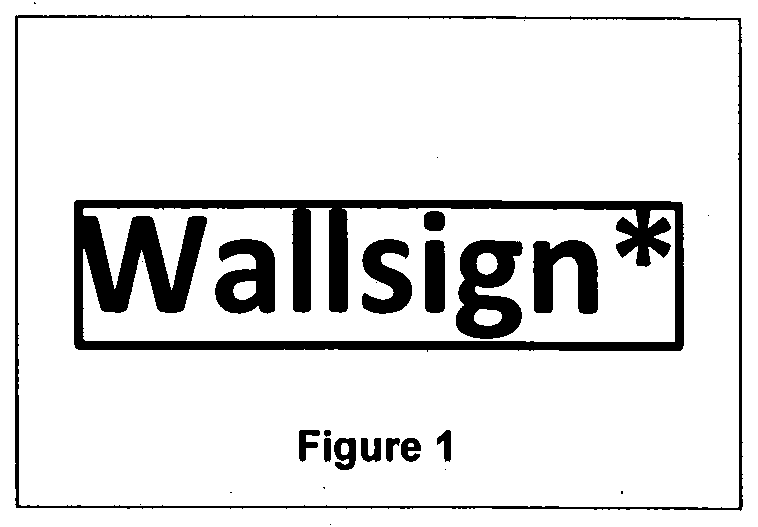
Figure 1
Where a sign has two or more faces, the area of all faces shall be included in determining the area of the sign, except that where two such faces are placed back-to-back and are at no point more than two feet from one another, the area of the sign shall be taken as the area of one face if the two faces are of equal area, or as the area of the larger face if the two faces are of unequal area.
Awnings. A sheet of canvas or other material that stretches on a frame and is used to keep the sun or rain off a storefront, window, doorway, or deck.
Billboards (outdoor advertising structure). A sign that is affixed to or erected upon a freestanding framework designed or intended to be used for posting information not pertaining directly to the use of the premises on which it is located.
Digital sign. A sign that has or appears to contain movement or that appears to change, caused by a method other than physically removing and replacing the sign or its components, whether the real or apparent movement or change is in the display, the sign structure itself, or any other part of the sign. A digital sign often incorporates a technology allowing the sign face to change the image without the necessity of physically or mechanically replacing the sign face or its components. A digital sign includes any display that incorporates rotating panels, LED lights manipulated through digital input, electronic message centers, or other similar methods or technologies that permit a sign face to present difference images or displays.
Free-standing signs. A sign supported by one or more uprights, poles or braces placed in or upon the ground surface and not attached to any building. Such sign may also be commonly known as a ground sign, or pole sign.
Identification signs. A sign that identifies the activity, business, owner or resident and/or the street address and which sets forth no other advertisement.
Illuminated signs. A sign that provides artificial light directly (or through any transparent or translucent material) or backlit through a translucent sign fixed to a structure or free standing, from a source of light connected with such sign.
Institutional bulletin board. A sign containing a surface area upon which is displayed the name of a religious institution, school, library, community center or similar institution and the announcement of its institution services or activities.
Marquee sign. An identification sign attached to a marquee, canopy or awning projecting from and supported by the building, above sidewalk level.
Monument sign. A free-standing sign that does not have an exposed pole or pylon and is attached to a common or pedestal base.
On-premises advertising sign. A sign which directs attention to and whose message relates to a business, service, commodity, or profession lawfully being conducted, sold, or offered on the same premises.
Parking lot sign. A sign that has been erected within the parking lot of a given site that directs motorists, pedestrians or cyclists.
Pole signs. A free-standing sign supported by one or more uprights, poles or braces placed in or upon the ground surface and not attached to any building.
Portable signs. A free-standing sign not permanently anchored or secured to either a building or the ground, but usually anchored or secured to a trailer or frame capable of being moved from place to place.
Projecting signs. A sign which projects from and is supported by a wall of a building and does not extend beyond the minimum required setback line or into and over a street right-of-way, and is not less than nine feet, at its lowest point, above sidewalk or ground level.
Sign. Any words, numerals, figures, devices, designs, pictures or trademarks, visible from any right-of-way, erected on or otherwise affixed to a building, wall board, plate or any other structure, or on a vehicle or trailer, for the purpose of advertising or identifying an establishment, product, service, or activity.
Temporary sign. A display or informational sign with or without a structural frame and intended for a period not to exceed 90 days of display, including seasonal produce sales, decorative displays for holiday or public demonstrations.
Wall sign (fascia sign). A sign which is attached directly to or painted upon a building wall and which does not extend more than 18 inches therefrom nor above the eave line on roof, with the exposed face of the sign in a plane parallel to the building wall.
Window sign. Signs affixed to, in contact with, or within 12 inches of a window; installed for purposes of viewing from outside the premises. This does not include merchandise located in a window.
(Ord. No. 31.55, 4-17-2017; Ord. No. 31.76, § 2, 5-2-2022)
Sec. 18.05. - Signs permitted in all districts.
The following signs shall be permitted in all districts subject to the requirements stated herein:
A.
House numbers legible from the street, and nameplates (fraternal, social, apartment, and professional) identifying the occupant or address of a parcel of land, and not exceeding two square feet in display surface area.
B.
Memorial signs or tablets, especially those containing the names of buildings and dates of construction.
C.
Reserved.
D.
Flags.
E.
Traffic, or other municipal signs, also private traffic control signs which conform to the requirements of the Michigan Manual of Uniform Traffic Control Devices.
F.
Institutional bulletin board located on the premises to which the sign pertains and not exceeding 100 square feet in surface display area.
G.
Park and playground signs.
H.
Temporary signs shall be subject to the following:
1.
One non-illuminated temporary sign not exceeding 12 square feet may be placed by right on any property.
2.
One additional non-illuminated temporary sign not exceeding 12 square feet may be placed for each additional condition:
a.
One additional sign for properties with more than one front lot line, such as a corner lot.
b.
One additional sign per registered political candidate and/or any ballot question within a time period between 60 days prior and 10 days after any election in which Bath Charter Township residents are eligible to vote.
c.
One additional sign while the property is for sale.
3.
Temporary signs for office or commercial uses in all districts shall have the following additional regulations:
a.
Temporary signs for office or commercial uses in all districts shall not exceed 32 square feet, except those temporary signs as allowed by paragraph 18.05.H(2) are limited to 12 square feet.
b.
A building permit is required to erect temporary signs attached to or suspended from a building, or placed in the sidewalk area. Said permit shall specify the size and length of duration of said sign.
c.
Cloth or canvas signs, pennants or banners are permitted and shall also require a building permit.
d.
Temporary seasonal produce signs shall be allowed in all zoning districts; they shall not exceed nine square feet in surface display area; they shall be placed ten feet off and/or from the street right-of-way; and they shall be removed by November 15 of each calendar year.
4.
Trespassing, safety or caution signs, not exceeding two square feet in area, shall be permitted.
(Ord. No. 31.55, 4-17-2017; Ord. No. 31.76, § 3, 5-2-2022)
Sec. 18.06. - Signs for residential uses in all districts.
Any sign not expressly permitted is prohibited.
A.
Home occupation. One non-illuminated sign announcing a home occupation or professional service not to exceed two square feet in surface display area, and attached flat against principal building wall or free-standing, but not closer than ten feet to street right-of-way; see section 3.02(49)(e).
B.
Subdivision or development entry. A permanent sign, which may be illuminated, may be permitted by planning commission approval provided that the sign copy may include only the name of the development and the developer and provided that the sign and structure shall be harmonious and appropriate in appearance with the existing and intended character of the general vicinity, and shall not exceed 100 square feet in surface display area.
C.
Identification sign. One sign placed flat against the main building announcing the identification of the apartment development that shall not exceed 12 square feet in surface display area. Such a sign may be illuminated provided that the source of the light is not visible beyond the property lines of the parcel upon which it is located.
(Ord. No. 31.55, 4-17-2017)
Sec. 18.07. - Signs for office or commercial uses in all districts.
Any sign not expressly permitted is prohibited. Permitted surface display area shall not exceed 100 square feet for any office or commercial use outside of shopping centers, including surface display area of outdoor advertising structures of section 18.12 for off-premise signs.
A.
Free-standing signs:
1.
Pole signs:
a.
One on-premises advertising sign per building not exceeding 100 square feet in surface display area.
b.
The sign shall convey only the identification of the permitted use.
c.
A free-standing sign, the leading edge of which is set back at least ten feet from the right-of-way line and shall be located in the front yard.
d.
The leading edge of the display area or any part of the sign, other than the pole support elements, nearest to the ground shall have a minimum height of eight feet from the surface of the ground.
e.
The leading edge of the display area or any part of the sign shall have a maximum height of 20 feet from the surface of the ground.
f.
The ground surface that supports the base of the sign shall not be raised in an unnatural or deliberate manner with the intention of increasing the overall height of the proposed sign.
2.
Monument signs require the following:
a.
The minimum front yard setback shall be five feet;
b.
The minimum side yard setback shall not be less than the height of the sign;
c.
The total surface display area shall be no greater than 65 feet at the five foot front yard setback;
d.
The maximum surface display area may be increased by seven square feet for each foot of additional setback beyond five feet, but may not exceed 100 square feet;
e.
The sign height shall be no greater than five feet, which includes the columnar or pedestal base, at the minimum five-foot setback;
f.
The maximum sign height may be increased by two inches for each foot of additional setback beyond five feet, but may not exceed a maximum of six feet in height, which includes the columnar or pedestal base;
g.
The placement of the monument sign shall provide for a clear vision area for pedestrians and vehicles;
h.
The ground surface that supports the base of the sign shall not be raised in an unnatural or deliberate manner with the intention of increasing the overall height of the proposed sign.
B.
Wall signs:
1.
Wall signs shall not exceed ten percent of the building face to which it is attached.
2.
Wall signs shall be placed flat against the main building or parallel to the building on a facade and may only face public streets or parking areas which are part of the development.
3.
Wall signs shall not project above the eave or lower roof line.
C.
Marquee signs:
1.
Marquee signs shall not exceed the surface display area permitted for wall signs.
2.
No portion of a marquee sign shall be higher than the eave or lower roofline.
D.
Projecting signs:
1.
One per building, with a surface display area not exceeding one and one-half square feet in area for each lineal foot of building frontage up to a maximum of 50 square feet.
2.
Projecting signs shall be attached directly to a building by means of building mounts or hung from a mast arm. These support members may also include decorative appurtenances, but external bracing such as guy wires and metal framework shall be prohibited.
3.
Signs must project at a 90-degrec angle to the building surface to which it is attached.
4.
Projecting signs shall not extend beyond the minimum required setback line or into and over street right-of-way.
5.
The minimum clearance of a projecting sign over a sidewalk shall be nine feet.
E.
Window signs:
1.
Permanent window copy, painted or otherwise attached to the window surface shall be limited in area to ten percent of the total window surface of the window involved.
2.
Window signs are permitted on first floor windows only.
3.
Temporary window signs shall not exceed 20 percent of the surface of the window to which it is attached.
4.
The provisions stated above shall not restrict the reasonable application upon a window surface of lettering or decals giving the address, hours of business, entrance or exit information, professional or security information, credit cards which are accepted or other similar information, nor shall the surface area of such lettering or decals be included in the overall computation of allowable signage.
F.
Illuminated signs:
1.
Signs may be illuminated but no flashing or moving illumination shall be permitted.
2.
The source of illumination shall not be visible beyond the property line of the parcel on which the sign is located.
3.
Neon signs shall be permitted.
4.
Signs shall not revolve or move in any manner.
G.
Service station signs:
1.
In the case of gasoline service stations on a two-sided sign indicating only price and grade of gasoline as shown on the pumps, either side not to exceed 12 square feet in surface display area, may be permanently attached to the support pole of the free-standing sign. If the support pole is poorly located, said price sign may be attached to a light standard or support. Price signs shall be attached with the bottom of sign no lower than six feet from ground level.
2.
There shall be no signs located in fuel pump islands or on canopies except those constituting an integral part of the fuel pump itself or those required by state law or regulation.
H.
Parking lot and directional signs:
1.
Surface display area per sign shall not exceed six square feet.
2.
Parking lot or directional signs within a given site or development shall not exceed a maximum of eight feet in height.
3.
The combined total of surface display area for all parking lot or directional signs within a site shall not exceed 36 square feet.
I.
Awnings:
1.
May contain the name of the store, logo, and the street address. The use of an awning as a means to display the store name, logo, and the street address shall be limited to one awning per business.
J.
The Bath Township Planning Commission may approve alternative sign standards as part of the final site plan review process for commercial uses.
1.
The planning commission has the ability to grant relief as it deems appropriate in each unique case from the sign standards in section 18.07, with the requirement that during the Site Plan Review process (article XX) the applicant presenting the development to the planning commission is able to convey good reasoning as to the need for relief from the sign standards of this section.
(Ord. No. 31.55, 4-17-2017; Ord. No. 31.76, § 4, 5-2-2022)
Sec. 18.08. - Signs for industrial uses in all districts.
Any sign not expressly permitted is prohibited.
A.
All limitations governing office or commercial use shall apply, except the maximum permitted surface display area shall be 200 square feet.
B.
Development entry. One free-standing sign identifying the development near the entrance to an industrial complex, not exceeding 150 square feet in surface display area and no higher than five feet above the ground shall be permitted. Such signs shall be at least 20 feet from any street line and may be illuminated provided the source of illumination is not visible beyond the property line of the parcel.
C.
The maximum sign height may be increased by two inches for each foot of additional setback beyond 20 feet, but may not exceed a maximum of six feet in height, which includes the columnar or pedestal base.
D.
The maximum surface display area may be increased by seven square feet for each foot of additional setback beyond 20 feet, but may not exceed 200 square feet.
(Ord. No. 31.55, 4-17-2017; Ord. No. 31.76, § 5, 5-2-2022)
Sec. 18.09. - Sign requirements for planned shopping centers.
A.
Free-standing signs shall conform to the requirements of section 18.05A, signs for office or commercial uses in all districts.
B.
Each business within the shopping center may provide one wall sign conforming to the requirements of section 18.05B.
C.
Where the roof structure of a building containing more than one business is extended over a walkway along the outer edge of the building, one marquee sign or one underhanging sign may be permitted for each business in the building provided:
(1)
All signs shall be identical size and shape, and have a minimum clearance of nine feet.
(2)
Underhanging signs shall contain the name of the business only.
(3)
All marquee and underhanging signs shall utilize identical lettering style and color scheme.
D.
An additional free-standing sign may be permitted for planned shopping centers upon application for and granting of a special use permit by the planning commission.
(Ord. No. 31.55, 4-17-2017)
Sec. 18.10. - Illuminated signs.
A.
Signs may be illuminated by a direct or indirect source of light provided the light source is shielded in a manner so that no direct rays or glare emanating from the light source are visible from any public right-of-way or from the abutting property.
B.
Illuminated signs shall be installed in such a manner as to allow the reduction of the amount of illumination after normal business hours each day.
C.
The maximum brightness levels for an illuminated sign shall conform to the following requirements:
1.
Brightness shall be no greater than 2,000 nits or candelas from dawn until dusk.
2.
Brightness shall be no greater than 125 nits or candelas from dusk until dawn.
D.
Re-inspection and recalibration may be periodically required by the township in its discretion, at the expense of the applicant, their assignees or successors, or the individual who exercises control over the sign, to ensure that the specified brightness levels are maintained at all times.
E.
Brightness of the illuminated signs shall be measured from the sign's face using a standard nit-meter.
(Ord. No. 31.55, 4-17-2017; Ord. No. 31.76, § 6, 5-2-2022)
Sec. 18.11. - Moving or revolving signs.
Any sign which revolves or has any visible moving parts, visible revolving parts or visible mechanical movement of any type, or other apparent visible movement achieved by electrical, electronic or mechanical means, shall be prohibited.
(Ord. No. 31.55, 4-17-2017)
Sec. 18.12. - Signs not to constitute a traffic hazard.
No sign shall be erected at the intersection of any street in such a manner as to obstruct free and clear vision; or at any location where by reason of the position, shape or color, it may interfere with, obstruct the view of or be confused with any authorized traffic sign, signal or device; or which makes use of the words "stop", "look", "danger" or any word, phrase, symbol or character in such a manner as to interfere with, mislead or confuse traffic.
(Ord. No. 31.49, § 3, 6-1-2015; Ord. No. 31.55, 4-17-2017)
Sec. 18.13. - Portable or moveable signs.
Any portable sign not permanently anchored or secured to either a building or the ground, including but not limited to "A" frame, "T" frame, or inverted "T" shaped structures, including those signs mounted on wheeled trailers, shall be permitted in only the development or high- density districts and only in accordance with the following provisions:
A.
Portable signs are permitted for grand openings, advertising charitable or community-related events and the like. Being temporary in nature, such portable signs may be permitted for a period not to exceed 90 days.
B.
All illuminated portable signs shall comply with the requirements of section 18.10.
C.
All portable signs shall be located no closer than one-half the setback distance for a permanent structure, to the street right-of-way line.
D.
Any portable signs shall not exceed 50 square feet in surface display area.
E.
Any portable signage exceeding the above requirements shall necessitate issuance of a special use permit by the planning commission.
(Ord. No. 31.49, § 4, 6-1-2015; Ord. No. 31.55, 4-17-2017; Ord. No. 31.76, § 7, 5-2-2022)
Sec. 18.14. - Digital signs.
A.
Definitions. For purposes of this section, a "free-standing sign," "marquee sign," "on-premise advertising sign, "projecting sign," "wall sign," "window sign," "illuminated sign," "service station signs," "parking lot sign" or "temporary sign" shall meet the provisions of this section if it also meets the definition of a "digital sign".
B.
Display.
(1)
A digital sign may not allow the display or message to change more frequently than once every twelve seconds, with a transition period of one second or less. Digital signs may not contain any visible moving parts, alternating or moving messages or have the appearance of having moving parts or messages. Under no circumstances may any type of digital sign contain a video, or a message or display that appears to flash, undulate, pulse, move, or portray explosions, fireworks, flashes of light, or blinking lights or otherwise appears to move toward or away from the viewer, expand or contract, bounce, rotate, spin, twist or make other comparable movements.
(2)
A digital sign must have installed a monitor, which shall continuously monitor and automatically adjust the brightness level of the display based on conditions consistent with the terms of this section.
(3)
The maximum brightness levels for digital signs shall conform to the following requirements:
a.
Brightness shall be no greater than 2,000 nits from dawn until dusk.
b.
Brightness shall be no greater than 125 nits from dusk until dawn.
(4)
Certification must be provided to the township demonstrating that the sign has been preset to automatically adjust the brightness to these levels or lower. Re-inspection and recalibration may be periodically required by the township in its reasonable discretion, at the expense of the applicant, his or her assignees or successors, or the individual who exercises control over the sign, to ensure that the specified brightness levels are maintained at all times.
(5)
Brightness of digital signs shall be measured from the sign's face using a standard nit-meter when the digital sign is turned on to full white copy.
C.
Operation.
(1)
Digital signs may only be operated during a business's normal hours of operation and one-half hour before or after the open or close of the business, in accordance with brightness levels set forth in subsections 18.14(B)(3)(a) and (b).
(2)
Digital signs may only be operated in the following township zoning districts: Development (D) and High Density Development (HDD).
D.
Other Requirements. The use, size and location of digital signs must comply with all other relevant regulations and ordinances of the township.
(Ord. No. 31.55, 4-17-2017)
Sec. 18.15. - Outdoor advertising structures.
Billboards (outdoor advertising structures) may be permitted by special use permit in the development district in accordance with the following limitations:
A.
General requirements.
1.
For purposes of this section, "digital billboard" shall mean a "billboard" which incorporates, in whole or in part, a digital sign.
2.
Any double-faced billboard having back-to-back surface display areas, no part of which is more than two feet apart, is considered to be a single billboard.
3.
Billboards having more than one surface display area which are tandem (side-byside) or stacked (one above the other) are considered two billboards and are prohibited.
4.
The installation or use of a billboard is permitted only to the extent authorized by, and subject to, the provisions of the Zoning Ordinance.
5.
No billboard may be installed or erected at any time when there are five or more existing billboards located in the township.
B.
Spacing.
1.
No more than three billboards may be located within any linear mile along a street, notwithstanding the fact that such billboards may be located on different sides of the street. This distance requirement shall include in its calculation any billboards located outside of the boundaries of the township.
2.
No billboard may be located within a radius of 500 feet of another billboard regardless of geographic jurisdiction or within 300 feet of existing or future residential uses.
3.
Billboards shall be located at least 100 feet from the right-of-way line of the street on which they front.
4.
All distances as provided for in this section shall be measured radially from where the surface display area is visible.
5.
No billboard may be located on top of, cantilevered over or otherwise suspended above any building or structure.
C.
Billboard size.
1.
No billboard shall exceed 100 square feet in surface display area.
2.
The height of a billboard may not exceed 35 feet above the natural grade of the ground on which the billboard is located.
D.
Illumination. A billboard may be illuminated, provided such illumination is consistent with the requirements of this ordinance, is concentrated on the surface of the billboard and is located so as to avoid glare or reflection onto any portion of an adjacent street or highway, the path of oncoming vehicles or any adjacent premises.
E.
Appearance; movement. All billboards must be stationary and may not contain any visible moving parts, alternating or moving messages or have the appearance of having moving parts or messages.
F.
Display. A billboard may not, in whole or in part, incorporate any aspect of a digital sign. Digital billboards are expressly prohibited and shall not be constructed, displayed, placed, installed, substituted, operated, or maintained in the township.
G.
Construction. A billboard shall be constructed in such a fashion that it will withstand all wind and vibration forces that can normally be expected to occur in the vicinity and in compliance with all applicable codes.
H.
Maintenance. Billboards shall be adequately maintained. Such maintenance shall include proper alignment of structure, continued readability of structure and preservation of the structure with paint or other surface finishing material. If a billboard is not maintained, written notice of any disrepair shall be issued by the building inspector to the owner of said structure. If the disrepair is not corrected within 30 days, said structure shall be removed at the owner's expense.
I.
Other applicable laws. A billboard must comply with all applicable provisions of federal and state law.
J.
Permitting. Every billboard requires a township sign permit before installation or modification. Permits shall be reviewed and issued consistent with the terms of this section as well as all other applicable sections of the Township Zoning Ordinance. Every applicant for a billboard permit shall file with the application a policy of insurance, certifying that the applicant is insured against bodily injury and for property damage arising out of the erection, maintenance, repair, and replacement of the billboard in an amount satisfactory to the township. Each applicant, if the permit is granted, shall be required to maintain said insurance and keep a policy of insurance currently effective on file with the township so long as the billboard or billboards are in existence. The policy shall provide that the township shall receive ten-days written notice in case of cancellation of the policy. Any billboard in violation of the insurance requirements of this section shall be removed immediately and the cost of such removal shall be charged against the owner of the billboard.
K.
Other requirements. Billboards must otherwise comply with all other relevant regulations and ordinances of the township.
(Ord. No. 31.55, 4-17-2017; Ord. No. 31.76, § 8, 5-2-2022)
Sec. 18.16. - Minimum commercial signs standards in all districts.[5]
In an effort to maximize safety throughout all zoning districts and land uses, all sign types shall be required to meet the minimum sign standards set forth in this section. The minimum sign standards are signs of any type and with all zoning districts shall not be permitted within the following sight triangles.
A.
Street intersections or driveway and street intersections. No sign shall obstruct the visibility of motorists, pedestrians, or cyclists within a sight triangle at streets intersections or drive and street intersections between the height(s) of three feet and above, as measured from the back of the curb or edge of the pavement. The sight triangle shall be formed by measuring from the intersection along the back of curb or edge of asphalt of each street or driveway and ending the measurement at the required distance stated in Table 1. Then the two end points are connected across the property to form a three-sided sight triangle (See Figure 1 for an example of a sight triangle).
TABLE 1
FIGURE 1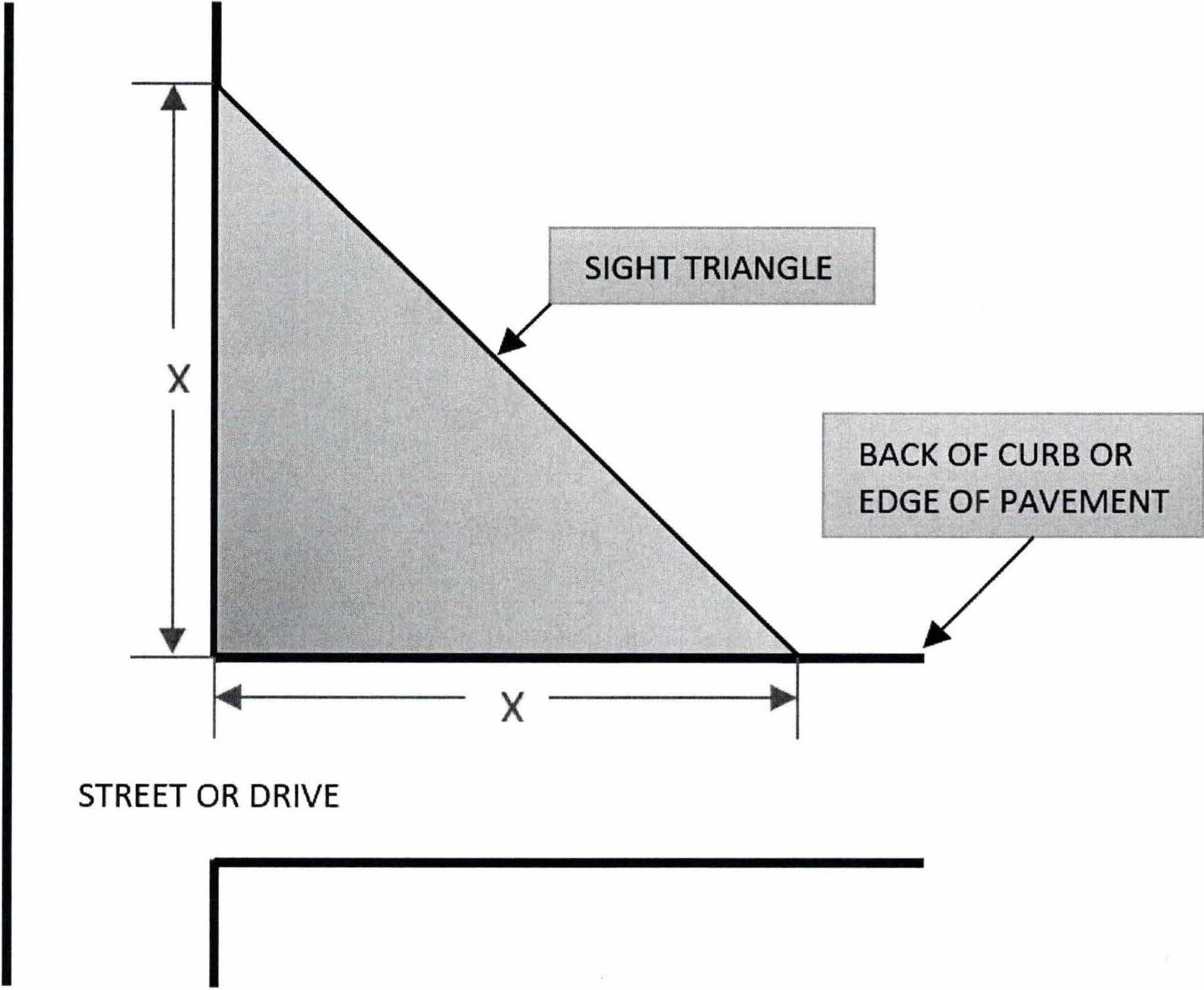
B.
For intersections where the sight triangle is in dispute, the planning commission has the ability to implement dimensional requirements of this section (18.16) as it deems appropriate in each unique case, with the requirement that during the Site Plan Review process (article XX) the applicant presenting the development to the planning commission is able to convey good reasoning as to the need for unique implementation of the sign standards of this section. The planning commission shall also refer to the Michigan Department of Transportation's Sight Distance Guidelines handbook to assets in the implement of sight triangles in unique circumstances.
(Ord. No. 31.76, § 10, 5-2-2022)
Editor's note— Ord. No 31.76, § 9, adopted May, 2, 2022, renumbered the former § 18.16 as § 18.17 and enacted a new § 18.16 as set out herein. The historical notation has been retained with the amended provisions for reference purposes.
Sec. 18.17. - Existing nonconforming signs.[6]
It is the intent of this section to permit the continuance of a lawful use of any sign or outdoor advertising structure existing at the effective date of adoption of this section, although such sign or outdoor advertising structure may not conform with the provisions of this section. It is the intent that nonconforming signs and outdoor advertising structures shall not be enlarged upon, expanded or extended. Further, it is the intent that nonconforming signs and outdoor advertising structures shall be gradually eliminated and terminated upon their natural deterioration or accidental destruction. The continuance of all nonconforming signs and outdoor advertising structures within Bath Charter Township shall be subject to the conditions and requirements set forth herein.
A.
Structural changes. The faces, supports, or other parts of any nonconforming sign or outdoor advertising structure shall not be structurally changed, altered, substituted, or enlarged unless the resultant has changed, been altered, substituted, or enlarged, the sign or outdoor advertising structure conforms to the provision of this article for the use it is intended, except as otherwise provided for.
B.
Repairs, alterations and improvements. Nothing shall prohibit the repair, reinforcement, alteration, improvement, or modernizing of a lawful nonconforming sign or outdoor advertising structure, provided such repair does not exceed an aggregate cost of 30 percent of the appraised replacement cost as determined by the building inspector, unless the subject sign or outdoor advertising structure is changed by such repair, reinforcement, alteration, improvement, or modernizing to a conforming structure. Nothing in this section shall prohibit the periodic change of a message on any outdoor advertising structure.
C.
Restoration of damage. Any lawful nonconforming sign or outdoor advertising structure damaged by fire, explosion, or an act of God, or by other accidental causes, may be restored, rebuilt or repaired, provided that the estimated expense of reconstruction does not exceed 50 percent of the appraised replacement cost as determined by the building inspector.
D.
Discontinuance or abandonment. Whenever the activity, business or usage of a premises to which a sign is attached or related has been discontinued for a period of 90 days or longer, such discontinuance shall be considered conclusive evidence of an intention to abandon legally the nonconforming sign attached or related thereto. At the end of this period of abandonment, the nonconforming sign shall either be removed or altered to conform with the provisions of this section.
E.
Elimination of nonconforming signs. The township board may acquire any nonconforming sign or outdoor advertising structure, with or without acquiring the property on which such sign or structure is located, by condemnation or other means, and may remove such sign or structure.
(Ord. No. 31.55, 4-17-2017; Ord. No. 31.76, § 9, 5-2-2022)
Editor's note— See editor's note at section 18.16.

