
Bath Township City Zoning Code
ARTICLE VI
B.- CSP COMMERCIAL SALES AND PROVISIONING OVERLAY DISTRICT
Sec. 6B.01 - Intent and purpose.
The CSP - Commercial Sales and Provisioning overlay district is intended to establish additional regulations, design, and dimensional standards for the land uses that are to be permitted within this overlay district. The geographical location of the CSP - Commercial Sales and Provisioning overlay district is based upon the carefully crafted language of the (1) Medical Marihuana Facilities Licensing Ordinance and (2) Authorizing and Permitting Adult-Use Marihuana Establishments Ordinance. At the current date of the CSP - Commercial Sales and Provisioning overlay district being established, both the medical and adult-use (recreational) ordinances, which are not zoning but police power (regulatory) ordinances, have sections titled "Required Spacing". Great attention and collected community input aided in the establishment of the standards detailed within the "Required Spacing" section. In an effort to create clarity, reduce conflicting land uses, and to better serve the public interest, a need was established to create an overlay district with the purpose and intent to establish boundaries where the desired land uses and development standards could be more easily conveyed to the general public. Using geographic information systems (GIS), careful consideration was taken to base this overlay district's boundaries on the "Required Spacing" section of the police power ordinances previously mentioned in this section. This was conducted with the intention that any parcels currently permitting the desired land uses of Sec. 6B.04. and 6B.05., per the previously mentioned police power ordinances, would continue to allow said uses within the CSP - Commercial Sales and Provisioning overlay district. In contrast, if the desired land uses of Sec. 6B.04. and 6B.05. are not permitted per the previously mentioned police power ordinances, they would continue to not be located within the boundaries of the CSP - Commercial Sales and Provisioning overlay district (therefore not be permitted in any other district within Bath Charter Township).
(Ord. No. 31.77, § 4, 8-15-2022)
Sec. 6B.02 - Location of the CSP commercial sales and provisioning overlay district.
A.
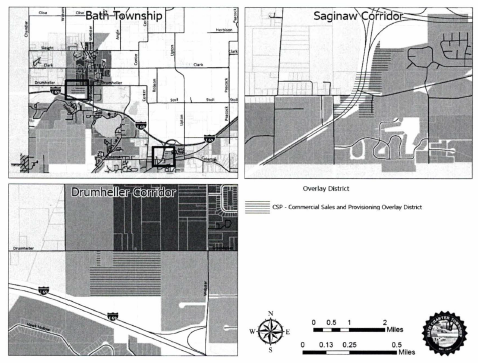
The CSP - Commercial Sales and Provisioning overlay district shall consist of the "hash-marked" area set forth on the "CSP - Commercial Sales and Provisioning overlay district Map" attached within this section and made part of this Ordinance by reference. Said map shall be attached to and become a part of the Zoning District Map described in article IV, section 4.01 of this Ordinance.
B.
The following parcels are currently included in the CSP - Commercial Sales and Provisioning overlay district: 010-034-400-015-60, 010-034-400-020-00, 010-034-400-025-00, 010-034-400-055-02, 010-034-400-055-03, 010-020-300-015-00, 010-034-100-035-51, 010-020-300-005-00, 010-020-300-030-60, 010-034-400-031-00, 010-020-300-010-50, and 010-034-400-040-00.
C.
Land located within the CSP - Commercial Sales and Provisioning overlay district may be developed according to the provisions of the underlying zoning district and according to the provisions of this article.
(Ord. No. 31.77, § 4, 8-15-2022)
Sec. 6B.03. - Uses permitted by right.
In the CSP - Commercial Sales and Provisioning overlay district, the principal permitted land uses and accessory uses shall meet the requirements of the D development district section 6.02. All uses permitted by right in the D - Development district (section 6.02) are allowed in the boundaries of the CSP - Commercial Sales and Provisioning overlay district.
(Ord. No. 31.77, § 4, 8-15-2022)
Sec. 6B.04 - Uses permitted by special use permit.
In the CSP - Commercial Sales and Provisioning overlay district, the land uses permitted by special use permit shall meet the requirements of section 6.04. In addition to other special uses identified in this section, all special uses allowed in the D-Development district (section 6.04) are allowed in the boundaries of the CSP- Commercial Sales and Provisioning overlay district.
The following uses are permitted in the CSP - Commercial Sales and Provisioning overlay district with a special use permit granted by the Township Board, after review and recommendation by the Planning Commission, in accordance with the provisions of this Article and Article XIX.-Special Use Permits:
A.
Marihuana retailers;
B.
Marihuana microbusinesses; and
C.
Provisioning centers.
In addition to the special use permit requirements of section 6.04, the following requirements shall apply for marihuana retailers, marihuana microbusinesses, and provisioning centers. Marihuana retailers and marihuana microbusinesses applicants may only apply for a special use permit approval after the township board has conditionally approved an applicant's application for a marihuana establishment permit pursuant to the Bath Charter Township Ordinance Authorizing and Permitting Adult-Use Marihuana Establishments and has expressly authorized the applicant to seek special use permit approval. A provisioning center applicant may only apply for a special use permit after they have received a permit issued pursuant to the Bath Charter Township Michigan Medical Marihuana Facilities Licensing Ordinance.
(Ord. No. 31.77, § 4, 8-15-2022)
Sec. 6B.05 - CSP commercial sales and provisioning - site development standards.
Due to the sensitive nature of the land uses permitted within the CSP - commercial sales and provisioning overlay district the following additional development standards shall apply to all commercial developments within this overlay.
All marihuana retailers, marihuana microbusinesses, and provisioning centers shall conform to the following site development standards:
A.
Marihuana establishments and facilities shall comply with all applicable codes, including local zoning, building, and health departments, except to the extent that they are inconsistent with the MRTMA, MMFLA or article VI.B. and all subsection within. The establishment or facility must hold a valid local permit and valid state license for the type of establishment or facility intended to be carried out on the permit holder. In addition to a valid local permit and valid State license for an adult-use marihuana establishment, an establishment must also hold a valid state license and local permit for the corresponding type of facility under the MMFLA. The establishment or facility operator, owner, licensee or permit holder must have documentation available that demonstrates full compliance with all local and State sales tax requirements, including holding any permits or licenses, if applicable.
B.
No special use permit or site plan application shall be considered administratively complete nor shall approval be granted without the applicant receiving authorization to seek final special use permit approval and conditional approval from the township board to operate a marihuana establishment pursuant to the Bath Charter Township Ordinance Authorizing and Permitting Adult-Use Marihuana Establishments or a marihuana or a commercial medical marihuana facility pursuant to the Bath Charter Township Michigan Medical Marihuana Facilities Licensing Ordinance.
C.
Marihuana retailers, marihuana microbusinesses, and provisioning centers shall at all times maintain a security system that meets State law requirements, and shall also include the following:
1.
Security surveillance cameras installed to monitor all entrances, along with the interior and exterior of the permitted premises; and
2.
Robbery and burglary alarm systems that are professionally monitored and operated 24 hours a day, seven days a week; and
3.
A locking vault permanently affixed to the permitted premises that shall store all marihuana and cash remaining in the establishment or facility overnight, except for marihuana actively grown in a grower establishment or facility; and
4.
All marihuana in whatever form stored at the permitted premises shall be kept in a secure manner and shall not be visible from outside the permit holder, nor shall it be grown, processed, exchanged, displayed or dispensed outside the permitted premises; and
5.
All security recordings and documentation shall be preserved for at least 30 days by the permit holder and made available to any law enforcement agency upon request for inspection.
D.
Operating hours. No retailer or retail aspect of a microbusiness shall operate between the hours of 12:00 a.m. and 8:00 a.m. Customers may not enter a retailer or retail aspect of a microbusiness between the operating hours of 10:00 p.m. and 12:00 a.m.
E.
Required spacing.
1.
In this subsection, any distance is measured horizontally between the nearest property line of the parcel where the marihuana establishment or facility's proposed permitted premises will be principally located and the nearest property line of the parcel where the use that is being measured from is principally located.
2.
Any retailer establishment or provisioning center shall be co-located with a grower and processor.
3.
No marihuana establishment or commercial medical marihuana facility may be located within 500 feet from any other marihuana establishment or commercial marihuana facility, unless the marihuana establishments or commercial medical marihuana facilities are owned and operated by the same permit holder, are co-located on the same parcel, and comply with state and local law.
F.
Colocation with certain commercial medical marihuana facilities and adult-use establishments. Subject to underlying zoning restrictions, the following colocation is permitted:
1.
A grower facility, processor facility, or provisioning center may operate from within a single facility also operating with a marihuana grower, marihuana processor, or marihuana retailer operating pursuant to the MRTMA and applicable rules promulgated by the department.
2.
A marihuana grower, marihuana processor, or marihuana retailer, may operate from within a single facility operating pursuant to the MRTMA and applicable rules promulgated by the department.
3.
Colocation of establishment permits is permitted under applicable rules and regulations of the department.
G.
Stacked license. An applicant for a grower establishment may apply to stack another grower permit at the establishment or permitted premises. Permits or licenses may only be stacked consistent with state law and the rules and regulations promulgated by the department.
H.
Amount of marihuana. The amount of marihuana on the permitted property and under the control of the permit holder, owner or operator of the establishment or facility shall not exceed that amount permitted by the State license or the township's permit.
I.
Sale of marihuana.
1.
The marihuana offered for sale and distribution must be packaged and labeled in accordance with state law.
2.
The establishment or facility is prohibited from selling, soliciting or receiving orders for marihuana or marihuana products over the internet.
J.
Sign restrictions. No pictures, photographs, drawings or other depictions of marihuana or marihuana paraphernalia shall appear on the outside of any permitted premises nor be visible outside of the permitted premises on the permitted property. The words "marihuana," and any other words used or intended to convey the presence or availability of marihuana shall not appear on the outside of the permitted premises nor be visible outside of the permitted premises on the permit holder other than the word "cannabis" which is explicitly permitted.
K.
Use of marihuana or other substances. The sale, consumption or use of alcohol or tobacco products on the permitted premises is prohibited. Smoking or consumption of controlled substances, including marihuana, on the permitted premises is prohibited.
L.
Indoor operation. All activities of marihuana establishments and facilities, including without limitation, distribution, growth, cultivation, or the sale of marihuana, and all other related activity permitted under the permit holder's license or permit must occur indoors. The establishment or facility's operation and design shall minimize any impact to adjacent uses, including the control of any odor by maintaining and operating an air filtration system so that no nuisance odor is detectable at the property line of the permitted premises.
M.
Control and mitigation of odor. Odors from cultivating, growing, manufacturing, and processing must be abated to the fullest extent reasonably possible through the installation of an operable filtration to ventilation and exhaust equipment and odors must otherwise be effectively confined to the interior of the building from which the odor is generated.
N.
Distribution. No person operating an establishment or facility shall provide or otherwise make available marihuana to any person who is not legally authorized to receive marihuana under State law.
O.
Unpermitted growing. A customer or patient may not grow his or her own marihuana at an establishment or facility.
P.
Waste disposal. The special use permit holder, owner and operator of the establishment or facility shall use lawful methods in controlling waste or by-products from any activities allowed under the license or permit.
Q.
Transportation. Marihuana may be transported by a marihuana secure transporter within the township under this Ordinance, and to effectuate its purpose, only:
1.
By persons who are otherwise authorized by state law to transport marihuana;
2.
In a manner consistent with all applicable state laws and rules, as amended;
3.
In a secure manner designed to prevent the loss of the marihuana;
4.
No vehicle used for the transportation or delivery of marihuana under this Ordinance shall have for markings the words "marihuana", cannabis" or any similar words; pictures or other renderings of the marihuana plant; advertisements for marihuana or for its sale, transfer, cultivation, delivery, transportation or manufacture, or any other word, phrase, or symbol indicating or tending to indicate that the vehicle is transporting marihuana;
5.
No vehicle may be used for the ongoing or continuous storage of marihuana, but may only be used incidental to, and in furtherance of, the transportation of marihuana.
R.
Additional conditions. The township board may impose such reasonable terms and conditions on a marihuana establishment or facility special use as may be necessary to protect the public health, safety and welfare, and to obtain compliance with the requirements of this Ordinance and applicable law.
(Ord. No. 31.77, § 4, 8-15-2022; Ord. No. 31.88, § 1, 8-19-2024)

