
Bemidji City Zoning Code
ARTICLE I
- GENERAL PROVISIONS
Sec. 28-1.- Authority.
This chapter is adopted pursuant to the city's authority under the city charter, Minn. Stat., Sections 462.351—462.364, and such other law as may apply.
(Ord. No. 199, 3rd series, § 1, 11-6-2023)
Sec. 28-2. - Title, jurisdiction, and application.
This chapter shall be known, cited, and referred to as the City of Bemidji Development Code, and referred to herein as this "development code." The jurisdiction of this development code is intended to apply to the use of land and water resources within the jurisdictional boundaries of the City of Bemidji; and including any land hereafter annexed into the city from the surrounding townships.
Application of these regulations shall be in part by establishment of districts, including overlays for such features such as shoreland and special use areas, and which district provisions include regulation of the location, size, use and height of buildings, the placement of buildings on lots, and the density of population for the purpose of promoting the public health, safety, order, convenience and general welfare of the city.
Application of this development code shall also be consistent with other official controls regulating land use and waters within the city, including Mississippi Headwaters Board (MHB) development code No. 10 (comprehensive plan), and consistent also with Bemidji Regional Airport Zoning Ordinance, created and passed by the Bemidji Regional Airport Joint Zoning Board pursuant to Minn. Stat., Chapter 360 and Minnesota Rules, Part 8800.2400.
(Ord. No. 199, 3rd series, § 1, 11-6-2023; Ord. No. 210, 3rd series, § 1, 10-21-2024)
Sec. 28-3. - Intent and purpose.
This development code is intended to serve the following purposes:
(a)
Protecting the public health, safety, comfort, convenience and general welfare of the city;
(b)
To guide the future growth and development of the city in accordance with the comprehensive plan, including various elements and/or other plans adopted by the city council;
(c)
Protecting and preserving the natural environment of the city;
(d)
To promote and maintain the Northwoods character of the community;
(e)
To protect and conserve the value of land throughout the city, and the value of buildings appropriate to the various districts established by this development code;
(f)
To provide adequate light, air, and privacy, to secure safety from fire, flood and other danger, and to prevent overcrowding and undue congestion of land and population;
(g)
To bring about the gradual conformity of the uses of land and buildings throughout the city through the zoning regulations set forth in this development code, and to minimize the conflicts among the uses of land and buildings;
(h)
To promote the beneficial and safe interaction between the use of land, buildings, and people for the circulation of vehicular, bicycles, and pedestrian traffic, including active transportation and complete streets, throughout the city;
(i)
To provide a guide for public policy and action in the efficient provision of public facilities and services and for private enterprises in building development, investment and other economic activity relating to uses of land, buildings, and active transportation throughout the city; and,
(j)
For the purpose of preserving and enhancing the quality of surface waters, preserving the economic and natural environmental values of shore lands, and providing for the wise utilization of waters and related land resources.
(k)
To improve and promote the delivery of aviation and airport passenger services by prevention of airport hazards through regulation of adjacent land use, height of structures and trees, and the density of population on lands within airport hazard areas adjacent to the Bemidji Regional Airport.
(Ord. No. 199, 3rd series, § 1, 11-6-2023)
Sec. 28-4. - Interpretation.
(a)
In their interpretation and application, the provisions of this development code shall be held to be the minimum requirements for the promotion of the public health, safety and general welfare. Interpretation shall be made by the planning director, subject to appeal to the board of adjustment. The language contained in the text of this development code shall be interpreted in accordance with the following rules of construction:
(b)
The singular number includes the plural and the singular.
(c)
The present tense includes the past and future tenses as well as all other tenses.
(d)
The word "shall" is mandatory, and the word "may" is permissive.
(e)
The masculine gender includes the feminine and neutral genders.
(f)
Whenever a word or term defined hereinafter appears in the text of this development code, its meaning shall be construed as set forth in such definition.
(g)
All measured distances expressed in feet shall be to the nearest tenth of a foot.
(h)
In the event of conflicting provisions, the more restrictive provisions shall apply.
(Ord. No. 199, 3rd series, § 1, 11-6-2023)
Sec. 28-5. - Relation to comprehensive plan.
It is the policy of the city council that the enforcement, amendment, and administration of this development code be accomplished with due consideration of the recommendations contained in the city comprehensive plan as developed and amended from time to time by the council. The council recognizes the comprehensive plan as the policy for regulating land use and development in accordance with the policies and purposes herein set forth.
(Ord. No. 199, 3rd series, § 1, 11-6-2023)
Sec. 28-6. - Standard requirements.
The following standards shall apply to all zoning districts and property, unless otherwise noted in this development code.
(a)
More restrictive provisions to govern. Where the conditions imposed by any provisions of this development code are either more restrictive or less restrictive than comparable conditions imposed by any other law, ordinance, code, statute, resolution or regulation, the regulations which are more restrictive or impose higher standards or requirements shall prevail.
(b)
Conformity with this development code. No building or structure shall be erected, converted, enlarged, constructed, reconstructed, moved or altered, and no building, structure or land shall be used for any purpose or in any manner which is not in conformity with the provisions of this development code and without a building permit being issued when required by this development code.
(c)
Building occupancy. Except as herein provided, no building, structure or premises shall hereafter be used or occupied and no building permit shall be granted that does not conform to the requirements of this development code.
(d)
Land reduction. No yard or lot existing at the time of passage of this development code shall be reduced in dimension or area below the minimum requirements set forth herein. Yards or lots created after the effective date of this development code shall meet at least the minimum requirements established by this development code.
(e)
Abrogation and greater restrictions. These regulations shall not abrogate any easement, covenant, or any other private agreement where such is legally enforceable, provided that where the regulations of this development code are more restrictive, or impose higher standards or requirements than such easements, covenants, or other private agreements, the requirements of this development code shall be controlling.
(Ord. No. 199, 3rd series, § 1, 11-6-2023)
Sec. 28-7. - Severability.
It is hereby declared to be the intention of the council that the several provisions of this development code are severable in accordance with the following:
(a)
If any court of competent jurisdiction shall adjudge any provision of this development code invalid, such judgment shall not affect any other provisions of this development code not specifically included in said judgment.
(b)
If any court of competent jurisdiction shall adjudge invalid the application of any provision of this development code to a particular property, building, or other structure, such judgment shall not affect the application of said provision to any other property, building, or structure not specifically included in said judgment.
(Ord. No. 199, 3rd series, § 1, 11-6-2023)
Sec. 28-8. - Annexation of certain land.
All land not located within the city, which may hereafter be annexed to the city of Bemidji shall be zoned R-1 upon such annexation until such time that the land may be rezoned under the procedures specified in this development code.
(Ord. No. 199, 3rd series, § 1, 11-6-2023)
Sec. 28-9. - Definitions.
The following words and terms, whenever they occur in this development code, are defined as follows:
Accessory dwelling unit (ADU) means a dwelling unit that is located on the same lot as a single-family dwelling unit to which it is accessory and subordinate to the principal dwelling unit. ADUs can be created in a variety of ways, including conversion of a portion of an existing house, addition to an existing house, conversion of an existing accessory structure, addition to an existing accessory structure, or the construction of an entirely new building.
(a)
Accessory dwelling unit, internal means a type of ADU that is incorporated within an existing single-family dwelling unit by converting a part of the existing home into a separate dwelling unit that provides complete independent living facilities for one or more person.
(b)
Accessory dwelling unit, attached means a type of ADU that is constructed as an expansion of an existing single-family dwelling unit, and is structurally a part of the principal dwelling unit.
(c)
Accessory dwelling unit, detached means a type of ADU that is not structurally a part of the principal dwelling unit, and is built separate or incorporated within an existing detached accessory structure, or attached to an existing detached accessory structure.
Accessory use or structure means a use or structure secondary in use, area or purpose to the principal use or structure on the same lot and serving a purpose naturally and normally incidental to the principal use or structure. This general definition does not include those accessory uses and structures that are separately defined in this development code. Accessory structures include but not limited to decks, stairways, carports, sheds, detached garages, barns, gazebos, swimming pools, and similar structures.
Accessory home share means a habitable room or space in an owner-occupied dwelling offered for trade or sale, whether for money or exchange of goods or services, for periods of 29 days or less.
Accessory recreation facility means a facility for private recreation that is accessory to the primary land use. Examples of accessory recreation facilities include but are not limited to: tennis courts, pools, trail heads, hockey rinks and volley ball courts.
Adult Use Definitions
Adult use means an adult body painting studios, adult book stores, adult cabaret, adult car wash, adult hotels or adult motels, adult motion picture theaters, adult mini motion picture theaters, adult massage parlors, adult health/sport clubs, adult sauna/steam room/bathhouses, adult companionship establishments, adult rap/conversation parlors, adult novelty businesses, adult motion picture arcade, adult modeling studios. This definition does not apply to the practice of medicine, surgery, osteopathy, chiropractic, physical therapy, or podiatry by State licensed or registered persons. Activities defined as obscene by Minn. Stat. § 617.241 are not lawful and are not included in the definitions of adult uses.
Adult uses (accessory) mean the offering of goods and/or services classified as adult uses on a limited scale that are incidental to the primary activity and goods and/or services offered by the establishment. Examples of such items include adult magazines, adult movies, adult novelties, and the like. Accessory uses that use less than 200 square feet or ten percent of the total floor area (square footage), whichever is less, are exempted from obtaining a license under this development code and, the requirement of being located in the I-1 zoning district.
Adult uses (principal) means the offering of goods and/or services classified as adult uses as a primary or sole activity of a business or establishment and include, but are not limited to, the following:
Adult body painting studio means an establishment or business that provides the service of applying paint or other substance, whether transparent or non-transparent, to or on the body of a patron when such body is nude or semi-nude.
Adult book store means an establishment, building or business engaging in the barter, rental or sale of items or merchandise consisting of printed matter, pictures, slides, records, audio tapes, video tapes, computer or video disks, motion picture film, or any other similar materials, if such shop is not open to the public generally but only to one or more classes of the public, excluding any minor because of age, and if a consistent and substantial useable floor area of the establishment, building, or business, is characterized by an emphasis on matters depicting, describing or related to "specified sexual activities" or "specified anatomical areas".
Adult cabaret means an establishment, building or business that regularly provides dancing or other live entertainment if such establishment excludes minors by virtue of age and if such dancing or live entertainment is distinguished or characterized by an emphasis on the performance or presentation, display, depiction or description of "specified sexual activities" or "specified anatomical areas".
Adult car wash means a wash facility for any type of motor vehicle that regularly allows employees, agent, independent contractors or persons to appear in a state of partial or total nudity in terms of "specified anatomical areas".
Adult companionship establishments means an establishment or business, if such establishment excludes minors because of age and regularly provides the service of engaging in or listening to conversation, talk or discussion between an employee of the establishment and a customer, if such service is distinguished or characterized by an emphasis on "specified sexual activities" or "specified anatomical areas".
Adult entertainment facility means a building or space in which an admission is charged for the entrance, or food or non-alcoholic beverages are sold or intended for consumption, and in which may be regularly observed live presentations of entertainment distinguished by an emphasis on matters depicting, describing, or relating to "specified sexual activities" or "specified anatomical areas".
Adult hotel or motel means a motel, hotel, or similar commercial establishment which: (a) offers public accommodations, for any form of consideration, and which regularly provides patrons with closed-circuit television transmissions, films, motion pictures, video cassettes, slides, or other photographic reproductions which are characterized by their emphasis upon the exhibition or description of "specified sexual activities" or "specified anatomical areas" and which regularly advertises the availability of such material by means of a sign visible from the public right-of-way, or by means of any off-premises advertising, including but not limited to, newspapers, magazines, pamphlets or leaflets, radio or television, and (b) offers a sleeping room for rent for a period of time less than ten hours.
Adult massage parlor, health/sport club means a massage parlor or health/sport club that restricts minors because of age or law, which regularly provides the services of massage if such service is distinguished or characterized by an emphasis on "specified sexual activities" or "specified anatomical areas".
Adult mini-motion picture theater means a business, building or establishment in an enclosed building with a capacity for less than 50 persons regularly used for the presenting of visual media material if such business as a prevailing practice excludes minors by virtue of age or law, and if said material is distinguished or characterized by an emphasis on "specified sexual activities" or "specified anatomical areas" for observation by patrons.
Adult modeling studio means an establishment or business whose major business is the regular provision of employees who are provided with the intent of providing sexual stimulation or sexual gratification to such customers and when said employees engage in "specified sexual activities" or display "specified anatomical areas" while being observed, painted, painted upon, sketched, drawn, sculptured, photographed or otherwise depicted by such customers.
Adult motion picture arcade means any building or place to which the public is allowed or invited in which coin or slug operated or electronically, electrically or mechanically controlled still or motion picture machines, projectors, computers or other production devices that regularly show images to five or fewer persons per machine at once, and are characterized by an emphasis on depicting or describing "specified sexual activities" or "specified anatomical areas".
Adult motion picture theater means a business premises within an enclosed building with a capacity of 50 or more persons regularly used for presenting visual media material if said business as a prevailing practice excludes minors by virtue of age, and if the material is distinguished or characterized by an emphasis on the depiction or description of "specified sexual activities" or "specified anatomical areas" for observation by patrons.
Adult novelty business means a business that has as a principal and regular activity the sale of materials or devices that stimulate human genitals or devices designed for sexual stimulation or which depict or relate to "specified sexual activities" or "specified anatomical areas".
Adult sauna/steam room/bathhouse means a business that excludes minors because of age, and which regularly provides a steam bath or heat bathing room used for bathing, pleasure, relaxation or reducing, and which utilizes steam or hot air as a cleaning, relaxing or reducing agent, if the service provided by the sauna/steam room/bathhouse is distinguished or characterized by an emphasis on "specified sexual activities" or "specified anatomical areas".
Adult act, distinguished or characterized by emphasis upon means the dominant or principal theme of the object described by such phrase. For instance, when the phrase refers to films "which are distinguished or characterized by an emphasis upon the exhibition or description of specified sexual activities or specified anatomical areas," the films so described are those whose dominant or principal character and theme are the exhibition or description of "specified anatomical areas" or "specified sexual activities."
Minor means any person under the age of 18 years.
Nudity means the showing of the human male or female genitals or pubic area with less than fully opaque covering; the showing of the female breast with less than fully opaque covering of any portion of the nipple; or the depiction or showing of the coverage of male genitals in a discernibly turgid state.
Semi-nude means a state of dress in which opaque clothing covers no more than the genitals, anus, anal cleft or cleavage, pubic area, vulva, and nipple of the female breast, as well as portions of the body covered by supporting straps or devices.
Sexually oriented business means any adult body painting studios, adult book stores, adult cabaret, adult car wash, adult hotels or adult motels, adult motion pictures theaters, adult mini motion picture theaters, adult massage parlors, adult health/sport clubs, adult sauna/steam room/bathhouses, adult companionship establishments, adult rap/conversation parlors, adult novelty businesses, adult motion picture arcade, adult modeling studios and other premises, enterprises or establishments, businesses, or places open to some or all members of the public at or in which there is an emphasis on the presentation or display, depiction or description of "specified sexual activities" or "specified anatomical areas" which the public could see. This definition does not apply to the practice of medicine, surgery, osteopathy, chiropractic, physical therapy, or podiatry by State licensed or registered persons. Activities defined as obscene by Minn. Stat. § 617.241 are not lawful and are not included in the definitions of adult uses.
Specified Anatomical Areas
(a)
Less than completely and opaquely covering human genitals, pubic region or pubic hair, buttock, anus, or female breast or breast below a point immediately above the top of the nipple or any combination of the foregoing; and
(b)
Human male genitals in a discernibly turgid state, even if completely and opaquely covered.
Specified Sexual Activities
(a)
Actual or simulated sexual intercourse, oral copulation, anal intercourse, oral-anal copulation, bestiality, direct physical stimulation or fondling of unclothed genitals, pubic region, buttock, or female breast, flagellation or torture in a sexual relationship, and any of the following sexually oriented acts or conduct: Anilingus, buggery, coprophagy, coprophilia, cunnilingus, fellatio, necrophilia, pederasty, pedophilia, piquerism, sapphism, sodomy, zooerasty; or,
(b)
Human genitals in the state of sexual stimulation, arousal, or tumescence; or,
(c)
Use or acts of human or animal ejaculation, sexual intercourse, sodomy, oral copulation, coitus or masturbation; or,
(d)
Fondling or touching of human genitals, pubic regions or pubic hair, buttocks, female breasts; or,
(e)
Situations involving a person or persons, any of whom are nude, clad in undergarments or in sexually revealing costumes, who are engaged in activities involving the flagellation, torture, fettering, binding or other physical restraint of any such person; or,
(f)
Erotic or lewd touching, fondling or other sexually oriented contact with an animal by a human being; or
(g)
Human excretion, urination, menstruation, vaginal or anal irrigation; or,
(h)
Any combination of the above.
Agriculture means the use of land for agricultural purposes including: farming; dairying; pasturage; horticulture; silviculture; animal and poultry husbandry and the necessary accessory uses for treating and storing the produce, provided that the operation of any such accessory uses shall be secondary to that of the principal agricultural activity.
Agricultural building or structure means any building or structure, existing or erected, which is used principally for agricultural purposes, with the exception of dwelling units.
Alley means the area of a parcel, other than a public street front yard, which is adjacent to a public alley right-of-way.
Ambulance service means emergency medical services dedicate to out-of-hospital acute care and medical transportation, which may include a structure for the storage of ambulance vehicles and related supplies, and may also include a residential component for staff to accommodate 24 hour operation.
Amendment means an amendment is a change in the zoning ordinance or map. An amendment may be initiated by a landowner, the planning commission, or the council.
Animal breeding means a facility designed for the breeding of domestic animals, typically cats or dogs, for the purpose of receiving compensation for the animals.
Animal, exotic means animal species that are not native to the area, or occurring outside of its natural range, or are of foreign origin or character. This term specifically includes animals such as, but not limited to, lions, tigers, leopards, elephants, camels, antelope, anteaters, kangaroos, water buffalo, and species of foreign domestic cattle, such as ankole, gayal, and yak.
Animal, non-domestic or game means an animal, the products of which are food that is not cattle, sheep, swine, or goat. These terms include animals such as, but not limited to reindeer, elk, deer, antelope, bison, rabbit, squirrel, bear, and muskrat; an aquatic or non-aquatic bird including a wild duck, goose, quail, and pheasant; a non-aquatic reptile including rattlesnake; and an aquatic mammal.
Animal feed lot means a lot or building or combination of contiguous lots and buildings intended for the confined feeding, breeding, raising, or holding of animals and specifically designated as a confinement area in which manure may accumulate, or where the concentration of animals is such that a vegetative cover cannot be maintained within the enclosure. Open lots used for feeding and rearing of poultry (poultry ranges), and barns, dairy farms, swine facilities, beef lots, horse stalls, mink ranges and zoos, shall be considered to be animal feedlots. Pastures shall not be considered animal feedlots.
Animal kennel and grooming/boarding means any facility, public or private, where domesticated animals are temporarily boarded, groomed, or sold for compensation, including animal day care/spa facilities, but not including zoos or veterinary hospitals. This use also includes public facilities for the temporary impoundment of animals.
Animal owner means the resident, property owner, custodian or keeper of any animal(s).
Animal unit means a unit of measure used to compare differences in the production of animal manure that employs as a standard, the amount of manure produced on a regular basis by a slaughter steer, heifer or other farm animal for an animal feedlot or manure storage area, calculated by multiplying the number of animals of each type by the respective multiplication factor and summing the resulting values for the total number of animal units. For the purposes of this development code, the multiplication factors shall be in accordance with the "Animal Unit Calculation" as established by the MPCA rules Minnesota Rules 7020.0300, as may be amended.
Antenna means any structure or device used for the purpose of collecting or transmitting electromagnetic waves, including, but not limited to, directional antennas, such as panels, microwave dishes, and satellite dishes, and omni-directional antennas, such as whip antennas.
Apartment means a room or suite of rooms designed for residence by an individual, a single family, or a group of individuals living together as a single family unit, equipped with cooking facilities. This includes any unit in buildings with more than two dwelling units.
Armory means a training facility for National Guard or other military staff often primarily used as an athletic type and/or indoor marching practice space, typically also used as community event center.
Art, business, or vocational school means a school, other than a college, that provides specialized training and education beyond the high school level, principally in the business, commercial or vocational arts, that does not provide lodging or dwelling units for students or faculty, and that has programs that typically result in the awarding of a certificate.
Art galleries and museums means a facility or area that is open to the public and is intended for the acquisition, preservation, study, and exhibition of works of artistic, historical or scientific value. It may also have retail sales of arts and crafts.
Athletic complex/community center means a publicly owned facility that is open to the public free of charge or for a fee, typically offering indoors; a combination of fitness equipment, fitness classes, gyms, indoor recreation facilities, skating rinks, tennis courts, child care, swimming or other aquatic facilities, meeting and classrooms, as well as other activities intended to provide a service to the public often located within a public park.
Auditorium and performing arts means a building, structure or part of a building devoted to showing motion pictures, or for dramatic, dance, musical, or other live performances. This term does not include a movie theatre which is considered a community indoor entertainment facility.
ATV, boat, recreational vehicle, snowmobile, trailer, and small engine sales and service means an establishment specializing in the sales or service of typical small engines, trailers, and other recreational type vehicles.
Automobile car wash and detailing means an establishment meant for the primary use of washing of passenger vehicles, including automatic washes, self-service, and professional detailing services.
Automobile repair or body shop means a general repair, rebuilding or reconditioning of engines, motor vehicles or trailers; collision services including body, frame, or fender straightening or repair; overall painting or paint shop; vehicle steam cleaning. Primarily repairs are only completed on passenger vehicles not exceeding one and one-half ton.
Automobile sales or rental means the sale, display, lease, rental, or storage of motor vehicles, including automobiles, vans, trucks, trailers, boats, and recreational vehicles. This shall not include salvage operations, scrap operations, vehicle impound yards, or commercial parking lots available for short-term use. Sales or rental lots must meet the requirements of accessory open sales lot. Primarily sale of rental of passenger vehicles not exceeding one and one-half ton.
Automobile service means a place where gasoline, kerosene or any other motor fuel or lubricating oil or grease for operating motor vehicles is offered for sale to the public and deliveries are made directly into motor vehicles, including greasing, oiling, tire sales and service on the premises.
Automobile towing/impound lot means a facility used to securely store vehicles that have been towed and impounded at the request of law enforcement.
Bank or financial institution means an establishment that provides retail banking, mortgage lending, and financial services to individuals and businesses, and including check-cashing facilities. Accessory uses may include automatic teller machines, offices, and parking.
Basement means any part of a structure, including crawl spaces, having its floor or base below ground level on one or more sides, regardless of the depth of excavation below ground level.
Bed and breakfast means a single family dwelling; in which six or fewer transient guest rooms are rented on a nightly basis for periods of less than a week, and where at least one meal is offered in connection with the provision of sleeping accommodations.
Bedroom means an area with a room designed for, used for, or capable of providing habitable sleeping area within a dwelling according to applicable building code standards. Architectural features normally associated with a habitable bedroom include, but are not limited to, definitions contained in Minnesota Rules, Chapters 7080—7083 (i.e., walls, doors, egress windows, closets, etc.) will be considered in making the bedroom determination.
Beekeeping (apiculture) means the raising and care of bees for commercial or agricultural purposes.
(a)
Apiary means the assembly of one or more colonies of bees at a single location.
(b)
Colony means an aggregate of bees consisting principally of workers, but having, when perfect, one queen and at times drones, brood, combs, and honey.
(c)
Hive means the receptacle inhabited by a colony that is manufactured for that purpose.
(d)
Honey bee means all life stages of the common domestic honey bee, apis mellifera (African subspecies and Africanized hybrids are not allowed).
Bituminous or concrete plant and sales means a facility engaged in producing bituminous or concrete for sale and delivery and uses incidental to that request. This does not include mining and extraction operations.
Block means an area of land within a subdivision that is entirely bounded by streets, the exterior boundary of the subdivision, or a stream or water body.
Bluff means a topographic feature such as a hill, cliff, or embankment having the following characteristics:
(a)
Part or all of the feature is located within a shoreland area;
(b)
The slope rises at least 25 feet above the toe of slope;
(c)
The grade of the slope from the toe of the bluff to the top of the bluff averages 30 percent or greater; and
(d)
The slope drains toward the water body.
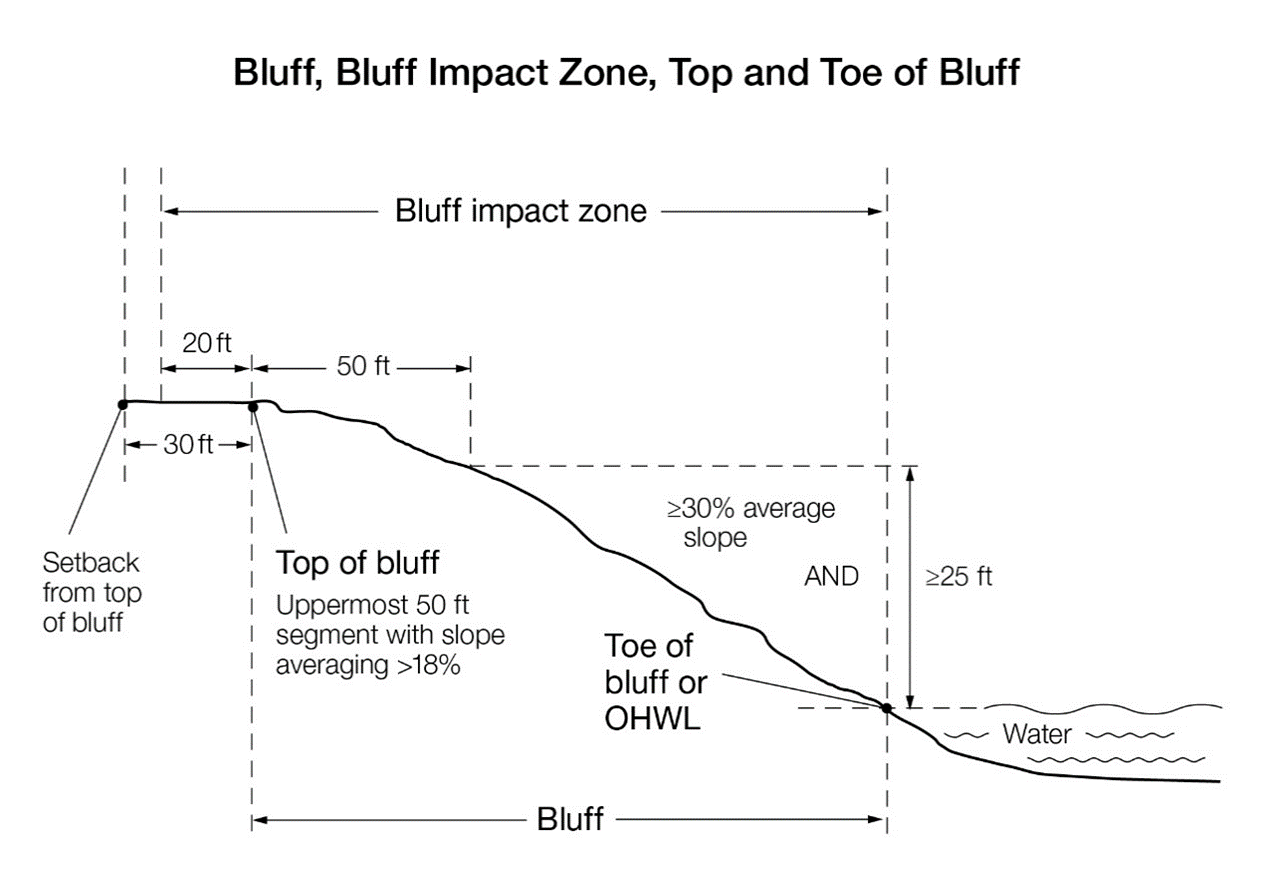
Bluff impact zone means a bluff and land located within 20 feet from the top of the bluff.
Bluff, toe of means the point on a bluff where there is, as visually observed, a clearly identifiable break in the slope from a gentle slope to steep slope or at the OWHL. When not clearly identifiable the following shall be used to calculate the toe; the lower point of a 50 foot segment with an average slope exceeding 18 percent or the ordinary high water level, whichever is higher.
Bluff, top of means the point on a bluff where, as visually observed, there exists a clearly identifiable break in the slope from a steep slope, as defined, to a gentle slope. When not clearly identifiable the following shall be used to calculate the top; for the purposes of measuring setbacks, the higher point of a 50 foot segment with an average slope exceeding 18 percent.
Board of adjustment means the city board of adjustment as appointed by the city council. The board of adjustment constitutes the board of appeals and adjustments under Minn. Stat., §§ 462.351 through 462.364.
Boarding (lodging) house means a building other than a hotel or motel, where for compensation and by prearrangement for definite periods, meals or lodging and meals are provided to three or more persons, but not to exceed ten persons.
Boathouse means a facility as defined by Minn. Stat., § 103G.245.
Boulevard means the portion of the street right-of-way between the back of curb line or pavement edge and the property line.
Buffer means a vegetative feature as defined by Minn. Stat., § 103F.48.
Buildable area means that area of a platted lot lying within the required setbacks, exclusive of those areas that are prohibited from development due to steep slopes, wetlands, easements or other conditions protected by ordinance or legal agreement.
Building means any structure, either temporary or permanent, having a roof or other covering, built for the support, shelter, or enclosure of persons, animals, or property of any kind, including tents or awnings, situated on private property and used for purposes of a building.
Building face means the exposed face of a building, including windows and doors, from ground level to the roof line.
Building material sale or lumberyard means an establishment engaged in the storage, distribution, and sale of building materials such as lumber, brick, tile, cement, insulation, floor covering, lighting, plumbing supplies, electrical supplies, cabinetry, and roofing materials. Accessory uses may include repair or delivery services and outside sale of plants and gardening supplies.
Building line means a line parallel to a lot line or the ordinary high-water level, at any story level of a building, representing the distance beyond which all or any part of the building may not extend without violating setback provisions.
Bulk fuel sales and storage means a facility engaged in the storage of petroleum-based products or gases for retail or wholesale distribution.
Butt lot means a lot at the end of a block and located between two corner lots.
Canopy means a rigid multi-sided structure covered with fabric, metal, or other material, and supported by a building at one or more points or extremities, and by columns or posts embedded in the ground at other points or extremities.
Carport means automobile shelters having one or more sides open.
Cemetery means land used or intended to be used for the burial of the human dead and dedicated for cemetery purposes, including, crematories, mausoleums, and mortuaries if operated in connection with and within the boundaries of such cemetery.
Certificate of (sanitary system) compliance means a document written after a compliance inspection, certifying that a subsurface sewage treatment system (SSTS) is in compliance with applicable State and Local requirements at the time of the inspection.
Charter school means a charter school is public school licensed under Minn. Stat., chapter 124E.
Class V impervious means a surface constructed of gravel or other such similar material which either prevents or retards the entry of water into the soil and causes water to run off the surface in greater quantities and at increased rate of flow than prior to installation.
Clear cutting means the removal of an entire stand of trees.
Club or lodge means a building or structure operated by a non-profit association of persons who are bona fide members, paying annual dues, with the use of the premises being restricted to members and their bona fide guests.
Collector street means a street which carries traffic from minor streets to thoroughfares. It includes the principal entrance streets of a residential development and street for circulation within such developments.
Commercial use means the principal use of land or buildings for the sale, lease, rental, or trade of products, goods, and services.
Common interest community (CIC) means contiguous or noncontiguous real estate that is subject to an instrument which obligates persons owning a separately described parcel of the real estate, or occupying a part of the real estate pursuant to a proprietary lease, by reason of their ownership or occupancy, to pay for
1.
Real estate taxes levied against;
2.
Insurance premiums payable with respect to;
3.
Maintenance of; or
4.
Construction, maintenance, repair or replacement of improvements located on, one or more parcels or parts of the real estate other than the parcel or part that the person owns or occupies. Real estate subject to a master association, regardless of when the master association was formed, shall not collectively constitute a separate common interest community unless so stated in the master declaration recorded against the real estate.
Common space means property owned and managed jointly by members of a planned community.
Community indoor entertainment, small means a business containing less than 10,000 square feet that provides or makes available entertainment or recreational facilities to the public for a fee including, but not limited to, billiard parlors, skating rinks, indoor swimming pools, bowling alleys, movie theaters, arcades, tennis courts, and other similar businesses. Such businesses may also provide a snack bar, restaurant, retails sales of related items, and other support facilities.
Community indoor entertainment, large means a business containing 10,000 square feet or more that provides or makes available entertainment or recreational facilities to the public for a fee including, but not limited to, billiard parlors, skating rinks, indoor swimming pools, bowling alleys, movie theaters, arcades, tennis courts, and other similar businesses. Such businesses may also provide a snack bar, restaurant, retails sales of related items, and other support facilities.
Compact evergreen tree or hedge means a coniferous tree or hedge that retains its foliage through the year. Planted in accordance with Section 1005 of this Ordinance.
Comprehensive plan means a land use or comprehensive policy plan prepared and adopted by the City of Bemidji indicating the general locations recommended for the various functional classes of land use, places and structures, and for the general physical, cultural, social, wellness, and economic needs of the City of Bemidji Community and includes any unit or part of such plan separately adopted and any amendments to such plan or parts thereof.
Conditional use means a land use or development as defined by ordinance that may be allowed only after an in-depth review procedure and with appropriate restrictions or conditions as provided by this development code upon a finding that standards and criteria stated in this code will be satisfied. A conditional use must conform to the City of Bemidji Land Use Plan and be compatible with the existing neighborhood.
Condominium means a multiple unit dwelling or development containing individually owned dwelling units and jointly owned and shared areas and facilities, which dwelling(s) or development is subject to the provisions of the Minnesota Condominium Law, Minn. Stat., Section 515.A.1-101 to 515.A.4-118.
Contour map means a map on which irregularities of land surface are shown by lines connecting points of equal elevations. Contour interval is the vertical height between contour lines.
Contractor's shop and storage facility means a lot or portion of a lot or parcel used to store and maintain construction equipment and other materials and facilities customarily required in the building trade by a construction contractor. This definition includes construction offices, shops, and showrooms for the display and sale of electrical, plumbing, heating, air conditioning, sheet metal and other material in connection with contracting services.
Convention or event center means a facility designed or used to host conferences, exhibitions, events, large meetings, seminars, or training facilities, which may be associated with a hotel or motel.
Council means the City of Bemidji city council.
Counseling service (behavioral, mental health, drug and alcohol abuse) means for this purpose of this Ordinance "counseling" is defined as professional counseling services are offered for various issues including behavioral and mental health as well as drug and alcohol abuse counseling.
Cul-de-sac means a short (500 foot or less), minor street that has only one inlet/outlet and contains a rounded end or turn-around area onto which houses face. Cul-de-sacs sometimes include landscaped or undeveloped central islands within the turn-around portion of the street, requiring an increase in radius to allow maneuvering of longer vehicles such as fire engines or delivery trucks. Streets with developed property within the interior of the turnaround spaces or with a length longer than 500 feet from the furthest driving surface of the turn-around to the edge of the nearest collector-street or thoroughfare are not cul-de-sacs and shall be considered dead-end streets.
Day care facility means a public or private facility licensed by the Minnesota Department of Human Services which, for gain or otherwise, regularly provides one or more persons, as defined by the State Human Services Licensing Act, with care, training, supervision, habilitation, rehabilitation, or developmental guidance on a regular basis, for periods of less than 24 hours per day, in a place other than the person's own home. Day care facilities include but are not limited to: family day care homes, group family day care homes, day care centers, day nurseries, nursery schools, developmental achievement centers for children, day training and rehabilitation services for adults, day treatment programs, adult day care centers, and day services.
Daycare facility (licensed commercial child care) means a state of Minnesota licensed facility with the primary use of caring for children less than 24 hours a day regularly providing one or more dependents with care, training, supervision, or developmental guidance.
Daycare facility (licensed home care 14 or less) means a private owner-occupied residence operating a daycare facility for periods of less than 24 hours a day licensed by the state of Minnesota, and that regularly provides up to 14 dependents with care, training, supervision, or developmental guidance.
Dead end street means a street having only one end open to through traffic.
Deck means a horizontal, unenclosed platform with or without attached railings, seats, trellises or other features, attached or functionally related to a principal use, structure or site, and at any point extending more than 30 inches above ground. A deck is considered a structure.
Demolition landfill means any area of land which is used for the disposal of non-leachable solid waste from the construction or demolition of residential or commercial structures and their contents.
Density means the number of dwelling units or square footage of commercial floor area relative to the total lot area.
District means a geographical portion of the greater land area subject of this code, which geographical portion is assigned a zoning classification and within which classification certain regulations and requirements or various combinations thereof apply under the provisions of this code.
Domestic violence emergency housing means any building or other structure used to provide refuge or other services to victims and/or to the dependent children of victims of domestic violence. A location that provides emergency housing for victims of, but not limited to, sexual assault, domestic violence, intimate partner violence, and/or human trafficking. This definition will follow R-6 standards and is a permitted use.
Dormitory means a structure specifically designed for a long-term stay by students at a college, university, or nonprofit organization. Such structures contain facilities for living, sleeping, and sanitation; and may include separate group facilities for cooking and eating.
Downtown business district means that portion of the shoreland jurisdiction of Lake Bemidji and Lake Irving, including the Mississippi River corridor connecting the two Lakes, bounded by Gould Avenue NE extended to the shoreline of Lake B, and Sixth (6 th ) Street NW (north of Library Park) extended to the shoreline of Lake Bemidji, and by Irvine Avenue NW extended to the shoreline of Lake Irving, and the westerly terminus of Gemmel Avenue extended due south to the shoreline of Lake Irving.
Driveway means a private entrance, either paved or unpaved, that provides vehicular access between a public right-of-way and the abutting property, including to any buildings or activities on the property.
Duplex, triplex and quad means dwelling units on a single lot having two, three and four units respectively, being attached by common walls and each unit having separate sleeping, cooking, eating, living and sanitation facilities.
Dwelling site means a designated location for residential use by one or more persons using temporary or movable shelter, including camping and recreational vehicle sites.
Dwelling unit means any structure, or portion of a structure, or other shelter, designed as short- or long-term living quarters for one or more persons, including rental or timeshare accommodations such as motel, hotel and resort rooms and cabins.
Easement means a grant or conveyance by an owner of real property of a right to use the owner's real property for a specific purpose.
Employee means any person who performs any service on the premises of a business, on a full time, part time, or contract basis, whether or not the person is denominated an employee, independent contractor, agent, or otherwise. Employee does not include a person exclusively on the premises for repair or maintenance of the premises or for the delivery of goods to the premises.
Environmental assessment worksheet (EAW) means a document, in worksheet format, that helps local governments determine if a proposed action is a major action with a potential for significant environmental effects, and to consider alternatives or to institute methods for reducing environmental effects.
Essential services means the erection, construction, alteration or maintenance by local governmental units of underground, surface or overhead utilities, including gas, electric, steam, fuel or water transmission or distribution system collection, communication, supply or disposal system, and including towers, poles, wires, mains, drains, sewers, pipes, conduits, cables, fire alarm and police call boxes, traffic signals, hydrants and similar equipment in connection therewith, but not including buildings, which are necessary for the furnishing of adequate service by such utilities or municipal departments for the general health, safety or welfare.
Extractive use means the use of land for surface or subsurface removal of sand, gravel, rock, industrial minerals, other nonmetallic minerals, and peat not regulated under Minn. Stat., Sections 93.44 to 93.51, and any amendments to said sections subsequently adopted.
Farmers market (flea/food/crafts) means a recurring event, held outdoors or in another defined place, on designated days and times, where market vendors, consisting of agricultural producers, home processors, or craft producers that manufacture non-food goods by the force of their own labor, are organized for the purpose of selling their products directly to the public.
Family means an individual or group of two or more persons related by blood, marriage, or adoption.
Farm animal means any animal other than a dog or cat normally kept outside of a dwelling unit. Farm animals include, but are not limited to chickens, cows, geese, goats, horses, llamas and pigs. Keeping farm animals is an agricultural use.
Fence means any partition, structure, wall or gate erected within the required yard.
Final plat means the final map, drawing or chart, on which the subdivider's plan of subdivision is presented for approval and which, if approved, will be submitted to the county recorder. The plat must conform to the requirements of law.
Flag lot means a lot predominately situated behind another lot and having an access to a public right of way through a portion of the lot which does not satisfy the minimum lot width standards in effect for the district in which the lot is located. The creation of a flag lot is prohibited except when approved through a PUD/CIC process and/or in accordance with other provisions of this code.
Floor area means the total gross area of all floors as measured to the outside surfaces of exterior walls, excluding crawl spaces, garages, carports, breezeways, attics without floors, and open porches, balconies, decks, and terraces.
Floor area percentage means the total floor area divided by the total lot area.
Food processing or production means the processing or production of food for sale. This term does not include animal slaughtering which is considered heavy manufacturing. Examples include, but are not limited to, coffee roasting, brewery, distillery, and candy making.
Footprint means the area underneath the leading edge of a structure as projected vertically onto the ground (includes roofline at eaves or drip line).
Forestry, land conversion means the clear cutting of forested lands to prepare for a land use other than reestablishment of a forest stand, according to the provisions of Minn. Stat., Section 89A.04, as may be amended.
Forestry, land management and timber harvest shall mean employing the use of best management practices for sustainable forest resources, and which shall apply to all private property proposed for development according to the provisions of Minn. Stat., Section 89A and as may be certified according to a certified tree inspector of the City of Bemidji, its planning administrator, or designee, according to the provisions of Minn. Stat., Section 89.63, as may be amended.
Fraternity or sorority means a residential building which is occupied only by a group of university or college students and support staff who are associated together in a fraternity or sorority, which is officially recognized by a college or university offering an accredited course of study, and who receive from the fraternity or sorority lodging or meals on the premises for compensation.
Front lot line means a line dividing a lot from any public street or highway, except a limited or controlled access highway to which the lot has no access. The front lot line is the right-of-way line of the public highway on which the lot has access. For a riparian lot, the front lot line shall also be that line indicating the ordinary high-water level.
Funeral home or crematorium means an establishment providing services such as preparing the human dead for burial, cremating human remains, and arranging and managing funerals. This use does not include cemeteries.
Frontage means the distance along a property line along a public right-of-way on which it borders.
Garage means a fully enclosed building designed or used for the storage of motor vehicles, but not including buildings in which fuel is sold or in which repair or other services are performed.
Garage, side loaded means a detached accessory structure garage with a vehicle entry door at an angle of no less than 45 degrees from the edge of a public alley right-of-way so that vehicles can pull entirely out of the garage onto a driveway parking space without entering the alley.
Garden center means a place of business where retail and wholesale products and produce are sold to the retail customer. These centers which may include a nursery and/or greenhouse, import the majority of the items sold. These items may include plants, nursery products and stock, fertilizers, potting soil, hardware, power equipment and machinery, hoses, rakes, shovels, and other garden and farm tools and utensils.
Gas station and convenience means a building, structure or land used primarily for the dispensing, sale or offering for sale at retail of any automobile fuels, oils or accessories. This may also include lubrication of automobiles, replacement or installation of minor parts and accessories but not including major repair work such as motor replacement, body and fender repair or spray painting. This use may include the retail sales of convenience goods, and car wash facilities. Designed to accommodate passenger vehicles not heavy truck traffic.
General retail store, small means a less than 10,000 square foot structure, facility, or area for the retail sale of general merchandise or food to the general public for direct consumption and not for wholesale. Typical general merchandise includes clothing and other apparel, equipment for hobbies or sports, gifts, flowers and household plants, dry goods, convenience and specialty foods, toys, furniture, books and stationery, pets, drugs, hardware, and similar consumer goods. This definition does not include grocery stores, or pharmacies.
General retail store, large means a 10,000 square foot or more structure, facility, or area for the retail sale of general merchandise or food to the general public for direct consumption and not for wholesale. Typical general merchandise includes clothing and other apparel, equipment for hobbies or sports, gifts, flowers and household plants, dry goods, convenience and specialty foods, toys, furniture, books and stationery, pets, drugs, hardware, and similar consumer goods. This definition does not include grocery stores, or pharmacies.
Government building or public safety facility means a building or facility housing the offices or operations of a department or agency of the city, county, state, or federal government, or a governmental entity, including but not limited to a building or facility that provides fire protection, police protection, or emergency medical services (not including a hospital or medical or dental clinic), together with incidental storage and maintenance of necessary vehicles.
Greenspace means open space covered by native plants, natural landscape, or other vegetative cover.
Greenhouse means an accessory building whose roof and sides are made largely of glass or other transparent or translucent materials and in which the temperature and humidity can be regulated for the cultivation of delicate or out of season plants.
Grocery store, small means a retail sales establishment less than 15,000 square feet selling primarily food and beverages for off-site preparation and consumption that maintains an inventory of fresh fruits, vegetables, fresh-cut meats, or fresh seafood or specialize in the sale of one type of food item. This use may also include sales of personal convenience and small household goods, provided such sales are incidental to the sale of food and beverages.
Grocery store, large means a retail sales establishment 15,000 square feet or more selling primarily food and beverages for off-site preparation and consumption that maintains an inventory of fresh fruits, vegetables, fresh-cut meats, or fresh seafood or specialize in the sale of one type of food item. This use may also include sales of personal convenience and small household goods, provided such sales are incidental to the sale of food and beverages.
Ground coverage percentage means the percentage of lot area included within the outside lines of exterior walls of all buildings located on the lot including porches, decks, patios, breeze ways, balconies, and bay windows. In shoreland areas, all impervious surfaces are included in computing ground coverage percentages.
Group family day care means a day care facility holding a license from Beltrami County or Minnesota pursuant to Minn. Stat., Chapter 245A and/or Minnesota Rules, Chapter 9502 or Chapter 9503, as amended.
Half street means a public right-of-way having only half of the width required by the subdivision design requirements prescribed in this Ordinance.
Hazardous chemical storage or distribution means an establishment storing hazardous chemicals or materials for profit for the purpose of wholesale distribution.
Headwaters Lakes. There are nine lakes within the Mississippi Headwaters Corridor, including Carr, Irving, Bemidji, and Stump (impoundment).
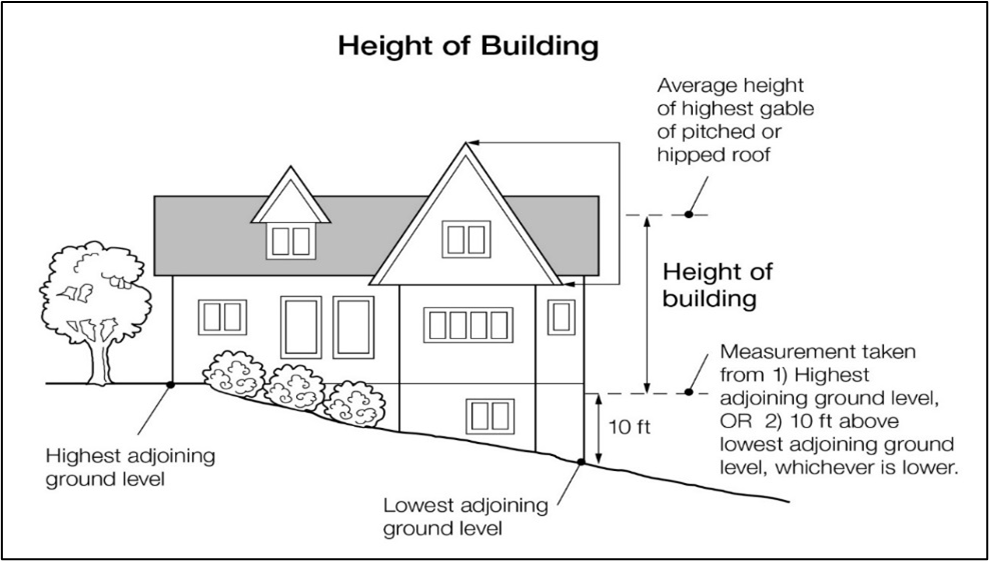
Height of building means the vertical distance between the highest adjoining ground level at the building or ten feet above the lowest adjoining ground level, whichever is lower, and the highest point of a flat roof or average height of the highest gable of a pitched or hipped roof.
Heavy truck, farm implement, construction equipment repair, rental, sales, and service means a facility offering the sale, service, or repair of heavy trucks, farm implements or construction equipment including, but not limited to; semi-tractor and trailer, farm tractor, dump-truck, skid loader, bulldozer, and crane.
Heavy truck fuel and convenience means a gas station and convenience facility designed for semi-truck and trailer overnight parking, fueling, or maintenance. Such a facility also typically provides showers for rent and will also serve passenger vehicles.
Heavy truck wash and detailing means an automotive washing facility designed to accommodate large vehicles such as semi-tractor and trailer or heavy equipment.
Home and community-based services means "home and community-based long-term services and supports" (HCBS) refers to assistance with daily activities that generally helps older adults and people with disabilities to remain in their homes.
Homeless facility means a facility which provides congregate style temporary sleeping accommodations, either with or without meals, to primarily house the homeless, or other transient individuals, for any period of time. Homeless facility does not include lodging establishments licensed by the State of Minnesota, or facilities that provide lodging to any individual who is: 1) placed by lawful authorities or otherwise housed in a public or private institution; or 2) who is imprisoned on a Department of Corrections Release Program, or otherwise detained pursuant to either federal or state law.
Home occupation means the following types of uses which are clearly secondary and incidental to residential occupancy, and which do not change the character thereof.
A.
Type I. An occupation conducted in a residential district in which no evidence of nonresidential activity is evident from off of the premises, no increase in traffic results from the business activity, and no employees other than household members work on the premises. Type I home occupations are allowed in all residential districts as accessory uses and do not require a permit.
B.
Type II. An occupation conducted in a residential district that does not meet the requirements of a Type I home occupation for one or more reasons but is not identified as a Type III home occupation. Specifically excluded are any activities that result in the alteration of a building, window display, construction features, equipment, machinery, or outdoor storage, any of which is visible from outside of the lot on which such use is located. Type II home occupations are permitted uses in all residential districts, and specifically includes: daycares, private lessons, photography and artist studios, commercial contractor storage, or similar uses which may result in the need for multiple trips or visits to the home business. All such uses shall be subject to all other provisions of this Code.
C.
Type III. Home occupations that have the potential to adversely affect the functioning of individual sewage treatment systems or those uses that have an increased potential to create a nuisance, environmental contamination, inappropriate off-street parking, or any other non-compatible residential activities with a potential to significantly disrupt the character of surrounding residential uses in the immediate neighborhood. Type III. Type III Home occupations may be approved as an interim use in residential zoning districts, provided findings in support of such use are approved. The Planning Administrator shall be responsible for determining whether such accessory use constitutes a primary use of the premises with regard to factors contained in Article II of this Code. Factors to be included in such review, and/or approval of a Type III Home Occupation shall include, but are not limited to, the following potential residential neighborhood impacts:
1.
Residential neighborhood character.
2.
SSTS function.
3.
Excessive noise, dust, vibrations, glares, etc.
4.
Environmental contamination.
5.
Substantially increased off-street parking.
6.
Any other significant or unusual non-residential neighborhood impacts.
Type III Home Occupation uses may include, but are not limited to, the following similar uses:
1.
Greenhouses;
2.
Automobile repair operations;
3.
Lumber mills;
4.
Welding shops;
5.
Appliance repair;
6.
Small engine repair;
7.
Food production;
8.
All other accessory uses of a similar character as determined by the planning administrator.
Homeless means the term "homeless", "homeless individual or homeless person" or "un-housed person" shall include:
A.
An individual who lacks a fixed, regular, and adequate nighttime residence; and
B.
An individual who has a primary nighttime residence that is:
1.
A supervised publicly or privately operated shelter designed to provide temporary living accommodations (including welfare hotels, congregate shelters, and transitional housing for the mentally ill);
2.
An institution that provides a temporary residence for individuals intended to be institutionalized; or
3.
A public or private place not designed for, or ordinarily used as, a regular sleeping accommodation for human beings.
Homeless housing, transitional means for the purposes of this Code, a transitional housing use refers to temporary living situations wherein individuals or families are residing temporarily with or without separate sleeping rooms or a congregate space. Transitional housing may occur for periods of one day to a specific time frame. Congregate space means that individuals share all or part of the kitchen, bath, and recreational spaces. Transitional housing shall only be defined as requiring an interim use permit if each housing unit does not contain independent living and cooking facilities, but rather are designed and integrated around a central group or congregate style living, cooking, and dining facilities.
Hospital means an institution or place where sick or injured in-patients are given medical or surgical care, at either public or private expense, but excluding nursing homes and institutions where persons suffering from permanent types of illness, injury, deformity or deficiency or age are given care and treatment on a prolonged or permanent basis.
Hotel/motel means any building or portion thereof where lodging is offered to transient guests for compensation and in which there are more than three sleeping rooms, with no cooking facilities in an individual room or apartment. Hotels and motels within shoreland areas are regulated as commercial planned unit developments.
Impervious surface means a constructed hard surface that either prevents or retards the entry of water into the soil and causes water to run off the surface in greater quantities and at increased rate of flow than prior to development. Examples include: rooftops; decks; sidewalks; patios; swimming pools; parking lots; concrete, asphalt, or gravel driveways; and other similar surfaces. (ee also lot coverage).
Improved lot means a lot that contains any structure, and which is served by a sewage disposal system and water supply.
Indoor fitness, health club or spa means a structure or leased space at which a variety of spa services are offered including, but not limited to, weight lifting, cardiovascular equipment, personal training, and group exercise classes, artificial tanning, as well as health spas and saunas. For the purpose of this development code skating rinks, tennis courts, basketball courts, swimming pools, and other similar uses are defined as community indoor entertainment.
Industrial use means the use of land or buildings for the production, manufacture, warehousing, storage or transfer of goods, products, commodities or other wholesale items.
Inoperative means a vehicle that is incapable of movement under its own power and in need of repair or junking, and shall include vehicles incapable of legal movement on public roads.
Intensive vegetative clearing means the substantial removal of trees or shrubs in a contiguous patch, strip, row or block.
Interim use means a temporary use of property until a particular date, until a particular event, or until zoning regulations no longer permit it. Interim use permits are not recorded and do not run with the land upon transfer. All interim uses shall conform to standards listed in section 28-524 of this development code.
Junk means waste, discarded or salvaged materials including, but not limited to, scrap metal, rags, paper, rubber products, glass products, lumber products and products resulting from the wrecking of automobiles or other vehicles
Junkyard means land or buildings where waste, discarded or salvaged materials are brought, purchased, sold, exchanged, stored, cleaned, packed, disassembled or handled, including, but not limited to, scrap metal, rags, paper, rubber products, glass products, lumber products and products resulting from the wrecking of automobiles or other vehicles, provided further that the storage of three or more inoperative and/or unlicensed motor vehicles for a period in excess of three months shall also be considered a junk yard. The term junk yard shall also be defined to include a recycling center operation.
Land alteration or tree removal not incidental to a permitted use means the alteration of land or tree removal when no permitted use has been established on a property, typically to prepare lots for sale or development.
Landscape area means the area of a lot between the minimum building setback and the street of the official address of the lot.
Laundromat means a place where patrons wash, dry, or dry clean clothing or other fabrics in machines operated by the patron.
Laundry Plant means an establishment where laundry or dry cleaning is performed in bulk and primarily for commercial and institutional customers. This use does not include facilities where the public drops off or picks up dry cleaning or laundry that is cleaned off-site.
Licensed family daycare, licensed group family daycare, licensed child care center means a facility holding a license from Beltrami County or Minnesota pursuant to Minn. Stat., Chapter 245A and/or Minnesota Rules, Chapter 9502 or Chapter 9503, as amended.
Licensed sewage treatment system installer means a person licensed by the Minnesota Pollution Control Agency to install onsite sewage treatment systems.
Licensed site evaluator means an individual licensed by the Minnesota Pollution Control Agency to complete a site evaluation report needed for the installation of an onsite sewage treatment system.
Liquor store means an establishment licensed to sell off-sale liquor.
Long-term rental means a dwelling unit, guest cottage, or structure designated or used for residential occupancy by a) one family or an individual or group of two or more persons related by blood, marriage or adoption, living together as a single housekeeping unit in a dwelling unit; b) or a group of not more than four persons who need not be related by blood, marriage, or adoption, living together as a single housekeeping unit in a dwelling unit who rent or lease for a period of more than 30 consecutive days at a time.
Lot means a parcel of land designated by plat, auditor's plat, metes and bounds description, registered land survey, or other accepted means and separated from other parcels or portions by said description for the purpose of sale, lease or separation.
Lot combination means the combination of two or more tax parcels into one lot of record.
Lot, area means the area of land within the boundaries of a lot, excluding that portion of a lot within shoreland which is below the ordinary high water level.
Lot, back means a separate noncontiguous lot which does not contain a principal structure, and is located on the opposite side of the street or on a nearby parcel, with the parcel boundary located within the same block, and/or is within 500 lineal feet of a lot containing a principal structure.
Lot, corner means a lot where the interior angle of two adjacent sides at the intersection of two street frontages is less than 135 degrees. A lot abutting upon a curved street or streets shall be considered a corner lot for the purposes of this development code if the arc is of less radius than 150 feet and the tangents to the curve, at the two points where the lot lines meet the curve or the straight street line, extended, form an interior angle of less than 135 degrees.
Lot, coverage means lot coverage shall include all structures, driving surfaces, including gravel surfaces, septic tank, parking areas regardless of type of surface, and other improved surfaces (see also impervious surface).
Lot, division or reconfiguration means a legal description(s), which divides a parcel of land into one or more new parcels, or adjusts an existing parcel line into a new position on the ground.
Lot, improvement means any building, structure, place, work of art, or other object, or improvement of the land on which they are situated constituting a physical betterment of real property, or any part of such betterment. Certain lot improvements shall be properly bonded as provided in these regulations.
Lot, line means a line marking a boundary of a lot except that where any portion of a lot extends in to the public right-of-way, the lot line shall be deemed to be the boundary of said public right-of-way.
Lot, front line means for a riparian lot, the front lot line is that line indicating the ordinary high water mark. For a non-riparian lot, a front lot line is a line dividing a lot from any public highway, except a limited or controlled access highway to which the lot has no access.
Lot, rear line means the lot line not intersecting a front lot line that is most distant from and most closely parallel to the front lot line. A lot bounded by only three lot lines will not have a rear lot line.
Lot, side line means any lot line which meets the end of a front lot line and any other lot line within 30 degrees of being parallel to such a line, except a front lot line.
Lot, record of means any lot or tax parcel of land which is one unit of a recorded plat designated by auditor's plat, subdivision plat, approved division, or other accepted means and separated from other parcels or portions of said description for the purpose of sale, lease or separation thereof that has been recorded in the Office of the County Recorder.
Lot, riparian means any lot which is bounded on one or more sides by public waters frontage.
Lot, non-riparian means any lot contained within a shoreland overlay district which is not bounded on one or more sides by public waters frontage.
Lot, river means a lot or parcel, any part of which abuts a watercourse identified in article IX of this development code.
Lot through; double fronted lot means a lot which has both a rear and front yard abutting a public street and which is not a corner lot.
Lot, width means the minimum required horizontal distance between the side lot lines measured at right angles to the lot depth, at the front yard property line and/or OHWM. For cul-de-sac lots or those fronting upon a curved street with an angle of 135 degrees or less, "lot width" shall mean the minimum required horizontal distance between the side lot lines, measured along a straight line at the minimum required front setback line.
Mansard means a roof having two slopes on all sides with the lower slope steeper than the upper slope.
Manufactured home means a structure designed or used for residential occupancy built upon or having a frame or chassis to which wheels may be attached by which it may be moved upon a highway, whether or not such structure actually has, at any given time, such wheels attached, or is jacked up or skirted. Manufactured homes shall be treated as single family housing units for purposes of these regulations.
Manufactured home park means any park, court, lot, parcel or tract of land, designed, improved, maintained or intended for the purpose of supplying a location for manufactured home units or upon which any manufactured homes are parked. It shall include all buildings used or intended for use as part of the equipment thereof, whether a charge is made for the use of the manufactured home park or not.
Manufacturing/processing light means a facility or area used for the assembly, fabrication, or processing of goods and materials using processes that ordinarily do not create noise, smoke, fumes, odors, glare, or health or safety hazards outside of the building or lot where such assembly, fabrication, or processing takes place, where such processes are housed entirely within a building, or where the area occupied by outside operations or storage of goods and materials used in the assembly, fabrication, or processing does not exceed 25 percent of the floor area of buildings on the lot. Examples include but are not limited to: food processing, electronic equipment assembly and manufacturing and assembly from finished products.
Manufacturing/processing heavy means an establishment or use of land that includes the assembly, fabrication, or processing of goods and materials using processes that ordinarily have impacts on the environment or significant impacts on the use and enjoyment of surrounding properties in terms of noise, smoke, fumes, odors, glare, or health or safety hazards, or any use where the area occupied by outside storage of goods and materials used in the assembly, fabrication, or processing exceeds 25 percent of the floor area of buildings on the lot. Examples include but are not limited to, battery, chemicals, machinery, and plastics manufacture; mushroom plant; batching plant; beverage bottling and distribution, packaging plant; sawmill; slaughterhouse; and rendering plant. This use does not include any use that meets the definition of "manufacturing/processing light" or any other use otherwise defined within this development code, and does not include any use that constitutes a public nuisance.
Marginal access street means a minor street which is parallel and adjacent to a thoroughfare and which provides access to abutting properties and protection from through traffic.
Marquee means a permanent roof-like structure or canopy of rigid materials supported by and extending from the façade of a building.
Master plan means a master plan shall have the same meaning as a comprehensive development plan.
Medical or dental clinic means an establishment where patients who are not lodged overnight are admitted for examination and treatment licensed health care practitioners, dentists, or licensed health care practitioners and dentists in practice together.
Metes and bounds description means a description of real property which is not described by reference to a lot or block shown on a map, but is described by starting at a known point and describing the bearings and distances of the lines forming the boundaries of the property or delineating a fractional portion of a section, lot or area by described lines or portions thereof.
Methane gas area of concern (MGAOC) means the area of land surrounding a mixed municipal solid waste (MSW) landfill waste footprint where the presence of certain activities, such as construction of enclosed structures, may be impacted or precluded by subsurface migration of methane gas.
Minimum subdivision design standards means the guides, principles and specifications for the preparation of subdivision plans indicating, among other things, the minimum and maximum dimensions of the various elements set forth in the preliminary plan.
Mining, sand, gravel and peat means the use of land for subsurface removal of non-metallic minerals and peat as regulated under Minn. Stat., §§ 93.44 through 93.51, and any amendments to said section subsequently adopted.
Mining area means "mining area" or "area subjected to non-metallic mining" means any area of land from which material is hereafter removed in connection with the production or extraction of non-metallic sand and gravel minerals or peat, the lands upon which material from such non-metallic mining is hereafter deposited, the lands upon which beneficiating plants and auxiliary facilities are hereafter located, the lands upon which the water reservoirs used in the non-metallic mining process are hereafter located, and auxiliary lands which are hereafter used or intended to be used in a particular non-metallic mining operation.
Mini storage means a building which contains separate, individual and private storage spaces of varying sizes leased or rented on individual leases for varying periods of time, or as part of an approved CIC.
Minnesota Pollution Control Agency (MPCA) means state agency with the stated purpose of protecting Minnesota's environment through monitoring environmental quality and enforcing environmental regulations.
Minor street means a street of limited continuity used primarily for access to the abutting properties and the local needs of a neighborhood.
Mississippi Headwaters Board (MHB) means a joint powers board established pursuant to law charged with planning and zoning within the Upper Mississippi River corridor.
Mobile home (see manufactured home.)
Multiple family dwelling means a structure designed or used for residential occupancy by more than one family, with or without separate kitchen or dining facilities, including apartment houses, rooming houses, boarding houses, townhomes, row houses, and similar housing types containing at least five dwelling units. Multiple family dwellings do not include hotels, motels, nursing homes or hospitals.
Multi-family or townhome development means any residential development proposing greater than one structure on one parcel of property. The number of dwelling units allowed within a structure or on a parcel is defined by the zoning district.
Multi-family/mixed-use means typical mixed-use buildings are vertically mixed-use consisting of main level commercial with apartment style living above. Mixed-use buildings require a conditional use permit in all zoning districts with the exception of the urban renaissance district (UR), for mixed-use buildings outside of the UR district the density ratio of commercial vs. residential will be determined by the council.
Multi-tenant building means a structure or grouping of attached or detached structures on a single parcel of land or CIC plat.
Municipal system (water and sewer) means a centrally treated, distributed, and/or collected system of public water or sewage service.
Nighttime means the time from sunset to sunrise.
Nonconformity means any legal use, structure or parcel of land already in existence, recorded, or authorized before the adoption of official controls or amendments thereto that would not have been permitted to become established under the terms of the official controls as now written, if the official controls had been in effect prior to the date it was established, recorded or authorized.
Nonriparian lot means any lot which is not bounded on any side by public water frontage.
Northwoods character means a wooded feeling, such as being covered with growing trees. Physical characteristics or architectural design features that are consistent with or that reflect those commonly associated with a northern Minnesota wooded setting including, but not limited to, trees and landscaping features indigenous to northern Minnesota and use of natural colors and materials. Northwoods character design feature examples may be identified within the city comprehensive plan.
Nursery means a business growing and selling trees, flowering and decorative plants and shrubs and which may be conducted within a building or without, for the purpose of landscape construction.
Nursing home means a structure designed or used for residential occupancy and at which limited medical or nursing care is provided for its occupants, but not including hospitals or mental health centers.
Official monument means a marker established by the original federal land survey for use as a reference point in surveying and subdividing land.
Open sales lot means the impervious land area of a parcel where a business will devote space to the regular display of goods for sale, rent, lease or trade where such goods are not enclosed within a building.
Open sales lot, major means an open sales lot which contains a total area of 2,000 square feet, or greater, land area devoted to display of such goods.
Open space means all area not covered by impervious surface as defined in this development code.
Operator, homeless shelter, transitional housing, or warming center means the owner, individual, partnership, organization, or corporation, which manages either a homeless shelter, transitional housing, or a warming center use, whether or not for remuneration of any kind.
Ordinary high water mark level (OHWL) means the boundary of public waters and wetlands indicated by an elevation delineating the highest water level which has been maintained for a sufficient period of time to leave evidence upon the landscape, commonly that point where the natural vegetation changes from predominantly aquatic to predominantly terrestrial. For watercourses, the ordinary high water level is the elevation of the top of the bank of the channel.
Owner means any individual, firm, associate, syndicate, partnership, trust, or any other legal entity having sufficient proprietary interest in the land.
Painted wall sign means any sign which is applied with paint, or similar substance on the surface of a wall.
Parcel means real property as defined by Minn. Stat., § 272.03.
Parking space means an area of definite length and width designed for parking of motor vehicles; said area shall be exclusive of drives, aisles or entrances giving access thereto.
Parking structure, public means a structure designed to accommodate vehicular parking spaces that are fully or partially enclosed or located on the deck surface of a building. This definition includes parking garages, deck parking, and underground or under-building parking areas
Passive recreation facility means a facility that provides persons comfortable use of parks, open space or green space in a manner that does not significantly impact natural, cultural, or scientific areas. Passive recreational facilities include park benches, picnic tables, and gazebos.
Pasture means areas where grass or other growing plants are used for grazing and where the concentration of animals is such that a vegetation cover is maintained during the growing season except in the immediate vicinity of temporary supplemental feeding or watering devices.
Patio means a horizontal unenclosed platform without railings, seats, trellises, or other features attached or functionally related to a principal use or site at ground level or at no point extending more than 30 inches above the ground. Platforms with railings, seats, trellises or other features shall be regulated as decks regardless of height above ground level.
Pawn or trade shop means an establishment that purchases or offers secured loans to people with items of personal property used as collateral including, but not limited to, guns, jewelry, musical instruments, home audio equipment, computers, video game systems, televisions, cameras, power tools and other relatively valuable items as collateral.
Pedestrian way means the right-of-way across or within a block, for use by pedestrian traffic whether designated as a pedestrian way, cross-walk or however otherwise designated.
Performance bond means a bond which may be required by the council, planning commission or board of adjustment to insure the completion of any activity falling under the jurisdiction of this development code.
Personal services and repair, small means an establishment containing less than 10,000 square feet of gross floor area and generally having no more than ten employees on site at one time, that is engaged in the provision of informational, instructional, personal improvement, personal care, or similar services. Examples include, but are not limited to, catering establishments, custom dressmaking, film processing, garment printing and embroidering, licensed massage salons, optical and optician services, service and repair establishments, sun tan centers, appliance repair and service bicycle repair and rental, small craft rental, tailor shops, dry cleaning and laundromats.
Personal services and repair, large means an establishment, containing 10,000 square feet or more of gross floor area and generally having more than ten employees on site at one time, that is engaged in the provision of informational, instructional, personal improvement, personal care, or similar services.
Pervious surface means all non-impervious areas on a parcel, including green space, landscaped planting areas, ponds, or other features which accommodate groundwater recharge.
Permanent foundation means a foundation meeting the State Building Code and consisting of approved footings, crawl space or a basement.
Permit means documentation of duly authorized approval provided in the form of an interim use permit, conditional use permit, sewage treatment permit, or variance, allowing a property owner to undertake an activity regulated under the provisions of this development code.
Person means any individual, corporation, association, firm, partnership, or similarly identified interest.
Pharmacy or convenience, small means a store less than 10,000 square feet where medicinal drugs are dispensed and sold as well as other medical and healthcare supplies, typically including retail or grocery sales as well.
Pharmacy or convenience, large means a store 10,000 square feet or more where medicinal drugs are dispensed and sold as well as other medical and healthcare supplies, typically including retail or grocery sales as well.
Planned unit development (PUD) means a type of development, characterized by a united site design for a number of dwelling units or dwelling sites on a parcel, whether for sale, rent, or lease, and also usually involving clustering of these units or sites to provide areas of common open space, density increases, and a mix of structure types and land uses. These developments may be organized and operated as condominiums, time-share condominiums, cooperative housing; full fee ownership, commercial enterprises; or any combination of these, or cluster subdivisions of dwelling units; residential condominiums; townhouses; apartment buildings; campgrounds; recreational vehicle parks; mobile home parks; resorts; hotels; motels; and conversions of structures and land uses to these uses.
Planned unit development, commercial means uses that provide transient, short-term lodging spaces, rooms or parcels with primarily service-oriented operations. Hotel/motel accommodations, bed and breakfast accommodations, resorts, recreational vehicle and camping parks, and other primarily service-oriented activities are examples of commercial planned unit developments.
Planned unit development, mixed use means a planned unit development which includes a mixture of residential and commercial uses. In addition, it may be a single structure developed or converted under the statutory requirements of a common interest community.
Planned unit development, residential means a use where the nature of residency is non-transient and the major or primary focus of the development is not service-oriented. For example: single family residences; duplexes; triplexes; residential apartments; mobile home parks; condominiums; time share condominiums; townhouses; cooperatives; and conversions of structures and land uses to these uses. To qualify as a residential planned unit development, a development must contain at least five dwelling units or sites.
Planning and zoning director or planning director means the person appointed by the city manager as the director of the city's planning and zoning office, including the person's authorized agents and representatives.
Plat means a map or drawing which graphically delineates the boundary of land parcels for the purpose of identification and record of title. The plat is a recorded legal document and must conform to the law.
Practical difficulties means, as used in connection with the granting of a variance, that the property owner proposes to use the property in a reasonable manner not permitted by the zoning ordinance; the plight of the landowner is due to circumstances unique to the property not created by the landowner; and the variance, if granted, will not alter the essential character of the locality. Economic considerations alone do not constitute practical difficulties. Practical difficulties include, but are not limited to, inadequate access to direct sunlight for solar energy systems.
Preliminary plat means the preliminary map, drawing or chart indicating the proposed layout of the subdivision to be submitted to the planning director, planning commission, and council for consideration.
Premises means any platted lot, parcel, tract of land or contiguous group thereof.
Principal structure means a structure in which is conducted the principal use of the lot upon which it is situated.
Principal use means the principal use to which the premises are devoted.
Printing or publishing means a facility dedicated to designing, writing, printing or publishing news, magazine, media releases, either for hard copy distribution or through web-based services.
Private street means a way for vehicular traffic, located within the city, which is not owned by the city, state or county.
Professional or business offices means places of business from which licensed or certified practitioners such as, attorneys, accountants, administration of business, architects, charitable organizations, surveyors, engineers, real estate, radio or television broadcasting etc. which provide a service to the public and from which only limited associated retail products incidental to the service provided are sold. This does not include uses where goods and merchandise are commercially produced to be sold.
Protective covenants means contracts entered into between private parties constituting a restriction on the use of all private property, or within a subdivision, for the benefit of property owners, and to provide mutual protection against undesirable aspects of development which would tend to impair stability of values. Protective covenants are not enforced by the council.
Public improvement means any drainage ditch, roadway, parkway, sidewalk, pedestrian way, tree, lawn, off-street parking area, lot improvement, utility or other facility for which the city may ultimately assume the responsibility for maintenance and operation, or which may affect an improvement for which local government responsibility is established.
Public library means any library that provides free access to all residents of a city or county without discrimination and is organized under Minn. Stat., Chapter 134.
Public park, athletic fields and active outdoor recreation means an athletic field, park, playground, beach, or recreation or community center in the community owned, leased, or used wholly or in part by the city, county, state, school district, or federal government for recreational purposes.
Public transportation facility means a facility intended for the storage, vehicle maintenance, and overall operations of a public transportation facility.
Public uses means uses owned or operated by municipal, school districts, county, state or other governmental units.
Public utility means any person, firm, corporation, municipal department or board fully authorized and furnishing under municipal regulation to the public electricity, gas, steam, communication services, cable television, telegraph services, transportation, water or the like.
Public utility building, minor means essential service structures or uses, including, but not limited to, buildings or uses such as telephone exchange stations, sewer lift stations, power poles, lines, and transformers, except as a power substation or transmission line, public and private water, sewer, and drainage distribution facilities, etc.
Public utility building, major means essential service structures or uses, including, but not limited to, buildings or uses such as booster or pressure regulating stations, wells and pumping stations, wastewater treatment plants, elevated tanks and towers, electrical power substations, and major electric utility transmission lines, etc.
Public waters means any waters as defined in Minn. Stat., § 103G.005, subdivision 15-15a. However, no lake, pond, or flowage of less than ten acres in size will be regulated for purposes of these parts. A body of water created by a private user where there was no previous shoreland shall be exempt from the provisions of this development code. The official determination of the size of public water basins and physical limits of drainage areas of rivers and streams shall be made by the commissioner.
Rain garden means a depression planted with native vegetation that filters and infiltrates rain water.
Recreational vehicle means any vehicle or vehicular portable structure built on a chassis designed to be used as a temporary dwelling for travel, recreation or other vacation use.
Recreational vehicle campground means any area, whether privately or publicly owned, used on a daily, nightly, weekly or longer basis for the accommodation of five or more tents or recreational vehicles, either free of charge or for compensation. Recreational vehicle campgrounds are considered commercial planned unit developments.
Refuse waste facility, transfer station means where intermediate solid waste, collected from any source, is temporarily deposited to await transportation to the final disposal site or facility.
Refuse waste facility, construction debris service and recycling means a facility specializing in the collection and recycling of waste resulting from the demolition of building, and other manmade structures. It does not include asbestos waste, appliances, furniture or household refuse.
Regular or regularly means a consistent, ongoing, and substantial course of conduct, such that the films, performances, or business activities so described constitute a significant and substantial portion of the films or performances offered as a part of the ongoing business of the sexually oriented business. See FW/PBS, Inc. v. city of Dallas, 493 U.S. 215, 259-261 (1990) (Scalia, J., concurring in part and dissenting in part).
Religious institution means a church, synagogue, temple, mosque or other structure that is architecturally designed or particularly adapted for the primary use of the regular assembly of persons for religious worship. Religious institution includes those accessory uses that are secondary to the principal use, but which are intrinsic and necessary to the tenants and exercise of religious beliefs and that can be conducted on the property in a manner that complies with the requirements of applicable federal, state, and local laws, rules, regulations, codes, and ordinances.
Research, design, and testing means a facility or area for conducting scientific research, investigation, testing, or experimentation, but not including facilities for the manufacture or sale of products, except as incidental to the main purpose of the laboratory.
Residential, accessory caretaker (as incidental use for security) means an occupied accessory dwelling use solely for the purposes of caretaking or security for an approved high density residential development, a commercial or industrial use.
Residential facility, permitted single family state licensed use means a state licensed residential facility or a housing with services establishment registered under Minn. Stat., Chapter 144D serving six or fewer persons, a licensed day care facility serving 12 or fewer persons, and a group family day care facility licensed under Minnesota Rules, parts 9502.0315 to 9502.0445 to serve 14 or fewer children according to Chapter 462.357, Subd. 7, shall be considered a permitted single family residential use of property for the purposes of zoning, except that a residential facility whose primary purpose is to treat juveniles who have violated criminal statutes relating to sex offenses or have been adjudicated delinquent on the basis of conduct in violation of criminal statutes relating to sex offenses shall not be considered a permitted use.
Residential facility permitted multi-family state licensed use means except as otherwise provided herein, a state licensed residential facility serving from seven through 16 persons or a licensed day care facility serving from 13 through 16 persons according to Minn. Stat., § 462.357, subdivision 8, shall be considered a permitted multifamily residential use of property for purposes of zoning.
Residential treatment facility or residential treatment center means a residential treatment facility or center, sometimes called a rehab, is a live-in health care facility providing therapy for substance abuse, mental illness, or other behavioral problems. Residential treatment may be considered the "last-ditch" approach to treating abnormal psychology or psychopathology.
Resort means a private commercial recreational development which includes multiple units intended for habitation on a temporary basis for relaxation or recreational purposes. Resorts are considered commercial planned unit developments.
Right-of-way (row) means the land covered by a public road, platted or via recorded roadway easement, and adjacent land designated or reserved for public use.
Road agreement means an agreement between a developer and the road authority prescribing standards for roads.
Sanitary landfill means any area of land intended or used for the disposal of solid waste.
Satellite television antennas means dish-type antennas greater than one meter in diameter used in the reception of television communication signals from orbiting satellites.
School means a building or space that is principally used as a place where 25 or more persons from any grade from head start through the 12 th grade receive a full course of educational instruction. Any post-secondary or post high school educational building, including any college or other vocational technical college, shall not be deemed a school for purposes of adult sexually oriented business distance restrictions under this development code.
Screening means the reduction of negative visual impact of a structure or use on adjacent or nearby properties by use of fencing, permanent landscape plantings, or other suitable means.
Searchlight means an apparatus for projecting a beam or beams of light from the ground into the sky.
Semi-public uses means uses owned by private or private non-profit organizations which are open to some, but not all, of the public such as denominational cemeteries, private schools, clubs, lodges, recreation facilities, religious institutions, etc.
Semi-trailer means a freight trailer with wheels only in the rear that is designed to be pulled by a truck tractor, and is used to transport and store materials and products.
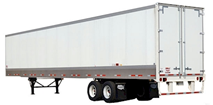
Septic tank means any water tight, covered receptacle designed and constructed to receive the discharge of sewage from a building's sewer, to separate solids from liquids, digest organic matters, and store liquids for a period of detention, and allow the liquids to discharge to a soil treatment system.
Setback means the shortest straight line distance between the outer extremity of a structure (including eaves), sewage treatment system, or other facilities and an ordinary high water level, sewage treatment system, top of a bluff, road, highway, property line or other feature.
Setback, front riparian means measured from the ordinary high water mark.
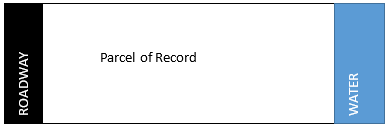
Setback, front non-riparian means measured from the parcel line the building is directionally facing (addressed). Corner lots have two front yards, with specific setback requirements based on zoning category.
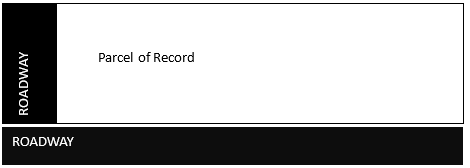
Sewage treatment system means a system which uses subsurface soil treatment and disposal whereby septic tank effluent is treated and disposed of below the ground surface by filtration and percolation through the soil and includes those systems commonly known as: seepage beds; disposal field; and mounds. All private sewage treatment systems must meet or exceed the standards prescribed in MPCA Chapter 7080.
Sewer system means pipelines, conduits, pumping stations, force main and all other construction, devices appliances, or appurtenances used for conducting sewage or industrial or other wastes to a point of ultimate disposal.
Shooting range (indoor) means an indoor firing range facility designed for the purpose of providing a place to safely discharge firearms, and where a user fee is charged, or where a person must be a member of a group to be allowed to use the facility and membership requires the payment of dues or fees (gun club).
Shooting range (outdoor) means an outdoor recreational firing range facility designed for the purpose of providing a place to safely discharge firearms, and where a user fee is charged, or where a person must be a member of a group to be allowed to use the facility and membership requires the payment of dues or fees (gun club).
(a)
Pistol/rifle firing range means a recreational firing range in which a "rifle" (firearms designed to be fired from the shoulder, including, but not limited to, firearms designed for military or law enforcement, and muzzle loading firearms), or a "pistol" (a firearm designed to be held, aimed, and fired with one hand. Also known as a "handgun") is used to discharge projectiles along a firing line toward targets.
(b)
Shotgun range means a recreational firing range in which a "shotgun" (a firearm designed to be fired from the shoulder with a smoothbore barrel that fires shot shells possessing a varying number of round pellets), is used to shoot at clay targets launched in the air from a machine. Shotgun ranges practicing recreational "clay pigeon shooting" are composed of three distinct disciplines; "trap shooting", "skeet shooting", and "sporting clays".
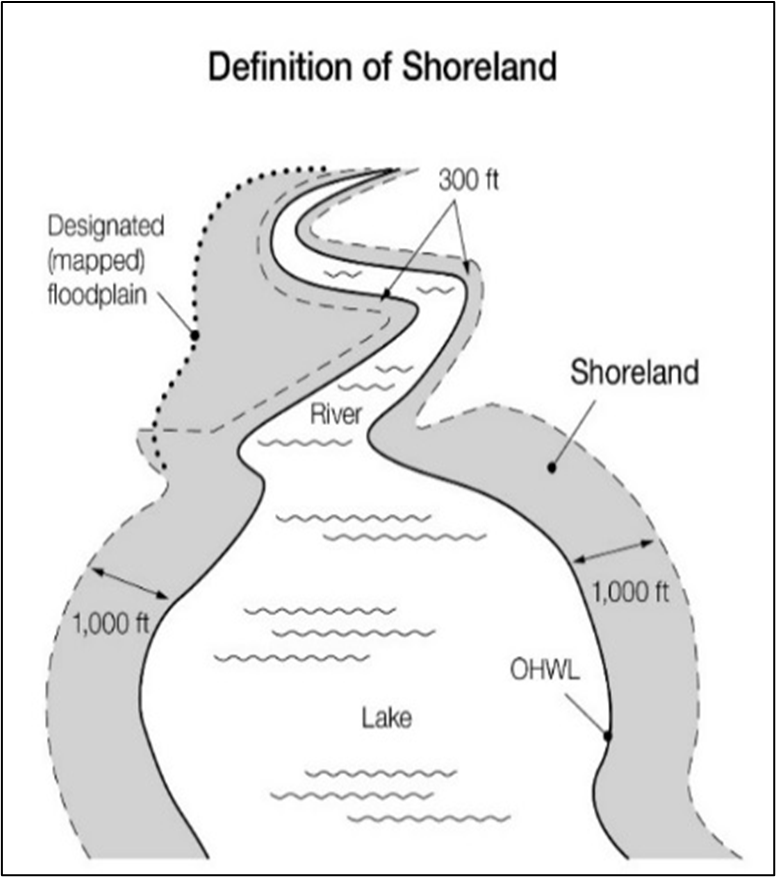
Shoreland means land located within the following distances from public waters: 1,000 feet from the ordinary high water level of a lake, pond or flowage; 500 feet from that stretch of the Mississippi River classified as scenic river; and 300 feet from any other river or stream classification, or the landward extent of a flood plain designated by ordinance on a river or stream, whichever is greater. The limits of shoreland may be reduced whenever the waters involved are bounded by topographic divides which extend landward from the waters for lesser distances and where approved by the commissioner.
Shore impact zone means land located between the ordinary high water level of a public water and a line parallel to it at a setback of 50 percent of the structure setback.
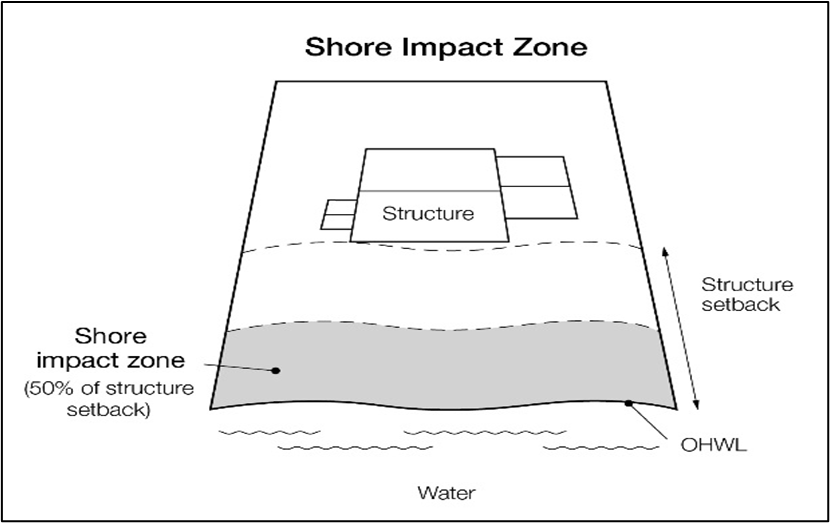
Shore recreation facilities means a facility along or adjacent to the shore of a public water designed to provide recreational opportunities or services including, but not limited to, swimming areas, docks, watercraft mooring areas and launching ramps and other water recreation facilities.
Short-term rental means a dwelling unit, guest cottage, a structure designated or used for residential occupancy or portion of said structure, rented for a period of less than 30 consecutive days. In which: (1) contains rooms furnished for the purposes of providing lodging to transient guests; (2) is kept, used, maintained, advertised or held out to the public as a place where sleeping accommodations are available for pay or compensation by transient guests. This term does not include bed and breakfasts, motels, hotels, or resort rooms.
Sight visibility triangle means the area of a lot closest to the intersection or driveway area, containing no visual impairment and allowing full view of both pedestrian and vehicular traffic according to the provisions of this development code.
Sign means any letter, word or symbol, poster, picture, statuary, reading matter or representation in the nature of an advertisement, announcement, message, or visual communication, whether painted, posted, printed, affixed or constructed including all associated brackets, braces, supports, wires and structures, which is displayed for informational or communicative purposes. A sign does not include wall or building art.
Sign, abandoned means a sign which no longer identifies or advertises a bona fide business, lessor/landlord, service, owner, product or activity or for which no legal owner or operator can be found on the premises for which an existing business identification sign exists.
Sign, area means the space inside a continuous line drawn around and enclosing all letters, designs, and background materials, exclusive of border, trim and structural supports. For the purpose of calculating the sign area of back-to-back signs, the stipulated maximum sign area shall refer to a single face, provided the internal radius of the sign does not exceed 45 degrees.
Sign, awning means a sign painted on, printed on, or attached flat against the surface of an awning or shelter constructed on non-rigid materials on a supporting framework projecting from and supported by the exterior wall of a building.
Sign, balloon or inflatable device means a moveable object consisting of rubber, vinyl, plastic, or a similar material which is capable of being inflated with air or gas to enlarge, swell or distend from internal pressure.
Sign, banner means a sign made of fabric or any non-rigid material with no enclosing framework temporarily mounted to a building, structure, or the ground at two or more edges.
Sign, bannerette means a small banner not exceeding four square feet in size.
Sign, bench means a permanent sign consisting of durable material attached to a bench or other similar type of outdoor furniture or seating. Such signage shall not be considered to be an off-premises advertising or billboard sign.
Sign, billboard means an off-premise sign.
Sign, business identification, on-premise means a sign which pertains to the use of the premises and/or property on which it is located.
Sign, business identification, off-premise means a commercial speech sign which directs the attention of the public to a business that is not on the same parcel where such a sign is located.
Sign, bulletin board means a small announcement message advertising coming events or activities through the use of non-dynamic changeable copy, bulletins, or printed fliers.
Sign, canopy means a sign affixed or applied to the exterior facing surface or surfaces of a building or freestanding canopy.
Sign, clearance means the shortest vertical distance between the grade of the adjacent street, highway, or street curb, and the lowest point of any sign, including framework and embellishments, extending over that grade.
Sign, construction means a temporary sign identifying an architect, contractor, subcontractor and/or material supplier participating in construction on the property on which the sign is located.
Sign, copy means the graphic content of a sign surface in either permanent or removable letter, pictographic, symbolic, or alphabetic form.
Sign, double faced means a sign with two faces, either back-to-back, or in a V-shaped construction.
Sign, dynamic display means any sign, portion of a sign or characteristics of a sign that appears to have movement or that appears to change and which is caused by any method other than physically removing and replacing the sign or its components, whether the apparent movement or change is in the display, the sign structure itself, or any other component of the sign. This includes a display that incorporates a technology or method allowing the sign face to change the image without having to physically or mechanically replace the sign face or its components. This also includes any rotating, revolving, moving, waving, flashing, blinking, or animated display or structural element, and any display that incorporates rotating panels, LED lights manipulated through digital input, "digital ink", incandescent bulbs, or any other method or technology that allows a sign face, or any other device, to present a series of images or displays.
Sign, dynamic display programming means the hardware, software and all necessary equipment and operations associated with the control and programming of a dynamic display.
Sign, easel (see sandwich board sign).
Sign, electrical means a sign or sign structure in which electrical wiring, connections, or fixtures are used.
Sign, façade means the entire front of a building, including the parapet.
Sign, face means the area of a sign on which the copy is placed.
Sign, freestanding means a sign supported permanently upon the ground by poles or braces and not attached to any building.
Sign, government means any temporary or permanent sign erected and maintained by the city, county, state or federal government.
Sign, ground means a sign which is anchored to the ground in a similar manner as a pylon or freestanding sign, but with a monolithic or columnar line and which maintains essentially the same contour from grade to top. Height and setback requirements are the same as for freestanding signs.
Sign, horizontal banner a-frame means a sign which shall be regulated according to the easel or sandwich board sign rules.
Sign, height means the vertical distance measured from the highest point of the sign to the highest adjacent surface grade beneath the sign.
Sign, incidental means a small sign, emblem, or decal placed on the exterior of a building, or attached to a freestanding structure on the premises, only informing the public of hours of operation.
Sign, identification means a sign attached to or adjacent to a building entrance and which is limited to the name and address of the premise.
Sign, illegal means a sign which does not meet the requirements of this development code, and which has not received legal nonconforming status.
Sign, illumination - direct means an illuminated sign in which the light source is not internally diffused from within the sign.
Sign, illumination - indirect means an illuminated sign in which the light source is internally diffused from within the sign.
Sign, low profile means a monument sign not exceeding six feet in height.
Sign, maintenance means the cleaning, painting, repair or replacement of defective parts of a sign in a manner that does not alter the basic copy, design, or structure of the sign.
Sign, marquee means any sign attached to or supported by a marquee structure.
Sign, master plan means a sign plan approved as part of a multi-tenant commercial building or PUD.
Sign, monument means a freestanding sign that is attached to the ground by means of a freestanding support structure, solid from grade to the top of the sign structure and is typically encased or supported by masonry or other permanent finished materials.
Sign, multiple faced means a sign containing three or more faces. Each face shall be counted separately toward the maximum allowable sign area.
Sign, nameplate means a non-electric on-premise identification sign giving only the name, address and/ or occupation of an occupant or group of occupants.
Sign, off-premise directional or way finding means an approved road, park or trail authority off-premise directional sign which directs the traveling public to a parcel where a business or use is located.
Sign, on-premise directional means an on-premise directional sign which provides on-premise circulation safety to and from, or upon a parcel.
Sign, pennants means various colored flag-like devices in any shape that are individually or collectively attached by a continuous string, with or without messages, and are used for identification, signaling or directing attention where displayed.
Sign, point of purchase display means a temporary exterior sign made of any material attached or adjacent to an item accompanying its exterior display.
Sign, political means a temporary sign used in connection with a local, state or national election or referendum.
Sign, portable means any sign designed to be moved easily and not permanently affixed to the ground or to a structure or building.
Sign, projecting means a sign other than a flat wall sign which is attached to a building and projects out at a non-horizontal angle from a wall or other structure not specifically designed and approved to support the sign.
Sign, roof means any sign erected over or on the roof of a building.
Sign, sail means a piece of cloth, varying in size, shape, color, and design, attached at one edge to a staff or cord for the entire vertical length of the cloth, and used as a means of conveying a message.
Sign, sandwich board, or easel means a temporary on-premise sign capable of being carried to and from a sidewalk or pedestrian area that is constructed of wood, metal, plastic or other durable material.
Sign, snipe means a temporary sign or poster consisting of any materials such as metal, paper, plastic, cardboard, synthetic material, etc. that is affixed to a tree, telephone or utility pole, fuel pump canopy or supporting structure or pump island barrier, fence, permitted sign structure, light standard, exterior window, or attached to a structure or device and temporarily placed in the ground.
Sign, special event means an event or special promotional activity with a limited duration that involves the use of temporary signs or attention getting devices.
Sign, static identification means a permanent on-premise sign, either freestanding or wall mounted, and which does not contain a dynamic display or copy that can be changed manually.
Sign, swinging means a sign which is made of permanent exterior material which is designed to swing in the air by hardware or some other form of attachment to an immovable object.
Sign, temporary means a sign not constructed or intended for long-term use, such as a special event, or any sign for a business that has not yet obtained a permanent sign permit.
Sign, under-canopy means a sign suspended beneath a canopy, ceiling, roof, or marquee.
Sign, wall means a sign attached essentially parallel to and extending not more than 24 inches from the wall of a building with no copy on the sides or edges. This definition includes painted, individual letter, cabinet signs, and signs on a mansard.
Sign, window means a sign attached to, placed upon, or painted on the interior of a window that is visible from the exterior of the building.
Significant historic site means any archeological site, standing structure, or other property that meets the criteria for eligibility to the National Register of Historic Places or is listed in the State Register of Historic Sites, or is determined to be an unplatted cemetery that falls under the provisions of Minn. Stat., § 307.08. A historic site meets these criteria if it is presently listed on either register or if it is determined to meet the qualifications for listing after review by the Minnesota State Archaeologist or the Director of the Minnesota Historic Society, or is locally designated by the city as a historic property or district. All unplatted cemeteries are automatically considered to be significant historic sites.
Single-family dwelling means a structure designated or used for residential occupancy by one family. See also Family, Rental.
Site evaluation report means a report completed by a licensed site evaluator containing a description of site and soil characteristics, percolation tests, and other information needed to ensure compliance with MPCA Chapter 7080.
Solar - building integrated means solar energy absorption where the photovoltaic elements actually become an integral part of the building. Often serving as the exterior weather skin.
Solar collectors means any of several devices that absorb and accumulate solar radiation for use as a source of energy. Commercial collectors are large scale systems for profit. Personal collectors are considered an accessory use when the power generated from the solar energy system is equal to or less than the expected power usage of the principal use and any other accessory use on the property.
Solar energy means the energy received by the earth from the sun. This energy is in the form of solar radiation, which makes the production of solar electricity possible.
Solar - ground means a ground mounted or pole mounted system. Must comply with accessory structure requirements of the code; measured when oriented at maximum design tilt, shall not exceed the maximum building height for accessory buildings in the applicable zoning district.
Solar - photovoltaic energy production facility means one or more freestanding ground, pole, or roof mounted solar collector devices, solar related equipment and other accessory structures and buildings including substations, electrical infrastructure, transmission lines and other appurtenant structures and facilities.
Solar - roof means a roof mounted system. Must not exceed five feet above maximum allowed height of the building in the applicable zoning district.
Special events means events, weddings, receptions, large parties or gatherings, business meetings, or similar activities on the premises of more than four un-registered guests.
Steep slopes means lands having slopes over 12 percent, as measured over horizontal distances of 50 feet or more, that are not bluffs.
Streamers means any long narrow collection of wavy plastic, tinsel, etc., strips of materials that are on a continuous string attachment and designed to be tied to objects to wave or float in the wind.
Street, public means a way for vehicular traffic, whether designated as a street, highway, thoroughfare, parkway, throughway, road, avenue, place, lane, court, alley or other such designation that has been accepted by the local government's road authority for maintenance as part of its system of publicly maintained rights-of-way.
Street, private means a way for vehicular traffic, whether designated as a street, highway, thoroughfare, parkway, throughway, road, avenue, place, lane, court, alley or other such designation, which connects to one or more existing public streets over which the general public does not have a right to pass or that is dedicated to the public and has not been accepted.
Street width means the shortest distance between the lines delineating the right-of-way of a street.
Structural alteration means any change to a structure, except those required by law or development code, which would prolong the life of its supporting members, including but not limited to, bearing walls, columns, beams, or girders.
Structure means that which is built or constructed, an edifice or building or appurtenance thereto, or any piece of work artificially built up, or composed of parts joined together in some definable manner, except aerial or underground utility lines such as: sewer, electric, telephone, telegraph, gas lines, towers, poles, and other supporting appurtenances.
Studio apartment means apartment without a formally designed bedroom.
Subdivider means any person commencing proceedings under the terms of this development code to affect a subdivision of land hereunder for himself or for another.
Subdivision means the division of a parcel of land into two or more lots or parcels for the purpose of transfer of ownership or building or development or, if a new street is involved, any division of a parcel of land; the term includes re-subdivision and, when appropriate to the context, relates to the process of subdividing or to the land subdivided.
Subdivision identification sign means a freestanding or wall sign located at the entrance of a recognized subdivision, condominium complex, or residential development.
Subdivision, major means a subdivision of a real estate parcels that cannot be divided through the simple or minor subdivision process and requiring the approval of a preliminary and final plat or a CIC.
Subdivision, minor means any subdivision containing not more than eight parcels fronting on an existing street, not involving any new street or road, or the extension of municipal facilities, or the creation of any public improvements, and not adversely affecting the remainder of the parcel or adjoining property, and not in conflict with any provision or portion of the comprehensive plan or these regulations.
Subdivision, simple means the division of a parcel into up to and involving no more than four parcels after a 20 acre parcel of record has been subdivided, with a COS indicating necessary easements.
Substandard lot means a lot that was legally established and recorded under the terms of regulations in existence at the time such lot was created, but which does not now meet the minimum dimensional standards prescribed by this development code.
Subsurface sewage treatment systems (SSTS) means a sewage treatment system as defined in all applicable Minnesota Rules, Chapters 7080 through 7083, that captures and may discharge effluent to an in-ground dispersal system. System flows of 5,000 gallons per day or less are classified as individual sewage treatment systems (ISTS), 5,001 to 10,000 gallons per day are classified as mid-sized sewage treatment systems (MSTS), and flows over 10,000 gallons per day are large subsurface sewage treatment systems (LSTS). LSTS are regulated directly by the Minnesota Pollution Control Agency and require state disposal permits in most situations. Unless otherwise indicated, the word "system", as it appears in this development code, means a subsurface sewage treatment system.
Suitable land means that portion of a lot, tract, or parcel of land that is a minimum of two feet above the high water table.
Suitability analysis means an evaluation of land to determine if it is appropriate for the proposed use. The analysis considers factors relevant to the proposed use and may include the following features: susceptibility to flooding; existence of wetlands; soils, erosion potential; slope steepness; water supply, sewage treatment capabilities; water depth, depth to groundwater and bedrock, vegetation, near-shore aquatic conditions unsuitable for water-based recreation; fish and wildlife habitat; presence of significant historic sites; or any other relevant feature of the natural land.
Surface water management plan and stormwater design guide means a set of documents originally developed for the city of Bemidji dated January, 2008 by Bonestroo. These documents are adopted as "Policy Guidelines" whenever this development code requires application of stormwater management techniques. This development code adopts the following goals from the Surface Water Management Plan: Volume Management, Water Quality, Water Quantity, Non degradation, Education and Communication, and Regulation; and adopts the "Stormwater Design Guide" as a policy guideline to meet those goals.
Surface water-oriented commercial use means the use of land for commercial purposes, where access to and use of a surface water feature is an integral part of the normal conductance of business. Marinas, resorts, and restaurants with transient docking facilities are examples of such use.
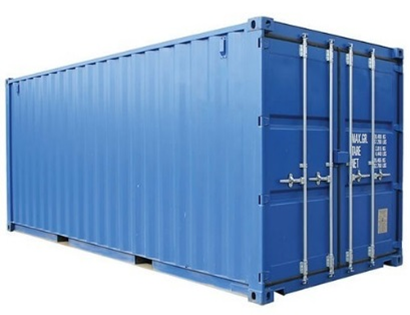
Temporary storage container means a standardized reusable steel box or container fabricated for the purpose of transporting freight or goods on a truck, railroad or ship, including cargo containers, shipping containers, storage units, or other portable structures that are placed on a private property and used for the storage of items, including, but not limited to, clothing, equipment, goods, household or office fixtures or furnishings, materials or merchandise.
Temporary uses or structures means any temporary use of property which is defined within section 28-411 of this development code.
Thoroughfare means a street provided for heavy volumes of fast moving vehicles, having considerable continuity, and used primarily as traffic arteries between large areas.
Tiny house means a house that is typically 150 to 800 square feet. A tiny house on wheels is considered a recreational vehicle and a tiny house on a foundation is considered an accessory dwelling unit (ADU).
Tiny house subdivision means a subdivision of land which promotes the development of tiny houses (150 to 800 square foot) as primary residential dwelling units.
Tower means any ground or roof mounted pole, spire, structure, or combination thereof, including supporting lines, cables, wires, braces, and masts, intended primarily for the purpose of mounting an antenna, meteorological device, turbines, blades or similar apparatus above grade. Does not include flag poles and bird houses.
Tower, guyed means a tower that is supported, in whole or in part, by wires and ground anchors.
Transient guest means a person who occupies a short-term rental for not more than 30 consecutive days.
Tree caliper inches means for significant trees, the trunk diameter measured approximately four and one-half feet above the ground. For trees that branch at or below four and one-half feet above the ground but above one foot, the diameter is measured at the smallest point below four and one-half feet. Trees that branch below one foot will be considered to have multiple stems and the diameter of the tree will equal the sum of the diameters of each stem. For replacement trees, the diameter of a tree measured usually 12 inches above the ground.
Tree critical root zone means the area of a circle around a significant tree with a radius that is equal to one and one-half feet for every inch in trunk diameter.
Tree removal means any excavating, grading, clearing, filling, or other earth change, or any cutting, which may result in removal or killing more than ten percent of the significant tree caliper inches on any land within any period of five years.
Tree replacement means a tree planted as part of the tree replacement plan, which must be at least one and three-quarters caliper inches measured 12 inches from the ground and which otherwise meets the requirements of this section, except bur oak, ironwood and similar trees accepted by the council which may be one and one-quarter caliper inches. A coniferous tree five feet high will meet the minimum caliper inches required, except on steep slopes.
Tree (significant) means any deciduous or coniferous tree measuring eight caliper inches in diameter or greater, measured at four and one-half feet above ground level of the main stem, and which is not dead or actively infected with a tree killing disease or organism such as, but not limited to: oak wilt, Dutch Elm Disease; except bur oak, ironwood and similar slow growing trees which are accepted by the council which may be four caliper inches in diameter or greater.
Tree (high quality significant with potential for hazard or disease) means any high quality significant tree(s) that are in imminent danger of dying or toppling due to natural causes and causing damage to public or private utilities, infrastructure, or buildings. Designation of such hazard or diseased significant tree(s) shall be evaluated and certified in writing to this effect by a certified tree inspector, as defined by Minnesota Laws Chapter 89.63, before being included as part of a site tree inventory and/or allowed to be removed.
Tree (high quality significant) means any significant tree of the following common indigenous species: American linden, ash, aspen (large tooth), basswood, black willow, birch (except paper) black cherry, cedar, cottonwood, dogwood, elm, hackberry, ironwood, locust, maple, oak, pine (all species except jack), spruce, tamarack, or walnut and other species which have an approximate minimum life expectancy of 45 years or greater.
Tree (significant mature cover) means the full aerial outline expressed in a measure of land area for all existing or expected significant tree canopy coverage at a mature stage of growth.
Unattended vegetation means overgrown or untrimmed shrubs, brush, or grasses; diseased, dead, noxious, or poisonous vegetative growth; weeds; and any other improperly maintained or inappropriate vegetation according to local and state laws.
University building means a building that is off-campus to a university but provides a service with a primary intent to serve the students and faculty of the university, but may also be open to the public.
University or college means an educational institution authorized by the state to award associate, baccalaureate or higher degrees.
Variable front yard setback means a waiver from the strict enforcement of the front yard setback shown for a specific property, as established in section 28-121(C)(6) of this development code.
Variance means relief from certain provisions of this development code, when due to the particular physical surroundings, shape or topographical condition of the property, compliance would result in a practical difficulty upon the property owner. A variance shall not be used to permit a use in a district where it is not allowed under the terms of this development code. Variances shall only be granted in compliance with Minn. Stat. 462.
Vehicular sign means signs placed on or painted on a motor vehicle or trailer parked with the primary purpose of providing signage not otherwise allowed by this development code.
Veterinary clinic or animal hospital means a facility for the diagnosis, treatment, or hospitalization of small animals, including dogs, cats, rabbits, hamsters, and other animals of similar nature. Does not include animal kennel, grooming, or boarding services.
Warehouse storage and distribution facility means a facility in which goods shipped by truck are loaded, unloaded, or transferred between trucks for shipping or distribution, together with incidental truck storage, maintenance, and administrative offices.
Warming center means a building operated for the purpose of temporarily sheltering of homeless persons from exposure to potentially life-threatening temperatures for brief intervals not to exceed 16 continuous hours and which is designed or licensed pursuant to state and local laws, rules, regulations and ordinances, to provide overnight sleeping accommodations.
Waste water treatment or cluster sewage treatment facility means any plant, disposal field, lagoon, or other works, installed for the purpose of collecting, pumping, treating, stabilizing or disposing of sewage, as defined in Minn. Stat., § 115.01, subd. 17.
Water-oriented accessory structure or facility means a small, above ground building or other improvement, except stairways, fences, docks and retaining walls, which, because of the relationship of its use to a surface water feature, reasonably needs to be located closer to public waters than the normal structure setback. Examples of such structures and facilities include boathouses, gazebos, screen houses, fish houses, pump houses, and detached decks.
Water supply purpose means any use of water for domestic, commercial, industrial or agricultural use.
Watercourse means a river or tributary identified by the Minnesota Department of Natural Resources as public water, or any river or stream identified in this development code.
Wetland means "wetland" has the meaning given under Minnesota Rule, part 8420.0111.
Wind energy conversion system (WECS) means any device such as a wind charger, windmill or wind turbine, which converts wind energy to a form of usable energy for any purpose.
(a)
Small commercial = >40 KW—4,999 KW
(b)
Small non-commercial = < 40 KW
Yard, front means a yard extending along the full width of the front lot line between side lot lines and extending from the abutting front street right-of-way line and/or ordinary high water level to a depth required in the yard regulations for the district in which such lot is located.
Yard, rear means a yard extending along the full width of the rear lot line between the side lot lines and extending toward the front lot line for a depth as specified in the yard regulations for the district in which such lot is located.
Yard, side means a yard extending along the side lot line between the front and rear yards having a width as specified in the yard regulations for the district in which such lot is located.
Yard, side exterior means that portion of a corner lot that borders a public street but is not defined by the address and for which no driveway access is provided.
(Ord. No. 199, 3rd series, § 1, 11-6-2023; Ord. No. 204, 3rd series, § 1, 3-4-2024; Ord. No. 210, 3rd series, § 1, 10-21-2024; Ord. No. 213, 3rd series, § 1, 11-18-2024)

