
Bemidji City Zoning Code
ARTICLE VI
ACCESSORY USES AND STRUCTURES
Sec. 28-201.- Accessory uses and structures.
Where a lot is devoted to a permitted principal use, customary accessory uses and structures are authorized, with the issuance of a building permit, except as prohibited specifically or by necessary implication in this or any other ordinance, provided that:
(a)
All accessory buildings and structures, including but not limited to decks, stairways, handicapped access, carports and breezeways, attached to the principal building on a lot shall be made structurally a part thereof and shall comply in all respects with the requirements of the development code applicable to the principal building.
(b)
All detached accessory buildings shall comply with all of the requirements applicable to the principal structure and maintain a minimum of ten feet between all structures.
(c)
No accessory building or structure shall be constructed, altered, or moved to any location within ten feet of the principal building unless the structure is made an integral part of the principal building.
(d)
In the R-1 through R-6 districts, the following maximum accessory structure size standards shall apply:
No maximum accessory structure size for lots larger than one acres in size, as long as impervious surface coverage isn't exceeded in the applicable zoning district. This standard shall only apply in R-1, R-2 and R-3 zoning districts.
(e)
No more than one accessory building (storage building) in excess of 200 square feet of floor area shall be allowed in the R-2, R-3, R-4, R-5 and R-6 districts except where the parcel is larger than one acre.
(f)
Accessory structures shall not exceed 25 feet in height, and side walls may not exceed 12 feet in height, except that accessory structures on parcels containing one acre or more in the R-1, R-2, and R-3 Districts shall not exceed 30 feet in height, and side walls may not exceed 16 feet in height.
(g)
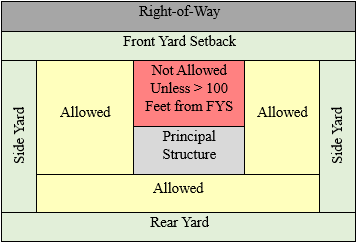
All detached accessory buildings or structures shall be located in the side or rear yards and shall not be placed directly between the front yard setback and principle structure. If the principle structure is set more than 100 feet from the front yard setback, then the accessory building may be placed directly between the front yard setback and principle structure. All such structures shall comply with all yard setback requirements applicable to the structures located within the zoning district.
(h)
Accessory structures 1,600 square feet or more shall be required to have double the minimum rear and side yard setback and accessory structures 3,000 square feet or more shall be required triple the minimum rear and side yard setback.
(i)
Structures, with a floor area 200 square feet or less are exempt from the building permit requirement, but they do count towards the maximum amount of accessory square footage allowed, and must meet all other underlying zoning requirements (i.e., setbacks, impervious surface total, etc.) per parcel.
(j)
Accessory structures shall not be constructed or occupied on any lot in the R-4 through R-6 zones prior to time of construction of the principal structure to which it is an accessory.
(k)
Accessory structures may be constructed on lots, not containing the principal structure in the R-3 through R-6 districts on the opposite side of the street or on an adjacent parcel. The accessory structure parcel shall be under the same ownership as the primary structure parcel.
(l)
The structure shall not be designed or used for human habitation and shall not contain sewage treatment facilities, unless the following conditions are met:
(1)
SSTS is a compliant system in conformity with article VIII of this development code
(Ord. No. 199, 3rd series, § 1, 11-6-2023)
Sec. 28-202. - Accessory buildings in manufactured housing parks.
No more than one storage building not to exceed 120 square feet is allowed per lot. A carport (in addition to the storage building) may also be allowed on manufactured home lots. All accessory buildings must meet setbacks. Storage and accessory buildings must be maintained and designed to enhance the general appearance of the lot.
(Ord. No. 199, 3rd series, § 1, 11-6-2023)
Sec. 28-203. - Accessory recreational facilities.
Accessory recreation facilities shall comply with a five foot side yard setback and front and rear yard setbacks as established by the zoning district. Examples of accessory recreation facilities include but are not limited to: tennis courts, pools, trail heads, hockey rinks and volley ball courts.
(Ord. No. 199, 3rd series, § 1, 11-6-2023)
Sec. 28-204. - Accessory dwelling units.
Accessory dwelling units (ADUs) may be incorporated within or added onto an existing house, garage, or other accessory structure, or may be built as a separate structure on a lot where a single-family dwelling exists in the R-1 through R-4 residential districts of the city.
Unless specifically addressed in this section, ADUs are subject to the regulations of the underlying zoning district in regards to lot and bulk standards (e.g., height, setbacks, and pervious coverage requirements), and the Minnesota State Building Code for residential structures.
In keeping within the character and standards of single-family residential districts of the city, the following standards shall apply:
(1)
Occupants of ADUs shall be limited to members of the family of the owner(s) of the principal structure.
(2)
No rental of the ADU's will be allowed.
(3)
No conversion of a single family house into a duplex will be allowed.
(4)
If a home is converted into a rental property, the ADU shall be removed.
(a)
Types of permits required.
(1)
Allowed with the issuance of an ADU permit:
a.
Internal ADUs incorporated within an existing principal structure shall be permitted in the R-1 through R-4 districts.
b.
Detached ADUs shall be permitted on lots in the R-1 and R-2 residential districts that contain a minimum of two acres of contiguous land.
c.
Attached ADUs shall be permitted on lots in the R-1 and R-2 Districts that contain a minimum of two acres of contiguous land.
(2)
Allowed pursuant the approval of a conditional use permit:
a.
Detached ADUs in the R-3 through R-4 Residential Districts, or on lots smaller than two acres, shall require the issuance of a conditional use permit subject to the standards of this development code.
b.
Attached ADUs in the R-3 through R-4 residential districts, or on lots smaller than two acres, shall require the issuance of a conditional use permit subject to the standards of this development code.
(b)
Property standards.
(1)
ADUs shall only be permitted in residential districts when the property owner lives on the property within the principal dwelling.
(2)
Only one ADU shall be allowed per single-family lot.
(3)
ADUs shall be located on the same parcel as the principle dwelling. ADUs located on back lots are prohibited.
(4)
ADUs shall remain under the ownership of the principal structure's occupant, and may not be sold separately or used as rental property.
(5)
ADUs shall not be subdivided or result in the creation of a separate tax parcel.
(6)
ADUs shall be prohibited on residential lots in which the permitted use of the principal structure is greater than a single-family use. This includes, but is not limited to, duplex units, twin homes, triplex units, quad units, residential facilities, etc.
(7)
Home occupations are prohibited uses for ADUs in all zoning districts.
(c)
Design standards.
(1)
Minimum/maximum size. The maximum size of an ADU may be no more than 50 percent of the square footage of the principal dwelling unit or 800 square feet, whichever is less.
(2)
Setbacks. The ADU must abide by the regular accessory structure setbacks.
(3)
Height. The height of the ADU shall not exceed that of the principle structure.
(4)
Architectural design. Attached ADUs added to the principal structure or to an existing accessory structure shall be designed to maintain the architectural design, style, appearance and character of the main building.
(5)
Parking. Parking requirements shall be established by the council for ADUs that require approval of a CUP, and the planning director shall determine parking requirements for permitted ADUs on a case-to-case basis.
(6)
Conversion of an existing structure to an ADU shall only occur if the existing structure meets all other zoning standards (setbacks, height, impervious, SSTS compliance).
(7)
All ADU structures shall be attached to a continuous load bearing permanent perimeter foundation that meets the requirements of the State Building Code (skirting is not an allowable substitute).
(Ord. No. 199, 3rd series, § 1, 11-6-2023)

