
Bemidji City Zoning Code
ARTICLE VII
SIGN REGULATIONS
Sec. 28-241.- Purpose and intent.
The purpose of this section shall be to coordinate the type, placement, and scale of signs within the different zoning districts to recognize the commercial communication requirements of all sectors of the business community; to encourage the innovative use of design; to promote both renovation and proper maintenance; to allow for special circumstances; to provide for the safety of the traveling public by limiting distractions, hazards and obstructions; and to guarantee equal treatment under the law through accurate record keeping and consistent enforcement. These shall be accomplished by regulation of the display, erection, use and maintenance of signs. No sign shall be permitted as a main or accessory use except in accordance with the provisions of this development code.
Because of its unique environmental setting, it is further the intent of this development code to encourage quality and aesthetics in the size, design and the materials used for sign construction; to enhance the overall appearance and image of the community; and to assure that the public is not endangered by the unsafe, disorderly or unnecessary use of signage. It is not, however, the purpose or intent of this development code to regulate the message displayed on any sign.
(Ord. No. 199, 3rd series, § 1, 11-6-2023)
Sec. 28-242. - Scope.
The purpose of this development code shall be to regulate all signs intended to be viewed from any vehicular or pedestrian public right-of-way. This development code shall not regulate government signs; the copy or message displayed on signs; signs not intended to be viewed from a public right-of-way; interior window displays; product dispensers; non-dynamic display scoreboards on athletic fields; gravestones; barber poles; religious symbols; commemorative plaques; the display of street numbers; or any display or construction not defined herein as a sign.
The owner of any sign which is otherwise allowed by this development code may substitute non-commercial copy in lieu of any other commercial or non-commercial copy. This substitution of copy may be made without any additional approval or permitting. The purpose of this provision is to prevent any inadvertent favoring of commercial speech over non-commercial speech, or favoring of any particular non-commercial message over any other non-commercial message. This provision prevails over any more specific provision to the contrary.
(Ord. No. 199, 3rd series, § 1, 11-6-2023)
Sec. 28-243. - General provisions.
It shall hereafter be unlawful for any person to erect, place, or maintain a sign in the city except in accordance with the provisions of this development code. Signs, other than government signs, are prohibited within all public rights-of-way and easements and on public property. Projecting signs, awnings, canopies, and under canopy signs that overhang a sidewalk or other pedestrian way shall provide a minimum clearance above the said pedestrian way of eight feet.
(Ord. No. 199, 3rd series, § 1, 11-6-2023)
Sec. 28-244. - Prohibited signs.
The following signs are prohibited in all districts:
(a)
Signs on vacant or abandoned buildings, or signs located at businesses which have ceased to operate as commercial enterprises. Such signs shall be removed by the property owner within 30 days of abandonment or business cessation;
(b)
Signs imitating or resembling official traffic or public safety signs or signals in shape, size or color;
(c)
Snipe signs or signs attached to trees, telephone or utility poles, public benches, streetlights, or placed on any public property or public right-of-way, with the exception of government signs;
(d)
Signs that interfere with the safe operation of official traffic control devices;
(e)
Signs that emit sound;
(f)
Signs anchored by guy wires, chains, cables or similar devices that project down to the ground or in any way which create an unsafe condition for pedestrians or motorists;
(g)
Dynamic displays on any moving motorized or non-motorized vehicle, except as may be allowed in a parade which has been officially approved by a political subdivision;
(h)
Roof signs without a CUP approved (excludes sloping roof signs and fascia signs on roof-like projections. Such signs may not extend higher than the peak of the roof line);
(i)
Swinging or other non-secured permanent signs;
(j)
Billboards including all dynamic billboard type displays;
(k)
Any vehicular signs displayed on a parked trailer or truck or other vehicle where the primary purpose of the vehicle is to advertise a product, service business, or other activity is prohibited. This regulation shall permit the use of business logos, identification or advertising on vehicles primarily and actively used for business purposes and/or personal transportation;
(l)
Signs tied to trees, supported by rocks or other naturally occurring landscape features; and
(m)
Off-premise or directional signage.
(Ord. No. 199, 3rd series, § 1, 11-6-2023)
Sec. 28-245. - Nonconforming Signs.
Existing signs which were legally erected, placed or maintained which do not conform to the specific provision of this development code may continue in use provided that:
(a)
Any sign legally existing at the time of the passage of this development code that does not conform to the provisions of this development code shall be considered a legal nonconforming sign and may be continued through repair, replacement, restoration, maintenance, or improvement but not including, expansion. "Expansion" shall be defined as any structural alteration, change or addition that is made outside of the original sign structure or sign area, including the addition of a dynamic display.
(b)
When any legal nonconforming sign is discontinued for a period of more than one year, or is changed to a conforming sign, any future sign shall be in conformity with the provisions of this development code. Any legal nonconforming sign shall be removed and shall not be repaired, replaced, or rebuilt if it is damaged by fire or similar peril to the extent of 50 percent or more of its estimated market value at the time of damage and no sign permit have been applied for within 180 days of the date of destruction. The county assessor shall be responsible for making the determination of whether a nonconforming off-premise business identification or billboard sign has been destroyed 50 percent or less of its estimated market value at the time of destruction.
(c)
In the event a sign permit is applied for within 180 days of the date of destruction, the board may impose reasonable conditions upon the sign permit in order to mitigate any newly created impact on adjacent properties.
(d)
A lawful nonconforming sign shall not be changed to a similar nonconforming sign or to a more restrictive nonconforming sign.
(e)
All legal nonconforming signs that have dynamic displays are required to comply with the night time dynamic display programming requirements of this development code, provided that the sign is capable of meeting programming requirements, as determined by the planning director.
(Ord. No. 199, 3rd series, § 1, 11-6-2023)
Sec. 28-246. - Permits required.
Unless otherwise provided by this development code, all signs shall require a sign permit issued by the planning director. No permit is required for the maintenance of a sign or for a change of copy on painted or printed sign face panels.
(a)
General information and application:
(1)
All signs requiring a permit will be required to pay an application fee as specified by the board's fee schedule.
(2)
In addition to a sign permit, an electrical permit must be obtained, if required, for illuminated signs or signs that have dynamic displays.
(3)
Unless otherwise stated herein, a permit will be valid for the life of the sign.
(4)
Application for a sign permit must be made on the forms provided by the city and filed with the planning director.
(5)
A change in business or ownership resulting in new signage requires staff review and a new sign permit.
(b)
Inspections. A sign requiring a permit shall be subject to an initial inspection by the city to determine whether the sign conforms to the provisions of this development code, the permit application and other applicable laws, ordinances and regulations, including, but not limited to: sign location, size, footings, structural design, and materials used.
(c)
Permit issuance. Upon the filing of a complete permit application, the planning director shall review the application materials submitted. If the proposed sign complies with this section and other applicable laws, ordinances and regulations, the planning director shall issue a sign permit.
(Ord. No. 199, 3rd series, § 1, 11-6-2023)
Sec. 28-247. - Signs not requiring permits.
The following types of signs are exempt from permit requirements but must be in compliance with all other requirements of this development code:
(a)
One non-illuminated sign with a commercial message that does not exceed 32 square feet in sign area in the single family R-1—R-5 and MH districts and 48 square feet in sign area in all other zoning districts may be placed upon a construction site. The sign must be removed within ten days after completion of construction or issuance of a certificate of occupancy, whichever occurs first.
(b)
Holiday decorations.
(c)
Identification signs.
(d)
Residential districts. Identification signs not to exceed three square feet in area.
(e)
Non-residential districts. Identification signs not to exceed five square feet in area.
(f)
Signs authorized by Minn. Stat., § 211B.045.
(g)
Government signs.
(h)
Commercial message signs on property that is for sale or lease according to the following standards:
All signs allowed by this paragraph must be removed within seven days after the closing date of the sale or lease of the property.
(i)
Window signs. For commercial uses, window signs shall be allowed only as accessory signage to a permitted permanent sign, and shall not be used as the principal wall sign of the business. If a window sign is the primary sign, then a permit is required and applicable sizes will comply.
(j)
Incidental signs that are two square feet in sign area or less, including, but not limited, to decals, logos, and emblems.
(k)
Wall or building art, provided such signs do not contain any commercial messaging.
(l)
Flags.
(1)
Location. Flags and flagpoles shall not be located within any right-of-way.
(2)
Height. Flags shall not be higher than what is allowed in underlying zoning district for an allowed principal structure;
(3)
Number. No more than two flags per lot in residential districts, no more than three flags per lot in all other districts;
(4)
Size. Maximum flag size is 24 square feet in residential districts, 35 square feet in all other districts; and
(5)
Flags containing commercial messages may be used in lieu of a permitted freestanding or projecting signs, and, if so used, the area of the flag shall be included in, and limited by the computation of allowable area for signs on the property.
(m)
Signs of any size on vehicles traveling or lawfully parked on operating and insured vehicles, construction trailers, or equipment which are temporarily parked on a permitted construction site.
(n)
Freestanding or portable signs not more than four square feet in size, on private property (having a garage sale) for not more than three days. Property owner is responsible for removal of signs.
(o)
Temporary or permanent signs installed or placed by public utilities to warn the public.
(p)
Outdoor scoreboards in athletic stadiums that do not include dynamic displays.
(q)
Static signs or banners adorning fences located in permitted outdoor recreational facilities, provided they are placed so as to only be viewed internal to the play field area and are not placed so as to orient a commercial message toward an adjacent public road right-of-way.
(r)
On-premise directional signs without business identification are permitted in parking lots or driveways of properties containing a multi-family residential use and in parking lots or driveways of properties located in a commercial or industrial district. Said signs shall not exceed four square feet in total directional sign area, unless otherwise permitted via planned unit development. Said signs shall not exceed five feet in height, unless they are placed on a building.
(s)
One off-premise directional sign per avenue or block leading to a commercially or industrially zoned property that has a driveway that has been permanently closed by the road authority and for which no reasonable direct access remains, as determined by the city. Said sign shall not be illuminated, shall not exceed two square feet in sign area and eight feet in height. No more than three off-premise directional signs shall be located on a single parcel and shall be placed on the same sign freestanding structure where feasible.
(t)
Bench signs located at bus stops, adjacent to sidewalks and located on other public and private resting places. Said sign shall not exceed four square feet in sign area.
(u)
Point of purchase display signs not to exceed one square foot in sign area.
(v)
Handicapped parking signs.
(w)
One non-illuminated non-commercial speech sign, not to exceed four square feet, may be attached to the wall of a structure by the owner, may not be an off-premises sign, and shall not contain any dynamic display.
(x)
One non-commercial speech community event banner, not to exceed 100 square feet, may be allowed in designated locations. Each location shall be approved by the council.
(y)
Security or warning signs. On-premise signs regulating the use of the premises, including, but not limited to, "no trespassing", "no hunting", "no soliciting" signs, and security system signs:
(1)
Residential districts. Signs not to exceed two square feet in area.
(2)
Non-residential districts. Maximum of one large sign per property, not to exceed five square feet in area. All other posted security and warning signs may not exceed two square feet in area.
(z)
Private drive sign. On-premise private drive signs are limited to one per driveway entrance, not exceeding two square feet in area.
(Ord. No. 199, 3rd series, § 1, 11-6-2023)
Sec. 28-248. - Sign standards.
All signs shall be properly maintained. Exposed surfaces shall be clean and painted if paint is required. Defective parts shall be replaced. The planning director shall order the repair or removal of any sign which is defective, damaged, or substantially deteriorated. Replacement of support posts, columns, pylons or other structural supports for any sign shall constitute removal of such sign, and its replacement shall be done in compliance with the terms of this development code. Banners and other temporary signs when attached to non-utility poles, stakes, tents, buildings or other structures shall be well secured so that they are not blown around uncontrollably by the wind. Banners and other temporary signs shall be maintained such that they do not become ripped, torn, faded, defaced, damaged, loose, or unsecured.
(a)
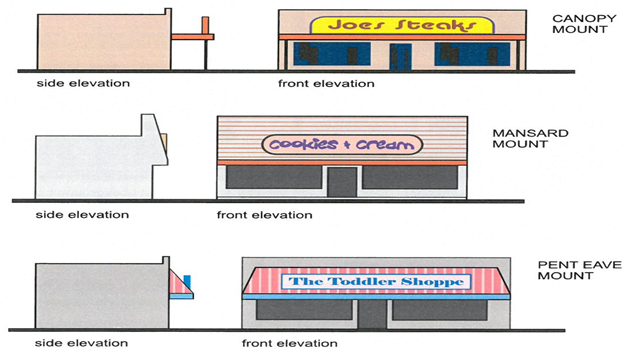
Typical sign elevations.
(1)
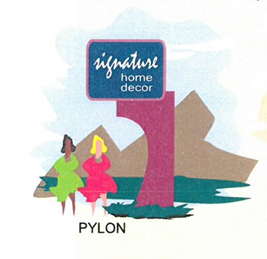
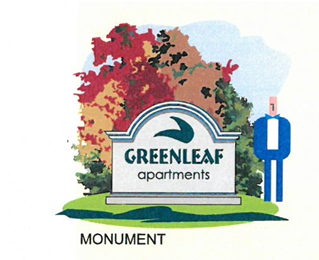
Freestanding signs.
a.
May be double or mutli faced and contain thematic embellishment and integral covers or cladding to conceal structural parts.
(2)
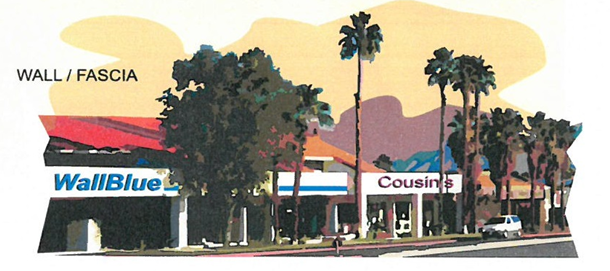
Wall signs.
(3)
Fascia signs (not roof signs).
(b)
Sign face area.
(1)
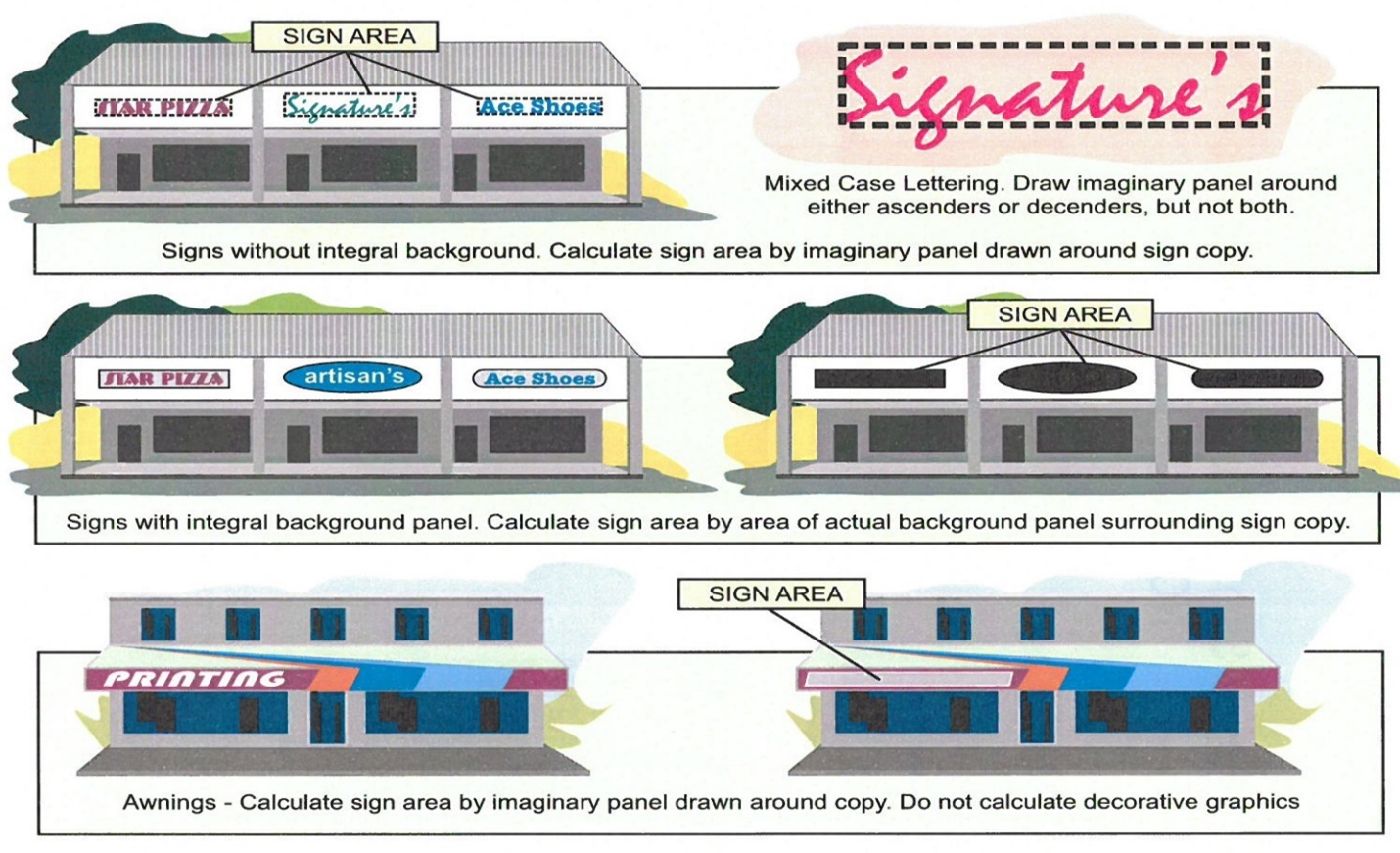
Sign cabinets. The area of sign faces enclosed in frames or cabinets is determined based on the outer dimensions of the frame or cabinet
(2)
Double sided signs. Only one side of a double sided sign is counted in determining the area of sign faces. Where the two sides are not of equal size, the larger of the two sides is used to determine sign area. The area of multiple-faced signs in which the interior angle formed by the faces is greater than 91 degrees shall be expressed as the sum of the areas of all the faces, except for multiple-faced signs containing faces that are configured back to back, in which case the area of the faces configured back to back will be calculated according to the rule for double-faced signs.
(3)
Round, oval and irregularly shaped signs. The area of a round, oval, or irregularly shaped sign shall be measured based on the appropriate mathematical formula to obtain the sign area.
(c)
Calculating sign area.
(1)
Signs containing integral background areas. The area of a sign containing a clearly defined background area shall be calculated based on the area of the smallest standard geometric shape or combination of geometric shapes capable of encompassing the perimeter of the background area of the sign. In the case of signs in which multiple background areas are separated by open space, sign area shall be calculated based on the sum of the areas of all separate background areas, calculated as referenced above, but without regard for any open space between the separate background areas.
(2)
Signs without integral background areas. In instances in which a sign consists of individual elements such as channel letters, symbols, or other graphic objects or representations that are painted, attached to, or otherwise affixed to a surface such as a wall, window, canopy, awning, architectural projection, or to any surface not specifically designed to serve as a sign background, the sign area shall be based on the sum of the individual areas of the smallest geometric shape or combination of geometric shapes capable of encompassing the perimeters of the individual elements comprising the sign.
(d)
Awnings and marquees. When graphics or sign copy is incorporated into an awning, the sign area is determined by computing the area of a standard imaginary geometric shape or combination of shapes drawn around the sign copy area or graphics. When the ends of awnings or marquees are parallel and contain graphics or sign copy, only one side is counted in addition to the sign face area on the front.
(e)
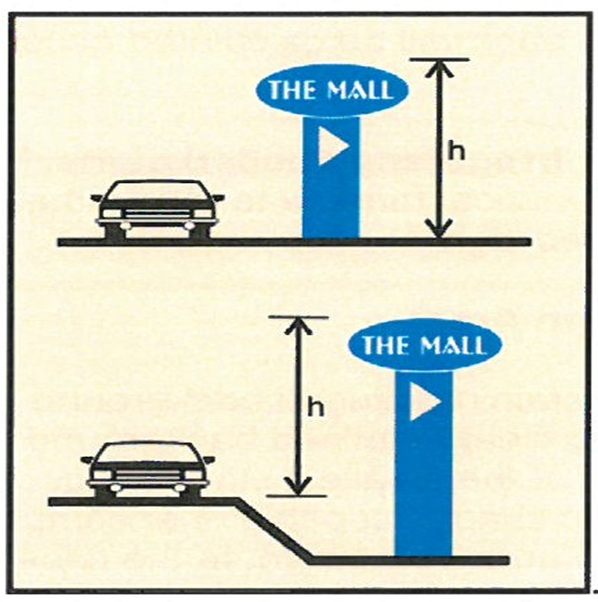
Height of sign. The overall height of a freestanding sign or sign structure is measured from the lowest point of the ground directly below the sign to the highest point of the freestanding sign or sign structure.
Exception: Where a freestanding sign or sign structure is mounted along a roadway that has a higher grade level as compared to the grade level directly below the freestanding sign or sign structure, then the freestanding sign or structure's height will be measured from the roadway grade level to the highest point of the freestanding sign or sign structure.
(f)
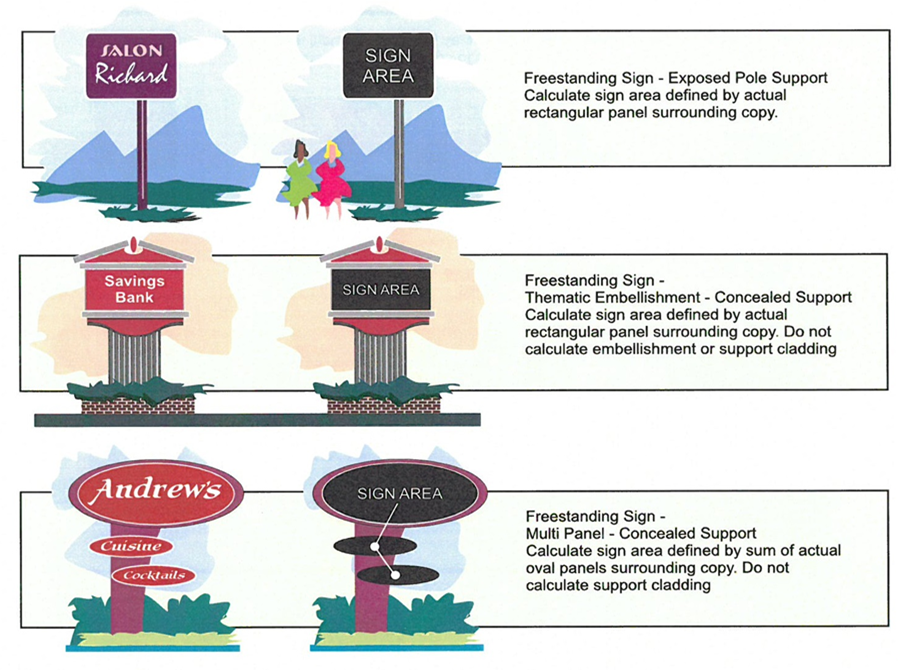
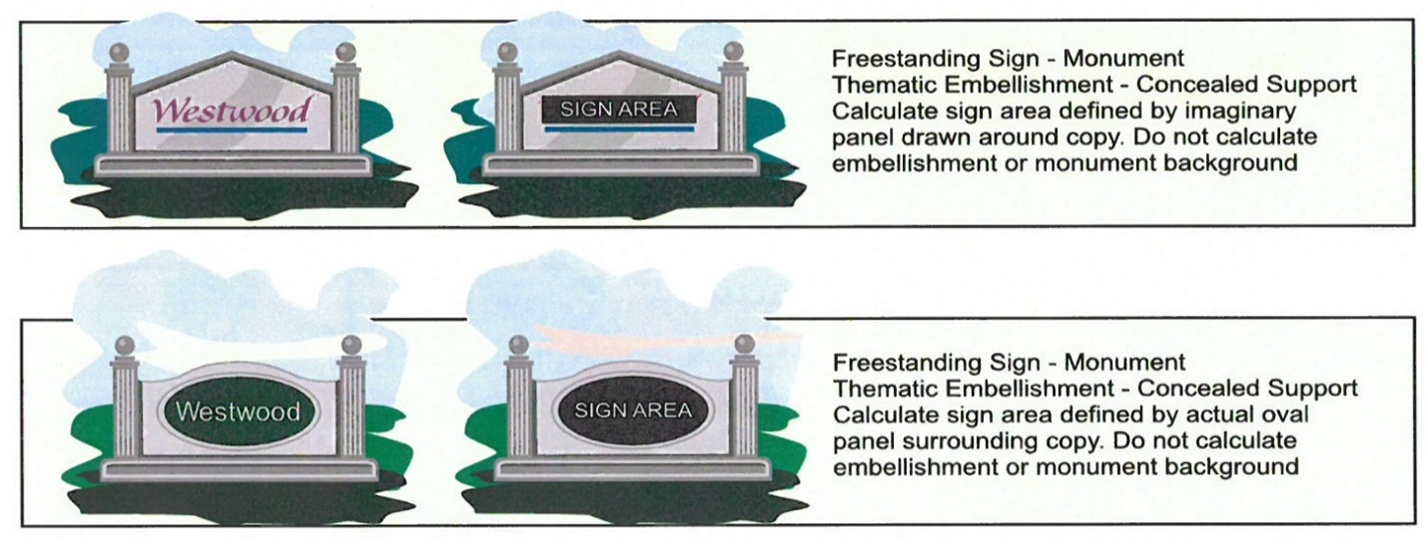
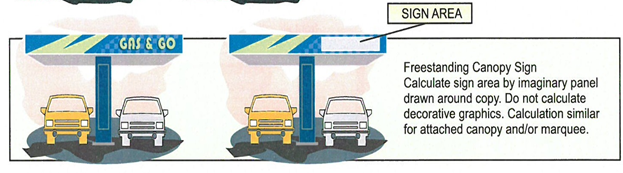
Illustrations. Sign calculations shall be completed and provided to the planning staff prior to approval. The following diagrams are meant to assist with this analysis.
(1)
Freestanding signs (pylon).
(2)
Freestanding—Monument.

(3)
Wall signs.
Four percent of the building's elevation
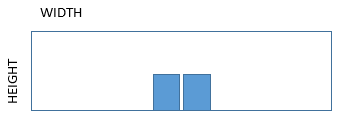
Multiply the height × width × 0.04 to find four percent of the building's elevation. Example: width of building is 100 feet. Height of building is 20 feet. The calculation for the sign would be 100 × 20 × 0.04 = 80 square feet of signage allowed.
(Ord. No. 199, 3rd series, § 1, 11-6-2023)
Sec. 28-249. - Signs permitted in the (C) conservation district.
No sign may be permitted in the conservation district, with the exception of those identified in section 28-246 of this development code. No sign shall be located less than ten feet from a road right-of-way.
(Ord. No. 199, 3rd series, § 1, 11-6-2023)
Sec. 28-250. - Signs permitted in the R-1, R-2, R-3, R-4, R-5, R-6 and MH districts.
(a)
The following signs are permitted with the issuance of a sign permit in accordance with the following standards provided that no such sign may be illuminated, except in the R-6 district and for permitted non-residential uses:
(1)
All signs as permitted in section 28-246 of this development code;
(2)
One subdivision, neighborhood or development entryway sign per street frontage, not to exceed 32 square feet in sign area for each location. Said sign shall not include a dynamic display;
(3)
One on-premise sign per entrance to each building in an apartment or condominium complex, not to exceed 36 square feet in total sign area. Said sign shall not include a dynamic display;
(4)
Permitted non-residential uses, including churches, schools, clinics, are allowed one freestanding sign per street frontage not to exceed 32 square feet in sign area. One wall sign of 24 square feet in sign area is also permitted per street frontage. The allowable sign area and height for freestanding signs and wall signs may be increased by 50 percent if the parcel is two and one-half acres in size or greater and all freestanding signs are set back at least 30 feet from any public right-of-way;
(5)
Home occupations are permitted no more than one sign not to exceed four square feet in sign area. The sign must be located in the front yard or the side yard. The sign shall not be illuminated and shall not include a dynamic display;
(6)
All permitted freestanding signs shall have a maximum height limit of six feet and shall be set back at least 15 feet from any public right-of-way. The total width of the support structure of a freestanding sign shall not exceed the sign. There shall be landscaping or a planter that encompasses the support structure.
(7)
Dynamic displays may be approved as a conditional use for uses that do not contain any residences, subject to the provisions and standards of this development code. Appropriate restrictions on the dynamic display size may be approved by the council in order to minimize any negative impacts on the surrounding residential area.
(8)
Permitted non-residential uses, with the exception of home occupations, may display one banner per parcel with no sign permit being required. The banner shall not exceed 30 square feet in sign area and shall only be displayed for a maximum of 30 days in a six month period running from January 1st to June 30 th and July 1 st to December 31 st . The days are cumulative and do not carry into the subsequent period.
(b)
Permitted non-residential uses, with the exception of home occupations, are allowed to display, without a permit, one sandwich board sign per parcel, which may not exceed 20 square feet in total sign area. There must be a minimum pedestrian clearance of five feet in sidewalk or trail width. Signs are only allowed to remain outdoors during periods of time that an establishment is open and being operated.
(Ord. No. 199, 3rd series, § 1, 11-6-2023)
Sec. 28-251. - Signs permitted in the LC and LD districts.
(a)
The following signs are allowed without the issuance of a sign permit in accordance with the following standards:
(1)
One on-premise bulletin board sign not to exceed nine square feet in sign area in addition to the maximum signage allowed per parcel;
(2)
One on premise banner per parcel, not to exceed 30 square feet in total sign area. Banners shall be displayed for no more than a total of 30 days within a six month period running from January 1 st to June 30 th and July 1 st to December 31 st . The days are cumulative and do not carry into the subsequent period.
(3)
Two sandwich board signs per parcel, which may not exceed 20 square feet in total sign area. There must be a minimum pedestrian clearance of five feet in sidewalk or trail width. Signs are only allowed to remain outdoors during periods of time that an establishment is open and being operated;
(4)
Two sail signs per parcel, which may not exceed 15 feet in height. There must be a minimum pedestrian clearance of five feet in sidewalk or trail width. Sail signs are only allowed to remain outdoors during periods of time that an establishment is open and being operated;
(b)
The following signs are permitted with the issuance of a sign permit in accordance with the following standards:
(1)
One portable on premise sign not to exceed 32 square feet in sign area. Said sign shall be set back no less than five feet from any lot line, and shall be permitted no more than a total of 30 days within a six month period running from January 1 st to June 30 th and July 1 st to December 31st. Said sign shall not contain a dynamic display;
(2)
Wall and freestanding signs.
a.
Wall signage is permitted for each building face. One freestanding sign is permitted per parcel. Parcels that are ten acres in size or larger, with two driveways on separate street frontages may be permitted two freestanding signs. No wall or freestanding signage shall be allowed on the lake side of riparian properties.
b.
The total allowable signage permitted for a single tenant building is as follows:
i.
Wall signage is limited to a maximum of four percent of the building's total wall elevation square feet per building face, or 50 square feet per building face whichever is greater. Maximum allowable sign size shall not exceed 250 square feet.
ii.
Freestanding signage shall be limited to 125 square feet for static on premise identification signage. An additional 55 square feet of on premise signage may be permitted for a manual changeable copy reader board or a dynamic display when it is incorporated into a permitted freestanding sign structure.
c.
The total allowable signage permitted for a multi-tenant building is as follows:
i.
Wall signage is limited to a maximum of four percent of the building's total wall elevation square footage per building face, or 50 square feet per building face whichever is greater. Each individual tenant may have one wall sign if a sign plan is submitted for review by planning staff. No individual tenant shall have a wall sign that exceeds 250 square feet. Properties located in the LD district with reduced or no front yard setbacks, and which front directly onto a public sidewalk may have one additional under canopy or projecting sign per sidewalk frontage.
ii.
Freestanding signage is limited to 150 square feet for static identification signage. An additional 55 square feet of signage may be permitted for a manual changeable copy reader board or dynamic display when it is incorporated into the freestanding sign structure.
d.
Low profile monument signs.
i.
One low profile monument sign less than 50 square feet in sign area and not exceeding six feet in height may be permitted in lieu of any other freestanding sign on the parcel. The sign must have a minimum setback of five feet from the street right-of-way and shall not be permitted in the sight visibility triangle.
(3)
Additional signage for parcels located on one-way streets.
a.
A parcel fronting on only one one-way street or highway may have one off-premise identification sign which must be located within the same block as the parcel. The sign area of the off-premise sign shall be added to the total allowed square footage for signs on the parcel in which the sign is located and shall not exceed the total amount of sign area that is permitted for that parcel.
b.
Where any parcel is located between two one-way streets or highways, it may have one additional freestanding sign per parcel per one-way street frontage.
(c)
Maximum height.
(1)
No sign shall exceed 30 feet in height in the LD District and 25 feet in height in the LC District.
(d)
Required setbacks.
(1)
There shall be a minimum setback of 15 feet from the front property line for all other freestanding signs. Side yard setbacks shall be a minimum of five feet.
(Ord. No. 199, 3rd series, § 1, 11-6-2023)
Sec. 28-252. - Signs permitted in the (B-1) and (B-2) low density and general commercial districts.
(a)
The following signs are allowed without the issuance of a sign permit in accordance with the following standards:
(1)
One on-premise bulletin board sign not to exceed nine square feet in sign area in addition to the maximum signage allowed per parcel;
(2)
One on-premise banner per parcel, not to exceed 60 square feet in total sign area. Such sign shall be set back no less than five feet from any lot line. Banners shall be displayed for no more than a total of 30 days within a six month period running from January 1 st to June 30 th and July 1 st to December 31 st . The days are cumulative and do not carry into the subsequent period.
(3)
Two sandwich board signs per parcel, which may not exceed 20 square feet in total sign area. There must be a minimum pedestrian clearance of five feet in sidewalk or trail width. Signs are only allowed to remain outdoors during periods of time that an establishment is open and being operated.
(4)
Two sail signs per parcel, which may not exceed 15 feet in height. There must be a minimum pedestrian clearance of five feet in sidewalk or trail width. Sail signs are only allowed to remain outdoors during periods of time that an establishment is open and being operated;
(b)
The following signs are permitted with the issuance of a sign permit in accordance with the following standards:
(1)
One portable on premise sign not to exceed 60 square feet in sign area, provided that there are no signs with dynamic displays on the parcel. Such sign shall be set back no less than five feet from any lot line, and shall be permitted no more than a total of 30 days within a six month period running from January 1 st to June 30 th and July 1 st to December 31st. Said sign shall not contain a dynamic display.
(2)
Wall, monument and freestanding signs.
a.
Wall signage is permitted for each building face. One freestanding sign or monument sign is permitted per parcel. Parcels that are five acres in size or larger, with two driveways on separate street frontages may have two freestanding or monument signs;
b.
The total allowable signage permitted for single tenant building is as follows:
i.
Wall signage is limited to a maximum of four percent of the building's total wall elevation square feet per building face, or 50 square feet per building face whichever is greater. Maximum allowable sign size shall not exceed 250 square feet.
ii.
Freestanding or monument signage shall be limited to 125 square feet for on premise static identification signage. An additional 55 square feet of on premise signage may be permitted for a manual changeable copy reader board or a dynamic display when it is incorporated into a permitted sign structure.
c.
The total allowable signage permitted for a multi-tenant building is as follows:
i.
Wall signage is limited to a maximum of four percent of the building's total wall elevation square feet per building face or 50 square feet per tenant whichever is greater. Each individual tenant may have one wall sign if a sign plan is submitted for review by the planning director. No individual tenant shall have a wall sign that exceeds 250 square feet.
ii.
Freestanding or monument signage is limited to 150 square feet for static identification signage. An additional 55 square feet of signage may be permitted for a manual changeable copy reader board or a dynamic display when it is incorporated into a permitted sign structure.
d.
Low profile monument signs.
i.
One low profile monument sign less than 50 square feet in sign area and not exceeding six feet in height may be permitted in lieu of any other freestanding sign on the parcel. The sign must have a minimum setback of five feet from the street right-of-way and shall not be permitted in the sight visibility triangle.
(c)
Maximum freestanding sign height.
(1)
No sign shall exceed 30 feet in height.
(d)
Required setbacks.
(1)
There shall be a minimum setback of 15 feet from the street right-of-way line for all other freestanding signs. Side yard setbacks shall be a minimum of ten feet.
(Ord. No. 199, 3rd series, § 1, 11-6-2023)
Sec. 28-253. - Signs permitted in the (UR) urban renaissance district.
(a)
The following signs are allowed without the issuance of a sign permit in accordance with the following standards:
(1)
One bulletin board sign not to exceed nine square feet in sign area in addition to the maximum signage allowed per parcel;
(2)
Two sandwich board signs per parcel, which may not exceed 20 square feet in total sign area. No sign permit is required. There must be a minimum pedestrian clearance of five feet in sidewalk or trail width. Signs are only allowed to remain outdoors during periods of time that an establishment is open and is being operated;
(3)
One banner per parcel, which may not exceed 60 square feet in total sign area. Banners shall be displayed for no more than a total of 30 days within a six month period running from January 1 st to June 30 th and July 1 st to December 31 st . The days are cumulative and do not carry into the subsequent period. Sail signs are not considered banners and are prohibited in the UR district.
(b)
The following signs are permitted with the issuance of a sign permit in accordance with the following standards:
(1)
Wall, monument and freestanding signs.
a.
The maximum number of wall signs permitted shall be the same as the number of street and alley right-of-way frontages for the parcel.
b.
The total allowable wall sign area shall not exceed three square feet per lineal foot of building frontage. No wall sign shall exceed 80 square feet in sign area. The maximum total allowable wall sign area for a building shall not exceed 160 square feet;
c.
For multi-tenant buildings, a total of one wall mounted sign is allowed per business per street and alley right-of-way frontage, if a sign plan is submitted for review by the planning director. The total allowable wall sign area shall not exceed 200 square feet per parcel. Landlords may submit one plan and obtain one permit per building if sign structures are incorporated into the lease plan.
d.
There shall be a maximum of one freestanding or monument sign permitted per parcel not to exceed 100 square feet in sign area for static on-premise identification signage. An additional 55 square feet of on-premise signage may be permitted for a manual changeable copy reader board or a dynamic display when it is incorporated into a permitted sign structure.
(2)
Under-canopy and projecting signs.
a.
Parcels with reduced or no front yard setbacks, and which front directly onto a public sidewalk with a pedestrian orientation may have one under-canopy or projecting sign per sidewalk frontage in addition to any permitted wall signage.
b.
Under-canopy and projecting signs shall be limited to one per building façade on which any such sign is mounted except for a use that fronts on more than one street, in which case, one such sign shall be permitted per facade for each separate street frontage. In the case of a building in which any individual facade exceeds 200 lineal feet one such sign shall be permitted for each 200 lineal feet of such facade or multiple thereof on each separate street on which such façade fronts.
c.
The area of any under-canopy or projecting sign shall not exceed one square foot per every two lineal feet of the building facade on which such sign is mounted, except that no such sign shall be larger in area than 50 square feet.
d.
No under-canopy or projecting sign shall extend in a vertical dimension above the highest architectural point of the facade to which it is mounted.
e.
Under-canopy and projecting signs extending over a public sidewalk shall be limited to a projection distance not to exceed two-thirds of the width of the sidewalk.
(c)
Maximum freestanding sign height.
(1)
No sign shall exceed 30 feet in height.
(d)
Required setbacks.
(1)
There shall be no required setbacks.
(Ord. No. 199, 3rd series, § 1, 11-6-2023)
Sec. 28-254. - Signs permitted in the O/M and U districts.
(a)
The following signs are allowed without the issuance of a sign permit in accordance with the following standards:
(1)
One bulletin board sign not to exceed nine square feet in sign area in addition to the maximum signage allowed per parcel;
(2)
One banner per parcel, which may not exceed 60 square feet in total sign area. No sign permit is required. Banners shall be displayed for no more than a total of 30 days within a six month period running from January 1 st to June 30 th and July 1 st to December 31 st . The days are cumulative and do not carry into the subsequent period.
(3)
Two sandwich board signs per parcel, which may not exceed 20 square feet in total sign area. There must be a minimum pedestrian clearance of five feet in sidewalk or trail width. Signs are only allowed to remain outdoors during periods of time that an establishment is open and being operated;
(4)
Two sail signs per parcel, which may not exceed 15 feet in height. There must be a minimum pedestrian clearance of five feet in sidewalk or trail width. Sail signs are only allowed to remain outdoors during periods of time that an establishment is open and being operated;
(b)
The following signs are permitted with the issuance of a sign permit in accordance with the following standards:
(1)
One portable sign no larger than 32 square feet in sign area, provided there are no signs with dynamic displays on the parcel. Such sign shall be set back no less than five feet from any lot line, and shall be displayed no more than a total of 30 days within a six month period running from January 1 st to June 30 th and July 1 st to December 31 st . Said sign shall not contain a dynamic display.
(2)
Wall and freestanding signs.
a.
There shall be no more than two wall or freestanding signs per 25 lineal feet of street frontage.
b.
The total sign area of wall and freestanding signs shall not exceed one square foot per each five lineal feet of street frontage.
c.
Outdoor recreational stadiums shall be permitted two wall signs not to exceed 160 square feet in sign area for each sign;
d.
Wall signage is limited to a maximum of four percent of the building's total wall elevation square feet per street frontage, or 50 square feet, whichever is greater. Maximum allowable sign size shall not exceed 150 square feet.
(c)
Maximum freestanding sign height.
(1)
No sign shall exceed 30 feet in height.
(d)
Low profile monument signs.
(1)
One low profile monument sign less than 50 square feet in sign area and not exceeding six feet in height may be permitted in lieu of any other freestanding sign on the parcel. The sign must have a minimum setback of five feet from the street right-of-way and shall not be permitted in the sight visibility triangle.
(e)
Required setbacks.
(1)
There shall be a minimum setback of 15 feet from the street right-of-way for all other freestanding signs. All signs shall comply with the minimum district rear yard setbacks for principal structures. Side yard setbacks shall be a minimum of ten feet from the property line.
(Ord. No. 199, 3rd series, § 1, 11-6-2023)
Sec. 28-255. - Signs permitted in the I-1 and I-2 districts.
(a)
The following signs are allowed without the issuance of a sign permit in accordance with the following standards:
(1)
One bulletin board sign not to exceed nine square feet in sign area in addition to the maximum signage allowed per parcel.
(2)
One banner per parcel, which may not exceed 60 square feet in total sign area. No sign permit is required. Banners shall be displayed for no more than a total of 30 days within a six month period running from January 1 st to June 30 th and July 1 st to December 31 st . The days are cumulative and do not carry into the subsequent period.
(b)
The following signs are permitted with the issuance of a sign permit in accordance with the following standards:
(1)
One portable sign no larger than 32 square feet in sign area. Such sign shall be set back no less than five feet from any lot line, and shall be displayed no more than a total of 30 days within a six month period running from January 1 st to June 30 th and July 1 st to December 31 st . Said sign shall not contain a dynamic display.
(2)
One off-premise directional freestanding sign not to exceed 100 square feet in sign area is permitted on a parcel in the I-1 or I-2 district in accordance with the following standards:
a.
The sign shall comply with all setback requirements of this section.
b.
The sign shall not exceed 30 feet in height.
c.
The parcel where the off-premise directional sign will be located shall be located within 300 feet of a principal or minor arterial or major collector street as defined by the city transportation plan.
(3)
Wall and freestanding signs.
a.
There shall be no more than two wall signs and one freestanding sign, or three wall signs on a parcel;
b.
Signage on a parcel shall not exceed 125 square feet in total sign area.
(4)
Low profile monument signs.
a.
One low profile monument sign less than 50 square feet in sign area and not exceeding six feet in height may be permitted in lieu of any other freestanding sign on the parcel. The sign must have a minimum setback of five feet from the street right-of-way and shall not be permitted in the sight visibility triangle.
(c)
Maximum freestanding sign height.
(1)
No sign shall exceed 30 feet in height.
(d)
Required setbacks.
(1)
There shall be a minimum setback of 15 feet from the front property line. All signs shall comply with the minimum district setbacks for principal structures in rear yards. Side yard setbacks shall be ten feet from the property line.
(e)
Dynamic displays shall be prohibited in these districts.
(Ord. No. 199, 3rd series, § 1, 11-6-2023)
Sec. 28-256. - Additional sign standards.
(a)
Illuminated signs.
(1)
Where illumination is permitted, such signs shall be indirect or backlit to avoid direct casting of light upon property located in any residential district, upon public waters, or onto any public right-of-way.
a.
Internal. A sign illuminated by a light source that is concealed or contained within the sign and becomes visible in darkness through a translucent surface.
b.
External. A sign illuminated with an artificial light, located away from the sign, and directed onto the sign face so that the message is visible in darkness. Signs for all commercial uses where illumination is permitted may have external lighting, provided that the light source has a shielded decorative exterior fixture consistent with section 28-408, and which incorporates the same architectural design motif as the sign and the building, avoids casting of light away from the sign and building and is permanently maintained in the same manner. The fixture detail information must be provided for review and approval with the sign permit application.
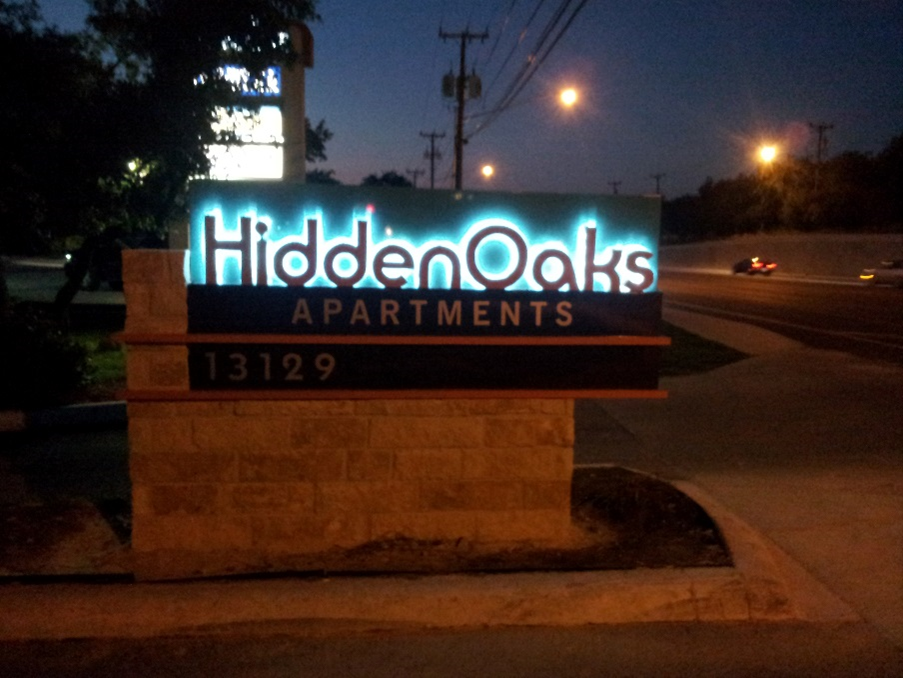
Internally lit signs (allowed)
Note— www.aetnasign.com
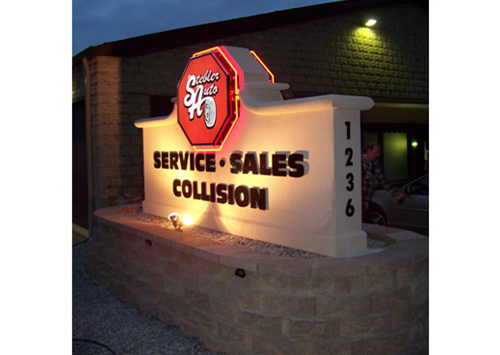
Upward "unshielded" lit signs (NOT allowed)
Note— www.foamcraft.info
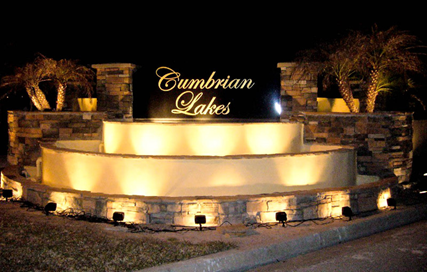
Upward "shielded" lit signs (allowed)
Note— www.disneyparadisevilla.com

Externally illuminated sign (allowed)
Note— esignsunlimited.com
(b)
Principal or minor arterial road signs.
(1)
An increase in the maximum freestanding sign height and one additional freestanding sign per parcel may be approved for non-residential developments, subject to the following requirements:
a.
Shall contain a minimum of one acre;
b.
Is adjacent to a principal or minor arterial road;
c.
Does not contain a driveway with direct access to the principal or minor arterial road; and
d.
The highest grade elevation of the adjacent principal or minor arterial road is 15 feet in height or greater, above the highest adjacent surface grade beneath the proposed sign location. In such cases, the applicant shall be required to provide the existing and proposed grade elevation comparison survey data. If this standard is met, then the maximum sign height shall be based upon this highest adjacent road elevation.
(Ord. No. 199, 3rd series, § 1, 11-6-2023)
Sec. 28-257. - Additional provisions in the Trunk Highway 197 overlay district.
(a)
No freestanding sign in the TH 197 overlay district shall exceed 25 feet in height.
(b)
MnDOT road authority may apply to the 197 overlay district. New freestanding signs must be reviewed by MnDOT.
(Ord. No. 199, 3rd series, § 1, 11-6-2023)
Sec. 28-258. - Dynamic displays.
(a)
Regulations. Dynamic displays on signs, where specifically allowed by this development code, shall comply with the following requirements:
(1)
Brightness. LED dynamic displays shall be adjusted to a night time brightness setting of no more than 20 percent of their maximum brightness setting. LED dynamic displays may operate at up to a 100 percent of their maximum brightness during the day time. Incandescent dynamic displays shall be adjusted to a night time brightness setting of no more than 60 percent. Incandescent dynamic displays may operate at up to a 100 percent of their maximum brightness during the day time. Constant night time displays of bright or "hot colors" such as complete red or white display background shall be prohibited. All dynamic displays shall be equipped with a night time manufacturer auto dim feature and operated according to manufacturer night time intensity specifications. Legal non-conforming dynamic displays without a manufacturer auto dim feature shall comply with this requirement to the extent feasible within the limits of the dynamic display's programming.
(2)
Time/duration. Full dynamic display animation electronic programming without any minimum frame hold display time duration is allowed for all display displays during the day time. The night time minimum frame hold display time duration for all dynamic displays, including legal non-conforming displays shall not be less than three seconds. There shall be no animation, motion, blinking, scrolling, rotating, oscillating, or other apparent flashing or movement on any dynamic display during the night time.
(3)
Dynamic display size and percentage of sign area. Dynamic displays may be permitted in certain zoning districts on freestanding and monument signs or as a wall sign, as specified by this development code. Dynamic displays for freestanding signs may occupy no more than 45 percent of the total allowable sign area of a freestanding or monument sign(s) permitted on a parcel. Dynamic displays may occupy no more than 45 percent of the total allowable wall sign area for a parcel. No dynamic display may exceed 55 square feet in sign area, except as may be approved as a conditional use permit condition for a comprehensive sign plan with a PUD in the LD district.
(4)
Maximum number. There shall be no more than one freestanding dynamic display sign permitted per property, except as may be permitted by this development code for additional signage along one-way pairs. Where a dynamic display is requested to be mounted as part of the building wall signage, there shall be no more than one dynamic display permitted per wall elevation and the maximum number of wall elevations per building shall be two, including multi-tenant centers. Dynamic displays which are mounted in a back-to-back configuration shall count as one dynamic display, provided the total angle for mounting does not exceed 60 degrees.
(5)
Spacing from residential uses. No dynamic display shall be located within 100 feet of a residential district. The distance shall be measured based upon a horizontal line beginning at the nearest residential property line and the leading edge of the dynamic display, or a viewing radius of 45 degrees, whichever is closer.
(6)
Spacing from traffic control signals. No dynamic display shall be located within 50 feet of an official traffic control signal. The distance shall be measured based upon a horizontal line beginning at the leading edge of the dynamic display and any portion of the traffic control device.
(7)
Restriction on additional temporary signage. When a dynamic display exists on a parcel, there shall be no additional temporary signage, including, but not limited to, banners and portable signs allowed or permitted on the parcel, except in accordance with section 28-258 of this development code with an approved special event sign permit.
(8)
Commercial off-premise advertising shall be prohibited.
(Ord. No. 199, 3rd series, § 1, 11-6-2023)
Sec. 28-259. - Special event signs.
(a)
Temporary signs may not be displayed at a special event without first applying for and obtaining a special event sign permit from the planning staff. Upon the filing of a complete special event sign permit application, the planning director shall review the application materials submitted. If the proposed signs comply with this development code and all other applicable laws, ordinances and regulations, planning staff shall issue a special event sign permit for the signs.
(b)
District requirements. A special event sign permit may be approved for a parcel in accordance with the following standards:
(1)
All permitted commercial and multi-family uses may be permitted up to one special event sign permit for up to 30 consecutive days in any four month period per calendar year, or five consecutive days per month for an entire calendar year.
(2)
Special event sign permits are not required for public parks or properties where community festivals open to the public are held.
(c)
Permitted devices. The devices described below are permitted, in addition to the maximum allowable temporary sign area, with a special event sign permit provided that they are correctly and safety installed and the following requirements are met:
(1)
Balloons.
a.
Small balloons, as either an individual or group of connected balloons shall not exceed four feet as the largest dimension. Balloon arches may be approved extending across private driveways, but shall not exceed 20 feet in height and may not be placed in the public right-of-way. Balloon arches over public streets are exempt from special event sign permit requirements, but the street must first be closed by the road authority.
b.
Balloons may be multicolored and incorporate logos and messages.
c.
Helium balloons must be regularly maintained and refilled.
d.
Helium or inflated balloons may be extended into the sky provided that they are securely attached and anchored to the ground. The length from the vertical attachment point shall not exceed a total site horizontal distance greater than any radial point of the parcel property line or any overhead utility service line. No balloon shall extend to a height greater than 100 feet from the ground without prior approval of the Bemidji Airport manager.
(2)
Tents.
a.
Tents displaying signs, including all ties, ropes, stakes and other equipment, shall be located entirely upon the property identified by the special event sign permit and shall comply with the setback requirements for accessory structures. Tents shall also comply with all applicable building and fire code requirements, if applicable.
(3)
Bannerettes.
a.
Bannerettes may be placed on light standards or flagpoles.
b.
No more than one bannerette shall be allowed per light standard or flagpole on the parcel. Multiple bannerettes may be staked in the ground on the parcel, provided they are set back a minimum of ten feet from the street right-of-way line and do not exceed a height of four feet.
(4)
Banners.
a.
Banners may be attached to non-utility poles, tents, and buildings, provided they are well secured and are prevented from being blown around uncontrollably by the wind.
b.
A total of two banners may be permitted. Each banner may be up to 100 square feet in sign area. For multi-tenant centers, three or more tenants may each display a banner with a special event sign permit, provided that all of the banners are attached to the building and no individual banner exceeds 30 square feet in sign area.
c.
Banners shall not be higher than the front wall of the principal building on the lot.
d.
All banners shall be maintained so that they do not become ripped, torn, defaced, damaged, loose, or unsecured.
(5)
Inflatable devices.
a.
A maximum of one inflatable device may be permitted per parcel. It shall not exceed a height of 24 feet.
b.
Inflatable devices may be multicolored and incorporate banners, logos and non-dynamic signs.
c.
Individual helium inflatable devices larger than four feet in diameter shall be prohibited.
d.
Inflatable devices must be anchored or tethered in a safe manner and must be kept in a weather tight and presentable condition.
e.
Inflatable devices may be located on green space or in parking lot areas, but shall not be located on rooftops.
f.
Inflatable devices larger than four feet in diameter shall comply with the setback requirements for accessory structures.
(6)
Portable manual copy or dynamic display signs.
a.
A maximum of one portable manual copy or dynamic display not to exceed 60 square feet may be allowed per parcel per special event sign permit. Such signs may be allowed in addition to any approved manual copy or permanent dynamic display(s) on the parcel, unless otherwise specified by this development code.
b.
The temporary placement of a portable manual copy or dynamic display sign shall comply with all permanent sign setbacks for the district in which the parcel is located.
c.
A portable dynamic display sign shall only be operated in a stationary position on the parcel and cannot be moved to and from, or upon the parcel, while in operation.
d.
The portable dynamic display sign shall comply with all programming requirements for dynamic displays as specified by this development code.
(7)
Pennants, streamers, temporary light strings, or any similar displays provided.
a.
Such devices shall be anchored, secured or tethered in a safe manner and shall not be secured to any power pole or transformer.
b.
Such devices shall provide a minimum clearance of 14 feet from the surface directly below the displays.
(d)
Off-premises or directional signs.
(1)
Off-premises or directional signs shall be prohibited. Any violation of this provision shall be sufficient cause for immediate revocation of an approved special event sign permit.
(e)
Special events.
(1)
The following are prohibited together with any other sign not specifically allowed by the development code:
(2)
Animated or dynamic display signs, beacons and flashing light bulb strings located in minimum required setback areas;
(3)
Displays or special features on roofs;
(4)
Swinging signs;
(5)
Large balloons exceeding four feet in diameter, or collections of small balloons exceeding four feet in diameter, except for approved balloon arches;
(6)
Any sign in the public right-of-way; and
(7)
Hot air inflatable devices.
(f)
Duration and removal.
(1)
Special event signs and devices must be removed within 24 hours of the expiration of the special event sign permit.
(2)
A special event sign permit shall not be issued for any parcel which a prior special event sign permit in the same calendar year has been revoked.
(Ord. No. 199, 3rd series, § 1, 11-6-2023)
Sec. 28-260. - Enforcement.
(a)
Violation.
(1)
It is a violation of this development code for any person, entity or organization to provide, erect, display or fail to remove any signs or other device without first obtaining the appropriate sign permit.
(b)
Notice.
(1)
Any person who violates any provision of this development code shall receive a notice of the violation by hand delivery or U.S. Mail indicating that they must correct the violation within the time prescribed by the planning director up to a maximum of 30 days.
(Ord. No. 199, 3rd series, § 1, 11-6-2023)
Sec. 28-261. - Appeal.
An applicant whose sign permit or special event sign permit has been denied or for which a sign permit has been revoked, may appeal the decision to the city provided that he or she files written notice of the appeal with the planning director within 15 days of the date of the decision to deny. Such appeal shall be considered by the city at its next regular scheduled meeting held after the city's receipt of the written notice of the appeal, provided that the notice of appeal is received by the city a minimum of 20 full business days before the meeting. The city shall conduct an appeal hearing and allow the applicant and any of his or her witnesses to address the city and to submit additional information. The city shall make its final determination on the appeal no more than 30 business days after the appeal hearing. The city shall notify the applicant of its decision and provide reasons for the decision.
(Ord. No. 199, 3rd series, § 1, 11-6-2023)

