
Bemidji City Zoning Code
ARTICLE IV
LOT SIZE AND BULK REGULATIONS
Sec. 28-121.- Minimum lot size and bulk requirements.
The following requirements shall apply to all lots existing at the time of the adoption of this development code. No new lot shall be created that does not meet the minimum dimensional standards of the encompassing zoning district. Except in the case of a planned unit development, each lot shall have access directly onto an abutting public street. PUD developments are designed with flexibility in mind.
An exception to this access requirement may be allowed where the parcel without direct street access, and the adjacent parcel which affords access, both contain a minimum of two acres and a minimum lot width of 200 feet. In such cases, a permanent minimum 33 foot wide private access easement shall be recorded against the adjacent parcel in favor of the restricted access parcel; which shall not be included in the calculation of the minimum lot width requirement (must be over and above minimum).
(a)
Private roads and driveways. The council and applicable road authorities do not assume any responsibility for private roads or private easements providing ingress and egress to parcels of land. The responsibility for maintenance of such private road(s) falls solely upon the property owners utilizing the private road, including the responsibility to ensure that private roads are properly maintained to ensure adequate service by emergency vehicles. No public funding is or will be available to improve or maintain any private roads. Any road must be developed in accordance with the standards of the local road authority to be eligible for road maintenance. It is recommended that landowners using private roads enter into private road maintenance agreements with other road users to formally address maintenance and the allocation of corresponding expenses.
Any division creating a new parcel to be accessed by a private road shall contain the following statement on the certificate of survey creating the parcel(s) approved for recording:
"The improvement and maintenance of any private access driveway or road constructed within the easement for ingress and egress conveyed herein shall be the sole responsibility of the property owner or owners benefiting from the use thereof, and is not the responsibility of the public or any public road authority."
(b)
General development requirements. Whenever a standard specified within a particular zoning district and that within an overlay district conflict, the stricter standard shall prevail (for shoreland overlay standards, please reference article IX). All setbacks shall be measured to the furthest protruding/leading edge (eaves) unless otherwise noted in this article. Minimum lot sizes as prescribed shall be exclusive of roadway and major utility easements.
Notwithstanding the height regulations prescribed within each of the following subsections, and excepting the building height limitation in commercial planned unit developments prescribed in section 28-473B, no structures in residentially zoned shoreland areas, nor non-service oriented uses or structures of a residential character in non-residentially zoned shoreland areas, with the exception of religious institutions and agricultural structures, shall exceed 30 feet in height. In all other shoreland areas the height of buildings shall be regulated by the standards prescribed in the following sections.
In any zoning district allowing more than one structure per lot there shall be a minimum distance of ten feet between structures, except where building code inspections are required. In such instances, the minimum distance between principal and/or accessory structures may be reduced in accordance with the requirements of the building code authority.
In any zoning district in which the building of a structure is proposed to be placed within the distance of three feet of the required lot line setback, the applicant shall be required to verify the property line boundary, either through identifying the location of property line pins in order for the planning staff to confirm the proposed location is in compliance with the setback requirement, or by submitting a certificate of survey in which clearly delineates the distance of the proposed structure from the property line boundaries.
All temporary dwellings are regulated by section 28-411 Temporary uses.
(c)
Standards for single and two family principle dwellings. The following standards shall apply to all single and two family dwelling units, unless specifically exempted:
(1)
All single and two family principle dwellings shall have a minimum livable floor area of 800 square feet per unit.
(2)
All single and two family dwellings shall be attached to a continuous load bearing permanent perimeter foundation that meets the requirements of the State Building Code (skirting is not an allowable substitute), except mobile homes in a mobile home park.
(3)
All single and two family principle dwellings, except mobile homes in a mobile home park, shall have a minimum width of 20 feet.
(4)
Not more than one principle residential structure shall be located on a platted lot, or parcel of record, except as may be permitted by article XI of this development code relating to planned unit developments or common interest communities consistent with the requirements of Minn. Stat. 515B. The addition of any new tax parcels through either the platting or CIC process shall be subject to the requirements of parkland dedication according to the provisions of this development code.
(5)
A two family dwelling (duplex) may be divided into individual lots of record with the party wall acting as the dividing lot line subject to the following conditions:
a.
The property must be zoned either R-5 or R-6, and shall be served by centralized sewer services.
b.
To protect the safety and property of the owner and occupants of each unit, no two family dwelling may be split until the common party wall fire rating is brought up to adopted Building Code standards.
c.
Separate sewer and water services, and to the extent feasible, separate gas, electric, telephone, and other utilities shall be provided to each dwelling unit.
d.
The two-family units must be constructed in a side-by-side manner.
e.
Where the subdivision of an existing or proposed two-family dwelling is requested, the lot size for each individual unit shall not be less than 4,000 square feet in area or such greater minimum required by Shoreland or other overlay.
f.
If the property has not been surveyed, a certificate of survey shall be submitted showing the newly created lot line and the legal description of each lot.
g.
A request for the division of a two-family dwelling shall be approved administratively by the planning director assuming all conditions are satisfied.
(6)
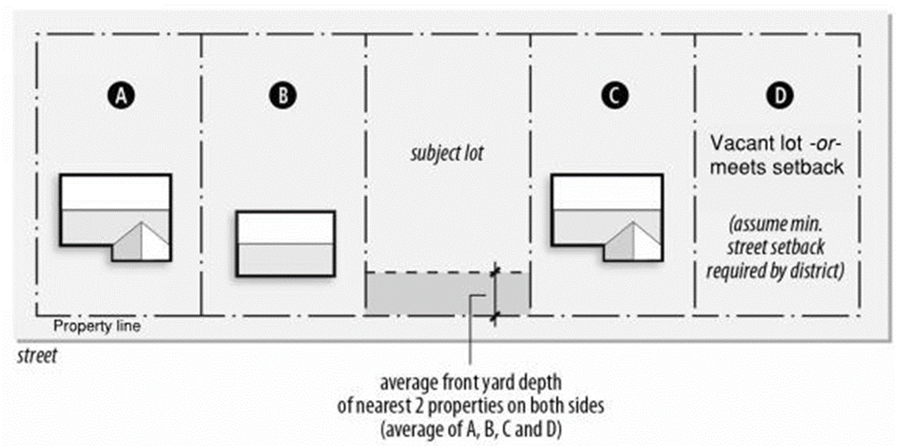
A variable front yard setback may be granted for properties in R-3 through R-6 districts by the planning director where the majority (greater than 66 percent of properties) of existing development on the same block face is set back less than the required amount outlined in section 28-122. In such case, the front yard setback may be the average setback line of the nearest two properties on both sides of the subject lot on that block face. If any of those properties are vacant, or meet or exceed the minimum setback of the district, then the minimum is used for the purposes of the calculation. In the absence of existing development on a particular block face, and where the majority of existing development on an opposing block face is set back less than the required setback, the front yard setback may be the average setback line for the entire opposing block face. Any property utilizing a variable front yard setback must still meet a minimum setback of ten feet from the right-of-way.
(d)
Standards for multi-family and townhome development.
(1)
Apartments meeting the state building codes with a minimum dwelling space of 300 square feet for studio apartments and 450 square feet for one bedroom apartments are allowed.
(2)
Any multi-family or townhome development with 30 units or more in the R-5 and R-6 district, shall require a conditional use permit. High density housing development in other districts shall be approved as a planned unit development. Whenever a public road is to be dedicated to the public, the development must be approved as a planned unit development or a major subdivision.
(e)
Standards for multi-family/mixed use development. Mixed-use buildings require a conditional use permit in all zoning districts with the exception of the urban renaissance district (UR), for mixed-use buildings outside of the UR district the density ratio of commercial and residential use will be determined by the council.
(Ord. No. 199, 3rd series, § 1, 11-6-2023)
Sec. 28-122. - Lot size and bulk regulations by zoning district.
* Local city streets only
* Local city streets only
* Local city streets only
** Lots within a major subdivision or a planned unit development platted after September 12, 2018 may contain 45,000 square foot lots and have a width of 150 feet. The flexibility provided in section 28-524 is also available to planned unit developments.
* Except for all parcels subject to Mississippi Headwaters Board development code standards which shall require 30,000 square feet.
**Not applicable in shoreland
*** Minimum 30 feet where driveway access exists or is proposed.
**** When an alley exists, the accessory structure setback may be reduced to five feet with a side loaded garage.
***** Local city streets only
* Not applicable in shoreland
** Minimum 30 feet where driveway access exists or is proposed.
*** When an alley exists, the accessory structure setback may be reduced to five feet with a side loaded garage.
**** Local city streets only
***** Sixty percent for permitted non-residential uses with an approved CUP
* Not applicable in shoreland
** Minimum 30 feet where driveway access exists or is proposed.
*** When an alley exists, the accessory structure setback may be reduced to five feet with a side loaded garage.
**** Local city streets only
***** Sixty percent for permitted non-residential uses with an approved CUP
* Minimum 30 feet where driveway access exists or is proposed.
** When an alley exists, the accessory structure setback may be reduced to five feet with a side loaded garage.
*** Local city streets only.
* Developments with municipal water and sewer utility services may be permitted in accordance with the standards of section 28-122(J) of this development code.
** Lots within a major subdivision or planned unit development platted after September 12, 2018 may contain one acre and have a width of 100 feet. The flexibility provided in section 28-524 is also available to planned unit development.
* Much of the B-2 commercial district is located within the 197 overlay district which requires a maximum impervious surface coverage of 70 percent.
* Height eligible for increase with PUD in accordance with article XI of this development code.
* See also section 28-414: Special provisions for development in sensitive areas
* See also section 28-415. Special provisions for Trunk Highway 197 overlay.
(Ord. No. 199, 3rd series, § 1, 11-6-2023; Ord. No. 210, 3rd series, § 1, 10-21-2024)

