
Bemidji City Zoning Code
ARTICLE X
- PERFORMANCE STANDARDS
Sec. 28-401.- Purpose.
The performance standards established in this section are designed to encourage a high standard of development by providing assurance that neighboring land uses will be compatible. These standards are also designed to prevent and eliminate conditions that cause blight. Before any land use or building permit is approved, the planning director shall determine whether the proposed use will conform to the performance standards. An applicant shall supply data necessary to demonstrate such conformance.
The performance standards shall apply to future development and to existing development within compliance periods as noted in individual sections. Compliance may be waived by the council if a building condition created under prior ordinances physically precludes the reasonable application of the standards
(Ord. No. 199, 3rd series, § 1, 11-6-2023)
Sec. 28-402. - Exterior storage and outdoor display of merchandise.
(a)
Purpose.
(1)
The city desires to regulate nuisance exterior storage and outdoor display of merchandise. Encouraging properties to maintain an image of Northwood's character from the view of public right-of-way, limit conflicts between residential and commercial land uses, and to protect property values.
(b)
Public nuisance. Any exterior storage in violation of this section constitutes a public nuisance and is a violation of this development code. Upon notice by the council to correct a violation the owner shall bring the property into compliance within 30 days or such other reasonable period as identified in the notice.
(c)
Exterior storage.
(1)
In R-1, R-2, R-3, R-4, R-5, R-6, and MH districts, all materials (trash, waste, refuse or any other items deemed a nuisance by the planning staff) and equipment shall be stored within a building or be fully screened so as not to be visible from adjoining properties. Exceptions include:
a.
Construction and landscaping equipment, materials, etc., currently being used on the premises in connection with an approved land use, building, or site plan approval permit. Such items shall not be allowed to remain upon expiration of such permit(s), or when the work is completed, whichever occurs sooner;
b.
Agricultural equipment and materials if being actively used for farming, and intended for use on, or off of the premises on a regular basis;
c.
Off-street parking of operable passenger automobiles and pick-up trucks;
d.
Passenger cars, trucks, or other vehicles in an obviously inoperative state due to age, damage, dismantled or malfunction shall not be parked outside in residential districts for a period exceeding seven consecutive calendar days;
e.
In R-2 districts, boats, trailers, recreational vehicles, and campers less than 40 feet in length, if stored at least ten feet from all property lines. In R-3, R-4, R-5, R-6 and MH districts, boats, trailers, recreational vehicles, and campers less than 20 feet in length, if stored in a rear yard at least ten feet from all property lines. All vehicles that are deemed inoperative shall be screened with an opaque fence.
(2)
For all uses, except one and two family residences, which provide exterior and/or accessory trash, recycling or associated storage incidental to the permitted use, the following standards shall be required:
a.
Such areas shall be completely screened and enclosed on all sides, except the roof, with an enclosure or screening wall a minimum of six feet in height.
b.
The enclosure shall be provided with a secure door and/or opening device to allow regular servicing and pick up of materials.
c.
The construction materials for the enclosure shall be of a durable and fully opaque material which cannot be seen through.
d.
The enclosure exterior design materials shall be compatible or of the same composition and appearance with that of the principal structure.
e.
The enclosure, if designed as an accessory structure with a roof or located within ten feet of the principal or accessory structure where building code inspections are required, shall be permitted in accordance with the requirements of the building code.
(3)
Exterior storage accessory to a permitted principle use.
a.
The exterior storage area shall also only be located upon an improved hard surface in accordance with section 28-409 of this development code.
b.
Exterior storage shall not be allowed within the front yard setback.
c.
The exterior storage area shall meet the screening requirements of section 28-405 of this development code. For areas where it may be impractical to fully screen with the exact provisions of section 28-405 the planning director may approve an alternate to allow densely planted evergreen trees.
d.
In LC, LD, UR, OM and U districts, no materials or equipment may be stored outside except those directly related to the principal use or those being used for construction on the premises.
(d)
Outdoor display of merchandise and open sales lots.
(1)
The following standards shall apply to any outdoor displays of merchandise and open sales lots in all districts where permitted:
a.
Shall not occupy more than 25 percent of the required front yard setback area.
b.
Shall be set back a minimum of 15 feet from any front yard property line, street or alley right-of-way line.
c.
Shall not occupy any required minimum front yard green space area.
d.
Shall only be located upon an improved hard surface consisting of bituminous, concrete, pavers or an equally durable surface.
e.
Shall not occupy any of the minimum required parking spaces associated with the current use of the property.
f.
Shall not exceed more than 25 percent of the maximum allowable impervious surface requirements of the district in which it is located, except by approval of a conditional use permit.
g.
Shall be in compliance with the lighting standards of this development code.
h.
Shall be in compliance with the sign standards of this development code.
i.
Merchandise shall be maintained in condition for immediate sale or rent and there shall be no storage of inoperable, dismantled or partially dismantled vehicles, equipment or supplies allowed for display.
j.
Permanent display areas should be accented with landscaping to provide a 'Northwoods Character' appearance.
(e)
Outdoor display of merchandise for major open sales lots.
(1)
The following standards shall apply to any outdoor display of merchandise and major open sales lots in all districts where permitted by IUP: All standards set forth in this section above shall be met, except as may be approved in accordance with the following:
a.
Merchandise display area shall not exceed more than 75 percent of the maximum allowable impervious surface requirements of the district in which it is located.
b.
A live landscaping plan shall be approved with the IUP in order to provide the appearance of a Northwoods Character on the parcel. Landscape planting shall be in accordance with section 28-406 of this development code.
c.
A minimum of at least eight percent of the merchandise display and parking lot area shall have live landscaping, including trees, within the interior of such areas, including circulation areas.
(Ord. No. 199, 3rd series, § 1, 11-6-2023)
Sec. 28-403. - Sight visibility triangle.
Notwithstanding any other provision of this development code, no buildings, structures, permanent or portable signs, parking spaces, fences, utility equipment, landscaping nor any other object may be erected, placed, planted, or allowed to grow in such a manner as to impede vision between a height of three feet and ten feet above curb grade, or street centerline elevation where no curb exists, except for sign support poles less than eight inches in diameter within the required sight visibility triangle of a street intersection or driveway intersection with a street.
At intersections of two streets, the sight visibility triangle for the street with the higher speed limit applies. The size of the triangle may be increased by the council, or road authority, when deemed necessary for traffic safety alignment or other factors that require increased corner visibility. This sight visibility standard shall not apply within the portion of the UR district where development follows the zero lot line dimensional standards. For purposes of this section, that "distance measured from curb" at an intersection of two streets or roads shall be determined from a point where the extension of the curb from the two streets or roads meet and, at an intersection of a street or road and a driveway, the distance shall be measured from the point of the curb cut for the driveway.
(Ord. No. 199, 3rd series, § 1, 11-6-2023)
Sec. 28-404. - Fences.
This section shall apply to all fences constructed after adoption of this development code. All boundary line fences shall be entirely located upon the property of the person constructing such fence unless the owner of the property adjoining agrees, in writing, that such fence may be erected on the division line of the respective properties. Fences shall not exceed four feet in height within the required front or exterior side yard setback in residential districts, six and one-half feet in height within the required side or rear yards in residential districts. On corner lots in residential districts fences shall not exceed a height of three feet above curb grade, or street centerline elevation where no curb exists within the required sight distance triangle unless the fence is made of open, decorative, or ornamental materials which are a maximum of 50 percent opaque, and which do not create a site obstruction for drivers.
Fences shall not exceed eight feet in height in the required side or rear yard setback in non-residential districts fences shall not obstruct the required sight distance triangle in non-residential districts. Fences shall not exceed six feet in height in the required front yard setback nor shall they obstruct the view of the principle structure from the street except with the issuance of a CUP, IUP or variance.
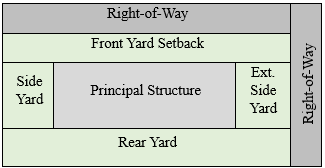
When determining the allowable height of a fence the graphic below shall determine location of front yard and exterior side yard setback, allowing for corner lots to have a privacy fence in the back yard.
Any posts or similar structural member used in the construction of a solid board fence shall be constructed to face inward towards the property being fenced, so as not to be visible from adjacent properties. Fence designs which partially conceal posts and structural members such as alternating board and basket weave fences are exempt from this requirement.
Fences constructed in the rear yard on parcels defined as a through or double fronted lot, may be erected and/or maintained up to the maximum height allowed for the district provided the fence is not located within the sight visibility triangle and there is no driveway access from the adjacent roadway. Fences in violation of this standard are nonconforming and shall be removed within six months of notice from planning staff or any other governmental authority.
(Ord. No. 199, 3rd series, § 1, 11-6-2023)
Sec. 28-405. - Screening.
Screening shall be provided on all parcels where:
(a)
Any off-street parking area contains more than four parking spaces and is adjoining a residential zone.
(b)
Where any business or industrial use (i.e. structure, parking or storage) is adjacent to or within 100 feet of property zoned for residential use, that business or industry shall provide screening along the boundary of the residential property. Screening shall also be provided where a business or industry is across the street from a residential zone, but not on that side of business or industry that is considered to be the front. The screening required shall consist of a wall, fence or densely planted compact evergreen hedge not less than five feet or more than eight feet in height that blocks direct vision but shall not extend to within 15 feet of any street right-of-way. Landscaping shall be required between the screening and pavement. All required screening shall be installed by the owner of property which creates the need for said screening. Compact evergreen hedges may initially be planted according to the landscaping requirements as a potted or ball and burlap plant measuring a minimum of no less than three feet in height. While many evergreens are slow growing, others can grow quite quickly once established. Most evergreens, such as pine or spruce trees, and other coniferous landscape approved species are allowed to grow naturally to required minimum heights. Such plantings to meet this definition shall ensure there is enough room on all sides for such trees to spread out and achieve their normal expected maturity height and width. An approved planting plan shall also be defined so as to ensure there is adequate room for roots to spread out. If tree roots are confined to a small area because of buildings, walks, driveways, roads, alleys, adjoining site improvements, etc. (roots will not grow under hard surfaces), the root system will eventually be too small to provide for the size of the tree or hedge. If the trees or hedge then stops growing, declines, or eventually dies, or leaves gaps in the approved screening barrier, then the definition of a compact evergreen tree or hedge for required screening under this development code shall no longer exist and may be subject to compliance or enforcement actions as defined under this development code. For foundation plantings or shrub beds, many dwarf evergreens species shall be defined as meeting this definition. Such species shall include, but not be limited to various common names such as, arborvitae, Japanese yew, hemlock, junipers, etc.
(Ord. No. 199, 3rd series, § 1, 11-6-2023)
Sec. 28-406. - Landscaping requirements.
In all zoning districts, all open areas on a lot not used for approved buildings, driveways, parking, patios, pools and similar improvements, shall have a vegetative cover, including grass seed or sod, and be kept free of noxious weeds and plants. Vegetative cover may include lawns, other landscaping vegetation, or indigenous plant species, provided that the vegetative cover also complies with other applicable property maintenance code requirements. Rocks, boulders, etc. may be used as an accent material within the landscape design, but shall not cover a majority of any area calculated to meet required green space areas on a development site.
Open space requirements by zoning district:
(a)
Native landscaping.
(1)
Purpose. To prohibit the uncontrolled growth of vegetation, while encouraging the planting and maintenance of native vegetation, edible landscapes, and rain gardens. There are reasonable expectations regarding the proper maintenance of vegetation on any lot or parcel of land.
(2)
Definition of landscape area. The area of the lot between the minimum building setback and the street of the official address of the lot.
(3)
Design required. Ornamental plants; and grasses; or vegetable and fruit bearing plants are allowed in the landscape area, but they must be planted pursuant to a design. The design must either be created by a professional landscape designer or be consistent with model community soil and water conservation district (SWCD) standards.
(4)
Setbacks. A three foot setback must be provided along the sidewalk or street. A one foot side yard setback is required but may be reduced to zero feet if:
a.
A fence is installed adjoining the landscape area, or
b.
The planted area abuts:
i.
A restoration area on any adjoining lot,
ii.
A public park or open space,
iii.
A vacant lot,
iv.
A wetland, pond, lake, stream, or natural area, or
c.
The landscape area is located on slopes equal to or greater than three feet horizontal to one foot vertical (3:1).
(5)
Plants allowed. Ornamental plants; native plants and grasses; and fruit and vegetable bearing plants are allowed.
(6)
Restoration and establishment of native plant communities. Restoration or establishment of native plant communities is allowed in the rear, side or front yard. Restoration projects should be consistent with the MN DNR's brochure, How to Use Native Plants for Landscaping and Restoration in Minnesota. Ornamental plants; native plants and grasses; and fruit and vegetable bearing plants are allowed.
(7)
Unattended vegetation. Every owner and responsible party who fails to keep private property clear of unattended vegetation is in violation of this article and subject to the remedies and enforcement specified herein.
(8)
Prohibited vegetation. Every owner and responsible party is in violation of this development code and subject to the remedies and enforcement specified herein if they fail to keep their private property clear of vegetation that:
a.
That presents a fire hazard;
b.
That attracts or harbors disease vectors;
c.
That obstruct sight lines for the traveling public on streets or alleys; or that includes noxious weeds or secondary noxious weed as identified by the State Commissioner of Agriculture pursuant to Minn. Stat. 18.171, Subd. 5.
(b)
For new construction and major building additions the following tree planting requirements shall apply for all parcels as the minimum number of trees required for development:
(1)
One and two family dwellings shall preserve existing or plant at least two trees between the front property line and the minimum front yard setback line. For corner lots there shall be a minimum of two trees per street frontage.
(2)
Multiple family dwellings shall preserve existing or plant at least one tree per 30 lineal feet of street frontage between the front property line and the minimum front yard setback line. The development site plan submitted for approval shall provide a landscape plan which provides a minimum total tree count as follows:
a.
< 1 acre = 1 tree per 600s.f. of minimum required pervious site surface.
b.
1—3 acres = 1 tree per 900s.f. of minimum required pervious site surface.
c.
3 acres = 1 tree per 1,200s.f. of minimum required pervious site surface.
(3)
Commercial zoning districts. Developments shall preserve existing, or plant at least one tree per 50 lineal feet of street frontage between the front property line and the minimum front yard setback line. As part of the development site plan submitted for approval, the landscape plan shall also include a minimum total tree count according to required minimum green space as follows:
a.
<1 acre = 1 tree per 800s.f. of minimum required pervious site surface.
b.
1—3 acres = 1 tree per 1,100s.f. of minimum required pervious site surface.
c.
3 acres = 1 tree per 1,400s.f. of minimum required pervious site surface.
(4)
Industrial zoning districts. Developments shall preserve existing, or plant at least one tree per 50 lineal feet of street frontage between the front property line and the minimum front yard setback line; or a minimum of four trees, whichever is less. As part of the development site plan submitted for approval, the landscape plan shall also include a minimum total tree count according to required minimum green space as follows:
a.
<1 acre = 1 tree per 1,600s.f. of minimum required pervious site surface.
b.
1—3 acres = 1 tree per 2,200s.f. of minimum required pervious site surface.
c.
3 acres = 1 tree per 3,800s.f. of minimum required pervious site surface.
(5)
Non-residential uses in residential zoning districts. Developments shall preserve existing, or plant at least one tree per 50 lineal feet of street frontage between the front property line and the minimum front yard setback line. As part of the development site plan submitted for approval, the landscape plan shall also include a minimum total tree count according to required minimum green space as follows:
a.
<1 acre = 1 tree per 800s.f. of minimum required pervious site surface.
b.
1—3 acres = 1 tree per 1,100s.f. of minimum required pervious site surface.
c.
3 acres = 1 tree per 1,400s.f. of minimum required pervious site surface.
(6)
Modifications to the tree planting standards may be approved by the council for unique or unusual conditions associated with the development.
(7)
Locations of tree planting. Trees shall be planted on the site based on the proposed use with special consideration to restoration areas including steep slopes, common areas, buffer zones between different land uses and/ or activities, and project entrance areas. If there is a lack of sufficient suitable area on the site, the council may consider allowing planting on other land, especially on or adjacent to land owned by a participating jurisdiction on the council (LGU). Areas required to be developed as "green space" within the parking lot are required to contain at least one tree per each island.
(8)
Size and types of trees.
a.
Trees must be no less than the following sizes when planted:
b.
Deciduous trees shall be no less than one and three quarter caliper inches; except on steep slopes (e.g. slopes greater than 3:1), and for slow growth deciduous trees such as bur oak, ironwood, etc. which may be no less than one and one-quarter caliper inches.
c.
Coniferous trees shall be no less than four feet high, except on steep slopes where coniferous trees shall be no less than three feet in height.
d.
All tree planting requirements shall be completed prior to building occupancy. Tree planting requirements which cannot be completed prior to building occupancy shall post with the council a landscaping performance bond or escrow to be held until the required planting is completed.
e.
As an alternate to the preceding two size requirements, the council may approve an off-premise planting size which includes seedlings or bare root stock. The plan must provide for an increased quantity of trees, a watering maintenance provision, and the total caliper inches in the third year after planting must equal the above required caliper or size requirements. Required escrow and landscaping performance guarantees shall be held by the council during this additional time period until a final inspection is completed and approved.
f.
Trees planted shall be the same species or similar to the trees which are lost or removed from a development site. A suggested list of desired trees is shown in the table below. In most situations it is recommended that not more than 40 percent of the trees be from the same species when planting more than 20 trees. Indigenous high quality species are preferred.
(9)
Tree planting table.
(Ord. No. 199, 3rd series, § 1, 11-6-2023)
Sec. 28-407. - Tree preservation.
(a)
Purpose. The city desires to preserve significant trees in urban, rural and other areas identified as containing substantial forested areas with high quality mature tree cover. When significant trees are lost through removal, grading, or other action, the city, property interests and the general welfare may be impacted by such tree loss. More specifically, the purpose of this section is to:
(1)
Promote protection of significant trees and overall tree cover for the benefits which they provide including: aesthetic value and contribution to the community's image, shading and cooling, air quality, energy use reduction, buffering, enhancement to property values, tourism, erosion control, noise reduction, and support of wildlife and natural habitats.
(2)
Preserve standing tress on undeveloped land until development occurs.
(3)
Recognize and protect the natural environment consistent with the community's goals and the city comprehensive plan by preserving "old growth" and protection of significant high quality mature tree cover areas.
(4)
Establish requirements on cutting, removal or destruction of high quality significant trees and identified high quality tree cover areas.
(5)
Establish reasonable requirements for the preservation and of high quality significant trees and overall canopy coverage in an effective manner.
(6)
Ensure fair and reasonable development opportunities for the city in a manner which does not create over burdensome regulations.
(7)
Ensures that tree replacement will occur when high quality significant trees are damaged during site development and grading activities.
(8)
Provides fair, understandable, cost effective administration, and enforcement of tree preservation regulations.
(b)
Applicability.
(1)
The provisions of this section shall apply to all land use activity in the city, except as may otherwise be regulated under section 28-474C of this development code. For developments which only involve street, utility, drainage or other site improvements which result in a loss of high quality significant trees, the requirements under this section shall apply only to the disturbed areas of the property.
(c)
Exclusions.
(1)
The provisions of this section shall not apply to commercial nurseries in the business of growing and selling trees, or active tree farms or commercial forests, if managed under a forest stewardship plan. The section shall also not apply to properties containing single or two-family residential housing units owned and occupied, or intended for occupancy, by their residents, except as may be otherwise restricted according to a development plan approved by the council. This exclusion shall not apply to land being platted and/or developed for single or two-family residential housing.
(d)
Permit required.
(1)
It is unlawful for any person to use land or to engage directly or indirectly in tree removal, as defined in this section, unless such person shall first have applied for and obtained a permit, from the council, authorizing high quality significant tree removal. An approved permit authorizing such tree removal shall be obtained by an applicant prior to commencing any land development, site demolition, or grading activities. A separate permit is not required, in accordance with these regulations, as part of an approved site plan review on parcels containing one acre or less.
(2)
Trees shall not be removed in preparation for, or as part of, a development project until the project has been approved and all required permits have been obtained. Failure to obtain a permit shall be cause to deny issuance of a land use or building permit, prohibit continuation of any construction on the property, connection or extension of any utilities on the property or on any adjacent streets, issuance of a certificate of occupancy, as applicable, and to require remedial action in accordance with the tree preservation table for high quality significant trees lost or expected to be lost as a result of activity on the site.
(3)
The council may hire an independent certified tree inspector, arborist, landscape architect, or similar professional, to assist the city and it's planning director in the review of such tree removal permits, analysis of unauthorized tree removal, or any other site assessment of tree loss, damage, and/or replacement from land within its jurisdiction, as may be deemed necessary. The cost for such professional services shall be paid for by the land owner, contractor, permit holder, or other individual responsible for tree loss, damage, or replacement. A permit escrow fee, payable to the council, for professional services and/or tree replacement shall be paid by the permit holder or responsible party and used to defray any or all costs of such services, including administrative and collection costs.
(e)
Application for tree removal. An application for a permit for tree removal shall be made in writing using the form provided by the council. The application shall include:
(1)
Applicant information.
(2)
Owner information.
(3)
Tree preservation plan including existing and proposed buildings, roads, utilities and easements, public parks and open spaces, lots and blocks, water bodies and wetlands, proposed building pads, equipment and material storage areas, the tree inventory, and tree protection.
(4)
Schedule for completion of tree removal.
(5)
Topographic map of site (the council may waive this requirement if site grading or disturbance will not result in changes to finished site contours or elevations.)
(6)
Proposed use of site.
(f)
Tree inventory. The applicant shall have a tree inventory prepared to include:
(1)
The quantity, species by type, condition including any existing tree hazard conditions as a result of disease or damage, and location of all significant high quality trees on a parcel or development site. On heavily wooded sites which contain two acres or greater of mature tree cover, forest mensuration methods may be used to determine the total tree quantity. On such parcels, the inventory shall also include an area calculation of the high quality significant tree canopy coverage during full leaf on conditions and a detailed species assessment.
(2)
Significant high quality trees which will be lost due to the proposed activities. Such trees shall be considered lost as a result of grade change, including grading or filling, whether temporary or permanent, affecting 45 percent or more of the tree's critical root zone, utility construction (e.g. sewer, water, storm sewer, gas, electric, telephone, cable television, fiber optics or similar facilities) resulting in the cutting of 45 percent or more of the tree's roots within the critical root zone.
(3)
The location, number, type and size of trees required to be preserved pursuant to this section.
(g)
Tree preservation and tree protection for all except single and two-family dwelling uses:
(1)
High quality significant trees designated for preservation shall be protected by a snow fence or other means acceptable to the council. The protective measures must protect the entire critical root zone of the trees, unless more protection is warranted due to the proximity of a structure, road or similar obstruction to be part of the development in which case at least 55 percent of the critical root zone of the tree must be protected. The protection measures shall be clearly identified on the site disturbance, demolition, and/or grading plans.
(2)
The applicant shall preserve high quality significant trees on a development site. Existing significant trees identified in the tree inventory with hazard conditions as a result of disease or damage should be considered for removal. They shall be clearly identified in the site tree inventory. These hazard trees shall be excluded from the high quality significant tree preservation requirements.
(3)
The significant high quality tree preservation table establishes performance criteria for tree preservation on a development site that has over and above the base minimum landscaping standard determined in accordance with the maximum impervious surface allowed in the underlying zoning district, according to section 28-406 of this development code. This standard shall only apply to parcels or developments which contain more existing high quality significant trees than the minimum base landscaping standard.
(4)
Removal of high quality significant trees identified by the tree inventory which are equal to or less than the base minimum landscape standard shall be prohibited except by CUP.
(5)
Removal of up to 60 percent of the high quality significant trees over and above the base minimum landscape standard may be permitted. Any removal of high quality significant trees beyond this standard may only be approved by CUP.
(6)
If significant high quality trees exist on the property and are competing with development requirements, then the trees authorized for removal shall be according to an approved plan. The final determination of the tree removal and replacement location(s) shall be made by the council.
(7)
Notwithstanding the tree preservation requirements, new boulevard tree planting in the required front setback area according to section 28-406 shall be required.
(8)
Tree removal permits and inventory evaluation for a development project involving more than one parcel of land will include all parcels of land as one development project.
(9)
Trees shall not be removed until a development project has been approved and permitted.
(10)
If the required inventory of all high quality significant trees results in a number greater than the base minimum landscape standard required in section 28-406, then the number of trees to be preserved shall be in accordance with the following tree preservation table:
SIGNIFICANT HIGH QUALITY TREE PRESERVATION TABLE
(Not Including 1 and 2 Family Dwelling Uses)
* For base minimum landscape standard per square foot of pervious surface, please refer to section 28-406.
** For developments which preserve 50 percent or more of existing high quality significant trees over and above the base minimum landscape standard, the total maximum allowable impervious surface may be increased by an additional two percent, provided adequate plans for on-site storm water management improvements are approved.
*** For developments which preserve 60 percent or more of existing high quality significant trees over and above the base minimum landscape standard, the total maximum allowable impervious surface may be increased by an additional five percent, provided adequate plans for on-site storm water management improvements are approved.
(h)
Action by the council.
(1)
Permit denial, approval, or approval subject to conditions shall be based upon the extent to which tree removal may be consistent with or detrimental to the above stated purposes of this section and the health, safety or general welfare of the public.
(2)
For initial development and new subdivisions and plats, the applicant shall enter into a written agreement with the council prior to the approval or issuance of a permit for any activity in which trees are required to be replaced. Such agreement will require the applicant to comply with the provisions and conditions imposed in connection with any such approval or issuance of a permit and the required provision of security for the performance of all obligations.
(i)
Procedures. The following identifies the general steps to be taken to comply with this development code:
(1)
Submit tree inventory and replacement plans with the data and submission requirements according to the council approved tree preservation plan application checklist and procedures.
(2)
The planning director shall require a performance bond, an irrevocable letter of credit, or an escrow fee in accordance with the council fee schedule in order to ensure completion of work consistent with any conditions imposed.
(3)
If approved by planning staff, implementation may begin.
(4)
Upon completion of the implementation activity the applicant shall request inspection and approval of the work by planning staff. Upon approval, the surety provided shall be released by the council to the applicant, less any direct costs incurred in the review and issuance of the tree preservation permit.
(Ord. No. 199, 3rd series, § 1, 11-6-2023)
Sec. 28-408. - Lighting.
Exterior lighting shall not be allowed unless such lighting is arranged so that it is hooded or otherwise shielded in order to deflect light away from adjoining property, public waters, and public streets. Bare light bulbs or other illumination sources shall not be permitted in view from adjacent properties, public waters, or public rights-of-way. Lighting shall be directed downward in order to minimize adverse impact on surrounding properties and rights-of-way. All development which requires a land use or building permit, excluding single and two-family residences, shall be required to submit a lighting plan which, at a minimum, must include the site placement of all exterior lighting components and the specific fixture design features of each light. For the purposes of this section, any property which contains lighting which is determined to be non-conforming by planning staff shall be brought into compliance upon written notice. Such non-conformity shall herein be defined as a public nuisance and shall not be entitled to the provisions of legal non-conforming uses as prescribed in article V of this development code. Minor changes to fixture direction or changes of illumination source which easily bring such lighting violations into compliance shall be made within the prescribed time frame. Substantial changes which require new lighting fixtures, the addition of fixture shields, and removal and/or replacement of lighting standards shall be completed so as to bring the property into compliance within one year of written notice.
(Ord. No. 199, 3rd series, § 1, 11-6-2023)
Sec. 28-409. - Off-street parking, loading and surfacing standards.
The regulation of off-street parking spaces in this development code is to alleviate or prevent congestion of the public right-of-way and to promote the safety and welfare of the public by establishing minimum requirements for off-street parking of motor vehicles. In all zoning districts all structures built and uses established hereafter shall provide off-street parking in accordance with the regulations of this development code. When an existing use or structure is expanded, off-street parking shall be provided in accordance with the regulations of this development code for the total area or capacity of such expansion and shall meet all surfacing requirements.
(a)
Design and maintenance. The design and maintenance of parking spaces shall comply with the following:
(1)
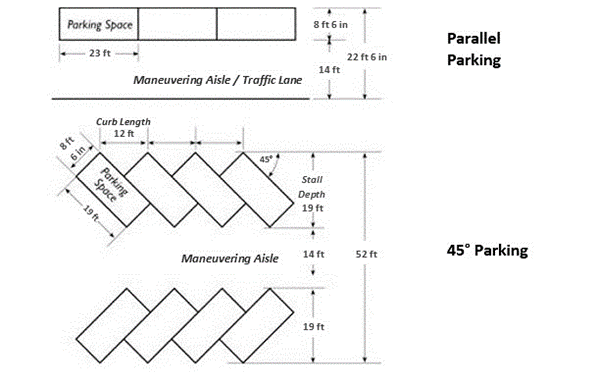
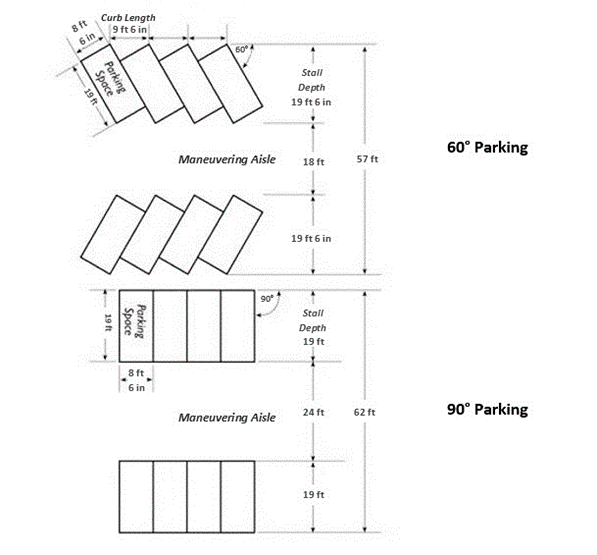
Parking spaces, aisles and driveway dimensions are listed below. A standard parking space shall not be less than 19 feet in length and eight and one-half feet in width, exclusive of access drives.
a.
Parallel parking spaces shall be a minimum of 23 feet in length.
b.
Except in the case of single family, two-family, townhouse, and four-plex dwellings, minimum driveway and traffic lane widths shall be developed in compliance with the dimensions listed below:
(2)
Off-street parking, driveways, loading and maneuvering areas shall be improved with a bituminous, concrete, pavers, or pervious paving/paver system. Pervious paving/paver systems shall only be used provided appropriate soils and site conditions exist for the pervious systems to function adequately. Minnesota Department of Transportation (MnDOT) class V aggregate base and other similar aggregate bases are not classified as an acceptable material. All parking, driveways and loading and maneuvering areas shall be graded and drained so as to dispose of all surface water accumulation within the area in accordance with the standards as prescribed in the city of Bemidji "Surface Water Management Plan and Stormwater Design Guide Report" Dated January 2008, as may be amended. Off-street parking and driveways for all single-family and two-family residential properties in an R-1, R-2, R-3, R-4, R-5 and R-6 residential zoning districts may use a class V aggregate base or another similar aggregate base in lieu of a surfacing material such as bituminous, concrete, pavers, or pervious paving/paver system.
a.
An exception can be made for outdoor storage areas in the B-1, I-1 or I-2 zoning districts where Minnesota Department of Transportation (MnDOT) class V aggregate base and other similar aggregate bases can be used within the defined outdoor storage area compliant with section 28-402 of this development code, only as approved during the site plan approval, provided the site is completely screened in accordance with section 28-405 of this development code. Dust control provisions including sealant must be applied at least twice a year or more often if needed.
b.
A construction use permit shall be issued by the planning staff prior to the creation or the redevelopment of any parking lot.
(3)
In all zoning districts the following limitations shall apply:
a.
Off-street driving or maneuvering areas shall not cover more than 35 percent of the total parcel area between the street and principal structure in R-1—R-5 districts. In all other districts they shall not cover more than 50 percent of the required minimum front yard setback areas, except in the UR district which shall be exempt from this requirement.
b.
Vehicle parking for single and two family residences is prohibited between the street and the principal structure along all street frontages of the parcel, except upon a driveway or approved parking surface. Driveways in these areas may not exceed 20 feet in width unless a designed parking area has been designed and approved by the planning director and the city engineering department. Platted alleys are exempt from these two specific limitations.
c.
Off street parking on grass, landscaped areas, or any unapproved driveway surface on a parcel is prohibited; except in R-1, R-2, and R-3 districts for parcels one acre in size or greater. Approved driveway and parking surfaces shall constitute an impervious surface subject to the limitations set forth in this development code.
d.
The public street or alley right-of-way area devoted to driveway purposes shall not be considered in determining whether off-street parking requirements have been met. Parking in alleys or unimproved street rights-of-way shall be prohibited.
e.
Enclosed buildings, carports, and any other permanent or temporary structure containing off-street parking shall be subject to structure setback requirements applicable to the district in which located.
f.
Type II and Type III home occupation off-street parking areas and driveways hall be improved with a bituminous, concrete, pavers, pervious paving/paver system.
(4)
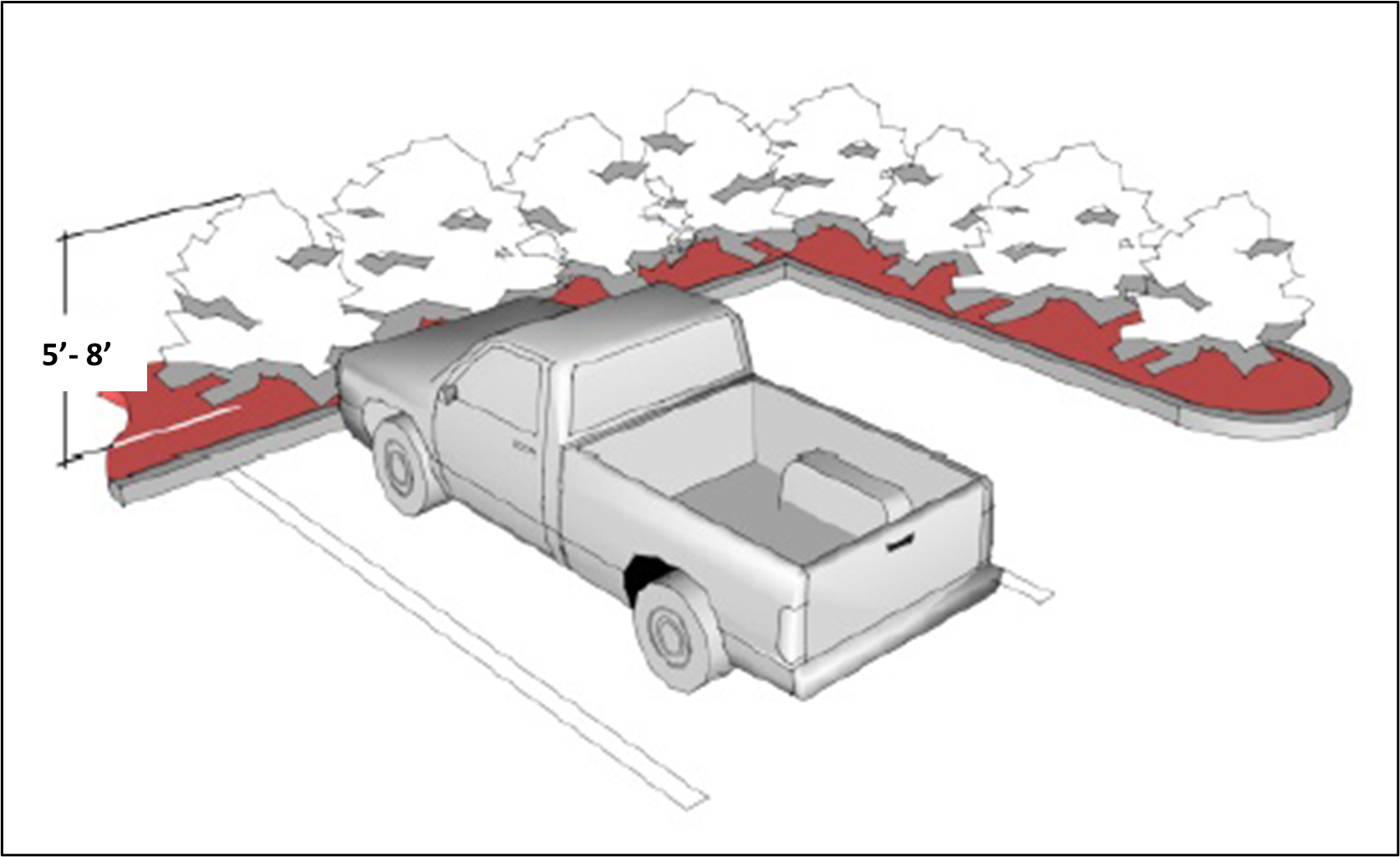
All open off-street parking areas containing more than four parking spaces shall be effectively screened on each side that adjoins any residentially zoned property by a wall, fence or densely planted compact evergreen hedge not less than five feet, or more than eight feet in height.
(5)
Any lighting used to illuminate off-street parking areas shall be in accordance with section 28-408 of this development code.
(6)
All parking spaces required to serve buildings or uses shall be located on the same lot or in the same zoning district as the building or use, except that such parking spaces may be provided in an adjacent zoning district if such district allows parking lots or parking garages as a permitted use. In no instance shall required off-street parking be located more than 600 feet from the use which it serves, measured along lines of public access.
(7)
Notwithstanding any other provision of this section, uses located within the urban renaissance (UR) district are exempt from all off-street parking and loading requirements.
(8)
Interior parking lot greenspace.
a.
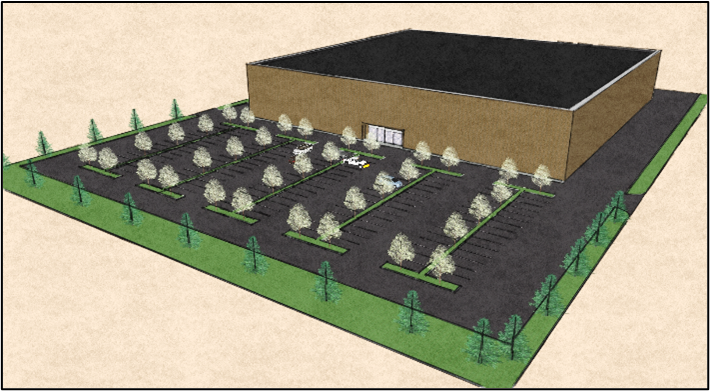
Developments on a single and/or adjoining parcels with at least a total of 40 or more off street parking spaces shall have live landscaping, including trees, of at least four percent of the interior of the parking lot area, including circulation areas. The more parking spaces required throughout the development equates to more interior greenspace throughout the interior parking area. The following chart indicates the required percentage of interior parking lot greenspace based on the number of parking spots throughout the developments parking area.
b.
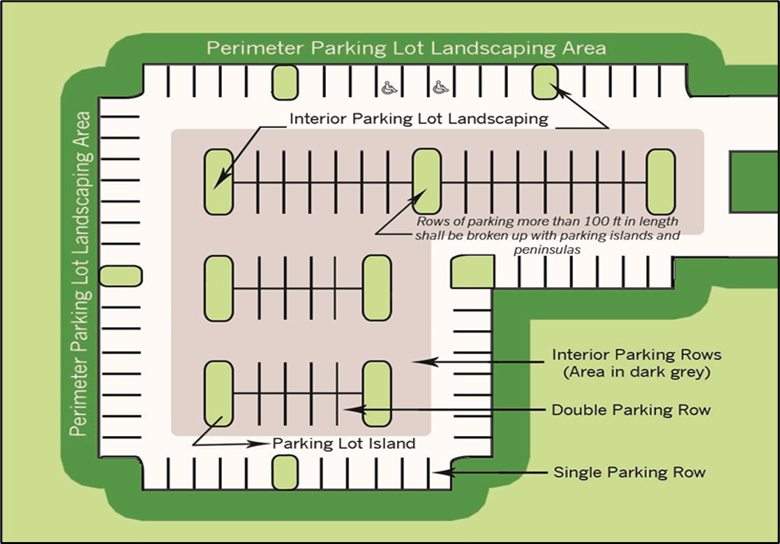
Interior live landscaped islands shall have either a divider median between opposing rows of parking, or a live landscaped island in the middle or at the end of a parking aisle. Each island is required to include at least one tree.
c.
Rows of parking more than 100 feet in length shall be broken up with live landscaping islands and peninsulas that include trees.
d.
Perimeter parking lot landscaping area shall not be included in the minimum interior greenspace calculation.
e.
All interior trees shall meet the type and minimum size criteria as provided under section 28-406 of this development code.
f.
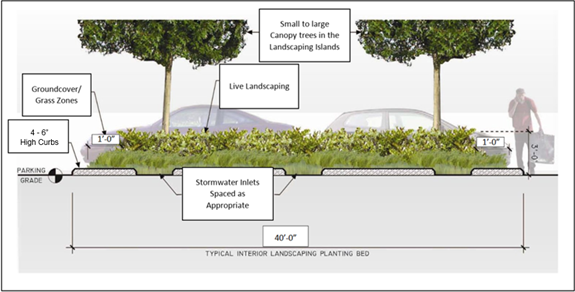
Parking area landscaping shall be contained in planting beds bordered by a four to six inch raised concrete curb. Curb cuts may be used to allow for stormwater infiltration, when the entire median of two rows of parking is split by interior greenspace the planning director may allow the use of a 12 inch ribbon curb to separate impervious from pervious surfaces.
g.
Each interior landscaped island must be at least 120 square feet in area and dispersed throughout the parking area.
h.
Rocks or wood mulch may only be used for ground cover if live landscaping covers at least 70 percent of the interior island.
i.
A minimum of at least eight percent of the merchandise display and major open sales parking lot area shall have live landscaping, including trees, within the interior of such areas, including circulation areas.
j.
If possible, continuous interior live landscaped islands shall help divide larger parking areas and should include areas for pedestrian access.
(9)
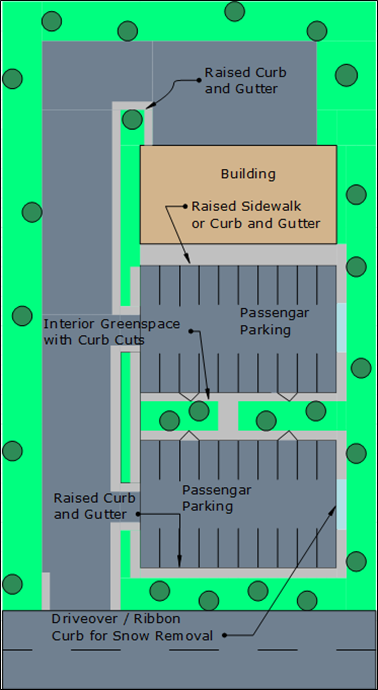
All new or redeveloped parking areas containing four or more spaces shall comply with the following standards:
a.
Striping and curbing. All parking areas shall be marked by durable painted stripes designating the parking spaces. A continuous concrete curb and gutter shall be installed within all or portions of the passenger parking lot perimeter for the purposes of surface water management control, site design and long-term maintenance of defined edges between pervious and impervious surfaces. Use of a drive over, flat concrete edge or curb cut pavement may be substituted for a portion of the vertical curb to allow the sheet flow of run-off or snow removal from the impervious parking surface onto a pervious infiltration area only in passenger parking areas. When ribbon curb is used a landscaping plan will need to be approved to contain vehicles to the parking area, landscaping plan will also allow for snow removal. This requirement may be modified by the planning director where public drainage utilities and infrastructure; including street curb and gutter, integrated subsurface drainage systems, improved overland drainage swales, etc., are not available or planned in the future.
b.
Setbacks.
i.
Front, side and rear setbacks of at least five feet from property lines shall be maintained from parking areas in all zoning districts, except in the UR district. Setbacks of five feet in the UR districts shall apply only to those parking areas adjacent to residentially zoned or residentially used property.
ii.
No area used by motor vehicles, other than driveways for ingress to and egress from the site, shall be located within the public street right-of-way.
c.
More than one use. Except for a multi-tenant commercial building, for structures containing two or more types of uses the parking requirements of each use shall be calculated and a reduction of up to ten percent may be made for non-usable space. The resulting net figure shall be utilized to determine the off-street parking requirement.
d.
Snow storage in parking stalls. Provision shall be made in the parking area for adequate snow storage or removal in order to ensure that the required numbers of spaces are available at all times during the year. If snow storage is moved from parking areas to a greenspace area, then greenspace areas shall be restored to a satisfactory landscaped condition each spring.
e.
Use of required area. Required off-street parking spaces in any district shall not be utilized for open storage, sale or rental of goods, except in accordance with the regulations of section 28-402 of this development code, or any storage of inoperable vehicles.
f.
Vehicular traffic generated by a use shall be channeled and controlled in a manner which will avoid congestion or interference with other vehicular transportation systems or pedestrian traffic and which will avoid creating traffic hazards or excessive traffic through residential areas. The adequacy of any proposed traffic circulation system to accomplish these objectives shall be determined by the planning director in conjunction with an engineer, which may require such additional measures for traffic control as deemed necessary, including but not limited to: directional signalization, channelization, standby turn lanes, sidewalks, driveway spacing, illumination and other facilities within the site to prevent a backup of vehicles on public streets.
g.
Except in the case of single-family, two-family and townhouse dwellings, parking areas shall be designed so that circulation between parking bays or aisles occurs within the designated parking lot and does not depend upon a public street or alley. Except in the case of single, two-family and townhouse dwellings, parking area design which requires backing into the public street is prohibited. Parking spaces in a public right-of-way cannot be utilized to meeting required off-street parking standards.
(10)
Curb cut location.
a.
Curb cut proximity to intersection. No curb cut or other driveway access shall be located less than 40 feet from the intersection of two or more street rights-of-way. This distance shall be measured from the intersection of lot lines, not curb lines.
b.
Curb cut maximum. No curb cut access shall exceed 24 feet in width, except upon approval by the planning director and road authority.
c.
Curb cut spacing minimum. Curb cut openings shall be located at a minimum of ten feet from the side yard lot line in all districts, except in UR district where such setbacks shall apply only to those parking areas adjacent to residentially zoned or residentially used property.
d.
Curb cut separation (multifamily, commercial and industrial). Driveway access curb openings on a public street, except for single, two-family and townhouse dwellings, shall not be located less than 40 feet from one another, except on approval by the planning director and road authority. Driveway access curb openings on the opposite side of the public street shall comply with the same separation standard along the street, unless they are in direct alignment.
e.
Curb cut separation (single family residential). Driveway access curb openings on a public street, for single, two-family and townhouse dwellings, shall not be located less than 20 feet from one another, except on approval by the planning director and road authority. Driveway access curb openings on the opposite side of the public street shall comply with the same separation standard along the street, unless they are in direct alignment.
(11)
Truck loading and maneuvering area requirements, design and maintenance.
a.
Requirements. Truck loading docks or berths are not required for off-street parking areas. When such facilities are planned for residential and commercial developments they shall meet the design provisions of this section. Such requirements will not be applied to the UR, B-1, I-1, or I-2 zoning districts.
b.
All loading areas shall consist of a maneuvering area in addition to the berth and shall not use any of those portions of the site containing parking stalls. Maneuvering areas shall be of such size as to permit the backing of truck tractors and coupled trailers into a berth, without blocking the use of other berths, drives or maneuvering areas or on public right-of-way. The construction and setback standards listed in this section also shall apply to all loading areas.
c.
Landscaping and screening of loading berths. Loading berths shall be screened from all property lines if adjacent to residential zoning districts and directly facing them. Said screening shall be accomplished by a solid wall or fence and shall be so designed with building materials as to be architecturally similar or compatible with that of the principal structure. Screening plantings may be substituted, provided such plantings fully screen the loading area to the top of any docked semi-trailer.
d.
Location.
i.
Off-street. All required loading berths for a non-residential use shall be off-street and located on the same lot as the building or use to be served.
ii.
Distance from intersection. All loading berth curb cuts shall be located a minimum of 50 feet from the intersection of two or more street rights-of-way. This distance shall be measured from the property line.
iii.
Distance from residential use. No loading berth for a non-residential use shall be located closer than 100 feet from a residential district unless located completely within a structure, except on approval by the planning director.
a.
Pedestrians. Loading berths shall not conflict with pedestrian movement.
b.
Visibility. Loading berths shall comply with sight visibility requirements.
c.
General compliance. Loading berths shall comply with all other requirements of this section.
iv.
Traffic interference. Each loading berth shall be located with a means of vehicular access to a street or public alley in a manner which will cause the least interference with traffic.
v.
Accessory use; parking and storage. Any space allocated as a required loading berth or access drive so as to comply with the terms of these zoning regulations shall not be used for the storage of goods, inoperable vehicles, container storage, or snow and shall not be included as part of the space requirements to meet off-street parking requirements.
(b)
Minimum off-street parking spaces required. The minimum parking standards for a standalone business as well as mixed-use businesses must individually comply with the minimum space requirements. If the use cannot comply with the minimum standards but can produce a shared parking model, with an adjoining property, the planning director may approve a reduction in onsite requirements. If reduced parking is approved, an executed copy of the parking easement must be provided to the council as a condition of the approval.
* Other uses not listed above; the planning director shall determine the total number of parking spaces required.
** For licensed rental dwellings, all provisions of section 28-409(B)(2) above shall apply.
*** Parking for employees shall be based on the maximum number of employees present during the largest work shift.
**** No parking area shall be allowed to be increased greater than 50 percent of the minimum standard without approval of a conditional use permit by the council.
***** When determining the number of off-street parking spaces required by this section, a fraction of less than one-half may be disregarded, and a fraction of one-half or more shall be counted as one required space.
(a)
Drive-through facilities.
(1)
Intent and purpose. Drive-through facilities shall be designed to lessen congestion in the streets and to allow the safe conduct of drive-through transactions without interference by or to other on-site activities.
(2)
Applicability. Any site with new development, redevelopment, or change in use that uses drive-through facilities for some or all of its transactions shall comply with this section.
(3)
Exemptions. Facilities without proposed drive-thrus are exempt.
(4)
Existing nonconformities. Existing sites not meeting the requirements contained in this section shall be brought into full compliance under one or more of the following conditions:
a.
If an existing use is improved or remodeled in a value of 25 percent or more of the valuation of the existing principal structure as reflected on the property appraiser's current records.
b.
If an amendment, other than a minor amendment, is required to an existing approved site plan.
c.
If a change in use generates a requirement for more or larger loading spaces.
(5)
Drive-through design requirements.
a.
All drive-in facilities and accessory drive-through car washes shall be so located and designed that they will not create a traffic hazard or nuisance because of their location in relation to similar uses, buildings or proposed buildings on or adjacent to the building site and the traffic patterns from such uses or buildings.

b.
Drive-in facilities and accessory drive-through car washes shall be so located and designed as to minimize turning movements in relation to their driveway access to streets and intersections, and to minimize turning movements across sidewalks and pedestrian access ways which may disrupt pedestrian circulation within activity centers
c.
Drive-through entrances shall be marked by the property owner with durable warning signage that directs traffic in a way that does not create hazardous congestion. Signage shall also be placed to prevent queues from extending into either the public right-of-way or roadways.
(Ord. No. 199, 3rd series, § 1, 11-6-2023)
Sec. 28-410. - Non-motorized transportation.
(a)
Purpose and rational. There is an important relationship between the built environment and the ability of people to be physically active in the public setting. The council will seek to enhance the safety, access, convenience and comfort of all transportation users of all ages and abilities, including pedestrians (including people requiring mobility aids), bicyclists, transit users, and motorists, through the design, operation and maintenance of the transportation network so as to create a connected network of facilities accommodating each mode of travel that is consistent with and supportive of the local community, recognizing that all streets are different and that the needs of various users will need to be balanced in a flexible manner non-motorized transportation seeks to:
(1)
Ensure that each development is designed to be pedestrian friendly.
(2)
Create a healthy built environment in which individuals have opportunities to incorporate physical activity, such as walking and bicycling, into their daily routine.
(3)
Create an environment where the risk of pedestrian injuries or fatalities is minimized through the application of appropriate design standard by minimizing bicycle, pedestrian and motorized vehicle conflict.
(b)
Requirements. Active transportation requirements shall apply to all private on site improvements in all zoning districts except I-1, I-2, C, R-1, and R-2. It will be important to ensure that the project development process includes early consideration of the land use and transportation context of the project, the identification of gaps or deficiencies in the network for various user groups that could be addressed by the project, and an assessment of the tradeoffs to balance the needs of all users. The context factors that should be given high priority include the following:
(1)
Whether the corridor provides a primary access, to a significant destination such as a community or regional park or recreational area, a school, a commercial area, grocery store, or an employment center. Any destination that is within a half mile shall meet these criteria.
(2)
Whether the corridor is in an area where a relatively high number of users of non-motorized transportation modes can be anticipated.
(3)
Whether a public road corridor provides important continuity or connectivity links for an existing or proposed trail, path, or sidewalk network.
When one or more of the context factors listed in this section is met, new development, major alterations, conditional/interim use permits, and subdivisions requests shall include on-site access and circulation design for pedestrians, bicyclists, and motor vehicles, and integrate these facilities with adjacent properties to support the safe travel of persons of all ages and abilities. Pedestrian and bicycle facilities shall have a paved surface width of not less than five feet and shall provide ADA (Americans with Disabilities Act) compliant accessibility.
(c)
Exemptions. Non-motorized transportation facilities shall be included in all development and land use projects based in the context factors and standards listed in section 28-410(B) above, except under one or more of the following conditions:
(1)
The planning director and/or the city engineer (when applicable) jointly determine that the construction of such facilities is not practically feasible or cost effective specifically because of significant or adverse environmental impacts to streams, flood plains, remnants of native vegetation, wetlands, steep slopes, or other critical areas, or due to impacts on neighboring land uses. Cost alone is not a reasonable factor.
(2)
The planning director and/or the city engineer (when applicable) jointly determine there is insufficient space to safely accommodate new facilities or there are relatively high safety risks.
(3)
There is a lack of need for the facilities due to a failure to meet each of the context factors listed in this section. If a residential development proposal does not meet both context factors 2 and 3 as outline[d] in section 28-410(b) above, the planning director can waive the non-motorized transportation requirements.
(4)
Permits for accessory uses, paving of driveways, sign requests, landscaping, farm animals and other actions that do not result in new development, major alterations, conditional/interim uses, or subdivision of land are exempt from the non-motorized transportation standards.
(5)
If the road the serves as the primary access to the proposed development is not paved, and any new roads will not be paved as a result of the development, the non-motorized transportation standards shall not apply.
(Ord. No. 199, 3rd series, § 1, 11-6-2023)
Sec. 28-411. - Temporary uses or structures.
The following temporary uses of land are allowed, subject to the regulations and time limits identified below, unless a permit is specifically required by this development code. These temporary uses are, however, subject to all other zoning regulations applicable within the specific zoning district in which the use is permitted.
(a)
Christmas tree sales in any commercial or industrial district for a period not to exceed 45 days. Display of such trees need not comply with the yard and setback requirements provided that no trees shall be displayed within 30 feet of the intersection of the curb line of any two streets.
(b)
Contractors' offices and equipment sheds accessory to an ongoing permitted construction project, provided that no sleeping or cooking accommodations are provided.
(c)
Real estate offices incidental to a new housing development, provided that no sleeping or cooking accommodations are provided, until the initial sale or lease of all dwelling units in the development.
(d)
Seasonal sale of farm produce (including Christmas trees) grown on the premises in the C and R-1 districts, to continue for not more than four months per year. Structures incidental to such sale need not comply with the front yard setback if the structures are removed or moved back behind the setback line at the end of the season in which they used.
(e)
Promotional activities of retail merchants involving the display only of goods and merchandise that are for sale within the principal structure, conducted outside of such structure for a period of not more than two consecutive weeks in any three month period, provided that:
(1)
No portion of the display shall be on publicly owned property unless the applicant shall have first obtained approval for such use from the council;
(2)
No required off-street parking or loading area will be utilized for such display, storage or dispensing;
(3)
No food or drink shall be displayed outside the building except in accordance with standards and prior approval of the health department; and
(4)
These provisions shall in no way be deemed to authorize the outdoor display of automobiles, trailers, equipment rental, or the sale of used furniture, appliances, plumbing, housewares, building materials, or similar display or sale in any business district except as otherwise permitted by this development code.
(f)
Garage or yard sale at a residential dwelling property limited to three consecutive days no more than twice in any 12 consecutive month period. Where such sale is conducted on premises exterior to any structure, all sale items shall be removed from such exterior premises within one day following the day the sale is conducted.
(g)
Temporary storage containers/semi-trailers. The purpose of this section is to regulate the use of temporary storage containers and semi-trailers within the city. These regulations are intended to preserve and protect the visual quality and character of neighborhoods and promote the safety and health among the residents and businesses of the city by ensuring the use of such storage containers does not become a public nuisance. [2]
(1)
Residential districts. The use of a temporary storage container/semi-trailer is prohibited in residential districts, except in accordance with the following:
a.
A temporary storage container/semi-trailer may be used to support construction activities occurring on the same property, subject to the following:
i.
A permit is required if more than a combined total of two temporary storage containers/semi-trailers are to be located on a property;
ii.
The temporary storage container/semi-trailer may only be on the property while the construction activities are occurring on the same property;
iii.
A current building permit has been issued for the construction activities;
iv.
The temporary storage container/semi-trailer is removed within seven calendar days after completion of construction or the expiration of the building permit, whichever occurs first.
b.
A temporary storage container/semi-trailer for the limited purpose of temporary storage to accommodate a move, a remodeling project, or the clean-up of a casualty loss may be on a property for no more than 15 consecutive days in a calendar year. Keeping a temporary storage container/semi-trailer on a property for more than 48 consecutive hours requires the issuance of a permit. The keeping of a temporary storage container/semi-trailer for more than 15 consecutive days within any 12 month period, shall require an interim use permit.
(2)
Commercial districts/business areas. In commercial and business districts, up to two temporary storage containers/semi-trailers per property are allowed with the issuance of a permit. An interim use permit is required if more than a combined total of two temporary storage containers/semi-trailers are located on a property. The use of a temporary storage container/semi-trailer in these districts is subject to the following:
a.
No temporary storage container or semi-trailer shall exceed 400 square feet, unless expressly authorized in an interim use permit;
b.
The temporary storage container/semi-trailer is counted toward impervious surface requirements;
c.
The temporary storage container/semi-trailer may only be located in the side or rear yard of a property, and shall not be located within the front yard setback, on greenspace, in a right-of-way, or other areas on which the placement of a structure is prohibited;
d.
The temporary storage container/semi-trailer shall be screened with sight-obscuring fencing or landscaping approved by council staff;
e.
The permit must be renewed annually or the temporary storage container/semi-trailer shall be removed.
f.
Any existing unpermitted storage container/semi-trailer shall be brought into compliance with this section by obtaining the required permit within one year of the effective date of this section or it shall be removed from the property.
g.
Contractor's shops and storage facilities (see definition per section 28-9) are exempt from the requirement to obtain a permit for their temporary storage containers and job trailers that are regularly transported to and from the contractor's shop or storage facility as part of its on-going business activities. However, all temporary storage containers and job trailers are subject to screening, impervious surface/greenspace, and setbacks requirements. All storage containers and job trailers shall be parked in the side or rear of the property.
(3)
Industrial districts. In industrial districts a temporary storage container/semi-trailer is allowed without a permit, but count towards impervious surface requirements, and shall not be located in the front yard setback, required greenspace, or in the right-of-way. All temporary storage containers/semi-trailers shall be properly screened with sight-obscuring fencing or landscaping approved by council staff and placed either in the side or rear yard of a property.
(4)
Standards. The following standards apply to an allowed temporary storage container/semi-trailer:
a.
It must be kept free of nuisances (grass, weeds, trash, vermin, holes, peeling paint, rust, damage, etc.) or it can be deemed a nuisance and be subject to legal action or revocation of the applicable permit;
b.
It shall not exceed 400 square foot each, except in a commercial or business district with the issuance of an interim use permit;
c.
It shall not be used for any advertising purpose and shall be kept free of all alpha-numeric signage and writing, except for identifying information required by law and job trailers used on a construction site;
d.
It shall not occupy any required off-street parking or loading areas;
e.
It shall be placed so as to comply with setbacks applicable to the zoning district in which it is located;
f.
It shall not be stacked on top of another temporary storage container/semi-trailer;
g.
Materials shall not be piled or stacked on, against, or next to a temporary storage container/semi-trailer;
h.
The maximum height of a temporary storage container/semi-trailer is 15 feet; and
i.
A temporary storage container/semi-trailer in violation of this section shall be removed from the property within 30 days of notification of the violation by the council. An extension for the removal may be granted by the planning director if a building permit is obtained for on-site construction to correct the violation.
(h)
Temporary construction office, office, or classroom.
(1)
Temporary storage containers and construction job trailers incidental to the construction of a permitted use may be allowed on-site for the duration of construction and must be removed within seven days after the completion of construction.
(2)
Temporary office or classroom space may be permitted for 180 days or less with a building permit as appropriate. Any time extension shall require an interim use permit.
(i)
Tents, recreational vehicles (RV) and other temporary assembly structures may be located on a property for temporary assembly uses for a period not to exceed 15 days without a permit. A permit is required for any temporary structure erected for more than 15 days.
(Ord. No. 199, 3rd series, § 1, 11-6-2023)
Note— The scope of this section, with respect to semi-trailers, is limited to the use of such trailers for storage when they are disconnected from a truck tractor. This section does not apply to the handling of semi-trailers when connected to a truck tractor.
Sec. 28-412. - Special provisions for Type II and Type III home occupations.
Customary Type II home occupations shall be allowed with the issuance of a home occupation permit provided that they meet the following conditions. Type III home occupations shall be allowed only via the issuance of an interim use permit and must meet the provisions of this section in addition to any standards or conditions prescribed by the council in the issuance of said permit.
(a)
Such occupation is carried on in the principal building and may not be conducted in an accessory building other than a private garage.
(b)
Not more than 25 percent of the gross floor area of the residence or garage is used for this purpose.
(c)
Only articles made or originating on the premises shall be sold on the premises, unless such articles are incidental to a permitted commercial service. Retail sales, including used goods and garage sales are prohibited from being the primary business. No more than two garage sales may occur at a dwelling in any year. A garage sale may not exceed a period of more than three consecutive days.
(d)
No articles for sale shall be displayed so as to be visible from the street.
(e)
Not more than one person other than those who reside on the premises shall be employed.
(f)
No mechanical or electrical equipment shall be used if the operation of such equipment violates existing nuisance ordinance controls, creates a public nuisance, or otherwise interferes unreasonably with the desired quiet residential environment of the neighborhood or if the health and safety of the residents is endangered. No equipment shall be used in the home occupation which will create electrical interference to surrounding properties.
(g)
Such occupation must provide off-street parking. Parking spaces shall be clearly identified on an approved site plan of the parcel at the time the permit is issued. Parking of vehicles associated with the home occupation on streets or alley ways is prohibited. The on-site parking spaces must be sufficient to accommodate all traffic generated by the home occupation. No more than six vehicles in addition to the vehicles registered to drivers living at the residence may be parked on a parcel at any one time.
(h)
There shall be no exterior storage of equipment or materials used in the home occupation, except personal automobiles used in the home occupation may be parked on the site.
(i)
One sign no larger than four square feet shall be permitted on site.
(j)
No permitted home occupation shall be conducted between the hours of 10:00 p.m. and 6:00 a.m.
(k)
An owner of a home occupation shall maintain adequate sewage treatment facilities, and shall provide documentation of compliance with the standards prescribed in article VIII upon request of the planning director.
(l)
No home occupation shall require exterior or significant interior renovation or alteration not customarily found in dwellings except where required to comply with local and state fire and police recommendations.
(m)
Home occupations which create noise, odor, dust, electrical glare or vibrations discernible off of the premises shall not be permitted.
(Ord. No. 199, 3rd series, § 1, 11-6-2023)
Sec. 28-413. - Manufactured home park standards.
In order that a manufactured home park may be harmonious within itself and with the surrounding area, the following performance standards are required:
(a)
Area and open space requirements.
(1)
The minimum area for a manufactured housing park connected with city utility services shall be two acres and 5,000 square feet per mobile home, excluding streets and rights-of-way.
(2)
The minimum area for a manufactured housing park not connected to city utility services and operating on SSTS shall be ten acres.
(3)
A minimum of 500 square feet per mobile home shall be provided in a definable play area and/or open space. Lot yards shall not be included in this space, nor shall any areas of less than 20 feet in length or width. All areas not used for access, parking circulation, buildings and service shall be completely landscaped and the entire area maintained in good condition, consistent with the provisions of this development code.
(b)
Streets. Streets must follow subdivision requirements concerning grading and must be a minimum of 24 feet in width and, at a minimum, a driving surface of class V gravel. When a manufactured home park reaches 75 percent occupancy, streets will be required to be paved with a bituminous or concrete surface. The right-of-way width will be a minimum of 40 feet. On-street parking is not allowed.
(c)
Parking. A minimum and maximum of two off-street parking spaces will be provided on each lot. These spaces will be clearly defined with a border and gravel or cement surface. A parking compound must be provided by the developer to accommodate one additional parking space for every two manufactured homes. All boats, campers and trailers must be parked in this designated parking compound.
(d)
Screening. All manufactured home parks located adjacent to residential, recreational, commercial or industrial land uses shall provide screening such as fences, shrubs or trees along the property boundary line separating the park and other uses and shall be maintained in a neat and orderly manner. Screening shall be a minimum of five feet in height. Landscaping shall be provided between the screen and property boundary. A landscape plan is required as part of the platting process for a manufactured home park.
(e)
Accessory buildings. One storage building of not more than 120 square feet is allowed per lot. A carport may also be allowed on manufactured home lots. All accessory buildings must meet applicable setbacks. Storage and accessory buildings must be maintained and designed to enhance the general appearance of the lot.
(f)
Manufactured home requirements. All manufactured homes shall be skirted and shall be in accordance with the decor of the manufactured home and in good repair. Each home shall be parked upon a jack or block approved by the council. Each manufactured home shall be anchored to resist damaging movement by wind or storm. Each manufactured home base shall have a suitable hardstand of durable material capable of supporting the vehicle wheels, stands or jacks. A minimum of 500 square feet shall be required for all manufactured homes in a manufactured housing park.
(g)
Sanitary sewer. All manufactured homes in manufactured housing parks shall be connected to municipal sanitary sewer if such services are within 600 feet of the boundaries of the park and within the orderly annexation areas adopted under the orderly annexation agreement. In areas where municipal sewer services are unavailable sanitary sewer services shall be provided consistent with article VIII of this development code, and any state requirements.
(h)
Miscellaneous requirements. Owners of the manufactured housing park are responsible for meeting the following standards:
(1)
Park management shall notify park occupants of all applicable provisions of this section and inform them of their duties and responsibilities under this section.
(2)
The park operator shall maintain a record of all mobile home owners and occupants located with the park. The register shall contain the following information: The name and address of each manufactured home occupant, the name and address of the owner of each manufactured home and motor vehicle by which it is towed; the make, model, year and license number of each manufactured home and motor vehicle, the state, territory or country issuing such license; and the date of arrival and departure of each manufactured home. The operator shall make this available to law enforcement officers, public health officers, and other officials whose duty necessitates acquisition of the information in the register. The register record for each occupant registered shall not be destroyed for a period of three years of the registrant moving from the park.
(3)
No part of any park shall be used for non-residential purposes, except such uses that are required for the direct serving and well-being of park residents and for the management and maintenance of the park.
(4)
All manufactured home parks shall comply with the State of Minnesota Department of Health requirements for manufactured home park licensing. The platting requirements of manufactured home parks shall meet the subdivision standards as prescribed in article XI of this development code, unless specifically exempted in this section.
(5)
All manufactured home parks shall have a designated storm shelter to accommodate park density per Minn. Stat. or State of Minnesota Department of Health requirements.
(Ord. No. 199, 3rd series, § 1, 11-6-2023)
Sec. 28-414. - Special provisions for development in sensitive areas.
To the greatest extent possible, all wetlands, including marshlands and swamps, shall be retained in their natural state. Proposed alterations to wetlands shall not be permitted, except in compliance with Wetland Conservation Act regulations applicable to the location and as administered by the responsible local governmental unit (LGU). Review shall be either by the Beltrami Soil and Water Conservation District, Beltrami County Environmental Services Staff or other qualified entity. The following provisions apply to development in sensitive areas:
(a)
No permit may be issued without documentation provided by the applicant that adequate sewage treatment will be provided, either through a municipal system or individual sewage treatment system. Documentation shall include soil borings completed at the applicant's expense, and an evaluation signed by a registered engineer, state certified wetland delineator, or qualified soils scientist.
(b)
No part of any sewage treatment system requiring on-land or in-ground disposal of waste shall be located closer than 75 feet from the wetland boundary or ordinary high water level, as delineated by a certified wetland specialist, unless it is proven by the applicant that no effluent will immediately or gradually reach the wetland because of existing physical characteristics of the site or the system.
(c)
Organic waste which would normally be disposed of at a solid waste treatment site or which would normally be discharged into a sewage treatment system or sewer shall not be directly or indirectly discharged to the wetland.
(d)
Untreated storm water runoff from construction sites may not be directed to a wetland.
(e)
The lowest floor elevation of buildings used for living quarters or work area shall be at least three feet above the ordinary high water level. Structures shall be setback 20 feet from the wetland boundary, as delineated by a certified wetland specialist.
(Ord. No. 199, 3rd series, § 1, 11-6-2023)
Sec. 28-415. - Special provisions for Trunk Highway 197 overlay.
No direct access located within 100 lineal feet of an existing access shall be approved unless no access is available from an alternate public street.
(Ord. No. 199, 3rd series, § 1, 11-6-2023)
Sec. 28-416. - Reserved.
Editor's note— Ord. No. 210, 3rd series, § 1, adopted Oct. 21, 2024, repealed § 28-416, which pertained to special provisions for airport protection overlay and derived from Ord. No. 199, 3rd series, § 1, adopted Nov. 6, 2023.
Sec. 28-417. - Closed landfill overlay district (CL).
(a)
Purpose. In order to protect the public health, safety and general welfare of the community by informing the public about the risks to current and future land owners regarding the use of land within the Minnesota Pollution Control Agency (MPCA) identified Methane gas area of concern (MGAOC) associated with closed mixed solid waste (MSW) landfills, as identified on the long-term care list of state-permitted, mixed municipal solid waste closed landfills under Minn. Stat. 115B.412, Subd. 9. Methane gas is an odorless gas produced as waste decomposes which may be explosive in confined spaces such as basements.
(b)
Applicability. These regulations shall apply only to parcels located at least in part within the MPCA identified MGAOC associated with closed MSW landfills, as identified on the long-term care list of state-permitted, mixed municipal solid waste closed landfills under Minn. Stat. 115B.412, Subd. 9. (CL district).
(c)
Standards. In order to regulate development within the CL district, the following regulations shall apply to affected parcels (as identified above), in addition to the requirements of the applicable underlying zoning district:
(1)
The use of land and any improvements to structures contained on parcels within the CL district shall conform to the most restrictive requirements of this development code and the Minnesota Closed Landfill Program.
(2)
A land use or structure may be permitted to occur within the (CL) district in accordance with the following requirements:
a.
All provisions of the Minnesota Landfill Clean Up Program are met in accordance with any land use plan developed for the landfill site by the MPCA and any other applicable requirements contained within Minn. Stat., §§ 115B.39 to 115B.445.
b.
The MPCA shall be notified of any proposed use on parcels within the CL district, including the plans and details of such use. The MPCA shall review and provide comments, along with any suggested conditions, to the council within 30 days of such notice.
(Ord. No. 199, 3rd series, § 1, 11-6-2023)
Sec. 28-418. - Transitional housing, homeless shelters, and warming centers.
(a)
Purpose. It is the purpose of this section to provide standards for transitional housing, homeless shelters and warming centers in order to promote the health, safety, morals, and general welfare of the city and to establish uniform regulations to:
(1)
To promote the health, safety and welfare of shelter clients.
(2)
Prevent deterioration of neighborhoods and its consequent adverse effect on real estate values of properties within the neighborhood.
(3)
To minimize their impacts on the residential neighborhood and provide for the greatest level of safety within the neighborhood.
(4)
To minimize the public costs and impacts of community service delivery and enforcement efforts necessary to ensure adequate levels of regulation and safety where such uses are located.
(b)
Land use requirements for transitional housing, homeless shelters, and warming centers:
(1)
Except as may otherwise be allowed or required by this development code, no structure shall be erected, converted, enlarged, reconstructed, or altered, and no structure or land shall be used or occupied for transitional housing, a homeless shelters, or a warming center unless it is connected to municipal water and sewer services and is in full conformity with the provisions of this development code, and all other applicable federal, state and local laws, rules, regulations, codes, and ordinances.
(2)
Transitional housing, homeless shelters, and warming centers are interim uses and are allowed in the R-1, R-2, R-3, R-4, R-5, R-6, B-2, UR, and OM districts upon issuance of an interim use permit. Except as may be provided for by law, no such uses shall occur in these districts unless an interim use permit has been applied for and obtained pursuant to the procedures provided for in this development code.
(3)
No new transitional housing, homeless shelter, or warming center use shall be located on a parcel that has a boundary that is within 500 feet from the boundary of a parcel containing any of the following uses;
a.
Any other transitional housing, homeless shelter, or warming center, or licensed care facilities for vulnerable adults and children.
b.
Licensed daycares, schools, libraries, parks, and trails.
(4)
All transitional housing, homeless shelters and warming centers shall be required to meet all applicable building, safety, fire and health code requirements.
(5)
Signage may be permitted in accordance with applicable sign regulations with the issuance of a sign permit.
(6)
The application for an interim use permit for a homeless shelter, transitional housing, or warming center shall provide a list of its board of directors, executives and officers and the owner of the proposed facility and the operator of the facility.
(7)
Transitional housing, homeless shelters, and warming centers lawfully established prior to the effective date of this section shall be allowed to continue provided they comply with applicable building, safety, fire and health code requirements. Transitional housing, homeless shelters, and warming centers which are lawful nonconforming uses may expand the use within the existing structure in which it is located provided the expanded use continues to comply with the applicable building, safety, fire and health code requirements. However, no relocation of the use or expansion of the structure in which it is located shall be allowed except in conformity with the requirements of this development code. Furthermore, if any such nonconforming use is discontinued for period of one year or more, it shall not be re-established except in conformity with the requirements of this development code.
(Ord. No. 199, 3rd series, § 1, 11-6-2023)
Sec. 28-419. - Special provisions for bed and breakfast establishments.
Bed and breakfast establishments are a conditional use in all residential zoning districts and shall meet the following requirements:
(a)
A site plan showing location of home, garage and provision for guest parking is to be provided.
(b)
At least one parking space per guest room is to be established and at least two spaces for the homeowner are to be provided.
(c)
One information sign is allowed, not exceeding three square foot.
(d)
No exterior alterations shall be made to the residential structure other than those necessary to meet health and safety codes.
(e)
The structure is to be owner occupied.
(f)
The bed and breakfast operation shall not use more than 70 percent of the floor area of the principle residence.
(Ord. No. 199, 3rd series, § 1, 11-6-2023)
Sec. 28-420. - Short term rentals.
(a)
Purpose. The purpose of this section is to allow short-term rentals where appropriate while mitigating impacts upon surrounding properties by implementing balanced regulations to protect the integrity of the area's neighborhoods as well as protect the general public health, safety and welfare.
(b)
Requirements. It is unlawful for any person to use property for a short-term rental unless it complies with all of the provisions of this paragraph and this ordinance.
(1)
Zoning districts. Short-term rentals are only allowed within one of the following zoning districts; all other zoning districts are prohibited:
a.
R-1, R-2, R-3, R-4, R-5, and R-6.
(2)
Annual short-term rental license. An annual short-term rental license must be obtained from the building department in accordance with paragraph C of this section.
(3)
Compliance and additional approvals. The short-term rental must be conducted in accordance with this section and all applicable federal, state, and local laws, rules, regulations, and ordinances. All other approvals that may be required to use the property for a short-term rental must be obtained including, but not limited to, a license from the Minnesota Department of Health.
(c)
Short-term rental license. No property may be used for a short-term rental without first obtaining a short-term rental license from the building official. A request for a short-term rental license shall be submitted and processed in accordance with this section. A short-term rental license shall terminate upon a change in ownership of the property for which it is issued, and the new owner shall pay all fees that would be required for any new application for a short-term rental license.
(1)
Requirements before applying. No application for an initial short-term rental license shall be accepted or deemed complete until all of the following have occurred:
a.
A meeting between the administrator, or any applicable city department staff, local government staff, state agency staff, and the property owner to confirm the property is zoned correctly, is suitable for use as a short-term rental, and application is complete.
b.
The property has been reviewed and has been found to be in compliance with local building code and, if needed, all required corrective actions have been completed and verified; and
c.
The property has been reviewed and/or inspected by the Minnesota Department of Health and, if needed, all required corrective actions have been completed and verified.
(2)
Initial license application. An application for a short-term rental license must be submitted on the form prescribed by the city. The application form shall include information on the items to be reviewed as part of the required review/inspections. To be considered complete, the application must contain all the information requested on the application form and all of the following:
a.
A site plan, drawn to scale, showing parking, driveways, all structures and outdoor recreational areas that guests will be allowed to use, which shall include, but not be limited to, deck/patio, barbeque grill, recreational fire, pool/hot tub or sauna, and any other information which may be reasonably required by the building official to evaluate the request;
b.
A floor plan of the home, which shall identify those rooms which will be used as guest bedrooms. Dining rooms, closets, and kitchens shall not be counted or used as a guest bedroom. Dimensions of the bedrooms shall be included and access points, doors and windows, shall be included. Homes and bedrooms must be in compliance with all applicable Building Codes;
c.
If not serviced by municipal sewer, then a current SSTS certificate of compliance shall be submitted;
d.
Certification that the property has passed the review/inspections by the Bemidji Building Department and the Minnesota Department of Health;
e.
A copy of the review/inspection reports from the Bemidji Building Department and the Minnesota Department of Health. At least one of the reports shall identify the number of bedrooms contained on the property; and
f.
Certificate of insurance showing the types and amounts of insurance coverage for the property complying the Department of Health requirements.
g.
Contact information and signed document of understanding or consent for a local managing agent or local contact, if different than the property owner.
(3)
Renewal license application. An application for a short-term rental annual renewal license must be submitted on the form prescribed by the city. The application form shall include information on the items to be reviewed as part of the required review/inspections. To be considered complete, the application must contain all the information requested on the application form and all of the documentation from the original short-term rental application adding or correcting any changes and updating those said documents.
(4)
License fee. The application for a license shall not be deemed complete unless it is accompanied by payment in full of the required annual short-term rental license application fee. The license application fee amounts will be as determined by the council in its fee schedule.
(5)
Issuance. Short-term rental license shall be issued administratively by the building official. The building official may place conditions on the permit as the building official determines are reasonable and appropriate. Every short-term rental license is conditioned on compliance with the conditions placed on the license. Each short-term rental license shall indicate the number of bedrooms and parking spaces which are on the property, as determined at the time of the required review.
(6)
Neighbor notification. Within ten days of the issuance of an annual short-term rental permit, the planning and zoning staff shall mail written notice of the issuance of the permit to all property owners within 500 feet of the permitted property. Such distance shall be calculated by drawing a radius around the permitted property, with only those properties which are located within such radius receiving written notice. Failure of an owner to receive the notice does not affect the validity of the short-term rental license. The notice shall include, at a minimum, the following:
a.
Name of licensee;
b.
Address of the permitted premises; and
c.
Phone number of the licensee and/or local managing agent/contact.
d.
The process for filing a complaint against the rental, to include, but is not limited to, the contact information of the local manager or agent of the rental.
(7)
License renewal. Short-term rental license expire on December 31 of each year regardless of when it was issued in the year. No short-term rental of a property may occur in the subsequent year until a new annual short-term rental license has been issued for that year.
(d)
General standards. The following general standards shall apply to all short-term rental license issued under this section. Failure to comply with the conditions placed on the license, may result in the revocation or suspension of the short-term rental license as provided in this section.
(1)
No physical alterations. No physical alterations of a short-term rental shall be permitted in conjunction with the operation of a short-term rental, except that:
a.
Additional on-site parking may be provided, to the extent that such parking is otherwise permitted by the applicable provisions of this development code and/or
b.
Any updates, alterations or changes to the structure or site is to bring said structure or site into compliance with not limited to, standards, codes, regulations and ordinances. Parking requirements shall adhere to article X.
(2)
Non-transferable. Annual short-term rental license are non-transferable and any such license shall automatically terminate upon the sale or other conveyance of the property.
(3)
No vested right. Annual short-term rental license issued under this section constitute a revocable, limited right. Nothing herein shall be construed as granting a vested property right in the short-term rental of the property.
(4)
Insurance confirmation. The licensee must, upon reasonable request, confirm that the insurance coverages for the property identified in the certificate of insurance provided with the license application remains in place.
(5)
Number of bedrooms. No licensee shall advertise the property as containing any more than the number of bedrooms identified in the short-term rental license. The number of bedrooms, as indicated on the license, shall be used for all calculations required herein.
(6)
Parking requirements. Short-term rentals shall comply with the following parking requirements as well as article X:
a.
All guest parking must be accommodated on improved surfaces on the premises and shall comply with all parking standards in accordance with article X. No on-street parking is allowed for guests. At a minimum, at least one parking space shall be provided for each bedroom up to three bedrooms. Properties with four or more bedrooms shall have the number of parking spaces equal the number of bedrooms, minus one space.
b.
Parking shall not encumber the minimum greenspace requirements for that particular zoning district and adhere to landscaping regulations. Parking conditions may be placed on the property through the permit license process. Parking shall not encumber ingress and egress of the neighborhood or rights-of-way.
(7)
Length of occupancy. The short-term rental is defined by the maximum length of stay of 30 consecutive days. If guests stay longer than 30 consecutive days, then the property owner/applicant will need to apply and be granted a long-term rental property license at time of the short-term rental permit process, if within the city limits.
(8)
Limit on the number of guests. The maximum number of guests permitted to stay within a short-term rental during one rental period shall be the sum of the number of bedrooms contained in the building multiplied by two. Such sum shall include adults and children.
(9)
Guest records. Each licensee shall maintain a transient guest record for the property. At a minimum, such guest record shall include the following information on all guests staying at the property:
a.
Name;
b.
Address;
c.
Phone number;
d.
Number of guest per stay; and
e.
Record of lodging tax collected.
(10)
Annual report. Each licensee shall annually provide the building official with a written report at the end of every license term. The report shall include a copy of guest records for each stay. Failure to submit an annual report to the building official may result in revocation or nonrenewal of the short-term rental license.
(11)
Guest disclosures. Each licensee shall provide a written disclosure to each short- term rental guest. Such written disclosure shall include, at a minimum, the following information:
a.
Name, phone number, and permanent address of the owner; and operating lessee or local managing agent/representative;
b.
The maximum number of guests permitted to stay at the property pursuant to the short-term rental license;
c.
The maximum number of vehicles permitted to be parked upon the property, as well as a visual display showing the permitted parking locations on the property;
d.
A visual display along with a staked-out area showing where the property's septic system is located, if not served by municipal services, to reduce the potential of the system being damaged;
e.
Property rules related to use of outdoor features such as but not limited to, decks, patios, grills, recreational fires, pools, hot tubs, saunas, and other recreational facilities;
f.
Notice that all nuisance ordinances will be enforced by the Bemidji Police Department or the Beltrami County Sheriff's Department, including reduced noise levels between 10 PM and 7 AM.; and
g.
Notice of any current burning or water use restrictions, as may be imposed by the municipality or other government agency in effect during the duration of the guest occupancy
h.
Notice that no "special events" (see definition in section 28-9) are allowed to be hosted by a guest on the premises of a short-term rental. Events hosted by the property owner are allowed, but must abide by all applicable ordinances and policies, and obtain all required approvals.
(12)
Display of license. Each permittee shall post or publish their annual short-term rental license number upon all print, poster, or web advertisements offering the property for short-term rental.
(13)
Proximity of assistance. The licensee must designate a local managing agent or a local contact who resides within 30 minutes travel time of the property who can respond 24-hours-a-day to any complaints or to offer any assistance upon request. The licensee shall notify and provide the building staff within ten days of a change in the local managing agent or local contact. Within ten days of such notice, the planning and zoning staff shall send the updated contact information for such person(s) to those properties within a 500 foot radius provided written notice of the issuance of a short-term rental license under this section.
(14)
Garbage. All garbage must be kept in suitable containers that are stored out of view of a public street and shall be disposed of at least once a week or as guest depart the property. Any excessive trash or debris will need to be removed from the property by the property owner or local contact within a week of the guests stay. Property shall adhere to this ordinance.
(15)
Signage. One informational sign is allowed on the property of a short-term vacation rental that does not exceed three square feet. The sign shall comply with all setback requirements in its applicable zoning district and in conformance to article VII.
(16)
Additional inspections. The building department may, as a condition of every short-term rental license, conduct ongoing compliance reviews/inspections of the property or conduct a compliant/violation inspection of the property.
(17)
Local lodging taxes. In addition to state sales-use tax, the licensee/applicant is required/responsible to pay all federal, state, and local taxes.
(18)
Long-term rentals. A licensee that is permitted to operate a short-term rental in the city of Bemidji must also obtain a long-term rental license from the city of Bemidji, if the licensee desires to rent out the property to one party for longer than 30 consecutive days. An annual short-term rental permit and a long- term rental permit are not interchangeable.
(e)
Enforcement, license suspension, and/or revocation. Upon a finding that a short-term rental has violated any provision of this development code, or any and all applicable federal, state, and local laws, rules, regulations, and ordinances, on three separate occasions within a 12 month period, the building official may revoke or suspend the annual short-term rental license.
(1)
License suspension. Prior to such revocation, the building staff shall mail written notice of the license violation and suspension to the licensee and local contact. The license will be suspended until the violation has been corrected or the licensee has contacted building staff and has an agreement or plan of action with staff. No guests will be allowed on the property during the suspension period.
a.
Violation is a misdemeanor. Each violation of any term of this section shall constitute a misdemeanor. Each day that such violation occurs shall constitute a separate offense.
(2)
Request hearing for revocation. The licensee shall have ten days to request a hearing regarding such revocation before the council. Failure to request such a hearing shall constitute waiver of the right to be heard on such revocation. If a timely request for a hearing is received, the council shall hold a hearing at a regular meeting, provide the licensee an opportunity to be heard, and shall then act on whether to revoke the annual short-term rental license. If the council does not revoke the license, it may add conditions to the license as it determines is appropriate to mitigate further violations.
a.
Effect of revocation. Upon revocation of an annual short-term rental license, the licensee shall be ineligible to apply for a new short-term rental license for a period of 12 months from the date of revocation.
(3)
Complaints. All complaints against a short-term rental shall first be directed to the property owner, local managing agent or a local contact. In cases of immediate health and safety of people and property, contact emergency services. If the property owner, local managing agent or the local contact fail to respond to the complaint, then the complaint shall be addressed to building staff. A complaint shall include the type of violation, and details of the violation along with the date and time it occurred.
(Ord. No. 199, 3rd series, § 1, 11-6-2023; Ord. No. 205, 3rd series, § 1, 3-4-2024)
Sec. 28-421. - Farm animals.
(a)
Animal units. An animal unit is a unit of measure used to compare the manure generated on a regular basis from different animal types. To calculate animal units, the number of animals of the same type is multiplied by the animal unit factor shown in the table below. The size of a feedlot is determined by its number of animal units.
(b)
Allowed without a permit: Domestic farm animals shall be an allowed accessory to a residential use without a permit, subject to the following standards: (All other situations shall require a permit.)
(1)
The parcel contains a minimum of three contiguous acres.
(2)
The standard shall be one animal unit per acre of fenced pasture, according to "animal unit factor" calculation methods prescribed by the Minnesota Department of Agriculture.
(3)
Adequate fencing to contain domesticated farm animals shall be provided and maintained to insure safe confinement on the owner's property.
(4)
Electric or barbed wire fence installed after April 8, 2009 shall be prohibited within 150 feet of an adjacent residential dwelling.
(5)
Covered shelter from winds and other weather shall be available.
(6)
Stallions and bulls shall only be allowed in R-1 districts and shall be confined within a fenced area of not less than five feet in height.
(c)
Allowed with a permit. A permit may be issued to allow domestic farm animals on residentially zoned property which contains less than three acres, subject to the following standards:
(1)
All animals and confinement area shall be maintained in a healthy and sanitary condition.
(2)
The applicant shall provide a written management plan. The plan shall include a diagram of the confinement area drawn to scale on a parcel site plan.
(3)
The confinement area is required to meet twice the required side and rear yard setback requirements of article IV of this development code.
(4)
The total number of animal units allowed under this section shall be determined according to the size of the available confinement area, but in all cases the number shall not exceed 50 percent of one animal unit.
(5)
Typical animal adult weight may not exceed 25 pounds with less than one and one-half acres in total parcel size, and 50 pounds on parcels which contain one and one-half to two and nine-tenths acres in total parcel size.
(6)
Animals shall be confined in an appropriate structure and/or fenced area.
(7)
The animal confinement area shall not be located between a principal structure and any street, with the exception of a platted alley.
(8)
Animal confinement area may not be located upon any part of an SSTS area.
(9)
The confinement area shall not consist of any type of vehicle or equipment, whether or not operative.
(10)
The animal owner shall prevent animal noise from occurring on the property which is audible on adjacent or nearby property.
(11)
Animal odors shall not be detectible on adjacent or nearby properties.
(12)
The animal owner shall prevent conditions which constitute a public nuisance.
(13)
All other requirements of article VI of this development code shall apply.
(d)
Non-domestic, exotic, or game animals. The keeping of non-domestic, exotic, or game animals may only be allowed upon approval of an interim use permit in accordance with section 28-524 of this development code. The council may impose any requirements of this development code, state and federal laws, and any other appropriate conditions to assure the safe keeping or harboring of such animals on the property. Non-domestic animal owners shall be required to mitigate any potential impacts to neighboring properties with conditions imposed with an approved IUP. A yearly inspection of approved exotic animal IUPs shall be conducted. This is meant to ensure that these permits are complying with the conditions placed upon the permit.
(e)
Beekeeping.
(1)
Allowed with a permit:
A permit may be issued to allow beekeeping.
(2)
All beekeeping in the city shall employ the best management practices as prescribed by the Minnesota Department of Agriculture, and are additionally subject to the following standards:
a.
Setback of hives must be set back ten feet from all property lines and at least 25 feet from a principle building on an abutting lot. Hives will be no closer than 15 feet from a public sidewalk.
b.
A flyway barrier at least six feet in height shall shield any part of a property line that is within 25 feet of a hive. The flyway barrier shall consist of a wall, fence, dense vegetation or a combination thereof.
c.
Each beekeeper shall ensure that a convenient source of water is available at all times to the honey bees so that the honey bees are discouraged from congregating at swimming pools, bibcock, pet water bowls, birdbaths or other water sources where they may cause human, or domestic pet contact.
d.
Any hive which has been abandoned by the beekeeper, is unlawful and may be summarily destroyed or removed from the municipality by an appropriate designee. The beekeeper will have 30 days from the time of the complaint to bring the hive/hives into compliance.
e.
Beekeeping shall be prohibited on residentially zoned properties that contain a use greater than a single-family dwelling including, but is not limited to, multi-family units, duplex units, triplex units, quad units, residential facilities, etc. Unless an interim use permit has been obtained and the surrounding property owners and renters have signed a bee keeping approval agreement.
f.
No person is permitted to keep more than the following numbers of colonies on any lot within the GBA, based upon the size of the lot:
i.
One-half acre lot or smaller: three colonies;
ii.
Lot larger than one-half acre but smaller than three-quarters acre: four colonies;
iii.
Lot larger than three-quarters acre lot but smaller than one acre: six colonies;
iv.
One acre lot but smaller than five acres: eight colonies;
v.
Larger than five acres: no restriction.
(3)
Honey production. Each beekeeper is allowed to make in person sales of honey from the beekeeper's residence as long as a permit has been applied for, approved, and the following standards are met:
a.
The beekeeper must live on the apiary lot.
b.
All honey sold in person on the residential premise must be produced by the beekeeper's hives that are located on the subject residential premise.
c.
An application for a home occupation must be applied for and a home occupation permit approved prior to sale of product, signage or commercial production commences.
(f)
Farm animal feedlot. Farm animal feedlot confinement operations which require a permit by the MPCA in accordance with Minn. Stat., § 116.07, subdivision 7 shall be required to obtain an IUP in accordance with the procedures of this development code. The IUP threshold shall be 50 animal units in R-1 Districts, 20 animal units in R-2 and B-1 districts and ten animal units in R-3 districts. MPCA feedlot confinement permits shall be prohibited in all other districts.
(Ord. No. 199, 3rd series, § 1, 11-6-2023)
Sec. 28-422. - Towers and antennas.
(a)
Purpose. In order to accommodate the communication and sustainable energy needs of residents and businesses while protecting the public health, safety, and general welfare of the community, the council finds that these regulations are necessary to:
(1)
Maximize the use of existing and approved towers and buildings to accommodate new antennas and towers in a manner which reduces the number of new towers necessary to serve the community.
(2)
Ensure antennas and towers are designed, located, and constructed in accordance with all applicable code requirements to avoid potential damage to adjacent properties from failure of the antenna and tower through structural standards and setback requirements.
(3)
Encourage wind energy conversion systems to be located on properties in a manner which minimizes potential negative impacts upon adjacent properties.
(4)
Maintain community aesthetics by minimizing adverse visual effects of antennas and towers.
(b)
Regulatory applicability.
(1)
These regulations shall only apply to towers which are not permitted as a land use by another governmental agency. Where such provisions exist in conflict with these requirements, the more restrictive provision shall apply. Such approval, however, shall not supersede any other applicable permitting requirements and/or other regulations contained elsewhere in this development code.
(2)
It shall be unlawful for any person, firm or corporation to erect, construct, place, replace, or make structural repairs to any tower without first securing a building permit as required by this section, unless otherwise exempted herein.
(c)
Height and permit requirements. The following permit requirements in relationship to tower height shall apply:
(1)
Less than 35 feet in height: No permit required, unless attached to a principal or accessory structure in which case a building permit shall be required where building codes are enforced and inspections required.
(2)
Thirty-five to 75 feet in height: Requires a building permit.
(3)
Greater than 75 feet in height: Requires an interim use permit (IUP).
(d)
Setbacks. All towers shall conform to a minimum setback requirement from all property lines at a horizontal distance of the total tower height, plus ten feet from any property line. Setback requirements are required even with engineering collapse analysis.
(e)
Lighting. Towers shall not be illuminated by artificial means and shall not display strobe lights unless such lighting is specifically required by the Federal Aviation Administration or other federal or state authority for a particular tower. When incorporated into the approved design of the tower for camouflage purposes, light fixtures used to illuminate ball fields, parking lots, or similar areas may be attached to the tower.
(f)
Signs and advertisements. No signage, advertising, or identification of any kind intended to be visible from the ground or other structures is permitted, except applicable warning and equipment information signage required by the manufacturer or by federal, state, or local authorities.
(g)
Accessory utility buildings. All utility buildings and structures accessory to a tower shall be architecturally designed to blend in with the surrounding environment and shall meet the minimum setback requirements for accessory structures of the underlying zoning district. Such buildings shall be exempt from the maximum number of accessory structures allowed or permitted under section 28-201(e) of this development code.
(h)
Design standards. Towers in all districts shall be of a monopole type unless otherwise permitted via CUP or IUP or other permit. They shall be designed to blend into the surrounding environment to the maximum extent possible through the use of building materials, colors, texture, screening, landscaping, and other camouflaging architectural treatment, except in instances where the color is dictated by federal or state authorities such as the federal aviation administration. Guyed towers and antennas (including antenna cables), with the exception of WECS, shall be prohibited within all zoning districts, except in R-1, I-1, and I-2 Districts. The council may approve alternatives, via IUP, where no other alternative is available.
(i)
Tower collocation requirements. All antennas erected, constructed, or located within the city shall co-locate on existing towers or structures, except where a comprehensive analysis reveals that there are no technical or structural alternatives. Such analysis shall be certified by an appropriately licensed individual at the time of application.
(j)
Special requirements for WECS. WECS shall be prohibited in R-3, R-4, R-5, R-6, LD, LC, MH and UR districts; and within all shoreland overlay areas.
(1)
Small Commercial WECS may only be permitted in R-1, R-2, B-1, U and industrial districts with.
(2)
If applicable, WECS must meet the requirements of the Bemidji Regional Airport Zoning Ordinance, as may be amended from time to time, or have approval from the Bemidji Regional Airport Board of Adjustment.
(3)
WECS may only be permitted on parcels which are one acre in size, or greater.
(4)
A maximum of one WECS per acre shall be allowed.
(5)
WECS shall maintain a minimum blade clearance of 12 feet from the ground.
(6)
WECS height is measured from the highest blade point to the top of existing grade at the base.
(7)
WECS shall not exceed MN Rules 7030 governing noise.
(k)
Tower construction requirements. All towers erected, constructed, or located within the city shall comply with the following requirements:
(1)
Structural engineer's report. The applicant shall provide a report from a licensed structural engineer which demonstrates the tower's compliance with all applicable structural and electrical, standards, including, but not limited to, the Minnesota State Building Code, and IBC. The report shall include analysis of the base construction and the soils into which the tower will be placed. The report shall include the engineer's certification.
(2)
Exceptions. Building permits are not required for:
a.
Adjustment, repair, or replacement of existing antennas or the elements of an antenna array affixed to a tower or antenna; provided that adjustments or replacement does not reduce the safety factor.
b.
Routine maintenance (e.g., painting) and other nonstructural related repairs of towers.
c.
Antennas and/or towers erected temporarily for test purposes, for emergency communication, or for broadcast remote pick up operations, provided that all requirements of paragraphs (e) and (f) of this section are met. Temporary antennas shall be removed within 72 hours following installation, unless additional time is approved by the council. Temporary towers erected for emergency purposes may be exempt from setback requirements of this section.
(l)
Existing antennas and towers. Antennas and towers in existence as of the effective date hereof which do not conform or comply with this chapter are subject to the following provisions:
(1)
Towers may continue in use for the purpose used and existing as of the effective date hereof, but may not be replaced or structurally altered without complying in all respects with this chapter.
(2)
If such towers are subsequently damaged or destroyed due to any reason or cause whatsoever, the tower may be repaired and restored to its former use, location, and physical dimensions upon obtaining a land use or building permit for the repair or restoration, but without otherwise complying with this chapter, in accordance with section 28-161(E) of this development code.
(m)
Abandoned, unused towers and tower decommissioning. All abandoned or unused towers and associated facilities shall be removed within 12 months of the cessation of operations at the site unless a time extension is approved by the council. After the facilities are removed, the site shall be restored to its original or an improved state.
(n)
Interference with public safety telecommunications. No new or existing telecommunications service or WECS shall interfere with public safety telecommunications or air traffic.
(o)
Additional submittal requirements. In addition to the information required elsewhere in this title, an application for a land use or building or interim use permit for towers and antennas shall include the following supplemental information:
A report from a qualified and licensed structural engineer which includes the following:
(1)
Describes the tower height and design including a cross section and elevation.
(2)
Documents the height above grade for all potential mounting positions for collocated antennas and the minimum separation distances between antennas.
(3)
Describes the tower's structural integrity and capability of the base, including the number and type of antennas that it can accommodate.
(p)
Exemptions. Satellite TV antennas that are six feet or less in diameter are exempt from the requirements under this section.
(Ord. No. 199, 3rd series, § 1, 11-6-2023; Ord. No. 210, 3rd series, § 1, 10-21-2024)
Sec. 28-423. - Solar energy systems.
(a)
Purpose. It is the purpose of this regulation to promote the safe, effective and efficient use of solar energy systems installed to reduce the on-site consumption of utility supplied energy and/or hot water as a permitted accessory use while protecting the health, safety and welfare of adjacent and surrounding land uses through appropriate zoning and land use controls. A solar energy system shall be permitted in any zoning district as an accessory to a principal use herein and subject to specific criteria as set forth below.
(b)
Requirements.
(1)
A solar collection device or combination of devices shall be designed and located to avoid glare or reflection onto adjacent properties and adjacent roadways and shall not interfere with traffic or create a safety hazard.
(2)
Roof mounted solar collection devices shall not extend more than ten feet from the top of the roof. The total height of the building including the solar collection devices shall not extend more than ten feet above the height regulations in the applicable zoning district.
(3)
Solar collection devices shall not exceed 45 feet in height.
(4)
A solar energy system connected to the utility grid shall provide written authorization from the local utility company to acknowledge and approving such connection.
(5)
The minimum solar energy system setback distance from the property lines shall be equivalent to the building setback requirement of the underlying zoning district.
(6)
Before any construction can commence on any solar energy system the property owner must acknowledge that he/she is the responsible party for owning and maintaining the solar energy system.
(c)
Exemption.
(1)
Ground mounted solar energy systems shall not be included in calculation of impervious surface if mounted on a pole.
(2)
Ground mounted solar energy systems are considered an accessory structure and will not be required to be screened as equipment.
(Ord. No. 199, 3rd series, § 1, 11-6-2023)
Sec. 28-424. - Mining and extractive uses.
(a)
Requirements. Mining and extractive uses shall require an interim use permit (IUP) from the council as prescribed in article XII of this development code, and shall be subject to all requirements of this section. All requests for an IUP shall include a restoration plan complete with final elevations and a timetable for final restoration.
(b)
Information requirements. In addition to the information required on the permit application, the following information shall be provided, in writing, by the person requesting the permit:
(1)
Maps of existing conditions, proposed operations and proposed end use of the site. Maps shall include the site and all areas within one-half mile of the site. All maps shall be drawn at a scale of one inch to 100 feet. Such maps shall include the following information:
a.
Map of existing conditions shall include: contour lines at five foot intervals, soil conditions, vegetation, drainage and permanent water areas, structures, wells and existing and proposed roads.
b.
Map of proposed operations shall include: Location of materials to be extracted, structures to be erected or constructed, location of tailing deposits showing their maximum height, location of machinery to be used, location of material storage showing its maximum height, location of vehicle parking, location of explosives, storage, location of erosion and sediment control structures.
c.
Reclamation map shall include: Final grade of proposed site showing elevations and contour lines at five-foot intervals, location and species of vegetation to be replanted, location and nature of any structures to be erected.
(2)
A soil erosion and sediment control plan.
(3)
A plan for noise and dust control.
(4)
A full description of all phases of the proposed operation, including the expected duration of the mining or excavation operation.
(5)
Any other information deemed necessary by the planning commission in order to make an informed decision.
(c)
Standards.
(1)
The area shall be kept free of noxious weeds according to the requirements of State and local laws.
(2)
All equipment used for mining or excavation operations shall be constructed, maintained and operated in such a manner as to minimize, as far as is practical, noises and vibrations which are injurious or substantially annoying to persons living in the vicinity.
(3)
The mining or excavation operation shall not be allowed to interfere with surface water drainage beyond the boundaries of the site. The mining or excavation operation shall not adversely affect the quality of surface or subsurface water resources. Surface water originating outside and passing through the site shall, at its point of departure from the site, be of equal quality to the water at the point where it enters the site. The mining or excavation operator shall perform any water treatment necessary to comply with this provision.
(4)
Any mining or excavation operation within 300 feet of two or more residential structures shall be bound by the following standards:
a.
Where man-made or artificial collections of water occur that are one and one-half feet or more in depth, existing for any period of at least one month, all access to such man-made or artificial collections of water shall be barred by a fence or some similarly effective barrier such as a snow fence of at least four feet in height.
b.
In locations where slopes occur that are steeper than one foot vertical to three feet horizontal existing for a period of one month or more, access to such slopes shall be barred by a fence or some similarly effective barrier such as a snow fence at least four feet in height.
(5)
The location of the intersection of excavation access roads with any public roads shall be selected such that traffic on the access roads will have a sufficient distance of public road in view so that any turns onto the public road can be completed with a margin of safety.
(6)
To minimize problems of dust and noise, and to shield mining or excavation operations from public view, a screening barrier shall be maintained between the site and adjacent residential and commercial properties. A screening barrier shall also be maintained between the excavation site and any public road within 500 feet of any mining, excavation or processing operations. The screening barrier shall be planted with a species of fast growing trees such as jack pine and/or other native species. Existing trees and ground cover along public road frontage shall be preserved, maintained, and supplemented for the depth of the road side setback except where traffic safety requires cutting and trimming.
(7)
Mining or excavation operations shall not be conducted closer than 50 feet to the right-of-way line of any existing or platted street, road or highway, except that excavating may be conducted within such limits in order to reduce the elevation thereof in conformity to the existing or platted street, road, or highway. Excavation operations shall not be conducted closer than 500 feet from the ordinary high water level of any classified lake, river, or stream.
(8)
All buildings, structures and plants used for the production of sand and gravel shall be maintained in such a manner as is practical and according to acceptable industrial practice as to assure that such buildings, structures and plants shall not become dangerously dilapidated.
(9)
All equipment used for mining or excavation operations shall be constructed, maintained and operated in such a manner as to conform to Minnesota Pollution Control Agency Rules, Chapter 7011 which govern air quality/dust conditions which are injurious or substantially annoying to persons living within 600 feet of the mining or excavation operations site. All access roads from the mining or excavation operations to public highways, roads or streets or to adjoining property shall be paved or surfaced with gravel to minimize dust conditions.
(10)
All mining or excavation sites shall be reclaimed immediately after excavation operations cease. Reclamation shall be completed within one year. The following standards shall apply:
a.
Within a period of three months after the termination of a mining or excavation operation, or within three months after abandonment of such operation for a period of six months, or within three months after expiration of an interim use permit, all buildings, structures and plants incidental to such operation shall be dismantled and removed by, and at the expense of, the mining or excavation operator last operating such buildings, structures and plants.
b.
The peaks and depressions of the area shall be graded and backfilled to a surface which will result in a gently rolling topography and substantial conformity to the land area immediately surrounding, and which will minimize erosion due to rainfall. No finished slopes shall exceed 18 percent in grade.
c.
Reclaimed areas shall be sodded or surfaced with a soil of a quality at least equal to the topsoil of land areas immediately surrounding, and to a depth of six inches. Such required topsoil shall be planted with legumes and grasses. Trees and shrubs may also be planted, but not as a substitute for legumes and grasses. Such plantings shall adequately retard soil erosion. Mining or excavations completed to a water producing depth need not be backfilled if the water depth is at least ten feet and if banks are sloped to the waterline at a slope no greater than three feet horizontal to one foot vertical. The finished grade shall be such that it will not adversely affect the surrounding land or future development of the site upon which mining or excavation operations have been conducted. The finished plan shall restore the mining or excavation site to a condition whereby it can be utilized for the type of land use proposed to occupy the site after mining or excavation operations cease.
d.
The permit holder shall provide the council with a permanent financial guarantee which ensures these reclamation requirements shall be satisfied. The amount shall be determined according to the council fee schedule, or an amount as otherwise determined by the council prior to final approval. Failure to maintain such financial guarantees on record with the council may be cause for immediate review of the permit and possible revocation after conduct of a formal review hearing.
(Ord. No. 199, 3rd series, § 1, 11-6-2023)
Sec. 28-425. - Special provisions for asphalt plants and processing facilities.
No asphalt plant or asphalt processing facility is permitted except in conformance with the following standards:
(a)
No asphalt plant or processing facility may be located closer than 500 feet from the nearest property line of the premises or building used as a dwelling or residence, place of worship, school, public park, licensed family daycare, licensed group family daycare, or licensed child care or daycare center.
(b)
All asphalt plants must be surrounded by an earthen berm at least eight feet above the average grade at the placement of the processing facility or equipment.
(c)
This use is only allowed in the R-1, B-1, and I-2 zoning districts by conditional use permit. For temporary operations an interim use permit shall be required.
(Ord. No. 199, 3rd series, § 1, 11-6-2023)
Sec. 28-426. - Special provisions for adult entertainment.
(a)
Purpose. It is the purpose of this section to provide standards for adult oriented establishments in order to promote the health, safety, morals, and general welfare of the city and to establish uniform regulations to:
(1)
Prevent additional criminal activity within the community;
(2)
Prevent deterioration of neighborhoods and its consequent adverse effect on real estate values of properties within the neighborhood;
(3)
To locate adult oriented establishments away from residential areas, schools, religious institutions, parks and playgrounds;
(4)
Prevent concentration of adult oriented establishments.
The provisions of this development code have neither the purpose nor effect of imposing a limitation or restriction on the content of any communicative materials, including adult oriented materials. Similarly, it is neither the intent nor effect of this development code to restrict or deny access by adults to adult oriented materials protected by the First and Fourteenth Amendments to the Constitution of the United States or to deny access by distributors and exhibitors of adult oriented entertainment to their intended market. This development code represents a balancing of the legitimate ends of the community by imposing incidental, content-neutral place, time and manner of regulation of sexually oriented entertainment and businesses without limiting alternative avenues of communication, the special regulations deemed necessary to control the undesirable effects arising from these enterprises are set forth in this development code. See city of Erie v. Pap's A.M., 529 U.S. 277, 297 (2000) (holding that municipalities may "reasonably rely on the evidentiary foundation set forth in Renton and American Mini Theatres to the effect that secondary effects are caused by the presence of even one adult entertainment establishment" in a community); California v. LaRue, 409 U.S. 109, 111 (1972) (describing illicit "sexual conduct between dancers and customers" which included oral copulation and prostitution, as well as public masturbation, indecent exposure, attempted rape, rape, and assaults on law enforcement officers); see also Young v. American Mini Theatres, Inc., 427 U.S. 50 (1976), Renton v. Playtime Theatres, Inc., 475 U.S. 41 (1986), and Barnes v. Glen Theatre, Inc., 501 U.S. 560 (1991) (noting cases of prostitution linked with nude dancing establishments).
(b)
Application of this development code. Except as may otherwise be permitted in this development code, no structure shall be erected, converted, enlarged, reconstructed, or altered, and no structure or land shall be used, for any purpose nor in any manner which is not in conformity with this development code.
No adult oriented business shall engage in any activity or conduct, or permit any other person to engage in any activity or conduct, in or about an establishment which is prohibited by any development code of the council, a participating community in the council, the laws of the State of Minnesota or the United States of America. This development code shall supersede any similar regulations imposed by Beltrami County MN. However, nothing in this development code shall be construed as authorizing or permitting conduct which is prohibited or regulated by other statutes or ordinances, including but not limited to statutes or ordinances prohibiting the exhibition, sale, or distribution of obscene material generally, or the exhibition, sale or distribution of specified material to minors.
(c)
Licensing.
(1)
No person, firm or corporation shall own or operate an adult oriented business in the I-1 zoning district without having first secured a license from the city of Bemidji.
(2)
Accessory uses that use less than 200 square feet or ten percent of the total floor area (square footage), whichever is less, of the establishment, space, structure or building in which it is located are exempted from obtaining a license.
(d)
Nonconforming uses. Any legally established adult oriented business existing on the effective date of the adoption of this development code may be continued subject to the provisions of article V of this development code and the following provisions:
(1)
No such adult oriented business shall be expanded or enlarged except in conformity with the provisions of this development code;
(2)
A non-conforming adult oriented business shall be required to apply for and receive an adult oriented establishment license from the city of Bemidji. The city of Bemidji does not require a public hearing before issuing a license for the nonconforming adult oriented businesses.
(e)
Interim use permit required. Adult oriented establishments may be located only in the I-1 light industrial zoning district, as defined in article III of this development code, with an interim use permit issued by the council.
(f)
Location conditions of interim use permit. An adult oriented establishment located in the I-1 zoning district shall be subject to the following conditions:
(1)
No adult oriented establishment shall be located closer than 300 feet from any other adult use or sexually oriented business in the city or county. Measurements shall be made in a straight horizontal line, without regard to local government boundaries, intervening structures or objects, from the nearest point of the actual business premises of the adult use or sexually oriented business to the nearest point of the actual business premises of any other adult use or sexually oriented business.
(2)
No adult oriented establishment shall be located closer than 500 feet from any residential lot line, place of worship, school, public park, licensed family daycare home, public library, or licensed child care or daycare center in the city or county. Measurements shall be made in a straight horizontal line, without regard to local government boundaries, intervening structures or objects, from the nearest point of the actual business premises of the adult use or sexually oriented business to the nearest property line of the premises or building used as a dwelling or residence, place of worship, school, public park, licensed family daycare home, licensed group family daycare home, public library or licensed child care or daycare center. Any post-secondary or post high school educational building, including any college or other vocational technical college, shall not be deemed a school for purposes of adult sexually oriented business distance restrictions under this development code.
(3)
No adult oriented establishments shall be located closer than 500 feet from any residential lot line, any residential zoning district or any residential planned unit development (PUD). Measurements shall be a straight horizontal line, without regard to local government boundaries, intervening structures or objects, from the nearest point of the actual business premises of the adult oriented establishment to the nearest property line of the premises or building used as a dwelling or residence, residential zoning district or PUD
(4)
No adult oriented establishments shall be located closer than 500 feet from any state or federal trunk highway or 200 feet from Carr Lake Road (CSAH 404) and Paul Bunyan Drive SE (CSAH 50).
(5)
The building owner or operator of an adult oriented use is prohibited from having more than one of the following uses, tenants or activities in the same building structure:
a.
Adult body painting studio;
b.
Adult book store;
c.
Adult cabaret;
d.
Adult car wash;
e.
Adult companionship establishment;
f.
Adult entertainment facility;
g.
Adult hotel or motel;
h.
Adult modeling studio;
i.
Adult sauna/steam room/bathhouse;
j.
Adult motion picture theater;
k.
Adult mini-motion picture theater;
l.
Adult massage parlor;
m.
Adult health/sports club;
n.
Adult novelty business;
o.
Any business or establishment in which there is an emphasis on the presentation, display depiction, or description of "specified sexual activities" or "specified anatomical areas" that the public can see.
(6)
An adult oriented establishment shall not sell or dispense non-intoxicating or intoxicating liquors, nor shall it be located within 500 feet of a building that contains a business that sells or dispenses three and two-tenths percent malt liquor beverage or intoxicating liquors. An adult use oriented establishment shall not allow the consumption of non-intoxicating or intoxicating liquors anywhere on a parcel containing that use or business.
(7)
No adult oriented establishment's entertainment shall engage in any activity or conduct or permit any other person to engage in any activity or conduct in or about the adult use establishment that is prohibited by any local government ordinance, the laws of the State of Minnesota or the United States of America. Nothing in this development code shall be construed as authorizing or permitting conduct that is prohibited or regulated by other statutes or ordinances prohibiting the exhibition, sale, or distribution of obscene material generally, or the exhibition, sale or distribution of specified materials to minors.
(8)
No adult use oriented establishment shall be conducted in any manner that permits the perception or observation from any property not approved as an adult use, of any materials depicting, describing or relating to "specified sexual activities" or "specified anatomical areas" by any visual or auditory media, including display, decoration, sign, show window, sound transmission or other means.
(9)
All adult use oriented establishments shall prominently display a sign at the entrance and located within two feet of the door opening device of the adult use establishment or section of the establishment devoted to adult books or materials which states: "This business sells or display material containing adult themes. Persons under 18 years of age shall not enter".
(10)
No adult oriented establishments (principal) shall be open to the public between the hours of 10:00 p.m. and 10:00 a.m. on the days of Monday through Saturday. No adult oriented establishments (principal) shall be open to the public on Sunday.
(11)
Adult use accessory shall be prohibited from both internal and external advertising and signing of adult materials and products.
(12)
An adult oriented establishment shall prevent off-site viewing of its merchandise, which if viewed by a minor would be in violation of Minn. Stat. Chapter 617 or other applicable federal or state statutes or local ordinances.
(13)
All entrances to the establishment with the exception of the emergency fire exits which are not useable by patrons to enter the business shall be visible from a public right-of-way.
(14)
The layout of the display areas shall be designed so that the management of the establishment and any law enforcement personnel inside the store can observe all patrons while they have access to any merchandise offered for sale or viewing including but not limited to books, magazines, photographs, video tapes, or any other material.
(15)
Illumination of the premises exterior shall be adequate to observe the location and activities of all persons on the exterior premises.
(16)
Signage shall also be in compliance with all applicable requirements of this section.
(17)
No adult oriented establishment may be granted a conditional use permit under this section unless it is applied for and received a business license from the city of Bemidji. Applications for a business license and a conditional use permit may happen concurrently or a conditional use permit may be granted under the section subject to the applicant receiving a license from the city of Bemidji. An applicant for a conditional use permit under this section shall also include a copy of the application for the business license.
(g)
Appeals. In the event of a denial of an interim use permit by the council, within 30 days of the decision the applicant may seek judicial review of such administrative action in any court of competent jurisdiction.
(Ord. No. 199, 3rd series, § 1, 11-6-2023)
Sec. 28-427. - Special provisions for fire protection and safety.
The current Minnesota State Fire Code (Minn. Stat., § 299F.011) and reference standards, including all subsequent amendments and updates thereto, shall be required for all commercial site improvements.
(Ord. No. 199, 3rd series, § 1, 11-6-2023)
Sec. 28-428. - Special provisions for outdoor shooting ranges.
(a)
Purpose. It is the purpose of this section to provide standards for outdoor shooting ranges, which shall include pistol/rifle ranges and shotgun ranges, in order to promote the health, safety, and general welfare of the city and to establish uniform regulations of the following:
(1)
Safety standards;
(2)
Noise standards;
(3)
Environmental standards.
(b)
General requirements.
(1)
Conditional use permit required. Outdoor shooting ranges shall be permitted uses exclusively in R-1 rural districts of the city and solely pursuant to a conditional use permit subject to the standards of this development code.
(2)
Outdoor shooting ranges shall meet all applicable standards established in the 1999 edition of the National Rifle Association (NRA) Range Source Book.
(3)
Outdoor shooting ranges shall meet all applicable State and Federal regulations including, but not limited to: the Minnesota Department of Natural Resources, Environmental Protection Agency, the Occupational Safety and Health Administration, the Beltrami County Sherriff's Department, or the city of Bemidji Police Department.
(4)
Documentation indicating compliance with the standards cited hereinafter shall be submitted with the site plan including the development of a community relations plan, which describes exactly how positive relationships with the surrounding neighborhoods and communities will be established and maintained. The key components of this plan shall include: (1) A noise management plan that describes exactly how the impacts of sound and noise potential will be addressed and mitigated; (2) An environmental plan that addresses lead deposits, cleanup, containment, and recycling methods; (3) and a safety management plan that show[s] that the range's operational safety conditions are adequate.
(c)
Nonconforming uses/exemptions. The terms of this development code shall not apply to indoor shooting ranges, public outdoor shooting ranges developed and operating as of the effective date of the development code codified in this chapter, private outdoor shooting ranges where no fee is charged or membership required for the use of the facility and where firing occurs less than five times per month by other than the property owner or lessee, or to ranges used exclusively for archery; provided, any expansion of a public outdoor shooting range beyond that developed and operating as of the effective date of said development code, or beyond the terms of a permit issued hereunder, shall require issuance of a new conditional use permit and the total facility shall be subject to the standards of this development code.
(d)
Standards.
(1)
Safety standards.
a.
Setbacks.
i.
All shooting stations on a range facility shall be located a minimum of 200 feet from any adjacent property line.
ii.
All shooting stations on a range facility shall be located at least 750 feet from any existing occupied dwelling.
b.
Range design/shot containment.
i.
Pistol/rifle range. Pistol and rifle firing range design shall include sufficient land area under control of the applicant for a safety fan (direct fire zone, safety zones and ricochet zones) to accommodate the ballistics of the highest powered firearms and ammunition to be used on the range. Such geographic areas shall be based on the guidelines contained in the NRA Source Range Handbook.
ii.
Shotgun range. Shotgun ranges shall meet all applicable standards established in the 1999 edition of the National Rifle Association (NRA) Range Source Book.
c.
Security.
i.
The outdoor shooting range shall be fenced in a manner so as to prohibit entrance onto the property by members of the public.
ii.
The outdoor shooting range shall have signs posted at 100 foot intervals warning members of the public of the danger. A sign shall be constructed on the range site listing allowable types of firearms, and stating the rules of the operation of the range.
d.
Operations. Outdoor shooting ranges shall meet all applicable standards established in the 1999 edition of the National Rifle Association (NRA) Range Source Book in terms of the operational procedures of the range.
(2)
Noise standards. Shooting range facilities shall be designed to minimize off-site noise impacts generated by the activities conducted on the range facility. All firing line locations shall be located such that the sound levels generated by the discharge of firearms comply with the standards established by the Minnesota Department of Natural Resources. All noise studies shall be at the applicant's expense and shall be performed by a professional engineer registered in the State of Minnesota.
(3)
Environmental standards.
Wetland and wildlife preservation. Firing ranges shall be developed such that there are no streams, ponds, lakes, or other water courses or wetlands located between any firing line or within any shotgun shotfall zone.
Lead management program. Shooting range facilities shall implement best management practices for lead management as specified by the Environmental Protection Agency's (EPA) most current edition of Best Management Practices for Lead at Outdoor Shooting Ranges.
(Ord. No. 199, 3rd series, § 1, 11-6-2023)
Sec. 28-429. - Cannabis zoning and land use.
(a)
Purpose. The purpose of this section is to protect the public health, safety, welfare of the City residents, and to promote the community's interest in reasonable stability in zoning, by regulating cannabis businesses within the legal boundaries of the City.
(b)
Authority. The City is authorized by Minn. Stat., Section 342.13(c) to adopt reasonable restrictions on the time, place, and manner of the operation of a cannabis business, including the adoption of zoning regulations under Minn. Stat., section 462.357. The City is also authorized to register cannabis businesses under Minn. Stat., Sections 342.22 and to regulate the use of cannabis in public places under 152.0263, subdivision 5. The intent of this section is to comply with the provisions of Minn. Stat., Chapter 342 and the rules promulgated thereunder. References to statutes shall include any amendments made to those sections and includes any successor provisions.
(c)
Definitions. The following words, terms, and phrases, when used in this section, shall have meanings given them in this section. Any term not defined in this section, or in section 28-9, shall have the meaning given the term in Minn. Stat., Section 342.01 or in the rules promulgated by the Minnesota Office of Cannabis Management.
Cannabis business has the meaning given the term in Minn. Stat., Section 342.01, subdivision 14 and includes all business listed thereunder. The term also includes hemp manufacturers and hemp retailers.
Cannabis cultivator means a cannabis business licensed under Minn. Stat., Section 342.30 or a cannabis business endorsed to cultivate cannabis.
Cannabis delivery service means a cannabis business regulated by Minn. Stat., Section 342.41 or that is endorsed to deliver cannabis.
Cannabis Event Organizer means a cannabis business regulated by Minn. Stat., Section 342.39.
Cannabis manufacturer means a cannabis business licensed under Minn. Stat., Section 342.31 or that is endorsed to manufacture cannabis.
Cannabis retailer means a cannabis business regulated by Minn. Stat., Section 342.27. The term includes any cannabis business with a license or endorsement authorizing the retail sale of cannabis flower or cannabis products including, but not limited to, a cannabis microbusiness and a cannabis mezzobusiness. The term also includes any hemp retailer.
Cannabis testing facility means a cannabis business regulated by Minn. Stat., Section 342.37.
Cannabis transporter means a cannabis business regulated by Minn. Stat., Section 342.35 or that is endorsed to transport cannabis.
Cannabis wholesaler means a cannabis business regulated by Minn. Stat., Section 342.33 or that is endorsed to sell cannabis at wholesale.
Hemp manufacturer means a lower-potency hemp edible manufacturer licensed under Minn. Stat., Section 342.45 or a business that is endorsed to manufacture lower-potency hemp edibles.
Hemp retailer means a lower-potency hemp edible retailer licensed under Minn. Stat., Section 342.46, or a business endorsed to sell lower-potency hemp edibles at retail.
Medical cannabis combination business means a cannabis business regulated by Minn. Stat., Section 342.515 or that is endorsed to engage in any activities authorized under that statute.
Office of Cannabis Management ("OCM") means the Minnesota Office of Cannabis Management.
Preliminary license approval means OCM pre-approval for a cannabis business license for applicants who qualify under Minn. Stat., Section 342.17.
(d)
Requirements. It is unlawful for any person to use property for a cannabis business, or to otherwise operate a cannabis business, in the City except in conformance with the requirements of this section and all other applicable laws, rules, regulations, and ordinances.
(1)
Zoning Districts. Specific types of cannabis businesses are only allowed to operate in the zoning districts as indicated below, and then only upon issuance of an interim use permit, and are prohibited from operating in any other zoning districts.
a.
Cannabis Cultivator: C, R-1, B-1, OM, I-1, and I-2.
b.
Cannabis Manufacturer: I-1 and I-2.
c.
Hemp Manufacturer: B-1, B-2, I-1, and UR.
d.
Cannabis Testing Facility: I-1, and I-2.
e.
Cannabis Wholesaler: B-1, B-2, I-1, I-2.
f.
Cannabis Retailer: B-1, B-2, LC, LD, OM, and UR.
g.
Cannabis Event Organizer: B-1, B-2, LC, LD, OM, and UR.
h.
Cannabis Transporter: I-1 and I-2.
i.
Cannabis Delivery Service: B-1, B-2, LC, and UR.
j.
Lower-Potency Hemp Edibles Retail: B-1, B-2, LC, LD, OM, and UR.
(2)
Medical cannabis combination business. A medical cannabis combination business shall be classified as a cannabis cultivator, cannabis manufacturer, and/or a cannabis retailer, depending on the scope of its operations, for the purposes of determining in which zoning districts the particular cannabis business may be located.
(3)
Interim use permit required. No cannabis business may operate within the City until it has applied for and obtained an interim use permit from the City in accordance with section 28-524. A cannabis business shall not begin any operations until the interim use permit has been issued and all other permits, licenses, and registrations have been obtained. A cannabis business shall comply with all conditions placed on the interim use permit. Failure to comply with any of the permit conditions, or with any applicable laws, rules, regulations, or ordinances, may result in the revocation of the interim use permit.
(4)
Cannabis license. No property may be used as a cannabis business without first obtaining a preliminary license approval or a license from the OCM, and if required by Bemidji City Code, an approved registration by the City Council as provided in Minn. Stat., Section 342.22.
(5)
Requirements and prohibitions. No cannabis business shall operate in a manner that violates, or fails to comply with, any of the following.
a.
No cannabis business authorized to sell at retail shall sell any cannabis flower or cannabis products in violation of any of the prohibitions in Minn. Stat., Section 342.27, subdivision 12.
b.
All cannabis businesses must comply with the operational requirements and prohibitions contained in Minn. Stat., Section 342.24, including the need to create, follow, and maintain a security plan. The security plan must, at minimum, contain the following security features:
i.
24-hour security video surveillance of both the interior and exterior of the building that retains data for at least 30 days; and
ii.
Provisions on how access will be restricted from restricted areas as required by Minn. Stat., Section 342.24, subdivision 3.
c.
All cannabis businesses shall be located in a permanent building and may not be located in a temporary structure, trailer, cargo container, motor vehicle, or other similar nonpermanent enclosure.
(6)
Hours of operation. No cannabis business shall sell cannabis, cannabis flower, cannabis products, lower-potency hemp edibles, or hemp-derived consumer products from 9:00 p.m. to 10:00 a.m.
(7)
Buffer zones. No cannabis business shall be located or operate within:
a.
750 feet of a school;
b.
500 feet of a residential treatment facility or residential treatment center;
c.
500 feet of a daycare facility (Licensed Commercial Child Care); or
d.
500 feet of an attraction within a public park that is regularly used by minors including, but not limited to, playgrounds and athletic fields.
(8)
Clean Air Act. Any cannabis business shall comply with the Minnesota Clean Air Act, including maintaining a ventilation and filtration system sufficient to meet the requirements for odor control established by the OCM as required by Minn. Stat., Section 342.24, subdivision 4.
(9)
Building code. All cannabis businesses shall comply with all applicable building codes and fire codes.
(10)
Cannabis cultivation additional requirements. Any cannabis cultivation business shall meet the following requirements:
a.
Prepare, maintain, and follow an operating plan, which must be filed with the City, in accordance with Minn. Stat., Section 342.30. The operating plan shall comply with the City's Wellhead Protection Plan, which has been approved by the Minnesota Department of Health. The operating plan must be approved by the City Public Works Director, which approval will not be unreasonably withheld;
b.
A cultivation plan, which must be filed with the City, shall be prepared, maintained, and followed in accordance with Minn. Stat., Section 342.25, subdivision 4. The cultivation plan, including any amendments, shall be approved by the Public Works Director prior to implementation, which approval will not be unreasonably withheld;
c.
Comply with the size limitations as described in Minn. Stat., Section 342.30; and
d.
Comply with all rules promulgated by the OCM.
(11)
Cannabis Manufacture Business Additional Requirements. Any cannabis manufacture business shall meet the following requirements:
a.
The manufacturing of cannabis shall take place in an enclosed locked facility that is used specifically for the manufacturing of cannabis products described in Minn. Stat., Section 342.26, subdivision 2;
b.
As required under Minn. Stat., Section 342.26, subdivision 3, obtain, and file with the City certifications from an independent third-party industrial hygienist or professional engineer approving:
i.
All electrical, gas, fire suppression, and exhaust systems; and
ii.
The plan for safe storage and disposal of hazardous substances.
c.
Comply with the City's Wellhead Protection Plan, which has been approved by the Minnesota Department of Health;
d.
Comply with the size limitations established under Minn. Stat., Section 342.31;
e.
Prepare, maintain, and follow an operating plan, which shall be filed with the City, as required by Minn. Stat., Section 423.31. The operating plan shall also comply with the City's Wellhead Protection Plan, as approved by the Minnesota Department of Health. The operating plan must be approved by the City's Public Works Director, and approval will not be unreasonably withheld; and
f.
Comply with all rules promulgated by the OCM.
(12)
Additional cannabis retail provisions. Any cannabis retail business shall meet the following requirements:
a.
Not operate a drive thru window;
b.
Not operate a vending machine for the dispensing of any cannabis products; and
c.
Prepare, file with the City, maintain, and follow an operating plan as required by Minn. Stat., Section 423.32.
(13)
Additional Cannabis Microbusiness Provisions. Any cannabis microbusiness shall comply with the requirements of Minn. Stat., Section 342.28.
(14)
Additional Cannabis Mezzobusiness Provisions. Any cannabis mezzobusiness shall meet the following requirements:
a.
Follow the size limitations as set out in Minn. Stat., Section 342.29, subdivision 2;
b.
Prepare, maintain, and follow an operational plan, which shall be filed with the City and approved by the City's Public Works Director, and that includes the following:
i.
All the information as required by Minn. Stat., Section 423.29 subdivision 3;
ii.
Compliance with all applicable building and fire codes; and
iii.
Compliance with the City's Wellhead Protection Plan as approved by the Minnesota Department of Health.
(15)
Cannabis Testing Facility Additional Provisions. Any cannabis testing facility shall meet the following requirements:
a.
Prepare, maintain and follow an operating plan as required under Minn. Stat., Section 342.37. The operating plan shall comply with the City's Wellhead Protection Plan, as approved by the Minnesota Department of Health. The operating plan must be approved by the City's Public Works Director, with approval not being unreasonably withheld; and
b.
Maintain compliance with all applicable building and fire codes.
(16)
Lower-Potency Hemp Edible Manufacturing. Any lower-potency hemp edible manufacturing business shall comply with the following requirements:
a.
All manufacturing shall take place in a facility and on equipment that meets the applicable health and safety regulations established by the OCM;
b.
Obtain a certification from an independent third-party industrial hygienist or professional engineer approving all electrical, gas, first suppression, and exhaust systems, and the plan for safe storage and disposal of hazardous substances including, but not limited to, volatile chemicals; and
c.
Comply with the City's Wellhead Protection Plan as approved by the Minnesota Department of Health, as determined by the City's Public Works Director.
(17)
Lower-Potency Hemp Edible Retail Business. Any lower-potency hemp edible retail business shall comply with the following requirements:
a.
Cannot allow for dispensing of lower-potency hemp edibles in vending machines;
b.
May only allow on-site consumption if the retailer also holds an on-site consumption endorsement from the OCM pursuant to Minn. Stat., Section 342.46, subdivision 8; and
c.
Comply with all applicable building and fire codes.
(18)
Additional Provisions. The cannabis businesses shall comply with the requirements of Minnesota Statute Chapter 342 and any Rules promulgated by the OCM, which may be amended from time to time.
(Ord. No. 213, 3rd series, § 3, 11-18-2024)
Editor's note— Ord. No. 213, 3rd series, § 3, adopted Nov. 18, 2024, repealed the former § 28-429, and enacted a new § 28-429 as set out herein. The former § 28-429 pertained to special provisions for medical cannabis distribution and production and derived from Ord. No. 199, 3rd series, § 1, adopted Nov. 6, 2023.
Sec. 28-430. - Special provisions for home and community-based services.
(a)
Purpose. On January 16, 2014 the Centers for Medicare and Medicaid Services (CMS) in the U.S. Department of Health and Human Services issued final rules in the Federal Register that implemented Section 1915(i) State Plan home and community-based services.
The goal is to remove the "institutional" style living arrangements and maximize opportunities for people to have access to the benefits of community living, including receiving services in integrated settings. Rather than "group home" settings those recipients of services are encouraged to live in a variety of home settings.
The GBA shall consider the residence of the recipient of services under a home and community-based services as a residential use of property for the purposes of zoning and consider this a permitted use in all residential zones or districts, including all single-family residential zones.
The GBA shall not require that the recipient, or owner of such residence if other than the recipient, obtain a conditional use permit. The GBA shall not establish limitations regarding the proximity of one such residence to another.
(b)
General requirements.
(1)
The residence is a single-family dwelling owned or rented by the recipient.
(2)
The residence is a multifamily dwelling which does not hold itself out to the public as a community-based residential provider otherwise regulated by law, including but not limited to a residential care facility, and which provides dwelling units to no more than four recipients of services under a home and community-based services waiver at any one time.
(3)
The homes shall contain no more than six residents.
(Ord. No. 199, 3rd series, § 1, 11-6-2023)
Sec. 28-431. - Environmental review.
(a)
The provisions of Minn. Stat., Ch. 116D and Minnesota Rules, Chapter 4410 are hereby adopted by reference as they may be amended and are declared to be part of this development code.
(b)
Under state law certain projects, because of their potential to produce significant environmental effects, are required to prepare an environmental assessment worksheet ("EAW") or an environmental impact statement ("EIS") before the council can issue any final zoning approvals for these projects. Mandatory EAWs are identified in Minnesota Rules, parts 4410.1000; 4410.4300; and 4410.4400, and mandatory EISs are identified in Minn. Stat., § 116D.04 and Minnesota Rules, part 4410.2000. The council is also authorized under Minnesota Rules, part 4410.1000 to exercise its discretion, either on its own initiative or in response to a petition, to determine based on the nature or location of a project to require an EAW. Upon the review of an EAW and related comments, the council may also require an EIS if it determines the project has the potential for significant environmental effects. The law also expressly exempts certain projects from the environmental review process.
(c)
The Minnesota Environmental Quality Board oversees the environmental review process and provides a great deal of materials and information to assist affected parties and local governments to understand and work through the process.
(d)
The purpose of this section is to incorporate the environmental review process into the development code and to help inform project proposers of its requirements. Nothing in this section is intended, or shall be interpreted, as establishing standards or procedures that are less strict than those required by law. To the extent any provision in this section is found to be less strict, or directly contrary to, state law, the applicable provisions of state law shall be controlling.
(e)
The provisions of this section shall apply to any project subject to environmental review under law.
(f)
The planning director is responsible for the administration of this section. The council shall make the determination of whether a project may have the potential for significant environmental effects and to otherwise exercise the discretion allowed by law to determine whether an EAW or EIS shall be required for proposed projects.
(g)
The council shall, to the greatest extent permitted by law, serve as the responsible governmental unit for the purposes of the environmental review process for projects occurring within its jurisdictional boundaries.
(h)
Environmental assessment worksheets (EAW).
(1)
An EAW shall be required if mandated by law or if the council exercises its discretion under Minnesota Rules, part 4410.1000, subpart 3 to require an EAW.
(2)
The planning director shall identify when a mandatory EAW is required or when, based on the nature or location of the proposed project, the council may wish to consider a discretionary EAW. In either case, the planning director shall report to the council on the environmental review process related to the proposed project.
(3)
Upon the planning director's report to the council, or if the council receives a petition for an EAW as provided in Minnesota Rules, part 4410.1100, the council shall decide whether to require a discretionary EAW. The council may forward the matter to the planning commission for review and a recommendation before deciding whether to require a discretionary EAW. Notice of the council's decision shall be provided to the project proposer.
(4)
If an EAW is required, the proposer of the project shall submit an "Application for Environmental Review" along with the completed data portions of the EAW. The applicant shall agree in writing, as part of the application, to reimburse the council prior to the issuance of any permits for all reasonable costs, including legal and consultants' fees, incurred in preparation and review of the EAW. The proposer shall make a deposit with the council an amount identified in the fee schedule, or as may otherwise be determined by the council, to be held in escrow for the payment of these costs. The proposer shall be required to deposit additional funds as may be required to fully reimburse the council. Any unexpended funds shall be returned to the proposer within 30 days of the council's decision.
(5)
The planning director shall promptly review the application for completeness and accuracy. If the planning director determines that the submittal is incomplete, the submittal shall be returned to the proposer within five days for completion of the missing data. If the planning director determines that the submittal is complete, the proposer shall be notified of the acceptance of the submittal within five days. The council shall have 30 days from notification to add supplementary material to the EAW, if necessary, and to approve the EAW for distribution.
(6)
Upon completion of the EAW for distribution by the planning director, the council shall provide mailed notice of the availability of the EAW and date of the meeting at which the planning commission will consider the matter to all property owners within at least 750 feet of the boundaries of the property which is the subject of the EAW. Said notice shall be mailed at minimum ten days before the date of the planning commission meeting during which the EAW will be considered. Failure of a property owner to receive notice shall not invalidate any such proceedings on the EAW or the underlying land use proposal.
(7)
The planning director shall receive and collect all written comments on an EAW submitted during the 30 day EAW review and comment period. The planning commission and the council may take public comment on the EAW during the 30 day period, provided that notice of the comment time is published and mailed to the proposer at least ten days prior to the date the planning commission or council plans to take public comment.
(8)
When reviewing an EAW or EIS, council staff and the planning commission may suggest design alterations which would lessen the environmental impact of the action. The council may require these design alterations to be made as a condition for approving the land use proposal when it finds that the design alterations are necessary to lessen the environmental impact of the action.
(9)
The planning commission shall review the EAW and all public commentary after the close of the comment period, and make a recommendation to the council regarding the need for an EIS. The council shall meet no less than three and no more than 30 days after the close of the comment period to decide whether and EIS is needed for the land use proposal. Both the planning commission and the council shall use the standards and procedures set forth in Minnesota Rules, parts 4410.1700 and 4410.2000 to guide their recommendations and decisions.
(i)
If the council determines that an EIS is necessary, they shall apply and follow Minn. Stat., § 116D.045, Minnesota Rules, parts 4410.1700—4410.3000 in the preparation and review of an EIS.
(Ord. No. 199, 3rd series, § 1, 11-6-2023)

