
Bertrand Township City Zoning Code
CHAPTER 2
- DEFINITIONS
Sec. 24-27.- Rules applying to text.
(a)
If the meaning of this chapter is unclear in a particular circumstance, then the body or person charged with interpreting or applying this chapter shall construe the provision to carry out the intent of this chapter, if the intent can be discerned from other provisions of this chapter or law.
(b)
The word "shall" is always mandatory and not discretionary. The word "may" is permissive.
(c)
All words and phrases shall be construed and understood according to the common preferred use of the language; but technical words and phrases that may have acquired a peculiar and appropriate meaning in the law shall be construed and understood according to that peculiar and appropriate meaning.
(d)
The particular shall control the general. For terms used in this chapter, the use of a general term shall not be taken to be the same as the use of any other specific term. For example, a "truck stop," as used in this chapter, shall not be interpreted to be the same as a "vehicle service station" since each is listed as a separate and distinct use.
(e)
Words used in the present tense shall include the future; and words used in the singular number shall include the plural; and the plural the singular, unless the context clearly indicates the contrary.
(f)
A "building" or "structure" includes any part thereof.
(g)
The word "person" includes an individual, a corporation, a partnership, an incorporated association, or any other similar entity.
(h)
Unless the context clearly indicates the contrary, the conjunctions noted below shall be interpreted as follows:
(1)
"And" indicates that all connected items, conditions, provisions, or events shall apply.
(2)
"Or" indicates that the connected items, conditions, provisions or events may apply singularly or in any combination.
(3)
"Either … or" indicates that the connected items, conditions, provisions or events shall apply singularly but not in combination.
(4)
A masculine term shall include the feminine version of the term, and vice versa.
(i)
In computing the number of days, the first day is excluded and the last day is included. If the last day of any period during which an application, filing, or request is required to be made is a Saturday, Sunday, or legal holiday, the period is extended to include the next day which is not a Saturday, Sunday, or legal holiday.
(j)
With the exception of this chapter, the headings which title a chapter, section or subsection are for convenience only and are not to be considered in any construction or interpretation of this chapter or as enlarging or restricting the terms and provisions of this chapter in any respect.
(k)
Whenever reference is made to a federal, state, county, or township ordinance, law or act, that ordinance, law or act is presumed to include any amendments.
(l)
The listed terms and words are defined in this chapter for the purpose of their use in this chapter. These definitions shall apply in the interpretation and enforcement of this chapter unless otherwise specifically stated.
(Ord. of 2-1-2018, § 2.01)
Sec. 24-28. - Definitions—A.
ACCESSORY DEFINITIONS
Accessory building or structure means a structure, building or portion thereof, supplementary and/or subordinate to a principal building on the same lot occupied by or devoted exclusively to an accessory use. An accessory building or garage shall be considered part of the principal building if it is structurally and architecturally integrated into the principal building, or attached by an enclosed breezeway or similar architectural feature not greater than ten feet in length.
Accessory use means a use that is clearly incidental to, customarily found in connection with, and located on the same lot as the principal use to which it is related.
ADULT FOSTER CARE FACILITY/CONVALESCENT HOME DEFINITIONS
Adult foster care facility means a facility defined by the Adult Foster Care Facility Licensing Act (Public Act No. 218 of 1979), having as its principal function the receiving of adults for foster care. A facility includes facilities and foster care family homes for adults who are aged, mentally ill, developmentally disabled, or physically disabled who require supervision on an ongoing basis, but who do not require continuous nursing care.
Adult foster care family home means a private residence in which the licensee is a member of the household and an occupant, providing foster care for up to six adults for five or more days a week and for two or more consecutive weeks with the approved capacity to receive six or fewer adults. Such residence is a residential use that is not subject to special land use permit or procedures different from those required for other dwellings of similar density in the same zoning district
Adult foster care small group home means an adult foster care facility with the approved capacity of seven to 12 adults to be provided with foster care.
Convalescent or nursing home means a home for the care of the aged or infirm, or a place of rest for those suffering bodily disorders, wherein persons are provided care for compensation. The home shall conform to, and qualify for, license under applicable state law.
State licensed residential facility means a residential care facility licensed by the state under Public Act No. 218 of 1979, or Public Act No. 116 of 1973, which provides resident care services under 24-hour supervision or care for persons in need of that supervision or care. The term "state licensed residential facility" does not include facilities licensed by the state for care and treatment of persons released from or assigned to adult correctional institutions.
AGRICULTURALLY RELATED PRODUCTS
Agriculturally related products means items offered for sale as an accessory use at a farm market, farm winery or agricultural tourism operation to attract customers and promote agricultural products and agricultural tourism. Such items include, but are not limited to, all agricultural and horticultural products (including value-added agricultural products), baked goods, ice cream and ice cream based desserts and beverages, jams, honey, gift items, food stuffs, clothing, souvenirs and other items promoting the farm and agriculture in the state.
AGRICULTURE DEFINITIONS
Agricultural service establishments in the AG district. These uses shall include, but need not be limited to, the following: grain elevators for storage, drying and sales, bulk feed and fertilizer outlets and distribution centers, seed dealership outlets and distribution centers, grain and livestock, truck and cartage facilities, agricultural products, production and processing operation, auctions for livestock, sawmill.
Agriculture means the use of land for tilling the soil, raising tree or field crops, or animal husbandry as a source of income.
Farm means land, plants, animals, buildings, structures, including ponds used for agricultural or aquacultural activities, machinery, equipment, and other appurtenances used in the commercial production of farm products.
Farm operation means the operation and management of a farm or a condition or activity that occurs at any time as necessary on a farm in connection with the commercial production, harvesting, and storage of farm products, and includes, but is not limited to:
(1)
Marketing produce at roadside stands or farm markets.
(2)
The generation of noise, odors, dust, fumes, and other associated conditions.
(3)
The operation of machinery and equipment necessary for a farm including, but not limited to, irrigation and drainage systems and pumps and on-farm grain dryers, and the movement of vehicles, machinery, equipment, and farm products and associated inputs necessary for farm operations on the roadway as authorized by the Michigan Vehicle Code, Public Act No. 300 of 1949, being MCL 257.1 to 257.923, as amended.
(4)
Field preparation and ground and aerial seeding and spraying.
(5)
The application of chemical fertilizers or organic materials, conditioners, liming materials, or pesticides.
(6)
Use of alternative pest management techniques.
(7)
The fencing, feeding, watering, sheltering, transportation, treatment, use, handling and care of farm animals.
(8)
The management, storage, transport, utilization, and application of farm by-products, including manure or agricultural wastes.
(9)
The conversion from a farm operation activity to other farm operation activities.
(10)
The employment and use of farm labor.
Farm product means those plants and animals useful to human beings produced by agriculture and includes, but is not limited to, forages and sod crops, grains and feed crops, field crops, dairy and dairy products, poultry and poultry products, cervidae, livestock, including breeding and grazing, equine, fish, and other aquacultural products, bees and bee products, berries, herbs, fruits, vegetables, flowers, seeds, grasses, nursery stock, trees and tree products, mushrooms, and other similar products, or any other product which incorporates the use of food, feed, fiber, or fur, as determined by the state commission of agriculture.
Migrant agricultural labor housing means a tract of land and all buildings and other structures pertaining thereto which is established, occupied or used as living quarters for migratory workers engaged in agricultural activities including related food processing as licensed under the provisions of Public Act. No. 368 of 1978.
Roadside stand means a farm building or separate structure used for the display or sale of agricultural products grown on the premises upon which the stand is located.
ALTERATIONS/IMPROVEMENT DEFINITIONS
Alterations means any change, addition or modification in construction or type of use of occupancy; any change in the supporting structural members of a building, such as walls, partitions, columns, beams, girders, or any change which may be referred to herein as altered or reconstructed.
Substantial improvement means any repair, reconstruction or improvement of a structure, the cost of which equals or exceeds 50 percent of the market value of the structure either, before improvement or repair is started, or if the structure has been damaged and is being restored, before the damage occurred. For the purposes of this definition, "substantial improvement" is considered to occur when the first alteration of any wall, ceiling, floor, or other structural part of the building commences, whether or not that alteration affects the external dimensions of the structure. The term "substantial improvement" does not, however, include either any project for improvement of a structure to comply with existing state or local health, sanitary or safety code specifications which are solely necessary to ensure safe living conditions.
ANIMAL DEFINITIONS
Animal, domestic, means an animal commonly domesticated as a companion or pet and kept in a home or yard. Examples include dogs, cats, birds, fish, rabbits, small rodents and similar animals, and are not used for commercial purposes. Domesticated animals do not present an unusual risk to a person or property and are not considered farm or wild animals.
Animal, farm, means an animal or fowl customarily raised on a farm such as equines, cattle, swine, sheep, goats, llamas, alpacas, poultry, waterfowl, rabbits, mink and exotic animals, such as emus, and ostriches.
Animal, wild, means an animal not domesticated by humans or any animal which a person is prohibited from possessing by local, state or federal law.
ARCHITECTURAL FEATURES OF A BUILDING
Architectural features of a building includes cornices, eaves, gutters, belt courses, sills, lintels, bay windows, chimneys and decorative ornaments.
(Ord. of 2-1-2018, § 2.02)
Sec. 24-29. - Definitions—B.
BARN WEDDINGS AND RECEPTIONS
Barn weddings and receptions means a use that is clearly incidental to a principal farm, for the purpose of holding weddings and wedding receptions.
BASEMENT/STORY DEFINITIONS
Basement orcellar means a portion of a building having more than one-half of its height below grade. (See Figure 1.)
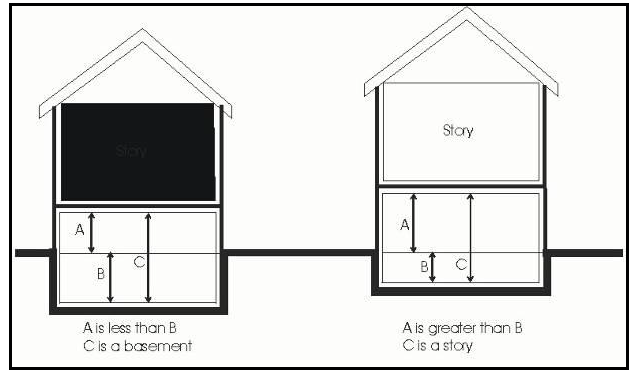
Figure 1: Basement and Story
Half-story means that part of a building between a pitched roof and the uppermost full story, the part having a floor area which does not exceed one-half the floor area of a full story, provided the area contains at least 200 square feet and a clear height of at least seven feet, at its highest point.
Story means that portion of a building, other than a basement or mezzanine, included between the surface of any floor and the floor next above it, or if there is no floor above it, then the space between the floor and the ceiling next above it. For the purpose of this chapter, a basement or cellar shall be counted as a story only if over one-half of its height is above the level from which the height of the building is measured.
BED AND BREAKFAST ESTABLISHMENT
Bed and breakfast establishment means a use within a single-family dwelling in which transient guests are provided a sleeping room, breakfast and access to bathing and lavatory facilities in return for payment.
BUILDABLE AREA ENVELOP
Buildable area envelop means the maximum three-dimensional volume on a lot within which a structure can be built, as permitted by applicable height and setback requirements.
BUILDING AND STRUCTURE DEFINITIONS
Building means an independent structure, either temporary or permanent, having a roof supported by columns, walls, or any other support used for the enclosure of persons, animals, or chattels, or carrying on business activities or other uses.
Building footprint means the ground area of a lot occupied within the exterior foundation walls of a principal building or accessory structure. Unenclosed and un-walled portions of a structure (such as deck, balcony, etc.) shall not be considered a part of the building footprint.
Building height means the building height measured from the grade to the average height between the eaves and ridge (mansard, gable, hip and gambrel roofs) and to the highest point of the roof for a flat roof. Where the terrain is sloping, the average grade is used for measurement.
Principal building means a building in which is conducted the principal use of the lot upon which it is situated.
Structure means anything constructed or erected, the use of which requires location on the ground or attachment to something on the ground.
BUILDING PERMIT
Building permit is the written authority as issued by the building inspector permitting the construction, moving, alteration or use of a building in conformity with the provisions of this chapter and the adopted building code.
(Ord. of 2-1-2018, § 2.03; Ord. No. 20200709, § II(2.03), 7-9-2020)
Sec. 24-30. - Definitions—C.
CLINIC
Clinic means a building or group of buildings where human patients are admitted for examination and treatment by more than one professional, such as a physician, dentist, or the like, except that human patients are not lodged therein overnight.
CLUB
Club means an organization of persons for special purposes or for the promulgation of sports, arts, sciences, literature, hobbies, politics, or the like, but not operated for profit.
COMMERCIAL STORAGE
Commercial storage means a building or group of buildings in a controlled access or fenced area that contains varying sizes of individual compartmentalized and controlled access stalls or lockers for the storage of customer's goods or wares which are not used on a daily basis.
CONDOMINIUM DEFINITIONS
Condominium Act means Public Act No. 59 of 1978.
Condominium unit means that portion of the condominium project designed and intended for separate ownership and use, as described in the master deed of the condominium project.
Condominium project means a plan or project consisting of not less than two condominium units established in conformance with the Condominium Act.
CONSERVATION EASEMENT
Conservation easement means a non-possessory interest in real property imposing limitations or affirmative obligations, the purposes of which include retaining or protecting natural, scenic or open space values of real property; assuring its availability for agricultural, forest, recreational or open space use; protecting natural resources; or maintaining air or water.
(Ord. of 2-1-2018, § 2.04)
Sec. 24-31. - Definitions—D.
DAY CARE DEFINITIONS
Commercial day care center means a facility, other than a private residence, receiving minor children or adults for care for periods of less than 24 hours in a day, for more than two weeks in any calendar year. Child care and supervision provided as an accessory use, while parents are engaged or involved in the principal use of the property, such as a nursery operated during church services or public meetings, or by a fitness center or similar operation, shall not be considered a day care center.
Family child care home means a private home in which one but fewer than seven minor children are received for care and supervision for compensation for periods of less than 24 hours a day, unattended by a parent or legal guardian, except children related to an adult member of the household by blood, marriage, or adoption. The term "family child care home" includes a home in which care is given to an unrelated minor child for more than four weeks during a calendar year. The term "family child care home" does not include an individual providing babysitting services for another individual. As used in this definition, the term "providing babysitting services" means caring for a child on behalf of the child's parent or guardian when the annual compensation for providing those services does not equal or exceed $600.00 or an amount that would, according to the Internal Revenue Code of 1986, obligate the child's parent or guardian to provide a form 1099-MISC to the individual for compensation paid during the calendar year for those services.
Group child care home means a private home in which more than six but not more than 12 minor children are given care and supervision for periods of less than 24 hours a day unattended by a parent or legal guardian, except children related to an adult member of the household by blood, marriage, or adoption. The term "group child care home" includes a home in which care is given to an unrelated minor child for more than four weeks during a calendar year.
DEED RESTRICTION
Deed restriction means a restriction on the use of a lot or parcel of land that is set forth in the property deed and recorded with the county register of deeds. It is binding on subsequent owners and is sometimes also known as a restrictive covenant.
DOMESTIC ANIMALS
Domestic animals means animals kept as a companion or pet, and kept in a home or yard. Examples include dogs, cats, birds, fish, rabbits, small rodents and similar animals, provided they are not kept, bred or maintained for commercial purposes.
DRIVE-THROUGH FACILITY
Drive-through facility means any commercial use that, by the way of site layout or building design, encourages or permits patrons to remain in their vehicle while receiving goods or services.
DWELLING DEFINITIONS
Dwelling ordwelling unit means a dwelling unit is any building or portion thereof having cooking facilities, which is occupied wholly as the home, residence or sleeping place of one family, either permanently or transiently, but in no case shall a motor home, trailer coach, automobile chassis, tent, or portable building be considered a dwelling. In case of mixed occupancy, where a building is occupied in part as a dwelling unit, the part so occupied shall be deemed a dwelling unit and shall comply with the provisions relative to dwellings.
Multiple-family dwelling means a building or portion thereof, used or designed for use as a residence for three or more families living independently of each other and each doing their own cooking in the building.
Single-family (detached) dwelling means a detached building used or designed for use exclusively by one family.
Two-family dwelling means a detached building used or designed for use exclusively by two families living independently of each other and each doing their own cooking in that building. The term "two-family dwelling" may also be termed a duplex.
(Ord. of 2-1-2018, § 2.05)
Sec. 24-32. - Definitions—E.
ENGINEER
Engineer means the person or firm designated by the township board as the engineer for the township.
ERECTED
Erected means and includes built, constructed, reconstructed, moved upon, or any physical operations on the premises required for the building. Excavations, fill, drainage, and the like, shall be considered a part of erection.
ESSENTIAL SERVICES
Essential services means the erection, construction, alteration, or maintenance by public utilities or municipal departments or commissions of underground, surface, or overhead gas, electrical, steam, or water transmission or distribution systems, collection, communication supply or disposal systems, including mains, drains, sewers, pipes, conduits, wires, cables, fire alarm boxes, traffic signals, hydrants, towers, poles, and other similar equipment, and accessories in connection therewith reasonably necessary for the furnishing of adequate service by those public utilities or municipal departments or commissions, or for the public health or general welfare, but not including cellular telephone or communications towers, or buildings other than those buildings that are primarily enclosures or shelters of the above essential service equipment.
EXCAVATING
Excavating means the removal of soil below the average grade of the surrounding land and/or road grade, whichever shall be highest, except common household gardening.
(Ord. of 2-1-2018, § 2.06)
Sec. 24-33. - Definitions—F.
FAMILY
Family means:
(1)
An individual or group of two or more persons related by blood, marriage, or adoption, together with foster children and servants of the principal occupants, who are domiciled together as a single housekeeping unit in a dwelling unit; or
(2)
A collective number of individuals domiciled together in one dwelling unit whose relationship is of a continuing, non-transient domestic character and who are cooking and living as a single nonprofit housekeeping unit.
This definition shall not include any society, club, fraternity, sorority, association, halfway house, lodge, coterie, organization, group of students, or other individual whose domestic relationship is of a transitory or seasonal nature, is for an anticipated limited duration of a school term or during a period of rehabilitation or treatment, or is otherwise not intended to be of a permanent nature.
FARM WINERY
Farm winery means a winery operated on the same farm at which the grapes or other produce used for making wine or wine-related products are grown or produced.
FENCE
Fence means any permanent fence, partition, wall, structure or gate erected as a dividing structure, barrier or enclosure, and not part of a structure that would require a building permit.
FLOOR AREA DEFINITIONS (See Figure 2)
Floor area (GFA) means:
(1)
The sum of the gross horizontal area of the several floors of the building measured from the exterior faces of the exterior walls or from the centerline of walls separating two buildings. The gross floor area of a building shall include the basement floor area only if more than one-half of the basement height is above finish lot grade. (See BASEMENT/STORY DEFINITIONS.)
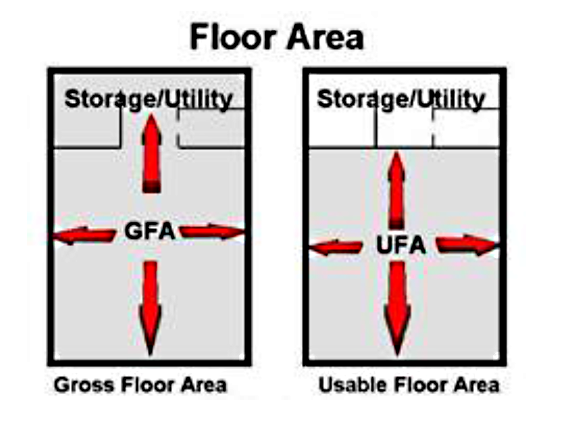
Figure 2: Floor Area
(2)
Gross floor area shall not include attic space having headroom of seven feet or less, or interior balconies or mezzanines. Any space devoted to off-street parking or loading shall not be included in floor area. Areas of basements (except as provided above), breezeways, porches, or attached garages are not included.
Usable floor area (UFA) means that area used for or intended to be used for the sale of merchandise or services, or used to serve patrons, clients, or customers; or area used in a dwelling unit for living purposes. Floor area which is used or intended to be used principally for the storage or processing of merchandise, for hallways, or for utilities shall be excluded from the computation of usable floor area. Measurement of usable floor area shall be the sum of the horizontal areas of the several floors of the building measured from the interior faces of the exterior walls.
FRONTAGE
Frontage means the horizontal distance between the side lot lines measured at the street right-of-way or easement line.
(Ord. of 2-1-2018, § 2.07)
Sec. 24-34. - Definitions—G.
GRADE DEFINITIONS
Grade means the ground elevation established for the purpose of regulating the height of the building. The building grade shall be the level of the ground adjacent to the walls of the building if the finished grade is level. If the ground is not entirely level, the grade shall be determined by averaging the elevation of the ground for each face of the building. (The term "grade" shall also mean average grade, as defined herein.)
Grade, average, means the arithmetic average of the lowest and highest grade elevations in an area within five feet of the foundation line of a building or structure.
Grade, finished, means the lowest point of elevation between the exterior walls of the structure and a line five feet from the exterior wall of the structure.
Grade, natural, means the elevation of the ground surface in its natural state, before manmade alterations.
GUEST HOUSE
Guest house means a structure that is accessory to a single family residence, which is used for guest accommodation.
(Ord. of 2-1-2018, § 2.08; Ord. No. 20200709, § III(2.08), 7-9-2020)
Sec. 24-35. - Definitions—H.
HOME BUSINESS DEFINITIONS
Home-based business means a business operated at a dwelling that because of its nature, intensity, scope, characteristics, activities and equipment, is not customary for a residential property. A home-based business is operated by the occupants of the dwelling and is clearly an incidental and secondary use of the property.
Home occupation means an occupation customarily conducted within a dwelling or accessory building by its occupants as a subordinate use. Without limiting the foregoing, a single-family residence used by an occupant of that residence to give instruction in a craft or fine art within the residence shall be considered a home occupation.
HOSPITAL
Hospital means an institution providing health services, primarily for in-patients and medical or surgical care of the sick or injured, including as an integral part of the institution, related facilities as laboratories, out-patient departments, training facilities, central service facilities and staff offices.
HOTEL/MOTEL
Hotel/motel means a building or multiple buildings used as temporary overnight accommodations for individuals or groups of individuals, with or without meals. A hotel or motel may include accessory uses such as gift shops, restaurants, banquet halls, meeting rooms, amenities, lounges, and other similar uses primarily oriented to the customers of the hotel or motel.
HOTEL/MOTEL, EXTENDED STAY
Hotel/motel, extended stay means a hotel or motel with units with provisions for living that contain kitchenette facilities for food preparation including but not limited to, refrigerators, stoves and ovens, as well as a bathroom and sleeping areas in each unit, that are specifically constructed and advertised for extended stays of one week or longer.
(Ord. of 2-1-2018, § 2.09; Ord. No. Ord. No. 221013A, § 1, 10-13-2022)
Sec. 24-37. - Definitions—J.
JUNK
Junk means any motor vehicles, machinery, appliances, products, or merchandise with parts missing; or scrap metals or materials that are damaged or deteriorated; or vehicles or machines in a condition which precludes their use of the purpose for which they were manufactured.
JUNK YARD
Junk yard means and includes vehicle wrecking yards and salvage areas and includes any area of more than 200 square feet for the storage, sale, processing, keeping or abandonment of junk, including scrap metals, other scrap materials or reclaimed materials, or for the dismantling, demolition, or abandonment of vehicles or machinery or parts thereof for profit, but does not include uses established entirely within enclosed buildings.
(Ord. of 2-1-2018, § 2.11)
Sec. 24-38. - Definitions—K.
KENNEL
Kennel means any lot or premises on which three or more animals, six months of age or older are kept temporarily or permanently for the purpose of breeding, boarding or for sale.
(Ord. of 2-1-2018, § 2.12; Ord. No. 221013C, § 1, 10-13-2022)
Sec. 24-39. - Definitions—L.
LANDFILL
Landfill means a land waste disposal site in which waste is generally spread in thin layers, compacted, and covered with a layer of soil.
LOADING SPACE
Loading space means an off-street space on the same lot with a building or group of buildings, for temporary parking for a commercial vehicle while loading or unloading merchandise or materials. Off-street loading space is not to be included as off-street parking space in computation of required off-street parking.
LOT DEFINITIONS (see Figures 3 and 4)
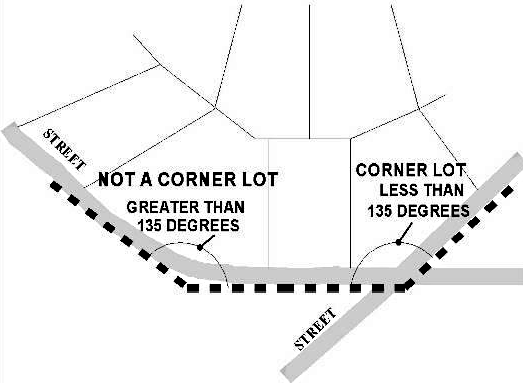
Figure 3: Corner Lots
Corner lot means a lot located at the intersection of two streets or a lot bounded on two sides by a curving street, any two points of which form an angle of 135 degrees or less.
Double frontage (through) lot means a lot other than a corner lot having frontage on two more or less parallel streets.
Front lot line. In the case of an interior lot, abutting upon one public or private street, the front lot line shall mean the line separating the lot from a street right-of-way. In the case of a corner or double frontage lot, the shorter street line shall be considered the front lot line; except in the case of both street lines being equal, the choice may be made at the discretion of the property owner. However, once declared, the designated front lot line shall remain as such. In the case of a waterfront lot, the lot line separating the lot from the water shall be considered the front lot line.
Interior lot means a lot other than a corner or a double frontage lot with only one lot line fronting on a street.
Lot means a parcel of land occupied or intended for occupancy by a use permitted in this chapter, including a principal building with its accessory buildings, and providing the open spaces, parking spaces, and loading spaces required by this chapter. The term "lot" shall include plot or parcel. A lot need not be a "lot of record." The term "lot" may also mean a portion of a condominium project, as regulated by the Condominium Act, designed and intended for separate or limited ownership and/or use.
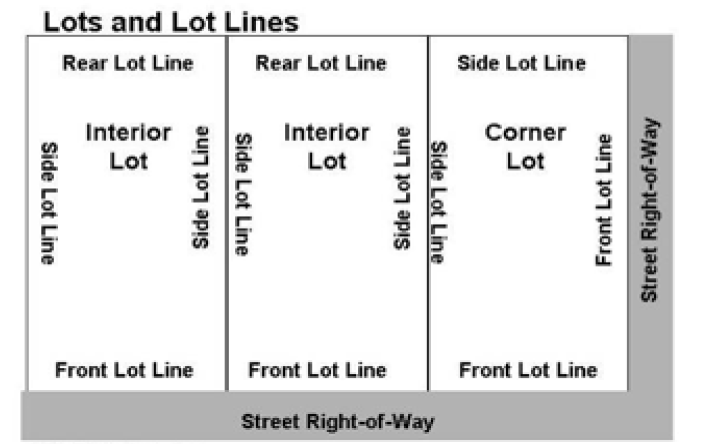
Figure 4: Lots and Lot Lines
Lot area means the total horizontal area within the lot lines of a lot excluding road right-of-way.
Lot coverage means the part or percent of the lot occupied by buildings or structures.
Lot depth means the mean horizontal distance from the front lot line to the rear lot line, or the two front lines of a double frontage lot.
Lot lines means the property lines bounding the lot.
Lot of record means a lot which lawfully exists in a subdivision plat as shown on the records of the county register of deeds, or a lawful lot or parcel described by metes and bounds, the description of which has been so recorded as required by law.
Lot width means the horizontal distance between the side lot lines, measured as nearly as possible at right angles to the side lot lines at all points between the front building setback line and the rear building setback line.
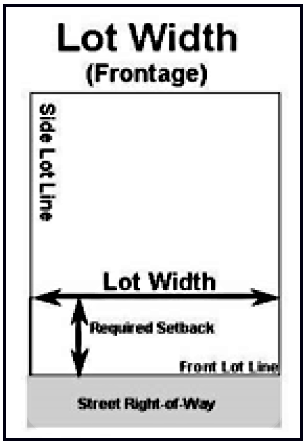
Figure 5: Lot Width
Rear lot line means, ordinarily, that lot line which is opposite and most distant from the front lot line of the lot. In the case of an irregular or triangular-shaped lot, a line at least ten feet in length entirely within the lot parallel to and at the maximum distance from the front lot line of the lot shall be considered to be the lot line for the purpose of determining depth of the rear yard. In cases where none of these definitions are applicable, the zoning administrator shall designate the rear lot line.
Side lot line means any lot line that is not a front lot line or a rear lot line. A side lot line separating a lot from another lot or lots is an interior side lot line.
Waterfront lot means a lot having frontage directly upon a lake, river or otherwise formed impoundments of water.
(Ord. of 2-1-2018, § 2.13)
Sec. 24-40. - Definitions—M.
MANUFACTURED HOME DEFINITIONS
Manufactured home means a factory-built, single-family structure that is manufactured under the National Manufactured Home Construction and Safety Standards Act. It is transportable in one or more sections, built on a permanent chassis or foundation and used as a dwelling. It is not constructed with a permanent hitch or other device allowing its transport, other than for its delivery to a permanent site and does not have wheels or axles permanently attached to its body or frame.
Manufactured home community means a parcel or tract of land under the control of a person upon which three or more manufactured homes are located on a continual, non-recreational basis that is offered to the public for that purpose regardless of whether a charge is made therefor, together with any building, structure, enclosure, street, equipment, or facility used or intended for use incident to the occupancy of a manufactured home.
Manufactured home space means a plot of ground within a manufactured home community designed for the accommodation of one manufactured home.
MASTER PLAN
Master plan. The master plan currently adopted by the township, including graphic and written materials, indicating the general location for streets, parks, public buildings, and all physical development of the township, and includes any unit, part, or amendment to the plan.
MICHIGAN ZONING ENABLING ACT
Michigan Zoning Enabling Act means The Michigan Zoning Enabling Act, Public Act No. 110 of 2006.
(Ord. of 2-1-2018, § 2.14)
Sec. 24-41. - Definitions—N.
NONCONFORMING DEFINITIONS
Nonconforming building means a building or portion thereof lawfully existing at the effective date of the ordinance from which this chapter is derived (February 1, 2018), or amendments thereto, that does not conform to the provisions of this chapter in the zoning district in which it is located.
Nonconforming lot of record means a lot, whether platted or unplatted, that conformed with all zoning lot requirements at the time of recording but which no longer conforms to the zoning regulations and requirements for lot area, lot width, or both; that has not been subdivided or reduced in size subsequent to the time it did conform to this chapter.
Nonconforming use means a use which lawfully occupied a building or land at the effective date of the ordinance from which this chapter is derived (February 1, 2018) or amendments thereof, and that does not conform to the use regulations of the zoning district in which it is located.
(Ord. of 2-1-2018, § 2.15)
Sec. 24-42. - Definitions—O.
OPEN AIR BUSINESS
Open air business means uses operated for profit substantially in the open air, including, but not limited to:
(1)
Bicycle, utility truck or trailer, motor vehicle, boats, or home equipment sale, repair, rental, or storage services.
(2)
Outdoor display and sale of garages, motor homes, manufactured homes, snowmobiles, farm implements, swimming pools, and similar activities.
(3)
Retail sale of trees, fruits, vegetables, shrubbery, plants, seeds, topsoil, humus, fertilizer, trellises, lawn furniture, playground equipment, and other home garden supplies and equipment.
OPEN SPACE DEFINITIONS
Dedicated open space means common open space dedicated as a permanent recorded easement.
Open space means land used for recreation, resource protection, amenity, and/or buffers, and not containing any principal building or structure.
Open space development means a development which is permitted to have smaller lot sizes in return for protected open space. The term "open space development" is also known as open space preservation development.
Usable open space means that portion of the common open space that meets the minimum dimensions as required by this chapter that due to its slope, drainage characteristics and soil conditions can be used for recreation.
(Ord. of 2-1-2018, § 2.16)
Sec. 24-43. - Definitions—P.
PARCEL
Parcel means a tract of land which can be legally described with certainty and is capable of being located by survey.
PERSONAL SERVICE ESTABLISHMENTS
Personal service establishments means any commercial business conducting services that are performed primarily on the premises.
PLANNED UNIT DEVELOPMENT
Planned unit development means a development of land that is under unified control and is planned and developed as a whole in a single development operation or programmed series of development stages. The development may include streets, circulation ways, utilities, buildings, open spaces, and other site features and improvements.
PLOT PLAN
Plot plan means a drawing required by this chapter to ensure that a proposed land use or activity is in compliance with the chapter. It is used to provide information for a zoning permit for things such as single-family home development, additions to homes, accessory buildings and fences. For the purposes of this chapter, a plot plan and a site plan are not the same.
PORCH, ENCLOSED
Porch, enclosed, means a covered entrance to a building or structure which is totally enclosed, and projects out from the main wall of the building or structure and has a separate roof or an integral roof with the principal building or structure to which it is attached.
PORCH, OPEN
Porch, open, means a covered entrance to a building or structure which is unenclosed except for columns supporting the porch roof, and projects out from the main wall of the building or structure and has a separate roof or an integral roof with the principal building or structure to which it is attached.
PRINCIPAL USE
Principal use means the primary purpose for which land or premises, or a building thereon, is designed, arranged, or intended, for which it is occupied, or maintained, let, or leased.
PRIVATE EVENT VENUE
Private event venue means a site or facility approved by Bertrand Charter Township to conduct private events by renting or leasing to private parties on a commercial basis in a commercial building designed for hosting catered events. A "private event" is periodic or special in nature, with guests in attendance by invitation only, with the event not being open to the public. Examples of private events include, but are not limited to a banquet, wedding, reception, ceremony, service, private dinner or luncheon, special event sponsored by community groups, baby or wedding showers, or an open house. Private event venues shall not include barn weddings and receptions, which have different requirements.
PRIVATE HOME
Private home means a private residence in which the licensee permanently resides, which residency is not contingent upon caring for children or employment by a child placing agency. The term "private home" includes a full-time foster family home, a full-time foster family group home, a group child care home, or a family child care home.
PUBLIC UTILITY
Public utility means any person, firm, corporation, municipal department, board, or commission duly authorized to furnish, under federal, state or municipal regulations, to the public, electricity, gas, steam, communications, telegraph, transportation, or water services, not including wireless telecommunications providers or wind energy conversion facilities.
(Ord. of 2-1-2018, § 2.17; Ord. No. 220511A, § 1, 5-11-2023)
Sec. 24-44. - Definitions—R.
RECREATION VEHICLE OR EQUIPMENT DEFINITIONS
Recreation vehicle or equipment means a vehicle or equipment intended for temporary or periodic use for recreational or leisure pursuits. These vehicles shall include boats, airplanes, special purpose vehicles, floats, rafts, trailers, snowmobiles, camping or travel trailers, motorized homes, detachable travel equipment of the type adaptable to light trucks, and other equipment or vehicles of a similar nature.
Motor home means a motorized vehicular unit primarily designed for temporary dwelling in connection with travel and/or recreational use. This term "motor home" does not include manufactured homes.
(Ord. of 2-1-2018, § 2.18)
Sec. 24-45. - Definitions—S.
SATELLITE DISH ANTENNA, OR DISH ANTENNA
Satellite dish antenna ordish antenna means an apparatus capable of receiving communications from a transmitter or a transmitter relay located in planetary orbit.
SENIOR HOUSING
Senior housing means a building or group of buildings containing dwellings where the occupancy of dwellings is restricted to persons 55 years of age or older or couples where either the husband or wife is 55 years of age or older. This does not include a development that contains a convalescent or nursing home as licensed under MCL 333.21701 et seq.; or a mental hospital for mental patients licensed under sections Public Act No. 258 of 1974 (MCL 330.1001 et seq.).
SETBACK DEFINITIONS (see Figure 6)
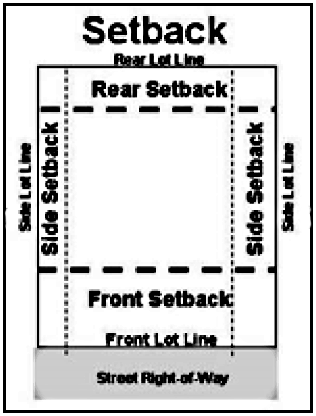
Figure 6: Setback Lines
Front building setback line means the line marking the setback distance from the front lot line which establishes the minimum front setback.
Rear building setback line means the line marking the setback distance from the rear lot line which establishes the minimum rear setback.
Setback means the distance required to comply with front, side or rear yard open space provisions of this chapter.
Setback lines means lines marking the setback distance from the lot lines which establish the minimum permitted front, side, or rear yards.
Side setback lines means lines marking the setback distance from the side lot lines which establish the minimum side setback.
SEXUALLY ORIENTED BUSINESS DEFINITIONS
Sexually oriented business means and includes adult bookstores, adult novelty stores, adult video stores, adult cabarets, adult motion picture theaters, massage establishments, and nude artist and photography studios. These terms shall have the following indicated meanings:
(1)
Adult bookstore, adult novelty store or adult video store. The term "adult bookstore, adult novelty store or adult video store" means an establishment having, as a substantial or significant portion of its stock in trade, books, magazines, or other periodicals, videotapes, movies, or adult-related novelties which are distinguished or characterized by their emphasis on matter depicting, describing or relating to specified sexual activities or specified anatomical areas, as defined herein, or an establishment with a segment or section devoted to the sale or display of this material.
(2)
Adult cabaret. The term "adult cabaret" means a nightclub, restaurant, or other similar commercial establishment which regularly features or displays:
a.
Persons who appear in a state of nudity;
b.
Live performances predominantly distinguished or characterized by an emphasis on the exposure of any specified anatomical areas or specified sexual activities; or
c.
Films, motion pictures, videocassettes, videotapes, any material in digital format (including, but not limited to, compact discs (CDs) or digital video discs (DVDs)), slides, or other photographic reproductions or visual media which are predominantly distinguished or characterized by an emphasis on the depiction or description of specified anatomical areas or specified sexual activities.
(3)
Adult motion picture theater. The term "adult motion picture theater" means an establishment used for presenting material distinguished or characterized by an emphasis on matter depicting, describing, or relating to specified sexual activities or specified anatomical areas, as defined herein, for observation by patrons therein.
(4)
Massage establishment. The term "massage establishment" means any establishment having a fixed place of business where massages are administered by pay, including, but not limited to, massage parlors, health clubs, sauna baths, and steam baths. The term "massage establishment" shall not be construed to include a hospital, osteopath, or physical therapist; or massage establishment with a therapist who is certified by the American Massage Therapy Association, American Medical Massage Therapy, National Certification Board of Therapeutic Massage and Bodywork and/or a graduate of a licensed school of massage therapy or duly licensed by the state, nor barbershops or beauty salons in which massages are administered. The term "massage establishment" shall not be construed to include a nonprofit organization operating a community center, swimming pool, tennis court, or other educational, cultural, recreational, and athletic facilities for the welfare of the residents of the area. A massage is defined as a method of treating the external parts of the human body by rubbing, stroking, kneading, tapping or vibrating with the hand or any instrument.
(5)
Nude artist and photography studio. The term "nude artist and photography studio" means any building, structure, premises or part thereof used solely or primarily as a place which offers as its principal activity the providing of models to display specified anatomical areas, as defined herein, for artists and photographers for a fee or charge.
(6)
Specified anatomical areas. The term "specified anatomical areas" means less than completely and opaquely covered:
a.
Human genitals, pubic region, buttock, and female breast below a point immediately above the top of the areola; and
b.
Human male genitals in a discernible turgid state, even if completely and opaquely covered.
(7)
Specified sexual activities. The term "specified sexual activities" means:
a.
Human genitals in a state of sexual stimulation or arousal;
b.
Acts of human masturbation, sexual intercourse or sodomy;
c.
Fondling or other erotic touching of human genitals, pubic region, buttock or female breast.
SHORELINE
Shoreline means the line between upland and bottomland which persists through successive changes in water levels, below which the presence and action of the water is so common or recurrent that the character of the land is marked distinctly from the upland and is apparent in the soil itself, the configuration of the surface of the soil and the vegetation.
SIGN DEFINITIONS
Area means the total square footage of a sign face exposed to public view.
Awning sign means a sign which is part of, hung from the underside of, or attached to, a marquee, canopy, or other covered structure projecting from and supported by a building and does not project horizontally beyond or vertically above the marquee, canopy, or covered structure.
Banner means an unsecured sign made of natural, flexible, synthetic or plastic material used to call attention to a land use or product, service or activity; however, the term "banner" does not include pennants or flags.
Billboard means a sign structure which exceeds 100 square feet.
Directional sign means a sign that contains only directional information and the identification of one of the following:
(1)
A public or private activity or attraction that is owned or operated by the federal or a state or local government or an agency of the federal or a state or local government.
(2)
A publicly or privately owned natural phenomenon or a historic, cultural, scientific, educational, or religious site.
(3)
An area that is in the interest of the traveling public, if the area is of natural scenic beauty or is naturally suited for outdoor recreation.
Electronic message board means a sign on which copy changes automatically on a lamp bank or through mechanical means (e.g., electrical or electronic time and temperature units).
Freestanding sign means any nonmovable sign not affixed to a building.
Height means the maximum vertical distance from the uppermost extremity of a sign or sign support to the average ground level at the base of the sign.
Illuminated sign means any sign designed to give forth artificial light, or designed to reflect any light given from any source which is intended to cause light or reflection.
Monument sign means a freestanding sign affixed to the ground with a full footing where the display surface is less than four feet above the grade to the bottom of the display area.
Off-premises sign means a sign located on a different parcel of land or lot or premises.
On-premises sign means a sign located on the parcel of land or lot.
Pennant means a small, often triangular, tapering flag.
Pole sign means a freestanding sign which is supported by one or more uprights in permanent footings with all parts of the display surface of the sign eight feet or more above the grade at the base of the sign.
Political sign. Follow the regulations of Portable (temporary) sign.
Portable (temporary) sign means a sign which is not permanently affixed to a building (wall sign), structure (pole sign) or the ground (monument sign). Portable or temporary signs include, without limitation, signs supported on wooden posts, mobile chassis, motor vehicles, banners, flags, and pennants.
Residential entranceway sign means a permanent structure, including, but not limited to, walls, columns and gates.
Roof sign means a sign erected, constructed and maintained upon or above the roof, or parapet wall of a building which is wholly or partially supported by the building.
Sign means any individual announcement, declaration, demonstration, display, illustration, insignia, surface or space when erected or maintained to the out of doors in view of the general public for identification, advertisement or promotion of the interests of any person.
Wall sign means a sign fastened to or painted on the wall of a building or structure in such a manner that the wall becomes the supporting structure for, or forms the background surface of, the sign that does not project more than 12 inches from the building or structure.
Window sign means a sign that is applied or attached to the exterior or interior of a window or located in a building so that it can be seen from the exterior of the structure through a window.
STREET/ACCESS DEFINITIONS
Alley means a public way which affords a secondary means of access to abutting property but not being intended for general traffic circulation.
Major road means roads that gather traffic from local streets and/or move larger volumes of traffic through the township, including any road considered a state highway or primary road.
Private driveway means an improved or unimproved path extending from a public right-of-way or private road easement to a single building, dwelling, or structure, intended to provide ingress and egress primarily for occupants thereof.
Private street means a privately owned and maintained thoroughfare providing access to two or more individual lots or parcels.
Public street means a thoroughfare including any easements or rights-of-way and traveled surfaces which afford traffic circulation and principal means of access to abutting property, including avenue, place, way, drive, lane, boulevard, highway, road, and other thoroughfare; except an alley.
(Ord. of 2-1-2018, § 2.19)
Sec. 24-46. - Definitions—T.
TEMPORARY BUILDING OR USE
Temporary building or use means a structure or use permitted by the zoning administrator in accordance with the requirements of this chapter during periods of construction of a principal building or for special events.
TOWNSHIP OFFICIALS DEFINITIONS
Building inspector means the person or agency appointed by the township board as the building inspector for the township.
Clerk means the township clerk.
Planning commission means the township planning commission.
Zoning administrator means the person designated by the township board to administer the provisions of this chapter.
Zoning board of appeals or board means the zoning board of appeals of the township.
(Ord. of 2-1-2018, § 2.20)
Sec. 24-48. - Definitions—V.
VARIANCE
Variance means a modification of the literal provisions of this chapter granted when strict enforcement of this chapter would cause practical difficulty owing to circumstances unique to the individual property.
VEHICLE DEFINITIONS
Major vehicle repair means any activity involving the general repair, rebuilding or reconditioning of motor vehicles, engines or trailers; collision service, such as body, frame or fender straightening and repair; overall painting and vehicle rust-proofing; or steam cleaning.
Minor vehicle repair means any use whose primary activity involves minor repair and maintenance of passenger vehicles and light trucks and vans, including, but not limited to, vehicle detailing, oil change establishments, audio or cellular installation, and auto glass installation and repair, but not including fuel sales.
Vehicle service station means a building or premises to be used for the retail sale of gasoline or other motor fuel for the propulsion of motor vehicles and accessory sales and installation of vehicle accessories, including, but not limited to, tires, batteries, oil, and similar products.
Vehicle wash establishment means a building, or portion thereof, the primary purpose of which is washing motor vehicles.
(Ord. of 2-1-2018, § 2.22)
Sec. 24-49. - Definitions—W.
WATERFRONT LOT (see LOT DEFINITIONS)
WETLAND
Wetland means land characterized by the presence of water at a frequency and duration sufficient to support, and that under normal circumstances does support, wetland vegetation or aquatic life, and is commonly referred to as a bog, swamp, or marsh.
WIND ENERGY CONVERSION SYSTEM DEFINITIONS
Commercial WECS means any WECS that is a single WECS for commercial purposes, any WECS within a wind farm, or any other WECS meant to provide power which is utilized off the site on which the WECS is located.
Interconnected WECS means a WECS that is electrically connected to the local electrical power utility system and could feed power back into the local electrical power utility system.
On-site service WECS means a single WECS placed upon a lot or parcel with the primary intent to service the energy needs of only the structures and uses on the same lot or parcel.
Shadow flicker means alternating changes in light intensity caused by the moving blade of a WECS casting shadows on the ground and stationary objects such as dwellings.
Single WECS for commercial purposes means a single WECS placed upon a lot or parcel with the intent to sell or provide electricity to a site or location other than the premises upon which the structure is located. Said WECS may or may not be owned by the owner of the property upon which the WECS is placed.
WECS testing facility means a structure and equipment used to determine the potential for the placement of a WECS.
WECS tower height (see Figure 7).
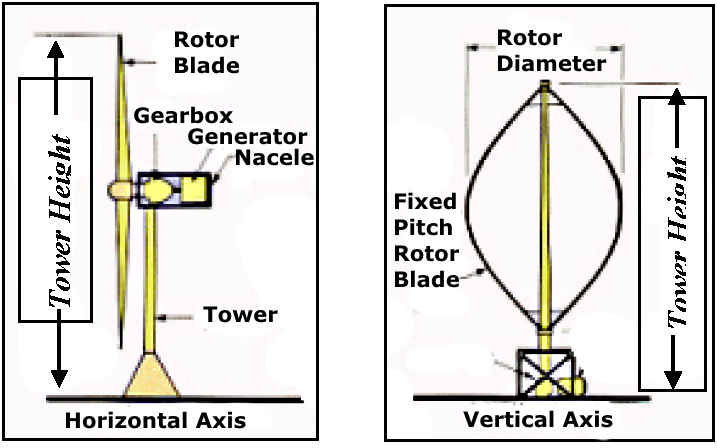
Figure 7: WECS Height
(1)
Horizontal axis wind turbine rotors: The distance between the ground and the highest point of the WECS, as measured from the ground, plus the length by which the rotor blade on a horizontal-mounted WECS exceeds the structure which supports the rotor and blades.
(2)
Vertical axis wind turbine: The distance between the ground and the highest point of the WECS.
Wind energy conversion system (WECS) means a combination of:
(1)
A surface area (typically a blade, rotor, or similar device), either variable or fixed, for utilizing the wind for electrical power;
(2)
A shaft, gearing, belt, or coupling utilized to convert the rotation of the surface area into a form suitable for driving a generator, alternator, or other electricity-producing device;
(3)
The generator, alternator, or other device to convert the mechanical energy of the surface area into electrical energy, generally housed in a nacelle;
(4)
The tower, pylon, building mount or other structure upon which any, all, or some combination of the above are mounted; and
(5)
Other components not listed above but associated with the normal construction, operation, and maintenance of a WECS.
Wind farm means clusters of two or more WECS placed upon a lot or parcel with the intent to sell or provide electricity to a site or location other than the premises upon which the WECS are located. The WECS facilities may or may not be owned by the owner of the property upon which the WECS is placed.
WIRELESS TELECOMMUNICATION TOWER
Wireless telecommunication tower means a structure of lattice or monopole framework to which an antenna may be attached for the transmission and/or reception of radio, television, satellite or microwave signals that facilitates wireless communications, including cellular, enhanced specialized mobile radio (ESMR), personal communication, or similar services, along with associated equipment necessary to operate these facilities.
WIRELESS COMMUNICATION ANTENNA
Wireless communication antenna means the device for transmitting and/or receiving radio, television, satellite, cellular, enhanced specialized mobile radio, personal communication, microwave, or similar transmissions.
(Ord. of 2-1-2018, § 2.23)
Sec. 24-50. - Definitions—Y.
YARD DEFINITIONS (see Figure 8)
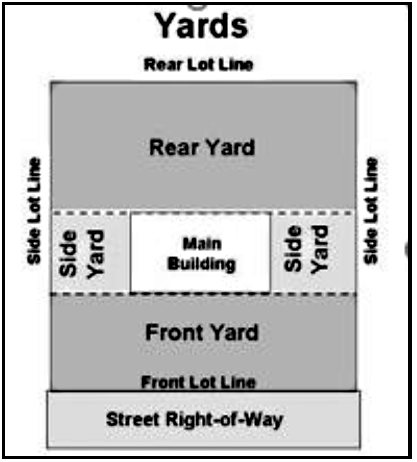
Figure 8: Yards
Front yard means an open space extending the full width of the lot, from the front elevation of a principal building to the front lot lines.
Rear yard means an open area extending across the full width of the lot, from the rear elevation of a principal building to the rear lot lines.
Side yard means an open unoccupied area between a principal building and the side lot lines, extending from the front yard area to the rear yard area. The width of the side yard shall be measured horizontally from and at right angles to the nearest point of the side lot line.
Yard means an open space on the same land with a building or group of buildings, which lies between the building or group of buildings and the nearest lot line.
(Ord. of 2-1-2018, § 2.24)
Sec. 24-51. - Definitions—Z.
ZONING DISTRICT DEFINITIONS
Nonresidential district refers to the C, C-2, C-3 and IND zoning districts, as described in this chapter.
Residential district refers to the AG, RR, R-1 and R-2 zoning districts, as described in this chapter.
(Ord. of 2-1-2018, § 2.25)

