Bethlehem City Zoning Code
ARTICLE XVI
HIGHWAY CORRIDOR OVERLAY DISTRICT
Sec. 89-1601.- Purpose of article.
The purpose of the Highway Corridor Overlay District is:
(a)
To promote the general health, safety, and welfare of the community.
(b)
To improve the efficient operation of traffic around Barrow County.
(c)
To promote safe and efficient movement within the Overlay District for persons using all modes of travel - motorized vehicles, bicycles, and walking.
(d)
To create an attractive gateway that is aesthetically appealing and environmentally responsible.
(e)
To encourage innovative development projects that set standards for landscaping, open space, community design, streetscapes, and public amenities.
(f)
To establish consistent and harmonious design standards for public improvements and private property development within the Overlay District so as to unify the distinctive visual quality of the Highway Corridor.
(Ord. of 10-13-2020)
Sec. 89-1602. - Boundaries.
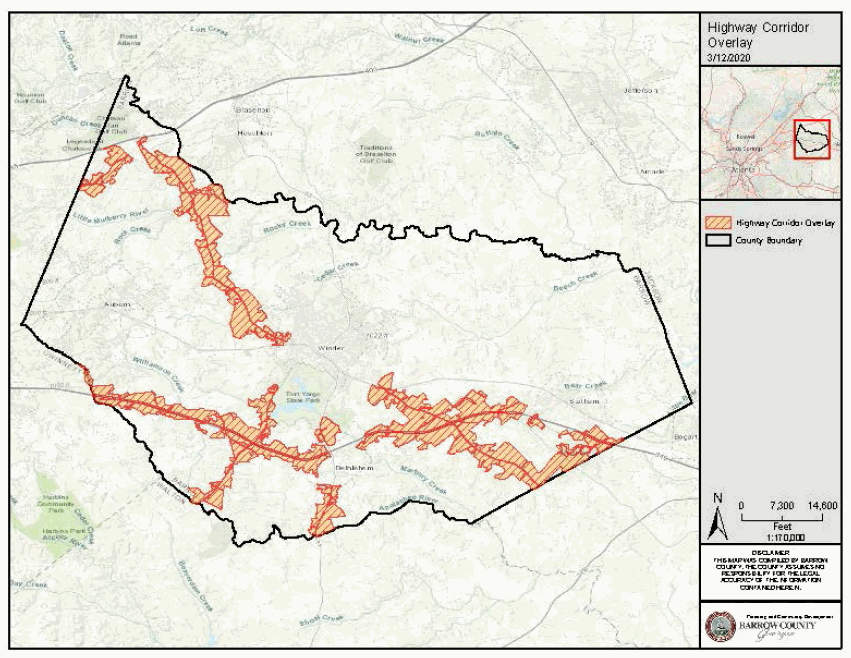
This article applies to land parcels of record within unincorporated Barrow County as depicted on Exhibit "A" which is attached hereto and incorporated herein by reference. All property contained within any parcel subject to this ordinance on the date of adoption of this ordinance shall continue to be subject to this article, even if the parcel is subdivided in the future.
(a)
The Highway Corridor Overlay District shall include all properties within the boundaries of unincorporated Barrow with frontage along the following corridors: SR 124, SR 11, Hwy 211, Hwy 53, Hwy 81, or Hwy 316/US 29.
(b)
Upon written application pursuant to Article 13, the board of appeals may grant exemptions from these requirements for parcels or portions of a parcel that would otherwise be included in the Highway Corridor Overlay District, based on one or more of the following findings:
(1)
The subject property to be exempted lies more than 750 feet from the centerline of SR 124, SR11, 211, 53, 81 or 316 as applicable.
(2)
The property to be exempted does not have access to SR 124, SR 11, 211, 53, 81 or 316 as applicable and will not require access to SR 124, SR 11, 211, 53, 81 or 316, as applicable when developed.
(3)
Due to site topography, development of the property to be exempted will not be visible from SR 124, SR11, 211, 53, 81 or 316 as applicable.
(4)
Due to the location, size, and shape of the property, development of the parcel under its current zoning and in conformity with the requirements of the Highway Corridor Overlay District would present a severe and unique hardship.
(Ord. of 10-13-2020)
Sec. 89-1603. - Effect of highway corridor overlay district provisions.
(a)
Application. This overlay district is supplemental to the underlying zoning district classifications established in the Barrow County Unified Development Code governing all properties and approvals within this overlay district. The provisions of this article shall be overlaid upon and shall be imposed in addition to said underlying zoning regulations and other Barrow County ordinances.
The planning and community development director is authorized to promulgate and enforce such rules, regulations, guidelines, and standards as may be reasonably necessary or desirable to give effect to the provisions of this article.
(b)
Relationship to underlying zoning district standards and other provisions of Unified Development Code. In any case where the standards and requirements of the highway corridor overlay district conflict with those of the base-zoning district or with other provisions of the Unified Development Code, the standards and requirements of the highway corridor overlay district shall govern.
(c)
Exceptions. The provisions of this article shall not apply to the following:
(1)
Completion of work subject to preliminary plats, site development plans, construction plans, building permits, or interior finish permits approved prior to the effective date of this article for those parcels not previously covered within the Highway overlay district previously known as the SR 124 and 211 Corridor Overlay District.
(2)
Improvements and additions that are made to a single-family residence previously permitted and built on a lot of record prior to enactment of this article for those parcels not previously covered within the Highway overlay district previously known as the SR 124 and 211 Corridor Overlay District.
(3)
Construction of a single-family dwelling on an existing lot of record within a single-family residential subdivision with final plat approved prior to enactment of this article, for those parcels not previously covered within the overlay district previously known as the SR 124 and 211 Corridor Overlay District, provided that the new construction shall be of a similar floor area, materials and design as the single-family dwellings on adjacent lots in the same subdivision.
(4)
Construction, rehabilitation, restoration, repair of a nonresidential structure, interior renovations or interior finishes within an existing structure, or addition to an existing nonresidential structure that was permitted prior to the enactment of this article for those parcels not previously covered within the highway overlay district previously known as the SR 124 and 211 Corridor Overlay District shall not be subject to the provisions of the highway corridor overlay district, provided that such construction is on a lot of record and does not affect a change to more than 20 percent of the existing permitted structure or 5,000 square feet, whichever is less.
(d)
Building plan application.
(1)
All building plans submitted pursuant to an application for a building permit should clearly indicate all of the proposed building materials and colors for each facade as described in section 89-1604(k) of this article.
(2)
The plans should clearly show the location and calculate the amount/percentages of all building materials per facade.
(3)
Groups of buildings on the same parcel of land may be reviewed and permitted as a single project rather than individual buildings.
(Ord. of 10-13-2020)
Sec. 89-1604. - Property development standards.
(a)
Prohibited uses.
(1)
Self service storage or mini-warehouse.
(2)
Salvage, junk, wrecking and scrap yards.
(3)
Adult bookstore.
(4)
Sexually oriented businesses or establishments.
(5)
Pawnshop or loan brokers, other than mortgage loan brokers.
(6)
Rooming and boarding houses.
(7)
Automotive repair and maintenance, except car washes.
(b)
Special uses. The following use shall require special use approval in accordance with the procedures of article XII:
(1)
Outdoor commercial recreation.
(2)
Car washes.
(3)
Outdoor storage or display.
(4)
Commercial buildings in excess of 150,000 square feet.
(5)
Exceptions to building height standards as set forth in subsection (l)(6) below.
(6)
Industrial use buildings in excess of 500,000 square feet.
(c)
Ground floor area limitation. New commercial buildings may not exceed 150,000 gross square feet in ground floor area. New commercial buildings greater than 150,000 gross square feet must obtain special use approval. In determining whether to grant an increase in ground floor size beyond 150,000 square feet, the board of commissioners shall consider the following factors, in addition to those listed in article XII:
(1)
The site has safe, immediate access to the highway corridor overlay district as applicable.
(2)
The building site will provide convenient inter-connections with adjacent uses and properties that serve both pedestrians and automobiles.
(3)
The floor area of the proposed building is the smallest feasible to serve the function of the proposed use.
(4)
The architectural design of the building reduces the perceived size of the building by appropriate articulations and variations in the massing, facade, roofline, materials, colors, and textures of the building exterior.
(5)
The building and site meets or exceeds all other standards set forth in this ordinance and by the Barrow County Unified Development Code.
(d)
Lot standards.
(1)
Minimum lot size shall be as follows:
a.
For outparcels or stand-alone commercial projects: 1 acre.
b.
For commercial lots within a common development with shared parking and interconnectivity: ½ acre.
(2)
Minimum commercial lot frontage: 175 feet along an arterial.
(3)
Nonresidential lots shall be generally rectangular with a ratio of depth to frontage not greater than 4:1.
(4)
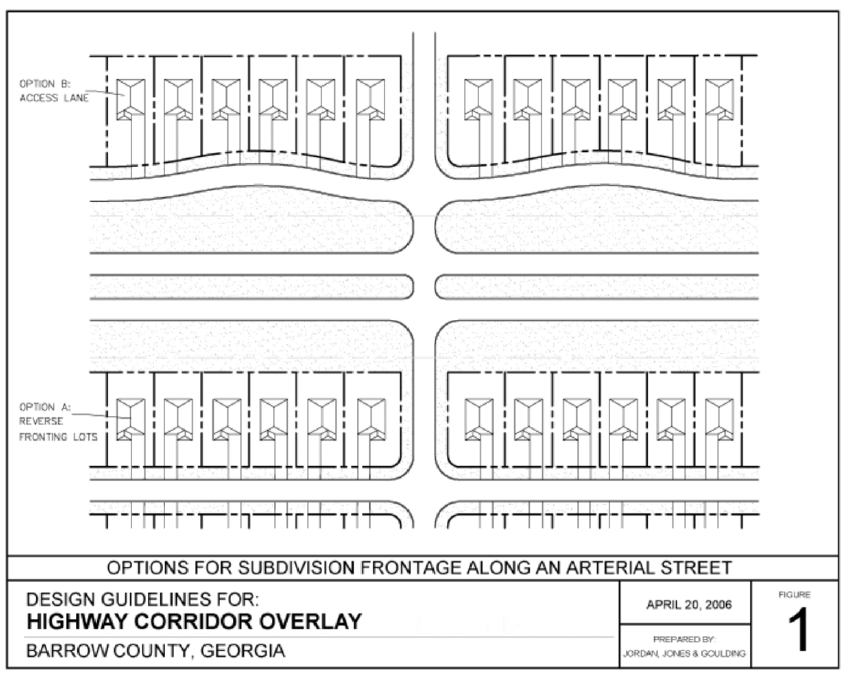
Residential subdivisions shall comply with one of the following two requirements (see section 1606, Design Guidelines, Figure 1):
a.
Reverse-fronting lots are required for residential subdivisions along streets classified as arterials or collectors, subject to subparagraph (b) below. Reverse-fronting residential lots shall be platted with a landscaped access easement restricting vehicular access placed adjacent to the public right-of-way. Such easement shall be a minimum of 20 feet in depth and include one of the following:
1.
A continuous four-foot high solid wall constructed entirely of brick or stone masonry.
2.
A four-foot high fence constructed of a combination of brick or stone masonry pillars with iron pickets.
3.
A vegetated strip of canopy trees, shrubs, and groundcover that provide a full landscape buffer.
b.
If a residential lot is separated from the arterial or collector street by a minimum 20-foot-wide landscaped strip and a residential street, a residential lot may face an arterial or a collector street.
(e)
Access management standards.
(1)
Driveways. Driveway connections to public streets shall be consistent with the following standards:
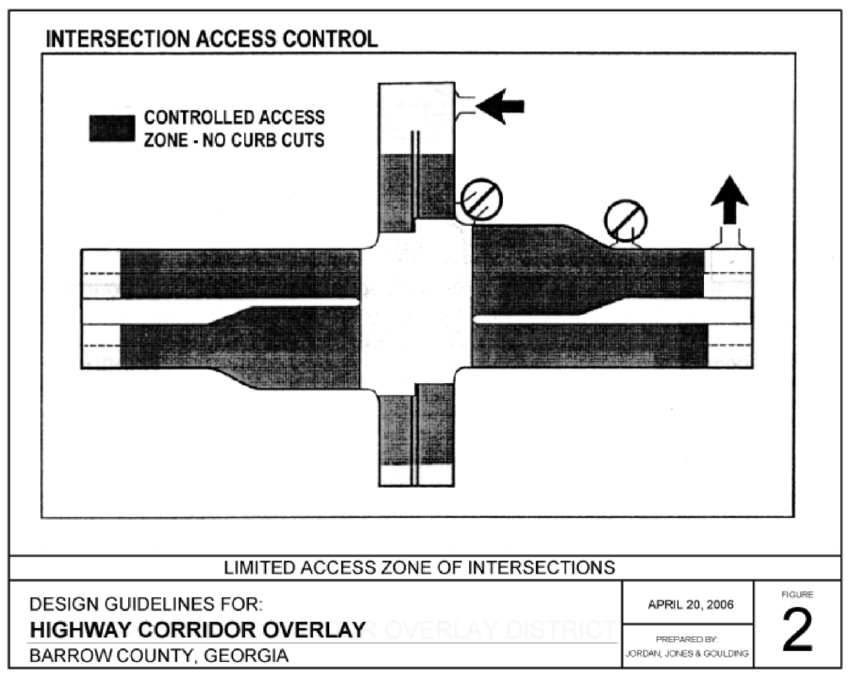
a.
Driveway connections shall not be permitted within the controlled access zone of an intersection. (See section 1606, Design Guidelines, Figure 2.)
b.
Outparcels with less than 200 feet of road frontage are restricted to internal access only.
c.
Driveways that enter a major thoroughfare at traffic signals must have at least two outbound lanes (one for each turning direction) of at least 11 feet in width, and one inbound lane with a maximum width of 11 feet.
d.
No residentially developed property may have a curb cut in excess of 30 feet in width, and no nonresidential property may have a curb cut in excess of 40 feet without approval of the public works director.
e.
Except for single-family and two-family residences, driveway grades shall conform to the requirements of the Georgia Department of Transportation Regulations for Driveway and Encroachment Control.
f.
Except where driveways are on opposite sides of a raised median, driveways on opposite sides of a street shall either directly align or have offsets of a minimum of 125 feet, as measured between the extended centerlines of such driveways.
g.
Whenever possible, driveways on undivided arterials, collector streets, or local streets should align with driveways (if any) on the opposite side of such street.
h.
On a divided arterial street that includes a median, driveways should align with median breaks whenever possible. Driveways not meeting this standard shall be limited to right turn access and right turn egress.
i.
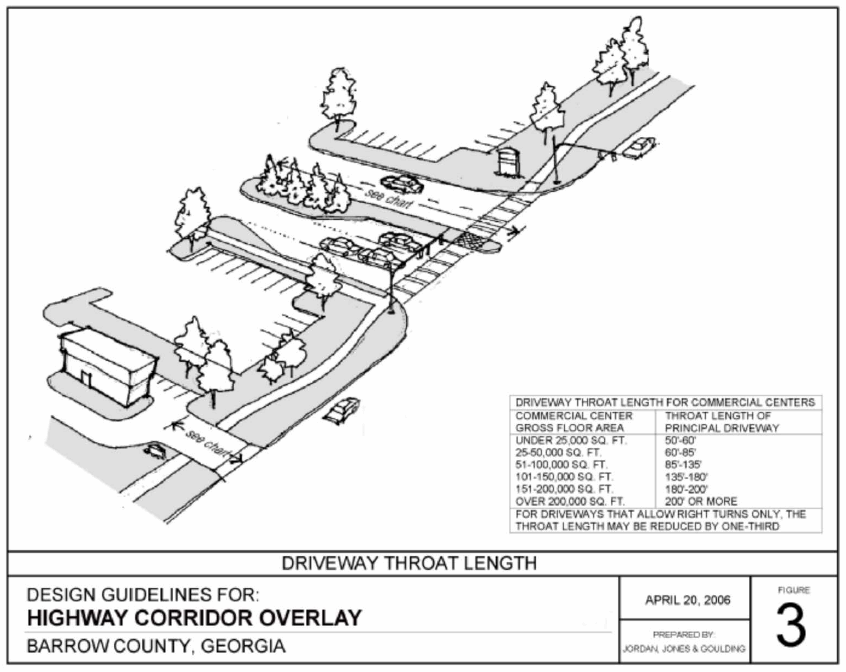
Driveway throat length. The length of a driveway or "throat length" for a commercial or office development shall be designed in accordance with the vehicle storage required for entering and exiting vehicles to prevent vehicles from backing into the flow of traffic on the public street or causing unsafe conflicts with on-site vehicle circulation. The throat lengths specified in Table 16.1 are generally acceptable guidelines intended for the major entrance driveway of a commercial development. (See section 1606, Design Guidelines, Figure 3.)
Table 16.1: Driveway Throat Length for Commercial Centers
(2)
Deceleration lanes.
a.
A major driveway entering a street with a regulated arterial speed greater than 35 miles per hour shall be required to provide a deceleration lane consistent with the standards set forth in article X.
b.
An acceleration or deceleration lane that would begin or end within 75 feet of another driveway or intersecting street shall be lengthened so that it connects with the adjacent street or driveway.
(f)
Landscaped strip to screen parking lots and loading areas.
(1)
Where a parking lot or loading area for a commercial, industrial, or institutional use is located adjacent to the public right-of-way, it shall be screened from the public right-of-way consistent with article VIII of this Development Code.
(2)
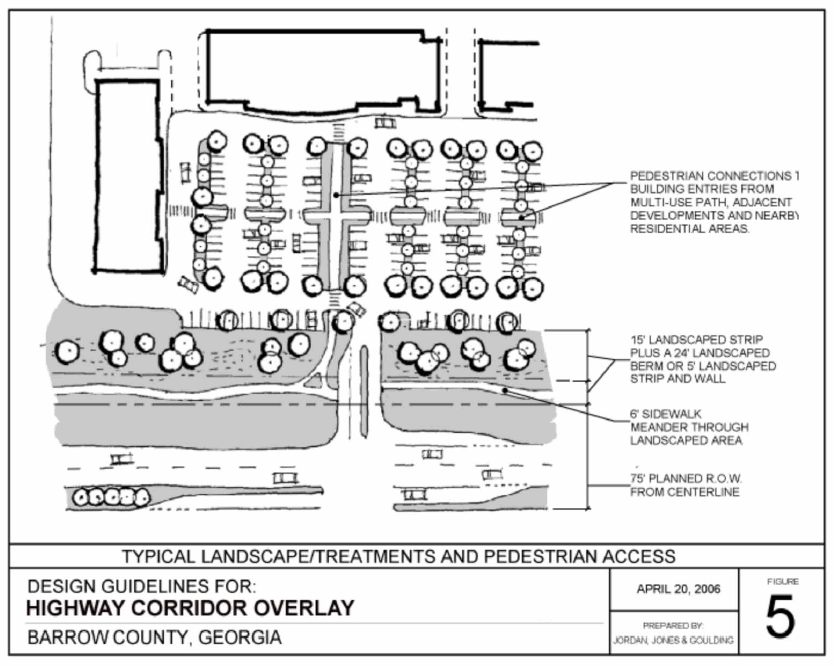
Setbacks for screening areas facing the highway corridor overlay district shall be based on future right-of-way consistent with section 1606, Design Guidelines, Figure 7.
(g)
Environmental controls.
(1)
Stormwater management design shall comply in all respects with the current edition of the Georgia Stormwater Management Manual.
(2)
Parking lot landscaping. Parking areas shall incorporate landscaped areas as required in article VI. Such landscaped areas shall cover at least 12 percent of the parking area, except that this requirement shall have no application to industrial uses.
(h)
Parking requirements. Off-street parking shall be required as in article VI of the Barrow County Unified Development Code, except as provided in this subsection:
(1)
Maximum number of parking spaces. The maximum number of parking spaces that may be constructed on impervious surfaces shall be no more than 125 percent of the minimum number of required parking spaces. Parking spaces in excess of 105 percent shall be constructed on pervious surfaces recommended in paragraph (3)(b) of this subsection. The parking requirements of this subsection (h)(1) shall have no application to industrial uses.
(2)
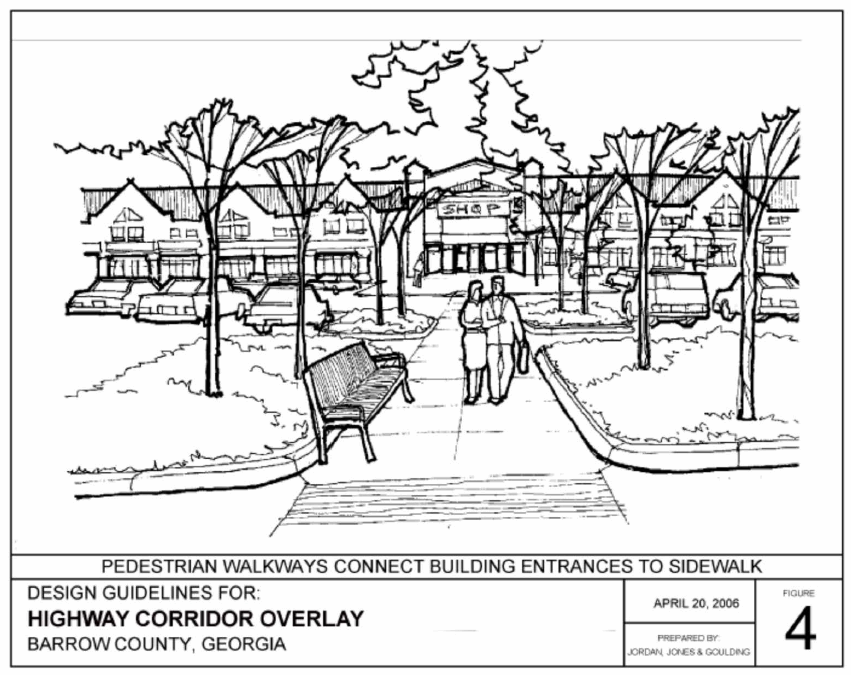
Pedestrian circulation. Parking areas shall be designed to facilitate safe and convenient use by pedestrians, except that this requirement shall have no application to industrial uses. Commercial and multi-family developments shall provide designated pedestrian pathways or sidewalks connecting the front entrance of the principal building to the sidewalk along the abutting street, including marked crosswalks across interior driveways. (See section 1606, Design Guidelines, Figures 4 and 5.)
(3)
Paving materials for parking lots.
a.
All parking areas shall be paved with asphalt, concrete, or pervious materials approved by the planning and community development director.
b.
Pervious paving. Recommended pervious paving materials include those described in the current edition of the Georgia Stormwater Management Manual as the Porous Concrete or Modular Porous Paver Systems under the Limited Application Stormwater Structural Controls.
c.
Paving areas shall be of sufficient size and strength to support the weight of service vehicles.
(4)
On-street parking may be permitted, where appropriate, in accordance with on-street parking standards in article VI.
(i)
Dumpsters.
(1)
Location.
a.
Dumpsters and trash receptacles shall be located where they are not visible from adjacent residentially-zoned properties and shall be adequately screened from view from all other adjacent properties and streets.
b.
Dumpsters shall be enclosed either within a building or out of sight from public streets or located outside to the rear of the principal building.
c.
Dumpsters shall be set back a minimum of five feet from all property lines. If a buffer is required on the subject property line, the dumpster shall not be located within the buffer.
(2)
Pad.
a.
Dumpsters shall be placed on concrete pads of sufficient size and strength to support the weight of service vehicles.
b.
Restaurants and other food service establishments shall place dumpsters on concrete pads that are designed to slope into a drain that is equipped with a grease trap.
(j)
Lighting.
(1)
Streetlights.
a.
Streetlights shall be provided on all public streets; provided, however, that within the right-of-way of State Routes, SR 124, SR 11, 211, 53, 81 or 316 as applicable, as streetlights are not required.
b.
The spacing of street lights shall be staggered, 150 feet on-center, along both sides of the roadway.
c.
All street lighting shall be subject to review and approval of the Barrow County Public Works Department.
d.
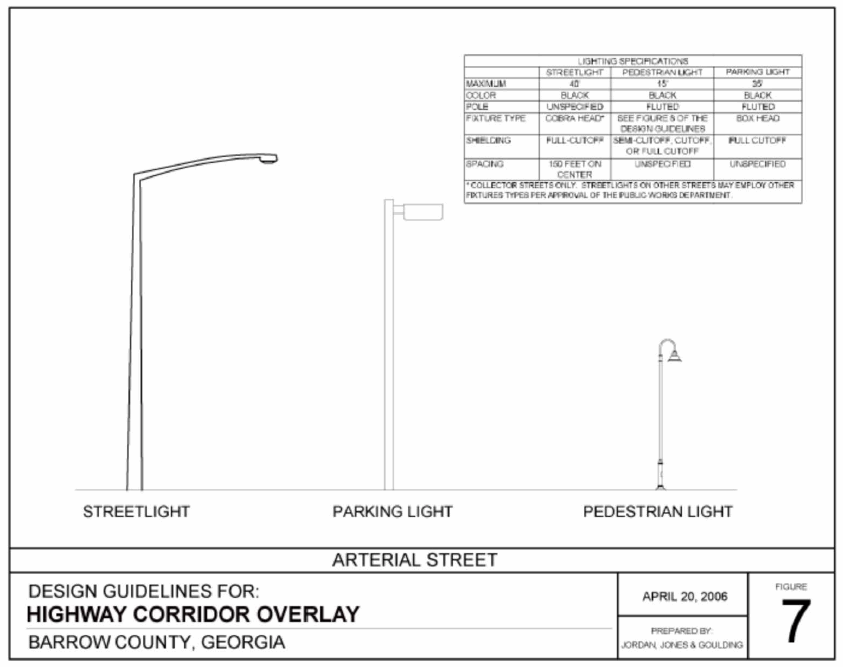
All roadway lighting, streetlights, and parking lights shall be the full cutoff type. Pedestrian lights shall be the semi-cutoff, cutoff, or full-cutoff type.
e.
Streetlights shall be consistent with Table 16.2 and section 1607, Design Guidelines, Figure 7.
(2)
Parking lot, sidewalk, and building illumination.
a.
Lighting shall be designed to prevent light spillover on to adjacent properties. All lighting shall be fully shielded, have recessed luminaries, or be cut-off luminary fixtures mounted in such a manner that the cone of light is directed downward and does not cross any property line of the site.
b.
Only incandescent, florescent, light-emitting diode (LED), metal halide, low-pressure sodium, or color corrected, high-pressure sodium may be used. The same type of lighting must be used for the same or similar types of lighting on any one site.
c.
Pedestrian lights shall be consistent with Table 16.2. and section 1606, Design Guidelines, Figure 7.
d.
Parking light fixtures shall be the box head type, shall have a maximum height of 35 feet, and shall employ a fluted pole. All parking light fixtures and poles shall be black.
Table 16.2: Lighting Specifications
(3)
Security lighting restrictions.
a.
Full cutoff luminaries shall be used for all security lighting.
b.
The number of luminaires remaining on for security lighting shall not exceed one fourth the total number of each type of luminaire number by four, any remainder is counted as a whole number.
(4)
Sign illumination.
a.
Neon signs and internally illuminated window signs are prohibited.
b.
Signs may be illuminated with external lighting fixtures provided that fixtures are directed downward and away from streets and adjacent property and public streets. All lighting shall be fully shielded, have recessed luminaries, or be full cut-off luminary fixtures.
c.
Signs may be illuminated as set forth in section 89-787.
(5)
Drive-under canopies and pump islands at fueling stations. The luminaire shall be recessed into the canopy ceiling so that the bottom of the luminaire does not extend below the ceiling.
(k)
Architectural standards. The following design guidelines and standards apply to all newly constructed buildings used for multi-family residential, office, commercial, or industrial (except where specifically excluded) purposes. These standards do not apply to single-family residential, duplex, storage or warehouse uses.
(1)
General architectural requirements.
a.
The use of a common palette of building materials should be maintained for building facades to create a consistent and traditional architectural identity. Traditional architecture shall include, for example, the use of brick, pitched roofs, low-profile signage, and subdued colors. For large commercial/retail buildings and multi-family buildings, variations in facade, roofline and depth should be provided to lend the appearance of multi-tenant occupancy. All design and construction shall be subject to architectural review by the county or its designated architect to ensure adherence with this subsection (k) and the structures of traditional architecture. The requirements of this paragraph shall have no application to industrial uses.
b.
All ground or roof-mounted mechanical, HVAC, and like systems shall be screened from public street view (within 300 feet) on all sides by an opaque wall or fence made of brick, stucco, split face block, or landscaping.
c.
For all commercial buildings, roof-mounted mechanical, HVAC, and like systems shall be screened from public street view (within 300 feet) on all sides by a raised parapet or pitched roof along the edge of the roofline.
d.
Contrasting accent colors on any single facade shall be limited to no more than ten percent of the total wall area for any single facade.
e.
Permanent mounted exterior neon lights shall not be allowed.
f.
Buildings that are located on outparcels and all accessory buildings shall be constructed of materials complementing the principal building with which they are associated.
g.
Back-lit awnings, roof-mounted lights, and/or roof mounted flag poles are not permitted. Satellite dishes shall be located and painted to blend with the background as much as practical.
(2)
Building materials. Table 16.3 and this subsection outlines allowed building materials that may be used and combined to create a consistent, attractive, interesting and long-lasting building design:
a.
Allowed building materials.
1.
Brick, except that brick veneers that are intended to simulate brick exteriors are not acceptable;
2.
Stone. Natural stone such as, but not limited to, granite, limestone, acid marble are allowed building materials. Terra cotta and/or cast stone, which simulate natural stone, are also acceptable. Painted stone is not allowed;
3.
Split-face block/concrete masonry unit (CMU) is restricted to ten percent of the surface area of the facade;
4.
Tilt/architectural pre-cast concrete is not allowed, except this restriction shall have no application to industrial use buildings;
5.
High grade stucco is restricted to 50 percent of the surface area of a facade, except that this restriction shall have no application to industrial use buildings;
6.
Natural wood and/or cement-based artificial wood siding are allowed only for residential buildings;
7.
Glass;
8.
Exposed concrete block, metal, and tile are not allowed as building materials on a facade.
Table 16.3 Allowable Building Materials
b.
Ratios and amounts of allowed building materials.
1.
Accent/trim exterior building material. Small amounts of building materials such as wood, tile, etc., may be used to enhance the facade of the building or for decorative elements, but should not exceed ten percent of total wall area per facade.
2.
Facade calculations. With the exception of accent/trim materials, there shall be no more than two primary building materials used. When stucco is used as a building material for a facade, it is restricted to 50 percent of the total, except for industrial use buildings. The allowed facade materials shall not apply to entry doors and/or roll-up doors.
c.
The amount of permitted material shall be calculated using the gross square footage of wall area per facade.
For example, a building has a front facade with a gross facade area of 1,200 square feet with 400 square feet consisting of windows and doors. Begin with 1,200 square feet for required building material calculations. A wall area of 1,200 square feet shall have no more than 600 square feet of stucco on the front facade [e.g. (1,200 X 50% = 600)]. The balance shall be brick or other allowed material. Trim or accent material may account for up to ten percent or 120 square feet.
(3)
Roof requirements. Materials for pitched roofs shall be limited to architectural dimensional grade asphalt shingles, natural slate, natural terra cotta, natural wood shake, copper or factory finished sheet metal.
a.
Pitched roofs. All buildings less than 5,000 square feet of gross floor area must have a pitched roof with a minimum pitch of 4:12. All one-story buildings less than 10,000 gross square feet must have a pitched roof (between 3:12 and 12:12); provided, however, that if a pitched roof is not possible, a combination of flat roof and pitched roof is required. Provide a pitched roof on front and side of the building to screen view of any flat roof. Create arcades, drive-under canopies, porches, and other features with pitched roof.
b.
Mansard roofs. Mansard roofs shall have a maximum pitch of 12:12 with a minimum 12-foot vertical surface length.
c.
Flat roofs. Building materials for flat roofs shall meet local codes.
d.
Exposed metal flashing shall be copper or factory finished sheet metal. If factory finished metal flashing is used, such as standing seam, the color must be subdued to blend with other materials or of a color to simulate weathered copper or bronze. All buildings with flat roofs should include parapet articulation on the front facade(s) of such building. There shall be roof articulations/offsets at a minimum of one per each 125 linear feet of length by a change in the top line of the parapet. Additional articulation may occur at any lesser distance. If the front facade is less than 125 linear feet of length, then a minimum of one roof articulation must occur.
e.
Other. Drive under canopies for gasoline pumps may have flat roof with vertical or factory formed facing of finished sheet metal.
f.
The requirements of this subsection (k)(3) shall have no application to industrial use buildings.
(4)
Arcade/structural canopy for retail use. For any multi-tenant commercial development, a covered arcade/structural canopy shall be provided along the front facade of the building. Arcades are covered walkways connected to the principal building. They should be a minimum of five feet in width and designed to provide covered areas for relief from the weather. Different arcade/structural canopy designs may be used for each individual tenant/business within a multi-tenant commercial development provided that they blend aesthetically with the front facade of the building and has the approval of the building owner and the planning and community development director.
(5)
Street orientation. Principal building entrances shall be oriented to public streets.
(6)
Building height. Any building of which 50 percent or more is located within 250 feet of the centerline of an arterial street shall be no more than three stories in height, except that this restriction shall have no application to industrial use buildings.
A relief from height restrictions shall only be allowed if special use approval is granted by the board of commissioners, in accordance with procedures in article XII of the Barrow County Unified Development Code. In deciding whether to grant a height increase, the board of commissioners shall consider the following factors, in addition to those listed in article XII.
a.
Proximity and relationship of the proposed building to other buildings that are more than three stories or 35 feet in height.
b.
Impact of the proposed building on single-family residences on nearby tracts.
c.
Topography and vegetation that screen the view of the proposed building.
d.
On-site screening and/or landscaped buffers.
e.
Provision of public open space in exchange for increased building height.
f.
The effect of additional building height on traffic congestion.
g.
Access of the site to major traffic arteries.
h.
Economic development opportunities for the Barrow County.
i.
The necessity of greater building height to the function of the proposed use.
j.
The quality of the architectural design and its compatibility with its surroundings.
(7)
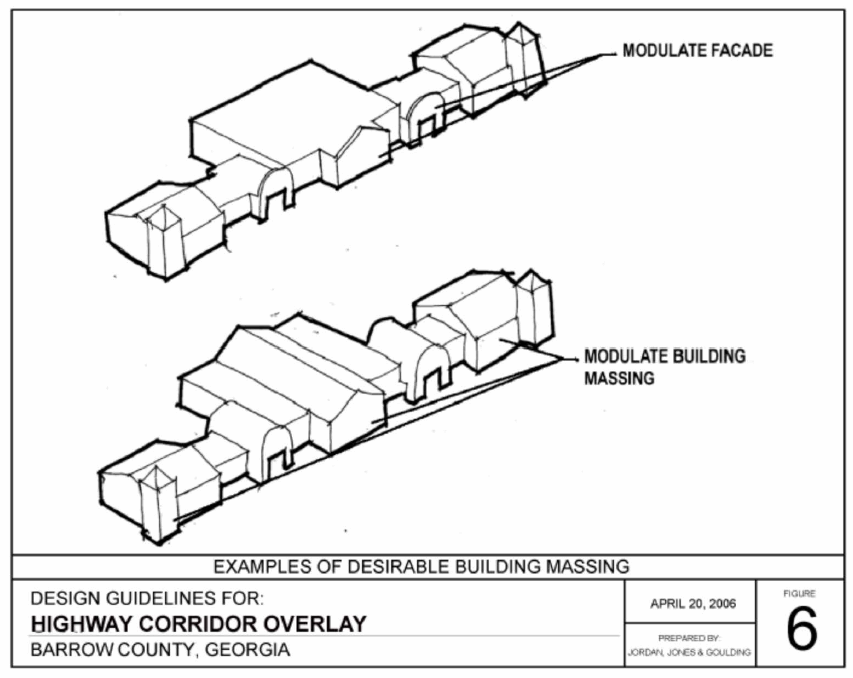
Building massing and modulation. (See section 1606, Design Guidelines, Figure 6) Except for industrial use buildings, the massing of building facades longer than 150 feet that are approximately parallel to the right-of-way and oriented to a public street shall be modulated to increase visual interest, as follows.
a.
Building facades that are less than 500 feet long shall be modulated at intervals no greater than 100 feet in length.
b.
Building facades that are more than 500 feet long shall be modulated with intervals no greater than 20 percent of the length of the facade.
(8)
No nonresidential building shall have less than 2,000 square feet of heated floor space.
(9)
Building design, except for industrial use buildings, shall include minimum one-foot-deep cornices along the entire front facade of buildings and extending for a distance of at least ten feet along the sides of buildings.
(10)
Building designs, except for industrial use buildings, shall include a minimum two-foot-high contrasting base, along the entire front facade of buildings and extending for a distance of at least ten feet along the sides of buildings.
(11)
Satellite dish antennae. No satellite dishes shall be permitted within view from public streets.
(12)
Off-street loading areas. Off-street loading areas shall be located in the rear of buildings and screened from view from adjacent property or streets.
(l)
Signage. Except as provided in this subsection, signage shall comply with the regulations in article VII of the Barrow County Unified Development Code.
(1)
Freestanding and project entrance signs shall be limited to ground signs. round signs shall be limited to base and sign structure shall be constructed of materials such as brick, stone, stucco, wood or metal consistent with the architecture and exterior treatment of the building.
(2)
The maximum sign area of any ground sign, inclusive of any border and trim, but excluding the base, apron, supports and other structural members shall be:
a.
Ground signs on lots zoned commercial or industrial, including shared signs, on lots with more than one tenant shall be no greater than 50 square feet in sign area.
b.
Ground signs on lots zoned commercial or industrial with one tenant shall be no greater than 32 square feet in sign area.
c.
Ground signs on lots zoned O-I shall be no greater than 32 square feet of sign area.
d.
Ground signs for single business premises shall be no greater than 32 square feet in sign area.
(Ord. of 10-13-2020; Ord. of 1-20-2022, § 1(Exh. A))
Sec. 89-1605. - Public improvement standards.
Public rights-of-way within the Highway Corridor Overlay District shall be improved in accordance with the following standards:
(a)
Street standards—Public rights-of-way located within the Highway Corridor Overlay District shall be classified by type (i.e. Arterial, Collector, Local, or Nonresidential Access) and shall be consistent with section 1606 Design Guidelines as follows:
(1)
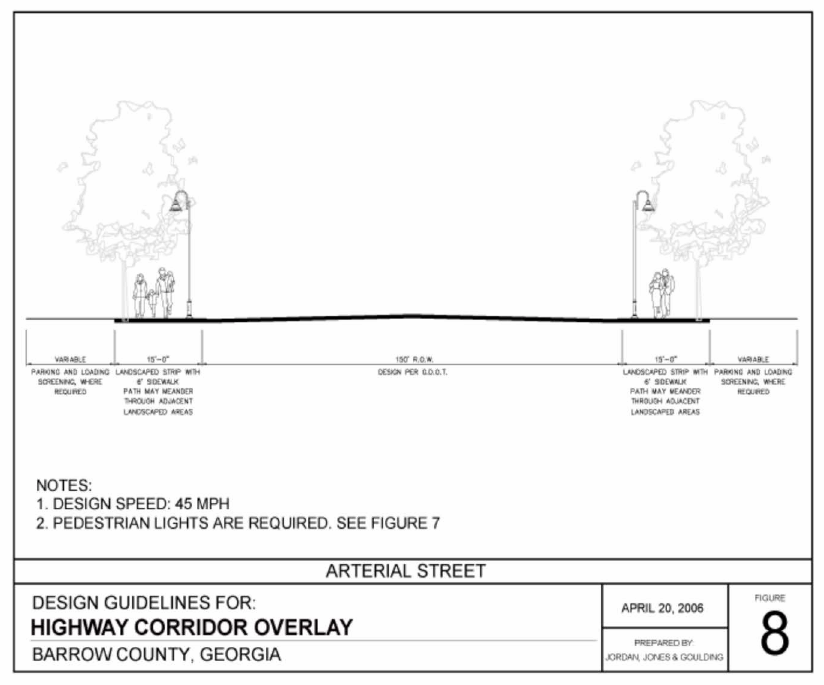
Arterial (future design for Highway Corridor District—See section 1606, Design Guidelines, Figure 8):
a.
45-mph design speed.
b.
Minimum 150-foot right-of-way.
c.
15-foot (minimum) wide landscaped strip outside planned right-of-way (both sides of street), including a six-foot wide sidewalk.
d.
Pedestrian lights are required in landscaped strip on both sides of arterial.
e.
Street trees are required in landscaped strip on both sides of arterial.
(2)
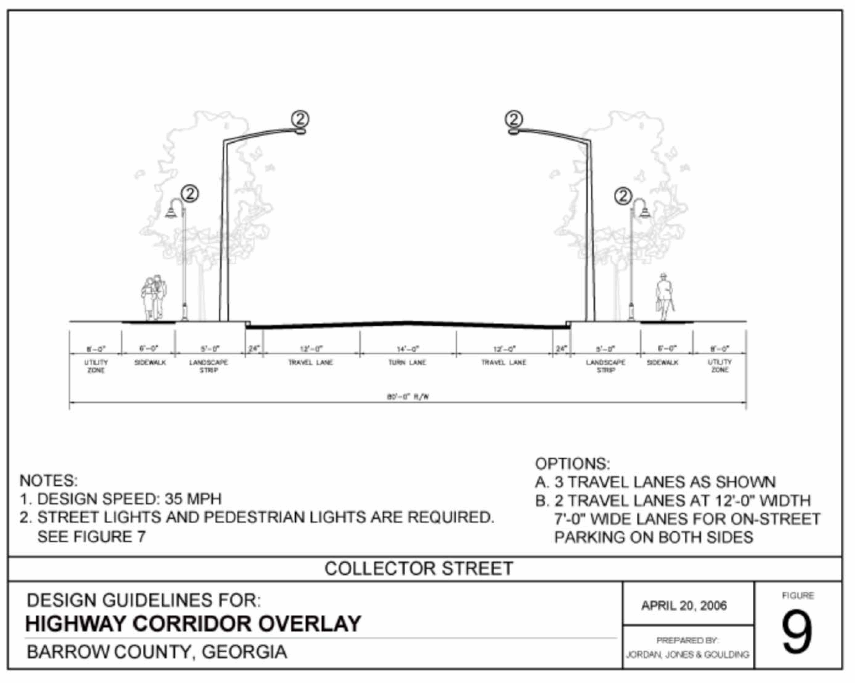
Collector (See section 1606, Design Guidelines, Figure 9):
a.
35-mph design speed.
b.
Minimum 64-foot right-of-way.
c.
Depending on adjacent land use, lanes shall conform to one of the following two options:
1.
Two travel lanes at 12 feet with center turn lane at 14 feet in commercial areas.
2.
Two travel lanes at 12 feet with turn lane at intersection and on-street parking provided between intersections for planned developments or residential areas.
d.
24-inch-wide curb and gutter.
e.
Five-foot (minimum) wide landscaped strip along outside curb (both sides of street).
f.
Six-foot (minimum) wide sidewalk outside landscaped strip (both sides of street).
g.
Streetlights and pedestrian lights are required in landscaped strip on both sides of collector.
h.
Street trees are required in landscaped strip on both sides of collector.
(3)
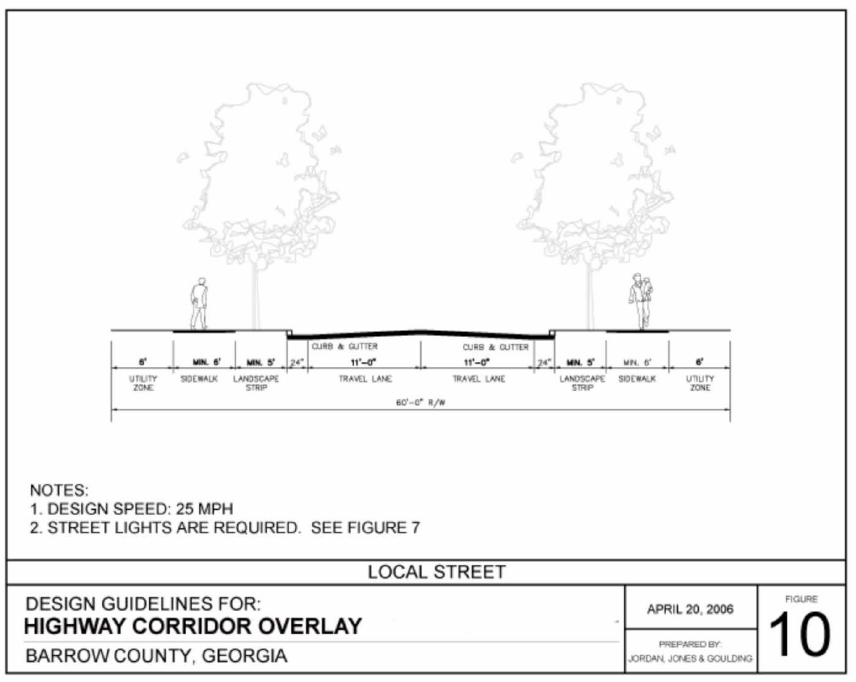
Local streets (See section 1606, Design Guidelines, Figure 10):
a.
25-mph design speed.
b.
Minimum 50-foot right-of-way.
c.
Two travel lanes at 11 feet each.
d.
24-inch-wide curb and gutter.
e.
Five-foot (minimum) wide landscaped strip along outside curb.
f.
Six-foot (minimum) wide sidewalk outside landscaped strip.
g.
Streetlights are required in landscaped strip on both sides of local street.
h.
Street trees are required in landscaped strip on both sides of local street.
(4)
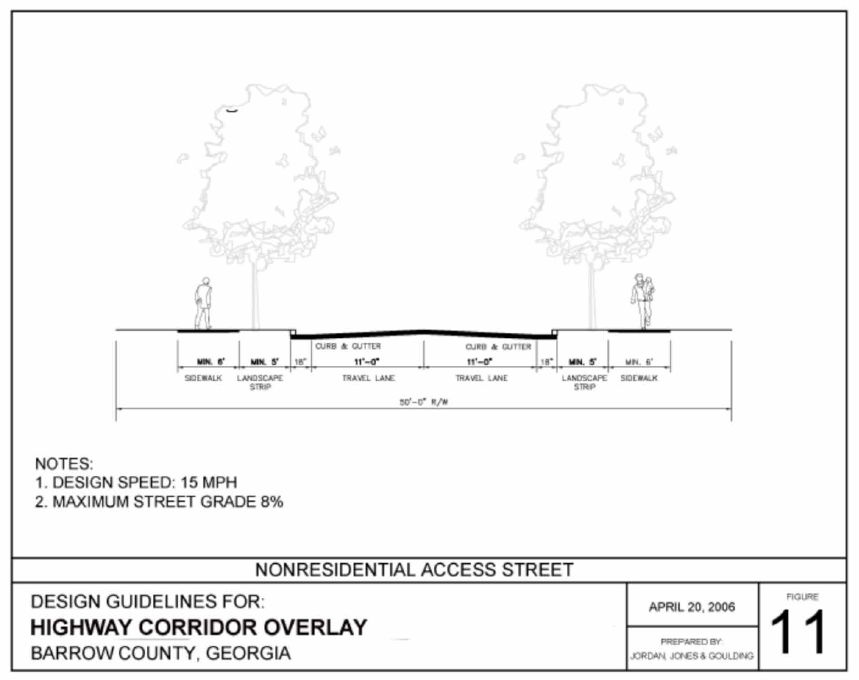
Nonresidential access street (See section 1606, Design Guidelines, Figure 11):
a.
15-mph design speed.
b.
Minimum 50-foot right-of-way.
c.
Two travel lanes at 11 feet each.
d.
18-inch-wide curb and gutter.
e.
Five-foot (minimum) wide landscaped strip along outside curb.
f.
Six-foot (minimum) wide sidewalk outside landscaped strip.
g.
Street trees are required in landscaped strip on both sides of local street.
(5)
Underground utilities are required for all street frontages. Upon written application pursuant to article XIII, an exception may be granted by the board of appeals in cases where, due to unique topography or the presence of rock, the installation of underground utilities would present a severe and unique hardship.
(b)
Network standards.
(1)
Connectivity. Within all nonresidential or multi-family developments or any single-family residential development of five or more acres, the following standards shall apply unless a variance is sought and obtained from the board of appeals pursuant to article XIII due to unusual topography or environmental constraints such as major streams and rivers that create a severe and unique hardship:
a.
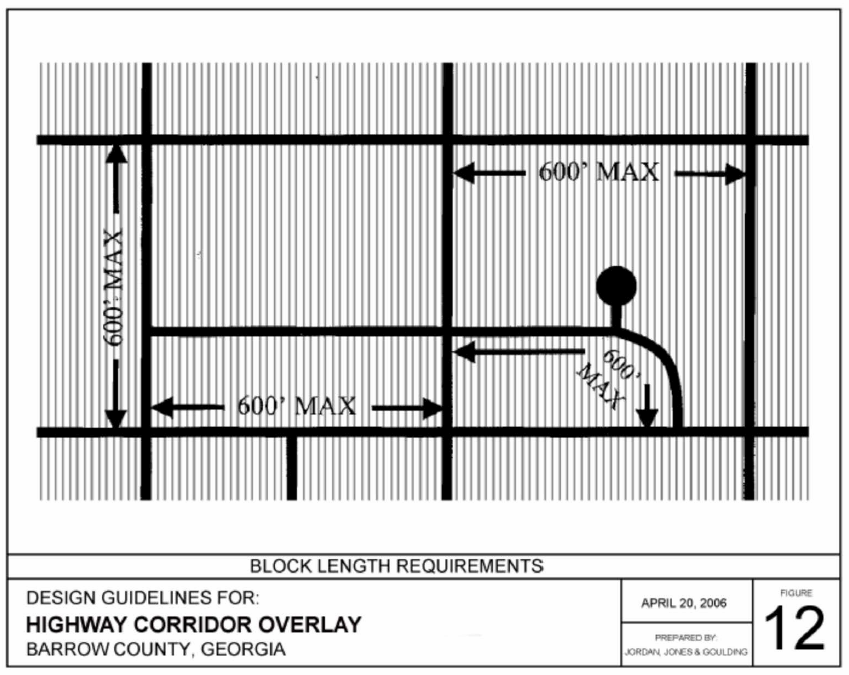
No local street may be longer than 600 feet without an intersection with another local through street. Cul-de-sac streets shall not count as through streets. (See section 1606, Design Guidelines, Figure 12.)
b.
Continuous pedestrian walkways shall be provided to connect building entrances to required sidewalks along street frontage.
c.
A cul-de-sac street that ends within 200 feet of the right-of-way of an adjacent collector or arterial street shall provide a five-foot wide sidewalk in a ten-foot-wide easement connecting the sidewalk on the cul-de-sac to the sidewalk on the adjacent collector or arterial street.
d.
Dead-end streets, including cul-de-sac streets, shall not exceed 300 feet in length and shall not serve more than 30 dwelling units.
(2)
Vehicular access points: Minimum number of driveways or streets required per Table 16.4 below, except that the minimum number of vehicular access points to public streets as provided in Table 16.4 shall have no application to industrial uses.
Table 16.4: Minimum Vehicular Access Points
(3)
Utilization and provision of sub-arterial street connections to and from adjacent developments and developable parcels.
a.
All development plans shall incorporate and continue all sub-arterial streets stubbed to the boundary of the development plan by previously approved development plans or existing development.
b.
All development plans shall provide for future public street connections to adjacent developable parcels by providing a local street connection spaced at intervals not to exceed 600 feet along each development plan boundary that abuts potentially developable or redevelopable land.
(4)
Interparcel access. For developments along an arterial or collector street, except where a variance is sought and obtained from the board of appeals pursuant to article XIII because of topographic or other site-specific constraints that create a unique and sever hardship, compatible developments, as determined by the planning and community development director, shall provide a network of nonresidential access streets that meet the following:
a.
Access streets shall be constructed for a commercial or multi-family residential development that abuts another commercial or multi-family residential development, whether existing or planned. The development of the site shall incorporate the following:
1.
Continuous nonresidential access street, where necessary to connect adjacent parcels along the thoroughfare. (See section 1606, Design Guidelines, Figure 1.)
2.
Driveway aprons, stub-outs and other design features to indicate that abutting properties may be connected to provide cross access.
b.
New commercial or multi-family property that abuts a planned, new or existing multi-family residential property shall provide for a five-foot wide sidewalk connecting the two uses.
c.
New multi-family residential development that abuts a planned, new or existing commercial property shall provide for a five-foot wide sidewalk connecting the two uses.
(5)
Crosswalks.
a.
All intersections shall contain crosswalks that connect to sidewalks in all quadrants.
b.
Crosswalks shall be either demarcated with high-reflectivity thermoplastic paint or brick pavers.
(c)
Street trees. Canopy trees shall be provided in street rights-of-way including medians and required landscaped strips adjacent to all streets.
(1)
Appropriate street tree species include the following:
Large trees: Average spacing 40 feet on center:
• Nuttall Oak
• Shumard Oak
• Willow Oak
• Gingko (variety: President, Autumn Gold, male gender)
• Princeton Elm
• Chinese Elm (varieties Allee, Athena, Drake, Bosque)
• Bald Cypress (variety: Shawnee Brave)
• Zelkova (variety: Green Vase or Village Green)
• Northern Red Oak
• Red Leaf Maple
Small trees: Average spacing 20 feet on center:
• Crepe Myrtle
• Saucer Magnolia (variety: Butterflies)
• Chinese Fringe Tree
• Golden Rain Tree
• Texas Redbud (Cercis reniformis)
• Kousa Dogwood
• Washington Hawthorn 'Princeton Sentry'
• Zelkova (variety: Wires)
(2)
No more than 25 (or 25 percent of the total number, whichever is greater) of the trees installed may be of any one genus.
(3)
No more than 25 percent of the street trees used in a single development shall be of the small tree species.
(d)
Improvement Guarantees. At the option of Barrow County, the developer may be required to provide to the county financial security to guarantee the installation of project improvements required in this article. The developer's financial guarantee may be any of the following: (1) An escrow of funds with the county; (2) An escrow of funds with a bank upon which the county can draw; (3) An irrevocable letter of credit or commitment upon which the county can draw; (4) A performance bond for the benefit of the county upon which the county can collect; and (5) Any other form of guarantee approved by the board of commissioners that will satisfy the objectives of this subsection. The guarantee shall be in an amount sufficient to secure the full costs, as determined by the Barrow County Director of Public Works, of the construction cost of the improvements, based on the most recent edition of Georgia Department of Transportation "Item Means Summary" or other comparable standardized cost estimation procedure.
(Ord. of 10-13-2020; Ord. of 1-20-2022, § 1(Exh. A))
Sec. 89-1606. - Design guidelines.
(a)
Property development standards.
(b)
Public Improvements Standards.
(Ord. of 10-13-2020)
EXHIBIT A. AIRPORT HAZARD OVERLAY DISTRICT MAP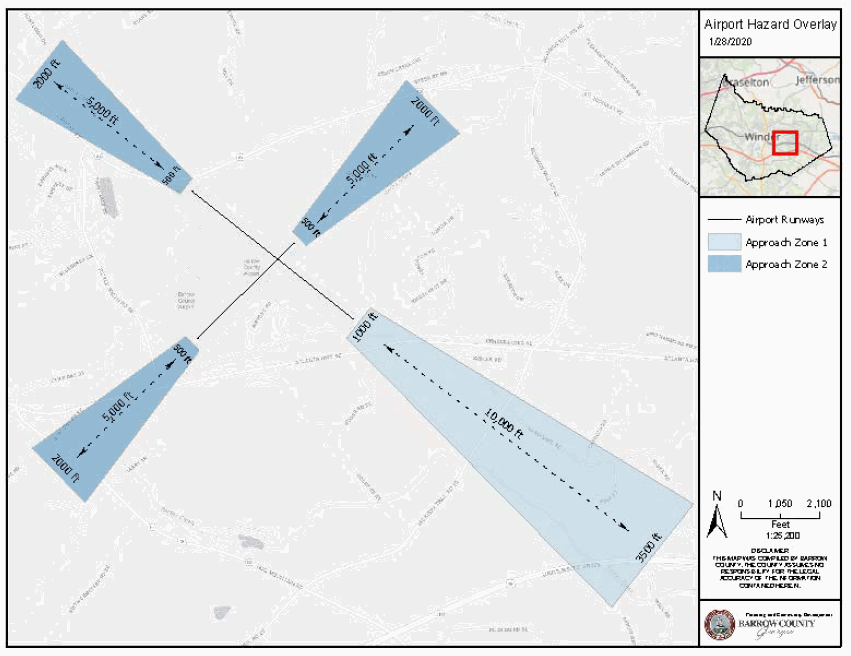
EXHIBIT B. HIGHWAY CORRIDOR OVERLAY DISTRICT MAP