
Bethlehem City Zoning Code
ARTICLE VI
PARKING AND LOADING REQUIREMENTS
Sec. 89-721.- Purpose of article.
This article presents the minimum standards for vehicle parking for all land uses in the county (including design and construction standards), minimum standards for truck loading, and requirements for the provision of landscaping related to parking and loading areas.
(Ord. of 10-13-2020)
Sec. 89-722. - Parking; when required.
Permanent parking spaces shall be provided in accordance with the requirements of this article whenever any of the following occurs:
(a)
At the time of the establishment of any use, or erection of any building.
(b)
At the time of occupancy of a building by a new use.
(c)
At the time any principal building is enlarged or increased in capacity by adding dwelling units, guest rooms, seats or floor area.
(Ord. of 10-13-2020)
Sec. 89-723. - Parking plans required.
Parking plans are required as follows:
(a)
A parking plan for all but detached single-family and two-family residential uses shall be submitted to the planning and community development department with the building plans.
(b)
The proposed plan will be reviewed by the planning and community development department and the public works department to insure its conformance with all applicable provisions of this resolution and with the Barrow County development regulations.
(c)
Occupancy or use of a building is prohibited until related parking facilities are completed in accordance with the approved plan, as indicated by the planning and community development department. The provision of the required spaces on a temporary basis on a hard-surface sub-base (sub-grade plus an asphalt first layer or bound crushed stone aggregate) shall satisfy this requirement.
(Ord. of 10-13-2020)
Sec. 89-724. - Number of parking spaces required.
(a)
Parking for residents, employees, customers and visitors. Space for the parking of motor vehicles must be provided for every property that contains a principal use, for the safety and convenience of the people who live or work on the property, shop or do business on the property, or otherwise visit the property in the normal course of activity of the principal use.
(1)
Minimum number of parking spaces required. The minimum number of parking spaces to be provided for residents, employees, customers and visitors for each type of land use shall be determined by the following Table 6.1, rounded up to the nearest whole parking space. Developments containing two or more of the uses listed on Table 6.1 shall provide the number of spaces required for each use (except as may be reduced under shared parking, below).
(2)
Maximum number of parking spaces allowed.
a.
Nonresidential uses. The maximum number of parking spaces allowed on a nonresidential property for employees, customers and visitors shall not exceed 120 percent of the minimum number of parking spaces required, as determined for the type of land use by the following Table 6.1.
b.
Residential uses. The maximum number of outdoor spaces per dwelling unit, including those located within a carport, shall not exceed five. Additional spaces may be located within an enclosed garage.
(3)
Deviation from parking requirements.
a.
Notwithstanding the minimum and maximum requirements of paragraphs (1) and (2) of this subsection (a), the county recognizes that due to the particulars of any given development, the inflexible application of the parking standards set forth therein may result in a development either with inadequate parking space or parking space in excess of its needs. The former situation may lead to traffic congestion or parking violations on adjacent streets as well as unauthorized parking in nearby lots; the latter situation is inefficient. Therefore, the planning and community development director may administratively allow deviations from the minimum or maximum parking requirements of paragraphs (1) and (2) whenever they find that the requested deviation is justified by the described development and will not adversely impact traffic circulation or public health, safety and welfare.
b.
The number of parking spaces required for a development shall be based upon the anticipated parking demand of individual uses based upon the operating characteristics of the individual use. The planning and community development director shall base their decision for such deviation on site and operational plans submitted in support of the requested deviation and such other documents as the planning and community development director may reasonably determine are necessary to determine the number of parking spaces required for the development.
c.
Notwithstanding anything to the contrary herein, the planning and community development director shall not authorize a deviation to the number of parking spaces by below 75 percent of the minimum required spaces or above 25 percent of the maximum required spaces. Requests for greater deviations shall be treated as a hardship variance pursuant to the requirements of article XIII.
Table 6.1: Minimum Parking Spaces Required by Use
1 Square feet.
2 Gross floor area—The total area of all floors, measured between the exterior walls of a building.
3 Defined as follows:
Restaurant, custom service: An establishment where food and drink are prepared to individual order, ordered and served at the table, and consumed primarily within the principal building or in established outdoor dining areas.
Restaurant, family: A custom service restaurant primarily oriented to sit-down service, occasionally with take-out service but no drive-in or drive-through facilities, and having an average turnover rate generally of less than one hour. Family restaurants are usually moderately priced and frequently belong to chains such as Denny's, Pizza Hut and Shoney's.
Restaurant, quality: A custom service restaurant primarily oriented to fine dining and often associated with a particular cuisine. Quality restaurants are characterized by table settings of better silverware, china, glassware and cloth tablecloths, and have average turnover rates generally of one hour or more.
4; Gross leasable area—The total area of all floors intended for occupancy and the exclusive use of tenants, specifically excluding public or common areas such as utility rooms, stairwells, enclosed malls and interior hallways.
(b)
Parking for company-owned vehicles not included. Every business that stores vehicles owned by the business on site overnight (such as a company fleet), or maintains a stock of vehicles as part of its business activities (such as a car sales lot, a salvage and wrecking yard, car rental agency, etc.), shall provide for adequate parking or storage for the vehicles such that no parking occurs in a public right-of-way or in an area that has not been improved as a parking lot or storage yard. Such parking spaces shall be in addition to those required for residents, employees, customers and visitors.
(c)
Maneuvering lanes not considered parking. Areas designated for temporary occupancy of vehicles while maneuvering on a site, such as queuing lanes for a drive-in window, are not considered parking spaces.
(d)
Dedication to parking use.
(1)
Parking spaces provided to meet the minimum requirements of this article shall not be used for the sale, repair, dismantling or servicing of any vehicles, or for the sale, display or storage of equipment, goods, materials or supplies.
(2)
Parking spaces provided to meet the minimum requirements of this article shall not be used to meet the minimum parking requirements of any other use, except as provided for shared parking, below.
(3)
Parking spaces provided to meet the minimum requirements of this article shall not be reduced in number nor otherwise lose their functional ability to serve the land use for which they were required.
(e)
Handicap accessible parking spaces.
(1)
Handicapped spaces are to be provided as required by the federal Americans with Disabilities Act and the Georgia Accessibility Code for all multi-family and nonresidential uses; including but not limited to the requirements of this section.
(2)
Handicap accessible spaces shall be provided in each parking lot in the following ratio to the total number of spaces otherwise required for the use under Table 6.2.
(3)
Handicap accessible parking spaces shall be counted as part of the total number of parking spaces required under this article.
(4)
Handicap accessible parking spaces shall have an adjacent aisle five feet wide, and one in every eight handicapped spaces shall be adjacent to an aisle eight feet wide and the space shall be signed "Van accessible." Handicapped parking space aisles shall be clearly demarcated by lines painted on or otherwise applied to the parking lot surface.
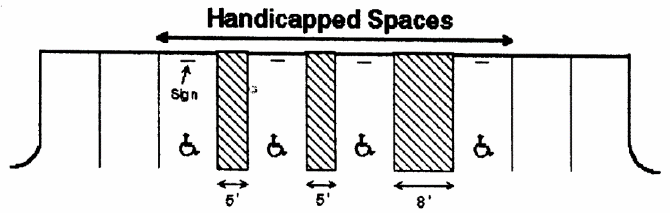
Figure 6.1 Handicapped Spaces
(5)
Handicap accessible parking spaces shall be located on a surface with a slope not exceeding one vertical foot in 50 horizontal feet (1:50).
(6)
Wheelchair ramps shall be provided in accordance with county specifications at locations appropriate to normal travel routes from the parking lot to the principal use.
Table 6.2: Handicap Accessible Spaces Required
Source: Americans with Disabilities Act Accessibility Guidelines.
(f)
Open space set aside for reduced parking. The site plan for a commercial or industrial use may, subject to approval by the planning and community development director, be designed to provide sufficient open space on the subject site to accommodate the additional parking spaces otherwise required by this section. Such open space shall be in addition to required yards, setbacks, driveways, private streets, loading and service areas and open space requirements. Sufficient open space shall be provided which, if converted to parking spaces, would provide off-street parking to meet the full requirements of this section at the time of application.
(Ord. of 10-13-2020)
Sec. 89-725. - Proximity of parking spaces to use.
Location of parking spaces. All parking spaces required to meet the minimum standards of this article for residents, employees, customers or visitors shall be located in proximity to the use that the spaces serve, as follows:
Table 6.3: Location of Parking Spaces
(Ord. of 10-13-2020)
Sec. 89-726. - Parking of certain vehicles.
(a)
In any residential district, it shall be unlawful to park wreckers, dump trucks, flat-bed trucks, tow trucks, mechanical earthmoving equipment or any commercial vehicle except that such vehicles used exclusively for an agricultural purpose on a parcel may be parked in an AG or AR district.
(b)
It shall be unlawful to park travel trailers, recreational vehicles, campers, motorized homes, boats, personal watercraft, wave runners, all-terrain vehicles or trailers of any type in the front yard, or in any other yard, except as hereinafter provided, in any residential district. In residential districts, travel trailers, recreational vehicles, campers, motorized homes, boats, personal watercraft, wave runners, all-terrain vehicles and trailers may only be parked or stored in an enclosed garage or carport or in rear or side yards, provided that they remain more than 20 feet from the rear property line and ten feet from the side property line.
(c)
No such vehicle shall be occupied for sleeping or as a residence, either permanently or temporarily, when so parked.
(d)
Notwithstanding any other provision of this section, a school bus may be parked on property owned or occupied by the school bus operator provided that all of the following conditions are met:
(1)
Zoning and minimum lot area. The parcel must be a minimum of five acres in size and zoned agricultural (AG) or agricultural-residential (AR); provided, however, that the parking of school buses shall be prohibited on any parcel that is part of a platted residential subdivision, regardless of zoning classification and parcel size.
(2)
Access to the parcel shall be from a public street. In order to protect the integrity of paved public streets, a minimum of ten feet of paved or concrete driveway or apron shall abut the paved public street at the property access point to be utilized by the school bus. The above requirement for a paved driveway or apron shall not apply if the parcel's direct access is from an unpaved public street.
(3)
Vehicle parking location. The school bus shall be parked within the rear yard of the parcel, outside of all required setbacks and/or buffers.
(4)
Parking area surface. Unless the school bus is otherwise parked or stored in an enclosed structure, the school bus shall be parked upon a concrete or gravel surface of sufficient size to accommodate all wheels of the school bus.
(5)
Limit of one vehicle. No more than one school bus may be parked on a parcel as otherwise permitted by this subsection.
(Ord. of 10-13-2020)
Sec. 89-727. - Off-site parking.
If required parking spaces are not located on the same lot as the particular use, building or establishment they are intended to serve, the following shall apply:
(a)
The parking spaces must be located on a property that has the same zoning classification as the property that the spaces serve, or a less restrictive zoning classification.
(b)
No required parking spaces may be located across any state or US highway from the use they are intended to serve unless a signaled cross-walk is provided.
(c)
An easement (or other recordable instrument satisfactory to the planning and community development director) dedicating the off-site parking to the property that the spaces serve shall be recorded with the clerk of the superior court and a copy provided to the planning and community development director. The document must be written to survive future changes in ownership in perpetuity, unless the agreement is dissolved with approval by the board of commissioners.
(d)
Off-site parking spaces shall be located in proximity to the use that the spaces serve, in accordance with the locational requirements of Table 6.3, above, or transportation services shall be provided, such as a shuttle bus.
(Ord. of 10-13-2020)
Sec. 89-728. - Shared parking facilities.
The required parking space for a number of separate uses may be combined in one lot, but the required space assigned to one use may not be assigned to another use at the same time, except as follows:
(a)
Shared parking between day and night users. One-half of the parking spaces required for churches, theaters or assembly halls whose peak attendance will be at night or on Sundays may be assigned to a use which will be closed at night and on Sundays.
(b)
Mixed use developments. Parking spaces may be shared by more than one use if the planning and community development director finds that the total number of spaces will be adequate at the peak hours of the uses they serve. The ratios on Table 6.4 may be used in determining the time of day and the day of the week at which the maximum number of spaces will be needed by the uses served by the shared parking facility.
(c)
Availability of shared spaces. Parking spaces that are proposed to be shared among two or more uses must be clearly available to each use and not appear in any way to be serving a particular use, either through signage dedicating the spaces or through design techniques that would tend to orient use of the spaces to a particular business or building.
(d)
Recordation of shared parking agreement.
(1)
Shared parking arrangements must be committed to writing in an instrument acceptable to the planning and community development director and approved by the owners of each of the affected properties or uses.
(2)
The instrument must be approved by the planning and community development director and shall be recorded with the clerk of the superior court. A copy of the recorded document must be supplied to the planning and community development department. The document must be written to survive future changes in ownership in perpetuity, unless the agreement is dissolved with approval by the board of commissioners.
Table 6.4: Percentage of Required Parking Spaces by Time Period
By way of example, the following illustrates shared parking calculations for a particular mixed-use development:
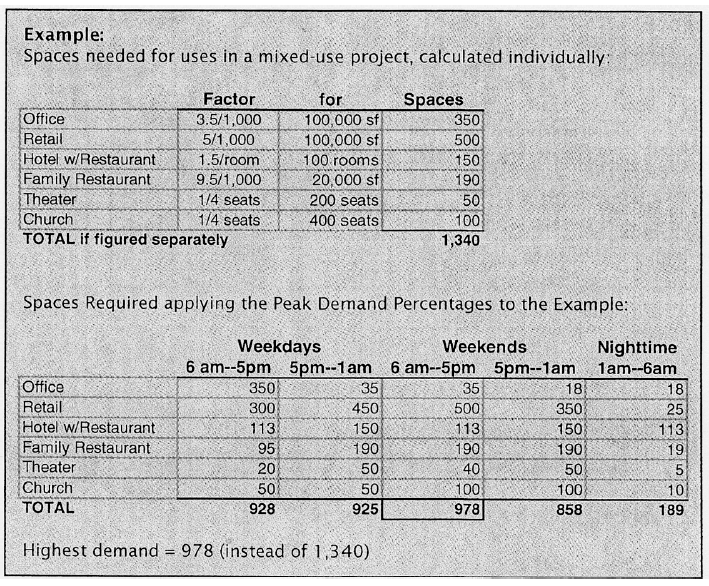
Figure 6.2 Parking calculations
(Ord. of 10-13-2020)
Sec. 89-729. - Design requirements for off-street parking lots.
Except for single-family detached and two family residential uses (unless otherwise noted), the provisions of this section apply to all off-street parking spaces and parking areas, whether the parking meets or exceeds the number of spaces required to serve a particular use or the parking lot is operated as a principal use on a property and not dedicated to serving a particular use.
(a)
Orientation to street.
(1)
All areas devoted to off-street parking shall be so designed and be of such size that no vehicle is required to back into a public street to obtain access.
(2)
The distance from a parking area access drive to the intersection of two streets, and the distance between driveways at the street right-of-way between adjacent properties, shall not be less than 20 feet for a single-family or two-family dwelling and not less than 50 feet for all other uses. Distances must be measured from the back of the driveway curb at the right-of-way line (or from the edge of the driveway if curbs are not required).
(3)
The number of driveways that access a property from any one street, road or highway shall be limited as follows:
a.
A permit to access a state road must be obtained from the Georgia Department of Transportation and submitted to the director of public works before the driveway access can be approved.
b.
Along state or U.S. numbered highways, and along all other major collector and arterial thoroughfares, no more than one point of vehicular access from a property shall be permitted for each 300 feet of lot frontage, or fraction thereof.
c.
Along all other streets or roads, no more than two points of vehicular access from a property to each abutting public road shall be permitted for each 400 feet of lot frontage, or fraction thereof; provided however, that lots with 150 feet of frontage or less shall have no more than one point of access to any one public street. The director of public works shall determine whether the points of access may be unrestricted or will have to be designed for right-in, right-out traffic flow.
(b)
Off-street parking spaces.
(1)
No parking spaces shall be accessible directly from an access driveway within the first 30 feet of the driveway back from the street right-of-way line.
(2)
Every parking space shall provide a useable rectangular area at least nine feet wide by 20 feet long. Access aisles shall not encroach into this minimum rectangular area.
(3)
Every parking space shall be clearly demarcated by lines painted on or otherwise applied to the parking lot surface.
(c)
Access and circulation.
(1)
Access aisles in parking lots must be at least 24 feet wide serving spaces that are perpendicular (90 degrees) to the access aisle, and provide for two-way traffic. Access aisles serving spaces that are oblique (slanted) to the access aisle shall be limited to one-way traffic, and shall have the following minimum widths: 18 feet wide serving spaces that are at a 60 degree angle to the aisle, and 13 feet wide serving spaces that are at a 45 degree angle to the aisle. (See the parking illustration, below.) Angles less than 45 degree to the access aisle are not allowed, except for parking spaces that are parallel to the access aisle.
(2)
One-way traffic aisles must be clearly marked with directional arrows on the pavement at each intersection with another aisle.
(3)
Ingress and egress to parking areas shall be by means of paved driveways from the adjoining street.
a.
The minimum width of driveways for ingress and egress shall be the same as those specified above for aisles. Driveway width, for the purpose of this section, shall include only the pavement and not the curbs and gutters.
b.
The slope of ingress and egress driveways at their connection to the adjoining street shall not exceed that allowed by county specifications for landings at residential street intersections.
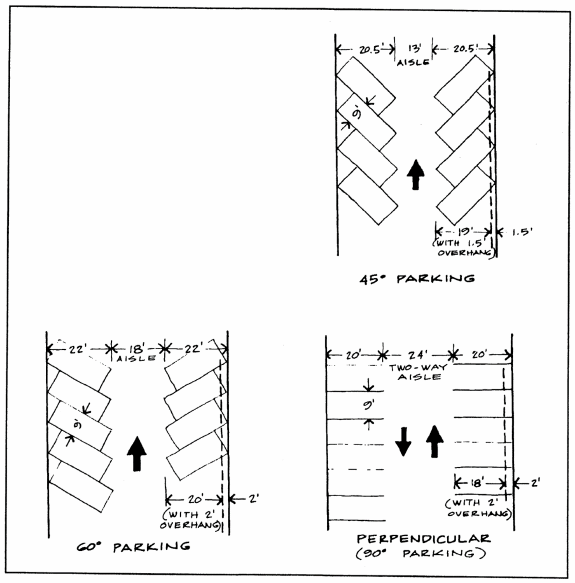
Figure 6.3 Parking illustration
(d)
Setback requirements; off-street parking lots.
(1)
No parking shall be established in the minimum required front setback of any residential zoning district except for a single-family or two-family residential use, nor shall more than 35 percent of this required front yard be paved or used for parking under any circumstances.
(2)
Unenclosed off-street parking for single-family and two-family dwellings shall have no setback requirements.
(3)
Off-street parking for all other uses, including multi-family residential, commercial, industrial, and institutional uses, shall be setback from the front property line by at least ten feet. An additional ten-foot setback from any buffer required along a side or rear property line shall also be maintained.
(4)
The required setback area between the front property line and the parking area shall be used for landscaping and/or screening as required in section 89-735, below.
(e)
Lighting of parking areas.
(1)
Adequate lighting shall be provided if the facilities are to be used at night. Any lights used to illuminate the parking area shall be arranged, located or screened to direct light away from any adjoining residential use. "Shoe box" recessed lighting fixtures on poles, and motion-detector security lighting, shall be utilized for this purpose.
(2)
Lighting standards in and surrounding parking lots shall not conflict with tree locations, considering the height and breadth of the trees normally achieved at maturity and their root systems.
(Ord. of 10-13-2020)
Sec. 89-730. - On-street parking standards.
(a)
On-street parking allowed. On-street parking may be used on Barrow County maintained public streets if approved as a part of a special use application and shall be limited to local streets internal to townhouse developments, mixed use master planned developments, traditional neighborhood developments, and senior housing developments that provide pedestrian walkability within the project.
(1)
On-street parking shall be shown on the zoning exhibit and the concept plan and is subject to planning and community development director and zoning review and approval prior to submission to the board of commissioners.
(2)
On-street parking shall not be permitted for a single building on an individual parcel, but rather shall be permitted to serve multiple buildings or parcels within in a townhouse development, master planned development, traditional neighborhood development, and senior housing development. In addition, individual businesses shall not designate any one on-street parking space for exclusive use by their patrons.
(b)
On-street parking space requirements.
(1)
Each on-street parking space shall be nine feet wide by 22 feet long as measured from the face of curb.
(2)
On-street parking calculations shall be provided on the zoning exhibit and concept plan.
(3)
Handicap parking shall comply with the ADA Standards, the Georgia State Law for Accessible Design and the Georgia Accessibility Code for Buildings and Facilities for all multi-family and nonresidential uses.
(4)
A maintenance agreement for on-street parking shall be authorized between the owner/developer and the county prior to development permit issuance.
(5)
On-street parking shall be constructed to the street standards as established in this Development Code and maintained in accordance with County Standards and further maintained so as not to create any hazards with traffic flow on the adjacent street.
(6)
A mandatory property owners association shall be established. The property owners association shall be responsible for the maintenance of any on-street parking in the development. A maintenance responsibility statement for on-street parking shall be placed on the approved plans and the covenants shall include a section that specifically states who is responsible for maintenance and what the maintenance standards are for on-street parking.
(c)
On-street parking requirements specific to mixed use master planned developments, traditional neighborhood developments, and senior housing developments.
(1)
Up to 100 percent of the on-street parking spaces available within 700 feet of a use may be counted towards the minimum off-street parking requirements for commercial uses as shown on the zoning exhibit and concept plan.
(2)
No more than 25 percent of the number of required off-street parking spaces may be provided by on-street parking.
(Ord. of 10-13-2020)
Sec. 89-731. - Inter-parcel access.
(a)
Internal access easements required. Inter-parcel access shall be achieved by means of shared driveway easements between properties. The purpose of the easement is to facilitate movement of customers from business to business without generating additional turning movements on the public streets which best protects the interest of the public health, safety and welfare.
(b)
Access easement provisions. The easement shall permit automobile access from the adjoining property to driveways and parking areas intended for customer or tenant use; but parking spaces may be restricted to use by the owner's customers and tenants only.
(1)
Inter-parcel vehicle access shall be required between automobile parking areas on all contiguous parcels within the nonresidential zoning districts and between all other contiguous nonresidential uses when the parking areas are or will be in reasonable proximity to one another.
(2)
On all surface drives (i.e., inter-parcel streets that are not government owned or maintained), curb cuts may be located no closer than 20 feet from a property line.
(3)
All access easements shall be no less than 28 feet in width and shall be wide enough to permit two-way vehicular traffic to and from the adjoining properties.
(4)
Inter-parcel access shall not be allowed within 35 feet of the right-of-way of any public street or road.
(c)
Relief. Requirements of this section may only be waived by the director of public works when it is adequately demonstrated that the adverse impact of the required easements on use of the subject property would outweigh the reduced impact on public streets provided by reciprocal easements.
(Ord. of 10-13-2020)
Sec. 89-732. - Improvement of parking areas.
(a)
Surfacing and curbing.
(1)
All parking areas and all access drives except for single-family and two-family dwellings, and within the agricultural districts shall be improved with a permanent dust-free surface consisting of a minimum of a six-inch graded aggregate base overlaid with a minimum two-inch Type E or F asphalt surface, or an appropriate alternative porous paving surface as approved by the director of public works.
(2)
The parking of any vehicle on any lot in any district on other than a surface treated and hardened to accommodate this vehicle is prohibited except as provided herein. In addition, parking vehicles in the front yard or in front of the principal building line in an R district shall be prohibited except on a hard-surfaced driveway or in a carport or garage.
(3)
In the commercial and the industrial zoning districts, the above type of surface is required for customer, visitor, and employee automobile parking. In these zoning districts the following surface will be required in areas of loading docks and parking of commercial trucks and other commercial equipment:
a.
A eight-inch graded aggregate base, overlaid with a two-inch Type B binder and a 1½-inch Type E or F asphalt surface; or,
b.
A ten-inch graded aggregate base, overlaid with a 12-inch course of 3,000 P.S.I. concrete.
(4)
Curb and gutter meeting county specifications shall be installed around the periphery of every parking lot and loading area, where required for drainage, and extend along both sides of every access drive between the parking lot or loading area and the street or another parking lot or loading area, as applicable.
(5)
The minimum thickness specified above shall be evaluated for each application to determine adequacy for projected traffic.
(b)
Maintenance. Parking areas shall be maintained in proper repair with a dust-free surface.
(c)
Drainage facilities. For any use that will require a parking area of five spaces or more, or a loading area, to be newly constructed, added to, or altered in such a way as to affect drainage either on or off the site, stormwater drainage plans, including grading plans, shall be submitted to and approved by the director of public works, prior to the issuance of a building permit or occupational license.
(d)
Permit required. Construction of a new parking lot or loading area, or expansion of an existing parking lot or loading area, requires issuance of a development permit in accordance with the procedures and permits article of this Development Code.
(e)
Time limit. All required parking areas shall be ready for use, including the above surfacing requirement, before the occupancy of the use (in the case of a new building or addition) or within 45 days after the issuance of an occupational license (in the case of a change of occupancy in an existing building). An extension of time may be granted by the director of public works due to adverse weather conditions.
(Ord. of 10-13-2020)
Sec. 89-733. - Truck loading.
(a)
Off-street truck loading; where required. Any business or industrial building, hospital, institution, or hotel, in any zoning district, shall provide adequate off-street facilities for the loading and unloading of business merchandise, supplies, goods or freight within or adjacent to the building as deemed appropriate by the owner or occupants of the property. Such loading facilities, if provided, shall not obstruct freedom of vehicular traffic or pedestrian movement on the public streets and sidewalks.
(b)
Setback requirements; loading areas.
(1)
Off-street truck loading areas shall be setback from the front property line by at least ten feet. An additional ten-foot setback from any buffer required along a side or rear property line shall also be maintained.
(2)
The required setback area between the front property line and the truck loading area shall be used for landscaping and/or screening as required in section 89-735 below.
(c)
Truck loading on public streets. The loading or unloading of business merchandise, supplies, goods or freight within a street right-of-way is prohibited in all zoning districts. Loading or unloading of furniture, equipment, or fixtures for the purpose of a home or business relocation may be allowed within a street right-of-way if:
(1)
The street is classified as a "local" street as defined in this Development Code; and
(2)
Vehicular and pedestrian access is not completely blocked on the street; or
(3)
The sheriff's department otherwise grants approval based on a determination that adequate traffic safety measures are implemented during the period of loading or unloading.
(Ord. of 10-13-2020)
Sec. 89-734. - Parking lot plantings.
Parking lot plantings shall comply with applicable standards in Article VIII.
(Ord. of 10-13-2020)
Sec. 89-735. - Street-side screening of parking and loading areas.
(a)
Generally.
(1)
Any off-street parking lot designed or intended to accommodate ten cars or more, and any area permanently set aside for loading or unloading of trucks or vans, which are visible from a street right-of-way, must provide a landscaped visual screen of the parking lot or loading area that meets the requirements of this section.
(2)
The setback area required under subsection 89-729(d) for parking lots and subsection 89-733(b) for truck loading areas may be used for the screening required by this section.
(b)
Visual screening required.
(1)
Decorative visual screening that is 100 percent opaque shall be provided to a height of three feet above the elevation of the parking/loading area or the street, whichever is highest.
(2)
If the parking/loading area is three feet or more below the street shoulder within ten feet of the street right-of-way line, no screening is required.
(c)
Screening alternatives. The decorative visual screening may be provided in any of the following ways:
(1)
Planted only. A hedge consisting of at least a single row of shrubs planted three feet on center that will spread into a continuous visual screen within two growing seasons. Shrubs must be at least 18 inches tall at the time of planting, and be certified by a registered landscape architect to be of a species that will normally exceed three feet in height at maturity and are suitable for the parking lot application. The hedge must be setback at least four feet from the street right-of-way line.
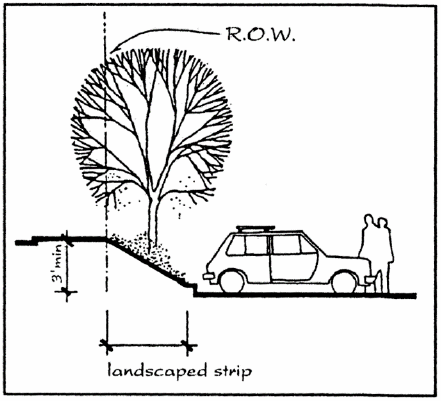
Figure 6.4 Screening (1)
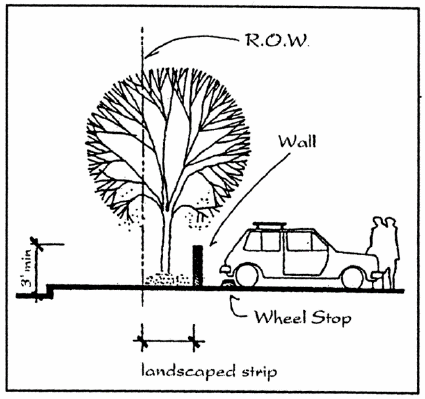
Figure 6.5 Screening (2)
(2)
Earthen berm. An earthen berm constructed to a height of three feet above the adjacent elevation of the street or parking/loading area, whichever is highest, shall not exceed a slope of 50 percent (one foot of vertical rise for every two feet of horizontal run) and shall have a crown of at least two feet. The berm shall be planted in ground covers and other plant materials to achieve a decorative effect to the reasonable satisfaction of the planning and community development director.
(3)
Wall. A wall of brick, stone or finished and textured concrete may be constructed to the required height and opacity, and landscaped with plant material to achieve a decorative effect to the reasonable satisfaction of the planning and community development director. The wall must be setback at least four feet from the street right-of-way line.
(4)
Combination. Any combination of hedge, berm or wall that effectively provides a visual screen of the parking lot or loading area to a height of three feet and achieves a decorative effect through appropriate use of landscaping and plant material.
(d)
Obstructions to sight distance. All landscaping and other screening devices placed along street rights-of-way and driveways must be designed and installed in a manner consistent with the requirements of this Development Code regarding vision clearance in sight triangles at street intersections with driveways and other streets.
(Ord. of 10-13-2020)

