
Bethlehem City Zoning Code
ARTICLE IV
LOT AND BUILDING STANDARDS
Sec. 89-401.- Purpose of article.
This article sets out the standards that control the size of lots, the placement of buildings and structures on a lot, and the bulk and intensity of development on a lot.
(Ord. of 10-13-2020)
Sec. 89-402. - Minimum lot frontage.
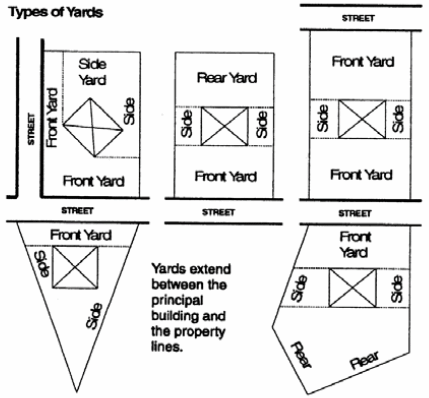
(a)
Street frontage required. Every property must front on a street from which direct access can be gained that has been opened and accepted as a public street or is a recorded private street approved by the board of commissioners.
(b)
Minimum frontage.
(1)
Every lot and every multi-family or nonresidential development must have minimum street frontage equal to 50 feet, except as follows:
(2)
Exceptions to minimum frontage requirement:
a.
Lots fronting primarily on a cul-de-sac turnaround, or any right-of-way having a curve radius of 60 feet or less, shall not have less than 35 feet of street frontage.
b.
A townhouse subdivision lot shall have at least 20 feet of street frontage.
(Ord. of 10-13-2020)
Sec. 89-403. - Maximum density, minimum lot area and width.
(a)
Every property upon which a principal building or use will be located shall meet or exceed the requirements shown on Table 4.1 for the zoning district in which the lot is situated.
(b)
Maximum density.
(1)
The total number of dwelling units in a residential subdivision or development shall not exceed the gross area of the subdivision or development property multiplied by the maximum density shown on Table 4.1. Residential densities are shown on the table as the number of dwelling units per acre.
(2)
The maximum nonresidential density figures shown on Table 4.1 are used to determine the amount of gross floor area for nonresidential uses that can be constructed on a lot. Maximum floor area is determined by multiplying the floor area ratio (FAR) times the area of the lot in square feet. For instance, a one-acre lot at 0.5 FAR could accommodate 21,780 square feet of floor area (43,560 square feet of lot area × 0.5 FAR).
Table 4.1: Density, Lot Area, Width, Setbacks and Building Heights by Zoning District
* Townhouse subdivision density may be increased with special use approval up to 5 du/acre in R-2.
** None required between attached principal buildings.
*** Rear vehicular access from an alley is required for all units; no parking allowed between the street and each unit.
**** A FAR of up to 0.5 and a building height of up to 50 feet may be allowed with special use approval.
***** The minimum principal building setback along an arterial road (including highways) shall be 100 feet from the right-of-way line. (See Section 89-404 (b).)
(3)
Minimum lot width. Each minimum lot width shown on Table 4.1 shall be achieved at the minimum front setback line for a principal building on the lot, measured as described under the definition of "lot width." For a lot having the majority of its frontage on a cul-de-sac, the minimum lot width shall be the achieved at the minimum required front setback line or at a line parallel to said setback line at no more than twice the minimum front setback distance from the street.
(4)
Authority of health department. Nothing contained in this article shall be construed as preventing the county health department, after study of the conditions existing in a proposed subdivision, from requiring that all or any portion of the area of such subdivision shall not be built upon or that the minimum lot sizes set forth in this Development Code are inadequate and must be increased to ensure the protection of the public health.
(Ord. of 10-13-2020; Ord. of 1-20-2022, § 1(Exh. A))
Sec. 89-404. - Minimum setbacks; principal buildings.
(a)
All principal buildings on a lot shall be setback from the street right-of-way lines and from the side and rear lot lines bounding the lot no less than the distances shown on Table 4.1.
(b)
Minimum setback along highways. For any lot that adjoins an arterial road, the minimum building setback along such road shall be 100 feet from the right-of-way line.
(Ord. of 10-13-2020)
Sec. 89-405. - Building and structure heights.
(a)
Building and structure heights; how measured.
(1)
Building height. The vertical distance measured to the highest point of a building from the average finished grade across those sides of a building that face a street.
(2)
Structure height. The vertical distance to the highest point of a structure (other than a building), as measured from the average grade at the base of the structure or from the average grade directly below a projecting structure.
(b)
Maximum building and structure heights. The maximum height of all buildings and structures in each zoning district, except as otherwise provided in this section, shall be as shown on Table 4.1.
(1)
The maximum height for all buildings and structures within the AHO airport hazard overlay district shall be 35 feet and shall not exceed AHO height restrictions set forth in Article III, Division 4. No exceptions are allowed.
(2)
Exemptions. The following structures (unless within the AHO airport hazard overlay district) are exempt from the height limitations imposed by this section, provided that no structure may exceed 200 feet in height from the average finished grade at its base:
a.
Agricultural buildings located on a farm such as barns, silos, windmills, grain elevators, and other farm structures, but not including dwellings.
b.
Structures located on a building's roof, such as bulkheads, elevator penthouses, water tanks, cooling towers, gas holders, and industrial structures where required as part of the manufacturing process, provided that these structures shall not cover more than 25 percent of the total roof area of the building on which these structures are located.
c.
Church spires, belfries, cupolas, domes, monuments, water towers, observation towers, citizens band and ham radio antennae, utility substations, windmills, chimneys, smokestacks, derricks, conveyors, and TV reception antennae.
(3)
Height limitations for fences and freestanding walls. Fences and freestanding walls (other than retaining walls) cannot be located within any public right-of-way or utility or drainage.
a.
In the AG and AR zoning districts, the following shall apply:
1.
A fence or freestanding wall in any front yard area may not exceed five feet in height.
2.
A fence or freestanding wall in any side or rear yard area may not exceed eight feet in height.
b.
In the R-1, and R-2 zoning districts, and for single-family detached and duplex developments within the R-3 and MH zoning districts, the following shall apply:
1.
A fence or freestanding wall in any front yard area may not exceed four feet in height, and shall not be constructed out of chain link, barbed wire or woven wire.
2.
A fence or freestanding wall in any side or rear yard area may not exceed eight feet in height.
3.
A decorative wall surrounding a subdivision or located along an abutting county road shall not exceed eight feet in height, regardless of the type of yard in which the wall is located and shall not be constructed in right-of-way.
c.
For multi-family developments (including townhouses) within any zoning district, the following shall apply:
1.
A fence or freestanding wall in any front yard area may not exceed six feet in height.
2.
A fence or freestanding wall in any side or rear yard area may not exceed eight feet in height.
3.
A decorative wall surrounding a development or located along an abutting county road shall not exceed eight feet in height, regardless of the type of yard in which the wall is located.
d.
In any office, commercial or industrial zoning district, no fence or freestanding wall may exceed eight feet in height.
e.
In all zoning districts and developments, fences or freestanding walls shall not obstruct visibility at street intersections (see the visibility triangle provisions under the project design standards in article X).
(4)
Height limitations for radio, television and telecommunication antennae and towers are contained section 89-182.
(Ord. of 10-13-2020)
Sec. 89-406. - Minimum lot size on septic tank.
(a)
Minimum area for lots served by septic tanks.
(1)
Any lot upon which both an individual well and septic tank are to be provided shall have a minimum area of not less than that required by state and county health department regulations or this Development Code, whichever is greater. The site location on the lot of these facilities shall be approved by the county health department in accordance with all applicable requirements.
(2)
Any lot which is to be served by a public water supply and an individual septic tank shall have an area of not less than that required by state and county health department regulations or this Development Code, whichever is greater. The site location on the lot of these facilities shall be approved by the county health department in accordance with all applicable requirements.
(b)
Lot size and width increases. The county health department may require larger lot sizes in individual cases based on a variety of factors, in accordance with their regulations.
(Ord. of 10-13-2020)
Sec. 89-407. - Minimum setbacks; accessory buildings and structures.
(a)
Accessory buildings. Minimum setbacks for accessory buildings shall be as follows:
(1)
Guest house. Guest houses must be located to the rear of the main home on the lot and must meet the same setbacks as required for principal buildings in each zoning district.
(2)
Night watchman residence. Night watchman residences shall conform to the minimum setback requirements for principal buildings in each zoning district.
(3)
All other accessory buildings.
a.
Accessory buildings having a floor area of 144 square feet or less must be at least five feet from any property line and shall be located to the rear of the principal building.
b.
Accessory buildings having a floor area greater than 144 square feet must comply with the same setbacks as required for principal buildings in each zoning district and may not be located within any front yard except between the minimum front principal building setback and the principal building on a lot containing five acres or more.
c.
When an accessory building is attached to the principal building it shall comply with the yard requirements of the principal building to which it is accessory. Decks and patios shall meet the standards in (b)(5) of this section.
(b)
Accessory structures. Minimum setbacks for accessory structures (excluding buildings but including parking lots, fences, signs and outdoor swimming pools) shall be as follows:
(1)
Fences and freestanding walls. For all fences and freestanding walls, there shall be no minimum setback from any property line, provided that any fence or freestanding wall shall not be location within a utility or drainage easement and shall not obstruct visibility at street intersections (see the sight triangle provisions under the project design standards article).
(2)
Gasoline pumps and canopies. For special setback provisions for gasoline pumps and canopies, see "gasoline stations, truck stops and convenience stores with fuel pumps" in section 89-174.
(3)
Signs.
a.
Any portion of a sign ten feet high or less shall be located at least five feet from a public street right-of-way line (except for miscellaneous signs specifically allowed under the sign regulations article of this Development Code).
b.
Any portion of a sign more than ten feet high shall be located at least 20 feet from a public street right-of-way line.
c.
All signs shall be setback at least five feet from any side or rear property line.
(4)
Outdoor recreation facilities.
a.
An outdoor swimming pool, tennis court, basketball court or other recreation or sports facility must comply with the same setbacks as required for principal buildings in each zoning district; and
b.
Shall not be located within any front yard, except between the minimum front principal building setback and the principal building on a lot containing five acres or more.
(5)
Decks and patios.
a.
Decks and patios may extend into the side or rear setback but no closer than five feet from any property line.
b.
Steps and landings may extend into the required setbacks provided that such extensions do not exceed ten feet for the front and three feet for the side.
c.
Steps and landings may extend into the rear setback but no closer than five feet from the property line.
(6)
All other accessory structures. Accessory structures not listed above must be at least 20 feet from any street right-of-way and at least five feet from any other property line (except driveways that connect to a street or adjoining property).
(Ord. of 10-13-2020)
Sec. 89-408. - Floor area provisions.
(a)
Minimum building floor area within a dwelling unit.
(1)
The minimum building floor area required for dwelling units in each zoning district is shown on Table 4.2.
(2)
Occupancy within a dwelling unit is not allowed to exceed the following number of persons, based on the amount of building floor area within the unit:
a.
For up to 600 square feet of building floor area, no more than two persons.
b.
For each person over two, at least 125 square feet of additional building.
c.
Floor area shall be provided within the dwelling unit.
(b)
Maximum floor area in nonresidential districts.
(1)
The gross floor area occupied by a single business establishment in the C-1 zoning district, or within any master planned development allowing neighborhood commercial uses, may not exceed the maximums shown on Table 4.3, nor may a multi-tenant commercial building exceed 100,000 square feet and may contain one grocery store and one drug or hardware store.
(2)
For the purpose of this subsection, a business that contains other businesses within it occupying the same space, such as a grocery store with a branch bank or fast food restaurant inside, shall be considered a single business establishment.
Table 4.2: Residential Floor Area Requirements
* A maximum of 20% of all apartments within a development may be less than the minimum 650 sf, but not less than 520.
* All floor area measured in heated square feet.
Table 4.3: Nonresidential Floor Area Restrictions
* The maximum gross floor area in an O-I district may be increased with special use approval.
** Maximum 100,000 square feet total in multi-tenant building.
(Ord. of 10-13-2020)

