
Bethlehem City Zoning Code
ARTICLE VIII
BUFFERS, TREE CONSERVATION, AND LANDSCAPING
Sec. 89-846. - Purpose of article.
The purpose of this chapter is to provide requirements for the landscaping and buffering of developments and for the protection of existing trees in all zoning districts, in order to enrich the urbanized and natural environment of Barrow County by:
(a)
Providing for the separation of incompatible types of land use.
(b)
To require landscaping and the preservation and replacement of trees in certain areas within the county in order to ensure the continued health of its citizens through improved air and water quality.
(c)
To provide developers and others active in the county with the appropriate guidance to better ensure proper tree preservation and replacement in the course of the land development process in the county.
(d)
To preserve property values in the county by maintaining a safe, aesthetically pleasing environment.
(e)
To prevent clear-cutting and mass grading of land that results in the loss of mature trees, and to ensure appropriate replanting when tree loss does occur.
(f)
To reduce soil erosion in the county by planting trees and other vegetation so as to aid in prevention of soil loss through stormwater runoff and flooding and to promote stormwater infiltration.
(g)
To reduce noise and glare on adjacent properties from properties that has been extensively developed.
(h)
To conserve energy by cooling surrounding air temperatures through the existence of adequate shade trees.
(Ord. of 10-13-2020)
Sec. 89-861. - Zoning buffers; where required.
A zoning buffer shall be required between any multi-family or nonresidential development project along a side or rear lot line that abuts a less intense land use, as follows:
Table 8.1: Zoning buffer requirements.
(a)
A zoning buffer must be provided between any multi-family use (townhouses, apartments or mobile home park) and any agricultural zoning district or single-family or two-family use or zoning district;
(b)
A zoning buffer must be provided between any office or commercial use and any agricultural zoning district or any single-family, two-family or multi-family use or zoning district; and
(c)
A zoning buffer must be provided between any industrial use and any agricultural zoning district; any single-family, two-family, multi-family use or zoning district; or any office or commercial use or zoning district.
(Ord. of 10-13-2020)
Sec. 89-862. - Zoning buffers; when required.
Zoning buffers are required to be created at the time of construction of any new development.
(Ord. of 10-13-2020)
Sec. 89-863. - Zoning buffer design standards.
(a)
General. Zoning buffer areas shall contain no driveways, parking areas, patios, or any other structures or accessory uses except for a fence, wall, utility or earthen berm constructed to provide the visual screening required to meet the standards of this Development Code. Underground utilities may be permitted to cross a zoning buffer if the screening standards of this Development Code will be subsequently achieved. Vehicular access through a zoning buffer may be allowed only as a condition of rezoning, special use or any type of master planned development approval by the board of commissioners, as follows:
(1)
Approximately perpendicular to the greater distance of the zoning buffer area and for drainage improvements required by the county based upon competent engineering studies which show these improvements to be necessary, upon approval of the planning and community development director planning and community development director or the board of commissioner's.
(2)
Except as provided above, the natural topography of the land shall be preserved and natural growth shall not be disturbed beyond that which is necessary to prevent a nuisance, or to thin this natural growth where too dense for normal growth, or to remove diseased, misshapen or dangerous and decayed timbers. However, a slope easement may be cleared and graded where required to prevent soil erosion upon approval of the planning and community development director; this easement may cover no more than 20 percent of the required zoning buffer area, and shall be immediately replanted upon completion of easement improvements.
(b)
Width of zoning buffer.
(1)
Zoning buffers required along any lot line shall be no less than the minimum required width as shown in Table 8.1.
(2)
When a proposed development adjoins an existing development but the full width of the required zoning buffer does not exist, the new development shall provide a zoning buffer of adequate width to meet the full width required in Table 8.1 when considered in combination with any existing zoning buffer on the property of the adjoining development.
(c)
Minimum required screening. Minimum required screening shall consist of a natural zoning buffer utilizing existing vegetation or a structural zoning buffer, whichever provides an opaque visual screen to a height of six feet, or any combination of existing and replanted vegetation which can reasonably be expected to create an opaque visual screen six feet high within two growing seasons.
(d)
Natural zoning buffers. Natural zoning buffers may contain deciduous or perennial vegetation but shall contain evergreen shrubs and trees suitable to local growing conditions that will provide an opaque visual screen during all seasons of the year.
(e)
Structural zoning buffers. Structural zoning buffers shall meet the following criteria:
(1)
Structural zoning buffers shall be vegetated throughout the minimum area required for the zoning buffer around any fences or walls and upon any earthen berms, which may include grass, ground covers, shrubs, and trees.
(2)
All earthen berms shall have a maximum side slope of 50 percent (one foot of vertical rise to two feet of horizontal run). Earthen berms shall not be constructed within the drip line of any existing trees that will remain on the property.
(3)
Trees shall be located or planted within any structural zoning buffer at a density of no less than one overstory tree for each 40 feet of zoning buffer length or portion thereof or one understory tree for each 20 feet. Overstory and understory trees may be combined using the appropriate density distance for each. New deciduous trees shall have a caliper of no less than two inches upon planting, and new evergreens shall be at least five feet tall when planted. Trees may be clustered for decorative effect following professional landscaping standards for spacing, location, and design.
(4)
Fences and freestanding walls shall present a finished and decorative appearance to the abutting property and shall meet location requirements for fences and walls in section 89-407.
(5)
Fences used in zoning buffers must be made of rot-resistant material or protected from deterioration with waterproofing material.
(6)
The accompanying Figure 21 provides examples of natural and structural zoning buffers. Other solutions meeting the minimum requirements of this section are also acceptable.
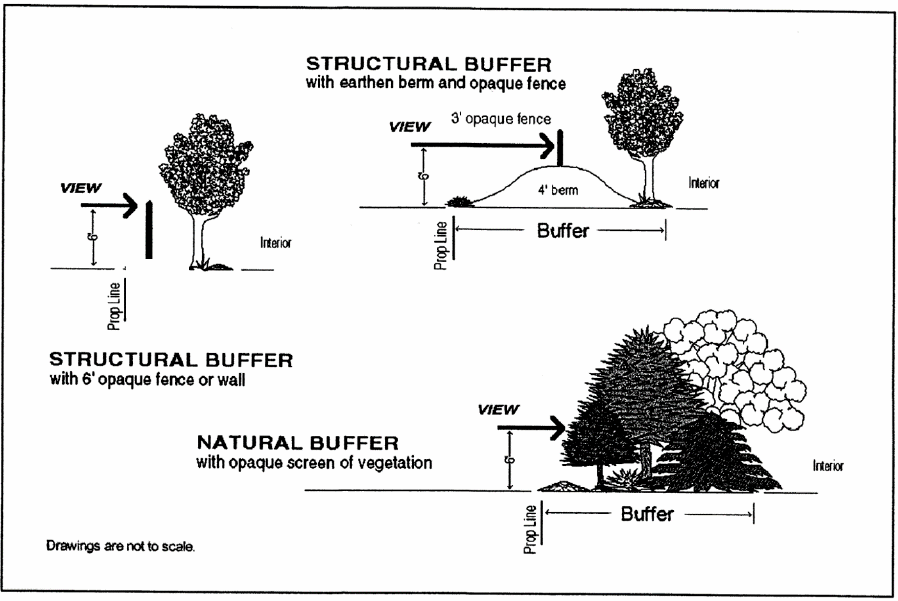
Figure 8.1. Examples of zoning buffers
(Ord. of 10-13-2020)
Sec. 89-864. - Maintenance of zoning buffers.
Every zoning buffer required by this article shall be maintained by the owner of the property where the zoning buffer is located, so as to provide an opaque visual screen to a height of six feet on a continuous, year-round basis.
(Ord. of 10-13-2020)
Sec. 89-865. - Zoning buffer modifications.
(a)
Automatic reduction in zoning buffer width. If a structural zoning buffer is provided that creates an opaque screen to a height of no less than eight feet instead of six, the zoning buffer may be reduced to a width of no less than 75 percent of the zoning buffer width otherwise required. If the structural zoning buffer achieves a height of 12 feet or more, the zoning buffer width may be reduced to 50 percent of the width otherwise required.
(b)
Location of zoning buffers. Zoning buffers may be relocated on the site to best achieve the screening required.
(c)
Waiver for unnecessary zoning buffers. The board of commissioners may waive a zoning buffer requirement or reduce its extent to a temporarily appropriate level of screening if the comprehensive plan anticipates future development on the adjoining property in a land use category such that a zoning buffer would not be required by this Development Code once the adjoining property is rezoned or developed.
(Ord. of 10-13-2020)
Sec. 89-891. - Purpose and intent.
(a)
The purpose and intent of this division is to:
(1)
Provide standards for the protection of trees as part of the land development and building construction process within Barrow County;
(2)
Provide a healthy living environment and make the county an attractive place to live and work;
(3)
Maintain control of stormwater runoff, noise, glare, and soil erosion; and
(4)
Preserve, protect, and promote the general health, welfare, and safety of the public.
(Ord. of 10-13-2020)
Sec. 89-892. - Applicability.
(a)
Exemptions from tree conservation requirements. The tree conservation requirements shall not apply to the following:
(1)
Individual homeowners. The exemption does not include an exemption from requirements for protective buffers along streams, creeks, and reservoirs.
(2)
The following situations within all residential districts shall also be exempted:
a.
Where the addition to a principal structure will constitute structural and exterior changes to the home.
b.
Where the construction of an accessory structure(s) and/or uses including, but not limited to, swimming pools and tennis courts, is permitted, including an accessory residential living facility (a.k.a. guest quarters).
c.
The removal of diseased, deceased, infested or dying trees, or living pine trees or other trees which may pose a danger to an existing or proposed home, or other structure.
(3)
Public utility companies and government agencies conducting operations on public and utility rights-of-way and easements or on sites for electric power substations and similar facilities, which operations are for the purpose of assuring uninterrupted utility and governmental services and unobstructed passage on public streets.
(4)
Agricultural activities.
a.
Property in use for agricultural tree harvesting (as defined by this Development Code) or other agricultural activities (as defined by this Development Code), provided that the timber harvesting notice requirements of this Development Code and the requirements of state law and regulations regarding tree harvesting are met.
b.
If a property is systematically thinned of trees or is clear-cut for any purpose other than a bona fide agricultural use, or the timber is harvested without complying with the requirements of this Development Code and state law, a preliminary plat or project site plan for development of the property may not be approved for a period of five years. This restriction may only be waived by the board of commissioners by majority vote. Such waiver may be based on a valid excuse for the clear-cutting, or on remedial action such as the replanting of trees.
(b)
Nothing in this section shall be construed to allow the removal of any tree or vegetation in a required stream buffer, watershed buffer, buffer adjacent to waters of the state, or other undisturbed or planted buffer located for protection of natural resources, except where such removal has been specifically authorized as set forth in this UDC.
(Ord. of 10-13-2020)
Sec. 89-893. - Requirements in all zoning districts.
(a)
Clear cutting of any lot in a residential subdivision is prohibited, except as noted below. On such lots, land area shall be cleared only as is necessary for purposes of the proper development of said lot. Clearing shall be limited to the specific development and an area not to exceed ten feet from the specific development, including areas for:
(1)
The placement of the individual home;
(2)
The placement of driveways and sidewalks;
(3)
The placement of utilities and detention ponds;
(4)
The placement of septic systems;
(5)
The placement of roads;
(6)
The placement of decks and patios; and
(7)
Proper drainage as required by the county.
(Ord. of 10-13-2020)
Sec. 89-894. - Protection of trees during construction.
Methods and standards for tree protection shall be required as follows:
(a)
Trees identified to be preserved and/or planted+ and being counted as credit for meeting the requirements of section article VIII, division 3, shall have a valid, recognizable method of tree-protection (tree-save) marking or delineation installed at the critical root zones.
(b)
No person engaged in the construction of any structure(s) or improvement(s) shall encroach on a designated tree-save/critical root zone area with heavy machinery or the storage of heavy building materials.
(c)
During construction, a tree save area must be designated around any trees that are to remain at the end of construction. Desirable trees should be identified and a physical barrier set up around the tree or group of trees. This barrier can consist of a four-foot high orange safety fence, wide plastic caution tape, a simple fence made of lumber, or other appropriate methods that can identify the noninvasive drip line area.
(d)
The barrier should be placed beyond the drip zone (critical root zone) and should prevent the stockpiling of soil or building materials, dumping cleaning solvents, or parking vehicles or equipment within this barricaded area.
(Ord. of 10-13-2020)
Sec. 89-895. - Applicability and provision of landscape plans.
(a)
In order to demonstrate compliance with the requirements of this chapter, a landscaping plan shall be submitted with applications for development approval for all development subject to these standards. The requirements and procedures for submittal, review, and approval of all applications are set forth in article XII. The requirements of article VIII, division 3 shall apply to all properties to be developed, or redeveloped within the county, except as may specifically be exempted below:
(1)
The construction of single-family detached dwellings and in subdivisions of no more than five lots.
(2)
Industrial development is exempt from certain standards in this division, where indicated in the sections of this division.
(3)
Applications for accessory uses, accessory structures, or temporary uses.
(4)
Public utility companies and government agencies.
(b)
A landscape plan shall include sufficient information to determine whether the proposed landscape improvements are in conformity with the requirements of Article VIII, including the following:
(1)
Identification of size and species of all trees that will be retained upon the site.
(2)
Location of tree protection area fencing.
(3)
Location and species of trees and other landscaping to be planted.
(Ord. of 10-13-2020)
Sec. 89-896. - Maintenance requirements.
All landscaped areas shall be maintained to ensure that plant materials are healthy and thrive.
(a)
Any diseased or dead plant materials shall be replaced as soon as reasonably possible based on the growing season, but not later than six months following identification of the need for replacement.
(b)
Necessary trimming and maintenance shall be performed to maintain the health of the plant materials, to provide an aesthetically pleasing appearance, and to assure that the landscaped and buffer areas serve the intended purpose.
(Ord. of 10-13-2020)
Sec. 89-897. - Landscape standards for nonresidential development.
(a)
Required landscaped areas, including general landscaping, parking lot landscaping, perimeter landscaping, and buffer areas shall not be disturbed by grading, property improvements, or construction activities, except where necessary to prevent a nuisance, or to thin natural growth which is too dense to permit normal growth, or to remove diseased, misshapen, or dangerous and decayed timbers.
(b)
A minimum of 12 percent of the total buildable area in any parcel shall be devoted to landscaping.
(c)
Buffers required in article VIII, division 2 shall not be counted towards the 12 percent landscaping area requirement.
(1)
Exemptions. Industrial development is exempt from this requirement and can count required buffers towards the landscaping requirement, when applicable.
(d)
Trees of at least six inch DBH preserved within buffers or setbacks may be counted towards tree planting requirements in Table 8.1.
(e)
Landscaped areas may utilize existing natural vegetation in an undisturbed state provided that the existing vegetation is appropriate for inclusion.
(f)
The site design standards for landscaping are provided in Table 8.2 below.
(g)
A minimum of 50 percent of trees planted shall be large trees as listed in section 89-900(b)(1)a.
Table 8.2: Site Design Standards for Nonresidential Landscaping
* Trees and landscaping may be clustered or grouped in order to enhance aesthetics.
(Ord. of 10-13-2020)
Sec. 89-898. - Residential landscape standards.
(a)
Prior to the issuance of a building permit, any parcel of land for which a building permit has been requested shall have preserved or planted trees, meeting the following standards:
(1)
The minimum DBH is two and one-half (2½) inches.
(2)
A minimum of 75 percent of planted trees shall be hardwoods.
(3)
All recorded lots within a subdivision shall have planted or preserved the required number of trees according to the zoning district, as set forth in subsection (b) below. Agricultural Residential (AR) properties are exempt from these requirements.
(4)
Existing trees counted towards residential landscaping requirements shall be at least six inches DBH.
(b)
Residential tree plantings must comply with requirements in Table 8.3.
(c)
Subdivision entrances. For each subdivision entrance sign located on private property, there shall be a minimum of one large tree, or twomedium or small trees, and five shrubs.
Table 8.3: Tree Planting Requirements by Residential Zoning District
(Ord. of 10-13-2020)
Sec. 89-899. - Landscape requirements for parking lots.
(a)
Perimeter landscaping for parking lots. A minimum of a ten-foot wide strip of land, located between the property line and a parking lot shall be landscaped. Width of sidewalks shall not be included within the ten-foot wide front setback perimeter landscape area.
(b)
Interior landscaping.
(1)
Industrial development shall be exempt from interior landscaping requirements in section 89-874(b).
(2)
Parking lots with 20 or more parking spaces shall provide interior landscaping.
(3)
Interior planting areas may be located in tree islands, at the end of parking bays, or between rows of parking spaces. Tree islands shall be a minimum of ten feet wide and 150 square feet.
(4)
There shall be one tree required for each ten parking spaces.
(5)
New trees shall have a caliper of no less than two and one-half inches upon planting and shall be maintained in good condition. Trees must be removed as a result of disease, damage or death, and must be replaced.
(6)
Vehicle stops or curbing shall be used to ensure that vehicles do not overhang required landscaped areas.
(Ord. of 10-13-2020)
Sec. 89-900. - Landscape material and planting standards.
(a)
Trees and landscape materials selected for planting must be free from trunk or root injury, pests, disease, nutritional disorders or root defects, and must be of good vigor in order to assure a reasonable expectation of survivability. Whenever appropriate, all landscaped areas shall utilize existing natural vegetation in an undisturbed state.
(b)
Species. Species selected as replacement trees shall be selected from the list of appropriate trees provided below. A mix of trees with no more than 25 percent of one genus is acceptable for meeting replanting requirements. Landscaping materials must be ecologically compatible with the site where they are to be planted, and a mix of shrubs with no more than 25 percent of one genus is acceptable for meeting landscaping requirements.
Appropriate tree and shrub species are included in the following tables:
Table 8.4: Large trees
Table 8.5: Medium and small trees
Table 8.6: Shrubs
(b)
Tree planting standards.
(1)
A planting area of 150 square feet shall be required for each large tree.
(2)
A planting area of 100 square feet shall be required for each small tree.
(3)
All planting strips shall have a minimum width of five feet.
(4)
Trees shall be planted to avoid septic tanks and drain fields.
(5)
The hole shall be a minimum of two times the width of the root ball with sloped sides. The depth of the hole should be no deeper than the height between the bottom of the root ball and the trunk flare.
(6)
Once the tree is placed in the hole, all strapping plus the upper half of burlap and wire basket must be removed from the top of the root ball.
(c)
Required comments and standards for transplanting shall be in keeping with those established in the International Society of Arboriculture publications, "Tree and Shrub Transplanting Manual", "The Practical Science of Planting Trees", or similar publication. Reference the American Association of Nurserymen publication American Standard for Nursery Stock (ANSI Z60, -2014) for plant material quality specifications. The location of plant materials shall be such that developers incorporate landscaping design that enhances the aesthetics of the property in keeping with the planned use.
(Ord. of 10-13-2020)
Sec. 89-901. - Alternative compliance.
(a)
Overview. The intent of the tree conservation provisions of this Development Code is to ensure that an adequate amount of trees are preserved or planted on all developed sites. Occasionally, this intent cannot be met because a project site will not bear the required number of trees. To provide a viable alternative for such cases, the developer may be allowed to plant trees at his own expense on an alternate property in lieu of over-planting the development site.
(b)
Alternate tree plantings.
(1)
The county must review and approve all requests for alternative compliance. In no instance shall 100 percent of the required tree units be met through alternative compliance. As many trees as can reasonably be expected to survive must be planted on the development site.
(2)
Public properties, such as school sites, parks, fire stations and other publicly owned sites, will be given priority for alternate tree plantings.
(3)
Tree planting on alternate compliance properties shall be done simultaneously with the planting of trees on the development site such that inspections and final approval for the project will include trees planted on the alternate property.
(4)
The land disturbance permit for the development site will only be issued after the county has approved the alternate compliance request and the property designated to receive the alternate plantings.
(Ord. of 10-13-2020)

