
Billings City Zoning Code
ARTICLE 27
1200.- LANDSCAPING, BUFFERING, AND SCREENING
Sec. 27-1201.- Purpose.
The purpose of this section is to provide landscaping and performance standards that:
A.
Enhance and promote a unique image for the City of Billings.
B.
Protect the public health, safety and welfare by:
1.
Increasing parking lot traffic safety by guiding the circulation of cars and people and lowering traffic speeds;
2.
Minimizing noise, air, water and visual pollution;
3.
Screening and buffering incompatible land uses;
4.
Reducing the amount of reflected glare and heat absorbed in and around developments;
5.
Breaking up large expanses of parking lots;
6.
Preserving property values and neighborhood characteristics by lessening the impacts of potentially incompatible uses; and
7.
Providing screening from wind.
C.
Conserve water resources by:
1.
Promoting the use of xeriscaping and drought-tolerant naturalized plantings; and
2.
Promoting the utilization of storm water detention as an irrigation source.
D.
Ensure that landscaping is an integral part of the site design and development process.
(Ord. No. 21-5748, § 3(Exh. A), 1-25-21)
Sec. 27-1202. - Applicability.
A.
General applicability.
1.
The provisions of this article are applicable to all new development as identified in Table 27-1200.1.
2.
A property or development site may have more than one type of required landscaping. Each type of landscaping is calculated separately. One type of required landscaping may not be calculated toward nor substituted for the provision of a different type of required landscaping. For example, street frontage landscaping may not be calculated toward off-street parking lot landscaping.
Table 27-1200.1. Landscaping Applicability.
Notes:
(1)
May be applicable to new master site plan or new subdivisions adjacent to existing non-residential development or non-residential zone districts.
(2)
May be applicable to multifamily parking lots depending on total number of spaces.
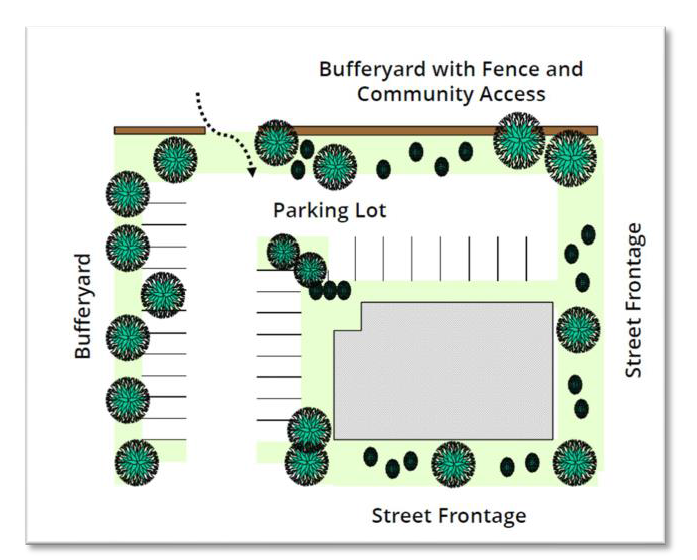
Figure 27-1200.A. Illustrated location of different required landscape types.
B.
Proportionate compliance.Article 27-1100, Proportionate compliance, may be applicable to adjust landscape standards for redevelopment projects.
(Ord. No. 21-5748, § 3(Exh. A), 1-25-21)
Sec. 27-1203. - Street frontage landscaping.
A.
Purpose. Street frontage landscaping trees helps maintain and enhance the appearance of the city, contribute to pedestrian safety and comfort, and offer environmental benefits by allowing the infiltration of storm water, reducing urban heating, and improving air quality.
B.
Required street frontage landscaping. The area that abuts a public and private street shall be provided a street frontage landscaped area planted with street trees. Property owners shall plant and maintain street trees as follows and as further required by this section:
1.
All districts except CBD.
(a)
The street frontage landscape area shall be at least ten (10) feet wide. The width of the landscape area may be reduced to six (6) feet with the provision of drip irrigation per subsection 27-1208.F.
(b)
The required total number of street trees shall be calculated at one tree per forty (40) lineal feet of frontage. Fractions shall be rounded up to the next whole number.
(c)
Street trees do not need to be spaced at 40-foot intervals; the maximum interval shall be sixty (60) feet with decisions about landscaping design within that interval left to the discretion of the property developer in consultation with their landscape designer or landscape architect.
(d)
Additional required plant materials are specified in subsection 27-1208.
2.
CBD.
(a)
The required total number of trees is one tree per twenty-five (25) feet of frontage. In the CBD trees shall be spaced an average of twenty-five (25) feet and may not be grouped. Tree spacing may be varied by up to five (5) feet to avoid planting a tree directly in front of a building entrance. Overall spacing shall be designed to avoid placing trees side-by-side at street corners.
(b)
Street trees shall be planted in pervious landscape areas, tree strips, or tree wells that are located adjacent to the back-of-curb. The dimensions of the tree planting area for a single tree shall be no less than five-feet square.
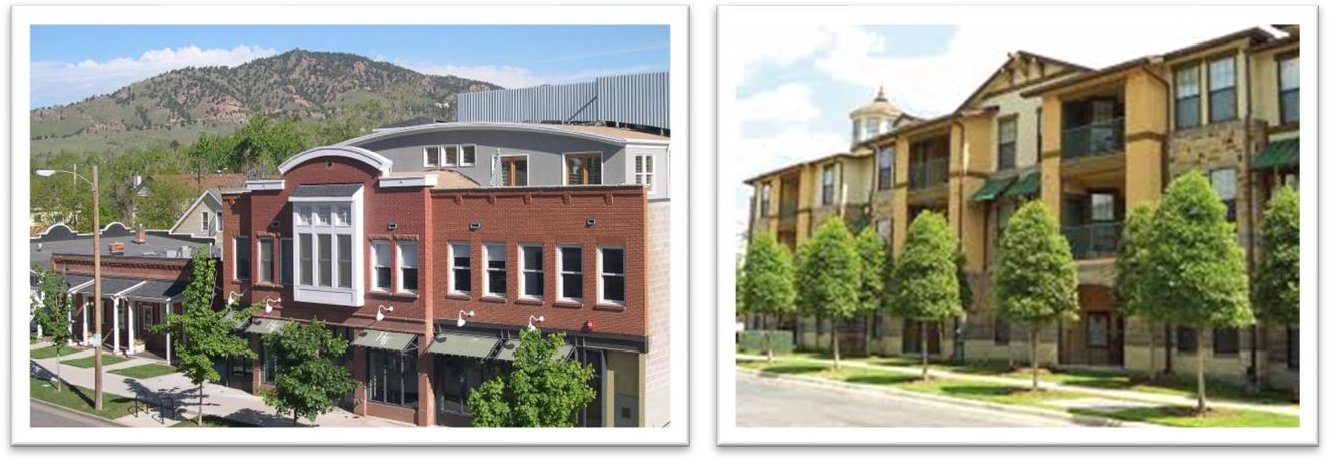
Figure 27-1200.B. Street tree landscaping examples (left: mixed use, right:
multifamily).
C.
Location and calculations.
1.
Measurement.
(a)
Generally. The street frontage landscape area depth is measured from the property line inward.
(b)
Boulevard. Street frontage yards located along a boulevard shall be measured from the curb inward. Trees may be located within a boulevard where permitted by city engineering.
2.
Street frontage landscape areas may overlap required yards and be located within required setbacks.
3.
Access driveways shall not be subtracted from the linear frontage in calculations of the amount of landscaping required. If there are driveways along the frontage or property line, required landscaping shall be condensed into the remaining landscaping area.
D.
Plant materials (except for subsections 1 and 4 below, Part D does not apply to single family and two-family residential development).
1.
Street tree species shall be chosen from the Billings Plant List.
2.
The ground plane of the street front landscape yard shall be planted in seventy-five (75) percent organic materials that will remain in place through typical local weather and may not include turf grass or other material that requires regular mowing. The remaining twenty-five (25) percent of the ground plane may be covered in inorganic materials.
3.
Generally applicable plant materials standards are located in section 27-1208.
4.
The use of coniferous trees is not permitted in street frontage landscaping.
(Ord. No. 21-5748, § 3(Exh. A), 1-25-21; Ord. No. 22-5807, § 3(i), 5-9-22)
Sec. 27-1204. - Bufferyards.
A.
Required bufferyards.
1.
Applicability.
(a)
The exterior boundary of a lot that adjoins or is located across an alley from a different zone district, structure, or use, and that does not adjoin a public street right-of-way, shall meet the bufferyard requirements shown in Table 27-1200.3 below.
(b)
A lot may require a combination of street frontage yards and bufferyards depending upon the types of surrounding development.
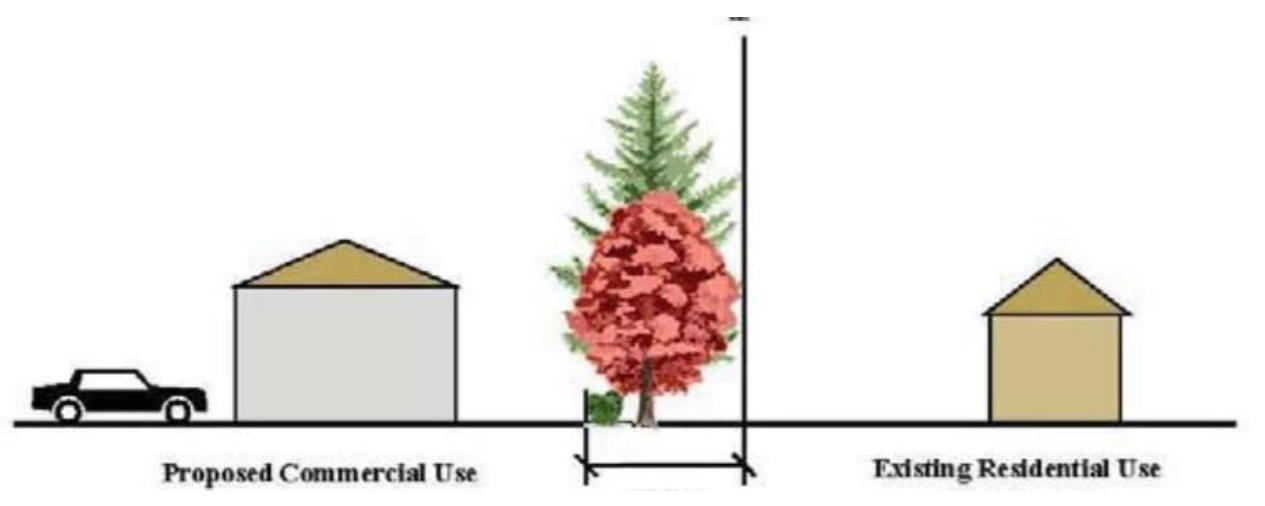
Figure 27-1200.C. Bufferyards are located between different types of development.
(c)
In the CBD, the requirements of this section shall be accommodated to the maximum extent feasible. The bufferyard design may be adjusted by the zoning coordinator to accommodate the space available on the lot.
2.
Types of bufferyards.
(a)
There are three (3) types of landscaping bufferyards defined in this section that are intended to accomplish the following:
(1)
B1: Visual enhancement is intended to create a partial visual separation between uses or districts.
(2)
B2: Filtered screen is intended to create a semi-opaque visual separation between uses or districts.
(3)
B3: Screened separation is intended to provide both space and a partial visual separation between uses or districts. This bufferyard is intended for use where a new development is located adjacent to a district or use that is significantly different in intensity, such as a residential district next to an industrial district.
(b)
The dimensions and planting requirements for each type of bufferyard is specified in Table 27-1200.4.
3.
Additional standards and instruction.
(a)
If a use or district does not conform to the categories identified in Table 27-1200.3, the zoning coordinator shall determine which category best matches the use.
(b)
A six-foot high sight-obscuring fence or wall shall be provided on the property line where a commercial or industrial use or structure is adjacent to or across an alley from any residential uses, including residential as part of a mixed-use development.
(1)
A continuous hedge may be substituted for the required fence or wall, as long as it has a minimum height at installation of three (3) feet and reaches six (6) feet or more at maturity.
(2)
Vinyl or powder-coated, colored chain link fencing is allowed within a bufferyard where a sight obscuring fence is required so long as the chain link fence has sight-obscuring slats installed.
Table 27-1200.3. Required Bufferyards.
For proposed development in EBURD, please see section 27-905, for landscaping standards.
B.
Standard bufferyard types. The bufferyard dimensional and planting requirements are established in Table 27-1200.4, and a menu of landscape points is established in Table 27-1200.5. Landscape point allocations may be enhanced through the use or conservation of bonus materials as identified in Table 27-1200.6.
1.
Standard types of bufferyards. Different buffer widths and planting requirements may be specified in this section according to the following standard landscape buffering types:
Table 27-1200.4. Standard Bufferyard Types.
Bufferyard type B - Requires one tree every seventy (70) feet along shared property line, with drip irrigation to each tree.
2.
Design. Placement and landscaping design shall be at the discretion of the developer, in consultation with the landscape architect or landscape designer, including the placement of the required trees within the required bufferyard.
3.
Location and calculations.
(a)
Bufferyard depth is measured from the property line inward. Where a buffer area overlaps another buffer area, the area of overlap of one bufferyard shall be subtracted from the total required landscape point calculation to avoid double counting.
(b)
Bufferyards may be located within required yards and setbacks.
(c)
Access driveways shall not be subtracted from the linear frontage in calculations of the amount of landscaping required. If there are driveways along the frontage or property line, required landscaping shall be condensed into the remaining site perimeter landscaping area.
4.
Landscape points.
(a)
Required bufferyard landscaping is calculated in landscape points. The following table identifies the landscape points awarded for various planted or preserved landscape materials. Plant material standards are provided in section 27-1208.
Table 27-1200.5. Landscape Points.
(b)
Public amenities may be included in a bufferyard that is generally accessible by the public or by adjacent residential development. Public amenities shall meet the following standards:
(1)
Outdoor seating plaza or sheltering structure with a minimum useable area of one hundred eighty (180) square feet.
(2)
Public art, including but not limited to sculptures, fountains, clocks, or murals with an installed value equal to or greater than ½ of one percent of the construction value of the structure.
(3)
Sidewalk planters between the sidewalk and the building.
(4)
Pedestrian paths that connect residential development to the adjacent development or to an existing or proposed public walkway system.
5.
Bonus calculation.
(a)
Bonus landscape points may be awarded for landscaping that meets the following standards:
Table 27-1200.6. Bonus Landscape Points.
(b)
Landscape and bonus point standards.
(1)
Points awarded for retained vegetation in perimeter buffers may only be applied in the buffer area along the same lot line where the vegetation is found.
(2)
Any trees preserved on a site in required landscaping areas that meet the specifications in this section and are not identified on the Billings plant list may, at the discretion of the zoning coordinator, be credited toward meeting the tree requirements of any landscaping provision of this article.
(3)
Any tree for which landscape points or bonus points are given shall be in a condition that encourages long-term survival and in a location that conforms to the intent and standards of this section.
(4)
Existing trees that are preserved and receive landscape points or bonus points shall be marked on the landscape plan and the amount of bonus points shall be indicated. Any trees which receive points and are later removed shall be replaced with the number of trees for which landscape points was received.
(Ord. No. 21-5748, § 3(Exh. A), 1-25-21)
Sec. 27-1205. - Off-street parking lot landscaping.
A.
Applicability. The following requirements shall be applicable to all new off-street surface parking lots with ten (10) or more spaces.
B.
Required landscape area.
1.
All surface parking lots shall incorporate the following interior landscaping:
(a)
All parking stalls shall be within one hundred thirty-two (132) lineal feet of a required parking lot landscape area. For purposes of determining tree spacing, parking spaces may be counted in any rational sequence.
(b)
Landscape terminal islands that are a minimum of nine (9) feet wide and four (4) feet shorter than the adjacent parking stalls in the parking row shall be provided at the ends of each parking row.
(c)
Parking lots with one hundred (100) or more spaces shall also be divided into subsections of no more than fifty (50) spaces with landscape divider strips shall be placed between the sections.

Figure 27-1200.D. Sample parking lot landscape area layout.
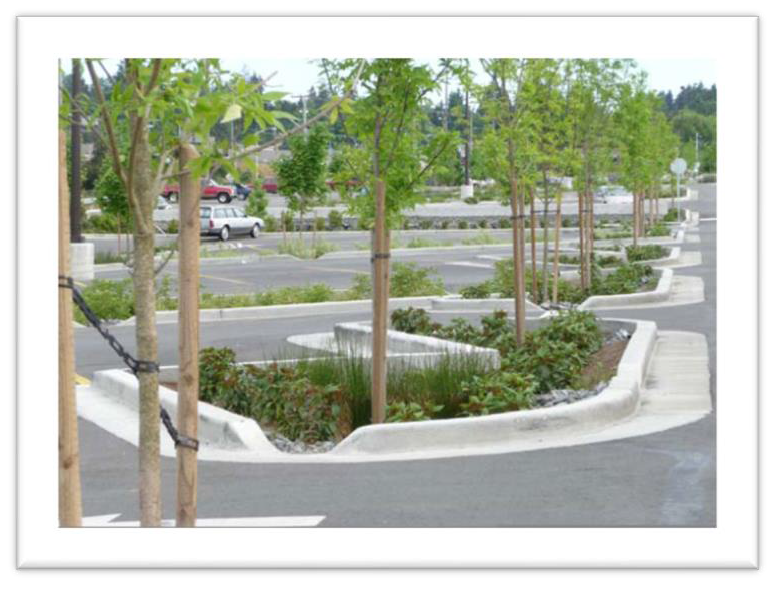 | 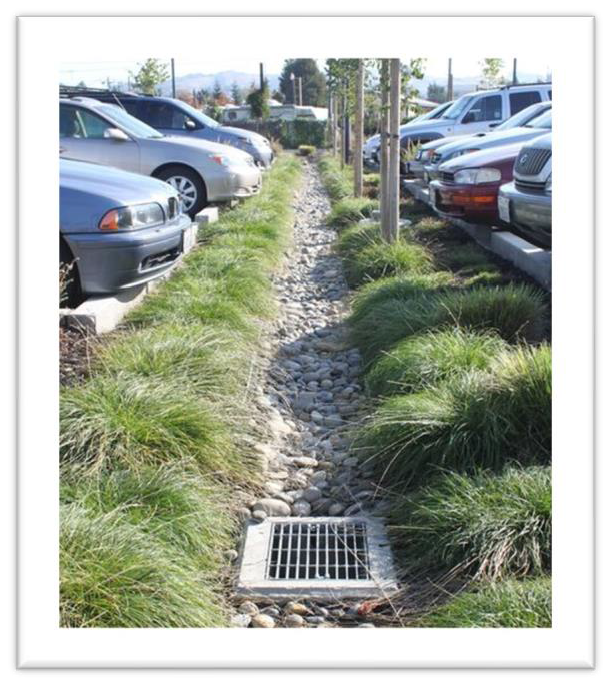 |
| Figure 27-1200.E Left. Landscape islands with storm water infiltration. | Figure 27-1200.F Right. Landscape divider with bio-swale |
C.
Landscape area design.
1.
A sidewalk located within a landscape divider strip that separates either parking rows or parking lots shall be allowed to count toward a part of the required off-street parking lot landscaping. The intent of this sidewalk is to help facilitate safe pedestrian movement. This sidewalk must meet the following criteria if it is to be counted toward the required landscaping:
(a)
The sidewalk has a five-foot wide walking path and shall add two (2) feet for vehicle overhang, if the sidewalk abuts a parking stall.
(b)
The sidewalks extends the entire length of the divider strip. The ends of the sidewalk shall be ADA compliant.
(c)
The sidewalk is bordered on at least one side by landscaping, of which the sidewalk cannot account for more than fifty (50) percent of the area of the divider strip.
2.
Landscaped areas within parking lots or along the perimeter of the property must be protected from vehicular traffic through the use of concrete curbs, extruded asphalt or other approved permanent barriers.
3.
No paving shall be permitted within four (4) feet of the center of a tree.
D.
Plant materials.
1.
The ground plane of all of the required parking lot landscaped areas shall be planted in a minimum of seventy-five (75) percent organic landscaping material that will remain in place through typical local weather, with a maximum of twenty-five (25) percent of the ground plane covered in inorganic landscaping material. Approved sidewalks are not counted toward the percentage of inorganic material unless specifically provided for in this section.
(a)
A landscape divider strip shall be planted with one tree every forty (40) feet.
(b)
Islands shall be planted with one tree in addition to the required ground plane coverage. Turf grass is prohibited in or on parking lot landscape islands. Deciduous canopy trees are encouraged within the parking lot.
2.
Clear vision areas where the parking lot access drive enters from a public right-of-way must be maintained as required in subsection 27-1803.H. Plant materials within these clear vision areas must be trimmed down to no more than thirty (30) inches above grade, or in the case of trees, the lowest branch height trimmed up to eight (8) feet above grade.
E.
Water conservation design.
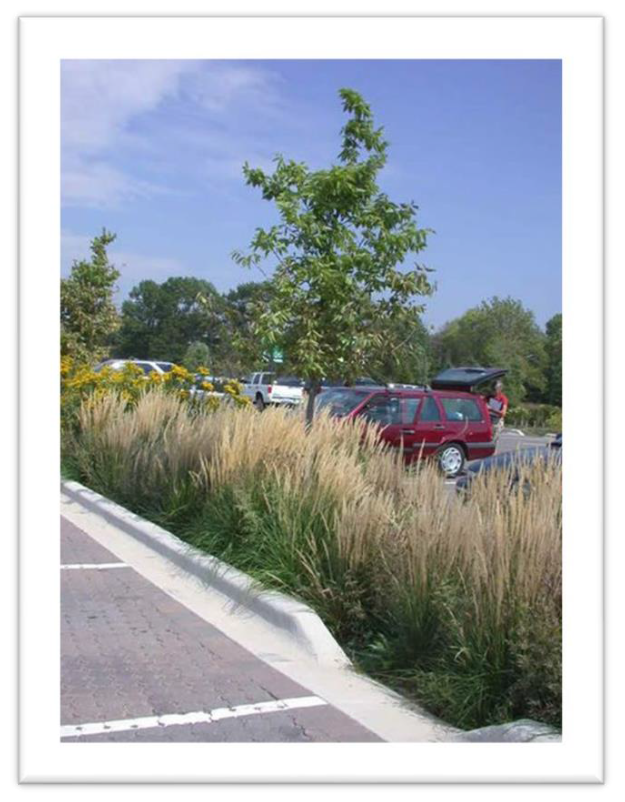
Figure 27-1200.G. Curb cut to allow drainage.
1.
Where appropriate and approved by the engineering division, the use of porous pavement and/or specially designed brick or block should be considered to increase on-site water retention for plant material, replenishment of groundwater supplies and to reduce problems associated with runoff.
2.
Parking lots shall be designed so as not to drain into or across public sidewalks, adjacent property, or directly into natural watercourses. Curbs used to protect landscape islands should have 18- to 24-inch-wide curb cuts at frequent intervals to allow storm water infiltration. The surface of landscape islands and divider strips shall be concave to help channel surface water runoff. The following drainage structures are permitted within parking lot landscape areas:
(a)
Rain gardens;
(b)
Bio-swales;
(c)
Drainage easements; and
(d)
Drainage inlets.
F.
Snow storage.
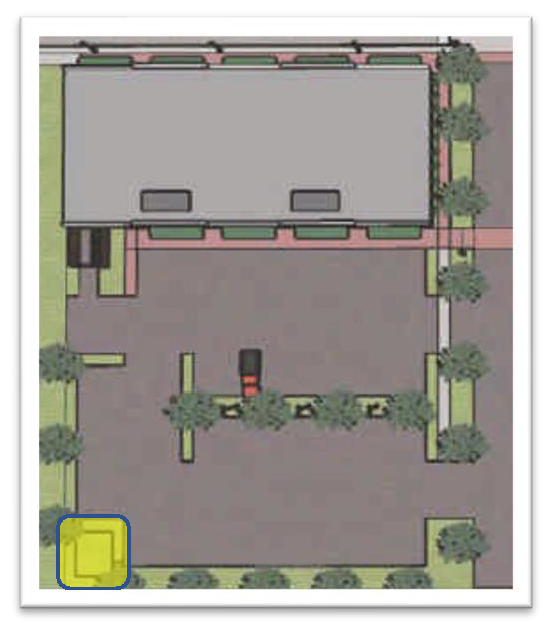
Figure 27-1200.H. Snow storage area.
1.
A portion of the site equal to five (5) percent of the surface areas to be plowed shall be provided as one or more snow storage areas that:
(a)
Are adjacent to and within twenty (20) feet of the edge of the pavement to be plowed;
(b)
Are located so as not to interfere with the safe movement of pedestrians and traffic, including outside of any required clear vision areas as identified in article 27-1800;
(c)
Are provided with appropriate drainage and where refreezing of any sheet drainage will not pose safety issues; and
(d)
Remain accessible, useable, and clear of obstructions.
2.
Plowed snow may be placed in a required bufferyard or parking lot interior landscape area that has been designed as follows:
(a)
Snow storage areas shall be planted with plant materials that are salt-tolerant and that can withstand the weight and compaction of the snow. Mulch shall cover less than thirty (30) percent of the landscape area within three (3) years of installation.
(b)
Trees, shrubs and other woody plants shall be protected from adjacent snow storage areas by separation by a minimum at grade separation from tree trunks or shrubs of four (4) horizontal feet, or planters, elevated landscaping elements, walls or other approved mechanisms.
(Ord. No. 21-5748, § 3(Exh. A), 1-25-21)
Sec. 27-1206. - Utility and service area screening.
A.
Single family residential. To the maximum extent practicable, utility equipment on residential lots shall be located behind the front building line of the house and screened from public view by an opaque wall, fence, or landscaping screen. Alternative locations may be approved by the planning and community services director to allow for the retention of existing trees on wooded sites.
B.
Multifamily and non-residential.
1.
Screening generally.
(a)
Site screening. All multiple-family residential projects, manufactured and mobile home parks, and all mixed-use and non-residential projects shall include on the landscape plan, a detailed drawing of enclosure and screening methods to be used in connection with trash bins, recycle bins, storage yards, service areas, loading docks, and equipment areas on the property.
(b)
Visual screening. Structures shall be designed and screened so that windows and decks do not overlook neighboring residential properties in a manner that intrudes on privacy.
2.
Mechanical equipment.
(a)
Applicability.
(1)
The standards of this section shall apply to all of the following:
(i)
Electrical and gas-powered mechanical equipment;
(ii)
Ductwork and major plumbing lines used to heat, cool, or ventilate; and
(iii)
Power systems for the building or site upon which the equipment is located.
(2)
Roof or wall-mounted antennas and vent openings shall not be considered mechanical equipment for purposes of these screening standards. The standards of this section are not intended to apply to solar arrays, solar energy collection systems, or small wind energy systems, if such systems are otherwise in compliance with applicable building codes and development standards requirements.
(b)
Screening standards.
(1)
Roof-mounted mechanical equipment. Roof-mounted mechanical equipment shall be screened by a parapet wall or similar feature that is an integral part of the building's architectural design. The parapet wall or similar feature shall be of a height equal to, or greater than the height of the mechanical equipment being screened. Roof-mounted mechanical equipment, except solar energy collection systems, is prohibited on single-family residential dwellings.
(2)
Wall-mounted mechanical equipment. Wall-mounted mechanical equipment, except air conditioning equipment (e.g., window AC units), that protrudes more than six (6) inches from the outer building wall shall be screened from view by structural features that are compatible with the architecture of the subject building. Wall-mounted mechanical equipment that protrudes six (6) inches or less from the outer building wall shall be designed to blend with the color and architectural design of the subject building.
(3)
Ground-mounted mechanical equipment. Ground-mounted mechanical equipment shall be screened from view by landscaping, a fence, or a decorative wall that is integrated into the architecture of the structure. The fence or wall shall be of a height equal to, or greater than the height of the mechanical equipment being screened.
(4)
Alternate screening. Alternate screening methods that meet the intent of this section may be approved by the planning and community services director. Alternative screening might include, but shall not be limited to, increased setbacks, increased landscaping, grouping the equipment on specific portions of a site, architectural elements, and painting or otherwise causing the equipment to blend with the site or structure.
3.
Service, loading, and storage areas.
(a)
Applicability. These screening requirements are applicable to all service, loading, and storage areas. Applicants are encouraged to locate the types of features listed in this subsection where they are not visible from off-site, or from public areas of a site, so that screening is unnecessary.
(b)
Placement.
(1)
All service areas shall be placed at the rear, on the side of, or inside buildings.
(2)
No service area shall be visible from a public right-of-way, or from adjacent residential areas.
(3)
Service areas and access drives shall be located so they do not interfere with the normal activities of building occupants or visitors on driveways, walkways, in parking areas, or at entries.
(c)
Outside storage areas and loading docks.
(1)
All storage areas, service areas, and loading docks visible from any public street right-of-way must be screened according to one or more of the screening options provided in these standards. Property zoned industrial must also screen from view, all outside storage areas that are adjacent to, or can be seen from non-industrial zoned property.
(2)
Screening shall be a minimum height of eight (8) feet to screen truck berths, loading docks, areas designated for permanent parking, or storage of heavy vehicles, equipment, or materials.
(3)
Screening shall be long enough to screen the maximum size trailer that can be accommodated on site. Sites that can accommodate a full-size tractor-trailer shall provide a 48-foot wing wall, where wing walls are used.
(d)
Shopping cart storage.
(1)
All shopping carts shall be stored either inside the building they serve or adjacent to the building in an area that is screened from public view.
(2)
Shopping cart corrals shall be made of a material suitable for withstanding weathering and rusting.
(3)
Shopping cart storage shall not be located in required off-street parking spaces.
(Ord. No. 21-5748, § 3(Exh. A), 1-25-21)
Sec. 27-1207. - Tree protection during construction.
A.
General requirements. If the developer and designer intend to acquire landscape or bonus points for retained trees and landscaping, then tree protection during construction shall conform to the requirements of this section and the requirements relevant to construction in the American National Standards Institute (ANSI) publication A300 standards.
B.
Protective fencing required. Tree protection requirements shall apply to existing trees that are to receive credit for preservation. Such trees shall be surrounded by a temporary fluorescent colored fence that shall be constructed around the drip line of each tree, or group of trees to be preserved, prior to any grading or construction on the property.
1.
The fencing shall be rigidly supported and maintained during all construction periods at a minimum height of four (4) feet above grade.
2.
All trees required to be fenced shall be clearly marked in a method approved by the zoning coordinator to notify inspectors the subject tree, or trees, are to be fenced at all times during construction.
3.
Fencing may only be removed with the zoning coordinator's written permission, or upon approval of the final landscaping inspection.
C.
Owner's responsibility. The owner or developer shall be responsible for the erection of any and all fences necessary to protect any existing or installed trees from damage both during, and after construction.
D.
Shown on site or landscaping plan. The tree protection fencing shall be clearly shown on the site plan or landscape plan.
E.
Inspection prior to land disturbance. All tree protection measures shall be inspected and approved by the applicant or landscape design professional responsible for the final landscape plan prior to start of any land disturbing activities.
F.
Prohibited activities. The following activities are restricted or prohibited within the area contained by the tree protection fence:
1.
Storage is prohibited within the fenced areas, including storage of heavy equipment, building materials, or soil.
2.
Installation of underground utilities should be avoided within the area enclosed by the temporary fence. If installation of underground utilities is necessary, tunneling shall be used under the entire tree protection area. Tunneling must occur below the main lateral level of roots, or at least two (2) feet below the surface, whichever is greater. Tunneling shall be done from both directions. Soil shall be backfilled in the tunnels.
3.
Road and grade cuts (for basements and foundations) shall be outside the area enclosed by the temporary fence.
4.
Minimal grading within twenty (20) feet of the tree protection area may be allowed provided it does not impound water during wet periods or increase the drainage rate so that water tables are lowered.
G.
Time limit for commencing construction after clearing land. Where land is cleared and construction does not begin within nine (9) months from the date of the building permit issuance, the owner shall be required to replant or re-seed the cleared property to its original vegetative cover based on tree counts and other information originally submitted to the city. A six-month extension of this limit may be issued at the discretion of the zoning coordinator.
(Ord. No. 21-5748, § 3(Exh. A), 1-25-21)
Sec. 27-1208. - Landscaping material standards.
A.
Compliance with landscape plan.
1.
Plants shall conform to the measurements specified in the plant schedule submitted with the landscaping plan.
2.
Homeowner associations and other similar organizations may not establish landscaping standards that conflict with the naturalized plant or water conservation provisions of this article as approved in an individual building permit landscape plan.
3.
It is recommended that a professional horticulturist, nurseryman or design professional be consulted to determine the proper time to move and install all plant materials, so that stress to the plants will be minimized and plant success will be maximized.
B.
Plant selection.
1.
Tree and plant materials shall be selected for: Energy efficiency and water efficiency; adaptability and relationship to the native environment; color, form and pattern; ability to provide shade; soil retention; and resistance to fire. The overall landscape plan shall be integrated with all elements of the project, such as buildings, parking lots, and streets, and to achieve a desirable microclimate and minimize energy demand.
2.
The Billings plant list shall identify appropriate tree and plant species for use in required landscaping areas. Alternate appropriate trees and plants may be used on a site as recommended by a landscape architect or landscape designer.
3.
Naturalized vegetation within sensitive land and resource areas shall be preserved unless the city approves an alternative naturalized landscaping plan that preserves significant desirable naturalized vegetation.
4.
If turf areas are included in landscaping, they must use a sod or seed mix specifically cultivated to thrive in the conditions present at the particular site.
(a)
The use of non-naturalized, high water consumptive turf or other monoculture seeding is discouraged.
(b)
The applicant must provide information regarding the composition of a sod or seed mix as part of the detailed plant list as required.
(c)
No person or organization shall impose private covenants, conditions, deed clauses, or other agreements that require the installation of turf or prevent the utilization of water efficient landscaping, provided such landscaping receives appropriate approval. No person shall prohibit landscaping materials and designs solely on the basis that they make use of water-efficient landscaping.
C.
Measurement.
1.
Caliper.
(a)
Caliper measurement shall be taken six (6) inches above the ground level for field grown stock and from the soil line for container grown stock, which should be at or near the top of the root flare, and six (6) inches above the root flare for bare root plants, up to and including the four-inch caliper size interval (i.e., from four (4) inches up to, but not including, four and one-half (4½) inches). If the caliper measured at six (6) inches is four and one-half (4½) inches or more, the caliper shall be measured at twelve (12) inches above the ground level, soil line, or root flare, as appropriate.
Note: Seldom are tree trunks perfectly round. The most accurate measurement will result from the use of a diameter tape. Caliper measurements taken with manual or electronic "slot" or "pincer" type caliper tools should be the average of the smallest and largest measurements.
(b)
Trees with multiple stems: When a caliper measurement is included in the specifications, the specifications shall also include the method used to determine the caliper measurement, shown below:
(1)
The number of required trunks and the minimum caliper of each required trunk.
(2)
The caliper of only the largest trunk, with all other required trunks within a certain caliper range of the largest trunk (e.g., by percent or within two (2) smaller caliper sizes).
(3)
The caliper specified is one-half (½) of the caliper of the three (3) largest required trunks.
(4)
The caliper specified is the average of all required trunks.
2.
Height and spread (coverage).
(a)
Height measurement shall be taken from ground level for field grown stock and from the soil line for container grown stock, which should be at or near the top of the root flare, and from the root flare for bare root plants.
(b)
Spread measurement shall be the average spread of the branches of the plant, without leaves for deciduous shrubs, including leaves for evergreens.
(c)
For deciduous shrubs, height measurement shall extend to the top of all canes meeting the height specification, as appropriate to the plant type.
(d)
For evergreens, height measurement shall not be taken at the tip of the leader but should be taken at the midpoint between the uppermost whorl(s) and the tip of the leader.
D.
General standards. The following criteria and standards shall apply to landscape materials and installation:
1.
Plant materials list. The planning division shall maintain a suggested and prohibited plant list as necessary to identify plant material requirements or prohibitions within the city. Where a species is chosen for a landscape plan that is not identified on a city plant list, the applicant shall provide information about growth and spacing characteristics on the landscape plan. Plant information shall be taken from objective sources, including professional landscape organization websites or nursery cut sheets. Plant materials identified in any prohibited plant list may not be used in landscaping.
2.
Quality. All trees and shrubs used for landscaping shall have well-developed leaders, tops, and roots characteristic of the species, cultivar, or variety per American National Standards Institute (ANSI) Z60.1, a copy of which is on file in the planning office, and shall show evidence of proper nursery pruning per the same standard. All plant materials must be free of insects, diseases, mechanical injuries, and other objectionable features at the time of planting.
3.
Coverage.
(a)
Grass, ground cover, shrubs, organic mulch, and other organic landscape materials shall be used to cover at least seventy-five (75) percent of open ground. Shade provided by trees, shrubs, or structures, or anything not on the horizontal plane of the site does not qualify as ground cover.
(1)
Open ground includes all fill slopes and hillsides, regardless of the angle of the slope.
(2)
Open ground also includes all fill rock and shot rock slopes that must be covered with an appropriate depth of soil to allow for the healthy growth of the coverage.
(3)
Inorganic material can be incorporated into a landscape plan where appropriate and can be used to cover up to twenty-five (25) percent of open ground.
(b)
No area required to be landscaped shall include any artificial trees, plants, or turf; impervious surfacing other than sidewalks, decorative pathways or other public amenities; or any carpeting designed as a visual substitute for lawn or other groundcover.
(c)
Areas devoted to pasture, farm crops, or undeveloped areas of a parcel shall not be considered landscaped for the purpose of fulfilling any landscape requirements.
4.
Trees. Trees used for landscaping shall be a species common to, or adapted to this area of the state, and not identified as prohibited on any city plant list. Trees shall have the following characteristics:
(a)
Size.
(1)
Canopy trees shall be deciduous trees that have a minimum height of thirty (30) feet at maturity. All canopy trees shall have a caliper width of at least two (2) inches at time of planting.
(2)
Understory trees shall be deciduous trees that have a maximum height of less than thirty (30) feet at maturity. All understory trees shall have a caliper width of at least one and one-half (1½) inches at time of planting.
(3)
Coniferous trees shall have a minimum height of twenty (20) feet at maturity. All coniferous trees shall be at least four (4) feet in height at time of planting.
(4)
Street trees shall be canopy trees.
(b)
All trees shall conform to the American National Standards Institute (ANSI) Z60.1, a copy of which is on file in the planning office.
5.
Shrubs, hedges, and ornamental grasses.
(a)
Shrubs shall have the following characteristics:
(1)
Small or dwarf deciduous shrubs that typically do not grow to a mature height or spread exceeding three (3) feet shall have a minimum height of twelve (12) inches with a minimum of four (4) canes.
(2)
Intermediate deciduous shrubs with a mature height or spread of three (3) to seven (7) feet shall have a minimum height of eighteen (18) inches with a minimum of four (4) canes.
(3)
Large or tall deciduous shrubs with a mature height exceeding seven (7) feet shall have a minimum height of twenty-four (24) inches and a minimum of five (5) canes. Where these shrubs have a narrow habit the minimum number of canes may be reduced to one.
(b)
Ornamental grasses shall have a minimum two-gallon pot size at time of planting.
(c)
Hedges, where installed as a bufferyard screen, shall be planted and maintained so as to form a continuous, unbroken, solid, visual screen which will be at least three (3) feet in height at the time of planting and achieve a minimum height of six (6) feet within five (5) years.
6.
Ground cover, perennials, and annual planting areas. Ground covers, perennials, and annual planting areas used in lieu of grass in whole, and in part, shall be planted in such a manner as to present a finished appearance and reasonably complete coverage at maturity.
7.
Lawn grass. Grass areas may be sodded, plugged, sprigged, or seeded, except that sod or other erosion control products shall be used in swales, berms, or other areas subject to erosion.
8.
Naturalized plants and grasses. Naturalized plants and grasses shall not be considered weeds that are subject to BMCC section 25-302; however, the area planted in naturalized plants and grasses shall be kept weed-free to maintain this exemption. The owner shall provide documentation to show the seed mix used for naturalized plants and grasses.
9.
Fractions in the calculation of number of trees and shrubs. In the calculation of trees and shrubs for any required landscaping, all fractions shall be rounded to the nearest whole number.
E.
Interference and visibility.
1.
All landscaping shall be sized and located so that it does not interfere with utilities, easements or fire hydrants.
2.
All landscaped areas must comply with the clear vision area standards for intersections as established in subsection 27-1802.H.
F.
Irrigation systems.
1.
Required and optional systems.
(a)
Automatic irrigation systems are not required for single unit or two-unit residential dwellings on single lots or in the CBD.
(b)
Automatic irrigation systems shall be installed in required landscape areas in all other zone districts.
2.
General standards. The following standards shall apply to all in-ground permanent irrigation systems:
(a)
The landscape plan shall identify the area of approximate installation of an automatic irrigation system, its maintenance, and intended uses. The landscape plan must note and delineate all irrigated and sod areas.
(b)
Irrigation systems installed with new development must be installed prior to plant materials.
(c)
Irrigation systems with a precipitation rate exceeding 0.75 inches per hour shall be prohibited on areas exceeding one thousand (1,000) square feet with a slope greater than thirty (30) percent unless:
(1)
Infiltration trenches, vegetated swales, bio detention areas, and similar facilities as approved by the city are employed to reduce runoff, or
(2)
The landscape designer specifies an alternative design or technology that clearly demonstrates to the city's satisfaction no runoff or erosion will occur. Prevention of runoff and erosion must be confirmed during the final landscape inspection.
3.
Low-flow irrigation systems. Low-flow irrigation devices shall be used in all landscape areas that are less than eight (8) feet wide in any direction to avoid overspray and runoff.
(a)
System design shall be either surface drip system, subterranean drip system, micro-spray, or a combination of these systems.
(b)
A hose bib system may be used for irrigation when a landscape area is less than one thousand (1,000) square feet in size and when all portions of the area are within one hundred (100) feet of a hose attachment.
4.
Automatic operation.
(a)
All systems shall be equipped with timers and scheduled to operate during evening or early morning hours to minimize evaporation rates.
(b)
All automatic underground sprinkler systems shall be equipped with rain and freeze sensors.
(Ord. No. 21-5748, § 3(Exh. A), 1-25-21)
Sec. 27-1209. - Fences, walls and hedges.
A.
Applicability.
1.
Fences, walls, and hedges may be erected or maintained in any zoning district provided the height, setback, and material provisions outlined below are followed and a permit is secured.
2.
"Fence" for the purposes of this section means any fence, wall or hedge.
3.
No fence shall be erected or maintained in a public right-of-way.
4.
All fences over thirty-six (36) inches in height and equal to or less than seven (7) feet in height shall require a permit from the planning division. Fences over seven (7) feet in height may require a permit from the Building Division.
B.
Height. Height, for the purposes of this section, shall be defined as the vertical distance from the top rail, board or wire to the ground directly below as measured inside the fence.
C.
Setbacks required.
1.
Front yard. The maximum height for fences, walls, or hedges in a required front yard setback is four (4) feet. Front yard setbacks are defined in the applicable zone district.
2.
Side and rear yards.
(a)
Fences, walls, or hedges between a height of four (4) and six (6) feet may be erected or maintained in any side or rear yard setback. Fences may not block a clear vision area pursuant to subsection 27-1802.H.
(b)
Any fence, wall, or hedge in excess of six (6) feet shall meet all of the yard setback requirements for structures as defined in the applicable zone district and will require a building permit.
3.
Exceptions. The setback requirements described above shall not apply in the heavy commercial (CX), EBURD-CW, EBURD-IS, light industrial (I1), or heavy industrial (I2) zones.
D.
Setbacks for clear vision areas. No fence, wall, or hedge greater than thirty (30) inches in height may be erected or maintained within a clear vision area in any zone district, pursuant to subsection 27-1802.H.
E.
Materials.
1.
Residential and commercial zones.
(a)
Generally. All fences in residential, and commercial zoning districts shall be constructed from materials which are commonly used for fencing.
(1)
Commonly used fence materials include wood including wood composites, brick, stone, split railing, chain-link, wire, vinyl, ornamental iron work, and corrugated or uncorrugated metal panels framed in wood, vinyl, composite, brick or stone. Metal panels shall be coated with a non-reflective material.
(2)
Prohibited materials: Railroad ties, intact wood pallets, tires, rubble or reflective metal panels.
(3)
Salvaged material that do not meet one of the commonly used fence materials identified above are generally prohibited except as provided in this section. Salvaged material may be used for fencing where:
(i)
The appearance of the completed fence is substantially similar to and consistent with the design of a fence constructed of commonly-used materials,
(ii)
The salvaged material fence is constructed according to generally applicable fence construction standards, and
(iii)
The salvaged material is in good repair and capable of long-term maintenance by the property owner.
(4)
Materials not listed may be submitted for administrative relief.
(b)
Bufferyard fencing. Required bufferyard fencing may be constructed of any of the materials identified in subsection E.1(a) along with powder-coated or vinyl coated chain link fence.
(1)
Where an opaque screening fence is required between uses—such as residential next to heavy commercial or industrial—solid vinyl, wood including wood composites or similar solid fencing, or powder-coated or vinyl-coated chain link fence with opaque (solid) inserts shall be installed.
(2)
An existing fence of the proper height and materials that is located on the property line where a bufferyard fence is required may be retained. Where an existing fence is not compliant with this section, the property owner who is required to install the bufferyard fence shall replace the existing fence with a compliant fence.
2.
Industrial zones. All fences in industrial zoning districts shall be constructed from materials commonly used for fencing and shall not be constructed from railroad ties, intact wood pallets, rubble, or salvaged material.
(a)
Commonly used fence materials include wood, brick, stone, split railing, chain-link, wire, vinyl, ornamental iron work, finished or coated steel or aluminum building panels.
(b)
Barbed wire is only permitted where an eight-foot tall fence is permitted. The barbed wire must be placed on top of the fence and must be located a minimum of eight (8) feet from the ground. Electric fencing is not permitted.
(c)
Materials not listed may be submitted for administrative relief.
(Ord. No. 21-5748, § 3(Exh. A), 1-25-21; Ord. No. 22-5807, § 3(j), 5-9-22; Ord. No. 23-5837, § 3, 6-12-23)

