
Billings City Zoning Code
ARTICLE 27
1400.- SIGN CODE
Sec. 27-1401.- General provisions.
A.
Purpose and interests. The city has a legitimate, important, substantial, or compelling interest in:
1.
Avoiding the proliferation of signs of generally increasing size, dimensions, and visual intrusiveness that tends to result from property owners competing for the attention of passing motorists and pedestrians because this approach to signage:
(a)
Creates visual distraction and obstructs views, potentially creating safety hazards for motorists, bicyclists, and pedestrians;
(b)
May involve physical obstruction of streets, sidewalks, or trails, creating public safety hazards;
(c)
Degrades the aesthetic quality of the city, making the city a less attractive place for residents, business owners, visitors, and private investment; and
(d)
Dilutes or obscures messages on individual signs due to the increasing competition for attention.
2.
Maintaining and enhancing the character of the central business district and commercial corridors, both of which are resources of exceptional quality and vibrancy to the community as a whole.
3.
Coordinating the location and type of signage with existing and proposed street frontage landscaping in a manner that that contributes to the character, environmental quality, and economic health of the city and the region.
4.
Maintaining a high-quality aesthetic environment to protect and enhance property values, leverage public investments in streets, sidewalks, trails, plazas, parks, open space, civic buildings, and landscaping, and enhance community pride.
5.
Protecting minors from speech that is harmful to them according to state or federal law, by preventing such speech in places that are accessible to and used by minors.
B.
Findings. The city finds that:
1.
Content-neutrality, viewpoint neutrality, and fundamental fairness in regulation and review are essential to ensuring an appropriate balance between the important, substantial, and compelling interests set out in this article and the constitutionally protected right to free expression.
2.
The regulations set out in this article are unrelated to the suppression of constitutionally protected free expression, do not relate to the content of protected messages that may be displayed on signs, and do not relate to the viewpoint of individual speakers.
3.
The incidental restriction on the freedom of speech that may result from the regulation of signs pursuant to this article is no greater than is essential to the furtherance of the important, substantial, and compelling interests that are set out in this article.
4.
Regulation of the location, number, materials, height, sign area, form, and duration of display of temporary signs is essential to preventing sign clutter.
5.
Temporary signs may be degraded, damaged, moved, or destroyed by wind, rain, snow, ice, and sun, and after such degradation, damage, movement, or destruction, such signs harm the safety and aesthetics of the public on city's streets or sidewalks if they are not removed.
6.
Certain classifications of speech are not constitutionally protected due to the harm that they cause to individuals or the community.
C.
Savings and severability.
1.
Signs containing noncommercial speech are permitted anywhere that commercial speech signs are permitted, subject to the same regulations applicable to such signs. Any sign that can be displayed under the provisions of this article may contain a noncommercial message.
2.
If any clause, section, or other part of the application of these sign regulations shall be held by a court of competent jurisdiction to be unconstitutional or invalid, it is the intent of the city that such clause, section, or specific regulation be considered eliminated and not affecting the validity of the remaining clauses, sections, or specific regulations that shall remain in full force and effect.
D.
Conflicts with other provisions. Nothing in this article shall be deemed a waiver of the provisions of any other ordinance or regulation applicable to signs. Signs located in areas governed by several ordinances or applicable regulations shall comply with all such ordinances and regulations. If there is a conflict between this article and any other ordinance or regulation, the more stringent shall apply.
(Ord. No. 21-5748, § 3(Exh. A), 1-25-21)
Sec. 27-1402. - Applicability.
A.
Applicability.
1.
The regulations contained in this article shall apply to, and regulate the display, construction, installation, erection, alteration, use, location, maintenance, and removal of all signs and support structures in all districts unless the sign, item, or activity is expressly exempted from these regulations.
2.
No new sign shall be located, erected, modified, or maintained except in compliance with the regulations contained in this article.
3.
Existing signs that were legally installed are not required to come into compliance with this article unless changes to the sign are made in a manner regulated in section 27-1403, Nonconformities. Existing signs are required to comply with maintenance requirements and are subject to abandonment per section 27-1410, Installation and maintenance.
B.
Sign permit required.
1.
New signs. A sign permit shall be required to erect, place, modify the size or shape, allow the continued placement, or convert any portion of a sign, including a conversion from temporary to permanent or from non-EMD to EMD unless otherwise provided in this article. Permits submitted for marijuana businesses shall provide proof of compliance with state sign regulations along with a completed city sign permit application.
2.
Existing signs. Changes to existing signs that are made nonconforming by the 2020 zoning code update require a sign permit and are subject to section 27-1403, Nonconformities. Changes to existing signs for marijuana businesses shall comply with state sign regulations.
3.
Sign permit exemptions. The following activities shall not require a sign permit, provided that these exemptions shall not be construed as relieving the owner from the responsibility to comply with the provisions of this zoning code or any other law or ordinance, including the city's adopted building code(s), and any related state sign regulations:
(a)
Changing of the advertising copy or message on an existing approved painted or printed sign, marquee, changeable copy sign or a similar approved sign whether electrical, illuminated, electronic changing message display or non-illuminated painted message which are all specifically designed for the use of replaceable copy;
(b)
Painting, repainting, cleaning or other normal maintenance and repair of a sign not involving structural changes. Replacement of or a change of a plastic sign face will be included as an exempt operation;
(c)
Changes in the content of show window displays and permitted temporary signs.
C.
Exemptions. The following signs, items, and operations shall not require a sign permit, but shall be undertaken in conformance with this article, and all adopted building code(s):
1.
Internal and integral signs.
(a)
Signs not intended for view or readily legible from the public right-of-way or adjacent residential, public, or civic districts or uses.
(b)
Integral signs that are carved into stone or similar material that are integral to the building or plaques that are placed flat against a building. Integral signs shall not exceed four (4) square feet in area
(c)
Signs that are less than one square foot in area that are affixed to machines, equipment, fences, gates, walls, gasoline pumps, or utility cabinets.
(d)
Signs or banners on fences and structures within an arena, park, recreational complex, or athletic field, provided such signs or banners face inward to the arena, park, recreational complex, or athletic field.
2.
Flags and insignia.
(a)
Flags that are affixed to a permanent flagpole or structure.
(b)
Up to two (2) flutter flags affixed to a permanent flag pole.
3.
Neighborhood watch area.
(a)
All developed properties within a neighborhood watch area may post one sign provided by the neighborhood watch organization. Neighborhood watch signs shall be posted on private property.
(b)
Wall signs, not exceeding four (4) square feet in sign area, shall be placed flat against the wall of a building.
(c)
Freestanding signs shall not exceed four (4) square feet in sign area and six (6) feet in height and shall be placed at least one foot behind all property lines. The maximum height for a freestanding sign located within a clear vision area, defined in subsection 27-1802.H, is thirty (30) inches.
4.
Public signs.
(a)
Official public signs approved by a governmental body with jurisdiction over issues such as traffic safety, pedestrian safety, schools, railroads, or public notice, as well as signs required by the Manual of Uniform Traffic Controls.
(b)
Signs and notices required to be displayed, maintained, or posted by law or by any court or governmental order, rule, or regulation, including any notices required for marijuana businesses.
(c)
Government signs and notices provided for the convenience and safety of the community.
(d)
Bench signs. Bench signs on benches located on active, fixed bus routes, controlled or authorized by the Billings MET. The benches must be located on active, fixed routes. Signs shall be removed from or prohibited on benches located in prohibited sign locations or where the bench is not associated with an active, fixed route.
5.
Seasonal displays.
(a)
Seasonal displays that might include incidental signage provided both the sign and the display meet the clear vision area requirements of subsection 27-1802.H.
6.
Vehicle signs.
Lettering or symbols applied directly onto or flush-mounted magnetically to a motor vehicle operating in the normal course of business.
D.
Prohibited signs. The following types of signs and sign structures are prohibited in all districts, except as otherwise provided by this article:
1.
Distracting, interfering, or confusing signs.
(a)
Non-electronic message displays signs that are animated by means of flashing, scintillating, blinking, traveling lights, displaying video, or any other means not providing constant illumination. Electronic message displays may be allowed provided they comply with the standards in subsection 27-1405.C.
(b)
Signs that contain or are an imitation of an official traffic or emergency sign or signal or which, by reason of their size, movement, content, coloring or manner of illumination, may be confused with or construed as a traffic control sign, signal or device, or the light of an emergency or road equipment vehicle, or which hide from view any traffic or street sign or signal or device.
(c)
Signs with a lighting or control mechanism that causes radio, radar, cellular, wireless, or other electronic signal interference.
(d)
Wind-driven signs; additionally, no sign shall be suspended by chains or other devices that will allow the sign to swing due to wind action. Signs shall be anchored to prevent any lateral movement.
2.
External movement and light projecting signs.
(a)
Signs that operate or employ visible moving parts or any portion of which moves, or give the illusion of motion;
(b)
Signs that emit audible sound, odor or visible matter; or
(c)
Signs that are light projecting or operate or employ any motion picture projection or video projection in conjunction with any advertisements.
E.
Prohibited locations. Signs and sign structures, including exempt signs, are prohibited in the following locations:
1.
Improper location.
(a)
In the right-of-way or on other public property without approval of the city.
(b)
Placed on private property without the consent of the owner or authorized agent of the owner of such property.
(c)
Within a clear vision triangle (see subsection 27-1802.H).
(d)
Attached to utility poles, other utility or public infrastructure structures or equipment, or wireless communication facilities.
2.
Creation of hazardous condition.
(a)
Signs that create conflict with traffic control signs, signals, or various private signs resulting in vehicular or pedestrian safety hazards, including any sign placed at any location where it may, by reason of its size, shape, design, location, content, coloring, or manner of illumination, constitute a traffic hazard or a detriment to traffic safety by obstructing the vision of drivers, by obscuring or otherwise physically interfering with any official traffic control device, or that may be confused with an official traffic control device.
(b)
Signs that creates a danger to the public during periods of inclement weather or high winds due to their location or the manner in which they are placed.
(c)
Signs that create a hazard due to collapse, fire, collision, decay, abandonment, or other safety considerations.
(d)
Signs that obstruct firefighting, police, or emergency activities.
(e)
Signs that are improperly mounted or installed, such as signs attached to a standpipe, gutter drain, unbraced parapet wall, or fire escape, unless the safety of such sign and such mounting have been verified in writing by a structural engineered licensed to practice in the state.
3.
Parking of advertising vehicles. No person shall park any vehicle or trailer on a public right-of-way or public property or on private property so that it is visible from the public right-of-way and which has attached thereto or located thereon any sign or advertising device for the sole purpose of providing advertisement of products or directing people to a business or activity located on the same or nearby property or any other premises. This section is not intended to prohibit any form of vehicular signage such as a sign attached to a bus or lettered on a motor vehicle, or company vehicle signs.
4.
Fence or wall signs. Non-exempt signs that are painted on or attached to any fence or any wall which is not structurally a part of a building.
F.
Prohibited content. No sign shall be approved or disapproved based on the content or message it displays, except that the following content, without reference to the viewpoint of the speaker, shall not be displayed on signs:
1.
Text or graphics that is harmful to minors as defined by state or federal law;
2.
Text or graphics that are obscene, fighting words, defamation, incitement to imminent lawless action, or true threats, as such words and phrases are defined by controlling law;
3.
Text or graphics that present a danger or risk due to their potential confusion with traffic control signs;
4.
Signs that provide false information related to public safety (e.g., signs that use the words "stop" or "caution" or comparable words, phrases, symbols, or characters) that are presented in a manner as to confuse or imply a safety hazard that doesn't exist; or
5.
Text or graphics that provide false or misleading information.
(Ord. No. 21-5748, § 3(Exh. A), 1-25-21; Ord. No. 21-5784, §§ 3.E, 3.F, 11-22-21)
Sec. 27-1403. - Nonconforming signs.
A.
Nonconforming signs. Where a lawful sign exists at the effective date of this article, or amendment of this article, that would be illegal under the terms of this article, the use of such sign may be continued so long as it remains otherwise lawful, subject to the provisions of this section.
B.
Classification of nonconformities. There are two (2) types of legal, nonconforming signs: major and minor. Signs with multiple nonconforming elements are classified in the category of the most significant nonconformity.
1.
Major nonconforming signs. Major nonconforming signs are those signs for which the nonconformity generates a nuisance per se, violates city sign policy, or is incompatible with adjacent signs and/or the adopted guiding principles such that public policy favors their elimination from the zone if they are discontinued, abandoned, or destroyed. Major nonconforming signs include:
(a)
Off-premises signs, unless permitted as a conforming off-premise sign through section 27-1409;
(b)
Dangerous signs;
(c)
Signs that exceed the maximum height or size permitted in the zone district by more than twenty (20) percent;
(d)
Nonconforming setback that encroaches on or over a public right-of-way, clear vision area, or public access easement;
(e)
Signs with nonconforming illumination;
(f)
Nonconforming sign types; and
(g)
Signs approved with a variance on or before January 1, 2010, that permits any issue included in this major nonconformity list.
2.
Minor nonconforming signs. Minor nonconforming signs are any nonconforming signs that are not classified as major nonconforming signs. Minor nonconforming signs include but are not limited to:
(a)
Signs that exceed the maximum height or size permitted in the zone district by twenty (20) percent or less;
(b)
Nonconforming setback that does not encroach on or over a right-of-way; and
(c)
Nonconforming separation.
C.
Major nonconformities.
1.
Alterations.
(a)
A major nonconforming sign or sign structure may not be altered in any way that increases any nonconformity. A proposed change to any nonconforming aspect of a major nonconforming sign for a new or relocating business shall require the entire sign to be brought into conformance with this article.
(b)
General repairs, maintenance, updates and rebranding for an existing business and change to advertising copy that does not include replacing a static sign with an EMD are not considered alterations.
2.
Replacement.
(a)
A major nonconforming sign that is voluntarily replaced for a new or relocating business shall be replaced with a conforming sign.
(b)
A major nonconforming sign that loses its nonconforming status per subsection 27-1403.F shall be replaced with a conforming sign.
D.
Minor nonconformities.
1.
Alterations.
(a)
A minor nonconforming sign may be altered for an existing business in a manner that conforms to this zoning code while still maintaining the nonconforming elements. For example, a sign that is two (2) feet over the height limit for the zone district may be altered provided the height is not increased.
(b)
General repairs, maintenance, updates and rebranding for an existing business and change to advertising copy that does not include replacing a static sign with an EMD are not considered alterations.
2.
Replacement.
(a)
A minor nonconforming sign that is voluntarily replaced may be replaced with a conforming sign.
(b)
A minor nonconforming sign that loses its nonconforming status per subsection 27-1403.F shall be replaced with a conforming sign.
E.
Sign removal for public purposes. Any nonconforming sign temporarily removed by a public utility company, the city, or any governmental agency to accommodate repair, maintenance, or expansion operations may be replaced, provided that there is no change in size, height, or location of the sign. If any sign is moved as a direct result of a governmental or utility project, it may be relocated to a position determined by the city engineer to be appropriate in relation to the project, and such a sign shall not be considered nonconforming for the reason of applicable separation standards. No permit shall be required for such replacement.
F.
Loss of nonconforming status. A nonconforming sign shall lose its nonconforming designation and be required to come into compliance with this article if any of the following apply:
1.
Any portion of the freestanding sign structure is replaced.
2.
The principal structure on the site is replaced, renovated in a manner that expands the building footprint by more than fifty (50) percent, or when the sign is required to be moved to accommodate building replacement or expansion in compliance with the zone district regulations.
3.
A major nonconforming sign is removed, relocated, or replaced for any reason except towards compliance with this article.
4.
If more than fifty (50) percent of a nonconforming sign is damaged by any means, as measured by total replacement cost of both the sign and structure prior to such destruction, and the sign type is no longer permitted in the zone district, it shall be considered destroyed and shall not be brought back into service or use except in conformity with the provisions of this article.
5.
The sign is voluntarily replaced in compliance with this article.
6.
The sign is abandoned pursuant to subsection 27-1410.C.
G.
Maintenance and repair.
1.
A nonconforming sign is subject to all requirements of this article regarding safety, maintenance, and repair.
2.
Temporary removal of any portion of a sign for repairs or general maintenance shall not be considered to be in violation of this section, provided that no alterations are made to the sign or sign structure. Should such sign or sign structure be moved permanently for any reason and over any distance whatsoever, it shall thereafter conform to all regulations for the district in which it is located after it has been moved or relocated.
3.
Maintenance shall not include the conversion of a nonconforming sign to an electronic message display sign. Any such conversions may only be made to a conforming sign and shall be subject to the permitting and fee requirements set forth in this article.
H.
Records. In addition to initial and construction inspections, signs may be inspected periodically by the planning and community services department to ensure continued compliance with this article.
(Ord. No. 21-5748, § 3(Exh. A), 1-25-21; Ord. No. 23-5838, § 3, 6-12-23)
Sec. 27-1404. - Measurement and calculation.
A.
Applicability. This section applies to all sign types and classifications, including permanent signs, temporary signs, and off-premises signs.
B.
Sign area.
1.
Maximum. The permitted maximum area for all individual signs is determined by the sign type and the zoning district in which the sign is located.
2.
Building and street frontage.
(a)
Building frontage is the wall of the principal building that faces the street abutting the property.
(1)
If the principal building is located on a corner lot, the frontage shall be the wall of the principal building which faces the street with the highest average daily traffic count.
(2)
Accessory structures shall not be included in the calculation of maximum signage. Wall signs may be affixed to accessory structures; where this is done the amount of signage used on the accessory structure shall be deducted from the total amount of wall signage permitted on the property.
(3)
The surface area of a wall shall be determined by measuring the building height and multiplying it by the length of the wall, without deduction for doors and windows. "False fronts" and mansard roofs shall not be included when calculating the total area of a wall.
(b)
Street frontage is the linear footage of a lot adjacent to a street or right-of-way. Street frontage calculation includes driveways.
(c)
If the principal building is located on a corner lot, both frontages on a public street or right-of-way shall be allowed to apply principal signage standards. When a site has multiple frontages with permitted signage, the permitted signage may only be used on the frontage for which it has been calculated; permitted sign area may not be transferred from one frontage to another unless specifically stated in this article.
3.
Method of measuring sign area.
(a)
Freestanding signs.
(1)
The sign area of a freestanding sign shall be measured from the outside edge of the sign face.
a.
The sign area of multiple freestanding signs each consisting of one single-sided sign shall be computed by adding together the total area(s) of all signs. See subsection (2)a. for sign area calculation for two-sided signs.
b.
Area calculation does not include decorative rocks or landscaping adjacent to a monument sign.
(2)
The sign area for multiple-sided signs shall be calculated as follows:
a.
The total sign area for a two-sided sign shall be calculated using one face, but the second face may not exceed the area of the first face.
b.
The total sign area for a three-sided sign shall be calculated using one face, but the second and third face total area may not exceed the area of the first face.
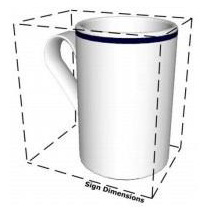
Identification of the vertical sides of a three-dimensional sign
(b)
Three-dimensional signs. The sign area of three-dimensional free-form or sculptural (non-planar) signs is calculated as fifty (50) percent of the sum of the area of the four (4) vertical sides of the smallest cube that will encompass the sign.
(c)
Wall signs.
(1)
Wall sign with border. The sign area is entire area within any type of perimeter or border which may enclose the outer limits of the sign face.
(2)
Wall sign without border. The area of the sign that does not have a perimeter or border shall be computed by enclosing the entire area with parallelograms, triangles, or circles of the smallest size sufficient to cover the entire area of the sign and computing the area of these parallelograms, triangles or circles. The area computed shall be the maximum portion or portions which may be viewed from any one direction.
(d)
Window signs. Sign area percentage is measured for each architecturally distinct window by dividing the sign area by the window area.
C.
Height and clearance. The permitted maximum height for all signs is determined by the sign type and the zoning district in which the sign is located. Sign height and clearance is measured as follows:
1.
Freestanding sign height.
(a)
The vertical distance measured from the highest point of the sign to the crown of the adjacent street, not including the interstate highway.
(b)
Height shall include the sign face, base, cabinet, and ornamental cap.
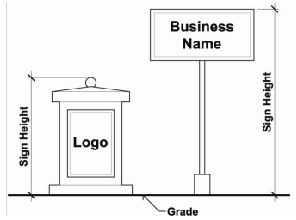
(c)
When the existing finished grade at the point of measurement is lower than the average elevation of the adjacent street finished grade parallel to the location where the sign will be installed, that portion of the sign below the street shall not be included in determining the sign's overall height.
2.
Sign clearance.
(a)
Clearance for freestanding and projecting signs shall be measured as the smallest vertical distance between finished grade directly underneath the sign face at the lowest point of the sign structure, including any framework or other structural elements.
(b)
Signs that project over a roof shall maintain a four (4) foot clearance over the average roof height.
D.
Separation.
1.
On-premises sign separation shall be measured along the property lines from the center of the sign.
2.
Off-premises sign separation shall be measured either by linear feet or radius and diameter, as specified in section 27-1409.
E.
Setback.
1.
Required setbacks are measured from the property line inward.
2.
Clear vision areas, defined in subsection 27-1802.H, may be required in addition to specified setbacks.
(Ord. No. 21-5748, § 3(Exh. A), 1-25-21; Ord. No. 22-5807, § 3(l), 5-9-22; Ord. No. 23-5854, § 3, 10-9-23)
Sec. 27-1405. - General regulations for permanent, on-premises signs.
The purpose of this section is to provide generally applicable sign regulations by sign type. The section is organized by sign category—freestanding, attached, and electronic message displays (EMDs). The amount of signage permitted by zone district is identified in section 27-1406.
A.
Freestanding signs.
1.
Number of signs permitted and required separation for multiple signs.
(a)
Where a developed property abuts more than the total lineal feet of street frontage applicable to a specific district, one additional free-standing may be erected for each additional three hundred (300) feet of street frontage as described in Table 27-1400.1.
(b)
For properties where more than one freestanding sign is permitted, the distance between freestanding signs on that parcel shall meet the distance specified in Table 27-1400.1.
(c)
Where a developed parcel has frontage on more than one public right-of-way or street, excluding alleys, driveways, and service ways the provisions of this subsection shall apply to each street frontage.
Table 27-1400.1. Permitted Number of Permanent Freestanding Signs.
2.
Access point signs.
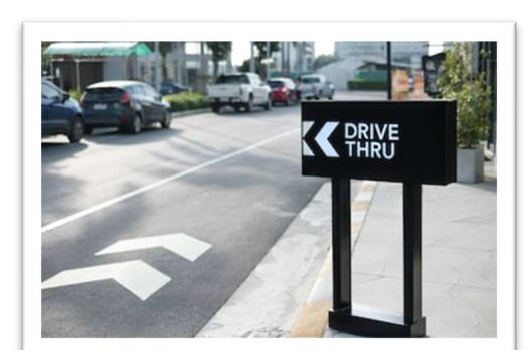
Figure 1. Sample Access Point Sign.
(a)
Access point signage shall be located at public access points where a driveway or other public entryway intersects with a public street. Access point signs are for vehicular access, not pedestrian access.
(b)
Access point signs that are visible from the public right-of-way shall be permanently anchored or fastened.
(c)
Each vehicular access point may have one access point sign.
(d)
Access point signs are exempt from the total freestanding sign calculation in Table 27-1400.1 and are not included in freestanding sign separation measurements.
3.
Monument signs. Monument signs shall have zero clearance above the existing finish grade level and shall be supported in or on the ground.
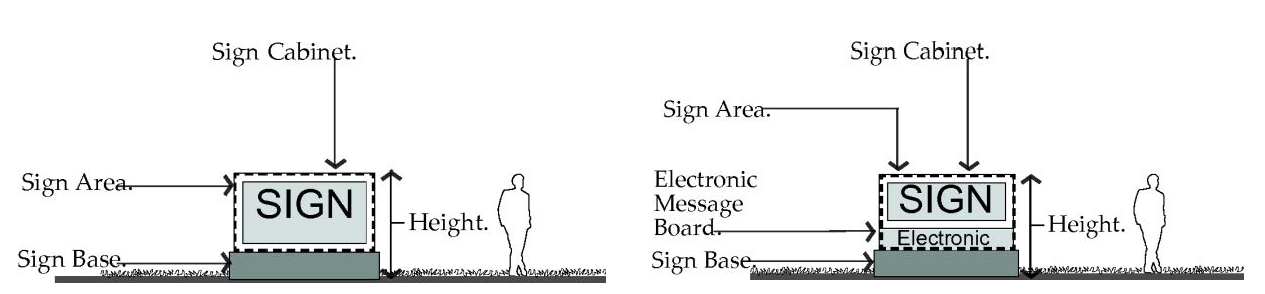
Figure 2. Monument Sign Elements.
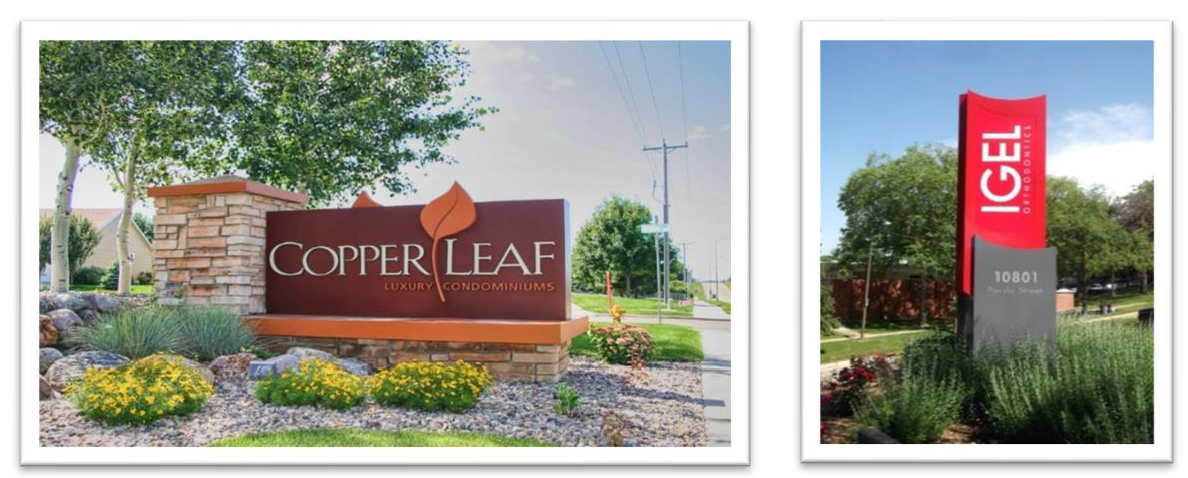
Figure 3. Monument Sign Examples.
4.
Pole signs.
(a)
If a free-standing sign projects over a private vehicular driveway or parking lot aisle, the minimum clearance of fourteen (14) feet shall be maintained between the bottom of the sign edge and the established grade of the site.
(b)
A clear, unobstructed area, a minimum of eight (8) feet in height is required above existing finish grade level when a pole sign is located over a pedestrian walkway or within a clear sight triangle.
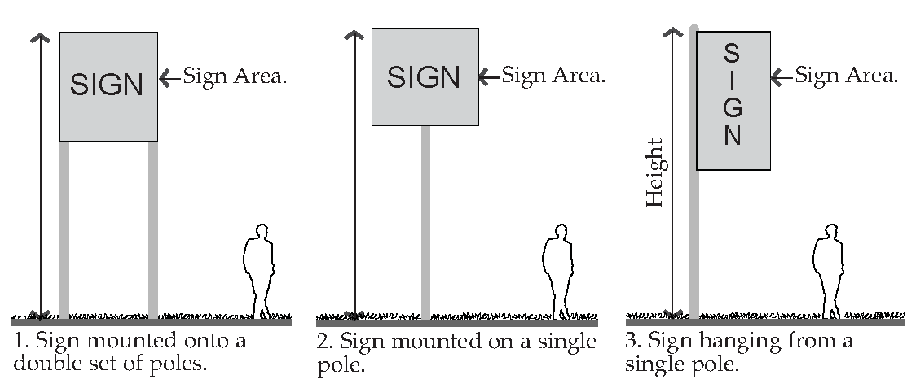
Figure 3. Pole Sign Configurations.
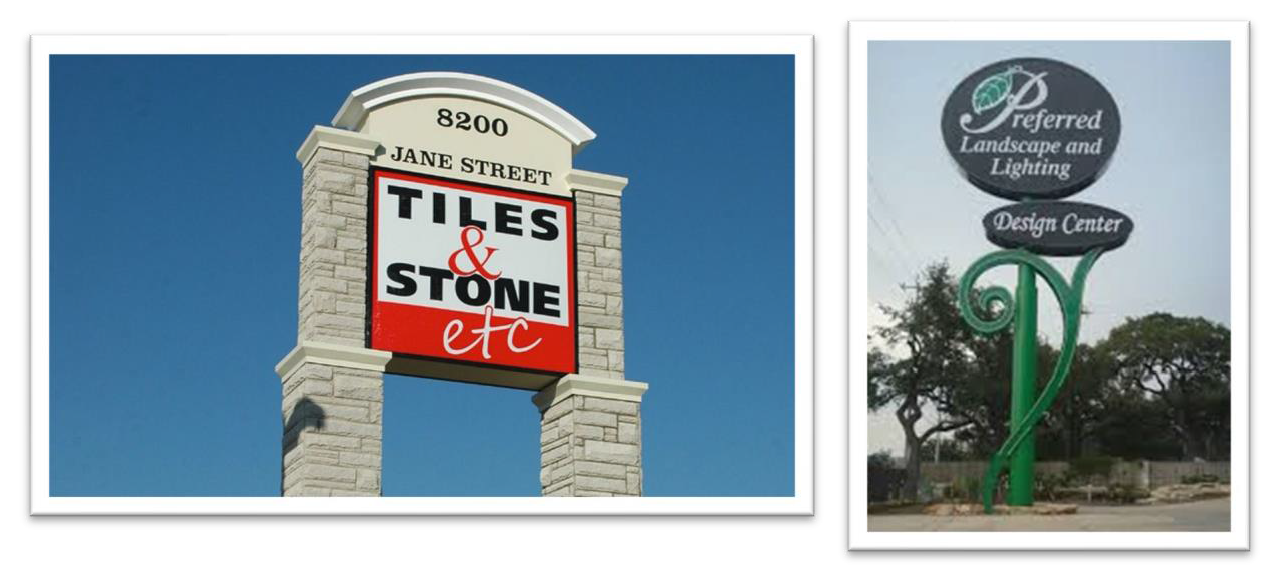
Figure 4. Pole Sign Examples.
5.
Pedestrian-scale signs.
(a)
A pedestrian-scale pole-mounted sign is freestanding and may be mounted on one or two (2) poles. Three (3) configurations are permitted:
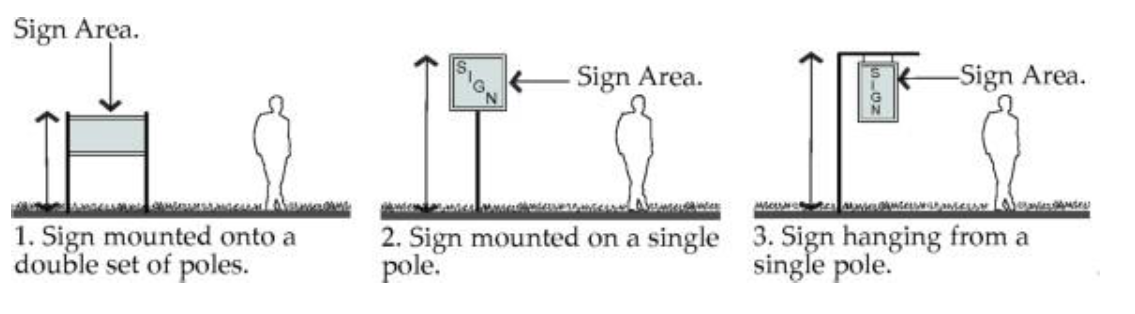
Figure 5. Pedestrian-Scale Sign Configurations.
(b)
Hanging signs may not overhang a lot line or right-of-way.
6.
Structural canopy. Structural canopy signs shall be mounted on the canopy and shall not project more than twenty-four (24) inches above or below the canopy structure. Signs that project below the canopy shall maintain a minimum clearance of fourteen (14) feet between the bottom of the sign edge and the established grade of the site.
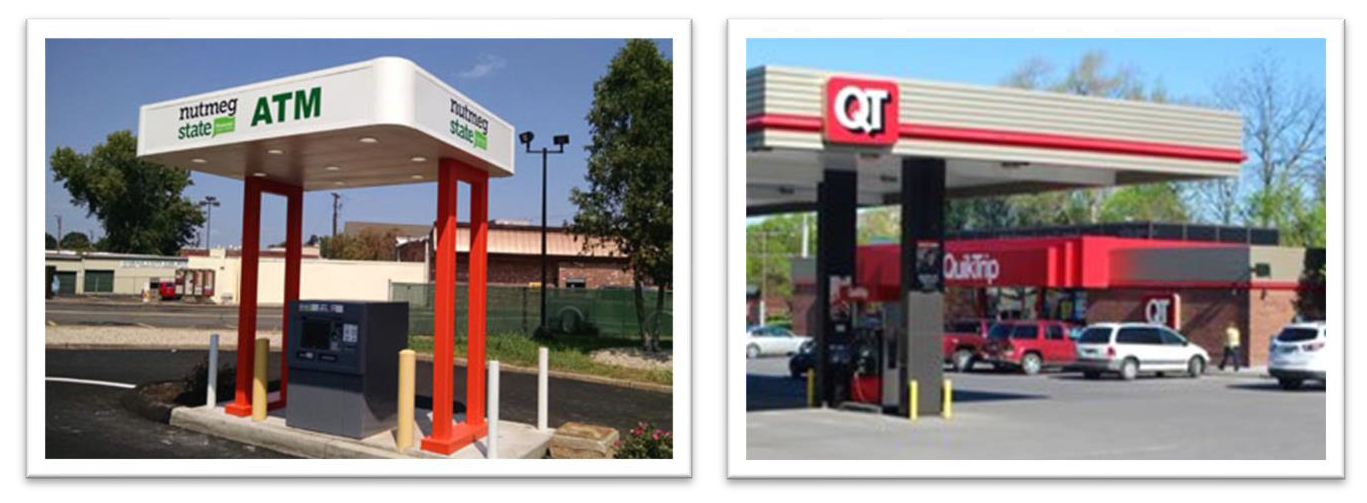
Figure 6. Structural Canopy Sign Examples.
7.
Subdivision, and neighborhood signs.
(a)
Two (2) entrance signs are permitted per subdivision or neighborhood entrances.
(b)
A sign, masonry wall, landscaping and other similar materials or features may be combined to form a display.
(c)
Dimensions:
(1)
Sign area, maximum: Thirty-two (32) square feet.
(2)
Height, maximum: Eight (8) feet or the height of the wall on which the sign is located, whichever is lower.
(3)
Setback: A minimum of five (5) feet behind all property lines.
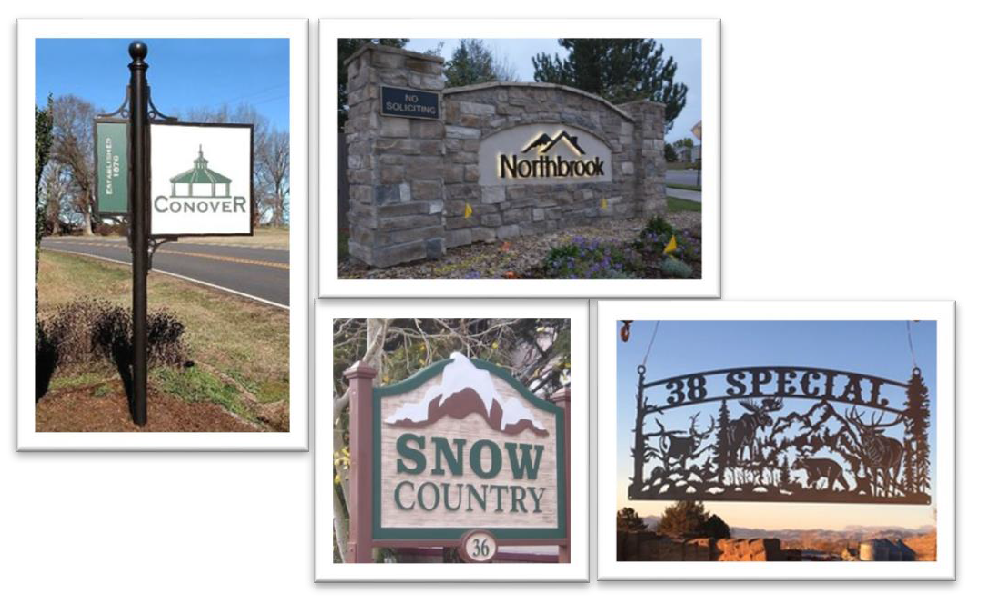
Figure 7. Subdivision and Neighborhood Sign Examples.
B.
Attached signs.
1.
Awning signs.
(a)
Signage placed upon an awning will count as one sign for that awning or canopy regardless of the number of sides of the awning or canopy have signage.
(b)
Maximum Projection: Six (6) feet from the building and the awning and sign shall not project closer than two (2) feet from back of curb. An encroachment permit is required for any awning sign that encroaches into the public right-of-way.
(c)
Minimum Clearance: Eight (8) feet.
(d)
The awning sign shall not interfere with the operation any window, door, ventilation system or the roof design.
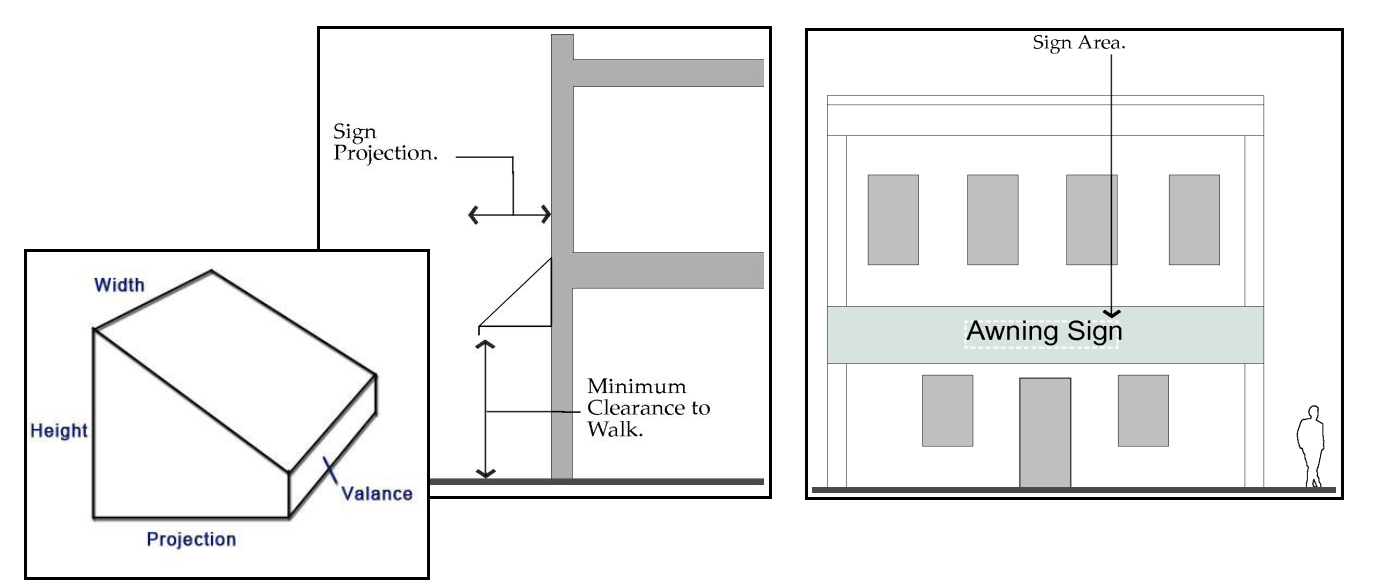
Figure 8. Awning Sign Elements.
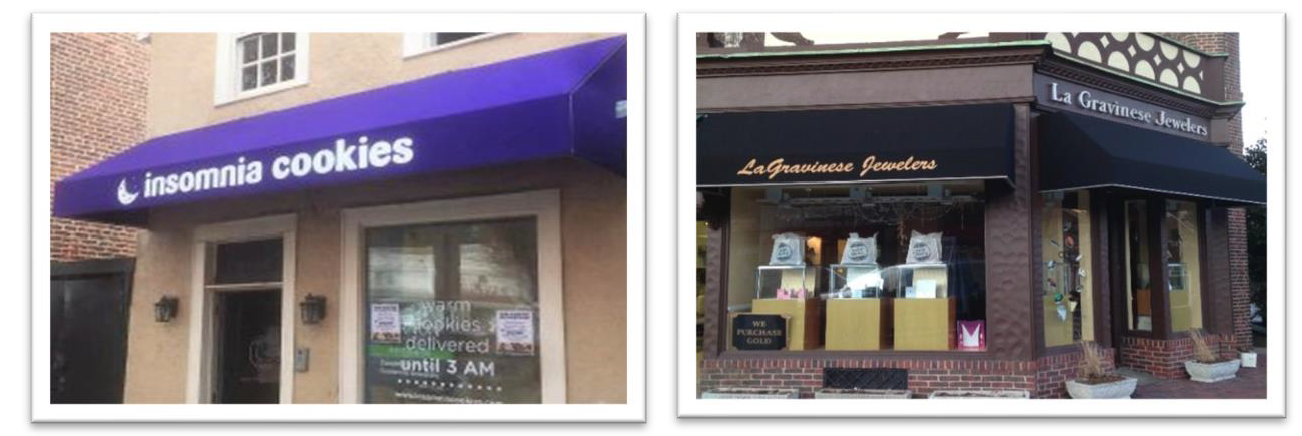
Figure 9. Awning Sign Examples.
2.
Canopy signs.
(a)
Minimum Clearance: Eight (8) feet. Where under-canopy signs are permitted there shall be eight (8) feet of clearance beneath the under-canopy sign.
(b)
Maximum Projection: Canopy signs may project up to two (2) feet to a vertical line from the curb face over the right-of-way. An encroachment permit is required for any canopy sign that encroaches into the public right-of-way.
(c)
Signage placed on a canopy will count as one sign for that canopy regardless of the number of sides of the canopy have signage.
(d)
The canopy sign shall not interfere with the operation of any window, door, ventilation system, or the roof design.
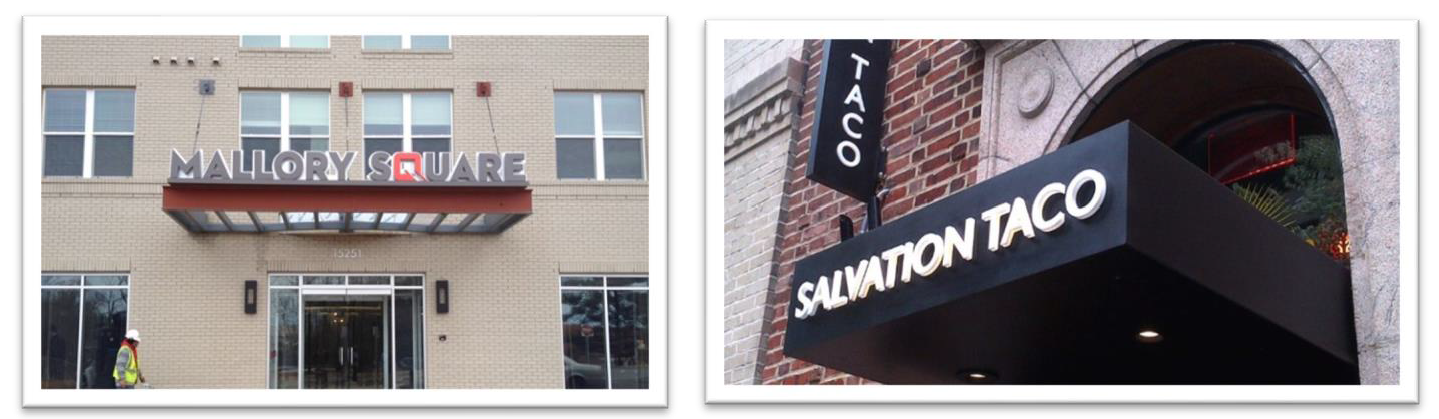
Figure 10. Canopy Sign Examples.
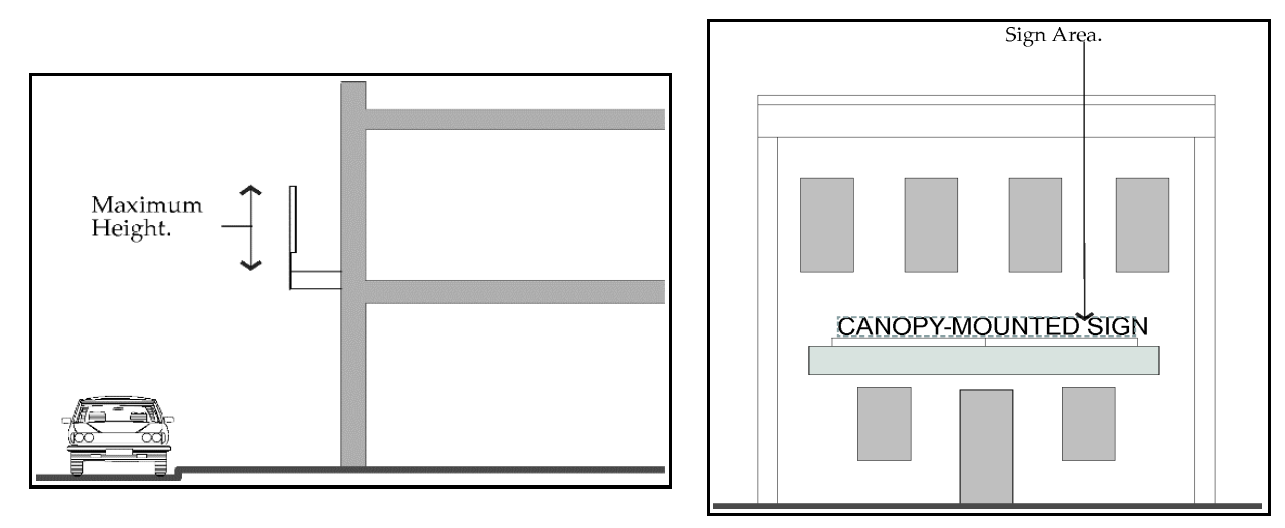
Figure 11. Canopy Sign Elements.
3.
Marquee sign.
(a)
Minimum Clearance: Eight (8) feet
(b)
Maximum Projection: Six (6) feet from the building; the sign shall not project closer than two (2) feet from back of curb. An encroachment permit is required for any projecting sign that encroaches into the public right-of-way.
(c)
Marquee signs may be used only on theaters.
(d)
The roofs of all marquees exceeding forty (40) square feet shall be properly guttered and connected with downspouts to storm sewers so that water will not drip or flow into sidewalks or streets.
(e)
All signage on the marquee shall be affixed flat to the vertical face of the marquee.
(f)
Either manual changeable copy or EMDs may be incorporated in the overall signage. EMD and manual changeable copy sign areas are limited to the face of the marquee, without extension above or below the marquee. The EMD message shall be limited to one copy change every twenty-four (24) hours.
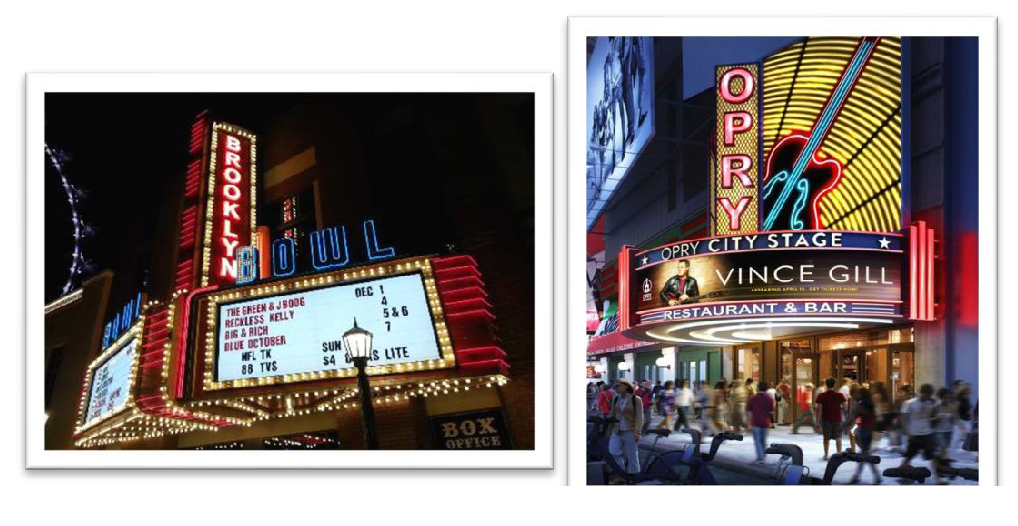
Figure 12. Marquee Sign Examples.
4.
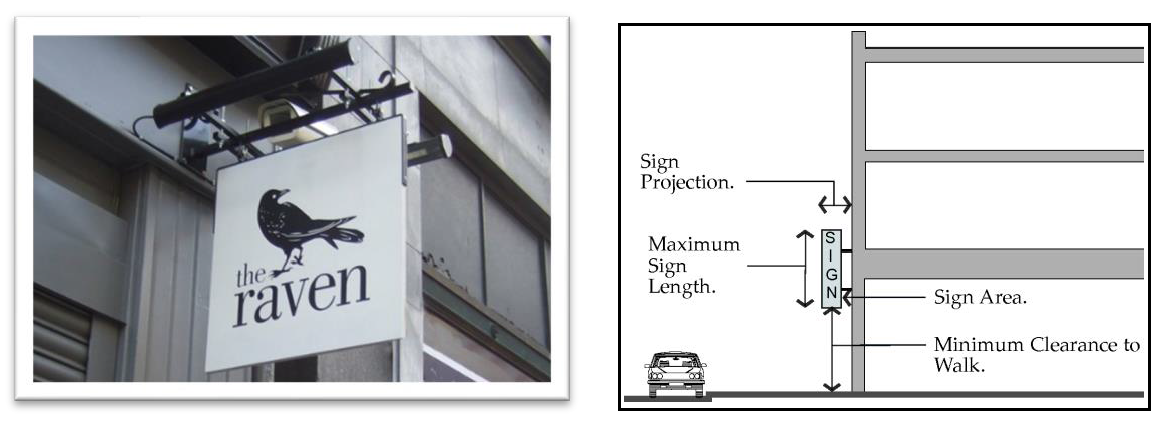
Projecting sign.
(a)
Minimum Clearance: Eight (8) feet.
(b)
Maximum Projection: Six (6) feet from the building or two (2) feet from the back of curb, whichever is less. An encroachment permit from city engineering is required for any projecting sign that encroaches into or over the public right-of-way.
(c)
Maximum sign dimensions: Six (6) by eight (8) feet.
(d)
Supports shall be covered in a neat and orderly fashion. Guy wire support is prohibited.
5.
Roof sign.
(a)
Maximum height: Roof signs shall not extend more than four (4) feet above the average height of the roof.
(b)
Maximum projection: Roof signs shall not project horizontally, overhang, or extend beyond any exterior wall or parapet line of any roof.
(c)
The supports, anchors, or braces for the roof sign shall be enclosed so that they are not visible from the street or other public or private property.
(d)
Roof signs shall be designed to look like part of the building or roof structure, with most of the sign structure incorporated into the sign design, rather than suspended from or standing on the building that displays significant sign structure. Roof signs shall typically be situated parallel to the adjacent street.
(e)
Neon glass is permitted provided the neon is not visible from the rear of the sign.

Figure 13. Roof Sign Examples.
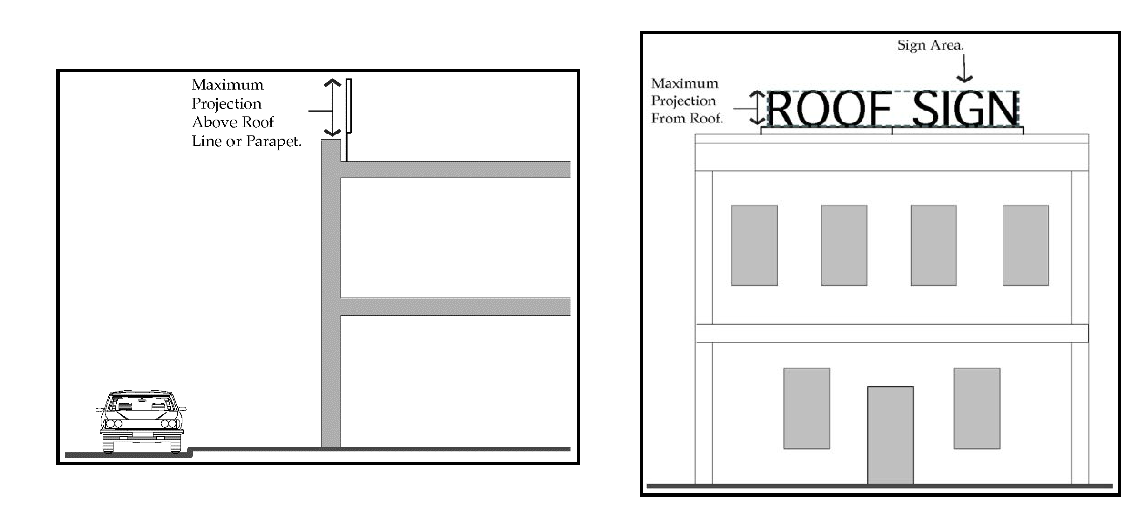
Figure 14. Roof Sign Elements.
6.
Wall sign.
(a)
Maximum projection.
(1)
Wall signs that do not extend more than twelve (12) inches from the face of the building may be installed at any height on the structure.
(2)
Wall signs that project more than twelve (12) inches from the face of the building shall be installed with eight (8) feet of clearance below the sign.
(3)
Signs that project more than twenty-four (24) inches or that are not installed parallel to the wall plane shall be considered projecting signs.
(b)
Maximum height.
(1)
Wall sign(s) shall not extend above the roofline of the building to which it is attached.
(2)
An EMD wall sign shall be placed at least two (2) feet from the top of the wall on which it is installed. Where the size of the structure on which the sign is placed permits, the maximum height of a wall sign with an EMD shall be forty (40) feet from the building wall grade.
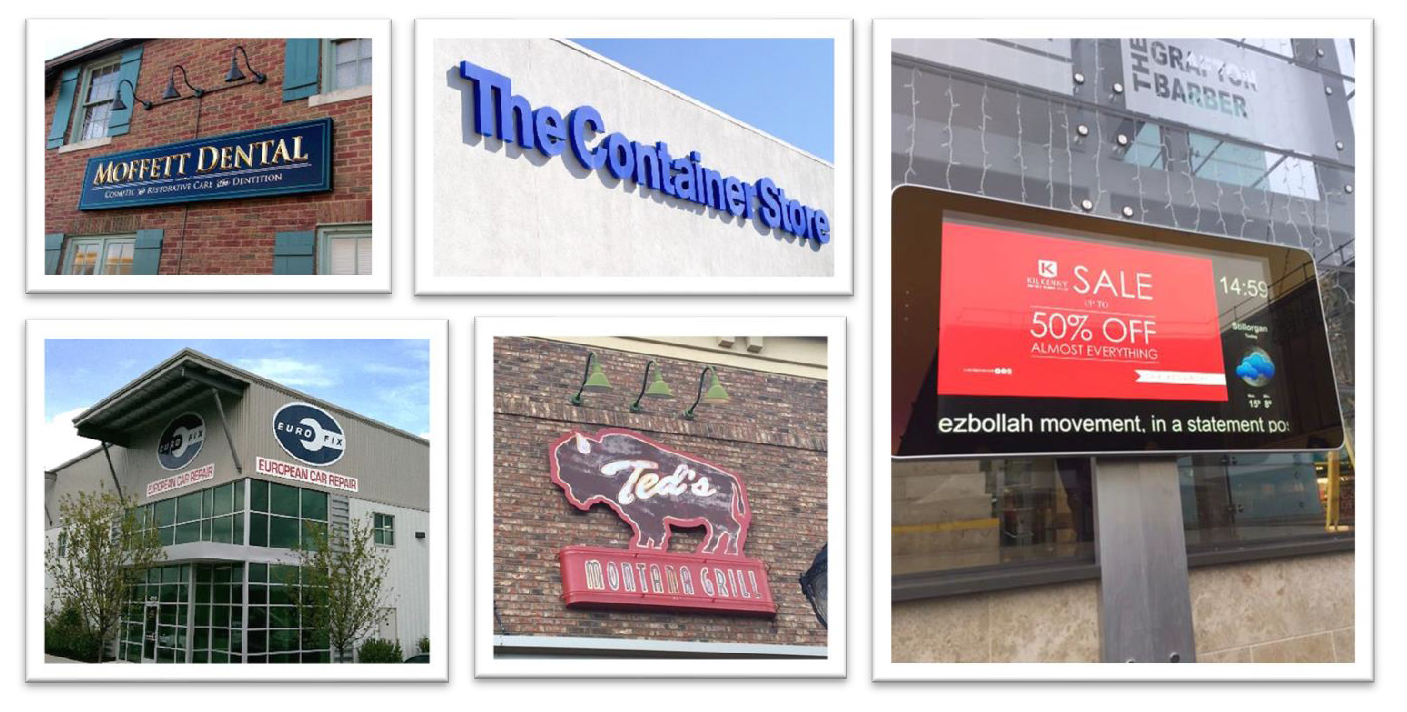
Figure 15. Wall Sign Examples.
7.
Window sign.
(a)
The area of window signs shall be counted as part of the overall permitted sign area as follows:
(1)
Sign face coverage of up to twenty-five (25) percent of the area of an individual window is exempt from calculation in the overall sign area maximum.
(2)
The total amount of any sign face coverage that exceeds twenty-five (25) percent of the area of an individual window shall be included in the wall area signage calculation. For example, if a business installs a window sign that covers thirty-five (35) percent of the window, ten (10) percent of the sign area is included in the wall sign area calculation.
(b)
Location: Ground or upper story windows.
(c)
Installation: Signs may be affixed directly to the inside or outside window or hung/mounted inside the window from the top, side, or bottom of the window frame or similar architectural element.
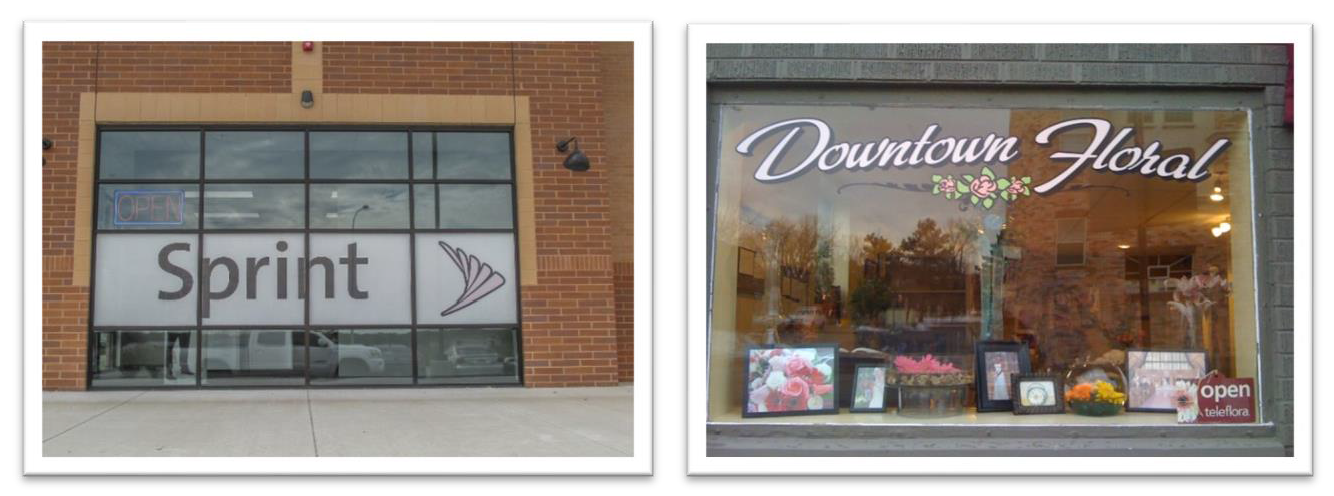
Figure 16. Window Sign Examples.
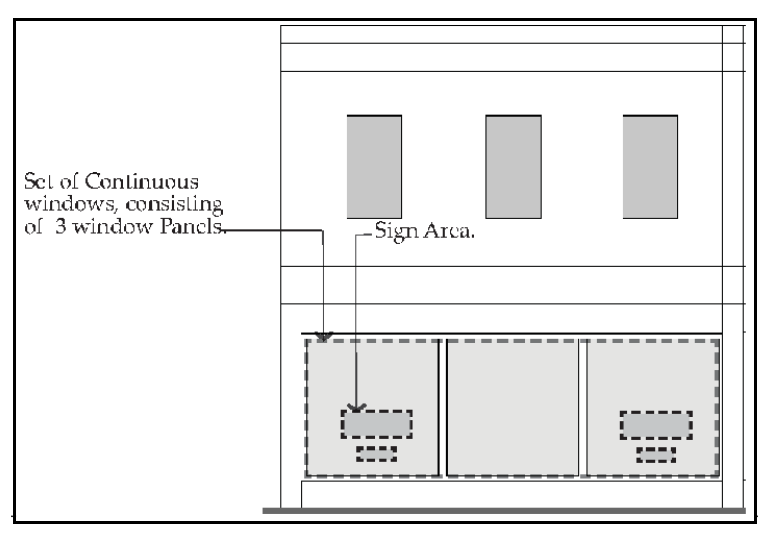
Figure 17. Window Sign Elements.
C.
Electronic message display (EMD) signs.
1.
EMD signs prohibited. EMD signs are prohibited in the following districts:
(a)
All residential neighborhood districts: N1-3, NX1-3 and RMH.
(b)
Neighborhood office.
(c)
Neighborhood mixed-use.
(d)
Public 1.
(e)
Historic districts.
2.
Display technology. The technology currently being deployed for EMDs is LED (light emitting diode), but there may be alternate, preferred, and superior technology available in the future. Any other technology that operates pursuant to the display brightness limits above shall not require an ordinance change for approval.
3.
Incorporation in wall or freestanding sign.
(a)
An EMD may only be used in conjunction with an adjacent wall sign or as part of a freestanding sign and shall not be displayed on its own.
(1)
The EMD shall not be larger than forty (40) percent of the total square footage of the permanent graphic portion of the sign when compared as separate components.
(2)
For purposes of determining the allowable total sign area, the permanent graphic portion of the sign and the EMD shall be included in the same perimeter and measured as a single sign, inclusive of any physical separation between the two (2) components.
(b)
Only one EMD sign, either wall or freestanding is permitted per developed parcel. EMD sign(s) shall be counted in the total number of signs allowed on the parcel.
4.
Generally applicable display standards.
(a)
All EMD signs shall comply with the following display standards:
(1)
EMDs must be equipped with an automatic image dimming capability (ambient light monitors). This feature must be enabled at all times, allowing the display to automatically adjust brightness based on ambient light conditions. The sign must be operated at a brightness level no greater than the manufacturer's recommended levels.
(2)
The sign shall not include audio, pyrotechnic, bluecasting (bluetooth advertising), or other similar components.
5.
Static display EMD. Where a static display EMD is permitted by this article, the following standards shall apply:
(a)
A static display EMD may display a series of static messages and may not flash, scintillate, blink, show motion borders or traveling lights, employ any other aspect of animation, or display video.
(b)
Messages on static display EMDs shall not include flashing, the varying of light intensity, or scrolling.
(c)
Each static message on the sign shall be displayed for a minimum of three (3) seconds in duration.
(d)
Message change shall be completed instantaneously.
(e)
There shall be a direct change from one message to the next. All transition effects, such as motion, animation, fading, scrolling, or dissolving are prohibited.
6.
Animated display EMD. Where an animated display EMD is permitted by this article, the following standards shall apply:
(a)
The sign shall be on-premises;
(b)
A freestanding animated display EMD sign shall be separated by at least thirty-five (35) linear feet in any direction from any other freestanding animated display EMD;
(c)
The sign shall be located at least one hundred (100) feet from any residential neighborhood zone (N1-3, NX1-3, or RMH); and
(d)
Video display is prohibited.
7.
Sign permit conditions. The following conditions apply to all EMD sign permits. Failure to comply shall result in the sign ceasing operation until compliance occurs.
(a)
That the sign shall at all times be operated in accordance with city codes and that the owner or operator shall provide proof of such conformance within twenty-four (24) hours of a request by the city;
(b)
That a city inspector may access the property upon twenty-four (24) hours' notice to the owner, operator or permittee so that the city may verify that the EMD has the automatic image dimming capability engaged. In the event of a citizen complaint regarding the EMD brightness, the owner, operator or permittee may be required by the city inspector to manually reduce the brightness to a lower setting;
(c)
That whether the sign is programmed from the site or from a remote location, the computer interface that programs the sign and the sign's operation manual shall be available to city staff upon twenty-four (24) hours' notice to the owner, operator or permittee.
(d)
Sign permit applications to install an EMD must include a certification from the owner or operator that the sign shall at all times be operated in compliance with the conditions set out in city code. The owner, operator or permittee shall immediately provide proof of such conformance upon request of the city.
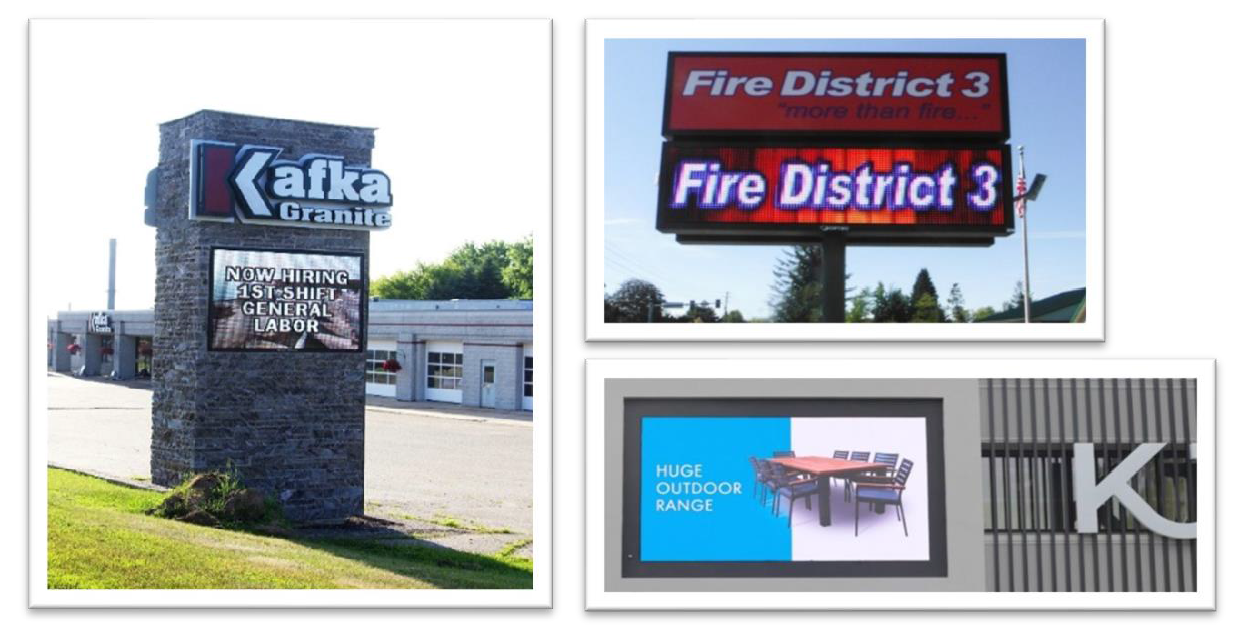
Figure 18. EMD Sign Examples.
(Ord. No. 21-5748, § 3(Exh. A), 1-25-21)
Sec. 27-1406. - Generally applicable site and design standards.
A.
Illumination for non-electronic message displays.
1.
Intent. Light sources to illuminate signs shall neither be visible from any street right-of-way, nor cause glare which is hazardous or distracting to pedestrians, vehicle drivers, or adjacent properties.
2.
External illumination. Externally illuminated signs shall have lighting confined to the sign and shall be positioned and shielded to minimize impacts to the surrounding area(s).
3.
Internal illumination.
(a)
Internally illuminated signs, where permitted, including neon lighting, must be static in intensity and color.
(b)
The light source for internally illuminated signs must be entirely enclosed within the sign.
4.
Flashing or rotating lights restricted. Flashing or rotating lights are prohibited.
B.
Landscaping. The area surrounding a freestanding sign shall comply with the applicable requirements of article 27-1200, Landscaping.
(Ord. No. 21-5748, § 3(Exh. A), 1-25-21)
Sec. 27-1407. - Sign regulations by zone district.
A.
Neighborhood residential.
1.
Applicability. The standards in this section shall apply to the following districts: N1, N2, N3, NX1, NX2, NX3, RMH.
2.
Summary Table. Table 27-1400.2 identifies the types of signs permitted in the neighborhood districts, subject to the regulations identified in the table and this article.
Table 27-1400.2. Permanent Signs in Neighborhood Residential Districts.
3.
District specific standards.
(a)
Where signs are linked to a use category, a description of the category can be found in article 27-1000, Use standards.
(b)
EMD signs are not permitted in neighborhood residential districts.
(c)
Multi-unit wall signage is permitted as follows:
(1)
NX1: The sign shall be located on the primary building on a wall facing the main entrance to the development.
(2)
NX2, NX3, and RMH, all with ten (10) or more units: Wall sign with the same restrictions as NX1 plus one neighborhood monument sign.
B.
Neighborhood office, neighborhood mixed-use, and EBURD RSV.
1.
Applicability. The standards in this section shall apply to the following districts: NO, NMU, and EBURD RSV.
2.
Maximum total permitted sign area.
(a)
Attached wall signs. Twenty (20) percent of total wall area of a street-facing wall, or a max of one hundred (100) square feet, or to a max of one and one-half (1.5) square feet of sign area per linear foot of building frontage whichever is less. This maximum wall sign area is calculated on a per tenant basis. See subsection 27-1407.B.4 for wall signs on building facades that do not face a street.
(b)
Freestanding signs. Thirty-two (32) square feet unless otherwise provided in Table 27-1400.4. Table 27-1400.1, Permitted Number of Permanent Freestanding Signs applies.
3.
Summary tables. Tables 27-1400.3 and 27-1400.4 identify the types of signs permitted in the NO and NMU districts, subject to the regulations identified in the table and this article.
Table 27-1400.3. Attached signs NO, NMU, and EBURD RSV.
Table 27-1400.4. Freestanding signs NO, NMU, and EBURD RSV.
4.
District specific standards.
(a)
Where signs are linked to a use category, a description of the category can be found in article 27-1000, Use Standards.
(b)
Residential uses and structures within an NO, NMU, or EBURD RSV district are permitted the same signage as neighborhood residential districts as provided in Table 27-1400.2.
(c)
EMD signs are not permitted in NO, NMU, or EBURD RSV districts.
(d)
Tenant signage in multitenant structures shall be calculated for each tenant unit based on the front wall area of the individual unit. Tenants with side, rear, or alley entrances are permitted wall signage on the wall with their primary public entrance only.
C.
Corridor mixed-use and EBURD RSVMS.
1.
Applicability. The standards in this section shall apply to the following districts: CMU1, CMU2, and EBURD RSVMS.
2.
Maximum total permitted sign area.
(a)
Attached wall signs. Twenty (20) percent of total wall area of a street facing wall, or a max of two hundred fifty (250) square feet, or two (2) square feet of sign area per linear foot of building frontage, whichever is less. This maximum wall sign area is calculated on a per tenant basis. See subsection 27-1407.C.4 for wall signs on building facades that do not face a street.
(b)
Freestanding signs.
(1)
Table 27-1400.1, Permitted Number of Permanent Freestanding Signs applies.
(2)
Table 27-1400.5, Maximum sign area for freestanding signs is as follows:
Table 27-1400.5. Freestanding Sign Maximum Area in CMU1, CMU2, and EBURD RSVMS.
3.
Summary tables. Tables 27-1400.6 and 27-1400.7 identify the types of signs permitted in these districts, subject to the regulations identified in the table and this article.
Table 27-1400.6. Attached Signs in CMU1, CMU2, and EBURD RSVMS.
Table 27-1400.7. Freestanding Signs in CMU1, CMU2, and EBURD RSVMS.
4.
District specific standards.
(a)
Where signs are linked to a use category, a description of the category can be found in article 27-1000, Use Standards.
(b)
Tenant signage in multitenant structures shall be calculated for each tenant unit based on the front wall area of the individual unit. Tenants with side, rear, or alley entrances are permitted wall signage on the wall with their primary public entrance.
D.
CBD and DX.
1.
Applicability. The standards in this section shall apply to the CBD and DX zone district.
2.
Maximum total signage.
(a)
Attached wall signs.
(1)
Buildings under ten (10) stories. Ten (10) percent of the wall area up to a max of two hundred fifty (250) square feet for any single wall sign. The maximum wall sign area is calculated for each tenant based on the tenant's occupied floor area. Tenant wall sign area is .015 square feet of wall sign area per square foot of occupied floor area. See subsection 27-1407.D.4 for wall signs on building facades that do not face a street.
(2)
Buildings ten (10) stories and taller. Ten (10) percent of wall area with no maximum.
(b)
Freestanding signs. 0.5 square foot per lineal foot of street frontage to a max of fifty (50) square feet unless otherwise provided in Table 27-1400.9. Table 27-1400.1, Permitted Number of Permanent Freestanding Signs applies.
3.
Summary tables. Tables 27-1400.8 and 27-1400.9 identify the types of signs permitted in these districts, subject to the regulations identified in the table and this article.
Table 27-1400.8. Attached Signs in CBD and DX.
Table 27-1400.9. Freestanding Signs in CBD and DX.
4.
District specific standards.
(a)
Where signs are linked to a use category, a description of the category can be found in article 27-1000, Use standards.
(b)
Tenant signage in multitenant structures shall calculated for each tenant based on the tenant's occupied floor area. Tenant wall sign area is .015 square feet of wall sign area per square foot of occupied floor area. Tenants with side, rear, or alley entrances are permitted wall signage on the wall with their primary public entrance.
E.
Commercial, industrial, and EBURD CW, 13thSt., and IS.
1.
Applicability. The standards in this section shall apply to the following districts: CX, I1, I2, and EBURD CW, 13th St. and IS.
2.
Maximum total signage.
(a)
Attached wall signs. Two (2) square feet per lineal foot of building frontage to a max. of two hundred fifty (250) square feet. This maximum wall sign area is calculated on a per tenant basis. See subsection 27-1407.E.4 for wall signs on building facades that do not face a street.
(b)
Freestanding signs. One square foot per lineal foot of street frontage to a max. of one hundred (100) square feet unless otherwise provided in Table 27-1400.11. Table 27-1400.1, Permitted Number of Permanent Freestanding Signs applies.
3.
Summary table. Tables 27-1400.10 and 27-1400.11 identify the types of signs permitted in these districts, subject to the regulations identified in the table and this article.
Table 27-1400.10. Attached Signs Commercial, Industrial, and EBURD CW, 13th, and IS.
Table 27-1400.11. Freestanding Signs Commercial, Industrial, and EBURD CW, 13thSt., and IS.
4.
District specific standards.
(a)
Where signs are linked to a use category, a description of the category can be found in article 27-1000, Use standards.
(b)
Tenant signage in multitenant structures shall be calculated for each tenant based on the front wall area of the individual unit. Tenants with side, rear, or alley entrances are permitted wall signage on the wall with their primary public entrance.
F.
Public districts.
1.
Public 1: Park and open space.
(a)
Freestanding signage is permitted per street frontage as identified in Table 27-1400.12.
(b)
Internal park signage is exempt per subsection 27-1402.C.
Table 27-1400.12. Maximum Sign Area P1.
2.
Public 2: Public and institutional. Signage is permitted pursuant to subsection 27-1407.B, NO and NMU.
3.
Public 3: Medical campus signs.
(a)
Applicability.
(1)
The standards in this section shall apply to the P3 medical campus district.
(2)
The permitted signage in the P3 medical campus is applicable to two (2) categories of structures and uses, both of which are defined in article 27-1800:
a.
Medical structures: any primary structure on the campus that is used for the provision of medical services or support of medical staff and administration.
b.
Non-medical structures: Permitted support campus structures such as, but not limited to, restaurants or hotels.
(b)
District specific terms.
(1)
Internal signage is defined as signage that is not visible from outside of the campus or from the main circulation routes of the campus.
(2)
Street frontage is defined as building frontage on an exterior street. Signs facing other internal streets are considered internal signage.
(c)
Prohibited signs and lighting. The following signs and lighting are prohibited in the P3 medical campus district:
(1)
Animated display EMD.
(2)
Inflatable signs.
(3)
Flashing illumination and flashing neon.
(4)
Strobe lights.
(5)
Searchlights.
(6)
Temporary signs.
(7)
Window signs.
(d)
Medical structures signage. Maximum signage is calculated by sign category as provided below:
Table 27-1400.13. Medical Structure Signs in P3.
(e)
Non-medical structure signage.
(1)
Maximum signage is calculated by sign type, as provided below.
(2)
Tables 27-1400.14 and 27-1400.15 identify the types of signs permitted for non-medical structures in the P3 district, subject to the regulations identified in the table and this article.
Table 27-1400.14. Non-Medical Structure Attached Signs in P3.
Table 27-1400.15. Non-Medical Structure Freestanding Signs in P3.
4.
P3 educational and civic campus signs.
(a)
Applicability.
(1)
The standards in this section shall apply to the P3 educational campus and P3 civic campus district.
(2)
The permitted signage in the P3 educational or civic campus is applicable to two (2) categories of structures and uses:
a.
Educational or civic structures: Any primary structure on the campus that is used for the provision of core campus services or support of staff and administration.
b.
Support structures: Permitted support campus structures that may include but are not limited to uses such as restaurants or hotels.
(b)
District specific terms.
(1)
Internal signage is defined as signage that is not visible from outside of the campus or from the main circulation routes of the campus.
(2)
Street frontage is defined as building frontage on an exterior street. Signs facing other internal streets are considered internal signage.
(c)
Educational and civic structure signage. Maximum signage is calculated by sign category as provided below:
Table 27-1400.16. Educational Structure Signs in P3.
(d)
Support structure signage.
(1)
Maximum signage is calculated by sign type, as provided below.
(2)
Tables 27-1400.17 and 27-1400.18 identify the types of signs permitted for non-educational structures in the P3 district, subject to the regulations identified in the table and this article.
Table 27-1400.17. Support Structure Attached Signs in P3.
Table 27-1400.18. Support Structure Freestanding Signs in P3.
G.
Historic districts. Statement of special purpose. This special code acknowledges the unique visual concerns associated with the Billings' historic districts, including the Billings Townsite Historic District, Old Town Historic District, and North Elevation Historic District, as defined in BMCC section 6-700, and recognizes the benefits of restoring the district's visual appearance of prosperity, cohesiveness, and historic integrity, while continuing to promote business advertising variety, individuality, and growth.
1.
Signs permitted in historic districts. Within the North Elevation Historic District signs are permitted as per the underlying zone district and in compliance with the requirements for placement and style as per this code section.
Within the Billings Townsite Historic District and Old Town Historic District, signs are permitted as follows:
(a)
Excluding window signs, one additional sign type per business is allowed, except for business with entrances on more than one street, in which case one sign type per street entrance is allowed.
(b)
The size of signs in the historic district is limited to fifty (50) percent of that allowed in this article.
(c)
No new roof signs shall be permitted after the adoption of this code January 25, 2021.
2.
Sign standards.
(a)
Signs and sign lettering within the Billings Townsite, Old Town, and the North Elevation Historic Districts shall be designed and installed to compliment the architectural style.
(b)
Where an awning does not have a clear vertical plane, the signage may not exceed twenty-five (25) percent of the lower third of the awning.
(c)
Signage placed on a valance of an awning may not exceed twelve (12) inches in height.
(d)
Internally illuminated signs shall be constructed with an opaque background and translucent letters and symbols. Opaque means that the material must not transmit light from an internal illumination source.
(e)
In the Billings Townsite and Old Town Historic Districts, the use of neon is encouraged when done in a manner that is historic in nature, compatible, or complementary to the character of the district and adjacent signage. The use of neon should be incorporated into the design of the sign. Neon and incandescent lamps may flash in the following ways.
(1)
Alternating. One section comes on as another goes off.
(2)
Scintillating. Random sections go on and off with part of the lighting on at all times.
(3)
Chasing. One section comes on at a time and is followed by one section going off at a time. Part of the sign is on at all times.
(4)
Sweeping (filling). The lighting sections individually go on until all of the sections are on, then the entire group goes off and then the process is repeated.
(5)
On-off action—Not allowed. Lighting that goes all on and then all off.
(f)
No sign will be permitted to obscure or cover any significant architectural detail or decorative element of the existing building.
(g)
The material used in the manufacturing of the sign should either be materials traditional to the time period of the structure, such as wood, stone, metal, neon, or a modern material that effectively simulates the original materials.
(h)
The use of lighting should be sensitive to the character of the district. Direct lighting through the use of fixtures such as goose neck lamps is encouraged. Back lighted solid letters or stained glass is encouraged. The use of back lighted, molded plastic faces is discouraged. Installation must comply with the applicable electrical codes. All raceways, exposed conduits and supports will be painted to match or compliment the building.
(i)
Ghost signs that were created prior to 1935 shall be permitted. These signs will not count toward the allowable square footage or allowable number of signs. Ghost signs are encouraged provided they meet the following conditions:
(1)
Ghost signs shall be permitted to fade, to be stabilized, or restored to the original condition.
(2)
Any ghost sign that is changed, or any post-1935 ghost sign that is restored or changed shall comply with the applicable sign district regulations.
(j)
Only on-premises signs shall be allowed within the Billings Townsite, Old Town and North Elevation Historic Districts.
(k)
Once the copy of an existing sign is changed it must come into compliance with the special provisions of the historic sign district and the existing sign code.
3.
Prohibited signs. The following signs are prohibited:
(a)
New billboards, off-premises/third party signs.
(b)
Electronic message displays.
(c)
Changeable copy signs, except for the use on a theater marquee.
(d)
Rotating signs.
(e)
Intermittent or flashing lights, except for neon signs as described above.
(f)
Above peak roof signs unless a roof sign had previously been on the building.
4.
Temporary signs.
(a)
Banner signs in the public right-of-way.
(1)
Banners may be placed upon light standards to announce district wide events or exhibits at the Western Heritage Center.
(2)
Banners may not exceed twenty (20) square feet in area.
(3)
Banners may not be stretched across the public rights-of-way.
(b)
Banners on private property. Each business shall be permitted to display one banner not to exceed thirty-two (32) square feet in area for one five-day period per calendar year.
(c)
Sandwich board (A-frame) signs.
(1)
One sandwich board sign shall be permitted per public entrance.
(2)
All requirements of BMCC sections 22-407.1 and 22-407.2 must be met.
(3)
Sandwich boards must be securely anchored to the ground.
(4)
Sandwich boards may only be displayed during regular business hours.
(Ord. No. 21-5748, § 3(Exh. A), 1-25-21; Ord. No. 22-5807, §§ 3(k), 3(n), 5-9-22; Ord. No. 23-5838, § 5, 6-12-23; Ord. No. 23-5854, § 3, 10-9-23)
Sec. 27-1408. - Temporary signs.
A.
Purposes. The purposes of these temporary sign regulations are as follows:
1.
Enhance opportunities for visual communication, including promoting the legibility of such communications;
2.
Create a more attractive economic and business climate within the city;
3.
Enhance and protect the physical appearance of all areas of the city;
4.
Identify permissible signage for temporary uses and temporary events; and
5.
Reduce the distractions, obstructions, and hazards to pedestrian and automobile traffic caused by the excessive number, size, or height, inappropriate means of illumination or movement, indiscriminate placement, overconcentration, or unsafe construction of signs.
B.
Allowed on private property restrictions. Temporary event signs, including, but not limited to, those specified within this article, may be allowed off-premises on private property provided they meet the following requirements:
1.
The sign conforms to all requirements of this article;
2.
The sign does not interfere with automobile traffic or pedestrians;
3.
The sign is not placed in the public right-of-way or on public property;
4.
When a sign placed on private property, is done with the express permission of the property owner; and
5.
The sign is not a public danger or nuisance during high winds or inclement weather.
C.
Permit and display.
1.
A temporary sign permit is required unless otherwise specified in this article.
2.
Temporary signs shall comply with the following unless otherwise specified in this article:
(a)
Maximum display time: Thirty (30) days;
(b)
Maximum number of temporary signs: shall not exceed one thirty-two (32) square foot sign per property frontage unless otherwise permitted in this article.
D.
Generally applicable temporary sign standards.
1.
Temporary sign types. The following temporary sign types are applicable to this section:
Table 27-1400.19. Temporary Sign Types.
2.
Location.
(a)
Temporary signs are subject to the prohibited sign locations identified in subsection 27-1402.E.
(b)
No temporary sign shall cause unsafe ingress or egress or otherwise create traffic visibility problems, subsection 27-1802.H.
3.
Size and placement limitations. The following placement limitations are generally applicable to temporary signs unless otherwise specified in this article.
(a)
Signs may be printed on both sides or two (2) single-sided banners may be placed back-to-back. V-type configurations are not permitted.
(b)
Measuring one side of the display shall determine the square footage for purposes of computation.
E.
Additional temporary signs permitted by type.
1.
Banner sign.
(a)
One banner sign is permitted for one 30-day period in mixed-use, commercial, industrial, and EBURD districts.
(b)
Banner signs are limited to use on private property unless otherwise provided in a zone district.
(c)
Banner signs must be securely attached to a structure, the wall of a building, or canopy.
2.
Inflatable signs.
(a)
One inflatable sign is permitted for one 30-day period in the CMU1, CMU2, CX, I1, I2, and EBURD districts.
(b)
Inflatable signs are permitted on rooftops provided the sign and structure are securely anchored to the rooftop.
3.
Sandwich board signs.
(a)
Sandwich board signs may be placed on private property or the public sidewalk in the NO, NMU, CBD, DX, and EBURD districts directly in front of the business at any time when the business is open.
(b)
Sandwich board signs shall be placed so they do not interfere with or impede the flow of pedestrian movement; a minimum of three (3) feet of unobstructed sidewalk with must be maintained while the sign is displayed.
(c)
Sandwich board signs placed on a public sidewalk within the street right-of-way will follow all requirements of BMCC sections 22-407.1 and 22-407.2.
F.
Additional temporary signs permitted by activity.
1.
Active real estate listing. Additional temporary signage is permitted for the duration of the active real estate listing as follows:
(a)
Neighborhood residential use or property: one small yard sign per street frontage.
(b)
Mixed use, commercial, and industrial use or property: one large yard sign or banner attached to a permanent structure per street frontage.
(c)
Open house event: Signage permitted per Table 27-1400.20.
(d)
Temporary sign permits are not required.
2.
Active building permit/active construction.
(a)
Single structure development shall be permitted one large yard sign per construction project. The sign shall be confined to the site of construction and shall be removed five (5) days after issuance of an occupancy certificate or completion of construction and prior to occupancy.
(b)
Subdivision development projects shall be permitted two (2) large yard signs per subdivision development project. The sign shall be removed six (6) months after construction on the last lot is commenced.
(c)
Contractor, architect, surveyor, or engineer signs. Subcontractors on an active construction project may place a maximum of one small yard sign on one street frontage for the same period of time as the single structure or subdivision development sign. Subcontractor signs may be moved from lot to lot as construction progresses.
(d)
Temporary sign permits are not required.
3.
New or relocating business. New businesses or existing businesses which are relocating may have one additional temporary sign that complies with the standards of Table 27-1400.19. The temporary sign shall be limited in use to one time for no longer than sixty (60) days. A temporary sign permit is required.
4.
Real estate sign—Prospective development listing. Additional temporary signage is permitted for a subdivision, multi-unit residential development, or non-residential structure following the issuance of a building permit as follows:
(a)
Residential development: One large yard sign per public entrance.
(b)
Non-residential development: One large yard sign per public entrance or one banner placed on the structure per street frontage.
(c)
The sign shall remain only as long as property remains unsold or unleased for the first time within the tract, but not to exceed one year. The planning division may extend the one-year time period upon written request by the owners/developers of the project.
(d)
A Temporary sign permit is required.
G.
Temporary signage permitted by temporary use group permit.
1.
Temporary use signage permitted.
(a)
Temporary uses allowed by temporary use permit may have up to one hundred (100) square feet of temporary sign area allocated across signage that complies with Table 27-1400.19 for the district in which the temporary use is located.
(b)
Group 3 temporary uses will require a temporary sign permit. Group 1 and Group 2 temporary uses will not require sign permits for temporary signage.
(c)
The temporary signage shall meet the following standards:
(1)
Signs advertising the temporary use or activity are allowed only at the same location as the temporary use.
(2)
Signage may only be displayed while the temporary use is on the property.
(3)
Clear vision triangle standards are applicable (subsection 27-1802.H).
(4)
Paper or cardboard signs are prohibited.
(5)
All signage and temporary structures must be removed at the time the temporary use has ceased on the property.
H.
Temporary signage permitted by event.
1.
Standards for temporary event signage.
(a)
Temporary signs may be allowed as part of a special event whether or not a temporary use permit for the event is required.
(b)
Temporary signs for special events may be off-premises with the permission of the property owner, and may be allowed on a parcel in addition to the maximum amount of temporary signage permitted on that parcel.
(c)
Temporary signs for special events do not require permits.
2.
Signage permitted. Temporary signs permitted for special events are restricted to the types, sizes, and heights identified in Table 27-1400.20 unless otherwise specified in this subsection.
Table 27-1400.20. Temporary Signage by Event.
(Ord. No. 21-5748, § 3(Exh. A), 1-25-21; Ord. No. 22-5807, § 3(m), 5-9-22; Ord. No. 23-5838, § 5, 6-12-23)
Sec. 27-1409. - Off-premises/billboard signs.
A.
Purpose and intent. The purpose of this section is to regulate the impact of billboards on the community; to improve the appearance of major corridors and gateways; to enhance the urban design of the greater downtown area and the west end; to ensure compatibility between billboards and adjacent land uses; and to limit the impact that billboards have on sign clutter in the community. The city recognizes that billboards are a necessary and appropriate advertising medium, and that there are acceptable and viable locations for billboards within the community.
It is the intent of this subsection to address the following specific concerns regarding the impact of billboards upon the community:
1.
The citizens of Billings, and others visiting or traveling through the city are very concerned about the urban design and visual integrity of the city.
2.
Billboards may be often incongruous with the city's natural setting and features due to their large-scale figures, numbers, letters, and colors.
3.
A billboard may dominate the view from vehicles and interfere with the occupants' enjoyment of the city's natural setting and features.
4.
A high concentration of billboards may create traffic safety problems and distract attention away from public safety signs.
5.
Billboards of excessive size or height should be downsized within a reasonable period of time.
6.
Billboards are incompatible with residential uses.
7.
The I-90, Highway 3, Main Street, 27th Street, other gateways, and Shiloh Road are major entryways to the city which are of particular importance in terms of urban design and public perception to citizens, visitors, and tourists.
8.
The downtown area defined in the Downtown Strategic Plan is an area in which urban design significantly influences the health and vitality of the total community.
B.
No new off-premises/billboard signage pending removal of non-conforming signs.
1.
New billboards prohibited. No off-premises/billboard sign shall be constructed or erected in any district after the date of the enactment of this subsection 27-1409.B. [previous code subsection 27-706(b), adopted by Ord. No. 99-5107, enacted Nov. 22, 1999].
2.
Billboard replacement provisions.
(a)
For each nonconforming off-premises/billboard sign face removed a replacement conforming off-premises/billboard sign face may be erected. Replacement off-premises/billboard sign face(s) shall comply with all of the applicable regulations contained herein.
(b)
When all nonconforming off-premises/billboard signs within the city have been removed pursuant to this section, then additional off-premises/billboard signs may be constructed in accordance with the regulations contained herein.
C.
Location standards following compliance with subsection 27-1409.B. All replacement billboards shall be located in accordance with the following standards:
1.
Zoning districts.
(a)
Replacement billboards shall be permitted as an allowed use in heavy commercial (CX), light industrial (I1), and heavy industrial (I2) zoning districts and on boulevard street types in EBURD zone districts.
(b)
Billboards shall be permitted as an allowed use in corridor mixed use 2 (CMU2) zoning district provided that the structure is two hundred (200) feet or more from a residential zoning district. This distance shall be measured as a radius from the proposed location of the off-premise sign. A residential zone district includes any planned development zone that allows residential uses, and any county zone district that allows residential uses.
(c)
A special review shall be required for all billboards to be located in a CMU2 zone if the structure is less than two hundred (200) feet but greater than one hundred fifty (150) feet from a residential zoning district.
(d)
Billboards may be permitted in the CBD through section 27-1623, Special review uses.
(e)
No new billboards shall be permitted on, directed to, or within two hundred (200) feet of the following corridors regardless of the applicable zoning:
(1)
27th Street from I-90 to Airport Road (excluding 27th Street North from Montana Avenue to 6th Avenue North).
(2)
Highway 3 (Airport Road) from Alkali Creek Road west to the city limits.
(3)
Shiloh Road from I-90 to Rimrock Road.
(4)
Yellowstone River.
(5)
Any historic district registered on the National Register of Historic Places.
2.
Locations standards.
(a)
Billboards shall be set back twenty (20) feet from the front property line.
(b)
No billboard shall be placed on the roof of any building or structure.
3.
Spacing standards. Billboards shall be required to have the following spacing requirements:
(a)
Billboards located in CMU2 shall have a minimum spacing of a 1,000-foot radius from any other billboard.
(b)
Billboards located in CX, I1, I2, and EBURD shall have a minimum spacing of six hundred (600) linear feet from any other billboard.
(c)
No billboard shall be placed within one hundred fifty (150) feet of any neighborhood residential zone.
4.
Area, height, face, and pole standards. All replacement billboards (and new billboards when permitted) shall conform to the following standards:
(a)
Sign area: New and replacement billboards faces and supporting framework shall not exceed the following sign areas:
(1)
Generally: Two hundred fifty (250) square feet.
(2)
Located within the interstate corridor: Four hundred eighty (480) square feet.
(b)
Height, maximum:
(1)
Thirty-five (35) feet above the road grade to which the billboard reads.
(2)
The minimum distance between grade and the bottom of the billboard shall be fifteen (15) feet.
(c)
Faces:
(1)
There shall be no more than a total of two (2) faces per supporting structure.
(2)
All structures must be single face, back-to-back, or "v" type of construction. Stacked faces are prohibited.
(d)
Pole construction: All structures must be of single pole construction.
5.
Special review requirements for off-premises/billboard signs in CMU2 and CBD. The following criteria will be used in reviewing the proposed structure:
(a)
The location and placement of the sign will not endanger motorists or pedestrians and does not interfere with the clear vision triangle at street, railroad, or street driveway intersections.
(b)
The signs will not cover or blanket any prominent view of a structure or facade of historical or architectural significance.
(c)
The sign will not obstruct views of users of adjacent buildings to side yards. This requirement does not include views of distant vistas.
(d)
The sign cannot be seen from religious assemblies, schools, the Yellowstone River or any city, county, or state park; or, if it can be seen it must be located at two hundred fifty (250) feet from the boundaries of such places.
(e)
The height of signs located in undeveloped areas (no buildings within 300-foot radius) shall not exceed twenty-six (26) feet above grade. The minimum clearance of a sign shall be at least fifteen (15) feet.
(f)
The sign's lighting will not cause hazardous or unsafe driving conditions for motorists and will not glare, reflect, or spill onto adjacent business or residential areas.
6.
Lighting and display.
(a)
Static lighting shall comply with subsection 27-1406.A or the EMD provisions in this section.
(b)
Electronic message display (EMD) lighting shall comply with subsection 27-1405.C and the following:
(1)
A billboard EMD may be allowed on any off-premises/billboard sign face provided it conforms to all of the standards and requirements of the city sign code including the limitation on replacement of nonconforming off-premises billboard signs in subsection 27-1409(b) and the maintenance and repair requirements of section 27-1410.
(2)
A billboard EMD does not need to be incorporated in a freestanding or wall sign pursuant to subection 27-1405.C, the EMD may be used as the only sign area on the billboard sign face.
7.
Landscaping. The provisions of subsection 27-1406.B, Landscaping, apply to new and replacement billboards.
8.
Discontinuance. The city may order the removal of any billboard, without compensation, upon which the advertising or other message has been discontinued for more than sixty (60) continuous days. The owner shall either advertise upon or remove the billboard within thirty (30) days of written notification by the city.
(Ord. No. 21-5748, § 3(Exh. A), 1-25-21; Ord. No. 23-5838, § 7, 6-12-23)
Sec. 27-1410. - Installation and maintenance.
A.
Installation.
1.
Compliance with adopted building code(s). All signs shall comply with the appropriate provisions of any adopted building and related code(s) with standards for design, structural members, and connections. Signs shall also comply with the provisions of the applicable electrical code and the additional construction standards hereinafter set forth in this section.
B.
Maintenance.
1.
Good condition. Every sign in the city, including but not limited to those signs for which permits or for which no permits or permit fees are required, shall be maintained in good condition at all times.
(a)
All signs, including those exempted, shall be kept neatly painted, including all metal parts and supports by which these conditions are deteriorating.
(b)
The sign administrator may inspect and have the authority to order the painting, repair, alteration, or removal of signs which become dilapidated or are abandoned, or which constitute physical hazard to the public safety.
2.
Continuous maintenance required.
(a)
Any sign that has been approved or that has been issued a permit shall be maintained by the owner or person in possession of the property on which the sign is located. Maintenance shall be such that the signage continues to conform to the conditions imposed by the sign permit.
(b)
Any damaged sign base shall be repaired within sixty (60) days.
(c)
No person shall maintain or permit to be maintained on any premises owned or controlled by such person any sign which is in a dangerous or defective condition. Any such sign shall be removed or repaired by the owner of the sign or the owner of the premises.
(d)
Any signage which has been damaged to such extent that it may pose a hazard to passersby shall be repaired or removed immediately. If the sign is repaired, it shall be done in compliance with this article.
C.
Abandonment.
1.
Abandoned signs.
(a)
Except as otherwise provided in this article, the city may determine that a sign or sign structure has been abandoned where either:
(1)
The sign or sign structure is no longer used by the property or sign owner, in which case discontinuance of sign use may be shown by expiration or revocation of a business license for the business located on the property, or cessation of use of the property where the sign or sign structure is located for the use or purpose associated with the sign; or
(2)
The sign or sign structure has been damaged, and repairs and restoration have not been started within forty-five (45) days of the date the sign was damaged, or, once started, are not diligently pursued to completion.
(b)
A nonconforming sign that meets the requirements of this section may be considered abandoned and will be subject to enforcement and removal.
(c)
Temporary signs shall be considered abandoned if the associated permit has expired, the special event has occurred in the past or if the sign fails to meet the maintenance requirements of this article.
2.
Sign face change.
(a)
Permanent signs applicable to a business temporarily suspended because of a change of ownership or management of such business or where a building or tenant space is for lease shall not be deemed abandoned unless the property remains vacant for a period of six (6) months or more.
(b)
The sign face(s) of all signs associated with the structure or tenant space shall be removed and shall be replaced with a blank face.
3.
Sign removal.
(a)
An abandoned sign or sign structure is prohibited and shall be removed by the owner of the sign or owner of the premises within forty-five (45) days of a determination of abandonment.
(b)
When an on-premises sign or sign structure becomes abandoned due to demolition or destruction of the structure in which the business was located, the sign and structure shall be removed at the same time as the demolition of the structure, or within forty-five (45) days of a determination of abandonment by the sign administrator.
(c)
Where a successor to a business agrees in writing, prior to the demolition of the structure or as part of a determination of abandonment, to bring any sign into compliance with this article and to maintain the sign as provided in this article, the removal requirement shall not apply. The sign and sign structure shall be brought into full compliance prior to the issuance of a certificate of occupancy for use of any part of the associated structure or business.
(Ord. No. 21-5748, § 3(Exh. A), 1-25-21)
Sec. 27-1411. - Violations and sign removal.
A.
Violations.
1.
Unlawful signs. No person shall erect on any premises owned or controlled by such person any sign which does not comply with the provisions of this article.
2.
Signs declared unlawful.
(a)
The sign administrator may declare any sign unlawful if it endangers public safety by reasons of inadequate maintenance, dilapidation or abandonment. Any such declaration shall state the reasons of the sign administrator for stating that the sign constitutes a safety hazard to the general public.
(b)
Any sign owned, kept, displayed or maintained by any person with the city, the ownership keeping a display which is unlawful pursuant to the provisions of this article, is hereby declared to be in violation of this article. The sign administrator may declare any such sign to be unlawful, and such declaration shall state in writing the reason or reasons why such sign and the keeping, owning, maintenance, construction and display or operation thereof, is unlawful under the terms of this article.
(Ord. No. 21-5748, § 3(Exh. A), 1-25-21)

