
Biloxi City Zoning Code
ARTICLE 23
2: - Administration
1 - Summary and Organization
Table 23-2-1, Summary of Development Review Responsibilities, identifies the authorities responsible for reviewing and deciding various development application and their roles in the review process. It also identifies those applications requiring a public hearing.
Section 23-2-2, Review and Decision-Making Authorities, describes the powers and duties of city entities involved in reviewing proposed development in the City of Biloxi for compliance with the provisions of this Ordinance. Section 23-2-3, Standard Review Procedures, sets forth review procedures that are generally applicable to most types of development applications. Section 23-2-4, Application-Specific Review Procedures and Standards, notes the applicability of the common review procedures to each type of application and include any variations or additions the common review procedures specific to the particular type of application.
(Ord. No. 2293, § 3, 1-26-2016)
3 - Standard Review Procedures
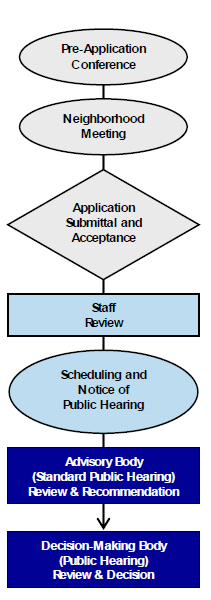
Standard Review Steps
This section sets forth a series of six standard review steps common to most development applications reviewed under this Ordinance. These standard review procedural requirements shall apply to all development application requests submitted under this Ordinance, unless otherwise exempted or alternative procedural requirements are specified in Section 23-2-4, Application-Specific Review Procedures and Standards. Flowcharts in Section 23-2-4 depict the major procedural steps applicable to review of each of the individual types of development applications.
4 - Application-Specific Review Procedures and Standards
This section sets forth supplemental review procedures, standards, and related information for each type of development application listed in Table 23-2-1, Summary of Development Review Responsibilities. They apply in addition to, or instead of, the common review procedures set forth in Section 23-2-3, Standard Review Procedures.
(A) - Review and Decision-Making Authorities Generally
The following bodies and city staff have powers and responsibilities in administering and reviewing applications for development approval under this Ordinance:
(1)
Mayor and City Council;
(2)
Planning Commission;
(3)
Board of Zoning Adjustments;
(4)
Architectural and Historical Review Commission; and
(5)
City staff.
(B) - City Council
To exercise the authority granted the City Council by state law, the City Council shall have the following powers and duties under this Ordinance:
(1)
Application Review
To initiate, review, and decide applications for the following:
a.
Amendments to the text of this Ordinance;
b.
Amendments to the Official Zoning Map (Rezonings);
c.
Planned Developments;
d.
Conditional Use Permits;
e.
Final Plats;
f.
Appeals of Major Subdivision Preliminary Plats;
g.
Property, Right-of-Way, and Easement Dedication Acceptances;
h.
Right-of-Way or Easement Vacations or Abandonments; and
i.
Street Name Changes.
(2)
Schedule of Fees and Civil Penalties
To approve, by resolution, a schedule of fees governing applications for permits and other development approvals reviewed under this Ordinance or civil penalties for violations of this Ordinance.
(3)
Other Actions
To take any other action not assigned or delegated to the Planning Commission, Board of Zoning Adjustments, Architectural and Historical Review Commission, Development Review Committee, Director of Community Development, City Engineer, Building Official, City Arborist, or other decision-making body or staff as the Mayor and/or City Council may deem desirable and necessary to implement the provisions of this Ordinance.
(4)
Council Approvals Subject to Mayor's Endorsement or Veto
In accordance with the statutory mayor-council charter applicable to the City of Biloxi (Mississippi Code § 21-8-17(2)), any City Council approval in accordance with this Ordinance is not effective unless or until the Mayor endorses the approval, or the Mayor fails to veto the approval within a prescribed time frame, or the City Council overrides the Mayor's veto of its approval within a prescribed timeframe. Where this Ordinance references a decision made by the City Council, therefore, such decision—if one of approval—shall be construed as also subject to the statutory requirement for endorsement or veto by the Mayor.
(C) - Planning Commission
The Planning Commission is hereby established in accordance with the Mississippi Code. [1]
(1)
Powers and Duties
The Planning Commission shall have the following powers and duties:
a.
Decision Authority
Review and decide applications for Major Subdivision Preliminary Plats.
b.
Recommendation Authority
Hold public hearings, review, and make recommendations to the City Council on applications for the following:
1.
Amendments to the text of this Ordinance;
2.
Amendments to the Official Zoning Map (Rezonings);
3.
Planned Developments;
4.
Conditional Use Permits;
5.
Property, Right-of-Way, and Easement Dedication Acceptances;
6.
Right-of-Way or Easement Vacations or Abandonments; and
7.
Street Name Changes.
c.
Other Powers and Duties
The Planning Commission is authorized to carry out any other powers and duties delegated to it by the City Council, consistent with state law.
(2)
Membership, Appointment, and Terms of Office
a.
The Planning Commission shall consist of a total of 15 voting members appointed by the Mayor, subject to confirmation by the City Council. All members shall reside within the corporate limits of the City of Biloxi and shall be qualified electors of the city. There shall be two resident members appointed from each ward of the city, plus one member appointed at large, who may be a resident of any ward. A representative of Keesler Air Force Base, appointed by the base commander, shall be an ex officio member of the Planning Commission, with full authority to participate in meetings, but without authority to vote.
b.
Members shall be appointed for four-year, staggered terms, and shall continue to serve until their successors are appointed.
c.
Members may be reappointed to successive terms without limitation.
d.
Vacancies occurring for reasons other than expiration of terms shall be filled by the Mayor, subject to confirmation of the City Council, for the period of the unexpired term only.
e.
A member who moves outside the city shall be replaced by a qualifying member appointed by the Mayor, subject to confirmation by the City Council.
f.
Each member is eligible to receive per diem compensation in an amount established by the City Council in accordance with the Mississippi Code. [2]
(3)
Removal and Replacement; Attendance
a.
Removal for Good Cause
The Mayor, subject to confirmation by the City Council, may remove and replace any member of the Planning Commission at any time for good cause, including, but not limited to, poor attendance (See b. below.), lack of participation, unfitness, malfeasance, and conflict of interest (See Section 23-2-2(C)(8).).
b.
Removal for Poor Attendance
A member of the Planning Commission shall attend at least 50 percent of regularly scheduled commission meetings held within any 12-month period extending from the date or anniversary of the member's appointment. Any member who fails to comply with this requirement may be removed from the commission by the Mayor, subject to confirmation by the City Council. The Chairman of the Planning Commission shall notify the Mayor and City Council if a member fails to comply with this attendance requirement.
(4)
Chairman and Vice-Chairman
a.
The Planning Commission shall elect a Chairman and a Vice-Chairman from among its members, each to serve a one-year term.
b.
The Chairman shall preside over all Planning Commission meetings. The Vice-Chairman shall preside over commission meetings in the absence of the Chairman. If both the Chairman and Vice-Chairman are absent, the Planning Commission shall vote to determine who shall serve as acting chairman for the meeting.
(5)
Staff
The Director of Community Development shall serve as Secretary and the professional staff liaison to the Planning Commission and shall notify board members of all meetings, keep the minutes of the meetings, and provide the commission with administrative support. The Director of Community Development shall also notify the Mayor and City Council and the Building Official of all commission decisions.
(6)
Meetings
a.
Schedule
The Planning Commission shall adopt a schedule establishing the date, time, and location of regular meetings. The Chairman may adjourn a regular meeting on determining that there are no agenda items for consideration, and may call special meetings.
b.
Official Record
1.
The Planning Commission shall keep a record of its recommendations, transactions, findings, and determinations. Such record shall include minutes of meetings in accordance with the Mississippi Open Meetings Act (Chapter 41 of the Mississippi Code).
2.
Such record shall be a public record and filed in the Community Development Department.
c.
Notice
Notice of all Planning Commission meetings shall be provided in accordance with the Mississippi Open Meetings Act (Chapter 41 of the Mississippi Code) and, where applicable, the public hearing requirements in Section 23-2-3(F)(4), Public Hearing Notice.
d.
Open to the Public
All meetings shall be open to the public.
e.
Procedure
In conducting its meetings, the Planning Commission shall follow rules of procedure adopted in accordance with Section 23-2-2(C)(9), Rules of Procedure, consistent with the procedural requirements of this Ordinance, other ordinances of the city, and state law.
(7)
Quorum and Necessary Vote
a.
Quorum
A majority of the voting membership of the Planning Commission shall constitute a quorum. No official business of the commission shall be conducted without a quorum present.
b.
Voting
An affirmative vote of the majority of commission members present and constituting a quorum is required for all decisions of the Planning Commission.
(8)
Disqualification from Participation and Voting
a.
A member of the Planning Commission shall not participate in the review of, or vote on, an application if the member:
1.
Is an employee of the applicant or has been hired to aid the applicant, in any manner whatsoever;
2.
Has any proprietary, tenancy, or personal interest in the decision on the application; or
3.
Has an interest in the property subject to the application, or in any property located within 300 feet of the property subject to the application.
b.
If an objection is raised to a commission member's participation in a matter and that member does not recuse himself or herself, the remaining members of the commission present shall, by majority vote, determine whether the member is or is not disqualified from participating in and voting on the matter.
c.
If a commission member is disqualified due to a conflict of interest on a regular and continuing basis, the Chairman of the commission shall request, in writing, that the member resign. If the member does not resign, the Chairman shall report the conflict of interest to the Mayor and City Council, and the member is subject to removal and replacement in accordance with Section 23-2-2(C)(3).
(9)
Rules of Procedure
The Planning Commission shall adopt rules of procedure governing its procedures and operations. Copies shall be made available for public inspection in the Community Development Department.
State Law reference— Miss. Code § 17-1-11 et seq.
--- (2) ---
State Law reference— Miss. Code § 7-1-11(1)(a).
(D) - Board of Zoning Adjustments
The Board of Zoning Adjustments is hereby established, as a special type of planning commission, in accordance with the Mississippi Code. [3]
(1)
Powers and Duties
a.
Application Review
The Board of Zoning Adjustments shall review and decide applications for:
1.
Variances;
2.
Appeals on the following decisions:
A.
Major Certificates of Appropriateness by the Architectural and Historical Review Commission;
B.
Major Site Plans, Certificates of Development Compliance, and Major Administrative Adjustments by the Development Review Committee;
C.
Minor Site Plans, Minor Subdivision Plats, Exempt Subdivisions, Minor Certificates of Appropriateness, Tree Permits, Temporary Use Permits, Certificates of Zoning Compliance, Minor Administrative Adjustments, and Development Names/New Street Names by the Director of Community Development
D.
Public Works Permits by the City Engineer; and
E.
All other decisions, determinations, and orders of the Development Review Committee, Director of Community Development, or other city official in administering or enforcing this Ordinance.
b.
Reports to the City Council
The Board of Zoning Adjustments shall make such reports to the Mayor and City Council as may be required by the City Council.
c.
Other Powers and Duties
The Board of Zoning Adjustments is authorized by this Ordinance to carry out any other powers and duties delegated to it by the City Council, consistent with state law.
(2)
Membership, Appointment, and Terms of Office
a.
The Board of Zoning Adjustments shall consist of a total of 15 voting members appointed by the Mayor, subject to confirmation by the City Council. All members shall reside within the corporate limits of the City of Biloxi and shall be qualified electors of the city. There shall be two resident members appointed from each ward of the city, plus one member appointed at large, who may be a resident of any ward. A representative of Keesler Air Force Base, appointed by the base commander, shall be an ex officio member of the Board of Adjustments, with full authority to participate in meetings, but without authority to vote.
b.
Members shall be appointed for four-year, staggered terms, and shall continue to serve until their successors are appointed.
c.
Members may be reappointed to successive terms without limitation.
d.
Vacancies occurring for reasons other than expiration of terms shall be filled by the Mayor, subject to confirmation of the City Council, for the period of the unexpired term only.
e.
A member who moves outside the city shall be replaced by a qualifying member appointed by the Mayor, subject to confirmation by the City Council.
f.
Each member is eligible to receive per diem compensation in an amount established by the City Council in accordance with the Mississippi Code. [4]
(3)
Removal and Replacement; Attendance
a.
Removal for Good Cause
The Mayor, subject to confirmation by the City Council, may remove and replace any member of the Board of Zoning Adjustments at any time for good cause, including, but not limited to, poor attendance (See b. below.), lack of participation, unfitness, malfeasance, and conflict of interest (See Section 23-2-2(D)(8).).
b.
Removal for Poor Attendance
A member of the Board of Zoning Adjustments shall attend at least 50 percent of regularly scheduled board meetings held within any 12-month period extending from the date or anniversary of the member's appointment. Any member who fails to comply with this requirement may be removed from the board by the Mayor, subject to confirmation by the City Council. The Chairman of the Board of Zoning Adjustments shall notify the Mayor and City Council if a member fails to comply with this attendance requirement.
(4)
Chairman and Vice-Chairman
a.
The Board of Zoning Adjustments shall elect a Chairman and a Vice-Chairman from among its members, each to serve a one-year term.
b.
The Chairman shall preside over all board meetings. The Vice-Chairman shall preside over board meetings in the absence of the Chair. If both the Chairman and Vice-Chairman are absent, the Board of Zoning Adjustments shall vote to determine who shall serve as acting chairman for the meeting.
(5)
Staff
The Director of Community Development shall serve as Secretary and the professional staff liaison to the Board of Zoning Adjustments and shall notify board members of all meetings, keep the minutes of the meetings, and provide the board with administrative support. The Director of Community Development shall also notify the Planning Commission and the Building Official of all board decisions.
(6)
Meetings
a.
Schedule
The Board of Zoning Adjustments shall adopt a schedule establishing the date, time, and location of regular meetings. The Chairman may adjourn a regular meeting on determining that there are no agenda items for consideration, or call special meetings.
b.
Official Record
1.
The Board of Zoning Adjustments shall keep a record of its recommendations, transactions, findings, and determinations. Such record shall include minutes of meetings in accordance with the Mississippi Open Meetings Act (Chapter 41 of the Mississippi Code).
2.
Such record shall be a public record and filed in the Community Development Department.
c.
Notice
Notice of all Board of Zoning Adjustments meetings shall be provided in accordance with the Mississippi Open Meetings Act (Chapter 41 of the Mississippi Code) and, where applicable, the public hearing requirements in Section 23-2-3(F)(4), Public Hearing Notice.
d.
Open to the Public
All meetings shall be open to the public.
e.
Procedure
In conducting its meetings, the Board of Zoning Adjustments shall follow rules of procedure adopted in accordance with Section 23-2-2(D)(9), Rules of Procedure, consistent with the procedural requirements of this Ordinance and state law.
(7)
Quorum and Necessary Vote
a.
Quorum
A majority of the voting membership of the Board of Zoning Adjustments shall constitute a quorum. No official business of the board shall be conducted without a quorum present.
b.
Voting
An affirmative vote of the majority of commission members present and constituting a quorum is required for all decisions of the Board of Zoning Adjustments.
(8)
Disqualification from Participation and Voting
a.
A member of the Board of Zoning Adjustments shall not participate in the review of, or vote on, an application if the member:
1.
Is an employee of the applicant or has been hired to aid the applicant, in any manner whatsoever;
2.
Has any proprietary, tenancy, or personal interest in the decision on the application; or
3.
Has an interest in the property subject to the application or in any property located within 300 feet of the property subject to the application.
b.
If an objection is raised to a board member's participation in a matter and that member does not recuse himself or herself, the remaining members of the board present shall, by majority vote, determine whether the member is or is not disqualified from participating in and voting on the matter.
c.
If a board member is disqualified due to a conflict of interest on a regular and continuing basis, the Chairman of the board shall request, in writing, that the member resign. If the member does not resign, the Chairman shall report the conflict of interest to the Mayor and City Council, and the member is subject to removal and replacement in accordance with Section 23-2-2(D)(3).
(9)
Rules of Procedure
The Board of Zoning Adjustments shall adopt rules of procedure governing its procedures and operations. Copies shall be made available for public inspection in the Community Development Department.
State Law reference— Miss. Code § 17-1-11 et seq.
--- (4) ---
State Law reference— Miss. Code § 17-1-11(1)(a).
(E) - Architectural and Historical Review Commission
The Architectural and Historical Review Commission is hereby established in accordance with the Mississippi Code.
(1)
Powers and Duties
The Architectural and Historical Review Commission shall have the following powers and duties:
a.
Review and decide applications for Certificates of Appropriateness;
b.
Review and provide recommendations to the Planning Commission and the City Council on:
1.
Amendments to the Official Zoning Map (Rezonings) that establish or change the boundaries of an Architectural/Historic Overlay district; and
2.
Amendments to the text of this Ordinance that involve:
A.
The Architectural/Historic Overlay district (including historic districts, landmarks, and landmark sites);
B.
Certificates of Appropriateness; or
C.
Other provisions directly related to historic preservation;
c.
Investigate and prepare a report describing the proposed boundaries of any area recommended for designation as a historic district and the significance of the proposed district and the buildings, structures, features, sites, or surroundings included in it;
d.
Review and make findings on the significance of individual structures, buildings, sites, areas, or objects recommended for designation as a historic landmark or landmark site;
e.
Prepare and recommend adoption of preservation goals, objectives, policies, and strategies as part of the city's comprehensive planning efforts;
f.
Recommend city acquisition of properties within established historic districts or designated landmarks as necessary to promote their preservation;
g.
Advise the Planning Commission and the City Council on matters involving an Architectural/Historic Overlay district, landmark, or landmark site, or involving urban design or corridor design;
h.
Provide assistance, guidance, or technical advice to property owners concerning restoration and the preservation of architectural features on historic structures; and
i.
Submit a report to the Planning Commission and City Council by October of each year that identifies significant changes during the previous year to properties zoned Architectural/Historic Overlay (including historic districts, landmarks, and landmark sites), and recommends actions to be taken to address such changes that are inconsistent with or not authorized by a Certificate of Appropriateness.
(2)
Membership, Appointment, and Terms of Office
a.
The Architectural and Historical Review Commission shall consist of a total of nine voting members appointed by the Mayor and City Council. All members shall reside within the corporate limits of the City of Biloxi and shall be qualified electors of the city. At least five members shall be residents of property zoned Architectural/Historic Overlay, or own property in such Architectural/Historic Overlay area. A representative of the Biloxi Main Street organization, appointed by that organization, shall be an ex officio member of the Architectural and Historic Review Commission, with full authority to participate in meetings, but without authority to vote.
b.
All members, including the ex officio member from the Biloxi Main Street organization, shall have a demonstrated special interest, knowledge, experience, or education in history, architecture, urban planning, archaeology, or related fields.
c.
Members shall be appointed for four-year, staggered terms, and shall continue to serve until their successors have been appointed.
d.
Members may be reappointed to successive terms without limitation.
e.
Vacancies occurring for reasons other than expiration of terms shall be filled by the Mayor, subject to confirmation of the City Council, for the period of the unexpired term only.
f.
A member who moves outside the city shall be replaced by a qualifying member appointed by the Mayor, subject to confirmation by the City Council.
(3)
Removal and Replacement; Attendance
a.
Removal for Good Cause
The Mayor, subject to confirmation by the City Council, may remove and replace any member of the Architectural and Historical Review Commission at any time for good cause, including, but not limited to, poor attendance (See b. below), lack of participation, unfitness, malfeasance, and conflict of interest (See Section 23-2-2(E)(8).).
b.
Removal for Poor Attendance
A member of the Architectural and Historical Review Commission shall attend at least 50 percent of regularly scheduled commission meetings held within any 12-month period extending from the date or anniversary of the member's appointment. Any member who fails to comply with this requirement may be removed from the commission by the Mayor, subject to confirmation by the City Council. The Chairman of the Architectural and Historical Review Commission shall notify the Mayor and City Council if a member fails to comply with this attendance requirement.
(4)
Chair and Vice-Chair
a.
The Architectural and Historical Review Commission shall elect a Chairman and a Vice-Chairman from among its members, each to serve a one-year term.
b.
The Chairman shall preside over all commission meetings. The Vice-Chairman shall preside over commission meetings in the absence of the Chairman. If both the Chairman and Vice-Chairman are absent, the Architectural and Historic Review Commission shall vote to determine who shall serve as acting chairman for the meeting.
(5)
Staff
The Director of Community Development shall serve as Secretary and the professional staff liaison to the Architectural and Historical Review Commission and shall notify commission members of all meetings, keep the minutes of the meetings, and provide the commission with administrative support. The Director of Community Development shall also notify the Building Official of all board decisions.
(6)
Meetings
a.
Schedule
The Architectural and Historical Review Commission shall adopt a schedule establishing the date, time, and location of regular meetings. The Chairman may adjourn a regular meeting on determining that there are no agenda items for consideration, or call special meetings.
b.
Official Record
1.
The Architectural and Historical Review Commission shall keep a record of its recommendations, transactions, findings, and determinations. Such record shall include minutes of meetings in accordance with the Mississippi Open Meetings Act (Chapter 41 of the Mississippi Code).
2.
Such record shall be a public record and filed in the Community Development Department.
c.
Notice
Notice of all Architectural and Historical Review Commission meetings shall be provided in accordance with the Mississippi Open Meetings Act (Chapter 41 of the Mississippi Code) and, where applicable, the public notice requirements in Section 23-2-3(G), Certificate of Appropriateness.
d.
Open to the Public
All meetings shall be open to the public.
e.
Procedure
In conducting its meetings, the Architectural and Historical Review Commission shall follow rules of procedure adopted in accordance with Section 23-2-2(F)(9), Rules of Procedure, consistent with the procedural requirements of this Ordinance and state law.
(7)
Quorum and Necessary Vote
a.
Quorum
A majority of currently serving members of the Architectural and Historical Review Commission (not counting vacant seats) shall constitute a quorum. No official business of the commission shall be conducted without a quorum present.
b.
Voting
An affirmative vote of the majority of commission members present and constituting a quorum is required for all decisions of the Architectural and Historical Review Commission.
(8)
Disqualification from Participation and Voting
a.
A member of the Architectural and Historical Review Commission shall not participate in the review of, or vote on, an application if the member:
1.
Is an employee of the applicant or has been hired to aid the applicant, in any manner whatsoever;
2.
Has any proprietary, tenancy, or personal interest in the decision on the application; or
3.
Has an interest in the property subject to the application, or in any property located within 300 feet of the property subject to the application.
b.
If an objection is raised to a commission member's participation in a matter and that member does not recuse himself or herself, the remaining members of the commission present shall, by majority vote, determine whether the member is or is not disqualified from participating in and voting on the matter.
c.
If a commission member is disqualified due to a conflict of interest on a regular and continuing basis, the Chairman of the commission shall request, in writing, that the member resign. If the member does not resign, the Chairman shall report the conflict of interest to the Mayor and City Council, and the member is subject to removal and replacement in accordance with Section 23-2-2(E)(3).
(9)
Rules of Procedure
The Architectural and Historical Review Commission shall adopt rules of procedure governing its procedures and operations. Copies shall be made available for public inspection in the Community Development Department.
(Ord. No. 2506, § 2, 2-14-2023)
(F) - City Staff
(1)
Development Review Committee
The Development Review Committee is hereby established.
a.
Powers and Duties
The Development Review Committee shall have the following powers and duties:
1.
Decision Authority
Review and decide applications for the following:
A.
Major Site Plans; and
B.
Major Administrative Adjustments.
2.
Recommendation Authority
Review and make recommendations on applications for the following:
A.
Amendments to the text of this Ordinance;
B.
Amendments to the Official Zoning Map (Rezonings);
C.
Planned Developments; and
D.
Conditional Use Permits.
3.
Additional Duties
A.
Conduct pre-application conferences;
B.
Provide expertise and technical assistance to the Director of Community Development in compiling and maintaining an Administrative Manual and in establishing application content requirements and a submittal schedule for review of applications and appeals; and
C.
Provide expertise and technical assistance to the city's other decision-making bodies, upon request.
b.
Membership and Appointment
1.
The Development Review Committee shall consist of the Director of Community Development plus a representative from each of the following city departments and divisions involved with development review, as designated by the head of the department or division:
A.
Planning Division, Community Development Department;
B.
Building and Code Enforcement Division, Community Development Department;
C.
Engineering Division, Public Works Department;
D.
Fire Department;
E.
Police Department; and
F.
City Arborist, Community Development Department.
2.
Representatives from other city departments and divisions, and from non-city regulatory agencies, service providers, and organizations generally involved with development review (such as the Mississippi Department of Transportation, the Gulf Regional Planning Commission, electrical utilities, and the Biloxi Council of Garden Clubs) or commonly affected by development (such as Keesler Air Force Base) may serve as participating, but non-voting, members of the Development Review Committee.
c.
Chair
The Director of Community Development, or his designee, shall serve as Chair of the Development Review Committee, and shall schedule committee meetings, coordinate the committee's activities, preside over committee meetings, prepare committee reports, and serve as liaison to the departments and agencies involved for clarification of issues and resolution of conflicts.
d.
Meetings
1.
Schedule
The Development Review Committee shall establish a regular meeting schedule and meet frequently enough to take action as expeditiously as practicable on matters before it. The Chairman may adjourn a regular meeting on determining that there are no agenda items for consideration, or call special meetings.
2.
Official Record
A.
The Development Review Committee shall keep a record of its recommendations, transactions, findings, and determinations.
B.
Such record shall be a public record and filed in the Community Development Department.
3.
Open to the Public
All meetings shall be open to the public. The Chairman of the Development Review Committee may invite applicants to attend Development Review Committee meetings as necessary to answer questions from, or provide clarifications requested by, Development Review Committee members.
4.
Procedure
In conducting its meetings, the Development Review Committee shall follow rules of procedure adopted in accordance with Section 23-2-2(F)(1)e, Rules of Procedure, consistent with the procedural requirements of this Ordinance and state law.
e.
Rules of Procedure
The Development Review Committee shall adopt rules of procedure governing its procedures and operations. Copies shall be made available for public inspection in the Community Development Department.
(2)
Director of Community Development
The Director of Community Development is the official primarily responsible for administering and enforcing the provisions of this Ordinance. The Director of Community Development may delegate any decision or review authority to any professional-level staff in the Community Development Department. The Director of Community Development shall have the following powers and duties:
a.
Decision Authority
Review and decide applications for the following:
1.
Minor Site Plans;
2.
Minor Subdivision Plats;
3.
Exempt Subdivisions;
4.
Administrative Adjustments;
5.
Minor Certificates of Appropriateness;
6.
Tree Permits;
7.
Temporary Use Permits;
8.
Sign Permits;
9.
Certificates of Zoning Compliance;
10.
Certificates of Development Compliance;
11.
Minor Administrative Adjustments;
12.
Interpretations; and
13.
Development Names/New Street Names.
b.
Recommendation Authority
Review and make recommendations on applications for the following:
1.
Street Name Changes.
c.
Additional Duties
1.
Establish application content requirements and a submittal schedule for review of applications and appeals;
2.
Compile and maintain an Administrative Manual;
3.
Maintain the Official Zoning Map and related materials;
4.
Serve as secretary and staff liaison to the Planning Commission, Board of Zoning Adjustments, and Architectural and Historical Review Commission;
5.
Provide administrative support to the Development Review Committee;
6.
Enforce this Ordinance in accordance with Article 23-9: Enforcement;
7.
Provide expertise and technical assistance to the city's other decision-making bodies, upon request; and
8.
Maintain a record of all permits and approvals on file and make copies available upon request.
(3)
City Engineer
In addition to, and in conjunction with, the authority and duties conferred by Chapter 17 (Streets and Sidewalks) of the Biloxi Code of Ordinances, the City Engineer shall have the following powers and duties under this Ordinance:
a.
Decision Authority
Review and decide applications for the following:
1.
Public Works Permits.
b.
Recommendation Authority
Review and make recommendations on applications for the following:
1.
Final Plats;
2.
Acceptance of Property, Right-of-Way, or Easement Dedications; and
3.
Vacation or Abandonment of Rights-of-Way or Easements.
c.
Additional Duties
1.
Assist the Director of Community Development in establishing application content requirements for review of applications and appeals;
2.
Assist the Director of Community Development in compiling and maintaining an Administrative Manual;
3.
Assist the Director of Community Development in enforcing this Ordinance in accordance with Article 23-9: Enforcement;
4.
Provide expertise and technical assistance to the city's other decision-making bodies, upon request; and
5.
Maintain a record of all permits and approvals on file and make copies available upon request.
(4)
Director of Public Works
In addition to, and in conjunction with, the authority and duties conferred by Chapter 22 (Water and Sewers) of the Biloxi Code of Ordinances, the Director of Public Works shall have the following duties under this Ordinance:
a.
Assist the Director of Community Development in establishing application content requirements for review of applications and appeals;
b.
Assist the Director of Community Development in compiling and maintaining an Administrative Manual;
c.
Assist the Director of Community Development in enforcing this Ordinance in accordance with Article 23-9: Enforcement; and
d.
Provide expertise and technical assistance to the city's other decision-making bodies, upon request.
(5)
Building Official
In addition to, and in conjunction with, the authority and duties conferred by Chapter 5 (Building) and Chapter 8 (Flood Damage Prevention) of the Biloxi Code of Ordinances, the Building Official shall have the following duties under this Ordinance:
a.
Assist the Director of Community Development in establishing application content requirements for review of applications and appeals;
b.
Assist the Director of Community Development in compiling and maintaining an Administrative Manual;
c.
Assist the Director of Community Development in enforcing this Ordinance in accordance with Article 23-9: Enforcement; and
d.
Provide expertise and technical assistance to the city's other decision-making bodies, upon request.
(6)
City Arborist
The City Arborist shall have the duty to provide the knowledge and expertise necessary for the Director of Community Development to adequately review and decide Tree Permit applications and to review and make recommendations or decisions relative to landscaping, buffers, and screening aspects of other development applications.
(G) - TREE COMMITTEE
The Tree Committee is hereby established.
(1)
Tree Committee; Purpose and Intent.
The purpose and intent of this article is to establish a body to assist the City in promoting the preservation and replenishment of the native stock of trees, conservation, ground water recharge, storm water runoff retardation, oxygen regeneration, and noise abatement, and to make the City a healthier, more beautiful, and safer place to live. This committee is to be known as the Biloxi Tree Committee, referred to in this article as the "committee." In making its recommendations the committee is charged with using its best efforts to balance those public goals with the public need for economic development while respecting the rights of individuals to develop their property in a meaningful yet responsible way within the confines of the law.
(2)
Membership; Term of Office; No Compensation of Committee.
The Biloxi Tree Committee shall be composed of seven members, one individual from each of the City's seven Wards, all of whom shall be resident citizens of the City and qualified electors therein. The members will be selected by the Mayor and ratified by the City council. Each member shall be appointed for a period of three years and shall continue to serve until a successor is appointed and ratified. Vacancies shall be filled in accordance with this section, and appointments to fill vacancies shall be for the unexpired terms only. Each member shall be eligible for reappointment, and all members of the committee shall serve without pay.
(3)
Officers; Rules of Procedure.
The Biloxi Tree Committee shall elect from among its members its own chairman, vice chairman, and secretary, and provide from time to time such rules and regulations, not inconsistent with the ordinances of the City, for its own organization and procedure, as it may deem appropriate. Meetings may be held by telephonic or other electronic means, and any official action shall only require a majority of the members participating in the meeting. A quorum shall consist of a majority of the members appointed and ratified, and vacancies shall not be considered in the determination of a quorum.
(4)
Powers and Duties
The Biloxi Tree Committee shall advise City officials with regard to the development of a comprehensive city beautification plan, Tree Protection, and when undertaking those tasks shall work under the direction of the City Arborist. With the assistance of the Director of Community Development or his designee the Committee shall serve in an advisory capacity to perform the following functions:
a.
Tree Permits
To review applications for permits involving the proposed removal of protected trees from a property site as outlined in 23-2-4(I), Tree Permit; the City Arborist shall notify all Committee members by email of the content of all applications for Tree Permits.
b.
DRC and Planning Commission Participation
The Committee may serve as a non-voting member to the Development Review Committee in order to be aware of all projects with potential for removal or alteration of protected trees. A designated individual from the Tree Committee may serve as the Committee's representative at DRC and Planning Commission Meetings, and may be a different designee by the Committee for each permit. The Designee shall have the authority to inquire and comment on projects in regards to tree protection, and to modify any recommendations of the Committee.
For Permits requiring a Tree Hearing before the Planning Commission, The City Arborist shall notify the Committee by email of each Tree Hearing and include documents required by the Developer in order to facilitate evaluation of the impact of tree removal. The Committee shall review and make a written recommendation of such applications (by email or other writing) to the City Arborist, The Community Development Director, and the Mayor within ten days of receipt of such permits. The Committee's failure to make a written recommendation on Tree Hearing cases within said ten days will result in the City Arborist making a determination without the Committee's input.
c.
Review of Prior Approved Permits
Review previously issued Tree Permits periodically in order to determine compliance with replacement/mitigation and establishment provisions during the terms of those permits, and to provide resulting reports to the Mayor, the Director of Community Development and the City Council when requested, but at least annually. The Committee shall report any perceived violation to the Mayor, and Director of Community Development for follow up and enforcement. The City Arborist shall provide the Committee with the information and data necessary to carry out these follow-up tasks including but not limited to:
1.
All permits issued in a given period;
2.
Quantity, caliper size and species of trees required for replacement/mitigation;
3.
Date, general location when on-site, and GPS coordinates when off-site of replacement/mitigation;
4.
Annual inspection findings for each year to three years from the date of mitigation;
5.
Incurrence of all notices of non-compliance and associated actions and/or penalties.
d.
Mitigation Site Recommendation
To identify and suggest potential suitable sites to help promote the appropriate replenishment of trees throughout the City and provide mitigation sites for developers where such mitigation is required and not suitable for the developed site; and,
e.
Majestic Trees
The Committee receives and reviews applications by property owners for a designation of an individual tree on their property to be designated a "Majestic Tree." If approved by the Committee, such designation will be submitted to the Mayor and City Council for their consideration. If that designation is also approved by the Mayor and City Council, or if the City Council otherwise designates a tree a Majestic Tree, then any tree permit involving such Majestic Tree shall require assessment of the Tree Committee, and determination of risk by an ISA-certified arborists, who should be a TRAQ (Tree Risk Assessment Qualification) certified professional if available, and who must be contracted at the expense of the applicant.
(Ord. No. 2293, § 1, 1-26-2016; Ord. No. 2400, 8-27-2019; Ord. No. 2410, 1-28-2020; Ord. No. 2475, 2-1-2022)
(A) - Pre-Application Conference
(1)
Purpose
The purpose of a pre-application conference is to provide an opportunity for the applicant to determine the submittal requirements, review procedures, and standards applicable to the development proposal, and for city staff to offer the applicant preliminary comments about the scope, features, and impacts of the proposed development. The pre-application conference should occur before any substantial investment in a proposed development (e.g., site acquisition, preparation of design and engineering plans).
(2)
Pre-Application Conference Mandatory
Except for development applications initiated by city staff or the Planning Commission, Board of Zoning Adjustments, Architectural and Historic Review Commission, Mayor, or City Council, a pre-application conference between the applicant and the Development Review Committee shall be mandatory before submittal of the following types of applications:
a.
Official Zoning Map Amendments (Rezonings);
b.
Planned Developments;
c.
Conditional Use Permits;
d.
Major Site Plans;
e.
Major Subdivision Preliminary Plats; and
f.
Right-of-Way or Easement Vacation or Abandonment.
(3)
Pre-Application Conference Optional
An applicant for any application for development approval other than those listed in Section 23-2-3(A)(2), Pre-Application Conference Required, may request a pre-application conference from the Director of Community Development. The Director of Community Development shall determine whether the optional pre-application conference is to be conducted with the Development Review Committee or with selected city staff.
(4)
Sketch Plan or Conceptual Drawings Required
Applicants seeking approval of a Planned Development (Section 23-2-4(C)), Conditional Use Permit (Section 23-2-4(D)), Major Site Plan (Section 23-2-4(E)(4)), or Major Subdivision Preliminary Plat (Section 23-2-4(F)(5)) shall submit a sketch plan or conceptual drawings that show the location, general layout, and main elements of the proposed development to the Director of Community Development at least three business days before the pre-application conference.
(5)
Effect
The pre-application conference is intended as a means of facilitating the development application process. Discussions held in accordance with this section are not binding on the city. Processing times for review of development applications do not begin until a formal, complete application is submitted and determined to be complete.
(B) - Neighborhood Meeting
(1)
Purpose
The purpose of the neighborhood meeting is to educate owners and occupants of nearby lands about the proposed development and application, receive comments, address concerns about the development proposal, and resolve conflicts and outstanding issues, where possible.
(2)
Favored Practice
Neighborhood meetings are encouraged as opportunities for informal communication between applicants and the owners and occupants of nearby lands, and other residents who may be affected by development proposals.
(3)
Applicability
a.
Neighborhood Meeting May Be Required
1.
The Director of Community Development may require an applicant to conduct a neighborhood meeting before submittal of the application or before a public hearing on an application if the Director of Community Development determines the application is likely to have significant land use, appearance, traffic, or other public facility impacts on neighboring lands.
2.
The Mayor, the Chairman of the Planning Commission, or the Chairman of the Architectural and Historical Review Commission may direct an applicant to conduct a neighborhood meeting either before or during a public hearing on an application being reviewed by the body they chair, on determining that the application could potentially have significant land use, appearance, traffic, or other public facility impacts on neighboring lands.
b.
Neighborhood Meeting Optional
A neighborhood meeting is optional before submittal of any other applications for development approval.
(4)
Procedure
If a neighborhood meeting is held by the applicant, it shall comply with the following procedures:
a.
Time and Place
The neighborhood meeting shall be held at a place that the Director of Community Development determines is accessible to neighbors that reside in close proximity to the land subject to the application. It shall be scheduled after 5:00 p.m. On a weekday.
b.
Notification
1.
Mailed Notice
The applicant shall mail notice of the neighborhood meeting a minimum of ten days in advance of the meeting to:
A.
All persons to whom mailed notice of a public hearing on the application is required by Section 23-2-3(F)(4)b.2, Mailed Notice;
B.
The Director of Community Development;
C.
Any organizations or persons who have registered to receive notification of development applications in accordance with Section 23-2-3(F)(4)f, Registration to Receive Notice by Mail; and
D.
The Mayor, the Chairman of the Planning Commission, or the Chairman of the Architectural and Historical Review Commission, if the neighborhood meeting is being held at the direction of such person in accordance with Section 23-2-3(B)(3)b.2.
2.
Posted Notice
The applicant shall post notice of the neighborhood meeting on the subject property at least ten days before the date fixed for the meeting, in a form established by the Director of Community Development.
3.
Notice Content
The notice shall state the time and place of the meeting and general nature of the development proposal.
c.
Conduct of Meeting
At the neighborhood meeting, the applicant shall explain the development proposal and application, inform attendees about the application review process, answer questions, respond to concerns neighbors raise about the application, and propose ways to resolve conflicts and concerns.
d.
Staff Attendance
City staff may attend the neighborhood meeting for the purpose of advising attendees about applicable provisions of this Ordinance, but shall not serve as facilitators or become involved in negotiations.
e.
Written Summary of Neighborhood Record of Meeting
The applicant shall prepare a written summary of the meeting that includes a list of meeting attendees, a summary of attendee comments, discussed issues related to the development proposal, and any other information the applicant deems appropriate. The meeting summary shall be included with the application materials and be made available to the public for inspection.
f.
Response to Summary
Any persons attending the neighborhood meeting may submit to the Director of Community Development a written response to the applicant's meeting summary. The response may state their understanding of attendee comments and discussed issues related to the development proposal, and any other information they deem appropriate. All written responses to the applicant's summary of the neighborhood meeting shall be made available to the applicant and for public inspection.
(C) - Application Filing, Contents, Fees, and Review Schedule
(1)
Authority to File Applications
a.
Unless expressly stated otherwise in this Ordinance, applications for development approvals shall be submitted by:
1.
The owner of the land on which development is proposed; or
2.
The contract purchaser of the land; or
3.
Any other person having a recognized property interest in the land (e.g., lessee); or
4.
A person authorized to submit the application on behalf of the owner, contract purchaser, or other person having a recognized property interest in the land, as evidenced by a letter or document signed by such owner, contract purchaser, or other person.
b.
If there are multiple owners, contract purchasers, or other persons authorized to submit the application, all such persons shall sign the application or a letter or document consenting to the application.
(2)
Application Contents
The Director of Community Development is authorized to and shall establish the requirements for application contents and forms, which shall be located in an Administrative Manual. The Director of Community Development may amend and update these requirements as determined necessary to ensure effective and efficient city review. The applicant bears the burden of ensuring that an application contains sufficient information to demonstrate the proposed development's compliance with applicable standards.
(3)
Application Fees
The City Council shall establish application fees, and may amend and update those fees as determined necessary. Fees established by the City Council shall be included in the Administrative Manual.
(4)
Submittal and Review Schedule
The Director of Community Development is authorized to and shall establish in an Administrative Manual the submittal and review schedule (including time frames for review) for development applications. The Director of Community Development may amend and update these requirements as determined necessary to ensure effective and efficient city review.
(D) - Application Submittal, Completeness Determination, Revision, and Withdrawal
(1)
Application Submittal
Applications shall be submitted to the Community Development Department in the form established by the Director of Community Development (Section 23-2-3(C)(2), Application Contents), along with a fee established in accordance with Section 23-2-3(C)(3), Application Fees.
(2)
Determination of Application Completeness
a.
Completeness Review
On receiving an application, the Director of Community Development shall, within five business days, determine whether the application is complete or incomplete. A complete application is one that:
1.
Contains all information and materials established by the Director of Community Development as required for submittal of the particular type of application;
2.
Is in the form established by the Director of Community Development as required for submittal of the particular type of application;
3.
Includes information in sufficient detail to evaluate the application to determine whether it complies with the appropriate substantive standards of this Ordinance; and
4.
Is accompanied by the fee established for the particular type of application.
b.
Application Incomplete
1.
If the application is determined to be incomplete, the Director of Community Development shall notify the applicant of the deficiencies within the specified completeness review period. The applicant may correct the deficiencies and resubmit the application for completeness determination.
2.
If the applicant fails to resubmit an application within 45 calendar days after being first notified of deficiencies, the application shall be considered withdrawn.
3.
The Director of Community Development shall not process an application for further review until it is determined to be complete.
c.
Application Complete
If the application is determined to be complete, the Director of Community Development shall refer the application to the appropriate staff, review agencies, and review bodies for review in accordance with the procedures and standards of this Ordinance. The time frame and cycle for review of the application shall be based on the date the application is determined to be complete.
(3)
Revision of Application after Public Hearing Notice
If an application is subject to a public hearing, substantive changes to the application that relate to uses, densities, intensities, access, or other major elements of the proposed development application, and that are made after notice of the public hearing is provided in accordance with Section 23-2-3(F)(4), Public Hearing Notice, shall be referred back to the Director of Community Development for staff review and any advisory body review, as required for review of the original application, unless the changes are made solely to satisfy specific deficiencies or recommended conditions of approval contained in the staff report or advisory body recommendations, or identified by the City Council. Changes constituting only minor additions, deletions, or corrections responding to clerical errors in the application do not require referral back.
(4)
Withdrawal of Application
a.
If no public hearing is required on an application, or if no required notice of a required public hearing has yet been provided, the applicant may withdraw the application by submitting a letter of withdrawal to the Director of Community Development. Otherwise, the applicant may request withdrawal of the application at the public hearing or other public meeting at which consideration of the application is scheduled. The body conducting the hearing or meeting shall act on the request.
b.
If an application requiring a public hearing is withdrawn after required notice of the public hearing is provided in accordance with Section 23-2-3(F)(4), Public Hearing Notice, no application proposing the same or similar development on all or part of the same land shall be submitted within six months after the date of withdrawal.
c.
Application fees shall not be refunded for withdrawn applications.
(E) - Staff Review
(1)
Staff Decision
If an application is subject to a staff decision (See Table 23-2-1, Summary of Development Review Responsibilities.), the Development Review Committee, the Director of Community Development, City Engineer, or Building Official, as appropriate, shall review the application, relevant support material, and any comments from other staff and review agencies to which the application may have been referred, and shall decide, based on the review standards applicable to the particular application, to approve the application, approve the application subject to conditions, or deny the application.
(2)
Staff Recommendation
a.
General
If an application is subject to a staff recommendation (See Table 23-2-1, Summary of Development Review Responsibilities.), the Director of Community Development, City Engineer, Building Official, or Development Review Committee, as appropriate, shall review the application, relevant support material, and any comments from other staff and review agencies to which the application may have been referred, and shall prepare a written staff report addressed to the appropriate advisory body or decision-making body.
b.
Staff Report Contents
The staff report shall state whether the application complies with all applicable standards of this Ordinance and shall recommend one of the actions the decision-making body is authorized to take on the application, based on the review standards set forth in Section 23-2-4, Application-Specific Review Procedures and Standards, for the particular type of application. The staff report may identify ways in which areas of noncompliance might be eliminated and adverse effects of the development proposal might be mitigated.
c.
Distribution and Availability of Application and Staff Report
1.
The Director of Community Development shall transmit a copy of the staff report to the applicant.
2.
If the application is subject to review by an advisory body or a decision-making body, the Director of Community Development shall transmit the application, related materials, and the staff report to advisory body or decision-making body, as appropriate, within a reasonable time period before the public hearing or meeting for which the application is scheduled.
3.
The Director of Community Development shall make the application, related materials, and the staff report available for examination by the public in the Community Development Department during normal business hours. Copies of such materials shall be made available at a reasonable cost.
(F) - Scheduling, Public Notice, and Conduct of Public Hearing
(1)
Required Public Hearings
Table 23-2-3(F)(1), Required Public Hearings, depicts the review and decision-making bodies responsible for conducting public hearings on development applications, what types of applications require or may involve public hearings, and the type of public hearing (standard or quasi-judicial) involved.
(2)
Scheduling Public Hearings
a.
Meetings Scheduled for Hearing
If an application is subject to a public hearing (See Table 23-2-3(F)(1), Required Public Hearings.), the Director of Community Development shall ensure that the public hearing on the application is scheduled for either:
1.
A regularly scheduled meeting of the body reviewing the application; or
2.
A meeting specially called for that purpose by the body reviewing the application.
b.
Time for Review and Public Notice
The public hearing on the application shall be scheduled so there is sufficient time for preparation of a written staff report and satisfaction of the public notice requirements in this Ordinance and the Mississippi Code.
(3)
Requests to Defer Public Hearing
a.
Before Public Hearing Notice
If an application is subject to a public hearing, the applicant may request that the hearing be deferred by submitting a written request for deferral to the Director of Community Development before notice of the hearing is provided in accordance with Section 23-2-3(F)(4), Public Hearing Notice. The Director of Community Development may grant such requests for good cause.
b.
After Public Hearing Notice
If notice of the public hearing has already been provided in accordance with Section 23-2-3(F)(4), Public Hearing Notice, the applicant may request that the hearing be deferred by submitting a written request for deferral to the Director of Community Development before the public hearing is held. The Director of Community Development shall submit the request to the review body conducting the hearing, which may grant the request for good cause, or if finding no good cause for deferral, may proceed to hold the hearing and consider the application. If the reviewing body grants the request for deferral, it shall concurrently set the new hearing date for the application. If a deferral is granted, the application may be subject to additional application fees to defray the additional costs of processing the application.
(4)
Public Hearing Notice
a.
General Notice Requirements
Public notice of the public hearing on an application shall be required as shown in Table 23-2-3(F)(4), Public Hearing Notice Requirements, for the type of application and the type of notice. In computing the time periods prescribed for notices, the day the notice is published, postmarked, or posted shall not be included, but the day of the hearing shall be included.
b.
Notice Requirements by Type
1.
Published Notice
The Director of Community Development shall cause a required notice of a public hearing on an application to be prepared and published in a newspaper having general circulation in the city.
2.
Mailed Notice
The Director of Community Development shall cause a required notice of a public hearing on an application to be prepared and mailed via first class mail to the following persons:
A.
The applicant;
B.
All owners of record of real property within 200 feet of the parcel(s) subject to the application, as shown on the most recently available Harrison County tax rolls—provided, however, that where the properties are part of a condominium or timeshare development, the notice may be mailed to the president or manager of the property owners association in lieu of individual unit owners;
C.
The planning commission or governing board of the county or an adjacent municipality if its jurisdictional boundary lies within 500 feet of the parcel(s) subject to the application; and
D.
Organizations and persons who have registered to receive notification of development application public hearings in accordance with Section 23-2-3(F)(4)f, Registration to Receive Notice by Mail.
3.
Posted Notice
A.
The Director of Community Development shall cause a required notice of a public hearing on an application to be prepared and posted at the following locations:
1.
On the property subject to the application, at a location adjacent to each abutting street and clearly visible to traffic along the street (or if no part of the subject property abuts a street, in the right-of-way of the nearest street, and in a manner consistent with the intent of this subsection); and
2.
On the city's website.
B.
Notices posted on the property subject to the application shall be in a form established by the Director of Community Development.
C.
The applicant shall ensure that the notice posted on the property subject to the application is maintained in place until after a final decision is rendered on the application.
c.
Notice Content
Required public notices shall:
1.
Identify the size of property subject to the application;
2.
Identify the location of the property subject to the application by street address or by its relationship to a fronting street and nearest cross street, if applicable (not applicable to notices posted on the subject property);
3.
Describe the nature and scope of the proposed development or action;
4.
Identify the date, time, and location of the public hearing, and state that interested parties may appear at the hearing and speak and submit evidence and written comments on the application;
5.
Indicate how and where written comments on the application may be submitted before the hearing; and
6.
Indicate how and where additional information about the application and review process may be obtained.
d.
Affidavit of Notice
The Director of Community Development shall prepare and sign an affidavit affirming that public notice meeting the requirements of this subsection was provided. Such an affidavit shall be conclusive that required notice was given in accordance with the terms of this subsection.
e.
Constructive Notice
1.
Minor defects in any notice shall not impair the notice or invalidate proceedings pursuant to the notice if a bona fide attempt is made to comply with applicable notice requirements. Minor defects in notice may include, but are not limited to:
A.
Errors in a legal description; or
B.
Typographical or grammatical errors that do not impede communication of the notice to affected parties.
2.
Failure of a party to receive written notice shall not invalidate subsequent action. In all cases, however, the requirements for the timing of the notice and for specifying the time, date, and place of a public hearing and the location of the subject property shall be strictly adhered to.
3.
If questions arise at the hearing regarding the adequacy of notice, the body conducting the hearing shall direct the Director of Community Development to make a formal finding as to whether there is substantial compliance with the notice requirements of this Ordinance, and such findings shall be made available to the decision-making body before final action on the request.
f.
Registration to Receive Notice by Mail
Any person, neighborhood organization, or other organization in the city may register biennially with the Director of Community Development to receive mailed written notice of all development application public hearings in accordance with Section 23-2-3(F)(4)b.2, Mailed Notice. To be eligible for registration, the person or organization shall provide the Director of Community Development information in a form established by the Director of Community Development, along with a fee to defray registration and mailing costs. To continue to receive such notice, a person or organization shall reregister every two years.
(5)
Public Hearing Procedures
a.
General
All public hearings on development applications shown in Table 23-2-3(F)(1), Required Public Hearings, shall comply with the procedures set forth in this subsection. Where state law requires quasi-judicial proceedings for a particular development review procedure, a quasi-judicial public hearing shall be held. For all other development review procedures requiring a public hearing, a standard public hearing shall be held. Table 23-2-3(F)(1), Required Public Hearings, identifies which type of public hearing is required for each development review procedure. Quasi-judicial public hearings shall require the additional procedures and special considerations as noted in this subsection and required by state law.
b.
Burden of Proof
The burden of demonstrating that an application complies with applicable review and approval standards is on the applicant. The burden is not on the city or other parties to show that the standards are not met by the applicant.
c.
Conduct of the Hearing
1.
Rights of All Persons
Any person may appear at the hearing and submit documents, materials, and other written or oral testimony, either individually or as a representative of an organization. Persons speaking at the hearing shall identify themselves, state their home or business address, and if appearing on behalf of a person or organization, state the name and mailing address of the person or organization they represent.
2.
Time Restrictions
The body conducting the hearing may place reasonable and equitable time restrictions on the presentation of testimony and the submittal of documents and other materials.
3.
Continuance of Hearing
The body conducting the public hearing may, on its own motion or at the request of any person, continue the public hearing to a fixed date, time and place.
d.
Public Hearing Record
The body conducting the public hearing shall record the proceedings by any appropriate means. If a sound recording is made, any person shall be entitled to listen to the recording at a reasonable time, or make copies at that person's own expense, at the offices of the City Clerk (for hearings conducted by the City Council) or at the Community Development Department (for hearings conducted by other review bodies).
(G) - Review and Action of Advisory Body
If an application is subject to a recommendation by the Planning Commission, Architectural and Historical Review Commission, or other appointed advisory body (See Table 23-2-1, Summary of Development Review Responsibilities.), the advisory body shall hold any required public hearing on the application and review and recommend action on the application in accordance with the following procedures.
(1)
The advisory body shall consider the application, relevant support materials, the staff report, any prior recommendation of another advisory body, and the public comments and other information given at the public hearing (if relevant), and shall recommend one of the decisions authorized for the application, based on the review standards set forth in Section 23-2-4, Application-Specific Review Procedures and Standards, for the particular type of application. If the application is subject to a quasi-judicial public hearing by the advisory body (See Table 23-2-3(F)(1), Required Public Hearings.), the recommendation shall be based on the record of the public hearing (See Section 23-2-3(F)()d, Public Hearing Record.).
(2)
The advisory body's recommendation shall clearly state the factors considered in the decision and the basis or rationale for the recommended decision.
(3)
The advisory body shall take action as promptly as possible in consideration of the interests of the applicant, affected parties, and citizens of the city.
(H) - Review and Action of Decision-Making Body
If an application is subject to a decision by the City Council, Planning Commission, Board of Zoning Adjustments, or Architectural and Historical Review Commission (See Table 23-2-1, Summary of Development Review Responsibilities.), the decision-making body shall review and decide the application in accordance with the following procedures.
(1)
Quasi-Judicial Decisions
a.
If the application is subject to a quasi-judicial public hearing (See Table 23-2-3(F)(1), Required Public Hearings.), the decision-making body shall review the staff report, the record of the public hearing (See Section 23-2-3(F)(5)d, Public Hearing Record.), and any advisory body recommendation, and shall decide, based on the public hearing record and the review standards set forth in Section 23-2-4, Application-Specific Review Procedures and Standards, for the particular type of application, to approve the application, approve the application subject to conditions, or deny the application.
b.
The decision-making body may remand the application back to the staff and advisory body for further consideration.
c.
The form of the decision shall include at least the following elements:
1.
A description or summary of material and substantial factual evidence presented at the public hearing;
2.
Findings of fact based on evidence presented at the public hearing;
3.
Statements concluding whether the application does or does not comply with applicable review standards;
4.
A statement of the decision (e.g., approval, approval subject to conditions, or denial);
5.
A clear statement of any conditions of approval; and
6.
Reasons for the decision, including the link between the decision, the required conclusions, the findings of fact, and presented evidence.
d.
The decision-making body shall take action as promptly as possible in consideration of the interests of the applicant, affected parties, and citizens of the city.
(2)
Other Decisions
a.
If an application is not subject to a quasi-judicial public hearing (See Table 23-2-3(F)(1), Required Public Hearings.), the decision-making body shall review the application, relevant support materials, the staff report, any advisory body recommendations, and the public comments and other information given at any public hearing or meeting, and shall decide, based on the review standards set forth in Section 23-2-4, Application-Specific Procedures and Standards, for the particular type of application, to approve the application, approve the application subject to conditions, or deny the application.
b.
The decision-making body may remand the application back to the staff and advisory body for further consideration.
c.
Unless stated otherwise in this Ordinance, the decision-making body's decision shall clearly state the factors considered in the decision and the basis and rationale for the decision.
d.
The decision-making body shall take action as promptly as possible in consideration of the interests of the applicant, affected parties, and citizens of the city.
(I) - Notice of Decision
Within ten calendar days after a decision on an application, the Director of Community Development shall notify the applicant of the decision in writing and make a copy of the decision available to the public in the offices of the Community Development Department, during normal business hours.
(J) - Appeals
(1)
From Decisions by City Council or Board of Zoning Adjustments
A party aggrieved by a final decision by the City Council or the Board of Zoning Adjustments may appeal the decision by filing a Notice of Appeal with the clerk to the Circuit Court of Harrison County no later than ten days after adjournment of the meeting at which the decision was made and by filing a bill of exceptions with the Clerk of Council and the circuit court clerk in the time and manner provided by law.
(2)
From Other Decisions
A party aggrieved by other final decisions may be appealed in accordance with the appeal rights and procedures set forth in Section 23-2-4(S), Appeal.
(K) - Miscellaneous Provisions
(1)
Conditions of Approval
a.
General
Where the staff or decision-making body is authorized to approve a development application subject to conditions, it may impose reasonable and appropriate restrictions and conditions on the approval that it deems necessary to ensure compliance with the requirements and particular standards of this Ordinance or prevent or minimize adverse effects from the proposed development on surrounding lands.
b.
Limitations
The restrictions and conditions imposed must be related in both type and amount to the impact that the proposed development would have on the public and surrounding development. All conditions imposed shall be expressly set forth in the statement of approval.
(2)
Expiration of Approval
a.
General
Development permits and approvals shall expire as provided in Section 23-2-4, Application-Specific Review Procedures and Standards, for the particular type of development application. A change in ownership of the land shall not affect the established expiration time period.
b.
Extension
Except as otherwise provided in Section 23-2-4, Application-Specific Review Procedures and Standards, for the particular type of development application, the Director of Community Development may, on receiving a written request for extension before the expiration date and upon a showing of good cause, grant extensions of an expiration time period for up to 90 days. Any further extension may be granted only by the decision-making body that approved the development application, on receiving a written request for extension submitted to the Director of Community Development before the expiration date (as previously extended) and upon a showing of good cause.
(3)
Simultaneous Processing of Applications
Whenever two or more applications for a development proposal are required under this Ordinance, the Director of Community Development may allow the applications to be processed simultaneously on determining that all applicable state and local requirements are satisfied.
(4)
Limitation on Subsequent Similar Application
a.
General
Except as otherwise provided for applications for Certificates of Appropriateness in Section 23-2-4(G)(8), whenever any application for a development permit or approval requiring a public hearing is denied, an application for the same or similar development on all or part of the same land shall not be accepted or considered for a period of one year after the date of denial unless the decision-making body waives this time limit in accordance with the requirements of this subsection. Only one waiver of the time limit may be requested during the one-year period.
b.
Waiver of Time Limit
1.
Initiation
A request for waiver of the resubmittal time limit may be initiated only by the owner of land or the owner's authorized agent, by submitting the request, in writing, to the Director of Community Development, along with a fee to defray the cost of processing the request.
2.
Action
The Director of Community Development shall submit a request for waiver of the resubmittal time limit to the decision-making body, which shall consider the request, other relevant support materials, and statements made by the applicant and the public, and grant or deny the request.
3.
Standards for Granting Waiver
The decision-making body may grant a request for waiver of the resubmittal time limit only upon a finding by at least two-thirds of its membership that substantial evidence is presented that demonstrates:
A.
There is a substantial change in circumstances relevant to the issues or facts considered during review of the prior application that might reasonably affect the decision-making body's application of the relevant review standards to the development proposed in the new application; or
B.
New or additional information is available that was not available at the time of review of the prior application and that might reasonably affect the decision-making body's application of the relevant review standards to the development proposed in the new application; or
C.
The new application proposed to be submitted is materially different from the prior application; or
D.
The final decision on the prior application was based on a material mistake of fact.
(5)
Public Availability of Application and Related Documents
Upon reasonable request, any person may examine an application, a finalized staff report, and materials submitted in support of or in opposition to an application in the Community Development Department during normal business hours. Copies of such materials shall be made available at a reasonable cost.
(A) - Text Amendment
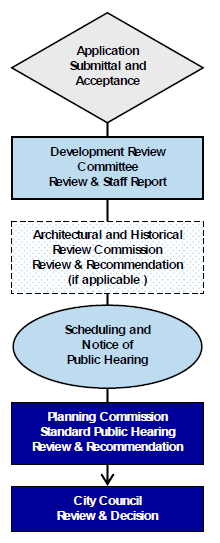
Text Amendment
(1)
Purpose
The purpose of this subsection is to provide a uniform means for amending the text of this Ordinance whenever the public necessity, convenience, general welfare, or appropriate land use practices justify doing so.
(2)
Procedure
a.
Basic Procedures
Except as modified by Sections 23-2-4(A)(2)b—d below, review of an application to amend the text of this Ordinance shall be subject to the common review procedures and requirements established in Section 23-2-3, Standard Review Procedures.
b.
Initiation
An application to amend the text of this Ordinance may be initiated by the Mayor, City Council, Planning Commission, Architectural and Historical Review Commission, or the Director of Community Development.
c.
City Council Review and Action
At its discretion, the City Council may hold an additional standard public hearing on the application, in accordance with Section 23-2-3(F), Scheduling, Notice, and Conduct of Public Hearing.
d.
Expiration
Approval of an amendment to the text of this Ordinance shall not expire, but the amended text is subject to further amendment in accordance with the Text Amendment procedures set forth in this subsection.
(3)
Text Amendment Review Standards
Amending the text of this Ordinance is a matter committed to the legislative discretion of the City Council. In determining whether to adopt or deny the proposed amendment, the City Council shall weigh the relevance of and consider whether and the extent to which the proposed amendment:
a.
Is consistent with all city-adopted plans that are applicable;
b.
Is in conflict with any provision of this Ordinance, and related city regulations;
c.
Is required by a public need or changed conditions;
d.
Is consistent with the purpose and intent of the zoning districts in this Ordinance, or would improve compatibility among uses and would ensure efficient development within the city;
e.
Would result in a logical and orderly development pattern; and
f.
Would result in significantly adverse impacts on the natural environment, including but not limited to water, air, noise, storm water management, wildlife, vegetation, wetlands, and the natural functioning of the environment.
(B) - Map Amendment (Rezoning)
(1)
Purpose
The purpose of this subsection is to provide a uniform means for amending the Official Zoning Map (Rezoning) whenever the public necessity, convenience, general welfare, or appropriate land use practices justify doing so.
(2)
Procedure
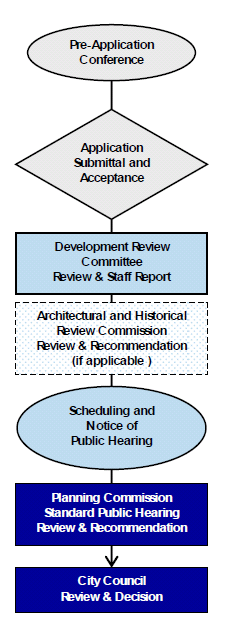
Map Amendments (Rezoning)
a.
Basic Procedures
Except as modified by Sections 23-2-4(B)(2)b—e below, review of an application to amend the Official Zoning Map (Rezoning) shall be subject to the common review procedures and requirements established in Section 23-2-3, Standard Review Procedures.
b.
Initiation
An application to amend the Official Zoning Map (Rezoning) may be initiated by the City Council, Planning Commission, Architectural and Historic Review Commission, Director of Community Development, or a person who may submit applications in accordance with Section 23-2-3(C)(1), Authority to File Applications.
c.
City Council Review and Action
1.
At its discretion, the City Council may hold an additional standard public hearing on the application, in accordance with Section 23-2-3(F), Scheduling, Notice, and Conduct of Public Hearing.
2.
The City Council's decision on the application shall be one of the following:
A.
Approval of the application as submitted;
B.
Approval of the application with a reduction in the area proposed to be rezoned;
C.
Approval of a rezoning to a more restricted base zoning district; or
D.
Denial of the application.
d.
Protest Petition
In accordance with the Mississippi Code, an application to amend the Official Zoning Map (Rezoning) that is subject to a valid protest petition shall only be approved by an affirmative vote of at least three-fifths of all the members of the City Council who are not required by law or ethical considerations to recuse themselves.
e.
Expiration
Approval of an amendment to the Official Zoning Map (Rezoning) shall not expire, but the amended map is subject to further amendment in accordance with the Map Amendment procedures set forth in this subsection.
(3)
Map Amendment (Rezoning) Review Standards
Amending the Official Zoning Map (Rezoning) is a matter committed to the legislative discretion of the City Council. In determining whether to adopt or deny a proposed amendment, the city shall weigh the relevance of and consider whether and the extent to which the proposed amendment:
a.
Is consistent with all city-adopted plans that are applicable;
b.
Is required to address:
1.
A mistake in the original zoning, or
2.
A public need and changed conditions in the neighborhood and community;
c.
Is compatible with existing and proposed uses surrounding the subject land, and is the appropriate zoning district for the land;
d.
Would result in a logical and orderly development pattern, or deviate from logical and orderly development patterns;
e.
Would encourage premature development;
f.
Would result in strip or ribbon commercial development;
g.
Would result in the creation of an isolated zoning district unrelated to adjacent and surrounding zoning districts;
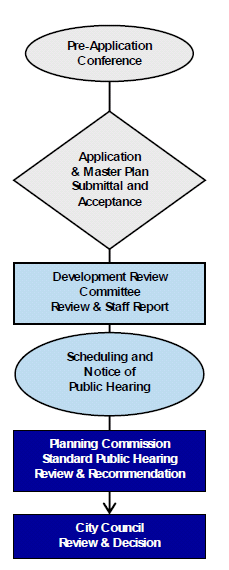
Planned Development
h.
Would result in significant adverse impacts on the property values of surrounding lands; and
i.
Would result in significantly adverse impacts on the natural environment, including but not limited to water, air, noise, stormwater management, wildlife, vegetation, wetlands, and the natural functioning of the environment.
(C) - Planned Development
(1)
Purpose
Planned developments are developments that are planned and developed under unified control and in accordance with more flexible standards and procedures that are more conducive to creating more mixed-use, pedestrian-oriented, and otherwise higher quality development than could be achieved through general use (base) zoning district regulations. The purpose of this subsection is to provide a uniform means for amending the Official Zoning Map to reclassify land to any of the Planned Development (PD) overlay zoning districts established in Article 23-3: Zoning Districts.
(2)
Scope
A Planned Development is established by amendment of the Official Zoning Map to rezone land to a Planned Development zoning classification that is defined by a master plan and a terms and conditions document. Subsequent development within the PD district occurs through the appropriate Site Plan review and subdivision review procedures (whichever is appropriate), which ensure compliance with the approved master plan and terms and conditions.
(3)
Procedure
a.
Basic Procedures
Except as modified by Sections 23-2-4(C)(3)b-f below, review of an application for a Planned Development zoning classification shall be subject to the common review procedures and requirements established in Section 23-2-3, Standard Review Procedures.
b.
Initiation
To ensure unified control, an application for a Planned Development zoning classification may be initiated only by the owner(s) of all the property to be included in the proposed Planned Development district.
c.
Application to Include Master Plan and Terms and Conditions
The application shall include a master plan that depicts the general configuration and relationship of the principal elements of the proposed development, including uses, general building types, density/intensity, resource protection, pedestrian and vehicular circulation, open space, public facilities, and phasing. The application shall also include a terms and conditions document specifying terms and conditions defining development parameters, providing for environmental mitigation, and outlining how public facilities will be provided to serve the Planned Development. To ensure unified control, the application shall also include a copy of the title to all land that is part of the proposed PD zoning district classification.
d.
City Council Review and Action
1.
At its discretion, the City Council may hold an additional public hearing on the application, in accordance with Section 23-2-3(F), Scheduling, Notice, and Conduct of Public Hearing.
2.
The City Council's decision on the application shall be one of the following:
A.
Approval of the application subject to the PD Master Plan and PD Terms and Conditions included in the application;
B.
Approval of the application subject to conditions related to the PD Master Plan and the PD Terms and Conditions; or
C.
Denial of the application.
e.
Protest Petition
An application for Planned Development shall be subject to the protest petition provisions applicable to all Zoning Map Amendments (Rezonings), in Section 23-2-4(B)(2)d, Protest Petitions.
f.
Time Limit for Submittal of Development Application
If no application for approval of a Preliminary Plat or Site Plan (Major or Minor) for any part of the approved PD Master Plan is submitted within two years after approval of the Planned Development, the Director of Community Development shall initiate a Map Amendment (Rezoning) application to rezone the land back to its prior zoning classification or any other base zoning classification determined to be appropriate. Such time period shall not be extended with transfer of ownership, but may be extended in accordance with Section 23-2-3(K)(2)b, Extension.
(4)
Planned Development Review Standards
Review of and the decision on a Planned Development application shall be subject to the review standards in Section 23-2-4(B)(3) Map Amendment (Rezoning) Review Standards, the general standards for all PD districts in Section 23-3-4(C), General Standards for All Planned Development Districts, and the standards for the proposed type of PD District in Sections 23-3-4(C) through 23-3-4(H).
(5)
Designation on Official Zoning Map
Designation of a PD zoning district on the Official Zoning Map shall note the ordinance number approving the PD zoning classification.
(6)
Effect of Approval
Lands rezoned to a PD zoning district shall be subject to the approved PD Master Plan and the approved PD Terms and Conditions. The Master Plan and Terms and Conditions are binding on the land as an amendment to the Official Zoning Map. The applicant may apply for and obtain subsequent development permits and approvals necessary to implement the PD Master Plan in accordance with the appropriate procedures and standards set forth in this Ordinance. Any permits or approvals shall comply with the PD Master Plan and the PD Terms and Conditions.
(7)
Minor Deviations from Approved Plans
a.
Subsequent plans and permits for development within an approved Planned Development may include minor deviations from the PD Master Plan or PD Terms and Conditions, provided such deviations are limited to changes addressing technical considerations that could not reasonably be anticipated during the Planned Development zoning classification process or any other change that has no material effect on the character of the approved Planned Development, the basic concept of the PD Master Plan, or the basic parameters set by the PD Terms and Conditions.
b.
Examples of minor deviations include:
1.
Minor changes in driveway locations;
2.
Minor shifts in the configuration or location of buildings;
3.
Increases of five percent or less in the total floor area for the development, or of ten percent or less in the floor area of any single building;
4.
Structural alterations that do not significantly affect the basic size, form, style, and appearance of principal structures;
5.
Increases of ten percent or more in the total number of parking spaces;
6.
Minor changes in the amount or location of landscaping and screening; and
7.
Facility design modifications for amenities and the like.
(8)
Amendments
Any modifications of development from the basic concept of the PD Master Plan or the basic parameters set by the PD Terms and Conditions other than the minor deviations authorized in Section 23-2-4(C)(7), Minor Deviations from Approved Plans—and including, but not limited to, the following modifications—shall require amendment of the Planned Development, PD Master Plan, and PD Terms and Conditions in accordance with the procedures and standards for the full review of an application for a Planned Development zoning classification.
a.
Changes in use designations;
b.
Density/intensity increases;
c.
Decreases in open space;
d.
Substantial changes in the location of streets (particularly if streets are to be deleted or access points to the development moved so traffic flows both inside and outside the development are affected);
e.
Substantial changes in the location of any public easement; or
f.
Changes in the proportion of any housing type by more than 15 percent.
(Ord. No. 2488, 8-2-2022)
(D) - Conditional Use Permit
(1)
Purpose
A use designated as a Conditional Use in a particular zoning district is one that may be appropriate in the district, but because of its nature, extent, and external effects, requires special consideration of its location, design, and methods of operation before it can be deemed appropriate in the district and compatible with its surroundings. The purpose of this subsection is to establish procedures and standards for review and approval of Conditional Use Permits that provide for such special consideration.
(2)
Applicability
A Conditional Use Permit approved in accordance with this subsection is required for development of any use designated in the use tables in Sections 23-4-1(B) and 23-4-1(C) as a Conditional Use in the zoning district where proposed.
(3)
Procedure
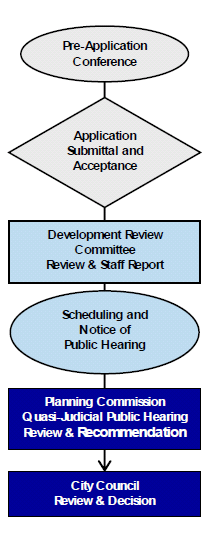
Conditional Use Permit
a.
Basic Procedures
Except as modified by Sections 23-2-4(D)(3)b-d below, review of an application for a Conditional Use Permit shall be subject to the common review procedures and requirements established in Section 23-2-3, Standard Review Procedures.
b.
City Council Review and Decision
At its discretion, the City Council may hold an additional quasi-judicial public hearing on the application, in accordance with Section 23-2-3(F), Scheduling, Notice, and Conduct of Public Hearing.
c.
Permit Issuance
If the application is approved, the Director of Community Development shall prepare a Conditional Use Permit identifying the site and approved plans and documents and listing any conditions of approval, and shall issue the permit to the applicant.
d.
Expiration
1.
A Conditional Use Permit shall automatically expire if a Certificate of Zoning Compliance for the development authorized by the Conditional Use Permit is not obtained within one year after the date of issuance of the Conditional Use Permit, or an authorized extension of this time period (See Section 23-2-3(K)(2)b, Extension.).
2.
A Conditional Use Permit shall automatically expire if the development authorized by the Conditional Use Permit is discontinued and not resumed for a period of one year. This expiration period may not be extended in accordance with Section 23-2-3(K)(2)b, Extension.
(4)
Conditional Use Permit Review Standards
A Conditional Use Permit shall be approved only upon a finding that all of the following standards are met:
a.
The Conditional Use complies with all applicable zoning district standards;
b.
The Conditional Use complies with all standards in Section 23-4-3, Use-Specific Standards;
c.
The Conditional Use is compatible with the character of surrounding lands and the uses permitted in the zoning district(s) of surrounding lands;
d.
The Conditional Use avoids significant adverse economic, odor, noise, glare, and vibration impacts on surrounding lands regarding refuse collection, service delivery, parking and loading, signs, lighting, and other site elements;
e.
The Conditional Use is configured and designed to screen, buffer, or otherwise minimize adverse visual impacts on adjacent lands;
f.
The Conditional Use avoids significant deterioration of water and air resources, wildlife habitat, scenic resources, and other natural resources;
g.
The Conditional Use maintains safe and convenient ingress and egress and traffic flow onto and through the site by vehicles and pedestrians, and safe road conditions around the site;
h.
The Conditional Use allows for the protection of property values and the ability of neighboring lands to develop the uses permitted in the zoning district; and
i.
The Conditional Use complies with all other relevant city, state and federal laws and regulations.
(5)
Effect of Approval
A Conditional Use Permit authorizes the permit holder to submit an application for a Certificate of Zoning Compliance and any other development permit or approval of detailed plans that may be required before construction or use of the approved development. A Conditional Use Permit authorizes only the particular Conditional Use and associated development that is approved. Unless it expires in accordance with Section 23-2-4(D)(3)d, Expiration, or is revoked in accordance with Section 23-9-6(A)(2), Revocation of Permit or Approval, a Conditional Use Permit, including any approved plans and conditions, shall run with the land, and shall not be affected by a change in ownership unless specifically conditioned as part of the approval.
(6)
Minor Deviations from Approved Plans
Subsequent applications for a Certificate of Zoning Compliance or other development permit or approval for development subject to an approved Conditional Use Permit may include minor deviations from the approved plans and conditions, without the need to amend the Conditional Use Permit, provided such deviations are limited to changes that the Director of Community Development determines would not:
a.
Materially alter the drainage, streets, or other engineering design;
b.
Adversely impact the management of stormwater quality or stormwater quantity;
c.
Substantially affect the terms of the original approval; or
d.
Result in significant adverse impacts on the surrounding properties or the city at large.
(7)
Amendments
Any modifications of development subject to an approved Conditional Use Permit other than the minor deviations authorized in Section 23-2-4(D)(6), Minor Deviations from Approved Plans, shall require amendment of the Conditional Use Permit in accordance with the procedures and standards for the full review of an application for a Conditional Use Permit.
(E) - Site Plan Approval
(1)
Purpose
Site plan approval procedures are intended to ensure that the layout and general design of proposed development is compatible with surrounding uses and complies with all applicable standards in this Ordinance and all other applicable city regulations. The purpose of this subsection is to establish the procedure and standards for review and approval of two types of Site Plan: Major Site Plans and Minor Site Plans.
(2)
Applicability
a.
Minor Site Plans
Unless exempted in accordance with Section 23-2-3(E)(2)c, Exemptions, the following development shall be required to have a Minor Site Plan approved in accordance with this subsection before issuance of a Certificate of Zoning Compliance:
1.
A change in use involving no new development or additions;
2.
New single-building nonresidential development, or additions to such development, that total less than 2,500 square feet in gross floor area;
3.
New single-building multifamily residential development, or additions to such development, that total fewer than four dwelling units;
4.
New single-family, two-family, three- to four-family, live-work, or manufactured or mobile home dwelling, or additions to such dwellings;
5.
New accessory building or structure incidental to a single-family, two- to four-family, live-work, or manufactured or mobile home dwelling;
6.
New outdoor storage, production, or sales area more than 500 square feet in area; and
7.
Grading operations (e.g., cut, fill, excavation, soil stockpiling) unassociated with other development that disturb less than 10,000 square feet of land area.
b.
Major Site Plans
Unless exempted in accordance with Section 23-2-4(E)(2)c, Exemptions, the following developments shall be required to have a Major Site Plan approved in accordance with this subsection before issuance of a Certificate of Zoning Compliance:
1.
New nonresidential or multifamily development with two or more buildings;
2.
New single-building nonresidential development with 2,500 square feet or more in gross floor area;
3.
New single-building multifamily development with five or more dwelling units;
4.
Manufactured or mobile home park, or recreational vehicle (RV) park; and
5.
Grading operations (e.g., cut, fill, excavation, soil stockpiling) unassociated with other development that disturb 10,000 square feet or more of land area.
c.
Exemptions
The following development shall be exempted from the requirements of this subsection:
1.
Internal construction that does not increase gross floor area or building height, increase the density or intensity of use, or affect parking requirements; and
2.
Temporary uses.
(3)
Minor Site Plan Procedure
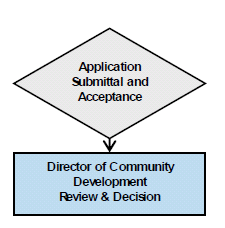
Minor Site Plan Approval
a.
Basic Procedures
Except as modified by Section 23-2-4(E)(3)b below, review of an application for Minor Site Plan approval shall be subject to the common review procedures and requirements established in Section 23-2-3, Standard Review Procedures.
b.
Expiration
Minor Site Plan approval shall automatically expire if a Certificate of Zoning Compliance for the development authorized by the Minor Site Plan approval is not obtained within one year after the date of approval, or an authorized extension of this time period (See Section 23-2-3(K)(2)b, Extension.).
(4)
Major Site Plan Procedure
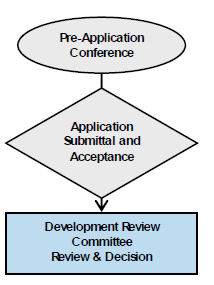
Major Site Plan Approval
a.
Basic Procedures
Except as modified by Section 23-2-4(E)(4)b below, review of an application for Major Site Plan approval shall be subject to the common review procedures and requirements established in Section 23-2-3, Standard Review Procedures.
b.
Expiration
Major Site Plan approval shall automatically expire if a Certificate of Zoning Compliance for the development authorized by the Major Site Plan approval is not obtained within one year after the date of approval, or an authorized extension of this time period. (See Section 23-2-3(K)(2)b, Extension.)
(5)
Site Plan Review Standards
A Minor Site Plan or Major Site Plan shall be approved only upon a finding that all of the following standards are met:
a.
The development complies with the applicable district, use, and intensity and dimensional standards (Articles 23-3, 23-4, and 23-5);
b.
The development complies with the applicable development standards (Article 23-6)
c.
The development complies with all other applicable standards in this Ordinance;
d.
The development complies with all requirements or conditions of any applicable development approvals (e.g., PD Master Plan and PD Terms and Conditions, Conditional Use Permit); and
e.
The development complies with all other applicable city regulations.
(6)
Effect of Site Plan Approval
Approval of a Minor Site Plan or Major Site Plan authorizes the applicant to submit an application for a Certificate of Zoning Compliance and any other development permit or approval of detailed plans that may be required before construction or use of the approved development.
(7)
Performance Guarantees
If all required street paving and other on-site or off-site public infrastructure improvements are not installed or completed before application for a Building Permit, or all required landscaping and other private site improvements are not installed or completed before application for a Certificate of Occupancy, the landowner or applicant shall provide a performance guarantee in accordance with the standards in Section 23-7-9, Performance and Maintenance Guarantees.
(8)
Minor Deviations from Approved Plans
Subsequent applications for a Certificate of Zoning Compliance or other permits for development subject to an approved Site Plan may include minor deviations from the approved Site Plan and conditions, without the need to amend the Site Plan approval, provided such deviations are limited to changes that the Director of Community Development determines would not:
a.
Increase the density of residential development or gross square footage of nonresidential development;
b.
Increase or decrease the number of building stories;
c.
Materially alter the drainage, streets, or other engineering design;
d.
Adversely impact the management of stormwater quality or stormwater quantity;
e.
Substantially affect the terms of the original approval; or
f.
Result in significant adverse impacts on the surrounding properties or the city at large.
(9)
Amendments
Any modifications of development subject to an approved Minor Site Plan or Major Site Plan other than the minor deviations authorized in Section 23-2-4(E)(8), Minor Deviations from Approved Plans, shall require amendment of the Site Plan in accordance with the procedures and standards for the full review of an application for approval of a Minor Site Plan or Major Site Plan, as appropriate.
(F) - Subdivision Approval
(1)
Purpose
The purpose of this subsection is to provide a uniform means for the approval of divisions of land and to ensure, in conjunction with Section 23-7: Subdivision Standards, that subdivisions promote the health, safety, morals, convenience, order, prosperity and welfare of the present and future inhabitants of the city by:
a.
Providing for the orderly growth and development of the city;
b.
Coordinating streets and roads within proposed subdivisions with the city's street system and transportation plans, and with other public facilities;
c.
Providing rights-of-way for streets and utility easements;
d.
Avoiding congestion and overcrowding, and encouraging the proper arrangement of streets in relation to existing or planned streets;
e.
Ensuring there is adequate open space and recreation facilities to serve development; and
f.
Ensuring there is proper recordation of landownership or property owner association records, where applicable.
(2)
Applicability
a.
General
A division of land shall be an Exempt Subdivision, Minor Subdivision, or Major Subdivision.
b.
Exempt Subdivision
1.
The following divisions of land are exempt from the subdivision requirements of this Ordinance.
A.
The division of a parcel into not more than three lots, where:
1.
Each resulting lot is at least one acre in area;
2.
Each resulting lot complies with the standards in Section 23-7-6, Subdivision Lot Standards;
3.
Each resulting lot has the potential (by means of size and geological characteristics, or access to existing facilities) for resolving all water access and sewage disposal issues;
4.
Proposed improvements comply with city standards and codes, and do not create public or private off-site drainage problems; and
5.
Each resulting lot fronts on a public street or has access to a public street through an easement for ingress, egress, and utilities that:
(A)
Is at least 50 feet wide;
(B)
Ensures a continuous route of access between the lot and a public street;
(C)
Extends through the entire parcel being subdivided;
(D)
Is improved to the standards and extent required by the Building Code and Fire Code before any Building Permit is issued on any lot served by the easement;
(E)
Contains provisions for the private maintenance of the easement by the parties benefitting from it, or is accompanied by a separate agreement containing such provisions;
(F)
Includes an irrevocable offer of dedication of the easement as a public street;
(G)
Grants the city authority to take possession and control the easement as a public street upon determining that the easement has been improved and maintained to city standards and serves a sufficient number of lots to be accepted by the city as a public street, or that the public need necessitates acceptance of the easement in its "as is" condition;
(H)
Includes an acknowledgement that the city is not obligated to improve or maintain the easement; and
(I)
Provides that the easement grants no new right-of-way, right of entry, or right of use to owners of abutting properties unless granted by the owner of the parcel being divided or the easement is converted to a public street in accordance with (G) above.
B.
The rearrangement of property lines between existing parcels or lots, where:
1.
No new parcels or lots are created;
2.
The involved parcels or lots comply with applicable minimum lot area standards;
3.
The frontage of the involved parcels or lots is not reduced below applicable minimum lot frontage standards;
4.
No nonconformity as to an existing structure's setbacks is created;
5.
Proposed improvements comply with city standards; and
6.
The purpose of any easement is not adversely affected.
2.
Development of an Exempt Subdivision requires determination that the division of land constitutes an Exempt Subdivision in accordance with procedures in Section 23-2-4(F)(3), Exempt Subdivision.
c.
Minor Subdivision
1.
A Minor Subdivision is a division of land other than an Exempt Subdivision where:
A.
No more than four residential lots or two nonresidential lots are created;
B.
Each resulting lot fronts on an existing publicly maintained street;
C.
Each resulting lot either has access to public water and sewer facilities(including taps for water and sewer service), if the city provides water or sewer service to the area, or has potential (by means of size and geological characteristics, or by access to existing facilities) for resolving all water access and sewage disposal issues;
D.
No construction, expansion, or improvement of any public infrastructure other than sidewalks is required or involved; and
E.
No dedication to the city of any public infrastructure or right-of-way is required or involved.
2.
Development of a Minor Subdivision requires approval of a Minor Subdivision Plat in accordance with Section 23-2-4(F)(4), Minor Subdivision, and approval of a Final Plat in accordance with Section 23-2-4(F)(7), Final Plat.
d.
Major Subdivision
1.
A Major Subdivision is any division of land other than an Exempt Subdivision or Minor Subdivision.
2.
Development of a Major Subdivision requires approval of a Major Subdivision Preliminary Plat approval in accordance with Section 23-2-4(F)(5), Major Subdivision Preliminary Plat, and approval of a Final Plat in accordance with Section 23-2-4(F)(7), Final Plat.
(3)
Exempt Subdivision
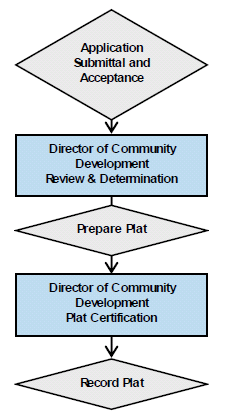
Exempt Subdivision
a.
Procedure
1.
Basic Procedures
Except as modified by Sections 23-2-4(E)(3)a.2—6 below, review of an application for approval of an Exempt Subdivision shall be subject to the common review procedures and requirements established in Section 23-2-3, Standard Review Procedures.
2.
Review by Director of Community Development
The Director of Community Development shall decide whether the division of land does or does not constitute an Exempt Subdivision.
3.
Notice to Applicant
A.
If the Director of Community Development decides that the division of land does constitute an Exempt Subdivision and, therefore, is exempt from the subdivision requirements of this Ordinance, the notice of the decision provided the applicant in accordance with Section 23-2-3(I), Notice of Decision, shall require that a plat showing the division be prepared and recorded as required by Section 23-2-4(F)(3)b.4, Certified Plat, and Section 23-2-4(F)(3)b.5, Recordation.
B.
If the Director of Community Development determines that the division of land does not constitute an Exempt Subdivision and, therefore, is not exempt from the subdivision requirements of this Ordinance, the notice of the decision provided the applicant in accordance with Section 23-2-3(I), Notice of Decision, shall state that the division of land is subject to the subdivision requirements of this Ordinance and shall refer the applicant to Section 23-2-4(F)(4), Minor Subdivision Plat or Section 23-2-4(F)(5), Major Subdivision Preliminary Plat, as appropriate.
4.
Certified Plat
If the Subdivision Exemption application is approved, the applicant shall prepare a plat showing the division of land and incorporating any conditions of approval and any required certification forms and signatures, and shall submit the plat to the Director of Community Development within 15 days after the date of approval. On determining that the plat appropriately reflects the approved division of land, the Director of Community Development shall enter onto the plat a signed certification that the plat does not constitute a subdivision subject to approval by the city.
5.
Recordation
The subdivider shall file an approved and certified Exempt Subdivision plat with the Office of the Chancery Clerk of Harrison County for recording, and shall provide proof of recording to the Director of Community Development.
6.
Expiration
Approval of a Subdivision Exemption shall automatically expire if the plat is not recorded with the Office of the Chancery Clerk of Harrison County within 30 days after the date it is certified as approved. This expiration period may not be extended in accordance with Section 23-2-3(K)(2)b, Extension.
b.
Exempt Subdivision Review Standards
An Exempt Subdivision application shall be approved only upon a finding that the division of land, resultant lots, and any associated development qualifies as an Exempt Subdivision, as defined in Section 23-2-4(F)(2)b.
c.
Amendments
Any modifications of an approved Exempt Subdivision plat shall require amendment of the Exempt Subdivision approval in accordance with the procedures and standards for the full review of an application for approval of an Exempt Subdivision.
(4)
Minor Subdivision Plat
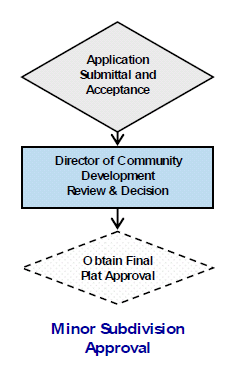
Minor Subdivision Approval
a.
Procedure
1.
Basic Procedures
Except as modified by Section 23-2-4(F)(4)a.2 below, review of an application for approval of a Minor Subdivision Plat shall be subject to the common review procedures and requirements established in Section 23-2-3, Standard Review Procedures.
2.
Expiration
A Minor Subdivision Plat approval shall automatically expire if an application for approval of a Final Plat for the entire subdivision is not submitted within one year after the date of Minor Subdivision Plat approval, or an authorized extension of this time period (See Section 23-2-3(K)(2)b, Extension.).
b.
Minor Subdivision Plat Review Standards
A Minor Subdivision Plat shall be approved only upon a finding that all of the following standards are met:
1.
The development complies with the applicable standards in Section 23-7: Subdivision Standards;
2.
The development complies with all other applicable standards in this Ordinance;
3.
The development complies with all requirements or conditions of any applicable development approvals (e.g., PD Master Plan and PD Terms and Conditions) for the land; and
4.
The development complies with all other applicable city regulations.
c.
Effect of Approval
Approval of a Minor Subdivision Plat authorizes the subdivider to submit an application for approval of a Final Plat for the subdivision in accordance with Section 23-2-4(F)(7), Final Plat.
d.
Amendments
Any modifications of an approved Minor Subdivision plat shall require amendment of the Minor Subdivision Plat approval in accordance with the procedures and standards for the full review of an application for approval of a Minor Subdivision Plat.
(5)
Major Subdivision Preliminary Plat
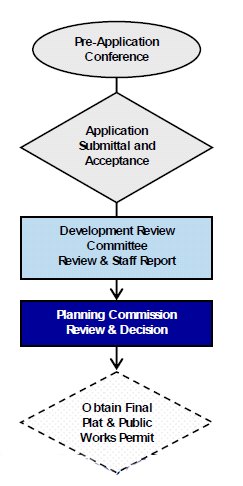
Major Subdivision Preliminary Plat Approval
a.
Procedure
1.
Basic Procedures
Except as modified by Sections 23-2-4(F)(5)a.2-3 below, review of an application for approval of a Major Subdivision Preliminary Plat shall be subject to the common review procedures and requirements established in Section 23-2-3, Standard Review Procedures.
2.
Public Notice
The Director of Community Development shall post notice of the Planning Commission's meeting to review the application for approval of a Major Subdivision Preliminary Plat at least 15 calendar days before the date of the meeting, and in accordance with the requirements applicable to posted public hearing notices in Section 23-2-3(F)(4), Public Hearing Notice.
3.
Expiration
A.
A Major Subdivision Preliminary Plat approval shall automatically expire if an application for approval of a Final Plat for the subdivision, or a phase of the subdivision approved as part of the Preliminary Plat, is not submitted within two years after the date of the Major Subdivision Preliminary Plat approval, or an authorized extension of this time period (See Section 23-2-3(K)(2)b, Extension.).
B.
A Major Subdivision Preliminary Plat shall automatically expire if no application for approval of a Final Plat for an approved phase of the subdivision is submitted within two years after the date of Final Plat approval for a prior phase of the subdivision, or an authorized extension of this time period (See Section 23-2-3(K)(2)b, Extension.).
b.
Major Subdivision Preliminary Plat Review Standards
A Major Subdivision Preliminary Plat shall be approved only upon a finding that all of the following standards are met:
1.
The development complies with the applicable standards in Section 23-7: Subdivisions;
2.
The development complies with all other applicable standards in this Ordinance;
3.
The development complies with all requirements or conditions of any applicable development approvals (e.g., PD Master Plan and PD Terms and Conditions) for the land; and
4.
The development complies with all other applicable city regulations.
(6)
Approved Preliminary Plat
a.
Effect of Preliminary Plat Approval
1.
Approval of a Major Subdivision Preliminary Plat authorizes the subdivider to submit an application for a Public Works Permit in accordance with Section 23-2-4(H), Public Works Permit, for approval of public infrastructure improvements (e.g., streets, sidewalks, stormwater management facilities, water distribution facilities, fire hydrants, and sewage collection and disposal facilities) proposed to serve the subdivision or an approved phase of the subdivision, and to seek approval of private utilities (e.g., electrical, gas, telephone, and cable television distribution facilities) from the appropriate agencies.
2.
Approval of a Major Subdivision Preliminary Plat also authorizes the subdivider to submit an application for approval of a Final Plat for the subdivision or an approved phase of the subdivision in accordance with Section 23-2-4(F)(7), Final Plat, provided a Public Works Permit for all public infrastructure improvements required to serve the area covered by the Final Plat has been approved and either the improvements have been constructed and accepted, or performance and maintenance guarantees ensuring such construction have been approved in accordance with Section 23-2-4(F)(6)b, Completion of Public Infrastructure Improvements.
b.
Completion of Public Infrastructure Improvements
1.
The subdivider may apply for approval of a Final Plat only after construction or installation of all public infrastructure improvements required to serve the area covered by the Final Plat is completed or such completion is ensured by performance and maintenance guarantees approved by the city. Before submitting an application for approval of a Final Plat, the subdivider shall submit to the City Engineer a request to inspect all public infrastructure improvements required to serve the area covered by the Final Plat for completion in accordance with the Public Works Permit.
2.
If the City Engineer determines that any required public infrastructure improvements are not complete, the subdivider shall provide a performance guarantee to ensure their completion in accordance with Section 23-7-9, Performance and Maintenance Guarantees.
3.
The subdivider shall also provide maintenance guarantees in accordance with Section 23-7-9, Performance and Maintenance Guarantees, to ensure maintenance of completed public infrastructure improvements until they are accepted by the city.
c.
Minor Deviations from Approved Preliminary Plat
Subsequent applications for approval of a Certificate of Zoning Compliance, Public Works Permit, or Final Plat for development subject to an approved Major Subdivision Preliminary Plat may include minor deviations from the approved Preliminary Plat, without the need to amend the Preliminary Plat, provided such deviations are limited to changes that the Director of Community Development determines would not:
1.
Increase the number of lots by more than five percent;
2.
Decrease the amount of open space;
3.
Substantially change the location or dimensions of open space;
4.
Materially alter the drainage, streets, or other engineering design;
5.
Adversely impact the management of stormwater quality or stormwater quantity;
6.
Substantially affect the terms of the original approval; or
7.
Result in significant adverse impacts on the surrounding properties or the city at large.
d.
Amendments
Any modifications of development subject to an approved Major Subdivision Preliminary Plat other than the minor deviations authorized in Section 23-2-4(F)(6)c, Minor Deviations from Approved Preliminary Plat, shall require amendment of the Preliminary Plat in accordance with the procedures and standards for the full review of an application for approval of a Major Subdivision Preliminary Plat, as appropriate.
(7)
Final Plat
a.
Procedure
1.
Basic Procedures
Except as modified by Sections 23-2-4(F)(7)a.2-6 below, review of an application for approval of a Final Plat shall be subject to the common review procedures and requirements established in Section 23-2-3, Standard Review Procedures.
2.
Application Submittal
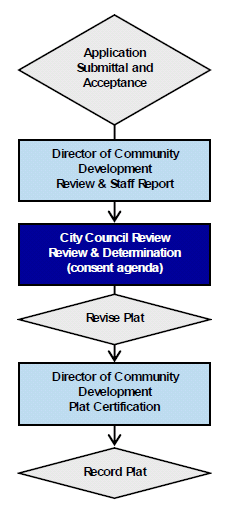
Final Plat Approval
No application for approval of a Final Plat for a subdivision or an approved phase of a subdivision shall be submitted or accepted unless:
A.
A Minor Subdivision or a Major Subdivision Preliminary Plat for the subdivision is approved and is unexpired;
B.
Either construction or installation of sidewalks that are approved as part of the Minor Subdivision, or all public infrastructure improvements approved as part of the Major Subdivision Preliminary Plat—and that are required to serve the area covered by the Final Plat—is inspected and approved as complete, or such completion is ensured by performance and maintenance guarantees, in accordance with Section 23-2-4(F)(6)b, Completion of Public Infrastructure Improvements; and
C.
The Final Plat includes Flood Insurance Rate Map (FIRM) information, where applicable.
3.
City Council Review
Following staff review, the City Council shall meet to decide the application, in accordance with the action and conditions recommended in the staff report, as part of the consent agenda for the meeting. The City Council may adopt the consent agenda and thereby the action recommended in the staff report, or may remove the application from the consent agenda and review and take action on the application, in accordance with Section 23-2-3(H), Review and Action of Decision-Making Body.
4.
Certification
If the Final Plat application is approved, the applicant shall revise the Final Plat as necessary to incorporate any conditions of approval and any required certification forms and signatures, and shall submit the revised plat to the Director of Community Development within 15 days after the date of approval. On determining that the plat is properly revised, the Director of Community Development, the Mayor, and the City Clerk shall enter onto the plat a signed certification that the plat is approved by the city in accordance with this Ordinance, and any other certifications as may be appropriate.
5.
Recordation
The subdivider shall file an approved and certified Final Plat with the Office of the Chancery Clerk of Harrison County for recording, and shall provide proof of recording to the Director of Community Development.
6.
Expiration
Final Plat approval shall automatically expire if the plat is not recorded with the Office of the Chancery Clerk of Harrison County within 30 days after the date it is certified as approved. This expiration period may not be extended in accordance with Section 23-2-3(K)(2)b, Extension.
b.
Final Plat Standards
A Final Plat shall be approved only upon a finding that all of the following standards are met:
1.
The Final Plat is in substantial conformity with the approved Minor Subdivision Plat or Major Subdivision Preliminary Plat, as appropriate (See Section 23-2-4(F)(7)c for allowed deviations from Preliminary Plats.);
2.
The Final Plat complies with the standards in Article 23-7: Subdivision Standards;
3.
The Final Plat complies with all other relevant provisions of this Ordinance;
4.
The Final Plat complies with all other relevant city regulations; and
5.
The Final Plat includes all required certificates.
c.
Effect of Approval
Approval of a Final Plat allows a subdivider to proceed with recording the plat and conveying the platted lots by reference to the recorded plat.
d.
Amendments
Any modifications of an approved Final Plat shall require amendment of the Final Plat approval in accordance with the procedures and standards for the full review of an application for approval of a Final Plat. If the Final Plat is approved and recorded and lots or parcels are conveyed to others, any application to amend the Final Plat that proposes to alter the layout or size of any street, alley, or other accessway, or any open space, shall be submitted by the owners of all the lots or parcels shown on the originally approved and recorded Final Plat. Proposals to modify a single lot line or other modifications not affecting streets or open space areas shown on an approved and recorded Final Plat shall not require an application to amend the Final Plat to be submitted by all owners of lots shown on the Final Plat, and may be submitted and reviewed as an independent application for approval of a Subdivision Exemption (See Section 23-2-4(F)(3).) or Minor Subdivision Plat (See Section 23-2-4(F)(4).).
e.
Acceptance of Dedications
Approval of a Final Plat and recordation of the plat with the Office of the Chancery Clerk of Harrison County shall, unless otherwise specified on the plat, constitute the acceptance of the dedication to public use of any rights-of-way, easements, completed public infrastructure improvements, and public parks or open space as shown on the Final Plat. This acceptance of dedication shall not constitute or imply a responsibility of the city or other public agency to open or maintain such rights-of-way, easements, public infrastructure improvements, or parks or open space until so determined by the City Council or other public agency.
(G) - Certificate of Appropriateness
(1)
Purpose
The purpose of this subsection is to provide for the review of development within an Architectural/Historic Overlay District—a zoning classification applicable to designated historic districts as well to properties containing designated historic landmarks and landmark sites—to ensure compliance with the historic preservation standards of this Ordinance and the AHRC Design Review Guidelines, and otherwise protect the historic and architectural integrity of historic districts, landmarks, and landmark sites.
(2)
Applicability
a.
General
Unless exempted in accordance with Section 23-2-3(G)(2)d, Exemptions, a Certificate of Appropriateness approved in accordance with this subsection shall be required before issuance of a Certificate of Zoning Compliance for the erection, construction, exterior alteration, restoration, moving, relocation, or demolition of any building or other structure (including walls, fences, lighting, signs, utility facility, steps, etc.), street or sidewalk pavement, and landscaping—or the excavation, fill, or other alteration of land—located on a property within an Architectural/Historic Overlay District.
b.
Minor Certificates of Appropriateness
A Minor Certificate of Appropriateness approved in accordance with Section 23-2-4(G)(3), Minor Certificate of Appropriateness Procedure, shall be required for:
1.
The ordinary maintenance or repair of any exterior architectural feature of a structure that does not involve a change in design, materials, or outer appearance; and
2.
Minor alterations or renovations of structures, signage, lighting, landscaping, or land (e.g., excavation or fill), as identified by, and in accordance with, written guidelines adopted by the Architectural and Historical Review Commission for the delegation of Certificate of Appropriateness approval authority to the Director of Community Development.
c.
Major Certificates of Appropriateness
Unless exempted in accordance with Section 23-2-4(G)(2)d, Exemptions, a Major Certificate of Appropriateness approved in accordance with Section 23-2-4(G)(4), Major Certificate of Appropriateness, shall be required for development not requiring a Minor Certificate of Appropriateness.
d.
Exemptions
The following development shall be exempted from the requirements of this subsection:
1.
Construction, alternation, or restoration in the interior of a building or other structure, where the architectural style, design, and general arrangement of the exterior of the building or structure is not changed;
2.
The ordinary maintenance or repair of streets, sidewalks, pavement markings, street signs, or traffic signs;
3.
The construction, reconstruction, alteration, restoration, or demolition of any of the above features where the Building Official certifies the activity is required by the public safety because of an unsafe or dangerous condition; and
4.
The maintenance of any aboveground utility structure or the immediate restoration of such a structure in the event of an emergency.
(3)
Minor Certificate of Appropriateness Procedure
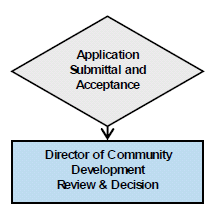
Minor Certificate of Appropriateness
a.
Basic Procedures
Except as modified by Section 23-2-4(G)(3)b below, review of an application for a Minor Certificate of Appropriateness shall be subject to the common review procedures and requirements established in Section 23-2-3, Standard Review Procedures.
b.
Expiration
A Minor Certificate of Appropriateness shall automatically expire if a Certificate of Zoning Compliance for the development authorized by the Minor Certificate of Appropriateness approval is not obtained within one year after the date of approval, or an authorized extension of this time period (See Section 23-2-3(K)(2)b, Extension.).
(4)
Major Certificate of Appropriateness Procedure
a.
Basic Procedures
Except as modified by Sections 23-2-4(G)(4)b—c below, review of an application for a Major Certificate of Appropriateness shall be subject to the common review procedures and requirements established in Section 23-2-3, Standard Review Procedures.
b.
Conditions of Approval
Conditions of approval may include a requirement that the applicant or property owner provide a performance guarantee to ensure satisfactory completion of a relocation project.
c.
Expiration
A Major Certificate of Appropriateness shall automatically expire if a Certificate of Zoning Compliance for the development authorized by the Major Certificate of Appropriateness approval is not obtained within one year after the date of approval, or an authorized extension of this time period (See Section 23-2-3(K)(2)b, Extension.).
(5)
Certificate of Appropriateness Review Standards
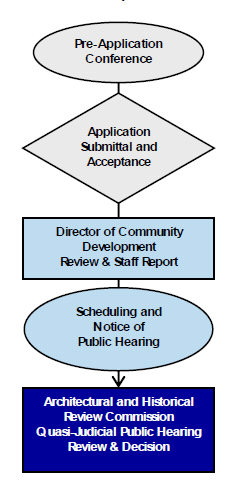
Major Certificate of Appropriateness
a.
General
An application for a Minor Certificate of Appropriateness or Major Certificate of Appropriateness shall be approved only upon a finding that the proposed development:
1.
Is consistent with the Secretary of the Interior's "Standards for Rehabilitation and Guidelines for Rehabilitating Historic Buildings;
2.
Is consistent with the AHRC Design Guidelines, incorporated by reference;
3.
Is compatible with the character of the historic district, landmark, or landmark site; and
4.
Does not compromise the integrity of the historic district, landmark, or landmark site.
b.
Moving, Relocation, Excavation, or Demolition
The Architectural and Historical Review Commission may deny a Major Certificate of Occupancy application proposing to move, relocate, or demolish a structure, or to excavate land, if it determines such activity would disrupt or diminish the concentration, linkage, or continuity of structures, objects, or sites within an AHO-zoned district, landmark, or landmark site, or would be detrimental to Biloxi's architectural history or aesthetic and cultural heritage.
c.
Demolition
Notwithstanding Section 23-2-4(b)(5)b. above, a Certificate of Appropriateness for demolition of a structure may not be denied if denial would cause unreasonable economic hardship to the owner of the property.
(6)
Effect of Certificate of Appropriateness Approval
Approval of a Certificate of Appropriateness authorizes the applicant to submit an application for a Certificate of Zoning Compliance and any other development permit or approval of detailed plans that may be required before construction or other development activity associated with the approved development.
(7)
Amendments
Any modifications of development subject to an approved Minor Certificate of Appropriateness or Major Certificate of Appropriateness shall require amendment of the Certificate of Appropriateness approval in accordance with the procedures and standards for the full review of an application for approval of a Minor Certificate of Appropriateness or Major Certificate of Appropriateness, as appropriate.
(8)
Resubmittal of Denied Applications
Whenever an application for a Certificate of Appropriateness for a landmark property of statewide or national significance is denied, an application for a Certificate of Appropriateness for the same property shall not be accepted or considered for a period of six months after the date of denial. If a subsequent application is submitted and accepted, the Director of Community Development shall provide written notice of the application to the Mississippi Department of Archives and History.
(H) - Public Works Permit
(1)
Purpose
The Public Works Permit is intended to ensure that public infrastructure improvements are constructed and repaired in accordance with local, state, and federal regulations to minimize future maintenance and avoid unsafe conditions.
(2)
Applicability
a.
General
Unless exempted in accordance with Section 23-2-4(H)(2)b., Exemptions, a Public Works Permit approved in accordance with this subsection and Code of Ordinances Section 17-2-10 is required before:
1.
Any construction, installation, repair, or maintenance activity affecting any public infrastructure improvements (e.g., roadways, sidewalks, stormwater management facilities, water facilities, and sewerage facilities) dedicated or proposed to be dedicated to the public; or
2.
Any development activity (e.g., installation, relocation, or repair of underground utilities or utility poles; construction or repair of driveway entrances; grading; disturbance of curbing, roadway, or other roadside appurtenances; installation or repair of tie-ins to utility or stormwater management systems; or other disturbance of pavement, structures, driveways, sidewalks, trees, or vegetation) within an existing or proposed city property or public right-of-way or easement.
b.
Exemptions
The following development shall be exempted from the requirements of this subsection:
1.
Public infrastructure improvements and activities within a city property or public right-of-way or easement that are authorized by another permit or approval granted under this Ordinance or under Code of Ordinances Section 17-2-10; and
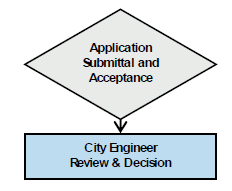
Public Works Permit
2.
Public infrastructure improvements and activities within a city property or public right-of-way or easement that are conducted, supervised, or monitored by the city and expressly exempted from a Public Works Permit in writing by the City Engineer. Absent such exemption, the City, its contractors and subcontractors, and any other governmental entity must secure approval of a permit pursuant to this Section and Code of Ordinances Section 17-2-10.
(3)
Procedure
a.
Basic Procedures
Except as modified by Section 23-2-4(H)(3)b. below, review of an application for a Public Works Permit shall be subject to the common review procedures and requirements established in Section 23-2-3, Standard Review Procedures.
b.
Expiration
A Public Works Permit shall automatically expire if the development it authorizes is not commenced within six months after approval of the Public Works Permit. An extension of the expiration time period may be granted in accordance with Section 23-2-3(K)(2)b., Extension, except that any extension shall be granted by the City Engineer and may be for a time period of up to three months.
(4)
Public Works Permit Review Standards
A Public Works Permit shall be approved only upon a finding that all of the following standards are met:
a.
The development complies with all other applicable standards in this Ordinance and the city's Administrative Manual;
b.
The development is in substantial conformity with the requirements or conditions of any prior approvals (e.g., PD Master Plan and PD Terms and Conditions; Site Plan, subdivision plat—see Section 23-2-4(F)(6)c. for allowed deviations from Preliminary Plats); and
c.
The development complies with all other applicable city regulations.
(5)
Effect of Public Works Permit Approval
Approval of a Public Works Permit authorizes the applicant to start construction, installation, or repairs associated with the approved development.
(6)
Amendments
Any modifications of development subject to an approved Public Works Permit shall require amendment of the Public Works Permit approval in accordance with the procedures and standards for the full review of an application for approval of a Public Works Permit.
(7)
Performance Guarantees
If all required street paving and other on-site or off-site public infrastructure are not installed or completed before application for a Building Permit, or all required landscaping and other improvements are not installed or completed before application for a Certificate of Occupancy, the applicant shall provide a performance guarantee in accordance with the standards in Section 23-7-9, Performance and Maintenance Guarantees.
(I) - Tree Permit
(1)
Purpose
The purpose of a Tree Permit is to support the preservation and replenishment of the native stock of trees, specifically those described as protected trees, to ensure compliance with the standards in Section 23-6-4, Tree Protection, and to ensure that existing trees on vacant or underdeveloped lands are not removed without an approved application in order to:
a.
Preserve the cultural heritage and aesthetic qualities of the city;
b.
Encourage site design techniques that preserve the natural environment and enhance the developed environment;
c.
Provide for a separation of uses and establish a sense of privacy;
d.
Minimize the impact of incompatible land uses;
e.
Reduce glare, dust, heat, and noise;
f.
Preserve and enhance air and water quality;
g.
Increase slope stability, and control erosion and sediment run-off into streams and waterways;
h.
Conserve energy by reducing heating and cooling costs; and
i.
Maintain and enhance the quality of life in the City.
j.
Provide incentive for sustainable development/landscape bonuses are available in Section 23-6-12(C)
(2)
Applicability
a.
Activities Subject to Permitting Process
A Tree Permit is required for the removal, relocation or alteration in any of the following conditions, within any zoning district and on any size lot:
1.
Any tree of a protected species (Live Oak, Bald Cypress, and Southern Magnolia) that are at least eight inches diameter at DBH (diameter at breast height — 54 inches above the ground); or
2.
Any tree of a non-protected species with a DBH of sixteen or more inches.
b.
Activities Exempt from Permitting Process
A Tree Permit is not required for the removal, relocation or alteration in any of the following conditions:
1.
Any Pecan (Carya illinoinensis), Chinese tallow or Popcorn (Sapium sebiferum), Water Oak (Quercus Nigra), or member of the Pine genus (Pinus spp.);or
2.
Any protected species (Live Oak, Bald Cypress, and Southern Magnolia) that are less than eight inches diameter at DBH; or
3.
Any tree of non-protected species with a DBH of less than sixteen inches.
(3)
Application Requirements
a.
Coordination with Site Plan
Where the application for a Tree Permit relates to a development proposal for a site, the application for Tree Permit shall be submitted simultaneously with an application for Site Plan Review and the material required below shall, to the maximum extent practicable, be integrated with the site plan application.
b.
Contents
An application for a Tree Permit shall be filed with the Department of Community Development and shall include the following:
1.
A completed application form for Tree Permit signed by the applicant.
2.
A drawing showing the following information at an adequate scale to make a determination.
a.
The shape and dimensions of the lot of record, together with the existing and proposed locations of all structures and improvements, if any;
b.
Location, species, and DBH of all existing trees including those proposed for removal and those proposed to remain.
c.
Groups of trees in close proximity to one another (five feet or less) may be designated as a cluster of trees with the predominant species, estimated number, average DBH, and overall canopy shown. Within a cluster however, trees of protected species with a DBH of eight inches or greater, and trees of any non-protected species with a DBH of 16 inches or greater, must be identified by location, species, whether proposed to remain, be removed or relocated.
d.
A statement showing how trees not proposed for removal are to be protected during land clearing and construction with protective barriers to disallow excavation, stockpiling or vehicular traffic encroaching upon the root zone, as stipulated in Section 23-6-4(F), Tree Protection during Construction.
e.
A drawing as to grade changes, if proposed, for the lot or parcel and how such changes will affect matters of this Chapter, as stipulated in Section 23-6-4, Tree Protection. Grade changes may not occur beneath more than ten percent of the canopy of a protected tree.
f.
A statement identifying the reason for removal of each protected tree.
g.
A replacement/mitigation plan, as stipulated in Section (23-6-4(E)(4), Replacement/Mitigation of a Protected Tree.
(4)
Review Procedure
a.
Basic Procedures
Except as modified by Sections 23-2-4(I)(4)b. below, review of an application for a Tree Permit shall be subject to the common review procedures and requirements established in Section 23-2-3, Standard Review Procedures.
b.
Authority and Review Process
1.
All applications for Tree Permits shall be submitted to the Department of Community Development and reviewed for completeness by the Director of Community Development and City Arborist who will then forward the application to the Biloxi Tree Committee in accordance with the procedure set out in Section 23-2-2(G), Tree Committee. Written or verbal recommendations of the Tree Committee regarding protected trees will be presented verbatim before the Planning Commission.
2.
For Tree Permits involving the removal, relocation, or alteration of one to four protected trees, and not otherwise requiring Planning Commission approval, the review and approval authority shall rest with the Director of Community Development or City Arborist. The final determination will be sent in writing from the Director of Community Development to the applicant and to the Tree Committee. The Director of Community Development may delegate this task to City Arborist.
3.
For Tree Permits involving removal, relocation, or alteration of five or more protected trees the Tree Committee shall review and make recommendation to the Planning Commission and approval rests with the Planning Commission and requires a Public Tree Hearing to be posted by the Director of Community Development in accordance with Section 23-2-3(F)(4), Public Hearing Notice. The final determination on cases heard before the Planning Commission are written into the public record. This section will apply to any multi-phased developments.
4.
In the event of a conflict between the recommendations of the Tree Committee, the decision of the Director of Community Development and/or the Planning Commission, the Director of Community Development shall report the conflict to the Mayor within two days and submit the entire application, including all photographs of the site, the Tree Committee recommendation, and the Director of Community Development and/or Planning Commission's recommendation to the Mayor for review. The Mayor may either accept the Tree Committee recommendation, the decision of the Director of Community Development, The Planning Commission, or modify the decision and the permit, or deny the permit. The City Arborist and Tree Committee are to be copied on all reports of conflict and final decisions.
c.
Expiration
A Tree Permit shall automatically expire at the end of six months following the date of approval. An extension may be granted in accordance with Section 23-2-3(K)(2)b., Extension, that extension may be for a time period of up to six months.
(5)
Tree Permit Review Standards
A Tree Permit shall be approved only upon receipt of a complete permit application and finding that all the standards is Section 23-6-4, Tree Protection, are met. The Review Criteria used by City Arborist and Director of Community Development that allows for the issuance of a Tree Permit is as follows:
a.
A tree of any species is in danger of falling or damaging structures, or the where the tree's roots pose a significant threat of damaging utilities or structures; or
b.
A tree of any species that either encroaches into established easements, is a detriment to access, or obstructs required sight distances, as determined by the Director of Community Development; or
c.
The City Arborist provides written verification and photographic documentation that the tree is dead or dying; or
d.
The removal is necessary to comply with storm water regulations, or to maintain public health and safety around utilities and infrastructure; or
e.
The removal is necessary to address extraordinary circumstances such as weather-related emergencies and natural disasters, as determined by the Mayor.
(6)
Amendments
Modifications to an approved Tree Permit shall require review by the Tree Committee and Community Development Department and an amended Tree Permit be issued.
(7)
Tree Damage or Removal
The unauthorized removal or accidental damage or removal of existing protected trees shall be subject to the replacement/mitigation standards of Section 23-6-4(G)(4)a., Replacement/Mitigation of Protected Trees, and Penalties, according to Section 23-2-4(I)(10) Penalties.
(8)
Credit for Retaining Existing Trees
Qualifying trees located onsite shall be credited towards the landscaping requirements in accordance with Section 23-6-4(G)(1), Tree Preservation Incentives, if the site or parcel of land becomes the subject of a development application in accordance with this Ordinance.
(9)
Appeals
Any aggrieved person may appeal a determination by the Director of Community Development to the City Council by providing written notice to the Clerk of Council of such appeal within ten days of the receipt by the applicant.
(10)
Penalties
The provisions of Chapter 23 of this Code of Ordinances relating to the protection of trees and Tree Permits are hereby incorporated herein by reference, and violation of the terms of any of those provisions relating to the protection of trees or the terms of any Tree Permit is a general offense. Any one so convicted shall be subject to the provisions of Section 1-1-8 of the Code of Ordinances. Each day a violation continues to exist constitutes a separate offense.
(Ord. No. 2475, 2-1-2022)
(J) - Temporary Use Permit
(1)
Purpose
The purpose of this subsection is to provide a uniform mechanism for reviewing temporary uses and structures to ensure they comply with the standards in Section 23-4-5, Temporary Uses and Structures.
(2)
Applicability
The provisions of this subsection shall apply to all proposed temporary uses as set forth in Section 23-4-5, Temporary Uses and Structures.
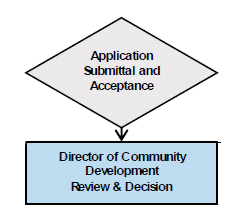
Temporary Use Permit
(3)
Procedure
a.
Basic Procedures
Except as modified by Section 23-2-4(J)(3)b. below, review of an application for a Temporary Use Permit shall be subject to the common review procedures and requirements established in Section 23-2-3, Standard Review Procedures.
b.
Expiration
A Temporary Use Permit shall be effective beginning on the date specified in the permit approval, and shall remain effective for the period indicated on the permit, or an authorized extension of this time period (See Section 23-2-3(K)(2)b., Extension.).
(4)
Temporary Use Permit Review Standards
A Temporary Use Permit shall be approved only upon a finding that the temporary use, as proposed, complies with the relevant standards in Section 23-4-5, Temporary Uses and Structures.
(5)
Amendments
Any modifications of development subject to an approved Temporary Use Permit shall require amendment of the Temporary Use Permit approval in accordance with the procedures and standards for the full review of an application for approval of a Temporary Use Permit.
(K) - Sign Permit
(1)
Purpose
The purpose of this subsection is to provide a uniform mechanism for reviewing applications for Sign Permits to ensure all signs comply with the standards in Section 23-6-13, Signage.
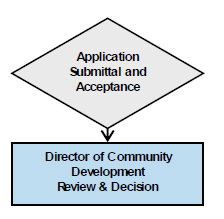
Sign Permit
(2)
Applicability
Unless exempted in accordance with Section 23-6-13(B)(3), Signs Exempt from Regulation, or Section 23-6-13(B)(4), Signs Allowed without a Sign Permit, a Sign Permit approved in accordance with this subsection shall be required before any sign is erected, placed, moved, constructed, expanded, or structurally altered, and before issuance of any Building Permit required for the sign.
(3)
Procedure
a.
Basic Procedures
Except as modified by Section 23-2-4(K)(3)b below, review of an application for a Sign Permit shall be subject to the common review procedures and requirements established in Section 23-2-3, Standard Review Procedures.
b.
Expiration
A Sign Permit shall automatically expire if the activity it authorizes is not commenced within six months after approval of the Sign Permit. An extension of the expiration time period may be granted in accordance with Section 23-2-3(K)(2)b., Extension, except that any extension shall be granted by the Director of Community Development and may be for a time period of up to three months.
(4)
Sign Permit Review Standards
A Sign Permit shall be approved only upon a finding the application complies with the standards in Section 23-6-13, Signage, all relevant standards of this Ordinance, and any other applicable city requirements and applicable conditions of approval.
(5)
Amendments
Any modifications of development subject to an approved Sign Permit shall require amendment of the Sign approval in accordance with the procedures and standards for the full review of an application for approval of a Sign Permit.
(L) - Certificate of Zoning Compliance
(1)
Purpose
The purpose of a Certificate of Zoning Compliance is to ensure that changes in use and other development not covered by other development permits or approvals comply with the standards in this Ordinance. Additionally, the intent is that final, detailed plans for development authorized by prior approvals of preliminary or general plans both continue to comply with the standards of this Ordinance at a detailed level and comply with any conditions of the previous approvals.
(2)
Applicability
a.
General
A Certificate of Zoning Compliance is required before issuance of a Building Permit and before any change in use or any other development. A Certificate of Zoning Compliance may be applied for and reviewed simultaneously with an application for approval of a Major Site Plan, Minor Site Plan, Certificate of Appropriateness, or Sign Permit where the Director of Community Development finds that plans submitted with the applications are sufficiently detailed to determine the development's full compliance with the standards of this Ordinance.
b.
Exemptions
Development authorized by an unexpired Public Works Permit, Tree Permit, or Temporary Use Permit shall be exempted from the requirement for a Certificate of Zoning Compliance.
(3)
Procedure
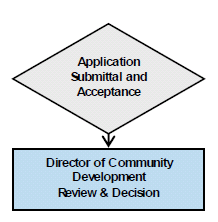
Certificate of Zoning Compliance
a.
Basic Procedures
Except as modified by Section 23-2-4(L)(3)b. below, review of an application for a Certificate of Zoning Compliance shall be subject to the common review procedures and requirements established in Section 23-2-3, Standard Review Procedures.
b.
Expiration
A Certificate of Zoning Compliance shall automatically expire if the development activity it authorizes is not commenced within six months after approval of the Certificate of Zoning Compliance. An extension of the expiration time period may be granted in accordance with Section 23-2-3(K)(2)b., Extension, except that the extension may be for a time period of up to three months.
(4)
Certificate of Zoning Compliance Review Standards
A Certificate of Zoning Compliance shall be approved only upon a finding that the application complies with all applicable standards in this Ordinance, as well as any other applicable city regulations.
(5)
Amendments
Any modifications of development subject to an approved Certificate of Zoning Compliance shall require amendment of the Certificate of Zoning Compliance approval in accordance with the procedures and standards for the full review of an application for approval of a Certificate of Zoning Compliance.
(M) - Building Permit
(1)
General
Building Permits are approved and issued by the Building Official in accordance with review procedures and construction standards in the International Building Code, as adopted and modified in accordance with Chapter 5, Buildings, of the Biloxi Code of Ordinances. A Building Permit is required before construction, alteration, movement, enlargement, replacement, repair, equipment, use and occupancy, location, maintenance, removal, or demolition of any building or structure and certifies that such work complies with the construction standards in the Building Code.
(2)
Relationship to this Ordinance
No Building Permit shall be issued for a structure except in accordance with a previously issued Certificate of Zoning Compliance, Public Works Permit, Temporary Use Permit, or Sign Permit for development that includes the structure.
(N) - Certificate of Development Compliance
(1)
Purpose
The Certificate of Development Compliance is intended to ensure that authorized development, as completed, complies with all of the applicable standards of this Ordinance. A Certificate of Development Compliance, in conjunction with a Certificate of Occupancy (See Section 23-2-4(O), Certificate of Occupancy.), serves as a final check on a development's compliance with the requirements of this Ordinance. Whereas a Certificate of Occupancy pertains to structures, a Certificate of Development Compliance pertains to both structures and all other elements of an authorized development (e.g., use, access, parking, utilities, stormwater management, landscaping, lighting, fencing/walls, signs, etc.).
(2)
Applicability
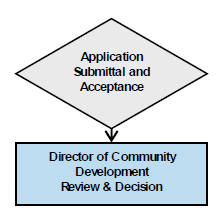
Certificate of Development Compliance
Except as otherwise provided in Section 23-2-4(N)(6), Temporary Certificate of Development Compliance, no development of land or structures authorized in accordance with this Ordinance shall be occupied or used until a Certificate of Development Compliance is approved and issued in accordance with this subsection, certifying that the development is completed in accordance with the permits or approvals authoring the development and fully complies with this Ordinance and other city regulations.
(3)
Procedure
Review of an application for a Certificate of Development Compliance shall be subject to the common review procedures and requirements established in Section 23-2-3, Standard Review Procedures.
(4)
Certificate of Development Compliance Review Standards
A Certificate of Development Compliance shall be approved only upon a finding that the development:
a.
Is completed in compliance with the Certificate of Zoning Compliance, Public Works Permit, Tree Permit, Temporary Use Permit, or Sign Permit authorizing the development, as appropriate, including all requirements conditions of such approvals;
b.
Complies with all applicable standards of this Ordinance; and
c.
Complies with all other applicable city regulations.
(5)
Effect of Certificate of Development Compliance
Approval and issuance of a Certificate of Development Compliance certifies completion of development, authorized in accordance with this Ordinance, authorizes the use and occupancy of nonstructural elements of the development, and in conjunction with issuance of a Certificate of Occupancy, authorizes the use and occupancy of structures associated with the development.
(6)
Temporary Certificate of Development Compliance
The Director of Community Development may issue a temporary Certificate of Development Compliance for up to 90 days to allow partial or full occupancy of a structure, provided the temporary certificate includes conditions and safeguards necessary to protect the safety of structure occupants and users, and the public. For good cause, the Director of Community Development may issue a second temporary Certificate of Development Compliance.
(O) - Certificate of Occupancy
(1)
General
Certificates of Occupancy are approved and issued by the Building Official in accordance with review procedures and construction standards in the Building Code and Fire Code. A Certificate of Occupancy is required before a structure being developed in accordance with a Building Permit may be occupied or used for its authorized purpose. It certifies that work on a structure is completed in compliance with the Biloxi Building Code and terms of the Building Permit, but also with all other applicable city regulations, including those in this Ordinance. A Certificate of Occupancy, in conjunction with a Certificate of Development Compliance, thus serves as a final check on a structure's compliance with the requirements of this Ordinance.
(2)
Relationship to this Ordinance
Except as otherwise provided in Section 23-3-3(O)(3), Temporary Certificate of Occupancy, no Certificate of Occupancy shall be issued for a structure unless and until the structure is completed in full compliance with a Certificate of Zoning Compliance, Public Works Permit, Temporary Use Permit, or Sign Permit authorizing development that includes the structure.
(3)
Temporary Certificate of Occupancy
The Building Official may issue a temporary Certificate of Occupancy for up to 90 days to allow partial or full occupancy of a structure, provided the temporary certificate includes conditions and safeguards necessary to protect the safety of structure occupants and users, and the public. For good cause, the Building Official may issue a second temporary Certificate of Occupancy.
(P) - Variance
(1)
Purpose
The purpose of a Variance is to allow certain deviations from the dimensional standards of this Ordinance (such as height, yard setback, lot coverage, or similar numeric standards) when the landowner demonstrates that, owing to special circumstances or conditions beyond the landowner's control (such as exceptional topographical conditions or the narrowness, shallowness, or shape of a specific parcel of land), the literal application of the standards would result in undue and unique hardship to the landowner and the deviation would not be contrary to the public interest. Variances are to be sparingly exercised and only in rare instances and under exceptional circumstances to relieve undue and unique hardships to the landowner. No change in permitted uses may be authorized by a Variance.
(2)
Authority
The Board of Zoning Adjustments shall review and decide any applications for Variances from the requirements of this Ordinance in accordance with this subsection.
(3)
Applicability
The following standards may be varied through the Variance procedure:
a.
The maximum height standards, maximum impervious surface coverage standards, minimum setback standards, minimum lot width standards, and minimum lot depth standards for each zoning district in Article 23-3: Zoning Districts;
b.
The standards in:
1.
Section 23-6-2, Off-Street Parking and Loading;
2.
Section 23-6-3, Landscaping;
3.
Section 23-6-7, Fences and Walls;
4.
Section 23-6-8, Exterior Lighting; and
5.
Section 23-6-13, Signage.
(4)
Procedure
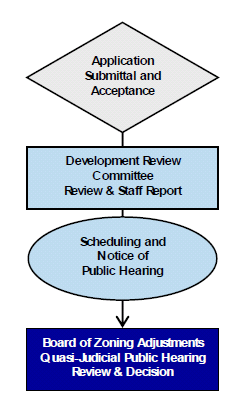
Variance
a.
Basic Procedures
Except as modified by Section 23-2-4(P)(4)b. below, review of an application for a Variance shall be subject to the common review procedures and requirements established in Section 23-2-3, Standard Review Procedures.
b.
Expiration
A Variance granted for development activity authorized by a Site Plan, subdivision approval, Certificate of Zoning Compliance, Public Works Permit, Tree Permit, or Temporary Use Permit shall automatically expire upon expiration of such permit or approval.
(5)
Variance Review Standards
a.
A Variance application shall be approved only upon a finding that all of the following standards are met:
1.
Strict application of the Ordinance requirements to the land or structure for which a Variance is sought results in practical difficulties and unnecessary hardships that would deprive the property owner of a reasonable use of the land or structure; and
2.
The practical difficulties or unnecessary hardships result from circumstances or conditions peculiar to the land or structure, and not to conditions that are widespread in the neighborhood or the city; and
3.
The special circumstances or conditions causing the hardship are not the result of the actions of the property owner; and
4.
The extent of the Variance is the minimum necessary to allow a reasonable use of the land or structure; and
5.
The Variance is in harmony with the general purpose and intent of this Ordinance and preserves its spirit; and
6.
The Variance would not adversely affect the health or safety of persons residing or working in the neighborhood, be injurious to property or improvements in the neighborhood, or otherwise be detrimental to the public welfare; and
7.
The Variance would not confer on the applicant any special privilege denied by this Ordinance to other lands or structures without a demonstration of hardship.
b.
The following factors do not constitute sufficient grounds for approval of a Variance:
1.
A request for a particular use that is expressly, or by inference, prohibited in the zoning district; or
2.
Hardships resulting from factors other than application of requirements of this Ordinance; or
3.
The fact that property may be utilized more profitably or be more marketable with a Variance; or
4.
The citing of other nonconforming or conforming uses of land or structures in the same or other zoning districts.
(6)
Subsequent Development
Development authorized by the Variance shall not be carried out until the applicant has secured all other permits required by this Ordinance or any other applicable provisions of the city. A Variance shall not ensure that the development receiving a Variance receives subsequent approval for other applications for development unless the relevant and applicable portions of this Ordinance or any other applicable provisions are met.
(7)
Effect of Variance Approval
Approval of a Variance shall authorize only the particular type and extent of deviation of standards that is approved. Unless it expires in accordance with Section 23-2-4(P)(4)b., Expiration, or is revoked in accordance with Section 23-9-6(A)(2), Revocation of Permit or Approval, an approved and recorded Variance, including any conditions of approval, shall run with the land and shall not be affected by a change in ownership.
(8)
Amendments
Any modifications of development subject to an approved Variance shall require amendment of the Variance approval in accordance with the procedures and standards for the full review of an application for approval of a Variance.
(Q) - Administrative Adjustment
(1)
Purpose
The purpose of this subsection is to provide an administrative mechanism for allowing minor modifications or adjustments to certain dimensional or numerical standards of this Ordinance based on specific criteria, with the intent of providing relief where application of a standard creates practical difficulties in allowing development that otherwise advances the purposes served by the standards and is compatible with the area.
(2)
Applicability
a.
General
Administrative Adjustments may be requested and granted for the standards identified in Table 23-2-4(Q)(2), Standards Subject to Administrative Adjustments, up to the limits set forth in the table.
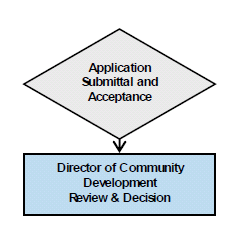
Minor Administrative Adjustment
b.
Minor Administrative Adjustment
An application to adjust a standard by ten percent or less shall be reviewed and decided by the Director of Community Development in accordance with Section 23-2-4(Q)(3), Minor Administrative Adjustment Procedure.
c.
Major Administrative Adjustment
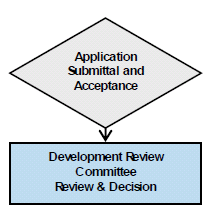
Major Administrative Adjustment
An application to adjust a standard by more than ten percent shall be reviewed and decided by the Development Review Committee in accordance with Section 23-2-4(Q)(4), Major Administrative Adjustment Procedure.
(3)
Minor Administrative Adjustment Procedure
a.
Basic Procedures
Except as modified by Sections 23-2-4(Q)(3)b—c. below, review of an application for a Minor Administrative Adjustment shall be subject to the common review procedures and requirements established in Section 23-2-3, Standard Review Procedures.
b.
Conditions of Approval
Conditions of approval may include limitation of the allowable adjustment to a lesser modification than the maximum allowed by this subsection or requested by an applicant.
c.
Expiration
Approval of a Minor Administrative Adjustment shall automatically expire if a Certificate of Zoning Compliance, Public Works Permit, Tree Permit, or Temporary Use Permit, as appropriate, for development incorporating the modification authorized by the Administrative Adjustment approval is not obtained within one year after the date of approval, or an authorized extension of this time period (See Section 23-2-3(K)(2)b., Extension.).
(4)
Major Administrative Adjustment Procedure
a.
Basic Procedures
Except as modified by Sections 23-2-4(Q)(4)b—c. below, review of an application for a Minor Administrative Adjustment shall be subject to the common review procedures and requirements established in Section 23-2-3, Standard Review Procedures.
b.
Conditions of Approval
Conditions of approval may include restricting the allowable adjustment to a lesser modification than the maximum allowed by this subsection or requested by an applicant.
c.
Expiration
Approval of a Major Administrative Adjustment shall automatically expire if a Certificate of Zoning Compliance for development incorporating the modification authorized by the Administrative Adjustment approval is not obtained within one year after the date of approval, or an authorized extension of this time period (See Section 23-2-3(K)(2)b., Extension.).
(5)
Administrative Adjustment Standards
Administrative Adjustments shall be approved only upon a finding that the following standards are met:
a.
The requested Administrative Adjustment is not inconsistent with the character of development in the surrounding area, and will not result in incompatible uses.
b.
Any adverse impacts resulting from the Administrative Adjustment will be mitigated to the maximum extent practicable.
c.
The Administrative Adjustment is of a technical nature (i.e., relief from a dimensional or design standard), and is either:
1.
Supporting an objective or goal from the purpose and intent statements of the zoning district where located; or
2.
Proposed to save healthy existing trees.
d.
The Administrative Adjustment will not substantially interfere with the convenient and enjoyable use of adjacent lands, and will not pose a danger to the public health or safety.
(6)
Subsequent Development
Development authorized by the Administrative Adjustment shall not be carried out until the applicant has secured all other permits required by this Ordinance or any other applicable provisions of the city. An Administrative Adjustment provides no assurance that the development receiving an Administrative Adjustment will receive subsequent approval for other applications for development unless the relevant and applicable portions of this Ordinance or any other applicable provisions are met.
(7)
Effect of Approval
Approval of an Administrative Adjustment shall authorize only the particular modification authorized by the approval. Unless it expires in accordance with Section 23-2-4(Q)(3)c., Expiration (Minor Administrative Adjustments), or Section 23-2-4(Q)(4)c., Expiration (Major Administrative Adjustments), or is revoked in accordance with Section 23-9-6(A)(2), Revocation of Permit or Approval, an Administrative Adjustment, including any conditions, of approval, shall run with the land and shall not be affected by a change in ownership.
(8)
Amendments
Any modifications of development subject to an approved Minor Administrative Adjustment or Major Administrative Adjustment shall require amendment of the Administrative Adjustment approval in accordance with the procedures and standards for the full review of an application for approval of a Minor Administrative Adjustment or Major Administrative Adjustment, as appropriate.
(R) - Interpretation
(1)
Purpose
The purpose of this subsection is to provide a uniform mechanism for interpreting provisions of this Ordinance whose meaning or application to a particular circumstance may not be readily clear.
(2)
Authority
The Director of Community Development shall be responsible for making interpretations of all provisions of this Ordinance—including, but not limited to, interpretations of the text of this Ordinance, interpretations of the zoning district boundaries, interpretations of compliance with a condition of approval, and interpretations of whether an unspecified use falls within a use classification, use category, or use type allowed in a zoning district.
(3)
Procedure
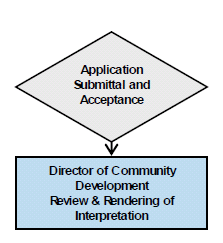
Interpretation
a.
Basic Procedures
Except as modified by Sections 23-2-4(R)(3)b—d. below, review of an application for a written Interpretation shall be subject to the common review procedures and requirements established in Section 23-2-3, Standard Review Procedures.
b.
Initiation
An application for a formal written Interpretation may be initiated by the City Council, Planning Commission, Architectural and Historical Review Commission, Board of Zoning Adjustments, any resident or landowner, or any person having a contractual interest in land in the city.
c.
Staff Review
The Director of Community Development shall consult with the City Attorney and affected city officials, and shall render a written Interpretation.
d.
Expiration
A written Interpretation shall not expire, but may be overturned or modified by a subsequent written Interpretation or an Appeal decision, or superseded by an amendment to this Ordinance.
(4)
Interpretation Standards
a.
Zoning Map Boundaries
Interpretation of zoning district boundaries on the Official Zoning Map shall be in accordance with the standards in Section 23-1-7(D), Interpretation of Official Zoning Map Boundaries.
b.
Unspecified Uses
Interpretations of whether an unspecified use falls within a use classification, use category, or use type allowed in a zoning district shall be based the standards in Section 23-4-2, Use Classifications, Categories, and Types.
c.
Text Provisions
Interpretations of text provisions and their application shall be based on the standards in Section 23-10-1, General Rules of Interpretation, and the following considerations:
1.
The clear and plain meaning of the provision's wording, as defined by the meaning and significance given specific terms used in the provision, as established in Section 23-10-2, Terms and Uses Defined, and by the common and accepted usage of the term;
2.
The intended purpose of the provision, as indicated by purpose statements, its context and consistency with surrounding and related provisions, and any legislative history to its adoption;
3.
The general purposes served by this Ordinance, as set forth in Section 23-1-3, General Purpose and Intent; and
4.
Consistency with the Biloxi Comprehensive Plan.
(5)
Official Record of Interpretations
a.
The Director of Community Development shall maintain a record of written Interpretations that shall be available for public inspection, upon reasonable request, during normal business hours.
b.
If a written Interpretation from the Director of Community Development is appealed and the Appeal decision results in a change of interpretation, the new Interpretation shall be filed in the official record of Interpretations.
(6)
Effect of Interpretation
A written Interpretation shall be binding on subsequent decisions by the Director of Community Development, Development Review Committee, or other city administrative official in applying the same provision of this Ordinance in the same circumstance.
(S) - Appeal
(1)
Purpose
The purpose of this subsection is to establish an administrative remedy whereby persons claiming to having been aggrieved by an administrative decision of city staff or certain appointed boards may appeal that decision to the Board of Zoning Adjustments or the City Council.
(2)
Right to Appeal
a.
To Architectural and Historical Review Commission
Any party aggrieved by a decision by the Director of Community Development in deciding a Minor Certificate of Appropriateness application or in interpreting provisions directly related to Certificates of Appropriateness or Architectural/Historic Overlay (AHO) district regulations may appeal such decision to the Architectural and Historical Review Commission in accordance with this subsection.
b.
To Board of Zoning Adjustments
1.
Except as otherwise provided in Section 23-I-4(S)(2)a., above, any party aggrieved by an interpretation or decision of the Director of Community Development, Building Official, City Engineer, or Development Review Committee in administering or enforcing this Ordinance may appeal such interpretation or decision to the Board of Zoning Adjustments in accordance with this subsection.
2.
City Engineer and Building Official interpretations and decisions may be appealed to the Board of Zoning Adjustments only if they directly relate to application of the requirements and standards in this Ordinance. Building Official decisions relating to application of the Building Code are appealable to the Building and Housing Board of Adjustments and Appeals in accordance with Chapter 5, Buildings, of the Biloxi Code of Ordinances.
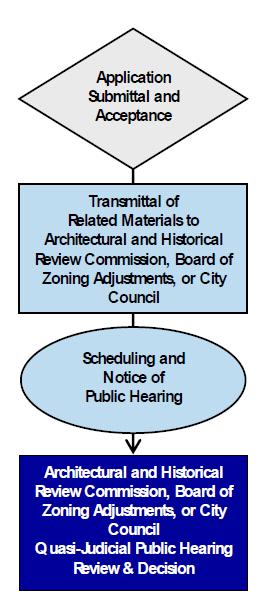
Appeal
c.
To City Council
Any party aggrieved by a decision by the Planning Commission in deciding a Major Subdivision Preliminary Plat application, or by a decision of the Architectural and Historical Review Commission in deciding a Major Certificate of Appropriateness application or an Appeal of a decision on a Minor Certificate of Appropriateness application, may appeal such decision to the City Council in accordance with this subsection.
(3)
Procedure
a.
Basic Procedures
Except as modified by Sections 23-2-4(S)(3)b—f. below, review of a Notice of Appeal and Appeal application shall be subject to the common review procedures and requirements established in Section 23-2-3, Standard Review Procedures.
b.
Initiation
An Appeal shall be initiated by filing a written Notice of Appeal and Appeal application with the Director of Community Development within ten days of the date of the interpretation or decision being appealed.
c.
Staff Submittal of Appeal and Related Materials
On accepting a Notice of Appeal and Appeal application, the Director of Community Development shall transmit the notice, application, and all the papers, documents, and other materials relating to the appealed interpretation or decision to the Architectural and Historical Review Commission, Board of Zoning Adjustments or City Council, as appropriate. These materials shall constitute the record of the Appeal.
d.
Notice to Applicant for Decision Being Appealed
In addition to providing notice of the public hearing to be held by the Architectural and Historical Review Commission, Board of Zoning Adjustments, or City Council, as appropriate, in accordance with Section 23-2-3(F)(4), Public Hearing Notice, the Director of Community Development shall provide such notice to the applicant for the decision being appealed, if different from the applicant for the Appeal.
e.
Review by Architectural and Historical Review Commission, Board of Zoning Adjustments, or City Council
The decision of the Architectural and Historical Review Commission, Board of Zoning Adjustments, or City Council, as appropriate, shall be one of the following:
1.
Affirmation of the interpretation or decision (in whole or in part);
2.
Modification of the interpretation or decision (in whole or in part); or
3.
Reversal of the interpretation or decision (in whole or in part).
f.
Expiration
A decision on an Appeal application shall not expire, but may be overturned or modified by a subsequent Appeal decision or superseded by an amendment to this Ordinance.
(4)
Appeal Review Standards
a.
The Architectural and Historical Review Commission, Board of Zoning Adjustments, or City Council, as appropriate, shall review an Appeal application in accordance with the standards of this Ordinance applicable to the interpretation or decision being appealed.
b.
The Architectural and Historical Review Commission, Board of Zoning Adjustments, or City Council, as appropriate, may modify or reverse an interpretation or decision on appeal (in whole or in part) only if it finds that there is competent, substantial, and material evidence in the record of a clear and demonstrable error in the interpretation or application of the relevant standards or provisions of this Ordinance.
(5)
Effect of Pending Appeal
A pending Appeal stays all city actions seeking enforcement of or compliance with the interpretation or decision being appealed unless the Director of Community Development certifies to the Architectural and Historical Review Commission, Board of Zoning Adjustments, or City Council, as appropriate, that because of facts stated in the certificate, a stay would cause imminent peril to life or property or would seriously interfere with enforcement of this Ordinance due to the violation's transitory nature. In that case, proceedings shall not be stayed other than by an order issued by the Architectural and Historical Review Commission, Board of Zoning Adjustments, or City Council, as appropriate, or a court of competent jurisdiction, after notice to the Director of Community Development and for good cause shown.
(6)
Effect of Appeal Decision
To the extent a decision by the Architectural and Historical Review Commission, Board of Zoning Adjustments, or City Council on an Appeal pertains to application of a particular provision of this Ordinance in a particular circumstance, the Appeal decision shall be binding on subsequent decisions by the Director of Community Development, Development Review Committee, or other city administrative official applying the same provision of this Ordinance in the same circumstance.
(T) - Property, Right-of-Way, or Easement Dedication Acceptance
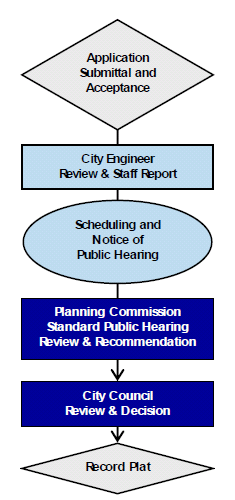
Property, Right-of-Way, or Easement Dedication Acceptance
(1)
Purpose
The purpose of this subsection is to establish a uniform procedure for city acceptance of property, right-of-way, or easements being offered for dedication to the public, where such offers are made independent of a procedure for review of a subdivision or other development permit or approval.
(2)
Applicability
The City Council shall review and decide any applications, outside of other development permit and approval procedures of this Ordinance, that request city acceptance of an offer to dedicate to the public any property, right-of-way, and easement in accordance with this subsection.
(3)
Procedure
a.
Basic Procedures
Except as modified by Sections 23-2-4(T)(3)b—e. below, review of an application for Property, Right-of-Way, or Easement Dedication Acceptance shall be subject to the common review procedures and requirements established in Section 23-2-3, Standard Review Procedures.
b.
Initiation
An application for Property, Right-of-Way, or Easement Dedication Acceptance may be initiated by any person who may submit applications in accordance with Section 23-2-3(C)(1), Authority to File Applications, or by the Director of Community Development, City Engineer, Planning Commission, or City Council.
c.
City Council Review and Action
At its discretion, the City Council may hold an additional standard public hearing on the application, in accordance with Section 23-2-3(F), Scheduling, Notice, and Conduct of Public Hearing.
d.
Plat and Certification
If the application is approved and accepted by the applicant, the applicant and City Engineer shall prepare a plat showing the property, right-of-way, or easement and incorporating accepted conditions of approval and any required certification forms and signatures, and shall submit the plat to the Director of Community Development. The applicant and City Engineer shall also prepare all other documentation appropriate to acceptance of the dedicated property, right-of-way, or easements and submit it to the Director of Community Development. On determining that the plat is properly revised and the other documentation is appropriate, the Director of Community Development, the Mayor, and the City Clerk shall sign the plat and other documentation as appropriate to certify their approval by the city in accordance with this Ordinance, and any other certifications as may be appropriate.
e.
Recordation
The applicant and Director of Community Development shall file an approved and certified plat and other documentation with the Office of the Chancery Clerk of Harrison County for recording, and proof of recording shall be provided to the Director of Community Development and City Engineer.
(4)
Dedication Acceptance Review Standards
An application for acceptance of a property, right-of-way, or easement shall be approved only upon a finding that all of the following standards are met:
a.
Acceptance of the property or proposed right-of-way or easement would be in the best interest of the public; and
b.
The city is capable of maintaining and regulating the property or proposed right-of-way or easement in an efficient and economical manner.
(5)
Acceptance of Dedication
Approval of an application for Property, Right-of-way or Easement Dedication Acceptance and recordation of a plat with the Office of the Chancery Clerk of Harrison County shall, unless otherwise specified on the plat, constitute the acceptance of the dedication to public use of any rights-of-way, easements, completed public improvements, and public parks or open space as shown on the plat. This acceptance of dedication shall not constitute or imply a responsibility of the city or other public agency to open or maintain such rights-of-way, easements, public improvements, or parks or open space until so determined by the City Council or other public agency.
(U) - Right-of-Way or Easement Vacation or Abandonment
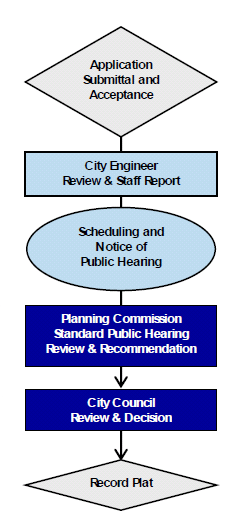
Right-of-Way or Easement Vacation or Abandonment
(1)
Purpose
The purpose of this subsection is to establish a uniform mechanism for vacating or abandoning developed and undeveloped public rights-of-way and easements when they are no longer required or needed by the city or its inhabitants.
(2)
Applicability
The City Council shall review and decide applications to vacate or abandon public rights-of-way and easements in accordance with this subsection.
(3)
Procedure
a.
Basic Procedures
Except as modified by Sections 23-2-4(U)(3)b—g. below, review of an application for Right-of-Way or Easement Vacation or Abandonment shall be subject to the common review procedures and requirements established in Section 23-2-3, Standard Review Procedures.
b.
Initiation
An application for Right-of-Way or Easement Vacation or Abandonment may be initiated by any person who may submit applications in accordance with Section 23-2-3(C)(1), Authority to File Applications, or by the Director of Community Development, City Engineer, Planning Commission, or City Council.
c.
Public Notice
1.
In providing notice of the public hearing(s) on the application in accordance with Section 23-2-3(F)(4), Public Hearing Notice, the Director of Community Development shall construe that subsection's references to the "parcel" or "property" subject to the application as incorporating the segment of right-of-way or easement proposed to be vacated or abandoned.
2.
The Director of Community Development shall also provide mailed notice of the public hearing to:
A.
All owners of record of real property within 500 feet of the segment of public right-of-way or easement proposed to be vacated or abandoned;
B.
Every utility agency authorized to maintain facilities within that part of the city in which the subject right-of-way or easement is located; and
C.
The member(s) of the City Council in whose ward(s) contains the public right-of-way or easement proposed to be vacated or abandoned.
d.
City Council Review
1.
At its discretion, the City Council may hold an additional standard public hearing on the application, in accordance with Section 23-2-3(F), Scheduling, Notice, and Conduct of Public Hearing.
2.
The City Council's decision on the application shall be one of the following:
A.
Approval of the application as submitted;
B.
Approval of the application with a reduction in the amount or extent of right-of-way vacated or easement abandoned;
C.
Approval of the application subject to conditions; or
D.
Denial of the application.
e.
Conditions of Approval
Conditions of approval may include requirements for retention of a public utility easement in any portion of a vacated right-of-way.
f.
Plat and Certification
If the application is approved and accepted by the applicant, the applicant and City Engineer shall prepare a plat or plat revision showing the vacation or abandonment of public right-of-way or easement and incorporating conditions of approval and any required certification forms and signatures, and shall submit the plat to the Director of Community Development. The applicant and City Engineer shall also prepare all other documentation appropriate to vacation or abandonment of the public right-of-way or easement and submit it to the Director of Community Development. On determining that the plat is properly revised and the other documentation is appropriate, the Director of Community Development, the Mayor, and the City Clerk shall sign the plat and other documentation as appropriate to certify their approval by the city in accordance with this Ordinance, and any other certifications as may be appropriate.
g.
Recordation
The applicant and Director of Community Development shall file an approved and certified plat with the Office of the Chancery Clerk of Harrison County for recording, and proof of recording shall be provided to the Director of Community Development and City Engineer.
(4)
Right-of-Way or Easement Vacation or Abandonment Review Standards
An application for vacation or abandonment of a public right-of-way or easement shall be approved only upon a finding that all of the following standards are met:
a.
The right-of-way or easement is not now, or in the foreseeable future, of any benefit to the city or its inhabitants; and
b.
A public right-of-way shall not be vacated or abandoned unless record owner of property abutting the subject segment of right-of-way expressly consents in writing to the vacation or abandonment.
(5)
Effect of Right-of-Way or Easement Vacation or Abandonment
Approval of the total vacation or abandonment of a public right-of-way or easement and recording of a plat showing the vacation or abandonment shall extinguish the right of the public to use the right-of-way or easement.
(V) - Street Name Change
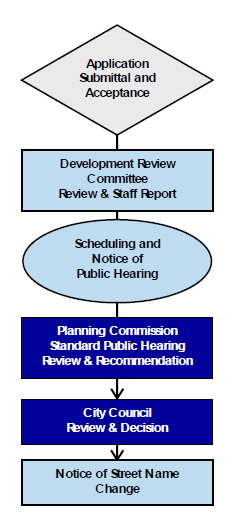
Street Name Change
(1)
Purpose
The purpose of this subsection is to establish a uniform method for changing the names of streets, as listed on the city's Street Identification and Property Number Map, as established in Article IV, Street Names and Property Numbering, of Chapter 17, Streets and Sidewalks, of the Biloxi Code of Ordinances.
(2)
Applicability
The name of an existing street, as listed on the city's Street Identification and Property Number Map, may be changed only upon approval of an application for a Street Name Change in accordance with this subsection.
(3)
Procedure
a.
Basic Procedures
Except as modified by Sections 23-2-4(V)(3)b—e. below, review of an application for a Street Name Change shall be subject to the common review procedures and requirements established in Section 23-2-3, Standard Review Procedures
b.
Initiation
Any resident or owner of property in the City of Biloxi may initiate an application for a Street Name Change.
c.
City Council Review
1.
At its discretion, the City Council may hold an additional standard public hearing on the application, in accordance with Section 23-2-3(F), Scheduling, Notice, and Conduct of Public Hearing.
2.
The City Council's decision on the application shall be one of the following:
A.
Approval of the street name change as proposed;
B.
Approval of a alternative street name change;
C.
Denial of the proposed street name change; or
d.
Notice of Street Name Change
If the City Council approves a Street Name Change, the Director of Community Development shall provide written notice of the change to:
1.
All owners of record of property abutting or having an address on the street;
2.
The emergency dispatch office;
3.
The U.S. Postal Service; and
4.
Any other agency with a substantial interest in maintaining street names.
e.
Entry of Street Name Change
If the City Council approves a Street Name Change, the Director of Community Development shall enter the name change onto the Street Identification and Property Number Map.
(4)
Street Name Change Standards
A Street Name Change shall be approved only after consideration of the following criteria:
a.
No proposed renaming of an existing street shall duplicate, be phonetically similar to, or create confusion with an existing street name, unless the street to be so named is a logical connection of the other street bearing that name. The use of prefixes, suffixes or other minor changes shall not be sufficient to allow re-use of a street name.
b.
It is desirable to use names which are simple, logical, easy to read and pronounce, and which are clear and brief. Use of frivolous or complicated words, or unconventional spellings, shall not be approved.
c.
In all cases, names that might reasonably be perceived as offensive shall not be permitted.
d.
The use of numbers (such as First Street), alphabetical letters or proper names is discouraged.
e.
It is desirable to use names that have some association with the city and specifically with the immediate location of the road or place, such as reference to local history or physiographic features.
f.
Use of a common theme is recommended for names of streets that are associated with one another, such as those within a residential development.
g.
Care should be exercised in changing any street name in order to preserve local history and to minimize disruption and cost.
h.
Any existing street following the corridor shown for a street shown on an adopted Major Street Plan of the City shall bear the name indicated on the Major Street Plan.
i.
Intersecting streets shall not have the same or similar name.
j.
Street sections planned to be or likely to be connected in a straight line shall bear the same name, regardless of whether the two will be immediately connected.
k.
Street sections not planned to be or unlikely to be connected shall not bear the same name.
l.
Streets that continue through an intersection should generally bear the same name.
m.
A street making an approximate right-angle turn where there is no possibility of extending the street in either direction shall be considered to be continuous and be so named. Where there is a possibility of extending either section in the future, such configuration shall be considered to be an intersection and different names assigned.
n.
Where there is a change in the direction of a street of greater than 60 degrees for a distance equal to or exceeding 1,000 feet in length, each segment of the street shall bear a different name.
o.
A street name that otherwise meets the criteria but in the judgment of the City Council may be misleading to residents or visitors or otherwise be inappropriate shall be disapproved.
p.
If there are conflicts in applying the criteria set forth above, a specific criterion shall apply over a general one; in the case of conflicts between two general criteria or two specific criteria, the earlier listed criterion shall control.
(W) - Development Name/New Street Name
(1)
Purpose
The purpose of this subsection is to establish a uniform method for establishing the names of new development and streets.
(2)
Applicability
The name of any development or new street shall be approved in accordance with this subsection.
(3)
Procedure
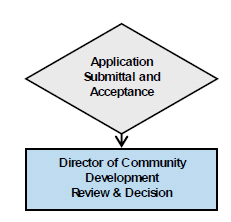
Development Name/ New Street Name
a.
Basic Procedures
Except as modified by Sections 23-2-4(W)(4)b—c. below, review of an application for a Development Name or New Street Name shall be subject to the common review procedures and requirements established in Section 23-2-3, Standard Review Procedures.
b.
Initiation
An application for a Development Name or New Street Name may be initiated by the applicant for a proposed new development or a development proposed to include new streets, or the developer or resident of an existing development proposing a new development name.
c.
Entry of Development Names and New Street Names
1.
On approving a new or revised development name, the Director of Community Development shall enter the name on a list of development names for the city, to be used to avoid the same or similar development names in the future.
2.
On approving a new street name, the Director of Community Development shall enter the name onto the Street Identification and Property Number Map.
(4)
Development Name/New Street Name Standards
A Development Name or New Street Name shall be approved only after consideration of the following criteria:
a.
No new street name shall duplicate, be phonetically similar to, or create confusion with an existing street name, unless the street to be so named is a logical connection of the other street bearing that name. The use of prefixes, suffixes or other minor changes shall not be sufficient to allow re-use of a street name.
b.
No new development name, or proposed renaming of an existing development, shall duplicate, be phonetically similar to, or create confusion with an existing development name, unless the development to be so named is an additional phase of the original development bearing that name and includes direct internal street connections to that development. The use of prefixes, suffixes or other minor changes shall not be sufficient to allow re-use of a development name.
c.
It is desirable to use names which are simple, logical, easy to read and pronounce, and which are clear and brief. Use of frivolous or complicated words, or unconventional spellings, shall not be approved.
d.
In all cases, names that might reasonably be perceived as offensive shall not be permitted.
e.
The use of numbers (such as First Street), alphabetical letters or proper names is discouraged.
f.
It is desirable to use names that have some association with the city and specifically with the immediate location of the road or place, such as reference to local history or physiographic features.
g.
Use of a common theme is recommended for names of streets that are associated with one another, such as those within a residential development.
h.
Any proposed street following the corridor shown for a street shown on an adopted Major Street Plan of the City shall bear the name indicated on the Major Street Plan.
i.
Intersecting streets shall not have the same or similar name.
j.
Proposed streets obviously in alignment with existing streets shall bear the name of the existing street to the extent practicable, regardless of whether the two will be immediately connected.
k.
Street sections planned to be or likely to be connected in a straight line shall bear the same name, regardless of whether the two will be immediately connected.
l.
Street sections not planned to be or unlikely to be connected shall not bear the same name.
m.
Streets that continue through an intersection should generally bear the same name.
n.
A street making an approximate right-angle turn where there is no possibility of extending the street in either direction shall be considered to be continuous and be so named. Where there is a possibility of extending either section in the future, such configuration shall be considered to be an intersection and different names assigned.
o.
Where there is a change in the direction of a street of greater than 60 degrees for a distance equal to or exceeding 1,000 feet in length, each segment of the street shall bear a different name.
p.
The proposed name of the development should in all respects emphasize the project's distinctive name rather than the name of the company or corporation that owns the development. This will reduce confusion on the location of separate developments owned by the same company or corporation.
q.
A development or street name that otherwise meets the criteria but in the judgment of the City Council may be misleading to residents or visitors or otherwise be inappropriate shall be disapproved.
r.
If there are conflicts in applying the criteria set forth above, a specific criterion shall apply over a general one; in the case of conflicts between two general criteria or two specific criteria, the earlier listed criterion shall control.
(Ord. No. 2293, § 2, 1-26-2016; Ord. No. 2301, § 1, 3-22-2016)

