
Biloxi City Zoning Code
ARTICLE 23
7: - SUBDIVISION STANDARDS
1 - Purpose
The purpose of this section is to establish standards for the layout and lotting of subdivisions of land within the city, plus standards for streets and other infrastructure provided as part of subdivisions and other new development.
2 - Applicability
The design and construction standards in this article shall apply to all subdivisions and all development requiring Site Plan approval.
(A) - Layout
The layout of streets, lots, and other elements of a subdivision shall be based on complete site analysis, and shall comply with the following standards:
(1)
Streets and lots shall be designed and situated to minimize alteration of natural and historic site features to be preserved.
(2)
The subdivision layout shall consider the practicality and economic feasibility of development of individual lots, including the environmental characteristics and size of the site, and the requirements of this Ordinance.
(3)
Unique and fragile elements—including, but not limited to, wetlands, significant stands of trees, and specimen trees—shall be preserved where practicable, with development reserved for environmentally stable areas.
(4)
Open space shall be provided in accordance with Section 23-6-6, Open Space Set-Asides.
(5)
The proposed development shall be coordinated with all existing and officially approved plans of the city.
(6)
Subdivisions with 50 lots or more shall have at least two vehicular access points into the subdivision. These access points shall be separated by at least 200 feet or one block length, whichever is greater.
(B) - Blocks
(1)
Blocks shall have sufficient width to provide for two tiers of lots of appropriate depth for the zoning district, excluding any water bodies, public alleys, or other public rights-of-way. Exceptions to this prescribed block width shall be permitted in blocks adjacent to major streets, railroads, or waterways, or due to limiting topographical conditions, the size or configuration of the site, or for approved through lots.
(2)
Blocks shall be laid out to provide a functional street pattern and circulation and connectivity in accordance with the standards in Section 23-6-1, Access and Circulation.
(3)
Block lengths shall not exceed 1,600 feet, nor be less than 200 feet or four lot widths, whichever is greater, except as necessary to secure efficient use of land or desired features of the street pattern.
(4)
Where a block length exceeds 1,200 feet, sidewalks or multi-use paths shall be provided mid-block to connect parallel streets on the long side of the block.
(5)
The lengths, widths, and shapes of blocks shall be determined based on the following:
a.
Lot size standards;
b.
Needs for convenient access, circulation, control, and safety of vehicular and pedestrian traffic;
c.
Relationship to existing utilities;
d.
Layout of the public water system with regard to eliminating stagnant water, providing adequate fire flow, appropriately placing fire hydrants, and meeting minimum pressure requirements;
e.
Layout of the public sanitary sewer system with regard to utilizing gravity sewer system wherever possible and minimizing the use of sewer force mains;
f.
Layout of the public storm drainage system with regard to utilizing natural outfalls adjacent to the land being subdivided, and minimizing the use of existing public storm drainage systems for the new development;
g.
Location of existing and proposed easements; and
h.
Limitations and opportunities of topography.
(A) - Developer Responsibility
(1)
The cost of all required street improvements and dedication of rights-of-way and improvements shall be borne by the developer. Required street improvements include the roadway, curb and gutter, sidewalks, street lights, drainage facilities, utilities, traffic signs, and street trees required in accordance with this Ordinance.
(2)
When a development site includes the proposed corridor of a street designated on the Major Thoroughfare Plan as an arterial street, the subdivision shall incorporate provision of the arterial street into the design of the subdivision. The developer shall be responsible for constructing street improvements that meet at least the collector street standards of this section, and shall dedicate right-of-way that meets the right-of-way width standards for an arterial street.
(3)
When a development fronts on and obtains vehicular access from an existing arterial street that does not meet the minimum street standards of this section, the developer shall provide those street improvements necessary to bring the street into compliance with at least the collector street standards of this section, and shall dedicate right-of-way along the frontage sufficient to provide half of the right-of-way required for an arterial street or an equivalent combination of right-of-way and utility easement, as identified and approved by the Director of Community Development and City Engineer.
(4)
When a development fronts on and obtains vehicular access from an existing paved street other than an arterial street that does not meet the minimum street standards in this section, the developer shall provide those street improvements necessary to bring the street into compliance with the standards of this section applicable to the type of street.
(B) - Right-of-Way
(1)
General
a.
For any improvements to be accepted by the city, the developer shall dedicate, at no cost to the city, rights-of-way for streets, utilities, and other improvements in accordance with this Ordinance.
b.
Developments that extend existing streets shall dedicate any additional right-of-way needed to comply with the minimum right-of-way width requirements set out in this section.
c.
When a development is located on only one side of an existing street, the developer shall dedicate to the city any additional right-of-way needed to comply with existing street design regulations.
(2)
Right-of-Way Width
The width of the right-way for a street shall be sufficient to safely and efficiently accommodate the improvements required or provided as part of the street—including, but not limited to, roadway, curb and gutter, sidewalks, streetlights, utilities, traffic signs, and street trees. The following Table 23-7-4(B)(2), Minimum Street Right-of-Way Width, sets forth required right-of-way widths for city streets:
(C) - Roadway
(1)
Roadway Paving
a.
Any street proposed to be dedicated to the city as a public street, or in the opinion of the City Engineer has the potential of being donated to the city in the future, shall be improved to the following minimum pavement width set forth in Table 23-7-4(C)(1), Minimum Street Pavement Width:
b.
Streets shall not be paved until all underground utilities and other appurtenances are in place and approved by the City Engineer.
(2)
Roadway Design Standards
a.
Street grades, where practicable, shall not exceed the grade set forth in Table 23-7-4(C)(2), Maximum Street Grade:
b.
The proposed street system shall extend existing streets at the same or greater width, but in no case less than the required minimum width in accordance with this Section.
c.
Median divided drives or roadways shall be permitted provided that no median may be located within 25 feet from the back of curb of the intersecting roadway.
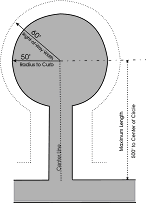
Figure 23-7-4(C)(3): Cul-de-Sac Design
d.
The property line radius and curb line radius at street intersections shall not be less than 25 feet; where the angle of street intersection is less than 90 degrees, the city may require a greater radius.
e.
Street jogs with centerline offsets of less than 125 feet shall not be permitted. There shall be no jogs on collector or arterial streets.
(3)
Cul-de-Sac Design
Cul-de-sac streets designed to have one end permanently closed shall be no more than 500 feet long, measured from the edge of the intersecting street right-of-way to the center of the turnaround. A circular turnaround having an outside right-of-way diameter of 60 feet and an outside pavement radius of 50 feet shall be provided at the end of the cul-de-sac. (See Figure 23-7-4(C)(3), Cul-de-Sac Design.)
(D) - Sidewalks
(1)
In providing sidewalks required by Section 23-6-1(G)(1)b., Sidewalks Required, a subdivision developer shall be responsible for installing sidewalks along all common area properties or other areas along the street that are not adjacent to individual lots.
(2)
Additional sidewalks and wider sidewalks may be required near commercial areas, schools, and other places of public assembly.
(3)
Sidewalks, where required, shall be included within the dedicated non-traffic way portion of the right-of-way or easement of all streets.
(E) - Curb and Gutter
Curb and gutter shall be installed on both sides of all streets. Curbs and gutters shall be designed and installed in accordance with the Administrative Manual.
(F) - Streetlights
(1)
Streetlights shall be installed along new subdivision lots by the subdivision developer.
(2)
Streetlights shall be installed along all single lot developments by the developer if the lot is located in an area requiring street lighting as shown on the City's Street Lighting Plan.
(G) - Fire Hydrants
Fire hydrants shall be required for all developments in accordance with the Administrative Manual and Fire Code. No development shall be located in a manner that impedes access to a fire hydrant.
(H) - Traffic Signs
Street name and traffic signs shall be required in all subdivisions and installed by the subdivision developer. Such signs and posts shall conform to the requirements specified in the Administrative Manual, Fire Code, and the latest edition of "The Manual of Uniform Traffic Control Devices." The developer may install decorative signage if approved by the City Engineer. If decorative signage is installed, the maintenance of the decorative signs shall be subject to a maintenance agreement between the city and the developer and/or the property owners' association. The city shall not be responsible for replacing damaged/missing decorative signs with the same.
(I) - Sight Triangles at Street Intersections
(1)
Wherever two streets intersect, unobstructed cross-visibility shall be provided between the heights of three and seven feet above the grade elevation of the roadways within sight triangles at each corner of the intersecting roadways. Each sight triangle shall be measured from a point where the curb or edge-of-pavement line for the intersecting roadways meet, to a point 30 feet behind one roadway's curb or edge-of-pavement line, to a point along the other roadway's curb or edge-of-pavement line located 30 feet from the original point—see Figure 23-7-4(I)(1), Sight Triangle at Street Intersection.
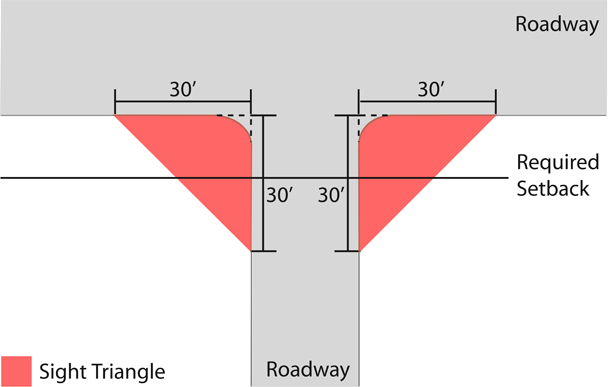
Figure 23-7-4(I)(1): Sight Triangle at Street
(2)
Within the sight triangles, no fence, wall, sign, earthworks, hedge, shrub, or other structure or planting shall be located, maintained, or permitted to grow between the heights of three and seven feet above the grade elevation of the adjacent road. Public safety and utility devices (such as street light, street sign, and telephone poles) and trees less than 12 inches in diameter are exempt from these standards, provided their number and location is limited, and the limbs and foliage of any such trees are trimmed, so as to ensure provision of the required unobstructed cross-visibility. (See Figure 23-7-4(I)(2), Sight Triangle Clear Visibility.)
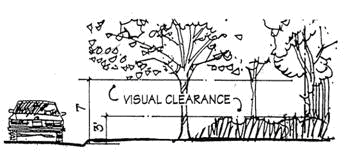
Figure 23-7-4(I)(2): Sight Triangle Clear Visibility
(A) - Stormwater Management Facilities
(1)
All stormwater management facilities shall be designed to serve the entire drainage area of the development site. The city may, at its option, elect to participate in the cost of any stormwater management system that is required to serve a drainage basin greater than the development site.
(2)
Stormwater runoff from developments shall discharge to an approved outfall.
(B) - Potable/Fire Protection Water and Sanitary Sewer
(1)
Potable/fire protection water and sanitary sewer service and/or systems for all development shall be in accordance with this Ordinance, Chapter 22, Water and Sewer, of the Biloxi Code of Ordinances, and the Administrative Manual. All water and sewer utilities shall be installed underground.
(2)
Developers shall install or have installed a system of water mains and sewer mains of approved size and location connected to the city systems. If city systems are not available, the developer shall install water and sanitary sewer infrastructure for future tie-in to the city systems.
(C) - Utilities by Private Utility Companies
(1)
A subdivision developer shall install or cause to be installed all utilities provided by private utility companies such as, but not limited to, power, gas, telecommunication, and television cable, before final plat approval.
(2)
All utilities shall be installed underground.
(3)
All utilities shall be installed before final inspection and acceptance of sanitary and storm drain utilities by the city.
(4)
The subdivision developer shall be responsible for all improvements until they are accepted for maintenance by the appropriate utility company.
(5)
Before excavation activities, the developer shall be responsible for locating all existing underground utilities in the area being disturbed that have not been accepted by the city, so that existing utilities will not be disturbed. The developer shall post a construction sign at each entrance to the development providing utility companies with contact information to have existing utilities located prior to excavation.
(D) - Solid Waste Disposal
All residential, commercial, and industrial uses shall provide space to collect and dispose of solid waste in compliance with the Administrative Manual, the screening requirements of Section 23-6-3(G), Screening, and Chapter 9, Garbage, Trash, and Weeds, of the Biloxi Code of Ordinance.
(E) - Fire Protection for Piers, Docks, and Wharves
Where a standpipe system is required for a pier, dock, or wharf, it shall be provided in accordance with the Standard Fire Prevention Code and NFPA 14 and shall be located as follows:
(1)
A Fire Department Connection (FDC) to the standpipe system shall be located at the entrance to the pier, dock, or wharf.
(2)
A gated outlet to the standpipe system shall be located no more than 50 linear feet from the farthest end of the pier, dock, or wharf, and gated outlets to the standpipe system shall be spaced no more than 100 linear feet thereafter for the entire length of a pier, dock, or wharf.
(3)
Where a pier, dock, or wharf has more than one branch, a standpipe shall be located no more than 50 linear feet from the farthest end of each branch of the pier, dock, or wharf, and gated connections to the standpipe system shall be spaced no more than 100 linear feet thereafter for the entire length of a pier, dock or wharf.
(A) - General
(1)
Every lot within a subdivision shall be buildable in accordance with this Ordinance.
(2)
To the maximum extent practicable, side lot lines shall be perpendicular or radial to fronting street right-of-way lines.
(3)
Lots shall be arranged in relationship to topography, flood hazards, tree protection requirements, or other site conditions, to minimize difficulties in providing a reasonable building site and yard area in accordance with requirement of this Ordinance.
(4)
Each lot shall be situated so that stormwater may be easily directed away from buildings in subsequent site-specific development. Lots shall be configured so that buildings and general flood sensitive site facilities are not located in drainage ways.
(5)
Flag lots are prohibited in nonresidential zoning districts and highly discouraged in residential districts.
(6)
Creation of through lots (street abutment front and rear) shall be avoided except where necessary to provide access to residential development from other than arterial streets, or to overcome specific disadvantages of topography and orientation. Through lots shall meet front yard setbacks on both streets. Where a lot has frontage on two streets, the plat shall establish building lines for each street and shall clearly designate the front yard.
(7)
Dimensions of the corner lots shall be large enough to allow for the minimum required street intersection radii and for erection of buildings in accordance with the corner side setback standards in Article 23-5, Intensity and Dimensional Standards.
(B) - Lot Frontage and Access
(1)
Each lot shall be designed to be accessible to and abut a dedicated public street right-of-way. The minimum public street frontage for a lot shall be at least 35 feet, except that a lot designed for a single-family detached dwelling and fronting a cul-de-sac shall have a minimum street frontage of 25 feet.
(2)
Residential lots shall not front on arterial streets, to the maximum extent practicable. If frontage on or driveway access to and from an arterial is necessary, such access shall comply with the standards in Section 23-6-1(F)(3), Vehicular Access Management.
(C) - Lot Area
(1)
Lot area shall comply with the minimum standards in Article 23-5, Intensity and Dimensional Standards.
(2)
Residential lots not served by a public centralized sanitary sewage service collection system shall be sized in accordance with the requirements of the Mississippi Department of Health (MDH). The applicant for a subdivision containing such lots shall provide the city a letter from MDH approving the lots as meeting its requirements before approval of a Minor Subdivision Plat or a Major Subdivision Preliminary Plat for the subdivision.
(3)
Commercial lots not served by a public centralized sanitary sewage service collection system shall be sized in accordance with the requirements of MDH and the Mississippi Department of Environmental Quality (MDEQ) based on their anticipated use, but in no case shall they have an area less than one and one-half acres. If the exact use of each lot is not known at the time of the subdivision of land, the lots shall be sized with regard to the anticipated future business use, the surrounding businesses, and the zoning classification of the subdivision site. The applicant for a subdivision containing such lots shall provide the city a letter from MDH and MDEQ approving the lots as meeting their requirements before approval of a Minor Subdivision Plat or a Major Subdivision Preliminary Plat for the subdivision.
(4)
Except in the A, RE, and RER zoning districts, proposed lot sizes shall not exceed three times the minimum lot size required by Article 23-5: Intensity and Dimensional Standards, for the district within which the proposed subdivision is located. Exceptions may be made when land proposed for division contains floodplain, wetlands, or terrain otherwise unsuitable for development.
(D) - Lot Depth
Lots greater than two acres in area and located in a residential zoning district shall not have a lot depth greater than three and one-half times the lot width. Exceptions may be made for lots lying partially within the floodplain.
(E) - Waterfront Lots
(1)
Not Public Trust Tidelands
If a proposed subdivision contains a water body that is not public trust tidelands subject to the jurisdiction and stewardship of the State of Mississippi or other cognizant agencies, the following shall apply:
a.
Lot lines shall be so drawn as to distribute the entire ownership and costs associated with maintenance of the water body among the adjacent lots. An alternative plan may be approved as part of a subdivision Preliminary Plat approval whereby the ownership of and responsibility for safe maintenance of the water body is placed so it will not become a public responsibility. If the water body is indicated as "open space" on the Final Plat, maintenance of the water body shall be borne by the property owners of the subdivision through covenants so that maintenance of the water body shall not be or become a public responsibility.
b.
Where a watercourse separates a buildable area of a lot from the street by which it has access, provisions shall be made by the subdivision developer for installation of a culvert or other drainage device of a design approved by the City Engineer, and no Building Permit shall be issued for a structure on separated portion of the lot until such culvert of or other drainage device is installed.
(2)
Public Trust Tidelands
If a proposed subdivided contains a water body, or portion thereof, which is public trust tidelands subject to the jurisdiction and stewardship of the State of Mississippi, the developer shall submit written documentation from the Mississippi Secretary of State verifying compliance with all applicable state requirements.
(3)
Right of Waterfront Access
The subdivision covenants and Final Plat for a subdivision shall include provisions ensuring that all waterfront lot owners enjoy the right to waterfront access. If access to the water body is provided to all lot owners in a subdivision, the Final Plat shall identify public access easement(s), open space(s), or other approved methods of providing waterfront access, and subdivision covenants shall include provisions ensuring such access. Subdivision covenants shall also address responsibilities for maintenance of the water body.
(F) - Easements
Existing and proposed easements shall be located along lot lines except where not practicable due to unusual topography.
(A) - Monuments
(1)
Monuments shall be of concrete at least four inches in diameter or square, three feet long, with a flat top.
(2)
Tops of monuments shall have an indented cross or metal pin to identify properly the location of the point, and shall be set flush with the finished grade.
(3)
Monuments shall be set on all outside corners of the subdivision. The monuments shall directly correspond to the Final Plat, with one corner monument designated as the point of beginning; said point of beginning shall be related by distance and bearing to an established section, township, and range corner that is no smaller than one-quarter of one-quarter section.
(B) - Pins
All lot corners shall be marked with metal pins not less than one-half inch in diameter and 24 inches long.
(C) - Benchmarks
(1)
Permanent benchmarks, based on mean sea level, shall be set not more than 1,000 feet apart along all street lines. Elevations on fire hydrants, manhole rings and spikes in utility poles will not be acceptable.
(2)
A complete description of all benchmarks—including the location, the type of mark, and the elevation—shall be included on the Final Plat.
(3)
At least one permanent benchmark shall be required for a subdivision of four or more lots. The City Engineer may require additional permanent benchmarks.
(4)
The surveying system used for benchmark layout shall be in accordance with the Administrative Manual.
(A) - Approval as Part of Site Plan or Preliminary Plat
Developments to be constructed in phases shall be indicated as such on the Site Plan and/or Preliminary Plat submitted for review. Revisions to the phases shall require amendment of the Site Plan or Preliminary Plat in accordance with the procedures in Section 23-2-4(E), Site Plan Approval, or Section 23-2-4(F), Subdivision Approval, as appropriate.
(B) - Phasing Design
(1)
The numbering of phases shall be sequential and coincide with the order in which the different development phases are proposed to be constructed.
(2)
If a development is to be constructed in phases, each phase shall be designed to meet all requirements of this Ordinance and the Administrative Manual, either as a stand-alone development or in conjunction with completed and accepted phases of the same development.
(C) - Temporary Measures
(1)
If approved as a part of Site Plan approval or Preliminary Plat approval, as appropriate, temporary measures may be installed for a particular phase of a subdivision to meet the requirements of this Ordinance for the particular phase to stand alone, but where the temporary measure is not required when the subsequent phase is installed.
(2)
Temporary measures shall only be allowed for up to one year after the date of Final Plat.
(3)
The developer shall post a performance guarantee for any temporary measures installed in accordance with Section 23-7-9, Performance and Maintenance Guarantees.
(A) - Performance Guarantees
(1)
General
A performance guarantee in accordance with the standards in this section shall be required in the following circumstances:
a.
To ensure completion of public infrastructure improvements that are required as part of an approved Site Plan (e.g., streets, sidewalks, stormwater management facilities, potable water facilities, wastewater facilities, street lights), but are not installed before application for a Building Permit (See Section 23-2-4(E)(7), Performance Guarantees.);
b.
To ensure completion of private site improvements (other than landscaping) that are required as part of an approved Site Plan (e.g., sidewalks, exterior lighting), but are not installed before application for a Certificate of Occupancy (See Section 23-2-4(E)(7), Performance Guarantees.)—provided that the Director of Community Development determines that the property may be safely occupied and used pending the delayed installation of the improvements;
c.
To ensure the completion of public infrastructure improvements that are required as part of an approved Preliminary Plat (e.g., streets, sidewalks, stormwater management facilities, potable water facilities, wastewater facilities, street lights), but are not approved by the City Engineer as complete before application for approval of a Final Plat (See Section 23-2-4(F)((7)b, Completion of Public infrastructure Improvements);
d.
To ensure completion of landscaping that is required in accordance with Section 23-6-3, Landscaping, but is not installed before issuance of a Certificate of Occupancy (in conjunction with the grant of an extension to the time limit for installation of required landscaping (See Section 23-6-3(J)(1), Time for Installation of Required Landscaping)).
(2)
Term of Performance Guarantees
The term of a performance guarantee shall reflect any time limit for completing installation of required improvements that is included in approval of the Final Plat, Building Permit, or Certificate of Occupancy, as appropriate, but in any case, the term shall not exceed two years. The Director of Community Development, in consultation with the City Engineer or City Arborist, as appropriate, may, for good cause shown and with approval of the provider of the guarantee, grant up to two extensions of the term, with each extension not exceeding one year.
(3)
Form of Performance Guarantee
a.
Where required, the owner or developer shall furnish a performance guarantee in any of the following acceptable forms:
1.
Cash deposit with the city;
2.
Certified check from a Mississippi lender based upon a cash deposit, in a form acceptable to the City Attorney;
3.
Irrevocable letter of credit from a Mississippi banking institution in a form acceptable to the City Attorney; or
4.
Surety bond from a Mississippi surety bonding company in a form acceptable to the City Attorney.
b.
The performance guarantee shall be conditioned on the performance of all work necessary to complete the installation of the required improvements within the term of the performance guarantee. Performance guarantees shall provide that in case of the owner's or developer's failure to complete the guaranteed improvements, the city shall be able to immediately obtain the funds necessary to complete installation of the improvements.
(4)
Amount of Performance Guarantee
a.
Performance guarantees for required improvements shall be in an amount equal to at least 125 percent of the estimated full cost of completing the installation of the required improvements, including the costs of materials, labor, and project management.
b.
Estimated costs for completing installation of required public infrastructure improvements shall be itemized by improvement type and certified by the owner's or developer's licensed professional engineer, and are subject to approval by the City Engineer. Estimated costs for completing installation of required landscaping shall be itemized and certified by the owner's or developer's licensed landscape architect, and are subject to approval by the City Arborist and Director of Community Development.
c.
If the guarantee is renewed, the Director of Community Development may require the amount of the performance guarantee be updated to reflect cost increases over time.
d.
The amount of a performance guarantee may be waived or reduced by the City Council where the improvements are being installed with federal funds or in other circumstances where similar third-party assurance of their completion exists.
(5)
Release or Reduction of Performance Guarantees
a.
Requirements for Release or Reduction
The Director of Community Development shall release or reduce a performance guarantee only after:
1.
The owner or developer has submitted to the Director of Community Development a written request for a release or reduction of the performance guarantee that includes certification by the owner's or developer's engineer or landscape architect, whichever is appropriate, that installation of the guaranteed improvements has been completed in accordance with approved plans and specifications;
2.
City staff has performed an inspection of the improvements and certified in writing that installation of the guaranteed improvements has been completed in accordance with approved plans and specifications;
3.
The owner or developer has reimbursed the city for all costs associated with conducting any inspection that finds the guaranteed improvements have not been installed in accordance with approved plans and specifications;
4.
The owner or developer has provided the Director of Community Development assurances that liens against guaranteed public infrastructure improvements will not be filed after their acceptance by the city (e.g., through affidavits, releases, or waivers of liens from all contractors and subcontractors); and
5.
The owner or developer has provided the Director of Community Development any required maintenance guarantee for the same public infrastructure improvements (See Section 23-2-4(F)(7).
b.
Limits on Reductions
No performance guarantee for public infrastructure improvements (including street trees planted within a public right-of-way) shall be reduced to less than 50 percent of the full amount of the performance guarantee until all guaranteed public infrastructure improvements have been completed by the owner or developer. No performance guarantee for required landscaping or other private site improvements shall be reduced to less than 75 percent of the full amount of the performance guarantee, until all guaranteed private site improvements have been completed by the owner or developer.
c.
Releases Shall be Recorded
The city shall provide written notice and record all releases of performance guarantees, or in the alternative, shall record a notice of the city's final acceptance of the public infrastructure improvements in the Office of the Chancery Clerk of Harrison County.
(6)
Default and Forfeiture of Performance Guarantee
a.
Notice of Failure to Install or Complete Improvements
If the owner or developer fails to complete installation of the guaranteed improvements within the term of the performance guarantee (as may be extended), the Director of Community Development shall give the owner or developer 30 days written notice of the default by certified mail.
b.
City Completion of Improvements
After the 30-day notice period expires, the city may draw on the security and use the funds to perform work necessary to complete installation of the guaranteed improvements. After completing such work, the city shall provide a complete accounting of the expenditures to the owner or developer and, as applicable, refund all unused security deposited, without interest.
(B) - Maintenance Guarantees
(1)
General
A maintenance guarantee in accordance with the standards in this section is required in the following circumstances:
a.
To ensure against defects in workmanship or materials in providing public infrastructure improvements required as part of an approved Site Plan (Section 23-2-4(E)) or Preliminary Plat (Section 23-2-4(F)); and
b.
To ensure the survival and health of replacement trees required in accordance with Section 23-6-3, Landscaping, or Section 23-6-4, Tree Protection, during an establishment period.
(2)
Term of Maintenance Guarantees
The term of a maintenance guarantee for required public infrastructure improvements shall be two years from the date of acceptance.
(3)
Form of Maintenance Guarantees
a.
Where required, the owner or developer shall furnish a maintenance guarantee for the provision of required landscaping in any of the following acceptable forms:
1.
Cash deposit with the city;
2.
Certified check from a Mississippi lender based upon a cash deposit, in a form acceptable to the City Attorney;
3.
Irrevocable letter of credit from a Mississippi banking institution in a form acceptable to the City Attorney; or
4.
Surety bond from a Mississippi surety bonding company in a form acceptable to the City Attorney.
b.
The maintenance guarantee shall be conditioned on the performance of all work necessary to maintain required public infrastructure improvements and replacement trees during the term of the maintenance guarantee, including work needed to repair or replace infrastructure defects or to replace dead, diseased, or significantly damaged replacement trees. Maintenance guarantees shall provide that in case of the owner's or developer's failure to maintain and repair or replace the guaranteed public infrastructure improvements or replacement trees during the term of the maintenance guarantee, the city shall be able to immediately obtain the funds necessary to make necessary repairs or replacements.
(4)
Amount of Maintenance Guarantees
a.
Maintenance guarantees shall be in an amount equal to at least 50 percent of the full actual cost, including the costs of materials and labor, of installing the required public infrastructure improvements or replacement trees.
b.
Actual costs for installing required public infrastructure improvements shall be itemized by improvement type and certified by the owner's or developer's licensed professional engineer. Actual costs for installing required replacement trees shall be itemized and certified by the owner's or developer's licensed landscape architect.
c.
The amount of a maintenance guarantee may be waived or reduced by the City Council where alternative means of ensuring proper maintenance of the improvements or replacement trees are used.
(5)
Release of Maintenance Guarantees
The Director of Community Development shall release a maintenance guarantee at the end of the term of the maintenance guarantee only after city staff has performed an inspection of the infrastructure or replacement trees and certified in writing that the guaranteed public infrastructure improvements have been maintained in accordance with approved plans and specifications or that the guaranteed replacement trees have been maintained in a healthy state or replaced with new replacement trees meeting required standards.
(6)
Default and Forfeiture of Guarantee
a.
Notice of Failure to Maintain Improvements or Replacement Trees
If the owner or developer fails to maintain the guaranteed public infrastructure improvements or replacement trees during the term of the maintenance guarantee, the Director of Community Development shall give the owner or developer 30 days written notice of the default by certified mail.
b.
City Correction of Defects or Replacement of Trees
After the 30-day notice period expires, the city may draw on the security and use the funds to perform work necessary to ensure the public guaranteed infrastructure improvements comply with approved plans and specifications or to replace any replacement trees that are dead, diseased, or significantly damaged, as determined by the City Arborist. After completing such work, the city shall provide a complete accounting of the expenditures to the owner or developer and, as applicable, refund all unused security deposited, without interest.

