
Bluffdale City Zoning Code
11.340 ACCESSORY
DWELLING UNITS
11.340.010 Purpose
The purpose of this chapter and any rules, regulations, standards, and specifications adopted pursuant hereto are to:
- Permit property owners within certain residential zones to establish an accessory dwelling unit (ADU) within a single-family dwelling or accessory building subject to regulations set forth herein.
- Accommodate such housing in certain single-family residential zones with minimal impacts on the neighborhood in terms of traffic, noise, parking, congestion and compatible scale and appearance of residential buildings.
- Prevent the proliferation of rental dwellings, absentee ownership, property disinvestment, Building Code violations and associated decline in quality of single-family residential zones.
- Set forth standardized terms and standards for accessory dwelling units and procedures for review and approval of the same.
11.340.020 Scope
The requirements of this chapter shall apply to all ADUs within the City.
- Internal ADUs (I-ADUs) shall be a permitted use in all primary residential zoning districts, mixed use zones, and special district zones within single family dwellings on parcels greater than 6,000 square feet.
- Detached ADUs (D-ADUs) shall be a permitted use in all primary residential zoning districts, mixed use zones, and special district zones on individual lots or parcels that contain no more than one single-family dwelling.
11.340.030 Approval Process
- All property owners desiring to establish an ADU must apply for, and obtain, approval prior to utilizing the accessory dwelling unit, using forms provided by the Planning Department.
- An ADU shall not be rented, leased, or occupied or offered for rent, lease or occupancy unless the owner of record possesses a valid ADU permit.
- Applications for ADUs shall be reviewed and approved by the designated Land Use Authority in accordance with subsection 11.030.090(I) of this title. The applicant and/or any person adversely affected by a decision of the Land Use Authority regarding the proposed ADU may appeal such decision to the Appeal Authority, as designated in subsection 11.030.090(I)of this title, by filing written notice of appeal with the Planning Department within ten (10) calendar days from the date of such decision.
- An ADU Permit issued by the Land Use Authority shall be required for the development and use of any ADU and shall only be issued once all regulations and standards of this chapter as applicable to the specific type of ADU are met.
- Building Permit Required. All applicants for ADU approval shall obtain a building permit for construction or inspection associated with the proposed ADU, regardless of timing and method of creation or whether a non-permitted ADU has previously completed construction. No ADU permit and/or certificate of occupancy shall be issued for an ADU until all associated construction is complete and inspected pursuant to applicable building codes.
- Statement of Owner Occupancy. An application for an ADU shall include documentation, using forms provided by the Planning Department, that demonstrates an owner occupant resides in the primary dwelling or the ADU on the property pursuant to subsection 11.340.040(I).
11.340.040 General Accessory Dwelling Unit Standards
The following standards and conditions shall apply to all accessory dwelling units:
- Location: An I-ADU must be enclosed within the primary dwelling.
- Primary dwellings are not permitted to contain more than one I-ADU. I-ADUs are not permitted within a D-ADU or other detached structure.
- I-ADUs are not permitted within mobile homes.
- ADUs are not permitted within a primary dwelling unit or on a parcel serviced by a failing septic system.
- Separate utility meters may not be installed for any I-ADU or D-ADU.
- An I-ADU or D-ADU shall not be rented or leased for a period of less than thirty (30) consecutive days. Only one rental agreement or lease shall be in effect at any one time.
- Size: The ADU shall be accessory and subordinate to the primary dwelling.
- Accessory and subordinate requires the ADU to be no more than fifty percent (50%) of the total square footage of all floors of the primary dwelling, as shown on Salt Lake County Assessor’s Office records, not including any attached garage floor space.
- The primary dwelling associated with any ADU shall be occupied by the owner of record as their primary residence and shall not be separately rented or offered for rent. If the primary dwelling associated with the ADU ceases to be occupied by the owner of record, the ADU shall not be rented, leased, hired, occupied, or loaned. Owner occupancy of the primary dwelling shall not be required when:
- The owner has a bona fide, temporary absence of three years or less for activities such as military service, temporary job assignments, sabbaticals, or voluntary service (indefinite periods of absence from the dwelling shall not qualify for this exception); or
- The owner is placed in a hospital, nursing home, assisted living facility or other similar facility that provides regular medical care, excluding retirement living facilities or communities;
- For up to 90 days when the property is changing ownership; or
- The owner lives in an approved ADU.
- Number: A maximum of one ADU shall be allowed per parcel which contains a primary dwelling. ADUs shall contain no more than one dwelling unit.
- D-ADUs shall not be permitted for any property containing an I-ADU. As a condition of approval for a new D-ADU the owner of record shall agree to waive any right to create an I-ADU on the same property unless the D-ADU is first removed from the property. This condition shall be included in the recorded notice of accessory dwelling unit required by section 11.340.070 of this chapter.
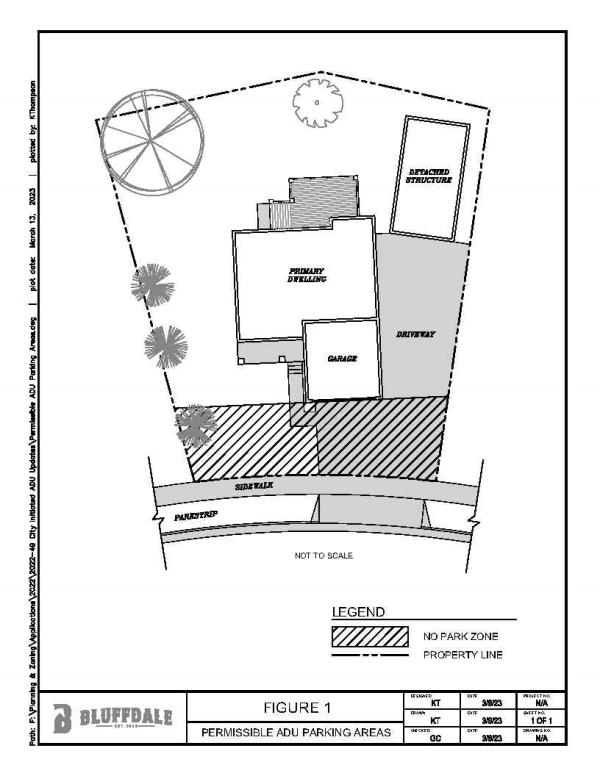
- Parking: At least one (1) off-street parking stall shall be constructed for an I-ADU. A minimum of two (2) off-street parking spaces shall be constructed for a D-ADU. Parking stalls for ADUs shall be constructed of an all-weather surface rolled and compacted road base, asphalt, or concrete surface which meet the dimensional requirements of Chapter 11.120 of this Title. Such parking stalls shall be in addition to all off-street parking requirements for the primary dwelling on the lot and be reserved for exclusive use by occupants of the approved ADU. The parking stalls for the ADU shall be located behind the front plane of the dwelling and shall not impede or prevent access to the primary dwelling's required parking. The parking stall may be in a garage only if the stall is in addition to the required number of parking spaces for the primary dwelling and is not a tandem parking stall. Driveways must conform to all applicable building and fire code requirements and adopted standards. See Figure 1 for illustration of permissible parking locations for ADUs.
- All ADUs shall comply with all applicable building, health and fire codes in effect at the time the ADU is constructed, created or subsequently remodeled. The owner of record shall be responsible to ensure that all required building permits and other permits are obtained for the creation of an ADU.
- ADUs that have been previously completed before July 1, 2023, and cannot be shown to have complied with building permit and inspection requirements for an ADU in effect at the time of their construction shall comply with the requirements of the International Existing Building Code and other applicable adopted building and fire codes and shall comply with all permit procedures and requirements of the City.
- Number of Residents. The total number of residents that reside in an ADU may not exceed the number allowed for a “family” for the lot on which the accessory dwelling unit is found, as defined in BCC 11.20.
- Home Occupations. Home occupations may be conducted in an ADU as allowed per Title 3 of the BCC. Standards for home occupations and associated impacts shall be calculated on a total per parcel basis, not per ADU.
- Addressing. Separate addressing and mailboxes for ADUs are not allowed.
- Continuing Use: Approval of an ADU shall run with the land if it complies with all adopted requirements.
FIGURE 1. PERMISSABLE ADU PARKING LOCATIONS
11.340.050 D-ADU Standards
The development standards set forth in this section shall apply to each D-ADU:
- A. Separate Structure: A D-ADU is a separate structure from the primary dwelling contained on the same lot or parcel as the primary dwelling.
- Conditions: A D-ADU shall comply with the applicable requirements of section 11.340.040 of this Title and all the following conditions:
- Only one D-ADU shall be allowed per lot or parcel.
- A D-ADU shall comply with the same setbacks for an accessory building in the zoning district in which the lot or parcel is located. Regardless of size, a D-ADU cannot be created within a building or structure which has utilized the reduced side and rear setbacks allowed for small accessory buildings or structures found in BCC 11.160.260. All structures shall also comply with the maximum lot coverage percentages for the zone in which it resides.
- A D-ADU shall be located within the rear or side yard area of the lot or parcel and is prohibited within the front yard area.
- The habitable square footage of a D-ADU shall be 400 square feet or greater in size.
- A D-ADU shall comply with all building construction and fire codes in effect at the time the D-ADU is constructed, created or subsequently remodeled, including obtaining the required building and other permits.
- D-ADUs shall be a permanent structure anchored to a foundation which meets the adopted building codes. Trailers, mobile homes, tiny homes with wheels, and other portable or temporary structures, or structures with wheels shall not be permitted as a D-ADU.
- Exterior lighting shall provide illumination directed downward. Light source shall be shielded and not be visible from adjacent properties.
- Windows on a façade, located within 20 feet of an adjacent property containing a single family or townhome residence, shall be translucent or installed as a skylight.
- Exterior stairways and landings shall not encroach within 20 feet of an adjacent property containing a single family or townhome residence.
- Balconies on a D-ADU shall be located on the interior side of the lot and building, not adjacent to a rear or side yard shared with a neighboring residence, and:
- Shall not exceed 80 square feet in size when located above the ground level of the building;
- Shall be located a minimum of 20 feet from a side or rear yard lot line unless the applicable side or rear yard lot line is adjacent to an alley;
- Rooftop decks or second-story decks are prohibited on an accessory structure used as a D-ADU.
- The height of a D-ADU shall conform to the height limit specified for accessory buildings in the zoning district in which it is located.
- A second kitchen in a D-ADU is not allowed.
- Entrance Locations. The entrance to a D-ADU shall be located:
- Facing an alley, public street, rear or side façade of the primary dwelling, or rear yard of the single-family dwelling on the same property.
- Facing a side or rear property line provided the entrance is located a minimum of 10 feet from the side or rear property line if at ground level or first story level or 20 feet from side or rear property line if above the first story.
- Exterior stairs leading to an entrance shall be located a minimum of 20 feet from a side or rear property line.
11.340.060 I-ADU Standards
The development standards set forth in this section shall apply to each I-ADU in addition to the general standards for all ADUs found in 11.340.040:
- Existing Structure: An I-ADU shall be contained within the footprint of the primary dwelling, which can also be above an attached garage. The existence of a second kitchen within the primary dwelling's footprint does not, by itself, qualify a living space as an I-ADU. An existing second kitchen located within a primary dwelling can be converted to an I-ADU as part of an application for the creation of an I-ADU in compliance with all other standards for I-ADUs listed in this chapter.
- Conditions: An I-ADU shall comply with the applicable requirements of this chapter and with all the following conditions:
- Only one I-ADU shall be allowed per lot or parcel.
- If an I-ADU is created within a garage or carport attached to the primary dwelling, the parking spaces contained within the garage or carport that are removed shall be replaced in accordance with adopted parking and access standards.
- The I-ADU shall comply with all applicable building, health, and fire codes in effect at the time the I-ADU is constructed, created, or subsequently remodeled. The owner of record shall be responsible to ensure that all required building permits and other permits are obtained for the creation of an I-ADU.
- In accommodating an I-ADU within the primary dwelling, the exterior of the primary dwelling may not be changed or altered in a manner that would alter the appearance of the primary dwelling from that of a single-family dwelling.
- Design And Character: I-ADUs shall retain the compatibility of the primary dwelling with the residential character of the neighborhood. I-ADUs shall include materials comparable to those used on and within the primary dwelling.
- Ownership: The single-family dwelling and the I-ADU shall remain in single ownership and either the single-family dwelling or the I-ADU shall be owner occupied in accordance with 11.340.040.
- Entrance Locations. Entrances to an I-ADU shall only be permitted in the following locations:
- An existing entrance to the single-family dwelling;
- Exterior stairs on lots other than a corner lot, leading to an entrance above or below the first level of the principal structure, may be located on a side or rear elevation of a building;
- Located on the rear facade of the dwelling.
11.340.070 Recorded Notice
- As part of the ADU permit process, the owner of the property shall execute a “notice of accessory dwelling unit” affidavit. The City shall record the notice with the County Recorder as a use condition on the property. The notice shall be in a form approved by the Bluffdale City Attorney. Once recorded, a copy of the notice shall be delivered to the owner of record.
- The notice of accessory dwelling unit shall include:
- A legal description and address of the property; and
- Either of the following statements as applicable to the type of ADU permit being issued:
- The primary dwelling contains an approved I-ADU and that the I-ADU may only be used in accordance with the land use regulations of the City of Bluffdale; or
- The property has an approved D-ADU and that the D-ADU may only be used in accordance with the land use regulations of the City of Bluffdale.
11.340.080 Nonconforming Units
- ADUs legally established prior to July 1, 2023, may continue to operate under the applicable provisions in effect at the time they were approved and established in accordance with this chapter of the BCC. Provided, however, legal nonconforming ADUs shall obtain and maintain an ADU permit under the procedures of section 11.340.030.
- ADUs converted from existing accessory buildings that were completed before July 1, 2023, do not have to modify existing entrance locations – including exterior stairways - if all applicable building and fire codes are met.
11.340.090 Violations
Violations of this chapter shall be enforced consistent with this title and Utah state code and may include fines and liens.
- Notice of Violation:
- Whenever an owner of record has violated any of the provisions of this chapter the City shall provide a written notice of violation. The notice of violation shall:
- Describe the violation;
- Provide the owner of record an opportunity to cure or correct the violation that is:
- Not less than fourteen (14) days after the notice of violation is issued, for violations of BCC 11.340.040(G);
- Not less than thirty (30) days after the notice of violation is issued for any other violation;
- Include a statement that if the owner of record fails to cure the violation within the given time period that they may be subject to daily fines, liens, the revocation of permits or approvals, criminal prosecution, and other enforcement actions permitted by applicable law;
- Provide notification to the owner of record that they may file a written objection to the violation within fourteen (14) days after the day on which the written notice of violation is post-marked or posted on the property;
- Indicate the department name and address where the owner of record may file the written objection;
- Be mailed to the owner of record, or to any other individual designated to receive notice in the owner's license or permit records, and a copy shall be posted on the property.
- If an owner of record files a written objection to the written notice of violation in accordance with Utah Code 10-9a-530(5), as amended, the Zoning Administrator shall provide notice, hold a hearing, and conduct a review to determine whether the violation described in the written notice of violation has occurred. If the Zoning Administrator determines that the violation in the notice of violation has occurred, the city may impose any of the remedies listed in this section or others as permitted by applicable law.
- If an owner of record does not file a written objection to the notice of violation and does not cure the violation within the time period provided in the notice, the city may impose any of the remedies listed in this section or others as permitted by applicable law.
- If an owner of record cures a violation within the time period prescribed in the notice of violation, or if the Zoning Administrator finds that the violation listed in the notice of violation has not occurred, the city may not impose sanctions.
- Whenever an owner of record has violated any of the provisions of this chapter the City shall provide a written notice of violation. The notice of violation shall:
- Liens:
- Notice of lien:
- A written notice of lien issued under this section shall:
- comply with the requirements of Utah Code 38-12-102 as amended;
- State that the property is subject to a lien;
- Specify the lien amount for each day of violation after the day on which the opportunity to cure the violation expired; and
- Be mailed to the owner of record, or to any other individual designated to receive notice in the owner's license or permit records, and a copy of the notice shall be posted on the property.
- Each notice of lien shall be recorded with the respective county recorder.
- A written notice of lien issued under this section shall:
- Notice of lien:
- Remedies:
- Revocation.
- In addition to cases of an uncured violation as set forth above, an ADU permit may be revoked if the Zoning Administrator determines:
- The permit was procured by false representation; or
- The permit was issued by mistake.
- After the written notice of revocation is served no further construction for an ADU may continue until a new permit is issued, or the permit is reinstated by the Zoning Administrator.
- If the permit was issued by mistake, the city shall notify the owner of record of the mistake and the actions or changes that must be made to bring the ADU into compliance with applicable requirements and ordinances.
- For properties where a permit has been revoked for any reason other than a mistake, a new or reinstated ADU permit may not be issued except in conformance with applicable ordinances, resolutions, regulations, and requirements.
- Properties for which an ADU permit has been revoked may be subject to the recordation of a notice of non-compliance against the property and shall be prohibited from renting, leasing, hiring or loaning the accessory dwelling unit.
- In addition to cases of an uncured violation as set forth above, an ADU permit may be revoked if the Zoning Administrator determines:
- The city shall have such other remedies as are and may be from time to time provided by Utah law or city ordinance for the violation of any provision of this title.
- All remedies pertaining to violations of this chapter are cumulative.
- Revocation.

