
Brighton City Zoning Code
ARTICLE 9
- Sign Standards
_____
9.01 - Purpose, Intent & Applicability
A.
Purpose. These sign regulations are established to safeguard the health, safety, convenience, order and welfare of all residents of the City. The City recognizes that signs may act as a visual means of communication between the public and businesses and those businesses have an expectation of using signs to identify and advertise themselves. The purpose of this Section is to provide a balanced and fair legal framework for the design, construction, and placement of signs that:
1.
Promote the safety of persons and property by ensuring that signs do not create a hazard by:
a.
Confusing or distracting motorists; or
b.
Impairing drivers' ability to see pedestrians, obstacles or other vehicles, or to read traffic signs.
2.
Promote the efficient communication of messages, and ensure that persons exposed to signs are not overwhelmed by the number of messages presented;
3.
Protect the public welfare and enhance the appearance and economic value of the landscape by reducing and preventing sign clutter;
4.
Ensure that signs are compatible with their surroundings, and prevent the construction of signs that are a nuisance to occupants of adjacent and contiguous property due to brightness, reflectivity, bulk, or height;
5.
Enhance property values and business opportunities;
6.
Assist in wayfinding; and
7.
Provide fair and consistent permitting and enforcement.
B.
Intent. It is the intent of these regulations to provide for the proper control of signs in a manner consistent with the First Amendment guarantee of free speech. It is not the intent of these regulations to regulate signs based on the content of their messages. Rather, this Section advances important, substantial, and compelling governmental interests.
1.
The incidental restriction on the freedom of speech that may result from the regulation of signs is no greater than is essential to the furtherance of the important, substantial, and compelling interests that are advanced by this Section.
2.
The City has an important and substantial interest in preventing sign clutter (which is the proliferation of signs of increasing size and dimensions as a result of competition among property owners for the attention of passing motorists and pedestrians), because sign clutter:
a.
Creates visual distraction and obstructs views, potentially creating a public safety hazard for motorists, bicyclists, and pedestrians;
b.
May involve physical obstructions of streets or sidewalks, creating public safety hazards;
c.
Degrades the aesthetic and essential historic character of the City, making the City a less attractive place for tourism, commerce, and private investment; and
d.
Dilutes or obscures messages displayed along the City's streets through the proliferation of distracting structures and competing messages.
3.
The City has a substantial and/or compelling interest in preventing traffic accidents.
4.
The City has a substantial and/or compelling interest in preventing negative impacts associated with temporary signs. Temporary signs may be degraded, damaged, moved, or destroyed by wind, rain, snow, ice, and sun, and after degradation, damage, movement, or destruction, signs harm the safety and aesthetics of the City's streets if they are not removed.
C.
Applicability. These regulations shall apply to the display, construction, erection, alteration, use, maintenance, and location of all signs within the City.
1.
All signs displayed, constructed, erected or altered after the date of the adoption of these regulations shall be in conformance with the provisions of these regulations. All signs that are existing at the time of the adoption of these regulations shall not be altered or enlarged without being brought into conformance with these regulations.
2.
The City recognizes other regulations pertaining to signage (i.e., State of Colorado, Department of Highways, "Rules and Regulations Pertaining to Outdoor Advertising," effective January 1, 1984, and as may be amended). Where any provision of this Section addresses the same subject matter as other regulations, the more restrictive regulation shall apply.
3.
Nothing in this Section shall be construed as a defense to a violation of applicable State or federal law.
4.
Nonconforming signs shall be considered as provided in Section 1.05.F.
9.02 - Sign Permits & Procedures
A.
Requirements. A sign permit shall be required in order to erect, move, alter, or reconstruct any permanent or temporary sign, except signs that are exempt from permits per Section 9.02.C.
1.
Changing or replacing the copy on an existing lawful sign shall not require a permit, provided that the copy change does not change the type of the sign or render the sign in violation of this Section.
2.
A sign permit shall be required for each sign.
a.
Each permit shall become invalid unless the work on the site authorized by such permit is commenced within 180 days after its issuance or if the work authorized on the site by such permit is suspended for a continuous period of 180 days after the time the work is commenced.
b.
The Director is authorized to grant, in writing, one or more extensions of time, for periods not more than 180 days each. The extension shall be requested in writing and justifiable cause demonstrated.
3.
In addition to the required sign permit, a building permit may be required by the City for signs incorporating structural elements or attached to buildings. Electrical permits may be required for signs that are illuminated or other signs with electrical components.
4.
All temporary signs not otherwise exempt from a sign permit shall require the submittal of a temporary sign permit application and the issuance of a temporary sign permit by the City.
a.
Approved temporary signs may be displayed for no more than 60 days in any ninety-day period and for a total of no more than 180 days per calendar year, unless as otherwise set forth in this Section.
b.
A maximum of 2 temporary sign permits may be issued per nonresidential use at any given time, and each temporary sign permit may grant up to 2 for approval. A maximum of 4 temporary signs may be posted at any given time for a nonresidential use.
5.
All applications for permits and/or licenses shall be accompanied by the appropriate fee as adopted and required by the City.
B.
Permit Procedures.
1.
An application for a sign permit shall be submitted on a form provided by the City. No sign permit shall be issued for any permanent sign on private property without written consent of the property owner or the owner's authorized agent.
2.
The applicant may choose to apply for a single permit for multiple signs in a unified or coordinated development by filing a comprehensive sign plan in accordance with Section 9.08.
3.
Upon receipt of a complete application the Director shall review the permit for compliance with this Section and all applicable building code requirements, and approve, approve with conditions, or deny the application.
4.
The Director shall have the right to inspect the proposed sign location prior to acting on the application and shall also have the right to inspect the sign after construction to ensure compliance with this Section and any conditions of approval.
5.
A sign permit shall lapse and have no further effect unless a sign has been erected in compliance with the terms and conditions of the permit within 1 year after the date of the sign permit approval.
6.
A denial of a sign permit by the Director may be appealed to the Board of Adjustment. All appeals to the Board of Adjustment shall be in accordance with the procedures provided in Article 2 of this Code.
C.
Permit Exempt Signs. The following signs are exempt from the sign permit requirements; however, exempt signs remain subject to the remaining provisions of this Article. Exempt signs shall otherwise be in conformance with all applicable requirements of this Section, and the construction and safety standards of the City. All signs not listed in this subsection require a sign permit. Unless otherwise specifically provided, exempt signs may not be illuminated. Exempt signs include:
1.
Signs erected by the City or by any federal, state or county government agency, including traffic control signs.
2.
Any public purpose/safety sign and any other notice or warning required by a valid and applicable federal, state or local law, regulation or resolution, provided that the sign does not exceed 4 square feet in area. These signs shall comply with the lighting requirements of this Article.
3.
Signs displayed on motor vehicles which are being operated or stored in the normal course of a business, provided that the primary purpose of the vehicle is not for the display of signs and provided that they are parked or stored in areas appropriate to their use as vehicles.
a.
Signs on vehicles shall not project beyond the surface of the vehicle on which they are attached a distance in excess of 6 inches.
b.
It shall be unlawful to place or store a vehicle with a sign on it in a manner that increases the permitted sign area or number of signs either on-site or off-site for a non-residential use.
4.
Scoreboards located adjacent to athletic fields are exempt and may be lighted, provided that scoreboards comply with the lighting requirements of this Article.
5.
Temporary decorations or displays may be of any type, number, area, height, location, illumination or animation, provided that decorations or displays:
a.
Are maintained and do not constitute a fire hazard; and
b.
Do not conflict with, interfere with or visually distract from traffic regulatory devices.
6.
Signs being carried by a person (handheld sign). Handheld signs shall not exceed 20 square feet in area. No person shall place, maintain or otherwise utilize a handheld sign in a manner which obstructs or makes hazardous the free passage of pedestrians and motor vehicles on any street, sidewalk or public-right-of way.
7.
Flags and pennants.
a.
Flags or pennants that are affixed to permanent flagpoles or flagpoles that are mounted to buildings (either temporary or permanent).
1.
Flags, when fully extended, shall not encroach on the public right-of-way.
2.
For any single lot, up to 3 poles for flags or pennants may be erected in any zone district in accordance with the maximum height requirement for such zone district.
3.
Flagpoles must be placed outside of sight triangles and must be setback at a minimum of 3 feet from any property line.
b.
Decorative flags or pennants or a combination, constituting an architectural feature which is integral to the design of a project. Each flag or pennant shall be secured to a building, structure, stable object or the ground.
c.
Flags or pennants shall be counted as part of the allowable square footage for signs.
8.
Yard signs, subject to the standards in Sections 9.04 and 9.07.
9.
Swing signs, subject to the standards in Sections 9.04 and 9.07.
10.
Site signs, subject to the standards in Sections 9.04 and 9.07.
11.
Feather banners, subject to the standards in Sections 9.04 and 9.07.
12.
Sidewalk signs, subject to the standards in Sections 9.04 and 9.07.
13.
Tethered balloons attached or anchored to prevent dislocation, entanglement or encroachment onto adjacent properties or public streets, or undue hazard to motorists or pedestrians. All other inflatable signs require a sign permit, and are subject to the standards in Section 9.07.
14.
Directional signs not exceeding 2 square feet in size.
15.
Window signs that are painted on, attached to or placed within 4 feet of the inside of a window, as long as they do not extend beyond the first story of the building on/in which they are located and are not animated, do not block any openings required for entrance or exit from the building, and do not cover over 25% of the total window area for the entire wall of the business.
a.
In addition, any sign displayed on a window of or inside a residential building, and any sign inside a non-residential building that is not visible through a window.
b.
Window signs must comply with the lighting requirements of this Article.
16.
Incidental signs which do not exceed 2 square feet in sign area.
17.
Architectural features or permanent building decorations that are integral to the design of a building or provide an artistic accent, provided that they comply with building height limits and setback requirements applicable to the property on which they are located.
18.
Display signs, subject to the standards in Section 9.04.
D.
Sign Removal and Alteration. Any alteration to an existing sign, other than for a change of copy or for maintenance, shall require a new sign permit.
1.
Alterations shall include hanging the size, shape, material, height, or changing or adding lighting to the sign.
2.
The City may cause the removal of any sign within the public right-of-way, on property that is otherwise abandoned, or that has been erected or placed without first complying with the requirements of this Article.
3.
Signs removed in compliance with this subsection shall be stored by the City for 30 days, during which time they may be recovered by the permit holder and/or owner upon payment to the City for costs of removal and storage.
a.
The costs of removal and storage, up to 30 days, may be billed to the owner.
b.
If not recovered within the thirty-day period, title to the sign and supporting structure shall vest with the City.
E.
Abandoned Signs. Any sign abandoned for a period of 90 days or longer shall be considered an illegal sign.
1.
If the sign owner fails or refuses to repair or remove an abandoned sign, the sign shall be deemed a nuisance and the City may abate the nuisance as provided in Section 8-6, Abatement of Nuisances, of the Brighton Municipal Code.
2.
This provision shall not apply to permanent signs accessory to businesses that are open only on a seasonal basis, provided that there is clear intent to continue operation of the business.
(Ord. No. 2405, §§ 31, 32, 1-3-2023)
9.03 - Prohibited Signs
The following signs are prohibited, except as noted:
A.
All signs not expressly permitted under this Article or exempt from a sign permit in accordance with 9.02.C.
B.
Signs on vehicles, when the vehicle is placed in a location for the primary purpose of displaying signage. See Section 9.02.C. for circumstances where vehicle signs are permitted.
C.
Portable signs.
D.
Banners not firmly attached on at least all 4 corners and/or not stretched tightly to avoid movement in windy conditions.
E.
Signs located on utility or light poles, benches (with the exception of bus bench signs permitted in Section 9.06) trash receptacles, other street furniture or any other form of public property or within any public right-of-way, unless explicitly permitted by this Section.
F.
Signs which produce audible noise or sounds.
G.
Signs which emit visible smoke, vapor, or odors.
H.
Signs that appear to or are designed to move, rotate, revolve, spin, swing, wave or make any other motion whatsoever; except for:
1.
Such signs that are less than 2 square feet per sign face;
2.
Temporary inflatable signs and tethered balloons in accordance with the requirements of this Article;
3.
Traditional barber poles; and
4.
Electronic message center signs for which a permit has been issued in accordance with the requirements of this Article.
I.
Signs that are animated with lights or illuminations which flash, move, rotate, scintillate, blink, flicker, vary in intensity, vary in color or use intermittent electrical pulsation, with the exception of electronic message signs meeting the requirements of this Section.
J.
Signs that have a fountain, chaser or strobe, including searchlights.
K.
Strings of light bulbs with a bulb greater than 0.25 inch used in connection with commercial premises for commercial purposes (excluding traditional holiday decorations).
L.
Any sign painted, erected and/or constructed upon, above or over the roof or parapet of any building, except for temporary inflatable signs and tethered balloons.
M.
Any sign other than traffic control signs, that is erected, constructed or maintained within, over or upon a public right-of-way, except sidewalk signs in conformance with Section 9.07, other signs otherwise granted permission for such location by the City or the Colorado Department of Transportation, or signs explicitly permitted within Section 9.06 K.
N.
Any sign that impedes pedestrian or vehicular movement, or is erected in a location that causes visual obstruction or interference with motor vehicle traffic or traffic-control devices, including any sign that obstructs clear vision in any direction from any street intersection or driveway.
1.
No sign greater than 30 inches in height may be permitted to locate within a vision triangle.
2.
Signs shall not interfere, visually or otherwise, with the effectiveness of any pedestrian sidewalk or way.
O.
Any sign that obstructs access to or impedes operation of any fire escape, downspout, window, door, stairway, ladder or opening intended to provide light, air, ingress or egress for any building or structure as may be required by law.
P.
Any sign or sign structure which is structurally unsafe, constitutes a hazard to safety or health by reason of inadequate maintenance, abandonment, dilapidation or obsolescence and/or is not kept in good repair.
Q.
Off-premises signs, except for 1) bus bench and bus shelter signs subject to Section 9.06, and 2) site signs subject to Section 9.07. An off-premises sign in existence at the time of the adoption of the initial ordinance may be maintained in use only so long as it is used in conjunction with the same business or activity with which it was associated and which was in existence on the date of adoption of the ordinance. Any off-premises sign which has been damaged or has not been maintained, or which is subject to any of the nonconforming limitations, shall be removed.
(Ord. No. 2405, § 33, 1-3-2023; Ord. No. 2480, § 1, 8-5-2025)
9.04 - Permitted Signs by District
A.
Residential Districts. Signs in all residential zoning districts shall be subject to the limitations and standards in Table 9-1. Signs may also be subject to standards for specific sign types in Section 9.06.
B.
Non-residential Districts. Signs in all non-residential and mixed-use zoning districts shall be subject to a total sign allowance, and the limitations in Tables 9-2 and 9-3. Signs may also be subject to standards for specific sign types in Section 9.06.
1.
Total Sign Allowance. The aggregate area of all permanent signs displayed on a site in a non-residential zoning district shall not exceed the following:
a.
1 square foot of sign per 1 foot of frontage. Example: A building has 100 feet of street frontage. The calculation would be as follows: (100 x 1) = 100 square feet of allowed signage.
b.
Property with a building frontage of less than 50 square feet shall be allowed a maximum aggregate sign area of 50 square feet.
c.
Where no street frontage exists, building frontage will be used to calculate the maximum aggregate sign area allowed.
d.
Vacant property without a building frontage may be permitted to display 2 signs, with the aggregate area of both signs not to exceed 64 square feet.
2.
Specific Sign Limits. The total sign allowance may be allocated to any of the sign types in Table 9-2, subject to the limitations in the table.
3.
Freestanding Height and Size Limits. Freestanding pole and monument signs are also limited by the standards in Table 9-3.
4.
Criteria for Bonus Sign Area. To encourage excellence in design and to protect and enhance public health, safety and welfare by reducing visually intrusive signs and promoting community aesthetics, the maximum sign area for freestanding signs for all nonresidential uses may be increased by the percentages below if the following criteria are met. A separate bonus shall be granted for compliance with each of the categories; the bonus is based upon the original allowed size standard. Any bonus area shall be counted toward the total allowable square footage. If fractions occur when bonuses are calculated, round fractions of five hundredths (.05) or above to the next higher number and round fractions less than five hundredths (.05) to the next lower number. All site plans and sign designs submitted for bonus sign area consideration shall be reviewed and approved by the Director. Bonus sign area for freestanding signs may be earned through utilizing any combination of the following two categories. The maximum bonus area allowed is 20% of the allowed sign area.
a.
Integration with building architecture design: A 10% bonus shall be available if all the freestanding signs are integrated with the building structure and design such that visual clutter is reduced and overall community aesthetics enhanced. The sign will be considered well integrated if the same or similar building materials and colors are used.
b.
Landscaped signs: a 10% bonus shall be available if all the freestanding signs within the development are located within a landscaped area. A minimum of 3 square feet of landscaping shall be provided for every 1 square foot of sign face. Only 1 face of the sign will be counted. The portion of the sign on the ground shall not count toward the landscaping. 75% of the sign area landscaping shall be living plants for a period of 3 years or a specific landscaping design approved by the Director.
C.
Planned Districts. Signs in a planned zoning district shall be in accordance with the most applicable base zoning district, except standards are specifically modified as part of the planned district approval, or otherwise according to a comprehensive sign plan as provided in 9.08. Signs in previously approved PUD zoning may be in accordance with any previous PUD approvals.
(Ord. No. 2405, §§ 34, 35, 1-3-2023)
9.05 - Standards for All Signs
A.
Sign Design.
1.
In general, signs shall have mutually unifying elements which may include uniformity in materials, color, size, height, letter style, sign type, shape, lighting, location on buildings, and design motif.
2.
Materials and textures of signs shall be compatible with the architectural character of the site and building. Supporting sign structures of freestanding signs shall match the primary finish and colors of the associated building(s).
3.
Where possible, freestanding pole and monument signs shall integrate tenant signs into a single sign structure.
4.
The electronic message area portion of a monument sign shall be integrated into the design of the monument sign. Such electronic message portions of a monument sign shall not be an add-on feature but rather must be fully integrated into the sign design. The entire sign must be compatible with the site design and/or building architecture.
5.
Wayfinding and directional signage systems shall be of a unified graphical system. Such signage shall be placed in consistent locations near site entries, key points on the internal automobile and pedestrian circulation system, building entries, seating areas, and sidewalk intersections.
B.
Sign Construction and Installation.
1.
Except for flags, window signs and temporary signs conforming to the requirements of this Section, all signs shall be constructed of high quality durable materials and shall be permanently attached to the ground, a building, or another structure by direct attachment to a rigid wall, frame, or structure. No plywood signs shall be permitted.
2.
All permanent signs and all components, including sign structures and sign faces, shall be installed in compliance with the adopted building and electrical codes of the City.
a.
All professional installations of signs shall require a contractor's license from the City prior to any installation.
b.
All electrical work for the construction and/or operation of a sign shall be performed in accordance with the Electrical Code as adopted by the City and shall be subject to inspection by the City for compliance therewith.
c.
Signs shall be located to maintain horizontal and vertical clearance of all overhead electrical conductors in accordance with adopted electrical code specifications, depending on voltages concerned. However, in no case shall a sign be installed closer than 48 inches horizontally or vertically from any conductor or public utility guy wire, or as recommended by the local public utility company.
d.
Every electric sign shall have an approved Underwriters' Laboratories label on it, or all wiring approved by the State electrical inspector, and all wiring connected to the sign shall comply with all provisions of the applicable regulations of the City relating to electrical installations.
e.
No sign or sign structure shall be installed that impedes pedestrian or vehicular movement, or erected in a location that obstructs or interferes with motor vehicle traffic or traffic-control devices, or obstructs clear vision in any direction from any street intersection or driveway.
f.
No sign or sign structure shall be installed that obstructs access to or impedes operation of any fire escape, downspout, window, door, stairway, ladder or opening intended to provide light, air, ingress or egress for any building or structure as may be required by law.
g.
Signs should not be placed in locations that obscure architectural features such as pilasters, arches, windows, cornices, etc.
h.
No sign or sign structure shall be installed which is structurally unsafe.
1.
All permanent freestanding pole signs shall have self-supporting structures erected on, or permanently attached to, concrete foundations.
C.
Sign Maintenance.
1.
All signs, both currently existing and constructed in the future, and all parts and components shall be maintained in a safe condition in compliance with all building and electrical codes, and in conformance with this Article.
a.
All signs, including sign structures and sign faces, shall be maintained in good repair at all times and shall not constitute a hazard to safety, health or public welfare by reason of inadequate maintenance or deterioration. For the purposes of this Article, good repair shall mean that there are no loose, broken, torn or severely weathered or faded portions of the sign structure or sign face.
b.
The owner of any sign regulated by this Article shall be required to keep signs and supporting hardware structurally safe, clean, free of visible defects, including graffiti, and functioning properly at all times. Exposed surfaces shall be clean and painted if paint is required. Defective parts shall be replaced. Repairs to signs shall be equal to or better in quality of materials and design than the original sign.
c.
All electronic message centers shall be equipped with a malfunction display and the ability to automatically shut off if a malfunction occurs. An electronic message center under repair shall be shut off.
d.
Bus bench signs shall be maintained in a safe and clean condition at all times. Damaged or disfigured benches shall be repaired or replaced immediately upon notification by the City of damage or disfigurement, or the bench will be removed. The area around and under a bus bench must be kept clear of ice, snow, mud, trash and weeds.
2.
All signs or any part of a sign which is broken or damaged or which is not reasonably maintained such as to present a nuisance, hazard or potential hazard, including any required landscaping, shall be repaired or removed by the sign owner such that the sign no longer is a nuisance or endangers public health and/or safety. If the sign owner fails or refuses to repair or remove the unsafe sign, the sign shall be deemed a nuisance and the City may abate the nuisance as provided in Section 8-24, Abatement of Nuisances, of the Brighton Municipal Code.
D.
Lighting. Signs may be illuminated by external or internal means, unless as otherwise specifically provided in this Article, subject to the following standards:
1.
The brightness and intensity shall not be greater than necessary to meet reasonable needs of the business or use served;
2.
Light sources shall be shielded, shaded or hooded to direct the light inward and downward onto the sign and away from all adjacent buildings and streets;
3.
The lighting shall not create excessive glare to pedestrians and/or motorists, and will not obstruct traffic control or any other public informational signs;
4.
Electrical supply to illuminated freestanding pole or monument signs shall be underground; and
5.
An electrical permit may be required per the electrical code for signs that are illuminated.
6.
When commercial areas are adjacent to residential areas, the use of illuminated signs may be restricted at the discretion of the Director.
9.06 - Standards for Specific Sign Types
A.
Electronic Message Center.
1.
General.
a.
Electronic message copy shall only be permitted on monument signs, display signs oriented to vehicles in a drive aisle, and incidental signs. Electronic message copy on wall signs, window signs, pole signs or any other sign is not permitted.
b.
Existing signage proposed for conversion to the use of an electronic message center shall conform to the sign standards in this subsection prior to issuance of a sign permit.
c.
Non-conforming signs shall not be eligible for conversion to an electronic message center.
2.
Location.
a.
Monument signs with electronic message copy shall only be permitted on properties or developments with a minimum of 200 linear feet of street frontage. In instances where a property has more than 1 street frontage, only the street frontage that the sign shall be oriented to and set back from shall be utilized to determine the minimum linear street frontage.
b.
Display signs with electronic message copy shall be located on the driver's window side of a drive-through lane.
3.
Quantity, Area and Height.
a.
A maximum of 1 monument sign with electronic message copy per property or development shall be permitted.
b.
A maximum of 1 display sign with electronic message copy per drive-through lane shall be permitted.
c.
The electronic message area portion of the sign shall not make up more than 50% of the sign face. If areas of the support base which are above grade utilize permanent, dimensional letters or symbols, these areas shall be counted as signage.
4.
Lighting.
a.
The sign shall have automatic dimmer software or solar sensors to control brightness for nighttime viewing. The intensity of the light source shall not produce glare, the effect of which constitutes a traffic hazard or is otherwise detrimental to the public health, safety or welfare.
b.
Applications for sign permits containing an electronic display shall include the manufacturer's specifications and nit (candela per square meter) rating. The Director may place a maximum nit (candela per square meter) on the sign permit approval.
(1)
In no instance shall a sign be approved with a maximum nit (candela per square meter) of more than 600 between sunset and sunrise as measured from the sign's face.
(2)
Between sunrise and sunset, the maximum shall not exceed 5,000 nits (candelas per square meter) or 0.3 foot-candles over the ambient light, whichever is lower, as measured from the sign's face.
(3)
In some instances, especially in sensitive areas (i.e. proximity to residential, parks, open space or other similar uses), the Director may place a maximum nit (candela per square meter) less than these maximums on the sign permit approval.
c.
Documentation shall be provided from the sign manufacturer which verifies compliance with auto dimming and brightness requirements.
d.
City officials may enter the property and view the programmed specifications of the sign to determine compliance with this provision of this Section in accordance with Article 1-20, Right of Entry for Inspection, of the Brighton Municipal Code.
5.
Transitions
a.
The electronic message center shall be limited to static messages, changed only through either dissolve or fade transitions, which may otherwise not have movement, or the appearance or optical illusion of movement, of any part of the sign structure, design, or pictorial segment of the sign, including the movement of any illumination or the flashing, scintillating or varying of light intensity.
b.
The transition duration between messages shall not exceed 1 second.
c.
The message hold time shall be a minimum of 20 seconds.
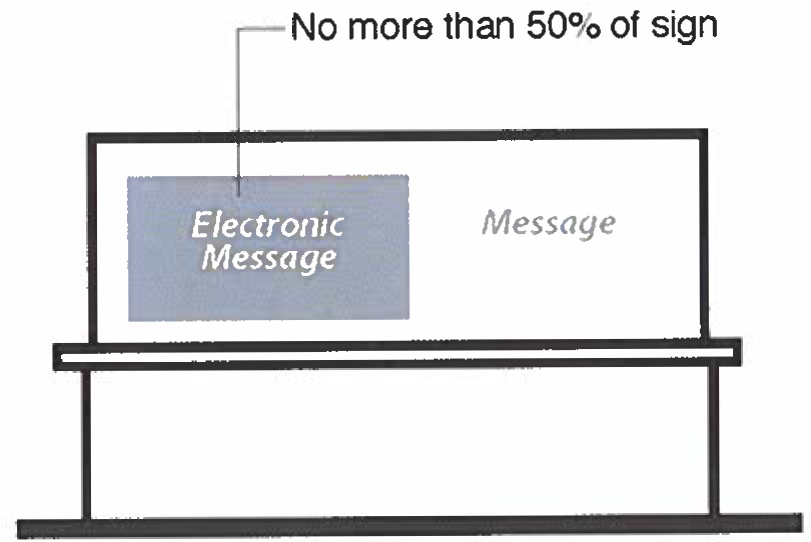
Figure 9-2 Electronic Message Center Detail
B.
Awning Signs.
1.
Location.
a.
An awning may include a printed or mounted sign. No sign mounted to an awning shall project beyond, above or below the face of an awning.
b.
Awning signs shall be placed on a ground floor facade, except for businesses located above the ground level with direct exterior pedestrian access.
c.
Awning signs shall be limited in the Downtown Zone District to a projection distance of 4 feet, but in no event shall such signs project beyond the curb line. In all other commercial and industrial zone districts, awning signs shall be limited to a projection of 6.5 feet from the building wall.
d.
All proposed awning signs shall submit a detailed structural analysis to ensure security to the awning, and of the awning to the wall of the structure
2.
Quantity, Area and Height. Sign quantity and area shall comply with the requirements established in Section 9.04.
a.
No structural element of an awning shall be located less than 8 feet above finished grade.
b.
Awning signs shall not be higher than the wall from which the sign projects if attached to a single story building, or the height of the bottom of any second story window if attached to a multi-story building. No point on any awning sign shall project above the roof or parapet line of any building.
c.
The area of an awning sign shall be included in the total sign area allowed for wall signs and may not exceed the total square footage allowed for a wall sign per building frontage.
3.
Lighting. Awnings may be internally illuminated only.
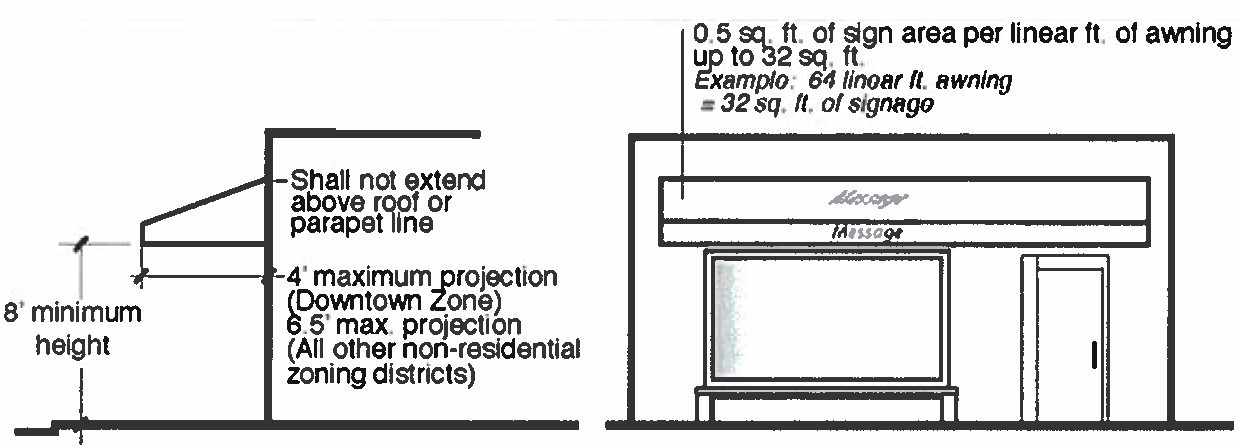
Figure 9-3 Awning Sign Detail
C.
Bus Bench & Bus Shelter Signs.
1.
Location.
a.
No more than 2 bus benches may be placed at a given bus stop unless otherwise permitted by the City in agreement with RTD.
b.
No permit will be issued for a bus bench at an RTD bus stop adjacent to any residentially zoned property without written consent of the owners of the adjacent property.
c.
Bus benches must be placed at least 3 feet from the curb or edge of pavement if no curb exists. Benches may not interfere with the safe and efficient passage of pedestrians and specifically may not impede pedestrian access to or use of traffic control devices.
d.
Copy or graphics placed on bus benches shall display no fluorescent or other reflective color or material.
e.
The bus bench company name and phone number must be on each bench.
f.
The City shall have the right to remove any bus bench within the public right-of-way after giving 15 days' written notice to the bus bench owner of the removal. In cases where a bus bench creates a public safety hazard, the City may remove the bus bench without any written notice.
2.
Quantity, Area and Height.
a.
Bus benches shall be no longer than 8 feet, no higher than 42 inches and no wider than 30 inches, and must weigh no less than 300 pounds.
b.
The total square footage of signage on a bus shelter shall be limited to 48 square feet, with no individual sign larger than 24 square feet.
3.
Lighting. Bus bench and bus shelter signs shall not be illuminated.
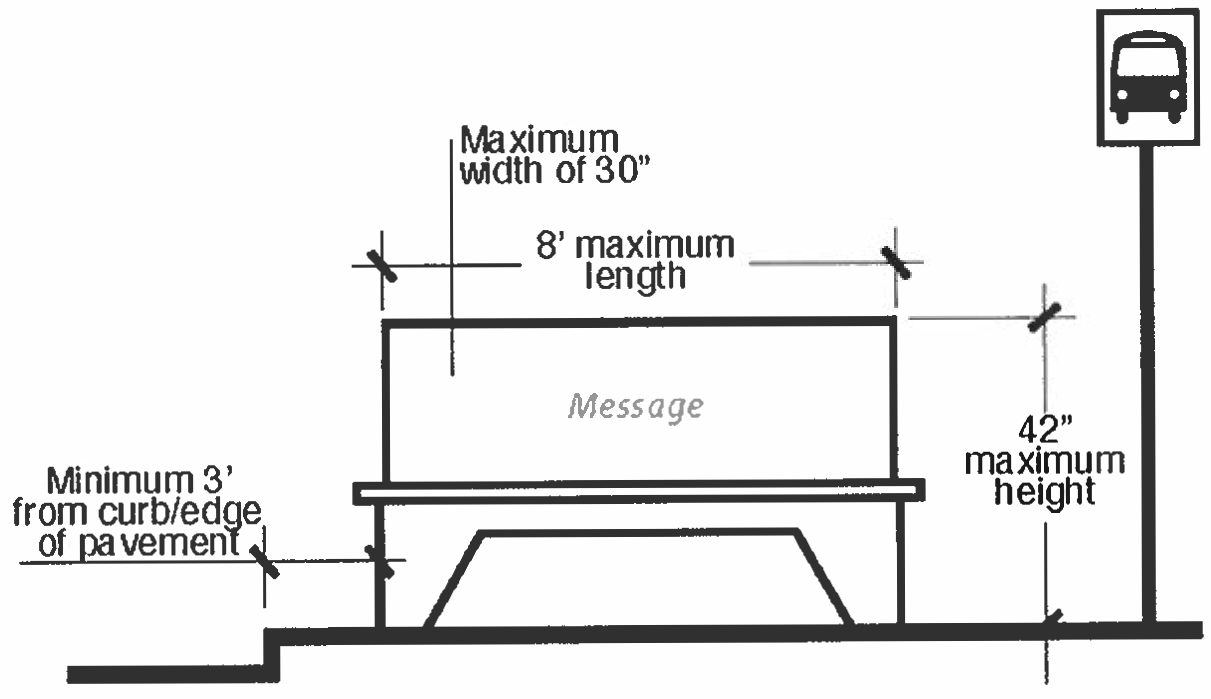
Figure 9-4 Bus Bench Sign Detail
D.
Canopy Signs.
1.
Location.
a.
Signs may be placed on canopies that front a street, parking lot or pedestrian way, or that are located in a driveway.
b.
A canopy may include a printed or mounted sign.
c.
No sign mounted to a canopy shall project beyond, above or below the face of a canopy.
2.
Quantity, Area and Height. Sign quantity and area shall comply with the requirements established in Section 9.04.
a.
No structural element of a canopy sign shall be located less than 8 feet above finished grade in a pedestrian way, or less than 14 feet above finished grade in a vehicular way.
b.
Canopies on which signs are printed or mounted shall not extend over a public right-of-way more than 7 feet from the face of a supporting building, and be no closer than 2 feet to a curb line.
c.
No canopy, with or without signage, shall extend above the roof or parapet line of any building.
d.
No canopy sign shall project above the top of the canopy upon which it is mounted. However, a sign may project horizontally from the face of a canopy the distance necessary to accommodate the letter thickness and required electrical equipment, but not more than 18 inches.
e.
The area of a canopy sign shall be included in the total sign area allowed for wall signs and may not exceed the total square footage allowed for a wall sign per building frontage.
3.
Lighting. Canopies may be internally illuminated only.
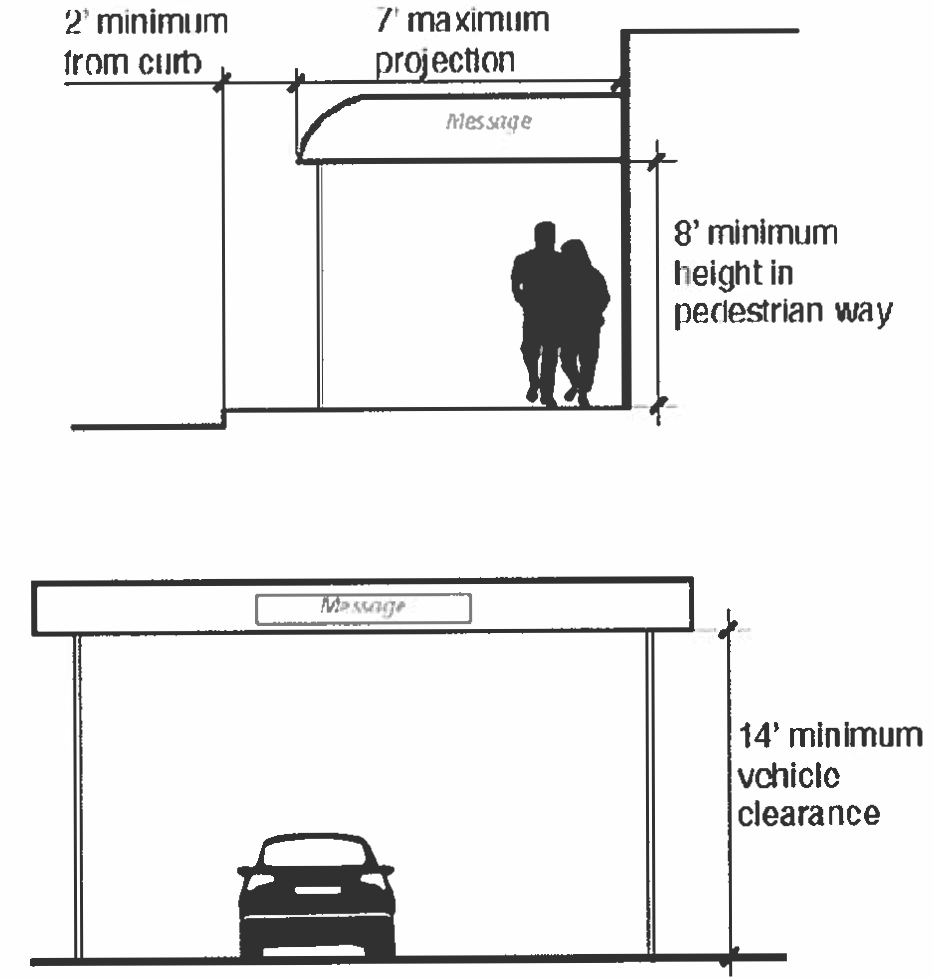
Figure 9-5 Canopy Sign Details
E.
Display Signs.
1.
Location.
a.
Signs oriented to pedestrians shall be mounted on a wall.
b.
Signs oriented to vehicles in a drive aisle shall be monument signs and shall not be designed to be read from the public right-of-way nor to attract attention to the site from the right-of-way.
2.
Quantity, Area and Height.
a.
A maximum of 1 display sign shall be permitted per site or per drive aisle.
b.
If mounted on a wall oriented to pedestrians, such signs shall not exceed 6 square feet.
c.
If oriented to occupants of a vehicle in a drive aisle, such signs shall not exceed 32 square feet.
3.
Lighting.
a.
Such signs may be illuminated, subject to the lighting standards in Section 9.05.
b.
Display signs oriented to occupants of a vehicle in a drive aisle may also be electronic message center signs, subject to the standards in Section 9.06.
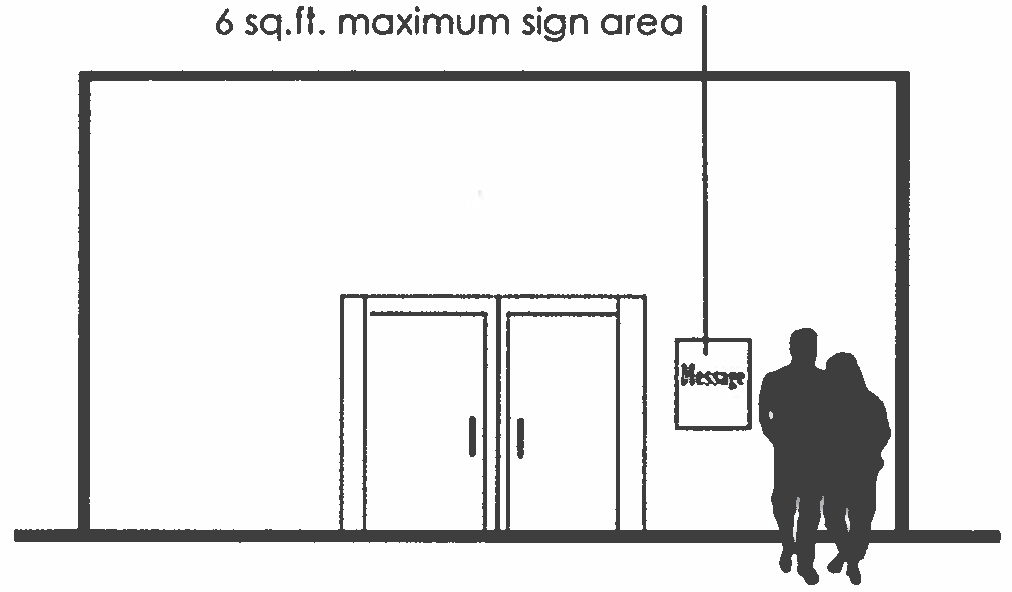
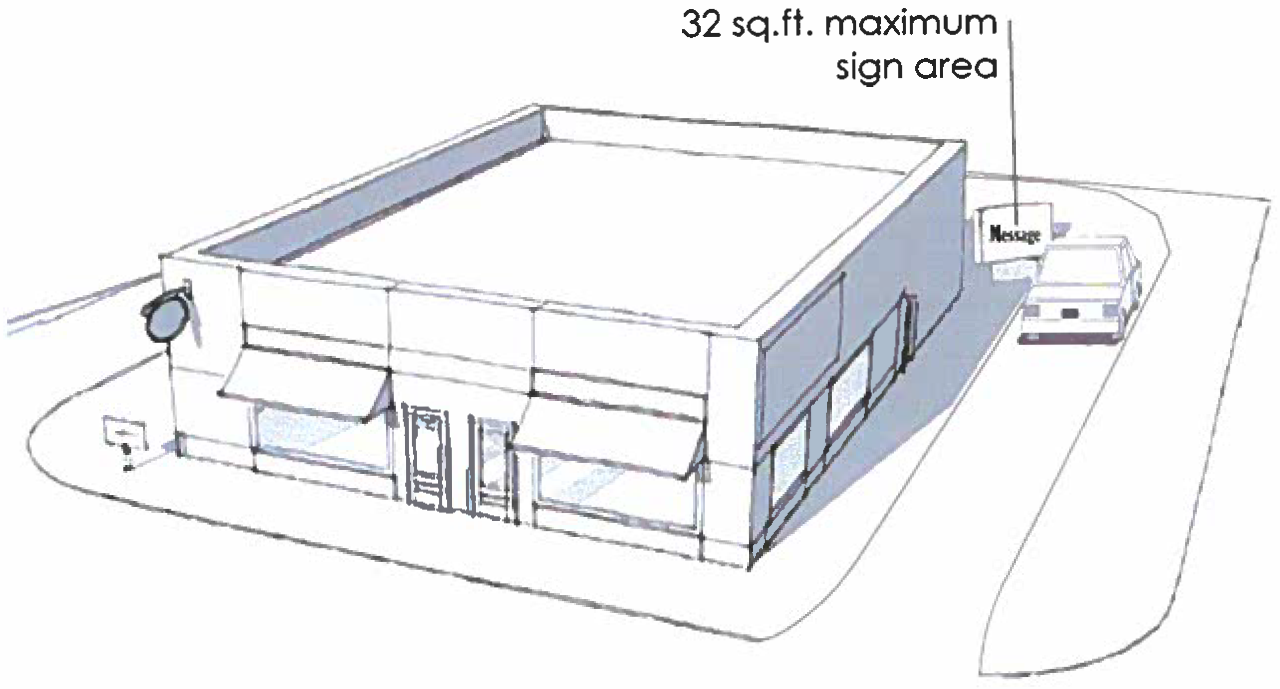
Figure 9-6 Display Sign Details
F.
Marquee Signs.
1.
Location.
a.
A marquee sign shall be placed on a ground floor facade of a building.
b.
Marquee signs shall be limited in the Downtown Zone District to a projection distance of 4 feet, but in no event shall such signs project beyond the curb line. In all other commercial and industrial zone districts, marquee signs shall be limited to a projection of 6.5 feet from the building wall.
c.
All proposed marquee signs shall submit a detailed structural analysis to ensure security to the wall of the structure.
2.
Quantity, Area and Height. A marquee sign shall comply with the quantity, area and height requirements established Section 9.04.
a.
No structural element of a marquee sign shall be located less than 8 feet above finished grade.
b.
Marquee signs shall not be higher than the wall from which the sign projects. No point on any marquee sign shall project above the roof or parapet line of any building.
c.
The area of a marquee sign shall be included in the total sign area allowed for wall signs and may not exceed the total square footage allowed for a wall sign per building frontage.
3.
Lighting. Marquee signs may be internally or externally illuminated.
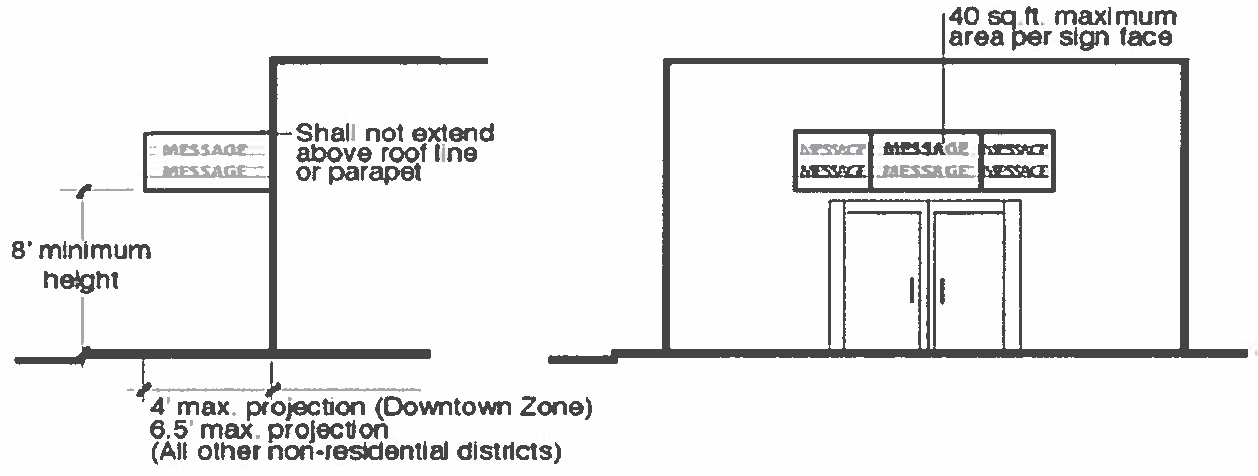
Figure 9-7 Marquee Sign Details
G.
Monument Signs.
1.
Location.
a.
Monument signs shall be located on a street frontage, unless as otherwise shown on an approved PUD plan. A main entrance on a street frontage shall be defined as the ingress/egress point off a collector street, a minor arterial or a major arterial as established by the Transportation Master Plan.
b.
A monument sign shall not obstruct any vehicle or pedestrian movement, and shall be setback according to Table 9-3.
2.
Quantity, Area and Height. A monument sign shall comply with the quantity, area and height requirements established in Section 9.04.
a.
Height and sign area exceptions for freeway-oriented monument signs:
(1)
In Commercial and Industrial Zone Districts, all signs located within a 350-foot radius of the center of an interchange (except for Interstate 76 interchanges which have a 500-foot radius) shall not exceed a maximum area of 100 square feet and a maximum height of 50 feet, but shall be allowed to locate on or near the property line.
(2)
All other signs located along the freeway corridors shall not exceed a maximum area of 80 square feet and a maximum height 20 feet, but shall be allowed to locate on or near the property line.
3.
Lighting. Monument signs may be internally or externally illuminated.
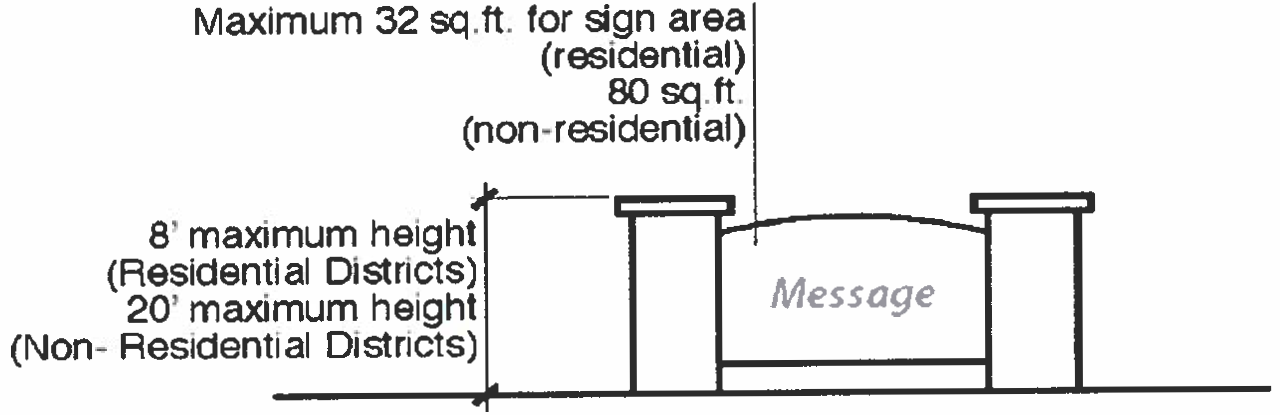
Figure 9-8 Monument Sign Details
H.
Pole Signs.
1.
Location.
a.
Pole signs shall be located on a street frontage.
b.
No portion of any pole sign shall encroach or project into the public right-of-way.
2.
Quantity, Area and Height. A pole sign shall comply with the quantity, area and height requirements established in Section 9.04.
a.
Height and sign area exceptions for freeway-oriented pole/freestanding signs:
(1)
In Commercial and Industrial Zone Districts, all signs located within a 350-foot radius of the center of an interchange (except for Interstate 76 interchanges which have a 500-foot radius) shall not exceed a maximum area of 100 square feet and a maximum height of 50 feet, but shall be allowed to locate on or near the property line.
(2)
All other signs located along the freeway corridors shall not exceed a maximum area of 80 square feet and a maximum height of 20 feet, but shall be allowed to locate on or near the property line.
3.
Lighting. Pole signs may be internally illuminated only.
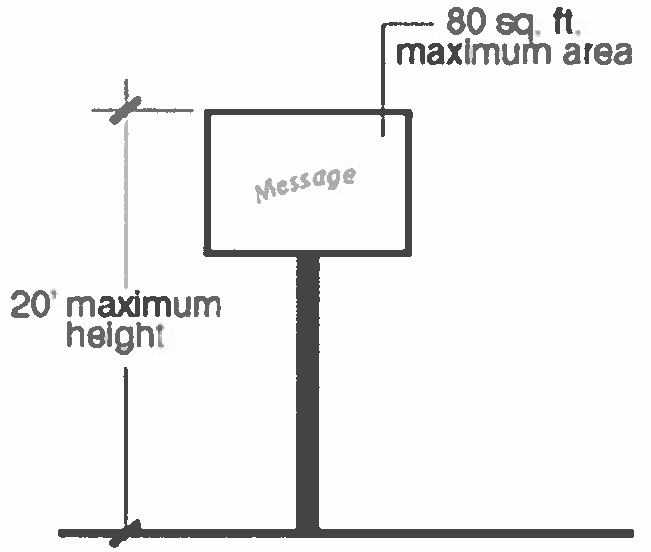
Figure 9-9 Pole Sign Details
I.
Projecting Signs.
1.
Location.
a.
Projecting signs shall be placed on a ground floor facade, except for businesses located above the ground level with direct exterior pedestrian access.
b.
The sign face of a projecting sign shall project at an approximate angle of 90 degrees.
c.
Projecting signs shall be limited in the Downtown Zone District to a projection distance of 4 feet, but in no event shall such signs project beyond the curb line. In all other commercial and industrial zone districts, projecting signs shall be limited to a projection of 6.5 feet from the building wall.
d.
All proposed projection signs shall submit a detailed structural analysis to ensure security to the wall of the structure.
2.
Quantity, Area and Height. A projecting sign shall comply with the quantity, area and height requirements established in Section 9.04.
a.
No structural element of a projecting sign shall be located less than 8 feet above finished grade.
b.
Projecting signs shall not be higher than the wall from which the sign projects if attached to a single story building, or the height of the bottom of any second story window if attached to a multi-story building. No point on any projecting sign shall project above the roof or parapet line of any building.
3.
Lighting. Projecting signs shall not be illuminated.
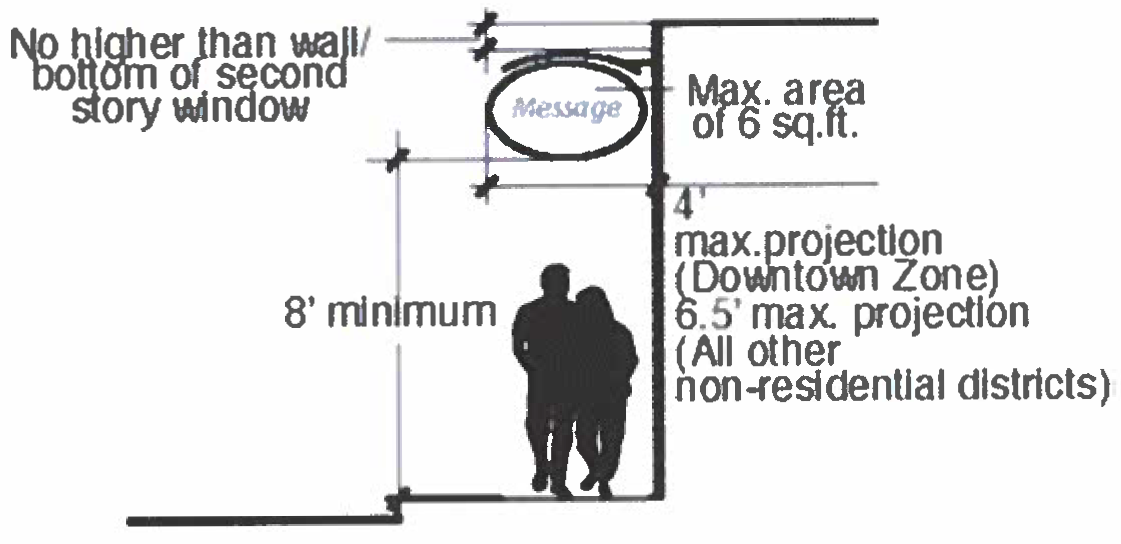
Figure 9-10 Projecting Sign Detail
J.
Wall Signs.
1.
Location. A wall sign shall not:
a.
Obstruct any portion of a window, doorway or other architectural detail;
b.
Extend above the eave or parapet line of any building; or
c.
Project from the building wall more than required for construction purposes and in no case more than 18 inches.
2.
Quantity, Area and Height. A wall sign shall comply with the quantity, area and height requirements established in Section 9.04.
a.
Multiple wall signs are permitted as long as the total sign area does not exceed the allowance established in subsections b. and c. below.
b.
No wall sign shall exceed 10% of the wall face to which it is attached.
c.
A wall sign or signs shall not be greater than 80% of the length of the tenant space or the length of the building frontage for single-tenant buildings. This is to assure that the sign of one tenant is not so close to the sign of an adjacent tenant that the 2 signs would run into each other.
3.
Lighting. Wall signs may be internally or externally illuminated.
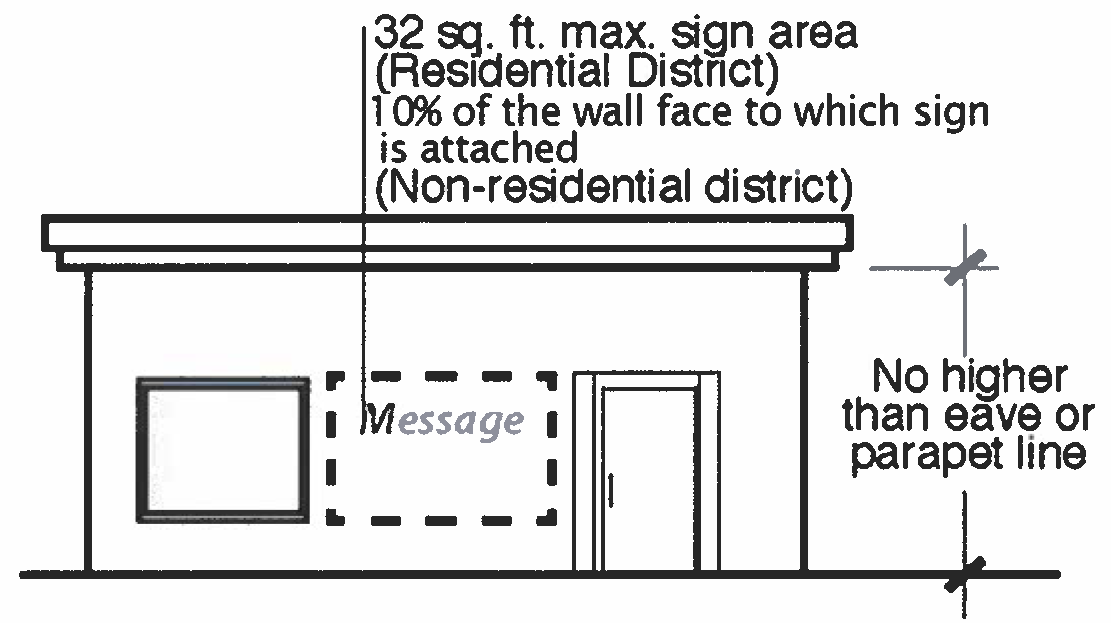
Figure 9-11 Wall Sign Detail
K.
Brighton Identity Signage. Brighton identity signage is intended to generate a unique sense of place for Brighton by incorporating themed signs at gateways and themed wayfinding elements for important features throughout the City. Brighton identity signage may be located either on a site or within the right-of-way. Brighton identity signage shall not count toward the total sign allowance on a site.
1.
Primary Gateway Signs.
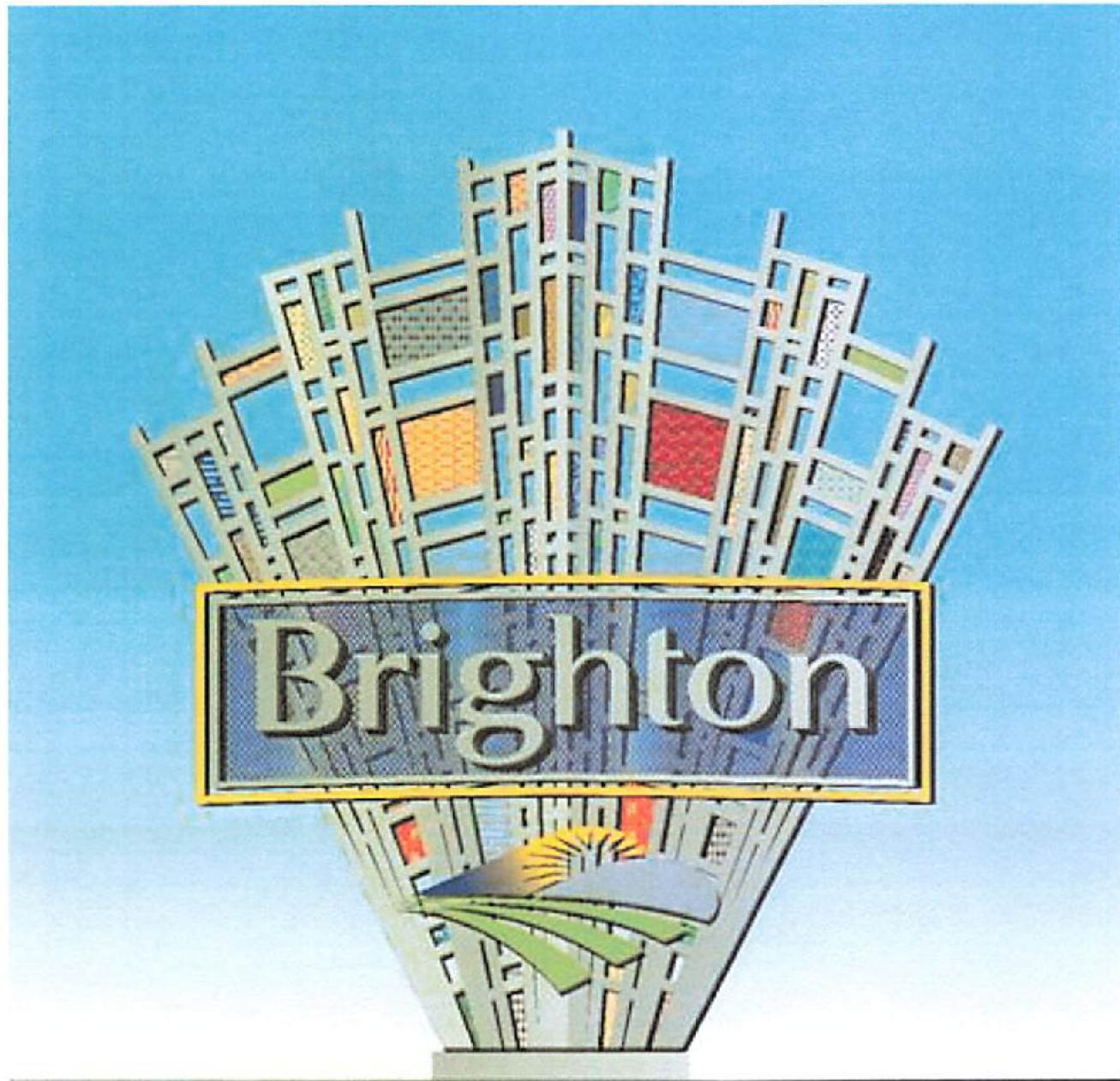
a.
Location. Primary gateway signs may be located at any of the following intersections:
(1)
Highway 85 and West Bridge Street (CO-7);
(2)
I-76 and East Bridge Street;
(3)
I-76 and East Bromley Lane;
(4)
1-76 and Eagle Boulevard; and
(5)
E-470 and Sable Boulevard (South 4 th Avenue).
b.
Quantity and Height.
(1)
One primary gateway sign shall be allowed per intersection.
(2)
Any quantity of artistic elements per Section 9.10 E. shall be allowed to accompany the primary gateway sign.
(3)
Primary gateway signs may not exceed 80 feet in height.
c.
Lighting. Primary gateway signs may be internally or externally illuminated.
2.
Secondary Gateway Signs.
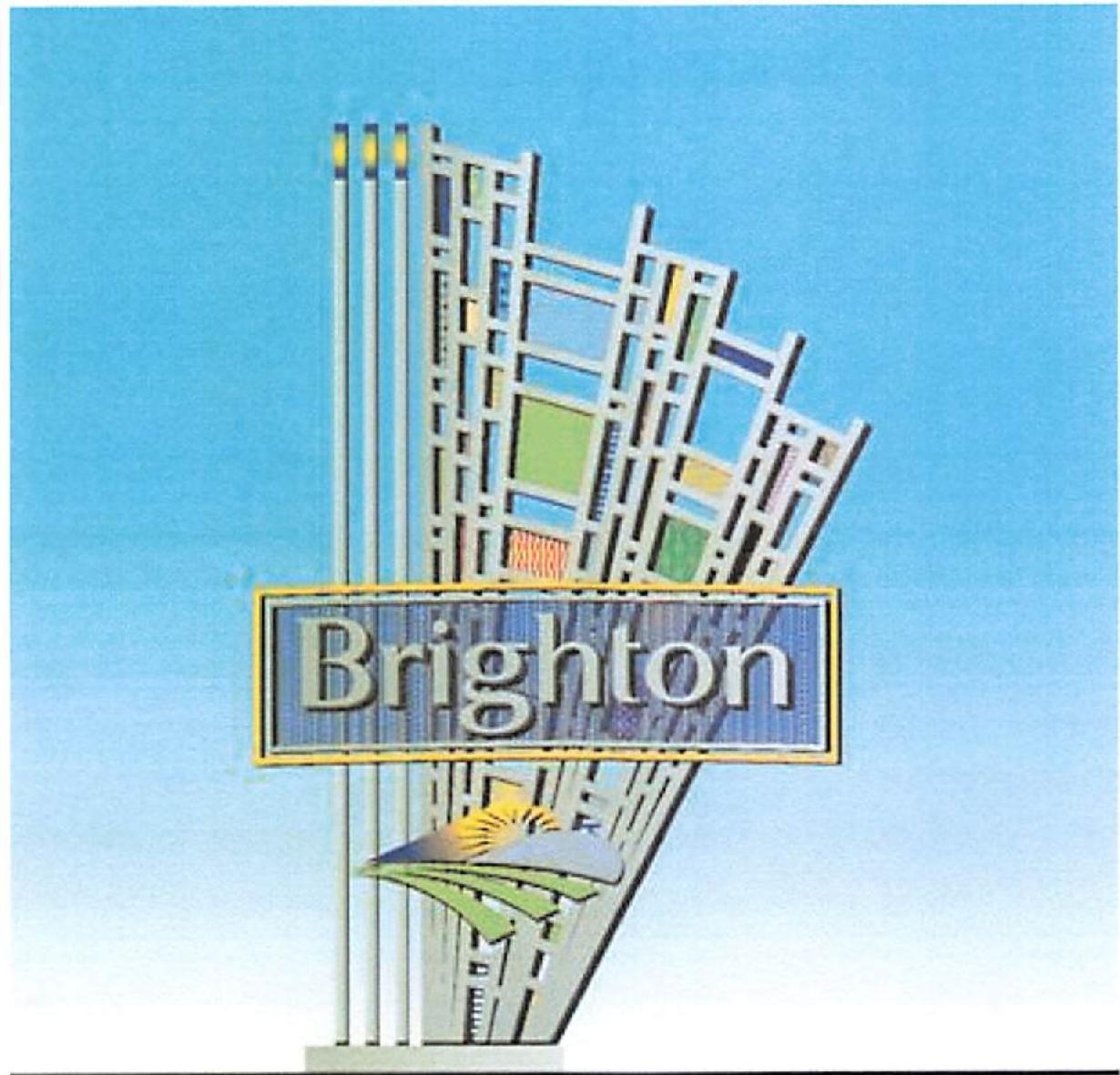
a.
Location.
(1)
Secondary gateway signs may be located at any of the following intersections:
(1)
All intersections where the primary gateway signs are permitted;
(2)
Highway 85 and Weld County Road 4;
(3)
South 4 th Avenue and East Bromley Lane;
(4)
Highway 85 and 136 th Avenue; and
(5)
South 27 th Avenue and 136 th Avenue.
(2)
Secondary gateway signs may be located at any of the following river crossings;
(1)
East 168 th Avenue and the South Platte River;
(2)
E-470 and the South Platte River; and
(3)
East 120 th Avenue and the South Platte River.
b.
Quantity and Height.
(1)
One secondary gateway sign shall be allowed per intersection or river crossing.
(2)
Any quantity of artistic elements per Section 9.10 E. shall be allowed to accompany the secondary gateway sign.
(3)
Secondary gateway signs may not exceed 40 feet in height.
c.
Lighting. Secondary gateway signs may be internally or externally illuminated.
3.
Tertiary Gateway Signs.
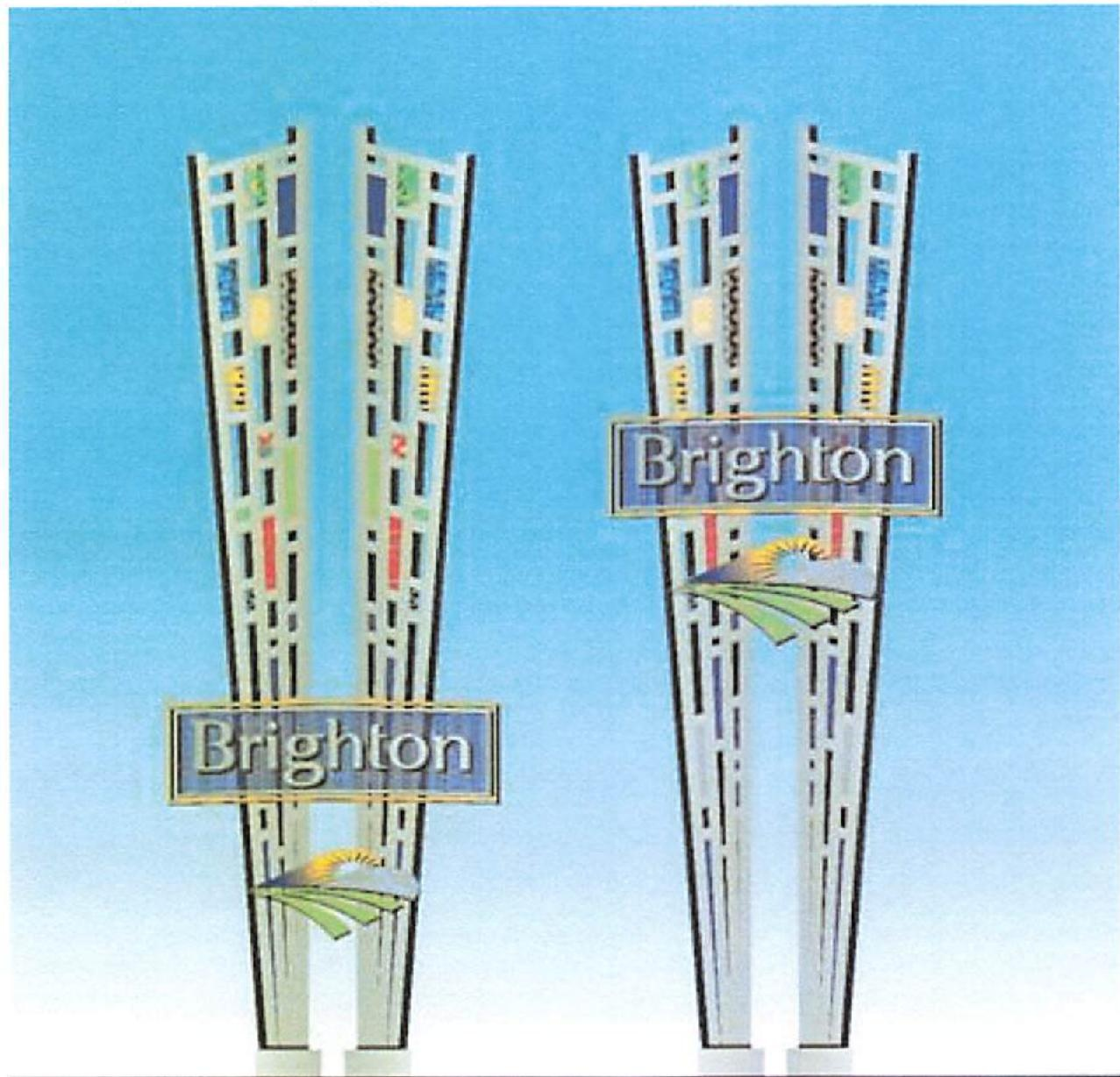
a.
Location. Tertiary gateway signs may be located at any of the following intersections:
(1)
All intersections where the primary gateway signs are permitted;
(2)
All intersections where the secondary gateway signs are permitted; and
(3)
All river crossings where the secondary gateway signs are permitted.
b.
Quantity and Height.
(1)
One tertiary gateway sign shall be allowed per intersection.
(2)
Any quantity of artistic elements per Section 9.10 E. shall be allowed to accompany the tertiary gateway sign.
(3)
Tertiary gateway signs may not exceed 40 feet in height.
c.
Lighting. Tertiary gateway signs may be internally or externally illuminated.
4.
Trail Gateway Signs and Wayfinding Signs.
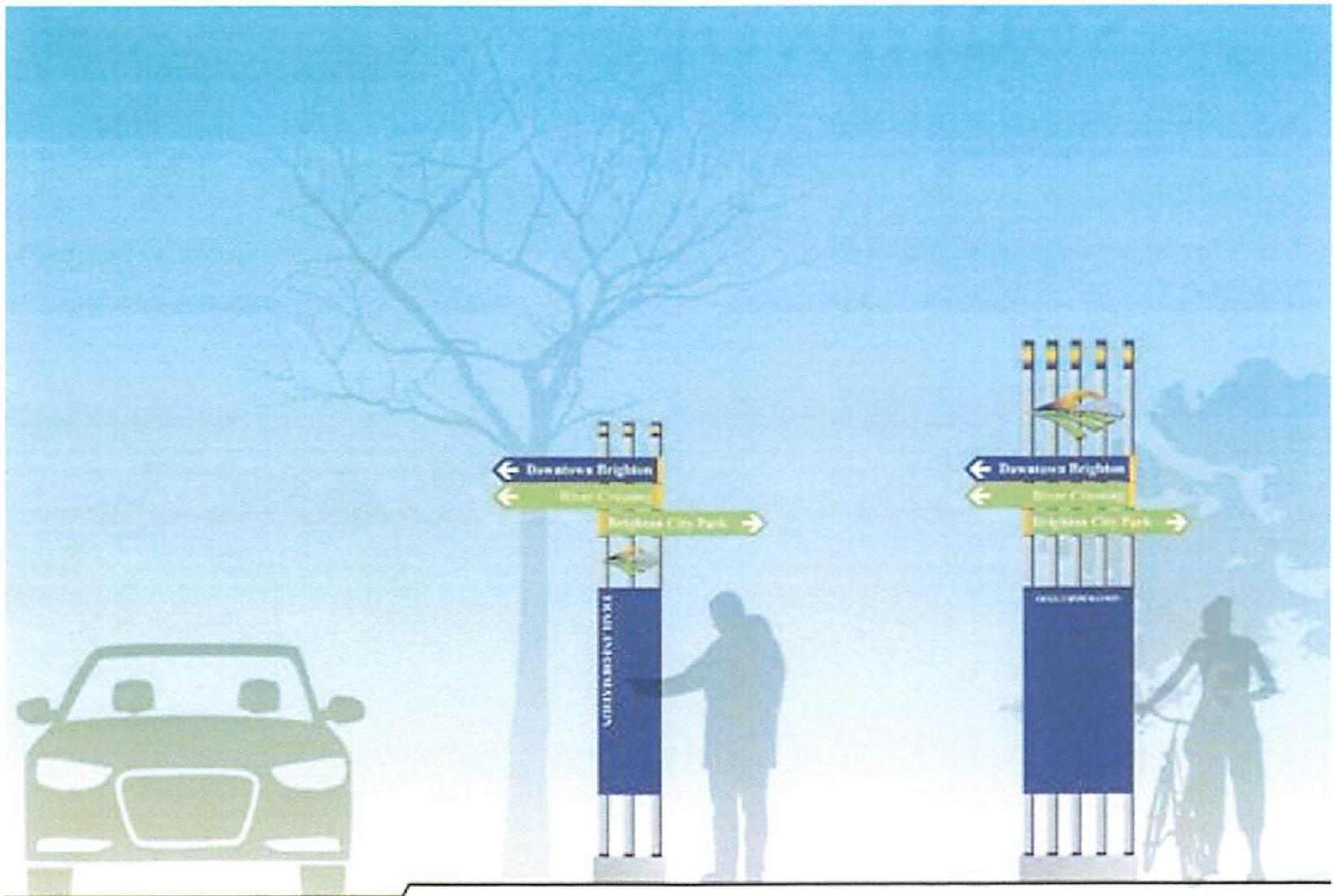
a.
General.
(1)
Trail gateway signs are intended to create clear directional guidance for local and regional trails that pass through Brighton. They are intended to mark entrances to Brighton, trailhead accesses, directions to connecting trails, and similar destinations.
(2)
Wayfinding signs are intended to guide residents and visitors to local places within and around the City of Brighton. The wayfinding signs are primarily intended to be installed at a pedestrian scale and used by foot traffic but could also be located along roadways to guide drivers to different destinations.
b.
Location. Trail gateway signs may be located at any intersection or along trails, with priority for the following intersections:
(1)
Longs Peak Street at the Fulton Ditch Trail;
(2)
East Bridge Street at the Brighton Lateral Ditch Trail;
(3)
Prairie Center Parkway at the Brighton Lateral Ditch Trail;
(4)
East 132 nd Avenue at the Fulton Ditch Trail; and
(5)
East 120 th Avenue at the Burlington Ditch Trail.
c.
Wayfinding signs may be located at any intersection or along streets or along trails.
d.
Quantity and Height.
(1)
Up to four gateway and wayfinding signs shall be allowed per intersection.
(2)
Any quantity of artistic elements per Section 9.10 E. shall be allowed to accompany the trail gateway signs and wayfinding signs.
(3)
Trail gateway signs and wayfinding signs may not exceed 20 feet in height.
e.
Lighting. Trail gateway signs and wayfinding signs may be internally or externally illuminated.
5.
Artistic Elements.
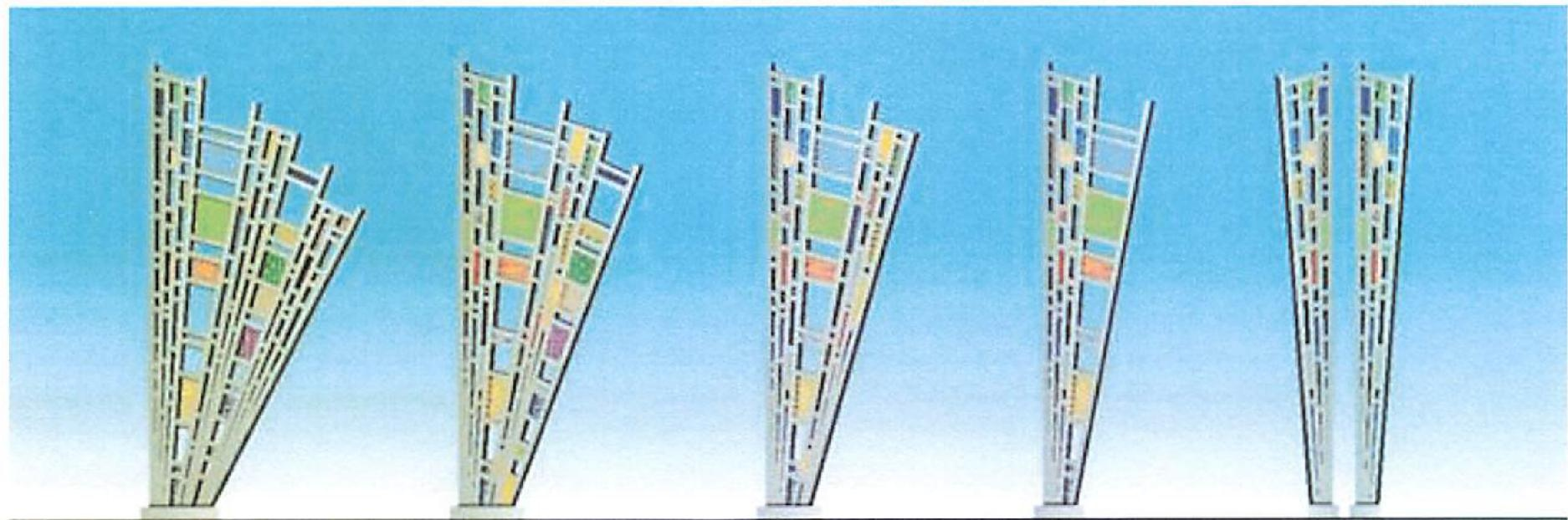
a.
Location. Artistic elements may be located in conjunction with any of the Brighton identity sign types as referenced in Section 9.06 K. Artistic elements may also be located independently of any additional signs.
b.
Quantity and Height.
(1)
Any number of artistic elements shall be allowed per intersection.
(2)
Artistic elements may not exceed 80 feet in height when in conjunction with a primary gateway sign.
(3)
Artistic elements may not exceed 40 feet in height when in conjunction with a secondary or tertiary gateway sign.
(4)
Artistic elements may not exceed 20 feet in height when in conjunction with a trail gateway sign, a wayfinding sign, or as an independent artistic element.
c.
Lighting. Artistic elements are not intended to be lighted.
(Ord. No. 2405, § 36, 1-3-2023; Ord. No. 2480, § 2, 8-5-2025)
9.07 - Temporary Signs
A.
General. The following standards are applicable to all temporary signs:
1.
Owner consent. All temporary signs must be located on private property and only with the consent of the property owner.
2.
Lighting. No temporary sign shall be illuminated.
3.
Duration. The purpose of temporary signs is to display messages for a temporary duration. Temporary signs shall not be used as a subterfuge to circumvent the regulations that apply to permanent signs or to add permanent signage in addition to that which is permitted by Section 9.04. Temporary signs shall be removed on or before 90 days after first being placed, unless otherwise specified in this subsection.
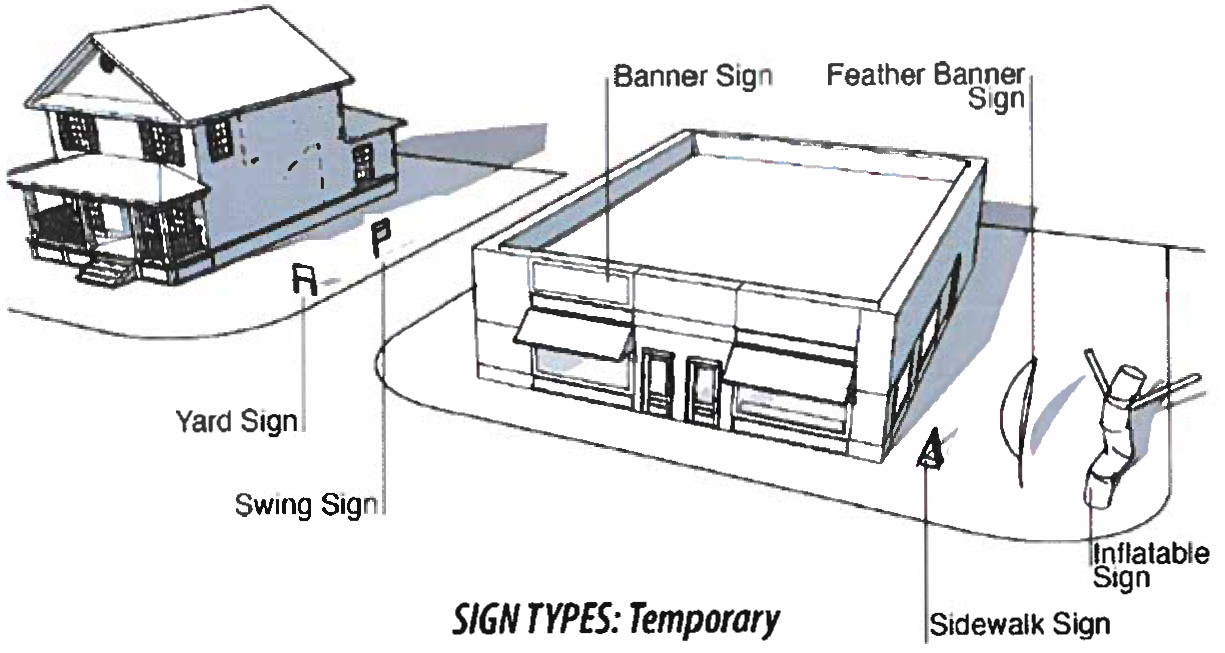
Figure 9-12 Temporary Sign Types
B.
Banners.
1.
Location.
a.
Banners shall not be placed to obstruct any portion of a window, doorway or other architectural detail.
b.
Banners shall not obstruct any vehicle or pedestrian movement, and shall be setback a minimum of 5 feet from any property line.
c.
Banners may be installed on a utility pole with the consent of the utility provider, provided that the banner is attached at the top and bottom by brackets that project no more than 30 inches from the utility pole.
d.
Banners may be installed on fences or between 2 posts mounted in the ground, provided that the banner is firmly attached on at least all 4 corners and stretched tightly to avoid movement in windy conditions.
2.
Quantity, Area and Height. Banners shall comply with the quantity, area and height requirements established in Section 9.04.
a.
Banners installed on utility poles in accordance with subsection a. above shall not exceed 24 inches in width and 48 inches in height.
b.
Banners installed on fences or between 2 posts shall not exceed 20 square feet in size.
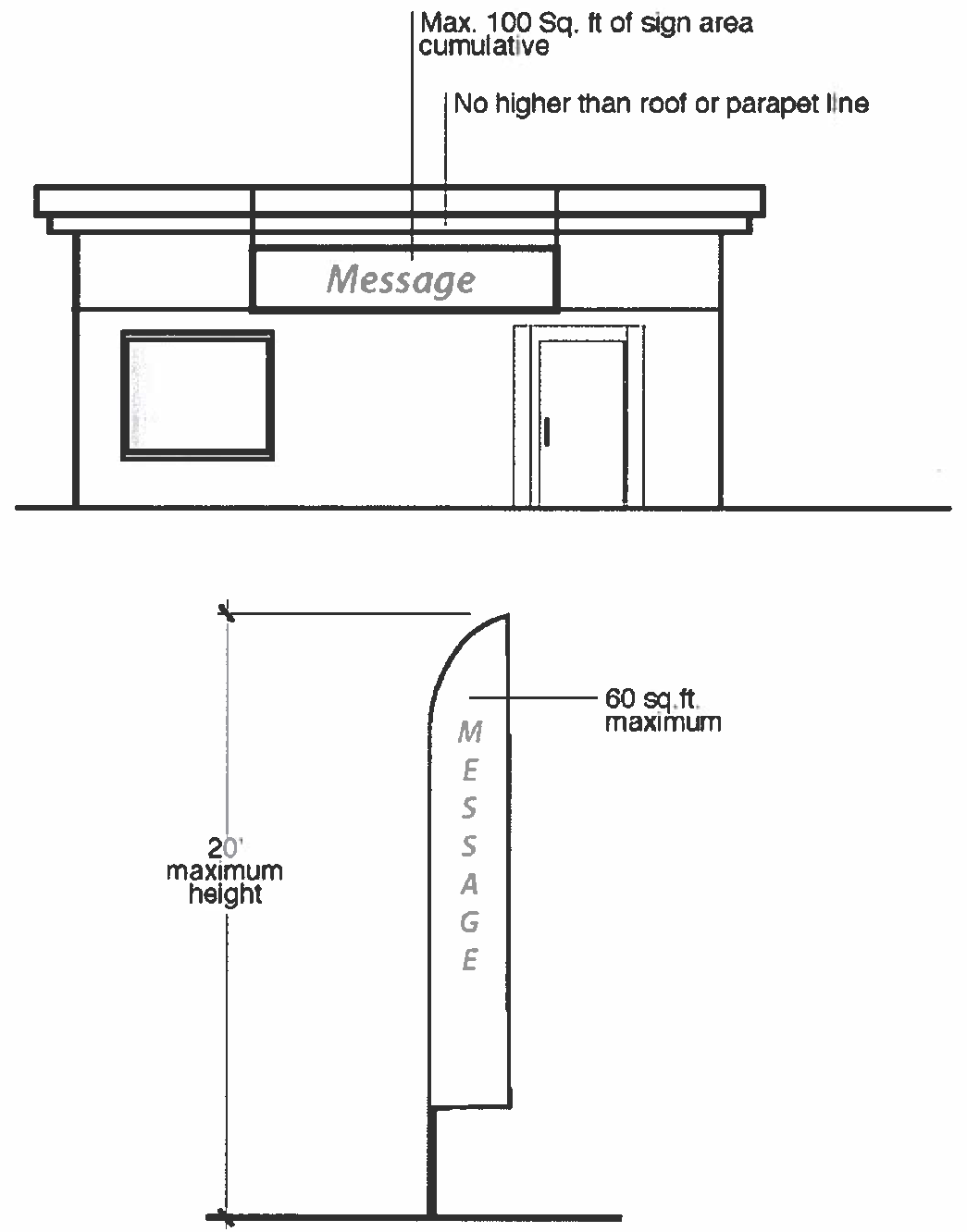
Figure 9-13 Banner Sign Details - Wall and Feather
C.
Inflatable Signs.
1.
Location.
a.
Inflatable signs must be secured to a building, structure, stable object or the ground and shall not extend beyond the boundaries of the lot or premises. Attaching balloons to tethers is permitted. Inflatable signs shall be attached or anchored so as to prevent dislocation, entanglement or encroachment onto adjacent properties or public streets, or undue hazard to motorists or pedestrians.
2.
Quantity, Area and Height.
a.
Inflatable signs shall not exceed the maximum permitted building height for the zone district in which they are located.
3.
Duration. Inflatable signs are permitted 1 time per year for up to 60 days, or 2 times per year for up to 30 days each time, or 4 times per year for up to 15 days each time.
D.
Sidewalk Signs.
1.
Location.
a.
Placement of a sidewalk sign must be within 1 foot of a building wall.
b.
A minimum of 4 feet of sidewalk width clearance shall be available for pedestrian use.
c.
Sidewalk signs shall be removed each day at close of business.
2.
Quantity, Area and Height. A Sidewalk sign shall comply with the quantity, area and height requirements established in Section 9.04.
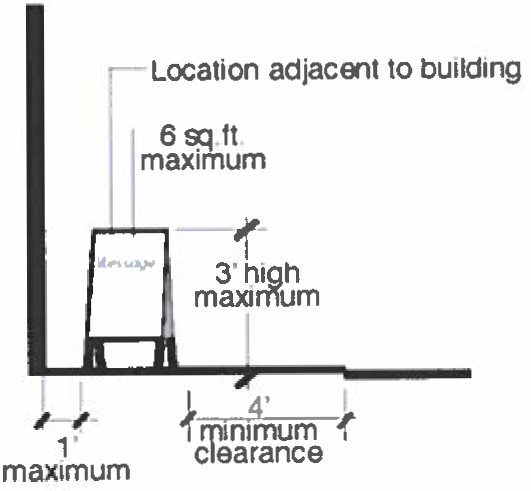
Figure 9-14 Sidewalk Sign Detail
E.
Site Signs.
1.
Location.
a.
Site signs are intended for vacant land parcels or lots under construction, and are not permitted on parcels with existing or built-out residential or non-residential uses.
b.
Site signs shall be setback a minimum of 10 feet from any property line.
2.
Quantity, Area and Height. A site sign shall comply with the quantity, area and height requirements established in Section 9.04.
3.
Duration. Site signs shall be removed within 30 days after issuance of the final certificate of occupancy or final completion of construction, whichever occurs first.
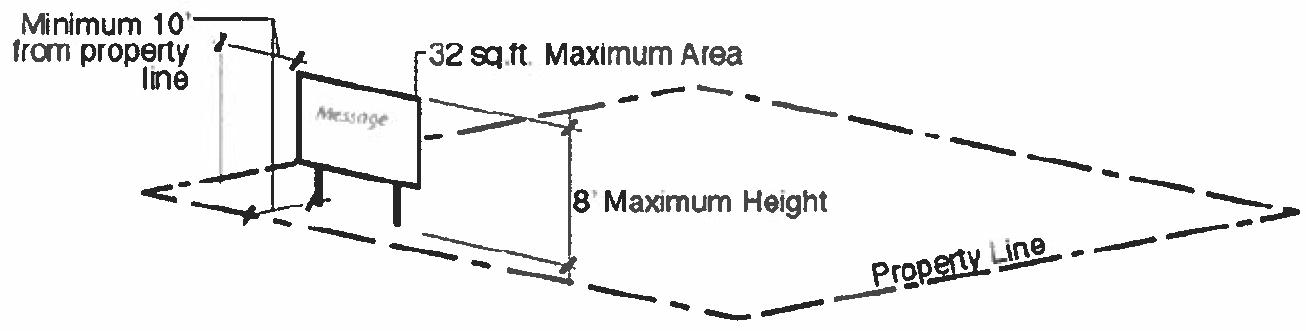
Figure 9-15 Site Sign Detail
F.
Swing Signs.
1.
Quantity, Area and Height. A swing sign shall comply with the quantity, area and height requirements established in Section 9.04.
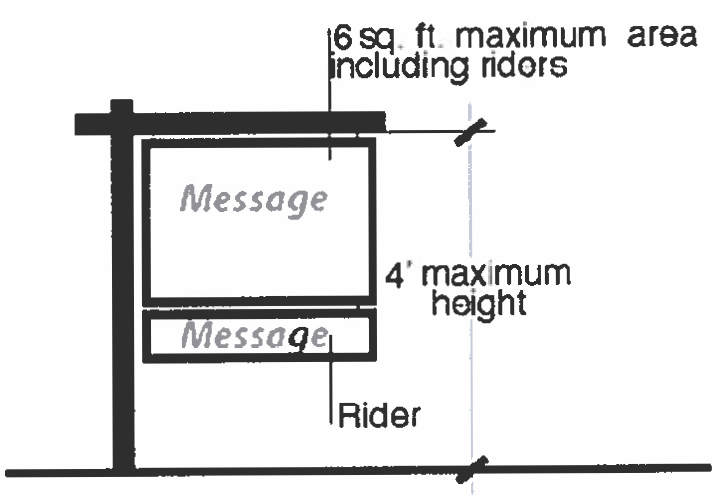
Figure 9-16 Swing Sign Detail
G.
Yard Signs.
1.
Location.
a.
No yard signs shall be erected or placed in parks, alleys or in a street or other public right-of way or place.
2.
Quantity, Area and Height. A yard sign shall comply with the quantity, area and height requirements established in Section 9.04.
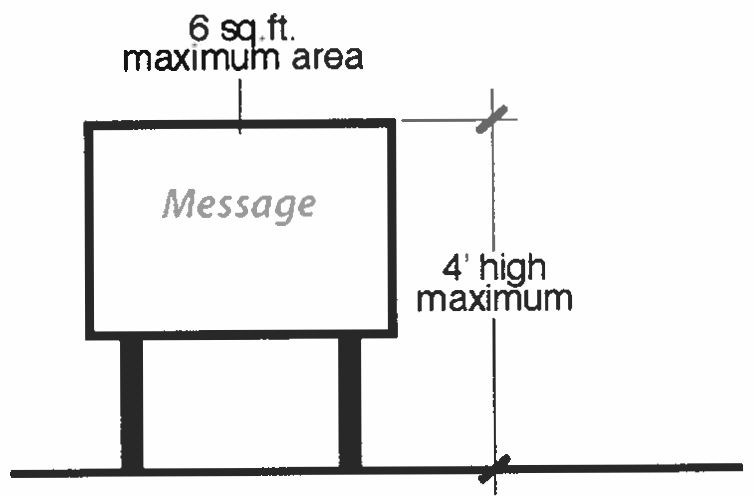
Figure 9-17 Yard Sign Detail
(Ord. No. 2405, § 36, 1-3-2023)
9.08 - Comprehensive Sign Plans
A.
Intent. The intent of these provisions is to allow flexibility in the size, type, number, height and location of signs related to commercial, industrial and mixed use developments greater than 1 acre and having at least 2 building sites. Flexibility is offered for those developments that may not be able to meet the strict application of the Code due to constraints caused by the physical layout of the development. This flexibility is offered in exchange for a coordinated program of signage ensuring a higher standard of design quality for such signs. Flexibility via the use of a comprehensive sign plan is not a matter of right, and a proposed comprehensive sign plan must be reviewed and approved pursuant to the following provisions prior to the release of a permit. A comprehensive sign plan may be a component of a site plan or planned development as provided in Article 2.
B.
Application. Application for a comprehensive sign plan shall be made by the property owner or his or her authorized agent. The Director shall review the comprehensive sign plan to determine if the plan complies with the submittal requirements, design standard requirements and review criteria. The Director may refer the application back to the applicant for revision or additional information, approve, approve with conditions or deny the comprehensive sign plan. The applicant shall have the right to appeal a decision by the Director as provided in Article 2.
C.
Submittal Requirements. The application for a comprehensive sign plan shall include the following plans and other information as required:
1.
A completed comprehensive sign plan application on a form as provided by the City.
2.
Application fee in accordance with the fee schedule as established by the City Council.
3.
A comprehensive sign plan document to scale, in a format acceptable to the Director, which shall include the following information:
a.
Site layout showing lot lines, existing and proposed buildings, parking areas, drive aisles, drainage areas, adjoining streets and landscaped areas, including fences and retaining walls.
b.
Site dimensions, particularly lineal feet of building frontage and street frontage.
c.
For any existing and proposed freestanding or monument signs, the location and dimensions of such signs on the site layout.
d.
For any existing and proposed wall signs, building elevations showing sign location and dimensions to scale; roof lines; building heights and lineal footage of the building frontage.
e.
For each sign, the sign elevation including the area to be occupied by lettering, symbols or images, with dimensions; sign type; lettering styles, colors, method of illumination; construction materials; projection or depth of sign cabinet.
f.
Other data pertinent to the application as determined by the Director.
D.
Design Standards. Comprehensive sign plans shall present an overall coordinated appearance which shall contribute to an aesthetically pleasing visual environment. Therefore, a comprehensive sign plan shall include design standards to ensure that all features of the proposed signage, including the illumination, support structure, color, lettering, height and location, shall be designed so that it will be an attractive and complimentary feature of the building it serves or of the overall development.
E.
Review Criteria. The following criteria shall be used by the Director in making a determination regarding a proposed comprehensive sign plan.
1.
In determining the height, area, number and location of signs, the following items shall be considered:
a.
The overall size of the buildings and/or development and the scale of the uses located or anticipated to be located within it (e.g., larger land areas and scales of use tend to favor larger signs and/or additional signage).
b.
Relationship between the building setback and sign location or height (e.g., additional signage or larger signs may be appropriate for buildings with less visibility, particularly where buffering is providing an aesthetic and/or environmental benefit to the City, or in instances in which there is grade separation from the roadway to the development).
c.
Frontage (larger frontages may justify more or larger signs, particularly if the size of the frontage tends to prevent sign clutter).
d.
Access and visibility of the site.
e.
Intended traffic circulation pattern and the need for wayfinding.
f.
Relationship between the site and adjacent uses.
g.
The desired function of the site (e.g., a vertically integrated, mixed use development would tend to include signage that is more urban and more dynamic in character than a strip shopping center).
2.
Generally, all signage proposed within a comprehensive sign plan shall meet the following:
a.
The plan is consistent with the purposes of this Article and is a creative alternative design.
b.
All signs shall be architecturally integrated into or complimentary to the design of the buildings and character of the site and shall use similar and coordinated design features, materials and colors. This shall be evidenced within the comprehensive sign plan design standards.
c.
The design, character, location, color and/or materials of all freestanding and attached signs shall be demonstrably more attractive or appropriate than signs otherwise permitted for the development.
d.
Signs shall not be oriented, situated or illuminated so that they adversely affect the surrounding area, particularly existing nearby residential uses or structures.
F.
Compliance. Upon approval of a comprehensive sign plan, no sign permit shall be issued for a sign which is not in compliance with the plan. It shall be unlawful to change, modify, alter or otherwise deviate from the provisions of a comprehensive sign plan except as otherwise provided in this Section.
G.
Amendments. A property owner or his or her authorized agent may propose amendments to a comprehensive sign plan. Amendments shall be submitted, reviewed and a determination reached in the same manner as for the original plan, except that evidence in the form of signatures on the proposed amended plan document shall be provided indicating that the current property owners have agreed to the proposed amendment prior to a determination being made on the amendment by the Director.
9.09 - Sign Measurements
A.
Signs mounted on or displayed as a standard geometrical shape shall be measured by the standard mathematical formula for that shape (e.g. length x width). Signs mounted on or displayed as an irregular shape shall be measured by the smallest area of up to two standard geometrical shapes that can encompass the entire sign mounting.
1.
The area of a freestanding sign (monument, pole, directional, site, swing, yard or other freestanding sign type) shall be computed by the entire area of the face of the structure, cabinet or module enclosed by the outside of the frame.
2.
Signs mounted directly on a wall or a window shall be measured by the smallest single and continuous perimeter of up to two geometric shape that enclose the outer limits of the sign copy. Gaps in sign copy which are greater than two times the height of the sign area, when using the same single continuous perimeter above, may be subtracted from the calculation of the sign area but shall be interpreted as two signs.
a.
The area of the wall or window area for the purposes of determining an allowed percentage shall be the total surface of the wall plane or window visible in an elevation view.
b.
Wall planes with offsets of more than 20 feet in the same elevation may not contribute to the sign allowance of another wall plane.
3.
Signs mounted on building surfaces other than the building wall or window shall be measured by the surface of the object on which they are mounted.
B.
Where the sign faces of a double-faced sign are no more than 3 feet apart at any location, only one face shall be measured.
1.
If the two faces of a double-faced sign are of unequal area, the area of the sign will be the area of the larger sign face.
2.
In all other cases, the areas of all sign faces of a multi-faced sign or the surface area of objects shall be combined to compute the sign area.
C.
For a freestanding pole or monument sign, the sign area shall include the frame, if any, but shall not include:
1.
The pole(s) or other structural support unless such pole or structural support is internally illuminated or otherwise so designed to constitute a display device, or part of a display device.
2.
Architectural features that are either part of the building or part of a freestanding structure, and not an integral part of the sign, and which may consist of landscaping, building or structural forms complementing the site in general.
D.
The area of a freestanding pole or monument sign shall be measured as follows if the sign is composed of more than 1 individual cabinet or includes a rider:
1.
The area around and enclosing the perimeter of each cabinet or rider shall be summed and then totaled to determine total area.
2.
If the sign is composed of more than 2 sign cabinets or riders, the area enclosing the entire perimeter of all cabinets and/or riders within a single, continuous geometric figure shall be the area of the sign.
E.
Sign height shall be measured from the base of the sign or supportive structure at its point of attachment to the ground, to the highest point of the sign.
1.
Where a freestanding pole or monument sign or sign structure is mounted along a roadway that has a higher grade level as compared to the grade level directly below the freestanding pole or monument sign or sign structure, then the freestanding pole or monument sign or structure's height will be measured from the roadway grade level to the highest point of the freestanding pole or monument sign or sign structure.
F.
Clearance for awning, canopy, marquee, pole and projecting signs shall be measured as the smallest vertical distance between finished grade and the lowest point of the sign, including any framework.
G.
In the Downtown or Mixed Use zone districts, where the building setback is zero (0) feet, sign setbacks for all signs other than projecting, marquee or awning signs shall be measured from the inside of the sidewalk, or 4 feet from the inside face of the curb where no sidewalk exists, to the front of the sign face.

