
Brighton City Zoning Code
ARTICLE 1
- General Provisions
_____
1.01 - Overview
A.
Title. This Chapter is known as the Brighton Land Use & Development Code. References to "this code," "the development code," or "these regulations" shall be considered a reference to the Brighton Land Use & Development Code.
B.
Authority and Jurisdiction. The development code is enacted pursuant to the purposes and authority granted by Colorado Revised Statutes, Title 31, Article 23 Planning and Zoning, as amended, and the home rule authority granted by Article XX of the Colorado Constitution and the Brighton Home Rule Charter. It applies to all structures and land within the incorporated area of the City of Brighton, as depicted on the official zoning map, and other maps accompanying the City's plans and policies. It shall be unlawful to conduct any development or use of land until any applicable development review and processes have been followed, all applicable standards have been applied, and all applicable approvals, permits or other authorizations have been issued. The provisions of this code that apply to subdivisions, and the planning and design of major streets shall apply to all land within the legal boundaries of the City and all land within three miles of the corporate limits of the City, if not located in any other municipality's authorized jurisdiction.
C.
Purposes. This development code is adopted to promote the public safety, health, and general welfare for the City of Brighton and its citizens and businesses. Specifically, the regulations have the following purposes:
1.
Implement the Comprehensive Plan, and other plans and programs authorized under the guidance of the Comprehensive Plan.
2.
Promote the physical, social, and economic well-being of residents and businesses, the long-term value and viability of public investments, and individual property values by balancing the co-equal rights of property owners.
3.
Promote planning and urban design that emphasizes distinct places and unique elements of community character throughout Brighton.
4.
Provide parks, trails, and civic spaces that help organize development around systems of connected open spaces, emphasize significant natural landscapes, and contribute to a valuable public realm.
5.
Secure proper arrangement and design of streets to shape efficient development patterns, coordinate with existing and planned streets, create multi-modal networks, improve access and circulation, support abutting land uses, and create value through public realm investments.
6.
Divide the City into zones and districts that promote the character, compatibility, scale, development patterns, and the use of land and buildings for the distinct places identified in the Comprehensive Plan.
7.
Regulate and restrict the development and use of buildings and land within each zoning district to create a compatible scale and range of building types within districts, to relate development to the public realm, and to promote the appropriate transitions to adjacent property and to supporting districts.
8.
Secure adequate provisions for water, drainage, sanitary sewer facilities and other public improvements based upon city, state, and federal requirements.
9.
Provide for coordinated development of Brighton consistent with established policies of the City.
D.
Severability.
1.
If any court of competent and final jurisdiction declares any part of this development code to be invalid, that ruling shall not affect any other provisions of this development code not specifically included in that ruling.
2.
If any court of competent and final jurisdiction declares that the application of this development code to a particular property or structure is invalid, that ruling shall not affect the application of the regulations to any other property or structure, or to development with different circumstances.
3.
No provision of this code shall enable any circumstance that is unlawful under superseding federal or state law. If any section, subsection, sentence, clause, phrase, or portion of this code is now or in the future superseded or preempted by state or federal law, or found by a court of competent jurisdiction to be unauthorized, such provision shall be automatically interpreted and applied as required by law.
E.
Transition Provisions. This section shall be used to guide the transition from previously existing regulations. Unless specifically stated otherwise in this code, the following rules shall apply:
1.
Generally. All standards in this code shall apply beyond the effective date of the ordinance adopting these standards, and all subsequent amendments shall become effective in the same manner.
2.
Applications. Any official application submitted prior to the effective date of the ordinance adopting these standards, and determined a complete application by the Director, shall be reviewed and processed according to the prior standards and procedures. An application submitted prior to the effective date, but determined incomplete, shall be resubmitted and processed according to the regulations in effect at the time of submittal of a complete application.
3.
Permits and Site Plans. All permits, site plans or other approvals issued under an administrative capacity prior to the effective date of this code shall remain effective for the duration specified in that permit or under the prior code as it existed on December 31, 2019. If no date is specified, the duration of the most applicable approval under this code shall be used.
4.
Plats. Any approved preliminary plat may continue to be processed according to the standards and procedures of the prior code, for the duration of the approved preliminary plat or applicable under the prior standards. Each subsequent approval of a final plat for a phased project may renew the validity of that plat. However, a previously approved preliminary plat may be resubmitted as a subdivision plan under these standards, provided it meets the submittal requirements in Section 2.02. Any preliminary plat re-approved as a subdivision plan may then be processed as provided in this code, but subject to the standards and criteria of the previously approved preliminary plat.
5.
Conditional Uses or Special Uses. Any conditional use, special use or other approval that may be limited to a specific duration under prior regulations may continue for that specified duration. Any subsequent approvals of these uses upon expiration of that period shall be processed according to this code.
6.
Planned Unit Developments. All Planned Unit Developments approved under the previous regulations shall remain in effect. Any subsequent approvals needed for future development under the PUDs shall be processed according to the standards previously applicable to PUDs. However, changes to approved PUDs, or future development or redevelopment within PUDs, may also be processed according to the following:
a.
Minor Amendments. Subject to the same procedures and criteria of previous PUDs.
b.
Major Amendments. Subject to the procedures and criteria of Section 2.04 for converting prior PUDs to Planned Developments under the provisions of this code.
c.
Rezoning. Removal from a prior PUD subject to the same criteria of zoning text amendments in Section 2.03.
1.02 - Interpretation
A.
Rules of Construction. The following rules shall apply to the application and interpretation of these regulations, unless the context clearly indicates otherwise:
1.
All words shall have the customary dictionary meaning, unless specifically defined in these regulations.
2.
The present tense includes the future tense and the future tense includes the present tense.
3.
The singular includes the plural and the plural includes the singular.
4.
Lists of examples prefaced by "including the following," "such as," or other similar clauses shall not be construed as exclusive or exhaustive and shall not preclude an interpretation of the list to include other similar and non-mentioned examples.
5.
The conjunctive "and" in a list means that all apply; the conjunctives "or" and "and/or" mean the provisions may apply singly or in any combination; and the conjunctive "either...or" means the provisions apply singly but not in combinations.
6.
When calculations to determine a requirement of the standards in this code results in fractions, it shall be rounded up to the nearest whole number if the standard is expressed as a minimum requirement and rounded down to the nearest whole number if the standard is expressed as a maximum allowance.
7.
"Shall," "will" or "must" is mandatory; "should" or "may" is permissive but recommended as a way to best meet the standard or achieve the intent of the standard.
8.
A reference to an administrative official shall refer to that official, or his or her official designee, and all references to specific city officials may also include any other designee of the City Manager.
9.
Any reference to other official local, state or federal government rules or regulations shall include the current versions of those regulations, provided they remain binding on the City, or where not binding, remain consistent with the purposes, intent, and objectives included in these regulations.
10.
References to a person shall include individuals, partnerships, agencies, corporations or other legal entities and the owner, tenant, occupant, principal, partners, officers, employees, agents and representatives of any legal entity.
B.
Conflicts. All provisions shall be considered the minimum requirements to promote the public health, safety and welfare. In case of a conflict between these regulations and any other adopted rule, regulation or code of the City, the higher standard shall apply. In making a determination of which standard is higher, the official may consider which is more specific; which is more consistent with the Comprehensive Plan; which is more consistent with the purposes, intent and objectives of these regulations; and which best promotes the public health, safety and welfare.
C.
Computations of Time. The following rules apply to any computation of time, unless a specific section of these regulations indicates otherwise:
1.
The day of the act that commences a time period shall not be counted.
2.
The last day of the time period shall be included, unless it is a Saturday, Sunday or legal city holiday, in which case the next working day shall end the time period. In all other cases Saturday, Sunday or legal city holidays count in the time period.
3.
Whenever any time period is expressed for a formal submittal to the City, the time period shall end at 4:00 p.m. on the last day of that time period.
4.
Any time period expressed in years shall include a full calendar year from the act that commences the time period.
D.
Building & Structure Measurements. The following shall be used in interpreting measurements and dimensional standards for buildings:
1.
Front Building Line. When established as a requirement for location of the principal building, the distance or a range from the front lot line, at or within which distance the front building line of the principal structure shall be established. When expressed as a requirement to measure something else (i.e. parking or accessory buildings located behind the front building line), the front building line shall mean the actual line at which the front of the building is established, extending across the entire lot. With regard to building design standards, the "required front building line" is the percentage of the lot frontage which must be occupied by at least a portion of the front building. Required front building lines are intended to create enclosure or edges of the streetscape, in coordination with other buildings along the block face and on the opposing block face. Alternatives, such as active and social open spaces along the frontage or other defining vertical features along the building line, may serve this enclosure purpose in specific cases.
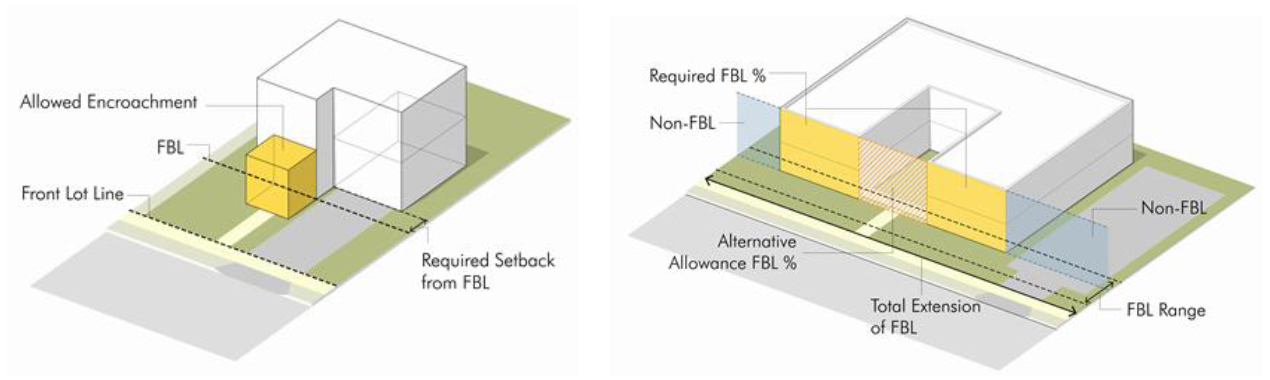
Figure 1-1 Front Building Line
Front building line standards deal with the relationship of the principal building
to the front lot line, the extent of the building along the lot frontage, and the
relationship of other site elements to the front of the building.
2.
Height. Building height, when expressed as a dimension, is measured from the average grade to the highest point of a roof. Average grade is determined by calculating the average of the highest and lowest elevation of finished grade along the front building line parallel to the street. Building heights expressed in both dimension and stories shall use the additional story limits to impact the scale, form, and mass of the building within the permitted overall height.
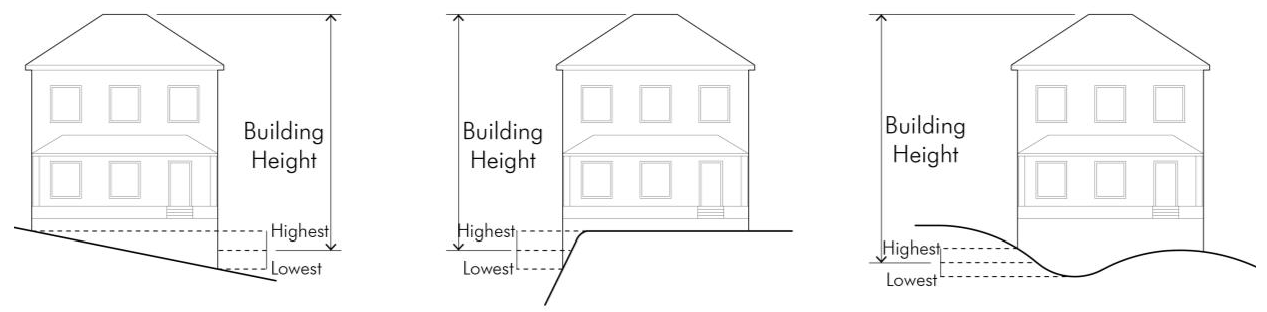
Figure 1-2 Building Height
Building height is measured from the average of the highest and lowest elevation of
finished grade along the front building line to the highest point of the roof structure.
3.
Building Setbacks. The minimum required distance between any property line and the building. When front building setbacks are expressed as a range (i.e. 10' to 25'), it shall be interpreted as a "front building line" range, within which distance the front building line of the principal structure shall be established.
4.
Story. The part of a building included between the surface of one floor and the surface of the floor next above, or if there is no floor above the ceiling above. Story heights shall be:
a.
9 feet to 12 feet, generally;
b.
The first story for residential buildings should be 10 feet to 14 feet;
c.
The first story in non-residential buildings should be 12 feet to 20 feet;
d.
Building types or parts of buildings that require high floor-to-ceiling heights, such as a gymnasium, atrium or warehouse, shall have the number of stories calculated as the finished floor-to-ceiling height divided by 15.
e.
Any ground story that has more than 4 feet of its height exposed above finished grade along more than 50% of the foundation perimeter shall count as a story, except that the Director may determine that it is not a story (i.e. "walk out basement") provided:
(1)
The lot has a grade change of more than 4 feet within the buildable area established by setbacks; and
(2)
The building foundation is no more than 2 feet above grade at the highest grade point along the front elevation; and
(3)
The grading for the site was not significantly altered to benefit the height of the proposed building in a manner that is incompatible with the scale, massing and relationship to adjacent buildings.
5.
Story, Half. The space under a sloping roof that has a line of intersection of the roof and exterior wall face not more than 2 feet above the floor level, and where the possible floor area with head room of 7 feet or more is no greater than 60% of the total floor area of the story directly beneath.
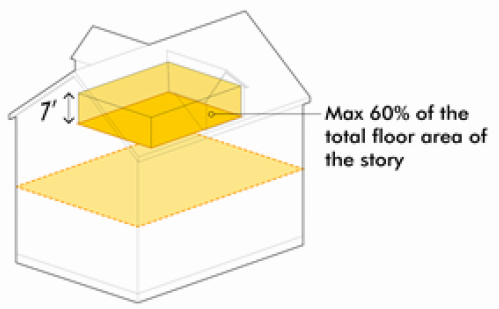 | Figure 1-3 Half Story Half stories allow for habitable or occupied space below pitched roof structure. |
6.
Building Transparency. When referring to the design of building facades, transparency is the percentage of windows and doors on the façade, intended for two purposes: (1) to break up the scale and massing of the façade and relate the building to the streetscape and public spaces; and (2) to provide connections - visual and perceived - between the activities on the site and the public streetscape or spaces. Therefore, transparency has two measurements: the extent of transparency, which is the percentage of the overall façade, measured at each story but which includes non-transparent components associated with the opening such as molding, casing or frames; and the degree of transparency, which is typically the clarity of the glass used for the opening. The clarity of the glass in the opening is met by a minimum Visible Light Transmission of 60% (VLT = the percent of total visible light that is transmitted through a glazing system) and a maximum Visible Light Reflectance of 15%. (VLR = the percent of total visible light that is reflected by a glazing system) For upper story windows, these measures may be 40% VLT and 20% VLR.
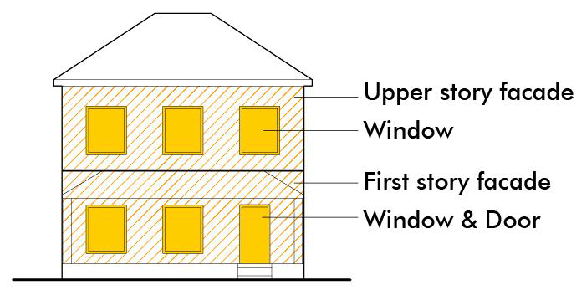 | Figure 1-4 Transparency Transparency requirements help break up the scale of building facades and create relationships between the building and the open spaces around the building. These requirements should be measured independently for each story. |
E.
Lot Measurements. The following shall be used in interpreting measurements and dimensional standards for lots. In the case of parcels, tracts or other property lines clearly intended to bound buildable areas, these lines may be interpreted as lot lines for the purposes of this code:
1.
Lot Area. The area bounded by the front, rear and side lot lines, or when expressed as a range, it shall be interpreted as a minimum and a maximum.
2.
Lot Depth.The horizontal distance between the front and rear lot lines measured at right angles to the front right-of-way lines. Where the front and rear lines are not approximately parallel, the lot depth shall be the average when measured from at least three different points along the front lot line, including the two corners at the front lot line.
3.
Lot Frontage. The portion of the lot that establishes the relationship between the building or site and the public realm or street upon which the lot fronts.
4.
Lot Width. The horizontal distance between the side lot lines, typically measured at the front lot line, but for irregular lots it may be measured at the front building line.
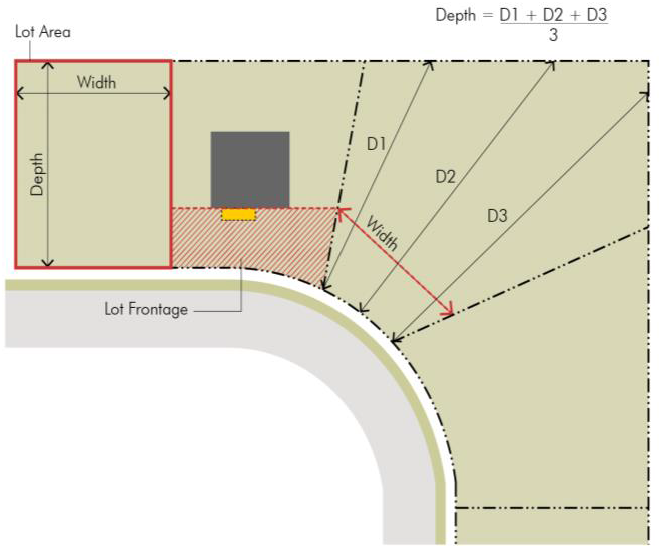 | Figure 1-5 Lot Measurements This illustrates how to apply lot measurements on both regular and irregular lots. |
5.
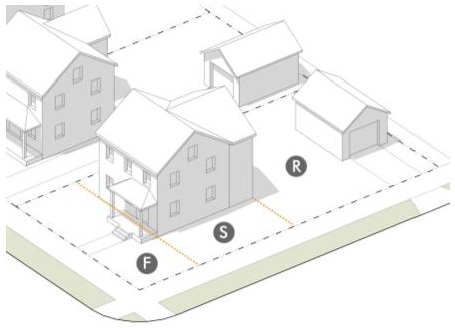
Corner lots. When applying building, lot and frontage standards to corner lots, lots can be arranged in one of three patterns based on the context of the block and abutting lots:
a.
Standard Corner. The building orients to the same front as all other buildings on the same street, and an expanded side setback may apply on the other street side of the lot. Side and rear setbacks apply to the remaining sides.
b.
Reverse Corner. The building orients to the end-grain of the block (not the same as other buildings on the interior of the block), and the front setback and frontage design applies to that street. The other street-side setback can be the greater of (1) the stated street-side setback for that building type or (2) 10 feet in front of the forward-most point of the front building line of the abutting lot. Side and rear setbacks apply to the remaining sides.
c.
Corner Orientation. The building orients to both streets, with the front setback and frontage design applying on both street sides. The two remaining lot lines are treated as side setbacks and there is no rear setback.
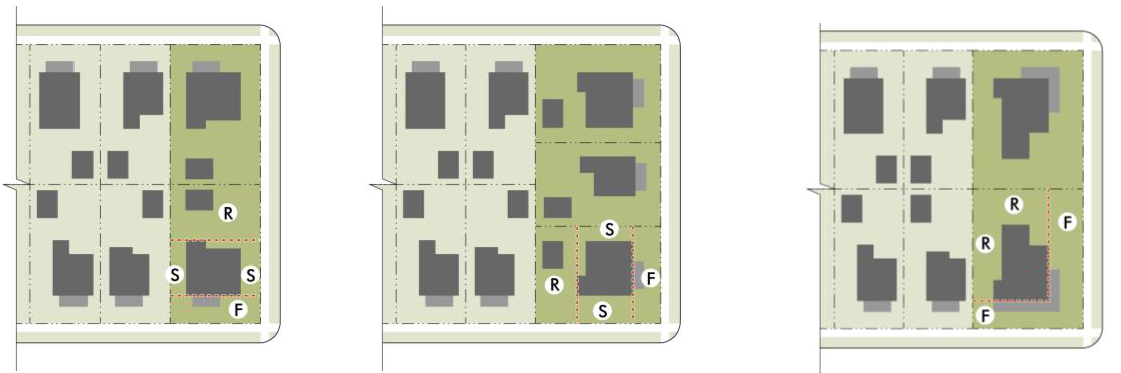
 Standard Corner
| 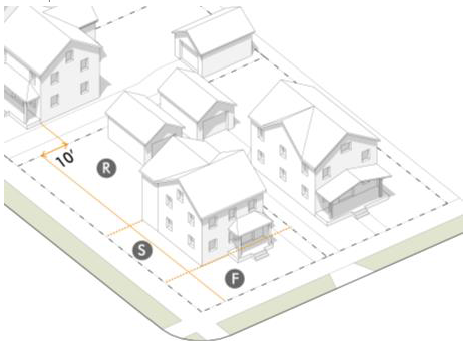 Reverse Corner
|
Corner Orientation
|
Figure 1-6 Corner Lots
Setbacks, building lines and lot dimensions on corner lots can be varied based on
the orientation of the lot, and the orientation of the buildings to adjacent lots.
F.
Interpretation of Zoning Map. Where uncertainty exists with respect to any boundary on the zoning district map, the following rules shall apply:
1.
Boundaries approximately following streets or other rights of way or rivers or streams - the centerlines or extension of these centerlines shall be the boundaries.
2.
Boundaries indicated as approximately following property lines - the platted or other official legal line of that property shall be the boundaries, unless the property boundaries on the map have been substantially altered.
3.
Boundaries approximately following city limits shall be interpreted as following the actual city limits.
4.
Boundaries that split any platted lots - the lot shall be interpreted in the district designated to the majority of the lot. In the case of an equal split, the Director shall determine the appropriate zoning based on consideration of the Comprehensive Plan, the context, the surrounding existing uses, and the likelihood of change in context or existing uses in the future.
5.
Boundaries that split any unplatted property - any future platting of property may generally follow the zoning boundary and then each resulting property may assume the zoning applicable to the majority of the resulting lot, or where any resulting lots have significant discrepancies with zoning boundaries, rezoning may be required.
6.
Boundaries following a shoreline shall be interpreted to follow the shorelines and in the event of change in the shoreline, shall move with the actual shoreline.
G.
Non-regulatory Provisions. Intent statements, design objectives, graphics and commentary such as captions to graphics or notes in tables, are an aid to interpretation of the standards and criteria. In the event of any a conflict between the intent statements, design objectives, graphics or commentary and a specific standard, the specific standard shall control.
H.
Resources, Guides and Industry Standards. Resources, guides and industry standards that are recognized as a reputable authority in the planning, development and urban design professions, may be used to supplement interpretation of this code. They shall be subject to the approval of the Director upon a determination that the content is consistent with the policies of the Comprehensive Plan and the purposes, intent, and design objectives of these regulations. Any resource, guide, or industry standard approved by the Director shall be listed in Appendix A, and at least one copy shall be kept on file with the Community Development Department. Use of these guides shall only be to the extent that it is consistent with the purposes, intent and design objectives expressed in these regulations, and shall not be used to otherwise modify or conflict with any specific standard in these regulations.
I.
Official Interpretations. In cases where there is uncertainty how this code applies to potentially recurring situations, the Director may make Official Interpretations.
1.
Filing. Official Interpretations shall generally be in the format provided in Appendix B, and each official statement shall be filed with the Community Development Department and included in Appendix B. Official Interpretations shall be filed with the Planning Commission by placing it on the consent agenda of a regularly scheduled meeting.
2.
Criteria. In making an Official Interpretation, the Director shall use the following criteria:
a.
Sound professional planning and urban design principles.
b.
The Comprehensive Plan and any specific plans or policies created under the Comprehensive Plan.
c.
The purposes, intent or design objectives applicable to this code and the specific article or sections subject to the interpretation.
d.
Any resources, guides or industry standards applicable to the specific situation.
e.
Based on the context of the street, block, site or building, the interpretation is at least one reasonable way the standards could be applied.
f.
Whether the same interpretation could be applied to all similarly situated property or circumstances, and meet these criteria; or whether any conditions or limitations are necessary to ensure it meets the criteria.
3.
Effect of Decision. An approved Official Interpretation shall be effective upon approval by the Planning Commission and may apply to all similar situations unless:
a.
It is overruled or modified by a different Official Interpretation.
b.
It is overruled by appeal as provided in these regulations.
c.
It is amended or overruled by a text amendment to the section addressed by the statement.
1.03 - Administration
A.
Staff. The following city staff positions are responsible for administering specific aspects of this code.
1.
Community Development Director. The Community Development Director (Director) is responsible for administration of the development code, and is the principal interpretation and enforcement official of these regulations. The Director may consult with any other department or relevant outside agencies in order to coordinate any plans, policies and programs that impact the Comprehensive Plan. The Director shall specifically:
a.
Prepare and provide development applications and forms;
b.
Oversee the application, review and administration processes, and prepare presentations and reports for review bodies;
c.
Set the dates for meetings and hearings before the Planning Commission, Board of Adjustment, and Historic Preservation Commission;
d.
Determine additional information and materials required for review of applications;
e.
Waive submittal requirements, with appropriate justification supporting that the information is not necessary due to the context or type of project, and won't otherwise be needed to evaluate the application against standards or criteria.
f.
Issue official interpretations and approve the use of other resources, guides, and industry standards used in administering this code.
g.
Make all final interpretations and any final administrative decision referred to the Director under the procedures and standards of these regulations.
2.
City Manager and Other Staff. The City Manager is the chief executive and administrative officer for the City and may make any decision delegated to any city staff member under this code. All other department heads and staff may serve in an advisory role to the Community Development Director under this code, as designated by the City Manager.
3.
Development Review Committee. The City Manager or Director may assemble the Development Review Committee, as established under Chapter 2, Article 38 of the Municipal Code, for any applications that the City Manager or Director determines require referral, review, and comment from any of the departments or agencies on the committee.
B.
Planning Commission. The Planning Commission is the appointed body of the City responsible for all long-range and comprehensive planning, as well as review, recommendations and decisions on implementation of the Comprehensive Plan. For these purposes, it may engage in cooperative and joint planning programs with the City Council, officers and departments of the City, other planning agencies, and representatives of other governmental units and private agencies or organizations. In addition to all other general planning authority granted by statute, local ordinance, or bylaws, the Planning Commission shall have the specific review responsibilities and final administrative decisions referred to the Planning Commission under the procedures and standards of these regulations.
C.
City Council. The City Council is the elected body of the City responsible for all legislative decisions that affect implementation of the Comprehensive Plan. In addition to other general authority granted by law, the City Council shall have the appeal authority and final decision authority referred to the City Council under the procedures and standards of these regulations.
D.
Board of Adjustment. The Board of Adjustment is created under the authority of C.R.S. 31-23-307. The Board of Adjustment is established pursuant to these regulations according the following provisions.
1.
Membership. The City Council may appoint the Planning Commission as the Board of Adjustment, or alternatively may appoint a separate Board of Adjustment consisting of five members and two alternate members with the following criteria:
a.
All members shall be residents of the City.
b.
All members shall serve without compensation.
c.
Each member shall be appointed for a four-year term. Terms shall be staggered every two years, so that at least two members and one alternate position are up for appointment every two years.
d.
An alternate member shall serve in the absence of any regular member.
e.
Any member may be removed by the City Council for inefficiency, neglect of duty, or malfeasance, upon written notice and after a public hearing.
f.
Vacancies for unexpired terms shall be filled by an appointment of the City Council, giving preference to alternate members.
2.
Officers. The Board of Adjustment shall elect a chairperson and vice chairperson from among its members. The term of the chairperson and vice chairperson shall be for one year with eligibility for reelection. Unless otherwise absent or disqualified, the Chairperson shall preside over all meetings of the Board Adjustment. In the absence or disqualification of the Chairperson, the Vice Chairperson shall preside. In the absence or disqualification of both the Chairperson and Vice Chairperson, the next longest-serving Board member shall preside.
3.
Proceedings. The Board of Adjustment shall adopt rules necessary to conduct affairs and in keeping with this Section and its authority under these regulations. Meetings shall be held at the call of the Chair and at such other times as the Board may determine. The Chair may administer oaths and compel the attendance of witnesses. All meetings shall be open to the public.
4.
Appellate Power. The Board of Adjustment is empowered to hear and decide appeals. Specifically, the Board is empowered to make the following decisions as specified in Article 2:
a.
Grant variances to the strict application of the standards in this code; and
b.
Hear and decide appeals when an error is alleged in any order or determination made by the Director in the interpretation or enforcement of this code.
E.
Historic Preservation Commission. The Historic Preservation Commission is established by Chapter 2, Article 66 of the Municipal Code, and shall be responsible for preservation of the historical and architectural heritage of the City, and the implementation of Section 10.03 Historic Preservation Standards. The Historic Preservation Commission shall have the following powers, duties, and rule-making authority, subject to approval by the City Council:
a.
Advise the City Council on matters related to preserving the cultural resources and historic character of the City;
b.
Initiate designation of historic structures and districts;
c.
Conduct surveys and inventories of the cultural resources of the City, including identification of historic sites, structures, buildings and districts;
d.
Review cultural resources nominated for designation as a historic landmark or historic district and make recommendations to the City Council;
e.
Review and make decisions on applications for Certificates of Appropriateness related to alterations, construction, repair, moving and/or demolition to a designated historic landmark or historic district; and
f.
Perform all actions and functions as authorized or directed by the Brighton Municipal Code, this development code or other rules, policies and procedures of the City related to historic preservation.
1.04 - Violations
Each of the following actions, or inaction when action is required, is a violation of this development code, and is subject to enforcement and the imposition of penalties as shown in Article 1-24 of the Brighton Municipal Code, and/or Sections 1.06 (Enforcement) or 1.07 (Penalties).
A.
Failure to comply with any standard, regulation, or requirement of this development code or any regulation adopted by a City department or agency under authority granted by this development code, any agreement, including, but not limited to, any development agreement, annexation agreement, or approved plat.
B.
Failure to comply with any condition attached to a permit or approval by the City Manager or designee under this development code.
C.
Engaging in the division of land for sale or development in any way that does not comply with the standards, criteria, and procedures for approval of a plat under this development code.
D.
Transferring title to any lot, tract, or parcel of land before any plat required by this development code has been approved and the approved plat has been filed with the County Clerk and Recorder for the county or counties in which the property is located.
E.
Submitting for recording with any County Clerk and Recorder any subdivision plan, plat, or other land use document that has not been approved under this development code.
F.
Obstructing or removing any notice required to be posted or otherwise given under this development code.
G.
Interfering in any manner with persons in performance of a right or duty granted or imposed by this development code, maintained, or otherwise initiated in violation of this development code.
H.
To continue any violation as defined in Subsections A through G above, with each day of continued violation to be considered a separate violation for purposes of charging of any ordinance violations and computing cumulative penalties.
(Ord. No. 2456, § 1, 11-4-2024)
Editor's note— Ord. No. 2456, § 1, adopted Nov. 4, 2024, amended Sec. 1.04 in its entirety to read as set out herein. Former Sec. 1.04 pertained to penalties and derived from the Code of 2020.
1.05 - Nonconformances
A.
Intent. The general policy of the City is to allow uses, buildings and lots that were created legally and in conformance with then-applicable requirements, but that do not conform to the current applicable requirements of these regulations, to continue to be put to productive use. However, it is the City's intent to bring as many aspects of these nonconformances into compliance with current regulations as is reasonably practical. The intent of this section is to balance the interests of property owners in past investments, discourage investment that expands or reinforces non-conforming situations, and promote investment consistent with the Comprehensive Plan and these regulations.
B.
Nonconforming Uses. Uses that were legally initiated prior to the adoption or amendment of this code, but which could not be continued under the current terms of this code, may continue to exist subject to the following:
1.
The use shall not be expanded beyond any specific area of the site or lot where it was legally established, within any existing building or structure, or any structural changes that expand the exterior footprint or building or structure. The Director may consider an exception based on the following findings:
a.
The enlargement of the structure or buildings is only to facilitate a conforming use, and does not otherwise allow, encourage or promote expansion of the nonconforming use;
b.
The enlargement of the structure or buildings shall not result in conversion of the nonconforming use from a seasonal to a year-round operation; and
c.
The enlargement of the structure or buildings complies will all applicable standards.
2.
Any use accessory to a principal nonconforming use shall not be permitted absent the principal use, and continuation of accessory uses shall not avoid any abandonment period for the nonconforming principal use. No additional accessory building or use not present when the nonconforming use was established shall be permitted.
3.
If active and continuous operations are not carried on during a period of 60 days, the use shall not be reestablished and all subsequent uses shall be in conformance with the provisions of this code.
a.
Intent to resume active and continuous uses shall not count towards reestablishing the use.
b.
A nonconforming home occupation shall be considered abandoned if the occupants of the dwelling who were conducting the use discontinue either their occupancy of the dwelling or the non-conforming home occupations.
c.
At the time any nonconforming, individual mobile home existing on a private lot is removed or is vacated, the use shall be deemed abandoned and shall not be returned or occupied except in compliance with this code.
d.
A change of operator or sale of use shall not be considered discontinued, provided that neither the previous or current business or owner combined to cease operation for 60 days or more.
4.
No person shall move a nonconforming use within the same parcel or to another parcel unless the relocation conforms to this code.
5.
Any change of use shall be to a conforming use, and at this time the nonconforming use shall be abandoned.
6.
Any structure in which a non-conforming use is carried on that is damaged to the extent of more than 50% of the current local assessed value shall not be restored to support the non-conforming use.
7.
Any new activity that triggers specific site design standards shall require full compliance with that site design standard in order for the nonconforming use to continue, and the presence of a non-conforming use shall not be used to justify not meeting other applicable standards.
C.
Nonconforming Structures. Structures other than signs that were legally constructed prior to the adoption or amendment of this code, but which could not be constructed under the current terms of this code, may continue to exist subject to the following:
1.
Rehabilitation or expansion of the structure that increases the degree of nonconformity is prohibited. Other rehabilitation or expansions may occur provided that they comply with all other requirements of this code; are not detrimental to the purposes, intent and objectives of the standards; and do not negatively impact development in conformance with this code on adjacent property. In general, no repairs or alterations that exceed 50% of the local assessed value of the structure shall be permitted.
2.
If damaged by 50% or less of its total replacement cost, the structure may be restored to its original condition if work obtains a permit within 60 days, work is commenced within 180 days, and work is completed prior to expiration of the permit.
3.
If the structure is determined obsolete or substandard by virtue of any applicable code beyond this chapter, and the cost of improvement or restoration is 50% or more of the current local assessed value, then the right to maintain the nonconformance shall terminate.
4.
Structures granted variances from the dimensional standards are not considered nonconforming and are not subject to the limitations of this section, provided that the structure and owner comply with any terms of the variance and the circumstances surrounding the variance have not substantially changed.
D.
Nonconforming Site Conditions. Any site condition associated with a conforming use or structure (such as parking, landscape, open space or other non-building site characteristic) in existence prior to these regulations, but which are not compliant with the standards of these regulations, may continue to exist subject to the following:
1.
Any change of use or expansion of use shall require compliance with the new site standards up to the maximum extent possible, considering the level of investment needed to support the new use and the extent of area being impacted by work to support the new use.
2.
Any site development activity on a portion of a site shall require compliance with the new standards up to that proportion that is subject to the development activity. For example, a site that is not compliant with the landscape standards must meet the landscape standards prorated to the portion of the site where development activity occurs, but the remainder of the site may remain nonconforming.
3.
Any change of use, building or site design element that triggers a screening requirement shall require 100% compliance with all screening standards applicable to the site.
4.
Where any investment is greater than 50% of the current local assessed value of the site, or can reasonably be interpreted as impacting more than 50% of any one component of the site, the site or that component shall be brought into full compliance with these standards.
E.
Nonconforming Lots. Any lots platted legally prior to the adoption or amendment of this code, but which could not be platted under the current requirements of this code, may continue to exist provided it complies with the following standards. Any difficulties meeting these standards caused by the nonconformance of the lot may be used as criteria in granting any relief to these standards. The size and shape of any nonconforming lot shall not be altered in any way, except to increase the conformity with these regulations
1.
Two abutting nonconforming lots shall be considered an undivided single lot for the purposes of accommodating a detached house or other permitted building type if the lots are in single ownership and share a continuous frontage.
2.
In any district that allows detached houses, a detached house and customary accessory buildings may be erected on any nonconforming lot not eligible for a lot combination, provided all standards other than lot dimensions standards are met.
3.
In any district that does not allow detached houses, the nonconforming lot not eligible for a lot combination may be used for the smallest-scale building type permitted in the district by these regulations, provided all standards other than lot dimension standards are met.
F.
Nonconforming Signs. Existing signs which do not conform to the specific provisions of these regulations are designated as nonconforming signs. With the exception of signs designated as historic signs by the Historic Preservation Commission, nonconforming signs must be brought into compliance with this code or must be removed when any of the following conditions exist:
1.
Whenever there is a change in the ownership of the real property upon which the sign is located.
2.
When the property or premises upon which the sign is located is vacant for a period of at least 60 days.
3.
When a sign and/or sign structure is damaged or destroyed in a monetary amount which exceeds 50% of its total replacement cost or becomes a hazard or potential hazard.
4.
When there is a zone change initiated by the business or property owner.
5.
When a sign and/or sign structure is abandoned, including empty frames.
6.
When an existing structure upon which the sign is located is relocated, replaced, or changed in size, location, height or setback.
7.
When the sign itself is relocated, replaced, or changed in size, location, height or setback.
8.
The structure or size of the sign is altered in any way except towards compliance with these regulations. This does not refer to change of copy or normal maintenance.
9.
When improvements are being made to 25% percent or more of the facade of a building on which a nonconforming sign is located.
G.
Burden of Proof. The burden shall be on the applicant to establish that the nonconformity was established lawfully and the entitlement to continuation of nonconforming situations or completion of nonconforming projects according to this section. Owners of nonconformances may request a "certificate of legal nonconforming status" by filing an application with the Director, and once issued may record the certificate in the clerk and recorder's office of the county in which the property is located.
H.
Benign Nonconformance. At the time of any rezoning request, the City may determine that any existing use, site or building within the area affected by the rezoning is a "benign" nonconforming situation if it would be made illegal by the zoning action, it is determined to have no negative effects on the long-term development within the district, and it is consistent with the intent of the district in the current location and format. A benign nonconformance may then be permitted additional rights beyond the standard nonconforming rights of this section, as specified in the specific rezoning ordinance adopted by the City, and subject to the same criteria as a Conditional Use Permit in Section 2.07.
1.06 - Enforcement
A.
Responsibility. The Director of Community Development shall be responsible for enforcement of this development code and for inspections of property to determine violations of this development code through the employment of inspectors who are vested with the powers of enforcement.
B.
Inspections. Upon presentation of proper credentials, including a warrant, an authorized employee or agent of the City may enter at reasonable times any building, structure, or premises in the City to perform inspections of potential violations of this development code.
C.
Remedies are Cumulative. The City may use any or all of the powers listed in this Section in any order, to enforce the provisions of this development code. The selection of any methods of enforcement does not restrict the power of the City to choose an additional or different form of enforcement in the future.
1.
Withholding of a Building Permit or Certificate of Occupancy. No building permit or final certificate of occupancy shall be issued for any building or structure that does not fully comply with the provisions of this development code. Nothing in this development code shall be waived or superseded by the wrongful or erroneous issuance of a building permit, business license, or certificate of occupancy.
2.
Withholding of Other Permits and Approvals.
a.
If the City has issued some permits or approvals for a development or subdivision, but additional permits or approvals are needed for completion of the project, and the City determines that there have been violations of this development code related to those permits or approvals already granted, the City may withhold later permits or approvals for the development until the violations have been corrected.
b.
As an alternative to withholding of permits or approvals, the City may issue later permits or approvals subject to conditions that the existing violations be cured within a stated period of time.
3.
Withholding of Water Taps or Water Service. The City may refuse to issue water taps for the development where the violation exists, and/or may withhold water service to that development, until the violation is cured.
4.
Revocation of Permits or Approvals. The Community Development Director may revoke any permit or approval under this development code if the Director determines that the permit or approval has been issued in error, or that the site development, land uses, or structures authorized by that permit or approval have been established or constructed or are being maintained in violation of this development code.
5.
Suspension of Licenses. The City may suspend the license of the builder, contractor, or subdivider responsible for the violation.
6.
Stop Work Order. With or without revoking permits, the City may issue a stop work order or a notice of violation requiring the property owner and its agents and contractors to stop work on any building or structure on any land on which there is an uncorrected violation of a provision of this development code or of a permit or approval issued under this development code.
7.
Abatement. The City may seek a court order in the nature of mandamus, abatement, injunction or other action or proceeding to abate or remove a violation or to otherwise restore the premises in question to the condition in which they existed prior to the violation.
8.
Injunctive Relief. If the Director of Community Development determines that irreparable harm or injury may result to person or property by the continued violation of this development code, the Director of Community Development may request the City Attorney to seek injunctive relief in a court of proper jurisdiction.
9.
Article 1-24 Powers. The City may use any powers and procedures listed in Article 1-24 of the Brighton Municipal Code to enforce this development code.
10.
City Abatement and Recovery Costs. When a violation of this development code or a failure to complete construction or improvements required by this development code creates a nuisance or a hazard to public health or safety, the City may correct the violation or abate the nuisance or hazard itself and recover the costs of such abatement from the owner of the property in any manner permitted by law.
11.
Others Permitted by Law. The City may use any other powers permitted by Colorado law to enforce this development code, the terms and conditions of any permit or approval issued pursuant to this development code, or the violation of any regulation issued based on authority granted in this development code.
D.
Enforcement Procedures.
1.
Non-emergency Matters.
a.
Notice of Violation.
(1)
In the case of violations of this development code that do not constitute an emergency or an immediate threat to public health or safety, the City may give written notice of the nature of the violation to the occupant (other than the resident of an apartment in a multifamily residential or mixed-use structure), property owner, or any applicant for any relevant permit. Notice may be provided by:
(a)
Delivering a copy of the notice to the occupant (other than the resident of a dwelling unit in a multifamily residential or mixed-use structure), property owner, or the holder of the permit or approval, mail return receipt requested, to the last-known post office address of the property owner or holder of the permit; or
(b)
Leaving a copy of the notice with any agent of the premises and mailing a copy to the property owner as shown in the real estate records; or
(c)
If no person can be found on the premises, affixing a copy of the notice in a conspicuous place at or near the entrance to the property or primary structure on the property.
(2)
Violation notices shall state the nature of the violation, and the time period for compliance, and may also state the corrective steps necessary to ensure compliance with the development code and the types of additional enforcement steps and/or penalties that the City may use if the violation is not corrected within the stated time.
b.
Correction of Violations.
(1)
Unless otherwise stated in this development code, the notice of violation shall generally allow the occupant, property owner, or permit holder 10 calendar days from the date of the notice to correct the violation before further enforcement action may be taken. However, the Director of Community Development may provide a longer period for compliance if the Director determines that the nature of the violation or other unique circumstances make it unlikely that the violation can be corrected within 10 calendar days. Similarly, the Director may allow a shorter time period if the Director determines that the violation can be corrected in less than 10 calendar days, or if the violation involves a temporary use or structure that will be used or will occur in less than 10 calendar days from the date on which the notice of violation is provided, or if the violation is associated with a property deemed to be a chronic violator by the Department of Community Development.
(2)
The Director of Community Development may extend the time permitted to correct a violation of this development code upon receipt of written evidence that the required correction has been started and is being diligently pursued, and that it is impossible or impracticable to complete the correction within the time period stated in the notice of violation.
c.
Summons to Municipal Court. Violations not corrected within the required timeframe may be subject to summons to appear in municipal court and subject to additional penalties.
2.
Emergency Matters. In the case of violations of this development code that constitute an immediate threat to public health and safety, or an emergency with the potential to create substantially increased problems, costs, or liabilities for the City if not remedied immediately, the City may use the enforcement powers available under this development code without prior notice. In such cases, the City shall give notice simultaneously with the beginning of its enforcement action or as soon as possible after beginning enforcement action. Notice may be provided to the property owner or to the holder of any approval or permit under which the violation has occurred.
(Ord. No. 2456, § 2, 11-4-2024)
1.07 - Penalties
A.
Unless a violation of this development code is by its nature uncorrectable or irreversible, each day of continued violation shall constitute a separate violation.
B.
Any violation of this development code shall be punishable in accordance with the penalty as set forth in Section 1-24 of the Brighton Municipal Code.
(Ord. No. 2456, § 3, 11-4-2024)

